EP1561497A1 - Communication device, communication method, program, and information recording medium - Google Patents
Communication device, communication method, program, and information recording medium Download PDFInfo
- Publication number
- EP1561497A1 EP1561497A1 EP03755687A EP03755687A EP1561497A1 EP 1561497 A1 EP1561497 A1 EP 1561497A1 EP 03755687 A EP03755687 A EP 03755687A EP 03755687 A EP03755687 A EP 03755687A EP 1561497 A1 EP1561497 A1 EP 1561497A1
- Authority
- EP
- European Patent Office
- Prior art keywords
- unit
- display
- letter string
- communication device
- side message
- Prior art date
- Legal status (The legal status is an assumption and is not a legal conclusion. Google has not performed a legal analysis and makes no representation as to the accuracy of the status listed.)
- Withdrawn
Links
Images


Classifications
-
- A—HUMAN NECESSITIES
- A63—SPORTS; GAMES; AMUSEMENTS
- A63F—CARD, BOARD, OR ROULETTE GAMES; INDOOR GAMES USING SMALL MOVING PLAYING BODIES; VIDEO GAMES; GAMES NOT OTHERWISE PROVIDED FOR
- A63F13/00—Video games, i.e. games using an electronically generated display having two or more dimensions
- A63F13/85—Providing additional services to players
- A63F13/87—Communicating with other players during game play, e.g. by e-mail or chat
-
- A—HUMAN NECESSITIES
- A63—SPORTS; GAMES; AMUSEMENTS
- A63F—CARD, BOARD, OR ROULETTE GAMES; INDOOR GAMES USING SMALL MOVING PLAYING BODIES; VIDEO GAMES; GAMES NOT OTHERWISE PROVIDED FOR
- A63F13/00—Video games, i.e. games using an electronically generated display having two or more dimensions
- A63F13/50—Controlling the output signals based on the game progress
- A63F13/53—Controlling the output signals based on the game progress involving additional visual information provided to the game scene, e.g. by overlay to simulate a head-up display [HUD] or displaying a laser sight in a shooting game
- A63F13/537—Controlling the output signals based on the game progress involving additional visual information provided to the game scene, e.g. by overlay to simulate a head-up display [HUD] or displaying a laser sight in a shooting game using indicators, e.g. showing the condition of a game character on screen
- A63F13/5372—Controlling the output signals based on the game progress involving additional visual information provided to the game scene, e.g. by overlay to simulate a head-up display [HUD] or displaying a laser sight in a shooting game using indicators, e.g. showing the condition of a game character on screen for tagging characters, objects or locations in the game scene, e.g. displaying a circle under the character controlled by the player
-
- A—HUMAN NECESSITIES
- A63—SPORTS; GAMES; AMUSEMENTS
- A63F—CARD, BOARD, OR ROULETTE GAMES; INDOOR GAMES USING SMALL MOVING PLAYING BODIES; VIDEO GAMES; GAMES NOT OTHERWISE PROVIDED FOR
- A63F13/00—Video games, i.e. games using an electronically generated display having two or more dimensions
- A63F13/20—Input arrangements for video game devices
- A63F13/22—Setup operations, e.g. calibration, key configuration or button assignment
-
- H—ELECTRICITY
- H04—ELECTRIC COMMUNICATION TECHNIQUE
- H04L—TRANSMISSION OF DIGITAL INFORMATION, e.g. TELEGRAPHIC COMMUNICATION
- H04L12/00—Data switching networks
- H04L12/02—Details
- H04L12/16—Arrangements for providing special services to substations
- H04L12/18—Arrangements for providing special services to substations for broadcast or conference, e.g. multicast
- H04L12/1813—Arrangements for providing special services to substations for broadcast or conference, e.g. multicast for computer conferences, e.g. chat rooms
- H04L12/1827—Network arrangements for conference optimisation or adaptation
-
- A—HUMAN NECESSITIES
- A63—SPORTS; GAMES; AMUSEMENTS
- A63F—CARD, BOARD, OR ROULETTE GAMES; INDOOR GAMES USING SMALL MOVING PLAYING BODIES; VIDEO GAMES; GAMES NOT OTHERWISE PROVIDED FOR
- A63F13/00—Video games, i.e. games using an electronically generated display having two or more dimensions
- A63F13/30—Interconnection arrangements between game servers and game devices; Interconnection arrangements between game devices; Interconnection arrangements between game servers
-
- A—HUMAN NECESSITIES
- A63—SPORTS; GAMES; AMUSEMENTS
- A63F—CARD, BOARD, OR ROULETTE GAMES; INDOOR GAMES USING SMALL MOVING PLAYING BODIES; VIDEO GAMES; GAMES NOT OTHERWISE PROVIDED FOR
- A63F2300/00—Features of games using an electronically generated display having two or more dimensions, e.g. on a television screen, showing representations related to the game
- A63F2300/50—Features of games using an electronically generated display having two or more dimensions, e.g. on a television screen, showing representations related to the game characterized by details of game servers
- A63F2300/57—Features of games using an electronically generated display having two or more dimensions, e.g. on a television screen, showing representations related to the game characterized by details of game servers details of game services offered to the player
- A63F2300/572—Communication between players during game play of non game information, e.g. e-mail, chat, file transfer, streaming of audio and streaming of video
Definitions
- the present invention relates to a communication device, a communication method, a program, and an information recording medium.
- chat communication technique for enabling communication between terminals connected to each other via a computer communication network such as the Internet.
- a plurality of terminals are connected to each other via a chat server, or via no chat server.
- a user of one terminal edits a letter string and decides on this letter string, this letter string is sent to another terminal.
- the terminal which receives this letter string, displays the letter string on the screen.
- the chat communication technique has gained attention as a technique for developing communication between a plurality of users, particularly in the fields of electronic conference rooms, online games, etc. utilizing a computer communication network.
- chat communication technique there is a strong demand for a technique for easily acquiring and transmitting information corresponding to the degree of excitation and emotion of a user and the message the user wants to communicate, and presenting this information to the chat partner, in order to further develop communication between the users.
- the present invention is made to solve this problem, and an object of the present invention is to provide a communication device and communication method suitable for easily acquiring and transmitting information such as the degree of excitation of a user, etc., and presenting this information to the communication partner, a program for realizing these by a computer, and a computer readable information recording medium storing the program.
- a communication device comprises a letter string editing unit, a decide input reception unit, a sending unit, a reception unit, a display image generation unit, and a display unit, which are configured as follows.
- the letter string editing unit receives an edit instruction for editing a letter string from a user and edits a letter string in accordance with the received edit instruction.
- the decide input reception unit receives a decide instruction from the user together with an operation strength of the user for inputting the decide instruction.
- the sending unit sends a sender side message specifying the edited letter string and strength information associated with the operation strength, to another communication device which is communicably connected to the communication device.
- the reception unit receives a receiver side message specifying a letter string to be displayed and strength information, from another communication device communicably connected to the communication device.
- the display image generation unit generates a display image by depicting the letter string specified in the receiver side message, in accordance with a format which is pre-associated with the received strength information.
- the format includes various kinds of formats for letter string display such as, for example, options for face, size, line width, letter space, line space, and color of font to depict the letter string with, background color, options for shading, underline, and overbar, option for italic type, option for vertical writing or horizontal writing, option for background image of the letter string and modification and decoration for the background image, options for a case where a letter string and a background, if any, are placed in a virtual three-dimensional space as polygons, including shape, position, texture, and various light beam effect of such polygons, two-dimensional display or three-dimensional display of the letter string, etc.
- options for face, size, line width, letter space, line space, and color of font to depict the letter string with, background color, options for shading, underline, and overbar
- option for italic type option for vertical writing or horizontal writing
- option for background image of the letter string and modification and decoration for the background image options for a case where a letter string and a background, if any, are placed in
- the display unit displays the generated display image.
- the letter string editing unit may further receive an operation strength for inputting the edit instruction by the user, and the sending unit may send a sender side message specifying strength information associated with the operation strength for inputting the edit instruction instead of the operation strength for inputting the decide instruction.
- the communication device may further comprise a font acquiring unit (306), which is configured as follows.
- the font acquiring unit acquires font information designating a font having a size which is pre-associated with the strength information specified in the receiver side message.
- the communication device may further comprise a background image acquiring unit, which is configured as follows.
- the background image acquiring unit acquires background image information which is pre-associated with the strength information specified in the receiver side message.
- the display image generation unit generates a display image by depicting the letter string specified in the receiver side message in accordance with the acquired font information, and by overlaying the letter string on the acquired background image information.
- the communication device may further comprise a display time acquiring unit, which is configured as follows.
- the display time acquiring unit acquires a display time which is pre-associated with the strength information specified in the receiver side message.
- the display unit finishes display of the generated display image, when the acquired display time passes after the generated display is displayed.
- the communication device may further comprise a display position candidate acquiring unit and a display position selection unit, which are configured as follows.
- the sending unit sends the sender side message in which a user identifier assigned to the user is further specified.
- a user identifier is further specified in the receiver side message received by the reception unit.
- the display position candidate acquiring unit acquires a plurality of display position candidates which are associated with the user identifier specified in the received receiver side message.
- the display position selection unit assumes a case where the display image corresponding to the user identifier is displayed at the plurality of acquired display position candidates respectively, calculates an area occupied together by the so-displayed display image and by a display image, of already-displayed display images, that corresponds to any user identifier other than the user identifier, and selects a display position candidate at which the area becomes the smallest.
- the display unit displays the display image corresponding to the user identifier at the selected display position candidate.
- the communication device may further comprise a display position candidate acquiring unit and a display position selection unit, which are configured as follows.
- the sending unit sends the sender side message in which a user identifier assigned to the user is further specified.
- a user identifier is further specified in the receiver side message received by the reception unit.
- the display position candidate acquiring unit acquires a plurality of display position candidates which are associated with the user identifier specified in the receiver side message and which are positions in a virtual three-dimensional space.
- the display position selection unit calculates "a smallest value of an angle formed by a vector extending from a predetermined viewpoint to each of the plurality of display position candidates in the virtual three-dimensional space, and by a vector extending from the predetermined viewpoint to a position in the virtual three-dimensional space of a display image, of already-displayed display images, that corresponds to a user identifier other than the user identifier", and selects one display position candidate whose calculated smallest value is the largest.
- the display unit displays a rendered image of the display image corresponding to the user identifier, which is arranged at the selected display position candidate in the virtual three-dimensional space, and which is seen from the predetermined viewpoint.
- the display unit may be so configured as to expand the display image to have a size equal to or larger than a predetermined smallest size, in a case where a size when seen from the predetermined viewpoint, of the display image corresponding to the user identifier which is arranged at the selected display position candidate in the virtual three-dimensional space, is smaller than the predetermined smallest size.
- the communication device may further comprise a character image position acquiring unit, which is configured as follows.
- the character image position acquiring unit acquires a character image and a character display position which are associated with the user identifier specified in the receiver side message.
- the display position candidate acquiring unit acquires, for each of a plurality of pairs of directions and distances, a position which is apart from the acquired character display position in a direction in each pair by a distance in each same pair, as a display position candidate.
- the display unit further displays the acquired character image at the acquired character display position.
- a communication method comprises a letter string editing step, a decide input receiving step, a sending step, a receiving step, a font acquiring step, a display image generating step, and a displaying step, which are configured as follows.
- the letter string editing step receives an edit instruction for editing a letter string from a user and edits a letter string in accordance with the edit instruction.
- the decide input receiving step receives a decide instruction from the user together with an operation strength for inputting the decide instruction by the user.
- the sending step sends a sender side message specifying the edited letter string and strength information associated with the operation strength, to another communication device.
- the receiving step receives a receiver side message specifying a letter string to be displayed and strength information from another communication device.
- the font acquiring step acquires font information designating a font having a size which is pre-associated with the strength information specified in the receiver side message.
- the display image generating step generates a display image by depicting the letter string specified in the receiver side message in accordance with the acquired font information.
- the displaying step displays the generated display image.
- the letter string editing step may further receive an operation strength for inputting the edit instruction by the user, and the sending step may send a sender side message specifying strength information associated with the operation strength for putting the edit instruction instead of the operation strength for inputting the decide instruction.
- a program according to another aspect of the present invention is configured so as to control a computer (including a game console which is communicably connected to another game console via a computer communication network), to function as each unit comprised in the above-described communication device.
- the program may be recorded on a computer-readable information recording medium such as a compact disk, a flexible disk, a hard disk, an opto-magnetic disk, a digital video disk, a magnetic tape, a semiconductor memory, etc.
- a computer-readable information recording medium such as a compact disk, a flexible disk, a hard disk, an opto-magnetic disk, a digital video disk, a magnetic tape, a semiconductor memory, etc.
- the above-described program may be distributed and sold via a computer communication network, separately from a computer by which the program may be executed.
- the above-described information recording medium may be distributed and sold separately from the computer.
- FIG. 1 is an exemplary diagram showing a schematic structure of a typical game console in which a communication device according to a first embodiment of the present invention is realized. The following explanation will be made with reference to FIG. 1.
- a game console 100 comprises a CPU (Central Processing Unit) 101, a ROM (Read Only Memory) 102, a RAM (Random Access Memory) 103, an interface 104, a controller 105, an external memory 106, an image processing unit 107, a DVD (Digital Versatile Disk)-ROM drive 108, and an NIC (Network Interface Card) 109.
- CPU Central Processing Unit
- ROM Read Only Memory
- RAM Random Access Memory
- the communication device of the present embodiment is realized by installing a DVD-ROM storing a game program having a chat communication function and data on the DVD-ROM drive 108, and switching on the power of the game console 100 to start the program.
- the CPU 101 controls the entire operation of the game console 100, is connected to each structural component, and exchanges control signals and data with them.
- the ROM 102 stores an IPL (Initial Program Loader) which is started immediately after the power is turned on. With the IPL started, the program stored in the DVD-ROM is read out into the RAM 103, and the CPU 101 starts execution of this program. Further, the ROM 102 stores a program for an operating system necessary for controlling the entire operation of the game console 100, and various data.
- IPL Initial Program Loader
- the RAM 103 temporarily stores data and programs. Programs and data read out from the DVD-ROM and other data necessary for progress of the game and chat communication are retained in the RAM 103.
- FIG. 2 is an explanatory diagram showing the appearance of the controller 105. The following explanation will be made with reference to FIG. 2.
- a ⁇ button 201 Provided on the left side of the controller 105 are a ⁇ button 201, a ⁇ button 202, a ⁇ button 203, and a ⁇ button 204 used for performing input of operations indicating the upward, downward, leftward, and rightward directions.
- a circle button 205 used for performing input of "decide” operation
- a cross button 206 used for performing input of "cancel” operation
- a triangle button 207 used for performing input of an instruction such as an instruction for displaying menus
- a square button 208 used for performing input of other instructions.
- a SELECT button 209 Provided on the center of the controller 105 are a SELECT button 209, and a START button 210, and other than those, an ANALOG button 211 for instructing start/stop of analog input, and an indicator 212 for displaying whether an analog input is valid or invalid.
- joysticks 213 and 214 for performing input of an instruction having a magnitude in a direction not limited to the upward, downward, leftward, and rightward directions.
- an L1 button 215, an L2 button 216, an R1 button 217, and an R2 button 218 which can be used for input of various instructions.
- Each of the buttons 201 to 208, and 215 to 218 of the controller 105 is provided with a pressure sensor, so that which of those buttons is pushed can be detected or the pressure level of the pushing operation of a user can be evaluated by 256 stages from 0 to 255, in a case where analog input is valid.
- the joysticks 213 and 214 of the controller 105 are provided with deformation gauges, so that in which direction and how much the joysticks 213 and 214 are deformed can be detected.
- the external memory 106 which is attachably and detachably connected via the interface 104, rewritably stores data representing a progress status of a game, and data representing a log (record) of chat communication, etc.
- a user can store such data in the external memory 106 when necessary, by inputting an instruction via the controller 105.
- a DVD-ROM to be installed on the DVD-ROM drive 108 stores a program for realizing a game, and image data and audio data included in the game. Under the control of the CPU 101, the DVD-ROM drive 108 performs an operation for reading out from the DVD-ROM installed thereon to read out a necessary program and necessary data, which are to be temporarily stored in the RAM 103, etc.
- the image processing unit 107 processes data read out from a DVD-ROM under the control of the CPU 101 and an image operation processor (not shown) included in the image processing unit 107, and after this, stores the data in a frame memory (not shown) included in the image processing unit 107.
- Image information stored in the frame memory is converted into a video signal at a predetermined synchronization timing and output to a monitor (not shown) connected to the image processing unit 107. Due to this, display of various images is available.
- the image operation processor can execute an overlay operation for two-dimensional images, a transparency operation such as alpha blending, and various saturation operations rapidly.
- the image operation processor can rapidly execute an operation for rendering polygon information which is arranged in a virtual three-dimensional space and to which information on various textures is added, by a Z-buffer method, and obtaining a rendered image of the polygon arranged in the virtual three-dimensional space and overlooked from a predetermined viewpoint.
- the CPU 101 and image operation processor in cooperation with each other, can depict a letter string in a frame memory as a two-dimensional image, or can depict a letter string on the surface of each polygon, in accordance with font information defining a shape of letters. Font information is stored in the ROM 102, however, specialized font information stored in the DVD-ROM may be used instead.
- the NIC 109 is for connecting the game console 100 to a computer communication network (not shown) such as the Internet.
- the NIC 109 comprises any of a modem following the 10BASE-T/100BASE-T standard used for constructing a LAN (Local Area network), an analog modem, an ISDN (Integrated Services Digital Network) modem, and an ADSL (Asymmetric Digital Subscriber Line) modem for gaining connection to the Internet by using a telephone line, and a cable modem for gaining connection to the Internet by using a cable television line, and an interface (not shown) for intermediating between any of the above-mentioned modems and the CPU 101.
- LAN Local Area network
- ISDN Integrated Services Digital Network
- ADSL Asymmetric Digital Subscriber Line
- An audio processing unit 110 converts audio data read out from a DVD-ROM into an analog audio signal, and outputs the analog audio signal from a speaker (not shown) connected to the audio processing unit 110. Further, under the control of the CPU 101, the audio processing unit 110 produces sound effect data or music data that should be sounded in the process of a game, and outputs a sound corresponding to the produced data from the speaker.
- the game console 100 may be constructed such that it uses a large capacity external storage device such as a hard disk, so as to replace the function of the ROM 102, the RAM 103, the external memory 106, and a DVD-ROM installed in the DVD-ROM drive 108, etc.
- a large capacity external storage device such as a hard disk
- an embodiment may be employed wherein a keyboard for receiving editing and inputting of a letter string from a user, and a mouse for receiving input for designating and selecting certain positions are connected to the game console 100.
- a general-purpose personal computer may be used instead of the game console 100 of the present embodiment.
- FIG. 3 is an exemplary diagram showing a schematic structure of the communication device according to the present embodiment.
- FIG. 4 is a flowchart showing a flow of a control of a sender side operation, which is performed by the communication device.
- FIG. 5 is a flowchart showing a flow of a control of a receiver side operation, which is performed by the communication device.
- the communication device is realized by execution of a program stored in a DVD-ROM by the game console 100.
- a sender side operation and a receiver side operation are performed in parallel. That is, in the sender side operation, input of instructions from a user is waited, and performance of various operations is repeated in response to input of instructions. On the other hand, in the receiver side operation, a message from a computer communication network is waited, and performance of various operations is repeated in response to the received message.
- the communication device 301 comprises a letter string editing unit 302, a decide input reception unit 303, a sending unit 304, a reception unit 305, a font acquiring unit 306, a display image generation unit 307, and a display unit 308.
- the sender side operation is performed by the letter string editing unit 302, the decide input reception unit 303, and the sending unit 304, and the receiver side operation is performed by the reception unit 305, the font acquiring unit 306, the display image generation unit 307, and the display unit 308.
- the CPU 101 waits for a certain instruction to be input by a user via the controller 105, and receives an instruction when it detects input of the instruction (step S401). During this waiting state, the above-mentioned receiver side operation and other various operations can be performed separately by means of co-routines.
- the CPU 101 checks the kind of the received instruction (step S403).
- step S403 In a case where the instruction is something other than an instruction for starting editing of a message to be sent by chat (step S403; Other), the CPU 101 performs an operation corresponding to the received instruction (step S421), and returns to step S401.
- the CPU 101 displays a software keyboard on the screen (step S404), and receives an input of a further instruction via the controller 105 (step S405).
- FIG. 6 is an explanatory diagram showing a state of the monitor display screen on which the software keyboard is displayed.
- the software keyboard 602 is displayed on the lower part of the monitor display screen 601.
- the software keyboard 602 has a table of the Japanese syllabary 603 on which hiragana letters from "A” to "N", a voiced consonant mark, a Japanese voiceless bilabial plosive consonant mark, punctuation marks, and other various marks are displayed.
- a user can select a desired hiragana letter by positioning a cursor 604 on the desired letter while operating the ⁇ button 201, the ⁇ button 202, the ⁇ button 203, and the ⁇ button 204, and after this, pushing the circle button 205.
- Selected hiragana letters are displayed in a letter string presentation area 605 in the order of selection.
- the cross button 206 is pushed, the last hiragana letter among the hiragana letters displayed in the letter string presentation area 605 is deleted.
- a letter string can be edited by using an external keyboard, as long as such an external keyboard is connected to the game console 100.
- These input operations are handled as an input of an edit instruction.
- the CPU 101 checks the kind of a received instruction (step S406). If the received instruction is an edit instruction (step S406; Edit Instruction), the CPU 101 performs an operation corresponding to the edit instruction as described above (step S407), and returns to step S405. That is, the CPU 101 functions as the letter string editing unit 302 in cooperation with the controller 105.
- the CPU 101 acquires a pressure of pushing the circle button 205 by the user (step S408).
- the pressure of a pushing operation is expressed as a value that may be varied in 256 stages from 0 to 255. This value is strength information. The larger the value of the strength information is, the larger the pressure is, which means the user is operating energetically by pouring his/her physical power. That is, the CPU 101 functions as the decide input reception unit 303 in cooperation with the controller 105.
- the CPU 101 sends a sender side message that specifies the edited letter string and acquired pressure information to another communication device connected via the NIC 109 (step S409), erases the software keyboard (step S410), and returns to step S401. That is, the CPU 101 functions as the sending unit 304 in cooperation with the NIC 109.
- the CPU 101 performs an operation corresponding to this instruction.
- an operation is not shown in the flowchart.
- a user shows a tendency that when he/she gets excited and emotional and thus wants to transmit a message with a strong willpower, he/she pushes the circle button 205 with a strong power without knowing it him/herself.
- the strength information may be acquired not only from the pressure of pushing the circle button 205, but also from the joysticks 213 and 214 by deforming the joysticks 213 and 214, which means that a decide instruction is input, and by detecting the amount of deformation with the deformation gauges.
- a voice uttered by the user may be picked up by the mike, and if the voice is equal to or greater than a predetermined sound volume, this voice may be recognized as an input of a decide instruction and the sound volume of this voice may be used as the strength information.
- a flow of a control of the receiver side operation which is started in response to that a sender side message is transmitted through a computer communication network and arrives at the communication device 301 as a receiver side message, will now be explained with reference to FIG. 3 and FIG. 5.
- the CPU 101 receives a receiver side message which specifies a letter string to be displayed and strength information via the NIC 109 (step S501). That is, the CPU 101 functions as the reception unit 305 in cooperation with the NIC 109.
- the CPU 101 acquires font information specifying a font size which is associated in advance with the strength information specified by the receiver side message, from the ROM 102 or the DVD-ROM installed on the DVD-ROM drive (step S502). That is, the CPU 101 functions as the font acquiring unit 306 in cooperation with an information recording medium storing such font information. In acquiring font, the following ranking method may be employed.
- the CPU 101 controls the image processing unit 107 to generate a display image obtained by depicting the letter string specified by the receiver side message in accordance with the acquired font information (step S503). That is, the CPU 101 functions as a display image generation unit 307 in cooperation with the image processing unit 107.
- the CPU 101 controls the image processing unit 107 to write the generated display image in the frame memory, displays it on the monitor to present the image to the user (step S504), and finishes this operation. That is, the CPU 101 functions as the display unit 308 in cooperation with the image processing unit 107.
- the present operation is started in response to that a receiver side message arrives at the NIC 109. Therefore, although the flowchart of FIG. 5 is not shown as a repetitive operation, the present operation is actually performed repeatedly.
- FIG. 6 will now be referred to.
- a log display area 607 there are alternately displayed letter strings input so far by the user who operates the game console 100, and letter strings input by another user who operates another game console connected to the game console 100. It is known from the log display area 607 that each letter string is displayed with letters having a font size corresponding to the pressure of pushing the circle button 205 when the user makes a decision to send.
- the user can know how excited the partner is, whether the partner gets emotional or not, and whether or not the partner wants to transmit a message with a strong willpower. This helps develop a deeper communication.
- step S408 changes in the pressure of pushing the circle button 205 when deciding to send may be followed in a small time unit, and the font size of the letter string to be displayed in the letter string presentation area 605 may be changed in accordance with the pressure in each time unit, so that the user can confirm how the information to be sent by him/herself will be displayed on the partner's side (and in the log display area 607 on the side of the user him/herself).
- a "decide instruction” may be executed without using the send button 606 at all, but by pushing the circle button 205, changing the font size in accordance with the pushing pressure, and when a desired font size appears, pushing the R1 button 217 while keeping pushing the circle button 205.
- an embodiment may be employed wherein the letter string input so far and the pressure of pushing the circle button 205 for selecting the last letter are sent, each time the user inputs an edit instruction.
- the pressure of pushing the circle button 205 after putting the cursor 604 on the send button 606 in the software keyboard 602 displayed on the monitor display screen 601 is detected, and the detected pressure is used as an operation strength.
- the value to be described below will be used as an operation strength.
- the pressure of pushing the ⁇ button 201, the ⁇ button 202, the ⁇ button 203, and the ⁇ button 204 which are used to move the cursor 604 for selecting a kana in the software keyboard 602, and the pressure of pushing the circle button 205 after the cursor 604 is placed on a kana, are detected.
- the time average value of these detected pressures is used as the strength information.
- a weight may be adequately added.
- the user can check how the information to be sent by him/herself will be displayed on the partner side (and in the log display area 607 on the user side).
- a user interface that would once give up sending a letter string when the user stops pushing the circle button 205 before he/she pushes the R1 button 217, and allow the user to edit a letter string again.
- an embodiment may be employed wherein the the letter string input so far and the pressure of pushing the circle button 205 for selecting the last letter are sent, each time the user inputs an edit instruction.
- the pushing operation to the circle button 205 for selecting a kana plays two roles, namely, input of an edit instruction and input of a decide instruction.
- a user interface having instantaneousness can be obtained.
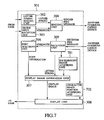
- FIG. 7 is an exemplary diagram showing a schematic structure of a communication device according to another embodiment of the present invention.
- components that have the same functions as those of the components shown in FIG. 3 are denoted by the same reference numerals. The following explanation will be made with reference to FIG. 7. To facilitate understanding, explanation for the components having the same functions as those explained in the above-described embodiment will be omitted.
- the communication device 301 further comprises a background image acquiring unit 701 and a character image position acquiring unit 702, in addition to the components of the above-described embodiment.
- the sending unit 304 sends a sender side message which further specifies a user identifier assigned to each user. Along with this, a receiver side message received by the reception unit 305 specifies a user identifier.
- the user identifier is a string of numbers and letters assigned to a user so as not to assign the same string to other users.
- a user ID for gaining connection to a network and for receiving a chat communication service, an IP address assigned when gaining connection to a network, and a MAC (Media Access Control) address assigned to the NIC 109, etc. may be used as the user identifier.
- the background image acquiring unit 701 acquires background image information which is previously associated with strength information specified in the receiver side message.
- the background image information is pre-stored in the DVD-ROM or the like, and the CPU 101 reads this out in cooperation with the DVD-ROM drive 108.
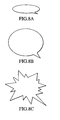
- FIGS. 8 are explanatory diagrams showing examples of the background image information.
- FIG. 8A shows a shape of a figure represented by background image information corresponding to the strength 0 to 31.
- FIG. 8B shows a shape of a figure represented by background image information corresponding to the strength 32 to 223.
- FIG. 8C shows a shape of a figure represented by background image information corresponding to the strength 224 to 255.
- the display image generation unit 307 generates a display image obtained by depicting a letter string specified in the receiver side message in accordance with acquired font information and overlaying the letter string on the acquired background image information.
- the character image position acquiring unit 702 acquires a character image and a character display position which are associated with the user identifier specified in the receiver side message.
- the character image is an image pre-stored in the DVD-ROM or the like, or an image obtained by processing the pre-stored image.
- the CPU 101, (the image processing unit 107), and the DVD-ROM drive 108 acquire the character image in cooperation with each other.
- the character display position associated with the user identifier is pre-set in the RAM 103 or the like.
- a plurality of positions for character display are prepared in advance, so that a position for character display that has not yet been assigned to any user identifier will be assigned when a certain communication device 301 gains connection to the chat communication server.
- the user identifier and the position assigned to this user identifier are broadcast to every communication device 301 that is connected to the chat communication server at that time.
- Each communication device 301 stores the sent user identifier and the position assigned to this user identifier (character display position) in the RAM 103.
- the position of a character controlled by each player may be directly acquired as the character display position.
- the character display position can also be pre-set by determining in step S403 in the above-described embodiment whether the received instruction is an instruction for moving the character, moving the user's own character image in a case where determined that the received instruction is an instruction for moving the character, and broadcasting the position reached by this moving operation to other communication devices 301.
- the display unit 308 further displays the acquired character image at the acquired character display position.
- the figure represented by the background image information be adequately expanded or reduced, so that the letter string can be neatly contained in the figure represented by the background image information. Further, it is preferred that the display image be arranged near the character image.
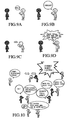
- FIGS. 9 and FIG. 10 are explanatory diagrams showing display examples in a case where a chat process is displayed by "a character and a speech balloon" of the present embodiment.
- the character of the user him/herself is displayed in addition to the character (character image) of the chat partner and the partner's speech (display image).
- display image the character of the chat partner
- the partner's speech display image
- FIG. 10 a scene where chats are exchanged among many users, is represented.
- letter strings are displayed in speech balloons having a shape corresponding to each strength information and in the font size corresponding to each strength information.
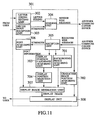
- FIG. 11 is a diagram showing a schematic structure of a communication device according to a yet another embodiment of the present invention. The following explanation will be made with reference to FIG. 11.
- a display position candidate acquiring unit 703 and a display position selection unit 704 are further comprised in addition to the above-described embodiments.
- the display position candidate acquiring unit 703 acquires a plurality of display position candidates associated with a user identifier specified in the received receiver side message.
- a position which is reached by getting far from the acquired character display position in a direction specified in a pair by a distance specified in the same pair is acquired as a display position candidate.
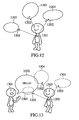
- FIG. 12 is an explanatory diagram showing a positional relationship among a character image, a character display position, display position candidates, and display images (balloon images) which are to be displayed at the respective display position candidates.
- FIG. 12 shows a state where display images 1203 having various shapes are arranged at the respective display position candidates 1202.
- the figures of the display images 1203 may have the same shape, or may have approximately the same shape and approximately the same size in accordance with the positional relationships between the character display position 1201 and the respective display position candidates 1202.
- the positions of the "horns" sticking out from the balloons towards the character are different, and the angles of displaying the balloons are different.
- the basic shape of the balloons is an oval, and the size of the balloons is approximately the same.
- the display position selection unit 704 positions the display image corresponding to the user identifier concerned, at the respective display position candidates, in order to calculate an overlap area occupied together by a display image, of already-displayed display images, that corresponds to a user identifier other than the user identifier concerned and by the display image at the respective display position candidates, and selects one display position candidate at which the display image occupies the smallest overlap area together with the already-displayed display image.
- the display position selection unit 704 may select any of such candidates by a random number, or may prioritize the display position candidates 1202 in advance to select one candidate in accordance with the priority order, or may select the display position candidates 1202 cyclically.
- FIG. 13 is an explanatory diagram for explaining a method of selecting the display position candidates.
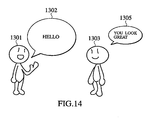
- a display image (balloon image) 1302 is already displayed for a character image 1301, as shown in FIG. 13. Also, in FIG. 13, states of display images (balloon images) provisionally positioned at the respective display position candidates of a character image 1303, are shown by shapes 1304, 1305, and 1306 formed by broken lines.
- the display position candidate corresponding to the shape 1305 is selected.
- the display unit 308 displays the display image corresponding to the user identifier concerned, at the selected display position candidate. As a result, an image shown in FIG. 14 is displayed.
- the present embodiment is an embodiment in which the above-described embodiments are applied to a chat between players' characters put in a virtual three-dimensional space.
- the display position candidate acquiring unit 703 acquires a plurality of display position candidates that are associated with a user identifier specified in the receiver side message, and that are positions included in the virtual three-dimensional space.
- Such display position candidates are equal to the two-dimensional display position candidates shown in FIG. 12 that are expanded in the three-dimensional space in a natural way.
- a display image can be expressed as one plate-like polygon having acquired shape and size.
- a received letter string is depicted on the surface of this plate-like polygon in accordance with acquired font information.
- the display position selection unit 704 makes a calculation for each of the plurality of display position candidates, in order to calculate "the smallest value of an angle formed by a vector extending from a predetermined viewpoint to each display position candidate in the virtual three-dimensional space, and by a vector extending from the predetermined viewpoint to a position in the virtual three-dimensional space of a display image of already-displayed display images, that corresponds to a user identifier other than the user identifier concerned", and selects a display position candidate whose calculated smallest value is the largest of all. By making such a selection, the overlap of display images can automatically be minimized.
- the display unit 308 displays a rendered image of the display image corresponding to the user identifier concerned, that is positioned at the selected display position candidate in the virtual three-dimensional space and that is seen from the predetermined viewpoint.
- the display image of a character who is positioned in a remoter place is displayed as much smaller, and the display image of a character who is positioned in a nearer place is displayed as much larger.
- chat environments corresponding to real world situations where "even if you cry out in a loud voice, someone far apart from you can not hear you clearly", or "even if you whisper in a small voice, someone near you can hear you and someone apart from you can not hear you at all”.
- the display unit 308 may expand the display image to have a size equal to or larger than the predetermined smallest size, in order to ensure that everyone participating in the chat communication can see the contents of the chat.
- the smallest font size may be determined, and a value obtained by dividing "the smallest font size" by "the font size of a case where the display image corresponding to the user identifier concerned is seen from the predetermined viewpoint", may be determined as an expansion rate.
- a communication device further comprises a display time acquiring unit (not shown) in addition to the components included in the above-described embodiments.
- the display time acquiring unit acquires a display time which is associated in advance with strength information specified in the receiver side message.
- the correspondence between strength information and display time is pre-stored in a DVD-ROM or the like. It is preferred that the larger the strength information is, the longer the display time is.
- the display unit 308 starts display of a generated display image, and finishes display of this display image when the acquired display time elapses.
- a communication device and communication method suitable for easily acquiring and transmitting information such as the degree of excitation of a user, etc., and presenting this information to the communication partner, a program for realizing these by a computer, and a computer readable information recording medium storing the program.
Landscapes
- Engineering & Computer Science (AREA)
- Multimedia (AREA)
- Signal Processing (AREA)
- General Engineering & Computer Science (AREA)
- Computer Networks & Wireless Communication (AREA)
- Optics & Photonics (AREA)
- Physics & Mathematics (AREA)
- Human Computer Interaction (AREA)
- User Interface Of Digital Computer (AREA)
- Processing Or Creating Images (AREA)
- Information Transfer Between Computers (AREA)
- Facsimiles In General (AREA)
- Telephone Function (AREA)
Abstract
Description
Claims (15)
- A communication device (301) comprising a letter string editing unit (302), a decide input reception unit (303), a sending unit (304), a reception unit (305), a display image generation unit (307), and a display unit (308), wherein:said letter string editing unit (302) receives an edit instruction for editing a letter string from a user and edits a letter string in accordance with the received edit instruction;said decide input reception unit (303) receives a decide instruction from the user together with an operation strength of the user for inputting the decide instruction;in a case where the decide input is received, said sending unit (304) sends a sender side message specifying the edited letter string and strength information associated with the operation strength, to another communication device which is communicably connected to said communication device;said reception unit (305) receives a receiver side message specifying a letter string to be displayed and strength information, from another communication device communicably connected to said communication device;said display image generation unit (307) generates a display image by depicting the letter string specified in the receiver side message, in accordance with a format which is pre-associated with the strength information specified in the receiver side message; andsaid display unit (308) displays the generated display image.
- A communication device (301) comprising a letter string editing unit (302), a decide input reception unit (303), a sending unit (304), a reception unit (305), a display image generation unit (307), and a display unit (308), wherein:said letter string editing unit (302) receives an edit instruction for editing a letter string from a user together with an operation strength of the user for inputting the edit instruction, and edits a letter string in accordance with the edit instruction;said decide input reception unit (303) receives a decide instruction from the user;in a case where the decide instruction is received, said sending unit (304) sends a sender side message specifying the edited letter string and strength information associated with the operation strength, to another communication device which is communicably connected to said communication device;said reception unit (305) receives a receiver side message specifying a letter string to be displayed and strength information from another communication device communicably connected to said communication device;said display image generation unit (307) displays a display image by depicting the letter string specified in the receiver side message, in accordance with a format which is pre-associated with the strength information specified in the receiver side message; andsaid display unit (308) displays the generated display image.
- The communication device (301) according to claim 1 or 2, further comprising a font acquiring unit (306), wherein:said font acquiring unit (306) acquires font information designating a font having a size which is pre-associated with the strength information specified in the receiver side message; andsaid display image generation unit (307) generates the display image by depicting the letter string specified in the receiver side message in accordance with the acquired font information.
- The communication device (301) according to any one of claims 1 and 2, further comprising a background image acquiring unit (701), wherein:said background image acquiring unit (701) acquires background image information which is pre-associated with the strength information specified in the receiver side message; andsaid display image generation unit (307) displays the display image by depicting the letter string specified in the receiver side message in accordance with the acquired font information, and by overlaying the letter string on the acquired background image information.
- The communication device (301) according to claim 1 or 2, further comprising a display time acquiring unit, wherein:said display time acquiring unit acquires a display time which is pre-associated with the strength information specified in the receiver side message; andsaid display unit (308) finishes display of the generated display image, when the acquired display time passes after display of the display image is started.
- The communication device (301) according to claim 1, further comprising a display position candidate acquiring unit (703) and a display position selection unit (704), wherein:said sending unit (304) sends the sender side message in which a user identifier assigned to the user is further specified;a user identifier is further specified in the receiver side message received by said reception unit (305);said display position candidate acquiring unit (703) acquires a plurality of display position candidates which are associated with the user identifier specified in the received receiver side message;said display position selection unit (704) provisionally displays the display image corresponding to the user identifier specified in the receiver side message, at the respective acquired display position candidates, in order to calculate an overlap area which is occupied together by any already-displayed display image corresponding to a user identifier other than the specified user identifier and by the provisionally-displayed display image at the respective acquired display position candidates, and selects one display position candidate at which the overlap area becomes the smallest of all the overlap areas calculated for the respective acquired display position candidates; andsaid display unit (308) displays the display image corresponding to the specified user identifier at the selected display position candidate.
- The communication device according to claim 1, further comprising a display position candidate acquiring unit (703) and a display position selection unit (704), wherein:said sending unit (304) sends the sender side message in which a user identifier assigned to the user is further specified;a user identifier is further specified in the receiver side message received by said reception unit (305);said display position candidate acquiring unit (703) acquires a plurality of display position candidates which are associated with the user identifier specified in the receiver side message and which are positions in a virtual three-dimensional space;said display position selection unit (704) calculates "a smallest value of an angle formed by a vector extending from a predetermined viewpoint to each of the plurality of acquired display position candidates in the virtual three-dimensional space, and by a vector extending from the predetermined viewpoint to a position in the virtual three-dimensional space of any already-displayed display image corresponding to a user identifier other than the user identifier specified in the receiver side message", and selects one display position candidate whose calculated smallest value is the largest of all the calculated smallest values; andsaid display unit (308) displays a rendered image of the display image corresponding to the specified user identifier, which is arranged at the selected display position candidate in the virtual three-dimensional space, and which is seen from the predetermined viewpoint.
- The communication device (301) according to claim 7, whereinin a case where a size when seen from the predetermined viewpoint, of the display image corresponding to the specified user identifier which is arranged at the selected display position candidate in the virtual three-dimensional space, is smaller than a predetermined smallest size, the display unit (308) expands the display image to have a size equal to or larger than the predetermined smallest size.
- The communication device (301) according to any one of claims 6 to 8, further comprising a character image position acquiring unit (702), wherein:said character image position acquiring unit (702) acquires a character image and a character display position which are associated with the user identifier specified in the receiver side message;said display position candidate acquiring unit (703) refers to each of a plurality of pairs of directions and distances, and acquires as a display position candidate, a position which is apart from the acquired character display position in a direction in a pair, by a distance in the same pair; andsaid display unit (308) further displays the acquired character image at the acquired character display position.
- A communication method comprising a letter string editing step, a decide input receiving step, a sending step, a receiving step, a font acquiring step, a display image generating step, and a displaying step, wherein:said letter string editing step receives an edit instruction for editing a letter string from a user and edits a letter string in accordance with the edit instruction;said decide input receiving step receives a decide instruction from the user together with an operation strength of the user for inputting the decide instruction;in a case where the decide instruction is received, said sending step sends a sender side message specifying the edited letter string and strength information associated with the operation strength, to another communication device;said receiving step receives a receiver side message specifying a letter string to be displayed and strength information from another communication device;said font acquiring step acquires font information designating a font having a size which is pre-associated with the strength information specified in the receiver side message;said display image generating step generates a display image by depicting the letter string specified in the receiver side message in accordance with the acquired font information; andsaid displaying step displays the generated display image.
- A communication method comprising a letter string editing step, a decide input receiving step, a sending step, a receiving step, a font acquiring step, a display image generating step, and a displaying step, wherein:said letter string editing step receives an edit instruction for editing a letter string from a user together with an operation strength of the user for inputting the editing instruction, and edits a letter string in accordance with the edit instruction;said decide input receiving step receives a decide instruction from the user;in a case where the decide instruction is received, said sending step sends a sender side message specifying the edited letter string and strength information associated with the operation strength to another communication device;said receiving step receives a receiver side message specifying a letter string to be displayed and strength information from another communication device;said font acquiring step acquires font information designating a font having a size which is pre-associated with the strength information specified in the receiver side message;said display image generating step generates a display image by depicting the letter string specified in the receiver side message in accordance with the acquired font information; andsaid displaying image displays the generated display image.
- A program for controlling a computer (including a game console which is communicably connected to another game console via a computer communication network) to function as a letter string editing unit (302), a decide input reception unit (303), a sending unit (304), a reception unit (305), a display image generation unit (307), and a display unit (308), wherein said program controls, in said computer:said letter string editing unit (302) to receive an edit instruction for editing a letter string from a user and edit a letter string in accordance with the received edit instruction;said decide input reception unit (303) to receive a decide instruction from the user together with an operation strength of the user for inputting the decide instruction;in a case where the decide input is received, said sending unit (304) to send a sender side message specifying the edited letter string and strength information associated with the operation strength, to another communication device which is communicably connected to said communication device;said reception unit (305) to receive a receiver side message specifying a letter string to be displayed and strength information, from another communication device communicably connected to said communication device;said display image generation unit (307) to generate a display image by depicting the letter string specified in the receiver side message, in accordance with a format which is pre-associated with the strength information specified in the receiver side message; andsaid display unit (308) to display the generated display image.
- A program for controlling a computer (including a game console which is communicably connected to another game console via a computer communication network) to function as a letter string editing unit (302), a decide input reception unit (303), a sending unit (304), a reception unit (305), a display image generation unit (307), and a display unit (308), wherein said program controls, in said computer:said letter string editing unit (302) to receive an edit instruction for editing a letter string from a user together with an operation strength of the user for inputting the edit instruction and edit a letter string in accordance with the edit instruction;said decide input reception unit (303) to receive a decide instruction from the user;in a case where the decide instruction is received, said sending unit (304) to send a sender side message specifying the edited letter string and strength information associated with the operation strength, to another communication device which is communicably connected to said communication device;said reception unit (305) to receive a receiver side message specifying a letter string to be displayed and strength information from another communication device communicably connected to said communication device;said display image generation unit (307) to display a display image by depicting the letter string specified in the receiver side message, in accordance with a format which is pre-associated with the strength information specified in the receiver side message; andsaid display unit (308) to display the generated display image.
- A computer readable information recording medium storing a program for controlling a computer (including a game console which is communicably connected to another game console via a computer communication network) to function as a letter string editing unit (302), a decide input reception unit (303), a sending unit (304), a reception unit (305), a display image generation unit (307), and a display unit (308), wherein said program controls, in said computer:said letter string editing unit (302) to receive an edit instruction for editing a letter string from a user and edit a letter string in accordance with the received edit instruction;said decide input reception unit (303) to receive a decide instruction from the user together with an operation strength of the user for inputting the decide instruction;in a case where the decide input is received, said sending unit (304) to send a sender side message specifying the edited letter string and strength information associated with the operation strength, to another communication device which is communicably connected to said communication device;said reception unit (305) to receive a receiver side message specifying a letter string to be displayed and strength information, from another communication device communicably connected to said communication device;said display image generation unit (307) to generate a display image by depicting the letter string specified in the receiver side message, in accordance with a format which is pre-associated with the strength information specified in the receiver side message; andsaid display unit (308) to display the generated display image.
- A computer readable information recording medium storing a program for controlling a computer (including a game console which is communicably connected to another game console via a computer communication network) to function as a letter string editing unit (302), a decide input reception unit (303), a sending unit (304), a reception unit (305), a display image generation unit (307), and a display unit (308), wherein said program controls, in said computer:said letter string editing unit (302) to receive an edit instruction for editing a letter string from a user together with an operation strength of the user for inputting the edit instruction and edit a letter string in accordance with the edit instruction;said decide input reception unit (303) to receive a decide instruction from the user;in a case where the decide instruction is received, said sending unit (304) to send a sender side message specifying the edited letter string and strength information associated with the operation strength, to another communication device which is communicably connected to said communication device;said reception unit (305) to receive a receiver side message specifying a letter string to be displayed and strength information from another communication device communicably connected to said communication device;said display image generation unit (307) to display a display image by depicting the letter string specified in the receiver side message, in accordance with a format which is pre-associated with the strength information specified in the receiver side message; andsaid display unit (308) to display the generated display image.
Applications Claiming Priority (3)
| Application Number | Priority Date | Filing Date | Title |
|---|---|---|---|
| JP2002287536A JP2004126786A (en) | 2002-09-30 | 2002-09-30 | Communication device, program and communication method |
| JP2002287536 | 2002-09-30 | ||
| PCT/JP2003/012418 WO2004028652A1 (en) | 2002-09-30 | 2003-09-29 | Communication device, communication method, program, and information recording medium |
Publications (2)
| Publication Number | Publication Date |
|---|---|
| EP1561497A1 true EP1561497A1 (en) | 2005-08-10 |
| EP1561497A4 EP1561497A4 (en) | 2008-01-16 |
Family
ID=32025402
Family Applications (1)
| Application Number | Title | Priority Date | Filing Date |
|---|---|---|---|
| EP03755687A Withdrawn EP1561497A4 (en) | 2002-09-30 | 2003-09-29 | Communication device, communication method, program, and information recording medium |
Country Status (7)
| Country | Link |
|---|---|
| US (1) | US7546536B2 (en) |
| EP (1) | EP1561497A4 (en) |
| JP (1) | JP2004126786A (en) |
| CN (1) | CN100428973C (en) |
| AU (1) | AU2003273588A1 (en) |
| TW (1) | TWI256563B (en) |
| WO (1) | WO2004028652A1 (en) |
Families Citing this family (32)
| Publication number | Priority date | Publication date | Assignee | Title |
|---|---|---|---|---|
| US6993553B2 (en) * | 2000-12-19 | 2006-01-31 | Sony Corporation | Data providing system, data providing apparatus and method, data acquisition system and method, and program storage medium |
| JP4163718B2 (en) | 2006-02-28 | 2008-10-08 | 株式会社コナミデジタルエンタテインメント | Object display device, object arrangement method, and program |
| US9304675B2 (en) | 2006-09-06 | 2016-04-05 | Apple Inc. | Portable electronic device for instant messaging |
| US8564544B2 (en) | 2006-09-06 | 2013-10-22 | Apple Inc. | Touch screen device, method, and graphical user interface for customizing display of content category icons |
| KR101058040B1 (en) * | 2006-12-21 | 2011-08-19 | 삼성전자주식회사 | Content output method and device therefor |
| EP2127209A2 (en) * | 2007-02-28 | 2009-12-02 | France Telecom | Information transmission method for collectively rendering emotional information |
| US8122356B2 (en) * | 2007-10-03 | 2012-02-21 | Eastman Kodak Company | Method for image animation using image value rules |
| JP5386118B2 (en) * | 2008-06-26 | 2014-01-15 | 株式会社タイトー | Game device, game program |
| JP5791236B2 (en) * | 2010-05-10 | 2015-10-07 | キヤノン株式会社 | Information processing apparatus, information processing apparatus control method, and program |
| JP5459856B2 (en) * | 2010-07-13 | 2014-04-02 | サミー株式会社 | Pachinko machine |
| JP5197705B2 (en) * | 2010-09-24 | 2013-05-15 | ヤフー株式会社 | Terminal, method and program for displaying information |
| JP5674450B2 (en) * | 2010-12-22 | 2015-02-25 | 富士フイルム株式会社 | Electronic comic viewer device, electronic comic browsing system, viewer program, recording medium on which the viewer program is recorded, and electronic comic display method |
| JP5462828B2 (en) * | 2011-03-29 | 2014-04-02 | 株式会社コナミデジタルエンタテインメント | Selection device, selection method, and program |
| BR112015008168B1 (en) | 2012-10-15 | 2021-11-23 | Sony Computer Entertainment Inc | OPERATING DEVICE |
| CN104704455B (en) * | 2012-10-15 | 2017-09-01 | 索尼电脑娱乐公司 | Operation device |
| US9436357B2 (en) * | 2013-03-08 | 2016-09-06 | Nook Digital, Llc | System and method for creating and viewing comic book electronic publications |
| JP5971770B2 (en) * | 2014-01-10 | 2016-08-17 | サミー株式会社 | Pachinko machine |
| JP6454106B2 (en) * | 2014-09-04 | 2019-01-16 | 株式会社コロプラ | Emotional text display program, method and system |
| KR102306538B1 (en) * | 2015-01-20 | 2021-09-29 | 삼성전자주식회사 | Apparatus and method for editing content |
| CN104917892A (en) * | 2015-05-29 | 2015-09-16 | 努比亚技术有限公司 | Adjusting method for fonts of terminal device and terminal device |
| JP5864018B1 (en) * | 2015-06-11 | 2016-02-17 | 株式会社コロプラ | Computer program |
| JP6696739B2 (en) * | 2015-07-13 | 2020-05-20 | 株式会社コロプラ | Computer program for supporting user input |
| JP2017023238A (en) * | 2015-07-17 | 2017-02-02 | 株式会社コロプラ | Computer program |
| JP6448500B2 (en) * | 2015-08-07 | 2019-01-09 | キヤノン株式会社 | Image processing apparatus and image processing method |
| JP6156554B2 (en) * | 2016-06-24 | 2017-07-05 | サミー株式会社 | Pachinko machine |
| JP2017182841A (en) * | 2017-06-28 | 2017-10-05 | 株式会社スクウェア・エニックス | Communication terminal, display method, and program |
| US10810327B2 (en) * | 2018-01-05 | 2020-10-20 | Intel Corporation | Enforcing secure display view for trusted transactions |
| CN108521369B (en) * | 2018-04-03 | 2021-03-09 | 平安科技(深圳)有限公司 | Information transmission method, receiving terminal device and sending terminal device |
| JP7108514B2 (en) | 2018-10-24 | 2022-07-28 | 株式会社スクウェア・エニックス | Communication terminal, display method and program |
| JP7286967B2 (en) * | 2019-01-08 | 2023-06-06 | 京セラドキュメントソリューションズ株式会社 | Display device and display control program |
| JP7363235B2 (en) * | 2019-09-10 | 2023-10-18 | 富士フイルムビジネスイノベーション株式会社 | Information processing device and information processing program |
| US12432080B2 (en) * | 2022-11-14 | 2025-09-30 | Microsoft Technology Licensing, Llc | Persistent display of prioritized participants with shared content of communication sessions |
Family Cites Families (22)
| Publication number | Priority date | Publication date | Assignee | Title |
|---|---|---|---|---|
| US5757360A (en) | 1995-05-03 | 1998-05-26 | Mitsubishi Electric Information Technology Center America, Inc. | Hand held computer control device |
| JPH09138767A (en) * | 1995-11-14 | 1997-05-27 | Fujitsu Ten Ltd | Communication device for emotional expression |
| JPH10261099A (en) * | 1997-03-17 | 1998-09-29 | Casio Comput Co Ltd | Image processing device |
| US6392667B1 (en) * | 1997-06-09 | 2002-05-21 | Aprisma Management Technologies, Inc. | Method and apparatus for representing objects as visually discernable entities based on spatial definition and perspective |
| US6025841A (en) * | 1997-07-15 | 2000-02-15 | Microsoft Corporation | Method for managing simultaneous display of multiple windows in a graphical user interface |
| JPH11143616A (en) * | 1997-11-10 | 1999-05-28 | Sega Enterp Ltd | Character communication device |
| JP3216084B2 (en) * | 1998-01-19 | 2001-10-09 | 株式会社ネットワークコミュニティクリエイション | Chat screen display method |
| JP2000172392A (en) * | 1998-12-07 | 2000-06-23 | Nippon Telegr & Teleph Corp <Ntt> | Emotion information expression processing method, expression device thereof, and recording medium storing program describing the processing method |
| JP3301983B2 (en) * | 1999-01-12 | 2002-07-15 | 富士通株式会社 | Interactive communication device and method using characters |
| JP2001034410A (en) * | 1999-07-26 | 2001-02-09 | Matsushita Electric Ind Co Ltd | Kansei input device and Kansei estimation method |
| JP3581642B2 (en) * | 1999-09-02 | 2004-10-27 | 株式会社ソニー・コンピュータエンタテインメント | Entertainment system, entertainment device, recording medium, and message display method |
| JP2001084441A (en) * | 1999-09-13 | 2001-03-30 | Matsushita Refrig Co Ltd | vending machine |
| US6929547B2 (en) * | 2000-01-14 | 2005-08-16 | Sony Computer Entertainment Inc. | Recording medium, method of using a computer and computer for executing role-playing games |
| JP3621861B2 (en) * | 2000-02-16 | 2005-02-16 | 日本電信電話株式会社 | Conversation information presentation method and immersive virtual communication environment system |
| JP2001236162A (en) * | 2000-02-24 | 2001-08-31 | Sony Computer Entertainment Inc | Entertainment device, recording medium, and computer program |
| US6784901B1 (en) * | 2000-05-09 | 2004-08-31 | There | Method, system and computer program product for the delivery of a chat message in a 3D multi-user environment |
| JP2001325200A (en) * | 2000-05-12 | 2001-11-22 | Ricoh Elemex Corp | Chat system |
| JP2002082894A (en) * | 2000-06-29 | 2002-03-22 | Atr Media Integration & Communications Res Lab | Community environment providing system and object expression control device |
| JP3818428B2 (en) * | 2000-09-21 | 2006-09-06 | 株式会社セガ | Character communication device |
| KR100377936B1 (en) | 2000-12-16 | 2003-03-29 | 삼성전자주식회사 | Method for inputting emotion icon in mobile telecommunication terminal |
| JP2002202943A (en) * | 2000-12-28 | 2002-07-19 | Square Co Ltd | A video game apparatus and a control method thereof, a video game program and a computer-readable recording medium recording the program. |
| JP2002251365A (en) * | 2001-02-21 | 2002-09-06 | Square Co Ltd | Electronic conference system, client thereof, electronic conference method, and client program |
-
2002
- 2002-09-30 JP JP2002287536A patent/JP2004126786A/en active Pending
-
2003
- 2003-09-26 US US10/672,478 patent/US7546536B2/en not_active Expired - Fee Related
- 2003-09-29 WO PCT/JP2003/012418 patent/WO2004028652A1/en not_active Ceased
- 2003-09-29 AU AU2003273588A patent/AU2003273588A1/en not_active Abandoned
- 2003-09-29 CN CNB038155125A patent/CN100428973C/en not_active Expired - Fee Related
- 2003-09-29 EP EP03755687A patent/EP1561497A4/en not_active Withdrawn
- 2003-09-30 TW TW092126971A patent/TWI256563B/en not_active IP Right Cessation
Also Published As
| Publication number | Publication date |
|---|---|
| AU2003273588A1 (en) | 2004-04-19 |
| WO2004028652A1 (en) | 2004-04-08 |
| US7546536B2 (en) | 2009-06-09 |
| EP1561497A4 (en) | 2008-01-16 |
| TW200410085A (en) | 2004-06-16 |
| US20040064498A1 (en) | 2004-04-01 |
| HK1081891A1 (en) | 2006-05-26 |
| CN100428973C (en) | 2008-10-29 |
| JP2004126786A (en) | 2004-04-22 |
| TWI256563B (en) | 2006-06-11 |
| CN1665572A (en) | 2005-09-07 |
Similar Documents
| Publication | Publication Date | Title |
|---|---|---|
| US7546536B2 (en) | Communication device, communication method, and computer usable medium | |
| JP3679350B2 (en) | Program, information storage medium and computer system | |
| US8727883B2 (en) | Messaging service for video game systems | |
| JP3818428B2 (en) | Character communication device | |
| US8137191B2 (en) | Game device, message display method, information recording medium and program | |
| CA3045132C (en) | Communication with augmented reality virtual agents | |
| US20100085355A1 (en) | Image Generating Apparatus, Image Processing Method, Information Recording Medium, and Program | |
| JP2017217352A (en) | Information processing program, information processing device, information processing system, and information processing method | |
| JP2009027423A (en) | Communicating system, communication device, communication program, and computer-readable storage medium in which communication program is stored | |
| JP3424822B2 (en) | Network game system | |
| JP2005235142A (en) | Inter-user intimacy measurement system and inter-user intimacy measurement program | |
| JP2003150978A5 (en) | ||
| EP1994970A1 (en) | Communication game system, communication game control method, information recording medium, and program | |
| KR100878964B1 (en) | Computer readable information recording medium recording game device, game device control method and program | |
| CN111790153A (en) | Object display method and device, electronic equipment and computer-readable storage medium | |
| JP2008212269A (en) | GAME DEVICE, CHARACTER CONTROL METHOD, AND PROGRAM | |
| JP2012050791A (en) | Character display device, character display method, and program | |
| JP2003290549A (en) | Network game system, game device, and program | |
| KR20050016674A (en) | Communication device, communication method, program, and information recording medium | |
| HK1081891B (en) | Communication device and communication method | |
| WO2026068681A1 (en) | Influencing of user utterances in a dialogue system | |
| JP2009205101A (en) | Voice processing device, voice processing method, and program |
Legal Events
| Date | Code | Title | Description |
|---|---|---|---|
| PUAI | Public reference made under article 153(3) epc to a published international application that has entered the european phase |
Free format text: ORIGINAL CODE: 0009012 |
|
| 17P | Request for examination filed |
Effective date: 20041227 |
|
| AK | Designated contracting states |
Kind code of ref document: A1 Designated state(s): AT BE BG CH CY CZ DE DK EE ES FI FR GB GR HU IE IT LI LU MC NL PT RO SE SI SK TR |
|
| AX | Request for extension of the european patent |
Extension state: AL LT LV MK |
|
| DAX | Request for extension of the european patent (deleted) | ||
| RBV | Designated contracting states (corrected) |
Designated state(s): DE FR GB |
|
| A4 | Supplementary search report drawn up and despatched |
Effective date: 20071219 |
|
| RAP1 | Party data changed (applicant data changed or rights of an application transferred) |
Owner name: KONAMI DIGITAL ENTERTAINMENT CO., LTD. |
|
| 17Q | First examination report despatched |
Effective date: 20100127 |
|
| STAA | Information on the status of an ep patent application or granted ep patent |
Free format text: STATUS: THE APPLICATION IS DEEMED TO BE WITHDRAWN |
|
| 18D | Application deemed to be withdrawn |
Effective date: 20100608 |