EP1559754A1 - Ink composition - Google Patents
Ink composition Download PDFInfo
- Publication number
- EP1559754A1 EP1559754A1 EP03769950A EP03769950A EP1559754A1 EP 1559754 A1 EP1559754 A1 EP 1559754A1 EP 03769950 A EP03769950 A EP 03769950A EP 03769950 A EP03769950 A EP 03769950A EP 1559754 A1 EP1559754 A1 EP 1559754A1
- Authority
- EP
- European Patent Office
- Prior art keywords
- ink composition
- group
- cyclic group
- water
- compound
- Prior art date
- Legal status (The legal status is an assumption and is not a legal conclusion. Google has not performed a legal analysis and makes no representation as to the accuracy of the status listed.)
- Granted
Links
- 0 CCN1N(*)O[C@](C)(*)C(*)ON1* Chemical compound CCN1N(*)O[C@](C)(*)C(*)ON1* 0.000 description 1
Classifications
-
- C—CHEMISTRY; METALLURGY
- C09—DYES; PAINTS; POLISHES; NATURAL RESINS; ADHESIVES; COMPOSITIONS NOT OTHERWISE PROVIDED FOR; APPLICATIONS OF MATERIALS NOT OTHERWISE PROVIDED FOR
- C09D—COATING COMPOSITIONS, e.g. PAINTS, VARNISHES OR LACQUERS; FILLING PASTES; CHEMICAL PAINT OR INK REMOVERS; INKS; CORRECTING FLUIDS; WOODSTAINS; PASTES OR SOLIDS FOR COLOURING OR PRINTING; USE OF MATERIALS THEREFOR
- C09D11/00—Inks
- C09D11/02—Printing inks
- C09D11/03—Printing inks characterised by features other than the chemical nature of the binder
-
- C—CHEMISTRY; METALLURGY
- C09—DYES; PAINTS; POLISHES; NATURAL RESINS; ADHESIVES; COMPOSITIONS NOT OTHERWISE PROVIDED FOR; APPLICATIONS OF MATERIALS NOT OTHERWISE PROVIDED FOR
- C09D—COATING COMPOSITIONS, e.g. PAINTS, VARNISHES OR LACQUERS; FILLING PASTES; CHEMICAL PAINT OR INK REMOVERS; INKS; CORRECTING FLUIDS; WOODSTAINS; PASTES OR SOLIDS FOR COLOURING OR PRINTING; USE OF MATERIALS THEREFOR
- C09D11/00—Inks
- C09D11/30—Inkjet printing inks
- C09D11/32—Inkjet printing inks characterised by colouring agents
- C09D11/328—Inkjet printing inks characterised by colouring agents characterised by dyes
-
- B—PERFORMING OPERATIONS; TRANSPORTING
- B41—PRINTING; LINING MACHINES; TYPEWRITERS; STAMPS
- B41J—TYPEWRITERS; SELECTIVE PRINTING MECHANISMS, i.e. MECHANISMS PRINTING OTHERWISE THAN FROM A FORME; CORRECTION OF TYPOGRAPHICAL ERRORS
- B41J2/00—Typewriters or selective printing mechanisms characterised by the printing or marking process for which they are designed
- B41J2/005—Typewriters or selective printing mechanisms characterised by the printing or marking process for which they are designed characterised by bringing liquid or particles selectively into contact with a printing material
- B41J2/01—Ink jet
-
- B—PERFORMING OPERATIONS; TRANSPORTING
- B41—PRINTING; LINING MACHINES; TYPEWRITERS; STAMPS
- B41M—PRINTING, DUPLICATING, MARKING, OR COPYING PROCESSES; COLOUR PRINTING
- B41M5/00—Duplicating or marking methods; Sheet materials for use therein
-
- C—CHEMISTRY; METALLURGY
- C07—ORGANIC CHEMISTRY
- C07C—ACYCLIC OR CARBOCYCLIC COMPOUNDS
- C07C49/00—Ketones; Ketenes; Dimeric ketenes; Ketonic chelates
- C07C49/92—Ketonic chelates
-
- C—CHEMISTRY; METALLURGY
- C09—DYES; PAINTS; POLISHES; NATURAL RESINS; ADHESIVES; COMPOSITIONS NOT OTHERWISE PROVIDED FOR; APPLICATIONS OF MATERIALS NOT OTHERWISE PROVIDED FOR
- C09D—COATING COMPOSITIONS, e.g. PAINTS, VARNISHES OR LACQUERS; FILLING PASTES; CHEMICAL PAINT OR INK REMOVERS; INKS; CORRECTING FLUIDS; WOODSTAINS; PASTES OR SOLIDS FOR COLOURING OR PRINTING; USE OF MATERIALS THEREFOR
- C09D11/00—Inks
- C09D11/02—Printing inks
- C09D11/03—Printing inks characterised by features other than the chemical nature of the binder
- C09D11/037—Printing inks characterised by features other than the chemical nature of the binder characterised by the pigment
-
- C—CHEMISTRY; METALLURGY
- C09—DYES; PAINTS; POLISHES; NATURAL RESINS; ADHESIVES; COMPOSITIONS NOT OTHERWISE PROVIDED FOR; APPLICATIONS OF MATERIALS NOT OTHERWISE PROVIDED FOR
- C09K—MATERIALS FOR MISCELLANEOUS APPLICATIONS, NOT PROVIDED FOR ELSEWHERE
- C09K11/00—Luminescent materials, e.g. electroluminescent or chemiluminescent
- C09K11/06—Luminescent materials, e.g. electroluminescent or chemiluminescent containing organic luminescent materials
-
- C—CHEMISTRY; METALLURGY
- C09—DYES; PAINTS; POLISHES; NATURAL RESINS; ADHESIVES; COMPOSITIONS NOT OTHERWISE PROVIDED FOR; APPLICATIONS OF MATERIALS NOT OTHERWISE PROVIDED FOR
- C09K—MATERIALS FOR MISCELLANEOUS APPLICATIONS, NOT PROVIDED FOR ELSEWHERE
- C09K2211/00—Chemical nature of organic luminescent or tenebrescent compounds
- C09K2211/18—Metal complexes
- C09K2211/182—Metal complexes of the rare earth metals, i.e. Sc, Y or lanthanide
Definitions
- the present invention relates to a recording material.
- the present invention relates, particularly, to an ink composition which provides a print record which is colorless and cannot be therefore invisible to the naked eye under visible light, but develops a color and is visible under the radiation of ultraviolet rays.
- a tris(thenoyltrifluoroacetonate)europium complex, a tris(benzoyltrifluoroacetonate)europium complex and the like are known compounds which are colorless under visible light but emit red light under the radiation of ultraviolet rays and are applied to various inks (see, for example, Patent Documents 1 and 2).
- Patent Documents 1 and 2 the complexes superior in stability and durability have insufficient solubility in solvents, especially, water-containing solvents and are therefore limited in its applications.
- the inventors of the present invention have made earnest studies to solve the above problem and as a result, found that a specific europium compound (complex) solves the above problem, to complete the present invention.
- the present invention relates to:
- the europium compound (A) in the present invention is one represented by the aforementioned formula (1).
- X in the formula (1) represents an aromatic cyclic group or a heterocyclic group which may have a substituent.
- the aromatic cyclic group include a benzene cyclic group, naphthalene cyclic group, anthracene cyclic group, azulene cyclic group and phenanthrene cyclic group.
- heterocyclic group examples include a pyridine cyclic group, thiophene cyclic group, furan cyclic group, pyrazine cyclic group, thiazole cyclic group, oxazole cyclic group, quinoline cyclic group and indole cyclic group.
- Preferable examples include a benzene ring, naphthalene ring, pyridine ring, thiophene ring and furan ring.
- substituent which X may have include an alkyl group, alkoxyl group, aromatic cyclic group, heterocyclic group, amino group, alkylamino group, dialkylamino group, hydroxyl group, aralkyl group and halogen atom.
- Preferable examples include a halogen atom and alkyl group.
- Y represents a fluoride hydrocarbon group having 1 to 10 carbon atoms.
- the fluoride hydrocarbon group include perfluoroalkyl groups such as a trifluoromethyl group, pentafluoroethyl group, heptafluoropropyl group and heptadecafluorooctane; monofluoromethyl groups, difluoromethyl groups, trifluoroethyl groups, tetrafluoropropyl groups and octafluoropentyl groups.
- Preferable examples include perfluoroalkyl groups such as a trifluoromethyl group, pentafluoroethyl group and heptadecafluorooctane group. More preferable examples include a trifluoromethyl group.
- M represents an alkali metal or an alkali earth metal. M is necessary to neutralize the plus charge of europium. The amount of M to be required per 1 mol of europium is 1 mol in the case of an alkali metal and 1/2 mol in the case of an alkali earth metal.
- the alkali metal include lithium, sodium, potassium, rubidium, cesium and francium.
- the alkali earth metal include beryllium, magnesium, calcium, strontium, barium and radium.
- Preferable examples include lithium, sodium, potassium, magnesium and calcium and more preferable examples include lithium, sodium and potassium.
- X is a naphthalene cyclic group or a thiophene cyclic group
- Y is a trifluoromethyl group
- M is lithium or sodium.
- the compound of the formula (1) may be synthesized in the following manner.
- the compound is easily synthesized by adding, for example, europium perchlorate or europium chloride in an alcohol or acetone solvent in the presence of a diketone derivative and an alkali agent, such as sodium hydroxide or potassium hydroxide, selected as the M source and by running a reaction at usually 0°C to 80°C.
- a diketone derivative such as sodium hydroxide or potassium hydroxide
- the structure of the cation affords opportunity for formation of an unstable complex and a complex which cannot be isolated stably, but permits the presence of a complex which can be isolated stably under controlled pH and temperature.
- Specific examples of the compound of the formula (1) are shown in Table 1.
- a benzene ring is represented by Ph, a naphthalene ring by Np, a pyridine ring by Py, a thiophene ring by Th, a furan ring by Fu and a benzyl group by Bz.
- the ink composition of the present invention contains at least one of the europium compounds represented by the formula (1) (or its mixture, the same as follows)
- a compound having a small content of inorganic salts is preferable.
- a compound having a particularly small content of inorganic salts is preferable.
- a method using a reverse osmosis membrane a method of washing with water or a method of cleansing treatment with water, optionally using a lower alcohol such as methanol, ethanol or isopropanol.
- the content of the europium compound (A) of the formula (1) is 0.001 to 10% by weight and preferably 0.01 to 4% by weight in the ink composition of the present invention.
- a preferable example of the binder (B) is an emulsion of a water-soluble high-molecular compound or a hydrophobic high-molecular compound.
- water-soluble high-molecular compound which may be used are water-soluble compounds including a polyethylene glycol, polypropylene glycol, polyethylene glycol/polypropylene glycol block copolymer, polyethyleneimine, methyl cellulose, methoxy cellulose, hydroxyethyl cellulose, carboxymethyl cellulose, sodium carboxymethyl cellulose, cellulose, polyvinyl alcohol (PVA), modified polyvinyl alcohols such as a carboxyl group modified polyvinyl alcohol and sulfonic acid group modified polyvinyl alcohol, polyvinyl pyrrolidone, polyvinyl pyrrolidone/vinyl acetate copolymer, polyacrylamide, polyacrylic acid, starch and its derivatives, casein, gelatin, water-soluble isoprene rubber, alkali salt of a styrene/maleic acid copolymer, methyl vinyl ether/maleic acid anhydride copolymer, iso (or diiso)butylene glycol
- Examples of the emulsions of hydrophobic high-molecular compounds include emulsions of hydrophobic high-molecular compounds such as a styrene/butadiene (SB) copolymer, styrene/maleic acid anhydride copolymer, styrene carboxylate/butadiene (SB) copolymer, styrene/butadiene/acrylic acid copolymer, polyvinyl acetate, polyvinyl chloride, vinyl chloride/vinyl acetate copolymer, polystyrene, acrylic resin, acryl/styrene resin, polyacrylate, polyester, polycarbonate, polyurethane, polybutyral, epoxy resin, furan resin, vinyltoluene resin and rosin ester resin, and emulsions of these hydrophobic high-polymer compounds made to be self-emulsifiable by compounding a base or a polyethylene oxide in these compounds
- the binder (B) is preferably a compound which is itself solid at ambient temperature (about 5 to 35°C) and is preferably a water-soluble high-molecular compound. Also, the binder (B) is preferably a polyvinyl alcohol or a modified polyvinyl alcohol in consideration of the drying characteristics and stickiness of the coating film after printing. The binder (B) is more preferably a carboxyl group or sulfonic acid modified polyvinyl alcohol having a polymerization degree of 150 to 2000, a saponification value of 70 to 99 mol% and a carboxylic acid group or a sulfonic acid group in an amount of 0.01 to 5 mol% based on the copolymer.
- a polymer having a cyclic amide group in the molecular structure is suitable in consideration of the emission intensity of the coating film.
- the polymer having a cyclic amide group in the molecular structure include polymers obtained by homo-polymerizing monomers having a cyclic amide group such as N-vinyl pyrrolidone, N-vinyl piperidone and N-vinyl caprolactam or by copolymerizing these monomers with other monomers.
- polymers include a polyvinylpyrrolidone, polyvinylcaprolactam, polyvinylpyrrolidone/acetic acid copolymer, vinylpyrrolidone/vinylcaprolactam copolymer, vinylpyrrolidone/vinylimidazole copolymer, vinylpyrrolidone/acrylic acid copolymer, vinylpyrrolidone/methacrylic acid copolymer and vinylpyrrolidone/3-methyl-1-vinylimidazolium salt copolymer.
- the binder is not limited to these polymers and any polymer may be used as the binder insofar as it has a cyclic amide group in its structure and is soluble in water or a mixed solvent of water and an organic solvent.
- a polymer is preferable in which the ratio of polymerization of the monomer having a cyclic amide group is 30% or more in the polymer.
- the polymer having at least a cyclic amide group in the structure those having a molecular weight of 4000 to 2000000, preferably 5000 to 1000000 and more preferably 5000 to 60000 may be used in consideration of the stability and viscosity of the ink composition.
- the content of the binder (B) is 0.01% to 20% by weight and preferably 0.1% by weight to 15% by weight in the aqueous ink composition of the present invention in consideration of the stability of the ink and viscosity of the ink during use.
- the aqueous medium (C) of the present invention is water or a mixture of water and a water-soluble organic solvent.
- water-soluble organic solvent which may be used include C1-C4 alkanols such as methanol, ethanol, 1-propanole, isopropanol, butanol, isobutanol, secondary butanol and tertiary butanol; lower carboxylic acids such as N,N-dimethylformamide or N,N-dimethylacetamide; (mono or di) lower alkylamides; lactams such as N-methylpyrrolidin-2-one and preferably four-membered to eight-membered lactams; cyclic ureas such as 1,3-dimethylimidazolidin-2-one or 1,3-dimethylhexahydro pyrimido-2-one and preferably five-membered or six-membered cyclic ureas; ketones and keto-alcohols in which the straight-chain has 4 to 7 carbon atoms such as acetone, methyl ethyl ketone and
- water-soluble organic solvents though the solvent used in the present invention is not limited to these solvents, may be used either alone or in combinations of two or more in consideration of the hygroscopicity and moisture retentivity of the solvent, the solubilities of materials to be compounded, penetrability and the viscosity of the ink.
- the ink composition of the present invention has high stability and is free from any precipitation and a reduction in emission intensity with time even in a mixed solvent having a high water content. Accordingly, the ink composition of the present invention can be made into ink with reduced odor of the solvent and reduced flammability in consideration of an influence on environment.
- a water-soluble organic solvent may be used together to control the drying speed of the ink and the ratio of water in the mixed solvent (water/water-soluble organic solvent) is usually 10% by weight or more, preferably 10 to 90% by weight and more preferably 20 to 80% by weight.
- a waterproofing agent may be added to the ink composition of the present invention in the application wherein waterproof properties is required.
- the waterproof agent which may be used include glyoxal, methylolmelamine and water-soluble epoxy compounds.
- Specific examples of the water-soluble epoxy compound include ethylenepolyethylene glycol diglycidyl ether, propylenepolypropylene glycol diglycidyl ether, glycerol polyglycidyl ether and lauryl alcohol glycidyl ether.
- the amount of the waterproofing agent is usually 0.5 to 50% by weight and preferably 1 to 30% by weight based on the amount of the binder.
- the ink composition of the present invention may contain an ink conditioner in an amount of 0 to 10% by weight and preferably 5% by weight or less.
- the ink conditioner include all components except for the aforementioned water, dye components and water-soluble organic solvent and specifically include an antiseptic, pH adjusting agent, antirust agent, water-soluble ultraviolet absorber, surfactant, dissolution adjuvant and specific resistance controller.
- the ink composition may also include chemicals for controlling surface tension, viscosity and conductivity.
- the antiseptic include sodium dehydroacetate, sodium sorbate, sodium 2-pyridinethiol-1-oxide, sodium benzoate and sodium pentachlorophenolate.
- an optional material may be compounded insofar as it can control the pH of the ink in a range from 6 to 10 without adversely affecting the ink to be formulated.
- the pH conditioner include alkanol amines such as diethanolamine and triethanolamine, hydroxides of alkali metal elements such as lithium hydroxide, sodium hydroxide and potassium hydroxide, ammonium hydroxide and carbonates of alkali metals such as lithium carbonate, sodium carbonate and potassium carbonate.
- Examples of the antirust agent include acidic sulfites, sodium thiosulfate, ammon thioglycolate, diisopropylammonium nitrite, pentaerythritol tetranitrate and dicyclohexylammonium nitrate.
- Examples of the water-soluble ultraviolet absorber include sulfonated benzophenone and sulfonated benzotriazole.
- Examples of the surfactant include anionic surfactants, amphoteric surfactants, cationic surfactants and nonionic surfactants. Examples of the anionic surfactant which may be used include ⁇ -olefin sulfonate and polyoxyethylene alkyl ether acetate.
- Examples of the cationic surfactant include 2-vinylpyridine derivatives and poly 4-vinylpyridine derivatives.
- Examples of the amphoteric surfactant which may be used include lauryldimethylaminoacetic acid betaine, 2-alkyl-N-carboxymethyl-N-hydroxyethylimidazolinium betaine, coconut oil fatty acid amidopropyldimethylaminoacetic acid betaine.
- nonionic surfactants examples include ether types such as polyoxyethylene nonylphenyl ether and polyoxyethylene octylphenyl ether, ester types such as polyoxyethylene oleic acid and polyoxyethylene oleate and acetylene glycol types such as 2,4,7,9-tetramethyl-5-decyne-4,7-diol and 3,6-dimethyl-4-octyne-3,6-diol.
- dissolution adjuvant examples include urea and ⁇ -caprolactam.
- specific resistance regulator examples include inorganic salts and organic salts. These ink conditioners may be used either alone or as a mixture.
- the ink composition of the present invention may be prepared by mixing the europium compound (A) of the formula (1), the binder (B) and water, and as required, the water-soluble organic solvent and the ink conditioner, and by, as required, balancing the total amount with water finally. Also, if necessary, filtration may be carried out after the ink composition is obtained, to remove impurities.
- the pH of the ink is preferably about 6 to 10.
- the ink composition of the present invention is most preferably used for ink jet recording.
- the content of inorganic salts such as chlorides and sulfates of metal cations in the europium compound (A) of the formula (1) is that as mentioned above. It is however preferable to use the europium compound in which the content of inorganic salts is controlled in a lower range.
- the ink composition of the present invention is applied to or printed on paper, synthetic paper or a film by a known method such as usual bar coater coating, air knife coating, gravure coating, offset printing, flexographic printing, screen printing and ink jet printing.
- information communication sheets such as paper and films.
- synthetic paper and films those obtained by disposing an ink receptor layer on these base materials are also used.
- the ink receptor layer is formed by impregnating the above base material with a cationic polymer or by applying the cationic polymer to the base material, or by applying inorganic fine particles, such as porous silica, alumina sol and specific ceramics, which can absorb dyes in ink, to the surface of the above base material together with a hydrophilic polymer such as polyvinyl alcohol and polyvinylpyrrolidone.
- the above base material may be color-printed or colored. It is usually known that an image is clearer and water resistance is stronger in the case of utilizing the ink composition for information communication sheets provided with an ink receptor layer.
- the dry film thickness after printing is usually about 0.001 to 10 ⁇ m (0.001 to 10 g/m 2 in weight) and preferably about 0.005 to 3 ⁇ m although this differs depending on printing system.
- a container stored with the ink composition of the present invention may be set to a known ink jet printer to carry out recording using a usual ink jet recording method.
- ink jet systems to which the ink composition of the present invention may be applied include a piezo system utilizing mechanical vibration and bubble jet (registered trade mark) system utilizing bubbles produced by heating.
- the film thickness obtained in an ink jet recording method is preferably about 0.005 to 0.2 ⁇ m.
- the aqueous ink composition of the present invention is highly stable and free from a reduction in emission intensity with time even in a mixed solvent having high water content and is made into a coating film superior in friction resistance, water resistance and light fastness.
- the ink composition of the present invention can be made into ink with reduced odor of the solvent and reduced flammability in consideration of an influence on environment.
- the composition is free from the conventional problems concerning the drawbacks caused by inferior stability, specifically, clogging of a nozzle in an ink jet printer and sedimentation during coating, and therefore has high utility value as a low-pollution aqueous ink composition which may be utilized as print products relating to concealed characters and security.
- the aqueous ink composition of the present invention has good reducibility in water, it can be easily washed away with water when equipment for producing ink and a recording device using the ink are cleaned.
- the europium compound of the present invention has high solubility in a mixed solvent having high water content and also has good preserving stability. Therefore, the aqueous ink composition using this compound has high stability even in a mixed solvent having high water content and is not reduced in emission intensity with time. Also, since the emission intensity is high, the content of the europium compound (complex) in the ink composition can be reduced. Further, the coating film of the ink composition has good friction resistance and water resistance. Also, the ink composition imparts good light fastness to print products.
- the ink composition of the present invention can be made into ink with reduced odor of the solvent and reduced flammability in consideration of an influence on environment.
- the composition is free from the conventional problems concerning the drawbacks caused by inferior stability, specifically, clogging of a nozzle in an ink jet printer and sedimentation during coating, and therefore has high utility value as a low-pollution aqueous ink composition which may be utilized as print products relating to concealed characters and security.
- the europium compound (complex) of the present invention has high water solubility, it can be easily washed away with water when equipment for producing the europium compound and ink using the europium compound and a recording device using the ink are cleaned.
- a compound No. (11) was obtained in the same manner as in Example 3 except that 11 parts of 4,4,4-trifluoromethyl-1-(phenyl)-1,3-butanedione was used in place of 11 parts of 4,4,4-trifluoromethyl-1-(2-thienyl)-1,3-butanedione (the theoretical value of the concentration of the compound No. (11) in the solution is 8.3%).
- a compound No. (14) was obtained in the same manner as in Example 3 except that 10 parts of 4,4,4-trifluoromethyl-1-(2-furoyl)-1,3-butanedione was used in place of 11 parts of 4,4,4-trifluoromethyl-1-(2-thienyl)-1,3-butanedione (the theoretical value of the concentration of the compound No. (14) in the solution is 8.0%).
- Example 4 3 parts of 1-(3-sulfopropyl)pyridinium hydroxybetaine was added after the aqueous solution of europium chloride hexahydrate was added dropwise and the mixture was stirred for 3 hours to obtain a comparative compound represented by the following formula (4) (Compound No. 5 described in Patent Document 3) (the theoretical value of the concentration of the compound of the formula (4) in the solution is 9.2%).
- Fluorescent spectrum methanol: excitation maximum wavelength: 342 nm, fluorescent maximum wavelength: 616 nm.
- aqueous ink composition according to the present invention.
- This ink composition was applied to white PET Lumirror E22 manufactured by Toray by using a bar coater in a thickness of about 0.05 g/m 2 (film thickness: about 0.05 ⁇ m) and dried to manufacture a colored body according to the present invention.
- aqueous ink composition and a colored body according to the present invention were obtained in the same manner as in Example 1 except that in Example 7, the reaction solution of the compound No. 2 obtained in Example 4 was used in place of the reaction solution of the compound No. 1 obtained in Example 3.
- aqueous ink composition and a colored body according to the present invention were obtained in the same manner as in Example 7 except that VA-37E (Note 2) was used in place of KL-506 in Example 7.
- aqueous ink composition and a colored body according to the present invention were obtained in the same manner as in Example 7 except that the above components were used.
- An aqueous ink composition and a colored body according to the present invention were obtained in the same manner as in Example 10 except that in Example 10, the reaction solution of the compound No. 14 obtained in Example 6 was used in place of the reaction solution of the compound No. 11 obtained in Example 5.
- a comparative aqueous ink composition and a comparative colored body were obtained in the same manner as in Example 10 except that in Example 10, the reaction solution of the compound synthesized in Comparative Example 1 was used in place of the reaction solution of the compound No. 11 obtained in Example 5.
- Example 10 50 parts of water was added to 10 parts of the ink obtained in Example 10 according to the present invention to observe the state of the mixture, to find that the obtained mixture was a transparent solution.
- the obtained mixture was clouded and precipitated with time.
- the ink of the present invention had good reducibility in water, whereas the comparative ink had unsatisfactory reducibility in water.
- the aqueous ink composition of the present invention was highly stable, was not reduced in emission intensity with time and had satisfactory reducibility in water with time. Further, the colored body was superior in friction resistance, water resistance and light fastness.
Landscapes
- Chemical & Material Sciences (AREA)
- Organic Chemistry (AREA)
- Engineering & Computer Science (AREA)
- Materials Engineering (AREA)
- Life Sciences & Earth Sciences (AREA)
- Wood Science & Technology (AREA)
- Chemical Kinetics & Catalysis (AREA)
- General Chemical & Material Sciences (AREA)
- Inks, Pencil-Leads, Or Crayons (AREA)
- Ink Jet (AREA)
Abstract
Description
- Patent Document 1: Japanese Patent Application Laid-Open (JP-A) No. 2000-160083 (pages 2 to 4)
- Patent Document 2: JP-A No. 8-253715 (pages 3 to 5)
- Patent Document 3: JP-A No. 2002-37791 (pages 3 to 5)
- Patent Document 4: USP No. 3254103
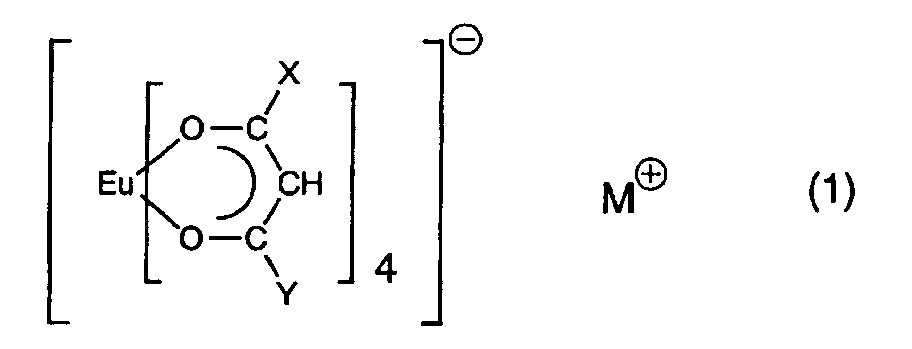
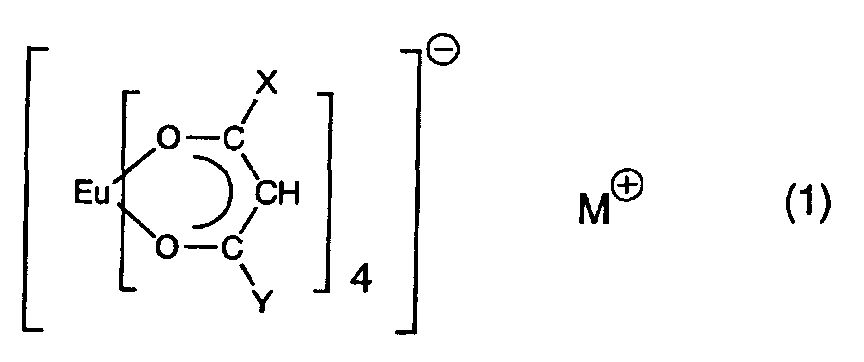
Specific examples of the compound of the formula (1) are shown in Table 1. In Table 1, a benzene ring is represented by Ph, a naphthalene ring by Np, a pyridine ring by Py, a thiophene ring by Th, a furan ring by Fu and a benzyl group by Bz.
| Compound No. | X | Y | M |
| 1 | 2-Th | CF3 | Li |
| 2 | 2-Th | CF3 | Na |
| 3 | 2-Th | CF3 | K |
| 4 | 2-Th | CF3 | Mg |
| 5 | 2-Th | CF3 | Ca |
| 6 | 2-Np | CF3 | Li |
| 7 | 2-Np | CF3 | Na |
| 8 | 2-Np | CF3 | K |
| 9 | 2-Np | CF3 | Mg |
| 10 | 2-Np | CF3 | Ca |
| 11 | Ph | CF3 | Li |
| 12 | Ph | CF3 | Na |
| 13 | Ph | CF3 | K |
| 14 | 2-Fu | CF3 | Li |
| 15 | 2-Fu | CF3 | Na |
| 16 | 2-Fu | CF3 | K |
| 17 | 2-Fu | CF3 | Mg |
| 18 | 3-Py | CF3 | Na |
| 19 | 2-Th | -CF2CF2CH3 | K |
| 20 | 2-Np | -CF2CF2CH3 | Na |
| 21 | Ph | -CF2CF2CH3 | K |
| 22 | 2-Fu | F2CF2CH3 | Na |
| 23 | 3-Py | F2CF2CH3 | Li |
| 24 | 2-Th | C8F17 | Na |
| 25 | 2-Np | C8F17 | K |
| 26 | Ph | C8F17 | Na |
| 27 | 2-Fu | C8F17 | Na |
| 28 | 3-Py | C8F17 | K |

Absorption spectrum (methanol): maximum absorption wavelength: 344 nm
Fluorescent spectrum (methanol): excitation maximum wavelength: 344 nm, fluorescent maximum wavelength: 616 nm.

Absorption spectrum (methanol): maximum absorption wavelength: 334 nm
Fluorescent spectrum (methanol): excitation maximum wavelength: 334 nm, fluorescent maximum wavelength: 616 nm.

Absorption spectrum (methanol): maximum absorption wavelength: 344 nm
Fluorescent spectrum (methanol): excitation maximum wavelength: 344 nm, fluorescent maximum wavelength: 616 nm.
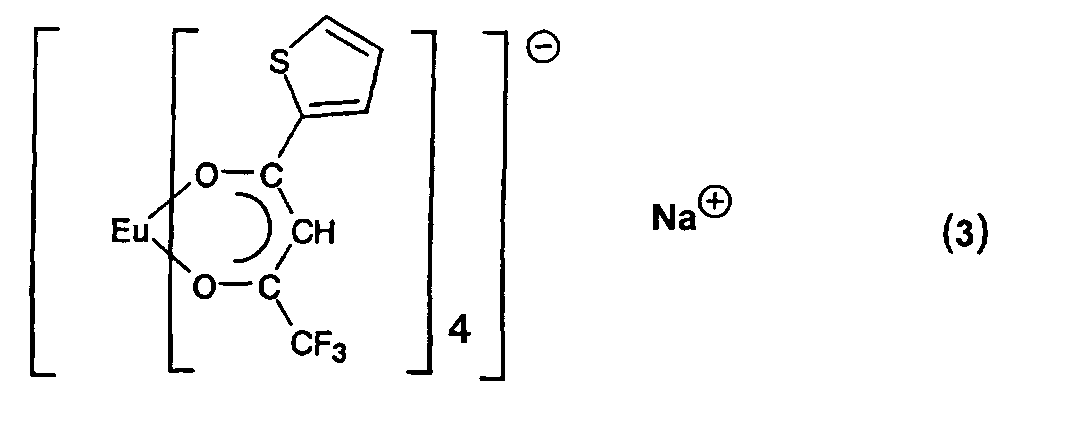
Fluorescent spectrum (methanol): excitation maximum wavelength: 341 nm, fluorescent maximum wavelength: 615 nm.
Fluorescent spectrum (methanol): excitation maximum wavelength: 355 nm, fluorescent maximum wavelength: 615 nm.
Fluorescent spectrum (methanol): excitation maximum wavelength: 342 nm, fluorescent maximum wavelength: 616 nm.

| Ethanol | 60 parts |
| Water | 40 parts |
| KL-506 (Note 1) | 3 parts |
| Reaction solution of the compound No. (1) obtained in Example 3 | 16 parts |
| (Note 1): KL-506 (manufactured by Kuraray Co., Ltd.) carboxyl group-modified PVA (degree of polymerization: 600, degree of saponification: 74 to 80) |
(Note 2): Lubiscole VA-37E (manufactured by BASF), ethanol solution containing 50% of a vinylpyrrolidone/vinyl acetate copolymer
| Ethanol | 40 parts |
| 1-Propanol | 35 parts |
| Water | 20 parts |
| K-30 (Note 8) | 3 parts |
| Reaction solution of the compound No. (11) obtained in Example 5 | 16 parts |
| (Note 8): Lubiscole K-30 (manufactured by BASF), polyvinylpyrrolidone |
| Results of evaluation | ||||
| Condition of ink | Emission intensity | |||
| Just after manufactured | After stored | Just after manufactured | After stored | |
| Example 7 | ○ | ○ | 450 | 446 |
| Example 8 | ○ | ○ | 428 | 417 |
| Example 9 | ○ | ○ | 702 | 785 |
| Example 10 | ○ | ○ | 680 | 658 |
| Example 11 | ○ | ○ | 710 | 715 |
| Comparative Example 2 | ○ | ○ | 435 | 428 |
| Friction resistance | Water resistance | Light fastness | Adaptability to an ink jet | |
| Example 7 | ○ | ○ | ○ | ○ |
| Example 8 | ○ | ○ | ○ | ○ |
| Example 9 | ○ | ○ | ○ | ○ |
| Example 10 | ○ | ○ | ○ | ○ |
| Example 11 | ○ | ○ | ○ | ○ |
| Comparative Example 2 | ○ | ○ | ○ | ○ |
The state of the resulting ink composition was observed visually to evaluate.
The resulting ink composition was stored at 40°C for 2 hours to observe the state of the ink visually, thereby evaluating the stability.
The obtained ink composition was stored at 40°C for 2 weeks and the emission intensity of the coating film was measured in the same manner as above.
Claims (9)
- An aqueous ink composition comprising a europium compound (A) represented by the following formula (1), a binder (B) and an aqueous medium (C):wherein X represents an aromatic cyclic group or a heterocyclic group which may have a substituent, Y represents a fluorinated hydrocarbon group having 1 to 10 carbon atoms and M represents an alkali metal or an alkali earth metal.

- The aqueous ink composition according to Claim 1, wherein X is a benzene cyclic group, a naphthalene cyclic group, a pyridine cyclic group, a thiophene cyclic group or a furan cyclic group which may have a substituent.
- The aqueous ink composition according to Claim 1 or 2, wherein Y is a trifluoromethyl group.
- The aqueous ink composition according to any one of Claims 1 to 3, wherein M is an alkali metal.
- The aqueous ink composition according to any one of Claims 1 to 4, wherein (B) is a water-soluble high-molecular compound.
- The aqueous ink composition according to Claim 5, wherein (B) is polyvinyl alcohol, modified polyvinyl alcohol or a polymer having a cyclic amide group in a molecular structure.
- The aqueous ink composition according to any one of Claims 1 to 6, wherein the content of (A) is 0.1 to 4% by weight, the content of (B) is 0.1 to 15% by weight and the content of (C) is 73.5 to 99.8% by weight.
- A colored body treated with the aqueous ink composition as claimed in any one of Claims 1 to 7.
- A europium compound represented by the following formula (1):wherein X represents a benzene cyclic group, a naphthalene cyclic group, a pyridine cyclic group, a thiophene cyclic group or a furan cyclic group, Y represents a trifluoromethyl group and M represents an alkali metal.

Applications Claiming Priority (3)
| Application Number | Priority Date | Filing Date | Title |
|---|---|---|---|
| JP2002322126 | 2002-11-06 | ||
| JP2002322126 | 2002-11-06 | ||
| PCT/JP2003/013839 WO2004041945A1 (en) | 2002-11-06 | 2003-10-29 | Ink composition |
Publications (3)
| Publication Number | Publication Date |
|---|---|
| EP1559754A1 true EP1559754A1 (en) | 2005-08-03 |
| EP1559754A4 EP1559754A4 (en) | 2006-02-08 |
| EP1559754B1 EP1559754B1 (en) | 2006-12-06 |
Family
ID=32310381
Family Applications (1)
| Application Number | Title | Priority Date | Filing Date |
|---|---|---|---|
| EP03769950A Expired - Lifetime EP1559754B1 (en) | 2002-11-06 | 2003-10-29 | Ink composition |
Country Status (9)
| Country | Link |
|---|---|
| US (1) | US20060001006A1 (en) |
| EP (1) | EP1559754B1 (en) |
| KR (1) | KR20050073620A (en) |
| CN (1) | CN1318525C (en) |
| AU (1) | AU2003280593A1 (en) |
| CA (1) | CA2503803A1 (en) |
| DE (1) | DE60310256T2 (en) |
| TW (1) | TW200418939A (en) |
| WO (1) | WO2004041945A1 (en) |
Cited By (1)
| Publication number | Priority date | Publication date | Assignee | Title |
|---|---|---|---|---|
| FR2909095A1 (en) * | 2006-11-28 | 2008-05-30 | Imaje Sa Sa | FLUORESCENT LIQUID INK COMPOSITION FOR INKJET PRINTING. |
Families Citing this family (1)
| Publication number | Priority date | Publication date | Assignee | Title |
|---|---|---|---|---|
| CN110041755A (en) * | 2019-04-19 | 2019-07-23 | 陕西科技大学 | A kind of fluorescent ink and its preparation method and application |
Family Cites Families (8)
| Publication number | Priority date | Publication date | Assignee | Title |
|---|---|---|---|---|
| JPH0826264B2 (en) * | 1987-07-21 | 1996-03-13 | 三井東圧化学株式会社 | Ink composition containing luminescent compound |
| JPH08239609A (en) * | 1995-03-03 | 1996-09-17 | Toyo Ink Mfg Co Ltd | Recording fluid |
| US5837042A (en) * | 1996-06-10 | 1998-11-17 | Videojet Systems International, Inc. | Invisible fluorescent jet ink |
| JPH1017571A (en) * | 1996-07-01 | 1998-01-20 | Toyo Ink Mfg Co Ltd | Red fluorescent material and composition containing the same |
| JP2002356632A (en) * | 2001-03-29 | 2002-12-13 | Toyo Ink Mfg Co Ltd | Recording liquid |
| JP2002348508A (en) * | 2001-05-28 | 2002-12-04 | Toyo Ink Mfg Co Ltd | Ink jet recording liquid |
| JP4266538B2 (en) * | 2001-07-16 | 2009-05-20 | オリヱント化学工業株式会社 | Red luminescent ink composition |
| JP3960058B2 (en) * | 2001-12-25 | 2007-08-15 | 東洋インキ製造株式会社 | Inkjet recording liquid |
-
2003
- 2003-10-29 CA CA002503803A patent/CA2503803A1/en not_active Abandoned
- 2003-10-29 US US10/533,374 patent/US20060001006A1/en not_active Abandoned
- 2003-10-29 DE DE60310256T patent/DE60310256T2/en not_active Expired - Fee Related
- 2003-10-29 KR KR1020057008098A patent/KR20050073620A/en not_active Withdrawn
- 2003-10-29 CN CNB2003801028998A patent/CN1318525C/en not_active Expired - Fee Related
- 2003-10-29 AU AU2003280593A patent/AU2003280593A1/en not_active Abandoned
- 2003-10-29 EP EP03769950A patent/EP1559754B1/en not_active Expired - Lifetime
- 2003-10-29 WO PCT/JP2003/013839 patent/WO2004041945A1/en not_active Ceased
- 2003-11-05 TW TW092130946A patent/TW200418939A/en unknown
Cited By (1)
| Publication number | Priority date | Publication date | Assignee | Title |
|---|---|---|---|---|
| FR2909095A1 (en) * | 2006-11-28 | 2008-05-30 | Imaje Sa Sa | FLUORESCENT LIQUID INK COMPOSITION FOR INKJET PRINTING. |
Also Published As
| Publication number | Publication date |
|---|---|
| WO2004041945A1 (en) | 2004-05-21 |
| US20060001006A1 (en) | 2006-01-05 |
| EP1559754A4 (en) | 2006-02-08 |
| EP1559754B1 (en) | 2006-12-06 |
| KR20050073620A (en) | 2005-07-14 |
| CN1318525C (en) | 2007-05-30 |
| TW200418939A (en) | 2004-10-01 |
| DE60310256D1 (en) | 2007-01-18 |
| CN1711329A (en) | 2005-12-21 |
| DE60310256T2 (en) | 2007-06-28 |
| AU2003280593A1 (en) | 2004-06-07 |
| CA2503803A1 (en) | 2004-05-21 |
Similar Documents
| Publication | Publication Date | Title |
|---|---|---|
| AU737591B2 (en) | A jet ink composition | |
| US9834660B2 (en) | Rare earth metal complexes that excite in the long UV wavelength range | |
| EP3042942B1 (en) | Microcapsule color material, and ink composition for writing tools | |
| JPH0657191A (en) | Ink composition | |
| JPH0216171A (en) | water based ink | |
| JP4721248B2 (en) | Dye composition, ink composition, and ink jet recording method | |
| EP1559754B1 (en) | Ink composition | |
| JP2502637B2 (en) | Aqueous ink composition | |
| JP4400911B2 (en) | Europium compound and ink composition containing the same | |
| JP2002206088A (en) | Fluorescent complex and ink composition | |
| CN1997715A (en) | Black ink composition, ink set containing the same, and ink jet recording method | |
| JP2004169026A (en) | Ink composition | |
| JP4165870B2 (en) | Ink composition | |
| EP1371652A1 (en) | Europium compounds and ink compositions containing the same | |
| JP2003268272A (en) | Ink composition | |
| JP2003261804A (en) | Ink composition | |
| JP4530569B2 (en) | Red fluorescent material and composition containing the same | |
| JP2003073587A (en) | Ink composition erasable by light irradiation | |
| JPH02233782A (en) | Ink and recording method using same | |
| KR100434687B1 (en) | Stamping ink | |
| JPH03247676A (en) | Recording liquid and method for recording using the same | |
| JP2002088292A (en) | Ink composition and printed matter | |
| JP2001323202A (en) | Photochromic aqueous ink composition for ball-point pen | |
| JPH09316374A (en) | Recording liquid and recording method using the same | |
| JPH01141965A (en) | water based ink |
Legal Events
| Date | Code | Title | Description |
|---|---|---|---|
| PUAI | Public reference made under article 153(3) epc to a published international application that has entered the european phase |
Free format text: ORIGINAL CODE: 0009012 |
|
| 17P | Request for examination filed |
Effective date: 20050503 |
|
| AK | Designated contracting states |
Kind code of ref document: A1 Designated state(s): AT BE BG CH CY CZ DE DK EE ES FI FR GB GR HU IE IT LI LU MC NL PT RO SE SI SK TR |
|
| AX | Request for extension of the european patent |
Extension state: AL LT LV MK |
|
| RIN1 | Information on inventor provided before grant (corrected) |
Inventor name: KITAYAMA, YASUYUKI Inventor name: KATOH, YOSINORI Inventor name: KIYOYANAGI, NORIKO |
|
| A4 | Supplementary search report drawn up and despatched |
Effective date: 20051229 |
|
| DAX | Request for extension of the european patent (deleted) | ||
| RBV | Designated contracting states (corrected) |
Designated state(s): CH DE FR GB LI |
|
| GRAP | Despatch of communication of intention to grant a patent |
Free format text: ORIGINAL CODE: EPIDOSNIGR1 |
|
| GRAS | Grant fee paid |
Free format text: ORIGINAL CODE: EPIDOSNIGR3 |
|
| GRAA | (expected) grant |
Free format text: ORIGINAL CODE: 0009210 |
|
| AK | Designated contracting states |
Kind code of ref document: B1 Designated state(s): CH DE FR GB LI |
|
| REG | Reference to a national code |
Ref country code: GB Ref legal event code: FG4D |
|
| REG | Reference to a national code |
Ref country code: CH Ref legal event code: EP |
|
| REF | Corresponds to: |
Ref document number: 60310256 Country of ref document: DE Date of ref document: 20070118 Kind code of ref document: P |
|
| REG | Reference to a national code |
Ref country code: CH Ref legal event code: NV Representative=s name: ROTTMANN, ZIMMERMANN + PARTNER AG |
|
| ET | Fr: translation filed | ||
| PLBE | No opposition filed within time limit |
Free format text: ORIGINAL CODE: 0009261 |
|
| STAA | Information on the status of an ep patent application or granted ep patent |
Free format text: STATUS: NO OPPOSITION FILED WITHIN TIME LIMIT |
|
| 26N | No opposition filed |
Effective date: 20070907 |
|
| PGFP | Annual fee paid to national office [announced via postgrant information from national office to epo] |
Ref country code: CH Payment date: 20071023 Year of fee payment: 5 |
|
| PGFP | Annual fee paid to national office [announced via postgrant information from national office to epo] |
Ref country code: FR Payment date: 20071019 Year of fee payment: 5 Ref country code: GB Payment date: 20071022 Year of fee payment: 5 |
|
| PGFP | Annual fee paid to national office [announced via postgrant information from national office to epo] |
Ref country code: DE Payment date: 20080611 Year of fee payment: 6 |
|
| REG | Reference to a national code |
Ref country code: CH Ref legal event code: PL |
|
| GBPC | Gb: european patent ceased through non-payment of renewal fee |
Effective date: 20081029 |
|
| REG | Reference to a national code |
Ref country code: FR Ref legal event code: ST Effective date: 20090630 |
|
| PG25 | Lapsed in a contracting state [announced via postgrant information from national office to epo] |
Ref country code: LI Free format text: LAPSE BECAUSE OF NON-PAYMENT OF DUE FEES Effective date: 20081031 Ref country code: CH Free format text: LAPSE BECAUSE OF NON-PAYMENT OF DUE FEES Effective date: 20081031 Ref country code: FR Free format text: LAPSE BECAUSE OF NON-PAYMENT OF DUE FEES Effective date: 20081031 |
|
| PG25 | Lapsed in a contracting state [announced via postgrant information from national office to epo] |
Ref country code: GB Free format text: LAPSE BECAUSE OF NON-PAYMENT OF DUE FEES Effective date: 20081029 |
|
| PG25 | Lapsed in a contracting state [announced via postgrant information from national office to epo] |
Ref country code: DE Free format text: LAPSE BECAUSE OF NON-PAYMENT OF DUE FEES Effective date: 20100501 |