EP1559430A1 - Use of ginkgo complexes for the enhancement of cognitive functions and the alleviation of mental fatigue - Google Patents
Use of ginkgo complexes for the enhancement of cognitive functions and the alleviation of mental fatigue Download PDFInfo
- Publication number
- EP1559430A1 EP1559430A1 EP04001937A EP04001937A EP1559430A1 EP 1559430 A1 EP1559430 A1 EP 1559430A1 EP 04001937 A EP04001937 A EP 04001937A EP 04001937 A EP04001937 A EP 04001937A EP 1559430 A1 EP1559430 A1 EP 1559430A1
- Authority
- EP
- European Patent Office
- Prior art keywords
- ginkgo
- use according
- phosphatidylserine
- medicament
- cognitive
- Prior art date
- Legal status (The legal status is an assumption and is not a legal conclusion. Google has not performed a legal analysis and makes no representation as to the accuracy of the status listed.)
- Granted
Links
- 235000008100 Ginkgo biloba Nutrition 0.000 title claims abstract description 93
- 235000011201 Ginkgo Nutrition 0.000 title claims abstract description 84
- 230000003920 cognitive function Effects 0.000 title claims abstract description 31
- 208000019914 Mental Fatigue Diseases 0.000 title claims abstract description 17
- 241000218628 Ginkgo Species 0.000 title claims abstract 13
- 230000015654 memory Effects 0.000 claims abstract description 37
- 238000011282 treatment Methods 0.000 claims abstract description 34
- TZCPCKNHXULUIY-RGULYWFUSA-N 1,2-distearoyl-sn-glycero-3-phosphoserine Chemical compound CCCCCCCCCCCCCCCCCC(=O)OC[C@H](COP(O)(=O)OC[C@H](N)C(O)=O)OC(=O)CCCCCCCCCCCCCCCCC TZCPCKNHXULUIY-RGULYWFUSA-N 0.000 claims abstract description 28
- ZWZWYGMENQVNFU-UHFFFAOYSA-N Glycerophosphorylserin Natural products OC(=O)C(N)COP(O)(=O)OCC(O)CO ZWZWYGMENQVNFU-UHFFFAOYSA-N 0.000 claims abstract description 28
- 239000003814 drug Substances 0.000 claims abstract description 27
- 235000015872 dietary supplement Nutrition 0.000 claims abstract description 23
- 230000001149 cognitive effect Effects 0.000 claims abstract description 21
- 208000037265 diseases, disorders, signs and symptoms Diseases 0.000 claims abstract description 11
- 206010012289 Dementia Diseases 0.000 claims abstract description 10
- 208000024827 Alzheimer disease Diseases 0.000 claims abstract description 9
- 201000010099 disease Diseases 0.000 claims abstract description 9
- 238000004519 manufacturing process Methods 0.000 claims abstract description 8
- 230000002265 prevention Effects 0.000 claims abstract description 8
- 230000003247 decreasing effect Effects 0.000 claims abstract description 6
- 230000006866 deterioration Effects 0.000 claims abstract description 5
- 206010016256 fatigue Diseases 0.000 claims abstract description 5
- 244000194101 Ginkgo biloba Species 0.000 claims description 84
- 239000000203 mixture Substances 0.000 claims description 21
- 239000000284 extract Substances 0.000 claims description 20
- MOLPUWBMSBJXER-YDGSQGCISA-N bilobalide Chemical compound O([C@H]1OC2=O)C(=O)[C@H](O)[C@@]11[C@@](C(C)(C)C)(O)C[C@H]3[C@@]21CC(=O)O3 MOLPUWBMSBJXER-YDGSQGCISA-N 0.000 claims description 19
- 229910052500 inorganic mineral Inorganic materials 0.000 claims description 18
- 239000011707 mineral Substances 0.000 claims description 18
- 235000010755 mineral Nutrition 0.000 claims description 17
- -1 flavone glycosides Chemical class 0.000 claims description 16
- 150000003904 phospholipids Chemical class 0.000 claims description 15
- 150000001875 compounds Chemical class 0.000 claims description 14
- 229940088594 vitamin Drugs 0.000 claims description 14
- 229930003231 vitamin Natural products 0.000 claims description 14
- 235000013343 vitamin Nutrition 0.000 claims description 14
- 239000011782 vitamin Substances 0.000 claims description 14
- CIWBSHSKHKDKBQ-JLAZNSOCSA-N Ascorbic acid Chemical compound OC[C@H](O)[C@H]1OC(=O)C(O)=C1O CIWBSHSKHKDKBQ-JLAZNSOCSA-N 0.000 claims description 9
- 239000000654 additive Substances 0.000 claims description 9
- GVJHHUAWPYXKBD-UHFFFAOYSA-N (±)-α-Tocopherol Chemical compound OC1=C(C)C(C)=C2OC(CCCC(C)CCCC(C)CCCC(C)C)(C)CCC2=C1C GVJHHUAWPYXKBD-UHFFFAOYSA-N 0.000 claims description 8
- XEEYBQQBJWHFJM-UHFFFAOYSA-N Iron Chemical compound [Fe] XEEYBQQBJWHFJM-UHFFFAOYSA-N 0.000 claims description 8
- FPIPGXGPPPQFEQ-OVSJKPMPSA-N all-trans-retinol Chemical compound OC\C=C(/C)\C=C\C=C(/C)\C=C\C1=C(C)CCCC1(C)C FPIPGXGPPPQFEQ-OVSJKPMPSA-N 0.000 claims description 7
- 239000002775 capsule Substances 0.000 claims description 7
- FPIPGXGPPPQFEQ-UHFFFAOYSA-N 13-cis retinol Natural products OCC=C(C)C=CC=C(C)C=CC1=C(C)CCCC1(C)C FPIPGXGPPPQFEQ-UHFFFAOYSA-N 0.000 claims description 6
- GAMYVSCDDLXAQW-AOIWZFSPSA-N Thermopsosid Natural products O(C)c1c(O)ccc(C=2Oc3c(c(O)cc(O[C@H]4[C@H](O)[C@@H](O)[C@H](O)[C@H](CO)O4)c3)C(=O)C=2)c1 GAMYVSCDDLXAQW-AOIWZFSPSA-N 0.000 claims description 6
- 239000013543 active substance Substances 0.000 claims description 6
- 239000003795 chemical substances by application Substances 0.000 claims description 6
- 229930003944 flavone Natural products 0.000 claims description 6
- 235000011949 flavones Nutrition 0.000 claims description 6
- 229930182470 glycoside Natural products 0.000 claims description 6
- VHBFFQKBGNRLFZ-UHFFFAOYSA-N vitamin p Natural products O1C2=CC=CC=C2C(=O)C=C1C1=CC=CC=C1 VHBFFQKBGNRLFZ-UHFFFAOYSA-N 0.000 claims description 6
- OYPRJOBELJOOCE-UHFFFAOYSA-N Calcium Chemical compound [Ca] OYPRJOBELJOOCE-UHFFFAOYSA-N 0.000 claims description 5
- ZLMJMSJWJFRBEC-UHFFFAOYSA-N Potassium Chemical compound [K] ZLMJMSJWJFRBEC-UHFFFAOYSA-N 0.000 claims description 5
- FPIPGXGPPPQFEQ-BOOMUCAASA-N Vitamin A Natural products OC/C=C(/C)\C=C\C=C(\C)/C=C/C1=C(C)CCCC1(C)C FPIPGXGPPPQFEQ-BOOMUCAASA-N 0.000 claims description 5
- HCHKCACWOHOZIP-UHFFFAOYSA-N Zinc Chemical compound [Zn] HCHKCACWOHOZIP-UHFFFAOYSA-N 0.000 claims description 5
- 239000011575 calcium Substances 0.000 claims description 5
- 229910052791 calcium Inorganic materials 0.000 claims description 5
- 229960005069 calcium Drugs 0.000 claims description 5
- 239000011591 potassium Substances 0.000 claims description 5
- 229910052700 potassium Inorganic materials 0.000 claims description 5
- 235000007586 terpenes Nutrition 0.000 claims description 5
- 235000019155 vitamin A Nutrition 0.000 claims description 5
- 239000011719 vitamin A Substances 0.000 claims description 5
- 229940045997 vitamin a Drugs 0.000 claims description 5
- RYGMFSIKBFXOCR-UHFFFAOYSA-N Copper Chemical compound [Cu] RYGMFSIKBFXOCR-UHFFFAOYSA-N 0.000 claims description 4
- ZZZCUOFIHGPKAK-UHFFFAOYSA-N D-erythro-ascorbic acid Natural products OCC1OC(=O)C(O)=C1O ZZZCUOFIHGPKAK-UHFFFAOYSA-N 0.000 claims description 4
- 229930003268 Vitamin C Natural products 0.000 claims description 4
- MECHNRXZTMCUDQ-UHFFFAOYSA-N Vitamin D2 Natural products C1CCC2(C)C(C(C)C=CC(C)C(C)C)CCC2C1=CC=C1CC(O)CCC1=C MECHNRXZTMCUDQ-UHFFFAOYSA-N 0.000 claims description 4
- 229930003427 Vitamin E Natural products 0.000 claims description 4
- 125000002252 acyl group Chemical group 0.000 claims description 4
- 230000000996 additive effect Effects 0.000 claims description 4
- 239000011230 binding agent Substances 0.000 claims description 4
- FAPWYRCQGJNNSJ-UBKPKTQASA-L calcium D-pantothenic acid Chemical compound [Ca+2].OCC(C)(C)[C@@H](O)C(=O)NCCC([O-])=O.OCC(C)(C)[C@@H](O)C(=O)NCCC([O-])=O FAPWYRCQGJNNSJ-UBKPKTQASA-L 0.000 claims description 4
- 239000000544 cholinesterase inhibitor Substances 0.000 claims description 4
- 229910052802 copper Inorganic materials 0.000 claims description 4
- 239000010949 copper Substances 0.000 claims description 4
- 239000003937 drug carrier Substances 0.000 claims description 4
- 229960002061 ergocalciferol Drugs 0.000 claims description 4
- 239000000796 flavoring agent Substances 0.000 claims description 4
- 235000019634 flavors Nutrition 0.000 claims description 4
- 235000003599 food sweetener Nutrition 0.000 claims description 4
- WIGCFUFOHFEKBI-UHFFFAOYSA-N gamma-tocopherol Natural products CC(C)CCCC(C)CCCC(C)CCCC1CCC2C(C)C(O)C(C)C(C)C2O1 WIGCFUFOHFEKBI-UHFFFAOYSA-N 0.000 claims description 4
- 229910052742 iron Inorganic materials 0.000 claims description 4
- 229960003284 iron Drugs 0.000 claims description 4
- 239000000546 pharmaceutical excipient Substances 0.000 claims description 4
- 239000003765 sweetening agent Substances 0.000 claims description 4
- 239000003826 tablet Substances 0.000 claims description 4
- 235000019154 vitamin C Nutrition 0.000 claims description 4
- 239000011718 vitamin C Substances 0.000 claims description 4
- MECHNRXZTMCUDQ-RKHKHRCZSA-N vitamin D2 Chemical compound C1(/[C@@H]2CC[C@@H]([C@]2(CCC1)C)[C@H](C)/C=C/[C@H](C)C(C)C)=C\C=C1\C[C@@H](O)CCC1=C MECHNRXZTMCUDQ-RKHKHRCZSA-N 0.000 claims description 4
- 235000001892 vitamin D2 Nutrition 0.000 claims description 4
- 239000011653 vitamin D2 Substances 0.000 claims description 4
- 235000019165 vitamin E Nutrition 0.000 claims description 4
- 229940046009 vitamin E Drugs 0.000 claims description 4
- 239000011709 vitamin E Substances 0.000 claims description 4
- 239000011701 zinc Substances 0.000 claims description 4
- 229910052725 zinc Inorganic materials 0.000 claims description 4
- PXGOKWXKJXAPGV-UHFFFAOYSA-N Fluorine Chemical compound FF PXGOKWXKJXAPGV-UHFFFAOYSA-N 0.000 claims description 3
- OAICVXFJPJFONN-UHFFFAOYSA-N Phosphorus Chemical compound [P] OAICVXFJPJFONN-UHFFFAOYSA-N 0.000 claims description 3
- DFPAKSUCGFBDDF-ZQBYOMGUSA-N [14c]-nicotinamide Chemical compound N[14C](=O)C1=CC=CN=C1 DFPAKSUCGFBDDF-ZQBYOMGUSA-N 0.000 claims description 3
- 239000011737 fluorine Substances 0.000 claims description 3
- 229910052731 fluorine Inorganic materials 0.000 claims description 3
- 239000008187 granular material Substances 0.000 claims description 3
- WPBNNNQJVZRUHP-UHFFFAOYSA-L manganese(2+);methyl n-[[2-(methoxycarbonylcarbamothioylamino)phenyl]carbamothioyl]carbamate;n-[2-(sulfidocarbothioylamino)ethyl]carbamodithioate Chemical compound [Mn+2].[S-]C(=S)NCCNC([S-])=S.COC(=O)NC(=S)NC1=CC=CC=C1NC(=S)NC(=O)OC WPBNNNQJVZRUHP-UHFFFAOYSA-L 0.000 claims description 3
- 239000011574 phosphorus Substances 0.000 claims description 3
- 229910052698 phosphorus Inorganic materials 0.000 claims description 3
- 239000000843 powder Substances 0.000 claims description 3
- 230000009467 reduction Effects 0.000 claims description 3
- IKGXIBQEEMLURG-BKUODXTLSA-N rutin Chemical compound O[C@H]1[C@H](O)[C@@H](O)[C@H](C)O[C@@H]1OC[C@H]1[C@H](O)[C@@H](O)[C@H](O)[C@@H](OC=2C(C3=C(O)C=C(O)C=C3OC=2C=2C=C(O)C(O)=CC=2)=O)O1 IKGXIBQEEMLURG-BKUODXTLSA-N 0.000 claims description 3
- 229960004555 rutoside Drugs 0.000 claims description 3
- 239000000243 solution Substances 0.000 claims description 3
- 239000006188 syrup Substances 0.000 claims description 3
- 235000020357 syrup Nutrition 0.000 claims description 3
- 229940100578 Acetylcholinesterase inhibitor Drugs 0.000 claims description 2
- 239000002253 acid Substances 0.000 claims description 2
- 150000007513 acids Chemical class 0.000 claims description 2
- 235000007882 dietary composition Nutrition 0.000 claims description 2
- 235000014113 dietary fatty acids Nutrition 0.000 claims description 2
- 239000008298 dragée Substances 0.000 claims description 2
- 239000006196 drop Substances 0.000 claims description 2
- 229930195729 fatty acid Natural products 0.000 claims description 2
- 239000000194 fatty acid Substances 0.000 claims description 2
- 150000004665 fatty acids Chemical class 0.000 claims description 2
- 239000000499 gel Substances 0.000 claims description 2
- 229940087603 grape seed extract Drugs 0.000 claims description 2
- 235000002532 grape seed extract Nutrition 0.000 claims description 2
- 239000007924 injection Substances 0.000 claims description 2
- 238000002347 injection Methods 0.000 claims description 2
- 235000021281 monounsaturated fatty acids Nutrition 0.000 claims description 2
- 235000020777 polyunsaturated fatty acids Nutrition 0.000 claims description 2
- 235000003441 saturated fatty acids Nutrition 0.000 claims description 2
- 150000004671 saturated fatty acids Chemical class 0.000 claims description 2
- WVGIJSKXRWIMLY-UHFFFAOYSA-N selanylidenemagnesium Chemical compound [Se]=[Mg] WVGIJSKXRWIMLY-UHFFFAOYSA-N 0.000 claims description 2
- 239000000725 suspension Substances 0.000 claims description 2
- 150000003722 vitamin derivatives Chemical class 0.000 claims description 2
- 239000001717 vitis vinifera seed extract Substances 0.000 claims description 2
- IPCSVZSSVZVIGE-UHFFFAOYSA-N hexadecanoic acid Chemical compound CCCCCCCCCCCCCCCC(O)=O IPCSVZSSVZVIGE-UHFFFAOYSA-N 0.000 claims 2
- OYHQOLUKZRVURQ-NTGFUMLPSA-N (9Z,12Z)-9,10,12,13-tetratritiooctadeca-9,12-dienoic acid Chemical compound C(CCCCCCC\C(=C(/C\C(=C(/CCCCC)\[3H])\[3H])\[3H])\[3H])(=O)O OYHQOLUKZRVURQ-NTGFUMLPSA-N 0.000 claims 1
- WRIDQFICGBMAFQ-UHFFFAOYSA-N (E)-8-Octadecenoic acid Natural products CCCCCCCCCC=CCCCCCCC(O)=O WRIDQFICGBMAFQ-UHFFFAOYSA-N 0.000 claims 1
- LQJBNNIYVWPHFW-UHFFFAOYSA-N 20:1omega9c fatty acid Natural products CCCCCCCCCCC=CCCCCCCCC(O)=O LQJBNNIYVWPHFW-UHFFFAOYSA-N 0.000 claims 1
- QSBYPNXLFMSGKH-UHFFFAOYSA-N 9-Heptadecensaeure Natural products CCCCCCCC=CCCCCCCCC(O)=O QSBYPNXLFMSGKH-UHFFFAOYSA-N 0.000 claims 1
- ZQPPMHVWECSIRJ-UHFFFAOYSA-N Oleic acid Natural products CCCCCCCCC=CCCCCCCCC(O)=O ZQPPMHVWECSIRJ-UHFFFAOYSA-N 0.000 claims 1
- 239000005642 Oleic acid Substances 0.000 claims 1
- 235000021314 Palmitic acid Nutrition 0.000 claims 1
- 235000021355 Stearic acid Nutrition 0.000 claims 1
- QXJSBBXBKPUZAA-UHFFFAOYSA-N isooleic acid Natural products CCCCCCCC=CCCCCCCCCC(O)=O QXJSBBXBKPUZAA-UHFFFAOYSA-N 0.000 claims 1
- WQEPLUUGTLDZJY-UHFFFAOYSA-N n-Pentadecanoic acid Natural products CCCCCCCCCCCCCCC(O)=O WQEPLUUGTLDZJY-UHFFFAOYSA-N 0.000 claims 1
- QIQXTHQIDYTFRH-UHFFFAOYSA-N octadecanoic acid Chemical compound CCCCCCCCCCCCCCCCCC(O)=O QIQXTHQIDYTFRH-UHFFFAOYSA-N 0.000 claims 1
- OQCDKBAXFALNLD-UHFFFAOYSA-N octadecanoic acid Natural products CCCCCCCC(C)CCCCCCCCC(O)=O OQCDKBAXFALNLD-UHFFFAOYSA-N 0.000 claims 1
- ZQPPMHVWECSIRJ-KTKRTIGZSA-N oleic acid Chemical compound CCCCCCCC\C=C/CCCCCCCC(O)=O ZQPPMHVWECSIRJ-KTKRTIGZSA-N 0.000 claims 1
- 235000021313 oleic acid Nutrition 0.000 claims 1
- 239000008117 stearic acid Substances 0.000 claims 1
- 235000019156 vitamin B Nutrition 0.000 claims 1
- 239000011720 vitamin B Substances 0.000 claims 1
- 230000000694 effects Effects 0.000 abstract description 31
- 230000036651 mood Effects 0.000 abstract description 12
- 230000007423 decrease Effects 0.000 abstract description 4
- 238000012360 testing method Methods 0.000 description 20
- 230000035484 reaction time Effects 0.000 description 18
- 238000000540 analysis of variance Methods 0.000 description 16
- 230000004044 response Effects 0.000 description 16
- 239000000902 placebo Substances 0.000 description 13
- 229940068196 placebo Drugs 0.000 description 13
- 241000196324 Embryophyta Species 0.000 description 11
- 230000003936 working memory Effects 0.000 description 10
- 239000000126 substance Substances 0.000 description 9
- 239000009429 Ginkgo biloba extract Substances 0.000 description 8
- 230000008859 change Effects 0.000 description 8
- 230000003111 delayed effect Effects 0.000 description 8
- 229940068052 ginkgo biloba extract Drugs 0.000 description 8
- 235000020686 ginkgo biloba extract Nutrition 0.000 description 8
- LFQSCWFLJHTTHZ-UHFFFAOYSA-N Ethanol Chemical compound CCO LFQSCWFLJHTTHZ-UHFFFAOYSA-N 0.000 description 7
- 238000000034 method Methods 0.000 description 7
- 238000002360 preparation method Methods 0.000 description 6
- 239000002904 solvent Substances 0.000 description 6
- 229940079593 drug Drugs 0.000 description 5
- 230000000007 visual effect Effects 0.000 description 5
- WQZGKKKJIJFFOK-GASJEMHNSA-N Glucose Natural products OC[C@H]1OC(O)[C@H](O)[C@@H](O)[C@@H]1O WQZGKKKJIJFFOK-GASJEMHNSA-N 0.000 description 4
- 240000004371 Panax ginseng Species 0.000 description 4
- 235000002789 Panax ginseng Nutrition 0.000 description 4
- AUNGANRZJHBGPY-SCRDCRAPSA-N Riboflavin Chemical compound OC[C@@H](O)[C@@H](O)[C@@H](O)CN1C=2C=C(C)C(C)=CC=2N=C2C1=NC(=O)NC2=O AUNGANRZJHBGPY-SCRDCRAPSA-N 0.000 description 4
- MTCFGRXMJLQNBG-UHFFFAOYSA-N Serine Natural products OCC(N)C(O)=O MTCFGRXMJLQNBG-UHFFFAOYSA-N 0.000 description 4
- 239000008280 blood Substances 0.000 description 4
- 210000004369 blood Anatomy 0.000 description 4
- ADEBPBSSDYVVLD-UHFFFAOYSA-N donepezil Chemical compound O=C1C=2C=C(OC)C(OC)=CC=2CC1CC(CC1)CCN1CC1=CC=CC=C1 ADEBPBSSDYVVLD-UHFFFAOYSA-N 0.000 description 4
- OVBPIULPVIDEAO-LBPRGKRZSA-N folic acid Chemical compound C=1N=C2NC(N)=NC(=O)C2=NC=1CNC1=CC=C(C(=O)N[C@@H](CCC(O)=O)C(O)=O)C=C1 OVBPIULPVIDEAO-LBPRGKRZSA-N 0.000 description 4
- 238000009472 formulation Methods 0.000 description 4
- 235000008434 ginseng Nutrition 0.000 description 4
- 239000008103 glucose Substances 0.000 description 4
- 239000004615 ingredient Substances 0.000 description 4
- 230000000144 pharmacologic effect Effects 0.000 description 4
- 238000003825 pressing Methods 0.000 description 4
- 239000000047 product Substances 0.000 description 4
- 230000036642 wellbeing Effects 0.000 description 4
- YBJHBAHKTGYVGT-ZKWXMUAHSA-N (+)-Biotin Chemical compound N1C(=O)N[C@@H]2[C@H](CCCCC(=O)O)SC[C@@H]21 YBJHBAHKTGYVGT-ZKWXMUAHSA-N 0.000 description 3
- AUNGANRZJHBGPY-UHFFFAOYSA-N D-Lyxoflavin Natural products OCC(O)C(O)C(O)CN1C=2C=C(C)C(C)=CC=2N=C2C1=NC(=O)NC2=O AUNGANRZJHBGPY-UHFFFAOYSA-N 0.000 description 3
- FYYHWMGAXLPEAU-UHFFFAOYSA-N Magnesium Chemical class [Mg] FYYHWMGAXLPEAU-UHFFFAOYSA-N 0.000 description 3
- PVNIIMVLHYAWGP-UHFFFAOYSA-N Niacin Chemical compound OC(=O)C1=CC=CN=C1 PVNIIMVLHYAWGP-UHFFFAOYSA-N 0.000 description 3
- DFPAKSUCGFBDDF-UHFFFAOYSA-N Nicotinamide Chemical compound NC(=O)C1=CC=CN=C1 DFPAKSUCGFBDDF-UHFFFAOYSA-N 0.000 description 3
- 239000004480 active ingredient Substances 0.000 description 3
- 230000001154 acute effect Effects 0.000 description 3
- 238000004458 analytical method Methods 0.000 description 3
- 230000008901 benefit Effects 0.000 description 3
- 238000006243 chemical reaction Methods 0.000 description 3
- 230000003931 cognitive performance Effects 0.000 description 3
- 239000000470 constituent Substances 0.000 description 3
- 230000002354 daily effect Effects 0.000 description 3
- ASUTZQLVASHGKV-JDFRZJQESA-N galanthamine Chemical compound O1C(=C23)C(OC)=CC=C2CN(C)CC[C@]23[C@@H]1C[C@@H](O)C=C2 ASUTZQLVASHGKV-JDFRZJQESA-N 0.000 description 3
- 230000001965 increasing effect Effects 0.000 description 3
- 230000003993 interaction Effects 0.000 description 3
- 229910052749 magnesium Inorganic materials 0.000 description 3
- 239000011777 magnesium Chemical class 0.000 description 3
- 230000003340 mental effect Effects 0.000 description 3
- 238000012986 modification Methods 0.000 description 3
- 230000004048 modification Effects 0.000 description 3
- 239000008194 pharmaceutical composition Substances 0.000 description 3
- SHUZOJHMOBOZST-UHFFFAOYSA-N phylloquinone Natural products CC(C)CCCCC(C)CCC(C)CCCC(=CCC1=C(C)C(=O)c2ccccc2C1=O)C SHUZOJHMOBOZST-UHFFFAOYSA-N 0.000 description 3
- 230000008569 process Effects 0.000 description 3
- ZUFQODAHGAHPFQ-UHFFFAOYSA-N pyridoxine hydrochloride Chemical compound Cl.CC1=NC=C(CO)C(CO)=C1O ZUFQODAHGAHPFQ-UHFFFAOYSA-N 0.000 description 3
- 229960002477 riboflavin Drugs 0.000 description 3
- 150000003839 salts Chemical class 0.000 description 3
- 230000006886 spatial memory Effects 0.000 description 3
- 235000019164 vitamin B2 Nutrition 0.000 description 3
- 239000011716 vitamin B2 Substances 0.000 description 3
- YLKVIMNNMLKUGJ-UHFFFAOYSA-N 3-Delta8-pentadecenylphenol Natural products CCCCCCC=CCCCCCCCC1=CC=CC(O)=C1 YLKVIMNNMLKUGJ-UHFFFAOYSA-N 0.000 description 2
- VEXZGXHMUGYJMC-UHFFFAOYSA-M Chloride anion Chemical compound [Cl-] VEXZGXHMUGYJMC-UHFFFAOYSA-M 0.000 description 2
- SNPLKNRPJHDVJA-ZETCQYMHSA-N D-panthenol Chemical compound OCC(C)(C)[C@@H](O)C(=O)NCCCO SNPLKNRPJHDVJA-ZETCQYMHSA-N 0.000 description 2
- DGAQECJNVWCQMB-PUAWFVPOSA-M Ilexoside XXIX Chemical compound C[C@@H]1CC[C@@]2(CC[C@@]3(C(=CC[C@H]4[C@]3(CC[C@@H]5[C@@]4(CC[C@@H](C5(C)C)OS(=O)(=O)[O-])C)C)[C@@H]2[C@]1(C)O)C)C(=O)O[C@H]6[C@@H]([C@H]([C@@H]([C@H](O6)CO)O)O)O.[Na+] DGAQECJNVWCQMB-PUAWFVPOSA-M 0.000 description 2
- UPYKUZBSLRQECL-UKMVMLAPSA-N Lycopene Natural products CC(=C/C=C/C=C(C)/C=C/C=C(C)/C=C/C1C(=C)CCCC1(C)C)C=CC=C(/C)C=CC2C(=C)CCCC2(C)C UPYKUZBSLRQECL-UKMVMLAPSA-N 0.000 description 2
- OVBPIULPVIDEAO-UHFFFAOYSA-N N-Pteroyl-L-glutaminsaeure Natural products C=1N=C2NC(N)=NC(=O)C2=NC=1CNC1=CC=C(C(=O)NC(CCC(O)=O)C(O)=O)C=C1 OVBPIULPVIDEAO-UHFFFAOYSA-N 0.000 description 2
- PXHVJJICTQNCMI-UHFFFAOYSA-N Nickel Chemical compound [Ni] PXHVJJICTQNCMI-UHFFFAOYSA-N 0.000 description 2
- VYGQUTWHTHXGQB-FFHKNEKCSA-N Retinol Palmitate Chemical compound CCCCCCCCCCCCCCCC(=O)OC\C=C(/C)\C=C\C=C(/C)\C=C\C1=C(C)CCCC1(C)C VYGQUTWHTHXGQB-FFHKNEKCSA-N 0.000 description 2
- XSVMFMHYUFZWBK-NSHDSACASA-N Rivastigmine Chemical compound CCN(C)C(=O)OC1=CC=CC([C@H](C)N(C)C)=C1 XSVMFMHYUFZWBK-NSHDSACASA-N 0.000 description 2
- 229930003471 Vitamin B2 Natural products 0.000 description 2
- LXNHXLLTXMVWPM-UHFFFAOYSA-N Vitamin B6 Natural products CC1=NC=C(CO)C(CO)=C1O LXNHXLLTXMVWPM-UHFFFAOYSA-N 0.000 description 2
- QYSXJUFSXHHAJI-XFEUOLMDSA-N Vitamin D3 Natural products C1(/[C@@H]2CC[C@@H]([C@]2(CCC1)C)[C@H](C)CCCC(C)C)=C/C=C1\C[C@@H](O)CCC1=C QYSXJUFSXHHAJI-XFEUOLMDSA-N 0.000 description 2
- 230000009471 action Effects 0.000 description 2
- 230000007000 age related cognitive decline Effects 0.000 description 2
- ANVAOWXLWRTKGA-XHGAXZNDSA-N all-trans-alpha-carotene Chemical compound CC=1CCCC(C)(C)C=1/C=C/C(/C)=C/C=C/C(/C)=C/C=C/C=C(C)C=CC=C(C)C=CC1C(C)=CCCC1(C)C ANVAOWXLWRTKGA-XHGAXZNDSA-N 0.000 description 2
- 229940121363 anti-inflammatory agent Drugs 0.000 description 2
- 239000002260 anti-inflammatory agent Substances 0.000 description 2
- 230000015572 biosynthetic process Effects 0.000 description 2
- 230000002490 cerebral effect Effects 0.000 description 2
- 238000011260 co-administration Methods 0.000 description 2
- 238000011284 combination treatment Methods 0.000 description 2
- 208000035475 disorder Diseases 0.000 description 2
- 238000000556 factor analysis Methods 0.000 description 2
- 229960000304 folic acid Drugs 0.000 description 2
- 235000019152 folic acid Nutrition 0.000 description 2
- 239000011724 folic acid Substances 0.000 description 2
- 230000037406 food intake Effects 0.000 description 2
- 229930184727 ginkgolide Natural products 0.000 description 2
- 230000036541 health Effects 0.000 description 2
- 230000006872 improvement Effects 0.000 description 2
- 238000010348 incorporation Methods 0.000 description 2
- 230000002757 inflammatory effect Effects 0.000 description 2
- 238000012423 maintenance Methods 0.000 description 2
- 229960003512 nicotinic acid Drugs 0.000 description 2
- 235000001968 nicotinic acid Nutrition 0.000 description 2
- 239000011664 nicotinic acid Substances 0.000 description 2
- 235000019175 phylloquinone Nutrition 0.000 description 2
- 239000011772 phylloquinone Substances 0.000 description 2
- MBWXNTAXLNYFJB-NKFFZRIASA-N phylloquinone Chemical compound C1=CC=C2C(=O)C(C/C=C(C)/CCC[C@H](C)CCC[C@H](C)CCCC(C)C)=C(C)C(=O)C2=C1 MBWXNTAXLNYFJB-NKFFZRIASA-N 0.000 description 2
- 230000035790 physiological processes and functions Effects 0.000 description 2
- 229960001898 phytomenadione Drugs 0.000 description 2
- RADKZDMFGJYCBB-UHFFFAOYSA-N pyridoxal hydrochloride Natural products CC1=NC=C(CO)C(C=O)=C1O RADKZDMFGJYCBB-UHFFFAOYSA-N 0.000 description 2
- 238000011160 research Methods 0.000 description 2
- 239000000523 sample Substances 0.000 description 2
- 239000011734 sodium Substances 0.000 description 2
- 229910052708 sodium Inorganic materials 0.000 description 2
- 230000007596 spatial working memory Effects 0.000 description 2
- 241000894007 species Species 0.000 description 2
- 238000007619 statistical method Methods 0.000 description 2
- 230000001225 therapeutic effect Effects 0.000 description 2
- DPJRMOMPQZCRJU-UHFFFAOYSA-M thiamine hydrochloride Chemical compound Cl.[Cl-].CC1=C(CCO)SC=[N+]1CC1=CN=C(C)N=C1N DPJRMOMPQZCRJU-UHFFFAOYSA-M 0.000 description 2
- KBPHJBAIARWVSC-XQIHNALSSA-N trans-lutein Natural products CC(=C/C=C/C=C(C)/C=C/C=C(C)/C=C/C1=C(C)CC(O)CC1(C)C)C=CC=C(/C)C=CC2C(=CC(O)CC2(C)C)C KBPHJBAIARWVSC-XQIHNALSSA-N 0.000 description 2
- 230000000472 traumatic effect Effects 0.000 description 2
- 235000010374 vitamin B1 Nutrition 0.000 description 2
- 239000011691 vitamin B1 Substances 0.000 description 2
- 235000019163 vitamin B12 Nutrition 0.000 description 2
- 239000011715 vitamin B12 Substances 0.000 description 2
- 235000019158 vitamin B6 Nutrition 0.000 description 2
- 239000011726 vitamin B6 Substances 0.000 description 2
- 229940011671 vitamin b6 Drugs 0.000 description 2
- 230000001755 vocal effect Effects 0.000 description 2
- XLYOFNOQVPJJNP-UHFFFAOYSA-N water Substances O XLYOFNOQVPJJNP-UHFFFAOYSA-N 0.000 description 2
- GVJHHUAWPYXKBD-IEOSBIPESA-N α-tocopherol Chemical compound OC1=C(C)C(C)=C2O[C@@](CCC[C@H](C)CCC[C@H](C)CCCC(C)C)(C)CCC2=C1C GVJHHUAWPYXKBD-IEOSBIPESA-N 0.000 description 2
- YLKVIMNNMLKUGJ-FPLPWBNLSA-N (15:1)-Cardanol Chemical compound CCCCCC\C=C/CCCCCCCC1=CC=CC(O)=C1 YLKVIMNNMLKUGJ-FPLPWBNLSA-N 0.000 description 1
- MRAMPOPITCOOIN-VIFPVBQESA-N (2r)-n-(3-ethoxypropyl)-2,4-dihydroxy-3,3-dimethylbutanamide Chemical compound CCOCCCNC(=O)[C@H](O)C(C)(C)CO MRAMPOPITCOOIN-VIFPVBQESA-N 0.000 description 1
- DMASLKHVQRHNES-UPOGUZCLSA-N (3R)-beta,beta-caroten-3-ol Chemical compound C([C@H](O)CC=1C)C(C)(C)C=1/C=C/C(/C)=C/C=C/C(/C)=C/C=C/C=C(C)C=CC=C(C)C=CC1=C(C)CCCC1(C)C DMASLKHVQRHNES-UPOGUZCLSA-N 0.000 description 1
- JKQXZKUSFCKOGQ-JLGXGRJMSA-N (3R,3'R)-beta,beta-carotene-3,3'-diol Chemical compound C([C@H](O)CC=1C)C(C)(C)C=1/C=C/C(/C)=C/C=C/C(/C)=C/C=C/C=C(C)C=CC=C(C)C=CC1=C(C)C[C@@H](O)CC1(C)C JKQXZKUSFCKOGQ-JLGXGRJMSA-N 0.000 description 1
- RYHBNJHYFVUHQT-UHFFFAOYSA-N 1,4-Dioxane Chemical compound C1COCCO1 RYHBNJHYFVUHQT-UHFFFAOYSA-N 0.000 description 1
- IIZPXYDJLKNOIY-JXPKJXOSSA-N 1-palmitoyl-2-arachidonoyl-sn-glycero-3-phosphocholine Chemical compound CCCCCCCCCCCCCCCC(=O)OC[C@H](COP([O-])(=O)OCC[N+](C)(C)C)OC(=O)CCC\C=C/C\C=C/C\C=C/C\C=C/CCCCC IIZPXYDJLKNOIY-JXPKJXOSSA-N 0.000 description 1
- CIWBSHSKHKDKBQ-SZSCBOSDSA-N 2-[(1s)-1,2-dihydroxyethyl]-3,4-dihydroxy-2h-furan-5-one Chemical compound OC[C@H](O)C1OC(=O)C(O)=C1O CIWBSHSKHKDKBQ-SZSCBOSDSA-N 0.000 description 1
- QTBSBXVTEAMEQO-UHFFFAOYSA-M Acetate Chemical compound CC([O-])=O QTBSBXVTEAMEQO-UHFFFAOYSA-M 0.000 description 1
- HRQKOYFGHJYEFS-UHFFFAOYSA-N Beta psi-carotene Chemical compound CC(C)=CCCC(C)=CC=CC(C)=CC=CC(C)=CC=CC=C(C)C=CC=C(C)C=CC1=C(C)CCCC1(C)C HRQKOYFGHJYEFS-UHFFFAOYSA-N 0.000 description 1
- ZOXJGFHDIHLPTG-UHFFFAOYSA-N Boron Chemical compound [B] ZOXJGFHDIHLPTG-UHFFFAOYSA-N 0.000 description 1
- BVKZGUZCCUSVTD-UHFFFAOYSA-L Carbonate Chemical compound [O-]C([O-])=O BVKZGUZCCUSVTD-UHFFFAOYSA-L 0.000 description 1
- YLKVIMNNMLKUGJ-BQYQJAHWSA-N Cardanolmonoene Chemical compound CCCCCC\C=C\CCCCCCCC1=CC=CC(O)=C1 YLKVIMNNMLKUGJ-BQYQJAHWSA-N 0.000 description 1
- VYZAMTAEIAYCRO-UHFFFAOYSA-N Chromium Chemical compound [Cr] VYZAMTAEIAYCRO-UHFFFAOYSA-N 0.000 description 1
- 208000028698 Cognitive impairment Diseases 0.000 description 1
- IELOKBJPULMYRW-NJQVLOCASA-N D-alpha-Tocopheryl Acid Succinate Chemical compound OC(=O)CCC(=O)OC1=C(C)C(C)=C2O[C@@](CCC[C@H](C)CCC[C@H](C)CCCC(C)C)(C)CCC2=C1C IELOKBJPULMYRW-NJQVLOCASA-N 0.000 description 1
- ZAKOWWREFLAJOT-CEFNRUSXSA-N D-alpha-tocopherylacetate Chemical compound CC(=O)OC1=C(C)C(C)=C2O[C@@](CCC[C@H](C)CCC[C@H](C)CCCC(C)C)(C)CCC2=C1C ZAKOWWREFLAJOT-CEFNRUSXSA-N 0.000 description 1
- 239000011665 D-biotin Substances 0.000 description 1
- 235000000638 D-biotin Nutrition 0.000 description 1
- RGHNJXZEOKUKBD-SQOUGZDYSA-M D-gluconate Chemical compound OC[C@@H](O)[C@@H](O)[C@H](O)[C@@H](O)C([O-])=O RGHNJXZEOKUKBD-SQOUGZDYSA-M 0.000 description 1
- 235000004866 D-panthenol Nutrition 0.000 description 1
- 239000011703 D-panthenol Substances 0.000 description 1
- KRHYYFGTRYWZRS-UHFFFAOYSA-M Fluoride anion Chemical compound [F-] KRHYYFGTRYWZRS-UHFFFAOYSA-M 0.000 description 1
- VZCYOOQTPOCHFL-OWOJBTEDSA-N Fumaric acid Chemical compound OC(=O)\C=C\C(O)=O VZCYOOQTPOCHFL-OWOJBTEDSA-N 0.000 description 1
- 239000001828 Gelatine Substances 0.000 description 1
- 244000068988 Glycine max Species 0.000 description 1
- 235000010469 Glycine max Nutrition 0.000 description 1
- 208000013016 Hypoglycemia Diseases 0.000 description 1
- 239000002211 L-ascorbic acid Substances 0.000 description 1
- 235000000069 L-ascorbic acid Nutrition 0.000 description 1
- 239000011786 L-ascorbyl-6-palmitate Substances 0.000 description 1
- QAQJMLQRFWZOBN-LAUBAEHRSA-N L-ascorbyl-6-palmitate Chemical compound CCCCCCCCCCCCCCCC(=O)OC[C@H](O)[C@H]1OC(=O)C(O)=C1O QAQJMLQRFWZOBN-LAUBAEHRSA-N 0.000 description 1
- 235000000072 L-ascorbyl-6-palmitate Nutrition 0.000 description 1
- JVTAAEKCZFNVCJ-UHFFFAOYSA-M Lactate Chemical compound CC(O)C([O-])=O JVTAAEKCZFNVCJ-UHFFFAOYSA-M 0.000 description 1
- 206010024264 Lethargy Diseases 0.000 description 1
- WHXSMMKQMYFTQS-UHFFFAOYSA-N Lithium Chemical compound [Li] WHXSMMKQMYFTQS-UHFFFAOYSA-N 0.000 description 1
- JEVVKJMRZMXFBT-XWDZUXABSA-N Lycophyll Natural products OC/C(=C/CC/C(=C\C=C\C(=C/C=C/C(=C\C=C\C=C(/C=C/C=C(\C=C\C=C(/CC/C=C(/CO)\C)\C)/C)\C)/C)\C)/C)/C JEVVKJMRZMXFBT-XWDZUXABSA-N 0.000 description 1
- PWHULOQIROXLJO-UHFFFAOYSA-N Manganese Chemical compound [Mn] PWHULOQIROXLJO-UHFFFAOYSA-N 0.000 description 1
- 244000062730 Melissa officinalis Species 0.000 description 1
- 235000010654 Melissa officinalis Nutrition 0.000 description 1
- ABSPRNADVQNDOU-UHFFFAOYSA-N Menaquinone 1 Natural products C1=CC=C2C(=O)C(CC=C(C)C)=C(C)C(=O)C2=C1 ABSPRNADVQNDOU-UHFFFAOYSA-N 0.000 description 1
- ZOKXTWBITQBERF-UHFFFAOYSA-N Molybdenum Chemical compound [Mo] ZOKXTWBITQBERF-UHFFFAOYSA-N 0.000 description 1
- 238000005481 NMR spectroscopy Methods 0.000 description 1
- 229910019142 PO4 Inorganic materials 0.000 description 1
- 239000004260 Potassium ascorbate Substances 0.000 description 1
- VYGQUTWHTHXGQB-UHFFFAOYSA-N Retinol hexadecanoate Natural products CCCCCCCCCCCCCCCC(=O)OCC=C(C)C=CC=C(C)C=CC1=C(C)CCCC1(C)C VYGQUTWHTHXGQB-UHFFFAOYSA-N 0.000 description 1
- 241000283984 Rodentia Species 0.000 description 1
- 241000583552 Scleranthus annuus Species 0.000 description 1
- BUGBHKTXTAQXES-UHFFFAOYSA-N Selenium Chemical compound [Se] BUGBHKTXTAQXES-UHFFFAOYSA-N 0.000 description 1
- XUIMIQQOPSSXEZ-UHFFFAOYSA-N Silicon Chemical compound [Si] XUIMIQQOPSSXEZ-UHFFFAOYSA-N 0.000 description 1
- QAOWNCQODCNURD-UHFFFAOYSA-L Sulfate Chemical compound [O-]S([O-])(=O)=O QAOWNCQODCNURD-UHFFFAOYSA-L 0.000 description 1
- ATJFFYVFTNAWJD-UHFFFAOYSA-N Tin Chemical compound [Sn] ATJFFYVFTNAWJD-UHFFFAOYSA-N 0.000 description 1
- 244000294925 Tragopogon dubius Species 0.000 description 1
- 229930003451 Vitamin B1 Natural products 0.000 description 1
- 229930003779 Vitamin B12 Natural products 0.000 description 1
- 229930003756 Vitamin B7 Natural products 0.000 description 1
- 229930003316 Vitamin D Natural products 0.000 description 1
- 229930003448 Vitamin K Natural products 0.000 description 1
- JKQXZKUSFCKOGQ-LQFQNGICSA-N Z-zeaxanthin Natural products C([C@H](O)CC=1C)C(C)(C)C=1C=CC(C)=CC=CC(C)=CC=CC=C(C)C=CC=C(C)C=CC1=C(C)C[C@@H](O)CC1(C)C JKQXZKUSFCKOGQ-LQFQNGICSA-N 0.000 description 1
- QOPRSMDTRDMBNK-RNUUUQFGSA-N Zeaxanthin Natural products CC(=C/C=C/C=C(C)/C=C/C=C(C)/C=C/C1=C(C)CCC(O)C1(C)C)C=CC=C(/C)C=CC2=C(C)CC(O)CC2(C)C QOPRSMDTRDMBNK-RNUUUQFGSA-N 0.000 description 1
- 238000009098 adjuvant therapy Methods 0.000 description 1
- 230000002411 adverse Effects 0.000 description 1
- 230000036626 alertness Effects 0.000 description 1
- OENHQHLEOONYIE-UKMVMLAPSA-N all-trans beta-carotene Natural products CC=1CCCC(C)(C)C=1/C=C/C(/C)=C/C=C/C(/C)=C/C=C/C=C(C)C=CC=C(C)C=CC1=C(C)CCCC1(C)C OENHQHLEOONYIE-UKMVMLAPSA-N 0.000 description 1
- JKQXZKUSFCKOGQ-LOFNIBRQSA-N all-trans-Zeaxanthin Natural products CC(=C/C=C/C=C(C)/C=C/C=C(C)/C=C/C1=C(C)CC(O)CC1(C)C)C=CC=C(/C)C=CC2=C(C)CC(O)CC2(C)C JKQXZKUSFCKOGQ-LOFNIBRQSA-N 0.000 description 1
- NBZANZVJRKXVBH-ITUXNECMSA-N all-trans-alpha-cryptoxanthin Natural products CC(=C/C=C/C=C(C)/C=C/C=C(C)/C=C/C1=C(C)CC(O)CC1(C)C)C=CC=C(/C)C=CC2C(=CCCC2(C)C)C NBZANZVJRKXVBH-ITUXNECMSA-N 0.000 description 1
- 229940100609 all-trans-retinol Drugs 0.000 description 1
- 235000019169 all-trans-retinol Nutrition 0.000 description 1
- 239000011717 all-trans-retinol Substances 0.000 description 1
- 208000026935 allergic disease Diseases 0.000 description 1
- 229940087168 alpha tocopherol Drugs 0.000 description 1
- 239000011795 alpha-carotene Substances 0.000 description 1
- 235000003903 alpha-carotene Nutrition 0.000 description 1
- ANVAOWXLWRTKGA-HLLMEWEMSA-N alpha-carotene Natural products C(=C\C=C\C=C(/C=C/C=C(\C=C\C=1C(C)(C)CCCC=1C)/C)\C)(\C=C\C=C(/C=C/[C@H]1C(C)=CCCC1(C)C)\C)/C ANVAOWXLWRTKGA-HLLMEWEMSA-N 0.000 description 1
- 125000002714 alpha-linolenoyl group Chemical group O=C([*])C([H])([H])C([H])([H])C([H])([H])C([H])([H])C([H])([H])C([H])([H])C([H])([H])/C([H])=C([H])\C([H])([H])/C([H])=C([H])\C([H])([H])/C([H])=C([H])\C([H])([H])C([H])([H])[H] 0.000 description 1
- 150000001413 amino acids Chemical class 0.000 description 1
- 210000001557 animal structure Anatomy 0.000 description 1
- 125000000129 anionic group Chemical group 0.000 description 1
- 230000003078 antioxidant effect Effects 0.000 description 1
- 239000000010 aprotic solvent Substances 0.000 description 1
- 229940039856 aricept Drugs 0.000 description 1
- 150000004945 aromatic hydrocarbons Chemical class 0.000 description 1
- 229910052785 arsenic Inorganic materials 0.000 description 1
- RQNWIZPPADIBDY-UHFFFAOYSA-N arsenic atom Chemical compound [As] RQNWIZPPADIBDY-UHFFFAOYSA-N 0.000 description 1
- 230000008321 arterial blood flow Effects 0.000 description 1
- QVGXLLKOCUKJST-UHFFFAOYSA-N atomic oxygen Chemical compound [O] QVGXLLKOCUKJST-UHFFFAOYSA-N 0.000 description 1
- 230000003416 augmentation Effects 0.000 description 1
- 150000007514 bases Chemical class 0.000 description 1
- 230000006399 behavior Effects 0.000 description 1
- 230000009286 beneficial effect Effects 0.000 description 1
- 235000013734 beta-carotene Nutrition 0.000 description 1
- 239000011648 beta-carotene Substances 0.000 description 1
- TUPZEYHYWIEDIH-WAIFQNFQSA-N beta-carotene Natural products CC(=C/C=C/C=C(C)/C=C/C=C(C)/C=C/C1=C(C)CCCC1(C)C)C=CC=C(/C)C=CC2=CCCCC2(C)C TUPZEYHYWIEDIH-WAIFQNFQSA-N 0.000 description 1
- 235000002360 beta-cryptoxanthin Nutrition 0.000 description 1
- 239000011774 beta-cryptoxanthin Substances 0.000 description 1
- DMASLKHVQRHNES-ITUXNECMSA-N beta-cryptoxanthin Natural products CC(=C/C=C/C=C(C)/C=C/C=C(C)/C=C/C1=C(C)CC(O)CC1(C)C)C=CC=C(/C)C=CC2=C(C)CCCC2(C)C DMASLKHVQRHNES-ITUXNECMSA-N 0.000 description 1
- 229960002747 betacarotene Drugs 0.000 description 1
- 229940093797 bioflavonoids Drugs 0.000 description 1
- 229910052796 boron Inorganic materials 0.000 description 1
- 210000004556 brain Anatomy 0.000 description 1
- 125000000484 butyl group Chemical group [H]C([*])([H])C([H])([H])C([H])([H])C([H])([H])[H] 0.000 description 1
- 229910052793 cadmium Inorganic materials 0.000 description 1
- BDOSMKKIYDKNTQ-UHFFFAOYSA-N cadmium atom Chemical compound [Cd] BDOSMKKIYDKNTQ-UHFFFAOYSA-N 0.000 description 1
- 229940047036 calcium ascorbate Drugs 0.000 description 1
- 239000011692 calcium ascorbate Substances 0.000 description 1
- 235000010376 calcium ascorbate Nutrition 0.000 description 1
- BLORRZQTHNGFTI-ZZMNMWMASA-L calcium-L-ascorbate Chemical compound [Ca+2].OC[C@H](O)[C@H]1OC(=O)C(O)=C1[O-].OC[C@H](O)[C@H]1OC(=O)C(O)=C1[O-] BLORRZQTHNGFTI-ZZMNMWMASA-L 0.000 description 1
- 150000001746 carotenes Chemical class 0.000 description 1
- 235000005473 carotenes Nutrition 0.000 description 1
- 125000002091 cationic group Chemical group 0.000 description 1
- 239000007810 chemical reaction solvent Substances 0.000 description 1
- 229910052804 chromium Inorganic materials 0.000 description 1
- 239000011651 chromium Substances 0.000 description 1
- 230000001684 chronic effect Effects 0.000 description 1
- 150000001868 cobalt Chemical class 0.000 description 1
- AGVAZMGAQJOSFJ-WZHZPDAFSA-M cobalt(2+);[(2r,3s,4r,5s)-5-(5,6-dimethylbenzimidazol-1-yl)-4-hydroxy-2-(hydroxymethyl)oxolan-3-yl] [(2r)-1-[3-[(1r,2r,3r,4z,7s,9z,12s,13s,14z,17s,18s,19r)-2,13,18-tris(2-amino-2-oxoethyl)-7,12,17-tris(3-amino-3-oxopropyl)-3,5,8,8,13,15,18,19-octamethyl-2 Chemical compound [Co+2].N#[C-].[N-]([C@@H]1[C@H](CC(N)=O)[C@@]2(C)CCC(=O)NC[C@@H](C)OP(O)(=O)O[C@H]3[C@H]([C@H](O[C@@H]3CO)N3C4=CC(C)=C(C)C=C4N=C3)O)\C2=C(C)/C([C@H](C\2(C)C)CCC(N)=O)=N/C/2=C\C([C@H]([C@@]/2(CC(N)=O)C)CCC(N)=O)=N\C\2=C(C)/C2=N[C@]1(C)[C@@](C)(CC(N)=O)[C@@H]2CCC(N)=O AGVAZMGAQJOSFJ-WZHZPDAFSA-M 0.000 description 1
- FDJOLVPMNUYSCM-UVKKECPRSA-L cobalt(3+);[(2r,3s,4r,5s)-5-(5,6-dimethylbenzimidazol-1-yl)-4-hydroxy-2-(hydroxymethyl)oxolan-3-yl] [(2r)-1-[3-[(2r,3r,4z,7s,9z,12s,13s,14z,17s,18s,19r)-2,13,18-tris(2-amino-2-oxoethyl)-7,12,17-tris(3-amino-3-oxopropyl)-3,5,8,8,13,15,18,19-octamethyl-2,7, Chemical compound [Co+3].N#[C-].C1([C@H](CC(N)=O)[C@@]2(C)CCC(=O)NC[C@@H](C)OP([O-])(=O)O[C@H]3[C@H]([C@H](O[C@@H]3CO)N3C4=CC(C)=C(C)C=C4N=C3)O)[N-]\C2=C(C)/C([C@H](C\2(C)C)CCC(N)=O)=N/C/2=C\C([C@H]([C@@]/2(CC(N)=O)C)CCC(N)=O)=N\C\2=C(C)/C2=N[C@]1(C)[C@@](C)(CC(N)=O)[C@@H]2CCC(N)=O FDJOLVPMNUYSCM-UVKKECPRSA-L 0.000 description 1
- 208000010877 cognitive disease Diseases 0.000 description 1
- 230000007370 cognitive improvement Effects 0.000 description 1
- 230000036992 cognitive tasks Effects 0.000 description 1
- 238000002648 combination therapy Methods 0.000 description 1
- 235000000639 cyanocobalamin Nutrition 0.000 description 1
- 239000011666 cyanocobalamin Substances 0.000 description 1
- RMRCNWBMXRMIRW-BYFNXCQMSA-M cyanocobalamin Chemical compound N#C[Co+]N([C@]1([H])[C@H](CC(N)=O)[C@]\2(CCC(=O)NC[C@H](C)OP(O)(=O)OC3[C@H]([C@H](O[C@@H]3CO)N3C4=CC(C)=C(C)C=C4N=C3)O)C)C/2=C(C)\C([C@H](C/2(C)C)CCC(N)=O)=N\C\2=C\C([C@H]([C@@]/2(CC(N)=O)C)CCC(N)=O)=N\C\2=C(C)/C2=N[C@]1(C)[C@@](C)(CC(N)=O)[C@@H]2CCC(N)=O RMRCNWBMXRMIRW-BYFNXCQMSA-M 0.000 description 1
- 150000004292 cyclic ethers Chemical class 0.000 description 1
- ZAKOWWREFLAJOT-UHFFFAOYSA-N d-alpha-Tocopheryl acetate Natural products CC(=O)OC1=C(C)C(C)=C2OC(CCCC(C)CCCC(C)CCCC(C)C)(C)CCC2=C1C ZAKOWWREFLAJOT-UHFFFAOYSA-N 0.000 description 1
- 230000006735 deficit Effects 0.000 description 1
- 238000013461 design Methods 0.000 description 1
- WGLUMOCWFMKWIL-UHFFFAOYSA-N dichloromethane;methanol Chemical compound OC.ClCCl WGLUMOCWFMKWIL-UHFFFAOYSA-N 0.000 description 1
- 235000005911 diet Nutrition 0.000 description 1
- 230000037213 diet Effects 0.000 description 1
- 230000006806 disease prevention Effects 0.000 description 1
- 229930004069 diterpene Natural products 0.000 description 1
- 150000004141 diterpene derivatives Chemical class 0.000 description 1
- 229960003530 donepezil Drugs 0.000 description 1
- 235000013399 edible fruits Nutrition 0.000 description 1
- 238000001704 evaporation Methods 0.000 description 1
- 230000008020 evaporation Effects 0.000 description 1
- 230000003203 everyday effect Effects 0.000 description 1
- 229940108366 exelon Drugs 0.000 description 1
- 238000000605 extraction Methods 0.000 description 1
- FVTCRASFADXXNN-SCRDCRAPSA-N flavin mononucleotide Chemical compound OP(=O)(O)OC[C@@H](O)[C@@H](O)[C@@H](O)CN1C=2C=C(C)C(C)=CC=2N=C2C1=NC(=O)NC2=O FVTCRASFADXXNN-SCRDCRAPSA-N 0.000 description 1
- 229930003935 flavonoid Natural products 0.000 description 1
- 150000002215 flavonoids Chemical class 0.000 description 1
- 235000017173 flavonoids Nutrition 0.000 description 1
- 235000013305 food Nutrition 0.000 description 1
- 230000006870 function Effects 0.000 description 1
- 229960003980 galantamine Drugs 0.000 description 1
- ASUTZQLVASHGKV-UHFFFAOYSA-N galanthamine hydrochloride Natural products O1C(=C23)C(OC)=CC=C2CN(C)CCC23C1CC(O)C=C2 ASUTZQLVASHGKV-UHFFFAOYSA-N 0.000 description 1
- 239000011663 gamma-carotene Substances 0.000 description 1
- 235000000633 gamma-carotene Nutrition 0.000 description 1
- HRQKOYFGHJYEFS-RZWPOVEWSA-N gamma-carotene Natural products C(=C\C=C\C(=C/C=C/C=C(\C=C\C=C(/C=C/C=1C(C)(C)CCCC=1C)\C)/C)\C)(\C=C\C=C(/CC/C=C(\C)/C)\C)/C HRQKOYFGHJYEFS-RZWPOVEWSA-N 0.000 description 1
- 229920000159 gelatin Polymers 0.000 description 1
- 235000019322 gelatine Nutrition 0.000 description 1
- YXHVCZZLWZYHSA-BQYQJAHWSA-N ginkgoic acid Chemical compound CCCCCC\C=C\CCCCCCCC1=CC=CC(O)=C1C(O)=O YXHVCZZLWZYHSA-BQYQJAHWSA-N 0.000 description 1
- 229940050410 gluconate Drugs 0.000 description 1
- 230000036449 good health Effects 0.000 description 1
- 229910052736 halogen Inorganic materials 0.000 description 1
- 150000002367 halogens Chemical class 0.000 description 1
- 230000002519 immonomodulatory effect Effects 0.000 description 1
- 238000000338 in vitro Methods 0.000 description 1
- 230000010365 information processing Effects 0.000 description 1
- PNDPGZBMCMUPRI-UHFFFAOYSA-N iodine Chemical class II PNDPGZBMCMUPRI-UHFFFAOYSA-N 0.000 description 1
- 230000007794 irritation Effects 0.000 description 1
- 238000002955 isolation Methods 0.000 description 1
- 239000000787 lecithin Substances 0.000 description 1
- 229940067606 lecithin Drugs 0.000 description 1
- 235000010445 lecithin Nutrition 0.000 description 1
- 125000002669 linoleoyl group Chemical group O=C([*])C([H])([H])C([H])([H])C([H])([H])C([H])([H])C([H])([H])C([H])([H])C([H])([H])/C([H])=C([H])\C([H])([H])/C([H])=C([H])\C([H])([H])C([H])([H])C([H])([H])C([H])([H])C([H])([H])[H] 0.000 description 1
- 229910052744 lithium Inorganic materials 0.000 description 1
- 230000007774 longterm Effects 0.000 description 1
- 235000012680 lutein Nutrition 0.000 description 1
- 239000001656 lutein Substances 0.000 description 1
- 229960005375 lutein Drugs 0.000 description 1
- KBPHJBAIARWVSC-RGZFRNHPSA-N lutein Chemical compound C([C@H](O)CC=1C)C(C)(C)C=1\C=C\C(\C)=C\C=C\C(\C)=C\C=C\C=C(/C)\C=C\C=C(/C)\C=C\[C@H]1C(C)=C[C@H](O)CC1(C)C KBPHJBAIARWVSC-RGZFRNHPSA-N 0.000 description 1
- ORAKUVXRZWMARG-WZLJTJAWSA-N lutein Natural products CC(=C/C=C/C=C(C)/C=C/C=C(C)/C=C/C1=C(C)CCCC1(C)C)C=CC=C(/C)C=CC2C(=CC(O)CC2(C)C)C ORAKUVXRZWMARG-WZLJTJAWSA-N 0.000 description 1
- 235000012661 lycopene Nutrition 0.000 description 1
- 239000001751 lycopene Substances 0.000 description 1
- OAIJSZIZWZSQBC-GYZMGTAESA-N lycopene Chemical compound CC(C)=CCC\C(C)=C\C=C\C(\C)=C\C=C\C(\C)=C\C=C\C=C(/C)\C=C\C=C(/C)\C=C\C=C(/C)CCC=C(C)C OAIJSZIZWZSQBC-GYZMGTAESA-N 0.000 description 1
- 229960004999 lycopene Drugs 0.000 description 1
- 229910052748 manganese Inorganic materials 0.000 description 1
- 239000011572 manganese Substances 0.000 description 1
- 235000012054 meals Nutrition 0.000 description 1
- 238000002483 medication Methods 0.000 description 1
- 230000002503 metabolic effect Effects 0.000 description 1
- 229910052750 molybdenum Inorganic materials 0.000 description 1
- 239000011733 molybdenum Substances 0.000 description 1
- 229940042880 natural phospholipid Drugs 0.000 description 1
- 229910052759 nickel Inorganic materials 0.000 description 1
- 229960003966 nicotinamide Drugs 0.000 description 1
- 235000005152 nicotinamide Nutrition 0.000 description 1
- 239000011570 nicotinamide Substances 0.000 description 1
- 231100000957 no side effect Toxicity 0.000 description 1
- 239000012454 non-polar solvent Substances 0.000 description 1
- 235000016709 nutrition Nutrition 0.000 description 1
- 239000003921 oil Substances 0.000 description 1
- 125000002811 oleoyl group Chemical group O=C([*])C([H])([H])C([H])([H])C([H])([H])C([H])([H])C([H])([H])C([H])([H])C([H])([H])/C([H])=C([H])\C([H])([H])C([H])([H])C([H])([H])C([H])([H])C([H])([H])C([H])([H])C([H])([H])C([H])([H])[H] 0.000 description 1
- 239000003539 oral contraceptive agent Substances 0.000 description 1
- 210000000056 organ Anatomy 0.000 description 1
- 229910052760 oxygen Inorganic materials 0.000 description 1
- 239000001301 oxygen Substances 0.000 description 1
- 125000001312 palmitoyl group Chemical group O=C([*])C([H])([H])C([H])([H])C([H])([H])C([H])([H])C([H])([H])C([H])([H])C([H])([H])C([H])([H])C([H])([H])C([H])([H])C([H])([H])C([H])([H])C([H])([H])C([H])([H])C([H])([H])[H] 0.000 description 1
- 229940101267 panthenol Drugs 0.000 description 1
- 239000011619 pantothenol Substances 0.000 description 1
- 235000020957 pantothenol Nutrition 0.000 description 1
- 230000001575 pathological effect Effects 0.000 description 1
- 230000002093 peripheral effect Effects 0.000 description 1
- ISWSIDIOOBJBQZ-UHFFFAOYSA-N phenol group Chemical group C1(=CC=CC=C1)O ISWSIDIOOBJBQZ-UHFFFAOYSA-N 0.000 description 1
- NBIIXXVUZAFLBC-UHFFFAOYSA-K phosphate Chemical compound [O-]P([O-])([O-])=O NBIIXXVUZAFLBC-UHFFFAOYSA-K 0.000 description 1
- 239000010452 phosphate Substances 0.000 description 1
- WTJKGGKOPKCXLL-RRHRGVEJSA-N phosphatidylcholine Chemical compound CCCCCCCCCCCCCCCC(=O)OC[C@H](COP([O-])(=O)OCC[N+](C)(C)C)OC(=O)CCCCCCCC=CCCCCCCCC WTJKGGKOPKCXLL-RRHRGVEJSA-N 0.000 description 1
- 235000013824 polyphenols Nutrition 0.000 description 1
- 229940017794 potassium ascorbate Drugs 0.000 description 1
- 235000019275 potassium ascorbate Nutrition 0.000 description 1
- CONVKSGEGAVTMB-RXSVEWSESA-M potassium-L-ascorbate Chemical compound [K+].OC[C@H](O)[C@H]1OC(=O)C(O)=C1[O-] CONVKSGEGAVTMB-RXSVEWSESA-M 0.000 description 1
- 238000001556 precipitation Methods 0.000 description 1
- 235000019171 pyridoxine hydrochloride Nutrition 0.000 description 1
- 239000011764 pyridoxine hydrochloride Substances 0.000 description 1
- 229960004172 pyridoxine hydrochloride Drugs 0.000 description 1
- 230000000284 resting effect Effects 0.000 description 1
- 229960000342 retinol acetate Drugs 0.000 description 1
- 235000019173 retinyl acetate Nutrition 0.000 description 1
- 239000011770 retinyl acetate Substances 0.000 description 1
- QGNJRVVDBSJHIZ-QHLGVNSISA-N retinyl acetate Chemical compound CC(=O)OC\C=C(/C)\C=C\C=C(/C)\C=C\C1=C(C)CCCC1(C)C QGNJRVVDBSJHIZ-QHLGVNSISA-N 0.000 description 1
- 229940108325 retinyl palmitate Drugs 0.000 description 1
- 235000019172 retinyl palmitate Nutrition 0.000 description 1
- 239000011769 retinyl palmitate Substances 0.000 description 1
- 239000002151 riboflavin Substances 0.000 description 1
- 235000019192 riboflavin Nutrition 0.000 description 1
- 229950001574 riboflavin phosphate Drugs 0.000 description 1
- 229960004136 rivastigmine Drugs 0.000 description 1
- 239000011669 selenium Substances 0.000 description 1
- 229910052711 selenium Inorganic materials 0.000 description 1
- 229930004725 sesquiterpene Natural products 0.000 description 1
- 150000004354 sesquiterpene derivatives Chemical class 0.000 description 1
- 229910052710 silicon Inorganic materials 0.000 description 1
- 239000010703 silicon Substances 0.000 description 1
- PDEFQWNXOUGDJR-UHFFFAOYSA-M sodium;2,2-dichloropropanoate Chemical compound [Na+].CC(Cl)(Cl)C([O-])=O PDEFQWNXOUGDJR-UHFFFAOYSA-M 0.000 description 1
- 208000010110 spontaneous platelet aggregation Diseases 0.000 description 1
- 239000000758 substrate Substances 0.000 description 1
- 208000024891 symptom Diseases 0.000 description 1
- 238000012353 t test Methods 0.000 description 1
- 150000003505 terpenes Chemical class 0.000 description 1
- 229960003495 thiamine Drugs 0.000 description 1
- JZRWCGZRTZMZEH-UHFFFAOYSA-N thiamine Chemical compound CC1=C(CCO)SC=[N+]1CC1=CN=C(C)N=C1N JZRWCGZRTZMZEH-UHFFFAOYSA-N 0.000 description 1
- 235000019190 thiamine hydrochloride Nutrition 0.000 description 1
- 239000011747 thiamine hydrochloride Substances 0.000 description 1
- 229960000344 thiamine hydrochloride Drugs 0.000 description 1
- 235000019191 thiamine mononitrate Nutrition 0.000 description 1
- 239000011748 thiamine mononitrate Substances 0.000 description 1
- UIERGBJEBXXIGO-UHFFFAOYSA-N thiamine mononitrate Chemical compound [O-][N+]([O-])=O.CC1=C(CCO)SC=[N+]1CC1=CN=C(C)N=C1N UIERGBJEBXXIGO-UHFFFAOYSA-N 0.000 description 1
- 229960004860 thiamine mononitrate Drugs 0.000 description 1
- 229910052718 tin Inorganic materials 0.000 description 1
- 229960000984 tocofersolan Drugs 0.000 description 1
- 239000012049 topical pharmaceutical composition Substances 0.000 description 1
- 230000001988 toxicity Effects 0.000 description 1
- 231100000419 toxicity Toxicity 0.000 description 1
- 239000011573 trace mineral Substances 0.000 description 1
- 235000013619 trace mineral Nutrition 0.000 description 1
- VZCYOOQTPOCHFL-UHFFFAOYSA-N trans-butenedioic acid Natural products OC(=O)C=CC(O)=O VZCYOOQTPOCHFL-UHFFFAOYSA-N 0.000 description 1
- ZCIHMQAPACOQHT-ZGMPDRQDSA-N trans-isorenieratene Natural products CC(=C/C=C/C=C(C)/C=C/C=C(C)/C=C/c1c(C)ccc(C)c1C)C=CC=C(/C)C=Cc2c(C)ccc(C)c2C ZCIHMQAPACOQHT-ZGMPDRQDSA-N 0.000 description 1
- 229910052720 vanadium Inorganic materials 0.000 description 1
- GPPXJZIENCGNKB-UHFFFAOYSA-N vanadium Chemical compound [V]#[V] GPPXJZIENCGNKB-UHFFFAOYSA-N 0.000 description 1
- 230000007497 verbal memory Effects 0.000 description 1
- NCYCYZXNIZJOKI-UHFFFAOYSA-N vitamin A aldehyde Natural products O=CC=C(C)C=CC=C(C)C=CC1=C(C)CCCC1(C)C NCYCYZXNIZJOKI-UHFFFAOYSA-N 0.000 description 1
- 235000019160 vitamin B3 Nutrition 0.000 description 1
- 239000011708 vitamin B3 Substances 0.000 description 1
- 239000011579 vitamin B4 Substances 0.000 description 1
- 235000011912 vitamin B7 Nutrition 0.000 description 1
- 239000011735 vitamin B7 Substances 0.000 description 1
- 235000019166 vitamin D Nutrition 0.000 description 1
- 239000011710 vitamin D Substances 0.000 description 1
- 150000003710 vitamin D derivatives Chemical class 0.000 description 1
- 235000005282 vitamin D3 Nutrition 0.000 description 1
- 239000011647 vitamin D3 Substances 0.000 description 1
- QYSXJUFSXHHAJI-YRZJJWOYSA-N vitamin D3 Chemical compound C1(/[C@@H]2CC[C@@H]([C@]2(CCC1)C)[C@H](C)CCCC(C)C)=C\C=C1\C[C@@H](O)CCC1=C QYSXJUFSXHHAJI-YRZJJWOYSA-N 0.000 description 1
- 235000019168 vitamin K Nutrition 0.000 description 1
- 239000011712 vitamin K Substances 0.000 description 1
- 150000003721 vitamin K derivatives Chemical class 0.000 description 1
- 229940045999 vitamin b 12 Drugs 0.000 description 1
- 229940046008 vitamin d Drugs 0.000 description 1
- 229940021056 vitamin d3 Drugs 0.000 description 1
- 229940046010 vitamin k Drugs 0.000 description 1
- FJHBOVDFOQMZRV-XQIHNALSSA-N xanthophyll Natural products CC(=C/C=C/C=C(C)/C=C/C=C(C)/C=C/C1=C(C)CC(O)CC1(C)C)C=CC=C(/C)C=CC2C=C(C)C(O)CC2(C)C FJHBOVDFOQMZRV-XQIHNALSSA-N 0.000 description 1
- 235000010930 zeaxanthin Nutrition 0.000 description 1
- 239000001775 zeaxanthin Substances 0.000 description 1
- 229940043269 zeaxanthin Drugs 0.000 description 1
- 235000004835 α-tocopherol Nutrition 0.000 description 1
- 239000002076 α-tocopherol Substances 0.000 description 1
- OENHQHLEOONYIE-JLTXGRSLSA-N β-Carotene Chemical compound CC=1CCCC(C)(C)C=1\C=C\C(\C)=C\C=C\C(\C)=C\C=C\C=C(/C)\C=C\C=C(/C)\C=C\C1=C(C)CCCC1(C)C OENHQHLEOONYIE-JLTXGRSLSA-N 0.000 description 1
Images


Classifications
-
- A—HUMAN NECESSITIES
- A61—MEDICAL OR VETERINARY SCIENCE; HYGIENE
- A61K—PREPARATIONS FOR MEDICAL, DENTAL OR TOILETRY PURPOSES
- A61K36/00—Medicinal preparations of undetermined constitution containing material from algae, lichens, fungi or plants, or derivatives thereof, e.g. traditional herbal medicines
- A61K36/16—Ginkgophyta, e.g. Ginkgoaceae (Ginkgo family)
-
- A—HUMAN NECESSITIES
- A23—FOODS OR FOODSTUFFS; TREATMENT THEREOF, NOT COVERED BY OTHER CLASSES
- A23L—FOODS, FOODSTUFFS OR NON-ALCOHOLIC BEVERAGES, NOT OTHERWISE PROVIDED FOR; PREPARATION OR TREATMENT THEREOF
- A23L33/00—Modifying nutritive qualities of foods; Dietetic products; Preparation or treatment thereof
- A23L33/10—Modifying nutritive qualities of foods; Dietetic products; Preparation or treatment thereof using additives
- A23L33/105—Plant extracts, their artificial duplicates or their derivatives
-
- A—HUMAN NECESSITIES
- A61—MEDICAL OR VETERINARY SCIENCE; HYGIENE
- A61K—PREPARATIONS FOR MEDICAL, DENTAL OR TOILETRY PURPOSES
- A61K31/00—Medicinal preparations containing organic active ingredients
- A61K31/66—Phosphorus compounds
- A61K31/683—Diesters of a phosphorus acid with two hydroxy compounds, e.g. phosphatidylinositols
- A61K31/685—Diesters of a phosphorus acid with two hydroxy compounds, e.g. phosphatidylinositols one of the hydroxy compounds having nitrogen atoms, e.g. phosphatidylserine, lecithin
-
- A—HUMAN NECESSITIES
- A61—MEDICAL OR VETERINARY SCIENCE; HYGIENE
- A61P—SPECIFIC THERAPEUTIC ACTIVITY OF CHEMICAL COMPOUNDS OR MEDICINAL PREPARATIONS
- A61P25/00—Drugs for disorders of the nervous system
-
- A—HUMAN NECESSITIES
- A61—MEDICAL OR VETERINARY SCIENCE; HYGIENE
- A61P—SPECIFIC THERAPEUTIC ACTIVITY OF CHEMICAL COMPOUNDS OR MEDICINAL PREPARATIONS
- A61P25/00—Drugs for disorders of the nervous system
- A61P25/28—Drugs for disorders of the nervous system for treating neurodegenerative disorders of the central nervous system, e.g. nootropic agents, cognition enhancers, drugs for treating Alzheimer's disease or other forms of dementia
-
- A—HUMAN NECESSITIES
- A61—MEDICAL OR VETERINARY SCIENCE; HYGIENE
- A61P—SPECIFIC THERAPEUTIC ACTIVITY OF CHEMICAL COMPOUNDS OR MEDICINAL PREPARATIONS
- A61P3/00—Drugs for disorders of the metabolism
- A61P3/02—Nutrients, e.g. vitamins, minerals
-
- A—HUMAN NECESSITIES
- A61—MEDICAL OR VETERINARY SCIENCE; HYGIENE
- A61P—SPECIFIC THERAPEUTIC ACTIVITY OF CHEMICAL COMPOUNDS OR MEDICINAL PREPARATIONS
- A61P43/00—Drugs for specific purposes, not provided for in groups A61P1/00-A61P41/00
-
- A—HUMAN NECESSITIES
- A23—FOODS OR FOODSTUFFS; TREATMENT THEREOF, NOT COVERED BY OTHER CLASSES
- A23V—INDEXING SCHEME RELATING TO FOODS, FOODSTUFFS OR NON-ALCOHOLIC BEVERAGES AND LACTIC OR PROPIONIC ACID BACTERIA USED IN FOODSTUFFS OR FOOD PREPARATION
- A23V2002/00—Food compositions, function of food ingredients or processes for food or foodstuffs
Definitions
- the present invention relates to a novel use of a Ginkgo complex for the enhancement of cognitive function and mental fatigue functions.
- the active main components of Ginkgo are alkylated phenoles such as ginkgol and 3-(8-pentadecenyl) phenol, and phenolic carboxylic acids such as 2-hydroxy-6-(8-pentadecenyl) benzoic acid, ginkgolide and bilobalide.
- Bilobalide, a sesquiterpene, and ginkgolide, a hexacyclic diterpene are the only known naturally occurring compounds having tert. butyl groups. Said substances may be isolated from the leaves and other organs of the Ginkgo biloba tree, e.g. bilobalide is found in the leaves of Gingko biloba at concentrations below 0.01%.
- the known extracts have been used for the treatment of disturbances of cerebral and peripheral arterial blood flow.
- the contained Ginkgo flavone glycosides and terpenoids are known to have vaso-regulating and blood viscosity decreasing properties.
- the main indications for which Ginkgo is prescribed in Western countries, such as France and Germany, is cerebral insufficiency.
- Ginkgo biloba has been extensively used for various indications in Chinese medicine and is described in the traditional Chinese Pharmacy.
- Ginkgo extracts are known to have effects on cognitive functions.
- V.D. Petkov et al., Planta Med. 59 (1993), pp. 106-114 disclose that the standardized extracts of Panax ginseng, Ginkgo biloba and a combination thereof improve the learned behavior of young and old rodents.
- a Ginkgo biloba extract complexed with phosphatydil serine may be used to enhance significantly above the levels provided by the non-complexed extract cognitive function and mental fatigue, which comprises the administration of a medicament and/or a dietary supplement containing Ginkgo in the complexed form.
- the Ginkgo complex may be used for the enhancement of cognitive function and mental fatigue in healthy people, in particular children or young adults.
- Another aspect of the present invention is the possibility to prevent deterioration of the speed of memory in people with decreased cognitive functions and to counteract cognitive fatigue.
- a further aspect of the present invention is the maintenance of healthy cognitive functions and delay of age-related cognitive decline in middle-aged and/or old people, particularly healthy middle-aged and/or healthy old people.
- Still another aspect of the present invention is the possibility of providing a medicament or a dietary supplement for the treatment and prevention of a disease related with a decrease of the cognitive function and mental fatigue such as Dementia, e.g. Alzheimer's disease.
- the invention relates to a pharmaceutical or dietary composition
- a pharmaceutical or dietary composition comprising a Ginkgo biloba extract complexed with phosphatydil serine, at least one vitamin, optionally one or more minerals and trace elements and a pharmaceutically or dietarily acceptable carrier.
- the invention relaes to a Ginkgo biloba extract complexed with a certain phosphatydil serine with a defined ratio of different fatty acids.
- the present invention refers to the use of Ginkgo complexed with phosphatidylserine for the manufacture of a medicament or dietary supplement for the enhancement of cognitive function and mental fatigue.
- the Ginkgo used is derived from the plant Ginkgo biloba , and represents an extract or extracts thereof and/or the principal active substances thereof.
- Ginkgo phosphatidylserine complex is meant a complex of Ginkgo with phospholipid containing from 10 to 50% preferably from 20 to 40% more preferably 20% of phosphatidylserine.
- extract is meant that the plants or plant components are extracted with a suitable solvent like water, ethanol, a mixture thereof, oils or any other suitable solvent well known in the state of the art of extracting plants. These extracts can be used as such if pharmacologically acceptable or the solvent of the resulting solutions is removed and the residue is used as such or after further worked up, for example after resolving or re-suspending in a pharmacologically suitable solvent.
- the active ingredients are mainly responsible for the pharmacological effect.
- the formulation comprises all those ingredients of the plant of interest that are responsible for at least about 75%, more preferably at least about 90% of the pharmacological effects. These active ingredients may be won from the plants or synthesized chemically.
- a "pharmacologically acceptable" component is one that is suitable for use with humans without undue adverse side effects such as toxicity, irritation and allergic response, commensurate with a reasonable benefit/risk ratio.
- Bilobalide forms with phospholipids new compounds, which exhibit a different bioavailability compared with free bilobalide and are suitable for incorporation into pharmaceutical formulations.
- Ginkgo phospholipid complexes enables the preparation of new biologically active compositions.
- the formation of the complex will be confirmed for example by nuclear magnetic resonance analysis, which enables the identification of the interaction between the reacting molecular species and the portion of the molecule which is involved in the reaction.
- the complex of the present invention comprises herbal ingredients for example derived by an extraction from Ginkgo leaves.
- the Ginkgo extract contains among other substances Ginkgo flavone glycosides and terpene lactones.
- the formulation comprises dried Ginkgo leaves or other plant components, that optionally are powdered.
- plant is understood the plant itself as well as plant parts comprising the active ingredients. Like for example leaves, stems, fruits or roots as mentioned above.
- the plant or plant components are dried. Optionally, they may be powdered.
- the Ginkgo extract used contains among other substances Ginkgo flavone glycosides and terpene lactones, preferably containing at least about 20%, preferably about 21.0 to about 30%, in particular about 22.0 to about 27.0% Ginkgo flavone glycosides and about 2 to about 10%, preferably about 4.0 to about 8.0%, in particular about 5.0 to about 7.0%, most preferably about 6% terpene lactones.
- the medicament and/or dietary supplement comprises Ginkgo extract containing at least about 24% Ginkgo flavone glycosides and about 6% terpene lactones.
- Ginkgo extract disclosed in EP 0360556 is used as basis to produce the complex.
- the phospholipids used for the preparation of the complexes may be either natural or synthetic.
- the natural phospholipids are normally those extracted from soy-bean or from animal organs, whereas the synthetic phospholipids have homogeneous acyl chains and are prepared according to methods described in prior art.
- the phospholipid selected for the preparation of the complex is a phpspholipid containing from 10 to 50% of phosphatidylserine.
- the phopspholipid contain from 20 to 40% and particular preferred about 20% of phosphatidylserine of formula wherein R and R 1 each independently represent an C 6-20 acyl group, preferably an acyl moiety selected from the group consisting of palmitoyl, oleoyl, linoleoyl, linolenoyl, in particular which comprises, on an average, from 15 to 25% of saturated fatty acids, from 5 to 15% of mono-unsaturated fatty acids and from 60 to 80% of polyunsaturated fatty acids, based on the total acids; and R 2 represents the residue of serine,
- the resulting complex is lipophile in character and is soluble in nonpolar and aprotic solvents, in which the individual components of the complex are normally insoluble.
- the resulting complex exhibits a greater activity as compared to Ginkgo in free form and are suitable for incorporation into the most common pharmaceutical formulations.
- the complexes described in the present invention may be prepared by reacting in proper solvents, such as hot cyclic ether, aromatic hydrocarbons, halogen derivatives or methanol-methylene chloride mixture. It is therefore preferred that the ratio between Ginkgo and the phospholipid used to prepare the complex is about 0.5-1:2-5, preferably 1:3 W/w. The final products are then isolated by evaporation of the reaction solvent or by precipitation of the complex with appropriate solvents. The complex may also be prepared by lyophilizing the product obtained from the reaction of the components in dioxane.
- proper solvents such as hot cyclic ether, aromatic hydrocarbons, halogen derivatives or methanol-methylene chloride mixture. It is therefore preferred that the ratio between Ginkgo and the phospholipid used to prepare the complex is about 0.5-1:2-5, preferably 1:3 W/w.
- the final products are then isolated by evaporation of the reaction solvent or by precipitation of the complex with appropriate solvents.
- the complex may also be prepared
- the production of the complex used according to the present invention provides a useful mode of administration for Ginkgo, the principal active substances or extracts thereof.
- the possibility of producing new structures with Ginkgo extracts which retain unaltered the structure of the basic compound but exhibit a several-fold increase in a specific activity represents a significant advantage for the novel use which certainly could not be predicted beforehand. Due to the enhancement in the specific activity used, it is possible to reduce the dosage having the known benefits.
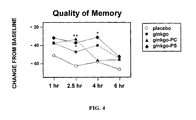
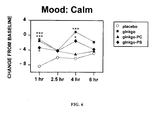
- cognitive performance involves but is not limited to improve factors related therewith such as improved speed of memory and memory quality, improved reaction time and working memory, increased accuracy and attention in activities in normal, healthy subjects, to prevent deterioration of the speed and quality of memory in people with decreased cognitive functions and to counteract cognitive fatigue having an influence on the mood and the physical well-being, particularly in healthy children, young adults, middle-aged and/or old people.
- the Ginkgo phosphatidylserine complex used according to the present invention has an excellent influence and effectivity on cognitive function and mental fatigue and the related cognitive factors such as quality of memory, speed of memory, and the majority of the activities concerning attention and accuracy.
- the general context will be clear from the study explained in the experimental part.
- the complex can be used at dosages ranging from about 20 to about 240 mg/day, preferably about 60 to about 120 mg/day, particularly preferred from about 80 to about 100 mg/day in single or divided daily administrations as medicament or as a dietary supplement.
- the medicament or dietary supplement may be in the form of tablets, coated tablets, granules, powders, powders in capsules, syrups, solutions or suspensions for example on the basis of water, ethanol or a mixture thereof, dragees, gels, injections or any other suitable manner well known to the skilled person. These products may be administered also as topical formulations, at variable dosages depending on the desired application, e.g. the severity of the pathological condition being treated.
- the medicament and/or dietary supplement is administrated in a form suitable for oral administration, such as granules, tablets, capsules, drops, syrups or others.
- dietary supplement as used hereinabove and hereinbelow includes a composition which may be used without prescription by a third party, for example a physician.
- the components may be taken together with meals or separated thereof, on a daily basis or only sometimes.
- Dietary supplements are primarily important for those having inadequate diets, individuals with a reduced ability to utilize or absorb the essential substances from food, particularly the elderly persons.
- the Ginkgo phosphatidylserine complex may be used with a suitable or pharmacologically acceptable amount of additives.
- additives may be, but are not limited to minerals, vitamins, sweeteners, flavors, pharmaceutically acceptable carriers, auxiliary and binder agents, excipients and mixtures thereof.
- the minerals used may be for example selected from salts of calcium, copper, magnesium, iron, zinc, iodine, selenium, manganese, fluoride, chromium, molybdenum, sodium, potassium, chloride and mixtures thereof. Additional minerals which are less preferred are arsenic, nickel, silicon, boron, cadmium, lead, lithium, tin, vanadium and cobalt salts and mixtures thereof.
- the mineral sources are usually present in nutritionally relevant amounts.
- the source of the mineral salts used maybe any of the well known salts such as carbonate, oxide, hydroxyde, chloride, sulfate, phosphate, gluconate, lactate, acetate, fumarate, citrat, malat, amino acids and the like for the cationic minerals and sodium, potassium, calcium, magnesium and the like for the anionic minerals.
- Those skilled in the art are familiar with the preferred ranges for infants or adults, depending somewhat on age and physiological state. It is clear that the daily intake of minerals may vary with the user so that no exact dosages may be mentioned. According to the present invention it is most preferred that the following minerals present in the medicament or dietary supplement may be selected from calcium, fluorine, phosphorus, copper, potassium, manganese, magnesium selenium, zinc and iron.
- Vitamins which may optionally be used according to the present invention can be, but are not limited to water-soluble vitamins e.g. Vitamin C e.g. L- (+)-ascorbic acid, calcium ascorbate, potassium ascorbate, 6-palmitoyl-L-ascorbic acid; Vitamin B1 e.g. thiamine hydrochloride, thiamine mononitrate; Vitamin B2 e.g. riboflavin, riboflavin 5'-phosphate sodium; Vitamin B6 e.g. pyridoxine hydrochloride, Vitamin B12 e.g. cyanocobalamine; Vitamin H e.g. D-biotin; Folic Acid; Vitamin PP (Niacin) e.g.
- Vitamin C e.g. L- (+)-ascorbic acid, calcium ascorbate, potassium ascorbate, 6-palmitoyl-L-ascorbic acid
- Vitamin B1 e.g. thiamine hydrochloride,
- Vitamin B5 e.g. panthenol (d and dl forms) ethyl panthenol and calcium D-pantothenate
- fat-soluble vitamins e.g. Vitamin A e.g. Vitamin A palmitate, Vitamin A acetate, Vitamin A propinate, all trans retinol
- Vitamin D e.g. ergocalciferol, cholecalciferol, cholecalciferol-cholesterol
- Vitamin E e.g. alpha-tocopherol, alpha-tocopheryl acetate, alpha-tocopheryl acid succinate (d and dl forms)
- Vitamin K such Vitamin K1 e.g.
- vitamins may be present in nutritional relevant amounts depending on age and physiological state as already mentioned above.
- Preferred vitamins are vitamin A, vitamins B1, B2 and B12, vitamin C, vitamin D2, nicotinamide, calcium pantotenate, rutoside and vitamin E.
- the present invention it is particularly preferred if minerals and/or vitamins are present as additives.
- Such a combination of the Ginkgo phosphatidylserine complex and selected multivitamins and/or minerals is particularly suitable for maintaining and/or restoring cognitive functions and improving physical well-being, for example in elderly persons or patients.
- the Ginkgo complex combined with a multivitamin/minerals formulation may be tailored particularly to the needs of elderly persons who face or want to prevent age-related decline of cognitive functions and physical well-being. It is a meaningful combination of Ginkgo and phosphatidylserine in form of a complex which is proven in the experimental part to have strong beneficial effects on cognitive function.
- the performance may be increased with additives such as minerals and/or vitamins which are selected and dosed according to their potential of maintaining and restoring cognitive functions and improving physical well-being, particularly of elderly persons.
- Most preferred is a combination consisting essentially of:
- the complex according to the present invention may be used for the improvement of cognitive functions in healthy young people and the maintenance of healthy cognitive functions and delay of age-related cognitive decline in healthy middle-aged and/or old people.
- the complex may be used for manufacturing a medicament or a dietary supplement for the treatment and prevention of diseases related with the reduction of cognitive function and mental fatigue.
- Still a further aspect of the present invention is directed to the use of Ginkgo complexed with phosphatidylserine for the manufacture of a medicament or a dietary supplement for the treatment and prevention of Dementia, e.g. Alzheimer's disease.
- the medicament or dietary supplement additionally contains a pharmaceutically acceptable amount of at least one additive which may be selected from the group comprising vitamins, minerals, sweeteners, flavors, pharmaceutically acceptable carriers, auxiliary and binder agents, excipients and mixtures thereof, as already described.
- the complex of the present invention may also be used in combination with an additionally active compound, i.e. the Ginkgo complex may also play a role in the combination treatment of Dementia such as age-related Dementia, e.g. Alzheimer's Disease.
- An active compound in this connection may be a pharmaceutical compound or another active substance used for the treatment and prevention of the disease to be treated, e.g. a compound which supports the treatment and curing of Alzheimer's Disease.
- One example of said embodiment of the invention may be to use Ginkgo complexed with phosphatidylserine of the invention as adjuvant therapy in the treatment of Dementia particularly Alzheimer's disease in combination with acetylcholinesterase inhibitors.
- the leading acetylcholinesterase inhibitors in the treatment of Dementia are Donepezil (Aricept® available from Pfizer), Rivastigmine (Exelon® available from Novartis) and Galantamine (Reminyl® available from Johnson & Johnson). Therefore the complex of the present invention may be co-administered with such a known acetylcholinesterase inhibitor.
- co-administration is meant that each of the two components (complex and additional active compound) are administered at the same time or separately but within a close timely relationship.
- a further embodiment for the combined therapy with the inventive complex and an additionally active compound is the combination treatment in an age-related Dementia such as Alzheimer's Disease by the co-administration of the complex of the present invention and complexed grape seed extract as additionally active compound. It has been found that the combined use of the inventive complex and an additionally active compound leads to superior results in the prevention or curing of such diseases and supports to alleviate the symptoms and to extenuate the course of the disease in an extraordinary way.
- CDR Cognitive Drug Research
- a tailored version of the CDR battery was used. This has previously been found to be sensitive to modulation of cognitive function as a consequence of acute ingestion of Melissa officinalis (Kennedy et al, 2002b), Ginkgo biloba (Kennedy et al 2000; 2002a) and Panax ginseng (Kennedy et al 2001a; 2002a), and acute and chronic administration of a Ginkgo biloba / Panax ginseng combination (Kennedy et al 2001b; 2002a; Wesnes et al 1997; Wesnes et al 2000).
- RVIP rapid visual information processing
- the selection of computer controlled tasks from the system was administered with randomly ordered parallel forms of the tests being presented at each testing session. Presentation was via desktop computers with high resolution VGA colour monitors, and, with the exception of written word recall tests, all responses were recorded via two-button (YES/NO) response boxes. The entire selection of tasks took approximately 20 minutes to perform.
- Word Presentation Fifteen words, matched for frequency and concreteness, were presented in random order on the monitor for the participant to remember. Stimulus duration was 1 second, as was the inter-stimulus interval.
- Immediate Word Recall The participant was allowed 60 seconds to write down as many of the words as possible. The task was scored as number of words correct and the resulting score was converted into a percentage.
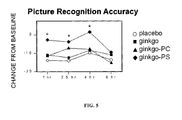
- Picture Presentation A series of 20 photographic images of everyday objects and scenes were presented on the monitor at the rate of 1 every 3 seconds, with a stimulus duration of 1 second, for the participant to remember.
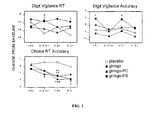
- Digit Vigilance Task A target digit was randomly selected and constantly displayed to the right of the monitor screen. A series of digits was presented in the centre of the screen at the rate of 80 per minute and the participant was required to press the "YES" button as quickly as possible every time the digit in the series matched the target digit. The task lasted one minute and there were 15 stimulus-target matches. Task measures were accuracy (%), reaction time (msecs) and number of false alarms.
- Choice Reaction Time Either the word "NO” or the word “YES” was presented on the monitor and the participant was required to press the corresponding button as quickly as possible. There were 50 trials, of which the stimulus word was chosen randomly with equal probability, with a randomly varying inter-stimulus interval of between 1 and 3.5 seconds. Reaction times (msec) and accuracy (%) were recorded.
- Spatial Working Memory A pictorial representation of a house was presented on the screen with four of its nine windows lit. The participant was instructed to memorise the position of the illuminated windows. In 36 subsequent presentations of the house, one of the windows was illuminated and the participant decided whether or not this matched one of the lighted windows in the original presentation. The participant made their response by pressing the "YES” or “NO” response button as quickly as possible. Mean reaction times were measured in msec, and accuracy of responses to both original and novel (distractor) stimuli were recorded as percentages which were used to derive a "% greater than chance performance" score (percentage of original targets + percentage of novel targets correctly identified - 100).
- Numeric Working Memory Five digits were presented sequentially for the participant to hold in memory. This was followed by a series of 30 probe digits for each of which the participant decided whether or not it had been in the original series and pressed the "YES” or "NO” response button as appropriate as quickly as possible. This was repeated two further times with different stimuli and probe digits. Mean reaction times were measured in msec, and accuracy of responses to both original and novel (distractor) stimuli were recorded as percentages which were used to derive a "% greater than chance performance" score as above.
- Delayed Word Recall The participant was again given 60 seconds to write down as many of the words as possible. The task was scored for number of words correct and the resulting score was converted into a percentage.
- Delayed Word Recognition The original words plus 15 distractor words were presented one at a time in a randomised order. For each word the participant indicated whether or not he recognised it as being included in the original list of words by pressing the "YES” or “NO” button as appropriate and as quickly as possible. Mean reaction times were measured in msec, and accuracy of responses to both original and novel (distractor) stimuli were recorded as percentages which were used to derive a "% greater than chance performance" score as above.
- Delayed Picture Recognition The original pictures plus 20 distractor pictures were presented one at a time in a randomised order. For each picture participants indicated whether or not it was recognised as being from the original series by pressing the "YES” or “NO” button as appropriate and as quickly as possible. Mean reaction times were measured in msec, and accuracy of responses to both original and novel (distractor) stimuli were recorded as percentages which were used to derive a "% greater than chance performance" score as above.
- Speed of Memory factor derived by combining the reaction times of the four computerised memory tasks - numeric working memory, spatial memory, delayed word recognition, and delayed picture recognition (units are summed milliseconds for the 4 tasks).
- “Secondary Memory” factor derived by combining the percentage accuracy scores (adjusted for proportions of novel and original stimuli where appropriate) from all of the secondary memory tests - delayed word recognition, delayed picture recognition, immediate word recall and delayed word recall (with adjustments to the total % correct for errors and intrusions on the latter two tasks). One hundred percent accuracy across the four tasks would generate a maximum score of 400 on this index.
- “Working Memory” factor derived by combining the percentage accuracy scores from the two working memory tests - spatial working memory, and numeric working memory. One hundred percent accuracy across the two tasks would generate a maximum score of 200 on this index.
- Serial Threes task was identical to Serial Sevens, except that it involved serial subtraction of threes.
- Bond-Lader Visual Analogue Scales (Bond and Lader 1974), consisting of 16 100 mm visual analogue scales anchored by antonyms (e.g. Alert-Drowsy, Lethargic-Energetic, etc) were combined as recommended by the authors to form three mood factors: alertness, calmness and contentedness.
- antonyms e.g. Alert-Drowsy, Lethargic-Energetic, etc
- the individual capsules contained either an inert placebo, 60 mg Ginkgo biloba extract, 180 mg of Ginkgo biloba extract complexed with phosphatidylcholine (equivalent to 60 mg of Ginkgo biloba extract, in the following referred to as "PC"), or 240 mg of Ginkgo biloba extract complexed with phosphatidylserine (phospholipid containing 20% of phospatidylserine.
- the complex is equivalent to 60 mg of Ginkgo biloba extract and in the following is referred to as "PS").
- the combination of capsules corresponded to a dose of either 0 mg (placebo), 120 mg Ginkgo, 360 mg Ginkgo complexed withphosphatidylcholine, or 480 mg Ginkgo complexed withphospholipid containing 20% of phosphatidylserine.
- placebo 120 mg Ginkgo
- 360 mg Ginkgo complexed withphosphatidylcholine 360 mg Ginkgo complexed withphosphatidylcholine
- 480 mg Ginkgo complexed withphospholipid containing 20% of phosphatidylserine 0 mg (placebo), 120 mg Ginkgo, 360 mg Ginkgo complexed withphosphatidylcholine, or 480 mg Ginkgo complexed withphospholipid containing 20% of phosphatidylserine.
- coded treatments were provided by the manufacturer in identical hard gelatine capsules.
- a disinterested third party was then responsible for preparing treatments as per the study's Latin Square. The code remained unbroken until initial
- Each participant was required to attend a total of five study days that were conducted seven days apart, to ensure a sufficient wash-out between conditions. Testing took place, commencing at the same time on each day, in a suite of laboratories with participants visually isolated from each other.
- the first day was identical to the following four, except that no treatment (active or placebo) was offered, to allow familiarisation with the test battery and procedure. Data from the four sessions of this practice day were not included in any analysis.
- Each active study day comprised four identical testing sessions. The first was a pre-dose testing session which established baseline performance for that day, and was immediately followed by the day's treatment on days 2 to 5. Further testing sessions began at 1 hour, 3 hours, and 6 hours following consumption of the day's treatment.
- Each testing session comprised completion of the Bond-Lader visual analogue scales, and the CDR test battery.
- Bond-Lader mood scales (cf . Fig. 5)
- the Ginkgo phosphatidylserine complex used according to the present invention has an outstanding higher effectivity compared with the other tested species, i.e. not complexed Ginkgo or Ginkgo phosphatidylcholin complex, regarding Quality of Memory, Picture Recognition Accuracy, Speed of Memory, Timed Memory Tasks and the majority of the tasks concerning attention.
Landscapes
- Health & Medical Sciences (AREA)
- Life Sciences & Earth Sciences (AREA)
- Engineering & Computer Science (AREA)
- Chemical & Material Sciences (AREA)
- Medicinal Chemistry (AREA)
- Veterinary Medicine (AREA)
- Pharmacology & Pharmacy (AREA)
- Animal Behavior & Ethology (AREA)
- General Health & Medical Sciences (AREA)
- Public Health (AREA)
- Natural Medicines & Medicinal Plants (AREA)
- Mycology (AREA)
- Botany (AREA)
- Bioinformatics & Cheminformatics (AREA)
- Chemical Kinetics & Catalysis (AREA)
- Organic Chemistry (AREA)
- Nuclear Medicine, Radiotherapy & Molecular Imaging (AREA)
- Epidemiology (AREA)
- General Chemical & Material Sciences (AREA)
- Biomedical Technology (AREA)
- Neurology (AREA)
- Neurosurgery (AREA)
- Alternative & Traditional Medicine (AREA)
- Biotechnology (AREA)
- Medical Informatics (AREA)
- Microbiology (AREA)
- Nutrition Science (AREA)
- Polymers & Plastics (AREA)
- Food Science & Technology (AREA)
- Hematology (AREA)
- Diabetes (AREA)
- Obesity (AREA)
- Hospice & Palliative Care (AREA)
- Psychiatry (AREA)
- Medicines Containing Plant Substances (AREA)
- Pharmaceuticals Containing Other Organic And Inorganic Compounds (AREA)
- Coloring Foods And Improving Nutritive Qualities (AREA)
- Medicinal Preparation (AREA)
- Medicines That Contain Protein Lipid Enzymes And Other Medicines (AREA)
- Steroid Compounds (AREA)
Abstract
Description
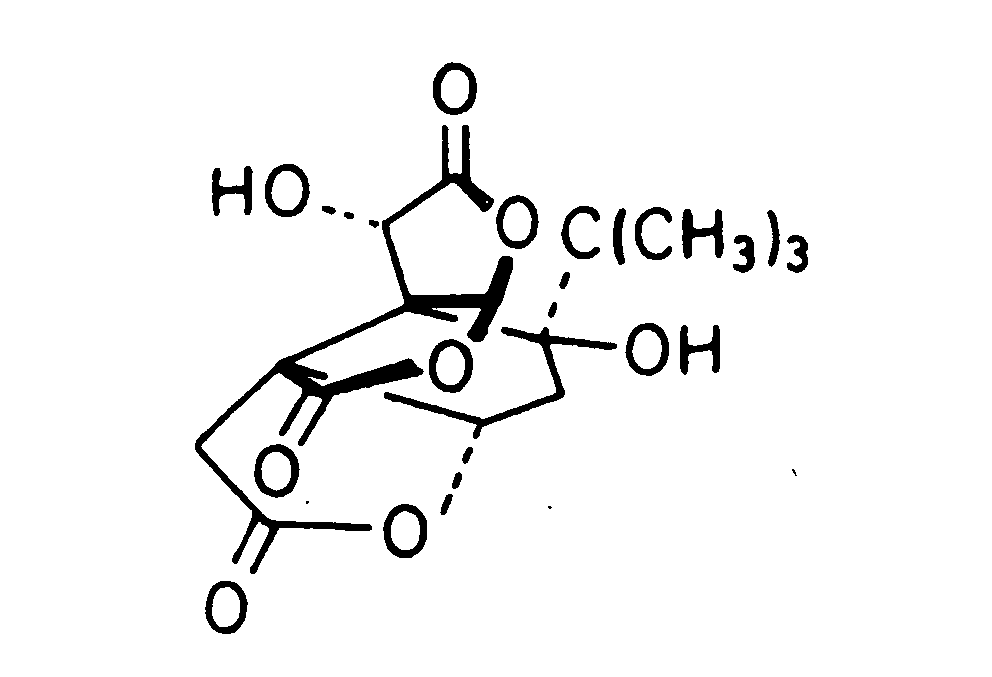

R and R1 each independently represent an C6-20 acyl group, preferably an acyl moiety selected from the group consisting of palmitoyl, oleoyl, linoleoyl, linolenoyl, in particular which comprises, on an average, from 15 to 25% of saturated fatty acids, from 5 to 15% of mono-unsaturated fatty acids and from 60 to 80% of polyunsaturated fatty acids, based on the total acids; and
R2 represents the residue of serine,
- a complex of Ginkgo extract and phosphatidylserine
- Vitamin A
-
Vitamin B 1 - Vitamin B2
- Vitamin B6
- Vitamin B 12
- Vitamin C
- Vitamin D2
- Vitamin E
- Nicotinamide
- Calcium Pantotenate
- Rutoside
- Folic Acid
- Fluorine
- Calcium
- Phosphorus
- Copper
- Potassium
- Manganese
- Magnesium
- Zinc
- Iron
- Lecithin
Claims (23)
- Use of Ginkgo complexed with a phospholipid containing from 10 to 50% of phosphatidylserine for the manufacture of a medicament or a dietary supplement for the enhancement of cognitive function and mental fatigue.
- Use according to claim 1 wherein the phospholipid contains from 20 to 40% of phosphatidylserine.
- Use according to claims 1-2 wherein the phospholipid contains 20% of phospatidylserine.
- Use according to claims 1-3, wherein the Ginkgo is derived from the plant Ginkgo biloba, extracts thereof and/or one or more principal active substances thereof.
- Use according to claim 4, wherein one of the principal active substances is bilobalide.
- Use according to claim 4, characterized in that the Ginkgo extract is used containing at least about 20% Ginkgo flavone glycosides and about 2 to about 10% terpene lactones.
- Use according to any of claims 1 to 6, wherein the ratio between Ginkgo and the phosphatidylserine used to prepare the complex is about 1:1.
- Use according to any of the preceding claims 1 to 7, wherein the medicament or dietary supplement is administered in the form of tablets, granules, powders, capsules, syrups, solutions, suspensions, dragees, gels, injections or drops.
- Use according to any of claims 1 to 8, wherein the medicament or dietary supplement is formulated for oral administration.
- Use according to any of the preceding claims 1 to 8, wherein the Ginkgo phosphatidylserine complex contained in the medicament or dietary supplement is to be administered in an amount of about 20 to about 240 mg per day, particularly about 60 to about 120 mg per day.
- Use according to any of the preceding claims 1 to 10, wherein the medicament or dietary supplement additionally contains a pharmaceutically acceptable amount of at least one additive selected from the group comprising minerals, vitamins, sweeteners, flavors, pharmaceutically acceptable carriers, auxiliary and binder agents, excipients and mixtures thereof.
- Use according to claim 11, wherein the additive is selected from vitamins, minerals and mixtures thereof, particularly selected from calcium, fluorine, phosphorus, copper, potassium, manganese, magnesium selenium, zinc and iron, Vitamin A, Vitamins B 1, B2 and B12, Vitamin C, Vitamin D2, nicotinamide, calcium pantotenate, rutoside and Vitamin E.
- Use of Ginkgo complexed with phosphatidylserine for the manufacture of a medicament or a dietary supplement for the enhancement of cognitive function and mental fatigue by improving the speed of memory and memory quality, by counteracting cognitive fatigue in normal, healthy persons or by preventing deterioration of the speed of memory in people with decreased cognitive functions.
- Use of Ginkgo complexed with phosphatidylserine for the manufacture of a medicament or a dietary supplement for the treatment and prevention of a diesease related with the reduction of cognitive function and mental fatigue.
- Use according to claim 14 wherein the disease is Dementia.
- Use according to claim 15 wherein the disease is Alzheimer's Disease.
- Use according to any of the preceding claims 14 to 16 wherein the medicament or dietary supplement additionally contains a pharmaceutically acceptable amount of at least one additive selected from the group comprising vitamins, minerals, sweeteners, flavors, pharmaceutically acceptable carriers, auxiliary and binder agents, excipients and mixtures thereof.
- Use according to any of the preceding claims 14 to 17 in combination with a pharmaceutical compound used for the treatment and prevention of the disease to be treated related with the reduction of cognitive function and mental fatigue.
- Use according to claim 18, wherein the pharmaceutical compound is an acetylcholinesterase inhibitor.
- Use according to claim 18, wherein the additionally active compound is complexed grape seed extract.
- A pharmaceutical or dietary composition comprising Ginkgo complex and at least one vitamin and a pharmaceutically or dietarily acceptable carrier.
- A complex of an extract of Ginkgo with a phosphatidylserine of formulawherein
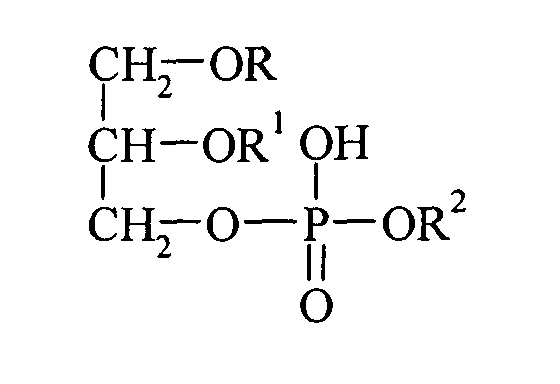
R and R' each independently represent an acyl moiety selected from the fatty acids consisting of palmitic acid, oleic acid, linoleic acid, stearic acid. - A complex according to claim 22, which comprises from 15 to 25% of saturated fatty acids, from 5 to 15% of mono-unsaturated fatty acids and from 60 to 80% of polyunsaturated fatty acids, based on the total acids.
Priority Applications (21)
| Application Number | Priority Date | Filing Date | Title |
|---|---|---|---|
| AT04001937T ATE428312T1 (en) | 2004-01-29 | 2004-01-29 | USE OF GINKGO COMPLEXES TO IMPROVE COGNITIVE PERFORMANCE AND RELIEF MENTAL FATIGUE |
| SI200431142T SI1559430T1 (en) | 2004-01-29 | 2004-01-29 | Use of ginkgo complexes for the enhancement of cognitive functions and the alleviation of mental fatigue |
| EP04001937A EP1559430B1 (en) | 2004-01-29 | 2004-01-29 | Use of ginkgo complexes for the enhancement of cognitive functions and the alleviation of mental fatigue |
| ES04001937T ES2323864T3 (en) | 2004-01-29 | 2004-01-29 | USE OF GINKGO COMPLEXES FOR THE POTENTIAL OF COGNITIVE FUNCTIONS AND RELIEF OF MENTAL FATIGUE. |
| DE602004020574T DE602004020574D1 (en) | 2004-01-29 | 2004-01-29 | Use of ginkgo complexes to improve cognitive performance and alleviate mental fatigue |
| PT04001937T PT1559430E (en) | 2004-01-29 | 2004-01-29 | Use of ginkgo complexes for the enhancement of cognitive functions and the alleviation of mental fatigue |
| DK04001937T DK1559430T3 (en) | 2004-01-29 | 2004-01-29 | Use of Ginkgo complexes for enhancing cognitive functions and alleviating mental fatigue |
| CN2005800033273A CN1913907B (en) | 2004-01-29 | 2005-01-26 | Use of ginkgo complexes for the enhancement of cognitive functions and the alleviation of mental fatigue |
| RU2006127272/15A RU2368385C2 (en) | 2004-01-29 | 2005-01-26 | Ginkgo complexes used for strengthening cognitive functions and decreasing mental fatigue |
| KR1020117024637A KR101249667B1 (en) | 2004-01-29 | 2005-01-26 | Use of ginkgo complexes for the enhancement of cognitive functions and the alleviation of mental fatigue |
| KR1020067015129A KR101249633B1 (en) | 2004-01-29 | 2005-01-26 | Use of ginkgo complexes for the enhancement of cognitive functions and the alleviation of mental fatigue |
| PL380826A PL219337B1 (en) | 2004-01-29 | 2005-01-26 | Applying Ginko compounds to increase cognitive function and alleviate brain fatigue |
| JP2006550086A JP5300196B2 (en) | 2004-01-29 | 2005-01-26 | Use of ginkgo complex for cognitive improvement and alleviation of mental fatigue |
| HK07104973.6A HK1098380B (en) | 2004-01-29 | 2005-01-26 | Use of a ginkgo complexes for the manufacture of a medicament or a dietary supplement for the enhancement of cognitive functions and the alleviation of mental fatigue |
| PCT/EP2005/000738 WO2005074956A1 (en) | 2004-01-29 | 2005-01-26 | Use of a ginkgo complexes for the enhancement of cognitive functions and the alleviation of mental fatigue |
| CA2554760A CA2554760C (en) | 2004-01-29 | 2005-01-26 | Use of a complex of ginkgo flavonoids and phosphatidylserine for enhanced cognitive function |
| SG2011046141A SG172727A1 (en) | 2004-01-29 | 2005-01-26 | Use of ginkgo complexes for the enhancement of cognitive functions and the alleviation of mental fatigue |
| US10/587,468 US8591965B2 (en) | 2004-01-29 | 2005-01-26 | Use of a ginkgo complexes for the enhancement of cognitive functions and the alleviation of mental fatigue |
| AU2005210091A AU2005210091B2 (en) | 2004-01-29 | 2005-01-26 | Use of a Ginkgo complexes for the enhancement of cognitive functions and the alleviation of mental fatigue |
| NO20063463A NO331190B1 (en) | 2004-01-29 | 2006-07-27 | Use of ginkgo complexes and non-therapeutic use of a dietary supplement of ginkgo complexes to enhance cognitive functions and alleviate mental fatigue |
| IL177118A IL177118A (en) | 2004-01-29 | 2006-07-27 | Use of lipophilic complexes in the manufacture of a medicament for treatment and prevention of cognitive function and the alleviation of mental fatigue and as a dietary supplement |
Applications Claiming Priority (1)
| Application Number | Priority Date | Filing Date | Title |
|---|---|---|---|
| EP04001937A EP1559430B1 (en) | 2004-01-29 | 2004-01-29 | Use of ginkgo complexes for the enhancement of cognitive functions and the alleviation of mental fatigue |
Publications (2)
| Publication Number | Publication Date |
|---|---|
| EP1559430A1 true EP1559430A1 (en) | 2005-08-03 |
| EP1559430B1 EP1559430B1 (en) | 2009-04-15 |
Family
ID=34639409
Family Applications (1)
| Application Number | Title | Priority Date | Filing Date |
|---|---|---|---|
| EP04001937A Expired - Lifetime EP1559430B1 (en) | 2004-01-29 | 2004-01-29 | Use of ginkgo complexes for the enhancement of cognitive functions and the alleviation of mental fatigue |
Country Status (19)
| Country | Link |
|---|---|
| US (1) | US8591965B2 (en) |
| EP (1) | EP1559430B1 (en) |
| JP (1) | JP5300196B2 (en) |
| KR (2) | KR101249633B1 (en) |
| CN (1) | CN1913907B (en) |
| AT (1) | ATE428312T1 (en) |
| AU (1) | AU2005210091B2 (en) |
| CA (1) | CA2554760C (en) |
| DE (1) | DE602004020574D1 (en) |
| DK (1) | DK1559430T3 (en) |
| ES (1) | ES2323864T3 (en) |
| IL (1) | IL177118A (en) |
| NO (1) | NO331190B1 (en) |
| PL (1) | PL219337B1 (en) |
| PT (1) | PT1559430E (en) |
| RU (1) | RU2368385C2 (en) |
| SG (1) | SG172727A1 (en) |
| SI (1) | SI1559430T1 (en) |
| WO (1) | WO2005074956A1 (en) |
Cited By (5)
| Publication number | Priority date | Publication date | Assignee | Title |
|---|---|---|---|---|
| EP2072054A1 (en) * | 2007-12-21 | 2009-06-24 | Dr. Willmar Schwabe GmbH & Co. KG | Use of a ginkgo biloba leaf extract |
| ITTO20080532A1 (en) * | 2008-07-10 | 2010-01-11 | Euro Pharma S R L | DIETARY SUPPLEMENT FOR NEURONAL AND SENSORY ENHANCEMENT |
| ITMI20100019A1 (en) * | 2010-01-12 | 2011-07-13 | Indena Spa | COMPOSITIONS BASED ON ANDROGRAPHIS PANICULATED EXTRACTS COMBINED WITH GINKGO BILOBA EXTRACTS COMPOSED WITH PHOSPHOLIPIDS AND THEIR USE |
| CN103156022A (en) * | 2011-12-09 | 2013-06-19 | 四川科伦药物研究有限公司 | Ginkgo leaf health-care tea and preparation method thereof |
| IT202300026307A1 (en) | 2023-12-11 | 2025-06-11 | Health Brands Lab S R L | A COMBINATION OF NOOTROPIC PRODUCTS FOR THE WELL-BEING OF THE NERVOUS SYSTEM AND COGNITIVE PROCESSES |
Families Citing this family (10)
| Publication number | Priority date | Publication date | Assignee | Title |
|---|---|---|---|---|
| KR100723609B1 (en) * | 2006-04-28 | 2007-06-04 | 주식회사 유유 | Ginkgo biloba extract for the prevention or treatment of Alzheimer's dementia and Parkinson's disease, as well as extraction and purification method from ginkgo biloba |
| US8183227B1 (en) | 2011-07-07 | 2012-05-22 | Chemo S. A. France | Compositions, kits and methods for nutrition supplementation |
| US8168611B1 (en) | 2011-09-29 | 2012-05-01 | Chemo S.A. France | Compositions, kits and methods for nutrition supplementation |
| AU2015348010B2 (en) * | 2014-11-20 | 2020-02-27 | Frutarom Limited | Phospholipid preparations for the improvement of communication skills |
| JP6923940B2 (en) | 2016-04-15 | 2021-08-25 | 慶裕 広川 | Cognitive function improver |
| CN105901649A (en) * | 2016-05-03 | 2016-08-31 | 王胜 | Plant salt containing ginkgo extracts and preparation method thereof |
| RU2680809C2 (en) * | 2016-12-20 | 2019-02-27 | федеральное государственное автономное образовательное учреждение высшего образования "Российский университет дружбы народов" (РУДН) | Method of producing a nanoscale phytosome system |
| US20200226948A1 (en) * | 2019-01-14 | 2020-07-16 | Robert Warren | Time and Attention Evaluation System |
| AU2021204964A1 (en) * | 2020-01-03 | 2022-07-07 | Biosearch, S.A. | Composition for use in the treatment of cognitive disorders |
| CN118121640A (en) * | 2024-02-05 | 2024-06-04 | 联合理论有限公司 | Composition for treating attention deficit hyperactivity disorder in children, soft capsule, preparation method and application thereof |
Citations (5)
| Publication number | Priority date | Publication date | Assignee | Title |
|---|---|---|---|---|
| EP0275005A2 (en) * | 1987-01-14 | 1988-07-20 | INDENA S.p.A. | Complex compounds of bioflavonoids with phospholipids, their preparation and use, and pharmaceutical and cosmetic compositions containing them |
| KR20020069539A (en) * | 2001-02-26 | 2002-09-05 | 주식회사 두산 | Composition for healthy brain |
| WO2003013549A2 (en) * | 2001-08-09 | 2003-02-20 | Degussa Food Ingredients Gmbh | Formulation containing (lyso-) phosphatidylserine for the prevention and treatment of stress states in warm-blooded animals |
| US6572899B1 (en) * | 2002-07-03 | 2003-06-03 | Vitacost.Com, Inc. | Memory loss treatment formulation |
| JP2003169632A (en) * | 2001-12-08 | 2003-06-17 | Sapuri:Kk | Health food containing rice germ oil, egg yolk oil and phosphatidylserine |
Family Cites Families (5)
| Publication number | Priority date | Publication date | Assignee | Title |
|---|---|---|---|---|
| DE2929959A1 (en) * | 1979-07-24 | 1981-02-19 | Hoechst Ag | THERMOPLASTIC PLASTIC MATERIAL |
| IT1238684B (en) * | 1990-02-09 | 1993-09-01 | Indena Spa | BILOBALIDE DERIVATIVES, THEIR USES AND FORMULATIONS THAT CONTAIN THEM |
| DK1242105T5 (en) * | 1999-12-17 | 2009-12-07 | Pharmaton Sa | Ginseng and ginkgo preparation to improve cognitive functions |
| US6733797B1 (en) * | 2000-11-15 | 2004-05-11 | William K. Summers | Neuroceutical for improving memory and cognitive abilities |
| JP2003261456A (en) * | 2002-03-08 | 2003-09-16 | Howaizu:Kk | Prevention of brain aging |
-
2004
- 2004-01-29 SI SI200431142T patent/SI1559430T1/en unknown
- 2004-01-29 EP EP04001937A patent/EP1559430B1/en not_active Expired - Lifetime
- 2004-01-29 PT PT04001937T patent/PT1559430E/en unknown
- 2004-01-29 AT AT04001937T patent/ATE428312T1/en active
- 2004-01-29 DK DK04001937T patent/DK1559430T3/en active
- 2004-01-29 DE DE602004020574T patent/DE602004020574D1/en not_active Expired - Lifetime
- 2004-01-29 ES ES04001937T patent/ES2323864T3/en not_active Expired - Lifetime
-
2005
- 2005-01-26 KR KR1020067015129A patent/KR101249633B1/en not_active Expired - Lifetime
- 2005-01-26 US US10/587,468 patent/US8591965B2/en active Active
- 2005-01-26 RU RU2006127272/15A patent/RU2368385C2/en active
- 2005-01-26 WO PCT/EP2005/000738 patent/WO2005074956A1/en not_active Ceased
- 2005-01-26 JP JP2006550086A patent/JP5300196B2/en not_active Expired - Lifetime
- 2005-01-26 KR KR1020117024637A patent/KR101249667B1/en not_active Expired - Lifetime
- 2005-01-26 CN CN2005800033273A patent/CN1913907B/en not_active Expired - Lifetime
- 2005-01-26 AU AU2005210091A patent/AU2005210091B2/en not_active Expired
- 2005-01-26 CA CA2554760A patent/CA2554760C/en not_active Expired - Lifetime
- 2005-01-26 SG SG2011046141A patent/SG172727A1/en unknown
- 2005-01-26 PL PL380826A patent/PL219337B1/en unknown
-
2006
- 2006-07-27 NO NO20063463A patent/NO331190B1/en unknown
- 2006-07-27 IL IL177118A patent/IL177118A/en active IP Right Grant
Patent Citations (5)
| Publication number | Priority date | Publication date | Assignee | Title |
|---|---|---|---|---|
| EP0275005A2 (en) * | 1987-01-14 | 1988-07-20 | INDENA S.p.A. | Complex compounds of bioflavonoids with phospholipids, their preparation and use, and pharmaceutical and cosmetic compositions containing them |
| KR20020069539A (en) * | 2001-02-26 | 2002-09-05 | 주식회사 두산 | Composition for healthy brain |
| WO2003013549A2 (en) * | 2001-08-09 | 2003-02-20 | Degussa Food Ingredients Gmbh | Formulation containing (lyso-) phosphatidylserine for the prevention and treatment of stress states in warm-blooded animals |
| JP2003169632A (en) * | 2001-12-08 | 2003-06-17 | Sapuri:Kk | Health food containing rice germ oil, egg yolk oil and phosphatidylserine |
| US6572899B1 (en) * | 2002-07-03 | 2003-06-03 | Vitacost.Com, Inc. | Memory loss treatment formulation |
Non-Patent Citations (7)
| Title |
|---|
| "Phosphatidylserine Complex with Ginkgo", PHYSIOLOGICS, 2003, NORTHGLENN, CO, USA, XP002277440, Retrieved from the Internet <URL:http://www.physiologics.com/vf/labels/002632PL.pdf> * |
| BORCHERS A T ET AL: "INFLAMMATION AND NATIVE AMERICAN MEDICINE: THE ROLE OF BOTANICALS", AMERICAN JOURNAL OF CLINICAL NUTRITION, BETHESDA,MD, US, vol. 72, no. 2, August 2000 (2000-08-01), pages 339 - 347, XP001083537, ISSN: 0002-9165 * |
| DATABASE WPI Section Ch Week 200314, Derwent World Patents Index; Class B05, AN 2003-145335, XP002277442 * |
| KIDD P M: "A REVIEW OF NUTRIENTS AND BOTANICALS IN THE INTEGRATIVE MANAGEMENT OF COGNITIVE DYSFUNCTION", ALTERNATIVE MEDICINE REVIEW, THORNE RESEARCH INC., SANDPOINT,, US, vol. 4, no. 3, June 1999 (1999-06-01), pages 144 - 161, XP008024312, ISSN: 1089-5159 * |
| OTT B R ET AL: "COMPLEMENTARY AND ALTERNATIVE MEDICINES FOR ALZHEIMER'S DISEASE", JOURNAL OF GERIATRIC PSYCHIATRY AND NEUROLOGY, DECKER PERIODICALS, HAMILTON, CA, vol. 11, no. 4, 21 December 1998 (1998-12-21), pages 163 - 173, XP001052687, ISSN: 0891-9887 * |
| PATENT ABSTRACTS OF JAPAN vol. 2003, no. 10 8 October 2003 (2003-10-08) * |
| SASAKI KEIKO ET AL: "Bilobalide prevents reduction of gamma-aminobutyric acid levels and glutamic acid decarboxylase activity induced by 4-O-methylpyridoxine in mouse hippocampus", LIFE SCIENCES, vol. 67, no. 6, 30 June 2000 (2000-06-30), &, pages 709 - 715, XP002277441, ISSN: 0024-3205 * |
Cited By (11)
| Publication number | Priority date | Publication date | Assignee | Title |
|---|---|---|---|---|
| EP2072054A1 (en) * | 2007-12-21 | 2009-06-24 | Dr. Willmar Schwabe GmbH & Co. KG | Use of a ginkgo biloba leaf extract |
| WO2009083162A1 (en) * | 2007-12-21 | 2009-07-09 | Dr. Willmar Schwabe Gmbh & Co. Kg | Use of an extract made of leaves of ginkgo biloba |
| ITTO20080532A1 (en) * | 2008-07-10 | 2010-01-11 | Euro Pharma S R L | DIETARY SUPPLEMENT FOR NEURONAL AND SENSORY ENHANCEMENT |
| ITMI20100019A1 (en) * | 2010-01-12 | 2011-07-13 | Indena Spa | COMPOSITIONS BASED ON ANDROGRAPHIS PANICULATED EXTRACTS COMBINED WITH GINKGO BILOBA EXTRACTS COMPOSED WITH PHOSPHOLIPIDS AND THEIR USE |
| WO2011086007A1 (en) * | 2010-01-12 | 2011-07-21 | Indena S.P.A. | Compositions comprising andrographics paniculata and gingko biloba extracts complexed with phospholipids |
| AU2011206693B2 (en) * | 2010-01-12 | 2014-03-20 | Indena S.P.A. | Compositions comprising Andrographis paniculata and Ginkgo biloba extracts complexed with phospholipids |
| RU2564093C2 (en) * | 2010-01-12 | 2015-09-27 | Индена С.П.А. | COMPOSITION, CONTAINING Andrographis paniculata AND Ginkgo biloba EXTRACTS IN COMBINATION WITH PHOSPHOLIPIDS |
| US9192636B2 (en) | 2010-01-12 | 2015-11-24 | Indena S.P.A. | Compositions comprising Andrographis paniculata extracts combined with Ginkgo biloba extracts complexed with phospholipids, and their use |
| CN103156022A (en) * | 2011-12-09 | 2013-06-19 | 四川科伦药物研究有限公司 | Ginkgo leaf health-care tea and preparation method thereof |
| CN103156022B (en) * | 2011-12-09 | 2014-12-17 | 四川科伦药物研究有限公司 | Ginkgo leaf health-care tea and preparation method thereof |
| IT202300026307A1 (en) | 2023-12-11 | 2025-06-11 | Health Brands Lab S R L | A COMBINATION OF NOOTROPIC PRODUCTS FOR THE WELL-BEING OF THE NERVOUS SYSTEM AND COGNITIVE PROCESSES |
Also Published As
| Publication number | Publication date |
|---|---|
| PT1559430E (en) | 2009-06-16 |
| IL177118A0 (en) | 2008-03-20 |
| CN1913907B (en) | 2011-03-30 |
| ATE428312T1 (en) | 2009-05-15 |
| PL219337B1 (en) | 2015-04-30 |
| SG172727A1 (en) | 2011-07-28 |
| JP5300196B2 (en) | 2013-09-25 |
| US8591965B2 (en) | 2013-11-26 |
| SI1559430T1 (en) | 2009-08-31 |
| CA2554760C (en) | 2018-10-09 |
| NO20063463L (en) | 2006-07-27 |
| AU2005210091B2 (en) | 2010-06-03 |
| IL177118A (en) | 2011-03-31 |
| NO331190B1 (en) | 2011-10-31 |
| AU2005210091A1 (en) | 2005-08-18 |
| CN1913907A (en) | 2007-02-14 |
| US20080226757A1 (en) | 2008-09-18 |
| ES2323864T3 (en) | 2009-07-27 |
| DK1559430T3 (en) | 2009-07-20 |
| WO2005074956A1 (en) | 2005-08-18 |
| JP2007519668A (en) | 2007-07-19 |
| RU2006127272A (en) | 2008-02-10 |
| KR101249633B1 (en) | 2013-04-02 |
| CA2554760A1 (en) | 2005-08-18 |
| DE602004020574D1 (en) | 2009-05-28 |
| RU2368385C2 (en) | 2009-09-27 |
| KR20060130148A (en) | 2006-12-18 |
| KR20110123289A (en) | 2011-11-14 |
| HK1098380A1 (en) | 2007-07-20 |
| PL380826A1 (en) | 2007-03-19 |
| EP1559430B1 (en) | 2009-04-15 |
| KR101249667B1 (en) | 2013-04-02 |
Similar Documents
| Publication | Publication Date | Title |
|---|---|---|
| Pizzorno et al. | The Clinician's Handbook of Natural Medicine E-Book: The Clinician's Handbook of Natural Medicine E-Book | |
| Dimitrov et al. | Bioavailability of beta-carotene in humans | |
| DE69122099T2 (en) | COMPOSITION AND METHOD FOR THE PREVENTION AND TREATMENT OF HYPERCHOLESTERINEMIA AND CELL PROLIFERATION DISORDERS | |
| US8591965B2 (en) | Use of a ginkgo complexes for the enhancement of cognitive functions and the alleviation of mental fatigue | |
| US20050202104A1 (en) | Method of enhancement of cognitive skills | |
| KR20040019382A (en) | Formulation containing (lyso-)phosphatidylserine for the prevention and treatment of stress states in warm-blooded animals | |
| US11376294B2 (en) | Mangiferin-containing compositions for improving sports performance | |
| AU2017306652A1 (en) | Compositions for enhancing brain activity | |
| JP7693243B2 (en) | Cognitive function improver | |
| Ros | Can specific nutrients, foods, or dietary patterns modulate cognitive function in (older) adults? Latest evidence from randomized controlled trials | |
| Morazzoni et al. | Use of a Ginkgo complexes for the enhancement of cognitive functions and the alleviation of mental fatigue | |
| US11357810B2 (en) | Compositions with purified Bombyx mori cocoon silk peptide fiber and refined Buglossoides arvensis seed oil having synergistic effects for improving memory, focus, and cognitive function, and related methods | |
| WO2001005356A2 (en) | Weight control product comprising a synergistic mixture of guggul extract, phosphate salt and metabolic stimulant | |
| EP3579856B1 (en) | Aronia extract for enhancing reaction time and attention | |
| US10201577B2 (en) | Compositions and methods for enhancing working and long-term memory support using new combination of ginkgo biloba and panax ginseng and associated components | |
| JP2019006699A (en) | Mild cognitive impairment improving composition | |
| HK1098380B (en) | Use of a ginkgo complexes for the manufacture of a medicament or a dietary supplement for the enhancement of cognitive functions and the alleviation of mental fatigue | |
| WO2024208561A1 (en) | Bacopa monnieri complexes with phosphatidylserine and phosphoryl ethers and use thereof for enhancing cognitive functions and memory | |
| DE20204843U1 (en) | Micronutrient combination product, suitable for nutritional supplementation when there is an increased need for micronutrients, especially in patients with diabetes and / or cardiovascular diseases | |
| Micozzi | Herbal remedies and micronutrients | |
| HK1122736A (en) | Composition comprising panax ginseng and paullinia cupana extracts | |
| HK1084868B (en) | Composition comprising panax ginseng and paullinia cupana extracts |
Legal Events
| Date | Code | Title | Description |
|---|---|---|---|
| PUAI | Public reference made under article 153(3) epc to a published international application that has entered the european phase |
Free format text: ORIGINAL CODE: 0009012 |
|
| AK | Designated contracting states |
Kind code of ref document: A1 Designated state(s): AT BE BG CH CY CZ DE DK EE ES FI FR GB GR HU IE IT LI LU MC NL PT RO SE SI SK TR |
|
| AX | Request for extension of the european patent |
Extension state: AL LT LV MK |
|
| 17P | Request for examination filed |
Effective date: 20060120 |
|
| AKX | Designation fees paid |
Designated state(s): AT BE BG CH CY CZ DE DK EE ES FI FR GB GR HU IE IT LI LU MC NL PT RO SE SI SK TR |
|
| RAP1 | Party data changed (applicant data changed or rights of an application transferred) |
Owner name: INDENA S.P.A. |
|
| GRAP | Despatch of communication of intention to grant a patent |
Free format text: ORIGINAL CODE: EPIDOSNIGR1 |
|
| GRAS | Grant fee paid |
Free format text: ORIGINAL CODE: EPIDOSNIGR3 |
|
| GRAA | (expected) grant |
Free format text: ORIGINAL CODE: 0009210 |
|
| AK | Designated contracting states |
Kind code of ref document: B1 Designated state(s): AT BE BG CH CY CZ DE DK EE ES FI FR GB GR HU IE IT LI LU MC NL PT RO SE SI SK TR |
|
| REG | Reference to a national code |
Ref country code: GB Ref legal event code: FG4D Ref country code: CH Ref legal event code: EP |
|
| REG | Reference to a national code |
Ref country code: IE Ref legal event code: FG4D |
|
| REG | Reference to a national code |
Ref country code: CH Ref legal event code: NV Representative=s name: ISLER & PEDRAZZINI AG |
|
| REF | Corresponds to: |
Ref document number: 602004020574 Country of ref document: DE Date of ref document: 20090528 Kind code of ref document: P |
|
| REG | Reference to a national code |
Ref country code: RO Ref legal event code: EPE |
|
| REG | Reference to a national code |
Ref country code: PT Ref legal event code: SC4A Free format text: AVAILABILITY OF NATIONAL TRANSLATION Effective date: 20090605 |
|
| REG | Reference to a national code |
Ref country code: GR Ref legal event code: EP Ref document number: 20090401610 Country of ref document: GR |
|
| REG | Reference to a national code |
Ref country code: DK Ref legal event code: T3 |
|
| REG | Reference to a national code |
Ref country code: ES Ref legal event code: FG2A Ref document number: 2323864 Country of ref document: ES Kind code of ref document: T3 |
|
| REG | Reference to a national code |
Ref country code: SE Ref legal event code: TRGR |
|
| REG | Reference to a national code |
Ref country code: EE Ref legal event code: FG4A Ref document number: E003210 Country of ref document: EE Effective date: 20090616 |
|
| REG | Reference to a national code |
Ref country code: HU Ref legal event code: AG4A Ref document number: E006162 Country of ref document: HU |
|
| PLBE | No opposition filed within time limit |
Free format text: ORIGINAL CODE: 0009261 |
|
| STAA | Information on the status of an ep patent application or granted ep patent |
Free format text: STATUS: NO OPPOSITION FILED WITHIN TIME LIMIT |
|
| 26N | No opposition filed |
Effective date: 20100118 |
|
| PGFP | Annual fee paid to national office [announced via postgrant information from national office to epo] |
Ref country code: EE Payment date: 20100113 Year of fee payment: 7 |
|
| PG25 | Lapsed in a contracting state [announced via postgrant information from national office to epo] |
Ref country code: MC Free format text: LAPSE BECAUSE OF NON-PAYMENT OF DUE FEES Effective date: 20100131 |
|
| REG | Reference to a national code |
Ref country code: EE Ref legal event code: MM4A Ref document number: E003210 Country of ref document: EE Effective date: 20110131 |
|
| PG25 | Lapsed in a contracting state [announced via postgrant information from national office to epo] |
Ref country code: EE Free format text: LAPSE BECAUSE OF NON-PAYMENT OF DUE FEES Effective date: 20110131 |
|
| PG25 | Lapsed in a contracting state [announced via postgrant information from national office to epo] |
Ref country code: CY Free format text: LAPSE BECAUSE OF FAILURE TO SUBMIT A TRANSLATION OF THE DESCRIPTION OR TO PAY THE FEE WITHIN THE PRESCRIBED TIME-LIMIT Effective date: 20090415 |
|
| PG25 | Lapsed in a contracting state [announced via postgrant information from national office to epo] |
Ref country code: LU Free format text: LAPSE BECAUSE OF NON-PAYMENT OF DUE FEES Effective date: 20100129 |
|
| REG | Reference to a national code |
Ref country code: FR Ref legal event code: PLFP Year of fee payment: 13 |
|
| REG | Reference to a national code |
Ref country code: FR Ref legal event code: PLFP Year of fee payment: 14 |
|
| REG | Reference to a national code |
Ref country code: FR Ref legal event code: PLFP Year of fee payment: 15 |
|
| PGFP | Annual fee paid to national office [announced via postgrant information from national office to epo] |
Ref country code: SK Payment date: 20221221 Year of fee payment: 20 Ref country code: CZ Payment date: 20221221 Year of fee payment: 20 Ref country code: BG Payment date: 20221223 Year of fee payment: 20 |
|
| PGFP | Annual fee paid to national office [announced via postgrant information from national office to epo] |
Ref country code: PT Payment date: 20221220 Year of fee payment: 20 Ref country code: BE Payment date: 20221221 Year of fee payment: 20 |
|
| PGFP | Annual fee paid to national office [announced via postgrant information from national office to epo] |
Ref country code: RO Payment date: 20230103 Year of fee payment: 20 Ref country code: IE Payment date: 20230103 Year of fee payment: 20 Ref country code: FR Payment date: 20230131 Year of fee payment: 20 Ref country code: FI Payment date: 20230124 Year of fee payment: 20 Ref country code: ES Payment date: 20230201 Year of fee payment: 20 Ref country code: DK Payment date: 20230116 Year of fee payment: 20 Ref country code: CH Payment date: 20230112 Year of fee payment: 20 Ref country code: AT Payment date: 20230131 Year of fee payment: 20 |
|
| PGFP | Annual fee paid to national office [announced via postgrant information from national office to epo] |
Ref country code: TR Payment date: 20230112 Year of fee payment: 20 Ref country code: SI Payment date: 20221230 Year of fee payment: 20 Ref country code: SE Payment date: 20230116 Year of fee payment: 20 Ref country code: IT Payment date: 20230109 Year of fee payment: 20 Ref country code: HU Payment date: 20230111 Year of fee payment: 20 Ref country code: GR Payment date: 20230124 Year of fee payment: 20 Ref country code: GB Payment date: 20230125 Year of fee payment: 20 Ref country code: DE Payment date: 20230130 Year of fee payment: 20 |
|
| P01 | Opt-out of the competence of the unified patent court (upc) registered |
Effective date: 20230320 |
|
| PGFP | Annual fee paid to national office [announced via postgrant information from national office to epo] |
Ref country code: NL Payment date: 20230119 Year of fee payment: 20 |
|
| REG | Reference to a national code |
Ref country code: DE Ref legal event code: R071 Ref document number: 602004020574 Country of ref document: DE |
|
| REG | Reference to a national code |
Ref country code: NL Ref legal event code: MK Effective date: 20240128 Ref country code: CH Ref legal event code: PL |
|
| REG | Reference to a national code |
Ref country code: DK Ref legal event code: EUP Expiry date: 20240129 |
|
| REG | Reference to a national code |
Ref country code: BE Ref legal event code: MK Effective date: 20240129 |
|
| REG | Reference to a national code |
Ref country code: GB Ref legal event code: PE20 Expiry date: 20240128 |
|
| REG | Reference to a national code |
Ref country code: IE Ref legal event code: MK9A Ref country code: SK Ref legal event code: MK4A Ref document number: E 5633 Country of ref document: SK Expiry date: 20240129 |
|
| REG | Reference to a national code |
Ref country code: SE Ref legal event code: EUG |
|
| REG | Reference to a national code |
Ref country code: AT Ref legal event code: MK07 Ref document number: 428312 Country of ref document: AT Kind code of ref document: T Effective date: 20240129 |
|
| PG25 | Lapsed in a contracting state [announced via postgrant information from national office to epo] |
Ref country code: IE Free format text: LAPSE BECAUSE OF EXPIRATION OF PROTECTION Effective date: 20240129 Ref country code: ES Free format text: LAPSE BECAUSE OF EXPIRATION OF PROTECTION Effective date: 20240130 |
|
| PG25 | Lapsed in a contracting state [announced via postgrant information from national office to epo] |
Ref country code: IE Free format text: LAPSE BECAUSE OF EXPIRATION OF PROTECTION Effective date: 20240129 Ref country code: ES Free format text: LAPSE BECAUSE OF EXPIRATION OF PROTECTION Effective date: 20240130 Ref country code: CZ Free format text: LAPSE BECAUSE OF EXPIRATION OF PROTECTION Effective date: 20240129 Ref country code: SK Free format text: LAPSE BECAUSE OF EXPIRATION OF PROTECTION Effective date: 20240129 Ref country code: GB Free format text: LAPSE BECAUSE OF EXPIRATION OF PROTECTION Effective date: 20240128 Ref country code: PT Free format text: LAPSE BECAUSE OF EXPIRATION OF PROTECTION Effective date: 20240207 |
|
| PG25 | Lapsed in a contracting state [announced via postgrant information from national office to epo] |
Ref country code: SI Free format text: LAPSE BECAUSE OF EXPIRATION OF PROTECTION Effective date: 20240130 |
|
| PG25 | Lapsed in a contracting state [announced via postgrant information from national office to epo] |
Ref country code: SI Free format text: LAPSE BECAUSE OF EXPIRATION OF PROTECTION Effective date: 20240130 |