EP1557760A2 - Methode und System zum Verbessern der Performanz der Java Virtuellen Maschine - Google Patents
Methode und System zum Verbessern der Performanz der Java Virtuellen Maschine Download PDFInfo
- Publication number
- EP1557760A2 EP1557760A2 EP05250030A EP05250030A EP1557760A2 EP 1557760 A2 EP1557760 A2 EP 1557760A2 EP 05250030 A EP05250030 A EP 05250030A EP 05250030 A EP05250030 A EP 05250030A EP 1557760 A2 EP1557760 A2 EP 1557760A2
- Authority
- EP
- European Patent Office
- Prior art keywords
- code
- byte
- virtual machine
- java virtual
- java
- Prior art date
- Legal status (The legal status is an assumption and is not a legal conclusion. Google has not performed a legal analysis and makes no representation as to the accuracy of the status listed.)
- Withdrawn
Links
Images





Classifications
-
- G—PHYSICS
- G06—COMPUTING OR CALCULATING; COUNTING
- G06F—ELECTRIC DIGITAL DATA PROCESSING
- G06F9/00—Arrangements for program control, e.g. control units
- G06F9/06—Arrangements for program control, e.g. control units using stored programs, i.e. using an internal store of processing equipment to receive or retain programs
- G06F9/44—Arrangements for executing specific programs
- G06F9/455—Emulation; Interpretation; Software simulation, e.g. virtualisation or emulation of application or operating system execution engines
- G06F9/45504—Abstract machines for programme code execution, e.g. Java virtual machine [JVM], interpreters, emulators
-
- A—HUMAN NECESSITIES
- A47—FURNITURE; DOMESTIC ARTICLES OR APPLIANCES; COFFEE MILLS; SPICE MILLS; SUCTION CLEANERS IN GENERAL
- A47J—KITCHEN EQUIPMENT; COFFEE MILLS; SPICE MILLS; APPARATUS FOR MAKING BEVERAGES
- A47J45/00—Devices for fastening or gripping kitchen utensils or crockery
- A47J45/06—Handles for hollow-ware articles
- A47J45/07—Handles for hollow-ware articles of detachable type
- A47J45/072—Bowl handles
-
- A—HUMAN NECESSITIES
- A47—FURNITURE; DOMESTIC ARTICLES OR APPLIANCES; COFFEE MILLS; SPICE MILLS; SUCTION CLEANERS IN GENERAL
- A47J—KITCHEN EQUIPMENT; COFFEE MILLS; SPICE MILLS; APPARATUS FOR MAKING BEVERAGES
- A47J36/00—Parts, details or accessories of cooking-vessels
- A47J36/34—Supports for cooking-vessels
Definitions
- the present invention relates to a method and system for improving performance of a Java (a registered trademark of Sun Microsystems, Inc.) virtual machine and, more particularly, but not exclusively, to a method for improving the execution speed of a Java program by converting a conventional Java byte-code based on the unit of one byte into a code having a data type of a 4-byte size that is expanded four times as large as the conventional Java byte-code.
- Java a registered trademark of Sun Microsystems, Inc.
- Java programming languages have proliferated rapidly since being published in the middle of the 1990's, but they have had a disadvantage in that their codes have a slow operating speed compared to the codes composed by other programming languages such as C or C++.
- two techniques applicable to a conventional interpreter-based Java virtual machine have been previously proposed: one is a dynamic code generation technique such as a JIT (Just-In-Time) compiler and the other is a static code generation technique such as an AOT (Ahead-Of-Time) compiler.
- the Java platform basically comprises a Java virtual machine and Java classes.
- Class files are composed of information associated with data structures of the classes, including field information, method information, and so on.
- Execution codes of a method are formed of the byte-code, independent of hardware or an operating system.
- Java virtual machine By classifying the conventional Java virtual machine on the basis of the execution engine, it can be differentiated into an interpreter-based Java virtual machine, a Just-In-Time (JIT) compiler-based Java virtual machine, a Java virtual machine using the interpreter-based and JIT compiler-based Java virtual machines, an Ahead-Of-Time (AOT) compiler-based Java virtual machine or so on.
- JIT Just-In-Time
- AOT Ahead-Of-Time
- the interpreter-based Java virtual machine interprets the byte-codes of the method intended for execution one by one, thereby performing an application.
- the JIT compiler obtains a machine language code dependent on the current Java platform by compiling the byte-codes, and then executes the machine language code to conduct an application.
- FIG. 1 illustrates a structure of a conventional Java virtual machine.
- a Java virtual machine 100 is comprised of an interpreter 110, a JIT or AOT compiler 120, a class loader 130 for loading a class, a run time system 140 for combining and operating the components 110, 120 and 130, application classes 150 to be executed, and system classes 160 that have been defined previously.
- FIG. 2 illustrates a general configuration of a conventional Java class file.
- a class file includes a class or interface definition and is comprised of various attributes, field information, method information and so on that are defined in the class.
- the method information defines a byte stream, which is called a byte-code and is intended to be executed in the interpreter. This byte-code is obtained from compiling a file (e.g., a file having an extension of "java") containing a Java source language statement.
- the byte-code is similar to a program module ready for execution in that it is executed within a computer one byte at a time. But the instructions of the byte-code are actual instructions transmitted to the logical and abstract Java virtual machine.
- the byte-code can be compiled again by the JIT compiler so as to be compatible with a particular system platform, including that it need be interpreted by one byte only once, thereby accelerating the execution speed of the Java program.
- As one method for increasing the execution speed of the Java program in the interpreter there is a "Threaded Interpreter" technique that writes the addresses of the op-code handler within the interpreter on a position of the op-code within the byte-code.
- FIG. 3 illustrates a byte-code to be executed in a conventional Java virtual machine.
- the instructions of the byte-code are composed of an operand and an op-code, both of which have a size of one byte to discriminate performed operations.
- One op-code may include several operands. Both the op-code and each operand are stored in the unit of one byte, so that they are represented as continuous bytes in order to represent the operands having a size of one or more bytes. For example, a 16-bit value consists of two continuous bytes, and a 32-bit value consists of four continuous bytes.
- the first line denotes the hexadecimal values of the actual byte-code
- the second line denotes the byte-code divided into op-codes and operands.
- FIG. 4 illustrates a process of loading and executing a class in a conventional Java virtual machine.
- An application class is loaded by a class loader of a Java virtual machine (S400), and goes through a linking process (S410) and an initialization process (S420), and then associated information is stored in a data structure within a runtime system, and the method is executed by the execution engine such as an interpreter or a JIT compiler (S430).
- FIG. 5 is a flowchart showing an exemplary operation of executing each op-code in a conventional Java interpreter.
- the byte-code is executed in the manner shown in FIG. 5.
- a Program Counter indicating the byte-code of the method is incremented (S510), and then it is determined whether the byte-code of the method is the last byte-code or not (S520). If the byte-code of the method is not the last byte-code, a 1-byte op-code is fetched (S530). Subsequently, the control goes to a handler corresponding to the fetched 1-byte op-code using a switch statement in the program, so that the handler is executed (S540 and S550). This process is repeated as many times as the size of the byte-code, and then the interpreting process for the method is terminated (S560).
- the values of the operand are stored in continuous bytes.
- the continuous bytes are reconstructed into one significant value through the OR operator and the Shift operator according to each bit.
- byte4 represents the first bit to the eighth bit of a 32-bit value to be logically indicated
- byte3 represents the ninth bit to the sixteenth bit of the 32-bit value to be logically indicated
- byte2 represents the seventeenth bit to the twenty-fourth bit of the 32-bit value to be logically indicated
- byte1 represents the twenty-fifth bit to the thirty-second bit of the 32-bit value to be logically indicated.
- the 32-bit value actually required by the op-code A can be obtained by an operation like "[(bytel « 24)
- processes for combining such operands occur whenever the method is executed.
- fetching 32-bit data shows better performance as compared to fetching 8-bit data.
- the bit size of the op-code is limited to 8 bits, which can represent a maximum of only 256 different bit configurations.
- the number of bit configurations remaining that can be devoted to newly definable op-codes is considerably limited. For this reason, there are many restraints on the dynamic code generation technique in which many re-definable op-codes are required.
- the operand when the data size of the operand is greater than 1 byte, the operand will be arranged in continuous bytes, and the continuous bytes will be reconstructed through the OR operator and the Shift operator according to each bit whenever the method is executed. This process may function as considerable overhead when the Java program is executed. Therefore, there is a desire to improve the performance of the Java virtual machine by addressing these restraints.
- embodiments of the present invention address the above-mentioned problems occurring in the prior art by providing a method for improving the execution speed of a Java virtual machine through conversion of a conventional Java byte-code of the unit of one byte into a code (hereinafter, referred to as an "int-code" code) having a data type of a 4-byte size that is expanded four times as large as the conventional Java byte-code.
- an int-code code having a data type of a 4-byte size that is expanded four times as large as the conventional Java byte-code.
- a method for improving the performance of a Java virtual machine comprising: extracting a byte-code of a method of a Java class; combining the extracted byte-code, generating a second code having a predetermined byte size, and allocating the second code to a predetermined type of data structure; and executing the second code by an execution engine of the Java virtual machine.
- the byte size is dependent upon the data processing capability of a central processing unit equipped with the Java virtual machine.
- the data structure is one of an integer type.
- the second step is a step for combining the at least two bytes, generating the second code having the predetermined byte size, and allocating the second code to the data structure of the predetermined type.
- the second step is a step for converting the op-code into an op-code not using the wide operand, and generating the second code of the predetermined byte size having the converted op-code, and allocating the second code to the data structure.
- a system comprising a Java virtual machine, in which the Java virtual machine is operable to extract a byte-code of a method of a Java class, to combine the extracted byte-code, to generate a second code having a predetermined byte size, to allocate the second code to a data structure of a predetermined type, and to allow the second code to be executed by an execution engine of the Java virtual machine.
- the byte size is dependent upon the data processing capability of a central processing unit equipped with the Java virtual machine.
- the system combines the at least two bytes, and generates the second code having the predetermined byte size.
- the system converts the op-code using the wide operand into an op-code not using the wide operand, and generates the second code of the predetermined byte size having the converted op-code.
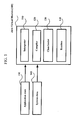
- FIG. 6 is a block diagram showing a structure of a Java virtual machine including a converter according to an exemplary embodiment of the present invention.
- FIG. 6 illustrates the structure of the Java virtual machine including a converter 630 not found in a conventional Java virtual machine, wherein the converter 630 converts a 1-byte byte-code into a 4-byte byte-code by arranging four bytes of the byte-code, according to an exemplary embodiment of the present invention.
- the Java virtual machine 600 is further provided with the converter 630, in addition to an interpreter 610, a JIT compiler 620, a class loader 640, a run time 650, an application class 660 and a system class 670, with which the conventional Java virtual machine is provided.
- the converter 630 can be realized in a thread type.
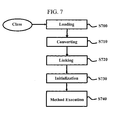
- FIG. 7 illustrates a process of loading and executing a class in a Java virtual machine according to an exemplary embodiment of the present invention.
- a new class is loaded in the Java virtual machine 600 by the class loader 640 (S700), and then the converter 630 is invoked. Subsequently, the converter 630 converts a byte-code into an int-code by arranging four 1-byte byte-codes with respect to each method declared in the loaded class (S710).
- step S710 After the step S710, and similarly to the steps shown in the conventional method of FIG. 4, a linking process (S720) and an initialization process (S730) are carried out and then each method is executed by the execution engine (S740).
- the converter 630 When the new class is loaded on the Java virtual machine, the converter 630 is invoked for each method declared within the class. In this case, the converter 630 receives a method byte-code and a size of the method byte-code as input parameters.
- a memory four times at least as large as the size of the method is allocated, and the allocated memory is indicated with the int-code that is a 32-bit integer pointer.
- the int-code is followed by a large loop, which continues to be circulated until no byte is fetched from the byte-code.
- the loop has one switch statement in which a routine for converting each op-code is defined.
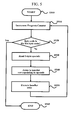
- FIG. 8 is a flowchart showing an exemplary process of converting a byte-code according to an exemplary embodiment of the present invention.
- the process of converting the byte-code begins when a new class is loaded by the class loader (S800). First of all, it is checked whether an op-code indicated by a current program counter has a wide index as an operand (S810). In the case of the op-code not requiring the wide operand, the op-code is stored in an int-code (S830). [01] In the case of the op-code requiring the wide operand, the op-code plays the same role on the Java virtual machine version 2, but another op-code is found which does not require the wide operand, and then the found op-code is stored in the int-code instead (S810 and S820).
- jsr_w is one of the instructions defined in the Java virtual machine version 2, and plays the same role as the "jsr” instruction.
- a 32-bit wide index is assigned to the operand (as four continuous bytes)
- a 16-bit index is assigned to the operand (as two continuous bytes).
- the "jsr" instruction is stored in an int-code array instead of the "jsr_w” instruction.
- the op-codes accompanied with the wide operand are removed and, thus, these op-codes can be newly defined to be usable when a dynamic code is generated.
- the empty space of the 24 bits can be used as a storage field, for which a JIT technique is applied to the op-code and the subsequent several byte-codes, and the resulting code block address, etc. are inserted into the empty space, together with the rest of the one byte defining a new op-code indicating that the JIT technique is applied thereto.
- both the program counter indicating the next byte-code and the int-codePC indicating the int-code are incremented.
- the operand When the op-code is accompanied with an operand, the operand must be inserted into the int-code. In this case, it must be checked whether the operand is larger than one byte or not (S840 and S850).
- the operand is stored in one int-code after being combined in accordance with an Endian format of CPU that is currently used by both an OR operator for operation according to each bit and a Shift operator (S860 and S870).
- the size of the operand combined with one or more bytes is not greater than four bytes, it is possible to store the operand in one element of the int-code. Since the function performing the operation, before executing the method, implements the above-mentioned operand combination only once, it can obtain better performance than the conventional interpreter. If the number of continuous bytes is n, the combined result is provided to one int-code, and then the other n-1 int-codes are provided with an empty space.
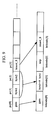
- FIG. 9 illustrates a byte-code executed in a Java virtual machine according to an exemplary embodiment of the present invention.
- an original byte-code "goto” is converted into a value of "int-code [0]” by way of an int-code conversion algorithm.
- the reason of inserting a "nop” is to improve convenience when the interpreter is converted in an int-code scheme, and an inserted value may be different according to an implementing scheme.
- the present invention has an effect of improving the execution speed of the hardware equipped with a 32-bit CPU, and easily storing and monitoring additional information associated with the respective op-codes using the empty spaces of the array. Furthermore, because embodiments of the present invention may no longer use the wide op-code for handling the wide operand, they have an advantage that these unused op-codes can be re-defined as new user-defined op-codes.
Landscapes
- Engineering & Computer Science (AREA)
- Software Systems (AREA)
- Theoretical Computer Science (AREA)
- Physics & Mathematics (AREA)
- General Engineering & Computer Science (AREA)
- General Physics & Mathematics (AREA)
- Food Science & Technology (AREA)
- Devices For Executing Special Programs (AREA)
Applications Claiming Priority (2)
| Application Number | Priority Date | Filing Date | Title |
|---|---|---|---|
| KR1020040003590A KR100643268B1 (ko) | 2004-01-17 | 2004-01-17 | 자바 가상 머신의 성능을 향상시키는 방법 및 상기 방법에의해 동작되는 시스템 |
| KR2004003590 | 2004-01-17 |
Publications (1)
| Publication Number | Publication Date |
|---|---|
| EP1557760A2 true EP1557760A2 (de) | 2005-07-27 |
Family
ID=34632167
Family Applications (1)
| Application Number | Title | Priority Date | Filing Date |
|---|---|---|---|
| EP05250030A Withdrawn EP1557760A2 (de) | 2004-01-17 | 2005-01-06 | Methode und System zum Verbessern der Performanz der Java Virtuellen Maschine |
Country Status (5)
| Country | Link |
|---|---|
| US (1) | US20050160415A1 (de) |
| EP (1) | EP1557760A2 (de) |
| JP (1) | JP2005202936A (de) |
| KR (1) | KR100643268B1 (de) |
| CN (1) | CN1311343C (de) |
Families Citing this family (28)
| Publication number | Priority date | Publication date | Assignee | Title |
|---|---|---|---|---|
| KR100597413B1 (ko) * | 2004-09-24 | 2006-07-05 | 삼성전자주식회사 | 자바 바이트코드 변환 방법 및 상기 변환을 수행하는 자바인터프리터 |
| US7844958B2 (en) * | 2005-03-11 | 2010-11-30 | Aptana, Inc. | System and method for creating target byte code |
| US7707547B2 (en) * | 2005-03-11 | 2010-04-27 | Aptana, Inc. | System and method for creating target byte code |
| KR100763177B1 (ko) * | 2005-04-21 | 2007-10-04 | 삼성전자주식회사 | 자바 가상 머신의 명령어 수행 방법 및 그 장치 |
| KR100678912B1 (ko) * | 2005-10-18 | 2007-02-05 | 삼성전자주식회사 | 메소드 바이트코드 해석 방법 및 상기 방법에 의해동작하는 시스템 |
| US8191052B2 (en) * | 2006-12-01 | 2012-05-29 | Murex S.A.S. | Producer graph oriented programming and execution |
| US8307337B2 (en) | 2006-12-01 | 2012-11-06 | Murex S.A.S. | Parallelization and instrumentation in a producer graph oriented programming framework |
| TR200606833A2 (tr) * | 2006-12-01 | 2007-10-22 | B�Lmed B�Lg�Sayar Ve Yazilim A.�. | Web tarayıcı tabanlı uygulamalarda performans arttırma yöntemi |
| KR100936401B1 (ko) * | 2007-10-17 | 2010-01-12 | 주식회사 에이디칩스 | 자바 바이트코드 변환방법 |
| US8914774B1 (en) | 2007-11-15 | 2014-12-16 | Appcelerator, Inc. | System and method for tagging code to determine where the code runs |
| US8954989B1 (en) | 2007-11-19 | 2015-02-10 | Appcelerator, Inc. | Flexible, event-driven JavaScript server architecture |
| US8260845B1 (en) | 2007-11-21 | 2012-09-04 | Appcelerator, Inc. | System and method for auto-generating JavaScript proxies and meta-proxies |
| US8719451B1 (en) | 2007-11-23 | 2014-05-06 | Appcelerator, Inc. | System and method for on-the-fly, post-processing document object model manipulation |
| US8566807B1 (en) | 2007-11-23 | 2013-10-22 | Appcelerator, Inc. | System and method for accessibility of document object model and JavaScript by other platforms |
| US8756579B1 (en) | 2007-12-03 | 2014-06-17 | Appcelerator, Inc. | Client-side and server-side unified validation |
| US8819539B1 (en) | 2007-12-03 | 2014-08-26 | Appcelerator, Inc. | On-the-fly rewriting of uniform resource locators in a web-page |
| US8806431B1 (en) | 2007-12-03 | 2014-08-12 | Appecelerator, Inc. | Aspect oriented programming |
| US8527860B1 (en) | 2007-12-04 | 2013-09-03 | Appcelerator, Inc. | System and method for exposing the dynamic web server-side |
| US8938491B1 (en) | 2007-12-04 | 2015-01-20 | Appcelerator, Inc. | System and method for secure binding of client calls and server functions |
| US8639743B1 (en) | 2007-12-05 | 2014-01-28 | Appcelerator, Inc. | System and method for on-the-fly rewriting of JavaScript |
| US8285813B1 (en) | 2007-12-05 | 2012-10-09 | Appcelerator, Inc. | System and method for emulating different user agents on a server |
| US8335982B1 (en) | 2007-12-05 | 2012-12-18 | Appcelerator, Inc. | System and method for binding a document object model through JavaScript callbacks |
| US8291079B1 (en) | 2008-06-04 | 2012-10-16 | Appcelerator, Inc. | System and method for developing, deploying, managing and monitoring a web application in a single environment |
| US8880678B1 (en) | 2008-06-05 | 2014-11-04 | Appcelerator, Inc. | System and method for managing and monitoring a web application using multiple cloud providers |
| US7596620B1 (en) | 2008-11-04 | 2009-09-29 | Aptana, Inc. | System and method for developing, deploying, managing and monitoring a web application in a single environment |
| US10838750B2 (en) * | 2019-01-10 | 2020-11-17 | Red Hat, Inc. | Combining ahead-of-time compilation and just-in-time compilation to improve application deployment |
| CN111045793A (zh) * | 2020-03-13 | 2020-04-21 | 支付宝(杭州)信息技术有限公司 | 一种在虚拟机中执行功能模块的方法和装置 |
| CN112506569B (zh) * | 2020-12-14 | 2023-06-20 | 杭州趣链科技有限公司 | 一种字节码执行方法、字节码执行装置及终端设备 |
Family Cites Families (17)
| Publication number | Priority date | Publication date | Assignee | Title |
|---|---|---|---|---|
| US6092094A (en) * | 1996-04-17 | 2000-07-18 | Advanced Micro Devices, Inc. | Execute unit configured to selectably interpret an operand as multiple operands or as a single operand |
| EP0938703B1 (de) * | 1996-11-13 | 2003-07-02 | Paran, Arik | Echtzeitprogramm-sprachbeschleuniger |
| US6233733B1 (en) * | 1997-09-30 | 2001-05-15 | Sun Microsystems, Inc. | Method for generating a Java bytecode data flow graph |
| US6170083B1 (en) * | 1997-11-12 | 2001-01-02 | Intel Corporation | Method for performing dynamic optimization of computer code |
| US6349344B1 (en) * | 1997-12-16 | 2002-02-19 | Microsoft Corporation | Combining multiple java class files into a run-time image |
| US6110226A (en) * | 1998-02-19 | 2000-08-29 | Cygnus Solutions | Java development environment using optimizing ahead-of-time compiler |
| EP0943990A3 (de) * | 1998-02-27 | 2004-12-22 | Texas Instruments Incorporated | Verfahren und System zum Darbieten dynamischer Optimierungsinformation in einer Kodeinterpretierlaufzeitumgebung |
| DE69814174T2 (de) * | 1998-03-23 | 2004-03-04 | International Business Machines Corp. | Java laufzeitsystem mit veränderter sammlung von konstanten |
| SE514762C2 (sv) * | 1998-05-28 | 2001-04-23 | Ericsson Telefon Ab L M | Förfarande, anordning och portabel terminal för programvarunedladdning i ett trådlöst näverk samt sådant telekommunikationsnät |
| US6385764B1 (en) * | 1999-01-29 | 2002-05-07 | International Business Machines Corporation | Method and apparatus for improving invocation speed of Java methods |
| US6691307B2 (en) * | 1999-08-03 | 2004-02-10 | Sun Microsystems, Inc. | Interpreter optimization for native endianness |
| KR100319755B1 (ko) * | 1999-12-02 | 2002-01-05 | 오길록 | 내장형 자바가상머신을 위한 바이트코드 압축 방법 |
| KR20020032889A (ko) * | 2000-10-27 | 2002-05-04 | 오길록 | 자바 클래스 파일 분석을 이용한 클래스 호출관계 표시 방법 |
| US6996813B1 (en) * | 2000-10-31 | 2006-02-07 | Sun Microsystems, Inc. | Frameworks for loading and execution of object-based programs |
| US7228533B2 (en) * | 2001-08-24 | 2007-06-05 | Sun Microsystems, Inc. | Frameworks for generation of Java macro instructions for performing programming loops |
| JP4163927B2 (ja) * | 2001-10-31 | 2008-10-08 | 松下電器産業株式会社 | Javaコンパイラ、及び、当該Javaコンパイラが使用するコンパイル情報の生成装置 |
| KR100697635B1 (ko) * | 2003-12-19 | 2007-03-20 | 한국전자통신연구원 | 자바가상머신에서 배열 접근을 위한 통합 바이트 코드를 기록한 기록매체, 통합 바이트 코드 수행방법 및 매핑 방법 |
-
2004
- 2004-01-17 KR KR1020040003590A patent/KR100643268B1/ko not_active Expired - Fee Related
- 2004-11-03 US US10/979,324 patent/US20050160415A1/en not_active Abandoned
- 2004-12-07 JP JP2004354555A patent/JP2005202936A/ja active Pending
-
2005
- 2005-01-06 EP EP05250030A patent/EP1557760A2/de not_active Withdrawn
- 2005-01-14 CN CNB2005100020773A patent/CN1311343C/zh not_active Expired - Fee Related
Also Published As
| Publication number | Publication date |
|---|---|
| US20050160415A1 (en) | 2005-07-21 |
| KR100643268B1 (ko) | 2006-11-10 |
| CN1311343C (zh) | 2007-04-18 |
| JP2005202936A (ja) | 2005-07-28 |
| CN1641587A (zh) | 2005-07-20 |
| KR20050075647A (ko) | 2005-07-21 |
Similar Documents
| Publication | Publication Date | Title |
|---|---|---|
| EP1557760A2 (de) | Methode und System zum Verbessern der Performanz der Java Virtuellen Maschine | |
| US11385872B2 (en) | Extending a virtual machine instruction set architecture | |
| US20020083416A1 (en) | Automatic stub/adapter generator | |
| JP2002163116A (ja) | マイクロコードエンジンを用いたJava(登録商標)ハードウェアアクセラレータ | |
| US9038039B2 (en) | Apparatus and method for accelerating java translation | |
| US12008351B2 (en) | Modeling foreign functions using executable references | |
| US20040215444A1 (en) | Hardware-translator-based custom method invocation system and method | |
| US7725879B2 (en) | Method and apparatus for executing instructions of java virtual machine and transforming bytecode | |
| KR100597413B1 (ko) | 자바 바이트코드 변환 방법 및 상기 변환을 수행하는 자바인터프리터 | |
| JP2003122555A (ja) | スプリットストリーム辞書プログラム圧縮およびジャストインタイム変換のためのシステムおよび方法 | |
| KR20040111139A (ko) | 미해결 명령어의 해결 | |
| Haggett | Tokenisation and Compression of Java Class Files for Mobile Devices |
Legal Events
| Date | Code | Title | Description |
|---|---|---|---|
| PUAI | Public reference made under article 153(3) epc to a published international application that has entered the european phase |
Free format text: ORIGINAL CODE: 0009012 |
|
| 17P | Request for examination filed |
Effective date: 20050125 |
|
| AK | Designated contracting states |
Kind code of ref document: A2 Designated state(s): AT BE BG CH CY CZ DE DK EE ES FI FR GB GR HU IE IS IT LI LT LU MC NL PL PT RO SE SI SK TR |
|
| AX | Request for extension of the european patent |
Extension state: AL BA HR LV MK YU |
|
| STAA | Information on the status of an ep patent application or granted ep patent |
Free format text: STATUS: THE APPLICATION HAS BEEN WITHDRAWN |
|
| 18W | Application withdrawn |
Effective date: 20080516 |