EP1557446A1 - Silicone rubber compositions, their preparation and use - Google Patents
Silicone rubber compositions, their preparation and use Download PDFInfo
- Publication number
- EP1557446A1 EP1557446A1 EP05250244A EP05250244A EP1557446A1 EP 1557446 A1 EP1557446 A1 EP 1557446A1 EP 05250244 A EP05250244 A EP 05250244A EP 05250244 A EP05250244 A EP 05250244A EP 1557446 A1 EP1557446 A1 EP 1557446A1
- Authority
- EP
- European Patent Office
- Prior art keywords
- silicone rubber
- rubber composition
- surface area
- specific surface
- parts
- Prior art date
- Legal status (The legal status is an assumption and is not a legal conclusion. Google has not performed a legal analysis and makes no representation as to the accuracy of the status listed.)
- Withdrawn
Links
- 239000000203 mixture Substances 0.000 title claims abstract description 48
- 229920002379 silicone rubber Polymers 0.000 title claims abstract description 45
- 239000004945 silicone rubber Substances 0.000 title claims abstract description 41
- VYPSYNLAJGMNEJ-UHFFFAOYSA-N Silicium dioxide Chemical compound O=[Si]=O VYPSYNLAJGMNEJ-UHFFFAOYSA-N 0.000 claims abstract description 80
- 239000000377 silicon dioxide Substances 0.000 claims abstract description 39
- 238000000034 method Methods 0.000 claims abstract description 29
- 239000003795 chemical substances by application Substances 0.000 claims abstract description 18
- XLYOFNOQVPJJNP-UHFFFAOYSA-N water Substances O XLYOFNOQVPJJNP-UHFFFAOYSA-N 0.000 claims abstract description 17
- 238000004438 BET method Methods 0.000 claims abstract description 15
- 125000003342 alkenyl group Chemical group 0.000 claims abstract description 15
- 229920001296 polysiloxane Polymers 0.000 claims abstract description 14
- LZZYPRNAOMGNLH-UHFFFAOYSA-M Cetrimonium bromide Chemical compound [Br-].CCCCCCCCCCCCCCCC[N+](C)(C)C LZZYPRNAOMGNLH-UHFFFAOYSA-M 0.000 claims abstract description 9
- 238000006116 polymerization reaction Methods 0.000 claims abstract description 9
- 239000003054 catalyst Substances 0.000 claims description 15
- 125000004435 hydrogen atom Chemical group [H]* 0.000 claims description 11
- 229920006136 organohydrogenpolysiloxane Polymers 0.000 claims description 10
- 125000001183 hydrocarbyl group Chemical group 0.000 claims description 8
- 125000000217 alkyl group Chemical group 0.000 claims description 7
- 238000001125 extrusion Methods 0.000 claims description 7
- 150000001451 organic peroxides Chemical class 0.000 claims description 5
- 238000006459 hydrosilylation reaction Methods 0.000 claims description 4
- KPUWHANPEXNPJT-UHFFFAOYSA-N disiloxane Chemical class [SiH3]O[SiH3] KPUWHANPEXNPJT-UHFFFAOYSA-N 0.000 claims description 3
- 150000001282 organosilanes Chemical class 0.000 claims description 3
- 238000000465 moulding Methods 0.000 claims description 2
- 238000004073 vulcanization Methods 0.000 abstract description 18
- 238000005187 foaming Methods 0.000 abstract description 17
- -1 dimethylsiloxane unit Chemical group 0.000 description 16
- 229920001971 elastomer Polymers 0.000 description 13
- 239000005060 rubber Substances 0.000 description 13
- 125000002496 methyl group Chemical group [H]C([H])([H])* 0.000 description 10
- 238000012360 testing method Methods 0.000 description 10
- 230000000704 physical effect Effects 0.000 description 9
- 125000000391 vinyl group Chemical group [H]C([*])=C([H])[H] 0.000 description 9
- 150000001875 compounds Chemical class 0.000 description 8
- 238000007259 addition reaction Methods 0.000 description 7
- 230000000052 comparative effect Effects 0.000 description 7
- 229920002554 vinyl polymer Polymers 0.000 description 7
- 238000010438 heat treatment Methods 0.000 description 6
- 229910052751 metal Inorganic materials 0.000 description 6
- 239000002184 metal Substances 0.000 description 6
- 125000001997 phenyl group Chemical group [H]C1=C([H])C([H])=C(*)C([H])=C1[H] 0.000 description 6
- XUIMIQQOPSSXEZ-UHFFFAOYSA-N Silicon Chemical group [Si] XUIMIQQOPSSXEZ-UHFFFAOYSA-N 0.000 description 5
- 125000001495 ethyl group Chemical group [H]C([H])([H])C([H])([H])* 0.000 description 5
- 125000004432 carbon atom Chemical group C* 0.000 description 4
- 238000004132 cross linking Methods 0.000 description 4
- 235000014113 dietary fatty acids Nutrition 0.000 description 4
- 239000000194 fatty acid Substances 0.000 description 4
- 229930195729 fatty acid Natural products 0.000 description 4
- 150000004665 fatty acids Chemical class 0.000 description 4
- 239000011148 porous material Substances 0.000 description 4
- 125000001436 propyl group Chemical group [H]C([*])([H])C([H])([H])C([H])([H])[H] 0.000 description 4
- 229910052710 silicon Inorganic materials 0.000 description 4
- 125000000725 trifluoropropyl group Chemical group [H]C([H])(*)C([H])([H])C(F)(F)F 0.000 description 4
- OVSKIKFHRZPJSS-UHFFFAOYSA-N 2,4-D Chemical compound OC(=O)COC1=CC=C(Cl)C=C1Cl OVSKIKFHRZPJSS-UHFFFAOYSA-N 0.000 description 3
- 125000003903 2-propenyl group Chemical group [H]C([*])([H])C([H])=C([H])[H] 0.000 description 3
- 125000003710 aryl alkyl group Chemical group 0.000 description 3
- 125000003118 aryl group Chemical group 0.000 description 3
- 125000000484 butyl group Chemical group [H]C([*])([H])C([H])([H])C([H])([H])C([H])([H])[H] 0.000 description 3
- 230000006835 compression Effects 0.000 description 3
- 238000007906 compression Methods 0.000 description 3
- 125000000753 cycloalkyl group Chemical group 0.000 description 3
- 125000000113 cyclohexyl group Chemical group [H]C1([H])C([H])([H])C([H])([H])C([H])(*)C([H])([H])C1([H])[H] 0.000 description 3
- 230000000694 effects Effects 0.000 description 3
- 125000005843 halogen group Chemical group 0.000 description 3
- 230000001771 impaired effect Effects 0.000 description 3
- 238000004898 kneading Methods 0.000 description 3
- 150000002739 metals Chemical class 0.000 description 3
- BASFCYQUMIYNBI-UHFFFAOYSA-N platinum Chemical group [Pt] BASFCYQUMIYNBI-UHFFFAOYSA-N 0.000 description 3
- 125000003944 tolyl group Chemical group 0.000 description 3
- AGKBXKFWMQLFGZ-UHFFFAOYSA-N (4-methylbenzoyl) 4-methylbenzenecarboperoxoate Chemical compound C1=CC(C)=CC=C1C(=O)OOC(=O)C1=CC=C(C)C=C1 AGKBXKFWMQLFGZ-UHFFFAOYSA-N 0.000 description 2
- 125000000094 2-phenylethyl group Chemical group [H]C1=C([H])C([H])=C(C([H])=C1[H])C([H])([H])C([H])([H])* 0.000 description 2
- IJGRMHOSHXDMSA-UHFFFAOYSA-N Atomic nitrogen Chemical compound N#N IJGRMHOSHXDMSA-UHFFFAOYSA-N 0.000 description 2
- PEDCQBHIVMGVHV-UHFFFAOYSA-N Glycerol Natural products OCC(O)CO PEDCQBHIVMGVHV-UHFFFAOYSA-N 0.000 description 2
- UQSXHKLRYXJYBZ-UHFFFAOYSA-N Iron oxide Chemical compound [Fe]=O UQSXHKLRYXJYBZ-UHFFFAOYSA-N 0.000 description 2
- KDLHZDBZIXYQEI-UHFFFAOYSA-N Palladium Chemical compound [Pd] KDLHZDBZIXYQEI-UHFFFAOYSA-N 0.000 description 2
- 239000002253 acid Substances 0.000 description 2
- 239000000654 additive Substances 0.000 description 2
- 125000001931 aliphatic group Chemical group 0.000 description 2
- 125000001797 benzyl group Chemical group [H]C1=C([H])C([H])=C(C([H])=C1[H])C([H])([H])* 0.000 description 2
- 125000004369 butenyl group Chemical group C(=CCC)* 0.000 description 2
- CJZGTCYPCWQAJB-UHFFFAOYSA-L calcium stearate Chemical compound [Ca+2].CCCCCCCCCCCCCCCCCC([O-])=O.CCCCCCCCCCCCCCCCCC([O-])=O CJZGTCYPCWQAJB-UHFFFAOYSA-L 0.000 description 2
- 235000013539 calcium stearate Nutrition 0.000 description 2
- 239000008116 calcium stearate Substances 0.000 description 2
- 238000006243 chemical reaction Methods 0.000 description 2
- 125000004093 cyano group Chemical group *C#N 0.000 description 2
- 125000004122 cyclic group Chemical group 0.000 description 2
- 239000004205 dimethyl polysiloxane Substances 0.000 description 2
- 235000013870 dimethyl polysiloxane Nutrition 0.000 description 2
- POULHZVOKOAJMA-UHFFFAOYSA-N dodecanoic acid Chemical compound CCCCCCCCCCCC(O)=O POULHZVOKOAJMA-UHFFFAOYSA-N 0.000 description 2
- 238000001035 drying Methods 0.000 description 2
- MVLVMROFTAUDAG-UHFFFAOYSA-N ethyl octadecanoate Chemical compound CCCCCCCCCCCCCCCCCC(=O)OCC MVLVMROFTAUDAG-UHFFFAOYSA-N 0.000 description 2
- HSEMFIZWXHQJAE-UHFFFAOYSA-N hexadecanamide Chemical compound CCCCCCCCCCCCCCCC(N)=O HSEMFIZWXHQJAE-UHFFFAOYSA-N 0.000 description 2
- IPCSVZSSVZVIGE-UHFFFAOYSA-N hexadecanoic acid Chemical compound CCCCCCCCCCCCCCCC(O)=O IPCSVZSSVZVIGE-UHFFFAOYSA-N 0.000 description 2
- FFUAGWLWBBFQJT-UHFFFAOYSA-N hexamethyldisilazane Chemical compound C[Si](C)(C)N[Si](C)(C)C FFUAGWLWBBFQJT-UHFFFAOYSA-N 0.000 description 2
- XXMIOPMDWAUFGU-UHFFFAOYSA-N hexane-1,6-diol Chemical compound OCCCCCCO XXMIOPMDWAUFGU-UHFFFAOYSA-N 0.000 description 2
- 125000006038 hexenyl group Chemical group 0.000 description 2
- 238000010348 incorporation Methods 0.000 description 2
- HQKMJHAJHXVSDF-UHFFFAOYSA-L magnesium stearate Chemical compound [Mg+2].CCCCCCCCCCCCCCCCCC([O-])=O.CCCCCCCCCCCCCCCCCC([O-])=O HQKMJHAJHXVSDF-UHFFFAOYSA-L 0.000 description 2
- LYRFLYHAGKPMFH-UHFFFAOYSA-N octadecanamide Chemical compound CCCCCCCCCCCCCCCCCC(N)=O LYRFLYHAGKPMFH-UHFFFAOYSA-N 0.000 description 2
- 229920000435 poly(dimethylsiloxane) Polymers 0.000 description 2
- 230000003014 reinforcing effect Effects 0.000 description 2
- 239000011369 resultant mixture Substances 0.000 description 2
- YYBMRDFADFQHGU-UHFFFAOYSA-N tert-butyl (2-methylpropan-2-yl)oxy carbonate Chemical compound CC(C)(C)OOC(=O)OC(C)(C)C YYBMRDFADFQHGU-UHFFFAOYSA-N 0.000 description 2
- WRXCBRHBHGNNQA-UHFFFAOYSA-N (2,4-dichlorobenzoyl) 2,4-dichlorobenzenecarboperoxoate Chemical compound ClC1=CC(Cl)=CC=C1C(=O)OOC(=O)C1=CC=C(Cl)C=C1Cl WRXCBRHBHGNNQA-UHFFFAOYSA-N 0.000 description 1
- ZICNIEOYWVIEQJ-UHFFFAOYSA-N (2-methylbenzoyl) 2-methylbenzenecarboperoxoate Chemical compound CC1=CC=CC=C1C(=O)OOC(=O)C1=CC=CC=C1C ZICNIEOYWVIEQJ-UHFFFAOYSA-N 0.000 description 1
- WRIDQFICGBMAFQ-UHFFFAOYSA-N (E)-8-Octadecenoic acid Natural products CCCCCCCCCC=CCCCCCCC(O)=O WRIDQFICGBMAFQ-UHFFFAOYSA-N 0.000 description 1
- QYLFHLNFIHBCPR-UHFFFAOYSA-N 1-ethynylcyclohexan-1-ol Chemical compound C#CC1(O)CCCCC1 QYLFHLNFIHBCPR-UHFFFAOYSA-N 0.000 description 1
- DMWVYCCGCQPJEA-UHFFFAOYSA-N 2,5-bis(tert-butylperoxy)-2,5-dimethylhexane Chemical compound CC(C)(C)OOC(C)(C)CCC(C)(C)OOC(C)(C)C DMWVYCCGCQPJEA-UHFFFAOYSA-N 0.000 description 1
- 125000001731 2-cyanoethyl group Chemical group [H]C([H])(*)C([H])([H])C#N 0.000 description 1
- LQJBNNIYVWPHFW-UHFFFAOYSA-N 20:1omega9c fatty acid Natural products CCCCCCCCCCC=CCCCCCCCC(O)=O LQJBNNIYVWPHFW-UHFFFAOYSA-N 0.000 description 1
- QSBYPNXLFMSGKH-UHFFFAOYSA-N 9-Heptadecensaeure Natural products CCCCCCCC=CCCCCCCCC(O)=O QSBYPNXLFMSGKH-UHFFFAOYSA-N 0.000 description 1
- 239000004342 Benzoyl peroxide Substances 0.000 description 1
- OMPJBNCRMGITSC-UHFFFAOYSA-N Benzoylperoxide Chemical compound C=1C=CC=CC=1C(=O)OOC(=O)C1=CC=CC=C1 OMPJBNCRMGITSC-UHFFFAOYSA-N 0.000 description 1
- VEXZGXHMUGYJMC-UHFFFAOYSA-M Chloride anion Chemical compound [Cl-] VEXZGXHMUGYJMC-UHFFFAOYSA-M 0.000 description 1
- 239000005046 Chlorosilane Substances 0.000 description 1
- LVGKNOAMLMIIKO-UHFFFAOYSA-N Elaidinsaeure-aethylester Natural products CCCCCCCCC=CCCCCCCCC(=O)OCC LVGKNOAMLMIIKO-UHFFFAOYSA-N 0.000 description 1
- LFQSCWFLJHTTHZ-UHFFFAOYSA-N Ethanol Chemical compound CCO LFQSCWFLJHTTHZ-UHFFFAOYSA-N 0.000 description 1
- 239000005639 Lauric acid Substances 0.000 description 1
- GWFGDXZQZYMSMJ-UHFFFAOYSA-N Octadecansaeure-heptadecylester Natural products CCCCCCCCCCCCCCCCCOC(=O)CCCCCCCCCCCCCCCCC GWFGDXZQZYMSMJ-UHFFFAOYSA-N 0.000 description 1
- 239000005642 Oleic acid Substances 0.000 description 1
- ZQPPMHVWECSIRJ-UHFFFAOYSA-N Oleic acid Natural products CCCCCCCCC=CCCCCCCCC(O)=O ZQPPMHVWECSIRJ-UHFFFAOYSA-N 0.000 description 1
- 235000021314 Palmitic acid Nutrition 0.000 description 1
- 235000021355 Stearic acid Nutrition 0.000 description 1
- 239000006096 absorbing agent Substances 0.000 description 1
- 239000003377 acid catalyst Substances 0.000 description 1
- 150000001298 alcohols Chemical class 0.000 description 1
- 125000003545 alkoxy group Chemical group 0.000 description 1
- PNEYBMLMFCGWSK-UHFFFAOYSA-N aluminium oxide Inorganic materials [O-2].[O-2].[O-2].[Al+3].[Al+3] PNEYBMLMFCGWSK-UHFFFAOYSA-N 0.000 description 1
- 150000001408 amides Chemical class 0.000 description 1
- 239000003963 antioxidant agent Substances 0.000 description 1
- 229920005601 base polymer Polymers 0.000 description 1
- 235000019400 benzoyl peroxide Nutrition 0.000 description 1
- ZCZLQYAECBEUBH-UHFFFAOYSA-L calcium;octadec-9-enoate Chemical compound [Ca+2].CCCCCCCCC=CCCCCCCCC([O-])=O.CCCCCCCCC=CCCCCCCCC([O-])=O ZCZLQYAECBEUBH-UHFFFAOYSA-L 0.000 description 1
- 239000004359 castor oil Substances 0.000 description 1
- 235000019438 castor oil Nutrition 0.000 description 1
- 125000004218 chloromethyl group Chemical group [H]C([H])(Cl)* 0.000 description 1
- KOPOQZFJUQMUML-UHFFFAOYSA-N chlorosilane Chemical compound Cl[SiH3] KOPOQZFJUQMUML-UHFFFAOYSA-N 0.000 description 1
- 239000003086 colorant Substances 0.000 description 1
- 238000013329 compounding Methods 0.000 description 1
- 238000009833 condensation Methods 0.000 description 1
- 230000005494 condensation Effects 0.000 description 1
- 239000003431 cross linking reagent Substances 0.000 description 1
- 125000000392 cycloalkenyl group Chemical group 0.000 description 1
- 125000001511 cyclopentyl group Chemical group [H]C1([H])C([H])([H])C([H])([H])C([H])(*)C1([H])[H] 0.000 description 1
- 238000011161 development Methods 0.000 description 1
- LSXWFXONGKSEMY-UHFFFAOYSA-N di-tert-butyl peroxide Chemical compound CC(C)(C)OOC(C)(C)C LSXWFXONGKSEMY-UHFFFAOYSA-N 0.000 description 1
- 125000002897 diene group Chemical group 0.000 description 1
- 150000002148 esters Chemical class 0.000 description 1
- LVGKNOAMLMIIKO-QXMHVHEDSA-N ethyl oleate Chemical compound CCCCCCCC\C=C/CCCCCCCC(=O)OCC LVGKNOAMLMIIKO-QXMHVHEDSA-N 0.000 description 1
- 229940093471 ethyl oleate Drugs 0.000 description 1
- 239000003063 flame retardant Substances 0.000 description 1
- 239000006260 foam Substances 0.000 description 1
- 235000013305 food Nutrition 0.000 description 1
- ZEMPKEQAKRGZGQ-XOQCFJPHSA-N glycerol triricinoleate Natural products CCCCCC[C@@H](O)CC=CCCCCCCCC(=O)OC[C@@H](COC(=O)CCCCCCCC=CC[C@@H](O)CCCCCC)OC(=O)CCCCCCCC=CC[C@H](O)CCCCCC ZEMPKEQAKRGZGQ-XOQCFJPHSA-N 0.000 description 1
- 150000002366 halogen compounds Chemical class 0.000 description 1
- 150000004687 hexahydrates Chemical class 0.000 description 1
- 125000004051 hexyl group Chemical group [H]C([H])([H])C([H])([H])C([H])([H])C([H])([H])C([H])([H])C([H])([H])* 0.000 description 1
- 230000003301 hydrolyzing effect Effects 0.000 description 1
- 125000002887 hydroxy group Chemical group [H]O* 0.000 description 1
- 239000003112 inhibitor Substances 0.000 description 1
- 230000005764 inhibitory process Effects 0.000 description 1
- QXJSBBXBKPUZAA-UHFFFAOYSA-N isooleic acid Natural products CCCCCCCC=CCCCCCCCCC(O)=O QXJSBBXBKPUZAA-UHFFFAOYSA-N 0.000 description 1
- 235000019359 magnesium stearate Nutrition 0.000 description 1
- 238000004519 manufacturing process Methods 0.000 description 1
- 239000000463 material Substances 0.000 description 1
- 238000012986 modification Methods 0.000 description 1
- 230000004048 modification Effects 0.000 description 1
- WQEPLUUGTLDZJY-UHFFFAOYSA-N n-Pentadecanoic acid Natural products CCCCCCCCCCCCCCC(O)=O WQEPLUUGTLDZJY-UHFFFAOYSA-N 0.000 description 1
- WIBFFTLQMKKBLZ-SEYXRHQNSA-N n-butyl oleate Chemical compound CCCCCCCC\C=C/CCCCCCCC(=O)OCCCC WIBFFTLQMKKBLZ-SEYXRHQNSA-N 0.000 description 1
- JMWUYEFBFUCSAK-UHFFFAOYSA-L nickel(2+);octadecanoate Chemical compound [Ni+2].CCCCCCCCCCCCCCCCCC([O-])=O.CCCCCCCCCCCCCCCCCC([O-])=O JMWUYEFBFUCSAK-UHFFFAOYSA-L 0.000 description 1
- 229910052757 nitrogen Inorganic materials 0.000 description 1
- QIQXTHQIDYTFRH-UHFFFAOYSA-N octadecanoic acid Chemical compound CCCCCCCCCCCCCCCCCC(O)=O QIQXTHQIDYTFRH-UHFFFAOYSA-N 0.000 description 1
- OQCDKBAXFALNLD-UHFFFAOYSA-N octadecanoic acid Natural products CCCCCCCC(C)CCCCCCCCC(O)=O OQCDKBAXFALNLD-UHFFFAOYSA-N 0.000 description 1
- NKBWPOSQERPBFI-UHFFFAOYSA-N octadecyl octadecanoate Chemical compound CCCCCCCCCCCCCCCCCCOC(=O)CCCCCCCCCCCCCCCCC NKBWPOSQERPBFI-UHFFFAOYSA-N 0.000 description 1
- 125000002347 octyl group Chemical group [H]C([*])([H])C([H])([H])C([H])([H])C([H])([H])C([H])([H])C([H])([H])C([H])([H])C([H])([H])[H] 0.000 description 1
- FATBGEAMYMYZAF-KTKRTIGZSA-N oleamide Chemical compound CCCCCCCC\C=C/CCCCCCCC(N)=O FATBGEAMYMYZAF-KTKRTIGZSA-N 0.000 description 1
- ZQPPMHVWECSIRJ-KTKRTIGZSA-N oleic acid Chemical compound CCCCCCCC\C=C/CCCCCCCC(O)=O ZQPPMHVWECSIRJ-KTKRTIGZSA-N 0.000 description 1
- 235000021313 oleic acid Nutrition 0.000 description 1
- FATBGEAMYMYZAF-UHFFFAOYSA-N oleicacidamide-heptaglycolether Natural products CCCCCCCCC=CCCCCCCCC(N)=O FATBGEAMYMYZAF-UHFFFAOYSA-N 0.000 description 1
- 238000012856 packing Methods 0.000 description 1
- 229910052763 palladium Inorganic materials 0.000 description 1
- 229910052697 platinum Inorganic materials 0.000 description 1
- 150000003058 platinum compounds Chemical class 0.000 description 1
- 125000004368 propenyl group Chemical group C(=CC)* 0.000 description 1
- 230000009257 reactivity Effects 0.000 description 1
- 230000001105 regulatory effect Effects 0.000 description 1
- 239000012763 reinforcing filler Substances 0.000 description 1
- 229910052703 rhodium Inorganic materials 0.000 description 1
- 239000010948 rhodium Substances 0.000 description 1
- MHOVAHRLVXNVSD-UHFFFAOYSA-N rhodium atom Chemical compound [Rh] MHOVAHRLVXNVSD-UHFFFAOYSA-N 0.000 description 1
- WBHHMMIMDMUBKC-XLNAKTSKSA-N ricinelaidic acid Chemical compound CCCCCC[C@@H](O)C\C=C\CCCCCCCC(O)=O WBHHMMIMDMUBKC-XLNAKTSKSA-N 0.000 description 1
- 229960003656 ricinoleic acid Drugs 0.000 description 1
- FEUQNCSVHBHROZ-UHFFFAOYSA-N ricinoleic acid Natural products CCCCCCC(O[Si](C)(C)C)CC=CCCCCCCCC(=O)OC FEUQNCSVHBHROZ-UHFFFAOYSA-N 0.000 description 1
- 238000007151 ring opening polymerisation reaction Methods 0.000 description 1
- 150000003839 salts Chemical class 0.000 description 1
- 125000005372 silanol group Chemical group 0.000 description 1
- 239000000741 silica gel Substances 0.000 description 1
- 229910002027 silica gel Inorganic materials 0.000 description 1
- 238000001179 sorption measurement Methods 0.000 description 1
- 229940037312 stearamide Drugs 0.000 description 1
- 239000008117 stearic acid Substances 0.000 description 1
- 238000004381 surface treatment Methods 0.000 description 1
- GJBRNHKUVLOCEB-UHFFFAOYSA-N tert-butyl benzenecarboperoxoate Chemical compound CC(C)(C)OOC(=O)C1=CC=CC=C1 GJBRNHKUVLOCEB-UHFFFAOYSA-N 0.000 description 1
- 238000012546 transfer Methods 0.000 description 1
- 238000009834 vaporization Methods 0.000 description 1
- 230000008016 vaporization Effects 0.000 description 1
- 239000003981 vehicle Substances 0.000 description 1
- XOOUIPVCVHRTMJ-UHFFFAOYSA-L zinc stearate Chemical compound [Zn+2].CCCCCCCCCCCCCCCCCC([O-])=O.CCCCCCCCCCCCCCCCCC([O-])=O XOOUIPVCVHRTMJ-UHFFFAOYSA-L 0.000 description 1
- LPEBYPDZMWMCLZ-CVBJKYQLSA-L zinc;(z)-octadec-9-enoate Chemical compound [Zn+2].CCCCCCCC\C=C/CCCCCCCC([O-])=O.CCCCCCCC\C=C/CCCCCCCC([O-])=O LPEBYPDZMWMCLZ-CVBJKYQLSA-L 0.000 description 1
Classifications
-
- C—CHEMISTRY; METALLURGY
- C08—ORGANIC MACROMOLECULAR COMPOUNDS; THEIR PREPARATION OR CHEMICAL WORKING-UP; COMPOSITIONS BASED THEREON
- C08L—COMPOSITIONS OF MACROMOLECULAR COMPOUNDS
- C08L83/00—Compositions of macromolecular compounds obtained by reactions forming in the main chain of the macromolecule a linkage containing silicon with or without sulfur, nitrogen, oxygen or carbon only; Compositions of derivatives of such polymers
- C08L83/04—Polysiloxanes
-
- C—CHEMISTRY; METALLURGY
- C08—ORGANIC MACROMOLECULAR COMPOUNDS; THEIR PREPARATION OR CHEMICAL WORKING-UP; COMPOSITIONS BASED THEREON
- C08K—Use of inorganic or non-macromolecular organic substances as compounding ingredients
- C08K3/00—Use of inorganic substances as compounding ingredients
- C08K3/34—Silicon-containing compounds
- C08K3/36—Silica
-
- C—CHEMISTRY; METALLURGY
- C08—ORGANIC MACROMOLECULAR COMPOUNDS; THEIR PREPARATION OR CHEMICAL WORKING-UP; COMPOSITIONS BASED THEREON
- C08G—MACROMOLECULAR COMPOUNDS OBTAINED OTHERWISE THAN BY REACTIONS ONLY INVOLVING UNSATURATED CARBON-TO-CARBON BONDS
- C08G77/00—Macromolecular compounds obtained by reactions forming a linkage containing silicon with or without sulfur, nitrogen, oxygen or carbon in the main chain of the macromolecule
- C08G77/04—Polysiloxanes
- C08G77/12—Polysiloxanes containing silicon bound to hydrogen
-
- C—CHEMISTRY; METALLURGY
- C08—ORGANIC MACROMOLECULAR COMPOUNDS; THEIR PREPARATION OR CHEMICAL WORKING-UP; COMPOSITIONS BASED THEREON
- C08G—MACROMOLECULAR COMPOUNDS OBTAINED OTHERWISE THAN BY REACTIONS ONLY INVOLVING UNSATURATED CARBON-TO-CARBON BONDS
- C08G77/00—Macromolecular compounds obtained by reactions forming a linkage containing silicon with or without sulfur, nitrogen, oxygen or carbon in the main chain of the macromolecule
- C08G77/04—Polysiloxanes
- C08G77/20—Polysiloxanes containing silicon bound to unsaturated aliphatic groups
Definitions
- the present invention relates to silicone rubber compositions comprising wet silica.
- Silicone rubbers are widely used in the fields of electrical appliances, motor vehicles, architectures, medical field, food industry, and other various fields, because of their excellent properties such as weatherability, electrical properties, low compression set, heat resistance, and cold resistance.
- silicone rubbers are used as rubber contacts in remote controllers, typewriters, word processors, computer terminals, musical instruments, and the like, architectural gaskets, rolls in business machines, such as fixing rolls, development rolls, transfer rolls, charging rolls, and paper feed rolls, vibration-proof rubbers for audio appliances and the like, packings for compact disks, and wire covering materials.
- a silicone rubber composition which cures to give a silicone rubber is generally obtained by incorporating a curing agent into a mixture of an organopolysiloxane as the base polymer and a reinforcing filler represented by silicas.
- Reinforcing silicas are roughly divided into dry (fumed) silica and wet (precipitated) silica. Dry silica, however, is more expensive than wet silica, and silicone rubber compositions containing dry silica have poor suitability for general-purpose use.
- silicone rubber compositions for extrusion molding generally contain dry silica. This is because use of wet silica is apt to result in a foaming phenomenon in hot air vulcanization due to the vaporization of the water adsorbed on the walls of inner pores of the silica. There is also a problem that use of wet silica results in poorer electrical insulating properties than in the case of using dry silica.
- JP-A-7-133356 a method in which a silicone rubber compound is treated at a temperature of 200°C for higher has been proposed in JP-A-7-133356 (patent document 1). Furthermore, a method in which wet silica is hydrophobized has been proposed in JP-A-4-202479 (patent document 2), JP-A-8-170029 (patent document 3), JP-A-2003-137532 (patent document 4), and JP-A-2003-160327 (patent document 5).
- the former method necessitates a special step in producing a composition
- the latter method has disadvantages that the hydrophobized wet silica obtained is expensive and the inhibition of foaming in hot air vulcanization is insufficient.
- the present inventor made extensive studies in order to accomplish the object. As a result, it was found that a silicone rubber composition obtainable by compounding an organopolysiloxane having a degree of polymerization of 100 or higher and having at least two silicon-bonded alkenyl groups with a wet silica having a specific surface area (the BET method) of 50 m 2 /g or larger, a specific surface area (the BET method)/specific surface area (the CTAB method) of from 1.0 to 1.3, and a water content of 4% or lower and with a curing agent is inhibited from foaming even in hot air vulcanization, and that the silicone rubber obtainable by curing this composition is excellent in electrical properties such as electrical insulating properties.
- the present invention has been achieved based on this finding.
- the present invention provides a silicone rubber composition
- a silicone rubber composition comprising
- a silicone rubber composition containing wet silica which, despite the use of wet silica, is inhibited from foaming in hot air vulcanization and can hence be extrusion-molded, can be obtained.
- the silicone rubber obtained by curing this composition is excellent in electrical properties such as electrical insulating properties.
- Component (A) is an organopolysiloxane having a degree of polymerization of 100 or higher and having at least two silicon-bonded alkenyl groups. Typical examples thereof are represented by the following average composition formula (II): R 2 a SiO (4-a) /2 (wherein R 2 's are the same or different and each represent an unsubstituted or substituted, monovalent hydrocarbon group and symbol "a" is a positive number of from 1.95 to 2.05) .
- R 2 's are the same or different and each represent an unsubstituted or substituted, monovalent hydrocarbon group.
- This hydrocarbon group preferably is one having generally from 1 to 12, more preferably from 1 to 8 carbon atoms.
- alkyl groups such as methyl, ethyl, propyl, butyl, hexyl, and octyl
- cycloalkyl groups such as cyclopentyl and cyclohexyl
- alkenyl groups such as vinyl, allyl, and propenyl
- cycloalkenyl groups aryl groups such as phenyl and tolyl
- aralkyl groups such as benzyl and 2-phenylethyl
- R 2 methyl, vinyl, phenyl, and trifluoropropyl are more preferable, and methyl and vinyl are particularly preferable. It is preferred that at least 80% by mole, especially at least 90% by mole, of the R 2 's be methyl.
- the organopolysiloxane include those in which the main chain is constituted of a dimethylsiloxane unit and those comprising the dimethylpolysiloxane main chain which partly contains a diphenylsiloxane unit, a methylvinylsiloxane unit, a methyl-3,3,3-trifluoropropylsiloxane unit, or the like respectively having phenyl group, vinyl group, 3,3,3-trifluoropropyl group, or the like.
- the organopolysiloxane as component (A) should have two or more alkenyl groups, preferably vinyl groups, per molecule. It is preferred that 0.01 to 20% by mole, especially 0.02 to 10% by mole, be alkenyl groups.
- the alkenyl groups each may be bonded to the silicon atom present at the end of the molecular chain or bonded to a silicon atom in a side chain, or the alkenyl groups may be bonded to both a terminal silicon atom and a silicon atom in a side chain. It is, however, preferred that the alkenyl groups be bonded at least to the silicon atoms at the ends of the molecular chain.
- the organopolysiloxane is preferably one in which each molecular chain end has been blocked with a dimethylvinylsilyl, methyldivinylsilyl, or trivinylsilyl group or the like.
- Symbol "a” is a positive number of from 1.95 to 2.05. Although the molecular chain is basically linear, it may be branched in such a degree as not to impair rubber elasticity.
- the degree of polymerization of the organopolysiloxane as component (A) is 100 or higher, preferably from 3,000 to 100,000, especially preferably from 4,000 to 20,000. In case where the degree of polymerization thereof is lower than 100, sufficient rubber strength may not be obtained.
- the organopolysiloxane as component (A) may be of one kind or may be a combination of two or more kinds each differ in molecular structure or degree of polymerization.
- Such an organopolysiloxane may be obtained by utilizing a known method. For example, it may be obtained by subjecting one or more organohalogenosilanes to hydrolytic (co)condensation or by subjecting a cyclic polysiloxane to ring-opening polymerization with the aid of an alkaline or acid catalyst.
- the wet silica as component (B) should have a specific surface area (the BET method) of 50 m 2 /g or larger, preferably 100 m 2 /g or larger, more preferably from 100 to 400 m 2 /g; a specific surface area (the BET method)/specific surface area (the CTAB method) of from 1.0 to 1.3, preferably from 1.0 to 1.2, more preferably from 1.0 to 1.1; and a water content of 4% or lower, preferably 3% or lower.
- the specific surface area (the BET method) of the silica is smaller than 50 m 2 /g, the impartation of mechanical strength is insufficient.
- the specific surface area (the BET method)/specific surface area (the CTAB method) is out of the range of from 1.0 to 1.3 and the water content exceeds 4%, the composition is apt to foam in hot air vulcanization.
- the silicone rubber obtained from this composition may have insufficient electrical properties.
- the specific surface area is a surface area determined from the amount of nitrogen adsorbed, while the specific surface area (the CTAB method) is a surface area determined from the amount of N-cetyl-N,N,N-trimethylammonium bromide adsorbed.
- the CTAB method is a surface area determined from the amount of N-cetyl-N,N,N-trimethylammonium bromide adsorbed. The closer the ratio between these specific surface areas to 1, the smaller the amount of pores present in inner parts of the silica. Namely, this silica has a structure in which water adsorption is less apt to occur in inner pores. Because of this structure, the water can be easily removed even when the amount of water contained in this silica is apparently large.
- the surface of the wet silica as component (B) may be subjected to treatment to impart hydrophobicity according to need by utilizing a known treating agent such as, e.g., chlorosilane or hexamethyldisilazane.
- a known treating agent such as, e.g., chlorosilane or hexamethyldisilazane.
- the wet silica to be used as component (B) is commercially available.
- Zeosil 172X manufactured by Rhodia Japan Ltd.
- Rhodia Japan Ltd. is usable.
- the amount of the wet silica to be added as component (B) is from 3 to 100 parts by weight, preferably from 10 to 70 parts by weight, more preferably from 30 to 60 parts by weight, per 100 parts by weight of component (A). In case where the amount of component (B) is smaller than 3 parts by weight, this addition amount may be too small to obtain a reinforcing effect. In case where the amount thereof exceeds 100 parts by weight, the composition may have impaired processability and the silicone rubber obtained therefrom may have a reduced mechanical strength.
- the wet silica as component (B) may be of one kind or may be a combination of two or more kinds.
- the curing agent as component (C) is not particularly limited as long as it can cure the rubber composition of the present invention. However, it is preferred to use (i) a curing agent for a crosslinking reaction by addition reaction, i.e., a combination of an organohydrogenpolysiloxane and a hydrosilylation catalyst or (ii) an organic peroxide; which are known curing agents for silicone rubbers.
- the curing agent as component (C) may be of one kind or may be a combination of two or more kinds.
- the hydrosilylation catalyst in the curing agent (i) for a crosslinking reaction by addition reaction is a catalyst which causes an aliphatic unsaturated bond (alkenyl group, diene group, etc.) of component (A) to undergo addition reaction with a silicon-bonded hydrogen atom (SiH group) of the organohydrogenpolysiloxane.
- the hydrosilylation catalyst examples include platinum-group metal catalysts such as elemental metals themselves in the platinum group and compounds containing the same. Such metals and compounds which have been known as catalysts for silicone rubber compositions which cure based on the addition reaction may be used. Examples thereof include finely particulate platinum-group metals deposited on a support such as silica, alumina, or silica gel, alcohol solutions of platinic chloride, chloroplatinic acid, or chloroplatinic acid hexahydrate, palladium catalysts, and rhodium catalysts. Platinum or a platinum compound is preferred. The amount of the catalyst to be added is not particularly limited as long as the addition reaction can be accelerated.
- the catalyst is generally used in an amount of 1 ppm to 1% by weight in terms of platinum-group metal amount, the amount thereof is preferably in the range of from 10 to 500 ppm.
- the amount of the catalyst added is smaller than 1 ppm, the addition reaction sometimes may not proceed sufficiently, resulting in insufficient cure.
- this increase in catalyst amount may exert limited influence on reactivity and may be uneconomical.
- an addition crosslinking inhibitor may be used for the purpose of regulating the rate of curing.
- examples thereof include ethynylcyclohexanol and tetracyclomethylvinylpolysiloxane.
- the organohydrogenpolysiloxane may be either linear, cyclic, or branched, as long as it has 2 or more, preferably 3 or more SiH groups per molecule. Any of organohydrogenpolysiloxanes known as crosslinking agents for silicone rubber compositions of the addition reaction curing type may be used. For example, an organohydrogenpolysiloxane represented by the following average composition formula (III) may be used. R 3 p H q SiO (4-p-q)/2
- R 3 's may be the same or different and each represent an unsubstituted or substituted, monovalent hydrocarbon group.
- the hydrocarbon group preferably is one having no aliphatic unsaturated bond.
- Each R 3 preferably is a monovalent hydrocarbon group having generally from 1 to 12, especially from 1 to 8 carbon atoms.
- alkyl groups such as methyl, ethyl, and propyl
- cycloalkyl groups such as cyclohexyl
- alkenyl groups such as vinyl, allyl, butenyl, and hexenyl
- aryl groups such as phenyl and tolyl
- aralkyl groups such as benzyl, 2-phenylethyl, and 2-phenylpropyl
- Symbols "p" and “q” are positive numbers satisfying 0 ⁇ p ⁇ 3, preferably 1 ⁇ p ⁇ 2.2, 0 ⁇ q ⁇ 3, preferably 0.002 ⁇ q ⁇ 1, and 0 ⁇ p+q ⁇ 3, preferably 1.002 ⁇ p+q ⁇ 3.
- the organohydrogenpolysiloxane has 2 or more, preferably 3 or more SiH groups per molecule, these SiH groups may be present at the molecular chain ends or in the molecular chain or may be present both at the molecular chain end and in the molecular chain.
- This organohydrogenpolysiloxane preferably has a viscosity as measured at 25°C of from 0.5 to 10,000 cSt, especially from 1 to 300 cSt.
- organohydrogenpolysiloxane examples include compounds represented by the following structural formulae.
- the amount of the organohydrogenpolysiloxane to be incorporated is preferably from 0.1 to 40 parts by weight per 100 parts by weight of component (A). It is appropriate that the proportion of silicon-bonded hydrogen atoms ( ⁇ SiH groups), in terms of the number thereof per alkenyl group of component (A), should be in the range of from 0.5 to 10, preferably from 0.7 to 5. When the proportion of silicon-bonded hydrogen atoms is smaller than 0.5, crosslinking may sometimes be insufficient and sufficient mechanical strength may not be obtained. When the proportion thereof exceeds 10, the rubber obtained through curing may sometimes have reduced physical properties, in particular, impaired heat resistance and impaired compression set characteristics.
- organic peroxide (ii) examples include benzoyl peroxide, 2,4-dichlorobenzoyl peroxide, p-methylbenzoyl peroxide, o-methylbenzoyl peroxide, 2,4-dicumyl peroxide, 2,5-dimethyl-2,5-bis(t-butylperoxy)hexane, di-t-butyl peroxide, t-butyl perbenzoate, and 1,6-hexanediol bis-t-butylperoxycarbonate.
- the amount of the organic peroxide to be added is preferably from 0.1 to 15 parts by weight, especially from 0.2 to 10 parts by weight, per 100 parts by weight of component (A).
- the silicone rubber composition of the present invention preferably further contains an organosilane or siloxane represented by the following general formula (I) as component (D) in addition to the components described above.
- component (D) improves the workability and extrudability of the silicone rubber composition of the present invention.
- R 1 's are the same or different and each represent an alkyl group or a hydrogen atom; R's are the same or different and each represent an unsubstituted or substituted, monovalent hydrocarbon group; and m is a positive number of from 1 to 50.
- R 1 's are the same or different and each are an alkyl group or a hydrogen atom.
- the organosilane or siloxane represented by the general formula (I) has an alkoxy group or hydroxy group at each end of the molecular chain.
- R 1 include a hydrogen atom and alkyl groups having from 1 to 4 carbon atoms; such as methyl, ethyl, propyl, and butyl. Methyl, ethyl, and hydrogen atom are preferable.
- the groups "R” preferably are ones each having generally from 1 to 12, especially from 1 to 8 carbon atoms.
- R examples include alkyl groups such as methyl, ethyl, propyl, and butyl, cycloalkyl groups such as cyclohexyl, alkenyl groups such as vinyl, allyl, butenyl, and hexenyl, aryl groups such as phenyl and tolyl, aralkyl groups such as ⁇ -phenylpropyl, and groups formed by replacing part or all of the carbon-bonded hydrogen atoms of these groups by a halogen atom, cyano group, etc., such as chloromethyl, trifluoropropyl, and cyanoethyl. Methyl, vinyl, phenyl, and trifluoropropyl are preferable, and methyl and vinyl are more preferable.
- m is a positive number of from 1 to 50, preferably from 1 to 30. In case where "m” exceeds 50 , the addition of a large amount of component (D) may be required for sufficient effects, while the incorporation of a large amount of component (D) may result in reduced rubber properties.
- the amount of component (D) to be incorporated is preferably from 0.1 to 50 parts by weight, more preferably from 0.5 to 30 parts by weight, per 100 parts by weight of component (A).
- the amount of component (D) incorporated is smaller than 0.1 part by weight, the effect of addition may sometimes be insufficient.
- its amount exceeds 50 parts by weight the rubber composition obtained may sometimes have tackiness and reduced rubber properties.
- Component (D) may be of one kind or may be a combination of two or more kinds.
- a release agent (E) be added to the silicone rubber composition of the present invention.
- the addition of a release agent improves moldability and processability in extrusion molding, etc.
- the release agent include higher fatty acids such as stearic acid, palmitic acid, oleic acid, and lauric acid, metal salts of higher fatty acids, such as zinc stearate, nickel stearate, calcium stearate, magnesium stearate, zinc oleate, and calcium oleate, esters of higher fatty acids with alcohols, such as ethyl stearate, stearyl stearate, ethyl oleate, butyl oleate, and castor oil (glycerol ester of ricinoleic acid), and amides of higher fatty acids, such as stearamide, oleamide, and palmitamide.
- the amount of the release agent to be added as component (E) is preferably from 0 to 3 parts by weight, especially from 0.01 to 2 parts by weight, per 100 parts by weight of the sum of components (A) and (B).
- component (E) is added in too large an amount, properties such as compression set may sometimes decrease.
- the release agent as component (E) may be of one kind or may be a combination of two or more kinds.
- additives for use in silicone rubber compositions may be added as optional components to the silicone rubber composition of the present invention according to need as long as the addition thereof does not hinder the effects of the present invention.
- additives include flame retardants or heat resistance improvers, such as iron oxide and halogen compounds, antioxidants, ultraviolet absorbers, and colorants.
- Processes for producing the rubber composition of the present invention are not particularly limited.
- the composition may be obtained by kneading given amounts of the components described above with a two-roll mill, kneader, Banbury mixer, or the like.
- a heat treatment (kneading with heating) may be conducted according to need. Examples of this procedure include a method which comprises kneading components (A) and (B) together, conducting a heat-treatment according to need, and then adding component (C) thereto.
- the heat treatment is not particularly limited with respect to temperature and period, it is preferred to conduct the treatment at a temperature of from 100 to 250°C, especially from 140 to 180°C, for about 30 minutes to 5 hours.
- Conditions for curing the silicone rubber composition of the present invention are not particularly limited, and may be selected according to the molding method to be used.
- the composition can be cured by heating at from 80 to 500°C, especially from 100 to 400°C, for about a few seconds to 1 hour, especially about 5 seconds to 30 minutes.
- Postcure may be conducted at from 100 to 250°C for about 10 minutes to 10 hours.
- the silicone rubber composition of the present invention is can be subjected for extrusion molding, and usual extrusion molding methods may be utilized.
- a silicone rubber composition was cured under the conditions of 165°C and 10 minutes, and the resultant cured rubber was examined for hardness (durometer A) and tensile strength in accordance with JIS K6249.
- a 100 parts of a rubber compound obtained was kneaded together with 1.3 parts of p-methylbenzoyl peroxide using a two-roll mill.
- the resultant mixture was formed into a sheet having a thickness of 2 mm and cured in a 350°C drying oven. The degree of foaming of this sheet was visually examined.
- the water content of a silica was determined from the weight of the silica as measured at 25°C and the weight of the silica heated at 110°C for 2 hours.
- a 100 parts of an organopolysiloxane having 99.825% by mole dimethylsiloxane units, 0.15% by mole methylvinylsiloxane units, and 0.025% by mole dimethylvinylsiloxane units and having an average degree of polymerization of about 8,000 was compounded, by means of a kneader, with 40 parts of a silica having a specific surface area (the BET method) of 180 m 2 /g, a specific surface area (the BET method)/specific surface area (the CTAB method) of 1.06, and a water content of 2.3% (Zeosil 172X (manufactured by Rhodia Japan Ltd.)) and 5 parts of a dimethylpolysiloxane having a silanol group at each end and a viscosity of 29 cSt (23°C).
- the resultant mixture was heat-treated at 180°C for 2 hours to produce a silicone rubber compound.
- a sheet for property examination was molded in the same manner as in Example 1, except that Zeosil 172X was used after drying at 110°C for 1 hour. The physical properties thereof were evaluated and the results are shown in Table 1.
- a sheet for property examination was molded in the same manner as in Example 1, except that 0.1 part of calcium stearate was added during the silicone rubber compound production. The physical properties thereof were evaluated and the results are shown in Table 1.
- a sheet for property examination was molded in the same manner as in Example 1, except that Zeosil 132 (manufactured by Rhodia Japan Ltd.) was used in place of the Zeosil 172X. The physical properties thereof were evaluated and the results are shown in Table 1.
- a sheet for property examination was molded in the same manner as in Example 1, except that Zeosil 132 which had been dried at 110° C for 1 hour was used in place of the Zeosil 172X. The physical properties thereof were evaluated and the results are shown in Table 1.
- a sheet for property examination was molded in the same manner as in Example 1, except that Zeosil 132 which had been dried at 110°C for 2 hours was used in place of the Zeosil 172X. The physical properties thereof were evaluated and the results are shown in Table 1.
- a sheet for property examination was molded in the same manner as in Example 1, except that Zeosil 172X was used after the water content thereof was increased by adding water. The physical properties thereof were evaluated and the results are shown in Table 1.
- a sheet for property examination was molded in the same manner as in Example 1, except that Nipsil LP (manufactured by Nippon Silica Co., Ltd.) was used in place of the Zeosil 172X. The physical properties thereof were evaluated and the results are shown in Table 1.
Landscapes
- Chemical & Material Sciences (AREA)
- Health & Medical Sciences (AREA)
- Chemical Kinetics & Catalysis (AREA)
- Medicinal Chemistry (AREA)
- Polymers & Plastics (AREA)
- Organic Chemistry (AREA)
- Compositions Of Macromolecular Compounds (AREA)
Abstract
Description
- The present invention relates to silicone rubber compositions comprising wet silica.
- Silicone rubbers are widely used in the fields of electrical appliances, motor vehicles, architectures, medical field, food industry, and other various fields, because of their excellent properties such as weatherability, electrical properties, low compression set, heat resistance, and cold resistance. For example, silicone rubbers are used as rubber contacts in remote controllers, typewriters, word processors, computer terminals, musical instruments, and the like, architectural gaskets, rolls in business machines, such as fixing rolls, development rolls, transfer rolls, charging rolls, and paper feed rolls, vibration-proof rubbers for audio appliances and the like, packings for compact disks, and wire covering materials.
- A silicone rubber composition which cures to give a silicone rubber is generally obtained by incorporating a curing agent into a mixture of an organopolysiloxane as the base polymer and a reinforcing filler represented by silicas.
- Reinforcing silicas are roughly divided into dry (fumed) silica and wet (precipitated) silica. Dry silica, however, is more expensive than wet silica, and silicone rubber compositions containing dry silica have poor suitability for general-purpose use.
- On the other hand, silicone rubber compositions for extrusion molding generally contain dry silica. This is because use of wet silica is apt to result in a foaming phenomenon in hot air vulcanization due to the vaporization of the water adsorbed on the walls of inner pores of the silica. There is also a problem that use of wet silica results in poorer electrical insulating properties than in the case of using dry silica.
- For eliminating those problems, a method in which a silicone rubber compound is treated at a temperature of 200°C for higher has been proposed in JP-A-7-133356 (patent document 1). Furthermore, a method in which wet silica is hydrophobized has been proposed in JP-A-4-202479 (patent document 2), JP-A-8-170029 (patent document 3), JP-A-2003-137532 (patent document 4), and JP-A-2003-160327 (patent document 5).
- However, the former method necessitates a special step in producing a composition, while the latter method has disadvantages that the hydrophobized wet silica obtained is expensive and the inhibition of foaming in hot air vulcanization is insufficient.
- In addition, there has been a problem that the water adsorbed on the walls of inner pores of silica is not always removed sufficiently by merely conducting a heat treatment or surface treatment.
- Patent Document 1 : JP-A-7-133356
- Patent Document 2 : JP-A-4-202479
- Patent Document 3 : JP-A-8-170029
- Patent Document 4 : JP-A-2003-137532
- Patent Document 5 : JP-A-2003-160327 An aspect of the present proposals is to provide a silicone rubber composition which comprises a wet silica and which is inhibited from foaming in hot air vulcanization despite of the use of the wet silica and is capable of providing a silicon rubber excellent in electrical properties such as electrical insulating properties.
-
- The present inventor made extensive studies in order to accomplish the object. As a result, it was found that a silicone rubber composition obtainable by compounding an organopolysiloxane having a degree of polymerization of 100 or higher and having at least two silicon-bonded alkenyl groups with a wet silica having a specific surface area (the BET method) of 50 m2/g or larger, a specific surface area (the BET method)/specific surface area (the CTAB method) of from 1.0 to 1.3, and a water content of 4% or lower and with a curing agent is inhibited from foaming even in hot air vulcanization, and that the silicone rubber obtainable by curing this composition is excellent in electrical properties such as electrical insulating properties. The present invention has been achieved based on this finding.
- Thus, the present invention provides a silicone rubber composition comprising
- (A) 100 parts by weight of an organopolysiloxane having a degree of polymerization of 100 or higher and having at least two silicon-bonded alkenyl groups in the molecule;
- (B) from 3 to 100 parts by weight of a wet silica having
the following properties:
- specific surface area (the BET method) of 50 m2/g or larger,
- specific surface area (the BET method)/specific surface
- area (the CTAB method) of from 1.0 to 1.3, and
- water content of 4% or lower; and
- (C) an effective amount of a curing agent.
-
- According to the present invention, a silicone rubber composition containing wet silica which, despite the use of wet silica, is inhibited from foaming in hot air vulcanization and can hence be extrusion-molded, can be obtained. The silicone rubber obtained by curing this composition is excellent in electrical properties such as electrical insulating properties. Methods of preparing such compositions are an aspect of the inventions, also methods of using them to make articles comprising the silicone rubber, especially by hot air vulcanisation such as extrusion moulding, and the articles themselves.
- Component (A) is an organopolysiloxane having a degree of polymerization of 100 or higher and having at least two silicon-bonded alkenyl groups. Typical examples thereof are represented by the following average composition formula (II):
- In average composition formula (II), R2's are the same or different and each represent an unsubstituted or substituted, monovalent hydrocarbon group. This hydrocarbon group preferably is one having generally from 1 to 12, more preferably from 1 to 8 carbon atoms. Examples thereof include alkyl groups such as methyl, ethyl, propyl, butyl, hexyl, and octyl, cycloalkyl groups such as cyclopentyl and cyclohexyl, alkenyl groups such as vinyl, allyl, and propenyl, cycloalkenyl groups, aryl groups such as phenyl and tolyl, aralkyl groups such as benzyl and 2-phenylethyl, and groups formed by replacing part or all of the hydrogen atoms of these groups by a halogen atom or cyano group, etc., such as trifluoropropyl. As R2, methyl, vinyl, phenyl, and trifluoropropyl are more preferable, and methyl and vinyl are particularly preferable. It is preferred that at least 80% by mole, especially at least 90% by mole, of the R2's be methyl.
- Specifically, preferred examples of the organopolysiloxane include those in which the main chain is constituted of a dimethylsiloxane unit and those comprising the dimethylpolysiloxane main chain which partly contains a diphenylsiloxane unit, a methylvinylsiloxane unit, a methyl-3,3,3-trifluoropropylsiloxane unit, or the like respectively having phenyl group, vinyl group, 3,3,3-trifluoropropyl group, or the like.
- The organopolysiloxane as component (A) should have two or more alkenyl groups, preferably vinyl groups, per molecule. It is preferred that 0.01 to 20% by mole, especially 0.02 to 10% by mole, be alkenyl groups.
- The alkenyl groups each may be bonded to the silicon atom present at the end of the molecular chain or bonded to a silicon atom in a side chain, or the alkenyl groups may be bonded to both a terminal silicon atom and a silicon atom in a side chain. It is, however, preferred that the alkenyl groups be bonded at least to the silicon atoms at the ends of the molecular chain. Specifically, the organopolysiloxane is preferably one in which each molecular chain end has been blocked with a dimethylvinylsilyl, methyldivinylsilyl, or trivinylsilyl group or the like.
- Symbol "a" is a positive number of from 1.95 to 2.05. Although the molecular chain is basically linear, it may be branched in such a degree as not to impair rubber elasticity.
- The degree of polymerization of the organopolysiloxane as component (A) is 100 or higher, preferably from 3,000 to 100,000, especially preferably from 4,000 to 20,000. In case where the degree of polymerization thereof is lower than 100, sufficient rubber strength may not be obtained.
- The organopolysiloxane as component (A) may be of one kind or may be a combination of two or more kinds each differ in molecular structure or degree of polymerization.
- Such an organopolysiloxane may be obtained by utilizing a known method. For example, it may be obtained by subjecting one or more organohalogenosilanes to hydrolytic (co)condensation or by subjecting a cyclic polysiloxane to ring-opening polymerization with the aid of an alkaline or acid catalyst.
- The wet silica as component (B) should have a specific surface area (the BET method) of 50 m2/g or larger, preferably 100 m2/g or larger, more preferably from 100 to 400 m2/g; a specific surface area (the BET method)/specific surface area (the CTAB method) of from 1.0 to 1.3, preferably from 1.0 to 1.2, more preferably from 1.0 to 1.1; and a water content of 4% or lower, preferably 3% or lower.
- In case where the specific surface area (the BET method) of the silica is smaller than 50 m2/g, the impartation of mechanical strength is insufficient. In case where the specific surface area (the BET method)/specific surface area (the CTAB method) is out of the range of from 1.0 to 1.3 and the water content exceeds 4%, the composition is apt to foam in hot air vulcanization. In addition, the silicone rubber obtained from this composition may have insufficient electrical properties.
- The specific surface area (the BET method) is a surface area determined from the amount of nitrogen adsorbed, while the specific surface area (the CTAB method) is a surface area determined from the amount of N-cetyl-N,N,N-trimethylammonium bromide adsorbed. The closer the ratio between these specific surface areas to 1, the smaller the amount of pores present in inner parts of the silica. Namely, this silica has a structure in which water adsorption is less apt to occur in inner pores. Because of this structure, the water can be easily removed even when the amount of water contained in this silica is apparently large.
- The surface of the wet silica as component (B) may be subjected to treatment to impart hydrophobicity according to need by utilizing a known treating agent such as, e.g., chlorosilane or hexamethyldisilazane.
- The wet silica to be used as component (B) is commercially available. For example, Zeosil 172X (manufactured by Rhodia Japan Ltd.) is usable.
- The amount of the wet silica to be added as component (B) is from 3 to 100 parts by weight, preferably from 10 to 70 parts by weight, more preferably from 30 to 60 parts by weight, per 100 parts by weight of component (A). In case where the amount of component (B) is smaller than 3 parts by weight, this addition amount may be too small to obtain a reinforcing effect. In case where the amount thereof exceeds 100 parts by weight, the composition may have impaired processability and the silicone rubber obtained therefrom may have a reduced mechanical strength.
- The wet silica as component (B) may be of one kind or may be a combination of two or more kinds.
- The curing agent as component (C) is not particularly limited as long as it can cure the rubber composition of the present invention. However, it is preferred to use (i) a curing agent for a crosslinking reaction by addition reaction, i.e., a combination of an organohydrogenpolysiloxane and a hydrosilylation catalyst or (ii) an organic peroxide; which are known curing agents for silicone rubbers.
- The curing agent as component (C) may be of one kind or may be a combination of two or more kinds.
- The hydrosilylation catalyst in the curing agent (i) for a crosslinking reaction by addition reaction is a catalyst which causes an aliphatic unsaturated bond (alkenyl group, diene group, etc.) of component (A) to undergo addition reaction with a silicon-bonded hydrogen atom (SiH group) of the organohydrogenpolysiloxane.
- Examples of the hydrosilylation catalyst include platinum-group metal catalysts such as elemental metals themselves in the platinum group and compounds containing the same. Such metals and compounds which have been known as catalysts for silicone rubber compositions which cure based on the addition reaction may be used. Examples thereof include finely particulate platinum-group metals deposited on a support such as silica, alumina, or silica gel, alcohol solutions of platinic chloride, chloroplatinic acid, or chloroplatinic acid hexahydrate, palladium catalysts, and rhodium catalysts. Platinum or a platinum compound is preferred. The amount of the catalyst to be added is not particularly limited as long as the addition reaction can be accelerated. Although the catalyst is generally used in an amount of 1 ppm to 1% by weight in terms of platinum-group metal amount, the amount thereof is preferably in the range of from 10 to 500 ppm. When the amount of the catalyst added is smaller than 1 ppm, the addition reaction sometimes may not proceed sufficiently, resulting in insufficient cure. On the other hand, even when the catalyst is added in an amount exceeding 1% by weight, this increase in catalyst amount may exert limited influence on reactivity and may be uneconomical.
- Besides the catalyst described above, an addition crosslinking inhibitor may be used for the purpose of regulating the rate of curing. Examples thereof include ethynylcyclohexanol and tetracyclomethylvinylpolysiloxane.
- The organohydrogenpolysiloxane may be either linear, cyclic, or branched, as long as it has 2 or more, preferably 3 or more SiH groups per molecule. Any of organohydrogenpolysiloxanes known as crosslinking agents for silicone rubber compositions of the addition reaction curing type may be used. For example, an organohydrogenpolysiloxane represented by the following average composition formula (III) may be used.
- In average composition formula (III), R3's may be the same or different and each represent an unsubstituted or substituted, monovalent hydrocarbon group. The hydrocarbon group preferably is one having no aliphatic unsaturated bond. Each R3 preferably is a monovalent hydrocarbon group having generally from 1 to 12, especially from 1 to 8 carbon atoms. Examples thereof include alkyl groups such as methyl, ethyl, and propyl, cycloalkyl groups such as cyclohexyl, alkenyl groups such as vinyl, allyl, butenyl, and hexenyl, aryl groups such as phenyl and tolyl, aralkyl groups such as benzyl, 2-phenylethyl, and 2-phenylpropyl, and groups formed by replacing part or all of the hydrogen atoms of these groups by a halogen atom, etc., such as 3,3,3-trifluoropropyl. Symbols "p" and "q" are positive numbers satisfying 0 ≤ p <3, preferably 1 ≤ p ≤2.2, 0 < q ≤ 3, preferably 0.002 ≤ q ≤ 1, and 0 < p+q ≤ 3, preferably 1.002 ≤ p+q ≤3.
- Although the organohydrogenpolysiloxane has 2 or more, preferably 3 or more SiH groups per molecule, these SiH groups may be present at the molecular chain ends or in the molecular chain or may be present both at the molecular chain end and in the molecular chain. This organohydrogenpolysiloxane preferably has a viscosity as measured at 25°C of from 0.5 to 10,000 cSt, especially from 1 to 300 cSt.
- Specific examples of this organohydrogenpolysiloxane include compounds represented by the following structural formulae.


- The amount of the organohydrogenpolysiloxane to be incorporated is preferably from 0.1 to 40 parts by weight per 100 parts by weight of component (A). It is appropriate that the proportion of silicon-bonded hydrogen atoms (≡SiH groups), in terms of the number thereof per alkenyl group of component (A), should be in the range of from 0.5 to 10, preferably from 0.7 to 5. When the proportion of silicon-bonded hydrogen atoms is smaller than 0.5, crosslinking may sometimes be insufficient and sufficient mechanical strength may not be obtained. When the proportion thereof exceeds 10, the rubber obtained through curing may sometimes have reduced physical properties, in particular, impaired heat resistance and impaired compression set characteristics.
- Examples of the organic peroxide (ii) include benzoyl peroxide, 2,4-dichlorobenzoyl peroxide, p-methylbenzoyl peroxide, o-methylbenzoyl peroxide, 2,4-dicumyl peroxide, 2,5-dimethyl-2,5-bis(t-butylperoxy)hexane, di-t-butyl peroxide, t-butyl perbenzoate, and 1,6-hexanediol bis-t-butylperoxycarbonate. The amount of the organic peroxide to be added is preferably from 0.1 to 15 parts by weight, especially from 0.2 to 10 parts by weight, per 100 parts by weight of component (A).
- The silicone rubber composition of the present invention preferably further contains an organosilane or siloxane represented by the following general formula (I) as component (D) in addition to the components described above. The incorporation of component (D) improves the workability and extrudability of the silicone rubber composition of the present invention.(In the formula, R1's are the same or different and each represent an alkyl group or a hydrogen atom; R's are the same or different and each represent an unsubstituted or substituted, monovalent hydrocarbon group; and m is a positive number of from 1 to 50.)

- In the formula, R1's are the same or different and each are an alkyl group or a hydrogen atom. Namely, the organosilane or siloxane represented by the general formula (I) has an alkoxy group or hydroxy group at each end of the molecular chain. Examples of R1 include a hydrogen atom and alkyl groups having from 1 to 4 carbon atoms; such as methyl, ethyl, propyl, and butyl. Methyl, ethyl, and hydrogen atom are preferable. The groups "R" preferably are ones each having generally from 1 to 12, especially from 1 to 8 carbon atoms. Examples of the groups "R" include alkyl groups such as methyl, ethyl, propyl, and butyl, cycloalkyl groups such as cyclohexyl, alkenyl groups such as vinyl, allyl, butenyl, and hexenyl, aryl groups such as phenyl and tolyl, aralkyl groups such as β-phenylpropyl, and groups formed by replacing part or all of the carbon-bonded hydrogen atoms of these groups by a halogen atom, cyano group, etc., such as chloromethyl, trifluoropropyl, and cyanoethyl. Methyl, vinyl, phenyl, and trifluoropropyl are preferable, and methyl and vinyl are more preferable.
- Symbol "m" is a positive number of from 1 to 50, preferably from 1 to 30. In case where "m" exceeds 50 , the addition of a large amount of component (D) may be required for sufficient effects, while the incorporation of a large amount of component (D) may result in reduced rubber properties.
- The amount of component (D) to be incorporated is preferably from 0.1 to 50 parts by weight, more preferably from 0.5 to 30 parts by weight, per 100 parts by weight of component (A). When the amount of component (D) incorporated is smaller than 0.1 part by weight, the effect of addition may sometimes be insufficient. When its amount exceeds 50 parts by weight, the rubber composition obtained may sometimes have tackiness and reduced rubber properties.
- Component (D) may be of one kind or may be a combination of two or more kinds.
- It is preferred that a release agent (E) be added to the silicone rubber composition of the present invention. The addition of a release agent improves moldability and processability in extrusion molding, etc. Examples of the release agent include higher fatty acids such as stearic acid, palmitic acid, oleic acid, and lauric acid, metal salts of higher fatty acids, such as zinc stearate, nickel stearate, calcium stearate, magnesium stearate, zinc oleate, and calcium oleate, esters of higher fatty acids with alcohols, such as ethyl stearate, stearyl stearate, ethyl oleate, butyl oleate, and castor oil (glycerol ester of ricinoleic acid), and amides of higher fatty acids, such as stearamide, oleamide, and palmitamide.
- The amount of the release agent to be added as component (E) is preferably from 0 to 3 parts by weight, especially from 0.01 to 2 parts by weight, per 100 parts by weight of the sum of components (A) and (B). When component (E) is added in too large an amount, properties such as compression set may sometimes decrease.
- The release agent as component (E) may be of one kind or may be a combination of two or more kinds.
- In addition, the components described above, known additives for use in silicone rubber compositions may be added as optional components to the silicone rubber composition of the present invention according to need as long as the addition thereof does not hinder the effects of the present invention. Examples of such additives include flame retardants or heat resistance improvers, such as iron oxide and halogen compounds, antioxidants, ultraviolet absorbers, and colorants.
- Processes for producing the rubber composition of the present invention are not particularly limited. For example, the composition may be obtained by kneading given amounts of the components described above with a two-roll mill, kneader, Banbury mixer, or the like. A heat treatment (kneading with heating) may be conducted according to need. Examples of this procedure include a method which comprises kneading components (A) and (B) together, conducting a heat-treatment according to need, and then adding component (C) thereto. Although the heat treatment is not particularly limited with respect to temperature and period, it is preferred to conduct the treatment at a temperature of from 100 to 250°C, especially from 140 to 180°C, for about 30 minutes to 5 hours.
- Conditions for curing the silicone rubber composition of the present invention are not particularly limited, and may be selected according to the molding method to be used. In general, the composition can be cured by heating at from 80 to 500°C, especially from 100 to 400°C, for about a few seconds to 1 hour, especially about 5 seconds to 30 minutes. Postcure may be conducted at from 100 to 250°C for about 10 minutes to 10 hours.
- The silicone rubber composition of the present invention is can be subjected for extrusion molding, and usual extrusion molding methods may be utilized.
- The present invention will be explained below in more detail by reference to Examples and Comparative Examples, but the present invention should not be construed as being limited to the following Examples. Unless otherwise indicated, all parts, percentages, ratios and the like used in this specification are by weight, which are the same with those by mass, respectively. The method of property examination, method of foaming test in hot air vulcanization, and method of determining the water content of silica which were used in the Examples and Comparative Examples are shown below.
- A silicone rubber composition was cured under the conditions of 165°C and 10 minutes, and the resultant cured rubber was examined for hardness (durometer A) and tensile strength in accordance with JIS K6249.
- A 100 parts of a rubber compound obtained was kneaded together with 1.3 parts of p-methylbenzoyl peroxide using a two-roll mill. The resultant mixture was formed into a sheet having a thickness of 2 mm and cured in a 350°C drying oven. The degree of foaming of this sheet was visually examined.
- The water content of a silica was determined from the weight of the silica as measured at 25°C and the weight of the silica heated at 110°C for 2 hours.
- A 100 parts of an organopolysiloxane having 99.825% by mole dimethylsiloxane units, 0.15% by mole methylvinylsiloxane units, and 0.025% by mole dimethylvinylsiloxane units and having an average degree of polymerization of about 8,000 was compounded, by means of a kneader, with 40 parts of a silica having a specific surface area (the BET method) of 180 m2/g, a specific surface area (the BET method)/specific surface area (the CTAB method) of 1.06, and a water content of 2.3% (Zeosil 172X (manufactured by Rhodia Japan Ltd.)) and 5 parts of a dimethylpolysiloxane having a silanol group at each end and a viscosity of 29 cSt (23°C). The resultant mixture was heat-treated at 180°C for 2 hours to produce a silicone rubber compound.
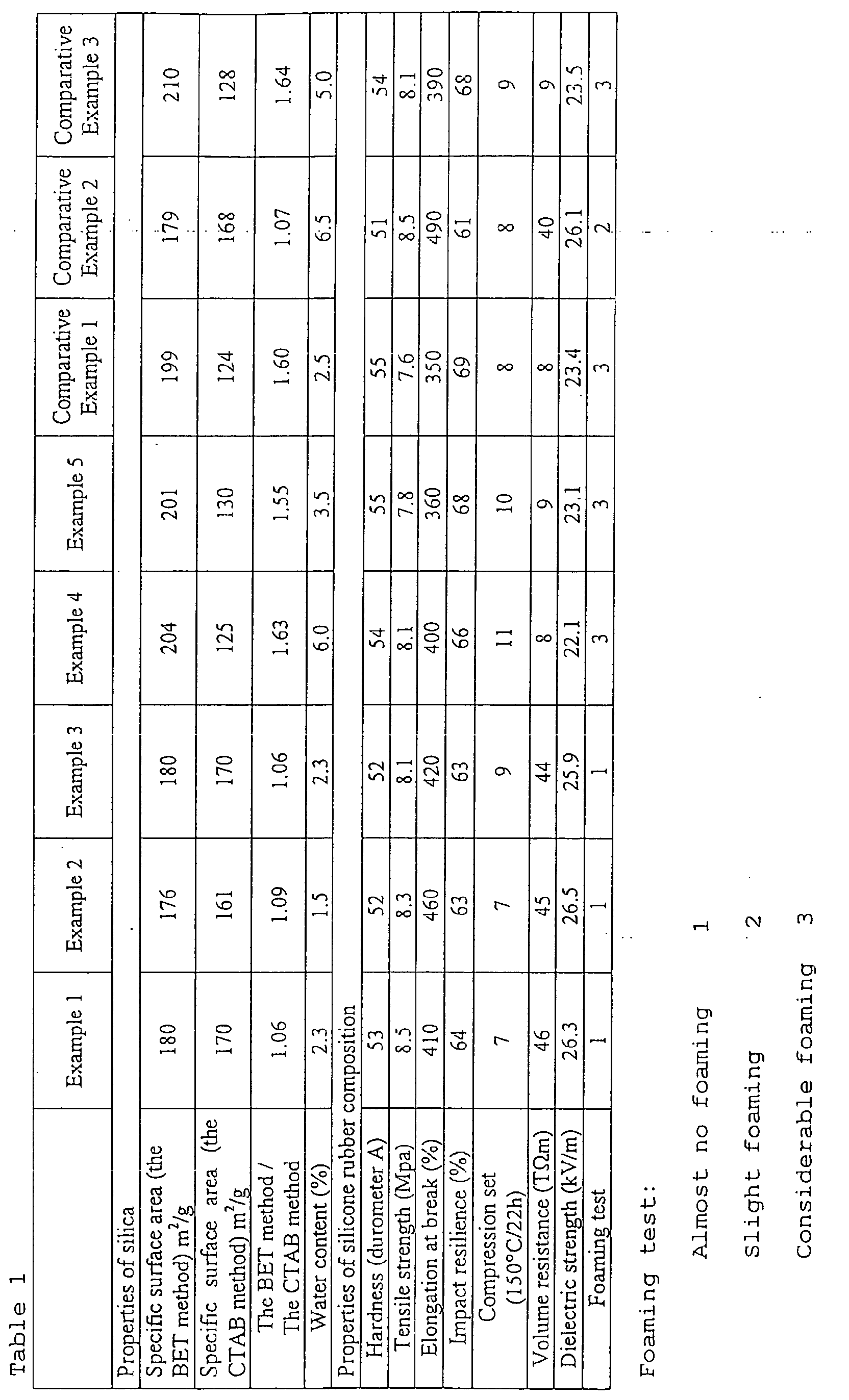
- To 100 parts of the rubber compound obtained was added 0.5 parts of 1,6-hexanediol bis-t-butylperoxycarbonate. This mixture was press-molded for curing at 165°C for 10 minutes to obtain a sheet for property examination. Thereafter, postcure was conducted at 200°C for 4 hours. The physical properties thereof were evaluated and the results are shown in Table 1.
- The results of the foaming test in hot air vulcanization are also shown in Table 1.
- A sheet for property examination was molded in the same manner as in Example 1, except that Zeosil 172X was used after drying at 110°C for 1 hour. The physical properties thereof were evaluated and the results are shown in Table 1.
- The results of the foaming test in hot air vulcanization are also shown in Table 1.
- A sheet for property examination was molded in the same manner as in Example 1, except that 0.1 part of calcium stearate was added during the silicone rubber compound production. The physical properties thereof were evaluated and the results are shown in Table 1.
- The results of the foaming test in hot air vulcanization are also shown in Table 1.
- A sheet for property examination was molded in the same manner as in Example 1, except that Zeosil 132 (manufactured by Rhodia Japan Ltd.) was used in place of the Zeosil 172X. The physical properties thereof were evaluated and the results are shown in Table 1.
- The results of the foaming test in hot air vulcanization are also shown in Table 1.
- A sheet for property examination was molded in the same manner as in Example 1, except that Zeosil 132 which had been dried at 110° C for 1 hour was used in place of the Zeosil 172X. The physical properties thereof were evaluated and the results are shown in Table 1.
- The results of the foaming test in hot air vulcanization are also shown in Table 1.
- A sheet for property examination was molded in the same manner as in Example 1, except that Zeosil 132 which had been dried at 110°C for 2 hours was used in place of the Zeosil 172X. The physical properties thereof were evaluated and the results are shown in Table 1.
- The results of the foaming test in hot air vulcanization are also shown in Table 1.
- A sheet for property examination was molded in the same manner as in Example 1, except that Zeosil 172X was used after the water content thereof was increased by adding water. The physical properties thereof were evaluated and the results are shown in Table 1.
- The results of the foaming test in hot air vulcanization are also shown in Table 1.
- A sheet for property examination was molded in the same manner as in Example 1, except that Nipsil LP (manufactured by Nippon Silica Co., Ltd.) was used in place of the Zeosil 172X. The physical properties thereof were evaluated and the results are shown in Table 1.
- The results of the foaming test in hot air vulcanization are also shown in Table 1.
- While the present invention has been described in detail and with reference to specific embodiments thereof, it will be apparent to one skilled in the art that various changes and modifications can be made therein without departing from the scope thereof.
- This application is based on Japanese patent application No. 2004-014762 filed January 22, 2004, the entire contents thereof being hereby incorporated by reference.
Claims (8)
- A silicone rubber composition comprising(A) 100 parts by weight of organopolysiloxane having a degree of polymerization of 100 or higher and having at least two silicon-bonded alkenyl groups in the molecule;(B) from 3 to 100 parts by weight of wet silica having the following properties:specific surface area (the BET method) of 50 m2/g or larger,specific surface area (the BET method)/specific surface area (the CTAB method) of from 1.0 to 1.3, andwater content of 4% or lower; and(C) an effective amount of a curing agent.
- The silicone rubber composition of claim 1, which further comprises as component (D) an organosilane or siloxane represented by the following general formula (I):wherein R1's are the same or different and each represent an alkyl group or a hydrogen atom; R's are the same or different and each represent an unsubstituted or substituted, monovalent hydrocarbon group; and m is a positive number of from 1 to 50.

- The silicone rubber composition of claim 1 or 2 wherein the curing agent comprises an organic peroxide or a combination of an organohydrogenpolysiloxane and a hydrosilylation catalyst.
- The silicone rubber composition of claim 1, 2 or 3 which further comprises a release agent as component (E).
- A silicone rubber composition according to any one of the preceding claims which is for use in extrusion moulding.
- A method of moulding an article comprising silicone rubber, the method comprising curing a silicone rubber composition according to any one of claims 1 to 4.
- A method according to claim 6 in which the silicone rubber composition is hot air vulcanised.
- A method according to claim 6 or 7 in which the silicone rubber composition is extrusion moulded.
Applications Claiming Priority (2)
| Application Number | Priority Date | Filing Date | Title |
|---|---|---|---|
| JP2004014762 | 2004-01-22 | ||
| JP2004014762A JP4524565B2 (en) | 2004-01-22 | 2004-01-22 | Method for suppressing foaming of wet silica-containing cured silicone rubber |
Publications (1)
| Publication Number | Publication Date |
|---|---|
| EP1557446A1 true EP1557446A1 (en) | 2005-07-27 |
Family
ID=34631934
Family Applications (1)
| Application Number | Title | Priority Date | Filing Date |
|---|---|---|---|
| EP05250244A Withdrawn EP1557446A1 (en) | 2004-01-22 | 2005-01-19 | Silicone rubber compositions, their preparation and use |
Country Status (6)
| Country | Link |
|---|---|
| US (1) | US20050165161A1 (en) |
| EP (1) | EP1557446A1 (en) |
| JP (1) | JP4524565B2 (en) |
| KR (1) | KR20050076755A (en) |
| CN (1) | CN100378173C (en) |
| TW (1) | TW200530338A (en) |
Cited By (4)
| Publication number | Priority date | Publication date | Assignee | Title |
|---|---|---|---|---|
| WO2007116988A1 (en) * | 2006-03-31 | 2007-10-18 | Dow Corning Toray Co., Ltd. | Curable silicone coating agent |
| DE102007052269A1 (en) | 2007-11-02 | 2009-05-07 | Evonik Degussa Gmbh | Precipitated silicic acids for storage-stable RTV-1 silicone rubber formulations without stabilizer |
| WO2011000133A1 (en) | 2009-07-03 | 2011-01-06 | Evonik Degussa Gmbh | Hydrophilic silica as filler for silicone rubber formulations |
| EP2554585A1 (en) * | 2011-08-03 | 2013-02-06 | Shin-Etsu Chemical Co., Ltd. | Silicone Rubber Composition Having Excellent Heat Resistance |
Families Citing this family (17)
| Publication number | Priority date | Publication date | Assignee | Title |
|---|---|---|---|---|
| EP1559744A1 (en) * | 2004-01-30 | 2005-08-03 | Rhodia Chimie | Use of a pretreated precipitated silica as a reinforcing filler for silicone elastomer and curable compositions thus obtained |
| DE102005008951A1 (en) * | 2005-02-24 | 2006-09-07 | Wacker Chemie Ag | Silicone rubber compositions and permanent load-resistant silicone elastomers obtained therefrom |
| JP2006241253A (en) * | 2005-03-01 | 2006-09-14 | Shin Etsu Chem Co Ltd | Room temperature curable organopolysiloxane composition |
| JP4883270B2 (en) * | 2005-12-02 | 2012-02-22 | 信越化学工業株式会社 | Silicone rubber composition and method for molding silicone rubber |
| JP4787068B2 (en) * | 2006-05-12 | 2011-10-05 | 信越化学工業株式会社 | High ream rate silicone rubber sponge |
| JP4664247B2 (en) * | 2006-07-07 | 2011-04-06 | 信越化学工業株式会社 | Glass fiber product treatment composition |
| JP4798375B2 (en) * | 2006-11-17 | 2011-10-19 | 信越化学工業株式会社 | Silicone rubber composition for extrusion molding and method for producing the same |
| JP4645859B2 (en) * | 2008-03-14 | 2011-03-09 | 信越化学工業株式会社 | Addition-curable silicone rubber composition and cured silicone rubber |
| EP2218703B1 (en) * | 2009-02-13 | 2013-05-08 | Evonik Degussa GmbH | A thermal insulation material comprising precipitated silica |
| JP2011231145A (en) * | 2010-04-23 | 2011-11-17 | Nitto Denko Corp | Composition for silicone resin |
| KR101362409B1 (en) * | 2012-05-31 | 2014-02-14 | 주식회사 엠닥터 | Removable thermal endurant coating agent composition |
| CN104194339A (en) * | 2014-08-21 | 2014-12-10 | 太仓荣南密封件科技有限公司 | Silica gel ignition coil rubber and preparation technique thereof |
| CN106928460A (en) * | 2017-04-25 | 2017-07-07 | 马鞍山纽泽科技服务有限公司 | A kind of silicon rubber carbon monoxide-olefin polymeric |
| KR102648018B1 (en) * | 2017-11-15 | 2024-03-18 | 신에쓰 가가꾸 고교 가부시끼가이샤 | Organopolysiloxane composition |
| JP6966373B2 (en) * | 2018-03-30 | 2021-11-17 | 住友理工株式会社 | Manufacturing method of conductive rolls for electrophotographic equipment and conductive rolls for electrophotographic equipment |
| JP7143827B2 (en) * | 2019-09-09 | 2022-09-29 | 信越化学工業株式会社 | ADDITION CURE LIQUID SILICONE RUBBER COMPOSITION FOR AIR BAG AND AIR BAG |
| CN118871523A (en) * | 2022-07-06 | 2024-10-29 | 瓦克化学股份公司 | Silicone elastomers for HVDC |
Citations (5)
| Publication number | Priority date | Publication date | Assignee | Title |
|---|---|---|---|---|
| US4409356A (en) * | 1979-12-20 | 1983-10-11 | Rhone-Poulenc Industries | Organosilicic elastomers reinforced with improved precipitated silica particulates |
| US4927587A (en) * | 1988-02-29 | 1990-05-22 | Shin-Etsu Chemical Co., Ltd. | Method for manufacturing extrusion molded silicone insulating articles |
| US5321058A (en) * | 1990-05-31 | 1994-06-14 | Dow Corning Toray Silicone Co., Ltd. | Curable organosiloxane compositions exhibiting reduced mold staining and scorching |
| US5395605A (en) * | 1987-02-25 | 1995-03-07 | Rhone-Poulenc Chimie | Low water uptake precipitated silica particulates |
| EP1281735A1 (en) * | 2001-08-04 | 2003-02-05 | Degussa AG | Hydrophobic precipitated silica with high whiteness and low moisture absorbance |
Family Cites Families (11)
| Publication number | Priority date | Publication date | Assignee | Title |
|---|---|---|---|---|
| FR2471947A1 (en) * | 1979-12-20 | 1981-06-26 | Rhone Poulenc Ind | PRECIPITATION SILICE, IN PARTICULAR AS A REINFORCING LOAD |
| FR2613708B1 (en) * | 1987-04-13 | 1990-10-12 | Rhone Poulenc Chimie | HYDROPHOBIC PRECIPITATION SILICA, ITS PREPARATION PROCESS AND ITS APPLICATION TO THE REINFORCEMENT OF SILICON ELASTOMERS |
| JPH0816194B2 (en) * | 1990-05-14 | 1996-02-21 | 信越化学工業株式会社 | Silicone rubber composition and method for producing the same |
| JPH0940868A (en) * | 1995-07-27 | 1997-02-10 | Toray Dow Corning Silicone Co Ltd | Heat-curable silicone rubber composition |
| JP3987132B2 (en) * | 1995-11-24 | 2007-10-03 | 東レ・ダウコーニング株式会社 | Method for extrusion molding of silicone rubber moldings |
| JP2001342347A (en) * | 2000-05-31 | 2001-12-14 | Dow Corning Toray Silicone Co Ltd | Silicone rubber composition for extrusion molding and method for producing silicone rubber extruded product |
| JP2002129017A (en) * | 2000-10-25 | 2002-05-09 | Dow Corning Toray Silicone Co Ltd | Silicone rubber composition for extrusion molding and method for producing silicone rubber extruded product |
| JP2002265784A (en) * | 2001-03-06 | 2002-09-18 | Shin Etsu Chem Co Ltd | Storage method for silica-containing rubber compounds |
| DE10138492A1 (en) * | 2001-08-04 | 2003-02-13 | Degussa | Hydrophobic, non-tempered precipitated silica with a high degree of whiteness |
| FR2833937B1 (en) * | 2001-12-26 | 2004-11-12 | Rhodia Chimie Sa | SILICA WITH LOW WATER RESUME |
| DE10203500A1 (en) * | 2002-01-30 | 2003-08-07 | Degussa | Room temperature crosslinking one-component silicone rubber formulations with hydrophobic silicas |
-
2004
- 2004-01-22 JP JP2004014762A patent/JP4524565B2/en not_active Expired - Fee Related
-
2005
- 2005-01-19 US US11/037,291 patent/US20050165161A1/en not_active Abandoned
- 2005-01-19 EP EP05250244A patent/EP1557446A1/en not_active Withdrawn
- 2005-01-21 CN CNB2005100056008A patent/CN100378173C/en not_active Expired - Fee Related
- 2005-01-21 KR KR1020050005706A patent/KR20050076755A/en not_active Withdrawn
- 2005-01-21 TW TW094101882A patent/TW200530338A/en not_active IP Right Cessation
Patent Citations (5)
| Publication number | Priority date | Publication date | Assignee | Title |
|---|---|---|---|---|
| US4409356A (en) * | 1979-12-20 | 1983-10-11 | Rhone-Poulenc Industries | Organosilicic elastomers reinforced with improved precipitated silica particulates |
| US5395605A (en) * | 1987-02-25 | 1995-03-07 | Rhone-Poulenc Chimie | Low water uptake precipitated silica particulates |
| US4927587A (en) * | 1988-02-29 | 1990-05-22 | Shin-Etsu Chemical Co., Ltd. | Method for manufacturing extrusion molded silicone insulating articles |
| US5321058A (en) * | 1990-05-31 | 1994-06-14 | Dow Corning Toray Silicone Co., Ltd. | Curable organosiloxane compositions exhibiting reduced mold staining and scorching |
| EP1281735A1 (en) * | 2001-08-04 | 2003-02-05 | Degussa AG | Hydrophobic precipitated silica with high whiteness and low moisture absorbance |
Cited By (4)
| Publication number | Priority date | Publication date | Assignee | Title |
|---|---|---|---|---|
| WO2007116988A1 (en) * | 2006-03-31 | 2007-10-18 | Dow Corning Toray Co., Ltd. | Curable silicone coating agent |
| DE102007052269A1 (en) | 2007-11-02 | 2009-05-07 | Evonik Degussa Gmbh | Precipitated silicic acids for storage-stable RTV-1 silicone rubber formulations without stabilizer |
| WO2011000133A1 (en) | 2009-07-03 | 2011-01-06 | Evonik Degussa Gmbh | Hydrophilic silica as filler for silicone rubber formulations |
| EP2554585A1 (en) * | 2011-08-03 | 2013-02-06 | Shin-Etsu Chemical Co., Ltd. | Silicone Rubber Composition Having Excellent Heat Resistance |
Also Published As
| Publication number | Publication date |
|---|---|
| TWI359845B (en) | 2012-03-11 |
| TW200530338A (en) | 2005-09-16 |
| JP2005206697A (en) | 2005-08-04 |
| CN100378173C (en) | 2008-04-02 |
| KR20050076755A (en) | 2005-07-27 |
| CN1651516A (en) | 2005-08-10 |
| US20050165161A1 (en) | 2005-07-28 |
| JP4524565B2 (en) | 2010-08-18 |
Similar Documents
| Publication | Publication Date | Title |
|---|---|---|
| US20050165161A1 (en) | Silicone rubber composition | |
| JP2011153305A (en) | Curable liquid silicone rubber composition for forming sealing member and sealing member | |
| JP2000160016A (en) | Composition for anti-vibration rubber | |
| EP2554585B1 (en) | Silicone Rubber Composition Having Excellent Heat Resistance | |
| US7977417B2 (en) | Silicone rubber composition for extrusion molding | |
| CN107459822B (en) | Silicone rubber composition for preparing key pad and key pad | |
| JP5527309B2 (en) | Millable silicone rubber compound and method for producing silicone rubber composition | |
| JP5888076B2 (en) | Method for improving plastic return resistance of silicone rubber compound, method for improving compression set resistance of cured silicone rubber, and method for reducing hardness difference | |
| JP4762781B2 (en) | Conductive silicone rubber composition and conductive silicone rubber sponge | |
| JP6738776B2 (en) | Silicone rubber composition | |
| JP4365769B2 (en) | Silicone rubber composition for sponge | |
| JP7156216B2 (en) | Millable type silicone rubber composition, cured product thereof, and silicone rubber compound for millable type silicone rubber composition | |
| JP2015131978A (en) | Method for improving dynamic fatigue durability of cured silicone rubber | |
| US5340872A (en) | Silicone rubber compositions and their cured products | |
| KR101099174B1 (en) | Silicone Rubber Composition | |
| JP4725713B2 (en) | Silicone rubber composition and method for improving heat resistance of cured product of silicone rubber composition | |
| JP2021070780A (en) | Barium titanate-containing silicone rubber and method for producing the same | |
| JP2013221090A (en) | Silicone rubber composition | |
| JP3613317B2 (en) | Silicone rubber composition and method for producing silicone rubber molded article | |
| JP2008222849A (en) | Curable silicone rubber composition giving cured product with excellent fatigue resistance and cured product thereof | |
| US20120277362A1 (en) | Method for producing silicone rubber compound and silicone rubber composition | |
| JPH04268377A (en) | Silicone rubber composition | |
| JP2005220263A (en) | Method for molding silicone rubber composition | |
| WO2025204325A1 (en) | Silicone rubber composition and cured object obtained therefrom | |
| JPH04252266A (en) | Silicone rubber composition |
Legal Events
| Date | Code | Title | Description |
|---|---|---|---|
| PUAI | Public reference made under article 153(3) epc to a published international application that has entered the european phase |
Free format text: ORIGINAL CODE: 0009012 |
|
| AK | Designated contracting states |
Kind code of ref document: A1 Designated state(s): AT BE BG CH CY CZ DE DK EE ES FI FR GB GR HU IE IS IT LI LT LU MC NL PL PT RO SE SI SK TR |
|
| AX | Request for extension of the european patent |
Extension state: AL BA HR LV MK YU |
|
| 17P | Request for examination filed |
Effective date: 20050829 |
|
| AKX | Designation fees paid |
Designated state(s): DE FR GB |
|
| 17Q | First examination report despatched |
Effective date: 20060112 |
|
| STAA | Information on the status of an ep patent application or granted ep patent |
Free format text: STATUS: THE APPLICATION IS DEEMED TO BE WITHDRAWN |
|
| 18D | Application deemed to be withdrawn |
Effective date: 20090903 |