EP1557443A1 - Resin composition for coating electric wire and electric wire using the same - Google Patents
Resin composition for coating electric wire and electric wire using the same Download PDFInfo
- Publication number
- EP1557443A1 EP1557443A1 EP03769921A EP03769921A EP1557443A1 EP 1557443 A1 EP1557443 A1 EP 1557443A1 EP 03769921 A EP03769921 A EP 03769921A EP 03769921 A EP03769921 A EP 03769921A EP 1557443 A1 EP1557443 A1 EP 1557443A1
- Authority
- EP
- European Patent Office
- Prior art keywords
- resin composition
- component
- electric wire
- polyolefin
- fibers
- Prior art date
- Legal status (The legal status is an assumption and is not a legal conclusion. Google has not performed a legal analysis and makes no representation as to the accuracy of the status listed.)
- Withdrawn
Links
Images

Classifications
-
- C—CHEMISTRY; METALLURGY
- C08—ORGANIC MACROMOLECULAR COMPOUNDS; THEIR PREPARATION OR CHEMICAL WORKING-UP; COMPOSITIONS BASED THEREON
- C08L—COMPOSITIONS OF MACROMOLECULAR COMPOUNDS
- C08L23/00—Compositions of homopolymers or copolymers of unsaturated aliphatic hydrocarbons having only one carbon-to-carbon double bond; Compositions of derivatives of such polymers
-
- C—CHEMISTRY; METALLURGY
- C08—ORGANIC MACROMOLECULAR COMPOUNDS; THEIR PREPARATION OR CHEMICAL WORKING-UP; COMPOSITIONS BASED THEREON
- C08L—COMPOSITIONS OF MACROMOLECULAR COMPOUNDS
- C08L23/00—Compositions of homopolymers or copolymers of unsaturated aliphatic hydrocarbons having only one carbon-to-carbon double bond; Compositions of derivatives of such polymers
- C08L23/02—Compositions of homopolymers or copolymers of unsaturated aliphatic hydrocarbons having only one carbon-to-carbon double bond; Compositions of derivatives of such polymers not modified by chemical after-treatment
- C08L23/04—Homopolymers or copolymers of ethene
- C08L23/06—Polyethylene
-
- C—CHEMISTRY; METALLURGY
- C08—ORGANIC MACROMOLECULAR COMPOUNDS; THEIR PREPARATION OR CHEMICAL WORKING-UP; COMPOSITIONS BASED THEREON
- C08K—Use of inorganic or non-macromolecular organic substances as compounding ingredients
- C08K7/00—Use of ingredients characterised by shape
- C08K7/02—Fibres or whiskers
-
- H—ELECTRICITY
- H01—ELECTRIC ELEMENTS
- H01B—CABLES; CONDUCTORS; INSULATORS; SELECTION OF MATERIALS FOR THEIR CONDUCTIVE, INSULATING OR DIELECTRIC PROPERTIES
- H01B3/00—Insulators or insulating bodies characterised by the insulating materials; Selection of materials for their insulating or dielectric properties
- H01B3/18—Insulators or insulating bodies characterised by the insulating materials; Selection of materials for their insulating or dielectric properties mainly consisting of organic substances
- H01B3/30—Insulators or insulating bodies characterised by the insulating materials; Selection of materials for their insulating or dielectric properties mainly consisting of organic substances plastics; resins; waxes
- H01B3/44—Insulators or insulating bodies characterised by the insulating materials; Selection of materials for their insulating or dielectric properties mainly consisting of organic substances plastics; resins; waxes vinyl resins; acrylic resins
- H01B3/441—Insulators or insulating bodies characterised by the insulating materials; Selection of materials for their insulating or dielectric properties mainly consisting of organic substances plastics; resins; waxes vinyl resins; acrylic resins from alkenes
-
- H—ELECTRICITY
- H01—ELECTRIC ELEMENTS
- H01B—CABLES; CONDUCTORS; INSULATORS; SELECTION OF MATERIALS FOR THEIR CONDUCTIVE, INSULATING OR DIELECTRIC PROPERTIES
- H01B3/00—Insulators or insulating bodies characterised by the insulating materials; Selection of materials for their insulating or dielectric properties
- H01B3/18—Insulators or insulating bodies characterised by the insulating materials; Selection of materials for their insulating or dielectric properties mainly consisting of organic substances
- H01B3/30—Insulators or insulating bodies characterised by the insulating materials; Selection of materials for their insulating or dielectric properties mainly consisting of organic substances plastics; resins; waxes
- H01B3/47—Insulators or insulating bodies characterised by the insulating materials; Selection of materials for their insulating or dielectric properties mainly consisting of organic substances plastics; resins; waxes fibre-reinforced plastics, e.g. glass-reinforced plastics
-
- C—CHEMISTRY; METALLURGY
- C08—ORGANIC MACROMOLECULAR COMPOUNDS; THEIR PREPARATION OR CHEMICAL WORKING-UP; COMPOSITIONS BASED THEREON
- C08K—Use of inorganic or non-macromolecular organic substances as compounding ingredients
- C08K3/00—Use of inorganic substances as compounding ingredients
- C08K3/18—Oxygen-containing compounds, e.g. metal carbonyls
- C08K3/20—Oxides; Hydroxides
- C08K3/22—Oxides; Hydroxides of metals
-
- C—CHEMISTRY; METALLURGY
- C08—ORGANIC MACROMOLECULAR COMPOUNDS; THEIR PREPARATION OR CHEMICAL WORKING-UP; COMPOSITIONS BASED THEREON
- C08K—Use of inorganic or non-macromolecular organic substances as compounding ingredients
- C08K5/00—Use of organic ingredients
- C08K5/0008—Organic ingredients according to more than one of the "one dot" groups of C08K5/01 - C08K5/59
- C08K5/0066—Flame-proofing or flame-retarding additives
-
- C—CHEMISTRY; METALLURGY
- C08—ORGANIC MACROMOLECULAR COMPOUNDS; THEIR PREPARATION OR CHEMICAL WORKING-UP; COMPOSITIONS BASED THEREON
- C08K—Use of inorganic or non-macromolecular organic substances as compounding ingredients
- C08K9/00—Use of pretreated ingredients
- C08K9/04—Ingredients treated with organic substances
- C08K9/06—Ingredients treated with organic substances with silicon-containing compounds
-
- C—CHEMISTRY; METALLURGY
- C08—ORGANIC MACROMOLECULAR COMPOUNDS; THEIR PREPARATION OR CHEMICAL WORKING-UP; COMPOSITIONS BASED THEREON
- C08L—COMPOSITIONS OF MACROMOLECULAR COMPOUNDS
- C08L2201/00—Properties
- C08L2201/02—Flame or fire retardant/resistant
-
- C—CHEMISTRY; METALLURGY
- C08—ORGANIC MACROMOLECULAR COMPOUNDS; THEIR PREPARATION OR CHEMICAL WORKING-UP; COMPOSITIONS BASED THEREON
- C08L—COMPOSITIONS OF MACROMOLECULAR COMPOUNDS
- C08L2203/00—Applications
- C08L2203/20—Applications use in electrical or conductive gadgets
- C08L2203/202—Applications use in electrical or conductive gadgets use in electrical wires or wirecoating
-
- C—CHEMISTRY; METALLURGY
- C08—ORGANIC MACROMOLECULAR COMPOUNDS; THEIR PREPARATION OR CHEMICAL WORKING-UP; COMPOSITIONS BASED THEREON
- C08L—COMPOSITIONS OF MACROMOLECULAR COMPOUNDS
- C08L2205/00—Polymer mixtures characterised by other features
- C08L2205/02—Polymer mixtures characterised by other features containing two or more polymers of the same C08L -group
-
- C—CHEMISTRY; METALLURGY
- C08—ORGANIC MACROMOLECULAR COMPOUNDS; THEIR PREPARATION OR CHEMICAL WORKING-UP; COMPOSITIONS BASED THEREON
- C08L—COMPOSITIONS OF MACROMOLECULAR COMPOUNDS
- C08L2205/00—Polymer mixtures characterised by other features
- C08L2205/14—Polymer mixtures characterised by other features containing polymeric additives characterised by shape
- C08L2205/16—Fibres; Fibrils
-
- C—CHEMISTRY; METALLURGY
- C08—ORGANIC MACROMOLECULAR COMPOUNDS; THEIR PREPARATION OR CHEMICAL WORKING-UP; COMPOSITIONS BASED THEREON
- C08L—COMPOSITIONS OF MACROMOLECULAR COMPOUNDS
- C08L51/00—Compositions of graft polymers in which the grafted component is obtained by reactions only involving carbon-to-carbon unsaturated bonds; Compositions of derivatives of such polymers
- C08L51/06—Compositions of graft polymers in which the grafted component is obtained by reactions only involving carbon-to-carbon unsaturated bonds; Compositions of derivatives of such polymers grafted on to homopolymers or copolymers of aliphatic hydrocarbons containing only one carbon-to-carbon double bond
-
- C—CHEMISTRY; METALLURGY
- C08—ORGANIC MACROMOLECULAR COMPOUNDS; THEIR PREPARATION OR CHEMICAL WORKING-UP; COMPOSITIONS BASED THEREON
- C08L—COMPOSITIONS OF MACROMOLECULAR COMPOUNDS
- C08L77/00—Compositions of polyamides obtained by reactions forming a carboxylic amide link in the main chain; Compositions of derivatives of such polymers
Definitions
- This invention relates to a resin composition for electric wire sheaths and an electric wire using the same.
- the electric wires used for a wire harness in a motor vehicle, etc. are identified by coloring in specific colors (red, white, black, blue, green, etc.) for facilitating wiring and connection.
- the coloring of electric wires has hitherto been carried out by one of the following methods (1) to (3):
- the productivity is low because the manufacturing line may be frequently stopped when the color is changed. Electric wires which are colored with rare colors may be in stock.
- the method (2) it is difficult to surely distinguish colors through the translucent insulative resin coating, so that the wiring or connecting workability is low.
- the method (3) a capital investment is necessary to provide a good working environment for using the organic solvent-family ink, thereby increasing the manufacturing cost.
- the insulative layer of the electric wire is colored by water-soluble ink containing a polyamine, alcohol, and pigment with predetermined ratios (see Japanese Patent Publication No. 10-251563A, page 2).
- the water-soluble ink cannot provide a good colorability when the surface comprised of a polyolefin resin component.
- a resin composition to be used for electric wire sheaths wherein a polyolefin resin and an ultrafine nylon fibers-dispersed polyolefin resin composition are mixed.
- a blend ratio of a polyolefin (PO) and ultrafine nylon fibers (Ny) in the ultrafine nylon fibers-dispersed polyolefin resin composition falls within a range from 5:5 to 9:1 (PO:Ny).
- the blend ratio is 8:2 (PO:Ny).
- the resin composition further comprises at least one of silica particles and magnesium hydroxide particles.
- the ultrafine nylon fibers-dispersed polyolefin resin composition is comprised of a polyolefin, polyamide fibers, a silane coupling agent and silica particles.
- the polyamide fibers are comprised of at least one of silica particles and magnesium hydroxide particles.
- a mean fiber diameter of the polyamide fibers is not greater than 5 ⁇ m, and an aspect ratio thereof falls within a range from 20 to 1000.
- an electric wire comprising a sheath comprised of the above resin composition.
- the tensile elongation (that is, flexibility and elasticity) and the ink colorability are enhanced by mixing the polyolefin resin and the ultrafine nylon fibers-dispersed polyolefin resin composition. Further, the wear resistance and the dye colorability are enhanced by containing the silica particles, the magnesium hydroxide particles, or a mixture of those particles.
- the polyolefin resin to be used in the resin composition for electric wire sheaths is preferably one having a melting point that falls between 80 and 250°C.
- Preferred examples of the resin of the type are a homopolymer and a copolymer of olefin having from 2 to 8 carbon atoms, a copolymer of olefin having from 2 to 8 carbon atoms with vinyl acetate, a copolymer of olefin having from 2 to 8 carbon atoms with acrylic acid or its ester, a copolymer of olefin having from 2 to 8 carbon atoms with methacrylic acid or its ester, and a copolymer of olefin having from 2 to 8 carbon atoms with a vinylsilane compound.
- the resin are high-density polyethylene, low-density polyethylene, linear low-density polyethylene, polypropylene, ethylene/propylene block copolymer, ethylene/propylene random copolymer, poly-4-methylpentene-1, polybutene-1, polyhexene-1, ethylene/vinyl acetate copolymer, ethylene/vinyl alcohol copolymer, ethylene/acrylic acid copolymer, ethylene/methyl acrylate copolymer, ethylene/ethyl acrylate copolymer, ethylene/propyl acrylate copolymer, ethylene/butyl acrylate copolymer, ethylene/2-ethylhexyl acrylate copolymer, ethylene/hydroxyethyl acrylate copolymer, ethylene/vinyltrimethoxysilane copolymer, ethylene/vinyltriethoxysilane copolymer, ethylene/vinylsilane
- high-density polyethylene HDPE
- low-density polyethylene LDPE
- linear low-density polyethylene LLDPE
- polypropylene PP
- EPBC ethylene/propylene block copolymer
- EPRC ethylene/propylene random copolymer
- EVA ethylene/vinyl acetate copolymer
- EAA ethylene/ethyl acrylate copolymer
- ethylene/vinyl alcohol copolymer and most preferred are those having a melt flow index (MFI) that falls between 0.2 and 50 g/10 min.
- MFI melt flow index
- ultrafine nylon fibers-dispersed polyolefin resin composition to be used in the resin composition of the invention.
- the nylon component in the nylon fiber to be used in the ultrafine nylon fibers-dispersed polyolefin resin composition is a thermoplastic polyamide having an amide group in the backbone chain thereof (this is hereinafter referred to as "polyamide”) and having a melting point that falls between 135 and 350°C and is higher by at least 20°C than the melting point of the polyolefin.
- polyamide has a melting point falling between 160 and 265°C.
- the polyamide of the type may give tough fibers through extrusion and stretching.
- polyamide examples include nylon 6, nylon 66, nylon 6-nylon 66 copolymer, nylon 610, nylon 46, nylon 11, nylon 12, nylon MXD6, xylylenediamine/adipic acid polycondensate, xylylenediamine/pimelic acid polycondensate, xylylenediamine/suberic acid polycondensate, xylylenediamine/azelaic acid polycondensate, xylylenediamine/sebacic acid polycondensate, tetramethylenediamine/terephthalic acid polycondensate, hexamethylenediamine/terephthalic acid polycondensate, octamethylenediamine/terephthalic acid polycondensate, trimethylhexamethylenediamine/terephthalic acid polycondensate, decamethylenediamine/terephthalic acid polycondensate, undecamethylenediamine/terephthalic acid polycondensate,
- nylon 6 PA6
- nylon 66 PA66
- nylon 12 PA12
- nylon 6-nylon 66 copolymer a polymer that has a molecular weight falling between 10,000 and 200,000.
- the fiber diameter of the nylon fiber is not specifically limited, but may be 5 ⁇ m or less.
- the polyolefin used in the ultrafine nylon fibers-dispersed polyolefin resin composition is the same polyolefin as has been mentioned as the principal component of the resin composition described before.
- the weight ratio of the polyolefin resin (PO) and very fine nylon fibers (Ny) in the Ny-PO used according to this invention is not specifically limited, but may be preferably 5:5 to 9:1 (PO:Ny), more preferably 7:3 to 9:1 (PO:Ny), and most preferably 8:2 (PO:Ny).
- the amount of Ny-PO used in the resin composition according to this invention is not specifically limited, but may be preferably 100 parts by weight or less, more preferably 50 parts by weight or less, and still more preferably 5 to 20 parts by weight for 100 parts by weight of the resin composition.
- the resin composition according to this invention preferably contains silica particles or magnesium hydroxide particles or a mixture of those particles to improve the wear resistance and coloring property of a molded resin product obtained from the resin composition.
- the silica particles which the resin composition according to this invention may contain are not specifically limited, but may have a particle diameter of preferably 1 nm to 100 ⁇ m, and particularly preferably 1 nm to 100 nm.
- the magnesium hydroxide particles which the resin composition according to this invention may contain are not specifically limited, but may have a particle diameter of preferably 1 nm to 100 ⁇ m, particularly preferably 10 nm to 10 ⁇ m, and still more preferably 10 nm to 1000 nm.
- the amount of the silica or magnesium hydroxide particles or a mixture of those particles which the resin composition according to this invention may contain is not specifically limited, but may be 100 parts by weight or less, more preferably 60 parts by weight or less, and still more preferably 10 to 30 parts by weight for 100 parts by weight of the resin composition.
- a ultrafine nylon fibers-dispersed polyolefin resin composition (Ny-PO) containing a polyolefin, polyamide fibers, a silane coupling agent and silica or magnesium hydroxide particles or a mixture of those particles.
- Ny-PO nylon fibers-dispersed polyolefin resin composition
- Such Ny-PO may be of the polyamide fibers containing or not containing silica or magnesium hydroxide particles or a mixture of those particles.
- the polyolefin used in the Ny-PO containing a polyolefin, polyamide fibers, a silane coupling agent and silica or magnesium hydroxide particles or a mixture of those particles is not specifically limited, but may be the same polyolefin as has been mentioned as the principal component of the resin composition described before.
- the polyamide used in the above Ny-PO is not specifically limited, but may be the same as has been mentioned as the nylon component of the resin composition described before.
- An organic peroxide may be used together with the silane coupling agent.
- radicals may be formed in the molecular chains of the polyolefin component and they may react with the silane coupling agent to promote the reaction of the polyolefin component and the silane coupling agent.
- the amount of the organic peroxide to be used may be from 0.01 to 1.0 part by weight relative to 100 parts by weight of the polyolefin component.
- the temperature for the half-life period for one minute of the organic peroxide is the same as the higher one of the melting point of the polyolefin component or the melting point of the silane coupling agent or is higher by around 30°C than that temperature. Concretely, the temperature for the half-life period for one minute of the organic peroxide preferably falls between 110 and 200°C or so.
- organic peroxide examples include di- ⁇ -cumyl peroxide, 1,1-di-t-butylperoxy-3,3,5-trimethylcyclohexane, 1,1-di-t-butylperoxycyclohexane, 2,2-di-t-butylperoxybutane, n-butyl 4,4-di-t-butylperoxyvalerate, 2,2-bis(4,4-di-t-butylperoxycyclohexane)propane, 2,2,4-trimethylpentylperoxy neodecanoate, ⁇ -cumylperoxy neodecanoate, t-butylperoxy neohexanoate, t-butylperoxy pivalate, t-butylperoxy acetate, t-butylperoxy laurate, t-butylperoxy benzoate, t-butylperoxy isophthalate.
- the temperature for the half-life period for one minute falls between a temperature at which the components are melt-kneaded and a temperature higher by around 30°C than the melt-kneading temperature, concretely the temperature for the half-life period for one minute thereof preferably falls between 80 and 260°C, approximately.
- the silica particles, the magnesium hydroxide particles or the mixture of those particles to be used in the Ny-PO are not is not specifically limited, but may be the same as have been mentioned as the silica particles, the magnesium hydroxide particles or a mixture of those particles of the resin composition described before.
- the content of the silica particles, the magnesium hydroxide particles or the mixture of those particles to be in the Ny-PO is preferably from 1 to 100 parts by weight, more preferably from 1 to 60 parts by weight relative to 100 parts by weight of the polyolefin resin composition.
- the strength of the composition could not high.
- the amount is less than 1 part by weight, the hydrogen bond part between the silane coupling agent and the silica particles, the magnesium hydroxide particles or the mixture of those particles will be unsatisfactory and the composition could not also have the intended abrasion resistance and strength.
- the preferred amount of the silica particles, the magnesium hydroxide particles or the mixture of those particles varies depending on the kneading condition in preparing the polyolefin resin composition of the invention, and therefore it may be suitably determined before the constituent components are kneaded.
- the polyamide component in the Ny-PO forms fine fibers that are uniformly dispersed in the matrix of the composition.
- at least 70 % by weight, preferably at least 80 % by weight, more preferably at least 90 % by weight of the polyamide component forms fine fibers that are uniformly dispersed in the matrix.
- the mean fiber diameter of the polyamide component fibers is at most 1 ⁇ m, and the mean fiber length thereof is at most 100 ⁇ m.
- the aspect ratio (ratio of fiber length/fiber diameter) of the fibers falls between 20 and 1,000.
- the method for producing the Ny-PO includes the following two ways.
- the method for preparing the resin composition that comprises a polyolefin, polyamide fibers and a silane coupling agent in the mode (A) comprises, for example, the following steps:
- Step (A1) will be described below.
- the melt-kneading temperature is not lower than the melting point of the component 1, but preferably higher by 30°C than the melting point.
- the component 1 reacts with the component 2 and is chemically modified by the component 2.
- Melt-kneading them may be effected in any ordinary device generally used for kneading resin or rubber.
- the device includes, for example, Banbury mixer, kneader, kneader extruder, open roll, single-screw kneader, double-screw kneader. Of those devices, most preferred is a double-screw kneader as it may achieve continuous melt-kneading within a short period of time (the same shall apply to the steps mentioned below).
- the melt-kneading temperature is not lower than the melting point of the component 3, but preferably higher by 10°C than the melting point. If the melt-kneading temperature is lower than the melting point of the component 3, the components could not be kneaded and could not be fibrously dispersed. Therefore, they are melt-kneaded at a temperature higher than the melting pint, especially preferably higher by 20°C than the melting point of the component 3.
- Step (A3) will be described below.
- the kneaded mixture obtained in the step is extruded out through a spinneret or through an inflation die or T-die. Spinning and extruding the mixture must be effected at a temperature higher than the melting point of the component 3. Concretely, it is desirable that the operation is effected at a temperature higher by 30°C than the melting point of the component 3. Even when the operation of melt-kneading the mixture is effected at a temperature lower than the melting point of the component 3, the kneaded mixture could not have a structure of fine fibers of the component 3 dispersed in the matrix of the component 1. Accordingly, even when the kneaded mixture of the type is spun and stretched, the component 3 could not form fine fibers.
- Step (A4) will be described below.
- the extruded, string-like or yarn-like product is continuously cooled, stretched or rolled. Cooling the fibrous product followed by stretching or rolling it is effected at a temperature lower by 10°C than the melting point of the component 3. Stretching and rolling it gives tougher fibers, and the treatment is favorable since the fiber-reinforced resin composition thus produced may have better properties.
- the stretching or rolling treatment may be effected, for example, by extruding the kneaded mixture through a spinneret to spin it into a string-like or yarn-like product, followed by winding it around a bobbin with drafting. If desired, it may be pelletized into pellets.
- Drafting the fibrous product as referred to herein means that the winding-up speed of the product is higher than the speed thereof that passes through a spinneret.
- the ratio of winding-up speed/spinneret speed falls between 1.5 and 100, more preferably between 2 and 50, even more preferably between 3 and 30.
- the polyamide fiber-reinforced polyolefin resin composition is preferably in the form of pellets since any additional resin or rubber component may be added to and uniformly kneaded with them.
- the pelletized resin composition may be uniformly kneaded with such additional rubber or resin, and it may readily give a polyamide fiber-reinforced resin composition with fine fibers uniformly dispersed therein.
- the respective steps may be combined into one continuous process to be effected in a double-screw kneader having a plurality of supply ports each feeding one of the respective components and a peroxide or the like into the kneader and having a plurality of kneading zones each correspond to one of the supply ports.
- the process is more economical, stable and safe.
- pellets of the resin composition that comprises a polyolefin, polyamide fibers and a silane coupling agent may be thermally kneaded with silica particles, magnesium hydroxide particles or the mixture of those particles, (component 5) in a Banbury mixer, kneader, kneader extruder, open roll, single-screw kneader or double-screw kneader, at a temperature higher by 10°C than the melting point of polyolefin but not higher than the melting point of polyamide.
- a hydrogen bond may be formed between the component 5 and the silane coupling agent in the component 4 through the thermal kneading operation as above.
- the thermally-kneaded mixture is preferably extruded, stretched or rolled, and pelletized.
- the method of producing the Ny-PO that comprises a polyolefin, polyamide fibers, a silane coupling agent and silica particles, magnesium hydroxide particles or a mixture of those particles in the production mode (B) is not specifically defined. For example, it comprises the following steps:
- the melt-kneading temperature is not lower than the melting point of the component 1, but preferably higher by 30°C than the melting point.
- the component 1 reacts with the component 2 and is chemically modified by the component 2.
- Melt-kneading them may be effected in any ordinary device generally used for kneading resin or rubber.
- the device includes, for example, Banbury mixer, kneader, kneader extruder, open roll, single-screw kneader, double-screw kneader. Of those devices, most preferred is a double-screw kneader as it may achieve continuous melt-kneading within a short period of time (the same shall apply to the steps mentioned below).
- the melt-kneading temperature is not lower than the melting point of the component 3, but preferably higher by 10°C than the melting point. If the melt-kneading temperature is lower than the melting point of the component 3, the components could not be kneaded and could not be fibrously dispersed. Therefore, they are melt-kneaded at a temperature higher than the melting pint, especially preferably higher by 20°C than the melting point of the component 3.
- Step (B3) will be described below.
- the kneaded mixture obtained in the step is extruded out through a spinneret or through an inflation die or T-die. Spinning and extruding the mixture must be effected at a temperature higher than the melting point of the component 3. Concretely, it is desirable that the operation is effected at a temperature higher by 30°C than the melting point of the component 3. Even when the operation of melt-kneading the mixture is effected at a temperature lower than the melting point of the component 3, the kneaded mixture could not have a structure of fine fibers of the component 3 dispersed in the matrix of the component 1.
- Step (B4) will be described below.
- the extruded, string-like or yarn-like product is continuously cooled, stretched or rolled. Cooling the fibrous product followed by stretching or rolling it is effected at a temperature lower by 10°C than the melting point of the component 3. Stretching and rolling it gives tougher fibers, and the treatment is favorable since the fiber-reinforced resin composition thus produced may have better properties.
- the stretching or rolling treatment may be effected, for example, by extruding the kneaded mixture through a spinneret to spin it into a string-like or yarn-like product, followed by winding it around a bobbin with drafting.
- Drafting the fibrous product as referred to herein means that the winding-up speed of the product is higher than the speed thereof that passes through a spinneret.
- the ratio of winding-up speed/spinneret speed falls between 1.5 and 100, more preferably between 2 and 50, even more preferably between 3 and 30.
- the polyamide fiber-reinforced polyolefin resin composition is preferably in the form of pellets since any additional resin or rubber component may be added to and uniformly kneaded with them.
- the pelletized resin composition may be uniformly kneaded with such additional rubber or resin, and it may readily give a polyamide fiber-reinforced resin composition with fine fibers uniformly dispersed therein.
- the respective steps may be combined into one continuous process to be effected in a double-screw kneader having a plurality of supply ports each feeding one of the respective components and a peroxide or the like into the kneader and having a plurality of kneading zones each corresponding to one of the supply ports.
- the process is more economical, stable and safe.
- the component 1 reacts with the component 2 and is thereby chemically modified with the latter, and fine fibers of the component 3 are dispersed in the matrix of the component 1.
- whisker fibers of the component 1 that are finer than the fine fibers of the component 3 may be formed on the surfaces of the fibers of the component 3.
- the component 3 is also modified with the component 2. It is presumed that the component 5 may chemically bond to the component 1 and the component 3 at their parts that have been chemically modified with the component 2 to thereby partially crosslink the component 1 and the component 3.
- the gel fraction of this embodiment with the component 5 added thereto is higher than that of the other case not containing the component 5. To that effect, the component 5 improve various properties of the resin composition.
- a method for obtaining the resin composition according to this invention there is no specific limitation, but it is possible to mention, for example, a method in which a polyolefin resin and Ny-PO, and also silica or magnesium hydroxide particles or a mixture of those particles are pre-blended by using a high-speed mixing device, such as a Henschel mixer, and are thereafter kneaded by using a known kneading machine, such as a single-screw extruder, a double-screw extruder, a Banbary mixer, a kneader or a roll mill.
- a high-speed mixing device such as a Henschel mixer
- the resin composition according to this invention may further contain various kinds of auxiliary components which are usually incorporated, for example, any of various kinds of oxidation inhibitors, such as of the phenol, phosphorus or sulfur type, a nucleating agent, an antistatic agent, a metal fatty acid salt, a lubricant such as of the amide, silicone or Teflon type, a slip agent, a processing aid, a metal inactivating agent, an ultraviolet inhibitor, and a filler such as carbon black, white carbon, calcium carbonate, magnesium silicate, ferrite, zeolite, montmorillonite, barium sulfate, clay, talc or zinc white, to the extent not injuring the effects of this invention.
- oxidation inhibitors such as of the phenol, phosphorus or sulfur type
- nucleating agent such as of the phenol, phosphorus or sulfur type
- an antistatic agent such as of the phenol, phosphorus or sulfur type
- a metal fatty acid salt such as of the amide, silicone
- This invention also provides an electric wire for which the above resin composition is employed as an insulating material.
- the above resin composition is employed as an insulating material.
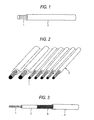
- the use of the above resin composition as an insulator for, for example, a single wire as shown in Fig. 1, a flat wire as shown in Fig. 2 or a shielded wire as shown in Fig. 3 makes it possible to achieve a satisfactory improvement in flexibility and softness, dye coloring property and also wear resistance.
- reference numeral 1 denotes a conductor
- 2 denotes an insulator
- 3 denotes a braided shield
- 4 denotes a sheath.
- an extruder may be a single-screw extruder having a cylinder diameter of 20 to 90 mm and an UD of 10 to 40, and having a screw, a crosshead, a breaker grate, a distributor, a nipple and dice.
- the above resin composition is charged into the single-screw extruder set at a temperature allowing the resin composition to melt thoroughly.
- the resin composition is melted and kneaded by the screw, and a specific amount thereof is supplied to the crosshead via the breaker plate.
- the molten resin composition is caused by the distributor to flow in onto the circumference of the nipple.
- the resin composition which has flown in is extruded by the dice onto the circumference of the conductor in a state coating it, whereby an electric wire having an insulator is obtained.
- the numerical unit for the composition of materials in Table 1 is parts by weight.
- the polyolefin was silane-modified polyethylene obtained by mixing 80 parts by weight of low-density polyethylene [having a melting point of 110°C and an MFR of 5.0 (g/10 min.)] with 1.0 part by weight of ⁇ -methacryloxypropyltrimethoxysilane as a silane coupling agent, 0.5 part by weight of Irganox 1010 as an oxidation inhibitor and 0.5 part by weight of d- ⁇ -cumyl peroxide (having a concentration of 40%) as a peroxide, charging their mixture into a double-screw extruder having a diameter of 45 mm and heated to 170°C and kneading and palletizing it.
- the whole amount of the silane-modified polyethylene as obtained, 20 parts by weight of nylon 6 (having a melting point of 215 to 225°C) as a nylon component and 0.5 part by weight of Irganox 1010 were kneaded in a double-screw extruder set at 235°C and having a diameter of ⁇ 3 mm. Die, extruded in a strand form through the die, and it was cooled by air, taken up in a draft ratio of 7 by a take-up roll, and stretched to 1.5 times between 5-inch rolls at room temperature, whereby pellets were obtained.
- the electric wires made by the electric wire extruder above were evaluated for tensile properties (yield, breakdown strength and elongation), wear resistance and flame retardancy. The test results are shown in Table 1.
- a electric wire specimen having a length of about 150 mm was marked in its middle portion with gages having a distance of 50 mm therebetween, was attached to a chuck in a testing device as specified by JIS B7721, and was pulled at a pulling rate of 200 mm/min., and its tensile elongation was determined from the maximum tensile load (MPa) and the length as found between the gages when it was broken.
- MPa maximum tensile load
- the test was conducted by using a scrape wear testing device as shown in Fig. 4. More specifically, an electric wire specimen 111 having a length of about 1 m was placed on a sample holder 105 and fixed by a clamp 104. A plunger 103 provided at its end with a piano wire 108 having a diameter of 0.45 mm was pressed against the electric wire specimen 111 at a total load of 7 N by using a pressing member 101 and reciprocated along it (along a reciprocating distance of 14 mm) until the insulator on the electric wire specimen 111 was worn and the piano wire 108 of the plunger 103 contacted the conductor 106 in the electric wire specimen 111, and the number of times of reciprocation as completed until then was determined.
- An electric wire specimen 10 having a length of 600 mm or more was set in an inclined position at an angle of 45° in a windless tank, as shown in Fig. 5, and a reducing flame was applied for 15 seconds by a Bunsen burner 20 to it at a point 500 ⁇ 5 mm from its upper end, and the time after which for the flame to go out was determined.
- a coloring solution was prepared by dissolving 3% by weight of Plast Blue 8580 as a dye in xylene.
- the coloring treatment of each electric wire obtained as described before was carried out by dipping it in the coloring solution at temperatures of 25 and 60°C for 10 seconds and washing it with xylene.
- the coloration of the electric wire after coloring treatment was read as image data by a computer and the color density of the image data was determined in accordance with a gray scale by using image processing software.
- the gray scale was for graduating color density in a range from 0 (black) to 255 (white).
- the test results are shown in Table 1.
Landscapes
- Chemical & Material Sciences (AREA)
- Health & Medical Sciences (AREA)
- Chemical Kinetics & Catalysis (AREA)
- Medicinal Chemistry (AREA)
- Polymers & Plastics (AREA)
- Organic Chemistry (AREA)
- Physics & Mathematics (AREA)
- Spectroscopy & Molecular Physics (AREA)
- Compositions Of Macromolecular Compounds (AREA)
- Insulated Conductors (AREA)
Abstract
Description
| sample No. | 1 | 2 | 3 | 4 | |
| composition of materials | low-density polyethylene | 100 | 100 | 100 | 100 |
| bromine-containing flame retardant | 35 | 35 | 10 | ||
| | 2 | 2 | 2 | 2 | |
| Ny-PO (Ny wt%) | 10 (2) | 10 (2) | 10 (2) | 10 (2) | |
| silica particles 16nm | 10 | 5 | |||
| magnesium hydroxide particles 80 nm | 60 | 5 | |||
| electron-beam crosslinking (Present or Absent) | A | A | A | A | |
| properties of electric wire | tensile strength (MPa) | 11.5 | 12.5 | 11.0 | 11.5 |
| elongation (%) | 540 | 540 | 350 | 330 | |
| wear resistance (number of times) | 150 | 210 | 120 | 140 | |
| flame retardancy (sec) | 5 | 5 | 6 | 12 | |
| colorability | before coloring | 225 | 225 | 220 | 220 |
| 25°C | 210 | 200 | 200 | 200 | |
| 60°C | 170 | 160 | 150 | 150 | |
| sample No. (c: comparative) | 5 | 6 | c1 | c2 | |
| composition of materials | low-density polyethylene | 100 | 100 | 100 | 100 |
| bromine-containing flame retardant | 35 | 35 | 35 | 35 | |
| | 2 | 2 | 2 | 2 | |
| Ny- | 10 | 10 | |||
| (Ny wt%) | (2) | (2) | |||
| silica particles 16nm | 10 | 10 | |||
| magnesium hydroxide particles 80 nm | |||||
| electron-beam crosslinking (Present or Absent) | P | P | P | P | |
| properties of electric wire | tensile strength (MPa) | 11.5 | 12.2 | 10.1 | 9.7 |
| elongation (%) | 410 | 405 | 410 | 390 | |
| wear resistance (number of times) | 235 | 260 | 160 | 195 | |
| flame retardancy (sec) | 4 | 3 | 6 | 6 | |
| colorability | before coloring | 230 | 230 | 235 | 230 |
| 25°C | 220 | 215 | 230 | 225 | |
| 60°C | 195 | 185 | 215 | 205 |
Claims (8)
- A resin composition to be used for electric wire sheaths, wherein a polyolefin resin and an ultrafine nylon fibers-dispersed polyolefin resin composition are mixed.
- The resin composition as set forth in claim 1, wherein a blend ratio of a polyolefin (PO) and ultrafine nylon fibers (Ny) in the ultrafine nylon fibers-dispersed polyolefin resin composition falls within a range from 5:5 to 9:1 (PO:Ny).
- The resin composition as set forth in claim 2, wherein the blend ratio is 8:2 (PO: Ny).
- The resin composition as set forth in claim 1, further comprising at least one of silica particles and magnesium hydroxide particles.
- The resin composition as set forth in claim 1, wherein the ultrafine nylon fibers-dispersed polyolefin resin composition is comprised of a polyolefin, polyamide fibers, a silane coupling agent and silica particles.
- The resin composition as set forth in claim 5, wherein the polyamide fibers are comprised of at least one of silica particles and magnesium hydroxide particles.
- The resin composition as set forth in claim 1, wherein a mean fiber diameter of the polyamide fibers is not greater than 5 µm, and an aspect ratio thereof falls within a range from 20 to 1000.
- An electric wire, comprising a sheath comprised of the resin composition as set forth in claim 1.
Applications Claiming Priority (3)
| Application Number | Priority Date | Filing Date | Title |
|---|---|---|---|
| JP2002314845A JP4201573B2 (en) | 2002-10-29 | 2002-10-29 | Electric wire covering resin composition and electric wire using the same |
| JP2002314845 | 2002-10-29 | ||
| PCT/JP2003/013791 WO2004039880A1 (en) | 2002-10-29 | 2003-10-28 | Resin composition for coating electric wire and electric wire using the same |
Publications (2)
| Publication Number | Publication Date |
|---|---|
| EP1557443A1 true EP1557443A1 (en) | 2005-07-27 |
| EP1557443A4 EP1557443A4 (en) | 2010-09-22 |
Family
ID=32211628
Family Applications (1)
| Application Number | Title | Priority Date | Filing Date |
|---|---|---|---|
| EP03769921A Withdrawn EP1557443A4 (en) | 2002-10-29 | 2003-10-28 | RESIN COMPOSITION USED IN COATING AN ELECTRIC WIRE AND ELECTRIC WIRE COMPRISING THE SAME |
Country Status (8)
| Country | Link |
|---|---|
| US (1) | US20060167158A1 (en) |
| EP (1) | EP1557443A4 (en) |
| JP (1) | JP4201573B2 (en) |
| KR (1) | KR20050067424A (en) |
| CN (1) | CN1708546A (en) |
| MX (1) | MXPA05004598A (en) |
| PL (1) | PL207952B1 (en) |
| WO (1) | WO2004039880A1 (en) |
Cited By (4)
| Publication number | Priority date | Publication date | Assignee | Title |
|---|---|---|---|---|
| DE102009008065A1 (en) * | 2009-02-09 | 2010-08-19 | Yazaki Corp. | Polymer composition useful as sheathing for an electrical cable which is used preferably in motor vehicle, comprises base polymer containing a polyolefin polymer, polyamide and metal hydroxide |
| EP2535901A1 (en) * | 2011-06-17 | 2012-12-19 | Silec Cable | Medium- or high-voltage cable with polyolefin sheath containing mineral fillers |
| CN102855995A (en) * | 2012-08-29 | 2013-01-02 | 通辽市津蒙线缆制造有限公司 | Horizontal crosslinked polyethylene cable and manufacturing device and process thereof |
| US8815386B2 (en) | 2007-08-10 | 2014-08-26 | Yazaki Corporation | Polymeric composition useful as electrical conduit covering and insulated electrical conduit |
Families Citing this family (20)
| Publication number | Priority date | Publication date | Assignee | Title |
|---|---|---|---|---|
| JPWO2005103138A1 (en) * | 2004-04-20 | 2007-08-16 | 矢崎総業株式会社 | Polyolefin resin composition and electric wire using the same |
| CN100372885C (en) * | 2006-02-23 | 2008-03-05 | 广州金发科技股份有限公司 | A kind of continuous long fiber reinforced nylon/polyolefin composite material and its preparation method |
| WO2007121520A1 (en) * | 2006-04-21 | 2007-11-01 | Olex Australia Pty Limited | Fire resistant compositions |
| JP5133578B2 (en) * | 2007-02-27 | 2013-01-30 | 株式会社オートネットワーク技術研究所 | Insulated wire and wire harness |
| WO2011000816A1 (en) * | 2009-07-03 | 2011-01-06 | Basf Se | Nanocomposite blends containing polyamides and polyolefins |
| CN101942151B (en) * | 2009-07-10 | 2012-05-02 | 广东华声电器股份有限公司 | CPE/POE/LDPE component type insulating rubber and preparation method thereof |
| US8658576B1 (en) | 2009-10-21 | 2014-02-25 | Encore Wire Corporation | System, composition and method of application of same for reducing the coefficient of friction and required pulling force during installation of wire or cable |
| CN101781426B (en) * | 2010-03-02 | 2013-09-11 | 扬州华声电子实业有限公司 | CPE/POE (chlorinated polyethylene/polyolefin elastomer) component type electro-insulating rubber and preparation method thereof |
| JP5383567B2 (en) * | 2010-03-16 | 2014-01-08 | リケンテクノス株式会社 | Thermoplastic resin composition for electric wire coating and method for producing the same |
| JP2013541443A (en) * | 2010-09-17 | 2013-11-14 | スリーエム イノベイティブ プロパティズ カンパニー | Fiber reinforced nanoparticle loaded thermoset polymer composite wires and cables and methods |
| JP6039563B2 (en) | 2010-09-17 | 2016-12-07 | スリーエム イノベイティブ プロパティズ カンパニー | Nanoparticle pultrusion processing aid |
| US9177692B2 (en) * | 2010-09-30 | 2015-11-03 | Ube Industries, Ltd. | Polyamide resin composition and molded article comprising the same |
| US9352371B1 (en) | 2012-02-13 | 2016-05-31 | Encore Wire Corporation | Method of manufacture of electrical wire and cable having a reduced coefficient of friction and required pulling force |
| JP2014054137A (en) * | 2012-09-10 | 2014-03-20 | Yazaki Corp | Wire harness |
| US11328843B1 (en) | 2012-09-10 | 2022-05-10 | Encore Wire Corporation | Method of manufacture of electrical wire and cable having a reduced coefficient of friction and required pulling force |
| US10056742B1 (en) | 2013-03-15 | 2018-08-21 | Encore Wire Corporation | System, method and apparatus for spray-on application of a wire pulling lubricant |
| JP2016149046A (en) * | 2015-02-13 | 2016-08-18 | 矢崎総業株式会社 | Coupler and wire harness having the same |
| JP6852725B2 (en) | 2018-11-26 | 2021-03-31 | 日立金属株式会社 | Cables and harnesses |
| JP7124723B2 (en) * | 2019-01-16 | 2022-08-24 | 株式会社オートネットワーク技術研究所 | Insulated wire with adhesive layer |
| JP7782447B2 (en) * | 2020-08-04 | 2025-12-09 | 住友電気工業株式会社 | insulated wire |
Family Cites Families (14)
| Publication number | Priority date | Publication date | Assignee | Title |
|---|---|---|---|---|
| US5470657A (en) * | 1991-04-26 | 1995-11-28 | Sumitomo Electric Industries, Ltd. | Heat-resistant, high-voltage lead wire for direct current |
| NL9101540A (en) * | 1991-09-12 | 1993-04-01 | Dsm Nv | FIRE-RESISTANT PLASTIC COMPOSITION BASED ON A POLYAMIDE, A POLYOLEFINE AND MAGNESIUM HYDROXIDE. |
| JP3379208B2 (en) * | 1994-04-08 | 2003-02-24 | 宇部興産株式会社 | Fiber reinforced elastic body and method for producing the same |
| IL117216A (en) * | 1995-02-23 | 2003-10-31 | Martinswerk Gmbh | Surface-modified filler composition |
| JPH11147967A (en) * | 1997-11-14 | 1999-06-02 | Ube Ind Ltd | Polyamide fiber reinforced polyolefin foamable composition and its production method |
| JPH11152362A (en) * | 1997-11-21 | 1999-06-08 | Ube Ind Ltd | Polyamide fiber reinforced polyolefin-based non-crosslinked foamable composition and method for producing the same |
| JP3622470B2 (en) * | 1998-01-30 | 2005-02-23 | 宇部興産株式会社 | Polyamide fiber reinforced rubber composition and production method thereof |
| WO1999048973A1 (en) * | 1998-03-20 | 1999-09-30 | Ube Industries, Ltd. | Resin composition reinforced with polyamide fibers and process for producing the same |
| JPH11302464A (en) * | 1998-04-24 | 1999-11-02 | Ube Ind Ltd | Polyamide fiber reinforced polyolefin resin composition and method for producing the same |
| JP2000026696A (en) * | 1998-07-14 | 2000-01-25 | Sumitomo Wiring Syst Ltd | Flame retardant and abrasion resistant resin composition |
| JP4277357B2 (en) * | 1998-12-25 | 2009-06-10 | 住友電気工業株式会社 | Non-halogen flame retardant resin composition and method for producing the applied product |
| JP3776325B2 (en) * | 2001-03-06 | 2006-05-17 | 神島化学工業株式会社 | Method for producing magnesium hydroxide flame retardant coated with silane coupling agent |
| JP2004149634A (en) * | 2002-10-29 | 2004-05-27 | Yazaki Corp | Insulation parts using abrasion resistant resin composition |
| JP2004149635A (en) * | 2002-10-29 | 2004-05-27 | Daimaru Sangyo Kk | Polyolefin resin composition and method for producing the same |
-
2002
- 2002-10-29 JP JP2002314845A patent/JP4201573B2/en not_active Expired - Fee Related
-
2003
- 2003-10-28 KR KR1020057007207A patent/KR20050067424A/en not_active Ceased
- 2003-10-28 EP EP03769921A patent/EP1557443A4/en not_active Withdrawn
- 2003-10-28 US US10/532,995 patent/US20060167158A1/en not_active Abandoned
- 2003-10-28 PL PL376799A patent/PL207952B1/en not_active IP Right Cessation
- 2003-10-28 CN CNA2003801024802A patent/CN1708546A/en active Pending
- 2003-10-28 MX MXPA05004598A patent/MXPA05004598A/en unknown
- 2003-10-28 WO PCT/JP2003/013791 patent/WO2004039880A1/en not_active Ceased
Cited By (6)
| Publication number | Priority date | Publication date | Assignee | Title |
|---|---|---|---|---|
| US8815386B2 (en) | 2007-08-10 | 2014-08-26 | Yazaki Corporation | Polymeric composition useful as electrical conduit covering and insulated electrical conduit |
| DE102009008065A1 (en) * | 2009-02-09 | 2010-08-19 | Yazaki Corp. | Polymer composition useful as sheathing for an electrical cable which is used preferably in motor vehicle, comprises base polymer containing a polyolefin polymer, polyamide and metal hydroxide |
| DE102009008065B4 (en) * | 2009-02-09 | 2013-10-10 | Yazaki Corp. | A polymer composition usable for a sheath of an electric wire and use thereof |
| EP2535901A1 (en) * | 2011-06-17 | 2012-12-19 | Silec Cable | Medium- or high-voltage cable with polyolefin sheath containing mineral fillers |
| FR2976713A1 (en) * | 2011-06-17 | 2012-12-21 | Silec Cable | MEDIUM OR HIGH VOLTAGE CABLE WITH POLYOLEFIN SHEATH CONTAINING MINERAL LOADS |
| CN102855995A (en) * | 2012-08-29 | 2013-01-02 | 通辽市津蒙线缆制造有限公司 | Horizontal crosslinked polyethylene cable and manufacturing device and process thereof |
Also Published As
| Publication number | Publication date |
|---|---|
| PL376799A1 (en) | 2006-01-09 |
| PL207952B1 (en) | 2011-02-28 |
| EP1557443A4 (en) | 2010-09-22 |
| WO2004039880A1 (en) | 2004-05-13 |
| JP2004152547A (en) | 2004-05-27 |
| JP4201573B2 (en) | 2008-12-24 |
| US20060167158A1 (en) | 2006-07-27 |
| MXPA05004598A (en) | 2006-04-27 |
| KR20050067424A (en) | 2005-07-01 |
| CN1708546A (en) | 2005-12-14 |
Similar Documents
| Publication | Publication Date | Title |
|---|---|---|
| US20060167158A1 (en) | Resin composition for coating electric wire and electric wire using the same | |
| EP2720234B1 (en) | Process for producing electrical wire molded body | |
| CN101946289A (en) | Resin material for coating electric wire, electric wire produced by using the resin material for coating electric wire, and flame-retardant cable | |
| CN115260666A (en) | Inorganic whisker flame-retardant reinforced CPE composite material and preparation method thereof | |
| CN114773719A (en) | Polyolefin material and preparation method and application thereof | |
| JP3661736B2 (en) | Method for producing polyolefin-polyamide resin composition | |
| US7041726B2 (en) | Insulating member using abrasion-resistant resin composition | |
| CA2971177C (en) | Cable jackets having designed microstructures and methods for making cable jackets having designed microstructures | |
| CN1317323C (en) | Polyolefin resin composition and processes for the production thereof | |
| JP2009161703A (en) | Polyolefin resin composition and covered electric wire | |
| US20080300342A1 (en) | Polyolefin Resin Composition and Electric Wire Using the Same | |
| CN112795107B (en) | High-insulativity EPDM (ethylene-propylene-diene monomer) insulating material for power cable and preparation method thereof | |
| CN114350071B (en) | High-uniformity polypropylene modified master batch and preparation method thereof | |
| JP3786252B2 (en) | Polyolefin insulation insulated wire | |
| KR20170121186A (en) | Cable jacket having a designed microstructure and method of manufacturing a cable jacket having a designed microstructure | |
| KR20070003804A (en) | Process for producing polyolefin-polyamide resin composition | |
| CN116829640B (en) | Glass fiber reinforced acrylic resin composition | |
| CN221782946U (en) | Cable bending test device | |
| JP2023121558A (en) | Silane-crosslinked rubber composition, method for producing the same, and wire/cable | |
| WO1999048970A1 (en) | Polyamide fiber-reinforced elastomer composition and process for the production thereof | |
| HK1194197B (en) | Process for producing electrical wire molded body | |
| HK1194197A (en) | Method for manufacturing molded body for electrical wire |
Legal Events
| Date | Code | Title | Description |
|---|---|---|---|
| PUAI | Public reference made under article 153(3) epc to a published international application that has entered the european phase |
Free format text: ORIGINAL CODE: 0009012 |
|
| 17P | Request for examination filed |
Effective date: 20050419 |
|
| AK | Designated contracting states |
Kind code of ref document: A1 Designated state(s): AT BE BG CH CY CZ DE DK EE ES FI FR GB GR HU IE IT LI LU MC NL PT RO SE SI SK TR |
|
| AX | Request for extension of the european patent |
Extension state: LT |
|
| RBV | Designated contracting states (corrected) |
Designated state(s): DE FR GB PT SK |
|
| A4 | Supplementary search report drawn up and despatched |
Effective date: 20100825 |
|
| RIC1 | Information provided on ipc code assigned before grant |
Ipc: C08K 9/06 20060101ALI20100819BHEP Ipc: C08K 3/36 20060101ALI20100819BHEP Ipc: C08K 3/22 20060101ALI20100819BHEP Ipc: C08L 23/02 20060101ALI20100819BHEP Ipc: H01B 7/18 20060101ALI20100819BHEP Ipc: C08K 7/00 20060101ALI20100819BHEP Ipc: C08L 23/00 20060101AFI20040518BHEP |
|
| GRAP | Despatch of communication of intention to grant a patent |
Free format text: ORIGINAL CODE: EPIDOSNIGR1 |
|
| RIC1 | Information provided on ipc code assigned before grant |
Ipc: C08K 9/06 20060101ALI20110202BHEP Ipc: C08K 3/36 20060101ALI20110202BHEP Ipc: C08K 3/22 20060101ALI20110202BHEP Ipc: C08L 23/02 20060101ALI20110202BHEP Ipc: H01B 7/18 20060101ALI20110202BHEP Ipc: C08K 7/00 20060101ALI20110202BHEP Ipc: C08L 23/00 20060101AFI20110202BHEP |
|
| STAA | Information on the status of an ep patent application or granted ep patent |
Free format text: STATUS: THE APPLICATION IS DEEMED TO BE WITHDRAWN |
|
| 18D | Application deemed to be withdrawn |
Effective date: 20110719 |