EP1557436A1 - Graft copolymer, composition containing the same and molded object thereof, and process for producing the same - Google Patents
Graft copolymer, composition containing the same and molded object thereof, and process for producing the same Download PDFInfo
- Publication number
- EP1557436A1 EP1557436A1 EP03758797A EP03758797A EP1557436A1 EP 1557436 A1 EP1557436 A1 EP 1557436A1 EP 03758797 A EP03758797 A EP 03758797A EP 03758797 A EP03758797 A EP 03758797A EP 1557436 A1 EP1557436 A1 EP 1557436A1
- Authority
- EP
- European Patent Office
- Prior art keywords
- graft copolymer
- polyolefin resin
- acid
- group
- substituted
- Prior art date
- Legal status (The legal status is an assumption and is not a legal conclusion. Google has not performed a legal analysis and makes no representation as to the accuracy of the status listed.)
- Granted
Links
Classifications
-
- C—CHEMISTRY; METALLURGY
- C08—ORGANIC MACROMOLECULAR COMPOUNDS; THEIR PREPARATION OR CHEMICAL WORKING-UP; COMPOSITIONS BASED THEREON
- C08F—MACROMOLECULAR COMPOUNDS OBTAINED BY REACTIONS ONLY INVOLVING CARBON-TO-CARBON UNSATURATED BONDS
- C08F255/00—Macromolecular compounds obtained by polymerising monomers on to polymers of hydrocarbons as defined in group C08F10/00
-
- C—CHEMISTRY; METALLURGY
- C08—ORGANIC MACROMOLECULAR COMPOUNDS; THEIR PREPARATION OR CHEMICAL WORKING-UP; COMPOSITIONS BASED THEREON
- C08F—MACROMOLECULAR COMPOUNDS OBTAINED BY REACTIONS ONLY INVOLVING CARBON-TO-CARBON UNSATURATED BONDS
- C08F255/00—Macromolecular compounds obtained by polymerising monomers on to polymers of hydrocarbons as defined in group C08F10/00
- C08F255/02—Macromolecular compounds obtained by polymerising monomers on to polymers of hydrocarbons as defined in group C08F10/00 on to polymers of olefins having two or three carbon atoms
-
- C—CHEMISTRY; METALLURGY
- C08—ORGANIC MACROMOLECULAR COMPOUNDS; THEIR PREPARATION OR CHEMICAL WORKING-UP; COMPOSITIONS BASED THEREON
- C08L—COMPOSITIONS OF MACROMOLECULAR COMPOUNDS
- C08L51/00—Compositions of graft polymers in which the grafted component is obtained by reactions only involving carbon-to-carbon unsaturated bonds; Compositions of derivatives of such polymers
- C08L51/06—Compositions of graft polymers in which the grafted component is obtained by reactions only involving carbon-to-carbon unsaturated bonds; Compositions of derivatives of such polymers grafted on to homopolymers or copolymers of aliphatic hydrocarbons containing only one carbon-to-carbon double bond
-
- C—CHEMISTRY; METALLURGY
- C09—DYES; PAINTS; POLISHES; NATURAL RESINS; ADHESIVES; COMPOSITIONS NOT OTHERWISE PROVIDED FOR; APPLICATIONS OF MATERIALS NOT OTHERWISE PROVIDED FOR
- C09J—ADHESIVES; NON-MECHANICAL ASPECTS OF ADHESIVE PROCESSES IN GENERAL; ADHESIVE PROCESSES NOT PROVIDED FOR ELSEWHERE; USE OF MATERIALS AS ADHESIVES
- C09J151/00—Adhesives based on graft polymers in which the grafted component is obtained by reactions only involving carbon-to-carbon unsaturated bonds; Adhesives based on derivatives of such polymers
- C09J151/06—Adhesives based on graft polymers in which the grafted component is obtained by reactions only involving carbon-to-carbon unsaturated bonds; Adhesives based on derivatives of such polymers grafted on to homopolymers or copolymers of aliphatic hydrocarbons containing only one carbon-to-carbon double bond
-
- C—CHEMISTRY; METALLURGY
- C08—ORGANIC MACROMOLECULAR COMPOUNDS; THEIR PREPARATION OR CHEMICAL WORKING-UP; COMPOSITIONS BASED THEREON
- C08L—COMPOSITIONS OF MACROMOLECULAR COMPOUNDS
- C08L2666/00—Composition of polymers characterized by a further compound in the blend, being organic macromolecular compounds, natural resins, waxes or and bituminous materials, non-macromolecular organic substances, inorganic substances or characterized by their function in the composition
- C08L2666/02—Organic macromolecular compounds, natural resins, waxes or and bituminous materials
Definitions
- the present invention relates to a graft copolymer excellent in adhesion to a polar material and scratch resistance, a composition containing the same and a molded product thereof, and a method for producing the graft copolymer.
- thermoplastic resins polyolefin resin enables light weight and good cost efficiency and is excellent in moldability, chemical resistance, and mechanical strength, and thus it is used for various applications as film, fiber, and molding material.
- polyolefin resin has low polarity and small intermolecular force, it has problems in that coating property, adhesive property to and compatibility with polar material, and scratch resistance are inferior.
- Patent Document 1 Japanese Patent No. 2885919, page 2 to 3.
- thermoplastic elastomer to improve adhesive property and scratch resistance of thermoplastic elastomer, proposed is a method of blending a graft copolymer with thermoplastic elastomer, the graft copolymer in which a vinyl polymer segment formed from a vinyl monomer having carboxylic acid is directly bonded to ethylene. ⁇ -olefin copolymerized rubber segment (see Patent Document 2: Japanese Patent Publication No. 2-51455 (page 3)).
- the graft copolymers disclosed in these documents are produced by a method in which the vinyl monomer is directly reacted through grafting with the polyolefin resin using a polymerization initiator, and thus they have some problems in that the reactivity during graft reaction is low and side reaction such as disintegration or crosslinking of polyolefin resin occurs during the reaction. It is thus considered that a graft copolymer having excellent properties is hard to be obtained by these methods.
- the graft copolymer of the present invention has a structure in which a vinyl copolymer segment formed from a vinyl monomer having an acid is suspended via ⁇ -substituted propylene group in a molecular chain of a polyolefin resin segment.
- the present invention further provides a graft copolymer resin composition containing the graft copolymer and a molded product thereof.
- the present invention furthermore provides a method for producing the graft copolymer.
- a vinyl monomer having an acid is reacted with polyolefin resin having a ⁇ -substituted propenyl group as a pendant.
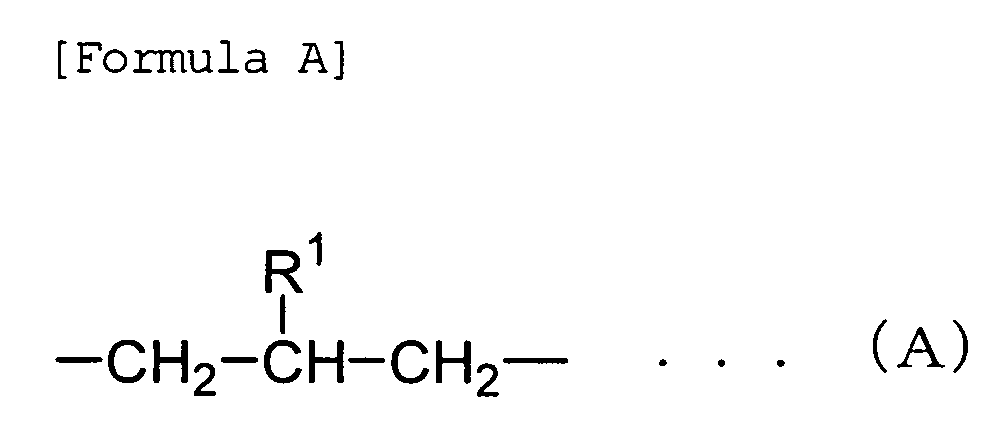
- a graft copolymer of the present invention having a structure in which a vinyl polymer segment formed from a vinyl monomer having an acid is suspended from a polyolefin resin segment via a ⁇ -substituted propylene group, preferably a ⁇ -substituted propylene group of the chemical formula (A).
- R 1 represents a phenyl group, a cyano group, or an alkylester group (-COOR m , wherein R m represents an alkyl group having 1 to 4 carbon atoms).
- Examples of the above ⁇ -substituted propylene group include a 2-phenyl-1,3-propylene group, a 2-cyano-1, 3-propylene group, and a 2-acetoxy-1,3-propylene group. Among them, 2-phenyl-1,3-propylene group is preferable.
- the amount of ⁇ -substituted propylene group contained in the graft copolymer is, for example, calculated from the amount of methine group bonded to ⁇ -substituted group, obtained from 1 H-NMR of the graft copolymer.
- the preferable amount of ⁇ -substituted propylene group is 0. 1 to 15% by weight in the graft copolymer.
- the amount of the ⁇ -substituted propylene group is less than 0.1% by weight in the graft copolymer, the performances of the graft copolymer such as adhesive properties and scratch resistance are relatively low, and it is unfavorable. Further, when the amount of the ⁇ -substituted propylene group in the graft copolymer exceeds 15% by weight, the desirable properties of polyolefin resin cannot be obtained.
- the polyolefin resin segment constituting the graft copolymer is a homopolymer of ⁇ -olefins having two or more carbon atoms, such as ethylene, propylene, 1-butene, 1-hexene, 4-methyl-1-pentene, and 1-octene (hereinafter abbreviated as ⁇ -olefins), a copolymer of two or more ⁇ -olefins, a copolymer of ⁇ -olefin and other vinyl monomer, or a mixture thereof.
- ⁇ -olefins a homopolymer of ⁇ -olefins having two or more carbon atoms, such as ethylene, propylene, 1-butene, 1-hexene, 4-methyl-1-pentene, and 1-octene
- polyethylene resins, polypropylene resins, orolefin elastomers are preferable from an economical viewpoint, and in particular,olefin elastomers synthesized with a metallocene catalyst is more preferable.
- polyethylene resin a homopolymer of polyethylene, a copolymer containing 80 or more % by mol of polyethylene, or a mixture thereof can be used.
- Specific examples thereof include a low density polyethylene, a linear low density polyethylene, and a high density polyethylene.
- the polyethylene resins usually having a melt flow rate of 0.01 to 100 g/10 min. (JIS K 7210: 190°C, 2.16 kg of load) and a density of 0.88 to 0.98 g/cm 3 (ASTM D 1505) are preferable from a viewpoint of the production.
- the polypropylene resin a homopolymer of polypropylene, a copolymer containing 80 or more % by mol of polypropylene, or a mixture thereof can be used. Among them, a random or block copolymer of propylene-ethylene containing 1 to 10% by weight of ethylene is preferable.
- the polypropylene resins usually having a melt flow rate of 0.01 to 100 g/10 min. (JIS K 7210: 230°C, 2.16 kg of load) are preferable from a viewpoint of the production.
- olefin elastomer usable are a copolymer rubber of 2 ormore kinds of ⁇ -olefin, or a copolymer of ⁇ -olefin and vinyl monomer, and a mixture or partially crosslinking substance thereof, and further an olefin thermoplastic elastomer, that is a mixture of these products, and a polyethylene resin or a crystalline polyolefin resin such as crystalline polyolefin resin.
- ethylene- ⁇ -olefin copolymer rubbers such as ethylene-propylene copolymer rubber, ethylene-butene copolymer rubber, ethylene-octene copolymer rubber, and ethylene-propylene-diene copolymer rubber
- ethylene-vinyl acetate copolymer rubber ethylene-glycidyl methacrylate copolymer
- ethylene- ⁇ -olefin copolymer rubbers such as ethylene-propylene copolymer rubber, ethylene-butene copolymer rubber, ethylene-octene copolymer rubber, and ethylene-propylene-diene copolymer rubber.
- ethylene-octene copolymer rubber and ethylene-propylene-diene copolymer rubber using a metallocene catalyst are more preferable.
- the vinyl polymer segment which constitutes the graft copolymer of the present invention and is formed from a vinyl monomer having an acid is an addition polymer in which one or more molecules of a vinyl monomer having an acid are polymerized.
- vinyl monomers having carboxylic acids vinyl monomers having carboxylic acid anhydrides, vinyl monomers having sulfonic acids, and vinyl monomers having phosphoric acids are preferable in terms of adhesive properties to and compatibility with polar materials, and further scratch resistance.
- vinyl monomers having carboxylic acids include methacrylic acid, maleic acid, fumaric acid, itaconic acid, crotonic acid, and methyltetrahydrophthalic acid.
- vinyl monomers having carboxylic acid anhydrides include maleic anhydride, itaconic anhydride, methyltetrahydrophthalic anhydride, and endomethylenetetrahydrophthalic anhydride.
- vinyl monomers having sulfonic acids include methacryl sulfonate, vinyl sulfonate, and p-styrene sulfonate.
- vinyl monomers having phosphoric acids include ethylene glycol methacrylate phosphate and polyethylene glycol methacrylate phosphate.
- vinyl monomers having acids use of vinyl monomers having carboxylic acids or carboxylic acid anhydrides is preferable for the present invention in terms of the acid content in the graft copolymer.
- use of acrylic acid and maleic anhydride is most preferable.
- vinyl monomers having these acids may be used either alone or in combination of two or more kinds thereof.
- the amount of vinyl polymer segment which is formed from the vinyl monomer having an acid and contained in the graft copolymer of the present invention can be calculated, for example, from a peak height of infrared absorption spectrum of the acid obtained by FT-IR.
- the amount of the vinyl polymer segment formed from the vinyl monomer having an acid is preferably in the range of 0.1 to 30% by weight in the graft copolymer, more preferably 1 to 20% by weight.
- the amount thereof is less than 0.1% by weight, the performances of the graft copolymer such as adhesive properties and scratch resistance are relatively low, and it is unfavorable.
- greater than 30% by weight of the acid is unfavorable, because the properties of polyolefin resin cannot be obtained.
- the graft copolymer of the present invention preferably has a number average molecular weight obtained by styrene conversion of 1,000 to 10,000,000, and more preferably 2,000 to 5,000,000 obtained by high temperature GPC (Column: Toso TSKgel GMHHR-H(20)HTx2, column temperature: 135°C, detector temperature: 135°C, sample temperature: 135°C, pump: 60°C, injection volume: 100 ⁇ l, solvent: orthodichlorobenzene, analytical time: 30 minute s ).
- the number average molecular weight is less than 1,000, the mechanical properties are relatively low, and it is unfavorable. Further, when the number average molecular weight is greater than 10,000,000, the reforming effects become insufficient, and it is unfavorable.
- the graft copolymer of the present invention may contain byproduct compounds generated during the production of the graft copolymer, that is to say, non-grafted polyolefin resins, vinyl polymer formed from the vinyl monomer having an acid, a decomposition product or a gel of polyolefin resin.
- a graft copolymer composition containing the graft copolymer of the present invention can contain two or more kinds of graft copolymers.
- more preferable is a mixture of: a graft copolymer composed of a polypropylene resin and a vinyl polymer segment formed from a vinyl monomer having an acid; and a graft copolymer composed of an olefin elastomer segment and a vinyl polymer segment formed from a vinyl monomer having an acid.
- a polyolefin resin can be newly added to the graft copolymer composition of the present invention.
- polyolefin resin can uniformly disperse the graft copolymer in the graft copolymer composition and enhance an application property, an adhesive property to dissimilar materials, scratch resistance, and wear resistance.
- the above-mentioned polyolefin resin and a mixture thereof can be used.
- the mixing ratio of the graft copolymer and polyolefin resin can be arbitrarily changed in the range of 99.5/0.5 to 0.5/99.5.
- the mixing ratio is preferably 50/50 to 0.5/99.5
- the weight ratio of the graft copolymer contained in a graft copolymer composition is less than 0. 5%, the scratch resistance and wear resistance of the graft copolymer composition are relatively low and it is not undesirable.
- the weight ratio of the polyolefin resin contained in the graft copolymer composition is less than 0.5%, the above-mentioned reforming effect by addition of polyolefin is hard to be obtained.
- the graft copolymer composition of the present invention is partially crosslinked.
- crosslinking methods there can be either of the following methods or a combination thereof: a method for intramolecular and intermolecular crosslinking by ionic bond using a metal salt or an organic amine by use of the acid of the graft copolymer composition; and a method for intramolecular and intermolecular crosslinking by covalent bond using an organic peroxide or sulfur by use of the polyolefin resin segment of the graft copolymer composition.
- metal salt to be used for crosslinking method by ionic bond examples include sodium salts, calcium salts, magnesium salts, zinc salts, lithium salts, and aluminum salts.
- organic amines examples include n-hexylamine, hexamethylenediamine, and 1,3-bis(aminomethyl)cyclohexane.
- metal salts are preferable, and magnesium salts, zinc salts, and aluminum salts are more preferable.
- any of the following methods can be used: a method for neutralizing a vinyl monomer having an acid by a metal salt or an organic amine before producing the graft copolymer composition; a method for neutralizing an acid of the graft copolymer composition by a metal salt or an organic amine after graft reaction; and a method for neutralizing by a metal salt or an organic amine after polyolefin resin is further added into the graft copolymer composition.
- metal salt or organic amine has an upper limit of equimolar amount based on the amount of the acid of the graft copolymer composition.
- organic peroxides to be used for the method for crosslinking by covalent bond include dicumyl peroxide, ⁇ , ⁇ '-bis(t-butylperoxy)diisopropylbenzene, 2,5-dimethyl-2,5-bis(t-butylperoxy)hexane, 2, 5-dimethyl-2, 5-bis(t-butylperoxy)hexyne-3, 1,1-bis(t-butylperoxy)3,3,5-trimethylcyclohexane, t-butylperoxybenzoate, and benzoyl peroxide.
- dicumyl peroxide, ⁇ , ⁇ '-bis(t-butylperoxy)diisopropylbenzene, 2,5-dimethyl-2,5-bis(t-butylperoxy)hexane, and 2,5-dimethyl-2,5-bis(t-butylperoxy)hexyne-3 are preferable.
- sulfur to be used for the method for crosslinking by covalent bond include organic sulfur donors such as tetramethylthiuramdisulfide and 4,4-dithiobis(morpholine) in addition to simple substance sulfur such as insoluble sulfur and colloidal sulfur.
- simple substance sulfur such as insoluble sulfur and colloidal sulfur is more desirable.
- the amount of crosslinking agent to be added is not greater than 10 parts by weight and more preferably not greater than 5 parts by weight, based on 100 parts by weight of graft copolymer composition. Addition of more than 10 parts by weight of crosslinking agent lowers the moldability of the graft copolymer composition, and it is not preferable.
- a crosslinking co-agent can be further added to the graft copolymer composition of the present invention when crosslinking is conducted by a crosslinking agent such as organic peroxides and sulfur.
- crosslinking co-agent usable are: a dimer or trimer of a vinyl monomer to be used in crosslinking by an organic peroxide, or a crosslinking accelerator used in crosslinking by sulfur; an activator; and a retarder.
- dimer or trimer of a vinyl monomer examples include divinylbenzene (ortho-, meta-, and para-), ethyleneglycoldi(meth)acrylate, trimethylolpropanetri(meth)acrylate, and diallyl phthalate.
- divinylbenzene (not limited to any of ortho-, meta-, and para-), ethyleneglycoldi(meth)acrylate, and trimethylolpropanetri(meth)acrylate are preferable.
- crosslinking accelerator examples include sulfenamide, benzothiazole, guanidine, and dithiocarbamic acid.
- the activator include metal oxides such as zinc oxide and magnesium oxide, aliphatic acids such as stearic acid.
- the retarder examples include acids such as phthalic anhydride and salicylic acid, and nitroso compounds such as N-nitroso diphenylamine.
- the amount of crosslinking co-agent to be added is not greater than 10 parts by weight and more preferably not greater than 5 parts by weight, based on 100 parts by weight of graft copolymer or a composition thereof. Addition of more than 10 parts by weight of crosslinking co-agent lowers the moldability of the graft copolymer composition.
- a lubricant can be added to the graft copolymer composition of the present invention.
- the lubricant include: hydrocarbons such as paraffin wax and polyethylene wax; aliphatics such as stearic acid; higher alcohols such as stearyl alcohol; amides such as oleic amide, ethylenebis (oleamide); esters such as monoglyceride stearate; metal soaps such as zinc stearate; silicones such as silicone oil; and alkylene glycols such as polyethylene glycol and polyethylene glycol monomethylether.
- hydrocarbons, amides, silicones, and alkylene glycols are preferable.
- the amount of lubricant to be added is preferably not less than 0.1 and not greater than 30 parts by weight based on 100 parts by weight of graft copolymer composition. When the amount thereof exceeds 30 parts by weight, the properties of polyolefin cannot be obtained. When the amount is less than 0.1 parts by weight, improvement effects of scratch resistance and wear resistance cannot be observed.
- the graft copolymer composition of the present invention can contain: flame retardants including phosphorous compounds and halogen-containing compounds such as halogenated styrene; fortified fillers such as carbon fiber, mica and talc; antioxidants such as phenolic ones, thioether ones and phosphorus ones; plasticizers such as phthalic esters, adipic esters, phosphate esters, polyesters, and mineral oils; stabilizers; dispersants; foaming agents; ultraviolet ray inhibitors; and coloring agents.
- flame retardants including phosphorous compounds and halogen-containing compounds such as halogenated styrene
- fortified fillers such as carbon fiber, mica and talc
- antioxidants such as phenolic ones, thioether ones and phosphorus ones
- plasticizers such as phthalic esters, adipic esters, phosphate esters, polyesters, and mineral oils
- stabilizers stabilizers
- dispersants foaming agents; ultraviolet ray inhibitors
- the graft copolymer composition of the present invention can be produced by reacting a vinyl monomer having an acid with polyolefin resin having ⁇ -substituted propenyl group as a pendant.
- polyolefin resin having ⁇ -substituted propenyl group as a pendant is, for example, a product which is produced as a residual chain by removing tertiary radical from a skeleton of an addition-fragmentation chain transfer agent after the addition-fragmentation chain transfer agent is reacted with a polymer radical of a polyolefin molecule generated in polyolefin resin.
- ⁇ -substituted propenyl group examples include a 2-phenyl-1-propenyl group, a 2-cyano-1-propenyl group, and a 2-acetoxy-1-propenyl group.
- 2-phenyl-1-propenyl group is preferable.
- addition-fragmentation chain transfer agent is not particularly limited and all of known chain transfer agents having properties of addition cleavage type can be used. Among them, an addition-fragmentation chain transfer agent represented by the chemical formula (B) is preferable.
- R 1 and R 2 represent a phenyl group, a cyano group or an alkyl ester group (in -COOR m , R m represents an alkyl group having 1 to 4 carbon atoms), and R 3 represents a hydrogen group or a methyl group.
- addition-fragmentation chain transfer agent examples include: styrene chain transfer agents such as 2,4-diphenyl-4-methyl-1-pentene, 2-phenyl-4-cyano-4-methyl-1-pentene, and ⁇ -(methyl 2-methyl-propanoate)styrene; acrylonitrile chain transfer agents such as 2,4-dicyano-1-pentene and ⁇ -(methyl 2-methylpropanoate)acrylonitrile; methyl acrylate chain transfer agents such as ⁇ -(2-phenyl-propyl)methyl acrylate and ⁇ -(2-methylpropanoic acid methyl)methyl acrylate.
- styrene chain transfer agents such as 2,4-diphenyl-4-methyl-1-pentene, 2-phenyl-4-cyano-4-methyl-1-pentene, and ⁇ -(methyl 2-methyl-propanoate)styrene
- acrylonitrile chain transfer agents such as 2,4-dicyano-1-pentene and ⁇
- a styrene addition-fragmentation chain transfer agent having R 1 of a phenyl group in the chemical formula (B) is preferable.
- 2,4-diphenyl-4-methyl-1-pentene and 2-phenyl-4-cyano-4-methyl-1-pentene are more preferable.
- the addition amount of addition-fragmentation chain transfer agent used herein is preferably 0.2 to 40 parts by weight and more preferably 0.5 to 20 parts by weight based on 100 parts by weight of polyolefin resin.
- the graft copolymer composition unfavorably has relatively low adhesive property to a vinyl polymer segment formed from a vinyl monomer having an acid and declined scratch resistance.
- the addition amount thereof exceeds 40 parts by weight, the properties of polyolefin resin cannot be obtained and it is not preferable.
- a radical polymerization initiator or a radical scavenger can be used in combination.
- radical polymerization initiator or radical scavenger compounds described below can be used in copolymerizing polyolefin resin having ⁇ -substituted propenyl group as a pendant and a vinyl monomer having an acid.
- the graft copolymer of the present invention can be obtained by reacting polyolefin resin having ⁇ -substituted propenyl group as a pendant with a vinyl monomer having an acid.
- a method for reacting them with each other is not particularly limited and any method can be used as long as polyolefin resin having ⁇ -substituted propenyl group as a pendant and an acid-containing monomer, etc. are fully mixed and reacted with each other.
- the reaction can be conducted, for example, by ultraviolet irradiation, but a method for reacting by heating and mixing is most preferable from a viewpoint of reaction efficiency.
- radical polymerization initiator usable means all of known compounds that generate radical.
- radical polymerization initiator examples include dicumyl peroxide, ⁇ , ⁇ '-bis (t-butylperoxy) diisopropylbenzene, 2,5-dimethyl-2,5-bis(t-butylperoxy)hexane, 2,5-dimethyl-2,5-bis(t-butylperoxy)hexyne-3, 1,1-bis(t-butylperoxy)3,3,5-trimethylcyclohexane, benzoyl peroxide, ammonium persulfate, potassium persulfate, sodium persulfate, 2,2-azobisisobutyronitril, and 2,2-azobisisovaleronitrile.
- dicumyl peroxide, ⁇ , ⁇ '-bis(t-butylperoxy)diisopropylbenzene, 2, 5-dimethyl-2, 5-bis(t-butylperoxy)hexane, and 2,5-dimethyl-2,5-bis(t-butylperoxy)hexyne-3 are preferable.
- the addition amount of radical polymerization initiator is not greater than 10 parts by weight and more preferably 0.1 to 5 parts by weight based on 100 parts by weight of polyolefin resin having ⁇ -substituted propenyl group as a pendant.
- the addition amount thereof exceeds 10 parts by weight, the polyolefin resin having ⁇ -substituted propenyl group as a pendant is easily disintegrated or crosslinked and thus it is not preferable.
- a radical scavenger is preferably used in heating and mixing after adding a vinyl monomer having an acid to polyolefin resin having ⁇ -substituted propenyl group as a pendant.
- radical scavenger examples include: primary antioxidants such as 2,6-di-t-butyl-4-methylphenol and tetrakis-[methylene-3-(3,5-di-t-butyl-4-hydroxyphenyl)propionat e]methane; secondary antioxidants such as di-lauryl thio-di-propionate and tris-nonylphenyl-phosphite; and nitroxide compounds. These are used either alone or in combination of two or more kinds thereof.
- a nitroxide compound represented by the chemical formula (C) is preferable since gelation is efficiently prevented in obtaining the graft copolymer composition.
- R 4 , R 5 , R 8 , and R 9 represent a straight chain or branched alkyl group, an aromatic-substituted alkyl group, an aromatic group, or an alkyl-substituted aromatic group.
- R 6 and R 7 may be independent or coupled with each other to form a cyclic structure, and each represents a straight chain or branched alkyl group, a hydroxyalkyl group, an alkoxyalkyl group, an alkylcarbonyloxy group, a cyano group, a carboxyl group, an alkyloxycarbonyl group, a benzoyloxy group, an alkoxy group, an amino group, a hydroxyl group, a nitro group, a sulfonic group, a phosphate group, or an aromatic group.
- nitroxide compound represented by the formula (C) include di-t-butylnitroxide, N-t-butyl-1-diethylphosphono-2,2-dimethylpropylnitroxide, 2, 2, 5, 5-tetramethylpyrrolidinyl-1-oxy, 2, 2, 6, 6-tetramethylpiperidinyl-1-oxy, and 2,2,6,6-tetramethyl-5-hydroxypiperidinyl-1.
- 2,2,6,6-tetramethylpiperidinyl-1-oxy and 2,2,6,6-tetramethyl-5-hydroxypiperidinyl-1-oxy are particularly preferable.
- the addition amount of nitroxide compound is not greater than 10 parts by weight and more preferably 0.1 to 5 parts by weight based on 100 parts by weight of polyolefin resin having ⁇ -substituted propenyl group as a pendant.
- the acid introduction ratio in the graft copolymer composition unfavorably decreases.
- a method of heating in combination with a radical polymerization initiator and a radical scavenger is more preferable combination from a standpoint of the reaction efficiency and the prevention of gelation or deterioration of resin.
- copolymerization can be conducted in combined use of a vinyl monomer to improve the acid introduction ratio in the graft copolymer and to lengthen a chain of polymer of the acid-containing vinyl monomer in the graft copolymer.
- any of the following methods can be employed for production: for example, a melting/kneading method wherein the reaction is conducted using an extruder, a Banbury mixer, a kneader, a kneader-ruder or the like; a solution reaction method wherein the reaction is conducted in a state of uniform solution using a solvent with dissolution ability; and a solid-state reaction method wherein the reaction is conducted in a state of powder, a sheet or the like.
- a melting/kneading method wherein the reaction is conducted using an extruder, a Banbury mixer, a kneader, a kneader-ruder or the like
- a solution reaction method wherein the reaction is conducted in a state of uniform solution using a solvent with dissolution ability
- a solid-state reaction method wherein the reaction is conducted in a state of powder, a sheet or the like.
- a melting/kneading method is more preferable from a standpoint of handiness and economical efficiency.
- reaction temperature is preferably not less than 20°C.
- more preferable temperature is 30 to 400°C in the case of addition of a radical polymerization initiator, and 100 to 400°C in the case of no addition thereof.
- the reaction rate tends to be too low.
- the reaction is conducted at a temperature of less than 100°C without addition of the racial polymerization initiator, the reaction rate tends to be too low.
- the reaction temperature exceeds 400°C in either case, the polymerization proceeds too rapidly and the control of the reaction tends to be difficult.
- a molded product can be obtained by molding the graft copolymer composition of the present invention into a designated shape.
- molding can be conducted by a processing machine generally used for thermoplastic resin, and exemplary methods include calendar molding, an extrusion molding, foam molding, injection molding, vacuum molding, and blow molding.
- Extrusion molding is preferable from a standpoint of moldability and high gloss appearance.
- Foam molding is preferable from a standpoint of lower specific gravity.
- Injection molding is preferable from a standpoint fluidity and high gloss appearance.
- Articles which can be obtained by molding the graft copolymer composition of the present invention include: sheet-like molded products such as films and sheets; bulk-like molded products such as plates, rods, and tubes.
- sheet-like molded products such as films and sheets
- bulk-like molded products such as plates, rods, and tubes.
- T-die extrusion molding or calendar molding are more desirable from a standpoint of moldability and appearance.
- extrusion molding, blow molding, foam molding, and injection molding are more preferable from a standpoint of moldability and appearance.
- Specific examples of molded products include: sheet-like molded products such as seat surface material for vehicles, seat surface material for chairs, shrink film for foods; bulk-like molded products such as Automotive moldings for vehicles, weather strips, mud guards, and grips for sticks.
- seat surface material for vehicles, automotive moldings, molded products for weather strip are more preferable from a standpoint of adhesive property, scratch resistance, and surface gloss of a molded product.
- seat surface material includes surface material for instrument panel, surface material for trim, surface material for body side trim, surface material for luggage side trim, surface material for roof trim, surface material for sun visor, and surface material for pillar trim.
- automotive moldings include front window molding, rear window molding, drip molding, door waist molding, rear pillar molding, lock pillar automotive moldingside guide molding, belt molding, and roof molding.
- weather strip include body side, door seal, side window, trunk rid, tail gate, rear quarter, window shield, glass run, and rear partition.
- These molded products include products produced by gluing one or more kinds of materials by heat welding or further laminating urethane elastomer on the molded product, multi layered molded films having gravure printing of urethane coating, primers, coating main agents, and molded products covered with hard coating.
- the obtained molded products can be collected after use and can be reused as material for molding, and thus it is excellent in recycling.
- the graft copolymer has a structure in which a vinyl polymer segment formed from a vinyl monomer having an acid is suspended in a molecular chain of polyolefin resin segment via a ⁇ -substituted propylene group. Therefore, the graft copolymer having less disintegration or crosslinking of polyolefin resin segment and higher introduction ratio of vinyl monomer having an acid can be obtained, compared with a graft copolymer having a structure in which an acid is suspended without ⁇ -substituted propylene group, and the obtained graft copolymer and a composition thereof are excellent in adhesive property and scratch resistance.
- adhesive property and scratch resistance of the graft copolymer composition can be improved by partial crosslinking.
- adhesive property and scratch resistance of the graft copolymer composition can be much improved by allowing it to contain a lubricant.
- the production methods of the graft copolymer it is possible to obtain a graft copolymer composition whose molecular weight has not changed while graft reaction and to which much acid has been grafted.
- Melt flow rate (abbreviated as MFR in tables) was measured in accordance with JIS K 7210 (temperature: 190°C, load: 2.16 kg).
- the precipitate was filtrated and dried, and the resultant product was dissolved in heavy cyclohexane. Then, the amount of suspended ⁇ -substituted propenyl group (%, abbreviated as suspension amount in tables) was determined in accordance with the following method using 1 H-NMR.
- ⁇ -substituted propenyl group (when a substituent is a phenyl group) to be detected are attributable as follows. 2.8 ppm; methylene proton 4.7 and 5.1 ppm; proton of a methylene double bond 7.0 to 7.2 ppm; benzene ring proton
- the number of moles (Md A ⁇ C/B) of methylene double bond in one mole of polyolefin resin component can be calculated.
- graft copolymer 1 g was added to 200 g of a mixture of 180 g of cyclohexane and 20 g of dimethylformamide, and dissolved at 70°C. Thereafter the resultant solution was dropped in 600 g of acetone for reprecipitation.
- the precipitate was filtrated and dried, and the resultant product was dissolved in heavy cyclohexane. Then, the amount of suspended ⁇ -substitutedpropylenegroup (%, abbreviated as suspension amount in tables) was determined in accordance with the following method using 1 H-NMR.
- ⁇ -substituted propenyl group (when a substituent is a phenyl group) to be detected are attributable as follows. 2.8 ppm; methylene proton 3.7 ppm; methine proton 7.0 to 7.2 ppm; benzene ring proton
- the number of moles (Mm a ⁇ c/b) of methine proton in one mole of polyolefin resin component can be calculated.
- graft copolymer 1 g was added to 200 g of a mixture of 180 g of cyclohexane and 20 g of dimethylformamide, and the resultant mixture was stirred for 2 hours at 70°C for dissolving graft copolymer. Thereafter, the resultant solution was dropped in 600 g of acetone for reprecipitation.
- the precipitate was filtrated and dried and the resultant product was heat-pressed (230°C, 5MPa), thereby forming a film with a thickness of 0.2 mm.
- graft reaction rate (%) ⁇ content (%) of acid or acid anhydride introduced to graft copolymer / content (%) of feed acid or acid anhydride ⁇ ⁇ 100).
- the content (%) of feed acid or acid anhydride means the content (%) of vinyl monomer containing acid or acid anhydride based on the total amount of the vinyl monomer containing feed acid or acid anhydride and polyolefin resin containing P propenyl group in reacting polyolefin resin containing ⁇ propenyl group with vinyl monomer containing acid or acid anhydride.
- the hardness of graft copolymer composition was measured in conformity to JIS K 6253.
- the graft copolymer composition was molded by heat-compression for 2 minutes at 220°C and 10 MPa, thereby molding a molded product having 2 mm of thickness and a square plate shape with 80 mm on a side.
- the molded product was sandwiched by two aluminum plates which have been defatted and have 0.1 mm of thickness and mirror finished surface, and molded by heat-compression for 2 minutes at 200°C and 10 MPa, thereby forming a molded aluminum product with 0.85 mm of resin thickness.
- the resultant product was cut into pieces with 25 mm of width, and conditioned for 24 hours under the conditions of 23°C and 50% humidity. Thereafter, T-peel strength was measured with a test distance of 60 mm at a pulling rate of 50 mm/min. using an autograph (AGS-H 500N manufactured by Shimadzu Corporation).
- a molded product (square plate with 2 mm of thickness and 120 mm on a side) of the graft copolymer was molded and the scratch resistance was evaluated according to three methods shown below.
- Aproductofgraftcopolymer (asquareplatewith2mmofthickness, 120 mmon a side) was molded, and subj ected to tensile test in conformity to JIS K 6251.
- PE having 2-phenyl-1-propenyl group as a pendant was obtained in the same manner as Reference Example 1 except that polyolefin resin was changed to PE (density: 0.9, melt flow rate (JIS K 7210 (190°C, 2.16 kg of load): 4.0 g/10 min.), and various evaluations were conducted in the same manner. The results are shown in Table 1.
- m-EOR having 2-phenyl-1-propenyl group as a pendant was obtained in the same manner as Reference Example 1 except that polyolefin resin was changed to m-EOR (melt flow rate (JIS K 7210: 230°C, 2.16 kg of load) : 1 g/10 min.) and the melting/kneading temperature was changed to 180°C, and various evaluations were conducted in the same manner. The results are shown in Table 1.
- m-EPDM having 2-phenyl-1-propenyl group as a pendant was obtained in the same manner as Reference Example 1 except that m-EPDM (melt flow rate (JIS K 7210: 230°C, 2.16 kg of load) : 0.5 g/10 min.) was used instead of polyolefin resin and the melting/kneading temperature was changed to 180°C, and the various evaluations were conducted in the same manner. The results are shown in Table 1.
- Example 1 production and performance of graft copolymer composition in which an acid is suspended
- this graft copolymer composition was molded by heat-compression for 2 minutes at 220°C and 10 MPa, thereby molding a molded product having 2 mm of thickness and a square plate shape with 80 mm on a side. Then, the obtained product was evaluated in terms of the adhesive property, scratch resistance, and tensile property, and the results are shown in Table 2.
- a graft copolymer composed of PP having polymaleic acid grafted was obtained in the same manner as Example 1 except that the amount of MAN was changed from 5 parts to 0.1 parts, and the various evaluations were conducted in the same manner. The results are shown in Table 2.
- a graft copolymer composed of PP having polyacrylic acid grafted was obtained in the same manner as Example 1 except that 5 parts of AA was used instead of 5 parts of MAN, and the various evaluations were conducted in the same manner. The results are shown in Table 2.
- PE composition having polymaleic anhydride grafted was obtained in the same manner as Example 1 except that 100 parts of PE having ⁇ -propenyl group as a pendant was used instead of 100 parts of PP having ⁇ -propenyl group as a pendant, and the various evaluations were conducted in the same manner. The results are shown in Table 3.
- M-EOR composition having polymaleic anhydride grafted was obtained in the same manner as Example 1 except that 100 parts of m-EOR having ⁇ -propenyl group as a pendant, which was produced in Reference Example 3, were used instead of 100 parts of PP having ⁇ -propenyl group as a pendant in obtaining PP composition having polymaleic anhydride grafted, and the various evaluations were conducted in the same manner. The results are shown in Table 3.
- m-EPDM composition having polymaleic anhydride grafted was obtained in the same manner as Example 1 except that 100 parts of m-EPDM having ⁇ -propenyl group as a pendant, which was produced in Reference Example 4, were used instead of 100 parts of PP having ⁇ -propenyl group as a pendant in obtaining PP composition having polymaleic anhydride grafted, and the various evaluations were conducted in the same manner. The results are shown in Table 3.
- m-EPDM composition having polymaleic anhydride grafted was obtained in the same manner as Example 6 except that 1 part of H-TEMPO was added in obtaining m-EPDM composition having polymaleic anhydride grafted, and the various evaluations were conducted in the same manner .
- the results are shown in Table 3.
- this graft copolymer composition was molded by heat-compression for 2 minutes at 220°C and 10 MPa, thereby molding a molded product having 2 mm of thickness and a square plate shape with 80 mm on a side. Thereafter, the obtained product was evaluated in terms of adhesive property, scratch resistance, and tensile property, and the results are shown in Table 4.
- a graft copolymer composition was obtained in the same manner as Example 8 except that 30 parts of PP were used instead of 30 parts of graft copolymer composition obtained in Example 1, and the obtained product was molded. Thereafter, the same evaluations on the molded product were conducted. The results are shown in Table 4.
- a graft copolymer composition was obtained in the same manner as Example 8 except that 70 parts of PP were used instead of 70 parts of graft copolymer composition obtained in Example 7, and the obtained product was molded. Then, the same evaluations on the molded product were conducted. The results are shown in Table 4.
- a graft copolymer composition was obtained in the same manner as Example 8 except that 70 parts of m-EPDM were used instead of 70 parts of graft copolymer composition obtained in Example 7, and the obtained product was molded. Then, the same evaluations on the molded product were conducted. The results are shown in Table 4.
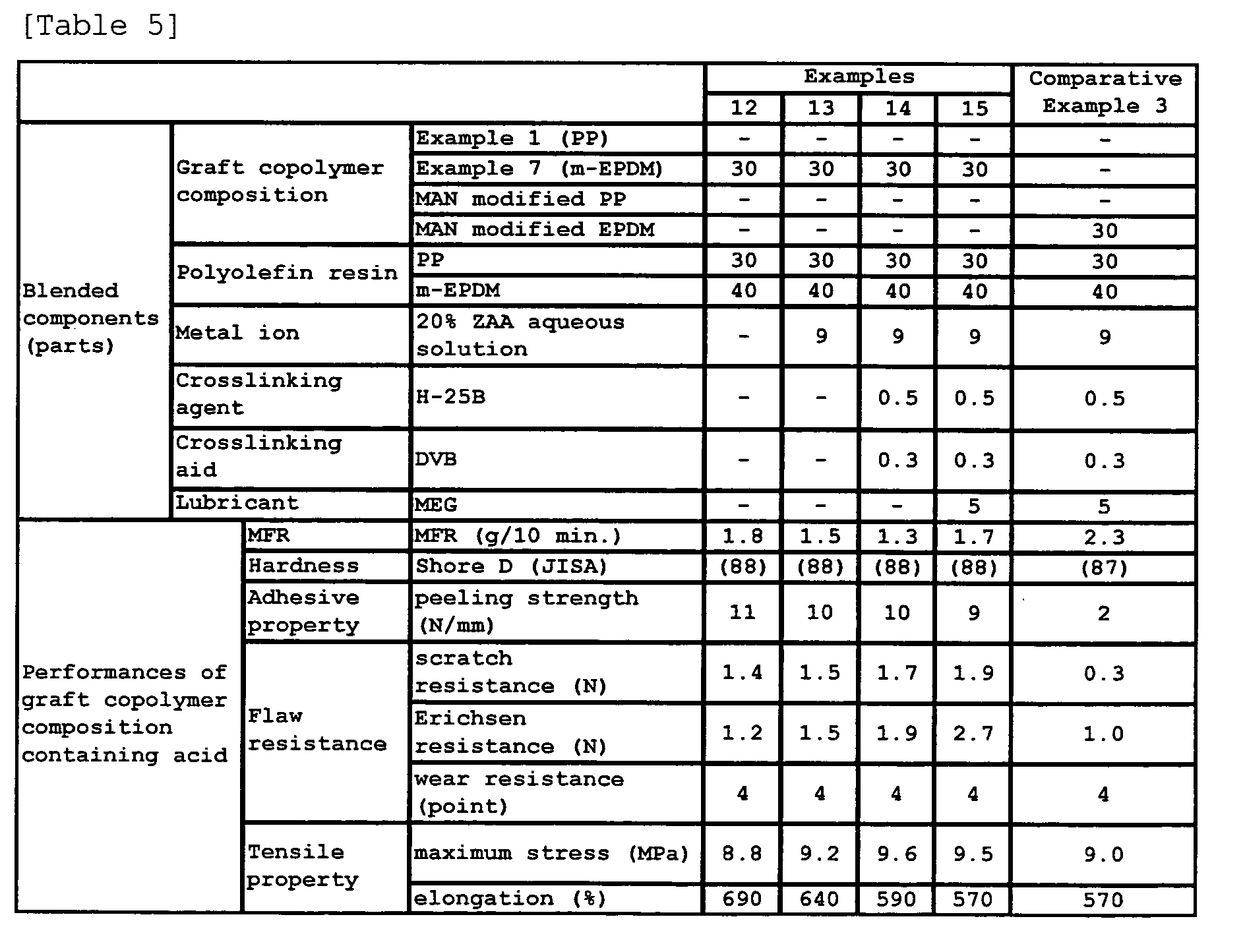
- a graft copolymer composition was obtained in the same manner as Example 8 except that 30 parts of PP and 30 parts of graft copolymer composition obtained in Example 7 and 40 parts of m-EPDM were used instead of 30 parts of graft copolymer composition obtained in Example 1, and 70 parts of graft copolymer composition of Example 7, and the obtained product was molded. Then, the same evaluations on the molded product were conducted. The results are shown in Table 5.
- a graft copolymer composition was obtained by further adding 9 parts of 20% ZAA aqueous solution to the graft copolymer composition obtained in Example 12, and the obtained product was molded. Then, the same evaluations on themoldedproduct were conducted. The results are shown in Table 5.
- a graft copolymer composition was obtained by further adding 0.5 parts of H-25B and 0.3 parts of DVB to the graft copolymer composition obtained in Example 12, and the obtained product was molded. Then, the same evaluations on the molded product were conducted. The results are shown in Table 5.
- a graft copolymer composition was obtained by further adding 5 parts of MEG to the graft copolymer composition obtained in Example 14, and the obtained product was molded. Then, the same evaluations on the molded product were conducted. The results are shown in Table 5.
- a graft copolymer composition was obtained in the same manner as Example 10 except that 30 parts of MAN modified PP were used instead of 30 parts of graft copolymer obtained in Example 1, and the obtained product was molded. Then, the same evaluations on the molded product were conducted. The results are shown in Table 4.
- a graft copolymer composition was obtained in the same manner as Example 15 except that 30 parts of MAN modified EPDM were used instead of 30 parts of graft copolymer composition obtained in Example 7, and the obtained composition was molded. Then, the same evaluations on the molded product were conducted. The results are shown in Table 5.
- PP of the present invention having polymaleic anhydride grafted has higher content of maleic anhydride, compared with the case wherein conventional PP was used as material in the reaction for obtaining a graft copolymer composition by grafting polymaleic anhydride. Further, it has been revealed that PP of the present invention is excellent in adhesive property and scratch resistance.
- PP of the present invention having polymaleic anhydride grafted exhibits equal or better adhesive property and scratch resistance of graft copolymer composition, despite lower acid introduction amount, compared with the case wherein conventional PP was used as material. Therefore, it is clear that the performances of the graft copolymer composition of the present invention have been improved because the composition has a structure in which polymaleic acid is grafted via ⁇ -substituted propylene group, rather than directly, to polyolefin resin segment.
- Example 10 Comparative Example 2 (Table 4)
- PP of the present invention having polymaleic anhydride group grafted is excellent in adhesive property and scratch resistance for PP composition, compared with commercially available maleic anhydride modified PP.
- the graft copolymer of the present invention has a structure in which a vinyl polymer segment formed from a vinyl monomer having an acid is suspended in a molecular chain of polyolefin resin segment via a ⁇ -substituted propylene group. Therefore, in comparison with a graft copolymer having a structure in which an acid is suspended without the intermediate of ⁇ -substituted propylene group, the graft copolymer of the present invention has less disintegration or crosslinking of polyolefin resin segment, and enable the obtainment of a graft copolymer having higher introduction ratio of vinyl monomer having an acid. Consequently, the graft copolymer and a composition thereof are excellent in adhesive property and scratch resistance.
- the change of molecular weight during graft reaction is small and it is possible to obtain a graft copolymer composition having larger amount of grafted acid.
- various molded products can be obtained, for example: sheet-like molded products such as sheets and films; bulk-like molded products such as plates, rods, and tubes. These molded products can be collected after use and reused as material for molding, and thus they are excellent in recycling.
Landscapes
- Chemical & Material Sciences (AREA)
- Chemical Kinetics & Catalysis (AREA)
- Organic Chemistry (AREA)
- Health & Medical Sciences (AREA)
- Medicinal Chemistry (AREA)
- Polymers & Plastics (AREA)
- Graft Or Block Polymers (AREA)
- Other Resins Obtained By Reactions Not Involving Carbon-To-Carbon Unsaturated Bonds (AREA)
Abstract
Description


| 2.8 ppm; | methylene proton |
| 4.7 and 5.1 ppm; | proton of a methylene double bond |
| 7.0 to 7.2 ppm; | benzene ring proton |
| 2.8 ppm; | methylene proton |
| 3.7 ppm; | methine proton |
| 7.0 to 7.2 ppm; | benzene ring proton |
- Scratch resistance performance Using a scratch tester (manufactured by Toyo Seiki Seisaku-sho, Ltd.), a test piece was scratched by a cutter with an arbitrary load applied thereto, and a minimum load that caused a scar on the test piece was measured.
- Erichsen resistance performance Using a scratch hardness tester (Model 318 manufactured by Erichsen), an arbitrary load was applied to a ball with 0.5 mm and scratching was conducted, and a minimum load that caused a scar on a test piece was measured.
- Wear resistance performance
Using a Frictional wear instrument (manufactured by Yasuda Co.),
1000 g of load was placed on a face of 10 mm, and 100 times of reciprocal
abrasion was performed with Cotton cloth (No.3). Thereafter, a
surface of a test piece was visually observed and evaluated in
accordance with the following evaluation standard.
- 4: when a flaw width is 0.0 to 0.5 mm (0 to 5%)
- 3: when a flaw width is 0.6 to 2.5 mm (6 to 50%)
- 2: when a flaw width is 2.6 to 9.5 mm (51 to 95%)
- 1: when a flaw width is 9.6 to 10.0 mm (96 to 100%)
Herein:
| Reference examples | |||||
| 1 | 2 | 3 | 4 | ||
| Blended components (parts) | Polyolefin resin | PP | 100 | ||
| PE | 100 | ||||
| m-EOR | 100 | ||||
| m-EPDM | 100 | ||||
| Addition cleavage type chain transfer agent | MSD | 5 | 5 | 5 | 5 |
| Radical polymerization initiator | H-25B | 1 | 1 | 1 | 1 |
| Radical scavenger | H-TEMPO | 1 | 1 | 1 | 1 |
| Melting/kneading temperature (°C) | 220 | 220 | 180 | 180 | |
| Properties of β-substituted propenyl group containing resin | MFR (g/10 min.) | 12 | 2.4 | 0.9 | 0.5 |
| Gel fraction (%) | 0 | 6 | 1 | 2 | |
| Introduction ratio (%) | 0.9 | 1.8 | 1.9 | 2.0 |
Herein,


Claims (12)
- A graft copolymer having a structure in which a vinyl polymer segment formed from a vinyl monomer having an acid is suspended in a molecular chain of polyolefin resin segment via a β-substituted propylene group.
- The graft copolymer according to claim 1, wherein the β-substituted propylene group is a group represented by the formula (A):wherein R1 represents a phenyl group, cyano group or -COORm (Rm represents an alkyl group having 1 to 4 carbon atoms)
- The graft copolymer according to claim 1 or 2, wherein the polyolefin resin segment is a polypropylene resin segment.
- The graft copolymer according to claim 1 or 2, wherein the polyolefin resin segment is an olefin elastomer segment.
- The graft copolymer according to any of claims 1 to 4, wherein the content of the vinyl polymer segment is 0.1 to 30% by weight.
- A graft copolymer composition containing the graft copolymer according to any of claims 1 to 5.
- The graft copolymer composition according to claim 6, wherein partial crosslinking is present.
- The graft copolymer composition according to claim 6 or 7, wherein the composition contains further a lubricant.
- A molded product obtainable by molding the graft copolymer composition according to any of claims 6 to 8.
- A method for producing a graft copolymer by reacting a vinyl monomer having an acid with polyolefin resin having a β-substituted propenyl group as a pendant.
- A method for producing a graft copolymer by reacting a vinyl monomer having an acid with polyolefin resin having a β-substituted propenyl group as a pendant by heating and mixing at a temperature of not less than 30°C and not more than 400°C.
- The method for producing a graft copolymer according to claim 10 or 11, wherein the polyolefin resin having a β-substituted propenyl group as a pendant is produced by reacting an addition-fragmentation chain transfer agent with polyolefin resin.
Applications Claiming Priority (3)
| Application Number | Priority Date | Filing Date | Title |
|---|---|---|---|
| JP2002311361 | 2002-10-25 | ||
| JP2002311361 | 2002-10-25 | ||
| PCT/JP2003/013525 WO2004037876A1 (en) | 2002-10-25 | 2003-10-23 | Graft copolymer, composition containing the same and molded object thereof, and process for producing the same |
Publications (3)
| Publication Number | Publication Date |
|---|---|
| EP1557436A1 true EP1557436A1 (en) | 2005-07-27 |
| EP1557436A4 EP1557436A4 (en) | 2007-10-03 |
| EP1557436B1 EP1557436B1 (en) | 2008-07-16 |
Family
ID=32171081
Family Applications (1)
| Application Number | Title | Priority Date | Filing Date |
|---|---|---|---|
| EP03758797A Expired - Lifetime EP1557436B1 (en) | 2002-10-25 | 2003-10-23 | Graft copolymer, composition containing the same and molded object thereof, and process for producing the same |
Country Status (6)
| Country | Link |
|---|---|
| US (1) | US7368507B2 (en) |
| EP (1) | EP1557436B1 (en) |
| CN (1) | CN100396708C (en) |
| AU (1) | AU2003275601A1 (en) |
| DE (1) | DE60322247D1 (en) |
| WO (1) | WO2004037876A1 (en) |
Families Citing this family (1)
| Publication number | Priority date | Publication date | Assignee | Title |
|---|---|---|---|---|
| EP4506429A3 (en) * | 2020-06-10 | 2025-05-14 | Novelis Inc. | Pretreatment compositions bonded to metal substrates and methods of making the same |
Family Cites Families (10)
| Publication number | Priority date | Publication date | Assignee | Title |
|---|---|---|---|---|
| US4957974A (en) * | 1988-03-29 | 1990-09-18 | Rohm And Haas Company | Graft copolymers and blends thereof with polyolefins |
| JPH0251455A (en) | 1988-08-11 | 1990-02-21 | Teijin Ltd | Bar material for prestressed concrete |
| JP2885919B2 (en) | 1990-09-25 | 1999-04-26 | 株式会社トクヤマ | Modified propylene ethylene copolymer and method for producing the same |
| JPH06172459A (en) * | 1992-12-09 | 1994-06-21 | Nippon Oil & Fats Co Ltd | Production of modified polyolefin |
| JP2517876B2 (en) | 1993-11-02 | 1996-07-24 | 工業技術院長 | Non-halogen flame-retardant resin molding for radiation exposure environment |
| CA2197791C (en) * | 1994-08-25 | 2001-06-19 | Thomas David Roberts | Maleated high acid number high molecular weight polypropylene of low color |
| US6140425A (en) * | 1997-08-25 | 2000-10-31 | Montell North America Inc. | Process for making polypropylene graft copolymers containing anhydride groups |
| JP2000159843A (en) * | 1998-12-02 | 2000-06-13 | Nof Corp | Method for producing modified polyolefin |
| US6177515B1 (en) * | 1998-12-17 | 2001-01-23 | Montell Technology Company Bv | Polypropylene graft copolymers with improved scratch and mar resistance |
| JP4023243B2 (en) * | 2002-07-16 | 2007-12-19 | 日油株式会社 | β-substituted propenyl group pendant polyolefin resin and process for producing the same |
-
2003
- 2003-10-23 US US10/532,799 patent/US7368507B2/en not_active Expired - Fee Related
- 2003-10-23 WO PCT/JP2003/013525 patent/WO2004037876A1/en not_active Ceased
- 2003-10-23 DE DE60322247T patent/DE60322247D1/en not_active Expired - Lifetime
- 2003-10-23 CN CNB2003801016948A patent/CN100396708C/en not_active Expired - Fee Related
- 2003-10-23 AU AU2003275601A patent/AU2003275601A1/en not_active Abandoned
- 2003-10-23 EP EP03758797A patent/EP1557436B1/en not_active Expired - Lifetime
Also Published As
| Publication number | Publication date |
|---|---|
| CN1705690A (en) | 2005-12-07 |
| US7368507B2 (en) | 2008-05-06 |
| DE60322247D1 (en) | 2008-08-28 |
| AU2003275601A1 (en) | 2004-05-13 |
| EP1557436A4 (en) | 2007-10-03 |
| EP1557436B1 (en) | 2008-07-16 |
| WO2004037876A1 (en) | 2004-05-06 |
| US20050261436A1 (en) | 2005-11-24 |
| CN100396708C (en) | 2008-06-25 |
Similar Documents
| Publication | Publication Date | Title |
|---|---|---|
| KR101513733B1 (en) | Functionalized olefin interpolymers compositions and articles prepared therefrom and methods for making the same | |
| JP6702854B2 (en) | CROSSLINKED PRODUCT, PRODUCTION METHOD AND USE THEREOF, AND ETHYLENE COPOLYMER | |
| CN103118872B (en) | For improvement of the graft composition of articulamentum | |
| KR20090116713A (en) | Functionalized olefin polymers, compositions and articles made therefrom, and methods of making the same | |
| EP2060590A1 (en) | Method for producing branched vinyl polymer having functional group | |
| JP5330691B2 (en) | Material for vibration control | |
| JP5129556B2 (en) | Adhesive composition | |
| CN100523068C (en) | Graft copolymer composition, thermoplastic resin composition containing the same, and molded object | |
| JP2003160621A (en) | Modified olefin copolymer | |
| JP2004217753A (en) | Modified polypropylene resin | |
| EP1557436B1 (en) | Graft copolymer, composition containing the same and molded object thereof, and process for producing the same | |
| JP7505494B2 (en) | Polyolefin-based adhesive composition and laminate | |
| KR20090020578A (en) | Grafted Polyolefins Useful as Metal Adhesion Promoter | |
| JP2004217754A (en) | Modified polypropylene resin | |
| EP4133001B1 (en) | Polymer compositions and foams comprising polymer compositions | |
| JP4501406B2 (en) | Graft copolymer, composition containing the same, molded product thereof, and production method thereof | |
| JP2000143896A (en) | Preparation of functionalized elastomer composition | |
| JP2002307625A (en) | Laminated structure and manufacturing method thereof | |
| JP2009120787A (en) | Modified polyolefin-based resin composition and method for producing the same | |
| JP4023243B2 (en) | β-substituted propenyl group pendant polyolefin resin and process for producing the same | |
| JP2009127006A (en) | Polypropylene resin film or sheet and use thereof | |
| CN101454363A (en) | Functional polyolefins useful as metal adhesion promoters | |
| JPH07329227A (en) | Laminate for interior materials |
Legal Events
| Date | Code | Title | Description |
|---|---|---|---|
| PUAI | Public reference made under article 153(3) epc to a published international application that has entered the european phase |
Free format text: ORIGINAL CODE: 0009012 |
|
| 17P | Request for examination filed |
Effective date: 20050428 |
|
| AK | Designated contracting states |
Kind code of ref document: A1 Designated state(s): AT BE BG CH CY CZ DE DK EE ES FI FR GB GR HU IE IT LI LU MC NL PT RO SE SI SK TR |
|
| AX | Request for extension of the european patent |
Extension state: AL LT LV MK |
|
| RIN1 | Information on inventor provided before grant (corrected) |
Inventor name: TAKAMURA, MASUMI Inventor name: YAMAMOTO, YOSHIKI Inventor name: SUGIURA, MOTOYUKI Inventor name: UCHIDA, HITOSHI |
|
| DAX | Request for extension of the european patent (deleted) | ||
| RBV | Designated contracting states (corrected) |
Designated state(s): DE FR |
|
| A4 | Supplementary search report drawn up and despatched |
Effective date: 20070903 |
|
| GRAP | Despatch of communication of intention to grant a patent |
Free format text: ORIGINAL CODE: EPIDOSNIGR1 |
|
| GRAS | Grant fee paid |
Free format text: ORIGINAL CODE: EPIDOSNIGR3 |
|
| GRAA | (expected) grant |
Free format text: ORIGINAL CODE: 0009210 |
|
| AK | Designated contracting states |
Kind code of ref document: B1 Designated state(s): DE FR |
|
| REF | Corresponds to: |
Ref document number: 60322247 Country of ref document: DE Date of ref document: 20080828 Kind code of ref document: P |
|
| PLBE | No opposition filed within time limit |
Free format text: ORIGINAL CODE: 0009261 |
|
| STAA | Information on the status of an ep patent application or granted ep patent |
Free format text: STATUS: NO OPPOSITION FILED WITHIN TIME LIMIT |
|
| 26N | No opposition filed |
Effective date: 20090417 |
|
| REG | Reference to a national code |
Ref country code: FR Ref legal event code: PLFP Year of fee payment: 13 |
|
| REG | Reference to a national code |
Ref country code: FR Ref legal event code: PLFP Year of fee payment: 14 |
|
| PGFP | Annual fee paid to national office [announced via postgrant information from national office to epo] |
Ref country code: DE Payment date: 20161020 Year of fee payment: 14 Ref country code: FR Payment date: 20161020 Year of fee payment: 14 |
|
| REG | Reference to a national code |
Ref country code: DE Ref legal event code: R119 Ref document number: 60322247 Country of ref document: DE |
|
| REG | Reference to a national code |
Ref country code: FR Ref legal event code: ST Effective date: 20180629 |
|
| PG25 | Lapsed in a contracting state [announced via postgrant information from national office to epo] |
Ref country code: DE Free format text: LAPSE BECAUSE OF NON-PAYMENT OF DUE FEES Effective date: 20180501 |
|
| PG25 | Lapsed in a contracting state [announced via postgrant information from national office to epo] |
Ref country code: FR Free format text: LAPSE BECAUSE OF NON-PAYMENT OF DUE FEES Effective date: 20171031 |