EP1557419A1 - Pyrrole derivative and process for producing the same - Google Patents
Pyrrole derivative and process for producing the same Download PDFInfo
- Publication number
- EP1557419A1 EP1557419A1 EP03738573A EP03738573A EP1557419A1 EP 1557419 A1 EP1557419 A1 EP 1557419A1 EP 03738573 A EP03738573 A EP 03738573A EP 03738573 A EP03738573 A EP 03738573A EP 1557419 A1 EP1557419 A1 EP 1557419A1
- Authority
- EP
- European Patent Office
- Prior art keywords
- group
- formula
- pyrrole derivative
- pyrrole
- substituted
- Prior art date
- Legal status (The legal status is an assumption and is not a legal conclusion. Google has not performed a legal analysis and makes no representation as to the accuracy of the status listed.)
- Withdrawn
Links
- 150000003233 pyrroles Chemical class 0.000 title claims abstract description 44
- 238000000034 method Methods 0.000 title claims abstract description 19
- 125000004435 hydrogen atom Chemical group [H]* 0.000 claims abstract description 16
- 125000000962 organic group Chemical group 0.000 claims abstract description 9
- 125000001183 hydrocarbyl group Chemical group 0.000 claims abstract 5
- 125000006239 protecting group Chemical group 0.000 claims description 15
- 150000002430 hydrocarbons Chemical group 0.000 claims description 13
- 229910052757 nitrogen Inorganic materials 0.000 claims description 11
- 125000004433 nitrogen atom Chemical group N* 0.000 claims description 11
- 125000002088 tosyl group Chemical group [H]C1=C([H])C(=C([H])C([H])=C1C([H])([H])[H])S(*)(=O)=O 0.000 claims description 8
- 229910052977 alkali metal sulfide Inorganic materials 0.000 claims description 5
- 238000010511 deprotection reaction Methods 0.000 claims description 5
- 239000004215 Carbon black (E152) Substances 0.000 claims description 4
- JEDZLBFUGJTJGQ-UHFFFAOYSA-N [Na].COCCO[AlH]OCCOC Chemical compound [Na].COCCO[AlH]OCCOC JEDZLBFUGJTJGQ-UHFFFAOYSA-N 0.000 claims description 4
- 229930195733 hydrocarbon Natural products 0.000 claims description 4
- 239000012419 sodium bis(2-methoxyethoxy)aluminum hydride Substances 0.000 claims description 4
- 125000005843 halogen group Chemical group 0.000 claims description 3
- 150000001875 compounds Chemical class 0.000 abstract description 8
- 239000007858 starting material Substances 0.000 abstract description 3
- 239000000543 intermediate Substances 0.000 abstract 2
- 125000001495 ethyl group Chemical group [H]C([H])([H])C([H])([H])* 0.000 description 35
- 125000001449 isopropyl group Chemical group [H]C([H])([H])C([H])(*)C([H])([H])[H] 0.000 description 35
- 125000004123 n-propyl group Chemical group [H]C([H])([H])C([H])([H])C([H])([H])* 0.000 description 35
- XEKOWRVHYACXOJ-UHFFFAOYSA-N Ethyl acetate Chemical compound CCOC(C)=O XEKOWRVHYACXOJ-UHFFFAOYSA-N 0.000 description 21
- 125000002496 methyl group Chemical group [H]C([H])([H])* 0.000 description 20
- 125000000959 isobutyl group Chemical group [H]C([H])([H])C([H])(C([H])([H])[H])C([H])([H])* 0.000 description 18
- 125000004108 n-butyl group Chemical group [H]C([H])([H])C([H])([H])C([H])([H])C([H])([H])* 0.000 description 18
- 125000002914 sec-butyl group Chemical group [H]C([H])([H])C([H])([H])C([H])(*)C([H])([H])[H] 0.000 description 18
- 125000000999 tert-butyl group Chemical group [H]C([H])([H])C(*)(C([H])([H])[H])C([H])([H])[H] 0.000 description 18
- 125000003538 pentan-3-yl group Chemical group [H]C([H])([H])C([H])([H])C([H])(*)C([H])([H])C([H])([H])[H] 0.000 description 17
- -1 s-pentyl group Chemical group 0.000 description 13
- VLKZOEOYAKHREP-UHFFFAOYSA-N n-Hexane Chemical compound CCCCCC VLKZOEOYAKHREP-UHFFFAOYSA-N 0.000 description 9
- WYURNTSHIVDZCO-UHFFFAOYSA-N Tetrahydrofuran Chemical compound C1CCOC1 WYURNTSHIVDZCO-UHFFFAOYSA-N 0.000 description 8
- OKKJLVBELUTLKV-UHFFFAOYSA-N Methanol Chemical compound OC OKKJLVBELUTLKV-UHFFFAOYSA-N 0.000 description 6
- 239000003990 capacitor Substances 0.000 description 6
- 239000000203 mixture Substances 0.000 description 5
- HEDRZPFGACZZDS-MICDWDOJSA-N Trichloro(2H)methane Chemical compound [2H]C(Cl)(Cl)Cl HEDRZPFGACZZDS-MICDWDOJSA-N 0.000 description 4
- 125000004432 carbon atom Chemical group C* 0.000 description 4
- 238000006243 chemical reaction Methods 0.000 description 4
- 239000002322 conducting polymer Substances 0.000 description 4
- 229920001940 conductive polymer Polymers 0.000 description 4
- CSNNHWWHGAXBCP-UHFFFAOYSA-L magnesium sulphate Substances [Mg+2].[O-][S+2]([O-])([O-])[O-] CSNNHWWHGAXBCP-UHFFFAOYSA-L 0.000 description 4
- 238000006116 polymerization reaction Methods 0.000 description 4
- 238000006722 reduction reaction Methods 0.000 description 4
- 229910052979 sodium sulfide Inorganic materials 0.000 description 4
- GRVFOGOEDUUMBP-UHFFFAOYSA-N sodium sulfide (anhydrous) Chemical compound [Na+].[Na+].[S-2] GRVFOGOEDUUMBP-UHFFFAOYSA-N 0.000 description 4
- 239000007787 solid Substances 0.000 description 4
- 239000002904 solvent Substances 0.000 description 4
- YLQBMQCUIZJEEH-UHFFFAOYSA-N tetrahydrofuran Natural products C=1C=COC=1 YLQBMQCUIZJEEH-UHFFFAOYSA-N 0.000 description 4
- XLYOFNOQVPJJNP-UHFFFAOYSA-N water Substances O XLYOFNOQVPJJNP-UHFFFAOYSA-N 0.000 description 4
- VFNAUSYXGJISGX-UHFFFAOYSA-N 3,4-bis(chloromethyl)-1-(4-methylphenyl)sulfonylpyrrole Chemical compound C1=CC(C)=CC=C1S(=O)(=O)N1C=C(CCl)C(CCl)=C1 VFNAUSYXGJISGX-UHFFFAOYSA-N 0.000 description 3
- PACRFWGPIBIQLV-UHFFFAOYSA-N 3,5-dihydro-1h-thieno[3,4-c]pyrrole Chemical compound N1C=C2CSCC2=C1 PACRFWGPIBIQLV-UHFFFAOYSA-N 0.000 description 3
- URGFDOJOQWLMIM-UHFFFAOYSA-N 5-(4-methylphenyl)sulfonyl-1,3-dihydrothieno[3,4-c]pyrrole Chemical compound C1=CC(C)=CC=C1S(=O)(=O)N1C=C2CSCC2=C1 URGFDOJOQWLMIM-UHFFFAOYSA-N 0.000 description 3
- UHOVQNZJYSORNB-UHFFFAOYSA-N Benzene Chemical compound C1=CC=CC=C1 UHOVQNZJYSORNB-UHFFFAOYSA-N 0.000 description 3
- YMWUJEATGCHHMB-UHFFFAOYSA-N Dichloromethane Chemical compound ClCCl YMWUJEATGCHHMB-UHFFFAOYSA-N 0.000 description 3
- RTZKZFJDLAIYFH-UHFFFAOYSA-N Diethyl ether Chemical compound CCOCC RTZKZFJDLAIYFH-UHFFFAOYSA-N 0.000 description 3
- LYCAIKOWRPUZTN-UHFFFAOYSA-N Ethylene glycol Chemical compound OCCO LYCAIKOWRPUZTN-UHFFFAOYSA-N 0.000 description 3
- ZMXDDKWLCZADIW-UHFFFAOYSA-N N,N-Dimethylformamide Chemical compound CN(C)C=O ZMXDDKWLCZADIW-UHFFFAOYSA-N 0.000 description 3
- KWYUFKZDYYNOTN-UHFFFAOYSA-M Potassium hydroxide Chemical compound [OH-].[K+] KWYUFKZDYYNOTN-UHFFFAOYSA-M 0.000 description 3
- HEMHJVSKTPXQMS-UHFFFAOYSA-M Sodium hydroxide Chemical compound [OH-].[Na+] HEMHJVSKTPXQMS-UHFFFAOYSA-M 0.000 description 3
- 229910052799 carbon Inorganic materials 0.000 description 3
- 229910052801 chlorine Inorganic materials 0.000 description 3
- 238000004440 column chromatography Methods 0.000 description 3
- 125000000524 functional group Chemical group 0.000 description 3
- 239000010410 layer Substances 0.000 description 3
- 229910052943 magnesium sulfate Inorganic materials 0.000 description 3
- 235000019341 magnesium sulphate Nutrition 0.000 description 3
- 239000007784 solid electrolyte Substances 0.000 description 3
- 238000005160 1H NMR spectroscopy Methods 0.000 description 2
- WKBOTKDWSSQWDR-UHFFFAOYSA-N Bromine atom Chemical group [Br] WKBOTKDWSSQWDR-UHFFFAOYSA-N 0.000 description 2
- HEDRZPFGACZZDS-UHFFFAOYSA-N Chloroform Chemical compound ClC(Cl)Cl HEDRZPFGACZZDS-UHFFFAOYSA-N 0.000 description 2
- IAZDPXIOMUYVGZ-UHFFFAOYSA-N Dimethylsulphoxide Chemical compound CS(C)=O IAZDPXIOMUYVGZ-UHFFFAOYSA-N 0.000 description 2
- LFQSCWFLJHTTHZ-UHFFFAOYSA-N Ethanol Chemical compound CCO LFQSCWFLJHTTHZ-UHFFFAOYSA-N 0.000 description 2
- VEXZGXHMUGYJMC-UHFFFAOYSA-N Hydrochloric acid Chemical compound Cl VEXZGXHMUGYJMC-UHFFFAOYSA-N 0.000 description 2
- KAESVJOAVNADME-UHFFFAOYSA-N Pyrrole Chemical compound C=1C=CNC=1 KAESVJOAVNADME-UHFFFAOYSA-N 0.000 description 2
- FAPWRFPIFSIZLT-UHFFFAOYSA-M Sodium chloride Chemical compound [Na+].[Cl-] FAPWRFPIFSIZLT-UHFFFAOYSA-M 0.000 description 2
- QAOWNCQODCNURD-UHFFFAOYSA-N Sulfuric acid Chemical compound OS(O)(=O)=O QAOWNCQODCNURD-UHFFFAOYSA-N 0.000 description 2
- 125000002252 acyl group Chemical group 0.000 description 2
- 125000003545 alkoxy group Chemical group 0.000 description 2
- 150000008064 anhydrides Chemical class 0.000 description 2
- 125000004391 aryl sulfonyl group Chemical group 0.000 description 2
- 239000003795 chemical substances by application Substances 0.000 description 2
- 125000001309 chloro group Chemical group Cl* 0.000 description 2
- MVPPADPHJFYWMZ-UHFFFAOYSA-N chlorobenzene Chemical compound ClC1=CC=CC=C1 MVPPADPHJFYWMZ-UHFFFAOYSA-N 0.000 description 2
- 239000013078 crystal Substances 0.000 description 2
- 239000012044 organic layer Substances 0.000 description 2
- 230000003647 oxidation Effects 0.000 description 2
- 238000007254 oxidation reaction Methods 0.000 description 2
- 125000000168 pyrrolyl group Chemical group 0.000 description 2
- 238000010992 reflux Methods 0.000 description 2
- 239000011780 sodium chloride Substances 0.000 description 2
- 125000000008 (C1-C10) alkyl group Chemical group 0.000 description 1
- RYHBNJHYFVUHQT-UHFFFAOYSA-N 1,4-Dioxane Chemical compound C1COCCO1 RYHBNJHYFVUHQT-UHFFFAOYSA-N 0.000 description 1
- OCJBOOLMMGQPQU-UHFFFAOYSA-N 1,4-dichlorobenzene Chemical compound ClC1=CC=C(Cl)C=C1 OCJBOOLMMGQPQU-UHFFFAOYSA-N 0.000 description 1
- 125000006021 1-methyl-2-propenyl group Chemical group 0.000 description 1
- 125000001637 1-naphthyl group Chemical group [H]C1=C([H])C([H])=C2C(*)=C([H])C([H])=C([H])C2=C1[H] 0.000 description 1
- 125000004974 2-butenyl group Chemical group C(C=CC)* 0.000 description 1
- 125000000094 2-phenylethyl group Chemical group [H]C1=C([H])C([H])=C(C([H])=C1[H])C([H])([H])C([H])([H])* 0.000 description 1
- 125000003903 2-propenyl group Chemical group [H]C([*])([H])C([H])=C([H])[H] 0.000 description 1
- 125000001494 2-propynyl group Chemical group [H]C#CC([H])([H])* 0.000 description 1
- ZCYVEMRRCGMTRW-UHFFFAOYSA-N 7553-56-2 Chemical group [I] ZCYVEMRRCGMTRW-UHFFFAOYSA-N 0.000 description 1
- 125000006374 C2-C10 alkenyl group Chemical group 0.000 description 1
- ZAMOUSCENKQFHK-UHFFFAOYSA-N Chlorine atom Chemical compound [Cl] ZAMOUSCENKQFHK-UHFFFAOYSA-N 0.000 description 1
- RWSOTUBLDIXVET-UHFFFAOYSA-N Dihydrogen sulfide Chemical compound S RWSOTUBLDIXVET-UHFFFAOYSA-N 0.000 description 1
- XTHFKEDIFFGKHM-UHFFFAOYSA-N Dimethoxyethane Chemical compound COCCOC XTHFKEDIFFGKHM-UHFFFAOYSA-N 0.000 description 1
- YXFVVABEGXRONW-UHFFFAOYSA-N Toluene Chemical compound CC1=CC=CC=C1 YXFVVABEGXRONW-UHFFFAOYSA-N 0.000 description 1
- WCHUSHMDTHFDQT-UHFFFAOYSA-N [4-(hydroxymethyl)-1-(4-methylphenyl)sulfonylpyrrol-3-yl]methanol Chemical compound C1=CC(C)=CC=C1S(=O)(=O)N1C=C(CO)C(CO)=C1 WCHUSHMDTHFDQT-UHFFFAOYSA-N 0.000 description 1
- 125000002777 acetyl group Chemical group [H]C([H])([H])C(*)=O 0.000 description 1
- 239000002253 acid Substances 0.000 description 1
- 150000007513 acids Chemical class 0.000 description 1
- 150000001298 alcohols Chemical class 0.000 description 1
- 238000006136 alcoholysis reaction Methods 0.000 description 1
- 125000002723 alicyclic group Chemical group 0.000 description 1
- 239000003513 alkali Substances 0.000 description 1
- 229910052783 alkali metal Inorganic materials 0.000 description 1
- 150000001340 alkali metals Chemical class 0.000 description 1
- 125000004453 alkoxycarbonyl group Chemical group 0.000 description 1
- 125000000217 alkyl group Chemical group 0.000 description 1
- 125000005278 alkyl sulfonyloxy group Chemical group 0.000 description 1
- 125000000304 alkynyl group Chemical group 0.000 description 1
- 125000002029 aromatic hydrocarbon group Chemical group 0.000 description 1
- 125000003710 aryl alkyl group Chemical group 0.000 description 1
- 125000005279 aryl sulfonyloxy group Chemical group 0.000 description 1
- 125000001797 benzyl group Chemical group [H]C1=C([H])C([H])=C(C([H])=C1[H])C([H])([H])* 0.000 description 1
- 230000015572 biosynthetic process Effects 0.000 description 1
- 238000009835 boiling Methods 0.000 description 1
- 229910000175 cerite Inorganic materials 0.000 description 1
- 239000000460 chlorine Substances 0.000 description 1
- 150000004292 cyclic ethers Chemical class 0.000 description 1
- 125000001995 cyclobutyl group Chemical group [H]C1([H])C([H])([H])C([H])(*)C1([H])[H] 0.000 description 1
- 125000001511 cyclopentyl group Chemical group [H]C1([H])C([H])([H])C([H])([H])C([H])(*)C1([H])[H] 0.000 description 1
- 125000001559 cyclopropyl group Chemical group [H]C1([H])C([H])([H])C1([H])* 0.000 description 1
- ASWXNYNXAOQCCD-UHFFFAOYSA-N dichloro(triphenyl)-$l^{5}-phosphane Chemical compound C=1C=CC=CC=1P(Cl)(C=1C=CC=CC=1)(Cl)C1=CC=CC=C1 ASWXNYNXAOQCCD-UHFFFAOYSA-N 0.000 description 1
- 229940117389 dichlorobenzene Drugs 0.000 description 1
- 229960004132 diethyl ether Drugs 0.000 description 1
- SBZXBUIDTXKZTM-UHFFFAOYSA-N diglyme Chemical compound COCCOCCOC SBZXBUIDTXKZTM-UHFFFAOYSA-N 0.000 description 1
- 239000003792 electrolyte Substances 0.000 description 1
- 125000001301 ethoxy group Chemical group [H]C([H])([H])C([H])([H])O* 0.000 description 1
- 229940093476 ethylene glycol Drugs 0.000 description 1
- 125000002534 ethynyl group Chemical group [H]C#C* 0.000 description 1
- 239000000706 filtrate Substances 0.000 description 1
- 238000001914 filtration Methods 0.000 description 1
- 229910052731 fluorine Inorganic materials 0.000 description 1
- 125000001153 fluoro group Chemical group F* 0.000 description 1
- 125000002485 formyl group Chemical group [H]C(*)=O 0.000 description 1
- 125000005842 heteroatom Chemical group 0.000 description 1
- 229910000037 hydrogen sulfide Inorganic materials 0.000 description 1
- 230000007062 hydrolysis Effects 0.000 description 1
- 238000006460 hydrolysis reaction Methods 0.000 description 1
- 239000005457 ice water Substances 0.000 description 1
- 229910052500 inorganic mineral Inorganic materials 0.000 description 1
- 229910052740 iodine Inorganic materials 0.000 description 1
- 125000001972 isopentyl group Chemical group [H]C([H])([H])C([H])(C([H])([H])[H])C([H])([H])C([H])([H])* 0.000 description 1
- 239000012280 lithium aluminium hydride Substances 0.000 description 1
- 229910052751 metal Inorganic materials 0.000 description 1
- 239000002184 metal Substances 0.000 description 1
- 125000000956 methoxy group Chemical group [H]C([H])([H])O* 0.000 description 1
- 239000011707 mineral Substances 0.000 description 1
- 235000010755 mineral Nutrition 0.000 description 1
- 125000003136 n-heptyl group Chemical group [H]C([H])([H])C([H])([H])C([H])([H])C([H])([H])C([H])([H])C([H])([H])C([H])([H])* 0.000 description 1
- 125000001280 n-hexyl group Chemical group C(CCCCC)* 0.000 description 1
- 125000000740 n-pentyl group Chemical group [H]C([H])([H])C([H])([H])C([H])([H])C([H])([H])C([H])([H])* 0.000 description 1
- 125000001971 neopentyl group Chemical group [H]C([*])([H])C(C([H])([H])[H])(C([H])([H])[H])C([H])([H])[H] 0.000 description 1
- 125000002868 norbornyl group Chemical group C12(CCC(CC1)C2)* 0.000 description 1
- 125000004430 oxygen atom Chemical group O* 0.000 description 1
- 125000001997 phenyl group Chemical group [H]C1=C([H])C([H])=C(*)C([H])=C1[H] 0.000 description 1
- 125000004437 phosphorous atom Chemical group 0.000 description 1
- 229910052698 phosphorus Inorganic materials 0.000 description 1
- 239000002798 polar solvent Substances 0.000 description 1
- 229920000767 polyaniline Polymers 0.000 description 1
- 229920000128 polypyrrole Polymers 0.000 description 1
- 229920000123 polythiophene Polymers 0.000 description 1
- DPLVEEXVKBWGHE-UHFFFAOYSA-N potassium sulfide Chemical compound [S-2].[K+].[K+] DPLVEEXVKBWGHE-UHFFFAOYSA-N 0.000 description 1
- BDERNNFJNOPAEC-UHFFFAOYSA-N propan-1-ol Chemical compound CCCO BDERNNFJNOPAEC-UHFFFAOYSA-N 0.000 description 1
- 238000000746 purification Methods 0.000 description 1
- 239000002002 slurry Substances 0.000 description 1
- 239000012279 sodium borohydride Substances 0.000 description 1
- 229910000033 sodium borohydride Inorganic materials 0.000 description 1
- SRRKNRDXURUMPP-UHFFFAOYSA-N sodium disulfide Chemical compound [Na+].[Na+].[S-][S-] SRRKNRDXURUMPP-UHFFFAOYSA-N 0.000 description 1
- 125000001424 substituent group Chemical group 0.000 description 1
- 229910052717 sulfur Inorganic materials 0.000 description 1
- 125000004434 sulfur atom Chemical group 0.000 description 1
- 238000003786 synthesis reaction Methods 0.000 description 1
- 230000002194 synthesizing effect Effects 0.000 description 1
- 125000004665 trialkylsilyl group Chemical group 0.000 description 1
- 125000000391 vinyl group Chemical group [H]C([*])=C([H])[H] 0.000 description 1
Classifications
-
- C—CHEMISTRY; METALLURGY
- C07—ORGANIC CHEMISTRY
- C07D—HETEROCYCLIC COMPOUNDS
- C07D495/00—Heterocyclic compounds containing in the condensed system at least one hetero ring having sulfur atoms as the only ring hetero atoms
- C07D495/02—Heterocyclic compounds containing in the condensed system at least one hetero ring having sulfur atoms as the only ring hetero atoms in which the condensed system contains two hetero rings
- C07D495/04—Ortho-condensed systems
Definitions
- the present invention relates to novel pyrrole derivatives including a sulfide bond within the molecule thereof, and to processes for producing the pyrrole derivatives.
- an object of the present invention is to provide a compound which may be a starting material for a conducting polymer having a novel structure from which satisfactory performance may be obtained.
- the inventors of the present invention have paid particular attention to compounds having a pyrrole structure and a sulfide bond within the same molecule as a compound capable of being used as a capacitor, and they have pursued diligent research. As a result, the inventors of the present invention have succeeded in synthesizing a novel pyrrole derivative having a sulfide bond under special conditions and have completed the present invention.
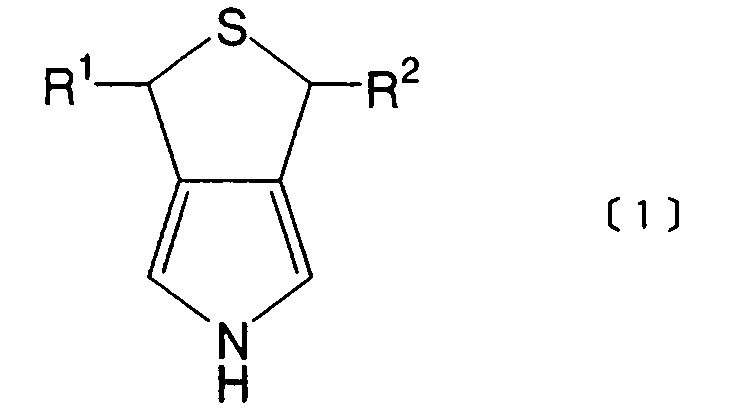
- the present invention relates to a pyrrole derivative (claim 1) represented by the formula [1]: (wherein R 1 and R 2 each independently represents a hydrogen atom or a substituted or unsubstituted C 1-10 hydrocarbon group); to a pyrrole derivative (claim 2) represented by the formula [2]: (wherein R 1 and R 2 each independently represents a hydrogen atom or a substituted or unsubstituted C 1-10 hydrocarbon group, and Z represents an organic group); to a pyrrole derivative (claim 3) claimed in claim 2 wherein Z is a protecting group for the nitrogen atom; and to a pyrrole derivative (claim 4) claimed in claim 3 wherein the protecting group for the nitrogen atom is a tosyl group.
- the present invention relates to a process for producing the pyrrole derivative (claim 5) represented by the formula [2]: (wherein R 1 and R 2 each independently represents a hydrogen atom or a substituted or unsubstituted C 1-10 hydrocarbon group, and Z represents an organic group) including the step of reacting a pyrrole derivative represented by the formula [3] with an alkali metal sulfide: (wherein R 1 and R 2 each independently represents a hydrogen atom or a substituted or unsubstituted C 1-10 hydrocarbon group, X and Y each independently represents a halogen atom, and Z represents an organic group); to a process for producing the pyrrole derivative (claim 6) represented by the formula [1]: (wherein R 1 and R 2 each independently represents a hydrogen atom or a substituted or unsubstituted C 1-10 hydrocarbon group) including the step of deprotecting a protecting group of a pyrrole derivative represented by the formula [4]: (wherein R 1 and R
- the pyrrole derivatives of the present invention may be characterized by being represented by the formula [1].
- the pyrrole derivatives represented by the formula [1] may be polymerized by electrolytic polymerization, oxidation polymerization, etc., and utilized as a solid electrolyte for a solid electrolytic capacitor.
- R 1 and R 2 each independently represents a hydrogen atom or a substituted or unsubstituted C 1-10 hydrocarbon group.
- the hydrocarbon group represented by R 1 and R 2 may be a straight chain or branched group, and may be substituted with an alkoxy group, such as methoxy group and ethoxy group, an acyl group, such as formyl group and acetyl group, and so forth.
- the number of carbon atoms of the hydrocarbon group represented by R 1 and R 2 is not particularly limited as long as it is between 1 and 10.
- C 1-10 alkyl groups such as methyl group, ethyl group, n-propyl group, isopropyl group, n-butyl group, t-butyl group, s-butyl group, isobutyl group, n-pentyl group, s-pentyl group, isopentyl group, neopentyl group, n-hexyl group, s-hexyl group, 1,1-dimethyl-n-hexyl group, n-heptyl group, and n-decyl group; C 2-10 alkenyl groups, such as vinyl group, allyl group, 2-butenyl group, 1-methyl-2-propenyl group, and 4-octenyl group; C 2-10 alkynyl groups, such as ethynyl group, propargyl group, and 1-methyl-propynyl group; C 3-10 alicyclic hydrocarbon groups, such as cycl
- examples of the pyrrole derivatives represented by the formula [1] include those shown in Table 1 below: Compound No R 1 (R 2 ) R 2 (R 1 ) 1 CH 3 CH 3 2 CH 3 CH 2 CH 3 3 CH 3 CH 2 CH 2 CH 3 4 CH 3 CH 2 CH 2 CH 2 CH 3 5 CH 3 CH 2 CH 2 CH 2 CH 2 CH 3 6 CH 3 CH(CH 3 ) 2 7 CH 3 CH 2 CH(CH 3 ) 2 8 CH 3 CH(CH 3 )CH 2 CH 3 9 CH 3 C(CH 3 ) 3 10 CH 3 CH 2 CH(CH 3 )CH 2 CH 3 11 CH 3 CH 2 C(CH 3 ) 3 12 CH 3 CH 2 CH 2 CH(CH 3 ) 2 13 CH 3 CH(CH 3 )CH 2 CH 2 CH 3 14 CH 3 CH(CH 2 CH 3 ) 2 15 CH 3 CH(CH 3 )CH(CH 3 ) 2 16 CH 3 CH(CH 3 ) 2 CH 2 CH 3 17 CH 2 CH 3 CH 2 CH 3 18 CH 2 CH 3 CH 2 CH 2 CH 3 19 CH 2
- the pyrrole derivatives according to the present invention may be characterized by being represented by the formula [2].
- the pyrrole derivatives represented by the formula [2] are compounds which may be an intermediate in the process of producing the pyrrole derivatives represented by the formula [1].
- R 1 and R 2 each independently represents a hydrogen atom or a substituted or unsubstituted C 1-10 hydrocarbon group
- Z represents an organic group (i.e., an organic functional group).
- the definition of R 1 and R 2 , respectively, in the formula [2] is the same as that of R 1 and R 2 , respectively, in the formula [1].
- the above-mentioned organic group is not particularly limited as long as it contains a carbon atom in the functional group.
- a carbon atom it is not necessary for a carbon atom to be directly bonded to the nitrogen atom in the pyrrole ring, and examples thereof include functional groups in which a carbon atom is bonded via a hetero atom, etc., such as a nitrogen atom, sulfur atom, oxygen atom, and phosphorus atom.
- a protecting group which is capable of protecting the nitrogen atom at the pyrrole portion is preferable.
- Specific examples thereof include alkoxy carbonyl group, aryl sulfonyl group, alkyloxymethyl group, trialkylsilyl group (these may include a substituent, such as alkyl group, alkoxy group, and acyl group).
- the aryl sulfonyl group is preferable, and a tosyl group (p-toluene sulfonyl group) is particularly preferable.
- a process for producing the pyrrole derivatives represented by the formula [2] specific examples thereof include a process in which the pyrrole derivative represented by the formula [3] is reacted with an alkali metal sulfide. Also, as a process for producing the pyrrole derivatives represented by the formula [1], specific examples thereof include a process in which the protecting group of the pyrrole derivative represented by the formula [4] is deprotected.
- R 1 and R 2 respectively, in the formula [3] is the same as that of R 1 and R 2 , respectively, in the formula [1].
- examples of the halogen atom represented by X and Y include fluorine atom, chlorine atom, bromine atom, and iodine atom. Among these, chlorine atom and bromine atom are preferable.
- X and Y may be aryl sulfonyloxy group, alkyl sulfonyloxy group, or trifluoromethylsulfonyloxy group.
- Z in the formula [3] is the same as that of Z in the formula [2].
- R 1 and R 2 each independently represents a hydrogen atom or a substituted or unsubstituted C 1-10 hydrocarbon group
- Z" represents a protecting group for the nitrogen atom.
- R 1 and R 2 respectively, in the formula [4] is the same as that of R 1 and R 2 , respectively, in the formula [1].
- Z" in the formula [4] is the same as that of Z which is a protecting group for the nitrogen atom in the formula [2].
- C 1-6 straight chain or branched alcohols such as methanol, ethanol, propanol, and ethyleneglycol
- straight chain or cyclic ether such as tetrahydrofuran, diethylether, dioxane, glyme, and diglyme
- chlorine containing solvents such as chloro
- the reaction temperature is preferably within a range between -10°C and the boiling point of the solvent used. If the temperature is within the above-mentioned range, the reaction may proceed more smoothly.
- alkali metal sulfide examples include potassium sulfide and sodium sulfide, and it is possible to use hydrate and anhydride thereof prepared in advance. Also, it is possible to directly use one which is purified in a reaction system of alkali metal alcoholate and hydrogen sulfide.
- the amount of alkali metal sulfide is 1 to 100 equivalents, preferably 1.0 to 2.0 equivalents, with respect to the pyrrole derivative represented by the formula [3].
- the pyrrole derivatives represented by the formula [1] may be produced by deprotecting the protecting group of the pyrrole derivative represented by the formula [4]. This deprotection process may be carried out after isolating the pyrrole derivative represented by the formula [4] or without isolating the pyrrole derivative.
- the deprotection process of the protecting group (Z") may be performed by, for example; hydrolysis using mineral acids, such as hydrochloric acid and sulfuric acid, or alkali, such as sodium hydroxide, potassium hydroxide, sodium sulfide, and sodium disulfide; alcoholysis using metal alcoholate; or a reduction reaction using lithium aluminum hydride, sodium borohydride, sodium bis(2-methoxyethoxy) aluminum hydride ("Red-A1" (registered trademark)).
- the reduction reaction is preferable and it is particularly preferable to use sodium bis(2-methoxyethoxy) aluminum hydride when a deprotection process for tosyl group, which is a protecting group, is performed.
- the amount of a reduction agent added is preferably within the range of 1 to 4 equivalents, more preferably 1.5 to 3 equivalents, with respect to the pyrrole derivative represented by the formula [4].
- the pyrrole derivative which is produced as explained above, may be polymerized by electrolytic polymerization, oxidation polymerization etc., and utilized as a solid electrolyte (electrode) for a solid electrolytic capacitor.
- N-tosyl-3,5-dihydro-1H-thieno-[3,4-c] pyrrole crystal, mp 134-136°C
- the pyrrole derivatives of the present invention are novel compounds which may be a starting material for a conducting polymer that can be used as an electrolyte of a solid electrolytic capacitor, and hence the industrial applicability thereof is high.
Landscapes
- Chemical & Material Sciences (AREA)
- Organic Chemistry (AREA)
- Polyoxymethylene Polymers And Polymers With Carbon-To-Carbon Bonds (AREA)
- Nitrogen Condensed Heterocyclic Rings (AREA)
- Heterocyclic Carbon Compounds Containing A Hetero Ring Having Oxygen Or Sulfur (AREA)
- Organic Low-Molecular-Weight Compounds And Preparation Thereof (AREA)
- Plural Heterocyclic Compounds (AREA)
Abstract
An object of the present invention is to provide novel pyrrole derivatives and
processes for producing the derivatives, and to provide novel pyrrole derivatives
(intermediates) which may be used as a starting material for the pyrrole derivatives and
processes for producing the derivatives (intermediates). The pyrrole derivatives may be
characterized by being represented by the formulae [1] and [2]
 wherein R1 and R2 each independently represents a hydrogen atom or a substituted or
unsubstituted C1-10 hydrocarbon group and Z represents an organic group; and the process
for producing the compound represented by the formula [1] may be characterized by
separating Z from the compound represented by the formula [2].
wherein R1 and R2 each independently represents a hydrogen atom or a substituted or
unsubstituted C1-10 hydrocarbon group and Z represents an organic group; and the process
for producing the compound represented by the formula [1] may be characterized by
separating Z from the compound represented by the formula [2].
Description
- The present invention relates to novel pyrrole derivatives including a sulfide bond within the molecule thereof, and to processes for producing the pyrrole derivatives.
- Recently, as high frequency waves are increasingly used for power circuits of electronic devices, demands have been increased for electrolytic capacitors used therein which have excellent high-frequency characteristics. Accordingly, in order to realize low impedance at a high frequency region, solid capacitors which utilize conducting polymers having high electric conductivity, such as polythiophene, polypyrrole, polyaniline and polyindole, as a solid electrolyte have been proposed (refer to Japanese Unexamined Patent Application, First Publication No. Sho 60-37114; Japanese Unexamined Patent Application, First Publication No. Sho 63-158829; Japanese Unexamined Patent Application, First Publication No. Hei 2-153516, and so forth).
- However, there is a problem in that satisfactory performance may not be obtained using the conducting polymers having conventional structure. Accordingly, an object of the present invention is to provide a compound which may be a starting material for a conducting polymer having a novel structure from which satisfactory performance may be obtained.
- The inventors of the present invention have paid particular attention to compounds having a pyrrole structure and a sulfide bond within the same molecule as a compound capable of being used as a capacitor, and they have pursued diligent research. As a result, the inventors of the present invention have succeeded in synthesizing a novel pyrrole derivative having a sulfide bond under special conditions and have completed the present invention.
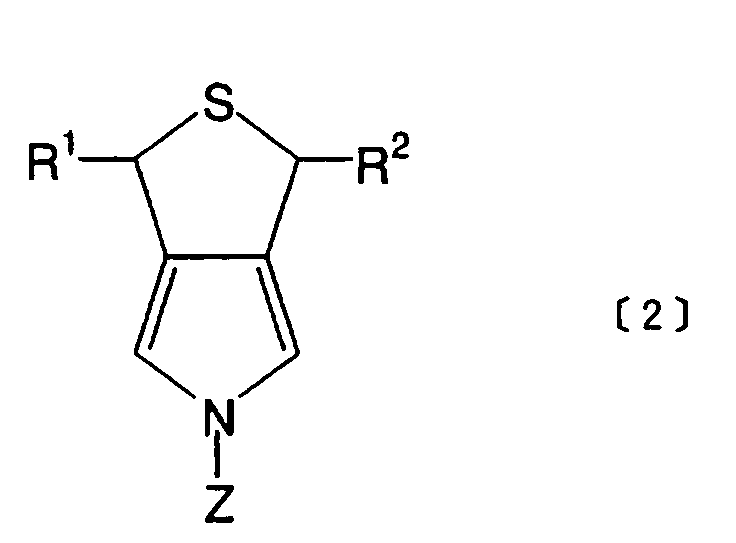
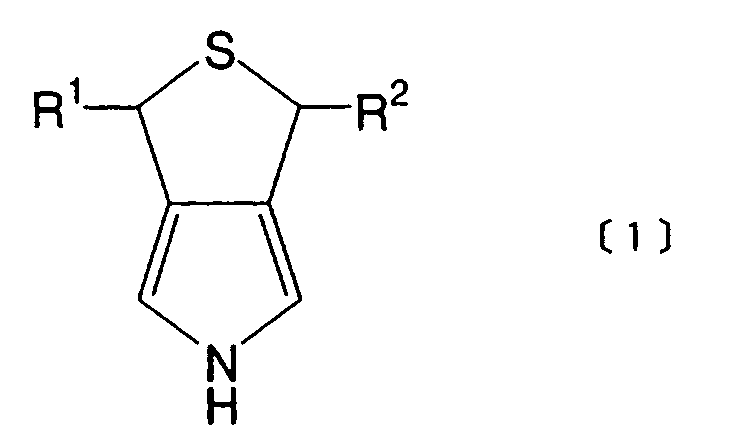
- That is, the present invention relates to a pyrrole derivative (claim 1) represented by the formula [1]:(wherein R1 and R2 each independently represents a hydrogen atom or a substituted or unsubstituted C1-10 hydrocarbon group); to a pyrrole derivative (claim 2) represented by the formula [2]:
 (wherein R1 and R2 each independently represents a hydrogen atom or a substituted or unsubstituted C1-10 hydrocarbon group, and Z represents an organic group); to a pyrrole derivative (claim 3) claimed in claim 2 wherein Z is a protecting group for the nitrogen atom; and to a pyrrole derivative (claim 4) claimed in claim 3 wherein the protecting group for the nitrogen atom is a tosyl group.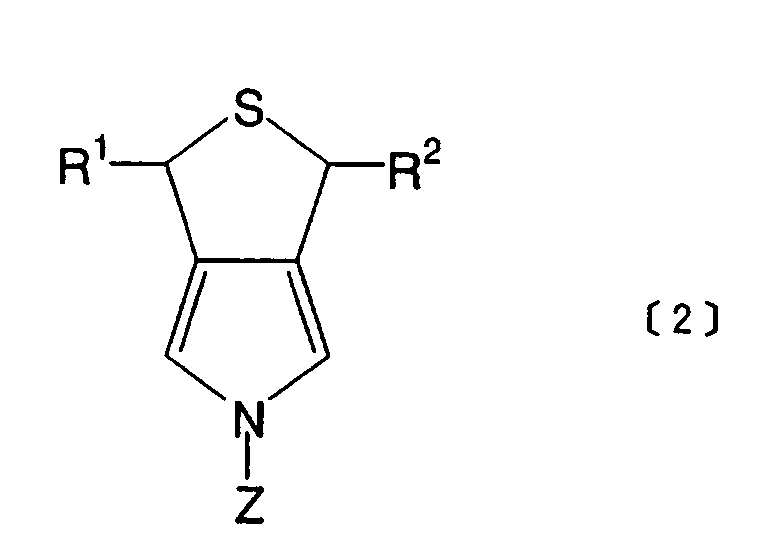
- Also, the present invention relates to a process for producing the pyrrole derivative (claim 5) represented by the formula [2]:(wherein R1 and R2 each independently represents a hydrogen atom or a substituted or unsubstituted C1-10 hydrocarbon group, and Z represents an organic group) including the step of reacting a pyrrole derivative represented by the formula [3] with an alkali metal sulfide:
 (wherein R1 and R2 each independently represents a hydrogen atom or a substituted or unsubstituted C1-10 hydrocarbon group, X and Y each independently represents a halogen atom, and Z represents an organic group); to a process for producing the pyrrole derivative (claim 6) represented by the formula [1]:
 (wherein R1 and R2 each independently represents a hydrogen atom or a substituted or unsubstituted C1-10 hydrocarbon group) including the step of deprotecting a protecting group of a pyrrole derivative represented by the formula [4]:
 (wherein R1 and R2 each independently represents a hydrogen atom or a substituted or unsubstituted C1-10 hydrocarbon group, and Z" represents a protecting group for the nitrogen atom); and to a process for producing the pyrrole derivative (claim 7) claimed in claim 6 wherein Z" in the formula [4] is a tosyl group and the deprotection of the tosyl group is carried out by using sodium bis(2-methoxyethoxy)aluminum hydride.
- The pyrrole derivatives of the present invention may be characterized by being represented by the formula [1]. The pyrrole derivatives represented by the formula [1] may be polymerized by electrolytic polymerization, oxidation polymerization, etc., and utilized as a solid electrolyte for a solid electrolytic capacitor.
- In the formula [1], R1 and R2 each independently represents a hydrogen atom or a substituted or unsubstituted C1-10 hydrocarbon group. The hydrocarbon group represented by R1 and R2 may be a straight chain or branched group, and may be substituted with an alkoxy group, such as methoxy group and ethoxy group, an acyl group, such as formyl group and acetyl group, and so forth. The number of carbon atoms of the hydrocarbon group represented by R1 and R2 is not particularly limited as long as it is between 1 and 10. Specific examples thereof include C1-10 alkyl groups, such as methyl group, ethyl group, n-propyl group, isopropyl group, n-butyl group, t-butyl group, s-butyl group, isobutyl group, n-pentyl group, s-pentyl group, isopentyl group, neopentyl group, n-hexyl group, s-hexyl group, 1,1-dimethyl-n-hexyl group, n-heptyl group, and n-decyl group; C2-10 alkenyl groups, such as vinyl group, allyl group, 2-butenyl group, 1-methyl-2-propenyl group, and 4-octenyl group; C2-10 alkynyl groups, such as ethynyl group, propargyl group, and 1-methyl-propynyl group; C3-10 alicyclic hydrocarbon groups, such as cyclopropyl group, cyclobutyl group, cyclopentyl group, 1-methyl-cyclopentyl group, 1-methyl-cyclohexyl group, and norbornyl group; C6-10 aromatic hydrocarbon groups, such as phenyl group, and 1-naphthyl group; and aralkyl groups, such as benzyl group, and phenethyl group. More specifically, examples of the pyrrole derivatives represented by the formula [1] include those shown in Table 1 below:
Compound No R1(R2) R2(R1) 1 CH3 CH3 2 CH3 CH2CH3 3 CH3 CH2CH2CH3 4 CH3 CH2CH2CH2CH3 5 CH3 CH2CH2CH2CH2CH3 6 CH3 CH(CH3)2 7 CH3 CH2CH(CH3)2 8 CH3 CH(CH3)CH2CH3 9 CH3 C(CH3)3 10 CH3 CH2CH(CH3)CH2CH3 11 CH3 CH2C(CH3)3 12 CH3 CH2CH2CH(CH3)2 13 CH3 CH(CH3)CH2CH2CH3 14 CH3 CH(CH2CH3)2 15 CH3 CH(CH3)CH(CH3)2 16 CH3 CH(CH3)2CH2CH3 17 CH2CH3 CH2CH3 18 CH2CH3 CH2CH2CH3 19 CH2CH3 CH2CH2CH2CH3 20 CH2CH3 CH2CH2CH2CH2CH3 21 CH2CH3 CH(CH3)2 22 CH2CH3 CH2CH(CH3)2 23 CH2CH3 CH(CH3)CH2CH3 24 CH2CH3 C(CH3)3 25 CH2CH3 CH2CH(CH3)CH2CH3 26 CH2CH3 CH2C(CH3)3 27 CH2CH3 CH2CH2CH(CH3)2 28 CH2CH3 CH(CH3)CH2CH2CH3 29 CH2CH3 CH(CH2CH3)2 30 CH2CH3 CH(CH3)CH(CH3)2 31 CH2CH3 CH(CH3)2CH2CH3 32 CH2CH2CH3 CH2CH2CH3 33 CH2CH2CH3 CH2CH2CH2CH3 34 CH2CH2CH3 CH2CH2CH2CH2CH3 35 CH2CH2CH3 CH(CH3)2 36 CH2CH2CH3 CH2CH(CH3)2 37 CH2CH2CH3 CH(CH3)CH2CH3 38 CH2CH2CH3 C(CH3)3 39 CH2CH2CH3 CH2CH(CH3)CH2CH3 40 CH2CH2CH3 CH2C(CH3)3 41 CH2CH2CH3 CH2CH2CH(CH3)2 42 CH2CH2CH3 CH(CH3)CH2CH2CH3 43 CH2CH2CH3 CH(CH2CH3)2 44 CH2CH2CH3 CH(CH3)CH(CH3)2 45 CH2CH2CH3 CH(CH3)2CH2CH3 46 CH2CH2CH2CH3 CH2CH2CH2CH3 47 CH2CH2CH2CH3 CH2CH2CH2CH2CH3 48 CH2CH2CH2CH3 CH(CH3)2 49 CH2CH2CH2CH3 CH2CH(CH3)2 50 CH2CH2CH2CH3 CH(CH3)CH2CH3 51 CH2CH2CH2CH3 C(CH3)3 52 CH2CH2CH2CH3 CH2CH(CH3)CH2CH3 53 CH2CH2CH2CH3 CH2C(CH3)3 54 CH2CH2CH2CH3 CH2CH2CH(CH3)2 55 CH2CH2CH2CH3 CH(CH3)CH2CH2CH3 56 CH2CH2CH2CH3 CH(CH2CH3)2 57 CH2CH2CH2CH3 CH(CH3)CH(CH3)2 58 CH2CH2CH2CH3 CH(CH3)2CH2CH3 59 CH2CH2CH2CH2CH3 CH2CH2CH2CH2CH3 60 CH2CH2CH2CH2CH3 CH(CH3)2 61 CH2CH2CH2CH2CH3 CH2CH(CH3)2 62 CH2CH2CH2CH2CH3 CH(CH3)CH2CH3 63 CH2CH2CH2CH2CH3 C(CH3)3 64 CH2CH2CH2CH2CH3 CH2CH(CH3)CH2CH3 65 CH2CH2CH2CH2CH3 CH2C(CH3)3 66 CH2CH2CH2CH2CH3 CH2CH2CH(CH3)2 67 CH2CH2CH2CH2CH3 CH(CH3)CH2CH2CH3 68 CH2CH2CH2CH2CH3 CH(CH2CH3)2 69 CH2CH2CH2CH2CH3 CH(CH3)CH(CH3)2 70 CH2CH2CH2CH2CH3 CH(CH3)2CH2CH3 71 CH(CH3)2 CH(CH3)2 72 CH(CH3)2 CH2CH(CH3)2 73 CH(CH3)2 CH(CH3)CH2CH3 74 CH(CH3)2 C(CH3)3 75 CH(CH3)2 CH2CH(CH3)CH2CH3 76 CH(CH3)2 CH2C(CH3)3 77 CH(CH3)2 CH2CH2CH(CH3)2 78 CH(CH3)2 CH(CH3)CH2CH2CH3 79 CH(CH3)2 CH(CH2CH3)2 80 CH(CH3)2 CH(CH3)CH(CH3)2 81 CH(CH3)2 CH(CH3)2CH2CH3 82 CH2CH(CH3)2 CH2CH(CH3)2 83 CH2CH(CH3)2 CH(CH3)CH2CH3 84 CH2CH(CH3)2 C(CH3)3 85 CH2CH(CH3)2 CH2CH(CH3)CH2CH3 86 CH2CH(CH3)2 CH2C(CH3)3 87 CH2CH(CH3)2 CH2CH2CH(CH3)2 88 CH2CH(CH3)2 CH(CH3)CH2CH2CH3 89 CH2CH(CH3)2 CH(CH2CH3)2 90 CH2CH(CH3)2 CH(CH3)CH(CH3)2 91 CH2CH(CH3)2 CH(CH3)2CH2CH3 92 CH(CH3)CH2CH3 CH(CH3)CH2CH3 93 CH(CH3)CH2CH3 C(CH3)3 94 CH(CH3)CH2CH3 CH2CH(CH3)CH2CH3 95 CH(CH3)CH2CH3 CH2C(CH3)3 96 CH(CH3)CH2CH3 CH2CH2CH(CH3)2 97 CH(CH3)CH2CH3 CH(CH3)CH2CH2CH3 98 CH(CH3)CH2CH3 CH(CH2CH3)2 99 CH(CH3)CH2CH3 CH(CH3)CH(CH3)2 100 CH(CH3)CH2CH3 CH(CH3)2CH2CH3 101 C(CH3)3 C(CH3)3 102 C(CH3)3 CH2CH(CH3)CH2CH3 103 C(CH3)3 CH2C(CH3)3 104 C(CH3)3 CH2CH2CH(CH3)2 105 C(CH3)3 CH(CH3)CH2CH2CH3 106 C(CH3)3 CH(CH2CH3)2 107 C(CH3)3 CH(CH3)CH(CH3)2 108 C(CH3)3 CH(CH3)2CH2CH3 109 CH2CH(CH3)CH2CH3 CH2CH(CH3)CH2CH3 110 CH2CH(CH3)CH2CH3 CH2C(CH3)3 111 CH2CH(CH3)CH2CH3 CH2CH2CH(CH3)2 112 CH2CH(CH3)CH2CH3 CH(CH3)CH2CH2CH3 113 CH2CH(CH3)CH2CH3 CH(CH2CH3)2 114 CH2CH(CH3)CH2CH3 CH(CH3)CH(CH3)2 115 CH2CH(CH3)CH2CH3 CH(CH3)2CH2CH3 116 CH2C(CH3)3 CH2C(CH3)3 117 CH2C(CH3)3 CH2CH2CH(CH3)2 118 CH2C(CH3)3 CH(CH3)CH2CH2CH3 119 CH2C(CH3)3 CH(CH2CH3)2 120 CH2C(CH3)3 CH(CH3)CH(CH3)2 121 CH2C(CH3)3 CH(CH3)2CH2CH3 122 CH2CH2CH (CH3)2 CH2CH2CH(CH3)2 123 CH2CH2CH (CH3)2 CH(CH3)CH2CH2CH3 124 CH2CH2CH(CH3)2 CH(CH2CH3)2 125 CH2CH2CH(CH3)2 CH(CH3)CH(CH3)2 126 CH2CH2CH(CH3)2 CH(CH3)2CH2CH3 127 CH(CH3)CH2CH2CH3 CH(CH3)CH2CH2CH3 128 CH(CH3)CH2CH2CH3 CH(CH2CH3)2 129 CH(CH3)CH2CH2CH3 CH(CH3)CH(CH3)2 130 CH(CH3)CH2CH2CH3 CH(CH3)2CH2CH3 131 CH(CH2CH3)2 CH(CH2CH3)2 132 CH(CH2CH3)2 CH(CH3)CH(CH3)2 133 CH(CH2CH3)2 CH(CH3)2CH2CH3 134 CH(CH3)CH(CH3)2 CH(CH3)CH(CH3)2 135 CH(CH3)CH(CH3)2 CH(CH3)2CH2CH3 136 CH(CH3)2CH2CH3 CH(CH3)2CH2CH3 - Also, the pyrrole derivatives according to the present invention may be characterized by being represented by the formula [2]. The pyrrole derivatives represented by the formula [2] are compounds which may be an intermediate in the process of producing the pyrrole derivatives represented by the formula [1].
- In the formula [2], R1 and R2 each independently represents a hydrogen atom or a substituted or unsubstituted C1-10 hydrocarbon group, and Z represents an organic group (i.e., an organic functional group). The definition of R1 and R2, respectively, in the formula [2] is the same as that of R1 and R2, respectively, in the formula [1]. Also, the above-mentioned organic group is not particularly limited as long as it contains a carbon atom in the functional group. Accordingly, it is not necessary for a carbon atom to be directly bonded to the nitrogen atom in the pyrrole ring, and examples thereof include functional groups in which a carbon atom is bonded via a hetero atom, etc., such as a nitrogen atom, sulfur atom, oxygen atom, and phosphorus atom. In particular, a protecting group which is capable of protecting the nitrogen atom at the pyrrole portion is preferable. Specific examples thereof include alkoxy carbonyl group, aryl sulfonyl group, alkyloxymethyl group, trialkylsilyl group (these may include a substituent, such as alkyl group, alkoxy group, and acyl group). Among these, the aryl sulfonyl group is preferable, and a tosyl group (p-toluene sulfonyl group) is particularly preferable.
- As a process for producing the pyrrole derivatives represented by the formula [2], specific examples thereof include a process in which the pyrrole derivative represented by the formula [3] is reacted with an alkali metal sulfide. Also, as a process for producing the pyrrole derivatives represented by the formula [1], specific examples thereof include a process in which the protecting group of the pyrrole derivative represented by the formula [4] is deprotected.
- The definition of R1 and R2, respectively, in the formula [3] is the same as that of R1 and R2, respectively, in the formula [1]. Also, in the formula [3], examples of the halogen atom represented by X and Y include fluorine atom, chlorine atom, bromine atom, and iodine atom. Among these, chlorine atom and bromine atom are preferable. Moreover, depending on the situation, X and Y may be aryl sulfonyloxy group, alkyl sulfonyloxy group, or trifluoromethylsulfonyloxy group. The definition of Z in the formula [3] is the same as that of Z in the formula [2].
- In the formula [4], R1 and R2 each independently represents a hydrogen atom or a substituted or unsubstituted C1-10 hydrocarbon group, and Z" represents a protecting group for the nitrogen atom. The definition of R1 and R2, respectively, in the formula [4] is the same as that of R1 and R2, respectively, in the formula [1]. Also, the definition of Z" in the formula [4] is the same as that of Z which is a protecting group for the nitrogen atom in the formula [2].
- Examples of solvent which may be suitably used in the above-mentioned reaction include water, C1-6 straight chain or branched alcohols, such as methanol, ethanol, propanol, and ethyleneglycol; straight chain or cyclic ether, such as tetrahydrofuran, diethylether, dioxane, glyme, and diglyme; chlorine containing solvents, such as chloroform, dichloromethane, chlorobenzene, and dichlorobenzene; and aprotic polar solvents, such as dimethyl formamide, and dimethylsulfoxide, and these may be used alone or in a mixture of two or more.
- The reaction temperature is preferably within a range between -10°C and the boiling point of the solvent used. If the temperature is within the above-mentioned range, the reaction may proceed more smoothly.
- Examples of the above-mentioned alkali metal sulfide include potassium sulfide and sodium sulfide, and it is possible to use hydrate and anhydride thereof prepared in advance. Also, it is possible to directly use one which is purified in a reaction system of alkali metal alcoholate and hydrogen sulfide. The amount of alkali metal sulfide is 1 to 100 equivalents, preferably 1.0 to 2.0 equivalents, with respect to the pyrrole derivative represented by the formula [3].
- The pyrrole derivatives represented by the formula [1] may be produced by deprotecting the protecting group of the pyrrole derivative represented by the formula [4]. This deprotection process may be carried out after isolating the pyrrole derivative represented by the formula [4] or without isolating the pyrrole derivative.
- The deprotection process of the protecting group (Z") may be performed by, for example; hydrolysis using mineral acids, such as hydrochloric acid and sulfuric acid, or alkali, such as sodium hydroxide, potassium hydroxide, sodium sulfide, and sodium disulfide; alcoholysis using metal alcoholate; or a reduction reaction using lithium aluminum hydride, sodium borohydride, sodium bis(2-methoxyethoxy) aluminum hydride ("Red-A1" (registered trademark)). Among these, the reduction reaction is preferable and it is particularly preferable to use sodium bis(2-methoxyethoxy) aluminum hydride when a deprotection process for tosyl group, which is a protecting group, is performed. The amount of a reduction agent added is preferably within the range of 1 to 4 equivalents, more preferably 1.5 to 3 equivalents, with respect to the pyrrole derivative represented by the formula [4].
- The pyrrole derivative which is produced as explained above, may be polymerized by electrolytic polymerization, oxidation polymerization etc., and utilized as a solid electrolyte (electrode) for a solid electrolytic capacitor.
- Hereinafter, the present invention will be explained in detail with reference to an example; however, it is apparent that the technical scope of the present invention is not limited by the example by any means.
- Dichlorotriphenyl phosphoran (6.44 g, 19.3 mmol) was suspended in 30 ml of tetrahydrofuran (THF), and 3,4-di(hydroxymethyl)-1-tosylpyrrole (2.47 g, 8.8 mmol) was slowly added thereto while being cooled by ice water. After the mixture was stirred for two hours at room temperature, the solvent of THF was evaporated under reduced pressure, and then water and ethyl acetate were added to separate layers. The layer of ethyl acetate was dried over magnesium sulfate anhydride, and was concentrated under reduced pressure. After purification using column chromatography ("Wako Gel C200"; hexane : ethyl acetate = 8 : 2 (slurry was used), 2.55 g of 3,4-di(chloromethyl)-1-tosylpyrrole was obtained (yield of 91 %).
3,4-di(chloromethyl)-1-tosylpyrrole:
1H-NMR (270MHz, CDCl3/TMS) d 2.43 (s, 3H), 4.53 (s, 4H), 7.17 (s, 2H), 7.33 (d, 2H, J = 8.1Hz), 7.77 (d, 2H, J = 8.1Hz) - After 2.55 g (8 mmol) of 3,4-di(chloromethyl)-1-tosylpyrrole was dissolved in 20 ml of methanol, 2.12 g (8.8 mmol) of sodium sulfide 9 hydrate (Na2S·9H2O) was added and the mixture was heated under reflux for 3 hours. After being cooled, water and ethyl acetate were added, and the mixture was subjected to cerite filtration. The filtrate was separated and the organic layer was washed with saline, dried over magnesium sulfate anhydride, concentrated, and purified using column chromatography ("Wako Gel C200"; hexane : ethyl acetate = 95 : 5). As a result, 0. 99 g of N-tosyl-3,5-dihydro-1H-thieno-[3,4-c] pyrrole was obtained (yield of 44%).
N-tosyl-3,5-dihydro-1H-thieno-[3,4-c] pyrrole: crystal, mp 134-136°C - After this, 0.99 g of N-tosyl-3,5-dihydro-1H-thieno-[3,4-c] pyrrole was dissolved in 15 ml of benzene, and Red-A1 (registered trademark) (65% by weight) 2.20 g (2 equivalents) was added, and the mixture was heated under reflux for 2 hours. After being cooled, ice was added to eliminate excess reduction agent, and then water and ethyl acetate were added to separate layers. The organic layer was washed with saline, dried over magnesium sulfate anhydride, concentrated, and purified using column chromatography ("Wako Gel C200"; hexane : ethyl acetate = 95 : 5). As a result, 0. 23 g of 3,5-dihydro-1H-thieno-[3,4-c] pyrrole was obtained (yield of 52%).
3,5-dihydro-1H-thieno-[3,4-c] pyrrole
1H-NMR (270MHz, CDCl3/TMS) d = 4.00 (s, 4H), 6.48 (d, 2H, J = 2.4Hz), 8.15 (bs, 1H), crystal, mp 39-40°C - As described above, the pyrrole derivatives of the present invention are novel compounds which may be a starting material for a conducting polymer that can be used as an electrolyte of a solid electrolytic capacitor, and hence the industrial applicability thereof is high.
Claims (7)
- A pyrrole derivative represented by a formula [1]:(wherein R1 and R2 each independently represents a hydrogen atom or a substituted or unsubstituted C1-10 hydrocarbon group).

- A pyrrole derivative represented by a formula [2]:(wherein R1 and R2 each independently represents a hydrogen atom or a substituted or unsubstituted C1-10 hydrocarbon group, and Z represents an organic group).
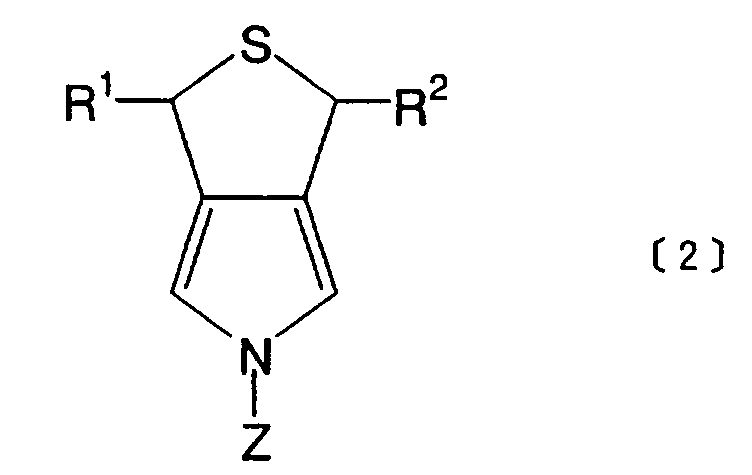
- A pyrrole derivative according to claim 2, wherein Z is a protecting group for the nitrogen atom.
- A pyrrole derivative according claim 3, wherein the protecting group for the nitrogen atom is a tosyl group.
- A process for producing the pyrrole derivative represented by the formula [2]:(wherein R1 and R2 each independently represents a hydrogen atom or a substituted or unsubstituted C1-10 hydrocarbon group, and Z represents an organic group), comprising the step of reacting a pyrrole derivative represented by a formula [3] with an alkali metal sulfide:
 (wherein R1 and R2 each independently represents a hydrogen atom or a substituted or unsubstituted C1-10 hydrocarbon group, X and Y each independently represents a halogen atom, and Z represents an organic group).
- A process for producing the pyrrole derivative represented by the formula [1]:(wherein R1 and R2 each independently represents a hydrogen atom or a substituted or unsubstituted C1-10 hydrocarbon group), comprising the step of deprotecting a protecting group of a pyrrole derivative represented by a formula [4]:
 (wherein R1 and R2 each independently represents a hydrogen atom or a substituted or unsubstituted C1-10 hydrocarbon group, and Z" represents the protecting group for the nitrogen atom).
- A process for producing the pyrrole derivative according to claim 6, wherein Z" in the formula [4] is a tosyl group and the deprotection of the tosyl group is carried out by using sodium bis(2-methoxyethoxy) aluminum hydride.
Applications Claiming Priority (3)
| Application Number | Priority Date | Filing Date | Title |
|---|---|---|---|
| JP2002197401A JP2004035507A (en) | 2002-07-05 | 2002-07-05 | Pyrrole derivative and method for producing the same |
| JP2002197401 | 2002-07-05 | ||
| PCT/JP2003/008266 WO2004005297A1 (en) | 2002-07-05 | 2003-06-30 | Pyrrole derivative and process for producing the same |
Publications (1)
| Publication Number | Publication Date |
|---|---|
| EP1557419A1 true EP1557419A1 (en) | 2005-07-27 |
Family
ID=30112397
Family Applications (1)
| Application Number | Title | Priority Date | Filing Date |
|---|---|---|---|
| EP03738573A Withdrawn EP1557419A1 (en) | 2002-07-05 | 2003-06-30 | Pyrrole derivative and process for producing the same |
Country Status (5)
| Country | Link |
|---|---|
| US (1) | US20050222241A1 (en) |
| EP (1) | EP1557419A1 (en) |
| JP (1) | JP2004035507A (en) |
| AU (1) | AU2003246132A1 (en) |
| WO (1) | WO2004005297A1 (en) |
Family Cites Families (10)
| Publication number | Priority date | Publication date | Assignee | Title |
|---|---|---|---|---|
| FR2537974A1 (en) * | 1982-12-16 | 1984-06-22 | Adir | NOVEL THIENO (2,3-B) PYRROLE DERIVATIVES, PREPARATION METHOD THEREOF AND PHARMACEUTICAL COMPOSITIONS COMPRISING THE SAME |
| JPH02180922A (en) * | 1988-12-29 | 1990-07-13 | Toyobo Co Ltd | Conductive polymer |
| DE4023048A1 (en) * | 1990-07-20 | 1992-01-23 | Basf Ag | Dicarboxylic acid imides, process for their preparation and their use as herbicides |
| JPH04198168A (en) * | 1990-11-28 | 1992-07-17 | Nippon Soda Co Ltd | Polycyclic pyrrole compound and its production |
| JP3091297B2 (en) * | 1992-01-10 | 2000-09-25 | 住友製薬株式会社 | Pyrrolidine derivative and method for producing the same |
| EP0599697A1 (en) * | 1992-11-24 | 1994-06-01 | Synthelabo | Pyrrole derivatives, their preparation and application in therapy |
| EP0765310A1 (en) * | 1994-04-08 | 1997-04-02 | E.I. Du Pont De Nemours And Company | Herbicidal bicyclic and tricyclic imides |
| GB2288799A (en) * | 1994-04-22 | 1995-11-01 | Japat Ltd | Polymerizable pyrroles and thiophenes |
| GB0016454D0 (en) * | 2000-07-04 | 2000-08-23 | Hoffmann La Roche | Thienopyrrolidinones |
| JP2002138134A (en) * | 2000-11-02 | 2002-05-14 | Noboru Koyama | Polypyrrole containing polysulfide and method of producing the same |
-
2002
- 2002-07-05 JP JP2002197401A patent/JP2004035507A/en active Pending
-
2003
- 2003-06-30 US US10/520,050 patent/US20050222241A1/en not_active Abandoned
- 2003-06-30 AU AU2003246132A patent/AU2003246132A1/en not_active Abandoned
- 2003-06-30 EP EP03738573A patent/EP1557419A1/en not_active Withdrawn
- 2003-06-30 WO PCT/JP2003/008266 patent/WO2004005297A1/en not_active Ceased
Non-Patent Citations (1)
| Title |
|---|
| See references of WO2004005297A1 * |
Also Published As
| Publication number | Publication date |
|---|---|
| US20050222241A1 (en) | 2005-10-06 |
| AU2003246132A1 (en) | 2004-01-23 |
| JP2004035507A (en) | 2004-02-05 |
| WO2004005297A1 (en) | 2004-01-15 |
Similar Documents
| Publication | Publication Date | Title |
|---|---|---|
| US5142098A (en) | Methylidenemalonate esters derived from esters of 9,10-endoethano-9,10-dihydroanthracane-11,11-dicarboxylic acid | |
| JPH05247039A (en) | Novel tetraoxo-diazabicyclo-(3,3,1)-nonane compound and preparation thereof | |
| JP2009256327A (en) | Method for producing cycloalkanedicarboxylic acid monoester | |
| JP3973941B2 (en) | Method for producing δ-aminopentadienoic acid ester derivative | |
| EP0001500A1 (en) | 1-Carbocyclic aryl-2-mono or -bis(alkoxycarbonyl) guanidino ethanes, and methods for their preparation and the preparation therefrom of 4,5-dihydro-2-alkoxycarbonylamino-5-carbocyclic aryl imidazoles | |
| CN1471532A (en) | Preparation method of 2-alkoxy-6-trifluoromethyl-N-([1,2,4]triazolo[1,5-c]pyrimidin-2-yl)benzenesulfonamide | |
| KR910000198B1 (en) | Process for preparing alkoxymethyl ethers and alkoxymethyl esters of glycerols | |
| US20050222241A1 (en) | Pyrrole derivative and process for producing the same | |
| JPS6247190B2 (en) | ||
| KR102033593B1 (en) | Preparing method of synthesizing indaceno dithienothiophene compound | |
| US5756724A (en) | High-yielding ullmann reaction for the preparation of bipyrroles | |
| CN112166108B (en) | Method for producing polymeric compound | |
| US5654429A (en) | Method for the preparation of 3-amino-2-chloro-4-alkylpyridines | |
| JP2023032408A (en) | Cyclic carbonate and method for producing the same | |
| JP2815654B2 (en) | Novel 4-substituted-3,5-dimethylpicolinic acid compound and method for producing the same | |
| US5145992A (en) | Process and preparation of α-alkoxy acetic acids and their salts | |
| KR101529963B1 (en) | Method for preparing everolimus and its intermediates | |
| JP2002138134A (en) | Polypyrrole containing polysulfide and method of producing the same | |
| US6632950B2 (en) | Process for the preparation of derivatives of 4-amino-3-hydroxypyrrole-2-carboxylic acid | |
| US5530136A (en) | Process for the preparation of pilocarpine derivatives from a 5-formyl-imidazole derivative | |
| CA1122983A (en) | Method of producing 5-fluorouracil derivatives | |
| US5081268A (en) | Process for the preparation of oxetanes from 1,3-glycol monosulfates | |
| CN114805168A (en) | Pyrrolidone compounds and synthetic method thereof | |
| JP2737304B2 (en) | Chiral ferrocene derivatives | |
| JP2001163879A (en) | Process for producing 3,4-dihydroxythiophenes and 3,4-alkylenedioxythiophenes |
Legal Events
| Date | Code | Title | Description |
|---|---|---|---|
| PUAI | Public reference made under article 153(3) epc to a published international application that has entered the european phase |
Free format text: ORIGINAL CODE: 0009012 |
|
| 17P | Request for examination filed |
Effective date: 20041230 |
|
| AK | Designated contracting states |
Kind code of ref document: A1 Designated state(s): AT BE BG CH CY CZ DE DK EE ES FI FR GB GR HU IE IT LI LU MC NL PT RO SE SI SK TR |
|
| AX | Request for extension of the european patent |
Extension state: AL LT LV MK |
|
| STAA | Information on the status of an ep patent application or granted ep patent |
Free format text: STATUS: THE APPLICATION HAS BEEN WITHDRAWN |
|
| 18W | Application withdrawn |
Effective date: 20060329 |