EP1557310A1 - Folding roof for a vehicle - Google Patents
Folding roof for a vehicle Download PDFInfo
- Publication number
- EP1557310A1 EP1557310A1 EP04100201A EP04100201A EP1557310A1 EP 1557310 A1 EP1557310 A1 EP 1557310A1 EP 04100201 A EP04100201 A EP 04100201A EP 04100201 A EP04100201 A EP 04100201A EP 1557310 A1 EP1557310 A1 EP 1557310A1
- Authority
- EP
- European Patent Office
- Prior art keywords
- vehicle
- roof
- opening
- control beam
- folding roof
- Prior art date
- Legal status (The legal status is an assumption and is not a legal conclusion. Google has not performed a legal analysis and makes no representation as to the accuracy of the status listed.)
- Withdrawn
Links
- 230000007246 mechanism Effects 0.000 claims abstract description 26
- 230000005540 biological transmission Effects 0.000 claims abstract description 16
- 238000010276 construction Methods 0.000 claims abstract description 11
- 230000000694 effects Effects 0.000 description 4
- 230000008859 change Effects 0.000 description 1
- 230000008439 repair process Effects 0.000 description 1
Images

Classifications
-
- B—PERFORMING OPERATIONS; TRANSPORTING
- B60—VEHICLES IN GENERAL
- B60J—WINDOWS, WINDSCREENS, NON-FIXED ROOFS, DOORS, OR SIMILAR DEVICES FOR VEHICLES; REMOVABLE EXTERNAL PROTECTIVE COVERINGS SPECIALLY ADAPTED FOR VEHICLES
- B60J7/00—Non-fixed roofs; Roofs with movable panels, e.g. rotary sunroofs
- B60J7/185—Locking arrangements
- B60J7/1858—Locking arrangements for locking soft tops to a surrounding rigid roof structure, e.g. to a closed vehicle body
-
- B—PERFORMING OPERATIONS; TRANSPORTING
- B60—VEHICLES IN GENERAL
- B60J—WINDOWS, WINDSCREENS, NON-FIXED ROOFS, DOORS, OR SIMILAR DEVICES FOR VEHICLES; REMOVABLE EXTERNAL PROTECTIVE COVERINGS SPECIALLY ADAPTED FOR VEHICLES
- B60J7/00—Non-fixed roofs; Roofs with movable panels, e.g. rotary sunroofs
- B60J7/02—Non-fixed roofs; Roofs with movable panels, e.g. rotary sunroofs of sliding type, e.g. comprising guide shoes
- B60J7/06—Non-fixed roofs; Roofs with movable panels, e.g. rotary sunroofs of sliding type, e.g. comprising guide shoes with non-rigid element or elements
- B60J7/061—Non-fixed roofs; Roofs with movable panels, e.g. rotary sunroofs of sliding type, e.g. comprising guide shoes with non-rigid element or elements sliding and folding
Definitions
- the present invention relates to a folding roof for a vehicle, comprising a flexible cover for selectively closing or opening a roof opening provided in a stationary roof part of the vehicle, wherein a control beam is attached to the opening side of said cover, which at its lateral ends is guided in stationary guide rails that extend in the longitudinal direction of the vehicle along either side of said roof opening, further comprising drive means connected to said control beam for moving it in the guide rails for opening and closing the roof opening, and a transmission mechanism positioned between the drive means and the control beam for moving the control beam towards the closed position with increased driving force during the last part of the closing movement, wherein the transmission mechanism is of the type comprising a triangular construction with a variable base, with a first leg pivotally connected to a drive slide and a second leg pivotally and movably connected to said drive slide under the control of a locking and releasing mechanism.
- a folding roof of such a type experiences a large range of tolerances while closing, such that the closed positions (as defined by the locking and releasing mechanism) will differ among different folding roofs.
- a differing closed position means, that it is not sure whether the required position of the folding roof (generally, the control beam thereof) relative to the remainder of the vehicle (for example a front beam of the roof opening), with a play as little as possible, is realised.
- This effect is further negatively influenced when such a folding roof is provided for a vehicle of the cabriolet-type with removable guide rails.
- the removable guide rails will add to the uncertainty of the position of the folding roof in its closed position (and thus will make an effective functioning of the folding roof uncertain) due to the tolerances at the interface between the guide rails and the remainder of the vehicle.
- a folding roof for a vehicle comprising a flexible cover for selectively closing or opening a roof opening provided in a stationary roof part of the vehicle, wherein a control beam is attached to the opening side of said cover, which at its lateral ends is guided in stationary guide rails that extend in the longitudinal direction of the vehicle along either side of said roof opening, further comprising drive means connected to said control beam for moving it in the guide rails for opening and closing the roof opening, and a transmission mechanism positioned between the drive means and the control beam for moving the control beam towards the closed position with increased driving force during the last part of the closing movement, wherein the transmission mechanism is of the type comprising a triangular construction with a variable base, with a first leg pivotally connected to a drive slide and a second leg pivotally and movably connected to said drive slide under the control of a locking and releasing mechanism, characterized in that the locking and releasing mechanism cooperates with a fixed, basically non-removable part of the vehicle.
- the position of the folding roof in its closed position always will be defined relative to said fixed part of the vehicle such that in such a situation any play between the folding roof and the remainder of the vehicle (especially between the control beam of the flexible cover and the stationary roof part) can be minimised.
- the construction of the folding roof can be made safer, simpler with less moving parts and more reliable.
- said fixed part of the vehicle is a front beam of the roof opening.
- a front beam as is known per se, defines the forward boundary of the roof opening and is part of the stationary roof part of the vehicle. Because it generally also will be the part with which the folding roof (contol beam) cooperates in its closed position, the closing accuracy in this closed position will be extremely high.
- the locking and releasing mechanism comprises an arm pivotally connected to said driving slide, which arm is provided with a projecting cam for cooperation with said fixed part.
- the folding roof according to the present invention may be of a type, wherein the stationary guide rails are removably connected to the remainder of the vehicle. In such a case the advantages of the present invention will appear in their full extent.
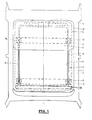
- FIG. 1 shows a fixed roof 1 of a vehicle, in this case a passenger car, which is provided with an opening 2 for accommodating a folding roof.
- the folding roof comprises a frame 3, which supports parts of the folding roof and which is arranged for mounting the folding roof in the fixed roof 1.
- Frame 3 defines a roof opening or passage opening 4, which can be selectively closed or at least partially opened by flexible cover 5.
- the construction of the flexible cover 5 and the means for folding up same when the roof is being opened basically belongs to the prior art and will not be explained in more detail herein.
- a control beam 6 for operating the folding roof is provided on the front side of the flexible cover 5, on which control beam a cover plate 7 is mounted, which is connected to flexible cover 5.
- Control beam 6 is guided in guide rails 8 at its lateral ends, which guide rails extend along each side of passage opening 4 in the longitudinal direction of the vehicle (of course such guide rails also could be applied without a frame 3, as can be other means for guiding the control beam).
- Control beam 6 can be moved forward and backward by drive means comprising a driving element 9 in the form of a crank, an electric motor or the like, and connecting means 10 in the form of pressure-resistant driving cables or the like. Cables 10 drive control beam 6 directly during the larger part of the opening and closing movement.
- a transmission mechanism 11 is provided between cables 10 and control beam 6, which transmission mechanism functions to pull control beam 6 with increased force to the closed and sealed position during the last part of the closing movement.
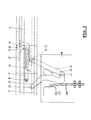
- Figs. 2 and 3 show a possible embodiment of said transmission mechanism 11 and the parts that co-operate therewith.
- a lateral end portion of control beam 6 can be distinguished, which is supported, in a manner yet to be shown, in a driving slide 12 which is capable of reciprocating movement in guide rail 8 on the respective side of passage opening 4.
- a subslide 13 attached to the cables 10 cooperates with said driving slide 12.
- Driving slide 12 and subslide 13 are interconnected in such a manner that they move as a unit during the larger part of the closing (and opening) movement (Fig. 2), whilst driving slide 12 is locked with respect to guide rail 8 and subslide 13 moves with respect to driving slide 12 during the final part of the closing movement (Fig. 3) (and the first part of the opening movement), whereby subslide 13 drives the control beam 6 via transmission mechanism 11 during said movement relative to each other.
- a locking element in the form of a pin 15 which engages in an oblique slot portion 16' of a slot 16 in subslide 13 is provided for the purpose of interconnecting slides 12 and 13 as a unit.
- Pin 15 is provided near the free ends of an arm 17 which is pivotally connected to driving slide 12 by means of a vertical pivot 18. While driving slide 12 and subslide 13 are fixedly interconnected, pin 15 is positioned at the end of the oblique slot portion 16'.
- Arm 17 is prevented from pivoting about pivot 18 by a cam or nose 19 provided on the free end of arm 17, which abuts against a flange 8' of guide rail 8 or any other appropiate fixed part of the vehicle.
- driving slide 12 and subslide 13 are rigidly interconnected in longitudinal direction in the position of fig. 2.
- the locking engagement by locking element 15 can be released by means of the cam 19 that is present on the free end of arm 17, which cam 19 can enter into a cavity 20 formed in a fixed part 31 of the vehicle.
- Cam 19 is forced into cavity 20 by a catch element 21 projecting into the path of cam 19, which catches cam 19 and, because of its sloping position, guides said cam into cavity 20.
- Another effect of said sloping position is that the driving slide 12 which is connected to arm 17 is gradually stopped, because the cam 19 present on arm 17 continues to move forward slightly, and driving slide 12 will not come to a standstill until cam 19 fully engages in cavity 20, therefore. In this manner, the driving slide is prevented from slamming to a standstill.
- the fixed part 31 of the vehicle may be a front beam of the passage opening 4.
- the position of said fixed part 31 only has been indicated schematically, and it is noted that when said fixed part indeed is a front beam (as indicated schematically by reference 32 in fig. 1) it generally will be positioned in front of the position of the control beam 6 when the folding roof is closed (as seen in the longitudinal direction of the vehicle) and that the arm 17 then will have a corresponding enlarged length.
- the illustrated transmission mechanism 11 comprises a triangular construction with a first leg 22, which is pivotally connected to driving slide 12 by means of a vertical pivot 23, and a second leg 24, which is pivotally connected to subslide 13 by means of a vertical pivot 25.
- Legs 22 and 24 are pivoted together by means of a pivot 26 at their ends remote from pivots 23, 25.
- a triangular construction having a variable base is formed, because vertical pivot 25 on subslide 13 is capable of movement with respect to pivot 23 on driving slide 12. Movement of subslide 13 with respect to driving slide 12 thus causes the triangle to change its form, to the effect that the angle between legs 22 and 24 will be changed and the top of the triangle will shift relative to the angular point formed by pivot 23.
- the triangular construction of the transmission mechanism 11 is in driving engagement with control beam 6 in that first leg 22 is accommodated between upright walls 27 and 28 on control beam 6.
- first leg 22 is positioned at some distance from upright wall 27 while engaging a spring means 29.
- the spring means 29 in the shown embodiment a leaf spring, is attached to the control beam 6 by mountings 30. It is conceivable, however, that the first leg will directly engage the upright wall 27 without the interpositioning of said spring means 29. For the present invention, however, this is not an essential feature.
Landscapes
- Engineering & Computer Science (AREA)
- Mechanical Engineering (AREA)
- Lock And Its Accessories (AREA)
Abstract
Description
- The present invention relates to a folding roof for a vehicle, comprising a flexible cover for selectively closing or opening a roof opening provided in a stationary roof part of the vehicle, wherein a control beam is attached to the opening side of said cover, which at its lateral ends is guided in stationary guide rails that extend in the longitudinal direction of the vehicle along either side of said roof opening, further comprising drive means connected to said control beam for moving it in the guide rails for opening and closing the roof opening, and a transmission mechanism positioned between the drive means and the control beam for moving the control beam towards the closed position with increased driving force during the last part of the closing movement, wherein the transmission mechanism is of the type comprising a triangular construction with a variable base, with a first leg pivotally connected to a drive slide and a second leg pivotally and movably connected to said drive slide under the control of a locking and releasing mechanism.
- Such a folding roof is known from European patent 1051307.
- A folding roof of such a type experiences a large range of tolerances while closing, such that the closed positions (as defined by the locking and releasing mechanism) will differ among different folding roofs. A differing closed position means, that it is not sure whether the required position of the folding roof (generally, the control beam thereof) relative to the remainder of the vehicle (for example a front beam of the roof opening), with a play as little as possible, is realised. This effect is further negatively influenced when such a folding roof is provided for a vehicle of the cabriolet-type with removable guide rails. The removable guide rails will add to the uncertainty of the position of the folding roof in its closed position (and thus will make an effective functioning of the folding roof uncertain) due to the tolerances at the interface between the guide rails and the remainder of the vehicle.
- It is an object of the present invention to further improve such a folding roof.
- Thus, in accordance with the present invention, there is provided a folding roof for a vehicle, comprising a flexible cover for selectively closing or opening a roof opening provided in a stationary roof part of the vehicle, wherein a control beam is attached to the opening side of said cover, which at its lateral ends is guided in stationary guide rails that extend in the longitudinal direction of the vehicle along either side of said roof opening, further comprising drive means connected to said control beam for moving it in the guide rails for opening and closing the roof opening, and a transmission mechanism positioned between the drive means and the control beam for moving the control beam towards the closed position with increased driving force during the last part of the closing movement, wherein the transmission mechanism is of the type comprising a triangular construction with a variable base, with a first leg pivotally connected to a drive slide and a second leg pivotally and movably connected to said drive slide under the control of a locking and releasing mechanism, characterized in that the locking and releasing mechanism cooperates with a fixed, basically non-removable part of the vehicle.
- As a result the position of the folding roof in its closed position always will be defined relative to said fixed part of the vehicle such that in such a situation any play between the folding roof and the remainder of the vehicle (especially between the control beam of the flexible cover and the stationary roof part) can be minimised. As a result the construction of the folding roof can be made safer, simpler with less moving parts and more reliable.
- It is noted that the phrase 'basically non-removable' intends to express that said part is not removable during normal use. Of course it could be possible that such a part is removable for servicing and repairs.
- In accordance with a preferred embodiment of the folding roof in accordance with the present invention said fixed part of the vehicle is a front beam of the roof opening. Such a front beam, as is known per se, defines the forward boundary of the roof opening and is part of the stationary roof part of the vehicle. Because it generally also will be the part with which the folding roof (contol beam) cooperates in its closed position, the closing accuracy in this closed position will be extremely high.
- In still a further embodiment of the folding roof in accordance with the present invention the locking and releasing mechanism comprises an arm pivotally connected to said driving slide, which arm is provided with a projecting cam for cooperation with said fixed part.
- As mentioned before, the folding roof according to the present invention may be of a type, wherein the stationary guide rails are removably connected to the remainder of the vehicle. In such a case the advantages of the present invention will appear in their full extent.
- Hereinafter the invention will be elucidated referring to the drawing, in which an embodiment of the folding roof according to the present invention is illustrated.
- Figure 1 is a schematic plan view of an embodiment of the folding roof according to the present invention;
- figure 2 shows, on a larger scale, a detail of the folding roof of figure 1 in a first position, and
- figure 3 shows a detail as depicted in fig. 2, however in a different position.
-
- The drawing, and in first instance Fig. 1 thereof, shows a
fixed roof 1 of a vehicle, in this case a passenger car, which is provided with anopening 2 for accommodating a folding roof. The folding roof comprises aframe 3, which supports parts of the folding roof and which is arranged for mounting the folding roof in thefixed roof 1.Frame 3 defines a roof opening orpassage opening 4, which can be selectively closed or at least partially opened by flexible cover 5. The construction of the flexible cover 5 and the means for folding up same when the roof is being opened basically belongs to the prior art and will not be explained in more detail herein. - In the present case, a
control beam 6 for operating the folding roof is provided on the front side of the flexible cover 5, on which control beam acover plate 7 is mounted, which is connected to flexible cover 5. -
Control beam 6 is guided inguide rails 8 at its lateral ends, which guide rails extend along each side of passage opening 4 in the longitudinal direction of the vehicle (of course such guide rails also could be applied without aframe 3, as can be other means for guiding the control beam).Control beam 6 can be moved forward and backward by drive means comprising adriving element 9 in the form of a crank, an electric motor or the like, andconnecting means 10 in the form of pressure-resistant driving cables or the like.Cables 10drive control beam 6 directly during the larger part of the opening and closing movement. However, in order to be able to pull the flexible cover taut nicely in the closed position of the folding roof, atransmission mechanism 11 is provided betweencables 10 andcontrol beam 6, which transmission mechanism functions to pullcontrol beam 6 with increased force to the closed and sealed position during the last part of the closing movement. - Figs. 2 and 3 show a possible embodiment of said
transmission mechanism 11 and the parts that co-operate therewith. A lateral end portion ofcontrol beam 6 can be distinguished, which is supported, in a manner yet to be shown, in adriving slide 12 which is capable of reciprocating movement inguide rail 8 on the respective side of passage opening 4. Asubslide 13 attached to thecables 10 cooperates with saiddriving slide 12. Drivingslide 12 andsubslide 13 are interconnected in such a manner that they move as a unit during the larger part of the closing (and opening) movement (Fig. 2), whilst drivingslide 12 is locked with respect toguide rail 8 andsubslide 13 moves with respect to drivingslide 12 during the final part of the closing movement (Fig. 3) (and the first part of the opening movement), wherebysubslide 13 drives thecontrol beam 6 viatransmission mechanism 11 during said movement relative to each other. - A locking element in the form of a
pin 15 which engages in an oblique slot portion 16' of aslot 16 insubslide 13 is provided for the purpose of interconnectingslides Pin 15 is provided near the free ends of anarm 17 which is pivotally connected to drivingslide 12 by means of avertical pivot 18. While drivingslide 12 andsubslide 13 are fixedly interconnected,pin 15 is positioned at the end of the oblique slot portion 16'.Arm 17 is prevented from pivoting aboutpivot 18 by a cam ornose 19 provided on the free end ofarm 17, which abuts against a flange 8' ofguide rail 8 or any other appropiate fixed part of the vehicle. Thus, drivingslide 12 andsubslide 13 are rigidly interconnected in longitudinal direction in the position of fig. 2. - The locking engagement by
locking element 15 can be released by means of thecam 19 that is present on the free end ofarm 17, whichcam 19 can enter into acavity 20 formed in afixed part 31 of the vehicle.Cam 19 is forced intocavity 20 by acatch element 21 projecting into the path ofcam 19, which catchescam 19 and, because of its sloping position, guides said cam intocavity 20. Another effect of said sloping position is that thedriving slide 12 which is connected toarm 17 is gradually stopped, because thecam 19 present onarm 17 continues to move forward slightly, and drivingslide 12 will not come to a standstill untilcam 19 fully engages incavity 20, therefore. In this manner, the driving slide is prevented from slamming to a standstill. - The
fixed part 31 of the vehicle may be a front beam of the passage opening 4. In the drawing the position of saidfixed part 31 only has been indicated schematically, and it is noted that when said fixed part indeed is a front beam (as indicated schematically byreference 32 in fig. 1) it generally will be positioned in front of the position of thecontrol beam 6 when the folding roof is closed (as seen in the longitudinal direction of the vehicle) and that thearm 17 then will have a corresponding enlarged length. - The lateral movement of
arm 17 caused bycam 19 engaging intocavity 20 not onlylocks driving slide 12 in position with respect to thefixed part 31, but also causes the locking engagement betweendriving slide 12 andsubslide 13 to be released, since thepin 15 present onarm 17 moves from theoblique slot portion 16 into the slot portion 16' that extends in the longitudinal direction ofguide rail 8, as a result of whichsubslide 13 can move relative to drivingslide 12, due to the fact thatpin 15 has moved into slot portion 16'.Arm 17 comprisingcam 19 thus functions as a releasing element for locking element/pin 15, and also as a locking element for drivingslide 12, and thus as a push-off element fortransmission mechanism 11. That is, the engagement betweencam 19 andcavity 20 makes it possible to transmit the required push-off force to fixedpart 31 viacam 9, which enables the transmission mechanism to produce a speed-reducing and thus force-increasing effect. - The illustrated
transmission mechanism 11 comprises a triangular construction with afirst leg 22, which is pivotally connected to drivingslide 12 by means of avertical pivot 23, and asecond leg 24, which is pivotally connected tosubslide 13 by means of avertical pivot 25.Legs pivot 26 at their ends remote frompivots vertical pivot 25 onsubslide 13 is capable of movement with respect topivot 23 on drivingslide 12. Movement ofsubslide 13 with respect to drivingslide 12 thus causes the triangle to change its form, to the effect that the angle betweenlegs pivot 23. - The triangular construction of the
transmission mechanism 11 is in driving engagement withcontrol beam 6 in thatfirst leg 22 is accommodated betweenupright walls control beam 6. In the specific embodiment illustrated here thefirst leg 22 is positioned at some distance fromupright wall 27 while engaging aspring means 29. The spring means 29, in the shown embodiment a leaf spring, is attached to thecontrol beam 6 bymountings 30. It is conceivable, however, that the first leg will directly engage theupright wall 27 without the interpositioning of said spring means 29. For the present invention, however, this is not an essential feature. - In the position shown in fig. 2, which occurs among others during the first part of closing the folding roof, the
slides leg 22 engages the spring means 29 (or theupright wall 27 if a spring means is not provided). - During the last part of the closing movement of the
control beam 6 and flexible cover 5 (figure 3)driving slide 12 has been stopped because thearm 7 carried thereby has engaged thecavity 20 of thefixed part 31 with itscam 19. Thesubslide 13 has been moved further, as a result of which the triangular construction has assumed the position in fig. 3, while generating an increased force on the spring means 29 (or, again, upright wall 27). - The engagement of the
cam 19 ofarm 17 with thecavity 20 of thefixed part 31 of the vehicle ensures that the folding roof, especially itscontrol beam 6, will always assume a well-defined position when the folding roof is closed, also in cases where theguide rails 8 can be removed (for example when the vehicle is of the cabriolet-type). Thus tolerances and play can be minimised. - The invention is not limited to the embodiment described before which can be varied widely within the scope of the invention as defined by the appending claims.
Claims (4)
- Folding roof for a vehicle, comprising a flexible cover for selectively closing or opening a roof opening provided in a stationary roof part of the vehicle, wherein a control beam is attached to the opening side of said cover, which at its lateral ends is guided in stationary guide rails that extend in the longitudinal direction of the vehicle along either side of said roof opening, further comprising drive means connected to said control beam for moving it in the guide rails for opening and closing the roof opening, and a transmission mechanism positioned between the drive means and the control beam for moving the control beam towards the closed position with increased driving force during the last part of the closing movement, wherein the transmission mechanism is of the type comprising a triangular construction with a variable base, with a first leg pivotally connected to a drive slide and a second leg pivotally and movably connected to said drive slide under the control of a locking and releasing mechanism, characterized in that the locking and releasing mechanism cooperates with a fixed, basically non-removable part of the vehicle.
- Folding roof according to claim 1, wherein said fixed part of the vehicle is a front beam of the roof opening.
- Folding roof according to claim 1 or 2, wherein the locking and releasing mechanism comprises an arm pivotally connected to said driving slide, which arm is provided with a projecting cam for cooperation with said fixed part.
- Folding roof according to any of the previous claims, wherein the stationary guide rails are removably connected to the remainder of the vehicle.
Priority Applications (1)
| Application Number | Priority Date | Filing Date | Title |
|---|---|---|---|
| EP04100201A EP1557310A1 (en) | 2004-01-22 | 2004-01-22 | Folding roof for a vehicle |
Applications Claiming Priority (1)
| Application Number | Priority Date | Filing Date | Title |
|---|---|---|---|
| EP04100201A EP1557310A1 (en) | 2004-01-22 | 2004-01-22 | Folding roof for a vehicle |
Publications (1)
| Publication Number | Publication Date |
|---|---|
| EP1557310A1 true EP1557310A1 (en) | 2005-07-27 |
Family
ID=34626532
Family Applications (1)
| Application Number | Title | Priority Date | Filing Date |
|---|---|---|---|
| EP04100201A Withdrawn EP1557310A1 (en) | 2004-01-22 | 2004-01-22 | Folding roof for a vehicle |
Country Status (1)
| Country | Link |
|---|---|
| EP (1) | EP1557310A1 (en) |
Citations (5)
| Publication number | Priority date | Publication date | Assignee | Title |
|---|---|---|---|---|
| GB323065A (en) * | 1928-10-11 | 1929-12-24 | Francis Edwin Harmer | Improvements in or relating to vehicle bodies |
| EP0765771A1 (en) * | 1995-09-26 | 1997-04-02 | Inalfa Industries B.V. | Opening roof for a vehicle |
| WO1999039932A1 (en) * | 1998-02-05 | 1999-08-12 | Inalfa Industries B.V. | A folding roof for a vehicle |
| EP1024043A1 (en) * | 1999-01-27 | 2000-08-02 | Inalfa Industries B.V. | Open roof construction for a vehicle |
| EP1155890A2 (en) * | 2000-05-16 | 2001-11-21 | Webasto Vehicle Systems International GmbH | Foldable top for vehicle |
-
2004
- 2004-01-22 EP EP04100201A patent/EP1557310A1/en not_active Withdrawn
Patent Citations (5)
| Publication number | Priority date | Publication date | Assignee | Title |
|---|---|---|---|---|
| GB323065A (en) * | 1928-10-11 | 1929-12-24 | Francis Edwin Harmer | Improvements in or relating to vehicle bodies |
| EP0765771A1 (en) * | 1995-09-26 | 1997-04-02 | Inalfa Industries B.V. | Opening roof for a vehicle |
| WO1999039932A1 (en) * | 1998-02-05 | 1999-08-12 | Inalfa Industries B.V. | A folding roof for a vehicle |
| EP1024043A1 (en) * | 1999-01-27 | 2000-08-02 | Inalfa Industries B.V. | Open roof construction for a vehicle |
| EP1155890A2 (en) * | 2000-05-16 | 2001-11-21 | Webasto Vehicle Systems International GmbH | Foldable top for vehicle |
Similar Documents
| Publication | Publication Date | Title |
|---|---|---|
| US8870276B2 (en) | Locking mechanism for open roof construction and open roof construction provided therewith | |
| EP2078630A1 (en) | Open roof construction for a vehicle | |
| KR101381321B1 (en) | Sliding roof device, in particular for a motor vehicle | |
| EP2425996A1 (en) | Vehicle sunroof device | |
| CN110370903B (en) | Roof systems for vehicles | |
| US6513866B1 (en) | Open roof construction for a vehicle | |
| EP2305500B1 (en) | Open roof construction for a vehicle | |
| US6957851B2 (en) | Open roof construction for a vehicle, and method of moving a closure element thereof | |
| US6631945B2 (en) | Openable motor vehicle roof | |
| US6325452B1 (en) | Folding roof for a vehicle | |
| US6412859B1 (en) | Folding roof for a vehicle | |
| EP1494883B1 (en) | Roof assembly for a vehicle | |
| EP1070615B2 (en) | Open roof construction for a vehicle | |
| EP1557310A1 (en) | Folding roof for a vehicle | |
| EP1150852B1 (en) | Open roof construction for a vehicle | |
| US20040169402A1 (en) | Vehicle roof | |
| EP1544013A1 (en) | Folding roof for a vehicle | |
| EP1564052A1 (en) | Folding roof for a vehicle | |
| US6942283B2 (en) | Open roof construction for a vehicle | |
| EP0662399A1 (en) | A roof panel assembly | |
| EP4289647B1 (en) | Roof system for a vehicle | |
| US20180297458A1 (en) | Locking Device Having a Locking Hook and a Slide Movable on a Locking Support |
Legal Events
| Date | Code | Title | Description |
|---|---|---|---|
| PUAI | Public reference made under article 153(3) epc to a published international application that has entered the european phase |
Free format text: ORIGINAL CODE: 0009012 |
|
| AK | Designated contracting states |
Kind code of ref document: A1 Designated state(s): AT BE BG CH CY CZ DE DK EE ES FI FR GB GR HU IE IT LI LU MC NL PT RO SE SI SK TR |
|
| AX | Request for extension of the european patent |
Extension state: AL LT LV MK |
|
| AKX | Designation fees paid | ||
| REG | Reference to a national code |
Ref country code: DE Ref legal event code: 8566 |
|
| 111Z | Information provided on other rights and legal means of execution |
Free format text: ATBEBGCHCYCZDEDKEEESFIFRGBGRHUIEITLUMCNLPTROSESISKTR Effective date: 20060531 |
|
| STAA | Information on the status of an ep patent application or granted ep patent |
Free format text: STATUS: THE APPLICATION IS DEEMED TO BE WITHDRAWN |
|
| 18D | Application deemed to be withdrawn |
Effective date: 20060128 |