EP1557282A2 - Decolorable image forming material - Google Patents
Decolorable image forming material Download PDFInfo
- Publication number
- EP1557282A2 EP1557282A2 EP05250122A EP05250122A EP1557282A2 EP 1557282 A2 EP1557282 A2 EP 1557282A2 EP 05250122 A EP05250122 A EP 05250122A EP 05250122 A EP05250122 A EP 05250122A EP 1557282 A2 EP1557282 A2 EP 1557282A2
- Authority
- EP
- European Patent Office
- Prior art keywords
- image forming
- forming material
- developer
- decolorable
- decolorable image
- Prior art date
- Legal status (The legal status is an assumption and is not a legal conclusion. Google has not performed a legal analysis and makes no representation as to the accuracy of the status listed.)
- Granted
Links
Images
Classifications
-
- B—PERFORMING OPERATIONS; TRANSPORTING
- B41—PRINTING; LINING MACHINES; TYPEWRITERS; STAMPS
- B41M—PRINTING, DUPLICATING, MARKING, OR COPYING PROCESSES; COLOUR PRINTING
- B41M5/00—Duplicating or marking methods; Sheet materials for use therein
- B41M5/26—Thermography ; Marking by high energetic means, e.g. laser otherwise than by burning, and characterised by the material used
- B41M5/30—Thermography ; Marking by high energetic means, e.g. laser otherwise than by burning, and characterised by the material used using chemical colour formers
- B41M5/305—Thermography ; Marking by high energetic means, e.g. laser otherwise than by burning, and characterised by the material used using chemical colour formers with reversible electron-donor electron-acceptor compositions
-
- B—PERFORMING OPERATIONS; TRANSPORTING
- B65—CONVEYING; PACKING; STORING; HANDLING THIN OR FILAMENTARY MATERIAL
- B65G—TRANSPORT OR STORAGE DEVICES, e.g. CONVEYORS FOR LOADING OR TIPPING, SHOP CONVEYOR SYSTEMS OR PNEUMATIC TUBE CONVEYORS
- B65G47/00—Article or material-handling devices associated with conveyors; Methods employing such devices
- B65G47/52—Devices for transferring articles or materials between conveyors i.e. discharging or feeding devices
-
- B—PERFORMING OPERATIONS; TRANSPORTING
- B41—PRINTING; LINING MACHINES; TYPEWRITERS; STAMPS
- B41M—PRINTING, DUPLICATING, MARKING, OR COPYING PROCESSES; COLOUR PRINTING
- B41M5/00—Duplicating or marking methods; Sheet materials for use therein
- B41M5/26—Thermography ; Marking by high energetic means, e.g. laser otherwise than by burning, and characterised by the material used
- B41M5/30—Thermography ; Marking by high energetic means, e.g. laser otherwise than by burning, and characterised by the material used using chemical colour formers
-
- B—PERFORMING OPERATIONS; TRANSPORTING
- B65—CONVEYING; PACKING; STORING; HANDLING THIN OR FILAMENTARY MATERIAL
- B65G—TRANSPORT OR STORAGE DEVICES, e.g. CONVEYORS FOR LOADING OR TIPPING, SHOP CONVEYOR SYSTEMS OR PNEUMATIC TUBE CONVEYORS
- B65G39/00—Rollers, e.g. drive rollers, or arrangements thereof incorporated in roller-ways or other types of mechanical conveyors
- B65G39/10—Arrangements of rollers
- B65G39/12—Arrangements of rollers mounted on framework
- B65G39/18—Arrangements of rollers mounted on framework for guiding loads
-
- G—PHYSICS
- G03—PHOTOGRAPHY; CINEMATOGRAPHY; ANALOGOUS TECHNIQUES USING WAVES OTHER THAN OPTICAL WAVES; ELECTROGRAPHY; HOLOGRAPHY
- G03G—ELECTROGRAPHY; ELECTROPHOTOGRAPHY; MAGNETOGRAPHY
- G03G9/00—Developers
- G03G9/08—Developers with toner particles
- G03G9/09—Colouring agents for toner particles
- G03G9/0926—Colouring agents for toner particles characterised by physical or chemical properties
-
- G—PHYSICS
- G03—PHOTOGRAPHY; CINEMATOGRAPHY; ANALOGOUS TECHNIQUES USING WAVES OTHER THAN OPTICAL WAVES; ELECTROGRAPHY; HOLOGRAPHY
- G03G—ELECTROGRAPHY; ELECTROPHOTOGRAPHY; MAGNETOGRAPHY
- G03G9/00—Developers
- G03G9/08—Developers with toner particles
- G03G9/09—Colouring agents for toner particles
- G03G9/0928—Compounds capable to generate colouring agents by chemical reaction
-
- B—PERFORMING OPERATIONS; TRANSPORTING
- B41—PRINTING; LINING MACHINES; TYPEWRITERS; STAMPS
- B41M—PRINTING, DUPLICATING, MARKING, OR COPYING PROCESSES; COLOUR PRINTING
- B41M5/00—Duplicating or marking methods; Sheet materials for use therein
- B41M5/26—Thermography ; Marking by high energetic means, e.g. laser otherwise than by burning, and characterised by the material used
- B41M5/30—Thermography ; Marking by high energetic means, e.g. laser otherwise than by burning, and characterised by the material used using chemical colour formers
- B41M5/333—Colour developing components therefor, e.g. acidic compounds
- B41M5/3333—Non-macromolecular compounds
- B41M5/3335—Compounds containing phenolic or carboxylic acid groups or metal salts thereof
-
- B—PERFORMING OPERATIONS; TRANSPORTING
- B41—PRINTING; LINING MACHINES; TYPEWRITERS; STAMPS
- B41M—PRINTING, DUPLICATING, MARKING, OR COPYING PROCESSES; COLOUR PRINTING
- B41M5/00—Duplicating or marking methods; Sheet materials for use therein
- B41M5/26—Thermography ; Marking by high energetic means, e.g. laser otherwise than by burning, and characterised by the material used
- B41M5/30—Thermography ; Marking by high energetic means, e.g. laser otherwise than by burning, and characterised by the material used using chemical colour formers
- B41M5/337—Additives; Binders
- B41M5/3372—Macromolecular compounds
-
- B—PERFORMING OPERATIONS; TRANSPORTING
- B41—PRINTING; LINING MACHINES; TYPEWRITERS; STAMPS
- B41M—PRINTING, DUPLICATING, MARKING, OR COPYING PROCESSES; COLOUR PRINTING
- B41M5/00—Duplicating or marking methods; Sheet materials for use therein
- B41M5/26—Thermography ; Marking by high energetic means, e.g. laser otherwise than by burning, and characterised by the material used
- B41M5/30—Thermography ; Marking by high energetic means, e.g. laser otherwise than by burning, and characterised by the material used using chemical colour formers
- B41M5/337—Additives; Binders
- B41M5/3375—Non-macromolecular compounds
-
- B—PERFORMING OPERATIONS; TRANSPORTING
- B65—CONVEYING; PACKING; STORING; HANDLING THIN OR FILAMENTARY MATERIAL
- B65G—TRANSPORT OR STORAGE DEVICES, e.g. CONVEYORS FOR LOADING OR TIPPING, SHOP CONVEYOR SYSTEMS OR PNEUMATIC TUBE CONVEYORS
- B65G2812/00—Indexing codes relating to the kind or type of conveyors
- B65G2812/02—Belt or chain conveyors
- B65G2812/02128—Belt conveyors
- B65G2812/02138—Common features for belt conveyors
- B65G2812/02168—Belts provided with guiding means, e.g. rollers
Definitions
- the present invention relates to a decolorable image forming material that can be decolored by heating or contact with a decoloring solvent.
- Forest conservation is an essential requirement to maintain the terrestrial environment and suppress the greenhouse effect caused by CO 2 .
- it is an important subject to efficiently use the paper resources that we presently possess.
- paper resources are "recycling" by recovering paper fibers from used paper through a deinking step of removing image forming materials printed on the used paper, remaking paper fibers to manufacture recycled paper with low paper quality, and using the recycled paper according to the purpose.
- problems of a high cost of the deinking step and possibility of new environmental pollution by waste fluid treatment are pointed out.
- the present inventors have paid their attention to a phenomenon caused by a system of a color former and a developer that a colored state is realized when interaction between the color former and the developer is increased and a decolored state is realized when the interaction is decreased.
- the inventors have proposed, as paper reuse techniques, image forming materials of a composition system comprising a color former, a developer and a decoloring agent having a property to capture the developer.
- the image forming materials can exhibit stably a colored state at temperatures around a room temperature and can retain a decolored state for a long term at practical temperatures by treatment with heat or a solvent.
- the inventors have also proposed image decoloring processes and image erasing apparatuses for the image forming materials.
- image forming materials have advantages of high stability of colored and decolored states of the images, highly safety in view of materials, applicability to electrophotography toners, liquid inks, ink ribbons and writing instruments, and feasibility of large-scale decoloring treatment, which cannot be realized in any prior art.
- decolorable image forming materials which we have proposed, have a great resource-saving effect, because they can promote reuse and recycling of paper and therefore can remarkably decrease waste paper.
- an image recording medium is made of a polar polymer such as paper and if a binder contained in the image forming material is made of a non-polar material having a property of easily capturing the color former by heating or contact with a solvent, even an image forming material without an decoloring agent having a property of capturing a developer can be decolored a few times by utilizing the ability of the image recording medium (paper) to capture the developer.
- a decolorable image forming material comprises a color former and a developer that develop a colored state through interaction therebetween and can be decolored by heating or contact with a solvent, the developer comprising two or more compounds whose deference in molecular weight is 15 or more.
- a colored optical density of an image forming material prepared by using two color formers (leuco dyes) and one developer is approximately equal to a sum of colored optical densities predicted from concentrations of individual color formers.
- an optical density of an image forming material prepared by using one color former (a leuco dye) and two developers could exceed a sum of colored optical densities predicted from concentrations of individual developers in some cases.
- color former examples include electron-donating organic substances such as leucoauramines, diarylphthalides, polyarylcarbinols, acylauramines, arylauramines, rhodamine B lactams, indolines, spiropyrans, and fluorans.
- electron-donating organic substances such as leucoauramines, diarylphthalides, polyarylcarbinols, acylauramines, arylauramines, rhodamine B lactams, indolines, spiropyrans, and fluorans.
- color former are Crystal Violet Lactone (CVL), Malachite Green Lactone, 2-anilino-6-(N-cyclohexyl-N-methylamino)-3-methylfluoran, 2-anilino-3-methyl-6-(N-methyl-N-propylamino)fluoran, 3-[4-(4-pehnylaminophenyl)aminophenyl]amino-6-methyl-7-chlorofluoran, 2-anilino-6-(N-methyl-N-isobutylamino)-3-methylfluoran, 2-anilino-6-(dibutylamino)-3-methylfluoran, 3-chloro-6-(cyclohexylamino)fluoran, 2-chloro-6-(diethylamino)fluoran, 7-(N,N-dibenzylamino)-3-(N,N-diethylamino)fluoran, 3,6-bis(diethylamino)
- color former compounds can be used singly or in the form of a mixture of two or more species. If color formers are selected properly, a variety of colored states can be obtained. Among them, triphenylmethane-based, fluoran-based, and phenylindole-phthalide-based color formers are particularly suitable.
- Examples of the developer include phenols, metal phenolates, carboxylic acids, metal carboxylates, benzophenones, sulfonic acids, metal sulfonates, phosphoric acids, metal phosphates, acidic phosphoric esters, acidic phosphoric ester metal salts, phosphorous acids, and metal phosphites.
- examples of a particularly suitable material include gallic acid; gallate such as methyl gallate, ethyl gallate, n-propyl gallate, i-propyl gallate, and butyl gallate; dihydroxybenzoic acid and its ester such as 2,3-dihydroxybenzoic acid, and methyl 3,5-dihydroxybenzoate; hydroxyacetophenones such as 2,4-dihydroxyacetophenone, 2,5-dihydroxyacetophenone, 2,6-dihydroxyacetophenone, 3,5-dihydroxyacetophenone, and 2,3,4-trihydroxyacetophenone; hydroxybenzophenones such as 2,4-dihydroxybenzophenone, 4,4'-dihydroxybenzophenone, 2,3,4-trihydroxybenzophenone, 2,4,4'-trihydroxybenzophenone, 2,2',4,4'-tetrahydroxybenzophenone, and 2,3,4,4'-tetrahydroxybenzophenone; biphenols such as 2,4'-b
- two or more compounds whose difference in molecular weight is 15 or more are used as developers. If the difference in molecular weight of two or more developers is less than 15, effect of improving the colored optical density cannot be obtained.
- a suitable binder resin used in the embodiments of the present invention is a non-polar resin or a low-polarity resin.
- a styrene-based resin may be suitably used.
- a resin containing many polar groups such as an acrylic group, carbonyl group, ether group, ketone group, hydroxyl group and amido group, is not suitable for the binder resin.
- these resins have high compatibility with a developer having a phenolic hydroxyl group because the polar groups contribute to produce a hydrogen bond, shifts equilibrium between the color former and the developer towards separation thereof (decoloration) during a kneading step in a preparing process, and lowers the colored optical density of the image forming material.
- a decolorable toner is prepared using a fluoran dye, a gallate developer and a styrene-butyl acrylate binder resin
- a butyl acrylate content of the binder resin is 10 wt% or less.
- a charge control agent used for a decolorable toner is required to be colorless so that a color is not left upon decoloring.
- charge control agents as a negative charge control agent, compounds such as E-84 (zinc salicylate compound) manufactured by Orient Kagaku K.K., N-1, N-2 and N-3 (all are phenol-based compound) manufactured by NIPPON KAYAKU CO. LTD., FCA-1001N (styrene-sulfonic acid-based resin) of manufactured by FUJIKURA KASEI CO.
- TP-302 (CAS #116810-46-9) and TP-415 (CAS #117342-25-2) manufactured by Hodogaya Chemical Co. Ltd.
- P-51 quaternary amine compound
- AFP-B polyamine oligomer
- FCA-201PB styrene-acrylic quaternary ammonium salt-based resin
- negative charge control agent examples include acrylic fine particles MP-1451, MP-2200 and MP-1000 and styrene/acrylic copolymer fine particles MP-2701, which are manufactured by Soken Chemical & Engineering Co., Ltd.
- positive charge control agent examples include acrylic fine particles MP-2701 and styrene/acrylic copolymer fine particles MP-5500, which are manufactured by Soken Chemical & Engineering Co., Ltd.
- a wax for controlling fixing property may be blended. It is preferable that the wax is formed of higher alcohol, higher ketone or higher aliphatic ester, and has an acid value of 10 or less. It is also preferable that the wax has a weight average molecular weight of 10 2 to 10 4 . Low-molecular weight polypropylene, low-molecular weight polyethylene, low-molecular weight polybutylene, low-molecular weight polyalkane and the like can also be used if the weight average molecular weight is in the above range. It is preferable that the addition amount of wax is 0.5 to 10 parts by weight based on the total weight of the decolorable toner.
- the developer As the developer, EG or 2,4,4'-THBP was used alone, or EG and 2,4,4'-THBP were used together in an equivalent molar mixture.
- the blending weight of the developer was set to 2 parts by weight (for mixture, the total blending weight was set to 2 parts by weight).
- These components were sufficiently kneaded and dispersed using a closed-type kneader and then ground and classified into fine powder having an average particle size of about 9.5 ⁇ m. Thereafter, hydrophobic silica was externally added at 1 wt% based on the total weight to prepare a decolorable blue toner for electrophotography.
- the colored optical density of the resultant toner powder was measured by using a colorimeter (CR300) manufactured by Minolta.
- a decolorable blue toner for electrophotography was prepared in the same manner as in Example 1 except that dihydroxybenzophenone (2,4-DHBP, molecular weight: 214) was used in place of trihydroxybenzophenone, and an optical density of the toner powder was measured.
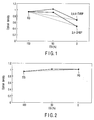
- FIG. 1 is a graph showing relationship between the concentration of ethyl gallate in the developer and the colored optical density with respect to the image forming materials of Examples 1 and 2.
- This figure shows a colored optical density predicted from additive property of concentrations of individual developers in each case by a broken line.
- FIG. 1 when two developers such as EG and 2,4,4'-THBP or EG and 2,4-DHBP are used, color developing effect remarkably exceeding the optical density predicted from additive property of concentrations of individual developers was obtained.
- Blue 203 manufactured by Yamada Kagaku Co., Ltd.
- EG ethyl gallate
- PG molecular weight: 212
- 3 parts by weight of polypropylene wax as a wax component 1 part by weight of LR-147 (available from Japan Carlit Co., Ltd.) as a charge control agent
- 90 parts by weight of polystyrene Mitsubishi Chemicals, Inc., XPA6638
- the developer As the developer, EG or PG was used alone, or EG and PG were used together in an equivalent molar mixture.
- the blending weight of the developer was set to 2 parts by weight (for mixture, the total blending weight was set to 2 parts by weight).
- These components were sufficiently kneaded and dispersed using a closed-type kneader and then ground and classified into fine powder having an average particle size of about 9.5 ⁇ m. Thereafter, hydrophobic silica was externally added at 1 wt% based on the total weight to prepare a decolorable blue toner for electrophotography.
- the colored optical density of the resultant toner powder was measured by using a colorimeter (CR300) manufactured by Minolta.
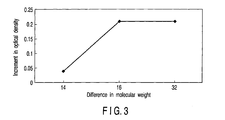
- FIG. 2 is a graph showing relationship between the concentration of ethyl gallate in the developer and the colored optical density with respect to the image forming material of Comparative Example. As seen from FIG. 2, even if two developers are used, a combination of EG and TG gives little effect of improving the optical density.
- FIG. 3 shows the relationship between the difference in molecular weight of the two developers and the increment in colored optical density (the difference between the actually measured value and the predicted value) with respect to the toner powder of Examples 1 and 2 and Comparative Example. It is seen from FIG. 3 that the difference in molecular weight of two developers should preferably be set to 15 or more.
Landscapes
- Physics & Mathematics (AREA)
- Chemical & Material Sciences (AREA)
- Chemical Kinetics & Catalysis (AREA)
- General Chemical & Material Sciences (AREA)
- Optics & Photonics (AREA)
- General Physics & Mathematics (AREA)
- Engineering & Computer Science (AREA)
- Mechanical Engineering (AREA)
- Developing Agents For Electrophotography (AREA)
- Heat Sensitive Colour Forming Recording (AREA)
Abstract
Description
Claims (8)
- A decolorable image forming material comprising a color former and a developer that develop a colored state through interaction therebetween and can be decolored by heating or contact with a solvent, characterized in that the developer comprises two or more compounds whose deference in molecular weight is 15 or more.
- The decolorable image forming material according to claim 1, characterized in that the two or more compounds are selected from a gallate-based developer and a benzophenone-based developer.
- The decolorable image forming material according to claim 2, characterized in that the gallate-based developer is ethyl gallate, and the benzophenone-based developer is 2,4-dihydroxybenzophenone or 2,4,4'-trihydroxybenzophenone.
- The decolorable image forming material according to any preceding claim, characterized by further comprising a binder resin.
- The decolorable image forming material according to claim 4, characterized in that the binder resin is a polystyrene-based resin.
- The decolorable image forming material according to any preceding claim, characterized by further comprising a charge control agent.
- The decolorable image forming material according to any preceding claim, characterized by further comprising a wax component.
- The decolorable image forming material according to any preceding claim, characterized in that the image forming material is printed on a paper medium in a form of a toner.
Applications Claiming Priority (2)
| Application Number | Priority Date | Filing Date | Title |
|---|---|---|---|
| JP2004012045A JP3954574B2 (en) | 2004-01-20 | 2004-01-20 | Decolorable image forming material |
| JP2004012045 | 2004-01-20 |
Publications (3)
| Publication Number | Publication Date |
|---|---|
| EP1557282A2 true EP1557282A2 (en) | 2005-07-27 |
| EP1557282A3 EP1557282A3 (en) | 2006-04-19 |
| EP1557282B1 EP1557282B1 (en) | 2009-03-18 |
Family
ID=34631883
Family Applications (1)
| Application Number | Title | Priority Date | Filing Date |
|---|---|---|---|
| EP05250122A Expired - Lifetime EP1557282B1 (en) | 2004-01-20 | 2005-01-12 | Decolorable image forming material |
Country Status (6)
| Country | Link |
|---|---|
| US (1) | US7208449B2 (en) |
| EP (1) | EP1557282B1 (en) |
| JP (1) | JP3954574B2 (en) |
| KR (1) | KR100753199B1 (en) |
| CN (1) | CN100461010C (en) |
| DE (1) | DE602005013315D1 (en) |
Cited By (1)
| Publication number | Priority date | Publication date | Assignee | Title |
|---|---|---|---|---|
| EP2256556A3 (en) * | 2009-05-27 | 2011-05-04 | Toshiba TEC Kabushiki Kaisha | Electrophotographic toner and process for producing electrophotographic toner |
Families Citing this family (18)
| Publication number | Priority date | Publication date | Assignee | Title |
|---|---|---|---|---|
| US20060023020A1 (en) * | 2002-11-29 | 2006-02-02 | 3M Innovative Properties Company | Head cleaning member for ink jet printer |
| JP3954574B2 (en) | 2004-01-20 | 2007-08-08 | 株式会社東芝 | Decolorable image forming material |
| JP4084346B2 (en) * | 2004-11-08 | 2008-04-30 | 株式会社東芝 | Erasable image forming material |
| JP4138792B2 (en) * | 2005-09-28 | 2008-08-27 | 株式会社東芝 | Erasable toner |
| JP4105718B2 (en) * | 2005-09-29 | 2008-06-25 | 株式会社東芝 | Decolorable image forming material |
| JP2008070780A (en) * | 2006-09-15 | 2008-03-27 | Toshiba Corp | Erasable image forming material and manufacturing method thereof |
| JP5389361B2 (en) * | 2008-02-15 | 2014-01-15 | 株式会社東芝 | Erasable ink |
| JP5139344B2 (en) * | 2009-02-16 | 2013-02-06 | 株式会社東芝 | Erasable toner |
| EP2325699B1 (en) * | 2009-11-23 | 2014-06-11 | Toshiba TEC Kabushiki Kaisha | Electrophotographic toner and method for producing the same |
| CN102236281B (en) | 2010-04-26 | 2014-12-03 | 株式会社东芝 | Image forming apparatus and image forming method |
| JP5723663B2 (en) * | 2011-04-20 | 2015-05-27 | 株式会社東芝 | Decolorizable color developing particles |
| US20120328977A1 (en) * | 2011-06-23 | 2012-12-27 | Toshiba Tec Kabushiki Kaisha | Toner and process for production thereof |
| US20130101305A1 (en) * | 2011-10-20 | 2013-04-25 | Toshiba Tec Kabushiki Kaisha | Image forming apparatus, image forming method, and fixing device |
| JP5568662B2 (en) | 2012-08-27 | 2014-08-06 | 株式会社東芝 | Image forming apparatus and image forming method |
| JP5453504B1 (en) | 2012-10-16 | 2014-03-26 | 株式会社東芝 | Image forming apparatus |
| JP6240113B2 (en) * | 2015-03-12 | 2017-11-29 | 株式会社東芝 | Image forming apparatus and erasing apparatus |
| US11321881B2 (en) | 2017-12-01 | 2022-05-03 | Sony Corporation | Image coloring apparatus, image coloring method, image learning apparatus, image learning method, computer program, and image coloring system |
| US11866603B2 (en) | 2019-01-03 | 2024-01-09 | Crayola Llc | Color-change and erasable writing compositions, writing instruments, and systems |
Family Cites Families (10)
| Publication number | Priority date | Publication date | Assignee | Title |
|---|---|---|---|---|
| US4028118A (en) * | 1972-05-30 | 1977-06-07 | Pilot Ink Co., Ltd. | Thermochromic materials |
| EP0138741B1 (en) * | 1983-09-05 | 1990-11-07 | Matsumoto Kosan Kabushiki Kaisha | Temperature-indicating sheet |
| US6017386A (en) * | 1996-07-25 | 2000-01-25 | Kabushiki Kaisha Toshiba | Decolorizable ink and printer |
| US5922115A (en) * | 1996-07-25 | 1999-07-13 | Kabushiki Kaisha Toshiba | Decolorizable ink and printer |
| US6203603B1 (en) * | 1998-08-04 | 2001-03-20 | Kabushiki Kaisha Toshiba | Erasable image forming material |
| JP3474780B2 (en) | 1998-08-04 | 2003-12-08 | 株式会社東芝 | Erasable image forming material |
| JP3505401B2 (en) * | 1998-09-16 | 2004-03-08 | 株式会社東芝 | Method for preparing erasable image forming material |
| JP2000284520A (en) * | 1999-03-31 | 2000-10-13 | Toshiba Corp | Erasable image forming material |
| JP4567859B2 (en) * | 2000-08-09 | 2010-10-20 | パイロットインキ株式会社 | Reversible thermochromic composition with improved light resistance and products using the same |
| JP3954574B2 (en) | 2004-01-20 | 2007-08-08 | 株式会社東芝 | Decolorable image forming material |
-
2004
- 2004-01-20 JP JP2004012045A patent/JP3954574B2/en not_active Expired - Fee Related
-
2005
- 2005-01-12 DE DE602005013315T patent/DE602005013315D1/en not_active Expired - Lifetime
- 2005-01-12 EP EP05250122A patent/EP1557282B1/en not_active Expired - Lifetime
- 2005-01-19 US US11/036,994 patent/US7208449B2/en not_active Expired - Fee Related
- 2005-01-19 KR KR1020050004997A patent/KR100753199B1/en not_active Expired - Fee Related
- 2005-01-20 CN CNB2005100677836A patent/CN100461010C/en not_active Expired - Fee Related
Cited By (3)
| Publication number | Priority date | Publication date | Assignee | Title |
|---|---|---|---|---|
| EP2256556A3 (en) * | 2009-05-27 | 2011-05-04 | Toshiba TEC Kabushiki Kaisha | Electrophotographic toner and process for producing electrophotographic toner |
| US8637217B2 (en) | 2009-05-27 | 2014-01-28 | Toshiba Tec Kabushiki Kaisha | Electrophotographic toner and process for producing electrophotographic toner |
| US8865388B2 (en) | 2009-05-27 | 2014-10-21 | Toshiba Tec Kabushiki Kaisha | Electrophotographic toner and process for producing electrophotographic toner |
Also Published As
| Publication number | Publication date |
|---|---|
| KR20050076669A (en) | 2005-07-26 |
| EP1557282B1 (en) | 2009-03-18 |
| CN100461010C (en) | 2009-02-11 |
| JP2005205625A (en) | 2005-08-04 |
| US20050159311A1 (en) | 2005-07-21 |
| JP3954574B2 (en) | 2007-08-08 |
| DE602005013315D1 (en) | 2009-04-30 |
| EP1557282A3 (en) | 2006-04-19 |
| CN1808292A (en) | 2006-07-26 |
| US7208449B2 (en) | 2007-04-24 |
| KR100753199B1 (en) | 2007-08-30 |
Similar Documents
| Publication | Publication Date | Title |
|---|---|---|
| EP1557282B1 (en) | Decolorable image forming material | |
| US7569515B2 (en) | Erasable image forming material | |
| JP4084346B2 (en) | Erasable image forming material | |
| JP2000089504A (en) | Erasable image forming material | |
| US8771912B2 (en) | Emulsion coloring materials for ink jet printers and methods of producing the same | |
| EP1582373A2 (en) | Decolorable image forming material | |
| JP3607682B2 (en) | Decolorable image forming material | |
| US7378373B2 (en) | Erasable image forming material | |
| JP2004137510A (en) | Erasable printing ink | |
| EP2530127B1 (en) | Erasable inkjet ink | |
| JP4146446B2 (en) | Erasable toner for electrophotography | |
| JP5723663B2 (en) | Decolorizable color developing particles | |
| JP4227114B2 (en) | Erasable toner | |
| JP4146447B2 (en) | Erasable toner for electrophotography | |
| JP2006282680A (en) | Image forming material | |
| JP2007093892A (en) | Erasable image forming material | |
| JP2009157270A (en) | Image forming material |
Legal Events
| Date | Code | Title | Description |
|---|---|---|---|
| PUAI | Public reference made under article 153(3) epc to a published international application that has entered the european phase |
Free format text: ORIGINAL CODE: 0009012 |
|
| 17P | Request for examination filed |
Effective date: 20050201 |
|
| AK | Designated contracting states |
Kind code of ref document: A2 Designated state(s): AT BE BG CH CY CZ DE DK EE ES FI FR GB GR HU IE IS IT LI LT LU MC NL PL PT RO SE SI SK TR |
|
| AX | Request for extension of the european patent |
Extension state: AL BA HR LV MK YU |
|
| PUAL | Search report despatched |
Free format text: ORIGINAL CODE: 0009013 |
|
| AK | Designated contracting states |
Kind code of ref document: A3 Designated state(s): AT BE BG CH CY CZ DE DK EE ES FI FR GB GR HU IE IS IT LI LT LU MC NL PL PT RO SE SI SK TR |
|
| AX | Request for extension of the european patent |
Extension state: AL BA HR LV MK YU |
|
| AKX | Designation fees paid |
Designated state(s): DE FR GB |
|
| 17Q | First examination report despatched |
Effective date: 20071106 |
|
| GRAP | Despatch of communication of intention to grant a patent |
Free format text: ORIGINAL CODE: EPIDOSNIGR1 |
|
| GRAS | Grant fee paid |
Free format text: ORIGINAL CODE: EPIDOSNIGR3 |
|
| GRAA | (expected) grant |
Free format text: ORIGINAL CODE: 0009210 |
|
| AK | Designated contracting states |
Kind code of ref document: B1 Designated state(s): DE FR GB |
|
| REG | Reference to a national code |
Ref country code: GB Ref legal event code: FG4D |
|
| REF | Corresponds to: |
Ref document number: 602005013315 Country of ref document: DE Date of ref document: 20090430 Kind code of ref document: P |
|
| PLBE | No opposition filed within time limit |
Free format text: ORIGINAL CODE: 0009261 |
|
| STAA | Information on the status of an ep patent application or granted ep patent |
Free format text: STATUS: NO OPPOSITION FILED WITHIN TIME LIMIT |
|
| 26N | No opposition filed |
Effective date: 20091221 |
|
| PGFP | Annual fee paid to national office [announced via postgrant information from national office to epo] |
Ref country code: GB Payment date: 20130109 Year of fee payment: 9 Ref country code: DE Payment date: 20130109 Year of fee payment: 9 Ref country code: FR Payment date: 20130204 Year of fee payment: 9 |
|
| REG | Reference to a national code |
Ref country code: DE Ref legal event code: R119 Ref document number: 602005013315 Country of ref document: DE |
|
| GBPC | Gb: european patent ceased through non-payment of renewal fee |
Effective date: 20140112 |
|
| PG25 | Lapsed in a contracting state [announced via postgrant information from national office to epo] |
Ref country code: DE Free format text: LAPSE BECAUSE OF NON-PAYMENT OF DUE FEES Effective date: 20140801 |
|
| REG | Reference to a national code |
Ref country code: FR Ref legal event code: ST Effective date: 20140930 |
|
| REG | Reference to a national code |
Ref country code: DE Ref legal event code: R119 Ref document number: 602005013315 Country of ref document: DE Effective date: 20140801 |
|
| PG25 | Lapsed in a contracting state [announced via postgrant information from national office to epo] |
Ref country code: FR Free format text: LAPSE BECAUSE OF NON-PAYMENT OF DUE FEES Effective date: 20140131 Ref country code: GB Free format text: LAPSE BECAUSE OF NON-PAYMENT OF DUE FEES Effective date: 20140112 |