EP1555281A1 - Process for the production of sulfoalkyl-containing polymers - Google Patents
Process for the production of sulfoalkyl-containing polymers Download PDFInfo
- Publication number
- EP1555281A1 EP1555281A1 EP03754093A EP03754093A EP1555281A1 EP 1555281 A1 EP1555281 A1 EP 1555281A1 EP 03754093 A EP03754093 A EP 03754093A EP 03754093 A EP03754093 A EP 03754093A EP 1555281 A1 EP1555281 A1 EP 1555281A1
- Authority
- EP
- European Patent Office
- Prior art keywords
- group
- sulfoalkyl
- production
- polymers
- represented
- Prior art date
- Legal status (The legal status is an assumption and is not a legal conclusion. Google has not performed a legal analysis and makes no representation as to the accuracy of the status listed.)
- Withdrawn
Links
- 0 CCC(C)(C)NCCC(C)(CC)N(C)* Chemical compound CCC(C)(C)NCCC(C)(CC)N(C)* 0.000 description 3
Classifications
-
- H—ELECTRICITY
- H01—ELECTRIC ELEMENTS
- H01B—CABLES; CONDUCTORS; INSULATORS; SELECTION OF MATERIALS FOR THEIR CONDUCTIVE, INSULATING OR DIELECTRIC PROPERTIES
- H01B1/00—Conductors or conductive bodies characterised by the conductive materials; Selection of materials as conductors
- H01B1/06—Conductors or conductive bodies characterised by the conductive materials; Selection of materials as conductors mainly consisting of other non-metallic substances
- H01B1/12—Conductors or conductive bodies characterised by the conductive materials; Selection of materials as conductors mainly consisting of other non-metallic substances organic substances
- H01B1/122—Ionic conductors
-
- B—PERFORMING OPERATIONS; TRANSPORTING
- B01—PHYSICAL OR CHEMICAL PROCESSES OR APPARATUS IN GENERAL
- B01D—SEPARATION
- B01D71/00—Semi-permeable membranes for separation processes or apparatus characterised by the material; Manufacturing processes specially adapted therefor
- B01D71/06—Organic material
- B01D71/66—Polymers having sulfur in the main chain, with or without nitrogen, oxygen or carbon only
- B01D71/68—Polysulfones; Polyethersulfones
-
- B—PERFORMING OPERATIONS; TRANSPORTING
- B01—PHYSICAL OR CHEMICAL PROCESSES OR APPARATUS IN GENERAL
- B01D—SEPARATION
- B01D71/00—Semi-permeable membranes for separation processes or apparatus characterised by the material; Manufacturing processes specially adapted therefor
- B01D71/06—Organic material
- B01D71/76—Macromolecular material not specifically provided for in a single one of groups B01D71/08 - B01D71/74
- B01D71/82—Macromolecular material not specifically provided for in a single one of groups B01D71/08 - B01D71/74 characterised by the presence of specified groups, e.g. introduced by chemical after-treatment
-
- B—PERFORMING OPERATIONS; TRANSPORTING
- B01—PHYSICAL OR CHEMICAL PROCESSES OR APPARATUS IN GENERAL
- B01J—CHEMICAL OR PHYSICAL PROCESSES, e.g. CATALYSIS OR COLLOID CHEMISTRY; THEIR RELEVANT APPARATUS
- B01J39/00—Cation exchange; Use of material as cation exchangers; Treatment of material for improving the cation exchange properties
- B01J39/08—Use of material as cation exchangers; Treatment of material for improving the cation exchange properties
- B01J39/16—Organic material
- B01J39/18—Macromolecular compounds
- B01J39/19—Macromolecular compounds obtained otherwise than by reactions only involving unsaturated carbon-to-carbon bonds
-
- C—CHEMISTRY; METALLURGY
- C08—ORGANIC MACROMOLECULAR COMPOUNDS; THEIR PREPARATION OR CHEMICAL WORKING-UP; COMPOSITIONS BASED THEREON
- C08G—MACROMOLECULAR COMPOUNDS OBTAINED OTHERWISE THAN BY REACTIONS ONLY INVOLVING UNSATURATED CARBON-TO-CARBON BONDS
- C08G75/00—Macromolecular compounds obtained by reactions forming a linkage containing sulfur with or without nitrogen, oxygen, or carbon in the main chain of the macromolecule
- C08G75/20—Polysulfones
-
- C—CHEMISTRY; METALLURGY
- C08—ORGANIC MACROMOLECULAR COMPOUNDS; THEIR PREPARATION OR CHEMICAL WORKING-UP; COMPOSITIONS BASED THEREON
- C08G—MACROMOLECULAR COMPOUNDS OBTAINED OTHERWISE THAN BY REACTIONS ONLY INVOLVING UNSATURATED CARBON-TO-CARBON BONDS
- C08G75/00—Macromolecular compounds obtained by reactions forming a linkage containing sulfur with or without nitrogen, oxygen, or carbon in the main chain of the macromolecule
- C08G75/20—Polysulfones
- C08G75/23—Polyethersulfones
Definitions
- the present invention relates to a process for the production of sulfoalkyl-containing polymers useful as ion-exchange resins comprising sulfoalkyl groups as ion-exchanging groups.
- Ion-exchange resins comprising ion-exchange groups in the polymers are useful as functional polymers such as membranes for separation or purification, particularly ion-exchange resins comprising sulfonic groups have been widely adopted because of the excellent properties due to their high proton dissociation rate. Particularly in recent years, many attempts have been made to utilize them for solid polymer electrolytes ion-conductors such as permeable membranes for water electrolyzers and fuel cells.
- the sulfonated resins wherein aromatic rings in the polymers are sulfonated by sulfonating agents such as sulfuric acid or chlorosulfuric acid have been readily used as resins having sulfonic groups in their polymers.
- sulfonated polyether ketone Japanese Unexamined Patent Publication No.H06-93114/1994
- sulfonated polysulfone Japanese Unexamined Patent Publication No.H09-245818/1997)
- sulfonated polyethersulfone Japanese Unexamined Patent Publication Nos. H09-245818/1997 and H11-116679/1999
- the like havebeenreported.
- sulfonated aromatic rings are not stable enough under acidic condition at a high temperature. This may be recognized as caused by a desulfonation reaction resulting from reversible reaction in the sulfonation reaction of aromatic rings.
- the ion-exchange membranes, where aromatic rings are directly sulfonated, are inferior in durability, thereby have a problem in a long term storage stability in use for the electrolytes.
- the method using sultone is not practical because little or none of the targeting sufoalkylated compounds are obtainable due to the low reactivity of sultone.
- the reaction should originally be conducted in an aqueous medium, however, most of the halogenoalkylated polymers being unsoluble in water, halogenoalkyl groups are not reactive at all or only partially reactive, so that the polymers were sulfonated only in the surface thereof, it was difficult to obtain the polymers having a sulfoalkyl side chain and exhibiting satisfactory ion-exchange performance. Because of the above, it was difficult to introduce sulfonic groups into the polymer matrix.
- the ion-exchange resins having sulfoalkyl groups as ion-exchange groups are yielded at a very low rate by the method introducing sulfoalkyl groups directly into polymers of base materials.
- the method of introducing an alkyl group having a leaving group into polymers and then converting the said leaving group into a sulfonic group has such a problem that the leaving group, particularly the leaving group in the polymer matrix cannot be converted into a sulfonic group at a satisfactory rate.
- the object of the present invention is to produce sulfoalkyl-containing polymers having high ion-exchange capacity with a high yield and at a low cost, from the polymers wherein alkyl groups comprising leaving groups are introduced, by quantitatively converting said leaving groups (including all leaving groups located on the surface or inside of the polymer matrix) into sulfonic groups.
- the present inventors made a diligent study and consequently completed the invention by finding out the method of converting the leaving group on the side chain of the polymers into an acylthio group and further converting it into a sulfonic group.
- the present invention relates to:
- the polymer, a base material of the sulfoalkyl-containing polymer of the present invention can be any as far as it is introducible the side chain (I) having a leaving group X.
- polymers with high durability such as engineering plastics and crosslinkable polymers are preferable. Examples of those include the commercially available polyethersulfone, polysulfone, polyetherketone, polyetheretherketone, polyphenyleneoxide, polyimide, polyimidazole, polyoxazole, polystyrene-divinylbenzene copolymer, and quasi thereof.
- the preferable base material is an aromatic hydrocarbon polymer which has a structural unit typically comprising an aromatic ring, preferably a benzene ring .
- a polysulfone compound is disclosed, for example, in Japanese Unexamined Patent Publication No. H11-116679/1999.
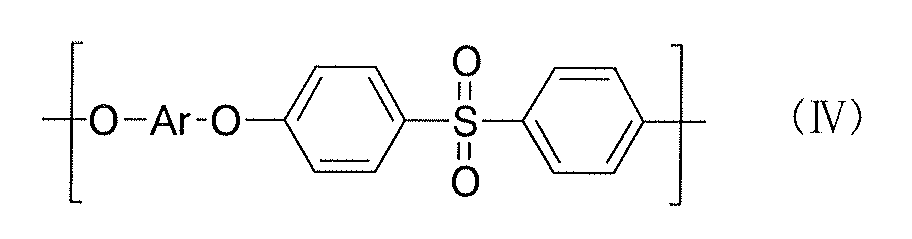
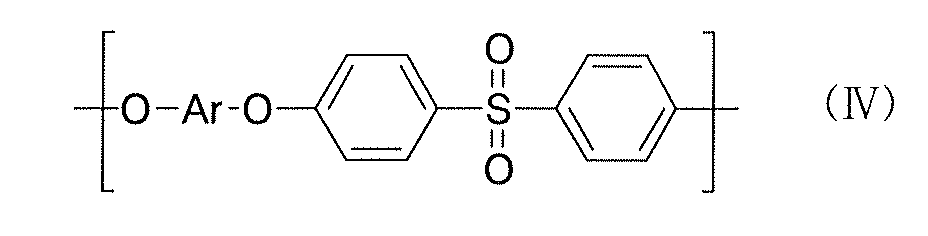
- the preferable polysulfones in the present invention include a polysulfones represented by the above formula (IV). More preferable polysulfones represented by the formula (IV) are those of which Ar is a phenylene or a biphenilene group. Additionally, the above described side chain (I) is generally substituted on a benzene ring of those polymers.
- the polymer (occasionally referred to as "a base material" hereinafter) into which introduced the side chain having a leaving group X is known or can be obtained by the polymer reaction in accordance with the known method or quasi thereof, where a side chain having a leaving group is introduced to the base material.
- the compound wherein the said side chain is introduced to the stylene-divinylbenzene thereof is disclosed, for example, in Macromol. Chem., Rapid Commun. , 1, 1980, 297-302 or Macromol. Chem. 184, 1585-1596(1983).
- the polymer wherein the side chain is introduced into the polysulfone is disclosed, for example, in Japanese Unexamined Patent Publication No. 2002-110174.
- the polymer wherein the side chain is introduced can be obtained essentially according to the methods disclosed therein by introducing the side chain into polymers other than disclosed in the above. More particularly, the methods include: (a) firstly lithiating the base material with alithiation agent such as n-butyl lithium tetramethylenediamine, then introducing the side chain using alkylation agent having a leaving group such as dihalide according essentially to the method disclosed in J. Org.
- alithiation agent such as n-butyl lithium tetramethylenediamine
- halogenomethylation of an aromatic ring can be carried out according to any known reactions without any particular limitation.
- chloromethylation can be carried out using the chloromethoxy substituted lower (C 1 -C 8 )alkane (wherein substituents other than chloromethoxy can be used that do not inhibit chloromethylation) including chloromethylether, 1,4-bis(chloromethoxy)butane and 1-chloromethoxy-4-chlorobutane as chloromethylation agents, and Lewis acids including tin chloride, zinc chloride, aluminum chloride and titanium chloride, or a hydrofluoric acid as catalysts.
- the solvents are not particularly limited as far as they are inert, examples of those include chlorosubstituted aliphatic or aromatic hydrocarbon solvents such as dichloroethane, trichloroethane, tetrachloroethane, chlorobenzene, dichlorobenzene and nitrobenzene, or other inert aromatic hydrocarbon solvents.
- the chloromethylation is preferably carried out in homogeneous system.
- halogenomethylation can be carried out by using paraformaldehyde with hydrogen chloride or hydrogen bromide.
- the reaction temperature is not particularly limited as far as hologenomethylation can be carried out, however typically is about 0 to 100°C, preferably is about 20 to 90°C.
- the introduction rate of said side chain into said polymer can suitably be selected.
- the polymer having the introduction rate of 20 to 60% can be obtained.
- the introduction rate of 10% indicates that one of the said side chain is introduced per ten structural units.
- the introduction rate of 100% indicates one of said side chain is introduced per one structural unit.
- Other numeric values showing introduction rates also indicate the same as the above.
- the occurrence of substitution with said side chain is one to two per one aromatic ring, preferably one.
- the conversion of a leaving group into a sulfoalkyl group can be carried out 100% quantitatively, so that the introduction rate of sulfoalkyl group into polymers is almost the same as the introduction rate of the side chain having a leaving group X into polymers used as materials.
- the leaving group X is not particularly limited as far as it is reactive with acylthiolation agent, preferably with acetylthiolation agent.
- Examples of leaving group X include halogen atoms such as C1, Br and I, or the substituents represented by the above formula (II).
- R 1 in the formula (II) includes an alkyl group having 1 to 6 carbon atoms such as a methyl group, an ethyl group, a propyl group and a hexyl group, a perfluoro(C 1 -C 3 )alkyl group such as a trifluoromethyl group, or an aryl group such as a phenyl group optionally substituted with a(C 1 -C 3 )alkyl group or a halogen atom or a naphtyl group.
- Examples of the leaving group represented by the formula (II) include a paratoluensulfonyloxy group, a methanesulfonyloxy group, a trifluoromethanesulfonyloxy group, and the like.
- the preferable leaving groups of the invention are halogen atoms, particularly is Cl.
- the preferable side chain connecting a leaving group X and a polymer base material is a polymethylene group having 1 to 6 carbon atoms such as a methylene group, a dimethylene group, a trimethylene group, a hexamethylene group, a pentamethylene group and a hexamethylene group, preferably is a polymethylene group having about 1 to 3 carbon atoms, most preferably is a methylene group.
- the preferable side chain having a leaving group X is a hologenomethyl group, more preferably is a chloromethyl group.
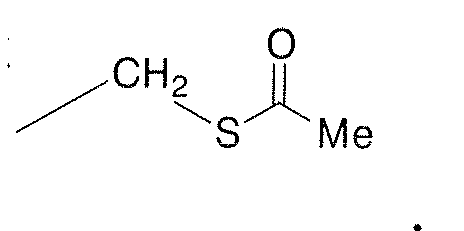
- the process for the production of sulfoalkyl-containing polymers of the present invention is characterized by substituting the leaving group in the polymers comprising the side chain having a leaving group, with an acylthio group, followed by converting it into a sulfonic group by oxidation and thereby introducing a sulfoalkyl group into a polymer.
- the leaving groups on said side chain having been substituted into polymer matrix can be quantitatively converted into sulfonic groups by passing through acylthio compound as intermediates on the surface and inside of said matrix.
- an acyl group includes an aliphatic or aromatic carbonyl group having 1 to 10 carbon atoms
- the examples of an aliphatic carbonyl group include an acethyl group, a propionyl group or a butanoyl group
- an aromatic carbonyl group include an optionally substituted (e.g. C 1 -C 3 alkyl or halogen substituted) aromatic carbonyl group having 6 to 10 carbon atoms such as a benzoyl group, a methyl substituted benzoyl group.
- Acylthiolation of a leaving group X can be carried out quantitatively by reacting said leaving group X with acylthiolation agents including, for example, a thio acid having the above described acyl groups, particularly including a thiocarboxylic acid such as a thioacetic acid, a thiopropanoic acid, a thiobutanoic acid, a thiobenzoic acid and thiotoluic acid, preferably a thiocarboxylic acid having 1 to 10 carbon atoms or the salt thereof, preferably the salt of alkali metal such as sodium salt or potassium salt.
- the amount of the acylthiolation agent to be used can be enough with the equivalent to the leaving group X or a little more.
- the acylthiolation temperature of a leaving group X can be suitably selected in a range about 0 - 100°C, generally is about 10-90°C. It can be a room temperature depending on the acylthiolation agents or polymers to use, or can be heated up to about 80°C to promote complete reaction depending on the cases.
- the aprotic polar solvent such as N-methylpyrolidone, N,N-dimethylformamide, N,N-dimethylacetoamide can be used extensively.
- an oxidant such as hydrogen peroxide aqueous solution and peracetic acid can be used extensively.
- the amount to use the oxidant is enough with the equivalent to acylthio groups or a little more. It can be used in an amount 5 or more up to about 10 equivalents to acylthio groups depending on the cases.
- the reaction temperature for the oxidation of an acylthio group generally is about 20-90°C, preferably 40-80°C, preferably kept at the same temperature during the reaction.
- a solvent for oxidation reaction of an acylthio group a solvent which is generally used for oxidation reaction such as acetic acid or dichloromethane can be used extensively.
- the equivalent weight of ion exchange (EW) of the obtained sulfoalkyl-containing polymers can be controlled by adjusting the amount of the leaving group in the precursors. Consequently, the sulfoalkyl-containing polymers having an optional ion exchange equivalent can be synthesized by suitably selecting the contents of the side chain having a leaving group in a polymer used as a base material.
- additives generally used for producing the polymer such as plasticizer, stabilizer and parting agent can be used within a range not departing from the spirit or scope of the invention.
- the obtained chloromethylated polyphenylene ethersulfone was then placed in 1000ml 4-neck round bottom flask equipped with a reflux condenser having a desiccant tube containing calcium chloride, a stirrer and a thermometer, and was added 600ml of N-methylpyrolidone(NMP). To the mixture, were added 9g of potassium thioacetate and 50ml of NMP solution, and the mixture was heated and stirred at 80°C for 3 hours. The solution was then poured into 1 litter of water to precipitate the polymers. The deposited precipitate was then pulverized with a mixer, washed with water, heated to dry to give 31g of acetylthiolated polyphenylene ethersulfone.
- 17g of the obtained acetylthiolated polysulfone was then placed in 500ml 4-neck round bottom flask equipped with a reflux condenser having a desiccant tube containing calcium chloride, a stirrer and a thermometer, and further was added 200ml of acetic acid. 50ml of hydrogen peroxide solution was added, and the mixture was heated and stirred at 65°C for 4 hours. The reaction solution was then poured into 1 litter of aqueous solution of 6N sodium hydroxide with cooling and stirring for a while. The polymers were filtrated and washed with water until the alkali was removed. The polymers were then added to 300ml of 1N HCl and stirred for a while.
- Example 2 20g of chloromethylated polyethersulfone synthesized in Example 2 was placed in 1000ml 4-neck round bottom flask equipped with a reflux condenser having a desiccant tube containing calcium chloride, a stirrer and a thermometer, and was added 500 ml of water. To the solution, 25g of sodium bisulfite was added and the mixture was refluxed for 24 hours. The polymers were then filtrated, and washed with 1N HC1 and water, followed by heated to dry to give 19g of sulfomethylated polyethersulfone.
- Example 3 0.5g of chloromethylated polysulfone synthesized in Example 3 was placed in 100ml 4-neck round bottom flask equipped with a reflux condenser having a desiccant tube containing calcium chloride, a stirrer and a thermometer, and was added 40 ml of water. To the solution, 15g of sodium sulfite was added. The mixture was heated and refluxed at 80°C for 8 hours. The polymers were then filtrated, and washed with 1N HCl and water, followed by heated to dry to give 0.5g of sulfomethylated polysulfone.
- Example 3 1 g of chloromethylated polysulfone synthesized in Example 3 was placed in 100 ml 4-neck round bottom flask equipped with a reflux condenser, having a desiccant tube containing calcium chloride, a stirrer and a thermometer, and was dissolved by adding 20 ml of chloroform. To the solution, 0.7g of sodium sulfate dissolved in 20 ml of water and 50mg of tetrabutylammoniumbromide were added, and the mixture having two phases was heated and stirred at 70°C for 3 hours. The polymers were then filtrated and washed with 1N HCl and water, followed by heated to dry to give 0.5g of sulfomethylated polysulfone. It was confirmed by NMR that the chloromethyl group had scarcely been reacted. Furthermore, the ion-exchange performance was also scarcely detected.
- the leaving group on the side chain comprised in the polymer can be converted into a sulfonic group nearly quantitatively, more particularly the leaving groups not only on the surface but inside the polymer matrix can be converted into a sulfonic groups, whereby an ion-exchange resin comprising a sulfoalkyl group as an ion-exchange group, exhibiting high ion-exchange performance can be produced at a low cost.
Landscapes
- Chemical & Material Sciences (AREA)
- Chemical Kinetics & Catalysis (AREA)
- Organic Chemistry (AREA)
- Health & Medical Sciences (AREA)
- Medicinal Chemistry (AREA)
- Polymers & Plastics (AREA)
- Physics & Mathematics (AREA)
- Spectroscopy & Molecular Physics (AREA)
- Polymers With Sulfur, Phosphorus Or Metals In The Main Chain (AREA)
- Addition Polymer Or Copolymer, Post-Treatments, Or Chemical Modifications (AREA)
- Organic Low-Molecular-Weight Compounds And Preparation Thereof (AREA)
- Manufacture Of Macromolecular Shaped Articles (AREA)
Abstract
Description









Claims (7)
- A process for the production of sulfoalkyl-containing polymers characterized by subjecting a polymer having a side chain containing a leaving group X represented by the structural formula (I):[wherein X is a leaving group, and n is an integer of 0 to 6] to substitution of X with an acylthio group, and then oxidizing the acylthio group into a sulfonic group.

- The process for the production according to Claim 1, wherein n in said side chain (I) is 0,
- The process for the production of sulfoalkyl-containing polymers according to Claim 1 or 2, wherein a leaving group X is Cl, Br, I or a substituent represented by the following formula (II):[wherein R1 is an alkyl group having 1 to 6 carbon atoms, a perfluoro(C1-C3)alkyl group or an aryl group],

- The process for the production of sulfoalkyl-containing polymers according to any of Claims 1 to 3, wherein an acylthio group represented by the following formula (III):[wherein R2 is an alkyl group having 1 to 6 carbon atoms or an aryl group],

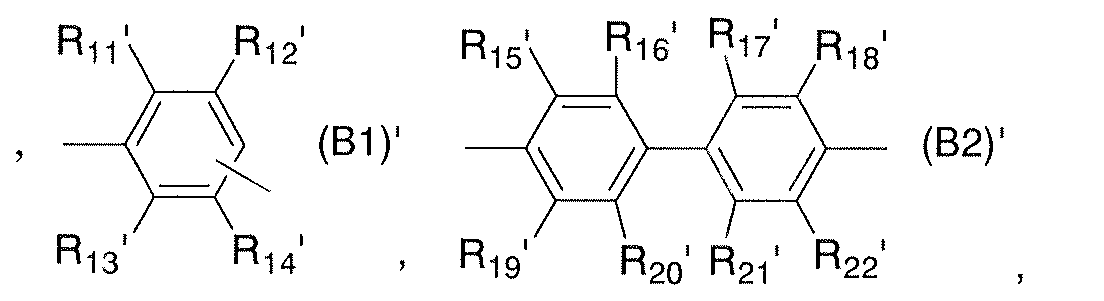
- The process for the production of sulfoalkyl-containing polymers according to any one of Claims 1 to 4 , wherein the backbone structure of the polymer having a side chain (I) is a polysulfone structure represented by the following formula (IV):wherein Ar is


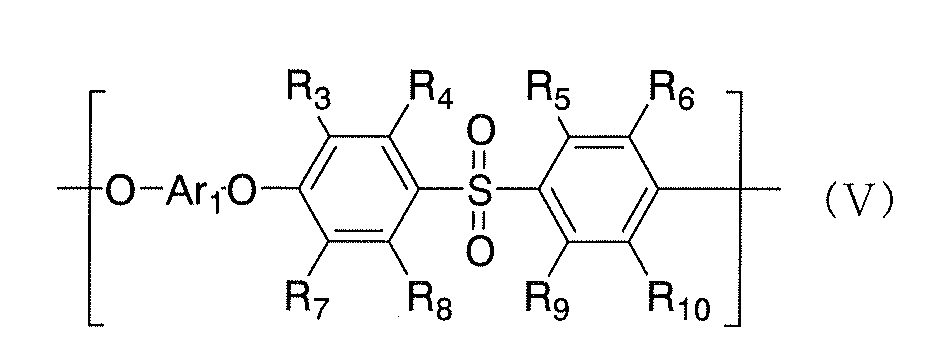
- A process for the production of sulfomethylated polysulfone, represented by the following formula (V):[wherein Ar1 is

 R3 - R38 independently is a hydrogen atom or a sulfomethyl group], characterized by subjecting an aromatic ring of a polysulfone polymers represented by the following formula (IV):
 [wherein Ar is
 to (a) chloromethylation, (b) then subjecting the formed chlorine to acetylthiolation, followed by further oxidation to be converted into a sulfonic group.
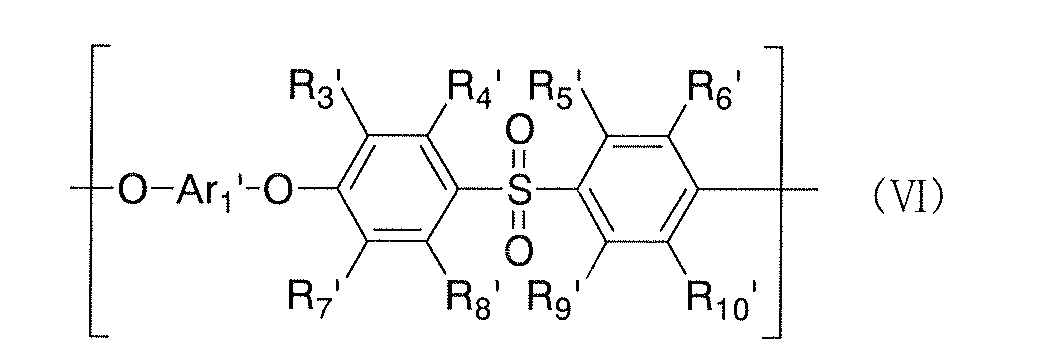
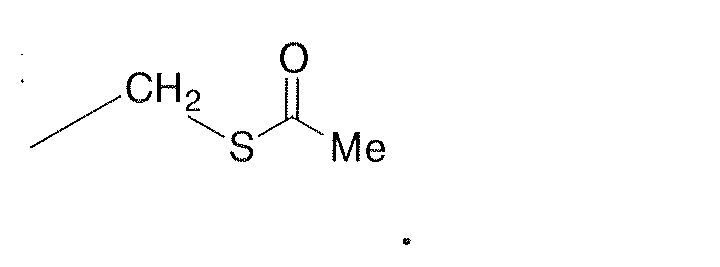
- An acetylthiomethyl-containing polysulfone, represented by the following formula (VI):wherein Ar1' is
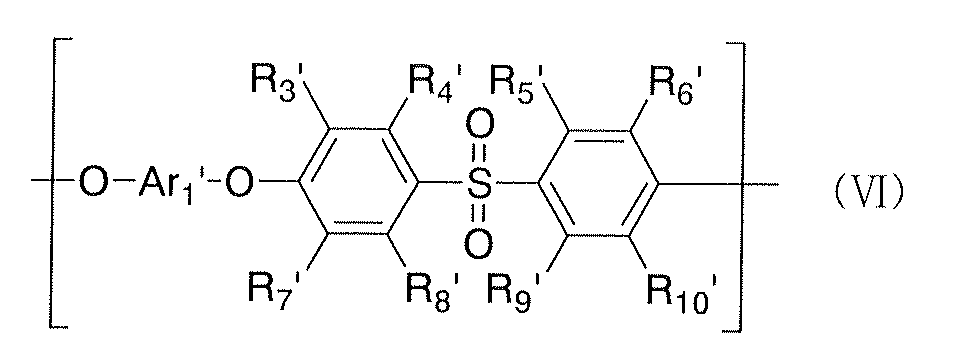
 R3' to R38' independently is a hydrogen atom, or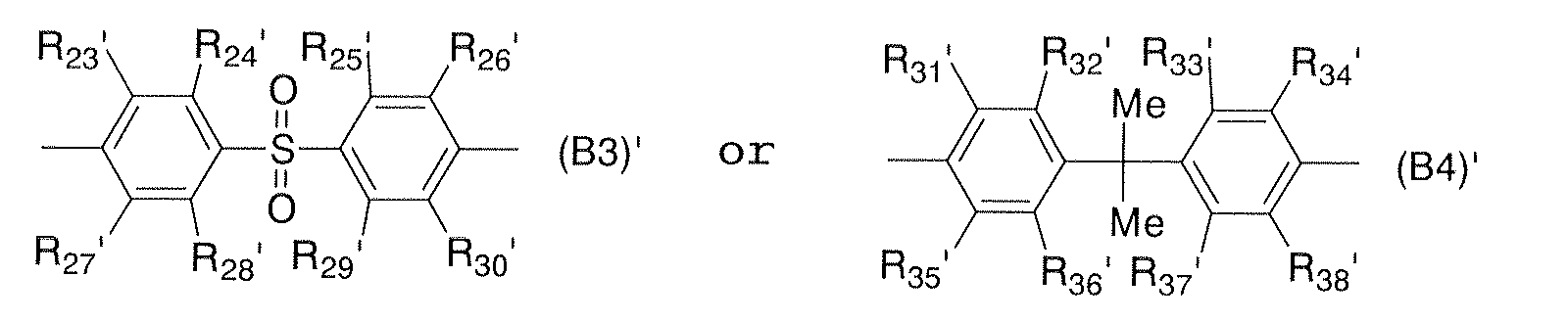
Applications Claiming Priority (3)
| Application Number | Priority Date | Filing Date | Title |
|---|---|---|---|
| JP2002301076 | 2002-10-15 | ||
| JP2002301076 | 2002-10-15 | ||
| PCT/JP2003/013085 WO2004035660A1 (en) | 2002-10-15 | 2003-10-10 | Process for the production of sulfoalkyl-containing polymers |
Publications (2)
| Publication Number | Publication Date |
|---|---|
| EP1555281A1 true EP1555281A1 (en) | 2005-07-20 |
| EP1555281A4 EP1555281A4 (en) | 2007-03-07 |
Family
ID=32105008
Family Applications (1)
| Application Number | Title | Priority Date | Filing Date |
|---|---|---|---|
| EP03754093A Withdrawn EP1555281A4 (en) | 2002-10-15 | 2003-10-10 | PROCESS FOR THE PRODUCTION OF POLYMERS CONTAINING SULFOALKYL |
Country Status (9)
| Country | Link |
|---|---|
| US (1) | US20050288482A1 (en) |
| EP (1) | EP1555281A4 (en) |
| JP (1) | JP4681298B2 (en) |
| KR (1) | KR20050071570A (en) |
| CN (1) | CN1311002C (en) |
| AU (1) | AU2003272982A1 (en) |
| CA (1) | CA2502551A1 (en) |
| TW (1) | TWI241313B (en) |
| WO (1) | WO2004035660A1 (en) |
Cited By (1)
| Publication number | Priority date | Publication date | Assignee | Title |
|---|---|---|---|---|
| EP1555281A4 (en) * | 2002-10-15 | 2007-03-07 | Nippon Kayaku Kk | PROCESS FOR THE PRODUCTION OF POLYMERS CONTAINING SULFOALKYL |
Families Citing this family (4)
| Publication number | Priority date | Publication date | Assignee | Title |
|---|---|---|---|---|
| US9070850B2 (en) | 2007-10-31 | 2015-06-30 | Cree, Inc. | Light emitting diode package and method for fabricating same |
| JP4757274B2 (en) * | 2007-04-23 | 2011-08-24 | 日本化薬株式会社 | Polyethersulfone-based polymer electrolyte, solid polymer electrolyte membrane, fuel cell, and production method thereof |
| US20150080537A1 (en) * | 2013-09-13 | 2015-03-19 | Samsung Sdi Co., Ltd. | Method for Preparing Polyethersulfone |
| KR20230086523A (en) * | 2021-12-08 | 2023-06-15 | 한국화학연구원 | Polycarbazole-based cation-exchange ion conductor and preparation method thereof |
Family Cites Families (6)
| Publication number | Priority date | Publication date | Assignee | Title |
|---|---|---|---|---|
| US2216751A (en) * | 1935-05-14 | 1940-10-08 | Standard Oil Dev Co | Heavy metal salts of thioether carboxylic acids |
| US2454108A (en) * | 1944-02-16 | 1948-11-16 | Du Pont | Preparing organic sulfides |
| US2892852A (en) * | 1957-05-28 | 1959-06-30 | Nathan H Koenig | Alkylthio-, (acetylthio)-and (arylthio)-undecanoic acids |
| WO1998004598A1 (en) * | 1996-07-31 | 1998-02-05 | Mitsubishi Chemical Corporation | Cation exchangers or chelating agents and process for the preparation thereof |
| JP3607862B2 (en) * | 2000-09-29 | 2005-01-05 | 株式会社日立製作所 | Fuel cell |
| US20050288482A1 (en) * | 2002-10-15 | 2005-12-29 | Masahiro Hamada | Process for the production of sulfoalkyl-containing polymers |
-
2003
- 2003-10-10 US US10/530,981 patent/US20050288482A1/en not_active Abandoned
- 2003-10-10 CN CNB2003801013795A patent/CN1311002C/en not_active Expired - Fee Related
- 2003-10-10 WO PCT/JP2003/013085 patent/WO2004035660A1/en not_active Ceased
- 2003-10-10 AU AU2003272982A patent/AU2003272982A1/en not_active Abandoned
- 2003-10-10 JP JP2004544932A patent/JP4681298B2/en not_active Expired - Fee Related
- 2003-10-10 KR KR1020057006337A patent/KR20050071570A/en not_active Ceased
- 2003-10-10 EP EP03754093A patent/EP1555281A4/en not_active Withdrawn
- 2003-10-10 CA CA002502551A patent/CA2502551A1/en not_active Abandoned
- 2003-10-13 TW TW092128252A patent/TWI241313B/en not_active IP Right Cessation
Cited By (1)
| Publication number | Priority date | Publication date | Assignee | Title |
|---|---|---|---|---|
| EP1555281A4 (en) * | 2002-10-15 | 2007-03-07 | Nippon Kayaku Kk | PROCESS FOR THE PRODUCTION OF POLYMERS CONTAINING SULFOALKYL |
Also Published As
| Publication number | Publication date |
|---|---|
| AU2003272982A8 (en) | 2004-05-04 |
| TWI241313B (en) | 2005-10-11 |
| EP1555281A4 (en) | 2007-03-07 |
| JP4681298B2 (en) | 2011-05-11 |
| CN1311002C (en) | 2007-04-18 |
| KR20050071570A (en) | 2005-07-07 |
| US20050288482A1 (en) | 2005-12-29 |
| CN1705704A (en) | 2005-12-07 |
| WO2004035660A1 (en) | 2004-04-29 |
| TW200420620A (en) | 2004-10-16 |
| CA2502551A1 (en) | 2004-04-29 |
| AU2003272982A1 (en) | 2004-05-04 |
| JPWO2004035660A1 (en) | 2006-02-16 |
Similar Documents
| Publication | Publication Date | Title |
|---|---|---|
| US7868124B2 (en) | Polyphenylene-type polymers, preparation method thereof, membranes and fuel cell device comprising said membranes | |
| US7226987B2 (en) | Aromatic polymer phosphonic acid derivative and process for production the same | |
| US8334358B2 (en) | Sulfonated poly(arylene ether) copolymers and related polymer electrolyte membranes and fuel cells | |
| US4598137A (en) | Polyarylene polyethersulfone ionomers | |
| JP2004131662A (en) | Sulfoalkylated polysulfone ion exchange resin and ion exchange membrane containing the same | |
| EP2084210A1 (en) | Sulfonated poly(arylene ether) containing crosslinkable moity at end group, method of manufacturing the same, and polymer electrolyte membrane using the sulfonated poly(arylene ether) and the method | |
| CN1922241B (en) | Polymer electrolyte and use of the same | |
| US20050288482A1 (en) | Process for the production of sulfoalkyl-containing polymers | |
| US5239043A (en) | Process for preparation of poly(aryl ether) polymers by macro bicyclic catalysts | |
| KR101105533B1 (en) | Sulfonated monomers and use thereof | |
| JP4993910B2 (en) | Fuel cell electrolyte and method for producing the same | |
| EP4486822B1 (en) | Process for the preparation of a membrane (m) containing a sulfonated polyarylenesulfone polymer (sp) | |
| JP4895570B2 (en) | Polymer electrolyte | |
| JP2007329120A (en) | Aromatic hydrocarbon based ion-conductive polymer electrolyte, electrolyte membrane, and its manufacturing method | |
| EP4486819A1 (en) | Process for the preparation of a sulfonated polyarylenesulfone polymer (sp) | |
| JP4916144B2 (en) | Aromatic sulfide and / or sulfone derivatives | |
| EP4486820A1 (en) | Sulfonated polyarylenesulfone polymer (sp) having an at least bimodal molecular weight distribution | |
| JP3758588B2 (en) | Method for recovering sulfonic acid group-containing polymer | |
| US20050142412A1 (en) | Proton conducting electrolyte and fuel cell using the same | |
| JP2003261653A (en) | Method for producing sulfonic acid group-containing polymer |
Legal Events
| Date | Code | Title | Description |
|---|---|---|---|
| PUAI | Public reference made under article 153(3) epc to a published international application that has entered the european phase |
Free format text: ORIGINAL CODE: 0009012 |
|
| 17P | Request for examination filed |
Effective date: 20050413 |
|
| AK | Designated contracting states |
Kind code of ref document: A1 Designated state(s): AT BE BG CH CY CZ DE DK EE ES FI FR GB GR HU IE IT LI LU MC NL PT RO SE SI SK TR |
|
| AX | Request for extension of the european patent |
Extension state: AL LT LV MK |
|
| DAX | Request for extension of the european patent (deleted) | ||
| RBV | Designated contracting states (corrected) |
Designated state(s): CH DE FR GB LI |
|
| A4 | Supplementary search report drawn up and despatched |
Effective date: 20070202 |
|
| RIC1 | Information provided on ipc code assigned before grant |
Ipc: H01B 1/12 20060101ALI20070129BHEP Ipc: B01J 39/18 20060101ALI20070129BHEP Ipc: C08G 75/23 20060101AFI20040504BHEP |
|
| RIN1 | Information on inventor provided before grant (corrected) |
Inventor name: KOBAYASHI, HISABUMI Inventor name: YAMASAKI, TAKEMICHI Inventor name: KAWAKAMI, SHOGO Inventor name: IWABUCHI, JUN Inventor name: HOTTA, HIROKI Inventor name: HAMADA, MASAHIRO |
|
| 17Q | First examination report despatched |
Effective date: 20070809 |
|
| RAP1 | Party data changed (applicant data changed or rights of an application transferred) |
Owner name: NIPPON KAYAKU KABUSHIKI KAISHA |
|
| GRAP | Despatch of communication of intention to grant a patent |
Free format text: ORIGINAL CODE: EPIDOSNIGR1 |
|
| STAA | Information on the status of an ep patent application or granted ep patent |
Free format text: STATUS: THE APPLICATION IS DEEMED TO BE WITHDRAWN |
|
| 18D | Application deemed to be withdrawn |
Effective date: 20090501 |