EP1555175A1 - Protection of automobiles against theft with the use of the hand brake or the brake - Google Patents
Protection of automobiles against theft with the use of the hand brake or the brake Download PDFInfo
- Publication number
- EP1555175A1 EP1555175A1 EP04386034A EP04386034A EP1555175A1 EP 1555175 A1 EP1555175 A1 EP 1555175A1 EP 04386034 A EP04386034 A EP 04386034A EP 04386034 A EP04386034 A EP 04386034A EP 1555175 A1 EP1555175 A1 EP 1555175A1
- Authority
- EP
- European Patent Office
- Prior art keywords
- engine
- vehicle
- handbrake
- switch
- brake
- Prior art date
- Legal status (The legal status is an assumption and is not a legal conclusion. Google has not performed a legal analysis and makes no representation as to the accuracy of the status listed.)
- Granted
Links
- 230000004913 activation Effects 0.000 claims description 2
- 238000005242 forging Methods 0.000 claims 1
- 230000000994 depressogenic effect Effects 0.000 abstract 1
- 238000004458 analytical method Methods 0.000 description 2
- 230000003213 activating effect Effects 0.000 description 1
- 230000005611 electricity Effects 0.000 description 1
- 230000003100 immobilizing effect Effects 0.000 description 1
- 238000000034 method Methods 0.000 description 1
- 230000008520 organization Effects 0.000 description 1
Images
Classifications
-
- B—PERFORMING OPERATIONS; TRANSPORTING
- B60—VEHICLES IN GENERAL
- B60R—VEHICLES, VEHICLE FITTINGS, OR VEHICLE PARTS, NOT OTHERWISE PROVIDED FOR
- B60R25/00—Fittings or systems for preventing or indicating unauthorised use or theft of vehicles
- B60R25/01—Fittings or systems for preventing or indicating unauthorised use or theft of vehicles operating on vehicle systems or fittings, e.g. on doors, seats or windscreens
- B60R25/04—Fittings or systems for preventing or indicating unauthorised use or theft of vehicles operating on vehicle systems or fittings, e.g. on doors, seats or windscreens operating on the propulsion system, e.g. engine or drive motor
- B60R25/042—Fittings or systems for preventing or indicating unauthorised use or theft of vehicles operating on vehicle systems or fittings, e.g. on doors, seats or windscreens operating on the propulsion system, e.g. engine or drive motor operating on the fuel supply
-
- B—PERFORMING OPERATIONS; TRANSPORTING
- B60—VEHICLES IN GENERAL
- B60R—VEHICLES, VEHICLE FITTINGS, OR VEHICLE PARTS, NOT OTHERWISE PROVIDED FOR
- B60R25/00—Fittings or systems for preventing or indicating unauthorised use or theft of vehicles
- B60R25/01—Fittings or systems for preventing or indicating unauthorised use or theft of vehicles operating on vehicle systems or fittings, e.g. on doors, seats or windscreens
- B60R25/04—Fittings or systems for preventing or indicating unauthorised use or theft of vehicles operating on vehicle systems or fittings, e.g. on doors, seats or windscreens operating on the propulsion system, e.g. engine or drive motor
-
- B—PERFORMING OPERATIONS; TRANSPORTING
- B60—VEHICLES IN GENERAL
- B60R—VEHICLES, VEHICLE FITTINGS, OR VEHICLE PARTS, NOT OTHERWISE PROVIDED FOR
- B60R25/00—Fittings or systems for preventing or indicating unauthorised use or theft of vehicles
- B60R25/01—Fittings or systems for preventing or indicating unauthorised use or theft of vehicles operating on vehicle systems or fittings, e.g. on doors, seats or windscreens
- B60R25/04—Fittings or systems for preventing or indicating unauthorised use or theft of vehicles operating on vehicle systems or fittings, e.g. on doors, seats or windscreens operating on the propulsion system, e.g. engine or drive motor
- B60R25/045—Fittings or systems for preventing or indicating unauthorised use or theft of vehicles operating on vehicle systems or fittings, e.g. on doors, seats or windscreens operating on the propulsion system, e.g. engine or drive motor by limiting or cutting the electrical supply to the propulsion unit
-
- B—PERFORMING OPERATIONS; TRANSPORTING
- B60—VEHICLES IN GENERAL
- B60R—VEHICLES, VEHICLE FITTINGS, OR VEHICLE PARTS, NOT OTHERWISE PROVIDED FOR
- B60R25/00—Fittings or systems for preventing or indicating unauthorised use or theft of vehicles
- B60R25/01—Fittings or systems for preventing or indicating unauthorised use or theft of vehicles operating on vehicle systems or fittings, e.g. on doors, seats or windscreens
- B60R25/08—Fittings or systems for preventing or indicating unauthorised use or theft of vehicles operating on vehicle systems or fittings, e.g. on doors, seats or windscreens operating on brakes or brake systems
-
- B—PERFORMING OPERATIONS; TRANSPORTING
- B60—VEHICLES IN GENERAL
- B60R—VEHICLES, VEHICLE FITTINGS, OR VEHICLE PARTS, NOT OTHERWISE PROVIDED FOR
- B60R25/00—Fittings or systems for preventing or indicating unauthorised use or theft of vehicles
- B60R25/10—Fittings or systems for preventing or indicating unauthorised use or theft of vehicles actuating a signalling device
-
- B—PERFORMING OPERATIONS; TRANSPORTING
- B60—VEHICLES IN GENERAL
- B60R—VEHICLES, VEHICLE FITTINGS, OR VEHICLE PARTS, NOT OTHERWISE PROVIDED FOR
- B60R25/00—Fittings or systems for preventing or indicating unauthorised use or theft of vehicles
- B60R25/10—Fittings or systems for preventing or indicating unauthorised use or theft of vehicles actuating a signalling device
- B60R25/1001—Alarm systems associated with another car fitting or mechanism, e.g. door lock or knob, pedals
-
- B—PERFORMING OPERATIONS; TRANSPORTING
- B60—VEHICLES IN GENERAL
- B60R—VEHICLES, VEHICLE FITTINGS, OR VEHICLE PARTS, NOT OTHERWISE PROVIDED FOR
- B60R25/00—Fittings or systems for preventing or indicating unauthorised use or theft of vehicles
- B60R25/20—Means to switch the anti-theft system on or off
- B60R25/2009—Antitheft state indicator
Definitions
- This invention relates to a system aiming at the protection of automobiles against theft by obstructing the flow of petrol or electrical current with the use of the handbrake or the brakes.
- This system eliminates the possibility that the automobile is started, if someone isolates the alarm system of the vehicle and enters into it. In order that the automobile is started, the system must be isolated with a key.
- the special technical field of the invention is the method of immobilization of the vehicle, which is different than those that are currently being applied.
- the immobilization of the automobile is achieved by locking the doors with a remote control unit and with the simultaneous cut-off of the electrical current or of the petrol, or both.
- the mechanism is isolated, all its functions are simultaneously isolated, as well.
- the system proposed by the inventor is not activated and de-activated with the use of a remote control unit which is forgeable, but with the use of a switch and a key, for which no master or replica key can be made. Furthermore, this system is fitted in a position of the cabin, which is not easily visible.
- the vehicle will not move at all when two principal functions of the car are activated: a) the hand brake is released and; b) the brakes are pressed.
- the system is in operation and the red led is lit.
- the key is introduced to the engine start switch and turned.
- the green led is switched and remains lit along with the red one, even if the key is removed from the engine switch. This is the indication that proves that someone attempted to forge the system.
- the two LEDs will be switched off when the system is set off operation, with the use of the special key of the security switch.
- the system is re-activated with the hand brake disengaged. Attempting to set the engine of the vehicle into operation is meaningless, as the motor will not start (the engine will be switched on).
- Raising the hand brake and activating the system secure the vehicle.
- the engine When the vehicle is forged, the engine will be started normally and will be stopped as soon as the hand brake is released in order to start moving the vehicle, as the electricity and petrol supply are cut-off and will not start again when the hand brake is re-engaged. In this manner, the system is blocked and the automobile cannot be started.
- the security switch In order to unblock the system, the security switch must be set into the off position, with the use of our key.
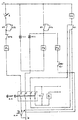
- the drawing represents the system in idle mode (de-activated)
- the security switch is in the Off position, the contacts 1 and 2 are open and the contacts 3 and 4 are closed.
- the (+) positive charge passes through the engine switch, position 2, rises to the EP1 Contact, finds it open and then descends. Then, the positive (+) charge rises to the engine switch (M), takes the negative (-) charge from the top, and the engine switch operates.
- the security switch is set to the on position, with the use of the key, the contacts 1 and 2 are closed and the contacts 3 and 4 are opened.
- the red Led is lit, indicating that the system is operative.
- the positive charge (+) passes via contact No 2 of the Security Switch and reaches the Led (which has the negative charge (-) from the top, and is thus lit.
- an open contact EP1 exists, parallel to an open contact EP2, in which case P2 goes negative (-) via the contact EP1 and receives the positive (+) from below, via the contact No 2 of the security switch which is shut.
- EP2 goes negative (-) via the contact EP1 and receives the positive (+) from below, via the contact No 2 of the security switch which is shut.
- EP2 is shut as self-retention and the closed contact EP2, located next to EP1 and under the contact X (handbrake, is opened.
- the green Led is also lit, thus both LEDs are lit, indicating that the engine switch has been forged. These two LEDs will remain lit, even when the key is removed from the engine switch and until the security switch is set to the Off position.
- the EP1 contact located under the engine switch (M) has been shut, in which case the positive charge (+) leaves from position no 2 of the engine switch and via the contact EP1 reaches the engine switch which receives the negative charge (-) from the top and has both (+) positive and negative (-) charge.
- the contact EP1 located to the petrol pump (B) and which also has both (+) positive and negative (-) charge has also closed and can be operative.
- the vehicle is started. By releasing the hand brake the negative (-) charge supplied via the handbrake contact to P1 is cut off and the latter is discharged. Hence, the four EP1 contacts open and the petrol supply is automatically cut-off, as EP1 is open and thus the vehicle engine stops running.
- the electrical current to the switch (M) is also cut -off and the vehicle cannot be re-started, even if the handbrake is re-engaged, as the contact EP2 located under the contact X (Handbrake) does not permit the negative charge (-) to reach the relay P1 and to discharge, as the contacts 3 and 4 of the security Switch are open and, thus, both circuits are open.
- the inventors apply to the Organization of Industrial Property (OBI) for granting the use of the following systems of an automobile, based on the technical characteristics of the invention referred below: handbrake, brake and pilots LED lights, aiming at the provision of protection against theft of the automobile.
- OBI Organization of Industrial Property
Landscapes
- Engineering & Computer Science (AREA)
- Mechanical Engineering (AREA)
- Lighting Device Outwards From Vehicle And Optical Signal (AREA)
- Valves And Accessory Devices For Braking Systems (AREA)
- Emergency Alarm Devices (AREA)
- Burglar Alarm Systems (AREA)
- Braking Arrangements (AREA)
- Output Control And Ontrol Of Special Type Engine (AREA)
Abstract
Description
- This invention relates to a system aiming at the protection of automobiles against theft by obstructing the flow of petrol or electrical current with the use of the handbrake or the brakes.
- This system eliminates the possibility that the automobile is started, if someone isolates the alarm system of the vehicle and enters into it. In order that the automobile is started, the system must be isolated with a key.
- The special technical field of the invention is the method of immobilization of the vehicle, which is different than those that are currently being applied.
- According to the technical applications known so far by the inventor, the immobilization of the automobile is achieved by locking the doors with a remote control unit and with the simultaneous cut-off of the electrical current or of the petrol, or both. However, if the mechanism is isolated, all its functions are simultaneously isolated, as well.
- The features of similar systems for the protection of automobiles against theft, known to the inventor, are:
- Simultaneous locking of the doors of the vehicle and cut-off of the supply of electrical current or petrol by pressing a button of a remote control unit, which is known to be forged by finding the frequency of the receiver, with the use of a multi - frequency remote control unit. The above system is de-activated as a whole, by the inverse use of the remote control unit (i.e., it is not polymorphic).
- The system proposed by the inventor is not activated and de-activated with the use of a remote control unit which is forgeable, but with the use of a switch and a key, for which no master or replica key can be made. Furthermore, this system is fitted in a position of the cabin, which is not easily visible.
- According to the present invention, if someone manages to isolate the existing alarm of the automobile and enters the vehicle with the use of some other key, then it will possible to start the vehicle. According to the implementation of the present invention, the vehicle will not move at all when two principal functions of the car are activated: a) the hand brake is released and; b) the brakes are pressed.
- In more detail:
- a) If the driver has omitted to engage the hand brake, then the engine will not start at all. If the hand brake is engaged, the engine is set into operation; then, when the hand brake is released in order to start driving, the engine switches off and cannot be switched on again, even if the hand brake is released.
- b) The second parameter of the invention concerns the brakes. When, someone manages to start the engine of the automobile and then attempts to press the brake pedal, then the engine switches off again and cannot be restarted.
- c) Finally, according to the third parameter of the invention, it is possible to understand if someone attempted theft of the automobile. This is achieved as follows: with the activation of the security system, a red LED is switched on, indicating the operation of the system. When a key is entered to start the engine and an attempt is made to start the engine without de-activation of the system, then a green LED is switched on, next to the red one, which is not switched off, even if the key is removed from the engine switch, proving that someone attempted to forge the vehicle.
-
- The above analyses a re-verified with the detailed and analytical drawings attached.
- It is evident that this invention can be applied to the field of the automobile industry.
- According to the application of the present invention, the system is in operation and the red led is lit. The key is introduced to the engine start switch and turned. Immediately, the green led is switched and remains lit along with the red one, even if the key is removed from the engine switch. This is the indication that proves that someone attempted to forge the system. The two LEDs will be switched off when the system is set off operation, with the use of the special key of the security switch.
- The system is re-activated with the hand brake disengaged. Attempting to set the engine of the vehicle into operation is meaningless, as the motor will not start (the engine will be switched on).
- Raising the hand brake and activating the system, secure the vehicle. When the vehicle is forged, the engine will be started normally and will be stopped as soon as the hand brake is released in order to start moving the vehicle, as the electricity and petrol supply are cut-off and will not start again when the hand brake is re-engaged. In this manner, the system is blocked and the automobile cannot be started. In order to unblock the system, the security switch must be set into the off position, with the use of our key.
- As mentioned above, when the handbrake is raised (engaged) the vehicle is normally set into operation. However, when the brake pedal is pressed, the supply of electrical current and petrol are again disrupted and the engine of the vehicle is switched off and cannot be re-started.
- Briefly, with the use of this system the supply of electrical current and petrol are interrupted, resulting in immobilizing completely the vehicle, before the latter moves at all.
- The drawing represents the system in idle mode (de-activated)
- The security switch is in the Off position, the contacts 1 and 2 are open and the contacts 3 and 4 are closed. We turn the engine switch to the On position. The (+) positive charge passes through the engine switch, position 2, rises to the EP1 Contact, finds it open and then descends. Then, the positive (+) charge rises to the engine switch (M), takes the negative (-) charge from the top, and the engine switch operates.
- Furthermore, flow passes via the petrol pump (B), as the negative charge (-) exists via contact 4 of the security switch, reaches the pump (B), which has the positive charge (+), in which case petrol flow exists, the engine switch is operative and the vehicle can be started.
- The security switch is set to the on position, with the use of the key, the contacts 1 and 2 are closed and the contacts 3 and 4 are opened. The red Led is lit, indicating that the system is operative. The positive charge (+) passes via contact No 2 of the Security Switch and reaches the Led (which has the negative charge (-) from the top, and is thus lit.
- When the hand brake is raised (engaged) the contact X (that corresponds to the hand-brake) is shut, the negative charge (-) passes through it and reaches the closed contact EP2 through which it passes to the closed contact EP3 and then reaches P1. P1 will be charged, when the key is introduced and the engine switch is turned in order to start the engine of the vehicle. Then, the positive charge (+) will pass via the engine switch to the position No 1, and via the security switch of the contact, it will reach P1. Then, P1 has both the positive (+) and negative (-) and is then charged. When P1 is charged, the open contact on top of it EP1 is shut, as a self-retention. Furthermore, all the open contacts EP1 are shut. A number of four (4) such contacts exist.
- On top of P2, an open contact EP1 exists, parallel to an open contact EP2, in which case P2 goes negative (-) via the contact EP1 and receives the positive (+) from below, via the contact No 2 of the security switch which is shut. By charging the contact P2, EP2 is shut as self-retention and the closed contact EP2, located next to EP1 and under the contact X (handbrake, is opened. In this case, the green Led is also lit, thus both LEDs are lit, indicating that the engine switch has been forged. These two LEDs will remain lit, even when the key is removed from the engine switch and until the security switch is set to the Off position.
- Also, the EP1 contact located under the engine switch (M) has been shut, in which case the positive charge (+) leaves from position no 2 of the engine switch and via the contact EP1 reaches the engine switch which receives the negative charge (-) from the top and has both (+) positive and negative (-) charge. The contact EP1 located to the petrol pump (B) and which also has both (+) positive and negative (-) charge has also closed and can be operative. Thus, with current at the engine switch (M) and the petrol pump (B), the vehicle is set into operation, though with the hand brake raised.
- Thus, with P2 charged, if the hand brake is released or the brake pedal pressed, the engine will be switched off and will not restart, as P2 will remain charged, until the security switch is set to the Off position, in which case EP2 located under the handbrake X remains open.
- The vehicle is started. By releasing the hand brake the negative (-) charge supplied via the handbrake contact to P1 is cut off and the latter is discharged. Hence, the four EP1 contacts open and the petrol supply is automatically cut-off, as EP1 is open and thus the vehicle engine stops running. The electrical current to the switch (M) is also cut -off and the vehicle cannot be re-started, even if the handbrake is re-engaged, as the contact EP2 located under the contact X (Handbrake) does not permit the negative charge (-) to reach the relay P1 and to discharge, as the contacts 3 and 4 of the security Switch are open and, thus, both circuits are open.
- If for some reason the handbrake does not operate and the engine is set into operation in the normal way as above, when the brake pedal is pressed, the positive charge (+) reaches P3, the negative charge is also supplied to P3 by P2 which is permanently charged, in which case P3 is also charged. Thus, by charging P3, the closed contact EP3 located under P1 also opens and cuts off the negative charge (-) that was directed towards P1, in which case it is discharged and opens again all the contacts EP1, resulting to the same result, as EP1, located under the handbrake, also opens and EP2 which is located next to it (as P2 is charged), in which case the negative charge (-) cannot reach the coil P1.
- Thus, we have the same result as with the case of the handbrake. This is because if the brake pedal is released, P3 is recharged, it closed the EP3 contact again, having though opened under it the EP1 contact above it which does not allow the negative charge (-) to drift lower, as the contact EP2 located next to the contact EP1 remains open, as P2 remains always charged and holds EP2 open.
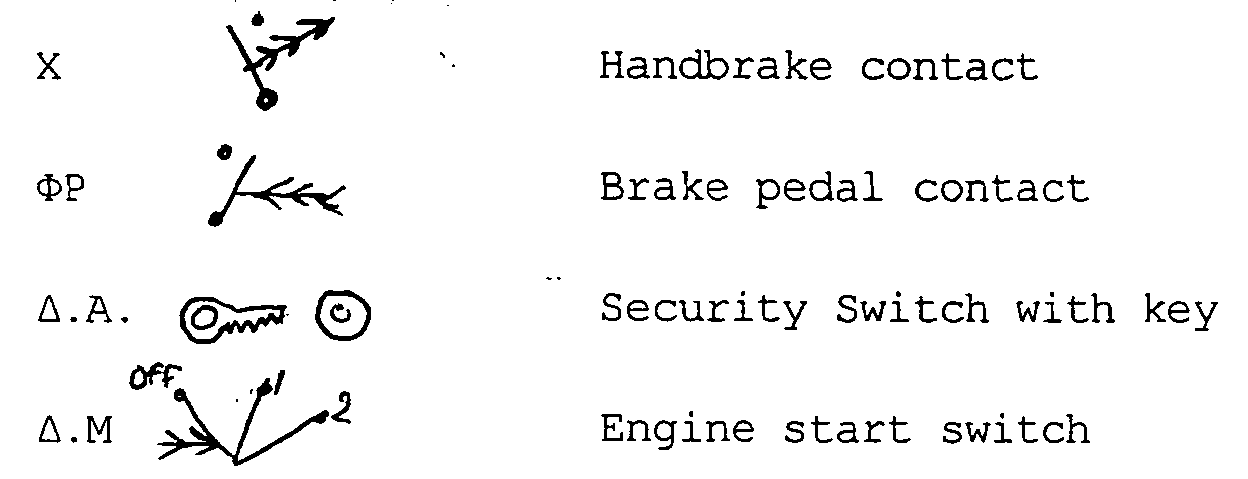
-
- P1
- Relay switch No 1
- P2
- Relay switch No 2
- P3
- Relay switch No 3
- M
- Engine start switch
- Δ.A.
- Security Switch
- B
- Petrol Pump
- ΠP.Λ
- Green LED
- K.Λ
- Red LED
- (-)
- Negative Pole of the Battery
- (+)
- Positive Pole of the Battery
- EP1
- Contact of the Relay switch No 1
- EP2
- Contact of the Relay switch No 2
- EP3
- Contact of the Relay switch No 3
- The inventors apply to the Organization of Industrial Property (OBI) for granting the use of the following systems of an automobile, based on the technical characteristics of the invention referred below: handbrake, brake and pilots LED lights, aiming at the provision of protection against theft of the automobile.

Claims (5)
- The system is activated prior to the exit of the driver from the automobile, with the use of a switch key located in a non-visible position, and an LED is lit indicating the activation of the system.
- When somebody enters into the vehicle, by isolating the alarm that already exists or by forging some window of the vehicle, the automobile does not start when the handbrake is released (lowered).
- When the handbrake is engaged (raised), the vehicle engine is set into operation and is stopped when the handbrake is released and cannot re-start ads the supply of electric contact to the engine start switch and of petrol to the petrol pump have been interrupted.
- When the hand brake is not engaged for some reason, the engine will be started and will be subsequently stopped when the brake pedal is pressed, because the supply of electric contact to the engine start switch and of petrol to the petrol pump have been interrupted.
- Finally, as the vehicle has not finally moved, a green LED is lit next to the red one and remains lit along with it, as an indication of an attempt to forge the vehicle. When the system is de-activated, the LEDs are switched off.
Applications Claiming Priority (2)
| Application Number | Priority Date | Filing Date | Title |
|---|---|---|---|
| GR20040100014A GR1004723B (en) | 2004-01-16 | 2004-01-16 | Anti-theft car system energised by way of the handbrake or the brake pedal |
| GR2004100014 | 2004-01-16 |
Publications (2)
| Publication Number | Publication Date |
|---|---|
| EP1555175A1 true EP1555175A1 (en) | 2005-07-20 |
| EP1555175B1 EP1555175B1 (en) | 2006-08-02 |
Family
ID=33561658
Family Applications (1)
| Application Number | Title | Priority Date | Filing Date |
|---|---|---|---|
| EP04386034A Expired - Lifetime EP1555175B1 (en) | 2004-01-16 | 2004-12-21 | Protection of automobiles against theft with the use of the hand brake or the brake |
Country Status (4)
| Country | Link |
|---|---|
| EP (1) | EP1555175B1 (en) |
| AT (1) | ATE334856T1 (en) |
| DE (1) | DE602004001750D1 (en) |
| GR (1) | GR1004723B (en) |
Citations (3)
| Publication number | Priority date | Publication date | Assignee | Title |
|---|---|---|---|---|
| US3850260A (en) * | 1973-02-12 | 1974-11-26 | G Obermeit | Auto warm-up theft preventing apparatus |
| US5912615A (en) * | 1994-09-23 | 1999-06-15 | Kretzmar; Allan J. | Electrified theft/car-jack prevention device for use with motor vehicles and methods of use |
| US6206130B1 (en) * | 1998-06-08 | 2001-03-27 | Leslie L. Hetler | Vehicle anti-theft device |
-
2004
- 2004-01-16 GR GR20040100014A patent/GR1004723B/en unknown
- 2004-12-21 EP EP04386034A patent/EP1555175B1/en not_active Expired - Lifetime
- 2004-12-21 AT AT04386034T patent/ATE334856T1/en not_active IP Right Cessation
- 2004-12-21 DE DE602004001750T patent/DE602004001750D1/en not_active Expired - Lifetime
Patent Citations (3)
| Publication number | Priority date | Publication date | Assignee | Title |
|---|---|---|---|---|
| US3850260A (en) * | 1973-02-12 | 1974-11-26 | G Obermeit | Auto warm-up theft preventing apparatus |
| US5912615A (en) * | 1994-09-23 | 1999-06-15 | Kretzmar; Allan J. | Electrified theft/car-jack prevention device for use with motor vehicles and methods of use |
| US6206130B1 (en) * | 1998-06-08 | 2001-03-27 | Leslie L. Hetler | Vehicle anti-theft device |
Also Published As
| Publication number | Publication date |
|---|---|
| EP1555175B1 (en) | 2006-08-02 |
| GR1004723B (en) | 2004-11-12 |
| DE602004001750D1 (en) | 2006-09-14 |
| ATE334856T1 (en) | 2006-08-15 |
Similar Documents
| Publication | Publication Date | Title |
|---|---|---|
| US8577575B2 (en) | Control apparatus for vehicle | |
| US9580045B2 (en) | Configurable electronic brake shift interlock override | |
| US9770984B2 (en) | Motion sensitive interlock for a vehicle having a breathe analyzer | |
| CN104245389B (en) | Motor vehicle and involve switch off motor vehicle power set method | |
| US5453730A (en) | Auto anti-theft system | |
| US20050131622A1 (en) | Method for automatically starting an internal combustion engine | |
| EP1331149A3 (en) | Keyless engine controlling unit | |
| CN108909693B (en) | Safety protection system and method for passengers to get on or off bus | |
| KR20180033717A (en) | method for ISG system of vehicle | |
| EP1555175A1 (en) | Protection of automobiles against theft with the use of the hand brake or the brake | |
| CN105774548A (en) | Fatigue driving detection system for vehicle and vehicle with fatigue driving detection system | |
| CN103879288A (en) | Method for operating motor car | |
| US7592714B2 (en) | Ignition bypass system | |
| US6398320B1 (en) | Vehicle braking system with auxiliary activation circuit | |
| CN105691203A (en) | Identification method and protection scheme of mistaken automobile accelerator stepping | |
| CN212171931U (en) | Driver alcohol lock device for bus | |
| CN109910860A (en) | An electronic system for automatically turning off the ignition after the car is parked | |
| US7777613B2 (en) | Vehicle antitheft system and method | |
| JP3044739U (en) | Vehicle anti-theft device | |
| KR0126075Y1 (en) | Accelerator pedal lock to prevent theft | |
| CN212921437U (en) | Intelligent anti-theft and anti-misoperation system for non-driver | |
| CN2108654U (en) | Anti-theft emergency auto-brake for motor vehicle | |
| CN2656232Y (en) | Safety environmental protection theft-proof system for car | |
| CN1876451A (en) | Automobile burglarproof alarming method | |
| KR20180100694A (en) | Restart method and restart assembly for starting internal combustion engine of vehicle |
Legal Events
| Date | Code | Title | Description |
|---|---|---|---|
| PUAI | Public reference made under article 153(3) epc to a published international application that has entered the european phase |
Free format text: ORIGINAL CODE: 0009012 |
|
| AK | Designated contracting states |
Kind code of ref document: A1 Designated state(s): AT BE BG CH CY CZ DE DK EE ES FI FR GB GR HU IE IS IT LI LT LU MC NL PL PT RO SE SI SK TR |
|
| AX | Request for extension of the european patent |
Extension state: AL BA HR LV MK YU |
|
| 17P | Request for examination filed |
Effective date: 20051118 |
|
| GRAP | Despatch of communication of intention to grant a patent |
Free format text: ORIGINAL CODE: EPIDOSNIGR1 |
|
| AKX | Designation fees paid |
Designated state(s): AT BE BG CH CY CZ DE DK EE ES FI FR GB GR HU IE IS IT LI LT LU MC NL PL PT RO SE SI SK TR |
|
| GRAS | Grant fee paid |
Free format text: ORIGINAL CODE: EPIDOSNIGR3 |
|
| GRAA | (expected) grant |
Free format text: ORIGINAL CODE: 0009210 |
|
| AK | Designated contracting states |
Kind code of ref document: B1 Designated state(s): AT BE BG CH CY CZ DE DK EE ES FI FR GB GR HU IE IS IT LI LT LU MC NL PL PT RO SE SI SK TR |
|
| PG25 | Lapsed in a contracting state [announced via postgrant information from national office to epo] |
Ref country code: IT Free format text: LAPSE BECAUSE OF FAILURE TO SUBMIT A TRANSLATION OF THE DESCRIPTION OR TO PAY THE FEE WITHIN THE PRESCRIBED TIME-LIMIT;WARNING: LAPSES OF ITALIAN PATENTS WITH EFFECTIVE DATE BEFORE 2007 MAY HAVE OCCURRED AT ANY TIME BEFORE 2007. THE CORRECT EFFECTIVE DATE MAY BE DIFFERENT FROM THE ONE RECORDED. Effective date: 20060802 Ref country code: SI Free format text: LAPSE BECAUSE OF FAILURE TO SUBMIT A TRANSLATION OF THE DESCRIPTION OR TO PAY THE FEE WITHIN THE PRESCRIBED TIME-LIMIT Effective date: 20060802 Ref country code: SK Free format text: LAPSE BECAUSE OF FAILURE TO SUBMIT A TRANSLATION OF THE DESCRIPTION OR TO PAY THE FEE WITHIN THE PRESCRIBED TIME-LIMIT Effective date: 20060802 Ref country code: IS Free format text: LAPSE BECAUSE OF FAILURE TO SUBMIT A TRANSLATION OF THE DESCRIPTION OR TO PAY THE FEE WITHIN THE PRESCRIBED TIME-LIMIT Effective date: 20060802 Ref country code: PL Free format text: LAPSE BECAUSE OF FAILURE TO SUBMIT A TRANSLATION OF THE DESCRIPTION OR TO PAY THE FEE WITHIN THE PRESCRIBED TIME-LIMIT Effective date: 20060802 Ref country code: CH Free format text: LAPSE BECAUSE OF FAILURE TO SUBMIT A TRANSLATION OF THE DESCRIPTION OR TO PAY THE FEE WITHIN THE PRESCRIBED TIME-LIMIT Effective date: 20060802 Ref country code: LI Free format text: LAPSE BECAUSE OF FAILURE TO SUBMIT A TRANSLATION OF THE DESCRIPTION OR TO PAY THE FEE WITHIN THE PRESCRIBED TIME-LIMIT Effective date: 20060802 Ref country code: LT Free format text: LAPSE BECAUSE OF FAILURE TO SUBMIT A TRANSLATION OF THE DESCRIPTION OR TO PAY THE FEE WITHIN THE PRESCRIBED TIME-LIMIT Effective date: 20060802 Ref country code: FI Free format text: LAPSE BECAUSE OF FAILURE TO SUBMIT A TRANSLATION OF THE DESCRIPTION OR TO PAY THE FEE WITHIN THE PRESCRIBED TIME-LIMIT Effective date: 20060802 Ref country code: NL Free format text: LAPSE BECAUSE OF FAILURE TO SUBMIT A TRANSLATION OF THE DESCRIPTION OR TO PAY THE FEE WITHIN THE PRESCRIBED TIME-LIMIT Effective date: 20060802 Ref country code: CZ Free format text: LAPSE BECAUSE OF FAILURE TO SUBMIT A TRANSLATION OF THE DESCRIPTION OR TO PAY THE FEE WITHIN THE PRESCRIBED TIME-LIMIT Effective date: 20060802 Ref country code: AT Free format text: LAPSE BECAUSE OF FAILURE TO SUBMIT A TRANSLATION OF THE DESCRIPTION OR TO PAY THE FEE WITHIN THE PRESCRIBED TIME-LIMIT Effective date: 20060802 Ref country code: BE Free format text: LAPSE BECAUSE OF FAILURE TO SUBMIT A TRANSLATION OF THE DESCRIPTION OR TO PAY THE FEE WITHIN THE PRESCRIBED TIME-LIMIT Effective date: 20060802 Ref country code: RO Free format text: LAPSE BECAUSE OF FAILURE TO SUBMIT A TRANSLATION OF THE DESCRIPTION OR TO PAY THE FEE WITHIN THE PRESCRIBED TIME-LIMIT Effective date: 20060802 |
|
| REG | Reference to a national code |
Ref country code: GB Ref legal event code: FG4D |
|
| REG | Reference to a national code |
Ref country code: CH Ref legal event code: EP |
|
| REG | Reference to a national code |
Ref country code: IE Ref legal event code: FG4D |
|
| REF | Corresponds to: |
Ref document number: 602004001750 Country of ref document: DE Date of ref document: 20060914 Kind code of ref document: P |
|
| PG25 | Lapsed in a contracting state [announced via postgrant information from national office to epo] |
Ref country code: DK Free format text: LAPSE BECAUSE OF FAILURE TO SUBMIT A TRANSLATION OF THE DESCRIPTION OR TO PAY THE FEE WITHIN THE PRESCRIBED TIME-LIMIT Effective date: 20061102 Ref country code: BG Free format text: LAPSE BECAUSE OF FAILURE TO SUBMIT A TRANSLATION OF THE DESCRIPTION OR TO PAY THE FEE WITHIN THE PRESCRIBED TIME-LIMIT Effective date: 20061102 Ref country code: SE Free format text: LAPSE BECAUSE OF FAILURE TO SUBMIT A TRANSLATION OF THE DESCRIPTION OR TO PAY THE FEE WITHIN THE PRESCRIBED TIME-LIMIT Effective date: 20061102 |
|
| PG25 | Lapsed in a contracting state [announced via postgrant information from national office to epo] |
Ref country code: DE Free format text: LAPSE BECAUSE OF FAILURE TO SUBMIT A TRANSLATION OF THE DESCRIPTION OR TO PAY THE FEE WITHIN THE PRESCRIBED TIME-LIMIT Effective date: 20061103 |
|
| PG25 | Lapsed in a contracting state [announced via postgrant information from national office to epo] |
Ref country code: ES Free format text: LAPSE BECAUSE OF FAILURE TO SUBMIT A TRANSLATION OF THE DESCRIPTION OR TO PAY THE FEE WITHIN THE PRESCRIBED TIME-LIMIT Effective date: 20061113 |
|
| REG | Reference to a national code |
Ref country code: GR Ref legal event code: EP Ref document number: 20060403864 Country of ref document: GR |
|
| PG25 | Lapsed in a contracting state [announced via postgrant information from national office to epo] |
Ref country code: IE Free format text: LAPSE BECAUSE OF NON-PAYMENT OF DUE FEES Effective date: 20061221 |
|
| PG25 | Lapsed in a contracting state [announced via postgrant information from national office to epo] |
Ref country code: MC Free format text: LAPSE BECAUSE OF NON-PAYMENT OF DUE FEES Effective date: 20061231 |
|
| NLV1 | Nl: lapsed or annulled due to failure to fulfill the requirements of art. 29p and 29m of the patents act | ||
| PG25 | Lapsed in a contracting state [announced via postgrant information from national office to epo] |
Ref country code: PT Free format text: LAPSE BECAUSE OF FAILURE TO SUBMIT A TRANSLATION OF THE DESCRIPTION OR TO PAY THE FEE WITHIN THE PRESCRIBED TIME-LIMIT Effective date: 20070102 |
|
| REG | Reference to a national code |
Ref country code: CH Ref legal event code: PL |
|
| EN | Fr: translation not filed | ||
| PLBE | No opposition filed within time limit |
Free format text: ORIGINAL CODE: 0009261 |
|
| STAA | Information on the status of an ep patent application or granted ep patent |
Free format text: STATUS: NO OPPOSITION FILED WITHIN TIME LIMIT |
|
| 26N | No opposition filed |
Effective date: 20070503 |
|
| PG25 | Lapsed in a contracting state [announced via postgrant information from national office to epo] |
Ref country code: FR Free format text: LAPSE BECAUSE OF FAILURE TO SUBMIT A TRANSLATION OF THE DESCRIPTION OR TO PAY THE FEE WITHIN THE PRESCRIBED TIME-LIMIT Effective date: 20070511 |
|
| PG25 | Lapsed in a contracting state [announced via postgrant information from national office to epo] |
Ref country code: EE Free format text: LAPSE BECAUSE OF FAILURE TO SUBMIT A TRANSLATION OF THE DESCRIPTION OR TO PAY THE FEE WITHIN THE PRESCRIBED TIME-LIMIT Effective date: 20060802 |
|
| PG25 | Lapsed in a contracting state [announced via postgrant information from national office to epo] |
Ref country code: TR Free format text: LAPSE BECAUSE OF FAILURE TO SUBMIT A TRANSLATION OF THE DESCRIPTION OR TO PAY THE FEE WITHIN THE PRESCRIBED TIME-LIMIT Effective date: 20060802 Ref country code: HU Free format text: LAPSE BECAUSE OF FAILURE TO SUBMIT A TRANSLATION OF THE DESCRIPTION OR TO PAY THE FEE WITHIN THE PRESCRIBED TIME-LIMIT Effective date: 20070203 Ref country code: LU Free format text: LAPSE BECAUSE OF NON-PAYMENT OF DUE FEES Effective date: 20061221 |
|
| PG25 | Lapsed in a contracting state [announced via postgrant information from national office to epo] |
Ref country code: FR Free format text: LAPSE BECAUSE OF FAILURE TO SUBMIT A TRANSLATION OF THE DESCRIPTION OR TO PAY THE FEE WITHIN THE PRESCRIBED TIME-LIMIT Effective date: 20060802 Ref country code: CY Free format text: LAPSE BECAUSE OF FAILURE TO SUBMIT A TRANSLATION OF THE DESCRIPTION OR TO PAY THE FEE WITHIN THE PRESCRIBED TIME-LIMIT Effective date: 20060802 |
|
| PGFP | Annual fee paid to national office [announced via postgrant information from national office to epo] |
Ref country code: GB Payment date: 20090130 Year of fee payment: 5 |
|
| GBPC | Gb: european patent ceased through non-payment of renewal fee |
Effective date: 20091221 |
|
| PG25 | Lapsed in a contracting state [announced via postgrant information from national office to epo] |
Ref country code: GB Free format text: LAPSE BECAUSE OF NON-PAYMENT OF DUE FEES Effective date: 20091221 |
|
| PGFP | Annual fee paid to national office [announced via postgrant information from national office to epo] |
Ref country code: GR Payment date: 20121213 Year of fee payment: 9 |
|
| REG | Reference to a national code |
Ref country code: GR Ref legal event code: ML Ref document number: 20060403864 Country of ref document: GR Effective date: 20140702 |
|
| PG25 | Lapsed in a contracting state [announced via postgrant information from national office to epo] |
Ref country code: GR Free format text: LAPSE BECAUSE OF NON-PAYMENT OF DUE FEES Effective date: 20140702 |