EP1554939A1 - Method of modifying food material - Google Patents
Method of modifying food material Download PDFInfo
- Publication number
- EP1554939A1 EP1554939A1 EP03738638A EP03738638A EP1554939A1 EP 1554939 A1 EP1554939 A1 EP 1554939A1 EP 03738638 A EP03738638 A EP 03738638A EP 03738638 A EP03738638 A EP 03738638A EP 1554939 A1 EP1554939 A1 EP 1554939A1
- Authority
- EP
- European Patent Office
- Prior art keywords
- food material
- enzyme
- potato
- solution containing
- pectinesterase
- Prior art date
- Legal status (The legal status is an assumption and is not a legal conclusion. Google has not performed a legal analysis and makes no representation as to the accuracy of the status listed.)
- Withdrawn
Links
- 235000013305 food Nutrition 0.000 title claims abstract description 123
- 239000000463 material Substances 0.000 title claims abstract description 118
- 238000000034 method Methods 0.000 title claims abstract description 61
- 102000004190 Enzymes Human genes 0.000 claims abstract description 113
- 108090000790 Enzymes Proteins 0.000 claims abstract description 113
- 238000006911 enzymatic reaction Methods 0.000 claims abstract description 7
- 235000013311 vegetables Nutrition 0.000 claims description 75
- 235000002595 Solanum tuberosum Nutrition 0.000 claims description 56
- 244000061456 Solanum tuberosum Species 0.000 claims description 56
- 108020004410 pectinesterase Proteins 0.000 claims description 50
- 235000013399 edible fruits Nutrition 0.000 claims description 43
- 235000002767 Daucus carota Nutrition 0.000 claims description 17
- 244000000626 Daucus carota Species 0.000 claims description 17
- 108090000623 proteins and genes Proteins 0.000 claims description 13
- 235000004936 Bromus mango Nutrition 0.000 claims description 12
- 235000014826 Mangifera indica Nutrition 0.000 claims description 12
- 108010059820 Polygalacturonase Proteins 0.000 claims description 12
- 235000009184 Spondias indica Nutrition 0.000 claims description 12
- 108010093305 exopolygalacturonase Proteins 0.000 claims description 12
- 102000004169 proteins and genes Human genes 0.000 claims description 12
- 239000000126 substance Substances 0.000 claims description 12
- 108091005804 Peptidases Proteins 0.000 claims description 11
- 235000000832 Ayote Nutrition 0.000 claims description 10
- 235000009854 Cucurbita moschata Nutrition 0.000 claims description 10
- 235000009804 Cucurbita pepo subsp pepo Nutrition 0.000 claims description 10
- 235000010469 Glycine max Nutrition 0.000 claims description 10
- 244000068988 Glycine max Species 0.000 claims description 10
- 235000015136 pumpkin Nutrition 0.000 claims description 10
- 235000013372 meat Nutrition 0.000 claims description 9
- 235000011299 Brassica oleracea var botrytis Nutrition 0.000 claims description 8
- 240000003259 Brassica oleracea var. botrytis Species 0.000 claims description 8
- 235000009467 Carica papaya Nutrition 0.000 claims description 8
- 235000011511 Diospyros Nutrition 0.000 claims description 8
- 240000009088 Fragaria x ananassa Species 0.000 claims description 8
- 239000004382 Amylase Substances 0.000 claims description 7
- 108010065511 Amylases Proteins 0.000 claims description 7
- 102000013142 Amylases Human genes 0.000 claims description 7
- 235000019418 amylase Nutrition 0.000 claims description 7
- 125000002091 cationic group Chemical group 0.000 claims description 7
- 101710121765 Endo-1,4-beta-xylanase Proteins 0.000 claims description 6
- 239000004365 Protease Substances 0.000 claims description 6
- 102100037486 Reverse transcriptase/ribonuclease H Human genes 0.000 claims description 6
- 235000013339 cereals Nutrition 0.000 claims description 6
- -1 glucanase Proteins 0.000 claims description 6
- 235000019419 proteases Nutrition 0.000 claims description 6
- 102000035195 Peptidases Human genes 0.000 claims description 5
- 108060008539 Transglutaminase Proteins 0.000 claims description 5
- 159000000007 calcium salts Chemical group 0.000 claims description 5
- 235000019833 protease Nutrition 0.000 claims description 5
- 102000003601 transglutaminase Human genes 0.000 claims description 5
- ZIIUUSVHCHPIQD-UHFFFAOYSA-N 2,4,6-trimethyl-N-[3-(trifluoromethyl)phenyl]benzenesulfonamide Chemical compound CC1=CC(C)=CC(C)=C1S(=O)(=O)NC1=CC=CC(C(F)(F)F)=C1 ZIIUUSVHCHPIQD-UHFFFAOYSA-N 0.000 claims description 4
- 241000251468 Actinopterygii Species 0.000 claims description 4
- 244000291564 Allium cepa Species 0.000 claims description 4
- 235000002732 Allium cepa var. cepa Nutrition 0.000 claims description 4
- 244000144730 Amygdalus persica Species 0.000 claims description 4
- 244000099147 Ananas comosus Species 0.000 claims description 4
- 235000007119 Ananas comosus Nutrition 0.000 claims description 4
- 244000003416 Asparagus officinalis Species 0.000 claims description 4
- 235000005340 Asparagus officinalis Nutrition 0.000 claims description 4
- 235000017166 Bambusa arundinacea Nutrition 0.000 claims description 4
- 235000017491 Bambusa tulda Nutrition 0.000 claims description 4
- 240000007124 Brassica oleracea Species 0.000 claims description 4
- 235000003899 Brassica oleracea var acephala Nutrition 0.000 claims description 4
- 235000011301 Brassica oleracea var capitata Nutrition 0.000 claims description 4
- 235000017647 Brassica oleracea var italica Nutrition 0.000 claims description 4
- 235000001169 Brassica oleracea var oleracea Nutrition 0.000 claims description 4
- 240000004160 Capsicum annuum Species 0.000 claims description 4
- 235000008534 Capsicum annuum var annuum Nutrition 0.000 claims description 4
- 240000006432 Carica papaya Species 0.000 claims description 4
- 244000241235 Citrullus lanatus Species 0.000 claims description 4
- 235000012828 Citrullus lanatus var citroides Nutrition 0.000 claims description 4
- 244000241257 Cucumis melo Species 0.000 claims description 4
- 235000015510 Cucumis melo subsp melo Nutrition 0.000 claims description 4
- 240000004244 Cucurbita moschata Species 0.000 claims description 4
- 244000236655 Diospyros kaki Species 0.000 claims description 4
- 235000016623 Fragaria vesca Nutrition 0.000 claims description 4
- 235000011363 Fragaria x ananassa Nutrition 0.000 claims description 4
- 102000009127 Glutaminase Human genes 0.000 claims description 4
- 108010073324 Glutaminase Proteins 0.000 claims description 4
- 244000017020 Ipomoea batatas Species 0.000 claims description 4
- 235000002678 Ipomoea batatas Nutrition 0.000 claims description 4
- 108010029541 Laccase Proteins 0.000 claims description 4
- 108090001060 Lipase Proteins 0.000 claims description 4
- 102000004882 Lipase Human genes 0.000 claims description 4
- 239000004367 Lipase Substances 0.000 claims description 4
- 241000220225 Malus Species 0.000 claims description 4
- 235000011430 Malus pumila Nutrition 0.000 claims description 4
- 235000015103 Malus silvestris Nutrition 0.000 claims description 4
- 240000007228 Mangifera indica Species 0.000 claims description 4
- 108010064785 Phospholipases Proteins 0.000 claims description 4
- 102000015439 Phospholipases Human genes 0.000 claims description 4
- 244000082204 Phyllostachys viridis Species 0.000 claims description 4
- 235000015334 Phyllostachys viridis Nutrition 0.000 claims description 4
- 235000006040 Prunus persica var persica Nutrition 0.000 claims description 4
- 235000014443 Pyrus communis Nutrition 0.000 claims description 4
- 240000001987 Pyrus communis Species 0.000 claims description 4
- 244000088415 Raphanus sativus Species 0.000 claims description 4
- 235000006140 Raphanus sativus var sativus Nutrition 0.000 claims description 4
- 235000009337 Spinacia oleracea Nutrition 0.000 claims description 4
- 244000300264 Spinacia oleracea Species 0.000 claims description 4
- FJJCIZWZNKZHII-UHFFFAOYSA-N [4,6-bis(cyanoamino)-1,3,5-triazin-2-yl]cyanamide Chemical compound N#CNC1=NC(NC#N)=NC(NC#N)=N1 FJJCIZWZNKZHII-UHFFFAOYSA-N 0.000 claims description 4
- 239000011425 bamboo Substances 0.000 claims description 4
- 235000019688 fish Nutrition 0.000 claims description 4
- 235000019421 lipase Nutrition 0.000 claims description 4
- 238000004519 manufacturing process Methods 0.000 claims description 4
- 235000015170 shellfish Nutrition 0.000 claims description 4
- 229940088598 enzyme Drugs 0.000 description 96
- 239000000243 solution Substances 0.000 description 57
- UXVMQQNJUSDDNG-UHFFFAOYSA-L Calcium chloride Chemical compound [Cl-].[Cl-].[Ca+2] UXVMQQNJUSDDNG-UHFFFAOYSA-L 0.000 description 34
- 239000001110 calcium chloride Substances 0.000 description 32
- 229910001628 calcium chloride Inorganic materials 0.000 description 32
- 235000012015 potatoes Nutrition 0.000 description 23
- 238000009835 boiling Methods 0.000 description 21
- 229960002713 calcium chloride Drugs 0.000 description 17
- 235000011148 calcium chloride Nutrition 0.000 description 17
- 230000000704 physical effect Effects 0.000 description 17
- 239000007864 aqueous solution Substances 0.000 description 16
- 238000012986 modification Methods 0.000 description 11
- 230000004048 modification Effects 0.000 description 11
- 235000018102 proteins Nutrition 0.000 description 11
- 238000012545 processing Methods 0.000 description 10
- 230000000052 comparative effect Effects 0.000 description 9
- 241000249058 Anthracothorax Species 0.000 description 8
- 241000219122 Cucurbita Species 0.000 description 6
- TWRXJAOTZQYOKJ-UHFFFAOYSA-L Magnesium chloride Chemical compound [Mg+2].[Cl-].[Cl-] TWRXJAOTZQYOKJ-UHFFFAOYSA-L 0.000 description 6
- 230000035515 penetration Effects 0.000 description 6
- OYPRJOBELJOOCE-UHFFFAOYSA-N Calcium Chemical compound [Ca] OYPRJOBELJOOCE-UHFFFAOYSA-N 0.000 description 5
- 229960005069 calcium Drugs 0.000 description 5
- 239000011575 calcium Substances 0.000 description 5
- 229910052791 calcium Inorganic materials 0.000 description 5
- 239000007789 gas Substances 0.000 description 5
- 235000019668 heartiness Nutrition 0.000 description 5
- 239000001307 helium Substances 0.000 description 5
- 229910052734 helium Inorganic materials 0.000 description 5
- SWQJXJOGLNCZEY-UHFFFAOYSA-N helium atom Chemical compound [He] SWQJXJOGLNCZEY-UHFFFAOYSA-N 0.000 description 5
- 235000019640 taste Nutrition 0.000 description 5
- 235000019583 umami taste Nutrition 0.000 description 5
- XKRFYHLGVUSROY-UHFFFAOYSA-N Argon Chemical compound [Ar] XKRFYHLGVUSROY-UHFFFAOYSA-N 0.000 description 4
- IJGRMHOSHXDMSA-UHFFFAOYSA-N Atomic nitrogen Chemical compound N#N IJGRMHOSHXDMSA-UHFFFAOYSA-N 0.000 description 4
- 241000219172 Caricaceae Species 0.000 description 4
- 241000723267 Diospyros Species 0.000 description 4
- 238000007654 immersion Methods 0.000 description 4
- 235000019575 mouthfulness Nutrition 0.000 description 4
- 239000003921 oil Substances 0.000 description 4
- 239000002904 solvent Substances 0.000 description 4
- 235000021012 strawberries Nutrition 0.000 description 4
- XLYOFNOQVPJJNP-UHFFFAOYSA-N water Substances O XLYOFNOQVPJJNP-UHFFFAOYSA-N 0.000 description 4
- QTBSBXVTEAMEQO-UHFFFAOYSA-N Acetic acid Chemical compound CC(O)=O QTBSBXVTEAMEQO-UHFFFAOYSA-N 0.000 description 3
- 241000196324 Embryophyta Species 0.000 description 3
- OKKJLVBELUTLKV-UHFFFAOYSA-N Methanol Chemical compound OC OKKJLVBELUTLKV-UHFFFAOYSA-N 0.000 description 3
- 150000001768 cations Chemical class 0.000 description 3
- KRKNYBCHXYNGOX-UHFFFAOYSA-N citric acid Chemical compound OC(=O)CC(O)(C(O)=O)CC(O)=O KRKNYBCHXYNGOX-UHFFFAOYSA-N 0.000 description 3
- 238000005520 cutting process Methods 0.000 description 3
- 230000000694 effects Effects 0.000 description 3
- 230000008595 infiltration Effects 0.000 description 3
- 238000001764 infiltration Methods 0.000 description 3
- 229910001629 magnesium chloride Inorganic materials 0.000 description 3
- 159000000003 magnesium salts Chemical class 0.000 description 3
- 238000005259 measurement Methods 0.000 description 3
- 244000005700 microbiome Species 0.000 description 3
- 239000001814 pectin Substances 0.000 description 3
- 229920001277 pectin Polymers 0.000 description 3
- 235000010987 pectin Nutrition 0.000 description 3
- 150000003839 salts Chemical class 0.000 description 3
- 239000000523 sample Substances 0.000 description 3
- VTYYLEPIZMXCLO-UHFFFAOYSA-L Calcium carbonate Chemical compound [Ca+2].[O-]C([O-])=O VTYYLEPIZMXCLO-UHFFFAOYSA-L 0.000 description 2
- SRBFZHDQGSBBOR-IOVATXLUSA-N D-xylopyranose Chemical compound O[C@@H]1COC(O)[C@H](O)[C@H]1O SRBFZHDQGSBBOR-IOVATXLUSA-N 0.000 description 2
- CSNNHWWHGAXBCP-UHFFFAOYSA-L Magnesium sulfate Chemical compound [Mg+2].[O-][S+2]([O-])([O-])[O-] CSNNHWWHGAXBCP-UHFFFAOYSA-L 0.000 description 2
- 240000007594 Oryza sativa Species 0.000 description 2
- 235000007164 Oryza sativa Nutrition 0.000 description 2
- WCUXLLCKKVVCTQ-UHFFFAOYSA-M Potassium chloride Chemical compound [Cl-].[K+] WCUXLLCKKVVCTQ-UHFFFAOYSA-M 0.000 description 2
- ONIBWKKTOPOVIA-UHFFFAOYSA-N Proline Natural products OC(=O)C1CCCN1 ONIBWKKTOPOVIA-UHFFFAOYSA-N 0.000 description 2
- FAPWRFPIFSIZLT-UHFFFAOYSA-M Sodium chloride Chemical compound [Na+].[Cl-] FAPWRFPIFSIZLT-UHFFFAOYSA-M 0.000 description 2
- 229920002472 Starch Polymers 0.000 description 2
- 240000008042 Zea mays Species 0.000 description 2
- 235000005824 Zea mays ssp. parviglumis Nutrition 0.000 description 2
- 235000002017 Zea mays subsp mays Nutrition 0.000 description 2
- 229910052786 argon Inorganic materials 0.000 description 2
- 235000015278 beef Nutrition 0.000 description 2
- 235000019658 bitter taste Nutrition 0.000 description 2
- MKJXYGKVIBWPFZ-UHFFFAOYSA-L calcium lactate Chemical compound [Ca+2].CC(O)C([O-])=O.CC(O)C([O-])=O MKJXYGKVIBWPFZ-UHFFFAOYSA-L 0.000 description 2
- 239000001527 calcium lactate Substances 0.000 description 2
- 235000011086 calcium lactate Nutrition 0.000 description 2
- 229960002401 calcium lactate Drugs 0.000 description 2
- OSGAYBCDTDRGGQ-UHFFFAOYSA-L calcium sulfate Chemical compound [Ca+2].[O-]S([O-])(=O)=O OSGAYBCDTDRGGQ-UHFFFAOYSA-L 0.000 description 2
- 150000001720 carbohydrates Chemical class 0.000 description 2
- 235000014633 carbohydrates Nutrition 0.000 description 2
- 235000013330 chicken meat Nutrition 0.000 description 2
- 239000013068 control sample Substances 0.000 description 2
- 238000010411 cooking Methods 0.000 description 2
- 235000005822 corn Nutrition 0.000 description 2
- 238000011156 evaluation Methods 0.000 description 2
- 238000007710 freezing Methods 0.000 description 2
- 230000008014 freezing Effects 0.000 description 2
- 239000012520 frozen sample Substances 0.000 description 2
- 238000010438 heat treatment Methods 0.000 description 2
- 230000006872 improvement Effects 0.000 description 2
- 229910052757 nitrogen Inorganic materials 0.000 description 2
- 235000015277 pork Nutrition 0.000 description 2
- 230000002265 prevention Effects 0.000 description 2
- 230000008569 process Effects 0.000 description 2
- 125000001500 prolyl group Chemical group [H]N1C([H])(C(=O)[*])C([H])([H])C([H])([H])C1([H])[H] 0.000 description 2
- 235000009566 rice Nutrition 0.000 description 2
- 238000005507 spraying Methods 0.000 description 2
- 239000008107 starch Substances 0.000 description 2
- 235000019698 starch Nutrition 0.000 description 2
- 238000003860 storage Methods 0.000 description 2
- 235000000346 sugar Nutrition 0.000 description 2
- 150000008163 sugars Chemical class 0.000 description 2
- HDTRYLNUVZCQOY-UHFFFAOYSA-N α-D-glucopyranosyl-α-D-glucopyranoside Natural products OC1C(O)C(O)C(CO)OC1OC1C(O)C(O)C(O)C(CO)O1 HDTRYLNUVZCQOY-UHFFFAOYSA-N 0.000 description 1
- GUBGYTABKSRVRQ-XLOQQCSPSA-N Alpha-Lactose Chemical compound O[C@@H]1[C@@H](O)[C@@H](O)[C@@H](CO)O[C@H]1O[C@@H]1[C@@H](CO)O[C@H](O)[C@H](O)[C@H]1O GUBGYTABKSRVRQ-XLOQQCSPSA-N 0.000 description 1
- 108010011485 Aspartame Proteins 0.000 description 1
- 241000228212 Aspergillus Species 0.000 description 1
- 241000228215 Aspergillus aculeatus Species 0.000 description 1
- 241000283690 Bos taurus Species 0.000 description 1
- 235000010149 Brassica rapa subsp chinensis Nutrition 0.000 description 1
- 235000000536 Brassica rapa subsp pekinensis Nutrition 0.000 description 1
- 241000499436 Brassica rapa subsp. pekinensis Species 0.000 description 1
- 239000001736 Calcium glycerylphosphate Substances 0.000 description 1
- 108090000746 Chymosin Proteins 0.000 description 1
- 240000000560 Citrus x paradisi Species 0.000 description 1
- 241000588698 Erwinia Species 0.000 description 1
- IAJILQKETJEXLJ-UHFFFAOYSA-N Galacturonsaeure Natural products O=CC(O)C(O)C(O)C(O)C(O)=O IAJILQKETJEXLJ-UHFFFAOYSA-N 0.000 description 1
- 241000447437 Gerreidae Species 0.000 description 1
- WQZGKKKJIJFFOK-GASJEMHNSA-N Glucose Natural products OC[C@H]1OC(O)[C@H](O)[C@@H](O)[C@@H]1O WQZGKKKJIJFFOK-GASJEMHNSA-N 0.000 description 1
- WHUUTDBJXJRKMK-UHFFFAOYSA-N Glutamic acid Natural products OC(=O)C(N)CCC(O)=O WHUUTDBJXJRKMK-UHFFFAOYSA-N 0.000 description 1
- CKLJMWTZIZZHCS-REOHCLBHSA-N L-aspartic acid Chemical compound OC(=O)[C@@H](N)CC(O)=O CKLJMWTZIZZHCS-REOHCLBHSA-N 0.000 description 1
- WHUUTDBJXJRKMK-VKHMYHEASA-N L-glutamic acid Chemical compound OC(=O)[C@@H](N)CCC(O)=O WHUUTDBJXJRKMK-VKHMYHEASA-N 0.000 description 1
- GUBGYTABKSRVRQ-QKKXKWKRSA-N Lactose Natural products OC[C@H]1O[C@@H](O[C@H]2[C@H](O)[C@@H](O)C(O)O[C@@H]2CO)[C@H](O)[C@@H](O)[C@H]1O GUBGYTABKSRVRQ-QKKXKWKRSA-N 0.000 description 1
- 235000007688 Lycopersicon esculentum Nutrition 0.000 description 1
- 240000004658 Medicago sativa Species 0.000 description 1
- 235000017587 Medicago sativa ssp. sativa Nutrition 0.000 description 1
- 235000015429 Mirabilis expansa Nutrition 0.000 description 1
- 244000294411 Mirabilis expansa Species 0.000 description 1
- 235000002637 Nicotiana tabacum Nutrition 0.000 description 1
- 244000061176 Nicotiana tabacum Species 0.000 description 1
- 229920002230 Pectic acid Polymers 0.000 description 1
- 241000228143 Penicillium Species 0.000 description 1
- 235000006089 Phaseolus angularis Nutrition 0.000 description 1
- 240000003768 Solanum lycopersicum Species 0.000 description 1
- KDYFGRWQOYBRFD-UHFFFAOYSA-N Succinic acid Natural products OC(=O)CCC(O)=O KDYFGRWQOYBRFD-UHFFFAOYSA-N 0.000 description 1
- 229930006000 Sucrose Natural products 0.000 description 1
- CZMRCDWAGMRECN-UGDNZRGBSA-N Sucrose Chemical compound O[C@H]1[C@H](O)[C@@H](CO)O[C@@]1(CO)O[C@@H]1[C@H](O)[C@@H](O)[C@H](O)[C@@H](CO)O1 CZMRCDWAGMRECN-UGDNZRGBSA-N 0.000 description 1
- HDTRYLNUVZCQOY-WSWWMNSNSA-N Trehalose Natural products O[C@@H]1[C@@H](O)[C@@H](O)[C@@H](CO)O[C@@H]1O[C@@H]1[C@H](O)[C@@H](O)[C@@H](O)[C@@H](CO)O1 HDTRYLNUVZCQOY-WSWWMNSNSA-N 0.000 description 1
- 244000042324 Trifolium repens Species 0.000 description 1
- 235000013540 Trifolium repens var repens Nutrition 0.000 description 1
- 235000021307 Triticum Nutrition 0.000 description 1
- 244000098338 Triticum aestivum Species 0.000 description 1
- 235000010711 Vigna angularis Nutrition 0.000 description 1
- 240000007098 Vigna angularis Species 0.000 description 1
- 241000589636 Xanthomonas campestris Species 0.000 description 1
- 239000002253 acid Substances 0.000 description 1
- HDTRYLNUVZCQOY-LIZSDCNHSA-N alpha,alpha-trehalose Chemical compound O[C@@H]1[C@@H](O)[C@H](O)[C@@H](CO)O[C@@H]1O[C@@H]1[C@H](O)[C@@H](O)[C@H](O)[C@@H](CO)O1 HDTRYLNUVZCQOY-LIZSDCNHSA-N 0.000 description 1
- AEMOLEFTQBMNLQ-BKBMJHBISA-N alpha-D-galacturonic acid Chemical compound O[C@H]1O[C@H](C(O)=O)[C@H](O)[C@H](O)[C@H]1O AEMOLEFTQBMNLQ-BKBMJHBISA-N 0.000 description 1
- 235000001014 amino acid Nutrition 0.000 description 1
- 150000001413 amino acids Chemical class 0.000 description 1
- PYMYPHUHKUWMLA-UHFFFAOYSA-N arabinose Natural products OCC(O)C(O)C(O)C=O PYMYPHUHKUWMLA-UHFFFAOYSA-N 0.000 description 1
- IAOZJIPTCAWIRG-QWRGUYRKSA-N aspartame Chemical compound OC(=O)C[C@H](N)C(=O)N[C@H](C(=O)OC)CC1=CC=CC=C1 IAOZJIPTCAWIRG-QWRGUYRKSA-N 0.000 description 1
- 239000000605 aspartame Substances 0.000 description 1
- 229960003438 aspartame Drugs 0.000 description 1
- 235000010357 aspartame Nutrition 0.000 description 1
- 235000003704 aspartic acid Nutrition 0.000 description 1
- 159000000009 barium salts Chemical class 0.000 description 1
- 238000005452 bending Methods 0.000 description 1
- SRBFZHDQGSBBOR-UHFFFAOYSA-N beta-D-Pyranose-Lyxose Natural products OC1COC(O)C(O)C1O SRBFZHDQGSBBOR-UHFFFAOYSA-N 0.000 description 1
- WQZGKKKJIJFFOK-VFUOTHLCSA-N beta-D-glucose Chemical compound OC[C@H]1O[C@@H](O)[C@H](O)[C@@H](O)[C@@H]1O WQZGKKKJIJFFOK-VFUOTHLCSA-N 0.000 description 1
- OQFSQFPPLPISGP-UHFFFAOYSA-N beta-carboxyaspartic acid Natural products OC(=O)C(N)C(C(O)=O)C(O)=O OQFSQFPPLPISGP-UHFFFAOYSA-N 0.000 description 1
- KDYFGRWQOYBRFD-NUQCWPJISA-N butanedioic acid Chemical compound O[14C](=O)CC[14C](O)=O KDYFGRWQOYBRFD-NUQCWPJISA-N 0.000 description 1
- 235000001465 calcium Nutrition 0.000 description 1
- FAPWYRCQGJNNSJ-UBKPKTQASA-L calcium D-pantothenic acid Chemical compound [Ca+2].OCC(C)(C)[C@@H](O)C(=O)NCCC([O-])=O.OCC(C)(C)[C@@H](O)C(=O)NCCC([O-])=O FAPWYRCQGJNNSJ-UBKPKTQASA-L 0.000 description 1
- YYRMJZQKEFZXMX-UHFFFAOYSA-L calcium bis(dihydrogenphosphate) Chemical compound [Ca+2].OP(O)([O-])=O.OP(O)([O-])=O YYRMJZQKEFZXMX-UHFFFAOYSA-L 0.000 description 1
- 229910000019 calcium carbonate Inorganic materials 0.000 description 1
- FNAQSUUGMSOBHW-UHFFFAOYSA-H calcium citrate Chemical compound [Ca+2].[Ca+2].[Ca+2].[O-]C(=O)CC(O)(CC([O-])=O)C([O-])=O.[O-]C(=O)CC(O)(CC([O-])=O)C([O-])=O FNAQSUUGMSOBHW-UHFFFAOYSA-H 0.000 description 1
- 239000001354 calcium citrate Substances 0.000 description 1
- 229960004256 calcium citrate Drugs 0.000 description 1
- 229940062672 calcium dihydrogen phosphate Drugs 0.000 description 1
- AXCZMVOFGPJBDE-UHFFFAOYSA-L calcium dihydroxide Chemical compound [OH-].[OH-].[Ca+2] AXCZMVOFGPJBDE-UHFFFAOYSA-L 0.000 description 1
- JUNWLZAGQLJVLR-UHFFFAOYSA-J calcium diphosphate Chemical compound [Ca+2].[Ca+2].[O-]P([O-])(=O)OP([O-])([O-])=O JUNWLZAGQLJVLR-UHFFFAOYSA-J 0.000 description 1
- 239000004227 calcium gluconate Substances 0.000 description 1
- 235000013927 calcium gluconate Nutrition 0.000 description 1
- 229960004494 calcium gluconate Drugs 0.000 description 1
- 229940095618 calcium glycerophosphate Drugs 0.000 description 1
- UHHRFSOMMCWGSO-UHFFFAOYSA-L calcium glycerophosphate Chemical compound [Ca+2].OCC(CO)OP([O-])([O-])=O UHHRFSOMMCWGSO-UHFFFAOYSA-L 0.000 description 1
- 235000019299 calcium glycerylphosphate Nutrition 0.000 description 1
- FUFJGUQYACFECW-UHFFFAOYSA-L calcium hydrogenphosphate Chemical compound [Ca+2].OP([O-])([O-])=O FUFJGUQYACFECW-UHFFFAOYSA-L 0.000 description 1
- 239000000920 calcium hydroxide Substances 0.000 description 1
- 229910001861 calcium hydroxide Inorganic materials 0.000 description 1
- 229940095643 calcium hydroxide Drugs 0.000 description 1
- 235000011116 calcium hydroxide Nutrition 0.000 description 1
- BRPQOXSCLDDYGP-UHFFFAOYSA-N calcium oxide Chemical compound [O-2].[Ca+2] BRPQOXSCLDDYGP-UHFFFAOYSA-N 0.000 description 1
- 239000000292 calcium oxide Substances 0.000 description 1
- ODINCKMPIJJUCX-UHFFFAOYSA-N calcium oxide Inorganic materials [Ca]=O ODINCKMPIJJUCX-UHFFFAOYSA-N 0.000 description 1
- 229960002079 calcium pantothenate Drugs 0.000 description 1
- 239000001506 calcium phosphate Substances 0.000 description 1
- 229910000389 calcium phosphate Inorganic materials 0.000 description 1
- 229940043256 calcium pyrophosphate Drugs 0.000 description 1
- 229940095672 calcium sulfate Drugs 0.000 description 1
- 235000011132 calcium sulphate Nutrition 0.000 description 1
- NEEHYRZPVYRGPP-UHFFFAOYSA-L calcium;2,3,4,5,6-pentahydroxyhexanoate Chemical compound [Ca+2].OCC(O)C(O)C(O)C(O)C([O-])=O.OCC(O)C(O)C(O)C(O)C([O-])=O NEEHYRZPVYRGPP-UHFFFAOYSA-L 0.000 description 1
- VEJCUEBBRSCJRP-UHFFFAOYSA-L calcium;hydron;phosphonato phosphate Chemical compound [Ca+2].OP(O)(=O)OP([O-])([O-])=O VEJCUEBBRSCJRP-UHFFFAOYSA-L 0.000 description 1
- 125000003178 carboxy group Chemical group [H]OC(*)=O 0.000 description 1
- 239000001913 cellulose Substances 0.000 description 1
- 229920002678 cellulose Polymers 0.000 description 1
- 235000010980 cellulose Nutrition 0.000 description 1
- 235000013351 cheese Nutrition 0.000 description 1
- 238000006243 chemical reaction Methods 0.000 description 1
- 229940080701 chymosin Drugs 0.000 description 1
- 238000000354 decomposition reaction Methods 0.000 description 1
- 230000003247 decreasing effect Effects 0.000 description 1
- 230000006866 deterioration Effects 0.000 description 1
- 235000019821 dicalcium diphosphate Nutrition 0.000 description 1
- 235000019700 dicalcium phosphate Nutrition 0.000 description 1
- 235000005911 diet Nutrition 0.000 description 1
- 230000037213 diet Effects 0.000 description 1
- 238000002845 discoloration Methods 0.000 description 1
- 235000006694 eating habits Nutrition 0.000 description 1
- 150000002148 esters Chemical class 0.000 description 1
- 239000000284 extract Substances 0.000 description 1
- 239000003925 fat Substances 0.000 description 1
- 239000000796 flavoring agent Substances 0.000 description 1
- 235000019634 flavors Nutrition 0.000 description 1
- 238000010353 genetic engineering Methods 0.000 description 1
- 239000008103 glucose Substances 0.000 description 1
- 229940049906 glutamate Drugs 0.000 description 1
- 235000013922 glutamic acid Nutrition 0.000 description 1
- 239000004220 glutamic acid Substances 0.000 description 1
- 235000021384 green leafy vegetables Nutrition 0.000 description 1
- 230000003301 hydrolyzing effect Effects 0.000 description 1
- 238000011534 incubation Methods 0.000 description 1
- 125000000741 isoleucyl group Chemical group [H]N([H])C(C(C([H])([H])[H])C([H])([H])C([H])([H])[H])C(=O)O* 0.000 description 1
- 239000008101 lactose Substances 0.000 description 1
- 150000002632 lipids Chemical class 0.000 description 1
- 239000007788 liquid Substances 0.000 description 1
- ZLNQQNXFFQJAID-UHFFFAOYSA-L magnesium carbonate Chemical compound [Mg+2].[O-]C([O-])=O ZLNQQNXFFQJAID-UHFFFAOYSA-L 0.000 description 1
- 239000001095 magnesium carbonate Substances 0.000 description 1
- 229910000021 magnesium carbonate Inorganic materials 0.000 description 1
- 239000000395 magnesium oxide Substances 0.000 description 1
- CPLXHLVBOLITMK-UHFFFAOYSA-N magnesium oxide Inorganic materials [Mg]=O CPLXHLVBOLITMK-UHFFFAOYSA-N 0.000 description 1
- 229910052943 magnesium sulfate Inorganic materials 0.000 description 1
- 235000019341 magnesium sulphate Nutrition 0.000 description 1
- AXZKOIWUVFPNLO-UHFFFAOYSA-N magnesium;oxygen(2-) Chemical compound [O-2].[Mg+2] AXZKOIWUVFPNLO-UHFFFAOYSA-N 0.000 description 1
- 150000004702 methyl esters Chemical group 0.000 description 1
- 235000013536 miso Nutrition 0.000 description 1
- 239000011259 mixed solution Substances 0.000 description 1
- 238000002156 mixing Methods 0.000 description 1
- 235000019691 monocalcium phosphate Nutrition 0.000 description 1
- GNOLWGAJQVLBSM-UHFFFAOYSA-N n,n,5,7-tetramethyl-1,2,3,4-tetrahydronaphthalen-1-amine Chemical compound C1=C(C)C=C2C(N(C)C)CCCC2=C1C GNOLWGAJQVLBSM-UHFFFAOYSA-N 0.000 description 1
- 235000015097 nutrients Nutrition 0.000 description 1
- 235000016709 nutrition Nutrition 0.000 description 1
- 230000035764 nutrition Effects 0.000 description 1
- 150000007524 organic acids Chemical class 0.000 description 1
- 235000005985 organic acids Nutrition 0.000 description 1
- 230000003647 oxidation Effects 0.000 description 1
- 238000007254 oxidation reaction Methods 0.000 description 1
- LCLHHZYHLXDRQG-ZNKJPWOQSA-N pectic acid Chemical compound O[C@@H]1[C@@H](O)[C@@H](O)O[C@H](C(O)=O)[C@@H]1OC1[C@H](O)[C@@H](O)[C@@H](OC2[C@@H]([C@@H](O)[C@@H](O)[C@H](O2)C(O)=O)O)[C@@H](C(O)=O)O1 LCLHHZYHLXDRQG-ZNKJPWOQSA-N 0.000 description 1
- 150000003904 phospholipids Chemical class 0.000 description 1
- 239000010318 polygalacturonic acid Substances 0.000 description 1
- 239000001103 potassium chloride Substances 0.000 description 1
- 235000011164 potassium chloride Nutrition 0.000 description 1
- 238000003825 pressing Methods 0.000 description 1
- 108090000765 processed proteins & peptides Proteins 0.000 description 1
- 102000004196 processed proteins & peptides Human genes 0.000 description 1
- 235000021134 protein-rich food Nutrition 0.000 description 1
- 235000021251 pulses Nutrition 0.000 description 1
- 239000002994 raw material Substances 0.000 description 1
- 238000005215 recombination Methods 0.000 description 1
- 230000006798 recombination Effects 0.000 description 1
- 238000004064 recycling Methods 0.000 description 1
- 230000009467 reduction Effects 0.000 description 1
- 235000019643 salty taste Nutrition 0.000 description 1
- 230000001953 sensory effect Effects 0.000 description 1
- 230000035939 shock Effects 0.000 description 1
- 238000004904 shortening Methods 0.000 description 1
- 239000011780 sodium chloride Substances 0.000 description 1
- 239000007787 solid Substances 0.000 description 1
- 235000013555 soy sauce Nutrition 0.000 description 1
- 239000007921 spray Substances 0.000 description 1
- 239000005720 sucrose Substances 0.000 description 1
- 239000013076 target substance Substances 0.000 description 1
- 238000012360 testing method Methods 0.000 description 1
- 238000010257 thawing Methods 0.000 description 1
- QORWJWZARLRLPR-UHFFFAOYSA-H tricalcium bis(phosphate) Chemical compound [Ca+2].[Ca+2].[Ca+2].[O-]P([O-])([O-])=O.[O-]P([O-])([O-])=O QORWJWZARLRLPR-UHFFFAOYSA-H 0.000 description 1
- 235000013337 tricalcium citrate Nutrition 0.000 description 1
- 229940078499 tricalcium phosphate Drugs 0.000 description 1
- 229910000391 tricalcium phosphate Inorganic materials 0.000 description 1
- 235000019731 tricalcium phosphate Nutrition 0.000 description 1
- UFTFJSFQGQCHQW-UHFFFAOYSA-N triformin Chemical compound O=COCC(OC=O)COC=O UFTFJSFQGQCHQW-UHFFFAOYSA-N 0.000 description 1
Images








Classifications
-
- A—HUMAN NECESSITIES
- A23—FOODS OR FOODSTUFFS; TREATMENT THEREOF, NOT COVERED BY OTHER CLASSES
- A23B—PRESERVATION OF FOODS, FOODSTUFFS OR NON-ALCOHOLIC BEVERAGES; CHEMICAL RIPENING OF FRUIT OR VEGETABLES
- A23B7/00—Preservation of fruit or vegetables; Chemical ripening of fruit or vegetables
- A23B7/14—Preserving or ripening with chemicals not covered by group A23B7/08 or A23B7/10
- A23B7/153—Preserving or ripening with chemicals not covered by group A23B7/08 or A23B7/10 in the form of liquids or solids
- A23B7/154—Organic compounds; Microorganisms; Enzymes
- A23B7/155—Microorganisms; Enzymes ; Antibiotics
-
- A—HUMAN NECESSITIES
- A23—FOODS OR FOODSTUFFS; TREATMENT THEREOF, NOT COVERED BY OTHER CLASSES
- A23L—FOODS, FOODSTUFFS OR NON-ALCOHOLIC BEVERAGES, NOT OTHERWISE PROVIDED FOR; PREPARATION OR TREATMENT THEREOF
- A23L19/00—Products from fruits or vegetables; Preparation or treatment thereof
- A23L19/03—Products from fruits or vegetables; Preparation or treatment thereof consisting of whole pieces or fragments without mashing the original pieces
-
- A—HUMAN NECESSITIES
- A23—FOODS OR FOODSTUFFS; TREATMENT THEREOF, NOT COVERED BY OTHER CLASSES
- A23L—FOODS, FOODSTUFFS OR NON-ALCOHOLIC BEVERAGES, NOT OTHERWISE PROVIDED FOR; PREPARATION OR TREATMENT THEREOF
- A23L19/00—Products from fruits or vegetables; Preparation or treatment thereof
- A23L19/10—Products from fruits or vegetables; Preparation or treatment thereof of tuberous or like starch containing root crops
- A23L19/12—Products from fruits or vegetables; Preparation or treatment thereof of tuberous or like starch containing root crops of potatoes
- A23L19/14—Original non-roasted or non-fried potato pieces
-
- A—HUMAN NECESSITIES
- A23—FOODS OR FOODSTUFFS; TREATMENT THEREOF, NOT COVERED BY OTHER CLASSES
- A23L—FOODS, FOODSTUFFS OR NON-ALCOHOLIC BEVERAGES, NOT OTHERWISE PROVIDED FOR; PREPARATION OR TREATMENT THEREOF
- A23L19/00—Products from fruits or vegetables; Preparation or treatment thereof
- A23L19/10—Products from fruits or vegetables; Preparation or treatment thereof of tuberous or like starch containing root crops
- A23L19/12—Products from fruits or vegetables; Preparation or treatment thereof of tuberous or like starch containing root crops of potatoes
- A23L19/18—Roasted or fried products, e.g. snacks or chips
-
- A—HUMAN NECESSITIES
- A23—FOODS OR FOODSTUFFS; TREATMENT THEREOF, NOT COVERED BY OTHER CLASSES
- A23L—FOODS, FOODSTUFFS OR NON-ALCOHOLIC BEVERAGES, NOT OTHERWISE PROVIDED FOR; PREPARATION OR TREATMENT THEREOF
- A23L29/00—Foods or foodstuffs containing additives; Preparation or treatment thereof
- A23L29/06—Enzymes
-
- A—HUMAN NECESSITIES
- A23—FOODS OR FOODSTUFFS; TREATMENT THEREOF, NOT COVERED BY OTHER CLASSES
- A23L—FOODS, FOODSTUFFS OR NON-ALCOHOLIC BEVERAGES, NOT OTHERWISE PROVIDED FOR; PREPARATION OR TREATMENT THEREOF
- A23L5/00—Preparation or treatment of foods or foodstuffs, in general; Food or foodstuffs obtained thereby; Materials therefor
- A23L5/30—Physical treatment, e.g. electrical or magnetic means, wave energy or irradiation
-
- C—CHEMISTRY; METALLURGY
- C12—BIOCHEMISTRY; BEER; SPIRITS; WINE; VINEGAR; MICROBIOLOGY; ENZYMOLOGY; MUTATION OR GENETIC ENGINEERING
- C12Y—ENZYMES
- C12Y301/00—Hydrolases acting on ester bonds (3.1)
- C12Y301/01—Carboxylic ester hydrolases (3.1.1)
- C12Y301/01011—Pectinesterase (3.1.1.11)
-
- C—CHEMISTRY; METALLURGY
- C12—BIOCHEMISTRY; BEER; SPIRITS; WINE; VINEGAR; MICROBIOLOGY; ENZYMOLOGY; MUTATION OR GENETIC ENGINEERING
- C12Y—ENZYMES
- C12Y302/00—Hydrolases acting on glycosyl compounds, i.e. glycosylases (3.2)
- C12Y302/01—Glycosidases, i.e. enzymes hydrolysing O- and S-glycosyl compounds (3.2.1)
- C12Y302/01015—Polygalacturonase (3.2.1.15)
-
- C—CHEMISTRY; METALLURGY
- C12—BIOCHEMISTRY; BEER; SPIRITS; WINE; VINEGAR; MICROBIOLOGY; ENZYMOLOGY; MUTATION OR GENETIC ENGINEERING
- C12Y—ENZYMES
- C12Y304/00—Hydrolases acting on peptide bonds, i.e. peptidases (3.4)
Definitions
- the present invention relates to a method for modifying a food material to obtain a food material with good appearance and texture that hardly becomes softened and disintegrated during boiling, and a food material with appropriate softness.
- Modifying food materials is extremely important in view of processability, preservability , texture and taste, and the like.
- processability there are various needs such as shortening of the time required for cooking, obtaining physical properties that facilitate cutting and mixing processes, and reduced deterioration in physical characteristics during processing.
- preservability there are needs such as prevention of oxidation decay and discoloration due to storage period, temperature, and the like, and prevention of deformation upon transport.
- texture and taste there are also various needs for food materials, such as moderate resistance to teeth, proper crunchness, and umami (delicious taste) or kokumi(mouthfullness, continuity, thickness, mildness or punch) that spreads intraorally.
- food materials there are needs such as preventing changes in shape and taste due to physical treatment such as retort heating, freezing, and thawing.
- Recent examples of processing food materials include processing sugars using amylase, glucanase, xylanase, or the like and processing of fruits using pectinase.
- enzymes are used for various types of food processing, currently enzymes are used mainly for processing slurry-formed materials or the surfaces of food materials.
- As a technique to infiltrate enzymes into food materials long-time immersion in an enzyme solution or infiltration under reduced pressure has been examined.
- these techniques have low industrial productivity because of their time-consuming processes and the complicated procedure for reduced pressure condition.
- the resulting effects have been unsatisfactory.
- methods using reduced pressure are impractical.
- US 2002/0004085 discloses enzyme treatment wherein 400 g of Bintje potato with a 1 cm x 10 cm cross section that had been subjected to 10 minutes of blanch treatment at 75°C was immersed for 1 hour in 0.25 M calcium solution (1000 ml) with pectinesterase (5g). The treated potato was used to make fried potato. The surface of the treated potato was dried, and the potato was pre-fried at 190°C for 2 minutes, frozen, and then fried at 195°C for 5 minutes to give fried potato.
- the objective of the present invention is to provide a food material having improved appearance, texture, digestability, reduction of softening and disintegration during boiling, umami or kokumi (mouthfulness, continuity, thickness, mildness or punch), hardness, and the like, and a method for modifying a food material to produce such a food material.
- the present invention comprises the following inventions.
- the method for modifying a food material of the present invention comprises contacting a solution containing an enzyme with a food material, infiltrating the enzyme into the food material by pressure treatment, and carrying out the enzyme reaction inside the food material, thereby modifying the food material.
- a food material used in the present invention means a material used for producing foods. Any food materials can be used in the present invention. Preferred examples of such food materials include meat, fish and shellfish, cereals, vegetables, and fruits. Examples of meat include beef, pork, and chicken meat. Examples of cereals include rice, soybean (green soybean), adzuki bean, and corn. Examples of vegetables include root vegetables such as potato, carrot, onion, radish, and sweet potato, fruit vegetables such as pumpkin and bell pepper, leaf vegetables such as spinach, cabbage, and Chinese cabbage, and leaf and stem vegetables such as asparagus, broccoli, cauliflower, and bamboo shoot. Examples of fruits include strawberry, peach, mango, papaya, watermelon, melon, apple, persimmon, pear, and pineapple.
- Food materials used herein may be cut into pieces of any size and shape or may be peeled in view of treatment efficiency or intended purpose of food materials.
- An enzyme used in the present invention is not specifically limited, as long as it can react on a protein, a carbohydrate, a lipid, or other components contained in a food material.
- examples of such an enzyme include protease, transglutaminase, lipase, glutaminase, amylase, glucanase, xylanase, laccase, phospholipase, pectinase, pectinesterase, and peptidase.
- Enzymes that can be used in the present invention are not limited to purified enzymes. When an enzyme is extracted from a plant or the like, such extract can be used. Alternatively, when an enzyme is obtained from a microorganism, the culture broth can also be used. In addition, those produced by genetic engineering techniques can be used.
- a food material and an enzyme are not specifically limited. It is preferred to select an enzyme in accordance with food material components.
- pectinesterase also referred to as pectin methylesterase
- Pectinesterase is an enzyme that hydrolyzes the ester linkage of the methylester residue of pectin (poly ⁇ -D-galacturonic acid) to give methanol and pectic acid.
- Pectinesterase is known to exist in plants such as white clover, alfalfa, tobacco, tomatoes, and grapefruits, and microorganisms such as Coniophera cerebclla, Aspergillus, Penicillium, Erwinia , and Xanthomonas campestris .
- Pectinesterase that can be used in the present invention may be derived from plants or microorganisms or may be produced by gene recombination.
- pectinesterase examples include pectinesterase (produced by Sigma Chemical Co.,) derived from orange peels, Rapidase (produced by DSM Food Specialities) marketed as an enzyme for producing jam in Europe and the U.S.A., and NovoShape (produced by Novozymes A/S) derived from Aspergillus aculeatus .
- enzymes such as transglutaminase and protease are preferred for modification of the quality of meat, and enzymes such as glucanase, xylanase, and amylase are preferred for modification of cereals and the like.
- An enzyme and a food material used in the present method are preferably used in, for example, the following combinations. It is preferred to combine an enzyme such as protease, transglutaminase, peptidase, or glutaminase with a protein-rich food material such as meat (e.g., beef, pork, or chicken meat), fish and shellfish, green soybean (soybean), or wheat.
- meat e.g., beef, pork, or chicken meat
- fish and shellfish e.g., green soybean (soybean), or wheat.
- an enzyme such as amylase, glucanase, xylanase, pectinase, pectinesterase, or laccase with a carbohydrate (e.g., starch, pectin, cellulose, or xylose)-rich food material such as root and tuber crops including potato, sweet potato, and the like, root vegetables including radish, carrot, and the like, fruit vegetables including pumpkin, bell pepper, and the like, leaf and stem vegetables including spinach, onion, cabbage, asparagus, broccoli, cauliflower, bamboo shoot, and the like, pulse crops including green soybean (soybean) and the like, fruits (edible fruits) including strawberry, peach, mango, papaya, watermelon, melon, apple, pear, persimmon, pineapple, and the like, and other cereals including rice, corn, and the like.
- Lipase or phospholipase is preferably combined with a food material containing fats and oils (e.g., triglyceride and
- a solvent for a solution containing an enzyme is not specifically limited, as long as the enzyme is not denatured or inactivated and is food grade.
- An example of such a solvent is water.
- the pH is preferably 3-10.
- a medium containing an enzyme is not limited to a liquid such as a solvent and media such as gases or solids can be used.
- the amount of an enzyme in a solution containing the enzyme can be appropriately determined considering the characteristics of a food material to be modified and the degree of modification. For example, when a food material such as a vegetable or a fruit is modified using pectinesterase, the concentration of an enzyme is 0.0005% to 0.03% by weight (converted in terms of the protein amount of the enzyme) relative to a food material (e.g., a vegetable or a fruit) or preferably 1 to 60 P.E.U. (1 P.E.U.
- the enzyme concentration in the pectinase solution is preferably 0.1 to 4000 units and more preferably 2 to 40 units relative to 100 parts by weight of the food material.
- a food material such as a vegetable or a fruit is modified using pectinesterase
- divalent cations Through the addition of divalent cations, ionic linkages are formed via the divalent cations between carboxyl groups generated as a result of the hydrolytic reaction of pectinesterase, whereby viscosity of pectinis increased.
- a divalent cationic salt include magnesium salts, calcium salts, and barium salts.
- the magnesium salt used is not specifically limited, as long as it can be used in foods.
- examples of such a magnesium salt include magnesium carbonate, magnesium oxide, magnesium chloride, and magnesium sulfate.
- the calcium salt used is not specifically limited as long as it can be used in foods.
- examples of such a calcium salt include calcium chloride, calcium sulfate, tricalcium phosphate, calcium monohydrogenphosphate, calcium dihydrogenphosphate, calcium glycerophosphate, calcium gluconate, calcium 1-glutamate, calcium lactate, calcium pantothenate, calcium hydroxide, calcium pyrophosphate, calcium citrate, calcium dihydrogenpyrophosphate, calcium oxide, calcium carbonate, and calcinated calcium.
- calcium chloride, calcium lactate, and magnesium chloride are preferred.
- concentrations of these divalent cationic salts in solutions differ depending on the type, shape, and treatment conditions of a vegetable or a fruit, and are generally 0.1-5% by weight and preferably 0.2-1% by weight. When the concentration of a divalent cation is too high, bitterness may be generated in a vegetable or a fruit.
- Methods for contacting a solution containing an enzyme with a food material include, for example, immersion of a food material in a solution containing an enzyme or spray of a solution containing an enzyme on the surface of a food material.
- a solution containing an enzyme is contacted with a food material, and then pressure treatment is carried out for the enzyme to reach the inside of the food material.
- the pressure for pressure treatment is generally 1.04-50 atm (0.104-5 MPa), preferably 1.5-50 atm (0.15-5 MPa), more preferably 2-15 atm (0.2-1.5 MPa), and most preferably 3-10 atm (0.3-1 MPa).
- Methods for pressure treatment include, for example, pressurizing an enzyme solution containing a food material immersed therein by a hydraulic pressure pump, compressed air, or gas in a high-pressure cylinder (e.g., helium, argon, and nitrogen), and pressurizing a food material, which is sprayed with an enzyme solution, by compressed air or gas in a high-pressure cylinder (e.g., helium, argon, and nitrogen).
- the time for pressure treatment can be appropriately varied considering, for example, the characteristics of a food material or ease of the infiltration of an enzyme into a food material, and it is generally about 1-30 minutes.
- the infiltration can be controlled by controlling the time even on the second time scale at, for example, 0.1-60 seconds.
- the temperature for pressure treatment is not specifically limited, as long as an enzyme is not inactivated and can be appropriately adjusted.
- the food material When pressure treatment is completed, the food material may be left immersed in the enzyme solution for an appropriate time, or an incubation time may be provided with appropriately controlling temperature (preferably 30°C to 50°C) so as to carry out an enzyme reaction more sufficiently.
- appropriately controlling temperature preferably 30°C to 50°C
- an enzyme solution can be utilized (recycled) repeatedly. For example, vegetables or fruits are put into a container such as a net or a sieve, and the container is immersed in an enzyme solution followed by pressurizing it to carry out enzyme treatment, and then the container containing the vegetables or the fruits are taken away. This enzyme solution may be used again as it is for the next enzyme treatment for vegetables or fruits contained in a net or sieve, which is immersed in the solution and then pressurized.
- a food material obtained by the method of the present invention can be preferably used as a cooking material.
- potato which is processed by the present method using pectinesterase is preferred as raw materials for fried potato.
- Fried potato obtained from the potato produced by the present method have excellent texture, and their initial crispness last even if time passes from the frying.
- the present invention provides a method for modifying a food material, which comprises contacting a solution containing an enzyme with a food material and carrying out pressure treatment at 1.04-50 atm for the enzyme to infiltrate into the food material.
- a solution containing 1 or more types of substances with a molecular weight of 1000 or less can also be used instead of a solution containing an enzyme.
- conditions such as pressure applied, temperature, time
- substances with a molecular weight of 1000 or less include, but not limited to, substances that can improve the hardness or the texture of a food material and substances for adding nutrition components and flavor such as umami (delicious taste) or kokumi (mouthfulness, continuity, thickness, mildness or punch), sweetness, bitterness, sourness, or salty taste to a food material.
- umami delicious taste
- kokumi mouthfulness, continuity, thickness, mildness or punch
- sweetness bitterness, sourness, or salty taste
- Such substances include amino acids or salts thereof such as glutamic acid and aspartic acid, peptides such as isoleucyl ⁇ prolyl ⁇ proline (IPP), vanillyl ⁇ prolyl ⁇ proline (VPP), and aspartame, sugars such as glucose, lactose, sucrose, and trehalose, organic acids or salts thereof such as citric acid, acetic acid, and succinic acid, and furthermore, inorganic salts such as sodium chloride, potassium chloride, calcium chloride, and magnesium chloride.
- amino acids or salts thereof such as glutamic acid and aspartic acid
- peptides such as isoleucyl ⁇ prolyl ⁇ proline (IPP), vanillyl ⁇ prolyl ⁇ proline (VPP), and aspartame
- sugars such as glucose, lactose, sucrose, and trehalose
- organic acids or salts thereof such as citric acid, acetic acid, and succinic acid
- inorganic salts
- load-bearing characteristic was similarly measured using samples obtained in a manner similar to that described above except for not adding pectinesterase, samples obtained in a manner similar to that described above except for not adding calcium, and control samples prepared by simply boiling the raw vegetables intact for 15 minutes.
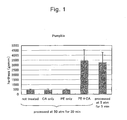
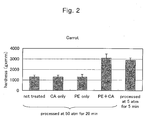
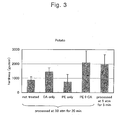
- Figs. 1 to 3 showed that the hardness of all the vegetables including pumpkins, potatoes, and carrots increased when the vegetables were subjected to pressure treatment in the presence of pectinesterase (PE) and calcium chloride (CA). It was also shown that even when pressure treatment was carried out at 5 atm for 5 minutes in the presence of pectinesterase and calcium chloride, the hardness of the vegetables was increased to the same degree as that in the case of 20 minutes of pressure treatment at 50 atm.
- PE pectinesterase
- CA calcium chloride
- pectinesterase NovoShape, converted in terms of protein amount
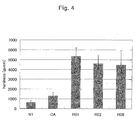
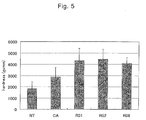
- the treated vegetables obtained by each of the first immersion and pressure treatment to the eighth (R01 to R08) immersion and pressure treatment were kept in the aqueous solutions at 40°C for 1 hour, and then boiled in a boiling pan for 15 minutes, thereby preparing samples for measuring physical properties (R01 to R08).
- the physical properties of the obtained samples were measured using a texture analyzer (produced by Stable Micro Systems Ltd.), and then load-bearing characteristic (hardness) was evaluated using penetration of a 5-mm plunger.
- load-bearing characteristic was similarly measured for samples (CA) treated in a manner similar to that described above except for not using an enzyme and samples (NT) prepared by simply boiling raw vegetables intact for 15 minutes.
- the results are shown in Figs. 4 and 5.
- the results in Figs. 4 and 5 showed that an enzyme solution can be recycled because even vegetables treated in the repeatedly-used enzyme solution were more significantly hardened compared with the vegetables (CA) treated only with the calcium chloride solution and the vegetables (NT) prepared by boiling the raw vegetables for 15 minutes.
- the physical properties of the obtained samples were measured using a texture analyzer (produced by Stable Micro Systems Ltd.), and then load-bearing characteristic (hardness) was evaluated using penetration of a 5-mm plunger.
- load-bearing characteristic was similarly measured for samples (CA) treated in a manner similar to that described above except for not using an enzyme and samples (NT) prepared by simply boiling the raw vegetables intact for 15 minutes.
- the results are shown in Fig. 6.
- the results in Fig. 6 showed that carrots treated with an enzyme solution containing pectinase at a higher ratio was softened to a greater extent than the vegetables (CA) treated only with the calcium chloride solution and the vegetables (NT) prepared by boiling the raw vegetables for 15 minutes.
- pectinesterase NovoShape, converted in terms of protein amount
- the frozen pre-fried potatoes were fried in oil at 170°C for 3 minutes, thereby preparing samples (PE+CA) for evaluating texture and for measuring physical properties. Texture was evaluated by a sensory test wherein 10 blindfolded panels were asked to select samples with higher crispness.
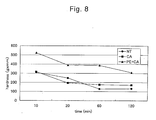
- the physical properties of the samples were measured using a texture analyzer (produced by Stable Micro Systems Ltd.), and then load-bearing characteristic (hardness) was measured upon bending of the fried potatoes with a triangle plunger. Measurement was carried out immediately following frying or after the passage of a certain time following frying.
- fried potatoes (PE+CA) treated with the enzyme maintained sufficient load-bearing strength.
- Fig. 8 shows changes with time in load- bearing strength (hardness).
- the fried potatoes (PE+CA) treated with the enzyme had significantly high load- bearing strength even after a certain time had passed compared with that of the fried potatoes (CA) and (NT).
- the fried potatoes (PE+CA) maintained crispness for a long time period, equivalent to that at the time immediately following frying.
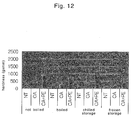
- samples obtained in a manner similar to that described above except for not adding pectinesterase samples obtained in a manner similar to that described above except for not adding calcium, and samples obtained by simply storing the raw fruits intact for 1 week as control samples were prepared.
- pectinesterase NovoShape, converted in terms of protein amount
- the remaining fruits were boiled for 10 minutes, and then cooled, followed by measurement of load-bearing characteristic (hardness) (boiled samples). Subsequently, some of the boiled fruits were refrigerated at 4°C for 1 week (chilled samples), and then the remaining boiled fruits were frozen at -18°C for 1 week (frozen samples). Each stored sample was allowed to return to a normal temperature, and then load-bearing strength (hardness) was measured.
- pectinesterase (converted in terms of protein amount) was added to each 1% calcium chloride aqueous solution.
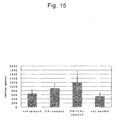
- the aqueous solutions were sprayed over the surfaces of carrots or potatoes cut into pieces in the shape of a 1.5 cm dice so as to moisten the surfaces of the vegetables. Subsequently, pressure treatment was carried out at 5 atm for 5 minutes in a method similar to that in Example 1 using helium gas. After pressure treatment, the vegetables were kept in the aqueous solutions at 40°C for 1 hour, and then boiled in a boiling pan for 15 minutes, thereby preparing samples for measuring physical properties (PE+CA-sprayed).
- 0.01% pectinesterase (NovoShape, converted in terms of protein amount) relative to the weight of vegetables was added to each 200 parts by weight of 1.1% calcium chloride aqueous solution.
- 100 parts by weight of vegetables (carrots) cut into pieces in the shape of a 1.5 cm dice were immersed in the enzyme solutions, and then pressure was increased to 1.1, 2, or 6 atm within 20 seconds or less using a hydraulic pump. Within 1 second after a pressure reached each predetermined pressure, pressure was released for the pressure to return to a normal pressure within 5 seconds.
- the vegetables were kept at 40°C for 1 hour, removed from the solutions, and then boiled in a boiling pan for 15 minutes, thereby preparing samples for measuring physical properties.
- the physical properties of the obtained samples were measured using a texture analyzer (produced by Stable Micro Systems Ltd.), and then load-bearing characteristic (hardness) was evaluated using penetration of a 5-mm spherical plunger.
- Example 9 Pressure processing of potatoes under conditions with low pressure
- 0.01% pectinesterase (NovoShape, converted in terms of protein amount) relative to the weight of vegetables was added to each 200 parts by weight of 5% calcium chloride aqueous solution.
- 100 parts by weight of vegetables (potato) cut into pieces in the shape of a 1.5 cm dice were added to the enzyme solutions.
- the vegetables were put at a depth of 40 cm in the solution for 2 hours and the enzyme solution was infiltrated into the vegetables. Pressure to be applied to the vegetables at this time would be 1.04 atm in total, made up of an atmospheric pressure (1 atm) and water pressure of 0.04 atm.
- the vegetables were kept at 40°C for 1 hour, removed from the solution, and then boiled in a boiling pan for 15 minutes, thereby preparing samples for measuring physical properties.
- the physical properties of the obtained samples were measured using a texture analyzer (produced by Stable Micro Systems Ltd.), and then load-bearing characteristic (hardness) was evaluated using penetration of a 5-mm spherical plunger.
- samples (untreated) prepared by cutting the raw vegetables into pieces and then simply boiling them for 15 minutes and samples (treated at 1 atm) prepared by putting the cut vegetables in enzyme solution prepared in a manner similar to that described above, putting them at a depth of 2 cm in the solution for 2 hours, keeping them at 40°C for 1 hour, and then boiling them in a boiling pan for 15 minutes were used.
- the results are shown in Fig. 17.
- a food material having improved umami or kokumi (mouthfulness, continuity, thickness, mildness or punch), and excellent appearance and texture and a method for modifying a food material to produce such a food material
- a method for modifying a food material to produce such a food material can be provided.
- hardness of a food material such as a vegetable or a fruit can be increased; that is, the food material can be hardened.
- softening and disintegration during boiling can be prevented while heating a vegetable or a fruit.
- loss of the shape of a food material during storage or due to shock during transport can be prevented.
- this can also reduce softening of a food material, which is caused by freezing.
- a food material such as a vegetable or a fruit
- hardness of a food material can be decreased; that is, the food material can be softened.
- a food material softened by the method of the present invention can be easily chewed and swallowed.
- such a food material is appropriate for the diet of patients with weakened maxillary force, old persons, infants who do not yet have a full set of teeth, and the like.
Landscapes
- Chemical & Material Sciences (AREA)
- Life Sciences & Earth Sciences (AREA)
- Engineering & Computer Science (AREA)
- Health & Medical Sciences (AREA)
- Food Science & Technology (AREA)
- Polymers & Plastics (AREA)
- Organic Chemistry (AREA)
- Nutrition Science (AREA)
- Zoology (AREA)
- Wood Science & Technology (AREA)
- General Health & Medical Sciences (AREA)
- Genetics & Genomics (AREA)
- General Engineering & Computer Science (AREA)
- Bioinformatics & Cheminformatics (AREA)
- Biochemistry (AREA)
- Microbiology (AREA)
- Chemical Kinetics & Catalysis (AREA)
- General Chemical & Material Sciences (AREA)
- Preparation Of Fruits And Vegetables (AREA)
- General Preparation And Processing Of Foods (AREA)
- Meat, Egg Or Seafood Products (AREA)
Abstract
A method for modifying a food material, which comprises immersing a
food material in a solution containing an enzyme, carrying out pressure treatment
at 1.04-50 atm or less for the enzyme to infiltrate into the food material, and
causing an enzyme reaction to take place inside the food material.
Description
The present invention relates to a method for modifying a food material to
obtain a food material with good appearance and texture that hardly becomes
softened and disintegrated during boiling, and a food material with appropriate
softness.
Modifying food materials is extremely important in view of processability,
preservability , texture and taste, and the like. Regarding processability, there
are various needs such as shortening of the time required for cooking, obtaining
physical properties that facilitate cutting and mixing processes, and reduced
deterioration in physical characteristics during processing. Regarding
preservability, there are needs such as prevention of oxidation decay and
discoloration due to storage period, temperature, and the like, and prevention of
deformation upon transport. Regarding texture and taste, there are also various
needs for food materials, such as moderate resistance to teeth, proper crunchness,
and umami (delicious taste) or kokumi(mouthfullness, continuity, thickness,
mildness or punch) that spreads intraorally. Furthermore, regarding food materials,
there are needs such as preventing changes in shape and taste due to physical
treatment such as retort heating, freezing, and thawing.
There are many needs such as physico-chemical stability under the
condition of normal or excessive treatment, and improvement of processability.
Techniques using enzymes for processing foods have existed from long
ago. For example, production of cheese using the chymosin of cattle and
production of miso (fermented soybean paste) and soy sauce using koji-derived
proteinase are indispensable for the today's eating habits.
Recent examples of processing food materials include processing sugars
using amylase, glucanase, xylanase, or the like and processing of fruits using
pectinase.
Although enzymes are used for various types of food processing, currently
enzymes are used mainly for processing slurry-formed materials or the surfaces of
food materials. As a technique to infiltrate enzymes into food materials,
long-time immersion in an enzyme solution or infiltration under reduced pressure
has been examined. However, these techniques have low industrial productivity
because of their time-consuming processes and the complicated procedure for
reduced pressure condition. Thus the resulting effects have been unsatisfactory.
Moreover, there is concern that the reduced pressure condition cause the outflow
of nutrients existing inside the food materials. Thus, methods using reduced
pressure are impractical.
An example of utilizing pectinesterase for fried potato includes US
2002/0004085. US 2002/0004085 discloses enzyme treatment wherein 400 g of
Bintje potato with a 1 cm x 10 cm cross section that had been subjected to 10
minutes of blanch treatment at 75°C was immersed for 1 hour in 0.25 M calcium
solution (1000 ml) with pectinesterase (5g). The treated potato was used to
make fried potato. The surface of the treated potato was dried, and the potato
was pre-fried at 190°C for 2 minutes, frozen, and then fried at 195°C for 5
minutes to give fried potato. The crispness of the treated fried potato was then
evaluated by panels and 9 out of 13 panels chose the treated sample as being most
crispy over an untreated control sample, while 4 out of 13 panels chose the
control sample over the treated fried potato. Hence, it could not be said that the
effect of modifying potato by the enzyme treatment method disclosed in US
2002/0004085 was sufficient.
There are some findings that enzymes react on foods under pressure.
Examples of such findings include a saccharification method of starch using
amylase under pressure (e.g., BE75872 (1971) Iuds du Mais, JP Patent
Publication (Kokai) No. 62-118863 A (1987)) and a method for softening meat in
which protease react on the meat at 100 atm or more (JP Patent Publication
(Kokai) No. 5-7476 A (1993)). However, since these methods are carried out
under conditions of high temperature and high pressure, there are problems such
as complicated systems or procedures to carry out these methods and
decomposition of target substances. There are no findings concerning the
introduction of enzymes into food materials with moderate pressure in order to
improve the delicate texture of foods or to obtain food materials characterized by
having good digestability, being difficult to become softened and disintegrated
during boiling, having strong umami or kokumi (mouthfulness, continuity,
thickness, mildness or punch), having appropriate tenderness, or the like.
The objective of the present invention is to provide a food material having
improved appearance, texture, digestability, reduction of softening and
disintegration during boiling, umami or kokumi (mouthfulness, continuity,
thickness, mildness or punch), hardness, and the like, and a method for modifying
a food material to produce such a food material.
As a result of intensive studies to solve the above problems, we have
discovered that the above problems can be solved by carrying out pressure
treatment at 50 atm or less for an intact food material or a food material cut into
any size or shape in an enzyme solution in order to infiltrate the enzyme into the
food material. We have thus completed the present invention.
The present invention comprises the following inventions.
The method for modifying a food material of the present invention
comprises contacting a solution containing an enzyme with a food material,
infiltrating the enzyme into the food material by pressure treatment, and carrying
out the enzyme reaction inside the food material, thereby modifying the food
material.
A food material used in the present invention means a material used for
producing foods. Any food materials can be used in the present invention.
Preferred examples of such food materials include meat, fish and shellfish,
cereals, vegetables, and fruits. Examples of meat include beef, pork, and
chicken meat. Examples of cereals include rice, soybean (green soybean),
adzuki bean, and corn. Examples of vegetables include root vegetables such as
potato, carrot, onion, radish, and sweet potato, fruit vegetables such as pumpkin
and bell pepper, leaf vegetables such as spinach, cabbage, and Chinese cabbage,
and leaf and stem vegetables such as asparagus, broccoli, cauliflower, and
bamboo shoot. Examples of fruits include strawberry, peach, mango, papaya,
watermelon, melon, apple, persimmon, pear, and pineapple.
Food materials used herein may be cut into pieces of any size and shape
or may be peeled in view of treatment efficiency or intended purpose of food
materials.
An enzyme used in the present invention is not specifically limited, as
long as it can react on a protein, a carbohydrate, a lipid, or other components
contained in a food material. Examples of such an enzyme include protease,
transglutaminase, lipase, glutaminase, amylase, glucanase, xylanase, laccase,
phospholipase, pectinase, pectinesterase, and peptidase. Enzymes that can be
used in the present invention are not limited to purified enzymes. When an
enzyme is extracted from a plant or the like, such extract can be used.
Alternatively, when an enzyme is obtained from a microorganism, the culture
broth can also be used. In addition, those produced by genetic engineering
techniques can be used.
To carry out the method for modifying a food material of the present
invention, combinations of a food material and an enzyme are not specifically
limited. It is preferred to select an enzyme in accordance with food material
components. For example, when the hardness of a pectin-rich food material,
such as a vegetable or a fruit, is modified, pectinesterase (also referred to as
pectin methylesterase) is preferably used as an enzyme. Pectinesterase is an
enzyme that hydrolyzes the ester linkage of the methylester residue of pectin
(poly α-D-galacturonic acid) to give methanol and pectic acid. Pectinesterase is
known to exist in plants such as white clover, alfalfa, tobacco, tomatoes, and
grapefruits, and microorganisms such as Coniophera cerebclla, Aspergillus,
Penicillium, Erwinia, and Xanthomonas campestris. Pectinesterase that can be
used in the present invention may be derived from plants or microorganisms or
may be produced by gene recombination. Examples of pectinesterase include
pectinesterase (produced by Sigma Chemical Co.,) derived from orange peels,
Rapidase (produced by DSM Food Specialities) marketed as an enzyme for
producing jam in Europe and the U.S.A., and NovoShape (produced by
Novozymes A/S) derived from Aspergillus aculeatus.
In addition to these enzymes, enzymes such as transglutaminase and
protease are preferred for modification of the quality of meat, and enzymes such
as glucanase, xylanase, and amylase are preferred for modification of cereals and
the like.
An enzyme and a food material used in the present method are preferably
used in, for example, the following combinations. It is preferred to combine an
enzyme such as protease, transglutaminase, peptidase, or glutaminase with a
protein-rich food material such as meat (e.g., beef, pork, or chicken meat), fish
and shellfish, green soybean (soybean), or wheat. It is preferred to combine an
enzyme such as amylase, glucanase, xylanase, pectinase, pectinesterase, or
laccase with a carbohydrate (e.g., starch, pectin, cellulose, or xylose)-rich food
material such as root and tuber crops including potato, sweet potato, and the like,
root vegetables including radish, carrot, and the like, fruit vegetables including
pumpkin, bell pepper, and the like, leaf and stem vegetables including spinach,
onion, cabbage, asparagus, broccoli, cauliflower, bamboo shoot, and the like,
pulse crops including green soybean (soybean) and the like, fruits (edible fruits)
including strawberry, peach, mango, papaya, watermelon, melon, apple, pear,
persimmon, pineapple, and the like, and other cereals including rice, corn, and the
like. Lipase or phospholipase is preferably combined with a food material
containing fats and oils (e.g., triglyceride and phospholipid), such as meat or
soybean.
A solvent for a solution containing an enzyme is not specifically limited,
as long as the enzyme is not denatured or inactivated and is food grade. An
example of such a solvent is water. When water is used as a solvent, the pH is
preferably 3-10. Furthermore, a medium containing an enzyme is not limited to
a liquid such as a solvent and media such as gases or solids can be used.
The amount of an enzyme in a solution containing the enzyme can be
appropriately determined considering the characteristics of a food material to be
modified and the degree of modification. For example, when a food material
such as a vegetable or a fruit is modified using pectinesterase, the concentration
of an enzyme is 0.0005% to 0.03% by weight (converted in terms of the protein
amount of the enzyme) relative to a food material (e.g., a vegetable or a fruit) or
preferably 1 to 60 P.E.U. (1 P.E.U. refers to the titer of an enzyme that produces 1
mmol of acid for 1 minute) relative to 100 parts by weight of a food material (e.g.,
a vegetable or a fruit), and more preferably 0.005% to 0.02% by weight or 10 to
40 P.E.U. When a food material such as a vegetable or a fruit is modified using
pectinase, the enzyme concentration in the pectinase solution is preferably 0.1 to
4000 units and more preferably 2 to 40 units relative to 100 parts by weight of the
food material.
Moreover, when a food material such as a vegetable or a fruit is modified
using pectinesterase, it is preferable to further add a divalent cationic salt to a
solution containing the enzyme. Through the addition of divalent cations, ionic
linkages are formed via the divalent cations between carboxyl groups generated as
a result of the hydrolytic reaction of pectinesterase, whereby viscosity of pectinis
increased. As a result, the hardness of the vegetable, the fruit, or the like is
increased, so that a vegetable or a fruit having improved hardness that does not
lose its shape or disintegrate during boiling can be obtained. Examples of a
divalent cationic salt include magnesium salts, calcium salts, and barium salts.
The magnesium salt used is not specifically limited, as long as it can be
used in foods. Examples of such a magnesium salt include magnesium carbonate,
magnesium oxide, magnesium chloride, and magnesium sulfate. Furthermore,
the calcium salt used is not specifically limited as long as it can be used in foods.
Examples of such a calcium salt include calcium chloride, calcium sulfate,
tricalcium phosphate, calcium monohydrogenphosphate, calcium
dihydrogenphosphate, calcium glycerophosphate, calcium gluconate, calcium
1-glutamate, calcium lactate, calcium pantothenate, calcium hydroxide, calcium
pyrophosphate, calcium citrate, calcium dihydrogenpyrophosphate, calcium oxide,
calcium carbonate, and calcinated calcium. Among these, calcium chloride,
calcium lactate, and magnesium chloride are preferred.
The concentrations of these divalent cationic salts in solutions differ
depending on the type, shape, and treatment conditions of a vegetable or a fruit,
and are generally 0.1-5% by weight and preferably 0.2-1% by weight. When the
concentration of a divalent cation is too high, bitterness may be generated in a
vegetable or a fruit.
Methods for contacting a solution containing an enzyme with a food
material include, for example, immersion of a food material in a solution
containing an enzyme or spray of a solution containing an enzyme on the surface
of a food material.
A solution containing an enzyme is contacted with a food material, and
then pressure treatment is carried out for the enzyme to reach the inside of the
food material. The pressure for pressure treatment is generally 1.04-50 atm
(0.104-5 MPa), preferably 1.5-50 atm (0.15-5 MPa), more preferably 2-15 atm
(0.2-1.5 MPa), and most preferably 3-10 atm (0.3-1 MPa). Methods for pressure
treatment include, for example, pressurizing an enzyme solution containing a food
material immersed therein by a hydraulic pressure pump, compressed air, or gas
in a high-pressure cylinder (e.g., helium, argon, and nitrogen), and pressurizing a
food material, which is sprayed with an enzyme solution, by compressed air or
gas in a high-pressure cylinder (e.g., helium, argon, and nitrogen). The time for
pressure treatment can be appropriately varied considering, for example, the
characteristics of a food material or ease of the infiltration of an enzyme into a
food material, and it is generally about 1-30 minutes. The infiltration can be
controlled by controlling the time even on the second time scale at, for example,
0.1-60 seconds. Furthermore, the temperature for pressure treatment is not
specifically limited, as long as an enzyme is not inactivated and can be
appropriately adjusted.
When pressure treatment is completed, the food material may be left
immersed in the enzyme solution for an appropriate time, or an incubation time
may be provided with appropriately controlling temperature (preferably 30°C to
50°C) so as to carry out an enzyme reaction more sufficiently.
Moreover, an enzyme solution can be utilized (recycled) repeatedly. For
example, vegetables or fruits are put into a container such as a net or a sieve, and
the container is immersed in an enzyme solution followed by pressurizing it to
carry out enzyme treatment, and then the container containing the vegetables or
the fruits are taken away. This enzyme solution may be used again as it is for
the next enzyme treatment for vegetables or fruits contained in a net or sieve,
which is immersed in the solution and then pressurized.
A food material obtained by the method of the present invention can be
preferably used as a cooking material. For example, potato which is processed
by the present method using pectinesterase is preferred as raw materials for fried
potato. Fried potato obtained from the potato produced by the present method
have excellent texture, and their initial crispness last even if time passes from the
frying.
As described above, the present invention provides a method for
modifying a food material, which comprises contacting a solution containing an
enzyme with a food material and carrying out pressure treatment at 1.04-50 atm
for the enzyme to infiltrate into the food material. Moreover, according to the
present invention, a solution containing 1 or more types of substances with a
molecular weight of 1000 or less can also be used instead of a solution containing
an enzyme. In this case, conditions (such as pressure applied, temperature, time)
are same as those in a case where a solution containing an enzyme is used.
Examples of the above "substances with a molecular weight of 1000 or
less" include, but not limited to, substances that can improve the hardness or the
texture of a food material and substances for adding nutrition components and
flavor such as umami (delicious taste) or kokumi (mouthfulness, continuity,
thickness, mildness or punch), sweetness, bitterness, sourness, or salty taste to a
food material. Specific examples of such substances include amino acids or salts
thereof such as glutamic acid and aspartic acid, peptides such as
isoleucyl·prolyl·proline (IPP), vanillyl·prolyl·proline (VPP), and aspartame,
sugars such as glucose, lactose, sucrose, and trehalose, organic acids or salts
thereof such as citric acid, acetic acid, and succinic acid, and furthermore,
inorganic salts such as sodium chloride, potassium chloride, calcium chloride, and
magnesium chloride.
This specification includes part or all of the contents as disclosed in the
specifications and/or drawings of Japanese Patent Application Nos. 2002-199025
and 2003-155209, which are priority documents of the present application.
The present invention will be hereafter described in detail by referring to
examples, but the invention is not limited by these examples.
0.01% pectinesterase (NovoShape, converted in terms of protein amount)
relative to the weight of vegetables was added to each 0.28% calcium chloride
aqueous solution (two-fold weight relative to vegetables). Pumpkins, potatoes,
and carrots were cut into pieces in the shape of a 1.5 cm dice, and then immersed
in the solutions. The aqueous solutions were subjected to pressure treatment
carried out at 50 atm for 20 minutes or 5 atm for 5 minutes using a helium gas
cylinder. After pressure treatment, the vegetables were kept at 40°C for 1 hour,
removed from the solutions, and then boiled in a boiling pan for 15 minutes,
thereby preparing samples for measuring physical properties. The physical
properties of the obtained samples were measured using a texture analyzer
(produced by Stable Micro Systems Ltd.), and then load-bearing characteristic
(hardness) was evaluated using penetration of a 5 mm-spherical plunger.
Furthermore, as comparative examples, load-bearing characteristic was
similarly measured using samples obtained in a manner similar to that described
above except for not adding pectinesterase, samples obtained in a manner similar
to that described above except for not adding calcium, and control samples
prepared by simply boiling the raw vegetables intact for 15 minutes.
The results are shown in Figs. 1 to 3.
The results in Figs. 1 to 3 showed that the hardness of all the vegetables
including pumpkins, potatoes, and carrots increased when the vegetables were
subjected to pressure treatment in the presence of pectinesterase (PE) and calcium
chloride (CA). It was also shown that even when pressure treatment was carried
out at 5 atm for 5 minutes in the presence of pectinesterase and calcium chloride,
the hardness of the vegetables was increased to the same degree as that in the case
of 20 minutes of pressure treatment at 50 atm.
0.01% pectinesterase (NovoShape, converted in terms of protein amount)
relative to the weight of vegetables was added to each 200 parts by weight of
0.28% calcium chloride aqueous solution. 100 parts by weight of vegetables
(pumpkins or carrots) cut into pieces in the shape of a 1.5 cm dice and put into
nets were immersed to the enzyme solutions, and then pressure treatment was
carried out at 5 atm for 5 minutes using a hydraulic pump. Subsequently, the
vegetables in the nets were replaced with untreated vegetables, and then pressure
treatment was similarly carried out at 5 atm for 5 minutes using the same enzyme
solution repeatedly and a hydraulic pump. This procedure was repeated up to 12
times. The treated vegetables obtained by each of the first immersion and
pressure treatment to the eighth (R01 to R08) immersion and pressure treatment
were kept in the aqueous solutions at 40°C for 1 hour, and then boiled in a boiling
pan for 15 minutes, thereby preparing samples for measuring physical properties
(R01 to R08). The physical properties of the obtained samples were measured
using a texture analyzer (produced by Stable Micro Systems Ltd.), and then
load-bearing characteristic (hardness) was evaluated using penetration of a 5-mm
plunger. As comparative examples, load-bearing characteristic was similarly
measured for samples (CA) treated in a manner similar to that described above
except for not using an enzyme and samples (NT) prepared by simply boiling raw
vegetables intact for 15 minutes. The results are shown in Figs. 4 and 5. The
results in Figs. 4 and 5 showed that an enzyme solution can be recycled because
even vegetables treated in the repeatedly-used enzyme solution were more
significantly hardened compared with the vegetables (CA) treated only with the
calcium chloride solution and the vegetables (NT) prepared by boiling the raw
vegetables for 15 minutes.
2 parts by weight of a mixed solution containing pectinesterase
(Novoshape) and pectinase (Novozymes A/S, Pectinex Ultra SP-L) was added to
each 200 parts by weight of 0.28% calcium chloride aqueous solution. 100 parts
by weight of vegetables (carrots) cut into pieces in the shape of a 1.5 cm dice
were immersed in the enzyme solutions, and then pressure treatment was carried
out at 5 atm for 5 minutes using a helium cylinder. After pressure treatment, the
treated vegetables were kept at 40°C for 1 hour in the aqueous solutions, and then
boiled in a boiling pan for 15 minutes, thereby preparing samples for measuring
physical properties. The physical properties of the obtained samples were
measured using a texture analyzer (produced by Stable Micro Systems Ltd.), and
then load-bearing characteristic (hardness) was evaluated using penetration of a
5-mm plunger. As comparative examples, load-bearing characteristic was
similarly measured for samples (CA) treated in a manner similar to that described
above except for not using an enzyme and samples (NT) prepared by simply
boiling the raw vegetables intact for 15 minutes. The results are shown in Fig. 6.
The results in Fig. 6 showed that carrots treated with an enzyme solution
containing pectinase at a higher ratio was softened to a greater extent than the
vegetables (CA) treated only with the calcium chloride solution and the
vegetables (NT) prepared by boiling the raw vegetables for 15 minutes. As
described above, it is possible to provide a softer texture by causing enzymes to
react in combination.
0.003% pectinesterase (NovoShape, converted in terms of protein amount)
relative to the weight of potatoes was added to each 100 to 200 parts by weight of
1% calcium chloride aqueous solution. Potatoes (100 parts by weight) cut into
pieces in the shape of a 7 mm stick (produced in Hokkaido, Hokkaikogane) were
immersed in the enzyme solutions, and then pressure treatment was carried out at
5 atm for 5 minutes using a hydraulic pump. After pressure treatment, the
potatoes were immersed in hot water at 70°C for 10 minutes, and then drained off
with a strainer. Next the potatoes were pre-fried in oil at 190°C for 1 minute,
cooled at -40°C for 1 hour, and then stored at -18°C for 1 week. The frozen
pre-fried potatoes were fried in oil at 170°C for 3 minutes, thereby preparing
samples (PE+CA) for evaluating texture and for measuring physical properties.
Texture was evaluated by a sensory test wherein 10 blindfolded panels were asked
to select samples with higher crispness. The physical properties of the samples
were measured using a texture analyzer (produced by Stable Micro Systems Ltd.),
and then load-bearing characteristic (hardness) was measured upon bending of the
fried potatoes with a triangle plunger. Measurement was carried out
immediately following frying or after the passage of a certain time following
frying. As comparative examples, texture evaluation and measurement of
load-bearing characteristic was similarly carried out for samples (CA) obtained in
a manner similar to that described above except for not using pectinesterase and
samples (NT) obtained in a manner similar to that described above except for not
using both pectinesterase and calcium chloride. When texture evaluation was
carried out for these samples, all 10 panels evaluated that the enzyme-treated
samples had more crispness. In addition, the results of measuring physical
properties are shown in Figs. 7 and 8. Fig. 7 shows the results of measuring the
hardness of the fried potatoes 20 minutes after the time immediately following
frying. In the case of not treated sample (NT), the load-bearing strength of the
fried potatoes was weak and thus the fried potatoes were too soft. However, the
fried potatoes (PE+CA) treated with the enzyme maintained sufficient load-bearing
strength. Fig. 8 shows changes with time in load- bearing strength
(hardness). The fried potatoes (PE+CA) treated with the enzyme had
significantly high load- bearing strength even after a certain time had passed
compared with that of the fried potatoes (CA) and (NT). The fried potatoes
(PE+CA) maintained crispness for a long time period, equivalent to that at the
time immediately following frying.
0.01% by weight of pectinesterase (NovoShape, converted in terms of
protein amount) relative to the weight of fruits was added to each 0.28% calcium
chloride aqueous solution (two-fold weight relative to fruits). Intact
strawberries were immersed and mangos cut into pieces in the shape of a 1.5 cm
dice were immersed in the solutions, and then pressure treatment was carried out
at 5 atm for 5 minutes. In addition, pressure treatment was carried out by the
method similar to that in Example 1. After pressure treatment, the fruits were
kept in the aqueous solutions for 1 hour, removed from the solutions, and then
stored in a refrigerator for 1 week, thereby preparing samples.
Furthermore, as comparative examples, samples obtained in a manner
similar to that described above except for not adding pectinesterase, samples
obtained in a manner similar to that described above except for not adding
calcium, and samples obtained by simply storing the raw fruits intact for 1 week
as control samples were prepared.
The load-bearing characteristic of these samples was measured in a
manner similar to that of Example 1. The results are shown in Figs. 9 and 10.
The results in Figs. 9 and 10 showed that in both strawberries and mangos, the
hardness of the fruits was increased when pressure treatment had been carried out
in the presence of pectinesterase (PE) and calcium chloride (CA).
0.01% by weight of pectinesterase (NovoShape, converted in terms of
protein amount) relative to the weight of fruits was added to each 0.28% calcium
chloride aqueous solution (two-fold weight relative to fruits). Fruits
(persimmons, papayas, or mangos) cut into pieces in the shape of a 1 cm dice
were immersed in the solutions, and then pressure treatment was carried out at 5
atm for 5 minutes. Pressure treatment was carried out using a hydraulic pump
similarly to that used in Example 2. After pressure treatment, the fruits were
kept in the aqueous solutions at 40°C for 1 hour. Parts of them were then
removed from the solutions, and then load-bearing characteristic (hardness) was
measured (not-boiled samples). The remaining fruits were boiled for 10 minutes,
and then cooled, followed by measurement of load-bearing characteristic
(hardness) (boiled samples). Subsequently, some of the boiled fruits were
refrigerated at 4°C for 1 week (chilled samples), and then the remaining boiled
fruits were frozen at -18°C for 1 week (frozen samples). Each stored sample was
allowed to return to a normal temperature, and then load-bearing strength
(hardness) was measured.
Furthermore, as comparative examples, load-bearing characteristic of
samples (CA) obtained in a manner similar to that described above except for not
using pectinesterase and that of samples (NT) obtained in a manner similar to that
described above except for not using pectinesterase and calcium chloride were
measured. The results of measuring the load-bearing characteristic of these
samples are shown in Fig. 11 (persimmons), Fig. 12 (papayas), and Fig. 13
(mangos). In all the cases of the not-boiled samples, the boiled samples, the
chilled samples, and the frozen samples, it was shown that those treated with the
enzyme solution containing pectinesterase (CA+PE) tended to have more hardness
than that of (NT) and (CA) samples.
0.003% by weight of pectinesterase (converted in terms of protein
amount) was added to each 1% calcium chloride aqueous solution. The aqueous
solutions were sprayed over the surfaces of carrots or potatoes cut into pieces in
the shape of a 1.5 cm dice so as to moisten the surfaces of the vegetables.
Subsequently, pressure treatment was carried out at 5 atm for 5 minutes in a
method similar to that in Example 1 using helium gas. After pressure treatment,
the vegetables were kept in the aqueous solutions at 40°C for 1 hour, and then
boiled in a boiling pan for 15 minutes, thereby preparing samples for measuring
physical properties (PE+CA-sprayed). The physical properties of the obtained
samples were measured using a texture analyzer (produced by Stable Micro
Systems Ltd.), and then load-bearing characteristic (hardness) was evaluated
using penetration of a 5-mm plunger. As comparative examples, samples
(CA-sprayed) treated in a manner similar to that described above except for not
using an enzyme, samples (not sprayed) treated in a manner similar to that
described above but without spraying, and samples (not treated) prepared by
simply boiling the raw vegetables for 15 minutes were prepared, and then
load-bearing characteristic was measured for these samples. The results are
shown in Fig. 14 (carrots) and Fig. 15 (potatoes).
It was observed that the samples treated with the enzyme solution
containing pectinestrase were significantly hardened compared with the
non-treated samples.
0.01% pectinesterase (NovoShape, converted in terms of protein amount)
relative to the weight of vegetables was added to each 200 parts by weight of
1.1% calcium chloride aqueous solution. 100 parts by weight of vegetables
(carrots) cut into pieces in the shape of a 1.5 cm dice were immersed in the
enzyme solutions, and then pressure was increased to 1.1, 2, or 6 atm within 20
seconds or less using a hydraulic pump. Within 1 second after a pressure
reached each predetermined pressure, pressure was released for the pressure to
return to a normal pressure within 5 seconds. After pressure processing, the
vegetables were kept at 40°C for 1 hour, removed from the solutions, and then
boiled in a boiling pan for 15 minutes, thereby preparing samples for measuring
physical properties. The physical properties of the obtained samples were
measured using a texture analyzer (produced by Stable Micro Systems Ltd.), and
then load-bearing characteristic (hardness) was evaluated using penetration of a
5-mm spherical plunger.
As comparative examples, samples (untreated) prepared by cutting the raw
vegetables into pieces and then simply boiling them intact for 15 minutes were
used for measuring physical properties. The results are shown in Fig. 16.
The results in Fig. 16 showed that even when the time for applying
pressure was very short, the hardness of the vegetables would be higher.
0.01% pectinesterase (NovoShape, converted in terms of protein amount)
relative to the weight of vegetables was added to each 200 parts by weight of 5%
calcium chloride aqueous solution. 100 parts by weight of vegetables (potato)
cut into pieces in the shape of a 1.5 cm dice were added to the enzyme solutions.
The vegetables were put at a depth of 40 cm in the solution for 2 hours and the
enzyme solution was infiltrated into the vegetables. Pressure to be applied to
the vegetables at this time would be 1.04 atm in total, made up of an atmospheric
pressure (1 atm) and water pressure of 0.04 atm. After pressure treatment, the
vegetables were kept at 40°C for 1 hour, removed from the solution, and then
boiled in a boiling pan for 15 minutes, thereby preparing samples for measuring
physical properties. The physical properties of the obtained samples were
measured using a texture analyzer (produced by Stable Micro Systems Ltd.), and
then load-bearing characteristic (hardness) was evaluated using penetration of a
5-mm spherical plunger.
As comparative examples, samples (untreated) prepared by cutting the raw
vegetables into pieces and then simply boiling them for 15 minutes and samples
(treated at 1 atm) prepared by putting the cut vegetables in enzyme solution
prepared in a manner similar to that described above, putting them at a depth of 2
cm in the solution for 2 hours, keeping them at 40°C for 1 hour, and then boiling
them in a boiling pan for 15 minutes were used. The results are shown in Fig.
17.
The results in Fig. 17 showed that even with a slight difference in
pressure upon pressure treatment between the samples treated at 1 atm and the
samples treated at 1.04 atm, the effect of modifying vegetables was significant in
the samples treated at 1.04 atm.
All publications, patents, and patent applications cited herein are
incorporated herein by reference in their entirety.
According to the present invention, a food material having improved
umami or kokumi (mouthfulness, continuity, thickness, mildness or punch), and
excellent appearance and texture, and a method for modifying a food material to
produce such a food material, can be provided. Furthermore, according to the
method for modifying a food material of the present invention, hardness of a food
material such as a vegetable or a fruit can be increased; that is, the food material
can be hardened. By hardening a food material, softening and disintegration
during boiling can be prevented while heating a vegetable or a fruit.
Furthermore, loss of the shape of a food material during storage or due to shock
during transport can be prevented. Moreover, this can also reduce softening of a
food material, which is caused by freezing.
In addition, according to the method for modifying a food material of the
present invention, hardness of a food material such as a vegetable or a fruit can
be decreased; that is, the food material can be softened. A food material
softened by the method of the present invention can be easily chewed and
swallowed. For example, such a food material is appropriate for the diet of
patients with weakened maxillary force, old persons, infants who do not yet have
a full set of teeth, and the like.
Claims (15)
- A method for modifying a food material, which comprises:contacting a solution containing an enzyme with a food material,infiltrating the enzyme into the food material by pressure treatment at 1.04-50 atm, andcarrying out the enzyme reaction inside the food material.
- The method of claim 1, wherein the food material is selected from the group consisting of meat, fish and shellfish, cereals, vegetables, and fruits.
- The method of claim 1, wherein the enzyme is selected from the group consisting of protease, transglutaminase, lipase, glutaminase, amylase, glucanase, xylanase, laccase, phospholipase, pectinase, pectinesterase, and peptidase.
- The method of claim 1, wherein the pressure of the pressure treatment is 2-15 atm.
- The method of claim 1, wherein the food material is selected from the group consisting of potato, carrot, onion, radish, pumpkin, bell pepper, spinach, cabbage, sweet potato, asparagus, broccoli, cauliflower, bamboo shoot, and green soybean.
- The method of claim 1, wherein the food material is selected from the group consisting of strawberry, peach, mango, papaya, watermelon, melon, apple, pear, persimmon, and pineapple.
- The method of claim 1, wherein the enzyme is pectinesterase, the food material is a vegetable or a fruit, and the enzyme concentration as the protein amount of the enzyme in a solution containing the enzyme is 0.0005% to 0.03% by weight relative to the food material .
- The method of claim 1, wherein the enzyme is pectinesterase, the food material is a vegetable or a fruit, and the enzyme concentration in a solution containing the enzyme is 1 to 60 P.E.U. relative to 100 parts by weight of the food material.
- The method of claim 7 or 8, wherein the solution containing the enzyme further contains a 0.1 % to 5% divalent cationic salt.
- The method of claim 9, wherein the divalent cationic salt is a calcium salt.
- The method of claim 1, wherein the enzyme is pectinase, the food material is a vegetable or a fruit, and the enzyme concentration in a solution containing the enzyme is 0.1 to 4000 units relative to 100 parts by weight of the food material.
- A food material, which is obtained by the method of any one of claims 1 to 11.
- A method for producing potato for fried potato, which comprises contacting a solution containing pectinesterase with potato, infiltrating the enzyme into the potato by pressure treatment at 1.04-50 atm, and carrying out the enzyme reaction inside the potato.
- A fried potato, which is obtained by frying the potato obtained by the method of claim 13 with oil.
- A method for modifying a food material, which comprises contacting a solution containing 1 or more types of substances with a molecular weight of 1000 or less with a food material, infiltrating the substance(s) into the food material by pressure treatment at 1.04-50 atm, and introducing the substance(s) into the food material.
Applications Claiming Priority (5)
| Application Number | Priority Date | Filing Date | Title |
|---|---|---|---|
| JP2002199025 | 2002-07-08 | ||
| JP2002199025 | 2002-07-08 | ||
| JP2003155209 | 2003-05-30 | ||
| JP2003155209A JP2004089181A (en) | 2002-07-08 | 2003-05-30 | Method for modifying food material |
| PCT/JP2003/008412 WO2004004489A1 (en) | 2002-07-08 | 2003-07-02 | Method of modifying food material |
Publications (2)
| Publication Number | Publication Date |
|---|---|
| EP1554939A1 true EP1554939A1 (en) | 2005-07-20 |
| EP1554939A4 EP1554939A4 (en) | 2007-03-21 |
Family
ID=30117407
Family Applications (1)
| Application Number | Title | Priority Date | Filing Date |
|---|---|---|---|
| EP03738638A Withdrawn EP1554939A4 (en) | 2002-07-08 | 2003-07-02 | Method of modifying food material |
Country Status (6)
| Country | Link |
|---|---|
| US (1) | US20050123648A1 (en) |
| EP (1) | EP1554939A4 (en) |
| JP (1) | JP2004089181A (en) |
| CN (1) | CN1665402A (en) |
| AU (1) | AU2003246242A1 (en) |
| WO (1) | WO2004004489A1 (en) |
Cited By (9)
| Publication number | Priority date | Publication date | Assignee | Title |
|---|---|---|---|---|
| WO2007055393A1 (en) * | 2005-11-09 | 2007-05-18 | Ajinomoto Co., Inc. | Kokumi-imparting agent |
| CN101305281A (en) * | 2005-11-09 | 2008-11-12 | 味之素株式会社 | Agent for imparting KOKUMI |
| US8106020B2 (en) | 2005-11-09 | 2012-01-31 | Ajinomoto Co., Inc. | Calcium receptor activator |
| CN102702311A (en) * | 2005-11-09 | 2012-10-03 | 味之素株式会社 | Agent with kokumi |
| US8399417B2 (en) | 2007-05-08 | 2013-03-19 | Ajinomoto Co., Inc. | Food |
| US8420144B2 (en) | 2005-11-09 | 2013-04-16 | Ajinomoto Co., Inc. | Kokumi-imparting agent, method of using, and compositions containing same |
| US8586121B2 (en) | 2005-07-22 | 2013-11-19 | Mars, Inc. | Fruit snack |
| WO2019125432A1 (en) * | 2017-12-20 | 2019-06-27 | General Mills, Inc. | Infused fruit compositions and method of processing fruit |
| US20220132877A1 (en) * | 2019-04-03 | 2022-05-05 | General Mills, Inc. | Methods of Making a Treated Fruit Composition |
Families Citing this family (30)
| Publication number | Priority date | Publication date | Assignee | Title |
|---|---|---|---|---|
| CN101090644A (en) | 2005-01-13 | 2007-12-19 | 味之素株式会社 | Processed meat product or fish paste product and process for producing the same |
| WO2006098453A1 (en) * | 2005-03-17 | 2006-09-21 | National University Corporation Kumamoto University | Method of treating food and food obtained by this method |
| JP2007000139A (en) * | 2005-06-27 | 2007-01-11 | Chi's Research Corp | Vegetable softener |
| GB0515173D0 (en) * | 2005-07-22 | 2005-08-31 | Mars Inc | Fruit snack |
| JP5424181B2 (en) * | 2006-03-24 | 2014-02-26 | 広島県 | Process for producing food for persons with difficulty in chewing / swallowing and food for persons having difficulty in chewing / swallowing |
| US20080311174A1 (en) * | 2006-02-01 | 2008-12-18 | Hiroshima Prefecture | Food and Process for Producing Food |
| TWI469740B (en) * | 2006-09-04 | 2015-01-21 | Mishima Foods Co Ltd | Method for making soft material of vegetable substance |
| JPWO2009044538A1 (en) * | 2007-10-02 | 2011-02-03 | イーエヌ大塚製薬株式会社 | Ingredients suitable for those who have difficulty chewing or swallowing |
| JP5093658B2 (en) * | 2007-10-10 | 2012-12-12 | 広島県 | Aged food manufacturing method |
| JP2010051209A (en) * | 2008-08-27 | 2010-03-11 | Mishima Shokuhin Kk | Method for producing frozen soft vegetable food |
| KR101093210B1 (en) | 2008-10-15 | 2011-12-13 | 김노수 | Method of preparing fermented dried persimmon using enzyme |
| JP5135175B2 (en) * | 2008-11-13 | 2013-01-30 | イーエヌ大塚製薬株式会社 | Softening method |
| WO2010114120A1 (en) * | 2009-04-02 | 2010-10-07 | 株式会社エフコム | Method for producing enzyme-containing food, and enzyme-containing food |
| JP5563235B2 (en) * | 2009-04-27 | 2014-07-30 | 株式会社スギヨ | Process for producing processed vegetable ingredients and processed vegetable ingredients |
| EP2438823A4 (en) * | 2009-06-05 | 2014-06-11 | Ajinomoto Kk | Enzyme preparation for reforming processed meat products and manufacturing method for processed meat products |
| JP5613844B2 (en) * | 2011-10-28 | 2014-10-29 | マルハニチロ株式会社 | Process for producing processed seafood with improved texture |
| CN103651825B (en) * | 2012-09-24 | 2016-02-17 | 内蒙古伊利实业集团股份有限公司 | A kind of preparation method of mango milk |
| JP5643917B2 (en) * | 2012-09-28 | 2014-12-17 | マルハニチロ株式会社 | Method for producing softened food |
| CN102871073B (en) * | 2012-10-17 | 2015-07-08 | 上海乐全食品有限公司 | Method for performing hardening treatment on fruit grains |
| JP6332935B2 (en) * | 2013-10-09 | 2018-05-30 | 茂樹 舘山 | Enzyme agent and method for producing softened food using the enzyme agent |
| CN104782782B (en) * | 2014-01-22 | 2018-04-17 | 内蒙古蒙牛乳业(集团)股份有限公司 | A kind of preparation method of the preparation method of dilute cream hydrolysate, the dairy products for adding it and dairy products |
| JP5683728B1 (en) * | 2014-03-28 | 2015-03-11 | マルハニチロ株式会社 | Citrus pulp processing composition and method for producing processed pulp food using the same |
| CN105685209A (en) * | 2014-11-28 | 2016-06-22 | 东港市锦江食品开发有限公司 | A deep processing method for strawberries |
| KR101782127B1 (en) | 2015-10-15 | 2017-09-27 | 건국대학교 산학협력단 | Method of tenderizing seafood and tenderizing seafood prepared therefrom |
| KR102014975B1 (en) | 2017-12-08 | 2019-10-23 | 주식회사 바이오프로후즈 | Apparatus for manufacturing tenderized food and decomposing·fermenting of food, and preparation method of tenderized food using the same |
| TWI711384B (en) * | 2019-09-04 | 2020-12-01 | 國立臺灣大學 | Soft plant ingredients and manufacturing method thereof |
| JP7282269B2 (en) * | 2020-07-02 | 2023-05-26 | サントリーホールディングス株式会社 | beer-taste beverages |
| JP7843300B2 (en) * | 2021-06-22 | 2026-04-09 | イン ホ オ | A method for producing vegetables or fruits in which water-soluble active ingredients have been highly permeated. |
| JP2023148123A (en) * | 2022-03-30 | 2023-10-13 | 公益財団法人東洋食品研究所 | Method for preventing disintegration of ingredients in processed food stored in storage containers and additives used in the method |
| KR102862012B1 (en) * | 2022-07-29 | 2025-09-18 | 한양대학교 산학협력단 | Method for Softening Root Vegetables |
Family Cites Families (12)
| Publication number | Priority date | Publication date | Assignee | Title |
|---|---|---|---|---|
| US2534263A (en) * | 1947-07-18 | 1950-12-19 | Claude H Hills | Method of firming fruit and vegetable slices |
| JPH03259036A (en) * | 1990-03-07 | 1991-11-19 | Genzo Kushibiki | Preparation of pickled apple |
| JPH057476A (en) * | 1991-06-28 | 1993-01-19 | Ajinomoto Co Inc | Improvement of meat quality |
| US5200217A (en) * | 1991-10-25 | 1993-04-06 | Sunkist Growers, Inc. | Enzyme infusion process for preparing whole peeled citrus fruit |
| JP2839455B2 (en) * | 1994-11-26 | 1998-12-16 | 昭和産業株式会社 | Manufacturing method of frozen vegetables |
| JP2662770B2 (en) * | 1994-12-28 | 1997-10-15 | 江崎グリコ株式会社 | Method for improving the quality of seafood for pressurized and heat sterilized foods |
| JPH0998716A (en) * | 1995-05-26 | 1997-04-15 | Osaka Seibutsu Kankyo Kagaku Kenkyusho:Kk | Production of microorganism-added pickle and pickle obtained thereby |
| EP1013179A1 (en) * | 1998-12-27 | 2000-06-28 | Dsm N.V. | Fruit juice clarification |
| US6149950A (en) * | 1999-07-22 | 2000-11-21 | Novo Norolisk A/S | Meat tenderization |
| FI20000295L (en) * | 2000-02-11 | 2001-08-12 | Valtion Teknillinen | Method for preserving food ingredients |
| DE60140385D1 (en) * | 2000-04-14 | 2009-12-17 | Novozymes Inc | Pectinase treatment of potato products |
| JP4342755B2 (en) * | 2000-09-27 | 2009-10-14 | 紀南農業協同組合 | Process for producing processed fruit |
-
2003
- 2003-05-30 JP JP2003155209A patent/JP2004089181A/en active Pending
- 2003-07-02 WO PCT/JP2003/008412 patent/WO2004004489A1/en not_active Ceased
- 2003-07-02 CN CN038162393A patent/CN1665402A/en active Pending
- 2003-07-02 AU AU2003246242A patent/AU2003246242A1/en not_active Abandoned
- 2003-07-02 EP EP03738638A patent/EP1554939A4/en not_active Withdrawn
-
2005
- 2005-01-10 US US11/031,032 patent/US20050123648A1/en not_active Abandoned
Cited By (14)
| Publication number | Priority date | Publication date | Assignee | Title |
|---|---|---|---|---|
| US8586121B2 (en) | 2005-07-22 | 2013-11-19 | Mars, Inc. | Fruit snack |
| US8173605B2 (en) | 2005-11-09 | 2012-05-08 | Ajinomoto Co., Inc. | Kokumi-imparting agent |
| EP2175273A1 (en) * | 2005-11-09 | 2010-04-14 | Ajinomoto Co., Inc. | Kokumi-imparting agent |
| EP2299271A2 (en) | 2005-11-09 | 2011-03-23 | Ajinomoto Co., Inc. | Kokumi-imparting agent |
| EP2299271A3 (en) * | 2005-11-09 | 2011-07-13 | Ajinomoto Co., Inc. | Kokumi-imparting agent |
| US8106020B2 (en) | 2005-11-09 | 2012-01-31 | Ajinomoto Co., Inc. | Calcium receptor activator |
| WO2007055393A1 (en) * | 2005-11-09 | 2007-05-18 | Ajinomoto Co., Inc. | Kokumi-imparting agent |
| CN102702311A (en) * | 2005-11-09 | 2012-10-03 | 味之素株式会社 | Agent with kokumi |
| US8420144B2 (en) | 2005-11-09 | 2013-04-16 | Ajinomoto Co., Inc. | Kokumi-imparting agent, method of using, and compositions containing same |
| CN101305281A (en) * | 2005-11-09 | 2008-11-12 | 味之素株式会社 | Agent for imparting KOKUMI |
| US9395376B2 (en) | 2005-11-09 | 2016-07-19 | Ajinomoto Co., Inc. | Kokumi-imparting agent |
| US8399417B2 (en) | 2007-05-08 | 2013-03-19 | Ajinomoto Co., Inc. | Food |
| WO2019125432A1 (en) * | 2017-12-20 | 2019-06-27 | General Mills, Inc. | Infused fruit compositions and method of processing fruit |
| US20220132877A1 (en) * | 2019-04-03 | 2022-05-05 | General Mills, Inc. | Methods of Making a Treated Fruit Composition |
Also Published As
| Publication number | Publication date |
|---|---|
| US20050123648A1 (en) | 2005-06-09 |
| WO2004004489A1 (en) | 2004-01-15 |
| CN1665402A (en) | 2005-09-07 |
| JP2004089181A (en) | 2004-03-25 |
| EP1554939A4 (en) | 2007-03-21 |
| AU2003246242A1 (en) | 2004-01-23 |
Similar Documents
| Publication | Publication Date | Title |
|---|---|---|
| US20050123648A1 (en) | Method for modifying food materials | |
| Cano | 7 Vegetables | |
| EP1591019B2 (en) | Pectinase treatment of potato products | |
| EP2196100B1 (en) | Method of producing matured food | |
| JP6052654B2 (en) | Soft food manufacturing method and food | |
| CA2809242C (en) | Method for producing softened plant material | |
| CN105212114A (en) | Soft vegetable material and manufacture method thereof | |
| KR20100075991A (en) | Food material suitable for patients with disturbance of mastication/swallowing | |
| US20110300260A1 (en) | Method for preparation of frozen microwave instant food | |
| JP4753206B2 (en) | Method for producing functional food and functional food | |
| US6033692A (en) | Method for hydrating dry edible beans | |
| Sriwimon et al. | Utilization of partially ripe mangoes for freezing preservation by impregnation of mango juice and sugars | |
| Temiz et al. | Enzymes in minimally processed fruits and vegetables | |
| JP5881418B2 (en) | Method for producing enzyme-containing food and enzyme-containing food | |
| CN106255420B (en) | Composition for processing citrus pulp and method for producing pulp-processed food using same | |
| Topno | Effect of calcium chloride (CaCl 2) and carbon dioxide (CO 2) on post harvest quality of apple fruit (Malus domestica) cv. Gala | |
| JP6333510B2 (en) | Method for producing sauces containing cut fruits or vegetables | |
| GB2304024A (en) | Tomato sauce for pasta | |
| US20050084601A1 (en) | Pumpkin for cooking use and process for producing the same | |
| Bhowmik et al. | Enzymes and quality factors of fruits and vegetables | |
| Singh et al. | Preservation of fresh-cut fruits and vegetables: Current status and emerging technologies | |
| Cantwell et al. | Postharvest technology of horticultural crops: Fresh-cut and processed horticultural products | |
| JP4490398B2 (en) | Process for producing processed root vegetables and process for producing food containing root vegetables | |
| JP5027094B2 (en) | Fried food | |
| CN1219466C (en) | Method for preparing wild collybia albuminosa fungus quickly and expediently |
Legal Events
| Date | Code | Title | Description |
|---|---|---|---|
| PUAI | Public reference made under article 153(3) epc to a published international application that has entered the european phase |
Free format text: ORIGINAL CODE: 0009012 |
|
| 17P | Request for examination filed |
Effective date: 20050204 |
|
| AK | Designated contracting states |
Kind code of ref document: A1 Designated state(s): AT BE BG CH CY CZ DE DK EE ES FI FR GB GR HU IE IT LI LU MC NL PT RO SE SI SK TR |
|
| AX | Request for extension of the european patent |
Extension state: AL LT LV MK |
|
| DAX | Request for extension of the european patent (deleted) | ||
| RBV | Designated contracting states (corrected) |
Designated state(s): DE FR GB |
|
| A4 | Supplementary search report drawn up and despatched |
Effective date: 20070219 |
|
| STAA | Information on the status of an ep patent application or granted ep patent |
Free format text: STATUS: THE APPLICATION IS DEEMED TO BE WITHDRAWN |
|
| 18D | Application deemed to be withdrawn |
Effective date: 20070521 |