EP1553518A1 - Transaction terminal unit and transaction terminal control method - Google Patents
Transaction terminal unit and transaction terminal control method Download PDFInfo
- Publication number
- EP1553518A1 EP1553518A1 EP02762790A EP02762790A EP1553518A1 EP 1553518 A1 EP1553518 A1 EP 1553518A1 EP 02762790 A EP02762790 A EP 02762790A EP 02762790 A EP02762790 A EP 02762790A EP 1553518 A1 EP1553518 A1 EP 1553518A1
- Authority
- EP
- European Patent Office
- Prior art keywords
- information
- transaction terminal
- terminal device
- module
- secure information
- Prior art date
- Legal status (The legal status is an assumption and is not a legal conclusion. Google has not performed a legal analysis and makes no representation as to the accuracy of the status listed.)
- Granted
Links
Images





Classifications
-
- G—PHYSICS
- G06—COMPUTING OR CALCULATING; COUNTING
- G06Q—INFORMATION AND COMMUNICATION TECHNOLOGY [ICT] SPECIALLY ADAPTED FOR ADMINISTRATIVE, COMMERCIAL, FINANCIAL, MANAGERIAL OR SUPERVISORY PURPOSES; SYSTEMS OR METHODS SPECIALLY ADAPTED FOR ADMINISTRATIVE, COMMERCIAL, FINANCIAL, MANAGERIAL OR SUPERVISORY PURPOSES, NOT OTHERWISE PROVIDED FOR
- G06Q20/00—Payment architectures, schemes or protocols
- G06Q20/30—Payment architectures, schemes or protocols characterised by the use of specific devices or networks
- G06Q20/32—Payment architectures, schemes or protocols characterised by the use of specific devices or networks using wireless devices
- G06Q20/322—Aspects of commerce using mobile devices [M-devices]
- G06Q20/3226—Use of secure elements separate from M-devices
-
- G—PHYSICS
- G06—COMPUTING OR CALCULATING; COUNTING
- G06F—ELECTRIC DIGITAL DATA PROCESSING
- G06F21/00—Security arrangements for protecting computers, components thereof, programs or data against unauthorised activity
- G06F21/30—Authentication, i.e. establishing the identity or authorisation of security principals
- G06F21/31—User authentication
- G06F21/34—User authentication involving the use of external additional devices, e.g. dongles or smart cards
-
- G—PHYSICS
- G06—COMPUTING OR CALCULATING; COUNTING
- G06Q—INFORMATION AND COMMUNICATION TECHNOLOGY [ICT] SPECIALLY ADAPTED FOR ADMINISTRATIVE, COMMERCIAL, FINANCIAL, MANAGERIAL OR SUPERVISORY PURPOSES; SYSTEMS OR METHODS SPECIALLY ADAPTED FOR ADMINISTRATIVE, COMMERCIAL, FINANCIAL, MANAGERIAL OR SUPERVISORY PURPOSES, NOT OTHERWISE PROVIDED FOR
- G06Q20/00—Payment architectures, schemes or protocols
- G06Q20/30—Payment architectures, schemes or protocols characterised by the use of specific devices or networks
- G06Q20/34—Payment architectures, schemes or protocols characterised by the use of specific devices or networks using cards, e.g. integrated circuit [IC] cards or magnetic cards
- G06Q20/341—Active cards, i.e. cards including their own processing means, e.g. including an IC or chip
-
- G—PHYSICS
- G07—CHECKING-DEVICES
- G07F—COIN-FREED OR LIKE APPARATUS
- G07F7/00—Mechanisms actuated by objects other than coins to free or to actuate vending, hiring, coin or paper currency dispensing or refunding apparatus
- G07F7/08—Mechanisms actuated by objects other than coins to free or to actuate vending, hiring, coin or paper currency dispensing or refunding apparatus by coded identity card or credit card or other personal identification means
- G07F7/0866—Mechanisms actuated by objects other than coins to free or to actuate vending, hiring, coin or paper currency dispensing or refunding apparatus by coded identity card or credit card or other personal identification means by active credit-cards adapted therefor
-
- G—PHYSICS
- G07—CHECKING-DEVICES
- G07F—COIN-FREED OR LIKE APPARATUS
- G07F7/00—Mechanisms actuated by objects other than coins to free or to actuate vending, hiring, coin or paper currency dispensing or refunding apparatus
- G07F7/08—Mechanisms actuated by objects other than coins to free or to actuate vending, hiring, coin or paper currency dispensing or refunding apparatus by coded identity card or credit card or other personal identification means
- G07F7/0873—Details of the card reader
-
- G—PHYSICS
- G07—CHECKING-DEVICES
- G07F—COIN-FREED OR LIKE APPARATUS
- G07F7/00—Mechanisms actuated by objects other than coins to free or to actuate vending, hiring, coin or paper currency dispensing or refunding apparatus
- G07F7/08—Mechanisms actuated by objects other than coins to free or to actuate vending, hiring, coin or paper currency dispensing or refunding apparatus by coded identity card or credit card or other personal identification means
- G07F7/0873—Details of the card reader
- G07F7/088—Details of the card reader the card reader being part of the point of sale [POS] terminal or electronic cash register [ECR] itself
- G07F7/0886—Details of the card reader the card reader being part of the point of sale [POS] terminal or electronic cash register [ECR] itself the card reader being portable for interacting with a POS or ECR in realizing a payment transaction
-
- G—PHYSICS
- G07—CHECKING-DEVICES
- G07F—COIN-FREED OR LIKE APPARATUS
- G07F7/00—Mechanisms actuated by objects other than coins to free or to actuate vending, hiring, coin or paper currency dispensing or refunding apparatus
- G07F7/08—Mechanisms actuated by objects other than coins to free or to actuate vending, hiring, coin or paper currency dispensing or refunding apparatus by coded identity card or credit card or other personal identification means
- G07F7/10—Mechanisms actuated by objects other than coins to free or to actuate vending, hiring, coin or paper currency dispensing or refunding apparatus by coded identity card or credit card or other personal identification means together with a coded signal, e.g. in the form of personal identification information, like personal identification number [PIN] or biometric data
- G07F7/1008—Active credit-cards provided with means to personalise their use, e.g. with PIN-introduction/comparison system
-
- G—PHYSICS
- G07—CHECKING-DEVICES
- G07F—COIN-FREED OR LIKE APPARATUS
- G07F7/00—Mechanisms actuated by objects other than coins to free or to actuate vending, hiring, coin or paper currency dispensing or refunding apparatus
- G07F7/08—Mechanisms actuated by objects other than coins to free or to actuate vending, hiring, coin or paper currency dispensing or refunding apparatus by coded identity card or credit card or other personal identification means
- G07F7/10—Mechanisms actuated by objects other than coins to free or to actuate vending, hiring, coin or paper currency dispensing or refunding apparatus by coded identity card or credit card or other personal identification means together with a coded signal, e.g. in the form of personal identification information, like personal identification number [PIN] or biometric data
- G07F7/1025—Identification of user by a PIN code
Definitions
- the present invention relates to a transaction terminal device and a transaction terminal control method used for dealing with customers. More particularly, the present invention relates to a transaction terminal device and a transaction terminal control method that ensures security when obtaining unique information such as PIN information, etc, enables a user to enter unique information in a secure environment, and that enhance versatility and scalability of the transaction terminal device.
- Fig. 14 is a block diagram of a conventional transaction terminal device 10.
- the transaction terminal device 10 is a handy terminal operated by a salesperson and is used in settlement of accounts by various cards such as credit cards, IC cards, ATM cards, and the like.
- the transaction terminal device 10 includes a CPU (Central Processing Unit) 11, a ROM (Read Only Memory) 12, a RAM (Random Access Memory) 13, a display 14, a keyboard 15, a card reader 16, and a line connector 17.
- the CPU 11 executes application programs such as a settlement of accounts application program and an encryption program, and controls the settlement of accounts and encryption process.
- the ROM 12 stores the settlement of accounts application program, the encryption program, and the like.
- the RAM 13 stores data temporarily.
- the display 14, for instance, is a liquid crystal display that displays a settlement of accounts screen, and the like.
- the keyboard 15 includes a group of keys (0 to 9 keys and symbol keys) that enables a user (a salesperson or a customer) to enter PIN (Personal Identification Number) information (unique information) such as a security code, a personal identification number, and the like.
- PIN Personal Identification Number
- unique information such as a security code, a personal identification number, and the like.
- the card reader 16 reads card information such as a card number, and the like, from a card 20 that is used for the settlement of accounts.
- the card 20 refers to the credit cards, the IC cards, the ATM cards, and the like.
- the line connector 17 sends the PIN information encrypted by the encryption program, to a settlement of accounts server 40 via a communication line 30.
- the settlement of accounts server 40 is a host computer of a banking corporation or a credit card company that verifies the encrypted and decrypted PIN information.
- a credit verification process is performed to gain a permission to settle the accounts.
- the settlement of accounts server 40 Upon receiving the permission to settle the accounts, the settlement of accounts server 40 sends predetermined response data to the transaction terminal device 10 via the communication line 30. Then, the CPU 11 of the transaction terminal device 10 executes the settlement of accounts application program and the settlement of accounts process (that is, processing of the transaction).
- a secured module is formed in order to prevent unauthorized access to the personal information such as the PIN information entered by means of the keyboard 15, or the card information read by means of the card reader 16.
- the secured module refers to a module having a non-tamperable CPU 11, ROM 12, RAM 13, keyboard 15, and card reader 16.
- a wiring that connects all the units is hardened by resin. This mitigates the possibility of signal tapping. Further, if a detector detects an illegal and forceful tapping of the signal, the contents of the ROM 12 and the RAM 13 are destroyed.
- the user a salesperson or a customer
- the user cannot ensure that he/she can enter the PIN information in a secure environment.
- the present invention provides a transaction terminal device that executes a customer transaction, including a tamper-proof secured module detachably incorporated in a main unit, and an unsecured module that is not tamper-proof and embedded in the main unit, where the secured module includes a secure information notifying unit, an obtaining unit, and an encrypting unit, wherein at the time of obtaining customer related unique information required for executing the customer transaction, the secure information notifying unit notifies secure information to a user, the obtaining unit obtains the unique information, and the encrypting unit encrypts the unique information obtained, and the unsecured module includes a controller that provides control to receive the unique information encrypted, and to execute the customer transaction using the encrypted unique information received.
- the present invention provides a transaction terminal control method for executing a customer transaction, and applied to a transaction terminal device including a tamper-proof secured module detachably incorporated in a main unit, and an unsecured module that is not tamper-proof and embedded in the main unit, the transaction terminal control method including notifying secure information to a user, obtaining customer related unique information required for executing the customer transaction, encrypting the unique information obtained, and providing control to send the unique information encrypted to the unsecured module, and to execute the customer transaction using the encrypted unique information received.
- the customer related unique information which is required in the processing of the transaction in the secured module, is obtained after notifying the secure information to the user.
- the unique information obtained is then encrypted, and sent to the unsecured module.
- the transaction with the customer is executed in the unsecured module using the received unique information. Consequently, the security required when obtaining the unique information is ensured, and the versatility and scalability of the transaction terminal device in the unsecured module can be enhanced.
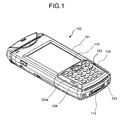
- Fig. 1 is a perspective view of an external configuration of a transaction terminal device according to a first embodiment of the present invention
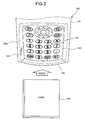
- Fig. 2 is a top view of one part of the external configuration of the transaction terminal device according to the first embodiment of the present invention
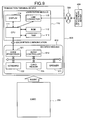
- Fig. 3 is a block diagram of an electric configuration of the transaction terminal device according to the first embodiment of the present invention
- Fig. 4 is a flowchart of an operation of the transaction terminal device according to the first embodiment of the present invention
- Fig. 5 is a top view of one part of the external configuration of the transaction terminal device according to a second embodiment of the present invention
- Fig. 6 is a block diagram of an electric configuration of the transaction terminal device according to the second embodiment of the present invention
- Fig. 1 is a perspective view of an external configuration of a transaction terminal device according to a first embodiment of the present invention
- Fig. 2 is a top view of one part of the external configuration of the transaction terminal device according to the first embodiment of the present invention
- Fig. 3 is a block
- FIG. 7 is a flowchart of an operation of the transaction terminal device according to the second embodiment of the present invention
- Fig. 8 is a top view of one part of the external configuration of the transaction terminal device according to a third embodiment of the present invention
- Fig. 9 is a block diagram of an electric configuration of the transaction terminal device according to the third embodiment of the present invention
- Fig. 10 is a flowchart of an operation of the transaction terminal device according to the third embodiment of the present invention
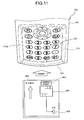
- Fig. 11 is a top view of one part of the external configuration of the transaction terminal device according to a fourth embodiment of the present invention
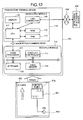
- Fig. 12 is a block diagram of the electric configuration of the transaction terminal device according to the fourth embodiment of the present invention
- Fig. 13 is a flowchart of an operation of the transaction terminal device according to the fourth embodiment of the present invention
- Fig. 14 is a block diagram of an electric configuration of a conventional transaction terminal device.
- Fig. 1 is a perspective view of an external configuration of the transaction terminal device according to a first embodiment of the present invention.
- a transaction terminal device 100 represents a handy terminal that is operated by a salesperson.
- Fig. 2 is a top view of one part of the external configuration of the transaction terminal device according to the first embodiment of the present invention.
- Fig. 3 is a block diagram of an electric configuration of the transaction terminal device according to the first embodiment of the present invention. In Fig. 1 to Fig. 3, the corresponding parts are denoted by the same reference numerals.
- an outsider can easily access the information, and a new application program can be added or an existing application program can be updated.
- the unsecured module 110 includes a CPU 111, a ROM 112, a RAM 113, a display 114, and a line connector 115.
- the CPU 111 executes a settlement of accounts application program and an encryption program, and controls the settlement of accounts and encryption process.
- the ROM 112 stores therein the settlement of accounts application program, the encryption program, and a normal operation application program.
- the ROM 112 is an EEPROM (Electrically Erasable Programmable Read-Only Memory) that in which a program or data can be rewritten.
- the RAM 113 stores the data temporarily.
- the display 114 for instance, is a liquid crystal display that displays a settlement of accounts screen, etc.
- the line connector 115 sends PIN information to a settlement of accounts server 400, via a communication line 300.
- the PIN information is unique information such as a security code, a personal identification number, etc., is input by a code processor 121 (described later), and is encrypted by the encryption program.
- the settlement of accounts server 400 is a host computer of a banking corporation or a credit card company, and verifies the encrypted and decrypted PIN information.
- a credit verification process is performed to gain permission to settle the accounts.
- the settlement of accounts server 400 Upon receiving the permission to settle the accounts, the settlement of accounts server 400 sends predetermined response data to the transaction terminal device 100 via the communication line 300. Then, the CPU 111 in the transaction terminal device 100 executes the settlement of accounts application program and the settlement of accounts process (that is, processing of the transaction).
- the secured module 120 includes a tamper-proof code processor 121, a keyboard 122, a card reader 123, an LED (Light Emitting Diode) 124, and an LED controller 125.
- a wiring that connects all the units in the secured module 120 is hardened by resin, thereby making it almost impossible to tap the signal from the wiring. Further, if a predetermined detector detects an illegal and forceful tapping of the signal, the entire data gets destroyed.
- the code processor 121 in the secured module 120 performs encryption communication (encryption/decryption) between the CPU 111 in the unsecured module 110 and the secured module 120.
- encryption communication encryption/decryption
- the keyboard 122 includes a group of keys (0 to 9 keys and symbol keys) that enables a user to enter the PIN information at the time of settlement of accounts.
- the card reader 123 is provided near the secured module 120 shown in Fig. 1.
- the card reader 123 reads card information such as a card number, etc. from a card 200 shown in Fig. 2.
- the card 200 is used in settlement of accounts, and refers to the credit cards, the IC cards, the ATM cards, and the like.
- the LED 124 is provided on an operating surface 120a of the secured module 120, as shown in Fig. 1.
- the LED 124 notifies the user (the salesperson or the customer) that he/she can enter the PIN information required for the settlement of accounts, in the secure environment.
- a LED controller 125 controls the switching ON of the LED 124.
- "PIN" is printed adjacent to the LED 124 on the operating surface 120a.
- the secure environment refers to an environment where illegal readout of the PIN information entered by means of the keyboard 122 from the secured module 120 becomes substantially impossible.
- the secure environment controls the switching ON of the LED 124 in the secured module 120.
- the reliability over the switching ON of the LED 124 is high in the secure environment.
- the LED controller 125 performs a security check to determine if there is any abnormality in the secured module 120 at the time of settlement of accounts. If there is no abnormality, the LED controller 125 switches ON the LED 124.
- the CPU 111 starts a normal operation application program (for instance, application program for commodity management).
- the CPU 111 executes a normal operation process (entering keys and switching the LED ON and OFF) according to the normal operation application program.
- Step SA3 the CPU 111 checks whether the salesperson has given any instructions pertaining to the settlement of accounts by way of entering predetermined keys of the keyboard 122, and sets the check result to "No". The normal operation process of Step SA2 is repeated till the check result of Step SA3 is set to "Yes".
- Step SA3 When a customer, whom the salesperson is dealing with, purchases goods using a card, the salesperson instructs the settlement of accounts by entering the predetermined keys. Thus, upon receiving the instructions to settle the accounts, the CPU 111 sets the check result of Step SA3 to "Yes".
- Step SA4 the CPU 111 starts the settlement of accounts application program stored in the ROM 112.
- Step SA5 the CPU 111 sends a security check request to the LED controller 125 of the secured module 120 by way of encryption communication.
- the LED controller 125 checks each unit of the secured module 120 for any abnormality such as breakage, etc.
- the LED controller 125 checks whether the security check result is OK (that is, there is no abnormality), and sets the check result to "Yes”.
- Step SA8 the LED controller 125 switches ON the LED 124.
- the user the salesperson or the customer
- the PIN information required for the settlement of accounts can be entered in the secure environment.
- Step SA9 the code processor 121 checks whether the PIN information has been entered using the keyboard 122, sets the check result to "No", and repeats the same check till the check result of Step SA9 is set to "Yes".
- the salesperson Upon receiving the card 200 from the customer, the salesperson inserts the card 200 in the card reader 123 (see Fig. 2), and allows the customer to enter the PIN information using the keyboard 122.
- the code processor 121 sets the check result of Step SA9 to "Yes".
- the code processor 121 encrypts the PIN information, and notifies the encrypted PIN information to the CPU 111.
- the card reader 123 reads the card information from the card 200.
- the code processor 121 encrypts the card information read, and notifies the encrypted card information to the CPU 111.
- Step SA11 the LED controller 125 switches OFF the LED 124.
- Step SA12 based on the PIN information (that is, the card information) notified by the secured module 120, the CPU 111 executes the settlement of accounts process (processing of the transaction) between the settlement of accounts server 400 and the unsecured module 110. Then, the process from Step SA1 onwards is repeated.
- Step SA7 if the check result of Step SA7 is "No", that is, if there is some abnormality in the secured module 120, then at Step SA13, the LED controller 125 notifies the CPU 111 that there is an abnormality in the secured module 120. Then, the CPU 111 performs error-handling process, and an error is displayed on the display 114.
- the customer related PIN information (unique information), which is required in the settlement of accounts process in the secured module 120 shown in Fig. 2, the PIN information is obtained by notifying secure information by switching ON the LED 124. The PIN information obtained is then encrypted, and is sent to the unsecured module. The transaction with the customer is executed in the unsecured module 110 using the PIN information. Consequently, the security required when obtaining the PIN information is ensured, the user can enter the PIN information in the secure environment, and the versatility and scalability of the transaction terminal device 100 in the unsecured module 110 (see Fig. 3) is enhanced.
- the transaction terminal device 100 An example of the transaction terminal device 100, in which the LED 124 (see Fig. 2) is switched ON to notify the user (the salesperson or the customer) that the PIN information can be entered in the secure environment, is explained in the first embodiment.
- the transaction terminal device 100 may be configured in such a way that the secure information is displayed on a display 511 (see Fig. 5) instead of switching ON the LED 124.
- the configuration example in which the secure information is displayed on the display 511 is explained next as a second embodiment.
- Fig. 5 is a top view of one part of the external configuration of the transaction terminal device according to a second embodiment of the present invention.
- Fig. 6 is a block diagram of the electric configuration of the transaction terminal device according to the second embodiment of the present invention.
- the parts corresponding to Fig. 2 and Fig. 3 are denoted by the same reference numerals.
- a secured module 510 is provided instead of the secured module 120 shown in Fig. 2.
- the display 511 is provided instead of the LED 124 shown in Fig. 2.
- the secured module 510 is provided instead of the secured module 120 shown in Fig. 2.
- the display 511 and a display controller 512 are provided instead of the LED 124 and the LED controller 125 shown in Fig. 3.
- the display 511 is a liquid crystal display provided on an operating surface 510a shown in Fig. 5.
- the display 511 notifies the user (the salesperson or the customer) that the PIN information required in the settlement of accounts can be entered in the secure environment, and displays the secure information ("Settling the accounts, please enter security code in specific area.") at the time of settlement of accounts.
- the secure environment refers to an environment where illegal readout of the PIN information entered by means of the keyboard 122 from the secured module 510 becomes substantially impossible.
- the secure environment controls the display of the display 511 in the secured module 510.
- the reliability over the display of the secure information is high in the secure environment.
- the display controller 512 performs a security check to determine if there is any abnormality in the secured module 510 at the time of settlement of accounts. If there is no abnormality, the display controller 512 displays the secure information on the display 511 (see Fig. 5).
- Step SB1 same as in Step SA1 (see Fig. 4), the CPU 111 starts the normal operation application program. Steps SB2 to SB4 are executed same as Steps SA2 to SA4 (see Fig. 4).
- Step SB5 the CPU 111 sends a security check request to the display controller 512 of the secured module 510 by way of encryption communication.
- the display controller 512 checks each unit of the secured module 510 for any abnormality such as breakage, etc.
- the display controller 512 checks whether the security check result is OK (that is, there is no abnormality), and sets the check result to "Yes”.
- the display controller 512 displays the secure information ("Settling the accounts, please enter security code in specific area.") on the display 511 (see Fig. 5).
- the user the salesperson or the customer
- the PIN information required in the settlement of accounts can be entered in the secure environment.
- Step SB9 the code processor 121 checks whether the PIN information has been entered using the keyboard 122, sets the check result to "No", and repeats the same check till the check result of Step SB9 is set to "Yes".
- the salesperson Upon receiving the card 200 from the customer, the salesperson inserts the card 200 in the card reader 123 (see Fig. 5), and allows the customer to enter the PIN information using the keyboard 122.
- the code processor 121 sets the check result of Step SB9 to "Yes".
- the code processor 121 encrypts the PIN information, and notifies the encrypted PIN information to the CPU 111.
- the card reader 123 reads the card information from the card 200.
- the code processor 121 encrypts the card information read, and notifies the encrypted card information to the CPU 111.
- the display controller 512 hides the secure information of the display 511.
- the CPU 111 executes the settlement of accounts process (processing of the transaction) between the settlement of accounts server 400 and the unsecured module 110. Then, the process from Step SB1 onwards is repeated.
- Step SB7 if the check result of Step SB7 is "No", that is, if there is some abnormality in the secured module 510, then at Step SB13, the display controller 512 notifies the CPU 111 that there is an abnormality in the secured module 510. Then, the CPU 111 performs the error-handling process.
- the secure information is displayed on the display 511 provided on the secured module 510 shown in Fig. 5, and hence, the security required when obtaining the PIN information is ensured, the user can enter the PIN information in the secure environment, and the versatility and scalability of the transaction terminal device 500 in the unsecured module 110 (see Fig. 6) is enhanced.
- the transaction terminal device 100 An example of the transaction terminal device 100, in which the LED 124 (see Fig. 2) is switched ON to notify the user (the salesperson or the customer) that the PIN information can be entered in the secure environment, is explained in the first embodiment.
- the transaction terminal device 100 may be configured in such a way that an audio guidance related to the secure information is notified to the user by means of a speaker 611 (see Fig. 8) instead of switching on the LED 124.
- the configuration example in which the audio guidance is notified to the user using the speaker 611 is explained next as a third embodiment.
- Fig. 8 is a top view of one part of the external configuration of the transaction terminal device according to a third embodiment of the present invention.
- Fig. 9 is a block diagram of the electric configuration of the transaction terminal device according to the third embodiment of the present invention.
- the parts corresponding to Fig. 2 and Fig. 3 are denoted by the same reference numerals.
- a secured module 610 is provided instead of the secured module 120 shown in Fig. 2.
- the speaker 611 is provided instead of the LED 124 shown in Fig. 2.
- the secured module 610 is provided instead of the secured module 120 shown in Fig. 2.
- the speaker 611 and an audio controller 612 are provided instead of the LED 124 and the LED controller 125 shown in Fig. 3.
- the speaker 611 is provided on an operating surface 610a shown in Fig. 8.
- the speaker 611 notifies the user (the salesperson or the customer) that the PIN information required in the settlement of accounts can be entered in the secure environment, and outputs the secure information ("Settling the accounts. Please enter the security code.") as the audio guidance, at the time of settlement of accounts.
- the secure environment refers to an environment where illegal readout of the PIN information entered by means of the keyboard 122 from the secured module 610 becomes substantially impossible.
- the secure environment controls the audio of the speaker 611 in the secured module 610.
- the reliability over the secure information is high in the secure environment.
- the audio controller 612 performs a security check to determine if there is any abnormality in the secured module 610 at the time of settlement of accounts. If there is no abnormality, the audio controller 612 outputs the secure information as the audio guidance, via the speaker 611 (see Fig. 8).
- Step SC1 same as the Step SA1 (see Fig. 4), the CPU 111 starts the normal operation application program. Steps SC2 to SC4 are executed same as Steps SA2 to SA4 (see Fig. 4).
- Step SC5 the CPU 111 sends a security check request to the audio controller 612 of the secured module 610 by way of encryption communication.
- the audio controller 612 checks each unit of the secured module 610 for any abnormality such as breakage, etc.
- the audio controller 612 checks whether the security check result is OK (that is, there is no abnormality) and sets the check result to "Yes”.
- the audio controller 612 outputs the secure information ("Settling the accounts. Please enter the security code.") as the audio guidance, through the speaker 611 (see Fig. 8).
- the user the salesperson or the customer
- the user recognizes that the PIN information required in the settlement of accounts can be entered in the secure environment.
- Step SC9 the code processor 121 checks whether the PIN information has been entered using the keyboard 122, sets the check result to "No", and repeats the same check till the check result of Step SC9 is set to "Yes".
- the salesperson Upon receiving the card 200 from the customer, the salesperson inserts the card 200 in the card reader 123 (see Fig. 8) and allows the customer to enter the PIN information using the keyboard 122.
- the code processor 121 sets the check result of Step SC9 to "Yes".
- the code processor 121 encrypts the PIN information, and notifies the encrypted PIN information to the CPU 111.
- the card reader 123 reads the card information from the card 200.
- the code processor 121 encrypts the card information read, and notifies the encrypted card information to the CPU 111.
- the CPU 111 executes the settlement of accounts process (processing of the transaction) between the settlement of accounts server 400 and the unsecured module 110. Then, the process from Step SC1 onwards is repeated.
- Step SC7 if the check result of Step SC7 is "No", that is, if there is some abnormality in the secured module 610, then at Step SC12, the audio controller 612 notifies the CPU 111 that there is an abnormality in the secured module 610. Then, the CPU 111 performs the error-handling process.
- the secure information is output as the audio guidance from the speaker 611 provided in the secured module 610 shown in Fig. 8, and hence, the security required when obtaining the PIN information is ensured, the user can enter the PIN information in the secure environment, and the versatility and scalability of the transaction terminal device 600 in the unsecured module 110 (see Fig. 9) is enhanced.
- the transaction terminal device 100 An example of the transaction terminal device 100, in which the LED 124 (see Fig. 2) provided in the secured module 120 is switched ON to notify the user (the salesperson or the customer) that the PIN information can be entered in the secure environment, is explained in the first embodiment.
- the transaction terminal device 100 may be configured in such a way that the secure information is notified to the user by means of a card LED 803 provided in an IC card 800 (see Fig. 11), instead of the LED 124.
- the configuration example in which the secure information is notified to the user by means of the card LED 803 is explained next as a fourth embodiment.
- Fig. 11 is a top view of one part of the external configuration of the transaction terminal device according to a fourth embodiment of the present invention.
- Fig. 12 is a block diagram of the electric configuration of the transaction terminal device according to the fourth embodiment of the present invention.
- the parts corresponding to Fig. 2 and Fig. 3 are denoted by the same reference numerals.
- a secured module 710 is provided instead of the secured module 120 shown in Fig. 2.
- An LED equivalent to the LED 124 shown in Fig. 2 is not provided in the secured module 710.
- the IC card 800 is shown instead of the card 200 shown in Fig. 2.
- the IC card 800 is used in settlement of accounts, and maintains the card information.
- the IC card 800 includes an IC 801, a contact point 802, and the card LED 803.
- the contact point 802 is a terminal that is electrically connected to the card reader 123 (see Fig. 12).
- the IC 801 stores the card information, and controls every unit of the IC card 800.
- the card LED 803 is provided on the surface of the IC card 800, and notifies the user (the salesperson or the customer) that the PIN information required in settlement of accounts can be entered in the secure environment.
- a card LED controller 711 (described later) controls the switching ON of the card LED 803. "PIN" is printed adjacent to the card LED 803.
- the secure environment refers to an environment where illegal readout of the PIN information entered by means of the keyboard 122 from the secured module 710 becomes substantially impossible.
- the secure environment controls the switching ON of the card LED 803 in the secured module 710. Thus, the reliability over the switching ON of the card LED 803 is high in the secure environment.
- the secured module 710 is provided instead of the secured module 120 shown in Fig. 2.
- the card LED controller 711 is provided instead of the LED 124 and the LED controller 125 shown in Fig. 3.
- the card LED controller 711 performs a security check to determine if there is any abnormality in the secured module 710 at the time of settlement of accounts. If there is no abnormality in the secured module 710, the card LED controller 711 switches ON the card LED 803 of the IC card 800 inserted in the card reader 123.
- Step SD1 same as in Step SA1 (see Fig. 4), the CPU 111 starts the normal operation application program. Steps SD2 to SD4 are executed same as Steps SA2 to SA4 (see Fig. 4).
- Step SD5 the CPU 111 sends a security check request to the card LED controller 711 of the secured module 710 by way of encryption communication.
- the card LED controller 711 checks each unit of the secured module 710 for any abnormality such as breakage, etc.
- the card LED controller 711 checks whether the security check result is OK (that is, there is no abnormality), and sets the check result to "Yes”.
- the salesperson Upon receiving the IC card 800 from the customer, the salesperson inserts the IC card 800 in the card reader 123 (see Fig. 11).
- the card LED controller 711 switches ON the card LED 803 via the card reader 123, the contact point 802, and the IC 801.
- the user the salesperson or the customer
- the PIN information required in the settlement of accounts can be entered in the secure environment.
- Step SD9 the code processor 121 checks whether the PIN information has been entered using the keyboard 122, sets the check result to "No", and repeats the same check till the check result of Step SD9 is set to "Yes".
- the salesperson allows the customer to enter the PIN information using the keyboard 122.
- the code processor 121 sets the check result of Step SD9 to "Yes".
- the code processor 121 encrypts the PIN information, and notifies the encrypted PIN information to the CPU 111.
- the card reader 123 reads the card information from the IC card 800.
- the code processor 121 encrypts the card information read, and notifies the encrypted card information to the CPU 111.
- Step SD11 based on the PIN information (that is, the card information) notified by the secured module 710, the CPU 111 executes the settlement of accounts process (processing of the transaction) between the settlement of accounts server 400 and the unsecured module 110. Then, at Step SD12, the card LED controller 711 switches OFF the card LED 803. Then, the process from Step SD1 onwards is repeated.
- Step SD7 if the check result of Step SD7 is "No", that is, if there is some abnormality in the secured module 710, then at Step SD13, the card LED controller 711 notifies the CPU 111 that there is an abnormality in the secured module 710. Then, the CPU 111 performs the error-handling process.
- the secure information is notified to the user by switching ON the card LED 803 provided in the IC card 800 that is inserted in the card reader 123 shown in Fig. 11, and hence, the security required when obtaining the PIN information is ensured, the user can enter the PIN information in the secure environment, and the versatility and scalability of the transaction terminal device 700 in the unsecured module 110 shown in Fig. 12 is enhanced.
- the customer related unique information which is required in the processing of the transaction in the secured module, is obtained after notifying the secure information to the user.
- the unique information obtained is then encrypted, and sent to the unsecured module.
- the transaction with the customer is executed in the unsecured module using the received unique information. Consequently, the security required when obtaining the unique information is ensured, the user can enter the unique information in the secure environment, and the versatility and scalability of the transaction terminal device in the unsecured module can be enhanced.
- a lighting unit provided in the secured module is switched ON to notify the user that he/she can enter the unique information in the secure environment, thereby ensuring the security when obtaining the unique information, enabling the user to enter the unique information in the secure environment, and enhancing the versatility and scalability of the transaction terminal device in the unsecured module.
- the secure information is displayed on the display provided in the secured module, thereby ensuring the security when obtaining the unique information, enabling the user to enter the unique information in the secure environment, and enhancing the versatility and scalability of the transaction terminal device in the unsecured module.
- the secure information is output as the audio guidance from the audio output unit provided in the secured module, thereby ensuring the security when obtaining the unique information, enabling the user to enter the unique information in the secure environment, and enhancing the versatility and scalability of the transaction terminal device in the unsecured module.
- the lighting unit provided in the card that is inserted in a main unit is switched ON to notify the secure information to the user, thereby ensuring the security when obtaining the unique information, enabling the user to enter the unique information in the secure environment, and enhancing the versatility and scalability of the transaction terminal device in the unsecured module.
- a transaction terminal device and a transaction terminal control method is useful in transactions between a salesperson and a customer, where secure environment is required.
Landscapes
- Engineering & Computer Science (AREA)
- Physics & Mathematics (AREA)
- General Physics & Mathematics (AREA)
- Theoretical Computer Science (AREA)
- Business, Economics & Management (AREA)
- Accounting & Taxation (AREA)
- Strategic Management (AREA)
- General Business, Economics & Management (AREA)
- Computer Networks & Wireless Communication (AREA)
- Computer Security & Cryptography (AREA)
- Computer Hardware Design (AREA)
- Software Systems (AREA)
- General Engineering & Computer Science (AREA)
- Microelectronics & Electronic Packaging (AREA)
- Cash Registers Or Receiving Machines (AREA)
- Financial Or Insurance-Related Operations Such As Payment And Settlement (AREA)
- Control Of Vending Devices And Auxiliary Devices For Vending Devices (AREA)
Abstract
Description
Claims (10)
- A transaction terminal device that executes processing of a transaction with a customer, the transaction terminal device comprising:a non-tamperable secured module that is incorporated in a removable main unit wherein, the secured module includes a secure information notifying unit that notifies secure information to a user, an obtaining unit that obtains confidential information, and an encrypting unit that encrypts the obtained confidential information, when obtaining the customer related confidential information that is required in processing of the transactions; anda tamperable unsecured module that is embedded in the removable main unit wherein, the unsecured module includes a controller that executes the transaction using the confidential information received after being encrypted by the encrypting unit.
- The transaction terminal device according to claim 1, wherein at the time of obtaining the confidential information the secure information notifying unit notifies the secure information to the user by switching ON a lighting unit provided in the secured module.
- The transaction terminal device according to claim 1, wherein at the time of obtaining the confidential information the secure information notifying unit notifies the secure information to the user by displaying the secure information on a display provided in the secured module.
- The transaction terminal device according to claim 1, wherein at the time of obtaining the confidential information the secure information notifying unit notifies the secure information to the user by outputting the secure information as the audio guidance from an audio output unit that is provided in the secured module.
- The transaction terminal device according to claim 1, wherein at the time of obtaining the confidential information the secure information notifying unit notifies the secure information to the user by switching ON the lighting unit provided in a card that is inserted in the main unit.
- A transaction terminal control method for executing a customer transaction, and applied to a transaction terminal device including a non-tamperable secured module that is detachably incorporated in a main unit, and a tamperable unsecured module that is embedded in the main unit, the transaction terminal control method comprising:a secure information notifying step that notifies secure information to a user, an obtaining step that obtains confidential information, and an encrypting step that encrypts the obtained confidential information, when obtaining the customer related confidential information that is required in processing of the transactions; anda controlling step that executes the transaction using the confidential information received after being encrypted by the encrypting step.
- The transaction terminal control method according to claim 6, wherein at the time of obtaining the confidential information, the secure information notifying step notifies the secure information to the user by switching ON a lighting unit provided in the secured module.
- The transaction terminal control method according to claim 6, wherein at the time of obtaining the confidential information, the secure information notifying step notifies the secure information to the user by displaying the secure information on a display provided in the secured module.
- The transaction terminal control method according to claim 6, wherein at the time of obtaining the confidential information, the secure information notifying step notifies the secure information to the user by outputting the secure information as audio guidance from an audio output unit that is provided in the secured module.
- The transaction terminal control method according to claim 6, wherein at the time of obtaining the confidential information, the secure information notifying step notifies the secure information to the user by switching ON a lighting unit provided in a card that is inserted in the main unit.
Applications Claiming Priority (1)
| Application Number | Priority Date | Filing Date | Title |
|---|---|---|---|
| PCT/JP2002/008316 WO2004017255A1 (en) | 2002-08-16 | 2002-08-16 | Transaction terminal unit, and transaction terminal control method |
Publications (3)
| Publication Number | Publication Date |
|---|---|
| EP1553518A1 true EP1553518A1 (en) | 2005-07-13 |
| EP1553518A4 EP1553518A4 (en) | 2008-09-17 |
| EP1553518B1 EP1553518B1 (en) | 2013-05-01 |
Family
ID=31742937
Family Applications (1)
| Application Number | Title | Priority Date | Filing Date |
|---|---|---|---|
| EP02762790.0A Expired - Lifetime EP1553518B1 (en) | 2002-08-16 | 2002-08-16 | Transaction terminal unit and transaction terminal control method |
Country Status (5)
| Country | Link |
|---|---|
| US (2) | US7293700B2 (en) |
| EP (1) | EP1553518B1 (en) |
| JP (1) | JP4102800B2 (en) |
| AU (1) | AU2002328624A1 (en) |
| WO (1) | WO2004017255A1 (en) |
Cited By (6)
| Publication number | Priority date | Publication date | Assignee | Title |
|---|---|---|---|---|
| WO2006058873A1 (en) * | 2004-12-03 | 2006-06-08 | Thales | Terminal for performing electronic transactions |
| FR2888381A1 (en) * | 2005-07-08 | 2007-01-12 | Thales Sa | TERMINAL FOR PERFORMING ELECTRONIC TRANSACTIONS |
| WO2012003892A1 (en) * | 2010-07-09 | 2012-01-12 | Izettle Hardware Ab | System for secure payment over a wireless communication network |
| WO2022182639A1 (en) * | 2021-02-23 | 2022-09-01 | Block, Inc. | Embedded card reader security |
| US11640595B2 (en) | 2021-02-23 | 2023-05-02 | Block, Inc. | Embedded card reader security |
| US11694178B2 (en) | 2021-02-23 | 2023-07-04 | Block, Inc. | Embedded card reader security |
Families Citing this family (24)
| Publication number | Priority date | Publication date | Assignee | Title |
|---|---|---|---|---|
| US6958903B1 (en) * | 2000-05-22 | 2005-10-25 | Cheryl Henry | Data storage device reader and method of using same |
| US7599856B2 (en) * | 2002-11-19 | 2009-10-06 | Amazon Technologies, Inc. | Detection of fraudulent attempts to initiate transactions using modified display objects |
| FR2878989B1 (en) * | 2004-12-03 | 2007-01-26 | Thales Sa | PDA TYPE TOUCH SLAB TERMINAL FOR PERFORMING ELECTRONIC TRANSACTIONS |
| US7953968B2 (en) * | 2005-08-04 | 2011-05-31 | Gilbarco Inc. | System and method for selective encryption of input data during a retail transaction |
| JP5073312B2 (en) * | 2007-02-16 | 2012-11-14 | 株式会社日立製作所 | IC tag system |
| JP2009130882A (en) * | 2007-11-28 | 2009-06-11 | Oki Electric Ind Co Ltd | Check value confirming method and apparatus |
| US20090159709A1 (en) * | 2007-12-24 | 2009-06-25 | Dynamics Inc. | Advanced dynamic credit cards |
| JP4656458B1 (en) | 2009-11-09 | 2011-03-23 | Necインフロンティア株式会社 | Handy terminal and payment method by handy terminal |
| CN102694781B (en) * | 2011-03-24 | 2015-12-16 | 中国银联股份有限公司 | Based on security information interaction system and the method for the Internet |
| US10102401B2 (en) | 2011-10-20 | 2018-10-16 | Gilbarco Inc. | Fuel dispenser user interface system architecture |
| FR2993694B1 (en) * | 2012-07-23 | 2014-08-29 | 4G Secure | SECURING A TRANSACTION USING A BANK CARD READING MODULE CONNECTED TO A TERMINAL. |
| GB2521560A (en) * | 2012-09-05 | 2015-06-24 | Mads Landrok | Trusted user interface and touchscreen |
| US9268930B2 (en) | 2012-11-29 | 2016-02-23 | Gilbarco Inc. | Fuel dispenser user interface system architecture |
| US20140244513A1 (en) * | 2013-02-22 | 2014-08-28 | Miguel Ballesteros | Data protection in near field communications (nfc) transactions |
| USD729867S1 (en) * | 2013-05-22 | 2015-05-19 | Bluebird Inc. | Card payment terminal |
| CA2927724A1 (en) * | 2013-10-16 | 2015-04-23 | Cryptomathic Ltd. | Trusted user interface and touchscreen |
| GB2519825B (en) * | 2013-10-29 | 2021-06-30 | Cryptomathic Ltd | Secure mobile user interface |
| PL3063900T3 (en) | 2013-10-30 | 2024-04-29 | Gilbarco Inc. | Cryptographic watermarking of content in fuel dispensing environments |
| JP2015114789A (en) * | 2013-12-11 | 2015-06-22 | パナソニックIpマネジメント株式会社 | Information processing method, information processor and computer program |
| EP2884470A1 (en) * | 2013-12-11 | 2015-06-17 | Panasonic Intellectual Property Management Co., Ltd. | Mobile payment terminal device |
| JP5861069B2 (en) * | 2014-03-27 | 2016-02-16 | パナソニックIpマネジメント株式会社 | Portable payment terminal |
| JP5810329B1 (en) * | 2014-05-28 | 2015-11-11 | パナソニックIpマネジメント株式会社 | Payment terminal device |
| JP6245560B2 (en) * | 2015-01-28 | 2017-12-13 | パナソニックIpマネジメント株式会社 | Payment terminal device |
| KR20170032715A (en) * | 2015-09-15 | 2017-03-23 | 삼성전자주식회사 | Method for Managing Application and Electronic Device supporting the same |
Family Cites Families (20)
| Publication number | Priority date | Publication date | Assignee | Title |
|---|---|---|---|---|
| JPS5968072A (en) * | 1982-10-13 | 1984-04-17 | Sharp Corp | Small-sized electronic equipment for function conversion |
| US4879455A (en) * | 1985-06-17 | 1989-11-07 | Butterworth Nathan I | Self-verifying transaction cards |
| DE8710852U1 (en) * | 1987-08-07 | 1988-12-08 | Siemens AG, 1000 Berlin und 8000 München | Chip card |
| US5748737A (en) * | 1994-11-14 | 1998-05-05 | Daggar; Robert N. | Multimedia electronic wallet with generic card |
| ATE483217T1 (en) * | 1995-04-28 | 2010-10-15 | Koninkl Kpn Nv | DEVICE FOR TRANSPARENT INTERACTION BETWEEN A CHIP CARD AND A REMOTE TERMINAL |
| CA2192017C (en) * | 1995-12-08 | 2000-04-25 | Masayuki Ohki | Ic card reader/writer and method of operation thereof |
| US6065679A (en) * | 1996-09-06 | 2000-05-23 | Ivi Checkmate Inc. | Modular transaction terminal |
| JPH1091866A (en) * | 1996-09-18 | 1998-04-10 | Hitachi Ltd | Electronic money transaction system |
| EP0831433A1 (en) * | 1996-09-24 | 1998-03-25 | Koninklijke KPN N.V. | Method of making recoverable smart card transactions, a method of recovering such a transaction, as well as a smart card allowing recoverable transactions |
| AU5079498A (en) * | 1996-10-18 | 1998-05-15 | Verifone, Inc. | Transaction terminal for electronic purse transactions and the like |
| US6097606A (en) * | 1998-05-28 | 2000-08-01 | International Verifact Inc. | Financial transaction terminal with limited access |
| US6092202A (en) * | 1998-05-22 | 2000-07-18 | N*Able Technologies, Inc. | Method and system for secure transactions in a computer system |
| JP4176898B2 (en) * | 1999-02-19 | 2008-11-05 | 株式会社東芝 | Personal authentication system, portable device and storage medium used therefor |
| US6871782B2 (en) * | 1999-10-08 | 2005-03-29 | Canon Kabushiki Kaisha | User programmable smart card interface system having an arbitrary mapping |
| JP2001118153A (en) * | 1999-10-22 | 2001-04-27 | Nec Corp | Pos terminal equipment |
| JP3822768B2 (en) * | 1999-12-03 | 2006-09-20 | 株式会社ルネサステクノロジ | IC card manufacturing method |
| AU2001235468A1 (en) * | 2000-02-18 | 2001-08-27 | Telefonaktiebolaget Lm Ericsson (Publ) | Accessory board with smart card reader for a portable radio telephone |
| JP2002150247A (en) * | 2000-11-07 | 2002-05-24 | Casio Comput Co Ltd | Terminal device, storage medium, storage medium container |
| JP4763163B2 (en) | 2001-06-27 | 2011-08-31 | 富士通フロンテック株式会社 | Transaction terminal device |
| US6776339B2 (en) * | 2002-09-27 | 2004-08-17 | Nokia Corporation | Wireless communication device providing a contactless interface for a smart card reader |
-
2002
- 2002-08-16 AU AU2002328624A patent/AU2002328624A1/en not_active Abandoned
- 2002-08-16 EP EP02762790.0A patent/EP1553518B1/en not_active Expired - Lifetime
- 2002-08-16 JP JP2004528821A patent/JP4102800B2/en not_active Expired - Lifetime
- 2002-08-16 WO PCT/JP2002/008316 patent/WO2004017255A1/en not_active Ceased
-
2005
- 2005-01-04 US US11/027,985 patent/US7293700B2/en not_active Expired - Lifetime
-
2007
- 2007-07-16 US US11/826,462 patent/US7513421B2/en not_active Expired - Fee Related
Cited By (13)
| Publication number | Priority date | Publication date | Assignee | Title |
|---|---|---|---|---|
| WO2006058873A1 (en) * | 2004-12-03 | 2006-06-08 | Thales | Terminal for performing electronic transactions |
| FR2888381A1 (en) * | 2005-07-08 | 2007-01-12 | Thales Sa | TERMINAL FOR PERFORMING ELECTRONIC TRANSACTIONS |
| WO2012003892A1 (en) * | 2010-07-09 | 2012-01-12 | Izettle Hardware Ab | System for secure payment over a wireless communication network |
| AU2010357028B2 (en) * | 2010-07-09 | 2014-10-02 | Paypal, Inc. | System for secure payment over a wireless communication network |
| US8983873B2 (en) | 2010-07-09 | 2015-03-17 | Izettle Merchant Services Ab | System for secure payment over a wireless communication network |
| US10275758B2 (en) | 2010-07-09 | 2019-04-30 | Izettle Merchant Services Ab | System for secure payment over a wireless communication network |
| WO2022182639A1 (en) * | 2021-02-23 | 2022-09-01 | Block, Inc. | Embedded card reader security |
| US11640595B2 (en) | 2021-02-23 | 2023-05-02 | Block, Inc. | Embedded card reader security |
| US11694178B2 (en) | 2021-02-23 | 2023-07-04 | Block, Inc. | Embedded card reader security |
| US12190304B2 (en) | 2021-02-23 | 2025-01-07 | Block, Inc. | Embedded card reader security |
| EP4510097A3 (en) * | 2021-02-23 | 2025-04-09 | Block, Inc. | Embedded card reader security |
| EP4510096A3 (en) * | 2021-02-23 | 2025-04-09 | Block, Inc. | Embedded card reader security |
| AU2024278493B2 (en) * | 2021-02-23 | 2026-04-23 | Block, Inc. | Embedded card reader security |
Also Published As
| Publication number | Publication date |
|---|---|
| US7513421B2 (en) | 2009-04-07 |
| US20050145690A1 (en) | 2005-07-07 |
| JPWO2004017255A1 (en) | 2005-12-08 |
| AU2002328624A1 (en) | 2004-03-03 |
| US20080041933A1 (en) | 2008-02-21 |
| WO2004017255A1 (en) | 2004-02-26 |
| EP1553518A4 (en) | 2008-09-17 |
| EP1553518B1 (en) | 2013-05-01 |
| US7293700B2 (en) | 2007-11-13 |
| AU2002328624A8 (en) | 2004-03-03 |
| JP4102800B2 (en) | 2008-06-18 |
Similar Documents
| Publication | Publication Date | Title |
|---|---|---|
| EP1553518A1 (en) | Transaction terminal unit and transaction terminal control method | |
| US20080005559A1 (en) | Methods and systems for ic card application loading | |
| CA2665417C (en) | Proxy authentication methods and apparatus | |
| US8887270B2 (en) | Smart storage device | |
| EP1271427B1 (en) | Transaction terminal apparatus | |
| SE515327C2 (en) | Device for carrying out secure transactions in a communication device | |
| US20090044268A1 (en) | Installation-free chip card reader for secure online banking | |
| WO2014081073A1 (en) | Mobile payment system and mobile payment method using dynamic track 2 information | |
| JP4636809B2 (en) | Information processing terminal and information security protection method thereof | |
| US20100170942A1 (en) | Method and system for increasing security in the creation of electronic signatures by means of a chip card | |
| KR20150065167A (en) | Fingerprint certification smart intergrated circuit card and method of certification of thereof | |
| US20190034900A1 (en) | Modular electronic funds transfer point of sale device | |
| KR101583156B1 (en) | Card reader, terminal and method for processing payment information thereof | |
| JPS6242888A (en) | IC card with solar cell | |
| US20060259961A1 (en) | Smart card with twoi/o ports linking secure and insecure environments | |
| JP2003533783A (en) | How to operate the safety module in the card reader | |
| JP2001060259A (en) | Composite IC card and IC card forgery detection system | |
| JP2025041191A (en) | Information processing system, information processing method, and program | |
| KR200481097Y1 (en) | A card reader appratus for a transaction and a portable terminal | |
| JP2005018203A (en) | Ic card and card system using it | |
| KR20080069568A (en) | IC Chip | |
| WO2004111926A1 (en) | Dielectric separation between inputs/outputs of a smart card | |
| GB2395047A (en) | Secure transacting using off-line PIN processing | |
| KR20060001703A (en) | Control device for multiple automated teller machines using a single controller | |
| JP2006285862A (en) | SIM reader / writer and user authentication system |
Legal Events
| Date | Code | Title | Description |
|---|---|---|---|
| PUAI | Public reference made under article 153(3) epc to a published international application that has entered the european phase |
Free format text: ORIGINAL CODE: 0009012 |
|
| 17P | Request for examination filed |
Effective date: 20050211 |
|
| AK | Designated contracting states |
Kind code of ref document: A1 Designated state(s): AT BE BG CH CY CZ DE DK EE ES FI FR GB GR IE IT LI LU MC NL PT SE SK TR |
|
| RBV | Designated contracting states (corrected) |
Designated state(s): DE FR GB |
|
| A4 | Supplementary search report drawn up and despatched |
Effective date: 20080814 |
|
| 17Q | First examination report despatched |
Effective date: 20090305 |
|
| RAP1 | Party data changed (applicant data changed or rights of an application transferred) |
Owner name: FUJITSU FRONTECH LIMITED |
|
| GRAP | Despatch of communication of intention to grant a patent |
Free format text: ORIGINAL CODE: EPIDOSNIGR1 |
|
| RIC1 | Information provided on ipc code assigned before grant |
Ipc: G06F 12/14 20060101ALI20121120BHEP Ipc: G06K 17/00 20060101AFI20121120BHEP Ipc: G06Q 20/00 20120101ALI20121120BHEP |
|
| GRAS | Grant fee paid |
Free format text: ORIGINAL CODE: EPIDOSNIGR3 |
|
| GRAA | (expected) grant |
Free format text: ORIGINAL CODE: 0009210 |
|
| AK | Designated contracting states |
Kind code of ref document: B1 Designated state(s): DE FR GB |
|
| REG | Reference to a national code |
Ref country code: GB Ref legal event code: FG4D |
|
| REG | Reference to a national code |
Ref country code: DE Ref legal event code: R096 Ref document number: 60244900 Country of ref document: DE Effective date: 20130627 |
|
| PLBE | No opposition filed within time limit |
Free format text: ORIGINAL CODE: 0009261 |
|
| STAA | Information on the status of an ep patent application or granted ep patent |
Free format text: STATUS: NO OPPOSITION FILED WITHIN TIME LIMIT |
|
| 26N | No opposition filed |
Effective date: 20140204 |
|
| REG | Reference to a national code |
Ref country code: DE Ref legal event code: R097 Ref document number: 60244900 Country of ref document: DE Effective date: 20140204 |
|
| REG | Reference to a national code |
Ref country code: FR Ref legal event code: PLFP Year of fee payment: 15 |
|
| REG | Reference to a national code |
Ref country code: FR Ref legal event code: PLFP Year of fee payment: 16 |
|
| REG | Reference to a national code |
Ref country code: FR Ref legal event code: PLFP Year of fee payment: 17 |
|
| PGFP | Annual fee paid to national office [announced via postgrant information from national office to epo] |
Ref country code: FR Payment date: 20180712 Year of fee payment: 17 Ref country code: DE Payment date: 20180731 Year of fee payment: 17 |
|
| PGFP | Annual fee paid to national office [announced via postgrant information from national office to epo] |
Ref country code: GB Payment date: 20180815 Year of fee payment: 17 |
|
| REG | Reference to a national code |
Ref country code: DE Ref legal event code: R119 Ref document number: 60244900 Country of ref document: DE |
|
| GBPC | Gb: european patent ceased through non-payment of renewal fee |
Effective date: 20190816 |
|
| PG25 | Lapsed in a contracting state [announced via postgrant information from national office to epo] |
Ref country code: FR Free format text: LAPSE BECAUSE OF NON-PAYMENT OF DUE FEES Effective date: 20190831 Ref country code: DE Free format text: LAPSE BECAUSE OF NON-PAYMENT OF DUE FEES Effective date: 20200303 |
|
| PG25 | Lapsed in a contracting state [announced via postgrant information from national office to epo] |
Ref country code: GB Free format text: LAPSE BECAUSE OF NON-PAYMENT OF DUE FEES Effective date: 20190816 |