EP1553197A1 - Steel material for mechanical structure excellent in suitability for rolling, quenching crack resistance, and torsional property and drive shaft - Google Patents
Steel material for mechanical structure excellent in suitability for rolling, quenching crack resistance, and torsional property and drive shaft Download PDFInfo
- Publication number
- EP1553197A1 EP1553197A1 EP02790877A EP02790877A EP1553197A1 EP 1553197 A1 EP1553197 A1 EP 1553197A1 EP 02790877 A EP02790877 A EP 02790877A EP 02790877 A EP02790877 A EP 02790877A EP 1553197 A1 EP1553197 A1 EP 1553197A1
- Authority
- EP
- European Patent Office
- Prior art keywords
- less
- content
- drive shaft
- crack resistance
- steel product
- Prior art date
- Legal status (The legal status is an assumption and is not a legal conclusion. Google has not performed a legal analysis and makes no representation as to the accuracy of the status listed.)
- Granted
Links
Images


Classifications
-
- C—CHEMISTRY; METALLURGY
- C22—METALLURGY; FERROUS OR NON-FERROUS ALLOYS; TREATMENT OF ALLOYS OR NON-FERROUS METALS
- C22C—ALLOYS
- C22C38/00—Ferrous alloys, e.g. steel alloys
- C22C38/18—Ferrous alloys, e.g. steel alloys containing chromium
- C22C38/40—Ferrous alloys, e.g. steel alloys containing chromium with nickel
- C22C38/42—Ferrous alloys, e.g. steel alloys containing chromium with nickel with copper
-
- C—CHEMISTRY; METALLURGY
- C22—METALLURGY; FERROUS OR NON-FERROUS ALLOYS; TREATMENT OF ALLOYS OR NON-FERROUS METALS
- C22C—ALLOYS
- C22C38/00—Ferrous alloys, e.g. steel alloys
- C22C38/001—Ferrous alloys, e.g. steel alloys containing N
-
- C—CHEMISTRY; METALLURGY
- C22—METALLURGY; FERROUS OR NON-FERROUS ALLOYS; TREATMENT OF ALLOYS OR NON-FERROUS METALS
- C22C—ALLOYS
- C22C38/00—Ferrous alloys, e.g. steel alloys
- C22C38/18—Ferrous alloys, e.g. steel alloys containing chromium
- C22C38/40—Ferrous alloys, e.g. steel alloys containing chromium with nickel
- C22C38/44—Ferrous alloys, e.g. steel alloys containing chromium with nickel with molybdenum or tungsten
-
- C—CHEMISTRY; METALLURGY
- C22—METALLURGY; FERROUS OR NON-FERROUS ALLOYS; TREATMENT OF ALLOYS OR NON-FERROUS METALS
- C22C—ALLOYS
- C22C38/00—Ferrous alloys, e.g. steel alloys
- C22C38/18—Ferrous alloys, e.g. steel alloys containing chromium
- C22C38/40—Ferrous alloys, e.g. steel alloys containing chromium with nickel
- C22C38/50—Ferrous alloys, e.g. steel alloys containing chromium with nickel with titanium or zirconium
Definitions
- the present invention relates to machine structural steel products.
- the present invention relates to a machine structural steel product having superior formability of rotary-forming, quenching-crack resistance, and torsional properties.
- a steel product is provided which is a machine structural steel product manufactured using an electric furnace instead of a blast furnace and which retains various properties even when a tramp element such as Cu or Ni is incorporated.
- Machine structural members such as drive shafts for automobile use and constant velocity joints have been requested to have a torsional strength at a required level.
- a hot-rolled steel bar has been generally processed by the steps of hot-forging, normalizing whenever necessary, cutting, cold-forging, and the like so as to have a predetermined shape, followed by induction hardening and tempering.
- Patent Document 2 Japanese Unexamined Patent Application Publication No. 4-218641 (Claims)
- Patent Document 2 Patent No. 3288563 (Claims)
- a primary object of the present invention is to solve the problems described above. That is, an object of the present invention is to provide a machine structural steel product which has superior quenching-crack resistance and torsional properties and which effectively prevents the degradation in formability of rotary-forming even when manufactured using an electric furnace instead of a blast furnace. In addition, a drive shaft formed from this steel product is also proposed.
- C is an element having the largest influence on the high-frequency hardenability and is an effective element for increasing the hardness and the depth of a hardened layer by quenching and for ensuring a torsional strength of 1,400 MPa or more after induction hardening and tempering.
- the content is less than 0.35%, the effect of the carbon component is not sufficient, and when the content is more than 0.50%, the machinability and quenching-crack resistance are degraded. Accordingly, the C content is set in the range of from 0.35% to 0.50%. Si: 0.15% or less
- Si is an element having a function of reinforcing steel when being dissolved in ferrite, thereby improving the torsional strength.
- the content is preferably more than 0.05%. However, when the Si content is more than 0.15%, the machinability is remarkably deteriorated, and hence the content is set to 0.15% or less.
- Mn 0.2% or more, 1.1% or less
- Mn is an effective element for improving the hardenability and increasing the hardness penetration depth in induction hardening, thereby contributing the improvement of the torsional strength.
- the content of Mn is set in the range of from 0.2% to 1.1%.
- Preferable content is in the range of from 0.2% to 0.8%. P: 0.020% or less
- the content of P is preferably decreased as small as possible. From this point of view, the content is decreased to 0.020% or less. S: 0.005% or more, 0.035% or less
- S forms MnS in steel and has a function of improving the machinability, and hence the content is set to 0.005% or more. However, since MnS tends to initiate cracking and causes the decrease in strength and toughness, the maximum content of S is set to 0.035%. Preferable content is in the range of from 0.010% to 0.035%. Cr: more than 0.1%, 0.2% or less
- Cr is a particularly important element in the present invention, and when Cr is contained, the adverse influence of tramp elements such as Cu and Ni can be advantageously removed, the adverse influence being degradation in formability of rotary-forming, torsion properties, machinability, and the like.
- the content of Cr is 0.1% or less, the effect of Cr component is not sufficient.
- the content of Cr is set to more than 0.1% to 0.2%.
- Mo 0.05% or more, 0.5% or less
- Mo is not only effective for improving the hardenability but also has a function of facilitating the growth of bainite so as to improve the machinability.
- the content must be 0.05% or more; however, when the content is more than 0.5%, the machinability is adversely degraded. Accordingly, the content of Mo is set in the range of from 0.05% to 0.5%. Preferable content is in the range of from 0.1% to 0.5%. Ti: 0.01% or more, 0.05% or less
- Ti forms a nitride with N and reduces the grain size of austenite in high-temperature heating.
- This element is essential for ensuring dissolved B that is effective for improving the hardenability.
- the content must be 0.01% or more; however, when the content is more than 0.05%, the toughness is degraded. Accordingly, the content of Ti is set in the range of from 0.01% to 0.05%.
- Al 0.01% or more, 0.05% or less
- Al is an effective element as a deoxidizing agent, and to obtain this effect, the content thereof must be at least 0.01%. However, when the content is more than 0.05%, giant alumina grains are grown and initiates fatigue damage, thereby decreasing the fatigue strength. Hence, the content of Ai is set in the range of from 0.01% to 0.05%. N: 0.01% or less
- N is an effective element for forming a nitride with Al or Ti and for reducing the grain size of austenite in high-frequency heating, and hence the fatigue strength can be improved.
- the content thereof is more than 0.01%, the nitride is coarsely grown, and the fatigue strength is adversely degraded.
- BN is formed, and as a result, the amount of dissolved B component effective for improving the hardenability is disadvantageously decreased.
- the content of N is set to 0.01% or less.
- B 0.0005% or more, 0.0050% or less
- B has an effect of improving the torsional strength by improving the hardenability and by increasing the hardness penetration depth in high-frequency hardening.
- the content thereof must be 0.0005% or more; however, when the content is more than 0.0050%, the toughness is decreased.
- the content of B is set in the range of from 0.0005% to 0.0050%.
- Cu is an element which is inevitably incorporated as a tramp element.
- the content is more than 0.25%, degradation in formability of rotary-forming and the like may occur in some cases, and hence the content is set to 0.25% or less.
- the content is decreased to less than 0.06%, the manufacturing cost is increased, and as a result, the content is set to 0.06% or more.
- Ni is an element which is inevitably incorporated as a tramp element.
- the content is more than 0.2%, degradation in formability of rotary-forming and the like may occur in some cases, and hence the content is set to 0.2% or less.
- the content is decreased to less than 0.05%, the manufacturing cost is increased, and as a result, the content is set to 0.05% or more.
- V 0.01% or more, 0.30% or less
- Nb 0.005% or more, 0.050% or less
- V and Nb form carbonitrides and reduce the grain size of austenite, thereby effectively contributing the improvement of strength.
- the contents of V and Nb are less than 0.01% and less than 0.005%, respectively, the effects thereof are not sufficient.
- the contents of V and Nb are more than 0.30% and more than 0.050%, respectively, a large and coarse material is precipitated, and the toughness is decreased thereby.
- the content of V is set in the range of from 0.01% to 0.30%
- the content of Nb is set in the range of from 0.005% to 0.050%.
- C, Mn, P, S, Si, Cr, Ni, Mo, and Cu each indicate the content (mass percent) of the respective elements.
- This LD value is the index of the texture and the hardness through the hardenability.
- Fig. 1 shows the results of measurement of the influence of the LD value on the formability of rotary-forming of high Cr steel and high Si steel.
- the results of measurement of low Cr and low Si steel disclosed in Patent Document 2 described above are also shown for comparison.
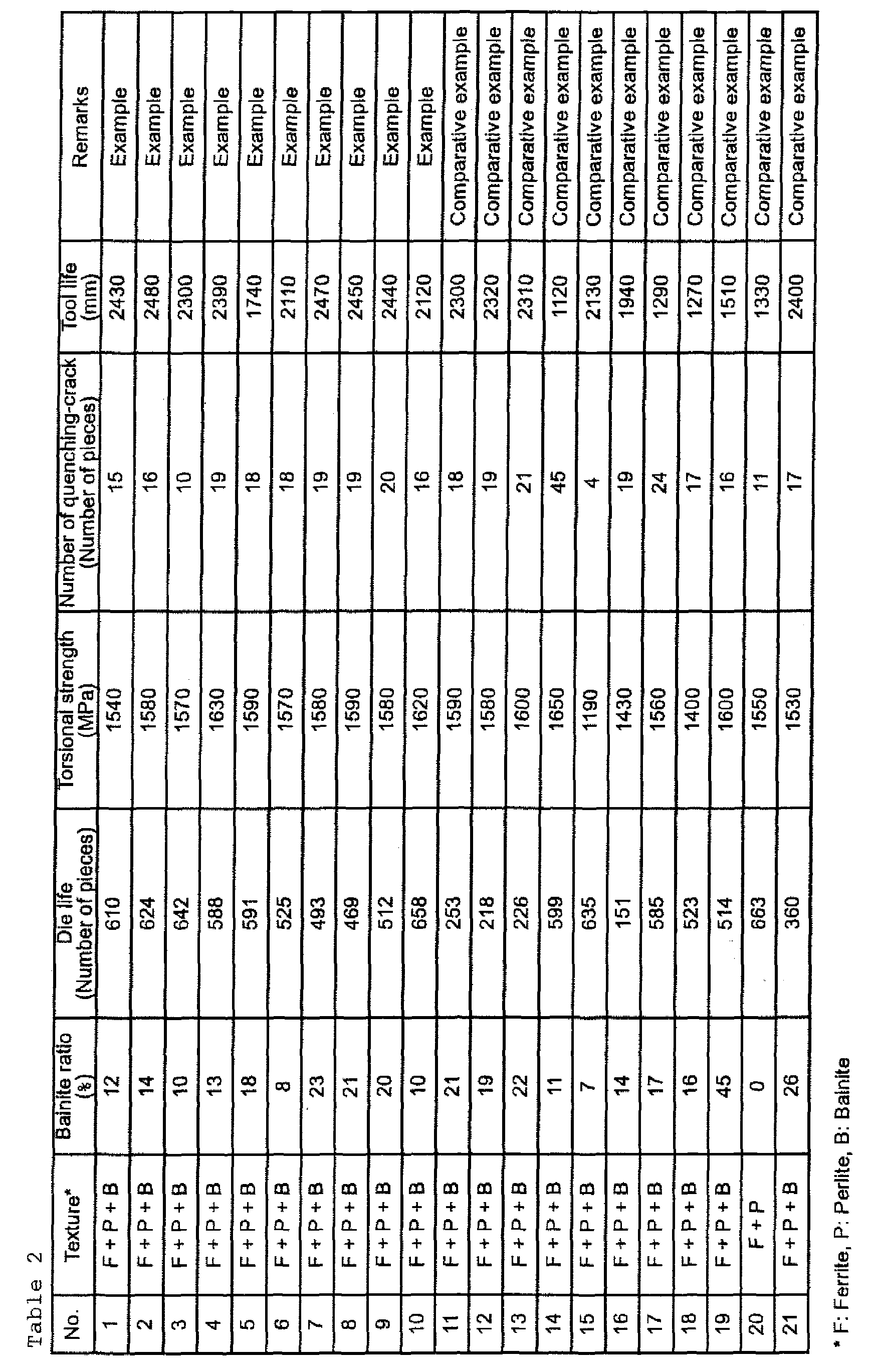
- the formability of rotary-forming are evaluated by a die life obtained in a form-rolling test.
- the die life As shown in the figure, in both cases, when the LD value is more than 120, the die life is rapidly decreased; however, when the LD value is 120 or less, the die life, that is, the formability of rotary-forming, of the high Cr and high Si steel of the present invention is much superior.
- the components are controlled to obtain an LD value of 120 or less.
- the steel texture is not particularly specified; however, a texture composed of ferrite as a primary component and approximately 5 to 30% of a bainite phase on an area percent basis is preferably used.
- the steel product described above is most preferably used for power transmission devices, particularly for automobile drive shafts and constant velocity joints.
- a significant advantage that is, weight reduction, can be obtained.
- a steel melting method for the steel product of the present invention may be performed by a known method and is not particularly limited.
- the machine structural steel of the present invention has superior formability of rotary-forming even when Cu or Ni is incorporated, which is difficult to be removed in steel melting performed by using an electric furnace, and hence the steel melting is preferably performed using an electric furnace.
- Vacuum degassing such as RH degassing, refining using ladles, and the like may be additionally performed.
- Molten steel is solidified by a continuous casting method or an ingot-making method and is then formed into materials having predetermined shapes through hot rolling or hot/warm forging. After processed by intermediate heat treatment, whenever necessary, such as normalizing, spheroidized annealing, or softening annealing, the materials thus obtained are finished into a desired shape by cold working such as cutting, forging, or form rolling.
- the product having a predetermined shape is formed by hot rolling or hot forging, or is then further processed by normalizing. Cooling after the formation of austenite by this hot rolling or hot forging followed by normalizing or the like is preferably performed at a rate of approximately 0.2 to 2.0°C/sec in order to produce an appropriate amount of bainite. In particular, for a steel bar having a large diameter, accelerated cooling in which cooling is controlled is preferably performed.
- final induction hardening and tempering may be performed by heating for approximately 0.2 to 1.0 second at an output of approximately 120 kW using a induction hardening apparatus at a frequency of approximately 15 kHz, followed by tempering at a temperature of 170°C for approximately 30 minutes.
- the measurement method of the steel texture and the various properties are as follows.
- the formability of rotary-forming were evaluated by the die life in accordance with a form-rolling test.
- the die life was determined by the number of material which was form-rolled until the form-rolling could not be further continued due to tooth tipping, peeling of a fracture surface, tooth abrasion, and the like.
- Tooth form involute form, module: 1.27, pressure angle: 30°, number of teeth: 21, pitch diameter: 26.27 mm, large diameter: 28.1 mm, small diameter: 24.88 mm, over-pin diameter (pin 2.5 mm in diameter): 30.49 mm
- a torsion test piece in the form of a smooth round bar having a parallel portion 20 mm in diameter was formed from a straight bar and was then quenched at a frequency of 15 kHz using a induction hardening apparatus, tempering treatment at 170°C for 30 minutes was performed, and the torsion test was then performed.
- the hardness penetration depth after the induction hardening and tempering was set to approximately 4 mm.
- the torsion test was performed by using a torsion tester of 4,900 J (500 kgf ⁇ m), and the maximum torsional shear strength was measured as the torsional strength.
- a round bar (20 mm in diameter) having a V-shaped groove on the surface thereof along the shaft direction was formed from the above straight bar 25 mm in diameter and was then processed by induction hardening equivalent to that described above. After 10 locations on a C cross-section of the round bar were polished and observed, the evaluation was performed by the number of generated cracks.
- an opening having a length of 12 mm was formed using a drill made of SKH 4 having a diameter of 4 mm at a rotation speed of 1,500 rpm, and the operation described above was repeated until the formation of the opening could not be further continued, thereby obtaining the total length (mm) of the openings. This total length of the openings thus formed was evaluated as a tool life.
- the steel products obtained according to the present invention have superior formability of rotary-forming, torsional properties, quenching-crack resistance, and machinability.
- the static strength and the fatigue strength of a drive shaft which was formed from the steel product of the present invention provided with a hardened layer by induction hardening and tempering, will be described with reference to Figs. 2 and 3, respectively.
- the drive shaft of the example according to the present invention was formed from a steel product of No. 2 shown in Table 1.
- the drive shaft of the comparative example was formed from a steel product of No. 18 shown in Table 1.
- Fig. 2 is a graph showing the results of measurement of the static strength of the drive shafts by a static strength test.
- the static strength test (static strength test) is to evaluate the static strength by measuring the maximum torque obtained when the drive shaft is broken.
- the number of the drive shafts used for the test was one for the comparative example and two for the examples.
- the results of the comparative example, example 1, and example 2 are shown in Fig. 2.
- the maximum torque obtained when the drive shaft of the comparative example was broken is set to be 1, and the maximum torque obtained when the drive shaft of the example was broken was represented by the ratio thereto. It was understood that the static strength of the drive shaft of the example was improved by approximately 1.17 times that of the drive shaft of the comparative example.
- Fig. 3 is a graph showing the results of the fatigue strengths of the drive shaft of the example and the drive shaft of the comparative example measured by a fatigue strength test.
- the fatigue strength test is a test for measuring the fatigue strength obtained when torque is repeatedly loaded. A predetermined load torque is repeatedly applied to the drive shaft, and the number of cycles N of load application which causes the fracture of the drive shaft is obtained.
- the vertical axis indicates the value obtained by dividing the load torque by the static strength of the drive shaft of the comparative example, and the value thus obtained is dimensionless.
- the horizontal axis indicates the number of cycles of load application causing the fracture of the drive shaft.
- a steel product can be obtained having superior formability of rotary-forming, torsional properties, quenching-crack resistance, and hardenability.
- significant advantage that is, weight reduction, can be obtained due to the high strength.
Landscapes
- Chemical & Material Sciences (AREA)
- Engineering & Computer Science (AREA)
- Materials Engineering (AREA)
- Mechanical Engineering (AREA)
- Metallurgy (AREA)
- Organic Chemistry (AREA)
- Heat Treatment Of Articles (AREA)
- Heat Treatment Of Steel (AREA)
- Shafts, Cranks, Connecting Bars, And Related Bearings (AREA)
Abstract
Description
Patent Document 1: Japanese Unexamined Patent Application Publication No. 4-218641 (Claims)
Patent Document 2: Patent No. 3288563 (Claims)
Si: 0.15% or less
Mn: 0.2% or more, 1.1% or less
P: 0.020% or less
S: 0.005% or more, 0.035% or less
Cr: more than 0.1%, 0.2% or less
Mo: 0.05% or more, 0.5% or less
Ti: 0.01% or more, 0.05% or less
Al: 0.01% or more, 0.05% or less
N: 0.01% or less
B: 0.0005% or more, 0.0050% or less
Cu: 0.06% or more, 0.25% or less
Ni: 0.05% or more, 0.2% or less
V: 0.01% or more, 0.30% or less, and Nb: 0.005% or more, 0.050% or less
Tooth form: involute form, module: 1.27, pressure angle: 30°, number of teeth: 21, pitch diameter: 26.27 mm, large diameter: 28.1 mm, small diameter: 24.88 mm, over-pin diameter (pin 2.5 mm in diameter): 30.49 mm

Claims (3)
- A machine structural steel product provided with superior formability of rotary-forming, quenching-crack resistance, and torsional properties, comprising: on a mass percent basis,wherein an LD value represented by the following equation (1) of 120 or less is satisfied, and the balance of the composition includes Fe and inevitable impurities:C: 0.35% to 0.50%;Si: 0.15% or less;Mn: 0.20% to 1.1%;P: 0.02% or less;S: 0.005% to 0.035%;Cr: more than 0.1% to 0.2%;Mo: 0.05% to 0.5%;Ti: 0.01% to 0.05%;Al: 0.01% to 0.05%;N: 0.01% or less;B: 0.0005% to 0.0050%;Cu: 0.06% to 0.25%; andNi: 0.05% to 0.2%,
note - The machine structural steel product having superior formability of rotary-forming, quenching-crack resistance, and torsional properties, according to Claim 1, further comprising: on a mass percent basis,V: 0.01% to 0.30%, andNb; 0.005% to 0.05%.
- A drive shaft comprising the machine structural steel product according to Claim 1 or 2, wherein a hardened layer is provided thereon by performing induction hardening and tempering.
Applications Claiming Priority (3)
| Application Number | Priority Date | Filing Date | Title |
|---|---|---|---|
| JP2002304190 | 2002-10-18 | ||
| JP2002304190 | 2002-10-18 | ||
| PCT/JP2002/013564 WO2004035848A1 (en) | 2002-10-18 | 2002-12-26 | Steel material for mechanical structure excellent in suitability for rolling, quenching crack resistance, and torsional property and drive shaft |
Publications (3)
| Publication Number | Publication Date |
|---|---|
| EP1553197A1 true EP1553197A1 (en) | 2005-07-13 |
| EP1553197A4 EP1553197A4 (en) | 2006-07-05 |
| EP1553197B1 EP1553197B1 (en) | 2007-09-19 |
Family
ID=32105100
Family Applications (1)
| Application Number | Title | Priority Date | Filing Date |
|---|---|---|---|
| EP02790877A Expired - Lifetime EP1553197B1 (en) | 2002-10-18 | 2002-12-26 | Steel material for mechanical structure excellent in suitability for rolling, quenching crack resistance, and torsional property and drive shaft |
Country Status (7)
| Country | Link |
|---|---|
| US (1) | US20060065328A1 (en) |
| EP (1) | EP1553197B1 (en) |
| JP (1) | JP4170294B2 (en) |
| CN (1) | CN1307319C (en) |
| DE (1) | DE60222595T2 (en) |
| ES (1) | ES2292836T3 (en) |
| WO (1) | WO2004035848A1 (en) |
Cited By (3)
| Publication number | Priority date | Publication date | Assignee | Title |
|---|---|---|---|---|
| WO2006110100A1 (en) * | 2005-04-12 | 2006-10-19 | Scania Cv Ab (Publ) | Boron steel grade for induction hardening and shaft |
| EP1900838A4 (en) * | 2005-07-05 | 2009-03-25 | Jfe Steel Corp | Steel for mechanical structure excelling in strength, ductility and toughness and process for producing the same |
| EP4481064A4 (en) * | 2022-06-24 | 2026-03-11 | Jfe Steel Corp | STEEL FOR HIGH FREQUENCY HARDENING |
Families Citing this family (3)
| Publication number | Priority date | Publication date | Assignee | Title |
|---|---|---|---|---|
| WO2018212327A1 (en) * | 2017-05-18 | 2018-11-22 | 新日鐵住金株式会社 | Wire, steel wire, and method for manufacturing steel wire |
| JP7136320B2 (en) * | 2019-03-05 | 2022-09-13 | 日本製鉄株式会社 | Crankshaft |
| JP2023103196A (en) * | 2022-01-13 | 2023-07-26 | 日本製鉄株式会社 | Steel used as a material for bolts |
Family Cites Families (10)
| Publication number | Priority date | Publication date | Assignee | Title |
|---|---|---|---|---|
| JPS61174322A (en) * | 1985-01-28 | 1986-08-06 | Nippon Steel Corp | Method for softening rolled material of machine structural steel |
| US5279688A (en) * | 1989-12-06 | 1994-01-18 | Daido Tokushuko Kabushiki Kaisha | Steel shaft material which is capable of being directly cut and induction hardened and a method for manufacturing the same |
| JP3062275B2 (en) * | 1990-05-02 | 2000-07-10 | 川崎製鉄株式会社 | Steel for high strength shaft parts |
| JP3598147B2 (en) * | 1995-06-19 | 2004-12-08 | エヌケーケー条鋼株式会社 | Machine structural steel with excellent cold workability and induction hardening |
| JPH0920958A (en) * | 1995-06-30 | 1997-01-21 | Nkk Corp | Hot-rolled steel sheet for press forming having excellent secondary workability and method for producing the same |
| JP3288563B2 (en) * | 1995-10-17 | 2002-06-04 | 川崎製鉄株式会社 | Steel for mechanical structure excellent in machinability and resistance to fire cracking and method for producing the same |
| CN1163942A (en) * | 1996-02-08 | 1997-11-05 | 阿斯克迈塔尔公司 | Steel for manufacturing forgings and method for manufacturing forgings |
| JP3402562B2 (en) * | 1996-07-19 | 2003-05-06 | 大同特殊鋼株式会社 | Induction hardened parts |
| EP0933440B1 (en) * | 1997-07-22 | 2003-02-05 | Nippon Steel Corporation | Case hardened steel excellent in the prevention of coarsening of particles during carburizing thereof, method of manufacturing the same, and raw shaped material for carburized parts |
| JP2000154828A (en) * | 1998-11-19 | 2000-06-06 | Nippon Steel Corp | Outer ring for constant velocity joint having excellent flaking resistance and shaft strength and method of manufacturing the same |
-
2002
- 2002-12-26 WO PCT/JP2002/013564 patent/WO2004035848A1/en not_active Ceased
- 2002-12-26 EP EP02790877A patent/EP1553197B1/en not_active Expired - Lifetime
- 2002-12-26 CN CNB028297733A patent/CN1307319C/en not_active Expired - Fee Related
- 2002-12-26 US US10/526,802 patent/US20060065328A1/en not_active Abandoned
- 2002-12-26 JP JP2004544722A patent/JP4170294B2/en not_active Expired - Lifetime
- 2002-12-26 DE DE60222595T patent/DE60222595T2/en not_active Expired - Lifetime
- 2002-12-26 ES ES02790877T patent/ES2292836T3/en not_active Expired - Lifetime
Cited By (3)
| Publication number | Priority date | Publication date | Assignee | Title |
|---|---|---|---|---|
| WO2006110100A1 (en) * | 2005-04-12 | 2006-10-19 | Scania Cv Ab (Publ) | Boron steel grade for induction hardening and shaft |
| EP1900838A4 (en) * | 2005-07-05 | 2009-03-25 | Jfe Steel Corp | Steel for mechanical structure excelling in strength, ductility and toughness and process for producing the same |
| EP4481064A4 (en) * | 2022-06-24 | 2026-03-11 | Jfe Steel Corp | STEEL FOR HIGH FREQUENCY HARDENING |
Also Published As
| Publication number | Publication date |
|---|---|
| CN1307319C (en) | 2007-03-28 |
| DE60222595D1 (en) | 2007-10-31 |
| CN1688733A (en) | 2005-10-26 |
| EP1553197B1 (en) | 2007-09-19 |
| EP1553197A4 (en) | 2006-07-05 |
| US20060065328A1 (en) | 2006-03-30 |
| DE60222595T2 (en) | 2008-06-19 |
| ES2292836T3 (en) | 2008-03-16 |
| JP4170294B2 (en) | 2008-10-22 |
| JPWO2004035848A1 (en) | 2006-02-16 |
| WO2004035848A1 (en) | 2004-04-29 |
Similar Documents
| Publication | Publication Date | Title |
|---|---|---|
| EP1091006B1 (en) | Process of producing steel strip or sheet comprising strain-induced martensite | |
| JP6652019B2 (en) | Machine structural steel and induction hardened steel parts for induction hardening | |
| JP6384629B2 (en) | Induction hardening steel | |
| JP6384626B2 (en) | Induction hardening steel | |
| EP0637636B1 (en) | Graphite structural steel having good free-cutting and good cold-forging properties and process of making this steel | |
| JP6384630B2 (en) | Induction hardening steel | |
| JP6384627B2 (en) | Induction hardening steel | |
| JP6614393B2 (en) | Non-tempered steel bar | |
| JP6384628B2 (en) | Induction hardening steel | |
| JP2002226939A (en) | Non-heat treated steel for soft nitriding | |
| WO2013031587A1 (en) | Rolled steel bar or wire for hot forging | |
| CN108138287A (en) | Steel for mechanical structure and high-frequency quenching steel part | |
| EP3272896B1 (en) | Age-hardenable steel, and method for manufacturing components using age-hardenable steel | |
| US20060065328A1 (en) | Steel material for mechanical structure excellent in suitability for rolling, quenching crack resistance, and torsional property and drive shaft | |
| CN113646448B (en) | steel shaft parts | |
| CN100436628C (en) | Steel material for induction hardening, induction hardened member using same, and method for producing same | |
| JP3288563B2 (en) | Steel for mechanical structure excellent in machinability and resistance to fire cracking and method for producing the same | |
| JP6828593B2 (en) | Carburized parts | |
| JP2004124127A (en) | Carburizing steel superior in torsion fatigue characteristic | |
| CN101283111A (en) | Steel and its manufacturing method | |
| JPH11106863A (en) | Steel for mechanical structure excellent in cold workability and method for producing the same | |
| JP3798251B2 (en) | Manufacturing method of undercarriage forgings for automobiles | |
| JPH0797656A (en) | Cold forging steel | |
| JP3591467B2 (en) | Carbon steel for machine structural use with excellent cold forgeability, hardenability and scale peelability | |
| JPH11106864A (en) | Steel for mechanical structure excellent in cold workability and method for producing the same |
Legal Events
| Date | Code | Title | Description |
|---|---|---|---|
| PUAI | Public reference made under article 153(3) epc to a published international application that has entered the european phase |
Free format text: ORIGINAL CODE: 0009012 |
|
| 17P | Request for examination filed |
Effective date: 20050308 |
|
| AK | Designated contracting states |
Kind code of ref document: A1 Designated state(s): AT BE BG CH CY CZ DE DK EE ES FI FR GB GR IE IT LI LU MC NL PT SE SI SK TR |
|
| RBV | Designated contracting states (corrected) |
Designated state(s): DE ES FR GB |
|
| A4 | Supplementary search report drawn up and despatched |
Effective date: 20060608 |
|
| RIC1 | Information provided on ipc code assigned before grant |
Ipc: C21D 9/28 20060101ALI20060601BHEP Ipc: C22C 38/00 20060101AFI20040504BHEP |
|
| 17Q | First examination report despatched |
Effective date: 20060922 |
|
| GRAP | Despatch of communication of intention to grant a patent |
Free format text: ORIGINAL CODE: EPIDOSNIGR1 |
|
| GRAS | Grant fee paid |
Free format text: ORIGINAL CODE: EPIDOSNIGR3 |
|
| GRAA | (expected) grant |
Free format text: ORIGINAL CODE: 0009210 |
|
| AK | Designated contracting states |
Kind code of ref document: B1 Designated state(s): DE ES FR GB |
|
| REG | Reference to a national code |
Ref country code: GB Ref legal event code: FG4D |
|
| REF | Corresponds to: |
Ref document number: 60222595 Country of ref document: DE Date of ref document: 20071031 Kind code of ref document: P |
|
| REG | Reference to a national code |
Ref country code: ES Ref legal event code: FG2A Ref document number: 2292836 Country of ref document: ES Kind code of ref document: T3 |
|
| ET | Fr: translation filed | ||
| PLBE | No opposition filed within time limit |
Free format text: ORIGINAL CODE: 0009261 |
|
| STAA | Information on the status of an ep patent application or granted ep patent |
Free format text: STATUS: NO OPPOSITION FILED WITHIN TIME LIMIT |
|
| 26N | No opposition filed |
Effective date: 20080620 |
|
| REG | Reference to a national code |
Ref country code: FR Ref legal event code: PLFP Year of fee payment: 14 |
|
| REG | Reference to a national code |
Ref country code: FR Ref legal event code: PLFP Year of fee payment: 15 |
|
| REG | Reference to a national code |
Ref country code: FR Ref legal event code: PLFP Year of fee payment: 16 |
|
| PGFP | Annual fee paid to national office [announced via postgrant information from national office to epo] |
Ref country code: DE Payment date: 20181211 Year of fee payment: 17 |
|
| PGFP | Annual fee paid to national office [announced via postgrant information from national office to epo] |
Ref country code: FR Payment date: 20181122 Year of fee payment: 17 Ref country code: GB Payment date: 20181227 Year of fee payment: 17 |
|
| PGFP | Annual fee paid to national office [announced via postgrant information from national office to epo] |
Ref country code: ES Payment date: 20190103 Year of fee payment: 17 |
|
| REG | Reference to a national code |
Ref country code: DE Ref legal event code: R119 Ref document number: 60222595 Country of ref document: DE |
|
| GBPC | Gb: european patent ceased through non-payment of renewal fee |
Effective date: 20191226 |
|
| PG25 | Lapsed in a contracting state [announced via postgrant information from national office to epo] |
Ref country code: DE Free format text: LAPSE BECAUSE OF NON-PAYMENT OF DUE FEES Effective date: 20200701 Ref country code: FR Free format text: LAPSE BECAUSE OF NON-PAYMENT OF DUE FEES Effective date: 20191231 Ref country code: GB Free format text: LAPSE BECAUSE OF NON-PAYMENT OF DUE FEES Effective date: 20191226 |
|
| REG | Reference to a national code |
Ref country code: ES Ref legal event code: FD2A Effective date: 20210524 |
|
| PG25 | Lapsed in a contracting state [announced via postgrant information from national office to epo] |
Ref country code: ES Free format text: LAPSE BECAUSE OF NON-PAYMENT OF DUE FEES Effective date: 20191227 |