EP1553119A1 - Electroluminescent polymers, bisfluorenylsilanes, and organic electroluminescent devices - Google Patents
Electroluminescent polymers, bisfluorenylsilanes, and organic electroluminescent devices Download PDFInfo
- Publication number
- EP1553119A1 EP1553119A1 EP03751486A EP03751486A EP1553119A1 EP 1553119 A1 EP1553119 A1 EP 1553119A1 EP 03751486 A EP03751486 A EP 03751486A EP 03751486 A EP03751486 A EP 03751486A EP 1553119 A1 EP1553119 A1 EP 1553119A1
- Authority
- EP
- European Patent Office
- Prior art keywords
- group
- formula
- indicate
- electroluminescent polymer
- polymer
- Prior art date
- Legal status (The legal status is an assumption and is not a legal conclusion. Google has not performed a legal analysis and makes no representation as to the accuracy of the status listed.)
- Withdrawn
Links
- 0 CCN(Cc1c(cc2)S(C)(c(cc3C4(*)I=*)ccc3-c3c4cc(C)cc3)N=C)C3(*)c1c2-c1ccc(C)cc31 Chemical compound CCN(Cc1c(cc2)S(C)(c(cc3C4(*)I=*)ccc3-c3c4cc(C)cc3)N=C)C3(*)c1c2-c1ccc(C)cc31 0.000 description 2
Images




Classifications
-
- C—CHEMISTRY; METALLURGY
- C08—ORGANIC MACROMOLECULAR COMPOUNDS; THEIR PREPARATION OR CHEMICAL WORKING-UP; COMPOSITIONS BASED THEREON
- C08G—MACROMOLECULAR COMPOUNDS OBTAINED OTHERWISE THAN BY REACTIONS ONLY INVOLVING UNSATURATED CARBON-TO-CARBON BONDS
- C08G77/00—Macromolecular compounds obtained by reactions forming a linkage containing silicon with or without sulfur, nitrogen, oxygen or carbon in the main chain of the macromolecule
- C08G77/60—Macromolecular compounds obtained by reactions forming a linkage containing silicon with or without sulfur, nitrogen, oxygen or carbon in the main chain of the macromolecule in which all the silicon atoms are connected by linkages other than oxygen atoms
- C08G77/62—Nitrogen atoms
-
- C—CHEMISTRY; METALLURGY
- C09—DYES; PAINTS; POLISHES; NATURAL RESINS; ADHESIVES; COMPOSITIONS NOT OTHERWISE PROVIDED FOR; APPLICATIONS OF MATERIALS NOT OTHERWISE PROVIDED FOR
- C09K—MATERIALS FOR MISCELLANEOUS APPLICATIONS, NOT PROVIDED FOR ELSEWHERE
- C09K11/00—Luminescent materials, e.g. electroluminescent or chemiluminescent
- C09K11/06—Luminescent materials, e.g. electroluminescent or chemiluminescent containing organic luminescent materials
-
- C—CHEMISTRY; METALLURGY
- C07—ORGANIC CHEMISTRY
- C07F—ACYCLIC, CARBOCYCLIC OR HETEROCYCLIC COMPOUNDS CONTAINING ELEMENTS OTHER THAN CARBON, HYDROGEN, HALOGEN, OXYGEN, NITROGEN, SULFUR, SELENIUM OR TELLURIUM
- C07F7/00—Compounds containing elements of Groups 4 or 14 of the Periodic Table
- C07F7/02—Silicon compounds
- C07F7/08—Compounds having one or more C—Si linkages
- C07F7/0803—Compounds with Si-C or Si-Si linkages
- C07F7/081—Compounds with Si-C or Si-Si linkages comprising at least one atom selected from the elements N, O, halogen, S, Se or Te
- C07F7/0812—Compounds with Si-C or Si-Si linkages comprising at least one atom selected from the elements N, O, halogen, S, Se or Te comprising a heterocyclic ring
-
- C—CHEMISTRY; METALLURGY
- C08—ORGANIC MACROMOLECULAR COMPOUNDS; THEIR PREPARATION OR CHEMICAL WORKING-UP; COMPOSITIONS BASED THEREON
- C08G—MACROMOLECULAR COMPOUNDS OBTAINED OTHERWISE THAN BY REACTIONS ONLY INVOLVING UNSATURATED CARBON-TO-CARBON BONDS
- C08G61/00—Macromolecular compounds obtained by reactions forming a carbon-to-carbon link in the main chain of the macromolecule
- C08G61/02—Macromolecular compounds containing only carbon atoms in the main chain of the macromolecule, e.g. polyxylylenes
-
- C—CHEMISTRY; METALLURGY
- C08—ORGANIC MACROMOLECULAR COMPOUNDS; THEIR PREPARATION OR CHEMICAL WORKING-UP; COMPOSITIONS BASED THEREON
- C08G—MACROMOLECULAR COMPOUNDS OBTAINED OTHERWISE THAN BY REACTIONS ONLY INVOLVING UNSATURATED CARBON-TO-CARBON BONDS
- C08G61/00—Macromolecular compounds obtained by reactions forming a carbon-to-carbon link in the main chain of the macromolecule
- C08G61/12—Macromolecular compounds containing atoms other than carbon in the main chain of the macromolecule
-
- C—CHEMISTRY; METALLURGY
- C08—ORGANIC MACROMOLECULAR COMPOUNDS; THEIR PREPARATION OR CHEMICAL WORKING-UP; COMPOSITIONS BASED THEREON
- C08G—MACROMOLECULAR COMPOUNDS OBTAINED OTHERWISE THAN BY REACTIONS ONLY INVOLVING UNSATURATED CARBON-TO-CARBON BONDS
- C08G77/00—Macromolecular compounds obtained by reactions forming a linkage containing silicon with or without sulfur, nitrogen, oxygen or carbon in the main chain of the macromolecule
- C08G77/48—Macromolecular compounds obtained by reactions forming a linkage containing silicon with or without sulfur, nitrogen, oxygen or carbon in the main chain of the macromolecule in which at least two but not all the silicon atoms are connected by linkages other than oxygen atoms
- C08G77/50—Macromolecular compounds obtained by reactions forming a linkage containing silicon with or without sulfur, nitrogen, oxygen or carbon in the main chain of the macromolecule in which at least two but not all the silicon atoms are connected by linkages other than oxygen atoms by carbon linkages
- C08G77/52—Macromolecular compounds obtained by reactions forming a linkage containing silicon with or without sulfur, nitrogen, oxygen or carbon in the main chain of the macromolecule in which at least two but not all the silicon atoms are connected by linkages other than oxygen atoms by carbon linkages containing aromatic rings
-
- H—ELECTRICITY
- H10—SEMICONDUCTOR DEVICES; ELECTRIC SOLID-STATE DEVICES NOT OTHERWISE PROVIDED FOR
- H10K—ORGANIC ELECTRIC SOLID-STATE DEVICES
- H10K85/00—Organic materials used in the body or electrodes of devices covered by this subclass
- H10K85/10—Organic polymers or oligomers
- H10K85/111—Organic polymers or oligomers comprising aromatic, heteroaromatic, or aryl chains, e.g. polyaniline, polyphenylene or polyphenylene vinylene
-
- H—ELECTRICITY
- H10—SEMICONDUCTOR DEVICES; ELECTRIC SOLID-STATE DEVICES NOT OTHERWISE PROVIDED FOR
- H10K—ORGANIC ELECTRIC SOLID-STATE DEVICES
- H10K85/00—Organic materials used in the body or electrodes of devices covered by this subclass
- H10K85/10—Organic polymers or oligomers
- H10K85/111—Organic polymers or oligomers comprising aromatic, heteroaromatic, or aryl chains, e.g. polyaniline, polyphenylene or polyphenylene vinylene
- H10K85/115—Polyfluorene; Derivatives thereof
-
- H—ELECTRICITY
- H10—SEMICONDUCTOR DEVICES; ELECTRIC SOLID-STATE DEVICES NOT OTHERWISE PROVIDED FOR
- H10K—ORGANIC ELECTRIC SOLID-STATE DEVICES
- H10K85/00—Organic materials used in the body or electrodes of devices covered by this subclass
- H10K85/40—Organosilicon compounds, e.g. TIPS pentacene
-
- C—CHEMISTRY; METALLURGY
- C09—DYES; PAINTS; POLISHES; NATURAL RESINS; ADHESIVES; COMPOSITIONS NOT OTHERWISE PROVIDED FOR; APPLICATIONS OF MATERIALS NOT OTHERWISE PROVIDED FOR
- C09K—MATERIALS FOR MISCELLANEOUS APPLICATIONS, NOT PROVIDED FOR ELSEWHERE
- C09K2211/00—Chemical nature of organic luminescent or tenebrescent compounds
- C09K2211/14—Macromolecular compounds
- C09K2211/1408—Carbocyclic compounds
- C09K2211/1416—Condensed systems
-
- C—CHEMISTRY; METALLURGY
- C09—DYES; PAINTS; POLISHES; NATURAL RESINS; ADHESIVES; COMPOSITIONS NOT OTHERWISE PROVIDED FOR; APPLICATIONS OF MATERIALS NOT OTHERWISE PROVIDED FOR
- C09K—MATERIALS FOR MISCELLANEOUS APPLICATIONS, NOT PROVIDED FOR ELSEWHERE
- C09K2211/00—Chemical nature of organic luminescent or tenebrescent compounds
- C09K2211/14—Macromolecular compounds
- C09K2211/1408—Carbocyclic compounds
- C09K2211/1433—Carbocyclic compounds bridged by heteroatoms, e.g. N, P, Si or B
-
- H—ELECTRICITY
- H10—SEMICONDUCTOR DEVICES; ELECTRIC SOLID-STATE DEVICES NOT OTHERWISE PROVIDED FOR
- H10K—ORGANIC ELECTRIC SOLID-STATE DEVICES
- H10K50/00—Organic light-emitting devices
- H10K50/10—OLEDs or polymer light-emitting diodes [PLED]
- H10K50/11—OLEDs or polymer light-emitting diodes [PLED] characterised by the electroluminescent [EL] layers
-
- Y—GENERAL TAGGING OF NEW TECHNOLOGICAL DEVELOPMENTS; GENERAL TAGGING OF CROSS-SECTIONAL TECHNOLOGIES SPANNING OVER SEVERAL SECTIONS OF THE IPC; TECHNICAL SUBJECTS COVERED BY FORMER USPC CROSS-REFERENCE ART COLLECTIONS [XRACs] AND DIGESTS
- Y10—TECHNICAL SUBJECTS COVERED BY FORMER USPC
- Y10S—TECHNICAL SUBJECTS COVERED BY FORMER USPC CROSS-REFERENCE ART COLLECTIONS [XRACs] AND DIGESTS
- Y10S428/00—Stock material or miscellaneous articles
- Y10S428/914—Transfer or decalcomania
Definitions
- the present invention relates to an electroluminescent (EL) polymer which is useful as a light-emitting layer material in an organic EL element, a bisfluorenylsilane compound which is a raw material used in the manufacture of this EL polymer, and an organic EL element using this EL polymer.
- EL electroluminescent
- ⁇ conjugated polymers and ⁇ conjugated polymers have been known as organic EL materials which are used to construct the light-emitting layers of organic EL elements.
- Polymers represented by poly(paraphenylenevinylene)s (PPV), poly(paraphenylene)s (PPP) and the like are widely utilized as ⁇ conjugated polymers.
- ⁇ conjugated polymers poly(9,9-dialkylfluorene)s (PDAF) have actually been used as polymers that show blue light emission (Y. Ohmori et al., Jpn. J. Appl. Phys., 1991, 30, L1941).
- polymers comprising fluorene derivative units ( ⁇ conjugated system) and diarylenesilane derivative units ( ⁇ conjugated system) have also been proposed as ⁇ - ⁇ conjugated polymers that have a ⁇ conjugated system and a ⁇ conjugated system in a single molecule (Japanese Patent Application Laid-Open No. 2001-55447).
- Objects of the present invention include the provision of a novel ⁇ - ⁇ conjugated polymer in which the color purity of blue emitted light in particular is extremely high, the provision of a novel raw material for the manufacture of this ⁇ - ⁇ conjugated polymer, and the provision of an organic EL element which uses this ⁇ - ⁇ conjugated polymer.
- the present inventors discovered that the abovementioned objects can be achieved by means of a polymer obtained by polymerizing a bisfluorenylsilane compound which has specified substituent groups. This discovery led to the perfection of the present invention.
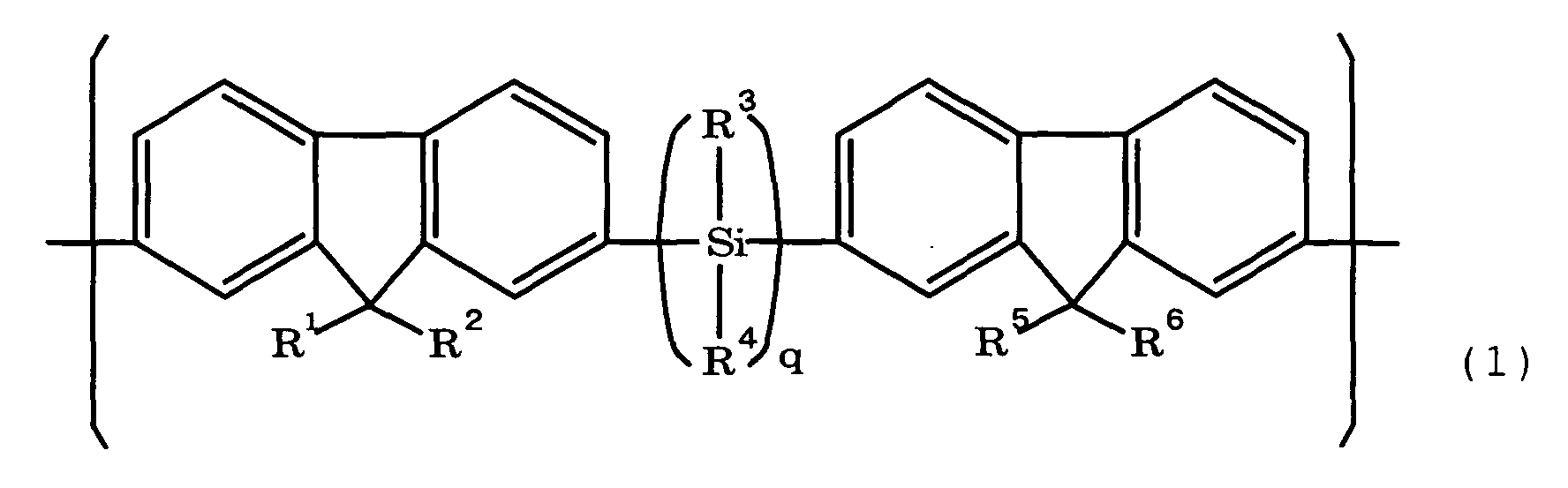
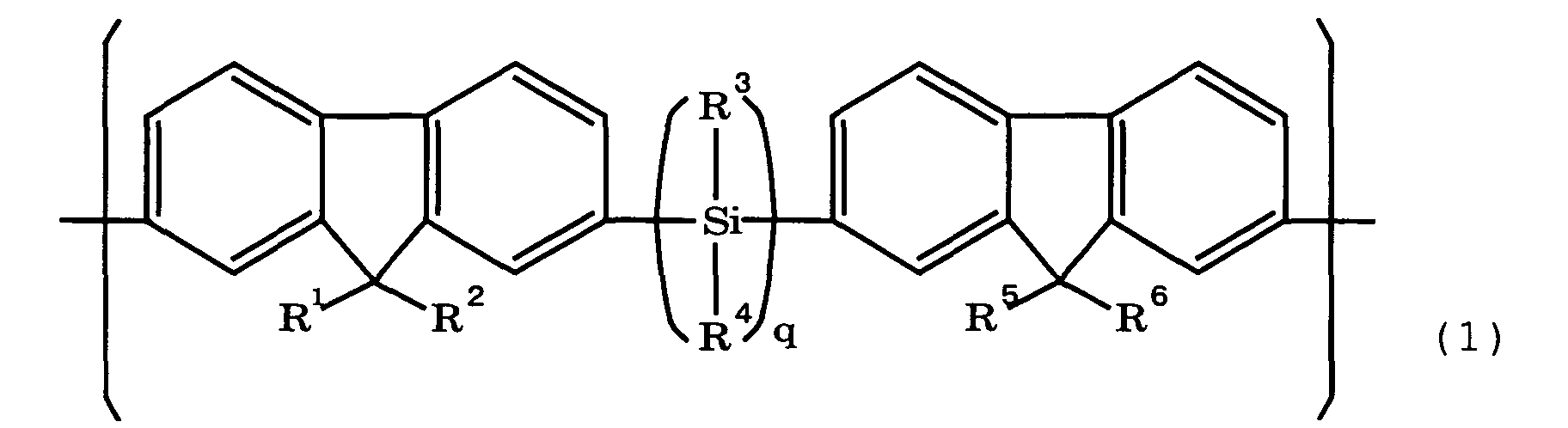
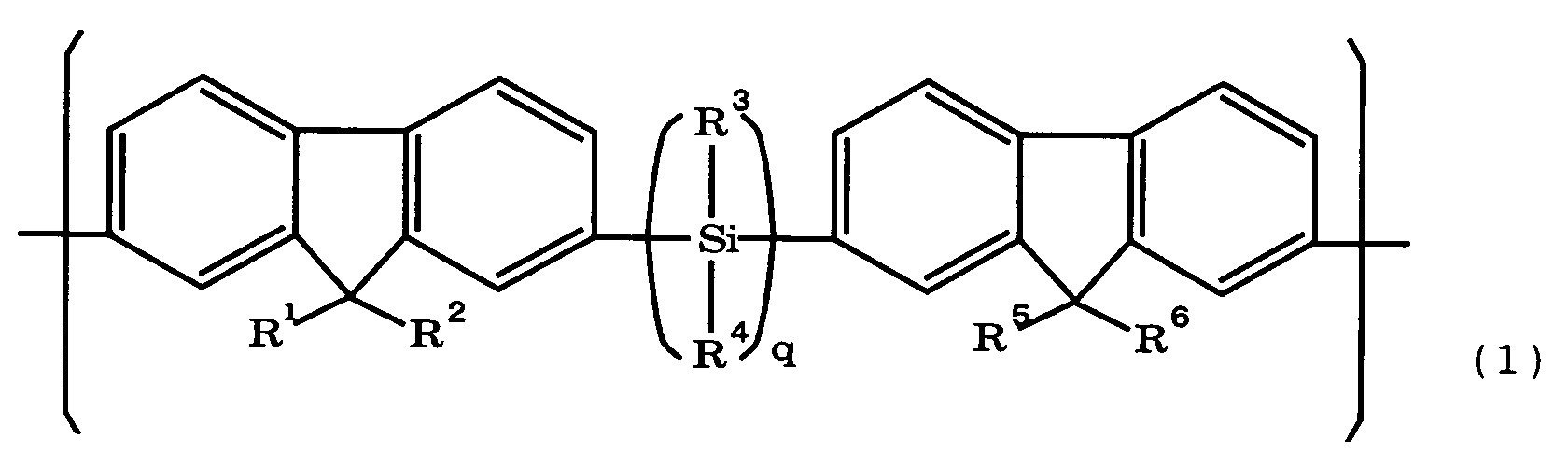
- the present invention provides an electroluminescent polymer which has repeating units represented by formula (1).
- R 1 , R 2 , R 5 and R 6 each independently indicate a hydrogen atom or substituent group
- R 3 and R 4 each independently indicate an aryl group or alkyl group
- q is 1 or 2.
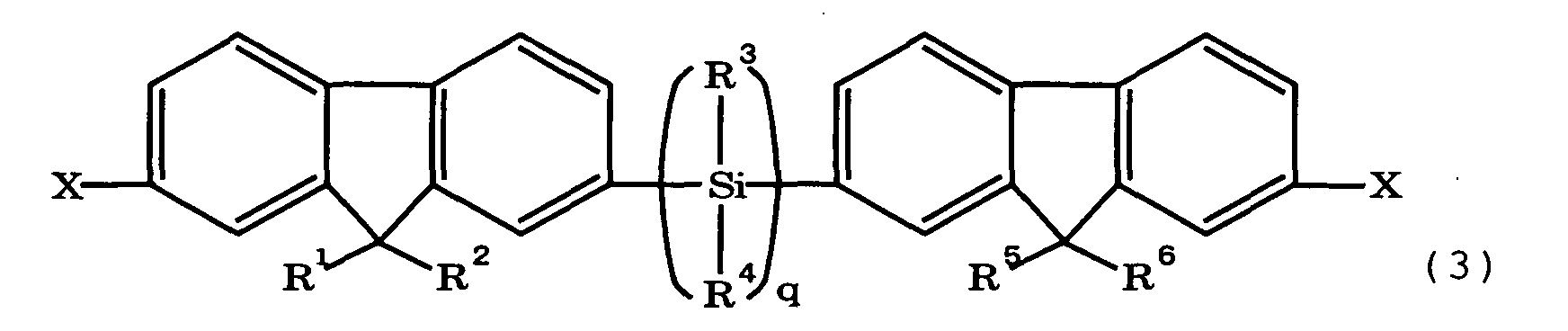
- the present invention provides a bisfluorenylsilane compound which is represented by formula (3) .
- R 1 , R 2 , R 5 and R 6 each independently indicate a hydrogen atom or substituent group
- R 3 and R 4 each independently indicate an aryl group or alkyl group
- q is 1 or 2
- X is a halogen atom.
- the present invention provides an organic electroluminescent element in which a light-emitting layer comprising the abovementioned electroluminescent polymer is clamped between a pair of electrodes.
- the EL polymer of the present invention has repeating units represented by the following formula (1).
- R 1 , R 2 , R 5 and R 6 each independently indicate a hydrogen atom or substituent group. Accordingly, R 1 , R 2 , R 5 and R 6 may be the same or different.
- substituent groups include linear, branched or ring-containing alkyl groups, e. g., t-butyl group, cyclohexyl group, 2-ethylhexyl group or n-octyl group; linear, branched or ring-containing alkenyl groups, e. g., propenyl group; linear, branched or ring-containing alkynyl groups, e.
- ethynyl group ethynyl group
- aralkyl group e. g., benzyl group
- aryl groups e. g., phenyl group, naphthyl group, anthryl group or pyranyl group
- heteroaryl group in which elements other than carbon (nitrogen atom, sulfur atom and/or oxygen atom or the like) form a portion of the aromatic moiety e. g., pyridyl group, thienyl group or carbazolyl group
- alkoxy groups e. g., methoxy group or isopropoxy group
- aryloxy groups e.
- phenoxy group or naphthoxy group e. g., phenoxy group or naphthoxy group
- aliphatic heterocyclic groups e. g., piperidyl group or the like.
- phenyl group, naphthyl group, cyclohexyl group, 2-ethylhexyl group, n-octyl group or n-hexyl group are preferable as R 1 , R 2 , R 5 and R 6 , and n-octyl group is especially preferable.
- R 3 and R 4 each independently indicate an aryl group or alkyl group. Accordingly, R 3 and R 4 may be the same or different.
- examples of aryl groups include phenyl group, p-tolyl group, mesityl group, 4-t-butylphenyl group, naphthyl group, anthryl group and the like
- examples of alkyl group include linear, branched or ring-containing alkyl groups, e. g., methyl group, ethyl group, t-butyl group and the like.
- methyl group, ethyl group, t-butyl group, p-tolyl group, mesityl group, 4-t-butylphenyl group, naphthyl group or anthryl group are preferable as R 3 and R 4 , and methyl group or phenyl group is especially preferable.
- q is 1 or 2
- X is halogen atom, especially bromine atom.
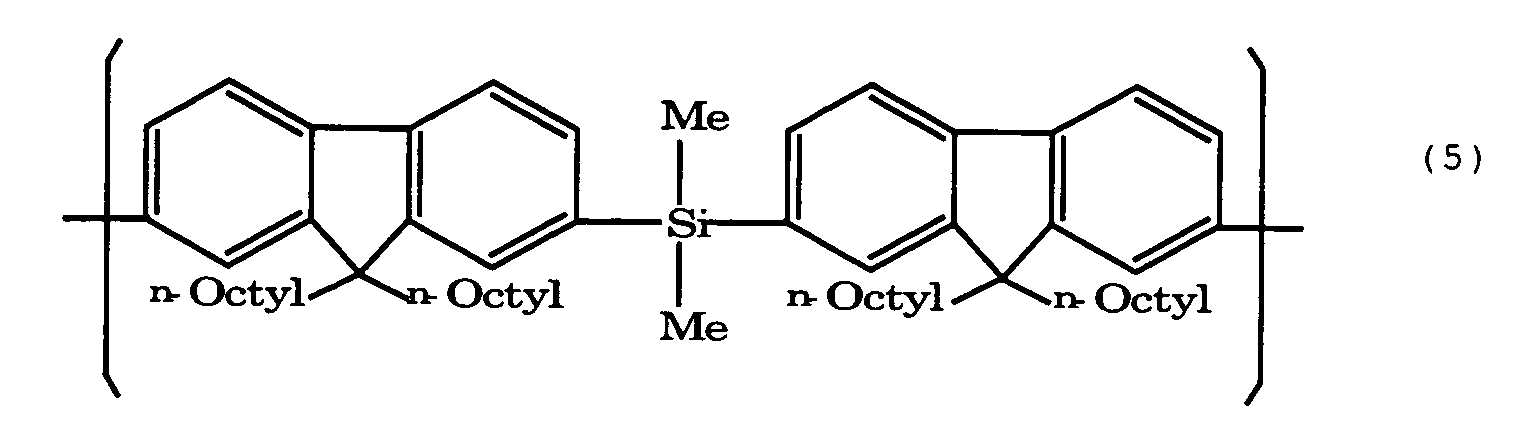
- the repeating unit represented by formula (1) in the electroluminescent polymer of the present invention are a repeating unit in which R 1 , R 2 , R 5 and R 6 are n-octyl groups, R 3 and R 4 are phenyl groups, and q is 1 (formula (4)) ; a repeating unit in which R 1 , R 2 , R 5 and R 6 are n-octyl groups, R 3 and R 4 are methyl groups, and q is 1 (formula (5)) ; a repeating unit in which R 1 , R 2 , R 5 and R 6 are n-octyl groups, R 3 and R 4 are methyl groups, and q is 2 (formula (6)) ; a repeating unit in which R 1 , R 2 , R 5 and R 6 are n-octyl groups, R 3 and R 4 are mesityl groups, and q is 1 (formula (7)) ;
- the content of the repeating unit represented by formula (1) is too small, blue light emission with a high color purity cannot be obtained. Accordingly, it is preferable that this content be 0.1 mol% or greater, and a content of 1 mol% or greater is even more preferable.
- this weight average molecular weight of the EL polymer of the present invention is preferably 1000 to 50,000,000, and is even more preferably 2000 to 500,000.
- the EL polymer of the present invention may contain the other repeating units shown below.
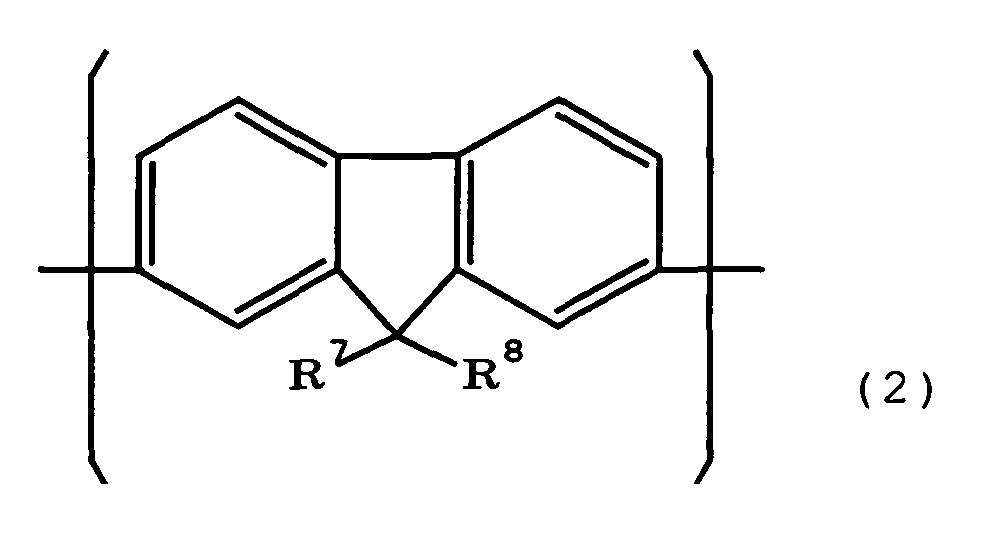
- the EL polymer of the present invention may contain repeating units (fluorene units) represented by formula (2) (preferably at the rate of 10 to 99.9 mol%, and even more preferably at the rate of 50 to 99 mol%).
- repeating units fluorene units represented by formula (2) (preferably at the rate of 10 to 99.9 mol%, and even more preferably at the rate of 50 to 99 mol%).
- R 7 and R 8 each independently indicate a hydrogen atom or a substituent group. Accordingly, R 7 and R 8 may be the same or different.
- substituent groups include linear, branched or ring-containing alkyl groups, e. g., t-butyl group, cyclohexyl group, 2-ethylhexyl group or n-octyl group; linear, branched or ring-containing alkenyl groups, e. g., propenyl group; linear, branched or ring-containing alkynyl groups, e. g., ethynyl group; aralkyl groups, e.
- benzyl group aryl groups, e. g., phenyl group, naphthyl group, anthryl group or pyranyl group; heteroaryl groups in which elements other than carbon (nitrogen atom, sulfur atom and/or oxygen atom or the like) form a portion of the aromatic moiety, e. g., pyridyl group, thienyl group or carbazolyl group; alkoxy groups, e. g., methoxy group or isopropoxy group; aryloxy groups, e. g., phenoxy group or naphthoxy group; and aliphatic heterocyclic groups, e. g., piperidyl group or the like.
- phenyl group, naphthyl group, cyclohexyl group, 2-ethylhexyl group, n-octyl group or n-hexyl group are preferable as R 7 and R 8 , and n-octyl group is especially preferable.
- the EL polymer of the present invention can be manufactured as follows.
- an alkyllithium (preferably n-butyllithium) is caused to act on 2,7-halogenofluorene derivatives (see manufacturing operation in Example 1 of Japanese Patent Publication No. 11-51535) represented by formula (9a) and formula (9b) (in formula (9a) and formula (9b), R 1 , R 2 , R 5 and R 6 are as defined in formula (1), and X is a halogen atom, preferably a bromine atom) in a solvent (ether, toluene or the like), preferably at a temperature of -20 to 20°C.
- a solvent ether, toluene or the like
- This intermediate raw material is a novel compound, and is extremely useful as a manufacturing raw material for the EL polymer of the present invention.
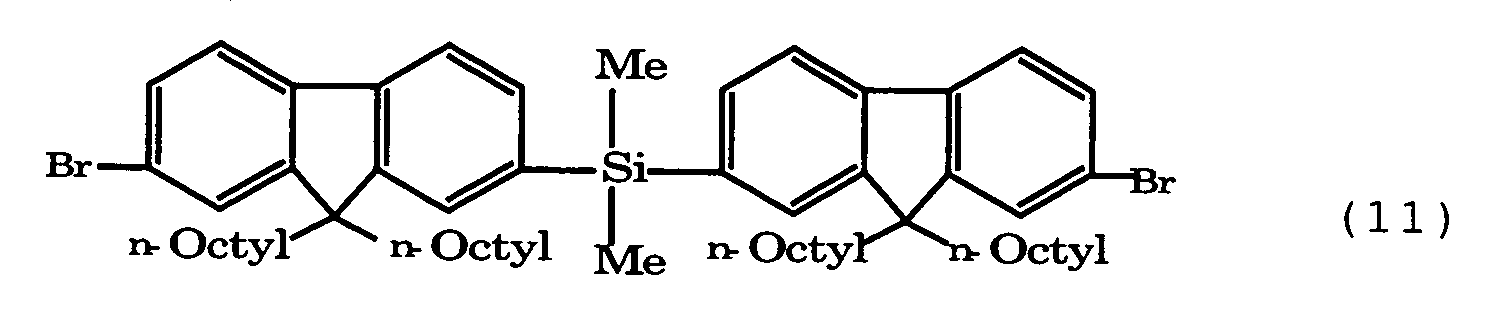
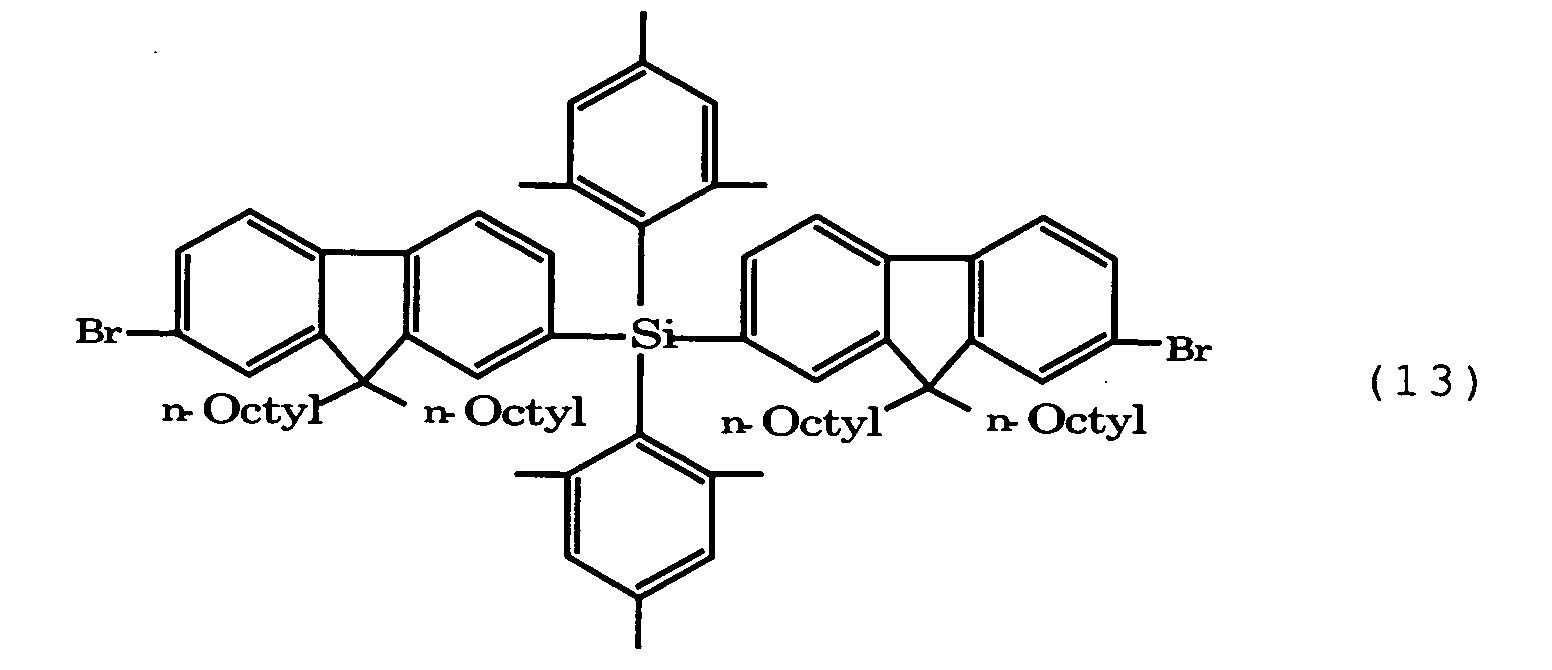
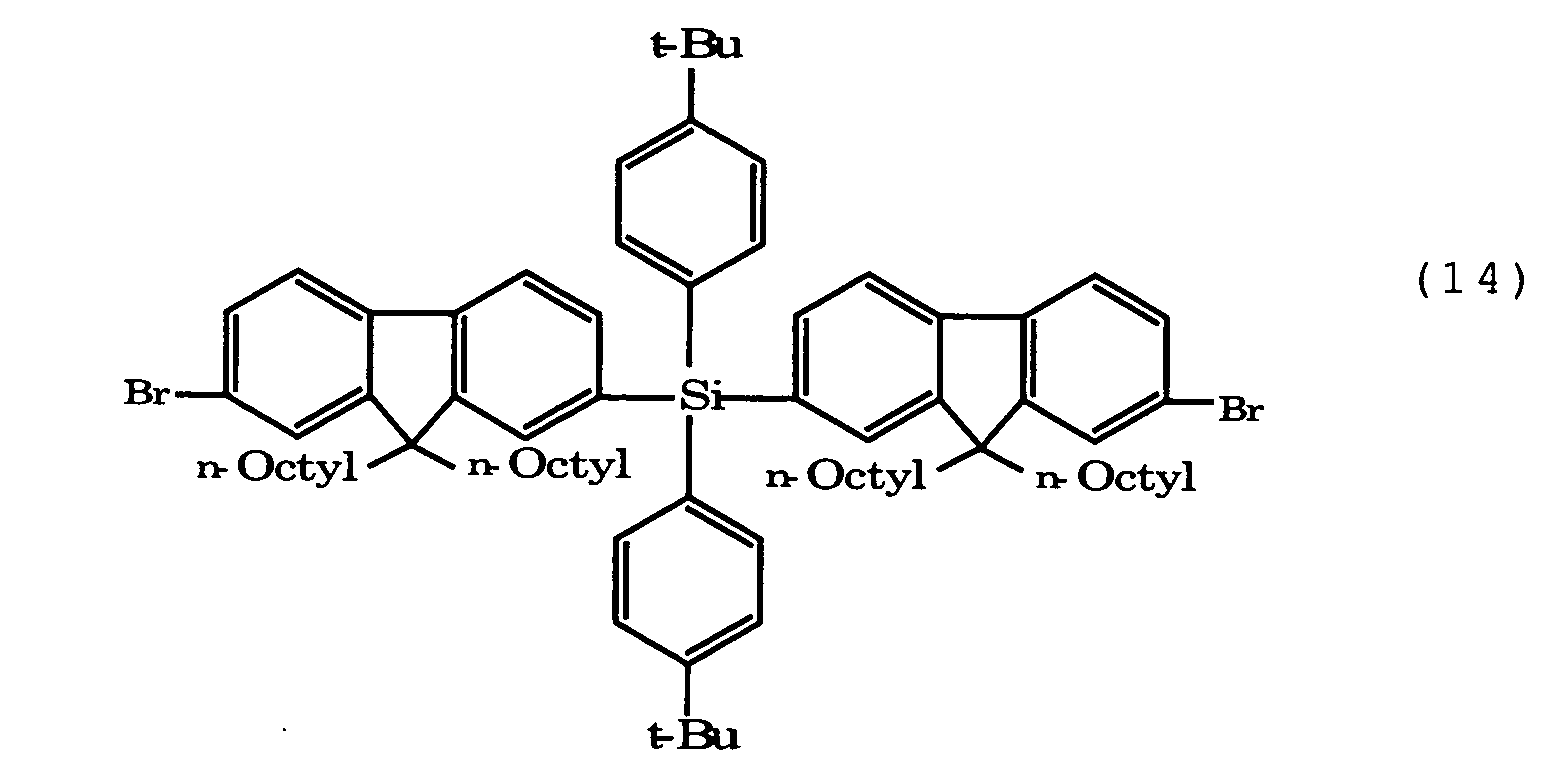
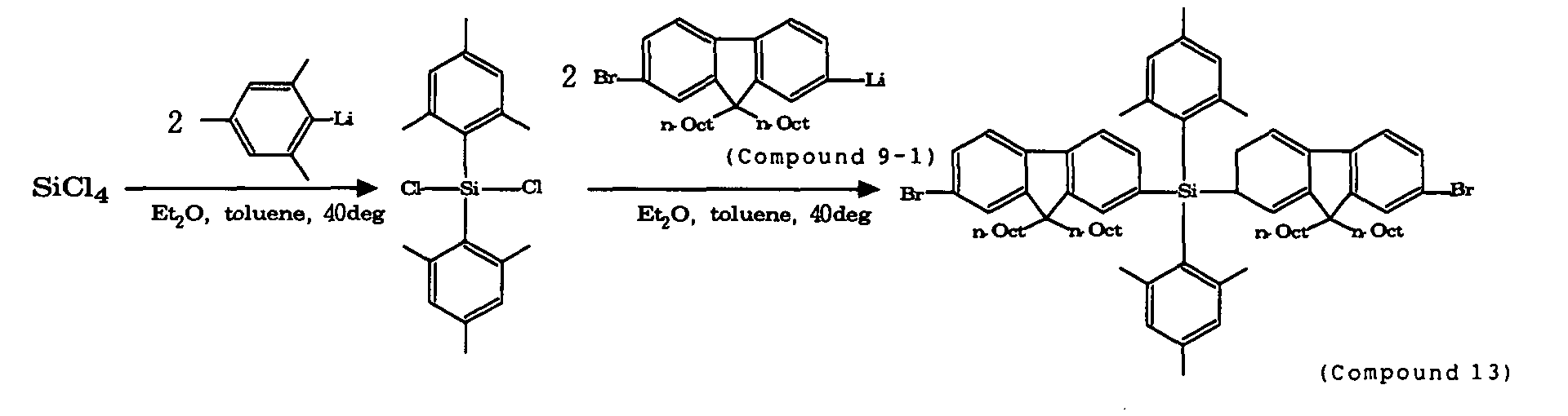
- preferable examples of compounds represented by formula (3) include a compound in which R 1 , R 2 , R 5 and R 6 are n-octyl groups, R 3 and R 4 are phenyl groups, q is 1, and X is bromine atom (formula (10)); a compound in which R 1 , R 2 , R 5 and R 6 are n-octyl groups, R 3 and R 4 are methyl groups, q is 1, and X is bromine atom (formula (11)) ; a compound in which R 1 , R 2 , R 5 and R 6 are n-octyl groups, R 3 and R 4 are methyl groups, q is 2, and X is bromine atom (formula (12)) ; a compound in which R 1 , R 2 R 5 and R 6 are n-octyl groups, R 3 and R
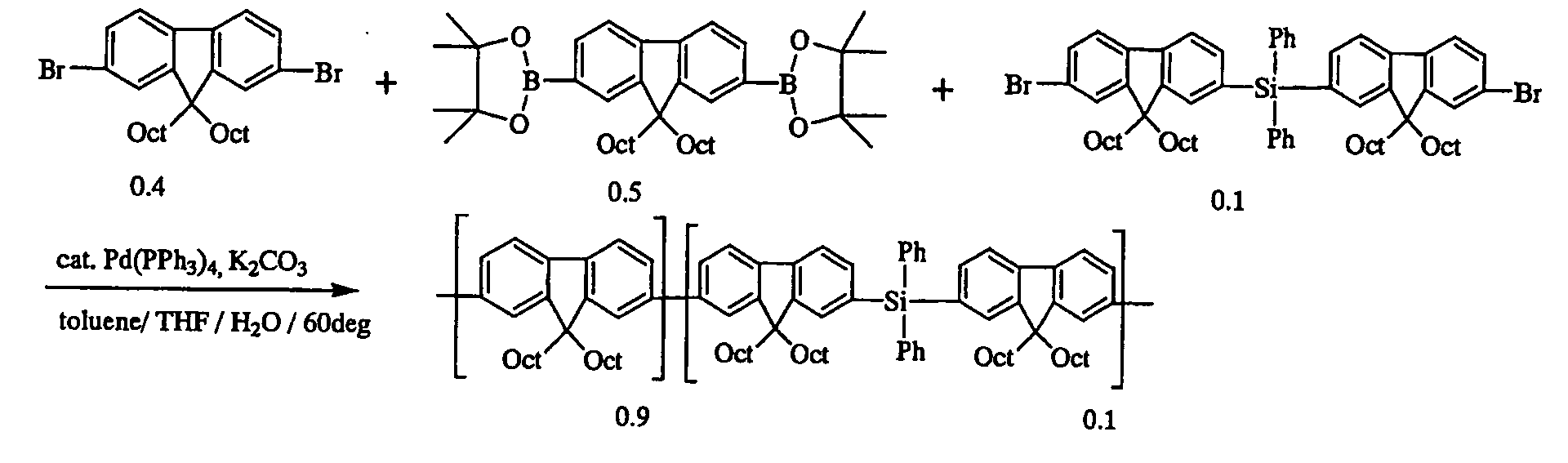
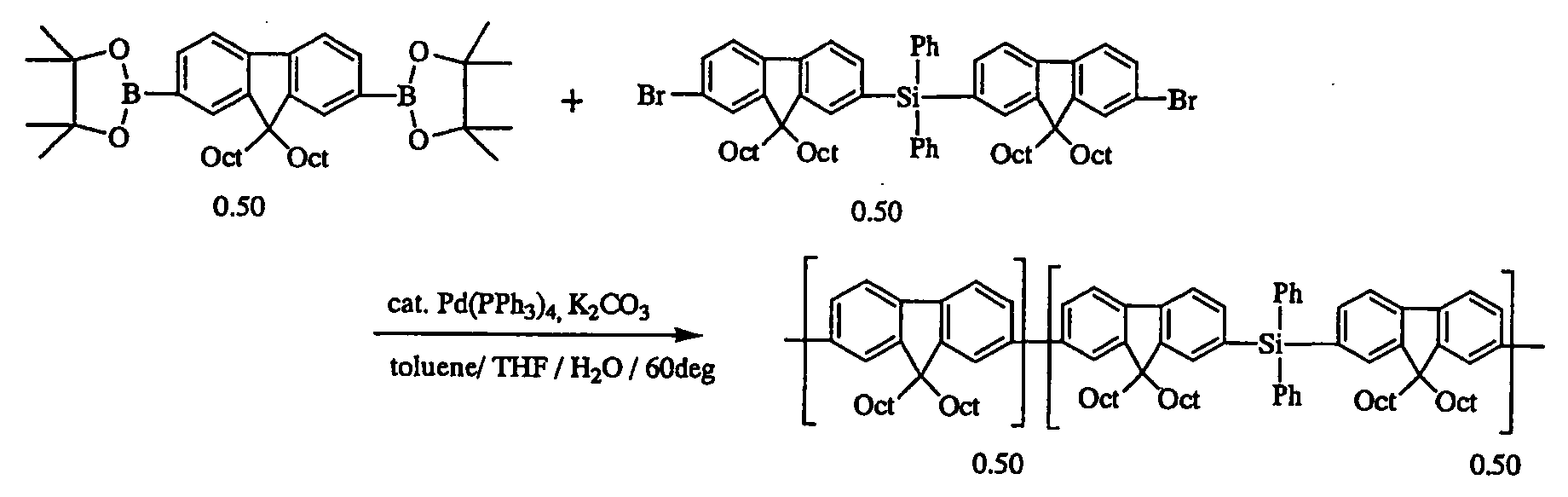
- an EL polymer with repeating units represented by formula (1) can be manufactured by reacting a fluorene compound in which a boron structure is introduced onto the 2 and 7 positions as represented by formula (15) where in formula (15), R 7 and R 8 are as defined in formula (2)),and if necessary a fluorene compound represented by formula (2), with the bisfluorenylsilane compound represented by formula (3), in the presence of a palladium catalyst (e. g., Pd(PPh 3 ) 4 ) and an alkali carbonate (e. g., potassium carbonate) in a solvent (e. g., toluene, THF, water or the like) at a temperature of 0 to 100°C.
- a palladium catalyst e. g., Pd(PPh 3 ) 4
- an alkali carbonate e. g., potassium carbonate
- the compound represented by formula (15) can be manufactured by reacting 2-isopropoxy-4,4,5,5-tetramethyl-1,3,2-dioxaborolane with the compound represented by formula (2) in the presence of an alkyllithium (e. g., n-butyllithium) in a solvent (e. g., hexane or THF) at a low temperature (e. g., -78°C) (see N. Miyaura and A. Suzuki, Chem. Rev., 1995, 95, 2457).
- an alkyllithium e. g., n-butyllithium
- a solvent e. g., hexane or THF
- a film of the EL polymer of the present invention can be utilized as an organic EL element by clamping this film as a light-emitting layer between a pair of electrodes.
- the basic layer construction of this organic EL element can be formed in the same manner as that of a universally known organic EL element.
- reaction solution thus obtained was extracted with hexane; afterward, the extract was dried and the hexane was distilled away. Then, the excess 1-bromooctane was distilled away under heating and reduced pressure. Next, the residue thus obtained was purified by column chromatography (carrier: silica gel, eluent: hexane), thus isolating 2,7-dibromo-9,9-dioctylfluorene as colorless crystals (amount yielded: 14.31 g (26.1 mmol), yield: 84.1%). Furthermore, the identification of the compound thus obtained was accomplished by MS, 1 H NMR and 13 C NMR.
- reaction solution was subjected to an extraction treatment.
- the extract thus obtained was dried and concentrated, and low-molecular components were removed from the concentrate by Kugelrohr vacuum distillation (200°C/0.1 mmHg).
- this polymer showed an Mw value (weight average molecular weight) of 34,686 and an Mn value (number average molecular weight) of 14,181. Furthermore, the concentration of inorganic metallic elements in this polymer was less than the detection limit (0.1%) of EDX (energy distribution type fluorescent X-ray measurement).
- the substance thus obtained was washed with 1 N hydrochloric acid, a 1 N aqueous solution of sodium hydroxide and distilled water in that order, so that the potassium carbonate was removed. Furthermore, dissolution in a small amount of warm THF and re-precipitation from methanol was performed twice, and the product was purified by performing a Soxhlet extraction (acetone) for approximately 48 hours, thus producing an EL polymer containing repeating units represented by formula (4) (bisfluorenyldiphenylsilane) at the rate of 25 mol% and fluorene units represented by formula (2) at the rate of 75 mol% (amount yielded: 958 mg).
- formula (4) bisfluorenyldiphenylsilane
- this polymer showed an Mw value (weight average molecular weight) of 13,667 and an Mn value (number average molecular weight) of 8,979. Furthermore, the concentration of inorganic metallic elements in this polymer was less than the detection limit (0.1%) of EDX (energy distribution type fluorescent X-ray measurement) .
- this polymer showed an Mw value (weight average molecular weight) of 13,214 and an Mn value (number average molecular weight) of 5,108. Furthermore, the concentration of inorganic metallic elements in this polymer was less than the detection limit (0.1%) of EDX (energy distribution type fluorescent X-ray measurement).
- this polymer showed an Mw value (weight average molecular weight) of 23,273 and an Mn value (number average molecular weight) of 9,767. Furthermore, the concentration of inorganic metallic elements in this polymer was less than the detection limit (0.1%) of EDX (energy distribution type fluorescent X-ray measurement).
- this polymer showed an Mw value (weight average molecular weight) of 27,671 and an Mn value (number average molecular weight) of 11,185. Furthermore, the concentration of inorganic metallic elements in this polymer was less than the detection limit (0.1%) of EDX (energy distribution type fluorescent X-ray measurement).
- this polymer showed an Mw value (weight average molecular weight) of 27,340 and an Mn value (number average molecular weight) of 9,530. Furthermore, the concentration of inorganic metallic elements in this polymer was less than the detection limit (0.1%) of EDX (energy distribution type fluorescent X-ray measurement).
- this polymer showed an Mw value (weight average molecular weight) of 20,290 and an Mn value (number average molecular weight) of 11,663. Furthermore, the concentration of inorganic metallic elements in this polymer was less than the detection limit (0.1%) of EDX (energy distribution type fluorescent X-ray measurement).
- a poly(9,9-dioctylfluorene) comprising only fluorene units represented by formula (2) was obtained by repeating the same operation as in Example 6, except for the fact that no bis(7-bromo-9,9-dioctylfluorenyl)diphenylsilane was used.
- This polymer showed a weight average molecular weight of 37,097.
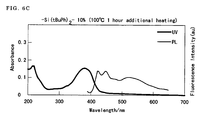
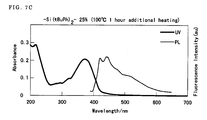
- the EL spectrum of an EL polymer shows more or less the same shape as the fluorescence spectrum of the polymer. Accordingly, the characteristics of the EL polymers were evaluated as described below by investigating the fluorescence spectrum showing a positive correlation with the EL spectrum, rather than directly evaluating the EL spectrum.
- a toluene solution (0.5 wt %) of the polymer was applied as a coating to the surface of a quartz glass by means of a spin coater whose rotational speed was controlled, so that the dry thickness of the coating film was 100 nm.
- the ultraviolet-visible absorption spectrum was measured, and the photoluminescence (fluorescence) spectrum in the case of excitation at the maximum absorption wavelength was measured.
- the EL polymer film was heated for 1 hour at 50°C, then for 1 hour at 100°C, under reduced pressure (0.1 mmHg (13.3 Pa)), and was then returned to room temperature, after which similar measurements were made. The measurement results are shown in Figs. 1 through 8.
- a glass substrate covered with ITO (indium-tin oxide) [thickness 200 nm, sheet resistance 10 ⁇ /sq or less, transmissivity 80% or greater] was subjected to an ultrasonic treatment using a commercially marketed cleaning agent.
- this substrate was rinsed with de-ionized water, and was then subjected to an ultrasonic treatment with acetone, followed by an ultrasonic treatment with IPA (isopropyl alcohol). Finally, this substrate was subjected to a degreasing treatment by boiling in IPA. Afterward, the substrate was exposed for several minutes using an excimer irradiation apparatus.
- This substrate was coated with a hole transporting polymer (Baytron P (TP AI 4083), manufactured by Bayer) filtered by a 0.45- ⁇ m PP filter using a spin coater whose rotational speed was controlled so that the dry film thickness was 70 nm.
- This coated substrate was then dried using a vacuum drier (100°C ⁇ 1 hour), so that a hole transporting polymer layer was formed.
- toluene solutions (0.5 wt %) of the respective EL polymers of Comparative Example 1, Example 6 and Example 7 were filtered by means of a 0.45- ⁇ m PTFE filter.
- each of these polymer solutions was applied as a coating to the surface of the previously formed hole transporting layer by means of a spin coater whose rotational speed was controlled so that the dry film thickness was 100 nm, and this coating was dried so that a light-emitting layer was formed.
- electroluminescence (EL) spectrum obtained showed a good correspondence with the corresponding photoluminescence (fluorescence) spectrum (Figs. 9 and 1A, Figs. 10 and 2A, and Figs. 11 and 3A).
- a novel ⁇ - ⁇ conjugated polymer in which the deterioration of the color purity of electroluminescence caused by excimer formation is greatly suppressed in spite of the fact that the polymer is a ⁇ - ⁇ conjugated type fluorene polymer is provided.
- this novel ⁇ - ⁇ conjugated polymer shows an extremely high color purity of blue emitted light.
- the electroluminescent polymer of the present invention is useful as a light-emitting material for organic electroluminescent elements, and the bisfluorenylsilane compound of the present invention is useful as manufacturing method raw material for electroluminescent polymers.
Landscapes
- Chemical & Material Sciences (AREA)
- Organic Chemistry (AREA)
- Engineering & Computer Science (AREA)
- Materials Engineering (AREA)
- Health & Medical Sciences (AREA)
- Chemical Kinetics & Catalysis (AREA)
- Medicinal Chemistry (AREA)
- Polymers & Plastics (AREA)
- Electroluminescent Light Sources (AREA)
- Polyoxymethylene Polymers And Polymers With Carbon-To-Carbon Bonds (AREA)
Abstract

Description




(R3R4) 4Si2Y2 (here, R3, R4 and Y are as described above) is reacted in a molar amount that is approximately half the total amount of the compounds represented by formula (9a) and formula (9b), thus producing a bisfluorenylsilane compound represented by formula (3)
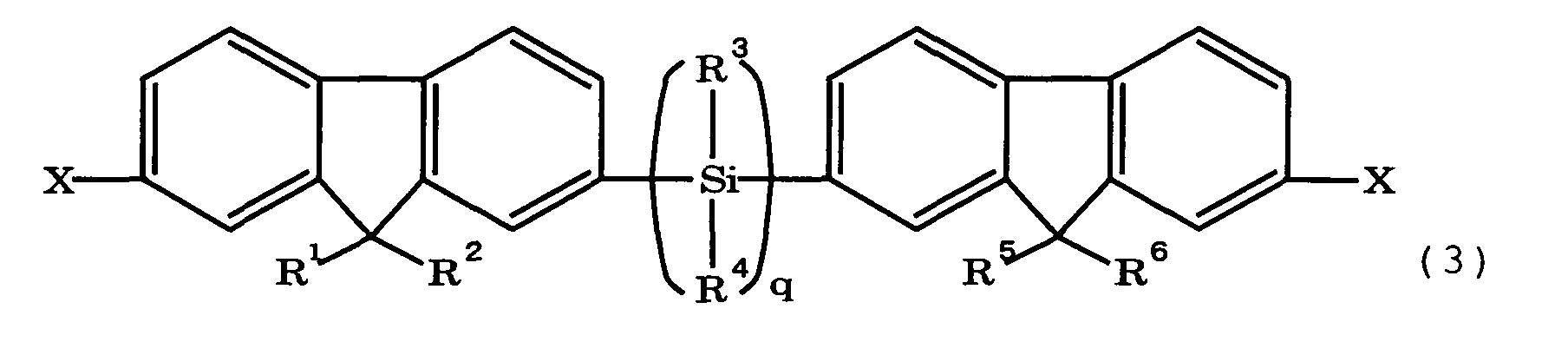
and this bisfluorenylsilane compound is used as an intermediate raw material. This intermediate raw material is a novel compound, and is extremely useful as a manufacturing raw material for the EL polymer of the present invention. Here, preferable examples of compounds represented by formula (3) include a compound in which R1, R2, R5 and R6 are n-octyl groups, R3 and R4 are phenyl groups, q is 1, and X is bromine atom (formula (10)); a compound in which R1, R2, R5 and R6 are n-octyl groups, R3 and R4 are methyl groups, q is 1, and X is bromine atom (formula (11)) ; a compound in which R1, R2, R5 and R6 are n-octyl groups, R3 and R4 are methyl groups, q is 2, and X is bromine atom (formula (12)) ; a compound in which R1, R2 R5 and R6 are n-octyl groups, R3 and R4 are mesityl groups, q is 1, and X is bromine atom (formula (13)); and a compound in which R1, R2, R5 and R6 are n-octyl groups, R3 and R4 are p-t-butylphenyl groups, q is 1, and X is bromine atom (formula (14)).




1H NMR (CDCl3, δ) :
7.67 - 7.14 (m, 22H), 1.90 (t, J = 7.5 Hz, 8H), 1.22 - 1.03 (m, 40H), 0.82 (t, J = 6.9 Hz, 12 H), 0.61 (brs, 8H).
13C NMR (CDCl3, δ) :
153.2, 149.3, 141.4, 139.7, 136.2, 135.1, 134.7, 132.9, 130.7, 129.9, 129.5, 127.8, 126.1, 121.4, 121.3, 119.3, 55.4, 40.2, 31.9, 30.1, 29.40, 29.37, 24.0, 22.7, 14.2.
29Si NMR (CDCl3, δ) : -13.3.
FAB-MS: 1116 (M+)
| Elemental analysis : | ||
| Theoretical values | C 75.1 %, | H 8.1 % (for C70H90Br2Si |
| Experimental values | C 75.5 % | H 8.1 % |

1H NMR (CDCl3, δ) :
7.67 - 7.14 (m, 12H), 1.93 (brs, 8H), 1.23 - 1.05 (m, 40H), 0.823 (t, J = 6.9 Hz, 12H), 0.62 (brs, 14H).
13C NMR (CDCl3, δ) :
153.0, 149.3, 140.8, 139.9, 137.3, 132.9, 129.8, 128.3, 126.1, 121.12, 121.07, 119.0, 55,4, 40.1, 31.9, 30.0, 29.28, 29.25, 23.8, 22.7, 14.2, -1.68.
29Si NMR (CDCl3, δ) : -7.08.
FAB-MS: 992 (M+)
| Elemental analysis : | ||
| Theoretical values | C 72.4 % | H 8.7 % (for C60H86Br2Si) |
| Experimental values | C 73.3 % | H 8.9 % |

1H NMR (CDCl3, δ) :
7.68 - 7.31 (m, 12H), 1.93 (t, J = 7.5 Hz, 8H), 1.27 - 0.93 (m, 0H), 0.826 (t, J = 6.9 Hz, 12H), 0.64 (brs, 8H), 0.37 (s, 12H).
13C NMR (CDCl3, δ) :
152.8, 149.3, 140.3, 140.0, 138.1, 132.2, 129.8, 127.9, 126.1, 121.1, 121.0, 119.0, 55.3, 40.3, 31.9, 30.1, 29.4, 29.3, 23.8, 22.7, 14.2, -3.8.
29Si NMR (CDCl3, δ) : -21.3.
FAB-MS: 1050 (M+)
| Elemental analysis : | ||
| Theoretical values | C 70.7 % | H 8.8 % (for C62H92Br2Si2) |
| Experimental values | C 71.3 % | H 8.9 % |

1H NMR (CDCl3, δ) :
7.65 - 7.34 (m, 20H), 1.90 (brs, 8H), 1.32 (s, 18H), 1.28 - 0.83 (m, 40H), 0.83 (t, J = 6.9 Hz, 12H), 0.62 (brs, 8H). 13C NMR (CDCl3, δ):
153.7, 152.3, 149.1, 141.2, 139.9, 136.0, 135.2, 133.5, 131.3, 130.7, 128.1, 126.1, 124.7, 121.3, 121.2, 119.2, 55.4, 40.3, 34.7, 31.9, 31.3, 30.2, 29.50, 29.46, 24.0, 22.8, 14.2.
29Si NMR (CDCl3, δ) : -13.9.
FAB-MS: 1228 (M+)
| Elemental analysis : | ||
| Theoretical values | C 76.1 % | H 8.6 % (for C18H106Br2Si) |
| Experimental values | C 76.4 % | H 8.6 % |
1H NMR (CDCl3, δ) :
7.70 - 7.40 (m, 12H), 6.83 (s, 4H), 2.34 (s, 12H), 2.26 (s, 6H), 1.91 (brs, 8H), 1.25 - 0.90 (m, 40H), 0.82 (t, J = 6.9 Hz, 12H), 0.60 (brs, 8H).
13C NMR (CDCl3, δ) :
153.0, 149.3, 146.0, 144.3, 140.9, 139.8, 136.5, 134.5, 130.3, 129.8, 129.4, 192.1, 126.1, 121.3, 121.1, 119.2, 55.5, 40.3, 31.9, 30.1, 29.4, 29.3, 26.1, 24.0, 22.8, 21.2, 14.2.
29Si NMR (CDCl3, δ) : -16.7.
FAB-MS: 1081 (M+ -Mes)
| Elemental analysis : | ||
| Theoretical values | C 75.9 %, | H 8.5 % (for C76H102Br2Si) |
| Experimental values | C 75.3 %, | H 8.7 % |



Claims (22)
- An electroluminescent polymer with repeating units represented by formula (1)where R1, R2, R5 and R6 each independently indicate a hydrogen atom or substituent group, R3 and R4 each independently indicate an aryl group or alkyl group, and q is 1 or 2.
- The electroluminescent polymer according to claim 1, wherein the substituent group that can be independently indicated by R1, R2, R5 and R6 in formula (1) is an alkyl group, alkenyl group, alkynyl group, aralkyl group, aryl group, heteroaryl group, alkoxy group, aryloxy group or aliphatic heterocyclic group.
- The electroluminescent polymer according to claim 1, wherein R1, R2, R5 and R6 in formula (1) each independently indicate an alkyl group or aryl group, R3 and R4 indicate an aryl group, and q is 1.
- The electroluminescent polymer according to claim 1, wherein R1, R2, R5 and R6 in formula (1) each independently indicate an alkyl group or aryl group, R3 and R4 indicate phenyl group, and q is 1.
- The electroluminescent polymer according to claim 1, wherein R1, R2, R5 and R6 in formula (1) indicate n-octyl group, R3 and R4 indicate phenyl group, and q is 1.
- The electroluminescent polymer according to claim 1, wherein R1, R2, R5 and R6 in formula (1) each independently indicate an alkyl group or aryl group, and R3 and R4 indicate an alkyl group.
- The electroluminescent polymer according to claim 1, wherein R1, R2, R5 and R6 in formula (1) each independently indicate an alkyl group or aryl group, and R3 and R4 indicate methyl group.
- The electroluminescent polymer according to claim 1, wherein R1, R2, R5 and R6 in formula (1) indicate n-octyl group, and R3 and R4 indicate methyl group.
- The electroluminescent polymer according to any of claims 1 through 8, containing repeating units represented by formula (1) at the rate of 0.1 mol% or greater.
- The electroluminescent polymer according to claim 1, further containing repeating units represented by formula (2)where R7 and R8 each independently indicate a hydrogen atom or a substituent group at the rate of 10 to 99.9 mol%.
- The electroluminescent polymer according to claim 10, wherein R7 and R8 in formula (2) each independently indicate an alkyl group, alkenyl group, alkynyl group, aralkyl group, aryl group, heteroaryl group, alkoxy group, aryloxy group or aliphatic heterocyclic group.
- The electroluminescent polymer according to claim 10, wherein R7 and R8 in formula (2) each independently indicate an alkyl group or aryl group.
- The electroluminescent polymer according to claim 10, wherein R7 and R8 in formula (2) indicate n-octyl groups.
- A bisfluorenylsilane compound represented by formula (3)where R1, R2, R5 and R6 each independently indicate a hydrogen atom or substituent group, R3 and R4 each independently indicate an aryl group or alkyl group, q is 1 or 2, and X is a halogen atom.
- The bisfluorenylsilane compound according to claim 14, wherein R1, R2, R5 and R6 in formula (3) each independently indicate an alkyl group, alkenyl group, alkynyl group, aralkyl group, aryl group, heteroaryl group, alkoxy group, aryloxy group or aliphatic heterocyclic group.
- The bisfluorenylsilane compound according to claim 14, wherein R1, R2, R5 and R6 in formula (3) each independently indicate an alkyl group or aryl group, R3 and R4 indicate an aryl group, and q is 1.
- The bisfluorenylsilane compound according to claim 14, wherein R1, R2, R5 and R6 in formula (3) each independently indicate alkyl groups or aryl groups, R3 and R4 indicate phenyl group, and q is 1.
- The bisfluorenylsilane compound according to claim 14, wherein R1, R2, R5 and R6 in formula (3) indicate n-octyl groups, R3 and R4 indicate phenyl groups, q is 1, and X is bromine atom.
- The bisfluorenylsilane compound according to claim 14, wherein R1, R2, R5 and R6 in formula (3) each independently indicate an alkyl group or aryl group, and R3 and R4 indicate an alkyl group.
- The bisfluorenylsilane compound according to claim 14, wherein R1, R2, R5 and R6 in formula (3) each independently indicate an alkyl group or aryl group, and R3 and R4 indicate methyl group.
- The bisfluorenylsilane compound according to claim 14, wherein R1, R2, R5 and R6 in formula (3) indicate an n-octyl group, R3 and R4 indicate methyl group, and X is bromine atom.
- An organic electroluminescent element comprising a light-emitting layer made from the electroluminescent polymer according to any of claims 1 through 13 supported by a pair of electrodes sandwiching the same.
Applications Claiming Priority (5)
| Application Number | Priority Date | Filing Date | Title |
|---|---|---|---|
| JP2002301145 | 2002-10-15 | ||
| JP2002301145 | 2002-10-15 | ||
| JP2003350152A JP3876872B2 (en) | 2002-10-15 | 2003-10-08 | Electroluminescent polymer, bisfluorenylsilane compound and organic EL device |
| JP2003350152 | 2003-10-08 | ||
| PCT/JP2003/013136 WO2004035652A1 (en) | 2002-10-15 | 2003-10-14 | Electroluminescent polymers, bisfluorenylsilanes, and organic electroluminescent devices |
Publications (2)
| Publication Number | Publication Date |
|---|---|
| EP1553119A1 true EP1553119A1 (en) | 2005-07-13 |
| EP1553119A4 EP1553119A4 (en) | 2011-05-25 |
Family
ID=32109458
Family Applications (1)
| Application Number | Title | Priority Date | Filing Date |
|---|---|---|---|
| EP03751486A Withdrawn EP1553119A4 (en) | 2002-10-15 | 2003-10-14 | Electroluminescent polymers, bisfluorenylsilanes, and organic electroluminescent devices |
Country Status (7)
| Country | Link |
|---|---|
| US (1) | US7135242B2 (en) |
| EP (1) | EP1553119A4 (en) |
| JP (1) | JP3876872B2 (en) |
| KR (1) | KR100847709B1 (en) |
| AU (1) | AU2003271189A1 (en) |
| TW (1) | TWI255275B (en) |
| WO (1) | WO2004035652A1 (en) |
Cited By (2)
| Publication number | Priority date | Publication date | Assignee | Title |
|---|---|---|---|---|
| WO2005111113A1 (en) * | 2004-05-11 | 2005-11-24 | Merck Patent Gmbh | Electroluminescent polymers |
| EP2384346A4 (en) * | 2009-01-30 | 2012-10-03 | Hewlett Packard Development Co | Uv light-emissive fluorene-based copolymers |
Families Citing this family (7)
| Publication number | Priority date | Publication date | Assignee | Title |
|---|---|---|---|---|
| US7906224B2 (en) * | 2003-08-21 | 2011-03-15 | Konica Minolta Holdings, Inc. | Organic electroluminescent device, display, and illuminating device |
| TWI426092B (en) * | 2005-06-22 | 2014-02-11 | Sumitomo Chemical Co | Polymer material and polymer light emitting device |
| KR101337519B1 (en) * | 2006-08-24 | 2013-12-05 | 삼성디스플레이 주식회사 | Fluorene-based compound and organo-electroluminescent device using the same |
| ES2365444T3 (en) * | 2007-04-04 | 2011-10-05 | F. Hoffmann-La Roche Ag | HETEROCICLES AS AN OREXINE ANTAGONISTS. |
| KR101704090B1 (en) | 2009-09-30 | 2017-02-07 | 스미또모 가가꾸 가부시키가이샤 | Laminated structure, polymer, electroluminescent element, and photoelectric conversion element |
| GB2484253B (en) * | 2010-05-14 | 2013-09-11 | Cambridge Display Tech Ltd | Organic light-emitting composition and device |
| JP6641845B2 (en) * | 2015-09-30 | 2020-02-05 | 日立化成株式会社 | Charge transporting material, ink composition using the material, organic electronic device, organic electroluminescent device, display device, lighting device, and display device |
Family Cites Families (4)
| Publication number | Priority date | Publication date | Assignee | Title |
|---|---|---|---|---|
| JP3415344B2 (en) | 1995-09-14 | 2003-06-09 | 株式会社東芝 | EL device |
| DE19846766A1 (en) * | 1998-10-10 | 2000-04-20 | Aventis Res & Tech Gmbh & Co | A conjugated fluorene-based polymer useful as an organic semiconductor, electroluminescence material, and for display elements |
| JP4512217B2 (en) | 1999-08-20 | 2010-07-28 | 富士フイルム株式会社 | Arylsilane compound, light emitting device material, and light emitting device using the same |
| JP2001335639A (en) | 2000-05-30 | 2001-12-04 | Sumitomo Electric Ind Ltd | Visible light conductive silicon-based polymer and method for producing the same |
-
2003
- 2003-10-08 JP JP2003350152A patent/JP3876872B2/en not_active Expired - Lifetime
- 2003-10-14 EP EP03751486A patent/EP1553119A4/en not_active Withdrawn
- 2003-10-14 WO PCT/JP2003/013136 patent/WO2004035652A1/en not_active Ceased
- 2003-10-14 KR KR1020047009959A patent/KR100847709B1/en not_active Expired - Lifetime
- 2003-10-14 AU AU2003271189A patent/AU2003271189A1/en not_active Abandoned
- 2003-10-14 US US10/496,875 patent/US7135242B2/en not_active Expired - Lifetime
- 2003-10-15 TW TW092128531A patent/TWI255275B/en not_active IP Right Cessation
Non-Patent Citations (2)
| Title |
|---|
| DATABASE WPI Week 200158 Thomson Scientific, London, GB; AN 2001-524816 XP002633070, -& JP 2001 055447 A (FUJI FILM CORP) 27 February 2001 (2001-02-27) -& US 6 558 819 B1 (IGARASHI TATSUYA [JP]) 6 May 2003 (2003-05-06) * |
| See also references of WO2004035652A1 * |
Cited By (3)
| Publication number | Priority date | Publication date | Assignee | Title |
|---|---|---|---|---|
| WO2005111113A1 (en) * | 2004-05-11 | 2005-11-24 | Merck Patent Gmbh | Electroluminescent polymers |
| EP2384346A4 (en) * | 2009-01-30 | 2012-10-03 | Hewlett Packard Development Co | Uv light-emissive fluorene-based copolymers |
| US8785004B2 (en) | 2009-01-30 | 2014-07-22 | Hewlett-Packard Development Company, L.P. | UV light-emissive fluorene-based copolymers |
Also Published As
| Publication number | Publication date |
|---|---|
| EP1553119A4 (en) | 2011-05-25 |
| JP2004156027A (en) | 2004-06-03 |
| KR20050036903A (en) | 2005-04-20 |
| HK1082516A1 (en) | 2006-06-09 |
| US20050079382A1 (en) | 2005-04-14 |
| TW200420600A (en) | 2004-10-16 |
| US7135242B2 (en) | 2006-11-14 |
| JP3876872B2 (en) | 2007-02-07 |
| AU2003271189A1 (en) | 2004-05-04 |
| KR100847709B1 (en) | 2008-07-23 |
| WO2004035652A1 (en) | 2004-04-29 |
| HK1092155A1 (en) | 2007-02-02 |
| TWI255275B (en) | 2006-05-21 |
Similar Documents
| Publication | Publication Date | Title |
|---|---|---|
| TWI724003B (en) | Metal complex and organic light-emitting device | |
| CN1863838B (en) | Polymer light emitting material and polymer light emitting device | |
| KR101106874B1 (en) | Electroluminescent iridium compounds having red-orange or red emission and devices made with such compounds | |
| TW200404882A (en) | Polymer compound and polymer light-emitting device using the same | |
| WO2003099901A1 (en) | Polymer and polymeric luminescent element comprising the same | |
| KR20000029916A (en) | Poly(arylamines) and films thereof | |
| JP2003226744A (en) | Polymer compound and polymer light emitting device using the same | |
| TW541855B (en) | Polymeric fluorescent substance and polymer light-emitting device using the same | |
| KR100613810B1 (en) | Compound for electroluminescent device and organic electroluminescent device comprising same | |
| WO2003000821A1 (en) | Processes for producing polymeric fluorescent material and polymeric luminescent element | |
| KR101151967B1 (en) | Dibenzosilol polymers their preparation and uses | |
| US7135242B2 (en) | Electroluminescent polymer, bisfluorenylsilane compound and organic electroluminescent element | |
| JP2007154184A (en) | Conductive polymer composition and electronic device provided with film obtained therefrom | |
| JP2003321546A (en) | Phosphorescent polymer compound, light emitting material and organic EL device using the same | |
| TW201245196A (en) | Curable composition, cured product and organic electroluminescent element using the same | |
| WO2004003053A1 (en) | Polymer and polymeric luminescent element comprising the same | |
| KR20070026599A (en) | Linear Polysiloxanes, Silicone Compositions, and Organic Light Emitting Diodes | |
| JP4882261B2 (en) | Polymer complex compound and polymer light emitting device using the same | |
| CN100360578C (en) | Electroluminescent polymer, bisfluorenylsilane, and organic electroluminescent element | |
| Jin et al. | Synthesis and properties of various PPV derivatives with phenyl substituents | |
| JP5196747B2 (en) | Polymer for luminescence | |
| KR20050044420A (en) | Process for preparing aromatic polymers | |
| JP2007224282A (en) | Polymer compound and polymer light emitting device using the same | |
| HK1082516B (en) | Electroluminescent polymers, bisfluorenylsilanes and organic electroluminescent devices | |
| HK1092155B (en) | A bisfluorenylsilane compound |
Legal Events
| Date | Code | Title | Description |
|---|---|---|---|
| PUAI | Public reference made under article 153(3) epc to a published international application that has entered the european phase |
Free format text: ORIGINAL CODE: 0009012 |
|
| 17P | Request for examination filed |
Effective date: 20050513 |
|
| AK | Designated contracting states |
Kind code of ref document: A1 Designated state(s): AT BE BG CH CY CZ DE DK EE ES FI FR GB GR HU IE IT LI LU MC NL PT RO SE SI SK TR |
|
| AX | Request for extension of the european patent |
Extension state: AL LT LV MK |
|
| DAX | Request for extension of the european patent (deleted) | ||
| RBV | Designated contracting states (corrected) |
Designated state(s): DE FR GB NL |
|
| RAP1 | Party data changed (applicant data changed or rights of an application transferred) |
Owner name: SONY CHEMICAL & INFORMATION DEVICE CORPORATION |
|
| A4 | Supplementary search report drawn up and despatched |
Effective date: 20110428 |
|
| 17Q | First examination report despatched |
Effective date: 20120404 |
|
| STAA | Information on the status of an ep patent application or granted ep patent |
Free format text: STATUS: THE APPLICATION IS DEEMED TO BE WITHDRAWN |
|
| 18D | Application deemed to be withdrawn |
Effective date: 20121016 |