EP1551602B1 - Razor having a microfluidic shaving aid delivery system and method of ejecting shaving aid - Google Patents
Razor having a microfluidic shaving aid delivery system and method of ejecting shaving aid Download PDFInfo
- Publication number
- EP1551602B1 EP1551602B1 EP03770248A EP03770248A EP1551602B1 EP 1551602 B1 EP1551602 B1 EP 1551602B1 EP 03770248 A EP03770248 A EP 03770248A EP 03770248 A EP03770248 A EP 03770248A EP 1551602 B1 EP1551602 B1 EP 1551602B1
- Authority
- EP
- European Patent Office
- Prior art keywords
- shaving aid
- razor
- razor assembly
- shaving
- substrate
- Prior art date
- Legal status (The legal status is an assumption and is not a legal conclusion. Google has not performed a legal analysis and makes no representation as to the accuracy of the status listed.)
- Expired - Lifetime
Links
- 238000000034 method Methods 0.000 title description 23
- 239000012530 fluid Substances 0.000 claims abstract description 32
- 239000000758 substrate Substances 0.000 claims description 72
- 239000000463 material Substances 0.000 claims description 50
- 230000003204 osmotic effect Effects 0.000 claims description 29
- XLYOFNOQVPJJNP-UHFFFAOYSA-N water Substances O XLYOFNOQVPJJNP-UHFFFAOYSA-N 0.000 claims description 17
- 239000012528 membrane Substances 0.000 claims description 15
- -1 jojoba oil Natural products 0.000 claims description 12
- 239000003795 chemical substances by application Substances 0.000 claims description 8
- 229920002301 cellulose acetate Polymers 0.000 claims description 6
- 229920003171 Poly (ethylene oxide) Polymers 0.000 claims description 5
- 230000004888 barrier function Effects 0.000 claims description 5
- 235000002639 sodium chloride Nutrition 0.000 claims description 5
- GVJHHUAWPYXKBD-UHFFFAOYSA-N (±)-α-Tocopherol Chemical compound OC1=C(C)C(C)=C2OC(CCCC(C)CCCC(C)CCCC(C)C)(C)CCC2=C1C GVJHHUAWPYXKBD-UHFFFAOYSA-N 0.000 claims description 4
- PEDCQBHIVMGVHV-UHFFFAOYSA-N Glycerine Chemical compound OCC(O)CO PEDCQBHIVMGVHV-UHFFFAOYSA-N 0.000 claims description 4
- CSNNHWWHGAXBCP-UHFFFAOYSA-L Magnesium sulfate Chemical compound [Mg+2].[O-][S+2]([O-])([O-])[O-] CSNNHWWHGAXBCP-UHFFFAOYSA-L 0.000 claims description 4
- WCUXLLCKKVVCTQ-UHFFFAOYSA-M Potassium chloride Chemical compound [Cl-].[K+] WCUXLLCKKVVCTQ-UHFFFAOYSA-M 0.000 claims description 4
- FAPWRFPIFSIZLT-UHFFFAOYSA-M Sodium chloride Chemical compound [Na+].[Cl-] FAPWRFPIFSIZLT-UHFFFAOYSA-M 0.000 claims description 4
- POJWUDADGALRAB-UHFFFAOYSA-N allantoin Chemical compound NC(=O)NC1NC(=O)NC1=O POJWUDADGALRAB-UHFFFAOYSA-N 0.000 claims description 4
- 239000004205 dimethyl polysiloxane Substances 0.000 claims description 4
- 235000013870 dimethyl polysiloxane Nutrition 0.000 claims description 4
- BXWNKGSJHAJOGX-UHFFFAOYSA-N hexadecan-1-ol Chemical compound CCCCCCCCCCCCCCCCO BXWNKGSJHAJOGX-UHFFFAOYSA-N 0.000 claims description 4
- KWGKDLIKAYFUFQ-UHFFFAOYSA-M lithium chloride Chemical compound [Li+].[Cl-] KWGKDLIKAYFUFQ-UHFFFAOYSA-M 0.000 claims description 4
- GLDOVTGHNKAZLK-UHFFFAOYSA-N octadecan-1-ol Chemical compound CCCCCCCCCCCCCCCCCCO GLDOVTGHNKAZLK-UHFFFAOYSA-N 0.000 claims description 4
- 229920000435 poly(dimethylsiloxane) Polymers 0.000 claims description 4
- DAEPDZWVDSPTHF-UHFFFAOYSA-M sodium pyruvate Chemical compound [Na+].CC(=O)C([O-])=O DAEPDZWVDSPTHF-UHFFFAOYSA-M 0.000 claims description 4
- 235000011399 aloe vera Nutrition 0.000 claims description 3
- POJWUDADGALRAB-PVQJCKRUSA-N Allantoin Natural products NC(=O)N[C@@H]1NC(=O)NC1=O POJWUDADGALRAB-PVQJCKRUSA-N 0.000 claims description 2
- 244000144927 Aloe barbadensis Species 0.000 claims description 2
- 235000002961 Aloe barbadensis Nutrition 0.000 claims description 2
- GUBGYTABKSRVRQ-XLOQQCSPSA-N Alpha-Lactose Chemical compound O[C@@H]1[C@@H](O)[C@@H](O)[C@@H](CO)O[C@H]1O[C@@H]1[C@@H](CO)O[C@H](O)[C@H](O)[C@H]1O GUBGYTABKSRVRQ-XLOQQCSPSA-N 0.000 claims description 2
- UXVMQQNJUSDDNG-UHFFFAOYSA-L Calcium chloride Chemical compound [Cl-].[Cl-].[Ca+2] UXVMQQNJUSDDNG-UHFFFAOYSA-L 0.000 claims description 2
- 239000001856 Ethyl cellulose Substances 0.000 claims description 2
- ZZSNKZQZMQGXPY-UHFFFAOYSA-N Ethyl cellulose Chemical compound CCOCC1OC(OC)C(OCC)C(OCC)C1OC1C(O)C(O)C(OC)C(CO)O1 ZZSNKZQZMQGXPY-UHFFFAOYSA-N 0.000 claims description 2
- 229930091371 Fructose Natural products 0.000 claims description 2
- RFSUNEUAIZKAJO-ARQDHWQXSA-N Fructose Chemical compound OC[C@H]1O[C@](O)(CO)[C@@H](O)[C@@H]1O RFSUNEUAIZKAJO-ARQDHWQXSA-N 0.000 claims description 2
- 239000005715 Fructose Substances 0.000 claims description 2
- WQZGKKKJIJFFOK-GASJEMHNSA-N Glucose Natural products OC[C@H]1OC(O)[C@H](O)[C@@H](O)[C@@H]1O WQZGKKKJIJFFOK-GASJEMHNSA-N 0.000 claims description 2
- 229920002907 Guar gum Polymers 0.000 claims description 2
- GUBGYTABKSRVRQ-QKKXKWKRSA-N Lactose Natural products OC[C@H]1O[C@@H](O[C@H]2[C@H](O)[C@@H](O)C(O)O[C@@H]2CO)[C@H](O)[C@@H](O)[C@H]1O GUBGYTABKSRVRQ-QKKXKWKRSA-N 0.000 claims description 2
- 239000000020 Nitrocellulose Substances 0.000 claims description 2
- 239000004952 Polyamide Substances 0.000 claims description 2
- PMZURENOXWZQFD-UHFFFAOYSA-L Sodium Sulfate Chemical compound [Na+].[Na+].[O-]S([O-])(=O)=O PMZURENOXWZQFD-UHFFFAOYSA-L 0.000 claims description 2
- VMHLLURERBWHNL-UHFFFAOYSA-M Sodium acetate Chemical compound [Na+].CC([O-])=O VMHLLURERBWHNL-UHFFFAOYSA-M 0.000 claims description 2
- DBMJMQXJHONAFJ-UHFFFAOYSA-M Sodium laurylsulphate Chemical compound [Na+].CCCCCCCCCCCCOS([O-])(=O)=O DBMJMQXJHONAFJ-UHFFFAOYSA-M 0.000 claims description 2
- 239000004141 Sodium laurylsulphate Substances 0.000 claims description 2
- 235000019486 Sunflower oil Nutrition 0.000 claims description 2
- 229930003427 Vitamin E Natural products 0.000 claims description 2
- FJWGYAHXMCUOOM-QHOUIDNNSA-N [(2s,3r,4s,5r,6r)-2-[(2r,3r,4s,5r,6s)-4,5-dinitrooxy-2-(nitrooxymethyl)-6-[(2r,3r,4s,5r,6s)-4,5,6-trinitrooxy-2-(nitrooxymethyl)oxan-3-yl]oxyoxan-3-yl]oxy-3,5-dinitrooxy-6-(nitrooxymethyl)oxan-4-yl] nitrate Chemical compound O([C@@H]1O[C@@H]([C@H]([C@H](O[N+]([O-])=O)[C@H]1O[N+]([O-])=O)O[C@H]1[C@@H]([C@@H](O[N+]([O-])=O)[C@H](O[N+]([O-])=O)[C@@H](CO[N+]([O-])=O)O1)O[N+]([O-])=O)CO[N+](=O)[O-])[C@@H]1[C@@H](CO[N+]([O-])=O)O[C@@H](O[N+]([O-])=O)[C@H](O[N+]([O-])=O)[C@H]1O[N+]([O-])=O FJWGYAHXMCUOOM-QHOUIDNNSA-N 0.000 claims description 2
- 229960000458 allantoin Drugs 0.000 claims description 2
- 230000002421 anti-septic effect Effects 0.000 claims description 2
- WQZGKKKJIJFFOK-VFUOTHLCSA-N beta-D-glucose Chemical compound OC[C@H]1O[C@@H](O)[C@H](O)[C@@H](O)[C@@H]1O WQZGKKKJIJFFOK-VFUOTHLCSA-N 0.000 claims description 2
- 229920001400 block copolymer Polymers 0.000 claims description 2
- 239000001110 calcium chloride Substances 0.000 claims description 2
- 229910001628 calcium chloride Inorganic materials 0.000 claims description 2
- 235000011148 calcium chloride Nutrition 0.000 claims description 2
- 229920006217 cellulose acetate butyrate Polymers 0.000 claims description 2
- 229960000541 cetyl alcohol Drugs 0.000 claims description 2
- 239000000701 coagulant Substances 0.000 claims description 2
- 238000004891 communication Methods 0.000 claims description 2
- 230000002951 depilatory effect Effects 0.000 claims description 2
- 239000008121 dextrose Substances 0.000 claims description 2
- 229940008099 dimethicone Drugs 0.000 claims description 2
- 235000019325 ethyl cellulose Nutrition 0.000 claims description 2
- 229920001249 ethyl cellulose Polymers 0.000 claims description 2
- WIGCFUFOHFEKBI-UHFFFAOYSA-N gamma-tocopherol Natural products CC(C)CCCC(C)CCCC(C)CCCC1CCC2C(C)C(O)C(C)C(C)C2O1 WIGCFUFOHFEKBI-UHFFFAOYSA-N 0.000 claims description 2
- 235000011187 glycerol Nutrition 0.000 claims description 2
- 239000000665 guar gum Substances 0.000 claims description 2
- 229960002154 guar gum Drugs 0.000 claims description 2
- 235000010417 guar gum Nutrition 0.000 claims description 2
- 229940119170 jojoba wax Drugs 0.000 claims description 2
- 239000008101 lactose Substances 0.000 claims description 2
- 229910052943 magnesium sulfate Inorganic materials 0.000 claims description 2
- 235000019341 magnesium sulphate Nutrition 0.000 claims description 2
- GOQYKNQRPGWPLP-UHFFFAOYSA-N n-heptadecyl alcohol Natural products CCCCCCCCCCCCCCCCCO GOQYKNQRPGWPLP-UHFFFAOYSA-N 0.000 claims description 2
- 229920001220 nitrocellulos Polymers 0.000 claims description 2
- 229920002401 polyacrylamide Polymers 0.000 claims description 2
- 229920002647 polyamide Polymers 0.000 claims description 2
- 229920001296 polysiloxane Polymers 0.000 claims description 2
- 239000001103 potassium chloride Substances 0.000 claims description 2
- 235000011164 potassium chloride Nutrition 0.000 claims description 2
- 239000008159 sesame oil Substances 0.000 claims description 2
- 235000011803 sesame oil Nutrition 0.000 claims description 2
- 229920002545 silicone oil Polymers 0.000 claims description 2
- 239000001632 sodium acetate Substances 0.000 claims description 2
- 235000017281 sodium acetate Nutrition 0.000 claims description 2
- 239000011780 sodium chloride Substances 0.000 claims description 2
- 235000019333 sodium laurylsulphate Nutrition 0.000 claims description 2
- 229940054269 sodium pyruvate Drugs 0.000 claims description 2
- 229910052938 sodium sulfate Inorganic materials 0.000 claims description 2
- 235000011152 sodium sulphate Nutrition 0.000 claims description 2
- 239000002600 sunflower oil Substances 0.000 claims description 2
- 229940046009 vitamin E Drugs 0.000 claims description 2
- 235000019165 vitamin E Nutrition 0.000 claims description 2
- 239000011709 vitamin E Substances 0.000 claims description 2
- MTZQAGJQAFMTAQ-UHFFFAOYSA-N benzoic acid ethyl ester Natural products CCOC(=O)C1=CC=CC=C1 MTZQAGJQAFMTAQ-UHFFFAOYSA-N 0.000 claims 1
- 229960005150 glycerol Drugs 0.000 claims 1
- 229940012831 stearyl alcohol Drugs 0.000 claims 1
- VYPSYNLAJGMNEJ-UHFFFAOYSA-N Silicium dioxide Chemical compound O=[Si]=O VYPSYNLAJGMNEJ-UHFFFAOYSA-N 0.000 description 12
- 230000001050 lubricating effect Effects 0.000 description 11
- 230000008569 process Effects 0.000 description 6
- 239000000853 adhesive Substances 0.000 description 5
- 230000001070 adhesive effect Effects 0.000 description 5
- 239000000314 lubricant Substances 0.000 description 5
- 230000035699 permeability Effects 0.000 description 5
- 239000012858 resilient material Substances 0.000 description 5
- 239000003974 emollient agent Substances 0.000 description 4
- 230000004044 response Effects 0.000 description 4
- 239000000377 silicon dioxide Substances 0.000 description 4
- 239000011248 coating agent Substances 0.000 description 3
- 238000000576 coating method Methods 0.000 description 3
- 239000011521 glass Substances 0.000 description 3
- 238000004519 manufacturing process Methods 0.000 description 3
- 229910052751 metal Inorganic materials 0.000 description 3
- 239000002184 metal Substances 0.000 description 3
- 229920003023 plastic Polymers 0.000 description 3
- 239000004033 plastic Substances 0.000 description 3
- 239000004014 plasticizer Substances 0.000 description 3
- 229920003229 poly(methyl methacrylate) Polymers 0.000 description 3
- 229920000642 polymer Polymers 0.000 description 3
- 229920001343 polytetrafluoroethylene Polymers 0.000 description 3
- 239000004810 polytetrafluoroethylene Substances 0.000 description 3
- 239000010453 quartz Substances 0.000 description 3
- 150000003839 salts Chemical class 0.000 description 3
- 239000007787 solid Substances 0.000 description 3
- 230000003068 static effect Effects 0.000 description 3
- 239000000126 substance Substances 0.000 description 3
- 238000012546 transfer Methods 0.000 description 3
- 238000003466 welding Methods 0.000 description 3
- VYZAMTAEIAYCRO-UHFFFAOYSA-N Chromium Chemical compound [Cr] VYZAMTAEIAYCRO-UHFFFAOYSA-N 0.000 description 2
- 201000004624 Dermatitis Diseases 0.000 description 2
- 239000004909 Moisturizer Substances 0.000 description 2
- 239000002202 Polyethylene glycol Substances 0.000 description 2
- 238000005299 abrasion Methods 0.000 description 2
- 230000021736 acetylation Effects 0.000 description 2
- 238000006640 acetylation reaction Methods 0.000 description 2
- 230000009471 action Effects 0.000 description 2
- 239000004760 aramid Substances 0.000 description 2
- 229920003235 aromatic polyamide Polymers 0.000 description 2
- 230000008901 benefit Effects 0.000 description 2
- 239000005388 borosilicate glass Substances 0.000 description 2
- 239000011651 chromium Substances 0.000 description 2
- 238000005520 cutting process Methods 0.000 description 2
- 230000000694 effects Effects 0.000 description 2
- 230000005684 electric field Effects 0.000 description 2
- 238000004049 embossing Methods 0.000 description 2
- 238000001746 injection moulding Methods 0.000 description 2
- 239000011159 matrix material Substances 0.000 description 2
- 239000000203 mixture Substances 0.000 description 2
- 230000001333 moisturizer Effects 0.000 description 2
- 239000004417 polycarbonate Substances 0.000 description 2
- 229920000515 polycarbonate Polymers 0.000 description 2
- 229920001223 polyethylene glycol Polymers 0.000 description 2
- 239000004926 polymethyl methacrylate Substances 0.000 description 2
- 239000004800 polyvinyl chloride Substances 0.000 description 2
- 238000003825 pressing Methods 0.000 description 2
- 238000005086 pumping Methods 0.000 description 2
- 230000000717 retained effect Effects 0.000 description 2
- 239000000344 soap Substances 0.000 description 2
- 239000005361 soda-lime glass Substances 0.000 description 2
- 230000032258 transport Effects 0.000 description 2
- RPZANUYHRMRTTE-UHFFFAOYSA-N 2,3,4-trimethoxy-6-(methoxymethyl)-5-[3,4,5-trimethoxy-6-(methoxymethyl)oxan-2-yl]oxyoxane;1-[[3,4,5-tris(2-hydroxybutoxy)-6-[4,5,6-tris(2-hydroxybutoxy)-2-(2-hydroxybutoxymethyl)oxan-3-yl]oxyoxan-2-yl]methoxy]butan-2-ol Chemical compound COC1C(OC)C(OC)C(COC)OC1OC1C(OC)C(OC)C(OC)OC1COC.CCC(O)COC1C(OCC(O)CC)C(OCC(O)CC)C(COCC(O)CC)OC1OC1C(OCC(O)CC)C(OCC(O)CC)C(OCC(O)CC)OC1COCC(O)CC RPZANUYHRMRTTE-UHFFFAOYSA-N 0.000 description 1
- RZVAJINKPMORJF-UHFFFAOYSA-N Acetaminophen Chemical compound CC(=O)NC1=CC=C(O)C=C1 RZVAJINKPMORJF-UHFFFAOYSA-N 0.000 description 1
- 208000002874 Acne Vulgaris Diseases 0.000 description 1
- 241001116389 Aloe Species 0.000 description 1
- JBRZTFJDHDCESZ-UHFFFAOYSA-N AsGa Chemical compound [As]#[Ga] JBRZTFJDHDCESZ-UHFFFAOYSA-N 0.000 description 1
- 241000894006 Bacteria Species 0.000 description 1
- 229910000599 Cr alloy Inorganic materials 0.000 description 1
- ZAKOWWREFLAJOT-CEFNRUSXSA-N D-alpha-tocopherylacetate Chemical compound CC(=O)OC1=C(C)C(C)=C2O[C@@](CCC[C@H](C)CCC[C@H](C)CCCC(C)C)(C)CCC2=C1C ZAKOWWREFLAJOT-CEFNRUSXSA-N 0.000 description 1
- 241000196324 Embryophyta Species 0.000 description 1
- 208000010201 Exanthema Diseases 0.000 description 1
- 229910001218 Gallium arsenide Inorganic materials 0.000 description 1
- 229920002633 Kraton (polymer) Polymers 0.000 description 1
- 229920000784 Nomex Polymers 0.000 description 1
- 229920002292 Nylon 6 Polymers 0.000 description 1
- 229920002302 Nylon 6,6 Polymers 0.000 description 1
- 239000004743 Polypropylene Substances 0.000 description 1
- 239000004793 Polystyrene Substances 0.000 description 1
- 201000004681 Psoriasis Diseases 0.000 description 1
- 229910001260 Pt alloy Inorganic materials 0.000 description 1
- 239000004902 Softening Agent Substances 0.000 description 1
- 206010000496 acne Diseases 0.000 description 1
- 229920006397 acrylic thermoplastic Polymers 0.000 description 1
- 239000004480 active ingredient Substances 0.000 description 1
- 230000002776 aggregation Effects 0.000 description 1
- 238000004220 aggregation Methods 0.000 description 1
- 238000000137 annealing Methods 0.000 description 1
- 208000010668 atopic eczema Diseases 0.000 description 1
- 239000011324 bead Substances 0.000 description 1
- 230000015572 biosynthetic process Effects 0.000 description 1
- 230000000740 bleeding effect Effects 0.000 description 1
- MTAZNLWOLGHBHU-UHFFFAOYSA-N butadiene-styrene rubber Chemical compound C=CC=C.C=CC1=CC=CC=C1 MTAZNLWOLGHBHU-UHFFFAOYSA-N 0.000 description 1
- 230000008859 change Effects 0.000 description 1
- 238000006243 chemical reaction Methods 0.000 description 1
- 229910052804 chromium Inorganic materials 0.000 description 1
- 239000012459 cleaning agent Substances 0.000 description 1
- 230000003750 conditioning effect Effects 0.000 description 1
- 230000007797 corrosion Effects 0.000 description 1
- 238000005260 corrosion Methods 0.000 description 1
- 239000002537 cosmetic Substances 0.000 description 1
- ZAKOWWREFLAJOT-UHFFFAOYSA-N d-alpha-Tocopheryl acetate Natural products CC(=O)OC1=C(C)C(C)=C2OC(CCCC(C)CCCC(C)CCCC(C)C)(C)CCC2=C1C ZAKOWWREFLAJOT-UHFFFAOYSA-N 0.000 description 1
- 230000001419 dependent effect Effects 0.000 description 1
- 239000003599 detergent Substances 0.000 description 1
- 238000009792 diffusion process Methods 0.000 description 1
- 239000013013 elastic material Substances 0.000 description 1
- 239000003623 enhancer Substances 0.000 description 1
- 150000002148 esters Chemical class 0.000 description 1
- 150000002170 ethers Chemical class 0.000 description 1
- 201000005884 exanthem Diseases 0.000 description 1
- 230000001815 facial effect Effects 0.000 description 1
- 230000004907 flux Effects 0.000 description 1
- 239000006260 foam Substances 0.000 description 1
- 238000009472 formulation Methods 0.000 description 1
- 150000004676 glycans Chemical class 0.000 description 1
- 238000009499 grossing Methods 0.000 description 1
- 229920001477 hydrophilic polymer Polymers 0.000 description 1
- 230000001788 irregular Effects 0.000 description 1
- 230000007794 irritation Effects 0.000 description 1
- 238000000608 laser ablation Methods 0.000 description 1
- 239000004816 latex Substances 0.000 description 1
- 229920000126 latex Polymers 0.000 description 1
- 239000007788 liquid Substances 0.000 description 1
- 239000006210 lotion Substances 0.000 description 1
- 230000013011 mating Effects 0.000 description 1
- 238000002844 melting Methods 0.000 description 1
- 230000008018 melting Effects 0.000 description 1
- 244000005700 microbiome Species 0.000 description 1
- 238000001053 micromoulding Methods 0.000 description 1
- 238000002156 mixing Methods 0.000 description 1
- 238000000465 moulding Methods 0.000 description 1
- 229920003052 natural elastomer Polymers 0.000 description 1
- 229920001194 natural rubber Polymers 0.000 description 1
- 239000004763 nomex Substances 0.000 description 1
- 239000002674 ointment Substances 0.000 description 1
- 230000003287 optical effect Effects 0.000 description 1
- 238000000206 photolithography Methods 0.000 description 1
- 229920002492 poly(sulfone) Polymers 0.000 description 1
- 229910021420 polycrystalline silicon Inorganic materials 0.000 description 1
- 239000012704 polymeric precursor Substances 0.000 description 1
- 230000000379 polymerizing effect Effects 0.000 description 1
- 229920001155 polypropylene Polymers 0.000 description 1
- 229920001282 polysaccharide Polymers 0.000 description 1
- 239000005017 polysaccharide Substances 0.000 description 1
- 229920005591 polysilicon Polymers 0.000 description 1
- 229920002223 polystyrene Polymers 0.000 description 1
- 229920000915 polyvinyl chloride Polymers 0.000 description 1
- 238000012545 processing Methods 0.000 description 1
- 239000005297 pyrex Substances 0.000 description 1
- 206010037844 rash Diseases 0.000 description 1
- 229920003031 santoprene Polymers 0.000 description 1
- 239000004065 semiconductor Substances 0.000 description 1
- 230000035807 sensation Effects 0.000 description 1
- 230000037307 sensitive skin Effects 0.000 description 1
- 230000021317 sensory perception Effects 0.000 description 1
- 239000010703 silicon Substances 0.000 description 1
- 229910052710 silicon Inorganic materials 0.000 description 1
- 229910052814 silicon oxide Inorganic materials 0.000 description 1
- 230000037380 skin damage Effects 0.000 description 1
- 231100000046 skin rash Toxicity 0.000 description 1
- 239000000243 solution Substances 0.000 description 1
- 239000002904 solvent Substances 0.000 description 1
- 238000001179 sorption measurement Methods 0.000 description 1
- 230000001629 suppression Effects 0.000 description 1
- 238000001356 surgical procedure Methods 0.000 description 1
- 229920003051 synthetic elastomer Polymers 0.000 description 1
- 239000005061 synthetic rubber Substances 0.000 description 1
- ISXSCDLOGDJUNJ-UHFFFAOYSA-N tert-butyl prop-2-enoate Chemical compound CC(C)(C)OC(=O)C=C ISXSCDLOGDJUNJ-UHFFFAOYSA-N 0.000 description 1
- 229940042585 tocopherol acetate Drugs 0.000 description 1
- 230000000699 topical effect Effects 0.000 description 1
- 239000000341 volatile oil Substances 0.000 description 1
- 229920003176 water-insoluble polymer Polymers 0.000 description 1
- 238000003631 wet chemical etching Methods 0.000 description 1
Images


Classifications
-
- B—PERFORMING OPERATIONS; TRANSPORTING
- B26—HAND CUTTING TOOLS; CUTTING; SEVERING
- B26B—HAND-HELD CUTTING TOOLS NOT OTHERWISE PROVIDED FOR
- B26B21/00—Razors of the open or knife type; Safety razors or other shaving implements of the planing type; Hair-trimming devices involving a razor-blade; Equipment therefor
- B26B21/40—Details or accessories
- B26B21/44—Means integral with, or attached to, the razor for storing shaving-cream, styptic, or the like
Definitions
- the present disclosure relates to a shaving system having a lubricating shaving aid for providing skin care topicals as well as improving the ease with which a razor can be drawn across the skin during the shaving process. More particularly, the present disclosure relates to a shaving system having a microfluidic system for the controlled delivery of shaving aid.
- Shaving systems also use lubricants to decrease the frictional resistance during shaving.
- static lubricating systems integrated with or attached to the razor cartridge are well known and help reduce the frictional drag of the razor as it is drawn across the skin.
- Such systems include lubricating strips affixed to the razor head proximate the razor cap portion.
- the lubricating strips typically include a water-insoluble polymer (such as polystyrene) and a water-soluble shaving aid such as polyethylene oxide, which gradually leaches out of the strip during shaving and reduces frictional drag.
- a problem with such systems is that the shaving aid leaches out in a skewed manner over time.
- US-A-4,872,263 discloses a device for lubricating skin in conjunction with the use of shaving aids in razor cartridges for shaving including a lubricating device comprised of a perforated, smooth water-insoluble sheet material secured to the surface of a porous, water-insoluble matrix material containing or impregnated with soap.
- a lubricating device comprised of a perforated, smooth water-insoluble sheet material secured to the surface of a porous, water-insoluble matrix material containing or impregnated with soap.
- EP-A-0 854 018 discloses a reduced friction razor head comprising at least one blade and a blade housing comprising a skin engaging surface having a static coefficient of friction not greater than 0.20. Also disclosed are shaving aids comprising a water insoluble matrix with a micro-porous structure and comprising a material having a static coefficient of friction not greater than 0.20 and a water soluble active ingredient.
- a razor assembly is provided herein as defined in claim 1.
- the dependent claims relate to individual embodiments of the invention.
- the razor assembly advantageously provides a convenient method for delivering shaving aid to the shaving surface, and allows for the selection of shaving aids from among two or more shaving aids contained in the shaving aid delivery system.
- the razor assembly herein employs a shaving aid delivery system which includes a microfluidic device.
- Microfluidic devices have been manufactured using microfabrication methods commonly employed in the electronics industry. Such methods generally involve the fabrication of microscale structures, e.g., grooves, wells, depressions and the like, on the upper planar surface of a first solid substrate material. A second substrate layer having a lower planar surface is then bonded over this surface, which covers and seals the grooves and wells to form the channels and chambers.
- microfluidic devices most often employ a planar structure where, aside from their intrinsic depth, the fluidic elements generally exist in two dimensions.
- microscale or “microfabricated” generally refers to structural elements or features of a device which have at least one fabricated dimension in the range of from about 0.1 ⁇ m to about 500 ⁇ m.
- a device referred to as being microfabricated or microscale will include at least one structural element or feature having such a dimension.
- a fluidic element such as a passage, chamber or conduit
- microscale microfabricated or “microfluidic” generally refer to one or more fluid passages, chambers or conduits which have at least one internal cross-sectional dimension, e.g., depth, width, length, diameter, etc., that is no more than 500 ⁇ m, and typically between about 0.1 ⁇ m and about 500 ⁇ m.
- microfluidic devices or systems employed in the present invention typically include at least one microscale channel, usually at least two intersecting microscale channels, and often, three or more intersecting channels disposed within a single body structure.
- Channel intersections may exist in a number of formats, including cross intersections, "T" intersections, or any number of other structures whereby two channels are in fluid communication.
- the body structure of the microfluidic devices described herein typically comprises an aggregation of two or more separate substrate layers which, when appropriately mated or joined together, form the microfluidic device of the invention, e.g., containing the multiple channel networks described herein.
- the microfluidic device described herein comprises three substrate layers, including a bottom substrate layer, a middle substrate layer and a top substrate layer.
- substrate or “substrate layer” are used interchangeably to refer to solid planar substrates having first and second opposing, or substantially parallel, planar surfaces.
- substrate materials may be employed as the various layers of the device.
- substrate materials will be selected based upon their compatibility with known microfabrication techniques, e.g., photolithography, wet chemical etching, laser ablation, air abrasion techniques, injection molding, embossing, microreplication, micromolding and other techniques.
- the substrate materials are also generally selected for their compatibility with the full range of conditions to which the microfluidic devices may be exposed, including extremes of pH, temperature, salt concentration, and application of electric fields.
- Substrates can also be generally selected for their electrokinetic properties, e.g., surface potential, thermal and optical properties, e.g., transparency etc.
- the substrate material may include materials normally associated with the semiconductor industry in which such microfabrication techniques are regularly employed, including, e.g., silica based substrates, such as glass, quartz, silicon or polysilicon, as well as other substrate materials, such as gallium arsenide and the like.
- silica based substrates such as glass, quartz, silicon or polysilicon
- other substrate materials such as gallium arsenide and the like.
- the substrate materials can comprise polymeric materials, e.g., plastics, such' as polymethylmethacrylate (PMMA), polycarbonate, polytetrafluoroethylene (PTFE), polyvinylchloride (PVC), polydimethylsiloxane (PDMS), polysulfone, and the like.
- polymeric substrates are readily manufactured using available microfabrication techniques, as described above, or from microfabricated masters, using well known molding technique, such as injection molding, embossing or stamping, or by polymerizing the polymeric precursor material within the mold (See U.S.-A-5,512,131 )
- Such polymeric substrate materials are preferred for their ease of manufacture, low cost and disposability, as well as their general inertness to most extreme reaction conditions.
- these polymeric materials may include treated surfaces, e.g., derivatized or coated surfaces, to enhance their utility in the microfluidic system, e.g., provide enhanced fluid direction, e.g., as described in U.S.-A-5,885,470 .
- the various substrate layers of the microfluidic devices are mated or bonded together to form the microfluidic elements of the device.
- Bonding of substrate layers is generally carried out under any of a number of methods or conditions known in the art. Conditions under which substrates may be bonded together are generally widely understood, and such bonding of substrates is generally carried out by any of a number of methods, which may vary depending upon the nature of the substrate materials used.
- thermal bonding of substrates may be applied to a number of substrate materials, including, e.g., glass or silica based substrates, as well as polymer based substrates.
- Such thermal bonding typically comprises mating together the substrates that are to be bonded, under conditions of elevated temperature and, in some cases, application of external pressure. The precise temperatures and pressures will generally vary depending upon the nature of the substrate materials used.
- thermal bonding of substrates is typically carried out by pressing the substrates together at temperatures ranging from about 500°C to about 1400°C, and preferably, from about 500°C to about 1200°C.
- soda lime glass is typically bonded at temperatures around 550°C
- borosilicate glass typically is thermally bonded at or near 800°C.
- Quartz substrates are typically thermally bonded at temperatures at or near 1200°C. These bonding temperatures are typically achieved by placing the substrates to be bonded into high temperature annealing ovens.
- Polymeric substrates that are thermally bonded on the other hand will typically utilize lower temperatures and/or pressure than silica-based substrates, in order to prevent excessive melting of the substrates and/or distortion, e.g., flattening of the interior portion of the device, i.e., channels or chambers.
- elevated temperatures for bonding polymeric substrates will vary from about 80°C to about 200°C, depending upon the polymeric material used, and will preferably be between about 90°C and 150°C.
- Adhesives may also be used to bond substrates together according to well known methods, which typically comprise applying a layer of adhesive between the substrates that are to be bonded and pressing them together until the adhesive sets.
- a variety of adhesives may be used in accordance with these methods, including, e.g., UV curable adhesives, that are commercially available.
- microchannel circuit refers to one or more microscale channels that are disposed between two substrates.
- such channel circuits, or networks include at least two microscale channels, and preferably at least two intersecting microscale channels.
- the intersection of channels can include channels which intersect and cross, e.g., at "four-way” intersections, as well as a charmel intersection wherein one channel intersects and terminates in another channel, e.g., at a "T" or "three-way” intersection.
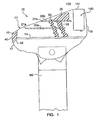
- microfluidic shaving aid delivery system 100 for use prior to and/or during the shaving process and is generally identified by reference numeral 100.
- the microfluidic shaving aid delivery system 100 may be incorporated with the various known types of disposable razors in which the razor (or the useable portion thereof, e.g., a razor head cartridge) is discarded and replaced after a selected number of shaves.
- FIGS.1 and 2 show a shaving system 10 in the form of a razor head cartridge 12 which includes a support base 14 having resilient supports 50 and 55 which movably connect a pair of sharpened blades 20a and 20b and a cap member 30 to the support base 14.
- FIGS. 1 and 2 show a shaving system 10 with a disposable and replaceable cartridge 12, the advantages of the present disclosure are equally applicable to other razor designs and shaving systems.
- the term “razor head” is meant to include replaceable cartridges 12 which are designed and manufactured for attachment to a separate razor handle 80, as well as a disposable razor assembly wherein the skin-engaging portions (i.e., guard bar, blades, cap and lubricating shaving strip) are integrally formed with a razor handle section.
- the shaving systems disclosed herein generally relate to facial shaving systems, it is contemplated that the presently-disclosed shaving aid delivery system may be included with other known shaving systems which engage other bodily skin areas, e.g., legs, arms, areas prepared for surgery, etc.
- the razor head 12 includes a support base 14 defined by forward and back surfaces 17 and 19, respectively, and fixed side walls 15a and 15b.
- a skin engaging guard member 40 is affixed to the support base 14 along and proximate the forward surface 17 of base 14 and a surface 101 of shaving aid delivery system 100 is disposed along the rear surface 19 of base 14.
- a seat blade 20a and a cap blade 20b are supported by a plurality of resilient support members 50 and 55.
- the tip of each blade 20a and 20b includes a cutting edge 21 a and 21b, respectively, which refers to the area within about 1 mm from the ultimate tip of each blade 20a, 20b.
- the razor blade cutting edge 21a and 21b are coated with a thin layer of metal coating that provides enhanced durability and corrosion resistance to the underlying metal, e.g., chromium or a chromium/platinum alloy.
- metal coating e.g., chromium or a chromium/platinum alloy.
- Other materials may also be coated on a razor blade(s) 20a, 20b such as, for example, the various coating materials identified in U.S.-A-5,630,275 .
- the support members 50 and 55 are attached along base 14 and support each blade 20a and 20b.
- the guard member 40, blades 20a and 20b, cap member 30, lubricating surface 101 of the shaving aid delivery system and the outward facing surfaces of the side walls 15a and 15b together define the face 16 of the razor head 12.
- These elements are commonly referred to as "skin engaging elements”.
- Resilient supports 50 and 55 are disposed at various positions along the face 16 of the razor head 12 to increase the stability of the blades 20a and 20b and also to provide greater flexibility. It is envisioned that the support members 50 and 55 are designed to have sufficient inherent resiliency to allow the blades 20a and 20b and cap member 30 to move downwardly relative to side walls 15a and 15b, i.e. toward base 14, in response to the normal forces encountered during shaving. Preferably, the resilient support members 50 and 55 are manufactured from the same resilient material; however, it is contemplated that the support members 50 and 55 may be manufactured from different resilient materials having varying resiliencies.
- the length and positioning of the resilient support members 50 and 55 may be also modified to increase or decrease the overall aggressiveness of the shaving geometry in response to forces encountered during shaving. For example, if the length of one resilient support, e.g., 55, is shorter than another resilient support, e.g., 50, the overall shaving angle which directly correlates to the aggressiveness of the shave will change in response to normal shaving forces.
- the guard member 40 includes a rear surface 42 which affixes the guard member 40 to the base 14 and an outermost guard surface 41 which is preferably made from a resilient, skin-engaging material having a higher coefficient of friction with wet skin than a rigid plastic of the type commonly used with many disposable razor head cartridges 12.
- the guard surface 41 is preferably designed to limit the degree to which the razor can be pressed into the skin, which protects the skin from cuts and nicks.
- the guard member 40 may be either a single unitary piece or separate segments, as set forth in commonly-owned U.S.-A-5,689,883 and U.S.-A-5,475,923 .
- the resilient guard surface 41 is formed from one or more materials selected from polypropylene, Hercuprene 1000, 3000 serves, Durometer 30 to 90 A scale available from J-Von, Leominster, Mass.; Kraton G series, Durometer 30 to 90A scale available from Shell Chemical Co., Lisle, Ill.; and Santoprene 2271 series, Durometer 30 to 90 A scale available from Monsanto Co.
- one or more of the above-identified resilient materials may also be disposed on the upper, skin-engaging portions of sidewalls 15a and 15b.
- the higher coefficient of friction of the resilient material enables the guard member 40 (and the sidewalls 15a, 15b) to grip the skin and exert greater control of the skin as it flows over the blade(s) 20a, 20b.
- the resilient material provides a more detectable sensation to the skin in a manner which will tend to mask any unpleasant sensory perceptions of a sharpened blade traveling across the skin.
- Cap member 30 seats atop blade 20b.
- the cap member 30 may be formed as a single piece extending across the face 16 of the razor head 12, or the cap member 30 may be segmented into a plurality of individual segments depending upon a particular purpose. It is contemplated that the cap member 30 may be integrally formed with or affixed to one or more of the resilient supports 50, 55 in order to unify the overall movement of the blades 20a, 20b and the cap member 30 across the skin during a shaving stroke.
- Other advantages relating to the formation of the cap member 30 are described in U.S.-A-5,822,862 and U.S.-A-5,822,862 , U.S.-A-5,666,729 and U.S.-A-5,456,009 .
- the shaving system 10 includes a shaving aid delivery system 100 according to the present disclosure which is disposed within the razor head 12 for selectively delivering shaving aid either prior to and/or during the shaving process.
- the shaving aid delivery system 100 can be fixedly incorporated into the razor head 12 and can be employed for multiple uses, or shaves.
- the shaving aid delivery system can be separable from the razor head 12, and, for example, discarded after a single use and replaced with a fresh shaving aid delivery system.
- the shaving aid delivery system 100 includes a reservoir for storing a predetermined amount of shaving aid for dispersal along a lubricating surface 101 which engages the skin during the shaving stroke.
- shave-aiding agent refers to a large variety of known shave-aiding agents which comprise one or more combinations of the following substances:
- the microfluidic shaving aid delivery system 100 includes a first substrate 110, a second substrate 120 and a third substrate 130, secured together in a stacked array.
- Each of said first, second, and third substrates 110, 120, and 130 can be individually fabricated from a substrate material such as those indicated above, and formed into the desired configuration by any suitable method such as those indicated above.
- First substrate 110 is a flat plate which serves as a cover.
- Second substrate 120 includes a microchannel circuit 121 including fluid vias 122a and 122b which extend through the second substrate 120 to allow passage of shaving aid fluid from the third substrate 130 (as described below) into the microchannel circuit 121.
- the microfluidic shaving aid delivery system 100 can include multiple shaving aids which can be individually selected for delivery to the shaving surface. Each via 122a and 122b transports an individual shaving aid. While the system described herein employs two shaving aids for illustration purposes, it should be noted that any number of shaving aids can be included in the shaving aid delivery system 100.
- Microchannel circuit 121 also includes a lateral channel 123 for carrying the shaving aid fluids to a mixing channel 124 wherein the shaving aids are combined and communicated to an outlet manifold 125.
- the shaving aid fluid is therein delivered to the multiple outlet ports 126 along the edge of the second substrate 120 whereupon the shaving aid fluid is ejected and delivered to the lubricating surface 101.
- the microchannels are preferably from about 50 ⁇ m to 200 ⁇ m in diameter, more preferably from about 100 ⁇ m to 150 ⁇ m in diameter.
- the microfluidic shaving aid delivery system 100 further includes at least two reservoirs for containing fluid shaving aid, and a transport system for driving shaving aid from the reservoirs through the microchannel circuit 121.
- the microfluidic shaving aid delivery system 100 allows the user to select one or more desired shaving aids from among two or more shavings aids stored in the device.
- the third substrate 130 includes, as the transfer system, at least one and preferably two or more osmotic pumps 131, each associated with a reservoir containing a specific shaving aid 90.
- the osmotic pump 131 includes a channel 132 defined by an interior wall in the body of the third member 130.
- a piston 134 divides the channel 132 into a reservoir portion 132' and a pump chamber 132".
- Shaving aid fluid 90 is stored in the reservoir portion 132.
- the pump chamber 132" contains an osmotic driving material 133 which generates pressure by means of expansion as described below.
- the piston 134 is a fluid impermeable barrier member which is freely and slidably movable in channel 132 in response to expansion of the driving material 133.
- Piston 134 can be fabricated from metal, plastic, or other suitable material. Preferred materials include acrylics, polycarbonates, PTFE, PVC, and the like.
- the piston 134 applies pressure to the shaving aid fluid 90 and drives the shaving aid fluid 90 through channel 137 to outlet 138 whereupon it enters through one of the vias (e.g.122a or 122b) into the microchannel circuit 121 for delivery to the lubricating surface 101.
- the osmotic driving material 133 is retained by a semipermeable membrane 135 disposed in channel 132 between the driving material 133 and the opening 136 of the channel 132.
- the osmotic driving material 133 can contain an inorganic water soluble salt such as sodium chloride, potassium chloride, magnesium sulfate, sodium sulfate, calcium chloride, or lithium chloride, an organic salt such as sodium acetate, or a water soluble organic chemical such as dextrose, lactose, or fructose.
- the osmotic driving material 133 can be in the form of a solution or solid.
- the semipermeable membrane allows the passage of water therethrough, but is impermeable to the driving material. Osmosis will tend to drive water through the semipermeable membrane into the driving medium. This causes an expansion of the driving material, which drives the shaving aid fluid 90 from the reservoir 132' as explained above.
- Suitable materials for making the semipermeable membrane are known in the art.
- Cellulose acetate is an especially preferred membrane material for this application because its water permeability is high and can be adjusted easily by varying the degree of acetylation of the polymer.
- the permeability of cellulose acetate membranes can be increased further by adding plasticizers to the polymer to increase the water diffusion coefficient, or by adding hydrophilic flux enhancers, which increase the water sorption of the membrane.
- Some hydrophilic plasticizers serve both purposes.
- the effect of the hydrophilic plasticizer polyethylene glycol on the osmotic water permeability of cellulose acetate membranes is substantial; the water permeability is increased more than fourfold by the addition of polyethylene glycol.
- membrane material examples include polyamides; nylon 6; nylon 6-6; aromatic polyamides, for example, the aromatic polyamide sold under the name Nomex® (DuPont); cellulose acetate butyrate; ethylcellulose; cellulose nitrate; blends of cellulose acetates of various degrees of acetylation; or various types of cellulosic esters and ethers.
- aromatic polyamides for example, the aromatic polyamide sold under the name Nomex® (DuPont); cellulose acetate butyrate; ethylcellulose; cellulose nitrate; blends of cellulose acetates of various degrees of acetylation; or various types of cellulosic esters and ethers.
- the end 136 of the channel 132 is sealed by, for example, an impermeable barrier 139 which covers the open end 136 to prevent water from entering.
- an impermeable barrier 139 which covers the open end 136 to prevent water from entering.
- the seal 139 is punctured or removed.
- the razor head is held under or immersed in water. Water then enters the opening 136 of the channel 132, and diffuses through semipermeable membrane 135 into the osmotic driving medium 133.
- the driving medium 133 expands, pushing piston 134, and driving the shaving aid 90 through channel 137 into the microchannel circuit 121 and out through outlet ports 126.
- water can be shaken off the razor, which is thereafter allowed to dry.
- the user can select from among two or more different types of shaving aid by puncturing or removing only the seals 139 corresponding to the osmotic pumps 131 containing the desired shaving aid.
- Third substrate 130a includes at least one, and preferably two or more osmotic pumps 131a.
- Each osmotic pump 131a has a channel 132 in which shaving aid 90 is stored in a reservoir portion 132a of the channel.
- the osmotic driving material 133 is optimally contained in an expandable pouch 134a, and is retained by a semipermeable membrane 135.
- the end of channel 132 is dosed by a plug 139a.
- plug 139a Upon removal of plug 139a, water is permitted to flow into channel 132 and diffuses through semipermeable membrane 135 into the osmotic driving medium 133.
- the expansion of the osmotic driving medium 133 causes expansion of the pouch 134a, which drives the shaving aid fluid 90 through channel 137 and outlet 138.
- the pouch 134a can be made of any expandable material.
- Preferred materials for making pouch 134a include elastic materials such as natural or synthetic rubber film such as latex, butadiene-styrene rubber, and the like.
- the shaving aid delivery system can alternatively include two substrates wherein one substrate includes both the microfluidic circuit and fluid reservoirs and the other substrate serves as a cover, or cap.
- the reservoirs 132' can each contain a different type of shaving aid, it is also within the scope of the invention that the individual reservoirs each contain the same type of shaving aid.
Landscapes
- Life Sciences & Earth Sciences (AREA)
- Forests & Forestry (AREA)
- Engineering & Computer Science (AREA)
- Mechanical Engineering (AREA)
- Cosmetics (AREA)
- Loading And Unloading Of Fuel Tanks Or Ships (AREA)
- Measurement Of The Respiration, Hearing Ability, Form, And Blood Characteristics Of Living Organisms (AREA)
- Nozzles (AREA)
- Micromachines (AREA)
Abstract
Description
- The present disclosure relates to a shaving system having a lubricating shaving aid for providing skin care topicals as well as improving the ease with which a razor can be drawn across the skin during the shaving process. More particularly, the present disclosure relates to a shaving system having a microfluidic system for the controlled delivery of shaving aid.
- It is known that many factors contribute to overall discomfort during the shaving process. Such factors include excessive frictional drag of the razor across the skin and the inflammation of the skin caused by various known epidermal conditions such as psoriasis, eczema, acne, skin rashes, etc. Efforts to address some of these factors have led to the use of pre-shave and/ or aftershave lotions which include emollients, beard softening agents, lathering agents, medicinal or soothing ointments, aloe, foam, soaps, and the like. Even though shaving comfort may be enhanced to some degree using emollients and other shaving aids, the requirement that they be applied before or after shaving tends to decrease their overall effectiveness and simply adds to the complications of the shaving process.
- Shaving systems also use lubricants to decrease the frictional resistance during shaving. For example, static lubricating systems integrated with or attached to the razor cartridge are well known and help reduce the frictional drag of the razor as it is drawn across the skin. Such systems include lubricating strips affixed to the razor head proximate the razor cap portion. The lubricating strips typically include a water-insoluble polymer (such as polystyrene) and a water-soluble shaving aid such as polyethylene oxide, which gradually leaches out of the strip during shaving and reduces frictional drag. However, a problem with such systems is that the shaving aid leaches out in a skewed manner over time. At first, more than enough shaving aid leaches out But after repeated use of the razor, less and less shaving aid leaches out This results in the inefficient use of the limited quantity of shaving aid which can be incorporated into the lubricant strip. Moreover, the surface of the strip may become irregular and rough after repeated use, thereby increasing the coefficient of friction of the strip. This might contribute to further irritation of sensitive skin.
- As a result, various attempts have been made to develop new systems for delivering shaving aid during the shaving process. For example,
US-A-4,872,263 discloses a device for lubricating skin in conjunction with the use of shaving aids in razor cartridges for shaving including a lubricating device comprised of a perforated, smooth water-insoluble sheet material secured to the surface of a porous, water-insoluble matrix material containing or impregnated with soap. However, such efforts have for the most part been only partially successful in their ability to consistently and evenly deliver shaving aid to the skin over time and repeated use of the razor. -
EP-A-0 854 018 discloses a reduced friction razor head comprising at least one blade and a blade housing comprising a skin engaging surface having a static coefficient of friction not greater than 0.20. Also disclosed are shaving aids comprising a water insoluble matrix with a micro-porous structure and comprising a material having a static coefficient of friction not greater than 0.20 and a water soluble active ingredient. - Moreover it is basically known to form three-dimensional microfluidic devices from a plurality of substantially planar layers sealed together as e.g. disclosed in
US-A-2004/0109793 for use in the processing and/or analysis of liquid biochemical samples. - Accordingly, there yet exists a need for a simple but effective shaving system which incorporates a system for effectively delivering a desired amount of shaving aid fluid from at least two reservoirs automatically or selectively by a user over the course of the normal and expected useful life of the razor blade.
- A razor assembly is provided herein as defined in claim 1. The dependent claims relate to individual embodiments of the invention.
- The razor assembly advantageously provides a convenient method for delivering shaving aid to the shaving surface, and allows for the selection of shaving aids from among two or more shaving aids contained in the shaving aid delivery system.
- Various embodiments are described below with reference to the drawings wherein:
-
FIG.1 is a schematic view illustrating a razor assembly including a microfluidic shaving aid delivery system; -
FIG. 2 is a perspective view of the razor head portion of the razor assembly; -
FIG. 3 is an exploded perspective view of the microfluidic shaving aid delivery system; -
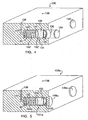
FIG. 4 is a sectional view of a substrate of the microfluidic shaving aid delivery system including osmotic pump transfer system for delivering shaving aid; and, -
FIG. 5 is a sectional view illustrating an alternative embodiment of the osmotic pump transfer system. - The razor assembly herein employs a shaving aid delivery system which includes a microfluidic device. Microfluidic devices have been manufactured using microfabrication methods commonly employed in the electronics industry. Such methods generally involve the fabrication of microscale structures, e.g., grooves, wells, depressions and the like, on the upper planar surface of a first solid substrate material. A second substrate layer having a lower planar surface is then bonded over this surface, which covers and seals the grooves and wells to form the channels and chambers. As a result of these manufacturing techniques, microfluidic devices most often employ a planar structure where, aside from their intrinsic depth, the fluidic elements generally exist in two dimensions.
- As used herein, the term "microscale" or "microfabricated" generally refers to structural elements or features of a device which have at least one fabricated dimension in the range of from about 0.1 µm to about 500 µm. Thus, a device referred to as being microfabricated or microscale will include at least one structural element or feature having such a dimension. When used to describe a fluidic element, such as a passage, chamber or conduit, the terms "microscale," "microfabricated" or "microfluidic" generally refer to one or more fluid passages, chambers or conduits which have at least one internal cross-sectional dimension, e.g., depth, width, length, diameter, etc., that is no more than 500 µm, and typically between about 0.1 µm and about 500 µm.
- The microfluidic devices or systems employed in the present invention typically include at least one microscale channel, usually at least two intersecting microscale channels, and often, three or more intersecting channels disposed within a single body structure. Channel intersections may exist in a number of formats, including cross intersections, "T" intersections, or any number of other structures whereby two channels are in fluid communication.
- The body structure of the microfluidic devices described herein typically comprises an aggregation of two or more separate substrate layers which, when appropriately mated or joined together, form the microfluidic device of the invention, e.g., containing the multiple channel networks described herein. Preferably, the microfluidic device described herein comprises three substrate layers, including a bottom substrate layer, a middle substrate layer and a top substrate layer.
- As used herein, the terms "substrate" or "substrate layer" are used interchangeably to refer to solid planar substrates having first and second opposing, or substantially parallel, planar surfaces. A variety of substrate materials may be employed as the various layers of the device. Typically, because the devices are microfabricated, substrate materials will be selected based upon their compatibility with known microfabrication techniques, e.g., photolithography, wet chemical etching, laser ablation, air abrasion techniques, injection molding, embossing, microreplication, micromolding and other techniques. The substrate materials are also generally selected for their compatibility with the full range of conditions to which the microfluidic devices may be exposed, including extremes of pH, temperature, salt concentration, and application of electric fields. Substrates can also be generally selected for their electrokinetic properties, e.g., surface potential, thermal and optical properties, e.g., transparency etc. Accordingly, in some preferred aspects, the substrate material may include materials normally associated with the semiconductor industry in which such microfabrication techniques are regularly employed, including, e.g., silica based substrates, such as glass, quartz, silicon or polysilicon, as well as other substrate materials, such as gallium arsenide and the like. In the case of semiconductive materials, it will often be desirable to provide an insulating coating or layer, e.g., silicon oxide, over the substrate material, and particularly in those applications where electric fields are to be applied to the device or its contents.
- In additional preferred aspects, the substrate materials can comprise polymeric materials, e.g., plastics, such' as polymethylmethacrylate (PMMA), polycarbonate, polytetrafluoroethylene (PTFE), polyvinylchloride (PVC), polydimethylsiloxane (PDMS), polysulfone, and the like. Such polymeric substrates are readily manufactured using available microfabrication techniques, as described above, or from microfabricated masters, using well known molding technique, such as injection molding, embossing or stamping, or by polymerizing the polymeric precursor material within the mold (See
U.S.-A-5,512,131 ) - Such polymeric substrate materials are preferred for their ease of manufacture, low cost and disposability, as well as their general inertness to most extreme reaction conditions. Again, these polymeric materials may include treated surfaces, e.g., derivatized or coated surfaces, to enhance their utility in the microfluidic system, e.g., provide enhanced fluid direction, e.g., as described in
U.S.-A-5,885,470 . - As noted above, the various substrate layers of the microfluidic devices are mated or bonded together to form the microfluidic elements of the device. Bonding of substrate layers is generally carried out under any of a number of methods or conditions known in the art. Conditions under which substrates may be bonded together are generally widely understood, and such bonding of substrates is generally carried out by any of a number of methods, which may vary depending upon the nature of the substrate materials used. For example, thermal bonding of substrates may be applied to a number of substrate materials, including, e.g., glass or silica based substrates, as well as polymer based substrates. Such thermal bonding typically comprises mating together the substrates that are to be bonded, under conditions of elevated temperature and, in some cases, application of external pressure. The precise temperatures and pressures will generally vary depending upon the nature of the substrate materials used.
- For example, for silica-based substrate materials, i.e., glass (borosilicate glass, Pyrex®, soda lime glass, etc.), quartz, and the like, thermal bonding of substrates is typically carried out by pressing the substrates together at temperatures ranging from about 500°C to about 1400°C, and preferably, from about 500°C to about 1200°C. For example, soda lime glass is typically bonded at temperatures around 550°C, whereas borosilicate glass typically is thermally bonded at or near 800°C. Quartz substrates, on the other hand, are typically thermally bonded at temperatures at or near 1200°C. These bonding temperatures are typically achieved by placing the substrates to be bonded into high temperature annealing ovens.
- Polymeric substrates that are thermally bonded on the other hand, will typically utilize lower temperatures and/or pressure than silica-based substrates, in order to prevent excessive melting of the substrates and/or distortion, e.g., flattening of the interior portion of the device, i.e., channels or chambers. Generally, such elevated temperatures for bonding polymeric substrates will vary from about 80°C to about 200°C, depending upon the polymeric material used, and will preferably be between about 90°C and 150°C. Adhesives may also be used to bond substrates together according to well known methods, which typically comprise applying a layer of adhesive between the substrates that are to be bonded and pressing them together until the adhesive sets. A variety of adhesives may be used in accordance with these methods, including, e.g., UV curable adhesives, that are commercially available.
- Alternative methods may also be used to bond substrates together in accordance with the present invention, including e.g., acoustic or ultrasonic welding, RF welding and / or solvent welding of polymeric parts.
- As used herein, the term "microchannel circuit" refers to one or more microscale channels that are disposed between two substrates. In preferred aspects, such channel circuits, or networks, include at least two microscale channels, and preferably at least two intersecting microscale channels. The intersection of channels can include channels which intersect and cross, e.g., at "four-way" intersections, as well as a charmel intersection wherein one channel intersects and terminates in another channel, e.g., at a "T" or "three-way" intersection.
- Referring now to
FIGS. 1-4 , an embodiment of a microfluidic shaving aid delivery system is shown for use prior to and/or during the shaving process and is generally identified byreference numeral 100. The microfluidic shavingaid delivery system 100 may be incorporated with the various known types of disposable razors in which the razor (or the useable portion thereof, e.g., a razor head cartridge) is discarded and replaced after a selected number of shaves. - The embodiment of the present disclosure illustrated in
FIGS.1 and2 show ashaving system 10 in the form of arazor head cartridge 12 which includes asupport base 14 havingresilient supports blades cap member 30 to thesupport base 14. AlthoughFIGS. 1 and2 show ashaving system 10 with a disposable andreplaceable cartridge 12, the advantages of the present disclosure are equally applicable to other razor designs and shaving systems. As used herein, the term "razor head" is meant to includereplaceable cartridges 12 which are designed and manufactured for attachment to a separate razor handle 80, as well as a disposable razor assembly wherein the skin-engaging portions (i.e., guard bar, blades, cap and lubricating shaving strip) are integrally formed with a razor handle section. Moreover, although the shaving systems disclosed herein generally relate to facial shaving systems, it is contemplated that the presently-disclosed shaving aid delivery system may be included with other known shaving systems which engage other bodily skin areas, e.g., legs, arms, areas prepared for surgery, etc. - The
razor head 12, includes asupport base 14 defined by forward and back surfaces 17 and 19, respectively, and fixedside walls guard member 40 is affixed to thesupport base 14 along and proximate theforward surface 17 ofbase 14 and asurface 101 of shavingaid delivery system 100 is disposed along therear surface 19 ofbase 14. Aseat blade 20a and acap blade 20b are supported by a plurality ofresilient support members blade cutting edge blade - Preferably, the razor
blade cutting edge U.S.-A-5,630,275 . - It is envisioned that the
support members base 14 and support eachblade guard member 40,blades cap member 30, lubricatingsurface 101 of the shaving aid delivery system and the outward facing surfaces of theside walls face 16 of therazor head 12. These elements are commonly referred to as "skin engaging elements". - Resilient supports 50 and 55 are disposed at various positions along the
face 16 of therazor head 12 to increase the stability of theblades support members blades cap member 30 to move downwardly relative toside walls base 14, in response to the normal forces encountered during shaving. Preferably, theresilient support members support members resilient support members - The
guard member 40 includes arear surface 42 which affixes theguard member 40 to thebase 14 and anoutermost guard surface 41 which is preferably made from a resilient, skin-engaging material having a higher coefficient of friction with wet skin than a rigid plastic of the type commonly used with many disposablerazor head cartridges 12. Theguard surface 41 is preferably designed to limit the degree to which the razor can be pressed into the skin, which protects the skin from cuts and nicks. - The
guard member 40 may be either a single unitary piece or separate segments, as set forth in commonly-ownedU.S.-A-5,689,883 andU.S.-A-5,475,923 . - Preferably, the
resilient guard surface 41 is formed from one or more materials selected from polypropylene, Hercuprene 1000, 3000 serves,Durometer 30 to 90 A scale available from J-Von, Leominster, Mass.; Kraton G series,Durometer 30 to 90A scale available from Shell Chemical Co., Lisle, Ill.; and Santoprene 2271 series,Durometer 30 to 90 A scale available from Monsanto Co. - It is contemplated that one or more of the above-identified resilient materials may also be disposed on the upper, skin-engaging portions of
sidewalls sidewalls -
Cap member 30 seats atopblade 20b. Thecap member 30 may be formed as a single piece extending across theface 16 of therazor head 12, or thecap member 30 may be segmented into a plurality of individual segments depending upon a particular purpose. It is contemplated that thecap member 30 may be integrally formed with or affixed to one or more of the resilient supports 50, 55 in order to unify the overall movement of theblades cap member 30 across the skin during a shaving stroke. Other advantages relating to the formation of thecap member 30 are described inU.S.-A-5,822,862 andU.S.-A-5,822,862 ,U.S.-A-5,666,729 andU.S.-A-5,456,009 . - As best illustrated in
FIGS. 3 ,4 and 5 , theshaving system 10 includes a shavingaid delivery system 100 according to the present disclosure which is disposed within therazor head 12 for selectively delivering shaving aid either prior to and/or during the shaving process. In one embodiment the shavingaid delivery system 100 can be fixedly incorporated into therazor head 12 and can be employed for multiple uses, or shaves. Alternatively, the shaving aid delivery system can be separable from therazor head 12, and, for example, discarded after a single use and replaced with a fresh shaving aid delivery system. - More particularly, the shaving
aid delivery system 100 includes a reservoir for storing a predetermined amount of shaving aid for dispersal along alubricating surface 101 which engages the skin during the shaving stroke. - As used herein, the term "shaving aid" refers to a large variety of known shave-aiding agents which comprise one or more combinations of the following substances:
- A lubricating agent for reducing the frictional forces between the razor and the skin, e.g., a silicone oil;
- An agent which reduces the drag between the razor parts and the surface being shaved, e.g., a polyethylene oxide in the range of molecular weight between 100,000 and 6,000,000; a non-ionic polyacrylamide; and/or a natural polysaccharide derived from plant materials such as "guar gum";
- An agent which modifies the chemical structure of the hair to allow the razor blade to pass through the whiskers very easily, e.g., a depilatory agent;
- A cleaning agent which allows the whisker and skin debris to wash more easily from the razor parts during shaving, e.g., a silicone polyethylene oxide block copolymer and detergent such as sodium lauryl sulphate;
- A medicinal agent such as an antiseptic for killing bacteria or other microorganisms, or an agent for repairing skin damage and abrasions;
- A cosmetic agent for softening, smoothing, conditioning or improving the skin;
- A blood coagulant for the suppression of bleeding that occurs from nicks and cuts;
- Essential oils;
- Vitamin E, e.g., in a formulation of vitamin E acetate, sodium pyruvate, and sunflower oil, contained on a polytrap bead carrier;
- Synthetic moisturizers, lubricants, emollients, e.g., Dimethicone, C12-C15 alcohol benzoates, glycerin, cetyl alcohol and stearyl alcohol;
- Natural moisturizers, lubricants, emollients, e.g., jojoba oil, allantoin, aloe vera and sesame oil.
- Referring now to
FIGS. 3 and4 , the microfluidic shavingaid delivery system 100 includes afirst substrate 110, asecond substrate 120 and athird substrate 130, secured together in a stacked array. Each of said first, second, andthird substrates -
First substrate 110 is a flat plate which serves as a cover. -
Second substrate 120 includes amicrochannel circuit 121 includingfluid vias second substrate 120 to allow passage of shaving aid fluid from the third substrate 130 (as described below) into themicrochannel circuit 121. The microfluidic shavingaid delivery system 100 can include multiple shaving aids which can be individually selected for delivery to the shaving surface. Each via 122a and 122b transports an individual shaving aid. While the system described herein employs two shaving aids for illustration purposes, it should be noted that any number of shaving aids can be included in the shavingaid delivery system 100. -
Microchannel circuit 121 also includes alateral channel 123 for carrying the shaving aid fluids to a mixingchannel 124 wherein the shaving aids are combined and communicated to anoutlet manifold 125. The shaving aid fluid is therein delivered to themultiple outlet ports 126 along the edge of thesecond substrate 120 whereupon the shaving aid fluid is ejected and delivered to thelubricating surface 101. - The microchannels (i.e., 123, 124,125) are preferably from about 50 µm to 200 µm in diameter, more preferably from about 100 µm to 150 µm in diameter.
- The microfluidic shaving
aid delivery system 100 further includes at least two reservoirs for containing fluid shaving aid, and a transport system for driving shaving aid from the reservoirs through themicrochannel circuit 121. Preferably, the microfluidic shavingaid delivery system 100 allows the user to select one or more desired shaving aids from among two or more shavings aids stored in the device. - Referring now to
FIG. 4 , thethird substrate 130 includes, as the transfer system, at least one and preferably two or moreosmotic pumps 131, each associated with a reservoir containing aspecific shaving aid 90. - More particularly, the
osmotic pump 131 includes achannel 132 defined by an interior wall in the body of thethird member 130. Apiston 134 divides thechannel 132 into a reservoir portion 132' and apump chamber 132". - Shaving
aid fluid 90 is stored in thereservoir portion 132. - The
pump chamber 132" contains anosmotic driving material 133 which generates pressure by means of expansion as described below. Thepiston 134 is a fluid impermeable barrier member which is freely and slidably movable inchannel 132 in response to expansion of the drivingmaterial 133.Piston 134 can be fabricated from metal, plastic, or other suitable material. Preferred materials include acrylics, polycarbonates, PTFE, PVC, and the like. As the drivingmaterial 133 expands thepiston 134 applies pressure to the shavingaid fluid 90 and drives the shavingaid fluid 90 throughchannel 137 tooutlet 138 whereupon it enters through one of the vias (e.g.122a or 122b) into themicrochannel circuit 121 for delivery to thelubricating surface 101. - The
osmotic driving material 133 is retained by asemipermeable membrane 135 disposed inchannel 132 between the drivingmaterial 133 and theopening 136 of thechannel 132. - The
osmotic driving material 133 can contain an inorganic water soluble salt such as sodium chloride, potassium chloride, magnesium sulfate, sodium sulfate, calcium chloride, or lithium chloride, an organic salt such as sodium acetate, or a water soluble organic chemical such as dextrose, lactose, or fructose. Theosmotic driving material 133 can be in the form of a solution or solid. - The semipermeable membrane allows the passage of water therethrough, but is impermeable to the driving material. Osmosis will tend to drive water through the semipermeable membrane into the driving medium. This causes an expansion of the driving material, which drives the shaving
aid fluid 90 from the reservoir 132' as explained above. - Suitable materials for making the semipermeable membrane are known in the art.
- Cellulose acetate is an especially preferred membrane material for this application because its water permeability is high and can be adjusted easily by varying the degree of acetylation of the polymer. The permeability of cellulose acetate membranes can be increased further by adding plasticizers to the polymer to increase the water diffusion coefficient, or by adding hydrophilic flux enhancers, which increase the water sorption of the membrane. Some hydrophilic plasticizers serve both purposes. The effect of the hydrophilic plasticizer polyethylene glycol on the osmotic water permeability of cellulose acetate membranes is substantial; the water permeability is increased more than fourfold by the addition of polyethylene glycol. Addition of the hydrophilic polymer hydroxybutyl methyl cellulose to the cellulose acetate membrane has a similar effect. Thus certain membrane materials can be tailored so that their permeability characteristics are made suitable for the particular application at hand, i.e., so that in the device created the pumped fluid is delivered at the desired flow rate.
- Other choices for membrane material include polyamides; nylon 6; nylon 6-6; aromatic polyamides, for example, the aromatic polyamide sold under the name Nomex® (DuPont); cellulose acetate butyrate; ethylcellulose; cellulose nitrate; blends of cellulose acetates of various degrees of acetylation; or various types of cellulosic esters and ethers.
- The
end 136 of thechannel 132 is sealed by, for example, animpermeable barrier 139 which covers theopen end 136 to prevent water from entering. To initiate the pumping action, theseal 139 is punctured or removed. The razor head is held under or immersed in water. Water then enters theopening 136 of thechannel 132, and diffuses throughsemipermeable membrane 135 into theosmotic driving medium 133. The drivingmedium 133 expands, pushingpiston 134, and driving the shavingaid 90 throughchannel 137 into themicrochannel circuit 121 and out throughoutlet ports 126. To stop the pumping action, water can be shaken off the razor, which is thereafter allowed to dry. - The user can select from among two or more different types of shaving aid by puncturing or removing only the
seals 139 corresponding to theosmotic pumps 131 containing the desired shaving aid. - Referring now to
FIG. 5 , an alternative embodiment of the osmotic pump, 131a, is shown.Third substrate 130a includes at least one, and preferably two or moreosmotic pumps 131a. - Each
osmotic pump 131a has achannel 132 in which shavingaid 90 is stored in areservoir portion 132a of the channel. Theosmotic driving material 133 is optimally contained in anexpandable pouch 134a, and is retained by asemipermeable membrane 135. The end ofchannel 132 is dosed by aplug 139a. Upon removal ofplug 139a, water is permitted to flow intochannel 132 and diffuses throughsemipermeable membrane 135 into theosmotic driving medium 133. The expansion of the osmotic driving medium 133 causes expansion of thepouch 134a, which drives the shavingaid fluid 90 throughchannel 137 andoutlet 138. - The
pouch 134a can be made of any expandable material. Preferred materials for makingpouch 134a include elastic materials such as natural or synthetic rubber film such as latex, butadiene-styrene rubber, and the like. - While the above description contains many specifics, these specifics should not be construed as limitations on the scope of the invention, but merely as exemplifications of preferred embodiments thereof. For example, while the embodiment illustrated herein includes three substrates, the shaving aid delivery system can alternatively include two substrates wherein one substrate includes both the microfluidic circuit and fluid reservoirs and the other substrate serves as a cover, or cap. Also, while the reservoirs 132' can each contain a different type of shaving aid, it is also within the scope of the invention that the individual reservoirs each contain the same type of shaving aid. Those skilled in the art will envision many other possibilities within the scope of the invention as defined by the claims appended hereto.
Claims (16)
- A razor assembly comprising- a razor head (12) having at least one blade (20a, 20b), and- a shaving aid delivery system (100) associated with the razor head (12), the shaving aid delivery system (100) including a framework with a supply of at least one shaving aid fluid,characterized by- the framework having at least two substrates (110, 120, 130), connected together in a stacked array, a micro-channel circuit (121) disposed between the at least two substrates (110, 120, 130),- wherein the supply of at least one shaving aid fluid (90) includes at least two reservoirs (132') in one of the at least two substrates (130), each reservoir (132') containing an individual shaving aid fluid (90),- wherein the framework includes vias (122a, 122b) for communicating the shaving aid fluid (90) from the at least two reservoirs (132') to the micro-channel circuit (121) and- wherein the micro-channel circuit is in fluid communication with a plurality of outlet ports (126) along a surface (101) of the framework, and- a transport system for driving the shaving aid fluid from the supply through the micro-channel circuit (121),- wherein the transport system includes at least one osmotic pump (131,131a) in the substrate (130) which includes the at least two reservoirs (132').
- The razor assembly of claim 1 wherein the framework includes at least two substrates (110, 120, 130) stacked together.
- The razor assembly of claim 1 wherein the framework includes a first substrate (110), a second substrate (120) and a third substrate (130), connected together in a stacked array.
- The razor assembly of claim 3 wherein the micro-channel cirucit is disposed between the first substrate (110) and the second substrate (120).
- The razor assembly of any one of claims 1 to 4 wherein the osmotic pump (131, 131a) includes a reservoir (132') containing the shaving aid fluid (90).
- The razor assembly of any one of claims 1 to 5 wherein the osmotic pump (131, 131a) includes an osmotic driving material separated from the reservoir (132') by a movable, substantially impermeable barrier (139).
- The razor assembly of claim 6 wherein the osmotic driving material is selected from the group consisting of sodium chloride, potassium chloride, magnesium sulfate, sodium sulfate, calcium chloride, lithium chloride, sodium acetate, dextrose, lactose and fructose.
- The razor assembly of claim 6 or 7 wherein the impermeable barrier (139) is a slidably movable piston.
- The razor assembly of claim 6 or 7 wherein the impermeable barrier (139) is a flexibly expandable pouch (134a) in which the osmotic driving material is contained.
- The razor assembly of claim 6 or 7 wherein the osmotic pump (131, 131a) includes a semipermeable membrane (135) disposed between the osmotic driving material and an inlet opening (136) in the osmotic pump (131, 131a).
- The razor assembly of claim 10 wherein the semipermeable material (135) is selected from the group consisting of cellulose acetate, polyamide, cellulose acetate butyrate; ethylcellulose, cellulose nitrate and combinations thereof.
- The razor assembly of claim 10 or 11 wherein the inlet opening (136) is covered by a removable or breakable seal.
- The razor assembly of any one of claims 1 to 12 further including a handle to which the razor head (12) is attached.
- The razor assembly of any one of claims 1 to 13 wherein the shaving aid (90) is selected from the group consisting of silicone oil, polyethylene oxide, non-ionic polyacrylamide, guar gum, depilatory agent, a silicone polyethylene oxide block copolymer, sodium lauryl sulphate, antiseptic, skin conditioner, blood coagulant, vitamin E, sodium pyruvate, sunflower oil, Dimethicone, C12-C15 alcohol benzoate, glycerin, cetyl alcohol, stearyl alcohol, jojoba oil, allantoin, aloe vera and sesame oil.
- The razor assembly of any one of claims 1 to 14 wherein the at least two reservoirs (132') each contain an individual shaving aid fluid (90) of the same or different type, and the shaving aid delivery system (100) includes means for selecting one or more of the shaving aid fluids for delivery to the outlet ports (126).
- The razor assembly of claim 15 wherein the shaving aid delivery system includes an individual osmotic pump (131, 131a) for delivering each individual shaving aid fluid, each osmotic pump (131, 131a) including an inlet (136) for admitting water therein for driving the osmotic pump (131, 131a), and wherein the means for selecting one or more shaving aid fluids comprises a removable or breakable seal disposed across each inlet opening (136).
Applications Claiming Priority (3)
| Application Number | Priority Date | Filing Date | Title |
|---|---|---|---|
| US40525502P | 2002-08-21 | 2002-08-21 | |
| US405255P | 2002-08-21 | ||
| PCT/US2003/026392 WO2004017785A2 (en) | 2002-08-21 | 2003-08-21 | Razor having a microfluidic shaving aid delivery system and method of ejecting shaving aid |
Publications (3)
| Publication Number | Publication Date |
|---|---|
| EP1551602A2 EP1551602A2 (en) | 2005-07-13 |
| EP1551602A4 EP1551602A4 (en) | 2005-11-16 |
| EP1551602B1 true EP1551602B1 (en) | 2008-10-08 |
Family
ID=31946835
Family Applications (1)
| Application Number | Title | Priority Date | Filing Date |
|---|---|---|---|
| EP03770248A Expired - Lifetime EP1551602B1 (en) | 2002-08-21 | 2003-08-21 | Razor having a microfluidic shaving aid delivery system and method of ejecting shaving aid |
Country Status (7)
| Country | Link |
|---|---|
| US (1) | US7103977B2 (en) |
| EP (1) | EP1551602B1 (en) |
| JP (1) | JP2006507037A (en) |
| AT (1) | ATE410276T1 (en) |
| AU (1) | AU2003278720B2 (en) |
| DE (1) | DE60324008D1 (en) |
| WO (1) | WO2004017785A2 (en) |
Families Citing this family (25)
| Publication number | Priority date | Publication date | Assignee | Title |
|---|---|---|---|---|
| US20060272155A1 (en) * | 2002-04-24 | 2006-12-07 | Eveready Battery Company, Inc. | Razor head apparatus |
| US7103977B2 (en) * | 2002-08-21 | 2006-09-12 | Eveready Battery Company, Inc. | Razor having a microfluidic shaving aid delivery system and method of ejecting shaving aid |
| GB2417007B (en) * | 2004-08-13 | 2009-03-11 | Gillette Co | Razors |
| US8444416B2 (en) * | 2005-04-26 | 2013-05-21 | Braun Gmbh | Valves for personal care devices |
| GB0526560D0 (en) * | 2005-12-29 | 2006-02-08 | Unilever Plc | Oral treatment device |
| GB2423494A (en) * | 2006-03-23 | 2006-08-30 | Unilever Plc | Razor head including acyl isethionate surfactant dispenser |
| CN101687328B (en) * | 2007-06-12 | 2013-03-13 | 吉列公司 | Manually actuatable liquid dispensing razor |
| AU2009307894B2 (en) * | 2008-10-23 | 2015-07-02 | Edgewell Personal Care Brands, Llc | Replacement cartridge for a safety razor |
| US8745877B2 (en) * | 2009-03-23 | 2014-06-10 | The Gillette Company | Manually actuable liquid dispensing razor |
| US8826543B2 (en) * | 2009-03-23 | 2014-09-09 | The Gillette Company | Manually actuable liquid dispensing razor |
| WO2011047225A1 (en) † | 2009-10-16 | 2011-04-21 | Everready Battery Company, Inc. | Lubrication box for a wet shaving implement |
| AU2010306725B2 (en) * | 2009-10-16 | 2016-09-15 | Edgewell Personal Care Brands, Llc | Lubrication box for a wet shaving implement |
| US9604374B2 (en) * | 2009-10-21 | 2017-03-28 | Edgewell Personal Care Brands, Llc | Method of making a lubrication box for a wet shaving implement |
| GB2491406A (en) * | 2011-06-03 | 2012-12-05 | Gwilym Boore | Shaving Aid and Method of Replenishment Thereof |
| EP2537511B1 (en) * | 2011-06-24 | 2017-02-01 | The Gillette Company LLC | Hair removal device comprising erodable moisturizer |
| EP2591895B1 (en) * | 2011-11-10 | 2019-02-27 | The Gillette Company LLC | Razor cartridge with lubrication and moisturizing strips |
| US9156175B2 (en) * | 2011-12-09 | 2015-10-13 | The Gillette Company | Fluid applicator for a personal-care appliance |
| JP6189192B2 (en) * | 2013-11-26 | 2017-08-30 | 花王株式会社 | Shaving agent for electric shaver |
| US9925678B2 (en) | 2014-12-30 | 2018-03-27 | The Gillette Company Llc | Razor blade with a printed object |
| US10675772B2 (en) * | 2016-06-29 | 2020-06-09 | The Gillette Company Llc | Printed lubricious material disposed on razor blades |
| US10384360B2 (en) | 2016-06-29 | 2019-08-20 | The Gillette Company Llc | Razor blade with a printed object |
| CN110662637B (en) * | 2017-06-29 | 2023-02-28 | 比克维奥莱克斯公司 | Shaver and method for detecting shaving properties |
| PL3581350T3 (en) * | 2018-06-13 | 2022-09-19 | BIC Violex Single Member S.A. | SHAVING MULTIPLE BLADES |
| US10532476B1 (en) * | 2018-07-13 | 2020-01-14 | Bic Violex S.A. | Dispenser for razor cartridge |
| WO2021011719A1 (en) * | 2019-07-17 | 2021-01-21 | Anchor Manufacturing Group, Inc. | Non-metallic razor blades and razor assemblies therefor |
Family Cites Families (56)
| Publication number | Priority date | Publication date | Assignee | Title |
|---|---|---|---|---|
| US3548849A (en) * | 1966-12-15 | 1970-12-22 | Ite Imperial Corp | Fluidic circuit package |
| US3495608A (en) * | 1967-05-04 | 1970-02-17 | Pitney Bowes Inc | Fluidic elements and devices thereof |
| US3468331A (en) * | 1967-07-03 | 1969-09-23 | Martin Marietta Corp | Stacked port fluidic amplifier |
| US3495604A (en) * | 1967-09-22 | 1970-02-17 | Us Army | Integral flueric element and manifold plate and method of stacking a series of such plates and fluid coupling the same |
| US3534757A (en) * | 1968-07-18 | 1970-10-20 | Gen Electric | Fluidic frequency-responsive lag circuit component |
| DE1941961A1 (en) * | 1968-09-04 | 1970-03-12 | Contraves Ag | Fluidics component |
| US3528445A (en) * | 1969-01-02 | 1970-09-15 | Gen Electric | Laminated filter for fluid amplifiers |
| US3731700A (en) * | 1969-03-24 | 1973-05-08 | Bailey Meter Co | Fluidic integrated logic circuit module |
| US3587615A (en) * | 1969-10-30 | 1971-06-28 | Bell Telephone Labor Inc | Electrically responsive fluid logic device |
| US3604417A (en) * | 1970-03-31 | 1971-09-14 | Wayne Henry Linkenheimer | Osmotic fluid reservoir for osmotically activated long-term continuous injector device |
| US3658088A (en) * | 1970-06-17 | 1972-04-25 | Ibm | Packaging system for pneumatic logic |
| NL7102074A (en) * | 1971-02-17 | 1972-08-21 | ||
| US3811474A (en) * | 1973-01-26 | 1974-05-21 | Bowles Fluidics Corp | Miniaturized fluidic element and circuit construction |
| US4012551A (en) * | 1974-02-05 | 1977-03-15 | Warner-Lambert Company | Coated razor blade |
| CA1102537A (en) * | 1977-09-08 | 1981-06-09 | Frank A. Ferraro | Shaving cartridge |
| US4238882A (en) * | 1979-09-26 | 1980-12-16 | Harrison Jack R Sr | Reservoir safety razor |
| US4340048A (en) * | 1981-03-28 | 1982-07-20 | Alza Corporation | Self-driven hypodermic injector |
| US4716652A (en) * | 1983-10-05 | 1988-01-05 | John Cataudella | Disposable shaver |
| US4809432A (en) * | 1986-11-24 | 1989-03-07 | Shaverd Corp. | Disposable razor and emollient dispensing device |
| US4880631A (en) * | 1987-09-24 | 1989-11-14 | Merck & Co., Inc. | Controlled porosity osmotic pump |
| US4868982A (en) * | 1988-04-15 | 1989-09-26 | Mccomas James L | Disposable razor using piston movement for dispensing shaving materials |
| US4872263A (en) | 1988-09-30 | 1989-10-10 | The Kendall Company | Lubricating device |
| US4984364A (en) * | 1989-06-06 | 1991-01-15 | Simmons Richmond R | Disposable refrigerated safety razor head |
| DE8911246U1 (en) * | 1989-09-21 | 1991-01-24 | Wilkinson Sword GmbH, 5650 Solingen | Shaver head, especially razor blade unit |
| US5072512A (en) * | 1990-05-18 | 1991-12-17 | Noujain Elie G | Reservoir razor for applying a thin film of metal lubricant onto the blade of the razor and method of shaving |
| US5672167A (en) * | 1990-05-21 | 1997-09-30 | Recordati Corporation | Controlled release osmotic pump |
| GB9027422D0 (en) * | 1990-12-18 | 1991-02-06 | Scras | Osmotically driven infusion device |
| DK0495754T3 (en) * | 1991-01-17 | 1994-05-09 | Kai Ind Co Ltd | Replacement cartridge for razor with lubricator and razor |
| US5263256A (en) * | 1992-04-17 | 1993-11-23 | The Gillette Company | Method of treating razor blade cutting edges |
| US5384961A (en) * | 1992-04-27 | 1995-01-31 | Gregory; Harbert S. | Apparatus for shaving |
| US5637469A (en) * | 1992-05-01 | 1997-06-10 | Trustees Of The University Of Pennsylvania | Methods and apparatus for the detection of an analyte utilizing mesoscale flow systems |
| US5304487A (en) * | 1992-05-01 | 1994-04-19 | Trustees Of The University Of Pennsylvania | Fluid handling in mesoscale analytical devices |
| US5331740A (en) * | 1992-10-08 | 1994-07-26 | The Gillette Company | Shaving system |
| US5377409A (en) * | 1992-10-08 | 1995-01-03 | Warner-Lambert Company | One-push cleaning mechanism for flexible wet-shaving razor unit |
| US5417235A (en) * | 1993-07-28 | 1995-05-23 | Regents Of The University Of Michigan | Integrated microvalve structures with monolithic microflow controller |
| US5412872A (en) * | 1993-08-04 | 1995-05-09 | Warner-Lambert Company | Razor head with expandable spacer |
| US5903979A (en) | 1994-07-13 | 1999-05-18 | The Gillette Company | Safety razors |
| US5660703A (en) * | 1995-05-31 | 1997-08-26 | The Dow Chemical Company | Apparatus for capillary electrophoresis having an auxiliary electroosmotic pump |
| US5645894A (en) * | 1996-01-17 | 1997-07-08 | The Gillette Company | Method of treating razor blade cutting edges |
| US5711076A (en) | 1996-03-27 | 1998-01-27 | The Gillette Company | Shaving system with improved guard structure |
| US5985459A (en) * | 1996-10-31 | 1999-11-16 | The Gillette Company | Method of treating razor blade cutting edges |
| CA2220443A1 (en) | 1997-01-17 | 1998-07-17 | Warner-Lambert Company | Reduced frction razor head |
| US5776473A (en) | 1997-01-17 | 1998-07-07 | Warner-Lambert Company | Razor comfort strip with alpha-hydroxy acid additive |
| US5876675A (en) * | 1997-08-05 | 1999-03-02 | Caliper Technologies Corp. | Microfluidic devices and systems |
| US6473970B1 (en) * | 1997-10-20 | 2002-11-05 | American Safety Razor Company | Razor blade cartridge with lubricating flow paths |
| US6269846B1 (en) * | 1998-01-13 | 2001-08-07 | Genetic Microsystems, Inc. | Depositing fluid specimens on substrates, resulting ordered arrays, techniques for deposition of arrays |
| US6167910B1 (en) * | 1998-01-20 | 2001-01-02 | Caliper Technologies Corp. | Multi-layer microfluidic devices |
| CA2261420A1 (en) | 1998-05-20 | 1999-11-20 | Warner-Lambert Company | Shaving systems with foam skin-engaging element |
| US6103199A (en) * | 1998-09-15 | 2000-08-15 | Aclara Biosciences, Inc. | Capillary electroflow apparatus and method |
| JP3012608B1 (en) * | 1998-09-17 | 2000-02-28 | 農林水産省食品総合研究所長 | Microchannel device and method for producing emulsion using the same |
| US6306273B1 (en) | 1999-04-13 | 2001-10-23 | Aclara Biosciences, Inc. | Methods and compositions for conducting processes in microfluidic devices |
| WO2003064121A1 (en) * | 2002-01-30 | 2003-08-07 | Eveready Battery Company, Inc. | Razor having deformable shaving aid ejection system and method of ejecting shaving aid |
| JP2005515868A (en) | 2002-01-30 | 2005-06-02 | エヴァレディ・バッテリー・カンパニー・インコーポレイテッド | Razor with thermoelectric shaving aid discharge device and method for discharging shaving aid |
| US7111400B2 (en) * | 2002-01-30 | 2006-09-26 | Eveready Battery Company, Inc. | Razor having thermo-electric shaving aid ejection system and method of ejecting shaving aid |
| US20040109793A1 (en) * | 2002-02-07 | 2004-06-10 | Mcneely Michael R | Three-dimensional microfluidics incorporating passive fluid control structures |
| US7103977B2 (en) * | 2002-08-21 | 2006-09-12 | Eveready Battery Company, Inc. | Razor having a microfluidic shaving aid delivery system and method of ejecting shaving aid |
-
2003
- 2003-08-19 US US10/643,365 patent/US7103977B2/en not_active Expired - Fee Related
- 2003-08-21 EP EP03770248A patent/EP1551602B1/en not_active Expired - Lifetime
- 2003-08-21 JP JP2004529878A patent/JP2006507037A/en active Pending
- 2003-08-21 WO PCT/US2003/026392 patent/WO2004017785A2/en not_active Ceased
- 2003-08-21 AT AT03770248T patent/ATE410276T1/en not_active IP Right Cessation
- 2003-08-21 AU AU2003278720A patent/AU2003278720B2/en not_active Ceased
- 2003-08-21 DE DE60324008T patent/DE60324008D1/en not_active Expired - Lifetime
Also Published As
| Publication number | Publication date |
|---|---|
| EP1551602A2 (en) | 2005-07-13 |
| US20040078986A1 (en) | 2004-04-29 |
| AU2003278720B2 (en) | 2007-03-29 |
| ATE410276T1 (en) | 2008-10-15 |
| WO2004017785A2 (en) | 2004-03-04 |
| JP2006507037A (en) | 2006-03-02 |
| DE60324008D1 (en) | 2008-11-20 |
| AU2003278720A1 (en) | 2004-03-11 |
| WO2004017785A3 (en) | 2004-06-03 |
| US7103977B2 (en) | 2006-09-12 |
| EP1551602A4 (en) | 2005-11-16 |
Similar Documents
| Publication | Publication Date | Title |
|---|---|---|
| AU2003278720B2 (en) | Razor having a microfluidic shaving aid delivery system and method of ejecting shaving aid | |
| US7155828B2 (en) | Razor having deformable shaving aid ejection system and method of ejecting shaving aid | |
| US20030154832A1 (en) | Razor having thermo-electric shaving aid ejection system and method of ejecting shaving aid | |
| JP5717804B2 (en) | Manual liquid dispensing razor | |
| EP2259903B1 (en) | Manually actuable liquid dispensing razor with degradable shaving aid | |
| US20040074097A1 (en) | Razor assembly having a clutch controlled shaving aid delivery system | |
| ES2534507T3 (en) | Applicator for shaving device with liquid dosage | |
| EP3062975B1 (en) | Razor cartridge for a liquid dispensing razor | |
| US20040181949A1 (en) | Wet shaving cartridge with provision of shaving aid | |
| EP2593278B1 (en) | Skin engaging member for a razor cartridge | |
| MX2013004558A (en) | Razor with removable care bottle. | |
| EP1633537A1 (en) | Shaving aid dispensing device | |
| CN103189169B (en) | There is the application device of the deflector for hair removal device | |
| AU757035B2 (en) | Shaving systems with foam skin-engaging element | |
| AU734449B2 (en) | Shaving systems with foam skin-engaging element | |
| EP1469977B1 (en) | Razor having thermo-electric shaving aid ejection system and method of ejecting shaving aid | |
| AU2004247683B2 (en) | Shaving aid dispensing device |
Legal Events
| Date | Code | Title | Description |
|---|---|---|---|
| PUAI | Public reference made under article 153(3) epc to a published international application that has entered the european phase |
Free format text: ORIGINAL CODE: 0009012 |
|
| 17P | Request for examination filed |
Effective date: 20050106 |
|
| AK | Designated contracting states |
Kind code of ref document: A2 Designated state(s): AT BE BG CH CY CZ DE DK EE ES FI FR GB GR HU IE IT LI LU MC NL PT RO SE SI SK TR |
|
| AX | Request for extension of the european patent |
Extension state: AL LT LV MK |
|
| A4 | Supplementary search report drawn up and despatched |
Effective date: 20051005 |
|
| RIC1 | Information provided on ipc code assigned before grant |
Ipc: 7B 26B 21/44 B Ipc: 7B 26B 21/40 A |
|
| DAX | Request for extension of the european patent (deleted) | ||
| 17Q | First examination report despatched |
Effective date: 20051219 |
|
| GRAP | Despatch of communication of intention to grant a patent |
Free format text: ORIGINAL CODE: EPIDOSNIGR1 |
|
| GRAS | Grant fee paid |
Free format text: ORIGINAL CODE: EPIDOSNIGR3 |
|
| GRAA | (expected) grant |
Free format text: ORIGINAL CODE: 0009210 |
|
| AK | Designated contracting states |
Kind code of ref document: B1 Designated state(s): AT BE BG CH CY CZ DE DK EE ES FI FR GB GR HU IE IT LI LU MC NL PT RO SE SI SK TR |
|
| REG | Reference to a national code |
Ref country code: GB Ref legal event code: FG4D |
|
| REG | Reference to a national code |
Ref country code: CH Ref legal event code: EP |
|
| REG | Reference to a national code |
Ref country code: IE Ref legal event code: FG4D |
|
| REF | Corresponds to: |
Ref document number: 60324008 Country of ref document: DE Date of ref document: 20081120 Kind code of ref document: P |
|
| PG25 | Lapsed in a contracting state [announced via postgrant information from national office to epo] |
Ref country code: SI Free format text: LAPSE BECAUSE OF FAILURE TO SUBMIT A TRANSLATION OF THE DESCRIPTION OR TO PAY THE FEE WITHIN THE PRESCRIBED TIME-LIMIT Effective date: 20081008 |
|
| NLV1 | Nl: lapsed or annulled due to failure to fulfill the requirements of art. 29p and 29m of the patents act | ||
| PG25 | Lapsed in a contracting state [announced via postgrant information from national office to epo] |
Ref country code: BG Free format text: LAPSE BECAUSE OF FAILURE TO SUBMIT A TRANSLATION OF THE DESCRIPTION OR TO PAY THE FEE WITHIN THE PRESCRIBED TIME-LIMIT Effective date: 20090108 Ref country code: ES Free format text: LAPSE BECAUSE OF FAILURE TO SUBMIT A TRANSLATION OF THE DESCRIPTION OR TO PAY THE FEE WITHIN THE PRESCRIBED TIME-LIMIT Effective date: 20090119 Ref country code: AT Free format text: LAPSE BECAUSE OF FAILURE TO SUBMIT A TRANSLATION OF THE DESCRIPTION OR TO PAY THE FEE WITHIN THE PRESCRIBED TIME-LIMIT Effective date: 20081008 |
|
| PG25 | Lapsed in a contracting state [announced via postgrant information from national office to epo] |
Ref country code: NL Free format text: LAPSE BECAUSE OF FAILURE TO SUBMIT A TRANSLATION OF THE DESCRIPTION OR TO PAY THE FEE WITHIN THE PRESCRIBED TIME-LIMIT Effective date: 20081008 Ref country code: PT Free format text: LAPSE BECAUSE OF FAILURE TO SUBMIT A TRANSLATION OF THE DESCRIPTION OR TO PAY THE FEE WITHIN THE PRESCRIBED TIME-LIMIT Effective date: 20090218 Ref country code: FI Free format text: LAPSE BECAUSE OF FAILURE TO SUBMIT A TRANSLATION OF THE DESCRIPTION OR TO PAY THE FEE WITHIN THE PRESCRIBED TIME-LIMIT Effective date: 20081008 |
|
| PG25 | Lapsed in a contracting state [announced via postgrant information from national office to epo] |
Ref country code: RO Free format text: LAPSE BECAUSE OF FAILURE TO SUBMIT A TRANSLATION OF THE DESCRIPTION OR TO PAY THE FEE WITHIN THE PRESCRIBED TIME-LIMIT Effective date: 20081008 Ref country code: EE Free format text: LAPSE BECAUSE OF FAILURE TO SUBMIT A TRANSLATION OF THE DESCRIPTION OR TO PAY THE FEE WITHIN THE PRESCRIBED TIME-LIMIT Effective date: 20081008 Ref country code: DK Free format text: LAPSE BECAUSE OF FAILURE TO SUBMIT A TRANSLATION OF THE DESCRIPTION OR TO PAY THE FEE WITHIN THE PRESCRIBED TIME-LIMIT Effective date: 20081008 Ref country code: BE Free format text: LAPSE BECAUSE OF FAILURE TO SUBMIT A TRANSLATION OF THE DESCRIPTION OR TO PAY THE FEE WITHIN THE PRESCRIBED TIME-LIMIT Effective date: 20081008 |
|
| PLBE | No opposition filed within time limit |
Free format text: ORIGINAL CODE: 0009261 |
|
| STAA | Information on the status of an ep patent application or granted ep patent |
Free format text: STATUS: NO OPPOSITION FILED WITHIN TIME LIMIT |
|
| PG25 | Lapsed in a contracting state [announced via postgrant information from national office to epo] |
Ref country code: SE Free format text: LAPSE BECAUSE OF FAILURE TO SUBMIT A TRANSLATION OF THE DESCRIPTION OR TO PAY THE FEE WITHIN THE PRESCRIBED TIME-LIMIT Effective date: 20090108 Ref country code: CZ Free format text: LAPSE BECAUSE OF FAILURE TO SUBMIT A TRANSLATION OF THE DESCRIPTION OR TO PAY THE FEE WITHIN THE PRESCRIBED TIME-LIMIT Effective date: 20081008 Ref country code: IT Free format text: LAPSE BECAUSE OF FAILURE TO SUBMIT A TRANSLATION OF THE DESCRIPTION OR TO PAY THE FEE WITHIN THE PRESCRIBED TIME-LIMIT Effective date: 20081008 |
|
| 26N | No opposition filed |
Effective date: 20090709 |
|
| PG25 | Lapsed in a contracting state [announced via postgrant information from national office to epo] |
Ref country code: SK Free format text: LAPSE BECAUSE OF FAILURE TO SUBMIT A TRANSLATION OF THE DESCRIPTION OR TO PAY THE FEE WITHIN THE PRESCRIBED TIME-LIMIT Effective date: 20081008 |
|
| PG25 | Lapsed in a contracting state [announced via postgrant information from national office to epo] |
Ref country code: MC Free format text: LAPSE BECAUSE OF NON-PAYMENT OF DUE FEES Effective date: 20090831 |
|
| REG | Reference to a national code |
Ref country code: CH Ref legal event code: PL |
|
| PG25 | Lapsed in a contracting state [announced via postgrant information from national office to epo] |
Ref country code: CH Free format text: LAPSE BECAUSE OF NON-PAYMENT OF DUE FEES Effective date: 20090831 Ref country code: LI Free format text: LAPSE BECAUSE OF NON-PAYMENT OF DUE FEES Effective date: 20090831 |
|
| REG | Reference to a national code |
Ref country code: IE Ref legal event code: MM4A |
|
| PG25 | Lapsed in a contracting state [announced via postgrant information from national office to epo] |
Ref country code: IE Free format text: LAPSE BECAUSE OF NON-PAYMENT OF DUE FEES Effective date: 20090821 |
|
| PG25 | Lapsed in a contracting state [announced via postgrant information from national office to epo] |
Ref country code: GR Free format text: LAPSE BECAUSE OF FAILURE TO SUBMIT A TRANSLATION OF THE DESCRIPTION OR TO PAY THE FEE WITHIN THE PRESCRIBED TIME-LIMIT Effective date: 20090109 |
|
| PG25 | Lapsed in a contracting state [announced via postgrant information from national office to epo] |
Ref country code: LU Free format text: LAPSE BECAUSE OF NON-PAYMENT OF DUE FEES Effective date: 20090821 |
|
| PG25 | Lapsed in a contracting state [announced via postgrant information from national office to epo] |
Ref country code: HU Free format text: LAPSE BECAUSE OF FAILURE TO SUBMIT A TRANSLATION OF THE DESCRIPTION OR TO PAY THE FEE WITHIN THE PRESCRIBED TIME-LIMIT Effective date: 20090409 |
|
| PG25 | Lapsed in a contracting state [announced via postgrant information from national office to epo] |
Ref country code: TR Free format text: LAPSE BECAUSE OF FAILURE TO SUBMIT A TRANSLATION OF THE DESCRIPTION OR TO PAY THE FEE WITHIN THE PRESCRIBED TIME-LIMIT Effective date: 20081008 |
|
| PG25 | Lapsed in a contracting state [announced via postgrant information from national office to epo] |
Ref country code: CY Free format text: LAPSE BECAUSE OF FAILURE TO SUBMIT A TRANSLATION OF THE DESCRIPTION OR TO PAY THE FEE WITHIN THE PRESCRIBED TIME-LIMIT Effective date: 20081008 |
|
| REG | Reference to a national code |
Ref country code: FR Ref legal event code: PLFP Year of fee payment: 14 |
|
| PGFP | Annual fee paid to national office [announced via postgrant information from national office to epo] |
Ref country code: GB Payment date: 20160830 Year of fee payment: 14 |
|
| PGFP | Annual fee paid to national office [announced via postgrant information from national office to epo] |
Ref country code: FR Payment date: 20160825 Year of fee payment: 14 |
|
| PGFP | Annual fee paid to national office [announced via postgrant information from national office to epo] |
Ref country code: DE Payment date: 20170829 Year of fee payment: 15 |
|
| GBPC | Gb: european patent ceased through non-payment of renewal fee |
Effective date: 20170821 |
|
| REG | Reference to a national code |
Ref country code: FR Ref legal event code: ST Effective date: 20180430 |
|
| PG25 | Lapsed in a contracting state [announced via postgrant information from national office to epo] |
Ref country code: GB Free format text: LAPSE BECAUSE OF NON-PAYMENT OF DUE FEES Effective date: 20170821 |
|
| PG25 | Lapsed in a contracting state [announced via postgrant information from national office to epo] |
Ref country code: FR Free format text: LAPSE BECAUSE OF NON-PAYMENT OF DUE FEES Effective date: 20170831 |
|
| REG | Reference to a national code |
Ref country code: DE Ref legal event code: R119 Ref document number: 60324008 Country of ref document: DE |
|
| PG25 | Lapsed in a contracting state [announced via postgrant information from national office to epo] |
Ref country code: DE Free format text: LAPSE BECAUSE OF NON-PAYMENT OF DUE FEES Effective date: 20190301 |