EP1550975A1 - Dispositif, procédé et programme d'ordinateur pour déterminer un agencement optimal d'un espace de travail, dispositif et procédé pour agencer automatiquement un espace de travail et support de données - Google Patents
Dispositif, procédé et programme d'ordinateur pour déterminer un agencement optimal d'un espace de travail, dispositif et procédé pour agencer automatiquement un espace de travail et support de données Download PDFInfo
- Publication number
- EP1550975A1 EP1550975A1 EP04293165A EP04293165A EP1550975A1 EP 1550975 A1 EP1550975 A1 EP 1550975A1 EP 04293165 A EP04293165 A EP 04293165A EP 04293165 A EP04293165 A EP 04293165A EP 1550975 A1 EP1550975 A1 EP 1550975A1
- Authority
- EP
- European Patent Office
- Prior art keywords
- efficiency
- task
- instantaneous
- workspace
- user
- Prior art date
- Legal status (The legal status is an assumption and is not a legal conclusion. Google has not performed a legal analysis and makes no representation as to the accuracy of the status listed.)
- Withdrawn
Links
Images
Classifications
-
- G—PHYSICS
- G06—COMPUTING OR CALCULATING; COUNTING
- G06Q—INFORMATION AND COMMUNICATION TECHNOLOGY [ICT] SPECIALLY ADAPTED FOR ADMINISTRATIVE, COMMERCIAL, FINANCIAL, MANAGERIAL OR SUPERVISORY PURPOSES; SYSTEMS OR METHODS SPECIALLY ADAPTED FOR ADMINISTRATIVE, COMMERCIAL, FINANCIAL, MANAGERIAL OR SUPERVISORY PURPOSES, NOT OTHERWISE PROVIDED FOR
- G06Q10/00—Administration; Management
- G06Q10/06—Resources, workflows, human or project management; Enterprise or organisation planning; Enterprise or organisation modelling
Definitions
- the present invention relates to a device, a method and a program computer to determine an optimal arrangement of a workspace, a device and a method for automatically arranging a workspace and a support for data.
- Workspace means any space within which a person is likely to have an activity and to perform tasks.
- the workspace can be real or virtual.
- the workspace can therefore be a work room as much as vehicle interior or an interface of a personal computer.
- These examples workspaces are not limiting in nature. It is said that the workspace is optimally arranged when the performance and efficiency of a user of this workspace are made maximum.
- the object of the invention is therefore to propose a device for determining a optimal layout of a workspace, which is not binding for the user.
- the invention therefore makes it possible to propose to a user of a workspace a optimal arrangement which is a function of the instantaneous use it makes of them, ie of the task he performs. Thanks to the recording means, the device according to the invention keeps in memory a history of the different arrangements already used by the user. The means of analysis, by comparison between history and instantaneous use, are then able to determine an optimal arrangement of the workspace.
- the invention also relates to a method for arranging automatically a workspace, in which an optimal arrangement of the space of work by implementing a method as described above, and configure the workspace under conditions that produce environmental data identified as corresponding to optimum efficiency.
- the invention also relates to a data medium readable by a computer on which is stored a computer program as described above.
- This data carrier is for example a CD-ROM, a magnetic diskette, a key USB or a hard disk, or a transmissible medium such as an electrical signal, optical or radio.
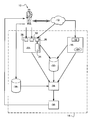
- the work space 12 may be for example a work room or a interface of a personal computer.
- the user 10 is working on the completion of a task, his workspace 12 being in a certain configuration.
- a device 14 is used to determine a optimal layout of the workspace 12.
- the purpose of this device 14 is to help the user 10 to determine the layout of his workspace that will allow him perform the task most efficiently, and possibly help the user 10 to choose the task for which it will be most effective given the workspace 14 of which he disposes.
- This device 14 comprises for that means 16 data measurement environment characteristics of the instant layout state of the workspace 12.
- These measuring means 16 comprise, for example, physical sensors 18 such as than thermometer, pressure gauge, luxmeter, hygrometer.
- the means 16 for measuring environment data may also include a clock 20 indicating the date and the instantaneous time in order to be able to follow the evolution of the data provided by the sensors over time.
- These means 16 for measuring environmental data allow the device 14 to know the environment and the context in which the user works.
- the device 14 also comprises means 22 for measuring a instantaneous efficiency when performing a task. These means 22 for measuring a instantaneous efficiency allow to evaluate the instantaneous performance of the user 10.
- the means 22 for measuring a instant effectiveness include programs 24 scrutinizing actions of the user 10 on computer input / output devices, or documents produced by the user as the task progresses. For example, the number of characters minted, the number of words for a document or the rate at a Conversation can be used to estimate the efficiency of a user 10.
- the programs 24 use sensors 26 monitoring tools used by the user 10 when performing the task.
- these tools is a post phone, a computer keyboard or fax machine. All these tools are part of workspace 12.
- the means 22 for measuring instantaneous efficiency therefore control the actions of the user 10, but they can also control the physical behavior of the user.
- biometric sensors 28 capable of capture including heart rate, blood pressure, body temperature, direction eyes, blinking, arm movements, the force of computer keyboard, user 10.
- the means 22 for measuring an instantaneous efficiency comprise also input means 30 allowing the user 10 to indicate manually an estimate of its effectiveness.
- the means 22 for measuring an instantaneous efficiency then calculate a characteristic function of the efficiency from the data provided by the sensors 26 and 28 and by the user 10. This function is for example a linear combination of parameters captured by the sensors 26 and 28.
- the device 14 therefore comprises at the same time means 16 for measuring environment data and means 22 for measuring instantaneous efficiency.
- the device 14 is initialized during a learning phase taking into account all the layouts of the workspace 14 appeared over time as well as user efficiencies associated with each respective arrangement.
- the device 14 includes for this purpose means 32 for recording the environment data measured by the data measurement means 16 of environment, in relation to the instantaneous efficiency measured by means 22 of measure of instantaneous efficiency, for a task in progress.
- These recording means 32 comprise a database which for example includes a table relating environment data measured, the corresponding instantaneous measured efficiency as well as the task corresponding report made by the user. This table plays a role of history.
- Analysis of the instantaneous data in relation to the history is carried out by means of analysis 34, able to identify, among the environmental data recorded in relation to a particular task, those corresponding to a particular optimal instantaneous efficiency.
- the device 14 can therefore propose to the user 10 executing a certain task, to reproduce a layout of his workspace 12 for which he had got the best efficiency when performing this task.
- These analysis means 34 and the recording means 32 therefore allow predicting, for a given task, an average efficiency of a given user. This prediction can be achieved for example by means of a neural network or a Kalman filter.
- the analysis means 34 know the task performed by the user 10, either because it has filled in manually or by means of recognition task, from the data provided by the means 22 for measuring efficiency, in particular from programs 24 scanning the actions of the user.
- the device 14 comprises an alert device 36 able to warn the user 10 when the efficiency becomes lower than a determined threshold generally calculated on the basis of average efficiency.
- the device 14 can propose to the user 10 to perform a task for which he believes that the user's efficiency will be better.
- the device 14 can be equipped with recording means 38 a to-do list.
- the analysis means 34 are then able to determine, for a given configuration of workspace 12, a task to be executed predictable efficiency considering this configuration is optimal.
- the device 14 can also classify the tasks in order of efficiency in function of the instantaneous arrangement of the workspace and the state of the user. In crossing this information with deadlines for work to be performed by the user 10, the device 14 is able to propose the task corresponding best to the present moment, according to the priorities of the user 10.
- the device 14 thus allows a user 10 to optimize his use of the time based on its instantaneous efficiency and priorities. When a task is accomplished, the device is able to reconfigure itself to offer a new job of the time to the user.
Landscapes
- Engineering & Computer Science (AREA)
- Business, Economics & Management (AREA)
- Human Resources & Organizations (AREA)
- Strategic Management (AREA)
- Economics (AREA)
- Entrepreneurship & Innovation (AREA)
- Educational Administration (AREA)
- Game Theory and Decision Science (AREA)
- Development Economics (AREA)
- Marketing (AREA)
- Operations Research (AREA)
- Quality & Reliability (AREA)
- Tourism & Hospitality (AREA)
- Physics & Mathematics (AREA)
- General Business, Economics & Management (AREA)
- General Physics & Mathematics (AREA)
- Theoretical Computer Science (AREA)
- Management, Administration, Business Operations System, And Electronic Commerce (AREA)
- User Interface Of Digital Computer (AREA)
Abstract
Description
- des moyens de mesure de données d'environnement caractéristiques de l'état d'agencement instantané de l'espace de travail,
- des moyens de mesure d'une efficacité instantanée lors de la réalisation d'une tâche,
- des moyens d'enregistrement des données d'environnement mesurées en relation avec une efficacité instantanée mesurée, pour une tâche en cours de réalisation,
- des moyens d'analyse aptes à identifier, parmi les données d'environnement enregistrées en relation avec une tâche déterminée, celles qui correspondent à une efficacité instantanée optimale.
- les moyens de mesure d'efficacité instantanée comprennent des programmes scrutant des actions d'un utilisateur sur des dispositifs d'entrée/sortie d'ordinateur, ou des documents produits par l'utilisateur au fil de la réalisation de la tâche ;
- le dispositif comprend des moyens de reconnaissance de tâche, à partir des données fournies par les moyens de mesure d'efficacité ;
- les moyens de mesure d'efficacité instantanée comprennent des capteurs surveillant des outils utilisés par l'utilisateur lors de la réalisation de la tâche, tels que poste téléphonique, télécopieur ;
- les moyens de mesure d'efficacité comprennent des moyens de saisie permettant à un utilisateur d'indiquer manuellement une estimation d'efficacité ;
- les moyens de mesure d'efficacité comprennent des capteurs biométriques aptes à capturer notamment le rythme cardiaque, la tension, la température corporelle, la direction du regard, le clignement des yeux, les mouvements de bras, d'un utilisateur ;
- les moyens de mesure de données d'environnement comprennent une horloge indiquant la date et l'heure instantanées ;
- les moyens de mesure de données d'environnement comprennent des capteurs physiques tels que thermomètre, manomètre, luxmètre, hygromètre ;
- le dispositif comprend en outre des moyens d'enregistrement d'une liste de tâches à accomplir ;
- les moyens d'analyse sont aptes à déterminer, pour une configuration donnée de l'espace de travail, une tâche à exécuter dont l'efficacité prévisible compte tenu de cette configuration est optimale ;
- le dispositif comprend un dispositif d'alerte apte à avertir lorsque l'efficacité instantanée mesurée devient inférieure à un seuil prédéterminé. L'invention a également pour objet un dispositif pour agencer automatiquement un espace de travail, comprenant, outre un dispositif pour déterminer un agencement optimal d'un espace de travail tel que décrit précédemment,
- un module d'agencement de l'espace de travail,
- des moyens d'actionnement du module d'agencement, commandés par les moyens d'analyse, pour configurer l'espace de travail dans des conditions propres à produire des données d'environnement identifiées comme correspondant à une efficacité optimale.
- on mesure des données d'environnement caractéristiques de l'état d'agencement instantané de l'espace de travail,
- on mesure une efficacité instantanée lors de la réalisation d'une tâche,
- on enregistre des données d'environnement mesurées en relation avec une efficacité instantanée mesurée, pour une tâche en cours de réalisation,
- on identifie, parmi les données d'environnement enregistrées en relation avec une tâche déterminée, celles qui correspondent à une efficacité instantanée optimale.
- au moins une fonction logicielle pour la capture de données d'environnement caractéristiques de l'état d'agencement instantané de l'espace de travail,
- au moins une fonction logicielle pour la capture d'une efficacité instantanée lors de la réalisation d'une tâche,
- au moins une fonction logicielle pour l'enregistrement de données d'environnement mesurées en relation avec une efficacité instantanée mesurée, pour une tâche en cours de réalisation,
- au moins une fonction logicielle pour l'identification, parmi les données d'environnement enregistrées en relation avec une tâche déterminée, de celles qui correspondent à une efficacité instantanée optimale.
Claims (16)
- Dispositif (14) pour déterminer un agencement optimal d'un espace de travail (12), comprenant :des moyens (16) de mesure de données d'environnement caractéristiques de l'état d'agencement instantané de l'espace de travail (12),des moyens (22) de mesure d'une efficacité instantanée lors de la réalisation d'une tâche,des moyens (32) d'enregistrement des données d'environnement mesurées en relation avec une efficacité instantanée mesurée, pour une tâche en cours de réalisation,des moyens d'analyse (34) aptes à identifier, parmi les données d'environnement enregistrées en relation avec une tâche déterminée, celles qui correspondent à une efficacité instantanée optimale.
- Dispositif (14) selon la revendication 1, dans lequel les moyens (22) de mesure d'efficacité instantanée comprennent des programmes (24) scrutant des actions d'un utilisateur (10) sur des dispositifs d'entrée/sortie d'ordinateur, ou des documents produits par l'utilisateur au fil de la réalisation de la tâche.
- Dispositif (14) selon la revendication 2, comprenant des moyens de reconnaissance de tâche, à partir des données fournies par les moyens de mesure d'efficacité.
- Dispositif (14) selon l'une quelconque des revendications 1 à 3, dans lequel les moyens (22) de mesure d'efficacité instantanée comprennent des capteurs (26) surveillant des outils utilisés par l'utilisateur (10) lors de la réalisation de la tâche, tels que poste téléphonique, télécopieur.
- Dispositif (14) selon l'une quelconque des revendications 1 à 4, dans lequel les moyens (22) de mesure d'efficacité comprennent des moyens de saisie (30) permettant à un utilisateur d'indiquer manuellement une estimation d'efficacité.
- Dispositif (14) selon l'une quelconque des revendications 1 à 5, dans lequel les moyens (22) de mesure d'efficacité comprennent des capteurs biométriques (28) aptes à capturer notamment le rythme cardiaque, la tension, la température corporelle, la direction du regard, le clignement des yeux, les mouvements de bras, d'un utilisateur.
- Dispositif (14) selon l'une quelconque des revendications 1 à 6, dans lequel les moyens (16) de mesure de données d'environnement comprennent une horloge (20) indiquant la date et l'heure instantanées.
- Dispositif (14) selon l'une quelconque des revendications 1 à 7, dans lequel les moyens (16) de mesure de données d'environnement comprennent des capteurs physiques (18) tels que thermomètre, manomètre, luxmètre, hygromètre.
- Dispositif (14) selon l'une quelconque des revendications 1 à 8, comprenant en outre des moyens (38) d'enregistrement d'une liste de tâches à accomplir.
- Dispositif (14) selon la revendication 9, dans lequel les moyens d'analyse (34) sont aptes à déterminer, pour une configuration donnée de l'espace de travail (12), une tâche à exécuter dont l'efficacité prévisible compte tenu de cette configuration est optimale.
- Dispositif (14) selon l'une quelconque des revendications 1 à 10, comprenant un dispositif d'alerte (36) apte à avertir lorsque l'efficacité instantanée mesurée devient inférieure à un seuil prédéterminé.
- Dispositif pour agencer automatiquement un espace de travail, comprenant, outre un dispositif selon l'une quelconque des revendications 1 à 11 :un module d'agencement de l'espace de travail (12),des moyens d'actionnement du module d'agencement, commandés par les moyens d'analyse, pour configurer l'espace de travail dans des conditions propres à produire des données d'environnement identifiées comme correspondant à une efficacité optimale.
- Procédé pour déterminer un agencement optimal d'un espace de travail (12), caractérisé par le fait que l'on exécute les étapes suivantes :on mesure des données d'environnement caractéristiques de l'état d'agencement instantané de l'espace de travail,on mesure une efficacité instantanée lors de la réalisation d'une tâche,on enregistre des données d'environnement mesurées en relation avec une efficacité instantanée mesurée, pour une tâche en cours de réalisation,on identifie, parmi les données d'environnement enregistrées en relation avec une tâche déterminée, celles qui correspondent à une efficacité instantanée optimale.
- Procédé pour agencer automatiquement un espace de travail, dans lequel on détermine un agencement optimal de l'espace de travail par mise en oeuvre d'un procédé selon la revendication 13, et on configure l'espace de travail dans des conditions propres à produire des données d'environnement identifiées comme correspondant à une efficacité optimale.
- Programme d'ordinateur pour l'exécution d'un procédé selon la revendication 13, comprenant :au moins une fonction logicielle pour la capture de données d'environnement caractéristiques de l'état d'agencement instantané de l'espace de travail,au moins une fonction logicielle pour la capture d'une efficacité instantanée lors de la réalisation d'une tâche,au moins une fonction logicielle pour l'enregistrement de données d'environnement mesurées en relation avec une efficacité instantanée mesurée, pour une tâche en cours de réalisation,au moins une fonction logicielle pour l'identification, parmi les données d'environnement enregistrées en relation avec une tâche déterminée, de celles qui correspondent à une efficacité instantanée optimale.
- Support de données lisible par un ordinateur sur lequel est stocké un programme d'ordinateur selon la revendication 15.
Applications Claiming Priority (2)
| Application Number | Priority Date | Filing Date | Title |
|---|---|---|---|
| FR0315527A FR2864661A1 (fr) | 2003-12-29 | 2003-12-29 | Dispositif pour determiner un agencement optimal d'un espace de travail et dispositif pour agencer automatiquement un espace de travail |
| FR0315527 | 2003-12-29 |
Publications (1)
| Publication Number | Publication Date |
|---|---|
| EP1550975A1 true EP1550975A1 (fr) | 2005-07-06 |
Family
ID=34566357
Family Applications (1)
| Application Number | Title | Priority Date | Filing Date |
|---|---|---|---|
| EP04293165A Withdrawn EP1550975A1 (fr) | 2003-12-29 | 2004-12-29 | Dispositif, procédé et programme d'ordinateur pour déterminer un agencement optimal d'un espace de travail, dispositif et procédé pour agencer automatiquement un espace de travail et support de données |
Country Status (2)
| Country | Link |
|---|---|
| EP (1) | EP1550975A1 (fr) |
| FR (1) | FR2864661A1 (fr) |
Citations (3)
| Publication number | Priority date | Publication date | Assignee | Title |
|---|---|---|---|---|
| US5909669A (en) * | 1996-04-01 | 1999-06-01 | Electronic Data Systems Corporation | System and method for generating a knowledge worker productivity assessment |
| US20030084403A1 (en) * | 2001-10-25 | 2003-05-01 | Koninklijke Philips Electronics N.V. | Method and system for processing of information |
| EP1408439A1 (fr) | 2002-10-11 | 2004-04-14 | Northrop Grumman Corporation | Mesure indirecte de processus d'affaires |
-
2003
- 2003-12-29 FR FR0315527A patent/FR2864661A1/fr active Pending
-
2004
- 2004-12-29 EP EP04293165A patent/EP1550975A1/fr not_active Withdrawn
Patent Citations (3)
| Publication number | Priority date | Publication date | Assignee | Title |
|---|---|---|---|---|
| US5909669A (en) * | 1996-04-01 | 1999-06-01 | Electronic Data Systems Corporation | System and method for generating a knowledge worker productivity assessment |
| US20030084403A1 (en) * | 2001-10-25 | 2003-05-01 | Koninklijke Philips Electronics N.V. | Method and system for processing of information |
| EP1408439A1 (fr) | 2002-10-11 | 2004-04-14 | Northrop Grumman Corporation | Mesure indirecte de processus d'affaires |
Also Published As
| Publication number | Publication date |
|---|---|
| FR2864661A1 (fr) | 2005-07-01 |
Similar Documents
| Publication | Publication Date | Title |
|---|---|---|
| US9886338B1 (en) | Health check solution evaluating system status | |
| CN112154411B (zh) | 使用音频数据进行设备控制 | |
| JP2016119096A (ja) | コンピューティングデバイスにおける制御nandフラッシュメモリの遅延トリミング | |
| CN111868686A (zh) | 常用应用程序的导出方法和使用该方法的导出设备 | |
| US20170004827A1 (en) | Data Collection and Reporting System and Method | |
| EP1378842A3 (fr) | Méthode et système permettant de fixer des rendez-vous selon des informations en temps réel | |
| US12124795B2 (en) | Techniques for enhancing an electronic document with an interactive workflow | |
| CN105292124A (zh) | 一种驾驶监测方法和装置 | |
| EP1177766B1 (fr) | Procédé d'acquisition d'une image d'une zone non dermatoglyphique de la peau au moyen d'un dispositif d'acquisition comprenant un capteur non optique. | |
| FR2884635A1 (fr) | Systeme de gestion d'outils de coupe | |
| CN107405111A (zh) | 用于汗液测试管理的可佩戴设备 | |
| CN112306890A (zh) | 人机交互测试系统、控制方法、控制装置和处理器 | |
| US20180315131A1 (en) | User-aware interview engine | |
| JP7147317B2 (ja) | 端末装置、情報処理方法、及びプログラム | |
| US20200285668A1 (en) | Emotional Experience Metadata on Recorded Images | |
| EP1550975A1 (fr) | Dispositif, procédé et programme d'ordinateur pour déterminer un agencement optimal d'un espace de travail, dispositif et procédé pour agencer automatiquement un espace de travail et support de données | |
| CN106197803A (zh) | 跌落数据的采集方法及终端设备 | |
| CN103532826A (zh) | 即时通讯工具中用户状态的设置方法及装置 | |
| JP2012230534A (ja) | 電子機器および電子機器の制御プログラム | |
| CN109597721A (zh) | 一种音频数据采集方法、装置、设备及存储介质 | |
| KR102405474B1 (ko) | 수면 질 향상 방법 | |
| FR3115150A1 (fr) | Procede et système d'asistance au soin du corps | |
| CA2434547C (fr) | Atlas comportant au moins une sequence video | |
| US12141812B2 (en) | User feedback system on product usage | |
| CN119718851A (zh) | 程序使用时长的计算方法、装置、设备及存储介质 |
Legal Events
| Date | Code | Title | Description |
|---|---|---|---|
| PUAI | Public reference made under article 153(3) epc to a published international application that has entered the european phase |
Free format text: ORIGINAL CODE: 0009012 |
|
| AK | Designated contracting states |
Kind code of ref document: A1 Designated state(s): AT BE BG CH CY CZ DE DK EE ES FI FR GB GR HU IE IS IT LI LT LU MC NL PL PT RO SE SI SK TR |
|
| AX | Request for extension of the european patent |
Extension state: AL BA HR LV MK YU |
|
| 17P | Request for examination filed |
Effective date: 20060103 |
|
| AKX | Designation fees paid |
Designated state(s): AT BE BG CH CY CZ DE DK EE ES FI FR GB GR HU IE IS IT LI LT LU MC NL PL PT RO SE SI SK TR |
|
| 17Q | First examination report despatched |
Effective date: 20060203 |
|
| STAA | Information on the status of an ep patent application or granted ep patent |
Free format text: STATUS: THE APPLICATION HAS BEEN WITHDRAWN |
|
| 18W | Application withdrawn |
Effective date: 20080523 |