EP1550963A1 - Data communication mediation apparatus cooperating with purchaser mobile terminal - Google Patents
Data communication mediation apparatus cooperating with purchaser mobile terminal Download PDFInfo
- Publication number
- EP1550963A1 EP1550963A1 EP02733335A EP02733335A EP1550963A1 EP 1550963 A1 EP1550963 A1 EP 1550963A1 EP 02733335 A EP02733335 A EP 02733335A EP 02733335 A EP02733335 A EP 02733335A EP 1550963 A1 EP1550963 A1 EP 1550963A1
- Authority
- EP
- European Patent Office
- Prior art keywords
- portable terminal
- personal identification
- identification information
- server
- purchaser
- Prior art date
- Legal status (The legal status is an assumption and is not a legal conclusion. Google has not performed a legal analysis and makes no representation as to the accuracy of the status listed.)
- Withdrawn
Links
Images




Classifications
-
- G—PHYSICS
- G07—CHECKING-DEVICES
- G07F—COIN-FREED OR LIKE APPARATUS
- G07F7/00—Mechanisms actuated by objects other than coins to free or to actuate vending, hiring, coin or paper currency dispensing or refunding apparatus
- G07F7/08—Mechanisms actuated by objects other than coins to free or to actuate vending, hiring, coin or paper currency dispensing or refunding apparatus by coded identity card or credit card or other personal identification means
- G07F7/0866—Mechanisms actuated by objects other than coins to free or to actuate vending, hiring, coin or paper currency dispensing or refunding apparatus by coded identity card or credit card or other personal identification means by active credit-cards adapted therefor
-
- G—PHYSICS
- G06—COMPUTING OR CALCULATING; COUNTING
- G06F—ELECTRIC DIGITAL DATA PROCESSING
- G06F21/00—Security arrangements for protecting computers, components thereof, programs or data against unauthorised activity
- G06F21/30—Authentication, i.e. establishing the identity or authorisation of security principals
- G06F21/31—User authentication
- G06F21/34—User authentication involving the use of external additional devices, e.g. dongles or smart cards
- G06F21/35—User authentication involving the use of external additional devices, e.g. dongles or smart cards communicating wirelessly
-
- G—PHYSICS
- G06—COMPUTING OR CALCULATING; COUNTING
- G06Q—INFORMATION AND COMMUNICATION TECHNOLOGY [ICT] SPECIALLY ADAPTED FOR ADMINISTRATIVE, COMMERCIAL, FINANCIAL, MANAGERIAL OR SUPERVISORY PURPOSES; SYSTEMS OR METHODS SPECIALLY ADAPTED FOR ADMINISTRATIVE, COMMERCIAL, FINANCIAL, MANAGERIAL OR SUPERVISORY PURPOSES, NOT OTHERWISE PROVIDED FOR
- G06Q20/00—Payment architectures, schemes or protocols
- G06Q20/04—Payment circuits
-
- G—PHYSICS
- G06—COMPUTING OR CALCULATING; COUNTING
- G06Q—INFORMATION AND COMMUNICATION TECHNOLOGY [ICT] SPECIALLY ADAPTED FOR ADMINISTRATIVE, COMMERCIAL, FINANCIAL, MANAGERIAL OR SUPERVISORY PURPOSES; SYSTEMS OR METHODS SPECIALLY ADAPTED FOR ADMINISTRATIVE, COMMERCIAL, FINANCIAL, MANAGERIAL OR SUPERVISORY PURPOSES, NOT OTHERWISE PROVIDED FOR
- G06Q20/00—Payment architectures, schemes or protocols
- G06Q20/08—Payment architectures
- G06Q20/12—Payment architectures specially adapted for electronic shopping systems
-
- G—PHYSICS
- G06—COMPUTING OR CALCULATING; COUNTING
- G06Q—INFORMATION AND COMMUNICATION TECHNOLOGY [ICT] SPECIALLY ADAPTED FOR ADMINISTRATIVE, COMMERCIAL, FINANCIAL, MANAGERIAL OR SUPERVISORY PURPOSES; SYSTEMS OR METHODS SPECIALLY ADAPTED FOR ADMINISTRATIVE, COMMERCIAL, FINANCIAL, MANAGERIAL OR SUPERVISORY PURPOSES, NOT OTHERWISE PROVIDED FOR
- G06Q20/00—Payment architectures, schemes or protocols
- G06Q20/30—Payment architectures, schemes or protocols characterised by the use of specific devices or networks
- G06Q20/32—Payment architectures, schemes or protocols characterised by the use of specific devices or networks using wireless devices
- G06Q20/322—Aspects of commerce using mobile devices [M-devices]
- G06Q20/3226—Use of secure elements separate from M-devices
-
- G—PHYSICS
- G06—COMPUTING OR CALCULATING; COUNTING
- G06Q—INFORMATION AND COMMUNICATION TECHNOLOGY [ICT] SPECIALLY ADAPTED FOR ADMINISTRATIVE, COMMERCIAL, FINANCIAL, MANAGERIAL OR SUPERVISORY PURPOSES; SYSTEMS OR METHODS SPECIALLY ADAPTED FOR ADMINISTRATIVE, COMMERCIAL, FINANCIAL, MANAGERIAL OR SUPERVISORY PURPOSES, NOT OTHERWISE PROVIDED FOR
- G06Q20/00—Payment architectures, schemes or protocols
- G06Q20/30—Payment architectures, schemes or protocols characterised by the use of specific devices or networks
- G06Q20/36—Payment architectures, schemes or protocols characterised by the use of specific devices or networks using electronic wallets or electronic money safes
- G06Q20/363—Payment architectures, schemes or protocols characterised by the use of specific devices or networks using electronic wallets or electronic money safes with the personal data of a user
-
- G—PHYSICS
- G06—COMPUTING OR CALCULATING; COUNTING
- G06Q—INFORMATION AND COMMUNICATION TECHNOLOGY [ICT] SPECIALLY ADAPTED FOR ADMINISTRATIVE, COMMERCIAL, FINANCIAL, MANAGERIAL OR SUPERVISORY PURPOSES; SYSTEMS OR METHODS SPECIALLY ADAPTED FOR ADMINISTRATIVE, COMMERCIAL, FINANCIAL, MANAGERIAL OR SUPERVISORY PURPOSES, NOT OTHERWISE PROVIDED FOR
- G06Q30/00—Commerce
- G06Q30/06—Buying, selling or leasing transactions
Definitions
- the present invention relates generally to authentication processing and, more particularly, to a client computer provided with a data communication intermediation program mediating data communication for personal authentication and settlement authentication in Internet shopping and with a communication intermediation apparatus mediating the above data communication.
- a purchaser browses products published on shop's web pages and selects a product to be purchased utilizing a web browser from a client computer such as a personal computer (hereinafter referred to as PC) connected to the Internet.
- PC personal computer
- the purchaser indicates purchase intention and enters into purchase procedures.
- a personal authentication is executed for clarifying an identity of the purchaser and checking whether the purchaser really has the intention to conduct a transaction
- a settlement authentication is executed for checking whether a payment is performed by the purchaser or whether the purchaser has ability topay.
- the personal authentication is executed based on personal information which is information for identifying the purchasing individual and the settlement authentication is executed based on settlement information, such as a credit card number, a bank account number or the like.
- the personal information and the settlement information are collectively referred to as personal identification information, hereinafter.
- the shop ships the product if results of above personal authentication and settlement authentication are preferable, and the purchase procedures are terminated.
- the personal identification information plays an important role in the Internet shopping.
- the purchaser inputs the personal identification information on the client computer when the personal authentication and the settlement authentication are needed. Since, in the client computer such as PC, the input personal identification information is generally stored in a hard disk, an ill-intentioned third party directly reads the information in the hard disk, reads out the information by intruding into a terminal apparatus via network and peeping remaining histories when the authenticated person is away from the terminal apparatus, resulting in the personal identification information such as accounts, passwords, credit card numbers, addresses and telephone numbers to be easily leaked to the third party other than the purchaser. As a result, "spoofing" can happen, wherein the third party purchases products as if the third party becomes the authenticated person.
- the purchaser may conduct the internet shopping with a purchaser portable terminal provided with a communication function, including a cell phone.
- a communication function including a cell phone.
- data such as the personal identification information are stored in memories inside the purchaser portable terminal instead of being stored in a removable separate apparatus such as a hard disk, the "spoofing" is not likely to happen due to leakage of the personal identification information, comparing to the client computer such as PC.
- a problem exists in regard to difficulty of obtaining sufficient information, because, since the screen size of the purchaser portable terminal is generally small, the purchaser has to switch or scroll the screens in order to select or compare products so that extra efforts are required; communication speed is often slow as compared to PC and the like; it takes lot of time to download data such as images; and the communication charge is expensive; and from other reasons.
- client computer which can display multiple images on one screen for browsing products by the purchaser for the personal authentication and settlement authentication processing, because client computer provides a display screen having the size large enough to give detailed description of the products and a fast communication function to give sufficient information for deciding the purchase, although the personal identification information should not be stored in the place where the data can be leaked to the third party, such as hard disks of the client computer for preventing the "spoofing".
- An object of the present invention is to provide an environment for the purchaser to select products using a client computer, such as PC, with a large screen and better operability and for enabling a personal identification information requested at the time of the personal authentication and the settlement authentication be obtained from a purchaser portable terminal with less risk of leakage of information to a third party, instead of a client computer, to prevent "spoofing", while products are selected.
- a client computer such as PC
- a communication intermediating program causing a client compute connectable to a server via a computer network to execute personal identification processing in cooperation with a portable terminal storing personal identification information therein, the personal identification processing having, in response to a personal identification information request signal from the server, transferring the personal identification information request signal to the portable terminal; and transferring to the server the personal identification information stored in the portable terminal, the personal identification information being sent to the client computer by the portable terminal in response to the personal identification information request signal.
- products are browsed and selected utilizing a client computer, such as PC, with better operability which large screen provides clear and detailed information; the personal authentication and the settlement authentication is executed with the personal identification information stored in the purchaser portable terminal which has less possibility of leakage of the personal identification information to the third party than a terminal apparatus such as PC; and, therefore, the "spoofing" can be prevented.
- a client computer such as PC
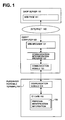
- Fig. 1 shows a configuration example of an embodiment of the present invention.
- a shop server 110 is a server providing a web page 111 of a shop.
- a client computer 120 is installed with a web browser 121 for browsing the web page and a communication intermediation program 122 of the present invention, and further provided with a communication module 123.
- the web browser 121 and the communication intermediation program 122 are implemented on the same operating system and the communication intermediation program 122 can be activated from the web browser 121.
- the shop server 110 and the client computer 120 are connected via Internet 140.
- a purchaser portable terminal 130 is provided with a communication module 131 which can communicate data with the communication module 123 in the client computer 120 and an IC card 132 containing personal identification information 133.
- a communication module 131 which can communicate data with the communication module 123 in the client computer 120 and an IC card 132 containing personal identification information 133.
- Bluetooth or IEEE 802.11 wireless module is preferred.
- the IC card 132 is a chip card with built-in IC chip and has a calculation function, a memory larger than a magnetic card and a high security function.
- the security function includes an encryption function for preventing eavesdropping of data by encrypting and decrypting data transactions with outside of the card with the calculation function and a function for preventing forges, falsifications, interpolations and the like, such that circuitry of the chip itself is destroyed when attempting to disassemble and analyze the IC card due to tamper-resistance (i.e., a property for resisting physical attacks from the outside and making analysis difficult).
- the personal identification information 133 is less likely to leak to the third party than PC, because of protecting not only the personal identification information 133 itself in the IC card 132, but also the transaction of the personal identification information 133 between the IC card 132 and an external apparatus.
- the personal identification information 133 stores a CA•• electronically-signed purchaser portable terminal electronic certificate and a purchaser portable terminal private key as the personal information, and credit card information needed for credit card settlement as the settlement information. Also, for example, the personal identification information 133 may store an address, a name, an age, a telephone number and a blood type as the personal information, and a bank account number and the like as the settlement information.
- the CA••electronically-signed purchaser portable terminal electronic certificate is an electronic certificate issued to the purchaser portable terminal by CA (CertificationAuthority), with a CA electronic signature added.
- the purchaser portable terminal electronic certificate includes a purchaser portable terminal public key, and CA assures that the purchaser portable terminal public key certainly is a possession of the purchaser portable terminal itself.
- the electronic signature utilizes a public key infrastructure, and is generated by converting base data to a message digest following a certain algorithm (hush function) and by encrypting the message digest with the private key of the signer, and is utilized as a pair with the base data.
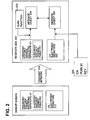
- Fig. 2 shows how to be able to check the credibility of the electronically signed data via network.
- Fig. 2 shows an example of a credibility check of electronically signed data.
- This example is the case that the CA••electronically-signed purchaser portable terminal electronic certificate is received.
- the receiver side 220 compares a message digest 225 obtained by decrypting a CA electronic signature 222 with a CA public key 230 with a message digest 224 obtained by converting a purchaser portable terminal electronic certificate 221 with a hush function 223. If the results are the same, it is known that data is not interpolated in the middle of transmission and that the CA electronic signature 222 certainly has been added to the purchaser portable terminal electroniccertificate221. Since existence of the CA is credible, credibility is established for the received purchaser portable terminal electronic certificate 221.
- the base data is not limited to the electronic certificate and the signer is not limited to CA, and in those cases, the purchaser portable terminal electronic certificate, the CA electronic signature and CA public key may be read differently as corresponding data, an electronic signature of a corresponding signer and a public key of a corresponding signer, respectively. Since the credibility check of an electronically signed document is often performed in the specification, the check procedure is hereinafter referred to as an "electronic signature check".
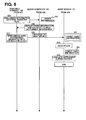
- Fig. 3 is a flowchart of a first embodiment.
- the first embodiment is an example wherein, in the Internet shopping including the personal authentication executed by means of the purchaser portable terminal electronic certificate and the settlement authentication executed by means of the credit card information, a communication intermediation program transfers a personal information request from the shop server to the purchaser portable terminal, transfers the CA•• electronically-signed purchaser portable terminal electronic certificate returned from the purchaser portable terminal to the shop server, transfers a settlement information request from the shop server to the purchaser portable terminal and transfers the credit card information returned from the purchaser portable terminal to the shop server for executing authentication processing respectively.
- the shop server has already obtained a CA electronic key 301. Also, the IC card in the purchaser portable terminal 130 has already stored the CA•• electronically-signed purchaser portable terminal electronic certificate 3 02 and the credit card information 3 03 as the personal identification information.
- the purchaser accesses to the shop server 110 via the Internet, browses seller's web page 111 stored in the shop server 110 and selects products, using a web browser 121 of the client computer 120 with a large screen which facilitates obtaining information and with good operability (S1).
- the purchaser sends order information and purchase intention to the shop server (S2).
- step S2 is achieved by clicking a button provided on the web page for moving to a purchase procedure when the product is selected in advance, and by the click the purchaser is judged to have purchase intention for the product selected by then.
- the order information includes information about the product to be purchased and the number of the product.
- the shop server 110 notifies the client computer 120 of beginning of the purchase procedure (S3).
- step S3 for example, a page is transmitted with special embedded HTML tags indicating the beginning of the purchase.
- the communication intermediation program is activated and starts transfer (S4).
- step S4 for example, the communication intermediation program 122 may be activated when the web browser 121 detects the special HTML tags indicating the beginning of the purchase.
- the shop server 110 sends a personal information request to the client computer 120 in order to execute a personal authentication (S5).
- the communication intermediation program 122 transfers the personal information request to the purchaser portable terminal 130 via a communication module 123 (S6).
- the purchaser portable terminal 130 responds to the personal information request, the purchaser portable terminal 130 returns the CA••electronically-signed purchaser portable terminal electronic certificate 302 from the IC card 132 storing the personal identification information 133, and the CA•• electronically-signed purchaser portable terminal electronic certificate 302 are sent to the client computer 120 via a communication module 131 (S7).
- the communication intermediation program 122 transfers the CA•• electronically-signed purchaser portable terminal electronic certificate to the shop server 110 without storing the CA•• electronically-signed purchaser portable terminal electronic certificate 302 into a hard disk of the client computer (S8).
- the shop server 110 uses a CApublic key 301 to perform an electronic signature check of the CA••electronically-signed purchaser portable terminal electronic certificate 302 (S9). A procedure of the electronic signature check is given in Fig. 2.
- the personal authentication is terminated when credibility of the purchaser portable terminal electronic certificate is established in step S9.
- the shop server 110 requests the settlement information to the client computer 120 (S10).
- the communication intermediation program 122 transfers the settlement information request to the purchaser portable terminal 130 (S11).
- the IC card 132 in the purchaser portable terminal 130 returns credit card information 303, and the credit card information 303 are sent to the client computer 120 via the communication module 131 (S12).
- the communication intermediation program 122 transfers the credit card information to the shop server without storing the credit card information 303 into a hard disk of the client computer (S13).
- the shop server conducts a credit examinationbased on the credit card information 303 and terminates the settlement authentication (S14). Subsequently, although not shown, the first embodiment is terminated through a sipping transaction of the product due to the settlement authentication result.
- the returned credit card information 303 of step S12 is desired to be encrypted in order not to be intercepted by the third party other than the shop server.
- the information may be encrypted by means of the shop server public key.
- the embodiment is an example that the personal authentication and the settlement authentication are executed separately, the personal authentication and the settlement authentication may be executed at the same time.
- the IC card 132 in the purchaser portable terminal 130 may return the CA••electronically-signed purchaser portable terminal electronic certificate 302 and the credit card information 303 simultaneously.
- the personal authentication and the settlement authentication can be completed using the personal identification information which is stored in the IC card in the purchaser portable terminal and is less likely to be leaked to the third party. Therefore, the Internet shopping can be conducted without leaving the personal identification information on the hard disk of the client computer and, at the same time, the spoofing can be prevented which is due to an environment for readout of the personal identification information from the hard disk in spite of facilitating the internet shopping.
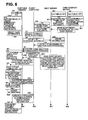
- Figs. 4 and 5 are flowcharts of a second embodiment.
- lower ends of flows 407, 408, 409 respectively for the portable terminal 130, the client computer 120 and the shop server 110 continue to upper ends of corresponding flows of Fig. 5, and therefore, the description is conducted by combining the two figures together.
- the second embodiment is an example wherein, in the Internet shopping including the personal authentication executed by means of the purchaser portable terminal electronic certificate and the settlement authentication executed by means of the credit card information, the communication intermediation program transfers the personal information request from the shop server to the purchaser portable terminal, transfers the CA-signed purchaser signature returned from the purchaser portable terminal to the shop server, transfers the settlement information request from the shop server to the purchaser portable terminal and transfers to the shop server the settlement information, encrypted based on common key cryptography and returned from the purchaser portable terminal for executing authentication processing respectively.
- the IC card in the purchaser portable terminal 130 has already obtained the CA•• electronically-signed purchaser portable terminal electronic certificate 302 and the credit card information 303 as the personal identification information
- the shop server 110 has already obtained a CA••electronically-signed shop server electronic certificate 401.
- the purchaser portable terminal and the shop server have already obtained the CA public key 301.
- Fig. 4 first, the purchaser accesses to the shop server 110 via the Internet, browses seller's web page 111 stored in the shop server 110 and selects products, using a web browser 121 of the client computer 120 with a large screen which facilitates obtaining information and with good operability (S1).
- the purchaser sends order information 402 and purchase intention to the shop server (S2) .
- step S2 is achieved by clicking a button provided on the web page for moving to a purchase procedure and by the click the purchaser is judged to have purchase intention for the product selected by then.
- the order information 402 is information about the product to be purchased and the number of the product.
- the shop server 110 notifies the client computer 120 of beginning of the purchase procedure (S3).
- step S3 for example, a page is transmitted with special embedded HTML tags indicating the beginning of the purchase.
- the communication intermediation program is activated and starts transfer (S4).
- step S4 for example, the communication intermediation program 122 may be activated when the web browser 121 detects the special HTML tags indicating the beginning of the purchase.
- the shop server 110 sends the personal information request and the CA••electronically-signed shop server electronic certificate 401 to the client computer 120 (S15).
- the communication intermediation program 122 transfers the personal information request and the CA••electronically-signed shop server electronic certificate 401 to the purchaser portable terminal 130 (S16).
- the IC card 132 in the purchaser portable terminal 130 uses the CA public key 301 to perform an electronic signature check of the CA••electronically-signed shop server electronic certificate 401 (S17).
- the shop server authentication is terminated when credibility of the shop server electronic certificate is established in step S17.
- the IC card 132 in the purchaser portable terminal 130 returns the CA•• electronically-signed purchaser portable terminal electronic certificate 302, and the CA••electronically-signed purchaser portable terminal electronic certificate is sent to the client computer 120 (S18).
- the communication intermediation program 122 transfers the CA••electronically-signed purchaser portable terminal electronic certificate to the shop server 110 without storing the CA••electronically-signed purchaser portable terminal electronic certificate 302 into the hard disk of the client computer 120 (S19).
- the shop server 110 performs an electronic signature check of the CA••electronically-signed purchaser portable terminal electronic certificate 302 (S20).
- the personal authentication is terminated when credibility of the purchaser portable terminal electronic certificate is established in step S20. Since the credibility of the purchaser portable terminal electronic certificate is established in step S20, a purchaser portable terminal public key 403 is stored, which is included in the purchaser portable terminal electronic certificate, for later use.
- the shop server 110 generates a session key which is equivalent to a common key for encrypting subsequent communication with the common key cryptography (S21).
- the shop server 110 encrypts the session key 404 and the order information 402 using the purchaser portable terminal public key 403 and sends an encrypted session key 405 and encrypted order information 406 to the client computer (S22).
- the session key 404 and the order information 402 can not be read out unless one has a purchaser portable terminal private key, that is effectively, can only be decrypted by the purchaser portable terminal.
- the communication intermediation program 122 transfers the encrypted session key 405 and the encrypted order information 406 to the purchaser portable terminal (S23).
- the IC card in the purchaser portable terminal 130 decrypts the encrypted session key 405 and the encrypted order information 406 using the purchaser portable terminal private key to pick up the session key 404 and the order information (S24).
- the IC card••132 in the purchaser portable terminal 130 returns the order information 402 with a no-transfer flag in order to make the purchaser confirm the purchasing product on the client computer, and the order information is sent to the client computer 120 via the communication module 131 (S25).
- the no-transfer flag is used when it is not desirable for the intermediate program to transfer data.
- the no-transfer flag is achieved by sending a page embedded with special HTML tags indicating the no-transfer flag.
- the communication intermediate program 122 detects theno-transferflag, makes the web browser 121 display the order information 402 for making the purchaser conduct a final confirmation of the order information and, when receiving the result of the final confirmation, sends a settlement information request to the purchaser portable terminal unless the purchase is cancelled (S26).
- the IC card••132 in the purchaser portable terminal 130 returns encrypted credit card information 501 which is credit card information 303 encrypted by the session key 404 and the encrypted credit card information 501 is sent to the client computer (S27).
- the communication intermediate program 122 transfers the encrypted credit card information to the shop server 110 without storing the encrypted credit card information 501 into the hard disk of the client computer 120 (S28).
- the shop server 110 the encrypted credit card information is decrypted and the credit card information 303 is picked up (S29).
- the settlement authentication is completed with the credit examination of the credit card (S30). Subsequently, although not shown, the second embodiment is terminated through a sipping transaction of the product due to the settlement authentication result.
- the personal authentication and the settlement authentication can be completed using the personal identification information which is stored in the IC card in the purchaser portable terminal and is less likely to be leaked to the third party. Encryption of the communication between the shop server and the purchaser portable terminal is done. No the personal identification information is left on the hard disk of the client computer. Therefore, while maintaining an environment for facilitating the internet shopping, not only the spoofing can be prevented which is caused by readout of the personal identification information from the hard disk of the client computer, but also the spoofing can be prevented which is caused by eavesdropping of the communication among the purchaser portable terminal, the client computer and the shop server.
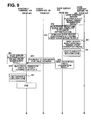
- Figs. 6, 7, 8 and 9 are flowcharts of a third embodiment.
- the third embodiment is an example that the present invention is applied to a mechanism called SET (Secure Electronic Transaction), which is developed as a standard specification of existing credit card settlement.
- SET Secure Electronic Transaction
- the third embodiment shows an example that, in the Internet shopping, the personal authentication is executed by means of the purchaser portable terminal electronic certificate and the settlement authentication is executed by means of the credit card information.
- the communication intermediation program transfers the personal information request from the shop server to the purchaser portable terminal, transfers the CA•• electronically-signed purchaser signature returned from the purchaser portable terminal to the shop server, transfers the settlement information request from the shop server to the purchaser portable terminal and transfers to the shop server the data including credit card information encrypted based on a card company server public key and returned from the purchaser portable terminal.
- the purchaser portable terminal 130 can process a function of software called Wallet, which is generally executed by PC of the purchaser in SET. Also, the purchaser portable terminal 130 has already obtained the CA••electronically-signed purchaser portable terminal electronic certificate 302; the shop server 110 has already obtained a CA••electronically-signed shop server electronic certificate 401; and the card company server 150 has already obtained a CA••electronically-signed card company server electronic certificate 601. Further, the purchaser portable terminal 130, the shop server 110 and the card company server 150 have already obtained the CA public key 301.
- the card company server sends CA••electronically-signed card company server electronic certificate 401 to the shop server in advance (S31).
- Fig. 6 first, the purchaser accesses to the shop server 110 via the Internet, browses seller's web page 111 stored in the shop server 110 and selects products, using a web browser 121 of the client computer 120 with a large screenwhich facilitates obtaining information and with good operability (S1).
- the purchaser sends order information 402 and purchase intention to the shop server (S2).
- step S2 is achieved by clicking a button provided on the web page for moving to a purchase procedure and by the click the purchaser is judged to have purchase intention for the product selected by then.
- the order information 402 is information about the product to be purchased and the number of the product.
- the shop server 110 notifies the client computer 120 of beginning of the purchase procedure (S3).
- step S3 for example, a page is transmitted with special embedded HTML tags indicating the beginning of the purchase.
- the communication intermediation program is activated and starts transfer (S4).
- the shop server 110 sends to the client computer 120 the CA••electronically-signed card company server electronic certificate 601, the CA••electronically-signed shop server electronic certificate 401 and the order information 402 (S32).
- the communication intermediation program 122 transfers to the purchaser portable terminal 130 the CA••electronically-signed card company server electronic certificate 601, the CA•• electronically-signed shop server electronic certificate 401 and the order information 402 (S33).
- the IC card 132 in the purchaser portable terminal 130 uses the CA public key 301 to perform the electronic signature check of the CA••electronically-signed shop server electronic certificate 401 and executes a shop server authentication (S34). If the authentication succeeds, a shop server public key 602 is stored, which is included in the shop server electronic certificate. Subsequently, Using the CA public key, the electronic signature check is performed also for the CA•• electronically-signed card company server electronic certificate 601 to execute a card company server authentication (S35). If the authentication succeeds, a card company server public key 603 is stored, which is included in the card company server electronic certificate.
- the IC card 132 in the purchaser portable terminal 130 generates a purchaser portable terminal electronic signature using the order information 402 as base data to form purchaser portable terminal electronically-signed order information 604 (S36).
- the purchaser portable terminal electronic signature ensures that the order has been issued by the purchaser and, therefore, the purchaser can not explain away.
- the IC card 132 in the purchaser portable terminal 130 summarizes the credit card information 303 and a message digest generated from the order information 402 as the settlement information and generates encrypted settlement information 701 by encrypting with the card company public key 603 (S37). Consequently, the credit card information can only be decrypted by a private key of the credit card company and will not be underlooked by the shop. In this way, the CA••electronically-signed purchaser portable terminal electronic certificate 302, the purchaser portable terminal electronically-signed order information 604 and the encrypted settlement information 701 are sent to the client computer 120 (S38).
- the communication intermediate program 122 transfers to the shop server the CA••electronically-signed purchaser portable terminal electronic certificate 302, the purchaser••portable terminal••electronically-signed order information 604 and the encrypted settlement information 701 encrypted with the credit card company server public key (S39).
- the shop server 110 performs the electronic signature check of the CA•• electronically-signed purchaser portable terminal electronic certificate 302 and executes the personal authentication (S40). If the authentication succeeds, the purchaser portable terminal public key 403 is stored. Then, the electronic signature check is performed for the purchaser••portable terminal•• electronically-signed order information 604 (S41). If results of comparison are the same, the order information is credible and the shop can find out the name, the number and the like of a product tobe offered to the purchaser.
- the shop server As proof of the agreement of the order between the purchaser and the shop, the shop server generates a shop server electronic signature using a message digest generated from the order information 402 as base data and generates a shop server electronically-signed message digest 702 (S42). Then, the shop server 110 sends to the card company server 150 the CA••electronically-signed purchaser portable terminal electronic certificate 302, the CA•• electronically-signed shop server electronic certificate 401, the shop server electronically-signed message digest 702 and the settlement information 701••encrypted with the card company server public key 603 (S43).
- the message digest rather than the order information, details of the order will not be transmitted to the card company, and the card company will only know total amount and the fact that the agreement has been reached between the purchaser and the shop for the order.
- the card company server 150 performs the electronic signature check of the CA••electronically-signed shop server electronic certificate 401 and executes a shop server authentication (S44). If the authentication succeeds, the shop server public key 602 is stored, which is included in the shop server electronic certificate.
- Fig. 8 is used from here.
- the card company server 150 performs the electronic signature check of the CA•• electronically-signed purchaser portable terminal electronic certificate 302 and executes a personal authentication (S45). If the authentication succeeds, the purchaser portable terminal public key 403 is stored, which is included in the purchaser portable terminal electronic certificate. Then, the encrypted settlement information 701 is decrypted using the card company server private key (S46). The credit information is picked up from the settlement information and a settlement authentication is executed by performing the credit examination (S47). Further, the electronic signature check is performed for the shop server electronically-signed message digest 702 to confirm that the agreement has been reached between the purchaser and the shop for the order (S48).
- the card company server 150 can not comprehend the direct order information 402, the card company server 150 can confirm that the seller has checked the details of the order information 402 from the purchaser in step S42. Then, a sent message digest 702 is compared to a message digest which has been generated from the order information 402 and which is obtained when the settlement information 304 is decrypted (S49). The comparison is performed in order to confirm whether the settlement amount is based on the order information 402. If results of the comparison are the same, it is confirmed that the amount charged by the shop certainly is based on the order information 402 of the purchaser. In order to notify the shop of a result of the examination, a card company server electronically-signed examination result 801 is generated (S50). The card company server 150 send to the shop server the card company server electronically-signed examination result 801 and the settlement information 701 encrypted with the card company server public key 603 (S51).
- Fig. 9 is used from here.
- the shop server 110 performs the electronic signature check of the card company server electronically-signed examination result 801 and completes the settlement authentication with the examination result (S52).
- a shop server electronic signature is generated using the examination result as base data, and a shop server electronically-signed examination result 901 is generated (S53).
- the shop server electronically-signed examination result 901 and the settlement information 701 encrypted with the card company server public key 603 are sent to the client computer 120.
- the communication intermediation program 122 transfers the shop server electronically-signed examination result 901 and the encrypted settlement information 701 to the purchaser portable terminal 130 (S55).
- the IC card 132 in the purchaser portable terminal 130 performs the electronic signature check of the shop server electronically-signed examination result 901, and after the credibility is confirmed, the examination results is checked (S56). At this point, the purchaser portable terminal notifies the client computer of completion of entire processing and, for example, the notification may be displayed by the browser. In this way, the third embodiment is terminated.
- the personal authentication and the settlement authentication can be completed using the personal identification information which is stored in the IC card in the purchaser portable terminal and which is less likely to be leaked to the third party, and also directly utilizing the existing mechanism of SET.
- the spoofing can be prevented which is caused by readout of the personal identification information from the hard disk of the client computer, but also the spoofing can be prevented which is caused by eavesdropping of the communication among the purchaser portable terminal, the client computer, the shop server and the card company server, and further, if equipment for SET have been installed, the equipment can be directly utilized, resulting in a benefit that the past equipment investment does not hove to be wasted.
- an environment can be provided for a personal authentication and a settlement authentication without storing personal identification information of the purchaser into a hard disk of the client computer which the possibility that data can be read out by a third party, so that the spoofing can be prevented.
- an encryption function included in an IC card in a purchaser portable terminal communication data can be protected between a server and the purchaser portable terminal, so that the spoofing can be prevented, which is due to eavesdropping of the personal identification information.
Landscapes
- Business, Economics & Management (AREA)
- Engineering & Computer Science (AREA)
- Accounting & Taxation (AREA)
- Theoretical Computer Science (AREA)
- Physics & Mathematics (AREA)
- General Physics & Mathematics (AREA)
- Strategic Management (AREA)
- General Business, Economics & Management (AREA)
- Finance (AREA)
- Computer Networks & Wireless Communication (AREA)
- Computer Security & Cryptography (AREA)
- Computer Hardware Design (AREA)
- Software Systems (AREA)
- General Engineering & Computer Science (AREA)
- Development Economics (AREA)
- Economics (AREA)
- Marketing (AREA)
- Financial Or Insurance-Related Operations Such As Payment And Settlement (AREA)
- Management, Administration, Business Operations System, And Electronic Commerce (AREA)
Abstract
In a personalauthentication and a settlement authentication
required for the Internet shopping, in order to make above
authentication processing executed between a server and a client
computer be executed between the server and a purchaser portable
terminal equipped with personal identification information and
a communication function, a program of the present invention
has functions for transferring to the purchaser portable terminal
a personal identification information request sent from the
server and data associated with the authentication processing
and for transferring to the server the data associated with the
authentication processing sent from the purchaser portable
terminal. Due to the program, while products are selected with
a client computer such as a personal computer with a large screen
and good operability, personal identification information
required for the personal authentication and a settlement
authentication is transmitted from the purchaser portable
terminal and will not be stored in a hard disk of the client
computer. Also, by encrypting communication, leakage of the
personal identification information to a third party can be
prevented and, as a result, the "spoofing" can be prevented.
Description
The present invention relates generally to authentication
processing and, more particularly, to a client computer provided
with a data communication intermediation program mediating data
communication for personal authentication and settlement
authentication in Internet shopping and with a communication
intermediation apparatus mediating the above data communication.
Currently, a series of actions is widely conducted as
Internet shopping for purchasing items such as products or
services from web sites of individuals, corporations or the like
created on the Internet and executing payment-settlement
procedures. In this specification, a service is considered as
one of products which can be selected by purchasers, and items
such as products or services are described as products for the
sake of simplicity.
First, a purchaser browses products published on shop's
web pages and selects a product to be purchased utilizing a web
browser from a client computer such as a personal computer
(hereinafter referred to as PC) connected to the Internet. When
the product to be purchased is determined, the purchaser indicates
purchase intention and enters into purchase procedures. In the
purchase procedures, a personal authentication is executed for
clarifying an identity of the purchaser and checking whether
the purchaser really has the intention to conduct a transaction,
and a settlement authentication is executed for checking whether
a payment is performed by the purchaser or whether the purchaser
has ability topay. The personal authentication is executed based
on personal information which is information for identifying
the purchasing individual and the settlement authentication is
executed based on settlement information, such as a credit card
number, a bank account number or the like. In this specification,
the personal information and the settlement information are
collectively referred to as personal identification information,
hereinafter. The shop ships the product if results of above
personal authentication and settlement authentication are
preferable, and the purchase procedures are terminated.
In this way, the personal identification information plays
an important role in the Internet shopping.
However, in the case of the Internet shopping conducted
by the client computer such as PC, the purchaser inputs the personal
identification information on the client computer when the
personal authentication and the settlement authentication are
needed. Since, in the client computer such as PC, the input
personal identification information is generally stored in a
hard disk, an ill-intentioned third party directly reads the
information in the hard disk, reads out the information by
intruding into a terminal apparatus via network and peeping
remaining histories when the authenticated person is away from
the terminal apparatus, resulting in the personal identification
information such as accounts, passwords, credit card numbers,
addresses and telephone numbers to be easily leaked to the third
party other than the purchaser. As a result, "spoofing" can
happen, wherein the third party purchases products as if the
third party becomes the authenticated person.
On the other hand, the purchaser may conduct the internet
shopping with a purchaser portable terminal provided with a
communication function, including a cell phone. In this case,
since data such as the personal identification information are
stored in memories inside the purchaser portable terminal instead
of being stored in a removable separate apparatus such as a hard
disk, the "spoofing" is not likely to happen due to leakage of
the personal identification information, comparing to the client
computer such as PC. However, a problem exists in regard to
difficulty of obtaining sufficient information, because, since
the screen size of the purchaser portable terminal is generally
small, the purchaser has to switch or scroll the screens in order
to select or compare products so that extra efforts are required;
communication speed is often slow as compared to PC and the like;
it takes lot of time to download data such as images; and the
communication charge is expensive; and from other reasons.
Therefore, what is needed is to use a client computer which
can display multiple images on one screen for browsing products
by the purchaser for the personal authentication and settlement
authentication processing, because client computer provides a
display screen having the size large enough to give detailed
description of the products and a fast communication function
to give sufficient information for deciding the purchase,
although the personal identification information should not be
stored in the place where the data can be leaked to the third
party, such as hard disks of the client computer for preventing
the "spoofing".
An object of the present invention is to provide an
environment for the purchaser to select products using a client
computer, such as PC, with a large screen and better operability
and for enabling a personal identification information requested
at the time of the personal authentication and the settlement
authentication be obtained from a purchaser portable terminal
with less risk of leakage of information to a third party, instead
of a client computer, to prevent "spoofing", while products are
selected.
In order to achieve the above object, there is provided
a communication intermediating program causing a client compute
connectable to a server via a computer network to execute personal
identification processing in cooperation with a portable terminal
storing personal identification information therein, the
personal identification processing having, in response to a
personal identification information request signal from the
server, transferring the personal identification information
request signal to the portable terminal; and transferring to
the server the personal identification information stored in
the portable terminal, the personal identification information
being sent to the client computer by the portable terminal in
response to the personal identification information request
signal.
According to the above invention, products are browsed and
selected utilizing a client computer, such as PC, with better
operability which large screen provides clear and detailed
information; the personal authentication and the settlement
authentication is executed with the personal identification
information stored in the purchaser portable terminal which has
less possibility of leakage of the personal identification
information to the third party than a terminal apparatus such
as PC; and, therefore, the "spoofing" can be prevented.
Embodiments of the present invention will now be described
with reference to the drawings. It is however to be noted that
the technical field of the present invention is not limited to
those embodiments but covers the invention as defined in the
appended claims and equivalents thereof.
Fig. 1 shows a configuration example of an embodiment of
the present invention.
A shop server 110 is a server providing a web page 111 of
a shop. A client computer 120 is installed with a web browser
121 for browsing the web page and a communication intermediation
program 122 of the present invention, and further provided with
a communication module 123. The web browser 121 and the
communication intermediation program 122 are implemented on the
same operating system and the communication intermediation
program 122 can be activated from the web browser 121.
The shop server 110 and the client computer 120 are connected
via Internet 140.
A purchaser portable terminal 130 is provided with a
communication module 131 which can communicate data with the
communication module 123 in the client computer 120 and an IC
card 132 containing personal identification information 133.
As an example of the communicationmodule 123 and the communication
module 131, Bluetooth or IEEE 802.11 wireless module is preferred.
The IC card 132 is a chip card with built-in IC chip and
has a calculation function, a memory larger than a magnetic card
and a high security function. The security function includes
an encryption function for preventing eavesdropping of data by
encrypting and decrypting data transactions with outside of the
card with the calculation function and a function for preventing
forges, falsifications, interpolations and the like, such that
circuitry of the chip itself is destroyed when attempting to
disassemble and analyze the IC card due to tamper-resistance
(i.e., a property for resisting physical attacks from the outside
and making analysis difficult). In this way, the personal
identification information 133 is less likely to leak to the
third party than PC, because of protecting not only the personal
identification information 133 itself in the IC card 132, but
also the transaction of the personal identification information
133 between the IC card 132 and an external apparatus.
The personal identification information 133 stores a CA••
electronically-signed purchaser portable terminal electronic
certificate and a purchaser portable terminal private key as
the personal information, and credit card information needed
for credit card settlement as the settlement information. Also,
for example, the personal identification information 133 may
store an address, a name, an age, a telephone number and a blood
type as the personal information, and a bank account number and
the like as the settlement information.
The CA••electronically-signed purchaser portable terminal
electronic certificate is an electronic certificate issued to
the purchaser portable terminal by CA (CertificationAuthority),
with a CA electronic signature added. The purchaser portable
terminal electronic certificate includes a purchaser portable
terminal public key, and CA assures that the purchaser portable
terminal public key certainly is a possession of the purchaser
portable terminal itself.
The electronic signature utilizes a public key
infrastructure, and is generated by converting base data to a
message digest following a certain algorithm (hush function)
and by encrypting the message digest with the private key of
the signer, and is utilized as a pair with the base data. Fig.
2 shows how to be able to check the credibility of the
electronically signed data via network.
Fig. 2 shows an example of a credibility check of
electronically signed data. This example is the case that the
CA••electronically-signed purchaser portable terminal
electronic certificate is received. The receiver side 220
compares a message digest 225 obtained by decrypting a CA
electronic signature 222 with a CA public key 230 with a message
digest 224 obtained by converting a purchaser portable terminal
electronic certificate 221 with a hush function 223. If the
results are the same, it is known that data is not interpolated
in the middle of transmission and that the CA electronic signature
222 certainly has been added to the purchaser portable terminal
electroniccertificate221. Since existence of the CA is credible,
credibility is established for the received purchaser portable
terminal electronic certificate 221. The base data is not limited
to the electronic certificate and the signer is not limited to
CA, and in those cases, the purchaser portable terminal electronic
certificate, the CA electronic signature and CA public key may
be read differently as corresponding data, an electronic
signature of a corresponding signer and a public key of a
corresponding signer, respectively. Since the credibility
check of an electronically signed document is often performed
in the specification, the check procedure is hereinafter referred
to as an "electronic signature check".
Fig. 3 is a flowchart of a first embodiment. The first
embodiment is an example wherein, in the Internet shopping
including the personal authentication executed by means of the
purchaser portable terminal electronic certificate and the
settlement authentication executed by means of the credit card
information, a communication intermediation program transfers
a personal information request from the shop server to the
purchaser portable terminal, transfers the CA••
electronically-signed purchaser portable terminal electronic
certificate returned from the purchaser portable terminal to
the shop server, transfers a settlement information request from
the shop server to the purchaser portable terminal and transfers
the credit card information returned from the purchaser portable
terminal to the shop server for executing authentication
processing respectively.
On the assumption of the embodiment, the shop server has
already obtained a CA electronic key 301. Also, the IC card in
the purchaser portable terminal 130 has already stored the CA••
electronically-signed purchaser portable terminal electronic
certificate 3 02 and the credit card information 3 03 as the personal
identification information.
First, the purchaser accesses to the shop server 110 via
the Internet, browses seller's web page 111 stored in the shop
server 110 and selects products, using a web browser 121 of the
client computer 120 with a large screen which facilitates
obtaining information and with good operability (S1). When
deciding a product to be purchased, the purchaser sends order
information and purchase intention to the shop server (S2). For
example, step S2 is achieved by clicking a button provided on
the web page for moving to a purchase procedure when the product
is selected in advance, and by the click the purchaser is judged
to have purchase intention for the product selected by then.
The order information includes information about the product
to be purchased and the number of the product.
The shop server 110 notifies the client computer 120 of
beginning of the purchase procedure (S3). In step S3, for example,
a page is transmitted with special embedded HTML tags indicating
the beginning of the purchase. In response to the notification
of the beginning of the purchase procedure, the communication
intermediation program is activated and starts transfer (S4).
In step S4, for example, the communication intermediation program
122 may be activated when the web browser 121 detects the special
HTML tags indicating the beginning of the purchase. Then, the
shop server 110 sends a personal information request to the client
computer 120 in order to execute a personal authentication (S5).
The communication intermediation program 122 transfers the
personal information request to the purchaser portable terminal
130 via a communication module 123 (S6). Responding to the
personal information request, the purchaser portable terminal
130 returns the CA••electronically-signed purchaser portable
terminal electronic certificate 302 from the IC card 132 storing
the personal identification information 133, and the CA••
electronically-signed purchaser portable terminal electronic
certificate 302 are sent to the client computer 120 via a
communication module 131 (S7). The communication
intermediation program 122 transfers the CA••
electronically-signed purchaser portable terminal electronic
certificate to the shop server 110 without storing the CA••
electronically-signed purchaser portable terminal electronic
certificate 302 into a hard disk of the client computer (S8).
The shop server 110 uses a CApublic key 301 to perform an electronic
signature check of the CA••electronically-signed purchaser
portable terminal electronic certificate 302 (S9). A procedure
of the electronic signature check is given in Fig. 2. The personal
authentication is terminated when credibility of the purchaser
portable terminal electronic certificate is established in step
S9.
When the personal authentication succeeds in step S9, then,
the shop server 110 requests the settlement information to the
client computer 120 (S10). The communication intermediation
program 122 transfers the settlement information request to the
purchaser portable terminal 130 (S11). Responding to the
settlement information request, the IC card 132 in the purchaser
portable terminal 130 returns credit card information 303, and
the credit card information 303 are sent to the client computer
120 via the communication module 131 (S12). The communication
intermediation program 122 transfers the credit card information
to the shop server without storing the credit card information
303 into a hard disk of the client computer (S13). The shop server
conducts a credit examinationbased on the credit card information
303 and terminates the settlement authentication (S14).
Subsequently, although not shown, the first embodiment is
terminated through a sipping transaction of the product due to
the settlement authentication result.
The returned credit card information 303 of step S12 is
desired to be encrypted in order not to be intercepted by the
third party other than the shop server. For example, if the
purchaser portable terminal 130 has obtained a shop server public
key, the information may be encrypted by means of the shop server
public key. Although the embodiment is an example that the
personal authentication and the settlement authentication are
executed separately, the personal authentication and the
settlement authentication may be executed at the same time. In
this case, in step S7, the IC card 132 in the purchaser portable
terminal 130 may return the CA••electronically-signed purchaser
portable terminal electronic certificate 302 and the credit card
information 303 simultaneously.
According to the embodiment, while using the client computer
with a large screen for selecting the product, the personal
authentication and the settlement authentication can be completed
using the personal identification information which is stored
in the IC card in the purchaser portable terminal and is less
likely to be leaked to the third party. Therefore, the Internet
shopping can be conducted without leaving the personal
identification information on the hard disk of the client computer
and, at the same time, the spoofing can be prevented which is
due to an environment for readout of the personal identification
information from the hard disk in spite of facilitating the
internet shopping.
Figs. 4 and 5 are flowcharts of a second embodiment. In
Fig. 4, lower ends of flows 407, 408, 409 respectively for the
portable terminal 130, the client computer 120 and the shop server
110 continue to upper ends of corresponding flows of Fig. 5,
and therefore, the description is conducted by combining the
two figures together. The second embodiment is an example wherein,
in the Internet shopping including the personal authentication
executed by means of the purchaser portable terminal electronic
certificate and the settlement authentication executed by means
of the credit card information, the communication intermediation
program transfers the personal information request from the shop
server to the purchaser portable terminal, transfers the
CA-signed purchaser signature returned from the purchaser
portable terminal to the shop server, transfers the settlement
information request from the shop server to the purchaser portable
terminal and transfers to the shop server the settlement
information, encrypted based on common key cryptography and
returned from the purchaser portable terminal for executing
authentication processing respectively.
On the assumption of the embodiment, the IC card in the
purchaser portable terminal 130 has already obtained the CA••
electronically-signed purchaser portable terminal electronic
certificate 302 and the credit card information 303 as the personal
identification information, and the shop server 110 has already
obtained a CA••electronically-signed shop server electronic
certificate 401. The purchaser portable terminal and the shop
server have already obtained the CA public key 301.
In Fig. 4, first, the purchaser accesses to the shop server
110 via the Internet, browses seller's web page 111 stored in
the shop server 110 and selects products, using a web browser
121 of the client computer 120 with a large screen which facilitates
obtaining information and with good operability (S1). When
deciding a product to be purchased, the purchaser sends order
information 402 and purchase intention to the shop server (S2) .
For example, step S2 is achieved by clicking a button provided
on the web page for moving to a purchase procedure and by the
click the purchaser is judged to have purchase intention for
the product selected by then. The order information 402 is
information about the product to be purchased and the number
of the product.
The shop server 110 notifies the client computer 120 of
beginning of the purchase procedure (S3). In step S3, for example,
a page is transmitted with special embedded HTML tags indicating
the beginning of the purchase. In response to the notification
of the beginning of the purchase procedure, the communication
intermediation program is activated and starts transfer (S4).
In step S4, for example, the communication intermediation program
122 may be activated when the web browser 121 detects the special
HTML tags indicating the beginning of the purchase.
The shop server 110 sends the personal information request
and the CA••electronically-signed shop server electronic
certificate 401 to the client computer 120 (S15). The
communication intermediation program 122 transfers the personal
information request and the CA••electronically-signed shop
server electronic certificate 401 to the purchaser portable
terminal 130 (S16). The IC card 132 in the purchaser portable
terminal 130 uses the CA public key 301 to perform an electronic
signature check of the CA••electronically-signed shop server
electronic certificate 401 (S17). The shop server
authentication is terminated when credibility of the shop server
electronic certificate is established in step S17.
After the shop server authentication of step S17, in response
to the personal information request, the IC card 132 in the
purchaser portable terminal 130 returns the CA••
electronically-signed purchaser portable terminal electronic
certificate 302, and the CA••electronically-signed purchaser
portable terminal electronic certificate is sent to the client
computer 120 (S18). The communication intermediation program
122 transfers the CA••electronically-signed purchaser portable
terminal electronic certificate to the shop server 110 without
storing the CA••electronically-signed purchaser portable
terminal electronic certificate 302 into the hard disk of the
client computer 120 (S19). The shop server 110 performs an
electronic signature check of the CA••electronically-signed
purchaser portable terminal electronic certificate 302 (S20).
The personal authentication is terminated when credibility of
the purchaser portable terminal electronic certificate is
established in step S20. Since the credibility of the purchaser
portable terminal electronic certificate is established in step
S20, a purchaser portable terminal public key 403 is stored,
which is included in the purchaser portable terminal electronic
certificate, for later use.
Then the shop server 110 generates a session key which is
equivalent to a common key for encrypting subsequent
communication with the common key cryptography (S21). The shop
server 110 encrypts the session key 404 and the order information
402 using the purchaser portable terminal public key 403 and
sends an encrypted session key 405 and encrypted order information
406 to the client computer (S22). By encryption using the
purchaser portable terminal public key 403, the session key 404
and the order information 402 can not be read out unless one
has a purchaser portable terminal private key, that is effectively,
can only be decrypted by the purchaser portable terminal. The
communication intermediation program 122 transfers the encrypted
session key 405 and the encrypted order information 406 to the
purchaser portable terminal (S23). The IC card in the purchaser
portable terminal 130 decrypts the encrypted session key 405
and the encrypted order information 406 using the purchaser
portable terminal private key to pick up the session key 404
and the order information (S24).
Reference is hereinafter made to Fig. 5. Subsequently, The
IC card••132 in the purchaser portable terminal 130 returns the
order information 402 with a no-transfer flag in order to make
the purchaser confirm the purchasing product on the client
computer, and the order information is sent to the client computer
120 via the communication module 131 (S25). The no-transfer flag
is used when it is not desirable for the intermediate program
to transfer data. For example, the no-transfer flag is achieved
by sending a page embedded with special HTML tags indicating
the no-transfer flag. The communication intermediate program
122 detects theno-transferflag, makes the web browser 121 display
the order information 402 for making the purchaser conduct a
final confirmation of the order information and, when receiving
the result of the final confirmation, sends a settlement
information request to the purchaser portable terminal unless
the purchase is cancelled (S26).
In response to the settlement information request, the IC
card••132 in the purchaser portable terminal 130 returns encrypted
credit card information 501 which is credit card information
303 encrypted by the session key 404 and the encrypted credit
card information 501 is sent to the client computer (S27). The
communication intermediate program 122 transfers the encrypted
credit card information to the shop server 110 without storing
the encrypted credit card information 501 into the hard disk
of the client computer 120 (S28). In the shop server 110, the
encrypted credit card information is decrypted and the credit
card information 303 is picked up (S29). Then, the settlement
authentication is completed with the credit examination of the
credit card (S30). Subsequently, although not shown, the second
embodiment is terminated through a sipping transaction of the
product due to the settlement authentication result.
According to the embodiment, while using the client computer
with a large screen for selecting the product, the personal
authentication and the settlement authentication can be completed
using the personal identification information which is stored
in the IC card in the purchaser portable terminal and is less
likely to be leaked to the third party. Encryption of the
communication between the shop server and the purchaser portable
terminal is done. No the personal identification information
is left on the hard disk of the client computer. Therefore, while
maintaining an environment for facilitating the internet shopping,
not only the spoofing can be prevented which is caused by readout
of the personal identification information from the hard disk
of the client computer, but also the spoofing can be prevented
which is caused by eavesdropping of the communication among the
purchaser portable terminal, the client computer and the shop
server.
Figs. 6, 7, 8 and 9 are flowcharts of a third embodiment.
As is the case with the relationship between Figs. 4 and 5, lower
ends of flows of Fig. 6, lower ends of flows of Fig. 7 and lower
ends of flows of Fig. 8 continue to upper ends of flows of Fig.
7, upper end of flows of Fig. 8 and upper end of flows of Fig.
9, respectively, and therefore, the description is conducted
by combining the four figures together. The third embodiment
is an example that the present invention is applied to a mechanism
called SET (Secure Electronic Transaction), which is developed
as a standard specification of existing credit card settlement.
The third embodiment shows an example that, in the Internet
shopping, the personal authentication is executed by means of
the purchaser portable terminal electronic certificate and the
settlement authentication is executed by means of the credit
card information. For executing authentication processing
respectively the communication intermediation program transfers
the personal information request from the shop server to the
purchaser portable terminal, transfers the CA••
electronically-signed purchaser signature returned from the
purchaser portable terminal to the shop server, transfers the
settlement information request from the shop server to the
purchaser portable terminal and transfers to the shop server
the data including credit card information encrypted based on
a card company server public key and returned from the purchaser
portable terminal.
On the assumption of the embodiment, the purchaser portable
terminal 130 can process a function of software called Wallet,
which is generally executed by PC of the purchaser in SET. Also,
the purchaser portable terminal 130 has already obtained the
CA••electronically-signed purchaser portable terminal
electronic certificate 302; the shop server 110 has already
obtained a CA••electronically-signed shop server electronic
certificate 401; and the card company server 150 has already
obtained a CA••electronically-signed card company server
electronic certificate 601. Further, the purchaser portable
terminal 130, the shop server 110 and the card company server
150 have already obtained the CA public key 301.
The card company server sends CA••electronically-signed
card company server electronic certificate 401 to the shop server
in advance (S31).
In Fig. 6, first, the purchaser accesses to the shop server
110 via the Internet, browses seller's web page 111 stored in
the shop server 110 and selects products, using a web browser
121 of the client computer 120 with a large screenwhich facilitates
obtaining information and with good operability (S1). When
deciding a product to be purchased, the purchaser sends order
information 402 and purchase intention to the shop server (S2).
For example, step S2 is achieved by clicking a button provided
on the web page for moving to a purchase procedure and by the
click the purchaser is judged to have purchase intention for
the product selected by then. The order information 402 is
information about the product to be purchased and the number
of the product.
The shop server 110 notifies the client computer 120 of
beginning of the purchase procedure (S3). In step S3, for example,
a page is transmitted with special embedded HTML tags indicating
the beginning of the purchase. In response to the notification
of the beginning of the purchase procedure, the communication
intermediation program is activated and starts transfer (S4).
The shop server 110 sends to the client computer 120 the
CA••electronically-signed card company server electronic
certificate 601, the CA••electronically-signed shop server
electronic certificate 401 and the order information 402 (S32).
The communication intermediation program 122 transfers to the
purchaser portable terminal 130 the CA••electronically-signed
card company server electronic certificate 601, the CA••
electronically-signed shop server electronic certificate 401
and the order information 402 (S33).
The IC card 132 in the purchaser portable terminal 130 uses
the CA public key 301 to perform the electronic signature check
of the CA••electronically-signed shop server electronic
certificate 401 and executes a shop server authentication (S34).
If the authentication succeeds, a shop server public key 602
is stored, which is included in the shop server electronic
certificate. Subsequently, Using the CA public key, the
electronic signature check is performed also for the CA••
electronically-signed card company server electronic
certificate 601 to execute a card company server authentication
(S35). If the authentication succeeds, a card company server
public key 603 is stored, which is included in the card company
server electronic certificate. Then, the IC card 132 in the
purchaser portable terminal 130 generates a purchaser portable
terminal electronic signature using the order information 402
as base data to form purchaser portable terminal
electronically-signed order information 604 (S36). The
purchaser portable terminal electronic signature ensures that
the order has been issued by the purchaser and, therefore, the
purchaser can not explain away.
Reference is hereinafter made to Fig. 7. Also, the IC card
132 in the purchaser portable terminal 130 summarizes the credit
card information 303 and a message digest generated from the
order information 402 as the settlement information and generates
encrypted settlement information 701 by encrypting with the card
company public key 603 (S37). Consequently, the credit card
information can only be decrypted by a private key of the credit
card company and will not be underlooked by the shop. In this
way, the CA••electronically-signed purchaser portable terminal
electronic certificate 302, the purchaser portable terminal
electronically-signed order information 604 and the encrypted
settlement information 701 are sent to the client computer 120
(S38). The communication intermediate program 122 transfers to
the shop server the CA••electronically-signed purchaser portable
terminal electronic certificate 302, the purchaser••portable
terminal••electronically-signed order information 604 and the
encrypted settlement information 701 encrypted with the credit
card company server public key (S39). The shop server 110
performs the electronic signature check of the CA••
electronically-signed purchaser portable terminal electronic
certificate 302 and executes the personal authentication (S40).
If the authentication succeeds, the purchaser portable terminal
public key 403 is stored. Then, the electronic signature check
is performed for the purchaser••portable terminal••
electronically-signed order information 604 (S41). If results
of comparison are the same, the order information is credible
and the shop can find out the name, the number and the like of
a product tobe offered to the purchaser. As proof of the agreement
of the order between the purchaser and the shop, the shop server
generates a shop server electronic signature using a message
digest generated from the order information 402 as base data
and generates a shop server electronically-signed message digest
702 (S42). Then, the shop server 110 sends to the card company
server 150 the CA••electronically-signed purchaser portable
terminal electronic certificate 302, the CA••
electronically-signed shop server electronic certificate 401,
the shop server electronically-signed message digest 702 and
the settlement information 701••encrypted with the card company
server public key 603 (S43). By sending the message digest,
rather than the order information, details of the order will
not be transmitted to the card company, and the card company
will only know total amount and the fact that the agreement has
been reached between the purchaser and the shop for the order.
The card company server 150 performs the electronic
signature check of the CA••electronically-signed shop server
electronic certificate 401 and executes a shop server
authentication (S44). If the authentication succeeds, the shop
server public key 602 is stored, which is included in the shop
server electronic certificate.
Fig. 8 is used from here. Subsequently, the card company
server 150 performs the electronic signature check of the CA••
electronically-signed purchaser portable terminal electronic
certificate 302 and executes a personal authentication (S45).
If the authentication succeeds, the purchaser portable terminal
public key 403 is stored, which is included in the purchaser
portable terminal electronic certificate. Then, the encrypted
settlement information 701 is decrypted using the card company
server private key (S46). The credit information is picked up
from the settlement information and a settlement authentication
is executed by performing the credit examination (S47). Further,
the electronic signature check is performed for the shop server
electronically-signed message digest 702 to confirm that the
agreement has been reached between the purchaser and the shop
for the order (S48). Although the card company server 150 can
not comprehend the direct order information 402, the card company
server 150 can confirm that the seller has checked the details
of the order information 402 from the purchaser in step S42.
Then, a sent message digest 702 is compared to a message digest
which has been generated from the order information 402 and which
is obtained when the settlement information 304 is decrypted
(S49). The comparison is performed in order to confirm whether
the settlement amount is based on the order information 402.
If results of the comparison are the same, it is confirmed that
the amount charged by the shop certainly is based on the order
information 402 of the purchaser. In order to notify the shop
of a result of the examination, a card company server
electronically-signed examination result 801 is generated (S50).
The card company server 150 send to the shop server the card
company server electronically-signed examination result 801 and
the settlement information 701 encrypted with the card company
server public key 603 (S51).
Fig. 9 is used from here. The shop server 110 performs the
electronic signature check of the card company server
electronically-signed examination result 801 and completes the
settlement authentication with the examination result (S52).
In order to notify the purchaser, a shop server electronic
signature is generated using the examination result as base data,
and a shop server electronically-signed examination result 901
is generated (S53). The shop server electronically-signed
examination result 901 and the settlement information 701
encrypted with the card company server public key 603 are sent
to the client computer 120.
The communication intermediation program 122 transfers the
shop server electronically-signed examination result 901 and
the encrypted settlement information 701 to the purchaser
portable terminal 130 (S55).
The IC card 132 in the purchaser portable terminal 130
performs the electronic signature check of the shop server
electronically-signed examination result 901, and after the
credibility is confirmed, the examination results is checked
(S56). At this point, the purchaser portable terminal notifies
the client computer of completion of entire processing and, for
example, the notification may be displayed by the browser. In
this way, the third embodiment is terminated.
According to the embodiment, while using the client computer
with a large screen for selecting the product, the personal
authentication and the settlement authentication can be completed
using the personal identification information which is stored
in the IC card in the purchaser portable terminal and which is
less likely to be leaked to the third party, and also directly
utilizing the existing mechanism of SET. Therefore, while
maintaining an environment for facilitating the internet shopping,
not only the spoofing can be prevented which is caused by readout
of the personal identification information from the hard disk
of the client computer, but also the spoofing can be prevented
which is caused by eavesdropping of the communication among the
purchaser portable terminal, the client computer, the shop server
and the card company server, and further, if equipment for SET
have been installed, the equipment can be directly utilized,
resulting in a benefit that the past equipment investment does
not hove to be wasted.
Above described embodiments of the present invention are
not limited to the authentication processing associated with
the purchase transaction conducted by the shop server and can
be applied to the authenticationprocessing associated with other
transactions.
As described above, according to the present invention,
in the Internet shopping, while using the client computer with
a large screen for selecting the product, an environment can
be provided for a personal authentication and a settlement
authentication without storing personal identification
information of the purchaser into a hard disk of the client computer
which the possibility that data can be read out by a third party,
so that the spoofing can be prevented.• • Further, by using an
encryption function included in an IC card in a purchaser portable
terminal, communication data can be protected between a server
and the purchaser portable terminal, so that the spoofing can
be prevented, which is due to eavesdropping of the personal
identification information.
Claims (9)
- A program causing a client compute connectable to a server via a computer network to execute personal identification processing in cooperation with a portable terminal storing personal identification information therein, the personal identification processing comprising:in response to a personal identification information request signal from the server, transferring the personal identification information request signal to the portable terminal; andtransferring to the server the personal identification information stored in the portable terminal, the personal identification information being sent to the client computer by the portable terminal in response to the personal identification information request signal.
- The program according to claim 1, wherein
the personal identification processing further comprises:
when received data contains a non-transfer flag, not transferring the received data. - The program according to claim 1, wherein
the program causes the client computer to execute, prior to the personal identification processing, starting up in response to a start-up instruction corresponding to an instruction from a shop server during a session of an electronic commerce in which a browser installed in the client computer connected to the server is used. - The program according to claim 1, wherein
the personal identification information includes at least one of personal information identifying an individual who conducts the electronic commerce and settlement information of the individual who conducts the electronic commerce. - The program according to claim 3, wherein
the personal information includes a personal electronic certificate of the portable terminal and an electronic signature of a certification authority on the personal electronic certificate. - The program according to claim 3, wherein
the settlement information includes either a credit card ID or a charge account ID of a financial institution. - The program according to claim 1, wherein
the personal identification information sent to the client computer by the portable terminal in response to the personal identification information request signal is encrypted in compliance with a predetermined encryption key. - The program according to claim 7, wherein
the predetermined encryption key is either a public key of the server or a credit card company or a session key generated during the electronic commerce session. - A client computer connectable via a computer network to a server which executes••personal identification processsing in cooperation with a portable terminal storing personal identification information therein, comprising:transfer unit which, in response to a personal identification information request signal from the server, transfers the personal identification information request signal to the portable terminal; andtransfer unit which transfers to the server the personal identification information stored in the portable terminal, the personal identification information being sent to the client computer by the portable terminal in response to the personal identification information request signal.
Applications Claiming Priority (1)
| Application Number | Priority Date | Filing Date | Title |
|---|---|---|---|
| PCT/JP2002/005582 WO2003105037A1 (en) | 2002-06-06 | 2002-06-06 | Data communication mediation apparatus cooperating with purchaser mobile terminal |
Publications (2)
| Publication Number | Publication Date |
|---|---|
| EP1550963A1 true EP1550963A1 (en) | 2005-07-06 |
| EP1550963A4 EP1550963A4 (en) | 2006-05-03 |
Family
ID=29727318
Family Applications (1)
| Application Number | Title | Priority Date | Filing Date |
|---|---|---|---|
| EP02733335A Withdrawn EP1550963A4 (en) | 2002-06-06 | 2002-06-06 | DATA COMMUNICATION MEDIATION APPARATUS COOPERATING WITH A BUYING MOBILE TERMINAL |
Country Status (3)
| Country | Link |
|---|---|
| EP (1) | EP1550963A4 (en) |
| JP (1) | JPWO2003105037A1 (en) |
| WO (1) | WO2003105037A1 (en) |
Cited By (2)
| Publication number | Priority date | Publication date | Assignee | Title |
|---|---|---|---|---|
| WO2011132025A1 (en) * | 2010-04-19 | 2011-10-27 | Logomotion, S.R.O. | The process of selling in electronic shop accessible from the mobile communication device |
| GB2506591A (en) * | 2012-09-28 | 2014-04-09 | Bell Identification Bv | Method of providing secure services using a mobile device |
Families Citing this family (11)
| Publication number | Priority date | Publication date | Assignee | Title |
|---|---|---|---|---|
| KR100648064B1 (en) * | 2004-01-14 | 2006-11-23 | 주식회사 케이티프리텔 | Authentication wireless terminal, electronic transaction system and method using same |
| KR20110105841A (en) * | 2008-12-23 | 2011-09-27 | 엠티엔 모바일 머니 에스에이 (피티와이) 엘티디 | Methods and systems for securely handling transactions |
| CN103780620B (en) * | 2014-01-22 | 2017-05-24 | 牟大同 | Network security method and network security system |
| JP2016034132A (en) * | 2015-09-17 | 2016-03-10 | 馮 光 | Caller-led communication method, communication system, and electronic payment system |
| CN106997529B (en) | 2016-01-25 | 2021-12-24 | 创新先进技术有限公司 | Credit payment method and device based on mobile terminal eSE |
| JP2017050009A (en) * | 2016-10-15 | 2017-03-09 | 馮 光 | Caller-led communication method, communication system, and electronic payment system |
| JP2018133090A (en) * | 2018-03-04 | 2018-08-23 | 馮 光 | Caller-led communication method, communication system, and electronic payment system |
| JP2019053778A (en) * | 2018-12-20 | 2019-04-04 | 馮 光 | Caller-led communication method, communication system, and electronic payment system |
| JP2020057395A (en) * | 2019-11-20 | 2020-04-09 | 馮 光 | Called party leadership based communication method, communication system, and electronic settlement system |
| JP2020074188A (en) * | 2020-01-23 | 2020-05-14 | 馮 光 | Called party leadership based communication method, communication system, and electronic settlement system |
| JP2021047901A (en) * | 2020-12-11 | 2021-03-25 | 馮 光 | Called party leadership based communication method, communication system, and electronic settlement system |
Family Cites Families (7)
| Publication number | Priority date | Publication date | Assignee | Title |
|---|---|---|---|---|
| EP0690399A3 (en) * | 1994-06-30 | 1997-05-02 | Tandem Computers Inc | Remote financial transaction system |
| DE19710249C2 (en) * | 1997-03-12 | 2002-03-28 | Siemens Nixdorf Inf Syst | Network-supported chip card transaction method and arrangement for processing transactions |
| JP2000138672A (en) * | 1998-11-02 | 2000-05-16 | Ntt Data Corp | Communication method and card system |
| JP3594180B2 (en) * | 1999-02-18 | 2004-11-24 | 松下電器産業株式会社 | Content provision method |
| WO2000079411A2 (en) * | 1999-06-21 | 2000-12-28 | Sun Microsystems, Inc. | Method and apparatus for commercial transactions via the internet |
| US20020029254A1 (en) * | 2000-09-06 | 2002-03-07 | Davis Terry L. | Method and system for managing personal information |
| JP2002083243A (en) * | 2000-09-07 | 2002-03-22 | Dainippon Printing Co Ltd | Payment method on the Internet using mobile phone |
-
2002
- 2002-06-06 EP EP02733335A patent/EP1550963A4/en not_active Withdrawn
- 2002-06-06 WO PCT/JP2002/005582 patent/WO2003105037A1/en not_active Ceased
- 2002-06-06 JP JP2004512039A patent/JPWO2003105037A1/en not_active Withdrawn
Cited By (2)
| Publication number | Priority date | Publication date | Assignee | Title |
|---|---|---|---|---|
| WO2011132025A1 (en) * | 2010-04-19 | 2011-10-27 | Logomotion, S.R.O. | The process of selling in electronic shop accessible from the mobile communication device |
| GB2506591A (en) * | 2012-09-28 | 2014-04-09 | Bell Identification Bv | Method of providing secure services using a mobile device |
Also Published As
| Publication number | Publication date |
|---|---|
| JPWO2003105037A1 (en) | 2005-10-13 |
| EP1550963A4 (en) | 2006-05-03 |
| WO2003105037A1 (en) | 2003-12-18 |
Similar Documents
| Publication | Publication Date | Title |
|---|---|---|
| EP1710980B1 (en) | Authentication services using mobile device | |
| JP4469376B2 (en) | Mobile phone, method and computer system for conducting cashless transactions using mobile phone | |
| US20180189767A1 (en) | Systems and methods for utilizing payment card information with a secure biometric processor on a mobile device | |
| US20110276496A1 (en) | Secure protocol for transactions | |
| US20110103586A1 (en) | System, Method and Device To Authenticate Relationships By Electronic Means | |
| EP3454274A1 (en) | Verification of portable consumer devices | |
| US8132244B2 (en) | Mobile smartcard based authentication | |
| JP2009526321A (en) | System for executing a transaction in a point-of-sale information management terminal using a changing identifier | |
| JP2000222362A (en) | Method and apparatus for enabling multiple security check points | |
| US20110202762A1 (en) | Method and apparatus for carrying out secure electronic communication | |
| US20190347661A1 (en) | Coordinator managed payments | |
| US20070033136A1 (en) | Secured financial transaction device | |
| US20050138429A1 (en) | Data communication intermediation program and apparatus for promoting authentication processing in cooperation with purchaser portable terminal having personal identification information and communication function | |
| EP1550963A1 (en) | Data communication mediation apparatus cooperating with purchaser mobile terminal | |
| US20250259158A1 (en) | Systems and methods for terminal device attestation for contactless payments | |
| Venkataramani et al. | Mobile phone based RFID architecture for secure electronic Payments using RFID credit cards | |
| JP2009276838A (en) | Information processing system, information processor, transaction processing method, transaction information processing method and transaction information processing program | |
| JP2002259866A (en) | Mobile terminal connection type card reader device and authentication settlement method using the same | |
| CN106330888A (en) | Method and device for ensuring security of Internet online payment | |
| US8788430B2 (en) | Apparatus with electronic information transfer function or the like, program for electronic information transfer, and method for electronic information transfer | |
| AU2021329996A1 (en) | Electronic payments systems, methods and apparatus | |
| JP2004537814A (en) | Acquisition method of service provided through data network | |
| WO2001092982A2 (en) | System and method for secure transactions via a communications network | |
| KR20150025140A (en) | On-line payment system and method of payment | |
| TWI817096B (en) | A tokenization scanning code payment system, method and computer readable medium |
Legal Events
| Date | Code | Title | Description |
|---|---|---|---|
| PUAI | Public reference made under article 153(3) epc to a published international application that has entered the european phase |
Free format text: ORIGINAL CODE: 0009012 |
|
| 17P | Request for examination filed |
Effective date: 20041229 |
|
| AK | Designated contracting states |
Kind code of ref document: A1 Designated state(s): AT BE CH CY DE DK ES FI FR GB GR IE IT LI LU MC NL PT SE TR |
|
| RBV | Designated contracting states (corrected) |
Designated state(s): DE FR GB |
|
| A4 | Supplementary search report drawn up and despatched |
Effective date: 20060317 |
|
| R17C | First examination report despatched (corrected) |
Effective date: 20070117 |
|
| STAA | Information on the status of an ep patent application or granted ep patent |
Free format text: STATUS: THE APPLICATION IS DEEMED TO BE WITHDRAWN |
|
| 18D | Application deemed to be withdrawn |
Effective date: 20070728 |