EP1550865A1 - Process for producing packing for resolving optical isomers - Google Patents
Process for producing packing for resolving optical isomers Download PDFInfo
- Publication number
- EP1550865A1 EP1550865A1 EP03751399A EP03751399A EP1550865A1 EP 1550865 A1 EP1550865 A1 EP 1550865A1 EP 03751399 A EP03751399 A EP 03751399A EP 03751399 A EP03751399 A EP 03751399A EP 1550865 A1 EP1550865 A1 EP 1550865A1
- Authority
- EP
- European Patent Office
- Prior art keywords
- optically active
- polymer compound
- porous carrier
- active polymer
- stirring
- Prior art date
- Legal status (The legal status is an assumption and is not a legal conclusion. Google has not performed a legal analysis and makes no representation as to the accuracy of the status listed.)
- Granted
Links
- 0 **[N+](NCI)[O-] Chemical compound **[N+](NCI)[O-] 0.000 description 1
Images



Classifications
-
- B—PERFORMING OPERATIONS; TRANSPORTING
- B01—PHYSICAL OR CHEMICAL PROCESSES OR APPARATUS IN GENERAL
- B01J—CHEMICAL OR PHYSICAL PROCESSES, e.g. CATALYSIS OR COLLOID CHEMISTRY; THEIR RELEVANT APPARATUS
- B01J20/00—Solid sorbent compositions or filter aid compositions; Sorbents for chromatography; Processes for preparing, regenerating or reactivating thereof
- B01J20/30—Processes for preparing, regenerating, or reactivating
- B01J20/32—Impregnating or coating ; Solid sorbent compositions obtained from processes involving impregnating or coating
- B01J20/3231—Impregnating or coating ; Solid sorbent compositions obtained from processes involving impregnating or coating characterised by the coating or impregnating layer
- B01J20/3242—Layers with a functional group, e.g. an affinity material, a ligand, a reactant or a complexing group
- B01J20/3268—Macromolecular compounds
- B01J20/3272—Polymers obtained by reactions otherwise than involving only carbon to carbon unsaturated bonds
-
- B—PERFORMING OPERATIONS; TRANSPORTING
- B01—PHYSICAL OR CHEMICAL PROCESSES OR APPARATUS IN GENERAL
- B01J—CHEMICAL OR PHYSICAL PROCESSES, e.g. CATALYSIS OR COLLOID CHEMISTRY; THEIR RELEVANT APPARATUS
- B01J20/00—Solid sorbent compositions or filter aid compositions; Sorbents for chromatography; Processes for preparing, regenerating or reactivating thereof
- B01J20/281—Sorbents specially adapted for preparative, analytical or investigative chromatography
- B01J20/282—Porous sorbents
-
- B—PERFORMING OPERATIONS; TRANSPORTING
- B01—PHYSICAL OR CHEMICAL PROCESSES OR APPARATUS IN GENERAL
- B01D—SEPARATION
- B01D15/00—Separating processes involving the treatment of liquids with solid sorbents; Apparatus therefor
- B01D15/08—Selective adsorption, e.g. chromatography
- B01D15/10—Selective adsorption, e.g. chromatography characterised by constructional or operational features
- B01D15/18—Selective adsorption, e.g. chromatography characterised by constructional or operational features relating to flow patterns
- B01D15/1814—Recycling of the fraction to be distributed
- B01D15/1821—Simulated moving beds
-
- B—PERFORMING OPERATIONS; TRANSPORTING
- B01—PHYSICAL OR CHEMICAL PROCESSES OR APPARATUS IN GENERAL
- B01J—CHEMICAL OR PHYSICAL PROCESSES, e.g. CATALYSIS OR COLLOID CHEMISTRY; THEIR RELEVANT APPARATUS
- B01J20/00—Solid sorbent compositions or filter aid compositions; Sorbents for chromatography; Processes for preparing, regenerating or reactivating thereof
- B01J20/22—Solid sorbent compositions or filter aid compositions; Sorbents for chromatography; Processes for preparing, regenerating or reactivating thereof comprising organic material
- B01J20/26—Synthetic macromolecular compounds
-
- B—PERFORMING OPERATIONS; TRANSPORTING
- B01—PHYSICAL OR CHEMICAL PROCESSES OR APPARATUS IN GENERAL
- B01J—CHEMICAL OR PHYSICAL PROCESSES, e.g. CATALYSIS OR COLLOID CHEMISTRY; THEIR RELEVANT APPARATUS
- B01J20/00—Solid sorbent compositions or filter aid compositions; Sorbents for chromatography; Processes for preparing, regenerating or reactivating thereof
- B01J20/22—Solid sorbent compositions or filter aid compositions; Sorbents for chromatography; Processes for preparing, regenerating or reactivating thereof comprising organic material
- B01J20/26—Synthetic macromolecular compounds
- B01J20/262—Synthetic macromolecular compounds obtained otherwise than by reactions only involving carbon to carbon unsaturated bonds, e.g. obtained by polycondensation
-
- B—PERFORMING OPERATIONS; TRANSPORTING
- B01—PHYSICAL OR CHEMICAL PROCESSES OR APPARATUS IN GENERAL
- B01J—CHEMICAL OR PHYSICAL PROCESSES, e.g. CATALYSIS OR COLLOID CHEMISTRY; THEIR RELEVANT APPARATUS
- B01J20/00—Solid sorbent compositions or filter aid compositions; Sorbents for chromatography; Processes for preparing, regenerating or reactivating thereof
- B01J20/22—Solid sorbent compositions or filter aid compositions; Sorbents for chromatography; Processes for preparing, regenerating or reactivating thereof comprising organic material
- B01J20/26—Synthetic macromolecular compounds
- B01J20/265—Synthetic macromolecular compounds modified or post-treated polymers
-
- B—PERFORMING OPERATIONS; TRANSPORTING
- B01—PHYSICAL OR CHEMICAL PROCESSES OR APPARATUS IN GENERAL
- B01J—CHEMICAL OR PHYSICAL PROCESSES, e.g. CATALYSIS OR COLLOID CHEMISTRY; THEIR RELEVANT APPARATUS
- B01J20/00—Solid sorbent compositions or filter aid compositions; Sorbents for chromatography; Processes for preparing, regenerating or reactivating thereof
- B01J20/28—Solid sorbent compositions or filter aid compositions; Sorbents for chromatography; Processes for preparing, regenerating or reactivating thereof characterised by their form or physical properties
- B01J20/28002—Solid sorbent compositions or filter aid compositions; Sorbents for chromatography; Processes for preparing, regenerating or reactivating thereof characterised by their form or physical properties characterised by their physical properties
- B01J20/28004—Sorbent size or size distribution, e.g. particle size
-
- B—PERFORMING OPERATIONS; TRANSPORTING
- B01—PHYSICAL OR CHEMICAL PROCESSES OR APPARATUS IN GENERAL
- B01J—CHEMICAL OR PHYSICAL PROCESSES, e.g. CATALYSIS OR COLLOID CHEMISTRY; THEIR RELEVANT APPARATUS
- B01J20/00—Solid sorbent compositions or filter aid compositions; Sorbents for chromatography; Processes for preparing, regenerating or reactivating thereof
- B01J20/28—Solid sorbent compositions or filter aid compositions; Sorbents for chromatography; Processes for preparing, regenerating or reactivating thereof characterised by their form or physical properties
- B01J20/28054—Solid sorbent compositions or filter aid compositions; Sorbents for chromatography; Processes for preparing, regenerating or reactivating thereof characterised by their form or physical properties characterised by their surface properties or porosity
- B01J20/28078—Pore diameter
-
- B—PERFORMING OPERATIONS; TRANSPORTING
- B01—PHYSICAL OR CHEMICAL PROCESSES OR APPARATUS IN GENERAL
- B01J—CHEMICAL OR PHYSICAL PROCESSES, e.g. CATALYSIS OR COLLOID CHEMISTRY; THEIR RELEVANT APPARATUS
- B01J20/00—Solid sorbent compositions or filter aid compositions; Sorbents for chromatography; Processes for preparing, regenerating or reactivating thereof
- B01J20/281—Sorbents specially adapted for preparative, analytical or investigative chromatography
-
- B—PERFORMING OPERATIONS; TRANSPORTING
- B01—PHYSICAL OR CHEMICAL PROCESSES OR APPARATUS IN GENERAL
- B01J—CHEMICAL OR PHYSICAL PROCESSES, e.g. CATALYSIS OR COLLOID CHEMISTRY; THEIR RELEVANT APPARATUS
- B01J20/00—Solid sorbent compositions or filter aid compositions; Sorbents for chromatography; Processes for preparing, regenerating or reactivating thereof
- B01J20/281—Sorbents specially adapted for preparative, analytical or investigative chromatography
- B01J20/282—Porous sorbents
- B01J20/285—Porous sorbents based on polymers
-
- B—PERFORMING OPERATIONS; TRANSPORTING
- B01—PHYSICAL OR CHEMICAL PROCESSES OR APPARATUS IN GENERAL
- B01J—CHEMICAL OR PHYSICAL PROCESSES, e.g. CATALYSIS OR COLLOID CHEMISTRY; THEIR RELEVANT APPARATUS
- B01J20/00—Solid sorbent compositions or filter aid compositions; Sorbents for chromatography; Processes for preparing, regenerating or reactivating thereof
- B01J20/281—Sorbents specially adapted for preparative, analytical or investigative chromatography
- B01J20/286—Phases chemically bonded to a substrate, e.g. to silica or to polymers
-
- B—PERFORMING OPERATIONS; TRANSPORTING
- B01—PHYSICAL OR CHEMICAL PROCESSES OR APPARATUS IN GENERAL
- B01J—CHEMICAL OR PHYSICAL PROCESSES, e.g. CATALYSIS OR COLLOID CHEMISTRY; THEIR RELEVANT APPARATUS
- B01J20/00—Solid sorbent compositions or filter aid compositions; Sorbents for chromatography; Processes for preparing, regenerating or reactivating thereof
- B01J20/281—Sorbents specially adapted for preparative, analytical or investigative chromatography
- B01J20/29—Chiral phases
-
- B—PERFORMING OPERATIONS; TRANSPORTING
- B01—PHYSICAL OR CHEMICAL PROCESSES OR APPARATUS IN GENERAL
- B01J—CHEMICAL OR PHYSICAL PROCESSES, e.g. CATALYSIS OR COLLOID CHEMISTRY; THEIR RELEVANT APPARATUS
- B01J20/00—Solid sorbent compositions or filter aid compositions; Sorbents for chromatography; Processes for preparing, regenerating or reactivating thereof
- B01J20/30—Processes for preparing, regenerating, or reactivating
- B01J20/32—Impregnating or coating ; Solid sorbent compositions obtained from processes involving impregnating or coating
- B01J20/3202—Impregnating or coating ; Solid sorbent compositions obtained from processes involving impregnating or coating characterised by the carrier, support or substrate used for impregnation or coating
- B01J20/3204—Inorganic carriers, supports or substrates
-
- B—PERFORMING OPERATIONS; TRANSPORTING
- B01—PHYSICAL OR CHEMICAL PROCESSES OR APPARATUS IN GENERAL
- B01J—CHEMICAL OR PHYSICAL PROCESSES, e.g. CATALYSIS OR COLLOID CHEMISTRY; THEIR RELEVANT APPARATUS
- B01J20/00—Solid sorbent compositions or filter aid compositions; Sorbents for chromatography; Processes for preparing, regenerating or reactivating thereof
- B01J20/30—Processes for preparing, regenerating, or reactivating
- B01J20/32—Impregnating or coating ; Solid sorbent compositions obtained from processes involving impregnating or coating
- B01J20/3231—Impregnating or coating ; Solid sorbent compositions obtained from processes involving impregnating or coating characterised by the coating or impregnating layer
- B01J20/3242—Layers with a functional group, e.g. an affinity material, a ligand, a reactant or a complexing group
- B01J20/3268—Macromolecular compounds
- B01J20/3272—Polymers obtained by reactions otherwise than involving only carbon to carbon unsaturated bonds
- B01J20/3274—Proteins, nucleic acids, polysaccharides, antibodies or antigens
-
- B—PERFORMING OPERATIONS; TRANSPORTING
- B01—PHYSICAL OR CHEMICAL PROCESSES OR APPARATUS IN GENERAL
- B01J—CHEMICAL OR PHYSICAL PROCESSES, e.g. CATALYSIS OR COLLOID CHEMISTRY; THEIR RELEVANT APPARATUS
- B01J20/00—Solid sorbent compositions or filter aid compositions; Sorbents for chromatography; Processes for preparing, regenerating or reactivating thereof
- B01J20/30—Processes for preparing, regenerating, or reactivating
- B01J20/32—Impregnating or coating ; Solid sorbent compositions obtained from processes involving impregnating or coating
- B01J20/3231—Impregnating or coating ; Solid sorbent compositions obtained from processes involving impregnating or coating characterised by the coating or impregnating layer
- B01J20/3242—Layers with a functional group, e.g. an affinity material, a ligand, a reactant or a complexing group
- B01J20/3268—Macromolecular compounds
- B01J20/328—Polymers on the carrier being further modified
-
- B—PERFORMING OPERATIONS; TRANSPORTING
- B01—PHYSICAL OR CHEMICAL PROCESSES OR APPARATUS IN GENERAL
- B01J—CHEMICAL OR PHYSICAL PROCESSES, e.g. CATALYSIS OR COLLOID CHEMISTRY; THEIR RELEVANT APPARATUS
- B01J2220/00—Aspects relating to sorbent materials
- B01J2220/50—Aspects relating to the use of sorbent or filter aid materials
- B01J2220/54—Sorbents specially adapted for analytical or investigative chromatography
-
- B—PERFORMING OPERATIONS; TRANSPORTING
- B01—PHYSICAL OR CHEMICAL PROCESSES OR APPARATUS IN GENERAL
- B01J—CHEMICAL OR PHYSICAL PROCESSES, e.g. CATALYSIS OR COLLOID CHEMISTRY; THEIR RELEVANT APPARATUS
- B01J2220/00—Aspects relating to sorbent materials
- B01J2220/50—Aspects relating to the use of sorbent or filter aid materials
- B01J2220/56—Use in the form of a bed
-
- B—PERFORMING OPERATIONS; TRANSPORTING
- B01—PHYSICAL OR CHEMICAL PROCESSES OR APPARATUS IN GENERAL
- B01J—CHEMICAL OR PHYSICAL PROCESSES, e.g. CATALYSIS OR COLLOID CHEMISTRY; THEIR RELEVANT APPARATUS
- B01J2220/00—Aspects relating to sorbent materials
- B01J2220/50—Aspects relating to the use of sorbent or filter aid materials
- B01J2220/58—Use in a single column
Definitions
- the present invention relates to a method of producing an enantiomeric isomer-separating filler.
- separation technologies are considered to be a kind of analysis technology, but have an aspect different from a technology for isolating a particular component in large quantities at a high purity from a mixture containing multiple components.
- the concept of "separation" in the field of analysis technology means separating each component from a mixture containing multiple components at a necessary level of purity for identifying each component.
- the term "separation” does not mean bulk separation and prevention of contamination of impurities.
- Examples of a method of producing an enantiomeric isomer-separating filler include: a method proposed by Okamoto et al. (Y. Okamoto, M. Kawashima and K. Hatada, J. Am. Chem. 106, 5357, 1984), in which silica gel is immersed in a solution of polysaccharide derivatives and the solvent is distilled off; an impact method in high speed flow as disclosed in JP 3-2009 B, and a method of preparing a carrier by spraying as disclosed in JP 63-84626 A.
- an enantiomeric isomer-separating filler having separating performance that is satisfactory to some extent can be produced when further testing is performed at a laboratory level at which some hundred grams of an enantiomeric isomer-separating filler are produced.
- an enantiomeric isomer-separating filler having excellent separating performance could not always be obtained by this method.
- an enantiomeric isomer-separating filler obtained by means of any one of those methods to allow the carrier to evenly carry a polysaccharide derivative or the like, and to allow the inner walls of pores of the carrier to carry the polysaccharide derivative or the like are difficult.
- the solvent remaining in the carrier is uneven. Further, particles are formed through agglomeration of the polysaccharide derivative or the like which is not carried by the carrier. Those factors lower the separating performance to such an extent that the obtained filler cannot practically be used.
- a pressure loss is preferably low in order to let a liquid, gas, or supercritical fluid pass through.
- a method that possibly breaks the carrier cannot be employed. Even though the above mentioned method can provide an excellent filler in laboratory size, such a method cannot always provide good results with an enantiomeric isomer-separating filler produced in a large size for industrial production. Because a mixing/stirring power for a carrier and a polysaccharide derivative or the like becomes larger or changes in other various conditions are involved.
- a purpose of the present invention is to provide a method of producing an enantiomeric isomer-separating filler which has high separating performance, which can be applied to levels ranging from a laboratory level to an industrial production level, and which is particularly suitable for an enantiomeric isomer-separating filler for simulated moving bed chromatography.
- the invention according to claim 1 provides, as means for achieving the object, a method of producing an enantiomeric isomer-separating filler, including bringing a porous carrier and a solution of an optically active polymer compound into contact with each other through a stirring operation in a stirring device, to allow the porous carrier to carry the solution of the optically active polymer compound, in which:
- the carrying amount of the optically active polymer compound is a ratio of the compound in the enantiomeric isomer-separating filler, and substantially has a value determined from the following equation: the mass of the optically active polymer compound/(the mass of the porous carrier + the mass of the optically active polymer compound) ⁇ 100.
- the invention according to claim 2 provides, as another means for achieving the object, a method of producing an enantiomeric isomer-separating filler, including bringing a porous carrier and a solution of an optically active polymer compound into contact with each other through a stirring operation in a stirring device, to allow the porous carrier to carry the solution of the optically active polymer compound, in which:
- the porous carrier such as silica gel
- the optically active polymer compound such as a polysaccharide derivative
- voids openings
- an enantiomeric isomer to be separated is adsorbed by the polymer compound present in the voids
- a ratio of the voids plays an important role in specifying the carrying amount and separating performance of the polymer compound.
- the ratio of the voids with respect to the entire porous carrier is expressed as a void volume/the volume of the porous carrier (hereinafter, the ratio determined from the equation is referred to as a "void ratio").
- a porous carrier having a predetermined void ratio When a porous carrier having a predetermined void ratio is allowed to carry an optically active polymer compound, the optically active polymer compound adheres to the voids, so the void volume reduces to change the void ratio.
- the control of the void volume, the void ratio, and the carrying amount of the polymer compound can be facilitated by repeating the combination of the first step and the second step plural times. As a result, the control of the separating performance can be facilitated, which is preferable.
- the production method of the present invention includes bringing a porous carrier and a solution of an optically active polymer compound into contact with each other under stirring in a two-axis vertical stirring device, to allow the porous carrier to carry the solution of the optically active polymer compound.
- the two-axis vertical stirring device is equipped with: a stirring tank for accommodating the porous carrier and the solution of the optically active polymer compound; and two stirring means (stirring blades) capable of stirring the inside of the tank.
- the stirring device may be equipped with a heating device (such as a heating jacket) as required.
- the two stirring blades are preferably ones which revolve while rotating together.
- the rotation directions of the two stirring blades may be identical to or different from each other.
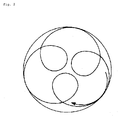
- the revolution of each of the two stirring blades is preferably set to draw a hypocycloid curve shown in Fig. 1 or a hypercyclone curve shown in Fig. 2.
- the carrying performance of the porous carrier with respect to the optically active polymer compound can be enhanced.
- the optically active polymer compound can be prevented from becoming a lump (particulate mass). Therefore, the porous carrier can be allowed to carry substantially a total amount of the optically active polymer compound used.
- the revolution trajectory of each of the two stirring blades is a hypocycloid curve or a hypercyclone curve, there is no dead point in the stirring tank, and substances to be mixed (the porous carrier and the optically active polymer compound) which are building up without being stirred are eliminated. As a result, the carrying performance can be further enhanced.
- Each of the two stirring blades may be a curved stirring rod or a curved stirring ring.
- the rod is preferably a hook-shaped rod or an anchor-type hook-shaped rod.
- the stirring blades serve to press the substances to be mixed against each other or to knead them.
- the substances are heated with a heating jacket, replacement of the substances at a position in contact with the heating jacket is smoothly performed, whereby an adverse effect of thermal hysteresis is prevented. The emergence of a lump is also prevented.
- the capacity of the stirring tank can be appropriately set in accordance with the amounts of the porous carrier and the solution of the optically active polymer compound in a range from a laboratory scale to an industrial production scale.
- the capacity can be set in the range of 0.03 to 3 m 3 .
- a porous organic carrier or a porous inorganic carrier can be used as the porous carrier. Of those, a porous inorganic carrier is preferable.
- Examples of appropriate porous organic carriers include polymer substances made of polystyrene, polyacrylamide, polyacrylate, and the like.
- Examples of appropriate porous inorganic carriers include silica, alumina, magnesia, glass, kaolin, titanium oxide, silicate, and hydroxyapatite.
- silica gel is particularly preferable.
- silica gel When silica gel is used, its surface is desirably subjected to silane treatment (silane treatment using aminopropylsilane), plasma treatment, or the like in order to eliminate the influence of silanol remaining on the silica gel surface and to enhance an affinity for the optically active polymer compound.
- silane treatment silane treatment using aminopropylsilane
- plasma treatment or the like in order to eliminate the influence of silanol remaining on the silica gel surface and to enhance an affinity for the optically active polymer compound.
- no problems occur even when the surface is subjected to no treatment.
- the porous carrier particularly silica gel, has a particle size preferably in the range of 1 to 300 ⁇ m, more preferably in the range of 15 to 100 ⁇ m, still more preferably in the range of 20 to 50 ⁇ m, and an average pore size preferably in the range of 200 to 8,000 ⁇ , more preferably in the range of 200 to 4,000 ⁇ , still more preferably in the range of 300 to 2, 000 ⁇ .
- the particle size of the porous carrier is substantially the particle size of a filler.
- An average pore size of the porous carrier in the above range is preferable because the solution of the optically active polymer compound is sufficiently immersed in pores and the optically active polymer compound tends to evenly adhere to the inner walls of the pores. Furthermore, the pores are not closed, so the pressure loss of the filler can be kept at a low level.
- a polysaccharide derivative is preferably used as the optically active polymer compound.
- a polysaccharide, from which the polysaccharide derivative is derived may be a synthetic polysaccharide, a natural polysaccharide or a natural product-modified polysaccharide.
- Sandra may be used as long as it is optically active.
- One having a high regularity of form of bonding is desirably used.
- polysaccharide examples include ⁇ -1,4-glucan (cellulose), ⁇ -1,4-glucan (amylose, amylopectin), ⁇ -1,6-glucan (dextran), ⁇ -1,6-glucan (pustulan), ⁇ -1,3-glucan (for example, curdlan, schizofillan, etc.), ⁇ -1,3-glucan, ⁇ -1,2-glucan (Crown Gall polysaccharide), ⁇ -1,4-galactan, ⁇ -1,4-mannan, ⁇ -1,6-mannan, ⁇ -1,2-fructan (inulin), ⁇ -2,6-fructan (levan), ⁇ -1,4-xylan, ⁇ -1,3-xylan, ⁇ -1,4-chitosan, ⁇ -1,4-N-acetylchitosan (chitin), pullulan, agarose, alginic acid, etc. as well as amylose-containing starch.
- cellulose, amylose, ⁇ -1,4-xylan, ⁇ -1,4-chitosan, chitin, ⁇ -1,4-mannan, inulin, curdlan, etc. are preferred, with cellulose and amylose being particularly preferred.
- the number average degree of polymerization (average number of pyranose or furanose ring contained in one molecule) of these polysaccharides is preferably 5 or more, more preferably 10 or more. There is no particular upper limit in the number average degree of polymerization but it is desirably 1, 000 or less in consideration of ease of handling. It is more preferably 5 to 1, 000, further more preferably 10 to 1,000, and particularly preferably 10 to 500.
- polysaccharide derivatives obtained by bonding the part or whole of the hydroxyl groups of the above polysaccharides with compounds having functional groups capable of reacting with hydroxyl groups through ester bonds, urethane bonds, ether bonds, and the like can be used as the polysaccharide derivative.
- Examples of a compound having a functional group capable of reacting with a hydroxyl group include an isocyanic acid derivative, a carboxylic acid, an ester, an acid halide, an acid amide compound, a halogen compound, an aldehyde, and an alcohol. Aliphatic, alicyclic, aromatic, and heteroaromatic compounds of the above compounds can also be used.
- Examples of a particular preferable polysaccharide derivative include a polysaccharide ester derivative and a polysaccharide carbamate derivative.
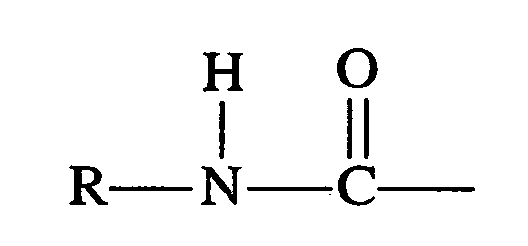
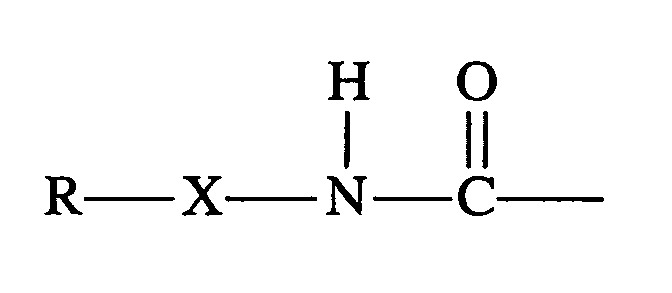
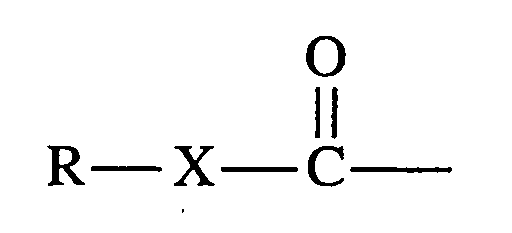
- Examples of the polysaccharide ester derivative and the polysaccharide carbamate derivative include a compound obtained by substituting at least one of the atomic groups represented by the following formulae for the part or whole of hydrogen atoms on hydroxyl groups or on amino groups of a polysaccharide.
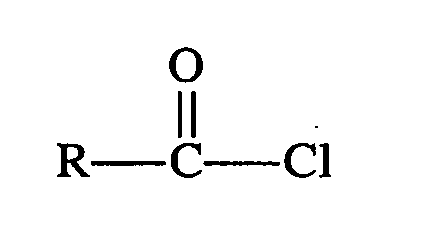
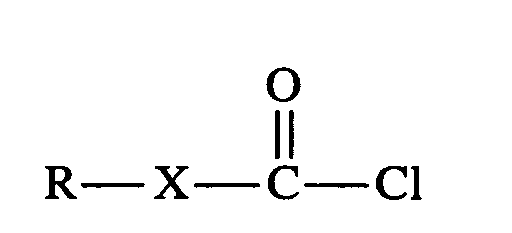
- R represents an aromatic hydrocarbon group which may contain a hetero atom, and may be unsubstituted or substituted by at least one group selected from the group consisting of an alkyl group having 1 to 12 carbon atoms, an alkoxy group having 1 to 12 carbon atoms, an alkylthio group having 1 to 12 carbon atoms, a cyano group, a halogen atom, an acyl group having 1 to 8 carbon atoms, an alkoxycarbonyl group having 1 to 8 carbon atoms, a nitro group, an amino group, and an alkylamino group having 1 to 8 carbon atoms.
- aromatic hydrocarbon group examples include a phenyl group, a naphthyl group, a phenanthryl group, an anthracyl group, an indenyl group, a furyl group, a thionyl group, a pyryl group, a benzofuryl group, a benzothionyl group, an indyl group, a pyridyl group, a pyrimidyl group, a quinolyl group, and an isoquinolyl group.
- a phenyl group, a naphthyl group, a pyridyl group, and the like are preferable.
- a halogenated phenyl group and an alkylphenyl group are particularly preferable.
- X represents a hydrocarbon group having 1 to 4 carbon atoms which may contain a double bond or a triple bond.
- Examples of X include a methylene group, a methylmethylene group, an ethylene group, an ethylidene group, an ethenylene group, an ethynylene group, a 1, 2- or 1, 3-propylene group, and a 1,1- or 2,2-propyridine group.
- the polysaccharide carbamate derivative can be obtained by reacting an isocyante represented by the below shown formula with a polysaccharide.
- the polysaccharide ester derivative can be obtained by reacting an acid chloride represented by the below shown formula with a polysaccharide.
- An introducing ratio of a substituent into a polysaccharide derivative is preferably in the range of 10% to 100%, more preferably in the range of 30% to 100%, still more preferably in the range of 80% to 100%.
- An introducing ratio of 10% or more is preferable because an optical resolution ability increases.
- An introducing ratio of 30% or more is preferable because sufficient separating performance can be achieved regardless of the type and concentration of a mixture of enantiomeric isomers to be subjected to optical resolution.
- An introducing ratio of 80% or more is particularly preferable because a particle excellent in enantiomeric isomer separating performance can be obtained.
- the introducing ratio of a substituent can be determined by investigating changes in carbon, hydrogen, and nitrogen before and after substituent introduction through elemental analysis.
- the solution or dispersion of the optically active polymer compound is composed of a polymer compound such as any one of the above polysaccharide derivatives and an organic solvent.
- organic solvent examples include: ketones such as acetone and methyl ethyl ketone; aromatic carboxylic acid alkyl esters including a benzoic acid alkyl ester such as methyl benzoate; and halogen compounds such as methylacetamide, methylene chloride, and chloroform.
- a mixing ratio between the optically active polymer compound and the organic solvent is preferably 300 to 10,000 parts by mass, more preferably 300 to 1,000 parts by mass of the organic solvent with respect to 100 parts by mass of the optically active polymer compound.
- a ratio between the porous carrier and the solution or dispersion of the optically active polymer compound is preferably 100 to 500 parts by mass, more preferably 100 to 300 parts by mass of the solution or dispersion of the optically active polymer compound with respect to 100 parts by mass of the porous carrier.
- a total volume of the porous carrier and the solution or dispersion of the optically active polymer compound with respect to the stirring tank capacity of the two-axis vertical stirring device is such that the total volume of the porous carrier and the solution or dispersion of the optically active polymer compound is preferably 0.1 to 0.8 m 3 , more preferably 0.2 to 0.5 m 3 with respect to the stirring tank capacity of 1 m 3 .
- a temperature condition at the time of stirring is preferably in the range of room temperature to 80°C, more preferably in the range of room temperature to 60°C.
- An operation condition for the stirring blades varies depending on parameters such as: the capacity of the stirring tank; the amounts of the porous carrier and the solution or dispersion of the optically active polymer compound used; the shapes of the stirring blades; the rotational speeds of the stirring blades; and the rotation trajectories of the stirring blades.
- stirring for about 10 to 300 minutes allows the porous carrier to carry the optically active polymer compound.
- porous carrier and the solution or dispersion of the optically active polymer compound are stirred in the two-axis vertical stirring device, they may be irradiated with light, radiation such as a ⁇ ray, or an electromagnetic wave such as a microwave to enhance a bonding force between the porous carrier and the optically active polymer compound.
- the above stirring processing using the two-axis vertical stirring device allows the porous carrier to carry the optically active polymer compound.
- the carrying state varies depending on a combination of the porous carrier and the optically active polymer compound, and ranges from a state where the optically active polymer compound merely adheres to the porous carrier to a state where the porous carrier and the optically active polymer compound are chemically bound to each other. Therefore, as described above, the porous carrier and the optically active polymer compound may be irradiated with light, radiation such as a ⁇ ray, or an electromagnetic wave such as a microwave to enhance the bonding force between the porous carrier and the optically active polymer compound as required.
- the organic solvent is removed through drying processing, and furthermore, as required, classification processing such as a vibrating screen, a cyclone, air classification, or wet classification, washing processing, and drying processing can be performed.
- classification processing such as a vibrating screen, a cyclone, air classification, or wet classification, washing processing, and drying processing can be performed.
- the above production method can provide an enantiomeric isomer-separating filler in which the porous carrier is allowed to carry the optically active polymer compound in a carrying amount of 23 mass% or more.
- the carrying amount as used herein is represented by a ratio of the weight of the polysaccharide derivative to the weight of the filler.
- the carrying amount of the polysaccharide derivative on the carrier is preferably 23 mass% or more with respect to the carrier.
- the carrying amount is more preferably 27 mass% or more from the viewpoint of productivity. There is no particular technical upper limit of the carrying amount.
- a carrying amount of 60 mass% or less is preferable because no reduction in separation efficiency due to a reduction in number of stages occurs.
- the carrying amount is particularly preferably in the range of 27 mass% to 45 mass%.
- the method (b) is preferably applied in bringing the porous carrier and the solution of the optically active polymer compound into contact with each other in the two-axis vertical stirring device.
- the porous carrier is fed into the two-axis vertical stirring device, and part of the solution or dispersion of the optically active polymer compound with a required amount being divided into multiple fractions is added.
- the number of divisions which is not particularly limited, is preferably 2 to 6, more preferably 2 to 4.
- porous carrier is allowed to carry the optically active polymer compound through a stirring operation of the two-axis vertical stirring device.
- the porous carrier carrying the optically active polymer compound is dried to remove a solvent.
- the combination of the above steps is counted as one process.
- the process is repeated a plurality of times, preferably 2 to 6 times, more preferably 2 to 4 times.
- the amounts of the solution or dispersion of the optically active polymer compound to be added for the respective times may be the same or different.
- the enantiomeric isomer-separating filler obtained by means of the production method of the present invention is preferably used for a separation column of simulated moving bed chromatography intended to obtain several milligrams to several kilograms of an optically active substance.
- the column has a ratio L/D of the length (L) of one column to the inner diameter (D) of the column preferably in the range of 0.01 to 100, more preferably in the range of 0.01 to 60, still more preferably in the range of 0.01 to 30.
- Adsorption and separation by means of simulated moving bed chromatography are carried out by continuously circulating an adsorption operation, a condensation operation, a desorption operation, and a desorbed liquid collection operation described below as basic operations.
- a mixture of enantiomeric isomers contacts an enantiomeric isomer-separating filler. Then, an enantiomeric isomer that is easily adsorbed (strong adsorption component) is adsorbed, while other enantiomeric isomer that is hardly adsorbed (weak adsorption component) is collected as a raffinate flow together with a desorbed liquid.
- the enantiomeric isomer-separating filler that has adsorbed the strong adsorption component is allowed to contact part of an extract to be described later, so the weak adsorption component remaining on the enantiomeric isomer-separating filler is expelled to condense the strong adsorption component.
- the enantiomeric isomer-separating filler containing the condensed strong adsorption component is allowed to contact the desorbed liquid, so the strong adsorption component is expelled from the enantiomeric isomer-separating filler to be collected as an extract flow accompanying the desorbed liquid.
- the enantiomeric isomer-separating filler adsorbing substantially only the desorbed liquid contacts part of the raffinate flow, so part of the desorbed liquid in the enantiomeric isomer-separating filler is collected as a desorbed liquid collection flow.
- a total number of columns to be used for performing the adsorption operation, the condensation operation, the desorption operation, and the desorbed liquid collection operation described above is preferably 4 to 32, more preferably 4 to 12, still more preferably 4 to 8.
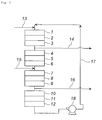
- Fig. 3 is a schematic drawing showing an example of a simulated moving bed according to the present invention.
- Fig. 4 is a schematic drawing showing another example of the simulated moving bed according to the present invention.
- the inside of a packed bed serving as a main portion of the simulated moving bed is divided into 12 unit packed beds.
- the inside is divided into 8 unit packed beds.
- the number and sizes of the unit packed beds depend on factors such as the composition and flow rate of an enantiomeric isomer mixture-containing liquid, a pressure loss, and the size of the device, and are not limited.
- reference numerals 1 to 12 each denote a chamber (adsorption chamber) filled with a filler, and the chambers are coupled to one another.
- Reference numeral 13 denotes a desorbed liquid supplying line; 14, an extract drawing line; 15, an enantiomeric isomer-containing liquid supplying line; 16, a raffinate drawing line; 17, a recycle line; and 18, a pump.
- the adsorption chambers 1 to 3 perform the desorption operation
- the adsorption chambers 4 to 6 perform the condensation operation
- the adsorption chambers 7 to 9 perform the adsorption operation
- the adsorption chambers 10 to 12 perform the desorbed liquid collection operation.
- each of the supplying lines and the drawing lines is moved by one adsorption chamber in a liquid flowing direction through a bulb operation every predetermined time period.
- the adsorption chambers 2 to 4 perform the desorption operation
- the adsorption chambers 5 to 7 perform the condensation operation
- the adsorption chambers 8 to 10 perform the adsorption operation
- the adsorption chambers 11, 12, and 1 perform the desorbed liquid collection operation.
- Such an operation is performed successively, whereby processing of separating the mixture of enantiomeric isomers can be continuously and efficiently achieved.
- the adsorption chamber 1 performs the desorption operation
- the adsorption chambers 2 to 5 perform the condensation operation
- the adsorption chambers 6 and 7 perform the desorption operation
- the adsorption chamber 8 performs the desorbed liquid collection operation.
- each of the supplying lines and the drawing lines is moved by one adsorption chamber in a liquid flowing direction through a bulb operation every predetermined time period. Accordingly, in the next arrangement state of the adsorption chambers, the adsorption chamber 2 performs the desorption operation, the adsorption chambers 3 to 6 perform the condensation operation, the adsorption chambers 7 and 8 perform the adsorption operation, and the adsorption chamber 1 performs the desorbed liquid collection operation. Such an operation is performed successively, whereby processing of separating the mixture of enantiomeric isomers can be continuously and efficiently achieved.
- an enantiomeric isomer-separating filler in which a porous carrier is allowed to carry an optically active polymer compound in a carrying amount of 23 mass% or more. Furthermore, an enantiomeric isomer-separating filler having a carrying amount of the optically active polymer compound of about 60 mass% can be obtained depending on purposes. From the viewpoint of the separating performance of the enantiomeric isomer-separating filler, the carrying amount of the optically active polymer compound is adjusted to fall within the range of preferably 23 to 50 mass%, more preferably 23 to 40 mass%.
- the enantiomeric isomer-separating filler obtained by means of the production method of the present invention can be applied to an enantiomeric isomer analysis technology in which a wide variety of chiral compounds are sampled with high productivity and subjected to optical resolution in analysis of a pharmaceutical preparation, a food, an agricultural chemical, a perfume, or the like and to enantiomeric isomer separation on an industrial scale utilizing a simulated moving bed mode, when it is preferably applied to pseudo-moving-bed chromatography.
- an enantiomeric isomer-separating filler in which a porous carrier is allowed to carry a polysaccharide derivative in a carrying amount of 23 mass% or more.
- Shape of stirring blade Curved stirring rod (hook-shaped)
- the stirring conditions were as the above.
- the stirring was performed at room temperature.
- Amylose tris(3,5-dimethylphenylcarbamate) was prepared in the same manner as in (1) of Example 1.
- silica gel subjected to surface inactivating treatment (average particle size: 20 ⁇ m, average pore size: 1,300 ⁇ ) were fed into the planetary stirring mixer, and then a 1/4 amount of the polymer dope was placed into it.
- the stirring conditions were as the above.
- the stirring was performed at room temperature.
- the filler carrying amylose tris(3,5-dimethylphenylcarbamate) prepared in (2) was filled in a stainless column having a length of 25 cm and an inner diameter of 0.46 cm by means of a slurry filling method to prepare a separating column for an enantiomeric isomer.
- Amylose tris(3,5-dimethylphenylcarbamate) was prepared in the same manner as in (1) of Example 1.
- the stirring conditions were as the above.
- the stirring was performed at room temperature.
- the filler carrying amylose tris(3,5-dimethylphenylcarbamate) prepared in (2) was filled in a stainless column having a length of 25 cm and an inner diameter of 0.46 cm by means of a slurry filling method to prepare a separating column for an enantiomeric isomer.
- Amylose tris(3,5-dimethylphenylcarbamate) was prepared in the same manner as in (1) of Example 1.
- silica gel subjected to surface inactivating treatment (average particle size: 20 ⁇ m, average pore size: 1,300 ⁇ ) were fed into the planetary stirring mixer, and then a 1/2 amount of the polymer dope was placed into it.
- the stirring conditions were as the above.
- the stirring was performed at room temperature.
- the filler carrying amylose tris(3,5-dimethylphenylcarbamate) prepared in (2) was filled in a stainless column having a length of 25 cm and an inner diameter of 0.46 cm by means of a slurry filling method to prepare a separating column for an enantiomeric isomer.
- Amylose tris(3,5-dimethylphenylcarbamate) was prepared in the same manner as in (1) of Example 1.
- a total amount of the polymer dope was added to 22.5 g of silica gel subj ected to surface inactivating treatment used in (2) of Example 1 placed into a 300-ml three-necked flask, and the resultant was evenly applied by using a blade-type stirring rod.
- the solvent was distilled off under a reduced pressure condition while it was heated, to thereby obtain a target filler carrying amylose tris(3,5-dimethylphenylcarbamate).
- the filler carrying amylose tris(3,5-dimethylphenylcarbamate) prepared in (2) was filled in a stainless column having a length of 25 cm and an inner diameter of 0.46 cm by means of a slurry filling method to prepare a separating column for an enantiomeric isomer.
- Amylose tris(3,5-dimethylphenylcarbamate) was prepared in the same manner as in (1) of Example 1.
- silica gel subjected to surface inactivating treatment (average particle size: 20 ⁇ m, average pore size: 1,300 ⁇ ) were fed into the planetary stirring mixer, and then a 1/2 amount of the polymer dope was placed into it.
- the stirring conditions were as the above.
- the stirring was performed at room temperature.
- the filler carrying amylose tris(3,5-dimethylphenylcarbamate) prepared in (2) was filled in a stainless column having a length of 25 cm and an inner diameter of 0. 46 cm by means of a slurry filling method to prepare a separating column for an enantiomeric isomer.
- Amylose tris(3,5-dimethylphenylcarbamate) was prepared in the same manner as in (1) of Example 1.
- a 1/4 amount of the polymer dope was added to 30.0 g of silica gel subj ected to surface inactivating treatment used in (2) of Example 1 placed into a 300-ml three-necked flask, and the resultant was evenly applied by using a blade-type stirring rod. After that, the remaining polymer dope (3/4 amount) was placed (1/4 amount per one placement: a total of 3 times), and the resultant was evenly applied.
- the adsorption chambers 1 to 8 were filled with the fillers prepared in Examples 1 to 5 and Comparative Examples 1 to 4, and the compound I was actually separated under the following conditions, thereby determining the productivity of a raffinate component in each filler (expressed in the mass (kg) of a racemic body that can be separated within a day per 1 kg of the filler).
- Table 1 shows the results. All of the resultant optical purities of the raffinate components were equal to or higher than 97%ee.
- Feed flow rate Flow rate of the solution of the compound (I) in ethanol from the line 15
Landscapes
- Chemical & Material Sciences (AREA)
- Analytical Chemistry (AREA)
- Chemical Kinetics & Catalysis (AREA)
- Organic Chemistry (AREA)
- Life Sciences & Earth Sciences (AREA)
- Biochemistry (AREA)
- Molecular Biology (AREA)
- General Health & Medical Sciences (AREA)
- Health & Medical Sciences (AREA)
- Inorganic Chemistry (AREA)
- Sustainable Development (AREA)
- Organic Low-Molecular-Weight Compounds And Preparation Thereof (AREA)
- Solid-Sorbent Or Filter-Aiding Compositions (AREA)
Abstract
Description


| Example | Comparative Example | ||||||
| 1 | 2 | 3 | 4 | 1 | 2 | 3 | |
| Carrying amount of polysaccharide derivative (mass%) | 35 | 40 | 30 | 25 | 10 | 20 | 40 |
| Number of carrying | 4 | 4 | 3 | 2 | 1 | 1 | 4 |
| Feed flow rate (ml/min) | 0.90 | 0.76 | 1.06 | 0.94 | - | 0.79 | - |
| Raffinate flow rate (ml/min) | 15.31 | 20.99 | 10.87 | 7.49 | - | 6.73 | - |
| Extract flow rate (ml/min) | 5.33 | 8.61 | 5.11 | 3.56 | - | 3.43 | - |
| Desorbed liquid flow rate (ml/min) | 19.74 | 28.83 | 14.92 | 10.12 | - | 9.37 | - |
| Productivity | 1.73 | 1.44 | 2.03 | 1.79 | - | 1.51 | - |
| Productivity: kg-rac./kg-CSP/day, -: Unable to sample |
Claims (6)
- A process for producing an enantiomeric isomer-separating filler, comprising bringing a porous carrier and a solution or dispersion of an optically active polymer compound into contact with each other through a stirring operation in a stirring device, to allow the porous carrier to carry the optically active polymer compound, wherein:a two-axis vertical stirring device is used as the stirring device; andthe porous carrier is allowed to carry the optically active polymer compound in a carrying amount of 23 mass% or more.
- A method of producing an enantiomeric isomer-separating filler, comprising bringing a porous carrier and a solution or dispersion of an optically active polymer compound into contact with each other through a stirring operation in a stirring device, to allow the porous carrier to carry the optically active polymer compound, wherein:a two-axis vertical stirring device is used as the stirring device;a first step involving: feeding the porous carrier into the two-axis vertical stirring device; adding part of the solution or dispersion of the optically active polymer compound with a required amount being divided into multiple fractions; and allowing the porous carrier to carry the optically active polymer compound through a stirring operation of the two-axis vertical stirring device, and a second step involving drying the porous carrier carrying the optically active polymer compound to remove a solvent are performed; anda combination of the first step and the second step is repeated a plurality of times by using a residual solution or dispersion of the optically active polymer compound, to thereby allow the porous carrier to carry the optically active polymer compound.
- The method according to claim 2, wherein the combination of the first step and the second step is repeated 2 to 6 times.
- The method according to any one of claims 1 to 3, wherein the porous carrier has an average particle size in a range of 1 to 300 µm and an average pore size in a range of 200 to 8,000 Å.
- The method according to any one of claims 1 to 3, wherein the optically active polymer compound comprises a polysaccharide derivative.
- The method according to any one of claims 1 to 3, wherein the enantiomeric isomer-separating filler comprises an enantiomeric isomer-separating filler for simulated moving bed chromatography.
Applications Claiming Priority (3)
| Application Number | Priority Date | Filing Date | Title |
|---|---|---|---|
| JP2002296533 | 2002-10-09 | ||
| JP2002296533A JP3866179B2 (en) | 2002-10-09 | 2002-10-09 | Method for producing filler for optical isomer separation |
| PCT/JP2003/012942 WO2004034048A1 (en) | 2002-10-09 | 2003-10-09 | Process for producing packing for resolving optical isomers |
Publications (3)
| Publication Number | Publication Date |
|---|---|
| EP1550865A1 true EP1550865A1 (en) | 2005-07-06 |
| EP1550865A4 EP1550865A4 (en) | 2005-10-19 |
| EP1550865B1 EP1550865B1 (en) | 2010-12-22 |
Family
ID=32089239
Family Applications (1)
| Application Number | Title | Priority Date | Filing Date |
|---|---|---|---|
| EP03751399A Expired - Lifetime EP1550865B1 (en) | 2002-10-09 | 2003-10-09 | Method of producing enantiomeric isomer-separating filler |
Country Status (8)
| Country | Link |
|---|---|
| US (1) | US7258794B2 (en) |
| EP (1) | EP1550865B1 (en) |
| JP (1) | JP3866179B2 (en) |
| KR (1) | KR100973748B1 (en) |
| CN (1) | CN100344366C (en) |
| AT (1) | ATE492339T1 (en) |
| DE (1) | DE60335478D1 (en) |
| WO (1) | WO2004034048A1 (en) |
Families Citing this family (1)
| Publication number | Priority date | Publication date | Assignee | Title |
|---|---|---|---|---|
| US8017017B2 (en) * | 2008-08-26 | 2011-09-13 | Daicel Chemical Industries, Ltd. | Method for producing a target substance using a simulated moving bed chromatography separation system |
Family Cites Families (17)
| Publication number | Priority date | Publication date | Assignee | Title |
|---|---|---|---|---|
| IE62100B1 (en) | 1986-07-30 | 1994-12-14 | Fisons Corp | Coated ion exchange resins |
| JPS6384626A (en) | 1986-09-26 | 1988-04-15 | Ashizawa Niro Atomaizaa Kk | Method for coating fine particle |
| JP2573936B2 (en) | 1987-01-06 | 1997-01-22 | 株式会社資生堂 | Modified solid material |
| JP2826125B2 (en) | 1989-05-31 | 1998-11-18 | 株式会社クラレ | Rotationally molded container and method for producing the same |
| CN1012468B (en) * | 1989-12-27 | 1991-05-01 | 北京化工学院 | A double-shaft double-action planetary stirring device |
| JP3190206B2 (en) | 1993-06-22 | 2001-07-23 | ダイセル化学工業株式会社 | Separating agent for optical isomers and method for producing the same |
| JPH07260762A (en) * | 1994-03-17 | 1995-10-13 | Daicel Chem Ind Ltd | Filler for high-speed liquid chromatography and manufacture thereof |
| DE4439444A1 (en) | 1994-11-04 | 1996-05-09 | Merck Patent Gmbh | Release materials and process for their preparation |
| JP3963531B2 (en) | 1996-10-01 | 2007-08-22 | ダイセル化学工業株式会社 | Method for producing column packing material for optical isomer separation |
| JPH10185894A (en) * | 1996-12-20 | 1998-07-14 | Daicel Chem Ind Ltd | Preparation of filler for high-performance liquid chromatography |
| JP4359796B2 (en) * | 1999-08-19 | 2009-11-04 | 日産化学工業株式会社 | Optical resolution agent using optically active isocyanurate and derivatives thereof |
| JP2001124752A (en) | 1999-10-26 | 2001-05-11 | Daicel Chem Ind Ltd | Method for producing optically active oxybutynin |
| JP3635002B2 (en) * | 2000-04-18 | 2005-03-30 | ダイセル化学工業株式会社 | Filler for separation of optical isomers for liquid chromatography |
| WO2002030853A1 (en) * | 2000-10-13 | 2002-04-18 | Daicel Chemical Industries, Ltd. | Packing material for separation of optical isomer and method of separating optical isomer with the same |
| JP4236463B2 (en) | 2000-10-13 | 2009-03-11 | ダイセル化学工業株式会社 | Process for producing optically active ethyl (3R, 5S, 6E) -7- [2-cyclopropyl-4- (4-fluorophenyl) quinolin-3-yl] -3,5-dihydroxy-6-heptenoate |
| WO2002083298A1 (en) | 2001-04-12 | 2002-10-24 | Daicel Chemical Industries, Ltd. | Optical isomer separating filler, production method therefor and application method therefor |
| JP2004003935A (en) * | 2002-04-12 | 2004-01-08 | Daicel Chem Ind Ltd | Packing material for optical isomer separation for simulated moving bed chromatography |
-
2002
- 2002-10-09 JP JP2002296533A patent/JP3866179B2/en not_active Expired - Fee Related
-
2003
- 2003-10-09 AT AT03751399T patent/ATE492339T1/en not_active IP Right Cessation
- 2003-10-09 CN CNB2003801008227A patent/CN100344366C/en not_active Expired - Fee Related
- 2003-10-09 US US10/529,698 patent/US7258794B2/en not_active Expired - Fee Related
- 2003-10-09 KR KR1020057005260A patent/KR100973748B1/en not_active Expired - Fee Related
- 2003-10-09 WO PCT/JP2003/012942 patent/WO2004034048A1/en not_active Ceased
- 2003-10-09 DE DE60335478T patent/DE60335478D1/en not_active Expired - Lifetime
- 2003-10-09 EP EP03751399A patent/EP1550865B1/en not_active Expired - Lifetime
Also Published As
| Publication number | Publication date |
|---|---|
| JP2004132786A (en) | 2004-04-30 |
| US20060016756A1 (en) | 2006-01-26 |
| KR20050067400A (en) | 2005-07-01 |
| CN1703618A (en) | 2005-11-30 |
| US7258794B2 (en) | 2007-08-21 |
| ATE492339T1 (en) | 2011-01-15 |
| KR100973748B1 (en) | 2010-08-04 |
| EP1550865B1 (en) | 2010-12-22 |
| JP3866179B2 (en) | 2007-01-10 |
| DE60335478D1 (en) | 2011-02-03 |
| CN100344366C (en) | 2007-10-24 |
| WO2004034048A1 (en) | 2004-04-22 |
| EP1550865A4 (en) | 2005-10-19 |
Similar Documents
| Publication | Publication Date | Title |
|---|---|---|
| JP3963822B2 (en) | Separating agent for optical isomers | |
| KR100973749B1 (en) | Separation of Optical Isomers Using Pseudomobile Phase Chromatography | |
| EP0527236A1 (en) | Polysaccharide derivative, production thereof, and separating agent | |
| EP0711742B1 (en) | Separating agent for optical isomers | |
| EP1391239B1 (en) | Method for producing an optical isomer separating filler and its use in chromatography | |
| JPWO2002070123A1 (en) | Separating agent for optical isomers | |
| JP2005017268A (en) | Separation agent for optical isomers, method for producing the same, and separation column for optical isomers | |
| US7258794B2 (en) | Process for producing packing for resolving optical isomers | |
| JP3635002B2 (en) | Filler for separation of optical isomers for liquid chromatography | |
| CN1099592C (en) | Separating agent | |
| JP3746315B2 (en) | Separating agent | |
| JP4334654B2 (en) | Separating agent | |
| EP1865313B1 (en) | Optical-isomer-separating agent | |
| JPH0475893B2 (en) | ||
| JP4430881B2 (en) | Method for producing filler for separation of optical isomers for liquid chromatography | |
| CN1462263A (en) | Separatory agent comprising polysaccharide derivative having polycyclic structrue | |
| US7550596B2 (en) | Method of producing ethyl (3R, 5S, 6E)-7-[2 cyclopropyl-4-(fluorophenyl) quinoline-3-yl]-3, 5-dihydroxy-6-heptenoate | |
| EP1637542A1 (en) | Separatory agent for optical isomer | |
| JPH10249191A (en) | Separating agent |
Legal Events
| Date | Code | Title | Description |
|---|---|---|---|
| PUAI | Public reference made under article 153(3) epc to a published international application that has entered the european phase |
Free format text: ORIGINAL CODE: 0009012 |
|
| 17P | Request for examination filed |
Effective date: 20050406 |
|
| AK | Designated contracting states |
Kind code of ref document: A1 Designated state(s): AT BE BG CH CY CZ DE DK EE ES FI FR GB GR HU IE IT LI LU MC NL PT RO SE SI SK TR |
|
| A4 | Supplementary search report drawn up and despatched |
Effective date: 20050906 |
|
| RIC1 | Information provided on ipc code assigned before grant |
Ipc: 7B 01D 15/08 B Ipc: 7G 01N 30/48 B Ipc: 7B 01J 20/28 B Ipc: 7B 01J 20/32 A |
|
| RIN1 | Information on inventor provided before grant (corrected) |
Inventor name: ONISHI, ATSUSHI Inventor name: IKEDA, HIROKAZU Inventor name: MURAZUMI, KOICHI |
|
| RAP1 | Party data changed (applicant data changed or rights of an application transferred) |
Owner name: DAICEL CHEMICAL INDUSTRIES, LTD. |
|
| 17Q | First examination report despatched |
Effective date: 20080527 |
|
| GRAP | Despatch of communication of intention to grant a patent |
Free format text: ORIGINAL CODE: EPIDOSNIGR1 |
|
| RIC1 | Information provided on ipc code assigned before grant |
Ipc: B01J 20/28 20060101ALI20100531BHEP Ipc: B01D 15/18 20060101ALI20100531BHEP Ipc: G01N 30/56 20060101ALI20100531BHEP Ipc: B01J 20/32 20060101AFI20100531BHEP |
|
| RTI1 | Title (correction) |
Free format text: METHOD OF PRODUCING ENANTIOMERIC ISOMER-SEPARATING FILLER |
|
| GRAS | Grant fee paid |
Free format text: ORIGINAL CODE: EPIDOSNIGR3 |
|
| GRAA | (expected) grant |
Free format text: ORIGINAL CODE: 0009210 |
|
| AK | Designated contracting states |
Kind code of ref document: B1 Designated state(s): AT BE BG CH CY CZ DE DK EE ES FI FR GB GR HU IE IT LI LU MC NL PT RO SE SI SK TR |
|
| REG | Reference to a national code |
Ref country code: GB Ref legal event code: FG4D |
|
| REG | Reference to a national code |
Ref country code: CH Ref legal event code: NV Representative=s name: MICHELI & CIE SA Ref country code: CH Ref legal event code: EP |
|
| REG | Reference to a national code |
Ref country code: IE Ref legal event code: FG4D |
|
| REF | Corresponds to: |
Ref document number: 60335478 Country of ref document: DE Date of ref document: 20110203 Kind code of ref document: P |
|
| REG | Reference to a national code |
Ref country code: DE Ref legal event code: R096 Ref document number: 60335478 Country of ref document: DE Effective date: 20110203 |
|
| REG | Reference to a national code |
Ref country code: NL Ref legal event code: VDEP Effective date: 20101222 |
|
| PG25 | Lapsed in a contracting state [announced via postgrant information from national office to epo] |
Ref country code: SE Free format text: LAPSE BECAUSE OF FAILURE TO SUBMIT A TRANSLATION OF THE DESCRIPTION OR TO PAY THE FEE WITHIN THE PRESCRIBED TIME-LIMIT Effective date: 20101222 Ref country code: FI Free format text: LAPSE BECAUSE OF FAILURE TO SUBMIT A TRANSLATION OF THE DESCRIPTION OR TO PAY THE FEE WITHIN THE PRESCRIBED TIME-LIMIT Effective date: 20101222 Ref country code: AT Free format text: LAPSE BECAUSE OF FAILURE TO SUBMIT A TRANSLATION OF THE DESCRIPTION OR TO PAY THE FEE WITHIN THE PRESCRIBED TIME-LIMIT Effective date: 20101222 Ref country code: SI Free format text: LAPSE BECAUSE OF FAILURE TO SUBMIT A TRANSLATION OF THE DESCRIPTION OR TO PAY THE FEE WITHIN THE PRESCRIBED TIME-LIMIT Effective date: 20101222 Ref country code: CY Free format text: LAPSE BECAUSE OF FAILURE TO SUBMIT A TRANSLATION OF THE DESCRIPTION OR TO PAY THE FEE WITHIN THE PRESCRIBED TIME-LIMIT Effective date: 20101222 Ref country code: BG Free format text: LAPSE BECAUSE OF FAILURE TO SUBMIT A TRANSLATION OF THE DESCRIPTION OR TO PAY THE FEE WITHIN THE PRESCRIBED TIME-LIMIT Effective date: 20110322 |
|
| PG25 | Lapsed in a contracting state [announced via postgrant information from national office to epo] |
Ref country code: BE Free format text: LAPSE BECAUSE OF FAILURE TO SUBMIT A TRANSLATION OF THE DESCRIPTION OR TO PAY THE FEE WITHIN THE PRESCRIBED TIME-LIMIT Effective date: 20101222 Ref country code: PT Free format text: LAPSE BECAUSE OF FAILURE TO SUBMIT A TRANSLATION OF THE DESCRIPTION OR TO PAY THE FEE WITHIN THE PRESCRIBED TIME-LIMIT Effective date: 20110422 Ref country code: EE Free format text: LAPSE BECAUSE OF FAILURE TO SUBMIT A TRANSLATION OF THE DESCRIPTION OR TO PAY THE FEE WITHIN THE PRESCRIBED TIME-LIMIT Effective date: 20101222 Ref country code: ES Free format text: LAPSE BECAUSE OF FAILURE TO SUBMIT A TRANSLATION OF THE DESCRIPTION OR TO PAY THE FEE WITHIN THE PRESCRIBED TIME-LIMIT Effective date: 20110402 Ref country code: CZ Free format text: LAPSE BECAUSE OF FAILURE TO SUBMIT A TRANSLATION OF THE DESCRIPTION OR TO PAY THE FEE WITHIN THE PRESCRIBED TIME-LIMIT Effective date: 20101222 Ref country code: GR Free format text: LAPSE BECAUSE OF FAILURE TO SUBMIT A TRANSLATION OF THE DESCRIPTION OR TO PAY THE FEE WITHIN THE PRESCRIBED TIME-LIMIT Effective date: 20110323 |
|
| PG25 | Lapsed in a contracting state [announced via postgrant information from national office to epo] |
Ref country code: NL Free format text: LAPSE BECAUSE OF FAILURE TO SUBMIT A TRANSLATION OF THE DESCRIPTION OR TO PAY THE FEE WITHIN THE PRESCRIBED TIME-LIMIT Effective date: 20101222 Ref country code: RO Free format text: LAPSE BECAUSE OF FAILURE TO SUBMIT A TRANSLATION OF THE DESCRIPTION OR TO PAY THE FEE WITHIN THE PRESCRIBED TIME-LIMIT Effective date: 20101222 Ref country code: SK Free format text: LAPSE BECAUSE OF FAILURE TO SUBMIT A TRANSLATION OF THE DESCRIPTION OR TO PAY THE FEE WITHIN THE PRESCRIBED TIME-LIMIT Effective date: 20101222 |
|
| PLBE | No opposition filed within time limit |
Free format text: ORIGINAL CODE: 0009261 |
|
| STAA | Information on the status of an ep patent application or granted ep patent |
Free format text: STATUS: NO OPPOSITION FILED WITHIN TIME LIMIT |
|
| PG25 | Lapsed in a contracting state [announced via postgrant information from national office to epo] |
Ref country code: DK Free format text: LAPSE BECAUSE OF FAILURE TO SUBMIT A TRANSLATION OF THE DESCRIPTION OR TO PAY THE FEE WITHIN THE PRESCRIBED TIME-LIMIT Effective date: 20101222 |
|
| 26N | No opposition filed |
Effective date: 20110923 |
|
| PG25 | Lapsed in a contracting state [announced via postgrant information from national office to epo] |
Ref country code: IT Free format text: LAPSE BECAUSE OF FAILURE TO SUBMIT A TRANSLATION OF THE DESCRIPTION OR TO PAY THE FEE WITHIN THE PRESCRIBED TIME-LIMIT Effective date: 20101222 |
|
| REG | Reference to a national code |
Ref country code: DE Ref legal event code: R097 Ref document number: 60335478 Country of ref document: DE Effective date: 20110923 |
|
| PGFP | Annual fee paid to national office [announced via postgrant information from national office to epo] |
Ref country code: FR Payment date: 20111026 Year of fee payment: 9 Ref country code: CH Payment date: 20111020 Year of fee payment: 9 |
|
| PG25 | Lapsed in a contracting state [announced via postgrant information from national office to epo] |
Ref country code: MC Free format text: LAPSE BECAUSE OF NON-PAYMENT OF DUE FEES Effective date: 20111031 |
|
| REG | Reference to a national code |
Ref country code: IE Ref legal event code: MM4A |
|
| PG25 | Lapsed in a contracting state [announced via postgrant information from national office to epo] |
Ref country code: IE Free format text: LAPSE BECAUSE OF NON-PAYMENT OF DUE FEES Effective date: 20111009 |
|
| PG25 | Lapsed in a contracting state [announced via postgrant information from national office to epo] |
Ref country code: LU Free format text: LAPSE BECAUSE OF NON-PAYMENT OF DUE FEES Effective date: 20111009 |
|
| REG | Reference to a national code |
Ref country code: CH Ref legal event code: PL |
|
| GBPC | Gb: european patent ceased through non-payment of renewal fee |
Effective date: 20121009 |
|
| REG | Reference to a national code |
Ref country code: FR Ref legal event code: ST Effective date: 20130628 |
|
| PG25 | Lapsed in a contracting state [announced via postgrant information from national office to epo] |
Ref country code: CH Free format text: LAPSE BECAUSE OF NON-PAYMENT OF DUE FEES Effective date: 20121031 Ref country code: DE Free format text: LAPSE BECAUSE OF NON-PAYMENT OF DUE FEES Effective date: 20130501 Ref country code: GB Free format text: LAPSE BECAUSE OF NON-PAYMENT OF DUE FEES Effective date: 20121009 Ref country code: LI Free format text: LAPSE BECAUSE OF NON-PAYMENT OF DUE FEES Effective date: 20121031 |
|
| REG | Reference to a national code |
Ref country code: DE Ref legal event code: R119 Ref document number: 60335478 Country of ref document: DE Effective date: 20130501 |
|
| PG25 | Lapsed in a contracting state [announced via postgrant information from national office to epo] |
Ref country code: FR Free format text: LAPSE BECAUSE OF NON-PAYMENT OF DUE FEES Effective date: 20121031 |
|
| PG25 | Lapsed in a contracting state [announced via postgrant information from national office to epo] |
Ref country code: TR Free format text: LAPSE BECAUSE OF FAILURE TO SUBMIT A TRANSLATION OF THE DESCRIPTION OR TO PAY THE FEE WITHIN THE PRESCRIBED TIME-LIMIT Effective date: 20101222 |
|
| PG25 | Lapsed in a contracting state [announced via postgrant information from national office to epo] |
Ref country code: HU Free format text: LAPSE BECAUSE OF FAILURE TO SUBMIT A TRANSLATION OF THE DESCRIPTION OR TO PAY THE FEE WITHIN THE PRESCRIBED TIME-LIMIT Effective date: 20101222 |