EP1550770A1 - Paper quality improver - Google Patents
Paper quality improver Download PDFInfo
- Publication number
- EP1550770A1 EP1550770A1 EP03791345A EP03791345A EP1550770A1 EP 1550770 A1 EP1550770 A1 EP 1550770A1 EP 03791345 A EP03791345 A EP 03791345A EP 03791345 A EP03791345 A EP 03791345A EP 1550770 A1 EP1550770 A1 EP 1550770A1
- Authority
- EP
- European Patent Office
- Prior art keywords
- polymer
- paper
- quality improver
- internal addition
- paper quality
- Prior art date
- Legal status (The legal status is an assumption and is not a legal conclusion. Google has not performed a legal analysis and makes no representation as to the accuracy of the status listed.)
- Granted
Links
- 0 CCC(CC(C)(*)*)C(C)CN(*)* Chemical compound CCC(CC(C)(*)*)C(C)CN(*)* 0.000 description 1
Classifications
-
- D—TEXTILES; PAPER
- D21—PAPER-MAKING; PRODUCTION OF CELLULOSE
- D21H—PULP COMPOSITIONS; PREPARATION THEREOF NOT COVERED BY SUBCLASSES D21C OR D21D; IMPREGNATING OR COATING OF PAPER; TREATMENT OF FINISHED PAPER NOT COVERED BY CLASS B31 OR SUBCLASS D21G; PAPER NOT OTHERWISE PROVIDED FOR
- D21H17/00—Non-fibrous material added to the pulp, characterised by its constitution; Paper-impregnating material characterised by its constitution
- D21H17/71—Mixtures of material ; Pulp or paper comprising several different materials not incorporated by special processes
- D21H17/72—Mixtures of material ; Pulp or paper comprising several different materials not incorporated by special processes of organic material
-
- D—TEXTILES; PAPER
- D21—PAPER-MAKING; PRODUCTION OF CELLULOSE
- D21H—PULP COMPOSITIONS; PREPARATION THEREOF NOT COVERED BY SUBCLASSES D21C OR D21D; IMPREGNATING OR COATING OF PAPER; TREATMENT OF FINISHED PAPER NOT COVERED BY CLASS B31 OR SUBCLASS D21G; PAPER NOT OTHERWISE PROVIDED FOR
- D21H21/00—Non-fibrous material added to the pulp, characterised by its function, form or properties; Paper-impregnating or coating material, characterised by its function, form or properties
- D21H21/14—Non-fibrous material added to the pulp, characterised by its function, form or properties; Paper-impregnating or coating material, characterised by its function, form or properties characterised by function or properties in or on the paper
- D21H21/22—Agents rendering paper porous, absorbent or bulky
-
- D—TEXTILES; PAPER
- D21—PAPER-MAKING; PRODUCTION OF CELLULOSE
- D21H—PULP COMPOSITIONS; PREPARATION THEREOF NOT COVERED BY SUBCLASSES D21C OR D21D; IMPREGNATING OR COATING OF PAPER; TREATMENT OF FINISHED PAPER NOT COVERED BY CLASS B31 OR SUBCLASS D21G; PAPER NOT OTHERWISE PROVIDED FOR
- D21H17/00—Non-fibrous material added to the pulp, characterised by its constitution; Paper-impregnating material characterised by its constitution
- D21H17/20—Macromolecular organic compounds
- D21H17/21—Macromolecular organic compounds of natural origin; Derivatives thereof
- D21H17/24—Polysaccharides
- D21H17/28—Starch
- D21H17/29—Starch cationic
-
- D—TEXTILES; PAPER
- D21—PAPER-MAKING; PRODUCTION OF CELLULOSE
- D21H—PULP COMPOSITIONS; PREPARATION THEREOF NOT COVERED BY SUBCLASSES D21C OR D21D; IMPREGNATING OR COATING OF PAPER; TREATMENT OF FINISHED PAPER NOT COVERED BY CLASS B31 OR SUBCLASS D21G; PAPER NOT OTHERWISE PROVIDED FOR
- D21H17/00—Non-fibrous material added to the pulp, characterised by its constitution; Paper-impregnating material characterised by its constitution
- D21H17/20—Macromolecular organic compounds
- D21H17/33—Synthetic macromolecular compounds
- D21H17/34—Synthetic macromolecular compounds obtained by reactions only involving carbon-to-carbon unsaturated bonds
-
- D—TEXTILES; PAPER
- D21—PAPER-MAKING; PRODUCTION OF CELLULOSE
- D21H—PULP COMPOSITIONS; PREPARATION THEREOF NOT COVERED BY SUBCLASSES D21C OR D21D; IMPREGNATING OR COATING OF PAPER; TREATMENT OF FINISHED PAPER NOT COVERED BY CLASS B31 OR SUBCLASS D21G; PAPER NOT OTHERWISE PROVIDED FOR
- D21H17/00—Non-fibrous material added to the pulp, characterised by its constitution; Paper-impregnating material characterised by its constitution
- D21H17/20—Macromolecular organic compounds
- D21H17/33—Synthetic macromolecular compounds
- D21H17/34—Synthetic macromolecular compounds obtained by reactions only involving carbon-to-carbon unsaturated bonds
- D21H17/41—Synthetic macromolecular compounds obtained by reactions only involving carbon-to-carbon unsaturated bonds containing ionic groups
- D21H17/44—Synthetic macromolecular compounds obtained by reactions only involving carbon-to-carbon unsaturated bonds containing ionic groups cationic
Definitions
- the present invention relates to an additive for internal addition, which is useful for improving the paper qualities of a pulp sheet.
- the thickness of paper is decreased with lighter weight of paper, high-speed papermaking and incorporation of higher amount of deinked pulp for the purpose of reducing burden on the environment and reducing transport costs in recent years. While bulky paper is desired, the stiffness of paper is proportional with the cube of thickness, and thus a decrease in the thickness of paper causes a reduction in stiffness.
- the stiffness of paper exerts significant influence on feeling of high qualities, operativeness in papermaking and printing, the durability of a box, etc., and a reduction in stiffness gives a feeling of low qualities and causes paper clogging in operation and swelling of a box etc.
- Techniques of improving stiffness include a method (1) wherein unit pulp amount (basis weight) is increased, a method (2) wherein a paper-strengthening agent or the like is used, etc., but there is a problem that in the method (1), the amount of necessary pulp is increased and the weight of paper is increased, and in the method (2), paper strength (difficulty in tearing paper) is improved and stiffness is somewhat improved, but satisfactory levels are not reached.
- JP-A 8-170296 discloses a paper internal agent comprising fine polymer particles of vinyl monomers or diene monomers with a dispersant cationic polyvinyl alcohol having a mercapto group
- JP-A 11-302992 discloses an additive for papermaking, which is based on grafted starch obtained by graft-copolymerizing (meth)acrylamide-containing monomers while maintaining the form of starch particles without gelatinizing starch, and these preparations improve stiffness to a certain extent, but are still unsatisfactory.
- Japanese Patent No. 2971447 discloses a polyvalent alcohol/fatty acid ester compound
- Japanese Patent No. 3283248 discloses a paper quality improver having a water freeness of 4% or more and improving at least two items selected from bulk, whiteness and opaqueness, but there is also demand for improvement of stiffness.
- the object of the present invention is to provide a paper quality improver for internal addition, which improves the stiffness, bulk etc. of a pulp sheet.
- the object of the present invention is to provide a paper quality improver for internal addition, which is useful as a stiffness improver.
- the present invention relates to a paper quality improver for internal addition, which comprises a polymer emulsion containing a natural cationic polymer (A) and polymer particles (B) containing at least vinyl monomer-derived structural units.
- the present invention relates to a pulp sheet wherein the paper quality improver for internal addition according to the present invention is contained in the surface and/or the inside of the pulp sheet.
- the present invention relates to a method of improving the paper qualities of a pulp sheet, which comprises bringing the paper quality improver for internal addition according to the present invention into contact with pulp.
- the present invention provides a method of improving the paper qualities of a pulp sheet, which comprises adding the paper quality improver for internal addition to pulp slurry at the time of papermaking.
- the present invention also provides use of the paper quality improver for internal addition as a stiffness improver.
- the present invention relates to a paper quality improver for internal addition, which comprises a polymer emulsion containing a synthetic cationic polymer (A') having a viscosity of 20 mPa ⁇ s (50°C) or more in the form of an aqueous solution (7 wt%) and a nitrogen content of 1.0 wt% or less and polymer particles (B) having a glass transition temperature (Tg) of 90°C or less having vinyl monomer-derived structural units.
- A' synthetic cationic polymer having a viscosity of 20 mPa ⁇ s (50°C) or more in the form of an aqueous solution (7 wt%) and a nitrogen content of 1.0 wt% or less
- polymer particles (B) having a glass transition temperature (Tg) of 90°C or less having vinyl monomer-derived structural units A'
- Tg glass transition temperature
- the present invention relates to a paper quality improver for internal addition, which comprises a polymer emulsion containing a natural cationic polymer (A) or a synthetic cationic polymer (A') and polymer particles (B) having a glass transition temperature (Tg) of 90°C or less containing at least vinyl monomer-derived structural units.
- the synthetic cationic polymer (A') has a viscosity of 20 mPa ⁇ s (50°C) or more in the form of an aqueous solution (7 wt%) and a nitrogen content of 1.0 wt% or less.
- the paper quality improver for internal addition according to the present invention comprises an emulsion containing a natural cationic polymer (A) and fine polymer particles (B) containing at least vinyl monomer-derived structural units.
- A natural cationic polymer
- B fine polymer particles
- the reason that the paper quality improver for internal addition according to the present invention significantly improves stiffness and bulk is not certainly evident, but it is estimated that the natural polymer has a similar structure to that of pulp and thus has very strong affinity for pulp, and therefore the paper quality improver for internal addition according to the present invention, as compared with the conventional agent consisting of synthetic polymers represented by polyvinyl alcohol and fine particles of polymerized vinyl monomers, significantly increases the amount of the agent fixed, improves the efficiency due to spreading on the wet surface of pulp after fixation or during drying and heating, and improves the fixation of the agent/pulp interface, thus improving stiffness and bulk.
- the paper quality improver for internal addition according to the present invention exhibits a significant effect on improvement of stiffness, and is
- the paper quality improver for internal addition comprises a polymer emulsion containing a synthetic cationic polymer (A') having a viscosity of 20 mPa ⁇ s (50°C) or more in the form of an aqueous solution (7 wt%) and a nitrogen content of 1.0 wt% or less and polymer particles having a glass transition temperature (Tg) of 90°C or less having vinyl monomer-derived structural units.
- A' synthetic cationic polymer having a viscosity of 20 mPa ⁇ s (50°C) or more in the form of an aqueous solution (7 wt%) and a nitrogen content of 1.0 wt% or less and polymer particles having a glass transition temperature (Tg) of 90°C or less having vinyl monomer-derived structural units.
- Tg glass transition temperature
- the natural cationic polymer (A) used in the present invention is a polymer obtained from naturally occurring materials by procedures such as extraction and purification, which may further be chemically modified.
- the polymer is preferably the one having a glucose residue (starch residue, cellulose residue etc.) on the polymer skeleton thereof, which is for example cationic starch or cationic cellulose (particularly preferably the water-soluble one whose cationic group is a quaternary ammonium cationic group), and one kind of polymer may be used, or two or more kinds of polymers may be used as a mixture.
- the cationic group includes an ammonium group or an amino group neutralized with an acid.
- the cationic group includes those groups neutralized preferably with hydrochloric acid, sulfuric acid, nitric acid, acetic acid, formic acid, maleic acid, fumaric acid, citric acid, tartaric acid, adipic acid, lactic acid etc.
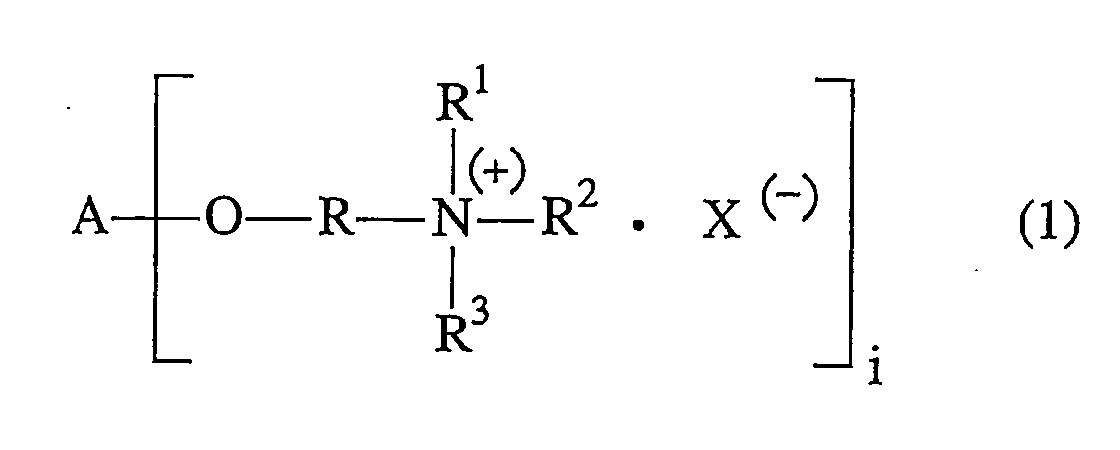
- the cationic starch or cationic cellulose is preferably the one represented by, for example, the following formula (1) : wherein A represents a starch residue or cellulose residue, R represents an alkylene or hydroxyalkylene group; R 1 , R 2 and R 3 may be the same or different and each represent an alkyl group, aryl group or aralkyl group, or may form a heterocycle containing the nitrogen atom in the formula, X - represents a counterion of an ammonium salt, and i represents a positive integer.
- the starch residue or cellulose residue is preferably a group wherein one hydroxyl group was removed from starch or cellulose.
- R is preferably a C1 to C12, more preferably C1 to C3, alkylene or hydroxyalkylene group, particularly preferably a hydroxypropylene group.
- R 1 , R 2 or R 3 is preferably a C1 to C12, more preferably C1 to C3, alkyl group including a methyl group, ethyl group, i-propyl group, n-propyl group etc.
- X - include halogen ions such as ions of chlorine, iodine, bromine etc. and organic anions such as anions of sulfuric acid, sulfonic acid, methylsulfuric acid, phosphoric acid, nitric acid etc. i is determined depending on the substitution degree on the cation described above.
- the natural cationic polymer is produced by known methods.
- the natural cationic polymer is produced for example by cationizing corn starch or the like with a cationizing agent in a water/alcohol system, followed by neutralization with acetic acid, washing with water and drying.
- the regulation of the molecular weight thereof can be easily carried out by adding a strong acid such as hydrochloric acid to such a cationized slurry and then heating it.
- the cationic starch can be obtained by reacting glycidyl trimethyl ammonium chloride or 3-chloro-2-hydroxypropyl trimethyl ammonium chloride with raw starch or processed starch from corn, potato, tapioca, wheat, rice etc. Alternatively, it can be obtained by quaternarizing dimethylaminoethylated starch. Alternatively, it can be obtained by reacting 4-chlorobutene trimethyl ammonium chloride with starch.
- the cationic cellulose can be obtained for example by subjecting hydroxyethyl cellulose to the reaction described above.
- the nitrogen content of the natural cationic polymer is preferably 0.05 to 1 wt%, particularly preferably 0.07 to 0.9 wt%, from the viewpoint of improvement of stiffness.
- nitrogen wt% (referred to hereinafter as N%) is preferably 0.05 wt% or more, or in respect of the effect of improvement of stiffness, N% is preferably 1 wt% or less.
- N% is analyzed by the Kjeldahl method (JIS K 8001).
- the molecular weight of the natural cationic polymer can be decreased in such a range that the effect of the present invention is not hindered.
- the viscosity of 7 wt% aqueous solution at 50°C is preferably 40 to 10,000 mPa ⁇ s, more preferably 50 to 8,000 mPa ⁇ s.
- a functional group including an ether group such as a hydroxyalkyl group and an ester group such as an acetyl group may be introduced into the natural cationic polymer in the present invention insofar as the effect of the present invention is not hindered.
- the synthetic cationic polymer is cationic polyvinyl alcohol
- the nonionic polymer is a semi-synthetic water-soluble polymer such as methyl cellulose, hydroxyethyl cellulose or soluble starch, or a synthetic water-soluble polymer such as polyvinyl alcohol.
- the amount of the other polymers than the natural cationic polymer is preferably 0 to 100 parts by weight, more preferably 0 to 50 parts by weight, relative to 100 parts by weight of vinyl monomers constituting the polymer particles (B).
- the nitrogen content (N%, analyzed by the Kjeldahl method) of the synthetic cationic polymer used in the present invention is preferably 0.05 wt% or more, more preferably 0. 07 wt% or more, still more preferably 0.1 wt% or more, or is preferably 1.0 wt% or less, more preferably 0.9 wt% or less, still more preferably 0.7 wt% or less.
- the synthetic cationic polymer is preferably a polymer wherein cationic groups are present such that the nitrogen content is in the above range.
- the cationic groups may be introduced by polymerizing cationic monomers or by introducing the cationic groups into the polymer through reaction or the like. In a nitrogen content in the above range, the effect of improving paper qualities such as stiffness and bulk in the present invention can be sufficiently obtained.
- the cationic group may be an ammonium group or an amino group neutralized with hydrochloric acid, sulfuric acid, nitric acid, acetic acid, formic acid, maleic acid, fumaric acid, citric acid, tartaric acid, adipic acid, lactic acid or the like.
- the viscosity of 7 wt% aqueous solution as determined by a measurement method described later is preferably 20 mPa ⁇ s or more, more preferably 40 mPa ⁇ s or more, still more preferably 65 mPa ⁇ s or more, and the upper limit is preferably 10,000 mPa ⁇ s or less, more preferably 8, 000 mPa ⁇ s or less, still more preferably 5,000 mPa ⁇ s or less.
- This range is preferable in that the cationic polymer can be easily handled, the solid content of the emulsion can be increased, and the paper qualities of a pulp sheet, such as stiffness and bulk, can be achieved.
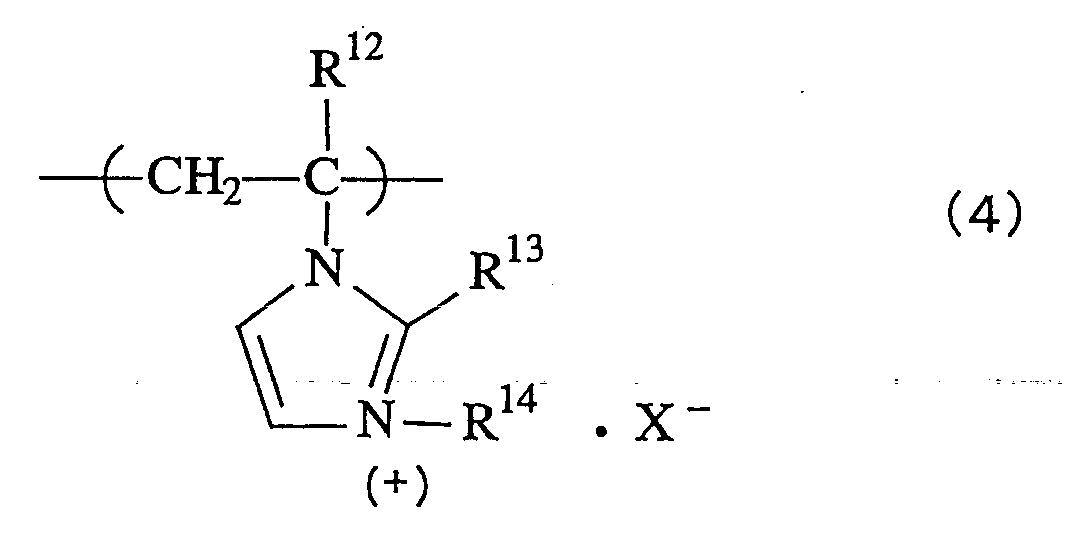
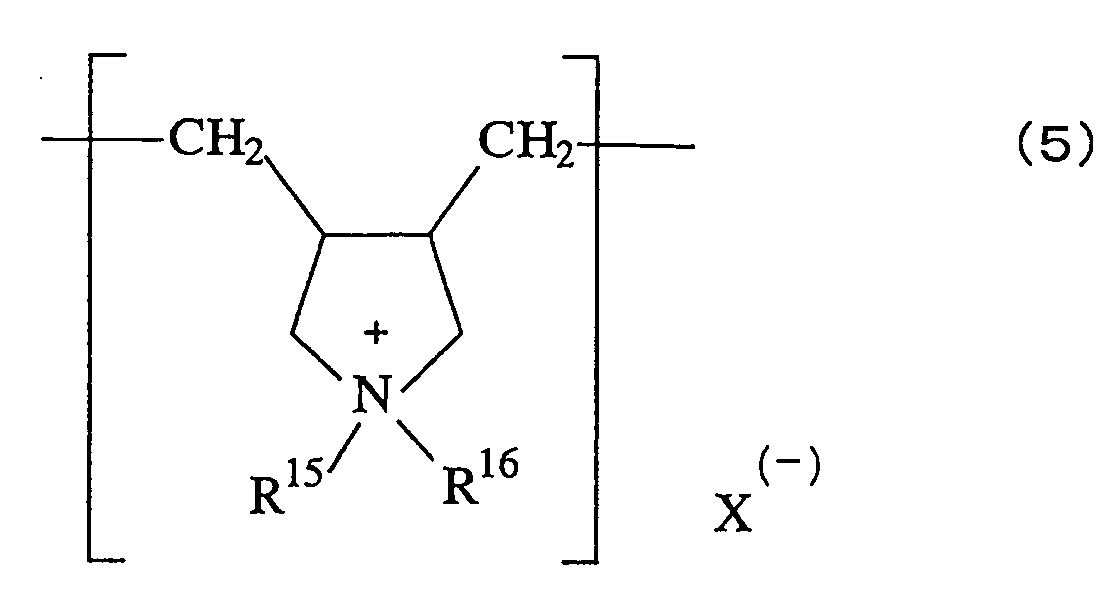
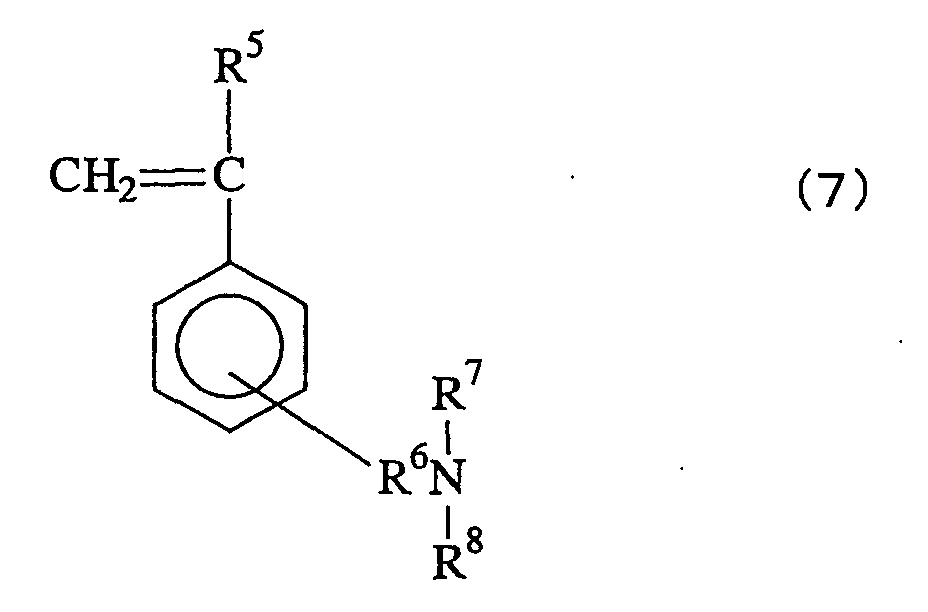
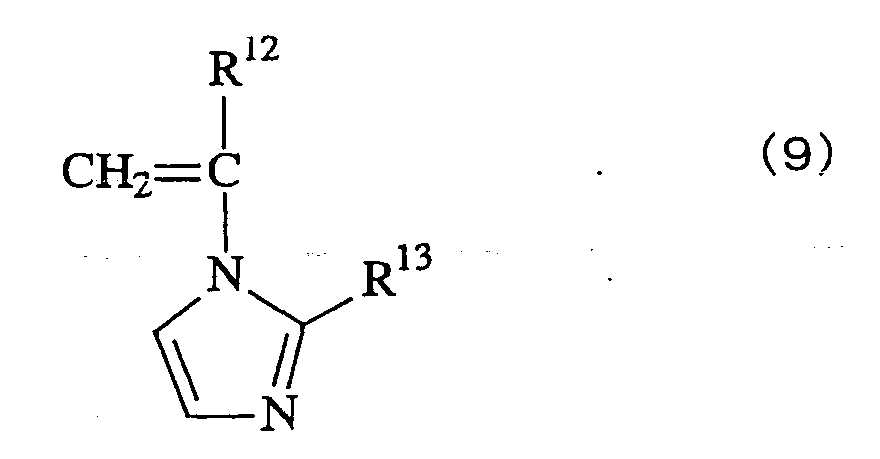
- the synthetic cationic polymer includes cationic polymers having cationic polymerizable units derived from monomers having polymerizable unsaturated groups (for example, vinyl group, vinylene group, vinylidene group, allyl group etc.), preferably polymerizable units based on (meth) acrylic acid, styrene, vinyl pyridine, vinyl imidazoline and diallyl amine represented by the general formulae (1') and (2) to (5): wherein R 1 represents a hydrogen atom or a methyl group, R 2 , R 3 and R 4 may be the same or different and each represent a hydrogen atom or a C1 to C22 alkyl or substituted alkyl group, Y represents -O- or -NH-, Z represents a C1 to C12 alkylene or hydroxyalkylene group, and X - represents an anion.
- monomers having polymerizable unsaturated groups for example, vinyl group, vinylene group, vinylidene group, allyl group etc.
- Z is preferably a C2 to C6, more preferably C1 to C3, alkylene or hydroxyalkylene group, particularly preferably a hydroxypropylene group.
- Each of R 2 , R 3 and R 4 is preferably a C1 to C12, more preferably C1 to C3, alkyl group such as a methyl group, ethyl group, i-propyl group or n-propyl group.
- X - include halogen ions including ions of chlorine, iodine and bromine and organic anions including anions of sulfuric acid, sulfonic acid, methylsulfuric acid, phosphoric acid and nitric acid.
- R 5 represents a hydrogen atom or a methyl group
- R 6 represents a C1 to C3 alkylene group
- R 7 , R 8 and R 9 may be the same or different and each represent a hydrogen atom or a C1 to C22 alkyl group which may have a substituent group
- X - has the same meaning as defined above.
- R 6 is preferably a methylene group.
- Each of R 7 , R 8 and R 9 is preferably a C1 to C12, more preferably C1 to C3, alkyl group such as a methyl group, ethyl group, i-propyl group or n-propyl group.
- the substituent group includes a hydroxyl group and a halogen atom.
- Specific examples of X - include those described above.
- the styrene-based polymerizable units are preferably those having a substituent group at the para-position. wherein R 10 represents a hydrogen atom or a methyl group, R 11 represents a hydrogen atom or a C1 to C22 alkyl group, and X - has the same meaning as defined above.
- R 11 is preferably a C1 to C12, more preferably C1 to C3, alkyl group such as a methyl group, ethyl group, i-propyl group and n-propyl group, among which a methyl group is particularly preferable.
- X - include those described above. wherein R 12 represents a hydrogen atom or a methyl group, R 13 represents a hydrogen atom or a C1 to C3 alkyl group, R 14 represents a hydrogen atom or a C1 to C22 alkyl group, and X - has the same meaning as defined above.
- R 13 is preferably a hydrogen atom or a methyl group, particularly preferably a hydrogen atom.
- R 14 is preferably a C1 to C12, more preferably C1 to C3, alkyl group such as a methyl group, ethyl group, i-propyl group and n-propyl group, among which a methyl group is particularly preferable.
- Specific examples of X - include those described above. wherein R 15 and R 16 may be the same or different and each represent a hydrogen atom or a C1 to C3 alkyl group, and X - has the same meaning as defined above.
- R 15 and R 16 are the same or different and include a hydrogen atom, methyl group, ethyl group, i-propyl group, n-propyl group etc.
- Specific examples of X - include those described above.
- the synthetic cationic polymer in the present invention is preferably a copolymer containing nonionic polymerizable units.
- the nonionic polymerizable units are preferably hydrophilic nonionic polymerizable units.
- the hydrophilic polymerizable units refer to polymerizable units given by groups wherein the ratio of inorganic monomer (I) to organic monomer (O) [I/O] is 0.60 or more, preferably 1.00 or more, still more preferably 1.30 or more in Yuuki-GainenZu, (Organic Conceptual View) -basic and application-(authored by Yoshio Koda and published in May 10, 1984 by Sankyo Shuppan).
- the nonionic polymerizable units can be obtained by copolymerization with nonionic monomers.
- nonionic monomers include vinyl alcohol; (meth)acrylate or (meth) acrylamide having a hydroxyalkyl (C1 to C8) group, such as N-hydroxypropyl (meth)acrylamide, hydroxyethyl (meth)acrylate and N-hydroxypropyl (meth)acrylamide; polyvalent alcohol (meth)acrylates such as polyethylene glycol (meth)acrylate (degree of polymerization of ethylene glycol: 1 to 30); (meth)acrylamides; alkyl (C1 to C8) (meth)acrylamides such as N-methyl (meth)acrylamide, N-n-propyl (meth)acrylamide, N-isopropyl (meth)acrylamide, N-t-butyl (meth)acrylamide and N-isobutyl (meth)acrylamide; dialkyl (total number of carbon atoms: 2 to 8) (
- the synthetic cationic polymer preferably has the nonionic polymerizable units so as to attain a nitrogen content in the range described above.
- the synthetic cationic polymer can be synthesized according to the following known synthesis method 1 or 2:
- polymerization of the monomers can be carried out by a known radical polymerization method, for example a solution polymerization method.
- the polymerization initiator includes, for example, peroxides such as sodium peroxide and azo compounds such as 2,2'-azobis(2-amidinopropane) hydrochloride.
- the solvent is preferably water or an alcohol such as methanol, ethanol or isopropanol.
- reaction temperature and reaction time are determined suitably depending on the monomers, the reaction is carried out preferably for 3 to 15 hours at 50 to 100°C.
- the regulation of the molecular weight can be carried out suitably by selecting polymerization conditions such as polymerization temperature, the type and amount of the polymerization initiator, the concentration of the monomers etc. It is preferable that in the synthetic cationic polymer used in the present invention, the nonionic monomers described above are copolymerized so as to attain the nitrogen content described above.
- the acid preferable for obtaining the acid-neutralized product includes hydrochloric acid, sulfuric acid, nitric acid, acetic acid, formic acid, maleic acid, fumaric acid, citric acid, tartaric acid, adipic acid, sulfamic acid, toluenesulfonic acid, lactic acid, pyrrolidone-2-carboxylic acid and succinic acid, and the quaternarizing agent preferable for obtaining the quaternary ammonium salt includes alkyl halides such as methyl chloride, ethyl chloride, methyl bromide and methyl iodide and general alkylating agents such as dimethyl sulfate, diethyl sulfate and di-n-propyl sulfate.
- alkyl halides such as methyl chloride, ethyl chloride, methyl bromide and methyl iodide
- general alkylating agents such as dimethyl sul
- a nonionic polymer may be used in combination with the cationic polymer in the present invention.
- the nonionic polymer is preferably a semi-synthetic water-soluble polymer such as methyl cellulose, hydroxyethyl cellulose, soluble starch or the like, or a synthetic water-soluble polymer such as polyvinyl alcohol, obtained by polymerizing the nonionic monomers described above.
- the amount of the nonionic polymer used is preferably 0 to 100 parts by weight, more preferably 0 to 50 parts by weight, based on 100 parts by weight of the total vinyl monomers.
- the polymer particles (B) used in the present invention have a glass transition temperature (Tg) of preferably 90°C or less, more preferably 80°C or less.
- Tg glass transition temperature
- a polymer Tg of 90°C or less is preferable because a part or the whole of the paper quality improver for internal addition, contained in paper, is melted in a process of producing paper.
- the lower limit is not particularly limited, but is preferably -10°C or more.
- the Tg is preferably 90°C or less.
- the Tg of the copolymer can be calculated on the basis of 2.4.
- Formula of Copolymer Glass Transition in "Physical Properties of Polymers” in Japanese) (Kagaku Dojin Shuppan, 1969).
- the Tg used is a value described in POLYMER HANDBOOK, Fourth Edition 1999 by John Wiley & Sons, Inc.
- 1/Tg ⁇ Wn/Tgn wherein Tg is the glass transition temperature of a copolymer, Tgn is the glass transition temperature of a homopolymer, and Wn is weight fraction.
- the polymer particles used in the present invention contain vinyl monomer-derived structural units.
- the content of the constituent vinyl monomers in the polymer particles is not particularly limited, but is preferably 50 to 100 mol%, particularly preferably 80 to 100 mol%.
- the vinyl monomers include vinyl compounds, vinylene compounds, vinylidene compounds and cyclic olefins, and preferable examples include the following compounds:
- vinyl lower fatty esters are used most preferably to improve the stiffness of paper.
- the method of producing the polymer particles used in the present invention can be carried out by emulsion polymerization, suspension polymerization or dispersion polymerization.
- the emulsion in the present invention contains the polymer particles (B) in an amount (in terms of solid content) of preferably 5 to 60 wt% or 10 to 60 wt%, more preferably 15 to 55 wt%, from the viewpoint of easiness of handling.
- the average particle diameter of the polymer particles (B) is preferably 0.01 to 50 ⁇ m, more preferably 0.1 to 30 ⁇ m, still more preferably 0.2 to 20 ⁇ m.
- the solid content is measured by a method described in the Examples.
- the amount of the natural cationic polymer (A) or synthetic cationic polymer (A') in the emulsion is preferably 5 to 200 parts by weight, more preferably 5 to 150 parts by weight and still more preferably 7 to 120 parts by weight, relative to 100 parts by weight of the polymer particles (B), to improve the polymerization stability of the polymer particles (B), to allow the polymer particles (B) to be effectively adsorbed onto pulp, and to improve the stiffness of a pulp sheet.
- the weight of the polymer particles (B) is the total weight of the whole monomers constituting the polymer.
- the amount of the natural cationic polymer (A) or synthetic cationic-polymer (A') is preferably 5 to 500 parts by weight, more preferably 7 to 500 parts by weight and still more preferably 10 to 500 parts by weight, relative to 100 parts by weight of the polymer particles (B), to allow the polymer particles (B) to be effectively adsorbed onto pulp and to attain the auxiliary effect of the natural cationic polymer (A) or synthetic cationic polymer (A') on improvement of stiffness.
- the emulsion in the present invention contains a dispersing medium in an amount of preferably 40 to 90 wt%, more preferably 45 to 85 wt%.
- the dispersing medium is preferably water which may contain a C1 to C4 lower alcohol.
- the lower alcohol includes a C1 to C3 methyl, ethyl and isopropyl alcohols.
- the amount of the natural cationic polymer (A) or synthetic cationic polymer (A') is preferably 5 to 500 parts by weight, more preferably 7 to 500 parts by weight and still more preferably 30 to 500 parts by weight, relative to 100 parts by weight of the polymer particles (B), in order to attain the auxiliary effect of the natural cationic polymer (A) or synthetic cationic polymer (A') on improvement of stiffness.
- Fillers and pigments such as calcium carbonate, talc and white carbon may be contained as additives in addition to a preservative, a sterilizer etc.
- An emulsion (suspension, aqueous dispersion) of the polymer particles (B) obtained by polymerizing the vinyl monomers is used in the paper quality improver for internal addition according to the present invention.
- the method of polymerizing the polymer particles (B) is preferably an emulsion polymerization method, suspension polymerization method or dispersion polymerization method wherein a general anionic, cationic, nonionic or amphoteric surfactant, a natural, semi-synthetic or synthetic anionic or nonionic polymer or the above cationic polymer is used as a dispersion or emulsion stabilizer.
- anionic surfactants such as sodium polyoxyethylene dodecyl ether sulfate and sodium dodecyl ether sulfate
- cationic and amphoteric surfactants such as trimethyl stearyl ammonium chloride and carboxymethyl dimethyl cetyl ammonium
- nonionic surfactants for example sucrose fatty esters such as sucrose monostearate and sucrose dilaurate, sorbitan esters such as sorbitan monostearate, a polyoxyalkylene adduct to sorbitan ester such as polyoxyethylene sorbitan monostearate, and a polyoxyalkylene adduct to an aliphatic alcohol
- natural and semi-synthetic polymers such as starch and derivatives thereof, cellulose ethers such as ethyl cellulose, cellulose esters such as cellulose acetate, and cellulose derivatives
- synthetic polymers such as polyvinyl alcohol and derivatives thereof, and maleated poly
- Preferable among these compounds are compounds produced by polymerizing vinyl monomers in the presence of the natural cationic polymer (A) or synthetic cationic polymer (A') by the emulsion polymerization method, suspension polymerization method or dispersion polymerization method, particularly preferably by the emulsion polymerization method.
- the vinyl polymers are used in an amount of preferably 1 to 70 parts by weight, more preferably 1.5 to 60 parts by weight, still more preferably 8 to 57 parts by weight, relative to 100 parts by weight of the reaction solvent.
- the reaction solvent is preferably water or a lower alcohol.
- the polymerization initiator used includes peroxides dissolved uniformly in solvent, organic or inorganic acids or salts thereof, azobis compounds, or redox initiators having the above initiators combined with reducing agents.
- Typical examples include t-butyl peroxide, t-amyl peroxide, cumyl peroxide, acetyl peroxide, propionyl peroxide, benzoyl peroxide, benzoyl isobutyryl peroxide, lauroyl peroxide, t-butyl hydroperoxide, cyclohexyl hydroperoxide, tetralin hydroperoxide, t-butyl peracetate, t-butyl perbenzoate, bis(2-ethylhexyl peroxy dicarbonate), 2,2'-azobisisobutyronitrile, phenyl azotriphenyl methane, 2,2'-azobis(2-amidinopropane) dihydrochloride, 2,2'
- the reaction temperature is preferably 30 to 90°C, and the reaction time is preferably about 30 minutes to 10 hours.
- the emulsion can be used directly as the paper quality improver for internal addition in the present invention.
- the natural cationic polymer (A) or synthetic cationic polymer (A') is added to, and mixed with, the emulsion preferably at room temperature after polymerization. Even when the natural cationic polymer (A) or synthetic cationic polymer (A') is used as a dispersant or an emulsion stabilizer, the natural cationic polymer (A) or synthetic cationic polymer (A') may be further added to the emulsion after polymerization.
- an additive such as a pH adjusting agent may be used at the time of polymerization in order to improve polymerization stability, mechanical stability, storage stability etc.
- a pH adjusting agent an acid such as phosphoric acid, tartaric acid or the like or an aqueous solution of an alkali such as sodium hydroxide, potassium hydroxide or the like is added to the polymerization system.
- the emulsion is mixed with pulp preferably at room temperature and used in paper making to give a pulp sheet wherein the paper quality improver for internal addition is contained in the surface and/or the inside of the pulp sheet.
- an emulsion containing the polymer particles (B), and the natural cationic polymer (A) or synthetic cationic polymer (A') are added separately to pulp and used in paper making to give a pulp sheet wherein the paper quality improver for internal addition according to the present invention is contained in the surface and/or the inside of the pulp sheet.
- the amount of the paper quality improver for internal addition in terms of solid content, is preferably 0.05 to 20 parts by weight, more preferably 0.1 to 10 parts by weight, relative to 100 parts by weight of pulp. From the viewpoint of performance of improving stiffness and bulk, the amount of the paper quality improver for internal addition is preferably 0.05 part by weight or more, and from the viewpoint of performance inherent in the pulp sheet, the amount is preferably 20 parts by weight or less.
- the stiffness is made higher preferably by 1%, more preferably by at least 2.5%, than that of a pulp sheet as a control to which the paper quality improver for internal addition was not added.
- the "internal addition" in the present invention means that the improver is used as an agent added to pulp slurry in a process of producing a pulp sheet, that is, at the time of papermaking.
- the place where the improver is added may be a pulping machine or a beater such as a pulper or a refiner, a tank in a machine chest, a head box or a white-water tank, or a piping connected to such facilities, desirably a refiner, a machine chest or a head box where the improver can be mixed uniformly with the pulp material, prior to the paper-making process wherein a dilution of the pulp material, while passing on a wire mesh, drains water out to form a paper layer.
- the pulp sheet obtained by using the paper quality improver for internal addition according to the present invention is used preferably in newspapers, uncoated printing paper, lightly coated printing paper, coated printing paper, information paper, corrugated cardboard paper and white plate paper.
- the paper quality improver for internal addition which comprises an emulsion containing the natural cationic polymer (A) having cationic groups or the synthetic cationic polymer (A') and the polymer particles (B) having at least vinyl monomer-derived structural units, can be added in paper making to give a pulp sheet having high stiffness and/or bulk, particularly a pulp sheet having high stiffness.
- N% 0.6%; the viscosity of 7% aqueous solution, 260 mPa ⁇ s (50°C, Brookfield viscometer, Rotor No. 2, 60 rpm)]
- the mixture was heated to 77°C, and a mixture of 205.0 g vinyl acetate, 5.5 g methacrylic acid (manufactured by Mitsubishi Rayon Co., Ltd.) and 6.6 g dimethyl acrylamide (reagent, manufactured by Wako Pure Chemical Industries), and a solution of 0.35 g initiator (V-50) in 101 g ion exchange water, were added dropped thereto over 3 hours through separate dropping funnels respectively, and the mixture was polymerized. Then, the reaction mixture was heated to 82°C, aged for 1 hour, cooled and recovered.
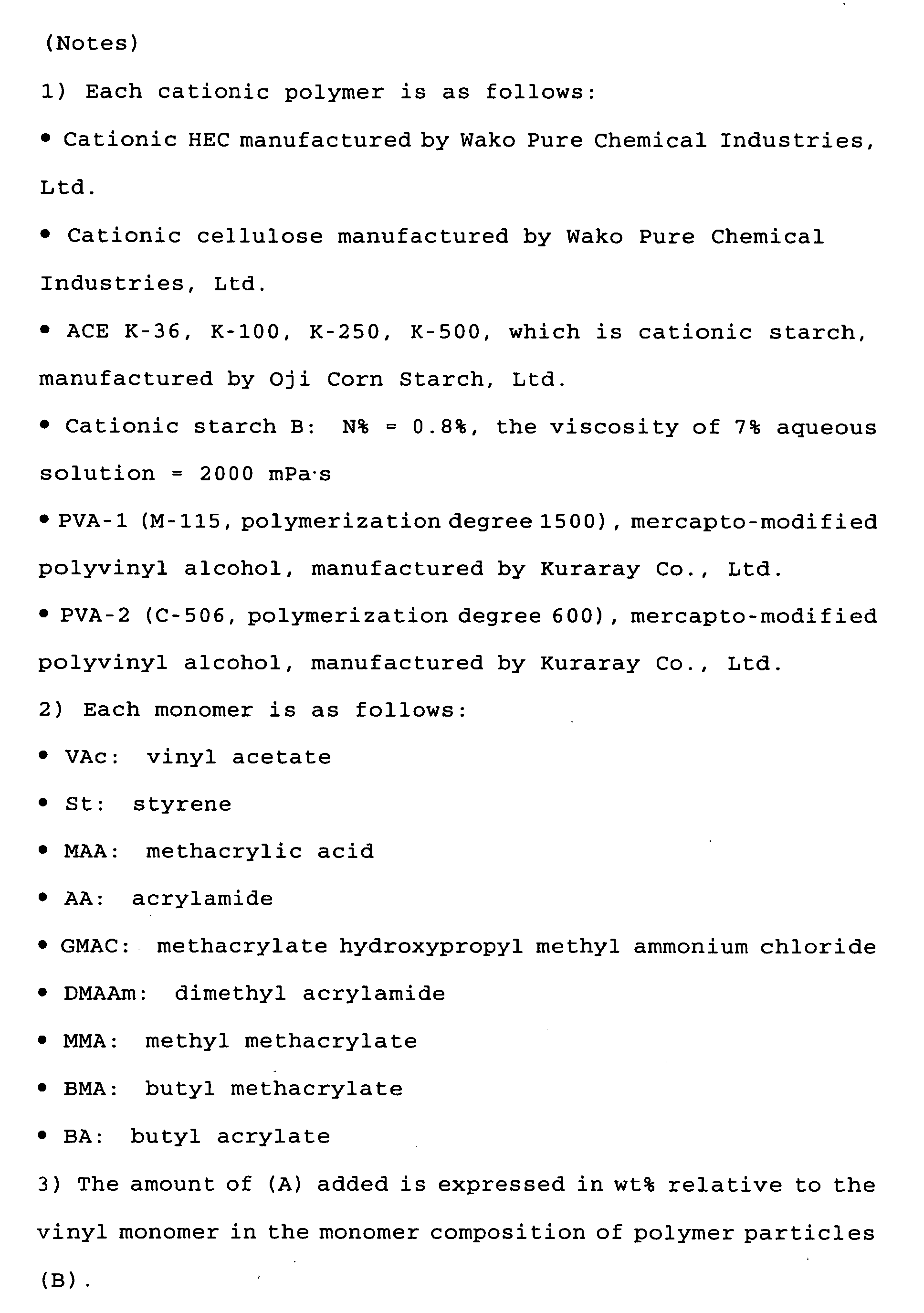
- Emulsions were synthesized in the same manner as for Emulsion II except that the cationic polymer and the monomer composition of polymer particles (B) were changed as shown in Tables 1 and 2 (The polyvinyl alcohol was used in a ratio of 16.8 parts by weight to 100 parts by weight of the cationic polymer. The amount of ion exchange water was suitably changed.)
- Emulsion XIV having a solid content of 17.7% and an average particle diameter of 1.85 ⁇ m was obtained.
- N% 0.6%; the viscosity of 7% aqueous solution, 260 mPa ⁇ s (50°C, Brookfield viscometer, Rotor No. 2, 60 rpm)]
- EMULGEN 150 nonionic surfactant, 20% aqueous solution, manufactured by Kao Corporation
- aqueous solution having 1.1 g of 75% aqueous phosphoric acid and 26.6 g of 4% sodium hydroxide mixed with 10.2 g ion exchange water were added thereto, stirred at 120 rpm and heated at 60°C for 30 minutes while nitrogen was blown into the reaction mixture.
- the mixture was heated to 77°C, and a mixture of 54.3 g vinyl acetate, 1.6 g methacrylic acid (manufactured by Mitsubishi Rayon Co., Ltd.) and 1.9 g dimethyl acrylamide (reagent, manufactured by Wako Pure Chemical Industries), and a solution of 0.85 g initiator (V-50) in 130 g ion exchange water, were added dropped thereto over 3 hours through separate dropping funnels respectively, and the mixture was polymerized. Then, the reaction mixture was heated to 82°C, aged for 1 hour, cooled and recovered.
- the mixture was heated to 75°C, and 380 g vinyl acetate and a solution of 0.8 g initiator (V-50) in 160 g ion exchange water were dropped thereto over 3 hours through separate dropping funnels respectively, and the mixture was polymerized. Then, the reaction mixture was heated to 82°C, aged for 1 hour, cooled and recovered.
- Emulsion II-II The emulsion was synthesized in the same manner as in the method of producing Emulsion II-I except that vinyl acetate/methacrylic acid/dimethyl acrylamide (94.9/2.32/2.78 [ratio by weight]) was used in place of vinyl acetate, and the cationic polyvinyl alcohol was not used (The amount of ion exchange water was suitably changed).
- Emulsion II-II had a solid content of 17.7% and an average particle diameter of 1.85 ⁇ m.
- Emulsion II-III had a solid content of 32% and an average particle diameter of 5.52 ⁇ m.
- Emulsion III-I having a solid content of 19.5% and an average particle diameter of 0.22 ⁇ m was obtained.
- Emulsion III-II having a solid content of 20.7% and an average particle diameter of 0.23 ⁇ m was obtained.
- the solid content of the emulsion was determined by measuring 1 g sample under heating at 150°C for 20 minutes with an infrared moisture determination balance FD-240 (Kett).
- the average particle diameter of dispersed particles in the emulsion was measured by laser diffraction/scattering particle size distribution measuring instrument LA-910 (manufactured by Horiba, Ltd.) .
- the average particle diameter was expressed in terms of median diameter.
- particles of less than 0.4 ⁇ m were measured with a dynamic light scattering particle diameter distribution measuring instrument N4 Plus (Beckman Coulter, Inc.). In this case, the average particle diameter was determined by a unimodal method (cumulant method).
- the nitrogen content of the cationic polymer was determined according to the JIS K 8001 method.
- the viscosity (7 wt%) of the cationic polymer was measured by a Brookfield viscometer (60 rpm, 50°C) .
- the rotor was selected suitably according to viscosity to be measured. Examples 1 to 28
- a paper quality improver (also referred to hereinafter as agent) consisting of the above emulsion was used in manufacturing paper from the following pulp material, and the resulting pulp sheet was evaluated for improvement of stiffness and bulk. The results are shown in Tables 1 and 2.
- LBKP broad-leaved bleached kraft pulp
- JIS P 8121 Canadian Standard Freeness
- the virgin pulp slurry was weighed such that the pulp basis weight of a pulp sheet after papermaking became 70 g/m 2 ⁇ 1 g/m 2 , and as shown in Table 1, each of the paper quality improvers for internal addition in the Examples of the present invention or in the Comparative Examples was added as an internal agent in an amount of 0.5 to 5% [that is, the total amount of the natural cationic polymer (A) or synthetic cationic polymer (A') and polymer particles (B)] per 100 parts by weight of pulp, and then used in papermaking by a square TAPPI paper machine with a 80-mesh wire (area 625 cm 2 ) to give a pulp sheet.
- the sheet after papermaking was pressed for 5 minutes at 3.5 kg/cm 2 with a pressing machine and dried at 105°C for 2 minutes with a mirror-surface dryer.
- the dried pulp sheet was subjected to moisture conditioning under the conditions of 23°C and 50% humidity for 1 day, and the paper was measured for bulk density and Clark stiffness in the following methods.
- the number of paper samples was 5 for each improver, and the average of 10 paper measurements for each improver was determined.
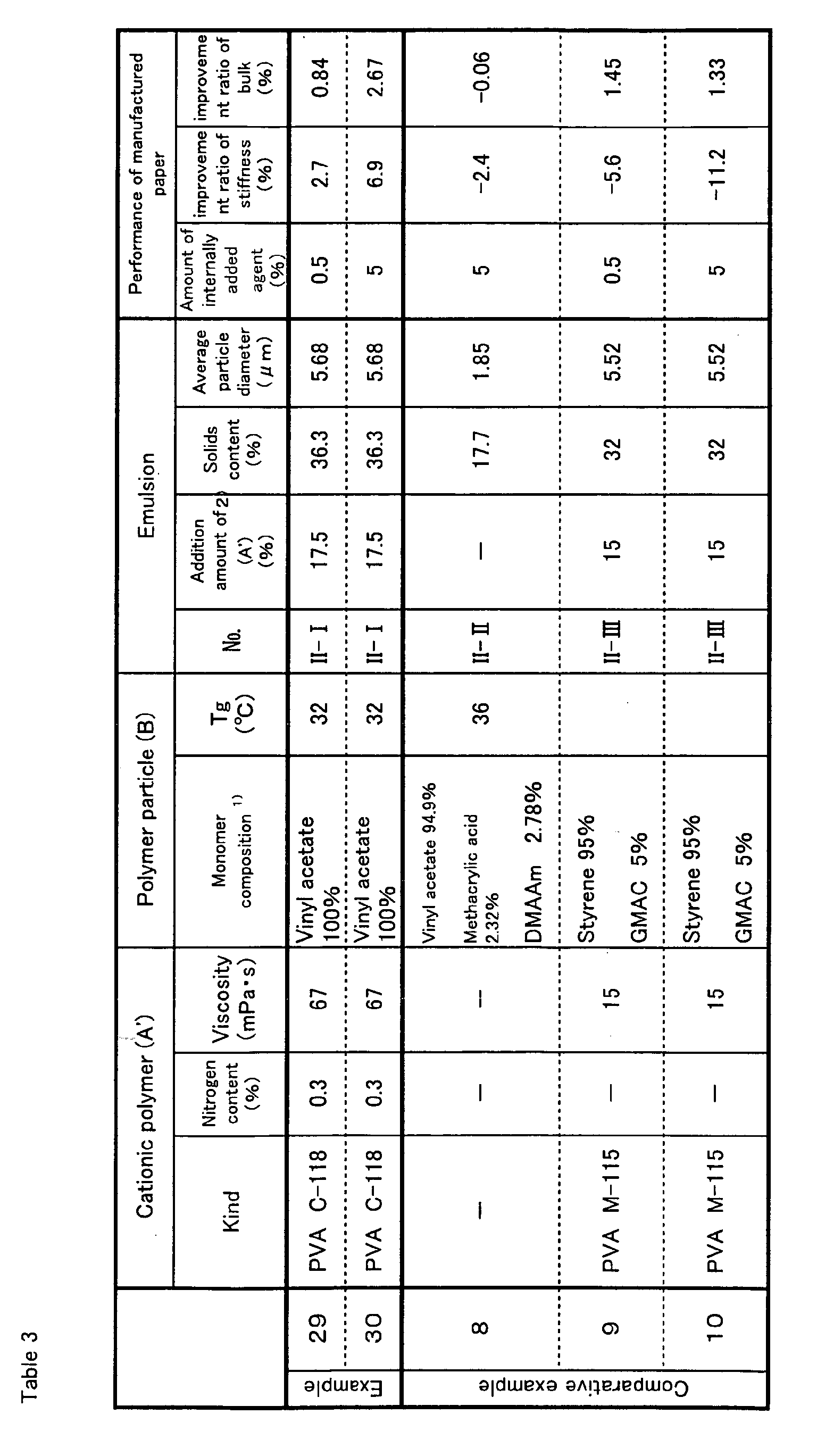
- the improvement of stiffness and bulk of paper produced from the following pulp material by using the paper quality improver shown in Table 3 was evaluated in the same manner as in Example 1. The results are shown in Table 3.
- the paper quality improver of the present invention can achieve the paper quality improvement effect even in a relatively small amount of the cationic polymer used.
Landscapes
- Chemical & Material Sciences (AREA)
- Chemical Kinetics & Catalysis (AREA)
- Paper (AREA)
Abstract
Description







Claims (12)
- A paper quality improver for internal addition, which comprises a polymer emulsion comprising a natural cationic polymer (A) and polymer particles (B) comprising at least vinyl monomer-derived structural units.
- The paper quality improver for internal addition according to claim 1, wherein the natural cationic polymer (A) is at least one selected from cationic starch and cationic cellulose.
- The paper quality improver for internal addition according to claim 1, wherein the glass transition temperature (TG) of the polymer particle (B) comprising vinyl monomer-derived structural units is 90°C or less.
- The paper quality improver for internal addition according to claim 1 or 3, wherein the vinyl monomer is a vinyl fatty ester.
- The paper improver for internal addition according to claim 1 or 2, wherein the nitrogen content of the natural cationic polymer (A) is 0.05 to 1 wt %.
- The paper quality improver for internal addition according to claim 1, wherein the proportion of the natural cationic polymer (A) is 5 to 500 parts by weight relative to 100 parts by weight of the polymer particles (B).
- A pulp sheet comprising the paper quality improver for internal addition according to claim 1 on the surface and/or in the inside of the pulp sheet.
- The pulp sheet according to claim 7, which is obtained by adding the paper quality improver for internal addition in an amount of 0.05 to 20 parts by weight in terms of solid content to 100 parts by weight of a pulp sheet.
- A paper quality improver for internal addition, which comprises a polymer emulsion comprising a synthetic cationic polymer (A') having a viscosity of 20 mPa·s (50°C) or more in the form of an aqueous solution (7 wt %) and a nitrogen content of 1.0 wt. or less and polymer particles (B) having a glass transition temperature (TG) of 90°C or less having vinyl monomer-derived structural units.
- A method of improving paper qualities of a pulp sheet, which comprises bringing the paper quality improver for internal addition according to any one of claims 1 to 9 into contact with pulp.
- A method of improving paper qualities of a pulp sheet, which comprises adding the paper quality improver for internal addition according to any one of claims 1 to 9 to pulp slurry at the time of papermaking.
- Use of the paper quality improver for internal addition according to any one of claims 1 to 9 as a stiffness improver.
Applications Claiming Priority (5)
| Application Number | Priority Date | Filing Date | Title |
|---|---|---|---|
| JP2002247754 | 2002-08-27 | ||
| JP2002247754 | 2002-08-27 | ||
| JP2002252659 | 2002-08-30 | ||
| JP2002252659A JP3976136B2 (en) | 2002-08-30 | 2002-08-30 | Paper quality improver |
| PCT/JP2003/010867 WO2004020736A1 (en) | 2002-08-27 | 2003-08-27 | Paper quality improver |
Publications (3)
| Publication Number | Publication Date |
|---|---|
| EP1550770A1 true EP1550770A1 (en) | 2005-07-06 |
| EP1550770A4 EP1550770A4 (en) | 2006-08-23 |
| EP1550770B1 EP1550770B1 (en) | 2009-07-01 |
Family
ID=31980489
Family Applications (1)
| Application Number | Title | Priority Date | Filing Date |
|---|---|---|---|
| EP03791345A Expired - Lifetime EP1550770B1 (en) | 2002-08-27 | 2003-08-27 | method of improving paper stiffness |
Country Status (8)
| Country | Link |
|---|---|
| US (1) | US7744725B2 (en) |
| EP (1) | EP1550770B1 (en) |
| KR (1) | KR100989538B1 (en) |
| CN (1) | CN1316123C (en) |
| AU (1) | AU2003261765A1 (en) |
| CA (1) | CA2496638A1 (en) |
| DE (1) | DE60328211D1 (en) |
| WO (1) | WO2004020736A1 (en) |
Families Citing this family (3)
| Publication number | Priority date | Publication date | Assignee | Title |
|---|---|---|---|---|
| EP3077212A4 (en) | 2013-12-06 | 2016-10-12 | Hewlett Packard Development Co | Cationic latex fixative for ink applications |
| JP6795790B2 (en) * | 2016-06-23 | 2020-12-02 | 荒川化学工業株式会社 | Manufacturing method of paper |
| ES3050623T3 (en) * | 2017-03-30 | 2025-12-22 | Kemira Oyj | A surface sizing composition, method of production, and use thereof |
Family Cites Families (26)
| Publication number | Priority date | Publication date | Assignee | Title |
|---|---|---|---|---|
| US3632535A (en) * | 1967-09-20 | 1972-01-04 | Cpc International Inc | Emulsion polymerization method and resultant aqueous latex |
| DE2332294C3 (en) | 1973-06-25 | 1980-01-31 | Feldmuehle Ag, 4000 Duesseldorf | Lightweight, high-stiffness, high-volume paper |
| JPS5434409A (en) | 1977-08-23 | 1979-03-13 | Sanyo Chemical Ind Ltd | Internally adding and treating agent for paper making |
| DE3534273A1 (en) * | 1985-09-26 | 1987-04-02 | Basf Ag | METHOD FOR PRODUCING VINYLAMINE UNITS CONTAINING WATER-SOLUBLE COPOLYMERISATS AND THE USE THEREOF AS WET AND DRY-FASTENING AGENTS FOR PAPER |
| DE3730887A1 (en) * | 1987-09-15 | 1989-03-23 | Basf Ag | METHOD FOR IMPROVING THE PRINTABILITY OF PAPER |
| US4940741A (en) * | 1988-06-17 | 1990-07-10 | National Starch And Chemical Investment Holding Corporation | Process for the production of hardboard |
| US5349089A (en) * | 1989-07-07 | 1994-09-20 | National Starch And Chemical Investment Holding Corporation | Reagent for preparing polycationic polysaccharides |
| JP2912403B2 (en) | 1990-01-31 | 1999-06-28 | 三井化学株式会社 | Papermaking additives |
| US5167766A (en) * | 1990-06-18 | 1992-12-01 | American Cyanamid Company | Charged organic polymer microbeads in paper making process |
| US5274055A (en) * | 1990-06-11 | 1993-12-28 | American Cyanamid Company | Charged organic polymer microbeads in paper-making process |
| WO1994000514A1 (en) * | 1992-06-19 | 1994-01-06 | Penford Products Company | Cationic starch/vinyl acetate coating board binders |
| US5431783A (en) * | 1993-07-19 | 1995-07-11 | Cytec Technology Corp. | Compositions and methods for improving performance during separation of solids from liquid particulate dispersions |
| JP3434055B2 (en) | 1994-12-14 | 2003-08-04 | 株式会社クラレ | Internal additives for paper |
| DE69607394T3 (en) * | 1995-12-25 | 2007-02-01 | Hymo Corp. | PAPER MANUFACTURING PROCESS |
| US6146494A (en) * | 1997-06-12 | 2000-11-14 | The Procter & Gamble Company | Modified cellulosic fibers and fibrous webs containing these fibers |
| JPH11302992A (en) | 1998-04-16 | 1999-11-02 | Misawa Ceramics Corp | Paper making additive, its production and paper production using said additive |
| JP2971447B1 (en) | 1998-06-02 | 1999-11-08 | 花王株式会社 | Bulking agent for paper |
| FI107174B (en) * | 1998-07-10 | 2001-06-15 | Raisio Chem Oy | Additive composition for papermaking |
| FI107173B (en) | 1998-07-10 | 2001-06-15 | Raisio Chem Oy | Additives for papermaking |
| JP3283248B2 (en) | 1998-12-28 | 2002-05-20 | 花王株式会社 | Papermaking paper quality improver |
| FI105565B (en) * | 1999-02-05 | 2000-09-15 | Raisio Chem Oy | Polymer dispersion and process for its preparation |
| JP4329149B2 (en) | 1999-03-12 | 2009-09-09 | 星光Pmc株式会社 | Paper sizing method |
| DK1232189T3 (en) * | 1999-10-19 | 2004-04-13 | Suedzucker Ag | Emulsion polymerization process |
| KR20020058086A (en) * | 1999-12-06 | 2002-07-12 | 조이스 엘. 모리슨 | Method for Using Hydrophobically Associative Polymers in Preparing Cellulosic Fiber Compositions, and Cellulosic Fiber Compositions Incorporating the Hydrophobically Associative Polymers |
| JP3681655B2 (en) | 2000-08-03 | 2005-08-10 | ハイモ株式会社 | Medium paper making method |
| MY140287A (en) * | 2000-10-16 | 2009-12-31 | Ciba Spec Chem Water Treat Ltd | Manufacture of paper and paperboard |
-
2003
- 2003-08-27 AU AU2003261765A patent/AU2003261765A1/en not_active Abandoned
- 2003-08-27 US US10/525,458 patent/US7744725B2/en not_active Expired - Fee Related
- 2003-08-27 WO PCT/JP2003/010867 patent/WO2004020736A1/en not_active Ceased
- 2003-08-27 CN CNB038202808A patent/CN1316123C/en not_active Expired - Fee Related
- 2003-08-27 DE DE60328211T patent/DE60328211D1/en not_active Expired - Lifetime
- 2003-08-27 KR KR1020057003162A patent/KR100989538B1/en not_active Expired - Fee Related
- 2003-08-27 EP EP03791345A patent/EP1550770B1/en not_active Expired - Lifetime
- 2003-08-27 CA CA002496638A patent/CA2496638A1/en not_active Abandoned
Also Published As
| Publication number | Publication date |
|---|---|
| US7744725B2 (en) | 2010-06-29 |
| DE60328211D1 (en) | 2009-08-13 |
| CA2496638A1 (en) | 2004-03-11 |
| US20060106137A1 (en) | 2006-05-18 |
| KR20050058513A (en) | 2005-06-16 |
| CN1316123C (en) | 2007-05-16 |
| EP1550770B1 (en) | 2009-07-01 |
| AU2003261765A1 (en) | 2004-03-19 |
| CN1678793A (en) | 2005-10-05 |
| KR100989538B1 (en) | 2010-10-25 |
| WO2004020736A1 (en) | 2004-03-11 |
| EP1550770A4 (en) | 2006-08-23 |
Similar Documents
| Publication | Publication Date | Title |
|---|---|---|
| US5672392A (en) | Preparation of recording materials for inkjet printers | |
| KR101577483B1 (en) | Production of paper | |
| US4774285A (en) | Preparation of water-soluble copolymers containing vinylamine units, and their use as wet strength agents and dry strength agents for paper | |
| US7482417B2 (en) | Papermaking chemical, method for manufacturing same, and paper containing same | |
| US5698627A (en) | Additive for papermaking | |
| JP2642384B2 (en) | Process for producing paper, paperboard or cardboard with high drying strength | |
| JP2596593B2 (en) | Process for producing paper, cardboard or paperboard with high drying strength | |
| AU613744B2 (en) | Sizing composition and sizing method | |
| JP6779976B2 (en) | Paper manufacturing method | |
| AU2019373454B2 (en) | Synthesis of re-pulpable temporary wet strength polymer for tissue application | |
| US7547376B2 (en) | Paper improver | |
| EP1550770B1 (en) | method of improving paper stiffness | |
| JP2000273387A (en) | Surface paper quality improver | |
| JP3969543B2 (en) | Paper quality improver | |
| JP4048612B2 (en) | Mechanical pulp-containing paper and method for producing the same | |
| KR20170068561A (en) | Solidifying composition for paper and cardboard | |
| JP4395817B2 (en) | Method for producing surface sizing agent and coated paper | |
| CA2336660A1 (en) | The use of modified starch products as retention agents in the production of paper | |
| JP2020147888A (en) | Disperse for paper chemicals, paper strength enhancer containing the dispersion for paper chemicals, drainage improver and yield improver | |
| JP3976136B2 (en) | Paper quality improver | |
| JP4590195B2 (en) | Newspaper printing paper | |
| JP2005299012A (en) | Paper quality improver | |
| JP4312647B2 (en) | Paper quality improver | |
| JPH08176991A (en) | Surface coating agent and its use | |
| JP2004068226A (en) | Sizing agent for papermaking |
Legal Events
| Date | Code | Title | Description |
|---|---|---|---|
| PUAI | Public reference made under article 153(3) epc to a published international application that has entered the european phase |
Free format text: ORIGINAL CODE: 0009012 |
|
| 17P | Request for examination filed |
Effective date: 20050225 |
|
| AK | Designated contracting states |
Kind code of ref document: A1 Designated state(s): AT BE BG CH CY CZ DE DK EE ES FI FR GB GR HU IE IT LI LU MC NL PT RO SE SI SK TR |
|
| AX | Request for extension of the european patent |
Extension state: AL LT LV MK |
|
| DAX | Request for extension of the european patent (deleted) | ||
| RBV | Designated contracting states (corrected) |
Designated state(s): DE FR GB |
|
| A4 | Supplementary search report drawn up and despatched |
Effective date: 20060720 |
|
| 17Q | First examination report despatched |
Effective date: 20070622 |
|
| GRAP | Despatch of communication of intention to grant a patent |
Free format text: ORIGINAL CODE: EPIDOSNIGR1 |
|
| RTI1 | Title (correction) |
Free format text: METHOD OF IMPROVING PAPER STIFFNESS |
|
| GRAS | Grant fee paid |
Free format text: ORIGINAL CODE: EPIDOSNIGR3 |
|
| GRAA | (expected) grant |
Free format text: ORIGINAL CODE: 0009210 |
|
| AK | Designated contracting states |
Kind code of ref document: B1 Designated state(s): DE FR GB |
|
| REG | Reference to a national code |
Ref country code: GB Ref legal event code: FG4D |
|
| REF | Corresponds to: |
Ref document number: 60328211 Country of ref document: DE Date of ref document: 20090813 Kind code of ref document: P |
|
| PLBE | No opposition filed within time limit |
Free format text: ORIGINAL CODE: 0009261 |
|
| STAA | Information on the status of an ep patent application or granted ep patent |
Free format text: STATUS: NO OPPOSITION FILED WITHIN TIME LIMIT |
|
| 26N | No opposition filed |
Effective date: 20100406 |
|
| PGFP | Annual fee paid to national office [announced via postgrant information from national office to epo] |
Ref country code: DE Payment date: 20140821 Year of fee payment: 12 |
|
| PGFP | Annual fee paid to national office [announced via postgrant information from national office to epo] |
Ref country code: FR Payment date: 20140808 Year of fee payment: 12 Ref country code: GB Payment date: 20140827 Year of fee payment: 12 |
|
| REG | Reference to a national code |
Ref country code: DE Ref legal event code: R119 Ref document number: 60328211 Country of ref document: DE |
|
| GBPC | Gb: european patent ceased through non-payment of renewal fee |
Effective date: 20150827 |
|
| REG | Reference to a national code |
Ref country code: FR Ref legal event code: ST Effective date: 20160429 |
|
| PG25 | Lapsed in a contracting state [announced via postgrant information from national office to epo] |
Ref country code: DE Free format text: LAPSE BECAUSE OF NON-PAYMENT OF DUE FEES Effective date: 20160301 Ref country code: GB Free format text: LAPSE BECAUSE OF NON-PAYMENT OF DUE FEES Effective date: 20150827 |
|
| PG25 | Lapsed in a contracting state [announced via postgrant information from national office to epo] |
Ref country code: FR Free format text: LAPSE BECAUSE OF NON-PAYMENT OF DUE FEES Effective date: 20150831 |