EP1550733A1 - Element for thermal fuse, thermal fuse and battery including the same - Google Patents
Element for thermal fuse, thermal fuse and battery including the same Download PDFInfo
- Publication number
- EP1550733A1 EP1550733A1 EP03748719A EP03748719A EP1550733A1 EP 1550733 A1 EP1550733 A1 EP 1550733A1 EP 03748719 A EP03748719 A EP 03748719A EP 03748719 A EP03748719 A EP 03748719A EP 1550733 A1 EP1550733 A1 EP 1550733A1
- Authority
- EP
- European Patent Office
- Prior art keywords
- thermal fuse
- insulation
- alloy
- fusible
- fusible alloy
- Prior art date
- Legal status (The legal status is an assumption and is not a legal conclusion. Google has not performed a legal analysis and makes no representation as to the accuracy of the status listed.)
- Granted
Links
Images



Classifications
-
- H—ELECTRICITY
- H01—ELECTRIC ELEMENTS
- H01H—ELECTRIC SWITCHES; RELAYS; SELECTORS; EMERGENCY PROTECTIVE DEVICES
- H01H37/00—Thermally-actuated switches
- H01H37/74—Switches in which only the opening movement or only the closing movement of a contact is effected by heating or cooling
- H01H37/76—Contact member actuated by melting of fusible material, actuated due to burning of combustible material or due to explosion of explosive material
- H01H37/761—Contact member actuated by melting of fusible material, actuated due to burning of combustible material or due to explosion of explosive material with a fusible element forming part of the switched circuit
-
- H—ELECTRICITY
- H01—ELECTRIC ELEMENTS
- H01H—ELECTRIC SWITCHES; RELAYS; SELECTORS; EMERGENCY PROTECTIVE DEVICES
- H01H85/00—Protective devices in which the current flows through a part of fusible material and this current is interrupted by displacement of the fusible material when this current becomes excessive
- H01H85/02—Details
- H01H85/04—Fuses, i.e. expendable parts of the protective device, e.g. cartridges
-
- C—CHEMISTRY; METALLURGY
- C22—METALLURGY; FERROUS OR NON-FERROUS ALLOYS; TREATMENT OF ALLOYS OR NON-FERROUS METALS
- C22C—ALLOYS
- C22C28/00—Alloys based on a metal not provided for in groups C22C5/00 - C22C27/00
-
- C—CHEMISTRY; METALLURGY
- C22—METALLURGY; FERROUS OR NON-FERROUS ALLOYS; TREATMENT OF ALLOYS OR NON-FERROUS METALS
- C22C—ALLOYS
- C22C30/00—Alloys containing less than 50% by weight of each constituent
-
- C—CHEMISTRY; METALLURGY
- C22—METALLURGY; FERROUS OR NON-FERROUS ALLOYS; TREATMENT OF ALLOYS OR NON-FERROUS METALS
- C22C—ALLOYS
- C22C30/00—Alloys containing less than 50% by weight of each constituent
- C22C30/04—Alloys containing less than 50% by weight of each constituent containing tin or lead
-
- H—ELECTRICITY
- H01—ELECTRIC ELEMENTS
- H01H—ELECTRIC SWITCHES; RELAYS; SELECTORS; EMERGENCY PROTECTIVE DEVICES
- H01H37/00—Thermally-actuated switches
- H01H37/74—Switches in which only the opening movement or only the closing movement of a contact is effected by heating or cooling
- H01H37/76—Contact member actuated by melting of fusible material, actuated due to burning of combustible material or due to explosion of explosive material
-
- H—ELECTRICITY
- H01—ELECTRIC ELEMENTS
- H01M—PROCESSES OR MEANS, e.g. BATTERIES, FOR THE DIRECT CONVERSION OF CHEMICAL ENERGY INTO ELECTRICAL ENERGY
- H01M50/00—Constructional details or processes of manufacture of the non-active parts of electrochemical cells other than fuel cells, e.g. hybrid cells
- H01M50/50—Current conducting connections for cells or batteries
- H01M50/572—Means for preventing undesired use or discharge
- H01M50/574—Devices or arrangements for the interruption of current
- H01M50/581—Devices or arrangements for the interruption of current in response to temperature
-
- H—ELECTRICITY
- H01—ELECTRIC ELEMENTS
- H01M—PROCESSES OR MEANS, e.g. BATTERIES, FOR THE DIRECT CONVERSION OF CHEMICAL ENERGY INTO ELECTRICAL ENERGY
- H01M50/00—Constructional details or processes of manufacture of the non-active parts of electrochemical cells other than fuel cells, e.g. hybrid cells
- H01M50/50—Current conducting connections for cells or batteries
- H01M50/572—Means for preventing undesired use or discharge
- H01M50/574—Devices or arrangements for the interruption of current
- H01M50/583—Devices or arrangements for the interruption of current in response to current, e.g. fuses
-
- H—ELECTRICITY
- H01—ELECTRIC ELEMENTS
- H01H—ELECTRIC SWITCHES; RELAYS; SELECTORS; EMERGENCY PROTECTIVE DEVICES
- H01H9/00—Details of switching devices, not covered by groups H01H1/00 - H01H7/00
- H01H2009/0077—Details of switching devices, not covered by groups H01H1/00 - H01H7/00 using recyclable materials, e.g. for easier recycling or minimising the packing material
-
- H—ELECTRICITY
- H01—ELECTRIC ELEMENTS
- H01H—ELECTRIC SWITCHES; RELAYS; SELECTORS; EMERGENCY PROTECTIVE DEVICES
- H01H37/00—Thermally-actuated switches
- H01H37/02—Details
- H01H37/32—Thermally-sensitive members
- H01H37/52—Thermally-sensitive members actuated due to deflection of bimetallic element
- H01H2037/526—Materials for bimetals
-
- H—ELECTRICITY
- H01—ELECTRIC ELEMENTS
- H01H—ELECTRIC SWITCHES; RELAYS; SELECTORS; EMERGENCY PROTECTIVE DEVICES
- H01H37/00—Thermally-actuated switches
- H01H37/74—Switches in which only the opening movement or only the closing movement of a contact is effected by heating or cooling
- H01H37/76—Contact member actuated by melting of fusible material, actuated due to burning of combustible material or due to explosion of explosive material
- H01H2037/768—Contact member actuated by melting of fusible material, actuated due to burning of combustible material or due to explosion of explosive material characterised by the composition of the fusible material
-
- H—ELECTRICITY
- H01—ELECTRIC ELEMENTS
- H01M—PROCESSES OR MEANS, e.g. BATTERIES, FOR THE DIRECT CONVERSION OF CHEMICAL ENERGY INTO ELECTRICAL ENERGY
- H01M2200/00—Safety devices for primary or secondary batteries
- H01M2200/10—Temperature sensitive devices
- H01M2200/103—Fuse
-
- Y—GENERAL TAGGING OF NEW TECHNOLOGICAL DEVELOPMENTS; GENERAL TAGGING OF CROSS-SECTIONAL TECHNOLOGIES SPANNING OVER SEVERAL SECTIONS OF THE IPC; TECHNICAL SUBJECTS COVERED BY FORMER USPC CROSS-REFERENCE ART COLLECTIONS [XRACs] AND DIGESTS
- Y02—TECHNOLOGIES OR APPLICATIONS FOR MITIGATION OR ADAPTATION AGAINST CLIMATE CHANGE
- Y02E—REDUCTION OF GREENHOUSE GAS [GHG] EMISSIONS, RELATED TO ENERGY GENERATION, TRANSMISSION OR DISTRIBUTION
- Y02E60/00—Enabling technologies; Technologies with a potential or indirect contribution to GHG emissions mitigation
- Y02E60/10—Energy storage using batteries
Definitions
- the present invention relates to an element for a thermal fuse, a thermal fuse including the element, and a battery including the thermal fuse.
- thermal fuses that do not contain lead and cadmium are demanded since the thermal fuses are connected to batteries by spot welding, and lead-free solder is already used for protection circuits for regulating charges and discharges of the batteries.
- thermal fuses have low fusible temperatures ranging from 85°C to 95°C in order to stop electric currents quickly in case of abnormal conditions.
- Fig. 7 is a sectional view of a conventional thermal fuse.
- the conventional thermal fuse includes tubular insulation case 1 having openings at both ends, fusible alloy 2 having a substantially columnar or prismatic shape within insulation case 1, a pair of lead conductors 3, flux coated on fusible alloy 2 (not shown in the figure), and sealing member 4 for sealing the openings at the both ends of insulation case 1.
- Lead conductors 3 have their respective ends connected to respective ends of fusible alloy 2, and have respective other ends extending to the outside through the openings of insulation case 1.
- Thermal fuse fusible at a temperature ranging from 85°C to 95°C includes fusible alloy 2 made of Sn-Cd-In eutectic alloy (having a melting point of 93°C) or Sn-Bi-Pb eutectic alloy (having a melting point of 95°C).
- Japanese Patent Laid-Open Publication No.2000-90792 discloses a thermal fuse including a fusible alloy containing lead and cadmium.
- the conventional thermal fuse uses fusible alloy 2 containing lead and cadmium, disposal of an electronic apparatus using this thermal fuse releases lead and cadmium.
- a fusible element used in a thermal fuse includes an alloy containing 20wt.% to 39.5wt.% of tin, 11.5wt.% to 31wt.% of bismuth, and 49wt.% to 68.5wt.% of indium.
- a thermal fuse including the fusible element does not release lead or cadmium even if being disposed of.
- Fig. 1A is a top view of a thin thermal fuse according to Exemplary Embodiment 1 of the present invention.
- Fig. 1B is a sectional view of the thermal fuse taken along line 1B-1B shown in Fig. 1A.
- First insulation film 11 formed of a single-layered sheet is provided with a pair of metal terminals 12 having widths narrower than that of first insulation film 11.
- Fusible alloy 13 is connected between respective ends of metal terminals 12 and positioned over first insulation film 11, and provides a fusible element of the thermal fuse.
- a surface of fusible alloy 13 is coated with flux (not shown) made of resin including essentially rosin.
- Second insulation film 14 of a single-layered sheet is placed over fusible alloy 13, and bonded to first insulation film 11 by sealing, so that a space is provided between insulation films 11 and 14.
- Fusible alloy 13 is hermetically sealed by securely bonding the outer circumference of second insulation film 14 to the outer circumference of first insulation film 11 to prevent fusible alloy 13 from deterioration. Insulation films 11 and 14 thus provide an insulation housing for enclosing fusible alloy 13.
- Metal terminals 12 have flat strip or filament shapes made of metal essentially including nickel, nickel-based alloy, such as copper nickel, solid nickel, or nickel alloy including other material. Metal terminals 12 containing more than 98% of nickel has a low specific resistance ranging from 6.8 ⁇ 10 -8 ⁇ • ⁇ m to 12 ⁇ 10 -8 ⁇ • ⁇ m, hence having an improved reliability including a resistance to corrosion. A thickness of the metal terminal 12 is not more than 0.15mm. If the thickness exceeds 0.15mm, the thermal fuse becomes too thick.
- metal terminals 12 are made of material having a Young's modulus ranging from 3 ⁇ 10 10 Pa to 8 ⁇ 10 10 Pa and a tensile strength ranging from 4 ⁇ 10 8 Pa to 6 ⁇ 10 8 Pa, they do not often deform accidentally during handling and transportation, hence being easily bent without breaking in a bending process. If the Young's modulus is not larger than 3 ⁇ 10 10 Pa, metal terminal 12 is easily bent, hence having wavy deformation at portions which are not to be bent (e.g., end portions of metal terminals 12 to be arranged to use for electrical connections). This prevents the terminals from being connected fusible alloy 13 by welding. If the Young's modulus is not less than 8 ⁇ 10 10 Pa, metal terminals 12 are hardly to bent and broken,. Furthermore, if the tensile strength is not more than 4 ⁇ 10 8 Pa, metal terminals 12 is easily bent. If the strength is not less than 6 ⁇ 10 8 Pa, the terminals are hardly bent and broken.
- Each of metal terminals 12 may include metal layer 12A made of material, such as tin or copper on an upper surface at the distal end thereof, as shown in Fig. 1C.
- the layer provides a wettability to fusible alloy 13 to ensure connection between metal layer 12A and fusible alloy 13. Since tin and copper composing metal layers 12A have wettability to fusible alloy 13 better than that of nickel used for metal terminals 12, tin and copper expedite flow of melted fusible alloy 13 toward the metal layers 12A, thereby facilitating disconnection of fusible alloy 13.
- Metal layers 12A include solid metals of copper, tin, bismuth, indium, and alloys of them.
- Metal layers 12A preferably have thicknesses not more than 15 ⁇ m. If the thicknesses are larger than 15 ⁇ m, an amount of metal composing metal layers 12A diffusing towards fusible alloy 13 increases. This increase changes a melting point of fusible alloy 13, hence causing a fusing temperature of the thermal fuse to shift.
- Metal layers 12A may be made of material having a composition identical to that of fusible alloy 13, and does not change the melting point of fusible alloy 13 since the amount of the diffusing metal composing the metal layers 12A is very small even if it diffuses to fusible alloy 13.
- Fusible alloy 13 is composed of Sn-Bi-In alloy which contains 20 to 39.5wt.% of tin, 49 to 68.5wt.% of indium, and 11.5 to 31wt.% of bismuth.
- the alloy provides the thermal fuse having a fusing temperature rated not higher than 95°C and excluding lead and cadmium.
- Fusible alloy 13 does not have a sufficient strength if a composition of tin is less than 20wt.% in Sn-Bi-In alloy composing fusible alloy 13 since indium is softer than tin, and since bismuth is more brittle than tin. As a result, it is difficult to handle fusible alloy 13 in manufacturing processes.
- Sn-Bi-In alloy containing not less than 20wt.% of tin if a composition of indium is less than 49wt.%, the amount of tin is excessively large.
- the composition of indium more than 55wt.% is excessively large.
- a melting point of solid tin is 232°C, which is higher than the melting point of 156°C of solid indium.
- the melting point of fusible alloy 13 depends greatly upon the composition of tin if the alloy contains an excessive amount of tin. Hence, a variation of the composition causes deviation of the melting point, hence causing a large change of the fusing temperature of the thermal fuse.
- the composition of indium is more than 49wt.%, and preferably ranges from 49 to 55wt,% since these figures provide a desirable balance between tin and indium.
- the melting point of fusible alloy 13 exceeds 95°C if a composition of bismuth is less than 11.5wt.%.
- the Sn-Bi-In alloy contains not less than 11.5 wt% of bismuth for use in the thermal fuse having the fusing temperature rated not higher than 95°C for protecting a battery.
- Fig. 2 shows a composition of Sn-Bi-In ternary alloy composing fusible alloy 13. Fusible alloy 13 having the above composition corresponds to an area surrounded by line 15 in Fig. 2.
- the composition of indium preferably ranges from 49 to 55wt.% corresponding to hatched area 16.
- Fusible alloy 13 is processed to have a filament shape by a process, such as die drawing or die extrusion with a die having a circular cross-section. Alloy 13 of the filament shape is pressed to have a rectangular or oval cross section having a thickness not more than 0.1mm. This filament shape is then cut to have a predetermined length. Fusible alloy 13 is placed between the respective ends of metal terminals 12 and at the center over first insulation film 11. Metal terminals 12 and fusible alloy 13 are connected by a process, such as laser welding, hot welding, or ultrasonic welding. The laser welding is suitable since reducing an area to be heated for the connection of fusible alloy 13 to metal terminals 12 without causing damages to areas other than welding portions.
- a process such as die drawing or die extrusion with a die having a circular cross-section. Alloy 13 of the filament shape is pressed to have a rectangular or oval cross section having a thickness not more than 0.1mm. This filament shape is then cut to have a predetermined length. Fusible alloy 13
- First insulation film 11 and second insulation film 14 have thicknesses not more than 0.15mm. Films having thicknesses exceeding 0.15mm are not suitable for the thin thermal fuse since increasing a thickness of the thermal fuse.
- First insulation film 11 and second insulation film 14 may be made of resin essentially including one of polyethylene terephthalate (“PET”), polyethylene naphthalate (“PEN”), ABS resin, SAN resin, polysulfone, polycarbonate, Noryl, vinyl chloride, polyethylene, polyester, polypropylene, polyamide, PPS resin, polyacetal, fluorine-base resin and polyester, and may be preferably includes thermoplastic resin.
- first insulation film 11 and second insulation film 14 made of single-layered sheets are explained, and may be made of laminated sheets of plural materials different from each other.
- first insulation film 11 and second insulation film 14 may be composed of laminated sheets of PET film and PEN film to obtain a larger strength. This can increase a mechanical strength of the thermal fuse.
- laminated sheets of first insulation film 11 and second insulation film 14 may be made of combination of materials having a low thermal resistance and a high thermal resistance, respectively, besides the combination described above.
- a main body of the thermal fuse consisting of first insulation film 11, second insulation film 14, and fusible alloy 13 has an overall length not more than 2.0mm, as denoted by reference symbol La in Fig. 1A and Fig. 1B, and is not useful as the thermal fuse. If the length La is not less than 5.0mm, the thermal fuse is not practical for use in a small sized battery since the fuse requires a large space for mounting.
- the thermal fuse preferably includes a main body having length La ranging from 2.0mm to 5.0mm.
- a thickness Lb in Fig. 1B measured from the bottom surface of first insulation film 11 to the upper surface of second insulation film 14 is not more than 0.3mm, the thickness is not suitable to make a thermal fuse since the thickness does not provide a space to accommodate fusible alloy 13. If thickness Lb not less than 0.7mm, the thermal fuse becomes too thick. If the thermal fuse is mounted to a small battery having a projection, such as an electrode, having a height ranging from 0.5 to 0.7mm, for example, the combination of the thermal fuse and the battery become too thick to be actually used. Therefore, the thickness Lb from the bottom surface of first insulation film 11 to the upper surface of second insulation film 14 preferably ranges from 0.3 to 0.7mm.
- Fusible alloys according to Embodiment 1 having predetermined compositions were prepared, and were examined.
- Alloy composed of 37wt.% of tin, 12wt.% of bismuth, and 51wt.% of indium was die-drawn to have a filament shape having a circular cross-section having a diameter of 0.5mm, is pressed to have a filament shape having a rectangular cross section having a thickness of 0.1mm and a width of 1.95mm, and then, is cut to have a length of 3mm, thus providing fusible alloy 13 PET films having a length of 5mm, a width of 3mm and a thiclness of 0.1mm were used for first insulation films 11 and second insulation films 14.
- Metal terminals 12 were made of nickel plates having a length of 10mm a width of 3mm, and a thickness of 0.1mm, and have respective end portions tin-plated to provide plated layers 12A having thicknesses of 10 ⁇ m.
- Flux (not shown) essentially included rosin.
- thermal fuses Twenty samples of each of thermal fuses include fusible alloys 13 of Example 1, Example 2, comparative Example 1, and Comparative Example 2.
- the thermal fuses have small thicknesses ranging from 0.55 to 0.70mm.
- the prepared thermal fuses were placed inside an air-circulating oven, and were measured in fusing temperatures on the thermal fuses while the temperature in the oven rose at a rate of 1°C/min.
- Table 1 shows a result of the measured fusing temperatures of the thermal fuses of Example 1, Example 2, Comparative Example 1, and Comparative Example 2.
- Fusing Temperature Example 1 Example 2 Comparative Example 1 Comparative Example 1 Average 93.8°C 86.5°C 97.2°C 103.1°C Highest 94.5°C 87.8°C 100.6°C 105.2°C Lowest 93.2°C 85.7°C 93.2°C 101.3°C
- the thermal fuses of Examples 1 and 2 exhibit differences between their respective highest fusing temperatures and the lowest fusing temperatures not more than 3°C, hence providing thermal fuses having small variations in their fusing temperature.
- the thermal fuses of Comparative Example 1 includes alloy containing excessive proportion of tin, and hence, exhibits the difference exceeding 4°C between the highest fusing temperature and the lowest fusing temperature, thus exhibiting large variations of the fusing temperature.
- the fusible alloy used in the fuse of Comparative Example 1 is not suitable for use in the thermal fuses since exhibiting variations exceeding 4°C of the fusing temperature, which is a limit required for ordinary thermal fuses.
- the thermal fuses of Comparative Example 2 have fusing temperatures exceeding 95°C since they contain a small amount, 8% of bismuth.
- fusible alloy 13 made of Sn-Bi-In alloy may not necessarily exclude unavoidable impurities, such as zinc, silver, copper mixed in this alloy.
- An amount of such impurities is preferably not more than 0.5wt.% since the impurities may further change the fusing temperature if included at a rate more than 0.5wt.%.
- Fig. 3A is a top view of a thin thermal fuse according to Exemplary Embodiment 2 of the present invention.
- Fig. 3B is a sectional view of the thermal fuse taken along line 3B-3B shown in Fig. 3A.
- the thermal fuse of Embodiment 2 shown in Fig. 3A and Fig. 3B includes the same components as those of a thermal fuse of Embodiment 1 shown in Fig. 1A and Fig. 1B.
- the thermal fuse according to Embodiment 2 differs from that of Embodiment 1 in that metal terminals 112 has a portion near one end thereof protrudes over the upper surface of first insulation film 111 from the bottom surface, as shown in Fig. 3B.
- a structure other than this is identical to that of the thermal fuse of Embodiment 1.
- fusible alloy 113 includes a fusible element of the thermal fuse connected between respective ends of metal terminals 112 and positioned above first insulation film 111.
- the fusible element is composed of Sn-Bi-In alloy containing more than 20wt.% tin, more than 11.5wt.% of bismuth, and more than 49wt.% of indium. Fusible alloy 113 thus contains neither lead nor cadmium that may be released to the outside.
- the thermal fuse according to Embodiment 2 includes a main body consisting of first insulation film 111, second insulation film 114, and fusible alloy 113 and having an overall length Lc. If the length Lc is not more than 2.0mm, a sufficient insulation distance may not be ensured between metal terminals 112 after the thermal fuse is fused since a spine like projection, such as a burr, on metal terminals 112 in manufacturing processes, hence being not useful for the thermal fuse. If the length Lc is mot less than 5.0mm, the thermal fuse is not practical for use in a small size battery since requiring a large space for mounting it.
- the length Lc of the main body may range preferably from 2.0mm to 5.0mm.
- a thickness Ld measured from the bottom surface of first insulation film 111 to the upper surface of second insulation film 114 shown in Fig. 3B is not more than 0.3mm, the thickness is not suitable to make the thermal fuse since a space enough to accommodate fusible alloy 113 is not provided.
- the thermal fuse is too thick if thickness Ld is not less than 0.7mm.
- the thermal fuse may be mounted to a small battery including an electrodes having a projecting height ranging, for example, from 0.5 to 0.7mm. The thickness makes the combination of the thermal fuse and the battery too thick, hence being not practical. Therefore, the thickness Ld measured from the bottom surface of first insulation film 111 to the upper surface of second insulation film 114 may range preferably from 0.3 to 0.7mm.
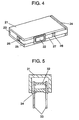
- Fig. 4 is a perspective view of a battery according to Exemplary Embodiment 3 of the present invention.
- the battery includes battery unit 21, thermal fuse 22, external electrode 23 of battery unit 21, and protection circuit 24 connected electrically to battery unit 21.
- Thermal fuse 22 may be any of thin thermal fuses according to Embodiments 1 and 2 shown in Fig. 1A through Fig. 3B.
- Terminal 25 of thermal fuse 22 is connected electrically to external electrode 23 at connection point 26 by spot welding or the like.
- Another terminal 27 of thermal fuse 22 is connected electrically to protection circuit 24 at connection point 28 by spot welding or the like.
- Component providing protection circuit 24 are assembled in the protection circuit 24 with lead-free solder, such as Sn-Ag base solder or Sn-Cu base solder.
- Thermal fuse 22 stops an electric current from battery unit 21 when battery unit 21 produces heat exceeding a predetermined amount.
- Thin thermal fuse 22 of the battery includes fusible alloy 13 including a fusible element.
- the element is connected between respective ends of metal terminals 12 and positioned above first insulation film 11, for instance, as shown in Fig. 1A.
- Fusible alloy 13 is composed of Sn-Bi-In alloy containing not less than 20wt.% of tin, not less than 11.5 wt.% of bismuth, and not less than 49wt.% indium. Fusible alloy 13 thus contains neither lead nor cadmium, hence preventing the battery from releasing lead or cadmium even if the battery is disposed of.
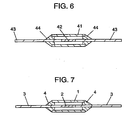
- Fig. 5 is a sectional view of a radial type thermal fuse according to Exemplary Embodiment 4 of the present invention.
- insulation case 31 having a cylindrical tube shape having a bottom or a prismatic tube shape having a bottom is made of any of polybutylene terephthalate (PBT), polyphenylene sulfide (PPS), polyethylene terephthalate (PET), phenolic resin, ceramic, glass, and the like materials.
- Fusible alloy 32 having a substantially cylindrical or prismatic shape in insulation case 31 is composed of Sn-Bi-In alloy.
- the alloy contains 20 to 39.5wt.% of tin, 49 to 68.5wt.% of indium, and 11.5 to 31wt.% of bismuth.
- the alloy allows the thermal fuse to have a rated fusing tenperature not more than 95°C and not to contain lead or cadmium.
- Sn-Bi-In alloy composing fusible alloy 32 contains less than 20wt.% of tin, Fusible alloy 32 does not have a sufficient strength since indium is softer than tin and bismuth is more brittle than tin. This composition prevents fusible alloy 32 from being to handled easily in manufacturing processes.
- the Sn-Bi-In alloy containing not less than 20wt% of tin is regarded as containing excessive amount of tin if containing less than 49wt.% of indium.
- the Sn-Bi-In alloy containing not less than 55wt.% of indium is regarded as containing an excessive amount of indium.
- a melting point of solid tin is 232°C, which is higher than a melting point of 156°C of solid indium.
- the melting point of fusible alloy 32 depends greatly upon the compounding ratio of tin if alloy 32 contains an excessive amount of tin. Hence, a variation of the compounding ratio increases a deviation of the melting point, hence changing the fusing temperature of the thermal fuse.
- the alloy preferably contains at least 49wt.% of indium, preferably 49 to 55wt.% of indium, thus providing a desirable balance between tin and indium.
- Sn-Bi-In alloy containing 20wt.% of tin and 49wt.% of indium provides the melting point of fusible alloy 32 exceeds 95°C if containing less than 11.5wt.% of bismuth.
- the fusible alloy may preferably contain not less than 11.5wt.% of bismuth for use in the radial type thermal fuse having a rated fusing temperature not higher than 95°C for protection of the battery.
- Lead conductors 33 have respective one ends connected to respective ones of both ends of fusible alloy 32, and have respective other ends extending to the outside through an opening of insulation case 31.
- Lead conductors 33 having a filament shape may be made of solid metal, such as copper, iron, nickel, alloy of them, and have surfaces plated with metal, such as tin, zinc, bismuth, indium, silver, copper, and alloy containing any of these metals.
- Fusible alloy 32 is coated with flux (not shown) which melts and removes an oxide film from the fusible alloy 32 when the ambient temperature rises.
- sealing member 34 made of thermosetting resin, such as epoxy or silicone. Fusible alloy 32 and lead conductors 33 are connected by welding or ultrasonic welding. Alternatively, they are connected by having them melt with an electric current.
- the radial type thermal fuse of Embodiment 4 includes fusible alloy 32 composed of the Sn-Bi-In alloy containing not less than 20wt.% of tin, not less than 11.5wt.% of bismuth, and not less than 49wt.% of indium, not containing lead or cadmium. Therefore, fusible alloy 32 does not release lead or cadmium. Lead conductors 33 having their respective one ends connected with fusible alloy 32 have respective other ends extending to the outside through the opening of insulation case 31. This structure provides the radial type thermal fuse having a large flexibility for an orientation in mounting it to a device, such as a battery.
- Fig. 6 is a sectional view of an axial type thermal fuse according to Exemplary Embodiment 5 of the present invention.
- Tubular insulation case 41 having openings at both ends thereof is made of any of polybutylene terephthalate (PBT), polyphenylene sulfide (PPT), polyethylene terephthalate (PET), phenolic resin, ceramic, glass, and the like.
- Fusible alloy 42 having a substantially cylindrical or prismatic shape in insulation case 41 is composed of Sn-Bi-In alloy.
- the alloy contains 20 to 39.5wt.% of tin, 49 to 68.5wt.% of indium, and 11.5to 31wt.% of bismuth.
- the alloy provides the axial type thermal fuse having a rated fusing temperature not higher than 95°C and containing no lead and no cadmium similarly to a thermal fuse of Embodiment 1.
- lead conductors 43 extends outward from the openings of insulation case 41. Respective ends of these lead conductors 43 are connected to respective ones of both ends of fusible alloy 42. The opening at each end of insulation case 41 is sealed with sealing member 44.
- a fusible element for a thermal fuse according to the present invention does not contain lead or cadmium, hence not releasing lead or cadmium even after the fuse is disposed of.
Landscapes
- Chemical & Material Sciences (AREA)
- Engineering & Computer Science (AREA)
- Mechanical Engineering (AREA)
- General Chemical & Material Sciences (AREA)
- Electrochemistry (AREA)
- Materials Engineering (AREA)
- Chemical Kinetics & Catalysis (AREA)
- Metallurgy (AREA)
- Organic Chemistry (AREA)
- Combustion & Propulsion (AREA)
- Fuses (AREA)
- Connection Of Batteries Or Terminals (AREA)
- Secondary Cells (AREA)
Abstract
Description
| Fusing Temperature | Example 1 | Example 2 | Comparative Example 1 | Comparative Example 1 |
| Average | 93.8°C | 86.5°C | 97.2°C | 103.1°C |
| Highest | 94.5°C | 87.8°C | 100.6°C | 105.2°C |
| Lowest | 93.2°C | 85.7°C | 93.2°C | 101.3°C |
Claims (13)
- A fusible element for use in a thermal fuse, said fusible element comprising an alloy containing 20 to 39.5wt.% of tin, 11.5 to 31wt.% of bismuth, and 49 to 68.5wt.% of indium.
- The fusible element according to claim 1, wherein the alloy contains 49 to 55wt.% of indium.
- A thermal fuse comprising:first and second metal terminals; anda fusible alloy connected between the first metal terminal and the second metal terminal, the alloy containing 20 to 39.5wt.% of tin, 11.5 to 31wt.% of bismuth, and 49 to 68.5wt.% of indium.
- The thermal fuse according to claim 3, wherein the fusible alloy contains 49 to 55wt.% of indium.
- The thermal fuse according to claim 3, further comprising an insulation housing for accommodating the fusible alloy.
- The thermal fuse according to claim 5, wherein the insulation housing comprises:a first insulation film having the first metal terminal and the second metal terminal mounted thereto; anda second insulation film located over a first surface of the first insulation film and over the fusible alloy to provide a space between the first and second insulation films.
- The thermal fuse according to claim 6, wherein the first and second metal terminals are placed on the first surface of the first insulation film.
- The thermal fuse according to claim 6,
wherein respective portions of the first and second metal terminals are located over the first surface of the first insulation film,
wherein respective other portions of the first and second metal terminals are located on a second surface of the first insulation film, and
wherein the fusible alloy is connected to the respective portions of the first and second metal terminals. - The thermal fuse according to claim 6, wherein the first insulation film and the second insulation film provides a main body having a length ranging from 2.0mm to 5.0mm.
- The thermal fuse according to claim 5,
wherein the insulation housing includes
an insulation case having a tubular shape having an opening, the insulation case having a bottom, and
a sealing member for closing the opening of the insulation case, and
wherein the first and second metal terminals extend through the opening of the insulation case to an outside of the insulation case in a same directions. - The thermal fuse according to claim 5,
wherein the insulation housing includes
a tubular insulation case having openings at both ends thereof, and
sealing members for closing the openings at the both ends of the insulation case, and
wherein the first and second metal terminals extend through the openings at the both ends of the insulation case to an outside of the tubular insulation case, respectively. - A battery comprising:a battery unit; anda thermal fuse including
a first metal terminal connected with the battery unit,
a second metal terminal, and
a fusible alloy connected between the first metal terminal and the second metal terminal, the fusible alloy containing 20 to 39.5wt.% of tin, 11.5 to 31wt.% of bismuth, and 49 to 68.5wt.% of indium, the fusible alloy being fusible by heat from the battery unit, wherein the thermal fuse stops an electric current from the battery unit when the fusible alloy fuses by the heat from the battery unit. - The battery according to claim 12, wherein the fusible alloy contains 49 to 55wt.% of indium.
Applications Claiming Priority (3)
| Application Number | Priority Date | Filing Date | Title |
|---|---|---|---|
| JP2002293865 | 2002-10-07 | ||
| JP2002293865 | 2002-10-07 | ||
| PCT/JP2003/012769 WO2004031426A1 (en) | 2002-10-07 | 2003-10-06 | Element for thermal fuse, thermal fuse and battery including the same |
Publications (3)
| Publication Number | Publication Date |
|---|---|
| EP1550733A1 true EP1550733A1 (en) | 2005-07-06 |
| EP1550733A4 EP1550733A4 (en) | 2006-04-12 |
| EP1550733B1 EP1550733B1 (en) | 2013-08-28 |
Family
ID=32064017
Family Applications (1)
| Application Number | Title | Priority Date | Filing Date |
|---|---|---|---|
| EP03748719.6A Expired - Lifetime EP1550733B1 (en) | 2002-10-07 | 2003-10-06 | Element for thermal fuse, thermal fuse and battery including the same |
Country Status (7)
| Country | Link |
|---|---|
| US (1) | US20050083166A1 (en) |
| EP (1) | EP1550733B1 (en) |
| JP (1) | JPWO2004031426A1 (en) |
| KR (1) | KR100776875B1 (en) |
| CN (1) | CN1685069B (en) |
| AU (1) | AU2003268769A1 (en) |
| WO (1) | WO2004031426A1 (en) |
Families Citing this family (14)
| Publication number | Priority date | Publication date | Assignee | Title |
|---|---|---|---|---|
| KR101088256B1 (en) * | 2003-05-29 | 2011-11-30 | 파나소닉 주식회사 | Thermal fuses, thermal fuses and batteries using them |
| WO2005006374A2 (en) * | 2003-07-11 | 2005-01-20 | Matsushita Electric Industrial Co., Ltd. | Fusible alloy and thermal fuse |
| JP4641744B2 (en) * | 2004-05-31 | 2011-03-02 | 三洋電機株式会社 | Pack battery, heat-sensitive body used for battery pack and heat-sensitive body |
| DE102007014334A1 (en) * | 2007-03-26 | 2008-10-02 | Robert Bosch Gmbh | Fusible alloy element, thermal fuse with a fusible alloy element and method for producing a thermal fuse |
| JP5321783B2 (en) * | 2008-03-04 | 2013-10-23 | 株式会社東芝 | Nonaqueous electrolyte secondary battery and battery pack |
| KR101090111B1 (en) * | 2009-03-06 | 2011-12-07 | 주식회사 엑사이엔씨 | Heater using paste composition |
| KR101094039B1 (en) * | 2009-10-01 | 2011-12-19 | 삼성에스디아이 주식회사 | Current blocking device and secondary battery having same |
| US9172079B2 (en) * | 2012-02-01 | 2015-10-27 | Samsung Sdi Co., Ltd. | Rechargeable battery |
| JP5726954B2 (en) * | 2013-06-27 | 2015-06-03 | 株式会社東芝 | Nonaqueous electrolyte secondary battery and battery pack |
| KR20150035205A (en) * | 2013-09-27 | 2015-04-06 | 삼성에스디아이 주식회사 | Secondary battery |
| KR102172843B1 (en) * | 2014-03-20 | 2020-11-02 | 삼성에스디아이 주식회사 | Secondary Battery |
| CN113488747B (en) * | 2017-02-14 | 2024-01-09 | 宁德时代新能源科技股份有限公司 | Power battery |
| CN107104218B (en) * | 2017-03-06 | 2019-12-13 | 安普能源科技有限公司 | A connection method of lithium-ion power battery using fusible alloy |
| DE102021109628A1 (en) * | 2021-04-16 | 2022-10-20 | Bayerische Motoren Werke Aktiengesellschaft | Battery cell with an electrical fuse |
Family Cites Families (28)
| Publication number | Priority date | Publication date | Assignee | Title |
|---|---|---|---|---|
| US2703352A (en) * | 1953-08-13 | 1955-03-01 | Chase Shawmut Co | Fuse and fuse link of the time lag type |
| US3168632A (en) * | 1961-10-31 | 1965-02-02 | Advance Transformer Co | Ballast disconnect device having a coating of flux material |
| DE3033323A1 (en) * | 1979-09-11 | 1981-03-26 | Rohm Co. Ltd., Kyoto | PROTECTIVE DEVICE FOR A SEMICONDUCTOR DEVICE |
| US5455004A (en) * | 1993-10-25 | 1995-10-03 | The Indium Corporation Of America | Lead-free alloy containing tin, zinc, indium and bismuth |
| US6140904A (en) * | 1997-10-14 | 2000-10-31 | Sandia Corporation | Thermal disconnect for high-temperature batteries |
| US6064293A (en) * | 1997-10-14 | 2000-05-16 | Sandia Corporation | Thermal fuse for high-temperature batteries |
| US5982268A (en) * | 1998-03-31 | 1999-11-09 | Uchihashi Estec Co., Ltd | Thin type fuses |
| JP4396787B2 (en) * | 1998-06-11 | 2010-01-13 | 内橋エステック株式会社 | Thin temperature fuse and method of manufacturing thin temperature fuse |
| JP2000090792A (en) | 1998-07-15 | 2000-03-31 | Uchihashi Estec Co Ltd | Alloy type thermal fuse |
| JP2001135216A (en) * | 1999-11-09 | 2001-05-18 | Uchihashi Estec Co Ltd | Alloy-type thermal fuse |
| JP2001143592A (en) * | 1999-11-18 | 2001-05-25 | Uchihashi Estec Co Ltd | Fuse alloy |
| US6343647B2 (en) * | 2000-01-11 | 2002-02-05 | Thermax International, Ll.C. | Thermal joint and method of use |
| JP3841257B2 (en) * | 2000-03-23 | 2006-11-01 | 内橋エステック株式会社 | Alloy type temperature fuse |
| JP4369008B2 (en) * | 2000-04-07 | 2009-11-18 | 内橋エステック株式会社 | Alloy type temperature fuse |
| JP3478785B2 (en) * | 2000-07-21 | 2003-12-15 | 松下電器産業株式会社 | Thermal fuse and battery pack |
| JP2002279878A (en) * | 2001-01-15 | 2002-09-27 | Matsushita Electric Ind Co Ltd | Thermal fuse and manufacturing method thereof |
| CN1254836C (en) * | 2001-05-21 | 2006-05-03 | 松下电器产业株式会社 | Fusible thermique |
| JP2003082430A (en) * | 2001-06-28 | 2003-03-19 | Sorudaa Kooto Kk | Fusible metal for thermal fuse, wire for thermal fuse, and thermal fuse |
| JP2003034831A (en) * | 2001-07-24 | 2003-02-07 | Nec Schott Components Corp | Thermal fuse and fusible alloy therefor |
| JP3990169B2 (en) * | 2002-03-06 | 2007-10-10 | 内橋エステック株式会社 | Alloy type temperature fuse |
| JP4001757B2 (en) * | 2002-03-06 | 2007-10-31 | 内橋エステック株式会社 | Alloy type temperature fuse |
| JP4162917B2 (en) * | 2002-05-02 | 2008-10-08 | 内橋エステック株式会社 | Alloy type temperature fuse |
| US7147367B2 (en) * | 2002-06-11 | 2006-12-12 | Saint-Gobain Performance Plastics Corporation | Thermal interface material with low melting alloy |
| JP4230204B2 (en) * | 2002-11-26 | 2009-02-25 | 内橋エステック株式会社 | Alloy type thermal fuse and material for thermal fuse element |
| JP4204852B2 (en) * | 2002-11-26 | 2009-01-07 | 内橋エステック株式会社 | Alloy type thermal fuse and material for thermal fuse element |
| JP4064217B2 (en) * | 2002-11-26 | 2008-03-19 | 内橋エステック株式会社 | Alloy type thermal fuse and material for thermal fuse element |
| JP4207686B2 (en) * | 2003-07-01 | 2009-01-14 | パナソニック株式会社 | Fuse, battery pack and fuse manufacturing method using the same |
| WO2005006374A2 (en) * | 2003-07-11 | 2005-01-20 | Matsushita Electric Industrial Co., Ltd. | Fusible alloy and thermal fuse |
-
2003
- 2003-10-06 CN CN2003801001529A patent/CN1685069B/en not_active Expired - Fee Related
- 2003-10-06 AU AU2003268769A patent/AU2003268769A1/en not_active Abandoned
- 2003-10-06 US US10/502,686 patent/US20050083166A1/en not_active Abandoned
- 2003-10-06 EP EP03748719.6A patent/EP1550733B1/en not_active Expired - Lifetime
- 2003-10-06 JP JP2004541293A patent/JPWO2004031426A1/en active Pending
- 2003-10-06 WO PCT/JP2003/012769 patent/WO2004031426A1/en not_active Ceased
- 2003-10-06 KR KR1020047014097A patent/KR100776875B1/en not_active Expired - Fee Related
Also Published As
| Publication number | Publication date |
|---|---|
| AU2003268769A1 (en) | 2004-04-23 |
| JPWO2004031426A1 (en) | 2006-02-02 |
| EP1550733B1 (en) | 2013-08-28 |
| US20050083166A1 (en) | 2005-04-21 |
| KR20040099314A (en) | 2004-11-26 |
| EP1550733A4 (en) | 2006-04-12 |
| KR100776875B1 (en) | 2007-11-16 |
| WO2004031426A1 (en) | 2004-04-15 |
| CN1685069B (en) | 2011-11-30 |
| CN1685069A (en) | 2005-10-19 |
Similar Documents
| Publication | Publication Date | Title |
|---|---|---|
| EP1645646B1 (en) | Temperature fuse element, temperature fuse and battery using the same | |
| EP1550733B1 (en) | Element for thermal fuse, thermal fuse and battery including the same | |
| TWI398894B (en) | Protection element | |
| EP1357569B1 (en) | Thermal fuse | |
| CN105518820B (en) | Fuse element and fuse unit | |
| US7718308B2 (en) | Temperature fuse and battery using the same | |
| CN100461321C (en) | protection element | |
| US9508519B2 (en) | Fuse and manufacturing method thereof | |
| KR102254620B1 (en) | Fuse element | |
| KR20150135349A (en) | Fuse element and fuse device | |
| CN109643624B (en) | Fuse unit, fuse element, and protection element | |
| WO2010084819A1 (en) | Protection element | |
| JPH08161990A (en) | Protective element and manufacturing method thereof | |
| US20210343494A1 (en) | Fuse Element and Protective Element | |
| TW201802853A (en) | Fuse element | |
| WO2017163766A1 (en) | Protection element | |
| WO2005006374A2 (en) | Fusible alloy and thermal fuse | |
| JP2025181528A (en) | Protection elements and battery packs | |
| JPH02116111A (en) | Mold-chip solid electrolytic capacitor |
Legal Events
| Date | Code | Title | Description |
|---|---|---|---|
| PUAI | Public reference made under article 153(3) epc to a published international application that has entered the european phase |
Free format text: ORIGINAL CODE: 0009012 |
|
| 17P | Request for examination filed |
Effective date: 20040906 |
|
| AK | Designated contracting states |
Kind code of ref document: A1 Designated state(s): AT BE BG CH CY CZ DE DK EE ES FI FR GB GR HU IE IT LI LU MC NL PT RO SE SI SK TR |
|
| AX | Request for extension of the european patent |
Extension state: AL LT LV MK |
|
| DAX | Request for extension of the european patent (deleted) | ||
| RBV | Designated contracting states (corrected) |
Designated state(s): DE FR GB |
|
| A4 | Supplementary search report drawn up and despatched |
Effective date: 20060301 |
|
| RIC1 | Information provided on ipc code assigned before grant |
Ipc: H01H 85/06 20060101ALI20060223BHEP Ipc: H01H 37/76 20060101ALI20060223BHEP Ipc: C22C 30/00 20060101AFI20040416BHEP |
|
| RAP1 | Party data changed (applicant data changed or rights of an application transferred) |
Owner name: PANASONIC CORPORATION |
|
| 17Q | First examination report despatched |
Effective date: 20100503 |
|
| GRAP | Despatch of communication of intention to grant a patent |
Free format text: ORIGINAL CODE: EPIDOSNIGR1 |
|
| GRAS | Grant fee paid |
Free format text: ORIGINAL CODE: EPIDOSNIGR3 |
|
| GRAA | (expected) grant |
Free format text: ORIGINAL CODE: 0009210 |
|
| AK | Designated contracting states |
Kind code of ref document: B1 Designated state(s): DE FR GB |
|
| REG | Reference to a national code |
Ref country code: GB Ref legal event code: FG4D |
|
| REG | Reference to a national code |
Ref country code: DE Ref legal event code: R096 Ref document number: 60344832 Country of ref document: DE Effective date: 20131024 |
|
| PGFP | Annual fee paid to national office [announced via postgrant information from national office to epo] |
Ref country code: GB Payment date: 20131021 Year of fee payment: 11 Ref country code: DE Payment date: 20131021 Year of fee payment: 11 Ref country code: FR Payment date: 20131022 Year of fee payment: 11 |
|
| REG | Reference to a national code |
Ref country code: DE Ref legal event code: R097 Ref document number: 60344832 Country of ref document: DE |
|
| PLBE | No opposition filed within time limit |
Free format text: ORIGINAL CODE: 0009261 |
|
| STAA | Information on the status of an ep patent application or granted ep patent |
Free format text: STATUS: NO OPPOSITION FILED WITHIN TIME LIMIT |
|
| 26N | No opposition filed |
Effective date: 20140530 |
|
| REG | Reference to a national code |
Ref country code: DE Ref legal event code: R097 Ref document number: 60344832 Country of ref document: DE Effective date: 20140530 |
|
| REG | Reference to a national code |
Ref country code: DE Ref legal event code: R119 Ref document number: 60344832 Country of ref document: DE |
|
| GBPC | Gb: european patent ceased through non-payment of renewal fee |
Effective date: 20141006 |
|
| PG25 | Lapsed in a contracting state [announced via postgrant information from national office to epo] |
Ref country code: DE Free format text: LAPSE BECAUSE OF NON-PAYMENT OF DUE FEES Effective date: 20150501 Ref country code: GB Free format text: LAPSE BECAUSE OF NON-PAYMENT OF DUE FEES Effective date: 20141006 |
|
| REG | Reference to a national code |
Ref country code: FR Ref legal event code: ST Effective date: 20150630 |
|
| PG25 | Lapsed in a contracting state [announced via postgrant information from national office to epo] |
Ref country code: FR Free format text: LAPSE BECAUSE OF NON-PAYMENT OF DUE FEES Effective date: 20141031 |