EP1550695A1 - Polyol mixture, reactive hot-melt composition obtained from the mixture, and molded article obtained with the composition - Google Patents
Polyol mixture, reactive hot-melt composition obtained from the mixture, and molded article obtained with the composition Download PDFInfo
- Publication number
- EP1550695A1 EP1550695A1 EP03748650A EP03748650A EP1550695A1 EP 1550695 A1 EP1550695 A1 EP 1550695A1 EP 03748650 A EP03748650 A EP 03748650A EP 03748650 A EP03748650 A EP 03748650A EP 1550695 A1 EP1550695 A1 EP 1550695A1
- Authority
- EP
- European Patent Office
- Prior art keywords
- polyol
- acid
- aliphatic
- polyester polyol
- weight
- Prior art date
- Legal status (The legal status is an assumption and is not a legal conclusion. Google has not performed a legal analysis and makes no representation as to the accuracy of the status listed.)
- Withdrawn
Links
Classifications
-
- C—CHEMISTRY; METALLURGY
- C08—ORGANIC MACROMOLECULAR COMPOUNDS; THEIR PREPARATION OR CHEMICAL WORKING-UP; COMPOSITIONS BASED THEREON
- C08L—COMPOSITIONS OF MACROMOLECULAR COMPOUNDS
- C08L67/00—Compositions of polyesters obtained by reactions forming a carboxylic ester link in the main chain; Compositions of derivatives of such polymers
- C08L67/02—Polyesters derived from dicarboxylic acids and dihydroxy compounds
-
- C—CHEMISTRY; METALLURGY
- C08—ORGANIC MACROMOLECULAR COMPOUNDS; THEIR PREPARATION OR CHEMICAL WORKING-UP; COMPOSITIONS BASED THEREON
- C08G—MACROMOLECULAR COMPOUNDS OBTAINED OTHERWISE THAN BY REACTIONS ONLY INVOLVING UNSATURATED CARBON-TO-CARBON BONDS
- C08G18/00—Polymeric products of isocyanates or isothiocyanates
- C08G18/06—Polymeric products of isocyanates or isothiocyanates with compounds having active hydrogen
- C08G18/28—Polymeric products of isocyanates or isothiocyanates with compounds having active hydrogen characterised by the compounds used containing active hydrogen
- C08G18/40—High-molecular-weight compounds
- C08G18/42—Polycondensates having carboxylic or carbonic ester groups in the main chain
- C08G18/4205—Polycondensates having carboxylic or carbonic ester groups in the main chain containing cyclic groups
- C08G18/4208—Polycondensates having carboxylic or carbonic ester groups in the main chain containing cyclic groups containing aromatic groups
- C08G18/4211—Polycondensates having carboxylic or carbonic ester groups in the main chain containing cyclic groups containing aromatic groups derived from aromatic dicarboxylic acids and dialcohols
- C08G18/4216—Polycondensates having carboxylic or carbonic ester groups in the main chain containing cyclic groups containing aromatic groups derived from aromatic dicarboxylic acids and dialcohols from mixtures or combinations of aromatic dicarboxylic acids and aliphatic dicarboxylic acids and dialcohols
-
- C—CHEMISTRY; METALLURGY
- C08—ORGANIC MACROMOLECULAR COMPOUNDS; THEIR PREPARATION OR CHEMICAL WORKING-UP; COMPOSITIONS BASED THEREON
- C08G—MACROMOLECULAR COMPOUNDS OBTAINED OTHERWISE THAN BY REACTIONS ONLY INVOLVING UNSATURATED CARBON-TO-CARBON BONDS
- C08G18/00—Polymeric products of isocyanates or isothiocyanates
- C08G18/06—Polymeric products of isocyanates or isothiocyanates with compounds having active hydrogen
- C08G18/08—Processes
- C08G18/10—Prepolymer processes involving reaction of isocyanates or isothiocyanates with compounds having active hydrogen in a first reaction step
- C08G18/12—Prepolymer processes involving reaction of isocyanates or isothiocyanates with compounds having active hydrogen in a first reaction step using two or more compounds having active hydrogen in the first polymerisation step
-
- C—CHEMISTRY; METALLURGY
- C08—ORGANIC MACROMOLECULAR COMPOUNDS; THEIR PREPARATION OR CHEMICAL WORKING-UP; COMPOSITIONS BASED THEREON
- C08G—MACROMOLECULAR COMPOUNDS OBTAINED OTHERWISE THAN BY REACTIONS ONLY INVOLVING UNSATURATED CARBON-TO-CARBON BONDS
- C08G18/00—Polymeric products of isocyanates or isothiocyanates
- C08G18/06—Polymeric products of isocyanates or isothiocyanates with compounds having active hydrogen
- C08G18/28—Polymeric products of isocyanates or isothiocyanates with compounds having active hydrogen characterised by the compounds used containing active hydrogen
- C08G18/40—High-molecular-weight compounds
- C08G18/42—Polycondensates having carboxylic or carbonic ester groups in the main chain
-
- C—CHEMISTRY; METALLURGY
- C08—ORGANIC MACROMOLECULAR COMPOUNDS; THEIR PREPARATION OR CHEMICAL WORKING-UP; COMPOSITIONS BASED THEREON
- C08G—MACROMOLECULAR COMPOUNDS OBTAINED OTHERWISE THAN BY REACTIONS ONLY INVOLVING UNSATURATED CARBON-TO-CARBON BONDS
- C08G18/00—Polymeric products of isocyanates or isothiocyanates
- C08G18/06—Polymeric products of isocyanates or isothiocyanates with compounds having active hydrogen
- C08G18/28—Polymeric products of isocyanates or isothiocyanates with compounds having active hydrogen characterised by the compounds used containing active hydrogen
- C08G18/40—High-molecular-weight compounds
- C08G18/42—Polycondensates having carboxylic or carbonic ester groups in the main chain
- C08G18/4236—Polycondensates having carboxylic or carbonic ester groups in the main chain containing only aliphatic groups
- C08G18/4238—Polycondensates having carboxylic or carbonic ester groups in the main chain containing only aliphatic groups derived from dicarboxylic acids and dialcohols
-
- C—CHEMISTRY; METALLURGY
- C08—ORGANIC MACROMOLECULAR COMPOUNDS; THEIR PREPARATION OR CHEMICAL WORKING-UP; COMPOSITIONS BASED THEREON
- C08G—MACROMOLECULAR COMPOUNDS OBTAINED OTHERWISE THAN BY REACTIONS ONLY INVOLVING UNSATURATED CARBON-TO-CARBON BONDS
- C08G18/00—Polymeric products of isocyanates or isothiocyanates
- C08G18/06—Polymeric products of isocyanates or isothiocyanates with compounds having active hydrogen
- C08G18/28—Polymeric products of isocyanates or isothiocyanates with compounds having active hydrogen characterised by the compounds used containing active hydrogen
- C08G18/40—High-molecular-weight compounds
- C08G18/42—Polycondensates having carboxylic or carbonic ester groups in the main chain
- C08G18/4266—Polycondensates having carboxylic or carbonic ester groups in the main chain prepared from hydroxycarboxylic acids and/or lactones
- C08G18/4269—Lactones
- C08G18/4277—Caprolactone and/or substituted caprolactone
-
- C—CHEMISTRY; METALLURGY
- C08—ORGANIC MACROMOLECULAR COMPOUNDS; THEIR PREPARATION OR CHEMICAL WORKING-UP; COMPOSITIONS BASED THEREON
- C08G—MACROMOLECULAR COMPOUNDS OBTAINED OTHERWISE THAN BY REACTIONS ONLY INVOLVING UNSATURATED CARBON-TO-CARBON BONDS
- C08G18/00—Polymeric products of isocyanates or isothiocyanates
- C08G18/06—Polymeric products of isocyanates or isothiocyanates with compounds having active hydrogen
- C08G18/28—Polymeric products of isocyanates or isothiocyanates with compounds having active hydrogen characterised by the compounds used containing active hydrogen
- C08G18/40—High-molecular-weight compounds
- C08G18/42—Polycondensates having carboxylic or carbonic ester groups in the main chain
- C08G18/44—Polycarbonates
-
- C—CHEMISTRY; METALLURGY
- C09—DYES; PAINTS; POLISHES; NATURAL RESINS; ADHESIVES; COMPOSITIONS NOT OTHERWISE PROVIDED FOR; APPLICATIONS OF MATERIALS NOT OTHERWISE PROVIDED FOR
- C09J—ADHESIVES; NON-MECHANICAL ASPECTS OF ADHESIVE PROCESSES IN GENERAL; ADHESIVE PROCESSES NOT PROVIDED FOR ELSEWHERE; USE OF MATERIALS AS ADHESIVES
- C09J175/00—Adhesives based on polyureas or polyurethanes; Adhesives based on derivatives of such polymers
- C09J175/04—Polyurethanes
- C09J175/06—Polyurethanes from polyesters
-
- C—CHEMISTRY; METALLURGY
- C08—ORGANIC MACROMOLECULAR COMPOUNDS; THEIR PREPARATION OR CHEMICAL WORKING-UP; COMPOSITIONS BASED THEREON
- C08G—MACROMOLECULAR COMPOUNDS OBTAINED OTHERWISE THAN BY REACTIONS ONLY INVOLVING UNSATURATED CARBON-TO-CARBON BONDS
- C08G2170/00—Compositions for adhesives
- C08G2170/20—Compositions for hot melt adhesives
-
- C—CHEMISTRY; METALLURGY
- C08—ORGANIC MACROMOLECULAR COMPOUNDS; THEIR PREPARATION OR CHEMICAL WORKING-UP; COMPOSITIONS BASED THEREON
- C08G—MACROMOLECULAR COMPOUNDS OBTAINED OTHERWISE THAN BY REACTIONS ONLY INVOLVING UNSATURATED CARBON-TO-CARBON BONDS
- C08G2250/00—Compositions for preparing crystalline polymers
Definitions
- the present invention relates to a polyol mixture containing an aliphatic polyester polyol, an aromatic polyester polyol and a polycarbonate polyol and a reactive hot melt composition obtained by said mixture, and a molded product using said composition.
- a reactive hot melt adhesive has been rapidly grown since it is excellent in strength and an adhesion speed, has high line adaptability in assembly industry, and also is adapted to social demand that requires solvent-free and energy saving. Accompanied with this, demand of improvement in continuous workability is high and a reactive hot melt adhesive having more rapid curing speed has been desired.
- polyester polyol As the starting materials for these polyester polyol, it has been known, as the polyvalent carboxylic acid component, terephthalic acid, isophthalic acid, succinic acid, adipic acid, azelaic acid, sebacic acid, dodecanedioic acid, etc., and as the diol component, ethylene glycol, propylene glycol, 1,4-butanediol, 1,5-pentanediol, 1,6-hexanediol, 1,4-cyclohexanedimethanol, and the like.
- the polyvalent carboxylic acid component terephthalic acid, isophthalic acid, succinic acid, adipic acid, azelaic acid, sebacic acid, dodecanedioic acid, etc.
- diol component ethylene glycol, propylene glycol, 1,4-butanediol, 1,5-pentanediol, 1,6-hexaned
- polyester polyols obtained by a combination of these monomers as production starting materials of a reactive hot melt adhesive having improved curing speed, those using dodecanedioic acid and 1,6-hexanediol, those using sebacic acid and 1,6-hexanediol, a polyester polyol using dodecanedioic acid and ethylene glycol, are disclosed. (see, for example, Japanese Unexamined Patent Publication No. Hei. 2-88686 (pp. 4-6).)
- a reactive hot melt adhesive obtained by the reaction of a polycarbonate series polyol and a polyisocyanate is improved in initial adhesion force and heat-resistant adhesion force, and excellent in heat stability and humidity resistance (or water resistance).
- a molding method in which a moisture-curing polyurethane hot melt type adhesive is used as a molding raw material for the production of a molded product, and the molding raw material is melted under heating, injected into a closed mold under a pressure of 0.1 to 5 MPa, and cooling to solidify the molded product, which is taken out from the mold within a short period of time and exposed to air moisture to be cured.
- a moisture-curing polyurethane hot melt type adhesive is used as a molding raw material for the production of a molded product, and the molding raw material is melted under heating, injected into a closed mold under a pressure of 0.1 to 5 MPa, and cooling to solidify the molded product, which is taken out from the mold within a short period of time and exposed to air moisture to be cured.
- This molded product is temperature resistant and adheres to various kinds of substrates, and they are particularly suitable for production of electric constitutional members. (see, for example, Japanese PCT Unexamined Patent Publication No. Hei. 10-5
- a used ratio of a crystalline polyester polyol, an aromatic polyester polyol and a polycarbonate polyol is investigated to solve the above-mentioned problems, and an object thereof is to provide a polyol mixture suitable therefore and a reactive hot melt composition obtained from said mixture, particularly excellent in adhesive property to aluminum, and a molded product using the composition.
- the present inventors have earnestly studied to solve the above-mentioned problems, and as a result, they have found that the problems can be solved by the following compositions to accomplish the present invention.
- the polyol mixture of the present invention comprises
- a reactive hot melt composition particularly excellent in adhesion strength of electric circuit parts and aluminum substrate, a polyol mixture for producing said composition, and a molded product obtained by using said composition are provided.
- a mixture comprising a straight aliphatic polyester polyol produced by using an aliphatic dicarboxylic acid such as dodecanedioic acid, adipic acid, etc. and 1,6-hexanediol as main components, an aromatic polyester polyol produced by using an aromatic polycarboxylic acid such as o-, m-, p-phthalic acid, etc. and a polyol such as 1,6-hexanediol, etc. as main components, and a polycarbonate polyol produced by using a polyol such as 1,6-hexanediol, etc., and a reactive hot melt composition obtained from said mixture and a molded product using said composition.
- aliphatic dicarboxylic acid such as dodecanedioic acid, adipic acid, etc. and 1,6-hexanediol
- an aromatic polyester polyol produced by using an aromatic polycarboxylic acid such as o-, m
- the polyol may be a material in which the carbon atoms are partially replaced by an oxygen atom or an aromatic ring, such as diethylene glycol, triethylene glycol, tetraethylene glycol, 1,4-bis( ⁇ -hydroxyethoxy)-benzene, 2,2-bis(4-hydroxyethoxyphenylpropane, etc.
- polystyrene resins may be used alone or in combination of two or more. Also, the respective polycarbonate polyols may be carried out random or block copolymerization.
- a number average molecular weight of the polycarbonate polyol is preferably 300 to 20000, more preferably 400 to 10000, further preferably 500 to 5000. If it is less than the above range, crystallinity is low, and if it is larger than this range, a viscosity at the time of melting tends to be high in some cases.
- a formulation ratio to be used in the respective components of (1) the crystalline polyester polyol produced by reacting the aliphatic dicarboxylic acid and the aliphatic diol as main components, (2) the polyester polyol produced by reacting the aromatic polycarboxylic acid and the aliphatic polyol as main components and (3) the polyol mixture containing the polycarbonate polyol to be used in the present invention is,
- polyol which is not included in the above-mentioned (1), (2) and (3) may be mixed with the above-mentioned polyol mixture in a small amount without problem.
- the polyol other than the above-mentioned (1), (2) and (3) may be mentioned a polylactone polyol or a polyether polyol.
- the usable polylactone polyol there may be mentioned, for example, polycaprolactone polyol obtained by ring-opening polymerization of caprolactone monomers.
- the usable polyether polyol there may be mentioned, for example, polyethylene glycol, polypropylene glycol, and polytetramethylene glycol.
- the polyisocyanate to be used in the present invention is generally known aromatic, aliphatic and/or cyclic aliphatic diisocyanates or polyfunctional or high molecular weight polyisocyanate, preferably an aromatic diisocyanate. More specifically, there may be mentioned 1,5-naphthylene diisocyanate, 4,4'-diphenylmethane diisocyanate, 4,4'-diphenyldimethylmethane diisocyanate, 4,4'-dibenzyldiisocyanate, tetraalkyldiphenylmethane diisocyanate, 1,3-phenylenediisocyanate, 1,4-phenylenediisocyanate, tolylene diisocyanate, butane-1,4-diisocyanate, hexamethylene diisocyanate, 2,2,4-trimethylhexamethylene diisocyanate, 2,4,4-trimethylhexamethylene diisocyanate, cyclohex
- Usable ranges of the polyol mixture and the polyisocynanate of the present invention are not specifically limited and used within usual ranges. That is, a molar ratio of the OH group of the polyol mixture to the NCO group of the polyisocyanate is 1:1.2 to 1:3.5, preferably 1:1.5 to 1:3.0, further preferably 1:1.7 to 1:2.5.
- the reaction conditions are not specifically limited, and carried out within the usual range. More specifically, it is carried out at a temperature range of 50 to 150°C, preferably at 70 to 140°C, for 0.5 to 10 hours or so. Incidentally, the reaction may be carried out in a solvent.
- a catalyst including a transition metal compound catalyst such as titanium tetrabutoxide, dibutyltin oxide, dibutyltin dilaurate, tin 2-ethylcaproate, zinc naphthenate, cobalt naphthenate, zinc 2-ethylcaproate, molybdenum glycolate, iron chloride, zinc chloride, etc, or an amine catalyst such as triethylamine, tributylamine, triethylenediamine, benzyldibutylamine, etc. may be added.
- the reaction is generally carried out under an inert gas atmosphere such as nitrogen, argon, etc., and it may be carried out without any problem so long as it is the conditions in which water content is not migrated such as under dry air atmosphere or a closed system condition.
- a viscosity of the reactive hot melt composition obtained in the present invention is preferably 100000 cps or less, more preferably 100 to 50000 cps, further preferably 200 to 40000 cps or less, most preferably 500 to 7000 cps or less at 120°C.
- the reactive hot melt composition of the present invention can be used as such, and a plasticizer, a thermoplastic polymer, a tackifier, an aging-preventive agent, etc. which are used for usual hot melt composition may be added and used. Also, a colorant or a filler to be generally used for a resin for molding may be used.
- the reactive hot melt composition obtained by the present invention is not only for use for usual hot melt adhesive, but also it gives excellent adhesion to metal (more specifically, there may be mentioned copper, magnesium and aluminum, preferably aluminum) and can control an adhesion time, so that it is suitable for adhesion processing in continuous working or molding processing such as encapsulating working, etc.
- metal more specifically, there may be mentioned copper, magnesium and aluminum, preferably aluminum
- an adhesion time so that it is suitable for adhesion processing in continuous working or molding processing such as encapsulating working, etc.
- a semiconductor encapsulating product and a circuit board an element, a switch, a wiring, a plug connector, a display device, electric and electronic parts into which a battery is inserted, encapsulated by a reactive hot melt composition to integrally constituted, and electric and electronic products such as a computer, video, camera, game machine, television, radio or mobile phone parts, etc.
- the reactive hot melt composition obtained by the present invention can form a molded product only by using the reactive hot melt composition without using an inserting material of parts or without carrying out adhesion or encapsulation.
- a processing temperature of the reactive hot melt composition obtained by the present invention is at least a melting point or higher of the reactive hot melt composition to be used, preferably 70 to 200°C, further preferably 90 to 170°C. If it is a temperature lower than the melting point, processing efficiency is poor, while the processing temperature is too high, modification of the reactive hot melt composition sometimes occurs so that it is not preferred.
- the reactive hot melt composition obtained by the present invention is used for molding processing, it is not specifically limited, and a usual injection molding machine or an applicator can be used.
- the reactive hot melt composition is melted at a temperature of 70 to 200°C, the melted material is injected in a closed mold under an excessive pressure of 0.1 to 5 MPa, cooled molded product is taken off from the mold within a short period of time, and then, cured by moisture in the air. Also, in the closed mold, it is possible to insert a part before molding in the above-mentioned industrial fields as a part for adhesion or encapsulation.
- a hydroxyl group value and an acid value of the polyester polyol were measured according to JIS K 1557, and a number average molecular weight was calculated from the hydroxyl group value.
- a melting point and crystallization temperature of the polyester polyol were obtained from temperatures of the maximum heat-absorption peak and heat-releasing peak in a differential scanning calorimetry (DSC). Measurement by DSC was carried out with a heating rate of 10°C/min and cooling rate of -10°C/min.
- crystallinity is a value measured and calculated by X-ray diffraction method (Ruland method) in which the produced polyester polyol was melted at a temperature of the melting point or higher, cooled from this state with a rate of 10°C/min and solidified, and then, powdered, which was then measured.
- ETERNACOLL 3010 a polyester polyol
- UH-CARB 100 a polycarbonate polyol
- Reactive hot melt compositions were synthesized by the same operation except for using the polyester polyol and the polycarbonate polyol shown in Table 1 in place of 70 parts by weight of ETERNACOLL 3010 and 30 parts by weight of UH-CARB 100 in Example 1.
- Reactive hot melt compositions were synthesized by the same operation except for using the materials shown in Table 1 in place of 70 parts by weight of ETERNACOLL 3010 and 30 parts by weight of UH-CARB 100 in Example 1.
- An integrated battery molded product produced by inserting an aluminum battery case and a print wiring board by using the reactive hot melt composition
- Example 8 By using the reactive hot melt composition of Example 8, an integrated battery molded product was produced by inserting an aluminum battery case and a print wiring board as mentioned below.
- a polyol mixture which is a precursor of a reactive hot melt composition excellent in adhesive property to a metal, particularly to aluminum and a reactive hot melt composition obtained by said mixture, and a molded product using the composition.
- a polyol mixture which is a precursor of a reactive hot melt composition excellent in adhesive property to a metal, particularly to aluminum and a reactive hot melt composition obtained by said mixture, and a molded product using the composition.
- it can be used for the uses of electric and electronic constitutional parts or semiconductor parts.
Landscapes
- Chemical & Material Sciences (AREA)
- Organic Chemistry (AREA)
- Health & Medical Sciences (AREA)
- Chemical Kinetics & Catalysis (AREA)
- Medicinal Chemistry (AREA)
- Polymers & Plastics (AREA)
- Polyurethanes Or Polyureas (AREA)
- Adhesives Or Adhesive Processes (AREA)
- Polyesters Or Polycarbonates (AREA)
- Compositions Of Macromolecular Compounds (AREA)
Abstract
Description
a reactive hot melt composition of the present invention comprises one obtained by reacting the above-mentioned polyol mixture and a polyisocyanate, and further, a molded product obtained by using the composition can be provided.
- (1) 30 to 90% by weight of a crystalline polyester polyol produced by an aliphatic dicarboxylic acid and an aliphatic diol as main components,
- (2) 5 to 30% by weight of a polyester polyol produced by an aromatic polycarboxylic acid and an aliphatic polyol as main components, and
- (3) 5 to 40% by weight of a polycarbonate polyol. If an amount of (1) the crystalline polyester polyol produced by using the aliphatic dicarboxylic acid and the aliphatic diol as main components is less than 10% by weight, it takes a long time for adhesion by solidifying the melted reactive hot melt composition. Also, if it is contained more than 97% by weight, an adhesion time is extremely short, and an initial adhesive property of a material to be adhered, in particular aluminum becomes poor so that it is not preferred.
- (2) The polyester polyol produced by using the aromatic polycarboxylic acid and the aliphatic polyol as main components may not be used in some cases, but for the purpose of adjusting strength of the reactive hot melt composition, it is used within the range of 0 to 45% by weight. If it is more than 45% by weight, crystalline of the composition is lowered or there is a possibility of causing problem in workability in some cases so that it is not preferred.
- (3) The polycarbonate polyol is less than 3% by weight, adhesive property at the initial stage is poor. Also, if it is used more than 45% by weight, crystallinity of the composition is lowered so that it is not preferred.
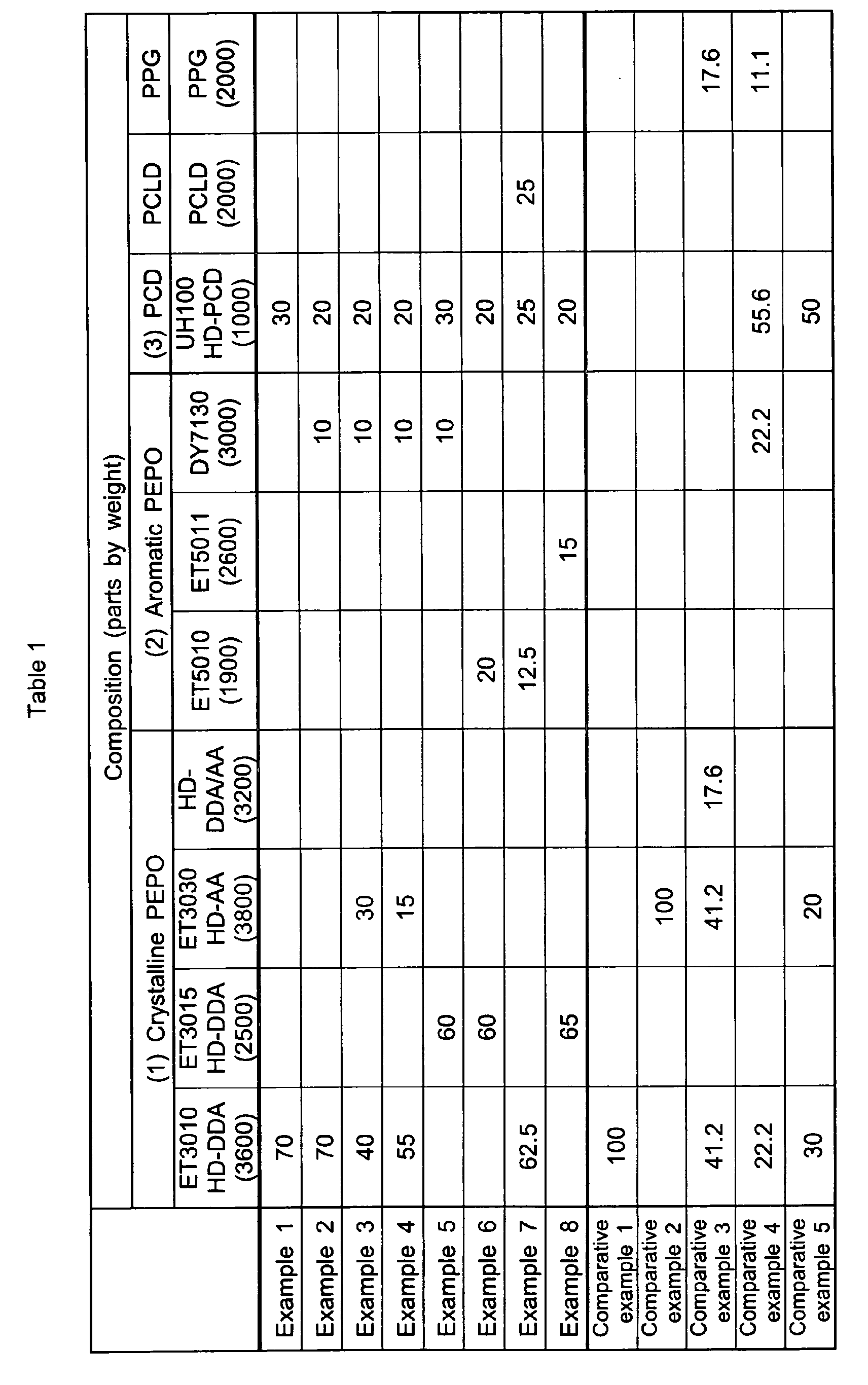

PPG: polypropylene glycol
HD: 1,6-hexanediol
DDA: dodecanedioic acid
AA: adipic acid
ET3010: ETERNACOLL 3010 available from Ube Industries, Ltd. [trade name, HD-DDA series polyester polyol: average molecular weight 3600, hydroxyl group value 30.9, acid value 0.16, melting point 70.4°C, crystallization temperature 57.3°C, crystallinity 49%]
ET3015: ETERNACOLL 3015 available from Ube Industries, Ltd. [trade name, HD-DDA series polyester polyol: average molecular weight 2500, hydroxyl group value 45.0, acid value 0.08, melting point 70.8°C, crystallization temperature 54.5°C, crystallinity 43%]
ET3030: ETERNACOLL 3030 available from Ube Industries, Ltd. [trade name, HD-AA series polyester polyol: average molecular weight 3800, hydroxyl group value 29.0, acid value 0.20, melting point 57.3°C, crystallization temperature 40.4°C, crystallinity 43%]
HD-(DDA/AA): [DDA/AA:40/60: average molecular weight 3200, hydroxyl group value 32.2, acid value 0.21, melting point 56.3°C, crystallization temperature 37.0°C, crystallinity 40%]
ET5010: ETERNACOLL 5010 available from Ube Industries, Ltd. [trade name, EG/NPG-AA/PA series polyester polyol: average molecular weight 1900, hydroxyl group value 58.2, acid value 0.10, Tg -0.2°C]
ET5011: ETERNACOLL 5011 available from Ube Industries, Ltd. [trade name, EG/NPG-AA/PA series polyester polyol: average molecular weight 2600, hydroxyl group value 43.8, acid value 0.10, Tg -0.5°C]
DY7130: DYNACOLL 7130 available from Degussa-Huls AG [trade name, average molecular weight 3000, hydroxyl group value 34.6, acid value <2, Tg 23.6°C]
UH-100: UH-CARB100 available from Ube Industries, Ltd. [trade name, HD series polycarbonate diol: average molecular weight 1000, hydroxyl group value 112.1, acid value 0.02, melting point 45.9°C]
PCLD(2000): TONE(™) POLYOL 2241 available from DOW CHEMICALS [trade name, polycaprolactone diol: average molecular weight 2000, melting point 67.7°C, crystallization temperature 47.5°C]
PPG(2000): available from Wako Junyaku K.K. [polypropylene glycol diol type: average molecular weight 2000]
EG: ethylene glycol
NPG: neopentyl glycol
PA: phthalic acid
Processing temperature: 110°C, Injection pressure: 1.4MPa, Injection time: 5 seconds
This molded product did not have peeling or crack.
Claims (14)
- A polyol mixture containing(1) 10 to 97% by weight of a crystalline polyester polyol produced by an aliphatic dicarboxylic acid and an aliphatic diol as main components,(2) 0 to 45% by weight of a polyester polyol produced by an aromatic polycarboxylic acid and an aliphatic polyol as main components, and(3) 3 to 45% by weight of a polycarbonate polyol.
- The polyol mixture according to Claim 1, wherein (1) the crystalline polyester polyol produced by the aliphatic dicarboxylic acid and the aliphatic diol as main components has a crystallinity of 30% or more, when the polyester polyol is cooled and solidified from a melting state with a cooling rate of 10°C/min and the crystallinity of which was measured by X-ray diffraction method (Ruland method).
- The polyol mixture according to Claim 1, wherein (1) the crystalline polyester polyol is a diol comprising the aliphatic dicarboxylic acid is a dicarboxylic acid having 6 to 12 carbon atoms, and the aliphatic diol is a diol having 2 to 12 carbon atoms,
(2) the polyester polyol is a polyol comprising the aromatic polycarboxylic acid which is at least one compound selected from the group consisting of phthalic acid, terephthalic acid and isophthalic acid, and the aliphatic polyol is a polyol having 2 to 12 carbon atoms. - The polyol mixture according to Claim 3, wherein (1) the aliphatic dicarboxylic acid is at least one selected from dodecanedioic acid and adipic acid, and the aliphatic diol is 1,6-hexanediol.
- The polyol mixture according to Claim 4, wherein (2) the aromatic polycarboxylic acid is phthalic acid and adipic acid, and the aliphatic polyol is a polyester polyol of ethylene glycol and neopentyl glycol.
- The polyol mixture according to Claim 5, wherein (3) the polycarbonate polyol is a compound containing 1,6-hexanediol.
- The polyol mixture according to Claim 1, wherein the mixture contains(1) 30 to 90% by weight of a crystalline polyester polyol produced by an aliphatic dicarboxylic acid and an aliphatic diol as main components,(2) 5 to 30% by weight of a polyester polyol produced by an aromatic polycarboxylic acid and an aliphatic polyol as main components,(3) 5 to 40% by weight of a polycarbonate.
- A reactive hot melt composition obtained by reacting the polyol mixture and the polyisocyanate according to any one of Claims 1 to 7.
- A molded product using the reactive hot melt composition according to Claim 8.
- A molded product which is obtained by injecting the reactive hot melt composition according to Claim 8 into a closed mold, cooling the same, taken out from the mold, and then, cured by moisture in the air.
- A molded product according to Claim 10, wherein the product can be obtained by providing an inserting material in the closed mold and integrally molded.
- A molded product according to any one of Claims 9 to 11, wherein the product is a product in the fields of an electric and electronic parts producing industry, and a semiconductor parts producing industry.
- A molded product according to Claim 11, wherein the inserting material is an electric or electronic constitutional part or a semiconductor constitutional part.
- A molded product according to Claim 12 or 13, wherein the electric or electronic constitutional part or the semiconductor constitutional part is a sensor, a circuit board, an element, a switch, a wiring, a connector, a display device or a battery.
Applications Claiming Priority (3)
| Application Number | Priority Date | Filing Date | Title |
|---|---|---|---|
| JP2002288486 | 2002-10-01 | ||
| JP2002288486 | 2002-10-01 | ||
| PCT/JP2003/012594 WO2004031296A1 (en) | 2002-10-01 | 2003-10-01 | Polyol mixture, reactive hot-melt composition obtained from the mixture, and molded article obtained with the composition |
Publications (2)
| Publication Number | Publication Date |
|---|---|
| EP1550695A1 true EP1550695A1 (en) | 2005-07-06 |
| EP1550695A4 EP1550695A4 (en) | 2011-04-06 |
Family
ID=32063676
Family Applications (1)
| Application Number | Title | Priority Date | Filing Date |
|---|---|---|---|
| EP03748650A Withdrawn EP1550695A4 (en) | 2002-10-01 | 2003-10-01 | MIXTURE OF POLYOLS, REACTIVE THERMOFUSIBLE COMPOSITION PRODUCED THEREFROM, AND MOLDED ARTICLE FORMED THEREWITH |
Country Status (8)
| Country | Link |
|---|---|
| US (1) | US20060025555A1 (en) |
| EP (1) | EP1550695A4 (en) |
| JP (1) | JP4325556B2 (en) |
| KR (1) | KR20050070028A (en) |
| CN (1) | CN100338138C (en) |
| AU (1) | AU2003268720A1 (en) |
| TW (1) | TWI275623B (en) |
| WO (1) | WO2004031296A1 (en) |
Cited By (3)
| Publication number | Priority date | Publication date | Assignee | Title |
|---|---|---|---|---|
| EP1873177A4 (en) * | 2005-04-22 | 2009-07-22 | Asahi Glass Co Ltd | URETHANE PREPOLYMER WITH EXTREMITES ISOCYANATE, PROCESS FOR PRODUCING THE SAME, AND ADHESIVE COMPRISING THE URETHANE PREPOLYMER |
| EP1923414A3 (en) * | 2006-11-15 | 2010-04-28 | Bayer MaterialScience AG | Coating agent |
| WO2021041534A1 (en) * | 2019-08-26 | 2021-03-04 | H.B. Fuller Company | Fast set moisture curable hot melt adhesive composition and articles including the same |
Families Citing this family (27)
| Publication number | Priority date | Publication date | Assignee | Title |
|---|---|---|---|---|
| US7073352B2 (en) * | 2002-03-07 | 2006-07-11 | Vitro Global, S.A. | Method and a machine for the production of hollow glassware articles |
| JPWO2006090650A1 (en) * | 2005-02-23 | 2008-07-24 | Jsr株式会社 | Wafer processing method |
| JP2006273986A (en) * | 2005-03-29 | 2006-10-12 | Aica Kogyo Co Ltd | Humidity curing type reactive hot-melt adhesive |
| WO2008026513A1 (en) * | 2006-08-31 | 2008-03-06 | Ube Industries, Ltd. | Reactive hot-melt composition and molded article using the same |
| DE102007004102A1 (en) * | 2007-01-26 | 2008-07-31 | Evonik Degussa Gmbh | Crystalline copolyesters with good solubility in non-halogenated solvents and their use |
| JP5303846B2 (en) * | 2007-03-16 | 2013-10-02 | Dic株式会社 | Moisture-curing hot melt adhesive, fabricated member and flash panel using the same |
| DE102007033651A1 (en) * | 2007-07-17 | 2009-01-22 | Evonik Degussa Gmbh | Moisture-curing hotmelt adhesive with good adhesion |
| KR101240009B1 (en) * | 2007-09-19 | 2013-03-06 | 히타치가세이가부시끼가이샤 | Adhesive composition and bonded body |
| PL2098579T3 (en) * | 2008-02-27 | 2011-01-31 | Sika Tech Ag | Laminate adhesive for higher temperature demoulding |
| JP5626008B2 (en) * | 2011-02-25 | 2014-11-19 | Dic株式会社 | Moisture curable hot melt urethane resin composition and molded article |
| JP5472206B2 (en) * | 2011-05-30 | 2014-04-16 | 東洋紡株式会社 | adhesive |
| JP2013116993A (en) * | 2011-12-05 | 2013-06-13 | Henkel Japan Ltd | Moisture-curable hot melt adhesive |
| JP5907377B2 (en) * | 2012-02-09 | 2016-04-26 | Dic株式会社 | Moisture curable polyurethane hot melt resin composition |
| JP6256743B2 (en) * | 2013-09-24 | 2018-01-10 | Dic株式会社 | Moisture curable polyurethane hot melt resin composition, adhesive and laminate |
| WO2015061032A1 (en) | 2013-10-22 | 2015-04-30 | Elevance Renewable Sciences, Inc. | Polyester polyols and methods of making and using the same |
| JP6373618B2 (en) * | 2014-04-01 | 2018-08-15 | 積水フーラー株式会社 | Moisture curable hot melt adhesive |
| CA2959489A1 (en) * | 2014-09-02 | 2016-03-10 | Elevance Renewable Sciences, Inc. | Polyester polyols and use thereof in powder coatings |
| US10246617B2 (en) * | 2015-03-02 | 2019-04-02 | Evonik Degussa Gmbh | Adhesives with low VOC and fogging values |
| JP6610235B2 (en) * | 2015-12-21 | 2019-11-27 | Dic株式会社 | Moisture curable urethane hot melt resin composition |
| JP6674128B2 (en) * | 2015-12-24 | 2020-04-01 | Dic株式会社 | Manufacturing method of decorative board |
| JP7451071B2 (en) * | 2017-08-30 | 2024-03-18 | Dic株式会社 | Moisture-curable hot melt resin composition and laminate or molded body |
| JP2019066538A (en) * | 2017-09-28 | 2019-04-25 | 花王株式会社 | Binder resin composition for electrophotographic toner |
| DE212018000351U1 (en) * | 2017-11-17 | 2020-07-23 | Shenzhen Kedali Industry Co., Ltd | aluminum casing |
| WO2019124266A1 (en) * | 2017-12-20 | 2019-06-27 | 日立化成株式会社 | Reactive hot-melt adhesive composition and method for manufacturing same, bonding method, and image display device and method for manufacturing same |
| CN111741992B (en) * | 2018-02-21 | 2022-10-28 | Dic株式会社 | Moisture-curable polyurethane hot-melt resin composition |
| WO2020003778A1 (en) * | 2018-06-28 | 2020-01-02 | Dic株式会社 | Moisture-curable polyurethane hot melt resin composition |
| CN113088234B (en) * | 2019-12-23 | 2024-05-24 | 上海理日化工新材料有限公司 | A low-shrinkage, high-melting-point, lightweight hot-melt adhesive composition and preparation method thereof |
Family Cites Families (9)
| Publication number | Priority date | Publication date | Assignee | Title |
|---|---|---|---|---|
| JPH0717891B2 (en) * | 1989-05-20 | 1995-03-01 | 新田ゼラチン株式会社 | Reactive hot melt adhesive |
| CA2037606C (en) * | 1990-03-13 | 2002-06-04 | Yukiatsu Komiya | Polyurethane, elastic polyurethane fiber and polyesterpolycarbonatediol used for the same |
| US6191212B1 (en) * | 1990-10-11 | 2001-02-20 | Henkel Kommanditgesellschaft Auf Aktien | Moisture-curing hotmelt adhesives |
| IT1251489B (en) * | 1991-09-17 | 1995-05-15 | Enichem Sintesi | DIOLOTHERMINATED POLYCARBONATES |
| DE4446027A1 (en) * | 1994-12-23 | 1996-07-04 | Henkel Kgaa | Molded parts made of PU hot melt adhesives |
| DE19757569A1 (en) * | 1997-12-23 | 1999-06-24 | Bayer Ag | Aliphatic, low-emission, sinterable thermoplastic polyurethane molding compounds |
| EP1010712B1 (en) * | 1998-12-16 | 2009-10-28 | Bayer MaterialScience AG | Aliphatic thermoplastic polyurethanes, a process for their preparation and their use |
| JP2000344852A (en) * | 1999-06-07 | 2000-12-12 | Sekisui Chem Co Ltd | Moisture curable hot melt composition |
| US6821110B2 (en) * | 2002-07-23 | 2004-11-23 | The Cavist Corporation | Apparatus for molding with hot melt adhesives |
-
2003
- 2003-10-01 JP JP2004541262A patent/JP4325556B2/en not_active Expired - Fee Related
- 2003-10-01 KR KR1020057005648A patent/KR20050070028A/en not_active Ceased
- 2003-10-01 AU AU2003268720A patent/AU2003268720A1/en not_active Abandoned
- 2003-10-01 CN CNB200380100841XA patent/CN100338138C/en not_active Expired - Fee Related
- 2003-10-01 WO PCT/JP2003/012594 patent/WO2004031296A1/en not_active Ceased
- 2003-10-01 TW TW092127141A patent/TWI275623B/en active
- 2003-10-01 EP EP03748650A patent/EP1550695A4/en not_active Withdrawn
- 2003-10-01 US US10/529,780 patent/US20060025555A1/en not_active Abandoned
Cited By (4)
| Publication number | Priority date | Publication date | Assignee | Title |
|---|---|---|---|---|
| EP1873177A4 (en) * | 2005-04-22 | 2009-07-22 | Asahi Glass Co Ltd | URETHANE PREPOLYMER WITH EXTREMITES ISOCYANATE, PROCESS FOR PRODUCING THE SAME, AND ADHESIVE COMPRISING THE URETHANE PREPOLYMER |
| US7906607B2 (en) | 2005-04-22 | 2011-03-15 | Asahi Glass Company, Limited | Isocyanate group-terminated urethane prepolymer, process for producing the same, and adhesive comprising the urethane prepolymer |
| EP1923414A3 (en) * | 2006-11-15 | 2010-04-28 | Bayer MaterialScience AG | Coating agent |
| WO2021041534A1 (en) * | 2019-08-26 | 2021-03-04 | H.B. Fuller Company | Fast set moisture curable hot melt adhesive composition and articles including the same |
Also Published As
| Publication number | Publication date |
|---|---|
| AU2003268720A1 (en) | 2004-04-23 |
| AU2003268720A8 (en) | 2004-04-23 |
| KR20050070028A (en) | 2005-07-05 |
| EP1550695A4 (en) | 2011-04-06 |
| WO2004031296A1 (en) | 2004-04-15 |
| CN1703460A (en) | 2005-11-30 |
| JP4325556B2 (en) | 2009-09-02 |
| TWI275623B (en) | 2007-03-11 |
| CN100338138C (en) | 2007-09-19 |
| US20060025555A1 (en) | 2006-02-02 |
| JPWO2004031296A1 (en) | 2006-02-02 |
| TW200415222A (en) | 2004-08-16 |
Similar Documents
| Publication | Publication Date | Title |
|---|---|---|
| US20060025555A1 (en) | Polyol mixture and reactive hot melt composition obtained from the mixture, and molded article obtained with composition | |
| JPWO2008026513A1 (en) | Reactive hot melt composition and molded article using the same | |
| JP3618749B2 (en) | Reactive wax-containing moisture-curable hot melt composition | |
| EP0340906B1 (en) | Hot-melt polyurethane adhesive compositions | |
| CN101348702B (en) | Moisture-curing hot-melt adhesive with good adhesion | |
| CN102549099B (en) | Reactive hot-melt adhesive agent composition | |
| WO2001094489A2 (en) | Method of bonding permeable substrates with hot melt moisture cure adhesive | |
| JP2627839B2 (en) | Reactive hot melt adhesive | |
| JP3700645B2 (en) | Compatibilizer and polyester polyol mixture containing the same and melt adhesive using the mixture | |
| JP2000336142A (en) | Polyurethane resin and method for producing the same | |
| JP3114341B2 (en) | Polyurethane adhesive | |
| EP1149850B1 (en) | Crystalline polyesterpolyol and hot-melt adhesive | |
| JPH07179559A (en) | Polyurethane having rosin skeleton and polyurethane-based adhesive containing the same | |
| JP2005023181A (en) | Polyol mixture, reactive hot melt composition obtained from the mixture, and molded article obtained from the composition | |
| TW200301295A (en) | Moisture-curing adhesives | |
| EP1693396B1 (en) | Crystalline polyester polyol and hot melt adhesive | |
| JP7639994B2 (en) | Method for producing zinc phenylphosphonate complex, powder of zinc phenylphosphonate complex, use of the same as a crystal nucleating agent, and moisture-curable hot-melt urethane resin adhesive | |
| JPH09309939A (en) | Polyurethane resin composition and method for producing the same | |
| JP7484730B2 (en) | Reactive hot melt adhesive composition, adhesive body and method for producing same | |
| JP3241009B2 (en) | Method for producing polyurethane | |
| JP2002188073A (en) | Melt adhesive | |
| JP2025168042A (en) | Reactive hot melt adhesives, structures, and electronic devices | |
| JPH108015A (en) | Polyurethane-based adhesive composition | |
| JPH06136087A (en) | Thermoplastic polyurethane resin using modified polyester |
Legal Events
| Date | Code | Title | Description |
|---|---|---|---|
| PUAI | Public reference made under article 153(3) epc to a published international application that has entered the european phase |
Free format text: ORIGINAL CODE: 0009012 |
|
| 17P | Request for examination filed |
Effective date: 20050426 |
|
| AK | Designated contracting states |
Kind code of ref document: A1 Designated state(s): AT BE BG CH CY CZ DE DK EE ES FI FR GB GR HU IE IT LI LU MC NL PT RO SE SI SK TR |
|
| AX | Request for extension of the european patent |
Extension state: AL LT LV MK |
|
| DAX | Request for extension of the european patent (deleted) | ||
| RBV | Designated contracting states (corrected) |
Designated state(s): DE FR GB |
|
| RAP1 | Party data changed (applicant data changed or rights of an application transferred) |
Owner name: UBE INDUSTRIES, LTD. |
|
| A4 | Supplementary search report drawn up and despatched |
Effective date: 20110307 |
|
| RIC1 | Information provided on ipc code assigned before grant |
Ipc: C09J 175/06 20060101ALI20110225BHEP Ipc: C08G 18/42 20060101AFI20110225BHEP |
|
| STAA | Information on the status of an ep patent application or granted ep patent |
Free format text: STATUS: THE APPLICATION IS DEEMED TO BE WITHDRAWN |
|
| 18D | Application deemed to be withdrawn |
Effective date: 20110604 |