BACKGROUND OF THE INVENTION
Field of the Invention
-
The present invention relates to isoquinoline derivatives having
Rho kinase inhibitory activity, more particularly to isoquinoline derivatives
useful for the treatment of diseases mediated by Rho kinase.
Background Art
-
It has been revealed that Rho is activated upon the receipt of
signals from various cell membrane receptors, and the activated Rho
functions, through ROCK/Rho kinase and, further, actomyosin system, as
a molecular switch of a wide variety of cellular phenomena such as
smooth muscle contraction, cell movement, cell adhesion, change in
character of cells (formation of actin stressed fibers), control of cell
division (sthenia of cytokinesis or activation of gene transcription),
platelet aggregation, leukocyte aggregation, cell proliferation, sthenia of
carcinogenesis and invasion of cancer and the like.
-
The contraction of smooth muscle is deeply involved in the
pathology of hypertension, angina pectoris, vasospasm, for example,
cardiovascular contraction and cerebrovascular contraction, asthma,
peripheral circulatory disorder, threatened premature birth, glaucoma,
constriction of visual field, pollakiuria, impotence and the like. Cell
movement plays an important role in invasion/metastasis of cancer,
arteriosclerosis, retinopathy, immune response and the like. Cell
adhesion is deeply involved in metastasis of cancer, inflammation, and
autoimmune diseases. The change of cell morphology is deeply involved
in cerebral dysfunction, osteoporosis, microbism and the like. Cell
proliferation is deeply involved in cancer, arteriosclerosis and the like.
Thus, Rho is deeply involved in various diseases.
-
ROCK or ROCK I (Japanese Patent Laid-Open No. 135683/1997;
and T. Ishizaki et al., EMBO J., Vol. 15, No. 8, pp 1885-1893 (1996)) and
Rho kinase or ROCK II (Japanese Patent Laid-Open No. 113187/1998;
and T. Matsui et al., EMBO J., Vol. 15, No. 9, pp 2208-2216 (1996)) were
reported as serine/threonine kinase which is activated upon the
activation of Rho and were shown to be isozymes (O. Nakagawa et al.,
FEBS Lett., Vol. 392, No. 2, pp 189-193 (1996)).
-
Compounds having ROCK/Rho kinase inhibitory activity include
trans-4-amino(alkyl)-1-pyridylcarbamoylcyclohexane compounds (WO
90/05723), benzamide compounds (WO 95/28387), Y-27632 (Uehata, M.,
Ishizaki, T. et al.: Nature, 389: pp 990-994 (1997)), and fasudil
hydrochloride commercially available as cerebrovascular contraction
inhibitor (HA-1077, Asahi Kasei Kogyo K.K.) (Ono-Saito, N., Niki, I.,
Hidaka, H.: Pharmacol. Ther., pp 123-131 (1999)). WO 98/06433
discloses ROCK/Rho kinase inhibitors. Further, WO 01/56988
discloses nitrogen-containing compounds having kinase inhibitory activity.
SUMMARY OF THE INVENTION
-
An object of the present invention is to provide compounds
having Rho kinase inhibitory activity and useful for the treatment of
diseases mediated by Rho kinase.
-
Another object of the present invention is to provide a
pharmaceutical composition for use in the treatment of diseases
mediated by Rho kinase.
-
The present inventors have found that certain isoquinoline
derivatives possess very excellent Rho kinase inhibitory activity
(Pharmacological Test Examples 1 and 3). The present inventors have
further confirmed that the isoquinoline derivatives are very effective for the
treatment of diseases mediated by Rho kinase (Pharmacological Test
Examples 2, 4, and 5).
-
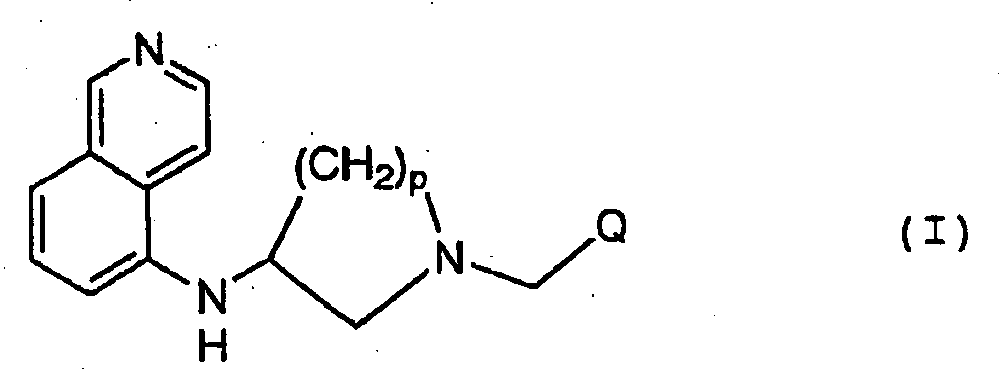
Thus, according to the present invention, there are provided
compounds represented by formula (I) or pharmaceutically acceptable
salts or solvates thereof:
wherein Q represents a cyclic group selected from phenyl, pyridyl,
pyrrolyl, thienyl, and furyl; one or two hydrogen atoms on the cyclic
group are optionally substituted by a substituent selected from the group
consisting of a halogen atom, C
1-4 alkyl, nitro, and amino; and p is 2 or 3.
-
According to another aspect of the present invention, there is
provided a pharmaceutical composition comprising the compound
according to the present invention as an active ingredient.
DETAILED DESCRIPTION OF THE INVENTION
Compounds
-
The term "alkyl" as used herein means a straight chain or
branched chain alkyl group. Examples of C1-4 alkyl include methyl,
ethyl, n-propyl, isopropyl, n-butyl, i-butyl, s-butyl, and t-butyl.
-
The term "halogen atom" means a fluorine, chlorine, bromine, or
iodine atom.
-
Q preferably represents a cyclic group selected from phenyl, 2-chlorophenyl,
3-chlorophenyl, 4-chlorophenyl, 4-fluorophenyl, 2,6-difluorophenyl,
2,6-dichlorophenyl, 4-methylphenyl, 4-isopropylphenyl, 2-nitrophenyl,
3-nitrophenyl, 4-nitrophenyl, 4-chloro-2-nitrophenyl, 2-pyridyl,
3-pyridyl, 4-pyridyl, 2-aminophenyl, 3-aminophenyl, 4-aminophenyl, 2-amino-4-chlorophenyl,
1H-2-pyrrolyl, 1H-3-pyrrolyl, 2-thienyl, 3-thienyl,
2-furyl, and 3-furyl. Particularly preferred are 3-nitrophenol and 3-aminophenyl.
-
Examples of preferred compounds represented by formula (I)
include compounds in which Q represents 3-nitrophenyl or 3-aminophenyl
and p is 2.
-
Examples of more preferred compounds represented by formula
(I) include the following compounds:
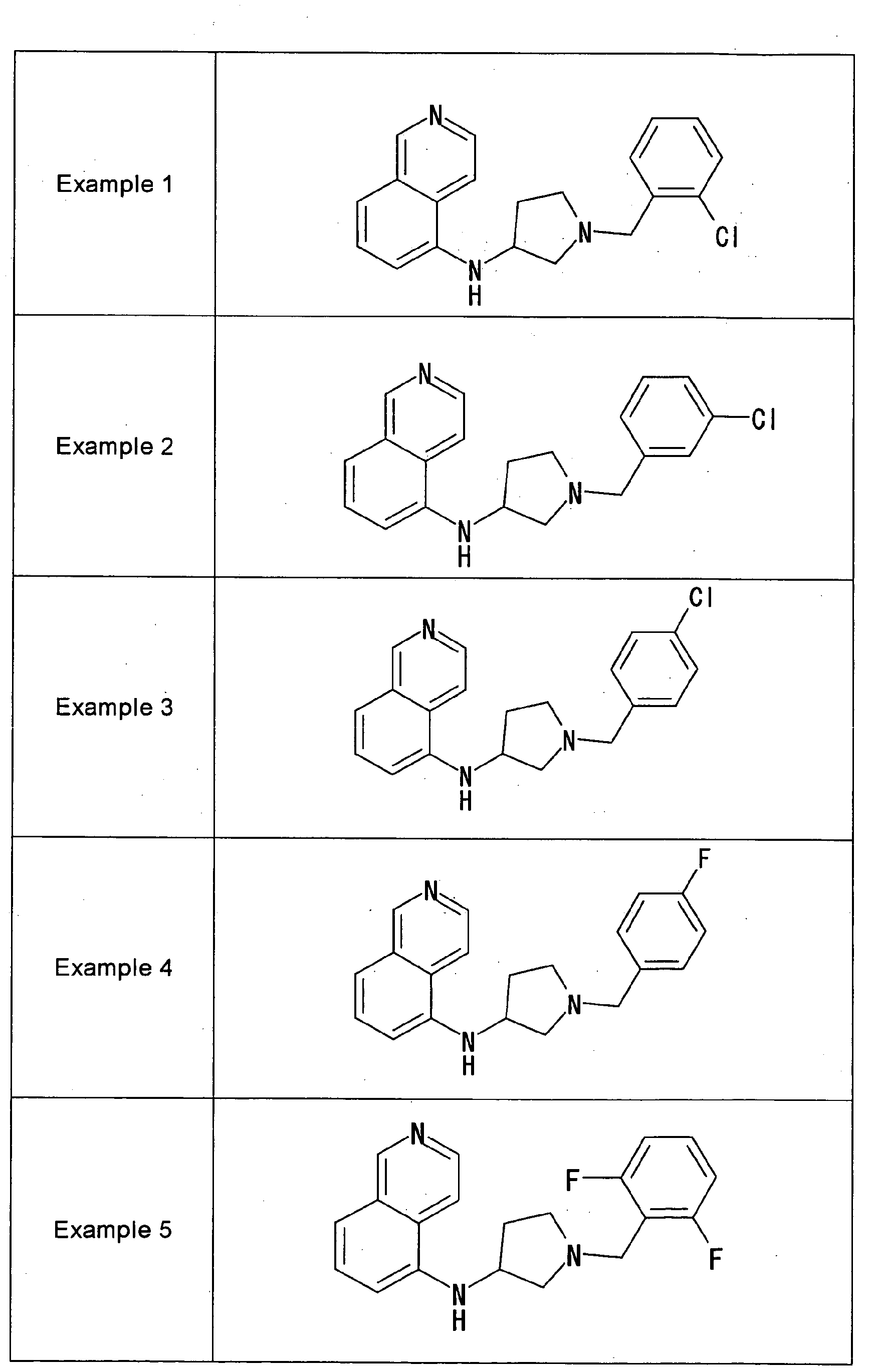
- (1) N5-[1-(2-chlorobenzyl)tetrahydro-1H-3-pyrrolyl]-5-isoquinolylamine;
- (2) N5-[1-(3-chlorobenzyl)tetrahydro-1H-3-pyrrolyl]-5-isoquinolylamine;
- (3) N5-[1-(4-chlorobenzyl)tetrahydro-1H-3-pyrrolyl]-5-isoquinolylamine;
- (4) N5-[1-(4-fluorobenzyl)tetrahydro-1H-3-pyrrolyl]-5-isoquinolylamine;
- (5)N5-[1-(2,6-difluorobenzyl)tetrahydro-1H-3-pyrrolyl]-5-isoquinolylamine;
- (6)N5-[1-(2,6-dichlorobenzyl)tetrahydro-1 H-3-pyrrolyl]-5-isoquinolylamine;
- (7)N-(5-isoquinolyl)-N-[1-(4-methylbenzyl)tetrahydro-1H-3-pyrrolyl]amine;
- (8)N5-[1-(4-isopropylbenzyl)tetrahydro-1H-3-pyrrolyl]-5-isoquinolylamine;
- (9) N-(5-isoquinolyl)-N-[1-(2-nitrobenzyl)tetrahydro-1H-3-pyrrolyl]amine;
- (10) N-(5-isoquinolyl)-N-[1-(3-nitrobenzyl)tetrahydro-1H-3-pyrrolyl]amine;
- (11) N-(5-isoquinolyl)-N-[1-(4-nitrobenzyl)tetrahydro-1H-3-pyrrolyl]amine;
- (12)N5-[1-(4-chloro-2-nitrobenzyl)tetrahydro-1 H-3-pyrrolyl]-5-isoquinolylamine;
- (13)N-(5-isoquinolyl)-N-[1-(2-pyridylmethyl)tetrahydro-1H-3-pyrrolyl]amine;
- (14)N-(5-isoquinolyl)-N-[1-(3-pyridylmethyl)tetrahydro-1H-3-pyrrolyl]amine;
- (15)N-(5-isoquinolyl)-N-[1-(4-pyridylmethyl)tetrahydro-1H-3-pyrrolyl]amine;
- (16) N5-[1-(2-aminobenzyl)tetrahydro-1H-3-pyrrolyl]-5-isoquinolylamine;
- (17) N5-[1-(3-aminobenzyl)tetrahydro-1H-3-pyrrolyl]-5-isoquinolylamine;
- (18) N5-[1-(4-aminobenzyl)tetrahydro-1H-3-pyrrolyl]-5-isoquinolylamine;
- (19)N5-[1-(2-amino-4-chlorobenzyl)tetrahydro-1H-3-pyrrolyl]-5-isoquinolylamine;
- (20) N5-[1-(2-chlorobenzyl)-3-piperidyl]-5-isoquinolylamine;
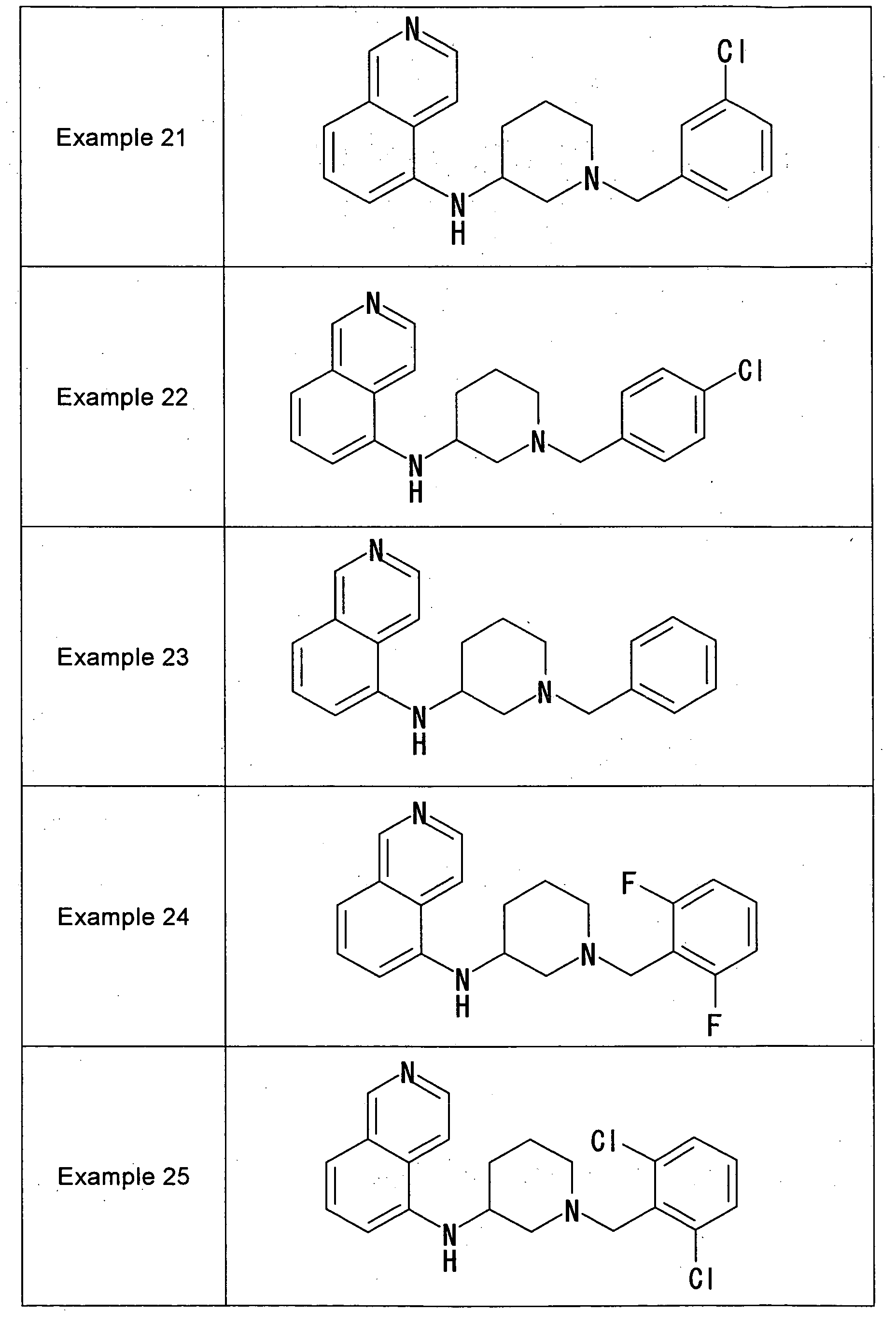
- (21) N5-[1-(3-chlorobenzyl)-3-piperidyl]-5-isoquinolylamine;
- (22) N5-[1-(4-chlorobenzyl)-3-piperidyl]-5-isoquinolylamine;
- (23) N-(1-benzyl-3-piperidyl)-5-isoquinolylamine;
- (24) N5-[1-(2,6-difluorobenzyl)-3-piperidyl]-5-isoquinolylamine;
- (25) N5-[1-(2,6-dichlorobenzyl)-3-piperidyl]-5-isoquinolylamine;
- (26) N-(5-isoquinolinyl)-N-[1-(4-methylbenzyl)-3-piperidyl]amine;
- (27) N-(5-isoquinolinyl)-N-[1-(4-isopropylbenzyl)-3-piperidyl]amine;
- (28) N-(5-isoquinolinyl)-N-[1-(2-nitrobenzyl)-3-piperidyl]amine;
- (29) N-(5-isoquinolinyl)-N-[1-(3-nitrobenzyl)-3-piperidyl]amine;
- (30) N-(5-isoquinolinyl)-N-[1-(4-nitrobenzyl)-3-piperidyl]amine;
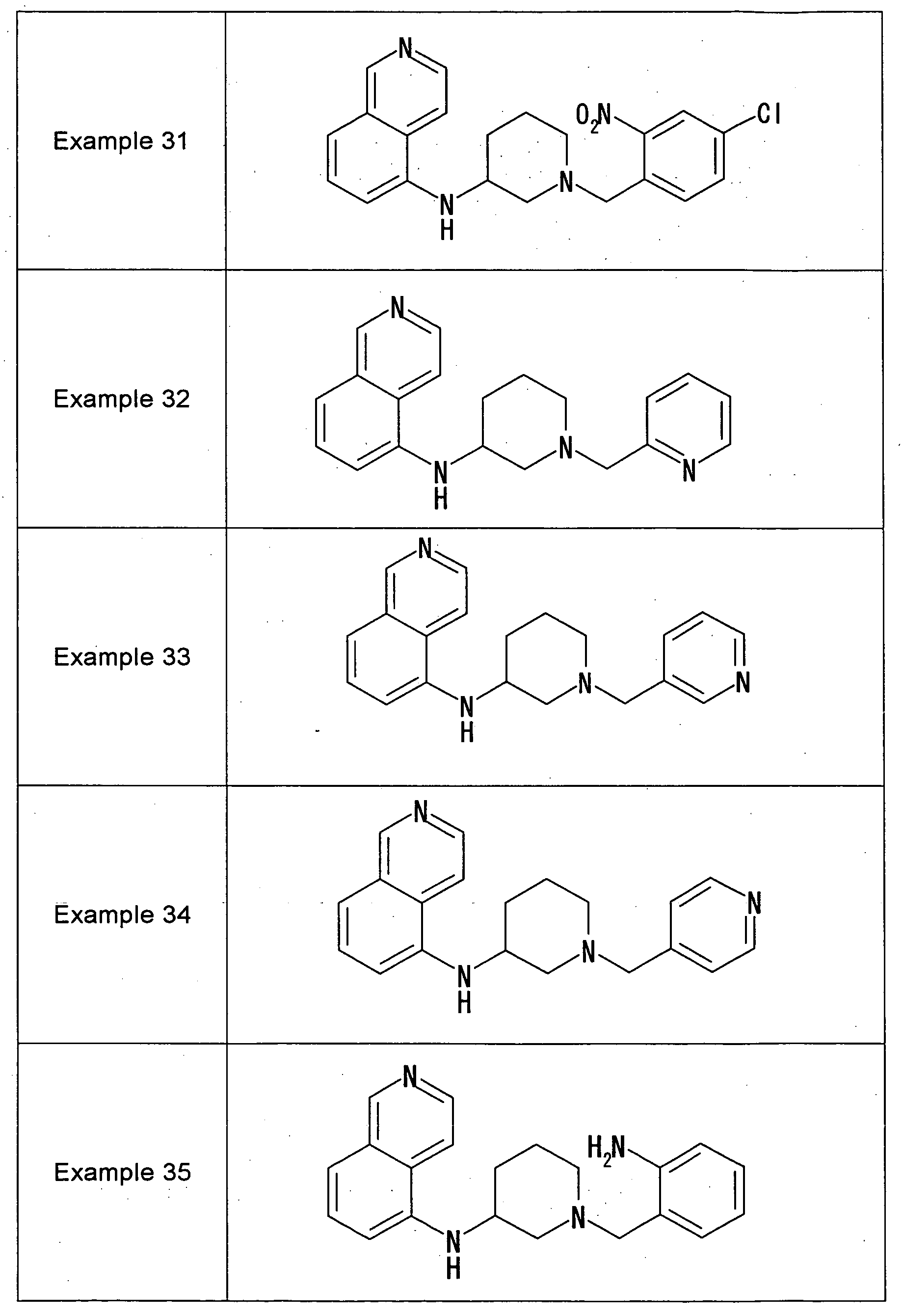
- (31) N5-[1-(4-chloro-2-nitrobenzyl)-3-piperidyl]-5-isoquinolylamine;
- (32) N-(5-isoquinolinyl)-N-[1-(2-pyridylmethyl)-3-piperidyl]amine;
- (33) N-(5-isoquinolinyl)-N-[1-(3-pyridylmethyl)-3-piperidyl]amine;
- (34) N-(5-isoquinolinyl)-N-[1-(4-pyridylmethyl)-3-piperidyl]amine;
- (35) N5-[1-(2-aminobenzyl)-3-piperidyl]-5-isoquinolylamine;
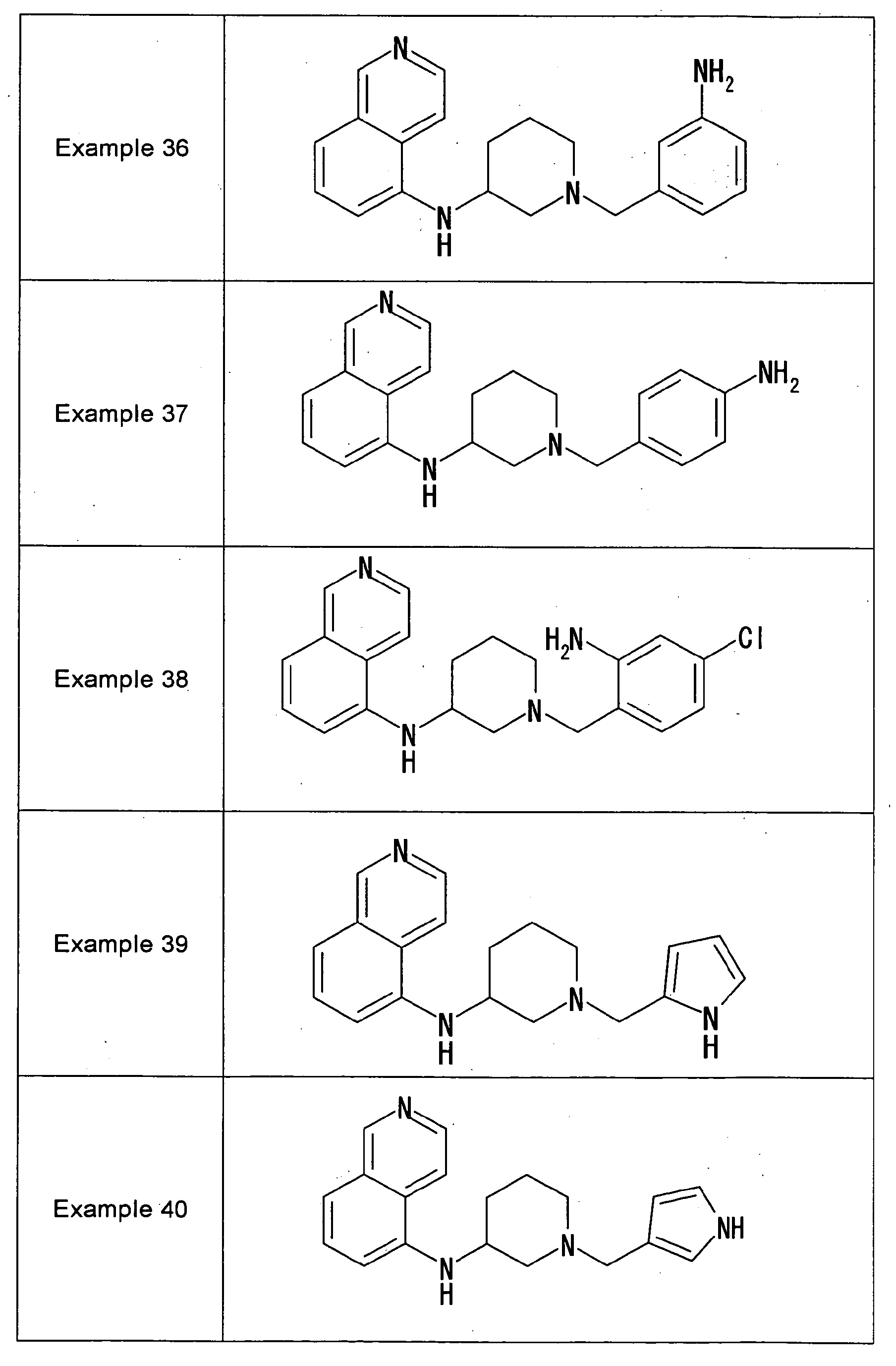
- (36) N5-[1-(3-aminobenzyl)-3-piperidyl]-5-isoquinolylamine;
- (37) N5-[1-(4-aminobenzyl)-3-piperidyl]-5-isoquinolylamine;
- (38) N5-[1-(2-amino-4-chlorobenzyl)-3-piperidyl]-5-isoquinolylamine;
- (39) N-(5-isoquinolinyl)-N-[1-(1H-2-pyrrolylmethyl)-3-piperidyl]amine;
- (40) N-(5-isoquinotiny)-N-[1-(1H-3-pyrrolylmethyl)-3-piperidyl]amine;
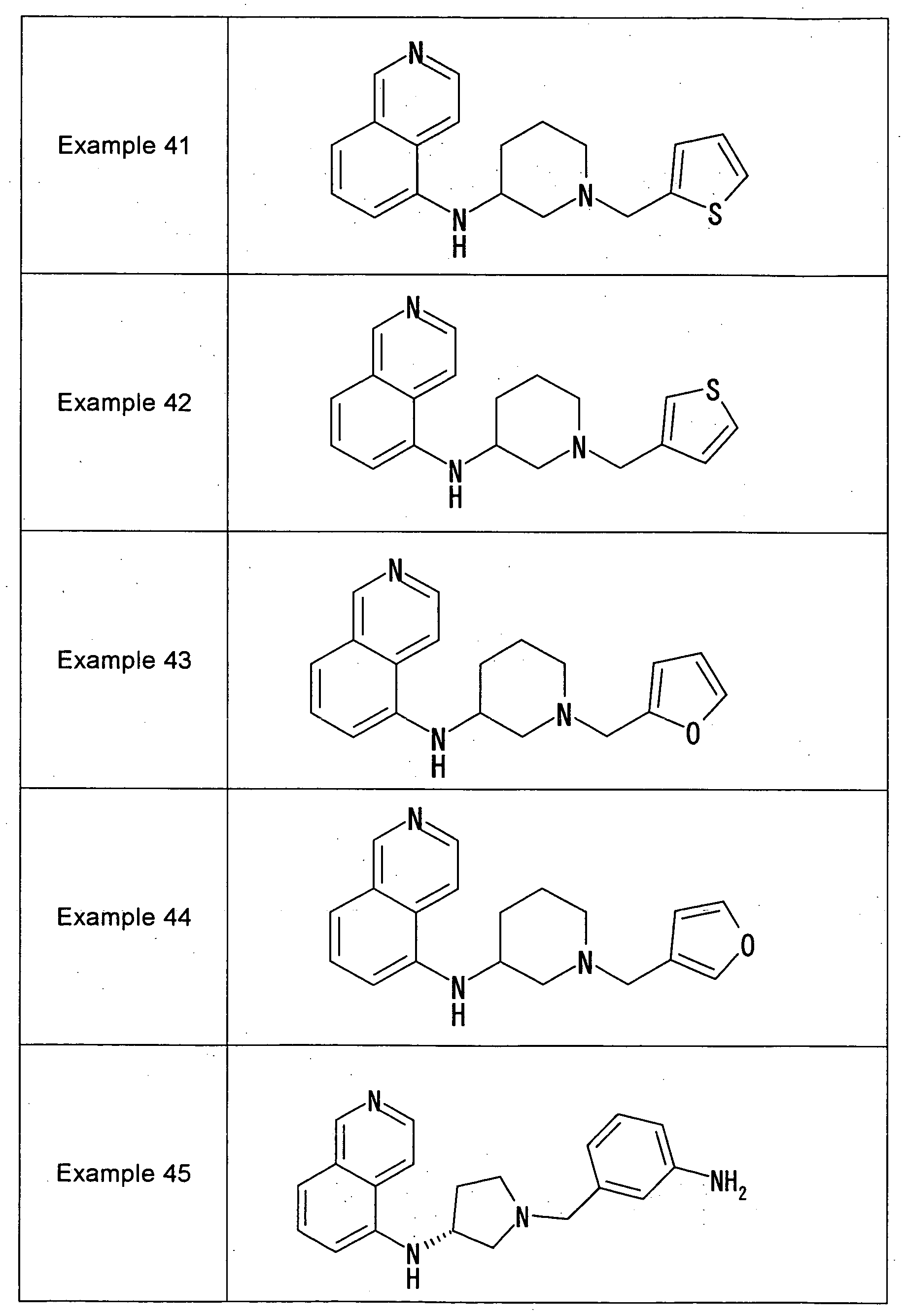
- (41) N-(5-isoquinolinyl)-N-[1-(2-thienylmethyl)-3-piperidyl]amine;
- (42) N-(5-isoquinolinyl)-N-[1-(3-thienylmethyl)-3-piperidyl]amine;
- (43) N-[1-(2-furylmethyl)-3-piperidyl]-N-(5-isoquinolyl)amine;
- (44) N-[1-(3-furylmethyl)-3-piperidyl]-N-(5-isoquinolyl)amine;
- (45)(3S)-N5-[1-(3-aminobenzyl)tetrahydro-1H-3-pyrrolyl]-5-isoquinolineamine;
and
- (46)(3R)-N5-[1-(3-aminobenzyl)tetrahydro-1H-3-pyrrolyl]-5-isoquinolineamine.
-
-
Examples of particularly preferred compounds among the
compounds represented by formula (I) include (3S)-N5-[1-(3-aminobenzyl)tetrahydro-1H-3-pyrrolyl]-5-isoquinolineamine
and (3R)-N5-[1-(3-aminobenzyl)tetrahydro-1H-3-pyrrolyl]-5-isoquinolineamine
and
mixtures thereof.
-
Pharmaceutically acceptable salts of the compounds represented
by formula (I) include acid addition salts. Acid addition salts include:
salts with inorganic acids such as hydrochloric acid, sulfuric acid,
phosphoric acid, hydrobromic acid, and nitric acid; salts with organic
acids such as maleic acid, fumaric acid, malic acid, oxalic acid, tartaric
acid, succinic acid, citric acid, acetic acid, lactic acid, methanesulfonic
acid, p-toluenesulfonic acid and salicylic acid; and salts with amino acids
such as lysine. These acid addition salts may be converted to
corresponding free bases by a conventional method, for example, by a
reaction with an alkali such as sodium hydroxide or potassium hydroxide.
Further, the compounds may be brought to quaternary ammonium salts
or salts with metals such as sodium, potassium, calcium, magnesium, or
aluminum.
-
Pharmaceutically acceptable solvates of the compounds
represented by formula (I) include hydrates.
-
In the compounds represented by formula (I), optical isomers,
racemic forms thereof, and cis and trans isomers may exist, and the
compounds according to the present invention include all of these
isomers. These isomers may be isolated according to a conventional
method, or may be produced by using various materials for respective
isomers.
Production of compounds
-
The compounds according to the present invention may be
produced according to schemes below.
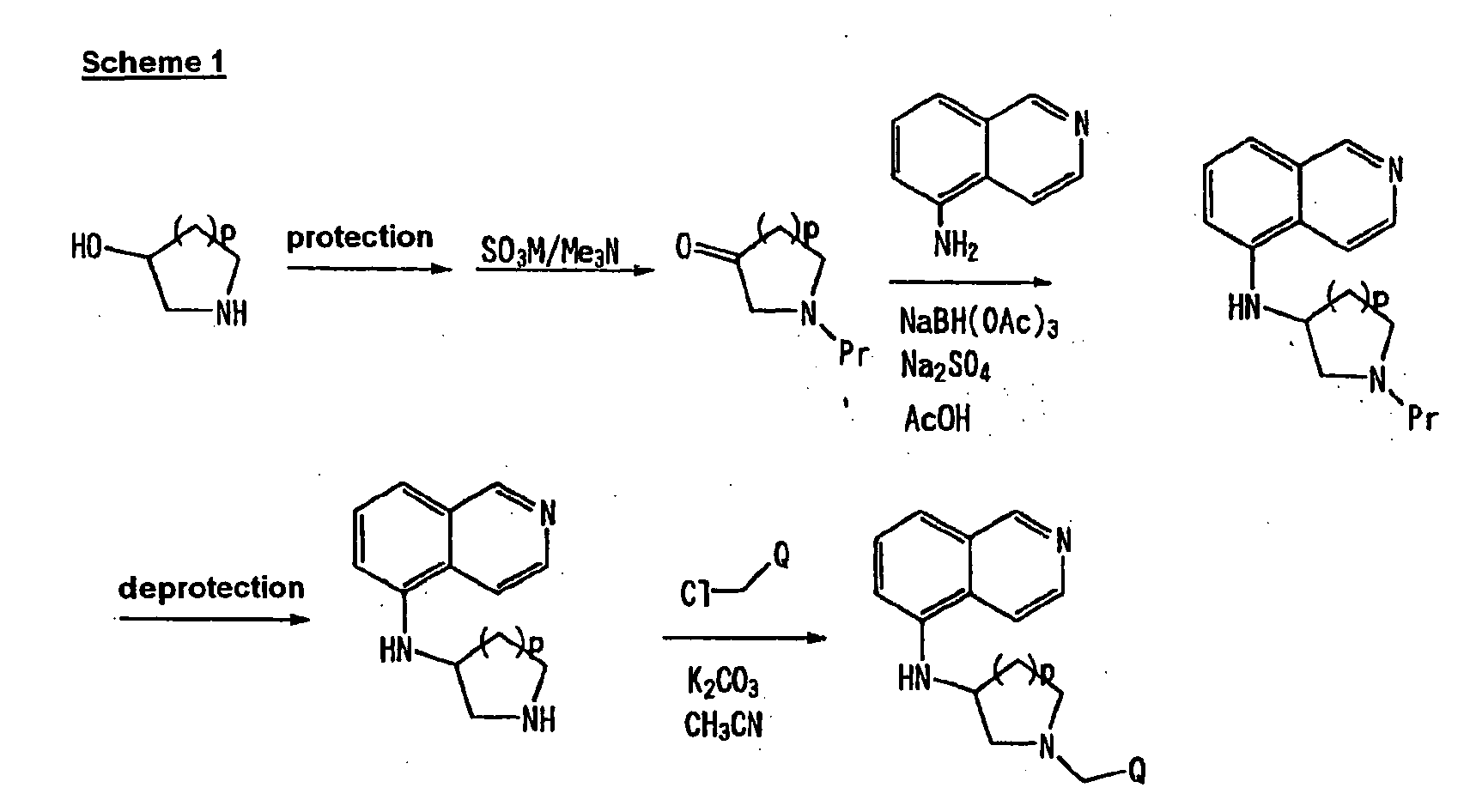
wherein Pr represents a protective group; and Q and p are as defined in
formula (I).
-
The compound in which Q represents phenyl may be produced
by protecting the secondary amine of (R)-(-)-3-pyrrolidinol, where p = 1,
or 3-hydroxypiperidine, where p = 2, with a suitable functional group, for
example, tert-butyloxycarbony, then oxidizing the protected compound
with a sulfur trioxide/trimethylamine complex in DMSO at room
temperature, condensing the oxidized compound with 5-aminoisoquinoline
in acetic acid in the presence of anhydrous sodium
sulfate, reducing the condensate with sodium hydride triacetate to give
an intermediate, deprotecting the intermediate, for example, with
trifluoroacetic acid, and then reacting the deprotected compound with an
alkyl chloride Q-CH2-Cl in the presence of a base, for example,
potassium carbonate.
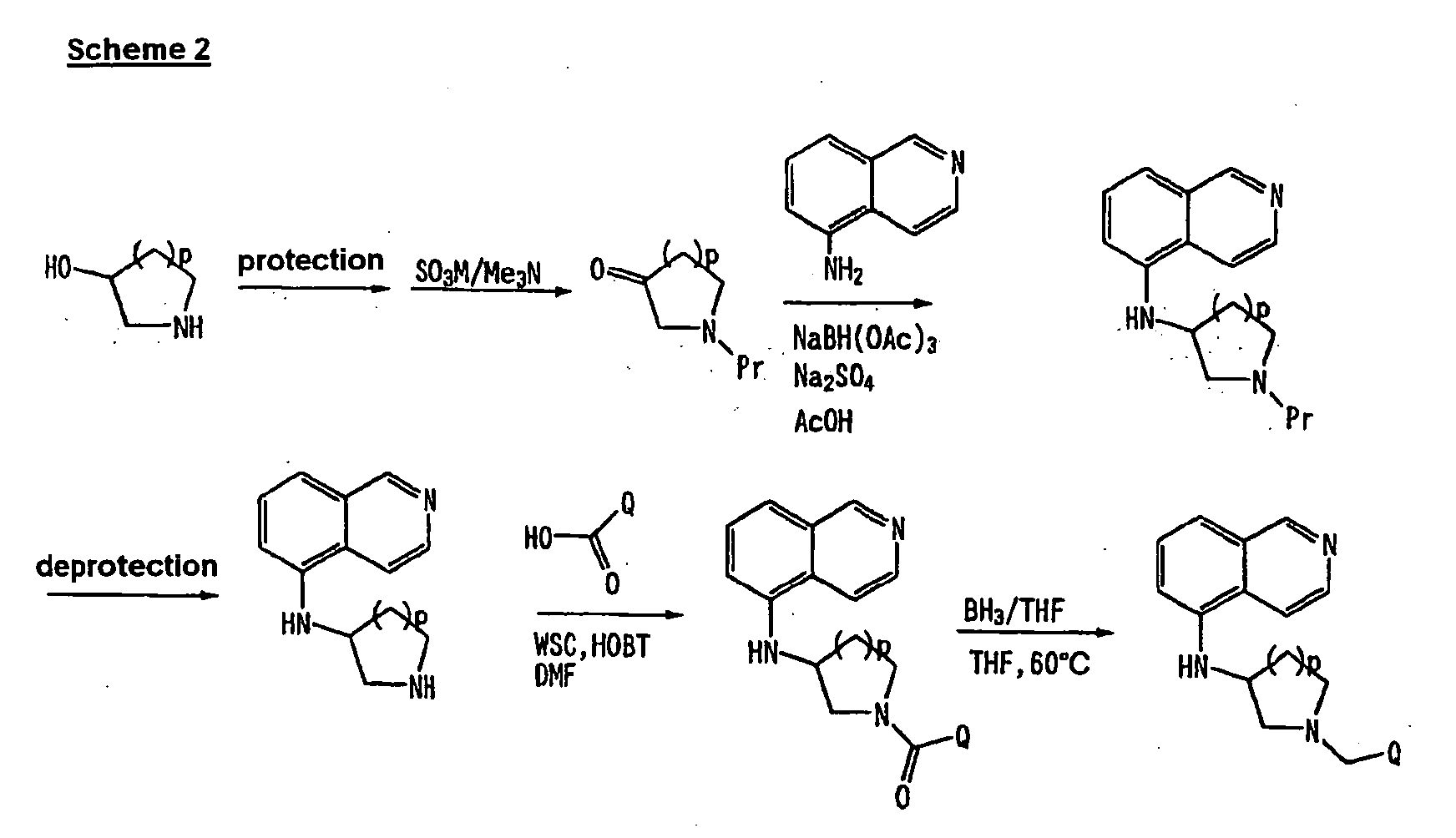
wherein Pr represents a protective group; and Q and p are as defined in
formula (I).
-
The compound in which Q represents pyrrolyl, thienyl, or furyl
may be produced by protecting a secondary amine in (R)-(-)-3-pyrrolidinol,
where p = 1, or 3-hydroxypiperidine, where p = 2, with a
suitable functional group, for example, tert-butyloxycarbony, then
oxidizing the protected compound with sulfur trioxide/trimethylamine
complex in DMSO at room temperature, condensing the oxidized
compound with 5-aminoisoquinoline in acetic acid in the presence of
anhydrous sodium sulfate, reducing the condensate with sodium hydride
triacetate to give an intermediate, deprotecting the intermediate, for
example, with trifluoroacetic acid, then condensing the deprotected
compound with a carboxylic acid Q-COOH using N-[3-(diethylamino)propyl]-N'-ethyl
carbodiimide hydrochloride and 1-hydroxybenzotriazole,
and subsequently reducing the condensate with a
borane/tetrahydrofuran complex.
wherein Pr represents a protective group; L represents a leaving group;
and Q and p are as defined in formula (I).
-
These compounds may be produced by reacting the secondary
amine of 3-aminopyrrolidine, where p = 1, or 3-aminopiperidine, where
p = 2, in which a primary amine has been protected with a suitable
protective group, for example, (3R)-(+)-3-(tert-butoxyamino)pyrrolidine),
with an alkyl chloride Q-CH2-Cl in the presence of a base, for example,
potassium carbonate, deprotecting the reaction product, for example,
with trifluoroacetic acid, and then adding a catalytic amount of palladium
acetate and BINAP to the deprotected compound and an isoquinoline
having a leaving group X (for example, when X represents triflate, this
isoquinoline may be produced by reacting 5-hydroxyisoquinoline with
trifluoromethanesulfonic anhydride) in toluene in the presence of cesium
carbonate at 80°C.
-
The compound according to the present invention may also be
produced by the method described in WO 01/56988.
Use of compounds/pharmaceutical composition
-
The compounds according to the present invention have Rho
kinase inhibitory activity (see Pharmacological Test Examples 1 and 3).
Therefore, the compounds represented by formula (I) can be used in the
treatment of diseases mediated by Rho kinase. Diseases mediated by
Rho kinase include hypertension, asthma including bronchial asthma,
angina pectoris, cerebrovascular contraction, peripheral circulatory
disorder, threatened premature birth, glaucoma, constriction of visual
field, pollakiuria, cancer, invasion/metastasis of cancer, arteriosclerosis,
retinopathy, immune response, inflammation, autoimmune diseases,
cerebral dysfunction, osteoporosis, microbism, chronic renal failure,
chronic nephritis, diabetic nephropathy, IgA nephropathia, thrombosis-related
diseases, rheumatism, impotence, and fibrosis.
-
According to the present invention, there is provided a method for
the treatment of a disease mediated by Rho kinase, comprising the step
of administering a therapeutically effective amount of a compound
according to the present invention together with a pharmaceutically
acceptable carrier, to a mammal including a human.
-
Further, according to the present invention, there is also provided
use of a compound according to the present invention, for the
manufacture of a medicament in the treatment of diseases mediated by
Rho kinase.
<Hypertension, asthma, etc.>
-
It has been revealed that Rho is activated upon the receipt of
signals from various cell membrane acceptors and the activated Rho
functions in the contraction of smooth muscle through ROCK/Rho kinase
and, further, actomyosin system (K. Kimura et al., Science, Vol. 273, No.
5272, pp 245-248 (1996); and Kureishi et al., J. Biol. Chem., Vol. 272,
No. 19, pp 12257-60 (1997)). The contraction of smooth muscle is
deeply involved in the pathology of hypertension, angina pectoris,
cerebrovascular contraction, asthma, peripheral circulatory disorder,
threatened premature birth, glaucoma, constriction of visual field,
impotence, pollakiuria, and the like (for example, hypertension: AP.
Samlyo et al., Rev. Physiol. Biochem. Pharmacol., Vol. 134, pp 209-34
(1999), angina pectoris: Shimokawa et al., Cardiovasc. Res., Vol. 43, No.
4, pp 1029-39 (1999); and Satoh, H., & Kawahara, K: Jpn. J. Pharmacol.,
79 (suppl): 211 P, 1999, cerebrovascular contraction: Motohiko Sato and
Kohzo Kaibuchi: Abstract of the 57th Annual Meeting of the Japan
Neurosurgical Society: 153, 1998; N. Ono et al., Pharmacol. Ther., Vol.
82, No. 2-3, pp 123-31(1991); and Shimokawa et al., Cardiovasc. Res.,
Vol. 43, No. 4, pp 1029-39 (1999), impotence: Andersson, K. E. & Stief,
C. G. & World J. Vrol. 15, 14-20 (1997)).
-
For hypertension, ROCK/Rho kinase inhibitors have pressure
depression activity in spontaneously hypertensive rats (SHR), two-kidney
hypertensive rats, and brine deoxycorticosterone acetate rats (DOCA
rats) (Uehata, M., Ishizaki; T. et at.: Nature, 389: 990-994, 1997).
-
For asthma, ROCK/Rho kinase inhibitors have bronchodilation
activity and antiasthmatic activity in extirpated bronchia or bronchial
asthma model animals (WO 93/05021 and WO 95/28387). Further, Rho
kinase inhibitors suppress an increase in bronchial resistance caused by
acetylcholine inhalation in bronchial asthma models in a dose-dependent
manner and suppress, in vitro, chemotaxis caused by PAF in eosinophilic
leukocytes of human peripheral blood in a concentration-dependent
manner (Kunihiko litsuka: Arerugi (Allergy), 47: 943, 1998, Kunihiko
litsuka and Akihiro Yoshii: Journal of The Japanese Respiratory Society,
37: 196, 1999). Further, Rho kinase is also involved in migration of
leukocytes.
-
For glaucoma, it is known that ROCK/Rho kinase inhibitors are
involved in trabecular meshwork of rabbits and bovines induced by
carbachol and ciliary muscle contraction of rabbits and humans (M.
Honjo et al., Investigative Ophthalmology and Visual Science: 2001; 42:
137-144, and T. Hukigami et al., Biochem Biophys Res Commun. 2001
Oct 26; 288 (2): 296-300) to lower the ocular tension of rabbits (WO
00/09162 and M. Waki et al., Current Eye Research 2001, Vol. 22, No. 6,
pp. 470-474).
-
For impotence, ROCK/Rho kinase inhibitors have rat corpus
carvernosum penis relaxation activity in vitro and have rat corpus
carvernosum penis pressure rising activity in vitro (Kanchan Chitaley et
al., Nature Medicine, Vol. 7, No. 1, 119-122 (2001)).
-
The compounds according to the present invention actually have
leukocyte migration inhibitory activity and blood pressure depression
activity (see Pharmacological Test Examples 2 and 5).
-
Therefore, the compounds according to the present invention can
be used in the treatment of hypertension, asthma including bronchial
asthma, angina pectoris, cerebrovascular contraction, peripheral
circulatory disorder, threatened premature birth, glaucoma, constriction
of visual field, impotence, pollakiuria and other diseases.
<Cancer, metastasis of cancer, etc.>
-
Rho is activated upon the receipt of signals from various cell
membrane acceptors, and the activated Rho functions, through
ROCK/Rho kinase and, further, actomyosin system, as a molecular
switch of cellular phenomena such as cell movement, cell adhesion,
alteration of cytoplasm (formation of actin stressed fibers), control of cell
division (sthenia of cytokinesis or activation of gene transcription), cell
proliferation, sthenia of carcinogenesis and invasion of cancer and the
like (P. Keely et al., Trends Cell Biol. Vol. 8, No. 3, pp 101-6 (1998); and
K. Itoh et al., Nat. Med., Vol. 5, No. 2, pp 221-5 (1999)).
-
Cell movement plays an important role in invasion/metastasis of
cancer, arteriosclerosis, retinopathy, immune response and the like.
Cell adhesion is deeply involved in metastasis of cancer, inflammation,
and autoimmune diseases. The cytoskeletal change is deeply involved
in cerebral dysfunction, osteoporosis, microbism and the like. Cell
proliferation is deeply involved in cancer, arteriosclerosis and the like
(Experimental Medicine), Vol. 17, No. 7 (1999)).
-
In particular, for transformation of cells to malignant state and
metastasis/invasion of cancer, Rho is involved in the control of cell
morphology and, in addition, in cell proliferation, particularly in the
progression of cell cycle from gap1 period (G1 phase) to synthesis
period (S phase) (Yamamoto, M., Marui, N., Oncogene, 8: 1449-1455,
1993). Further, it has been found that oncogenes such as Dbl are GDP-GTP
exchange factors for Rho family (Hart, M. J., Eva, A., Nature, 354:
311-314, 1991). Further, it has been found that Rac and Rho are
activated downstream of information transmission of Ras (Ridley, A. J. &
Hall, A.: Cell, 70: 401-410, 1992). Further, it is reported that Rac and
Rho are in the downstream of Ras, and involved in the transformation of
cancer cells to malignant state by Ras (Qui, R. G., Chen, J., et al.:
Nature, 374: 457-459, 1995., Qui, R. G., Chen, J., et al.: Proc. Natl. Acad.
Sci. USA, 92: 11781-11785, 1995, and Khosravi-Far, R., Solski, P. A.:
Mol. Cell. Biol., 15: 6443-6453, 1995). Furthermore, it has been proven
by ROCK/Rho kinase inhibitor (Y-27632) that the path from Rho to ROCK
is involved in transformation of cancer cells to malignant state (Sahai, E.,
Ishizaki, T.: Curr. Biol., 9: 136-145, 1999).
-
Further, it is reported in various cell systems that, as with
leukocytes, cell movement in cancer invasion is regulated by an
actomyosin system as a moving device and an intracellular signal
transfer system for controlling the actomyosin system and Rho family
protein regulates cytoskeleton protein and controls various cell functions
such as alteration of morphology, adhesion, movement, division, transfer
regulation and the like of cells (K. Itoh et al., Nat. Med., Vol. 5, No. 2, pp
221-5 (1999); P. Keely et al., Trends Cell Biol. Vol. 8, No. 3, pp 101-6
(1998)).
-
It is also reported that ROCK downstream of Rho controls
invasive movement through the activation of an actomyosin system
(Yoshioka, K., Matsumura, F.: J. Biol. Chem., 273: 5146-5154, 1998). It
has been demonstrated that controlling the path from Rho to ROCK by
ROCK/Rho kinase inhibitor (Y-27632) suppresses the invasive
movement (Itoh, K., Yoshioka, K.: Nature Med., 5: 221-225, 1999).
-
Therefore, the compounds according to the present invention can
be used in treatment of cancer, invasion/metastasis of cancer,
arteriosclerosis, retinopathy, immune response, inflammation,
autoimmune diseases, cerebral dysfunction, osteoporosis, and
microbism.
<Renal diseases>
-
Renal disorder was found in Rho GDI knockout mouse
(Oncogene, 1999; 18 (39): 5373-80).
-
Further, as described above, Rho is activated upon the receipt of
signals from various cell membrane acceptors, and the activated Rho is
involved in cell adhesion or migration of leukocytes through ROCK/Rho
kinase and actomyosin system. Cell adhesion and migration of
leukocytes are involved in inflammation, particularly nephritis (Osamu
Fujimoto and Kohzo Kaibuchi, Journal of The Japanese Society of
Internal Medicine, 1999; 88 (1); 148-54).
-
Furthermore, Rho is involved in nephritis through HGF, oxidized
LDL, platelets, or Na-H exchange (Mol. Cell. Biol. 1995; 15 (2): 1110-22;
J. Biol. Chem. 1999; 274 (43): 30361-4; J. Biol. Chem., 1999; 274 (40):
28293-300; and EMBO J., 1998; 17 (16): 4712-22).
-
The compounds according to the present invention actually have
proteinuria amelioration activity (see Pharmacological Test Example 4).
-
Therefore, the compounds according to the present invention can
be used in the treatment of chronic renal failure, chronic nephritis,
diabetic nephropathy, and IgA nephropathia.
<Inflammation, thrombosis-related diseases, etc.>
-
It is known that Rho is activated upon the receipt of signals from
various cell membrane acceptors, and the activated Rho functions,
through Rho kinase and, further, actomyosin system, as a molecular
switch of cellular phenomena such as platelet aggregation, leukocyte
aggregation, and leukocyte migration (K. Naka et al., Blood, Vol. 90, No.
10, pp 3736-42 (1997)). Platelet aggregation, leukocyte aggregation,
and leukocyte migration are deeply involved in thrombus, inflammation,
fibrosis and the like.
-
The compounds according to the present invention actually have
leukocyte migration inhibitory activity (see Pharmacological Test
Example 2).
-
Therefore, the compounds according to the present invention can
be used in the treatment of inflammation, asthma, thrombosis-related
diseases, for example, cardiac infarction, cerebral infarction,
arteriosclerosis obliterans, thrombus obstruction, and generalized
angiocoagulation syndrome, rheumatism, and fibrosis.
-
Pharmaceutical compositions comprising compounds of the
present invention as an active ingredient can be administered to human
and non-human animals orally or parenterally by administration routes,
for example, intravenous administration, intramuscular administration,
subcutaneous administration, rectal administration, or percutaneous
administration. Therefore, the pharmaceutical composition comprising
a compound according to the present invention as an active ingredient
may be formulated into suitable dosage forms according to the
administration routes.
-
Specifically, oral preparations include tablets, capsules, powders,
granules, syrups, pills, and troches, and parental preparations include
injections, such as solutions and suspensions, inhalants, suppositories,
transdermal preparations, for example, tapes, ointments, eye drops, and
eye ointments.
-
These various preparations may be prepared by conventional
methods, for example, with commonly used component, such as
excipients, disintegrants, binders, lubricants, colorants, diluents,
corrigents, flavors, emulsifiers, and solubilizers.
-
Excipients include, for example, lactose, glucose; corn starch,
sorbit, and crystalline cellulose. Disintegrants include, for example,
starch, sodium alginate, gelatin powder, calcium carbonate, calcium
citrate, and dextrin. Binders include, for example, dimethylcellulose,
polyvinyl alcohol, polyvinyl ether, methylcellulose, ethylcellulose, gum
arabic, gelatin, hydroxypropylcellulose, and polyvinyl pyrrolidone.
Lubricants include, for example, talc, magnesium stearate, polyethylene
glycol, and hydrogenated vegetable oils.
-
In the formulation of solid preparations, additives are used such
as sucrose, lactose, cellulose sugar, D-mannitol, maltitol, dextran,
starches, agar, alginates, chitins, chitosans, pectins, tragacanths, gum
arabics, gelatins, collagens, caseins, albumin, calcium phosphate,
sorbitol, glycine, carboxymethylcellulose, polyvinyl pyrrolidone,
hydroxypropylcellulose, hydroxypropylmethylcellulose, glycerin,
polyethylene glycol, sodium hydrogencarbonate, magnesium stearate;
and talc. Further, tablets may be those on which, if necessary,
conventional coating has been provided, for example, sugar coated
tablets, enteric coated tablets, film coated tablets, or two-layer tablets,
and multilayer tablets.
-
In the formulation of semi-solid preparations, animal fats and oils,
such as olive oils, corn oils, and castor oils, mineral fats and oils, such
as petrolatum, white petrolatum, and hard paraffin, waxes, such as
jojoba oils, carnauba wax, and beeswax, and partially synthesized or
wholly synthesized glycerin fatty acid esters, such as laurylic acid,
myristic acid, and palmitic acid, and the like may be used. Examples of
commercially available products thereof include Witepsol manufactured
by Dynamid Nobel and Pharmasol manufactured by Nippon Oils & Fats
Co., Ltd.
-
In the formulation of solutions, additives may be used such as
sodium chloride, glucose, sorbitol, glycerin, olive oil, propylene glycol,
and ethyl alcohol. In the formulation of injections, aseptic aqueous
solutions, for example, physiological saline, isotonic solutions, oily
solutions, for example, sesame oils and soybean oils, may be used. If
necessary, suitable suspending agents, for example, sodium
carboxymethylcellulose, nonionic surfactants, solubilizers, for example,
benzyl benzoate, benzyl alcohol and the like may be used in combination
with the above solutions.
-
In the formulation of eye drops, aqueous liquid preparations or
aqueous solutions are used, and, in particular, aseptic aqueous solutions
for injections may be used. Various additives, such as buffers,
preferably, for example, borate buffers, acetate buffers, and carbonate
buffers for abatement of stimulation, isotonicity, solubilizers,
preservatives, thickening agents, chelating agents, pH adjustors (in
general, pH being preferably adjusted to about 2 to 8.5), and aromatics,
may be properly added to the liquid preparation for eye drops.
-
The content of a compound according to the present invention in
the pharmaceutical composition may vary according to the dosage form.
The content is, however, generally about 0.1 to 100% by weight,
preferably about 1 to 50% by weight, based on the whole composition.
-
The dose may be appropriately determined in consideration of
particular conditions, for example, the age, weight, sex, type of disease,
and severity of condition of patients, and the preparation may be
administered, for example, in an amount of about 1 to 500 mg. This
dose may be administered at a time daily or divided doses of several
times daily.
EXAMPLES
-
The present invention is further illustrated by the following
Examples that are not intended as a limitation of the invention.
Intermediate 1: Tert-butyl 3-(5-isoquinolylamino)-1-pyrrolidinecarboxylate
-
(R)-pyrrolidinol (Tokyo Chemical Industry Co., Ltd., 12.4 g, 100
mmol) was dissolved in 100 ml of a 3 N aqueous solution of sodium
hydroxide. A solution (50 ml) of di-tert-butyl dicarbonate (Tokyo
Chemical Industry Co., Ltd., 25.0 g, 120 mmol) in tetrahydrofuran was
added dropwise thereto at 0°C. The pH value of the mixture was
determined with a pH test paper and was found to be 11. The mixture
was then stirred at room temperature for 2 hr and was then concentrated
to remove a major part of tetrahydrofuran. The aqueous layer was
extracted three times with ethylacetate. The combined organic layer was
dried over sodium sulfate and was concentrated to give a crude product.
-
The crude product and triethylamine (20 ml) were dissolved in
anhydrous dimethylsulfoxide (100 ml), and a trituated sulfur
trioxide/trimethylamine complex (Aldrich, 28.0 g, 200 mmol) was added
little by little thereto at room temperature. The mixture was stirred at
room temperature for 18 hr. Water (200 ml) was then added to the
reaction solution to stop the reaction. The aqueous layer was extracted
three times with ethylacetate. The combined organic layer was dried over
sodium sulfate and was concentrated to give a crude product.
-
The crude product was loaded on a silica gel column and
developed with chloroform, followed by development with chloroform
only to give an intermediate (11.25 g).
-
The intermediate (3.70 g, 20 mmol) and 5-aminoisoquinoline
(Aldrich, 2.48 g, 17 mmol) were dissolved in 100 ml of acetic acid.
Sodium sulfate (14.2 g, 100 mmol) was added thereto, and the mixture
was stirred at room temperature for 30 min. The reaction mixture
was cooled to 0°C, sodium hydride triacetate (Aldrich, 4.44 g, 20 mmol)
was added thereto little by little, and the mixture was stirred at room
temperature for 18 hr. The reaction solution was concentrated under
the reduced pressure to remove a major part of acetic acid. The
reaction mixture was then adjusted to pH = 8 by the addition of a
saturated sodium hydrogencarbonate solution and was filtered through
Celite, and the filtrate was separated into an organic layer and an
aqueous layer. The aqueous layer was extracted three times with
ethylacetate. The combined organic layer was dried over sodium
sulfate and was concentrated to give a crude product.
-
The crude product in methylene chloride was loaded on a silica
gel column and developed with hexane. The development was first
carried out with hexane only, subsequently with hexane/chloroform (1 : 1),
and finally with chloroform only to collect a fraction having UV absorption
with Rf = 0.6 to give the title compound (3.70 g, 12 mmol).
1H-NMR (CDCl3, 400 MHz): 1.46 (s, 9H), 1.75 - 1.94 (m, 1H),
2.02 - 2.10 (m, 1 H), 3.35 - 3.55 (m, 31 H), 3.75 - 3.86 (m, 1 H), 4.17 - 4.24
(m, 1 H), 4.705 - 4.90 (m, 1 H), 6.91 (d, J = 7.6 Hz, 1H), 7.44 (d, J = 8.3
Hz, 1 H), 7.58 (t, J = 7.9 Hz, 1 H), 7.80 - 7.90 (m, 1 H), 8.42 (d, J = 6.4 Hz,
1 H), 9.20 (s, 1 H).
Mass spectrometric value (ESI-MS, m/z): 314 (M++1)
Intermediate 2: Tert-butyl 3-(5-isoquinolylamino)-1-piperidine-carboxylate
-
(R)-pyrrolidinol (Tokyo Chemical Industry Co., Ltd., 12.4 g, 100
mmol) was dissolved in 100 ml of a 3 N aqueous solution of sodium
hydroxide. A solution (50 ml) of di-tert-butyl dicarbonate (Tokyo
Chemical Industry Co., Ltd., 25.0 g, 120 mmol) in tetrahydrofuran was
added dropwise thereto at 0°C. The pH value of the mixture was
confirmed to be 11 with a pH test paper. The mixture was stirred at
room temperature for 2 hr and was then concentrated to remove a major
part of tetrahydrofuran. The aqueous layer was extracted three times
with ethylacetate. The combined organic layer was dried over sodium
sulfate and was concentrated to give a crude product.
-
The crude product and triethylamine (20 ml) were dissolved in
anhydrous dimethylsulfoxide (100 ml). Finely triturated sulfur
trioxide/trimethylamine complex (Aldrich, 28.0 g, 200 mmol) was added
thereto little by little at room temperature. The mixture was stirred at
room temperature for 18 hr. Thereafter, 200 ml of water was added to
stop the reaction. The aqueous layer was extracted three times with
ethylacetate. The combined organic layer was dried over sodium
sulfate and was concentrated to give a crude product.
-
The crude product was purified by a silica gel column eluted with
chloroform. The development was carried out with chloroform to give
an intermediate (15.6 g).
-
The intermediate (3.70 g, 20 mmol) and 5-aminoisoquinoline
(Aldrich, 2.48 g, 17 mmol) were dissolved in 100 ml of acetic acid.
Sodium sulfate (14.2 g, 100 mmol) was added thereto, and the mixture
was stirred at room temperature for 30 min. The reaction mixture was
cooled to 0°C. Sodium hydride triacetate (Aldrich, 4.44 g, 20 mmol)
was added thereto little by little, and the mixture was stirred at room
temperature for 18 hr. The reaction solution was concentrated under
the reduced pressure to remove a major part of acetic acid. The
reaction mixture was then adjusted to pH 8 by the addition of a saturated
sodium hydrogencarbonate solution and was filtered through Celite, and
the filtrate was separated into an organic layer and an aqueous layer.
The aqueous layer was extracted three times with ethylacetate. The
combined organic layer was dried over sodium sulfate and was
concentrated to give a crude product.
-
The crude product dissolved in methylene chloride was purified
by a silica gel column and developed with hexane. The development
was first carried out with hexane only, then with hexane/chloroform (1 :
1), and finally with chloroform only to collect a fraction having UV
absorption with Rf = 0.6 to give the title compound (3.720 g, 12 mmol).
1H-NMR (CDCl3, 400 MHz): 1.44 (s, 9H), 1.48 - 1.68 (m, 1 H),
1.73 - 1.83 (m, 2H), 1.90 - 2.10 (m, 1 H), 3.10 - 3.32 (m, 2H), 3.52 - 3.65
(m, 2H), 3.92 - 3.98 (m, 1H), 6.86 (d, J = 7.6 Hz, 1H), 7.30 (d, J = 8.3 Hz,
1 H), 7.45 (t, J = 7.9 Hz, 1 H), 7.54 (d, J = 5.8 Hz, 1 H), 8.42 (d, J = 5.8 Hz,
1 H), 9.13 (s, 1 H).
Mass spectrometric value (ESI-MS, m/z): 328 (M++1)
Example 1: N5-[1-(2-Chlorobenzyl)tetrahydro-1H-3-pyrrolyl]-5-isoquinolylamine
-
Tert-butyl 3-(5-isoquinolylamino)-1-pyrrolidinecarboxylate
(intermediate 1) (62 mg, 0.20 mmol) was dissolved in 1 ml of chloroform.
Trifluoroacetic acid (1 ml) was added thereto, and the mixture was stirred
at room temperature for 3 hr. The reaction mixture was concentrated,
potassium carbonate (Wako Kagaku Industry, Co., 69 mg, 0.50 mmol)
was then added to the concentrate, and the mixture was dissolved in 1
ml of acetonitrile. A solution (1 ml) of 2-chlorobenzylchloride (40 mg,
0.25 mmol) in acetonitrile was added dropwise thereto at room
temperature, and the mixture was stirred for additional 18 hr. Water (2
ml) was added thereto, and the mixture was then concentrated to remove
a major part of acetonitrile. The aqueous layer was extracted three
times with ethylacetate. The combined organic layer was dried over
sodium sulfate and was concentrated. The resultant salt was further
dissolved in a chloroform/methanol (10 : 1) solution, and the solution was
filtered through a silica gel column with a short length. The filtrate was
concentrated to give a crude product.
-
The crude product dissolved in chloroform was loaded on a silica
gel column and developed with chloroform. The development was first
carried out with chloroform only, subsequently with chloroform/methanol
(20 : 1), and finally with chloroform/methanol (10 : 1) to collect a fraction
having UV absorption with Rf = 0.5 to give the title compound (28 mg,
0.083 mmol).
1H-NMR (CDCl3, 400 MHz): 1.98 - 2.10 (m, 1H), 2.40 - 2.52 (m,
1 H), 2.70 - 2.90 (m, 1H), 3.00 - 3.86 (m, 3H), 4.00 - 4.15 (m, 2H), 4.25 -
4.35 (m, 1 H), 6.59 (d, J = 7.6 Hz, 1H), 7.20 - 7.28 (m, 3H), 7.32 - 7.38 (m,
2H), 7.63 - 7.83 (m, 2H), 8.44 (d, J = 5.8 Hz, 1 H), 9.07 (s, 1 H).
Mass spectrometric value (ESI-MS, m/z): 339 (M++1)
Example 2: N5-[1-(3-Chlorobenzyl)tetrahydro-1H-3-pyrrolyl]-5-isoquinolylamine
-
Tert-butyl 3-(5-isoquinolylamino)-1-pyrrolidinecarboxylate
(intermediate 1) (62 mg, 0.20 mmol) was dissolved in 1 ml of chloroform.
Trifluoroacetic acid (1 ml) was added thereto, and the mixture was stirred
at room temperature for 3 hr. The reaction mixture was concentrated,
potassium carbonate (Wako Kagaku Industry, Co., 69 mg, 0.50 mmol)
was then added to the concentrate, and the mixture was dissolved in 1
ml of acetonitrile. A solution (1 ml) of 3-chlorobenzylchloride (40 mg,
0.25 mmol) in acetonitrile was added dropwise thereto at room
temperature, and the mixture was stirred for additional 18 hr. Water (2
ml) was added thereto, and the mixture was then concentrated to remove
a major part of acetonitrile. The aqueous layer was extracted three
times with ethylacetate. The combined organic layer was dried over
sodium sulfate and was concentrated. The resultant salt was further
dissolved in a chloroform/methanol (10 : 1) solution, and the solution was
filtered through a silica gel column with a short length. The filtrate was
concentrated to give a crude product.
-
The crude product dissolved in chloroform was loaded on a
silica gel column and developed with chloroform. The development was
first carried out with chloroform only, subsequently with
chloroform/methanol (20 : 1), and finally with chloroform/methanol (10 :
1) to collect a fraction having UV absorption with Rf = 0.5 to give the title
compound (14 mg, 0.042 mmol).
1H-NMR (CDCl3, 400 MHz): 2.00 - 2.10 (m, 1 H), 2.45 - 2.55 (m,
1 H), 2.70 - 2.80 (m, 1 H), 3.00 - 3.45 (m, 3H), 3.80 - 3.90 (m, 2H), 4.25 -
4.36 (m, 1 H), 6.64 (d, J = 7.6 Hz, 1 H), 7.28 - 7.34 (m, 3H), 7.37 - 7.43 (m,
3H), 7.75 - 7.85 (m, 1 H), 8.48 (d, J = 6.1 Hz, 1 H), 9.12 (s, 1H).
Mass spectrometric value (ESI-MS, m/z): 339 (M++1)
Example 3: N5-[1-(4-Chlorobenzyl)tetrahydro-1H-3-pyrrolyl]-5-isoquinolylamine
-
Tert-butyl, 3-(5-isoquinolylamino)-1-pyrrolidinecarboxylate
(intermediate 1) (62 mg, 0.20 mmol) was dissolved in 1 ml of chloroform.
Trifluoroacetic acid (1 ml) was added thereto, and the mixture was stirred
at room temperature for 3 hr. The reaction mixture was concentrated,
potassium carbonate (Wako Kagaku Industry, Co., 69 mg, 0.50 mmol)
was then added to the concentrate, and the mixture was dissolved in 1
ml of acetonitrile. A solution (1 ml) of 4-chlorobenzylchloride (40 mg,
0.25 mmol) in acetonitrile was added dropwise to the solution at room
temperature, and the mixture was stirred for additional 18 hr. Water (2
ml) was added to the reaction solution, and the mixture was then
concentrated to remove a major part of acetonitrile. The aqueous layer
was extracted three times with ethylacetate. The combined organic
layer was dried over sodium sulfate and was concentrated. The
resultant salt was further dissolved in a chloroform/methanol (10 : 1)
solution, and the solution was filtered through a silica gel column with a
short length. The filtrate was concentrated to give a crude product.
-
The crude product dissolved in chloroform was loaded on a
silica gel column and developed with chloroform. The development was
first carried out with chloroform only, subsequently with
chloroform/methanol (20 : 1), and finally with chloroform/methanol (10 :
1) to collect a fraction having UV absorption with Rf = 0.5 to give the title
compound (11 mg, 0.03 mmol).
1H-NMR (CDCl3, 400 MHz): 2.00 - 2.10 (m, 1 H), 2.45 - 2.55 (m,
1 H), 2.60 - 2.90 (m, 1 H), 3.00 - 3.40 (m, 3H), 3.85 - 4.00 (m, 2H), 4.28 -
4.50 (m, 1 H), 6.62 (d, J = 7.3 Hz, 1 H), 7.28 - 7.44 (m, 5H), 7.80 - 8.00 (m,
1 H), 8.48 (d, J = 6.1 Hz, 1 H), 9.12 (s, 1H).
Mass spectrometric value (ESI-MS, m/z): 339 (M++1)
Example 4: N5-[1-(4-Fluorobenzyl)tetrahydro-1H-3-pyrrolyl]-5-isoquinolylamine
-
Tert-butyl 3-(5-isoquinolylamino)-1-pyrrolidinecarboxylate
(intermediate 1) (62 mg, 0.20 mmol) was dissolved in 1 ml of chloroform.
Trifluoroacetic acid (1 ml) was added thereto, and the mixture was stirred
at room temperature for 3 hr. The reaction mixture was concentrated,
potassium carbonate (Wako Kagaku Industry, Co., 69 mg, 0.50 mmol)
was then added to the concentrate, and the mixture was dissolved in 1
ml of acetonitrile. A solution (1 ml) of 4-fluorobenzylchloride (39 mg,
0.25 mmol) in acetonitrile was added dropwise to the solution at room
temperature, and the mixture was stirred for additional 18 hr. Water (2
ml) was added thereto, and the mixture was then concentrated to remove
a major part of acetonitrile. The aqueous layer was extracted three
times with ethylacetate. The combined organic layer was dried over
sodium sulfate and was concentrated. The resultant salt was further
dissolved in a chloroform/methanol (10 : 1) solution, and the solution was
filtered through a silica gel column with a short length. The filtrate was
concentrated to give a crude product.
-
The crude product dissolved in chloroform was loaded on a
silica gel column and developed with chloroform. The development was
first carried out with chloroform only, subsequently with
chloroform/methanol (20 : 1), and finally with chloroform/methanol (10 :
1) to collect a fraction having UV absorption with Rf = 0.5 to give the title
compound (17 mg, 0.053 mmol).
1H-NMR (CDCl3, 400 MHz): 1.80 - 2.10 (m, 1 H), 2.40 - 2.53 (m,
1H), 2.57 - 2.75 (m, 1 H), 2.90 - 3.25 (m, 3H), 3.75 - 3.88 (m, 2H), 4.21 -
4.31 (m, 1H), 6.64 (d, J = 7.6 Hz, 1H), 7.03 (t, J = 8.5 Hz, 2H), 7.30 (d, J
= 8.0 Hz, 1 H), 7.35 - 7.43 (m, 3H), 7.65 - 7.78 (m, 1 H), 8.47 (d, J = 6.1
Hz, 1 H), 9.12 (s, 1H).
Mass spectrometric value (ESI-MS, m/z): 322 (M++1)
Example 5: N5-[1-(2,6-Difluorobenzyl)tetrahydro-1H-3-pyrrolyl]-5-isoquinolylamine
-
Tert-butyl 3-(5-isoquinolylamino)-1-pyrrolidinecarboxylate
(intermediate 1) (62 mg, 0.20 mmol) was dissolved in 1 ml of chloroform.
Trifluoroacetic acid (1 ml) was added thereto, and the mixture was stirred
at room temperature for 3 hr. The reaction mixture was concentrated,
potassium carbonate (Wako Kagaku Industry, Co., 69 mg, 0.50 mmol)
was then added to the concentrate, and the mixture was dissolved in
acetonitrile. A solution (1 ml) of 2,6-difluorobenzylchloride (40 mg, 0.25
mmol) in acetonitrile was added dropwise thereto at room temperature,
and the mixture was stirred for additional 18 hr. Water (2 ml) was
added thereto, and the mixture was then concentrated to remove a major
part of acetonitrile. The aqueous layer was extracted three times with
ethylacetate. The combined organic layer was dried over sodium
sulfate and was concentrated. The resultant salt was further dissolved
in a chloroform/methanol (10 : 1) solution, and the solution was filtered
through a silica gel column with a short length. The filtrate was
concentrated to give a crude product.
-
The crude product dissolved in chloroform was loaded on a
silica gel column and developed with chloroform. The development was
first carried out with chloroform only, subsequently with
chloroform/methanol (20 : 1), and finally with chloroform/methanol (10 :
1) to collect a fraction having UV absorption with Rf = 0.5 to give the title
compound (34 mg, 0.10 mmol).
1H-NMR (CDCl3, 400 MHz): 1.78 - 1.90 (m, 1H), 2.35 - 2.45 (m,
1H), 2.52 - 2.65 (m, 1 H), 2.88 - 3.00 (m, 3H), 3.90 (s, 2H), 4.11 - 4.20 (m,
1 H), 4.75 - 4.85 (m, 1 H), 6.66 (d, J = 7.6 Hz, 1 H), 6.85 - 6.95 (m, 3H),
7.29 (d, J = 8.3 Hz, 1 H), 7.41 (t, J = 7.9 Hz, 1 H), 7.58 (d, J = 6.1 Hz, 1 H),
8.44 (d, J = 6.1 Hz, 1 H), 9.13 (s, 1H).
Mass spectrometric value (ESI-MS, m/z): 340 (M++1)
Example 6: N5-[1-(2,6-Dichlorobenzyl)tetrahydro-1H-3-pyrrolyl]-5-isoquinolylamine
-
Tert-butyl 3-(5-isoquinolylamino)-1-pyrrolidinecarboxylate
(intermediate 1) (62 mg, 0.20 mmol) was dissolved in 1 ml of chloroform.
Trifluoroacetic acid (1 ml) was added thereto, and the mixture was stirred
at room temperature for 3 hr. The reaction mixture was concentrated,
potassium carbonate (Wako Kagaku Industry, Co., 69 mg, 0.50 mmol)
was then added to the concentrate, and the mixture was dissolved in 1
ml of acetonitrile. A solution (1 ml) of 2,6-dichlorobenzylchloride (49 mg,
0.25 mmol) in acetonitrile was added dropwise thereto at room
temperature, and the mixture was stirred for additional 18 hr. Water (2
ml) was added thereto, and the mixture was then concentrated to remove
a major part of acetonitrile. The aqueous layer was extracted three
times with ethylacetate. The combined organic layer was dried over
sodium sulfate and was concentrated. The resultant salt was further
dissolved in a chloroform/methanol (10 : 1) solution, and the solution was
filtered through a silica gel column with a short length. The filtrate was
concentrated to give a crude product.
-
The crude product dissolved in chloroform was loaded on a silica
gel column and developed with chloroform. The development was first
carried out with chloroform only, subsequently with chloroform/methanol
(20 : 1), and finally with chloroform/methanol (10 : 1) to collect a fraction
having UV absorption with Rf = 0.5 to give the title compound (22 mg,
0.059 mmol).
1H-NMR (CDCl3, 400 MHz): 1.83 - 1.95 (m, 1 H), 2.33 - 2.43 (m,
1 H), 2.65 - 2.75 (m, 1 H), 2.95 - 3.15 (m, 3H), 4.09 (s, 2H), 4.13 - 4.24 (m,
1 H), 4.90 - 5.05 (m, 1 H), 6.67 (d, J = 7.6 Hz, 1 H), 7.17 (dd, J = 7.8 Hz,
8.3 Hz, 1 H), 7.28 (t, J = 8.3 Hz, 1 H), 7.33 (d, J = 8.0 Hz, 1 H), 7.41 (t, J =
7.9 Hz, 1 H), 7.61 (d, J = 5.9 Hz, 1 H), 8.45 (d, J = 6.1 Hz, 1 H), 9.11 (s,
1 H).
Mass spectrometric value (ESI-MS, m/z): 373 (M++1)
Example 7: N-(5-Isoquinolvl)-N-[1-(4-methylbenzyl)tetrahydro-1H-3-pyrrolyl]amine
-
Tert-butyl 3-(5-isoquinolylamino)-1-pyrrolidinecarboxylate
(intermediate 1) (62 mg, 0.20 mmol) was dissolved in 1 ml of chloroform.
Trifluoroacetic acid (1 ml) was added thereto, and the mixture was stirred
at room temperature for 3 hr. The reaction mixture was concentrated,
potassium carbonate (Wako Kagaku Industry, Co., 69 mg, 0.50 mmol)
was then added to the concentrate, and the mixture was dissolved in 1
ml of acetonitrile. A solution (1 ml) of 4-methylbenzylchloride (40 mg,
0.25 mmol) in acetonitrile was added dropwise thereto at room
temperature, and the mixture was stirred for additional 18 hr. Water (2
ml) was added thereto, and the mixture was then concentrated to remove
a major part of acetonitrile. The aqueous layer was extracted three
times with ethylacetate. The combined organic layer was dried over
sodium sulfate and was concentrated. The resultant salt was further
dissolved in a chloroform/methanol (10 : 1) solution, and the solution was
filtered through a silica gel column with a short length. The filtrate was
concentrated to give a crude product.
-
The crude product dissolved in chloroform was loaded on a
silica get column and developed with chloroform. The development was
first carried out with chloroform only, subsequently with
chloroform/methanol (20 : 1), and finally with chloroform/methanol (10 :
1) to collect a fraction having UV absorption with Rf = 0.5 to give the title
compound (16 mg, 0.050 mmol).
Mass spectrometric value (ESI-MS, m/z): 318 (M++1)
Example 8: N5-[1-(4-Isoprolylbenzyl)tetrahydro-1H-3-pyrrolyl]-5-isoquinolylamine
-
Tert-butyl 3-(5-isoquinolylamino)-1-pyrrolidinecarboxylate
(intermediate 1) (62 mg, 0.20 mmol) was dissolved in 1 ml of chloroform.
Trifluoroacetic acid (1 ml) was added thereto, and the mixture was stirred
at room temperature for 3 hr. The reaction mixture was concentrated,
potassium carbonate (Wako Kagaku Industry, Co., 69 mg, 0.50 mmol)
was then added to the concentrate, and the mixture was dissolved in 1
ml of acetonitrile. A solution (1 ml) of 4-isopropylbenzylchloride (42 mg,
0.25 mmol) in acetonitrile was added dropwise thereto at room
temperature, and the mixture was stirred for additional 18 hr. Water (2
ml) was added thereto, and the mixture was then concentrated to remove
a major part of acetonitrile. The aqueous layer was extracted three
times with ethylacetate. The combined organic layer was dried over
sodium sulfate and was concentrated. The resultant salt was further
dissolved in a chloroform/methanol (10 : 1) solution, and the solution was
filtered through a silica gel column with a short length. The filtrate was
concentrated to give a crude product.
-
The crude product dissolved in chloroform was loaded on a
silica gel column and developed with chloroform. The development was
first carried out with chloroform only, subsequently with
chloroform/methanol (20 : 1), and finally with chloroform/methanol (10 :
1) to collect a fraction having UV absorption with Rf = 0.5 to give the title
compound (14 mg, 0.041 mmol).
1H-NMR (CDCl3, 400 MHz): 1.22 (d, J = 6.9 Hz, 6H), 1.85 - 1.99
(m, 1 H), 2.40 - 2.50 (m, 1 H), 2.60 - 2.75 (m, 1 H), 2.83 - 3.05 (m, 3H),
3.81 (s, 2H), 4.20 - 4.30 (m, 1 H), 6.64 (d, J = 7.8 Hz, 1 H), 7.20 (d, J =
8.1 Hz, 1 H), 7.28 - 7.33 (m, 3H), 7.40 (t, J = 7.8 Hz, 1 H), 7.28 - 7.33 (m,
3H), 7.41 (t, J = 7.8 Hz, 1 H), 7.70 - 7.80 (m, 1 H), 8.47 (d, J = 6.1 Hz, 1 H),
9.13 (s, 1H).
Mass spectrometric value (ESI-MS, m/z): 346 (M++1)
Example 9: N-(5-Isoquinolyl)-N-[1-(2-nitrobenzyl)tetrahydro-1H-3
pyrrolyl]amine
-
Tert-butyl 3-(5-isoquinolylamino)-1-pyrrolidinecarboxylate
(intermediate 1) (62 mg, 0.20 mmol) was dissolved in 1 ml of chloroform.
Trifluoroacetic acid (1 ml) was added thereto, and the mixture was stirred
at room temperature for 3 hr. The reaction mixture was concentrated,
potassium carbonate (Wako Kagaku Industry, Co., 69 mg, 0.50 mmol)
was then added to the concentrate, and the mixture was dissolved in 1
ml of acetonitrile. A solution (1 ml) of 2-nitrobenzylchloride (43 mg,
0.25 mmol) in acetonitrile was added dropwise thereto at room
temperature, and the mixture was stirred for additional 18 hr. Water (2
ml) was added thereto, and the mixture was then concentrated to remove
a major part of acetonitrile. The aqueous layer was extracted three
times with ethylacetate. The combined organic layer was dried over
sodium sulfate and was concentrated. The resultant salt was further
dissolved in a chloroform/methanol (10 : 1) solution, and the solution was
filtered through a silica gel column with a short length. The filtrate was
concentrated to give a crude product.
-
The crude product dissolved in chloroform was loaded on a
silica gel column and developed with chloroform. The development was
first carried out with chloroform only, subsequently with
chloroform/methanol (20 : 1), and finally with chloroform/methanol (10 :
1) to collect a fraction having UV absorption with Rf = 0.5 to give the title
compound (27 mg, 0.076 mmol).
Mass spectrometric value (ESI-MS, m/z): 349 (M++1)
Example 10: N-(5-Isoquinolyl)-N-[1-(3-nitrobenzyl)tetrahydro-1H-3-pyrrolyl]amine
-
Tert-butyl 3-(5-isoquinolylamino)-1-pyrrolidinecarboxylate
(intermediate 1) (62 mg, 0.20 mmol) was dissolved in 1 ml of chloroform.
Trifluoroacetic acid (1 ml) was added thereto, and the mixture was stirred
at room temperature for 3 hr. The reaction mixture was concentrated,
potassium carbonate (Wako Kagaku Industry, Co., 69 mg, 0.50 mmol)
was then added to the concentrate, and the mixture was dissolved in 1
ml of acetonitrile. A solution (1 ml) of 3-nitrobenzylchloride (43 mg,
0.25 mmol) in acetonitrile was added dropwise thereto at room
temperature, and the mixture was stirred for additional 18 hr. Water (2
ml) was added thereto, and the mixture was then concentrated to remove
a major part of acetonitrile. The aqueous layer was extracted three
times with ethylacetate. The combined organic layer was dried over
sodium sulfate and was concentrated. The resultant salt was further
dissolved in a chloroform/methanol (10 : 1) solution, and the solution was
filtered through a silica gel column with a short length. The filtrate was
concentrated to give a crude product.
-
The crude product dissolved in chloroform was loaded on a
silica gel column and developed with chloroform. The development was
first carried out with chloroform only, subsequently with
chloroform/methanol (20 : 1), and finally with chloroform/methanol (10 :
1) to collect a fraction having UV absorption with Rf = 0:5 to give the title
compound (27 mg, 0.076 mmol).
1H-NMR (CDCl3, 400 MHz): 1.78 - 1.90 (m, 1 H), 2.40 - 2.57 (m,
2H), 2.72 - 2.79 (m, 1 H), 2.85 - 2.96 (m, 2H), 3.77 (s, 2H), 4.14 - 4.24 (m,
1 H), 4.55 - 4.67 (m, 1 H), 6.69 (d, J = 7.6 Hz, 1 H), 7.31 (d, J = 8.3 Hz,
1 H), 7.41 (t, J = 7.8 Hz, 1 H), 7.49 (d, J = 7.8.Hz, 1 H), 7.58 (d, J = 6.1 Hz,
1 H), 7.69 (d, J = 6.7 Hz, 1 H), 8.11 (d, J = 7.3 Hz, 1 H), 8.23 (s, 1 H), 8.47
(d, J = 6.1 Hz, 1 H), 9.14 (s, 1H).
Mass spectrometric value (ESI-MS, m/z): 349 (M++1)
Example 11: N-(5-Isoquinolyl)-N-[1-(4-nitrobenzyl)tetrahydro-1H-3-pyrrolyl]amine
-
Tert-butyl 3-(5-isoquinolyamino)-1-pyrrolidinecarboxylate
(intermediate 1) (62 mg, 0.20 mmol) was dissolved in 1 ml of chloroform.
Trifluoroacetic acid (1 ml) was added thereto, and the mixture was stirred
at room temperature for 3 hr. The reaction mixture was concentrated,
potassium carbonate (Wako Kagaku Industry, Co., 69 mg, 0.50 mmol)
was then added to the concentrate, and the mixture was dissolved in 1
ml of acetonitrile. A solution (1 ml) of 4-nitrobenzylchloride (43 mg,
0.25 mmol) in acetonitrile was added dropwise thereto at room
temperature, and the mixture was stirred for additional 18 hr. Water (2
ml) was added to the reaction solution, and the mixture was then
concentrated to remove a major part of acetonitrile. The aqueous layer
was extracted three times with ethylacetate. The combined organic
layer was dried over sodium sulfate and was concentrated. The
resultant salt was further dissolved in a chloroform/methanol (10 : 1)
solution, and the solution was filtered through a silica gel column with a
short length. The filtrate was concentrated to give a crude product.
-
The crude product dissolved in chloroform was loaded on a silica
gel column and developed with chloroform. The development was first
carried out with chloroform only, subsequently with chloroform/methanol
(20 : 1), and finally with chloroform/methanol (10 : 1) to collect a fraction
having UV absorption with Rf = 0.5 to give the title compound (20 mg,
0.057 mmol).
1H-NMR (CDCl3, 400 MHz): 1.86 - 1.94 (m, 1H), 2.43 - 2.54 (m,
1 H), 2.84 - 3.06 (m, 3H), 3.85 (s, 2H), 4.20 - 4.28 (m, 1 H), 4.76 - 4.90 (m,
1 H), 6.66 (d, J = 7.6 Hz, 1 H), 7.31 (d, J = 8.3 Hz, 1 H), 7.41 (t, J = 7.9 Hz,
1 H), 7.41 (t, J = 7.9 Hz, 1 H), 7.57 (d, J = 8.5 Hz, 2H), 7.63 (d, J = 5.8 Hz,
1 H), 8.18 (d, J = 8.8 Hz, 2H), 8.46 (d, J = 5.8 Hz, 1 H), 9.13 (s, 1H).
Mass spectrometric value (ESI-MS, m/z): 349 (M++1)
Example 12: N5-[1-(4-Chloro-2-nitrobenzyl)tetrahydro-1H-3-pyrrolyl]-5-isoquinolylamine
-
Tert-butyl 3-(5-isoquinolylamino)-1-pyrrolidinecarboxylate
(intermediate 1) (62 mg, 0.20 mmol) was dissolved in 1 ml of chloroform.
Trifluoroacetic acid (1 ml) was added thereto, and the mixture was stirred
at room temperature for 3 hr. The reaction mixture was concentrated,
potassium carbonate (Wako Kagaku Industry, Co., 69 mg, 0.50 mmol)
was then added to the concentrate, and the mixture was dissolved in 1
ml of acetonitrile. A solution (1 ml) of 4-chloro-2-nitrobenzylchloride (52
mg, 0.25 mmol) in acetonitrile was added dropwise thereto at room
temperature, and the mixture was stirred for additional 18 hr. Water (2
ml) was added thereto, and the mixture was then concentrated to remove
a major part of acetonitrile. The aqueous layer was extracted three
times with ethylacetate. The combined organic layer was dried over
sodium sulfate and was concentrated. The resultant salt was further
dissolved in a chloroform/methanol (10 : 1) solution, and the solution was
filtered through a silica gel column with a short length. The filtrate was
concentrated to give a crude product.
-
The crude product dissolved in chloroform was loaded on a
silica gel column and developed with chloroform. The development was
first carried out with chloroform only, subsequently with
chloroform/methanol (20 : 1), and finally with chloroform/methanol (10 :
1) to collect a fraction having UV absorption with Rf = 0.5 to give the title
compound (37 mg, 0.106 mmol).
1H-NMR (CDCl3, 400 MHz): 1.80 - 1.92 (m, 1H), 2.30 - 2.55 (m,
2H), 2.70 - 2.90 (m, 3H), 3.99 (s, 2H), 4.35 - 4.43 (m, 1 H), 4.68 - 4.78 (m,
1 H), 6.65 (d, J = 7.6 Hz, 1 H), 7.30 (d, J = 8.3 Hz, 1 H), 7.41 (t, J = 7.9 Hz,
1 H), 7.50 (dd, J = 2.2 Hz, 8.3 Hz, 1 H), 7.55. - 7.69 (m, 1H), 7.68 (d, J =
6.1 Hz, 1 H), 7.80 (d, J = 2.5 Hz, 1 H), 8.49 (d, J = 6.1 Hz; 1 H), 9.13 (s,
1 H).
Mass spectrometric value (ESI-MS, m/z): 383 (M++1)
Example 13: N-(5-Isoquinolyl)-N-[1-(2-pyridylmethyl)tetrahydro-1H-3-pyrrolyl]amine
-
Tert-butyl 3-(5-isoquinolylamino)-1-pyrrolidinecarboxylate
(intermediate 1) (62 mg, 0.20 mmol) was dissolved in 1 ml of chloroform.
Trifluoroacetic acid (1 ml) was added thereto, and the mixture was stirred
at room temperature for 3 hr. The reaction mixture was concentrated,
potassium carbonate (Wako Kagaku Industry, Co., 69 mg, 0.50 mmol)
was then added to the concentrate, and the mixture was dissolved in 1
ml of acetonitrile. A solution (1 ml) of 2-chloromethylpyridine (41 mg,
0.25 mmol) in acetonitrile was added dropwise thereto at room
temperature, and the mixture was stirred for additional 18 hr. Water (2
ml) was added thereto, and the mixture was then concentrated to remove
a major part of acetonitrile. The aqueous layer was extracted three
times with ethylacetate. The combined organic layer was dried over
sodium sulfate and was concentrated. The resultant salt was further
dissolved in a chloroform/methanol (10 : 1) solution, and the solution was
filtered through a silica gel column with a short length. The filtrate was
concentrated to give a crude product.
-
The crude product dissolved in chloroform was loaded on a silica
gel column and developed with chloroform. The development was first
carried out with chloroform only, subsequently with chloroform/methanol
(20 : 1), and finally with chloroform/methanol (10 : 1) to collect a fraction
having UV absorption with Rf = 0.5 to give the title compound (10 mg,
0.033 mmol).
Mass spectrometric value (ESI-MS, m/z): 305 (M++1)
Example 14: N-(5-Isoquinolyl)-N-[1-(3-pyridylmethyl)tetrahydro-1H-3-pyrrolyl]amine
-
Tert-butyl 3-(5-isoquinolylamino)-1-pyrrolidinecarboxylate
(intermediate 1) (62 mg, 0.20 mmol) was dissolved in 1 ml of chloroform.
Trifluoroacetic acid (1 ml) was added thereto, and the mixture was stirred
at room temperature for 3 hr. The reaction mixture was concentrated,
potassium carbonate (Wako Kagaku Industry, Co., 69 mg, 0.50 mmol)
was then added to the concentrate, and the mixture was dissolved in 1
ml of acetonitrile. A solution (1 ml) of 3-chloromethylpyridine (41 mg,
0.25 mmol) in acetonitrile was added dropwise thereto at room
temperature, and the mixture was stirred for additional 18 hr. Water (2
ml) was added thereto, and the mixture was then concentrated to remove
a major part of acetonitrile. The aqueous layer was extracted three
times with ethylacetate. The combined organic layer was dried over
sodium sulfate and was concentrated. The resultant salt was further
dissolved in a chloroform/methanol (10 : 1) solution, and the solution was
filtered through a silica gel column with a short length. The filtrate was
concentrated to give a crude product.
-
The crude product dissolved in chloroform was loaded on a
silica gel column and developed with chloroform. The development was
first carried out with chloroform only, subsequently with
chloroform/methanol (20 : 1), and finally with chloroform/methanol (10 :
1) to collect a fraction having UV absorption with Rf = 0.5 to give the title
compound (11 mg, 0.033 mmol).
Mass spectrometric value (ESI-MS, m/z): 305 (M++1)
Example 15: N-(5-Isoquinolyl)-N-[1-(4-pyridylmethyl)tetrahydro-1H-3-pyrrolyl]amine
-
Tert-butyl 3-(5-isoquinolylamino)-1-pyrrolidinecarboxylate
(intermediate 1) (62 mg, 0.20 mmol) was dissolved in 1 ml of chloroform.
Trifluoroacetic acid (1 ml) was added thereto, and the mixture was stirred
at room temperature for 3 hr. The reaction mixture was concentrated,
potassium carbonate (Wako Kagaku Industry, Co., 69 mg, 0.50 mmol)
was then added to the concentrate, and the mixture was dissolved in 1
ml of acetonitrile. A solution (1 ml) of 4-chloromethylpyridine (41 mg,
0.25 mmol) in acetonitrile was added dropwise thereto at room
temperature, and the mixture was stirred for additional 18 hr. Water (2
ml) was added thereto, and the mixture was then concentrated to remove
a major part of acetonitrile. The aqueous layer was extracted three
times with ethylacetate. The combined organic layer was dried over
sodium sulfate and was concentrated. The resultant salt was further
dissolved in a chloroform/methanol (10 : 1) solution, and the solution was
filtered through a silica gel column with a short length. The filtrate was
concentrated to give a crude product.
-
The crude product dissolved in chloroform was loaded on a silica
gel column and developed with chloroform. The development was first
carried out with chloroform only, subsequently with chloroform/methanol
(20 : 1), and finally with chloroform/methanol (10 : 1) to collect a fraction
having UV absorption with Rf = 0.5 to give the title compound (11 mg,
0.033 mmol).
1H-NMR (CDCl3, 400 MHz): 1.90 - 2.00 (m, 1H), 2.40 - 2.67 (m,
2H), 2.88 - 3.25 (m, 3H), 3.77 (s, 2H), 4.20 - 4.30 (m, 1 H), 4.82 - 4.98 (m,
1H), 6.66 (d, J = 7.3 Hz, 1 H), 7.28 - 7.35 (m, 4H), 7.42 (t, J = 7.9 Hz, 1 H),
7.65 (s, 1 H), 8.48 (d, J = 5.9 Hz; 1 H), 8.54 - 8.60 (m, 1 H), 9.13 (s, 1H).
Mass spectrometric value (ESI-MS, m/z): 305 (M++1)
Example 16: N5-[1-(2-Aminobenzyl)tetrahydro-1H-3-pyrrolyl]-5-isoquinolylamine
-
Tert-butyl 3-(5-isoquinolylamino)-1-pyrrolidinecarboxylate
(intermediate 1) (62 mg, 0.20 mmol) was dissolved in 1 ml of chloroform.
Trifluoroacetic acid (1 ml) was added thereto, and the mixture was stirred
at room temperature for 3 hr. The reaction mixture was concentrated,
potassium carbonate (Wako Kagaku Industry, Co., 69 mg, 0.50 mmol)
was then added to the concentrate, and the mixture was dissolved in 1
ml of acetonitrile. A solution (1 ml) of 2-nitrobenzylchloride (43 mg,
0.25 mmol) in acetonitrile was added dropwise thereto at room
temperature, and the mixture was stirred for additional 18 hr. Water (2
ml) was added thereto, and the mixture was then concentrated to remove
a major part of acetonitrile. The aqueous layer was extracted three
times with ethylacetate. The combined organic layer was dried over
sodium sulfate and was concentrated. The resultant salt was further
dissolved in a chloroform/methanol (10 : 1) solution, and the solution was
filtered through a silica gel column with a short length. The filtrate was
concentrated to give a crude product.
-
The crude product dissolved in chloroform was loaded on a
silica gel column and developed with chloroform. The development was
first carried out with chloroform only, subsequently with
chloroform/methanol (20 : 1), and finally with chloroform/methanol (10 :
1) to collect a fraction having UV absorption with Rf = 0.5 as an
intermediate.
-
The intermediate was dissolved in 3 ml of 1 N hydrochloric acid
at 80°C. Tin dichloride hydrate (Kanto Chemical Co., Inc., 113 mg; 0.50
mmol) was added little by little thereto, and the mixture was stirred at
80°C for 3 hr. The reaction mixture was cooled to 0°C, and a 30%
ammonia solution (1 ml) was added dropwise thereto. Ethylacetate was
added, and the mixture was filtered through Celite. The filtrate was
separated into an organic layer and an aqueous layer, and the aqueous
layer was extracted twice with ethylacetate. The combined organic
layer was dried over sodium sulfate and was concentrated to give a
crude product. The crude product was further purified by column
chromatography on alumina (alumina oxide 90 neutral) using
chloroform/methanol (10 : 1) for development to give the title compound
(20 mg, 0.063 mmol).
Mass spectrometric value (ESI-MS, m/z): 319 (M++1)
Example 17: N5-[1-(3-Aminobenzyl)tetrahydro-1H-3-pyrrolyl]-5-isoquinolylamine
-
Tert-butyl 3-(5-isoquinolylamino)-1-pyrrolidinecarboxylate
(intermediate 1) (62 mg, 0.20 mmol) was dissolved in 1 ml of chloroform.
Trifluoroacetic acid (1 ml) was added thereto, and the mixture was stirred
at room temperature for 3 hr. The reaction mixture was concentrated,
potassium carbonate (Wako Kagaku Industry, Co., 69 mg, 0.50 mmol)
was then added to the concentrate, and the mixture was dissolved in 1
ml of acetonitrile thereto. A solution (1 ml) of 3-nitrobenzylchloride (43
mg, 0.25 mmol) in acetonitrile was added dropwise thereto at room
temperature, and the mixture was stirred for additional 18 hr. Water (2
ml) was added thereto, and the mixture was then concentrated to remove
a major part of acetonitrile. The aqueous layer was extracted three
times with ethylacetate. The combined organic layer was dried over
sodium sulfate and was concentrated. The resultant salt was further
dissolved in a chloroform/methanol (10 : 1) solution, and the solution was
filtered through a silica gel column with a short length. The filtrate was
concentrated to give a crude product.
-
The crude product dissolved in chloroform was loaded on a silica
gel column and developed with chloroform. The development was first
carried out with chloroform only, subsequently with chloroform/methanol
(20 : 1), and finally with chloroform/methanol (10 : 1) to collect a fraction
having UV absorption with Rf = 0.5 to give an intermediate.
-
The intermediate was dissolved in 3 ml of 1 N hydrochloric acid
at 80°C. Tin dichloride hydrate (Kanto Chemical Co., Inc., 113 mg, 0.50
mmol) was added little by little thereto, and the mixture was stirred at
80°C for 3 hr. The reaction mixture was cooled to 0°C, and 30%
ammonia solution (1 ml) was added dropwise thereto. Ethylacetate was
added, and the mixture was filtered through Celite. The filtrate was
separated into an organic layer and an aqueous layer, and the aqueous
layer was extracted twice with ethylacetate. The combined organic
layer was dried over sodium sulfate and was concentrated to give a
crude product. The crude product was further purified by column
chromatography on alumina (alumina oxide 90 neutral) using
chloroform/methanol (10 : 1) for development to give the title compound
(17 mg, 0.053 mmol).
1H-NMR (CDCl3, 400 MHz): 1.80 - 1.94 (m, 1H), 2.38 - 2.48 (m,
1H), 2.52 - 2.62 (m, 1H), 2.75 - 2.86 (m, 1H), 2.87 - 3.02 (m, 1H), 3.64 (s,
2H), 4.14 - 4.24 (m, 1H), 4.75 - 4.90 (m, 1H), 6.58 (d, J = 7.6 Hz, 1H),
6.66 (d, J = 7.6 Hz, 1H), 6.70 - 6.75 (m, 2H), 7.09 (t, J = 8.1 Hz, 1H),
7.29 (d, J = 8.1 Hz, 1H), 7.41 (t, J = 7.8 Hz, 1H), 7.59 - 7.66 (m, 1H),
8.46 (d, J = 6.1 Hz, 1H), 9.13 (s, 1H).
Mass spectrometric value (ESI-MS, m/z): 319 (M++1)
Example 18: N5-[1-(4-Aminobenzyl)tetrahydro-1H-3-pyrrolyl]-5-isoquinolylamine
-
Tert-butyl 3-(5-isoquinolylamino)-1-pyrrolidinecarboxylate
(intermediate 1) (62 mg, 0.20 mmol) was dissolved in 1 ml of chloroform.
Trifluoroacetic acid (1 ml) was added thereto, and the mixture was stirred
at room temperature for 3 hr. The reaction mixture was concentrated,
potassium carbonate (Wako Kagaku Industry, Co., 69 mg, 0.50 mmol)
was then added to the concentrate, and the mixture was dissolved in 1
ml of acetonitrile. A solution (1 ml) of 4-nitrobenzylchloride (43 mg,
0.25 mmol) in acetonitrile was added dropwise thereto at room
temperature, and the mixture was stirred for additional 18 hr. Water (2
ml) was added thereto, and the mixture was then concentrated to remove
a major part of acetonitrile. The aqueous layer was extracted three
times with ethylacetate. The combined organic layer was dried over
sodium sulfate and was concentrated. The resultant salt was further
dissolved in a chloroform/methanol (10 : 1) solution, and the solution was
filtered through a silica gel column with a short length. The filtrate was
concentrated to give a crude product.
-
The crude product dissolved in chloroform was loaded on a
silica gel column and developed with chloroform. The development was
first carried out with chloroform only, subsequently with
chloroform/methanol (20 : 1), and finally with chloroform/methanol (10 :
1) to collect a fraction having UV absorption with Rf = 0.5 to give an
intermediate.
-
The intermediate was dissolved in 3 ml of 1 N hydrochloric acid
at 80°C. Tin dichloride hydrate (Kanto Chemical Co., Inc., 113 mg, 0.50
mmol) was added little by little thereto, and the mixture was stirred at
80°C for 3 hr. The reaction mixture was cooled to 0°C, and a 30%
ammonia solution (1 ml) was added dropwise thereto. Ethylacetate was
added, and the mixture was filtrated through Celite. The filtrate was
separated into an organic layer and an aqueous layer, and the aqueous
layer was extracted twice with ethylacetate. The combined organic
layer was dried over sodium sulfate and was concentrated to give a
crude product. The crude product was further purified by column
chromatography on alumina (alumina oxide 90 neutral) using
chloroform/methanol (10 : 1) for development to give the title compound
(12 mg, 0.037 mmol).
Mass spectrometric value (ESI-MS, m/z): 319 (M++1)
Example 19: N5-[1-(2-Amino-4-chlorobenzyl)tetrahydro-1H-3-pyrrolyl]-5-isoquinolylamine
-
Tert-butyl 3-(5-isoquinolylamino)-1-pyrrolidinecarboxylate
(intermediate 1) (62 mg, 0.20 mmol) was dissolved in 1 ml of chloroform.
Trifluoroacetic acid (1 ml) was added thereto, and the mixture was stirred
at room temperature for 3 hr. The reaction mixture was concentrated,
potassium carbonate (Wako Kagaku Industry, Co., 69 mg, 0.50 mmol)
was then added to the concentrate, and the mixture was dissolved in 1
ml of acetonitrile. A solution (1 ml) of 4-chloro-2-nitrobenzylchloride (50
mg, 0.25 mmol) in acetonitrile was added dropwise thereto at room
temperature, and the mixture was stirred for additional 18 hr. Water (2
ml) was added thereto, and the mixture was then concentrated to remove
a major part of acetonitrile. The aqueous layer was extracted three
times with ethylacetate. The combined organic layer was dried over
sodium sulfate and was concentrated. The resultant salt was further
dissolved in a chloroform/methanol (10 : 1) solution, and the solution was
filtered through a silica gel column with a short length. The filtrate was
concentrated to give a crude product.
-
The crude product dissolved in chloroform was loaded on a silica
gel column and developed with chloroform. The development was first
carried out with chloroform only, subsequently with chloroform/methanol
(20 : 1), and finally with chloroform/methanol (10 : 1) to collect a fraction
having UV absorption with Rf = 0.5 to give an intermediate.
-
The intermediate was dissolved in 3 ml of 1 N hydrochloric acid
at 80°C. Tin dichloride hydrate (Kanto Chemical Co., Inc., 113 mg, 0.50
mmol) was added little by little thereto, and the mixture was stirred at
80°C for 3 hr. The reaction mixture was cooled to 0°C, and a 30%
ammonia solution (1 ml) was added dropwise thereto. Ethylacetate was
added, and the mixture was filtered through Celite. The filtrate was
separated into an organic layer and an aqueous layer, and the aqueous
layer was extracted twice with ethylacetate. The combined organic
layer was dried over sodium sulfate and was concentrated to give a
crude product. The crude product was further purified by column
chromatography on alumina (alumina oxide 90 neutral) using
chloroform/methanol (10 : 1) for development to give the title compound
(24 mg, 0.068 mmol).
Mass spectrometric value (ESI-MS, m/z): 354 (M++1)
Example 20: N5-[1-(2-Chlorobenzyl)-3-piperidyl]-5-isoquinolylamine
-
Tert-butyl 3-(5-isoquinolylamino)-1-piperidinecarboxylate
(intermediate 2) (66 mg, 0.20 mmol) was dissolved in 1 ml of chloroform.
Trifluoroacetic acid (1 ml) was added thereto, and the mixture was stirred
at room temperature for 3 hr. The reaction mixture was concentrated,
potassium carbonate (Wako Kagaku Industry, Co., 69 mg, 0.50 mmol)
was then added to the concentrate, and the mixture was dissolved in 1
ml of acetonitrile. A solution (1 ml) of 2-chlorobenzylchloride (40 mg,
0.25 mmol) in acetonitrile was added dropwise thereto at room
temperature, and the mixture was stirred for additional 18 hr. Water (2
ml) was added thereto, and the mixture was then concentrated to remove
a major part of acetonitrile. The aqueous layer was extracted three
times with ethylacetate. The combined organic layer was dried over
sodium sulfate and was concentrated. The resultant salt was further
dissolved in a chloroform/methanol (10 : 1) solution, and the solution was
filtered through a silica gel column with a short length. The filtrate was
concentrated to give a crude product.
-
The crude product dissolved in chloroform was loaded on a silica
gel column and developed with chloroform. The development was first
carried out with chloroform only, subsequently with chloroform/methanol
(20 : 1), and finally with chloroform/methanol (10 : 1) to collect a fraction
having UV absorption with Rf = 0.5 to give the title compound (19 mg,
0.054 mmol).
Mass spectrometric value (ESI-MS, m/z): 353 (M++1)
Example 21: N5-[1-(3-Chlorobenzyl)-3-piperidyl]-5-isoquinolylamine
-
Tert-butyl 3-(5-isoquinolylamino)-1-piperidinecarboxylate
(intermediate 2) (66 mg, 0.20 mmol) was dissolved in 1 ml of chloroform.
Trifluoroacetic acid (1 ml) was added thereto, and the mixture was stirred
at room temperature for 3 hr. The reaction mixture was concentrated,
potassium carbonate (Wako Kagaku Industry, Co., 69 mg, 0.50 mmol)
was then added to the concentrate, and the mixture was dissolved in 1
ml of acetonitrile: A solution (1 ml) of 3-chlorobenzylchloride (40 mg,
0.25 mmol) in acetonitrile was added dropwise thereto at room
temperature, and the mixture was stirred for additional 18 hr. Water (2
ml) was added thereto, and the mixture was then concentrated to remove
a major part of acetonitrile. The aqueous layer was extracted three
times with ethylacetate. The combined organic layer was dried over
sodium sulfate and was concentrated. The resultant salt was further
dissolved in a chloroform/methanol (10 : 1) solution, and the solution was
filtered through a silica gel column with a short length. The filtrate was
concentrated to give a crude product.
-
The crude product dissolved in chloroform was loaded on a silica
gel column and developed with chloroform. The development was first
carried out with chloroform only, subsequently with chloroform/methanol
(20 : 1), and finally with chloroform/methanol (10 : 1) to collect a fraction
having UV absorption with Rf = 0.5 to give the title compound (23 mg,
0.066 mmol).
Mass spectrometric value (ESI-MS, m/z): 353 (M++1)
Example 22: N5-[1-(4-Chlorobenzyl)-3-piperidyl]-5-isoquinolylamine
-
Tert-butyl 3-(5-isoquinolylamino)-1-piperidinecarboxylate
(intermediate 2) (66 mg, 0.20 mmol) was dissolved in 1 ml of chloroform.
Trifluoroacetic acid (1 ml) was added thereto, and the mixture was stirred
at room temperature for 3 hr. The reaction mixture was concentrated,
potassium carbonate (Wako Kagaku Industry, Co., 69 mg, 0.50 mmol)
was then added to the concentrate, and the mixture was dissolved in 1
ml of acetonitrile. A solution (1 ml) of 4-chlorobenzylchloride (40 mg,
0.25 mmol) in acetonitrile was added dropwise thereto at room
temperature, and the mixture was stirred for additional 18 hr. Water (2
ml) was added thereto, and the mixture was then concentrated to remove
a major part of acetonitrile. The aqueous layer was extracted three
times with ethylacetate. The combined organic layer was dried over
sodium sulfate and was concentrated. The resultant salt was further
dissolved in a chloroform/methanol (10 : 1) solution, and the solution was
filtered through a silica gel column with a short length. The filtrate was
concentrated to give a crude product.
-
The crude product dissolved in chloroform was loaded on a silica
gel column and developed with chloroform. The development was first
carried out with chloroform only, subsequently with chloroform/methanol
(20 : 1), and finally with chloroform/methanol (10 : 1) to collect a fraction
having UV absorption with Rf = 0.5 to give the title compound (24 mg,
0.066 mmol).
1H-NMR (CDCl3, 400 MHz): 1.48 - 2.00 (m, 5H), 2.38 - 3.05 (m,
3H), 3.40 - 4.20 (m, 3H), 6.63 - 6.78 (m, 1 H), 7.23 - 7.52 (m, 7H), 8.48 (d,
J = 6.1 Hz, 1H), 9.12 (s, 1 H).
Mass spectrometric value (ESI-MS, m/z): 353 (M++1)
Example 23: N-(1-Benzyl-3-piperidyl)-5-isoquinolylamine
-
Tert-butyl 3-(5-isoquinolylamino)-1-piperidinecarboxylate
(intermediate 2) (66 mg, 0.20 mmol) was dissolved in 1 ml of chloroform.
Trifluoroacetic acid (1 ml) was added thereto, and the mixture was stirred
at room temperature for 3 hr. The reaction mixture was concentrated,
potassium carbonate (Wako Kagaku Industry, Co., 69 mg, 0.50 mmol)
was then added to the concentrate, and the mixture was dissolved in 1
ml of acetonitrile. A solution (1 ml) of 4-fluorobenzylchloride (39 mg,
0.25 mmol) in acetonitrile was added dropwise thereto at room
temperature, and the mixture was stirred for additional 18 hr. Water (2
ml) was added thereto, and the mixture was then concentrated to remove
a major part of acetonitrile. The aqueous layer was extracted three
times with ethylacetate. The combined organic layer was dried over
sodium sulfate and was concentrated. The resultant salt was further
dissolved in a chloroform/methanol (10 : 1) solution, and the solution was
filtered through a silica gel column with a short length. The filtrate was
concentrated to give a crude product.
-
The crude product dissolved in chloroform was loaded on a
silica gel column and developed with chloroform. The development was
first carried out with chloroform only, subsequently with
chloroform/methanol (20 : 1), and finally with chloroform/methanol (10 :
1) to collect a fraction having UV absorption with Rf = 0.5 to give the title
compound (18 mg, 0.057 mmol).
1H-NMR (CDCl3, 400 MHz): 1.40 - 2.05 (m, 5H), 2.25 - 2.98 (m,
3H), 3.37 - 4.10 (m, 3H), 6.65 - 6.80 (m, 1 H), 7.24 - 7.58 (m, 9H), 8.47 (d,
J = 5.9 Hz, 1 H), 9.12 (s, 1 H).
Mass spectrometric value (ESI-MS, m/z): 318 (M++1)
Example 24: N5-[1-(2,6-Difluorobenzyl)-3-piperidyl]-5-isoquinolylamine
-
Tert-butyl 3-(5-isoquinolylamino)-1-piperidinecarboxylate
(intermediate 2) (66 mg, 0.20 mmol) was dissolved in 1 ml of chloroform.
Trifluoroacetic acid (1 ml) was added thereto, and the mixture was stirred
at room temperature for 3 hr. The reaction mixture was concentrated,
potassium carbonate (Wako Kagaku Industry, Co., 69 mg, 0.50 mmol)
was then added thereto, and the mixture was dissolved in 1 ml of
acetonitrile. A solution (1 ml) of 2,6-difluorobenzylchloride (40 mg, 0.25
mmol) in acetonitrile was added dropwise thereto at room temperature,
and the mixture was stirred for additional 18 hr. Water (2 ml) was
added thereto, and the mixture was then concentrated to remove a major
part of acetonitrile. The aqueous layer was extracted three times with
ethylacetate. The combined organic layer was dried over sodium
sulfate and was concentrated. The resultant salt was further dissolved
in a chloroform/methanol (10 : 1) solution, and the solution was filtered
through a silica gel column with a short length. The filtrate was
concentrated to give a crude product.
-
The crude product dissolved in chloroform was loaded on a
silica gel column and developed with chloroform. The development was
first carried out with chloroform only, subsequently with
chloroform/methanol (20 : 1), and finally with chloroform/methanol (10 :
1) to collect a fraction having UV absorption with Rf = 0.5 to give the title
compound (25 mg, 0.071 mmol).
1H-NMR (CDCl3, 400 MHz): 1.48 - 2.20 (m, 5H), 2.45 - 3.22 (m,
3H), 3.75 - 4.25 (m, 3H), 6.70 - 6.80 (m, 1 H), 6.90 - 7.02 (m, 2H), 7.24 -
7.30 (m, 3H), 7.43 (t, J = 7.9 Hz, 1 H), 7.59 - 7.66 (m, 1 H), 8.46 (d, J =
6.1 Hz, 1 H), 9.12 (s, 1 H).
Mass spectrometric value (ESI-MS, m/z): 354 (M++1)
Example 25: N5-[1-(2,6-Dichlorobenzyl)-3-piperidyl]-5-isoquinolylamine
-
Tert-butyl 3-(5-isoquinolylamino)-1-pyrrolidinecarboxylate
(intermediate 1) (66 mg, 0.20 mmol) was dissolved in 1 ml of chloroform.
Trifluoroacetic acid (1 ml) was added thereto, and the mixture was stirred
at room temperature for 3 hr. The reaction mixture was concentrated,
potassium carbonate (Wako Kagaku Industry, Co., 69 mg, 0.50 mmol)
was then added thereto, and the mixture was dissolved in 1 ml of
acetonitrile. A solution (1 ml) of 2,6-dichlorobenzylchloride (49 mg, 0.25
mmol) in acetonitrile was added dropwise thereto at room temperature,
and the mixture was stirred for additional 18 hr. Water (2 ml) was
added thereto, and the mixture was then concentrated to remove a major
part of acetonitrile. The aqueous layer was extracted three times with
ethylacetate. The combined organic layer was dried over sodium
sulfate and was concentrated. The resultant salt was further dissolved
in a chloroform/methanol (10 : 1) solution, and the solution was filtered
through a silica gel column with a short length. The filtrate was
concentrated to give a crude product.
-
The crude product dissolved in chloroform was loaded on a
silica gel column and developed with chloroform. The development was
first carried out with chloroform only, subsequently with
chloroform/methanol (20 : 1), and finally with chloroform/methanol (10 :
1) to collect a fraction having UV absorption with Rf = 0.5 to give the title
compound (28 mg, 0.073 mmol).
1H-NMR (CDCl3, 400 MHz): 1.45 - 1.60 (m, 1 H), 1.60 - 1.80 (m,
1 H), 1.95 - 2.05 (m, 1 H), 2.30 - 2.50 (m, 1 H), 2.60 - 3.00 (m, 1 H), 3.75 -
3.94 (m, 3H), 6.71 (d, J = 8.1 Hz, 2H), 7.45 (t, J = 8.0 Hz, 1 H), 7.59 -
7.81 (m, 1 H), 8.42 (d, J = 6.1 Hz, 1 H), 9.12 (s, 1H).
Mass spectrometric value (ESI-MS, m/z): 387 (M++1)
Example 26: N-(5-Isoquinolinyl)-N-[1-(4-methylbenzyl)-3-piperidyl]amine
-
Tert-butyl 3-(5-isoquinolylamino)-1-piperidinecarboxylate
(intermediate 2) (66 mg, 0.20 mmol) was dissolved in 1 ml of chloroform.
Trifluoroacetic acid (1 ml) was added thereto, and the mixture was stirred
at room temperature for 3 hr. The reaction mixture was concentrated,
potassium carbonate (Wako Kagaku industry, Co., 69 mg, 0.50 mmol)
was then added thereto, and the mixture was dissolved in 1 ml of
acetonitrile. A solution (1 ml) of 4-methylbenzylchloride (40 mg, 0.25
mmol) in acetonitrile was added dropwise thereto at room temperature,
and the mixture was stirred for additional 18 hr. Water (2 ml) was
added thereto, and the mixture was then concentrated to remove a major
part of acetonitrile. The aqueous layer was extracted three times with
ethylacetate. The combined organic layer was dried over sodium
sulfate and was concentrated. The resultant salt was further dissolved
in a chloroform/methanol (10 : 1) solution, and the solution was filtered
through a silica gel column with a short length. The filtrate was
concentrated to give a crude product.
-
The crude product dissolved in chloroform was loaded on a silica
gel column and developed with chloroform. The development was first
carried out with chloroform only, subsequently with chloroform/methanol
(20 : 1), and finally with chloroform/methanol (10 : 1) to collect a fraction
having UV absorption with Rf = 0.5 to give the title compound (20 mg,
0.060 mmol).
1H-NMR (CDCl3, 400 MHz): 1.48 - 2.00 (m, 5H), 2.32 (s, 3H),
2.25 - 2.80 (m, 3H), 3.35 - 4.00 (m, 3H), 6.65 - 6.80 (m, 1 H), 7.10 - 7.18
(m, 3H), 7.22 - 7.30 (m, 2H), 7.41 (t, J = 8.0 Hz, 1 H), 7.50 - 7.60 (m, 1 H),
8.47 (d, J = 5.8 Hz, 1 H), 9.12 (s, 1H).
Mass spectrometric value (ESI-MS, m/z): 332(M++1)
Example 27: N-(5-Isoquinolinyl)-N-[1-(4-isopropylbenzyl)-3-piperidyl]amine
-
Tert-butyl 3-(5-isoquinolylamino)-1-piperidinecarboxylate
(intermediate 2) (66 mg, 0.20 mmol) was dissolved in 1 ml of chloroform.
Trifluoroacetic acid (1 ml) was added thereto, and the mixture was stirred
at room temperature for 3 hr. The reaction mixture was concentrated,
potassium carbonate (Wako Kagaku Industry, Co., 69 mg, 0.50 mmol)
was then added to the concentrate, and the mixture was dissolved in 1
ml of acetonitrile. A solution (1 ml) of 4-isopropylbenzylchloride (42 mg,
0.25 mmol) in acetonitrile was added dropwise thereto at room
temperature, and the mixture was stirred for additional 18 hr. Water (2
ml) was added thereto, and the mixture was then concentrated to remove
a major part of acetonitrile. The aqueous layer was extracted three
times with ethylacetate. The combined organic layer was dried over
sodium sulfate and was concentrated. The resultant salt was further
dissolved in a chloroform/methanol (10 : 1) solution, and the solution was
filtered through a silica gel column with a short length. The filtrate was
concentrated to give a crude product.
-
The crude product dissolved in chloroform was loaded on a silica
gel column and developed with chloroform. The development was first
carried out with chloroform only, subsequently with chloroform/methanol
(20 : 1), and finally with chloroform/methanol (10 : 1) to collect a fraction
having UV absorption with Rf = 0.5 to give the title compound (15 mg,
0.042 mmol).
1H-NMR (CDCl3, 400 MHz): 1.23 (d, J = 7.0 Hz, 6H), 1.50 - 2.00
(m, 5H), 2.20 -3.00 (m, 3H), 2.88 (dt, J = 7.0 Hz, 13.4 Hz, 1H), 3.35 -
4.00 (m, 3H), 6.61 - 6.73 (m, 1 H), 7.15 - 7.35 (m, 5H), 7.39 (t, J = 7.6 Hz,
1 H), 7.50 - 7.60 (m, 1 H), 8.47 (d, J = 5.9 Hz, 1 H), 9.12 (s, 1 H).
Mass spectrometric value (ESI-MS, m/z): 361 (M++1)
Example 28: N-(5-Isoquinolinyl)-N-[1-(2-nitrobenzyl)-3-piperidyl]amine
-
Tert-butyl 3-(5-isoquinolylamino)-1-piperidinecarboxylate
(intermediate 2) (66 mg, 0.20 mmol) was dissolved in 1 ml of chloroform.
Trifluoroacetic acid (1 ml) was added thereto, and the mixture was stirred
at room temperature for 3 hr. The reaction mixture was concentrated,
potassium carbonate (Wako Kagaku Industry, Co., 69 mg, 0.50 mmol)
was then added to the concentrate, and the mixture was dissolved in 1
ml of acetonitrile. A solution (1 ml) of 2-nitrobenzylchloride (43 mg,
0.25 mmol) in acetonitrile was added dropwise thereto at room
temperature, and the mixture was stirred for additional 18 hr. Water (2
ml) was added thereto, and the mixture was then concentrated to remove
a major part of acetonitrile. The aqueous layer was extracted three
times with ethylacetate. The combined organic layer was dried over
sodium sulfate and was concentrated. The resultant salt was further
dissolved in a chloroform/methanol (10 : 1) solution, and the solution was
filtered through a silica gel column with a short length. The filtrate was
concentrated to give a crude product.
-
The crude product dissolved in chloroform was loaded on a silica
gel column and developed with chloroform. The development was first
carried out with chloroform only, subsequently with chloroform/methanol
(20 : 1), and finally with chloroform/methanol (10 : 1) to collect a fraction
having UV absorption with Rf = 0.5 to give the title compound (20 mg,
0.055 mmol).
1H-NMR (CDCl3, 400 MHz): 1.45 - 1.60 (m, 1H), 1.65 - 1.75 (m,
1 H), 1.85 - 2.00 (m, 1 H), 2.05 - 2.30 (m, 1 H), 2.50 - 2.80 (m, 3H), 3.63 -
3.86 (m, 2H), 3.93 - 4.02 (m, 1 H), 5.00 - 5.25 (m, 1 H), 6.72 (d, J = 7.8 Hz,
1 H), 7.24 - 7.28 (m, 2H), 7.40 - 7.47 (m, 2H), 7.47 - 7.55 (m, 1 H), 7.80 (d,
J = 7.8 Hz, 1 H), 7.95 - 8.05 (m, 1 H), 8.50 (d, J = 6.1 Hz, 1 H), 9.14 (s,
1H).
Mass spectrometric value (ESI-MS, m/z): 363 (M++1)
Example 29: N-(5-Isoquinolinyl)-N-[1-(3-nitrobenzyl)-3-piperidyl]amine
-
Tert-butyl 3-(5-isoquinolylamino)-1-piperidinecarboxylate
(intermediate 2) (66 mg, 0.20 mmol) was dissolved in 1 ml of chloroform.
Trifluoroacetic acid (1 ml) was added thereto, and the mixture was stirred
at room temperature for 3 hr. The reaction mixture was concentrated,
potassium carbonate (Wako Kagaku Industry, Co., 69 mg, 0.50 mmol)
was then added to the concentrate, and the mixture was dissolved in 1
ml of acetonitrile. A solution (1 ml) of 3-nitrobenzylchloride (43 mg,
0.25 mmol) in acetonitrile was added dropwise thereto at room
temperature, and the mixture was stirred for additional 18 hr. Water (2
ml) was added thereto, and the mixture was then concentrated to remove
a major part of acetonitrile. The aqueous layer was extracted three
times with ethylacetate. The combined organic layer was dried over
sodium sulfate and was concentrated. The resultant salt was further
dissolved in a chloroform/methanol (10 : 1) solution, and the solution was
filtered through a silica gel column with a short length. The filtrate was
concentrated to give a crude product.
-
The crude product dissolved in chloroform was loaded on a silica
gel column and developed with chloroform. The development was first
carried out with chloroform only, subsequently with chloroform/methanol
(20 : 1), and finally with chloroform/methanol (10 : 1) to collect a fraction
having UV absorption with Rf = 0.5 to give the title compound (29 mg,
0.080 mmol).
Mass spectrometric value (ESI-MS, m/z): 363 (M++1)
Example 30: N-(5-Isoquinolinyl)-N-[1-4-nitrobenzyl)-3-piperidyl]amine
-
Tert-butyl 3-(5-isoquinolylamino)-1-piperidinecarboxylate
(intermediate 2) (66 mg, 0.20 mmol) was dissolved in 1 ml of chloroform.
Trifluoroacetic acid (1 ml) was added thereto, and the mixture was stirred
at room temperature for 3 hr. The reaction mixture was concentrated,
potassium carbonate (Wako Kagaku Industry, Co., 69 mg, 0.50 mmol)
was then added to the concentrate, and the mixture was dissolved in 1
ml of acetonitrile. A solution (1 ml) of 4-nitrobenzylchloride (43 mg,
0.25 mmol) in acetonitrile was added dropwise thereto at room
temperature, and the mixture was stirred for additional 18 hr. Water (2
ml) was added thereto, and the mixture was then concentrated to remove
a major part of acetonitrile. The aqueous layer was extracted three
times with ethylacetate. The combined organic layer was dried over
sodium sulfate and was concentrated. The resultant salt was further
dissolved in a chloroform/methanol (10 : 1) solution, and the solution was
filtered through a silica gel column with a short length. The filtrate was
concentrated to give a crude product.
-
The crude product dissolved in chloroform was loaded on a silica
gel column and developed with chloroform. The development was first
carried out with chloroform only, subsequently with chloroform/methanol
(20 : 1), and finally with chloroform/methanol (10 : 1) to collect a fraction
having UV absorption with Rf = 0.5 to give the title compound (26 mg,
0.075 mmol).
Mass spectrometric value (ESI-MS, m/z): 363 (M++1)
Example 31: N5-[1-(4-Chloro-2-nitrobenzyl)-3-piperidyl]-5-isoquinolylamine
-
Tert-butyl 3-(5-isoquinolylamino)-1-piperidinecarboxylate
(intermediate 2) (66 mg, 0.20 mmol) was dissolved in 1 ml of chloroform.
Trifluoroacetic acid (1 ml) was added thereto, and the mixture was stirred
at room temperature for 3 hr. The reaction mixture was concentrated,
potassium carbonate (Wako Kagaku Industry, Co., 69 mg, 0.50 mmol)
was then added thereto, and the mixture was dissolved in 1 ml of
acetonitrile. A solution (1 ml) of 4-chloro-2-nitrobenzylchloride (52 mg,
0.25 mmol) in acetonitrile was added dropwise thereto at room
temperature, and the mixture was stirred for additional 18 hr. Water (2
ml) was added thereto, and the mixture was then concentrated to remove
a major part of acetonitrile. The aqueous layer was extracted three
times with ethylacetate. The combined organic layer was dried over
sodium sulfate and was concentrated. The resultant salt was further
dissolved in a chloroform/methanol (10 : 1) solution, and the solution was
filtered through a silica gel column with a short length. The filtrate was
concentrated to give a crude product.
-
The crude product dissolved in chloroform was loaded on a silica
gel column and developed with chloroform. The development was first
carried out with chloroform only, subsequently with chloroform/methanol
(20 : 1), and finally with chloroform/methanol (10 : 1) to collect a fraction
having UV absorption with Rf = 0.5 to give the title compound (34 mg,
0.086 mmol).
1H-NMR (CDCl3, 400 MHz): 1.44 - 1.75 (m, 3H), 1.80 - 1.95 (m,
1 H), 2.13 - 2.25 (m, 1 H), 2.50 - 2.80 (m, 3H), 3.62 - 3.70 (m, 1 H), 3.75 -
3.84 (m, 1H), 3.85 - 3.95 (m, 1 H), 4.90 - 5.10 (m, 1 H), 6.66 - 6.75 (m,
1 H), 7.23 - 7.30 (m, 1 H), 7.36 - 7.50 (m, 3H), 7.80 (s, 1 H), 7.82 - 7.92 (m,
1 H), 8.50 (d, J = 6.1 Hz, 1 H), 9.13 (s, 1 H).
Mass spectrometric value (ESI-MS, m/z): 398 (M++1)
Example 32: N-(5-Isoquinolinyl)-N-[1-(2-pyrridylmethyl)-3-piperidyl]amine
-
Tert-butyl 3-(5-isoquinolylamino)-1-piperidinecarboxylate
(intermediate 2) (66 mg, 0.20 mmol) was dissolved in 1 ml of chloroform.
Trifluoroacetic acid (1 ml) was added thereto, and the mixture was stirred
at room temperature for 3 hr. The reaction mixture was concentrated,
potassium carbonate (Wako Kagaku Industry, Co., 69 mg, 0.50 mmol)
was then added to the concentrate, and the mixture was dissolved in 1
ml of acetonitrile. A solution (1 ml) of 2-chloromethylpyridine (41 mg,
0.25 mmol) in acetonitrile was added dropwise thereto at room
temperature, and the mixture was stirred for additional 18 hr. Water (2
ml) was added thereto, and the mixture was then concentrated to remove
a major part of acetonitrile. The aqueous layer was extracted three
times with ethylacetate. The combined organic layer was dried over
sodium sulfate and was concentrated. The resultant salt was further
dissolved in a chloroform/methanol (10 : 1) solution, and the solution was
filtered through a silica gel column with a short length. The filtrate was
concentrated to give a crude product.
-
The crude product dissolved in chloroform was loaded on a silica
gel column and developed with chloroform. The development was first
carried out with chloroform only, subsequently with chloroform/methanol
(20 : 1), and finally with chloroform/methanol (10 : 1) to collect a fraction
having UV absorption with Rf = 0.5 to give the title compound (23 mg,
0.072 mmol).
Mass spectrometric value (ESI-MS, m/z): 319 (M++1)
Example 33: N-(5-Isoquinolinyl)-N-[1-(3-pyridylmethyl)-3-piperidyl]amine
-
Tert-butyl 3-(5-isoquinolylamino)-1-piperidinecarboxylate
(intermediate 2) (66 mg, 0.20 mmol) was dissolved in 1 ml of chloroform.
Trifluoroacetic acid (1 ml) was added thereto, and the mixture was stirred
at room temperature for 3 hr. The reaction mixture was concentrated,
potassium carbonate (Wako Kagaku Industry, Co., 69 mg, 0.50 mmol)
was then added to the concentrate, and the mixture was dissolved in 1
ml of acetonitrile. A solution (1 ml) of 3-chloromethylpyridine (41 mg,
0.25 mmol) in acetonitrile was added dropwise thereto at room
temperature, and the mixture was stirred for additional 18 hr. Water (2
ml) was added thereto, and the mixture was then concentrated to remove
a major part of acetonitrile. The aqueous layer was extracted three
times with ethylacetate. The combined organic layer was dried over
sodium sulfate and was concentrated. The resultant salt was further
dissolved in a chloroform/methanol (10 : 1) solution, and the solution was
filtered through a silica gel column with a short length. The filtrate was
concentrated to give a crude product.
-
The crude product dissolved in chloroform was loaded on a silica
gel column and developed with chloroform. The development was first
carried out with chloroform only, subsequently with chloroform/methanol
(20 : 1), and finally with chloroform/methanol (10 : 1) to collect a fraction
having UV absorption with Rf = 0.5 to give the title compound (14 mg,
0.044 mmol).
Mass spectrometric value (ESI-MS, m/z): 319 (M++1)
Example 34: N-(5-Isoquinolinyl)-N-[1-(4-pyridylmethyl)-3-piperidyl]amine
-
Tert-butyl 3-(5-isoquinolylamino)-1-piperidinecarboxylate
(intermediate 2) (66 mg, 0.20 mmol) was dissolved in 1 ml of chloroform.
Trifluoroacetic acid (1 ml) was added thereto, and the mixture was stirred
at room temperature for 3 hr. The reaction mixture was concentrated,
potassium carbonate (Wako Kagaku Industry, Co., 69 mg, 0.50 mmol)
was then added to the concentrate, and the mixture was dissolved in 1
ml of acetonitrile. A solution (1 ml) of 4-chloromethylpyridine (41 mg,
0.25 mmol) in acetonitrile was added dropwise thereto at room
temperature, and the mixture was stirred for additional 18 hr. Water (2
ml) was added thereto, and the mixture was then concentrated to remove
a major part of acetonitrile. The aqueous layer was extracted three
times with ethylacetate. The combined organic layer was dried over
sodium sulfate and was concentrated. The resultant salt was further
dissolved in a chloroform/methanol (10 : 1) solution, and the solution was
filtered through a silica gel column with a short length. The filtrate was
concentrated to give a crude product.
-
The crude product dissolved in chloroform was loaded on a silica
gel column and developed with chloroform. The development was first
carried out with chloroform only, subsequently with chloroform/methanol
(20 : 1), and finally with chloroform/methanol (10 : 1) to collect a fraction
having UV absorption with Rf = 0.5 to give the title compound (16 mg,
0.050 mmol).
1H-NMR (CDCl3, 400 MHz): 1.56 - 1.90 (m, 4H), 2.40 - 2.70 (m,
3H), 2.70 - 2.85 (m, 1 H), 3.50 - 3.75 (m, 2H), 3.80 - 3.90 (m, 1 H), 4.80 -
5.10 (m, 1 H), 6.70 - 6.80 (m, 1 H), 7.22 - 7.50 (m, 5H), 7.50 - 7.60 (m,
1 H), 8.47 (d, J = 6.1 Hz, 1 H), 8.55 (s, 1 H), 9.13 (s, 1 H).
Mass spectrometric value (ESI-MS, m/z): 319 (M++1)
Example 35: N5-[1-(2-Aminobenzyl)-3-piperidyl]-5-isoquinolylamine
-
Tert-butyl 3-(5-isoquinolylamino)-1-piperidinecarboxylate
(intermediate 2) (66 mg, 0.20 mmol) was dissolved in 1 ml of chloroform.
Trifluoroacetic acid (1 ml) was added thereto, and the mixture was stirred
at room temperature for 3 hr. The reaction mixture was concentrated,
potassium carbonate (Wako Kagaku Industry, Co., 69 mg, 0.50 mmol)
was then added to the concentrate, and the mixture was dissolved in 1
ml of acetonitrile. A solution (1 ml) of 2-nitrobenzylchloride (43 mg,
0.25 mmol) in acetonitrile was added dropwise thereto at room
temperature, and the mixture was stirred for additional 18 hr. Water (2
ml) was added thereto, and the mixture was then concentrated to remove
a major part of acetonitrile. The aqueous layer was extracted three
times with ethylacetate. The combined organic layer was dried over
sodium sulfate and was concentrated. The resultant salt was further
dissolved in a chloroform/methanol (10 : 1) solution, and the solution was
filtered through a silica gel column with a short length. The filtrate was
concentrated to give a crude product.
-
The crude product dissolved in chloroform was loaded on a silica
gel column and developed with chloroform. The development was first
carried out with chloroform only, subsequently with chloroform/methanol
(20 : 1), and finally with chloroform/methanol (10 : 1) to collect a fraction
having UV absorption with Rf = 0.5 to give an intermediate.
-
The intermediate was dissolved in 3 ml of 1 N hydrochloric acid
at 80°C, tin dichloride hydrate (Kanto Chemical Co., Inc., 113 mg, 0.50
mmol) was added little by little thereto, and the mixture was stirred at
80°C for 3 hr. The reaction mixture was cooled to 0°C, and a 30%
ammonia solution (1 ml) was added dropwise thereto. Ethylacetate was
added; and the mixture was filtrated through Celite. The filtrate was
separated into an organic layer and an aqueous layer, and the aqueous
layer was extracted twice with ethylacetate. The combined organic
layer was dried over sodium sulfate and was concentrated to give a
crude product. The crude product was further purified by column
chromatography on alumina (alumina oxide 90 neutral) using
chloroform/methanol (10 : 1) for development to give the title compound
(18 mg, 0.054 mmol).
Mass spectrometric value (ESI-MS, m/z): 333 (M++1)
Example 36: N5-[1-(3-Aminobenzyl)-3-piperidy]-5-isoquinolylamine
-
Tert-butyl 3-(5-isoquinolylamino)-1-piperidinecarboxylate
(intermediate 2) (66 mg, 0.20 mmol) was dissolved in 1 ml of chloroform.
Trifluoroacetic acid (1 ml) was added thereto, and the mixture was stirred
at room temperature for 3 hr. The reaction mixture was concentrated,
potassium carbonate (Wako Kagaku Industry, Co., 69 mg, 0.50 mmol)
was then added to the concentrate, and the mixture was dissolved in 1
ml of acetonitrile. A solution (1 ml) of 3-nitrobenzylchloride (43 mg,
0.25 mmol) in acetonitrile was added dropwise thereto at room
temperature, and the mixture was stirred for additional 18 hr. Water (2
ml) was added thereto, and the mixture was then concentrated to remove
a major part of acetonitrile. The aqueous layer was extracted three
times with ethylacetate. The combined organic layer was dried over
sodium sulfate and was concentrated. The resultant salt was further
dissolved in a chloroform/methanol (10 : 1) solution, and the solution was
filtered through a silica gel column with a short length. The filtrate was
concentrated to give a crude product.
-
The crude product dissolved in chloroform was loaded on a silica
gel column and developed with chloroform. The development was first
carried out with chloroform only, subsequently with chloroform/methanol
(20 : 1), and finally with chloroform/methanol (10 : 1) to collect a fraction
having UV absorption with Rf = 0.5 to give an intermediate.
-
The intermediate was dissolved in 3 ml of 1 N hydrochloric acid
at 80°C. Tin dichloride hydrate (Kanto Chemical Co., Inc., 113 mg, 0.50
mmol) was added little by little to the solution, and the mixture was
stirred at 80°C for 3 hr. The reaction mixture was cooled to 0°C, and a
30% ammonia solution (1 ml) was added dropwise thereto.
Ethylacetate was added, and the mixture was filtrated through Celite.
The filtrate was separated into an organic layer and an aqueous layer,
and the aqueous layer was extracted twice with ethylacetate. The
combined organic layer was dried over sodium sulfate and was
concentrated to give a crude product. The crude product was further
purified by column chromatography on alumina (alumina oxide 90
neutral) using chloroform/methanol (10 : 1) for development to give the
title compound (22 mg, 0.066 mmol).
Mass spectrometric value (ESI-MS, m/z): 333 (M++1)
Example 37: N5-[1-(4-Aminobenzyl)-3-piperidyl]-5-isoquinolylamine
-
Tert-butyl 3-(5-isoquinolylamino)-1-piperidinecarboxylate
(intermediate 2) (66 mg, 0.20 mmol) was dissolved in 1 ml of chloroform.
Trifluoroacetic acid (1 ml) was added thereto, and the mixture was stirred
at room temperature for 3 hr. The reaction mixture was concentrated,
potassium carbonate (Wako Kagaku Industry, Co., 69 mg, 0.50 mmol)
was then added to the concentrate, and the mixture was dissolved in 1
ml of acetonitrile. A solution (1 ml) of 4-nitrobenzylchloride (43 mg,
0.25 mmol) in acetonitrile was added dropwise thereto at room
temperature, and the mixture was stirred for additional 18 hr. Water (2
ml) was added thereto, and the mixture was then concentrated to remove
a major part of acetonitrile. The aqueous layer was extracted three
times with ethylacetate. The combined organic layer was dried over
sodium sulfate and was concentrated. The resultant salt was further
dissolved in a chloroform/methanol (10 : 1) solution, and the solution was
filtered through a silica gel column with a short length. The filtrate was
concentrated to give a crude product.
-
The crude product dissolved in chloroform was loaded on a silica
gel column and developed with chloroform. The development was first
carried out with chloroform only, subsequently with chloroform/methanol
(20 : 1), and finally with chloroform/methanol (10 : 1) to collect a fraction
having UV absorption with Rf = 0.5 to give an intermediate.
-
The intermediate was dissolved in 3 ml of 1 N hydrochloric acid
at 80°C. Tin dichloride hydrate (Kanto Chemical Co., Inc., 113 mg, 0.50
mmol) was added little by little thereto, and the mixture was stirred at
80°C for 3 hr. The reaction mixture was cooled to 0°C, and a 30%
ammonia solution (1 ml) was added dropwise thereto. Ethylacetate was
added, and the mixture was filtrated through Celite. The filtrate was
separated into an organic layer and an aqueous layer, and the aqueous
layer was extracted twice with ethylacetate. The combined organic
layer was dried over sodium sulfate and was concentrated to give a
crude product. The crude product was further purified by column
chromatography on alumina (alumina oxide 90 neutral) using
chloroform/methanol (10 : 1) for development to give the title
compound (17 mg, 0.054 mmol).
Mass spectrometric value (ESI-MS, m/z): 333 (M++1)
Example 38: N5-[1-(2-Amino-4-chlorobenzyl)-3-piperidyl]-5-isoquinolylamine
-
Tert-butyl 3-(5-isoquinolylamino)-1-piperidinecarboxylate
(intermediate 2) (66 mg, 0.20 mmol) was dissolved in 1 ml of chloroform.
Trifluoroacetic acid (1 ml) was added thereto, and the mixture was stirred
at room temperature for 3 hr. The reaction mixture was concentrated,
potassium carbonate (Wako Kagaku Industry, Co., 69 mg, 0.50 mmol)
was then added to the concentrate, and the mixture was dissolved in 1
ml of acetonitrile. A solution (1 ml) of 4-chloro-2-nitrobenzylchloride (50
mg, 0.25 mmol) in acetonitrile was added dropwise thereto at room
temperature, and the mixture was stirred for additional 18 hr. Water (2
ml) was added thereto, and the mixture was then concentrated to remove
a major part of acetonitrile. The aqueous layer was extracted three
times with ethylacetate. The combined organic layer was dried over
sodium sulfate and was concentrated. The resultant salt was further
dissolved in a chloroform/methanol (10 : 1) solution, and the solution was
filtered through a silica gel column with a short length. The filtrate was
concentrated to give a crude product.
-
The crude product dissolved in chloroform was loaded on a
silica gel column and developed with chloroform. The development was
first carried out with chloroform only, subsequently with
chloroform/methanol (20 : 1), and finally with chloroform/methanol (10 :
1) to collect a fraction having UV absorption with Rf = 0.5 to give an
intermediate.
-
The intermediate was dissolved in 3 ml of 1 N hydrochloric acid
at 80°C. Tin dichloride hydrate (Kanto Chemical Co., Inc., 113 mg, 0.50
mmol) was added little by little thereto, and the mixture was stirred at
80°C for 3 hr. The reaction mixture was cooled to 0°C, and a 30%
ammonia solution (1 ml) was added dropwise thereto. Ethylacetate was
added, and the mixture was filtrated through Celite. The filtrate was
separated into an organic layer and an aqueous layer, and the aqueous
layer was extracted twice with ethylacetate. The combined organic
layer was dried over sodium sulfate and was concentrated to give a
crude product. The crude product was further purified by column
chromatography on alumina (alumina oxide 90 neutral) using
chloroform/methanol (10 : 1) for development to give the title compound
(18 mg, 0.049 mmol).
Mass spectrometric value (ESI-MS, m/z): 368 (M++1)
Example 39: N-(5-Isoquinolinyl)-N-[1-(1H-2-pyrrolylmethyl)-3-piperidyl]amine
-
Tert-butyl 3-(5-isoquinolylamino)-1-piperidinecarboxylate
(intermediate 2) (66 mg, 0.20 mmol) was dissolved in 1 ml of chloroform.
Trifluoroacetic acid (1 ml) was added thereto, and the mixture was stirred
at room temperature for 3 hr. The reaction mixture was concentrated,
diisopropylethylamine (65 mg, 0.50 mmol) was then added thereto, and
the mixture was dissolved in 1 ml of acetonitrile. Pyrrole-2-carboxylic
acid (28 mg, 0.25 mmol) was added thereto at room temperature, and,
further, 1-ethyl-3-(3-dimethylaminopropyl)carbodiimide hydrochloride (51
mg, 0.30 mmol), 1-hydroxybenzotriazole (46 mg, 0.30 mmol), and
dimethylaminopyridine (2 mg) were added thereto. The reaction
mixture was stirred at room temperature for 18 hr. A saturated aqueous
sodium hydrogencarbonate solution (2 ml) was then added thereto, and
the mixture was extracted with ethylacetate. The organic layer was
dried over anhydrous sodium sulfate, and the solvent was removed by
evaporation under the reduced pressure to give a residue. The crude
product in chloroform was loaded on a silica gel column and developed
with chloroform/methanol. The development was first carried out with
chloroform only, subsequently with chloroform/methanol (20 : 1), and
finally with chloroform/methanol (10 : 1) to collect a fraction having UV
absorption with Rf = 0.5 to give an intermediate.
-
The intermediate was dissolved in tetrahydrofuran (1 ml). A
borane-tetrahydrofuran complex (Kanto Chemical Co., Inc., 1 mol/l,
tetrahydrofuran solution) (1 ml) was added dropwise thereto at 0°C.
The reaction mixture was stirred at 60°C for 3 hr and was then cooled to
0°C, and 2 ml of a 1 N aqueous solution of hydrochloric acid was added
dropwise thereto. Further, the mixture was stirred at 60°C for one hr, a
saturated aqueous sodium hydrogencarbonate solution (1 ml) was then
added thereto, and the mixture was extracted with ethylacetate. The
organic layer was dried over anhydrous sodium sulfate, and the solvent
was removed by evaporation under the reduced pressure to give a
residue. The crude product in chloroform was loaded on a silica gel
column and developed with chloroform/methanol. The development
was first carried out with chloroform only, subsequently with
chloroform/methanol (20 : 1), and finally with chloroform/methanol (10 :
1) to collect a fraction having UV absorption with Rf = 0.5 to give the title
compound (12 mg, 0.026 mmol).
1H-NMR (CDCl3, 400 MHz): 1.60 - 1.73 (m, 1H), 1.82 - 2.00 (m,
2H), 2.02 - 2.12 (m, 1 H), 3.64 - 3.88 (m, 5H), 3.93 - 4.02 (m, 1 H), 4.14 -
4.24 (m, 1 H), 4.90 - 5.00 (m, 1 H), 6.23 (s, 1 H), 6.58 (s, 1 H), 6.86 (d, J =
7.6 Hz, 1H), 6.92 (s, 1 H), 7.32 (d, J = 8.3 Hz, 1 H), 7.47 (t, J = 7.9 Hz,
1 H), 7.59 (s, 1 H), 8.43 (d, J = 6.1 Hz, 1 H), 9.13 (s, 1H), 9.45 - 9.55 (s,
1H).
Mass spectrometric value (ESI-MS, m/z): 307 (M++1)
Example 40: N-(5-Isoquinolinyl)-N-[1-(1H-3-pyrrolylmethyl)-3-piperidyl]amine
-
Tert-butyl 3-(5-isoquinolylamino)-1-piperidinecarboxylate
(intermediate 2) (66 mg, 0.20 mmol) was dissolved in 1 ml of chloroform.
Trifluoroacetic acid (1 ml) was added thereto, and the mixture was stirred
at room temperature for 3 hr. The reaction mixture was concentrated,
diisopropylethylamine (65 mg, 0.50 mmol) was then added to the
concentrate, and the mixture was dissolved in 1 ml of acetonitrile.
Pyrrole-3-carboxylic acid (28 mg, 0.25 mmol) was added thereto at room
temperature, and, further, 1-ethyl-3-(3-dimethylaminopropyl)carbodiimide
hydrochloride (51 mg, 0.30 mmol), 1-hydroxybenzotriazole (46 mg, 0.30
mmol), and dimethylaminopyridine (2 mg) were added thereto. The
reaction mixture was stirred at room temperature for 18 hr, a saturated
aqueous sodium hydrogencarbonate solution (2 ml) was then added
thereto, and the mixture was extracted with ethylacetate. The organic
layer was dried over anhydrous sodium sulfate, and the solvent was
removed by evaporation under the reduced pressure to give a residue.
The crude product in chloroform was loaded on a silica gel column and
developed with chloroform/methanol. The development was first carried
out with chloroform only, subsequently with chloroform/methanol (20 : 1),
and finally with chloroform/methanol (10 : 1) to collect a fraction having
UV absorption with Rf = 0.5 to give an intermediate.
-
The intermediate was dissolved in tetrahydrofuran (1 ml). A
borane-tetrahydrofuran complex (Kanto Chemical Co., Inc., 1 mol/l,
tetrahydrofuran solution) (1 ml) was added dropwise thereto at 0°C.
The reaction mixture was stirred at 60°C for 3 hr and was then cooled to
0°C, and 2 ml of a 1 N aqueous solution of hydrochloric acid was added
dropwise thereto. Further, the mixture was stirred at 60°C for one hr.
A saturated aqueous sodium hydrogencarbonate solution (1 ml) was then
added thereto, and the mixture was extracted with ethylacetate. The
organic layer was dried over anhydrous sodium sulfate, and the solvent
was removed by evaporation under the reduced pressure to give a
residue. The crude product in chloroform was loaded on a silica gel
column and developed with chloroform/methanol. The development
was first carried out with chloroform only; subsequently with
chloroform/methanol (20 : 1), and finally with chloroform/methanol (10 :
1) to collect a fraction having UV absorption with Rf = 0.5 to give the title
compound (15 mg, 0.049 mmol).
1H-NMR (CDCl3, 400 MHz): 1.55 - 1.70 (m, 1H), 1.75 - 1.88 (m,
1H), 1.90 - 2.10 (m, 2H), 3.62 - 3.90 (m, 6H), 4.08 - 4.16 (m, 1 H), 6.40 (s,
1 H), 6.70 - 6.85 (m, 2H), 7.18 - 7.24 (m, 1H), 7.28 (d, J = 8.1 Hz, 1H),
7.38 - 7.46 (m, 1 H), 7.56 - 7.64 (m, 1 H), 8.42 (d, J = 6.1 Hz, 1 H), 8.66 -
8.82 (m, 1 H), 9.12 (s, 1 H).
Mass spectrometric value (ESI-MS, m/z): 307 (M++1)
Example 41: N-(5-Isoquinolinyl)-N-[1-(2-thienylmethyl)-3-piperidyl]amine
-
Tert-butyl 3-(5-isoquinolylamino)-1-piperidinecarboxylate
(intermediate 2) (66 mg, 0.20 mmol) was dissolved in 1 ml of chloroform.
Trifluoroacetic acid (1 ml) was added thereto, and the mixture was stirred
at room temperature for 3 hr. The reaction mixture was concentrated,
diisopropylethylamine (65 mg, 0.50 mmol) was then added to the
concentrate, and the mixture was dissolved in 1 ml of acetonitrile.
Thiophene-2-carboxylic acid (32 mg, 0.25 mmol) was added to the
solution at room temperature, and, further, 1-ethyl-3-(3-dimethylaminopropyl)carbodiimide
hydrochloride (51 mg, 0.30 mmol), 1-hydroxybenzotriazole
(46 mg, 0.30 mmol), and dimethylaminopyridine (2
mg) were added thereto. The reaction mixture was stirred at room
temperature for 18 hr, a saturated aqueous sodium hydrogencarbonate
solution (2 ml) was then added thereto, and the mixture was extracted
with ethylacetate. The organic layer was dried over anhydrous sodium
sulfate, and the solvent was removed by evaporation under the reduced
pressure to give a residue. The crude product in chloroform was loaded
on a silica gel column and developed with chloroform/methanol. The
development was first carried out with chloroform only, subsequently with
chloroform/methanol (20 : 1), and finally with chloroform/methanol (10 :
1) to collect a fraction having UV absorption with Rf = 0.5 to give an
intermediate.
-
The intermediate was dissolved in tetrahydrofuran (1 ml), and 1
ml of a borane-tetrahydrofuran complex (Kanto Chemical Co., Inc., 1
mol/l, tetrahydrofuran solution) was added dropwise thereto at 0°C.
The reaction mixture was stirred at 60°C for 3 hr, and was then cooled to
0°C, and 2 ml of a 1 N aqueous solution of hydrochloric acid was added
dropwise thereto. The mixture was stirred at 60°C for additional one hr.
A saturated aqueous sodium hydrogencarbonate solution (1 ml) was then
added thereto, and the mixture was extracted with ethylacetate. The
organic layer was dried over anhydrous sodium sulfate, and the solvent
was removed by evaporation under the reduced pressure to give a
residue. The crude product in chloroform was loaded on a silica gel
column and developed with chloroform/methanol. The development
was first carried out with chloroform only, subsequently with
chloroform/methanol (20 : 1), and finally with chloroform/methanol (10 :
1) to collect a fraction having UV absorption with Rf = 0.5 to give the title
compound (7 mg, 0.022 mmol).
Mass spectrometric value (ESI-MS, m/z): 324 (M++1)
Example 42: N-(5-Isoquinolinyl)-N-[1-(3-thienylmethyl)-3-piperidyl]amine
-
Tert-butyl 3-(5-isoquinolylamino)-1-piperidinecarboxylate
(intermediate 2) (66 mg, 0.20 mmol) was dissolved in 1 ml of chloroform.
Trifluoroacetic acid (1 ml) was added thereto, and the mixture was stirred
at room temperature for 3 hr. The reaction mixture was concentrated,
diisopropylethylamine (65 mg, 0.50 mmol) was then added to the
concentrate, and the mixture was dissolved in 1 ml of acetonitrile.
Thiophene-3-carboxylic acid (32 mg, 0.25 mmol) was added to the
solution at room temperature, and, further, 1-ethyl-3-(3-dimethylaminopropyl)carbodiimide
hydrochloride (51 mg, 0.30 mmol), 1-hydroxybenzotriazole
(46 mg, 0.30 mmol), and dimethylaminopyridine (2
mg) were added thereto. The reaction mixture was stirred at room
temperature for 18 hr, a saturated aqueous sodium hydrogencarbonate
solution (2 ml) was then added thereto, and the mixture was extracted
with ethylacetate. The organic layer was dried over anhydrous sodium
sulfate, and the solvent was removed by evaporation under the reduced
pressure to give a residue. The crude product in chloroform was loaded
on a silica gel column and developed with chloroform/methanol. The
development was first carried out with chloroform only, subsequently with
chloroform/methanol (20 : 1), and finally with chloroform/methanol (10 :
1) to collect a fraction having UV absorption with Rf = 0.5 to give an
intermediate.
-
The intermediate was dissolved in tetrahydrofuran (1 ml), and 1
ml of a borane-tetrahydrofuran complex (Kanto Chemical Co., Inc., 1
mol/l, tetrahydrofuran solution) was added dropwise thereto at 0°C.
The reaction mixture was stirred at 60°C for 3 hr, was then cooled to 0°C,
and 2 ml of a 1 N aqueous solution of hydrochloric acid was added
dropwise thereto. The mixture was further stirred at 60°C for one hr.
A saturated aqueous sodium hydrogencarbonate solution (1 ml) was then
added thereto, and the mixture was extracted with ethylacetate. The
organic layer was dried over anhydrous sodium sulfate, and the solvent
was removed by evaporation under the reduced pressure to give a
residue. The crude product in chloroform was loaded on a silica gel
column and developed with chloroform/methanol. The development
was first carried out with chloroform only, subsequently with
chloroform/methanol (20 : 1), and finally with chloroform/methanol (10 :
1) to collect a fraction having UV absorption with Rf = 0.5 to give the title
compound (18 mg, 0.056 mmol).
Mass spectrometric value (ESI-MS, m/z): 324 (M++1)
Example 43: N-[1-(2-Furylmethyl)-3-piperidyl]-N-(5-isoquinolyl)amine
-
Tert-butyl 3-(5-isoquinolylamino)-1-piperidinecarboxylate
(intermediate 2) (66 mg, 0.20 mmol) was dissolved in 1 ml of chloroform.
Trifluoroacetic acid (1 ml) was added thereto, and the mixture was stirred
at room temperature for 3 hr. The reaction mixture was concentrated,
diisopropylethylamine (65 mg, 0.50 mmol) was then added to the
concentrate, and the mixture was dissolved in 1 ml of acetonitrile.
Furan-2-carboxylic acid (32 mg, 0.25 mmol) was added thereto at room
temperature, and, further, 1-ethyl-3-(3-dimethylaminopropyl)carbodiimide
hydrochloride (51 mg, 0.30 mmol), 1-hydroxybenzotriazole (46 mg, 0.30
mmol), and dimethylaminopyridine (2 mg) were added thereto. The
reaction mixture was stirred at room temperature for 18 hr, a saturated
aqueous sodium hydrogencarbonate solution (2 ml) was then added
thereto, and the mixture was extracted with ethylacetate. The organic
layer was dried over anhydrous sodium sulfate, and the solvent was
removed by evaporation under the reduced pressure to give a residue.
The crude product in chloroform was loaded on a silica gel column and
developed with chloroform/methanol. The development was first carried
out with chloroform only, subsequently with chloroform/methanol (20 : 1),
and finally with chloroform/methanol (10 : 1) to collect a fraction having
UV absorption with Rf = 0.5 to give an intermediate.
-
The intermediate was dissolved in tetrahydrofuran (1 ml), and 1
ml of a borane-tetrahydrofuran complex (Kanto Chemical Co., Inc., 1
mol/l, tetrahydrofuran solution) was added dropwise thereto at 0°C.
The reaction mixture was stirred at 60°C for 3 hr, was then cooled to 0°C,
and 2 ml of a 1 N aqueous solution of hydrochloric acid was added
dropwise thereto. Further, the mixture was stirred at 60°C for one hr, a
saturated aqueous sodium hydrogencarbonate solution (1 ml) was then
added thereto, and the mixture was extracted with ethylacetate. The
organic layer was dried over anhydrous sodium sulfate, and the solvent
was removed by evaporation under the reduced pressure to give a
residue. The crude product in chloroform was loaded on a silica gel
column and developed with chloroform/methanol. The development
was first carried out with chloroform only, subsequently with
chloroform/methanol (20 : 1), and finally with chloroform/methanol (10 :
1) to collect a fraction having UV absorption with Rf = 0.5 to give the title
compound (12 mg, 0.039 mmol).
Mass spectrometric value (ESI-MS, m/z): 308 (M++1)
Example 44: N-[1-(3-Furylmethyl)-3-piperidyl]-N-(5-isoquinolyl)amine
-
Tert-butyl 3-(5-isoquinolylamino)-1-piperidinecarboxylate
(intermediate 2) (66 mg, 0.20 mmol) was dissolved in 1 ml of chloroform.
Trifluoroacetic acid (1 ml) was added thereto, and the mixture was stirred
at room temperature for 3 hr. The reaction mixture was concentrated,
diisopropylethylamine (65 mg, 0.50 mmol) was then added to the
concentrate, and the mixture was dissolved in 1 ml of acetonitrile.
Furan-3-carboxylic acid (32 mg, 0.25 mmol) was added to the solution at
room temperature, and, further, 1-ethyl-3-(3-dimethylaminopropyl)carbodiimide
hydrochloride (51 mg, 0.30 mmol), 1-hydroxybenzotriazole
(46 mg, 0.30 mmol), and dimethylaminopyridine (2
mg) were added thereto. The reaction mixture was stirred at room
temperature for 18 hr, a saturated aqueous sodium hydrogencarbonate
solution (2 ml) was then added thereto, and the mixture was extracted
with ethylacetate. The organic layer was dried over anhydrous sodium
sulfate, and the solvent was removed by evaporation under the reduced
pressure to give a residue. The crude product in chloroform was loaded
on a silica gel column and developed with chloroform/methanol. The
development was first carried out with chloroform only, subsequently with
chloroform/methanol (20 : 1), and finally with chloroform/methanol (10 :
1) to collect a fraction having UV absorption with Rf = 0.5 to give an
intermediate.
-
The intermediate was dissolved in tetrahydrofuran (1 ml), and 1
ml of a borane-tetrahydrofuran complex (Kanto Chemical Co., Inc., 1
mol/l, tetrahydrofuran solution) was added dropwise thereto at 0°C.
The reaction mixture was stirred at 60°C for 3 hr, was then cooled to 0°C,
and 2 ml of a 1 N aqueous solution of hydrochloric acid was added
dropwise thereto. The mixture was further stirred at 60°C for one hr, a
saturated aqueous sodium hydrogencarbonate solution (1 ml) was then
added thereto, and the mixture was extracted with ethylacetate. The
organic layer was dried over anhydrous sodium sulfate, and the solvent
was removed by evaporation under the reduced pressure to give a
residue. The crude product in chloroform was loaded on a silica gel
column and developed with chloroform/methanol. The development
was first carried out with chloroform only, subsequently with
chloroform/methanol (20 : 1), and finally with chloroform/methanol (10 :
1) to collect a fraction having UV absorption with Rf = 0.5 to give the title
compound (18 mg, 0.059 mmol).
Mass spectrometric value (ESI-MS, m/z): 308 (M++1)
Example 45: (3S)-N5-[1-(3-Aminobenzyl)tetrahydro-1H-3-pyrrolyl]-5-isoquinolineamine
-
5-Hydroisoquinoline (Aldrich, 4.35 g, 30 mmol) and pyridine (3.16
g) were dissolved in anhydrous chloroform (50 ml), and
trifluoromethansulfonic acid (10 g, 35 mmol) was added dropwise thereto
at 0°C. The reaction mixture was stirred for 3 hr, and a saturated
sodium hydrogencarbonate solution was then added thereto. The
aqueous layer was extracted three times with ethylacetate. The
combined organic layer was dried over sodium sulfate and was
concentrated to give a crude product.
-
The crude product dissolved in chloroform was loaded on a silica
gel column and developed with chloroform. The development was
carried out with chloroform only to collect a fraction having UV
absorption with Rf = 0.7 to give intermediate A (7.55 g, 27 mmol).
-
Potassium carbonate (Wako Kagaku Industry, Co., 2.07 g, 15
mmol) was added to (3S)-(-)-3-(tert-butoxyamino)pyrrolidine (Tokyo
Chemical Industry Co., Ltd., 1.86 g, 10 mmol), and the mixture was
dissolved in 10 ml of acetonitrile. A solution (3 ml) of 3-nitrobenzylchloride
(Tokyo Chemical Industry Co., Ltd., 1.88 g, 11 mmol)
in acetonitrile was added dropwise thereto at room temperature, and the
mixture was stirred for additional 18 hr. Water (10 ml) was added
thereto, and the mixture was then concentrated to remove a major part of
acetonitrile. The aqueous layer was extracted three times with
ethylacetate. The combined organic layer was dried over sodium
sulfate and was concentrated to give a crude product.
-
The crude product dissolved in chloroform was loaded on a silica
gel column and developed with chloroform. The development was first
carried out with chloroform only and subsequently with
chloroform/methanol (20 : 1) to collect a fraction having UV absorption
with Rf = 0.6 as intermediate B (3.0 g, 9.3 mmol).
-
Intermediate A (1.0 g, 3.1 mmol) was dissolved in 2.5 mmol of
chloroform, 2.5 ml of trifluoroacetic acid was added thereto, and the
mixture was stirred at room temperature for 3 hr. The reaction mixture
was concentrated under the reduced pressure to remove a major part of
trifluoroacetic acid. The reaction mixture was then adjusted to pH 10 by
the addition of a 3 N sodium hydroxide solution. The aqueous layer
was extracted three times with ethylacetate. The combined organic
layer was dried over sodium sulfate and was concentrated, the
concentrate was then passed through an alumina (alumina oxide 90
neutral) column, to give a crude product.
-
Intermediate A (858 mg, 3.1 mmol), the above crude product,
palladium acetate (Wako Kagaku Industry, Co., 113 mg, 0.50 mmol),
racemic BINAP (Aldrich, 311 mg, 0.50 mmol), and cesium carbonate
(Wako Kagaku Industry, Co., 1.63 g, 5 mmol) were suspended in
anhydrous toluene (5 ml), and the suspension was stirred in an argon
atmosphere at 80°C for 18 hr. Ethylacetate (5 ml) was added thereto,
and the mixture was filtrated through Celite. The filtrate was
concentrated to give a crude product.
-
The crude product dissolved in chloroform was loaded on a
silica gel column and developed with chloroform. The development was
first carried out with chloroform only and subsequently with
chloroform/methanol (20 : 1) to collect a fraction having UV absorption
with Rf = 0.6 as intermediate C (624 mg, 1.67 mmol).
-
Intermediate C (624 mg, 1.67 mmol) was dissolved in 3 ml of 1 N
hydrochloric acid. Tin dichloride hydrate (Kanto Chemical Co., Inc.,
1.13 g, 5 mmol) was added little by little thereto, and the mixture was
stirred at 80°C for 3 hr. The reaction mixture was cooled to 0°C, and a
30% ammonia solution (5 ml) was added dropwise thereto.
Ethylacetate was added, and the mixture was filtrated through Celite.
The filtrate was separated into an organic layer and an aqueous layer,
and the aqueous layer was extracted twice with ethylacetate. The
combined organic layer was dried over sodium sulfate and was
concentrated to give a crude product. The crude product was further
purified by column chromatography on alumina (alumina oxide 90
neutral) using chloroform/methanol (10 : 1) for development to give the
title compound (488 mg, 1.53 mmol).
1H-NMR (CDCl3, 400 MHz): 1.80 - 1.94 (m, 1 H), 2.38 - 2.48 (m,
1 H), 2.52 - 2.62 (m, 1 H), 2.75 - 2.86 (m, 1 H), 2.87 - 3.02 (m, 1 H), 3.64 (s,
3H), 4.14 - 4.24 (m, 1 H), 4.75 - 4.90 (m, 1 H), 6.58 (d, J = 7.6 Hz, 1 H),
6.66 (d, J = 7.6 Hz, 1H), 6.70 - 6.75 (m, 2H), 7.09 (t, J = 8.1 Hz, 1 H),
7.29 (d, J = 8.1 Hz, 1 H), 7.41 (t, J = 7.8 Hz, 1 H), 7.59 - 7.66 (m, 1 H),
8.46 (d, J = 6.1 Hz, 1 H), 9.13 (s, 1H).
Mass spectrometric value (ESI-MS, m/z): 319 (M++1)
Rotary power [α]25D = +111 (C = 0.25)
Example 46: (3R)-N5-[1-(3-Aminobenzyl)tetrahydro-1H-3-pyrrolyl]-5-isoquinolineamine
-
5-Hydroisoquinoline (Aldrich, 4.35 g, 30 mmol) and pyridine (3.16
g) were dissolved in anhydrous chloroform (50 ml).
Trifluoromethansulfonic acid (10 g, 35 mmol) was added dropwise
thereto at 0°C. The reaction mixture was stirred for 3 hr, and a
saturated sodium hydrogencarbonate solution was then added thereto.
The aqueous layer was extracted three times with ethylacetate. The
combined organic layer was dried over sodium sulfate and was
concentrated to give a crude product.
-
The crude product dissolved in chloroform was loaded on a silica
gel column and developed with chloroform. The development was
carried out with chloroform to collect a fraction having UV absorption
with Rf = 0.7 as intermediate A (7.55 g, 27 mmol).
-
Potassium carbonate (Wako Kagaku Industry, Co., 2.07 g, 15
mmol) was added to (3R)-(+)-3-(tert-butoxyamino)pyrrolidine (Tokyo
Chemical Industry Co., Ltd., 1.86 g, 10 mmol), and the mixture was
dissolved in 10 ml of acetonitrile. A solution (3 ml) of 3-nitrobenzylchloride
(Tokyo Chemical Industry Co., Ltd., 1.88 g, 11 mmol)
in acetonitrile was added dropwise thereto at room temperature, and the
mixture was stirred for additional 18 hr. Water (10 ml) was added
thereto, and the mixture was then concentrated to remove a major part of
acetonitrile. The aqueous layer was extracted three times with
ethylacetate. The combined organic layer was dried over sodium
sulfate and was concentrated to give a crude product.
-
The crude product dissolved in chloroform was loaded on a
silica gel column and developed with chloroform. The development was
first carried out with chloroform and subsequently with
chloroform/methanol (20 : 1) to collect a fraction having UV absorption
with Rf = 0.6 as intermediate B (2.7 g, 8.5 mmol).
-
Intermediate A (1.0 g, 3.1 mmol) was dissolved in 2.5 mmol of
chloroform, 2.5 ml of trifluoroacetic acid was added thereto, and the
mixture was stirred at room temperature for 3 hr. The reaction mixture
was concentrated under the reduced pressure to remove a major part of
trifluoroacetic acid. The reaction mixture was then adjusted to pH 10 by
the addition of a 3 N sodium hydroxide solution. The aqueous layer
was extracted three times with ethylacetate. The combined organic
layer was dried over sodium sulfate and was concentrated, the
concentrate was further passed through an alumina (alumina oxide 90
neutral) column, to give a crude product.
-
Intermediate A (858 mg, 3.1 mmol), the above crude product,
palladium acetate (Wako Kagaku Industry, Co., 113 mg, 0.50 mmol),
racemic BINAP (Aldrich, 311 mg, 0.50 mmol), and cesium carbonate
(Wako Kagaku Industry, Co., 1.63 g, 5 mmol) were suspended in
anhydrous toluene (5 ml), and the suspension was stirred in an argon
atmosphere at 80°C for 18 hr. Ethylacetate (5 ml) was added, and the
mixture was filtrated through Celite, and the filtrate was concentrated to
give a crude product.
-
The crude product dissolved in chloroform was loaded on a
silica gel column and developed with chloroform. The development was
first carried out with chloroform only and subsequently with
chloroform/methanol (20 : 1) to collect a fraction having UV absorption
with Rf = 0.6 as intermediate C (629 mg, 1.68 mmol).
-
Intermediate C (624 mg, 1.67 mmol) was dissolved in 3 ml of 1 N
hydrochloric acid, tin dichloride hydrate (Kanto Chemical Co., Inc., 1.13
g, 5 mmol) was added little by little thereto, and the mixture was stirred
at 80°C for 3 hr. The reaction mixture was cooled to 0°C, and a 30%
ammonia solution (5 ml) was added dropwise thereto. Ethylacetate was
added, and the mixture was filtrated through Celite. The filtrate was
separated into an organic layer and an aqueous layer, and the aqueous
layer was extracted twice with ethylacetate. The combined organic
layer was dried over sodium sulfate and was concentrated to give a
crude product. The crude product was further purified by column
chromatography on alumina (alumina oxide 90 neutral) using
chloroform/methanol (10 : 1) for development to give the title compound
(462 mg, 1.45 mmol).
1H-NMR (CDCl3, 400 MHz): 1.80 - 1.94 (m, 1H), 2.38 - 2.48 (m,
1H), 2.52 - 2.62 (m, 1 H), 2.75 - 2.86 (m, 1 H), 2.87 - 3.02 (m, 1 H), 3.64 (s,
3H), 4.14 - 4.24 (m, 1 H), 4.75 - 4.90 (m, 1 H), 6.58 (d, J = 7.6 Hz, 1 H),
6.66 (d, J = 7.6 Hz, 1 H), 6.70 - 6.75 (m, 2H), 7.09 (t, J = 8.1 Hz, 1 H),
7.29 (d, J = 8.1 Hz, 1 H), 7.41 (t, J = 7.8 Hz, 1 H), 7.59 - 7.66 (m, 1 H),
8.46 (d, J = 6.1 Hz, 1H), 9.13 (s, 1 H).
Mass spectrometric value (ESI-MS, m/z): 319 (M++1)
Rotary power [α]25D = -103 (C = 0.25)
-
The compounds prepared in Examples 1 to 46 were treated in a
hydrochloric acid-methanol solution and were then concentrated, and the
concentrates were washed with ether to give corresponding
hydrochlorides.
-
The compounds prepared in Examples 1 to 46 and intermediates
1 and 2 had the following respective chemical structures.
Pharmacological Test Example 1: Rho kinase inhibitory activity
-
Recombinant Rho kinase was prepared according to the
disclosure of Japanese Patent Laid-Open No. 113187/1998, i.e., by
infecting insect cells with baculovirus, into which cDNA coding fused
protein composed of bovine Rho kinase catalytic region and glutathione
S-transferase had been incorporated, and allowing the insect cells to
produce the recombinant Rho kinase. A substrate (ribosomal S6 kinase
substrate, S6 231-239) was phosphorylated by adding the Rho kinase,
together with ATP (γ32 P-ATP) of which phosphorus at the γ-position had
been labeled with a radioisotope, to the substrate. This permits the
substrate to be labeled with the radioisotope.
-
Thereafter, the substrate was adsorbed to a filter paper. ATP
was washed away with a phosphoric acid solution, and the amount of the
phosphorylated substrate was then measured with a liquid scintillation
counter.
-
The antienzymatic activity of a test compound was determined by
adding the test samples before the enzymatic reaction, determining the
percentage phosphorylation inhibition of the substrate, and determining,
as IC50, a concentration of the test compound necessary for inhibiting the
phosphorylation by 50%.
-
The results are shown in the table below.
| Test compound | IC50 (µM) |
| Example 1 | 0.099 |
| 2 | 0.063 |
| 3 | 0.066 |
| 4 | 0.093 |
| 5 | 0.073 |
| 6 | 0.14 |
| 7 | 0.096 |
| 8 | 0.20 |
| 9 | 0.57 |
| 10 | 0.20 |
| 11 | 0.66 |
| 12 | 1.3 |
| 13 | 0.48 |
| 14 | 0.59 |
| 15 | 1.1 |
| 16 | 0.21 |
| 17 | 0.28 |
| 18 | 0.23 |
| 19 | 0.24 |
| 20 | 0.21 |
| 21 | 0.27 |
| 22 | 0.19 |
| 23 | 0.24 |
| 24 | 0.23 |
| 25 | 1.2 |
| 26 | 0.18 |
| 27 | 0.53 |
| 28 | 0.58 |
| 29 | 1.9 |
| 30 | 1.8 |
| 31 | 2.3 |
| 32 | 1.3 |
| 33 | 1.0 |
| 34 | 1.5 |
| 35 | 0.27 |
| 36 | 0.31 |
| 37 | 0.29 |
| 38 | 0.40 |
| 39 | 0.023 |
| 40 | 0.67 |
| 41 | 0.19 |
| 42 | 0.031 |
| 43 | 0.20 |
| 44 | 0.11 |
| 45 | 0.31 |
| 46 | 0.023 |
Pharmacological Test Example 2: Leukocyte migration inhibitory activity
-
Mouse-derived CCR2 overexpressing human-derived histiocyte
lymphoma (U937/CCR2), was suspended in a 0.1% BSA-containing
RPMI 1640 medium, to which a test compound had been added (5 x
106/ml), and the suspension was incubated for 20 min. A chemical
solution (500 µl) (0.1 % BSA-containing RPMI 1640 medium DMSO 1 %),
to which an MCP-1 ligand (1 µM) and the test compound had been
added, was added to a 24-well plate. CHEMOTAXICELL was put
thereon, and 200 µl of the cell suspension was added to the top layer,
followed by migration under a 5% CO2 atmosphere at 37°C for one hr.
The number of cells, which had migrated to the lower chamber, was
counted with a particle count analyzer (CDA-500, SYSMEX
CORPORATION), and the percentage migration inhibition was calculated
by the following equation:
Migration inhibition (%) = (1 - number of migrated cells in the
presence of test compound/number of migrated cells in the absence of
test compound) x 100
-
The results are shown in the table below.
| Test compound (Concentration 10 µg/ml) | Migration inhibition (%) |
| Example 1 | 86 |
| 2 | 90 |
| 3 | 101 |
| 4 | 98 |
| 5 | 93 |
| 7 | 103 |
| 16 | 99 |
| 17 | 94 |
| 18 | 94 |
| 19 | 82 |
| 20 | 69 |
| 21 | 97 |
| 22 | 80 |
| 45 | 74 |
| 46 | 104 |
Pharmacological Test Example 3: Ex vivo experiment
-
Water or a solution of a hydrochloride salt of a test compound (30
mg/kg) in physiological saline was orally administered to SD rats (N = 4).
The blood samples were collected 3 hr after the administration. The
serum was diluted 8 times with physiological saline and was added to
Rho kinase, substrate, and labeled ATP according to the method
described in Pharmacological Test Example 1, and the amount of the
phosphorylated substrate was determined. Rho kinase inhibition was
calculated according to the following equation:
Inhibition (%) = (1 - amount of substrate in the case of test
compound administration/amount of substrate in the case of water
administration) x 100
-
The results are shown in the table below.
| Test compound | Inhibition (%) |
| Example 17 | 57 |
| Example 45 | 17* |
| Example 46 | 42 |
Pharmacological Test Example 4: Proteinuria amelioration activity for
anti-GBM nephritis model using WKY rats
-
An anti-GBM antibody produced by immunizing domestic rabbits
with a rat-derived GBM fraction was caudointravenously administered to
WKY male rats of 8 weeks old to induce nephritis. For 3 days from the
time 24 hr after the administration of the antibody, a solution of each of
the hydrochlorides prepared in Examples 45 and 46 in purified water was
orally administered at a dose of 30 mg/kg twice a day. Three days after
the administration of the antibody, twenty-four-hours urine was collected
to determine the protein level of urine. The mean of urine protein level
and the standard error for 6 rats are shown in the table below.
| Group | Protein level of urine (mg/kg, body weight) |
| Control group | 491.9 ± 48.1 |
| Example 45 administration group | 91.2 ± 21.5 |
| Example 46 administration group | 73.6 ± 9:1 |
| Normal group | 66.3 ± 8.4 |
-
Four days after the administration of the antibody, the rats were
sacrificed by exsanguination, and the kidney was then harvested and
was fixed in 4% paraformaldehyde to prepare a specimen for staining.
Next, the specimen thus obtained was immunostained using a mouse-anti-rat
macrophage monoclonal antibody (ED-1). The number of ED-1
positive cells per glomerulus was counted. The mean of the number of
ED-1 positive cells and the standard error for 6 rats in each group are
shown in the table below.
| Group | Number of cells |
| Control group | 4.80 ± 0.75 |
| Example 45 administration group | 2.20 ± 0.65 |
| Example 46 administration group | 1.38 ± 0.68 |
| Normal group | 0.00 ± 0.00 |
-
Likewise, an anti-GBM antibody was caudointravenously
administered to WKY male rats of 7 weeks old to induce nephritis. For
4 weeks from the time 24 hr after the administration of the antibody, a
solution of the hydrochloride prepared in each of Examples 45 and 46 in
purified water was orally administered at a dose of 30 mg/kg twice a day.
Four weeks after the administration of the antibody, twenty-four-hours
urine was collected to determine the protein level of urine. The mean of
urine protein level and the standard error for 6 rats are shown in the
table below.
| Group | Protein level of urine (mg/kg, body weight) |
| Control group | 1559.4 ± 121.7 |
| Example 45 administration group | 779.4 ± 133.9 |
| Example 46 administration group | 327.6 ± 55.2 |
| Normal group | 68.9 ± 4.0 |
Pharmacological Test Example 5: Blood pressure depression activity
-
Spontaneously hypertensive male rats (SHR, Charles River
Japan, Inc.) of 15 weeks old were provided. A solution of a
hydrochloride of a compound of Example 45 or 46 (30 mg/kg) in purified
water was orally administered to the rats. The systolic pressure of SHR
was measured immediately before the administration of the test
compound and 3 to 4 hr after the administration of the test compound.
The percentage blood pressure depression was calculated by the
following equation:
Blood pressure depression (%) = {(blood pressure before
administration of test compound - blood pressure after administration of
test compound)/blood pressure before administration of test compound}
x 100
-
The results were as shown in the table below. The blood
pressure depression was expressed in terms of the percentage blood
pressure depression and the standard error for four SHRs.
| Test compound | Blood pressure depression (%) |
| Example 45 | 10.2 ± 3.1 |
| Example 46 | 25.1 ± 4.4 |