EP1550506A1 - Oxygen scavenger composition - Google Patents
Oxygen scavenger composition Download PDFInfo
- Publication number
- EP1550506A1 EP1550506A1 EP02775302A EP02775302A EP1550506A1 EP 1550506 A1 EP1550506 A1 EP 1550506A1 EP 02775302 A EP02775302 A EP 02775302A EP 02775302 A EP02775302 A EP 02775302A EP 1550506 A1 EP1550506 A1 EP 1550506A1
- Authority
- EP
- European Patent Office
- Prior art keywords
- oxygen
- weight
- parts
- absorbing
- carrier
- Prior art date
- Legal status (The legal status is an assumption and is not a legal conclusion. Google has not performed a legal analysis and makes no representation as to the accuracy of the status listed.)
- Granted
Links
Images

Classifications
-
- B—PERFORMING OPERATIONS; TRANSPORTING
- B01—PHYSICAL OR CHEMICAL PROCESSES OR APPARATUS IN GENERAL
- B01J—CHEMICAL OR PHYSICAL PROCESSES, e.g. CATALYSIS OR COLLOID CHEMISTRY; THEIR RELEVANT APPARATUS
- B01J20/00—Solid sorbent compositions or filter aid compositions; Sorbents for chromatography; Processes for preparing, regenerating or reactivating thereof
- B01J20/22—Solid sorbent compositions or filter aid compositions; Sorbents for chromatography; Processes for preparing, regenerating or reactivating thereof comprising organic material
-
- A—HUMAN NECESSITIES
- A23—FOODS OR FOODSTUFFS; TREATMENT THEREOF, NOT COVERED BY OTHER CLASSES
- A23B—PRESERVATION OF FOODS, FOODSTUFFS OR NON-ALCOHOLIC BEVERAGES; CHEMICAL RIPENING OF FRUIT OR VEGETABLES
- A23B2/00—Preservation of foods or foodstuffs, in general
- A23B2/70—Preservation of foods or foodstuffs, in general by treatment with chemicals
- A23B2/704—Preservation of foods or foodstuffs, in general by treatment with chemicals in the form of gases, e.g. fumigation; Compositions or apparatus therefor
- A23B2/708—Preservation of foods or foodstuffs, in general by treatment with chemicals in the form of gases, e.g. fumigation; Compositions or apparatus therefor in a controlled atmosphere, e.g. partial vacuum, comprising only CO2, N2, O2 or H2O
- A23B2/712—Preservation of foods or foodstuffs, in general by treatment with chemicals in the form of gases, e.g. fumigation; Compositions or apparatus therefor in a controlled atmosphere, e.g. partial vacuum, comprising only CO2, N2, O2 or H2O in which an absorbent is placed or used
- A23B2/717—Oxygen absorbent
-
- B—PERFORMING OPERATIONS; TRANSPORTING
- B01—PHYSICAL OR CHEMICAL PROCESSES OR APPARATUS IN GENERAL
- B01J—CHEMICAL OR PHYSICAL PROCESSES, e.g. CATALYSIS OR COLLOID CHEMISTRY; THEIR RELEVANT APPARATUS
- B01J20/00—Solid sorbent compositions or filter aid compositions; Sorbents for chromatography; Processes for preparing, regenerating or reactivating thereof
- B01J20/02—Solid sorbent compositions or filter aid compositions; Sorbents for chromatography; Processes for preparing, regenerating or reactivating thereof comprising inorganic material
- B01J20/10—Solid sorbent compositions or filter aid compositions; Sorbents for chromatography; Processes for preparing, regenerating or reactivating thereof comprising inorganic material comprising silica or silicate
-
- B—PERFORMING OPERATIONS; TRANSPORTING
- B01—PHYSICAL OR CHEMICAL PROCESSES OR APPARATUS IN GENERAL
- B01J—CHEMICAL OR PHYSICAL PROCESSES, e.g. CATALYSIS OR COLLOID CHEMISTRY; THEIR RELEVANT APPARATUS
- B01J20/00—Solid sorbent compositions or filter aid compositions; Sorbents for chromatography; Processes for preparing, regenerating or reactivating thereof
- B01J20/02—Solid sorbent compositions or filter aid compositions; Sorbents for chromatography; Processes for preparing, regenerating or reactivating thereof comprising inorganic material
- B01J20/20—Solid sorbent compositions or filter aid compositions; Sorbents for chromatography; Processes for preparing, regenerating or reactivating thereof comprising inorganic material comprising free carbon; comprising carbon obtained by carbonising processes
-
- B—PERFORMING OPERATIONS; TRANSPORTING
- B01—PHYSICAL OR CHEMICAL PROCESSES OR APPARATUS IN GENERAL
- B01J—CHEMICAL OR PHYSICAL PROCESSES, e.g. CATALYSIS OR COLLOID CHEMISTRY; THEIR RELEVANT APPARATUS
- B01J20/00—Solid sorbent compositions or filter aid compositions; Sorbents for chromatography; Processes for preparing, regenerating or reactivating thereof
- B01J20/28—Solid sorbent compositions or filter aid compositions; Sorbents for chromatography; Processes for preparing, regenerating or reactivating thereof characterised by their form or physical properties
- B01J20/28014—Solid sorbent compositions or filter aid compositions; Sorbents for chromatography; Processes for preparing, regenerating or reactivating thereof characterised by their form or physical properties characterised by their form
- B01J20/2803—Sorbents comprising a binder, e.g. for forming aggregated, agglomerated or granulated products
-
- B—PERFORMING OPERATIONS; TRANSPORTING
- B01—PHYSICAL OR CHEMICAL PROCESSES OR APPARATUS IN GENERAL
- B01J—CHEMICAL OR PHYSICAL PROCESSES, e.g. CATALYSIS OR COLLOID CHEMISTRY; THEIR RELEVANT APPARATUS
- B01J20/00—Solid sorbent compositions or filter aid compositions; Sorbents for chromatography; Processes for preparing, regenerating or reactivating thereof
- B01J20/30—Processes for preparing, regenerating, or reactivating
- B01J20/32—Impregnating or coating ; Solid sorbent compositions obtained from processes involving impregnating or coating
- B01J20/3202—Impregnating or coating ; Solid sorbent compositions obtained from processes involving impregnating or coating characterised by the carrier, support or substrate used for impregnation or coating
- B01J20/3204—Inorganic carriers, supports or substrates
-
- B—PERFORMING OPERATIONS; TRANSPORTING
- B01—PHYSICAL OR CHEMICAL PROCESSES OR APPARATUS IN GENERAL
- B01J—CHEMICAL OR PHYSICAL PROCESSES, e.g. CATALYSIS OR COLLOID CHEMISTRY; THEIR RELEVANT APPARATUS
- B01J20/00—Solid sorbent compositions or filter aid compositions; Sorbents for chromatography; Processes for preparing, regenerating or reactivating thereof
- B01J20/30—Processes for preparing, regenerating, or reactivating
- B01J20/32—Impregnating or coating ; Solid sorbent compositions obtained from processes involving impregnating or coating
- B01J20/3231—Impregnating or coating ; Solid sorbent compositions obtained from processes involving impregnating or coating characterised by the coating or impregnating layer
- B01J20/3242—Layers with a functional group, e.g. an affinity material, a ligand, a reactant or a complexing group
-
- C—CHEMISTRY; METALLURGY
- C01—INORGANIC CHEMISTRY
- C01B—NON-METALLIC ELEMENTS; COMPOUNDS THEREOF; METALLOIDS OR COMPOUNDS THEREOF NOT COVERED BY SUBCLASS C01C
- C01B13/00—Oxygen; Ozone; Oxides or hydroxides in general
- C01B13/02—Preparation of oxygen
- C01B13/0229—Purification or separation processes
- C01B13/0248—Physical processing only
- C01B13/0259—Physical processing only by adsorption on solids
- C01B13/0262—Physical processing only by adsorption on solids characterised by the adsorbent
-
- C—CHEMISTRY; METALLURGY
- C01—INORGANIC CHEMISTRY
- C01B—NON-METALLIC ELEMENTS; COMPOUNDS THEREOF; METALLOIDS OR COMPOUNDS THEREOF NOT COVERED BY SUBCLASS C01C
- C01B13/00—Oxygen; Ozone; Oxides or hydroxides in general
- C01B13/02—Preparation of oxygen
- C01B13/0229—Purification or separation processes
- C01B13/0248—Physical processing only
- C01B13/0259—Physical processing only by adsorption on solids
- C01B13/0281—Physical processing only by adsorption on solids in getters
-
- Y—GENERAL TAGGING OF NEW TECHNOLOGICAL DEVELOPMENTS; GENERAL TAGGING OF CROSS-SECTIONAL TECHNOLOGIES SPANNING OVER SEVERAL SECTIONS OF THE IPC; TECHNICAL SUBJECTS COVERED BY FORMER USPC CROSS-REFERENCE ART COLLECTIONS [XRACs] AND DIGESTS
- Y02—TECHNOLOGIES OR APPLICATIONS FOR MITIGATION OR ADAPTATION AGAINST CLIMATE CHANGE
- Y02E—REDUCTION OF GREENHOUSE GAS [GHG] EMISSIONS, RELATED TO ENERGY GENERATION, TRANSMISSION OR DISTRIBUTION
- Y02E60/00—Enabling technologies; Technologies with a potential or indirect contribution to GHG emissions mitigation
- Y02E60/30—Hydrogen technology
- Y02E60/32—Hydrogen storage
Definitions
- the present invention relates to an oxygen-absorbing composition, more particularly, to an organic oxygen-absorbing composition containing an organic compound as a principal ingredient.
- the oxygen-absorbing agent is made into an oxygen-absorbing package by continuously packing an easily oxidizable composition into small bags made of a gas-permeable material.
- the oxygen-absorbing package is placed, together with products being preserved such as foods and medicines, into a gas-barrier package such as a bag and container with less oxygen permeability.
- oxygen-absorbing agent known are those containing an easily oxidizable inorganic substance such as iron as the principal ingredient and those containing an easily oxidizable organic substance such as an ascorbic acid compound, a polyphenol compound and an unsaturated hydrocarbon compound as the principal ingredient.
- An inorganic oxygen-absorbing agent containing the easily oxidizable inorganic substance such as iron is unintentionally detected by a metal detector for detecting metallic contaminants in products being preserved such as foods and medicines.
- a metal detector for detecting metallic contaminants in products being preserved such as foods and medicines.
- an organic oxygen-absorbing agent containing as the principal ingredient an organic substance undetectable to a metal detector has been used.
- the organic oxygen-absorbing agent usually contains, in addition to the principal ingredient of an organic substance, an inorganic filler to control the oxygen-absorbing ability and oxygen-absorbing speed and to improve the powder properties such as packing easiness, as described in JP 5-269376A.
- a liquid organic oxygen-absorbing agent is carried on inorganic carriers.
- Some inorganic carriers originated from natural products contain iron components such as iron oxide as impurities. Therefore, such inorganic carriers applied to food packages are likely to be detected in safety inspection using a metal detector. To avoid such inconvenience, it has been proposed to remove the iron components by washing the natural inorganic carriers with acid.
- a large amount of the oxygen-absorbing composition must be used to achieve an intended oxygen-absorbing amount when the content of the easily oxidizable composition per volume of the oxygen-absorbing composition is low.
- an increased amount of the gas-permeable packaging material per one oxygen-absorbing package is required, to increase production costs.
- Activated carbon has been known as the carrier for promoting the oxidation of the easily oxidizable principal ingredient of an easily oxidizable organic composition, particularly, the oxidation of ascorbic acid or its related compounds.
- the use of activated carbon as the carrier is likely to cause the dusting thereof.
- the dust of activated carbon adheres to the surface of an oxygen-absorbing package, the dust also adheres to the product being preserved, to deteriorate its appearance.
- An object of the present invention is to provide an oxygen-absorbing composition containing an organic compound as the principal ingredient, which is not detected by a metal detector, which can carry a large amount of the organic compound, and which is excellent in the oxygen-absorbing ability per unit volume.
- the oxygen-absorbing agent excellent in the oxygen-absorbing ability per unit volume can be small in the volume for its oxygen absorption, thereby reducing the amount of a packaging material to be used.
- the inventors have further found that a calcium silicate compound carrying such a large amount of the easily oxidizable organic composition serves as an oxygen-absorbing composition containing an organic compound as the principal ingredient, which is excellent in the total oxygen absorption per unit volume, the oxygen-absorbing speed, and handling ability.
- the present invention has been accomplished on the basis of these findings.
- the oxygen-absorbing composition of the present invention shows a large oxygen-absorbing ability per its unit volume because of carrying a large amount of the easily oxidizable organic composition. This reduces the size of an oxygen-absorbing package that is produced by packaging the oxygen-absorbing composition into an gas-permeable packaging material, and also reduces the amount of the gas-permeable packaging material to be used. Thus, the present invention is of great industrial value.
- Fig. 1 is a scanning electron photomicrograph (about x 15,000) showing the crystal structures of the raw powder material used in Example 1.
- calcium silicate compounds with crystalline and amorphous structures are known.
- those having a SiO 2 /CaO molar ratio of from 1.0 to 1.5 are in the crystal forms such as xonotlite, tobermorite, and gyrolite.
- the calcium silicate compound for use as the carrier for supporting the easily oxidizable organic composition is represented by the following formula: CaO-mSiO 2 -nH 2 O wherein m is a number from 1.6 to 6.5 and n is a positive number, and has corollaceous crystal structures.
- the SiO 2 /CaO molar ratio, m is from 1.6 to 6.5, preferably from 1.7 to 4.2, more preferably from 2.0 to 3.0, and most preferably from 2.0 to 2.5.
- the H 2 O/CaO molar ratio, n is a positive number, preferably 1.0 or more, and more preferably from 1.0 to 1.5.
- the calcium silicate compound used in the present invention is constituted by curved plate crystals (petaloid crystals) containing gyrolite calcium silicate and amorphous silicon dioxide.
- the plate crystals are aggregated into the corollaceous crystal structures, to form a highly porous powder with an increased number of voids.
- the calcium silicate compound is chemically synthesized as a powder having a specifically large water absorption and excellent in compression moldability.
- the corollaceous crystal structures referred to herein are crystal structures resembling rose flower, which are composed of irregular aggregates of petaloid, i.e., curved plate crystals each extending not along a fixed direction but along various directions (Fig. 1).
- the size and shape of the petaloid crystals constituting the corollaceous crystal structures vary depending on the kinds of starting raw materials, the mixing ratio of starting raw materials, the production conditions, etc.
- the petaloid crystals have circular or elliptical shapes having a lengthwise diameter from 0.1 to 30 ⁇ m and a thickness from about 0.005 to 0.1 ⁇ m.
- the diameter referred to herein means the maximum length of particles with circular, prismatic, columnar, or other shapes.
- the crystal structures of the calcium silicate compound can be confirmed by a scanning electron photomicrograph of about 10,000 magnifications.
- the corollaceous calcium silicate compound used in the present invention has a large number of micropores attributable to the gyrolite crystal structures.
- the excellent water retention of the calcium silicate compound is assumed as a result of such a large number of micropores.
- the calcium silicate compound is produced as a water-insoluble powder by reacting a water-soluble silicate such as sodium silicate and potassium silicate with a water-soluble calcium compound such as calcium chloride, calcium nitrate and calcium hydroxide in 5 to 100 times, preferably 15 to 70 times by weight of an aqueous medium, and then, performing a hydrothermal reaction at 150 to 250°C for 1 to 50 h.
- the reaction is carried out such that an insoluble silicon dioxide is present simultaneously with the formation of the gyrolite calcium silicate, for example, by adjusting pH.
- the presence of the insoluble silicon dioxide contributes to the formation of the petaloid and corollaceous crystal structures (JP 54-93698A).
- the chemically synthesized calcium silicate compound may be made into granulates by passing it through punching plates, rolling it in a container, etc.
- the average particle size of the granulate is preferably 100 ⁇ m or more, more preferably from 100 ⁇ m to 15 mm, and still more preferably from 300 ⁇ m to 10 mm.
- the most preferred particle size is 100 ⁇ m to 5 mm for nearly spherical particles, and 500 ⁇ m to 7 mm for particles with a long and narrow shape such as prism and column. Particles having an average particle size of less than 100 ⁇ m are insufficient in the flowability and not suitable for an automatic packaging of the oxygen-absorbing agent by a high-speed packaging machine.
- a binder may be added in the granulation process.
- suitable binders include synthetic polymers such as poly(vinyl alcohol), poly(vinyl acetate), poly(acrylic acid), and polyurethane; soluble cellulose compounds such as methylcellulose, ethylcellulose and carboxymethylcellulose; and naturally-occurring polymers such as guar gum, xanthan gum, tragacanth gum, carageenan, and sodium alginate.
- the amount of the binder to be added, if used, is from 0.01 to 20 parts by weight, preferably from 0.05 to 10 parts by weight, and more preferably from 0.5 to 5 parts by weight based on 100 parts by weight the calcium silicate compound (exclusive of water).
- An additive for promoting deoxgenation reaction and removing smelling components produced by the deoxgenation reaction may be further added in the granulation process.
- additives include alkali metal hydroxides; alkaline earth metal hydroxides; transition metal salt catalysts such as iron salts, manganese salts, copper salts, and cobalt salts; carbon dioxide gas regulators such as carbonates and hydrogencarbonates; absorbers such as silica gel and zeolite; and aldehyde removers such as ethylene urea and sulfamic acid.
- a deodorant and a powdery filler serving as a flowability improver may be added.
- the additive may be added so as to cover the surface of carrier or may be mixed with the carrier so as to exist as separate particles.
- the chemically synthesized calcium silicate compound may be mixed with activated carbon and granulated into a carrier having an average particle size of 100 ⁇ m or more. With such a granulation operation, an oxygen-absorbing composition that is excellent in flowability, free from dusting, good in handling during the packing operation into packaging material, and high in packing density.
- the activated carbon to be granulated together with the calcium silicate compound may be activated carbons generally used such as coconut shell-base carbon, wood-base carbon and coal-base carbon.
- the shape of the activated carbon to be used in the present invention is not specifically limited, and a powdery activated carbon having an average particle size from 10 to 100 ⁇ m is preferably used in view of easiness of mixing with the calcium silicate compound.
- the oxygen-absorbing speed increases with increasing mixing ratio of the activated carbon to the calcium silicate compound, namely, with increasing proportion of the activated carbon, and a relatively high oxygen-absorbing speed can be attained particularly even at low temperatures.
- the mixing ratio of the activated carbon to the calcium silicate compound may be determined according to the intended oxygen-absorbing speed and oxygen absorption.
- the mixing ratio is preferably from 10 to 150 parts by weight, more preferably from 30 to 100 parts by weight of the activated carbon per 100 parts by weight of the calcium silicate compound.
- the mixing ratio of the activated carbon is too large, the total oxygen absorption per unit volume of oxygen-absorbing composition becomes too small because the potential impregnation amount of the easily oxidizable composition is reduced.
- the mixing ratio of the activated carbon is too small, the effect for increasing the oxygen-absorbing speed is diminished.
- the easily oxidizable organic composition is carried in an amount of 210 parts by weight or more per 100 parts by weight of the carrier.
- an excellent oxygen-absorbing agent having a large oxygen absorption can be obtained if the carried amount is less than the above range, a larger carried amount of the easily oxidizable organic composition is recommended.
- the carried amount is 240 parts by weight or more per 100 parts by weight of the carrier.
- the upper limit of the carried amount is generally 450 parts by weight, preferably 400 parts by weight per 100 parts by weight of the carrier.
- the easily oxidizable composition may be carried on the carrier by impregnating a dried carrier with an easily oxidizable composition in liquid form, by producing the carrier under impregnation with an easily oxidizable composition in liquid form; or by granulating the carrier under impregnation with an easily oxidizable composition in liquid form.
- the easily oxidizable organic composition to be carried on the carrier is a mixture containing an organic compound as the principal ingredient of the oxygen-absorbing agent, an additive for putting the principal organic compound in chemically easily oxidizable conditions, and an optional water.
- the easily oxidizable organic composition can be impregnated into the carrier in the form of liquid, preferably a homogeneous liquid such as an aqueous solution, a slurry and an oily solution.
- Examples of the easily oxidizable organic compounds as the principal ingredient of the oxygen-absorbing agent include ascorbic acid and its salts; erythorbic acid and its salts; polyhydric alcohols such as ethylene glycol, propylene glycol and glycerol; monosaccharides such as glucose and xylose; sugar alcohols such as xylitol, mannitol and sorbitol: polyphenols such as catechol, resorcinol, hydroquinone, gallic acid, pyrogallol, and tocopherol; unsaturated fats and oils such as vegetable oils, fish oils and tall oil, and unsaturated fatty acids contained therein; and unsaturated polymers such as butadiene oligomers and isoprene oligomers.
- ascorbic acid, its salts, gallic acid and butadiene oligomers with ascorbic acid and its salts being more preferred.
- Examples of the additive for putting the organic compound in chemically easily oxidizable conditions include alkali agents such as hydroxides, carbonates and hydrogen carbonates of alkali metals or alkaline earth metals; and transition metal salt catalysts such as iron salts, manganese salts, copper salts and cobalt salts. These compounds may be used alone or in combination of two or more.
- the oxygen-absorbing ability is preferably increased by increasing the carried amount of the easily oxidizable organic compound on the carrier. Therefore, it is preferred that the ratio of the easily oxidizable organic compound to water is as high as possible within the range not causing the precipitation of the easily oxidizable organic compound, although depending on the solubility and the viscosity of solution.
- ascorbic acid (or its slat) is used as the easily oxidizable organic compound
- an easily oxidizable composition containing 100 parts by weight of ascorbic acid (or its slat), 60 to 200 parts by weight of water, 1 to 35 parts by weight of the alkali agent, and 5 to 30 parts by weight of the transition metal salt catalyst.
- an easily oxidizable composition containing 100 parts by weight of the polyhydric alcohol, 15 to 115 parts by weight of water, and 3 to 6 parts by weight of the transition metal salt catalyst.
- the optimum amount of the additive depends on the kinds of the easily oxidizable organic compound and the additive, although a larger addition amount of the additive is preferable in view of increasing the oxygen-absorbing ability, an excessive amount of the additive is not preferred in view of the storage stability, the loss of effect during handling under atmospheric pressure, and increased costs.
- the oxygen-absorbing composition of the present invention is made into the oxygen-absorbing package by packaged with the gas-permeable packaging material.
- the gas-permeable packaging material may include paper, resin film, non-woven fabric, perforated resin film, and laminates of the preceding materials.
- the oxygen-absorbing package containing the oxygen-absorbing composition packaged in the gas-permeable packaging material is not detected by a metal detector even when made into a large-sized package containing a large amount of the oxygen-absorbing composition.
- the oxygen absorption for initial four hours per apparent volume (1 mL) of the oxygen-absorbing composition was measured. From the results, an average oxygen absorption for initial one hour was calculated as the initial oxygen-absorbing speed.
- a mixture of 0.5 kg of a powdery calcium silicate compound (Florite R, trade name of Tokuyama Co., Ltd., hereinafter referred to as "powdery raw material") having an average particle size of 25 ⁇ m, 1.8 L of water and 0.08 kg of 50% aqueous solution of poly(vinyl acetate) emulsion as a binder was extruded through a punching plate having circular holes of 1.0 mm diameter, to prepare 2.3 kg of columnar granulates with 1.0 mm minor diameter and 2 to 6 mm length.
- the powdery calcium silicate compound used here was structured by corollaceous, curved plate crystals made of gyrolite calcium silicate and amorphous silicon dioxide. The obtained granulates were passed through a sizer and then hot-air dried in a fluidized bed drier at 100°C for 30 min until substantially no moisture was noticed, to obtain 0.6 kg of carrier 1.
- the powdery raw material was represented by: CaO ⁇ mSiO 2 ⁇ nH 2 O wherein m was 2.0 to 2.5 and n was 1.0 to 1.5.
- the chemical composition thereof was SiO 2 : 56 to 63 wt %; CaO: 20 to 27 wt %; Al 2 O 3 : 0.3 to 0.6 wt %; Na 2 O: 0.2 to 0.6 wt %; and Fe 2 O 3 : less than 0.1 wt %.
- the easily oxidizable composition was impregnated into a portion of carrier 1 prepared above while adding little by little under stirring to obtain oxygen-absorbing compositions with different addition amounts, which were evaluated for the flowability to determine the largest addition amount (maximum carried amount) of the easily oxidizable composition which allowed to retain a good flowability.
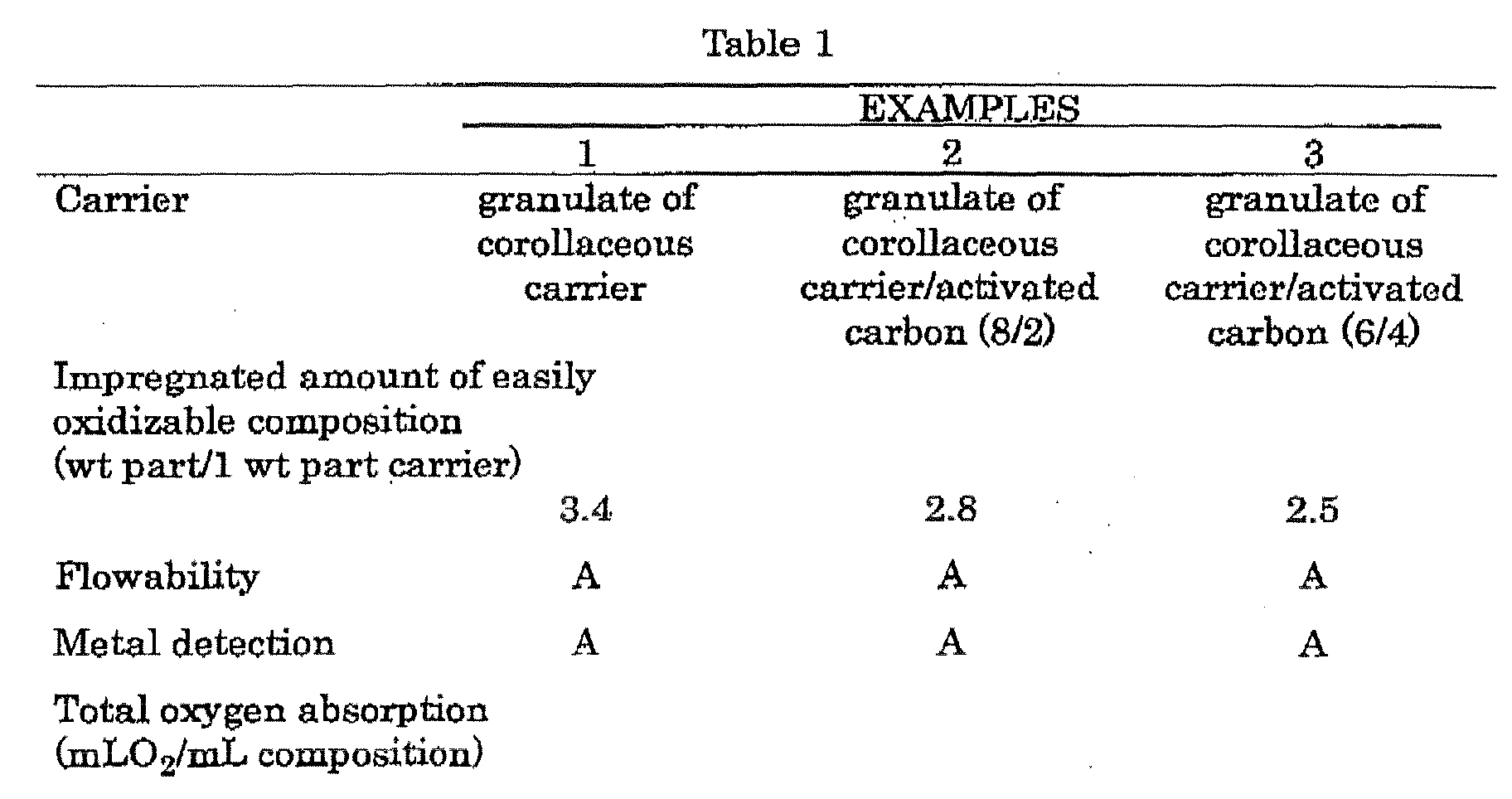
- the oxygen-absorbing composition 1 was measured for the flowability, metal detection, total oxygen absorption, and initial oxygen-absorbing speed in the manners described above. The results are shown in Table 1.
- a mixture of 0.4 kg of the powdery raw material, 0.1 kg of a powdery activated carbon, 1.7 L of water, and 0.08 kg of a 50% poly(vinyl acetate) emulsion was granulated and dried in the same manner as in Example 1 to prepare 0.6 kg of carrier 2.
- the oxygen-absorbing composition 2 was measured for the flowability, metal detection, total oxygen absorption, and initial oxygen-absorbing speed in the manners described above. The results are shown in Table 1.
- a mixture of 0.3 kg of the powdery raw material, 0.2 kg of a powdery activated carbon, 1.7 L of water, and 0.48 kg of a 7% aqueous solution of poly(vinyl alcohol) was granulated and dried in the same manner as in Example 1 to prepare 0.6 kg of carrier 3.
- the oxygen-absorbing composition 3 was measured for the flowability, metal detection, total oxygen absorption, and initial oxygen-absorbing speed in the manners described above. The results are shown in Table 1.
- a mixture of 0.5 kg of a synthesized powdery silicon dioxide (Carplex, trade name of Shionogi & Co., Ltd.; primary particle size: 0.05 ⁇ m), 1.8 L of water, and 0.08 kg of a 50% poly(vinyl acetate) emulsion was granulated and dried in the same manner as in Example 1 to prepare 0.6 kg of carrier 4.
- a synthesized powdery silicon dioxide Carplex, trade name of Shionogi & Co., Ltd.; primary particle size: 0.05 ⁇ m
- 0.08 kg of a 50% poly(vinyl acetate) emulsion was granulated and dried in the same manner as in Example 1 to prepare 0.6 kg of carrier 4.
- the oxygen-absorbing composition 4 was measured for the flowability, metal detection, total oxygen absorption, and initial oxygen-absorbing speed in the manners described above. The results are shown in Table 1.
- Example 2 In the same manner as in Example 1, 0.10 kg of the easily oxidizable composition, corresponding to 90% of the maximum carried amount, was impregnated into 0.1 kg of a columnar baked diatomaceous earth (substantially free from water; diameter: 1 mm; length: 2 to 6 mm) while adding little by little under stirring to prepare an oxygen-absorbing composition 5.
- the oxygen-absorbing composition 5 was measured for the flowability, metal detection, total oxygen absorption, and initial oxygen-absorbing speed in the manners described above. The results are shown in Table 1.
- Example 2 In the same manner as in Example 1, it was tried to impregnate 0.1 kg of a powdery wollastonite (naturally-occurring calcium silicate) with the easily oxidizable composition. However, the whole mixture turned into a mass by the addition of a small amount of the easily oxidizable composition, and therefore, a flowable oxygen -absorbing composition could not be prepared.
- a powdery wollastonite naturally-occurring calcium silicate
- Example 2 In the same manner as in Example 1, 0.19 kg of the easily oxidizable composition, corresponding to 90% of the maximum carried amount, was impregnated into 0.1 kg of a granular activated carbon (particle size: 150 to 1000 ⁇ m) while adding little by little under stirring to prepare an oxygen-absorbing composition 6.
- the oxygen-absorbing composition 6 was measured for the flowability, metal detection, total oxygen absorption, and initial oxygen-absorbing speed in the manners described above. The results are shown in Table 1.
- the carrier used in the invention as compared with conventional carriers, can be impregnated with a large amount of a liquid easily oxidizable organic composition while retaining a flowability of powder and granulate. Therefore, the oxygen-absorbing ability per unit volume can be enhanced to provide an oxygen-absorbing agent that is small-sized, easy to handle, and produced with low costs of packaging material.
- the oxygen-absorbing composition of the invention is easy to handle and excellent in the ability of packing into a small bags, i.e., excellent in the productivity of the oxygen-absorbing packages.
- the oxygen-absorbing package can be made compact in its shape. Further, the invention provides an oxygen-absorbing package that is not detected by a metal detector.
- the carrier is a mixture of a calcium silicate compound and an activated carbon
- the invention provides a non-iron oxygen-absorbing composition having a relatively high oxygen-absorbing speed even at low temperatures.
Landscapes
- Chemical & Material Sciences (AREA)
- Organic Chemistry (AREA)
- Analytical Chemistry (AREA)
- Chemical Kinetics & Catalysis (AREA)
- Inorganic Chemistry (AREA)
- Engineering & Computer Science (AREA)
- Life Sciences & Earth Sciences (AREA)
- Zoology (AREA)
- Polymers & Plastics (AREA)
- Food Science & Technology (AREA)
- Wood Science & Technology (AREA)
- Solid-Sorbent Or Filter-Aiding Compositions (AREA)
- Food Preservation Except Freezing, Refrigeration, And Drying (AREA)
Abstract
Description

Claims (12)
- An oxygen-absorbing composition comprising 100 parts by weight of a carrier and an easily oxidizable organic composition carried on the carrier in an amount exceeding 210 parts by weight, the carrier being a granulate of a calcium silicate compound represented by the following formula:
and the carrier having crystal structures constituted by aggregate of curved plate crystals comprising gyrolite calcium silicate and amorphous silicon dioxide. - The oxygen-absorbing composition according to Claim 1, wherein the easily oxidizable organic composition is carried on the carrier in an amount exceeding 240 parts by weight based on 100 parts by weight of the carrier.
- The oxygen-absorbing composition according to Claim 1 or 2, wherein the carrier is a granulate prepared by granulating a mixture comprising 100 parts by weight of the calcium silicate compound and 0.01 to 20 parts by weight of a binder.
- The oxygen-absorbing composition according to Claim 1 or 2, wherein the carrier is a granulate prepared by granulating a mixture comprising 100 parts by weight of the calcium silicate compound, 10 to 150 parts by weight of activated carbon and 0.01 to 20 parts by weight of a binder.
- The oxygen-absorbing composition according to Claim 3 or 4, wherein the binder is at least one compound selected from the group consisting of poly(vinyl alcohol), poly(vinyl acetate), poly(acrylic acid), polyurethane, methylcellulose, ethylcellulose, carboxymethylcellulose, guar gum, xanthan gum, tragacanth gum, carageenan, and sodium alginate.
- The oxygen-absorbing composition according to any one of Claims 1 to 5, wherein n is from 1.0 to 1.5.
- The oxygen-absorbing composition according to any one of Claims 1 to 6, wherein the easily oxidizable organic composition comprises an easily oxidizable organic compound, an additive for putting the easily oxidizable organic compound in chemically easily oxidizable conditions and/or water.
- The oxygen-absorbing composition according to Claim 7, wherein the easily oxidizable organic compound is at least one organic compound selected from the group consisting of ascorbic acid, salts of ascorbic acid, erythorbic acid, salts of erythorbic acid, ethylene glycol, propylene glycol, glycerol, glucose, xylose, xylitol, mannitol, sorbitol, catechol, resorcinol, hydroquinone, gallic acid, pyrogallol, tocopherol, vegetable oils, fish oils, tall oil, unsaturated fatty acids derived from vegetable oils, unsaturated fatty acids derived from fish oils, unsaturated fatty acids derived from tall oil, butadiene oligomers, and isoprene oligomers.
- The oxygen-absorbing composition according to Claim 7 or 8, wherein the additive is at least one compound selected from the group consisting of alkali metal compounds, alkaline earth metal compounds, iron slats, manganese salts, copper salts, cobalt salts, carbonates, and hydrogen carbonates.
- The oxygen-absorbing composition according to any one of Claims 7 to 9, wherein the easily oxidizable organic composition comprises 100 parts by weight of ascorbic acid or its slat, 60 to 200 parts by weight of water, 1 to 35 parts by weight of an alkali agent, and 5 to 30 parts by weight of a transition metal salt catalyst.
- The oxygen-absorbing composition according to any one of Claims 7 to 9, wherein the easily oxidizable organic composition comprises 100 parts by weight of the polyhydric alcohol, 15 to 115 parts by weight of water, and 3 to 6 parts by weight of the transition metal salt catalyst
- An oxygen-absorbing package comprising the oxygen-absorbing composition as defined in any one of Claims 1 to 10 packed by a gas-permeable packaging material.
Applications Claiming Priority (1)
| Application Number | Priority Date | Filing Date | Title |
|---|---|---|---|
| PCT/JP2002/010434 WO2004033088A1 (en) | 2002-10-08 | 2002-10-08 | Oxygen scavenger composition |
Publications (3)
| Publication Number | Publication Date |
|---|---|
| EP1550506A1 true EP1550506A1 (en) | 2005-07-06 |
| EP1550506A4 EP1550506A4 (en) | 2008-03-26 |
| EP1550506B1 EP1550506B1 (en) | 2016-03-09 |
Family
ID=32089038
Family Applications (1)
| Application Number | Title | Priority Date | Filing Date |
|---|---|---|---|
| EP02775302.9A Expired - Lifetime EP1550506B1 (en) | 2002-10-08 | 2002-10-08 | Oxygen scavenger composition |
Country Status (4)
| Country | Link |
|---|---|
| US (1) | US20060163534A1 (en) |
| EP (1) | EP1550506B1 (en) |
| JP (1) | JP4305664B2 (en) |
| WO (1) | WO2004033088A1 (en) |
Cited By (12)
| Publication number | Priority date | Publication date | Assignee | Title |
|---|---|---|---|---|
| US7700820B2 (en) | 2006-11-30 | 2010-04-20 | Kimberly-Clark Worldwide, Inc. | Process for controlling the quality of an absorbent article including a wetness sensing system |
| EP2305375A1 (en) * | 2009-09-30 | 2011-04-06 | Kyodo Printing Co., Ltd. | Oxygen absorber, oxygen absorbent resin composition, and oxygen absorbent film |
| WO2012020287A1 (en) * | 2010-08-13 | 2012-02-16 | Universidad De Los Andes | Oxygen-absorbing compound encapsulated in a silica matrix and method for the production thereof |
| CN101252984B (en) * | 2005-10-21 | 2012-09-05 | 三菱瓦斯化学株式会社 | Solid oxygen scavenger composition and process for producing the same |
| US20140260252A1 (en) * | 2013-03-15 | 2014-09-18 | Honeywell International Inc. | Stabilized hfo and hcfo compositions for use in high temperature heat transfer applications |
| EP2505644A4 (en) * | 2009-11-24 | 2015-09-16 | Mitsubishi Gas Chemical Co | REGULATION COMPOSITION OF THE ATMOSPHERE |
| EP3192838A1 (en) * | 2016-01-14 | 2017-07-19 | Omya International AG | Treatment of surface-reacted calcium carbonate |
| EP3192850A1 (en) * | 2016-01-14 | 2017-07-19 | Omya International AG | O2 scavenging caco3 treatment |
| EP3127865A4 (en) * | 2014-03-29 | 2017-11-29 | Tomita Pharmaceutical Co., Ltd. | Powdered tobermorite type calcium silicate-based material and method for producing same |
| EP3943590A4 (en) * | 2019-03-20 | 2022-06-22 | Mitsubishi Gas Chemical Company, Inc. | Gas concentration adjusting agent for use in culture of bacteria, and method for culturing bacterium using same |
| WO2022157309A1 (en) | 2021-01-25 | 2022-07-28 | Omya International Ag | Coatings comprising surface-reacted calcium carbonate and an oxygen scavenger for improving food shelf life |
| WO2023237396A1 (en) | 2022-06-07 | 2023-12-14 | Omya International Ag | Porous coatings comprising minerals and an oxygen scavenger for improving food shelf life |
Families Citing this family (19)
| Publication number | Priority date | Publication date | Assignee | Title |
|---|---|---|---|---|
| TW200607459A (en) * | 2004-06-18 | 2006-03-01 | Kuraray Co | Oxygen-absorbing composition and packaging material |
| JP4752238B2 (en) * | 2004-10-18 | 2011-08-17 | 凸版印刷株式会社 | Package with oxygen absorption capacity |
| CA2650498A1 (en) * | 2006-03-31 | 2007-10-11 | Rubicon Research Private Limited | Orally disintegrating tablets |
| US20080023379A1 (en) * | 2006-04-26 | 2008-01-31 | Battenfeld Technologies, Inc. | Media separation systems and methods |
| US7779572B2 (en) | 2006-05-08 | 2010-08-24 | Battenfeld Technologies, Inc. | Bipod device for use with a firearm |
| US8371057B2 (en) | 2006-05-09 | 2013-02-12 | Battenfeld Technologies, Inc. | Firearm cleaning apparatus with protective coating |
| WO2008091394A2 (en) | 2006-08-22 | 2008-07-31 | Battenfeld Technologies, Inc. | Adjustable shooting rests and shooting rest assemblies |
| WO2008121964A1 (en) * | 2007-03-30 | 2008-10-09 | Applied Extrusion Technologies, Inc. | High barrier compositions and articles employing same |
| US7845267B2 (en) | 2007-09-11 | 2010-12-07 | Battenfield Technologies, Inc. | Attachment mechanisms for coupling firearms to supporting structures |
| KR101168049B1 (en) | 2010-01-29 | 2012-07-24 | 주식회사 립멘 | Food Preservative Containing Sterilization Ingredients And Process for Preparing thereof |
| JP5740678B1 (en) | 2013-11-09 | 2015-06-24 | 富田製薬株式会社 | Powdery gyrolite-type calcium silicate having high oil absorption and large particle diameter and method for producing the same |
| US9515276B2 (en) | 2014-09-02 | 2016-12-06 | General Electric Company | Organic X-ray detector and X-ray systems |
| US9535173B2 (en) | 2014-09-11 | 2017-01-03 | General Electric Company | Organic x-ray detector and x-ray systems |
| JP6450570B2 (en) * | 2014-11-28 | 2019-01-09 | 旭化成株式会社 | Granular compact |
| JP6275197B2 (en) * | 2015-12-07 | 2018-02-07 | 凸版印刷株式会社 | Oxygen scavenger and method for producing the same |
| JP7020270B2 (en) * | 2018-04-24 | 2022-02-16 | 凸版印刷株式会社 | Oxygen scavenger and oxygen scavenger packaging, as well as food packaging |
| CN114196048B (en) * | 2020-09-18 | 2023-04-14 | 中国农业大学 | A kind of oxygen absorbing bottle cap gasket and its preparation method and application |
| EP4327933A4 (en) * | 2021-04-20 | 2025-02-19 | Mitsubishi Gas Chemical Company, Inc. | Oxygen absorber |
| KR20260052246A (en) * | 2024-10-10 | 2026-04-20 | 주식회사 엘지에너지솔루션 | Method of manufacturing secondary batteries using the same |
Family Cites Families (16)
| Publication number | Priority date | Publication date | Assignee | Title |
|---|---|---|---|---|
| GB1289156A (en) * | 1968-11-06 | 1972-09-13 | ||
| JPS5371693A (en) * | 1976-12-08 | 1978-06-26 | Mitsubishi Gas Chem Co Inc | Oxygen absorbent |
| JPS6029643B2 (en) * | 1977-12-30 | 1985-07-11 | 株式会社トクヤマ | Calcium silicate and its manufacturing method |
| DE2857424C2 (en) * | 1977-12-30 | 1988-03-17 | Tokuyama Soda K.K., Tokuyama, Yamaguchi, Jp | |
| US4524015A (en) * | 1982-08-09 | 1985-06-18 | Mitsubishi Gas Chemical Company, Inc. | Oxygen absorbent |
| JP2666323B2 (en) * | 1988-02-08 | 1997-10-22 | 凸版印刷株式会社 | Oxygen absorber for anaerobic bacteria culture |
| DE3828531A1 (en) * | 1988-08-23 | 1990-03-15 | Rudolf Dr Ing Ernst | Oxygen absorbent and use of the same |
| KR930001255B1 (en) * | 1989-04-25 | 1993-02-22 | 미쓰비시가스 가가꾸 가부시끼가이샤 | Deoxidation agent |
| JPH0386238A (en) * | 1989-08-31 | 1991-04-11 | Toppan Printing Co Ltd | Oxygen absorbent and its production |
| JP3052317B2 (en) * | 1989-10-25 | 2000-06-12 | 三菱瓦斯化学株式会社 | Oxygen scavenger |
| JP2701999B2 (en) * | 1990-05-16 | 1998-01-21 | 株式会社上野製薬応用研究所 | Oxygen absorber |
| CA2075479A1 (en) * | 1991-02-28 | 1992-08-29 | Ryukichi Matsuo | Atmosphere modifier |
| JP3169285B2 (en) * | 1992-11-11 | 2001-05-21 | 日本化薬株式会社 | Oxygen scavenger |
| JPH10140129A (en) * | 1996-11-15 | 1998-05-26 | Oji Paper Co Ltd | Oxygen scavenger |
| JP4015223B2 (en) * | 1997-04-15 | 2007-11-28 | 大江化学工業株式会社 | Oxygen scavenger |
| US5977212A (en) * | 1997-11-21 | 1999-11-02 | W. R. Grace & Co.-Conn. | Oxygen scavenging compositions |
-
2002
- 2002-10-08 EP EP02775302.9A patent/EP1550506B1/en not_active Expired - Lifetime
- 2002-10-08 US US10/530,721 patent/US20060163534A1/en not_active Abandoned
- 2002-10-08 WO PCT/JP2002/010434 patent/WO2004033088A1/en not_active Ceased
- 2002-10-08 JP JP2004542782A patent/JP4305664B2/en not_active Expired - Lifetime
Cited By (30)
| Publication number | Priority date | Publication date | Assignee | Title |
|---|---|---|---|---|
| CN101252984B (en) * | 2005-10-21 | 2012-09-05 | 三菱瓦斯化学株式会社 | Solid oxygen scavenger composition and process for producing the same |
| US7700820B2 (en) | 2006-11-30 | 2010-04-20 | Kimberly-Clark Worldwide, Inc. | Process for controlling the quality of an absorbent article including a wetness sensing system |
| EP2305375A1 (en) * | 2009-09-30 | 2011-04-06 | Kyodo Printing Co., Ltd. | Oxygen absorber, oxygen absorbent resin composition, and oxygen absorbent film |
| CN102029143A (en) * | 2009-09-30 | 2011-04-27 | 共同印刷株式会社 | Oxygen absorber, oxygen absorbent resin composition, and oxygen absorbent film |
| US8728347B2 (en) | 2009-09-30 | 2014-05-20 | Kyodo Printing Co., Ltd. | Oxygen absorber, oxygen absorbent resin composition, and oxygen absorbent film |
| TWI499453B (en) * | 2009-09-30 | 2015-09-11 | Kyodo Printing Co Ltd | Oxygen absorbers and resin composition having oxygen absorbency and film having oxygen absorbency |
| EP2505644A4 (en) * | 2009-11-24 | 2015-09-16 | Mitsubishi Gas Chemical Co | REGULATION COMPOSITION OF THE ATMOSPHERE |
| WO2012020287A1 (en) * | 2010-08-13 | 2012-02-16 | Universidad De Los Andes | Oxygen-absorbing compound encapsulated in a silica matrix and method for the production thereof |
| US9441157B2 (en) | 2010-08-13 | 2016-09-13 | Universidad De Los Andes | Oxygen-absorbing compound encapsulated in a silica matrix and method for the production thereof |
| US20140260252A1 (en) * | 2013-03-15 | 2014-09-18 | Honeywell International Inc. | Stabilized hfo and hcfo compositions for use in high temperature heat transfer applications |
| EP3127865A4 (en) * | 2014-03-29 | 2017-11-29 | Tomita Pharmaceutical Co., Ltd. | Powdered tobermorite type calcium silicate-based material and method for producing same |
| RU2731914C2 (en) * | 2016-01-14 | 2020-09-09 | Омиа Интернэшнл Аг | Treatment of calcium carbonate with modified surface |
| CN108463513B (en) * | 2016-01-14 | 2021-05-28 | Omya国际股份公司 | Treatment of surface-reacted calcium carbonate |
| WO2017121774A1 (en) * | 2016-01-14 | 2017-07-20 | Omya International Ag | O2 scavenging caco3 treatment |
| CN108473869B (en) * | 2016-01-14 | 2021-05-25 | Omya国际股份公司 | CaCO3 treatment for O2 removal |
| CN108463513A (en) * | 2016-01-14 | 2018-08-28 | Omya国际股份公司 | The processing of calcium carbonate through surface reaction |
| CN108473869A (en) * | 2016-01-14 | 2018-08-31 | Omya国际股份公司 | Remove O2CaCO3Processing |
| KR20180101423A (en) * | 2016-01-14 | 2018-09-12 | 옴야 인터내셔널 아게 | O2 capture CaCO3 treatment |
| KR20180103068A (en) * | 2016-01-14 | 2018-09-18 | 옴야 인터내셔널 아게 | Treatment of surface-reacted calcium carbonate |
| WO2017121675A1 (en) * | 2016-01-14 | 2017-07-20 | Omya International Ag | Treatment of surface-reacted calcium carbonate |
| EP3192850A1 (en) * | 2016-01-14 | 2017-07-19 | Omya International AG | O2 scavenging caco3 treatment |
| EP3192838A1 (en) * | 2016-01-14 | 2017-07-19 | Omya International AG | Treatment of surface-reacted calcium carbonate |
| US11161088B2 (en) | 2016-01-14 | 2021-11-02 | Omya International Ag | O2 scavenging CaCO3 treatment |
| KR102749660B1 (en) | 2016-01-14 | 2025-01-07 | 옴야 인터내셔널 아게 | O2 capture CaCO3 treatment |
| KR102706752B1 (en) | 2016-01-14 | 2024-09-13 | 옴야 인터내셔널 아게 | Treatment of surface-reacted calcium carbonate |
| US11753548B2 (en) * | 2016-01-14 | 2023-09-12 | Omya International Ag | Treatment of surface-reacted calcium carbonate |
| EP3943590A4 (en) * | 2019-03-20 | 2022-06-22 | Mitsubishi Gas Chemical Company, Inc. | Gas concentration adjusting agent for use in culture of bacteria, and method for culturing bacterium using same |
| US12291703B2 (en) | 2019-03-20 | 2025-05-06 | Mitsubishi Gas Chemical Company, Inc. | Gas concentration adjusting agent for use in culture of bacteria, and method for culturing bacterium using same |
| WO2022157309A1 (en) | 2021-01-25 | 2022-07-28 | Omya International Ag | Coatings comprising surface-reacted calcium carbonate and an oxygen scavenger for improving food shelf life |
| WO2023237396A1 (en) | 2022-06-07 | 2023-12-14 | Omya International Ag | Porous coatings comprising minerals and an oxygen scavenger for improving food shelf life |
Also Published As
| Publication number | Publication date |
|---|---|
| JPWO2004033088A1 (en) | 2006-02-09 |
| WO2004033088A1 (en) | 2004-04-22 |
| JP4305664B2 (en) | 2009-07-29 |
| EP1550506A4 (en) | 2008-03-26 |
| EP1550506B1 (en) | 2016-03-09 |
| US20060163534A1 (en) | 2006-07-27 |
Similar Documents
| Publication | Publication Date | Title |
|---|---|---|
| EP1550506B1 (en) | Oxygen scavenger composition | |
| JP2701999B2 (en) | Oxygen absorber | |
| GB1579460A (en) | Oxygen absorbent | |
| EP0965381B1 (en) | Oxygen absorbent | |
| EP0547761B1 (en) | Oxygen absorber and method for producing same | |
| CN113811195B (en) | Deoxidizer composition and method for producing the same | |
| JP2003144113A (en) | Oxygen scavenger | |
| JP4453797B2 (en) | Oxygen absorber composition | |
| JP7286946B2 (en) | Oxygen absorber manufacturing method, oxygen absorber, oxygen absorber package, and food package | |
| JP3204273B2 (en) | Oxygen absorber | |
| WO2008008715A1 (en) | Oxygen scavenger compositions | |
| JP6879445B2 (en) | Oxygen scavenger composition | |
| JP7668003B2 (en) | Atmosphere adjusting agent and method for producing the same | |
| CN119947813A (en) | Deoxidizer composition and method for producing the same, and deoxidizer package | |
| JPS6218217B2 (en) | ||
| JP2019188312A (en) | Deoxidant, deoxidant package and food package | |
| JPS6357029B2 (en) | ||
| JP4015223B2 (en) | Oxygen scavenger | |
| JP3706444B2 (en) | Oxygen scavenger | |
| JPS6357030B2 (en) | ||
| JP2000005596A (en) | Deoxidizing agent | |
| JP7238913B2 (en) | Oxygen absorber, method for producing oxygen absorber, oxygen absorber package, and food package | |
| JP2993085B2 (en) | Oxygen scavenger | |
| JP7263989B2 (en) | Oxygen absorber, oxygen absorber package and food package | |
| JPS626775B2 (en) |
Legal Events
| Date | Code | Title | Description |
|---|---|---|---|
| PUAI | Public reference made under article 153(3) epc to a published international application that has entered the european phase |
Free format text: ORIGINAL CODE: 0009012 |
|
| 17P | Request for examination filed |
Effective date: 20050408 |
|
| AK | Designated contracting states |
Kind code of ref document: A1 Designated state(s): AT BE BG CH CY CZ DE DK EE ES FI FR GB GR IE IT LI LU MC NL PT SE SK TR |
|
| RBV | Designated contracting states (corrected) |
Designated state(s): DE FR GB |
|
| A4 | Supplementary search report drawn up and despatched |
Effective date: 20080221 |
|
| 17Q | First examination report despatched |
Effective date: 20080701 |
|
| REG | Reference to a national code |
Ref country code: DE Ref legal event code: R079 Ref document number: 60247848 Country of ref document: DE Free format text: PREVIOUS MAIN CLASS: B01J0020100000 Ipc: B01J0020200000 |
|
| GRAP | Despatch of communication of intention to grant a patent |
Free format text: ORIGINAL CODE: EPIDOSNIGR1 |
|
| RIC1 | Information provided on ipc code assigned before grant |
Ipc: B01J 20/20 20060101AFI20150925BHEP Ipc: A23L 3/3436 20060101ALI20150925BHEP Ipc: B01J 20/28 20060101ALI20150925BHEP Ipc: B01J 20/22 20060101ALI20150925BHEP Ipc: B01J 20/10 20060101ALI20150925BHEP Ipc: C01B 13/02 20060101ALI20150925BHEP Ipc: B01J 20/32 20060101ALI20150925BHEP |
|
| INTG | Intention to grant announced |
Effective date: 20151028 |
|
| RIN1 | Information on inventor provided before grant (corrected) |
Inventor name: SEKI, TAKAHIRO Inventor name: SUGIMOTO, KEN Inventor name: IWAI, TATSUO |
|
| GRAS | Grant fee paid |
Free format text: ORIGINAL CODE: EPIDOSNIGR3 |
|
| GRAA | (expected) grant |
Free format text: ORIGINAL CODE: 0009210 |
|
| AK | Designated contracting states |
Kind code of ref document: B1 Designated state(s): DE FR GB |
|
| REG | Reference to a national code |
Ref country code: GB Ref legal event code: FG4D |
|
| REG | Reference to a national code |
Ref country code: DE Ref legal event code: R096 Ref document number: 60247848 Country of ref document: DE |
|
| REG | Reference to a national code |
Ref country code: FR Ref legal event code: PLFP Year of fee payment: 15 |
|
| REG | Reference to a national code |
Ref country code: DE Ref legal event code: R097 Ref document number: 60247848 Country of ref document: DE |
|
| PLBE | No opposition filed within time limit |
Free format text: ORIGINAL CODE: 0009261 |
|
| STAA | Information on the status of an ep patent application or granted ep patent |
Free format text: STATUS: NO OPPOSITION FILED WITHIN TIME LIMIT |
|
| 26N | No opposition filed |
Effective date: 20161212 |
|
| REG | Reference to a national code |
Ref country code: FR Ref legal event code: PLFP Year of fee payment: 16 |
|
| REG | Reference to a national code |
Ref country code: FR Ref legal event code: PLFP Year of fee payment: 17 |
|
| PGFP | Annual fee paid to national office [announced via postgrant information from national office to epo] |
Ref country code: FR Payment date: 20210913 Year of fee payment: 20 |
|
| PGFP | Annual fee paid to national office [announced via postgrant information from national office to epo] |
Ref country code: GB Payment date: 20210901 Year of fee payment: 20 |
|
| PGFP | Annual fee paid to national office [announced via postgrant information from national office to epo] |
Ref country code: DE Payment date: 20210831 Year of fee payment: 20 |
|
| REG | Reference to a national code |
Ref country code: DE Ref legal event code: R071 Ref document number: 60247848 Country of ref document: DE |
|
| REG | Reference to a national code |
Ref country code: GB Ref legal event code: PE20 Expiry date: 20221007 |
|
| PG25 | Lapsed in a contracting state [announced via postgrant information from national office to epo] |
Ref country code: GB Free format text: LAPSE BECAUSE OF EXPIRATION OF PROTECTION Effective date: 20221007 |