EP1548866A1 - Nonaqueous electrolyte and nonaqueous-electrolyte secondary battery - Google Patents
Nonaqueous electrolyte and nonaqueous-electrolyte secondary battery Download PDFInfo
- Publication number
- EP1548866A1 EP1548866A1 EP03791250A EP03791250A EP1548866A1 EP 1548866 A1 EP1548866 A1 EP 1548866A1 EP 03791250 A EP03791250 A EP 03791250A EP 03791250 A EP03791250 A EP 03791250A EP 1548866 A1 EP1548866 A1 EP 1548866A1
- Authority
- EP
- European Patent Office
- Prior art keywords
- nonaqueous electrolyte
- weight
- compound
- ionic liquid
- electrolyte
- Prior art date
- Legal status (The legal status is an assumption and is not a legal conclusion. Google has not performed a legal analysis and makes no representation as to the accuracy of the status listed.)
- Withdrawn
Links
Images


Classifications
-
- H—ELECTRICITY
- H01—ELECTRIC ELEMENTS
- H01M—PROCESSES OR MEANS, e.g. BATTERIES, FOR THE DIRECT CONVERSION OF CHEMICAL ENERGY INTO ELECTRICAL ENERGY
- H01M4/00—Electrodes
- H01M4/02—Electrodes composed of, or comprising, active material
- H01M4/13—Electrodes for accumulators with non-aqueous electrolyte, e.g. for lithium-accumulators; Processes of manufacture thereof
-
- H—ELECTRICITY
- H01—ELECTRIC ELEMENTS
- H01M—PROCESSES OR MEANS, e.g. BATTERIES, FOR THE DIRECT CONVERSION OF CHEMICAL ENERGY INTO ELECTRICAL ENERGY
- H01M10/00—Secondary cells; Manufacture thereof
- H01M10/05—Accumulators with non-aqueous electrolyte
- H01M10/056—Accumulators with non-aqueous electrolyte characterised by the materials used as electrolytes, e.g. mixed inorganic/organic electrolytes
-
- C—CHEMISTRY; METALLURGY
- C07—ORGANIC CHEMISTRY
- C07C—ACYCLIC OR CARBOCYCLIC COMPOUNDS
- C07C217/00—Compounds containing amino and etherified hydroxy groups bound to the same carbon skeleton
- C07C217/02—Compounds containing amino and etherified hydroxy groups bound to the same carbon skeleton having etherified hydroxy groups and amino groups bound to acyclic carbon atoms of the same carbon skeleton
- C07C217/04—Compounds containing amino and etherified hydroxy groups bound to the same carbon skeleton having etherified hydroxy groups and amino groups bound to acyclic carbon atoms of the same carbon skeleton the carbon skeleton being acyclic and saturated
- C07C217/06—Compounds containing amino and etherified hydroxy groups bound to the same carbon skeleton having etherified hydroxy groups and amino groups bound to acyclic carbon atoms of the same carbon skeleton the carbon skeleton being acyclic and saturated having only one etherified hydroxy group and one amino group bound to the carbon skeleton, which is not further substituted
- C07C217/08—Compounds containing amino and etherified hydroxy groups bound to the same carbon skeleton having etherified hydroxy groups and amino groups bound to acyclic carbon atoms of the same carbon skeleton the carbon skeleton being acyclic and saturated having only one etherified hydroxy group and one amino group bound to the carbon skeleton, which is not further substituted the oxygen atom of the etherified hydroxy group being further bound to an acyclic carbon atom
-
- C—CHEMISTRY; METALLURGY
- C07—ORGANIC CHEMISTRY
- C07C—ACYCLIC OR CARBOCYCLIC COMPOUNDS
- C07C311/00—Amides of sulfonic acids, i.e. compounds having singly-bound oxygen atoms of sulfo groups replaced by nitrogen atoms, not being part of nitro or nitroso groups
- C07C311/48—Amides of sulfonic acids, i.e. compounds having singly-bound oxygen atoms of sulfo groups replaced by nitrogen atoms, not being part of nitro or nitroso groups having nitrogen atoms of sulfonamide groups further bound to another hetero atom
-
- C—CHEMISTRY; METALLURGY
- C07—ORGANIC CHEMISTRY
- C07D—HETEROCYCLIC COMPOUNDS
- C07D295/00—Heterocyclic compounds containing polymethylene-imine rings with at least five ring members, 3-azabicyclo [3.2.2] nonane, piperazine, morpholine or thiomorpholine rings, having only hydrogen atoms directly attached to the ring carbon atoms
- C07D295/04—Heterocyclic compounds containing polymethylene-imine rings with at least five ring members, 3-azabicyclo [3.2.2] nonane, piperazine, morpholine or thiomorpholine rings, having only hydrogen atoms directly attached to the ring carbon atoms with substituted hydrocarbon radicals attached to ring nitrogen atoms
- C07D295/08—Heterocyclic compounds containing polymethylene-imine rings with at least five ring members, 3-azabicyclo [3.2.2] nonane, piperazine, morpholine or thiomorpholine rings, having only hydrogen atoms directly attached to the ring carbon atoms with substituted hydrocarbon radicals attached to ring nitrogen atoms substituted by singly bound oxygen or sulfur atoms
- C07D295/084—Heterocyclic compounds containing polymethylene-imine rings with at least five ring members, 3-azabicyclo [3.2.2] nonane, piperazine, morpholine or thiomorpholine rings, having only hydrogen atoms directly attached to the ring carbon atoms with substituted hydrocarbon radicals attached to ring nitrogen atoms substituted by singly bound oxygen or sulfur atoms with the ring nitrogen atoms and the oxygen or sulfur atoms attached to the same carbon chain, which is not interrupted by carbocyclic rings
- C07D295/088—Heterocyclic compounds containing polymethylene-imine rings with at least five ring members, 3-azabicyclo [3.2.2] nonane, piperazine, morpholine or thiomorpholine rings, having only hydrogen atoms directly attached to the ring carbon atoms with substituted hydrocarbon radicals attached to ring nitrogen atoms substituted by singly bound oxygen or sulfur atoms with the ring nitrogen atoms and the oxygen or sulfur atoms attached to the same carbon chain, which is not interrupted by carbocyclic rings to an acyclic saturated chain
-
- H—ELECTRICITY
- H01—ELECTRIC ELEMENTS
- H01M—PROCESSES OR MEANS, e.g. BATTERIES, FOR THE DIRECT CONVERSION OF CHEMICAL ENERGY INTO ELECTRICAL ENERGY
- H01M10/00—Secondary cells; Manufacture thereof
- H01M10/05—Accumulators with non-aqueous electrolyte
- H01M10/052—Li-accumulators
- H01M10/0525—Rocking-chair batteries, i.e. batteries with lithium insertion or intercalation in both electrodes; Lithium-ion batteries
-
- H—ELECTRICITY
- H01—ELECTRIC ELEMENTS
- H01M—PROCESSES OR MEANS, e.g. BATTERIES, FOR THE DIRECT CONVERSION OF CHEMICAL ENERGY INTO ELECTRICAL ENERGY
- H01M10/00—Secondary cells; Manufacture thereof
- H01M10/05—Accumulators with non-aqueous electrolyte
- H01M10/056—Accumulators with non-aqueous electrolyte characterised by the materials used as electrolytes, e.g. mixed inorganic/organic electrolytes
- H01M10/0564—Accumulators with non-aqueous electrolyte characterised by the materials used as electrolytes, e.g. mixed inorganic/organic electrolytes the electrolyte being constituted of organic materials only
- H01M10/0566—Liquid materials
-
- H—ELECTRICITY
- H01—ELECTRIC ELEMENTS
- H01M—PROCESSES OR MEANS, e.g. BATTERIES, FOR THE DIRECT CONVERSION OF CHEMICAL ENERGY INTO ELECTRICAL ENERGY
- H01M10/00—Secondary cells; Manufacture thereof
- H01M10/05—Accumulators with non-aqueous electrolyte
- H01M10/056—Accumulators with non-aqueous electrolyte characterised by the materials used as electrolytes, e.g. mixed inorganic/organic electrolytes
- H01M10/0564—Accumulators with non-aqueous electrolyte characterised by the materials used as electrolytes, e.g. mixed inorganic/organic electrolytes the electrolyte being constituted of organic materials only
- H01M10/0566—Liquid materials
- H01M10/0567—Liquid materials characterised by the additives
-
- H—ELECTRICITY
- H01—ELECTRIC ELEMENTS
- H01M—PROCESSES OR MEANS, e.g. BATTERIES, FOR THE DIRECT CONVERSION OF CHEMICAL ENERGY INTO ELECTRICAL ENERGY
- H01M10/00—Secondary cells; Manufacture thereof
- H01M10/05—Accumulators with non-aqueous electrolyte
- H01M10/056—Accumulators with non-aqueous electrolyte characterised by the materials used as electrolytes, e.g. mixed inorganic/organic electrolytes
- H01M10/0564—Accumulators with non-aqueous electrolyte characterised by the materials used as electrolytes, e.g. mixed inorganic/organic electrolytes the electrolyte being constituted of organic materials only
- H01M10/0566—Liquid materials
- H01M10/0569—Liquid materials characterised by the solvents
-
- H—ELECTRICITY
- H01—ELECTRIC ELEMENTS
- H01M—PROCESSES OR MEANS, e.g. BATTERIES, FOR THE DIRECT CONVERSION OF CHEMICAL ENERGY INTO ELECTRICAL ENERGY
- H01M50/00—Constructional details or processes of manufacture of the non-active parts of electrochemical cells other than fuel cells, e.g. hybrid cells
- H01M50/40—Separators; Membranes; Diaphragms; Spacing elements inside cells
- H01M50/409—Separators, membranes or diaphragms characterised by the material
- H01M50/411—Organic material
- H01M50/429—Natural polymers
- H01M50/4295—Natural cotton, cellulose or wood
-
- H—ELECTRICITY
- H01—ELECTRIC ELEMENTS
- H01M—PROCESSES OR MEANS, e.g. BATTERIES, FOR THE DIRECT CONVERSION OF CHEMICAL ENERGY INTO ELECTRICAL ENERGY
- H01M50/00—Constructional details or processes of manufacture of the non-active parts of electrochemical cells other than fuel cells, e.g. hybrid cells
- H01M50/40—Separators; Membranes; Diaphragms; Spacing elements inside cells
- H01M50/409—Separators, membranes or diaphragms characterised by the material
- H01M50/44—Fibrous material
-
- H—ELECTRICITY
- H01—ELECTRIC ELEMENTS
- H01M—PROCESSES OR MEANS, e.g. BATTERIES, FOR THE DIRECT CONVERSION OF CHEMICAL ENERGY INTO ELECTRICAL ENERGY
- H01M10/00—Secondary cells; Manufacture thereof
- H01M10/05—Accumulators with non-aqueous electrolyte
- H01M10/056—Accumulators with non-aqueous electrolyte characterised by the materials used as electrolytes, e.g. mixed inorganic/organic electrolytes
- H01M10/0564—Accumulators with non-aqueous electrolyte characterised by the materials used as electrolytes, e.g. mixed inorganic/organic electrolytes the electrolyte being constituted of organic materials only
- H01M10/0565—Polymeric materials, e.g. gel-type or solid-type
-
- H—ELECTRICITY
- H01—ELECTRIC ELEMENTS
- H01M—PROCESSES OR MEANS, e.g. BATTERIES, FOR THE DIRECT CONVERSION OF CHEMICAL ENERGY INTO ELECTRICAL ENERGY
- H01M2300/00—Electrolytes
- H01M2300/0017—Non-aqueous electrolytes
- H01M2300/002—Inorganic electrolyte
- H01M2300/0022—Room temperature molten salts
-
- H—ELECTRICITY
- H01—ELECTRIC ELEMENTS
- H01M—PROCESSES OR MEANS, e.g. BATTERIES, FOR THE DIRECT CONVERSION OF CHEMICAL ENERGY INTO ELECTRICAL ENERGY
- H01M6/00—Primary cells; Manufacture thereof
- H01M6/14—Cells with non-aqueous electrolyte
- H01M6/16—Cells with non-aqueous electrolyte with organic electrolyte
- H01M6/162—Cells with non-aqueous electrolyte with organic electrolyte characterised by the electrolyte
- H01M6/164—Cells with non-aqueous electrolyte with organic electrolyte characterised by the electrolyte by the solvent
-
- H—ELECTRICITY
- H01—ELECTRIC ELEMENTS
- H01M—PROCESSES OR MEANS, e.g. BATTERIES, FOR THE DIRECT CONVERSION OF CHEMICAL ENERGY INTO ELECTRICAL ENERGY
- H01M6/00—Primary cells; Manufacture thereof
- H01M6/14—Cells with non-aqueous electrolyte
- H01M6/16—Cells with non-aqueous electrolyte with organic electrolyte
- H01M6/162—Cells with non-aqueous electrolyte with organic electrolyte characterised by the electrolyte
- H01M6/166—Cells with non-aqueous electrolyte with organic electrolyte characterised by the electrolyte by the solute
-
- Y—GENERAL TAGGING OF NEW TECHNOLOGICAL DEVELOPMENTS; GENERAL TAGGING OF CROSS-SECTIONAL TECHNOLOGIES SPANNING OVER SEVERAL SECTIONS OF THE IPC; TECHNICAL SUBJECTS COVERED BY FORMER USPC CROSS-REFERENCE ART COLLECTIONS [XRACs] AND DIGESTS
- Y02—TECHNOLOGIES OR APPLICATIONS FOR MITIGATION OR ADAPTATION AGAINST CLIMATE CHANGE
- Y02E—REDUCTION OF GREENHOUSE GAS [GHG] EMISSIONS, RELATED TO ENERGY GENERATION, TRANSMISSION OR DISTRIBUTION
- Y02E60/00—Enabling technologies; Technologies with a potential or indirect contribution to GHG emissions mitigation
- Y02E60/10—Energy storage using batteries
Definitions
- the present invention relates to nonaqueous electrolytes and to secondary cells in which such nonaqueous electrolytes are used.
- Ionic compounds generally exist in the form of crystals composed of positively charged cations and negatively charged anions which pull electrostatically on each other. Such ionic compounds dissolve in water and various other liquids to form liquids that conduct electricity, i.e., electrolyte solutions.
- ionic compounds maintain a liquid state at room temperature and do not solidify even at very low temperatures.
- Such ionic compounds which maintain a liquid state at room temperature or below are referred to in particular as "room-temperature fused salts" or "ionic liquids.”
- ionic liquids To minimize electrostatic interactions between the cations and anions which make up the ionic liquid, either or both are molecular ions of a substantial size. Moreover, to minimize the charge and electrostatic interactions, either or both are monovalent.
- ionic liquids As electrolytes in batteries and other applications.
- ionic liquids generally have a high hydroscopic property and are difficult to handle in air, their use has remained limited.
- JP-A 11-260400 describes nonaqueous electrolyte secondary cells which use a nonaqueous electrolyte composed of a room-temperature fused salt (ionic liquid) and a carbonate compound.
- room-temperature fused salts used in the above publication are primarily imidazolium-based salts. Because these have relatively high solidification points, batteries obtained using such salts have less than satisfactory low temperature characteristics.
- quaternary ammonium salts and quaternary phosphonium salts bearing at least one alkoxyalkyl group as a substituent have the properties of ionic liquids.
- the inventors have found that because these ionic liquids have a low melting point and a broad potential window, they are not readily subject to reductive decomposition during charging and discharging of the battery, and are thus excellent nonaqueous electrolytes.
- the invention provides the following:
- the nonaqueous electrolyte contains an ionic liquid having a low melting point and a broad potential window, and contains also a compound which reductively decomposes at a more noble potential than the ionic liquid, by using this nonaqueous electrolyte as the electrolyte in secondary cells there can be obtained nonaqueous electrolyte secondary cells having excellent low-temperature characteristics, stability and cycle retention.
- the ionic liquid used in the nonaqueous electrolyte according to the invention has general formula (1) below and has a melting point not higher than 50°C.
- R 1 to R 4 are each independently an alkyl group of 1 to 5 carbons or an alkoxyalkyl group of the formula R'-O-(CH 2 ) n - (R' being methyl or ethyl, and the letter n being an integer from 1 to 4), and any two from among R 1 , R 2 , R 3 and R 4 may together form a ring, with the proviso that at least one of R 1 to R 4 is an alkoxyalkyl group of the above formula.
- X is a nitrogen atom or a phosphorus atom
- Y is a monovalent anion.
- alkyls having 1 to 5 carbons examples include methyl, ethyl, propyl, 2-propyl, butyl and pentyl.
- groups R 1 to R 4 it is preferable for at least one of groups R 1 to R 4 to be methyl, ethyl or propyl, and especially methyl or ethyl. These ethyl or propyl groups may form rings with other alkyl groups.
- alkoxyalkyl groups of the formula R'-O-(CH 2 ) n - include methoxymethyl, ethoxymethyl, methoxyethyl, ethoxyethyl, methoxypropyl, ethoxypropyl, methoxybutyl and ethoxybutyl.
- the letter n is an integer from 1 to 4. Taking into account the physical properties and the electrochemical characteristics of the ionic liquid, the letter n is preferably 1 or 2, and most preferably 2.
- Exemplary compounds in which any two groups from among R 1 to R 4 form a ring include, when X is a nitrogen atom, quaternary ammonium salts containing an aziridine, azetidine, pyrrolidine or piperidine ring; and, when X is a phosphorus atom, quaternary phosphonium salts containing a pentamethylenephosphine (phosphorinane) ring.
- Quaternary ammonium salts having as a substituent at least one methoxyethyl group, in which R' above is methyl and the letter n is 2, are preferred.
- R' is methyl or ethyl
- X is a nitrogen or phosphorus atom
- Y is a monovalent anion.
- Me represents a methyl group and Et represents an ethyl group.
- Illustrative, non-limiting examples of the monovalent anion Y include BF 4 - , PF 6 - , AsF 6 - , SbF 6 - , AlCl 4 - , HSO 4 - , ClO 4 - , CH 3 SO 3 - , CF 3 SO 3 - , CF 3 CO 2 - , (CF 3 SO 2 ) 2 N - , (C 2 F 5 SO 2 ) 2 N - , (C 3 F 7 SO 2 ) 2 N - , (C 4 F 9 SO 2 ) 2 N - , (CF 3 SO 2 )(C 2 F 5 SO 2 )N - , (CF 3 SO 2 )(C 3 F 7 SO 2 )N - , (CF 3 SO 2 )(C 4 F 9 SO 2 )N - , (C 2 F 5 SO 2 )(C 3 F 7 SO 2 )N - , (C 2 F 5 SO 2 )(C 4 F 9 SO
- BF 4 - , PF 6 - , (CF 3 SO 2 ) 2 N - , CF 3 SO 3 - or CF 3 CO 2 - is preferred.
- (CF 3 SO 2 ) 2 N - is highly preferable for further reducing the viscosity of the ionic liquid and increasing its handleability.
- BF 4 - is also highly preferable because the resulting ionic liquid has a high versatility and it is less readily affected by water than ionic liquids containing PF 6 - as the anion and thus easier to handle.
- quaternary ammonium salts and quaternary phosphonium salts highly suitable for use in the invention include compounds (3) to (11) below (wherein “Me” stands for methyl and “Et” stands for ethyl).
- a tertiary amine is mixed with a compound such as an alkyl halide or a dialkyl sulfate and reacted under heating, if necessary, to give a quaternary ammonium halide.
- a compound having a low reactivity e.g., an alkoxyethyl halide or an alkoxymethyl halide
- reaction under applied pressure such as in an autoclave, is preferred.
- the resulting quaternary ammonium halide is dissolved in an aqueous solvent such as water, then reacted with a reagent that generates the required anionic species, such as tetrafluoroboric acid or tetrafluorophosphoric acid, so as to effect an anion exchange reaction, yielding the quaternary ammonium salt.
- a reagent that generates the required anionic species such as tetrafluoroboric acid or tetrafluorophosphoric acid
- a quaternary ammonium halide is dissolved in water, silver oxide is added and a salt exchange reaction is carried out to form the corresponding quaternary ammonium hydroxide.
- the product is then reacted with tetrafluoroboric acid, yielding the target compound.
- This method is effective for synthesizing high-purity quaternary ammonium tetrafluoroborates because the silver halide that arises as a result of salt exchange during formation of the quaternary ammonium hydroxide can easily be removed.
- Quaternary phosphonium salts can generally be synthesized in much the same way as quaternary ammonium salts.
- a tertiary phosphine is mixed with a suitable compound such as an alkyl halide or a dialkyl sulfate. If necessary, the reaction is carried out under the application of heat.
- quaternary phosphonium salts containing various different anions may be prepared by dissolving a quaternary phosphonium halide (a chloride, bromide or iodide) in an aqueous solvent and reacting the dissolved halide with a reagent that generates the required anionic species so as to effect an anion exchange reaction.
- a quaternary phosphonium halide a chloride, bromide or iodide
- the above ionic liquid has a melting point not higher than 50°C, preferably not higher than 25°C, and most preferably not higher than 15°C. If the melting point is higher than 50°C, the ionic liquid will precipitate within the electrolyte at low temperatures, increasing the likelihood of a decline in the ionic conductivity. The lower the melting point, the more desirable. The melting point has no particular lower limit.
- the ionic liquid of the invention has a lower melting point than imidazolium ion-containing ionic liquids known to the art, by using nonaqueous electrolytes containing this ionic liquid as the electrolyte in nonaqueous electrolyte secondary cells, there can be obtained secondary cells having even better low-temperature characteristics.
- the above ionic liquids allow the level of water present therein to be lowered or minimized.
- secondary cells can be obtained which have a higher charge/discharge performance and are less subject to deterioration with repeated charging and discharging.
- the above ionic liquid has a broader potential window than prior-art ionic liquids containing imidazolium ions, it does not itself readily undergo reductive decomposition during charging and discharging.
- Preparation of the electrolyte by adding to this ionic liquid the subsequently described compound which reductively decomposes at a more noble potential than the ionic liquid enables reductive decomposition of the ionic liquid associated with charging and discharging to be more effectively suppressed.
- a highly stable secondary cell can be obtained which does not readily deteriorate even with repeated charging and discharging.
- the nonaqueous electrolytes of the invention contain the above-described ionic liquid, a compound which reductively decomposes at a more noble potential than the ionic liquid, and a lithium salt.
- the compound which is reductively decomposed at a more noble potential than the ionic liquid is not subjected to any particular limitation provided it is a compound which forms what is known as a solid electrolyte interphase (SEI) film on the active materials of secondary cells, particularly the negative electrode active material, due to the electrochemical reactions associated with charging and discharging, and which at this time reductively decomposes at a more noble potential than the ionic liquid.
- SEI solid electrolyte interphase
- Illustrative examples of such compounds that may be used include cyclic and acyclic carbonates, acyclic carboxylates, cyclic and acyclic ethers, phosphates, lactone compounds, nitrile compounds, amide compounds, and mixtures thereof.
- One method that may be employed to measure the potential at which reductive decomposition occurs is cyclic voltammetry which is carried out using a potentiostat and function generator in a system where the working electrode and the counter electrode are each platinum electrodes and the reference electrode is a silver/silver chloride electrode, or a system where the working electrode is made of a carbonaceous material or metallic lithium, the counter electrode is a platinum electrode and the reference electrode is a silver/silver chloride electrode.
- Another measurement method involves carrying out charge/discharge tests using a constant-current, constant-voltage power supply in a system which uses a carbonaceous material electrode as the working electrode and a metallic lithium electrode as the counter electrode and which uses, if necessary, a reference electrode such as a metallic lithium electrode.
- an actual nonaqueous electrolyte secondary cell system that is, a system which is closely similar to a lithium ion secondary cell or lithium secondary cell and uses a carbonaceous material electrode or a metallic lithium electrode as the working electrode, a platinum electrode as the counter electrode, and a silver/silver chloride electrode as the reference electrode; or by carrying out charge/discharge tests in a system which uses a carbonaceous material electrode as the working electrode and a metallic lithium electrode as the counter electrode and which, if necessary, uses a reference electrode such as a metallic lithium electrode.
- Suitable cyclic carbonates include alkylene carbonates such as propylene carbonate, ethylene carbonate and butylene carbonate; and vinylene carbonates.
- suitable acyclic carbonates include dialkyl carbonates such as dimethyl carbonate, ethyl methyl carbonate and diethyl carbonate.
- suitable acyclic carboxylates include methyl acetate and methyl propionate.
- suitable cyclic and acyclic ethers include tetrahydrofuran, 1,3-dioxolane and 1,2-dimethoxyethane.
- Suitable phosphates include trimethyl phosphate, triethyl phosphate, ethyldimethyl phosphate, diethylmethyl phosphate, tripropyl phosphate, tributyl phosphate, tri(trifluoromethyl) phosphate, tri(trichloromethyl) phosphate, tri(trifluoroethyl) phosphate, tri(triperfluoroethyl) phosphate, 2-ethoxy-1,3,2-dioxaphosphoran-2-one, 2-trifluoroethoxy-1,3,2-dioxaphosphoran-2-one and 2-methoxyethoxy-1,3,2-dioxaphosphoran-2-one.
- An example of a suitable lactone compound is ⁇ -butyrolactone.
- An example of a suitable nitrile compound is acetonitrile.
- An example of a suitable amide compound is dimethylformamide.
- cyclic carbonates, acyclic carbonates, phosphates and mixtures thereof are preferred because they provide a good battery performance such as high charge/discharge characteristics and high output characteristics.
- the use of one or more selected from among ethylene carbonate, propylene carbonate, vinylene carbonate, dimethyl carbonate, ethyl methyl carbonate and diethyl carbonate is especially preferred.
- cyclic carbonates such as ethylene carbonate, propylene carbonate and vinylene carbonate are most preferable on account of their safety owing to their high flash and ignition points and their low vapor pressures.
- vinylene carbonate is especially desirable because it reductively decomposes at a more noble potential than the other carbonate compounds, and forms a thin, uniform SEI layer. That is, the use of vinylene carbonate enables an ionic liquid having a relatively narrow potential window to be used as the electrolyte. Moreover, even in cases where such an ionic liquid is used, the vinylene carbonate reductively decomposes and forms a SEI layer that is thin and uniform, making it possible to suppress a rise in impedance in nonaqueous electrolyte secondary cells due to SEI layer growth.
- the content of the compound which reductively decomposes at a more noble potential than the ionic liquid is preferably 0.1 to 60 wt%, more preferably 0.1 to 30 wt%, even more preferably 0.2 to 20 wt%, and most preferably 0.4 to 15 wt%, based on the overall nonaqueous electrolyte.
- the nonflammable ionic liquid accounts for a lower proportion of the nonaqueous electrolyte, which may lower the safety of the secondary cell.
- the lithium salt may be any known lithium salt capable of being used in nonaqueous electrolyte secondary cells.
- Illustrative examples include LiBF 4 , LiPF 6 , LiAsF 6 , LiClO 4 , Li(CF 3 SO 2 ) 2 N, Li(CF 3 SO 2 ) 2 N, Li(C 2 F 5 SO 2 ) 2 N, Li(C 3 F 7 SO 2 ) 2 N, Li(C 4 F 9 SO 2 ) 2 N, Li(CF 3 SO 2 )(C 2 F 5 SO 2 )N, Li(CF 3 SO 2 )(C 3 F 7 SO 2 )N, Li(CF 3 SO 2 )(C 4 F 9 SO 2 )N, Li(C 2 F 5 SO 2 )(C 3 F 7 SO 2 )N, Li(C 2 F 5 SO 2 )(C 4 F 9 SO 2 )N, Li(CF 3 OCF 2 SO 2 ) 2 N, LiCF 3 SO 3 and LiCF 3 CO 2 .
- LiBF 4 LiPF 6 , Li(CF 3 SO 2 ) 2 N, LiCF 3 SO 3 or LiCF 3 CO 2 is especially preferred.
- the content of lithium salt in the above electrolyte is not subject to any particular limitation, although the content is generally 0.05 to 3 mol/L, and preferably 0.1 to 2 mol/L. Too low a lithium salt concentration may result in a higher cell impedance, which make charging and discharging at a large current impossible. On the other hand, a lithium salt concentration which is too high increases the liquid viscosity, which may make battery production difficult.
- nonaqueous electrolyte of the invention contains an ionic liquid having a broader potential window than imidazolium ion-containing ionic liquids known to the prior art and contains also a compound which reductively decomposes at a more noble potential than the ionic liquid, the ionic liquid does not readily incur reductive decomposition during charging and discharging. This enables the cycle retention and stability of nonaqueous electrolyte secondary cells in which this electrolyte is used to be improved.
- the above ionic liquid has a lower melting point than imidazolium ion-containing ionic liquids known to the prior art, a nonaqueous electrolyte having even better low-temperature characteristics can be obtained.
- nonaqueous electrolyte of the invention it is also possible for the above-described nonaqueous electrolyte of the invention to be mixed with a polymeric compound and used as a polymer electrolyte.
- polymeric compound No particular limitation is imposed on the polymeric compound.
- Some preferred polymeric compounds are (a) hydroxyalkyl polysaccharide derivatives, (b) oxyalkylene branched polyvinyl alcohol derivatives, (c) polyglycidol derivatives, (d) cyano-substituted monovalent hydrocarbon group-bearing polyvinyl alcohol derivatives, and (e) thermoplastic polyurethanes.
- hydroxyalkyl polysaccharide derivatives include: (1) hydroxyethyl polysaccharides prepared by reacting ethylene oxide with a naturally occurring polysaccharide such as cellulose, starch or pullulan; (2) hydroxypropyl polysaccharides prepared by reacting propylene oxide with the above naturally occurring polysaccharides; and (3) dihydroxypropyl polysaccharides prepared by reacting glycidol or 3-chloro-1,2-propanediol with the above naturally occurring polysaccharides. Hydroxyalkyl polysaccharide derivatives in which some or all of the hydroxyl groups on these hydroxyalkyl polysaccharides are capped with an ester-bonded or ether-bonded substituent are preferred.
- the above hydroxyalkyl polysaccharides have a molar substitution of 2 to 30, and preferably 2 to 20. At the molar substitution of less than 2, the lithium salt dissolving ability of the hydroxyalkyl polysaccharide may become so low as to make it unsuitable for use.
- Oxyalkylene branched polyvinyl alcohol derivatives (b) suitable for use as the polymeric compound include polymeric compounds which bear on the molecule polyvinyl alcohol units of general formula (12) below, which have an average degree of polymerization of at least 20, and in which some or all of the hydroxyl groups on the polyvinyl alcohol units are substituted with oxyalkylene-bearing groups having an average molar substitution of at least 0.3.
- the letter n is preferably from 20 to 10,000.
- this type of polymeric compound has a high oxyalkylene fraction, it has the ability to dissolve a large amount of the lithium salt.
- the molecule contains many oxyalkylene segments which permit the movement of ions, resulting in a high ion mobility.
- This type of polymeric compound is thus capable of exhibiting a high ionic conductivity.
- these polymeric compounds have a high tackiness. Accordingly, they act as a binder component and are capable of firmly bonding the positive and negative electrodes.
- polymeric compounds of above formula (12) include [1] polymeric compounds obtained by reacting a polyvinyl alcohol unit-containing polymeric compound with an oxirane compound such as ethylene oxide, propylene oxide or glycidol (e.g., dihydroxypropylated polyethylene vinyl alcohol, propylene oxide-modified polyvinyl alcohol); and [2] polymeric compounds obtained by reacting a polymeric compound having polyvinyl alcohol units with a polyoxyalkylene compound having terminal hydroxy-reactive substituents.
- an oxirane compound such as ethylene oxide, propylene oxide or glycidol
- polymeric compounds obtained by reacting a polymeric compound having polyvinyl alcohol units with a polyoxyalkylene compound having terminal hydroxy-reactive substituents include [1] polymeric compounds obtained by reacting a polyvinyl alcohol unit-containing polymeric compound with an oxirane compound such as ethylene oxide, propylene oxide or glycidol (e.g., dihydroxypropylated
- the polyvinyl alcohol unit-bearing polymeric compound is a polymeric compound which has a number-average degree of polymerization of at least 20, preferably at least 30, and most preferably at least 50, which has polyvinyl alcohol units on the molecule, and in which some or all of the hydroxyl groups on the polyvinyl alcohol units are substituted with oxyalkylene-containing groups.
- the upper limit in the number-average degree of polymerization in this case is preferably not more than 2,000, more preferably not more than 500, and most preferably not more than 200.
- the above-described polyvinyl alcohol unit-bearing polymeric compound it is most preferable for the above-described polyvinyl alcohol unit-bearing polymeric compound to have a number-average degree of polymerization within the above range and to be a homopolymer in which the fraction of polyvinyl alcohol units in the molecule is at least 98 mol%.
- the polyvinyl alcohol unit-bearing polymeric compound is not limited to the above, and may be one which has a number-average degree of polymerization within the above range and which has a polyvinyl alcohol fraction of preferably at least 60 mol%, and more preferably at least 70 mol%.
- Illustrative examples of such compounds that may be used include polyvinyl formals in which some of the hydroxyl groups on the polyvinyl alcohol have been converted to formal, modified polyvinyl alcohols in which some of the hydroxyl groups on the polyvinyl alcohol have been converted to alkyls, poly(ethylene vinyl alcohols), partially saponified polyvinyl acetates, and other modified polyvinyl alcohols.
- This polymeric compound is one in which some or all of the hydroxyl groups on the above-described polyvinyl alcohol units are substituted with oxyalkylene-containing groups having an average molar substitution of at least 0.3 (moreover, some of the hydrogen atoms on these oxyalkylene groups may be substituted with hydroxyl groups). Preferably at least 30 mol%, and most preferably at least 50 mol%, of the hydroxyl groups are substituted in this way.
- polyglycidol derivative (c) contains units of formula (13) (referred to hereinafter as "A units”) and units of formula (14) (referred to hereinafter as "B units")
- a units units of formula (13)
- B units units of formula (14)
- the polyglycidol can be prepared by polymerizing glycidol or 3-chloro-1,2-propanediol, although it is generally preferable to carry out polymerization from glycidol as the starting material and using a basic catalyst or a Lewis acid catalyst.
- the total number of A and B units on the polyglycidol molecule is at least two, preferably at least six, and most preferably at least ten. There is no particular upper limit, although it is generally preferable for the total number of such units to not exceed about 10,000. The total number of these respective units may be set as appropriate based on such considerations as the flowability and viscosity required of the polyglycidol.
- the ratio of A units to B units in the molecule, expressed as A/B, is within a range of 1/9 to 9/1, and preferably 3/7 to 7/3. There is no regularity to the arrangement of A and B units. Any combination is possible.
- the polyglycidol has a polyethylene glycol equivalent weight-average molecular weight (Mw), as determined by gel permeation chromatography (GPC), within a range of preferably 200 to 730,000, more preferably 200 to 100,000, and most preferably 600 to 20,000.
- Mw polyethylene glycol equivalent weight-average molecular weight
- the dispersity defined as weight-average molecular weight divided by number-average molecular weight (Mw/Mn) is preferably 1.1 to 20, and most preferably 1.1 to 10.
- These polymeric compounds (a) to (c) may be hydroxyl-capped polymer derivatives in which some or all, and preferably at least 10 mol%, of the hydroxyl groups on the molecule are capped with one or more type of monovalent substituent selected from among halogen atoms; substituted or unsubstituted monovalent hydrocarbon groups having 1 to 10 carbons, R 5 CO- groups (wherein R 5 is a substituted or unsubstituted monovalent hydrocarbon group of 1 to 10 carbons), R 5 3 Si- groups (wherein R 5 is as defined above), amino groups, alkylamino groups and phosphorus-containing groups.
- monovalent substituent selected from among halogen atoms; substituted or unsubstituted monovalent hydrocarbon groups having 1 to 10 carbons, R 5 CO- groups (wherein R 5 is a substituted or unsubstituted monovalent hydrocarbon group of 1 to 10 carbons), R 5 3 Si- groups (wherein R 5 is as defined above), amino groups, alkylamino
- Illustrative examples of the substituted or unsubstituted monovalent hydrocarbon groups having 1 to 10 carbons include alkyl groups such as methyl, ethyl, propyl, isopropyl, t-butyl and pentyl, aryl groups such as phenyl and tolyl, aralkyl groups such as benzyl, alkenyl groups such as vinyl, and any of the foregoing in which some or all of the hydrogen atoms have been substituted with halogen atoms, cyano groups, hydroxyl groups or amino groups. Any one or combination of two or more of these types of groups may be used.
- Capping the hydroxyl groups on the above polymeric compounds (a) to (c) with highly polar substituents increases the polarity (and thus the dielectric constant) of the polymer matrix, making it possible to prevent the decline in conductivity which readily arises in a low dielectric constant polymer matrix due to the recombination of dissociated cations and counter ions (anions).
- the polymeric compound can be imparted with desirable characteristics, such as hydrophobicity and fire retardance.
- the oxyalkylene chain-bearing polymeric compounds (a) to (c) are reacted with a hydroxy-reactive compound so as to cap the hydroxyl groups on these polymeric compounds with highly polar substituents.
- substituents include substituted and unsubstituted monovalent hydrocarbon groups of 1 to 10 carbons, and R 5 CO- groups (wherein R 5 is as defined above). If necessary, capping may also be carried out with other suitable substituents, such as amino groups or alkylamino groups.
- the hydroxyl groups on the above polymeric compounds may be capped with, for example, halogen atoms, R 5 3 Si- groups (wherein R 5 is as defined above) or phosphorus-containing groups.
- R 5 3 Si- groups examples include those in which R 5 represents the same substituted or unsubstituted monovalent hydrocarbon groups having 1 to 10 carbons, and preferably 1 to 6 carbons, as above.
- R 5 preferably stands for alkyl groups.
- substituents include amino groups, alkylamino groups and phosphorus-containing groups.
- the proportion of end groups capped with the above substituents is at least 10 mol%, preferably at least 50 mol%, and most preferably at least 90 mol%. It is even possible to cap substantially all the end groups with the above substituents, representing a capping ratio of about 100 mol%.
- the above-mentioned cyano-substituted monovalent hydrocarbon group-bearing polyvinyl alcohol derivative (d) is preferably a polymeric compound which bears on the molecule polyvinyl alcohol units of above general formula (12), which has an average degree of polymerization of at least 20, and in which some or all of the hydroxyl groups on the polyvinyl alcohol units are substituted with cyano-substituted monovalent hydrocarbon groups.
- this polymeric compound has relatively short side chains, the viscosity of the electrolyte can be held to a low level.
- polymeric compounds examples include polyvinyl alcohols in which some or all of the hydroxyl groups have been substituted with groups such as cyanoethyl, cyanobenzyl or cyanobenzoyl. Cyanoethyl-substituted polyvinyl alcohol is especially preferred because the side chains are short.
- thermoplastic polyurethane (e) is preferably a thermoplastic polyurethane resin prepared by reacting (A) a polyol compound, (B) a polyisocyanate compound and, if necessary, (C) a chain elongation agent.
- Suitable thermoplastic polyurethane resins include not only polyurethane resins having urethane bond, but also polyurethane-urea resins having both urethane bond and urea bond.
- the polyol compound serving as component A is preferably a polyether polyol, a polyester polyol, a polyester polyether polyol, a polyester polycarbonate polyol, a polycaprolactone polyol, or a mixture thereof.
- the polyol compound serving as component A has a number-average molecular weight of preferably 1,000 to 5,000, and most preferably 1,500 to 3,000.
- a polyol compound having too small a number-average molecular weight may lower the physical properties of the resulting thermoplastic polyurethane resin film, such as the heat resistance and tensile elongation percentage.
- too large a number-average molecular weight increases the viscosity during synthesis, which may lower the production stability of the thermoplastic polyurethane resin being prepared.
- the number-average molecular weights used here in connection with polyol compounds are calculated based on the hydroxyl values measured in accordance with JIS K1577.
- polyisocyanate compound serving as component B examples include aromatic diisocyanates such as tolylene diisocyanate, 4,4'-diphenylmethane diisocyanate, p-phenylene diisocyanate, 1,5-naphthylene diisocyanate and xylylene diisocyanate; and aliphatic or alicyclic diisocyanates such as hexamethylene diisocyanate, isophorone diisocyanate, 4,4'-dicyclohexylmethane diisocyanate and hydrogenated xylylene diisocyanate.
- aromatic diisocyanates such as tolylene diisocyanate, 4,4'-diphenylmethane diisocyanate, p-phenylene diisocyanate, 1,5-naphthylene diisocyanate and xylylene diisocyanate
- aliphatic or alicyclic diisocyanates such as hexamethylene diiso
- the chain elongation agent serving as component C is preferably a low-molecular-weight compound having a molecular weight of not more than 300 and bearing two active hydrogen atoms capable of reacting with isocyanate groups.
- Various known compounds may be used as such low-molecular-weight compounds.
- Illustrative examples include aliphatic diols such as ethylene glycol, propylene glycol and 1,3-propanediol; aromatic or alicyclic diols such as 1,4-bis( ⁇ -hydroxyethoxy)benzene, 1,4-cyclohexanediol and bis( ⁇ -hydroxyethyl) terephthalate; diamines such as hydrazine, ethylenediamine, hexamethylenediamine and xylylenediamine; and amino alcohols such as adipoyl hydrazide. Any one or combinations of two or more of these may be used.
- the thermoplastic polyurethane resin typically includes 5 to 200 parts by weight, and preferably 20 to 100 parts by weight, of the polyisocyanate compound serving as component B and 1 to 200 parts by weight, and preferably 5 to 100 parts by weight, of the chain elongation agent serving as component C per 100 parts by weight of the polyol compound serving as component A.
- polymer electrolytes obtained by mixing the nonaqueous electrolyte of the invention with a polymeric compound contain the above-described ionic liquid and a compound which reductively decomposes at a potential more noble than the ionic liquid. Accordingly, there can be obtained nonaqueous electrolyte secondary cells which undergo little cycle deterioration and have an excellent stability, and which are also endowed with excellent low-temperature characteristics.
- the nonaqueous electrolyte contains the above-described polymeric compound, it can exhibit a high ionic conductivity, in addition to which it can act as a binder component and is thus fully capable of firmly bonding together the positive and negative electrodes.
- the resulting product can be used as a polymer electrolyte.
- curing is a concept which encompasses also gelation.
- the nonaqueous electrolyte obtained by curing or gelating the above composition is formed into a thin film and used as the electrolyte in a secondary cell, to increase the physical strength (e.g., shape retention), a compound having a reactive double bond on the molecule is added and the compound is reacted to form a polymer. This increases the ability of the electrolyte to retain its shape.
- the compound bearing a reactive double bond on the molecule prefferably has two or more reactive double bonds, because the reaction of this compound forms a three-dimensional network structure, making it possible to increase even further the shape retaining ability of the electrolyte.
- the nonaqueous electrolyte of the invention includes not only the above-mentioned compound having at least two reactive double bonds, but also the above-described polymeric compound, there can be obtained an electrolyte having a semi-interpenetrating polymer network (semi-IPN) structure in which the molecular chains of the polymeric compound are intertwined with the three-dimensional network structure of the polymer formed by crosslinkage of the reactive double bond-bearing compounds.
- the shape retention and strength of the electrolyte can thus be further increased, and its adhesive properties and ion conductivity also enhanced.
- the compound having a reactive double bond on the molecule is not subject to any particular limitation.
- Illustrative examples include acrylates and methacrylates such as glycidyl methacrylate, glycidyl acrylate, methoxydiethylene glycol methacrylate, methoxytriethylene glycol methacrylate and methoxypolyethylene glycol methacrylate (average molecular weight, 200 to 1,200); and other compounds having one acrylic acid group or methacrylic acid group on the molecule, such as methacryloyl isocyanate, 2-hydroxymethylmethacrylic acid and N,N-dimethylaminoethylmethacrylic acid.
- Preferred examples of the compound having two or more reactive double bonds on the molecule include divinylbenzene, divinylsulfone, allyl methacrylate, ethylene glycol dimethacrylate, diethylene glycol dimethacrylate, triethylene glycol dimethacrylate, polyethylene glycol dimethacrylate (average molecular weight, 200 to 1,000), 1,3-butylene glycol dimethacrylate, 1,6-hexanediol dimethacrylate, neopentyl glycol dimethacrylate, polypropylene glycol dimethacrylate (average molecular weight, 400), 2-hydroxy-1,3-dimethacryloxypropane, 2,2-bis[4-(methacryloxyethoxy)phenyl]propane, 2,2-bis[4-(methacryloxyethoxy-diethoxy)phenyl]propane, 2,2-bis[4-(methacryloxyethoxy-polyethoxy)phenyl]propane, ethylene glyco
- especially preferred reactive monomers include the polyoxyalkylene component-bearing diesters of general formula (15) below.
- the use of such a diester in combination with a polyoxyalkylene component-bearing monoester of general formula (16) below and a triester is recommended.
- R 6 to R 8 are each independently a hydrogen atom or an alkyl group having 1 to 6 carbons, and preferably 1 to 4 carbons, such as methyl, ethyl, n-propyl, i-propyl, n-butyl, i-butyl, s-butyl or t-butyl; and X and Y satisfy the condition X ⁇ 1 and Y ⁇ 0 or the condition X ⁇ 0 and Y ⁇ 1.
- R 6 to R 8 are preferably methyl, ethyl, n-propyl, i-propyl, n-butyl, i-butyl, s-butyl or t-butyl.
- R 9 to R 11 are each independently a hydrogen atom or an alkyl group having 1 to 6 carbons, and preferably 1 to 4 carbons, such as methyl, ethyl, n-propyl, i-propyl, n-butyl, i-butyl, s-butyl or t-butyl; and A and B satisfy the condition A ⁇ 1 and B ⁇ 0 or the condition A ⁇ 0 and B ⁇ 1.
- R 9 to R 11 are preferably methyl, ethyl, n-propyl, i-propyl, n-butyl, i-butyl, s-butyl or t-butyl.
- a preferred example of the compound of above formula (15) is one in which X is 9, Y is 0, and both R 6 and R 8 are CH 3 .
- a preferred example of the compound of above formula (16) is one in which A is 2 or 9, B is 0, and both R 9 and R 11 are CH 3 .
- the triester is preferably trimethylolpropane trimethacrylate.
- the above-described polyoxyalkylene component-bearing diester and polyoxyalkylene component-bearing monoester are exposed, in a mixture together with the above-described ionic liquid, the compound which reductively decomposes at a more noble potential than the ionic liquid, the lithium salt and the polymeric compound, to a suitable form of radiation (e.g., UV light, electron beams, x-rays, gamma rays, microwaves, radio-frequency radiation).
- a suitable form of radiation e.g., UV light, electron beams, x-rays, gamma rays, microwaves, radio-frequency radiation.
- the mixture is heated to form a semi-IPN-type three-dimensional crosslinked network structure.
- the relative proportions of the above-described polyoxyalkylene component-bearing diester, the polyoxyalkylene component-bearing monoester and the triester are set as appropriate for the length of the polyoxyalkylene components and are not subject to any particular limitation. However, a diester/monoester molar ratio of 0.1 to 2, and especially 0.3 to 1.5, and a diester/triester molar ratio of 2 to 15, and especially 3 to 10, are preferred to enhance the strength of the electrolyte.
- the polymer electrolyte obtained by curing (gelating) a composition containing the nonaqueous electrolyte of the invention and a reactive double bond-containing compound includes the above-mentioned ionic liquid and a compound which reductively decomposes at a more noble potential than the ionic liquid, in addition to the above-mentioned properties such as low-temperature characteristics, cyclability, ionic isoelectricity and tackiness, the polymer electrolyte also has a high shape-retaining ability.
- the shape retaining ability and strength of the electrolyte can be increased all the more, as can also its adhesive properties and ionic conductivity.
- the secondary cell according to this invention is a nonaqueous electrolyte secondary cell having a positive electrode which contains a lithium-containing double oxide, a negative electrode containing a carbonaceous material capable of inserting and extracting of lithium ions or containing metallic lithium, a separator between the positive and negative electrodes, and a nonaqueous electrolyte which is the above-described nonaqueous electrolyte or a polymeric electrolyte.
- the positive electrode may be one that is produced by coating both the front and the back side or just one side of a positive electrode current collector with a positive electrode binder composition composed primarily of a binder polymer and a positive electrode active material.
- a positive electrode binder composition composed primarily of a binder polymer and a positive electrode active material may be melted and blended, then extruded as a film to form a positive electrode.
- the binder polymer may be any polymer capable of being used in the applications of concern here.
- a thermoplastic resin having a swelling ratio as defined by the formula below, in a range of 150 to 800%
- a fluoropolymer material or a combination of two or more polymers of types (I) and (II).
- thermoplastic resin (I) has a swelling ratio, as determined from the formula indicated below, within a range of 150 to 800%, preferably 250 to 500%, and most preferably 250 to 400%.
- thermoplastic resin containing units of general formula (17) below wherein the letter r is 3 to 5 and the letter s is an integer ⁇ 5, may be used as the binder polymer of formula (I) above.
- fluoropolymer materials (II) that may be used as the binder polymer include polyvinylidene fluoride (PVDF), vinylidene fluoride-hexafluoropropylene copolymers (P(VDF-HFP)) and vinylidene fluoride-chlorotrifluoroethylene copolymers (P(VDF-CTFE)).
- PVDF polyvinylidene fluoride
- PVDF-HFP vinylidene fluoride-hexafluoropropylene copolymers
- PVDF-CTFE vinylidene fluoride-chlorotrifluoroethylene copolymers
- fluoropolymers having a vinylidene fluoride content of at least 50 wt%, and especially at least 70 wt% are preferred.
- the upper limit in the vinylidene fluoride content of the fluoropolymer is about 97 wt%.
- the weight-average molecular weight of the fluoropolymer is not subject to any particular limitation, although the weight-average molecular weight is preferably 500,000 to 2,000,000, and most preferably 500,000 to 1,500,000. Too low a weight-average molecular weight may result in an excessive decline in physical strength.
- the positive electrode current collector may be made of a suitable material such as stainless steel, aluminum, titanium, tantalum or nickel. Of these, aluminum foil or aluminum oxide foil is especially preferred both in terms of performance and cost.
- This current collector may be used in any of various forms, including foil, expanded metal, sheet, foam, wool, or a three-dimensional structure such as a net.
- lithium ion-containing chalcogen compounds lithium-containing double oxides
- lithium ion-containing chalcogen compounds lithium-containing double oxides
- lithium ion-containing chalcogen compounds include LiCoO 2 , LiMnO 2 , LiMn 2 O 4 , LiMo 2 O 4 , LiV 3 O 8 , LiNiO 2 and Li x Ni y M 1-y O 2 (wherein M is one or more metal element selected from among cobalt, manganese, titanium, chromium, vanadium, aluminum, tin, lead and zinc; 0.05 ⁇ x ⁇ 1.10; and 0.5 ⁇ y ⁇ 1.0).
- the binder composition for the positive electrode may include also an electrically conductive material.
- the conductive material include carbon black, Ketjenblack, acetylene black, carbon whiskers, carbon fibers, natural graphite and artificial graphite.
- the positive electrode binder composition typically includes 1,000 to 5,000 parts by weight, and preferably 1,200 to 3,500 parts by weight, of the positive electrode active material and 20 to 500 parts by weight, and preferably 50 to 400 parts by weight, of the conductive material per 100 parts by weight of the binder resin.
- the negative electrode may be one that is produced by coating both the front and back sides or just one side of a negative electrode current collector with a negative electrode binder composition composed primarily of a binder polymer and a negative electrode active material.
- a negative electrode binder composition composed primarily of a binder polymer and a negative electrode active material.
- the same binder polymer may be used as in the positive electrode.
- the negative electrode binder composition composed primarily of a binder polymer and a negative electrode active material may be melted and blended, then extruded as a film to form a negative electrode.
- the negative electrode current collector may be made of a suitable material such as copper, stainless steel, titanium or nickel. Of these, copper foil or a metal foil whose surface is covered with a copper plating film is especially preferred both in terms of performance and cost.
- the current collector used may be in any of various forms, including foil, expanded metal, sheet, foam, wool, or a three-dimensional structure such as a net.
- a carbonaceous material which reversibly inserts and extracts lithium ions is used as the negative electrode active material.
- Carbonaceous materials that may be used for this purpose include non-graphitizable carbonaceous materials and graphite materials. Specific examples include pyrolytic carbons, cokes (e.g., pitch coke, needle coke, petroleum coke), graphites, glassy carbons, fired organic polymeric materials (materials such as phenolic resins or furan resins that have been carbonized by firing at a suitable temperature), carbon fibers, and activated carbon.
- cokes e.g., pitch coke, needle coke, petroleum coke
- graphites e.g., graphites, glassy carbons, fired organic polymeric materials (materials such as phenolic resins or furan resins that have been carbonized by firing at a suitable temperature), carbon fibers, and activated carbon.
- the binder composition for the negative electrode may include also a conductive material.
- conductive materials suitable for this purpose include those mentioned above for the positive electrode binder composition.
- the negative electrode binder composition typically includes 500 to 1,700 parts by weight, and preferably 700 to 1,300 parts by weight, of the negative electrode active material and 0 to 70 parts by weight, and preferably 0 to 40 parts by weight, of the conductive material per 100 parts by weight of the binder polymer.
- the above-described negative electrode binder compositions and positive electrode binder compositions generally are used in the form of a paste after the addition of a dispersing medium.
- Suitable dispersing media include polar solvents such as N-methyl-2-pyrrolidone (NMP), dimethylformamide, dimethylacetamide and dimethylsulfamide.
- NMP N-methyl-2-pyrrolidone
- the dispersing medium is typically added in an amount of about 30 to 300 parts by weight per 100 parts by weight of the positive electrode or negative electrode binder composition.
- the composition by a suitable means such as roller coating with an applicator roll, screen coating, doctor blade coating, spin coating or bar coating so as to form an active material layer having a uniform thickness when dry of 10 to 200 ⁇ m, and especially 15 to 100 ⁇ m.
- a suitable means such as roller coating with an applicator roll, screen coating, doctor blade coating, spin coating or bar coating so as to form an active material layer having a uniform thickness when dry of 10 to 200 ⁇ m, and especially 15 to 100 ⁇ m.
- Illustrative, non-limiting, examples of the separator between the positive and negative electrodes include polyethylene nonwoven fabric, polypropylene nonwoven fabric, polyester nonwoven fabric, polytetrafluoroethylene porous film, kraft paper, sheet laid from a blend of rayon fibers and sisal fibers, manila hemp sheet, glass fiber sheet, cellulose-based electrolytic paper, paper made from rayon fibers, paper made from a blend of cellulose and glass fibers, and combinations thereof in the form of multilayer sheets.
- the separator is not subject to any particular limitation in structure, and may have a single-layer structure or a multilayer structure composed of a plurality of laminated films or sheets.
- the separator is preferably in the form of a porous film or porous sheet having a thickness of 20 to 50 ⁇ m and a porosity of 25 to 85%. At a thickness of less than 20 ⁇ m, internal shorting of the cell may arise more frequently, and at a thickness of more than 50 ⁇ m, the discharge load characteristics of the cell may be compromised. Accordingly, it is desirable for the separator to have a thickness of 25 to 40 ⁇ m, and especially 25 to 35 ⁇ m.
- the separator At a porosity of less than 25%, the permeability of the separator to the electrolyte solution may worsen. Moreover, the amount of electrolyte solution per unit volume decreases, lowering the ionic conductivity and possibly compromising the cell characteristics. A porosity greater than 85% does enhance the large current discharge characteristics of the cell, but such a separator has a lower physical strength and may thus have a poor handleability during assembly operations, in addition to which the cell tends to have a higher incidence of internal shorting. Accordingly, it is desirable for the separator to have a porosity of 25 to 85%, preferably 50 to 80%, and most preferably 65 to 75%. By using a separator of the above thickness and porosity, there can be obtained nonaqueous electrolyte secondary cells having excellent large current discharge characteristics.
- porous film or porous sheet The material making up such a porous film or porous sheet is not subject to any particular limitation. That is, separators made of any of the various above-described materials may be used. However, it is preferable to use a porous film or porous sheet composed primarily of cellulose. "Composed primarily of cellulose” signifies here that cellulose accounts for at least about 95 wt% of the separator when dry (i.e., in a dehydrated state).
- the charging characteristics, rate capability, safety and manufacturability of the nonaqueous electrolyte secondary cells can be enhanced, in addition to which the overcharge characteristics can be increased.
- cellulose-containing porous film or sheet No particular limitation is imposed here on the cellulose-containing porous film or sheet.
- the use of paper formed from cellulose fibers by a papermaking process is preferable from the standpoint of production costs, lyophilicity with respect to the electrolyte solution, and cell characteristics. Paper obtained by beating cellulose fibers can also be used.
- the above-described cellulose has a heat resistance of at least 200°C and thus a better thermal stability than polyolefin resins, it can enhance the thermal stability of the cell. As a result, the danger of abnormal overheating such as from internal shorting due to thermal shrinkage of the separator can be avoided.
- the electrolyte solution has a high rate of penetration, increasing the efficiency of work during cell assembly and preventing the deterioration of cell performance from the presence of areas of the separator not penetrated by the electrolyte solution.
- the cell can be provided with better charge-discharge characteristics, high-temperature stability and safety.
- the nonaqueous electrolyte secondary cell of the invention is assembled by stacking, fan-folding, winding or forming into a laminated or coin-like shape a cell assembly composed of the separator disposed between the positive and negative electrodes, and placing the cell assembly within a battery housing such as a battery can or a laminate pack.
- the battery housing is mechanically sealed if it is a can or heat-sealed if it is a laminate pack.
- the separator is disposed between the positive electrode and the negative electrode, and the resulting cell assembly is placed within the battery housing.
- the cell assembly is then filled with a nonaqueous electrolyte solution.
- the electrolyte composition is filled into the cell assembly so that it fully penetrates the gap between the electrodes and the gaps between the separator and the electrodes, then is reacted to effect curing.
- the resulting nonaqueous electrolyte secondary cell of the invention can be operated at a high capacity and a high current without compromising such outstanding characteristics as its charge-discharge efficiency, energy density, power density and life. Moreover, the cell has a broad service temperature range.
- the nonaqueous electrolyte secondary cell of the invention lends itself well to use in a variety of applications, including main power supplies for portable electronic equipment such as video cameras, notebook computers, cell phones and PHS® ("personal handyphone system”) devices, uninterruptible power supplies for equipment such as personal computers -- including use as memory backup power supplies, in electric cars and hybrid cars, and together with solar cells as energy storage systems for solar power generation.
- main power supplies for portable electronic equipment such as video cameras, notebook computers, cell phones and PHS® ("personal handyphone system”) devices
- uninterruptible power supplies for equipment such as personal computers -- including use as memory backup power supplies
- electric cars and hybrid cars and together with solar cells as energy storage systems for solar power generation.
- lithium metal was used as the counter electrode in order to examine the performance on the negative electrode side of the electrolyte solution of the invention.
- the carbonaceous electrode is regarded as the positive electrode, in this case because it receives lithium ions and is reduced during discharge, it is referred to herein as the negative electrode and electrochemical activity in the reducing direction is referred to as "charging.”
- Each of the two divided organic phases that formed as a result was separated off with a separatory funnel and subjected twice to extraction with 100 ml of methylene chloride (Wako Pure Chemical Industries, Ltd.).
- the separated organic phases were then combined and washed with a saturated saline solution, following which potassium carbonate (Wako Pure Chemical Industries, Ltd.) was added to remove water and vacuum filtration was carried out.
- the solvent in the resulting organic phase was distilled off in a rotary evaporator, after which the residue was subjected to normal-pressure distillation, yielding 18.9 g of a fraction having a boiling point close to 135°C. This was identified by a 1 H-NMR spectrum as 2-methoxyethyldiethylamine.
- the acetonitrile was removed by vacuum distillation, then water was added to the residue, causing the organic phase to separate into two. The organic phase was then separated off and washed five times with water to remove impurities.
- a reactor equipped with a stirrer, a thermometer and a condensing tube was charged with 60.20 parts by weight of a preheated and dehydrated polyethylene glycol 4000 (PEG 4000-S, made by Sanyo Chemical Industries, Ltd.) and 7.84 parts by weight of 4,4'-diphenylmethane diisocyanate.
- the reactor contents were stirred and mixed for 2 hours at 120°C under a stream of nitrogen, following which 1.86 parts by weight of 1,4-butanediol was added to the mixture and the reaction was similarly effected at 120°C under a stream of nitrogen.
- the reaction product was then removed from the reactor and heated at 100°C for 12 hours. Once the isocyanate peak was confirmed to have disappeared from the infrared absorption spectrum, heating was stopped, yielding a solid polyurethane resin.
- the resulting polyurethane resin had a weight-average molecular weight (Mw) of 1.05 ⁇ 10 5 . Eight parts by weight of the polyurethane resin was dissolved in 92 parts by weight of N-methyl-2-pyrrolidone to give a polyurethane resin solution.
- Cyclic voltammetry measurements were carried out with a potentiostat and function generator at a sweep rate of 1 mV/s on each of the compounds obtained in above Synthesis Examples 1, 2 and 3, and on 1-ethyl-3-methylimidazolium tetrafluoroborate (Kanto Chemical Co. Inc.).
- a platinum electrode (electrode surface area, 1.76 mm 2 ) was used as the working electrode, a platinum electrode (electrode surface area, 400 mm 2 ) was used as the counter electrode, and a silver/silver chloride electrode was used as the reference electrode.
- the potential window data obtained as a result of the measurements are shown in FIG. 1.
- An electrolyte solution was prepared by first dissolving 4 parts by weight of lithium bis(trifluoromethanesulfonyl)imide in 96 parts by weight of the ionic liquid obtained in Synthesis Example 1, then adding thereto 10 parts by weight of vinylene carbonate.
- the carbonaceous negative electrode obtained as described above was cut to a diameter of 12 mm and a separator (E25MMS, a polyolefin porous film made by Tonen Tapyrus Co., Ltd.) was cut to a diameter of 13 mm, following which both were immersed in the electrolyte solution prepared as described above and vacuum impregnated with the solution for 30 minutes.
- the carbonaceous negative electrode impregnated with the electrolyte solution and a 12 mm diameter stamped disk of lithium metal were stacked together with the electrolyte solution-impregnated separator therebetween, then hermetically sealed within an outer case to give a test cell.
- the thickness and porosity of the polyolefin porous film used in this example were measured and found to be 25 ⁇ m and 26.6%, respectively.
- the thickness of the separator was measured here using a 1/10,000 thickness gauge.
- the porosity was determined by cutting the separator into a 3 cm diameter disk, measuring the volume and weight of the disk in air, and using the following formula to calculate the porosity.
- the specific gravity of the resin component of the separator is the value obtained by the water displacement method described in JIS K 7112; that is the value calculated from the following formula using the weight of the separator in air and the weight of the separator when immersed in water.
- Specific gravity of resin component in separator (weight of separator in air)/[(weight of separator in air) - (weight of separator when immersed in water)]
- the test cell produced as described above was subjected to a charge/discharge test at a charge voltage of 10 mV, a discharge voltage of 1.5 V, and under a constant current at a current density of 0.03 mA/cm 2 .
- the carbonaceous negative electrode had a charge capacity of 297 mAh/g and a charge/discharge efficiency in the first cycle of 83.3%.
- Example 1 Aside from using as the electrolyte solution 4 parts by weight of lithium bis(trifluoromethanesulfonyl)imide dissolved in 96 parts by weight of the ionic liquid obtained in Synthesis Example 1, a test cell was produced in the same way as in Example 1.
- the resulting test cell was subjected to a charge/discharge test under the same conditions as in Example 1.
- the carbonaceous negative electrode had a capacity of 151 mAh/g, and the cell had a charge/discharge efficiency in the first cycle of 45.7%.
- FIG. 2 shows the charge curves in the first cycle for the test cells produced in Example 1 and Comparative Example 1.
- Example 2 Aside from using an electrolyte solution prepared by dissolving 4 parts by weight of lithium bis(trifluoromethanesulfonyl)imide in 96 parts by weight of the ionic liquid obtained in Synthesis Example 3 and adding thereto 10 parts by weight of vinylene carbonate, a test cell was produced in the same way as in Example 1.
- the resulting test cell was subjected to a charge/discharge test under the same conditions as in Example 1.
- the carbonaceous negative electrode had a capacity of 243 mAh/g, and the cell had a charge/discharge efficiency in the first cycle of 68.2%.
- Example 1 Aside from using an electrolyte solution prepared by dissolving 4 parts by weight of lithium bis(trifluoromethanesulfonyl)imide in 96 parts by weight of the ionic liquid obtained in Synthesis Example 1 and adding thereto 5 parts by weight of vinylene carbonate, a test cell was produced in the same way as in Example 1.
- the resulting test cell was subjected to a charge/discharge test under the same conditions as in Example 1.
- the carbonaceous negative electrode had a capacity of 285 mAh/g, and the cell had a charge/discharge efficiency in the first cycle of 82.7%.
- Example 1 Aside from using an electrolyte solution prepared by dissolving 4 parts by weight of lithium bis(trifluoromethanesulfonyl)imide in 96 parts by weight of the ionic liquid obtained in Synthesis Example 1 and adding thereto 1 part by weight of vinylene carbonate, a test cell was produced in the same way as in Example 1.
- the resulting test cell was subjected to a charge/discharge test under the same conditions as in Example 1.
- the carbonaceous negative electrode had a capacity of 279 mAh/g, and the cell had a charge/discharge efficiency in the first cycle of 81.5%.
- Example 1 Aside from using an electrolyte solution prepared by dissolving 4 parts by weight of lithium bis(trifluoromethanesulfonyl)imide in 96 parts by weight of the ionic liquid obtained in Synthesis Example 1 and adding thereto 10 parts by weight of ethylene carbonate, a test cell was produced in the same way as in Example 1.
- the resulting test cell was subjected to a charge/discharge test under the same conditions as in Example 1.
- the carbonaceous negative electrode had a charge capacity of 273 mAh/g, and the cell had a charge/discharge efficiency in the first cycle of 79.3%.
- test cell was produced in the same way as in Example 1.
- the resulting test cell was subjected to a charge/discharge test under the same conditions as in Example 1.
- the carbonaceous negative electrode had a capacity of 277 mAh/g, and the cell had a charge/discharge efficiency in the first cycle of 80.8%.
- Example 1 Aside from using an electrolyte solution prepared by dissolving 17 parts by weight of lithium bis(trifluoromethanesulfonyl)imide in 83 parts by weight of the ionic liquid obtained in Synthesis Example 1 and adding thereto 10 parts by weight of vinylene carbonate, a test cell was produced in the same way as in Example 1.
- the resulting test cell was subjected to a charge/discharge test under the same conditions as in Example 1.
- the carbonaceous negative electrode had a charge capacity of 270 mAh/g, and the cell had a charge/discharge efficiency in the first cycle of 78.2%.
- Example 2 Aside from using an electrolyte solution prepared by dissolving 4 parts by weight of lithium tetrafluoroborate in 96 parts by weight of the ionic liquid obtained in Synthesis Example 2 and adding thereto 10 parts by weight of vinylene carbonate, a test cell was produced in the same way as in Example 1.
- the resulting test cell was subjected to a charge/discharge test under the same conditions as in Example 1.
- the carbonaceous negative electrode had a charge capacity of 282 mAh/g, and the cell had a charge/discharge efficiency in the first cycle of 81.9%.
- Example 1 Aside from using an electrolyte solution prepared by dissolving 4 parts by weight of lithium tetrafluoroborate in 96 parts by weight of the ionic liquid obtained in Synthesis Example 1 and adding thereto 10 parts by weight of vinylene carbonate, a test cell was produced in the same way as in Example 1.
- the resulting test cell was subjected to a charge/discharge test under the same conditions as in Example 1.
- the carbonaceous negative electrode had a charge capacity of 288 mAh/g, and the cell had a charge/discharge efficiency in the first cycle of 82.6%.
- Table 1 shows the capacity of the carbonaceous negative electrode and the charge/discharge efficiency in the first cycle for the cells produced in each of the above examples of the invention and the comparative examples.
- Capacity of carbonaceous negative electrode (mAh/g) Charge-discharge efficiency (%)
- Example 1 297 83.3
- Example 2 285 82.7
- Example 3 279 81.5
- Example 4 273 79.3
- Example 5 277 80.8
- Example 7 282 81.9
- test cells obtained in Examples 1 to 8 use nonaqueous electrolytes which include the ionic liquid of the invention and a compound which reductively decomposes at a more noble potential than the ionic liquid, the capacity of the carbonaceous negative electrode capacity and the charge/discharge efficiency of the cell in each of these examples are both much higher than in the test cell obtained in Comparative Example 1, which uses an electrolyte that does not include such a compound.
- An electrolyte solution was prepared by dissolving 4 parts by weight of lithium bis(trifluoromethanesulfonyl)imide in 96 parts by weight of the ionic liquid obtained in Synthesis Example 1, then adding thereto 10 parts by weight of vinylene carbonate.
- the positive electrode and the carbonaceous negative electrode obtained as described above were cut to respective diameters of 11 mm and 12 mm, and a separator (E25MMS, a polyolefin porous film made by Tonen Tapyrus Co., Ltd.) was cut to a diameter of 13 mm. All three were immersed in the electrolyte solution prepared as described above, and impregnated with the solution for 30 minutes under a vacuum. The positive electrode and carbonaceous negative electrode impregnated with the electrolyte solution were stacked together, with the electrolyte solution-impregnated separator therebetween, then hermetically sealed within an outer case, thereby giving a secondary cell.
- a separator E25MMS, a polyolefin porous film made by Tonen Tapyrus Co., Ltd.
- the secondary cell produced as described above was subjected to a charge/discharge test at a charge voltage of 4.2 V, a discharge voltage of 2.7 V, and under a constant current at a current density of 0.03 mA/cm 2 .
- the cell was found to have a capacity of 0.723 mAh and a charge-discharge efficiency in the first cycle of 76.5%.
- a 20-cycle charge-discharge test was subsequently carried out under the same conditions, whereupon the percent retention of the discharge capacity in the 20 th cycle, defined as the ratio of the discharge capacity in the 20 th cycle to the discharge capacity in the first cycle, was 97.2%.
- FIG. 3 shows the discharge curve in the first cycle.
- the resulting secondary cell was subjected to a charge/discharge test under the same conditions as in Example 9.
- the cell capacity was 0.714 mAh and the charge-discharge efficiency in the first cycle was 75.9%.
- a 20-cycle charge/discharge test was then carried out in the same way as in Example 9, whereupon the percent retention of discharge capacity in the 20 th cycle was found to be 96.8%.
- the polyurethane resin solution obtained in Synthesis Example 3 was applied with a doctor blade to a dry film thickness of 30 ⁇ m, then vacuum dried at 120°C for 2 hours to form a polyurethane resin film.
- An electrolyte solution was prepared by dissolving 4 parts by weight of lithium bis(trifluoromethanesulfonyl)imide in 96 parts by weight of the ionic liquid obtained in Synthesis Example 1, then adding 10 parts by weight of vinylene carbonate.
- a positive electrode and a carbonaceous negative electrode fabricated in the same way as in Example 9 were cut to respective diameters of 11 mm and 12 mm, immersed in the electrolyte solution prepared as described above, and impregnated with the solution for 30 minutes under a reduced pressure.
- the above-described polyurethane resin film was cut to a diameter of 13 mm and immersed for 24 hours in the electrolyte solution prepared as described above to impregnate it with the electrolyte solution.
- the positive electrode and carbonaceous negative electrode impregnated with the electrolyte solution were stacked together, with the electrolyte solution-impregnated polyurethane resin film therebetween, then hermetically sealed within an outer case, thereby giving a secondary cell.
- the resulting secondary cell was subjected to a charge/discharge test under the same conditions as in Example 9.
- the cell capacity was 0.708 mAh and the charge-discharge efficiency in the first cycle was 75.5%.
- a 20-cycle charge/discharge test was then carried out in the same way as in Example 9, whereupon the percent retention of discharge capacity in the 20 th cycle was found to be 96.1%.
- the positive electrode and carbonaceous negative electrode obtained in the same way as in Example 9 were cut to respective diameters of 11 mm and 12 mm, and a separator (E25MMS, a polyolefin porous film made by Tonen Tapyrus Co., Ltd.) was cut to a diameter of 13 mm. All three were immersed in the electrolyte composition solution prepared as described above and impregnated with the solution for 30 minutes under a vacuum. The positive electrode and carbonaceous negative electrode impregnated with the electrolyte composition solution were stacked together, with the electrolyte composition solution-impregnated separator therebetween. The resulting assembly was hermetically sealed within an outer case, then heated at 55°C for 2 hours and at 80°C for 0.5 hour to induce gelation, thereby giving a secondary cell.
- a separator E25MMS, a polyolefin porous film made by Tonen Tapyrus Co., Ltd.
- the resulting secondary cell was subjected to a charge/discharge test under the same conditions as in Example 9.
- the cell capacity was 0.706 mAh and the charge/discharge efficiency in the first cycle was 75.0%.
- a 20-cycle charge-discharge test was subsequently carried out under the same conditions as in Example 9, whereupon the percent retention of discharge capacity in the 20 th cycle was found to be 95.3%.
- An electrolyte solution was prepared by dissolving 29 parts by weight of lithium bis(trifluoromethanesulfonyl)imide in 71 parts by weight of the ionic liquid obtained in Synthesis Example 1, then adding 10 parts by weight of vinylene carbonate.
- the positive electrode and carbonaceous negative electrode produced in the same way as in Example 9 were cut to respective dimensions, in the coated portions of the electrode, of 38x38 mm and 40x40 mm, stacked together with an intervening cellulose separator (TF40-30, made by Nippon Kodoshi Corporation), then sandwiched and fixed in place between polypropylene sheets.
- This laminate was placed in a laminate pack, following which the electrolyte solution prepared as described above was poured therein and impregnated into the laminate for 1 hour under a vacuum. The laminate was then hermetically sealed in a vacuum state, giving a laminate-type nonaqueous electrolyte secondary cell.
- the thickness and porosity of the cellulose separator used in the invention were measured and found to be 30 ⁇ m and 73.1%, respectively.
- the discharge capacity and the volume ratio during 0.1C discharge ((capacity at a particular discharge rate)/(capacity during 0.1C discharge) ⁇ 100) were respectively 11.1 mAh and 99.3%, 11.1 mAh and 99.1%, 10.8 mAh and 96.3%, and 6.3 mAh and 56.4%.
- Table 3 shows the capacity during discharge at the various current densities, and the capacity ratio with respect to 0.1C discharge. The resulting discharge curves are shown in FIG. 5.
- Discharge rate Discharge capacity with respect to LiCoO 2 (mAh/g) Load characteristics (vs. 0.1C) (%) 0.1C 132.6 100 0.2C 131.7 99.3 0.3C 131.4 99.1 0.5C 127.7 96.3 1.0C 74.8 56.4
- Example 13 Aside from using a polyolefin porous film (E25MMS, made by Tonen Tapyrus Co., Ltd.) as the separator, a secondary cell was produced in the same way as in Example 13.
- E25MMS polyolefin porous film
- FIG. 8 shows the discharge curves obtained in load characteristics tests conducted on the resulting secondary cell.
- Example 15 65:35 LiTFSI VC 10 cellulose 11.1 131.0 55.5 97.3
- Example 17 71:29 LiTFSI VC 10 polyolefin porous film 10.8 128.1 32.8 94.6
- Example 19 71:29 LiTFSI VC/EC 1/3 (by weight) 40 cellulose 11.2 132.3 96.7 97.7
Landscapes
- Chemical & Material Sciences (AREA)
- Organic Chemistry (AREA)
- Engineering & Computer Science (AREA)
- Chemical Kinetics & Catalysis (AREA)
- General Chemical & Material Sciences (AREA)
- Electrochemistry (AREA)
- Manufacturing & Machinery (AREA)
- Inorganic Chemistry (AREA)
- General Physics & Mathematics (AREA)
- Condensed Matter Physics & Semiconductors (AREA)
- Physics & Mathematics (AREA)
- Materials Engineering (AREA)
- Life Sciences & Earth Sciences (AREA)
- Wood Science & Technology (AREA)
- Secondary Cells (AREA)
- Cell Separators (AREA)
- Organic Low-Molecular-Weight Compounds And Preparation Thereof (AREA)
Abstract
A nonaqueous electrolyte which contains an ionic liquid having general formula (1) below and a melting point not higher than 50 DEG C, a compound which reductively decomposes at a more noble potential than the ionic liquid, and a lithium salt. <CHEM> In formula (1), R<1> to R<4> are each independently an alkyl group of 1 to 5 carbons or an alkoxyalkyl group of the formula R'-O-(CH2)n- (R' being methyl or ethyl, and the letter n being an integer from 1 to 4), and any two from among R<1>, R<2>, R<3> and R<4> may together form a ring, with the proviso that at least one of R<1> to R<4> is an alkoxyalkyl group of the above formula. X is a nitrogen atom or a phosphorus atom, and Y is a monovalent anion.
Description
The present invention relates to nonaqueous
electrolytes and to secondary cells in which such nonaqueous
electrolytes are used.
Ionic compounds generally exist in the form of
crystals composed of positively charged cations and
negatively charged anions which pull electrostatically on
each other. Such ionic compounds dissolve in water and
various other liquids to form liquids that conduct
electricity, i.e., electrolyte solutions.
Some ionic compounds maintain a liquid state at room
temperature and do not solidify even at very low temperatures.
Such ionic compounds which maintain a liquid state at room
temperature or below are referred to in particular as
"room-temperature fused salts" or "ionic liquids." To
minimize electrostatic interactions between the cations and
anions which make up the ionic liquid, either or both are
molecular ions of a substantial size. Moreover, to minimize
the charge and electrostatic interactions, either or both are
monovalent.
Active research efforts are being made to employ such
ionic liquids as electrolytes in batteries and other
applications. However, because ionic liquids generally have
a high hydroscopic property and are difficult to handle in
air, their use has remained limited.
In light of these circumstances, the
1-ethyl-3-methylimidazolium tetrafluoroborate reported by
Wilkes et al. in 1992 is a remarkable ionic liquid that can
be handled even in air. This new ionic liquid led to the
synthesis of many ionic liquids which are combinations of
numerous alkylimidazolium cations having different side
chains with various anions.
Since the above report was published, efforts to use
ionic liquids as the electrolyte in nonaqueous electrolyte
secondary cells have gradually begun to be made. For example,
JP-A 11-260400 describes nonaqueous electrolyte secondary
cells which use a nonaqueous electrolyte composed of a
room-temperature fused salt (ionic liquid) and a carbonate
compound.
However, the room-temperature fused salts used in the
above publication are primarily imidazolium-based salts.
Because these have relatively high solidification points,
batteries obtained using such salts have less than
satisfactory low temperature characteristics.
In addition, efforts have been made to suppress the
reductive decomposition of room-temperature fused salts by
adding a carbonate. However, because the salt itself does
not have a very broad potential window, it is readily subject
to reductive decomposition during charging and discharging of
the battery and thus lacks a performance adequate for
practical use.
It is therefore one object of the invention is to
provide nonaqueous electrolytes which contain an ionic liquid
and provide secondary cells having excellent low-temperature
characteristics and stability. Another object of the
invention is to provide nonaqueous electrolyte secondary
cells which contain such nonaqueous electrolytes.
The inventors have conducted extensive investigations
in order to achieve the above objects. As a result they have
found that quaternary ammonium salts and quaternary
phosphonium salts bearing at least one alkoxyalkyl group as a
substituent have the properties of ionic liquids. Moreover,
the inventors have found that because these ionic liquids
have a low melting point and a broad potential window, they
are not readily subject to reductive decomposition during
charging and discharging of the battery, and are thus
excellent nonaqueous electrolytes. These discoveries led
ultimately to the present invention.
Accordingly, the invention provides the following:


According to this invention, because the nonaqueous
electrolyte contains an ionic liquid having a low melting
point and a broad potential window, and contains also a
compound which reductively decomposes at a more noble
potential than the ionic liquid, by using this nonaqueous
electrolyte as the electrolyte in secondary cells there can
be obtained nonaqueous electrolyte secondary cells having
excellent low-temperature characteristics, stability and
cycle retention.
The invention is described more fully below.
The ionic liquid used in the nonaqueous electrolyte
according to the invention has general formula (1) below and
has a melting point not higher than 50°C.
 In formula (1), R1 to R4 are each independently an alkyl
group of 1 to 5 carbons or an alkoxyalkyl group of the
formula R'-O-(CH2)n- (R' being methyl or ethyl, and the
letter n being an integer from 1 to 4), and any two from
among R1, R2, R3 and R4 may together form a ring, with the
proviso that at least one of R1 to R4 is an alkoxyalkyl group
of the above formula. X is a nitrogen atom or a phosphorus
atom, and Y is a monovalent anion.
In formula (1), R1 to R4 are each independently an alkyl
group of 1 to 5 carbons or an alkoxyalkyl group of the
formula R'-O-(CH2)n- (R' being methyl or ethyl, and the
letter n being an integer from 1 to 4), and any two from
among R1, R2, R3 and R4 may together form a ring, with the
proviso that at least one of R1 to R4 is an alkoxyalkyl group
of the above formula. X is a nitrogen atom or a phosphorus
atom, and Y is a monovalent anion.
Examples of alkyls having 1 to 5 carbons include
methyl, ethyl, propyl, 2-propyl, butyl and pentyl. However,
taking into account the physical properties and the
electrochemical characteristics of the ionic liquid, it is
preferable for at least one of groups R1 to R4 to be methyl,
ethyl or propyl, and especially methyl or ethyl. These ethyl
or propyl groups may form rings with other alkyl groups.
Examples of alkoxyalkyl groups of the formula
R'-O-(CH2)n- include methoxymethyl, ethoxymethyl,
methoxyethyl, ethoxyethyl, methoxypropyl, ethoxypropyl,
methoxybutyl and ethoxybutyl. The letter n is an integer
from 1 to 4. Taking into account the physical properties and
the electrochemical characteristics of the ionic liquid, the
letter n is preferably 1 or 2, and most preferably 2.
Exemplary compounds in which any two groups from among
R1 to R4 form a ring include, when X is a nitrogen atom,
quaternary ammonium salts containing an aziridine, azetidine,
pyrrolidine or piperidine ring; and, when X is a phosphorus
atom, quaternary phosphonium salts containing a
pentamethylenephosphine (phosphorinane) ring.
Quaternary ammonium salts having as a substituent at
least one methoxyethyl group, in which R' above is methyl and
the letter n is 2, are preferred.
Preferred use can also be made of quaternary salts of
general formula (2) below having as substituents a methyl
group, two ethyl groups and an alkoxyethyl group.
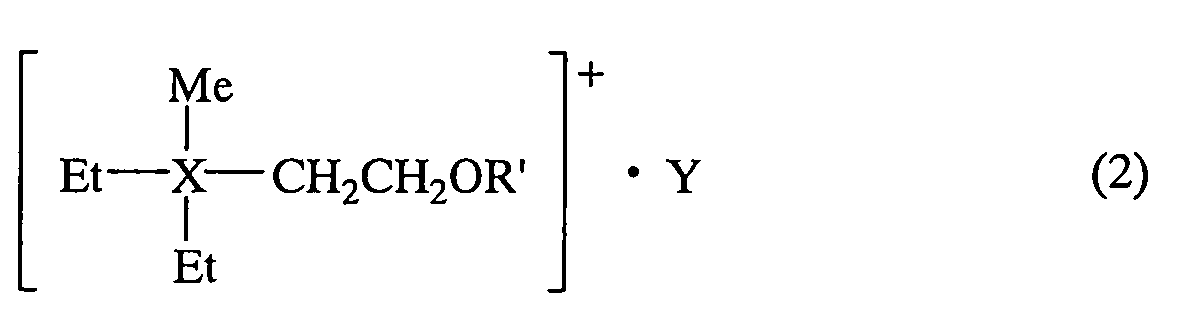 In formula (2), R' is methyl or ethyl, X is a nitrogen or
phosphorus atom, and Y is a monovalent anion. Me represents
a methyl group and Et represents an ethyl group.
In formula (2), R' is methyl or ethyl, X is a nitrogen or
phosphorus atom, and Y is a monovalent anion. Me represents
a methyl group and Et represents an ethyl group.
Illustrative, non-limiting examples of the monovalent
anion Y include BF4 - , PF6 -, AsF6 -, SbF6 -, AlCl4 -, HSO4 -, ClO4 -,
CH3SO3 -, CF3SO3 -, CF3CO2 -, (CF3SO2)2N-, (C2F5SO2)2N-, (C3F7SO2)2N-,
(C4F9SO2)2N-, (CF3SO2)(C2F5SO2)N-, (CF3SO2)(C3F7SO2)N-,
(CF3SO2)(C4F9SO2)N-, (C2F5SO2)(C3F7SO2)N-, (C2F5SO2)(C4F9SO2)N-, Cl-,
Br- and I-. To ensure such properties as a good degree of
dissociation and good stability in nonaqueous organic
solvents, the use of BF4 -, PF6 -, (CF3SO2)2N-, CF3SO3 - or CF3CO2 -
is preferred.
Of these anions, the use of (CF3SO2)2N- is highly
preferable for further reducing the viscosity of the ionic
liquid and increasing its handleability. BF4 - is also highly
preferable because the resulting ionic liquid has a high
versatility and it is less readily affected by water than
ionic liquids containing PF6 - as the anion and thus easier to
handle.
Specific examples of quaternary ammonium salts and
quaternary phosphonium salts highly suitable for use in the
invention include compounds (3) to (11) below (wherein "Me"
stands for methyl and "Et" stands for ethyl).





A common method for synthesizing such quaternary
ammonium salts is described. First, a tertiary amine is
mixed with a compound such as an alkyl halide or a dialkyl
sulfate and reacted under heating, if necessary, to give a
quaternary ammonium halide. In cases where a compound having
a low reactivity (e.g., an alkoxyethyl halide or an
alkoxymethyl halide) is used, reaction under applied pressure,
such as in an autoclave, is preferred.
The resulting quaternary ammonium halide is dissolved
in an aqueous solvent such as water, then reacted with a
reagent that generates the required anionic species, such as
tetrafluoroboric acid or tetrafluorophosphoric acid, so as to
effect an anion exchange reaction, yielding the quaternary
ammonium salt.
In one illustrative method for synthesizing quaternary
ammonium tetrafluoroborate, a quaternary ammonium halide is
dissolved in water, silver oxide is added and a salt exchange
reaction is carried out to form the corresponding quaternary
ammonium hydroxide. The product is then reacted with
tetrafluoroboric acid, yielding the target compound. This
method is effective for synthesizing high-purity quaternary
ammonium tetrafluoroborates because the silver halide that
arises as a result of salt exchange during formation of the
quaternary ammonium hydroxide can easily be removed.
Quaternary phosphonium salts can generally be
synthesized in much the same way as quaternary ammonium salts.
Typically, a tertiary phosphine is mixed with a suitable
compound such as an alkyl halide or a dialkyl sulfate. If
necessary, the reaction is carried out under the application
of heat.
As in the case of quaternary ammonium salts,
quaternary phosphonium salts containing various different
anions may be prepared by dissolving a quaternary phosphonium
halide (a chloride, bromide or iodide) in an aqueous solvent
and reacting the dissolved halide with a reagent that
generates the required anionic species so as to effect an
anion exchange reaction.
The above ionic liquid has a melting point not higher
than 50°C, preferably not higher than 25°C, and most
preferably not higher than 15°C. If the melting point is
higher than 50°C, the ionic liquid will precipitate within
the electrolyte at low temperatures, increasing the
likelihood of a decline in the ionic conductivity. The lower
the melting point, the more desirable. The melting point has
no particular lower limit.
Because the ionic liquid of the invention has a lower
melting point than imidazolium ion-containing ionic liquids
known to the art, by using nonaqueous electrolytes containing
this ionic liquid as the electrolyte in nonaqueous
electrolyte secondary cells, there can be obtained secondary
cells having even better low-temperature characteristics.
Also, compared with imidazolium ion-containing ionic
liquids known to the art, the above ionic liquids allow the
level of water present therein to be lowered or minimized.
As a result, by using a nonaqueous electrolyte containing
this ionic liquid as the electrolyte for a nonaqueous
electrolyte secondary cell, secondary cells can be obtained
which have a higher charge/discharge performance and are less
subject to deterioration with repeated charging and
discharging.
Furthermore, because the above ionic liquid has a
broader potential window than prior-art ionic liquids
containing imidazolium ions, it does not itself readily
undergo reductive decomposition during charging and
discharging. Preparation of the electrolyte by adding to
this ionic liquid the subsequently described compound which
reductively decomposes at a more noble potential than the
ionic liquid enables reductive decomposition of the ionic
liquid associated with charging and discharging to be more
effectively suppressed. As a result, a highly stable
secondary cell can be obtained which does not readily
deteriorate even with repeated charging and discharging.
The nonaqueous electrolytes of the invention contain
the above-described ionic liquid, a compound which
reductively decomposes at a more noble potential than the
ionic liquid, and a lithium salt.
The compound which is reductively decomposed at a more
noble potential than the ionic liquid is not subjected to any
particular limitation provided it is a compound which forms
what is known as a solid electrolyte interphase (SEI) film on
the active materials of secondary cells, particularly the
negative electrode active material, due to the
electrochemical reactions associated with charging and
discharging, and which at this time reductively decomposes at
a more noble potential than the ionic liquid. Illustrative
examples of such compounds that may be used include cyclic
and acyclic carbonates, acyclic carboxylates, cyclic and
acyclic ethers, phosphates, lactone compounds, nitrile
compounds, amide compounds, and mixtures thereof.
One method that may be employed to measure the
potential at which reductive decomposition occurs is cyclic
voltammetry which is carried out using a potentiostat and
function generator in a system where the working electrode
and the counter electrode are each platinum electrodes and
the reference electrode is a silver/silver chloride
electrode, or a system where the working electrode is made of
a carbonaceous material or metallic lithium, the counter
electrode is a platinum electrode and the reference electrode
is a silver/silver chloride electrode. Another measurement
method that may be employed involves carrying out
charge/discharge tests using a constant-current,
constant-voltage power supply in a system which uses a
carbonaceous material electrode as the working electrode and
a metallic lithium electrode as the counter electrode and
which uses, if necessary, a reference electrode such as a
metallic lithium electrode.
When measuring the reduction potential of the compound
that is reductively decomposed at a more noble potential than
the ionic liquid, it is particularly advantageous to do so
either by means of cyclic voltammetry in an actual nonaqueous
electrolyte secondary cell system, that is, a system which is
closely similar to a lithium ion secondary cell or lithium
secondary cell and uses a carbonaceous material electrode or
a metallic lithium electrode as the working electrode, a
platinum electrode as the counter electrode, and a
silver/silver chloride electrode as the reference electrode;
or by carrying out charge/discharge tests in a system which
uses a carbonaceous material electrode as the working
electrode and a metallic lithium electrode as the counter
electrode and which, if necessary, uses a reference electrode
such as a metallic lithium electrode.
Examples of suitable cyclic carbonates include
alkylene carbonates such as propylene carbonate, ethylene
carbonate and butylene carbonate; and vinylene carbonates.
Examples of suitable acyclic carbonates include dialkyl
carbonates such as dimethyl carbonate, ethyl methyl carbonate
and diethyl carbonate. Examples of suitable acyclic
carboxylates include methyl acetate and methyl propionate.
Examples of suitable cyclic and acyclic ethers include
tetrahydrofuran, 1,3-dioxolane and 1,2-dimethoxyethane.
Examples of suitable phosphates include trimethyl phosphate,
triethyl phosphate, ethyldimethyl phosphate,
diethylmethyl phosphate, tripropyl phosphate,
tributyl phosphate, tri(trifluoromethyl) phosphate,
tri(trichloromethyl) phosphate,
tri(trifluoroethyl) phosphate,
tri(triperfluoroethyl) phosphate,
2-ethoxy-1,3,2-dioxaphosphoran-2-one,
2-trifluoroethoxy-1,3,2-dioxaphosphoran-2-one and
2-methoxyethoxy-1,3,2-dioxaphosphoran-2-one.
An example of a suitable lactone compound is γ-butyrolactone.
An example of a suitable nitrile compound is acetonitrile.
An example of a suitable amide compound is dimethylformamide.
Of these compounds, cyclic carbonates, acyclic
carbonates, phosphates and mixtures thereof are preferred
because they provide a good battery performance such as high
charge/discharge characteristics and high output
characteristics. The use of one or more selected from among
ethylene carbonate, propylene carbonate, vinylene carbonate,
dimethyl carbonate, ethyl methyl carbonate and diethyl
carbonate is especially preferred. Of these, cyclic
carbonates such as ethylene carbonate, propylene carbonate
and vinylene carbonate are most preferable on account of
their safety owing to their high flash and ignition points
and their low vapor pressures.
In particular, the use of vinylene carbonate is
especially desirable because it reductively decomposes at a
more noble potential than the other carbonate compounds, and
forms a thin, uniform SEI layer. That is, the use of
vinylene carbonate enables an ionic liquid having a
relatively narrow potential window to be used as the
electrolyte. Moreover, even in cases where such an ionic
liquid is used, the vinylene carbonate reductively decomposes
and forms a SEI layer that is thin and uniform, making it
possible to suppress a rise in impedance in nonaqueous
electrolyte secondary cells due to SEI layer growth.
In the above-described nonaqueous electrolyte, the
content of the compound which reductively decomposes at a
more noble potential than the ionic liquid is preferably 0.1
to 60 wt%, more preferably 0.1 to 30 wt%, even more
preferably 0.2 to 20 wt%, and most preferably 0.4 to 15 wt%,
based on the overall nonaqueous electrolyte.
At a content of the above compound of less than 0.1
wt%, even when the above-described ionic liquid having a
broad potential window is used, it is very likely to be
difficult to efficiently suppress reductive decomposition of
the ionic liquid during charging and discharging. As a
result, improvements in the cycle life and stability of the
secondary cell may not be achieved. On the other hand, at a
content of more than 60 wt%, the nonflammable ionic liquid
accounts for a lower proportion of the nonaqueous electrolyte,
which may lower the safety of the secondary cell.
The lithium salt may be any known lithium salt capable
of being used in nonaqueous electrolyte secondary cells.
Illustrative examples include LiBF4, LiPF6, LiAsF6, LiClO4,
Li(CF3SO2)2N, Li(CF3SO2)2N, Li(C2F5SO2)2N, Li(C3F7SO2)2N,
Li(C4F9SO2)2N, Li(CF3SO2)(C2F5SO2)N, Li(CF3SO2)(C3F7SO2)N,
Li(CF3SO2)(C4F9SO2)N, Li(C2F5SO2)(C3F7SO2)N, Li(C2F5SO2)(C4F9SO2)N,
Li(CF3OCF2SO2)2N, LiCF3SO3 and LiCF3CO2. To ensure such
properties as versatility and good solubility and a good
degree of dissociation in the ionic liquid, the use of LiBF4,
LiPF6, Li(CF3SO2)2N, LiCF3SO3 or LiCF3CO2 is especially
preferred.
The content of lithium salt in the above electrolyte
is not subject to any particular limitation, although the
content is generally 0.05 to 3 mol/L, and preferably 0.1 to 2
mol/L. Too low a lithium salt concentration may result in a
higher cell impedance, which make charging and discharging at
a large current impossible. On the other hand, a lithium
salt concentration which is too high increases the liquid
viscosity, which may make battery production difficult.
Because the above-described nonaqueous electrolyte of
the invention contains an ionic liquid having a broader
potential window than imidazolium ion-containing ionic
liquids known to the prior art and contains also a compound
which reductively decomposes at a more noble potential than
the ionic liquid, the ionic liquid does not readily incur
reductive decomposition during charging and discharging.
This enables the cycle retention and stability of nonaqueous
electrolyte secondary cells in which this electrolyte is used
to be improved.
Also, because the above ionic liquid has a lower
melting point than imidazolium ion-containing ionic liquids
known to the prior art, a nonaqueous electrolyte having even
better low-temperature characteristics can be obtained.
It is also possible for the above-described nonaqueous
electrolyte of the invention to be mixed with a polymeric
compound and used as a polymer electrolyte.
No particular limitation is imposed on the polymeric
compound. Some preferred polymeric compounds are (a)
hydroxyalkyl polysaccharide derivatives, (b) oxyalkylene
branched polyvinyl alcohol derivatives, (c) polyglycidol
derivatives, (d) cyano-substituted monovalent hydrocarbon
group-bearing polyvinyl alcohol derivatives, and (e)
thermoplastic polyurethanes.
Illustrative examples of (a) hydroxyalkyl
polysaccharide derivatives include:
(1) hydroxyethyl polysaccharides prepared by reacting ethylene oxide with a naturally occurring polysaccharide such as cellulose, starch or pullulan; (2) hydroxypropyl polysaccharides prepared by reacting propylene oxide with the above naturally occurring polysaccharides; and (3) dihydroxypropyl polysaccharides prepared by reacting glycidol or 3-chloro-1,2-propanediol with the above naturally occurring polysaccharides. Hydroxyalkyl polysaccharide derivatives in which some or all of the hydroxyl groups on these hydroxyalkyl polysaccharides are capped with an ester-bonded or ether-bonded substituent are preferred.
(1) hydroxyethyl polysaccharides prepared by reacting ethylene oxide with a naturally occurring polysaccharide such as cellulose, starch or pullulan; (2) hydroxypropyl polysaccharides prepared by reacting propylene oxide with the above naturally occurring polysaccharides; and (3) dihydroxypropyl polysaccharides prepared by reacting glycidol or 3-chloro-1,2-propanediol with the above naturally occurring polysaccharides. Hydroxyalkyl polysaccharide derivatives in which some or all of the hydroxyl groups on these hydroxyalkyl polysaccharides are capped with an ester-bonded or ether-bonded substituent are preferred.
The above hydroxyalkyl polysaccharides have a molar
substitution of 2 to 30, and preferably 2 to 20. At the
molar substitution of less than 2, the lithium salt
dissolving ability of the hydroxyalkyl polysaccharide may
become so low as to make it unsuitable for use.
Oxyalkylene branched polyvinyl alcohol derivatives (b)
suitable for use as the polymeric compound include polymeric
compounds which bear on the molecule polyvinyl alcohol units
of general formula (12) below, which have an average degree
of polymerization of at least 20, and in which some or all of
the hydroxyl groups on the polyvinyl alcohol units are
substituted with oxyalkylene-bearing groups having an average
molar substitution of at least 0.3.
 In formula (12), the letter n is preferably from 20 to 10,000.
Because this type of polymeric compound has a high
oxyalkylene fraction, it has the ability to dissolve a large
amount of the lithium salt. In addition, the molecule
contains many oxyalkylene segments which permit the movement
of ions, resulting in a high ion mobility. This type of
polymeric compound is thus capable of exhibiting a high ionic
conductivity. Moreover, these polymeric compounds have a
high tackiness. Accordingly, they act as a binder component
and are capable of firmly bonding the positive and negative
electrodes.
Examples of polymeric compounds of above formula (12)
include [1] polymeric compounds obtained by reacting a
polyvinyl alcohol unit-containing polymeric compound with an
oxirane compound such as ethylene oxide, propylene oxide or
glycidol (e.g., dihydroxypropylated polyethylene vinyl
alcohol, propylene oxide-modified polyvinyl alcohol); and [2]
polymeric compounds obtained by reacting a polymeric compound
having polyvinyl alcohol units with a polyoxyalkylene
compound having terminal hydroxy-reactive substituents.
Here, the polyvinyl alcohol unit-bearing polymeric
compound is a polymeric compound which has a number-average
degree of polymerization of at least 20, preferably at least
30, and most preferably at least 50, which has polyvinyl
alcohol units on the molecule, and in which some or all of
the hydroxyl groups on the polyvinyl alcohol units are
substituted with oxyalkylene-containing groups. For the sake
of handleability, the upper limit in the number-average
degree of polymerization in this case is preferably not more
than 2,000, more preferably not more than 500, and most
preferably not more than 200.
It is most preferable for the above-described
polyvinyl alcohol unit-bearing polymeric compound to have a
number-average degree of polymerization within the above
range and to be a homopolymer in which the fraction of
polyvinyl alcohol units in the molecule is at least 98 mol%.
However, the polyvinyl alcohol unit-bearing polymeric
compound is not limited to the above, and may be one which
has a number-average degree of polymerization within the
above range and which has a polyvinyl alcohol fraction of
preferably at least 60 mol%, and more preferably at least 70
mol%. Illustrative examples of such compounds that may be
used include polyvinyl formals in which some of the hydroxyl
groups on the polyvinyl alcohol have been converted to formal,
modified polyvinyl alcohols in which some of the hydroxyl
groups on the polyvinyl alcohol have been converted to alkyls,
poly(ethylene vinyl alcohols), partially saponified polyvinyl
acetates, and other modified polyvinyl alcohols.
This polymeric compound is one in which some or all of
the hydroxyl groups on the above-described polyvinyl alcohol
units are substituted with oxyalkylene-containing groups
having an average molar substitution of at least 0.3
(moreover, some of the hydrogen atoms on these oxyalkylene
groups may be substituted with hydroxyl groups). Preferably
at least 30 mol%, and most preferably at least 50 mol%, of
the hydroxyl groups are substituted in this way.
The above-mentioned polyglycidol derivative (c)
contains units of formula (13) (referred to hereinafter as "A
units")
 and units of formula (14) (referred to hereinafter as "B
units")
and units of formula (14) (referred to hereinafter as "B
units")
 The ends of the molecular chain are capped with specific
substituents.
The ends of the molecular chain are capped with specific
substituents.
The polyglycidol can be prepared by polymerizing
glycidol or 3-chloro-1,2-propanediol, although it is
generally preferable to carry out polymerization from
glycidol as the starting material and using a basic catalyst
or a Lewis acid catalyst.
The total number of A and B units on the polyglycidol
molecule is at least two, preferably at least six, and most
preferably at least ten. There is no particular upper limit,
although it is generally preferable for the total number of
such units to not exceed about 10,000. The total number of
these respective units may be set as appropriate based on
such considerations as the flowability and viscosity required
of the polyglycidol. The ratio of A units to B units in the
molecule, expressed as A/B, is within a range of 1/9 to 9/1,
and preferably 3/7 to 7/3. There is no regularity to the
arrangement of A and B units. Any combination is possible.
The polyglycidol has a polyethylene glycol equivalent
weight-average molecular weight (Mw), as determined by gel
permeation chromatography (GPC), within a range of preferably
200 to 730,000, more preferably 200 to 100,000, and most
preferably 600 to 20,000. The dispersity, defined as
weight-average molecular weight divided by number-average
molecular weight (Mw/Mn) is preferably 1.1 to 20, and most
preferably 1.1 to 10.
These polymeric compounds (a) to (c) may be
hydroxyl-capped polymer derivatives in which some or all, and
preferably at least 10 mol%, of the hydroxyl groups on the
molecule are capped with one or more type of monovalent
substituent selected from among halogen atoms; substituted or
unsubstituted monovalent hydrocarbon groups having 1 to 10
carbons, R5CO- groups (wherein R5 is a substituted or
unsubstituted monovalent hydrocarbon group of 1 to 10
carbons), R5 3Si- groups (wherein R5 is as defined above),
amino groups, alkylamino groups and phosphorus-containing
groups.
Illustrative examples of the substituted or
unsubstituted monovalent hydrocarbon groups having 1 to 10
carbons include alkyl groups such as methyl, ethyl, propyl,
isopropyl, t-butyl and pentyl, aryl groups such as phenyl and
tolyl, aralkyl groups such as benzyl, alkenyl groups such as
vinyl, and any of the foregoing in which some or all of the
hydrogen atoms have been substituted with halogen atoms,
cyano groups, hydroxyl groups or amino groups. Any one or
combination of two or more of these types of groups may be
used.
Capping the hydroxyl groups on the above polymeric
compounds (a) to (c) with highly polar substituents increases
the polarity (and thus the dielectric constant) of the
polymer matrix, making it possible to prevent the decline in
conductivity which readily arises in a low dielectric
constant polymer matrix due to the recombination of
dissociated cations and counter ions (anions). Moreover,
when capping is done using substituents that have
fire-retarding and hydrophobic properties, the polymeric
compound can be imparted with desirable characteristics, such
as hydrophobicity and fire retardance.
To increase the dielectric constant of above polymeric
compounds (a) to (c), the oxyalkylene chain-bearing polymeric
compounds (a) to (c) are reacted with a hydroxy-reactive
compound so as to cap the hydroxyl groups on these polymeric
compounds with highly polar substituents.
Although the highly polar substituents used for this
purpose are not subject to any particular limitation, neutral
substituents are preferable to ionic substituents. Exemplary
substituents include substituted and unsubstituted monovalent
hydrocarbon groups of 1 to 10 carbons, and R5CO- groups
(wherein R5 is as defined above). If necessary, capping may
also be carried out with other suitable substituents, such as
amino groups or alkylamino groups.
To confer polymeric compounds (a) to (c) with
hydrophobic properties and fire retardance, the hydroxyl
groups on the above polymeric compounds may be capped with,
for example, halogen atoms, R5 3Si- groups (wherein R5 is as
defined above) or phosphorus-containing groups.
Examples of suitable R5 3Si- groups include those in
which R5 represents the same substituted or unsubstituted
monovalent hydrocarbon groups having 1 to 10 carbons, and
preferably 1 to 6 carbons, as above. R5 preferably stands
for alkyl groups. Trialkylsilyl groups, and especially
trimethylsilyl groups, are preferred.
Additional examples of suitable substituents include
amino groups, alkylamino groups and phosphorus-containing
groups.
The proportion of end groups capped with the above
substituents is at least 10 mol%, preferably at least 50 mol%,
and most preferably at least 90 mol%. It is even possible to
cap substantially all the end groups with the above
substituents, representing a capping ratio of about 100 mol%.
The above-mentioned cyano-substituted monovalent
hydrocarbon group-bearing polyvinyl alcohol derivative (d) is
preferably a polymeric compound which bears on the molecule
polyvinyl alcohol units of above general formula (12), which
has an average degree of polymerization of at least 20, and
in which some or all of the hydroxyl groups on the polyvinyl
alcohol units are substituted with cyano-substituted
monovalent hydrocarbon groups.
Because this polymeric compound has relatively short
side chains, the viscosity of the electrolyte can be held to
a low level.
Examples of such polymeric compounds include polyvinyl
alcohols in which some or all of the hydroxyl groups have
been substituted with groups such as cyanoethyl, cyanobenzyl
or cyanobenzoyl. Cyanoethyl-substituted polyvinyl alcohol is
especially preferred because the side chains are short.
Various known methods may be used to substitute the
hydroxyl groups on the polyvinyl alcohol with
cyano-substituted monovalent hydrocarbon groups.
The above-mentioned thermoplastic polyurethane (e) is
preferably a thermoplastic polyurethane resin prepared by
reacting (A) a polyol compound, (B) a polyisocyanate compound
and, if necessary, (C) a chain elongation agent.
Suitable thermoplastic polyurethane resins include not
only polyurethane resins having urethane bond, but also
polyurethane-urea resins having both urethane bond and urea
bond.
The polyol compound serving as component A is
preferably a polyether polyol, a polyester polyol, a
polyester polyether polyol, a polyester polycarbonate polyol,
a polycaprolactone polyol, or a mixture thereof.
The polyol compound serving as component A has a
number-average molecular weight of preferably 1,000 to 5,000,
and most preferably 1,500 to 3,000. A polyol compound having
too small a number-average molecular weight may lower the
physical properties of the resulting thermoplastic
polyurethane resin film, such as the heat resistance and
tensile elongation percentage. On the other hand, too large
a number-average molecular weight increases the viscosity
during synthesis, which may lower the production stability of
the thermoplastic polyurethane resin being prepared. The
number-average molecular weights used here in connection with
polyol compounds are calculated based on the hydroxyl values
measured in accordance with JIS K1577.
Illustrative examples of the polyisocyanate compound
serving as component B include aromatic diisocyanates such as
tolylene diisocyanate, 4,4'-diphenylmethane diisocyanate,
p-phenylene diisocyanate, 1,5-naphthylene diisocyanate and
xylylene diisocyanate; and aliphatic or alicyclic
diisocyanates such as hexamethylene diisocyanate, isophorone
diisocyanate, 4,4'-dicyclohexylmethane diisocyanate and
hydrogenated xylylene diisocyanate.
The chain elongation agent serving as component C is
preferably a low-molecular-weight compound having a molecular
weight of not more than 300 and bearing two active hydrogen
atoms capable of reacting with isocyanate groups.
Various known compounds may be used as such
low-molecular-weight compounds. Illustrative examples
include aliphatic diols such as ethylene glycol, propylene
glycol and 1,3-propanediol; aromatic or alicyclic diols such
as 1,4-bis(β-hydroxyethoxy)benzene, 1,4-cyclohexanediol and
bis(β-hydroxyethyl) terephthalate; diamines such as hydrazine,
ethylenediamine, hexamethylenediamine and xylylenediamine;
and amino alcohols such as adipoyl hydrazide. Any one or
combinations of two or more of these may be used.
The thermoplastic polyurethane resin typically
includes 5 to 200 parts by weight, and preferably 20 to 100
parts by weight, of the polyisocyanate compound serving as
component B and 1 to 200 parts by weight, and preferably 5 to
100 parts by weight, of the chain elongation agent serving as
component C per 100 parts by weight of the polyol compound
serving as component A.
As noted above, polymer electrolytes obtained by
mixing the nonaqueous electrolyte of the invention with a
polymeric compound contain the above-described ionic liquid
and a compound which reductively decomposes at a potential
more noble than the ionic liquid. Accordingly, there can be
obtained nonaqueous electrolyte secondary cells which undergo
little cycle deterioration and have an excellent stability,
and which are also endowed with excellent low-temperature
characteristics.
Moreover, because the nonaqueous electrolyte contains
the above-described polymeric compound, it can exhibit a high
ionic conductivity, in addition to which it can act as a
binder component and is thus fully capable of firmly bonding
together the positive and negative electrodes.
Also, by adding to the above-described nonaqueous
electrolyte of the invention a compound having a reactive
double bond on the molecule, then reacting and curing the
composition, the resulting product can be used as a polymer
electrolyte. In this invention, curing is a concept which
encompasses also gelation.
That is, in cases where the nonaqueous electrolyte
obtained by curing or gelating the above composition is
formed into a thin film and used as the electrolyte in a
secondary cell, to increase the physical strength (e.g.,
shape retention), a compound having a reactive double bond on
the molecule is added and the compound is reacted to form a
polymer. This increases the ability of the electrolyte to
retain its shape.
It is particularly desirable for the compound bearing
a reactive double bond on the molecule to have two or more
reactive double bonds, because the reaction of this compound
forms a three-dimensional network structure, making it
possible to increase even further the shape retaining ability
of the electrolyte.
When the nonaqueous electrolyte of the invention
includes not only the above-mentioned compound having at
least two reactive double bonds, but also the above-described
polymeric compound, there can be obtained an electrolyte
having a semi-interpenetrating polymer network (semi-IPN)
structure in which the molecular chains of the polymeric
compound are intertwined with the three-dimensional network
structure of the polymer formed by crosslinkage of the
reactive double bond-bearing compounds. The shape retention
and strength of the electrolyte can thus be further
increased, and its adhesive properties and ion conductivity
also enhanced.
The compound having a reactive double bond on the
molecule is not subject to any particular limitation.
Illustrative examples include acrylates and methacrylates
such as glycidyl methacrylate, glycidyl acrylate,
methoxydiethylene glycol methacrylate, methoxytriethylene
glycol methacrylate and methoxypolyethylene glycol
methacrylate (average molecular weight, 200 to 1,200); and
other compounds having one acrylic acid group or methacrylic
acid group on the molecule, such as methacryloyl isocyanate,
2-hydroxymethylmethacrylic acid and
N,N-dimethylaminoethylmethacrylic acid.
In cases where a semi-IPN structure is formed using
such a compound having a single reactive double bond and the
polymeric compound described above, it is necessary to add
also a compound having at least two reactive double bonds on
the molecule.
Preferred examples of the compound having two or more
reactive double bonds on the molecule include divinylbenzene,
divinylsulfone, allyl methacrylate,
ethylene glycol dimethacrylate,
diethylene glycol dimethacrylate,
triethylene glycol dimethacrylate,
polyethylene glycol dimethacrylate (average molecular weight,
200 to 1,000), 1,3-butylene glycol dimethacrylate,
1,6-hexanediol dimethacrylate,
neopentyl glycol dimethacrylate,
polypropylene glycol dimethacrylate (average molecular
weight, 400), 2-hydroxy-1,3-dimethacryloxypropane,
2,2-bis[4-(methacryloxyethoxy)phenyl]propane,
2,2-bis[4-(methacryloxyethoxy-diethoxy)phenyl]propane,
2,2-bis[4-(methacryloxyethoxy-polyethoxy)phenyl]propane,
ethylene glycol diacrylate, diethylene glycol diacrylate,
triethylene glycol diacrylate,
polyethylene glycol diacrylate (average molecular weight, 200
to 1,000), 1,3-butylene glycol diacrylate,
1,6-hexanediol diacrylate, neopentyl glycol diacrylate,
polypropylene glycol diacrylate (average molecular weight,
400), 2-hydroxy-1,3-diacryloxypropane,
2,2-bis[4-(acryloxyethoxy)phenyl]propane,
2,2-bis[4-(acryloxyethoxy-diethoxy)phenyl]propane,
2,2-bis[4-(acryloxyethoxy-polyethoxy)phenyl]propane,
trimethylolpropane triacrylate,
trimethylolpropane trimethacrylate,
tetramethylolmethane triacrylate,
tetramethylolmethane tetraacrylate,
water-soluble urethane diacrylate,
water-soluble urethane dimethacrylate,
tricyclodecane dimethanol acrylate,
hydrogenated dicyclopentadiene diacrylate,
polyester diacrylate and polyester dimethacrylate.
Of the aforementioned reactive double bond-bearing
compounds, especially preferred reactive monomers include the
polyoxyalkylene component-bearing diesters of general formula
(15) below. The use of such a diester in combination with a
polyoxyalkylene component-bearing monoester of general
formula (16) below and a triester is recommended.


In formula (15), R6 to R8 are each independently a
hydrogen atom or an alkyl group having 1 to 6 carbons, and
preferably 1 to 4 carbons, such as methyl, ethyl, n-propyl,
i-propyl, n-butyl, i-butyl, s-butyl or t-butyl; and X and Y
satisfy the condition X ≥ 1 and Y ≥ 0 or the condition X ≥ 0
and Y ≥ 1. R6 to R8 are preferably methyl, ethyl, n-propyl,
i-propyl, n-butyl, i-butyl, s-butyl or t-butyl.
In formula (16), R9 to R11 are each independently a
hydrogen atom or an alkyl group having 1 to 6 carbons, and
preferably 1 to 4 carbons, such as methyl, ethyl, n-propyl,
i-propyl, n-butyl, i-butyl, s-butyl or t-butyl; and A and B
satisfy the condition A ≥ 1 and B ≥ 0 or the condition A ≥ 0
and B ≥ 1. R9 to R11 are preferably methyl, ethyl, n-propyl,
i-propyl, n-butyl, i-butyl, s-butyl or t-butyl.
A preferred example of the compound of above formula
(15) is one in which X is 9, Y is 0, and both R6 and R8 are
CH3. A preferred example of the compound of above formula
(16) is one in which A is 2 or 9, B is 0, and both R9 and R11
are CH3.
The triester is preferably trimethylolpropane
trimethacrylate.
The above-described polyoxyalkylene component-bearing
diester and polyoxyalkylene component-bearing monoester are
exposed, in a mixture together with the above-described ionic
liquid, the compound which reductively decomposes at a more
noble potential than the ionic liquid, the lithium salt and
the polymeric compound, to a suitable form of radiation (e.g.,
UV light, electron beams, x-rays, gamma rays, microwaves,
radio-frequency radiation). Alternatively, the mixture is
heated to form a semi-IPN-type three-dimensional crosslinked
network structure.
The relative proportions of the above-described
polyoxyalkylene component-bearing diester, the
polyoxyalkylene component-bearing monoester and the triester
are set as appropriate for the length of the polyoxyalkylene
components and are not subject to any particular limitation.
However, a diester/monoester molar ratio of 0.1 to 2, and
especially 0.3 to 1.5, and a diester/triester molar ratio of
2 to 15, and especially 3 to 10, are preferred to enhance the
strength of the electrolyte.
As explained above, because the polymer electrolyte
obtained by curing (gelating) a composition containing the
nonaqueous electrolyte of the invention and a reactive double
bond-containing compound includes the above-mentioned ionic
liquid and a compound which reductively decomposes at a more
noble potential than the ionic liquid, in addition to the
above-mentioned properties such as low-temperature
characteristics, cyclability, ionic isoelectricity and
tackiness, the polymer electrolyte also has a high
shape-retaining ability.
In particular, because a compound with at least two
reactive double bonds is used as the compound having a
reactive double bond on the molecule and because the
electrolyte obtained by curing a composition which contains
also the above-described polymeric compound has a semi-IPN
type three-dimensional crosslinked network structure, the
shape retaining ability and strength of the electrolyte can
be increased all the more, as can also its adhesive
properties and ionic conductivity.
The secondary cell according to this invention is a
nonaqueous electrolyte secondary cell having a positive
electrode which contains a lithium-containing double oxide, a
negative electrode containing a carbonaceous material capable
of inserting and extracting of lithium ions or containing
metallic lithium, a separator between the positive and
negative electrodes, and a nonaqueous electrolyte which is
the above-described nonaqueous electrolyte or a polymeric
electrolyte.
The positive electrode may be one that is produced by
coating both the front and the back side or just one side of
a positive electrode current collector with a positive
electrode binder composition composed primarily of a binder
polymer and a positive electrode active material.
Alternatively, a positive electrode binder composition
composed primarily of a binder polymer and a positive
electrode active material may be melted and blended, then
extruded as a film to form a positive electrode.
The binder polymer may be any polymer capable of being
used in the applications of concern here. For example, use
may be made of (I) a thermoplastic resin having a swelling
ratio, as defined by the formula below, in a range of 150 to
800%, (II) a fluoropolymer material, or a combination of two
or more polymers of types (I) and (II).
The above thermoplastic resin (I) has a swelling
ratio, as determined from the formula indicated below, within
a range of 150 to 800%, preferably 250 to 500%, and most
preferably 250 to 400%.
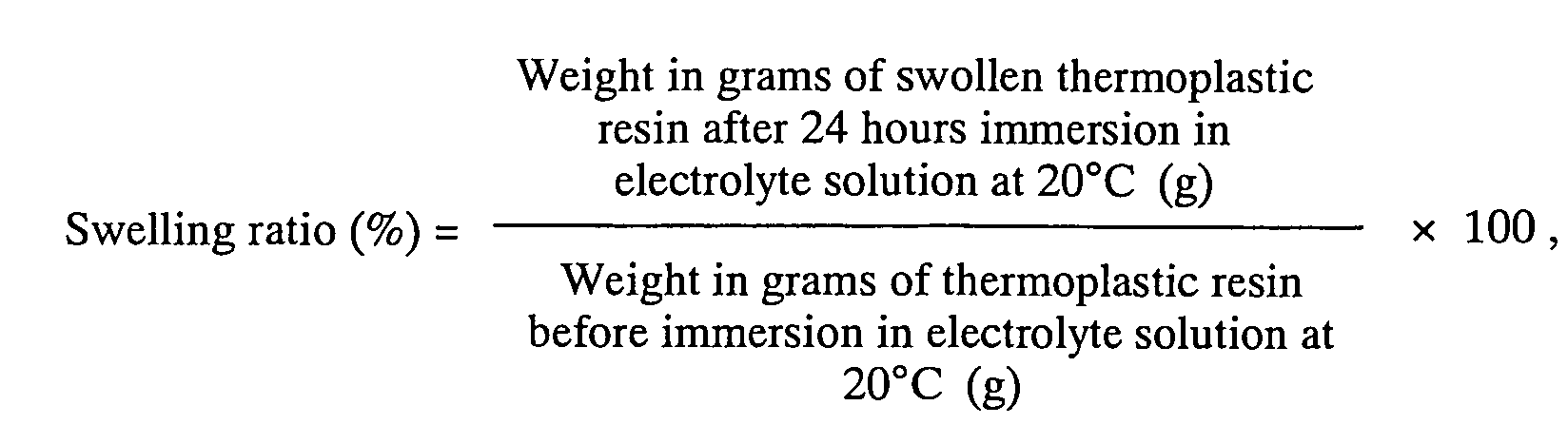
A thermoplastic resin containing units of general
formula (17) below
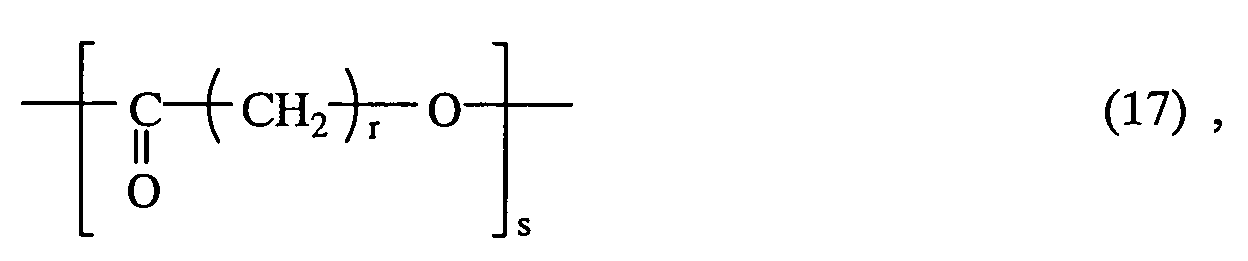 wherein the letter r is 3 to 5 and the letter s is an integer
≥5, may be used as the binder polymer of formula (I) above.
wherein the letter r is 3 to 5 and the letter s is an integer
≥5, may be used as the binder polymer of formula (I) above.
Preferred examples of fluoropolymer materials (II)
that may be used as the binder polymer include polyvinylidene
fluoride (PVDF), vinylidene fluoride-hexafluoropropylene
copolymers (P(VDF-HFP)) and vinylidene
fluoride-chlorotrifluoroethylene copolymers (P(VDF-CTFE)).
Of these, fluoropolymers having a vinylidene fluoride content
of at least 50 wt%, and especially at least 70 wt%, are
preferred. The upper limit in the vinylidene fluoride
content of the fluoropolymer is about 97 wt%.
The weight-average molecular weight of the
fluoropolymer is not subject to any particular limitation,
although the weight-average molecular weight is preferably
500,000 to 2,000,000, and most preferably 500,000 to
1,500,000. Too low a weight-average molecular weight may
result in an excessive decline in physical strength.
The positive electrode current collector may be made
of a suitable material such as stainless steel, aluminum,
titanium, tantalum or nickel. Of these, aluminum foil or
aluminum oxide foil is especially preferred both in terms of
performance and cost. This current collector may be used in
any of various forms, including foil, expanded metal, sheet,
foam, wool, or a three-dimensional structure such as a net.
In this invention, lithium ion-containing chalcogen
compounds (lithium-containing double oxides) may be used as
the above positive electrode active material.
Specific examples of such lithium ion-containing
chalcogen compounds (lithium-containing double oxides)
include LiCoO2, LiMnO2, LiMn2O4, LiMo2O4, LiV3O8, LiNiO2 and
LixNiyM1-yO2 (wherein M is one or more metal element selected
from among cobalt, manganese, titanium, chromium, vanadium,
aluminum, tin, lead and zinc; 0.05 ≤ x ≤ 1.10; and 0.5 ≤ y ≤
1.0).
In addition to the binder resin and the positive
electrode active material described above, if necessary, the
binder composition for the positive electrode may include
also an electrically conductive material. Illustrative
examples of the conductive material include carbon black,
Ketjenblack, acetylene black, carbon whiskers, carbon fibers,
natural graphite and artificial graphite.
The positive electrode binder composition typically
includes 1,000 to 5,000 parts by weight, and preferably 1,200
to 3,500 parts by weight, of the positive electrode active
material and 20 to 500 parts by weight, and preferably 50 to
400 parts by weight, of the conductive material per 100 parts
by weight of the binder resin.
The negative electrode may be one that is produced by
coating both the front and back sides or just one side of a
negative electrode current collector with a negative
electrode binder composition composed primarily of a binder
polymer and a negative electrode active material. The same
binder polymer may be used as in the positive electrode.
Alternatively, the negative electrode binder
composition composed primarily of a binder polymer and a
negative electrode active material may be melted and blended,
then extruded as a film to form a negative electrode.
The negative electrode current collector may be made
of a suitable material such as copper, stainless steel,
titanium or nickel. Of these, copper foil or a metal foil
whose surface is covered with a copper plating film is
especially preferred both in terms of performance and cost.
The current collector used may be in any of various forms,
including foil, expanded metal, sheet, foam, wool, or a
three-dimensional structure such as a net.
A carbonaceous material which reversibly inserts and
extracts lithium ions is used as the negative electrode
active material.
Carbonaceous materials that may be used for this
purpose include non-graphitizable carbonaceous materials and
graphite materials. Specific examples include pyrolytic
carbons, cokes (e.g., pitch coke, needle coke, petroleum
coke), graphites, glassy carbons, fired organic polymeric
materials (materials such as phenolic resins or furan resins
that have been carbonized by firing at a suitable
temperature), carbon fibers, and activated carbon.
If necessary, the binder composition for the negative
electrode may include also a conductive material. Examples
of conductive materials suitable for this purpose include
those mentioned above for the positive electrode binder
composition.
The negative electrode binder composition typically
includes 500 to 1,700 parts by weight, and preferably 700 to
1,300 parts by weight, of the negative electrode active
material and 0 to 70 parts by weight, and preferably 0 to 40
parts by weight, of the conductive material per 100 parts by
weight of the binder polymer.
The above-described negative electrode binder
compositions and positive electrode binder compositions
generally are used in the form of a paste after the addition
of a dispersing medium. Suitable dispersing media include
polar solvents such as N-methyl-2-pyrrolidone (NMP),
dimethylformamide, dimethylacetamide and dimethylsulfamide.
The dispersing medium is typically added in an amount of
about 30 to 300 parts by weight per 100 parts by weight of
the positive electrode or negative electrode binder
composition.
No particular limitation is imposed on the method of
shaping the positive and negative electrodes as thin films,
although it is preferable to apply the composition by a
suitable means such as roller coating with an applicator roll,
screen coating, doctor blade coating, spin coating or bar
coating so as to form an active material layer having a
uniform thickness when dry of 10 to 200 µm, and especially 15
to 100 µm.
Illustrative, non-limiting, examples of the separator
between the positive and negative electrodes include
polyethylene nonwoven fabric, polypropylene nonwoven fabric,
polyester nonwoven fabric, polytetrafluoroethylene porous
film, kraft paper, sheet laid from a blend of rayon fibers
and sisal fibers, manila hemp sheet, glass fiber sheet,
cellulose-based electrolytic paper, paper made from rayon
fibers, paper made from a blend of cellulose and glass fibers,
and combinations thereof in the form of multilayer sheets.
The separator is not subject to any particular
limitation in structure, and may have a single-layer
structure or a multilayer structure composed of a plurality
of laminated films or sheets.
The separator is preferably in the form of a porous
film or porous sheet having a thickness of 20 to 50 µm and a
porosity of 25 to 85%. At a thickness of less than 20 µm,
internal shorting of the cell may arise more frequently, and
at a thickness of more than 50 µm, the discharge load
characteristics of the cell may be compromised. Accordingly,
it is desirable for the separator to have a thickness of 25
to 40 µm, and especially 25 to 35 µm.
At a porosity of less than 25%, the permeability of
the separator to the electrolyte solution may worsen.
Moreover, the amount of electrolyte solution per unit volume
decreases, lowering the ionic conductivity and possibly
compromising the cell characteristics. A porosity greater
than 85% does enhance the large current discharge
characteristics of the cell, but such a separator has a lower
physical strength and may thus have a poor handleability
during assembly operations, in addition to which the cell
tends to have a higher incidence of internal shorting.
Accordingly, it is desirable for the separator to have a
porosity of 25 to 85%, preferably 50 to 80%, and most
preferably 65 to 75%. By using a separator of the above
thickness and porosity, there can be obtained nonaqueous
electrolyte secondary cells having excellent large current
discharge characteristics.
The material making up such a porous film or porous
sheet is not subject to any particular limitation. That is,
separators made of any of the various above-described
materials may be used. However, it is preferable to use a
porous film or porous sheet composed primarily of cellulose.
"Composed primarily of cellulose" signifies here that
cellulose accounts for at least about 95 wt% of the separator
when dry (i.e., in a dehydrated state).
By using such a porous film or sheet composed
primarily of cellulose, the charging characteristics, rate
capability, safety and manufacturability of the nonaqueous
electrolyte secondary cells can be enhanced, in addition to
which the overcharge characteristics can be increased.
No particular limitation is imposed here on the
cellulose-containing porous film or sheet. However, the use
of paper formed from cellulose fibers by a papermaking
process is preferable from the standpoint of production costs,
lyophilicity with respect to the electrolyte solution, and
cell characteristics. Paper obtained by beating cellulose
fibers can also be used.
Because the above-described cellulose has a heat
resistance of at least 200°C and thus a better thermal
stability than polyolefin resins, it can enhance the thermal
stability of the cell. As a result, the danger of abnormal
overheating such as from internal shorting due to thermal
shrinkage of the separator can be avoided.
Moreover, when a separator composed primarily of
cellulose is used, hydroxyl groups on the cellulose molecules
strongly interact with the highly polar electrolyte molecules,
giving the separator a better lyophilicity than that of a
polyolefin separator. As a result, the electrolyte solution
has a high rate of penetration, increasing the efficiency of
work during cell assembly and preventing the deterioration of
cell performance from the presence of areas of the separator
not penetrated by the electrolyte solution.
In addition, because cellulose fibers have a large
surface area, the surface of the fibers interacts with the
electrolyte solution, increasing electrolyte retention and
reducing liquid exudation. As a result, the cell can be
provided with better charge-discharge characteristics,
high-temperature stability and safety.
The nonaqueous electrolyte secondary cell of the
invention is assembled by stacking, fan-folding, winding or
forming into a laminated or coin-like shape a cell assembly
composed of the separator disposed between the positive and
negative electrodes, and placing the cell assembly within a
battery housing such as a battery can or a laminate pack.
The battery housing is mechanically sealed if it is a can or
heat-sealed if it is a laminate pack. In constructing the
cell, the separator is disposed between the positive
electrode and the negative electrode, and the resulting cell
assembly is placed within the battery housing. The cell
assembly is then filled with a nonaqueous electrolyte
solution. If a compound having reactive double bonds is used
as the nonaqueous electrolyte, the electrolyte composition is
filled into the cell assembly so that it fully penetrates the
gap between the electrodes and the gaps between the separator
and the electrodes, then is reacted to effect curing.
The resulting nonaqueous electrolyte secondary cell of
the invention can be operated at a high capacity and a high
current without compromising such outstanding characteristics
as its charge-discharge efficiency, energy density, power
density and life. Moreover, the cell has a broad service
temperature range.
The nonaqueous electrolyte secondary cell of the
invention lends itself well to use in a variety of
applications, including main power supplies for portable
electronic equipment such as video cameras, notebook
computers, cell phones and PHS® ("personal handyphone
system") devices, uninterruptible power supplies for
equipment such as personal computers -- including use as
memory backup power supplies, in electric cars and hybrid
cars, and together with solar cells as energy storage systems
for solar power generation.
The following Synthesis Examples, Examples of the
Invention and Comparative Examples are provided to illustrate
the invention and do not in any way limit the invention.
In Examples 1 to 8 and Comparative Examples 1 and 2,
lithium metal was used as the counter electrode in order to
examine the performance on the negative electrode side of the
electrolyte solution of the invention. Although it is
conventional for the carbonaceous electrode to be regarded as
the positive electrode, in this case because it receives
lithium ions and is reduced during discharge, it is referred
to herein as the negative electrode and electrochemical
activity in the reducing direction is referred to as
"charging."

A solution prepared by mixing together 100 ml of
diethylamine (Kanto Chemical Co., Inc.) and 85 ml of
2-methoxyethyl chloride (Kanto Chemical Co., Inc.) was placed
in an autoclave and reacted at 100°C for 24 hours. The
internal pressure during the reaction was 0.127 MPa (1.3
kgf/cm2). This yielded a mixture of deposited crystals and
reaction solution to which was added, following the 24 hours
of reaction, 200 ml of an aqueous solution containing 56 g of
dissolved potassium hydroxide (Katayama Chemical Industries
Co., Ltd.). Each of the two divided organic phases that
formed as a result was separated off with a separatory funnel
and subjected twice to extraction with 100 ml of methylene
chloride (Wako Pure Chemical Industries, Ltd.). The
separated organic phases were then combined and washed with a
saturated saline solution, following which potassium
carbonate (Wako Pure Chemical Industries, Ltd.) was added to
remove water and vacuum filtration was carried out. The
solvent in the resulting organic phase was distilled off in a
rotary evaporator, after which the residue was subjected to
normal-pressure distillation, yielding 18.9 g of a fraction
having a boiling point close to 135°C. This was identified
by a 1H-NMR spectrum as 2-methoxyethyldiethylamine.
Next, 8.24 g of the 2-methoxyethyldiethylamine was
dissolved in 10 ml of tetrahydrofuran (Wako Pure Chemical
Industries, Ltd.), then 4.0 ml of methyl iodide (Wako Pure
Chemical Industries, Ltd.) was added under ice cooling.
After 30 minutes, the mixture was removed from the ice bath
and stirred overnight at room temperature. The solvent in
this reaction solution was subsequently driven off by vacuum
distillation, and the resulting solids were recrystallized
from an ethanol (Wako Pure Chemical Industries, Ltd.) -
tetrahydrofuran system, yielding 16 g of
2-methoxyethyldiethylmethylammonium iodide.
Next, 10.0 g of the 2-methoxyethyldiethylmethylammonium
iodide was dissolved in 50 mL of acetonitrile (Kanto
Chemical Co. Inc.), after which 9.5 g of lithium
bis(trifluoromethanesulfonyl)imide (produced by Kishida
Chemical Co., Ltd.) was added and completely dissolved
therein, then the resulting solution was stirred for 15
minutes.
The acetonitrile was removed by vacuum distillation,
then water was added to the residue, causing the organic
phase to separate into two. The organic phase was then
separated off and washed five times with water to remove
impurities.
The washed organic phase was subsequently placed under
reduced pressure with a vacuum pump and the water was
thoroughly driven off, yielding 6.8 g of compound (8), which
was liquid at room temperature.

First, 8.24 g of the 2-methoxyethyldiethylamine
obtained as in Synthesis Example 1 was dissolved in 10 ml of
tetrahydrofuran (Wako Pure Chemical Industries, Ltd.),
following which 4.0 ml of methyl iodide (Wako Pure Chemical
Industries, Ltd.) was added under ice cooling. After 30
minutes, the mixture was removed from the ice bath and
stirred overnight at room temperature. The solvent in the
resulting reaction mixture was then driven off by vacuum
distillation, and the resulting solid matter was
recrystallized from an ethanol (Wako Pure Chemical Industries,
Ltd.) - tetrahydrofuran system, yielding 16 g of
2-methoxyethyldiethylmethylammonium iodide.
Next, 15.0 g of the 2-methoxyethyldiethylmethylammonium
iodide was dissolved in 100 ml of distilled water,
following which 6.37 g of silver oxide (Kanto Chemical Co.
Inc.) was added and stirring was carried out for 3 hours. The
reaction mixture was then vacuum filtered to remove the
precipitate, following which 42% tetrafluoroboric acid (Kanto
Chemical Co. Inc.) was gradually added under stirring until
the reaction solution reached a pH of about 5 to 6. The
reaction solution was subsequently freeze-dried, in addition
to which water was thoroughly driven off using a vacuum pump,
ultimately yielding 12.39 g of a compound (3) that was liquid
at room temperature (25°C).
First, 5.74 g of lithium bis(trifluoromethanesulfonyl)imide
(produced by Kishida Chemical Co., Ltd.) was
added to 30 ml of a 1:1 (by volume) mixed solvent composed of
chloroform and acetonitrile, and the mixture was stirred to
form a suspension. Next, a solution prepared by dissolving
2.92 g of 1-ethyl-3-methylimidazolium chloride (Tokyo Kasei
Kogyo Co., Ltd.) in 30 ml of a 1:1 (by volume) mixed solvent
of chloroform and acetonitrile was added to the suspension,
and the mixture was stirred for 80 minutes. The crystals
that formed were removed by vacuum filtration, and the
solvent within the filtrate was driven off with an evaporator
and a vacuum pump.
Next, 4.85 g of the resulting residue was further
purified by silica gel column chromatography (Wakogel C-200,
produced by Wako Pure Chemical Industries, Ltd.; eluate, 1:1
(by volume) mixed solvent of chloroform and methanol),
yielding 3.06 g of an imidazolium-based ionic liquid which is
liquid at room temperature.
A reactor equipped with a stirrer, a thermometer and a
condensing tube was charged with 60.20 parts by weight of a
preheated and dehydrated polyethylene glycol 4000 (PEG 4000-S,
made by Sanyo Chemical Industries, Ltd.) and 7.84 parts by
weight of 4,4'-diphenylmethane diisocyanate. The reactor
contents were stirred and mixed for 2 hours at 120°C under a
stream of nitrogen, following which 1.86 parts by weight of
1,4-butanediol was added to the mixture and the reaction was
similarly effected at 120°C under a stream of nitrogen. When
the reaction reached the point where the reaction product
became rubbery, it was stopped. The reaction product was
then removed from the reactor and heated at 100°C for 12
hours. Once the isocyanate peak was confirmed to have
disappeared from the infrared absorption spectrum, heating
was stopped, yielding a solid polyurethane resin.
The resulting polyurethane resin had a weight-average
molecular weight (Mw) of 1.05×10⁵. Eight parts by weight of
the polyurethane resin was dissolved in 92 parts by weight of
N-methyl-2-pyrrolidone to give a polyurethane resin solution.
Cyclic voltammetry measurements were carried out with
a potentiostat and function generator at a sweep rate of 1
mV/s on each of the compounds obtained in above Synthesis
Examples 1, 2 and 3, and on 1-ethyl-3-methylimidazolium
tetrafluoroborate (Kanto Chemical Co. Inc.). A platinum
electrode (electrode surface area, 1.76 mm2) was used as the
working electrode, a platinum electrode (electrode surface
area, 400 mm2) was used as the counter electrode, and a
silver/silver chloride electrode was used as the reference
electrode. The potential window data obtained as a result of
the measurements are shown in FIG. 1.
Ninety-two parts by weight of mesocarbon microbeads
(MCMB6-28, produced by Osaka Gas Chemicals Co., Ltd.) as the
carbonaceous negative electrode active material, 80 parts by
weight of a solution of 10 parts by weight of polyvinylidene
fluoride dissolved in 90 parts by weight of N-methyl-2-pyrrolidone,
and 40 parts by weight of N-methyl-2-pyrrolidone
were stirred and mixed to give a paste-like carbonaceous
negative electrode-forming composition. The composition was
coated onto copper foil with a doctor blade, dried at 80°C
for 2 hours, then roll pressed to an electrode thickness of
30 µm so as to form a carbonaceous negative electrode.
An electrolyte solution was prepared by first
dissolving 4 parts by weight of lithium bis(trifluoromethanesulfonyl)imide
in 96 parts by weight of the ionic liquid
obtained in Synthesis Example 1, then adding thereto 10 parts
by weight of vinylene carbonate.
The carbonaceous negative electrode obtained as
described above was cut to a diameter of 12 mm and a
separator (E25MMS, a polyolefin porous film made by Tonen
Tapyrus Co., Ltd.) was cut to a diameter of 13 mm, following
which both were immersed in the electrolyte solution prepared
as described above and vacuum impregnated with the solution
for 30 minutes. The carbonaceous negative electrode
impregnated with the electrolyte solution and a 12 mm
diameter stamped disk of lithium metal were stacked together
with the electrolyte solution-impregnated separator
therebetween, then hermetically sealed within an outer case
to give a test cell. The thickness and porosity of the
polyolefin porous film used in this example were measured and
found to be 25 µm and 26.6%, respectively.
The thickness of the separator was measured here using
a 1/10,000 thickness gauge. The porosity was determined by
cutting the separator into a 3 cm diameter disk, measuring
the volume and weight of the disk in air, and using the
following formula to calculate the porosity. The thickness
and porosity of the separator in each of the following
examples were determined in the same way.
Porosity (%) = 100 × [(volume - weight)/
(specific gravity of resin component of separator)]/volume
The specific gravity of the resin component of the
separator is the value obtained by the water displacement
method described in JIS K 7112; that is the value calculated
from the following formula using the weight of the separator
in air and the weight of the separator when immersed in water.
Specific gravity of resin component in separator =
(weight of separator in air)/[(weight of separator in
air) - (weight of separator when immersed in water)]
The test cell produced as described above was
subjected to a charge/discharge test at a charge voltage of
10 mV, a discharge voltage of 1.5 V, and under a constant
current at a current density of 0.03 mA/cm2. The
carbonaceous negative electrode had a charge capacity of 297
mAh/g and a charge/discharge efficiency in the first cycle of
83.3%.
Aside from using as the electrolyte solution 4 parts
by weight of lithium bis(trifluoromethanesulfonyl)imide
dissolved in 96 parts by weight of the ionic liquid obtained
in Synthesis Example 1, a test cell was produced in the same
way as in Example 1.
The resulting test cell was subjected to a
charge/discharge test under the same conditions as in Example
1. The carbonaceous negative electrode had a capacity of 151
mAh/g, and the cell had a charge/discharge efficiency in the
first cycle of 45.7%.
FIG. 2 shows the charge curves in the first cycle for
the test cells produced in Example 1 and Comparative Example
1.
Aside from using an electrolyte solution prepared by
dissolving 4 parts by weight of lithium bis(trifluoromethanesulfonyl)imide
in 96 parts by weight of the ionic liquid
obtained in Synthesis Example 3 and adding thereto 10 parts
by weight of vinylene carbonate, a test cell was produced in
the same way as in Example 1.
The resulting test cell was subjected to a
charge/discharge test under the same conditions as in Example
1. The carbonaceous negative electrode had a capacity of 243
mAh/g, and the cell had a charge/discharge efficiency in the
first cycle of 68.2%.
Aside from using an electrolyte solution prepared by
dissolving 4 parts by weight of lithium bis(trifluoromethanesulfonyl)imide
in 96 parts by weight of the ionic liquid
obtained in Synthesis Example 1 and adding thereto 5 parts by
weight of vinylene carbonate, a test cell was produced in the
same way as in Example 1.
The resulting test cell was subjected to a
charge/discharge test under the same conditions as in Example
1. The carbonaceous negative electrode had a capacity of 285
mAh/g, and the cell had a charge/discharge efficiency in the
first cycle of 82.7%.
Aside from using an electrolyte solution prepared by
dissolving 4 parts by weight of lithium
bis(trifluoromethanesulfonyl)imide in 96 parts by weight of
the ionic liquid obtained in Synthesis Example 1 and adding
thereto 1 part by weight of vinylene carbonate, a test cell
was produced in the same way as in Example 1.
The resulting test cell was subjected to a
charge/discharge test under the same conditions as in Example
1. The carbonaceous negative electrode had a capacity of 279
mAh/g, and the cell had a charge/discharge efficiency in the
first cycle of 81.5%.
Aside from using an electrolyte solution prepared by
dissolving 4 parts by weight of lithium bis(trifluoromethanesulfonyl)imide
in 96 parts by weight of the ionic liquid
obtained in Synthesis Example 1 and adding thereto 10 parts
by weight of ethylene carbonate, a test cell was produced in
the same way as in Example 1.
The resulting test cell was subjected to a
charge/discharge test under the same conditions as in Example
1. The carbonaceous negative electrode had a charge capacity
of 273 mAh/g, and the cell had a charge/discharge efficiency
in the first cycle of 79.3%.
Aside from using an electrolyte solution prepared by
dissolving 4 parts by weight of lithium bis(trifluoromethanesulfonyl)imide
in 96 parts by weight of the ionic liquid
obtained in Synthesis Example 1 and adding thereto 10 parts
by weight of a 1:1 (by volume) mixed solution of vinylene
carbonate and diethyl carbonate, a test cell was produced in
the same way as in Example 1.
The resulting test cell was subjected to a
charge/discharge test under the same conditions as in Example
1. The carbonaceous negative electrode had a capacity of 277
mAh/g, and the cell had a charge/discharge efficiency in the
first cycle of 80.8%.
Aside from using an electrolyte solution prepared by
dissolving 17 parts by weight of lithium bis(trifluoromethanesulfonyl)imide
in 83 parts by weight of the ionic
liquid obtained in Synthesis Example 1 and adding thereto 10
parts by weight of vinylene carbonate, a test cell was
produced in the same way as in Example 1.
The resulting test cell was subjected to a
charge/discharge test under the same conditions as in Example
1. The carbonaceous negative electrode had a charge capacity
of 270 mAh/g, and the cell had a charge/discharge efficiency
in the first cycle of 78.2%.
Aside from using an electrolyte solution prepared by
dissolving 4 parts by weight of lithium tetrafluoroborate in
96 parts by weight of the ionic liquid obtained in Synthesis
Example 2 and adding thereto 10 parts by weight of vinylene
carbonate, a test cell was produced in the same way as in
Example 1.
The resulting test cell was subjected to a
charge/discharge test under the same conditions as in Example
1. The carbonaceous negative electrode had a charge capacity
of 282 mAh/g, and the cell had a charge/discharge efficiency
in the first cycle of 81.9%.
Aside from using an electrolyte solution prepared by
dissolving 4 parts by weight of lithium tetrafluoroborate in
96 parts by weight of the ionic liquid obtained in Synthesis
Example 1 and adding thereto 10 parts by weight of vinylene
carbonate, a test cell was produced in the same way as in
Example 1.
The resulting test cell was subjected to a
charge/discharge test under the same conditions as in Example
1. The carbonaceous negative electrode had a charge capacity
of 288 mAh/g, and the cell had a charge/discharge efficiency
in the first cycle of 82.6%.
Table 1 below shows the capacity of the carbonaceous
negative electrode and the charge/discharge efficiency in the
first cycle for the cells produced in each of the above
examples of the invention and the comparative examples.
| Capacity of carbonaceous negative electrode (mAh/g) | Charge-discharge efficiency (%) | |
| Example 1 | 297 | 83.3 |
| Example 2 | 285 | 82.7 |
| Example 3 | 279 | 81.5 |
| Example 4 | 273 | 79.3 |
| Example 5 | 277 | 80.8 |
| Example 6 | 270 | 78.2 |
| Example 7 | 282 | 81.9 |
| Example 8 | 288 | 82.6 |
| Comparative Example 1 | 151 | 45.7 |
| Comparative Example 2 | 243 | 68.2 |
As is apparent in Table 1, because the test cells
obtained in Examples 1 to 8 use nonaqueous electrolytes which
include the ionic liquid of the invention and a compound
which reductively decomposes at a more noble potential than
the ionic liquid, the capacity of the carbonaceous negative
electrode capacity and the charge/discharge efficiency of the
cell in each of these examples are both much higher than in
the test cell obtained in Comparative Example 1, which uses
an electrolyte that does not include such a compound.
Moreover, the negative electrode capacity and the
charge-discharge efficiency are both greatly enhanced
compared also with the test cell obtained in Comparative
Example 2, which uses an electrolyte that includes both an
imidazolium ion-containing ionic liquid and the above type of
compound.
Ninety-two parts by weight of LiCoO2 as the positive
electrode active material, 3 parts by weight of Ketjenblack
as the conductive material, 50 parts by weight of a solution
of 10 parts by weight of polyvinylidene fluoride in 90 parts
by weight of N-methyl-2-pyrrolidone, and 20 parts by weight
of N-methyl-2-pyrrolidone were stirred and mixed together,
giving a paste-like positive electrode composition. This
positive electrode composition was applied onto aluminum foil
with a doctor blade, then dried at 80°C for 2 hours and
roll-pressed to an electrode thickness of 30 µm, thereby
forming a positive electrode.
Ninety-two parts by weight of mesophasecarbon
microbeads (MCMB6-28, made by Osaka Gas Chemicals Co., Ltd.)
as the carbonaceous negative electrode active material, 80
parts by weight of a solution of 10 parts by weight of
polyvinylidene fluoride in 90 parts by weight of N-methyl-2-pyrrolidone,
and 40 parts by weight of N-methyl-2-pyrrolidone
were stirred and mixed together, giving a paste-like
carbonaceous negative electrode composition. This
carbonaceous negative electrode binder composition was
applied onto copper foil with a doctor blade, then dried at
80°C for 2 hours and roll-pressed to an electrode thickness
of 30 µm, thereby forming a carbonaceous negative electrode.
An electrolyte solution was prepared by dissolving 4
parts by weight of lithium bis(trifluoromethanesulfonyl)imide
in 96 parts by weight of the ionic liquid obtained in
Synthesis Example 1, then adding thereto 10 parts by weight
of vinylene carbonate.
The positive electrode and the carbonaceous negative
electrode obtained as described above were cut to respective
diameters of 11 mm and 12 mm, and a separator (E25MMS, a
polyolefin porous film made by Tonen Tapyrus Co., Ltd.) was
cut to a diameter of 13 mm. All three were immersed in the
electrolyte solution prepared as described above, and
impregnated with the solution for 30 minutes under a vacuum.
The positive electrode and carbonaceous negative electrode
impregnated with the electrolyte solution were stacked
together, with the electrolyte solution-impregnated separator
therebetween, then hermetically sealed within an outer case,
thereby giving a secondary cell.
The secondary cell produced as described above was
subjected to a charge/discharge test at a charge voltage of
4.2 V, a discharge voltage of 2.7 V, and under a constant
current at a current density of 0.03 mA/cm2. The cell was
found to have a capacity of 0.723 mAh and a charge-discharge
efficiency in the first cycle of 76.5%. A 20-cycle
charge-discharge test was subsequently carried out under the
same conditions, whereupon the percent retention of the
discharge capacity in the 20th cycle, defined as the ratio of
the discharge capacity in the 20th cycle to the discharge
capacity in the first cycle, was 97.2%. FIG. 3 shows the
discharge curve in the first cycle.
Aside from using an electrolyte solution prepared by
dissolving 4 parts by weight of lithium tetrafluoroborate in
96 parts by weight of the ionic liquid obtained in Synthesis
Example 2 and adding thereto 10 parts by weight of vinylene
carbonate, a secondary cell was produced in the same way as
in Example 9.
The resulting secondary cell was subjected to a
charge/discharge test under the same conditions as in Example
9. The cell capacity was 0.714 mAh and the charge-discharge
efficiency in the first cycle was 75.9%. A 20-cycle
charge/discharge test was then carried out in the same way as
in Example 9, whereupon the percent retention of discharge
capacity in the 20th cycle was found to be 96.8%.
The polyurethane resin solution obtained in Synthesis
Example 3 was applied with a doctor blade to a dry film
thickness of 30 µm, then vacuum dried at 120°C for 2 hours to
form a polyurethane resin film.
An electrolyte solution was prepared by dissolving 4
parts by weight of lithium bis(trifluoromethanesulfonyl)imide
in 96 parts by weight of the ionic liquid obtained in
Synthesis Example 1, then adding 10 parts by weight of
vinylene carbonate.
A positive electrode and a carbonaceous negative
electrode fabricated in the same way as in Example 9 were cut
to respective diameters of 11 mm and 12 mm, immersed in the
electrolyte solution prepared as described above, and
impregnated with the solution for 30 minutes under a reduced
pressure. In addition, the above-described polyurethane
resin film was cut to a diameter of 13 mm and immersed for 24
hours in the electrolyte solution prepared as described above
to impregnate it with the electrolyte solution. The positive
electrode and carbonaceous negative electrode impregnated
with the electrolyte solution were stacked together, with the
electrolyte solution-impregnated polyurethane resin film
therebetween, then hermetically sealed within an outer case,
thereby giving a secondary cell.
The resulting secondary cell was subjected to a
charge/discharge test under the same conditions as in Example
9. The cell capacity was 0.708 mAh and the charge-discharge
efficiency in the first cycle was 75.5%. A 20-cycle
charge/discharge test was then carried out in the same way as
in Example 9, whereupon the percent retention of discharge
capacity in the 20th cycle was found to be 96.1%.
The following dehydration-treated components were
mixed in the indicated amounts: 100 parts by weight of
polyethylene glycol dimethacrylate (number of oxirene units,
9), 70.15 parts by weight of methoxypolyethylene glycol
monomethacrylate (number of oxirene units, 2), and 8.41 parts
by weight of trimethylolpropane trimethacrylate. To 14.5
parts by weight of the resulting mixture was added 85 parts
by weight of the electrolyte solution prepared in Example 11
and 0.5 part by weight of azobisisobutyronitrile, giving an
electrolyte composition.
The positive electrode and carbonaceous negative
electrode obtained in the same way as in Example 9 were cut
to respective diameters of 11 mm and 12 mm, and a separator
(E25MMS, a polyolefin porous film made by Tonen Tapyrus Co.,
Ltd.) was cut to a diameter of 13 mm. All three were
immersed in the electrolyte composition solution prepared as
described above and impregnated with the solution for 30
minutes under a vacuum. The positive electrode and
carbonaceous negative electrode impregnated with the
electrolyte composition solution were stacked together, with
the electrolyte composition solution-impregnated separator
therebetween. The resulting assembly was hermetically sealed
within an outer case, then heated at 55°C for 2 hours and at
80°C for 0.5 hour to induce gelation, thereby giving a
secondary cell.
The resulting secondary cell was subjected to a
charge/discharge test under the same conditions as in Example
9. The cell capacity was 0.706 mAh and the charge/discharge
efficiency in the first cycle was 75.0%. A 20-cycle
charge-discharge test was subsequently carried out under the
same conditions as in Example 9, whereupon the percent
retention of discharge capacity in the 20th cycle was found
to be 95.3%.
The discharge capacity, charge-discharge efficiency in
the first cycle and percent retention of discharge capacity
for the secondary cells obtained in each of the preceding
examples are given below in Table 2.
| Discharge capacity (mAh) | Charge/discharge efficiency | Retention of discharge capacity | |
| Example 9 | 0.723 | 76.5 | 97.2 |
| Example 10 | 0.714 | 75.9 | 96.8 |
| Example 11 | 0.708 | 75.5 | 96.1 |
| Example 12 | 0.706 | 75.0 | 95.3 |
As is apparent in Table 2, the nonaqueous electrolyte
secondary cells of Examples 9 to 12 which were produced using
an electrolyte that includes the ionic liquid of the
invention all exhibited excellent discharge capacities,
charge-discharge efficiencies and percent retention of
discharge capacity.
An electrolyte solution was prepared by dissolving 29
parts by weight of lithium bis(trifluoromethanesulfonyl)imide
in 71 parts by weight of the ionic liquid obtained in
Synthesis Example 1, then adding 10 parts by weight of
vinylene carbonate.
The positive electrode and carbonaceous negative
electrode produced in the same way as in Example 9 were cut
to respective dimensions, in the coated portions of the
electrode, of 38x38 mm and 40x40 mm, stacked together with an
intervening cellulose separator (TF40-30, made by Nippon
Kodoshi Corporation), then sandwiched and fixed in place
between polypropylene sheets. This laminate was placed in a
laminate pack, following which the electrolyte solution
prepared as described above was poured therein and
impregnated into the laminate for 1 hour under a vacuum. The
laminate was then hermetically sealed in a vacuum state,
giving a laminate-type nonaqueous electrolyte secondary cell.
The thickness and porosity of the cellulose separator used in
the invention were measured and found to be 30 µm and 73.1%,
respectively.
Secondary cells produced as described above were
subjected to a charge/discharge test at a charge voltage of
4.2 V, a discharge voltage of 2.7 V, and a current density of
0.076 mA/cm2 (corresponds to 0.1 C). The discharge capacity
was 11.2 mAh (capacity based on LiCoO2, 132.6 mAh/g), and
good operation as a lithium ion battery was confirmed. The
charge and discharge curves obtained are shown in FIG. 4.
Secondary cells obtained as described above were
subjected to a charge-discharge test under the following
conditions: charge voltage, 4.2 V; discharge voltage, 2.7 V;
current density while charging of 0.076 mA/cm2 (corresponds
to 0.1C); current densities while discharging of 0.152 mA/cm2
(0.2C), 0.228 mA/cm2 (0.3C), 0.380 mA/cm2 (0.5C) and 0.760
mA/cm2 (1.0C). The discharge capacity and the volume ratio
during 0.1C discharge ((capacity at a particular discharge
rate)/(capacity during 0.1C discharge) × 100) were
respectively 11.1 mAh and 99.3%, 11.1 mAh and 99.1%, 10.8 mAh
and 96.3%, and 6.3 mAh and 56.4%. Table 3 below shows the
capacity during discharge at the various current densities,
and the capacity ratio with respect to 0.1C discharge. The
resulting discharge curves are shown in FIG. 5.
| Discharge rate | Discharge capacity with respect to LiCoO2 (mAh/g) | Load characteristics (vs. 0.1C) (%) |
| 0.1C | 132.6 | 100 |
| 0.2C | 131.7 | 99.3 |
| 0.3C | 131.4 | 99.1 |
| 0.5C | 127.7 | 96.3 |
| 1.0C | 74.8 | 56.4 |
Secondary cells produced as described above were
subjected to a constant-current cycle test at a charge
voltage of 4.2 V, a discharge voltage of 2.7 V and a current
density of 0.076 mA/cm2 (corresponds to 0.1C). The percent
retention of the discharge capacity in the 100th cycle,
defined as the ratio of the discharge capacity in the 100th
cycle to the discharge capacity in the first cycle, was 96.9%.
When a secondary cell produced in the same way was subjected
to cycle tests in which only the current density during
discharge was changed to a constant current of 0.380 mA/cm2
(corresponds to 0.5C), the percent retention of discharge
capacity in the 100th cycle was 96.4%. FIG. 6 shows the
percent retention of discharge capacity results after various
numbers of cycles in cycle tests conducted at a discharge
current density of 0.076 mA/cm2 (corresponds to 0.1C). These
results show that the cyclability of nonaqueous electrolyte
secondary cells in which the nonaqueous electrolyte of the
invention is used do not have a large dependence on the
discharge current.
Using secondary cells produced as described above,
charging was carried out at a cut-off voltage of 4.2 V, a
current density of 0.076 mA/cm2 (corresponds to 0.1C) and a
temperature of 25°C, and discharging was carried out at an
end-of-discharge voltage of 2.7 V, a current density of 0.76
mA/cm2 (corresponds to 1.0C) and at temperatures of 25°C,
45°C and 60°C. The results were a discharge capacity of 7.57
mAh during 25°C discharge, a discharge capacity of 8.28 mAh
during 45°C discharge, and a discharge capacity of 8.61 mAh
during 60°C discharge. Discharge was carried out as follows.
After charging of the cell had been completed, a constant
temperature chamber was set to one of the discharge test
temperatures. Once the constant temperature chamber reached
the selected temperature, the cell was placed in the chamber
for 6 hours. FIG. 7 shows the discharge curves obtained as a
result of this test.
Aside from the use of an electrolyte solution prepared
by dissolving 17 parts by weight of lithium
bis(trifluoromethanesulfonyl)imide in 83 parts by weight of
the ionic liquid obtained in Synthesis Example 1 then adding
10 parts by weight of vinylene carbonate, a secondary cell
was produced in the same way as in Example 13.
Aside from the use of an electrolyte solution prepared
by dissolving 35 parts by weight of lithium
bis(trifluoromethanesulfonyl)imide in 65 parts by weight of
the ionic liquid obtained in Synthesis Example 1 then adding
10 parts by weight of vinylene carbonate, a secondary cell
was produced in the same way as in Example 13.
Aside from the use of an electrolyte solution prepared
by dissolving 39 parts by weight of lithium
bis(trifluoromethanesulfonyl)imide in 61 parts by weight of
the ionic liquid obtained in Synthesis Example 1 then adding
10 parts by weight of vinylene carbonate, a secondary cell
was produced in the same way as in Example 13.
Aside from using a polyolefin porous film (E25MMS,
made by Tonen Tapyrus Co., Ltd.) as the separator, a
secondary cell was produced in the same way as in Example 13.
Aside from using an electrolyte solution prepared by
adding 40 parts by weight of ethylene carbonate instead of 10
parts by weight of vinylene carbonate, a secondary cell was
produced in the same way as in Example 13.
Aside from using an electrolyte solution prepared by
adding 10 parts by weight of vinylene carbonate and 30 parts
by weight of ethylene carbonate instead of 10 parts by weight
of vinylene carbonate, a secondary cell was produced in the
same way as in Example 13. FIG. 8 shows the discharge curves
obtained in load characteristics tests conducted on the
resulting secondary cell.
Aside from the use of an electrolyte solution prepared
by dissolving 14.5 part by weight of lithium
bis(trifluoromethanesulfonyl)imide and 14.5 parts by weight
of lithium hexafluorophosphate in 71 parts by weight of the
ionic liquid obtained in Synthesis Example 1, then adding 10
parts by weight of vinylene carbonate, a secondary cell was
produced in the same way as in Example 13.
Aside from using an electrolyte solution prepared by
adding 10 parts by weight of vinylene carbonate and 15 parts
by weight of ethylene carbonate instead of 10 parts by weight
of vinylene carbonate, a secondary cell was produced in the
same way as in Example 13.
The cells produced in above Examples 14 to 21 were
subjected to initial performance tests, load characteristics
tests and cycle tests under the same conditions as in Example
13. The results obtained from these tests are shown below in
Table 4.
| | Lithium salt | Compound which reductively decomposes | Content of compound which reductively decomposes (wt%) | Separator | Initial discharge capacity (mAh) | Capacity based LiCoO2 (mAh/g) | Load characteristics (1C vs. 0.1C) (%) | Capacity retention in 100th cycle (during charging/ discharging at 0.1C) (%) | ||
| Example 13 | 71:29 | | VC | 10 | cellulose | 11.2 | 132.6 | 58.4 | 96.9 | |
| Example 14 | 83:17 | | VC | 10 | cellulose | 10.8 | 127.6 | 55.7 | 95.2 | |
| Example 15 | 65:35 | | VC | 10 | cellulose | 11.1 | 131.0 | 55.5 | 97.3 | |
| Example 16 | 61:39 | | VC | 10 | cellulose | 11.2 | 133.1 | 72.4 | 97.0 | |
| Example 17 | 71:29 | | VC | 10 | polyolefin porous film | 10.8 | 128.1 | 32.8 | 94.6 | |
| Example 18 | 71:29 | | EC | 40 | cellulose | 11.2 | 132.1 | 95.2 | 97.4 | |
| Example 19 | 71:29 | LiTFSI | VC/EC = 1/3 (by weight) | 40 | cellulose | 11.2 | 132.3 | 96.7 | 97.7 | |
| Example 20 | 71:29 | LiTFSI/LiPF6 = 1/1 (by weight) | | 40 | cellulose | 11.2 | 132.5 | 96.4 | 97.6 | |
| Example 21 | 71:29 | LiTFSI | VC/EC = 1/1.5 (by weight) | 25 | cellulose | 11.2 | 132.0 | 88.5 | 97.2 | |
| VC: vinylene carbonate; EC: ethylene carbonate |
Claims (13)
- A nonaqueous electrolyte characterized by containing:an ionic liquid having general formula (1) below and a melting point not higher than 50°Cwherein R1 to R4 are each independently an alkyl group of 1 to 5 carbons or an alkoxyalkyl group of the formula R'-O-(CH2)n- (R' being methyl or ethyl, and the letter n being an integer from 1 to 4), and any two from among R1, R2, R3 and R4 may together form a ring, with the proviso that at least one of R1 to R4 is an alkoxyalkyl group of the above formula,
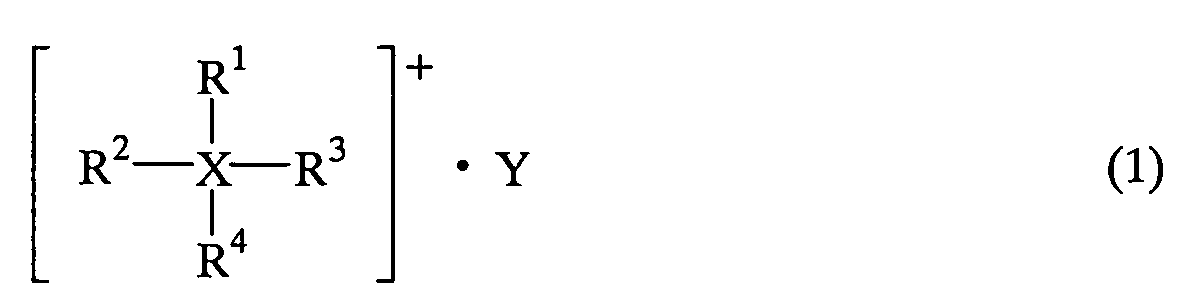
X is a nitrogen atom or a phosphorus atom, and
Y is a monovalent anion;a compound which reductively decomposes at a more noble potential than the ionic liquid; anda lithium salt. - The nonaqueous electrolyte of claim 1 which is characterized in that the compound reductively decomposes at a more noble potential than the ionic liquid when a working electrode used with the electrolyte is made of a carbonaceous material or metallic lithium.
- The nonaqueous electrolyte of claim 1 or 2 which is characterized in that the content of said compound within the electrolyte is from 0.1 to 60 wt%.
- The nonaqueous electrolyte of claim 3 which is characterized in that the content of said compound is 0.1 to 30 wt%.
- The nonaqueous electrolyte of any one of claims 1 to 4 which is characterized in that the compound is one or more selected from among ethylene carbonate, propylene carbonate, vinylene carbonate, dimethyl carbonate, ethyl methyl carbonate and diethyl carbonate.
- The nonaqueous electrolyte of any one of claims 1 to 5 which is characterized in that the ionic liquid has a melting point not higher than 25°C.
- The nonaqueous electrolyte of any one of claims 1 to 6 which is characterized in that X is a nitrogen atom, R' is methyl, and the letter n is 2.
- The nonaqueous electrolyte of any one of claims 1 to 6 which is characterized in that the ionic liquid has general formula (2) belowwherein R' is methyl or ethyl, X is a nitrogen atom or a phosphorus atom, Y is a monovalent anion, Me stands for methyl and Et stands for ethyl.

- The nonaqueous electrolyte of any one of claims 1 to 8 which is characterized in that Y is BF4 -, PF6 -, (CF3SO2)2N-, CF3SO3 - or CF3CO2 -.
- The nonaqueous electrolyte of any one of claims 1 to 9 which is characterized in that the lithium salt is LiBF4, LiPF6, Li(CF3SO2)2N, LiCF3SO3 or LiCF3CO2.
- A nonaqueous electrolyte secondary cell having a positive electrode which contains a lithium-containing double oxide, a negative electrode which contains a carbonaceous material capable of inserting and extracting lithium ions or contains metallic lithium, a separator between the positive and negative electrodes, and a nonaqueous electrolyte;
which secondary cell is characterized in that the nonaqueous electrolyte is a nonaqueous electrolyte according to any one of claims 1 to 10. - The nonaqueous electrolyte secondary cell of claim 11 which is characterized in that the separator is a porous film or porous sheet having a thickness of 20 to 50 µm and a porosity of 25 to 85%.
- The nonaqueous electrolyte secondary cell of claim 12 which is characterized in that the porous film or porous sheet is composed primarily of cellulose.
Applications Claiming Priority (5)
| Application Number | Priority Date | Filing Date | Title |
|---|---|---|---|
| JP2002248004 | 2002-08-28 | ||
| JP2002248004 | 2002-08-28 | ||
| JP2003149584 | 2003-05-27 | ||
| JP2003149584A JP2004146346A (en) | 2002-08-28 | 2003-05-27 | Non-aqueous electrolyte and non-aqueous electrolyte secondary battery |
| PCT/JP2003/010629 WO2004021500A1 (en) | 2002-08-28 | 2003-08-22 | Nonaqueous electrolyte and nonaqueous-electrolyte secondary battery |
Publications (2)
| Publication Number | Publication Date |
|---|---|
| EP1548866A1 true EP1548866A1 (en) | 2005-06-29 |
| EP1548866A4 EP1548866A4 (en) | 2008-03-26 |
Family
ID=31980491
Family Applications (1)
| Application Number | Title | Priority Date | Filing Date |
|---|---|---|---|
| EP03791250A Withdrawn EP1548866A4 (en) | 2002-08-28 | 2003-08-22 | NONAQUEOUS ELECTROLYTE AND NONAQUEOUS ELECTROLYTE SECONDARY BATTERY |
Country Status (8)
| Country | Link |
|---|---|
| US (1) | US20060035137A1 (en) |
| EP (1) | EP1548866A4 (en) |
| JP (1) | JP2004146346A (en) |
| KR (1) | KR20050056994A (en) |
| CN (1) | CN100407493C (en) |
| AU (1) | AU2003262275A1 (en) |
| CA (1) | CA2497109A1 (en) |
| WO (1) | WO2004021500A1 (en) |
Cited By (6)
| Publication number | Priority date | Publication date | Assignee | Title |
|---|---|---|---|---|
| EP1548750A4 (en) * | 2002-09-20 | 2006-09-06 | Nisshin Spinning | NONAQUEOUS ELECTROLYTE, DOUBLE LAYER CAPACITORS, AND NONAQUEOUS ELECTROLYTE BATTERIES |
| EP1642894A4 (en) * | 2003-07-01 | 2008-01-23 | Otsuka Chemical Co Ltd | Quaternary ammonium salt, electrolyte, and electrochemical device |
| EP1689016A4 (en) * | 2003-11-04 | 2009-10-28 | Stella Chemifa Corp | Electrolyte solution and nonaqueous electrolyte lithium secondary battery |
| WO2010023185A1 (en) * | 2008-08-29 | 2010-03-04 | Commissariat A L'energie Atomique | Lithium-ion rechargeable accumulators including an ionic liquid electrolyte |
| CN101336495B (en) * | 2005-12-26 | 2012-11-28 | 株式会社普利司通 | Nonaqueous electrolyte solution for battery, nonaqueous electrolyte battery comprising same, electrolyte solution for electric double layer capacitor and electric double layer capacitor comprising sam |
| FR3002086A1 (en) * | 2013-02-13 | 2014-08-15 | Commissariat Energie Atomique | PROCESS FOR THE SYNTHESIS OF IONIC LIQUIDS WITH CARBONATE FUNCTIONAL GROUP AND IONIC LIQUIDS THUS OBTAINED |
Families Citing this family (55)
| Publication number | Priority date | Publication date | Assignee | Title |
|---|---|---|---|---|
| JP4237531B2 (en) * | 2003-04-17 | 2009-03-11 | 三星エスディアイ株式会社 | Lithium secondary battery and method for producing lithium secondary battery |
| JP2005135776A (en) * | 2003-10-30 | 2005-05-26 | Yuasa Corp | Nonaqueous electrolytes and electrochemical devices |
| DE102004018930A1 (en) | 2004-04-20 | 2005-11-17 | Degussa Ag | Use of a ceramic separator in lithium-ion batteries having an electrolyte containing ionic liquids |
| JP4763987B2 (en) * | 2004-08-27 | 2011-08-31 | 帝人化成株式会社 | Polycarbonate resin composition |
| JP2006206517A (en) * | 2005-01-28 | 2006-08-10 | Koei Chem Co Ltd | Quaternary salt |
| JP2006236829A (en) * | 2005-02-25 | 2006-09-07 | Nisshinbo Ind Inc | Ionic liquid, non-aqueous electrolyte for electricity storage device, and electricity storage device |
| JP4519685B2 (en) * | 2005-03-14 | 2010-08-04 | 株式会社東芝 | Non-aqueous electrolyte battery |
| JP5165862B2 (en) * | 2005-07-19 | 2013-03-21 | パナソニック株式会社 | Non-aqueous electrolyte and electrochemical energy storage device using the same |
| US20090130565A1 (en) | 2005-07-19 | 2009-05-21 | Tooru Matsui | Non-aqueous electrolyte and electrochemical energy storage device using the same |
| JP4939836B2 (en) | 2005-11-08 | 2012-05-30 | 株式会社ブリヂストン | Ionic compounds |
| JP5032773B2 (en) * | 2006-02-03 | 2012-09-26 | 第一工業製薬株式会社 | Lithium secondary battery using ionic liquid |
| WO2008013409A1 (en) * | 2006-07-28 | 2008-01-31 | Lg Chem, Ltd. | Secondary batteries comprising eutectic mixture and preparation method thereof |
| EP2070150B1 (en) | 2006-09-25 | 2013-05-01 | LG Chem, Ltd. | Non-aqueous electrolyte solution and electrochemical device comprising the same |
| KR100977974B1 (en) * | 2007-01-16 | 2010-08-24 | 주식회사 엘지화학 | Electrolyte including eutectic mixture and secondary battery using same |
| JP2009138254A (en) * | 2007-02-13 | 2009-06-25 | Teijin Pharma Ltd | Electrochemical oxygen generator |
| EP1968141A1 (en) * | 2007-02-24 | 2008-09-10 | Ngk Insulators, Ltd. | Secondary battery |
| US9048508B2 (en) | 2007-04-20 | 2015-06-02 | Mitsubishi Chemical Corporation | Nonaqueous electrolytes and nonaqueous-electrolyte secondary batteries employing the same |
| EP2166611B1 (en) | 2007-04-20 | 2013-12-25 | Mitsubishi Chemical Corporation | Nonaqueous electrolyte, and rechargeable battery with the nonaqueous electrolyte |
| JP2010532071A (en) * | 2007-06-29 | 2010-09-30 | コモンウェルス サイエンティフィック アンド インダストリアル リサーチ オーガニゼイション | Lithium energy storage device |
| EP2023434B1 (en) * | 2007-07-23 | 2016-09-07 | Litarion GmbH | Electrolyte preparations for energy storage devices based on ionic fluids |
| JP5242973B2 (en) * | 2007-08-23 | 2013-07-24 | 日本化学工業株式会社 | Electrolyte composition for electricity storage device and electricity storage device using the same |
| DE102007043660A1 (en) * | 2007-09-13 | 2009-03-26 | Biotronik Crm Patent Ag | Battery operated device, in particular implantable medical electronic device |
| WO2009091159A2 (en) * | 2008-01-16 | 2009-07-23 | Lg Chem, Ltd. | Electrolyte having eutectic mixture and electrochemical device containing the same |
| JP5305678B2 (en) * | 2008-02-07 | 2013-10-02 | 株式会社東芝 | Non-aqueous electrolyte battery and battery pack |
| JP5499868B2 (en) * | 2010-04-20 | 2014-05-21 | コニカミノルタ株式会社 | Method for producing electrode for lithium ion secondary battery |
| WO2012017520A1 (en) * | 2010-08-03 | 2012-02-09 | トヨタ自動車株式会社 | Lithium secondary battery |
| JP6228009B2 (en) * | 2010-09-13 | 2017-11-08 | ザ、リージェンツ、オブ、ザ、ユニバーシティ、オブ、カリフォルニアThe Regents Of The University Of California | Ionic gel electrolytes, energy storage devices, and methods for their production |
| US9786947B2 (en) | 2011-02-07 | 2017-10-10 | Sila Nanotechnologies Inc. | Stabilization of Li-ion battery anodes |
| WO2012115092A1 (en) * | 2011-02-24 | 2012-08-30 | 日本電気株式会社 | Separator for accumulators, and accumulator |
| US9142357B2 (en) * | 2011-02-24 | 2015-09-22 | Nec Corporation | Separator for electric storage device and electric storage device |
| CN102694205B (en) | 2011-03-25 | 2016-05-18 | 昭荣化学工业株式会社 | Electrolyte solvent and electrolyte solution and lithium rechargeable battery for oxysalt lithium positive active material |
| WO2013040100A1 (en) * | 2011-09-13 | 2013-03-21 | Wildcat Discovery Technologies, Inc. | Electrolyte materials for batteries and methods for use |
| JP5668662B2 (en) * | 2011-10-07 | 2015-02-12 | トヨタ自動車株式会社 | Electrolyte |
| CA2823168A1 (en) | 2011-10-13 | 2013-04-18 | Tokushu Tokai Paper Co., Ltd. | Porous membrane and process for preparing the same |
| RU2542267C1 (en) | 2011-10-13 | 2015-02-20 | Токусю Токай Пейпер Ко., Лтд. | Porous membrane and method of its production |
| MX2013008027A (en) | 2011-10-13 | 2014-12-08 | Tokushu Tokai Paper Co Ltd | Microporous membrane and method for producing same. |
| RU2535205C1 (en) | 2011-10-13 | 2014-12-10 | Токусю Токай Пейпер Ко., Лтд. | Separator for electrochemical device and method of its manufacturing |
| EP2648244B1 (en) * | 2011-10-13 | 2015-05-06 | Tokushu Tokai Paper Co., Ltd. | Microporous film and manufacturing method therefor |
| JP6103708B2 (en) * | 2013-07-25 | 2017-03-29 | 国立大学法人神戸大学 | Interpenetrating network structure containing ionic liquid and method for producing the same |
| WO2015104727A1 (en) * | 2014-01-10 | 2015-07-16 | Lithops S.R.L. | Polymer electrolyte membranes and process for the production thereof |
| US11949071B2 (en) * | 2014-05-15 | 2024-04-02 | NOHMs Technologies, Inc. | Ionic liquids for solvating cyclic carbonates |
| US10530011B1 (en) | 2014-07-21 | 2020-01-07 | Imprint Energy, Inc. | Electrochemical cells and metal salt-based electrolytes |
| WO2016160703A1 (en) | 2015-03-27 | 2016-10-06 | Harrup Mason K | All-inorganic solvents for electrolytes |
| JP6794621B2 (en) * | 2015-11-10 | 2020-12-02 | 株式会社リコー | Gel electrolyte and electrochromic devices |
| CA3019132A1 (en) | 2016-04-01 | 2017-10-05 | NOHMs Technologies, Inc. | Modified ionic liquids containing phosphorus |
| US10707531B1 (en) | 2016-09-27 | 2020-07-07 | New Dominion Enterprises Inc. | All-inorganic solvents for electrolytes |
| JP2018200812A (en) * | 2017-05-26 | 2018-12-20 | 住友化学株式会社 | Non-aqueous electrolyte secondary battery |
| EP3656010B1 (en) | 2017-07-17 | 2025-03-26 | Sionic Energy, Inc. | Phosphorus-containing electrolytes |
| KR102657448B1 (en) | 2017-07-26 | 2024-04-16 | 주식회사 엘지에너지솔루션 | Polymer electrolyte for secondary battery and lithium secondary battery comprising the same |
| KR102261504B1 (en) * | 2017-08-10 | 2021-06-07 | 주식회사 엘지에너지솔루션 | Pre-lithiation Method of Anode Electrodes for secondary battery |
| CN113381072A (en) * | 2017-12-06 | 2021-09-10 | 宁德新能源科技有限公司 | Electrolyte and battery containing the same |
| JP7446657B2 (en) * | 2018-04-05 | 2024-03-11 | エルジー エナジー ソリューション リミテッド | Electrodes for secondary batteries, electrolyte layers for secondary batteries, and secondary batteries |
| KR102152306B1 (en) | 2018-04-19 | 2020-09-04 | 삼성에스디아이 주식회사 | Electrolyte for rechargeable lithium battery and rechargeable lithium battery |
| KR102739118B1 (en) | 2018-07-27 | 2024-12-05 | 삼성전자주식회사 | Lithium battery |
| KR102626832B1 (en) * | 2021-09-14 | 2024-01-19 | 주식회사 엘지에너지솔루션 | Non-aqueous electrolyte for lithium secondary battery and lithium secondary battery comprising same |
Family Cites Families (20)
| Publication number | Priority date | Publication date | Assignee | Title |
|---|---|---|---|---|
| DE3126522A1 (en) * | 1981-07-04 | 1983-01-20 | Basf Ag, 6700 Ludwigshafen | QUATERNAIRE AMMONIUM SALTS AND METHOD FOR THEIR PRODUCTION |
| JPS6030065A (en) * | 1983-07-29 | 1985-02-15 | Nippon Telegr & Teleph Corp <Ntt> | Electrolyte for lithium secondary battery |
| CN1009042B (en) * | 1984-07-13 | 1990-08-01 | 昭和电工株式会社 | secondary battery |
| JP3075766B2 (en) * | 1991-05-27 | 2000-08-14 | 株式会社東芝 | Lithium battery |
| JPH0992257A (en) * | 1995-09-27 | 1997-04-04 | Sony Corp | Non-aqueous electrolyte secondary battery |
| JP3426869B2 (en) * | 1996-09-18 | 2003-07-14 | 株式会社東芝 | Non-aqueous electrolyte secondary battery |
| JPH1167273A (en) * | 1997-08-21 | 1999-03-09 | Toshiba Corp | Lithium secondary battery |
| JP3774315B2 (en) | 1998-03-12 | 2006-05-10 | 株式会社東芝 | Nonaqueous electrolyte secondary battery |
| JPH11307121A (en) * | 1998-04-22 | 1999-11-05 | Mitsubishi Chemical Corp | Electrolyte for lithium secondary battery |
| GB9906829D0 (en) * | 1999-03-24 | 1999-05-19 | Univ Leicester | Ionic liquids |
| DE10016801A1 (en) * | 2000-04-05 | 2001-10-11 | Merck Patent Gmbh | Lithium salts, processes for their production, non-aqueous electrolyte and electrochemical cell |
| US20020110739A1 (en) * | 2000-05-26 | 2002-08-15 | Mcewen Alan B. | Non-flammable electrolytes |
| KR100473433B1 (en) * | 2000-07-17 | 2005-03-08 | 마쯔시다덴기산교 가부시키가이샤 | Non-aqueous electrolyte and non-aqueous electrolytic cell and electrolytic condenser comprising the same |
| US20020081485A1 (en) * | 2000-11-01 | 2002-06-27 | Toshihiro Takekawa | Non-aqueous rechargeable battery for vehicles |
| JP4240263B2 (en) * | 2000-12-22 | 2009-03-18 | 富士フイルム株式会社 | Electrolyte composition and non-aqueous electrolyte secondary battery |
| KR100861916B1 (en) * | 2001-03-26 | 2008-10-09 | 닛신보세키 가부시키 가이샤 | Ionic liquid, electrolyte salt for storage device, electrolytic solution for storage device, electric double layer capacitor, and secondary battery |
| KR100970918B1 (en) * | 2002-04-24 | 2010-07-16 | 닛신보 홀딩스 가부시키 가이샤 | Ionic liquids and dehydration methods, and electric double layer capacitors, and secondary cells |
| US7342769B2 (en) * | 2002-08-23 | 2008-03-11 | Nisshinbo Industries, Inc. | Electric double-layer capacitor |
| DE60314433T2 (en) * | 2002-09-20 | 2008-02-14 | Nisshinbo Industries, Inc. | COMPOSITION FOR POLYELECTROLYTE, POLYELECTROLYTE, ELECTRIC DOUBLE-LAYER CAPACITORS AND SECONDARY CELLS WITH A WATER-FREE ELECTROLYTE |
| JP4298246B2 (en) * | 2002-09-20 | 2009-07-15 | 日清紡ホールディングス株式会社 | Nonaqueous electrolyte, electric double layer capacitor and nonaqueous electrolyte secondary battery |
-
2003
- 2003-05-27 JP JP2003149584A patent/JP2004146346A/en active Pending
- 2003-08-22 WO PCT/JP2003/010629 patent/WO2004021500A1/en not_active Ceased
- 2003-08-22 US US10/525,818 patent/US20060035137A1/en not_active Abandoned
- 2003-08-22 KR KR1020057002612A patent/KR20050056994A/en not_active Ceased
- 2003-08-22 CA CA002497109A patent/CA2497109A1/en not_active Abandoned
- 2003-08-22 CN CN038205890A patent/CN100407493C/en not_active Expired - Fee Related
- 2003-08-22 AU AU2003262275A patent/AU2003262275A1/en not_active Abandoned
- 2003-08-22 EP EP03791250A patent/EP1548866A4/en not_active Withdrawn
Cited By (12)
| Publication number | Priority date | Publication date | Assignee | Title |
|---|---|---|---|---|
| EP1548750A4 (en) * | 2002-09-20 | 2006-09-06 | Nisshin Spinning | NONAQUEOUS ELECTROLYTE, DOUBLE LAYER CAPACITORS, AND NONAQUEOUS ELECTROLYTE BATTERIES |
| US7154737B2 (en) | 2002-09-20 | 2006-12-26 | Nisshinbo Industries, Inc. | Nonaqueous electrolyte, electrical double-layer capacitors, and nonaqueous electrolyte secondary cells |
| EP1642894A4 (en) * | 2003-07-01 | 2008-01-23 | Otsuka Chemical Co Ltd | Quaternary ammonium salt, electrolyte, and electrochemical device |
| EP1689016A4 (en) * | 2003-11-04 | 2009-10-28 | Stella Chemifa Corp | Electrolyte solution and nonaqueous electrolyte lithium secondary battery |
| CN101336495B (en) * | 2005-12-26 | 2012-11-28 | 株式会社普利司通 | Nonaqueous electrolyte solution for battery, nonaqueous electrolyte battery comprising same, electrolyte solution for electric double layer capacitor and electric double layer capacitor comprising sam |
| WO2010023185A1 (en) * | 2008-08-29 | 2010-03-04 | Commissariat A L'energie Atomique | Lithium-ion rechargeable accumulators including an ionic liquid electrolyte |
| FR2935547A1 (en) * | 2008-08-29 | 2010-03-05 | Commissariat Energie Atomique | IONIC LIQUID ELECTROLYTES AND ELECTROCHEMICAL DEVICES SUCH AS ACCUMULATORS COMPRISING SAME. |
| CN102138235A (en) * | 2008-08-29 | 2011-07-27 | 法国原子能及替代能源委员会 | Lithium-ion rechargeable batteries containing ionic liquid electrolytes |
| CN102138235B (en) * | 2008-08-29 | 2014-08-27 | 法国原子能及替代能源委员会 | Lithium-ion rechargeable batteries containing ionic liquid electrolytes |
| FR3002086A1 (en) * | 2013-02-13 | 2014-08-15 | Commissariat Energie Atomique | PROCESS FOR THE SYNTHESIS OF IONIC LIQUIDS WITH CARBONATE FUNCTIONAL GROUP AND IONIC LIQUIDS THUS OBTAINED |
| WO2014124892A1 (en) * | 2013-02-13 | 2014-08-21 | Commissariat A L'energie Atomique Et Aux Energies Alternatives | Method for synthesising ionic liquids having a carbonate functional group and resulting ionic liquids. |
| US10026993B2 (en) | 2013-02-13 | 2018-07-17 | Commissariat A L'energie Atomique Et Aux Energies Alternatives | Method for synthesizing ionic liquids having a carbonate functional group and ionic liquids thus obtained |
Also Published As
| Publication number | Publication date |
|---|---|
| CN1679200A (en) | 2005-10-05 |
| AU2003262275A1 (en) | 2004-03-19 |
| WO2004021500A1 (en) | 2004-03-11 |
| EP1548866A4 (en) | 2008-03-26 |
| CN100407493C (en) | 2008-07-30 |
| CA2497109A1 (en) | 2004-03-11 |
| JP2004146346A (en) | 2004-05-20 |
| US20060035137A1 (en) | 2006-02-16 |
| KR20050056994A (en) | 2005-06-16 |
Similar Documents
| Publication | Publication Date | Title |
|---|---|---|
| US20060035137A1 (en) | Nonaqueous electrolyte and nonaqueous-electrolyte secondary battery | |
| EP1548750B1 (en) | Nonaqueous electrolyte, electrical double layer capacitors, and nonaqueous electrolyte secondary cells | |
| EP1548751B1 (en) | Composition for polyelectrolytes, polyelectrolytes, electrical double layer capacitors and nonaqueous electrolyte secondary cells | |
| US7297289B2 (en) | Ionic liquids, electrolyte salts for storage device, electrolytic solution for storage device, electric double layer capacitor, and secondary battery | |
| US20040139587A1 (en) | Polymer gel electrolyte-use composition and method for non-aqueous electrolyte solution | |
| US20040146786A1 (en) | Nonaqueous electolytic solution, composition for polymer gel electrolyte, polymer gel electrolyte, secondary cell, and electric double-layer capacitor | |
| US20040076885A1 (en) | Composition for polymer gel electrolyte, polymer gel electrolyte, and secondary battery and electric double layer capacitor each employing the electrolyte | |
| US20040234865A1 (en) | Nonaqueous electrolyte secondary cell, power supply comprising the secondary cell, portable device, transportable or movable machine, electric apparatus for home use, and method for charging nonaqueous electrolyte secondary cell | |
| JPH11307121A (en) | Electrolyte for lithium secondary battery | |
| JP4081569B2 (en) | Voltage control method for non-aqueous electrolyte secondary battery | |
| CN101284791B (en) | Electrolytic solution for storage device, and electric double layer capacitor | |
| JP2002198093A (en) | Electrolyte composition, polymer solid electrolyte, polymer gel electrolyte and lithium polymer battery |
Legal Events
| Date | Code | Title | Description |
|---|---|---|---|
| PUAI | Public reference made under article 153(3) epc to a published international application that has entered the european phase |
Free format text: ORIGINAL CODE: 0009012 |
|
| 17P | Request for examination filed |
Effective date: 20050317 |
|
| AK | Designated contracting states |
Kind code of ref document: A1 Designated state(s): AT BE BG CH CY CZ DE DK EE ES FI FR GB GR HU IE IT LI LU MC NL PT RO SE SI SK TR |
|
| AX | Request for extension of the european patent |
Extension state: AL LT LV MK |
|
| DAX | Request for extension of the european patent (deleted) | ||
| A4 | Supplementary search report drawn up and despatched |
Effective date: 20080226 |
|
| 17Q | First examination report despatched |
Effective date: 20080722 |
|
| STAA | Information on the status of an ep patent application or granted ep patent |
Free format text: STATUS: THE APPLICATION IS DEEMED TO BE WITHDRAWN |
|
| 18D | Application deemed to be withdrawn |
Effective date: 20100427 |