EP1548706A1 - Methode zur kodierung einer tonquelle mit einem probabilistischem code-buch - Google Patents
Methode zur kodierung einer tonquelle mit einem probabilistischem code-buch Download PDFInfo
- Publication number
- EP1548706A1 EP1548706A1 EP03811104A EP03811104A EP1548706A1 EP 1548706 A1 EP1548706 A1 EP 1548706A1 EP 03811104 A EP03811104 A EP 03811104A EP 03811104 A EP03811104 A EP 03811104A EP 1548706 A1 EP1548706 A1 EP 1548706A1
- Authority
- EP
- European Patent Office
- Prior art keywords
- excitation vector
- channel
- codebook
- code
- coding method
- Prior art date
- Legal status (The legal status is an assumption and is not a legal conclusion. Google has not performed a legal analysis and makes no representation as to the accuracy of the status listed.)
- Withdrawn
Links
Images


Classifications
-
- G—PHYSICS
- G10—MUSICAL INSTRUMENTS; ACOUSTICS
- G10L—SPEECH ANALYSIS TECHNIQUES OR SPEECH SYNTHESIS; SPEECH RECOGNITION; SPEECH OR VOICE PROCESSING TECHNIQUES; SPEECH OR AUDIO CODING OR DECODING
- G10L19/00—Speech or audio signals analysis-synthesis techniques for redundancy reduction, e.g. in vocoders; Coding or decoding of speech or audio signals, using source filter models or psychoacoustic analysis
- G10L19/04—Speech or audio signals analysis-synthesis techniques for redundancy reduction, e.g. in vocoders; Coding or decoding of speech or audio signals, using source filter models or psychoacoustic analysis using predictive techniques
- G10L19/08—Determination or coding of the excitation function; Determination or coding of the long-term prediction parameters
- G10L19/12—Determination or coding of the excitation function; Determination or coding of the long-term prediction parameters the excitation function being a code excitation, e.g. in code excited linear prediction [CELP] vocoders
-
- G—PHYSICS
- G10—MUSICAL INSTRUMENTS; ACOUSTICS
- G10L—SPEECH ANALYSIS TECHNIQUES OR SPEECH SYNTHESIS; SPEECH RECOGNITION; SPEECH OR VOICE PROCESSING TECHNIQUES; SPEECH OR AUDIO CODING OR DECODING
- G10L19/00—Speech or audio signals analysis-synthesis techniques for redundancy reduction, e.g. in vocoders; Coding or decoding of speech or audio signals, using source filter models or psychoacoustic analysis
- G10L19/04—Speech or audio signals analysis-synthesis techniques for redundancy reduction, e.g. in vocoders; Coding or decoding of speech or audio signals, using source filter models or psychoacoustic analysis using predictive techniques
- G10L19/08—Determination or coding of the excitation function; Determination or coding of the long-term prediction parameters
- G10L19/10—Determination or coding of the excitation function; Determination or coding of the long-term prediction parameters the excitation function being a multipulse excitation
- G10L19/107—Sparse pulse excitation, e.g. by using algebraic codebook
-
- G—PHYSICS
- G10—MUSICAL INSTRUMENTS; ACOUSTICS
- G10L—SPEECH ANALYSIS TECHNIQUES OR SPEECH SYNTHESIS; SPEECH RECOGNITION; SPEECH OR VOICE PROCESSING TECHNIQUES; SPEECH OR AUDIO CODING OR DECODING
- G10L19/00—Speech or audio signals analysis-synthesis techniques for redundancy reduction, e.g. in vocoders; Coding or decoding of speech or audio signals, using source filter models or psychoacoustic analysis
- G10L2019/0001—Codebooks
- G10L2019/0004—Design or structure of the codebook
Definitions
- the present invention relates to a stochastic codebook excitation vector coding method in a CELP speech coding apparatus/speech decoding apparatus.
- speech signals are transmitted in a packet communication system typified by Internet communication, a mobile communication system, or the like, compression and coding techniques are used to improve the speech signal transmission efficiency.
- Many speech coding methods have been developed to date, and many low bit rate speech coding methods developed in recent years, such as CELP, separate a speech signal into spectrum envelope information and spectrum detailed structure information, and perform compression and coding of the separated information.
- synthetic speech vectors are calculated for all combinations of adaptive code vectors stored by an adaptive codebook and fixed code vectors stored by a stochastic codebook, distance calculation is performed for each synthetic speech and input speech signal, and the adaptive code vector index and fixed code vector index for which the distance is smallest are found.
- One known stochastic codebook is an algebraic codebook. This codebook enables a stochastic codebook search to be performed with a comparatively small amount of calculation, and has consequently been widely used in CELP in recent years.
- An excitation vector of an algebraic codebook is composed of a small number of pulses with an amplitude of 1 and polarities (+, -), and the pulses (in this case, excitation vector waveform candidates) are positioned so as not to overlap each other.
- a conventional stochastic codebook codes the pulse positions of each channel independently, and takes codes combining these with polarity codes as stochastic excitation vector codes.
- a problem with the above conventional stochastic codebook coding method is that, if the bit rate is low the bits assigned to each channel are also limited, and there are positions where there is no pulse at all, so that variations of an excitation vector waveform corresponding to a code (position information) decrease, and sound quality degradation occurs.
- This object is achieved by associating a pulse position of a predetermined channel with a pulse position of another channel, searching for a pulse position by means of a predetermined algorithm, and taking a found pulse position code and a polarity code as a stochastic excitation vector code.
- FIG.1 is a block diagram showing the configuration of a CELP speech coding apparatus.
- An input speech signal is input sequentially to the speech coding apparatus divided into processing frames at time intervals of approximately 20 ms.
- LPC analysis section 101 performs LPC (Linear Predictive Coding) of the input speech signal and obtains an LPC coefficient, performs vector quantization of the LPC coefficient to produce an LPC code, and decodes this LPC code to obtain a decoded LPC coefficient.
- LPC Linear Predictive Coding
- An excitation vector creation section 104 reads an adaptive code vector and fixed code vector respectively from an adaptive codebook 102 and stochastic codebook 103, and sends these to an LPC combining section 105.
- LPC combining section 105 performs combining filtering of the adaptive code vector and fixed code vector supplied from excitation vector creation section 104, and the decoded LPC coefficient provided from LPC analysis section 101, with an all pole type combining filter in the filter coefficient, and obtains a combined adaptive code vector and combined fixed code vector.
- a comparison section 106 analyzes the relationship between the combined adaptive code vector and combined fixed code vector output from LPC combining section 105, and finds adaptive codebook optimum gain to be multiplied by the combined adaptive code vector, and stochastic codebook optimum gain to be multiplied by the combined fixed code vector.
- Comparison section 106 also adds together the vector obtained by multiplying the combined adaptive code vector by the adaptive codebook optimum gain and the vector obtained by multiplying the combined fixed code vector by the stochastic codebook optimum gain, and obtains a combined speech vector, and performs a distance calculation on the combined speech and input speech signal. Then comparison section 106 obtains the adaptive code vector stored by adaptive codebook 102 and the combined speech vector stored by stochastic codebook 103, and finds the adaptive code vector index and fixed code vector index for which the distance between the combined speech and input speech signal is smallest. Comparison section 106 then sends the indexes of the code vectors output from the codebooks, the code vectors corresponding to the respective indexes, and the adaptive codebook optimum gain and stochastic codebook optimum gain, to a parameter coding section 107.
- Parameter coding section 107 codes the adaptive codebook optimum gain and stochastic codebook optimum gain and obtains a gain code, and outputs the gain code, the LPC coefficient provided by LPC analysis section 101, and the indexes of each codebook together for each processing frame.
- Parameter coding section 107 also adds together the two vectors comprising the vector obtained by multiplying the adaptive code vector corresponding to the adaptive codebook index by the adaptive codebook gain corresponding to the gain code, and the vector obtained by multiplying the fixed code vector corresponding to the stochastic codebook index by the stochastic codebook gain corresponding to the gain code, and obtains a drive excitation vector, and updates the old adaptive code vector in adaptive codebook 102 with the drive excitation vector.
- Combining filtering by LPC combining section 105 generally makes combined use of a linear predictive coefficient, a high emphasis filter, and a weighting filter that uses a long-term predictive coefficient obtained by long-term predictive analysis of input speech.
- Adaptive codebook and stochastic codebook optimum index searches, optimum gain calculation, and optimum gain coding processing are generally carried out in subframe units resulting from further division of a frame.
- comparison section 106 In order to reduce the amount of calculation, comparison section 106 usually searches for an adaptive codebook 102 excitation vector and stochastic codebook 103 excitation vector by means of an open-loop procedure. This open-loop search procedure is described below.
- the stochastic codebook 103 excitation vector search method will now be described in detail.
- Excitation vector code derivation is carried out by searching for the excitation vector that minimizes coding distortion E in Equation (1) below.
- x denotes the coding target;
- E
- stochastic codebook 103 code derivation is performed by searching for the excitation vector that minimizes coding distortion E in Equations (2) below.
- y denotes the stochastic excitation vector search target vector.
- yH can be found by reversing the order of vector y and convoluting matrix H, and then reversing the order of the result, and HH can be found by multiplication of the matrices.
- Stochastic codebook 103 searches for and codes a stochastic excitation vector using the procedure described in (1) through (4) below.
- Embodiment 1 a case is described in which an index of a predetermined channel is changed in accordance with another channel.
- channel 0 pulse positions ici0[i0], channel 1 pulse positions ici1[j1], channel 2 pulse positions ici2[j2], and channel 3 pulse positions ici3[j3] are as shown below.
- i0 (0 ⁇ i0 ⁇ 7) is the index of channel 0
- j1 (0 ⁇ j1 ⁇ 7) is the index of channel 1
- j2 (0 ⁇ j2 ⁇ 7) is the index of channel 2
- 3 (0 ⁇ j3 ⁇ 7) is the index of channel 3.
- Channel 1, channel 2, and channel 3 pulses are grouped into pairs. For example, for channel 1, pulses are grouped into group 0 ⁇ 1, 5 ⁇ , group 1 ⁇ 9, 13 ⁇ , group 2 ⁇ 17, 21 ⁇ , and group 3 ⁇ 25, 29 ⁇ .
- Equation (5) the relationship between indexes j1, j2, and j3 and group indexes i1, i2, and i3 is as shown in Equations (5) below.
- j1 i1 ⁇ 2 + (i0 % 2)
- j2 i2 ⁇ 2 + ((i0 + i1) % 2)
- j3 i3 ⁇ 2 + ((i1 + i2) %2)
- the "%” symbol denotes an operation that finds the remainder when the numeric value on the left of "%" (index) is divided by the numeric value on the right. If indexes i0 through i3 are expressed as binary numbers, the "%" operation can be implemented simply by checking the code of the least significant bit of the index on the left.
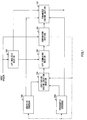
- FIG.2 and FIG.3 are flowcharts showing an example of a pulse search algorithm for each channel in a coding method according to this embodiment.
- loop 0 is a loop in which i0 is changed from 0 through 7
- loop 1 is a loop in which i1 is changed from 0 through 3
- loop 2 is a loop in which i2 is changed from 0 through 3
- loop 3 is a loop in which i3 is changed from 0 through 3.
- first, i0, i1, and i2 are fixed at 0, and as the first stage, y and H in each i3 are calculated in loop 3, and maximum values ymax and Hmax thereamong, and i0, i1, i2, and i3 at that time are stored as ii0, ii1, ii2, and ii3 respectively.
- the channel 3 pulse positions searched for in the first stage change according to the values of i0, i1, and i2.
- the channel 2 pulse positions searched for in the second stage change according to the values of i0 and i1.
- i0 is incremented in loop 0 and the above first-stage, second-stage, and third-stage computations are performed for each i0.
- the channel 1 pulse positions searched for in the third stage change according to the value of i0.
- ii0 is 3 bits and ii1, ii2, and ii3 are 2 bits each, so that pulse position coding can be performed in 9 bits, and together with the polarity codes of each channel (1 bit ⁇ 4 channels), coding can be performed with a 13-bit code. Therefore, compared with the conventional method, the number of bits necessary for coding can be reduced, and a lower bit rate can be achieved.
- pulse positions of a predetermined channel are associated with pulse positions of another channel by changing the predetermined channel index in accordance with another channel.
- a stochastic excitation vector can be represented by fewer bits than heretofore, and variations can be secured so that there are no positions where there is no pulse at all.
- Embodiment 2 a case is described in which the pulse positions themselves of a predetermined channel are changed in accordance with another channel.
- channel 0 pulse positions ici0[i0], channel 1 pulse positions ici1[i1], channel 2 pulse positions ici2[i2], and channel 3 pulse positions ici3[i3] are as shown below.
- i0 (0 ⁇ i 0 ⁇ 7) is the index of channel 0
- i1 (0 ⁇ i1 ⁇ 7) is the index of channel 1
- i2 (0 ⁇ i2 ⁇ 3) is the index of channel 2
- i3 (0 ⁇ i3 ⁇ 3) is the index of channel 3.
- channel pulse positions ici0[i0], ici1[i1], ici2[i2], and ici3[i3] are adjusted to k0, k1, k2, and k3 with indexes i0, i1, i2, and i3 by means of Equations (6) below.
- k0 ici0 [i0]
- k1 ici1 [i1] ⁇ 2 + (i0 % 2)
- k2 ici0 [i2] ⁇ 2 + ((i0 + i1) %2)
- k3 ici0 [i3] ⁇ 2 + ((i1 + i2) %2)
- the "%” symbol denotes an operation that finds the remainder when the numeric value on the left of "%" (index) is divided by the numeric value on the right.
- Equations (6) the pulse positions themselves of channels 1 through 3 are changed according to another channel.
- adjusted pulse positions k0, k1, k2, and k3 of channels 0 through 3 are as shown below.
- FIG.4 and FIG.5 are flowcharts showing an example of a pulse search algorithm for each channel in a coding method according to this embodiment.
- loop 0 is a loop in which i0 is changed from 0 through 7
- loop 1 is a loop in which i1 is changed from 0 through 3
- loop 2 is a loop in which i2 is changed from 0 through 3
- loop 3 is a loop in which i3 is changed from 0 through 3.
- first, i0, i1, and i2 are fixed at 0, and as the first stage, y and H in each i3 are calculated in loop 3, and maximum values ymax and Hmax thereamong, and i0, i1, i2, and i3 at that time are stored as ii0, ii1, ii2, and ii3 respectively.
- ii0 is 3 bits and ii1, ii2, and ii3 are 2 bits each, so that pulse position coding can be performed in 9 bits, and together with the polarity codes of each channel (1 bit ⁇ 4 channels), coding can be performed with a 13-bit code. Therefore, compared with the conventional method, the number of bits necessary for coding can be reduced, and a lower bit rate can be achieved.
- a stochastic excitation vector can be represented by fewer bits than heretofore, and variations can be secured so that there are no positions where there is no pulse at all.
- a stochastic excitation vector searched for by a speech coding apparatus can be found by performing computations by means of an above-described search algorithm on codes of each channel coded and transmitted in an above-described embodiment.
- a 2's remainder is found as variations are assumed to be 2-fold, but the present invention is not limited to this, and is also effective in a case where the numeric value for which a remainder is found is made larger, to 3 or more, in order to achieve a still lower bit rate and extended subframe length.
- information of a plurality of channels is integrated by means of addition, but the present invention is not limited to this, and is also effective in a case where a more sophisticated function, such as weighted addition (addition with multiplication by a constant) or a random number generator, is used.
- a value reflecting information of another channel is extracted by means of multiplication, but the present invention is not limited to this, and is also effective in a case where a more sophisticated function is used, such as when a random number generator or conversion table is used.
- the present invention by performing coding with a pulse position of a predetermined channel associated with a pulse position of another channel, and taking a code combining this and a polarity code as a stochastic codebook excitation vector code, it is possible to represent a stochastic excitation vector with fewer bits than heretofore, and to secure variations so that there are no positions where there is no pulse at all.
- the present invention is applicable to a CELP speech coding apparatus/speech decoding apparatus.
Landscapes
- Engineering & Computer Science (AREA)
- Physics & Mathematics (AREA)
- Multimedia (AREA)
- Health & Medical Sciences (AREA)
- Audiology, Speech & Language Pathology (AREA)
- Human Computer Interaction (AREA)
- Signal Processing (AREA)
- Acoustics & Sound (AREA)
- Computational Linguistics (AREA)
- Algebra (AREA)
- General Physics & Mathematics (AREA)
- Mathematical Analysis (AREA)
- Mathematical Optimization (AREA)
- Mathematical Physics (AREA)
- Pure & Applied Mathematics (AREA)
- Theoretical Computer Science (AREA)
- Compression, Expansion, Code Conversion, And Decoders (AREA)
Applications Claiming Priority (3)
| Application Number | Priority Date | Filing Date | Title |
|---|---|---|---|
| JP2002330768 | 2002-11-14 | ||
| JP2002330768A JP3887598B2 (ja) | 2002-11-14 | 2002-11-14 | 確率的符号帳の音源の符号化方法及び復号化方法 |
| PCT/JP2003/014298 WO2004044893A1 (ja) | 2002-11-14 | 2003-11-11 | 確率的符号帳の音源の符号化方法 |
Publications (2)
| Publication Number | Publication Date |
|---|---|
| EP1548706A1 true EP1548706A1 (de) | 2005-06-29 |
| EP1548706A4 EP1548706A4 (de) | 2006-01-18 |
Family
ID=32310603
Family Applications (1)
| Application Number | Title | Priority Date | Filing Date |
|---|---|---|---|
| EP03811104A Withdrawn EP1548706A4 (de) | 2002-11-14 | 2003-11-11 | Methode zur kodierung einer tonquelle mit einem probabilistischem code-buch |
Country Status (7)
| Country | Link |
|---|---|
| US (1) | US7577566B2 (de) |
| EP (1) | EP1548706A4 (de) |
| JP (1) | JP3887598B2 (de) |
| KR (1) | KR100736504B1 (de) |
| CN (1) | CN100593196C (de) |
| AU (1) | AU2003277667A1 (de) |
| WO (1) | WO2004044893A1 (de) |
Families Citing this family (7)
| Publication number | Priority date | Publication date | Assignee | Title |
|---|---|---|---|---|
| JPWO2008001866A1 (ja) * | 2006-06-29 | 2009-11-26 | パナソニック株式会社 | 音声符号化装置及び音声符号化方法 |
| ES2529292T3 (es) | 2007-04-29 | 2015-02-18 | Huawei Technologies Co., Ltd. | Método de codificación y de decodificación |
| CN100583649C (zh) * | 2007-07-23 | 2010-01-20 | 华为技术有限公司 | 矢量编/解码方法、装置及流媒体播放器 |
| KR101369064B1 (ko) * | 2007-07-27 | 2014-02-28 | 파나소닉 주식회사 | 음성 부호화 장치 및 음성 부호화 방법 |
| RU2458413C2 (ru) * | 2007-07-27 | 2012-08-10 | Панасоник Корпорэйшн | Устройство кодирования аудио и способ кодирования аудио |
| US20100174539A1 (en) * | 2009-01-06 | 2010-07-08 | Qualcomm Incorporated | Method and apparatus for vector quantization codebook search |
| CN102299760B (zh) | 2010-06-24 | 2014-03-12 | 华为技术有限公司 | 脉冲编解码方法及脉冲编解码器 |
Family Cites Families (17)
| Publication number | Priority date | Publication date | Assignee | Title |
|---|---|---|---|---|
| US5228086A (en) * | 1990-05-18 | 1993-07-13 | Matsushita Electric Industrial Co., Ltd. | Speech encoding apparatus and related decoding apparatus |
| US5396576A (en) * | 1991-05-22 | 1995-03-07 | Nippon Telegraph And Telephone Corporation | Speech coding and decoding methods using adaptive and random code books |
| DE69526017T2 (de) * | 1994-09-30 | 2002-11-21 | Kabushiki Kaisha Toshiba, Kawasaki | Vorrichtung zur Vektorquantisierung |
| JP3273455B2 (ja) | 1994-10-07 | 2002-04-08 | 日本電信電話株式会社 | ベクトル量子化方法及びその復号化器 |
| JP3878254B2 (ja) * | 1996-06-21 | 2007-02-07 | 株式会社リコー | 音声圧縮符号化方法および音声圧縮符号化装置 |
| US5751901A (en) * | 1996-07-31 | 1998-05-12 | Qualcomm Incorporated | Method for searching an excitation codebook in a code excited linear prediction (CELP) coder |
| DE69715478T2 (de) * | 1996-11-07 | 2003-01-09 | Matsushita Electric Industrial Co., Ltd. | Verfahren und Vorrichtung zur CELP Sprachkodierung und -dekodierung |
| FI113571B (fi) * | 1998-03-09 | 2004-05-14 | Nokia Corp | Puheenkoodaus |
| WO1999063523A1 (de) * | 1998-05-29 | 1999-12-09 | Siemens Aktiengesellschaft | Verfahren und anordnung zur sprachcodierung |
| KR100351484B1 (ko) * | 1998-06-09 | 2002-09-05 | 마츠시타 덴끼 산교 가부시키가이샤 | 음성 부호화 장치, 음성 복호화 장치, 음성 부호화 방법 및 기록 매체 |
| US7117146B2 (en) * | 1998-08-24 | 2006-10-03 | Mindspeed Technologies, Inc. | System for improved use of pitch enhancement with subcodebooks |
| SE521225C2 (sv) * | 1998-09-16 | 2003-10-14 | Ericsson Telefon Ab L M | Förfarande och anordning för CELP-kodning/avkodning |
| JP4173940B2 (ja) * | 1999-03-05 | 2008-10-29 | 松下電器産業株式会社 | 音声符号化装置及び音声符号化方法 |
| JP2001184097A (ja) * | 1999-12-22 | 2001-07-06 | Mitsubishi Electric Corp | 音声符号化装置および音声符号化方法 |
| JP3576485B2 (ja) | 2000-11-30 | 2004-10-13 | 松下電器産業株式会社 | 固定音源ベクトル生成装置及び音声符号化/復号化装置 |
| AU2002218501A1 (en) * | 2000-11-30 | 2002-06-11 | Matsushita Electric Industrial Co., Ltd. | Vector quantizing device for lpc parameters |
| US7302387B2 (en) * | 2002-06-04 | 2007-11-27 | Texas Instruments Incorporated | Modification of fixed codebook search in G.729 Annex E audio coding |
-
2002
- 2002-11-14 JP JP2002330768A patent/JP3887598B2/ja not_active Expired - Fee Related
-
2003
- 2003-11-11 CN CN200380102998A patent/CN100593196C/zh not_active Expired - Fee Related
- 2003-11-11 EP EP03811104A patent/EP1548706A4/de not_active Withdrawn
- 2003-11-11 AU AU2003277667A patent/AU2003277667A1/en not_active Abandoned
- 2003-11-11 WO PCT/JP2003/014298 patent/WO2004044893A1/ja not_active Ceased
- 2003-11-11 KR KR1020057006362A patent/KR100736504B1/ko not_active Expired - Fee Related
- 2003-11-11 US US10/531,417 patent/US7577566B2/en not_active Expired - Fee Related
Also Published As
| Publication number | Publication date |
|---|---|
| KR100736504B1 (ko) | 2007-07-06 |
| KR20050074480A (ko) | 2005-07-18 |
| JP2004163737A (ja) | 2004-06-10 |
| CN1711590A (zh) | 2005-12-21 |
| CN100593196C (zh) | 2010-03-03 |
| JP3887598B2 (ja) | 2007-02-28 |
| US7577566B2 (en) | 2009-08-18 |
| WO2004044893A1 (ja) | 2004-05-27 |
| AU2003277667A1 (en) | 2004-06-03 |
| US20050228653A1 (en) | 2005-10-13 |
| EP1548706A4 (de) | 2006-01-18 |
Similar Documents
| Publication | Publication Date | Title |
|---|---|---|
| KR100925084B1 (ko) | 음성 부호화기 및 음성 부호화 방법 | |
| US6763330B2 (en) | Receiver for receiving a linear predictive coded speech signal | |
| EP1008982B1 (de) | Sprachkodierer, sprachdekodierer, sprachkodierungsmethode und sprachdekodierungsmethode | |
| USRE43190E1 (en) | Speech coding apparatus and speech decoding apparatus | |
| US5659659A (en) | Speech compressor using trellis encoding and linear prediction | |
| EP1548706A1 (de) | Methode zur kodierung einer tonquelle mit einem probabilistischem code-buch | |
| US7337110B2 (en) | Structured VSELP codebook for low complexity search | |
| JPH096396A (ja) | 音響信号符号化方法及び音響信号復号化方法 | |
| US20040049381A1 (en) | Speech coding method and speech coder | |
| JPH1069297A (ja) | 音声符号化装置 | |
| KR100955126B1 (ko) | 벡터 양자화 장치 | |
| USRE43209E1 (en) | Speech coding apparatus and speech decoding apparatus | |
| JPH10133696A (ja) | 音声符号化装置 | |
| JPH05249999A (ja) | 学習型音声符号化装置 | |
| JPH07248800A (ja) | 音声処理装置 |
Legal Events
| Date | Code | Title | Description |
|---|---|---|---|
| PUAI | Public reference made under article 153(3) epc to a published international application that has entered the european phase |
Free format text: ORIGINAL CODE: 0009012 |
|
| 17P | Request for examination filed |
Effective date: 20050422 |
|
| AK | Designated contracting states |
Kind code of ref document: A1 Designated state(s): AT BE BG CH CY CZ DE DK EE ES FI FR GB GR HU IE IT LI LU MC NL PT RO SE SI SK TR |
|
| AX | Request for extension of the european patent |
Extension state: AL LT LV MK |
|
| A4 | Supplementary search report drawn up and despatched |
Effective date: 20051205 |
|
| RIC1 | Information provided on ipc code assigned before grant |
Ipc: G10L 19/10 20000101ALI20051130BHEP Ipc: G10L 19/12 20000101AFI20040529BHEP |
|
| DAX | Request for extension of the european patent (deleted) | ||
| RBV | Designated contracting states (corrected) |
Designated state(s): DE FR GB |
|
| RAP1 | Party data changed (applicant data changed or rights of an application transferred) |
Owner name: PANASONIC CORPORATION |
|
| 17Q | First examination report despatched |
Effective date: 20110324 |
|
| STAA | Information on the status of an ep patent application or granted ep patent |
Free format text: STATUS: THE APPLICATION IS DEEMED TO BE WITHDRAWN |
|
| 18D | Application deemed to be withdrawn |
Effective date: 20130601 |