EP1548622A1 - Korrektur von Datenabweichungen durch eine mittelwert-basierte Methode - Google Patents
Korrektur von Datenabweichungen durch eine mittelwert-basierte Methode Download PDFInfo
- Publication number
- EP1548622A1 EP1548622A1 EP03029697A EP03029697A EP1548622A1 EP 1548622 A1 EP1548622 A1 EP 1548622A1 EP 03029697 A EP03029697 A EP 03029697A EP 03029697 A EP03029697 A EP 03029697A EP 1548622 A1 EP1548622 A1 EP 1548622A1
- Authority
- EP
- European Patent Office
- Prior art keywords
- values
- series
- value
- denoted
- computing
- Prior art date
- Legal status (The legal status is an assumption and is not a legal conclusion. Google has not performed a legal analysis and makes no representation as to the accuracy of the status listed.)
- Ceased
Links
Images



Classifications
-
- G—PHYSICS
- G06—COMPUTING OR CALCULATING; COUNTING
- G06Q—INFORMATION AND COMMUNICATION TECHNOLOGY [ICT] SPECIALLY ADAPTED FOR ADMINISTRATIVE, COMMERCIAL, FINANCIAL, MANAGERIAL OR SUPERVISORY PURPOSES; SYSTEMS OR METHODS SPECIALLY ADAPTED FOR ADMINISTRATIVE, COMMERCIAL, FINANCIAL, MANAGERIAL OR SUPERVISORY PURPOSES, NOT OTHERWISE PROVIDED FOR
- G06Q10/00—Administration; Management
- G06Q10/10—Office automation; Time management
Definitions
- Outliers are values in a signal which exceed a given tolerance lane with respect to a "normal" situation by far, i.e., which are outside the tolerance of the expected value of the signal.
- Such a signal may be represented as discrete series of values over time.
- a cause for outliers may be production interruption due to a natural disaster, or a production peak due to extraordinary advertising activities.
- this invention provides methods and apparatus, including computer program products, for determining characteristic parameters on the basis of a series of m values, H_1, H_2, ..., H_m, over time, the values being descriptive for a predetermined process, the series having linear characteristics, the method comprising the following steps:
- the invention provides a method for determining characteristic parameters on the basis of a series of values over time, H_1, H_2, ..., H_m, the values being descriptive for a predetermined process, the series having a plurality of cycles, each of the cycles having the same number of periods, the number of periods being denoted by p, each period representing a predetermined characteristic of the process; the method comprising the following steps:
- the trend parameter T may be determined on the basis of the median value ⁇ _1_M, which is the median value of the first period.
- the median value may be taken over the corresponding pairs of the corresponding periods of all the cycles in the time series.
- the invention further comprises methods of forecasting a process.
- the invention provides a method of forecasting a process on the basis of a series of values over time, H_1, H_2, ..., H_m, the values representing a historical series which is descriptive for the process, the series having linear characteristics, the method comprising the following steps:
- the invention provides a method of forecasting a process on the basis of a series of values over time, H_1, H_2, ..., H_m, the values representing a historical series which is descriptive for the process, the series having a plurality of cycles, each of the cycles having the same number of periods, the number of periods being denoted by p, each period representing a predetermined characteristic of the process; the method comprising the following steps:
- the invention comprises also computer systems for performing the inventive methods.
- the invention comprises computer-readable storage media comprising program code for performing the inventive methods, when loaded into a computer system.
- FIG. 1A a time series of values, which describe a predetermined process is shown.
- the horizontal axis is the time line.
- the vertical line represents the presence, whereas values left from the vertical line are values of the past (also denoted historical values), and values right from the vertical line are values in the future, i.e., forecast values.
- the values in the past are actually known values, and are denoted as H, the complete series being denoted as H_1, H2, ... H_m.
- the values of the future, i.e., the forecast values are denoted by F.
- the process has ideally linear characteristics over time, i.e., the values of the time series increase with time by a constant amount, all the points of the time series lie on a straight line. Then, the differences ⁇ _i of the values H_i, H_i+1 of any two consecutive points t_i,t_i+1 are constant. However, the actual values may differ from the ideal values due to "abnormal" influences onto the process. In order to model the process by a straight line with constant slope, the outlier values, i.e., such values which do not lie on a straight line, must be corrected. The position and slope of the line may be computed as the median of all the computed differences ⁇ _i. The median value may be determined as follows.
- ⁇ _i The differences ⁇ _i according to Fig. 2A are sorted in ascending order, see Fig 2B. Then, the median value is the value in the middle of the sorted list of Fig. 2B. In the following, the median value of group of values ⁇ _1, ⁇ _2, ⁇ _3, ..., is denoted as ⁇ _M.
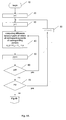
- Figs. 2C, 2D summarize the program flow of the first embodiment according to the invention in the form of a flow chart.
- step 30 the difference ⁇ _i between the historical values of pairs of consecutive points t_i, t_i+1 are computed.
- I is incremented by one, and step 30 is repeated.
- step 60 the program proceeds to step 60, wherein the median value over the computed differences ⁇ _i is determined.
- the trend value T is computed.
- the median basic value G_M can be obtained by determining basic values G for all historical values H.
- forecast values F can be computed in steps 80 to 100.
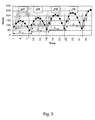
- FIG. 3 shows a time series which has 4 cycles. Each cycle has several periods. A period is a time interval in which values have a predefined common characteristics, for example increasing or decreasing tendency. For simplifying, each such time period in a cycle is represented by one point in the time series. As can be seen from Fig. 3, points 1, 9, 17, and 25 have a common characteristics, i.e., they lie on a line with positive slope. The same applies to the points 2,10, 18, and 26.
- ⁇ _ij p T S_i, wherein i denotes the period, j, denotes the season, and p denotes the number of points (i.e., the length) of a season.
- the differences of the same periods over all the seasons form one group, respectively. Since the differences in one group vary from each other, a mean value over these differences in one group is taken. As operation to determine the mean value, the median of these values is computed.
- the median value over the i-th group of differences i.e., ⁇ _i1, ⁇ _i2, ⁇ _i3, ⁇ _i4) is denoted as ⁇ _i_M.
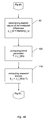
- Figs. 4A to C display a flow diagram of the processing.
- the processing begins with step 10 in Fig. 4A.
- the variable i denoting the period is initialized.
- the variable j denoting the cycle is initialized.
- the differences between pairs of values of corresponding points of corresponding periods are computed. This procedure is repeated for all the periods of the time series, see steps 70, 80.
- the median values are taken, see step 90 in Fig. 4B. With these median values, the trend parameter T is computed in step 100, and the seasonal indices are computed in step 110.
- forecast values F can be computed, see steps 120, 125, and 130 in Fig. 4C.
- the present techniques can be implemented in digital electronic circuitry, or in computer hardware, firmware, software, or in combinations of them.
- Apparatus of the invention can be implemented in a computer program product tangibly embodied in a machine-readable storage device for execution by a programmable processor.
- Method steps according to the invention can be performed by a programmable processor executing a program of instructions to perform functions of the invention by operating on the basis of input data, and by generating output data.
- the invention may be implemented in one or several computer programs that are executable in a programmable system, which includes at least one programmable processor coupled to receive data from, and transmit data to, a storage system, at least one input device, and at least one output device, respectively.
- Computer programs may be implemented in a high-level or object-oriented programming language, and/or in assembly or machine code.
- the language or code can be a compiled or interpreted language or code.
- Processors may include general and special purpose microprocessors.
- a processor receives instructions and data from memories, in particular from read-only memories and/ or random access memories.
- a computer may include one or more mass storage devices for storing data; such devices may include magnetic disks, such as internal hard disks and removable disks; magneto-optical disks; and optical disks.
- Storage devices suitable for tangibly embodying computer program instructions and data include all forms of non-volatile memory, including by way of example semiconductor memory devices, such as EPROM, EEPROM, and flash memory devices; magnetic disks such as internal hard disks and removable disks; magneto-optical disks; and CD-ROM disks. Any of the foregoing can be supplemented by or incorporated in ASICs (application-specific integrated circuits).
- the computer systems or distributed computer networks as mentioned above may be used, for example, for producing goods, delivering parts for assembling products, controlling technical or economical processes, or implementing telecommunication activities.
- the invention can be implemented on a computer system having a display device such as a monitor or LCD screen for displaying information to the user and a keyboard and a pointing device such as a mouse or a trackball by which the user can provide input to the computer system.
- the computer system can be programmed to provide a graphical or text user interface through which computer programs interact with users.
- a computer may include a processor, memory coupled to the processor, a hard drive controller, a video controller and an input/output controller coupled to the processor by a processor bus.
- the hard drive controller is coupled to a hard disk drive suitable for storing executable computer programs, including programs embodying the present technique.
- the I/O controller is coupled by means of an I/O bus to an I/O interface.
- the I/O interface receives and transmits in analogue or digital form over at least one communication link.
- Such a communication link may be a serial link, a parallel link, local area network, or wireless link (e.g. an RF communication link).
- a display is coupled to an interface, which is coupled to an I/O bus.
- a keyboard and pointing device are also coupled to the I/O bus. Alternatively, separate buses may be used for the keyboard pointing device and I/O interface.
Landscapes
- Engineering & Computer Science (AREA)
- Business, Economics & Management (AREA)
- Strategic Management (AREA)
- Entrepreneurship & Innovation (AREA)
- Human Resources & Organizations (AREA)
- Operations Research (AREA)
- Economics (AREA)
- Marketing (AREA)
- Data Mining & Analysis (AREA)
- Quality & Reliability (AREA)
- Tourism & Hospitality (AREA)
- Physics & Mathematics (AREA)
- General Business, Economics & Management (AREA)
- General Physics & Mathematics (AREA)
- Theoretical Computer Science (AREA)
- Management, Administration, Business Operations System, And Electronic Commerce (AREA)
Priority Applications (2)
| Application Number | Priority Date | Filing Date | Title |
|---|---|---|---|
| EP03029697A EP1548622A1 (de) | 2003-12-23 | 2003-12-23 | Korrektur von Datenabweichungen durch eine mittelwert-basierte Methode |
| US11/021,591 US8185347B2 (en) | 2003-12-23 | 2004-12-23 | Outlier correction with a median method |
Applications Claiming Priority (1)
| Application Number | Priority Date | Filing Date | Title |
|---|---|---|---|
| EP03029697A EP1548622A1 (de) | 2003-12-23 | 2003-12-23 | Korrektur von Datenabweichungen durch eine mittelwert-basierte Methode |
Publications (1)
| Publication Number | Publication Date |
|---|---|
| EP1548622A1 true EP1548622A1 (de) | 2005-06-29 |
Family
ID=34530714
Family Applications (1)
| Application Number | Title | Priority Date | Filing Date |
|---|---|---|---|
| EP03029697A Ceased EP1548622A1 (de) | 2003-12-23 | 2003-12-23 | Korrektur von Datenabweichungen durch eine mittelwert-basierte Methode |
Country Status (2)
| Country | Link |
|---|---|
| US (1) | US8185347B2 (de) |
| EP (1) | EP1548622A1 (de) |
Families Citing this family (6)
| Publication number | Priority date | Publication date | Assignee | Title |
|---|---|---|---|---|
| EP1548623A1 (de) * | 2003-12-23 | 2005-06-29 | Sap Ag | Korrektur von Datenabweichungen |
| US7917338B2 (en) * | 2007-01-08 | 2011-03-29 | International Business Machines Corporation | Determining a window size for outlier detection |
| US8200454B2 (en) * | 2007-07-09 | 2012-06-12 | International Business Machines Corporation | Method, data processing program and computer program product for time series analysis |
| US10885059B2 (en) | 2016-01-08 | 2021-01-05 | Micro Focus Llc | Time series trends |
| US10706190B2 (en) | 2017-05-17 | 2020-07-07 | Sap Se | Transfer and visualization of time streams for forecast simulation |
| CN110971435A (zh) * | 2018-09-30 | 2020-04-07 | 北京金山云网络技术有限公司 | 一种报警方法及装置 |
Family Cites Families (1)
| Publication number | Priority date | Publication date | Assignee | Title |
|---|---|---|---|---|
| US5748781A (en) * | 1995-01-04 | 1998-05-05 | Cabletron Systems, Inc. | Method and apparatus for digital data compression |
-
2003
- 2003-12-23 EP EP03029697A patent/EP1548622A1/de not_active Ceased
-
2004
- 2004-12-23 US US11/021,591 patent/US8185347B2/en active Active
Non-Patent Citations (1)
| Title |
|---|
| No Search * |
Also Published As
| Publication number | Publication date |
|---|---|
| US20050137830A1 (en) | 2005-06-23 |
| US8185347B2 (en) | 2012-05-22 |
Similar Documents
| Publication | Publication Date | Title |
|---|---|---|
| US11876374B2 (en) | System and method for optimal control of energy storage system | |
| CN111797250B (zh) | 媒体内容的推送控制方法、装置、计算机设备和存储介质 | |
| Perla et al. | Equilibrium imitation and growth | |
| WO2020086214A1 (en) | Deep reinforcement learning for production scheduling | |
| CN109543132A (zh) | 内容推荐方法、装置、电子设备及存储介质 | |
| EP1548623A1 (de) | Korrektur von Datenabweichungen | |
| CN105205297A (zh) | 一种时间序列预测方法及系统 | |
| KR20220115357A (ko) | 어텐션 메커니즘 기반의 미래 수요 예측 데이터 생성방법 및 장치 | |
| CN115439206A (zh) | 一种申报数据预测方法、装置、设备及介质 | |
| US8185347B2 (en) | Outlier correction with a median method | |
| US20100082405A1 (en) | Multi-period-ahead Forecasting | |
| CN107688901B (zh) | 数据调整方法及装置 | |
| JP2020184246A (ja) | 電力時間前市場取引装置および方法 | |
| CN119180454B (zh) | 基于非线性运营和风险性的虚拟电厂的调控方法和装置 | |
| Li et al. | Technological progress and technology acquisition: Strategic decision under uncertainty | |
| Norouzi | The effect of forecast evolution on production planning with resources subject to congestion | |
| Chen et al. | Optimal control for production inventory of uncertain random system with jump and deteriorating items: X. Chen and Y. Wang | |
| CN118134223B (zh) | 产品排产方法、电子设备及存储介质 | |
| CN113778784A (zh) | 目标应用的用户数量确定方法和装置、电子设备及存储介质 | |
| Glasserman | Service levels and tail probabilities in multistage capacitated production-inventory systems | |
| WO2015006817A1 (en) | Total revenue performance management system | |
| Castrillejo et al. | Electricity demand forecasting: The Uruguayan case | |
| Nunkaew et al. | An AI-Business Analysis (AI-BA) Forecasting Approach using a Regime-Specific Adaptive Ensemble for Spare-Parts Inventory Management | |
| Lio et al. | Belief Reliability Theory and Its Application in a Demand-Driven Uncertain Production System | |
| Sieders et al. | Simulating Front-End Semiconductor Supply Chains to Assess Master Plans Under Uncertainty: A Case Study |
Legal Events
| Date | Code | Title | Description |
|---|---|---|---|
| PUAI | Public reference made under article 153(3) epc to a published international application that has entered the european phase |
Free format text: ORIGINAL CODE: 0009012 |
|
| AK | Designated contracting states |
Kind code of ref document: A1 Designated state(s): AT BE BG CH CY CZ DE DK EE ES FI FR GB GR HU IE IT LI LU MC NL PT RO SE SI SK TR |
|
| AX | Request for extension of the european patent |
Extension state: AL LT LV MK |
|
| RAP1 | Party data changed (applicant data changed or rights of an application transferred) |
Owner name: SAP AG |
|
| 17P | Request for examination filed |
Effective date: 20051229 |
|
| AKX | Designation fees paid |
Designated state(s): AT BE BG CH CY CZ DE DK EE ES FI FR GB GR HU IE IT LI LU MC NL PT RO SE SI SK TR |
|
| AXX | Extension fees paid |
Extension state: MK Payment date: 20051229 Extension state: LV Payment date: 20051229 Extension state: LT Payment date: 20051229 Extension state: AL Payment date: 20051229 |
|
| 17Q | First examination report despatched |
Effective date: 20081028 |
|
| STAA | Information on the status of an ep patent application or granted ep patent |
Free format text: STATUS: THE APPLICATION HAS BEEN REFUSED |
|
| 18R | Application refused |
Effective date: 20110614 |