TECHNICAL FIELD
This invention relates to a test piece for protein
assay for assaying proteins present in protein-containing
samples (body fluid such as blood and urine, or protein-containing
beverages, or factory wastewater, etc.), and also
relates to a method for manufacturing such a test piece.
BACKGROUND ART
Assaying the protein in a biological sample is
important in pathological diagnosis. For instance, the
amount of serum albumin decreases in the case of diminished
liver function, while the amount of protein in urine
increases in the case of nephritis, nephrotic syndrome,
lithiasis, tumors, other such kidney and urinary tract
disorders, disorders of the circulatory system and disorders
of central nervous system. Therefore, assaying albumin or
other proteins can be an important clue in the diagnosis of
these disorders.
A simple assay method featuring the use of a protein
error indicator is known in the field of protein assay.
With this assay method, tetrabromophenol blue (TBPB) is used,
for instance, as the protein error indicator. As one
example, urine test paper made with TBPB is widely used for
primary screening purposes. TBPB changes from yellow to
blue through the dissociation of phenolic hydroxyl groups at
a pH of about 3 when a protein is present, and therefore can
be used to detect protein.
However, test paper made using TBPB as the indicator
has inadequate sensitivity with respect to the low protein
concentrations of 10 to 20 mg/dL required for clinical use,
and is therefore sometimes incapable of detecting protein
accurately. For example, in a visual evaluation conducted
by comparison with a color chart, the color is very similar
between negative protein and trace protein, making it
difficult to tell the two apart and hampering accurate
evaluation. Meanwhile, when a urine test paper assay
apparatus is used, the low sensitivity of TBPB often results
in erroneous evaluation.
Consequently, there has been a need for a technique
that would allow low concentrations of protein to be
quantified at higher sensitivity.
DISCLOSURE OF THE INVENTION
As a result of diligent research aimed at solving the
above problems, the inventors arrived at the present
invention upon discovering that low concentrations of
protein can be assayed at high sensitivity if the test piece
contains a surfactant.
Specifically, the test piece for protein assay provided
by a first aspect of the present invention is a test piece
for protein assay that is used for quantifying or semi-quantifying
a protein and that contains an acidic pH
indicator, containing a surfactant as a sensitizer for
increasing coloration sensitivity to protein.
A second aspect of the present invention is a method
for manufacturing a test piece for protein assay that is
used for quantifying or semi-quantifying a protein, by
impregnating an absorbent carrier with an impregnant
containing an acidic pH indicator and a sensitizer, and then
drying this product, wherein a surfactant is used as the
sensitizer.
An example of an acidic pH indicator that can be used
in the present invention is a triphenylmethane-based
indicator. A typical example of a triphenylmethane-based
indicator is expressed by the following Chemical Formula (1).
In Chemical Formula (1), X1 is a halogen, a nitro group,
or a nitroso group, and X2 and X3 are the same or different
halogens.
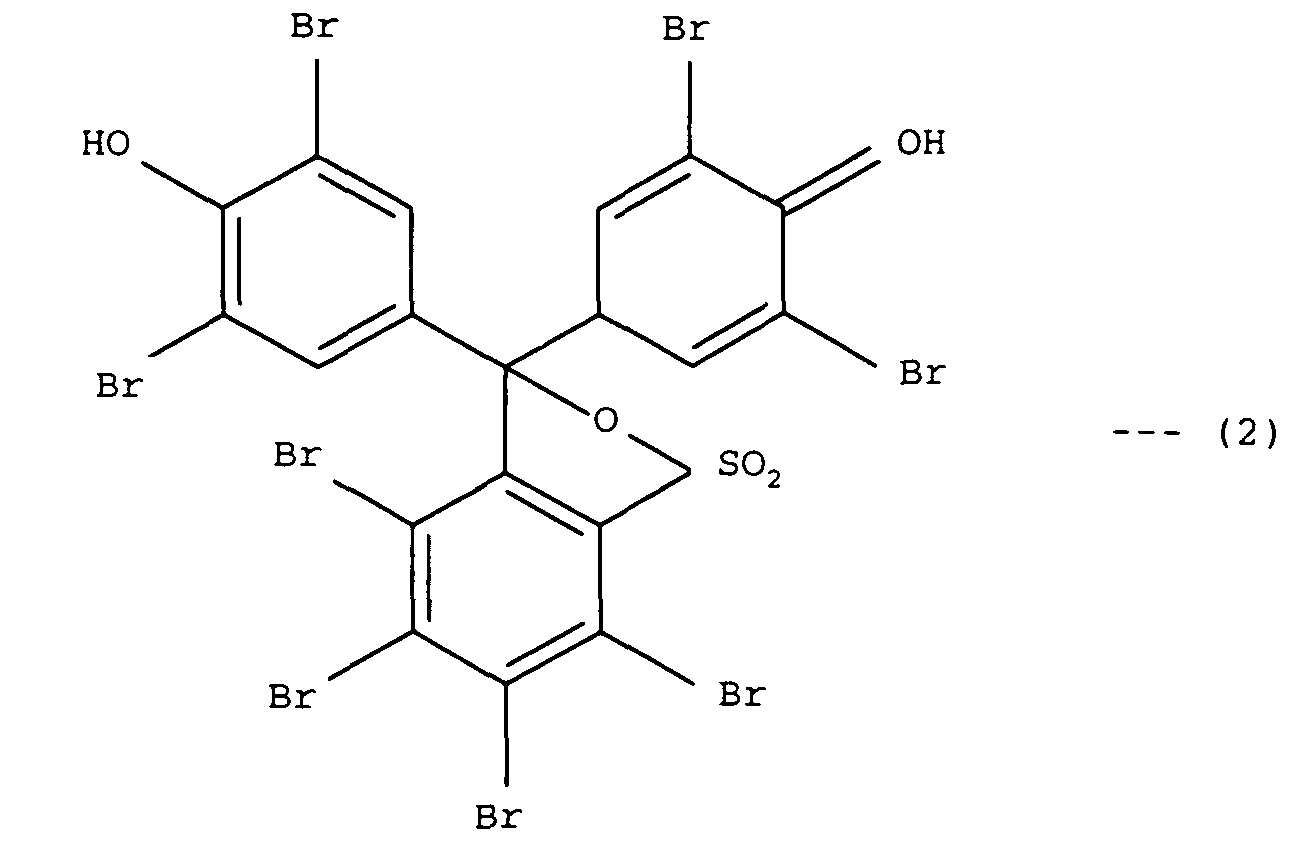
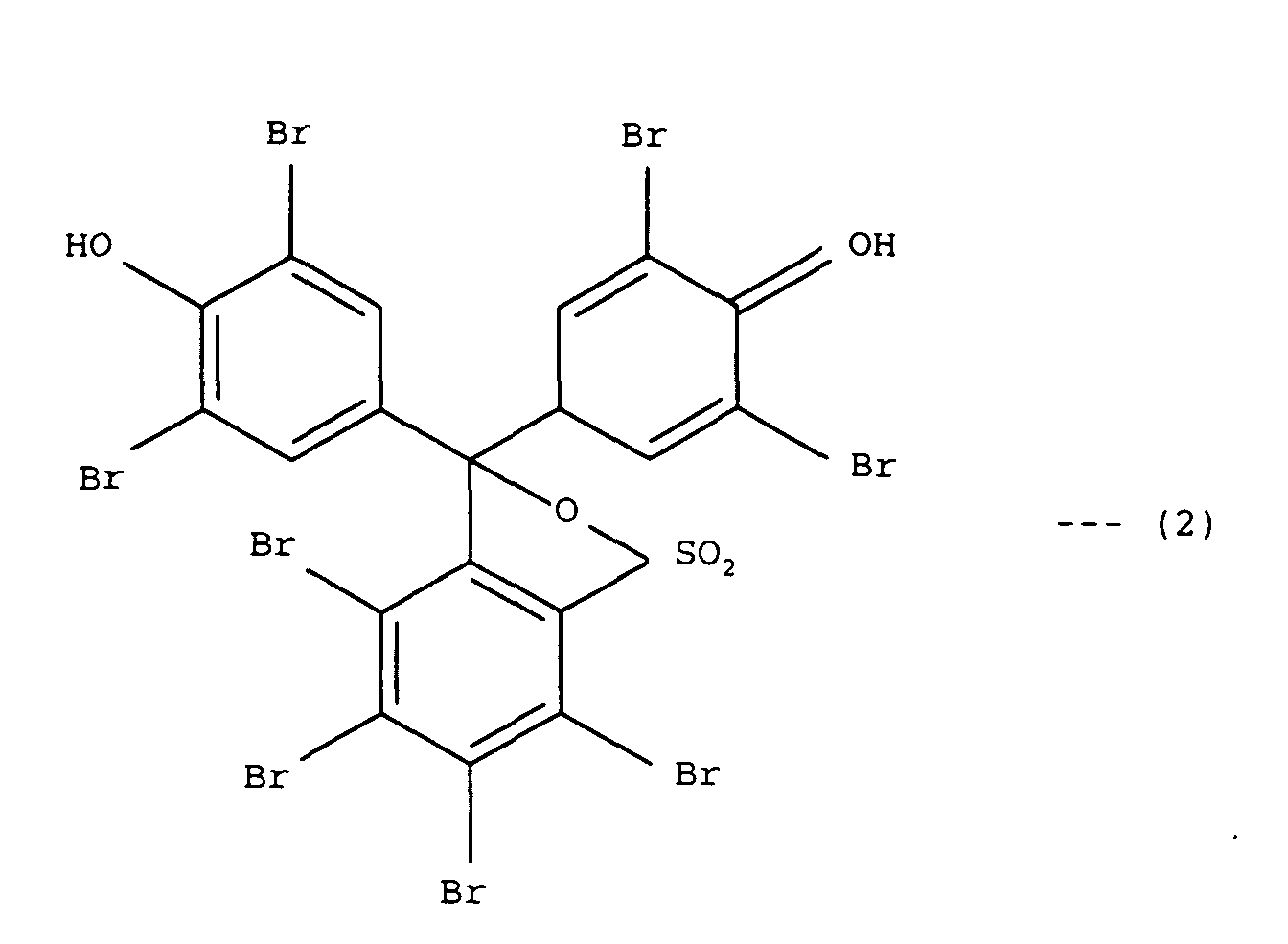
With the present invention, it is preferable to use the
tetrabromophenol blue (TBPB) expressed by the following
Chemical Formula (2) as the triphenylmethane-based indicator.
There are no particular restrictions on the
concentration of the acidic pH indicator (such as TBPB) in
the impregnant, but it is typically 0.1 to 5 mM, and
preferably 0.3 to 1 mM.
It is preferable to use a cationic surfactant as the
surfactant (sensitizer). In addition to this, or instead of
this, a nonionic surfactant may be used.
A quaternary ammonium salt can be used, for example, as
the cationic surfactant. This quaternary ammonium salt can
be an alkyldimethylbenzylammonium, alkyltrimethylammonium
salt, dialkyldimethylammonium salt, benzalkonium salt,
imidazolium salt, or the like. An aliphatic amine salt cah
also be used as the cationic surfactant.
The nonionic surfactant can be either an ether type,
ether ester type, ester type, or nitrogen-containing type.
Examples of ether-type surfactants include
polyoxyethylene alkyl ether, polyoxyethylene secondary
alcohol ether, polyoxyethylene alkylphenyl ether,
polyoxyethylene sterol ether, polyoxyethylene lanolin
derivative, ethylene oxide derivative of alkylphenol
formalin condensate, polyoxyethylene polyoxypropylene block
polymer, and polyoxyethylene polyoxypropylene alkyl ether.
Examples of ether ester-type surfactants include
polyoxyethylene glycerol fatty acid ester, polyoxyethylene
castor oil, polyoxyethylene hydrogenated castor oil,
polyoxyethylene sorbitan fatty acid ester, and
polyoxyethylene sorbitol fatty acid ester.
Examples of ester-type surfactants include polyethylene
glycol fatty acid ester, fatty acid monoglyceride,
monoglycerol fatty acid ester, sorbitan fatty acid ester,
propylene glycol fatty acid ester, and sucrose fatty acid
ester.
Examples of nitrogen-containing surfactants include
fatty acid alkanolamide, polyoxyethylene fatty acid amide,
polyoxyethylenealkylamine, and alkylamine oxide.
The cationic surfactant used in the present invention
is typically benzyltrimethylammonium bromide,
hexadecyltrimethylammonium bromide, lauryltrimethylammonium
bromide, or zephiramine, and the nonionic surfactant is
typically polyethylene glycol. Naturally, a plurality of
different surfactants may be used together, in which case it
is preferable to use a combination of a cationic surfactant
and a nonionic surfactant. Typically, a combination of
benzyltrimethylammonium bromide, which is a cationic
surfactant, and polyethylene glycol, which is a nonionic
surfactant, is used.
There are no particular restrictions on the
concentration of the sensitizer (surfactant) in the
impregnant, but it is typically 0.01 to 5 wt%, and
preferably 0.01 to 1 wt%.
A polycarbonate, polyvinyl alcohol, or other such
polymer material may also be used in addition to the
surfactant as a sensitizer.
The pH of the impregnant is set to be somewhat lower
than the pKa of the acidic pH indicator. When TBPB is used
as the acidic pH indicator, the pH of the impregnant is to
be from 2.0 to 4.5, and preferably 2.0 to 3.5.
Any buffer can be used as long as it has a good
buffering action at the pH of the impregnant (between 2.0
and 4.5, for instance) and does not impede the reaction
between the acidic pH indicator and the protein. Examples
of buffers that can be used include glycine buffer, citrate
buffer, succinate buffer, malate buffer, and tartrate buffer.
There are no particular restrictions on the concentration of
the buffer in the impregnant, but it is typically from 0.1
to 1.5 M, and preferably 0.3 to 1 M.
A porous substance that contains no protein component
can be used as the absorbent carrier, and can be used in the
form of a sheet or film, for example. Examples of porous
substances include paper-like materials, foams, woven
materials, nonwoven materials, and knits. Examples of the
material used to form the absorbent carrier include cotton,
linen, cellulose, nitrocellulose, cellulose acetate, rock
wool, glass fiber, silica fiber, carbon fiber, boron fiber,
polyamide, aramid, polyvinyl alcohol, polyvinyl acetate,
rayon, polyester, nylon, polyacrylic acid, polyacrylic ester,
and polyolefin. There are no particular restrictions on the
shape of the absorbent carrier, but it is generally
rectangular (either short and wide or long and narrow),
circular, or oval.
The test piece for protein assay of the present
invention can be used directly as it is, or after first
being bonded to a non-absorbent material.
The non-absorbent material is used in the form of a
sheet or film, for example. Examples of the material used
to form this non-absorbent material include polyethylene
terephthalate, polyester, polypropylene, polyethylene,
polyvinyl chloride, polyvinylidene chloride, and polystyrene.
EXAMPLES
[Example 1]
In this example, each test piece was impregnated with
urine having an albumin concentration of 0.3 mg/dL
(negative) or 15 mg/dL (positive), and the reflectance of
the test piece was measured. The test pieces were formed by
impregnating filter paper (3MMChr made by Whatman) with an
impregnant, and then drying. The impregnant was produced by
adding 0.2 wt% benzyltrimethylammonium bromide (a cationic
surfactant) as a sensitizer to the base composition shown in
Table 1. Reflectance was measured with a colorimeter at a
measurement wavelength of 630 nm. The measurement results
are given in Table 2.
[Example 2]
In this example, reflectance was measured in the same
manner as in Example 1, except that the impregnant was
produced by adding hexadecyltrimethylammonium bromide (a
cationic surfactant) as a sensitizer in an amount of
0.01 wt% to the base composition in Table 1. The
measurement results are given in Table 2.
[Example 3]
In this example, reflectance was measured in the same
manner as in Example 1, except that the impregnant was
produced by adding lauryltrimethylammonium bromide (a
cationic surfactant) as a sensitizer in an amount of
0.01 wt% to the base composition in Table 1. The
measurement results are given in Table 2.
[Example 4]
In this example, reflectance was measured in the same
manner as in Example 1, except that the impregnant was
produced by adding polyethylene glycol (a nonionic
surfactant) as a sensitizer in an amount of 0.5 wt% to the
base composition in Table 1. The measurement results are
given in Table 2.
[Example 5]
In this example, reflectance was measured in the same
manner as in Example 1, except that the impregnant was
produced by adding benzyltrimethylammonium bromide (a
cationic surfactant) in an amount of 0.2 wt% and
polyethylene glycol (a nonionic surfactant) in an amount of
0.5 wt% as sensitizers to the base composition in Table 1.
The measurement results are given in Table 2.
[Example 6]
In this example, reflectance was measured in the same
manner as in Example 1, except that the impregnant was
produced by adding lauryltrimethylammonium bromide (a
cationic surfactant) in an amount of 0.01 wt% and
polyethylene glycol (a nonionic surfactant) in an amount of
0.5 wt% as sensitizers to the base composition in Table 1.
The measurement results are given in Table 2.
[Example 7]
In this example, reflectance was measured in the same
manner as in Example 1, except that the impregnant was
produced by adding zephiramine (a cationic surfactant) in an
amount of 0.01 wt% and polyethylene glycol (a nonionic
surfactant) in an amount of 0.5 wt% as sensitizers to the
base composition in Table 1. The measurement results are
given in Table 2.
[Comparative Example 1]
In this comparative example, reflectance was measured
in the same manner as in Example 1, except that the
impregnant was the base composition itself (containing no
surfactant (sensitizer)). The measurement results are given
in Table 2.
| Base composition |
| Indicator | Buffer (pH 3.4) | Solvent |
| TBPB 0.5 mM | malate buffer 0.8 M | ethanol 30 wt% |
| Measurement results |
| | Sensitizer | Reflectance (%) | Differential Δ(%) |
| | | 0.3 mg/dL (negative) | 15 mg/dL (positive) |
| Ex. 1 | benzyltrimethylammonium bromide 0.2 wt% | 60.7 | 39.3 | 21.4 |
| Ex. 2 | hexadecyltrimethylammonium bromide 0.01 wt% | 60.4 | 40.6 | 19.8 |
| Ex. 3 | lauryltrimethylammonium bromide 0.01 wt% | 59.0 | 38.7 | 20.3 |
| Ex. 4 | polyethylene glycol 0.5 wt% | 57.0 | 40.4 | 16.6 |
| Ex. 5 | benzyltrimethylammonium bromide 0.2 wt% polyethylene glycol 0.5 wt% | 60.6 | 38.3 | 22.3 |
| Ex. 6 | lauryltrimethylammonium bromide 0.01 wt% polyethylene glycol 0.5 wt% | 59.1 | 35.9 | 23.2 |
| Ex. 7 | zephiramine 0.01 wt% polyethylene glycol 0.5 wt% | 61.2 | 41.5 | 19.8 |
| C. E. 1 | none | 60.7 | 48.9 | 11.8 |
As is clear from Table 2, reflectance at an albumin
concentration of 15 mg/dL was lower when a surfactant was
contained than when no surfactant was contained.
Accordingly, the differential Δ (%) between negative
(0.3 mg/dL) and positive (15 mg/dL) when a surfactant was
contained was about twice that when no surfactant was
contained. We can therefore conclude that when a surfactant
is contained, sensitivity to albumin is higher, and albumin
can be properly detected even when the albumin concentration
is low (about 10 to 20 mg/dL). The albumin detection
sensitivity was particularly high when a cationic surfactant
was used alone and when it is used together with a nonionic
surfactant. In this respect, a cationic surfactant can be
considered to be preferable as a sensitizer.
The experiment results in these examples pertain to
urine samples, but the present invention is not limited to
urine, and can also be applied to the quantification of
protein in any of various other samples containing protein,
such as blood, protein-containing beverages, and factory
wastewater.