EP1548164A1 - Flame-resistant acrylic fiber nonwoven fabric, carbon fiber nonwoven fabric, and method for production thereof - Google Patents
Flame-resistant acrylic fiber nonwoven fabric, carbon fiber nonwoven fabric, and method for production thereof Download PDFInfo
- Publication number
- EP1548164A1 EP1548164A1 EP03799128A EP03799128A EP1548164A1 EP 1548164 A1 EP1548164 A1 EP 1548164A1 EP 03799128 A EP03799128 A EP 03799128A EP 03799128 A EP03799128 A EP 03799128A EP 1548164 A1 EP1548164 A1 EP 1548164A1
- Authority
- EP
- European Patent Office
- Prior art keywords
- nonwoven fabric
- fiber nonwoven
- thickness
- carbon fiber
- carbon
- Prior art date
- Legal status (The legal status is an assumption and is not a legal conclusion. Google has not performed a legal analysis and makes no representation as to the accuracy of the status listed.)
- Withdrawn
Links
- 239000004745 nonwoven fabric Substances 0.000 title claims abstract description 572
- 229920000049 Carbon (fiber) Polymers 0.000 title claims abstract description 256
- 239000004917 carbon fiber Substances 0.000 title claims abstract description 256
- VNWKTOKETHGBQD-UHFFFAOYSA-N methane Chemical compound C VNWKTOKETHGBQD-UHFFFAOYSA-N 0.000 title claims abstract description 174
- 238000004519 manufacturing process Methods 0.000 title claims description 27
- 229920002972 Acrylic fiber Polymers 0.000 title abstract description 12
- 239000000446 fuel Substances 0.000 claims abstract description 95
- 230000003746 surface roughness Effects 0.000 claims abstract description 60
- 239000000463 material Substances 0.000 claims abstract description 17
- 229920006286 oxidized acrylic fiber Polymers 0.000 claims description 137
- 229910052799 carbon Inorganic materials 0.000 claims description 106
- OKTJSMMVPCPJKN-UHFFFAOYSA-N Carbon Chemical compound [C] OKTJSMMVPCPJKN-UHFFFAOYSA-N 0.000 claims description 94
- 239000005871 repellent Substances 0.000 claims description 77
- 239000000126 substance Substances 0.000 claims description 76
- 230000006835 compression Effects 0.000 claims description 71
- 238000007906 compression Methods 0.000 claims description 71
- 238000009792 diffusion process Methods 0.000 claims description 69
- 238000000034 method Methods 0.000 claims description 50
- 239000002245 particle Substances 0.000 claims description 47
- 239000012528 membrane Substances 0.000 claims description 33
- 239000003792 electrolyte Substances 0.000 claims description 31
- 239000011148 porous material Substances 0.000 claims description 28
- 239000003054 catalyst Substances 0.000 claims description 20
- 239000006229 carbon black Substances 0.000 claims description 17
- 238000011437 continuous method Methods 0.000 claims description 17
- 238000009826 distribution Methods 0.000 claims description 10
- 238000010000 carbonizing Methods 0.000 claims description 9
- 239000004744 fabric Substances 0.000 claims description 4
- 238000011282 treatment Methods 0.000 abstract description 35
- 238000003763 carbonization Methods 0.000 abstract description 13
- RNFJDJUURJAICM-UHFFFAOYSA-N 2,2,4,4,6,6-hexaphenoxy-1,3,5-triaza-2$l^{5},4$l^{5},6$l^{5}-triphosphacyclohexa-1,3,5-triene Chemical compound N=1P(OC=2C=CC=CC=2)(OC=2C=CC=CC=2)=NP(OC=2C=CC=CC=2)(OC=2C=CC=CC=2)=NP=1(OC=1C=CC=CC=1)OC1=CC=CC=C1 RNFJDJUURJAICM-UHFFFAOYSA-N 0.000 abstract 2
- 239000003063 flame retardant Substances 0.000 abstract 2
- 239000007789 gas Substances 0.000 description 46
- XLYOFNOQVPJJNP-UHFFFAOYSA-N water Substances O XLYOFNOQVPJJNP-UHFFFAOYSA-N 0.000 description 45
- 229920005989 resin Polymers 0.000 description 37
- 239000011347 resin Substances 0.000 description 37
- 230000000052 comparative effect Effects 0.000 description 32
- 239000000835 fiber Substances 0.000 description 30
- 230000000694 effects Effects 0.000 description 29
- 239000011248 coating agent Substances 0.000 description 18
- 238000000576 coating method Methods 0.000 description 18
- 230000035699 permeability Effects 0.000 description 16
- 229920001343 polytetrafluoroethylene Polymers 0.000 description 16
- 239000004810 polytetrafluoroethylene Substances 0.000 description 16
- 229920002313 fluoropolymer Polymers 0.000 description 12
- 238000010438 heat treatment Methods 0.000 description 11
- 238000005259 measurement Methods 0.000 description 10
- 238000012545 processing Methods 0.000 description 8
- 230000007423 decrease Effects 0.000 description 7
- 238000001035 drying Methods 0.000 description 7
- 239000000203 mixture Substances 0.000 description 7
- 238000000151 deposition Methods 0.000 description 6
- UFHFLCQGNIYNRP-UHFFFAOYSA-N Hydrogen Chemical compound [H][H] UFHFLCQGNIYNRP-UHFFFAOYSA-N 0.000 description 5
- 239000012530 fluid Substances 0.000 description 5
- 238000009998 heat setting Methods 0.000 description 5
- XMWRBQBLMFGWIX-UHFFFAOYSA-N C60 fullerene Chemical compound C12=C3C(C4=C56)=C7C8=C5C5=C9C%10=C6C6=C4C1=C1C4=C6C6=C%10C%10=C9C9=C%11C5=C8C5=C8C7=C3C3=C7C2=C1C1=C2C4=C6C4=C%10C6=C9C9=C%11C5=C5C8=C3C3=C7C1=C1C2=C4C6=C2C9=C5C3=C12 XMWRBQBLMFGWIX-UHFFFAOYSA-N 0.000 description 4
- 238000005452 bending Methods 0.000 description 4
- 239000002041 carbon nanotube Substances 0.000 description 4
- 229910021393 carbon nanotube Inorganic materials 0.000 description 4
- 239000006185 dispersion Substances 0.000 description 4
- 229910003472 fullerene Inorganic materials 0.000 description 4
- 239000001257 hydrogen Substances 0.000 description 4
- 229910052739 hydrogen Inorganic materials 0.000 description 4
- 230000000704 physical effect Effects 0.000 description 4
- BASFCYQUMIYNBI-UHFFFAOYSA-N platinum Chemical compound [Pt] BASFCYQUMIYNBI-UHFFFAOYSA-N 0.000 description 4
- 239000000843 powder Substances 0.000 description 4
- 239000000758 substrate Substances 0.000 description 4
- 238000012546 transfer Methods 0.000 description 4
- KXGFMDJXCMQABM-UHFFFAOYSA-N 2-methoxy-6-methylphenol Chemical compound [CH]OC1=CC=CC([CH])=C1O KXGFMDJXCMQABM-UHFFFAOYSA-N 0.000 description 3
- 239000004372 Polyvinyl alcohol Substances 0.000 description 3
- 239000011230 binding agent Substances 0.000 description 3
- 230000008021 deposition Effects 0.000 description 3
- 229920001971 elastomer Polymers 0.000 description 3
- 210000000887 face Anatomy 0.000 description 3
- 238000009413 insulation Methods 0.000 description 3
- 238000012423 maintenance Methods 0.000 description 3
- 229920001568 phenolic resin Polymers 0.000 description 3
- 239000005011 phenolic resin Substances 0.000 description 3
- 229920000642 polymer Polymers 0.000 description 3
- 229920002451 polyvinyl alcohol Polymers 0.000 description 3
- 238000004886 process control Methods 0.000 description 3
- 238000004080 punching Methods 0.000 description 3
- 239000007787 solid Substances 0.000 description 3
- NWUYHJFMYQTDRP-UHFFFAOYSA-N 1,2-bis(ethenyl)benzene;1-ethenyl-2-ethylbenzene;styrene Chemical compound C=CC1=CC=CC=C1.CCC1=CC=CC=C1C=C.C=CC1=CC=CC=C1C=C NWUYHJFMYQTDRP-UHFFFAOYSA-N 0.000 description 2
- 239000004925 Acrylic resin Substances 0.000 description 2
- 229920000178 Acrylic resin Polymers 0.000 description 2
- XKRFYHLGVUSROY-UHFFFAOYSA-N Argon Chemical compound [Ar] XKRFYHLGVUSROY-UHFFFAOYSA-N 0.000 description 2
- IJGRMHOSHXDMSA-UHFFFAOYSA-N Atomic nitrogen Chemical compound N#N IJGRMHOSHXDMSA-UHFFFAOYSA-N 0.000 description 2
- 229920006282 Phenolic fiber Polymers 0.000 description 2
- 229920000297 Rayon Polymers 0.000 description 2
- 239000000853 adhesive Substances 0.000 description 2
- 230000001070 adhesive effect Effects 0.000 description 2
- 239000003570 air Substances 0.000 description 2
- QVGXLLKOCUKJST-UHFFFAOYSA-N atomic oxygen Chemical compound [O] QVGXLLKOCUKJST-UHFFFAOYSA-N 0.000 description 2
- 238000005336 cracking Methods 0.000 description 2
- 230000006866 deterioration Effects 0.000 description 2
- 238000009499 grossing Methods 0.000 description 2
- 238000005470 impregnation Methods 0.000 description 2
- 239000004615 ingredient Substances 0.000 description 2
- 239000003456 ion exchange resin Substances 0.000 description 2
- 229920003303 ion-exchange polymer Polymers 0.000 description 2
- 238000002844 melting Methods 0.000 description 2
- 230000008018 melting Effects 0.000 description 2
- 230000001590 oxidative effect Effects 0.000 description 2
- 239000001301 oxygen Substances 0.000 description 2
- 229910052760 oxygen Inorganic materials 0.000 description 2
- 229910052697 platinum Inorganic materials 0.000 description 2
- 229920002239 polyacrylonitrile Polymers 0.000 description 2
- 229920002689 polyvinyl acetate Polymers 0.000 description 2
- 239000011118 polyvinyl acetate Substances 0.000 description 2
- 239000002243 precursor Substances 0.000 description 2
- 238000003825 pressing Methods 0.000 description 2
- 239000002964 rayon Substances 0.000 description 2
- 238000004904 shortening Methods 0.000 description 2
- 229910001220 stainless steel Inorganic materials 0.000 description 2
- 239000010935 stainless steel Substances 0.000 description 2
- 230000001131 transforming effect Effects 0.000 description 2
- 230000004580 weight loss Effects 0.000 description 2
- PEVRKKOYEFPFMN-UHFFFAOYSA-N 1,1,2,3,3,3-hexafluoroprop-1-ene;1,1,2,2-tetrafluoroethene Chemical group FC(F)=C(F)F.FC(F)=C(F)C(F)(F)F PEVRKKOYEFPFMN-UHFFFAOYSA-N 0.000 description 1
- FPJNQQRSBJPGHM-UHFFFAOYSA-N 1-chloro-2-nitropropane Chemical compound ClCC(C)[N+]([O-])=O FPJNQQRSBJPGHM-UHFFFAOYSA-N 0.000 description 1
- 229920002134 Carboxymethyl cellulose Polymers 0.000 description 1
- YCKRFDGAMUMZLT-UHFFFAOYSA-N Fluorine atom Chemical compound [F] YCKRFDGAMUMZLT-UHFFFAOYSA-N 0.000 description 1
- 229920000557 Nafion® Polymers 0.000 description 1
- 229910052786 argon Inorganic materials 0.000 description 1
- 239000012298 atmosphere Substances 0.000 description 1
- 239000001768 carboxy methyl cellulose Substances 0.000 description 1
- 235000010948 carboxy methyl cellulose Nutrition 0.000 description 1
- 239000008112 carboxymethyl-cellulose Substances 0.000 description 1
- 238000009960 carding Methods 0.000 description 1
- 229920006026 co-polymeric resin Polymers 0.000 description 1
- 150000001875 compounds Chemical class 0.000 description 1
- 238000007796 conventional method Methods 0.000 description 1
- 229920001577 copolymer Polymers 0.000 description 1
- 230000001186 cumulative effect Effects 0.000 description 1
- 239000002270 dispersing agent Substances 0.000 description 1
- 239000013013 elastic material Substances 0.000 description 1
- 239000000806 elastomer Substances 0.000 description 1
- 239000007772 electrode material Substances 0.000 description 1
- 238000005265 energy consumption Methods 0.000 description 1
- 230000002708 enhancing effect Effects 0.000 description 1
- 229910052731 fluorine Inorganic materials 0.000 description 1
- 239000011737 fluorine Substances 0.000 description 1
- 239000011261 inert gas Substances 0.000 description 1
- 239000011810 insulating material Substances 0.000 description 1
- 230000010354 integration Effects 0.000 description 1
- 239000007788 liquid Substances 0.000 description 1
- QSHDDOUJBYECFT-UHFFFAOYSA-N mercury Chemical compound [Hg] QSHDDOUJBYECFT-UHFFFAOYSA-N 0.000 description 1
- 229910052753 mercury Inorganic materials 0.000 description 1
- 238000013508 migration Methods 0.000 description 1
- 230000005012 migration Effects 0.000 description 1
- 229910052757 nitrogen Inorganic materials 0.000 description 1
- 239000003921 oil Substances 0.000 description 1
- -1 polytetrafluoroethylene Polymers 0.000 description 1
- 238000002459 porosimetry Methods 0.000 description 1
- 239000002994 raw material Substances 0.000 description 1
- 239000012495 reaction gas Substances 0.000 description 1
- 239000002210 silicon-based material Substances 0.000 description 1
- 229910021384 soft carbon Inorganic materials 0.000 description 1
- 238000001228 spectrum Methods 0.000 description 1
- 238000012360 testing method Methods 0.000 description 1
- 238000011144 upstream manufacturing Methods 0.000 description 1
- 239000002759 woven fabric Substances 0.000 description 1
Classifications
-
- H—ELECTRICITY
- H01—ELECTRIC ELEMENTS
- H01M—PROCESSES OR MEANS, e.g. BATTERIES, FOR THE DIRECT CONVERSION OF CHEMICAL ENERGY INTO ELECTRICAL ENERGY
- H01M8/00—Fuel cells; Manufacture thereof
- H01M8/02—Details
- H01M8/0202—Collectors; Separators, e.g. bipolar separators; Interconnectors
- H01M8/023—Porous and characterised by the material
- H01M8/0234—Carbonaceous material
-
- D—TEXTILES; PAPER
- D04—BRAIDING; LACE-MAKING; KNITTING; TRIMMINGS; NON-WOVEN FABRICS
- D04H—MAKING TEXTILE FABRICS, e.g. FROM FIBRES OR FILAMENTARY MATERIAL; FABRICS MADE BY SUCH PROCESSES OR APPARATUS, e.g. FELTS, NON-WOVEN FABRICS; COTTON-WOOL; WADDING ; NON-WOVEN FABRICS FROM STAPLE FIBRES, FILAMENTS OR YARNS, BONDED WITH AT LEAST ONE WEB-LIKE MATERIAL DURING THEIR CONSOLIDATION
- D04H1/00—Non-woven fabrics formed wholly or mainly of staple fibres or like relatively short fibres
- D04H1/40—Non-woven fabrics formed wholly or mainly of staple fibres or like relatively short fibres from fleeces or layers composed of fibres without existing or potential cohesive properties
- D04H1/42—Non-woven fabrics formed wholly or mainly of staple fibres or like relatively short fibres from fleeces or layers composed of fibres without existing or potential cohesive properties characterised by the use of certain kinds of fibres insofar as this use has no preponderant influence on the consolidation of the fleece
- D04H1/4209—Inorganic fibres
- D04H1/4242—Carbon fibres
-
- D—TEXTILES; PAPER
- D04—BRAIDING; LACE-MAKING; KNITTING; TRIMMINGS; NON-WOVEN FABRICS
- D04H—MAKING TEXTILE FABRICS, e.g. FROM FIBRES OR FILAMENTARY MATERIAL; FABRICS MADE BY SUCH PROCESSES OR APPARATUS, e.g. FELTS, NON-WOVEN FABRICS; COTTON-WOOL; WADDING ; NON-WOVEN FABRICS FROM STAPLE FIBRES, FILAMENTS OR YARNS, BONDED WITH AT LEAST ONE WEB-LIKE MATERIAL DURING THEIR CONSOLIDATION
- D04H1/00—Non-woven fabrics formed wholly or mainly of staple fibres or like relatively short fibres
- D04H1/40—Non-woven fabrics formed wholly or mainly of staple fibres or like relatively short fibres from fleeces or layers composed of fibres without existing or potential cohesive properties
- D04H1/42—Non-woven fabrics formed wholly or mainly of staple fibres or like relatively short fibres from fleeces or layers composed of fibres without existing or potential cohesive properties characterised by the use of certain kinds of fibres insofar as this use has no preponderant influence on the consolidation of the fleece
- D04H1/4282—Addition polymers
- D04H1/4291—Olefin series
-
- H—ELECTRICITY
- H01—ELECTRIC ELEMENTS
- H01M—PROCESSES OR MEANS, e.g. BATTERIES, FOR THE DIRECT CONVERSION OF CHEMICAL ENERGY INTO ELECTRICAL ENERGY
- H01M4/00—Electrodes
- H01M4/86—Inert electrodes with catalytic activity, e.g. for fuel cells
- H01M4/8605—Porous electrodes
-
- H—ELECTRICITY
- H01—ELECTRIC ELEMENTS
- H01M—PROCESSES OR MEANS, e.g. BATTERIES, FOR THE DIRECT CONVERSION OF CHEMICAL ENERGY INTO ELECTRICAL ENERGY
- H01M8/00—Fuel cells; Manufacture thereof
- H01M8/10—Fuel cells with solid electrolytes
- H01M8/1004—Fuel cells with solid electrolytes characterised by membrane-electrode assemblies [MEA]
-
- H—ELECTRICITY
- H01—ELECTRIC ELEMENTS
- H01M—PROCESSES OR MEANS, e.g. BATTERIES, FOR THE DIRECT CONVERSION OF CHEMICAL ENERGY INTO ELECTRICAL ENERGY
- H01M8/00—Fuel cells; Manufacture thereof
- H01M8/02—Details
- H01M8/0202—Collectors; Separators, e.g. bipolar separators; Interconnectors
- H01M8/023—Porous and characterised by the material
- H01M8/0239—Organic resins; Organic polymers
-
- Y—GENERAL TAGGING OF NEW TECHNOLOGICAL DEVELOPMENTS; GENERAL TAGGING OF CROSS-SECTIONAL TECHNOLOGIES SPANNING OVER SEVERAL SECTIONS OF THE IPC; TECHNICAL SUBJECTS COVERED BY FORMER USPC CROSS-REFERENCE ART COLLECTIONS [XRACs] AND DIGESTS
- Y02—TECHNOLOGIES OR APPLICATIONS FOR MITIGATION OR ADAPTATION AGAINST CLIMATE CHANGE
- Y02E—REDUCTION OF GREENHOUSE GAS [GHG] EMISSIONS, RELATED TO ENERGY GENERATION, TRANSMISSION OR DISTRIBUTION
- Y02E60/00—Enabling technologies; Technologies with a potential or indirect contribution to GHG emissions mitigation
- Y02E60/30—Hydrogen technology
- Y02E60/50—Fuel cells
-
- Y—GENERAL TAGGING OF NEW TECHNOLOGICAL DEVELOPMENTS; GENERAL TAGGING OF CROSS-SECTIONAL TECHNOLOGIES SPANNING OVER SEVERAL SECTIONS OF THE IPC; TECHNICAL SUBJECTS COVERED BY FORMER USPC CROSS-REFERENCE ART COLLECTIONS [XRACs] AND DIGESTS
- Y02—TECHNOLOGIES OR APPLICATIONS FOR MITIGATION OR ADAPTATION AGAINST CLIMATE CHANGE
- Y02P—CLIMATE CHANGE MITIGATION TECHNOLOGIES IN THE PRODUCTION OR PROCESSING OF GOODS
- Y02P70/00—Climate change mitigation technologies in the production process for final industrial or consumer products
- Y02P70/50—Manufacturing or production processes characterised by the final manufactured product
-
- Y—GENERAL TAGGING OF NEW TECHNOLOGICAL DEVELOPMENTS; GENERAL TAGGING OF CROSS-SECTIONAL TECHNOLOGIES SPANNING OVER SEVERAL SECTIONS OF THE IPC; TECHNICAL SUBJECTS COVERED BY FORMER USPC CROSS-REFERENCE ART COLLECTIONS [XRACs] AND DIGESTS
- Y10—TECHNICAL SUBJECTS COVERED BY FORMER USPC
- Y10T—TECHNICAL SUBJECTS COVERED BY FORMER US CLASSIFICATION
- Y10T442/00—Fabric [woven, knitted, or nonwoven textile or cloth, etc.]
- Y10T442/60—Nonwoven fabric [i.e., nonwoven strand or fiber material]
- Y10T442/643—Including parallel strand or fiber material within the nonwoven fabric
-
- Y—GENERAL TAGGING OF NEW TECHNOLOGICAL DEVELOPMENTS; GENERAL TAGGING OF CROSS-SECTIONAL TECHNOLOGIES SPANNING OVER SEVERAL SECTIONS OF THE IPC; TECHNICAL SUBJECTS COVERED BY FORMER USPC CROSS-REFERENCE ART COLLECTIONS [XRACs] AND DIGESTS
- Y10—TECHNICAL SUBJECTS COVERED BY FORMER USPC
- Y10T—TECHNICAL SUBJECTS COVERED BY FORMER US CLASSIFICATION
- Y10T442/00—Fabric [woven, knitted, or nonwoven textile or cloth, etc.]
- Y10T442/60—Nonwoven fabric [i.e., nonwoven strand or fiber material]
- Y10T442/696—Including strand or fiber material which is stated to have specific attributes [e.g., heat or fire resistance, chemical or solvent resistance, high absorption for aqueous compositions, water solubility, heat shrinkability, etc.]
Definitions
- An object of the invention is to provide a thin and dense oxidized acrylic fiber nonwoven fabric without impairing flame retardancy and heat resistance. Furthermore, another object of the invention is to provide a thin and dense carbon fiber nonwoven fabric having a thickness, density, gas permeability and pore size most suitable as an electrode diffusion layer of a fuel cell, and further having a high modulus of elasticity in flexure, small deformation due to compression, small surface roughness and high flexibility suitable as an electrode diffusion layer of a fuel cell.
- the density of a nonwoven fabric is obtained by calculation from the weight per square-meter of the nonwoven fabric and the thickness of the nonwoven fabric.
- water jet entanglement or needle punching may be used as treatment to entangle the fibers, or a binder may be added to bind the fibers to each other.
- the electric resistance of the carbon fiber nonwoven fabric in the thickness direction is 15 m ⁇ cm 2 or less. More preferred is 10 m ⁇ cm 2 or less, and further more preferred is 8 m ⁇ cm 2 or less. If it is attempted to obtain an electric resistance of less than 1 m ⁇ cm 2 , such special steps as pressurization at a high pressure, carbonization at a high temperature and binding by means of carbon are necessary. So, it is preferred that the electric resistance is 1 m ⁇ cm 2 or more.
- the electric resistance of the electrode diffusion layer directly relates to the voltage drop of the cell.
- the voltage drops by 20 mV compared with the case where electrode diffusion layers of 10 m ⁇ cm 2 are used, and if the cell voltage is 0.5 V, an efficiency drop of about 4% occurs.
- the efficiency drop further increases.
- this carbon fiber nonwoven fabric satisfies the following requirements (a-1) through (k-1). That is, (a-1) the weight per square-meter is from 70 to 95 g/m 2 , (b-1) the thickness is from 0.15 to 0.20 mm, (c-1) the density is from 0.45 to 0.6 g/cm 2 , (d-1) the maximum fracture radius is 20 mm or less, (e-1) the surface roughness Ra is 15 ⁇ m or less, (f-1) the thickness change due to compression as the difference between the thickness at a planar pressure of 0.15 MPa and the thickness at a planar pressure of 1.0 MPa is 0.05 mm or less, (g-1) the tensile strength is 0.7 kgf/cm or more, (h-1) the modulus of elasticity in flexure is 0.3 GPa or more, (i-1) the peak size in the pore size distribution is from 20 to 40 ⁇ m, (j-1) the electric resistance in the thickness direction is 10 m ⁇ cm 2
- the heating and pressurization step can also include a step of bonding an electrolyte membrane or catalyst layer to the nonwoven fabric used as an electrode diffusion layer, or a step of coating the nonwoven fabric with a carbon layer, or a step of smoothing the surface after carbon layer coating.
- the nonwoven fabric is not actually wound at such a small radius, if the maximum fracture radius is too small, no tension acts on the nonwoven fabric while it undergoes an additional treatment such as water repellence treatment or carbon layer coating or while it is processed in an additional treatment device, and even if the nonwoven fabric is locally loosened at a large curvature, it is unlikely to be fractured.
- an additional treatment such as water repellence treatment or carbon layer coating or while it is processed in an additional treatment device
- the modulus of elasticity in flexure of the nonwoven fabric formed of carbon fibers and a water-repellent substance is 0.5 GPa or more. More preferred is 1 GPa or more, and further more preferred is 1.5 GPa or more. Moreover, it is preferred that the modulus of elasticity in flexure is 25 GPa or less. More preferred is 15 GPa or less, and further more preferred is 10 GPa or less. If the modulus of elasticity in flexure is too high, it is difficult to wind the nonwoven fabric, and when the nonwoven fabric is bent, it is likely to be fractured.
- the modulus of elasticity in flexure can be enhanced by letting the nonwoven fabric contain a water-repellent substance, using a fluoroplastic as the water-repellent substance, and carrying out the heating and pressurization. If the modulus of elasticity in flexure is too low, the electrode diffusion layer is likely to protrude into the gas passage of the separator, to narrow the passage. So, the nonwoven fabric formed of carbon fibers and a water-repellent substance is required to have a modulus of elasticity in flexure higher than that of the nonwoven fabric substantially formed of carbon fibers only. The additional treatment such as carbon layer coating is also easier when the modulus of elasticity in flexure is higher.
- the thickness change due to compression as the difference between the thickness at a planar pressure of 0.15 MPa and the thickness at a planar pressure of 1.0 MPa of the nonwoven fabric formed of carbon fibers, fine carbon particles and a water-repellent substance in which the fine carbon particles locally exist on one side of the nonwoven fabric is 0.15 mm or less.
- Preferred is 0.1 mm or less, and more preferred is 0.05 mm or less.
- the thickness change is 0 mm.
- the nonwoven fabric is not actually wound at such a small radius, if the maximum fracture radius is small, no tension acts on the nonwoven fabric while it undergoes an additional treatment such as water repellence treatment or carbon layer coating or while it is processed in an additional treatment device, and even if the nonwoven fabric is locally loosened at a large curvature, it is unlikely to be fractured.
- an additional treatment such as water repellence treatment or carbon layer coating or while it is processed in an additional treatment device
- the carbon fiber nonwoven fabric of the invention can be preferably used as an electrically conductive sheet of a fuel cell, especially as an electrode diffusion layer of a solid polymer type fuel cell, especially preferably used as an electrode diffusion layer of a fuel cell having a grooved separator.
- an electrode diffusion layer made of a material likely to be crushed by compression or having a low modulus of elasticity in flexure protrudes into the groove formed as a gas passage in the separator adjacent to the electrode diffusion layer, to narrow the gas passage, thus increasing the pressure loss of gas flow, causing water clogging in the passage, and causing shortage of gas feed to the electrode.
- the voltage of a fuel cell in the following examples was measured according to the following method.
- the MEA was held between grooved separators, and the voltage at a current density of 1A/cm 2 was measured according to a conventional method.
- the cell temperature was 70°C; hydrogen gas humidifying temperature, 80°C; air gas humidifying temperature, 60°C; and gas pressure, atmospheric pressure.
- the hydrogen utilization at 1 A/cm 2 was 70%, and the air utilization was 40%. When the measured voltage was higher, the product was judged to be more excellent.
- the oxidized acrylic fiber nonwoven fabric of Comparative Example 6 was pressurized at the temperature and the planar pressure shown in Table 1 in the thickness direction.
- Table 1 shows the pressurization conditions in the production process and the property values (weight per square-meter, thickness, density, thickness change due to compression) of the produced oxidized acrylic fiber nonwoven fabrics.
- the carbon fiber nonwoven fabrics of Examples 18, 23, 24 and 25 were respectively immersed in a PTFE dispersion and pulled up and dried to obtain carbon fiber nonwoven fabrics respectively with 20 wt% of PTFE deposited.
- the obtained carbon fiber nonwoven fabrics were respectively heat-treated at a temperature of 380°C.
- the heat-treated nonwoven fabrics were respectively heated and pressurized at a temperature of 200°C and at a planar pressure of 3 MPa, and cooled to room temperature while being pressurized, then being taken out of the press, to obtain carbon fiber nonwoven fabrics.
- Table 2 shows the property values (weight per square-meter, thickness, density, maximum fracture radius, surface roughness Ra, thickness change due to compression, tensile strength, differential pressure occurring at the time of air permeation, electric resistance, fuel cell voltage) of the produced carbon fiber nonwoven fabrics.
Landscapes
- Engineering & Computer Science (AREA)
- Chemical & Material Sciences (AREA)
- General Chemical & Material Sciences (AREA)
- Chemical Kinetics & Catalysis (AREA)
- Electrochemistry (AREA)
- Manufacturing & Machinery (AREA)
- Life Sciences & Earth Sciences (AREA)
- Textile Engineering (AREA)
- Sustainable Development (AREA)
- Sustainable Energy (AREA)
- Inorganic Chemistry (AREA)
- Nonwoven Fabrics (AREA)
- Chemical Or Physical Treatment Of Fibers (AREA)
- Treatments For Attaching Organic Compounds To Fibrous Goods (AREA)
- Inorganic Fibers (AREA)
- Inert Electrodes (AREA)
Abstract
A nonwoven fabric comprising flame-retardant acrylic fibers,
characterized in that it has a weight per square-meter of 70 to
190 g/m2, a thickness of 0.1 to 0.3 mm, a density of 0.35 to 0.8
g/cm3; and a nonwoven fabric comprising carbon fibers,
characterized in that it has a weight per square-meter of 50 to
150 g/m2, a thickness of 0.1 to 0.25 mm, a density of 0.3 to 0.7
g/cm3, a surface roughness Ra of 30 µm or less, a tensile strength
of 0.2 kgf/cm or more, and a maximum fracture radius being defined
in the specification of 20 mm or less. Said carbon fiber nonwoven
fabric is produced by subjecting the flame-retardant acrylic
fiber nonwoven fabric to a carbonization treatment and can be
suitably used as a material for forming an electrode of a fuel
cell.
Description
The present invention relates to an oxidized acrylic fiber
nonwoven fabric, a carbon fiber nonwoven fabric and a method for
production thereof. Furthermore, the present invention relates
to an electrode, electrode diffusion layer, fuel cell unit and
fuel cell, in which the carbon fiber nonwoven fabric of the
invention is used as an electrode-forming material.
The oxidized acrylic fiber nonwoven fabric of the invention
is characterized by a dense structure and small thickness. The
carbon fiber nonwoven fabric of the invention is also
characterized by a dense structure and small thickness.
The oxidized acrylic fiber nonwoven fabric of the invention
can be preferably used for producing the carbon fiber nonwoven
fabric of the invention. The carbon fiber nonwoven fabric of the
invention can be preferably used as an electrode diffusion layer
of a solid polymer type fuel cell.
It is attempted to use a carbon fiber nonwoven fabric as
an electrode-forming material of a fuel cell. The attempts are
disclosed in JP 2002-194650 A and WO 02/42534 A1. These documents
respectively disclose a carbon fiber nonwoven fabric obtained by
carbonization treatment of an oxidized polyacrylonitrile
(PAN)-based fiber nonwoven fabric.
The densities of the carbon fiber nonwoven fabrics
disclosed in the examples of these documents are low. These
documents respectively disclose a case where carbonization
treatment of an oxidized fiber nonwoven fabric is performed
without resin impregnation into the nonwoven fabric, to produce
a carbon fiber nonwoven fabric, and also a case where resin
impregnation into the nonwoven fabric is performed and followed
by carbonization treatment of it for producing a carbon fiber
nonwoven fabric. In the former case, the obtained carbon fiber
nonwoven fabric has a high weight per square-meter, large
thickness and low density. Because of the low density, the
surface roughness is large, and the modulus of elasticity in
flexure is low. In the case where such a carbon fiber nonwoven
fabric is used as an electrode diffusion layer of a fuel cell,
it does not sufficiently function as a diffusion layer. That is,
it brings drying-up of an electrolyte membrane, and declining of
a cell characteristic. Furthermore, it brings crushing of the
nonwoven fabric and narrowing gas passages formed in a separator.
In the latter case, the obtained carbon fiber nonwoven fabric is
fragile and low in flexibility, since it is produced by
carbonization treatment of an oxidized fiber nonwoven fabric
impregnated with a resin.
JP 10-167855 A discloses a carbon fiber sheet obtained by
impregnating a resin into a short carbon fiber sheet formed by
a wet paper making process, and treating it for carbonization.
The carbon fiber sheet is a porous carbon sheet having a structure
in which short carbon fibers are bonded to each other by carbon
composed of the carbonized resin. In the document, it is
explained that the porous carbon sheet can be used as an electrode
material of fuel cells. However, the porous carbon sheet is poor
in flexibility, and it is difficult to obtain a continuous and
long material.
As a flexible porous carbon sheet in which carbon fibers
are bound to each other by carbon, Spectra Corp. launches
SpectraCarb2050L. However, the maximum fracture radius of the
carbon sheet is 25 mm, and it cannot be considered that it has
sufficient flexibility for use as a material forming an electrode.
If the thickness of the carbon sheet is reduced, the maximum
fracture radius can be lessened, but in this case, since the carbon
sheet per se is fragile, it is likely to be fractured due to the
shear and local bending at the portion in contact with the open
end of the groove forming the passage of the separator.
WO 01/56103 A1 proposes a method for producing a flexible
carbon sheet by reducing the carbon fiber diameter of a porous
carbon sheet. However, since the fiber diameter is small, the
gas permeability and pore size decline, and in the case where the
carbon sheet is used as an electrode of a solid polymer type fuel
cell, it is difficult to obtain excellent cell characteristics.
It is known to produce a carbon fiber nonwoven fabric by
carbonizing an oxidized acrylic fiber nonwoven fabric formed by
a dry method. However, the carbon fiber nonwoven fabric as it
is has such problems as being bulky and having high electric
resistance and large surface roughness. To solve the problems,
JP 2001-240477 A proposes a method in which an oxidized acrylic
fiber nonwoven fabric is impregnated with a resin and carbonized.
However, the carbon fiber nonwoven fabric obtained by this method
is a porous carbon sheet in which the impregnated resin is
carbonized, and its flexibility is low.
As a flexible material having good properties as an
electrode diffusion layer of a fuel cell, EP 1,139,471 A1
discloses a porous conductive sheet formed of numerous carbon
fibers having an organic substance deposited. However, if an
organic substance other than fluoroplastics is used in an
electrode diffusion layer, such problems as oxidative
deterioration and increase of hydrophilicity with the lapse of
time occur. Also in the case where a fluoroplastic is used as
the organic substance, it cannot be considered that the values
of pore size, modulus of elasticity in flexure, gas permeability
and density show optimum properties as an electrode diffusion
layer of a fuel cell, as described in the examples of the document.
Since the porous conductive sheet has a low modulus of elasticity
in flexure, it can happen that the gas passages of the separator
are narrowed. Furthermore, because of large pore size, high gas
permeability and low density, it can happen that the electrolyte
membrane is dried. In this case, the cell characteristics
decline.
The present invention has been made in view of the
above-mentioned problems of the prior art. An object of the
invention is to provide a thin and dense oxidized acrylic fiber
nonwoven fabric without impairing flame retardancy and heat
resistance. Furthermore, another object of the invention is to
provide a thin and dense carbon fiber nonwoven fabric having a
thickness, density, gas permeability and pore size most suitable
as an electrode diffusion layer of a fuel cell, and further having
a high modulus of elasticity in flexure, small deformation due
to compression, small surface roughness and high flexibility
suitable as an electrode diffusion layer of a fuel cell.
Moreover, a further other object of the invention is to
provide a carbon fiber nonwoven fabric structurally optimized in
view of the diffusion and transfer of gas and water and assuring
high cell characteristics.
Furthermore, a still further other object of the invention
is to provide a method for producing an oxidized acrylic fiber
nonwoven fabric and a method for producing a carbon fiber nonwoven
fabric, in which an oxidized acrylic fiber nonwoven fabric or a
carbon fiber nonwoven fabric is pressurized by a continuous press
such as a roll press or a continuous flat plate press, for
efficiently producing a thin and dense oxidized acrylic fiber
nonwoven fabric or a thin and dense carbon fiber nonwoven fabric
at a low cost.
The present invention for achieving the objects is as
follows.
In the invention, a denseness of the oxidized acrylic fiber
nonwoven fabric is compared with the conventional oxidized
acrylic fiber nonwoven fabric particularly in reference to the
property values stated in item (1).
In the invention, a denseness of the carbon fiber nonwoven
fabric is compared with the conventional carbon fiber nonwoven
fabric particularly in reference to the property values stated
in item (5).
The definitions and/or measuring methods of the respective
property values concerning nonwoven fabrics are as follows.
The weight of a nonwoven fabric is measured in the standard
condition described in JIS L 0105.
The weight per square-meter of a nonwoven fabric is
calculated by measuring the weight and area of a nonwoven fabric
and dividing the weight by the area. The number of measurement
times (the number n) is 1.
For the thickness of a nonwoven fabric, the nonwoven fabric
is placed on a smooth table, and a micrometer indenter having a
diameter of 5 mm is lowered from above to measure the thickness
at a planar pressure of 0.15 MPa. The number n is 5. The thickness
refers to the mean value obtained by dividing the sum of all the
measured values by the number of measurement times. Hereinafter,
in the measurement of two or more measurement times (the number
n is 2 or more), the mean value obtained by dividing the sum of
all the measured values by the number of measurement times is
simply called the mean value of the respective measured values.
The density of a nonwoven fabric is obtained by calculation
from the weight per square-meter of the nonwoven fabric and the
thickness of the nonwoven fabric.
The thickness change due to compression of a nonwoven fabric
is the difference between the thickness at a planar pressure of
0.15 MPa and the thickness at a planar pressure of 1.0 MPa. The
number n is 5. The thickness change due to compression is the
mean value of the respective measured values.
The surface roughness Ra of a nonwoven fabric is measured
based on the method described in JIS B 0601. The measurement is
performed in the longitudinal and transverse directions once each.
The surface roughness Ra is the mean value of the respective
measured values.
The tensile strength of a nonwoven fabric is measured at
a stress rate of 2 to 4 mm/min using a specimen having a width
of 1.5 cm and a span length of 30 mm. The tensile strength is
calculated by dividing the measured maximum load by the width of
the specimen. The number n is 2. The tensile strength is the
mean value of the respective measured values.
The maximum fracture radius of a nonwoven fabric is the
maximum radius among the radii of the cylinders around which the
nonwoven fabric is wound by more than one half and fractured.
Fracture means that unrecoverable fracture such as cracking or
breaking occurring in the nonwoven fabric can be observed with
eyes.
The maximum fracture radius of a nonwoven fabric is measured
according to the following method. Cylinders of 5, 10, 15, 20,
25 and 30 mm in radius are prepared, and a nonwoven fabric cut
to have a width of 20 mm and a length of 100 mm is wound around
each cylinder by more than one half in the circumferential
direction. The maximum radius at which unrecoverable fracture
such as cracking or breaking is observed with eyes in the nonwoven
fabric is the maximum fracture radius. It is preferred that the
nonwoven fabric wound at least in the longitudinal direction or
in the transverse direction satisfies the range. In the case of
a continuous and long nonwoven fabric, it is preferred that the
nonwoven fabric wound at least in the longitudinal direction
satisfies the range. The number n is 2. The maximum fracture
radius is the mean value of the respective measured values.
The pore size of a nonwoven fabric is the peak size in the
pore size distribution obtained by the method of mercury
porosimetry. In the case where there are plural peaks, the
highest peak size is selected. The number n is 1.
The modulus of elasticity in flexure of a nonwoven fabric
is measured according to JIS K 7074. In this case, the distance
between supporting points is 15 mm; the radius of the indenter
tip, 3 mm; the radius of each supporting point, 3 mm; the width
of the specimen, 10 to 15 mm; the length of the specimen is 20
mm or more; and the test speed, 1 mm/min. The thickness of the
specimen is the thickness of the nonwoven fabric, and is not
specially adjusted. The number n is 2. The modulus of elasticity
in flexure is the mean value of the respective measured values.
The differential pressure occurring when air of 14 cm/sec
is permeated through a nonwoven fabric in the thickness direction
is obtained by measuring the difference between the air pressure
upstream of the nonwoven fabric and the air pressure downstream
when air of 14 cm3/(cm2·sec) = 14 cm/sec is permeated through the
nonwoven fabric in the thickness direction. The number n is 1.
The electric resistance of a nonwoven fabric in the
thickness direction is measured as follows. Two gold-plated
stainless steel blocks, each having a current terminal and a
voltage terminal, are prepared. A nonwoven fabric cut to a size
of 20 mm x 25 mm (sample) is held between the two gold-plated
stainless steel blocks, and pressurization is performed to apply
a pressure of 1 MPa to the sample. In this case, the voltage
terminals should be kept near the faces holding the sample, and
the current terminals should be kept near the faces opposite to
the faces holding the sample. A current of 1 A is made to flow
between the current terminals, and the voltage V (V) is measured
between the voltage terminals. The resistance value is
calculated from the following formula (I). The number n is 1.
Electric resistance (mΩ·cm2 ) = V x 2 x 2.5 x 1,000
The oxidized acrylic fiber nonwoven fabric of the invention
is described below in further detail.
The oxidized acrylic fibers can be obtained by heating
acrylic fibers at 200 to 300°C in air. The oxidized acrylic fibers
are commercially available. Examples of the fibers include
Pyromex (registered trademark) produced by Toho Tenax Co., Ltd.
and Lastan (registered trademark) produced by Asahi Kasei Corp.
Oxidized acrylic fibers are high in flame resistance, heat
resistance and chemicals resistance and are not burned or melted
in air.
It is also known that oxidized acrylic fibers are used to
produce a nonwoven fabric. There is a dry method in which short
oxidized acrylic fibers are carded to produce a nonwoven fabric.
There is also a wet method in which short oxidized acrylic fibers
are dispersed in water and the dispersion is dewatered through
a wire cloth screen to produce a nonwoven fabric.
In the case of the wet method, to enhance the strength of
the nonwoven fabric, water jet entanglement treatment or needle
punching treatment may be performed to entangle the fibers.
Furthermore, for a similar purpose, a binder may be added to the
nonwoven fabric to bind fibers to each other.
Also in the case of the dry method, similarly, water jet
entanglement or needle punching may be used as treatment to
entangle the fibers, or a binder may be added to bind the fibers
to each other.
The dry method is more preferred to the wet method, since
it is easier to enhance the tensile strength of the obtained
nonwoven fabric.
As a further other method for obtaining an oxidized acrylic
fiber nonwoven fabric, there is a method in which an acrylic fiber
nonwoven fabric formed of acrylic fibers is treated to be
resistant against flames for producing an oxidized acrylic fiber
nonwoven fabric. In view of the efficiency in obtaining flame
resistance, the above-mentioned method of transforming oxidized
acrylic fibers into a nonwoven fabric is preferred.
There is a case where the oxidized acrylic fiber nonwoven
fabric contains a resin intended for bonding such as acrylic resin,
polyvinyl alcohol, polyvinyl acetate or phenolic resin. For use
in any application requiring heat insulation, it is preferred that
the resin content is 10 wt% or less. More preferred is 5 wt% or
less, and further more preferred is 2 wt% or less. It is most
preferred that the amount of the resin intended for bonding is
0 wt%, that is, the resin is not contained. If the resin content
is too large, the heat resistance of the nonwoven fabric declines.
To obtain a thin, dense and stronger nonwoven fabric, a
nonwoven fabric comprising oxidized acrylic fibers and acrylic
fibers mixed is used. In the case where the nonwoven fabric is
used in any application requiring heat insulation, it is preferred
that the contained amount of the acrylic fibers is 10 wt% or less.
More preferred is 5 wt % or less, and further more preferred is
2 wt% or less. If the contained amount of the acrylic fibers is
too large, the heat resistance of the nonwoven fabric declines.
The weight per square-meter of the oxidized acrylic fiber
nonwoven fabric is from 70 to 190 g/m2. A preferred range is from
100 to 160 g/m2, and a more preferred range is from 120 to 140
g/m2. If the weight per square-meter is too low, it is difficult
to enhance the tensile strength of the nonwoven fabric. If the
weight per square-meter is too high, it is difficult to obtain
a nonwoven fabric having a small thickness (thin nonwoven fabric).
The thickness of the oxidized acrylic fiber nonwoven fabric
is from 0.1 to 0.3 mm. A preferred range is from 0.15 to 0.25
mm.
If the thickness of the oxidized acrylic fiber nonwoven
fabric is too large, a thin and dense nonwoven fabric intended
in the invention cannot be obtained, and while it is stored or
used, it becomes bulky. If the thickness is too small,
flame-proof function and heat insulation function become
insufficient.
The density of the oxidized acrylic fiber nonwoven fabric
is from 0.35 to 0.8 g/cm3. A preferred range is from 0.45 to 0.7
g/cm3, and a more preferred range is from 0.5 to 0.65 g/cm3. If
the density is too low, the nonwoven fabric is too bulky, and a
thin and dense nonwoven fabric intended in the invention cannot
be obtained.
It is preferred that the thickness change due to compression
of the oxidized acrylic fiber nonwoven fabric is 0.15 mm or less.
More preferred is 0.11 mm or less, and further more preferred is
0.09 mm or less. If the thickness change is too large, the
nonwoven fabric is not sufficiently densified.
If the oxidized acrylic fibers are oriented also in the
thickness direction of the nonwoven fabric, the tensile strength
of the nonwoven fabric can be enhanced. Methods for making the
oxidized fibers oriented also in the thickness direction include
a method using water jet entanglement, a method using needle
punching, etc. A method using water jet entanglement is preferred
since the generation of oxidized fiber powder and the strength
decline respectively caused by fiber breaking little occur.
Being substantially formed of oxidized acrylic fibers only
means that the nonwoven fabric is substantially formed of oxidized
acrylic fibers only, and does not substantially contain a resin
intended for bonding such as acrylic resin, polyvinyl alcohol,
polyvinyl acetate or phenolic resin. It can happen that the
nonwoven fabric contains the oil, dispersing agent or the like
to be used for forming the nonwoven fabric. It is preferred that
the contained amount of the other ingredients than the oxidized
acrylic fibers in the nonwoven fabric is 5 wt% or less. More
preferred is 2 wt% or less. That is, the amount of the oxidized
acrylic fibers in the nonwoven fabric is preferably 95 wt% or more,
more preferably 98 wt% or more, further more preferably 99 wt%
or more. If the contained amount of the ingredients other than
the oxidized acrylic fibers is too large, the heat resistance of
the nonwoven fabric may decline. The above-mentioned amounts are
calculated under excluding the water such as moisture absorbed
by the oxidized acrylic fibers and the resin.
Next, the carbon fiber nonwoven fabric of the invention is
described in further detail.
Carbon fibers mean fibrous carbon, and it is preferred that
their raw material is acrylic fibers, pitch-based fibers, rayon
fibers or phenolic fibers, since the fibers are less likely to
be fractured. Acrylic fibers, rayon fibers or phenolic fibers
are more preferred, and acrylic fibers are especially preferred.
A nonwoven fabric formed of carbon fibers can be obtained
by carbonizing the aforesaid oxidized acrylic fiber nonwoven
fabric or by transforming carbon fibers into a nonwoven fabric.
It is difficult to transform carbon fibers into a nonwoven fabric
by a dry method. Even if a nonwoven fabric is formed by a wet
method, it is difficult to entangle the carbon fibers and a binder
for binding the carbon fibers to each other is necessary.
Therefore, a carbon fiber nonwoven fabric obtained by carbonizing
an oxidized acrylic fiber nonwoven fabric is preferred.
The carbonization temperature of the oxidized acrylic fiber
nonwoven fabric is preferably from 1,000 to 2,500°C, more
preferably 1,500 to 2,200°C, and further more preferably 1,700
to 2,000°C. If the temperature is less than 1,000°C, the electric
resistance is high, and the oxidative deterioration in the cell
is likely to occur. If the temperature is higher than 2,500°C,
the exhaustion of the carbonization furnace heater and the heat
insulating material and energy consumption increase. The
carbonization is performed in an inert gas atmosphere such as
nitrogen or argon or in vacuum.
The oxidized acrylic fiber nonwoven fabric may be made to
contain a small amount of a resin such as phenolic resin, polyvinyl
alcohol or carboxymethyl cellulose. However, in this case, the
carbonized resin causes the carbon fibers to be bound to each other,
and after completion of carbonization, there arises a problem that
the nonwoven fabric becomes fragile and cannot be wound or may
be chipped. Furthermore, since the amount of the carbonized resin
is small, there arises a problem that it is fractured by
compression and that even if the pressure is released, the
thickness is not recovered. Therefore, irrespectively of the
residual weight percent of the carbonized resin, it is preferred
that no resin is contained. Even if the resin is contained, it
is preferred that the resin content is 1 wt% or less. More
preferred is 0.1 wt% or less, and further more preferred is 0.05
wt% or less.
The weight per square-meter of the carbon fiber nonwoven
fabric is from 50 to 150 g/m2. A preferred range is from 60 to
110 g/m2, and a more preferred range is from 70 to 95 g/m2. If
the weight per square-meter is too high, the thickness becomes
large, and in the case where the nonwoven fabric is used as an
electrode diffusion layer of a fuel cell, there arises problem
that the electric resistance becomes high. Furthermore, there
arises another problem that the cell size becomes large. If the
weight per square-meter is too low, there arises a problem that
the tensile strength of the carbon fiber nonwoven fabric declines.
Furthermore, in the case where the nonwoven fabric is used as an
electrode diffusion layer of a fuel cell, there arises a problem
that the diffusion of the fluid in the in-plane direction of the
nonwoven fabric becomes insufficient.
The thickness of the carbon fiber nonwoven fabric is from
0.1 to 0.25 mm. A preferred range is from 0.13 to 0.22 mm, and
a more preferred range is from 0.15 to 0.20 mm. If the thickness
is too large in the case where the nonwoven fabric is used as an
electrode diffusion layer of a fuel cell, there arises a problem
that the electric resistance becomes high. Furthermore, there
arises another problem that the cell size becomes large. If the
thickness is too small, there arises a problem that the strength
of the carbon fiber nonwoven fabric becomes low. Furthermore,
in the case where the nonwoven fabric is used as an electrode
diffusion layer of a fuel cell, there arises a problem that the
diffusion of the fluid in the in-plane direction of the nonwoven
fabric becomes insufficient.
The density of the carbon fiber nonwoven fabric is from 0.3
to 0.7 g/cm3. A preferred range is from 0.4 to 0.6 g/cm3, and a
more preferred range is from 0.5 to 0.6 g/cm3. If the density
is too low in the case where the nonwoven fabric is used as an
electrode diffusion layer of a fuel cell, there arise such
problems that the electric resistance is low, that it is difficult
to coat the surface with a catalyst or carbon layer, that the
crushing by compression becomes large, and that thickness is
likely to be small with the lapse of time due to the cell clamping
pressure, lowering the clamping pressure and causing dimensional
change. Furthermore, there arise such problems that the pore size
becomes large and that the cell characteristics decline since the
electrolyte membrane is dried. If the density the nonwoven fabric
has too in the case where it is used as an electrode diffusion
layer of a fuel cell, there arises a problem that the diffusibility
becomes insufficient and water clogging is likely to occur,
lowering the cell characteristics.
The surface roughness Ra of the carbon fiber nonwoven fabric
is 30 µm or less. Preferred is 20 µm or less, and more preferred
is 15 µm or less. Further more preferred is 10 µm or less. If
it is attempted to obtain a nonwoven fabric having a surface
roughness Ra of less than 3 µm, it is necessary to reduce the fiber
diameter, to use a large amount of a resin and to impregnate carbon
particles. However, the obtained nonwoven fabric is not
preferred as an electrode substrate. Therefore, it is preferred
that the surface roughness Ra is 3 µm or more.
If the surface roughness is too large in the case where the
nonwoven fabric is coated on the surface with a catalyst layer
or a carbon layer, there arises such problems that since it is
difficult to coat uniformly, clearances are likely to be formed,
and that the electrolyte membrane is likely to be short-circuited.
It is preferred that at least one surface satisfies the
above-mentioned range, and it is more preferred that both the
surfaces satisfy the above-mentioned range. If the surface
roughness of one surface is different from that of the other
surface, it is preferred to use the nonwoven fabric having the
surface smaller in surface roughness turned to face the
electrolyte membrane in the fuel cell.
It is preferred that the tensile strength of the carbon fiber
nonwoven fabric is 0.2 kgf/cm or more. More preferred is 0.5
kgf/cm or more, and further more preferred is 0.7 kgf/cm or more.
To enhance the tensile strength of a nonwoven fabric, a special
step of, for example, impregnating a large amount of a resin is
usually necessary, but it is not preferred that a large amount
of a resin exists in the nonwoven fabric. Therefore, it is
preferred that the tensile strength of the carbon fiber nonwoven
fabric is 10 kgf/cm or less. It is only required that the tensile
strength satisfies the aforesaid value at least in one direction.
In the case of a continuous and long nonwoven fabric, it is only
required that the tensile strength in the longitudinal direction
satisfies the aforesaid value. If the tensile strength is too
low, the tension acting on the carbon fiber nonwoven fabric while
the nonwoven fabric is additionally treated, for example, treated
to be water-repellent or coated with a carbon layer can cause the
carbon fiber nonwoven fabric to be fractured.
It is preferred that the maximum fracture radius of the
carbon fiber nonwoven fabric is 20 mm or less. More preferred
is 15 mm or less, and further more preferred is 10 mm or less.
Furthermore, it is preferred that the maximum fracture radius is
0 mm or more. A maximum fracture radius of 0 mm means a state
where the nonwoven fabric is folded in double. If the maximum
fracture radius is too large, the bending acting when the carbon
fiber nonwoven fabric is additionally treated is likely to cause
the nonwoven fabric to be fractured. Even in the case where the
nonwoven fabric is not actually wound at such a small radius, if
the maximum fracture radius is too small, no tension acts on the
nonwoven fabric while it undergoes an additional treatment such
as water repellence treatment or carbon layer coating or while
it is processed in an additional treatment device, and even if
the nonwoven fabric is locally loosened at a large curvature, it
is unlikely to be fractured.
Being substantially formed of carbon fibers only means that
the nonwoven fabric is substantially formed of carbon fibers only,
and does not contain a resin used for binding the carbon fibers
to each other or a carbonized resin, etc. Particularly, it is
preferred that the amount of the carbon fibers contained in the
nonwoven fabric is preferably 99 wt% or more. More preferred is
99.9 wt% or more, and further more preferred is 99.95 wt% or more.
The weight of the carbon fibers and the carbonized resin
is obtained by calculation from the weight of the carbon fiber
precursor fibers and the resin in the nonwoven fabric not yet
carbonized, the weight loss caused when the carbon fiber precursor
fibers only are carbonized, and the weight loss caused when the
resin only is carbonized.
In the case where the carbon fibers are bound to each other
by a resin, there arise such problems as the increase of electric
resistance and the life shortening of electrodes. Furthermore,
in the case where the carbon fibers are bound to each other by
a carbonized resin, the flexibility declines, and the maximum
fracture radius becomes large, causing the nonwoven fabric to be
fractured in such additional treatments as water repellence
treatment, carbon layer coating and bonding to the electrolyte
membrane.
It is preferred that the pore size of the carbon fiber
nonwoven fabric is from 10 to 60 µm. A more preferred range is
from 15 to 50 µm, and a further more preferred range is from 20
to 40 µm. If the pore size is too small, the gas permeability
is low, and water clogging is likely to occur. So, the cell
voltage becomes low. If the pore size is too large, the gas
permeability is high and the electrolyte membrane is dried to
lower the cell voltage.
It is preferred that the thickness change due to compression
of the carbon fiber nonwoven fabric is 0.15 mm or less. More
preferred is 0.1 mm or less, and further more preferred is 0.06
mm or less. Furthermore, it is preferred that the thickness
change is 0 mm. If the thickness change due to compression is
too large, it is difficult to coat the nonwoven fabric on the
surface with a carbon layer. Furthermore, when the nonwoven
fabric is used as an electrode diffusion layer of a fuel cell,
there arise such problems that the gas passage of the separator
is clogged, that the thickness of the fuel cell is not likely to
be constant, and that the fuel cell clamping pressure declines
with the lapse of time.
The thickness change due to compression of the carbon fiber
nonwoven fabric is as defined for the above-mentioned thickness
change due to compression of a nonwoven fabric. The planar
pressure of 1.0 MPa in the definition corresponds to the clamping
pressure of a fuel cell stack.
It is preferred that the compression rate calculated from
the following formula (II) based on the value between the
thickness t (0.15) at a planar pressure of 0.15 MPa and the
thickness t (1.0) at a planar pressure of 1.0 MPa is 40% or less.
More preferred is 30% or less, and further more preferred is 20%
or less.
Compression rate (%) = {t(0.15) - t(1.0)}/t(0.15) x 100
Like the thickness change due to compression, if the
compression rate is too large, there arises a problem that the
gas passage of the separator is clogged. Furthermore, since the
thickness is greatly changed by the fuel cell clamping pressure,
there arise such problems that the height of the fuel cell is
unlikely to be constant and further that the fuel cell clamping
pressure declines with the lapse of time.
It is preferred that the modulus of elasticity in flexure
of the carbon fiber nonwoven fabric is 0.1 GPa or more. More
preferred is 0.3 GPa or more, and further more preferred is 0.6
GPa or more. Moreover, it is preferred that the modulus of
elasticity in flexure is 25 GPa or less. More preferred is 15
GPa or less, and further more preferred is 10 GPa or less. If
the modulus of elasticity in flexure is too high, it becomes
difficult to wind, and when bended, the nonwoven fabric is likely
to be fractured.
If the carbon fiber nonwoven fabric has such a high modulus
of elasticity in flexure, it is good in both flexibility and
stiffness, though this is impossible to achieve in the
conventional nonwoven fabric or carbon paper.
If the modulus of elasticity in flexure is too low, the
electrode diffusion layer is likely to protrude into the gas
passage of the separator, to narrow the passage. Also in such
additional treatment as water repellence treatment or carbon
layer coating, a high modulus of elasticity in flexure allows easy
traveling or coating. Depending on the gas passage pattern, it
is preferred that the modulus of elasticity in flexure at least
in one direction satisfies the aforesaid value, and in the case
of a long continuous substrate, it is preferred that the modulus
of elasticity in flexure in the longitudinal direction satisfies
the aforesaid value. It is more preferred that the values of
modulus of elasticity in flexure in both the longitudinal and
traverse directions satisfy the aforesaid value. In the case
where the modulus of elasticity in flexure in one direction only
is high, the nonwoven fabric has high processability, and
furthermore, if the gas passage of the separator is arranged to
be perpendicular to the direction in which the modulus of
elasticity in flexure is high, the effect of improving the passage
narrowing can be further enhanced. In the case where the values
of modulus of elasticity in flexure in the two directions are high,
the nonwoven fabric of course has high processability, and the
passage narrowing can be improved irrespectively of the direction
in which the gas passage pattern of the separator is arranged.
As the modulus of elasticity in flexure, the value obtained after
additional treatment such as water repellence treatment is
further important.
It is preferred that the differential pressure occurring
when air of 14 cm/sec is permeated through the carbon fiber
nonwoven fabric in the thickness direction is from 1 to 10 mm Aq.
A more preferred range is from 2 to 7 mm Aq, and a further more
preferred range is from 3.5 to 7 mm Aq. If the differential
pressure is too large, the permeability of air, hydrogen and water
is low and water clogging is likely to occur, lowering the cell
voltage. If the differential pressure is too small, water is
likely to dry up for drying the electrolyte membrane, thus
increasing the resistance and lowering the cell voltage.
The differential pressure occurring when air of 14 cm/sec
is permeated through the carbon fiber nonwoven fabric in the
thickness direction can be converted into permeability using the
following formula (III).
Permeability (ml/cm2 /hr/mm Aq) =
50,400 ÷ Differential pressure (mm Aq)
It is preferred that the electric resistance of the carbon
fiber nonwoven fabric in the thickness direction is 15 mΩ·cm2 or
less. More preferred is 10 mΩ·cm2 or less, and further more
preferred is 8 mΩ·cm2 or less. If it is attempted to obtain an
electric resistance of less than 1 mΩ·cm2, such special steps as
pressurization at a high pressure, carbonization at a high
temperature and binding by means of carbon are necessary. So,
it is preferred that the electric resistance is 1 mΩ·cm2 or more.
The electric resistance of the electrode diffusion layer
directly relates to the voltage drop of the cell. For example,
in the case where a cell using electrode diffusion layers of 20
mΩ·cm2 in the fuel electrode and the air electrode is used to
generate at 1 A/cm2, the voltage drops by 20 mV compared with the
case where electrode diffusion layers of 10 mΩ·cm2 are used, and
if the cell voltage is 0.5 V, an efficiency drop of about 4% occurs.
In the case where water repellence treatment is performed, since
the resistance value often increases, the efficiency drop further
increases.
A carbon fiber nonwoven fabric satisfying the following
requirements (a) through (k) was produced. The carbon fiber
nonwoven fabric was found to be excellent in the following
properties (i) through (iv) as a material used for forming the
electrode diffusion layers of a fuel cell. Hitherto, a carbon
fiber nonwoven fabric satisfying the requirements (a) through (k)
has never been known.
- (i) Mass transfer, i.e., gas supply and water discharge (weight per square-meter, thickness, density, pore size, differential pressure),
- (ii) electric conductivity, i.e., voltage drop due to electric resistance (electric resistance),
- (iii) shape stability, i.e., preventing the passage narrowing of separator, preventing the crushing of nonwoven fabric with the lapse of time, and preventing the short-circuiting of electrolyte membrane (surface roughness, thickness change due to compression, modulus of elasticity in flexure), and
- (iv) high processability, i.e., enduring continuous processing, higher processing speed (maximum fracture radius, tensile strength, modulus of elasticity in flexure).
It is preferred that this carbon fiber nonwoven fabric
satisfies the following requirements (a-1) through (k-1). That
is, (a-1) the weight per square-meter is from 70 to 95 g/m2, (b-1)
the thickness is from 0.15 to 0.20 mm, (c-1) the density is from
0.45 to 0.6 g/cm2, (d-1) the maximum fracture radius is 20 mm or
less, (e-1) the surface roughness Ra is 15 µm or less, (f-1) the
thickness change due to compression as the difference between the
thickness at a planar pressure of 0.15 MPa and the thickness at
a planar pressure of 1.0 MPa is 0.05 mm or less, (g-1) the tensile
strength is 0.7 kgf/cm or more, (h-1) the modulus of elasticity
in flexure is 0.3 GPa or more, (i-1) the peak size in the pore
size distribution is from 20 to 40 µm, (j-1) the electric
resistance in the thickness direction is 10 mΩ·cm2 or less, and
(k-1) the differential pressure occurring when air of 14 cm/sec
is permeated through the nonwoven fabric in the thickness
direction is 2 to 7 mm Aq.
For the purposes of enhancing the electric conductivity of
the carbon fiber nonwoven fabric, reducing the surface roughness,
reducing the thickness change due to compression, and controlling
the water permeability as an electrode diffusion layer of a fuel
cell, it is preferred that carbon black is contained on the surface
of and/or inside the nonwoven fabric, i.e., on the surface or
inside, or both on the surface and inside. Especially depositing
carbon black, fullerene or carbon nanotubes in layers on the
surface is preferred since it is very effective for reducing the
surface roughness and preventing the drying of the electrolyte
membrane.
It is preferred that the deposited amount of carbon black
is from 3 to 25 g/m2. The carbon black adding method is not
especially limited, but for example, a method of using a resin
or the like as an adhesive for binding carbon black to the nonwoven
fabric can be preferably used.
It is a preferred mode that the carbon fiber nonwoven fabric
of the invention contains a water-repellent substance for the
purpose of preventing water clogging when it is used in a fuel
cell. Furthermore, a water-repellent substance can also be used
as the adhesive of carbon black. A water-repellent substance is
a substance having a contact angle to water of 90° or more, and
for example, a fluorine-containing compound, silicon-containing
compound or the like can be preferably used. In view of water
repellency and durability, a fluoroplastic is preferred.
Next, the carbon fiber nonwoven fabric formed of carbon
fibers and a water-repellent substance of the invention is
explained.
In the carbon fiber nonwoven fabric formed of carbon fibers
and a water-repellent substance, the water-repellent substance
is preferably a fluoroplastic in view of water-repellent
performance and durability. Especially polytetrafluoroethylene
(PTFE) is preferred.
It is preferred that the deposited amount of the
water-repellent substance is from 3 to 30 wt%, and a more preferred
range is from 6 to 25 wt%. If the amount of the water-repellent
substance is too small, water clogging is likely to occur, and
if it is too large, the electric resistance becomes high.
The method for depositing the water-repellent substance on
the carbon fiber nonwoven fabric is not especially limited. For
uniform deposition, a method, in which a liquid having the
water-repellent substance dissolved or dispersed is impregnated
into the carbon fiber nonwoven fabric and is dried, is preferred.
In the case where a fluoroplastic is used, it is preferred
to heat-treat at a temperature between the melting point of the
fluoroplastic and 400°C after completion of drying. It is
preferred to heat and pressurize further after completion of the
heat treatment. The heating and pressurization can densify the
nonwoven fabric and can smooth the surface. In the case of a
fluoroplastic, the heating and pressurizing temperature is from
50 to 400°C, preferably 100°C to the melting point. The thermal
deformation temperature of a fluoroplastic such as PTFE,
tetrafluoroethylene-perfluoroalkyl vinyl ether copolymer (PFA)
or tetrafluoroethylene-hexafluoropropylene copolymer resin
(FEP) at a pressurization pressure of 1.81 MPa is often about 50°C,
and heating and pressurization at a temperature lower than 50°C
does not give a sufficient effect.
In the case of pressurization by a planar pressure, it is
preferred that the pressure of the heating and pressurization is
from 0.1 to 10 MPa, and a more preferred range is from 0.5 to 5
MPa. In the case of pressurization by a linear pressure using,
for example, a roll press, it is preferred that the pressure of
the heating and pressurization is from 0.1 to 500 kgf/cm. A more
preferred range is from 0.5 to 100 kgf/cm.
In the case where the linear pressure is 1 kgf/cm or more,
it is preferred to form a clearance corresponding to 20 to 90%
of the thickness of the nonwoven fabric not yet pressed, between
pressurizing bodies such as rolls, for preventing the fracture
of the nonwoven fabric caused by the pressure. It is also
preferred to use an elastic material such as a rubber or any other
elastomer, paper or organic fibers as the material of at least
either of the pressurizing bodies such as rolls, for preventing
the fracture of the nonwoven fabric.
The heating and pressurization step can also include a step
of bonding an electrolyte membrane or catalyst layer to the
nonwoven fabric used as an electrode diffusion layer, or a step
of coating the nonwoven fabric with a carbon layer, or a step of
smoothing the surface after carbon layer coating.
The weight per square-meter of the nonwoven fabric formed
of carbon fibers and a water-repellent substance is from 60 to
180 g/m2. A preferred range is from 70 to 130 g/m2, and a more
preferred range is from 80 to 110 g/m2. If the weight per
square-meter is too high, the thickness becomes large, and in the
case where the nonwoven fabric is used as an electrode diffusion
layer of a fuel cell, there arise such problems that the electric
resistance is high and that the cell size is large. If the weight
per square-meter is too low, the tensile strength of the carbon
fiber nonwoven fabric becomes low, and in the case where the
nonwoven fabric is used as an electrode diffusion layer of a fuel
cell, there arises such a problem that the diffusion of the fluid
in the in-plane direction of the nonwoven fabric becomes
insufficient.
The thickness of the nonwoven fabric formed of carbon fibers
and a water-repellent substance is from 0.1 to 0.25 mm. A
preferred range is from 0.13 to 0.22 mm, and a more preferred range
is from 0.15 to 0.20 mm. If the thickness is too large in the
case where the nonwoven fabric is used as an electrode diffusion
layer of a fuel cell, there arise such problems that the electric
resistance is high and that the cell size is large. If the
thickness is too small, the strength of the carbon fiber nonwoven
fabric becomes low, and in the case where the nonwoven fabric is
used as an electrode diffusion layer of a fuel cell, there arises
such a problem that the diffusion in the in-plane direction of
the nonwoven fabric is insufficient, since the thickness is too
small.
The density of the nonwoven fabric formed of carbon fibers
and a water-repellent substance is from 0.35 to 0.9 g/cm3. A
preferred range is from 0.45 to 0.7 g/cm3, and a more preferred
range is from 0.5 to 0.65 g/cm3. If the density is too low in
the case where the nonwoven fabric is used as an electrode
diffusion layer of a fuel cell, there arise such problems that
the electric resistance is low, that it becomes difficult to coat
the surface with a catalyst or carbon layer, that the nonwoven
fabric is crushed greatly by compression, and that it is likely
to be thin with the lapse of time due to the cell clamping pressure,
causing clamping pressure drop and dimensional change.
Furthermore, if the pore size becomes too large, there arises such
a problem that since the electrolyte membrane is dried, the cell
characteristics decline. A nonwoven fabric having high density
is difficult to produce and is costly, and furthermore, when it
is used as an electrode diffusion layer of a fuel cell, there arises
such a problem that water clogging is likely to occur due to
insufficient diffusibility, lowering the cell characteristics.
It is preferred that the pore size of the nonwoven fabric
formed of carbon fibers and a water-repellent substance is from
10 to 60 µm. A more preferred range is from 15 to 50 µm, and a
further more preferred range is from 20 to 40 µm. If the pore
size is too small, the gas permeability becomes low and water
clogging is liable to occur, lowering the cell voltage. If the
pore size is too large, the gas permeability is also high and the
electrolyte membrane is dried to lower the cell voltage.
The surface roughness Ra of the nonwoven fabric formed of
carbon fibers and a water-repellent substance is 25 µm or less.
Preferred is 15 µm or less, and more preferred is 10 µm or less.
Moreover, it is preferred that the surface roughness Ra is 3 µm
or more. If the surface roughness is too large, there arise such
problems that when the nonwoven fabric is coated on the surface
with a catalyst layer or carbon layer, it is difficult to uniformly
coat, that clearances are likely to be formed, and that the
electrolyte membrane is likely to be short-circuited.
It is preferred that the surface roughness Ra of the nonwoven
fabric satisfies the aforesaid range at least on one surface of
the nonwoven fabric, and it is more preferred that the surface
roughness Ra satisfies the aforesaid range on both the surfaces.
In the case where the surface roughness of one surface is different
from that on the other, it is preferred to use the nonwoven fabric
having the surface smaller in the surface roughness turned to face
the electrolyte membrane in the fuel cell.
It is preferred that the maximum fracture radius of the
nonwoven fabric formed of carbon fibers and a water-repellent
substance is 20 mm or less. More preferred is 15 mm or less, and
further more preferred is 10 mm or less. Furthermore, it is
preferred that the maximum fracture radius is 0 mm or more. The
maximum fracture radius being 0 mm means a state where the nonwoven
fabric is folded in double. If the maximum fracture radius is
too large, the bending acting when the carbon fiber nonwoven
fabric is additionally treated is likely to cause the carbon fiber
nonwoven fabric to be fractured. Even in the case where the
nonwoven fabric is not actually wound at such a small radius, if
the maximum fracture radius is too small, no tension acts on the
nonwoven fabric while it undergoes an additional treatment such
as water repellence treatment or carbon layer coating or while
it is processed in an additional treatment device, and even if
the nonwoven fabric is locally loosened at a large curvature, it
is unlikely to be fractured.
It is preferred that the modulus of elasticity in flexure
of the nonwoven fabric formed of carbon fibers and a
water-repellent substance is 0.5 GPa or more. More preferred is
1 GPa or more, and further more preferred is 1.5 GPa or more.
Moreover, it is preferred that the modulus of elasticity in
flexure is 25 GPa or less. More preferred is 15 GPa or less, and
further more preferred is 10 GPa or less. If the modulus of
elasticity in flexure is too high, it is difficult to wind the
nonwoven fabric, and when the nonwoven fabric is bent, it is likely
to be fractured.
The modulus of elasticity in flexure can be enhanced by
letting the nonwoven fabric contain a water-repellent substance,
using a fluoroplastic as the water-repellent substance, and
carrying out the heating and pressurization. If the modulus of
elasticity in flexure is too low, the electrode diffusion layer
is likely to protrude into the gas passage of the separator, to
narrow the passage. So, the nonwoven fabric formed of carbon
fibers and a water-repellent substance is required to have a
modulus of elasticity in flexure higher than that of the nonwoven
fabric substantially formed of carbon fibers only. The
additional treatment such as carbon layer coating is also easier
when the modulus of elasticity in flexure is higher.
Depending on the gas passage pattern, it is preferred that
the modulus of elasticity in flexure satisfies the aforesaid value
at least in one direction, and in the case of a long continuous
substrate, it is preferred that the modulus of elasticity in
flexure in the longitudinal direction satisfies the aforesaid
value. It is more preferred that the values of modulus of
elasticity in flexure in both the longitudinal and traverse
directions satisfy the aforesaid value. In the case where the
modulus of elasticity in flexure in one direction only is high,
the woven fabric has high processability, and furthermore if the
gas passage of the separator is arranged to be perpendicular to
the direction in which the modulus of elasticity in flexure is
high, the effect of improving passage narrowing can be further
enhanced. In the case where the values of modulus of elasticity
in flexure in two directions are high, the nonwoven fabric of
course has high processability, and the passage narrowing can be
improved irrespectively of the gas passage pattern of the
separator.
It is preferred that the thickness change due to compression
of the nonwoven fabric formed of carbon fibers and a
water-repellent substance is 0.15 mm or less. More preferred is
0.10 mm or less, and further more preferred is 0.06 mm or less.
Moreover, it is preferred that the thickness change is 0 mm. If
the thickness change due to compression is too large, it becomes
difficult to coat the nonwoven fabric on the surface with a carbon
layer. Furthermore, when the nonwoven fabric is used as an
electrode diffusion layer of a fuel cell, there arise such
problems that the gas passage of the separator is clogged, that
the thickness of the fuel cell is unlikely to be constant, and
that the fuel cell clamping pressure declines with the lapse of
time.
It is preferred that the compression rate calculated from
the aforesaid formula (II) based on the values of the thickness
t (0.15) at a planar pressure of 0.15 MPa and the thickness t (1.0)
at a planar pressure of 1.0 MPa of the nonwoven fabric formed of
carbon fibers and a water-repellent substance is 40% or less.
More preferred is 30% or less, and further more preferred is 20%
or less.
Like the thickness change due to compression, if the
compression rate is large, there arise such problems that the gas
passage of the separator is clogged, that since the thickness
changes greatly due to the fuel cell clamping pressure, the height
of the fuel cell is unlikely to be constant, and that the fuel
cell clamping pressure declines with the lapse of time.
It is preferred that the tensile strength of the nonwoven
fabric formed of carbon fibers and a water-repellent substance
is 0.7 kgf/cm or higher. More preferred is 1 kgf/cm or higher,
and further more preferred is 1.2 kgf/cm or higher. Moreover,
in order to obtain a nonwoven fabric with a tensile strength of
higher than 10 kgf/cm, any special step such as increasing the
water-repellent substance is necessary. Therefore, it is
preferred that the tensile strength of the nonwoven fabric is 10
kgf/cm or lower.
It is only required that the tensile strength satisfies the
aforesaid value at least in one direction. In the case of a
continuous and long nonwoven fabric, it is only required that the
tensile strength in the longitudinal direction satisfies the
aforesaid value. If the tensile strength is too low, the tension
acting during an additional treatment such as coating the carbon
fiber nonwoven fabric having a carbon layer or bonding the carbon
fiber nonwoven fabric to a catalyst layer or an electrolyte
membrane causes the carbon fiber nonwoven fabric to be fractured.
Water repellence treatment and carbon layer coating increase the
weight per square-meter, and a carbon layer coating device applies
a force. So, the nonwoven fabric formed of carbon fibers and a
water-repellent substance is required to have a tensile strength
higher than that of the nonwoven fabric formed of carbon fibers
only.
It is preferred that the differential pressure occurring
when air of 14 cm/sec is permeated through the nonwoven fabric
formed of carbon fibers and a water-repellent substance in the
thickness direction is from 2 to 12 mm Aq. A more preferred range
is from 2 to 8 mm Aq, and a further more preferred range is from
3 to 7 mm Aq. In the case where the differential pressure is too
large, since the permeability of air, hydrogen and water is low
while water clogging is also likely to occur, the cell voltage
declines. In the case where the differential pressure is too low,
water is liable to dry up, and the membrane is dried to raise the
resistance, hence lowering the cell voltage.
It is preferred that the electric resistance of the nonwoven
fabric formed of carbon fibers and a water-repellent substance
in the thickness direction is 30 mΩ·cm2 or less. More preferred
is 20 mΩ·cm2 or less. To achieve an electric resistance of less
than 2 mΩ·cm2, special steps such as binding by means of carbon,
pressurization at a high pressure and carbonizing at a high
temperature are necessary. Therefore, it is preferred that the
electric resistance is 2 mΩ·cm2 or more. For lowering the electric
resistance, it is preferred to carry out the above-mentioned
heating and pressurization.
A nonwoven fabric formed of carbon fibers and a
water-repellent substance, characterized in that (a) the weight
per square-meter is from 70 to 130 g/m2, (b) the thickness is from
0.13 to 0.22 mm, (c) the density is from 0.45 to 0.7 g/cm3, (d)
the surface roughness Ra is 15 µm or less, (e) the maximum fracture
radius is 20 mm or less, (f) the thickness change due to compression
as the difference between the thickness at a planar pressure of
0.15 MPa and the thickness at a planar pressure of 1.0 MPa is 0.1
mm or less, (g) the tensile strength is 1.0 kgf/cm or more, (h)
the modulus of elasticity in flexure is 1.0 GPa or more, and (i)
the differential pressure occurring when air of 14 cm/sec is
permeated through the nonwoven fabric in the thickness direction
is from 2 to 8 mm Aq, is excellent in the following (i) through
(iv) as a nonwoven fabric for an electrode diffusion layer of a
fuel cell.
It is preferred that the nonwoven fabric formed of carbon
fibers and a water-repellent substance satisfies the following
requirements (a-1) through (i-1). (a-1) the weight per
square-meter is from 80 to 110 g/m2, (b-1) the thickness is from
0.15 to 0.2 mm, (c-1) the density is from 0.5 to 0.65 g/cm3, (d-1)
the surface roughness Ra is 15 µm or less, (e-1) the maximum
fracture radius is 20 mm or less, (f-1) the thickness change due
to compression as the difference between the thickness at a planar
pressure of 0.15 MPa and the thickness at a planar pressure of
1.0 MPa is 0.05 mm or less, (g-1), the tensile strength is 1.2
kgf/cm or more, (h-1) the modulus of elasticity in flexure is 1.0
GPa or more, and (i-1) the differential pressure occurring when
air of 14 m/sec is permeated through the nonwoven fabric in the
thickness direction is from 3 to 7 mm Aq.
Being substantially formed of carbon fibers and a
water-repellent substance only means that the nonwoven fabric is
formed substantially formed of carbon fibers and a
water-repellent substance only, and does not substantially
contain a resin other than the water-repellent substance used for
binding the carbon fibers to each other, or the carbonized resin,
etc.
The water-repellent substance is preferably a
water-repellent fluoroplastic. Particularly it is preferred
that the total weight of the carbon fibers and water-repellent
substance contained in the nonwoven fabric is 99 wt% or more based
on the weight of the entire nonwoven fabric. More preferred is
99.9 wt% or more, and further more preferred is 99.95 wt% or more.
The water-repellent substance is added to provide a
function of preventing water clogging. A resin other than the
water-repellent substance does not function in the electrode and
increases the electric resistance while shortening the life of
the electrode. Furthermore, in the case where the carbonized
resin causes the carbon fibers to be bound to each other,
flexibility declines, and the maximum fracture radius becomes
large, causing the nonwoven fabric to be fractured in additional
treatments such as carbon layer coating and bonding to a catalyst
layer or an electrolyte membrane.
Similarly it is also preferred that the nonwoven fabric is
formed of carbon fibers, fine carbon particles and a
water-repellent substance. The fine carbon particles refer to
a carbon powder of, for example, carbon black, graphite powder,
fullerene, or carbon nanotubes respectively having a particle
size of 1 nm to 30 µm, preferably 10 nm to 1 µm. The carbonaceous
powder used to bind the carbon fibers to each other is not preferred.
The carbonaceous powder is deposited in the nonwoven fabric by
means of the water-repellent substance. It is preferred that the
total weight of carbon fibers, carbonaceous powder and
water-repellent substance in the nonwoven fabric is 95 wt% or more
based on the weight of the entire nonwoven fabric. More preferred
is 98 wt% or more, and further more preferred is 99 wt% or more.
Next, a nonwoven fabric formed of carbon fibers, fine carbon
particles and a water-repellent substance, in which the fine
carbon particles exist locally on one side of the nonwoven fabric,
is explained.
The fine carbon particles refer to a carbon powder of,
for example, carbon black, graphite powder, fullerene or carbon
nanotubes consisting of particles of about 1 nm to about 30 µm.
Carbon black, fullerene and carbon nanotubes are preferred, since
they can smooth the surface of the nonwoven fabric and can enhance
the effect of preventing the drying of the electrolyte membrane
owing to their small particle size.
The fine carbon particles are deposited in the nonwoven
fabric by means of the water-repellent substance or an ion
exchange resin. For preventing water clogging, it is preferred
that the deposition is achieved by means of the water-repellent
substance. As the water-repellent substance, a fluoroplastic,
especially PTFE is preferred. The water-repellent substance is
used not only for the deposition of fine carbon particles but also
to provide an effect of preventing the water clogging of the
nonwoven fabric. So, it is preferred that the water-repellent
substance exists also in the portion where no fine carbon
particles exist.
That the fine carbon particles exist locally on one side
of the nonwoven fabric means that the amount of the fine carbon
particles on one side of the nonwoven fabric is different from
that on the other side. Such a nonwoven fabric can be obtained,
for example, by coating the nonwoven fabric on one side only with
a fine carbon particle layer or sticking the fine carbon particle
layer to one side only. In this case, the fine carbon particle
layer partially migrates inside the nonwoven fabric, and it is
preferred that the migration depth is less than 100% of the
thickness of the nonwoven fabric. More preferred is 70% or less,
and further more preferred is 40% or less.
In the case where a nonwoven fabric is used as an electrode
diffusion layer, if many fine carbon particles exist near the
surface of the nonwoven fabric on the side facing the separator,
the diffusibility of the nonwoven fabric on the side facing the
separator declines, and water clogging and the decline of cell
characteristics occur. It is preferred that the weight per
square-meter of the fine carbon particle layer provided on one
side of the nonwoven fabric is from 3 to 25 g/m2. A more preferred
range is from 5 to 20 g/m2. If the weight per square-meter of
the fine carbon particle layer is too small, the effect of
smoothing the surface and the effect of preventing the drying of
the electrolyte membrane cannot be sufficiently obtained. If the
weight per square-meter of the fine carbon particle layer is too
large, the electric resistance becomes high, and water clogging
is likely to occur. The weight per square-meter referred to here
is the total weight per square-meter of the fine carbon particles
and the water-repellent substance or ion exchange resin used for
bonding the fine carbon particles.
The weight per square-meter of the nonwoven fabric formed
of carbon fibers, fine carbon particles and a water-repellent
substance in which the fine carbon particles exist locally on one
side of the nonwoven fabric is from 70 to 200 g/m2. A preferred
range is from 80 to 140 g/m2. If the weight per square-meter is
too high, the thickness of the nonwoven fabric becomes large, and
if the nonwoven fabric is used as an electrode diffusion layer
of a fuel cell, there arise such problems that the electric
resistance is high and that the cell size becomes large. If the
weight per square-meter is too low, there arise such problems that
the tensile strength of the carbon fiber nonwoven fabric declines,
and that if the nonwoven fabric is used as an electrode diffusion
layer of a fuel cell, the diffusion of the fluid in the in-plane
direction of the nonwoven fabric becomes insufficient.
The thickness of the nonwoven fabric formed of carbon fibers,
fine carbon particles and a water-repellent substance in which
the fine carbon particles exist locally on one side of the nonwoven
fabric is from 0.12 to 0.27 mm. A preferred range is from 0.15
to 0.23 mm. If the thickness is too large in the case where the
nonwoven fabric is used as an electrode diffusion layer of a fuel
cell, there arise such problems that the electric resistance is
high and that the cell size becomes large. If the thickness is
too small, there arise such problems that the strength of the
carbon fiber nonwoven fabric declines, and that if the nonwoven
fabric is used as an electrode diffusion layer of a fuel cell,
the diffusion of the fluid in the in-plane direction of the
nonwoven fabric becomes insufficient since the fabric is too thin.
The thickness of the nonwoven fabric formed of carbon fibers,
fine carbon particles and a water-repellent substance is measured
by the same method as used for measuring the thickness of the
above-mentioned nonwoven fabric. However, in this measurement,
the side small in the amount of the fine carbon particles is turned
to face the indenter of the micrometer when the sample is placed
on the table.
The surface roughness Ra of the nonwoven fabric formed of
carbon fibers, fine carbon particles and a water-repellent
substance in which the fine carbon particles exist locally on one
side of the nonwoven fabric is 15 µm or less. Preferred is 10
µm or less. It is preferred that the surface roughness Ra is 2
µm or more. If the surface roughness is too large, there arises
such a problem that the electrolyte membrane is likely to be
short-circuited in the fuel cell. In the fuel cell, the nonwoven
fabric is used in such a manner that the side having the fine carbon
particles locally existing is turned to face the catalyst layer
or electrolyte membrane.
The surface roughness Ra of the nonwoven fabric formed of
carbon fibers, fine carbon particles and a water-repellent
substance is measured by the same method as used for measuring
the surface roughness Ra of the above-mentioned nonwoven fabric.
However, in this measurement, the surface roughness Ra of the
surface on the side having many fine carbon particles existing
is measured.
The thickness change due to compression as the difference
between the thickness at a planar pressure of 0.15 MPa and the
thickness at a planar pressure of 1.0 MPa of the nonwoven fabric
formed of carbon fibers, fine carbon particles and a
water-repellent substance in which the fine carbon particles
locally exist on one side of the nonwoven fabric is 0.15 mm or
less. Preferred is 0.1 mm or less, and more preferred is 0.05
mm or less. Moreover, it is preferred that the thickness change
is 0 mm. If the thickness change due to compression is too large
in the case where the nonwoven fabric is used as an electrode
diffusion layer of a fuel cell, there arise such problems that
the gas passage of the separator is clogged, that the thickness
of the fuel cell is unlikely to be constant, and that the fuel
cell clamping pressure declines with the lapse of time.
The tensile strength of the nonwoven fabric formed of carbon
fibers, fine carbon particles and a water-repellent substance in
which the fine carbon particles exist locally on one side of the
nonwoven fabric is 0.7 kgf/cm or more. Preferred is 1 kgf/cm or
more, and more preferred is 1.2 kgf/cm or more. Moreover, for
producing a nonwoven fabric with a tensile strength of more than
10 kgf/cm, any special step such as letting the nonwoven fabric
contain a large amount of a water-repellent resin is necessary.
Therefore, it is preferred that the tensile strength of the
nonwoven fabric is 10 kgf/cm or less.
It is only required that the tensile strength satisfies the
aforesaid value at least in one direction of the nonwoven fabric.
In the case of a continuous and long nonwoven fabric, it is only
required that the tensile strength in the longitudinal direction
satisfies the aforesaid value. If the tensile strength is too
low, the tension acting in an additional treatment such as
catalyst layer coating or bonding to the electrolyte membrane
causes the nonwoven fabric to be fractured. Water-repellent
treatment and carbon layer coating increase the weight per
square-meter, and a catalyst layer coating device applies a force.
So, the nonwoven fabric formed of carbon fibers and a
water-repellent substance is required to have a tensile strength
higher than that of the nonwoven fabric formed of carbon fibers
only.
It is preferred that the maximum fracture radius of the
nonwoven fabric formed of carbon fibers, fine carbon particles
and a water-repellent layer in which the fine carbon particles
exist locally on one side of the nonwoven fabric is 20 mm or less.
Moreover, it is preferred that the maximum fracture radius is 0
mm or more. If the maximum fracture radius is too large, the
bending acting when the carbon fiber nonwoven fabric is
additionally treated is likely to cause the nonwoven fabric to
be fractured. Even in the case where the nonwoven fabric is not
actually wound at such a small radius, if the maximum fracture
radius is small, no tension acts on the nonwoven fabric while it
undergoes an additional treatment such as water repellence
treatment or carbon layer coating or while it is processed in an
additional treatment device, and even if the nonwoven fabric is
locally loosened at a large curvature, it is unlikely to be
fractured.
It is preferred that the modulus of elasticity in flexure
of the nonwoven fabric formed of carbon fibers, fine carbon
particles and a water-repellent substance in which the fine carbon
particles exist locally on one side of the nonwoven fabric is 0.5
GPa or more. More preferred is 1 GPa or more, and further more
preferred is 1.5 GPa or more. Moreover, it is preferred that the
modulus of elasticity in flexure is 25 GPa or less. More preferred
is 15 GPa or less, and further more preferred is 10 GPa or less.
As for the reason, if the modulus of elasticity in flexure is too
high, it is difficult to wind the nonwoven fabric, and when the
nonwoven fabric is bent, it is likely to be fractured.
The modulus of elasticity in flexure can be enhanced by
letting the nonwoven fabric contain a water-repellent substance,
using a fluoroplastic as the water-repellent substance, and by
carrying out the heating and pressurization.
If the modulus of elasticity in flexure is too low, the
electrode diffusion layer is likely to protrude into the gas
passage of the separator, to narrow the passage. So, the nonwoven
fabric formed of carbon fibers and a water-repellent substance
is required to have a modulus of elasticity in flexure higher than
that of the nonwoven fabric substantially formed of carbon fibers
only. Also in an additional treatment such as carbon layer
coating, a higher modulus of elasticity in flexure allows easier
processing.
Depending on the gas passage pattern, it is preferred that
the modulus of elasticity in flexure satisfies the aforesaid value
at least in one direction. In the case of a long and continuous
substrate, it is preferred that the modulus of elasticity in
flexure in the longitudinal direction satisfies the aforesaid
value. It is more preferred that the values of modulus of
elasticity in flexure in both the longitudinal and transverse
directions satisfy the aforesaid value. In the case where the
modulus of elasticity in flexure in one direction only is high,
the nonwoven fabric has high processability, and furthermore if
the gas passage of the separator is arranged to be perpendicular
to the direction in which the modulus of elasticity in flexure
is high, the effect of improving passage narrowing can be further
enhanced. In the case where the values of modulus of elasticity
in flexure in two directions are high, the nonwoven fabric of
course has high processability, and the passage narrowing can be
improved irrespectively of the gas passage pattern of the
separator.
The modulus of elasticity in flexure of the nonwoven fabric
formed of carbon fibers, fine carbon particles and a
water-repellent substance can be measured by the same method as
used for measuring the modulus of elasticity in flexure of the
above-mentioned nonwoven fabric. However, in this measurement,
the side containing many fine carbon particles is turned to face
the supporting points. If the carbon fibers are oriented also
in the thickness direction of the nonwoven fabric, the
entanglement between fibers increases and the tensile strength
of the nonwoven fabric can be enhanced. As the method for
orienting the carbon fibers also in the thickness direction,
preferred is a method in which an oxidized acrylic fiber nonwoven
fabric having oxidized acrylic fibers oriented also in the
thickness direction is carbonized.
The carbon fiber nonwoven fabric of the invention has
excellent properties in ( i ) mass transfer, i.e., gas supply and
water discharge (weight per square-meter, thickness, density,
pore size, differential pressure), ( ii ) electric conductivity,
i.e., voltage drop due to electric resistance (electric
resistance), ( iii ) shape stability, i.e., preventing the passage
narrowing of separator, preventing the crushing of nonwoven
fabric with the lapse of time, and preventing the short-circuiting
of electrolyte membrane (surface roughness, thickness change due
to compression, modulus of elasticity in flexure), and (iv) high
processability, i.e., enduring continuous processing, higher
processing speed (maximum fracture radius, tensile strength,
modulus of elasticity in flexure). Therefore, the carbon fiber
nonwoven fabric of the invention can be preferably used in an
electrode-forming material such as a gas diffusion electrode.
The carbon fiber nonwoven fabric of the invention can be
preferably used as an electrically conductive sheet of a fuel cell,
especially as an electrode diffusion layer of a solid polymer type
fuel cell, especially preferably used as an electrode diffusion
layer of a fuel cell having a grooved separator.
In the case where a grooved separator is used as a passage
for feeding oxygen or fuel to a fuel cell electrode, an electrode
diffusion layer made of a material likely to be crushed by
compression or having a low modulus of elasticity in flexure
protrudes into the groove formed as a gas passage in the separator
adjacent to the electrode diffusion layer, to narrow the gas
passage, thus increasing the pressure loss of gas flow, causing
water clogging in the passage, and causing shortage of gas feed
to the electrode.
The thin carbon fiber nonwoven fabric likely to be slightly
crushed by compression and having a high modulus of elasticity
in flexure of the invention can effectively prevent such
interferences with the passage function. As a result, the groove
depth of the grooved separator of the fuel cell can be reduced,
and the fuel cell as a whole can be provided as a compact device.
The carbon fiber nonwoven fabric of the invention can be
preferably used as a material forming an electrode diffusion layer
in a unit having an electrode diffusion layer and a catalyst layer
disposed in layers or in a unit having an electrode diffusion layer,
a catalyst layer and a polymeric electrolyte membrane disposed
in layers. One unit as described above or two units, each as
described above, form a fuel cell.
The fuel cell formed by using the soft carbon fiber nonwoven
fabric likely to be slightly crushed by compression of the
invention is strong against vibration and impact and compact, and
is suitable as a fuel cell for a moving body. It is especially
suitable for a moving body required to be compact, particularly
for a motor vehicle or two-wheeled car.
In the process for producing an oxidized acrylic fiber
nonwoven fabric or carbon fiber nonwoven fabric, it is preferred
to include a step of pressurizing a nonwoven fabric obtained by
using oxidized acrylic fibers, in the thickness direction using
a continuous press at a temperature of 140°C or higher and at a
linear pressure of 5 to 200 kgf/cm, since the oxidized acrylic
fiber nonwoven fabric or carbon fiber nonwoven fabric can be made
thin in thickness, high in density, small in the thickness change
due to compression and smooth on the surface.
A more preferred temperature range is from 160 to 300°C,
and a further more preferred range is from 170 to 230°C. If the
temperature is too low, the effect of compressing the nonwoven
fabric by the pressurization is insufficient, and especially if
the temperature is lower than 140°C, the effect is small. If the
temperature is too high, the oxidized acrylic fiber nonwoven
fabric is oxidized in air, and such a problem as strength drop
occurs. Furthermore, because of high temperature, equipment
maintenance and process control become difficult.
A continuous press refers to a method of pressurizing the
nonwoven fabric while continuously feeding it, and in this method,
a roll press, belt press or the like can be used. In the case
where the oxidized acrylic fiber nonwoven fabric is pressurized
in the thickness direction at a temperature of 140°C or higher,
it is preferred that the pressurization is performed using a
linear pressure as applied by a roll press. The reason is that
the time taken for the pressurization step can be short. It is
preferred that the pressure in this case is from 5 to 200 kgf/cm.
A more preferred range is from 10 to 100 kgf/cm, and a further
more preferred range is from 20 to 70 kgf/cm. If the pressure
is too low, the effect of compressing the nonwoven fabric by
pressurization is insufficient, and if the pressure is too high,
the strength drop of the nonwoven fabric and wrinkling during
carbonization occur.
A continuous press used for the pressurization by a linear
pressure allows a very high pressure to be applied to the nonwoven
fabric in a short time. It is preferred that the processing speed,
i.e., the traveling speed of the nonwoven fabric is from 0.2 to
30 m/min. If the speed is less than 0.2 m/min, the efficiency
of the pressurization step is too low. If it is higher than 30
m/min, it is difficult to keep the tension acting on the nonwoven
fabric constant, and it becomes difficult to stabilize the
physical properties. For increasing the pressurization time, it
is also preferred that an elastic roll such as a rubber roll is
used at least as one of the rolls of a roll press.
In the process for producing an oxidized acrylic fiber
nonwoven fabric or carbon fiber nonwoven fabric of the invention,
it is preferred to contain a step of pressurizing the nonwoven
fabric obtained by using the oxidized acrylic fibers, by a
continuous method at a temperature of 140 to 300°C and at a pressure
of 0.5 to 40 MPa for a pressurization time of 30 seconds or more,
since the oxidized acrylic fiber nonwoven fabric or carbon fiber
nonwoven fabric can be made thin in thickness, high in density,
small in the thickness change due to compression and smooth on
the surface.
Methods available for pressurizing an oxidized fiber
nonwoven fabric continuously by a planar pressure (continuous
press), the following methods include the following. In one
method, while a flat plate press and an intermittent nonwoven
fabric carrying device are arranged for use, a step in which the
press is used for pressurizing a nonwoven fabric section carried
into the press by a certain length and stopped, and another step
in which, after completion of pressurization, the press is opened
to carry out the pressed nonwoven fabric section out of the press
while the nonwoven fabric section to be pressed next is
simultaneously carried into the press, are repeated alternately.
In another method, a belt press is used in such a manner that a
traveling belt is used for pressing the nonwoven fabric.
According to the method using a flat plate press, since
uniform pressurization over the entire pressing surface can be
made, the pressurized nonwoven fabric can have a highly accurate
thickness, and the strength drop of the nonwoven fabric is
unlikely to occur. If the carrying length per time is kept shorter
than the length of the flat plate press, the time during which
pressurization is not made can be kept short. In the method using
a belt press, it is difficult to apply a constant planar pressure
in the traveling direction of the nonwoven fabric, and
substantially a linear pressure is used for the pressurization.
In the method in which a planar pressure is used for the
pressurization of the oxidized acrylic fiber nonwoven fabric in
the thickness direction, since the pressurization is made for a
relatively long time at a relatively low pressure compared with
the pressurization using a linear pressure, the effect of
densifying the nonwoven fabric by heat-setting after
pressurization is large, and the strength drop of the nonwoven
fabric caused due to a local high pressure after pressurization
is unlikely to occur.
The temperature at the time of pressurization is from 140
to 300°C. A preferred range is from 160 to 250°C, and a more
preferred range is from 170 to 230°C. If the temperature is too
low, the effect of compressing the nonwoven fabric by
pressurization is insufficient, and especially at lower than 140°C,
the effect is small. If the temperature is too high, the oxidized
acrylic fiber nonwoven fabric is oxidized in air, and there arises
such a problem as strength drop. Furthermore, because of high
temperature, equipment maintenance and process control are
difficult.
It is preferred that the pressure is from 1 to 25 MPa. A
more preferred range is from 1.5 to 8 MPa, and a further more
preferred range is from 2 to 4 MPa. If the pressure is too low,
the effect of compressing the nonwoven fabric is insufficient.
If the pressure is too high, the gas permeability of the carbon
fiber nonwoven fabric declines, and the nonwoven fabric cannot
exhibit good properties as a gas diffusion layer of a fuel cell.
Furthermore, there arises a problem that the nonwoven fabric
partially adheres to the press plate surface of the press and the
releasing paper used as required, and the fibers forming the
nonwoven fabric are strongly bound to each other. As a result,
in the step of treatment for carbonizing the pressurized nonwoven
fabric, the nonwoven fabric is likely to be wrinkled. Furthermore,
since an area of 1 m2 is pressurized at a pressure of 25 MPa, a
press with a very high capacity of 2,550 tons is necessary.
It is preferred that the pressurization time is from 1.5
to 10 minutes. A more preferred range is from 3.5 to 6 minutes.
In the pressurization by a planar pressure, since the nonwoven
fabric is pressurized for a long time compared with the
pressurization by a linear pressure, the fibers are thermally set.
Compared with the pressurization by a linear pressure, the
heat-setting gives an effect of greatly improving the thickness
change due to compression, surface roughness, tensile strength
and modulus of elasticity in flexure. If the pressurization time
is less than 30 seconds, the heat-setting effect cannot be
sufficiently obtained. Even if the pressurization is performed
for more than 6 minutes, the improving effect by heat-setting
cannot be further enhanced so much. In the case where
pressurization is performed divisionally several times, for
example, by a method consisting of a flat plate press and
intermittent material carrying in combination, it is only
required that the cumulative pressurization time conforms to the
aforesaid range.
In the process for producing an oxidized acrylic fiber
nonwoven fabric or carbon fiber nonwoven fabric of the invention,
it is preferred to include a step of continuously pressurizing
the nonwoven fabric obtained by using oxidized acrylic fibers,
in the thickness direction at a temperature of 140°C or higher
and at a linear pressure of 5 to 200 kgf/cm, and a step of
continuously pressurizing at a temperature of 140 to 300°C and
at a planar pressure of 0.05 to 40 MPa for a pressurization time
of 10 seconds or more, since the obtained oxidized acrylic fiber
nonwoven fabric or obtained carbon fiber nonwoven fabric becomes
thin in thickness, high in density, small in the thickness change
due to compression, and smooth on the surface.
If the pressurization by a linear pressure and the
pressurization by a planar pressure are used together, a high
compression effect can be obtained compared with the
pressurization by a linear pressure only. Moreover, compared
with the pressurization by a planar pressure only, the
pressurization by a planar pressure can be shortened in time and
lowered in pressure.
It is preferred that the temperature at the time of
pressurization is from 160 to 300°C irrespectively of the
pressurization by a linear pressure or a planar pressure. A more
preferred range is from 170 to 230°C. If the temperature is too
low, the effect of compressing the nonwoven fabric by
pressurization is insufficient, and especially at lower than 140°C,
the effect is small. If the temperature is too high, the oxidized
acrylic fiber nonwoven fabric is oxidized in air, and such a
problem as strength drop occurs. Furthermore, because of high
temperature, equipment maintenance and process control become
difficult.
It is preferred that the pressure in the pressurization by
a linear pressure is from 5 to 200 kgf/cm. A more preferred range
is from 10 to 100 kgf/cm, and a further more preferred range is
from 20 to 70 kgf/cm. If the pressure is too low, the effect of
compressing the nonwoven fabric by pressurization is insufficient,
and if the pressure is too high, the strength drop of the nonwoven
fabric occurs.
It is preferred that the pressure in the pressurization by
a planar pressure is from 0.1 to 8 MPa. A more preferred range
is from 0.2 to 2 MPa. If the pressure is too low, the effect of
compressing the nonwoven fabric is insufficient. If the pressure
is too high, the gas permeability of the carbon fiber nonwoven
fabric declines, and the nonwoven fabric cannot exhibit
sufficient properties as a gas diffusion layer of a fuel cell.
Furthermore, in the case where the nonwoven fabric is pressurized
at a pressure of 8 MPa per area of 1 m2, the press used is required
to have a high capacity of 820 tons.
It is preferred that the pressurization time by a planar
pressure is from 20 seconds to 6 minutes. A more preferred range
is from 30 seconds to 4 minutes, and a further more preferred range
is from 1 to 3 minutes. In the pressurization by a linear pressure,
since the nonwoven fabric is crushed especially at thick portions,
the nonwoven fabric can be densified by heat-setting and the
effect of improving physical properties can be obtained,
respectively in a period of time shorter than that in the
pressurization by a planar pressure.
To enhance the effect of densifying the oxidized acrylic
fiber nonwoven fabric by pressurization, it is preferred that the
density of the oxidized acrylic fibers is 1.45 or less. More
preferred is 1.43 or less. If flame retardation progresses so
much as to enhance the density, the fiber deformation by
pressurization is unlikely to occur, and the effect of
pressurization is unlikely to be obtained. Furthermore, at the
time of pressurization, fiber breaking is likely to occur.
If the oxidized acrylic fiber nonwoven fabric obtained like
this is carbonized, a carbon fiber nonwoven fabric thin in
thickness, dense, high in modulus of elasticity in flexure, small
in the deformation due to compression, small in surface roughness,
large in flexibility and suitable for a gas diffusion layer of
a fuel cell can be obtained.
The voltage of a fuel cell in the following examples was
measured according to the following method.
A carbon fiber nonwoven fabric was immersed in an aqueous
PTFE dispersion and pulled up and dried to have 20 wt% of PTFE
deposited in the nonwoven fabric. The obtained nonwoven fabric
was coated with a mixture consisting of carbon black and PTFE,
and it was heat-treated at 380°C to produce a nonwoven fabric
having a carbon layer.
The ratio of carbon black to PTFE in the mixture was 8:2,
and the amount of the mixture applied to the nonwoven fabric was
about 2 mg/cm2.
On the other hand, a membrane-catalyst sheet was prepared
by depositing a mixture consisting of platinum-loaded carbon
black as a catalyst on both the surfaces of a Nafion 112 membrane
(produced by E.I. du Pont de Nemours and Company).
The loaded amount of platinum as a catalyst was about 0.5
mg/cm2. The membrane-catalyst sheet was held between two
nonwoven fabrics respectively having a carbon layer, with the
carbon layers turned inside, and the assembly was heated and
pressurized at a temperature of 130°C and at a pressure of 3 MPa,
for integration, to obtain a membrane-electrode assembly (MEA).
The MEA was held between grooved separators, and the voltage
at a current density of 1A/cm2 was measured according to a
conventional method. The cell temperature was 70°C; hydrogen gas
humidifying temperature, 80°C; air gas humidifying temperature,
60°C; and gas pressure, atmospheric pressure. The hydrogen
utilization at 1 A/cm2 was 70%, and the air utilization was 40%.
When the measured voltage was higher, the product was judged to
be more excellent.
Oxidized acrylic fibers having a density of 1.41 g/cm3 was
crimped and subsequently cut to a fiber length of 51 mm, to obtain
short oxidized acrylic fibers. The obtained short oxidized
acrylic fibers were carded, and sheets, each obtained by the
carding, were laminated as many as to obtain the weight per
square-meter described later. The laminate was treated for water
jet entanglement, to obtain an oxidized acrylic fiber nonwoven
fabric.
The obtained oxidized acrylic fiber nonwoven fabric was
passed through a roll press at a speed of 2 m/min, for being
pressurized at a temperature of 200°C and at a linear pressure
of 50 kgf/cm in the thickness direction. The weight per
square-meter of the pressurized oxidized acrylic fiber nonwoven
fabric was 102 g/m2 (Example 1), 127 g/m2 (Example 2), or 170 g/m2
(Example 3). Table 1 shows the pressurization conditions in the
production process and the property values (weight per
square-meter, thickness, density, thickness change due to
compression) of the produced oxidized acrylic fiber nonwoven
fabrics.
An oxidized acrylic fiber nonwoven fabric having a weight
per square-meter of 60 g/m2 was obtained as described for Example
1. Table 1 shows the pressurization conditions in the production
process and the property values (weight per square-meter,
thickness, density, thickness change due to compression) of the
produced oxidized acrylic fiber nonwoven fabric.
Oxidized acrylic fibers having a density of 1.41 g/cm3 were
crimped and subsequently cut to a fiber length of 51 mm, to obtain
short oxidized acrylic fibers. The obtained short oxidized
acrylic fibers were carded, and subsequently treated for water
jet entanglement, to obtain an oxidized acrylic fiber nonwoven
fabric. Table 1 shows the pressurization conditions in the
production process and the property values (weight per
square-meter, thickness, density, thickness change due to
compression) of the produced oxidized acrylic fiber nonwoven
fabrics.
The oxidized acrylic fiber nonwoven fabric of Comparative
Example 2 was passed through a roll pressure at a speed of 2 m/min,
for being pressurized at a temperature of 60°C (Comparative
Example 3), 100°C (Comparative Example 4), or 125°C (Comparative
Example 5) and at a linear pressure of 50 kgf/cm in the thickness
direction. Table 1 shows the pressurization conditions in the
production process and the property values (weight per
square-meter, thickness, density, thickness change due to
compression) of the produced oxidized acrylic fiber nonwoven
fabrics.
The oxidized acrylic fiber nonwoven fabric of Comparative
Example 2 was passed through a roll press at a speed of 2 m/min,
for being pressurized at the temperature and linear pressure shown
in Table 1 in the thickness direction. Table 1 shows the
pressurization conditions in the production process and the
property values (weight per square-meter, thickness, density,
thickness change due to compression) of the produced oxidized
acrylic fiber nonwoven fabrics.
The oxidized acrylic fiber nonwoven fabric of Comparative
Example 6 was pressurized at the temperature and the planar
pressure shown in Table 1 in the thickness direction. Table 1
shows the pressurization conditions in the production process and
the property values (weight per square-meter, thickness, density,
thickness change due to compression) of the produced oxidized
acrylic fiber nonwoven fabrics.
The oxidized acrylic fiber nonwoven fabrics of Examples 1
to 7 were carbonized in vacuum with the highest temperature kept
at 1,950°C, to obtain carbon fiber nonwoven fabrics. Table 2
shows the property values (weight per square-meter, thickness,
density, maximum fracture radius, surface roughness Ra, thickness
change due to compression, tensile strength, differential
pressure occurring at the time of air permeation, electric
resistance, fuel cell voltage) of the produced carbon fiber
nonwoven fabrics.
The oxidized acrylic fiber nonwoven fabrics of Comparative
examples 1 to 6 were carbonized in vacuum with the highest
temperature kept at 1, 950°C, to obtain carbon fiber nonwoven
fabrics. Table 2 shows the property values (weight per
square-meter, thickness, density, maximum fracture radius,
surface roughness Ra, thickness change due to compression,
tensile strength, differential pressure occurring at the time of
air permeation, electric resistance, fuel cell voltage) of the
produced carbon fiber nonwoven fabrics.
The oxidized acrylic fiber nonwoven fabric of Comparative
Example 6 was passed through a roll press at a speed of 2 m/min,
for being pressurized at a temperature of 200°C and at a linear
pressure of 18.5 kgf/cm (Comparative Example 13) or 400 kgf/cm
(Comparative Example 14) in the thickness direction. The
obtained nonwoven fabrics were carbonized in vacuum with the
highest temperature kept at 1,950°C, to obtain carbon fiber
nonwoven fabrics. Table 2 shows the property values (weight per
square-meter, thickness, density, maximum fracture radius,
surface roughness Ra, thickness change due to compression,
tensile strength, differential pressure occurring at the time of
air permeation, electric resistance, fuel cell voltage) of the
produced carbon fiber nonwoven fabrics.
The oxidized acrylic fiber nonwoven fabric of Comparative
Example 6 was passed through a roll press at a speed of 2 m/min,
for being pressurized at a temperature of 200°C and at a linear
pressure of 38 kgf/cm (Example 17), 50 kgf/cm (Example 18), 100
kgf/cm (Example 19), or 200 kgf/cm (Example 20) in the thickness
direction. The obtained nonwoven fabrics were carbonized in
vacuum with the highest temperature kept at 1,950°C, to obtain
carbon fiber nonwoven fabrics. Table 2 shows the property values
(weight per square-meter, thickness, density, maximum fracture
radius, surface roughness Ra, thickness change due to compression,
tensile strength, differential pressure occurring at the time of
air permeation, electric resistance, fuel cell voltage) of the
produced carbon fiber nonwoven fabrics.
Oxidized acrylic fibers having a density of 1.41 g/cm3 were
crimped and subsequently cut to a fiber length of 51 mm, to obtain
short oxidized acrylic fibers. The obtained short oxidized
acrylic fibers were carded, and subsequently treated for water
jet entanglement, to obtain an oxidized acrylic fiber nonwoven
fabric. The weight per square-meter of the obtained oxidized
acrylic fiber nonwoven fabric was 142 g/m2.
The obtained oxidized acrylic fiber nonwoven fabric was
pressurized at a temperature of 230°C and at a planar pressure
of 1.5 MPa (Example 21) or 2.5 MPa (Example 22) for a pressurization
time of 5 minutes in the thickness direction. The obtained
nonwoven fabrics were carbonized in vacuum with the highest
temperature kept at 1,950°C, to obtain carbon fiber nonwoven
fabrics. Table 2 shows the property values (weight per
square-meter, thickness, density, maximum fracture radius,
surface roughness Ra, thickness change due to compression,
tensile strength, differential pressure occurring at the time of
air permeation, electric resistance, fuel cell voltage) of the
produced carbon fiber nonwoven fabrics.
The oxidized acrylic fiber nonwoven fabric of Comparative
Example 6 was pressurized at a temperature of 230°C and at a planar
pressure of 4.9 MPa (Example 23) or 9.8 MPa (Example 24) for a
pressurization time of 5 minutes in the thickness direction. The
obtained nonwoven fabrics were carbonized in vacuum with the
highest temperature kept at 1,950°C, to obtain carbon fiber
nonwoven fabrics. Table 2 shows the property values (weight per
square-meter, thickness, density, maximum fracture radius,
surface roughness Ra, thickness change due to compression,
tensile strength, differential pressure occurring at the time of
air permeation, electric resistance, fuel cell voltage) of the
produced carbon fiber nonwoven fabrics.
The oxidized acrylic fiber nonwoven fabric of Comparative
Example 6 was pressurized at a temperature of 230°C and at a planar
pressure of 19.6 MPa for a pressurization time of 5 minutes in
the thickness direction. The obtained nonwoven fabric was
carbonized in vacuum with the highest temperature kept at 1, 950°C,
to obtain a carbon fiber nonwoven fabric. Table 2 shows the
property values (weight per square-meter, thickness, density,
maximum fracture radius, surface roughness Ra, thickness change
due to compression, tensile strength, differential pressure
occurring at the time of air permeation, electric resistance, fuel
cell voltage) of the produced carbon fiber nonwoven fabric.
Oxidized acrylic fibers having a density of 1.41 g/cm3 were
crimped and subsequently cut to a fiber length of 51 mm, to obtain
short oxidized acrylic fibers. The obtained short oxidized
acrylic fibers were carded and subsequently treated for water jet
entanglement, to obtain an oxidized acrylic fiber nonwoven fabric.
The weight per square-meter of the obtained oxidized acrylic fiber
nonwoven fabric was 130 g/m2.
The obtained oxidized acrylic fiber nonwoven fabric was
passed through a roll press at a speed of 2 m/min, for being
pressurized at a temperature of 200°C and at a linear pressure
of 50 kgf/cm in the thickness direction. The roll-pressed
nonwoven fabric was further pressurized at a temperature of 230°C
and at a planar pressure of 0.39 MPa (Example 25) or 4.9 MPa
(Example 26) for a pressurization time of 5 minutes in the
thickness direction.
The obtained pressurized oxidized acrylic fiber nonwoven
fabrics were carbonized in vacuum with the highest temperature
kept at 1,950°C, to obtain carbon fiber nonwoven fabrics. Table
2 shows the property values (weight per square-meter, thickness,
density, maximum fracture radius, surface roughness Ra, thickness
change due to compression, tensile strength, differential
pressure occurring at the time of air permeation, electric
resistance, fuel cell voltage) of the produced carbon fiber
nonwoven fabrics.
The carbon fiber nonwoven fabrics of Examples 18, 23, 24
and 25 were respectively immersed in a PTFE dispersion and pulled
up and dried to obtain carbon fiber nonwoven fabrics respectively
with 20 wt% of PTFE deposited. The obtained carbon fiber nonwoven
fabrics were respectively heat-treated at a temperature of 380°C.
The heat-treated nonwoven fabrics were respectively heated and
pressurized at a temperature of 200°C and at a planar pressure
of 3 MPa, and cooled to room temperature while being pressurized,
then being taken out of the press, to obtain carbon fiber nonwoven
fabrics. Table 2 shows the property values (weight per
square-meter, thickness, density, maximum fracture radius,
surface roughness Ra, thickness change due to compression,
tensile strength, differential pressure occurring at the time of
air permeation, electric resistance, fuel cell voltage) of the
produced carbon fiber nonwoven fabrics.
The carbon fiber nonwoven fabric of Example 25 was immersed
in a PTFE dispersion and pulled up and dried to obtain a carbon
fiber nonwoven fabric with 20 wt% of PTFE deposited. The obtained
nonwoven fabric was coated with a mixture consisting of carbon
black and PTFE, and the coated nonwoven fabric was heat-treated
at a temperature of 380°C, to produce a nonwoven fabric having
a carbon layer. The deposited amount of the carbon black/PTFE
mixture was about 2 mg/cm2, and the ratio by weight of carbon black
to PTFE in the deposited mixture was 8:2.
The carbon fiber nonwoven fabric was heated and pressurized
at a temperature of 200°C and at a planar pressure of 3 MPa, and
cooled to room temperature while being pressurized, then being
taken out of the press, to obtain a carbon fiber nonwoven fabric
formed of carbon fibers, a water-repellent substance and fine
carbon particles. Table 2 shows the property values (weight per
square-meter, thickness, density, maximum fracture radius,
surface roughness Ra, thickness change due to compression,
tensile strength, differential pressure occurring at the time of
air permeation, electric resistance, fuel cell voltage) of the
produced carbon fiber nonwoven fabric.
Table 3 shows the physical properties relating to the supply
of reaction gas to the electrode and relating to the drying of
the electrolyte membrane (weight per square-meter, thickness,
density, peak size in pore size distribution, differential
pressure occurring at the time of air permeation, and fuel cell
voltage) of Examples 10 to 12, 14, 18 and 21 to 25 and Comparative
Examples 7, 8 and 15, the fuel cell voltage values of which are
shown in Table 2. Furthermore, Table 4 shows values of modulus
of elasticity in flexure in the length direction (longitudinal
direction) and in the width direction (transverse direction) of
the respective carbon fiber nonwoven fabrics obtained in Examples
23, 24, 28 and 29 and Comparative Example 12.
From Table 1, it can be seen that the oxidized acrylic fiber
nonwoven fabrics of the invention are thin in thickness, high in
density and small in the thickness change due to compression.
Moreover, it can be seen that if oxidized acrylic fiber nonwoven
fabrics are pressurized at a temperature of 150°C or higher, they
can be highly densified.
From Table 2, it can be seen that the carbon fiber nonwoven
fabrics of the invention are thin in thickness, high in density
and suitable for application as electrode diffusion layers. One
reason why they are suitable is that since they are small in maximum
fracture radius and high in tensile strength, they can endure an
additional treatment such as water repellence treatment.
Another reason is that since they are small in surface roughness,
they can be uniformly coated with a catalyst, and the
short-circuiting through the electrolyte membrane is unlikely to
occur. A further other reason is that since they are small in
the thickness change due to compression, they are unlikely to
cause fluctuation or change in cell size and also unlikely to cause
gas passage closure. A still further other reason is that since
the differential pressure occurring at the time of air permeation
is in a good range, high fuel cell voltages can be obtained as
a result.
From Table 3, the following can be seen about the relation
between the physical properties of carbon fiber nonwoven fabrics
of the invention and fuel cell voltages. In the case where the
density is too low or too high, the fuel cell voltage declines.
Also in the case where the thickness is too small or too large,
the fuel cell voltage declines. As in Comparative Example 7, even
in the case where the density is good, since the weight per
square-meter, thickness and differential pressure are too small,
the fuel cell voltage declines. Also in the case where the
differential pressure is too low or too high, the fuel cell voltage
declines greatly. Even in the case where there is no differential
pressure, the fuel cell voltage depends on the weight per
square-meter, thickness and density.
The voltage drop because of low weight per square-meter,
low density, small thickness and small differential pressure
causes the electrolyte membrane to be dried. It is considered
that the voltage drop because of high density and large
differential pressure is caused since the supply of hydrogen and
oxygen to the electrode catalyst layers is insufficient and since
water clogging occurs in the electrode diffusion layers. The peak
size in the pore size distribution is small when the carbon fiber
nonwoven fabric is thin and dense, and if the peak size in the
pore size distribution is small, the effect of preventing the
drying of the electrolyte membrane can be obtained.
From Table 4, it can be seen that since the carbon fiber
nonwoven fabrics of the invention are dense, the values of modulus
of elasticity in flexure are large. Especially carbon fiber
nonwoven fabrics having PTFE deposited as a water-repellent
substance are remarkable in the effect. If such a carbon fiber
nonwoven fabric of the invention is used to form an electrode
diffusion layer, a high effect can be obtained in preventing the
gas passage narrowing of the separator.

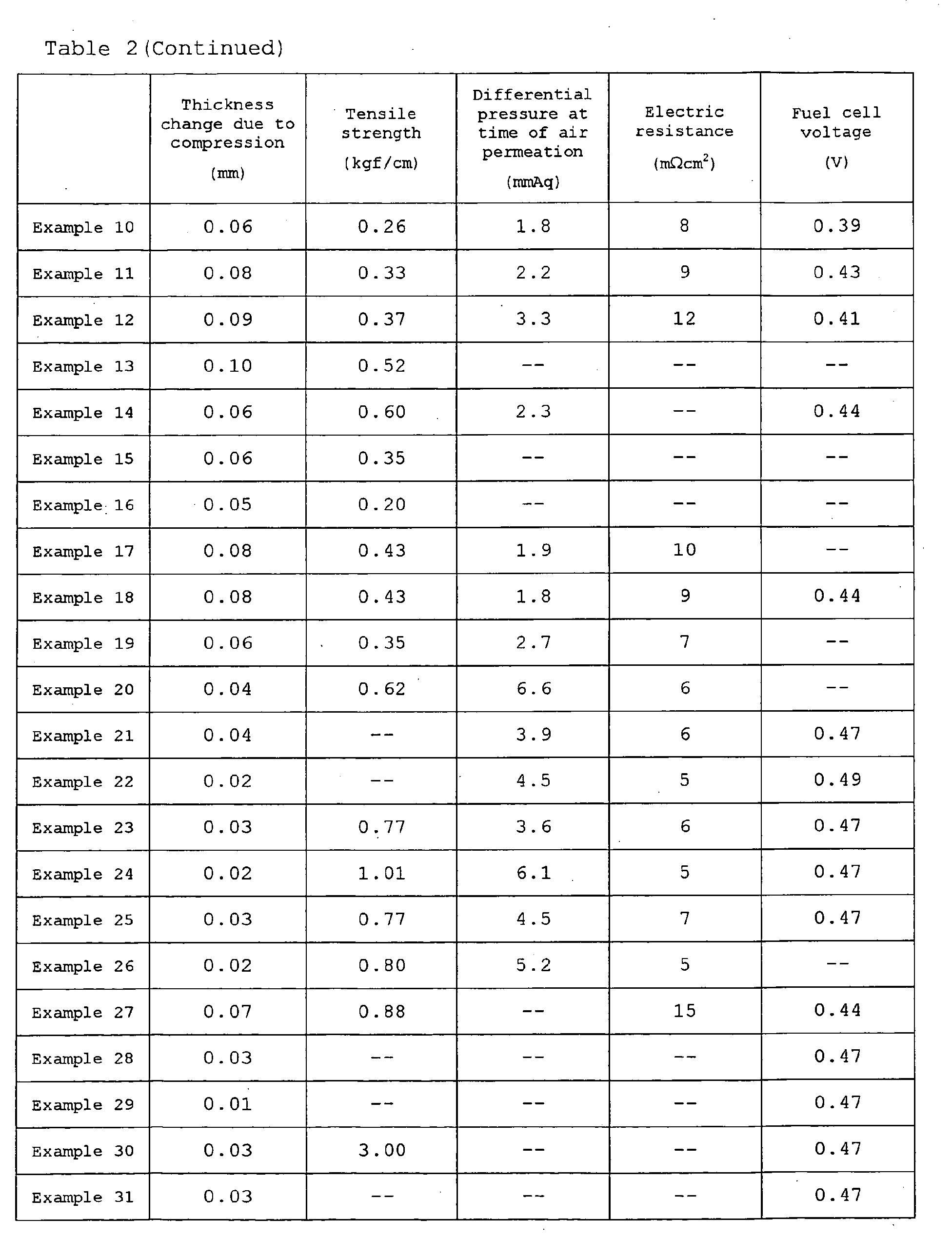


| Pressurization conditions | Weight per square-meter (g/m2) | Thickness (mm) | Density (g/cm3) | Thickness change due to compression (mm) | |||
| Temperature (°C) | Linear pressure (kgf/cm) | Planar pressure (MPa) | |||||
| Example 1 | 200 | 50 | 102 | 0.18 | 0.57 | 0.04 | |
| Example 2 | 200 | 50 | 127 | 0.23 | 0.55 | 0.05 | |
| Example 3 | 200 | 50 | 170 | 0.30 | 0.57 | 0.07 | |
| Example 4 | 150 | 50 | 138 | 0.29 | 0.48 | 0.08 | |
| Example 5 | 200 | 50 | 139 | 0.25 | 0.56 | 0.06 | |
| Example 6 | 200 | 100 | 137 | 0.23 | 0.60 | 0.06 | |
| Example 7 | 200 | 150 | 137 | 0.18 | 0.76 | 0.04 | |
| Example 8 | 230 | 4.9 | 120 | 0.23 | 0.52 | 0.03 | |
| Example 9 | 230 | 9.8 | 119 | 0.19 | 0.63 | 0.02 | |
| Comparative example 1 | 200 | 50 | 60 | 0.11 | 0.54 | 0.03 | |
| Comparative example 2 | No pressurization | 139 | 0.55 | 0.25 | 0.25 | ||
| Comparative example 3 | 60 | 50 | 140 | 0.45 | 0.31 | 0.16 | |
| Comparative example 4 | 100 | 50 | 138 | 0.35 | 0.39 | 0.11 | |
| Comparative example 5 | 125 | 50 | 139 | 0.33 | 0.42 | 0.10 | |
| Comparative example 6 | No pressurization | 121 | 0.48 | 0.25 | 0.22 |
| Weight per square- meter (g/m2) | Thickness (mm) | Density (g/cm3) | Peak size in pore size distribution (µm) | Differential pressure at time of air permeation (mmAq) | Fuel cell voltage (V) | |
| Example 10 | 60 | 0.13 | 0.48 | -- | 1.8 | 0.39 |
| Example 11 | 73 | 0.16 | 0.46 | -- | 2.2 | 0.43 |
| Example 12 | 101 | 0.21 | 0.47 | -- | 3.3 | 0.41 |
| Example 14 | 7 8 | 0.17 | 0.51 | -- | 2 . 3 | 0.44 |
| Example 18 | 73 | 0.21 | 0.35 | 36 | 1.8 | 0.44 |
| Example 21 | 90 | 0.20 | 0.45 | -- | 3.9 | 0.47 |
| Example 22 | 90 | 0.18 | 0.50 | -- | 4.5 | 0.49 |
| Example 23 | 80 | 0.16 | 0.50 | 29 | 3.6 | 0.47 |
| Example 24 | 78 | 0.13 | 0.60 | -- | 6.1 | 0.47 |
| Example 25 | 78 | 0.16 | 0.49 | -- | 4.5 | 0.47 |
| Comparative example 7 | 38 | 0.09 | 0.41 | -- | 0.8 | 0.31 |
| Comparative example 8 | 81 | 0.50 | 0.16 | 100 | 1.5 | 0.22 |
| Comparative example 15 | 74 | 0.10 | 0.72 | 27 | 10.3 | 0.24 |
| Modulus of elasticity in flexure (GPa) | ||
| Length direction (longitudinal direction) | Width direction (transverse direction) | |
| Example 23 | 0.4 | 0.06 |
| Example 24 | 1.2 | 0.12 |
| Example 28 | 1.3 | 0.60 |
| Example 29 | 3.9 | 1.70 |
| Comparative example 12 | Too low to be measured | Too low to be measured |
The oxidized acrylic fiber nonwoven fabric of the invention
is thin, dense, flame-proof, heat insulating and compact.
The carbon fiber nonwoven fabric of the invention is thin
and dense and has a thickness, density, gas permeability and pore
size most suitable as an electrode diffusion layer of a fuel cell.
The carbon fiber nonwoven fabric of the invention can be
preferably produced by carbonization treatment of the oxidized
acrylic fiber nonwoven fabric of the invention.
Since the carbon fiber nonwoven fabric of the invention is
high in modulus of elasticity in flexure, small in the deformation
due to compression, small in surface roughness, large in
flexibility and high in tensile strength, it is suitable as a
material for forming an electrode diffusion layer. A fuel cell
using the carbon fiber nonwoven fabric of the invention as the
electrode diffusion layers shows high cell performance.
Claims (34)
- An oxidized acrylic fiber nonwoven fabric, characterized in that it has a weight per square-meter of 70 to 190 g/m2, a thickness of 0.1 to 0.3 mm and a density of 0.35 to 0.8 g/cm3.
- An oxidized acrylic fiber nonwoven fabric, according to claim 1, wherein the thickness change due to compression as the difference between the thickness at a planar pressure of 0.15 MPa and the thickness at a planar pressure of 1.0 MPa is 0.15 mm or less.
- An oxidized acrylic fiber nonwoven fabric, according to claim 1, wherein the oxidized acrylic fibers are oriented also in the thickness direction of the nonwoven fabric.
- An oxidized acrylic fiber nonwoven fabric, according to claim 1, which is substantially formed of oxidized acrylic fibers only.
- A carbon fiber nonwoven fabric, characterized in that it is formed of carbon fibers and has a weight per square-meter of 50 to 150 g/m2, a thickness of 0.1 to 0.25 mm, a density of 0.3 to 0.7 g/cm3, a surface roughness Ra of 30 µm or less, a tensile strength of 0.2 kgf/cm or more and a maximum fracture radius of 20 mm or less.
- A carbon fiber nonwoven fabric, according to claim 5, which is substantially formed of carbon fibers only.
- A carbon fiber nonwoven fabric, characterized in that it is formed of substantially carbon fibers only and has a weight per square-meter of 50 to 150 g/m2, a thickness of 0.1 to 0.25 mm, a density of 0.3 to 0.7 g/cm3, a surface roughness Ra of 30 µm or less, a peak size of 10 to 60 µm in the pore size distribution and a tensile strength of 0.2 kgf/cm or more.
- A carbon fiber nonwoven fabric, according to claim 5 or 7,
wherein the thickness change due to compression as the difference between the thickness at a planar pressure of 0.15 MPa and the thickness at a planar pressure of 1.0 MPa is 0.15 mm or less. - A carbon fiber nonwoven fabric, according to claim 5 or 7,
wherein the modulus of elasticity in flexure is 0.1 GPa or more. - A carbon fiber nonwoven fabric, according to claim 5 or 7,
wherein the differential pressure occurring when air of 14 cm/sec is permeated through the nonwoven fabric in the thickness direction is from 1 to 10 mm Aq. - A carbon fiber nonwoven fabric, according to claim 5 or 7,
wherein the electric resistance in the thickness direction is 15 mΩ·cm2 or less. - A carbon fiber nonwoven fabric, characterized in that it has a weight per square-meter of 60 to 110 g/m2, a thickness of 0.13 to 0.22 mm, a density of 0.4 to 0.7 g/cm3, a maximum fracture radius of 20 mm or less, a surface roughness Ra of 20 µm or less, a thickness change due to compression as the difference between the thickness at a planar pressure of 0.15 MPa and the thickness at a planar pressure of 1.0 MPa is 0.1 mm or less, a tensile strength of 0.5 kgf/cm or more, a modulus of elasticity in flexure of 0.1 GPa or more, a peak size of 15 to 50 µm in the pore sizedistribution, an electric resistance of 15 mΩ·cm2 or less in the thickness direction, and a differential pressure of 2 to 7 mm Aq occurring when air of 14 cm/sec is permeated through the nonwoven fabric in the thickness direction.
- A carbon fiber nonwoven fabric, according to claim 5 or 12, wherein carbon black is contained on the surface of and/or inside the fabric.
- A carbon fiber nonwoven fabric, according to claim 5 or 12, which contains a water-repellent substance.
- A carbon fiber nonwoven fabric, characterized in that it is formed of carbon fibers and a water-repellent substance and has a weight per square-meter of 60 to 180 g/m2, a thickness of 0.1 to 0.25 mm, a density of 0.35 to 0.9 g/cm3, a surface roughness Ra of 25 µm or less, a maximum fracture radius of 20 mm or less and a modulus of elasticity in flexure of 0.5 GPa or more.
- A carbon fiber nonwoven fabric, according to claim 15, wherein the thickness change due to compression as the difference between the thickness at a planar pressure of 0.15 MPa and the thickness at a planar pressure of 1.0 MPa is 0.15 mm or less.
- A carbon fiber nonwoven fabric, according to claim 15, which has a tensile strength of 0.7 kgf/cm or more.
- A carbon fiber nonwoven fabric, according to claim 15, wherein the differential pressure occurring when air of 14 cm/sec is permeated through the nonwoven fabric in the thickness direction is from 2 to 12 mm Aq.
- A carbon fiber nonwoven fabric, characterized in that it is formed of carbon fibers and a water-repellent substance and has a weight per square-meter of 70 to 130 g/m2, a thickness of 0.13 to 0.22 mm, a density of 0.45 to 0.7 g/cm3, a surface roughness Ra of 15 µm or less, a maximum fracture radius of 20 mm or less, a thickness change due to compression of 0.1 mm or less as the difference between the thickness at a planar pressure of 0.15 MPa and the thickness at a planar pressure of 1.0 MPa, a tensile strength of 1.0 kgf/cm or more, a modulus of elasticity in flexure of 1.0 GPa or more and a differential pressure of 2 to 8 mm Aq occurring when air of 14 cm/sec is permeated through the nonwoven fabric in the thickness direction.
- A carbon fiber nonwoven fabric, according to claim 15 or 19, which is substantially formed of carbon fibers and a water-repellent substance only.
- A carbon fiber nonwoven fabric, characterized in that it is formed of carbon fibers, fine carbon particles and a water-repellent substance, with the fine carbon fibers existing locally on one side of the nonwoven fabric, and has a weight per square-meter of 70 to 200 g/m2, a thickness of 0.12 to 0.27 mm, a surface roughness Ra of 15 µm or less, a thickness change due to compression of 0.15 mm or less as the difference between the thickness at a planar pressure of 0.15 MPa and the thickness at a planar pressure of 1.0 MPa, and a tensile strength of 0.7 kgf/cm or more.
- A carbon fiber nonwoven fabric, according to any one of claims 5, 7, 12, 15, 19 and 21, wherein the carbon fibers are oriented also in the thickness direction of the nonwoven fabric.
- An electrode using the carbon fiber nonwoven fabric as set forth in any one of claims 5, 7, 12, 15, 19 and 21.
- An electrode diffusion layer using the carbon fiber nonwoven fabric as set forth in any one of claims 5, 7, 12, 15, 19 and 21.
- A fuel cell unit, characterized in that the electrode diffusion layer as set forth in claim 24, a catalyst layer and a polymeric electrolyte membrane are disposed in layers.
- A fuel cell, comprising the electrode diffusion layer as set forth in claim 24.
- A method for producing the oxidized acrylic fiber nonwoven fabric as set forth in claim 1, including the step of pressurizing a nonwoven fabric obtained by using oxidized acrylic fibers, at a temperature of 140°C or higher and at a linear pressure of 5 to 200 kgf/cm in the thickness direction using a continuous press.
- A method for producing the carbon fiber nonwoven fabric as set forth in any one of claims 5, 7, 12, 15, 19 and 21, comprising the steps of pressurizing a nonwoven fabric obtained by using oxidized acrylic fibers, at a temperature of 140°C or higher and at a linear pressure of 5 to 200 kgf/cm in the thickness direction, and carbonizing the oxidized acrylic fiber nonwoven fabric.
- A method for producing the oxidized acrylic fiber nonwoven fabric as set forth in claim 1, including the step of pressurizing a nonwoven fabric obtained by using oxidized acrylic fibers, at 140 to 300°C and at 0.5 to 40 MPa for 30 seconds or more by a continuous method.
- A method for producing the carbon fiber nonwoven fabric as set forth in any one of claims 5, 7, 12, 15, 19 and 21, comprising the steps of pressurizing a nonwoven fabric obtained by using oxidized acrylic fibers, at 140 to 300°C and at 0.5 to 40 MPa for 30 seconds or more by a continuous method, and carbonizing the oxidized acrylic fiber nonwoven fabric.
- A method for producing the oxidized acrylic fiber nonwoven fabric as set forth in claim 1, comprising the steps of pressurizing a nonwoven fabric obtained by using oxidized acrylic fibers, at a temperature of 140°C or higher and at a linear pressure of 5 to 200 kgf/cm in the thickness direction by a continuous method, and pressurizing at 140 to 300°C and at a planar pressure of 0.05 to 40 MPa for 10 seconds or more by a continuous method.
- A method for producing the carbon fiber nonwoven fabric as set forth in any one of claims 5, 7, 12, 15, 19 and 21, comprising the steps of pressurizing a nonwoven fabric obtained by using oxidized acrylic fibers, at a temperature of 140°C or higher and at a linear pressure of 5 to 200 kgf/cm in the thickness direction by a continuous method, and pressurizing at 140 to 300°C and at a planar pressure of 0.05 to 40 MPa for 10 seconds or more by a continuous method.
- A method for producing an oxidized acrylic fiber nonwoven fabric, according to claim 29 or 31, wherein the pressurization using a planar pressure by a continuous method is performed by a method comprising intermittent material carrying and a flat plate press in combination.
- A method for producing a carbon fiber nonwoven fabric, according to claim 30 or 32, wherein the pressurization using a planar pressure by a continuous method is performed by a method comprising intermittent material carrying and a flat plate press in combination.
Applications Claiming Priority (5)
| Application Number | Priority Date | Filing Date | Title |
|---|---|---|---|
| JP2002285627 | 2002-09-30 | ||
| JP2002285627 | 2002-09-30 | ||
| JP2003084642 | 2003-03-26 | ||
| JP2003084642 | 2003-03-26 | ||
| PCT/JP2003/012231 WO2004031465A1 (en) | 2002-09-30 | 2003-09-25 | Flame-resistant acrylic fiber nonwoven fabric, carbon fiber nonwoven fabric, and method for production thereof |
Publications (1)
| Publication Number | Publication Date |
|---|---|
| EP1548164A1 true EP1548164A1 (en) | 2005-06-29 |
Family
ID=32072460
Family Applications (1)
| Application Number | Title | Priority Date | Filing Date |
|---|---|---|---|
| EP03799128A Withdrawn EP1548164A1 (en) | 2002-09-30 | 2003-09-25 | Flame-resistant acrylic fiber nonwoven fabric, carbon fiber nonwoven fabric, and method for production thereof |
Country Status (5)
| Country | Link |
|---|---|
| US (1) | US20060166075A1 (en) |
| EP (1) | EP1548164A1 (en) |
| JP (1) | JPWO2004031465A1 (en) |
| CA (1) | CA2499828A1 (en) |
| WO (1) | WO2004031465A1 (en) |
Families Citing this family (27)
| Publication number | Priority date | Publication date | Assignee | Title |
|---|---|---|---|---|
| US20090061193A1 (en) * | 2005-04-19 | 2009-03-05 | Teijin Limited | Carbon fiber composite sheet, use thereof as a heat conductor and pitch-based carbon fiber web sheet for use in the same |
| DE102005022484B4 (en) * | 2005-05-11 | 2016-02-18 | Carl Freudenberg Kg | Gas diffusion layer and arrangement comprising two gas diffusion layers |
| US20080217030A1 (en) | 2005-06-09 | 2008-09-11 | Ricardo Grossman Goldeschelder | Fireproof Blanket Which is Used to Protect People, Furniture and Property Against Fire |
| JP2007035437A (en) * | 2005-07-27 | 2007-02-08 | Sony Corp | Porous conductive material, method for producing the same, electrode, method for producing the same, fuel cell, method for producing the same, electronic device, moving object, power generation system, cogeneration system, and electrode reaction utilization device |
| JP5041459B2 (en) * | 2006-03-07 | 2012-10-03 | 国立大学法人山梨大学 | Gas diffusion layer for fuel cells |
| WO2011065327A1 (en) * | 2009-11-24 | 2011-06-03 | 三菱レイヨン株式会社 | Porous electrode base material, process for production thereof, precursor sheet, film-electrode assembly, and solid polymer fuel cell |
| JP5497563B2 (en) * | 2010-07-09 | 2014-05-21 | 三菱レイヨン株式会社 | Method for producing porous carbon electrode substrate |
| KR101536835B1 (en) * | 2010-11-01 | 2015-07-14 | 미쯔비시 레이온 가부시끼가이샤 | Porous electrode base material and process for production thereof, porous electrode base material precursor sheet, membrane-electrode assembly, and solid polymer fuel cell |
| JP5435817B2 (en) * | 2011-03-24 | 2014-03-05 | 三菱レイヨン株式会社 | Method for producing porous electrode substrate |
| JP5681792B2 (en) | 2011-04-01 | 2015-03-11 | 本田技研工業株式会社 | ELECTROLYTE MEMBRANE / ELECTRODE STRUCTURE FOR FUEL CELL AND METHOD FOR PRODUCING THE SAME |
| TWI568888B (en) * | 2011-09-15 | 2017-02-01 | 第諾拉工業公司 | Gas diffusion electrode and its preparation method and electrochemical cell |
| JP6178041B2 (en) * | 2012-01-13 | 2017-08-09 | トヨタ自動車株式会社 | Method for producing diffusion layer for fuel cell |
| US20160087283A1 (en) | 2013-05-10 | 2016-03-24 | Mitsubishi Rayon Co., Ltd. | Porous electrode substrate, method for manufacturing same, and polymer electrolyte fuel cell |
| JP6054857B2 (en) * | 2013-12-26 | 2016-12-27 | 本田技研工業株式会社 | Electrolyte membrane / electrode structure |
| WO2015098530A1 (en) * | 2013-12-27 | 2015-07-02 | 東レ株式会社 | Carbon fiber nonwoven fabric, production method for carbon fiber nonwoven fabric, and nonwoven fabric of carbon fiber precurser fibers |
| JP6357923B2 (en) * | 2014-07-01 | 2018-07-18 | 東レ株式会社 | Gas diffusion electrode, manufacturing method and manufacturing apparatus thereof |
| JP6743805B2 (en) * | 2015-12-11 | 2020-08-19 | 東レ株式会社 | Carbon sheet, gas diffusion electrode substrate, and fuel cell |
| KR102234017B1 (en) * | 2016-12-29 | 2021-03-29 | 코오롱인더스트리 주식회사 | Method of manufacturing roll type gas diffusion layer with excellent spreading property |
| US11757103B2 (en) | 2019-04-19 | 2023-09-12 | Toray Industries, Inc. | Gas diffusion electrode medium and method for producing the same, gas diffusion electrode, membrane electrode assembly, and polymer electrolyte fuel cell |
| JP7426553B2 (en) * | 2019-05-29 | 2024-02-02 | パナソニックIpマネジメント株式会社 | Heat insulation sheet and its manufacturing method, electronic equipment and battery unit |
| JP7368283B2 (en) * | 2020-03-13 | 2023-10-24 | 帝人株式会社 | Manufacturing method and manufacturing device for carbon fiber electrode base material |
| EP4209632A4 (en) * | 2020-09-01 | 2025-01-01 | Teijin Limited | RESIN-BONDED FIBER, AND ACTIVE MATERIAL LAYER, ELECTRODE AND NONAQUEOUS ELECTROLYTE SECONDARY BATTERY USING SAME |
| FR3134245B1 (en) * | 2022-03-31 | 2025-07-11 | Hycco | Manufacturing process of a carbon fiber bipolar plate |
| DE102022124634A1 (en) | 2022-09-26 | 2024-03-28 | Ekpo Fuel Cell Technologies Gmbh | Method for producing a layer composite for an electrochemical unit |
| FR3155095A1 (en) * | 2023-11-07 | 2025-05-09 | Hycco | Manufacturing process of a carbon fiber bipolar plate and associated bipolar plate |
| CN117292778B (en) * | 2023-11-24 | 2024-02-20 | 中国石油大学(华东) | Method for calculating mechanical properties of gradient hole anode of solid oxide fuel cell |
| WO2025197535A1 (en) * | 2024-03-21 | 2025-09-25 | 泉株式会社 | Filter medium for air filter and method for manufacturing same |
Family Cites Families (7)
| Publication number | Priority date | Publication date | Assignee | Title |
|---|---|---|---|---|
| JP2000070631A (en) * | 1998-08-28 | 2000-03-07 | Osaka Gas Co Ltd | Manufacture of carbon fiber filter |
| GB9914492D0 (en) * | 1999-06-22 | 1999-08-25 | Johnson Matthey Plc | Non-woven fibre webs |
| KR20010080532A (en) * | 1999-09-22 | 2001-08-22 | 히라이 가쯔히꼬 | Porous, electrically conductive sheet and method for production thereof |
| KR100661785B1 (en) * | 2000-11-24 | 2006-12-28 | 도호 테낙구스 가부시키가이샤 | Carbon fiber sheet and its manufacturing method |
| JP4582905B2 (en) * | 2000-12-19 | 2010-11-17 | 東邦テナックス株式会社 | Oxidized fiber sheet, compressed oxidized fiber sheet, method for producing them, and method for producing carbon fiber sheet |
| JP2002266217A (en) * | 2001-03-08 | 2002-09-18 | Mitsubishi Rayon Co Ltd | Carbon fiber nonwoven fabric and method for producing the same |
| JP3976580B2 (en) * | 2002-02-12 | 2007-09-19 | 東邦テナックス株式会社 | High density flame resistant non-woven fabric, carbon non-woven fabric and production method thereof |
-
2003
- 2003-09-25 WO PCT/JP2003/012231 patent/WO2004031465A1/en not_active Ceased
- 2003-09-25 CA CA002499828A patent/CA2499828A1/en not_active Abandoned
- 2003-09-25 EP EP03799128A patent/EP1548164A1/en not_active Withdrawn
- 2003-09-25 US US10/528,633 patent/US20060166075A1/en not_active Abandoned
- 2003-09-25 JP JP2004541237A patent/JPWO2004031465A1/en not_active Withdrawn
Non-Patent Citations (1)
| Title |
|---|
| See references of WO2004031465A1 * |
Also Published As
| Publication number | Publication date |
|---|---|
| WO2004031465A1 (en) | 2004-04-15 |
| CA2499828A1 (en) | 2004-04-15 |
| US20060166075A1 (en) | 2006-07-27 |
| JPWO2004031465A1 (en) | 2006-02-02 |
Similar Documents
| Publication | Publication Date | Title |
|---|---|---|
| US20060166075A1 (en) | Flame-resistant acrylic fiber nonwoven fabric, carbon fiber nonwoven fabric, and method for production thereof | |
| CN100480451C (en) | Porous carbon base material, and preparation method and application thereof | |
| US6413663B1 (en) | Fluid permeable flexible graphite fuel cell electrode | |
| EP1139471A1 (en) | Porous, electrically conductive sheet and method for production thereof | |
| JP4051714B2 (en) | Electrode substrate for polymer electrolyte fuel cell and method for producing the same | |
| US20040241078A1 (en) | Fuel cell-use carbon fiber woven fabric, electrode element, fuel cell mobile unit, and production method for fuel cell-use carbon fiber woven fabric | |
| KR102943400B1 (en) | Gas diffusion electrode substrate and method of manufacturing the same, gas diffusion electrode, membrane electrode assembly and solid polymer fuel cell | |
| KR102946163B1 (en) | Gas diffusion layer for fuel cells having improved flexural characteristics | |
| CA3006426C (en) | Carbon sheet, gas diffusion electrode substrate, and fuel cell | |
| CN110024193B (en) | Gas diffusion electrode and method for producing same | |
| CN100444435C (en) | Membrane electrode assembly, method for producing same, and polymer electrolyte fuel cell | |
| TWI885531B (en) | A gas diffusion layer for a fuel cell with a low plastic deformability and a good surface quality and a method for producing the same | |
| JP2002358981A (en) | Current collector for fuel cell and method of manufacturing the same | |
| JP2004027435A (en) | Carbon fiber sheet and method for producing the same | |
| JPWO2017047515A1 (en) | Gas diffusion electrode and manufacturing method thereof | |
| TW202545054A (en) | a proton exchange membrane fuel cell with improved contact properties between the gas diffusion layers and the polymer electrolyte membrane | |
| JP2005240224A (en) | High-density flame resistant fiber nonwoven fabric and carbon fiber nonwoven fabric, and methods for producing them | |
| JP7691514B2 (en) | Separator Plate | |
| JP2025535150A (en) | Gas diffusion layer with property gradient and slight plastic deformation for fuel cells and method for manufacturing same | |
| KR20190103175A (en) | Gas Diffusion Electrodes and Fuel Cells | |
| JP2007176750A (en) | Porous carbon fiber sheet and method for producing the same | |
| JP4464049B2 (en) | Gas diffusion electrode substrate precursor, gas diffusion electrode substrate, gas diffusion electrode, and fuel cell | |
| JP4202205B2 (en) | Fuel cell stack | |
| DE102024101825A1 (en) | Gas diffusion layer for polymer electrolyte membrane fuel cells with reduced contact resistance | |
| JPWO2001022509A1 (en) | Approximate manufacturing method for porous conductive sheet |
Legal Events
| Date | Code | Title | Description |
|---|---|---|---|
| PUAI | Public reference made under article 153(3) epc to a published international application that has entered the european phase |
Free format text: ORIGINAL CODE: 0009012 |
|
| 17P | Request for examination filed |
Effective date: 20050314 |
|
| AK | Designated contracting states |
Kind code of ref document: A1 Designated state(s): AT BE BG CH CY CZ DE DK EE ES FI FR GB GR HU IE IT LI LU MC NL PT RO SE SI SK TR |
|
| RBV | Designated contracting states (corrected) |
Designated state(s): DE |
|
| STAA | Information on the status of an ep patent application or granted ep patent |
Free format text: STATUS: THE APPLICATION HAS BEEN WITHDRAWN |
|
| 18W | Application withdrawn |
Effective date: 20071127 |