EP1548124A1 - Method and apparatus for washing solid substrate with ultrasonic wave after hybridization reaction - Google Patents
Method and apparatus for washing solid substrate with ultrasonic wave after hybridization reaction Download PDFInfo
- Publication number
- EP1548124A1 EP1548124A1 EP02787326A EP02787326A EP1548124A1 EP 1548124 A1 EP1548124 A1 EP 1548124A1 EP 02787326 A EP02787326 A EP 02787326A EP 02787326 A EP02787326 A EP 02787326A EP 1548124 A1 EP1548124 A1 EP 1548124A1
- Authority
- EP
- European Patent Office
- Prior art keywords
- washing
- ultrasonic wave
- solid substrate
- washing solution
- ultrasonic
- Prior art date
- Legal status (The legal status is an assumption and is not a legal conclusion. Google has not performed a legal analysis and makes no representation as to the accuracy of the status listed.)
- Withdrawn
Links
Images
Classifications
-
- B—PERFORMING OPERATIONS; TRANSPORTING
- B08—CLEANING
- B08B—CLEANING IN GENERAL; PREVENTION OF FOULING IN GENERAL
- B08B3/00—Cleaning by methods involving the use or presence of liquid or steam
- B08B3/04—Cleaning involving contact with liquid
- B08B3/10—Cleaning involving contact with liquid with additional treatment of the liquid or of the object being cleaned, e.g. by heat, by electricity or by vibration
- B08B3/12—Cleaning involving contact with liquid with additional treatment of the liquid or of the object being cleaned, e.g. by heat, by electricity or by vibration by sonic or ultrasonic vibrations
-
- C—CHEMISTRY; METALLURGY
- C12—BIOCHEMISTRY; BEER; SPIRITS; WINE; VINEGAR; MICROBIOLOGY; ENZYMOLOGY; MUTATION OR GENETIC ENGINEERING
- C12Q—MEASURING OR TESTING PROCESSES INVOLVING ENZYMES, NUCLEIC ACIDS OR MICROORGANISMS; COMPOSITIONS OR TEST PAPERS THEREFOR; PROCESSES OF PREPARING SUCH COMPOSITIONS; CONDITION-RESPONSIVE CONTROL IN MICROBIOLOGICAL OR ENZYMOLOGICAL PROCESSES
- C12Q1/00—Measuring or testing processes involving enzymes, nucleic acids or microorganisms; Compositions therefor; Processes of preparing such compositions
- C12Q1/68—Measuring or testing processes involving enzymes, nucleic acids or microorganisms; Compositions therefor; Processes of preparing such compositions involving nucleic acids
- C12Q1/6813—Hybridisation assays
Definitions
- the present invention relates to a method and device for washing solid substrate after hybridization reaction using ultrasonic wave, especially relates to the method and device for washing biochips after hybridization reaction.
- the method and device can be used in clinical diagnosis, basic life science research, agriculture, environmental monitoring, and other fields.
- Nonspecific adsorption is very common during hybridization reactions, which makes it difficult to analyze the hybridization results in biological and medical applications.
- washing to get rid of nonspecific adsorption is one of the important steps during biological and medical sample analysis and detection.
- the conventional washing method is carried out by submerging the surface area of the solid substrate to be washed in a washing solution and washing the solid substrate through mechanical vibration. Although such method is simple, it is time consuming and inefficient, leaving high background signals and poor uniformity. Furthermore, because such washing device has moving part, it is difficult to adapt the device for integration and miniaturization.
- the purpose of the present invention is to shorten the washing time after hybridization reaction, increase the contrast between the hybridization and background signals, and provide a hybridization reaction washing device that is structurally simple, fast, inexpensive, easy to operate, suitable for automation, and applicable to microreaction systems.
- a method for washing a hybridized solid substrate i.e., a solid substrate on which a hybridization reaction has been completed
- the method includes 1) placing the hybridized solid substrate in a container having a washing solution; 2) generating a certain strength of ultrasound with an ultrasonic wave generator and transmitting the ultrasound into the washing solution, wherein the washing of the solid substrate is facilitated by cavitation effects in the washing solution produced by the ultrasound.
- the present invention further provides a device for carrying out the washing method described above.
- the device includes a container having a washing solution, a hybridized solid substrate placed in the washing solution, wherein at least one ultrasonic resonance component is placed upon, below, or around the hybridized solid substrate, and wherein the ultrasonic resonance component is connected to a resonance circuit.
- the ultrasonic resonance circuit which drives the ultrasonic resonance component to produce ultrasound.
- the washing is facilitated by the cavitation effect produced by the ultrasound transmitted to the solution.
- the cavitation bubbles in the washing solution can produce violent jet streams and local microslipstream against the solid surface, evidently reduce the liquid surface tension and friction, destroy the boundary layer at the solid-liquid interface, and enhance the liquid flow. Accordingly, nonspecific adsorption and deposit bound weakly on the solid substrate can be rapidly washed away.
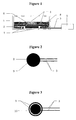
- Figure 1 is a schematic diagram of an exemplary device of the present invention.
- Figure 2 is the front view of an ultrasonic resonance component made of piezoelectric ceramic disk used in an example of the present invention.
- Figure 3 is the back view of an ultrasonic resonance component made of piezoelectric ceramic disk used in an example of the present invention.
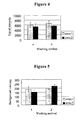
- Figure 4 shows the comparison of hybridization fluorescent signals obtained according to an exemplary method of the present invention and those obtained according to the conventional mechanical vibration method.
- Figure 5 shows the comparison of background fluorescent signals obtained according to an exemplary method of the present invention and those obtained according to the conventional mechanical vibration method.
- the hybridized solid substrate is first placed in the washing solution, wherein the surface of the substrate that is to be washed is brought into contact with the washing solution.
- the ultrasonic resonance component can be in direct contact with the washing solution, or can be adhered to the outside wall of the solution container by adhesives such as epoxy adhesives.
- the ultrasonic resonance component can be positioned at the upper part, the lower part, or the peripheral of the container.
- the material for the ultrasonic resonance component can be piezoelectric ceramic or quartz material.
- the shape of the ultrasonic resonance component can be column, cone, cylinder, cube, or any other shape suitable for generating ultrasonic wave resonance.
- the size of the ultrasonic resonance component can be in a range of 10 ⁇ m 3 to 1000cm 3 .
- the frequency of the ultrasonic wave generated by the ultrasonic resonance component can be in a range of 20kHz to 100MHz.
- the power of the ultrasonic wave generator can be in a range of 1 W to 200 W, and the mode of generating ultrasonic wave can be continuous or intermittent.
- FIG. 1 shows an actual example according to the present invention.
- This example provides a method of washing a hybridized gene chip using ultrasonic wave.
- a round piezoelectric ceramic disk 2 with diameter of 2.5cm and frequency of 1.7MHz was adhered to the inner side of plastic box 1 with the dimension of 8.5cm x 5cm x 2cm.
- the piezoelectric ceramic disk 2 was connected to ultrasonic resonance circuit 5 by wire 3 passing through a hole drilled at the side wall of the plastic box 1.
- the output power of ultrasonic resonance circuit 5 was 20W.
- the hole for wire passing was then sealed with epoxy adhesive.
- the outside rim of piezoelectric ceramic disk 2 was encircled by circular rubber sealing loop 4.
- the rubber sealing loop 4 was affixed to the bottom of plastic box 1 by epoxy adhesive 7, which was used to insulate the solder point from the washing solution to avoid short circuit.
- epoxy adhesive 7 was used to insulate the solder point from the washing solution to avoid short circuit.
- Figures 2 and 3 show the arrangement of electrodes on the piezoelectric ceramic ultrasonic resonance component of the present invention.
- Figure 2 is the front view of the piezoelectric ceramic disk
- Figure 3 is the back view of the same: 9 represents the metal electrode coated on the surface of the ultrasonic piezoelectric ceramic disk, 3 represents the wire soldered to the ultrasonic piezoelectric ceramic disk, and 10 represents the exposed piezoelectric material at the back of the ultrasonic piezoelectric ceramic disk.
- FIGS 4 and 5 show the comparison of hybridization and background fluorescent signals obtained according to an exemplary method of the present invention and those obtained according to the conventional method.
- Washing condition 1 shown in figures 4 and 5 represents washing the liquid-solid hybridization system for 15 minutes by mechanical vibration (vibration frequency 80rpm, amplitude 15mm).
- Washing condition 2 represents washing the same system for 3 minutes using a 1.7MHz piezoelectric ceramic disk under the power of 20W.
- the gene chip was placed somewhere about 2mm above the piezoelectric ceramic disk, with its surface with probes on facing away from the ceramic disk.
- the washing solution was then added to submerge the gene chip.
- the washing solution was 0.1 % SDS, and its volume was 10 mL.
- the probe, hybridization sample, and hybridization condition for Array 1 and Array 2 were the same.
- the probe was a 35mer oligonucleotide, which was attached covalently to an aldehyde modified glass slide.
- the target sample was a 1045 bp DNA, part of which matches perfectly with the probe.
- the sample DNA chain was labeled with Cy5 fluorescent molecules.
- the hybridization was carried out at 65 °C for 90 minutes.
- the detection was carried out using laser-induced fluorescence detection method.
- the instrument for detection was ScanArray 4000.
- the photomultiplier tube (PMT) was set at 75% of the maximum setting of the instrument.
- the power of the laser source was set at 80% of the maximum setting of the instrument.
- the method of the present invention significantly shortens the washing time (the results of the example show that the washing time of the hybridized gene chip using the ultrasonic wave method was about one fifth of the time needed when using the conventional mechanical vibration method) and increases the contrast of the hybridization and background signals.
- the structure of the inventive device is simple (the core elements only include the ultrasonic resonance component, the corresponding ultrasonic resonance circuit, and the washing solution container) and has no moving parts, which makes it easier for integration and automation.
Landscapes
- Chemical & Material Sciences (AREA)
- Organic Chemistry (AREA)
- Life Sciences & Earth Sciences (AREA)
- Zoology (AREA)
- Wood Science & Technology (AREA)
- Proteomics, Peptides & Aminoacids (AREA)
- Health & Medical Sciences (AREA)
- Engineering & Computer Science (AREA)
- Microbiology (AREA)
- Biochemistry (AREA)
- Physics & Mathematics (AREA)
- Molecular Biology (AREA)
- Biotechnology (AREA)
- Biophysics (AREA)
- Analytical Chemistry (AREA)
- Immunology (AREA)
- Bioinformatics & Cheminformatics (AREA)
- General Engineering & Computer Science (AREA)
- General Health & Medical Sciences (AREA)
- Genetics & Genomics (AREA)
- Apparatus Associated With Microorganisms And Enzymes (AREA)
- Automatic Analysis And Handling Materials Therefor (AREA)
- Cleaning By Liquid Or Steam (AREA)
Abstract
Description
Claims (6)
- A method for washing a solid substrate on which a hybridization reaction has been completed using ultrasonic wave, including 1) placing the solid substrate in a container having a washing solution; 2) generating certain strength of ultrasound with an ultrasonic wave generator and transmitting the ultrasound into the washing solution, wherein the washing of the solid substrate is facilitated by cavitation effect in the washing solution produced by the ultrasound.
- The method of claim 1, wherein the power of the ultrasonic wave generator is in a range of about 0.1 W to about 200W.
- The method of claim 1, wherein the ultrasonic wave frequency generated by the ultrasonic wave generator is in a range of about 20 kHz to about 100 MHz.
- The method of claim 1, wherein the mode of generating ultrasonic wave by the ultrasonic wave generator is continuous or intermittent.
- A device for washing a hybridized solid substrate according to the method of claim 1, comprising a container having a washing solution and a hybridized solid substrate placed in the solution, wherein at least one ultrasonic resonance component is placed upon, below, or around the hybridized solid substrate, and wherein the ultrasonic resonance component is connected with a resonance circuit.
- The device of claim 6, wherein the resonance component is in direct or indirect contact with the washing solution.
Applications Claiming Priority (3)
| Application Number | Priority Date | Filing Date | Title |
|---|---|---|---|
| CN02128860 | 2002-08-16 | ||
| CNB021288607A CN1235028C (en) | 2002-08-16 | 2002-08-16 | Ultrasonic method and equipment for cleaning solid matrix after hybridization reaction |
| PCT/CN2002/000877 WO2004016808A1 (en) | 2002-08-16 | 2002-12-10 | Method and apparatus for washing solid substrate with ultrasonic wave after hybridization reaction |
Publications (2)
| Publication Number | Publication Date |
|---|---|
| EP1548124A1 true EP1548124A1 (en) | 2005-06-29 |
| EP1548124A4 EP1548124A4 (en) | 2006-08-23 |
Family
ID=4746046
Family Applications (1)
| Application Number | Title | Priority Date | Filing Date |
|---|---|---|---|
| EP02787326A Withdrawn EP1548124A4 (en) | 2002-08-16 | 2002-12-10 | METHOD AND APPARATUS FOR WASHING A SOLID SUBSTRATE USING AN ULTRASONIC WAVE AFTER A HYBRIDIZATION REACTION |
Country Status (7)
| Country | Link |
|---|---|
| US (1) | US20060124152A1 (en) |
| EP (1) | EP1548124A4 (en) |
| JP (1) | JP2005535891A (en) |
| CN (1) | CN1235028C (en) |
| AU (1) | AU2002354071A1 (en) |
| CA (1) | CA2495643A1 (en) |
| WO (1) | WO2004016808A1 (en) |
Families Citing this family (2)
| Publication number | Priority date | Publication date | Assignee | Title |
|---|---|---|---|---|
| US20050158885A1 (en) * | 2004-01-20 | 2005-07-21 | Taiwan Semiconductor Manufacturing Co. | Wet bench wafer floating detection system |
| DE102020124322A1 (en) * | 2020-09-17 | 2022-03-17 | Echovista Gmbh | Method for clearing a field of view of an optical surveillance device |
Family Cites Families (13)
| Publication number | Priority date | Publication date | Assignee | Title |
|---|---|---|---|---|
| AU604684B2 (en) * | 1986-03-20 | 1991-01-03 | Gen-Probe Incorporated | Method for releasing RNA and DNA from cells |
| US5085982A (en) * | 1986-06-12 | 1992-02-04 | City Of Hope | Method of detecting specific substances by selective growth of living cells |
| US4886741A (en) * | 1987-12-09 | 1989-12-12 | Microprobe Corporation | Use of volume exclusion agents for the enhancement of in situ hybridization |
| DE4113157A1 (en) * | 1990-09-06 | 1992-03-12 | Bayer Ag | MELAMINE BASED BRANCHED POLYPHOSPHONATES |
| DE4121304A1 (en) * | 1991-06-27 | 1993-01-14 | Siemens Ag | Cleaning agent for removing pastes from thick layer hybrid technology substrates - comprising water, limonene and surface active additives, is non-toxic and allows use of ultrasound |
| JPH0751644A (en) * | 1993-08-13 | 1995-02-28 | Dainippon Ink & Chem Inc | Method for cleaning substrate for electrophotographic photoreceptor |
| US6287850B1 (en) * | 1995-06-07 | 2001-09-11 | Affymetrix, Inc. | Bioarray chip reaction apparatus and its manufacture |
| JPH09327671A (en) * | 1996-06-12 | 1997-12-22 | Kaijo Corp | Ultrasonic cleaner |
| US6291180B1 (en) * | 1999-09-29 | 2001-09-18 | American Registry Of Pathology | Ultrasound-mediated high-speed biological reaction and tissue processing |
| CN1314494A (en) * | 2000-03-20 | 2001-09-26 | 上海博德基因开发有限公司 | Washing method for fluorescent label of gene chip and its special elution liquid |
| CN1321890A (en) * | 2000-04-30 | 2001-11-14 | 南京益来基因医学有限公司 | Nucteic acid amplification gene chip hybridization detecting instrument |
| EP1281966A3 (en) * | 2001-07-30 | 2003-06-18 | Fuji Photo Film Co., Ltd. | Method and apparatus for conducting a receptor-ligand reaction |
| CN2495656Y (en) * | 2001-09-03 | 2002-06-19 | 赵雨杰 | Nucleic acid expanding gene chip hybridization and intellectualization parallel testing instrument |
-
2002
- 2002-08-16 CN CNB021288607A patent/CN1235028C/en not_active Expired - Fee Related
- 2002-12-10 AU AU2002354071A patent/AU2002354071A1/en not_active Abandoned
- 2002-12-10 EP EP02787326A patent/EP1548124A4/en not_active Withdrawn
- 2002-12-10 JP JP2004528249A patent/JP2005535891A/en active Pending
- 2002-12-10 CA CA002495643A patent/CA2495643A1/en not_active Abandoned
- 2002-12-10 WO PCT/CN2002/000877 patent/WO2004016808A1/en not_active Ceased
- 2002-12-10 US US10/524,903 patent/US20060124152A1/en not_active Abandoned
Also Published As
| Publication number | Publication date |
|---|---|
| WO2004016808A1 (en) | 2004-02-26 |
| CA2495643A1 (en) | 2004-02-26 |
| EP1548124A4 (en) | 2006-08-23 |
| CN1397790A (en) | 2003-02-19 |
| CN1235028C (en) | 2006-01-04 |
| US20060124152A1 (en) | 2006-06-15 |
| JP2005535891A (en) | 2005-11-24 |
| AU2002354071A1 (en) | 2004-03-03 |
Similar Documents
| Publication | Publication Date | Title |
|---|---|---|
| JP5758876B2 (en) | Sample processing method using focused acoustic energy | |
| US6277332B1 (en) | Reaction plenum with magnetic separation and/or ultrasonic agitation | |
| US6413783B1 (en) | Assay sonication apparatus and methodology | |
| CN101175557B (en) | Sonication of media | |
| CN112058325B (en) | Ultrasonic phased array microfluidic detection device and method based on immunomagnetic bead technology | |
| US8169122B1 (en) | Ultra sonic release of DNA or RNA | |
| US7459304B2 (en) | Method for analysing macromolecules | |
| ZA202213088B (en) | An infectious disease screening device | |
| CN101864360A (en) | A preparation method of microfluidic chip probe array for biochip analysis | |
| US20060124152A1 (en) | Method and apparatus for washing solid substrate with ultrasonic wave after hybridization reaction | |
| Singh et al. | Ultrasound: a boon in the synthesis of organic compounds | |
| JP5616773B2 (en) | Reaction device for nucleic acid analysis and nucleic acid analyzer | |
| JP2007147456A (en) | Microfluidic system, sample analyzer, and target substance detection or measurement method | |
| WO2011064333A1 (en) | Ultrasonic merging of particles in microwells | |
| CN1171526C (en) | A method and device for promoting hybridization reaction by using ultrasound | |
| JP2007117830A (en) | Ultarsonic micro plate agitation and defoaming apparatus | |
| CN115096994A (en) | Wireless sound wave liquid phase detection system combined with micro-fluidic chip | |
| CN207439793U (en) | A kind of suspended matter mechanical mixing apparatus and the mixer using the device | |
| CN218823932U (en) | Alzheimer's early sieve device based on ultrasonic accelerated reaction and aggregation enhancement | |
| CN213556975U (en) | Ultrasonic chemical reaction device | |
| US20090017528A1 (en) | Nucleic Acid Hybridization Device | |
| WO2024240708A1 (en) | Method and apparatus for the detection of biomolecules in a liquid sample | |
| WO2023004795A1 (en) | Ultrasonic pipetting apparatus and method | |
| CN113801787A (en) | Ultrasonic integrated micro-droplet array detection platform and preparation method and application thereof | |
| CN117535146A (en) | Ultrasonic oscillation device, cell wall removing system and cell wall removing method |
Legal Events
| Date | Code | Title | Description |
|---|---|---|---|
| PUAI | Public reference made under article 153(3) epc to a published international application that has entered the european phase |
Free format text: ORIGINAL CODE: 0009012 |
|
| 17P | Request for examination filed |
Effective date: 20050302 |
|
| AK | Designated contracting states |
Kind code of ref document: A1 Designated state(s): AT BE BG CH CY CZ DE DK EE ES FI FR GB GR IE IT LI LU MC NL PT SE SI SK TR |
|
| AX | Request for extension of the european patent |
Extension state: AL LT LV MK RO |
|
| DAX | Request for extension of the european patent (deleted) | ||
| A4 | Supplementary search report drawn up and despatched |
Effective date: 20060726 |
|
| RAP1 | Party data changed (applicant data changed or rights of an application transferred) |
Owner name: CAPITALBIO CORPORATION Owner name: TSINGHUA UNIVERSITY |
|
| 17Q | First examination report despatched |
Effective date: 20061103 |
|
| GRAP | Despatch of communication of intention to grant a patent |
Free format text: ORIGINAL CODE: EPIDOSNIGR1 |
|
| STAA | Information on the status of an ep patent application or granted ep patent |
Free format text: STATUS: THE APPLICATION IS DEEMED TO BE WITHDRAWN |
|
| 18D | Application deemed to be withdrawn |
Effective date: 20090310 |