EP1548114A1 - Method of expressing gene in transgenic birds using retrovirus vector and transgenic birds thus obtained - Google Patents
Method of expressing gene in transgenic birds using retrovirus vector and transgenic birds thus obtained Download PDFInfo
- Publication number
- EP1548114A1 EP1548114A1 EP03788072A EP03788072A EP1548114A1 EP 1548114 A1 EP1548114 A1 EP 1548114A1 EP 03788072 A EP03788072 A EP 03788072A EP 03788072 A EP03788072 A EP 03788072A EP 1548114 A1 EP1548114 A1 EP 1548114A1
- Authority
- EP
- European Patent Office
- Prior art keywords
- antibody
- transgenic chimera
- transgenic
- gene
- chimera bird
- Prior art date
- Legal status (The legal status is an assumption and is not a legal conclusion. Google has not performed a legal analysis and makes no representation as to the accuracy of the status listed.)
- Granted
Links
Images







Classifications
-
- A—HUMAN NECESSITIES
- A01—AGRICULTURE; FORESTRY; ANIMAL HUSBANDRY; HUNTING; TRAPPING; FISHING
- A01K—ANIMAL HUSBANDRY; AVICULTURE; APICULTURE; PISCICULTURE; FISHING; REARING OR BREEDING ANIMALS, NOT OTHERWISE PROVIDED FOR; NEW BREEDS OF ANIMALS
- A01K67/00—Rearing or breeding animals, not otherwise provided for; New or modified breeds of animals
- A01K67/027—New or modified breeds of vertebrates
-
- A—HUMAN NECESSITIES
- A01—AGRICULTURE; FORESTRY; ANIMAL HUSBANDRY; HUNTING; TRAPPING; FISHING
- A01K—ANIMAL HUSBANDRY; AVICULTURE; APICULTURE; PISCICULTURE; FISHING; REARING OR BREEDING ANIMALS, NOT OTHERWISE PROVIDED FOR; NEW BREEDS OF ANIMALS
- A01K67/00—Rearing or breeding animals, not otherwise provided for; New or modified breeds of animals
- A01K67/027—New or modified breeds of vertebrates
- A01K67/0275—Genetically modified vertebrates, e.g. transgenic
-
- A—HUMAN NECESSITIES
- A01—AGRICULTURE; FORESTRY; ANIMAL HUSBANDRY; HUNTING; TRAPPING; FISHING
- A01K—ANIMAL HUSBANDRY; AVICULTURE; APICULTURE; PISCICULTURE; FISHING; REARING OR BREEDING ANIMALS, NOT OTHERWISE PROVIDED FOR; NEW BREEDS OF ANIMALS
- A01K67/00—Rearing or breeding animals, not otherwise provided for; New or modified breeds of animals
- A01K67/027—New or modified breeds of vertebrates
- A01K67/0275—Genetically modified vertebrates, e.g. transgenic
- A01K67/0278—Knock-in vertebrates, e.g. humanised vertebrates
-
- C—CHEMISTRY; METALLURGY
- C07—ORGANIC CHEMISTRY
- C07K—PEPTIDES
- C07K16/00—Immunoglobulins [IG], e.g. monoclonal or polyclonal antibodies
-
- C—CHEMISTRY; METALLURGY
- C07—ORGANIC CHEMISTRY
- C07K—PEPTIDES
- C07K16/00—Immunoglobulins [IG], e.g. monoclonal or polyclonal antibodies
- C07K16/02—Immunoglobulins [IG], e.g. monoclonal or polyclonal antibodies from eggs
-
- C—CHEMISTRY; METALLURGY
- C07—ORGANIC CHEMISTRY
- C07K—PEPTIDES
- C07K16/00—Immunoglobulins [IG], e.g. monoclonal or polyclonal antibodies
- C07K16/18—Immunoglobulins [IG], e.g. monoclonal or polyclonal antibodies against material from animals or humans
- C07K16/28—Immunoglobulins [IG], e.g. monoclonal or polyclonal antibodies against material from animals or humans against receptors, cell surface antigens or cell surface determinants
- C07K16/2803—Immunoglobulins [IG], e.g. monoclonal or polyclonal antibodies against material from animals or humans against receptors, cell surface antigens or cell surface determinants against the immunoglobulin superfamily
- C07K16/2806—Immunoglobulins [IG], e.g. monoclonal or polyclonal antibodies against material from animals or humans against receptors, cell surface antigens or cell surface determinants against the immunoglobulin superfamily against CD2
-
- C—CHEMISTRY; METALLURGY
- C12—BIOCHEMISTRY; BEER; SPIRITS; WINE; VINEGAR; MICROBIOLOGY; ENZYMOLOGY; MUTATION OR GENETIC ENGINEERING
- C12N—MICROORGANISMS OR ENZYMES; COMPOSITIONS THEREOF; PROPAGATING, PRESERVING, OR MAINTAINING MICROORGANISMS; MUTATION OR GENETIC ENGINEERING; CULTURE MEDIA
- C12N15/00—Mutation or genetic engineering; DNA or RNA concerning genetic engineering, vectors, e.g. plasmids, or their isolation, preparation or purification; Use of hosts therefor
- C12N15/09—Recombinant DNA-technology
- C12N15/11—DNA or RNA fragments; Modified forms thereof; Non-coding nucleic acids having a biological activity
-
- C—CHEMISTRY; METALLURGY
- C12—BIOCHEMISTRY; BEER; SPIRITS; WINE; VINEGAR; MICROBIOLOGY; ENZYMOLOGY; MUTATION OR GENETIC ENGINEERING
- C12N—MICROORGANISMS OR ENZYMES; COMPOSITIONS THEREOF; PROPAGATING, PRESERVING, OR MAINTAINING MICROORGANISMS; MUTATION OR GENETIC ENGINEERING; CULTURE MEDIA
- C12N15/00—Mutation or genetic engineering; DNA or RNA concerning genetic engineering, vectors, e.g. plasmids, or their isolation, preparation or purification; Use of hosts therefor
- C12N15/09—Recombinant DNA-technology
- C12N15/63—Introduction of foreign genetic material using vectors; Vectors; Use of hosts therefor; Regulation of expression
- C12N15/79—Vectors or expression systems specially adapted for eukaryotic hosts
- C12N15/85—Vectors or expression systems specially adapted for eukaryotic hosts for animal cells
- C12N15/8509—Vectors or expression systems specially adapted for eukaryotic hosts for animal cells for producing genetically modified animals, e.g. transgenic
-
- C—CHEMISTRY; METALLURGY
- C12—BIOCHEMISTRY; BEER; SPIRITS; WINE; VINEGAR; MICROBIOLOGY; ENZYMOLOGY; MUTATION OR GENETIC ENGINEERING
- C12P—FERMENTATION OR ENZYME-USING PROCESSES TO SYNTHESISE A DESIRED CHEMICAL COMPOUND OR COMPOSITION OR TO SEPARATE OPTICAL ISOMERS FROM A RACEMIC MIXTURE
- C12P21/00—Preparation of peptides or proteins
- C12P21/02—Preparation of peptides or proteins having a known sequence of two or more amino acids, e.g. glutathione
-
- A—HUMAN NECESSITIES
- A01—AGRICULTURE; FORESTRY; ANIMAL HUSBANDRY; HUNTING; TRAPPING; FISHING
- A01K—ANIMAL HUSBANDRY; AVICULTURE; APICULTURE; PISCICULTURE; FISHING; REARING OR BREEDING ANIMALS, NOT OTHERWISE PROVIDED FOR; NEW BREEDS OF ANIMALS
- A01K2207/00—Modified animals
- A01K2207/15—Humanized animals
-
- A—HUMAN NECESSITIES
- A01—AGRICULTURE; FORESTRY; ANIMAL HUSBANDRY; HUNTING; TRAPPING; FISHING
- A01K—ANIMAL HUSBANDRY; AVICULTURE; APICULTURE; PISCICULTURE; FISHING; REARING OR BREEDING ANIMALS, NOT OTHERWISE PROVIDED FOR; NEW BREEDS OF ANIMALS
- A01K2217/00—Genetically modified animals
-
- A—HUMAN NECESSITIES
- A01—AGRICULTURE; FORESTRY; ANIMAL HUSBANDRY; HUNTING; TRAPPING; FISHING
- A01K—ANIMAL HUSBANDRY; AVICULTURE; APICULTURE; PISCICULTURE; FISHING; REARING OR BREEDING ANIMALS, NOT OTHERWISE PROVIDED FOR; NEW BREEDS OF ANIMALS
- A01K2217/00—Genetically modified animals
- A01K2217/05—Animals comprising random inserted nucleic acids (transgenic)
-
- A—HUMAN NECESSITIES
- A01—AGRICULTURE; FORESTRY; ANIMAL HUSBANDRY; HUNTING; TRAPPING; FISHING
- A01K—ANIMAL HUSBANDRY; AVICULTURE; APICULTURE; PISCICULTURE; FISHING; REARING OR BREEDING ANIMALS, NOT OTHERWISE PROVIDED FOR; NEW BREEDS OF ANIMALS
- A01K2227/00—Animals characterised by species
- A01K2227/30—Bird
-
- A—HUMAN NECESSITIES
- A01—AGRICULTURE; FORESTRY; ANIMAL HUSBANDRY; HUNTING; TRAPPING; FISHING
- A01K—ANIMAL HUSBANDRY; AVICULTURE; APICULTURE; PISCICULTURE; FISHING; REARING OR BREEDING ANIMALS, NOT OTHERWISE PROVIDED FOR; NEW BREEDS OF ANIMALS
- A01K2267/00—Animals characterised by purpose
- A01K2267/01—Animal expressing industrially exogenous proteins
-
- C—CHEMISTRY; METALLURGY
- C07—ORGANIC CHEMISTRY
- C07K—PEPTIDES
- C07K2317/00—Immunoglobulins specific features
- C07K2317/20—Immunoglobulins specific features characterized by taxonomic origin
- C07K2317/21—Immunoglobulins specific features characterized by taxonomic origin from primates, e.g. man
-
- C—CHEMISTRY; METALLURGY
- C07—ORGANIC CHEMISTRY
- C07K—PEPTIDES
- C07K2317/00—Immunoglobulins specific features
- C07K2317/50—Immunoglobulins specific features characterized by immunoglobulin fragments
- C07K2317/52—Constant or Fc region; Isotype
-
- C—CHEMISTRY; METALLURGY
- C07—ORGANIC CHEMISTRY
- C07K—PEPTIDES
- C07K2317/00—Immunoglobulins specific features
- C07K2317/60—Immunoglobulins specific features characterized by non-natural combinations of immunoglobulin fragments
- C07K2317/62—Immunoglobulins specific features characterized by non-natural combinations of immunoglobulin fragments comprising only variable region components
- C07K2317/622—Single chain antibody (scFv)
-
- C—CHEMISTRY; METALLURGY
- C07—ORGANIC CHEMISTRY
- C07K—PEPTIDES
- C07K2319/00—Fusion polypeptide
-
- C—CHEMISTRY; METALLURGY
- C12—BIOCHEMISTRY; BEER; SPIRITS; WINE; VINEGAR; MICROBIOLOGY; ENZYMOLOGY; MUTATION OR GENETIC ENGINEERING
- C12N—MICROORGANISMS OR ENZYMES; COMPOSITIONS THEREOF; PROPAGATING, PRESERVING, OR MAINTAINING MICROORGANISMS; MUTATION OR GENETIC ENGINEERING; CULTURE MEDIA
- C12N2799/00—Uses of viruses
- C12N2799/02—Uses of viruses as vector
- C12N2799/021—Uses of viruses as vector for the expression of a heterologous nucleic acid
- C12N2799/027—Uses of viruses as vector for the expression of a heterologous nucleic acid where the vector is derived from a retrovirus
-
- C—CHEMISTRY; METALLURGY
- C12—BIOCHEMISTRY; BEER; SPIRITS; WINE; VINEGAR; MICROBIOLOGY; ENZYMOLOGY; MUTATION OR GENETIC ENGINEERING
- C12N—MICROORGANISMS OR ENZYMES; COMPOSITIONS THEREOF; PROPAGATING, PRESERVING, OR MAINTAINING MICROORGANISMS; MUTATION OR GENETIC ENGINEERING; CULTURE MEDIA
- C12N2830/00—Vector systems having a special element relevant for transcription
-
- C—CHEMISTRY; METALLURGY
- C12—BIOCHEMISTRY; BEER; SPIRITS; WINE; VINEGAR; MICROBIOLOGY; ENZYMOLOGY; MUTATION OR GENETIC ENGINEERING
- C12N—MICROORGANISMS OR ENZYMES; COMPOSITIONS THEREOF; PROPAGATING, PRESERVING, OR MAINTAINING MICROORGANISMS; MUTATION OR GENETIC ENGINEERING; CULTURE MEDIA
- C12N2830/00—Vector systems having a special element relevant for transcription
- C12N2830/15—Vector systems having a special element relevant for transcription chimeric enhancer/promoter combination
-
- C—CHEMISTRY; METALLURGY
- C12—BIOCHEMISTRY; BEER; SPIRITS; WINE; VINEGAR; MICROBIOLOGY; ENZYMOLOGY; MUTATION OR GENETIC ENGINEERING
- C12N—MICROORGANISMS OR ENZYMES; COMPOSITIONS THEREOF; PROPAGATING, PRESERVING, OR MAINTAINING MICROORGANISMS; MUTATION OR GENETIC ENGINEERING; CULTURE MEDIA
- C12N2830/00—Vector systems having a special element relevant for transcription
- C12N2830/60—Vector systems having a special element relevant for transcription from viruses
-
- C—CHEMISTRY; METALLURGY
- C12—BIOCHEMISTRY; BEER; SPIRITS; WINE; VINEGAR; MICROBIOLOGY; ENZYMOLOGY; MUTATION OR GENETIC ENGINEERING
- C12N—MICROORGANISMS OR ENZYMES; COMPOSITIONS THEREOF; PROPAGATING, PRESERVING, OR MAINTAINING MICROORGANISMS; MUTATION OR GENETIC ENGINEERING; CULTURE MEDIA
- C12N2830/00—Vector systems having a special element relevant for transcription
- C12N2830/80—Vector systems having a special element relevant for transcription from vertebrates
- C12N2830/90—Vector systems having a special element relevant for transcription from vertebrates avian
-
- C—CHEMISTRY; METALLURGY
- C12—BIOCHEMISTRY; BEER; SPIRITS; WINE; VINEGAR; MICROBIOLOGY; ENZYMOLOGY; MUTATION OR GENETIC ENGINEERING
- C12N—MICROORGANISMS OR ENZYMES; COMPOSITIONS THEREOF; PROPAGATING, PRESERVING, OR MAINTAINING MICROORGANISMS; MUTATION OR GENETIC ENGINEERING; CULTURE MEDIA
- C12N2840/00—Vectors comprising a special translation-regulating system
- C12N2840/20—Vectors comprising a special translation-regulating system translation of more than one cistron
-
- C—CHEMISTRY; METALLURGY
- C12—BIOCHEMISTRY; BEER; SPIRITS; WINE; VINEGAR; MICROBIOLOGY; ENZYMOLOGY; MUTATION OR GENETIC ENGINEERING
- C12N—MICROORGANISMS OR ENZYMES; COMPOSITIONS THEREOF; PROPAGATING, PRESERVING, OR MAINTAINING MICROORGANISMS; MUTATION OR GENETIC ENGINEERING; CULTURE MEDIA
- C12N2840/00—Vectors comprising a special translation-regulating system
- C12N2840/20—Vectors comprising a special translation-regulating system translation of more than one cistron
- C12N2840/203—Vectors comprising a special translation-regulating system translation of more than one cistron having an IRES
Definitions
- the present invention relates to a G0 transgenic chimera bird producing an antibody, for example an scFv-Fc antibody, in blood and eggs. Moreover, the invention relates to a production method of an antibody which comprises producing a G0 transgenic chimera bird introduced an exogenous antibody gene with a replication-defective retrovirus vector, and recovering an antibody produced in blood, albumen, or egg yolk. Furthermore, the present invention also relates to a production method of a G0 transgenic chimera bird efficiently expressing a transgene, and the G0 transgenic chimera bird obtainable by said production method.
- transgenic animals As a means of research for gene functions, researches on transgenic animals incorporated with an exogenous gene in the host have been actively conducted. These transgenic animals are useful not only in fundamental research, but also in industrial applications such as breed improvement, substance production, and donors for replacement organs. An attempt for causing milk of cows, goats, sheep, etc. to produce a biologically active substance has been approaching to practical use. As typical examples thereof, ⁇ 1-antitrypsin and antithrombin are now in clinical stage objecting for applications in pharmaceutical products.
- Poultries typically quails and chickens, have long been bred for meat and eggs they lay, thus various approaches regarding breed improvement such as disease tolerance and flesh improvements objecting for transgenic research are also presumable.
- birds since birds require short period for reaching sexual maturation and can be raised in small spaces, they are thought as low cost protein expression systems and expected for their transgenic production as a production means of antibody pharmaceutical products and rare protein.
- bird eggs contain a large amount of protein and are laid every day, they are thought to become an efficient production system if a transgenic product can be systematically produced as a recombinant protein in eggs.
- transgenic birds are expected for the applications as production means of useful protein, but on the other hand, regardless of various attempts which have so far been conducted, a case successfully accumulating an intended recombinant protein in a bird egg at a practical level is not found yet. Furthermore, a case successfully producing transgenic birds expressing a protein having a conformation comprising a plurality of units such as an antibody at high concentration is also not found yet.
- Harvey et al. (Harvey, A. J et al. (2002) Nature Biotechnology. 19, 396) produced a G0 transgenic chimera chicken using a vector derived from Avian Leukosis Virus and introducing ⁇ -lactamase gene into a chicken, but the amount of enzyme expression to serum or egg was as much as about 50 to 250 ng/ml.
- G1 to G3 transgenic chimera chickens produced by mating the G0 transgenic chimera chickens increased in the amount of enzyme expression by introducing genes into whole somatic cells, but the increased level remains as much as about several ⁇ g/ml, thus they are still far from practical application.
- a method comprising microinjecting DNA to a pronucleus of a fertile egg is used, but this method cannot be applied to birds. That is because it is difficult to obtain an embryo of one-cell stage, and even if it can be obtained, there is no technology for distinguishing the nucleus in the egg. For obtaining the embryo of one-cell stage, it is necessary to obtain an egg immediately after fertilization from an oviduct of a female bird, and to develop the egg normally. In recent years, Perry established a system for obtaining a hen precleavage cell and culturing the cell outside the body (Perry, M. M (1988) Nature, 331). However, even with this technology, it is impossible to distinguish the nucleus within the egg and to introduce an intended gene into the nucleus.
- the present inventors have made intensive investigations, and as a result, they found a production method of a transgenic bird comprising using a safe replication-defective virus vector which is also applied for gene therapy, and efficiently introducing an intended gene (Japanese Kokai Publication 2002-176880). By this method, it became possible to safely and efficiently produce a transgenic bird having a plurality of transgene copies. Moreover, it was also found that the transgene is transmitted to the next generation at high efficiency by this technology, and the use of a transgenic bird as a substance production system has approached to practical use.
- the present inventors studied how the expression amount changes by introducing a vector at various stages after the fertilization using a ⁇ -galactosidase expression gene as an indicator. As a result, they found that the expression amount of the transgene significantly changes depending on the time when said gene is introduced during the embryo development. Thus, the invention has been completed. That is, the inactivation of the transgene is remarkable relative to the gene introduced immediately after the spawning, and expression frequency of the gene introduced after the lapse of a certain period of time after the spawning is high.
- the present inventors used this notice, and found that if an exogenous gene is introduced to an early embryo after the lapse of specific time from the start of the incubation, which is dependent on the bird species, it becomes possible to efficiently express an intended gene without the influence of the inactivation by a host.
- a vector incorporated with a gene encoding a chimera antibody useful as pharmaceutical products e.g. an scFv-Fc (single chain antibody)
- a chimera antibody useful as pharmaceutical products e.g. an scFv-Fc (single chain antibody)
- scFv-Fc single chain antibody
- the first aspect of the present invention relates to a production method of a G0 transgenic chimera bird which comprises incubating a bird fertile egg, infecting an early embryo after and exclusive of a blastodermal period immediately after the spawning (stage X) with a replication-defective retrovirus vector, and then hatching the embryo, and a G0 transgenic chimera bird produced by said method.
- the second aspect of the present invention relates to a G0 transgenic chimera bird which is introduced an exogenous antibody gene with a replication-defective retrovirus vector, and produces an antibody derived from a transgene in at least one of blood, albumen, and egg yolk.
- the third aspect of the present invention relates to a production method of an antibody which comprises producing the above G0 transgenic chimera bird, and recovering the antibody from blood and/or an egg of said G0 transgenic chimera bird.
- the expression of a transgene by the G0 transgenic chimera bird of the present invention is maintained even when the G0 transgenic chimera bird grows to the adult bird. Therefore, by the invention, it becomes possible to construct a practical production system which comprises introducing a specific gene into a bird, and producing an intended protein even after growing. Moreover, the transgene of the G0 transgenic chimera bird produced by the invention is transmitted to the next generation at high transmission efficiency by mating. Since the transgene is transmitted to the next generation in the form incorporated in the chromosome, the production system by a transgenic bird can provide stable substance production.
- the intended protein produced in a somatic cell of the transgenic bird is secreted in blood, and can be used by the separation from serum.
- an antibody having the constant region belonging to class human IgG and an antibody having the constant region of quail IgG, chicken IgG or mouse IgG are efficiently transmitted from blood to eggs in quails and chickens.
- the antibody having these constant regions is expressed in the G0 transgenic chimera bird produced by the method of the invention, the antibody secreted in blood is accumulated at high concentration in eggs.
- the protein When the intended protein is acquired by introducing a gene to transgenic animals, in mammals, the protein is generally secreted in milk and recovered, but in a transgenic bird, an object is accumulated in eggs, and recovered and purified from albumen and egg yolk thereof.
- the constitutive promoter refers to a promoter systemically expressed.
- modified antibodies, Fab and Fc fragments were inoculated into quail and chicken blood to test the transition ability into eggs.
- Fc fragment was accumulated in eggs, and it was suggested that the antibody transition into eggs are carried out through Fc receptor.
- a production method comprising designing a vector producing a protein having the structure of human IgG constant region (Fc) being fused, producing a transgenic bird, recovering a protein containing an object from eggs, and cutting the Fc portion to purifying the object.
- Fc human IgG constant region
- an scFv-Fc which is producible by bonding an Fc region to an scFv, is stable also in blood and is considered to be more practical, it cannot be produced by Escherichia coli , and can be supplied only by a bioreactor using an animal cell.
- a humanized scFv-Fc which is producible by bonding a human Fc to the scFv having a binding region produced by other animal such as chicken, has promise also for therapeutic uses.
- this protein can be mass-produced by the G0 transgenic chimera bird of the invention, its availability is high.
- the G0 transgenic chimera bird of the invention can be applied to the mass-production of the antibody protein that can be produced only in a small amount by the conventional manner, i.e. a recombinant antibody such as an scFv-Fc, chimera antibody, human monoclonal antibody, etc. at low cost, and to use thereof by practically recovering and purifying.
- a recombinant antibody such as an scFv-Fc, chimera antibody, human monoclonal antibody, etc. at low cost
- a production method of efficiently expressing a transgene in the G0 transgenic chimera bird using a retrovirus vector is disclosed. Also disclosed in the invention is a production method of a G0 transgenic chimera bird producing an intended useful protein in bird somatic cells by introducing a specific gene. Further disclosed in the invention is a protein production system low in the production cost which comprises causing bird cells to produce substances useful as pharmaceutical and testing products such as a monochronal human type antibody, chimera antibody, scFv-Fc antibody, and functional protein having a complicated confirmation, which cannot be conventionally produced by Escherichia coli , etc., and utilizing thereof by recovering from serum and blood.
- transgenic production of mammals, amphibians, fishes, and the like is currently carried out by a nuclear transfer, but the invention is also applicable as a new alternative efficient technology of transgenic animal production.
- the present invention relates to a G0 transgenic chimera bird which is introduced an exogenous antibody gene with a replication-defective retrovirus vector, and produces an antibody derived from a transgene in at least one of blood, albumen, and egg yolk.
- the constant region of the above antibody is preferably a class belonging to human IgG, subclass belonging to human IgG1, quail IgG, chicken IgG, or mouse IgG.
- the above antibody gene is preferably controlled by a constitutive promoter, and the above constitutive promoter is preferably chicken ⁇ -actin promoter.
- the above retrovirus vector is preferably a vector derived from Moloney murine leukemia virus, and a VSV-G pseudo type one is preferred.
- the G0 transgenic chimera bird of the invention is preferably a chicken or quail.
- the above antibody is preferably a chimera antibody, and the production amount of the above chimera antibody is preferably not less than 0.5 ⁇ g/ml, more preferably not less than 5 ⁇ g/ml in blood.
- albumen it is preferably not less than 0.1 ⁇ g/ml, more preferably not less than 1 ⁇ g/ml
- egg yolk it is preferably not less than 0.1 ⁇ g/ml, more preferably not less than 1 ⁇ g/ml.
- the above antibody is preferably an scFv-Fc antibody, and the production amount of said scFv-Fc antibody is preferably not less than 20 ⁇ g/ml, more preferably not less than 2000 ⁇ g/ml in blood.
- albumen it is preferably not less than 5 ⁇ g/ml, more preferably not less than 500 ⁇ g/ml
- egg yolk it is preferably not less than 5 ⁇ g/ml, more preferably not less than 500 ⁇ g/ml.
- a production method of an antibody comprising producing the G0 transgenic chimera bird of the invention, and recovering the antibody from blood and/or eggs of said G0 transgenic chimera bird is also one aspect of the invention.
- a production method of a G0 transgenic chimera bird which comprises incubating a bird fertile egg, infecting an early embryo after and exclusive of a blastodermal period immediately after the spawning with a replication-defective retrovirus vector, and then hatching the embryo is also one aspect of the invention.
- the time of infecting a replication-defective retrovirus vector is preferably after 24 hours or more from the start of the incubation.
- the method of infecting a replication-defective retrovirus vector preferably comprises microinjecting the vector into a heart or blood vessel formed in an early embryo. The above heart or blood vessel is preferably formed in the early embryo after 24 hours or more from the start of the incubation.
- the vector preferably has the titer of not less than 1 x 10 7 cfu/ml, more preferably not less than 1 x 10 8 cfu/ml, and still more preferably not less than 1 x 10 9 cfu/ml.
- the above retrovirus vector is preferably a vector derived from from Moloney murine leukemia virus, and a VSV-G pseudo type one is preferred.
- the G0 transgenic chimera bird produced by the invention is preferably a chicken or quail.
- the transgene incorporated into the above replication-defective retrovirus vector preferably contains a gene sequence not derived from a retrovirus.
- the above gene sequence not derived from a retrovirus is preferably a gene sequence controlled by chicken ⁇ -actin promoter, and is preferably a gene sequence coding for an antibody gene or fusion protein gene.
- the above antibody gene is preferably a chimera antibody gene, and an scFv-Fc antibody gene is preferred.
- the G0 transgenic chimera bird produced by the production method of a G0 transgenic chimera bird of the invention is also one aspect of the present invention.
- the G0 transgenic chimera bird of the invention is the bird introduced an exogenous antibody gene with a replication-defective retrovirus vector, and produces an antibody derived from a transgene in blood, albumen, or egg yolk.
- the bird to be used in the practice of the invention is not particularly restricted, and for example, there may be mentioned domestic fowls domesticated for eating, spawning and the like purpose such as a chicken, turkey, duck, ostrich and quail, and pet bird.
- domestic fowls domesticated for eating, spawning and the like purpose such as a chicken, turkey, duck, ostrich and quail, and pet bird.
- a chicken and quail are preferred in view of easy availability and fertility as egg production species.
- retrovirus vector to be used in the invention there may be mentioned vectors derived from Moloney murine leukemia virus (MoMLV), Avian leukosis virus (ALV), and the like. Among them, those derived from MoMLV are preferred, but the invention is not limited to these.
- MoMLV Moloney murine leukemia virus
- ABV Avian leukosis virus
- the virus generally used as a transgenic vector is a self replication-defective virus producible by deleting either or whole of three species of genes gag, pol and env which are necessary for replication of virus particles.
- virus vectors obtainable by artificially converting a coat protein to a VSV-G (vesicular stomatitis virus origin) pseudo type one are preferred, but the invention is not limited to this virus type.
- Pseudo type virus vectors prepared using a packaging cell, helper virus or the like are introduced into an early embryo, blood vessel, and heart by the general microinjection method (Bosselman R. A et al. (1989) Science 243, 533).
- the gene introduction method in addition to that, lipofection, electroporation and the like methods can be mentioned.
- the gene to be introduced into the bird in the practice of the invention is not particularly restricted, but is constituted with a marker gene, a structural gene for expressing an intended protein, a promoter gene controlling expression of these genes, a secretory signal gene, and the like.
- marker gene there may be mentioned a neomycin resistance gene, ⁇ -galactosidase gene, LacZ gene, and a gene coding for a fluorescence protein such as GFP (green fluororescent protein).
- the above structural gene for expressing an intended protein is not particularly restricted, and there may be mentioned a gene coding for an antibody or an enzyme, etc. useful in the filed of gene industry such as a human monoclonal antibody, and the like. Also usable are genes of other useful biologically active substances. Particularly preferred are structural genes of exogenous antibodies such as an antibody gene having the constant region belonging to class human IgG, antibody gene having the constant region belonging to subclass human IgG1, antibody gene having the constant region of quail IgG, chicken IgG, or mouse IgG in view of their preferable accumulation in eggs.
- a structural gene of a chimera antibody is preferred as the above structural gene.
- the chimera antibody refers to an antibody constituted of two or more different species of genetic characteristics.
- mice Conventionally, medical antibodies produced by mouse hybridoma are derived from mice, thus there has been a problem that the rejection occurs by the immune system when administered to human bodies.
- chimera antibody there may be mentioned, for example, chimera antibodies in which said defect is improved by substituting the regions other than those binding with an antigen protein among mouse antibodies with human antibodies to cause no rejection, such as an anti-human CD2 antibody, anti-CD20 receptor antibody and anti-TNF antibody, and some of them have already been placed on market as pharmaceutical products.
- Still more preferred as the above structural gene is a structural gene of an scFv-Fc antibody.
- scFv single chain Fv
- a group of artificial proteins in which parts of two or more species of proteins are fused by gene recombination is called a fusion protein.
- a fusion protein A group of artificial proteins in which parts of two or more species of proteins are fused by gene recombination is called a fusion protein.
- TNFR-Fc prepared by fusing Fc of immunoglobulin to a TNF receptor
- LFA3-Fc prepared by fusing Fc to LFA3, or the like.
- the G0 transgenic chimera bird of the invention by using the human monoclonal antibody gene, chimera antibody gene, and scFv-Fc antibody gene mentioned above as the gene to be introduced into the bird, antibody pharmaceutical products which have conventionally been difficult to produce can be mass-produced at low cost.
- the antibody content in blood is preferably not less than 0.5 ⁇ g/ml, more preferably not less than 5 ⁇ g/ml.
- albumen it is preferably not less than 0.1 ⁇ g/ml, more preferably not less than 1 ⁇ g/ml
- egg yolk it is preferably not less than 0.1 ⁇ g/ml, more preferably not less than 1 ⁇ g/ml.
- the antibody content in blood is preferably not less than 20 ⁇ g/ml, more preferably not less than 2000 ⁇ g/ml.
- albumen it is preferably not less than 5 ⁇ g/ml, more preferably not less than 500 ⁇ g/ml
- egg yolk it is preferably not less than 5 ⁇ g/ml, more preferably not less than 500 ⁇ g/ml.
- constitutive promoter there may be mentioned a constitutive promoter. It is preferable when the antibody gene is controlled by the constitutive promoter since the antibody gene expression is stabilized. As more preferable constitutive promoter, there may be mentioned chicken ⁇ -actin promoter.
- the method of producing an antibody of the invention comprises producing the G0 transgenic chimera bird of the invention, and recovering an antibody from blood and/or egg of the above G0 transgenic chimera bird.
- said production method there may be mentioned one which comprises incubating a bird fertile egg, infecting an early embryo after and exclusive of a blastodermal period immediately after the spawning with a replication-defective retrovirus vector, and then hatching the embryo.
- a method as one production method of the invention which comprises incubating a bird fertile egg, infecting an early embryo after the lapse of 24 hours or more from the start of the incubation with a replication-defective retrovirus vector, and then hatching the embryo.
- More preferred is a method comprising microinjecting a replication-defective retrovirus vector to a heart or blood vessel formed in the early embryo.
- the method of producing the G0 transgenic chimera bird of the invention comprises microinjecting a replication-defective retrovirus vector to a fertile egg after the lapse of specific time from spawning.
- a chicken as an example for the early development of a fertile egg after spawning, firstly, the fertile egg fertilized within an oviduct starts cleavage after about 1.5 hours from the fertilization.
- the egg in which discoidal cleavage is started with the state of cytoplasm being connected is cleaved for 1 day before released to outside the body, and becomes an embryo called blastoderm consisting of about 60,000 cells (blastoderm period). This blastoderm is observed as a white ring with a diameter of 3 to 4 mm in the center of egg yolk.
- This embryo is divided into upper and lower layers to form a blastocele.
- the spawning occurs at about the time a hypoblast is formed.
- the primitive streak is formed, the blastoderm becomes to have triple structure i.e. upper, middle and lower layers, and then triploplast is formed.
- an embryo is formed and grown, and hatched on the 22nd day from the ovulation.
- the blastoderm period is also called a stage X. Since a productive cell generates from a part of the cell of this stage, the fertile egg of this period is conventionally used as a target of gene introduction.
- the time when a fertile egg in a blastoderm period immediately after spawning is placed under the environmental condition suited for hatching for example, in the case of chicken, temperature of 37.7 to 37.8°C and humidity of 50 to 70%, is set as 0 hour, which was set as the start of incubation, and various treatments were conducted with time lapses.
- the formation of a blood vessel system was observed on egg yolk after 36 hours from the start of incubation in quails, and about after 50 hours in chickens, and pulsation of the organ which is to be differentiated to a heart was observed.
- the method comprising using an artificial eggshell developed by the present inventors (Kamihira, M. et al. (1998) Develop. Growth Differ., 40, 449) and the like can be applied.
- replication-defective retrovirus vector gene to be introduced, and transgenic bird, which are used in the production method of the invention, there may be mentioned the same ones as of the G0 transgenic chimera bird mentioned above.
- the transgene incorporated to the above replication-defective retrovirus vector preferably contains a gene sequence not derived form the retrovirus.
- the "gene not derived form the retrovirus” there may be mentioned the above structural gene, promoter gene, secretion signal gene, and the like.
- the above gene sequence not derived form retrovirus is preferably a gene sequence controlled by chicken ⁇ -actin promoter, and a gene sequence coding for an antibody gene or a fusion protein is preferred.
- a replication-defective retrovirus vector having titers of not less than 1 x 10 7 cfu/ml, preferably not less than 1 x 10 8 cfu/ml, more preferably not less than 1 x 10 9 cfu/ml in view of the efficient gene introduction.
- the bird introduced the gene into the fertile egg by the production method of the invention grows as the transgenic bird having a transgene in its somatic cell in mosaic shape.
- the first generation transgenic bird is called the G0 transgenic chimera bird.
- Such G0 transgenic chimera bird obtained by the production method of the invention is also one aspect of the invention.
- the born bird grows up as an individual containing the transgene within the somatic cells of the entire body.
- the offspring inheriting the transgene from the individual of the G0 transgenic chimera bird are called G1, G2, G3 transgenic birds through generations.
- the transgene By mating the G0 transgenic chimera bird of the invention with an allogeanic nontransgenic bird or mating type G0 transgenic chimera bird, the transgene can be transmitted to offspring, and also a complete transgenic bird having the transgene in somatic cells of the entire body can be produced. Since the complete transgenic bird has somatic cells having a transgene at high ratio, it can be expected that the production amount of recombinant protein derived from a transgene is increased as compared with the G0 transgenic chimera bird. Furthermore, by establishing the line of transgenic bird which stably transmits the transgene, it becomes possible to stabilize the quality as a protein production system.
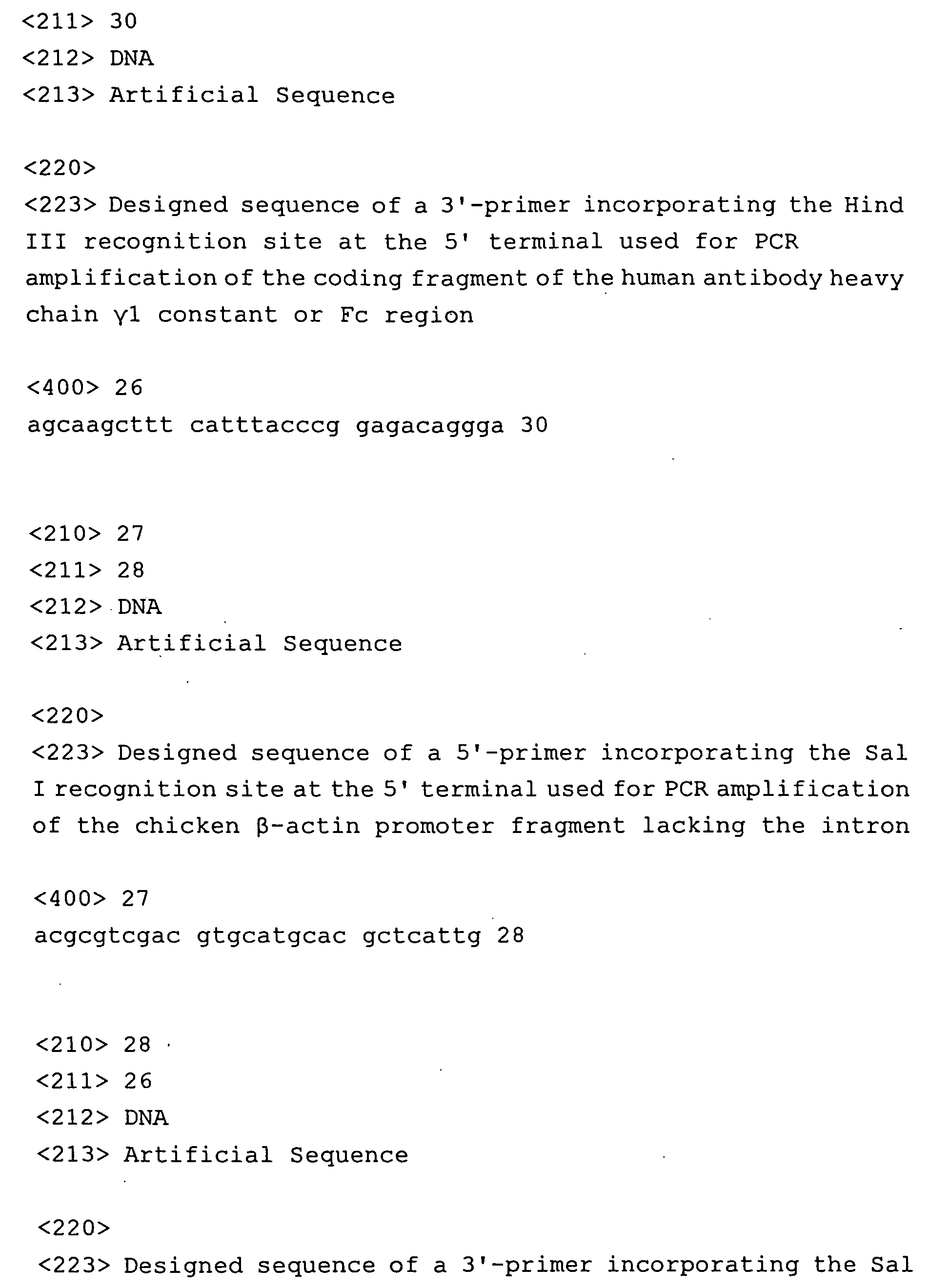
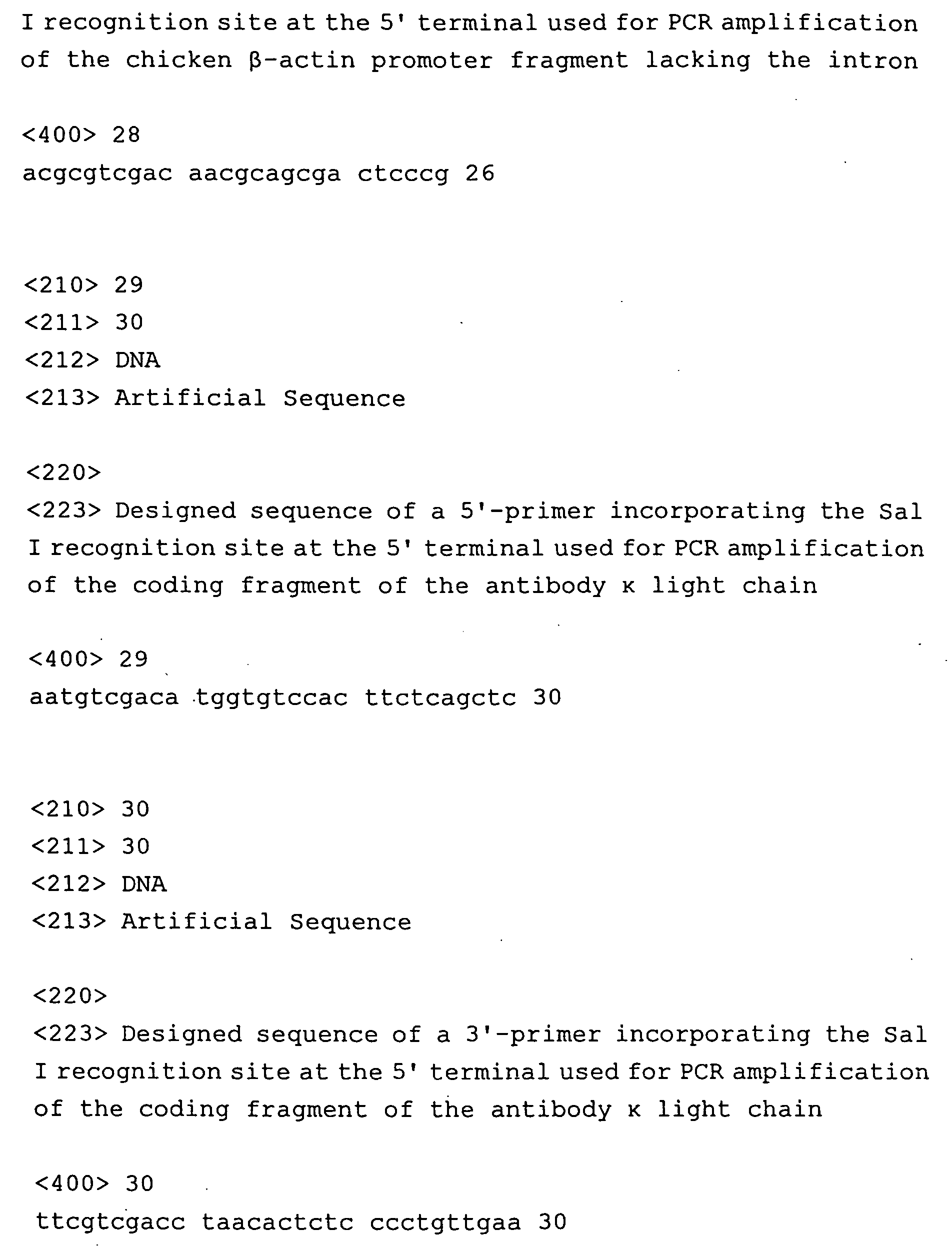
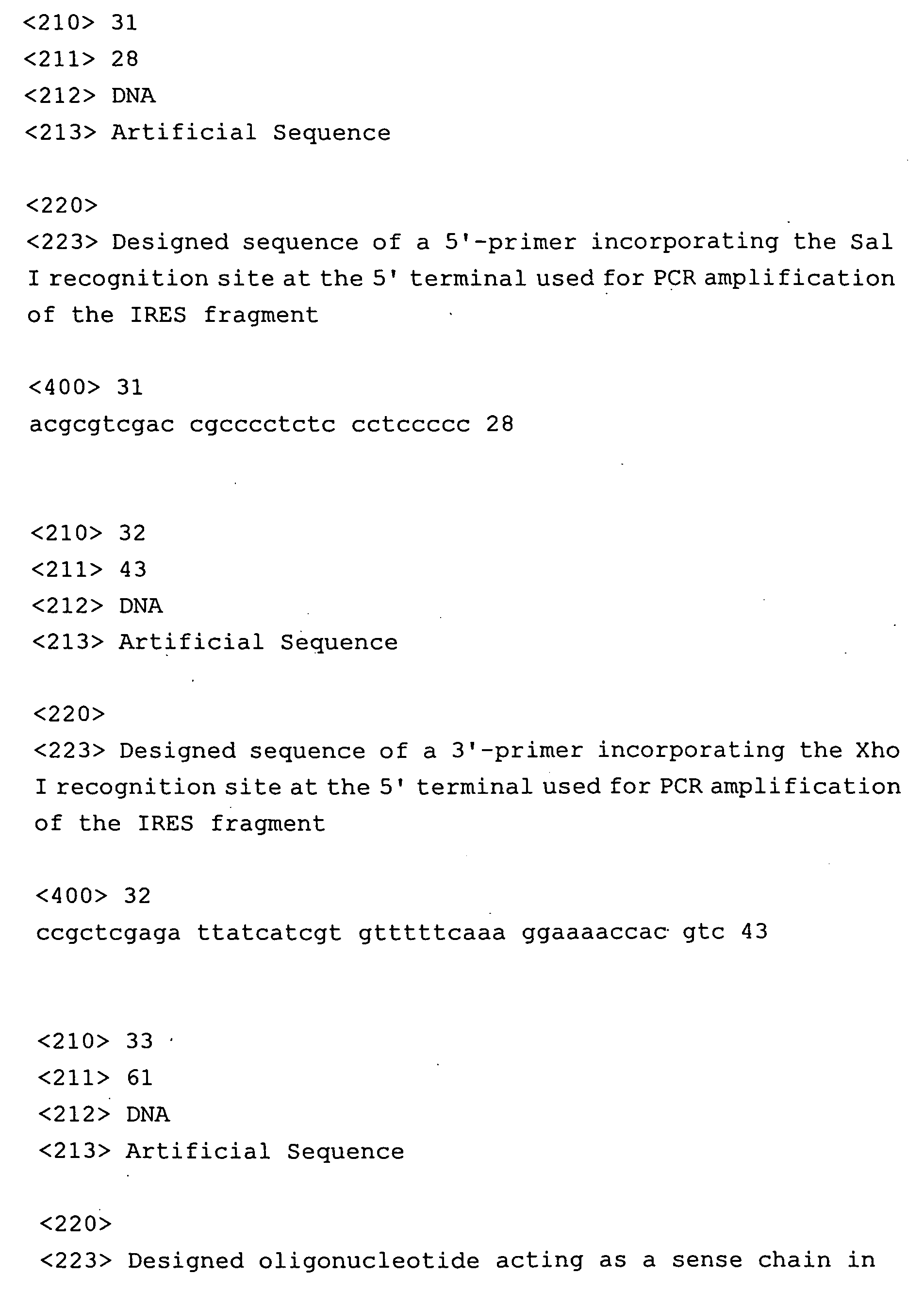
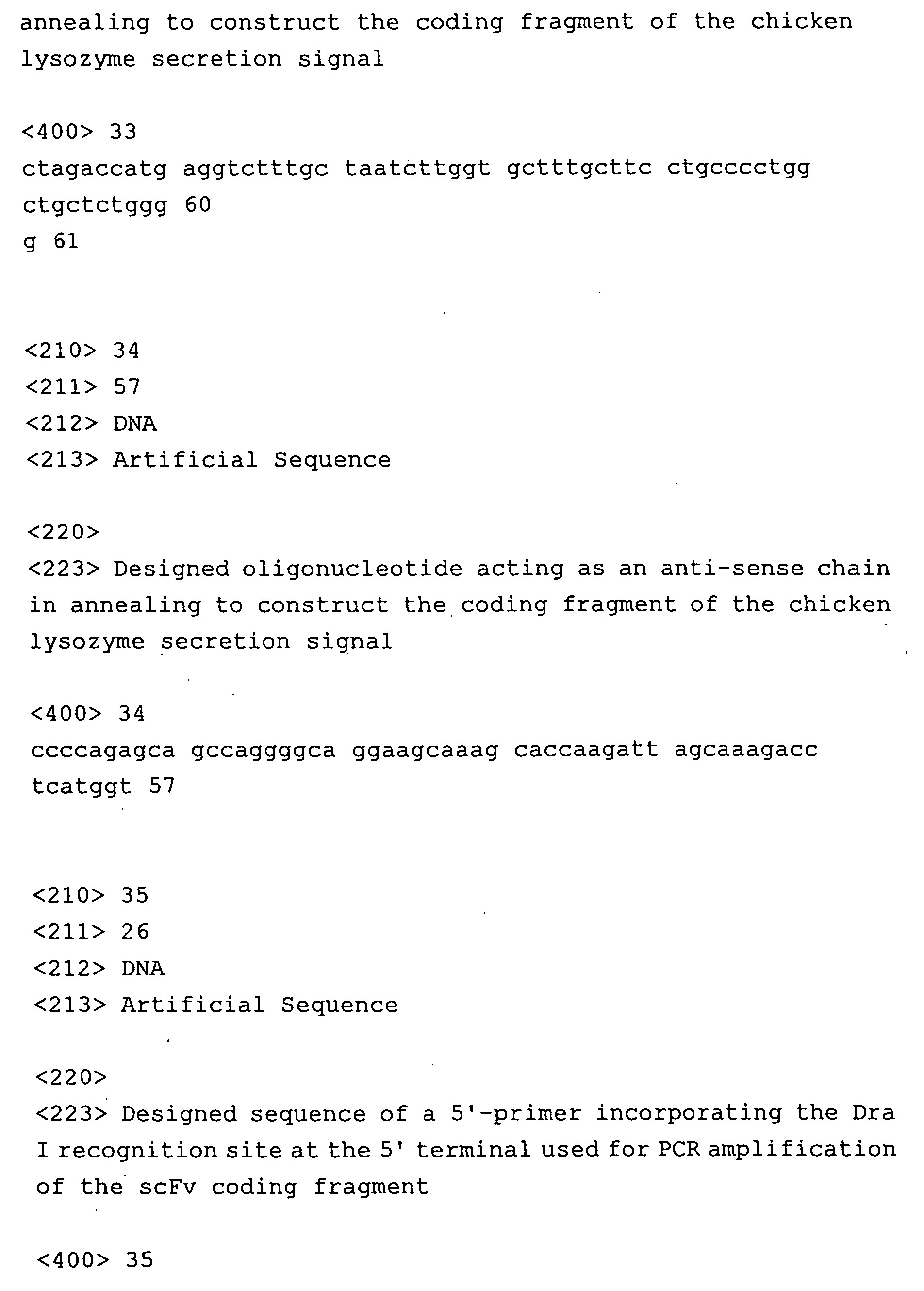
- ⁇ -galactosidase expression vector construct pMSCVN ⁇ A ⁇ was produced as follows.
- the culture supernatant containing virus particles were recovered and filtered through a 0.45 ⁇ m accetylcellulose filter (Advantech Co., Ltd.) to remove impurities.
- the obtained solution was added with polybrene (product of Sigma Corporation) so as to be 10 ⁇ g/ml to prepare a virus solution.
- the prepared virus solution was added to GP293 cells cultured separately, and after the culture for 48 hours, the cells were successively cultured in a culture containing 600 ⁇ g/ml of G418 (product of GIBCO BRL) to obtain G418 stably transformed GP293 strain.
- the obtained stably transformed strain was cultured in a 10 mm-diameter dish so as to be 80% confluent, and 16 ⁇ g of pVSV-G vector was introduced thereto by the lipofection method. After the lapse of 48 hours, 12 ml of the culture supernatant containing virus particles was recovered.
- This culture supernatant was subjected to centrifugation at 50,000 g and 4°C for 1.5 hours to precipitate virus. After removal of the supernatant, 50 ⁇ l of 50 mM Tris-HCl (pH 7.8), 130 mM NaCl and 1 mM EDTA solution were added to the precipitate containing the virus particles. Then, the mixture was allowed to stand at 4°C overnight and suspended thoroughly to recover a virus solution. The thus obtained high titer virus vector was 10 8 to 10 9 cfu/ml.
- a quail fertile egg of WE lineage (Japan Bio Science Laboratory CO., Ltd.) was used. At the time when this fertile egg was placed in an incubator with a built-in automatic egg rotation device (product of Showafuranki Co., Ltd.; P-008 type) at 37.9°C and humidity of 65% was set as the incubation start time (0 hour). Then, the incubation was carried out while rotating the egg at 90 degrees every 15 minutes.
- a built-in automatic egg rotation device product of Showafuranki Co., Ltd.; P-008 type
- the fertile eggshell was sterilized with 70% ethanol, and the sharp-round end portion was cut with a diamond cutter (MINIMO 7C710, product of Minitor Co., Ltd.) in a 2 cm-diameter circle to expose the embryo.
- a diamond cutter MINIMO 7C710, product of Minitor Co., Ltd.
- a needle prepared by folding the end so as to have a diameter of about 20 ⁇ m from a glass tube (CD-1, product of Olympus Corporation) using a micropipette puller (PC-10, product of Olympus Corporation) was stuck, and about 2 ⁇ l of the virus solution prepared in Example 2 was microinjected at the center of the blastodermal cavity using a microinjector (Transjector 5246, product of Eppendorf, Co., Ltd.).
- Teflon film (MilliWrap, product of Millipore Corporation) and polyvinylidene chloride wrap (Saran Wrap, product of Asahi Kasei Corporation) were used to cover the egg using albumen as a paste. Then, the incubation was carried out while rotating the egg at 90 degrees every 15 minutes.
- virus was injected to the fertile egg in the same manner. After about 36 hours from the start of incubation, the generation of a blood vessel was confirmed on the egg yolk surface; a part thereof pulsed, thus it was observed that a part thereof becomes a heart field with a stereoscopic microscope. After the lapse of 36, 48 and 55 hours from the start of incubation, 2 ⁇ l of the virus solution prepared in Example 2 was microinjected to the heart using a microinjector.
- a chicken fertile egg (Japan Bio Science Laboratory CO., Ltd.) was used. At the time when this fertile egg was placed in an incubator with a built-in automatic egg rotation device (product of Showafuranki Co., Ltd.; P-008 type) at 37.9°C and humidity of 65% was set as the incubation start time (0 hour). Then, the incubation was carried out while rotating the egg at 90 degrees every 15 minutes.
- a built-in automatic egg rotation device product of Showafuranki Co., Ltd.; P-008 type
- the fertile eggshell was sterilized with 70% ethanol, and the sharp-round end portion was cut with a diamond cutter (MINIMO 7C710, product of Minitor Co., Ltd.) in a 3.5 cm-diameter circle to expose the embryo.
- a diamond cutter MINIMO 7C710, product of Minitor Co., Ltd.
- a needle prepared by folding the end so as to have a diameter of about 20 ⁇ m from a glass tube (CD-1, product of Olympus Corporation) using a micropipette puller (PC-10, product of Olympus Corporation) was stuck, and about 2 ⁇ l of the virus solution prepared in Example 2 was microinjected at the center of the blastodermal cavity using a microinjector (Transjector 5246, product of Eppendorf, Co., Ltd.).
- Teflon film (MilliWrap, product of Millipore Corporation) and polyvinylidene chloride wrap (Saran Wrap, product of Asahi Kasei Corporation) were used to cover the egg using albumen as a paste. Then, the incubation was carried out while rotating the egg at 90 degrees every 15 minutes.
- the fertile egg was treated in the same manner. After about 50 hours from the start of incubation, the generation of a blood vessel was observed on the egg yolk surface; a part thereof pulsed, thus it was observed that a part thereof becomes a heart field with a stereoscopic microscope. After the lapse of 50, 55 and 60 hours from the start of incubation, 2 ⁇ l of the virus solution prepared in Example 2 was microinjected to the heart using a microinjector.
- the embryo was taken out from the eggshell, and washed with PBS (phosphate buffer solution) to remove a membrane enclosing the embryo.
- PBS phosphate buffer solution
- the removed embryo was finely sheared, and added with 0.8 ml of a reaction buffer (10 mM KC1, 1 mM MgCl 2 , 0.1% Triton X-100 (product of Wako Pure Chemical Industries, Ltd.), 5 mM 2-mercaptoethanol (product of Wako Pure Chemical Industries, Ltd.), and 2mM phosphate buffer pH 7.5), and subjected to ultrasonic disruption to obtain a cell liquid.
- a reaction buffer (10 mM KC1, 1 mM MgCl 2 , 0.1% Triton X-100 (product of Wako Pure Chemical Industries, Ltd.), 5 mM 2-mercaptoethanol (product of Wako Pure Chemical Industries, Ltd.), and 2mM phosphate buffer pH 7.5
- 0.6 ml of the cell liquid was incubated at 37°C for 10 minutes, and 0.1 ml of a liquid prepared by dissolving 4 mg/ml of o-nitrophenyl- ⁇ -D-galactopyranoside (ONPG) (product of Sigma Corporation) in 0.1M phosphate buffer (pH 7.5) warmed in advance was added. After the reaction, 0.3 ml of 1M Na 2 CO 3 (product of Wako Pure Chemical Industries, Ltd.) was added and the wavelength strength at 420 nm was measured with an adsorption meter.
- ONPG o-nitrophenyl- ⁇ -D-galactopyranoside
- the ⁇ -galactosidase activity was expressed in terms of ONPG unit (1 unit: activity with which 1 ⁇ mol of o-nitrophenol is generated per minute). The experiment was carried out three times, and the average value thereof was used as the ⁇ -galactosidase activity.
- the 1 x 10 8 cfu/ml virus solution prepared in Example 2 was diluted with dilution solvents (50 mM Tris-HCl (pH 7.8), 130 mM NaCl, and 1 mM EDTA solution) in three stages of 10-fold, 100-fold, and 1000-fold.
- dilution solvents 50 mM Tris-HCl (pH 7.8), 130 mM NaCl, and 1 mM EDTA solution
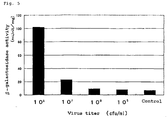
- 1 x 10 7 , 1 x 10 6 , and 1 x 10 5 cfu/ml titer virus solutions were prepared. Quail fertile eggs were incubated, and to early development hearts after 48 hours, 2 ⁇ l of the prepared virus solutions were microinjected. In the same manner, as a control, 2 ⁇ l of the dilution solvent alone was injected to an early development heart after 48 hours.
- Example 5 After the lapse of 115 hours from the start of the incubation, the ⁇ -galactosidase activity was measured according to Example 5. The relation between the virus titer and gene expression result in quails was shown in Fig. 4.
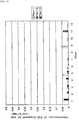
- Example 5 After the lapse of 115 hours from the start of the incubation, the ⁇ -galactosidase activity was measured according to Example 5. The relation between the virus titer and gene expression result in chickens was shown in Fig. 5.
- virus titer greatly affects the expression of transgene, that is, for efficiently expressing the transgene with the G0 transgenic chimera bird of the invention, the use of high titer replication-defective vector is effective.
- a mixture comprising human antibodies having three subclasses (IgG 1, 2, and 3) (product of Cosmo Bio Co., Ltd.) and the corresponding three species of antibody fragments (Fab-1, Fab-2, Fab-3, Fc-1, Fc-2, and Fc-3) (products of Cosmo Bio Co., Ltd.) were diluted with PBS so as to be 100 ⁇ g/ml. 100 ⁇ l of the diluted solutions were injected into veins under wings of quail adult birds (three birds) or chicken adult birds (three birds).
- Eggs were collected from the next day to the 20th day of the antibody injection into veins, and the antibodies transferred into eggs were quantified. Egg yolk and albumen were diluted to 50% (W/V) and 10% (V/V) with PBS, respectively, and preserved in frozen state to be used as measurement samples.
- An anti-human IgG antibody (product of Cosmo Bio Co., Ltd.) diluted with PBS was put into ELISA plates in 100 ⁇ g/well, and allowed to stand at 4°C overnight. Each plate was washed with 200 ⁇ l of PBS-0.05% Tween 20 solution three times, and then PBS-0.05% Tween 20 solution-2% skim milk was added in the wells in 150 ⁇ l/well.
- the wells were washed with PBS-0.05%Tween 20 solution four times, and 100 ⁇ l of a coloration liquid (prepared by dissolving 10 mg of o-phenylene diamine (product of Katayama Chemical Industry Co., Ltd.) in 1 ml of methanol, diluting with distilled water to be 100 ml, and adding 10 ⁇ l of hydrogen peroxide (product of Wako Pure Chemical Industries, Ltd.)) was added to the wells. Then, 50 ⁇ l of 8M sulfuric acid was added to quench the reaction, and the fluorescence intensity at 490nm was determined with a plate reader to calculate the concentration from the standard calibration curve. The result was obtained by averaging the antibody concentrations of the samples obtained from three quails and chickens.
- a coloration liquid prepared by dissolving 10 mg of o-phenylene diamine (product of Katayama Chemical Industry Co., Ltd.) in 1 ml of methanol, diluting with distilled water to be 100 ml,
- the standard antibody for standard calibration-curve construction (product of Cosmo Bio Co., Ltd.) was diluted with 50% egg yolk-PBS (W/V).
- the antibody concentrations accumulated in quail and chicken eggs were shown in Fig. 6 and 7.
- the Fab and Fc fragment concentrations accumulated in quail and chicken eggs were shown in Fig. 8, 9, 10 and 11.
- Vector constructs for anti-CD2 antibody expression pMSCV/G ⁇ AH, pMSCV/G ⁇ AL, and pMSCV/G ⁇ ALIH were produced as follows.
- Example 2 three species of retrovirus vectors were prepared from vector constructs pMSCV/G ⁇ AH, pMSCV/G ⁇ AL and pMSCV/G ⁇ ALIH. The titers of these retrovirus vectors were measured and found to be 10 8 cfu/ml to 10 9 cfu/ml.
- the obtained retrovirus vectors were microinjected to hearts of quail fertile eggs after 36 hours from the start of incubation according to Example 3, and the eggs were incubated while rotating the eggs at 90 degrees every 15 minutes at 37.9°C and humidity of 65%.
- an antibody comprising a light chain and heavy chain In order to cause an antibody comprising a light chain and heavy chain to be expressed in transgenic animals, presumable are a method comprising introducing a vector expressing a light chain and vector expressing a heavy chain individually, and a method comprising dividing genes expressing a light chain and genes expressing a heavy chain with a sequence such as IRES, and introducing thereof as the same vector.
- injection was carried out separately in a case where pMSCV/G ⁇ AH and pMSCV/G ⁇ AL were infected at the same time (Example 11 and Experiment Example 1), and a case where a vector prepared by pMSCV/G ⁇ ALIH was introduced alone (Example 11 and Experiment Example 2).
- G0 transgenic chimera quails hatched in Example 10 were bred for one month to grow baby chicks. After 30 and 60 days, blood was sampled from veins under wings of the grown G0 transgenic quails to obtain blood samples. The obtained blood was centrifuged for 10 minutes at 15,000 rpm, and the amount of anti-CD2 antibody was determined from serum obtained as supernatant.
- the G0 transgenic chimera quail (individual identification number #1113) simultaneously infected with vectors (3 to 4 x 10 8 cfu/ml) prepared from pMSCV/G ⁇ AH and pMSCV/G ⁇ AL expressed anti-CD2 antibody at concentrations of 0.6 ⁇ g/ml in egg yolk, and 0.5 ⁇ g/ml in albumen.
- the G0 transgenic chimera quail (#4202) introduced a vector prepared from pMSCV/G ⁇ ALIH (5 x 10 8 cfu/ml) alone expressed 5.2 ⁇ g/ml of anti-CD2 antibody in serum.
- ScFv-Fc antibody expression vector construct pMSCV/scFv-Fc was produced as follows.
- a retrovirus vector was prepared from vector construct pMSCV/G ⁇ AscFv-Fc.
- the titer of this retrovirus vector was determined and found to be 10 8 cfu/ml to 10 9 cfu/ml.
- Example 3 the obtained virus vector solution was microinjected into hearts of quail fertile eggs after 36 hours from the start of incubation. The eggs were hatched according to Example 10 to produce G0 transgenic chimera quails.
- G0 transgenic chimera quails produced in Example 13 were bred for one month to grow baby chicks. After the lapse of 30 and 60 days, blood was sampled from veins under wings of the grown G0 transgenic chimera quails (individual identification number #3303, #3306, #3310, #3311, and #3313) to obtain blood samples. The obtained blood was centrifuged at 15,000rpm for 10 minutes, and the amount of scFv-Fc antibodies was determined from serum obtained as supernatant.
- the standard calibration curve was constructed using a purified scFv-Fc.
- Vector construct pMSCV/scFv-Fc produced in Example 12 was introduced into GP293 cell by the lipofection method, and the culture supernatant was centrifuged at 3000 rpm and 4°C for 10 minutes to remove solid matters. While cooling, this supernatant was stirred and gradually added with finely crushed ammonium sulfate so as to be 50% saturation (313 g ammonium sulfate/1000 ml water) to precipitate protein. The mixture was allowed to stand at 4°C overnight, and centrifuged at 15,000 rpm and 4°C for 10 minutes to completely precipitate the protein. The precipitated protein was then dissolved in a small amount of PBS, and dialyzed by 2 L of PBS three times to remove ammonium sulfate.
- the initial washing of the protein G column for purification was carried out using 10 mL of a binding buffer (NaHPO 4 ⁇ 2H 2 O 1.56 g/l, NaHPO 4 ⁇ 12H 2 O 7.16 g/l), 10 ml of a wash buffer (acetic acid 20%, distilled water 80%), and 10 ml of the binding buffer (flow rate 2 ml/min.) in this order.
- a binding buffer NaHPO 4 ⁇ 2H 2 O 1.56 g/l, NaHPO 4 ⁇ 12H 2 O 7.16 g/l
- acetic acid 20%, distilled water 80% acetic acid 20%, distilled water 80%
- 10 ml of the binding buffer flow rate 2 ml/min.
- the eluted fraction was dialyzed with PBS (2L) three times to obtain a purified scFv-Fc, and the protein concentration was quantitated from the adsorption at a wavelength of 280 nm.
- the amount of the scFv-Fc in blood serum sampled after 30 and 60 days of the G0 transgenic chimera quails produced in Example 14 was shown in Fig. 14.
- the G0 transgenic chimera quail introduced an scFv-Fc antibody expression gene expressed about 2 mg/ml to 4 mg/ml of antibody in serum at 30th day, and three of five birds also showed the same extent of expression amount.
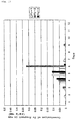
- the amount of scFv-Fc in egg yolk and albumen was shown in Fig. 15.
- the antibody was expressed in about 500 ⁇ g/ml to 1 mg/ml in albumen and egg yolk. Even there was a slight variation from the start of egg laying to the 17th day, a stable expression amount was maintained.
- Example 14 From 1 ml of G0 transgenic chimera quail serum produced in Example 13, an scFv-Fc was purified from ammonium sulfate precipitate and the protein G column according to Example 10. The purified scFv-Fc was analyzed by SDS-PAGE, and the result was shown in Fig. 16. From the untreated lane, the scFv-Fc molecular weight of about 120 kDa was shown.
- TNFR-Fc expression vector construct was produced, and a retrovirus vector was produced according to Example 2.
- the titer of this retrovirus vector was 1.7 x 10 7 cfu/ml.
- the obtained virus vector solution was microinjected to chicken fertile egg hearts after 55 hours from the start of incubation according to Example 4, and hatched according to Example 10 to produce G0 transgenic chimera chickens.
- TNFR-Fc in serum was quantitated according to Example 14, and TNFR-Fc of 50 ⁇ g/ml at the maximum was found to be expressed.
- the G0 transgenic chimera bird of the present invention can efficiently express a gene introduced using a replication-defective retrovirus vector without causing inactivation.
- the production method of a G0 transgenic chimera bird of the present invention makes it possible to introduce a gene of a chimera antibody, for example of an scFv-Fc antibody, and to produce birds capable of efficiently expressing the antibody in blood and eggs.
- the production method of an antibody of the present invention comprises producing a G0 transgenic chimera bird producing a chimera antibody, for example an scFv-Fc antibody, recovering and purifying the antibody from serum and eggs of the bird, thus the efficient production of an antibody becomes possible.
Landscapes
- Life Sciences & Earth Sciences (AREA)
- Health & Medical Sciences (AREA)
- Chemical & Material Sciences (AREA)
- Organic Chemistry (AREA)
- Genetics & Genomics (AREA)
- Engineering & Computer Science (AREA)
- General Health & Medical Sciences (AREA)
- Zoology (AREA)
- Biotechnology (AREA)
- Environmental Sciences (AREA)
- Molecular Biology (AREA)
- Biochemistry (AREA)
- Immunology (AREA)
- Wood Science & Technology (AREA)
- Biophysics (AREA)
- Biomedical Technology (AREA)
- Bioinformatics & Cheminformatics (AREA)
- General Engineering & Computer Science (AREA)
- Veterinary Medicine (AREA)
- Proteomics, Peptides & Aminoacids (AREA)
- Biodiversity & Conservation Biology (AREA)
- Animal Husbandry (AREA)
- Animal Behavior & Ethology (AREA)
- Medicinal Chemistry (AREA)
- Microbiology (AREA)
- Physics & Mathematics (AREA)
- Plant Pathology (AREA)
- Chemical Kinetics & Catalysis (AREA)
- General Chemical & Material Sciences (AREA)
- Preparation Of Compounds By Using Micro-Organisms (AREA)
- Micro-Organisms Or Cultivation Processes Thereof (AREA)
- Peptides Or Proteins (AREA)
Abstract
Description
a production method of a G0 transgenic chimera bird
which comprises incubating a bird fertile egg, infecting an early embryo after and exclusive of a blastodermal period immediately after the spawning (stage X) with a replication-defective retrovirus vector, and then hatching the embryo, and
a G0 transgenic chimera bird produced by said method.
a G0 transgenic chimera bird
which is introduced an exogenous antibody gene with a replication-defective retrovirus vector, and
produces an antibody derived from a transgene in at least one of blood, albumen, and egg yolk.
a production method of an antibody
which comprises producing the above G0 transgenic chimera bird, and recovering the antibody from blood and/or an egg of said G0 transgenic chimera bird.

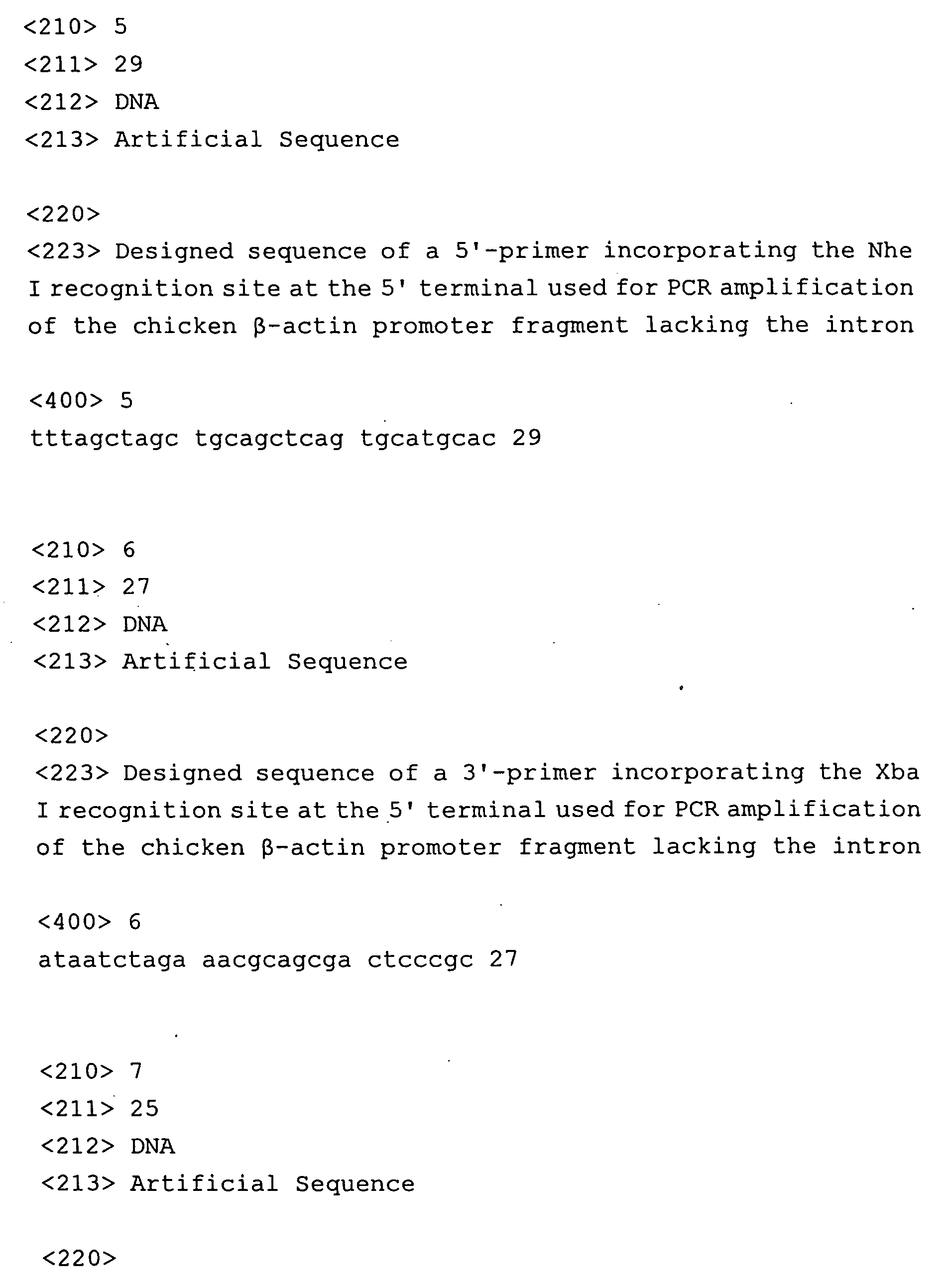
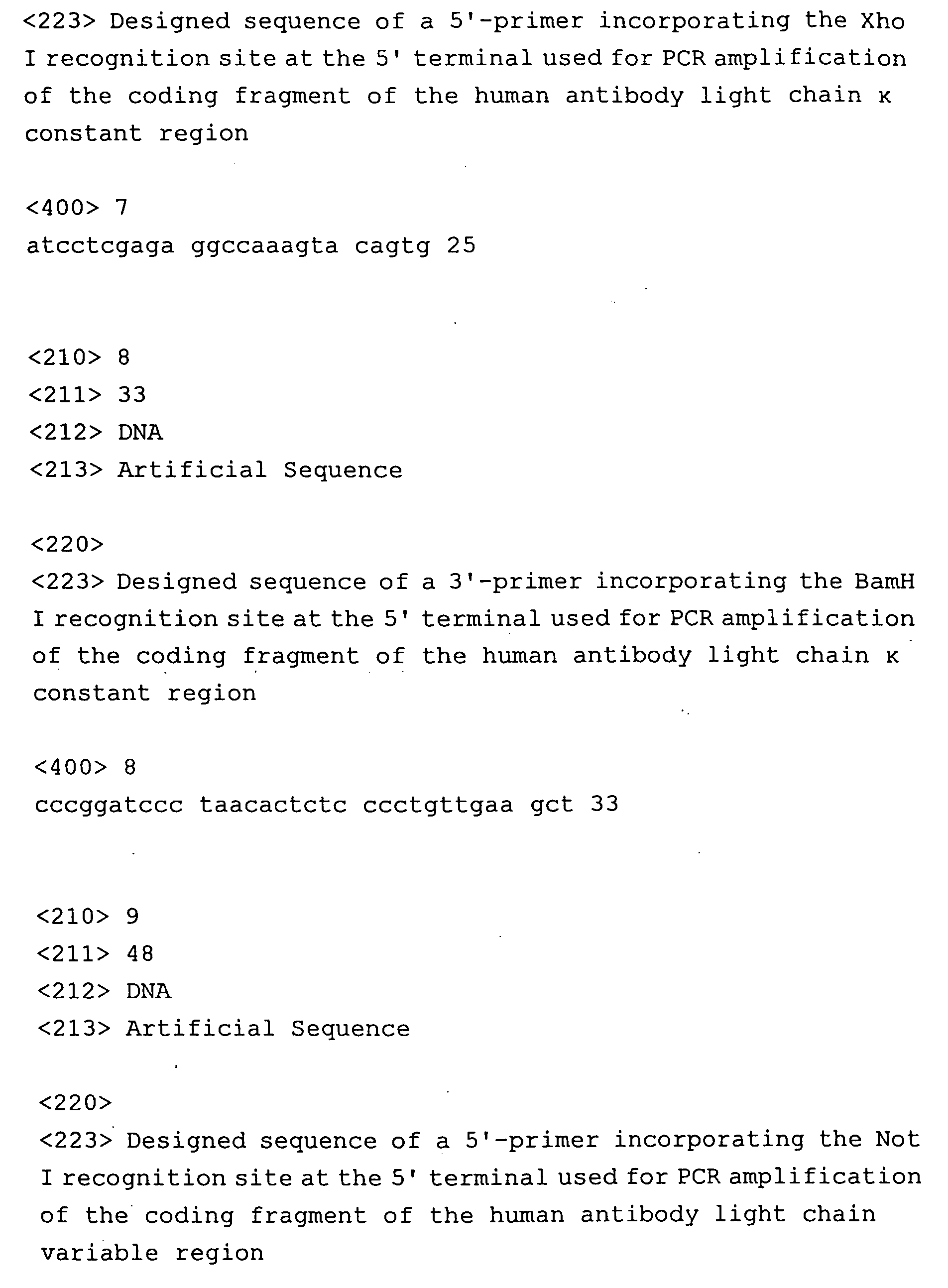


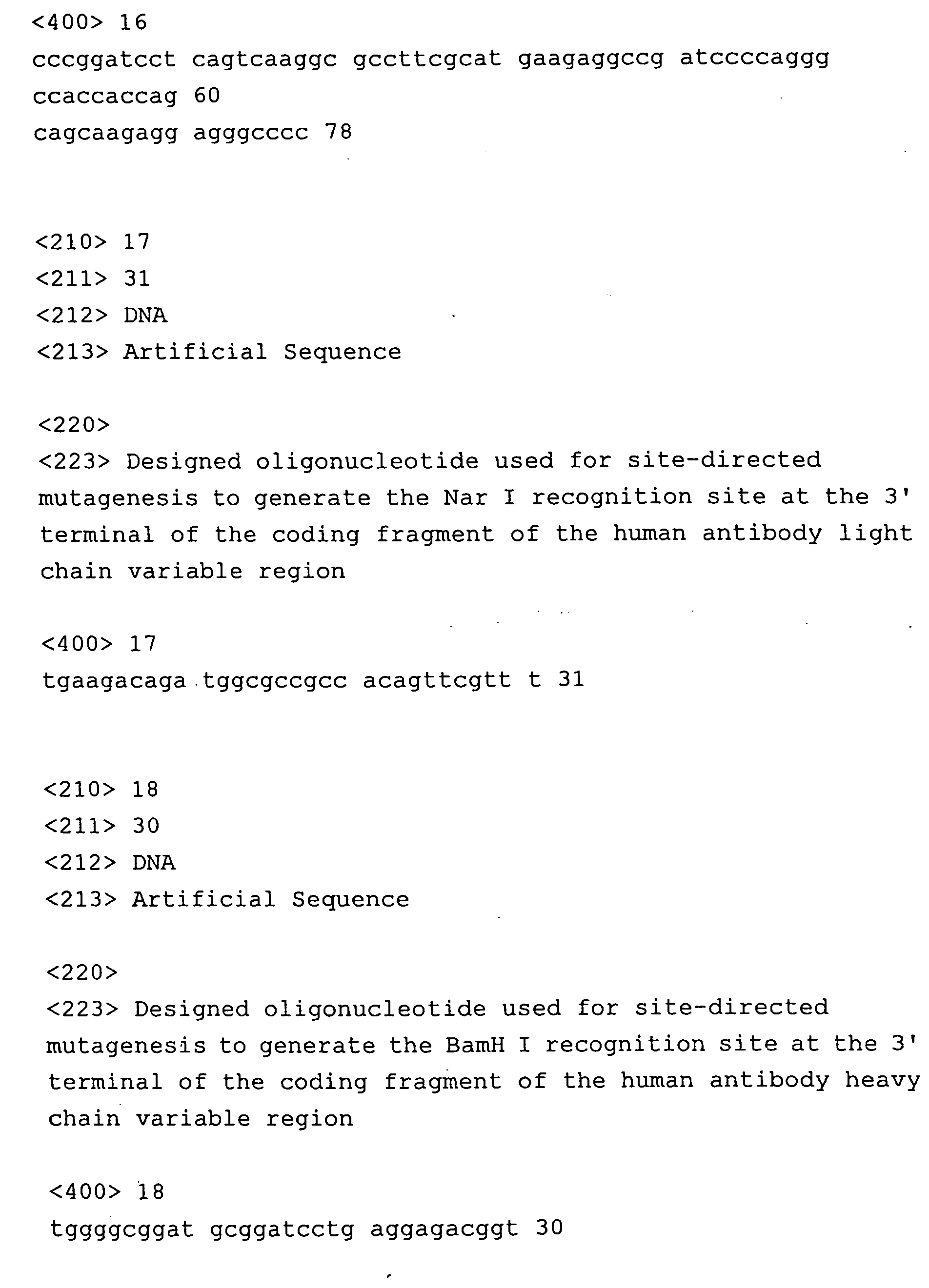


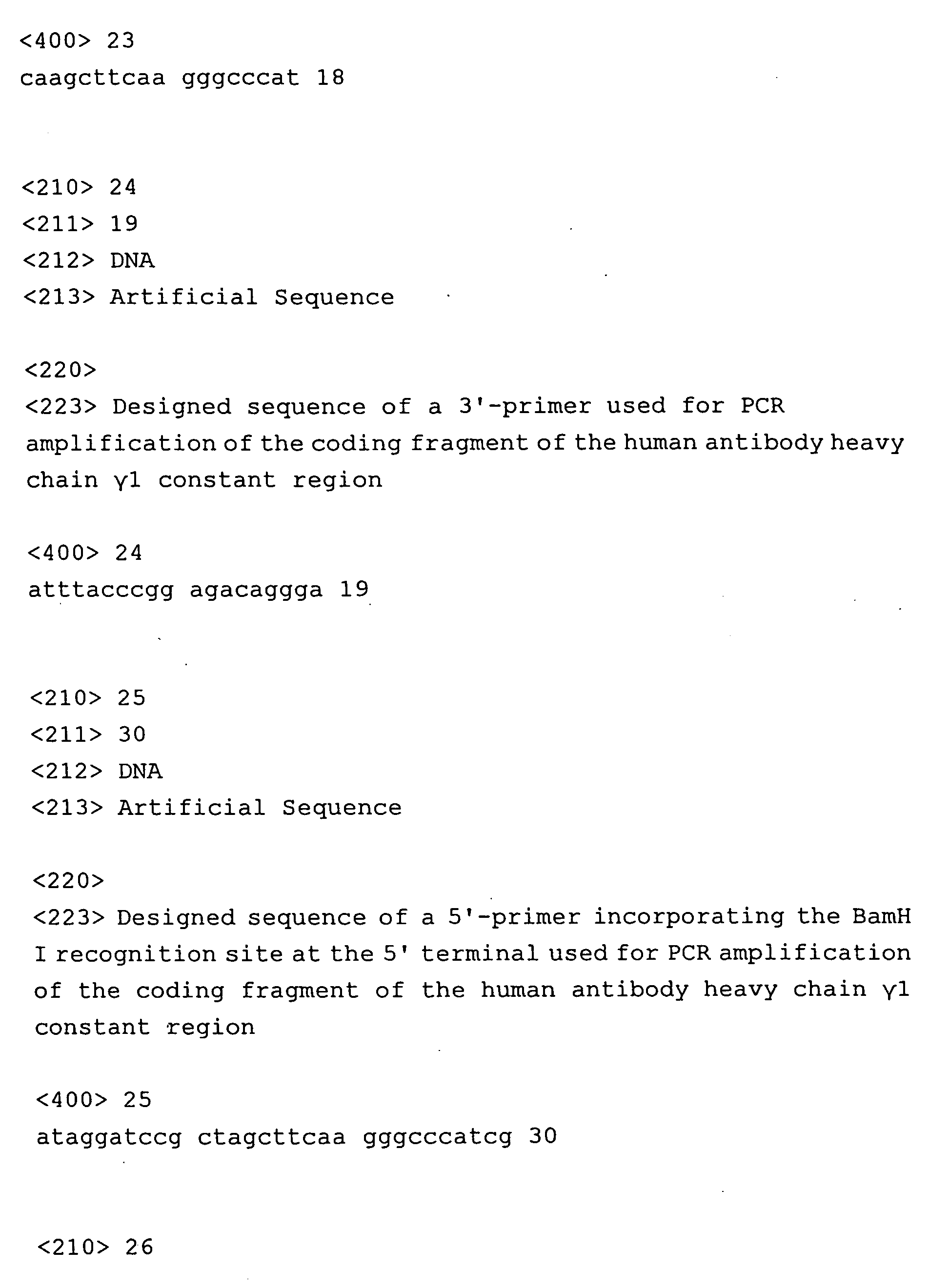

Claims (41)
- A G0 transgenic chimera bird
which is introduced an exogenous antibody gene with a replication-defective retrovirus vector, and
produces an antibody derived from a transgene in at least one of blood, albumen, and egg yolk. - The G0 transgenic chimera bird according to Claim 1,
wherein a class of a constant region of the antibody is human IgG. - The G0 transgenic chimera bird according to Claim 1,
wherein a subclass of a constant region of the antibody is human IgG1. - The G0 transgenic chimera bird according to Claim 1,
wherein the constant region of the antibody is quail IgG, chicken IgG, or mouse IgG. - The G0 transgenic chimera bird according to any one of Claims 1 to 4,
wherein the antibody gene is controlled by a constitutive promoter. - The G0 transgenic chimera bird according to Claim 5,
wherein the constitutive promoter is chicken β-actin promoter. - The G0 transgenic chimera bird according to any one of Claims 1 to 6,
wherein the retrovirus vector is a vector derived from Moloney murine leukemia virus. - The G0 transgenic chimera bird according to any one of Claims 1 to 7,
wherein the retrovirus vector is a VSV-G pseudo type one. - The G0 transgenic chimera bird according to any one of Claims 1 to 8,
wherein the bird is a chicken or quail. - The G0 transgenic chimera bird according to any one of Claims 1 to 9,
wherein the antibody is a chimera antibody. - The G0 transgenic chimera bird according to Claim 10,
which contains not less than 0.5 µg/ml of the antibody in blood. - The G0 transgenic chimera bird according to Claim 11,
which contains not less than 5 µg/ml of the antibody in blood. - The G0 transgenic chimera bird according to Claim 10,
which contains not less than 0.1 µg/ml of the antibody in albumen. - The G0 transgenic chimera bird according to Claim 13,
which contains not less than 1 µg/ml of the antibody in albumen. - The G0 transgenic chimera bird according to Claim 10,
which contains not less than 0.1 µg/ml of the antibody in egg yolk. - The G0 transgenic chimera bird according to Claim 15,
which contains not less than 1 µg/ml of the antibody in egg yolk. - The G0 transgenic chimera bird according to any one of Claims 1 to 9,
wherein the antibody is an scFv-Fc antibody. - The G0 transgenic chimera bird according to Claim 17,
which contains not less than 20 µg/ml of the antibody in blood. - The G0 transgenic chimera bird according to Claim 18,
which contains not less than 2000 µg/ml of the antibody in blood. - The G0 transgenic chimera bird according to Claim 17,
which contains not less than 5 µg/ml of the antibody in albumen. - The G0 transgenic chimera bird according to Claim 20,
which contains not less than 500 µg/ml of the antibody in albumen. - The G0 transgenic chimera bird according to Claim 17,
which contains not less than 5 µg/ml of the antibody in egg yolk. - The G0 transgenic chimera bird according to Claim 22,
which contains not less than 500 µg/ml of the antibody in egg yolk. - A production method of an antibody
which comprises producing the G0 transgenic chimera bird according to any one of Claims 1 to 23, and
recovering the antibody from blood and/or an egg of said G0 transgenic chimera bird. - A production method of a G0 transgenic chimera bird
which comprises incubating a bird fertile egg, infecting an early embryo after and exclusive of a blastodermal period immediately after the spawning with a replication-defective retrovirus vector, and then hatching the embryo. - The production method of a G0 transgenic chimera bird according to Claim 25,
which comprises incubating a bird fertile egg, infecting an early embryo after the lapse of 24 hours or more from the start of the incubation with a replication-defective retrovirus vector, and then hatching the embryo. - The production method of a G0 transgenic chimera bird according to Claim 25 or 26,
which comprises incubating a bird fertile egg, and microinjecting a replication-defective retrovirus vector to a heart or blood vessel formed in the early embryo. - The production method of a G0 transgenic chimera bird according to Claim 25 or 26,
which comprises incubating a bird fertile egg, and microinjecting a replication-defective retrovirus vector to a heart or blood vessel formed in the early embryo formed after the lapse of 24 hours or more from the start of the incubation. - The production method of a G0 transgenic chimera bird according to any one of Claims 25 to 28,
which comprises microinjecting a replication-defective retrovirus vector having the titer of not less than 1 x 10⁷ cfu/ml. - The production method of a G0 transgenic chimera bird according to Claim 29,
which comprises microinjecting a replication-defective retrovirus vector having the titer of not less than 1 x 10⁸ cfu/ml. - The production method of a G0 transgenic chimera bird according to Claim 30,
which comprises microinjecting a replication-defective retrovirus vector having the titer of not less than 1 x 10⁹ cfu/ml. - The production method of a G0 transgenic chimera bird according to any one of Claims 25 to 31,
wherein the retrovirus vector is a vector derived from Moloney murine leukemia virus. - The production method of a G0 transgenic chimera bird according to any one of Claims 25 to 32,
wherein the retrovirus vector is a VSV-G pseudo type one. - The production method of a G0 transgenic chimera bird according to any one of Claims 25 to 33,
wherein the bird is a chicken or quail. - The production method of a G0 transgenic chimera bird according to any one of Claims 25 to 34,
wherein a gene sequence not derived from a retrovirus is contained in a transgene incorporated into a replication-defective retrovirus vector. - The production method of a G0 transgenic chimera bird according to Claim 35,
wherein the gene sequence not derived from a retrovirus is a gene sequence controlled by chicken β-actin promoter. - The production method of a G0 transgenic chimera bird according to Claim 35 or 36,
wherein the gene sequence not derived from a retrovirus is a gene sequence coding for an antibody gene. - The production method of a G0 transgenic chimera bird according to Claim 37,
wherein the antibody gene is a chimera antibody gene. - The production method of a G0 transgenic chimera bird according to Claim 37,
wherein the antibody gene is an scFv-Fc antibody gene. - The production method of a G0 transgenic chimera bird according to Claim 35 or 36,
wherein the gene sequence not derived from a retrovirus is a gene sequence coding for a fusion protein gene. - A G0 transgenic chimera bird
which is produced by the method according to any one of Claims 25 to 40.
Applications Claiming Priority (3)
| Application Number | Priority Date | Filing Date | Title |
|---|---|---|---|
| JP2002236089 | 2002-08-13 | ||
| JP2002236089 | 2002-08-13 | ||
| PCT/JP2003/010198 WO2004016081A1 (en) | 2002-08-13 | 2003-08-11 | Method of expressing gene in transgenic birds using retrovirus vector and transgenic birds thus obtained |
Publications (4)
| Publication Number | Publication Date |
|---|---|
| EP1548114A1 true EP1548114A1 (en) | 2005-06-29 |
| EP1548114A4 EP1548114A4 (en) | 2008-05-14 |
| EP1548114B1 EP1548114B1 (en) | 2012-09-26 |
| EP1548114B8 EP1548114B8 (en) | 2012-10-31 |
Family
ID=31884397
Family Applications (1)
| Application Number | Title | Priority Date | Filing Date |
|---|---|---|---|
| EP03788072A Expired - Lifetime EP1548114B8 (en) | 2002-08-13 | 2003-08-11 | Method of expressing gene in transgenic birds using retrovirus vector and transgenic birds thus obtained |
Country Status (14)
| Country | Link |
|---|---|
| US (1) | US20060143725A1 (en) |
| EP (1) | EP1548114B8 (en) |
| JP (3) | JP5468719B2 (en) |
| KR (1) | KR20050067138A (en) |
| CN (1) | CN1674779A (en) |
| AU (1) | AU2003254929A1 (en) |
| BR (1) | BR0313441A (en) |
| CA (1) | CA2492927A1 (en) |
| ES (1) | ES2394792T3 (en) |
| HR (1) | HRP20050237A2 (en) |
| IL (1) | IL166395A0 (en) |
| MX (1) | MXPA05001331A (en) |
| RU (1) | RU2005106867A (en) |
| WO (1) | WO2004016081A1 (en) |
Cited By (4)
| Publication number | Priority date | Publication date | Assignee | Title |
|---|---|---|---|---|
| WO2007044284A1 (en) * | 2005-10-05 | 2007-04-19 | Avigenics, Inc. | Rapid production of high titer virus |
| EP1712126A4 (en) * | 2004-01-08 | 2009-08-05 | Kaneka Corp | TRANSGENIC BIRD AND METHOD OF CREATION |
| EP2311493A4 (en) * | 2008-05-20 | 2012-09-26 | Kaneka Corp | Cytotoxic composition |
| US8383399B2 (en) | 2004-12-29 | 2013-02-26 | Synageva Biopharma Corp. | Nucleic acid construct having an ovalbumin promotor |
Families Citing this family (8)
| Publication number | Priority date | Publication date | Assignee | Title |
|---|---|---|---|---|
| US20060191026A1 (en) * | 2005-02-18 | 2006-08-24 | Origen Therapeutics, Inc. | Tissue specific expression of antibodies in chickens |
| EP1548114B8 (en) * | 2002-08-13 | 2012-10-31 | Kaneka Corporation | Method of expressing gene in transgenic birds using retrovirus vector and transgenic birds thus obtained |
| JP4995574B2 (en) * | 2004-09-28 | 2012-08-08 | 株式会社カネカ | Methods for producing transgenic birds |
| JP2006271266A (en) * | 2005-03-29 | 2006-10-12 | Univ Nagoya | High expression and efficient transgenic birds |
| US20090064351A1 (en) * | 2005-03-30 | 2009-03-05 | Kaneka Corporation | Transgenic bird producing erythropoietin and method of constructing the same |
| KR101323563B1 (en) * | 2005-10-18 | 2013-10-29 | 니토 보세키 가부시기가이샤 | Antibody-producing transgenic silkworms and methods for producing the same |
| WO2008018562A1 (en) * | 2006-08-10 | 2008-02-14 | Kaneka Corporation | Production of useful protein such as antibody having modified sugar chain in egg yolk of transgenic chicken |
| CN101932231A (en) * | 2008-01-07 | 2010-12-29 | 辛那杰瓦生物制药股份有限公司 | Glycosylation in poultry |
Family Cites Families (10)
| Publication number | Priority date | Publication date | Assignee | Title |
|---|---|---|---|---|
| EP0424044A1 (en) * | 1989-10-16 | 1991-04-24 | Merck & Co. Inc. | Transgenic fowl expressing bovine growth hormone |
| JPH0928235A (en) * | 1995-07-17 | 1997-02-04 | Hoechst Japan Ltd | Osteopenia model transgenic animal |
| ATE489461T1 (en) * | 1997-10-16 | 2010-12-15 | Univ Georgia | TRANSGENIC BIRDS AND PROTEIN PRODUCTION |
| EP1103614B1 (en) * | 1999-06-04 | 2010-06-02 | Nippon Institute for Biological Science | Novel plasmid vector |
| EP1241935A2 (en) * | 1999-12-17 | 2002-09-25 | Gerald Schatten | Methods for producing transgenic animals |
| JP2002176880A (en) * | 2000-12-12 | 2002-06-25 | Kanegafuchi Chem Ind Co Ltd | Efficient method for producing transgenic birds and transgenic birds obtained thereby |
| US20020108132A1 (en) * | 2001-02-02 | 2002-08-08 | Avigenics Inc. | Production of a monoclonal antibody by a transgenic chicken |
| ATE513038T1 (en) * | 2001-09-18 | 2011-07-15 | Synageva Biopharma Corp | PRODUCTION OF A TRANSGENIC BIRD USING CYTOPLASM INJECTION |
| EP1548114B8 (en) * | 2002-08-13 | 2012-10-31 | Kaneka Corporation | Method of expressing gene in transgenic birds using retrovirus vector and transgenic birds thus obtained |
| AU2004269233A1 (en) * | 2003-08-29 | 2005-03-10 | Kaneka Corporation | Method of constructing transgenic bird using lentivirus vector and transgenic bird obtained thereby |
-
2003
- 2003-08-11 EP EP03788072A patent/EP1548114B8/en not_active Expired - Lifetime
- 2003-08-11 RU RU2005106867/13A patent/RU2005106867A/en not_active Application Discontinuation
- 2003-08-11 JP JP2004528857A patent/JP5468719B2/en not_active Expired - Lifetime
- 2003-08-11 BR BR0313441-5A patent/BR0313441A/en not_active Application Discontinuation
- 2003-08-11 AU AU2003254929A patent/AU2003254929A1/en not_active Abandoned
- 2003-08-11 WO PCT/JP2003/010198 patent/WO2004016081A1/en not_active Ceased
- 2003-08-11 ES ES03788072T patent/ES2394792T3/en not_active Expired - Lifetime
- 2003-08-11 HR HR20050237A patent/HRP20050237A2/en not_active Application Discontinuation
- 2003-08-11 US US10/523,191 patent/US20060143725A1/en not_active Abandoned
- 2003-08-11 MX MXPA05001331A patent/MXPA05001331A/en unknown
- 2003-08-11 CN CNA038192020A patent/CN1674779A/en active Pending
- 2003-08-11 CA CA002492927A patent/CA2492927A1/en not_active Abandoned
- 2003-08-11 KR KR1020057002420A patent/KR20050067138A/en not_active Withdrawn
-
2005
- 2005-01-19 IL IL16639505A patent/IL166395A0/en unknown
-
2011
- 2011-02-25 JP JP2011040380A patent/JP5473963B2/en not_active Expired - Lifetime
-
2013
- 2013-10-02 JP JP2013207597A patent/JP5815631B2/en not_active Expired - Lifetime
Cited By (6)
| Publication number | Priority date | Publication date | Assignee | Title |
|---|---|---|---|---|
| EP1712126A4 (en) * | 2004-01-08 | 2009-08-05 | Kaneka Corp | TRANSGENIC BIRD AND METHOD OF CREATION |
| US8383399B2 (en) | 2004-12-29 | 2013-02-26 | Synageva Biopharma Corp. | Nucleic acid construct having an ovalbumin promotor |
| WO2007044284A1 (en) * | 2005-10-05 | 2007-04-19 | Avigenics, Inc. | Rapid production of high titer virus |
| US7524626B2 (en) | 2005-10-05 | 2009-04-28 | Synageva Biopharma Corp. | Rapid production of high titer virus |
| AU2006302640B2 (en) * | 2005-10-05 | 2010-08-19 | Synageva Biopharma Corp. | Rapid production of high titer virus |
| EP2311493A4 (en) * | 2008-05-20 | 2012-09-26 | Kaneka Corp | Cytotoxic composition |
Also Published As
| Publication number | Publication date |
|---|---|
| RU2005106867A (en) | 2006-01-20 |
| JP2011147447A (en) | 2011-08-04 |
| CA2492927A1 (en) | 2004-02-26 |
| JP2013255521A (en) | 2013-12-26 |
| ES2394792T3 (en) | 2013-02-05 |
| AU2003254929A1 (en) | 2004-03-03 |
| JPWO2004016081A1 (en) | 2005-12-02 |
| KR20050067138A (en) | 2005-06-30 |
| HRP20050237A2 (en) | 2006-06-30 |
| WO2004016081A1 (en) | 2004-02-26 |
| CN1674779A (en) | 2005-09-28 |
| IL166395A0 (en) | 2006-01-15 |
| EP1548114A4 (en) | 2008-05-14 |
| JP5815631B2 (en) | 2015-11-17 |
| JP5468719B2 (en) | 2014-04-09 |
| EP1548114B1 (en) | 2012-09-26 |
| JP5473963B2 (en) | 2014-04-16 |
| EP1548114B8 (en) | 2012-10-31 |
| US20060143725A1 (en) | 2006-06-29 |
| MXPA05001331A (en) | 2005-10-06 |
| BR0313441A (en) | 2005-07-12 |
Similar Documents
| Publication | Publication Date | Title |
|---|---|---|
| JP5815631B2 (en) | Production method of target protein | |
| US11230697B2 (en) | Enhanced expression of human or humanized immunoglobulin in non-human transgenic animals | |
| AU8848598A (en) | Production of proteins in eggs | |
| US20170218336A1 (en) | Enhanced expression of human or humanized immunoglobulin in non-human transgenic animals | |
| JP2009082033A (en) | Method for producing completely human antibody | |
| ES2744125T3 (en) | Rapid production of high titre virus | |
| EP1712126B1 (en) | Method of constructing a transgenic bird. | |
| US20040172666A1 (en) | Transgenic birds and method of producing protein using same | |
| EP1672076A1 (en) | Method of constructing transgenic bird using lentivirus vector and transgenic bird obtained thereby | |
| JP4995574B2 (en) | Methods for producing transgenic birds | |
| WO2009142186A1 (en) | Cytotoxic composition | |
| JP4747329B2 (en) | Transgenic birds, production method thereof, and protein production method |
Legal Events
| Date | Code | Title | Description |
|---|---|---|---|
| PUAI | Public reference made under article 153(3) epc to a published international application that has entered the european phase |
Free format text: ORIGINAL CODE: 0009012 |
|
| 17P | Request for examination filed |
Effective date: 20050301 |
|
| AK | Designated contracting states |
Kind code of ref document: A1 Designated state(s): AT BE BG CH CY CZ DE DK EE ES FI FR GB GR HU IE IT LI LU MC NL PT RO SE SI SK TR |
|
| AX | Request for extension of the european patent |
Extension state: AL LT LV MK |
|
| DAX | Request for extension of the european patent (deleted) | ||
| A4 | Supplementary search report drawn up and despatched |
Effective date: 20080410 |
|
| 17Q | First examination report despatched |
Effective date: 20081110 |
|
| GRAP | Despatch of communication of intention to grant a patent |
Free format text: ORIGINAL CODE: EPIDOSNIGR1 |
|
| GRAS | Grant fee paid |
Free format text: ORIGINAL CODE: EPIDOSNIGR3 |
|
| GRAA | (expected) grant |
Free format text: ORIGINAL CODE: 0009210 |
|
| RIN1 | Information on inventor provided before grant (corrected) |
Inventor name: ONO, KENICHIRO Inventor name: NISHIJIMA, KENICHI, 302, KUZUOKAMANSHON Inventor name: KAMIHIRA, MASAMICHI, 603, TAKARAMANSHONSHIROKICHO Inventor name: IIJIMA, SHINJI |
|
| AK | Designated contracting states |
Kind code of ref document: B1 Designated state(s): AT BE BG CH CY CZ DE DK EE ES FI FR GB GR HU IE IT LI LU MC NL PT RO SE SI SK TR |
|
| REG | Reference to a national code |
Ref country code: GB Ref legal event code: FG4D |
|
| REG | Reference to a national code |
Ref country code: CH Ref legal event code: EP |
|
| REG | Reference to a national code |
Ref country code: AT Ref legal event code: REF Ref document number: 577093 Country of ref document: AT Kind code of ref document: T Effective date: 20121015 |
|
| RIN2 | Information on inventor provided after grant (corrected) |
Inventor name: IIJIMA, SHINJI Inventor name: NISHIJIMA, KENICHI, 302, KUZUOKAMANSHON Inventor name: KAMIHIRA, MASAMICHI Inventor name: ONO, KENICHIRO |
|
| REG | Reference to a national code |
Ref country code: IE Ref legal event code: FG4D |
|
| REG | Reference to a national code |
Ref country code: DE Ref legal event code: R096 Ref document number: 60342215 Country of ref document: DE Effective date: 20121122 |
|
| PG25 | Lapsed in a contracting state [announced via postgrant information from national office to epo] |
Ref country code: FI Free format text: LAPSE BECAUSE OF FAILURE TO SUBMIT A TRANSLATION OF THE DESCRIPTION OR TO PAY THE FEE WITHIN THE PRESCRIBED TIME-LIMIT Effective date: 20120926 |
|
| REG | Reference to a national code |
Ref country code: ES Ref legal event code: FG2A Ref document number: 2394792 Country of ref document: ES Kind code of ref document: T3 Effective date: 20130205 |
|
| REG | Reference to a national code |
Ref country code: AT Ref legal event code: MK05 Ref document number: 577093 Country of ref document: AT Kind code of ref document: T Effective date: 20120926 |
|
| REG | Reference to a national code |
Ref country code: NL Ref legal event code: VDEP Effective date: 20120926 |
|
| PG25 | Lapsed in a contracting state [announced via postgrant information from national office to epo] |
Ref country code: SI Free format text: LAPSE BECAUSE OF FAILURE TO SUBMIT A TRANSLATION OF THE DESCRIPTION OR TO PAY THE FEE WITHIN THE PRESCRIBED TIME-LIMIT Effective date: 20120926 Ref country code: SE Free format text: LAPSE BECAUSE OF FAILURE TO SUBMIT A TRANSLATION OF THE DESCRIPTION OR TO PAY THE FEE WITHIN THE PRESCRIBED TIME-LIMIT Effective date: 20120926 Ref country code: GR Free format text: LAPSE BECAUSE OF FAILURE TO SUBMIT A TRANSLATION OF THE DESCRIPTION OR TO PAY THE FEE WITHIN THE PRESCRIBED TIME-LIMIT Effective date: 20121227 |
|
| PG25 | Lapsed in a contracting state [announced via postgrant information from national office to epo] |
Ref country code: EE Free format text: LAPSE BECAUSE OF FAILURE TO SUBMIT A TRANSLATION OF THE DESCRIPTION OR TO PAY THE FEE WITHIN THE PRESCRIBED TIME-LIMIT Effective date: 20120926 Ref country code: RO Free format text: LAPSE BECAUSE OF FAILURE TO SUBMIT A TRANSLATION OF THE DESCRIPTION OR TO PAY THE FEE WITHIN THE PRESCRIBED TIME-LIMIT Effective date: 20120926 Ref country code: CZ Free format text: LAPSE BECAUSE OF FAILURE TO SUBMIT A TRANSLATION OF THE DESCRIPTION OR TO PAY THE FEE WITHIN THE PRESCRIBED TIME-LIMIT Effective date: 20120926 Ref country code: NL Free format text: LAPSE BECAUSE OF FAILURE TO SUBMIT A TRANSLATION OF THE DESCRIPTION OR TO PAY THE FEE WITHIN THE PRESCRIBED TIME-LIMIT Effective date: 20120926 |
|
| REG | Reference to a national code |
Ref country code: FR Ref legal event code: CA Effective date: 20130416 |
|
| PG25 | Lapsed in a contracting state [announced via postgrant information from national office to epo] |
Ref country code: SK Free format text: LAPSE BECAUSE OF FAILURE TO SUBMIT A TRANSLATION OF THE DESCRIPTION OR TO PAY THE FEE WITHIN THE PRESCRIBED TIME-LIMIT Effective date: 20120926 Ref country code: PT Free format text: LAPSE BECAUSE OF FAILURE TO SUBMIT A TRANSLATION OF THE DESCRIPTION OR TO PAY THE FEE WITHIN THE PRESCRIBED TIME-LIMIT Effective date: 20130128 Ref country code: CY Free format text: LAPSE BECAUSE OF FAILURE TO SUBMIT A TRANSLATION OF THE DESCRIPTION OR TO PAY THE FEE WITHIN THE PRESCRIBED TIME-LIMIT Effective date: 20120926 |
|
| PG25 | Lapsed in a contracting state [announced via postgrant information from national office to epo] |
Ref country code: AT Free format text: LAPSE BECAUSE OF FAILURE TO SUBMIT A TRANSLATION OF THE DESCRIPTION OR TO PAY THE FEE WITHIN THE PRESCRIBED TIME-LIMIT Effective date: 20120926 |
|
| PG25 | Lapsed in a contracting state [announced via postgrant information from national office to epo] |
Ref country code: BG Free format text: LAPSE BECAUSE OF FAILURE TO SUBMIT A TRANSLATION OF THE DESCRIPTION OR TO PAY THE FEE WITHIN THE PRESCRIBED TIME-LIMIT Effective date: 20121226 Ref country code: DK Free format text: LAPSE BECAUSE OF FAILURE TO SUBMIT A TRANSLATION OF THE DESCRIPTION OR TO PAY THE FEE WITHIN THE PRESCRIBED TIME-LIMIT Effective date: 20120926 |
|
| PLBE | No opposition filed within time limit |
Free format text: ORIGINAL CODE: 0009261 |
|
| STAA | Information on the status of an ep patent application or granted ep patent |
Free format text: STATUS: NO OPPOSITION FILED WITHIN TIME LIMIT |
|
| 26N | No opposition filed |
Effective date: 20130627 |
|
| REG | Reference to a national code |
Ref country code: DE Ref legal event code: R097 Ref document number: 60342215 Country of ref document: DE Effective date: 20130627 |
|
| REG | Reference to a national code |
Ref country code: CH Ref legal event code: PL |
|
| PG25 | Lapsed in a contracting state [announced via postgrant information from national office to epo] |
Ref country code: MC Free format text: LAPSE BECAUSE OF FAILURE TO SUBMIT A TRANSLATION OF THE DESCRIPTION OR TO PAY THE FEE WITHIN THE PRESCRIBED TIME-LIMIT Effective date: 20120926 Ref country code: CH Free format text: LAPSE BECAUSE OF NON-PAYMENT OF DUE FEES Effective date: 20130831 Ref country code: LI Free format text: LAPSE BECAUSE OF NON-PAYMENT OF DUE FEES Effective date: 20130831 |
|
| REG | Reference to a national code |
Ref country code: IE Ref legal event code: MM4A |
|
| PG25 | Lapsed in a contracting state [announced via postgrant information from national office to epo] |
Ref country code: IE Free format text: LAPSE BECAUSE OF NON-PAYMENT OF DUE FEES Effective date: 20130811 |
|
| REG | Reference to a national code |
Ref country code: FR Ref legal event code: PLFP Year of fee payment: 13 |
|
| PG25 | Lapsed in a contracting state [announced via postgrant information from national office to epo] |
Ref country code: TR Free format text: LAPSE BECAUSE OF FAILURE TO SUBMIT A TRANSLATION OF THE DESCRIPTION OR TO PAY THE FEE WITHIN THE PRESCRIBED TIME-LIMIT Effective date: 20120926 |
|
| PG25 | Lapsed in a contracting state [announced via postgrant information from national office to epo] |
Ref country code: LU Free format text: LAPSE BECAUSE OF NON-PAYMENT OF DUE FEES Effective date: 20130811 Ref country code: HU Free format text: LAPSE BECAUSE OF FAILURE TO SUBMIT A TRANSLATION OF THE DESCRIPTION OR TO PAY THE FEE WITHIN THE PRESCRIBED TIME-LIMIT; INVALID AB INITIO Effective date: 20030811 |
|
| REG | Reference to a national code |
Ref country code: FR Ref legal event code: PLFP Year of fee payment: 14 |
|
| REG | Reference to a national code |
Ref country code: FR Ref legal event code: PLFP Year of fee payment: 15 |
|
| REG | Reference to a national code |
Ref country code: FR Ref legal event code: PLFP Year of fee payment: 16 |
|
| REG | Reference to a national code |
Ref country code: DE Ref legal event code: R082 Ref document number: 60342215 Country of ref document: DE Representative=s name: HOFFMANN - EITLE PATENT- UND RECHTSANWAELTE PA, DE Ref country code: DE Ref legal event code: R081 Ref document number: 60342215 Country of ref document: DE Owner name: KANEKA CORP., OSAKA-SHI, JP Free format text: FORMER OWNERS: KANEKA CORP., OSAKA-SHI, OSAKA, JP; NAGOYA INDUSTRIAL SCIENCE RESEARCH INSTITUTE, NAGOYA, AICHI, JP Ref country code: DE Ref legal event code: R081 Ref document number: 60342215 Country of ref document: DE Owner name: NIPPON ZENYAKU KOGYO CO., LTD., KORIYAMA-SHI, JP Free format text: FORMER OWNERS: KANEKA CORP., OSAKA-SHI, OSAKA, JP; NAGOYA INDUSTRIAL SCIENCE RESEARCH INSTITUTE, NAGOYA, AICHI, JP |
|
| REG | Reference to a national code |
Ref country code: ES Ref legal event code: PC2A Owner name: KANEKA CORPORATION Effective date: 20190329 |
|
| REG | Reference to a national code |
Ref country code: GB Ref legal event code: 732E Free format text: REGISTERED BETWEEN 20190503 AND 20190508 Ref country code: DE Ref legal event code: R082 Ref document number: 60342215 Country of ref document: DE Representative=s name: HOFFMANN - EITLE PATENT- UND RECHTSANWAELTE PA, DE Ref country code: DE Ref legal event code: R081 Ref document number: 60342215 Country of ref document: DE Owner name: NIPPON ZENYAKU KOGYO CO., LTD., KORIYAMA-SHI, JP Free format text: FORMER OWNER: KANEKA CORP., OSAKA-SHI, OSAKA, JP |
|
| REG | Reference to a national code |
Ref country code: ES Ref legal event code: PC2A Owner name: NIPPON ZENYAKU KOGYO CO., LTD. Effective date: 20190528 |
|
| REG | Reference to a national code |
Ref country code: BE Ref legal event code: PD Owner name: KANEKA CORPORATION; JP Free format text: DETAILS ASSIGNMENT: CHANGE OF OWNER(S), CESSION; FORMER OWNER NAME: NAGOYA INDUSTRIAL SCIENCE RESEARCH INSTITUTE Effective date: 20190325 |
|
| REG | Reference to a national code |
Ref country code: BE Ref legal event code: PD Owner name: NIPPON ZENYAKU KOGYO CO., LTD.; JP Free format text: DETAILS ASSIGNMENT: CHANGE OF OWNER(S), CESSION; FORMER OWNER NAME: KANEKA CORPORATION Effective date: 20190524 |
|
| REG | Reference to a national code |
Ref country code: GB Ref legal event code: 732E Free format text: REGISTERED BETWEEN 20190718 AND 20190724 |
|
| PGFP | Annual fee paid to national office [announced via postgrant information from national office to epo] |
Ref country code: ES Payment date: 20190903 Year of fee payment: 17 Ref country code: FR Payment date: 20190711 Year of fee payment: 17 Ref country code: IT Payment date: 20190821 Year of fee payment: 17 Ref country code: DE Payment date: 20190730 Year of fee payment: 17 |
|
| PGFP | Annual fee paid to national office [announced via postgrant information from national office to epo] |
Ref country code: BE Payment date: 20190716 Year of fee payment: 17 |
|
| PGFP | Annual fee paid to national office [announced via postgrant information from national office to epo] |
Ref country code: GB Payment date: 20190814 Year of fee payment: 17 |
|
| REG | Reference to a national code |
Ref country code: DE Ref legal event code: R119 Ref document number: 60342215 Country of ref document: DE |
|
| GBPC | Gb: european patent ceased through non-payment of renewal fee |
Effective date: 20200811 |
|
| REG | Reference to a national code |
Ref country code: BE Ref legal event code: MM Effective date: 20200831 |
|
| PG25 | Lapsed in a contracting state [announced via postgrant information from national office to epo] |
Ref country code: DE Free format text: LAPSE BECAUSE OF NON-PAYMENT OF DUE FEES Effective date: 20210302 Ref country code: IT Free format text: LAPSE BECAUSE OF NON-PAYMENT OF DUE FEES Effective date: 20200811 Ref country code: FR Free format text: LAPSE BECAUSE OF NON-PAYMENT OF DUE FEES Effective date: 20200831 |
|
| PG25 | Lapsed in a contracting state [announced via postgrant information from national office to epo] |
Ref country code: BE Free format text: LAPSE BECAUSE OF NON-PAYMENT OF DUE FEES Effective date: 20200831 Ref country code: GB Free format text: LAPSE BECAUSE OF NON-PAYMENT OF DUE FEES Effective date: 20200811 |
|
| REG | Reference to a national code |
Ref country code: ES Ref legal event code: FD2A Effective date: 20211227 |
|
| PG25 | Lapsed in a contracting state [announced via postgrant information from national office to epo] |
Ref country code: ES Free format text: LAPSE BECAUSE OF NON-PAYMENT OF DUE FEES Effective date: 20200812 |