EP1548024B1 - Pyrazole derivatives, medicinal composition containing the same, medicinal use thereof, and intermediate for production thereof - Google Patents
Pyrazole derivatives, medicinal composition containing the same, medicinal use thereof, and intermediate for production thereof Download PDFInfo
- Publication number
- EP1548024B1 EP1548024B1 EP03792760A EP03792760A EP1548024B1 EP 1548024 B1 EP1548024 B1 EP 1548024B1 EP 03792760 A EP03792760 A EP 03792760A EP 03792760 A EP03792760 A EP 03792760A EP 1548024 B1 EP1548024 B1 EP 1548024B1
- Authority
- EP
- European Patent Office
- Prior art keywords
- group
- alkyl
- inhibitor
- hydroxy
- amino
- Prior art date
- Legal status (The legal status is an assumption and is not a legal conclusion. Google has not performed a legal analysis and makes no representation as to the accuracy of the status listed.)
- Expired - Lifetime
Links
- 150000003217 pyrazoles Chemical class 0.000 title claims abstract description 92
- 239000000203 mixture Substances 0.000 title claims description 50
- 238000004519 manufacturing process Methods 0.000 title claims description 16
- 125000004169 (C1-C6) alkyl group Chemical group 0.000 claims abstract description 418
- 125000005843 halogen group Chemical group 0.000 claims abstract description 127
- 150000003839 salts Chemical class 0.000 claims abstract description 91
- 206010012601 diabetes mellitus Diseases 0.000 claims abstract description 47
- 208000002705 Glucose Intolerance Diseases 0.000 claims abstract description 35
- 201000010099 disease Diseases 0.000 claims abstract description 35
- 208000037265 diseases, disorders, signs and symptoms Diseases 0.000 claims abstract description 35
- 201000009104 prediabetes syndrome Diseases 0.000 claims abstract description 35
- 239000008280 blood Substances 0.000 claims abstract description 30
- 210000004369 blood Anatomy 0.000 claims abstract description 30
- 230000002401 inhibitory effect Effects 0.000 claims abstract description 29
- 201000001421 hyperglycemia Diseases 0.000 claims abstract description 20
- 229930182830 galactose Natural products 0.000 claims abstract description 19
- 208000008589 Obesity Diseases 0.000 claims abstract description 14
- 235000020824 obesity Nutrition 0.000 claims abstract description 14
- 101000716688 Homo sapiens Sodium/glucose cotransporter 1 Proteins 0.000 claims abstract description 12
- 102000052194 human SLC5A1 Human genes 0.000 claims abstract description 12
- 125000003161 (C1-C6) alkylene group Chemical group 0.000 claims abstract description 9
- 208000027472 Galactosemias Diseases 0.000 claims abstract description 5
- 125000001424 substituent group Chemical group 0.000 claims description 193
- 125000002887 hydroxy group Chemical group [H]O* 0.000 claims description 190
- 150000001875 compounds Chemical class 0.000 claims description 173
- 125000003277 amino group Chemical group 0.000 claims description 166
- 125000006239 protecting group Chemical group 0.000 claims description 127
- -1 2,3,4,6-tetra-O-acetyl-β-D-glucopyranosyloxy group Chemical group 0.000 claims description 113
- 125000004191 (C1-C6) alkoxy group Chemical group 0.000 claims description 101
- 238000000034 method Methods 0.000 claims description 81
- 125000003917 carbamoyl group Chemical group [H]N([H])C(*)=O 0.000 claims description 77
- 125000003118 aryl group Chemical group 0.000 claims description 69
- 125000004435 hydrogen atom Chemical group [H]* 0.000 claims description 69
- 239000003112 inhibitor Substances 0.000 claims description 61
- NOESYZHRGYRDHS-UHFFFAOYSA-N insulin Chemical compound N1C(=O)C(NC(=O)C(CCC(N)=O)NC(=O)C(CCC(O)=O)NC(=O)C(C(C)C)NC(=O)C(NC(=O)CN)C(C)CC)CSSCC(C(NC(CO)C(=O)NC(CC(C)C)C(=O)NC(CC=2C=CC(O)=CC=2)C(=O)NC(CCC(N)=O)C(=O)NC(CC(C)C)C(=O)NC(CCC(O)=O)C(=O)NC(CC(N)=O)C(=O)NC(CC=2C=CC(O)=CC=2)C(=O)NC(CSSCC(NC(=O)C(C(C)C)NC(=O)C(CC(C)C)NC(=O)C(CC=2C=CC(O)=CC=2)NC(=O)C(CC(C)C)NC(=O)C(C)NC(=O)C(CCC(O)=O)NC(=O)C(C(C)C)NC(=O)C(CC(C)C)NC(=O)C(CC=2NC=NC=2)NC(=O)C(CO)NC(=O)CNC2=O)C(=O)NCC(=O)NC(CCC(O)=O)C(=O)NC(CCCNC(N)=N)C(=O)NCC(=O)NC(CC=3C=CC=CC=3)C(=O)NC(CC=3C=CC=CC=3)C(=O)NC(CC=3C=CC(O)=CC=3)C(=O)NC(C(C)O)C(=O)N3C(CCC3)C(=O)NC(CCCCN)C(=O)NC(C)C(O)=O)C(=O)NC(CC(N)=O)C(O)=O)=O)NC(=O)C(C(C)CC)NC(=O)C(CO)NC(=O)C(C(C)O)NC(=O)C1CSSCC2NC(=O)C(CC(C)C)NC(=O)C(NC(=O)C(CCC(N)=O)NC(=O)C(CC(N)=O)NC(=O)C(NC(=O)C(N)CC=1C=CC=CC=1)C(C)C)CC1=CN=CN1 NOESYZHRGYRDHS-UHFFFAOYSA-N 0.000 claims description 56
- 239000003623 enhancer Substances 0.000 claims description 49
- 108010041872 Islet Amyloid Polypeptide Proteins 0.000 claims description 45
- 102000036770 Islet Amyloid Polypeptide Human genes 0.000 claims description 45
- 125000004845 (C1-C6) alkylsulfonylamino group Chemical group 0.000 claims description 42
- 239000003795 chemical substances by application Substances 0.000 claims description 40
- WQZGKKKJIJFFOK-GASJEMHNSA-N Glucose Natural products OC[C@H]1OC(O)[C@H](O)[C@@H](O)[C@@H]1O WQZGKKKJIJFFOK-GASJEMHNSA-N 0.000 claims description 34
- 125000001951 carbamoylamino group Chemical group C(N)(=O)N* 0.000 claims description 34
- 125000004122 cyclic group Chemical group 0.000 claims description 34
- 239000008103 glucose Substances 0.000 claims description 34
- 125000006272 (C3-C7) cycloalkyl group Chemical group 0.000 claims description 33
- DTHNMHAUYICORS-KTKZVXAJSA-N Glucagon-like peptide 1 Chemical compound C([C@@H](C(=O)N[C@@H]([C@@H](C)CC)C(=O)N[C@@H](C)C(=O)N[C@@H](CC=1C2=CC=CC=C2NC=1)C(=O)N[C@@H](CC(C)C)C(=O)N[C@@H](C(C)C)C(=O)N[C@@H](CCCCN)C(=O)NCC(=O)N[C@@H](CCCNC(N)=N)C(N)=O)NC(=O)[C@H](CCC(O)=O)NC(=O)[C@H](CCCCN)NC(=O)[C@H](C)NC(=O)[C@H](C)NC(=O)[C@H](CCC(N)=O)NC(=O)CNC(=O)[C@H](CCC(O)=O)NC(=O)[C@H](CC(C)C)NC(=O)[C@H](CC=1C=CC(O)=CC=1)NC(=O)[C@H](CO)NC(=O)[C@H](CO)NC(=O)[C@@H](NC(=O)[C@H](CC(O)=O)NC(=O)[C@H](CO)NC(=O)[C@@H](NC(=O)[C@H](CC=1C=CC=CC=1)NC(=O)[C@@H](NC(=O)CNC(=O)[C@H](CCC(O)=O)NC(=O)[C@H](C)NC(=O)[C@@H](N)CC=1N=CNC=1)[C@@H](C)O)[C@@H](C)O)C(C)C)C1=CC=CC=C1 DTHNMHAUYICORS-KTKZVXAJSA-N 0.000 claims description 33
- 239000000556 agonist Substances 0.000 claims description 31
- 229910052757 nitrogen Inorganic materials 0.000 claims description 31
- 125000004433 nitrogen atom Chemical group N* 0.000 claims description 31
- 125000001072 heteroaryl group Chemical group 0.000 claims description 30
- 125000004043 oxo group Chemical group O=* 0.000 claims description 29
- 125000006619 (C1-C6) dialkylamino group Chemical group 0.000 claims description 27
- 108010038512 Platelet-Derived Growth Factor Proteins 0.000 claims description 26
- 102000010780 Platelet-Derived Growth Factor Human genes 0.000 claims description 26
- 238000010521 absorption reaction Methods 0.000 claims description 25
- 125000004453 alkoxycarbonyl group Chemical group 0.000 claims description 25
- 230000002265 prevention Effects 0.000 claims description 25
- 208000002249 Diabetes Complications Diseases 0.000 claims description 24
- 206010012655 Diabetic complications Diseases 0.000 claims description 24
- DRTQHJPVMGBUCF-XVFCMESISA-N Uridine Chemical compound O[C@@H]1[C@H](O)[C@@H](CO)O[C@H]1N1C(=O)NC(=O)C=C1 DRTQHJPVMGBUCF-XVFCMESISA-N 0.000 claims description 24
- 230000015572 biosynthetic process Effects 0.000 claims description 24
- 125000006700 (C1-C6) alkylthio group Chemical group 0.000 claims description 23
- 229940030600 antihypertensive agent Drugs 0.000 claims description 23
- 239000002220 antihypertensive agent Substances 0.000 claims description 23
- 239000008194 pharmaceutical composition Substances 0.000 claims description 22
- NVBFHJWHLNUMCV-UHFFFAOYSA-N sulfamide Chemical group NS(N)(=O)=O NVBFHJWHLNUMCV-UHFFFAOYSA-N 0.000 claims description 22
- 229940123518 Sodium/glucose cotransporter 2 inhibitor Drugs 0.000 claims description 21
- 206010022489 Insulin Resistance Diseases 0.000 claims description 20
- 102000004877 Insulin Human genes 0.000 claims description 19
- 108090001061 Insulin Proteins 0.000 claims description 19
- 229940125396 insulin Drugs 0.000 claims description 19
- 230000003914 insulin secretion Effects 0.000 claims description 19
- 230000002440 hepatic effect Effects 0.000 claims description 18
- 125000004739 (C1-C6) alkylsulfonyl group Chemical group 0.000 claims description 17
- 125000004755 (C2-C7) acylamino group Chemical group 0.000 claims description 17
- 101800000224 Glucagon-like peptide 1 Proteins 0.000 claims description 17
- 102100040918 Pro-glucagon Human genes 0.000 claims description 17
- 125000000217 alkyl group Chemical group 0.000 claims description 17
- 229940124213 Dipeptidyl peptidase 4 (DPP IV) inhibitor Drugs 0.000 claims description 16
- 229940122904 Glucagon receptor antagonist Drugs 0.000 claims description 16
- 229940121931 Gluconeogenesis inhibitor Drugs 0.000 claims description 16
- 102000003638 Glucose-6-Phosphatase Human genes 0.000 claims description 16
- 108010086800 Glucose-6-Phosphatase Proteins 0.000 claims description 16
- 239000003603 dipeptidyl peptidase IV inhibitor Substances 0.000 claims description 16
- 239000003572 glycogen synthase kinase 3 inhibitor Substances 0.000 claims description 16
- 239000004026 insulin derivative Substances 0.000 claims description 16
- 239000003801 protein tyrosine phosphatase 1B inhibitor Substances 0.000 claims description 16
- PHIQHXFUZVPYII-ZCFIWIBFSA-N (R)-carnitine Chemical class C[N+](C)(C)C[C@H](O)CC([O-])=O PHIQHXFUZVPYII-ZCFIWIBFSA-N 0.000 claims description 15
- ROJNYKZWTOHRNU-UHFFFAOYSA-N 2-chloro-4,5-difluoro-n-[[2-methoxy-5-(methylcarbamoylamino)phenyl]carbamoyl]benzamide Chemical compound CNC(=O)NC1=CC=C(OC)C(NC(=O)NC(=O)C=2C(=CC(F)=C(F)C=2)Cl)=C1 ROJNYKZWTOHRNU-UHFFFAOYSA-N 0.000 claims description 15
- SXKBTDJJEQQEGE-UHFFFAOYSA-N 3-(3,5-dibromo-4-hydroxy-benzoyl)-2-ethyl-benzofuran-6-sulfonic acid [4-(thiazol-2-ylsulfamoyl)-phenyl]-amide Chemical compound CCC=1OC2=CC(S(=O)(=O)NC=3C=CC(=CC=3)S(=O)(=O)NC=3SC=CN=3)=CC=C2C=1C(=O)C1=CC(Br)=C(O)C(Br)=C1 SXKBTDJJEQQEGE-UHFFFAOYSA-N 0.000 claims description 15
- 229940123208 Biguanide Drugs 0.000 claims description 15
- 229940093498 Fructose bisphosphatase inhibitor Drugs 0.000 claims description 15
- 229940121929 Insulin receptor kinase stimulant Drugs 0.000 claims description 15
- 229940122907 Phosphatase inhibitor Drugs 0.000 claims description 15
- 229940124117 Pyruvate dehydrogenase inhibitor Drugs 0.000 claims description 15
- 229940123286 Tripeptidyl peptidase II inhibitor Drugs 0.000 claims description 15
- 239000004480 active ingredient Substances 0.000 claims description 15
- 239000002830 appetite depressant Substances 0.000 claims description 15
- 239000003877 glucagon like peptide 1 receptor agonist Substances 0.000 claims description 15
- 230000001771 impaired effect Effects 0.000 claims description 15
- 125000004430 oxygen atom Chemical group O* 0.000 claims description 15
- 238000003786 synthesis reaction Methods 0.000 claims description 15
- 239000005541 ACE inhibitor Substances 0.000 claims description 14
- 229940123856 Glycogen synthase kinase 3 inhibitor Drugs 0.000 claims description 14
- 206010060378 Hyperinsulinaemia Diseases 0.000 claims description 14
- 239000003288 aldose reductase inhibitor Substances 0.000 claims description 14
- 239000002333 angiotensin II receptor antagonist Substances 0.000 claims description 14
- 229940044094 angiotensin-converting-enzyme inhibitor Drugs 0.000 claims description 14
- 125000003178 carboxy group Chemical group [H]OC(*)=O 0.000 claims description 14
- 239000002792 enkephalinase inhibitor Substances 0.000 claims description 14
- 230000003451 hyperinsulinaemic effect Effects 0.000 claims description 14
- 201000008980 hyperinsulinism Diseases 0.000 claims description 14
- XNCOSPRUTUOJCJ-UHFFFAOYSA-N Biguanide Chemical compound NC(N)=NC(N)=N XNCOSPRUTUOJCJ-UHFFFAOYSA-N 0.000 claims description 13
- 208000031226 Hyperlipidaemia Diseases 0.000 claims description 13
- PVNIIMVLHYAWGP-UHFFFAOYSA-N Niacin Chemical class OC(=O)C1=CC=CN=C1 PVNIIMVLHYAWGP-UHFFFAOYSA-N 0.000 claims description 13
- 229940123924 Protein kinase C inhibitor Drugs 0.000 claims description 13
- 102000001494 Sterol O-Acyltransferase Human genes 0.000 claims description 13
- 108010054082 Sterol O-acyltransferase Proteins 0.000 claims description 13
- 230000000702 anti-platelet effect Effects 0.000 claims description 13
- 239000005516 coenzyme A Substances 0.000 claims description 13
- 229940093530 coenzyme a Drugs 0.000 claims description 13
- 239000002934 diuretic Substances 0.000 claims description 13
- 125000000816 ethylene group Chemical group [H]C([H])([*:1])C([H])([H])[*:2] 0.000 claims description 13
- 125000000592 heterocycloalkyl group Chemical group 0.000 claims description 13
- 239000003881 protein kinase C inhibitor Substances 0.000 claims description 13
- GRYSXUXXBDSYRT-WOUKDFQISA-N (2r,3r,4r,5r)-2-(hydroxymethyl)-4-methoxy-5-[6-(methylamino)purin-9-yl]oxolan-3-ol Chemical compound C1=NC=2C(NC)=NC=NC=2N1[C@@H]1O[C@H](CO)[C@@H](O)[C@H]1OC GRYSXUXXBDSYRT-WOUKDFQISA-N 0.000 claims description 12
- NMOVJBAGBXIKCG-VKAVYKQESA-N (3z)-n-(2-hydroxy-3-piperidin-1-ylpropoxy)pyridine-3-carboximidoyl chloride Chemical compound C1CCCCN1CC(O)CO\N=C(/Cl)C1=CC=CN=C1 NMOVJBAGBXIKCG-VKAVYKQESA-N 0.000 claims description 12
- ILPUOPPYSQEBNJ-UHFFFAOYSA-N 2-methyl-2-phenoxypropanoic acid Chemical class OC(=O)C(C)(C)OC1=CC=CC=C1 ILPUOPPYSQEBNJ-UHFFFAOYSA-N 0.000 claims description 12
- 108010005094 Advanced Glycation End Products Proteins 0.000 claims description 12
- 229940118148 Aldose reductase inhibitor Drugs 0.000 claims description 12
- 101710129690 Angiotensin-converting enzyme inhibitor Proteins 0.000 claims description 12
- 102100023995 Beta-nerve growth factor Human genes 0.000 claims description 12
- 101710086378 Bradykinin-potentiating and C-type natriuretic peptides Proteins 0.000 claims description 12
- 229940118365 Endothelin receptor antagonist Drugs 0.000 claims description 12
- 208000035150 Hypercholesterolemia Diseases 0.000 claims description 12
- 206010020772 Hypertension Diseases 0.000 claims description 12
- 108090000723 Insulin-Like Growth Factor I Proteins 0.000 claims description 12
- 102000004218 Insulin-Like Growth Factor I Human genes 0.000 claims description 12
- 108010025020 Nerve Growth Factor Proteins 0.000 claims description 12
- 229920000439 Sulodexide Polymers 0.000 claims description 12
- LEHOTFFKMJEONL-UHFFFAOYSA-N Uric Acid Chemical compound N1C(=O)NC(=O)C2=C1NC(=O)N2 LEHOTFFKMJEONL-UHFFFAOYSA-N 0.000 claims description 12
- TVWHNULVHGKJHS-UHFFFAOYSA-N Uric acid Natural products N1C(=O)NC(=O)C2NC(=O)NC21 TVWHNULVHGKJHS-UHFFFAOYSA-N 0.000 claims description 12
- 239000002404 acyltransferase inhibitor Substances 0.000 claims description 12
- 239000000048 adrenergic agonist Substances 0.000 claims description 12
- 229940126317 angiotensin II receptor antagonist Drugs 0.000 claims description 12
- DRTQHJPVMGBUCF-PSQAKQOGSA-N beta-L-uridine Natural products O[C@H]1[C@@H](O)[C@H](CO)O[C@@H]1N1C(=O)NC(=O)C=C1 DRTQHJPVMGBUCF-PSQAKQOGSA-N 0.000 claims description 12
- 229950002409 bimoclomol Drugs 0.000 claims description 12
- 239000002857 endothelin converting enzyme inhibitor Substances 0.000 claims description 12
- 239000002308 endothelin receptor antagonist Substances 0.000 claims description 12
- 229940125753 fibrate Drugs 0.000 claims description 12
- MNQZXJOMYWMBOU-UHFFFAOYSA-N glyceraldehyde Chemical compound OCC(O)C=O MNQZXJOMYWMBOU-UHFFFAOYSA-N 0.000 claims description 12
- 239000002471 hydroxymethylglutaryl coenzyme A reductase inhibitor Substances 0.000 claims description 12
- 229940053128 nerve growth factor Drugs 0.000 claims description 12
- 229940121649 protein inhibitor Drugs 0.000 claims description 12
- 239000012268 protein inhibitor Substances 0.000 claims description 12
- 229960003491 sulodexide Drugs 0.000 claims description 12
- DRTQHJPVMGBUCF-UHFFFAOYSA-N uracil arabinoside Natural products OC1C(O)C(CO)OC1N1C(=O)NC(=O)C=C1 DRTQHJPVMGBUCF-UHFFFAOYSA-N 0.000 claims description 12
- 229940116269 uric acid Drugs 0.000 claims description 12
- 229940045145 uridine Drugs 0.000 claims description 12
- 230000002485 urinary effect Effects 0.000 claims description 12
- VBEQCZHXXJYVRD-GACYYNSASA-N uroanthelone Chemical compound C([C@@H](C(=O)N[C@H](C(=O)N[C@@H](CS)C(=O)N[C@@H](CC(N)=O)C(=O)N[C@@H](CS)C(=O)N[C@H](C(=O)N[C@@H]([C@@H](C)CC)C(=O)NCC(=O)N[C@@H](CC=1C=CC(O)=CC=1)C(=O)N[C@@H](CO)C(=O)NCC(=O)N[C@@H](CC(O)=O)C(=O)N[C@@H](CCCNC(N)=N)C(=O)N[C@@H](CS)C(=O)N[C@@H](CCC(N)=O)C(=O)N[C@@H]([C@@H](C)O)C(=O)N[C@@H](CCCNC(N)=N)C(=O)N[C@@H](CC(O)=O)C(=O)N[C@@H](CC(C)C)C(=O)N[C@@H](CCCNC(N)=N)C(=O)N[C@@H](CC=1C2=CC=CC=C2NC=1)C(=O)N[C@@H](CC=1C2=CC=CC=C2NC=1)C(=O)N[C@@H](CCC(O)=O)C(=O)N[C@@H](CC(C)C)C(=O)N[C@@H](CCCNC(N)=N)C(O)=O)C(C)C)[C@@H](C)O)NC(=O)[C@H](CO)NC(=O)[C@H](CC(O)=O)NC(=O)[C@H](CC(C)C)NC(=O)[C@H](CO)NC(=O)[C@H](CCC(O)=O)NC(=O)[C@@H](NC(=O)[C@H](CC=1NC=NC=1)NC(=O)[C@H](CCSC)NC(=O)[C@H](CS)NC(=O)[C@@H](NC(=O)CNC(=O)CNC(=O)[C@H](CC(N)=O)NC(=O)[C@H](CC(C)C)NC(=O)[C@H](CS)NC(=O)[C@H](CC=1C=CC(O)=CC=1)NC(=O)CNC(=O)[C@H](CC(O)=O)NC(=O)[C@H](CC=1C=CC(O)=CC=1)NC(=O)[C@H](CO)NC(=O)[C@H](CO)NC(=O)[C@H]1N(CCC1)C(=O)[C@H](CS)NC(=O)CNC(=O)[C@H]1N(CCC1)C(=O)[C@H](CC=1C=CC(O)=CC=1)NC(=O)[C@H](CO)NC(=O)[C@@H](N)CC(N)=O)C(C)C)[C@@H](C)CC)C1=CC=C(O)C=C1 VBEQCZHXXJYVRD-GACYYNSASA-N 0.000 claims description 12
- 101710175516 14 kDa zinc-binding protein Proteins 0.000 claims description 11
- 229940127291 Calcium channel antagonist Drugs 0.000 claims description 11
- 229940090955 Dipeptidase inhibitor Drugs 0.000 claims description 11
- 229940122783 Endothelin converting-enzyme inhibitor Drugs 0.000 claims description 11
- 102400001368 Epidermal growth factor Human genes 0.000 claims description 11
- 101800003838 Epidermal growth factor Proteins 0.000 claims description 11
- 102000000853 LDL receptors Human genes 0.000 claims description 11
- 108010001831 LDL receptors Proteins 0.000 claims description 11
- 229940123635 Lipid peroxidase inhibitor Drugs 0.000 claims description 11
- 239000000867 Lipoxygenase Inhibitor Substances 0.000 claims description 11
- 229940089973 Sodium channel antagonist Drugs 0.000 claims description 11
- 229940116731 Uricosuric agent Drugs 0.000 claims description 11
- 239000000384 adrenergic alpha-2 receptor agonist Substances 0.000 claims description 11
- 229920000080 bile acid sequestrant Polymers 0.000 claims description 11
- 239000000799 cathartic agent Substances 0.000 claims description 11
- 239000003354 cholesterol ester transfer protein inhibitor Substances 0.000 claims description 11
- 229940116977 epidermal growth factor Drugs 0.000 claims description 11
- 208000006575 hypertriglyceridemia Diseases 0.000 claims description 11
- 230000005764 inhibitory process Effects 0.000 claims description 11
- 239000003195 sodium channel blocking agent Substances 0.000 claims description 11
- 239000003383 uricosuric agent Substances 0.000 claims description 11
- 230000000304 vasodilatating effect Effects 0.000 claims description 11
- 239000003148 4 aminobutyric acid receptor blocking agent Substances 0.000 claims description 10
- 229940123324 Acyltransferase inhibitor Drugs 0.000 claims description 10
- 201000001320 Atherosclerosis Diseases 0.000 claims description 10
- 229940122184 Carnitine palmitoyltransferase inhibitor Drugs 0.000 claims description 10
- 229940122502 Cholesterol absorption inhibitor Drugs 0.000 claims description 10
- 229940086609 Lipase inhibitor Drugs 0.000 claims description 10
- 208000017170 Lipid metabolism disease Diseases 0.000 claims description 10
- 229940122142 Lipoxygenase inhibitor Drugs 0.000 claims description 10
- 102100031545 Microsomal triglyceride transfer protein large subunit Human genes 0.000 claims description 10
- 229940122215 Sodium/bile acid cotransporter inhibitor Drugs 0.000 claims description 10
- 229940121886 Thyroid hormone receptor agonist Drugs 0.000 claims description 10
- 239000002981 blocking agent Substances 0.000 claims description 10
- 239000000480 calcium channel blocker Substances 0.000 claims description 10
- 108010038232 microsomal triglyceride transfer protein Proteins 0.000 claims description 10
- 230000017128 negative regulation of NF-kappaB transcription factor activity Effects 0.000 claims description 10
- 230000002889 sympathetic effect Effects 0.000 claims description 10
- FAWLNURBQMTKEB-URDPEVQOSA-N 213546-53-3 Chemical compound N([C@@H](C)C(=O)N[C@H](C(=O)N[C@@H](CC(C)C)C(=O)N[C@@H](CC(C)C)C(=O)N[C@@H](C)C(=O)N[C@@H](CC(C)C)C(=O)N[C@@H](CC(C)C)C(=O)N[C@@H](C)C(=O)N1CCC[C@H]1C(=O)N[C@H](C(=O)N[C@@H](CCC(N)=O)C(=O)N[C@@H](CCCNC(N)=N)C(=O)N[C@@H](CCCCN)C(=O)N[C@@H](CCCNC(N)=N)C(=O)N[C@@H](CCC(N)=O)C(=O)N[C@@H](CCCCN)C(=O)N[C@@H](CC(C)C)C(=O)N[C@@H](CCSC)C(=O)N1[C@@H](CCC1)C(O)=O)C(C)C)C(C)C)C(=O)[C@@H]1CCCN1C(=O)[C@H](CC(C)C)NC(=O)[C@H](CC(C)C)NC(=O)[C@H](C)NC(=O)[C@@H](NC(=O)[C@H](C)NC(=O)[C@H](C)N)C(C)C FAWLNURBQMTKEB-URDPEVQOSA-N 0.000 claims description 9
- 125000000449 nitro group Chemical group [O-][N+](*)=O 0.000 claims description 9
- 239000004059 squalene synthase inhibitor Substances 0.000 claims description 9
- 125000004093 cyano group Chemical group *C#N 0.000 claims description 8
- 239000002552 dosage form Substances 0.000 claims description 8
- 229910052717 sulfur Inorganic materials 0.000 claims description 8
- 125000004434 sulfur atom Chemical group 0.000 claims description 8
- 125000000882 C2-C6 alkenyl group Chemical group 0.000 claims description 7
- 206010007559 Cardiac failure congestive Diseases 0.000 claims description 7
- 206010019280 Heart failures Diseases 0.000 claims description 7
- 206010030113 Oedema Diseases 0.000 claims description 7
- 125000002252 acyl group Chemical group 0.000 claims description 7
- 125000003545 alkoxy group Chemical group 0.000 claims description 7
- 125000006590 (C2-C6) alkenylene group Chemical group 0.000 claims description 6
- 239000002253 acid Substances 0.000 claims description 6
- 238000009472 formulation Methods 0.000 claims description 6
- 125000001449 isopropyl group Chemical group [H]C([H])([H])C([H])(*)C([H])([H])[H] 0.000 claims description 6
- 125000003320 C2-C6 alkenyloxy group Chemical group 0.000 claims description 5
- 201000005569 Gout Diseases 0.000 claims description 5
- 201000001431 Hyperuricemia Diseases 0.000 claims description 5
- 125000001570 methylene group Chemical group [H]C([H])([*:1])[*:2] 0.000 claims description 5
- 238000013268 sustained release Methods 0.000 claims description 5
- 239000012730 sustained-release form Substances 0.000 claims description 5
- 125000003258 trimethylene group Chemical group [H]C([H])([*:2])C([H])([H])C([H])([H])[*:1] 0.000 claims description 5
- 125000003739 carbamimidoyl group Chemical group C(N)(=N)* 0.000 claims description 4
- PRAKJMSDJKAYCZ-UHFFFAOYSA-N squalane Chemical compound CC(C)CCCC(C)CCCC(C)CCCCC(C)CCCC(C)CCCC(C)C PRAKJMSDJKAYCZ-UHFFFAOYSA-N 0.000 claims description 4
- JXTPJDDICSTXJX-UHFFFAOYSA-N n-Triacontane Natural products CCCCCCCCCCCCCCCCCCCCCCCCCCCCCC JXTPJDDICSTXJX-UHFFFAOYSA-N 0.000 claims description 2
- 229940032094 squalane Drugs 0.000 claims description 2
- 239000003814 drug Substances 0.000 abstract description 23
- 230000001965 increasing effect Effects 0.000 abstract description 6
- 235000000346 sugar Nutrition 0.000 abstract description 4
- 230000005856 abnormality Effects 0.000 abstract 1
- 230000003449 preventive effect Effects 0.000 abstract 1
- 239000000651 prodrug Substances 0.000 abstract 1
- 229940002612 prodrug Drugs 0.000 abstract 1
- 229940124597 therapeutic agent Drugs 0.000 abstract 1
- OKKJLVBELUTLKV-UHFFFAOYSA-N Methanol Chemical compound OC OKKJLVBELUTLKV-UHFFFAOYSA-N 0.000 description 127
- WYURNTSHIVDZCO-UHFFFAOYSA-N Tetrahydrofuran Chemical compound C1CCOC1 WYURNTSHIVDZCO-UHFFFAOYSA-N 0.000 description 94
- XEKOWRVHYACXOJ-UHFFFAOYSA-N Ethyl acetate Chemical compound CCOC(C)=O XEKOWRVHYACXOJ-UHFFFAOYSA-N 0.000 description 89
- LFQSCWFLJHTTHZ-UHFFFAOYSA-N Ethanol Chemical compound CCO LFQSCWFLJHTTHZ-UHFFFAOYSA-N 0.000 description 84
- 238000006243 chemical reaction Methods 0.000 description 83
- ZMXDDKWLCZADIW-UHFFFAOYSA-N N,N-Dimethylformamide Chemical compound CN(C)C=O ZMXDDKWLCZADIW-UHFFFAOYSA-N 0.000 description 78
- 239000002904 solvent Substances 0.000 description 76
- ZMANZCXQSJIPKH-UHFFFAOYSA-N Triethylamine Chemical compound CCN(CC)CC ZMANZCXQSJIPKH-UHFFFAOYSA-N 0.000 description 69
- WEVYAHXRMPXWCK-UHFFFAOYSA-N Acetonitrile Chemical compound CC#N WEVYAHXRMPXWCK-UHFFFAOYSA-N 0.000 description 60
- YMWUJEATGCHHMB-UHFFFAOYSA-N Dichloromethane Chemical compound ClCCl YMWUJEATGCHHMB-UHFFFAOYSA-N 0.000 description 60
- HEDRZPFGACZZDS-MICDWDOJSA-N Trichloro(2H)methane Chemical compound [2H]C(Cl)(Cl)Cl HEDRZPFGACZZDS-MICDWDOJSA-N 0.000 description 60
- 235000002639 sodium chloride Nutrition 0.000 description 56
- 238000005160 1H NMR spectroscopy Methods 0.000 description 51
- 239000012442 inert solvent Substances 0.000 description 50
- 238000010992 reflux Methods 0.000 description 50
- 239000012046 mixed solvent Substances 0.000 description 49
- YLQBMQCUIZJEEH-UHFFFAOYSA-N tetrahydrofuran Natural products C=1C=COC=1 YLQBMQCUIZJEEH-UHFFFAOYSA-N 0.000 description 47
- 230000008569 process Effects 0.000 description 45
- JUJWROOIHBZHMG-UHFFFAOYSA-N Pyridine Chemical compound C1=CC=NC=C1 JUJWROOIHBZHMG-UHFFFAOYSA-N 0.000 description 44
- HEMHJVSKTPXQMS-UHFFFAOYSA-M Sodium hydroxide Chemical compound [OH-].[Na+] HEMHJVSKTPXQMS-UHFFFAOYSA-M 0.000 description 42
- XLYOFNOQVPJJNP-UHFFFAOYSA-N water Substances O XLYOFNOQVPJJNP-UHFFFAOYSA-N 0.000 description 39
- JGFZNNIVVJXRND-UHFFFAOYSA-N N,N-Diisopropylethylamine (DIPEA) Chemical compound CCN(C(C)C)C(C)C JGFZNNIVVJXRND-UHFFFAOYSA-N 0.000 description 34
- 239000007858 starting material Substances 0.000 description 34
- 230000035484 reaction time Effects 0.000 description 33
- 239000000243 solution Substances 0.000 description 33
- OKKJLVBELUTLKV-MZCSYVLQSA-N Deuterated methanol Chemical compound [2H]OC([2H])([2H])[2H] OKKJLVBELUTLKV-MZCSYVLQSA-N 0.000 description 30
- WQDUMFSSJAZKTM-UHFFFAOYSA-N Sodium methoxide Chemical compound [Na+].[O-]C WQDUMFSSJAZKTM-UHFFFAOYSA-N 0.000 description 28
- YXFVVABEGXRONW-UHFFFAOYSA-N Toluene Chemical compound CC1=CC=CC=C1 YXFVVABEGXRONW-UHFFFAOYSA-N 0.000 description 27
- BWHMMNNQKKPAPP-UHFFFAOYSA-L potassium carbonate Chemical compound [K+].[K+].[O-]C([O-])=O BWHMMNNQKKPAPP-UHFFFAOYSA-L 0.000 description 22
- UMJSCPRVCHMLSP-UHFFFAOYSA-N pyridine Natural products COC1=CC=CN=C1 UMJSCPRVCHMLSP-UHFFFAOYSA-N 0.000 description 22
- RTZKZFJDLAIYFH-UHFFFAOYSA-N Diethyl ether Chemical compound CCOCC RTZKZFJDLAIYFH-UHFFFAOYSA-N 0.000 description 21
- 229940079593 drug Drugs 0.000 description 21
- 238000006460 hydrolysis reaction Methods 0.000 description 21
- 230000002829 reductive effect Effects 0.000 description 21
- ROSDSFDQCJNGOL-UHFFFAOYSA-N Dimethylamine Chemical compound CNC ROSDSFDQCJNGOL-UHFFFAOYSA-N 0.000 description 20
- BAVYZALUXZFZLV-UHFFFAOYSA-N Methylamine Chemical compound NC BAVYZALUXZFZLV-UHFFFAOYSA-N 0.000 description 20
- 230000009102 absorption Effects 0.000 description 20
- 235000001727 glucose Nutrition 0.000 description 20
- 239000011541 reaction mixture Substances 0.000 description 20
- FVAUCKIRQBBSSJ-UHFFFAOYSA-M sodium iodide Chemical compound [Na+].[I-] FVAUCKIRQBBSSJ-UHFFFAOYSA-M 0.000 description 18
- KFZMGEQAYNKOFK-UHFFFAOYSA-N Isopropanol Chemical compound CC(C)O KFZMGEQAYNKOFK-UHFFFAOYSA-N 0.000 description 17
- QTBSBXVTEAMEQO-UHFFFAOYSA-N Acetic acid Chemical compound CC(O)=O QTBSBXVTEAMEQO-UHFFFAOYSA-N 0.000 description 14
- VEXZGXHMUGYJMC-UHFFFAOYSA-N Hydrochloric acid Chemical compound Cl VEXZGXHMUGYJMC-UHFFFAOYSA-N 0.000 description 14
- VLKZOEOYAKHREP-UHFFFAOYSA-N n-Hexane Chemical compound CCCCCC VLKZOEOYAKHREP-UHFFFAOYSA-N 0.000 description 14
- 239000003480 eluent Substances 0.000 description 13
- 230000007062 hydrolysis Effects 0.000 description 13
- 239000012044 organic layer Substances 0.000 description 13
- IAZDPXIOMUYVGZ-WFGJKAKNSA-N Dimethyl sulfoxide Chemical compound [2H]C([2H])([2H])S(=O)C([2H])([2H])[2H] IAZDPXIOMUYVGZ-WFGJKAKNSA-N 0.000 description 12
- 108091006277 SLC5A1 Proteins 0.000 description 12
- 102000058090 Sodium-Glucose Transporter 1 Human genes 0.000 description 12
- 125000004432 carbon atom Chemical group C* 0.000 description 12
- KTFGWHSLIOZEKH-UHFFFAOYSA-N 5-benzyl-1h-pyrazole Chemical class C=1C=CC=CC=1CC1=CC=NN1 KTFGWHSLIOZEKH-UHFFFAOYSA-N 0.000 description 11
- CSNNHWWHGAXBCP-UHFFFAOYSA-L Magnesium sulfate Chemical compound [Mg+2].[O-][S+2]([O-])([O-])[O-] CSNNHWWHGAXBCP-UHFFFAOYSA-L 0.000 description 11
- FJDQFPXHSGXQBY-UHFFFAOYSA-L caesium carbonate Chemical compound [Cs+].[Cs+].[O-]C([O-])=O FJDQFPXHSGXQBY-UHFFFAOYSA-L 0.000 description 11
- 229910000024 caesium carbonate Inorganic materials 0.000 description 11
- 229910000027 potassium carbonate Inorganic materials 0.000 description 11
- QDRKDTQENPPHOJ-UHFFFAOYSA-N sodium ethoxide Chemical compound [Na+].CC[O-] QDRKDTQENPPHOJ-UHFFFAOYSA-N 0.000 description 11
- IAZDPXIOMUYVGZ-UHFFFAOYSA-N Dimethylsulphoxide Chemical compound CS(C)=O IAZDPXIOMUYVGZ-UHFFFAOYSA-N 0.000 description 10
- VYPSYNLAJGMNEJ-UHFFFAOYSA-N Silicium dioxide Chemical compound O=[Si]=O VYPSYNLAJGMNEJ-UHFFFAOYSA-N 0.000 description 10
- UIIMBOGNXHQVGW-UHFFFAOYSA-M Sodium bicarbonate Chemical compound [Na+].OC([O-])=O UIIMBOGNXHQVGW-UHFFFAOYSA-M 0.000 description 10
- AFYAXZTVROWEAI-JGALVPIPSA-N [(2r,3r,4s,5r,6s)-3,4,5-triacetyloxy-6-[[4-[[4-(3-aminopropoxy)phenyl]methyl]-5-propan-2-yl-1h-pyrazol-3-yl]oxy]oxan-2-yl]methyl acetate Chemical compound C=1C=C(OCCCN)C=CC=1CC1=C(C(C)C)NN=C1O[C@@H]1O[C@H](COC(C)=O)[C@@H](OC(C)=O)[C@H](OC(C)=O)[C@H]1OC(C)=O AFYAXZTVROWEAI-JGALVPIPSA-N 0.000 description 10
- 238000005904 alkaline hydrolysis reaction Methods 0.000 description 10
- 238000004440 column chromatography Methods 0.000 description 10
- 230000000694 effects Effects 0.000 description 10
- 239000000741 silica gel Substances 0.000 description 10
- 229910002027 silica gel Inorganic materials 0.000 description 10
- KEAYESYHFKHZAL-UHFFFAOYSA-N Sodium Chemical compound [Na] KEAYESYHFKHZAL-UHFFFAOYSA-N 0.000 description 9
- 239000000463 material Substances 0.000 description 9
- 239000000843 powder Substances 0.000 description 9
- 210000000813 small intestine Anatomy 0.000 description 9
- 239000012312 sodium hydride Substances 0.000 description 9
- 229910000104 sodium hydride Inorganic materials 0.000 description 9
- DGAQECJNVWCQMB-PUAWFVPOSA-M Ilexoside XXIX Chemical compound C[C@@H]1CC[C@@]2(CC[C@@]3(C(=CC[C@H]4[C@]3(CC[C@@H]5[C@@]4(CC[C@@H](C5(C)C)OS(=O)(=O)[O-])C)C)[C@@H]2[C@]1(C)O)C)C(=O)O[C@H]6[C@@H]([C@H]([C@@H]([C@H](O6)CO)O)O)O.[Na+] DGAQECJNVWCQMB-PUAWFVPOSA-M 0.000 description 8
- KDLHZDBZIXYQEI-UHFFFAOYSA-N Palladium Chemical compound [Pd] KDLHZDBZIXYQEI-UHFFFAOYSA-N 0.000 description 8
- 238000009903 catalytic hydrogenation reaction Methods 0.000 description 8
- UKVIEHSSVKSQBA-UHFFFAOYSA-N methane;palladium Chemical compound C.[Pd] UKVIEHSSVKSQBA-UHFFFAOYSA-N 0.000 description 8
- 239000011734 sodium Substances 0.000 description 8
- 229910052708 sodium Inorganic materials 0.000 description 8
- 229940083542 sodium Drugs 0.000 description 8
- OULBDBGCIUQACR-UHFFFAOYSA-N 4-[[4-(3-phenylmethoxypropoxy)phenyl]methyl]-5-propan-2-yl-1,2-dihydropyrazol-3-one Chemical compound N1NC(=O)C(CC=2C=CC(OCCCOCC=3C=CC=CC=3)=CC=2)=C1C(C)C OULBDBGCIUQACR-UHFFFAOYSA-N 0.000 description 7
- UBEVRTCDVBUUEI-WUDHZMGWSA-N [(2r,3r,4s,5r,6s)-3,4,5-triacetyloxy-6-[[4-[[4-(3-phenylmethoxypropoxy)phenyl]methyl]-5-propan-2-yl-1h-pyrazol-3-yl]oxy]oxan-2-yl]methyl acetate Chemical compound C=1C=C(OCCCOCC=2C=CC=CC=2)C=CC=1CC1=C(C(C)C)NN=C1O[C@@H]1O[C@H](COC(C)=O)[C@@H](OC(C)=O)[C@H](OC(C)=O)[C@H]1OC(C)=O UBEVRTCDVBUUEI-WUDHZMGWSA-N 0.000 description 7
- IQWIJOFMCDRBOO-UHFFFAOYSA-N [4-(3-phenylmethoxypropoxy)phenyl]methanol Chemical compound C1=CC(CO)=CC=C1OCCCOCC1=CC=CC=C1 IQWIJOFMCDRBOO-UHFFFAOYSA-N 0.000 description 7
- CSCPPACGZOOCGX-UHFFFAOYSA-N Acetone Chemical compound CC(C)=O CSCPPACGZOOCGX-UHFFFAOYSA-N 0.000 description 6
- CJUMAFVKTCBCJK-UHFFFAOYSA-N N-benzyloxycarbonylglycine Chemical compound OC(=O)CNC(=O)OCC1=CC=CC=C1 CJUMAFVKTCBCJK-UHFFFAOYSA-N 0.000 description 6
- LRKKFKACZNRPFW-JGALVPIPSA-N [(2r,3r,4s,5r,6s)-3,4,5-triacetyloxy-6-[[4-[[4-(3-hydroxypropoxy)phenyl]methyl]-5-propan-2-yl-1h-pyrazol-3-yl]oxy]oxan-2-yl]methyl acetate Chemical compound C=1C=C(OCCCO)C=CC=1CC1=C(C(C)C)NN=C1O[C@@H]1O[C@H](COC(C)=O)[C@@H](OC(C)=O)[C@H](OC(C)=O)[C@H]1OC(C)=O LRKKFKACZNRPFW-JGALVPIPSA-N 0.000 description 6
- VRAHURWABUWLHA-JGALVPIPSA-N diazonio-[3-[4-[[5-propan-2-yl-3-[(2s,3r,4s,5r,6r)-3,4,5-triacetyloxy-6-(acetyloxymethyl)oxan-2-yl]oxy-1h-pyrazol-4-yl]methyl]phenoxy]propyl]azanide Chemical compound C=1C=C(OCCCN=[N+]=[N-])C=CC=1CC1=C(C(C)C)NN=C1O[C@@H]1O[C@H](COC(C)=O)[C@@H](OC(C)=O)[C@H](OC(C)=O)[C@H]1OC(C)=O VRAHURWABUWLHA-JGALVPIPSA-N 0.000 description 6
- 235000009518 sodium iodide Nutrition 0.000 description 6
- RMVRSNDYEFQCLF-UHFFFAOYSA-N thiophenol Chemical compound SC1=CC=CC=C1 RMVRSNDYEFQCLF-UHFFFAOYSA-N 0.000 description 6
- PSUXTZLDBVEZTD-UHFFFAOYSA-N 3-bromopropoxymethylbenzene Chemical compound BrCCCOCC1=CC=CC=C1 PSUXTZLDBVEZTD-UHFFFAOYSA-N 0.000 description 5
- XTHFKEDIFFGKHM-UHFFFAOYSA-N Dimethoxyethane Chemical compound COCCOC XTHFKEDIFFGKHM-UHFFFAOYSA-N 0.000 description 5
- 229960000583 acetic acid Drugs 0.000 description 5
- 239000002168 alkylating agent Substances 0.000 description 5
- 229940100198 alkylating agent Drugs 0.000 description 5
- 239000012267 brine Substances 0.000 description 5
- 235000021258 carbohydrate absorption Nutrition 0.000 description 5
- 239000003054 catalyst Substances 0.000 description 5
- 239000003153 chemical reaction reagent Substances 0.000 description 5
- 238000001914 filtration Methods 0.000 description 5
- 239000002198 insoluble material Substances 0.000 description 5
- 125000005905 mesyloxy group Chemical group 0.000 description 5
- LPNYRYFBWFDTMA-UHFFFAOYSA-N potassium tert-butoxide Chemical compound [K+].CC(C)(C)[O-] LPNYRYFBWFDTMA-UHFFFAOYSA-N 0.000 description 5
- 235000017557 sodium bicarbonate Nutrition 0.000 description 5
- 229910000030 sodium bicarbonate Inorganic materials 0.000 description 5
- HPALAKNZSZLMCH-UHFFFAOYSA-M sodium;chloride;hydrate Chemical compound O.[Na+].[Cl-] HPALAKNZSZLMCH-UHFFFAOYSA-M 0.000 description 5
- 210000001519 tissue Anatomy 0.000 description 5
- 125000005424 tosyloxy group Chemical group S(=O)(=O)(C1=CC=C(C)C=C1)O* 0.000 description 5
- ASOKPJOREAFHNY-UHFFFAOYSA-N 1-Hydroxybenzotriazole Chemical compound C1=CC=C2N(O)N=NC2=C1 ASOKPJOREAFHNY-UHFFFAOYSA-N 0.000 description 4
- NGNBDVOYPDDBFK-UHFFFAOYSA-N 2-[2,4-di(pentan-2-yl)phenoxy]acetyl chloride Chemical compound CCCC(C)C1=CC=C(OCC(Cl)=O)C(C(C)CCC)=C1 NGNBDVOYPDDBFK-UHFFFAOYSA-N 0.000 description 4
- WKNMKGVLOWGGOU-UHFFFAOYSA-N 2-aminoacetamide;hydron;chloride Chemical compound Cl.NCC(N)=O WKNMKGVLOWGGOU-UHFFFAOYSA-N 0.000 description 4
- 229940077274 Alpha glucosidase inhibitor Drugs 0.000 description 4
- OYPRJOBELJOOCE-UHFFFAOYSA-N Calcium Chemical compound [Ca] OYPRJOBELJOOCE-UHFFFAOYSA-N 0.000 description 4
- UFHFLCQGNIYNRP-UHFFFAOYSA-N Hydrogen Chemical compound [H][H] UFHFLCQGNIYNRP-UHFFFAOYSA-N 0.000 description 4
- 239000012359 Methanesulfonyl chloride Substances 0.000 description 4
- SECXISVLQFMRJM-UHFFFAOYSA-N N-Methylpyrrolidone Chemical compound CN1CCCC1=O SECXISVLQFMRJM-UHFFFAOYSA-N 0.000 description 4
- PXIPVTKHYLBLMZ-UHFFFAOYSA-N Sodium azide Chemical compound [Na+].[N-]=[N+]=[N-] PXIPVTKHYLBLMZ-UHFFFAOYSA-N 0.000 description 4
- CYAYKKUWALRRPA-RGDJUOJXSA-N [(2r,3r,4s,5r,6r)-3,4,5-triacetyloxy-6-bromooxan-2-yl]methyl acetate Chemical compound CC(=O)OC[C@H]1O[C@H](Br)[C@H](OC(C)=O)[C@@H](OC(C)=O)[C@@H]1OC(C)=O CYAYKKUWALRRPA-RGDJUOJXSA-N 0.000 description 4
- 239000003888 alpha glucosidase inhibitor Substances 0.000 description 4
- 239000005557 antagonist Substances 0.000 description 4
- 239000012298 atmosphere Substances 0.000 description 4
- 125000001797 benzyl group Chemical group [H]C1=C([H])C([H])=C(C([H])=C1[H])C([H])([H])* 0.000 description 4
- 239000011575 calcium Substances 0.000 description 4
- 229960005069 calcium Drugs 0.000 description 4
- 229910052791 calcium Inorganic materials 0.000 description 4
- HVYWMOMLDIMFJA-DPAQBDIFSA-N cholesterol Chemical compound C1C=C2C[C@@H](O)CC[C@]2(C)[C@@H]2[C@@H]1[C@@H]1CC[C@H]([C@H](C)CCCC(C)C)[C@@]1(C)CC2 HVYWMOMLDIMFJA-DPAQBDIFSA-N 0.000 description 4
- 230000002708 enhancing effect Effects 0.000 description 4
- 239000000706 filtrate Substances 0.000 description 4
- 239000001257 hydrogen Substances 0.000 description 4
- 229910052739 hydrogen Inorganic materials 0.000 description 4
- NRYBAZVQPHGZNS-ZSOCWYAHSA-N leptin Chemical compound O=C([C@H](CO)NC(=O)[C@H](CC(C)C)NC(=O)[C@H](CC(O)=O)NC(=O)[C@H](CC(C)C)NC(=O)[C@H](CCC(N)=O)NC(=O)[C@H](CC=1C2=CC=CC=C2NC=1)NC(=O)[C@H](CC(C)C)NC(=O)[C@@H](NC(=O)[C@H](CC(O)=O)NC(=O)[C@H](CCC(N)=O)NC(=O)[C@H](CC(C)C)NC(=O)[C@H](CO)NC(=O)CNC(=O)[C@H](CCC(N)=O)NC(=O)[C@@H](N)CC(C)C)CCSC)N1CCC[C@H]1C(=O)NCC(=O)N[C@@H](CS)C(O)=O NRYBAZVQPHGZNS-ZSOCWYAHSA-N 0.000 description 4
- QARBMVPHQWIHKH-UHFFFAOYSA-N methanesulfonyl chloride Chemical compound CS(Cl)(=O)=O QARBMVPHQWIHKH-UHFFFAOYSA-N 0.000 description 4
- 238000002414 normal-phase solid-phase extraction Methods 0.000 description 4
- 229910052763 palladium Inorganic materials 0.000 description 4
- 238000002360 preparation method Methods 0.000 description 4
- 229940044551 receptor antagonist Drugs 0.000 description 4
- 239000002464 receptor antagonist Substances 0.000 description 4
- 230000009467 reduction Effects 0.000 description 4
- 238000006722 reduction reaction Methods 0.000 description 4
- 229920006395 saturated elastomer Polymers 0.000 description 4
- 239000000021 stimulant Substances 0.000 description 4
- 229940124530 sulfonamide Drugs 0.000 description 4
- CWERGRDVMFNCDR-UHFFFAOYSA-N thioglycolic acid Chemical compound OC(=O)CS CWERGRDVMFNCDR-UHFFFAOYSA-N 0.000 description 4
- RIOQSEWOXXDEQQ-UHFFFAOYSA-N triphenylphosphine Chemical compound C1=CC=CC=C1P(C=1C=CC=CC=1)C1=CC=CC=C1 RIOQSEWOXXDEQQ-UHFFFAOYSA-N 0.000 description 4
- LMDZBCPBFSXMTL-UHFFFAOYSA-N 1-Ethyl-3-(3-dimethylaminopropyl)carbodiimide Substances CCN=C=NCCCN(C)C LMDZBCPBFSXMTL-UHFFFAOYSA-N 0.000 description 3
- 125000003903 2-propenyl group Chemical group [H]C([*])([H])C([H])=C([H])[H] 0.000 description 3
- FPQQSJJWHUJYPU-UHFFFAOYSA-N 3-(dimethylamino)propyliminomethylidene-ethylazanium;chloride Chemical compound Cl.CCN=C=NCCCN(C)C FPQQSJJWHUJYPU-UHFFFAOYSA-N 0.000 description 3
- FERIUCNNQQJTOY-UHFFFAOYSA-N Butyric acid Natural products CCCC(O)=O FERIUCNNQQJTOY-UHFFFAOYSA-N 0.000 description 3
- QMMFVYPAHWMCMS-UHFFFAOYSA-N Dimethyl sulfide Chemical compound CSC QMMFVYPAHWMCMS-UHFFFAOYSA-N 0.000 description 3
- 102000005915 GABA Receptors Human genes 0.000 description 3
- 108010005551 GABA Receptors Proteins 0.000 description 3
- 206010054805 Macroangiopathy Diseases 0.000 description 3
- OFOBLEOULBTSOW-UHFFFAOYSA-N Malonic acid Chemical compound OC(=O)CC(O)=O OFOBLEOULBTSOW-UHFFFAOYSA-N 0.000 description 3
- MUBZPKHOEPUJKR-UHFFFAOYSA-N Oxalic acid Chemical compound OC(=O)C(O)=O MUBZPKHOEPUJKR-UHFFFAOYSA-N 0.000 description 3
- KWYUFKZDYYNOTN-UHFFFAOYSA-M Potassium hydroxide Chemical compound [OH-].[K+] KWYUFKZDYYNOTN-UHFFFAOYSA-M 0.000 description 3
- RWRDLPDLKQPQOW-UHFFFAOYSA-N Pyrrolidine Chemical compound C1CCNC1 RWRDLPDLKQPQOW-UHFFFAOYSA-N 0.000 description 3
- 241000700159 Rattus Species 0.000 description 3
- BSDBCYHGMPHOAL-SFFUCWETSA-N [(2r,3r,4s,5r,6r)-6-bromo-3,4,5-tris(2,2-dimethylpropanoyloxy)oxan-2-yl]methyl 2,2-dimethylpropanoate Chemical compound CC(C)(C)C(=O)OC[C@H]1O[C@H](Br)[C@H](OC(=O)C(C)(C)C)[C@@H](OC(=O)C(C)(C)C)[C@@H]1OC(=O)C(C)(C)C BSDBCYHGMPHOAL-SFFUCWETSA-N 0.000 description 3
- AVZWEORBGZQCEC-LILOYGOGSA-N [(2r,3r,4s,5r,6s)-3,4,5-triacetyloxy-6-[[4-[[4-(2-aminoethoxy)phenyl]methyl]-5-propan-2-yl-1h-pyrazol-3-yl]oxy]oxan-2-yl]methyl acetate Chemical compound C=1C=C(OCCN)C=CC=1CC1=C(C(C)C)NN=C1O[C@@H]1O[C@H](COC(C)=O)[C@@H](OC(C)=O)[C@H](OC(C)=O)[C@H]1OC(C)=O AVZWEORBGZQCEC-LILOYGOGSA-N 0.000 description 3
- CYAYKKUWALRRPA-HTOAHKCRSA-N [(2r,3s,4s,5r,6r)-3,4,5-triacetyloxy-6-bromooxan-2-yl]methyl acetate Chemical compound CC(=O)OC[C@H]1O[C@H](Br)[C@H](OC(C)=O)[C@@H](OC(C)=O)[C@H]1OC(C)=O CYAYKKUWALRRPA-HTOAHKCRSA-N 0.000 description 3
- WQZGKKKJIJFFOK-PHYPRBDBSA-N alpha-D-galactose Chemical compound OC[C@H]1O[C@H](O)[C@H](O)[C@@H](O)[C@H]1O WQZGKKKJIJFFOK-PHYPRBDBSA-N 0.000 description 3
- 125000001584 benzyloxycarbonyl group Chemical group C(=O)(OCC1=CC=CC=C1)* 0.000 description 3
- WQZGKKKJIJFFOK-VFUOTHLCSA-N beta-D-glucose Chemical compound OC[C@H]1O[C@@H](O)[C@H](O)[C@@H](O)[C@@H]1O WQZGKKKJIJFFOK-VFUOTHLCSA-N 0.000 description 3
- 150000001720 carbohydrates Chemical class 0.000 description 3
- 235000014633 carbohydrates Nutrition 0.000 description 3
- 150000001721 carbon Chemical group 0.000 description 3
- KRKNYBCHXYNGOX-UHFFFAOYSA-N citric acid Chemical compound OC(=O)CC(O)(C(O)=O)CC(O)=O KRKNYBCHXYNGOX-UHFFFAOYSA-N 0.000 description 3
- 239000012153 distilled water Substances 0.000 description 3
- 125000001495 ethyl group Chemical group [H]C([H])([H])C([H])([H])* 0.000 description 3
- 238000005858 glycosidation reaction Methods 0.000 description 3
- 125000005842 heteroatom Chemical group 0.000 description 3
- 230000003345 hyperglycaemic effect Effects 0.000 description 3
- RAXXELZNTBOGNW-UHFFFAOYSA-N imidazole Natural products C1=CNC=N1 RAXXELZNTBOGNW-UHFFFAOYSA-N 0.000 description 3
- 239000000543 intermediate Substances 0.000 description 3
- 125000000956 methoxy group Chemical group [H]C([H])([H])O* 0.000 description 3
- 125000002496 methyl group Chemical group [H]C([H])([H])* 0.000 description 3
- 125000001997 phenyl group Chemical group [H]C1=C([H])C([H])=C(*)C([H])=C1[H] 0.000 description 3
- 229940044601 receptor agonist Drugs 0.000 description 3
- 239000000018 receptor agonist Substances 0.000 description 3
- 125000005931 tert-butyloxycarbonyl group Chemical group [H]C([H])([H])C(OC(*)=O)(C([H])([H])[H])C([H])([H])[H] 0.000 description 3
- 238000012360 testing method Methods 0.000 description 3
- VZCYOOQTPOCHFL-UHFFFAOYSA-N trans-butenedioic acid Natural products OC(=O)C=CC(O)=O VZCYOOQTPOCHFL-UHFFFAOYSA-N 0.000 description 3
- 238000005406 washing Methods 0.000 description 3
- SFLSHLFXELFNJZ-QMMMGPOBSA-N (-)-norepinephrine Chemical compound NC[C@H](O)C1=CC=C(O)C(O)=C1 SFLSHLFXELFNJZ-QMMMGPOBSA-N 0.000 description 2
- XUFXOAAUWZOOIT-SXARVLRPSA-N (2R,3R,4R,5S,6R)-5-[[(2R,3R,4R,5S,6R)-5-[[(2R,3R,4S,5S,6R)-3,4-dihydroxy-6-methyl-5-[[(1S,4R,5S,6S)-4,5,6-trihydroxy-3-(hydroxymethyl)-1-cyclohex-2-enyl]amino]-2-oxanyl]oxy]-3,4-dihydroxy-6-(hydroxymethyl)-2-oxanyl]oxy]-6-(hydroxymethyl)oxane-2,3,4-triol Chemical compound O([C@H]1O[C@H](CO)[C@H]([C@@H]([C@H]1O)O)O[C@H]1O[C@@H]([C@H]([C@H](O)[C@H]1O)N[C@@H]1[C@@H]([C@@H](O)[C@H](O)C(CO)=C1)O)C)[C@@H]1[C@@H](CO)O[C@@H](O)[C@H](O)[C@H]1O XUFXOAAUWZOOIT-SXARVLRPSA-N 0.000 description 2
- BOOOLEGQBVUTKC-NVQSDHBMSA-N (2e,4e)-3-methyl-5-[(1s,2s)-2-methyl-2-(5,5,8,8-tetramethyl-6,7-dihydronaphthalen-2-yl)cyclopropyl]penta-2,4-dienoic acid Chemical compound OC(=O)\C=C(/C)\C=C\[C@@H]1C[C@]1(C)C1=CC=C2C(C)(C)CCC(C)(C)C2=C1 BOOOLEGQBVUTKC-NVQSDHBMSA-N 0.000 description 2
- FOZFSEMFCIPOSZ-SPCKQMHLSA-N (2r,3r,4r,5s)-2-(hydroxymethyl)-1-[[(2r,3s,4s,5r,6s)-3,4,5-trihydroxy-6-methoxyoxan-2-yl]methyl]piperidine-3,4,5-triol;trihydrate Chemical compound O.O.O.O[C@H]1[C@H](O)[C@@H](O)[C@@H](OC)O[C@@H]1CN1[C@H](CO)[C@@H](O)[C@H](O)[C@@H](O)C1.O[C@H]1[C@H](O)[C@@H](O)[C@@H](OC)O[C@@H]1CN1[C@H](CO)[C@@H](O)[C@H](O)[C@@H](O)C1 FOZFSEMFCIPOSZ-SPCKQMHLSA-N 0.000 description 2
- KWTSXDURSIMDCE-QMMMGPOBSA-N (S)-amphetamine Chemical compound C[C@H](N)CC1=CC=CC=C1 KWTSXDURSIMDCE-QMMMGPOBSA-N 0.000 description 2
- USVVENVKYJZFMW-ONEGZZNKSA-N (e)-carboxyiminocarbamic acid Chemical compound OC(=O)\N=N\C(O)=O USVVENVKYJZFMW-ONEGZZNKSA-N 0.000 description 2
- WSLDOOZREJYCGB-UHFFFAOYSA-N 1,2-Dichloroethane Chemical compound ClCCCl WSLDOOZREJYCGB-UHFFFAOYSA-N 0.000 description 2
- YQTCQNIPQMJNTI-UHFFFAOYSA-N 2,2-dimethylpropan-1-one Chemical group CC(C)(C)[C]=O YQTCQNIPQMJNTI-UHFFFAOYSA-N 0.000 description 2
- HZAXFHJVJLSVMW-UHFFFAOYSA-N 2-Aminoethan-1-ol Chemical compound NCCO HZAXFHJVJLSVMW-UHFFFAOYSA-N 0.000 description 2
- ZIOBGZDFMKCKGZ-UHFFFAOYSA-N 2-amino-2-methylpropanamide Chemical compound CC(C)(N)C(N)=O ZIOBGZDFMKCKGZ-UHFFFAOYSA-N 0.000 description 2
- FWOHDAGPWDEWIB-UHFFFAOYSA-N 2-bromoethoxymethylbenzene Chemical compound BrCCOCC1=CC=CC=C1 FWOHDAGPWDEWIB-UHFFFAOYSA-N 0.000 description 2
- QKVCSJBBYNYZNM-UHFFFAOYSA-N 2-methyl-2-(phenylmethoxycarbonylamino)propanoic acid Chemical compound OC(=O)C(C)(C)NC(=O)OCC1=CC=CC=C1 QKVCSJBBYNYZNM-UHFFFAOYSA-N 0.000 description 2
- OGJPSKLXUGOZFD-UHFFFAOYSA-N 4-[(4-phenylmethoxyphenyl)methyl]-5-propan-2-yl-1,2-dihydropyrazol-3-one Chemical compound N1NC(=O)C(CC=2C=CC(OCC=3C=CC=CC=3)=CC=2)=C1C(C)C OGJPSKLXUGOZFD-UHFFFAOYSA-N 0.000 description 2
- WHJJAQSRKKNNKR-UHFFFAOYSA-N 4-[[2-methyl-4-(2-phenylmethoxyethoxy)phenyl]methyl]-5-propan-2-yl-1,2-dihydropyrazol-3-one Chemical compound N1NC(=O)C(CC=2C(=CC(OCCOCC=3C=CC=CC=3)=CC=2)C)=C1C(C)C WHJJAQSRKKNNKR-UHFFFAOYSA-N 0.000 description 2
- ZGLOYSNDXJVVCA-UHFFFAOYSA-N 4-[[2-methyl-4-(3-phenylmethoxypropoxy)phenyl]methyl]-5-propan-2-yl-1,2-dihydropyrazol-3-one Chemical compound N1NC(=O)C(CC=2C(=CC(OCCCOCC=3C=CC=CC=3)=CC=2)C)=C1C(C)C ZGLOYSNDXJVVCA-UHFFFAOYSA-N 0.000 description 2
- HUFUDYLPPPZLHM-UHFFFAOYSA-N 4-[[4-(2-phenylmethoxyethoxy)phenyl]methyl]-5-propan-2-yl-1,2-dihydropyrazol-3-one Chemical compound N1NC(=O)C(CC=2C=CC(OCCOCC=3C=CC=CC=3)=CC=2)=C1C(C)C HUFUDYLPPPZLHM-UHFFFAOYSA-N 0.000 description 2
- RCAGCKFYRWCVQW-UHFFFAOYSA-N 4-[[4-(4-phenylmethoxybutoxy)phenyl]methyl]-5-propan-2-yl-1,2-dihydropyrazol-3-one Chemical compound N1NC(=O)C(CC=2C=CC(OCCCCOCC=3C=CC=CC=3)=CC=2)=C1C(C)C RCAGCKFYRWCVQW-UHFFFAOYSA-N 0.000 description 2
- RGHHSNMVTDWUBI-UHFFFAOYSA-N 4-hydroxybenzaldehyde Chemical compound OC1=CC=C(C=O)C=C1 RGHHSNMVTDWUBI-UHFFFAOYSA-N 0.000 description 2
- YYROPELSRYBVMQ-UHFFFAOYSA-N 4-toluenesulfonyl chloride Chemical compound CC1=CC=C(S(Cl)(=O)=O)C=C1 YYROPELSRYBVMQ-UHFFFAOYSA-N 0.000 description 2
- 102100034159 Beta-3 adrenergic receptor Human genes 0.000 description 2
- GHOSNRCGJFBJIB-UHFFFAOYSA-N Candesartan cilexetil Chemical compound C=12N(CC=3C=CC(=CC=3)C=3C(=CC=CC=3)C3=NNN=N3)C(OCC)=NC2=CC=CC=1C(=O)OC(C)OC(=O)OC1CCCCC1 GHOSNRCGJFBJIB-UHFFFAOYSA-N 0.000 description 2
- 229940122820 Cannabinoid receptor antagonist Drugs 0.000 description 2
- HEDRZPFGACZZDS-UHFFFAOYSA-N Chloroform Chemical compound ClC(Cl)Cl HEDRZPFGACZZDS-UHFFFAOYSA-N 0.000 description 2
- JZUFKLXOESDKRF-UHFFFAOYSA-N Chlorothiazide Chemical compound C1=C(Cl)C(S(=O)(=O)N)=CC2=C1NCNS2(=O)=O JZUFKLXOESDKRF-UHFFFAOYSA-N 0.000 description 2
- 102100025841 Cholecystokinin Human genes 0.000 description 2
- 101800001982 Cholecystokinin Proteins 0.000 description 2
- 102100021752 Corticoliberin Human genes 0.000 description 2
- 108010022152 Corticotropin-Releasing Hormone Proteins 0.000 description 2
- 239000000055 Corticotropin-Releasing Hormone Substances 0.000 description 2
- FBPFZTCFMRRESA-FSIIMWSLSA-N D-Glucitol Natural products OC[C@H](O)[C@H](O)[C@@H](O)[C@H](O)CO FBPFZTCFMRRESA-FSIIMWSLSA-N 0.000 description 2
- FBPFZTCFMRRESA-KVTDHHQDSA-N D-Mannitol Chemical compound OC[C@@H](O)[C@@H](O)[C@H](O)[C@H](O)CO FBPFZTCFMRRESA-KVTDHHQDSA-N 0.000 description 2
- FBPFZTCFMRRESA-JGWLITMVSA-N D-glucitol Chemical compound OC[C@H](O)[C@@H](O)[C@H](O)[C@H](O)CO FBPFZTCFMRRESA-JGWLITMVSA-N 0.000 description 2
- QOSSAOTZNIDXMA-UHFFFAOYSA-N Dicylcohexylcarbodiimide Chemical compound C1CCCCC1N=C=NC1CCCCC1 QOSSAOTZNIDXMA-UHFFFAOYSA-N 0.000 description 2
- VZCYOOQTPOCHFL-OWOJBTEDSA-N Fumaric acid Chemical compound OC(=O)\C=C\C(O)=O VZCYOOQTPOCHFL-OWOJBTEDSA-N 0.000 description 2
- PEDCQBHIVMGVHV-UHFFFAOYSA-N Glycerine Chemical compound OCC(O)CO PEDCQBHIVMGVHV-UHFFFAOYSA-N 0.000 description 2
- OMCPLEZZPVJJIS-UHFFFAOYSA-N Hypadil (TN) Chemical compound C1C(O[N+]([O-])=O)COC2=C1C=CC=C2OCC(O)CNC(C)C OMCPLEZZPVJJIS-UHFFFAOYSA-N 0.000 description 2
- HNDVDQJCIGZPNO-YFKPBYRVSA-N L-histidine Chemical compound OC(=O)[C@@H](N)CC1=CN=CN1 HNDVDQJCIGZPNO-YFKPBYRVSA-N 0.000 description 2
- 102000016267 Leptin Human genes 0.000 description 2
- 108010092277 Leptin Proteins 0.000 description 2
- 101710151321 Melanostatin Proteins 0.000 description 2
- 241001465754 Metazoa Species 0.000 description 2
- AFVFQIVMOAPDHO-UHFFFAOYSA-N Methanesulfonic acid Chemical compound CS(O)(=O)=O AFVFQIVMOAPDHO-UHFFFAOYSA-N 0.000 description 2
- YNAVUWVOSKDBBP-UHFFFAOYSA-N Morpholine Chemical compound C1COCCN1 YNAVUWVOSKDBBP-UHFFFAOYSA-N 0.000 description 2
- MZRVEZGGRBJDDB-UHFFFAOYSA-N N-Butyllithium Chemical compound [Li]CCCC MZRVEZGGRBJDDB-UHFFFAOYSA-N 0.000 description 2
- 238000007126 N-alkylation reaction Methods 0.000 description 2
- 102400000064 Neuropeptide Y Human genes 0.000 description 2
- 238000010934 O-alkylation reaction Methods 0.000 description 2
- NBIIXXVUZAFLBC-UHFFFAOYSA-N Phosphoric acid Chemical compound OP(O)(O)=O NBIIXXVUZAFLBC-UHFFFAOYSA-N 0.000 description 2
- GLUUGHFHXGJENI-UHFFFAOYSA-N Piperazine Chemical compound C1CNCCN1 GLUUGHFHXGJENI-UHFFFAOYSA-N 0.000 description 2
- NQRYJNQNLNOLGT-UHFFFAOYSA-N Piperidine Chemical compound C1CCNCC1 NQRYJNQNLNOLGT-UHFFFAOYSA-N 0.000 description 2
- KYQCOXFCLRTKLS-UHFFFAOYSA-N Pyrazine Chemical compound C1=CN=CC=N1 KYQCOXFCLRTKLS-UHFFFAOYSA-N 0.000 description 2
- KAESVJOAVNADME-UHFFFAOYSA-N Pyrrole Chemical compound C=1C=CNC=1 KAESVJOAVNADME-UHFFFAOYSA-N 0.000 description 2
- PMZURENOXWZQFD-UHFFFAOYSA-L Sodium Sulfate Chemical compound [Na+].[Na+].[O-]S([O-])(=O)=O PMZURENOXWZQFD-UHFFFAOYSA-L 0.000 description 2
- QAOWNCQODCNURD-UHFFFAOYSA-N Sulfuric acid Chemical compound OS(O)(=O)=O QAOWNCQODCNURD-UHFFFAOYSA-N 0.000 description 2
- YTPLMLYBLZKORZ-UHFFFAOYSA-N Thiophene Chemical compound C=1C=CSC=1 YTPLMLYBLZKORZ-UHFFFAOYSA-N 0.000 description 2
- KJADKKWYZYXHBB-XBWDGYHZSA-N Topiramic acid Chemical compound C1O[C@@]2(COS(N)(=O)=O)OC(C)(C)O[C@H]2[C@@H]2OC(C)(C)O[C@@H]21 KJADKKWYZYXHBB-XBWDGYHZSA-N 0.000 description 2
- DTQVDTLACAAQTR-UHFFFAOYSA-N Trifluoroacetic acid Chemical compound OC(=O)C(F)(F)F DTQVDTLACAAQTR-UHFFFAOYSA-N 0.000 description 2
- UGYSXJILJPIUIR-HQTCGSRDSA-N [(2r,3r,4s,5r,6s)-3,4,5-triacetyloxy-6-[[4-[(4-phenylmethoxyphenyl)methyl]-5-propan-2-yl-1h-pyrazol-3-yl]oxy]oxan-2-yl]methyl acetate Chemical compound C=1C=C(OCC=2C=CC=CC=2)C=CC=1CC1=C(C(C)C)NN=C1O[C@@H]1O[C@H](COC(C)=O)[C@@H](OC(C)=O)[C@H](OC(C)=O)[C@H]1OC(C)=O UGYSXJILJPIUIR-HQTCGSRDSA-N 0.000 description 2
- INRYUQGVBYYMMJ-WUDHZMGWSA-N [(2r,3r,4s,5r,6s)-3,4,5-triacetyloxy-6-[[4-[[2-methyl-4-(2-phenylmethoxyethoxy)phenyl]methyl]-5-propan-2-yl-1h-pyrazol-3-yl]oxy]oxan-2-yl]methyl acetate Chemical compound C=1C=C(OCCOCC=2C=CC=CC=2)C=C(C)C=1CC1=C(C(C)C)NN=C1O[C@@H]1O[C@H](COC(C)=O)[C@@H](OC(C)=O)[C@H](OC(C)=O)[C@H]1OC(C)=O INRYUQGVBYYMMJ-WUDHZMGWSA-N 0.000 description 2
- OKTCSMLEHJZLQM-VKTDQVFKSA-N [(2r,3r,4s,5r,6s)-3,4,5-triacetyloxy-6-[[4-[[2-methyl-4-(3-phenylmethoxypropoxy)phenyl]methyl]-5-propan-2-yl-1h-pyrazol-3-yl]oxy]oxan-2-yl]methyl acetate Chemical compound C=1C=C(OCCCOCC=2C=CC=CC=2)C=C(C)C=1CC1=C(C(C)C)NN=C1O[C@@H]1O[C@H](COC(C)=O)[C@@H](OC(C)=O)[C@H](OC(C)=O)[C@H]1OC(C)=O OKTCSMLEHJZLQM-VKTDQVFKSA-N 0.000 description 2
- YIYYQOQNMXFSMB-JGALVPIPSA-N [(2r,3r,4s,5r,6s)-3,4,5-triacetyloxy-6-[[4-[[4-(2-hydroxyethoxy)-2-methylphenyl]methyl]-5-propan-2-yl-1h-pyrazol-3-yl]oxy]oxan-2-yl]methyl acetate Chemical compound C=1C=C(OCCO)C=C(C)C=1CC1=C(C(C)C)NN=C1O[C@@H]1O[C@H](COC(C)=O)[C@@H](OC(C)=O)[C@H](OC(C)=O)[C@H]1OC(C)=O YIYYQOQNMXFSMB-JGALVPIPSA-N 0.000 description 2
- KLHKMSKYRDRFNX-LILOYGOGSA-N [(2r,3r,4s,5r,6s)-3,4,5-triacetyloxy-6-[[4-[[4-(2-hydroxyethoxy)phenyl]methyl]-5-propan-2-yl-1h-pyrazol-3-yl]oxy]oxan-2-yl]methyl acetate Chemical compound C=1C=C(OCCO)C=CC=1CC1=C(C(C)C)NN=C1O[C@@H]1O[C@H](COC(C)=O)[C@@H](OC(C)=O)[C@H](OC(C)=O)[C@H]1OC(C)=O KLHKMSKYRDRFNX-LILOYGOGSA-N 0.000 description 2
- HQNUVLJAYKLYSO-BDOIURIFSA-N [(2r,3r,4s,5r,6s)-3,4,5-triacetyloxy-6-[[4-[[4-(2-phenylmethoxyethoxy)phenyl]methyl]-5-propan-2-yl-1h-pyrazol-3-yl]oxy]oxan-2-yl]methyl acetate Chemical compound C=1C=C(OCCOCC=2C=CC=CC=2)C=CC=1CC1=C(C(C)C)NN=C1O[C@@H]1O[C@H](COC(C)=O)[C@@H](OC(C)=O)[C@H](OC(C)=O)[C@H]1OC(C)=O HQNUVLJAYKLYSO-BDOIURIFSA-N 0.000 description 2
- SIBWKOBNKBIQIW-RAAUJUNPSA-N [(2r,3r,4s,5r,6s)-3,4,5-triacetyloxy-6-[[4-[[4-(3-aminopropoxy)-2-methylphenyl]methyl]-5-propan-2-yl-1h-pyrazol-3-yl]oxy]oxan-2-yl]methyl acetate Chemical compound C=1C=C(OCCCN)C=C(C)C=1CC1=C(C(C)C)NN=C1O[C@@H]1O[C@H](COC(C)=O)[C@@H](OC(C)=O)[C@H](OC(C)=O)[C@H]1OC(C)=O SIBWKOBNKBIQIW-RAAUJUNPSA-N 0.000 description 2
- LEIXQUMIVDQJHX-RAAUJUNPSA-N [(2r,3r,4s,5r,6s)-3,4,5-triacetyloxy-6-[[4-[[4-(3-hydroxypropoxy)-2-methylphenyl]methyl]-5-propan-2-yl-1h-pyrazol-3-yl]oxy]oxan-2-yl]methyl acetate Chemical compound C=1C=C(OCCCO)C=C(C)C=1CC1=C(C(C)C)NN=C1O[C@@H]1O[C@H](COC(C)=O)[C@@H](OC(C)=O)[C@H](OC(C)=O)[C@H]1OC(C)=O LEIXQUMIVDQJHX-RAAUJUNPSA-N 0.000 description 2
- UQIALPYHPXDBJA-RAAUJUNPSA-N [(2r,3r,4s,5r,6s)-3,4,5-triacetyloxy-6-[[4-[[4-(4-aminobutoxy)phenyl]methyl]-5-propan-2-yl-1h-pyrazol-3-yl]oxy]oxan-2-yl]methyl acetate Chemical compound C=1C=C(OCCCCN)C=CC=1CC1=C(C(C)C)NN=C1O[C@@H]1O[C@H](COC(C)=O)[C@@H](OC(C)=O)[C@H](OC(C)=O)[C@H]1OC(C)=O UQIALPYHPXDBJA-RAAUJUNPSA-N 0.000 description 2
- OLXBABBBVLHGTL-RAAUJUNPSA-N [(2r,3r,4s,5r,6s)-3,4,5-triacetyloxy-6-[[4-[[4-(4-hydroxybutoxy)phenyl]methyl]-5-propan-2-yl-1h-pyrazol-3-yl]oxy]oxan-2-yl]methyl acetate Chemical compound C=1C=C(OCCCCO)C=CC=1CC1=C(C(C)C)NN=C1O[C@@H]1O[C@H](COC(C)=O)[C@@H](OC(C)=O)[C@H](OC(C)=O)[C@H]1OC(C)=O OLXBABBBVLHGTL-RAAUJUNPSA-N 0.000 description 2
- DHLKAVDTBFLKJD-VKTDQVFKSA-N [(2r,3r,4s,5r,6s)-3,4,5-triacetyloxy-6-[[4-[[4-(4-phenylmethoxybutoxy)phenyl]methyl]-5-propan-2-yl-1h-pyrazol-3-yl]oxy]oxan-2-yl]methyl acetate Chemical compound C=1C=C(OCCCCOCC=2C=CC=CC=2)C=CC=1CC1=C(C(C)C)NN=C1O[C@@H]1O[C@H](COC(C)=O)[C@@H](OC(C)=O)[C@H](OC(C)=O)[C@H]1OC(C)=O DHLKAVDTBFLKJD-VKTDQVFKSA-N 0.000 description 2
- KLZUXDPJWSUAGO-UHFFFAOYSA-N [2-methyl-4-(2-phenylmethoxyethoxy)phenyl]methanol Chemical compound C1=C(CO)C(C)=CC(OCCOCC=2C=CC=CC=2)=C1 KLZUXDPJWSUAGO-UHFFFAOYSA-N 0.000 description 2
- JIWMYVFLOMJOTH-UHFFFAOYSA-N [2-methyl-4-(3-phenylmethoxypropoxy)phenyl]methanol Chemical compound C1=C(CO)C(C)=CC(OCCCOCC=2C=CC=CC=2)=C1 JIWMYVFLOMJOTH-UHFFFAOYSA-N 0.000 description 2
- JANXAAOLQGFURG-UHFFFAOYSA-N [4-(2-phenylmethoxyethoxy)phenyl]methanol Chemical compound C1=CC(CO)=CC=C1OCCOCC1=CC=CC=C1 JANXAAOLQGFURG-UHFFFAOYSA-N 0.000 description 2
- BZROTFMKPQIQDQ-UHFFFAOYSA-N [4-(4-phenylmethoxybutoxy)phenyl]methanol Chemical compound C1=CC(CO)=CC=C1OCCCCOCC1=CC=CC=C1 BZROTFMKPQIQDQ-UHFFFAOYSA-N 0.000 description 2
- 229960002632 acarbose Drugs 0.000 description 2
- XUFXOAAUWZOOIT-UHFFFAOYSA-N acarviostatin I01 Natural products OC1C(O)C(NC2C(C(O)C(O)C(CO)=C2)O)C(C)OC1OC(C(C1O)O)C(CO)OC1OC1C(CO)OC(O)C(O)C1O XUFXOAAUWZOOIT-UHFFFAOYSA-N 0.000 description 2
- 125000002777 acetyl group Chemical group [H]C([H])([H])C(*)=O 0.000 description 2
- 229940090865 aldose reductase inhibitors used in diabetes Drugs 0.000 description 2
- 239000000739 antihistaminic agent Substances 0.000 description 2
- 230000036528 appetite Effects 0.000 description 2
- 235000019789 appetite Nutrition 0.000 description 2
- 125000004429 atom Chemical group 0.000 description 2
- BXUMISWXFKCEIA-UHFFFAOYSA-N benzyl (ne)-n-[amino(pyrazol-1-yl)methylidene]carbamate Chemical compound C1=CC=NN1C(N)=NC(=O)OCC1=CC=CC=C1 BXUMISWXFKCEIA-UHFFFAOYSA-N 0.000 description 2
- VJGNLOIQCWLBJR-UHFFFAOYSA-M benzyl(tributyl)azanium;chloride Chemical compound [Cl-].CCCC[N+](CCCC)(CCCC)CC1=CC=CC=C1 VJGNLOIQCWLBJR-UHFFFAOYSA-M 0.000 description 2
- 108040005346 beta3-adrenergic receptor activity proteins Proteins 0.000 description 2
- 150000004283 biguanides Chemical class 0.000 description 2
- 125000000484 butyl group Chemical group [H]C([*])([H])C([H])([H])C([H])([H])C([H])([H])[H] 0.000 description 2
- XJHCXCQVJFPJIK-UHFFFAOYSA-M caesium fluoride Chemical compound [F-].[Cs+] XJHCXCQVJFPJIK-UHFFFAOYSA-M 0.000 description 2
- 229960004349 candesartan cilexetil Drugs 0.000 description 2
- 239000003536 cannabinoid receptor antagonist Substances 0.000 description 2
- 235000021257 carbohydrate digestion Nutrition 0.000 description 2
- 229940077731 carbohydrate nutrients Drugs 0.000 description 2
- 229910052799 carbon Inorganic materials 0.000 description 2
- 230000003197 catalytic effect Effects 0.000 description 2
- 239000003638 chemical reducing agent Substances 0.000 description 2
- 229910052801 chlorine Inorganic materials 0.000 description 2
- 125000001309 chloro group Chemical group Cl* 0.000 description 2
- MVPPADPHJFYWMZ-UHFFFAOYSA-N chlorobenzene Chemical compound ClC1=CC=CC=C1 MVPPADPHJFYWMZ-UHFFFAOYSA-N 0.000 description 2
- 229940107137 cholecystokinin Drugs 0.000 description 2
- 229940041967 corticotropin-releasing hormone Drugs 0.000 description 2
- KLVRDXBAMSPYKH-RKYZNNDCSA-N corticotropin-releasing hormone (human) Chemical compound C([C@@H](C(=O)N[C@@H](CO)C(=O)N[C@@H](CC(N)=O)C(=O)N[C@@H](CCCNC(N)=N)C(=O)N[C@@H](CCCCN)C(=O)N[C@@H](CC(C)C)C(=O)N[C@@H](CCSC)C(=O)N[C@@H](CCC(O)=O)C(=O)N[C@H](C(=O)N[C@@H]([C@@H](C)CC)C(N)=O)[C@@H](C)CC)NC(=O)[C@H](C)NC(=O)[C@H](CCC(N)=O)NC(=O)[C@H](CCC(N)=O)NC(=O)[C@H](C)NC(=O)[C@H](CC(C)C)NC(=O)[C@H](CCC(N)=O)NC(=O)[C@H](CCC(O)=O)NC(=O)[C@H](C)NC(=O)[C@H](CCCNC(N)=N)NC(=O)[C@H](C)NC(=O)[C@H](CCSC)NC(=O)[C@H](CCC(O)=O)NC(=O)[C@H](CC(C)C)NC(=O)[C@@H](NC(=O)[C@H](CCC(O)=O)NC(=O)[C@H](CCCNC(N)=N)NC(=O)[C@H](CC(C)C)NC(=O)[C@H](CC(C)C)NC(=O)[C@H](CC=1N=CNC=1)NC(=O)[C@H](CC=1C=CC=CC=1)NC(=O)[C@@H](NC(=O)[C@H](CC(C)C)NC(=O)[C@H](CC(O)=O)NC(=O)[C@H](CC(C)C)NC(=O)[C@H](CO)NC(=O)[C@@H](NC(=O)[C@H]1N(CCC1)C(=O)[C@H]1N(CCC1)C(=O)[C@H](CCC(O)=O)NC(=O)[C@H](CCC(O)=O)NC(=O)[C@@H](N)CO)[C@@H](C)CC)C(C)C)C(C)C)C1=CNC=N1 KLVRDXBAMSPYKH-RKYZNNDCSA-N 0.000 description 2
- 230000003247 decreasing effect Effects 0.000 description 2
- 238000011161 development Methods 0.000 description 2
- YGLFEJXKOQXDLM-JGALVPIPSA-N diazonio-[2-[3-methyl-4-[[5-propan-2-yl-3-[(2s,3r,4s,5r,6r)-3,4,5-triacetyloxy-6-(acetyloxymethyl)oxan-2-yl]oxy-1h-pyrazol-4-yl]methyl]phenoxy]ethyl]azanide Chemical compound C=1C=C(OCCN=[N+]=[N-])C=C(C)C=1CC1=C(C(C)C)NN=C1O[C@@H]1O[C@H](COC(C)=O)[C@@H](OC(C)=O)[C@H](OC(C)=O)[C@H]1OC(C)=O YGLFEJXKOQXDLM-JGALVPIPSA-N 0.000 description 2
- LHIGTYVGENWNMM-LILOYGOGSA-N diazonio-[2-[4-[[5-propan-2-yl-3-[(2s,3r,4s,5r,6r)-3,4,5-triacetyloxy-6-(acetyloxymethyl)oxan-2-yl]oxy-1h-pyrazol-4-yl]methyl]phenoxy]ethyl]azanide Chemical compound C=1C=C(OCCN=[N+]=[N-])C=CC=1CC1=C(C(C)C)NN=C1O[C@@H]1O[C@H](COC(C)=O)[C@@H](OC(C)=O)[C@H](OC(C)=O)[C@H]1OC(C)=O LHIGTYVGENWNMM-LILOYGOGSA-N 0.000 description 2
- PAQXTMVZGIGENW-RAAUJUNPSA-N diazonio-[3-[3-methyl-4-[[5-propan-2-yl-3-[(2s,3r,4s,5r,6r)-3,4,5-triacetyloxy-6-(acetyloxymethyl)oxan-2-yl]oxy-1h-pyrazol-4-yl]methyl]phenoxy]propyl]azanide Chemical compound C=1C=C(OCCCN=[N+]=[N-])C=C(C)C=1CC1=C(C(C)C)NN=C1O[C@@H]1O[C@H](COC(C)=O)[C@@H](OC(C)=O)[C@H](OC(C)=O)[C@H]1OC(C)=O PAQXTMVZGIGENW-RAAUJUNPSA-N 0.000 description 2
- RKMKARXCINISGG-RAAUJUNPSA-N diazonio-[4-[4-[[5-propan-2-yl-3-[(2s,3r,4s,5r,6r)-3,4,5-triacetyloxy-6-(acetyloxymethyl)oxan-2-yl]oxy-1h-pyrazol-4-yl]methyl]phenoxy]butyl]azanide Chemical compound C=1C=C(OCCCCN=[N+]=[N-])C=CC=1CC1=C(C(C)C)NN=C1O[C@@H]1O[C@H](COC(C)=O)[C@@H](OC(C)=O)[C@H](OC(C)=O)[C@H]1OC(C)=O RKMKARXCINISGG-RAAUJUNPSA-N 0.000 description 2
- WBKFWQBXFREOFH-UHFFFAOYSA-N dichloromethane;ethyl acetate Chemical compound ClCCl.CCOC(C)=O WBKFWQBXFREOFH-UHFFFAOYSA-N 0.000 description 2
- 150000005690 diesters Chemical class 0.000 description 2
- 235000014113 dietary fatty acids Nutrition 0.000 description 2
- FAMRKDQNMBBFBR-BQYQJAHWSA-N diethyl azodicarboxylate Substances CCOC(=O)\N=N\C(=O)OCC FAMRKDQNMBBFBR-BQYQJAHWSA-N 0.000 description 2
- XBDQKXXYIPTUBI-UHFFFAOYSA-N dimethylselenoniopropionate Natural products CCC(O)=O XBDQKXXYIPTUBI-UHFFFAOYSA-N 0.000 description 2
- 230000001882 diuretic effect Effects 0.000 description 2
- 229940052760 dopamine agonists Drugs 0.000 description 2
- 239000003136 dopamine receptor stimulating agent Substances 0.000 description 2
- FAMRKDQNMBBFBR-UHFFFAOYSA-N ethyl n-ethoxycarbonyliminocarbamate Chemical compound CCOC(=O)N=NC(=O)OCC FAMRKDQNMBBFBR-UHFFFAOYSA-N 0.000 description 2
- 229930195729 fatty acid Natural products 0.000 description 2
- 239000000194 fatty acid Substances 0.000 description 2
- 150000004665 fatty acids Chemical class 0.000 description 2
- 229910052731 fluorine Inorganic materials 0.000 description 2
- 125000001153 fluoro group Chemical group F* 0.000 description 2
- 235000013305 food Nutrition 0.000 description 2
- 230000002496 gastric effect Effects 0.000 description 2
- 239000008187 granular material Substances 0.000 description 2
- 125000004051 hexyl group Chemical group [H]C([H])([H])C([H])([H])C([H])([H])C([H])([H])C([H])([H])C([H])([H])* 0.000 description 2
- OAKJQQAXSVQMHS-UHFFFAOYSA-N hydrazine Substances NN OAKJQQAXSVQMHS-UHFFFAOYSA-N 0.000 description 2
- IKDUDTNKRLTJSI-UHFFFAOYSA-N hydrazine hydrate Chemical compound O.NN IKDUDTNKRLTJSI-UHFFFAOYSA-N 0.000 description 2
- 229960002003 hydrochlorothiazide Drugs 0.000 description 2
- 229960004569 indapamide Drugs 0.000 description 2
- NDDAHWYSQHTHNT-UHFFFAOYSA-N indapamide Chemical compound CC1CC2=CC=CC=C2N1NC(=O)C1=CC=C(Cl)C(S(N)(=O)=O)=C1 NDDAHWYSQHTHNT-UHFFFAOYSA-N 0.000 description 2
- 125000000959 isobutyl group Chemical group [H]C([H])([H])C([H])(C([H])([H])[H])C([H])([H])* 0.000 description 2
- 239000012948 isocyanate Substances 0.000 description 2
- 125000001972 isopentyl group Chemical group [H]C([H])([H])C([H])(C([H])([H])[H])C([H])([H])C([H])([H])* 0.000 description 2
- 210000003734 kidney Anatomy 0.000 description 2
- JVTAAEKCZFNVCJ-UHFFFAOYSA-N lactic acid Chemical compound CC(O)C(O)=O JVTAAEKCZFNVCJ-UHFFFAOYSA-N 0.000 description 2
- 229940039781 leptin Drugs 0.000 description 2
- 102000005861 leptin receptors Human genes 0.000 description 2
- 108010019813 leptin receptors Proteins 0.000 description 2
- 229910052744 lithium Inorganic materials 0.000 description 2
- VZCYOOQTPOCHFL-UPHRSURJSA-N maleic acid Chemical compound OC(=O)\C=C/C(O)=O VZCYOOQTPOCHFL-UPHRSURJSA-N 0.000 description 2
- 108020004999 messenger RNA Proteins 0.000 description 2
- BDAGIHXWWSANSR-UHFFFAOYSA-N methanoic acid Natural products OC=O BDAGIHXWWSANSR-UHFFFAOYSA-N 0.000 description 2
- 125000002816 methylsulfanyl group Chemical group [H]C([H])([H])S[*] 0.000 description 2
- 230000000407 monoamine reuptake Effects 0.000 description 2
- 150000004682 monohydrates Chemical class 0.000 description 2
- 125000001971 neopentyl group Chemical group [H]C([*])([H])C(C([H])([H])[H])(C([H])([H])[H])C([H])([H])[H] 0.000 description 2
- 229950000754 nipradilol Drugs 0.000 description 2
- 239000002767 noradrenalin uptake inhibitor Substances 0.000 description 2
- 229960002748 norepinephrine Drugs 0.000 description 2
- SFLSHLFXELFNJZ-UHFFFAOYSA-N norepinephrine Natural products NCC(O)C1=CC=C(O)C(O)=C1 SFLSHLFXELFNJZ-UHFFFAOYSA-N 0.000 description 2
- URPYMXQQVHTUDU-OFGSCBOVSA-N nucleopeptide y Chemical compound C([C@@H](C(=O)N[C@@H]([C@@H](C)CC)C(=O)N[C@@H](CC(N)=O)C(=O)N[C@@H](CC(C)C)C(=O)N[C@@H]([C@@H](C)CC)C(=O)N[C@@H]([C@@H](C)O)C(=O)N[C@@H](CCCNC(N)=N)C(=O)N[C@@H](CCC(N)=O)C(=O)N[C@@H](CCCNC(N)=N)C(=O)N[C@@H](CC=1C=CC(O)=CC=1)C(N)=O)NC(=O)[C@H](CC=1NC=NC=1)NC(=O)[C@H](CCCNC(N)=N)NC(=O)[C@H](CC(C)C)NC(=O)[C@H](C)NC(=O)[C@H](CO)NC(=O)[C@H](CC=1C=CC(O)=CC=1)NC(=O)[C@H](CC=1C=CC(O)=CC=1)NC(=O)[C@H](CCCNC(N)=N)NC(=O)[C@H](C)NC(=O)[C@H](CC(C)C)NC(=O)[C@H](CC(O)=O)NC(=O)[C@H](CCC(O)=O)NC(=O)[C@H](C)NC(=O)[C@H]1N(CCC1)C(=O)[C@H](C)NC(=O)[C@H](CC(O)=O)NC(=O)[C@H](CCC(O)=O)NC(=O)CNC(=O)[C@H]1N(CCC1)C(=O)[C@H](CC(N)=O)NC(=O)[C@H](CC(O)=O)NC(=O)[C@H]1N(CCC1)C(=O)[C@H](CCCCN)NC(=O)[C@H](CO)NC(=O)[C@H]1N(CCC1)C(=O)[C@@H](N)CC=1C=CC(O)=CC=1)C1=CC=C(O)C=C1 URPYMXQQVHTUDU-OFGSCBOVSA-N 0.000 description 2
- 230000003647 oxidation Effects 0.000 description 2
- 238000007254 oxidation reaction Methods 0.000 description 2
- 125000001147 pentyl group Chemical group C(CCCC)* 0.000 description 2
- 230000002093 peripheral effect Effects 0.000 description 2
- 239000000546 pharmaceutical excipient Substances 0.000 description 2
- 239000003444 phase transfer catalyst Substances 0.000 description 2
- DHHVAGZRUROJKS-UHFFFAOYSA-N phentermine Chemical compound CC(C)(N)CC1=CC=CC=C1 DHHVAGZRUROJKS-UHFFFAOYSA-N 0.000 description 2
- XHXFXVLFKHQFAL-UHFFFAOYSA-N phosphoryl trichloride Chemical compound ClP(Cl)(Cl)=O XHXFXVLFKHQFAL-UHFFFAOYSA-N 0.000 description 2
- BASFCYQUMIYNBI-UHFFFAOYSA-N platinum Chemical compound [Pt] BASFCYQUMIYNBI-UHFFFAOYSA-N 0.000 description 2
- 230000003389 potentiating effect Effects 0.000 description 2
- 108090000765 processed proteins & peptides Proteins 0.000 description 2
- VVWRJUBEIPHGQF-UHFFFAOYSA-N propan-2-yl n-propan-2-yloxycarbonyliminocarbamate Chemical compound CC(C)OC(=O)N=NC(=O)OC(C)C VVWRJUBEIPHGQF-UHFFFAOYSA-N 0.000 description 2
- 125000002572 propoxy group Chemical group [*]OC([H])([H])C(C([H])([H])[H])([H])[H] 0.000 description 2
- 125000001436 propyl group Chemical group [H]C([*])([H])C([H])([H])C([H])([H])[H] 0.000 description 2
- 235000018102 proteins Nutrition 0.000 description 2
- 102000004169 proteins and genes Human genes 0.000 description 2
- 108090000623 proteins and genes Proteins 0.000 description 2
- 125000003226 pyrazolyl group Chemical group 0.000 description 2
- NHZMQXZHNVQTQA-UHFFFAOYSA-N pyridoxamine Chemical compound CC1=NC=C(CO)C(CN)=C1O NHZMQXZHNVQTQA-UHFFFAOYSA-N 0.000 description 2
- 125000002914 sec-butyl group Chemical group [H]C([H])([H])C([H])([H])C([H])(*)C([H])([H])[H] 0.000 description 2
- QZAYGJVTTNCVMB-UHFFFAOYSA-N serotonin Chemical compound C1=C(O)C=C2C(CCN)=CNC2=C1 QZAYGJVTTNCVMB-UHFFFAOYSA-N 0.000 description 2
- 239000000952 serotonin receptor agonist Substances 0.000 description 2
- 239000003772 serotonin uptake inhibitor Substances 0.000 description 2
- IZTQOLKUZKXIRV-YRVFCXMDSA-N sincalide Chemical compound C([C@@H](C(=O)N[C@@H](CCSC)C(=O)NCC(=O)N[C@@H](CC=1C2=CC=CC=C2NC=1)C(=O)N[C@@H](CCSC)C(=O)N[C@@H](CC(O)=O)C(=O)N[C@@H](CC=1C=CC=CC=1)C(N)=O)NC(=O)[C@@H](N)CC(O)=O)C1=CC=C(OS(O)(=O)=O)C=C1 IZTQOLKUZKXIRV-YRVFCXMDSA-N 0.000 description 2
- 239000012279 sodium borohydride Substances 0.000 description 2
- 229910000033 sodium borohydride Inorganic materials 0.000 description 2
- BEOOHQFXGBMRKU-UHFFFAOYSA-N sodium cyanoborohydride Chemical compound [Na+].[B-]C#N BEOOHQFXGBMRKU-UHFFFAOYSA-N 0.000 description 2
- 239000012321 sodium triacetoxyborohydride Substances 0.000 description 2
- NHXLMOGPVYXJNR-ATOGVRKGSA-N somatostatin Chemical compound C([C@H]1C(=O)N[C@H](C(N[C@@H](CO)C(=O)N[C@@H](CSSC[C@@H](C(=O)N[C@@H](CCCCN)C(=O)N[C@@H](CC(N)=O)C(=O)N[C@@H](CC=2C=CC=CC=2)C(=O)N[C@@H](CC=2C=CC=CC=2)C(=O)N[C@@H](CC=2C3=CC=CC=C3NC=2)C(=O)N[C@@H](CCCCN)C(=O)N[C@H](C(=O)N1)[C@@H](C)O)NC(=O)CNC(=O)[C@H](C)N)C(O)=O)=O)[C@H](O)C)C1=CC=CC=C1 NHXLMOGPVYXJNR-ATOGVRKGSA-N 0.000 description 2
- 229960002920 sorbitol Drugs 0.000 description 2
- 230000004936 stimulating effect Effects 0.000 description 2
- 239000003774 sulfhydryl reagent Substances 0.000 description 2
- 239000000725 suspension Substances 0.000 description 2
- 208000024891 symptom Diseases 0.000 description 2
- RMMXLENWKUUMAY-UHFFFAOYSA-N telmisartan Chemical compound CCCC1=NC2=C(C)C=C(C=3N(C4=CC=CC=C4N=3)C)C=C2N1CC(C=C1)=CC=C1C1=CC=CC=C1C(O)=O RMMXLENWKUUMAY-UHFFFAOYSA-N 0.000 description 2
- 125000000999 tert-butyl group Chemical group [H]C([H])([H])C(*)(C([H])([H])[H])C([H])([H])[H] 0.000 description 2
- 125000001981 tert-butyldimethylsilyl group Chemical group [H]C([H])([H])[Si]([H])(C([H])([H])[H])[*]C(C([H])([H])[H])(C([H])([H])[H])C([H])([H])[H] 0.000 description 2
- 125000001973 tert-pentyl group Chemical group [H]C([H])([H])C([H])([H])C(*)(C([H])([H])[H])C([H])([H])[H] 0.000 description 2
- 125000000383 tetramethylene group Chemical group [H]C([H])([*:1])C([H])([H])C([H])([H])C([H])([H])[*:2] 0.000 description 2
- JOXIMZWYDAKGHI-UHFFFAOYSA-N toluene-4-sulfonic acid Chemical compound CC1=CC=C(S(O)(=O)=O)C=C1 JOXIMZWYDAKGHI-UHFFFAOYSA-N 0.000 description 2
- 229960004394 topiramate Drugs 0.000 description 2
- DBGIVFWFUFKIQN-UHFFFAOYSA-N (+-)-Fenfluramine Chemical compound CCNC(C)CC1=CC=CC(C(F)(F)F)=C1 DBGIVFWFUFKIQN-UHFFFAOYSA-N 0.000 description 1
- HMJIYCCIJYRONP-UHFFFAOYSA-N (+-)-Isradipine Chemical compound COC(=O)C1=C(C)NC(C)=C(C(=O)OC(C)C)C1C1=CC=CC2=NON=C12 HMJIYCCIJYRONP-UHFFFAOYSA-N 0.000 description 1
- KIOUIMVIZXYLFV-BRFIBAHXSA-N (1r,7s,9ar,11ar)-3a-(1-hydroxyprop-2-enyl)-6,6,9a,11a-tetramethyl-1-(6-methylheptan-2-yl)-1,2,4,5,5a,7,8,9,10,11-decahydronaphtho[1,2-g][1]benzofuran-7-ol Chemical compound C([C@]12C)C[C@H](O)C(C)(C)C1CCC1=C2CC[C@]2(C)[C@@H](C(C)CCCC(C)C)COC21C(O)C=C KIOUIMVIZXYLFV-BRFIBAHXSA-N 0.000 description 1
- DZLOHEOHWICNIL-QGZVFWFLSA-N (2R)-2-[6-(4-chlorophenoxy)hexyl]-2-oxiranecarboxylic acid ethyl ester Chemical compound C=1C=C(Cl)C=CC=1OCCCCCC[C@]1(C(=O)OCC)CO1 DZLOHEOHWICNIL-QGZVFWFLSA-N 0.000 description 1
- MLBHFBKZUPLWBD-ZETCQYMHSA-N (2S)-1-[3-(trifluoromethyl)phenyl]-2-propanamine Chemical compound C[C@H](N)CC1=CC=CC(C(F)(F)F)=C1 MLBHFBKZUPLWBD-ZETCQYMHSA-N 0.000 description 1
- HNODNXQAYXJFMQ-LQUSFLDPSA-N (2e,4e,6z)-3-methyl-7-(5,5,8,8-tetramethyl-3-propoxy-6,7-dihydronaphthalen-2-yl)octa-2,4,6-trienoic acid Chemical compound CC1(C)CCC(C)(C)C2=C1C=C(\C(C)=C/C=C/C(/C)=C/C(O)=O)C(OCCC)=C2 HNODNXQAYXJFMQ-LQUSFLDPSA-N 0.000 description 1
- FONCZICQWCUXEB-RUZDIDTESA-N (2r)-2-[4-(9-bromo-2,3-dimethylbenzo[f][1]benzothiol-4-yl)-2,6-dimethylphenoxy]-3-phenylpropanoic acid Chemical compound C([C@@H](OC1=C(C)C=C(C=C1C)C=1C2=CC=CC=C2C(Br)=C2SC(=C(C2=1)C)C)C(O)=O)C1=CC=CC=C1 FONCZICQWCUXEB-RUZDIDTESA-N 0.000 description 1
- QHSRPPJQBFQWSC-OJDZSJEKSA-N (2r)-2-[[(2r)-2-[[(2s)-2-(azepane-1-carbonylamino)-4-methylpentanoyl]amino]-3-(1-formylindol-3-yl)propanoyl]amino]-3-(1h-indol-3-yl)propanoic acid Chemical compound N([C@@H](CC(C)C)C(=O)N[C@H](CC=1C2=CC=CC=C2N(C=O)C=1)C(=O)N[C@H](CC=1C2=CC=CC=C2NC=1)C(O)=O)C(=O)N1CCCCCC1 QHSRPPJQBFQWSC-OJDZSJEKSA-N 0.000 description 1
- QEGKXSHUKXMDRW-UWTATZPHSA-N (2r)-2-chlorobutanedioic acid Chemical compound OC(=O)C[C@@H](Cl)C(O)=O QEGKXSHUKXMDRW-UWTATZPHSA-N 0.000 description 1
- XSOXUIXLUNBLJA-RNRVQEDPSA-N (2r)-6-[(2r)-2-[[(2r)-2-(3-chlorophenyl)-2-hydroxyethyl]amino]propyl]-2,3-dihydro-1,4-benzodioxine-2-carboxylic acid Chemical compound C1([C@@H](O)CN[C@@H](CC=2C=C3OC[C@@H](OC3=CC=2)C(O)=O)C)=CC=CC(Cl)=C1 XSOXUIXLUNBLJA-RNRVQEDPSA-N 0.000 description 1
- VCIPQQCYKMORDY-KBYFLBCBSA-N (2r,3r,4s,5s,6r)-2-(hydroxymethyl)-6-[[(2r,3r,4s,5s,6r)-3,4,5-trihydroxy-6-(hydroxymethyl)oxan-2-yl]oxymethyl]piperidine-3,4,5-triol Chemical compound O[C@@H]1[C@@H](O)[C@H](O)[C@@H](CO)N[C@@H]1CO[C@H]1[C@H](O)[C@@H](O)[C@H](O)[C@@H](CO)O1 VCIPQQCYKMORDY-KBYFLBCBSA-N 0.000 description 1
- SEAQTHCVAGBRFY-INWYIAFRSA-N (2r,4s)-6-fluoro-2-methylspiro[2,3-dihydrochromene-4,5'-imidazolidine]-2',4'-dione Chemical compound C([C@H](OC1=CC=C(F)C=C11)C)[C@@]21NC(=O)NC2=O SEAQTHCVAGBRFY-INWYIAFRSA-N 0.000 description 1
- QIJLJZOGPPQCOG-NFAWXSAZSA-N (2s)-1-[(2s)-3-[(2r)-2-(cyclohexanecarbonylamino)propanoyl]sulfanyl-2-methylpropanoyl]pyrrolidine-2-carboxylic acid Chemical compound N([C@H](C)C(=O)SC[C@@H](C)C(=O)N1[C@@H](CCC1)C(O)=O)C(=O)C1CCCCC1 QIJLJZOGPPQCOG-NFAWXSAZSA-N 0.000 description 1
- BAVDEDVBIHTHJQ-UVJOBNTFSA-N (2s)-1-[(2s)-6-amino-2-[[(1s)-1-carboxy-3-phenylpropyl]amino]hexanoyl]pyrrolidine-2-carboxylic acid;hydrate Chemical compound O.C([C@H](N[C@@H](CCCCN)C(=O)N1[C@@H](CCC1)C(O)=O)C(O)=O)CC1=CC=CC=C1 BAVDEDVBIHTHJQ-UVJOBNTFSA-N 0.000 description 1
- JGLICGWVWBQYCQ-LURJTMIESA-N (2s)-2-[(2-nitrophenyl)sulfonylamino]propanamide Chemical compound NC(=O)[C@H](C)NS(=O)(=O)C1=CC=CC=C1[N+]([O-])=O JGLICGWVWBQYCQ-LURJTMIESA-N 0.000 description 1
- HWEMEKZYQCJVEZ-PPHPATTJSA-N (2s)-2-[(7-fluoro-2,3-dihydro-1h-inden-4-yl)oxymethyl]morpholine;hydrochloride Chemical compound Cl.C1=2CCCC=2C(F)=CC=C1OC[C@@H]1CNCCO1 HWEMEKZYQCJVEZ-PPHPATTJSA-N 0.000 description 1
- YPGILAVWVRBSAJ-MOPGFXCFSA-N (2s)-2-[[(2s)-2-benzyl-3-sulfanylpropanoyl]amino]-3-[4-(1,3-thiazol-2-yl)phenyl]propanoic acid Chemical compound C([C@@H](C(=O)O)NC(=O)[C@@H](CS)CC=1C=CC=CC=1)C(C=C1)=CC=C1C1=NC=CS1 YPGILAVWVRBSAJ-MOPGFXCFSA-N 0.000 description 1
- GKYIONYOYVKKQI-MPGHIAIKSA-N (2s)-2-[[(2s,3r)-2-(benzoylsulfanylmethyl)-3-phenylbutanoyl]amino]propanoic acid Chemical compound C([C@H](C(=O)N[C@@H](C)C(O)=O)[C@@H](C)C=1C=CC=CC=1)SC(=O)C1=CC=CC=C1 GKYIONYOYVKKQI-MPGHIAIKSA-N 0.000 description 1
- LPUDGHQMOAHMMF-JBACZVJFSA-N (2s)-2-[[[(2s)-6-amino-2-(methanesulfonamido)hexanoyl]amino]methyl]-3-[1-[[(1s)-1-carboxy-2-(4-hydroxyphenyl)ethyl]carbamoyl]cyclopentyl]propanoic acid Chemical compound N([C@@H](CC=1C=CC(O)=CC=1)C(O)=O)C(=O)C1(C[C@@H](CNC(=O)[C@H](CCCCN)NS(=O)(=O)C)C(O)=O)CCCC1 LPUDGHQMOAHMMF-JBACZVJFSA-N 0.000 description 1
- FWRRHTPNIAGRQZ-NSHDSACASA-N (2s)-2-amino-2-(hydroxymethyl)-3-oxo-3-phenylmethoxypropanoic acid Chemical compound OC[C@](N)(C(O)=O)C(=O)OCC1=CC=CC=C1 FWRRHTPNIAGRQZ-NSHDSACASA-N 0.000 description 1
- KGSYZDYPOJPQIM-SBFLOYGISA-N (2s)-2-amino-3-(1h-imidazol-5-yl)-n-[3-[4-[[5-propan-2-yl-3-[(2s,3r,4s,5s,6r)-3,4,5-trihydroxy-6-(hydroxymethyl)oxan-2-yl]oxy-1h-pyrazol-4-yl]methyl]phenoxy]propyl]propanamide Chemical compound C=1C=C(OCCCNC(=O)[C@@H](N)CC=2N=CNC=2)C=CC=1CC1=C(C(C)C)NN=C1O[C@@H]1O[C@H](CO)[C@@H](O)[C@H](O)[C@H]1O KGSYZDYPOJPQIM-SBFLOYGISA-N 0.000 description 1
- YKFCISHFRZHKHY-NGQGLHOPSA-N (2s)-2-amino-3-(3,4-dihydroxyphenyl)-2-methylpropanoic acid;trihydrate Chemical compound O.O.O.OC(=O)[C@](N)(C)CC1=CC=C(O)C(O)=C1.OC(=O)[C@](N)(C)CC1=CC=C(O)C(O)=C1 YKFCISHFRZHKHY-NGQGLHOPSA-N 0.000 description 1
- KQSWDIVYZBNQBM-RRUWFPKISA-N (2s)-2-amino-3-hydroxy-n-[3-[4-[[5-propan-2-yl-3-[(2s,3r,4s,5s,6r)-3,4,5-trihydroxy-6-(hydroxymethyl)oxan-2-yl]oxy-1h-pyrazol-4-yl]methyl]phenoxy]propyl]propanamide Chemical compound C=1C=C(OCCCNC(=O)[C@@H](N)CO)C=CC=1CC1=C(C(C)C)NN=C1O[C@@H]1O[C@H](CO)[C@@H](O)[C@H](O)[C@H]1O KQSWDIVYZBNQBM-RRUWFPKISA-N 0.000 description 1
- XOPCPPGNKPQYRR-GWQKUDGSSA-N (2s)-2-amino-n-[3-[4-[[5-propan-2-yl-3-[(2s,3r,4s,5s,6r)-3,4,5-trihydroxy-6-(hydroxymethyl)oxan-2-yl]oxy-1h-pyrazol-4-yl]methyl]phenoxy]propyl]propanamide Chemical compound C=1C=C(OCCCNC(=O)[C@H](C)N)C=CC=1CC1=C(C(C)C)NN=C1O[C@@H]1O[C@H](CO)[C@@H](O)[C@H](O)[C@H]1O XOPCPPGNKPQYRR-GWQKUDGSSA-N 0.000 description 1
- ZXEIEKDGPVTZLD-NDEPHWFRSA-N (2s)-2-dodecylsulfanyl-n-(4-hydroxy-2,3,5-trimethylphenyl)-2-phenylacetamide Chemical compound O=C([C@@H](SCCCCCCCCCCCC)C=1C=CC=CC=1)NC1=CC(C)=C(O)C(C)=C1C ZXEIEKDGPVTZLD-NDEPHWFRSA-N 0.000 description 1
- QNDFBOXBUCDYNZ-NRFANRHFSA-N (2s)-2-ethoxy-3-[4-[2-[4-[(2-methylpropan-2-yl)oxycarbonylamino]phenyl]ethoxy]phenyl]propanoic acid Chemical compound C1=CC(C[C@H](OCC)C(O)=O)=CC=C1OCCC1=CC=C(NC(=O)OC(C)(C)C)C=C1 QNDFBOXBUCDYNZ-NRFANRHFSA-N 0.000 description 1
- WCOJOHPAKJFUDF-LBPRGKRZSA-N (2s)-3-(1h-imidazol-5-yl)-2-(phenylmethoxycarbonylamino)propanoic acid Chemical compound C([C@@H](C(=O)O)NC(=O)OCC=1C=CC=CC=1)C1=CN=CN1 WCOJOHPAKJFUDF-LBPRGKRZSA-N 0.000 description 1
- RDGUFKZGMLPVHL-QFIPXVFZSA-N (2s)-3-[4-[2-(5-methyl-2-phenyl-1,3-oxazol-4-yl)ethoxy]phenyl]-2-(propylamino)propanoic acid Chemical compound C1=CC(C[C@H](NCCC)C(O)=O)=CC=C1OCCC1=C(C)OC(C=2C=CC=CC=2)=N1 RDGUFKZGMLPVHL-QFIPXVFZSA-N 0.000 description 1
- CRUVAUSVWLATAE-ZDUSSCGKSA-N (2s)-3-dibenzofuran-3-yl-2-(phosphonomethylamino)propanoic acid Chemical compound C1=CC=C2C3=CC=C(C[C@@H](C(=O)O)NCP(O)(O)=O)C=C3OC2=C1 CRUVAUSVWLATAE-ZDUSSCGKSA-N 0.000 description 1
- OAEWNSKRLBVVBV-QSEAXJEQSA-N (2s,3r,4s)-1-[2-(dibutylamino)-2-oxoethyl]-2-(2,2-dimethylpentyl)-4-(7-methoxy-1,3-benzodioxol-5-yl)pyrrolidine-3-carboxylic acid Chemical compound OC(=O)[C@H]1[C@H](CC(C)(C)CCC)N(CC(=O)N(CCCC)CCCC)C[C@@H]1C(C=C1OC)=CC2=C1OCO2 OAEWNSKRLBVVBV-QSEAXJEQSA-N 0.000 description 1
- FDCAFIAWDJZAHV-SQKWCZRTSA-N (2s,3r,4s,5s,6r)-2-[[4-[[4-(3-aminopropoxy)-2-methylphenyl]methyl]-5-propan-2-yl-1h-pyrazol-3-yl]oxy]-6-(hydroxymethyl)oxane-3,4,5-triol Chemical compound C=1C=C(OCCCN)C=C(C)C=1CC1=C(C(C)C)NN=C1O[C@@H]1O[C@H](CO)[C@@H](O)[C@H](O)[C@H]1O FDCAFIAWDJZAHV-SQKWCZRTSA-N 0.000 description 1
- HIKMGKJNOLEWMQ-KQDNOMNESA-N (2s,3r,4s,5s,6r)-2-[[4-[[4-(3-aminopropoxy)phenyl]methyl]-5-propan-2-yl-1h-pyrazol-3-yl]oxy]-6-(hydroxymethyl)oxane-3,4,5-triol Chemical compound C=1C=C(OCCCN)C=CC=1CC1=C(C(C)C)NN=C1O[C@@H]1O[C@H](CO)[C@@H](O)[C@H](O)[C@H]1O HIKMGKJNOLEWMQ-KQDNOMNESA-N 0.000 description 1
- NEQGAUIZSPMEJF-SQKWCZRTSA-N (2s,3r,4s,5s,6r)-2-[[4-[[4-(4-aminobutoxy)phenyl]methyl]-5-propan-2-yl-1h-pyrazol-3-yl]oxy]-6-(hydroxymethyl)oxane-3,4,5-triol Chemical compound C=1C=C(OCCCCN)C=CC=1CC1=C(C(C)C)NN=C1O[C@@H]1O[C@H](CO)[C@@H](O)[C@H](O)[C@H]1O NEQGAUIZSPMEJF-SQKWCZRTSA-N 0.000 description 1
- OOBHFESNSZDWIU-GXSJLCMTSA-N (2s,3s)-3-methyl-2-phenylmorpholine Chemical compound C[C@@H]1NCCO[C@H]1C1=CC=CC=C1 OOBHFESNSZDWIU-GXSJLCMTSA-N 0.000 description 1
- BIDNLKIUORFRQP-XYGFDPSESA-N (2s,4s)-4-cyclohexyl-1-[2-[[(1s)-2-methyl-1-propanoyloxypropoxy]-(4-phenylbutyl)phosphoryl]acetyl]pyrrolidine-2-carboxylic acid Chemical compound C([P@@](=O)(O[C@H](OC(=O)CC)C(C)C)CC(=O)N1[C@@H](C[C@H](C1)C1CCCCC1)C(O)=O)CCCC1=CC=CC=C1 BIDNLKIUORFRQP-XYGFDPSESA-N 0.000 description 1
- FXAAOALUHHXBSO-ILDUYXDCSA-N (3,3,5-trimethylcyclohexyl) (2s)-5-oxopyrrolidine-2-carboxylate Chemical compound C1C(C)(C)CC(C)CC1OC(=O)[C@H]1NC(=O)CC1 FXAAOALUHHXBSO-ILDUYXDCSA-N 0.000 description 1
- ZGGHKIMDNBDHJB-NRFPMOEYSA-M (3R,5S)-fluvastatin sodium Chemical compound [Na+].C12=CC=CC=C2N(C(C)C)C(\C=C\[C@@H](O)C[C@@H](O)CC([O-])=O)=C1C1=CC=C(F)C=C1 ZGGHKIMDNBDHJB-NRFPMOEYSA-M 0.000 description 1
- CABVTRNMFUVUDM-VRHQGPGLSA-N (3S)-3-hydroxy-3-methylglutaryl-CoA Chemical compound O[C@@H]1[C@H](OP(O)(O)=O)[C@@H](COP(O)(=O)OP(O)(=O)OCC(C)(C)[C@@H](O)C(=O)NCCC(=O)NCCSC(=O)C[C@@](O)(CC(O)=O)C)O[C@H]1N1C2=NC=NC(N)=C2N=C1 CABVTRNMFUVUDM-VRHQGPGLSA-N 0.000 description 1
- DNXIKVLOVZVMQF-UHFFFAOYSA-N (3beta,16beta,17alpha,18beta,20alpha)-17-hydroxy-11-methoxy-18-[(3,4,5-trimethoxybenzoyl)oxy]-yohimban-16-carboxylic acid, methyl ester Natural products C1C2CN3CCC(C4=CC=C(OC)C=C4N4)=C4C3CC2C(C(=O)OC)C(O)C1OC(=O)C1=CC(OC)=C(OC)C(OC)=C1 DNXIKVLOVZVMQF-UHFFFAOYSA-N 0.000 description 1
- QCVNMNYRNIMDKV-QGZVFWFLSA-N (3r)-2'-[(4-bromo-2-fluorophenyl)methyl]spiro[pyrrolidine-3,4'-pyrrolo[1,2-a]pyrazine]-1',2,3',5-tetrone Chemical compound FC1=CC(Br)=CC=C1CN1C(=O)[C@@]2(C(NC(=O)C2)=O)N2C=CC=C2C1=O QCVNMNYRNIMDKV-QGZVFWFLSA-N 0.000 description 1
- JICDBMXIQNEXKV-QFIPXVFZSA-N (3r)-3-(4-quinolin-6-ylphenyl)-1-azabicyclo[2.2.2]octan-3-ol Chemical compound N1=CC=CC2=CC(C3=CC=C(C=C3)[C@@]3(C4CCN(CC4)C3)O)=CC=C21 JICDBMXIQNEXKV-QFIPXVFZSA-N 0.000 description 1
- KTFMPDDJYRFWQE-DDWIOCJRSA-N (3r)-3-propanoyloxy-4-(trimethylazaniumyl)butanoate;hydrochloride Chemical compound [Cl-].CCC(=O)O[C@H](CC(O)=O)C[N+](C)(C)C KTFMPDDJYRFWQE-DDWIOCJRSA-N 0.000 description 1
- CKFWDLFFXXVSBJ-DHIUTWEWSA-N (3r,5r)-3-butyl-3-ethyl-7,8-dimethoxy-5-phenyl-4,5-dihydro-2h-1$l^{6},4-benzothiazepine 1,1-dioxide Chemical compound C1([C@@H]2C3=CC(OC)=C(OC)C=C3S(=O)(=O)C[C@@](N2)(CC)CCCC)=CC=CC=C1 CKFWDLFFXXVSBJ-DHIUTWEWSA-N 0.000 description 1
- HPFIYXJJZZWEPC-MMKWGKFASA-N (3r,5s,6e)-9,9-bis(4-fluorophenyl)-3,5-dihydroxy-8-(1-methyltetrazol-5-yl)nona-6,8-dienoic acid Chemical compound CN1N=NN=C1C(\C=C\[C@@H](O)C[C@@H](O)CC(O)=O)=C(C=1C=CC(F)=CC=1)C1=CC=C(F)C=C1 HPFIYXJJZZWEPC-MMKWGKFASA-N 0.000 description 1
- MAYZWDRUFKUGGP-VIFPVBQESA-N (3s)-1-[5-tert-butyl-3-[(1-methyltetrazol-5-yl)methyl]triazolo[4,5-d]pyrimidin-7-yl]pyrrolidin-3-ol Chemical compound CN1N=NN=C1CN1C2=NC(C(C)(C)C)=NC(N3C[C@@H](O)CC3)=C2N=N1 MAYZWDRUFKUGGP-VIFPVBQESA-N 0.000 description 1
- RICKQPKTSOSCOF-HKUYNNGSSA-N (3s)-2-[(2s)-2-amino-3-(1h-indol-3-yl)propanoyl]-3,4-dihydro-1h-isoquinoline-3-carboxylic acid Chemical compound C1C2=CC=CC=C2C[C@@H](C(O)=O)N1C(=O)[C@@H](N)CC1=CNC2=CC=CC=C12 RICKQPKTSOSCOF-HKUYNNGSSA-N 0.000 description 1
- DLOJBPLQFCFYKX-QQYYTUMTSA-N (3s)-4-[[(2r)-1-[2-[[(2s)-2-[[1h-indol-3-ylmethyl-[2-[[(2s)-2-[3-(4-sulfooxyphenyl)propanoylamino]hexanoyl]amino]acetyl]carbamoyl]amino]hexanoyl]carbamoyl]phenyl]propan-2-yl]amino]-3-(methylamino)-4-oxobutanoic acid Chemical compound N([C@@H](CCCC)C(=O)NCC(=O)N(CC=1C2=CC=CC=C2NC=1)C(=O)N[C@@H](CCCC)C(=O)NC(=O)C=1C(=CC=CC=1)C[C@@H](C)NC(=O)[C@H](CC(O)=O)NC)C(=O)CCC1=CC=C(OS(O)(=O)=O)C=C1 DLOJBPLQFCFYKX-QQYYTUMTSA-N 0.000 description 1
- VMDKRSNUUUUARH-MQDBWYGVSA-N (3s)-4-[[(2s)-1-[[(2s)-2-[[(2s)-3-(1h-indol-3-yl)-2-[[2-[[(2s)-2-[[2-(4-sulfooxyphenyl)acetyl]amino]hexanoyl]amino]acetyl]amino]propanoyl]amino]hexanoyl]amino]-1-oxo-3-phenylpropan-2-yl]amino]-3-(methylamino)-4-oxobutanoic acid Chemical compound N([C@@H](CCCC)C(=O)NCC(=O)N[C@@H](CC=1C2=CC=CC=C2NC=1)C(=O)N[C@@H](CCCC)C(=O)NC(=O)[C@H](CC=1C=CC=CC=1)NC(=O)[C@H](CC(O)=O)NC)C(=O)CC1=CC=C(OS(O)(=O)=O)C=C1 VMDKRSNUUUUARH-MQDBWYGVSA-N 0.000 description 1
- 108010040581 (4-hydroxy-3-(2-(2-propenyl)-4-quinoline)benzoyl)-(3-chloro-4-hydroxyarginyl)-(3-hydroxy-3-methylprolyl)-dehydrovaline Proteins 0.000 description 1
- NXLNNXIXOYSCMB-UHFFFAOYSA-N (4-nitrophenyl) carbonochloridate Chemical compound [O-][N+](=O)C1=CC=C(OC(Cl)=O)C=C1 NXLNNXIXOYSCMB-UHFFFAOYSA-N 0.000 description 1
- BMHZAHGTGIZZCT-LJQANCHMSA-N (4r)-2-[(4-bromo-2-fluorophenyl)methyl]-6-fluorospiro[isoquinoline-4,3'-pyrrolidine]-1,2',3,5'-tetrone Chemical compound C1([C@]2(C(NC(=O)C2)=O)C2=O)=CC(F)=CC=C1C(=O)N2CC1=CC=C(Br)C=C1F BMHZAHGTGIZZCT-LJQANCHMSA-N 0.000 description 1
- VIMMECPCYZXUCI-MMKWGKFASA-N (4r,6s)-6-[(1e)-4,4-bis(4-fluorophenyl)-3-(1-methyltetrazol-5-yl)buta-1,3-dienyl]-4-hydroxyoxan-2-one Chemical compound CN1N=NN=C1C(\C=C\[C@H]1OC(=O)C[C@H](O)C1)=C(C=1C=CC(F)=CC=1)C1=CC=C(F)C=C1 VIMMECPCYZXUCI-MMKWGKFASA-N 0.000 description 1
- VDSBXXDKCUBMQC-HNGSOEQISA-N (4r,6s)-6-[(e)-2-[2-(4-fluoro-3-methylphenyl)-4,4,6,6-tetramethylcyclohexen-1-yl]ethenyl]-4-hydroxyoxan-2-one Chemical compound C1=C(F)C(C)=CC(C=2CC(C)(C)CC(C)(C)C=2\C=C\[C@H]2OC(=O)C[C@H](O)C2)=C1 VDSBXXDKCUBMQC-HNGSOEQISA-N 0.000 description 1
- AIEZUMPHACQOGT-BJESRGMDSA-N (4s,7s,12br)-7-[[(2s)-2-acetylsulfanyl-3-phenylpropanoyl]amino]-6-oxo-2,3,4,7,8,12b-hexahydro-1h-pyrido[2,1-a][2]benzazepine-4-carboxylic acid Chemical compound C([C@H](SC(=O)C)C(=O)N[C@@H]1C(N2[C@@H](CCC[C@@H]2C2=CC=CC=C2C1)C(O)=O)=O)C1=CC=CC=C1 AIEZUMPHACQOGT-BJESRGMDSA-N 0.000 description 1
- 125000006727 (C1-C6) alkenyl group Chemical group 0.000 description 1
- 125000006570 (C5-C6) heteroaryl group Chemical group 0.000 description 1
- METKIMKYRPQLGS-GFCCVEGCSA-N (R)-atenolol Chemical compound CC(C)NC[C@@H](O)COC1=CC=C(CC(N)=O)C=C1 METKIMKYRPQLGS-GFCCVEGCSA-N 0.000 description 1
- ZXKXJHAOUFHNAS-FVGYRXGTSA-N (S)-fenfluramine hydrochloride Chemical compound [Cl-].CC[NH2+][C@@H](C)CC1=CC=CC(C(F)(F)F)=C1 ZXKXJHAOUFHNAS-FVGYRXGTSA-N 0.000 description 1
- BJEPYKJPYRNKOW-REOHCLBHSA-N (S)-malic acid Chemical compound OC(=O)[C@@H](O)CC(O)=O BJEPYKJPYRNKOW-REOHCLBHSA-N 0.000 description 1
- PVHUJELLJLJGLN-INIZCTEOSA-N (S)-nitrendipine Chemical compound CCOC(=O)C1=C(C)NC(C)=C(C(=O)OC)[C@@H]1C1=CC=CC([N+]([O-])=O)=C1 PVHUJELLJLJGLN-INIZCTEOSA-N 0.000 description 1
- WLRMANUAADYWEA-NWASOUNVSA-N (S)-timolol maleate Chemical compound OC(=O)\C=C/C(O)=O.CC(C)(C)NC[C@H](O)COC1=NSN=C1N1CCOCC1 WLRMANUAADYWEA-NWASOUNVSA-N 0.000 description 1
- KOHIRBRYDXPAMZ-YHBROIRLSA-N (S,R,R,R)-nebivolol Chemical compound C1CC2=CC(F)=CC=C2O[C@H]1[C@H](O)CNC[C@@H](O)[C@H]1OC2=CC=C(F)C=C2CC1 KOHIRBRYDXPAMZ-YHBROIRLSA-N 0.000 description 1
- YGEPYVAQKIHLFY-FYWRMAATSA-N (e)-3-(3,5-dimethoxy-4-octoxyphenyl)-1-[4-(3,4-dimethylphenyl)piperazin-1-yl]prop-2-en-1-one Chemical compound C1=C(OC)C(OCCCCCCCC)=C(OC)C=C1\C=C\C(=O)N1CCN(C=2C=C(C)C(C)=CC=2)CC1 YGEPYVAQKIHLFY-FYWRMAATSA-N 0.000 description 1
- RZPZLFIUFMNCLY-WLHGVMLRSA-N (e)-but-2-enedioic acid;1-(propan-2-ylamino)-3-[4-(2-propan-2-yloxyethoxymethyl)phenoxy]propan-2-ol Chemical compound OC(=O)\C=C\C(O)=O.CC(C)NCC(O)COC1=CC=C(COCCOC(C)C)C=C1 RZPZLFIUFMNCLY-WLHGVMLRSA-N 0.000 description 1
- GETTZEONDQJALK-UHFFFAOYSA-N (trifluoromethyl)benzene Chemical compound FC(F)(F)C1=CC=CC=C1 GETTZEONDQJALK-UHFFFAOYSA-N 0.000 description 1
- FTUXVMVEKYLKGE-WECFPGDBSA-N (z)-but-2-enedioic acid;[(2s,3s)-8-chloro-5-[2-(dimethylamino)ethyl]-2-(4-methoxyphenyl)-4-oxo-2,3-dihydro-1,5-benzothiazepin-3-yl] acetate Chemical compound OC(=O)\C=C/C(O)=O.C1=CC(OC)=CC=C1[C@H]1[C@@H](OC(C)=O)C(=O)N(CCN(C)C)C2=CC=C(Cl)C=C2S1 FTUXVMVEKYLKGE-WECFPGDBSA-N 0.000 description 1
- 125000004814 1,1-dimethylethylene group Chemical group [H]C([H])([H])C([*:1])(C([H])([H])[H])C([H])([H])[*:2] 0.000 description 1
- AKHXXQAIVSMYIS-UHFFFAOYSA-N 1,1-dioxo-3-pentyl-6-(trifluoromethyl)-3,4-dihydro-2h-1$l^{6},2,4-benzothiadiazine-7-sulfonamide Chemical compound FC(F)(F)C1=C(S(N)(=O)=O)C=C2S(=O)(=O)NC(CCCCC)NC2=C1 AKHXXQAIVSMYIS-UHFFFAOYSA-N 0.000 description 1
- ZXSQEZNORDWBGZ-UHFFFAOYSA-N 1,3-dihydropyrrolo[2,3-b]pyridin-2-one Chemical compound C1=CN=C2NC(=O)CC2=C1 ZXSQEZNORDWBGZ-UHFFFAOYSA-N 0.000 description 1
- VXKLVOZWYQOWEW-UHFFFAOYSA-N 1-(2,6-diethylphenyl)-3-[3-(2-methylphenyl)-6,7-dihydro-5h-cyclopenta[f][1]benzothiol-2-yl]urea Chemical compound CCC1=CC=CC(CC)=C1NC(=O)NC1=C(C=2C(=CC=CC=2)C)C2=CC(CCC3)=C3C=C2S1 VXKLVOZWYQOWEW-UHFFFAOYSA-N 0.000 description 1
- UFMIMTLGMYLWMY-YKUHLWEKSA-N 1-(2-morpholin-4-ylethyl)-3-[3-[4-[[5-propan-2-yl-3-[(2s,3r,4s,5s,6r)-3,4,5-trihydroxy-6-(hydroxymethyl)oxan-2-yl]oxy-1h-pyrazol-4-yl]methyl]phenoxy]propyl]urea Chemical compound C=1C=C(OCCCNC(=O)NCCN2CCOCC2)C=CC=1CC1=C(C(C)C)NN=C1O[C@@H]1O[C@H](CO)[C@@H](O)[C@H](O)[C@H]1O UFMIMTLGMYLWMY-YKUHLWEKSA-N 0.000 description 1
- ARSTYWCBFCDLSO-UHFFFAOYSA-N 1-(3-aminophenyl)sulfonyl-3-butylurea Chemical compound CCCCNC(=O)NS(=O)(=O)C1=CC=CC(N)=C1 ARSTYWCBFCDLSO-UHFFFAOYSA-N 0.000 description 1
- CWLFPWRNPQXWLD-UHFFFAOYSA-N 1-(4-chlorophenyl)sulfonyl-3-(4-cyano-5-methyl-2-phenylpyrazol-3-yl)urea Chemical compound N#CC=1C(C)=NN(C=2C=CC=CC=2)C=1NC(=O)NS(=O)(=O)C1=CC=C(Cl)C=C1 CWLFPWRNPQXWLD-UHFFFAOYSA-N 0.000 description 1
- UUOJIACWOAYWEZ-UHFFFAOYSA-N 1-(tert-butylamino)-3-[(2-methyl-1H-indol-4-yl)oxy]propan-2-yl benzoate Chemical compound C1=CC=C2NC(C)=CC2=C1OCC(CNC(C)(C)C)OC(=O)C1=CC=CC=C1 UUOJIACWOAYWEZ-UHFFFAOYSA-N 0.000 description 1
- ZJSUDHQFSBHLDV-UHFFFAOYSA-N 1-[(3-bromo-1-benzofuran-2-yl)sulfonyl]imidazolidine-2,4-dione Chemical compound O1C2=CC=CC=C2C(Br)=C1S(=O)(=O)N1CC(=O)NC1=O ZJSUDHQFSBHLDV-UHFFFAOYSA-N 0.000 description 1
- BOVGTQGAOIONJV-BETUJISGSA-N 1-[(3ar,6as)-3,3a,4,5,6,6a-hexahydro-1h-cyclopenta[c]pyrrol-2-yl]-3-(4-methylphenyl)sulfonylurea Chemical compound C1=CC(C)=CC=C1S(=O)(=O)NC(=O)NN1C[C@H]2CCC[C@H]2C1 BOVGTQGAOIONJV-BETUJISGSA-N 0.000 description 1
- ABDDQTDRAHXHOC-QMMMGPOBSA-N 1-[(7s)-5,7-dihydro-4h-thieno[2,3-c]pyran-7-yl]-n-methylmethanamine Chemical compound CNC[C@@H]1OCCC2=C1SC=C2 ABDDQTDRAHXHOC-QMMMGPOBSA-N 0.000 description 1
- GEVQMCFWDDZLMU-UHFFFAOYSA-N 1-[1-(3-ethoxyphenyl)propyl]-7-(pyrimidin-5-ylmethoxy)-4,5-dihydrobenzo[g]indazole-3-carboxylic acid Chemical compound CCOC1=CC=CC(C(CC)N2C=3C4=CC=C(OCC=5C=NC=NC=5)C=C4CCC=3C(C(O)=O)=N2)=C1 GEVQMCFWDDZLMU-UHFFFAOYSA-N 0.000 description 1
- KFNNPQDSPLWLCX-UHFFFAOYSA-N 1-[1-(4-chlorophenyl)cyclobutyl]-n,n,3-trimethylbutan-1-amine;hydron;chloride;hydrate Chemical compound O.Cl.C=1C=C(Cl)C=CC=1C1(C(N(C)C)CC(C)C)CCC1 KFNNPQDSPLWLCX-UHFFFAOYSA-N 0.000 description 1
- VDTWKXAPIQBOMO-UHFFFAOYSA-N 1-[2-(4-fluorophenyl)-4,6-di(propan-2-yl)-3-propylphenyl]ethanol Chemical compound CCCC1=C(C(C)C)C=C(C(C)C)C(C(C)O)=C1C1=CC=C(F)C=C1 VDTWKXAPIQBOMO-UHFFFAOYSA-N 0.000 description 1
- POQMHHDKXWTFHB-HKBQPEDESA-N 1-[5-[(s)-(4,5-diphenyl-1h-imidazol-2-yl)sulfinyl]pentyl]-3,5-dimethylpyrazole Chemical compound N1=C(C)C=C(C)N1CCCCC[S@](=O)C1=NC(C=2C=CC=CC=2)=C(C=2C=CC=CC=2)N1 POQMHHDKXWTFHB-HKBQPEDESA-N 0.000 description 1
- PMGZJNCIQHGNLT-UHFFFAOYSA-N 1-[bis(2,2-dimethylpropanoyloxymethoxy)phosphoryl]-4-(3-phenoxyphenyl)butane-1-sulfonic acid Chemical compound CC(C)(C)C(=O)OCOP(=O)(OCOC(=O)C(C)(C)C)C(S(O)(=O)=O)CCCC1=CC=CC(OC=2C=CC=CC=2)=C1 PMGZJNCIQHGNLT-UHFFFAOYSA-N 0.000 description 1
- NHVQKYFNCQUKFI-UHFFFAOYSA-N 1-bromo-2-methyl-4-(3-phenylmethoxypropoxy)benzene Chemical compound C1=C(Br)C(C)=CC(OCCCOCC=2C=CC=CC=2)=C1 NHVQKYFNCQUKFI-UHFFFAOYSA-N 0.000 description 1
- 125000004973 1-butenyl group Chemical group C(=CCC)* 0.000 description 1
- AKJWTZIUYIFCCS-UHFFFAOYSA-N 1-cycloheptyl-1-[[3-[[cycloheptyl-[[4-(dimethylamino)phenyl]carbamoyl]amino]methyl]phenyl]methyl]-3-[4-(dimethylamino)phenyl]urea;dihydrochloride Chemical compound Cl.Cl.C1=CC(N(C)C)=CC=C1NC(=O)N(C1CCCCCC1)CC1=CC=CC(CN(C2CCCCCC2)C(=O)NC=2C=CC(=CC=2)N(C)C)=C1 AKJWTZIUYIFCCS-UHFFFAOYSA-N 0.000 description 1
- SIHFCVXQGXGQQO-UHFFFAOYSA-N 1-cyclohexyl-1-[[4-[[cyclohexyl-[[4-(dimethylamino)phenyl]carbamoyl]amino]methyl]cyclohexyl]methyl]-3-[4-(dimethylamino)phenyl]urea Chemical compound C1=CC(N(C)C)=CC=C1NC(=O)N(C1CCCCC1)CC1CCC(CN(C2CCCCC2)C(=O)NC=2C=CC(=CC=2)N(C)C)CC1 SIHFCVXQGXGQQO-UHFFFAOYSA-N 0.000 description 1
- LLJFMFZYVVLQKT-UHFFFAOYSA-N 1-cyclohexyl-3-[4-[2-(7-methoxy-4,4-dimethyl-1,3-dioxo-2-isoquinolinyl)ethyl]phenyl]sulfonylurea Chemical compound C=1C(OC)=CC=C(C(C2=O)(C)C)C=1C(=O)N2CCC(C=C1)=CC=C1S(=O)(=O)NC(=O)NC1CCCCC1 LLJFMFZYVVLQKT-UHFFFAOYSA-N 0.000 description 1
- KFRPWMWQOMPNMA-UHFFFAOYSA-N 1-heptyl-1-[[4-(3-methylbutyl)phenyl]methyl]-3-(2,4,6-trifluorophenyl)urea Chemical compound FC=1C=C(F)C=C(F)C=1NC(=O)N(CCCCCCC)CC1=CC=C(CCC(C)C)C=C1 KFRPWMWQOMPNMA-UHFFFAOYSA-N 0.000 description 1
- 125000006017 1-propenyl group Chemical group 0.000 description 1
- 125000006411 1-propenylene group Chemical group [H]\C(*)=C(\[H])C([H])([H])[H] 0.000 description 1
- 125000004214 1-pyrrolidinyl group Chemical group [H]C1([H])N(*)C([H])([H])C([H])([H])C1([H])[H] 0.000 description 1
- 125000001462 1-pyrrolyl group Chemical group [*]N1C([H])=C([H])C([H])=C1[H] 0.000 description 1
- OIWIYLWZIIJNHU-UHFFFAOYSA-N 1-sulfanylpyrazole Chemical compound SN1C=CC=N1 OIWIYLWZIIJNHU-UHFFFAOYSA-N 0.000 description 1
- ICFGFAUMBISMLR-UHFFFAOYSA-N 1h-pyrazole-5-carbaldehyde Chemical class O=CC=1C=CNN=1 ICFGFAUMBISMLR-UHFFFAOYSA-N 0.000 description 1
- WAFNZAURAWBNDZ-UHFFFAOYSA-N 2,2-dimethyl-N-(2,4,6-trimethoxyphenyl)dodecanamide Chemical compound CCCCCCCCCCC(C)(C)C(=O)NC1=C(OC)C=C(OC)C=C1OC WAFNZAURAWBNDZ-UHFFFAOYSA-N 0.000 description 1
- QCCHBHSAIQIQGO-UHFFFAOYSA-N 2,7-difluorospiro[fluorene-9,5'-imidazolidine]-2',4'-dione Chemical compound C12=CC(F)=CC=C2C2=CC=C(F)C=C2C21NC(=O)NC2=O QCCHBHSAIQIQGO-UHFFFAOYSA-N 0.000 description 1
- NVYSVDRYESXWBD-UHFFFAOYSA-N 2-(1h-benzimidazol-2-ylsulfanyl)-1-(3,4-dihydroxyphenyl)ethanone Chemical compound C1=C(O)C(O)=CC=C1C(=O)CSC1=NC2=CC=CC=C2N1 NVYSVDRYESXWBD-UHFFFAOYSA-N 0.000 description 1
- FNLNSQHJKVQCBP-UHFFFAOYSA-N 2-(3-sulfanylpropyl)pentanedioic acid Chemical compound OC(=O)CCC(C(O)=O)CCCS FNLNSQHJKVQCBP-UHFFFAOYSA-N 0.000 description 1
- 239000003315 2-(4-chlorophenoxy)-2-methylpropanoic acid Substances 0.000 description 1
- RIMAGTAWNVQRCT-UHFFFAOYSA-N 2-(5,5,8,8-tetramethyl-6,7-dihydronaphthalene-2-carbonyl)benzoic acid Chemical compound C=1C=C2C(C)(C)CCC(C)(C)C2=CC=1C(=O)C1=CC=CC=C1C(O)=O RIMAGTAWNVQRCT-UHFFFAOYSA-N 0.000 description 1
- DEMLYXMVPJAVFU-UHFFFAOYSA-N 2-(chloromethyl)oxirane;2-methyl-1h-imidazole Chemical compound ClCC1CO1.CC1=NC=CN1 DEMLYXMVPJAVFU-UHFFFAOYSA-N 0.000 description 1
- VTAKZNRDSPNOAU-UHFFFAOYSA-M 2-(chloromethyl)oxirane;hydron;prop-2-en-1-amine;n-prop-2-enyldecan-1-amine;trimethyl-[6-(prop-2-enylamino)hexyl]azanium;dichloride Chemical compound Cl.[Cl-].NCC=C.ClCC1CO1.CCCCCCCCCCNCC=C.C[N+](C)(C)CCCCCCNCC=C VTAKZNRDSPNOAU-UHFFFAOYSA-M 0.000 description 1
- IMSODMZESSGVBE-UHFFFAOYSA-N 2-Oxazoline Chemical compound C1CN=CO1 IMSODMZESSGVBE-UHFFFAOYSA-N 0.000 description 1
- UKHLQJAHGDFIDT-UHFFFAOYSA-N 2-[(2-nitrophenyl)sulfonylamino]acetamide Chemical compound NC(=O)CNS(=O)(=O)C1=CC=CC=C1[N+]([O-])=O UKHLQJAHGDFIDT-UHFFFAOYSA-N 0.000 description 1
- XMQODGUTLZXUGZ-RPBOFIJWSA-N 2-[(3s)-3-[[1-[(2r)-2-ethoxycarbonyl-4-phenylbutyl]cyclopentanecarbonyl]amino]-2-oxo-4,5-dihydro-3h-1-benzazepin-1-yl]acetic acid Chemical compound C([C@@H](C(=O)OCC)CC1(CCCC1)C(=O)N[C@@H]1C(N(CC(O)=O)C2=CC=CC=C2CC1)=O)CC1=CC=CC=C1 XMQODGUTLZXUGZ-RPBOFIJWSA-N 0.000 description 1
- FEDJGPQLLNQAIY-UHFFFAOYSA-N 2-[(6-oxo-1h-pyridazin-3-yl)oxy]acetic acid Chemical compound OC(=O)COC=1C=CC(=O)NN=1 FEDJGPQLLNQAIY-UHFFFAOYSA-N 0.000 description 1
- IRGLQUMAHASUTG-IUCAKERBSA-N 2-[(6s,9s)-3-ethoxycarbonyl-6-methyl-4-oxo-6,7,8,9-tetrahydropyrido[1,2-a]pyrimidin-9-yl]acetic acid Chemical compound OC(=O)C[C@@H]1CC[C@H](C)N2C(=O)C(C(=O)OCC)=CN=C21 IRGLQUMAHASUTG-IUCAKERBSA-N 0.000 description 1
- CLDJCRWXLDLJLO-UHFFFAOYSA-N 2-[2,8-di(propan-2-yl)-3-sulfanylidene-1,4-benzoxazin-4-yl]acetic acid Chemical compound C1=CC=C2N(CC(O)=O)C(=S)C(C(C)C)OC2=C1C(C)C CLDJCRWXLDLJLO-UHFFFAOYSA-N 0.000 description 1
- YREIRIKJAMPPHC-UHFFFAOYSA-N 2-[3-[(3-nitrophenyl)methyl]-2,4,5-trioxoimidazolidin-1-yl]acetic acid Chemical compound O=C1C(=O)N(CC(=O)O)C(=O)N1CC1=CC=CC([N+]([O-])=O)=C1 YREIRIKJAMPPHC-UHFFFAOYSA-N 0.000 description 1
- DLZGQGBHYCAKQA-UHFFFAOYSA-N 2-[3-[(4,5,7-trifluoro-1,3-benzothiazol-2-yl)methyl]indol-1-yl]acetic acid;hydrate Chemical compound O.C12=CC=CC=C2N(CC(=O)O)C=C1CC1=NC2=C(F)C(F)=CC(F)=C2S1 DLZGQGBHYCAKQA-UHFFFAOYSA-N 0.000 description 1
- LKBFFDOJUKLQNY-UHFFFAOYSA-N 2-[3-[(4-bromo-2-fluorophenyl)methyl]-4-oxo-1-phthalazinyl]acetic acid Chemical compound O=C1C2=CC=CC=C2C(CC(=O)O)=NN1CC1=CC=C(Br)C=C1F LKBFFDOJUKLQNY-UHFFFAOYSA-N 0.000 description 1
- XNGGRURGYIXOBY-UHFFFAOYSA-N 2-[3-[1-(4-fluorobenzoyl)piperidin-4-yl]phenoxy]-2-methylpropanoic acid Chemical compound OC(=O)C(C)(C)OC1=CC=CC(C2CCN(CC2)C(=O)C=2C=CC(F)=CC=2)=C1 XNGGRURGYIXOBY-UHFFFAOYSA-N 0.000 description 1
- UERVQLLUXBWIAH-MNDUUMEHSA-N 2-[3-[3-methyl-4-[[5-propan-2-yl-3-[(2s,3r,4s,5s,6r)-3,4,5-trihydroxy-6-(hydroxymethyl)oxan-2-yl]oxy-1h-pyrazol-4-yl]methyl]phenoxy]propyl-methylsulfonylamino]acetamide Chemical compound C=1C=C(OCCCN(CC(N)=O)S(C)(=O)=O)C=C(C)C=1CC1=C(C(C)C)NN=C1O[C@@H]1O[C@H](CO)[C@@H](O)[C@H](O)[C@H]1O UERVQLLUXBWIAH-MNDUUMEHSA-N 0.000 description 1
- BUYWFAJWTSIACV-UHFFFAOYSA-N 2-[3-oxo-4-[(4,5,7-trifluoro-1,3-benzothiazol-2-yl)methyl]-1,4-benzothiazin-2-yl]acetic acid Chemical compound FC1=CC(F)=C2SC(CN3C4=CC=CC=C4SC(C3=O)CC(=O)O)=NC2=C1F BUYWFAJWTSIACV-UHFFFAOYSA-N 0.000 description 1
- ZGGNJJJYUVRADP-ACJLOTCBSA-N 2-[4-[(2R)-2-[[(2R)-2-(3-chlorophenyl)-2-hydroxyethyl]amino]propyl]phenoxy]acetic acid Chemical compound C([C@@H](C)NC[C@H](O)C=1C=C(Cl)C=CC=1)C1=CC=C(OCC(O)=O)C=C1 ZGGNJJJYUVRADP-ACJLOTCBSA-N 0.000 description 1
- BKONADSQADEJJP-SFTDATJTSA-N 2-[4-[(2s)-2-[[(1s)-1-carboxy-2-phenylethyl]carbamoylamino]-3-oxo-3-(pentylamino)propyl]phenoxy]propanedioic acid Chemical compound C([C@@H](C(=O)NCCCCC)NC(=O)N[C@@H](CC=1C=CC=CC=1)C(O)=O)C1=CC=C(OC(C(O)=O)C(O)=O)C=C1 BKONADSQADEJJP-SFTDATJTSA-N 0.000 description 1
- KCEFVYIWOQSJCH-LMOVPXPDSA-N 2-[4-[2-[[(2r)-2-hydroxy-2-phenylethyl]amino]ethoxy]phenyl]acetic acid;hydrochloride Chemical compound Cl.C([C@H](O)C=1C=CC=CC=1)NCCOC1=CC=C(CC(O)=O)C=C1 KCEFVYIWOQSJCH-LMOVPXPDSA-N 0.000 description 1
- RVMBDLSFFNKKLG-SFHVURJKSA-N 2-[4-[2-[[(2s)-2-hydroxy-3-phenoxypropyl]amino]ethoxy]phenoxy]-n-(2-methoxyethyl)acetamide Chemical compound C1=CC(OCC(=O)NCCOC)=CC=C1OCCNC[C@H](O)COC1=CC=CC=C1 RVMBDLSFFNKKLG-SFHVURJKSA-N 0.000 description 1
- MUGOTNWCTZMBLV-UHFFFAOYSA-N 2-[4-oxo-2-(2-propan-2-ylidenehydrazinyl)-1,3-thiazol-5-yl]-n-phenylacetamide Chemical compound S1C(NN=C(C)C)=NC(=O)C1CC(=O)NC1=CC=CC=C1 MUGOTNWCTZMBLV-UHFFFAOYSA-N 0.000 description 1
- MKJQESRCXYYHFR-UHFFFAOYSA-N 2-[7-(2,2-dimethylpropanoylamino)-4,6-dimethyl-1-octyl-2,3-dihydroindol-5-yl]acetic acid;sulfuric acid Chemical compound OS(O)(=O)=O.CC(C)(C)C(=O)NC1=C(C)C(CC(O)=O)=C(C)C2=C1N(CCCCCCCC)CC2.CC(C)(C)C(=O)NC1=C(C)C(CC(O)=O)=C(C)C2=C1N(CCCCCCCC)CC2 MKJQESRCXYYHFR-UHFFFAOYSA-N 0.000 description 1
- PLYWAKPAFSZPAL-HKUYNNGSSA-N 2-[[(7s)-7-[[(2r)-2-(3-chlorophenyl)-2-hydroxyethyl]amino]-5,6,7,8-tetrahydronaphthalen-2-yl]oxy]acetic acid Chemical compound C1([C@H](CN[C@@H]2CC3=CC(OCC(O)=O)=CC=C3CC2)O)=CC=CC(Cl)=C1 PLYWAKPAFSZPAL-HKUYNNGSSA-N 0.000 description 1
- MCHCGWZNXSZKJY-OEAKJJBVSA-N 2-[[2-[2-butyl-4-[(e)-2-carboxy-3-(6-methoxy-1,3-benzodioxol-5-yl)prop-1-enyl]pyrazol-3-yl]-5-methoxyphenoxy]methyl]benzoic acid Chemical compound CCCCN1N=CC(\C=C(/CC=2C(=CC=3OCOC=3C=2)OC)C(O)=O)=C1C1=CC=C(OC)C=C1OCC1=CC=CC=C1C(O)=O MCHCGWZNXSZKJY-OEAKJJBVSA-N 0.000 description 1
- FHEYFIGWYQJVDR-ACJLOTCBSA-N 2-[[3-[(2r)-2-[[(2r)-2-(3-chlorophenyl)-2-hydroxyethyl]amino]propyl]-1h-indol-7-yl]oxy]acetic acid Chemical compound C1([C@@H](O)CN[C@@H](CC=2C3=CC=CC(OCC(O)=O)=C3NC=2)C)=CC=CC(Cl)=C1 FHEYFIGWYQJVDR-ACJLOTCBSA-N 0.000 description 1
- NSVFSAJIGAJDMR-UHFFFAOYSA-N 2-[benzyl(phenyl)amino]ethyl 5-(5,5-dimethyl-2-oxido-1,3,2-dioxaphosphinan-2-yl)-2,6-dimethyl-4-(3-nitrophenyl)-1,4-dihydropyridine-3-carboxylate Chemical compound CC=1NC(C)=C(C(=O)OCCN(CC=2C=CC=CC=2)C=2C=CC=CC=2)C(C=2C=C(C=CC=2)[N+]([O-])=O)C=1P1(=O)OCC(C)(C)CO1 NSVFSAJIGAJDMR-UHFFFAOYSA-N 0.000 description 1
- BJBCSGQLZQGGIQ-QGZVFWFLSA-N 2-acetamidoethyl (2r)-2-(4-chlorophenyl)-2-[3-(trifluoromethyl)phenoxy]acetate Chemical compound O([C@@H](C(=O)OCCNC(=O)C)C=1C=CC(Cl)=CC=1)C1=CC=CC(C(F)(F)F)=C1 BJBCSGQLZQGGIQ-QGZVFWFLSA-N 0.000 description 1
- CCTREOMTIFSZAU-OGFXRTJISA-N 2-amino-2-(hydroxymethyl)propane-1,3-diol;5-[(3r)-dithiolan-3-yl]pentanoic acid Chemical compound OCC(N)(CO)CO.OC(=O)CCCC[C@@H]1CCSS1 CCTREOMTIFSZAU-OGFXRTJISA-N 0.000 description 1
- KDYUZDXJHBQWMP-YVTYUBGGSA-N 2-amino-2-methyl-n-[3-[4-[[5-propan-2-yl-3-[(2s,3r,4s,5s,6r)-3,4,5-trihydroxy-6-(hydroxymethyl)oxan-2-yl]oxy-1h-pyrazol-4-yl]methyl]phenoxy]propyl]propanamide Chemical compound C=1C=C(OCCCNC(=O)C(C)(C)N)C=CC=1CC1=C(C(C)C)NN=C1O[C@@H]1O[C@H](CO)[C@@H](O)[C@H](O)[C@H]1O KDYUZDXJHBQWMP-YVTYUBGGSA-N 0.000 description 1
- TVSGNAGCYLRPBT-WDVFSZROSA-N 2-amino-n-[3-[4-[[5-propan-2-yl-3-[(2s,3r,4s,5s,6r)-3,4,5-trihydroxy-6-(hydroxymethyl)oxan-2-yl]oxy-1h-pyrazol-4-yl]methyl]phenoxy]propyl]acetamide Chemical compound C=1C=C(OCCCNC(=O)CN)C=CC=1CC1=C(C(C)C)NN=C1O[C@@H]1O[C@H](CO)[C@@H](O)[C@H](O)[C@H]1O TVSGNAGCYLRPBT-WDVFSZROSA-N 0.000 description 1
- UBDZFAGVPPMTIT-UHFFFAOYSA-N 2-aminoguanidine;hydron;chloride Chemical compound [Cl-].NC(N)=N[NH3+] UBDZFAGVPPMTIT-UHFFFAOYSA-N 0.000 description 1
- 125000004974 2-butenyl group Chemical group C(C=CC)* 0.000 description 1
- JIVPVXMEBJLZRO-CQSZACIVSA-N 2-chloro-5-[(1r)-1-hydroxy-3-oxo-2h-isoindol-1-yl]benzenesulfonamide Chemical compound C1=C(Cl)C(S(=O)(=O)N)=CC([C@@]2(O)C3=CC=CC=C3C(=O)N2)=C1 JIVPVXMEBJLZRO-CQSZACIVSA-N 0.000 description 1
- WMUIIGVAWPWQAW-UHFFFAOYSA-N 2-ethoxy-3-[4-(2-phenoxazin-10-ylethoxy)phenyl]propanoic acid Chemical compound C1=CC(CC(OCC)C(O)=O)=CC=C1OCCN1C2=CC=CC=C2OC2=CC=CC=C21 WMUIIGVAWPWQAW-UHFFFAOYSA-N 0.000 description 1
- JRGBXEJDIMXJAP-UHFFFAOYSA-N 2-fluorospiro[fluorene-9,5'-imidazolidine]-2',4'-dione Chemical compound C12=CC(F)=CC=C2C2=CC=CC=C2C21NC(=O)NC2=O JRGBXEJDIMXJAP-UHFFFAOYSA-N 0.000 description 1
- 125000000954 2-hydroxyethyl group Chemical group [H]C([*])([H])C([H])([H])O[H] 0.000 description 1
- JSQSMUUUWOOZCJ-UHFFFAOYSA-N 2-methyl-2-[(2-nitrophenyl)sulfonylamino]propanamide Chemical compound NC(=O)C(C)(C)NS(=O)(=O)C1=CC=CC=C1[N+]([O-])=O JSQSMUUUWOOZCJ-UHFFFAOYSA-N 0.000 description 1
- TYEFTVXWOJQNJF-UHFFFAOYSA-N 2-methyl-4-(3-phenylmethoxypropoxy)benzaldehyde Chemical compound C1=C(C=O)C(C)=CC(OCCCOCC=2C=CC=CC=2)=C1 TYEFTVXWOJQNJF-UHFFFAOYSA-N 0.000 description 1
- HZOABPDJUQEYFK-UHFFFAOYSA-N 2-methyl-n-[4-(1,2,3,4-tetrahydro-1,5-benzodiazepine-5-carbonyl)phenyl]benzamide Chemical compound CC1=CC=CC=C1C(=O)NC1=CC=C(C(=O)N2C3=CC=CC=C3NCCC2)C=C1 HZOABPDJUQEYFK-UHFFFAOYSA-N 0.000 description 1
- YZQLWPMZQVHJED-UHFFFAOYSA-N 2-methylpropanethioic acid S-[2-[[[1-(2-ethylbutyl)cyclohexyl]-oxomethyl]amino]phenyl] ester Chemical compound C=1C=CC=C(SC(=O)C(C)C)C=1NC(=O)C1(CC(CC)CC)CCCCC1 YZQLWPMZQVHJED-UHFFFAOYSA-N 0.000 description 1
- WPHUUIODWRNJLO-UHFFFAOYSA-N 2-nitrobenzenesulfonyl chloride Chemical compound [O-][N+](=O)C1=CC=CC=C1S(Cl)(=O)=O WPHUUIODWRNJLO-UHFFFAOYSA-N 0.000 description 1
- BCSVCWVQNOXFGL-UHFFFAOYSA-N 3,4-dihydro-4-oxo-3-((5-trifluoromethyl-2-benzothiazolyl)methyl)-1-phthalazine acetic acid Chemical compound O=C1C2=CC=CC=C2C(CC(=O)O)=NN1CC1=NC2=CC(C(F)(F)F)=CC=C2S1 BCSVCWVQNOXFGL-UHFFFAOYSA-N 0.000 description 1
- TVXOXGBTADZYCZ-UHFFFAOYSA-N 3-(2,4-difluorophenyl)-1-[5-[(4,5-diphenyl-1h-imidazol-2-yl)sulfanyl]pentyl]-1-heptylurea Chemical compound C=1C=C(F)C=C(F)C=1NC(=O)N(CCCCCCC)CCCCCSC(N1)=NC(C=2C=CC=CC=2)=C1C1=CC=CC=C1 TVXOXGBTADZYCZ-UHFFFAOYSA-N 0.000 description 1
- HCDMJFOHIXMBOV-UHFFFAOYSA-N 3-(2,6-difluoro-3,5-dimethoxyphenyl)-1-ethyl-8-(morpholin-4-ylmethyl)-4,7-dihydropyrrolo[4,5]pyrido[1,2-d]pyrimidin-2-one Chemical compound C=1C2=C3N(CC)C(=O)N(C=4C(=C(OC)C=C(OC)C=4F)F)CC3=CN=C2NC=1CN1CCOCC1 HCDMJFOHIXMBOV-UHFFFAOYSA-N 0.000 description 1
- JXZZEXZZKAWDSP-UHFFFAOYSA-N 3-(2-(4-Benzamidopiperid-1-yl)ethyl)indole Chemical compound C1CN(CCC=2C3=CC=CC=C3NC=2)CCC1NC(=O)C1=CC=CC=C1 JXZZEXZZKAWDSP-UHFFFAOYSA-N 0.000 description 1
- QLMBAIRFQQLJJX-UHFFFAOYSA-N 3-(4-chlorophenyl)-6-methyl-1,3-dihydrofuro[3,4-c]pyridin-7-ol;hydron;chloride Chemical compound Cl.O1CC2=C(O)C(C)=NC=C2C1C1=CC=C(Cl)C=C1 QLMBAIRFQQLJJX-UHFFFAOYSA-N 0.000 description 1
- GEVGRLPYQJTKKS-UHFFFAOYSA-N 3-(phenylmethoxycarbonylamino)propanoic acid Chemical compound OC(=O)CCNC(=O)OCC1=CC=CC=C1 GEVGRLPYQJTKKS-UHFFFAOYSA-N 0.000 description 1
- WCIRSFCNKQJAOX-UHFFFAOYSA-N 3-[(2-nitrophenyl)sulfonylamino]propanamide Chemical compound NC(=O)CCNS(=O)(=O)C1=CC=CC=C1[N+]([O-])=O WCIRSFCNKQJAOX-UHFFFAOYSA-N 0.000 description 1
- VMJQLPNCUPGMNQ-HNNXBMFYSA-N 3-[(2s)-6-hydroxy-2,7,8-trimethyl-3,4-dihydrochromen-2-yl]propanoic acid Chemical compound C1C[C@@](C)(CCC(O)=O)OC2=C(C)C(C)=C(O)C=C21 VMJQLPNCUPGMNQ-HNNXBMFYSA-N 0.000 description 1
- WNEODWDFDXWOLU-QHCPKHFHSA-N 3-[3-(hydroxymethyl)-4-[1-methyl-5-[[5-[(2s)-2-methyl-4-(oxetan-3-yl)piperazin-1-yl]pyridin-2-yl]amino]-6-oxopyridin-3-yl]pyridin-2-yl]-7,7-dimethyl-1,2,6,8-tetrahydrocyclopenta[3,4]pyrrolo[3,5-b]pyrazin-4-one Chemical compound C([C@@H](N(CC1)C=2C=NC(NC=3C(N(C)C=C(C=3)C=3C(=C(N4C(C5=CC=6CC(C)(C)CC=6N5CC4)=O)N=CC=3)CO)=O)=CC=2)C)N1C1COC1 WNEODWDFDXWOLU-QHCPKHFHSA-N 0.000 description 1
- UVUYEFLGRZTPGJ-FLYQRFDZSA-N 3-amino-n-[3-[4-[[5-propan-2-yl-3-[(2s,3r,4s,5s,6r)-3,4,5-trihydroxy-6-(hydroxymethyl)oxan-2-yl]oxy-1h-pyrazol-4-yl]methyl]phenoxy]propyl]propanamide Chemical compound C=1C=C(OCCCNC(=O)CCN)C=CC=1CC1=C(C(C)C)NN=C1O[C@@H]1O[C@H](CO)[C@@H](O)[C@H](O)[C@H]1O UVUYEFLGRZTPGJ-FLYQRFDZSA-N 0.000 description 1
- OQEBBZSWEGYTPG-UHFFFAOYSA-N 3-aminobutanoic acid Chemical compound CC(N)CC(O)=O OQEBBZSWEGYTPG-UHFFFAOYSA-N 0.000 description 1
- GAGJMOQGABUOBK-UHFFFAOYSA-N 3-aminopropanamide;hydrochloride Chemical compound Cl.NCCC(N)=O GAGJMOQGABUOBK-UHFFFAOYSA-N 0.000 description 1
- BMYNFMYTOJXKLE-UHFFFAOYSA-N 3-azaniumyl-2-hydroxypropanoate Chemical compound NCC(O)C(O)=O BMYNFMYTOJXKLE-UHFFFAOYSA-N 0.000 description 1
- MEAPRSDUXBHXGD-UHFFFAOYSA-N 3-chloro-n-(4-propan-2-ylphenyl)propanamide Chemical compound CC(C)C1=CC=C(NC(=O)CCCl)C=C1 MEAPRSDUXBHXGD-UHFFFAOYSA-N 0.000 description 1
- ZGRIPYHIFXGCHR-UHFFFAOYSA-N 3-o-[2-[(4-fluorophenyl)methyl-methylamino]ethyl] 5-o-propan-2-yl 4-(1,3-benzodioxol-4-yl)-2,6-dimethyl-1,4-dihydropyridine-3,5-dicarboxylate Chemical compound C=1C=CC=2OCOC=2C=1C1C(C(=O)OC(C)C)=C(C)NC(C)=C1C(=O)OCCN(C)CC1=CC=C(F)C=C1 ZGRIPYHIFXGCHR-UHFFFAOYSA-N 0.000 description 1
- XTFPDGZNWTZCMF-DHZHZOJOSA-N 3-o-methyl 5-o-[(e)-3-phenylprop-2-enyl] 2,6-dimethyl-4-(3-nitrophenyl)-1,4-dihydropyridine-3,5-dicarboxylate Chemical compound COC(=O)C1=C(C)NC(C)=C(C(=O)OC\C=C\C=2C=CC=CC=2)C1C1=CC=CC([N+]([O-])=O)=C1 XTFPDGZNWTZCMF-DHZHZOJOSA-N 0.000 description 1
- LINVVMHRTUSXHL-GGVPDPBRSA-N 3beta-hydroxy-5alpha-cholest-8(14)-en-15-one Chemical compound C([C@@H]1CC2)[C@@H](O)CC[C@]1(C)[C@@H]1C2=C2C(=O)C[C@H]([C@H](C)CCCC(C)C)[C@@]2(C)CC1 LINVVMHRTUSXHL-GGVPDPBRSA-N 0.000 description 1
- GLQPTZAAUROJMO-UHFFFAOYSA-N 4-(3,4-dimethoxyphenyl)benzaldehyde Chemical compound C1=C(OC)C(OC)=CC=C1C1=CC=C(C=O)C=C1 GLQPTZAAUROJMO-UHFFFAOYSA-N 0.000 description 1
- OSWFIVFLDKOXQC-UHFFFAOYSA-N 4-(3-methoxyphenyl)aniline Chemical compound COC1=CC=CC(C=2C=CC(N)=CC=2)=C1 OSWFIVFLDKOXQC-UHFFFAOYSA-N 0.000 description 1
- HPTISECXMUCRSR-UHFFFAOYSA-N 4-(3-phenylmethoxypropoxy)benzaldehyde Chemical compound C1=CC(C=O)=CC=C1OCCCOCC1=CC=CC=C1 HPTISECXMUCRSR-UHFFFAOYSA-N 0.000 description 1
- OEBIVOHKFYSBPE-UHFFFAOYSA-N 4-Benzyloxybenzyl alcohol Chemical compound C1=CC(CO)=CC=C1OCC1=CC=CC=C1 OEBIVOHKFYSBPE-UHFFFAOYSA-N 0.000 description 1
- LUPJXXHWXBKHOO-DYVFJYSZSA-N 4-[(2r)-2-[[(2r)-2-hydroxy-2-phenylethyl]amino]propyl]benzoic acid Chemical compound C([C@@H](C)NC[C@H](O)C=1C=CC=CC=1)C1=CC=C(C(O)=O)C=C1 LUPJXXHWXBKHOO-DYVFJYSZSA-N 0.000 description 1
- LGSOKZOQANLOEU-UHFFFAOYSA-N 4-[2-(2,4-dioxo-1,3-thiazolidin-5-yl)ethoxy]benzonitrile Chemical compound S1C(=O)NC(=O)C1CCOC1=CC=C(C#N)C=C1 LGSOKZOQANLOEU-UHFFFAOYSA-N 0.000 description 1
- QBQLYIISSRXYKL-UHFFFAOYSA-N 4-[[4-[2-(5-methyl-2-phenyl-1,3-oxazol-4-yl)ethoxy]phenyl]methyl]-1,2-oxazolidine-3,5-dione Chemical compound CC=1OC(C=2C=CC=CC=2)=NC=1CCOC(C=C1)=CC=C1CC1C(=O)NOC1=O QBQLYIISSRXYKL-UHFFFAOYSA-N 0.000 description 1
- GPOQODYGMUTOQL-UHFFFAOYSA-N 4-bromo-3-methylphenol Chemical compound CC1=CC(O)=CC=C1Br GPOQODYGMUTOQL-UHFFFAOYSA-N 0.000 description 1
- MJRGSRRZKSJHOE-UHFFFAOYSA-N 5-(dimethylamino)-N-(3,4-dimethyl-5-isoxazolyl)-1-naphthalenesulfonamide Chemical compound C1=CC=C2C(N(C)C)=CC=CC2=C1S(=O)(=O)NC=1ON=C(C)C=1C MJRGSRRZKSJHOE-UHFFFAOYSA-N 0.000 description 1
- NFFXEUUOMTXWCX-UHFFFAOYSA-N 5-[(2,4-dioxo-1,3-thiazolidin-5-yl)methyl]-2-methoxy-n-[[4-(trifluoromethyl)phenyl]methyl]benzamide Chemical compound C1=C(C(=O)NCC=2C=CC(=CC=2)C(F)(F)F)C(OC)=CC=C1CC1SC(=O)NC1=O NFFXEUUOMTXWCX-UHFFFAOYSA-N 0.000 description 1
- HGLFNRGXRCKGSW-UHFFFAOYSA-N 5-[(3,5-ditert-butyl-4-hydroxyanilino)-[[4-(2,2-dimethylpropyl)phenyl]methyl-hexylamino]methylidene]-2,2-dimethyl-1,3-dioxane-4,6-dione Chemical compound C=1C(C(C)(C)C)=C(O)C(C(C)(C)C)=CC=1NC(=C1C(OC(C)(C)OC1=O)=O)N(CCCCCC)CC1=CC=C(CC(C)(C)C)C=C1 HGLFNRGXRCKGSW-UHFFFAOYSA-N 0.000 description 1
- AZKFGOQRYCSQPK-UHFFFAOYSA-N 5-[(7-phenylmethoxyquinolin-3-yl)methyl]-1,3-thiazolidine-2,4-dione Chemical compound S1C(=O)NC(=O)C1CC1=CN=C(C=C(OCC=2C=CC=CC=2)C=C2)C2=C1 AZKFGOQRYCSQPK-UHFFFAOYSA-N 0.000 description 1
- OKCRIUNHEQSXFD-UHFFFAOYSA-N 5-[2-(3,4-dimethoxyphenyl)ethyl-methylamino]-2-propan-2-yl-2-(3,4,5-trimethoxyphenyl)pentanenitrile;hydrochloride Chemical compound Cl.C1=C(OC)C(OC)=CC=C1CCN(C)CCCC(C#N)(C(C)C)C1=CC(OC)=C(OC)C(OC)=C1 OKCRIUNHEQSXFD-UHFFFAOYSA-N 0.000 description 1
- MVDXXGIBARMXSA-PYUWXLGESA-N 5-[[(2r)-2-benzyl-3,4-dihydro-2h-chromen-6-yl]methyl]-1,3-thiazolidine-2,4-dione Chemical compound S1C(=O)NC(=O)C1CC1=CC=C(O[C@@H](CC=2C=CC=CC=2)CC2)C2=C1 MVDXXGIBARMXSA-PYUWXLGESA-N 0.000 description 1
- FQCUYGFIIAZMLU-UHFFFAOYSA-N 5-[[2-(naphthalen-2-ylmethyl)-1,3-benzoxazol-5-yl]methyl]-1,3-thiazolidine-2,4-dione Chemical compound S1C(=O)NC(=O)C1CC1=CC=C(OC(CC=2C=C3C=CC=CC3=CC=2)=N2)C2=C1 FQCUYGFIIAZMLU-UHFFFAOYSA-N 0.000 description 1
- PCAZCAZVHLGDBA-UHFFFAOYSA-N 5-[[4-(2-indol-1-ylethoxy)phenyl]methyl]-1,3-thiazolidine-2,4-dione Chemical compound S1C(=O)NC(=O)C1CC(C=C1)=CC=C1OCCN1C2=CC=CC=C2C=C1 PCAZCAZVHLGDBA-UHFFFAOYSA-N 0.000 description 1
- IMVDZFOSXJSXFP-UHFFFAOYSA-N 5-chloro-2-propyl-3-[[4-[2-(2h-tetrazol-5-yl)phenyl]phenyl]methyl]imidazole-4-carbaldehyde Chemical compound CCCC1=NC(Cl)=C(C=O)N1CC1=CC=C(C=2C(=CC=CC=2)C2=NNN=N2)C=C1 IMVDZFOSXJSXFP-UHFFFAOYSA-N 0.000 description 1
- RWBBDSAYSNJJHM-UHFFFAOYSA-N 5-methyl-3-oxo-2-phenyl-1h-pyrazole-4-carbaldehyde Chemical compound O=C1C(C=O)=C(C)NN1C1=CC=CC=C1 RWBBDSAYSNJJHM-UHFFFAOYSA-N 0.000 description 1
- RZTAMFZIAATZDJ-HNNXBMFYSA-N 5-o-ethyl 3-o-methyl (4s)-4-(2,3-dichlorophenyl)-2,6-dimethyl-1,4-dihydropyridine-3,5-dicarboxylate Chemical compound CCOC(=O)C1=C(C)NC(C)=C(C(=O)OC)[C@@H]1C1=CC=CC(Cl)=C1Cl RZTAMFZIAATZDJ-HNNXBMFYSA-N 0.000 description 1
- LWXHLNHAYCDUGT-UHFFFAOYSA-N 5-phenylmethoxy-1h-pyrazole Chemical class C=1C=CC=CC=1COC=1C=CNN=1 LWXHLNHAYCDUGT-UHFFFAOYSA-N 0.000 description 1
- SLXTWXQUEZSSTJ-UHFFFAOYSA-N 6-[1-(3,5,5,8,8-pentamethyl-5,6,7,8-tetrahydronaphthalen-2-yl)cyclopropyl]pyridine-3-carboxylic acid Chemical compound CC1=CC(C(CCC2(C)C)(C)C)=C2C=C1C1(C=2N=CC(=CC=2)C(O)=O)CC1 SLXTWXQUEZSSTJ-UHFFFAOYSA-N 0.000 description 1
- RBSGUQYXRDKPAE-QFIPXVFZSA-N 6-[4-[2-[[(2s)-3-(9h-carbazol-4-yloxy)-2-hydroxypropyl]amino]-2-methylpropyl]phenoxy]pyridine-3-carboxamide Chemical compound C([C@H](O)COC=1C=2C3=CC=CC=C3NC=2C=CC=1)NC(C)(C)CC(C=C1)=CC=C1OC1=CC=C(C(N)=O)C=N1 RBSGUQYXRDKPAE-QFIPXVFZSA-N 0.000 description 1
- BKYKPTRYDKTTJY-UHFFFAOYSA-N 6-chloro-3-(cyclopentylmethyl)-1,1-dioxo-3,4-dihydro-2H-1$l^{6},2,4-benzothiadiazine-7-sulfonamide Chemical compound C1=C(Cl)C(S(=O)(=O)N)=CC(S(N2)(=O)=O)=C1NC2CC1CCCC1 BKYKPTRYDKTTJY-UHFFFAOYSA-N 0.000 description 1
- DHSSDEDRBUKTQY-UHFFFAOYSA-N 6-prop-2-enyl-4,5,7,8-tetrahydrothiazolo[4,5-d]azepin-2-amine Chemical compound C1CN(CC=C)CCC2=C1N=C(N)S2 DHSSDEDRBUKTQY-UHFFFAOYSA-N 0.000 description 1
- ZCYVEMRRCGMTRW-UHFFFAOYSA-N 7553-56-2 Chemical group [I] ZCYVEMRRCGMTRW-UHFFFAOYSA-N 0.000 description 1
- 108010023016 A 71378 Proteins 0.000 description 1
- ITZMJCSORYKOSI-AJNGGQMLSA-N APGPR Enterostatin Chemical compound C[C@H](N)C(=O)N1CCC[C@H]1C(=O)NCC(=O)N1[C@H](C(=O)N[C@@H](CCCN=C(N)N)C(O)=O)CCC1 ITZMJCSORYKOSI-AJNGGQMLSA-N 0.000 description 1
- DTDZLJHKVNTQGZ-GOSISDBHSA-N AZD7545 Chemical compound C1=CC(C(=O)N(C)C)=CC=C1S(=O)(=O)C1=CC=C(NC(=O)[C@@](C)(O)C(F)(F)F)C(Cl)=C1 DTDZLJHKVNTQGZ-GOSISDBHSA-N 0.000 description 1
- DJQOOSBJCLSSEY-UHFFFAOYSA-N Acipimox Chemical compound CC1=CN=C(C(O)=O)C=[N+]1[O-] DJQOOSBJCLSSEY-UHFFFAOYSA-N 0.000 description 1
- 108060003345 Adrenergic Receptor Proteins 0.000 description 1
- 102000017910 Adrenergic receptor Human genes 0.000 description 1
- 239000000275 Adrenocorticotropic Hormone Substances 0.000 description 1
- 102000054930 Agouti-Related Human genes 0.000 description 1
- 101710127426 Agouti-related protein Proteins 0.000 description 1
- FHHHOYXPRDYHEZ-COXVUDFISA-N Alacepril Chemical compound CC(=O)SC[C@@H](C)C(=O)N1CCC[C@H]1C(=O)N[C@H](C(O)=O)CC1=CC=CC=C1 FHHHOYXPRDYHEZ-COXVUDFISA-N 0.000 description 1
- 102000016912 Aldehyde Reductase Human genes 0.000 description 1
- 108010053754 Aldehyde reductase Proteins 0.000 description 1
- NLXLAEXVIDQMFP-UHFFFAOYSA-N Ammonium chloride Substances [NH4+].[Cl-] NLXLAEXVIDQMFP-UHFFFAOYSA-N 0.000 description 1
- VHUUQVKOLVNVRT-UHFFFAOYSA-N Ammonium hydroxide Chemical compound [NH4+].[OH-] VHUUQVKOLVNVRT-UHFFFAOYSA-N 0.000 description 1
- 229940127438 Amylin Agonists Drugs 0.000 description 1
- 241000272517 Anseriformes Species 0.000 description 1
- NCUCGYYHUFIYNU-UHFFFAOYSA-N Aranidipine Chemical compound COC(=O)C1=C(C)NC(C)=C(C(=O)OCC(C)=O)C1C1=CC=CC=C1[N+]([O-])=O NCUCGYYHUFIYNU-UHFFFAOYSA-N 0.000 description 1
- 239000004475 Arginine Substances 0.000 description 1
- BSYNRYMUTXBXSQ-UHFFFAOYSA-N Aspirin Chemical compound CC(=O)OC1=CC=CC=C1C(O)=O BSYNRYMUTXBXSQ-UHFFFAOYSA-N 0.000 description 1
- XUKUURHRXDUEBC-KAYWLYCHSA-N Atorvastatin Chemical compound C=1C=CC=CC=1C1=C(C=2C=CC(F)=CC=2)N(CC[C@@H](O)C[C@@H](O)CC(O)=O)C(C(C)C)=C1C(=O)NC1=CC=CC=C1 XUKUURHRXDUEBC-KAYWLYCHSA-N 0.000 description 1
- 102100027936 Attractin Human genes 0.000 description 1
- PTQXTEKSNBVPQJ-UHFFFAOYSA-N Avasimibe Chemical compound CC(C)C1=CC(C(C)C)=CC(C(C)C)=C1CC(=O)NS(=O)(=O)OC1=C(C(C)C)C=CC=C1C(C)C PTQXTEKSNBVPQJ-UHFFFAOYSA-N 0.000 description 1
- ZKFQEACEUNWPMT-UHFFFAOYSA-N Azelnidipine Chemical compound CC(C)OC(=O)C1=C(C)NC(N)=C(C(=O)OC2CN(C2)C(C=2C=CC=CC=2)C=2C=CC=CC=2)C1C1=CC=CC([N+]([O-])=O)=C1 ZKFQEACEUNWPMT-UHFFFAOYSA-N 0.000 description 1
- NOWKCMXCCJGMRR-UHFFFAOYSA-N Aziridine Chemical compound C1CN1 NOWKCMXCCJGMRR-UHFFFAOYSA-N 0.000 description 1
- 210000002237 B-cell of pancreatic islet Anatomy 0.000 description 1
- FBMCYYWIBYEOST-GJFSDDNBSA-N BIBO-3304 Chemical compound OC(=O)C(F)(F)F.N([C@H](CCCNC(=N)N)C(=O)NCC=1C=CC(CNC(N)=O)=CC=1)C(=O)C(C=1C=CC=CC=1)C1=CC=CC=C1 FBMCYYWIBYEOST-GJFSDDNBSA-N 0.000 description 1
- 108010073982 BQ 610 Proteins 0.000 description 1
- XEMPUKIZUCIZEY-YSCHMLPRSA-N Barnidipine hydrochloride Chemical compound Cl.C1([C@@H]2C(=C(C)NC(C)=C2C(=O)OC)C(=O)O[C@@H]2CN(CC=3C=CC=CC=3)CC2)=CC=CC([N+]([O-])=O)=C1 XEMPUKIZUCIZEY-YSCHMLPRSA-N 0.000 description 1
- 108010081589 Becaplermin Proteins 0.000 description 1
- BWSSMIJUDVUASQ-UHFFFAOYSA-N Benzylhydrochlorothiazide Chemical compound C1=C(Cl)C(S(=O)(=O)N)=CC(S(N2)(=O)=O)=C1NC2CC1=CC=CC=C1 BWSSMIJUDVUASQ-UHFFFAOYSA-N 0.000 description 1
- HWSISDHAHRVNMT-UHFFFAOYSA-N Bismuth subnitrate Chemical compound O[NH+]([O-])O[Bi](O[N+]([O-])=O)O[N+]([O-])=O HWSISDHAHRVNMT-UHFFFAOYSA-N 0.000 description 1
- 108010051479 Bombesin Proteins 0.000 description 1
- 102000013585 Bombesin Human genes 0.000 description 1
- 108090000715 Brain-derived neurotrophic factor Proteins 0.000 description 1
- 102000004219 Brain-derived neurotrophic factor Human genes 0.000 description 1
- 235000011960 Brassica ruvo Nutrition 0.000 description 1
- WKBOTKDWSSQWDR-UHFFFAOYSA-N Bromine atom Chemical group [Br] WKBOTKDWSSQWDR-UHFFFAOYSA-N 0.000 description 1
- 239000004072 C09CA03 - Valsartan Substances 0.000 description 1
- 239000002947 C09CA04 - Irbesartan Substances 0.000 description 1
- 239000002081 C09CA05 - Tasosartan Substances 0.000 description 1
- 239000005537 C09CA07 - Telmisartan Substances 0.000 description 1
- 108010055448 CJC 1131 Proteins 0.000 description 1
- PHKYGBHARUTZOY-UHFFFAOYSA-N CKD-711 Natural products OC1C(O)C(NC2C(C(O)C(O)C3(CO)OC32)O)C(CO)OC1OC(C(C1O)O)C(CO)OC1OC1C(CO)OC(O)C(O)C1O PHKYGBHARUTZOY-UHFFFAOYSA-N 0.000 description 1
- QLTVVOATEHFXLT-UHFFFAOYSA-N Cadralazine Chemical compound CCOC(=O)NNC1=CC=C(N(CC)CC(C)O)N=N1 QLTVVOATEHFXLT-UHFFFAOYSA-N 0.000 description 1
- 102000055006 Calcitonin Human genes 0.000 description 1
- 108060001064 Calcitonin Proteins 0.000 description 1
- 102000004414 Calcitonin Gene-Related Peptide Human genes 0.000 description 1
- 108090000932 Calcitonin Gene-Related Peptide Proteins 0.000 description 1
- 102000002666 Carnitine O-palmitoyltransferase Human genes 0.000 description 1
- 108010018424 Carnitine O-palmitoyltransferase Proteins 0.000 description 1
- VKJHTUVLJYWAEY-UHFFFAOYSA-N Celiprolol hydrochloride Chemical compound Cl.CCN(CC)C(=O)NC1=CC=C(OCC(O)CNC(C)(C)C)C(C(C)=O)=C1 VKJHTUVLJYWAEY-UHFFFAOYSA-N 0.000 description 1
- RKWGIWYCVPQPMF-UHFFFAOYSA-N Chloropropamide Chemical compound CCCNC(=O)NS(=O)(=O)C1=CC=C(Cl)C=C1 RKWGIWYCVPQPMF-UHFFFAOYSA-N 0.000 description 1
- 229920001268 Cholestyramine Polymers 0.000 description 1
- 108010005939 Ciliary Neurotrophic Factor Proteins 0.000 description 1
- 102100031614 Ciliary neurotrophic factor Human genes 0.000 description 1
- KJEBULYHNRNJTE-DHZHZOJOSA-N Cinalong Chemical compound COCCOC(=O)C1=C(C)NC(C)=C(C(=O)OC\C=C\C=2C=CC=CC=2)C1C1=CC=CC([N+]([O-])=O)=C1 KJEBULYHNRNJTE-DHZHZOJOSA-N 0.000 description 1
- KPSRODZRAIWAKH-JTQLQIEISA-N Ciprofibrate Natural products C1=CC(OC(C)(C)C(O)=O)=CC=C1[C@H]1C(Cl)(Cl)C1 KPSRODZRAIWAKH-JTQLQIEISA-N 0.000 description 1
- BMOVQUBVGICXQN-UHFFFAOYSA-N Clinofibrate Chemical compound C1=CC(OC(C)(CC)C(O)=O)=CC=C1C1(C=2C=CC(OC(C)(CC)C(O)=O)=CC=2)CCCCC1 BMOVQUBVGICXQN-UHFFFAOYSA-N 0.000 description 1
- ZNIFSRGNXRYGHF-UHFFFAOYSA-N Clonidine hydrochloride Chemical compound Cl.ClC1=CC=CC(Cl)=C1NC1=NCCN1 ZNIFSRGNXRYGHF-UHFFFAOYSA-N 0.000 description 1
- 102100035932 Cocaine- and amphetamine-regulated transcript protein Human genes 0.000 description 1
- 229920002905 Colesevelam Polymers 0.000 description 1
- 229920000230 Colestilan Polymers 0.000 description 1
- 208000032170 Congenital Abnormalities Diseases 0.000 description 1
- 206010010774 Constipation Diseases 0.000 description 1
- 101800000414 Corticotropin Proteins 0.000 description 1
- YVIXXPCJZAUQHJ-YGRLFVJLSA-N Cp-114271 Chemical compound C([C@@H](C)NC[C@H](O)C=1N=C(SC=1)C(F)(F)F)C1=CC=C(OCC(O)=O)C=C1 YVIXXPCJZAUQHJ-YGRLFVJLSA-N 0.000 description 1
- 101710088194 Dehydrogenase Proteins 0.000 description 1
- FDJCVHVKXFIEPJ-JCNFZFLDSA-N Delapril hydrochloride Chemical compound Cl.C([C@@H](C(=O)OCC)N[C@@H](C)C(=O)N(CC(O)=O)C1CC2=CC=CC=C2C1)CC1=CC=CC=C1 FDJCVHVKXFIEPJ-JCNFZFLDSA-N 0.000 description 1
- FEWJPZIEWOKRBE-JCYAYHJZSA-N Dextrotartaric acid Chemical compound OC(=O)[C@H](O)[C@@H](O)C(O)=O FEWJPZIEWOKRBE-JCYAYHJZSA-N 0.000 description 1
- 229940127422 Dipeptidase Inhibitors Drugs 0.000 description 1
- 108010011459 Exenatide Proteins 0.000 description 1
- LFMYNZPAVPMEGP-PIDGMYBPSA-N Fluvoxamine maleate Chemical compound OC(=O)\C=C/C(O)=O.COCCCC\C(=N/OCCN)C1=CC=C(C(F)(F)F)C=C1 LFMYNZPAVPMEGP-PIDGMYBPSA-N 0.000 description 1
- 229930091371 Fructose Natural products 0.000 description 1
- 239000005715 Fructose Substances 0.000 description 1
- RFSUNEUAIZKAJO-ARQDHWQXSA-N Fructose Chemical compound OC[C@H]1O[C@](O)(CO)[C@@H](O)[C@@H]1O RFSUNEUAIZKAJO-ARQDHWQXSA-N 0.000 description 1
- 102000027487 Fructose-Bisphosphatase Human genes 0.000 description 1
- 108010017464 Fructose-Bisphosphatase Proteins 0.000 description 1
- QTQMRBZOBKYXCG-MHZLTWQESA-N GW 1929 Chemical compound N([C@@H](CC1=CC=C(C=C1)OCCN(C)C=1N=CC=CC=1)C(O)=O)C1=CC=CC=C1C(=O)C1=CC=CC=C1 QTQMRBZOBKYXCG-MHZLTWQESA-N 0.000 description 1
- GGUVRMBIEPYOKL-WMVCGJOFSA-N GW 409544 Chemical compound C([C@H](NC(/C)=C\C(=O)C=1C=CC=CC=1)C(O)=O)C(C=C1)=CC=C1OCCC(=C(O1)C)N=C1C1=CC=CC=C1 GGUVRMBIEPYOKL-WMVCGJOFSA-N 0.000 description 1
- 102400001370 Galanin Human genes 0.000 description 1
- 101800002068 Galanin Proteins 0.000 description 1
- HEMJJKBWTPKOJG-UHFFFAOYSA-N Gemfibrozil Chemical compound CC1=CC=C(C)C(OCCCC(C)(C)C(O)=O)=C1 HEMJJKBWTPKOJG-UHFFFAOYSA-N 0.000 description 1
- FAEKWTJYAYMJKF-QHCPKHFHSA-N GlucoNorm Chemical compound C1=C(C(O)=O)C(OCC)=CC(CC(=O)N[C@@H](CC(C)C)C=2C(=CC=CC=2)N2CCCCC2)=C1 FAEKWTJYAYMJKF-QHCPKHFHSA-N 0.000 description 1
- 102000030595 Glucokinase Human genes 0.000 description 1
- 108010021582 Glucokinase Proteins 0.000 description 1
- WHUUTDBJXJRKMK-UHFFFAOYSA-N Glutamic acid Natural products OC(=O)C(N)CCC(O)=O WHUUTDBJXJRKMK-UHFFFAOYSA-N 0.000 description 1
- NMWQEPCLNXHPDX-UHFFFAOYSA-N Glybuzole Chemical compound S1C(C(C)(C)C)=NN=C1NS(=O)(=O)C1=CC=CC=C1 NMWQEPCLNXHPDX-UHFFFAOYSA-N 0.000 description 1
- HNSCCNJWTJUGNQ-UHFFFAOYSA-N Glyclopyramide Chemical compound C1=CC(Cl)=CC=C1S(=O)(=O)NC(=O)NN1CCCC1 HNSCCNJWTJUGNQ-UHFFFAOYSA-N 0.000 description 1
- 102000007390 Glycogen Phosphorylase Human genes 0.000 description 1
- 108010046163 Glycogen Phosphorylase Proteins 0.000 description 1
- 241001481828 Glyptocephalus cynoglossus Species 0.000 description 1
- 239000007818 Grignard reagent Substances 0.000 description 1
- MCSPBPXATWBACD-GAYQJXMFSA-N Guanabenz acetate Chemical compound CC(O)=O.NC(N)=N\N=C\C1=C(Cl)C=CC=C1Cl MCSPBPXATWBACD-GAYQJXMFSA-N 0.000 description 1
- DGFYECXYGUIODH-UHFFFAOYSA-N Guanfacine hydrochloride Chemical compound Cl.NC(N)=NC(=O)CC1=C(Cl)C=CC=C1Cl DGFYECXYGUIODH-UHFFFAOYSA-N 0.000 description 1
- LJIZUXQINHXGAO-ITWZMISCSA-N HR 780 Chemical compound C(\[C@H]1OC(=O)C[C@H](O)C1)=C/C=1C(C(C)C)=NC(C=2C=CC=CC=2)=CC=1C1=CC=C(F)C=C1 LJIZUXQINHXGAO-ITWZMISCSA-N 0.000 description 1
- 101000697936 Homo sapiens Attractin Proteins 0.000 description 1
- 101000715592 Homo sapiens Cocaine- and amphetamine-regulated transcript protein Proteins 0.000 description 1
- 101000976075 Homo sapiens Insulin Proteins 0.000 description 1
- WRYCSMQKUKOKBP-UHFFFAOYSA-N Imidazolidine Chemical compound C1CNCN1 WRYCSMQKUKOKBP-UHFFFAOYSA-N 0.000 description 1
- 102000003746 Insulin Receptor Human genes 0.000 description 1
- 108010001127 Insulin Receptor Proteins 0.000 description 1
- KLDXJTOLSGUMSJ-JGWLITMVSA-N Isosorbide Chemical compound O[C@@H]1CO[C@@H]2[C@@H](O)CO[C@@H]21 KLDXJTOLSGUMSJ-JGWLITMVSA-N 0.000 description 1
- ODKSFYDXXFIFQN-BYPYZUCNSA-P L-argininium(2+) Chemical compound NC(=[NH2+])NCCC[C@H]([NH3+])C(O)=O ODKSFYDXXFIFQN-BYPYZUCNSA-P 0.000 description 1
- CKLJMWTZIZZHCS-REOHCLBHSA-N L-aspartic acid Chemical compound OC(=O)[C@@H](N)CC(O)=O CKLJMWTZIZZHCS-REOHCLBHSA-N 0.000 description 1
- WHUUTDBJXJRKMK-VKHMYHEASA-N L-glutamic acid Chemical compound OC(=O)[C@@H](N)CCC(O)=O WHUUTDBJXJRKMK-VKHMYHEASA-N 0.000 description 1
- KDXKERNSBIXSRK-YFKPBYRVSA-N L-lysine Chemical compound NCCCC[C@H](N)C(O)=O KDXKERNSBIXSRK-YFKPBYRVSA-N 0.000 description 1
- XNSAINXGIQZQOO-UHFFFAOYSA-N L-pyroglutamyl-L-histidyl-L-proline amide Natural products NC(=O)C1CCCN1C(=O)C(NC(=O)C1NC(=O)CC1)CC1=CN=CN1 XNSAINXGIQZQOO-UHFFFAOYSA-N 0.000 description 1
- 108010018112 LY 315902 Proteins 0.000 description 1
- WTOVRSWDBLIFHU-UHFFFAOYSA-N Lemildipine Chemical compound COC(=O)C1=C(C)NC(COC(N)=O)=C(C(=O)OC(C)C)C1C1=CC=CC(Cl)=C1Cl WTOVRSWDBLIFHU-UHFFFAOYSA-N 0.000 description 1
- WMFYOYKPJLRMJI-UHFFFAOYSA-N Lercanidipine hydrochloride Chemical compound Cl.COC(=O)C1=C(C)NC(C)=C(C(=O)OC(C)(C)CN(C)CCC(C=2C=CC=CC=2)C=2C=CC=CC=2)C1C1=CC=CC([N+]([O-])=O)=C1 WMFYOYKPJLRMJI-UHFFFAOYSA-N 0.000 description 1
- 229940127470 Lipase Inhibitors Drugs 0.000 description 1
- 108010013563 Lipoprotein Lipase Proteins 0.000 description 1
- 102100022119 Lipoprotein lipase Human genes 0.000 description 1
- 108010007859 Lisinopril Proteins 0.000 description 1
- WHXSMMKQMYFTQS-UHFFFAOYSA-N Lithium Chemical compound [Li] WHXSMMKQMYFTQS-UHFFFAOYSA-N 0.000 description 1
- KDXKERNSBIXSRK-UHFFFAOYSA-N Lysine Natural products NCCCCC(N)C(O)=O KDXKERNSBIXSRK-UHFFFAOYSA-N 0.000 description 1
- 239000004472 Lysine Substances 0.000 description 1
- ZPXSCAKFGYXMGA-UHFFFAOYSA-N Mazindol Chemical compound N12CCN=C2C2=CC=CC=C2C1(O)C1=CC=C(Cl)C=C1 ZPXSCAKFGYXMGA-UHFFFAOYSA-N 0.000 description 1
- SMNOERSLNYGGOU-UHFFFAOYSA-N Mefruside Chemical compound C=1C=C(Cl)C(S(N)(=O)=O)=CC=1S(=O)(=O)N(C)CC1(C)CCCO1 SMNOERSLNYGGOU-UHFFFAOYSA-N 0.000 description 1
- 102400001132 Melanin-concentrating hormone Human genes 0.000 description 1
- 101800002739 Melanin-concentrating hormone Proteins 0.000 description 1
- 102100023726 Melanocortin receptor 3 Human genes 0.000 description 1
- 101710085774 Melanocortin receptor 3 Proteins 0.000 description 1
- 102100023724 Melanocortin receptor 4 Human genes 0.000 description 1
- 101710085775 Melanocortin receptor 4 Proteins 0.000 description 1
- 101800001751 Melanocyte-stimulating hormone alpha Proteins 0.000 description 1
- CESYKOGBSMNBPD-UHFFFAOYSA-N Methyclothiazide Chemical compound ClC1=C(S(N)(=O)=O)C=C2S(=O)(=O)N(C)C(CCl)NC2=C1 CESYKOGBSMNBPD-UHFFFAOYSA-N 0.000 description 1
- FNQQBFNIYODEMB-UHFFFAOYSA-N Meticrane Chemical compound C1CCS(=O)(=O)C2=C1C=C(C)C(S(N)(=O)=O)=C2 FNQQBFNIYODEMB-UHFFFAOYSA-N 0.000 description 1
- IBAQFPQHRJAVAV-ULAWRXDQSA-N Miglitol Chemical compound OCCN1C[C@H](O)[C@@H](O)[C@H](O)[C@H]1CO IBAQFPQHRJAVAV-ULAWRXDQSA-N 0.000 description 1
- JXRAXHBVZQZSIC-JKVLGAQCSA-N Moexipril hydrochloride Chemical compound Cl.C([C@@H](C(=O)OCC)N[C@@H](C)C(=O)N1[C@@H](CC2=CC(OC)=C(OC)C=C2C1)C(O)=O)CC1=CC=CC=C1 JXRAXHBVZQZSIC-JKVLGAQCSA-N 0.000 description 1
- PCZOHLXUXFIOCF-UHFFFAOYSA-N Monacolin X Natural products C12C(OC(=O)C(C)CC)CC(C)C=C2C=CC(C)C1CCC1CC(O)CC(=O)O1 PCZOHLXUXFIOCF-UHFFFAOYSA-N 0.000 description 1
- WPNJAUFVNXKLIM-UHFFFAOYSA-N Moxonidine Chemical compound COC1=NC(C)=NC(Cl)=C1NC1=NCCN1 WPNJAUFVNXKLIM-UHFFFAOYSA-N 0.000 description 1
- WGZDBVOTUVNQFP-UHFFFAOYSA-N N-(1-phthalazinylamino)carbamic acid ethyl ester Chemical compound C1=CC=C2C(NNC(=O)OCC)=NN=CC2=C1 WGZDBVOTUVNQFP-UHFFFAOYSA-N 0.000 description 1
- AYCPARAPKDAOEN-LJQANCHMSA-N N-[(1S)-2-(dimethylamino)-1-phenylethyl]-6,6-dimethyl-3-[(2-methyl-4-thieno[3,2-d]pyrimidinyl)amino]-1,4-dihydropyrrolo[3,4-c]pyrazole-5-carboxamide Chemical compound C1([C@H](NC(=O)N2C(C=3NN=C(NC=4C=5SC=CC=5N=C(C)N=4)C=3C2)(C)C)CN(C)C)=CC=CC=C1 AYCPARAPKDAOEN-LJQANCHMSA-N 0.000 description 1
- MBBZMMPHUWSWHV-BDVNFPICSA-N N-methylglucamine Chemical compound CNC[C@H](O)[C@@H](O)[C@H](O)[C@H](O)CO MBBZMMPHUWSWHV-BDVNFPICSA-N 0.000 description 1
- 102400001103 Neurotensin Human genes 0.000 description 1
- 101800001814 Neurotensin Proteins 0.000 description 1
- KUEUWHJGRZKESU-UHFFFAOYSA-N Niceritrol Chemical compound C=1C=CN=CC=1C(=O)OCC(COC(=O)C=1C=NC=CC=1)(COC(=O)C=1C=NC=CC=1)COC(=O)C1=CC=CN=C1 KUEUWHJGRZKESU-UHFFFAOYSA-N 0.000 description 1
- VRAHPESAMYMDQI-UHFFFAOYSA-N Nicomol Chemical compound C1CCC(COC(=O)C=2C=NC=CC=2)(COC(=O)C=2C=NC=CC=2)C(O)C1(COC(=O)C=1C=NC=CC=1)COC(=O)C1=CC=CN=C1 VRAHPESAMYMDQI-UHFFFAOYSA-N 0.000 description 1
- FAIIFDPAEUKBEP-UHFFFAOYSA-N Nilvadipine Chemical compound COC(=O)C1=C(C#N)NC(C)=C(C(=O)OC(C)C)C1C1=CC=CC([N+]([O-])=O)=C1 FAIIFDPAEUKBEP-UHFFFAOYSA-N 0.000 description 1
- GRYLNZFGIOXLOG-UHFFFAOYSA-N Nitric acid Chemical compound O[N+]([O-])=O GRYLNZFGIOXLOG-UHFFFAOYSA-N 0.000 description 1
- 239000005480 Olmesartan Substances 0.000 description 1
- 102000001490 Opioid Peptides Human genes 0.000 description 1
- 108010093625 Opioid Peptides Proteins 0.000 description 1
- 229940123730 Orexin receptor antagonist Drugs 0.000 description 1
- ZCQWOFVYLHDMMC-UHFFFAOYSA-N Oxazole Chemical compound C1=COC=N1 ZCQWOFVYLHDMMC-UHFFFAOYSA-N 0.000 description 1
- 102000004316 Oxidoreductases Human genes 0.000 description 1
- 108090000854 Oxidoreductases Proteins 0.000 description 1
- 108010016731 PPAR gamma Proteins 0.000 description 1
- 102000003992 Peroxidases Human genes 0.000 description 1
- 229940127520 Peroxisome Proliferator-activated Receptor alpha Agonists Drugs 0.000 description 1
- 229940127495 Peroxisome Proliferator-activated Receptor gamma Agonists Drugs 0.000 description 1
- 102000012141 Peroxisome proliferator-activated receptor alpha Human genes 0.000 description 1
- 102000012132 Peroxisome proliferator-activated receptor gamma Human genes 0.000 description 1
- PCNDJXKNXGMECE-UHFFFAOYSA-N Phenazine Natural products C1=CC=CC2=NC3=CC=CC=C3N=C21 PCNDJXKNXGMECE-UHFFFAOYSA-N 0.000 description 1
- MFOCDFTXLCYLKU-CMPLNLGQSA-N Phendimetrazine Chemical compound O1CCN(C)[C@@H](C)[C@@H]1C1=CC=CC=C1 MFOCDFTXLCYLKU-CMPLNLGQSA-N 0.000 description 1
- GHUUBYQTCDQWRA-UHFFFAOYSA-N Pioglitazone hydrochloride Chemical compound Cl.N1=CC(CC)=CC=C1CCOC(C=C1)=CC=C1CC1C(=O)NC(=O)S1 GHUUBYQTCDQWRA-UHFFFAOYSA-N 0.000 description 1
- UJEWTUDSLQGTOA-UHFFFAOYSA-N Piretanide Chemical compound C=1C=CC=CC=1OC=1C(S(=O)(=O)N)=CC(C(O)=O)=CC=1N1CCCC1 UJEWTUDSLQGTOA-UHFFFAOYSA-N 0.000 description 1
- 229920000148 Polycarbophil calcium Polymers 0.000 description 1
- TUZYXOIXSAXUGO-UHFFFAOYSA-N Pravastatin Natural products C1=CC(C)C(CCC(O)CC(O)CC(O)=O)C2C(OC(=O)C(C)CC)CC(O)C=C21 TUZYXOIXSAXUGO-UHFFFAOYSA-N 0.000 description 1
- 102100027467 Pro-opiomelanocortin Human genes 0.000 description 1
- 102000003923 Protein Kinase C Human genes 0.000 description 1
- 108090000315 Protein Kinase C Proteins 0.000 description 1
- CZPWVGJYEJSRLH-UHFFFAOYSA-N Pyrimidine Chemical compound C1=CN=CN=C1 CZPWVGJYEJSRLH-UHFFFAOYSA-N 0.000 description 1
- LCTONWCANYUPML-UHFFFAOYSA-M Pyruvate Chemical compound CC(=O)C([O-])=O LCTONWCANYUPML-UHFFFAOYSA-M 0.000 description 1
- LCQMZZCPPSWADO-UHFFFAOYSA-N Reserpilin Natural products COC(=O)C1COCC2CN3CCc4c([nH]c5cc(OC)c(OC)cc45)C3CC12 LCQMZZCPPSWADO-UHFFFAOYSA-N 0.000 description 1
- QEVHRUUCFGRFIF-SFWBKIHZSA-N Reserpine Natural products O=C(OC)[C@@H]1[C@H](OC)[C@H](OC(=O)c2cc(OC)c(OC)c(OC)c2)C[C@H]2[C@@H]1C[C@H]1N(C2)CCc2c3c([nH]c12)cc(OC)cc3 QEVHRUUCFGRFIF-SFWBKIHZSA-N 0.000 description 1
- 208000017442 Retinal disease Diseases 0.000 description 1
- 102000034527 Retinoid X Receptors Human genes 0.000 description 1
- 108010038912 Retinoid X Receptors Proteins 0.000 description 1
- 206010038923 Retinopathy Diseases 0.000 description 1
- RYMZZMVNJRMUDD-UHFFFAOYSA-N SJ000286063 Natural products C12C(OC(=O)C(C)(C)CC)CC(C)C=C2C=CC(C)C1CCC1CC(O)CC(=O)O1 RYMZZMVNJRMUDD-UHFFFAOYSA-N 0.000 description 1
- AJLFOPYRIVGYMJ-UHFFFAOYSA-N SJ000287055 Natural products C12C(OC(=O)C(C)CC)CCC=C2C=CC(C)C1CCC1CC(O)CC(=O)O1 AJLFOPYRIVGYMJ-UHFFFAOYSA-N 0.000 description 1
- JLRNKCZRCMIVKA-UHFFFAOYSA-N Simfibrate Chemical compound C=1C=C(Cl)C=CC=1OC(C)(C)C(=O)OCCCOC(=O)C(C)(C)OC1=CC=C(Cl)C=C1 JLRNKCZRCMIVKA-UHFFFAOYSA-N 0.000 description 1
- 229940127505 Sodium Channel Antagonists Drugs 0.000 description 1
- 102100029795 Sodium-dependent glucose transporter 1 Human genes 0.000 description 1
- 101710181093 Sodium-dependent glucose transporter 1 Proteins 0.000 description 1
- 102100021988 Sodium/bile acid cotransporter Human genes 0.000 description 1
- 101710195873 Sodium/bile acid cotransporter Proteins 0.000 description 1
- 102000005157 Somatostatin Human genes 0.000 description 1
- 108010056088 Somatostatin Proteins 0.000 description 1
- 229940127504 Somatostatin Receptor Agonists Drugs 0.000 description 1
- ZSJLQEPLLKMAKR-UHFFFAOYSA-N Streptozotocin Natural products O=NN(C)C(=O)NC1C(O)OC(CO)C(O)C1O ZSJLQEPLLKMAKR-UHFFFAOYSA-N 0.000 description 1
- KDYFGRWQOYBRFD-UHFFFAOYSA-N Succinic acid Natural products OC(=O)CCC(O)=O KDYFGRWQOYBRFD-UHFFFAOYSA-N 0.000 description 1
- 239000000219 Sympatholytic Substances 0.000 description 1
- NAVMQTYZDKMPEU-UHFFFAOYSA-N Targretin Chemical compound CC1=CC(C(CCC2(C)C)(C)C)=C2C=C1C(=C)C1=CC=C(C(O)=O)C=C1 NAVMQTYZDKMPEU-UHFFFAOYSA-N 0.000 description 1
- FEWJPZIEWOKRBE-UHFFFAOYSA-N Tartaric acid Natural products [H+].[H+].[O-]C(=O)C(O)C(O)C([O-])=O FEWJPZIEWOKRBE-UHFFFAOYSA-N 0.000 description 1
- HTWFXPCUFWKXOP-UHFFFAOYSA-N Tertatalol Chemical compound C1CCSC2=C1C=CC=C2OCC(O)CNC(C)(C)C HTWFXPCUFWKXOP-UHFFFAOYSA-N 0.000 description 1
- DHXVGJBLRPWPCS-UHFFFAOYSA-N Tetrahydropyran Chemical compound C1CCOCC1 DHXVGJBLRPWPCS-UHFFFAOYSA-N 0.000 description 1
- FZWLAAWBMGSTSO-UHFFFAOYSA-N Thiazole Chemical compound C1=CSC=N1 FZWLAAWBMGSTSO-UHFFFAOYSA-N 0.000 description 1
- AUYYCJSJGJYCDS-LBPRGKRZSA-N Thyrolar Chemical class IC1=CC(C[C@H](N)C(O)=O)=CC(I)=C1OC1=CC=C(O)C(I)=C1 AUYYCJSJGJYCDS-LBPRGKRZSA-N 0.000 description 1
- 239000000627 Thyrotropin-Releasing Hormone Substances 0.000 description 1
- 102400000336 Thyrotropin-releasing hormone Human genes 0.000 description 1
- 101800004623 Thyrotropin-releasing hormone Proteins 0.000 description 1
- JLRGJRBPOGGCBT-UHFFFAOYSA-N Tolbutamide Chemical compound CCCCNC(=O)NS(=O)(=O)C1=CC=C(C)C=C1 JLRGJRBPOGGCBT-UHFFFAOYSA-N 0.000 description 1
- NGBFQHCMQULJNZ-UHFFFAOYSA-N Torsemide Chemical compound CC(C)NC(=O)NS(=O)(=O)C1=CN=CC=C1NC1=CC=CC(C)=C1 NGBFQHCMQULJNZ-UHFFFAOYSA-N 0.000 description 1
- VXFJYXUZANRPDJ-WTNASJBWSA-N Trandopril Chemical compound C([C@@H](C(=O)OCC)N[C@@H](C)C(=O)N1[C@@H](C[C@H]2CCCC[C@@H]21)C(O)=O)CC1=CC=CC=C1 VXFJYXUZANRPDJ-WTNASJBWSA-N 0.000 description 1
- GSNOZLZNQMLSKJ-UHFFFAOYSA-N Trapidil Chemical compound CCN(CC)C1=CC(C)=NC2=NC=NN12 GSNOZLZNQMLSKJ-UHFFFAOYSA-N 0.000 description 1
- FNYLWPVRPXGIIP-UHFFFAOYSA-N Triamterene Chemical compound NC1=NC2=NC(N)=NC(N)=C2N=C1C1=CC=CC=C1 FNYLWPVRPXGIIP-UHFFFAOYSA-N 0.000 description 1
- 102100040411 Tripeptidyl-peptidase 2 Human genes 0.000 description 1
- 208000025865 Ulcer Diseases 0.000 description 1
- ICMGLRUYEQNHPF-UHFFFAOYSA-N Uraprene Chemical compound COC1=CC=CC=C1N1CCN(CCCNC=2N(C(=O)N(C)C(=O)C=2)C)CC1 ICMGLRUYEQNHPF-UHFFFAOYSA-N 0.000 description 1
- 108010059705 Urocortins Proteins 0.000 description 1
- 102000005630 Urocortins Human genes 0.000 description 1
- MVMIPBPFTZGTBS-UHFFFAOYSA-N Vatanidipine hydrochloride Chemical compound Cl.Cl.COC(=O)C1=C(C)NC(C)=C(C(=O)OCCC=2C=CC(=CC=2)N2CCN(CC2)C(C=2C=CC=CC=2)C=2C=CC=CC=2)C1C1=CC=CC([N+]([O-])=O)=C1 MVMIPBPFTZGTBS-UHFFFAOYSA-N 0.000 description 1
- 238000005874 Vilsmeier-Haack formylation reaction Methods 0.000 description 1
- FZNCGRZWXLXZSZ-CIQUZCHMSA-N Voglibose Chemical compound OCC(CO)N[C@H]1C[C@](O)(CO)[C@@H](O)[C@H](O)[C@H]1O FZNCGRZWXLXZSZ-CIQUZCHMSA-N 0.000 description 1
- NWLFOBZKYXKBOF-NSVAZKTRSA-N [(1s,2s)-2-[[2,2-dimethylpropyl(nonyl)carbamoyl]amino]cyclohexyl] 3-[[(4r)-2,2,5,5-tetramethyl-1,3-dioxane-4-carbonyl]amino]propanoate Chemical compound CCCCCCCCCN(CC(C)(C)C)C(=O)N[C@H]1CCCC[C@@H]1OC(=O)CCNC(=O)[C@H]1C(C)(C)COC(C)(C)O1 NWLFOBZKYXKBOF-NSVAZKTRSA-N 0.000 description 1
- JATPLOXBFFRHDN-DDWIOCJRSA-N [(2r)-2-acetyloxy-3-carboxypropyl]-trimethylazanium;chloride Chemical compound [Cl-].CC(=O)O[C@H](CC(O)=O)C[N+](C)(C)C JATPLOXBFFRHDN-DDWIOCJRSA-N 0.000 description 1
- ORJLGFDZXUDPEU-FOORKGQUSA-N [(2r,3r,4s,5r,6s)-3,4,5-triacetyloxy-6-[[4-[(4-hydroxyphenyl)methyl]-5-propan-2-yl-1h-pyrazol-3-yl]oxy]oxan-2-yl]methyl acetate Chemical compound C=1C=C(O)C=CC=1CC1=C(C(C)C)NN=C1O[C@@H]1O[C@H](COC(C)=O)[C@@H](OC(C)=O)[C@H](OC(C)=O)[C@H]1OC(C)=O ORJLGFDZXUDPEU-FOORKGQUSA-N 0.000 description 1
- RUMCATXKNGIUSC-JGALVPIPSA-N [(2r,3r,4s,5r,6s)-3,4,5-triacetyloxy-6-[[4-[[4-(2-aminoethoxy)-2-methylphenyl]methyl]-5-propan-2-yl-1h-pyrazol-3-yl]oxy]oxan-2-yl]methyl acetate Chemical compound C=1C=C(OCCN)C=C(C)C=1CC1=C(C(C)C)NN=C1O[C@@H]1O[C@H](COC(C)=O)[C@@H](OC(C)=O)[C@H](OC(C)=O)[C@H]1OC(C)=O RUMCATXKNGIUSC-JGALVPIPSA-N 0.000 description 1
- SLSOBEJQMAWWFS-RAAUJUNPSA-N [(2r,3r,4s,5r,6s)-3,4,5-triacetyloxy-6-[[4-[[4-(3-methylsulfonyloxypropoxy)phenyl]methyl]-5-propan-2-yl-1h-pyrazol-3-yl]oxy]oxan-2-yl]methyl acetate Chemical compound C=1C=C(OCCCOS(C)(=O)=O)C=CC=1CC1=C(C(C)C)NN=C1O[C@@H]1O[C@H](COC(C)=O)[C@@H](OC(C)=O)[C@H](OC(C)=O)[C@H]1OC(C)=O SLSOBEJQMAWWFS-RAAUJUNPSA-N 0.000 description 1
- POWBGDGNUPSGCX-BDOIURIFSA-N [(2r,3r,4s,5r,6s)-3,4,5-triacetyloxy-6-[[4-[[4-[3-(2-morpholin-4-ylethylcarbamoylamino)propoxy]phenyl]methyl]-5-propan-2-yl-1h-pyrazol-3-yl]oxy]oxan-2-yl]methyl acetate Chemical compound C=1C=C(OCCCNC(=O)NCCN2CCOCC2)C=CC=1CC1=C(C(C)C)NN=C1O[C@@H]1O[C@H](COC(C)=O)[C@@H](OC(C)=O)[C@H](OC(C)=O)[C@H]1OC(C)=O POWBGDGNUPSGCX-BDOIURIFSA-N 0.000 description 1
- PRQNHCGPLRRNME-RAAUJUNPSA-N [(2r,3r,4s,5r,6s)-3,4,5-triacetyloxy-6-[[4-[[4-[3-(methanesulfonamido)propoxy]phenyl]methyl]-5-propan-2-yl-1h-pyrazol-3-yl]oxy]oxan-2-yl]methyl acetate Chemical compound C=1C=C(OCCCNS(C)(=O)=O)C=CC=1CC1=C(C(C)C)NN=C1O[C@@H]1O[C@H](COC(C)=O)[C@@H](OC(C)=O)[C@H](OC(C)=O)[C@H]1OC(C)=O PRQNHCGPLRRNME-RAAUJUNPSA-N 0.000 description 1
- LURXXWVZBCAKTI-FBFPUXADSA-N [(2r,3r,4s,5r,6s)-3,4,5-triacetyloxy-6-[[4-[[4-[3-[(2-amino-2-oxoethyl)amino]propoxy]-2-methylphenyl]methyl]-5-propan-2-yl-1h-pyrazol-3-yl]oxy]oxan-2-yl]methyl acetate Chemical compound C=1C=C(OCCCNCC(N)=O)C=C(C)C=1CC1=C(C(C)C)NN=C1O[C@@H]1O[C@H](COC(C)=O)[C@@H](OC(C)=O)[C@H](OC(C)=O)[C@H]1OC(C)=O LURXXWVZBCAKTI-FBFPUXADSA-N 0.000 description 1
- AAPKZXVLSDBBEO-PDTCTMLJSA-N [(2r,3r,4s,5r,6s)-3,4,5-triacetyloxy-6-[[4-[[4-[3-[[2-(phenylmethoxycarbonylamino)acetyl]amino]propoxy]phenyl]methyl]-5-propan-2-yl-1h-pyrazol-3-yl]oxy]oxan-2-yl]methyl acetate Chemical compound C=1C=C(OCCCNC(=O)CNC(=O)OCC=2C=CC=CC=2)C=CC=1CC1=C(C(C)C)NN=C1O[C@@H]1O[C@H](COC(C)=O)[C@@H](OC(C)=O)[C@H](OC(C)=O)[C@H]1OC(C)=O AAPKZXVLSDBBEO-PDTCTMLJSA-N 0.000 description 1
- BSDBCYHGMPHOAL-ICUGJSFKSA-N [(2r,3s,4s,5r,6r)-6-bromo-3,4,5-tris(2,2-dimethylpropanoyloxy)oxan-2-yl]methyl 2,2-dimethylpropanoate Chemical compound CC(C)(C)C(=O)OC[C@H]1O[C@H](Br)[C@H](OC(=O)C(C)(C)C)[C@@H](OC(=O)C(C)(C)C)[C@H]1OC(=O)C(C)(C)C BSDBCYHGMPHOAL-ICUGJSFKSA-N 0.000 description 1
- BXNCIERBDJYIQT-PRDVQWLOSA-N [(2r,3s,4s,5r,6s)-6-[2-[3-(1-benzofuran-5-yl)propanoyl]-3-hydroxy-5-methylphenoxy]-3,4,5-trihydroxyoxan-2-yl]methyl methyl carbonate Chemical compound O[C@@H]1[C@@H](O)[C@H](O)[C@@H](COC(=O)OC)O[C@H]1OC1=CC(C)=CC(O)=C1C(=O)CCC1=CC=C(OC=C2)C2=C1 BXNCIERBDJYIQT-PRDVQWLOSA-N 0.000 description 1
- FLRQOWAOMJMSTP-JJTRIOAGSA-N [(2s)-2-[(2r)-3,4-dihydroxy-5-oxo-2h-furan-2-yl]-2-hydroxyethyl] (6z,9z,12z)-octadeca-6,9,12-trienoate Chemical compound CCCCC\C=C/C\C=C/C\C=C/CCCCC(=O)OC[C@H](O)[C@H]1OC(=O)C(O)=C1O FLRQOWAOMJMSTP-JJTRIOAGSA-N 0.000 description 1
- DFPAKSUCGFBDDF-ZQBYOMGUSA-N [14c]-nicotinamide Chemical compound N[14C](=O)C1=CC=CN=C1 DFPAKSUCGFBDDF-ZQBYOMGUSA-N 0.000 description 1
- FDKIDFYIEWFERB-UHFFFAOYSA-N [2-butyl-5-chloro-3-[[4-[2-(2h-tetrazol-5-yl)phenyl]phenyl]methyl]imidazol-4-yl]methanol;potassium Chemical compound [K].CCCCC1=NC(Cl)=C(CO)N1CC1=CC=C(C=2C(=CC=CC=2)C=2NN=NN=2)C=C1 FDKIDFYIEWFERB-UHFFFAOYSA-N 0.000 description 1
- HIILOVHYWAEGDS-QBHOUYDASA-N [3-naphthalen-1-yl-1-[[(1s)-2-(4-phenylphenyl)-1-(2h-tetrazol-5-yl)ethyl]amino]propyl]phosphonic acid Chemical compound C([C@H](NC(CCC=1C2=CC=CC=C2C=CC=1)P(O)(=O)O)C1=NNN=N1)C(C=C1)=CC=C1C1=CC=CC=C1 HIILOVHYWAEGDS-QBHOUYDASA-N 0.000 description 1
- HEZQPVDKEPPKDV-UHFFFAOYSA-N [4-(3-phenylmethoxypropoxy)phenyl]methyl methanesulfonate Chemical compound C1=CC(COS(=O)(=O)C)=CC=C1OCCCOCC1=CC=CC=C1 HEZQPVDKEPPKDV-UHFFFAOYSA-N 0.000 description 1
- JNLNXPCQHIQTRM-ACJLOTCBSA-N [4-[(2r)-2-[[(2r)-2-(3-chlorophenyl)-2-hydroxyethyl]amino]propyl]phenoxy]methanesulfonic acid Chemical compound C([C@@H](C)NC[C@H](O)C=1C=C(Cl)C=CC=1)C1=CC=C(OCS(O)(=O)=O)C=C1 JNLNXPCQHIQTRM-ACJLOTCBSA-N 0.000 description 1
- WUEHURHTEPWPPO-QZTJIDSGSA-N [4-[(4r,5r)-2-[[[2,6-di(propan-2-yl)phenyl]carbamoylamino]methyl]-4,5-dimethyl-1,3-dioxolan-2-yl]phenyl] dihydrogen phosphate Chemical compound CC(C)C1=CC=CC(C(C)C)=C1NC(=O)NCC1(C=2C=CC(OP(O)(O)=O)=CC=2)O[C@H](C)[C@@H](C)O1 WUEHURHTEPWPPO-QZTJIDSGSA-N 0.000 description 1
- KNDHRUPPBXRELB-UHFFFAOYSA-M [4-[3-(4-ethylphenyl)butyl]phenyl]-trimethylazanium;chloride Chemical compound [Cl-].C1=CC(CC)=CC=C1C(C)CCC1=CC=C([N+](C)(C)C)C=C1 KNDHRUPPBXRELB-UHFFFAOYSA-M 0.000 description 1
- DOQPXTMNIUCOSY-UHFFFAOYSA-N [4-cyano-4-(3,4-dimethoxyphenyl)-5-methylhexyl]-[2-(3,4-dimethoxyphenyl)ethyl]-methylazanium;chloride Chemical compound [H+].[Cl-].C1=C(OC)C(OC)=CC=C1CCN(C)CCCC(C#N)(C(C)C)C1=CC=C(OC)C(OC)=C1 DOQPXTMNIUCOSY-UHFFFAOYSA-N 0.000 description 1
- 229960003830 acebutolol hydrochloride Drugs 0.000 description 1
- KTUFKADDDORSSI-UHFFFAOYSA-N acebutolol hydrochloride Chemical compound Cl.CCCC(=O)NC1=CC=C(OCC(O)CNC(C)C)C(C(C)=O)=C1 KTUFKADDDORSSI-UHFFFAOYSA-N 0.000 description 1
- BZKPWHYZMXOIDC-UHFFFAOYSA-N acetazolamide Chemical compound CC(=O)NC1=NN=C(S(N)(=O)=O)S1 BZKPWHYZMXOIDC-UHFFFAOYSA-N 0.000 description 1
- 229960000571 acetazolamide Drugs 0.000 description 1
- 229960001466 acetohexamide Drugs 0.000 description 1
- VGZSUPCWNCWDAN-UHFFFAOYSA-N acetohexamide Chemical compound C1=CC(C(=O)C)=CC=C1S(=O)(=O)NC(=O)NC1CCCCC1 VGZSUPCWNCWDAN-UHFFFAOYSA-N 0.000 description 1
- 229960001138 acetylsalicylic acid Drugs 0.000 description 1
- 238000010306 acid treatment Methods 0.000 description 1
- 150000007513 acids Chemical class 0.000 description 1
- 229960003526 acipimox Drugs 0.000 description 1
- 229950010285 acitemate Drugs 0.000 description 1
- 230000003213 activating effect Effects 0.000 description 1
- 239000012190 activator Substances 0.000 description 1
- 230000000996 additive effect Effects 0.000 description 1
- UDMBCSSLTHHNCD-KQYNXXCUSA-N adenosine 5'-monophosphate Chemical compound C1=NC=2C(N)=NC=NC=2N1[C@@H]1O[C@H](COP(O)(O)=O)[C@@H](O)[C@H]1O UDMBCSSLTHHNCD-KQYNXXCUSA-N 0.000 description 1
- 210000000577 adipose tissue Anatomy 0.000 description 1
- WSLOHMLGIVSUPR-UHFFFAOYSA-N adn-138 Chemical compound C1COC2=CC(Cl)=CC3=C2N1C(=O)C31CC(=O)NC1=O WSLOHMLGIVSUPR-UHFFFAOYSA-N 0.000 description 1
- 230000002411 adverse Effects 0.000 description 1
- 229950007884 alacepril Drugs 0.000 description 1
- MKOMESMZHZNBIZ-UHFFFAOYSA-M alagebrium Chemical compound [Cl-].CC1=C(C)SC=[N+]1CC(=O)C1=CC=CC=C1 MKOMESMZHZNBIZ-UHFFFAOYSA-M 0.000 description 1
- 229940043432 albumin tannate Drugs 0.000 description 1
- 125000003342 alkenyl group Chemical group 0.000 description 1
- 125000004450 alkenylene group Chemical group 0.000 description 1
- 125000004390 alkyl sulfonyl group Chemical group 0.000 description 1
- 125000004656 alkyl sulfonylamino group Chemical group 0.000 description 1
- 125000004414 alkyl thio group Chemical group 0.000 description 1
- 125000002947 alkylene group Chemical group 0.000 description 1
- OFCNXPDARWKPPY-UHFFFAOYSA-N allopurinol Chemical compound OC1=NC=NC2=C1C=NN2 OFCNXPDARWKPPY-UHFFFAOYSA-N 0.000 description 1
- 229960003459 allopurinol Drugs 0.000 description 1
- 125000005336 allyloxy group Chemical group 0.000 description 1
- 239000002163 alpha 1-adrenoceptor agonist Substances 0.000 description 1
- BJEPYKJPYRNKOW-UHFFFAOYSA-N alpha-hydroxysuccinic acid Natural products OC(=O)C(O)CC(O)=O BJEPYKJPYRNKOW-UHFFFAOYSA-N 0.000 description 1
- 229910000147 aluminium phosphate Inorganic materials 0.000 description 1
- 229960003556 aminophylline Drugs 0.000 description 1
- FQPFAHBPWDRTLU-UHFFFAOYSA-N aminophylline Chemical compound NCCN.O=C1N(C)C(=O)N(C)C2=C1NC=N2.O=C1N(C)C(=O)N(C)C2=C1NC=N2 FQPFAHBPWDRTLU-UHFFFAOYSA-N 0.000 description 1
- 229960000528 amlodipine Drugs 0.000 description 1
- HTIQEAQVCYTUBX-UHFFFAOYSA-N amlodipine Chemical compound CCOC(=O)C1=C(COCCN)NC(C)=C(C(=O)OC)C1C1=CC=CC=C1Cl HTIQEAQVCYTUBX-UHFFFAOYSA-N 0.000 description 1
- QGZKDVFQNNGYKY-UHFFFAOYSA-N ammonia Natural products N QGZKDVFQNNGYKY-UHFFFAOYSA-N 0.000 description 1
- 235000011114 ammonium hydroxide Nutrition 0.000 description 1
- LVEXHFZHOIWIIP-UHFFFAOYSA-N amosulalol Chemical compound COC1=CC=CC=C1OCCNCC(O)C1=CC=C(C)C(S(N)(=O)=O)=C1 LVEXHFZHOIWIIP-UHFFFAOYSA-N 0.000 description 1
- 229950010351 amosulalol Drugs 0.000 description 1
- 229940025084 amphetamine Drugs 0.000 description 1
- 239000003392 amylase inhibitor Substances 0.000 description 1
- 230000006538 anaerobic glycolysis Effects 0.000 description 1
- 230000002421 anti-septic effect Effects 0.000 description 1
- 239000003472 antidiabetic agent Substances 0.000 description 1
- 229940125708 antidiabetic agent Drugs 0.000 description 1
- 229940064004 antiseptic throat preparations Drugs 0.000 description 1
- 239000007864 aqueous solution Substances 0.000 description 1
- 229950007556 aranidipine Drugs 0.000 description 1
- ODKSFYDXXFIFQN-UHFFFAOYSA-N arginine Natural products OC(=O)C(N)CCCNC(N)=N ODKSFYDXXFIFQN-UHFFFAOYSA-N 0.000 description 1
- 239000012300 argon atmosphere Substances 0.000 description 1
- 125000002029 aromatic hydrocarbon group Chemical group 0.000 description 1
- 229950005963 ascorbyl gamolenate Drugs 0.000 description 1
- 235000003704 aspartic acid Nutrition 0.000 description 1
- 229960002274 atenolol Drugs 0.000 description 1
- 229960005370 atorvastatin Drugs 0.000 description 1
- 229950010046 avasimibe Drugs 0.000 description 1
- 229950004646 azelnidipine Drugs 0.000 description 1
- HONIICLYMWZJFZ-UHFFFAOYSA-N azetidine Chemical compound C1CNC1 HONIICLYMWZJFZ-UHFFFAOYSA-N 0.000 description 1
- IIOPLILENRZKRV-UHFFFAOYSA-N azosemide Chemical compound C=1C=CSC=1CNC=1C=C(Cl)C(S(=O)(=O)N)=CC=1C1=NN=N[N]1 IIOPLILENRZKRV-UHFFFAOYSA-N 0.000 description 1
- 229960004988 azosemide Drugs 0.000 description 1
- 229950009252 beclobrate Drugs 0.000 description 1
- YWQGBCXVCXMSLJ-UHFFFAOYSA-N beclobrate Chemical compound C1=CC(OC(C)(CC)C(=O)OCC)=CC=C1CC1=CC=C(Cl)C=C1 YWQGBCXVCXMSLJ-UHFFFAOYSA-N 0.000 description 1
- VPSRQEHTHIMDQM-FKLPMGAJSA-N benazepril hydrochloride Chemical compound Cl.C([C@@H](C(=O)OCC)N[C@@H]1C(N(CC(O)=O)C2=CC=CC=C2CC1)=O)CC1=CC=CC=C1 VPSRQEHTHIMDQM-FKLPMGAJSA-N 0.000 description 1
- 229960003619 benazepril hydrochloride Drugs 0.000 description 1
- 229960004916 benidipine Drugs 0.000 description 1
- QZVNQOLPLYWLHQ-ZEQKJWHPSA-N benidipine Chemical compound C1([C@H]2C(=C(C)NC(C)=C2C(=O)OC)C(=O)O[C@H]2CN(CC=3C=CC=CC=3)CCC2)=CC=CC([N+]([O-])=O)=C1 QZVNQOLPLYWLHQ-ZEQKJWHPSA-N 0.000 description 1
- WHQCHUCQKNIQEC-UHFFFAOYSA-N benzbromarone Chemical compound CCC=1OC2=CC=CC=C2C=1C(=O)C1=CC(Br)=C(O)C(Br)=C1 WHQCHUCQKNIQEC-UHFFFAOYSA-N 0.000 description 1
- 229960002529 benzbromarone Drugs 0.000 description 1
- SRSXLGNVWSONIS-UHFFFAOYSA-N benzenesulfonic acid Chemical compound OS(=O)(=O)C1=CC=CC=C1 SRSXLGNVWSONIS-UHFFFAOYSA-N 0.000 description 1
- 229940092714 benzenesulfonic acid Drugs 0.000 description 1
- 125000003354 benzotriazolyl group Chemical group N1N=NC2=C1C=CC=C2* 0.000 description 1
- 125000003236 benzoyl group Chemical group [H]C1=C([H])C([H])=C(C([H])=C1[H])C(*)=O 0.000 description 1
- 229960002837 benzphetamine Drugs 0.000 description 1
- YXKTVDFXDRQTKV-HNNXBMFYSA-N benzphetamine Chemical compound C([C@H](C)N(C)CC=1C=CC=CC=1)C1=CC=CC=C1 YXKTVDFXDRQTKV-HNNXBMFYSA-N 0.000 description 1
- KKBIUAUSZKGNOA-HNAYVOBHSA-N benzyl (2s)-2-[[(2s)-2-(acetylsulfanylmethyl)-3-(1,3-benzodioxol-5-yl)propanoyl]amino]propanoate Chemical compound O=C([C@@H](NC(=O)[C@@H](CSC(C)=O)CC=1C=C2OCOC2=CC=1)C)OCC1=CC=CC=C1 KKBIUAUSZKGNOA-HNAYVOBHSA-N 0.000 description 1
- IUGQFMIATSVYLK-UHFFFAOYSA-N benzyl 2-(4-hydroxyphenyl)acetate Chemical compound C1=CC(O)=CC=C1CC(=O)OCC1=CC=CC=C1 IUGQFMIATSVYLK-UHFFFAOYSA-N 0.000 description 1
- PIIYOXFGVHEMGI-UHFFFAOYSA-N benzyl n-(1-amino-2-methyl-1-oxopropan-2-yl)carbamate Chemical compound NC(=O)C(C)(C)NC(=O)OCC1=CC=CC=C1 PIIYOXFGVHEMGI-UHFFFAOYSA-N 0.000 description 1
- UDYGXWPMSJPFDG-UHFFFAOYSA-M benzyl(tributyl)azanium;bromide Chemical compound [Br-].CCCC[N+](CCCC)(CCCC)CC1=CC=CC=C1 UDYGXWPMSJPFDG-UHFFFAOYSA-M 0.000 description 1
- 229950007003 benzylhydrochlorothiazide Drugs 0.000 description 1
- 229960004156 bepridil hydrochloride Drugs 0.000 description 1
- UEECHQPWQHYEDE-UHFFFAOYSA-N bepridil hydrochloride monohydrate Chemical compound [H+].O.[Cl-].C1CCCN1C(COCC(C)C)CN(C=1C=CC=CC=1)CC1=CC=CC=C1 UEECHQPWQHYEDE-UHFFFAOYSA-N 0.000 description 1
- 229960002890 beraprost Drugs 0.000 description 1
- YTCZZXIRLARSET-VJRSQJMHSA-M beraprost sodium Chemical compound [Na+].O([C@H]1C[C@@H](O)[C@@H]([C@@H]21)/C=C/[C@@H](O)C(C)CC#CC)C1=C2C=CC=C1CCCC([O-])=O YTCZZXIRLARSET-VJRSQJMHSA-M 0.000 description 1
- 229950005357 bervastatin Drugs 0.000 description 1
- OQFSQFPPLPISGP-UHFFFAOYSA-N beta-carboxyaspartic acid Natural products OC(=O)C(N)C(C(O)=O)C(O)=O OQFSQFPPLPISGP-UHFFFAOYSA-N 0.000 description 1
- CHDPSNLJFOQTRK-UHFFFAOYSA-N betaxolol hydrochloride Chemical compound [Cl-].C1=CC(OCC(O)C[NH2+]C(C)C)=CC=C1CCOCC1CC1 CHDPSNLJFOQTRK-UHFFFAOYSA-N 0.000 description 1
- 229960004347 betaxolol hydrochloride Drugs 0.000 description 1
- 229960003588 bevantolol Drugs 0.000 description 1
- HXLAFSUPPDYFEO-UHFFFAOYSA-N bevantolol Chemical compound C1=C(OC)C(OC)=CC=C1CCNCC(O)COC1=CC=CC(C)=C1 HXLAFSUPPDYFEO-UHFFFAOYSA-N 0.000 description 1
- 229960002938 bexarotene Drugs 0.000 description 1
- 229960000516 bezafibrate Drugs 0.000 description 1
- IIBYAHWJQTYFKB-UHFFFAOYSA-N bezafibrate Chemical compound C1=CC(OC(C)(C)C(O)=O)=CC=C1CCNC(=O)C1=CC=C(Cl)C=C1 IIBYAHWJQTYFKB-UHFFFAOYSA-N 0.000 description 1
- KUWBXRGRMQZCSS-HSZRJFAPSA-N bibp-3226 Chemical compound N([C@H](CCCN=C(N)N)C(=O)NCC=1C=CC(O)=CC=1)C(=O)C(C=1C=CC=CC=1)C1=CC=CC=C1 KUWBXRGRMQZCSS-HSZRJFAPSA-N 0.000 description 1
- 229940096699 bile acid sequestrants Drugs 0.000 description 1
- 239000011230 binding agent Substances 0.000 description 1
- 229950004495 binifibrate Drugs 0.000 description 1
- BFYRHDVAEJIBON-UHFFFAOYSA-N binifibrate Chemical compound C=1C=CN=CC=1C(=O)OCC(COC(=O)C=1C=NC=CC=1)OC(=O)C(C)(C)OC1=CC=C(Cl)C=C1 BFYRHDVAEJIBON-UHFFFAOYSA-N 0.000 description 1
- 230000000975 bioactive effect Effects 0.000 description 1
- RSMSFENOAKAUJU-UHFFFAOYSA-L bis[[2-(4-chlorophenoxy)-2-methylpropanoyl]oxy]aluminum;hydrate Chemical compound O.C=1C=C(Cl)C=CC=1OC(C)(C)C(=O)O[Al]OC(=O)C(C)(C)OC1=CC=C(Cl)C=C1 RSMSFENOAKAUJU-UHFFFAOYSA-L 0.000 description 1
- 229960001482 bismuth subnitrate Drugs 0.000 description 1
- 229960002781 bisoprolol Drugs 0.000 description 1
- 230000000903 blocking effect Effects 0.000 description 1
- 230000036772 blood pressure Effects 0.000 description 1
- 230000037396 body weight Effects 0.000 description 1
- DNDCVAGJPBKION-DOPDSADYSA-N bombesin Chemical compound C([C@@H](C(=O)N[C@@H](CC(C)C)C(=O)N[C@@H](CCSC)C(N)=O)NC(=O)CNC(=O)[C@@H](NC(=O)[C@H](C)NC(=O)[C@H](CC=1NC2=CC=CC=C2C=1)NC(=O)[C@H](CCC(N)=O)NC(=O)[C@H](CC(N)=O)NC(=O)CNC(=O)[C@H](CC(C)C)NC(=O)[C@H](CCCNC(N)=N)NC(=O)[C@H](CCC(N)=O)NC(=O)[C@H]1NC(=O)CC1)C(C)C)C1=CN=CN1 DNDCVAGJPBKION-DOPDSADYSA-N 0.000 description 1
- 229960001035 bopindolol Drugs 0.000 description 1
- 229960003065 bosentan Drugs 0.000 description 1
- SXTRWVVIEPWAKM-UHFFFAOYSA-N bosentan hydrate Chemical compound O.COC1=CC=CC=C1OC(C(=NC(=N1)C=2N=CC=CN=2)OCCO)=C1NS(=O)(=O)C1=CC=C(C(C)(C)C)C=C1 SXTRWVVIEPWAKM-UHFFFAOYSA-N 0.000 description 1
- 229940077737 brain-derived neurotrophic factor Drugs 0.000 description 1
- 229960002802 bromocriptine Drugs 0.000 description 1
- NOJMTMIRQRDZMT-GSPXQYRGSA-N bromocriptine methanesulfonate Chemical compound CS(O)(=O)=O.C1=CC(C=2[C@H](N(C)C[C@@H](C=2)C(=O)N[C@]2(C(=O)N3[C@H](C(N4CCC[C@H]4[C@]3(O)O2)=O)CC(C)C)C(C)C)C2)=C3C2=C(Br)NC3=C1 NOJMTMIRQRDZMT-GSPXQYRGSA-N 0.000 description 1
- 229950001730 budralazine Drugs 0.000 description 1
- DQGFCLJXYFXXIJ-LFIBNONCSA-N budralazine Chemical compound C1=CC=C2C(N/N=C(C)/C=C(C)C)=NN=CC2=C1 DQGFCLJXYFXXIJ-LFIBNONCSA-N 0.000 description 1
- 239000000872 buffer Substances 0.000 description 1
- 229960004111 buformin Drugs 0.000 description 1
- XSEUMFJMFFMCIU-UHFFFAOYSA-N buformin Chemical compound CCCC\N=C(/N)N=C(N)N XSEUMFJMFFMCIU-UHFFFAOYSA-N 0.000 description 1
- MAEIEVLCKWDQJH-UHFFFAOYSA-N bumetanide Chemical compound CCCCNC1=CC(C(O)=O)=CC(S(N)(=O)=O)=C1OC1=CC=CC=C1 MAEIEVLCKWDQJH-UHFFFAOYSA-N 0.000 description 1
- 229960004064 bumetanide Drugs 0.000 description 1
- 229960003612 bunazosin hydrochloride Drugs 0.000 description 1
- SNPPWIUOZRMYNY-UHFFFAOYSA-N bupropion Chemical compound CC(C)(C)NC(C)C(=O)C1=CC=CC(Cl)=C1 SNPPWIUOZRMYNY-UHFFFAOYSA-N 0.000 description 1
- 229960001058 bupropion Drugs 0.000 description 1
- KDYFGRWQOYBRFD-NUQCWPJISA-N butanedioic acid Chemical compound O[14C](=O)CC[14C](O)=O KDYFGRWQOYBRFD-NUQCWPJISA-N 0.000 description 1
- 125000004106 butoxy group Chemical group [*]OC([H])([H])C([H])([H])C(C([H])([H])[H])([H])[H] 0.000 description 1
- 125000004744 butyloxycarbonyl group Chemical group 0.000 description 1
- 125000004063 butyryl group Chemical group O=C([*])C([H])([H])C([H])([H])C([H])([H])[H] 0.000 description 1
- 229960005211 cadralazine Drugs 0.000 description 1
- 229960004015 calcitonin Drugs 0.000 description 1
- BBBFJLBPOGFECG-VJVYQDLKSA-N calcitonin Chemical compound N([C@H](C(=O)N[C@@H](CC(C)C)C(=O)NCC(=O)N[C@@H](CCCCN)C(=O)N[C@@H](CC(C)C)C(=O)N[C@@H](CO)C(=O)N[C@@H](CCC(N)=O)C(=O)N[C@@H](CCC(O)=O)C(=O)N[C@@H](CC(C)C)C(=O)N[C@@H](CC=1NC=NC=1)C(=O)N[C@@H](CCCCN)C(=O)N[C@@H](CC(C)C)C(=O)N[C@@H](CCC(N)=O)C(=O)N[C@@H]([C@@H](C)O)C(=O)N[C@@H](CC=1C=CC(O)=CC=1)C(=O)N1[C@@H](CCC1)C(=O)N[C@@H](CCCNC(N)=N)C(=O)N[C@@H]([C@@H](C)O)C(=O)N[C@@H](CC(N)=O)C(=O)N[C@@H]([C@@H](C)O)C(=O)NCC(=O)N[C@@H](CO)C(=O)NCC(=O)N[C@@H]([C@@H](C)O)C(=O)N1[C@@H](CCC1)C(N)=O)C(C)C)C(=O)[C@@H]1CSSC[C@H](N)C(=O)N[C@@H](CO)C(=O)N[C@@H](CC(N)=O)C(=O)N[C@@H](CC(C)C)C(=O)N[C@@H](CO)C(=O)N[C@@H]([C@@H](C)O)C(=O)N1 BBBFJLBPOGFECG-VJVYQDLKSA-N 0.000 description 1
- QEVLNUAVAONTEW-UZYHXJQGSA-L calcium;(2s)-4-[(3as,7ar)-1,3,3a,4,5,6,7,7a-octahydroisoindol-2-yl]-2-benzyl-4-oxobutanoate;dihydrate Chemical compound O.O.[Ca+2].C([C@@H](CC(=O)N1C[C@@H]2CCCC[C@@H]2C1)C(=O)[O-])C1=CC=CC=C1.C([C@@H](CC(=O)N1C[C@@H]2CCCC[C@@H]2C1)C(=O)[O-])C1=CC=CC=C1 QEVLNUAVAONTEW-UZYHXJQGSA-L 0.000 description 1
- 235000019577 caloric intake Nutrition 0.000 description 1
- 229950001261 camiglibose Drugs 0.000 description 1
- 239000002775 capsule Substances 0.000 description 1
- 229960000830 captopril Drugs 0.000 description 1
- FAKRSMQSSFJEIM-RQJHMYQMSA-N captopril Chemical compound SC[C@@H](C)C(=O)N1CCC[C@H]1C(O)=O FAKRSMQSSFJEIM-RQJHMYQMSA-N 0.000 description 1
- BVKZGUZCCUSVTD-UHFFFAOYSA-N carbonic acid Chemical compound OC(O)=O BVKZGUZCCUSVTD-UHFFFAOYSA-N 0.000 description 1
- 229960003362 carbutamide Drugs 0.000 description 1
- VDTNNGKXZGSZIP-UHFFFAOYSA-N carbutamide Chemical compound CCCCNC(=O)NS(=O)(=O)C1=CC=C(N)C=C1 VDTNNGKXZGSZIP-UHFFFAOYSA-N 0.000 description 1
- 229960004203 carnitine Drugs 0.000 description 1
- 229960002165 carteolol hydrochloride Drugs 0.000 description 1
- FYBXRCFPOTXTJF-UHFFFAOYSA-N carteolol hydrochloride Chemical compound [Cl-].N1C(=O)CCC2=C1C=CC=C2OCC(O)C[NH2+]C(C)(C)C FYBXRCFPOTXTJF-UHFFFAOYSA-N 0.000 description 1
- 229960004195 carvedilol Drugs 0.000 description 1
- NPAKNKYSJIDKMW-UHFFFAOYSA-N carvedilol Chemical compound COC1=CC=CC=C1OCCNCC(O)COC1=CC=CC2=NC3=CC=C[CH]C3=C12 NPAKNKYSJIDKMW-UHFFFAOYSA-N 0.000 description 1
- 238000010531 catalytic reduction reaction Methods 0.000 description 1
- 229960000384 celiprolol hydrochloride Drugs 0.000 description 1
- 230000005779 cell damage Effects 0.000 description 1
- 229940083181 centrally acting adntiadrenergic agent methyldopa Drugs 0.000 description 1
- SEERZIQQUAZTOL-ANMDKAQQSA-N cerivastatin Chemical compound COCC1=C(C(C)C)N=C(C(C)C)C(\C=C\[C@@H](O)C[C@@H](O)CC(O)=O)=C1C1=CC=C(F)C=C1 SEERZIQQUAZTOL-ANMDKAQQSA-N 0.000 description 1
- 229960005110 cerivastatin Drugs 0.000 description 1
- 229950005749 ceronapril Drugs 0.000 description 1
- MVCQKIKWYUURMU-UHFFFAOYSA-N cetilistat Chemical compound C1=C(C)C=C2C(=O)OC(OCCCCCCCCCCCCCCCC)=NC2=C1 MVCQKIKWYUURMU-UHFFFAOYSA-N 0.000 description 1
- 229950002397 cetilistat Drugs 0.000 description 1
- 230000008859 change Effects 0.000 description 1
- JUFFVKRROAPVBI-PVOYSMBESA-N chembl1210015 Chemical compound C([C@@H](C(=O)N[C@@H]([C@@H](C)CC)C(=O)N[C@@H](CCC(O)=O)C(=O)N[C@@H](CC=1C2=CC=CC=C2NC=1)C(=O)N[C@@H](CC(C)C)C(=O)N[C@@H](CCCCN)C(=O)N[C@@H](CC(=O)N[C@H]1[C@@H]([C@@H](O)[C@H](O[C@H]2[C@@H]([C@@H](O)[C@@H](O)[C@@H](CO[C@]3(O[C@@H](C[C@H](O)[C@H](O)CO)[C@H](NC(C)=O)[C@@H](O)C3)C(O)=O)O2)O)[C@@H](CO)O1)NC(C)=O)C(=O)NCC(=O)NCC(=O)N1[C@@H](CCC1)C(=O)N[C@@H](CO)C(=O)N[C@@H](CO)C(=O)NCC(=O)N[C@@H](C)C(=O)N1[C@@H](CCC1)C(=O)N1[C@@H](CCC1)C(=O)N1[C@@H](CCC1)C(=O)N[C@@H](CO)C(N)=O)NC(=O)[C@H](CC(C)C)NC(=O)[C@H](CCCNC(N)=N)NC(=O)[C@@H](NC(=O)[C@H](C)NC(=O)[C@H](CCC(O)=O)NC(=O)[C@H](CCC(O)=O)NC(=O)[C@H](CCC(O)=O)NC(=O)[C@H](CCSC)NC(=O)[C@H](CCC(N)=O)NC(=O)[C@H](CCCCN)NC(=O)[C@H](CO)NC(=O)[C@H](CC(C)C)NC(=O)[C@H](CC(O)=O)NC(=O)[C@H](CO)NC(=O)[C@@H](NC(=O)[C@H](CC=1C=CC=CC=1)NC(=O)[C@@H](NC(=O)CNC(=O)[C@H](CCC(O)=O)NC(=O)CNC(=O)[C@@H](N)CC=1NC=NC=1)[C@@H](C)O)[C@@H](C)O)C(C)C)C1=CC=CC=C1 JUFFVKRROAPVBI-PVOYSMBESA-N 0.000 description 1
- ZWGWSFHAZWNQQE-VPLSKCCHSA-N chembl1836102 Chemical compound Cl.C1=CC=C2C(N)=NC(NC[C@@H]3CC[C@@H](CNS(=O)(=O)C=4C=C5C=CC=CC5=CC=4)CC3)=NC2=C1 ZWGWSFHAZWNQQE-VPLSKCCHSA-N 0.000 description 1
- KFUIXDNQSMKKJQ-ZLFMSJRASA-N chembl439883 Chemical compound CC[C@H](C)[C@@H](C(O)=O)NC(=O)[C@H]([C@@H](C)O)NC(=O)[C@H](CC(O)=O)NC(=O)[C@H](CC(C)C)NC(=O)[C@H](CC(C)C)NC(=O)[C@H](CC(C)C)NC(=O)[C@H](CCCN=C(N)N)NC(=O)[C@H](CC(N)=O)NC(=O)[C@H](CC(N)=O)NC(=O)[C@H](C)NC(=O)[C@H](C)NC(=O)[C@H](CCC(N)=O)NC(=O)[C@H](CCC(N)=O)NC(=O)[C@H](CCCCN)NC(=O)[C@H](CCC(O)=O)NC(=O)[C@H](CCCCN)NC(=O)[C@H](CCC(O)=O)NC(=O)[C@H](CCC(N)=O)NC(=O)[C@H](CCCCN)NC(=O)[C@H](CCC(O)=O)NC(=O)[C@H]([C@@H](C)CC)NC(=O)[C@H](CCC(O)=O)NC(=O)[C@H]([C@@H](C)CC)NC(=O)[C@H](CCSC)NC(=O)[C@H](CCCCN)NC(=O)[C@H](CCCN=C(N)N)NC(=O)[C@H](CC(C)C)NC(=O)[C@H](CC(C)C)NC(=O)[C@H](CCC(O)=O)NC(=O)[C@H](CC(C)C)NC(=O)[C@H](CO)NC(=O)[C@H](CC(C)C)NC(=O)[C@H](CC(O)=O)NC(=O)[C@H]([C@@H](C)CC)NC(=O)[C@H](CO)NC(=O)[C@H]([C@@H](C)CC)NC(=O)[C@@H]1CCCN1C(=O)[C@H]1N(C(=O)CNC(=O)[C@H]2NC(=O)CC2)CCC1 KFUIXDNQSMKKJQ-ZLFMSJRASA-N 0.000 description 1
- 229960001761 chlorpropamide Drugs 0.000 description 1
- 229960001523 chlortalidone Drugs 0.000 description 1
- 230000001906 cholesterol absorption Effects 0.000 description 1
- 238000004587 chromatography analysis Methods 0.000 description 1
- YZFWTZACSRHJQD-UHFFFAOYSA-N ciglitazone Chemical compound C=1C=C(CC2C(NC(=O)S2)=O)C=CC=1OCC1(C)CCCCC1 YZFWTZACSRHJQD-UHFFFAOYSA-N 0.000 description 1
- 229950009226 ciglitazone Drugs 0.000 description 1
- 229960005025 cilazapril Drugs 0.000 description 1
- JQRZBPFGBRIWSN-YOTVLOEGSA-N cilazapril monohydrate Chemical compound O.C([C@@H](C(=O)OCC)N[C@@H]1C(N2[C@@H](CCCN2CCC1)C(O)=O)=O)CC1=CC=CC=C1 JQRZBPFGBRIWSN-YOTVLOEGSA-N 0.000 description 1
- 229960003020 cilnidipine Drugs 0.000 description 1
- 229960004588 cilostazol Drugs 0.000 description 1
- RRGUKTPIGVIEKM-UHFFFAOYSA-N cilostazol Chemical compound C=1C=C2NC(=O)CCC2=CC=1OCCCCC1=NN=NN1C1CCCCC1 RRGUKTPIGVIEKM-UHFFFAOYSA-N 0.000 description 1
- 229960002174 ciprofibrate Drugs 0.000 description 1
- KPSRODZRAIWAKH-UHFFFAOYSA-N ciprofibrate Chemical compound C1=CC(OC(C)(C)C(O)=O)=CC=C1C1C(Cl)(Cl)C1 KPSRODZRAIWAKH-UHFFFAOYSA-N 0.000 description 1
- 235000015165 citric acid Nutrition 0.000 description 1
- PHKYGBHARUTZOY-KTVVNDHVSA-N ckd-711 Chemical compound O([C@H]1O[C@H](CO)[C@H]([C@@H]([C@H]1O)O)O[C@H]1O[C@@H]([C@H]([C@H](O)[C@H]1O)N[C@@H]1[C@@H]([C@@H](O)[C@H](O)[C@]2(CO)O[C@@H]21)O)CO)[C@@H]1[C@@H](CO)OC(O)[C@H](O)[C@H]1O PHKYGBHARUTZOY-KTVVNDHVSA-N 0.000 description 1
- 229950003072 clinofibrate Drugs 0.000 description 1
- LRXXRIXDSAEIOR-ZDUSSCGKSA-N clobenzorex Chemical compound C([C@H](C)NCC=1C(=CC=CC=1)Cl)C1=CC=CC=C1 LRXXRIXDSAEIOR-ZDUSSCGKSA-N 0.000 description 1
- 229960002492 clobenzorex Drugs 0.000 description 1
- 229960001214 clofibrate Drugs 0.000 description 1
- KNHUKKLJHYUCFP-UHFFFAOYSA-N clofibrate Chemical compound CCOC(=O)C(C)(C)OC1=CC=C(Cl)C=C1 KNHUKKLJHYUCFP-UHFFFAOYSA-N 0.000 description 1
- 229950008441 clofibric acid Drugs 0.000 description 1
- TXCGAZHTZHNUAI-UHFFFAOYSA-N clofibric acid Chemical compound OC(=O)C(C)(C)OC1=CC=C(Cl)C=C1 TXCGAZHTZHNUAI-UHFFFAOYSA-N 0.000 description 1
- 229960002925 clonidine hydrochloride Drugs 0.000 description 1
- 229960000674 colesevelam hydrochloride Drugs 0.000 description 1
- 229960004095 colestilan Drugs 0.000 description 1
- 229950010523 colestolone Drugs 0.000 description 1
- 229960001678 colestyramine Drugs 0.000 description 1
- 229960004092 conivaptan hydrochloride Drugs 0.000 description 1
- BTYHAFSDANBVMJ-UHFFFAOYSA-N conivaptan hydrochloride Chemical compound Cl.C12=CC=CC=C2C=2NC(C)=NC=2CCN1C(=O)C(C=C1)=CC=C1NC(=O)C1=CC=CC=C1C1=CC=CC=C1 BTYHAFSDANBVMJ-UHFFFAOYSA-N 0.000 description 1
- 238000007796 conventional method Methods 0.000 description 1
- 238000001816 cooling Methods 0.000 description 1
- 229960000258 corticotropin Drugs 0.000 description 1
- IDLFZVILOHSSID-OVLDLUHVSA-N corticotropin Chemical compound C([C@@H](C(=O)N[C@@H](CO)C(=O)N[C@@H](CCSC)C(=O)N[C@@H](CCC(O)=O)C(=O)N[C@@H](CC=1NC=NC=1)C(=O)N[C@@H](CC=1C=CC=CC=1)C(=O)N[C@@H](CCCNC(N)=N)C(=O)N[C@@H](CC=1C2=CC=CC=C2NC=1)C(=O)NCC(=O)N[C@@H](CCCCN)C(=O)N1[C@@H](CCC1)C(=O)N[C@@H](C(C)C)C(=O)NCC(=O)N[C@@H](CCCCN)C(=O)N[C@@H](CCCCN)C(=O)N[C@@H](CCCNC(N)=N)C(=O)N[C@@H](CCCNC(N)=N)C(=O)N1[C@@H](CCC1)C(=O)N[C@@H](C(C)C)C(=O)N[C@@H](CCCCN)C(=O)N[C@@H](C(C)C)C(=O)N[C@@H](CC=1C=CC(O)=CC=1)C(=O)N1[C@@H](CCC1)C(=O)N[C@@H](CC(N)=O)C(=O)NCC(=O)N[C@@H](C)C(=O)N[C@@H](CCC(O)=O)C(=O)N[C@@H](CC(O)=O)C(=O)N[C@@H](CCC(O)=O)C(=O)N[C@@H](CO)C(=O)N[C@@H](C)C(=O)N[C@@H](CCC(O)=O)C(=O)N[C@@H](C)C(=O)N[C@@H](CC=1C=CC=CC=1)C(=O)N1[C@@H](CCC1)C(=O)N[C@@H](CC(C)C)C(=O)N[C@@H](CCC(O)=O)C(=O)N[C@@H](CC=1C=CC=CC=1)C(O)=O)NC(=O)[C@@H](N)CO)C1=CC=C(O)C=C1 IDLFZVILOHSSID-OVLDLUHVSA-N 0.000 description 1
- 229950002753 crilvastatin Drugs 0.000 description 1
- 125000001995 cyclobutyl group Chemical group [H]C1([H])C([H])([H])C([H])(*)C1([H])[H] 0.000 description 1
- 125000000582 cycloheptyl group Chemical group [H]C1([H])C([H])([H])C([H])([H])C([H])([H])C([H])(*)C([H])([H])C1([H])[H] 0.000 description 1
- 125000000113 cyclohexyl group Chemical group [H]C1([H])C([H])([H])C([H])([H])C([H])(*)C([H])([H])C1([H])[H] 0.000 description 1
- DZFSTAUMUPHORN-NRFANRHFSA-N cyclohexyl-[[4-[2-[[(2s)-2-hydroxy-3-(4-hydroxyphenoxy)propyl]amino]ethyl]phenoxy]methyl]phosphinic acid Chemical compound C([C@H](O)COC=1C=CC(O)=CC=1)NCCC(C=C1)=CC=C1OCP(O)(=O)C1CCCCC1 DZFSTAUMUPHORN-NRFANRHFSA-N 0.000 description 1
- 229960003206 cyclopenthiazide Drugs 0.000 description 1
- 125000001511 cyclopentyl group Chemical group [H]C1([H])C([H])([H])C([H])([H])C([H])(*)C1([H])[H] 0.000 description 1
- 125000001559 cyclopropyl group Chemical group [H]C1([H])C([H])([H])C1([H])* 0.000 description 1
- 229950003040 dalvastatin Drugs 0.000 description 1
- QQKNSPHAFATFNQ-UHFFFAOYSA-N darglitazone Chemical compound CC=1OC(C=2C=CC=CC=2)=NC=1CCC(=O)C(C=C1)=CC=C1CC1SC(=O)NC1=O QQKNSPHAFATFNQ-UHFFFAOYSA-N 0.000 description 1
- 229950006689 darglitazone Drugs 0.000 description 1
- FEJVSJIALLTFRP-LJQANCHMSA-N darusentan Chemical compound COC1=CC(OC)=NC(O[C@H](C(O)=O)C(OC)(C=2C=CC=CC=2)C=2C=CC=CC=2)=N1 FEJVSJIALLTFRP-LJQANCHMSA-N 0.000 description 1
- 229950008833 darusentan Drugs 0.000 description 1
- 229960000632 dexamfetamine Drugs 0.000 description 1
- 229960001096 dexfenfluramine hydrochloride Drugs 0.000 description 1
- 238000000502 dialysis Methods 0.000 description 1
- 230000000741 diarrhetic effect Effects 0.000 description 1
- 235000005911 diet Nutrition 0.000 description 1
- 230000037213 diet Effects 0.000 description 1
- 229960004890 diethylpropion Drugs 0.000 description 1
- XXEPPPIWZFICOJ-UHFFFAOYSA-N diethylpropion Chemical compound CCN(CC)C(C)C(=O)C1=CC=CC=C1 XXEPPPIWZFICOJ-UHFFFAOYSA-N 0.000 description 1
- 229960001079 dilazep Drugs 0.000 description 1
- VILIWRRWAWKXRW-UHFFFAOYSA-N dilazep dihydrochloride Chemical compound [Cl-].[Cl-].COC1=C(OC)C(OC)=CC(C(=O)OCCC[NH+]2CC[NH+](CCCOC(=O)C=3C=C(OC)C(OC)=C(OC)C=3)CCC2)=C1 VILIWRRWAWKXRW-UHFFFAOYSA-N 0.000 description 1
- 229960005316 diltiazem hydrochloride Drugs 0.000 description 1
- 238000007865 diluting Methods 0.000 description 1
- 239000003085 diluting agent Substances 0.000 description 1
- 229960002768 dipyridamole Drugs 0.000 description 1
- IZEKFCXSFNUWAM-UHFFFAOYSA-N dipyridamole Chemical compound C=12N=C(N(CCO)CCO)N=C(N3CCCCC3)C2=NC(N(CCO)CCO)=NC=1N1CCCCC1 IZEKFCXSFNUWAM-UHFFFAOYSA-N 0.000 description 1
- FXHKSTYWSZZOBF-NTEVMMBTSA-L disodium;(3s)-4-[2-[1-(4-fluorophenyl)-3-propan-2-ylindol-2-yl]ethynyl-oxidophosphoryl]-3-hydroxybutanoate Chemical compound [Na+].[Na+].C12=CC=CC=C2C(C(C)C)=C(C#CP([O-])(=O)C[C@@H](O)CC([O-])=O)N1C1=CC=C(F)C=C1 FXHKSTYWSZZOBF-NTEVMMBTSA-L 0.000 description 1
- FUZBPOHHSBDTJQ-CFOQQKEYSA-L disodium;5-[(2r)-2-[[(2r)-2-(3-chlorophenyl)-2-hydroxyethyl]amino]propyl]-1,3-benzodioxole-2,2-dicarboxylate Chemical compound [Na+].[Na+].C1([C@@H](O)CN[C@@H](CC=2C=C3OC(OC3=CC=2)(C([O-])=O)C([O-])=O)C)=CC=CC(Cl)=C1 FUZBPOHHSBDTJQ-CFOQQKEYSA-L 0.000 description 1
- 239000002270 dispersing agent Substances 0.000 description 1
- DLNKOYKMWOXYQA-UHFFFAOYSA-N dl-pseudophenylpropanolamine Natural products CC(N)C(O)C1=CC=CC=C1 DLNKOYKMWOXYQA-UHFFFAOYSA-N 0.000 description 1
- VJECBOKJABCYMF-UHFFFAOYSA-N doxazosin mesylate Chemical compound [H+].CS([O-])(=O)=O.C1OC2=CC=CC=C2OC1C(=O)N(CC1)CCN1C1=NC(N)=C(C=C(C(OC)=C2)OC)C2=N1 VJECBOKJABCYMF-UHFFFAOYSA-N 0.000 description 1
- 229960000220 doxazosin mesylate Drugs 0.000 description 1
- 230000004064 dysfunction Effects 0.000 description 1
- 235000006694 eating habits Nutrition 0.000 description 1
- ODUOJXZPIYUATO-LJQANCHMSA-N ecadotril Chemical compound C([C@H](CSC(=O)C)C(=O)NCC(=O)OCC=1C=CC=CC=1)C1=CC=CC=C1 ODUOJXZPIYUATO-LJQANCHMSA-N 0.000 description 1
- 229950001184 ecadotril Drugs 0.000 description 1
- 229950005925 eflucimibe Drugs 0.000 description 1
- 229950003102 efonidipine Drugs 0.000 description 1
- 229950007075 eldacimibe Drugs 0.000 description 1
- 229950010020 elgodipine Drugs 0.000 description 1
- 229950000269 emiglitate Drugs 0.000 description 1
- 239000003995 emulsifying agent Substances 0.000 description 1
- 229950002375 englitazone Drugs 0.000 description 1
- 230000006862 enzymatic digestion Effects 0.000 description 1
- CHNUOJQWGUIOLD-NFZZJPOKSA-N epalrestat Chemical compound C=1C=CC=CC=1\C=C(/C)\C=C1/SC(=S)N(CC(O)=O)C1=O CHNUOJQWGUIOLD-NFZZJPOKSA-N 0.000 description 1
- 229950010170 epalrestat Drugs 0.000 description 1
- CHNUOJQWGUIOLD-UHFFFAOYSA-N epalrestate Natural products C=1C=CC=CC=1C=C(C)C=C1SC(=S)N(CC(O)=O)C1=O CHNUOJQWGUIOLD-UHFFFAOYSA-N 0.000 description 1
- 229960000573 eprosartan mesylate Drugs 0.000 description 1
- DJSLTDBPKHORNY-XMMWENQYSA-N eprosartan methanesulfonate Chemical compound CS(O)(=O)=O.C=1C=C(C(O)=O)C=CC=1CN1C(CCCC)=NC=C1\C=C(C(O)=O)/CC1=CC=CS1 DJSLTDBPKHORNY-XMMWENQYSA-N 0.000 description 1
- 150000002148 esters Chemical class 0.000 description 1
- 229960003199 etacrynic acid Drugs 0.000 description 1
- AVOLMBLBETYQHX-UHFFFAOYSA-N etacrynic acid Chemical compound CCC(=C)C(=O)C1=CC=C(OCC(O)=O)C(Cl)=C1Cl AVOLMBLBETYQHX-UHFFFAOYSA-N 0.000 description 1
- 125000005678 ethenylene group Chemical group [H]C([*:1])=C([H])[*:2] 0.000 description 1
- 125000001301 ethoxy group Chemical group [H]C([H])([H])C([H])([H])O* 0.000 description 1
- 125000003754 ethoxycarbonyl group Chemical group C(=O)(OCC)* 0.000 description 1
- SSQPWTVBQMWLSZ-AAQCHOMXSA-N ethyl (5Z,8Z,11Z,14Z,17Z)-icosapentaenoate Chemical compound CCOC(=O)CCC\C=C/C\C=C/C\C=C/C\C=C/C\C=C/CC SSQPWTVBQMWLSZ-AAQCHOMXSA-N 0.000 description 1
- ZADJRRFMOOACHL-WQICJITCSA-N ethyl (e,3s,5r)-7-[4-(4-fluorophenyl)spiro[chromene-2,1'-cyclopentane]-3-yl]-3,5-dihydroxyhept-6-enoate Chemical compound C12=CC=CC=C2OC2(CCCC2)C(/C=C/[C@H](O)C[C@H](O)CC(=O)OCC)=C1C1=CC=C(F)C=C1 ZADJRRFMOOACHL-WQICJITCSA-N 0.000 description 1
- PWRYMMTWSPKRJD-NSLUPJTDSA-N ethyl 3-[(7r)-7-[[(2r)-2-(3-chlorophenyl)-2-hydroxyethyl]amino]-5,6,7,8-tetrahydronaphthalen-2-yl]propanoate;hydrochloride Chemical compound Cl.C1([C@@H](O)CN[C@@H]2CCC3=CC=C(C=C3C2)CCC(=O)OCC)=CC=CC(Cl)=C1 PWRYMMTWSPKRJD-NSLUPJTDSA-N 0.000 description 1
- NWWORXYTJRPSMC-QKPAOTATSA-N ethyl 4-[2-[(2r,3r,4r,5s)-3,4,5-trihydroxy-2-(hydroxymethyl)piperidin-1-yl]ethoxy]benzoate Chemical compound C1=CC(C(=O)OCC)=CC=C1OCCN1[C@H](CO)[C@@H](O)[C@H](O)[C@@H](O)C1 NWWORXYTJRPSMC-QKPAOTATSA-N 0.000 description 1
- XCLDSQRVMMXWMS-UHFFFAOYSA-N ethyl 4-methyl-3-oxopentanoate Chemical compound CCOC(=O)CC(=O)C(C)C XCLDSQRVMMXWMS-UHFFFAOYSA-N 0.000 description 1
- 125000004705 ethylthio group Chemical group C(C)S* 0.000 description 1
- 229960003501 etofibrate Drugs 0.000 description 1
- XXRVYAFBUDSLJX-UHFFFAOYSA-N etofibrate Chemical compound C=1C=CN=CC=1C(=O)OCCOC(=O)C(C)(C)OC1=CC=C(Cl)C=C1 XXRVYAFBUDSLJX-UHFFFAOYSA-N 0.000 description 1
- 229950009036 etofylline clofibrate Drugs 0.000 description 1
- KYAKGJDISSNVPZ-UHFFFAOYSA-N etofylline clofibrate Chemical compound C1=2C(=O)N(C)C(=O)N(C)C=2N=CN1CCOC(=O)C(C)(C)OC1=CC=C(Cl)C=C1 KYAKGJDISSNVPZ-UHFFFAOYSA-N 0.000 description 1
- 229950006213 etomoxir Drugs 0.000 description 1
- 229960001519 exenatide Drugs 0.000 description 1
- 238000009207 exercise therapy Methods 0.000 description 1
- OLNTVTPDXPETLC-XPWALMASSA-N ezetimibe Chemical compound N1([C@@H]([C@H](C1=O)CC[C@H](O)C=1C=CC(F)=CC=1)C=1C=CC(O)=CC=1)C1=CC=C(F)C=C1 OLNTVTPDXPETLC-XPWALMASSA-N 0.000 description 1
- 229960000815 ezetimibe Drugs 0.000 description 1
- ZZCHHVUQYRMYLW-HKBQPEDESA-N farglitazar Chemical compound N([C@@H](CC1=CC=C(C=C1)OCCC=1N=C(OC=1C)C=1C=CC=CC=1)C(O)=O)C1=CC=CC=C1C(=O)C1=CC=CC=C1 ZZCHHVUQYRMYLW-HKBQPEDESA-N 0.000 description 1
- 229950005203 fasidotril Drugs 0.000 description 1
- NGOGFTYYXHNFQH-UHFFFAOYSA-N fasudil Chemical compound C=1C=CC2=CN=CC=C2C=1S(=O)(=O)N1CCCNCC1 NGOGFTYYXHNFQH-UHFFFAOYSA-N 0.000 description 1
- 229960002435 fasudil Drugs 0.000 description 1
- 229960003580 felodipine Drugs 0.000 description 1
- 229960001582 fenfluramine Drugs 0.000 description 1
- 229960002297 fenofibrate Drugs 0.000 description 1
- YMTINGFKWWXKFG-UHFFFAOYSA-N fenofibrate Chemical compound C1=CC(OC(C)(C)C(=O)OC(C)C)=CC=C1C(=O)C1=CC=C(Cl)C=C1 YMTINGFKWWXKFG-UHFFFAOYSA-N 0.000 description 1
- WAAPEIZFCHNLKK-PELKAZGASA-N fidarestat Chemical compound C([C@@H](OC1=CC=C(F)C=C11)C(=O)N)[C@@]21NC(=O)NC2=O WAAPEIZFCHNLKK-PELKAZGASA-N 0.000 description 1
- 229950007256 fidarestat Drugs 0.000 description 1
- 229960003765 fluvastatin Drugs 0.000 description 1
- 229960002107 fluvoxamine maleate Drugs 0.000 description 1
- 229940013688 formic acid Drugs 0.000 description 1
- 235000019253 formic acid Nutrition 0.000 description 1
- 229960002490 fosinopril Drugs 0.000 description 1
- 238000010575 fractional recrystallization Methods 0.000 description 1
- 229960002737 fructose Drugs 0.000 description 1
- 239000001530 fumaric acid Substances 0.000 description 1
- 235000011087 fumaric acid Nutrition 0.000 description 1
- JKFAIQOWCVVSKC-UHFFFAOYSA-N furazan Chemical compound C=1C=NON=1 JKFAIQOWCVVSKC-UHFFFAOYSA-N 0.000 description 1
- ZZUFCTLCJUWOSV-UHFFFAOYSA-N furosemide Chemical compound C1=C(Cl)C(S(=O)(=O)N)=CC(C(O)=O)=C1NCC1=CC=CO1 ZZUFCTLCJUWOSV-UHFFFAOYSA-N 0.000 description 1
- 229960003883 furosemide Drugs 0.000 description 1
- AIWAEWBZDJARBJ-PXUUZXDZSA-N fz7co35x2s Chemical compound C([C@@H](C(=O)N[C@@H]([C@@H](C)CC)C(=O)N[C@@H](C)C(=O)N[C@@H](CC=1C2=CC=CC=C2NC=1)C(=O)N[C@@H](CC(C)C)C(=O)N[C@@H](C(C)C)C(=O)N[C@@H](CCCCN)C(=O)NCC(=O)N[C@@H](CCCN=C(N)N)C(=O)N[C@@H](CCCCNC(=O)COCCOCCNC(=O)CCN1C(C=CC1=O)=O)C(N)=O)NC(=O)[C@H](CCC(O)=O)NC(=O)[C@H](CCCCN)NC(=O)[C@H](C)NC(=O)[C@H](C)NC(=O)[C@H](CCC(N)=O)NC(=O)CNC(=O)[C@H](CCC(O)=O)NC(=O)[C@H](CC(C)C)NC(=O)[C@H](CC=1C=CC(O)=CC=1)NC(=O)[C@H](CO)NC(=O)[C@H](CO)NC(=O)[C@@H](NC(=O)[C@H](CC(O)=O)NC(=O)[C@H](CO)NC(=O)[C@@H](NC(=O)[C@H](CC=1C=CC=CC=1)NC(=O)[C@@H](NC(=O)CNC(=O)[C@H](CCC(O)=O)NC(=O)[C@@H](C)NC(=O)[C@@H](N)CC=1N=CNC=1)[C@@H](C)O)[C@@H](C)O)C(C)C)C1=CC=CC=C1 AIWAEWBZDJARBJ-PXUUZXDZSA-N 0.000 description 1
- 229960005145 gallopamil hydrochloride Drugs 0.000 description 1
- BTCSSZJGUNDROE-UHFFFAOYSA-N gamma-aminobutyric acid Chemical compound NCCCC(O)=O BTCSSZJGUNDROE-UHFFFAOYSA-N 0.000 description 1
- 229960003627 gemfibrozil Drugs 0.000 description 1
- 229950000806 glenvastatin Drugs 0.000 description 1
- 229960001764 glibornuride Drugs 0.000 description 1
- RMTYNAPTNBJHQI-LLDVTBCESA-N glibornuride Chemical compound C1=CC(C)=CC=C1S(=O)(=O)NC(=O)N[C@H]1[C@H](C2(C)C)CC[C@@]2(C)[C@H]1O RMTYNAPTNBJHQI-LLDVTBCESA-N 0.000 description 1
- 229960000346 gliclazide Drugs 0.000 description 1
- 229960004346 glimepiride Drugs 0.000 description 1
- WIGIZIANZCJQQY-RUCARUNLSA-N glimepiride Chemical compound O=C1C(CC)=C(C)CN1C(=O)NCCC1=CC=C(S(=O)(=O)NC(=O)N[C@@H]2CC[C@@H](C)CC2)C=C1 WIGIZIANZCJQQY-RUCARUNLSA-N 0.000 description 1
- 229960001381 glipizide Drugs 0.000 description 1
- ZJJXGWJIGJFDTL-UHFFFAOYSA-N glipizide Chemical compound C1=NC(C)=CN=C1C(=O)NCCC1=CC=C(S(=O)(=O)NC(=O)NC2CCCCC2)C=C1 ZJJXGWJIGJFDTL-UHFFFAOYSA-N 0.000 description 1
- 229960003468 gliquidone Drugs 0.000 description 1
- 230000004110 gluconeogenesis Effects 0.000 description 1
- 230000004190 glucose uptake Effects 0.000 description 1
- 150000002304 glucoses Chemical class 0.000 description 1
- 235000013922 glutamic acid Nutrition 0.000 description 1
- 239000004220 glutamic acid Substances 0.000 description 1
- ZNNLBTZKUZBEKO-UHFFFAOYSA-N glyburide Chemical compound COC1=CC=C(Cl)C=C1C(=O)NCCC1=CC=C(S(=O)(=O)NC(=O)NC2CCCCC2)C=C1 ZNNLBTZKUZBEKO-UHFFFAOYSA-N 0.000 description 1
- DVQVBLBKEXITIK-UHFFFAOYSA-N glybuthiazol Chemical compound S1C(C(C)(C)C)=NN=C1NS(=O)(=O)C1=CC=C(N)C=C1 DVQVBLBKEXITIK-UHFFFAOYSA-N 0.000 description 1
- 229950011569 glybuthiazol Drugs 0.000 description 1
- 229950005232 glybuzole Drugs 0.000 description 1
- 235000011187 glycerol Nutrition 0.000 description 1
- 229960005150 glycerol Drugs 0.000 description 1
- 229950002888 glyclopyramide Drugs 0.000 description 1
- RIGBPMDIGYBTBJ-UHFFFAOYSA-N glycyclamide Chemical compound C1=CC(C)=CC=C1S(=O)(=O)NC(=O)NC1CCCCC1 RIGBPMDIGYBTBJ-UHFFFAOYSA-N 0.000 description 1
- 229950005514 glycyclamide Drugs 0.000 description 1
- NFRPNQDSKJJQGV-UHFFFAOYSA-N glyhexamide Chemical compound C=1C=C2CCCC2=CC=1S(=O)(=O)NC(=O)NC1CCCCC1 NFRPNQDSKJJQGV-UHFFFAOYSA-N 0.000 description 1
- 229950008290 glyhexamide Drugs 0.000 description 1
- NUQDEHHKOXSIEA-UHFFFAOYSA-N glymidine sodium Chemical compound [Na+].N1=CC(OCCOC)=CN=C1[N-]S(=O)(=O)C1=CC=CC=C1 NUQDEHHKOXSIEA-UHFFFAOYSA-N 0.000 description 1
- HHLFWLYXYJOTON-UHFFFAOYSA-N glyoxylic acid Chemical compound OC(=O)C=O HHLFWLYXYJOTON-UHFFFAOYSA-N 0.000 description 1
- 229950009188 glypinamide Drugs 0.000 description 1
- RHQSNARBXHRBNP-UHFFFAOYSA-N glypinamide Chemical compound C1=CC(Cl)=CC=C1S(=O)(=O)NC(=O)NN1CCCCCC1 RHQSNARBXHRBNP-UHFFFAOYSA-N 0.000 description 1
- 150000004795 grignard reagents Chemical class 0.000 description 1
- 229960003050 guanabenz acetate Drugs 0.000 description 1
- 229960004746 guanfacine hydrochloride Drugs 0.000 description 1
- 229940093915 gynecological organic acid Drugs 0.000 description 1
- 125000003104 hexanoyl group Chemical group O=C([*])C([H])([H])C([H])([H])C([H])([H])C([H])([H])C([H])([H])[H] 0.000 description 1
- 125000003707 hexyloxy group Chemical group [H]C([H])([H])C([H])([H])C([H])([H])C([H])([H])C([H])([H])C([H])([H])O* 0.000 description 1
- 125000005935 hexyloxycarbonyl group Chemical group 0.000 description 1
- 229960002885 histidine Drugs 0.000 description 1
- 239000003667 hormone antagonist Substances 0.000 description 1
- ZUXNZUWOTSUBMN-UHFFFAOYSA-N hydralazine hydrochloride Chemical compound Cl.C1=CC=C2C(NN)=NN=CC2=C1 ZUXNZUWOTSUBMN-UHFFFAOYSA-N 0.000 description 1
- 229960005384 hydralazine hydrochloride Drugs 0.000 description 1
- DMDGGSIALPNSEE-UHFFFAOYSA-N hydroflumethiazide Chemical compound C1=C(C(F)(F)F)C(S(=O)(=O)N)=CC2=C1NCNS2(=O)=O DMDGGSIALPNSEE-UHFFFAOYSA-N 0.000 description 1
- 229960003313 hydroflumethiazide Drugs 0.000 description 1
- XMBWDFGMSWQBCA-UHFFFAOYSA-N hydrogen iodide Chemical compound I XMBWDFGMSWQBCA-UHFFFAOYSA-N 0.000 description 1
- 229940071870 hydroiodic acid Drugs 0.000 description 1
- TWTMQRXNAZGSCE-UHFFFAOYSA-N hydron;[6-(methylamino)-1-(2-methylpropanoyloxy)-5,6,7,8-tetrahydronaphthalen-2-yl] 2-methylpropanoate;chloride Chemical compound Cl.C1=CC(OC(=O)C(C)C)=C(OC(=O)C(C)C)C2=C1CC(NC)CC2 TWTMQRXNAZGSCE-UHFFFAOYSA-N 0.000 description 1
- SHFJWMWCIHQNCP-UHFFFAOYSA-M hydron;tetrabutylazanium;sulfate Chemical compound OS([O-])(=O)=O.CCCC[N+](CCCC)(CCCC)CCCC SHFJWMWCIHQNCP-UHFFFAOYSA-M 0.000 description 1
- 229960002600 icosapent ethyl Drugs 0.000 description 1
- KLZWOWYOHUKJIG-BPUTZDHNSA-N imidapril Chemical compound C([C@@H](C(=O)OCC)N[C@@H](C)C(=O)N1C(N(C)C[C@H]1C(O)=O)=O)CC1=CC=CC=C1 KLZWOWYOHUKJIG-BPUTZDHNSA-N 0.000 description 1
- 229960003409 imidapril hydrochloride Drugs 0.000 description 1
- 229950007327 imirestat Drugs 0.000 description 1
- 229960002056 indoramin Drugs 0.000 description 1
- 230000006698 induction Effects 0.000 description 1
- 239000007924 injection Substances 0.000 description 1
- 238000002347 injection Methods 0.000 description 1
- 150000007529 inorganic bases Chemical class 0.000 description 1
- 229910052500 inorganic mineral Inorganic materials 0.000 description 1
- PBGKTOXHQIOBKM-FHFVDXKLSA-N insulin (human) Chemical compound C([C@@H](C(=O)N[C@@H](CC(C)C)C(=O)N[C@H]1CSSC[C@H]2C(=O)N[C@H](C(=O)N[C@@H](CO)C(=O)N[C@H](C(=O)N[C@H](C(N[C@@H](CO)C(=O)N[C@@H](CC(C)C)C(=O)N[C@@H](CC=3C=CC(O)=CC=3)C(=O)N[C@@H](CCC(N)=O)C(=O)N[C@@H](CC(C)C)C(=O)N[C@@H](CCC(O)=O)C(=O)N[C@@H](CC(N)=O)C(=O)N[C@@H](CC=3C=CC(O)=CC=3)C(=O)N[C@@H](CSSC[C@H](NC(=O)[C@H](C(C)C)NC(=O)[C@H](CC(C)C)NC(=O)[C@H](CC=3C=CC(O)=CC=3)NC(=O)[C@H](CC(C)C)NC(=O)[C@H](C)NC(=O)[C@H](CCC(O)=O)NC(=O)[C@H](C(C)C)NC(=O)[C@H](CC(C)C)NC(=O)[C@H](CC=3NC=NC=3)NC(=O)[C@H](CO)NC(=O)CNC1=O)C(=O)NCC(=O)N[C@@H](CCC(O)=O)C(=O)N[C@@H](CCCNC(N)=N)C(=O)NCC(=O)N[C@@H](CC=1C=CC=CC=1)C(=O)N[C@@H](CC=1C=CC=CC=1)C(=O)N[C@@H](CC=1C=CC(O)=CC=1)C(=O)N[C@@H]([C@@H](C)O)C(=O)N1[C@@H](CCC1)C(=O)N[C@@H](CCCCN)C(=O)N[C@@H]([C@@H](C)O)C(O)=O)C(=O)N[C@@H](CC(N)=O)C(O)=O)=O)CSSC[C@@H](C(N2)=O)NC(=O)[C@H](CCC(N)=O)NC(=O)[C@H](CCC(O)=O)NC(=O)[C@H](C(C)C)NC(=O)[C@@H](NC(=O)CN)[C@@H](C)CC)[C@@H](C)CC)[C@@H](C)O)NC(=O)[C@H](CCC(N)=O)NC(=O)[C@H](CC(N)=O)NC(=O)[C@@H](NC(=O)[C@@H](N)CC=1C=CC=CC=1)C(C)C)C1=CN=CN1 PBGKTOXHQIOBKM-FHFVDXKLSA-N 0.000 description 1
- 230000007154 intracellular accumulation Effects 0.000 description 1
- 229910052740 iodine Inorganic materials 0.000 description 1
- 229960002198 irbesartan Drugs 0.000 description 1
- YCPOHTHPUREGFM-UHFFFAOYSA-N irbesartan Chemical compound O=C1N(CC=2C=CC(=CC=2)C=2C(=CC=CC=2)C=2[N]N=NN=2)C(CCCC)=NC21CCCC2 YCPOHTHPUREGFM-UHFFFAOYSA-N 0.000 description 1
- 125000002510 isobutoxy group Chemical group [H]C([H])([H])C([H])(C([H])([H])[H])C([H])([H])O* 0.000 description 1
- 125000005929 isobutyloxycarbonyl group Chemical group [H]C([H])([H])C([H])(C([H])([H])[H])C([H])([H])OC(*)=O 0.000 description 1
- 125000005921 isopentoxy group Chemical group 0.000 description 1
- 125000005932 isopentyloxycarbonyl group Chemical group 0.000 description 1
- 125000000555 isopropenyl group Chemical group [H]\C([H])=C(\*)C([H])([H])[H] 0.000 description 1
- 125000003253 isopropoxy group Chemical group [H]C([H])([H])C([H])(O*)C([H])([H])[H] 0.000 description 1
- 125000005928 isopropyloxycarbonyl group Chemical group [H]C([H])([H])C([H])(OC(*)=O)C([H])([H])[H] 0.000 description 1
- 229960002479 isosorbide Drugs 0.000 description 1
- ZLTPDFXIESTBQG-UHFFFAOYSA-N isothiazole Chemical compound C=1C=NSC=1 ZLTPDFXIESTBQG-UHFFFAOYSA-N 0.000 description 1
- CTAPFRYPJLPFDF-UHFFFAOYSA-N isoxazole Chemical compound C=1C=NOC=1 CTAPFRYPJLPFDF-UHFFFAOYSA-N 0.000 description 1
- 229960004427 isradipine Drugs 0.000 description 1
- 208000017169 kidney disease Diseases 0.000 description 1
- 229960004340 lacidipine Drugs 0.000 description 1
- GKQPCPXONLDCMU-CCEZHUSRSA-N lacidipine Chemical compound CCOC(=O)C1=C(C)NC(C)=C(C(=O)OCC)C1C1=CC=CC=C1\C=C\C(=O)OC(C)(C)C GKQPCPXONLDCMU-CCEZHUSRSA-N 0.000 description 1
- 239000004310 lactic acid Substances 0.000 description 1
- 235000014655 lactic acid Nutrition 0.000 description 1
- 229950005959 lecimibide Drugs 0.000 description 1
- 229950001530 lemildipine Drugs 0.000 description 1
- 229960002162 lercanidipine hydrochloride Drugs 0.000 description 1
- 229960001518 levocarnitine Drugs 0.000 description 1
- YDTFRJLNMPSCFM-YDALLXLXSA-M levothyroxine sodium anhydrous Chemical compound [Na+].IC1=CC(C[C@H](N)C([O-])=O)=CC(I)=C1OC1=CC(I)=C(O)C(I)=C1 YDTFRJLNMPSCFM-YDALLXLXSA-M 0.000 description 1
- SBXXSUDPJJJJLC-YDALLXLXSA-M liothyronine sodium Chemical compound [Na+].IC1=CC(C[C@H](N)C([O-])=O)=CC(I)=C1OC1=CC=C(O)C(I)=C1 SBXXSUDPJJJJLC-YDALLXLXSA-M 0.000 description 1
- 150000002632 lipids Chemical class 0.000 description 1
- 229960002394 lisinopril Drugs 0.000 description 1
- 150000002641 lithium Chemical group 0.000 description 1
- PPHTXRNHTVLQED-UHFFFAOYSA-N lixivaptan Chemical compound CC1=CC=C(F)C=C1C(=O)NC(C=C1Cl)=CC=C1C(=O)N1C2=CC=CC=C2CN2C=CC=C2C1 PPHTXRNHTVLQED-UHFFFAOYSA-N 0.000 description 1
- 229950011475 lixivaptan Drugs 0.000 description 1
- KSMAGQUYOIHWFS-UHFFFAOYSA-N lofexidine Chemical compound N=1CCNC=1C(C)OC1=C(Cl)C=CC=C1Cl KSMAGQUYOIHWFS-UHFFFAOYSA-N 0.000 description 1
- 229960002058 lofexidine hydrochloride Drugs 0.000 description 1
- 230000007774 longterm Effects 0.000 description 1
- ZEUXAIYYDDCIRX-UHFFFAOYSA-N losartan carboxylic acid Chemical compound CCCCC1=NC(Cl)=C(C(O)=O)N1CC1=CC=C(C=2C(=CC=CC=2)C2=NNN=N2)C=C1 ZEUXAIYYDDCIRX-UHFFFAOYSA-N 0.000 description 1
- 229960004844 lovastatin Drugs 0.000 description 1
- PCZOHLXUXFIOCF-BXMDZJJMSA-N lovastatin Chemical compound C([C@H]1[C@@H](C)C=CC2=C[C@H](C)C[C@@H]([C@H]12)OC(=O)[C@@H](C)CC)C[C@@H]1C[C@@H](O)CC(=O)O1 PCZOHLXUXFIOCF-BXMDZJJMSA-N 0.000 description 1
- QLJODMDSTUBWDW-UHFFFAOYSA-N lovastatin hydroxy acid Natural products C1=CC(C)C(CCC(O)CC(O)CC(O)=O)C2C(OC(=O)C(C)CC)CC(C)C=C21 QLJODMDSTUBWDW-UHFFFAOYSA-N 0.000 description 1
- 239000000314 lubricant Substances 0.000 description 1
- 239000011976 maleic acid Substances 0.000 description 1
- 239000001630 malic acid Substances 0.000 description 1
- 235000011090 malic acid Nutrition 0.000 description 1
- 229960003963 manidipine Drugs 0.000 description 1
- ANEBWFXPVPTEET-UHFFFAOYSA-N manidipine Chemical compound COC(=O)C1=C(C)NC(C)=C(C(=O)OCCN2CCN(CC2)C(C=2C=CC=CC=2)C=2C=CC=CC=2)C1C1=CC=CC([N+]([O-])=O)=C1 ANEBWFXPVPTEET-UHFFFAOYSA-N 0.000 description 1
- 235000010355 mannitol Nutrition 0.000 description 1
- 229960000299 mazindol Drugs 0.000 description 1
- 235000012054 meals Nutrition 0.000 description 1
- 230000007246 mechanism Effects 0.000 description 1
- 229960004678 mefruside Drugs 0.000 description 1
- ORRDHOMWDPJSNL-UHFFFAOYSA-N melanin concentrating hormone Chemical compound N1C(=O)C(C(C)C)NC(=O)C(CCCNC(N)=N)NC(=O)CNC(=O)C(C(C)C)NC(=O)C(CCSC)NC(=O)C(NC(=O)C(CCCNC(N)=N)NC(=O)C(NC(=O)C(NC(=O)C(N)CC(O)=O)C(C)O)CCSC)CSSCC(C(=O)NC(CC=2C3=CC=CC=C3NC=2)C(=O)NC(CCC(O)=O)C(=O)NC(C(C)C)C(O)=O)NC(=O)C2CCCN2C(=O)C(CCCNC(N)=N)NC(=O)C1CC1=CC=C(O)C=C1 ORRDHOMWDPJSNL-UHFFFAOYSA-N 0.000 description 1
- 239000000336 melanocortin receptor agonist Substances 0.000 description 1
- 229960004329 metformin hydrochloride Drugs 0.000 description 1
- OETHQSJEHLVLGH-UHFFFAOYSA-N metformin hydrochloride Chemical compound Cl.CN(C)C(=N)N=C(N)N OETHQSJEHLVLGH-UHFFFAOYSA-N 0.000 description 1
- XZWYZXLIPXDOLR-UHFFFAOYSA-N metformin hydrochloride Natural products CN(C)C(=N)NC(N)=N XZWYZXLIPXDOLR-UHFFFAOYSA-N 0.000 description 1
- 125000005394 methallyl group Chemical group 0.000 description 1
- 229960001252 methamphetamine Drugs 0.000 description 1
- MYWUZJCMWCOHBA-VIFPVBQESA-N methamphetamine Chemical compound CN[C@@H](C)CC1=CC=CC=C1 MYWUZJCMWCOHBA-VIFPVBQESA-N 0.000 description 1
- 229940098779 methanesulfonic acid Drugs 0.000 description 1
- FLOSMHQXBMRNHR-DAXSKMNVSA-N methazolamide Chemical compound CC(=O)\N=C1/SC(S(N)(=O)=O)=NN1C FLOSMHQXBMRNHR-DAXSKMNVSA-N 0.000 description 1
- 229960004083 methazolamide Drugs 0.000 description 1
- 125000001160 methoxycarbonyl group Chemical group [H]C([H])([H])OC(*)=O 0.000 description 1
- 125000004184 methoxymethyl group Chemical group [H]C([H])([H])OC([H])([H])* 0.000 description 1
- 229960003739 methyclothiazide Drugs 0.000 description 1
- IVAQJHSXBVHUQT-ZVHZXABRSA-N methyl (e)-3-(3,5-dimethoxyphenyl)-2-[4-[4-[(2,4-dioxo-1,3-thiazolidin-5-yl)methyl]phenoxy]phenyl]prop-2-enoate Chemical compound C=1C=C(OC=2C=CC(CC3C(NC(=O)S3)=O)=CC=2)C=CC=1/C(C(=O)OC)=C\C1=CC(OC)=CC(OC)=C1 IVAQJHSXBVHUQT-ZVHZXABRSA-N 0.000 description 1
- ZFLBZHXQAMUEFS-KUHUBIRLSA-N methyl 2-[4-[(2r)-2-[[(2r)-2-(3-chlorophenyl)-2-hydroxyethyl]amino]propyl]phenoxy]acetate Chemical compound C1=CC(OCC(=O)OC)=CC=C1C[C@@H](C)NC[C@H](O)C1=CC=CC(Cl)=C1 ZFLBZHXQAMUEFS-KUHUBIRLSA-N 0.000 description 1
- MVQOMOXWRUVMOG-UHFFFAOYSA-N methyl 2-[4-[2-[(2-hydroxy-3-phenoxypropyl)amino]ethoxy]phenoxy]acetate;hydrochloride Chemical compound Cl.C1=CC(OCC(=O)OC)=CC=C1OCCNCC(O)COC1=CC=CC=C1 MVQOMOXWRUVMOG-UHFFFAOYSA-N 0.000 description 1
- VKQFCGNPDRICFG-UHFFFAOYSA-N methyl 2-methylpropyl 2,6-dimethyl-4-(2-nitrophenyl)-1,4-dihydropyridine-3,5-dicarboxylate Chemical compound COC(=O)C1=C(C)NC(C)=C(C(=O)OCC(C)C)C1C1=CC=CC=C1[N+]([O-])=O VKQFCGNPDRICFG-UHFFFAOYSA-N 0.000 description 1
- OIZISCUUSLPUEN-LMORPYAASA-N methyl 4-[(2s)-2-[[(2s)-2-hydroxy-2-phenylethyl]amino]propyl]benzoate;(e)-4-oxopent-2-enoic acid Chemical compound CC(=O)\C=C\C(O)=O.C1=CC(C(=O)OC)=CC=C1C[C@H](C)NC[C@@H](O)C1=CC=CC=C1 OIZISCUUSLPUEN-LMORPYAASA-N 0.000 description 1
- 125000004170 methylsulfonyl group Chemical group [H]C([H])([H])S(*)(=O)=O 0.000 description 1
- 229960003738 meticrane Drugs 0.000 description 1
- 229960002817 metolazone Drugs 0.000 description 1
- AQCHWTWZEMGIFD-UHFFFAOYSA-N metolazone Chemical compound CC1NC2=CC(Cl)=C(S(N)(=O)=O)C=C2C(=O)N1C1=CC=CC=C1C AQCHWTWZEMGIFD-UHFFFAOYSA-N 0.000 description 1
- 229960001300 metoprolol tartrate Drugs 0.000 description 1
- AJLFOPYRIVGYMJ-INTXDZFKSA-N mevastatin Chemical compound C([C@H]1[C@@H](C)C=CC2=CCC[C@@H]([C@H]12)OC(=O)[C@@H](C)CC)C[C@@H]1C[C@@H](O)CC(=O)O1 AJLFOPYRIVGYMJ-INTXDZFKSA-N 0.000 description 1
- 229950009116 mevastatin Drugs 0.000 description 1
- BOZILQFLQYBIIY-UHFFFAOYSA-N mevastatin hydroxy acid Natural products C1=CC(C)C(CCC(O)CC(O)CC(O)=O)C2C(OC(=O)C(C)CC)CCC=C21 BOZILQFLQYBIIY-UHFFFAOYSA-N 0.000 description 1
- VLPIATFUUWWMKC-UHFFFAOYSA-N mexiletine Chemical compound CC(N)COC1=C(C)C=CC=C1C VLPIATFUUWWMKC-UHFFFAOYSA-N 0.000 description 1
- 229960001070 mexiletine hydrochloride Drugs 0.000 description 1
- 230000003228 microsomal effect Effects 0.000 description 1
- BMGQWWVMWDBQGC-IIFHNQTCSA-N midostaurin Chemical compound CN([C@H]1[C@H]([C@]2(C)O[C@@H](N3C4=CC=CC=C4C4=C5C(=O)NCC5=C5C6=CC=CC=C6N2C5=C43)C1)OC)C(=O)C1=CC=CC=C1 BMGQWWVMWDBQGC-IIFHNQTCSA-N 0.000 description 1
- 229950010895 midostaurin Drugs 0.000 description 1
- 229960001110 miglitol Drugs 0.000 description 1
- 229950002259 minalrestat Drugs 0.000 description 1
- 235000010755 mineral Nutrition 0.000 description 1
- 239000011707 mineral Substances 0.000 description 1
- 229960003365 mitiglinide Drugs 0.000 description 1
- 229960004185 moexipril hydrochloride Drugs 0.000 description 1
- SLZIZIJTGAYEKK-CIJSCKBQSA-N molport-023-220-247 Chemical compound C([C@@H](C(=O)N[C@@H](C)C(=O)N[C@@H]([C@@H](C)CC)C(=O)N[C@@H](CC(O)=O)C(=O)N[C@@H](CC(N)=O)C(=O)N[C@@H](CC=1N=CNC=1)C(=O)N[C@@H](CCCNC(N)=N)C(=O)N[C@@H](CO)C(=O)N[C@@H](CC=1C=CC=CC=1)C(=O)N[C@@H](CC=1N=CNC=1)C(=O)N[C@@H](CC(O)=O)C(=O)N[C@@H](CCCCN)C(=O)N[C@@H](CC=1C=CC(O)=CC=1)C(=O)NCC(=O)N[C@@H](CC(C)C)C(=O)N[C@@H](C)C(N)=O)NC(=O)[C@H]1N(CCC1)C(=O)CNC(=O)[C@H](CC(C)C)NC(=O)[C@H](CC(C)C)NC(=O)[C@H](CC=1C=CC(O)=CC=1)NC(=O)CNC(=O)[C@H](C)NC(=O)[C@H](CO)NC(=O)[C@H](CC(N)=O)NC(=O)[C@H](CC(C)C)NC(=O)[C@@H](NC(=O)[C@H](CC=1C2=CC=CC=C2NC=1)NC(=O)CN)[C@@H](C)O)C1=CNC=N1 SLZIZIJTGAYEKK-CIJSCKBQSA-N 0.000 description 1
- 125000002950 monocyclic group Chemical group 0.000 description 1
- 150000002772 monosaccharides Chemical class 0.000 description 1
- 125000004573 morpholin-4-yl group Chemical group N1(CCOCC1)* 0.000 description 1
- 229950006549 moveltipril Drugs 0.000 description 1
- 229960003938 moxonidine Drugs 0.000 description 1
- 229950000546 mozavaptan Drugs 0.000 description 1
- 230000003232 mucoadhesive effect Effects 0.000 description 1
- CVABPTLRAQIZJU-UHFFFAOYSA-N n'-[3-(2,6-dichloro-4-methoxyphenyl)-2,5-dimethylpyrazolo[1,5-a]pyrimidin-7-yl]-n-(oxan-4-yl)ethane-1,2-diamine Chemical compound ClC1=CC(OC)=CC(Cl)=C1C1=C2N=C(C)C=C(NCCNC3CCOCC3)N2N=C1C CVABPTLRAQIZJU-UHFFFAOYSA-N 0.000 description 1
- IAYNHDZSSDUYHY-UHFFFAOYSA-N n-(2-acetyl-4,6-dimethylphenyl)-3-[(3,4-dimethyl-1,2-oxazol-5-yl)sulfamoyl]thiophene-2-carboxamide Chemical compound CC(=O)C1=CC(C)=CC(C)=C1NC(=O)C1=C(S(=O)(=O)NC2=C(C(C)=NO2)C)C=CS1 IAYNHDZSSDUYHY-UHFFFAOYSA-N 0.000 description 1
- YFJUSGDKCDQMNE-UHFFFAOYSA-N n-(2-acetyl-4,6-dimethylphenyl)-3-[(4-chloro-3-methyl-1,2-oxazol-5-yl)sulfamoyl]thiophene-2-carboxamide Chemical compound CC(=O)C1=CC(C)=CC(C)=C1NC(=O)C1=C(S(=O)(=O)NC2=C(C(C)=NO2)Cl)C=CS1 YFJUSGDKCDQMNE-UHFFFAOYSA-N 0.000 description 1
- LJGUZUROJOJEMI-UHFFFAOYSA-N n-(3,4-dimethyl-1,2-oxazol-5-yl)-2-[4-(1,3-oxazol-2-yl)phenyl]benzenesulfonamide Chemical compound CC1=NOC(NS(=O)(=O)C=2C(=CC=CC=2)C=2C=CC(=CC=2)C=2OC=CN=2)=C1C LJGUZUROJOJEMI-UHFFFAOYSA-N 0.000 description 1
- CMCWIHQJEQYHPX-UHFFFAOYSA-N n-[2-[(2-aminohydrazinyl)methylideneamino]ethyl]acetamide;hydrochloride Chemical compound Cl.CC(=O)NCCN=CNNN CMCWIHQJEQYHPX-UHFFFAOYSA-N 0.000 description 1
- ZIWFFCXXHIUFDF-KQDNOMNESA-N n-[2-[4-[[5-propan-2-yl-3-[(2s,3r,4s,5s,6r)-3,4,5-trihydroxy-6-(hydroxymethyl)oxan-2-yl]oxy-1h-pyrazol-4-yl]methyl]phenoxy]ethyl]methanesulfonamide Chemical compound C=1C=C(OCCNS(C)(=O)=O)C=CC=1CC1=C(C(C)C)NN=C1O[C@@H]1O[C@H](CO)[C@@H](O)[C@H](O)[C@H]1O ZIWFFCXXHIUFDF-KQDNOMNESA-N 0.000 description 1
- GDHVAFNGEXASMP-UHFFFAOYSA-N n-[2-[6-[(2-ethyl-5,7-dimethylimidazo[4,5-b]pyridin-3-yl)methyl]quinolin-2-yl]phenyl]-1,1,1-trifluoromethanesulfonamide Chemical compound CCC1=NC2=C(C)C=C(C)N=C2N1CC(C=C1C=C2)=CC=C1N=C2C1=CC=CC=C1NS(=O)(=O)C(F)(F)F GDHVAFNGEXASMP-UHFFFAOYSA-N 0.000 description 1
- OQZBNLYNFLOKRM-SQKWCZRTSA-N n-[3-[4-[[5-propan-2-yl-3-[(2s,3r,4s,5s,6r)-3,4,5-trihydroxy-6-(hydroxymethyl)oxan-2-yl]oxy-1h-pyrazol-4-yl]methyl]phenoxy]propyl]methanesulfonamide Chemical compound C=1C=C(OCCCNS(C)(=O)=O)C=CC=1CC1=C(C(C)C)NN=C1O[C@@H]1O[C@H](CO)[C@@H](O)[C@H](O)[C@H]1O OQZBNLYNFLOKRM-SQKWCZRTSA-N 0.000 description 1
- DSEGFUSAJVUFLK-OFNKIYASSA-N n-[5-[(1r)-2-[[(1r)-2-(3-chlorophenyl)-1-[4-(difluoromethoxy)phenyl]ethyl]amino]-1-hydroxyethyl]-2-hydroxyphenyl]methanesulfonamide Chemical compound C1=C(O)C(NS(=O)(=O)C)=CC([C@@H](O)CN[C@H](CC=2C=C(Cl)C=CC=2)C=2C=CC(OC(F)F)=CC=2)=C1 DSEGFUSAJVUFLK-OFNKIYASSA-N 0.000 description 1
- FUKHGCVTMAEHRG-NRFANRHFSA-N n-[5-[(1r)-2-[bis[4-(difluoromethoxy)phenyl]methylamino]-1-hydroxyethyl]-2-hydroxyphenyl]methanesulfonamide Chemical compound C1=C(O)C(NS(=O)(=O)C)=CC([C@@H](O)CNC(C=2C=CC(OC(F)F)=CC=2)C=2C=CC(OC(F)F)=CC=2)=C1 FUKHGCVTMAEHRG-NRFANRHFSA-N 0.000 description 1
- LFWCJABOXHSRGC-UHFFFAOYSA-N n-[6-(2-hydroxyethoxy)-5-(2-methoxyphenoxy)-2-[2-(2h-tetrazol-5-yl)pyridin-4-yl]pyrimidin-4-yl]-5-methylpyridine-2-sulfonamide Chemical compound COC1=CC=CC=C1OC(C(=NC(=N1)C=2C=C(N=CC=2)C2=NNN=N2)OCCO)=C1NS(=O)(=O)C1=CC=C(C)C=N1 LFWCJABOXHSRGC-UHFFFAOYSA-N 0.000 description 1
- TUYWTLTWNJOZNY-UHFFFAOYSA-N n-[6-(2-hydroxyethoxy)-5-(2-methoxyphenoxy)-2-[2-(2h-tetrazol-5-yl)pyridin-4-yl]pyrimidin-4-yl]-5-propan-2-ylpyridine-2-sulfonamide Chemical compound COC1=CC=CC=C1OC(C(=NC(=N1)C=2C=C(N=CC=2)C2=NNN=N2)OCCO)=C1NS(=O)(=O)C1=CC=C(C(C)C)C=N1 TUYWTLTWNJOZNY-UHFFFAOYSA-N 0.000 description 1
- GBHZRMWZYDRRRK-UHFFFAOYSA-N n-[[2-[2-[(3,4-dimethyl-1,2-oxazol-5-yl)sulfamoyl]phenyl]-5-(1,3-oxazol-2-yl)phenyl]methyl]-3,3-dimethylbutanamide Chemical compound CC1=NOC(NS(=O)(=O)C=2C(=CC=CC=2)C=2C(=CC(=CC=2)C=2OC=CN=2)CNC(=O)CC(C)(C)C)=C1C GBHZRMWZYDRRRK-UHFFFAOYSA-N 0.000 description 1
- RWIVICVCHVMHMU-UHFFFAOYSA-N n-aminoethylmorpholine Chemical compound NCCN1CCOCC1 RWIVICVCHVMHMU-UHFFFAOYSA-N 0.000 description 1
- TYRGLVWXHJRKMT-QMMMGPOBSA-N n-benzyloxycarbonyl-l-serine-betalactone Chemical compound OC(=O)[C@H](C)NC(=O)OCC1=CC=CC=C1 TYRGLVWXHJRKMT-QMMMGPOBSA-N 0.000 description 1
- OZMWNRSILHTVFV-UHFFFAOYSA-N n-butyl-3-[(4-decoxybenzoyl)amino]-4-methylsulfanylbenzamide Chemical compound C1=CC(OCCCCCCCCCC)=CC=C1C(=O)NC1=CC(C(=O)NCCCC)=CC=C1SC OZMWNRSILHTVFV-UHFFFAOYSA-N 0.000 description 1
- 229960004255 nadolol Drugs 0.000 description 1
- VWPOSFSPZNDTMJ-UCWKZMIHSA-N nadolol Chemical compound C1[C@@H](O)[C@@H](O)CC2=C1C=CC=C2OCC(O)CNC(C)(C)C VWPOSFSPZNDTMJ-UCWKZMIHSA-N 0.000 description 1
- 125000001624 naphthyl group Chemical group 0.000 description 1
- 229960000698 nateglinide Drugs 0.000 description 1
- OELFLUMRDSZNSF-BRWVUGGUSA-N nateglinide Chemical compound C1C[C@@H](C(C)C)CC[C@@H]1C(=O)N[C@@H](C(O)=O)CC1=CC=CC=C1 OELFLUMRDSZNSF-BRWVUGGUSA-N 0.000 description 1
- 229960000619 nebivolol Drugs 0.000 description 1
- 125000005484 neopentoxy group Chemical group 0.000 description 1
- 125000005933 neopentyloxycarbonyl group Chemical group 0.000 description 1
- PKWDZWYVIHVNKS-UHFFFAOYSA-N netoglitazone Chemical compound FC1=CC=CC=C1COC1=CC=C(C=C(CC2C(NC(=O)S2)=O)C=C2)C2=C1 PKWDZWYVIHVNKS-UHFFFAOYSA-N 0.000 description 1
- 201000001119 neuropathy Diseases 0.000 description 1
- 230000007823 neuropathy Effects 0.000 description 1
- PCJGZPGTCUMMOT-ISULXFBGSA-N neurotensin Chemical compound C([C@@H](C(=O)N[C@@H]([C@@H](C)CC)C(=O)N[C@@H](CC(C)C)C(O)=O)NC(=O)[C@H]1N(CCC1)C(=O)[C@H](CCCN=C(N)N)NC(=O)[C@H](CCCN=C(N)N)NC(=O)[C@H]1N(CCC1)C(=O)[C@H](CCCCN)NC(=O)[C@H](CC(N)=O)NC(=O)[C@H](CCC(O)=O)NC(=O)[C@H](CC=1C=CC(O)=CC=1)NC(=O)[C@H](CC(C)C)NC(=O)[C@H]1NC(=O)CC1)C1=CC=C(O)C=C1 PCJGZPGTCUMMOT-ISULXFBGSA-N 0.000 description 1
- AIKVCUNQWYTVTO-UHFFFAOYSA-N nicardipine hydrochloride Chemical compound Cl.COC(=O)C1=C(C)NC(C)=C(C(=O)OCCN(C)CC=2C=CC=CC=2)C1C1=CC=CC([N+]([O-])=O)=C1 AIKVCUNQWYTVTO-UHFFFAOYSA-N 0.000 description 1
- 229960002289 nicardipine hydrochloride Drugs 0.000 description 1
- 229960000827 niceritrol Drugs 0.000 description 1
- 229950005171 nicofibrate Drugs 0.000 description 1
- RARQHAFNGNPQCZ-UHFFFAOYSA-N nicofibrate Chemical compound C=1C=CN=CC=1COC(=O)C(C)(C)OC1=CC=C(Cl)C=C1 RARQHAFNGNPQCZ-UHFFFAOYSA-N 0.000 description 1
- 229950001071 nicomol Drugs 0.000 description 1
- 229960002497 nicorandil Drugs 0.000 description 1
- LBHIOVVIQHSOQN-UHFFFAOYSA-N nicorandil Chemical compound [O-][N+](=O)OCCNC(=O)C1=CC=CN=C1 LBHIOVVIQHSOQN-UHFFFAOYSA-N 0.000 description 1
- 229960003512 nicotinic acid Drugs 0.000 description 1
- 235000001968 nicotinic acid Nutrition 0.000 description 1
- 239000011664 nicotinic acid Substances 0.000 description 1
- 229960001597 nifedipine Drugs 0.000 description 1
- HYIMSNHJOBLJNT-UHFFFAOYSA-N nifedipine Chemical compound COC(=O)C1=C(C)NC(C)=C(C(=O)OC)C1C1=CC=CC=C1[N+]([O-])=O HYIMSNHJOBLJNT-UHFFFAOYSA-N 0.000 description 1
- 229960005366 nilvadipine Drugs 0.000 description 1
- 229960000227 nisoldipine Drugs 0.000 description 1
- 229960005425 nitrendipine Drugs 0.000 description 1
- 229910017604 nitric acid Inorganic materials 0.000 description 1
- 235000016709 nutrition Nutrition 0.000 description 1
- 230000035764 nutrition Effects 0.000 description 1
- NUJGJRNETVAIRJ-UHFFFAOYSA-N octanal Chemical compound CCCCCCCC=O NUJGJRNETVAIRJ-UHFFFAOYSA-N 0.000 description 1
- 239000002674 ointment Substances 0.000 description 1
- VTRAEEWXHOVJFV-UHFFFAOYSA-N olmesartan Chemical compound CCCC1=NC(C(C)(C)O)=C(C(O)=O)N1CC1=CC=C(C=2C(=CC=CC=2)C=2NN=NN=2)C=C1 VTRAEEWXHOVJFV-UHFFFAOYSA-N 0.000 description 1
- 229960005117 olmesartan Drugs 0.000 description 1
- LVRLSYPNFFBYCZ-VGWMRTNUSA-N omapatrilat Chemical compound C([C@H](S)C(=O)N[C@H]1CCS[C@H]2CCC[C@H](N2C1=O)C(=O)O)C1=CC=CC=C1 LVRLSYPNFFBYCZ-VGWMRTNUSA-N 0.000 description 1
- 229950000973 omapatrilat Drugs 0.000 description 1
- 239000003399 opiate peptide Substances 0.000 description 1
- 230000003287 optical effect Effects 0.000 description 1
- 150000007524 organic acids Chemical class 0.000 description 1
- 235000005985 organic acids Nutrition 0.000 description 1
- 150000007530 organic bases Chemical class 0.000 description 1
- AHLBNYSZXLDEJQ-FWEHEUNISA-N orlistat Chemical compound CCCCCCCCCCC[C@H](OC(=O)[C@H](CC(C)C)NC=O)C[C@@H]1OC(=O)[C@H]1CCCCCC AHLBNYSZXLDEJQ-FWEHEUNISA-N 0.000 description 1
- 229960001243 orlistat Drugs 0.000 description 1
- BYERNKLVBZCFJW-UHFFFAOYSA-N oxadiazole;1h-pyrazole Chemical compound C=1C=NNC=1.C1=CON=N1 BYERNKLVBZCFJW-UHFFFAOYSA-N 0.000 description 1
- 235000006408 oxalic acid Nutrition 0.000 description 1
- CTRLABGOLIVAIY-UHFFFAOYSA-N oxcarbazepine Chemical compound C1C(=O)C2=CC=CC=C2N(C(=O)N)C2=CC=CC=C21 CTRLABGOLIVAIY-UHFFFAOYSA-N 0.000 description 1
- 229960001816 oxcarbazepine Drugs 0.000 description 1
- MUMZUERVLWJKNR-UHFFFAOYSA-N oxoplatinum Chemical compound [Pt]=O MUMZUERVLWJKNR-UHFFFAOYSA-N 0.000 description 1
- HXNFUBHNUDHIGC-UHFFFAOYSA-N oxypurinol Chemical compound O=C1NC(=O)N=C2NNC=C21 HXNFUBHNUDHIGC-UHFFFAOYSA-N 0.000 description 1
- 238000007911 parenteral administration Methods 0.000 description 1
- 230000037361 pathway Effects 0.000 description 1
- 229960004493 penbutolol sulfate Drugs 0.000 description 1
- FEDSNBHHWZEYTP-ZFQYHYQMSA-N penbutolol sulfate Chemical compound OS(O)(=O)=O.CC(C)(C)NC[C@H](O)COC1=CC=CC=C1C1CCCC1.CC(C)(C)NC[C@H](O)COC1=CC=CC=C1C1CCCC1 FEDSNBHHWZEYTP-ZFQYHYQMSA-N 0.000 description 1
- 229950001707 penflutizide Drugs 0.000 description 1
- 125000006340 pentafluoro ethyl group Chemical group FC(F)(F)C(F)(F)* 0.000 description 1
- 125000004115 pentoxy group Chemical group [*]OC([H])([H])C([H])([H])C([H])([H])C(C([H])([H])[H])([H])[H] 0.000 description 1
- 125000001148 pentyloxycarbonyl group Chemical group 0.000 description 1
- 229960003929 perindopril erbumine Drugs 0.000 description 1
- IYNMDWMQHSMDDE-MHXJNQAMSA-N perindopril erbumine Chemical compound CC(C)(C)N.C1CCC[C@@H]2N(C(=O)[C@H](C)N[C@@H](CCC)C(=O)OCC)[C@H](C(O)=O)C[C@@H]21 IYNMDWMQHSMDDE-MHXJNQAMSA-N 0.000 description 1
- 208000033808 peripheral neuropathy Diseases 0.000 description 1
- 108040007629 peroxidase activity proteins Proteins 0.000 description 1
- 108091008725 peroxisome proliferator-activated receptors alpha Proteins 0.000 description 1
- AFOGBLYPWJJVAL-UHFFFAOYSA-N phenbutamide Chemical compound CCCCNC(=O)NS(=O)(=O)C1=CC=CC=C1 AFOGBLYPWJJVAL-UHFFFAOYSA-N 0.000 description 1
- 229950008557 phenbutamide Drugs 0.000 description 1
- 229960000436 phendimetrazine Drugs 0.000 description 1
- 229960003243 phenformin Drugs 0.000 description 1
- ICFJFFQQTFMIBG-UHFFFAOYSA-N phenformin Chemical compound NC(=N)NC(=N)NCCC1=CC=CC=C1 ICFJFFQQTFMIBG-UHFFFAOYSA-N 0.000 description 1
- 229960003209 phenmetrazine Drugs 0.000 description 1
- 229960003562 phentermine Drugs 0.000 description 1
- 229960000395 phenylpropanolamine Drugs 0.000 description 1
- DLNKOYKMWOXYQA-APPZFPTMSA-N phenylpropanolamine Chemical compound C[C@@H](N)[C@H](O)C1=CC=CC=C1 DLNKOYKMWOXYQA-APPZFPTMSA-N 0.000 description 1
- 230000035479 physiological effects, processes and functions Effects 0.000 description 1
- 229960004984 pimagedine hydrochloride Drugs 0.000 description 1
- 229960002508 pindolol Drugs 0.000 description 1
- PHUTUTUABXHXLW-UHFFFAOYSA-N pindolol Chemical compound CC(C)NCC(O)COC1=CC=CC2=NC=C[C]12 PHUTUTUABXHXLW-UHFFFAOYSA-N 0.000 description 1
- 229960002827 pioglitazone hydrochloride Drugs 0.000 description 1
- 125000000587 piperidin-1-yl group Chemical group [H]C1([H])N(*)C([H])([H])C([H])([H])C([H])([H])C1([H])[H] 0.000 description 1
- 229960001085 piretanide Drugs 0.000 description 1
- 229950000957 pirifibrate Drugs 0.000 description 1
- YJBIJSVYPHRVCI-UHFFFAOYSA-N pirifibrate Chemical compound C=1C=CC(CO)=NC=1COC(=O)C(C)(C)OC1=CC=C(Cl)C=C1 YJBIJSVYPHRVCI-UHFFFAOYSA-N 0.000 description 1
- VGYFMXBACGZSIL-MCBHFWOFSA-N pitavastatin Chemical compound OC(=O)C[C@H](O)C[C@H](O)\C=C\C1=C(C2CC2)N=C2C=CC=CC2=C1C1=CC=C(F)C=C1 VGYFMXBACGZSIL-MCBHFWOFSA-N 0.000 description 1
- 229960002797 pitavastatin Drugs 0.000 description 1
- 230000001817 pituitary effect Effects 0.000 description 1
- 108010017843 platelet-derived growth factor A Proteins 0.000 description 1
- 108010000685 platelet-derived growth factor AB Proteins 0.000 description 1
- 229910052697 platinum Inorganic materials 0.000 description 1
- 229910003446 platinum oxide Inorganic materials 0.000 description 1
- 229940059101 polycarbophil calcium Drugs 0.000 description 1
- 229920005862 polyol Polymers 0.000 description 1
- 150000003077 polyols Chemical class 0.000 description 1
- 229950010884 ponalrestat Drugs 0.000 description 1
- 230000000291 postprandial effect Effects 0.000 description 1
- XAEFZNCEHLXOMS-UHFFFAOYSA-M potassium benzoate Chemical compound [K+].[O-]C(=O)C1=CC=CC=C1 XAEFZNCEHLXOMS-UHFFFAOYSA-M 0.000 description 1
- JTZQCHFUGHIPDF-RYVBEKKQSA-M potassium canrenoate Chemical compound [K+].O=C1CC[C@]2(C)[C@H]3CC[C@](C)([C@](CC4)(O)CCC([O-])=O)[C@@H]4[C@@H]3C=CC2=C1 JTZQCHFUGHIPDF-RYVBEKKQSA-M 0.000 description 1
- 229960000206 potassium canrenoate Drugs 0.000 description 1
- 239000001508 potassium citrate Substances 0.000 description 1
- 229960002635 potassium citrate Drugs 0.000 description 1
- QEEAPRPFLLJWCF-UHFFFAOYSA-K potassium citrate (anhydrous) Chemical compound [K+].[K+].[K+].[O-]C(=O)CC(O)(CC([O-])=O)C([O-])=O QEEAPRPFLLJWCF-UHFFFAOYSA-K 0.000 description 1
- 235000011082 potassium citrates Nutrition 0.000 description 1
- MZWCHWWQSPPZRH-UHFFFAOYSA-M potassium;4-(7-ethyl-1,3-benzodioxol-5-yl)-1,1-dioxo-2-[2-(trifluoromethyl)phenyl]-1$l^{6},2-benzothiazine-3-carboxylate Chemical compound [K+].C=1C=2OCOC=2C(CC)=CC=1C(C1=CC=CC=C1S1(=O)=O)=C(C([O-])=O)N1C1=CC=CC=C1C(F)(F)F MZWCHWWQSPPZRH-UHFFFAOYSA-M 0.000 description 1
- 108010029667 pramlintide Proteins 0.000 description 1
- NRKVKVQDUCJPIZ-MKAGXXMWSA-N pramlintide acetate Chemical compound C([C@@H](C(=O)NCC(=O)N1CCC[C@H]1C(=O)N[C@@H]([C@@H](C)CC)C(=O)N[C@@H](CC(C)C)C(=O)N1[C@@H](CCC1)C(=O)N1[C@@H](CCC1)C(=O)N[C@@H]([C@@H](C)O)C(=O)N[C@@H](CC(N)=O)C(=O)N[C@@H](C(C)C)C(=O)NCC(=O)N[C@@H](CO)C(=O)N[C@@H](CC(N)=O)C(=O)N[C@@H]([C@@H](C)O)C(=O)N[C@@H](CC=1C=CC(O)=CC=1)C(N)=O)NC(=O)[C@H](CC(N)=O)NC(=O)[C@H](CC(N)=O)NC(=O)[C@H](CO)NC(=O)[C@H](CO)NC(=O)[C@H](CC=1NC=NC=1)NC(=O)[C@@H](NC(=O)[C@H](CC(C)C)NC(=O)[C@H](CC=1C=CC=CC=1)NC(=O)[C@H](CC(N)=O)NC(=O)[C@H](C)NC(=O)[C@H](CC(C)C)NC(=O)[C@H](CCCNC(N)=N)NC(=O)[C@H](CCC(N)=O)NC(=O)[C@@H](NC(=O)[C@H](C)NC(=O)[C@H](CS)NC(=O)[C@@H](NC(=O)[C@H](C)NC(=O)[C@@H](NC(=O)[C@H](CC(N)=O)NC(=O)[C@H](CS)NC(=O)[C@@H](N)CCCCN)[C@@H](C)O)[C@@H](C)O)[C@@H](C)O)C(C)C)C1=CC=CC=C1 NRKVKVQDUCJPIZ-MKAGXXMWSA-N 0.000 description 1
- 229960004457 pramlintide acetate Drugs 0.000 description 1
- 229950004891 pranidipine Drugs 0.000 description 1
- KCTFTBCZZUBAKN-UHFFFAOYSA-N pratosartan Chemical compound CCCC1=NC=2CCCCC(=O)C=2N1CC(C=C1)=CC=C1C1=CC=CC=C1C1=NN=NN1 KCTFTBCZZUBAKN-UHFFFAOYSA-N 0.000 description 1
- 229960002965 pravastatin Drugs 0.000 description 1
- TUZYXOIXSAXUGO-PZAWKZKUSA-N pravastatin Chemical compound C1=C[C@H](C)[C@H](CC[C@@H](O)C[C@@H](O)CC(O)=O)[C@H]2[C@@H](OC(=O)[C@@H](C)CC)C[C@H](O)C=C21 TUZYXOIXSAXUGO-PZAWKZKUSA-N 0.000 description 1
- WFXFYZULCQKPIP-UHFFFAOYSA-N prazosin hydrochloride Chemical compound [H+].[Cl-].N=1C(N)=C2C=C(OC)C(OC)=CC2=NC=1N(CC1)CCN1C(=O)C1=CC=CO1 WFXFYZULCQKPIP-UHFFFAOYSA-N 0.000 description 1
- 229960002386 prazosin hydrochloride Drugs 0.000 description 1
- DBABZHXKTCFAPX-UHFFFAOYSA-N probenecid Chemical compound CCCN(CCC)S(=O)(=O)C1=CC=C(C(O)=O)C=C1 DBABZHXKTCFAPX-UHFFFAOYSA-N 0.000 description 1
- 229960003081 probenecid Drugs 0.000 description 1
- 102000004196 processed proteins & peptides Human genes 0.000 description 1
- 108010070701 procolipase Proteins 0.000 description 1
- 230000002250 progressing effect Effects 0.000 description 1
- AZGZXUZMWKHDDH-UHFFFAOYSA-N propan-2-yl n-[3-chloro-5-[1-[[6-[2-(5-ethyl-4-methyl-1,3-thiazol-2-yl)ethyl]-4-morpholin-4-ylpyridin-2-yl]amino]ethyl]phenyl]carbamate Chemical compound CC1=C(CC)SC(CCC=2N=C(NC(C)C=3C=C(NC(=O)OC(C)C)C=C(Cl)C=3)C=C(C=2)N2CCOCC2)=N1 AZGZXUZMWKHDDH-UHFFFAOYSA-N 0.000 description 1
- 235000019260 propionic acid Nutrition 0.000 description 1
- 125000001501 propionyl group Chemical group O=C([*])C([H])([H])C([H])([H])[H] 0.000 description 1
- 229960004604 propranolol hydrochloride Drugs 0.000 description 1
- AQHHHDLHHXJYJD-UHFFFAOYSA-N propranolol hydrochloride Natural products C1=CC=C2C(OCC(O)CNC(C)C)=CC=CC2=C1 AQHHHDLHHXJYJD-UHFFFAOYSA-N 0.000 description 1
- 125000004805 propylene group Chemical group [H]C([H])([H])C([H])([*:1])C([H])([H])[*:2] 0.000 description 1
- 125000004742 propyloxycarbonyl group Chemical group 0.000 description 1
- XNSAINXGIQZQOO-SRVKXCTJSA-N protirelin Chemical compound NC(=O)[C@@H]1CCCN1C(=O)[C@@H](NC(=O)[C@H]1NC(=O)CC1)CC1=CN=CN1 XNSAINXGIQZQOO-SRVKXCTJSA-N 0.000 description 1
- 210000000512 proximal kidney tubule Anatomy 0.000 description 1
- 238000000746 purification Methods 0.000 description 1
- 239000013014 purified material Substances 0.000 description 1
- USPWKWBDZOARPV-UHFFFAOYSA-N pyrazolidine Chemical compound C1CNNC1 USPWKWBDZOARPV-UHFFFAOYSA-N 0.000 description 1
- 125000003072 pyrazolidinyl group Chemical group 0.000 description 1
- PBMFSQRYOILNGV-UHFFFAOYSA-N pyridazine Chemical compound C1=CC=NN=C1 PBMFSQRYOILNGV-UHFFFAOYSA-N 0.000 description 1
- 235000008151 pyridoxamine Nutrition 0.000 description 1
- 239000011699 pyridoxamine Substances 0.000 description 1
- 229960003042 quinapril hydrochloride Drugs 0.000 description 1
- IBBLRJGOOANPTQ-JKVLGAQCSA-N quinapril hydrochloride Chemical compound Cl.C([C@@H](C(=O)OCC)N[C@@H](C)C(=O)N1[C@@H](CC2=CC=CC=C2C1)C(O)=O)CC1=CC=CC=C1 IBBLRJGOOANPTQ-JKVLGAQCSA-N 0.000 description 1
- IUVKMZGDUIUOCP-BTNSXGMBSA-N quinbolone Chemical compound O([C@H]1CC[C@H]2[C@H]3[C@@H]([C@]4(C=CC(=O)C=C4CC3)C)CC[C@@]21C)C1=CCCC1 IUVKMZGDUIUOCP-BTNSXGMBSA-N 0.000 description 1
- 108700040249 racecadotril Proteins 0.000 description 1
- HDACQVRGBOVJII-JBDAPHQKSA-N ramipril Chemical compound C([C@@H](C(=O)OCC)N[C@@H](C)C(=O)N1[C@@H](C[C@@H]2CCC[C@@H]21)C(O)=O)CC1=CC=CC=C1 HDACQVRGBOVJII-JBDAPHQKSA-N 0.000 description 1
- 229960003401 ramipril Drugs 0.000 description 1
- 230000009103 reabsorption Effects 0.000 description 1
- 230000001105 regulatory effect Effects 0.000 description 1
- 239000003488 releasing hormone Substances 0.000 description 1
- 229950010098 rentiapril Drugs 0.000 description 1
- BSHDUMDXSRLRBI-JOYOIKCWSA-N rentiapril Chemical compound SCCC(=O)N1[C@H](C(=O)O)CS[C@@H]1C1=CC=CC=C1O BSHDUMDXSRLRBI-JOYOIKCWSA-N 0.000 description 1
- 229960002354 repaglinide Drugs 0.000 description 1
- 238000011160 research Methods 0.000 description 1
- BJOIZNZVOZKDIG-MDEJGZGSSA-N reserpine Chemical compound O([C@H]1[C@@H]([C@H]([C@H]2C[C@@H]3C4=C([C]5C=CC(OC)=CC5=N4)CCN3C[C@H]2C1)C(=O)OC)OC)C(=O)C1=CC(OC)=C(OC)C(OC)=C1 BJOIZNZVOZKDIG-MDEJGZGSSA-N 0.000 description 1
- 229960003147 reserpine Drugs 0.000 description 1
- JZCPYUJPEARBJL-UHFFFAOYSA-N rimonabant Chemical compound CC=1C(C(=O)NN2CCCCC2)=NN(C=2C(=CC(Cl)=CC=2)Cl)C=1C1=CC=C(Cl)C=C1 JZCPYUJPEARBJL-UHFFFAOYSA-N 0.000 description 1
- 229960003015 rimonabant Drugs 0.000 description 1
- CRPGRUONUFDYBG-UHFFFAOYSA-N risarestat Chemical compound C1=C(OCC)C(OCCCCC)=CC=C1C1C(=O)NC(=O)S1 CRPGRUONUFDYBG-UHFFFAOYSA-N 0.000 description 1
- 229950006433 risarestat Drugs 0.000 description 1
- XMSXOLDPMGMWTH-UHFFFAOYSA-N rivoglitazone Chemical compound CN1C2=CC(OC)=CC=C2N=C1COC(C=C1)=CC=C1CC1SC(=O)NC1=O XMSXOLDPMGMWTH-UHFFFAOYSA-N 0.000 description 1
- HJORMJIFDVBMOB-UHFFFAOYSA-N rolipram Chemical compound COC1=CC=C(C2CC(=O)NC2)C=C1OC1CCCC1 HJORMJIFDVBMOB-UHFFFAOYSA-N 0.000 description 1
- 229950005741 rolipram Drugs 0.000 description 1
- 229960000804 ronifibrate Drugs 0.000 description 1
- AYJVGKWCGIYEAK-UHFFFAOYSA-N ronifibrate Chemical compound C=1C=CN=CC=1C(=O)OCCCOC(=O)C(C)(C)OC1=CC=C(Cl)C=C1 AYJVGKWCGIYEAK-UHFFFAOYSA-N 0.000 description 1
- MDMGHDFNKNZPAU-UHFFFAOYSA-N roserpine Natural products C1C2CN3CCC(C4=CC=C(OC)C=C4N4)=C4C3CC2C(OC(C)=O)C(OC)C1OC(=O)C1=CC(OC)=C(OC)C(OC)=C1 MDMGHDFNKNZPAU-UHFFFAOYSA-N 0.000 description 1
- SUFUKZSWUHZXAV-BTJKTKAUSA-N rosiglitazone maleate Chemical compound [H+].[H+].[O-]C(=O)\C=C/C([O-])=O.C=1C=CC=NC=1N(C)CCOC(C=C1)=CC=C1CC1SC(=O)NC1=O SUFUKZSWUHZXAV-BTJKTKAUSA-N 0.000 description 1
- 229960003271 rosiglitazone maleate Drugs 0.000 description 1
- 229960000672 rosuvastatin Drugs 0.000 description 1
- BPRHUIZQVSMCRT-VEUZHWNKSA-N rosuvastatin Chemical compound CC(C)C1=NC(N(C)S(C)(=O)=O)=NC(C=2C=CC(F)=CC=2)=C1\C=C\[C@@H](O)C[C@@H](O)CC(O)=O BPRHUIZQVSMCRT-VEUZHWNKSA-N 0.000 description 1
- 229950001780 sampatrilat Drugs 0.000 description 1
- 229950005789 sarpogrelate Drugs 0.000 description 1
- FFYNAVGJSYHHFO-UHFFFAOYSA-N sarpogrelate Chemical compound COC1=CC=CC(CCC=2C(=CC=CC=2)OCC(CN(C)C)OC(=O)CCC(O)=O)=C1 FFYNAVGJSYHHFO-UHFFFAOYSA-N 0.000 description 1
- 108010086511 sauvagine Proteins 0.000 description 1
- IMNTVVOUWFPRSB-JWQCQUIFSA-N sch-48461 Chemical compound C1=CC(OC)=CC=C1[C@H]1N(C=2C=CC(OC)=CC=2)C(=O)[C@@H]1CCCC1=CC=CC=C1 IMNTVVOUWFPRSB-JWQCQUIFSA-N 0.000 description 1
- 125000005920 sec-butoxy group Chemical group 0.000 description 1
- 125000005930 sec-butyloxycarbonyl group Chemical group [H]C([H])([H])C([H])([H])C([H])(OC(*)=O)C([H])([H])[H] 0.000 description 1
- 230000028327 secretion Effects 0.000 description 1
- 238000000926 separation method Methods 0.000 description 1
- 229940076279 serotonin Drugs 0.000 description 1
- 229960003660 sertraline hydrochloride Drugs 0.000 description 1
- 229960003466 sibutramine hydrochloride Drugs 0.000 description 1
- 230000019491 signal transduction Effects 0.000 description 1
- LKZMBDSASOBTPN-UHFFFAOYSA-L silver carbonate Substances [Ag].[O-]C([O-])=O LKZMBDSASOBTPN-UHFFFAOYSA-L 0.000 description 1
- 229910001958 silver carbonate Inorganic materials 0.000 description 1
- 229960004058 simfibrate Drugs 0.000 description 1
- XGVXKJKTISMIOW-ZDUSSCGKSA-N simurosertib Chemical compound N1N=CC(C=2SC=3C(=O)NC(=NC=3C=2)[C@H]2N3CCC(CC3)C2)=C1C XGVXKJKTISMIOW-ZDUSSCGKSA-N 0.000 description 1
- 229960002855 simvastatin Drugs 0.000 description 1
- RYMZZMVNJRMUDD-HGQWONQESA-N simvastatin Chemical compound C([C@H]1[C@@H](C)C=CC2=C[C@H](C)C[C@@H]([C@H]12)OC(=O)C(C)(C)CC)C[C@@H]1C[C@@H](O)CC(=O)O1 RYMZZMVNJRMUDD-HGQWONQESA-N 0.000 description 1
- PHWXUGHIIBDVKD-UHFFFAOYSA-N sitaxentan Chemical compound CC1=NOC(NS(=O)(=O)C2=C(SC=C2)C(=O)CC=2C(=CC=3OCOC=3C=2)C)=C1Cl PHWXUGHIIBDVKD-UHFFFAOYSA-N 0.000 description 1
- 229960002578 sitaxentan Drugs 0.000 description 1
- ODZPKZBBUMBTMG-UHFFFAOYSA-N sodium amide Chemical compound [NH2-].[Na+] ODZPKZBBUMBTMG-UHFFFAOYSA-N 0.000 description 1
- 239000001509 sodium citrate Substances 0.000 description 1
- NLJMYIDDQXHKNR-UHFFFAOYSA-K sodium citrate Chemical compound O.O.[Na+].[Na+].[Na+].[O-]C(=O)CC(O)(CC([O-])=O)C([O-])=O NLJMYIDDQXHKNR-UHFFFAOYSA-K 0.000 description 1
- 235000011083 sodium citrates Nutrition 0.000 description 1
- 159000000000 sodium salts Chemical class 0.000 description 1
- NTDIRNUKAZNMSW-IYVGUKHKSA-M sodium;(3s,5r,6e)-9,9-bis(4-fluorophenyl)-3,5-dihydroxy-8-(1-methyltetrazol-5-yl)nona-6,8-dienoate Chemical compound [Na+].CN1N=NN=C1C(\C=C\[C@H](O)C[C@H](O)CC([O-])=O)=C(C=1C=CC(F)=CC=1)C1=CC=C(F)C=C1 NTDIRNUKAZNMSW-IYVGUKHKSA-M 0.000 description 1
- LLDXOPKUNJTIRF-QFIPXVFZSA-N solabegron Chemical compound C([C@H](O)C=1C=C(Cl)C=CC=1)NCCNC(C=1)=CC=CC=1C1=CC=CC(C(O)=O)=C1 LLDXOPKUNJTIRF-QFIPXVFZSA-N 0.000 description 1
- 239000012453 solvate Substances 0.000 description 1
- 238000000638 solvent extraction Methods 0.000 description 1
- 229960000553 somatostatin Drugs 0.000 description 1
- 229940075620 somatostatin analogue Drugs 0.000 description 1
- LXANPKRCLVQAOG-NSHDSACASA-N sorbinil Chemical compound C12=CC(F)=CC=C2OCC[C@@]21NC(=O)NC2=O LXANPKRCLVQAOG-NSHDSACASA-N 0.000 description 1
- 229950004311 sorbinil Drugs 0.000 description 1
- 239000000600 sorbitol Substances 0.000 description 1
- 229960002909 spirapril Drugs 0.000 description 1
- HRWCVUIFMSZDJS-SZMVWBNQSA-N spirapril Chemical compound C([C@@H](C(=O)OCC)N[C@@H](C)C(=O)N1[C@@H](CC2(C1)SCCS2)C(O)=O)CC1=CC=CC=C1 HRWCVUIFMSZDJS-SZMVWBNQSA-N 0.000 description 1
- 108700035424 spirapril Proteins 0.000 description 1
- 229960002256 spironolactone Drugs 0.000 description 1
- LXMSZDCAJNLERA-ZHYRCANASA-N spironolactone Chemical compound C([C@@H]1[C@]2(C)CC[C@@H]3[C@@]4(C)CCC(=O)C=C4C[C@H]([C@@H]13)SC(=O)C)C[C@@]21CCC(=O)O1 LXMSZDCAJNLERA-ZHYRCANASA-N 0.000 description 1
- 239000003381 stabilizer Substances 0.000 description 1
- ZSJLQEPLLKMAKR-GKHCUFPYSA-N streptozocin Chemical compound O=NN(C)C(=O)N[C@H]1[C@@H](O)O[C@H](CO)[C@@H](O)[C@@H]1O ZSJLQEPLLKMAKR-GKHCUFPYSA-N 0.000 description 1
- 229960001052 streptozocin Drugs 0.000 description 1
- 150000008163 sugars Chemical group 0.000 description 1
- 239000000829 suppository Substances 0.000 description 1
- 235000020357 syrup Nutrition 0.000 description 1
- 239000003826 tablet Substances 0.000 description 1
- 229950008418 talipexole Drugs 0.000 description 1
- 239000011975 tartaric acid Substances 0.000 description 1
- 235000002906 tartaric acid Nutrition 0.000 description 1
- 229960000651 tasosartan Drugs 0.000 description 1
- ADXGNEYLLLSOAR-UHFFFAOYSA-N tasosartan Chemical compound C12=NC(C)=NC(C)=C2CCC(=O)N1CC(C=C1)=CC=C1C1=CC=CC=C1C=1N=NNN=1 ADXGNEYLLLSOAR-UHFFFAOYSA-N 0.000 description 1
- 229960005187 telmisartan Drugs 0.000 description 1
- 229960004084 temocapril Drugs 0.000 description 1
- FIQOFIRCTOWDOW-BJLQDIEVSA-N temocapril Chemical compound C([C@@H](C(=O)OCC)N[C@@H]1C(N(CC(O)=O)C[C@H](SC1)C=1SC=CC=1)=O)CC1=CC=CC=C1 FIQOFIRCTOWDOW-BJLQDIEVSA-N 0.000 description 1
- VCKUSRYTPJJLNI-UHFFFAOYSA-N terazosin Chemical compound N=1C(N)=C2C=C(OC)C(OC)=CC2=NC=1N(CC1)CCN1C(=O)C1CCCO1 VCKUSRYTPJJLNI-UHFFFAOYSA-N 0.000 description 1
- 229960001909 terazosin hydrochloride Drugs 0.000 description 1
- 125000004213 tert-butoxy group Chemical group [H]C([H])([H])C(O*)(C([H])([H])[H])C([H])([H])[H] 0.000 description 1
- WUBVEMGCQRSBBT-UHFFFAOYSA-N tert-butyl 4-(trifluoromethylsulfonyloxy)-3,6-dihydro-2h-pyridine-1-carboxylate Chemical compound CC(C)(C)OC(=O)N1CCC(OS(=O)(=O)C(F)(F)F)=CC1 WUBVEMGCQRSBBT-UHFFFAOYSA-N 0.000 description 1
- 125000005922 tert-pentoxy group Chemical group 0.000 description 1
- 125000005934 tert-pentyloxycarbonyl group Chemical group 0.000 description 1
- 229960000347 tertatolol hydrochloride Drugs 0.000 description 1
- JRMUNVKIHCOMHV-UHFFFAOYSA-M tetrabutylammonium bromide Chemical compound [Br-].CCCC[N+](CCCC)(CCCC)CCCC JRMUNVKIHCOMHV-UHFFFAOYSA-M 0.000 description 1
- 150000003536 tetrazoles Chemical class 0.000 description 1
- 229950000584 tezosentan Drugs 0.000 description 1
- BRNULMACUQOKMR-UHFFFAOYSA-N thiomorpholine Chemical compound C1CSCCN1 BRNULMACUQOKMR-UHFFFAOYSA-N 0.000 description 1
- 125000005505 thiomorpholino group Chemical group 0.000 description 1
- 229930192474 thiophene Natural products 0.000 description 1
- 239000005495 thyroid hormone Substances 0.000 description 1
- 229940036555 thyroid hormone Drugs 0.000 description 1
- 229940034199 thyrotropin-releasing hormone Drugs 0.000 description 1
- 229960002961 ticlopidine hydrochloride Drugs 0.000 description 1
- MTKNGOHFNXIVOS-UHFFFAOYSA-N ticlopidine hydrochloride Chemical compound [H+].[Cl-].ClC1=CC=CC=C1CN1CC(C=CS2)=C2CC1 MTKNGOHFNXIVOS-UHFFFAOYSA-N 0.000 description 1
- 229950008411 tilisolol Drugs 0.000 description 1
- TWVUMMQUXMYOOH-UHFFFAOYSA-N tilisolol Chemical compound C1=CC=C2C(=O)N(C)C=C(OCC(O)CNC(C)(C)C)C2=C1 TWVUMMQUXMYOOH-UHFFFAOYSA-N 0.000 description 1
- 229960005221 timolol maleate Drugs 0.000 description 1
- RBKASMJPSJDQKY-RBFSKHHSSA-N tirilazad Chemical compound O=C([C@@H]1[C@@]2(C)CC=C3[C@@]4(C)C=CC(=O)C=C4CC[C@H]3[C@@H]2C[C@H]1C)CN(CC1)CCN1C(N=1)=CC(N2CCCC2)=NC=1N1CCCC1 RBKASMJPSJDQKY-RBFSKHHSSA-N 0.000 description 1
- 229960005155 tirilazad Drugs 0.000 description 1
- 229950001089 todralazine Drugs 0.000 description 1
- 229960002277 tolazamide Drugs 0.000 description 1
- OUDSBRTVNLOZBN-UHFFFAOYSA-N tolazamide Chemical compound C1=CC(C)=CC=C1S(=O)(=O)NC(=O)NN1CCCCCC1 OUDSBRTVNLOZBN-UHFFFAOYSA-N 0.000 description 1
- 229960005371 tolbutamide Drugs 0.000 description 1
- 229960003069 tolrestat Drugs 0.000 description 1
- LUBHDINQXIHVLS-UHFFFAOYSA-N tolrestat Chemical compound OC(=O)CN(C)C(=S)C1=CC=CC2=C(C(F)(F)F)C(OC)=CC=C21 LUBHDINQXIHVLS-UHFFFAOYSA-N 0.000 description 1
- 229960005461 torasemide Drugs 0.000 description 1
- 229960002051 trandolapril Drugs 0.000 description 1
- 238000012546 transfer Methods 0.000 description 1
- 229960000363 trapidil Drugs 0.000 description 1
- IUCJMVBFZDHPDX-UHFFFAOYSA-N tretamine Chemical compound C1CN1C1=NC(N2CC2)=NC(N2CC2)=N1 IUCJMVBFZDHPDX-UHFFFAOYSA-N 0.000 description 1
- 229960001288 triamterene Drugs 0.000 description 1
- LMJSLTNSBFUCMU-UHFFFAOYSA-N trichlormethiazide Chemical compound C1=C(Cl)C(S(=O)(=O)N)=CC2=C1NC(C(Cl)Cl)NS2(=O)=O LMJSLTNSBFUCMU-UHFFFAOYSA-N 0.000 description 1
- 229960004813 trichlormethiazide Drugs 0.000 description 1
- 125000004044 trifluoroacetyl group Chemical group FC(C(=O)*)(F)F 0.000 description 1
- 125000002023 trifluoromethyl group Chemical group FC(F)(F)* 0.000 description 1
- UFTFJSFQGQCHQW-UHFFFAOYSA-N triformin Chemical compound O=COCC(OC=O)COC=O UFTFJSFQGQCHQW-UHFFFAOYSA-N 0.000 description 1
- 125000000025 triisopropylsilyl group Chemical group C(C)(C)[Si](C(C)C)(C(C)C)* 0.000 description 1
- UHLOVGKIEARANS-QZHINBJYSA-N tripamide Chemical compound C1=C(Cl)C(S(=O)(=O)N)=CC(C(=O)NN2C[C@@H]3[C@H]4CC[C@H](C4)[C@@H]3C2)=C1 UHLOVGKIEARANS-QZHINBJYSA-N 0.000 description 1
- 229950004678 tripamide Drugs 0.000 description 1
- 108010039189 tripeptidyl-peptidase 2 Proteins 0.000 description 1
- LENZDBCJOHFCAS-UHFFFAOYSA-N tris Chemical compound OCC(N)(CO)CO LENZDBCJOHFCAS-UHFFFAOYSA-N 0.000 description 1
- GXPHKUHSUJUWKP-UHFFFAOYSA-N troglitazone Chemical compound C1CC=2C(C)=C(O)C(C)=C(C)C=2OC1(C)COC(C=C1)=CC=C1CC1SC(=O)NC1=O GXPHKUHSUJUWKP-UHFFFAOYSA-N 0.000 description 1
- 229960001641 troglitazone Drugs 0.000 description 1
- GXPHKUHSUJUWKP-NTKDMRAZSA-N troglitazone Natural products C([C@@]1(OC=2C(C)=C(C(=C(C)C=2CC1)O)C)C)OC(C=C1)=CC=C1C[C@H]1SC(=O)NC1=O GXPHKUHSUJUWKP-NTKDMRAZSA-N 0.000 description 1
- 208000001072 type 2 diabetes mellitus Diseases 0.000 description 1
- 231100000397 ulcer Toxicity 0.000 description 1
- 229960001130 urapidil Drugs 0.000 description 1
- 230000036325 urinary excretion Effects 0.000 description 1
- 239000000777 urocortin Substances 0.000 description 1
- 125000003774 valeryl group Chemical group O=C([*])C([H])([H])C([H])([H])C([H])([H])C([H])([H])[H] 0.000 description 1
- 229960004699 valsartan Drugs 0.000 description 1
- ACWBQPMHZXGDFX-QFIPXVFZSA-N valsartan Chemical compound C1=CC(CN(C(=O)CCCC)[C@@H](C(C)C)C(O)=O)=CC=C1C1=CC=CC=C1C1=NN=NN1 ACWBQPMHZXGDFX-QFIPXVFZSA-N 0.000 description 1
- 229960001722 verapamil Drugs 0.000 description 1
- 229960000881 verapamil hydrochloride Drugs 0.000 description 1
- 125000000391 vinyl group Chemical group [H]C([*])=C([H])[H] 0.000 description 1
- 229960001729 voglibose Drugs 0.000 description 1
- SXONDGSPUVNZLO-UHFFFAOYSA-N zenarestat Chemical compound O=C1N(CC(=O)O)C2=CC(Cl)=CC=C2C(=O)N1CC1=CC=C(Br)C=C1F SXONDGSPUVNZLO-UHFFFAOYSA-N 0.000 description 1
- 229950006343 zenarestat Drugs 0.000 description 1
- 229960002769 zofenopril Drugs 0.000 description 1
- IAIDUHCBNLFXEF-MNEFBYGVSA-N zofenopril Chemical compound C([C@@H](C)C(=O)N1[C@@H](C[C@@H](C1)SC=1C=CC=CC=1)C(O)=O)SC(=O)C1=CC=CC=C1 IAIDUHCBNLFXEF-MNEFBYGVSA-N 0.000 description 1
- 229950005346 zopolrestat Drugs 0.000 description 1
- WHNFPRLDDSXQCL-UAZQEYIDSA-N α-msh Chemical compound C([C@@H](C(=O)N[C@@H](CO)C(=O)N[C@@H](CCSC)C(=O)N[C@@H](CCC(O)=O)C(=O)N[C@@H](CC=1NC=NC=1)C(=O)N[C@@H](CC=1C=CC=CC=1)C(=O)N[C@@H](CCCNC(N)=N)C(=O)N[C@@H](CC=1C2=CC=CC=C2NC=1)C(=O)NCC(=O)N[C@@H](CCCCN)C(=O)N1[C@@H](CCC1)C(=O)N[C@@H](C(C)C)C(N)=O)NC(=O)[C@H](CO)NC(C)=O)C1=CC=C(O)C=C1 WHNFPRLDDSXQCL-UAZQEYIDSA-N 0.000 description 1
Classifications
-
- A—HUMAN NECESSITIES
- A61—MEDICAL OR VETERINARY SCIENCE; HYGIENE
- A61K—PREPARATIONS FOR MEDICAL, DENTAL OR TOILETRY PURPOSES
- A61K38/00—Medicinal preparations containing peptides
- A61K38/16—Peptides having more than 20 amino acids; Gastrins; Somatostatins; Melanotropins; Derivatives thereof
- A61K38/17—Peptides having more than 20 amino acids; Gastrins; Somatostatins; Melanotropins; Derivatives thereof from animals; from humans
- A61K38/18—Growth factors; Growth regulators
- A61K38/185—Nerve growth factor [NGF]; Brain derived neurotrophic factor [BDNF]; Ciliary neurotrophic factor [CNTF]; Glial derived neurotrophic factor [GDNF]; Neurotrophins, e.g. NT-3
-
- A—HUMAN NECESSITIES
- A61—MEDICAL OR VETERINARY SCIENCE; HYGIENE
- A61K—PREPARATIONS FOR MEDICAL, DENTAL OR TOILETRY PURPOSES
- A61K31/00—Medicinal preparations containing organic active ingredients
-
- A—HUMAN NECESSITIES
- A61—MEDICAL OR VETERINARY SCIENCE; HYGIENE
- A61K—PREPARATIONS FOR MEDICAL, DENTAL OR TOILETRY PURPOSES
- A61K31/00—Medicinal preparations containing organic active ingredients
- A61K31/095—Sulfur, selenium, or tellurium compounds, e.g. thiols
- A61K31/10—Sulfides; Sulfoxides; Sulfones
-
- A—HUMAN NECESSITIES
- A61—MEDICAL OR VETERINARY SCIENCE; HYGIENE
- A61K—PREPARATIONS FOR MEDICAL, DENTAL OR TOILETRY PURPOSES
- A61K31/00—Medicinal preparations containing organic active ingredients
- A61K31/185—Acids; Anhydrides, halides or salts thereof, e.g. sulfur acids, imidic, hydrazonic or hydroximic acids
- A61K31/205—Amine addition salts of organic acids; Inner quaternary ammonium salts, e.g. betaine, carnitine
-
- A—HUMAN NECESSITIES
- A61—MEDICAL OR VETERINARY SCIENCE; HYGIENE
- A61K—PREPARATIONS FOR MEDICAL, DENTAL OR TOILETRY PURPOSES
- A61K31/00—Medicinal preparations containing organic active ingredients
- A61K31/33—Heterocyclic compounds
- A61K31/335—Heterocyclic compounds having oxygen as the only ring hetero atom, e.g. fungichromin
- A61K31/365—Lactones
- A61K31/366—Lactones having six-membered rings, e.g. delta-lactones
- A61K31/37—Coumarins, e.g. psoralen
-
- A—HUMAN NECESSITIES
- A61—MEDICAL OR VETERINARY SCIENCE; HYGIENE
- A61K—PREPARATIONS FOR MEDICAL, DENTAL OR TOILETRY PURPOSES
- A61K31/00—Medicinal preparations containing organic active ingredients
- A61K31/33—Heterocyclic compounds
- A61K31/395—Heterocyclic compounds having nitrogen as a ring hetero atom, e.g. guanethidine or rifamycins
- A61K31/41—Heterocyclic compounds having nitrogen as a ring hetero atom, e.g. guanethidine or rifamycins having five-membered rings with two or more ring hetero atoms, at least one of which being nitrogen, e.g. tetrazole
- A61K31/4164—1,3-Diazoles
- A61K31/4166—1,3-Diazoles having oxo groups directly attached to the heterocyclic ring, e.g. phenytoin
-
- A—HUMAN NECESSITIES
- A61—MEDICAL OR VETERINARY SCIENCE; HYGIENE
- A61K—PREPARATIONS FOR MEDICAL, DENTAL OR TOILETRY PURPOSES
- A61K31/00—Medicinal preparations containing organic active ingredients
- A61K31/70—Carbohydrates; Sugars; Derivatives thereof
- A61K31/7042—Compounds having saccharide radicals and heterocyclic rings
- A61K31/7052—Compounds having saccharide radicals and heterocyclic rings having nitrogen as a ring hetero atom, e.g. nucleosides, nucleotides
- A61K31/7056—Compounds having saccharide radicals and heterocyclic rings having nitrogen as a ring hetero atom, e.g. nucleosides, nucleotides containing five-membered rings with nitrogen as a ring hetero atom
-
- A—HUMAN NECESSITIES
- A61—MEDICAL OR VETERINARY SCIENCE; HYGIENE
- A61K—PREPARATIONS FOR MEDICAL, DENTAL OR TOILETRY PURPOSES
- A61K31/00—Medicinal preparations containing organic active ingredients
- A61K31/70—Carbohydrates; Sugars; Derivatives thereof
- A61K31/7042—Compounds having saccharide radicals and heterocyclic rings
- A61K31/7052—Compounds having saccharide radicals and heterocyclic rings having nitrogen as a ring hetero atom, e.g. nucleosides, nucleotides
- A61K31/706—Compounds having saccharide radicals and heterocyclic rings having nitrogen as a ring hetero atom, e.g. nucleosides, nucleotides containing six-membered rings with nitrogen as a ring hetero atom
- A61K31/7064—Compounds having saccharide radicals and heterocyclic rings having nitrogen as a ring hetero atom, e.g. nucleosides, nucleotides containing six-membered rings with nitrogen as a ring hetero atom containing condensed or non-condensed pyrimidines
- A61K31/7068—Compounds having saccharide radicals and heterocyclic rings having nitrogen as a ring hetero atom, e.g. nucleosides, nucleotides containing six-membered rings with nitrogen as a ring hetero atom containing condensed or non-condensed pyrimidines having oxo groups directly attached to the pyrimidine ring, e.g. cytidine, cytidylic acid
- A61K31/7072—Compounds having saccharide radicals and heterocyclic rings having nitrogen as a ring hetero atom, e.g. nucleosides, nucleotides containing six-membered rings with nitrogen as a ring hetero atom containing condensed or non-condensed pyrimidines having oxo groups directly attached to the pyrimidine ring, e.g. cytidine, cytidylic acid having two oxo groups directly attached to the pyrimidine ring, e.g. uridine, uridylic acid, thymidine, zidovudine
-
- A—HUMAN NECESSITIES
- A61—MEDICAL OR VETERINARY SCIENCE; HYGIENE
- A61K—PREPARATIONS FOR MEDICAL, DENTAL OR TOILETRY PURPOSES
- A61K31/00—Medicinal preparations containing organic active ingredients
- A61K31/70—Carbohydrates; Sugars; Derivatives thereof
- A61K31/715—Polysaccharides, i.e. having more than five saccharide radicals attached to each other by glycosidic linkages; Derivatives thereof, e.g. ethers, esters
- A61K31/737—Sulfated polysaccharides, e.g. chondroitin sulfate, dermatan sulfate
-
- A—HUMAN NECESSITIES
- A61—MEDICAL OR VETERINARY SCIENCE; HYGIENE
- A61K—PREPARATIONS FOR MEDICAL, DENTAL OR TOILETRY PURPOSES
- A61K38/00—Medicinal preparations containing peptides
- A61K38/16—Peptides having more than 20 amino acids; Gastrins; Somatostatins; Melanotropins; Derivatives thereof
- A61K38/17—Peptides having more than 20 amino acids; Gastrins; Somatostatins; Melanotropins; Derivatives thereof from animals; from humans
- A61K38/18—Growth factors; Growth regulators
- A61K38/1858—Platelet-derived growth factor [PDGF]
-
- A—HUMAN NECESSITIES
- A61—MEDICAL OR VETERINARY SCIENCE; HYGIENE
- A61K—PREPARATIONS FOR MEDICAL, DENTAL OR TOILETRY PURPOSES
- A61K38/00—Medicinal preparations containing peptides
- A61K38/16—Peptides having more than 20 amino acids; Gastrins; Somatostatins; Melanotropins; Derivatives thereof
- A61K38/17—Peptides having more than 20 amino acids; Gastrins; Somatostatins; Melanotropins; Derivatives thereof from animals; from humans
- A61K38/22—Hormones
- A61K38/28—Insulins
-
- A—HUMAN NECESSITIES
- A61—MEDICAL OR VETERINARY SCIENCE; HYGIENE
- A61K—PREPARATIONS FOR MEDICAL, DENTAL OR TOILETRY PURPOSES
- A61K45/00—Medicinal preparations containing active ingredients not provided for in groups A61K31/00 - A61K41/00
- A61K45/06—Mixtures of active ingredients without chemical characterisation, e.g. antiphlogistics and cardiaca
-
- A—HUMAN NECESSITIES
- A61—MEDICAL OR VETERINARY SCIENCE; HYGIENE
- A61P—SPECIFIC THERAPEUTIC ACTIVITY OF CHEMICAL COMPOUNDS OR MEDICINAL PREPARATIONS
- A61P19/00—Drugs for skeletal disorders
- A61P19/06—Antigout agents, e.g. antihyperuricemic or uricosuric agents
-
- A—HUMAN NECESSITIES
- A61—MEDICAL OR VETERINARY SCIENCE; HYGIENE
- A61P—SPECIFIC THERAPEUTIC ACTIVITY OF CHEMICAL COMPOUNDS OR MEDICINAL PREPARATIONS
- A61P3/00—Drugs for disorders of the metabolism
- A61P3/04—Anorexiants; Antiobesity agents
-
- A—HUMAN NECESSITIES
- A61—MEDICAL OR VETERINARY SCIENCE; HYGIENE
- A61P—SPECIFIC THERAPEUTIC ACTIVITY OF CHEMICAL COMPOUNDS OR MEDICINAL PREPARATIONS
- A61P3/00—Drugs for disorders of the metabolism
- A61P3/06—Antihyperlipidemics
-
- A—HUMAN NECESSITIES
- A61—MEDICAL OR VETERINARY SCIENCE; HYGIENE
- A61P—SPECIFIC THERAPEUTIC ACTIVITY OF CHEMICAL COMPOUNDS OR MEDICINAL PREPARATIONS
- A61P3/00—Drugs for disorders of the metabolism
- A61P3/08—Drugs for disorders of the metabolism for glucose homeostasis
-
- A—HUMAN NECESSITIES
- A61—MEDICAL OR VETERINARY SCIENCE; HYGIENE
- A61P—SPECIFIC THERAPEUTIC ACTIVITY OF CHEMICAL COMPOUNDS OR MEDICINAL PREPARATIONS
- A61P3/00—Drugs for disorders of the metabolism
- A61P3/08—Drugs for disorders of the metabolism for glucose homeostasis
- A61P3/10—Drugs for disorders of the metabolism for glucose homeostasis for hyperglycaemia, e.g. antidiabetics
-
- A—HUMAN NECESSITIES
- A61—MEDICAL OR VETERINARY SCIENCE; HYGIENE
- A61P—SPECIFIC THERAPEUTIC ACTIVITY OF CHEMICAL COMPOUNDS OR MEDICINAL PREPARATIONS
- A61P31/00—Antiinfectives, i.e. antibiotics, antiseptics, chemotherapeutics
- A61P31/04—Antibacterial agents
-
- A—HUMAN NECESSITIES
- A61—MEDICAL OR VETERINARY SCIENCE; HYGIENE
- A61P—SPECIFIC THERAPEUTIC ACTIVITY OF CHEMICAL COMPOUNDS OR MEDICINAL PREPARATIONS
- A61P31/00—Antiinfectives, i.e. antibiotics, antiseptics, chemotherapeutics
- A61P31/04—Antibacterial agents
- A61P31/06—Antibacterial agents for tuberculosis
-
- A—HUMAN NECESSITIES
- A61—MEDICAL OR VETERINARY SCIENCE; HYGIENE
- A61P—SPECIFIC THERAPEUTIC ACTIVITY OF CHEMICAL COMPOUNDS OR MEDICINAL PREPARATIONS
- A61P43/00—Drugs for specific purposes, not provided for in groups A61P1/00-A61P41/00
-
- A—HUMAN NECESSITIES
- A61—MEDICAL OR VETERINARY SCIENCE; HYGIENE
- A61P—SPECIFIC THERAPEUTIC ACTIVITY OF CHEMICAL COMPOUNDS OR MEDICINAL PREPARATIONS
- A61P5/00—Drugs for disorders of the endocrine system
- A61P5/48—Drugs for disorders of the endocrine system of the pancreatic hormones
-
- A—HUMAN NECESSITIES
- A61—MEDICAL OR VETERINARY SCIENCE; HYGIENE
- A61P—SPECIFIC THERAPEUTIC ACTIVITY OF CHEMICAL COMPOUNDS OR MEDICINAL PREPARATIONS
- A61P7/00—Drugs for disorders of the blood or the extracellular fluid
- A61P7/10—Antioedematous agents; Diuretics
-
- A—HUMAN NECESSITIES
- A61—MEDICAL OR VETERINARY SCIENCE; HYGIENE
- A61P—SPECIFIC THERAPEUTIC ACTIVITY OF CHEMICAL COMPOUNDS OR MEDICINAL PREPARATIONS
- A61P9/00—Drugs for disorders of the cardiovascular system
- A61P9/04—Inotropic agents, i.e. stimulants of cardiac contraction; Drugs for heart failure
-
- A—HUMAN NECESSITIES
- A61—MEDICAL OR VETERINARY SCIENCE; HYGIENE
- A61P—SPECIFIC THERAPEUTIC ACTIVITY OF CHEMICAL COMPOUNDS OR MEDICINAL PREPARATIONS
- A61P9/00—Drugs for disorders of the cardiovascular system
- A61P9/10—Drugs for disorders of the cardiovascular system for treating ischaemic or atherosclerotic diseases, e.g. antianginal drugs, coronary vasodilators, drugs for myocardial infarction, retinopathy, cerebrovascula insufficiency, renal arteriosclerosis
-
- A—HUMAN NECESSITIES
- A61—MEDICAL OR VETERINARY SCIENCE; HYGIENE
- A61P—SPECIFIC THERAPEUTIC ACTIVITY OF CHEMICAL COMPOUNDS OR MEDICINAL PREPARATIONS
- A61P9/00—Drugs for disorders of the cardiovascular system
- A61P9/12—Antihypertensives
-
- C—CHEMISTRY; METALLURGY
- C07—ORGANIC CHEMISTRY
- C07H—SUGARS; DERIVATIVES THEREOF; NUCLEOSIDES; NUCLEOTIDES; NUCLEIC ACIDS
- C07H17/00—Compounds containing heterocyclic radicals directly attached to hetero atoms of saccharide radicals
- C07H17/02—Heterocyclic radicals containing only nitrogen as ring hetero atoms
Definitions
- the present invention relates to pyrazole derivatives, or, pharmaceutically acceptable salts thereof which are useful as medicaments, pharmaceutical compositions comprising the same, pharmaceutical uses thereof and intermediates for production thereof.
- the present invention relates to pyrazole derivatives having an inhibitory activity in human SGLT1 or, pharmaceutically acceptable salts thereof which are useful as agents for the prevention or treatment of a disease associated with hyperglycemia such as diabetes, impaired glucose tolerance, impaired fasting glycemia, diabetic complications or obesity, and a disease associated with the increase of blood galactose level such as galactosemia, pharmaceutical compositions comprising the same, pharmaceutical uses thereof and intermediates for production thereof.
- a disease associated with hyperglycemia such as diabetes, impaired glucose tolerance, impaired fasting glycemia, diabetic complications or obesity
- a disease associated with the increase of blood galactose level such as galactosemia
- Diabetes is one of lifestyle-related diseases with the background of change of eating habit and lack of exercise. Hence, diet and exercise therapies are performed in patients with diabetes. Furthermore, when its sufficient control and continuous performance are difficult, drug treatment is simultaneously performed. In addition, it has been confirmed by large-scale clinical trial that it is necessary to practice a long-term control of blood sugar level strictly so as to prevent patients with diabetes from occuring and advancing diabetic complications by recieving treatment (see the following References 1 and 2). Furthermore, many epidemiologic studies on impaired glucose tolerance and macroangiopathy show that impaired glucose tolerance as the boundary type is also a risk factor in macroangiopathy as well as diabetes. Thus, needs to improve postprandial hyperglycemia have been focused (see the following Reference 3).
- ⁇ -glucosidase inhibitors which delay carbohydrate digestion and absorption at the small intestine, are used to improve postprandial hyperglycemia. It has been also reported that acarbose, one of ⁇ -glucosidase inhibitors, has an effect of preventing or delaying the incidence of diabetes by applying to patients with impaired glucose tolerance (see the following Reference 4).
- mRNA and protein of SGLT1 increase and absorption of glucoses are accelerated in OLETF rats and rats with streptozotocin-induced diabetic symptoms (see the following References 11 and 12). Generally in patients with diabetes, carbohydrate digestion and absorption are increased. For example, it is confirmed that mRNA and protein of SGLT1 are highly increased in the human small intestine (see the following Reference 13).
- blocking a human SGLT1 activity inhibits absorption of carbohydrates such as glucose at the small intestine, subsequently can prevent increase of blood sugar level.
- delaying glucose absorption based on the above mentioned mechanism is effective to normalize postprandial hyperglycemia.
- increase of SGLT1 in the small intestine is thought to contribute to increased carbohydrate absorption, fast development of agents, which have a potent inhibitory activity in human SGLT1, has been desired for the prevention or treatment of diabetes.
- Pyrazole derivatives are known for the treatment of diabetes (Reference 14).
- the present inventors have studied earnestly to find compounds having an inhibitory activity in human SGLT1. As a result, it was found that certain pyrazole derivatives represented by the following general formula (I) show an inhibitory activity in human SGLT1 at the small intestine and exert an excellent inhibitory activity in increase of blood glucose level as shown below, thereby forming the basis of the present invention.
- the present invention is to provide novel pyrazole derivatives which exert an excellent inhibitory activity of blood glucose level increase by showing an inhibitory activity in human SGLT1 and inhibiting absorption of carbohydrate such as glucose at the small intestine or pharmaceutically acceptable salts thereof, and to provide pharmaceutical compositions comprising the same, pharmaceutical uses thereof and intermediates for production thereof.
- C 1-6 alkyl group means a straight-chained or branched alkyl group having 1 to 6 carbon atoms such as, for example, a methyl group, an ethyl group, a propyl group, an isopropyl group, a butyl group, an isobutyl group, a sec -butyl group, a tert -butyl group, a pentyl group, an isopentyl group, a neopentyl group, a tert -pentyl group or a hexyl group ;
- C 1-6 alkylene group means a straight-chained or branched alkylene group having 1 to 6 carbon atoms such as for example, a methylene group, an ethylene group, a trimethylene group, a tetramethylene group, a propylene group or a 1,1-dimethylethylene group;
- R 1 is preferably a hydrogen atom or a hydroxy(C 2-6 alkyl) group, and is more preferably a hydrogen atom
- T is preferably a group of the formula: or a group of the formula:
- Q is preferably a C 1-6 alkyl group or a halo(C 1-6 alkyl) group, and is more preferably a C 1-6 alkyl group
- the C 1-6 alkyl group in Q is preferably an ethyl group or an isopropyl group, and is more preferably an isopropyl group
- X is preferably a single bond or an oxygen atom
- Y is preferably a C 1-6 alkylene group or a C 2-6 alkenylene group, and is more preferably a C 1-6 alkylene group
- the C 1-6 alkylene group in Y is preferably an ethylene group, a trimethylene group or a tetramethylene group, and is more preferably an ethylene group or a trimethylene group
- R B in Z is preferably a C 1-6 alkyl group which has the same or different 1 to 5 groups selected from the above substituent group (iA), and is more preferably a C 1-6 alkyl group having a carbamoyl group;
- R D in Z is preferably a hydrogen atom;
- R E is preferably a C 1-6 alkyl group which has the same or different 1 to 5 groups selected from the above substituent group (iB);
- R G in Z is preferably a hydrogen atom or a C 1-6 alkylsulfonyl group;
- R H is preferably a hydrogen atom;
- R I is preferably a hydrogen atom or a C
- R 4 is preferably a hydrogen atom
- R 2 is preferably a hydrogen atom, a halogen atom, a C 1-6 alkyl group, a C 1-6 alkoxy group, a C 1-6 alkoxy-substituted (C 1-6 alkoxy) group, a C 3-7 cycloalkyl- substituted (C 2-6 alkoxy) group or a group of the general formula: -A-R A in which A and R A have the same meanings as defined above, and is more preferably a hydrogen atom, a chlorine atom, a fluorine atom or a methyl group; and R 3 , R 5 and R 6 are preferably a hydrogen atom or a halogen atom, and all of them are more preferably a hydrogen atom.
- the compounds represented by the above general formula (I) of the present invention can be prepared according to the following procedure: wherein L 1 represents a leaving group such as, for example a halogen atom, a mesyloxy group or a tosyloxy group; L 2 represents MgBr, MgCl, MgI, ZnI, ZnBr, ZnCl or a lithium atom; R represents a C 1-6 alkyl group, a halo(C 1-6 alkyl) group, a C 1-6 alkoxy-substituted (C 1-6 alkyl) group or a C 3-7 cycloalkyl group; R 0 represents a C 1-6 alkyl group; one of Q 3 and T 3 represents a hydroxy group, the other represents a C 1-6 alkyl group, a halo(C 1-6 alkyl) group, a C 1-6 alkoxy-substituted (C 1-6 alkyl) group or a C 3-7 cycl
- a compound represented by the above general formula (VI) can be prepared by condensing a benzyl compound represented by the above general formula (IV) with a ketoacetate represented by the above general formula (V) in the presence of a base such as sodium hydride or potassium tert -butoxide in an inert solvent.
- a base such as sodium hydride or potassium tert -butoxide
- the inert solvent used in the reaction for example, 1,2-dimethoxyethane, tetrahydrofuran, N,N -dimethylformamide, or a mixed solvent thereof can be illustrated.
- the reaction temperature is usually from room temperature to reflux temperature, and the reaction time is usually from 1 hour to 1 day, varying based on a used starting material, solvent and reaction temperature.
- a benzylpyrazole derivative represented by the above general formula (III) can be prepared by condensing a compound represented by the above general formula (VI) with a hydrazine compound represented by the above general formula (VII) or a monohydrate thereof, or a salt thereof in the presence or absence of a base in an inert solvent, and introducing a hydroxy-protective group in the usual way as occasion demands.
- the inert solvent used in the condensing reaction for example, toluene, tetrahydrofuran, chloroform, methanol, ethanol or a mixed solvent thereof can be illustrated, and as the base, for example, triethylamine, N,N -diisopropylethyl-amine, pyridine, sodium methoxide or sodium ethoxide can be illustrated.
- the reaction temperature is usually from room temperature to reflux temperature, and the reaction time is usually from 1 hour to 1 day, varying based on a used starting material, solvent and reaction temperature.
- the obtained benzylpyrazole derivative represented by the above general formula (III) can be also used in the subsequent process after suitably converting into a salt thereof in the usual way.
- a compound represented by the above general formula (X) can be prepared by condensing dithiocarbonate ester compound represented by the above general formula (VIII) with a ketone compound represented by the above general formula (IX) in the presence of a base such as sodium amide in an inert solvent.
- a base such as sodium amide
- an inert solvent for example, toluene can be illustrated.
- the reaction temperature is usually from -20°C to room temperature, and the reaction time is usually from 30 minutes to 1 day, varying based on a used starting material, solvent and reaction temperature.
- a benzyloxypyrazole derivative represented by the above general formula (XI) can be prepared by condensing a compound represented by the above general formula (X) with a hydrazine compound represented by the above general formula (VII) or a monohydrate thereof, or a salt thereof in the presence of a base such as triethylamine or N,N -diisopropylethylamine in an inert solvent, and introducing a hydroxy-protective group in the usual way as occasion demands.
- a base such as triethylamine or N,N -diisopropylethylamine
- acetonitrile can be illustrated.
- the reaction temperature is usually from 0°C to reflux temperature
- the reaction time is usually from 1 hour to 1 day, varying based on a used starting material, solvent and reaction temperature.
- a pyrazole aldehyde derivative represented by the above general formula (XII) can be prepared by subjecting a compound represented by the above general formula (XI) to Vilsmeier reaction using phosphorus oxychloride and N,N -dimethylformamide in a various solvent.
- a solvent used in the reacion for example, N,N -dimethylformamide can be illustrated.
- the reaction temperature is usually from 0°C to reflux temperature, and the reaction time is usually from 30 minutes to 1 day, varying based on a used starting material, solvent and reaction temperature.
- a compound represented by the above general formula (XIV) can be prepared by condensing a compound represented by the above general formula (XII) with a Grignard reagent, a Reformatsky reagent or a lithium reagent represented by the above general formula (XIII) in an inert solvent.
- a Grignard reagent for example, tetrahydrofuran, diethyl ether, or a mixed solvent thereof can be illustrated.
- the reaction temperature is usually from -78°C to room temperature, and the reaction time is usually from 30 minutes to 1 day, varying based on a used starting material, solvent and reaction temperature.
- a benzylpyrazole derivative represented by the above general formula (III) can be prepared by subjecting a compound represented by the above general formula (XIV) to catalytic hydrogenation using a palladium catalyst such as palladium-carbon powder in the presence or absence of an acid such as hydrochloric acid in an inert solvent, and in case that a compound represented by the above general formula (XIV) has any sulfur atom, subjecting the resulting compound to acid treatment in an aqueous solution of trifluoroacetic acid and dimethyl sulfide usually at 0°C to reflux temperature for 30 minutes to 1 day as occasion demands.
- a palladium catalyst such as palladium-carbon powder
- an acid such as hydrochloric acid in an inert solvent
- the solvent used in the catalytic hydrogenation for example, methanol, ethanol, tetrahydrofuran, ethyl acetate, acetic acid, isopropanol or a mixed solvent thereof can be illustrated.
- the reaction temperature is usually from room temperature to reflux temperature, and the reaction time is usually from 30 minutes to 1 day, varying based on a used starting material, solvent and reaction temperature.
- the obtained benzylpyrazole derivative represented by the above general formula (III) can be also used in the subsequent process after suitably converting into a salt thereof in the usual way.
- glycosidated benzylpyrazole derivative represented by the above general formula (II) can be also used in the subsequent process after suitably converting into a salt thereof and separating in the usual way.
- a pyrazole derivative represented by the above general formula (I) of the present invention can be prepared by subjecting a compound represented by the above general formula (II) to alkaline hydrolysis, and removing a protective group or subjecting a nitro group of the resulting compound to reduction as occasion demands.
- a solvent used in the hydrolysis reaction for example, methanol, ethanol, tetrahydrofuran, water or a mixed solvent thereof can be illustrated.
- As the base for example, sodium hydroxide, sodium methoxide, sodium ethoxide, methylamine or dimethylamine can be illustrated.
- the reaction temperature is usually from 0°C to reflux temperature, and the reaction time is usually from 30 minutes to 1 day, varying based on a used starting material, solvent and reaction temperature.
- a pyrazole derivative represented by the above general formula (Ia) of the present invention can be prepared by subjecting a compound represented by the above general formula (IIa) to hydrolysis according to a similar method to that described in the above process 1-9 and N -alkylation using an alkylating agent represented by the above general formula (XV) in the presence of a base such as cesium carbonate or potassium carbonate in an inert solvent, and in case of compounds having a protective group, suitably removing the protective group in the usual way as occasion demands.
- a base such as cesium carbonate or potassium carbonate
- the inert solvent used in the N -alkylation for example, acetonitrile, ethanol, 1,2-dimethoxyethane, tetrahydrofuran, N , N -dimethylformamide, dimethyl sulfoxide or a mixed solvent thereof can be illustrated.
- the reaction temperature is usually from room temperature to reflux temperature, and the reaction time is usually from 10 minutes to 1 day, varying based on a used starting material, solvent and reaction temperature.
- a compound wherein R 1 , R 4 and Z represent a hydrogen atom can be also prepared according to the following procedure: wherein L represents a leaving group such as, for example, a mesyloxy group or a tosyloxy group ; and R 2 , R 3 , R 5 , R 6 , R 12 , Q, Q 2 , T, T 2 , X, Y and Y 1 have the same meanings as defined above.
- a compound represented by the above general formula (XVII) can be prepared by subjecting a compound represented by the above general formula (XVI) to catalytic hydrogenation using a palladium catalyst such as palladium-carbon powder in an inert solvent to remove the benzyl group.
- a palladium catalyst such as palladium-carbon powder
- an inert solvent for example, methanol, ethanol, tetrahydrofuran, ethyl acetate, acetic acid or a mixed solvent thereof can be illustrated.
- the reaction temperature is usually from 0°C to reflux temperature
- the reaction time is usually from 1 hour to 2 days, varying based on a used starting material, solvent and reaction temperature.
- a compound represented by the above general formula (XVIII) can be prepared by introducing a leaving group into a compound represented by the above general formula (XVII) using an acid chloride such as mesyl chloride or tosyl chloride in the presence of a base such as triethylamine or N,N -diisopropylethylamine in an inert solvent.
- a base such as triethylamine or N,N -diisopropylethylamine in an inert solvent.
- a base such as triethylamine or N,N -diisopropylethylamine
- the solvent used in the introducing reaction for example, dichloromethane, ethyl acetate, tetra-hydrofuran, pyridine or a mixed solvent thereof can be illustrated.
- the reaction temperature is usually from 0°C to room temperature, and the reaction time is usually from 30 minutes to 1 day, varying based on a used starting material
- a compound represented by the above general formula (XIX) can be prepared by subjecting a compound represented by the above general formula (XVIII) to azidation using an azidating agent such as sodium azide in an inert solvent.
- an azidating agent such as sodium azide
- the solvent used in the azidation for example, dichloromethane, ethyl acetate, N,N -dimethylformamide, dimethyl sulfoxide, N -methyl-pyrrolidone, N,N -dimethylimidazolidinone or a mixed solvent thereof can be illustrated.
- the reaction temperature is usually from room temperature to reflux temperature, and the reaction time is usually from 30 minutes to 1 day, varying based on a used starting material, solvent and reaction temperature.
- a compound represented by the above general formula (IIb) of the present invention can be prepared by subjecting a compound represented by the above general formula (XIX) to catalytic hydrogenation using a palladium catalyst such as palladium-carbon powder in an inert solvent.
- a palladium catalyst such as palladium-carbon powder
- an inert solvent for example, tetrahydrofuran, methanol, ethanol, ethyl acetate or a mixed solvent thereof can be illustrated.
- the reaction temperature is usually from room temperature to reflux temperature, and the reaction time is usually from 30 minutes to 1 day, varying based on a used starting material, solvent and reaction temperature.
- a compound represented by the above general formula (XX) can be prepared by subjecting a compound represented by the above general formula (XIX) to alkaline hydrolysis, and removing the protective group in the usual way as occasion demands.
- a solvent used in the hydrolysis reaction for example, methanol, ethanol, tetrahydrofuran, water or a mixed solvent thereof can be illustrated.
- the base for example, sodium hydroxide, sodium methoxide, sodium ethoxide, methylamine, or dimethylamine can be illustrated.
- the reaction temperature is usually from 0°C to reflux temperature, and the reaction time is usually from 30 minutes to 1 day, varying based on a used starting material, solvent and reaction temperature.
- the protective group can be suitably removed in the usual way as the process 1-9.
- a pyrazole derivative represented by the above general formula (Ib) of the present invention can be prepared by subjecting a compound represented by the above general formula (IIb) to alkaline hydrolysis, and removing the protective group in the usual way as occasion demands.
- a solvent used in the hydrolysis reaction for example, methanol, ethanol, tetrahydrofuran, water or a mixed solvent thereof can be illustrated.
- the base for example, sodium hydroxide, sodium methoxide, sodium ethoxide, methylamine, or dimethylamine can be illustrated.
- the reaction temperature is usually from 0°C to reflux temperature, and the reaction time is usually from 30 minutes to 1 day, varying based on a used starting material, solvent and reaction temperature.
- the protective group can be suitably removed in the usual way as the process 1-9.
- a pyrazole derivative represented by the above general formula (Ib) of the present invention can be prepared by subjecting a compound represented by the above general formula (XX) to catalytic hydrogenation using a palladium catalyst such as palladium-carbon powder in an inert solvent.
- a palladium catalyst such as palladium-carbon powder
- an inert solvent for example, tetra-hydrofuran, methanol, ethanol, ethyl acetate or a mixed solvent thereof can be illustrated.
- the reaction temperature is usually from room temperature to reflux temperature, and the reaction time is usually from 30 minutes to 1 day, varying based on a used starting material, solvent and reaction temperature.
- a compound represented by the above general formula (IIc) can be prepared from a compound represented by the above general formula (IIb) by treating according to the following methods 1-4, and removing the protective group in the usual way as occasion demands.
- a compound represented by the above general formula (IIb) is allowed to react with an acid chloride represented by the above general formula (XXI) or (XXII) in the presence of a base such as triethylamine, N,N -diisopropylethylamine, pyridine or 1,8-diazabicyclo[5.4.0]unde-7-cene in an inert solvent such as dichloromethane, ethyl acetate, tetrahydrofuran, pyridine, acetonitrile or a mixed solvent thereof at usually 0°C to reflux temperature for usually 30 minutes to 1 day.
- a base such as triethylamine, N,N -diisopropylethylamine, pyridine or 1,8-diazabicyclo[5.4.0]unde-7-cene
- an inert solvent such as dichloromethane, ethyl acetate, tetrahydrofuran, pyridine,
- a compound represented by the above general formula (IIb) is allowed to react with an isocyanate compound represented by the above general formula (XXIII) in the presence or absence of a base such as triethylamine, N,N -diisopropylethylamine, pyridine or 1,8-diazabicyclo[5.4.0]unde-7-cene in an inert solvent such as dichloromethane, ethyl acetate, tetrahydrofuran, pyridine, acetonitrile, toluene or a mixed solvent thereof at usually 0°C to reflux temperature for usually 30 minutes to 1 day.
- a base such as triethylamine, N,N -diisopropylethylamine, pyridine or 1,8-diazabicyclo[5.4.0]unde-7-cene
- an inert solvent such as dichloromethane, ethyl acetate, tetrahydrofuran,
- a compound represented by the above general formula (IIb) is allowed to react with a carboxylic acid compound represented by the above general formula (XXIV) after suitably adding 1-hydroxybenzotriazole as occasion demands in the presence of a condensing agent such as 1-ethyl-3-(3-dimethylaminopropyl)-carbodiimide hydrochloride or dicyclohexylcarbodiimide and in the presence or absence of a base such as triethylamine or N,N -diisopropylethylamine in an inert solvent such as N,N -dimethylformamide, dichloromethane or a mixed solvent thereof at usually 0°C to reflux temperature for usually 1 hour to 2 days.
- a condensing agent such as 1-ethyl-3-(3-dimethylaminopropyl)-carbodiimide hydrochloride or dicyclohexylcarbodiimide
- a base such as triethyl
- a compound represented by the above general formula (IIb) is allowed to react with a guanidylating reagent represented by the above general formula (XXV) such as N -(benzyloxycarbonyl)-1 H -pyrazol-1-carboxamidine in an inert solvent such as tetrahydrofuran, methanol, ethanol, toluene, N,N -dimethylformamide or a mixed solvent thereof at usually room temperature to reflux temperature for usually 1 hour to 5 days.
- a guanidylating reagent represented by the above general formula (XXV) such as N -(benzyloxycarbonyl)-1 H -pyrazol-1-carboxamidine
- an inert solvent such as tetrahydrofuran, methanol, ethanol, toluene, N,N -dimethylformamide or a mixed solvent thereof at usually room temperature to reflux temperature for usually 1 hour to 5 days.
- a pyrazole derivative represented by the above general formula (Ic) of the present invention can be prepared by subjecting a compound represented by the above general formula (IIc) to alkaline hydrolysis, and removing the protective group in the usual way as occasion demands.
- a solvent used in the hydrolysis reaction for example, methanol, ethanol, tetrahydrofuran, water or a mixed solvent thereof can be illustrated.
- the base for example, sodium hydroxide, sodium methoxide, sodium ethoxide, methylamine or dimethylamine can be illustrated.
- the reaction temperature is usually from 0°C to reflux temperature, and the reaction time is usually from 30 minutes to 1 day, varying based on a used starting material, solvent and reaction temperature.
- the protective group can be suitably removed in the usual way as the process 1-9.
- An activated ester compound represented by the above general formula (XXVII) can be prepared by condensing a compound represented by the above general formula (IIb) with an agent for making an activated ester represented by the above formula (XXVI) in the presence of a base such as triethylamine, N,N -diisopropylethylamine, pyridine or 1,8-diazabicyclo-[5.4.0]unde-7-cene in an inert solvent.
- a base such as triethylamine, N,N -diisopropylethylamine, pyridine or 1,8-diazabicyclo-[5.4.0]unde-7-cene in an inert solvent.
- a base such as triethylamine, N,N -diisopropylethylamine, pyridine or 1,8-diazabicyclo-[5.4.0]unde-7-cene in an inert solvent.
- An pyrazole derivative represented by the above general formula (IId) of the present invention can be prepared by condensing a compound represented by the above general formula (XXVII) with an amine compound represented by the above general formula (XXVIII) or a salt thereof in the presence or absence of a base such as triethylamine, N,N -diisopropylethylamine, pyridine, 1,8-diazabicyclo[5.4.0]unde-7-cene, sodium hydride, potassium tert -butoxide, potassium carbonate or cesium carbonate in an inert solvent, and removing the protective group in the usual way as occasion demands.
- a base such as triethylamine, N,N -diisopropylethylamine, pyridine, 1,8-diazabicyclo[5.4.0]unde-7-cene, sodium hydride, potassium tert -butoxide, potassium carbonate or cesium carbonate in an inert
- the solvent used in the condensing reaction for example, dichloromethane, methanol, ethanol, tetrahydrofuran, ethyl acetate, acetonitrile, pyridine, N,N -dimethylformamide or a mixed solvent thereof can be illustrated.
- the reaction temperature is usually from room temperature to reflux temperature, and the reaction time is usually from 30 minutes to 2 days, varying based on a used starting material, solvent and reaction temperature.
- a pyrazole derivative represented by the above general formula (Id) of the present invention can be prepared by subjecting a compound represented by the above general formula (IId) to alkaline hydrolysis, and removing the protective group in the usual way as occasion demands.
- a solvent used in the hydrolysis reaction for example, methanol, ethanol, tetrahydrofuran, water or a mixed solvent thereof can be illustrated.
- the base for example, sodium hydroxide, sodium methoxide, sodium ethoxide, methylamine or dimethylamine can be illustrated.
- the reaction temperature is usually from 0°C to reflux temperature, and the reaction time is usually from 30 minutes to 1 day, varying based on a used starting material, solvent and reaction temperature.
- the protective group can be suitably removed in the usual way as the process 1-9.
- a compound wherein R 1 represents a hydrogen atom; and Z represents R B can be also prepared according to the following procedures: wherein R 14 , R 1B , R 2 , R 3 , R 4 , R 5 , R 6 , R 12 , R B , L 4 , Q, Q 2 , T, T 2 , X, Y and Y 1 have the same meanings as defined above.
- a pyrazole derivative represented by the above general formula (Ie) of the present invention can be prepared by condensing a compound represented by the above general formula (XVIII) with an amine compound represented by the above general formula (XXIX) or a salt thereof in the presence or absence of a base such as triethylamine, N,N -diisopropylethylamine, pyridine, 1,8-diazabicyclo[5.4.0]unde-7-cene, sodium hydride, potassium tert -butoxide, potassium carbonate or cesium carbonate in an inert solvent after adding sodium iodide as occasion demands, subjecting the resulting compound to alkaline hydrolysis, and removing the protective group in the usual way as occasion demands.
- a base such as triethylamine, N,N -diisopropylethylamine, pyridine, 1,8-diazabicyclo[5.4.0]unde-7-cene, sodium hydride, potassium
- the solvent used in the condensing reaction for example, acetonitrile, N,N -dimethylformamide, dimethyl sulfoxide, N -methylpyrrolidone, methanol, ethanol, 2-propanol, tetrahydrofuran or a mixed solvent thereof can be illustrated.
- the reaction temperature is usually from room temperature to reflux temperature, and the reaction time is usually from 1 hour to 5 days, varying based on a used starting material, solvent and reaction temperature.
- the solvent used in the hydrolysis reaction for example, methanol, ethanol, tetrahydrofuran, water or a mixed solvent thereof can be illustrated.
- the base for example, sodium hydroxide, sodium methoxide, sodium ethoxide, methylamine or dimethylamine can be illustrated.
- the reaction temperature is usually from 0°C to reflux temperature, and the reaction time is usually from 30 minutes to 1 day, varying based on a used starting material, solvent and reaction temperature.
- the protective group can be suitably removed in the usual way as the process 1-9.
- a compound represented by the above general formula (IIe) of the present invention can be prepared from a compound represented by the above general formula (IIb) by treating according to the following methods 1-3.
- An aldehyde compound represented by the above general formula (XXXIII) or a ketone compound represented by the above general formula (XXXIV) is reductively aminated using a compound represented by the above general formula (IIb) in the presence of a reducing agent such as sodium cyanoborohydride or sodium triacetoxyborohydride in an inert solvent such as tetrahydrofuran, 1,2-dichloroethane, acetic acid or a mixed solvent thereof at usually room temperature to reflux temperature for usually 1 hour to 1 day.
- a reducing agent such as sodium cyanoborohydride or sodium triacetoxyborohydride
- an inert solvent such as tetrahydrofuran, 1,2-dichloroethane, acetic acid or a mixed solvent thereof
- a compound represented by the above general formula (IIb) is N -alkylated using an alkylating agent represented by the above general formula (XXXI) after adding sodium iodide as occasion demands in the presence or absence of a base such as triethylamine, N,N -diisopropylethylamine, pyridine or 1,8-diazabicyclo-[5.4.0]unde-7-cene in an inert solvent such as acetonitrile, N , N -dimethylformamide, dimethyl sulfoxide, N -methylpyrrolidone, methanol, ethanol, 2-propanol or a mixed solvent thereof at usually room temperature to reflux temperature for usually 1 hour to 5 days.
- a base such as triethylamine, N,N -diisopropylethylamine, pyridine or 1,8-diazabicyclo-[5.4.0]unde-7-cene
- an inert solvent such as
- a pyrazole derivative represented by the above general formula (If) of the present invention can be prepared by subjecting a compound represented by the above general formula (IIe) to alkaline hydrolysis, and removing the protective group in the usual way as occasion demands.
- a solvent used in the hydrolysis reaction for example, methanol, ethanol, tetrahydrofuran, water or a mixed solvent thereof can be illustrated.
- the base for example, sodium hydroxide, or sodium methoxide, sodium ethoxide, methylamine or dimethylamine can be illustrated.
- the reaction temperature is usually from 0°C to reflux temperature, and the reaction time is usually from 30 minutes to 1 day, varying based on a used starting material, solvent and reaction temperature.
- the protective group can be suitably removed in the usual way as the process 1-9.
- a compound represented by the above general formula (IIf) of the present invention can be prepared from a compound represented by the above general formula (IIe) by treating according to the following methods 1-6, and removing the protective group in the usual way as occasion demands.
- a compound represented by the above general formula (IIe) is allowed to react with an acid chloride represented by the above general formula (XXI) or (XXII) in the presence of a base such as triethylamine, N,N -diisopropylethylamine, pyridine or 1,8-diazabicyclo[5.4.0]unde-7-cene in an inert solvent such as dichloromethane, ethyl acetate, tetrahydrofuran, pyridine, acetonitrile or a mixed solvent thereof at usually 0°C to reflux temperature for usually 30 minutes to 1 day.
- a base such as triethylamine, N,N -diisopropylethylamine, pyridine or 1,8-diazabicyclo[5.4.0]unde-7-cene
- an inert solvent such as dichloromethane, ethyl acetate, tetrahydrofuran, pyridine,
- a compound represented by the above general formula (IIe) is allowed to react with an isocyanate compound represented by the above general formula (XXIII) in the presence or absence of a base such as triethylamine, N,N -diisopropylethylamine, pyridine or 1,8-diazabicyclo[5.4.0]unde-7-cene in an inert solvent such as dichloromethane, ethyl acetate, tetrahydrofuran, pyridine, acetonitrile, toluene or a mixed solvent thereof at usually 0°C to reflux temperature for usually 30 minutes to 1 day.
- a base such as triethylamine, N,N -diisopropylethylamine, pyridine or 1,8-diazabicyclo[5.4.0]unde-7-cene
- an inert solvent such as dichloromethane, ethyl acetate, tetrahydrofuran,
- a compound represented by the above general formula (IIe) is allowed to react with a carboxylic acid compound represented by the above general formula (XXIV) after suitably adding 1-hydroxybenzotriazole as occasion demands in the presence of a condensing agent such as 1-ethyl-3-(3-dimethylaminopropyl)-carbodiimide hydrochloride or dicyclohexylcarbodiimide and in the presence or absence of a base such as triethylamine or N,N -diisopropylethylamine in an inert solvent such as N,N -dimethylformamide, dichloromethane or a mixed solvent thereof at usually 0°C to reflux temperature for usually 1 hour to 2 days.
- a condensing agent such as 1-ethyl-3-(3-dimethylaminopropyl)-carbodiimide hydrochloride or dicyclohexylcarbodiimide
- a base such as triethyl
- a compound represented by the above general formula (IIe) is allowed to react with a guanidylating reagent represented by the above general formula (XXV) such as N -(benzyloxycarbonyl)-1 H -pyrazol-1-carboxamidine in an inert solvent such as tetrahydrofuran, methanol, ethanol, toluene, N,N -dimethylformamide or a mixed solvent thereof at usually room temperature to reflux temperature for usually 1 hour to 5 days.
- a guanidylating reagent represented by the above general formula (XXV) such as N -(benzyloxycarbonyl)-1 H -pyrazol-1-carboxamidine
- an inert solvent such as tetrahydrofuran, methanol, ethanol, toluene, N,N -dimethylformamide or a mixed solvent thereof at usually room temperature to reflux temperature for usually 1 hour to 5 days.
- An aldehyde compound represented by the above general formula (XXXIII) or a ketone compound represented by the above general formula (XXXIV) is reductively aminated using a compound represented by the above general formula (IIe) in the presence of a reducing agent such as sodium cyanoborohydride or sodium triacetoxyborohydride in an inert solvent such as tetrahydrofuran, 1,2-dichloroethane, acetic acid or a mixed solvent thereof at usually room temperature to reflux temperature for usually 1 hour to 1 day.
- a reducing agent such as sodium cyanoborohydride or sodium triacetoxyborohydride
- an inert solvent such as tetrahydrofuran, 1,2-dichloroethane, acetic acid or a mixed solvent thereof
- a compound represented by the above general formula (IIe) is N -alkylated using an alkylating agent represented by the above general formula (XXXI) after adding sodium iodide as occasion demands in the presence or absence of a base such as triethylamine, N,N -diisopropylethylamine, pyridine or 1,8-diazabicyclo-[5.4.0]unde-7-cene in an inert solvent such as acetonitrile, N,N -dimethylformamide, dimethyl sulfoxide, N -methyl-pyrrolidone, methanol, ethanol, 2-propanol or a mixed solvent thereof at usually room temperature to reflux temperature for usually 1 hour to 5 days.
- a base such as triethylamine, N,N -diisopropylethylamine, pyridine or 1,8-diazabicyclo-[5.4.0]unde-7-cene
- an inert solvent such as
- a pyrazole derivative represented by the above general formula (Ig) of the present invention can be prepared by subjecting a compound represented by the above general formula (IIf) to alkaline hydrolysis, and removing the protective group in the usual way as occasion demands.
- a solvent used in the hydrolysis reaction for example, methanol, ethanol, tetrahydrofuran, water or a mixed solvent thereof can be illustrated.
- the base for example, sodium hydroxide, sodium methoxide, sodium ethoxide, methylamine or dimethylamine can be illustrated.
- the reaction temperature is usually from 0°C to reflux temperature, and the reaction time is usually from 30 minutes to 1 day, varying based on a used starting material, solvent and reaction temperature.
- the protective group can be suitably removed in the usual way as the process 1-9.
- a compound wherein R 1 represents a hydrogen atom; X represents an oxygen atom; Y represents -CH 2 CH(OH)CH 2 -; and Z is R B , for example, can be also prepared according to the following procedures: wherein L 7 represents a leaving group such as for example a halogen atom, a mesyloxy group, a tosyloxy group or a nosyloxy group ; and R 1B , R 2 , R 3 , R 4 , R 5 , R 6 , R 12 , R 14 , R B , Q, Q 2 , T and T 2 have the same meanings as defined above.
- a compound represented by the above general formula (XXXVIII) can be prepared by subjecting a compound represented by the above general formula (XXXVI) to O -alkylation using an alkylating agent represented by the above general formula (XXXVII) after suitably adding a phase transfer catalyst such as, for example, tetra ( n -butyl) ammonium bromide as occasion demands in the presence of a base such as, for example, cesium carbonate, potassium carbonate, sodium hydride, sodium hydroxide or cesium fluoride in an inert solvent.
- a phase transfer catalyst such as, for example, tetra ( n -butyl) ammonium bromide as occasion demands in the presence of a base such as, for example, cesium carbonate, potassium carbonate, sodium hydride, sodium hydroxide or cesium fluoride in an inert solvent.
- the solvent used in the O -alkylation for example, N,N -dimethylformamide, acetone, tetrahydrofuran, chlorobenzene, dichloromethane, water or a mixed solvent thereof can be illustrated.
- the reaction temperature is usually from room temperature to reflux temperature, and the reaction time is usually from 1 hour to 3 days, varying based on a used starting material, solvent and reaction temperature.
- An pyrazole derivative represented by the above general formula (Ih) of the present invention can be prepared by condensing a compound represented by the above general formula (XXXVIII) with an amine compound represented by the above general formula (XXIX) or a salt thereof in the presence or absence of a base such as triethylamine, N,N -diisopropylethylamine, pyridine, 1,8-diazabicyclo[5.4.0]unde-7-cene, sodium hydride, potassium tert -butoxide, potassium carbonate or cesium carbonate in an inert solvent, subjecting the resulting compound to alkaline hydrolysis, and removing the protective group in the usual way as occasion demands.
- a base such as triethylamine, N,N -diisopropylethylamine, pyridine, 1,8-diazabicyclo[5.4.0]unde-7-cene, sodium hydride, potassium tert -butoxide,
- the solvent used in the condensing reaction for example, acetonitrile, N,N -dimethyl-formamide, methanol, ethanol, tetrahydrofuran or a mixed solvent thereof can be illustrated.
- the reaction temperature is usually from room temparature to reflux temperature, and the reaction time is usually from 1 hour to 1 day, varying based on a used starting material, solvent and reaction temperature.
- the solvent used in the hydrolysis for example, methanol, ethanol, tetrahydrofuran, water or a mixed solvent thereof can be illustrated.
- the base for example, sodium hydroxide, sodium methoxide, sodium ethoxide, methylamine or dimethylamine can be illustrated.
- the reaction temperature is usually from 0°C to reflux temperature, and the reaction time is usually from 30 minutes to 1 day, varying based on a used starting material, solvent and reaction temperature.
- the protective group can be suitably removed in the usual way as the process 1-9.
- a compound represented by the above general formula (XXXX) can be prepared by condensing a compound represented by the above general formula (IIb) with an isothioureidating reagent represented by the above general formula (XXXIX) in an inert solvent.
- an inert solvent for example, methanol, ethanol, 2-propanol, tetrahydrofuran, toluene or a mixed solvent thereof can be illustrated.
- the reaction temperature is usually from room temperature to reflux temperature, and the reaction time is usually from 1 hour to 1 day, varying based on a used starting material, solvent and reaction temperature.
- a compound represented by the above general formula (Ii) of the present invention can be prepared by condensing a compound represented by the above general formula (XXXX) with an amine compound represented by the above general formula (XXIX) or a salt thereof in the presence or absence of a base such as triethylamine, N,N -diisopropylethylamine, pyridine, 1,8-diazabicyclo[5.4.0]unde-7-cene, sodium hydride, potassium tert -butoxide, potassium carbonate or cesium carbonate in an inert solvent, subjecting the resulting compound to alkaline hydrolysis, and removing the protective group in the usual way as occasion demands.
- a base such as triethylamine, N,N -diisopropylethylamine, pyridine, 1,8-diazabicyclo[5.4.0]unde-7-cene, sodium hydride, potassium tert -butoxide, potassium carbonate or ces
- the solvent used in the condensing reaction for example, methanol, ethanol, acetonitrile, 2-propanol, N,N -dimethylformamide, tetrahydrofuran or a mixed solvent thereof can be illustrated.
- the reaction temperature is usually from room temparature to reflux temperature, and the reaction time is usually from 1 hour to 1 day, varying based on a used starting material, solvent and reaction temperature.
- the solvent used in the hydrolysis for example, methanol, ethanol, tetrahydrofuran, water or a mixed solvent thereof can be illustrated.
- the base for example, sodium hydroxide, sodium methoxide, sodium ethoxide, methylamine or dimethylamine can be illustrated.
- the reaction temperature is usually from 0°C to reflux temperature, and the reaction time is usually from 30 minutes to 1 day, varying based on a used starting material, solvent and reaction temperature.
- the protective group can be suitably removed in the usual way as the process 1-9.
- the compounds represented by the above general formula (I) of the present invention obtained by the above production processes can be isolated and purified by conventional separation means such as fractional recrystallization, purification using chromatography, solvent extraction and solid phase extraction.
- the pyrazole derivatives represented by the above general formula (I) of the present invention can be converted into their pharmaceutically acceptable salts in the usual way.
- salts include acid addition salts with mineral acids such as, for example, hydrochloric acid, hydrobromic acid, hydroiodic acid, sulfuric acid, nitric acid or phosphoric acid, acid addition salts with organic acids such as, for example, formic acid, acetic acid, methanesulfonic acid, benzenesulfonic acid, p -toluenesulfonic acid, propionic acid, citric acid, succinic acid, tartaric acid, fumaric acid, butyric acid, oxalic acid, malonic acid, maleic acid, lactic acid, malic acid, carbonic acid, glutamic acid or aspartic acid, salts with inorganic bases such as, for example, a sodium salt or a potassium salt , and salts with organic bases such as, for example, N -methyl-D-glucamine,
- the compounds represented by the above general formula (I) of the present invention include their solvates with pharmaceutically acceptable solvents such as ethanol and water.
- pyrazole derivatives represented by the above general formula (I) of the present invention there are two geometrical isomers in each compound having an unsaturated bond.
- either of cis(Z)-isomer or trans( E )-isomer can be employed.
- pyrazole derivatives represented by the above general formula (I) of the present invention there are two optical isomers, R -isomer and S -isomer, in each compound having an asymmetric carbon atom excluding the glucopyranosyloxy moiety or the galactopyranosyloxy moiety.
- R -isomer and S -isomer in each compound having an asymmetric carbon atom excluding the glucopyranosyloxy moiety or the galactopyranosyloxy moiety.
- either of the isomers can be employed, and a mixture of both isomers can be also employed.
- the pyrazole derivatives represented by the above general formula (I) of the present invention showed a potent inhibitory activity in human SGLT1 in a human SGLT1 inhibitory activity confirmatory test as described below, and exerted an excellent inhibitory activity of blood glucose level increase in a confirmatory test of the inhibitory activity of blood glucose level increase in rat.
- the pyrazole derivatives represented by the above general formula (I) of the present invention exhibit an excellent SGLT1 inhibitory activity at the small intestine, and can remarkably inhibit blood glucose level increase and/or decrease blood galactose level by inhibiting or delaying glucose and galactose absorption.
- a pharmaceutical composition comprising as an active ingredient a pyrazole derivative represented by the above general formula (I) of the present invention or a pharmaceutically acceptable salt thereof is extremely useful as an agent for inhibiting postprandial hypreglycemia, an agent for the inhibition of advancing impaired glucose tolerance (IGT) or impaired fasting glycemia (IFG) into diabetes in a subject, and an agent for the prevention or treatment of a disease associated with hyperglycemia such as, for example, diabetes, impaired glucose tolerance, impaired fasting glycemia, diabetic complications (e.g., retinopathy, neuropathy, nephropathy, ulcer, macroangiopathy), obesity, hyperinsulinemia, hyperlipidemia,hyper-cholesterolemia, hypertriglyceridemia, lipid metabolism disorder, atherosclerosis, hypertension, congestive heart failure, edema, hyperuricemia or gout, which relates to SGLT1 activity at the small intestine, and an agent for the prevention or treatment of a disease associated
- the compounds of the present invention can be suitably used in combination with at least one member selected from drugs other than SGLT2 inhibitors.
- the drugs which can be used in combination with the compounds of the present invention include an insulin sensitivity enhancer, a glucose absorption inhibitor, a biguanide, an insulin secretion enhancer, a SGLT2 inhibitor, an insulin or insulin analogue, a glucagon receptor antagonist, an insulin receptor kinase stimulant, a tripeptidyl peptidase II inhibitor, a dipeptidyl peptidase IV inhibitor, a protein tyrosine phosphatase-1B inhibitor, a glycogen phosphorylase inhibitor, a glucose-6-phosphatase inhibitor, a fructose-bisphosphatase inhibitor, a pyruvate dehydrogenase inhibitor, a hepatic gluconeogenesis inhibitor, D-chiroinsitol, a glycogen synthase kinase-3 inhibitor, glucagon-
- the present invention includes either dosage forms of simultaneous administration as a single preparation or separated praparations in way of the same or different administration route, and administration at different dosage intervals as separated praparations in way of the same or different administration route.
- a pharmaceutical combination comprising the compound of the present invention and the above drug(s) includes both dosage forms as a single preparation and separated preparations for combination as mentioned above.
- the compounds of the present invention can obtain more advantageous effects than additive effects in the prevention or treatment of the above diseases when using suitably in combination with the above one or more drugs. Also, the administration dose can be decreased in comparison with administration of either drug alone, or adverse effects of coadministrated drugs other than SGLT1 inhibitors can be avoided or declined.
- Concrete compounds as the drugs used for combination and preferable diseases to be treated are exemplified as follows.
- the present invention is not limited thereto, and the concrete compounds include their free compounds, and their or other pharmaceutically acceptable salts.
- peroxisome proliferator-activated receptor- ⁇ agonists such as troglitazone, pioglitazone hydrochloride, rosiglitazone maleate, sodium darglitazone, GI-262570, isaglitazone, LG-100641, NC-2100, T-174, DRF-2189, CLX-0921, CS-011, GW-1929, ciglitazone, sodium englitazone and NIP-221, peroxisome proliferator-activated receptor- ⁇ agonists such as GW-9578 and BM-170744, peroxisome proliferator-activated receptor- ⁇ / ⁇ agonists such as GW-409544, KRP-297, NN-622, CLX-0940, LR-90, SB-219994, DRF-4158 and DRF-MDX8, retinoid X receptor agonists such as ALRT-268, AGN-4204, MX-6054, AGN-194204, LG-100754 and be
- Insulin sensitivity enhancers are used preferably for diabetes, impaired glucose tolerance, diabetic complications, obesity, hyperinsulinemia, hyperlipidemia, hypercholesterolemia, hypertriglyceridemia, lipid metabolism disorder or atherosclerosis, and more preferably for diabetes, impaired glucose tolerance or hyperinsulinemia bacause of improving the disturbance of insulin signal transduction in peripheral tissues and enhancing glucose uptake into the tissues from the blood, leading to lowering of blood glucose level.
- glucose absorption inhibitors compounds other othan SGLT1 inhibitors, for example, ⁇ -glucosidase inhibitors such as acarbose, voglibose, miglitol, CKD-711, emiglitate, MDL-25,637, camiglibose and MDL-73,945, and ⁇ -amylase inhibitors such as AZM-127 are illustrated.
- Glucoseabsorption inhibitors are used preferably for diabetes, impaired glucose tolerance, diabetic complications, obesity or hyperinsulinemia, and more preferably for impaired glucose tolerance because of inhibiting the gastrointestinal enzymatic digestion of carbohydrates contained in foods, and inhibiting or delaying the absorption of glucose into the body.
- Biguanides for example, phenformin, buformin hydrochloride or metformin hydrochloride are illustrated. Biguanides are used preferably for diabetes, impaired glucose tolerance, diabetic complications or hyperinsulinemia, and more preferably for diabetes, impaired glucose tolerance or hyperinsulinemia because of lowering blood glucose level by inhibitory effects on hepatic gluconeogenesis, accelerating effects on anaerobic glycolysis in tissues or improving effects on insulin resistance in peripheral tissues.
- insulin secretion enhancers for example, tolbutamide, chlorpropamide, tolazamide, acetohexamide, glyclopyramide, glyburide (glibenclamide), gliclazide, 1-butyl-3-metanilyl-urea, carbutamide, glibornuride, glipizide, gliquidone, glisoxapide, glybuthiazol, glybuzole, glyhexamide, sodium glymidine, glypinamide, phenbutamide, tolcyclamide, glimepiride, nateglinide, mitiglinide calcium hydrate or repaglinide are illustrated.
- insulin secretion enhancers include glucokinase activators such as RO-28-1675.
- Insulin secretion enhancers are used preferably for diabetes, impaired glucose tolerance or diabetic complications, and more preferably for diabetes or impaired glucose tolerance because of lowering blood glucose level by act ing on pancreatic ⁇ -cells and enhancing the insulin secretion.
- SGLT2 inhibitors T-1095 and compounds described in Japanese patent publications Nos. Hei10-237089 and 2001-288178 , and International Publications Nos. WO01/16147 , WO01/27128 , WO01/68660 , WO01/74834 , WO01/74835 , WO02/28872 , WO02/36602 , WO02/44192 , WO02/53573 etc. are illustrated.
- SGLT2 inhibitors are used preferably for diabetes, impaired glucose tolerance, diabetic complications, obesity or hyperinsulinemia, and more preferably for diabetes, impaired glucose tolerance, obesity or hyperinsulinemia because of lowering blood glucose level by inhibiting the reabsorption of glucose at the kidney's proximal tubule.
- insulin or insulin analogues for example, human insulin, animal-derived insulin, human or animal-derived insulin analogues are illustrated. These preparations are used preferably for diabetes, impaired glucose tolerance or diabetic complications, and more preferably for diabetes or impaired glucose tolerance.
- glucagon receptor antagonists for example, BAY-27-9955 or NNC-92-1687 are illustrated; as insulin receptor kinase stimulants.
- TER-17411, L-783281 or KRX-613 are illustrated; as tripeptidyl peptidase II inhibitors, for example, UCL-1397 is illustrated; as dipeptidyl peptidase IV inhibitors, for example NVP-DPP728A, TSL-225 or P-32/98 are illustrated; as protein tyrosine phosphatase 1B inhibitors, for example, PTP-112, OC-86839 or PNU-177496 are illustrated; as glycogen phosphorylase inhibitors, for example NN-4201 or CP-368296 are illustrated; as fructose-bisphosphatase inhibitors, for example, R-132917 is illustrated; as pyruvate dehydrogenase inhibitors, for example, AZD-7545 is illustrated; as hepatic gluconeogenesis inhibitors, for example,
- glucose-6-phosphatase inhibitors D-chiroinsitol, glycogen synthase kinase-3 inhibitors and glucagon-like peptide-1 are used preferably for diabetes, impaired glucose tolerance, diabetic complications or hyperinsulinemia, and more preferably for diabetes or impaired glucose tolerance.
- aldose reductase inhibitors for example, ascorbyl gamolenate, tolrestat, epalrestat, ADN-138, BAL-ARI8, ZD-5522, ADN-311, GP-1447, IDD-598, fidarestat, sorbinil, ponalrestat, risarestat, zenarestat, minalrestat, methosorbinil, AL-1567, imirestat, M-16209, TAT, AD-5467, zopolrestat, AS-3201, NZ-314, SG-210, JTT-811 or lindolrestat are illustrated.
- Aldose reductase inhibitors are preferably used for diabetic complications because of inhibiting aldose reductase and lowering excessive intracellular accumulation of sorbitol in accelated polyol pathway which are in continuous hyperglycemic condition in the tissues in diabetic complications.
- Advanced glycation endproducts formation inhibitors for example, pyridoxamine, OPB-9195, ALT-946, ALT-711 or pimagedine hydrochloride are illustrated.
- Advanced glycation endproducts formation inhibitors are preferably used for diabetic complications because of inhibiting formation of advanced glycation endproducts which are accelated in continuous hyperglycemic condition in diabetes and declining of cellular damage.
- Protein kinase C inhibitors for example, LY-333531 or midostaurin are illustrated. Protein kinase C inhibitors are preferably used for diabetic complications because of inhibiting of protein kinase C activity which is accelated in continuous hyperglycemic condition in diabetes.
- ⁇ -aminobutyric acid receptor antagonists for example, topiramate is illustrated; as sodium channel antagonists, for example, mexiletine hydrochloride or oxcarbazepine are illustrated; as transcrit factor NF- ⁇ B inhibitors, for example dexlipotam is illustrated; as lipid peroxidase inhibitors, for example tirilazad mesylate is illustrated; as N -acetylated- ⁇ -linked-acid-dipeptidase inhibitors, for example, GPI-5693 is illustrated; and as carnitine derivatives, for example, carnitine, levacecarnine hydrochloride, levocarnitine chloride, levocarnitine or ST-261 are illustrated.
- insulin-like growth factor-I platelet-derived growth factor
- platelet derived growth factor analogues epidermal growth factor
- nerve growth factor uridine
- 5-hydroxy-1-methyl-hidantoin EGB-761
- bimoclomol sulodexide and Y-128 are preferably used for diabetic complications.
- antidiarrhoics or cathartics for example, polycarbophil calcium, albumin tannate or bismuth subnitrate are illustrated. These drugs are preferably used for, for example, diarrheal or constipation accompanying, for example, diabetes.
- hydroxymethylglutaryl coenzyme A reductase inhibitors for example, sodium cerivastatin, sodium pravastatin, lovastatin, simvastatin, sodium fluvastatin, atorvastatin calcium hydrate, SC-45355, SQ-33600, CP-83101, BB-476, L-669262, S-2468, DMP-565, U-20685, BAY-x-2678, BAY-10-2987, calcium pitavastatin, calcium rosuvastatin, colestolone, dalvastatin, acitemate, mevastatin, crilvastatin, BMS-180431, BMY-21950, glenvastatin, carvastatin, BMY-22089 or bervastatin are illustrated.
- Hydroxymethylglutaryl coenzyme A reductase inhibitors are used preferably for hyperlipidemia, hypercholesterolemia, hypertriglyceridemia, lipid metabolism disorder or atherosclerosis, and more preferably for hyperlipidemia, hypercholesterolemia or atherosclerosis because of lowering blood cholesterol level by inhibiting hydroxymethylglutaryl coenzyme A reductase.
- fibric acid derivatives for example, bezafibrate, beclobrate, binifibrate, ciprofibrate, clinofibrate, clofibrate, aluminum clofibrate, clofibric acid, etofibrate, fenofibrate, gemfibrozil, nicofibrate, pirifibrate, ronifibrate, simfibrate, theofibrate or AHL-157 are illustrated.
- Fibric acid derivatives are used preferably for hyperinsulinemia, hyperlipidemia, hypercholesterolemia, hypertriglyceridemia, lipid metabolism disorder or atherosclerosis, and more preferably for hyperlipidemia, hypertriglyceridemia or atherosclerosis because of activating hepatic lipoprotein lipase and enhancing fatty acid oxidation, leading to lowering of blood triglyceride level.
- ⁇ 3 -adrenoceptor agonists for example, BRL-28410, SR-58611A. ICI-198157, ZD-2079, BMS-194449, BRL-37344, CP-331679, CP-114271, L-750355, BMS-187413, SR-59062A, BMS-210285, LY-377604, SWR-0342SA, AZ-40140, SB-226552, D-7114, BRL-35135, FR-149175, BRL-26830A, CL-316243, AJ-9677, GW-427353, N-5984, GW-2696 or YM178 are illustrated.
- ⁇ 3 -Adrenoceptor agonists are used preferably for obesity, hyperinsulinemia, hyperlipidemia, hypercholesterolemia, hypertriglyceridemia or lipid metabolism disorder, and more preferably for obesity or hyperinsulinemia because of stimulating ⁇ 3 -adrenoceptor in adipose tissue and enhancing the fatty acid oxidation, leading to induction of energy expenditure.
- acyl-coenzyme A cholesterol acyltransferase inhibitors for example, NTE-122, MCC-147, PD-132301-2, DUP-129, U-73482, U-768b7, RP-70676, P-06139, CP-113818, RP-73163, FR-129169, FY-038, EAB-309, KY-455, LS-3115, FR-145237, T-2591, J-104127, R-755, FCE-28654, YIC-C8-434, avasimibe, CI-976, RP-64477, F-1394, eldacimibe, CS-505, CL-283546, YM-17E, lecimibide 447C88, YM-750, E-5324, KW-3033, HL-004 or eflucimibe are illustrated.
- Acyl-coenzyme A cholesterol acyltransferase inhibitors are used preferably for hyperlipidemia, hypercholesterolemia, hypertriglyceridemia or lipid metabolism disorder, and more preferably for hyperlipidemia or hypercholesterolemia because of lowering blood cholesterol level by inhibiting acyl-coenzyme A cholesterol acyltransferase.
- thyroid hormone recptor agonists for example, sodium liothyronine, sodium levothyroxine or KB-2611 are illustrated; as cholesterol absorption inhibitors, for example, ezetimibe or SCH-48461 are illustrated; as lipase inhibitors, for example, orlistat, ATL-962, AZM-131 or RED-103004 are illustrated; as carnitine palmitoyltransferase inhibitors, for example, etomoxir is illustrated; as squalene synthase inhibitors, for example, SDZ-268-198, BMS-188494, A-87049, RPR-101821, ZD-9720, RPR-107393 or ER-27856 are illustrated; as nicotinic acid derivatives for example, nicotinic acid, nicotinamide, nicomol, niceritrol, acipimox or nicorandil are illustrated; as bile acid sequestrants, for example, col
- These drugs, probcol, microsomal trigylceride transfer protein inhibitors, lipoxygenase inhibitors and low-density lipoprotein receptor enhancers are preferably used for hyperlipidemia, hypercholesterolemia, hypertriglyceridemia or lipid metabolism disorder.
- monoamine reuptake inhibitors As appetite suppressants, monoamine reuptake inhibitors, serotonin reuptake inhibitors, serotonin releasing stimulants, serotonin agonists (especially 5HT 2C -agonists), noradrenaline reuptake inhibitors, noradrenaline releasing stimulants, ⁇ 1 -adrenoceptor agonists, ⁇ 2 -adrenoceptor agonists, dopamine agonists, cannabinoid receptor antagonists, ⁇ -aminobutyric acid receptor antagonists, H 3 -histamine antagonists, L-histidine, leptin, leptin analogues, leptin receptor agonists, melanocortin receptor agonists (especially, MC3-R agonists, MC4-R agonists), ⁇ -melanocyte stimulating hormone, cocaine-and amphetamine-regulated transcript, mahogany protein, enterostatin agonists, calcitonin, calcit
- Appetite suppressants are used preferably for diabetes, impaired glucose tolerance, diabetic complications, obesity, hyperlipidemia, hypercholesterolemia, hypertriglyceridemia, lipid metabolism disorder, atherosclerosis, hypertension, congestive heart failure, edema, hyperuricemia or gout, and more preferably for obesity because of stimulating or inhibiting the activities of intracerebral monoamines or bioactive peptides in central appetite regulatory system and suppressing the appetite, leading to reduction of energy intake.
- angiotensin-converting enzyme inhibitors for example, captopril, enalapri maleate, alacepril,delapril hydrochloride,ramipril, lisinopril, imidapril hydrochloride, benazepril hydrochloride, ceronapril monohydrate, cilazapril, sodium fosinopril, perindopril erbumine, calcium moveltipril, quinapril hydrochloride, spirapril hydrochloride, temocapril hydrochloride, trandolapril, calcium zofenopril, moexipril hydrochloride or rentiapril are illustrated.
- Angiotensin-converting enzyme inhibitors are preferably used for diabetic complications or hypertension.
- neutral endopeptidase inhibitors for example, omapatrilat, MDL-100240, fasidotril, sampatrilat, GW-660511X, mixanpril, SA-7060, E-4030, SLV-306 or ecadotril are illustrated.
- Neutral endopeptidase inhibitors are preferably used for diabetic complications or hypertension.
- angiotensin II receptor antagonists for example, candesartan cilexetil, candesartan cilexetil/hydrochlorothiazide, potassium losartan, eprosartan mesylate, valsartan, telmisartan, irbesartan, EXP-3174, L-158809, EXP-3312, olmesartan, tasosartan, KT-3-671, GA-0113, RU-64276, EMD-90423 or BR-9701 are illustrated.
- Angiotensin II receptor antagonists are preferably used for diabetic complications or hypertension.
- endothelin-converting enzyme inhibitors for example, CGS-31447, CGS-35066 or SM-19712 are illustrated; as endothelin receptor antagonists, for example, IL-749805, TBC-3214, BMS-182874, BQ-610, TA-0201, SB-215355, PD-180988, sodium sitaxsentan, BMS-193884, darusentan, TBC-3711, bosentan, sodium tezosentan, J-104132, YM-598, S-0139, SB-234551, RPR-118031A, ATZ-1993, RO-61-1790, ABT-546, enlasentan or BMS-207940 are illustrated. These drugs are preferably used for diabetic complications or hypertension, and more preferably for hypertension.
- diuretic agents for example, chlorthalidone, metolazone, cyclopenthiazide, trichloromethiazide, hydrochlorothiazide, hydroflumethiazide, benzylhydrochlorothiazide, penflutizide, methyclothiazide, indapamide, tripamide, mefruside, azosemide, etacrynic acid, torasemide, piretanide, furosemide, bumetanide, meticrane, potassium canrenoate, spironolactone, triamterene, aminophylline, cicletanine hydrochloride, LLU- ⁇ , PNU-80873A, isosorbide, D-mannitol, D-sorbitol, fructose, glycerin, acetazolamide, methazolamide, FR-179544, OPC-31260, lixivaptan or conivaptan hydro
- Diuretic drugs are preferably used for diabetic complications, hypertension, congestive heart failure or edema, and more preferably for hypertension, congestive heart failure or edema because of reducing blood pressure or improving edema by increasing urinary excretion.
- bevantolol hydrochloride timolol maleate, carteolol hydrochloride, bisoprolol hemifumarate, bopindolol malonate, nipradilol, penbutolol sulfate, acebutolol hydrochloride, tilisolol hydrochloride, nadolol, urapidil or indoramin are illustrated; as centrally acting antihypertensive agents, for example, reserpine is illustrated; and as ⁇ 2 adrenoceptor agonists, for example, clonidine hydrochloride, methyldopa, CHF-1035, guanabenz acetate, guanfacine hydrochloride, moxonidine, lofexidine or talipexole hydrochloride are illustrated. These drugs are preferably used for hypertension.
- antiplatelets agents for example, ticlopidine hydrochloride, dipyridamole, cilostazol, ethyl icosapentate, sarpogrelate hydrochloride, dilazep dihydrochloride, trapidil, beraprost sodium or aspirin are illustrated.
- Antiplatelets agents are preferably used for atherosclerosis or congestive heart failure.
- uric acid synthesis inhibitors for example, allopurinol or oxypurinol are illustrated; as uricosuric agents, for example, benzbromarone or probenecid are illustrated; and as urinary alkalinizers, for example, sodium hydrogen carbonate, potassium citrate or sodium citrate are illustrated.
- uricosuric agents for example, benzbromarone or probenecid are illustrated; and as urinary alkalinizers, for example, sodium hydrogen carbonate, potassium citrate or sodium citrate are illustrated.
- urinary alkalinizers for example, sodium hydrogen carbonate, potassium citrate or sodium citrate are illustrated.
- compositions of the present invention When the pharmaceutical compositions of the present invention are employed in the practical treatment, various dosage forms are used depending on their uses. As examples of the dosage forms, powders, granules, fine granules, dry sirups, tablets, capsules, injections, solutions, ointments, suppositories or poultices are illustrated, which are orally or parenterally administered.
- the pharmaceutical compositions of the present invention also include sustained release formulation including gastrointestinal mucoadhesive formulation (e.g., International publications Nos. WO99/10010 , WO99/26606 , and Japanese patent publication No. 2001-2567 ).
- compositions can be prepared by admixing with or by diluting and dissolving with an appropriate pharmaceutical additive such as, for example, excipients, disintegrators, binders, lubricants, diluents, buffers, isotonicities, antiseptics, moistening agents, emulsifiers, dispersing agents, stabilizing agents or dissolving aids, and formulating the mixture in accordance with conventional methods.
- an appropriate pharmaceutical additive such as, for example, excipients, disintegrators, binders, lubricants, diluents, buffers, isotonicities, antiseptics, moistening agents, emulsifiers, dispersing agents, stabilizing agents or dissolving aids, and formulating the mixture in accordance with conventional methods.
- an appropriate pharmaceutical additive such as, for example, excipients, disintegrators, binders, lubricants, diluents, buffers, isotonicities, antiseptics, moistening agents
- the dosage of a compound represented by the above general formula (I) or a pharmaceutically acceptable salt thereof as the active ingredient is appropriately decided depending on the age, sex, body weight and degree of symptoms and treatment of each patient, which is approximately within the range of from 0.1 to 1,000mg per day per adult human in the case of oral administration and approximately within the range of from 0.01 to 300mg per day per adult human in the case of parenteral administration, and the daily dose can be divided into one to several doses per day and administered suitably.
- the dosage of the compound of the present invention can be decreased, depending on the dosage of the drug(s) other than SGLT1 inhibitors.
- the title compound was prepared in a similar manner to that described in Reference Example 17 using 4- ⁇ [4-(2-benzyloxy-ethoxy)phenyl]methyl ⁇ -1,2-dihydro-5-isopropyl-3 H -pyrazol-3-one instead of 4- ⁇ [4-(3-benzyloxypropoxy)phenyl]methyl ⁇ -1,2-dihydro-5-isopropyl-3 H -pyrazol-3-one.
- the title compound was prepared in a similar manner to that described in Reference Example 17 using 4- ⁇ [4-(4-benzyloxybutoxy)phenyl]methyl ⁇ -1,2-dihydro-5-isopropyl-3 H- pyrazol-3-one instead of 4- ⁇ [4-(3-benzyloxypropoxy)phenyl]-methyl ⁇ -1,2-dihydro-5-isopropyl-3 H -pyrazol-3-one.
- the title compound was prepared in a similar manner to that described in Reference Example 17 using 4- ⁇ [4-(3-benzyloxypropoxy)-2-methylphenyl]methyl ⁇ -1,2-dihydro-5-isopropyl-3 H -pyrazol-3-one instead of 4- ⁇ [4-(3-benzyl-oxypropoxy)phenyl]methyl ⁇ -1,2-dihydro-5-isopropyl-3 H- pyrazol-3-one.
- the title compound was prepared in a similar manner to that described in Reference Example 17 using 4-[(4-benzyloxyphenyl)methyl]-1,2-dihydro-5-isopropyl-3 H -pyrazol-3-one instead of 4- ⁇ [4-(3-benzyloxypropoxy)phenyl]methyl ⁇ -1,2-dihydro-5-isopropyl-3 H -pyrazol-3-one.
- the title compound was prepared in a similar manner to that described in Reference Example 17 using 4- ⁇ [4-(2-benzyloxyethoxy)-2-methylphenyl]methyl ⁇ -1,2-dihydro-5-isopropyl-3 H -pyrazol-3-one instead of 4- ⁇ [4-(3-benzyloxy-propoxy)phenyl]methyl ⁇ -1,2-dihydro-5-isopropyl-3 H -pyrazol-3-one.
- the title compound was prepared in a similar manner to that described in Reference Example 23 using 3-(2,3,4,6-tetra- O -acetyl- ⁇ -D-glucopyranosyloxy)-4- ⁇ [4-(2-benzyloxy-ethoxy)phenyl]methyl ⁇ -5-isopropyl-1 H -pyrazole instead of 3-(2,3,4,6-tetra- O -acetyl- ⁇ -D-glucopyranosyloxy)-4- ⁇ [4-(3-benzyloxypropoxy)phenyl]methyl ⁇ -5-isopropyl-1 H -pyrazole.
- the title compound was prepared in a similar manner to that described in Reference Example 23 using 3- (2, 3, 4, 6-tetra- O -acetyl- ⁇ -D-glucopyranosyloxy)-4- ⁇ [4-(4-benzyloxybutoxy)-phenyl]methyl ⁇ -5-isopropyl-1 H -pyrazole instead of 3-(2,3,4,6-tetra- O -acetyl- ⁇ -D-glucopyranosyloxy)-4- ⁇ [4-(3-benzyloxy-propoxy)phenyl]methyl ⁇ -5-isopropyl-1 H -pyrazole.
- the title compound was prepared in a similar manner to that described in Reference Example 23 using 3-(2,3,4,6-tetra- O -acetyl- ⁇ -D-glucopyranosyloxy)-4- ⁇ [4-(3-benzyloxy-propoxy)-2-methylphenyl]methyl ⁇ -5-isopropyl-1 H -pyrazole instead of 3-(2,3,4,6-tetra- O -acetyl- ⁇ -D-glucopyranosyloxy)-4- ⁇ [4-(3-benzyloxypropoxy)phenyl]methyl ⁇ -5-isopropyl-1 H- pyrazole.
- the title compound was prepared in a similar manner to that described in Reference Example 23 using 3-(2,3,4,6-tetra- O -acetyl- ⁇ -D-glucopyranosyloxy)-4-[(4-benzyloxyphenyl)methyl]-5-isopropyl-1 H -pyrazole instead of 3-(2,3,4,6-tetra- O -acetyl- ⁇ -D-glucopyranosyloxy)-4- ⁇ [4-(3-benzyloxy-propoxy)phenyl]methyl ⁇ -5-isopropyl-1 H -pyrazole.
- the title compound was prepared in a similar manner to that described in Reference Example 23 using 3-(2,3,4,6-tetra- O -acetyl- ⁇ -D-glucopyranosyloxy)-4- ⁇ [4-(2-benzyloxy-ethoxy)-2-methylphenyl]methyl ⁇ -5-isopropyl-1 H -pyrazole instead of 3-(2,3,4,6-tetra- O -acetyl- ⁇ -D-glucopyranosyloxy)-4- ⁇ [4-(3-benzyloxypropoxy)phenyl]methyl ⁇ -5-isopropyl-1 H -pyrazole.
- the title compound was prepared in a similar manner to that described in Reference Example 29 using 3-(2,3,4,6-tetra- O -acetyl- ⁇ -D-glucopyranosyloxy)-4- ⁇ [4-(2-hydroxy-ethoxy)phenyl]methyl ⁇ -5-isopropyl-1 H -pyrazole instead of 3-(2,3,4,6-tetra- O -acetyl- ⁇ -D-glucopyranosyloxy)-4- ⁇ [4-(3-hydroxypropoxy)phenyl]methyl ⁇ -5-isopropyl-1 H -pyrazole.
- the title compound was prepared in a similar manner to that described in Reference Example 29 using 3-(2,3,4,6-tetra- O -acetyl- ⁇ -D-glucopyranosyloxy)-4- ⁇ [4-(4-hydroxy-butoxy)phenyl]methyl ⁇ -5-isopropyl-1 H -pyrazole instead of 3-(2,3,4,6-tetra- O -acetyl- ⁇ -D-glucopyranosyloxy)-4- ⁇ [4-(3-hydroxypropoxy)phenyl]methyl ⁇ -5-isopropyl-1 H -pyrazole.
- the title compound was prepared in a similar manner to that described in Reference Example 29 using 3-(2,3,4,6-tetra- O -acetyl- ⁇ -D-glucopyranosyloxy)-4- ⁇ [4-(3-hydroxy-propoxy)-2-methylphenyl]methyl ⁇ -5-isopropyl-1 H -pyrazole instead of 3-(2,3,4,6-tetra- O -acetyl- ⁇ -D-glucopyranosyloxy)-4- ⁇ [4-(3-hydroxypropoxy)phenyl]methyl ⁇ -5-isopropyl-1 H -pyrazole.
- the title compound was prepared in a similar manner to that described in Reference Example 29 using 3- (2,3,4,6-tetra- O -acetyl- ⁇ -D-glucopyranosyloxy)-4- ⁇ [4-(2-hydroxyethoxy)-2-methylphenyl]methyl ⁇ -5-isopropyl-1 H -pyrazole instead of 3-(2,3,4,6-tetra- O -acetyl- ⁇ -D-glucopyranosyloxy)-4- ⁇ [4-(3-hydroxypropoxy)phenyl]methyl ⁇ -5-isopropyl-1 H -pyrazole.
- the title compound was prepared in a similar manner to that described in Example 1 using 3-(2,3,4,6-tetra- O -acetyl- ⁇ -D-glucopyranosyloxy)-4- ⁇ [4-(2-azidoethoxy)phenyl]methyl ⁇ -5-isopropyl-1 H -pyrazole instead of 3-(2,3,4,6-tetra- O -acetyl- ⁇ -D-glucopyranosyloxy)-4- ⁇ [4-(3-azidopropoxy)phenyl]-methyl ⁇ -5-isopropyl-1 H -pyrazole.
- the title compound was prepared in a similar manner to that described in Example 1 using 3-(2,3,4,6-tetra- O -acetyl- ⁇ -D-glucopyranosyloxy)-4- ⁇ [4-(4-azidobutoxy)phenyl]methyl ⁇ -5-isopropyl-1 H -pyrazole instead of 3-(2,3,4,6-tetra- O -acetyl- ⁇ -D-glucopyranosyloxy)-4- ⁇ [4-(3-azidopropoxy)phenyl]-methyl ⁇ -5-isopropyl-1 H -pyrazole.
- the title compound was prepared in a similar manner to that described in Example 1 using 3-(2,3,4,6-tetra- O -acetyl- ⁇ -D-glucopyranosyloxy)-4- ⁇ [4-(3-azidopropoxy)-2-methylphenyl]methyl ⁇ -5-isopropyl-1 H -pyrazole instead of 3-(2,3,4,6-tetra- O -acetyl- ⁇ -D-glucopyranosyloxy)-4- ⁇ [4-(3-azido-propoxy)phenyl]methyl ⁇ -5-isopropyl-1 H -pyrazole.
- the title compound was prepared in a similar manner to that described in Example 1 using 3-(2,3,4,6-tetra- O -acetyl- ⁇ -D-glucopyranosyloxy)-4- ⁇ [4-(2-azidoethoxy)-2-methylphenyl]methyl ⁇ -5-isopropyl-1 H -pyrazole instead of 3-(2,3,4,6-tetra- O -acetyl- ⁇ -D-glucopyranosyloxy)-4- ⁇ [4-(3-azido-propoxy)phenyl]methyl ⁇ -5-isopropyl-1 H -pyrazole.
- the title compound was prepared in a similar manner to that described in Example 6 using 3-(2,3,4,6-tetra- O- acetyl- ⁇ -D-glucopyranosyloxy)-4- ⁇ [4-(2-aminoethoxy)phenyl]-methyl ⁇ -5-isopropyl-1 H -pyrazole instead of 3-(2,3,4,6-tetra- O -acetyl- ⁇ -D-glucopyranosyloxy)-4- ⁇ [4-(3-aminopropoxy)-phenyl]methyl ⁇ -5-isopropyl-1 H -pyrazole.
- the title compound was prepared in a similar manner to that described in Example 6 using 3-(2,3,4,6-tetra- O -acetyl- ⁇ -D-glucopyranosyloxy)-4- ⁇ [4-(4-aminobutoxy)phenyl]methyl)-5-isopropyl-1 H -pyrazole instead of 3-(2,3,4,6-tetra- O -acetyl- ⁇ -D-glucopyranosyloxy)-4- ⁇ [4-(3-aminopropoxy)phenyl]-methyl ⁇ -5-isopropyl-1 H- pyrazole.
- the title compound was prepared in a similar manner to that described in Example 6 using 3-(2,3,4,6-tetra- O -acetyl- ⁇ -D-glucopyranosyloxy)-4- ⁇ [4-(3-aminopropoxy)-2-methylphenyl]methyl ⁇ -5-isopropyl-1 H -pyrazole instead of 3-(2,3,4,6-tetra- O -acetyl- ⁇ -D-glucopyranosyloxy)-4- ⁇ [4-(3-amino-propoxy)phenyl]methyl ⁇ -5-isopropyl-1 H -pyrazole.
- the title compound was prepared in a similar manner to that described in Example 10 using 3-(2,3,4,6-tetra- O- acetyl- ⁇ -D-glucopyranosyloxy)-4- ⁇ [4-(2-aminoethoxy)phenyl]-methyl ⁇ -5-isopropyl-1 H -pyrazole instead of 3-(2,3,4,6-tetra- O -acetyl- ⁇ -D-glucopyranosyloxy)-4- ⁇ [4-(3-aminopropoxy)-phenyl]methyl ⁇ -5-isopropyl-1 H -pyrazole.
- the title compound was prepared in a similar manner to that described in Example 10 using 3-(2,3,4,6-tetra- O -acetyl- ⁇ -D-glucopyranosyloxy)-4-( ⁇ 4-[3-(carbamoylmethylamino)-propoxy]-2-methylphenyl ⁇ methyl)-5-isopropyl-1 H -pyrazole instead of 3-(2,3,4,6-tetra- O -acetyl- ⁇ -D-glucopyranosyloxy)-4- ⁇ [4-(3-aminopropoxy)phenyl]methyl ⁇ -5-isopropyl-1 H -pyrazole.
- reaction mixture was poured into water, and the resulting mixture was extracted with ethyl acetate.
- organic layer was washed with water, a saturated aqueous sodium hydrogen carbonate solution, water and brine successively, dried over anhydrous magnesium sulfate and concentrated under reduced pressure.
- the title compound was prepared in a similar manner to that described in Example 19 using 3-(2,3,4,6-tetra- O -acetyl- ⁇ -D-glucopyranosyloxy)-4- ⁇ [4-(3-aminopropoxy)-2-methylphenyl]methyl ⁇ -5-isopropyl-1 H -pyrazole and 1-(2-hydroxyethyl)piperazine instead of 3-(2,3,4,6-tetra- O -acetyl- ⁇ -D-glucopyranosyloxy)-4- ⁇ [4-(3-aminopropoxy)phenyl]methyl ⁇ -5-isopropyl-1 H -pyrazole and 4-(2-aminoethyl)morpholine, respectively.
- the title compound was prepared in a similar manner to that described in Example 19 using 3-(2,3,4,6-tetra- O- acetyl- ⁇ -D-glucopyranosyloxy)-4- ⁇ [4-(3-aminopropoxy)-2-methylphenyl]methyl ⁇ -5-isopropyl-1 H -pyrazole and 2-amino-2-methyl-1-propanol instead of 3-(2,3,4,6-tetra- O -acetyl- ⁇ -D-glucopyranosyloxy)-4- ⁇ [4-(3-aminopropoxy)phenyl]methyl ⁇ -5-isopropyl-1 H -pyrazole and 4-(2-aminoethyl)morpholine, respectively.
- the title compound was prepared in a similar manner to that described in Example 19 using 3-(2,3,4,6-tetra- O- acetyl- ⁇ -D-glucopyranosyloxy)-4- ⁇ [4-(3-aminopropoxy)-2-methylphenyl]methyl ⁇ -5-isopropyl-1 H -pyrazole and 2-aminoethanol instead of 3-(2,3,4,6-tetra- O -acetyl- ⁇ -D-glucopyranosyloxy)-4- ⁇ [4-(3-aminopropoxy)phenyl]methyl ⁇ -5-isopropyl-1 H -pyrazole and 4-(2-aminoethyl)morpholine, respectively.
- the title compound was prepared in a similar manner to that described in Example 19 using 3-(2,3,4,6-tetra- O -acetyl- ⁇ -D-glucopyranosyloxy)-4- ⁇ [4-(2-aminoethoxy)-2-methylphenyl)methyl ⁇ -5-isopropyl-1 H -pyrazole and 2-amino-2-methylpropionamide instead of 3-(2,3,4,6-tetra- O -acetyl- ⁇ -D-glucopyranosyloxy)-4- ⁇ [4-(3-aminopropoxy)phenyl]methyl ⁇ -5-isopropyl-1 H -pyrazole and 4-(2-aminoethyl)morpholine, respectively.
- the title compound was prepared in a similar manner to that described in Example 19 using 3-(2,3,4,6-tetra- O -acetyl- ⁇ -D-glucopyranosyloxy)-4- ⁇ [4-(2-aminoethoxy)-2-methylphenyl]methyl ⁇ -5-isopropyl-1 H -pyrazole and 2-amino-2-methyl-1,3-propanediol instead of 3-(2,3,4,6-tetra- O -acetyl- ⁇ -D-glucopyranosyloxy)-4- ⁇ [4-(3-aminopropoxy)phenyl]methyl ⁇ -5-isopropyl-1 H -pyrazole and 4-(2-aminoethyl)morpholine, respectively.
- the title compound was prepared in a similar manner to that described in Example 19 using 3-(2,3,4,6-tetra- O -acetyl- ⁇ -D-glucopyranosyloxy)-4- ⁇ [4-(2-aminoethoxy)-2-methylphenyl]methyl ⁇ -5-isopropyl-1 H -pyrazole and 2-amino-2-methyl-1-propanol instead of 3-(2,3,4,6-tetra- O -acetyl- ⁇ -D-glucopyranosyloxy)-4- ⁇ [4-(3-aminopropoxy)phenyl]methyl ⁇ -5-isopropyl-1 H -pyrazole and 4-(2-aminoethyl)morpholine, respectively.
- the title compound was prepared in a similar manner to that described in Example 6 using 3-(2,3,4,6-tetra- O -acetyl- ⁇ -D-glucopyranosyloxy)-4-[(4- ⁇ 3-[4-(2-hydroxyethyl)-piperazin-1-yl]propoxy ⁇ -2-methylphenyl)methyl]-5-isopropyl-1 H -pyrazole instead of 3-(2,3,4,6-tetra- O -acetyl- ⁇ -D-glucopyranosyloxy)-4- ⁇ [4-(3-aminopropoxy)phenyl]methyl ⁇ -5-isopropyl-1 H -pyrazole.
- Methylamine (40% methanol solution, 2 mL) was added to 3-(2,3,4,6-tetra- O -acetyl-( ⁇ -D-glucopyranosyloxy)-4-[(4- ⁇ 3-[ N' -(cyano)- S -(methyl)isothioureido]propoxy ⁇ phenyl)methyl]-5-isopropyl-1 H -pyrazole (40 mg), and the mixture was stirred at room temperature overnight. The reaction mixture was concentrated under reduced pressure, and the residue was dissolved in methanol (2 mL). To the solution was added sodium methoxide (28% methanol solution, 0.02 mL), and the mixture was stirred at room temperature for 1 hour.
- the title compound was prepared in a similar manner to that described in Example 39 using 3-(2,3,4,6-tetra- O -acetyl- ⁇ -D-glucopyranosyloxy)-4- ⁇ [4-(3-hydroxypropoxy)phenyl]-methyl ⁇ -5-isopropyl-1 H -pyrazole instead of 3-(2,3,4,6-tetra- O -acetyl- ⁇ -D-glucopyranosyloxy)-4-t[4-(3-hydroxy-propoxy)-2-methylphenyl]methyl ⁇ -5-isopropyl-1 H -pyrazole.
- the title compound was prepared in a similar manner to that described in Example 39 using 3-(2,3,4,6-tetra- O -acetyl- ⁇ -D-glucopyranosyloxy)-4- ⁇ [4-(3-hydroxypropoxy)phenyl]-methyl ⁇ -5-isopropyl-1 H -pyrazole and ( S )-2-(2-nitrobenzene-sulfonylamino)propionamide instead of 3-(2,3,4,6-tetra- O- acetyl- ⁇ -D-glucopyranosyloxy)-4- ⁇ [4-(3-hydroxypropoxy)-2-methylphenyl]methyl ⁇ -5-isopropyl-1 H -pyrazole and 2-(2-nitrobenzenesulfonylamino)acetoamide, respectively.
- the title compound was prepared in a similar manner to that described in Example 39 using 3-(2,3,4,6-tetra- O -acetyl- ⁇ -D-glucopyranosyloxy)-4- ⁇ [4-(3-hydroxypropoxy)phenyl]-methyl ⁇ -5-isopropyl-1 H -pyrazole and 2-methyl-2-(2-nitro-benzenesulfonylamino)propionamide instead of 3-(2,3,4,6-tetra- O -acetyl- ⁇ -D-glucopyranosyloxy)-4- ⁇ [4-(3-hydroxy-propoxy)-2-methylphenyl]methyl ⁇ -5-isopropyl-1 H -pyrazole and 2-(2-nitrobenzenesulfonylamino)acetoamide, respectively.
- the title compound was prepared in a similar manner to that described in Example 39 using 3-(2,3,4,6-tetra- O -acetyl- ⁇ -D-glucopyranosyloxy)-4- ⁇ [4-(2-hydroxyethoxy)-2-methylphenyl]methyl ⁇ -5-isopropyl-1 H -pyrazole instead of 3-(2,3,4,6-tetra- O -acetyl- ⁇ -D-glucopyranosyloxy)-4- ⁇ [4-(3-hydroxy-propoxy)-2-methylphenyl]methyl ⁇ -5-isopropyl-1 H -pyrazole.
- the title compound was prepared in a similar manner to that described in Example 39 using 3-(2,3,4,6-tetra- O -acetyl- ⁇ -D-glucopyranosyloxy)-4- ⁇ [4-(2-hydroxyethoxy)-2-methylphenyl]methyl ⁇ -5-isopropyl-1 H -pyrazole and 3-(2-nitro-benzenesulfonylamino)propionamide instead of 3-(2,3,4,6-tetra- O -acetyl- ⁇ -D-glucopyranosyloxy)-4- ⁇ [4-(3-hydroxy-propoxy)-2-methylphenyl]methyl ⁇ -5-isopropyl-1 H -pyrazole and 2-(2-nitrobenzenesulfonylamino)acetoamide, respectively.
- the title compound was prepared in a similar manner to that described in Example 6 using 3-(2,3,4,6-tetra- O -acetyl- ⁇ -D-glucopyranosyloxy)-4-( ⁇ 4-[3-(carbamoylmethylamino)-propoxy]-2-methylphenyl ⁇ methyl)-5-isopropyl-1 H -pyrazole instead of 3-(2,3,4,6-tetra- O -acetyl- ⁇ -D-glucopyranosyloxy)-4- ⁇ [4-(3-aminopropoxy)phenyl]methyl ⁇ -5-isopropyl-1 H -pyrazole.
- the title compound was prepared in a similar manner to that described in Example 6 using 3-(2,3,4,6-tetra- O -acetyl- ⁇ -D-glucopyranosyloxy)-4-( ⁇ 4-[3-(carbamoylmethylamino)-propoxy]phenyl ⁇ methyl)-5-isopropyl-1 H -pyrazole instead of 3-(2,3,4,6-tetra- O -acetyl- ⁇ -D-glucopyranosyloxy)-4- ⁇ [4-(3-aminopropoxy)phenyl]methyl ⁇ -5-isopropyl-1 H -pyrazole.
- the title compound was prepared in a similar manner to that described in Example 6 using 3-(2,3,4,6-tetra- O -acetyl- ⁇ -D-glucopyranosyloxy)-4-[(4- ⁇ 3-[( S )-1-(carbamoyl)ethyl-amino]propoxy ⁇ phenyl)methyl]-5-isopropyl-1 H -pyrazole instead of 3-(2,3,4,6-tetra- O -acetyl- ⁇ -D-glucopyranosyloxy)-4- ⁇ [4-(3-aminopropoxy)phenyl]methyl ⁇ -5-isopropyl-1 H- pyrazole.
- the title compound was prepared in a similar manner to that described in Example 6 using 3-(2,3,4,6-tetra- O -acetyl- ⁇ -D-glucopyranosyloxy)-4-[(4- ⁇ 3-[1-carbamoyl-1-(methyl)-ethylamino]propoxy ⁇ phenyl)methyl]-5-isopropyl-1 H -pyrazole instead of 3-(2,3,4,6-tetra- O -acetyl- ⁇ -D-glucopyranosyloxy)-4- ⁇ [4-(3-aminopropoxy)phenyl]methyl ⁇ -5-isopropyl-1 H- pyrazole.
- the title compound was prepared in a similar manner to that described in Example 6 using 3-(2,3,4,6-tetra- O -acetyl- ⁇ -D-glucopyranosyloxy)-4-( ⁇ 4-[2-(carbamoylmethylamino)-ethoxy]-2-methylphenyl ⁇ methyl)-5-isopropyl-1 H -pyrazole instead of 3-(2,3,4,6-tetra- O -acetyl- ⁇ -D-glucopyranosyloxy)-4- ⁇ [4-(3-aminopropoxy)phenyl]methyl ⁇ -5-isopropyl-1 H- pyrazole.
- the title compound was prepared in a similar manner to that described in Example 6 using 3-(2,3,4,6-tetra- O -acetyl- ⁇ -D-glucopyranosyloxy)-4-[(4- ⁇ 2-[2-(carbamoyl)ethylamino]-ethoxy ⁇ -2-methylphenyl)methyl]-5-isopropyl-1 H -pyrazole instead of 3-(2,3,4,6-tetra- O -acetyl- ⁇ -D-glucopyranosyloxy)-4- ⁇ [4-(3-aminopropoxy)phenyl]methyl ⁇ -5-isopropyl-1 H- pyrazole.
- the title compound was prepared in a similar manner to that described in Example 55 using 3-(2,3,4,6-tetra- O- acetyl- ⁇ -D-glucopyranosyloxy)-4- ⁇ [4-(2-aminoethoxy)-2-methylphenyl]methyl ⁇ -5-isopropyl-1 H -pyrazole instead of 3-(2,3,4,6-tetra- O -acetyl- ⁇ -D-glucopyranosyloxy)-4- ⁇ [4-(3-aminopropoxy)-2-methylphenyl]methyl ⁇ -5-isopropyl-1 H- pyrazole.
- the title compound was prepared in a similar manner to that described in Example 57 using 3-(2,3,4,6-tetra- O -acetyl- ⁇ -D-glucopyranosyloxy)-4- ⁇ [4-(3-hydroxypropoxy)phenyl]-methyl ⁇ -5-isopropyl-1 H -pyrazole and 2-amino-1,3-propanediol instead of 3-(2,3,4,6-tetra- O -acetyl- ⁇ -D-glucopyranosyloxy)-4- ⁇ [4-(3-hydroxypropoxy)-2-methylphenyl]methyl ⁇ -5-isopropyl-1 H -pyrazole and 2-amino-2-methyl-1-propanol, respectively.
- the title compound was prepared in a similar manner to that described in Example 57 using 3-(2,3,4,6-tetra- O -acetyl- ⁇ -D-glucopyranosyloxy)-4- ⁇ [4-(3-hydroxypropoxy)phenyl]-methyl ⁇ -5-isopropyl-1 H -pyrazole instead of 3-(2,3,4,6-tetra- O -acetyl- ⁇ -D-glucopyranosyloxy)-4- ⁇ [4-(3-hydroxypropoxy)-2-methylphenyl]methyl ⁇ -5-isopropyl-1 H -pyrazole.
- the title compound was prepared in a similar manner to that described in Example 57 using 3-(2,3,4,6-tetra- O -acetyl- ⁇ -D-glucopyranosyloxy)-4- ⁇ [4-(2-hydroxyethoxy)-2-methylphenyl]methyl ⁇ -5-isopropyl-1 H -pyrazole and 2-amino-1,3-propanediol instead of 3-(2,3,4,6-tetra- O -acetyl- ⁇ -D-glucopyranosyloxy)-4- ⁇ [4-(3-hydroxypropoxy)-2-methylphenyl]-methyl ⁇ -5-isopropyl-1 H -pyrazole and 2-amino-2-methyl-1-propanol, respectively.
- the title compound was prepared in a similar manner to that described in Example 57 using 3-(2,3,4,6-tetra- O -acetyl- ⁇ -D-glucopyranosyloxy)-4- ⁇ [4-(2-hydroxyethoxy)-2-methylphenyl]methyl ⁇ -5-isopropyl-1 H -pyrazole and 2-aminoethanol instead of 3-(2,3,4,6-tetra- O -acetyl- ⁇ -D-glucopyranosyloxy)-4- ⁇ [4-(3-hydroxypropoxy)-2-methylphenyl]methyl ⁇ -5-isopropyl-1 H -pyrazole and 2-amino-2-methyl-1-propanol, respectively.
- the title compound was prepared in a similar manner to that described in Example 57 using 3-(2,3,4,6-tetra- O- acetyl- ⁇ -D-glucopyranosyloxy)-4- ⁇ [4-(3-hydroxypropoxy)-phenyl]methyl ⁇ -5-isopropyl-1 H -pyrazole and 3-picolylamine instead of 3-(2,3,4,6-tetra- O -acetyl- ⁇ -D-glucopyranosyloxy)-4- ⁇ [4-(3-hydroxypropoxy)-2-methylphenyl]methyl ⁇ -5-isopropyl-1 H -pyrazole and 2-amino-2-methyl-1-propanol, respectively.
- the title compound was prepared in a similar manner to that described in Example 6 using 3-(2,3,4,6-tetra- O -acetyl- ⁇ -D-glucopyranosyloxy)-4- ⁇ [4-(2-aminoethoxy)-2-methylphenyl]methyl ⁇ -5-isopropyl-1 H -pyrazole instead of 3-(2,3,4,6-tetra- O -acetyl- ⁇ -D-glucopyranosyloxy)-4- ⁇ [4-(3-amino-propoxy)phenyl]methyl ⁇ -5-isopropyl-1 H -pyrazole.
- the title compound was prepared in a similar manner to that described in Example 57 using 3-(2,3,4,6-tetra- O -acetyl- ⁇ -D-glucopyranosyloxy)-4- ⁇ [4-(2-hydroxyethoxy)-2-methylphenyl]methyl ⁇ -5-isopropyl-1 H -pyrazole and 2-amino-2-methyl-1,3-propanediol instead of 3-(2,3,4,6-tetra- O -acetyl- ⁇ -D-glucopyranosyloxy)-4- ⁇ [4-(3-hydroxypropoxy)-2-methylphenyl]methyl ⁇ -5-isopropyl-1 H -pyrazole and 2-amino-2-methyl-1-propanol, respectively.
- the title compound was prepared in a similar manner to that described in Example 57 using 3-(2,3,4,6-tetra- O -acetyl- ⁇ -D-glucopyranosyloxy)-4- ⁇ [4-(3-hydroxypropoxy)phenyl]-methyl ⁇ -5-isopropyl-1 H -pyrazole and tris (hydroxymethyl)-aminomethane instead of 3-(2,3,4,6-tetra- O -acetyl- ⁇ -D-glucopyranosyloxy)-4- ⁇ [4-(3-hydroxypropoxy)-2-methylphenyl]methyl ⁇ -5-isopropyl-1 H -pyrazole and 2-amino-2-methyl-1-propanol, respectively.
- the title compound was prepared in a similar manner to that described in Example 57 using 3-(2,3,4,6-tetra- O -acetyl- ⁇ -D-glucopyranosyloxy)-4- ⁇ [4-(2-hydroxyethoxy)-2-methylphenyl]methyl ⁇ -5-isopropyl-1 H -pyrazole and 3-amino-1-propanol instead of 3-(2,3,4,6-tetra- O -acetyl- ⁇ -D-glucopyranosyloxy)-4- ⁇ [4-(3-hydroxypropoxy)-2-methylphenyl]-methyl ⁇ -5-isopropyl-1 H -pyrazole and 2-amino-2-methyl-1-propanol, respectively.
- the title compound was prepared in a similar manner to that described in Example 72 using 2-[2-amino-2-(methyl)-propionylamino]-2-methyl-1-propanol instead of 2-[2-amino-2-(methyl)propionylamino]ethanol.
- reaction mixture was concentrated under reduced pressure, and the residue was dissolved in methanol (2 mL). To the solution was added sodium methoxide (28% methanol solution, 0.008 mL), and the mixture was stirred at room temperature for 3 hours. To the reaction mixture was added acetic acid (0.01 mL). The resulting mixture was concentrated under reduced pressure, and the residue was purified by solid phase extraction on ODS (washing solvent: distilled water, eluent: methanol) to give the title compound (38 mg).
- the title compound was prepared in a similar manner to that described in Example 72 using 3-(2,3,4,6-tetra- O -acetyl- ⁇ -D-glucopyranosyloxy)-4- ⁇ [4-(3-hydroxypropoxy)-2-methylphenyl]methyl ⁇ -5-isopropyl-1 H -pyrazole and ( S )-2-amino-6-(benzyloxycarbonylamino)hexanamide instead of 3-(2,3,4,6-tetra- O -acetyl- ⁇ -D-glucopyranosyloxy)-4- ⁇ [4-(3-hydroxy-propoxy)phenyl]methyl ⁇ -5-isopropyl-1 H -pyrazole and 2-[2-amino-2-(methyl)propionylamino]ethanol, respectively.
- the title compound was prepared in a similar manner to that described in Example 13 using 3-(2,3,4,6-tetra- O -acetyl- ⁇ -D-glucopyranosyloxy)-4- ⁇ [4-(3-aminopropoxy)-2-methylphenyl]methyl ⁇ -5-isopropyl-1 H -pyrazole and ( S )-2,5-bis-(benzyloxycarbonylamino)pentanoic acid instead of 3-(2,3,4,6-tetra- O -acetyl- ⁇ -D-glucopyranosyloxy)-4- ⁇ [4-(3-amino-propoxy)phenyl]methyl ⁇ -5-isopropyl-1 H -pyrazole and 2-benzyloxycarbonylaminoacetic acid, respectively.
- the extract was washed with a saturated aqueous sodium hydrogen carbonate solution, water and brine, and dried over anhydrous magnesium sulfate.
- This material was dissolved in ethanol (5 mL). To the solution was added 2 mol/L aqueous sodium hydroxide solution (2.93 mL), and the mixture was stirred at 55C° overnight.
- the title compound was prepared in a similar manner to that described in Example 13 using 3-(2,3,4,6-tetra- O -acetyl- ⁇ -D-glucopyranosyloxy)-4- ⁇ [4-(2-aminoethoxy)-2-methylphenyl]methyl ⁇ -5-isopropyl-1 H -pyrazole and 1-benzyloxycarbonyl-4-[2-carboxy-2-(methyl)propionyl]piperazine instead of 3-(2,3,4,6-tetra- O -acetyl- ⁇ -D-glucopyranosyloxy)-4- ⁇ [4-(3-aminopropoxy)phenyl]methyl ⁇ -5-isopropyl-1 H- pyrazole and 2-benzyloxy carbonyl amino acetic acid, respectively.
- the title compound was prepared in a similar manner to that described in Example 51 using 4-methyl-1-[3-(2-nitro-benzenesulfonylamino)propionyl]piperazine instead of 2-methyl-2-(2-nitrobenzenesulfonylamino)propionamide.
- the title compound was prepared in a similar manner to that described in Reference Example 17 using 4- ⁇ [4-(3-benzyl-oxypropoxy)-2-methylphenyl]methyl ⁇ -1,2-dihydro-5-isopropyl-3 H -pyrazol-3-one and acetobromo- ⁇ -D-galactose instead of 4- ⁇ [4-(3-benzyloxypropoxy)phenyl]methyl ⁇ -1,2-dihydro-5-isopropyl-3 H -pyrazol-3-one and acetobromo- ⁇ -D-glucose, respectively.
- the title compound was prepared in a similar manner to that described in Reference Example 23 using 3-(2,3,4,6-tetra- O -acetyl- ⁇ -D-galactopyranosyloxy)-4- ⁇ [4-(3-benzyloxy-propoxy)-2-methylphenyl]methyl ⁇ -5-isopropyl-1 H -pyrazole instead of 3-(2,3,4,6-tetra- O -acetyl- ⁇ -D-glucopyranosyloxy)-4- ⁇ [4-(3-benzyloxypropoxy)phenyl]methyl ⁇ -5-isopropyl-1 H- pyrazole.
- the title compound was prepared in a similar manner to that described in Example 92 using 3-(2,3,4,6-tetra- O -acetyl- ⁇ -D-glucopyranosyloxy)-4- ⁇ [4-(3-hydroxypropoxy)-2-methylphenyl]methyl ⁇ -5-isopropyl-1 H -pyrazole instead of 3-(2,3,4,6-tetra- O -acetyl- ⁇ -D-galactopyranosyloxy)-4- ⁇ [4-(3-hydroxy-propoxy)-2-methylphenyl]methyl ⁇ -5-isopropyl-1 H -pyrazole.
- the title compound was prepared in a similar manner to that described in Reference Example 17 using 4- ⁇ [4-benzyloxy-2-(tetrahydro-4 H -pyran-4-yloxy)phenyl]methyl ⁇ -1,2-dihydro-5-isopropyl-3 H -pyrazol-3-one and 2,3,4,6-tetra- O -pivaloyl- ⁇ -D-glucopyranosyl bromide instead of 4- ⁇ [4-(3-benzyloxy-propoxy)phenyl]methyl ⁇ -1,2-dihydro-5-isopropyl-3 H -pyrazol-3-one and acetobromo- ⁇ -D-glucose, respectively.
- the title compound was prepared in a similar manner to that described in Reference Example 58 using 1-(2-benzyloxyethyl)-4-[(4-benzyloxy-2-methylphenyl)methyl]-5-isopropyl-3-(2,3,4,6-tetra- O -pivaloyl- ⁇ -D-glucopyranosyloxy)-1 H -pyrazole instead of 4-[(4-benzyloxy-2-methylphenyl)methyl]-5-isopropyl-3-(2,3,4,6-tetra- O -pivaloyl- ⁇ -D-glucopyranosyloxy)-1 H -pyrazole.
- the title compound was prepared in a similar manner to that described in Reference Example 58 using 4-[(4-benzyloxy-2-methylphenyl)methyl]-1-(3-benzyloxypropyl)-5-isopropyl-3-(2,3,4,6-tetra- O -pivaloyl- ⁇ -D-glucopyranosyloxy)-1 H- pyrazole instead of 4-[(4-benzyloxy-2-methylphenyl)methyl]-5-isopropyl-3-(2,3,4,6-tetra- O -pivaloyl- ⁇ -D-glucopyranosyloxy)-1 H -pyrazole.
- the title compound was prepared in a similar manner to that described in Reference Example 58 using 4- ⁇ [4-benzyloxy-2-(tetrahydro-4 H -pyran-4-yloxy)phenyl]methyl ⁇ -5-isopropyl-3-(2,3,4,6-tetra- O -pivaloyl- ⁇ -D-glucopyranosyloxy)-1 H- pyrazole instead of 4-[(4-benzyloxy-2-methylphenyl)methyl]-5-isopropyl-3-(2,3,4,6-tetra- O -pivaloyl- ⁇ -D-glucopyranosyl-oxy)-1 H -pyrazole.
- the reaction mixture was poured into 1 mol/L hydrochloric acid, and the resulting mixture was extracted with diethyl ether. The extract was washed with 1 mol/L hydrochloric acid, water and brine successively, and dried over anhydrous sodium sulfate. The solvent was removed under reduced pressure, and the residue was dissolved in n-hexane (15 mL) - diisopropyl ether (5 mL) under reflux condition. The solution was cooled to room temperature, and n -hexane (25 mL) was added to the solution. The precipitated crystals were collected by filtration, and the crystals were washed with n -hexane and dried under reduced pressure to give the title compound (6.06 g).
- the title compound was prepared in a similar manner to that described in Reference Example 63 using 4-[(4-hydroxy-2-methylphenyl)methyl]-1-(3-hydroxypropyl)-5-isopropyl-3-(2,3,4,6-tetra- O -pivaloyl- ⁇ -D-glucopyranosyloxy)-1 H- pyrazole instead of 1-(2-hydroxyethyl)-4-[(4-hydroxy-2-methylphenyl)methyl]-5-isopropyl-3-(2,3,4,6-tetra- O- pivaloyl- ⁇ -D-glucopyranosyloxy)-1 H -pyrazole.
- the title compound was prepared in a similar manner to that described in Reference Example 63 using 4- ⁇ [4-hydroxy-2-(tetrahydro-4 H -pyran-4-yloxy)phenyl]methyl ⁇ -5-isopropyl-3-(2,3,4,6-tetra- O -pivaloyl- ⁇ -D-glucopyranosyloxy)-1 H- pyrazole instead of 1-(2-hydroxyethyl)-4-[(4-hydroxy-2-methylphenyl)methyl]-5-isopropyl-3-(2,3,4,6-tetra- O- pivaloyl- ⁇ -D-glucopyranosyloxy)-1 H -pyrazole.
- Example 96 The title compound was prepared in a similar manner to thatdescribed in Example 96 using 4- ⁇ [4-hydroxy-2-(tetrahydro-4H-pyran-4-yloxy)phenyl]methyl ⁇ -5-isopropyl-3-(2,3,4,6-tetra-O-pivaloyl- ⁇ -D-glucopyranosyloxy)-1 H -pyrazole instead of 4-[(4-hydroxy-2-methylphenyl)methyl]-5-isopropyl-3-(2,3,4,6-tetra- O -pivaloyl- ⁇ -D-glucopyranosyloxy)-1 H- pyrazole.
- the reaction mixture was poured into 1 mol/L hydrochloric acid, and the resulting mixture was extracted with ethyl acetate.
- the extract was washed with water, a saturated aqueous sodiumhydrogen carbonate solution and brine, and dried over anhydrous sodium sulfate.
- the title compound was prepared in a similar manner to that described in Example 98 using 4- ⁇ [4-(3-chloropropoxy)-2-methylphenyl]methyl ⁇ -1-(2-hydroxyethyl)-5-isopropyl-3-(2,3,4,6-tetra- O -pivaloyl- ⁇ -D-glucopyranosyloxy)-1 H- pyrazole instead of 4- ⁇ [4-(3-chloropropoxy)-2-methylphenyl]methyl ⁇ -5-isopropyl-3-(2,3,4,6-tetra-O-pivaloyl- ⁇ -D-glucopyranosyloxy)-1 H -pyrazole.
- the title compound was prepared in a similar manner to that described in Example 98 using 4- ⁇ [4-(3-chloropropoxy)-2-(tetrahydro-4 H -pyran-4-yloxy)phenyl]methyl ⁇ -5-isopropyl-3-(2,3,4,6-tetra- O -pivaloyl- ⁇ -D-glucopyranosyloxy)-1 H- pyrazole and 2-amino-2-methylpropionamide instead of 4- ⁇ [4-(3-chloropropoxy)-2-methylphenyl]methyl ⁇ -5-isopropyl-3-(2,3,4,6-tetra- O -pivaloyl- ⁇ -D-glucopyranosyloxy)-1 H- pyrazole and 3-benzylaminopropionamide, respectively.
- the title compound was prepared in a similar manner to that described in Example 102 using 4-[(4- ⁇ 3-[ N -benzyl- N -(2-carbamoylethyl)amino]propoxy ⁇ -2'-methylphenyl)methyl]-1-(2-hydroxyethyl)-5-isopropyl-3-(2,3,4,6-tetra- O- pivaloyl- ⁇ -D-glucopyranosyloxy)-1 H -pyrazole instead of 4-[(4- ⁇ 3-[ N- benzyl- N -(2-carbamoylethyl)amino]propoxy ⁇ -2-methylphenyl)-methyl]-5-isopropyl-3-(2,3,4,6-tetra- O -pivaloyl- ⁇ -D-glucopyranosyloxy)-1 H -pyrazole.
- the title compound was prepared in a similar manner to that described in Example 102 using 4-[(4- ⁇ 3-[ N -benzyl- N- (2-carbamoylethyl)amino]propoxy ⁇ -2-methylphenyl)methyl]-1-(3-hydroxypropyl)-5-isopropyl-3-(2,3,4,6-tetra- O -pivaloyl- ⁇ -D-glucopyranosyloxy)-1 H -pyrazole instead of 4-[(4- ⁇ 3-[ N- benzyl- N -(2-carbamoylethyl)amino]propoxy ⁇ -2-methylphenyl)-methyl]-5-isopropyl-3-(2,3,4,6-tetra- O -pivaloyl- ⁇ -D-glucopyranosyloxy)-1H-pyrazole.
- the title compound was prepared in a similar manner to that described in Example 102 using 4- ⁇ [4- ⁇ 3-[ N -benzyloxycarbonyl- N -(2-carbamoylethyl)amino]propoxy ⁇ -2-(tetrahydro-4H-pyran-4-yloxy)phenyl]methyl ⁇ -5-isopropyl-3-(2,3,4,6-tetra-O-pivaloyl- ⁇ -D-glucopyranosyloxy)-1 H -pyrazole instead of 4-[(4- ⁇ 3-[ N -benzyl- N -(2-carbamoylethyl)amino]propoxy ⁇ -2-methylphenyl)methyl]-5-isopropyl-3-(2,3,4,6-tetra- O- pivaloyl- ⁇ -D-glucopyranosyloxy)-1 H -pyrazole.
- the title compound was prepared in a similar manner to that described in Example 106 using 4-[(4- ⁇ 3-[2-(carbamoyl)ethylamino]propoxy ⁇ -2-methylphenyl)methyl]-1-(2-hydroxyethyl)-5-isopropyl-3-(2,3,4,6-tetra- O -pivaloyl- ⁇ -D-glucopyranosyloxy)-1 H -pyrazole instead of 4-[(4- ⁇ 3-[2-(carbamoyl)ethylamino]propoxy ⁇ -2-methylphenyl)methyl]-1-(3-hydroxypropyl)-5-isopropyl-3-(2,3,4,6-tetra- O -pivaloyl- ⁇ -D-glucopyranosyloxy)-1 H -pyrazole.
- the title compound was prepared in a similar manner to that described in Example 106 using 4- ⁇ [4- ⁇ 3-[2-(carbamoyl)ethylamino]propoxy ⁇ -2-(tetrahydro-4 H -pyran-4-yloxy)phenyl]methyl ⁇ -5-isopropyl-3-(2,3,4,6-tetra- O- pivaloyl- ⁇ -D-glucopyranosyloxy)-1 H -pyrazole instead of 4-[(4- ⁇ 3-[2-(carbamoyl)ethylamino]propoxy ⁇ -2-methylphenyl)methyl]-1-(3-hydroxypropyl)-5-isopropyl-3-(2,3,4,6-tetra- O -pivaloyl- ⁇ -D-glucopyranosyloxy)-1 H -pyrazole.
- the reaction mixture was poured into a saturated aqueous ammonium chloride solution, and the resulting mixture was extracted with ethyl acetate. The extract was washed with a saturated aqueous sodium hydrogen carbonate solution and brine, and dried over anhydrous sodium sulfate. The solvent was removed under reduced pressure, and the residue was dissolved in methanol (5 mL). To the solution was added 3-benzylaminopropionamide (0.14 g), and the mixture was stirred at 50C° overnight.
- This material was dissolved in tetrahydrofuran (4 mL). To the solution was added 10% palladium-carbon powder (20 mg), and the mixture was stirred at room temperature under a hydrogen atmosphere overnight. To the reaction mixture was added methanol (2 mL), and the mixture was stirred at room temperature under a hydrogen atmosphere for 5 hours. The insoluble material was removed by filtration, and the filtrate was concentrated under reduced pressure. The residue was dissolved in methanol (2 mL). To the solution was added sodium methoxide (28% methanol solution, 0.02 mL), and the mixture was stirred at room temperature for 1 hour.
- ODS washing solvent: distilled water, eluent: methanol
- the reaction mixture was poured into water, and the resulting mixture was extracted with ethyl acetate. The extract was washed with water and brine, and dried over anhydrous sodium sulfate. The solvent was removed under reduced pressure, and the residue was dissolved in methanol (3 mL). To the solution was added sodium methoxide (28% methanol solution, 0.1 mL), and the mixture was stirred at 50C° overnight.
- ODS washing solvent: distilled water, eluent: methanol
- Example 127 1.05
Landscapes
- Health & Medical Sciences (AREA)
- Life Sciences & Earth Sciences (AREA)
- Chemical & Material Sciences (AREA)
- General Health & Medical Sciences (AREA)
- Public Health (AREA)
- Veterinary Medicine (AREA)
- Animal Behavior & Ethology (AREA)
- Medicinal Chemistry (AREA)
- Pharmacology & Pharmacy (AREA)
- Engineering & Computer Science (AREA)
- Epidemiology (AREA)
- Bioinformatics & Cheminformatics (AREA)
- Organic Chemistry (AREA)
- Nuclear Medicine, Radiotherapy & Molecular Imaging (AREA)
- General Chemical & Material Sciences (AREA)
- Chemical Kinetics & Catalysis (AREA)
- Diabetes (AREA)
- Molecular Biology (AREA)
- Immunology (AREA)
- Gastroenterology & Hepatology (AREA)
- Zoology (AREA)
- Proteomics, Peptides & Aminoacids (AREA)
- Hematology (AREA)
- Endocrinology (AREA)
- Obesity (AREA)
- Cardiology (AREA)
- Heart & Thoracic Surgery (AREA)
- Biochemistry (AREA)
- Genetics & Genomics (AREA)
- Biotechnology (AREA)
- Psychology (AREA)
- Communicable Diseases (AREA)
- Dermatology (AREA)
- Emergency Medicine (AREA)
- Biomedical Technology (AREA)
- Neurology (AREA)
- Neurosurgery (AREA)
- Oncology (AREA)
- Urology & Nephrology (AREA)
- Pain & Pain Management (AREA)
Abstract
Description
- or The present invention relates to pyrazole derivatives, or, pharmaceutically acceptable salts thereof which are useful as medicaments, pharmaceutical compositions comprising the same, pharmaceutical uses thereof and intermediates for production thereof.
- More particularly, the present invention relates to pyrazole derivatives having an inhibitory activity in human SGLT1 or, pharmaceutically acceptable salts thereof which are useful as agents for the prevention or treatment of a disease associated with hyperglycemia such as diabetes, impaired glucose tolerance, impaired fasting glycemia, diabetic complications or obesity, and a disease associated with the increase of blood galactose level such as galactosemia, pharmaceutical compositions comprising the same, pharmaceutical uses thereof and intermediates for production thereof.
- Diabetes is one of lifestyle-related diseases with the background of change of eating habit and lack of exercise. Hence, diet and exercise therapies are performed in patients with diabetes. Furthermore, when its sufficient control and continuous performance are difficult, drug treatment is simultaneously performed. In addition, it has been confirmed by large-scale clinical trial that it is necessary to practice a long-term control of blood sugar level strictly so as to prevent patients with diabetes from occuring and advancing diabetic complications by recieving treatment (see the following References 1 and 2). Furthermore, many epidemiologic studies on impaired glucose tolerance and macroangiopathy show that impaired glucose tolerance as the boundary type is also a risk factor in macroangiopathy as well as diabetes. Thus, needs to improve postprandial hyperglycemia have been focused (see the following Reference 3).
- In recent years, development of various antidiabetic agents has been progressing with the background of a rapid increase of patients with diabetes. For example, α-glucosidase inhibitors, which delay carbohydrate digestion and absorption at the small intestine, are used to improve postprandial hyperglycemia. It has been also reported that acarbose, one of α-glucosidase inhibitors, has an effect of preventing or delaying the incidence of diabetes by applying to patients with impaired glucose tolerance (see the following Reference 4). However, since α-glucosidase inhibitors do not affect elevated glucose levels by ingesting a monosaccharide of glucose (see the following Reference 5), with recently changing compositions of sugars in meals, it has been desired to develop agents which exert a wider range of activities inhibiting carbohydrate absorption.
- In the meantime, it has been known that SGLT1, sodium-dependent glucose transporter 1, exists in the small intestine which controls carbohydrate absorption. It has been also reported that insufficiency of glucose and galactose absorption arises in patients with dysfunction due to congenital abnormalities of human SGLT1 (see the following References 6-8). In addition, it has been confirmed that SGLT1 is involved in glucose and galactose absorption (see the following References 9 and 10).
- Furthermore, it is confirmed that mRNA and protein of SGLT1 increase and absorption of glucoses are accelerated in OLETF rats and rats with streptozotocin-induced diabetic symptoms (see the following References 11 and 12). Generally in patients with diabetes, carbohydrate digestion and absorption are increased. For example, it is confirmed that mRNA and protein of SGLT1 are highly increased in the human small intestine (see the following Reference 13).
- Therefore, blocking a human SGLT1 activity inhibits absorption of carbohydrates such as glucose at the small intestine, subsequently can prevent increase of blood sugar level. Especially, it is considered that delaying glucose absorption based on the above mentioned mechanism is effective to normalize postprandial hyperglycemia. In addition, since increase of SGLT1 in the small intestine is thought to contribute to increased carbohydrate absorption, fast development of agents, which have a potent inhibitory activity in human SGLT1, has been desired for the prevention or treatment of diabetes. Pyrazole derivatives are known for the treatment of diabetes (Reference 14).
- Reference 1: The Diabetes Control and Complications Trial Research Group, N. Engl. J. Med., 1993.9, Vol.329, No.14, pp. 977-986 ;
- Reference 2: UK Prospective Diabetes Study Group, Lancet, 1998.9, Vol. 352, No. 9131, pp. 837-853 ;
- Reference 3: Makoto, TOMINAGA, Endocrinology & Diabetology, 2001.11, Vol.13, No.5, pp.534-542;
- Reference 4: Jean-Louis Chiasson and 5 persons, Lancet, 2002.6, Vol. 359, No. 9323, pp. 2072-2077 ;
- Reference 5: Hiroyuki, ODAKA and 3 persons, Journal of Japanese Society of Nutrition and Food Science, 1992, Vol.45, No.1, pp. 27-31 ;
- Reference 6: Tadao, BABA and 1 person, Supplementary volume of Nippon Rinsho, Ryoikibetsu Shokogun, 1998, No.19, pp.552-554; Reference 7: Michihiro, KASAHARA and 2 persons, Saishin Igaku, 1996.1, Vol.51, No.1, pp.84-90;
- Reference 8: Tomofusa, TSUCHIYA and 1 person, Nippon Rinsho, 1997.8, Vol.55, No.8, pp.2131-2139;
- Reference 9: Yoshikatsu, KANAI, Kidney and Dialysis, 1998.12, Vol.45, extra edition, pp.232-237;
- Reference 10: E. Turk and 4 persons, Nature, 1991.3, Vol.350, pp. 354-356 ;
- Reference 11: Y. Fujita and 5 persons, Diabetologia, 1998, Vol. 41, pp. 1459-1466 ;
- Reference 12: J. Dyer and 5 persons, Biochemical Society Transactions, 1997, Vol. 25, p. 479S ;
- Reference 13: J. Dyer and 4 persons, American Journal of Physiology, 2002.2, Vol. 282, No. 2, pp. G241-G248
- Reference 14:
WO0236602 - The present inventors have studied earnestly to find compounds having an inhibitory activity in human SGLT1. As a result, it was found that certain pyrazole derivatives represented by the following general formula (I) show an inhibitory activity in human SGLT1 at the small intestine and exert an excellent inhibitory activity in increase of blood glucose level as shown below, thereby forming the basis of the present invention.
- The present invention is to provide novel pyrazole derivatives which exert an excellent inhibitory activity of blood glucose level increase by showing an inhibitory activity in human SGLT1 and inhibiting absorption of carbohydrate such as glucose at the small intestine or pharmaceutically acceptable salts thereof, and to provide pharmaceutical compositions comprising the same, pharmaceutical uses thereof and intermediates for production thereof.
- This is, the present invention relates to
- [1] a pyrazole derivative represented by the general formula:

R1 represents a hydrogen atom, a C1-6 alkyl group, a C2-6 alkenyl group, a hydroxy (C2-6 alkyl) group, a C3-7 cycloalkyl group, a C3-7 cycloalkyl-substituted (C1-6 alkyl) group, an aryl group which may have the same or different 1 to 3 substituents selected from the group consisting of a halogen atom, a hydroxy group, an amino group, a C1-6 alkyl group and a C1-6 alkoxy group, or an aryl (C1-6 alkyl) group which may have the same or different 1 to 3 substituents selected from the group consisting of a halogen atom, a hydroxy group, an amino group, a C1-6 alkyl group and a C1-6 alkoxy group on the ring;
one of Q and T represents a group represented by the formula:

R2 represents a hydrogen atom, a halogen atom, a hydroxy group, a C1-6 alkyl group, a C1-6 alkoxy group, a C1-6 alkylthio group, a halo(C1-6 alkyl) group, a halo(C1-6 alkoxy) group, a C1-6 alkoxy-substituted (C1-6 alkoxy) group, a C3-7 cycloalkyl-substituted (C2-6 alkoxy) group or -A-RA in which A represents a single bond, an oxygen atom, a methylene group, an ethylene group, -OCH2- or -CH2O- ; and RA represents a C3-7 cycloalkyl group, a C2-6 heterocycloalkyl group, an aryl group which may have the same or different 1 to 3 substituents selected from the group consisting of a halogen atom, a hydroxy group, an amino group, a C1-6 alkyl group, a C1-6 alkoxy group, a C2-6 alkenyloxy group, a halo (C1-6 alkyl) group, a hydroxy (C1-6 alkyl) group, a carboxy group, a C2-7 alkoxycarbonyl group, a cyano group and a nitro group, or a heteroaryl group which may have a substituent selected from the group consisting of a halogen atom and a C1-6 alkyl group ;
X represents a single bond, an oxygen atom or a sulfur atom ;
Y represents a C1-6 alkylene group which may be substituted by a hydroxy group or a C2-6 alkenylene group;
Z represents -RB, -CORC, -SO2RC, -CON(RD)RE, -SO2NHRF or -C(=NRG)N(RH)RI ;
RC represents an aryl group which may have the same or different 1 to 3 substituents selected from the group consisting of a halogen atom, a hydroxy group, an amino group, a C1-6 alkylsulfonylamino group, a C1-6 alkyl group and a C1-6 alkoxy group, a heteroaryl group which may have a substituent selected from the group consisting of a halogen atom, an amino group and a C1-6 alkyl group, or a C1-6 alkyl group which may have the same or different 1 to 5 groups selected from the following substituent group (i) ;
R4, RB, RD, RE and RF are the same or different, and each represents a hydrogen atom, an aryl group which may have the same or different 1 to 3 substituents selected from the group consisting of a halogen atom, a hydroxy group, an amino group, a C1-6 alkylsulfonylamino group, a C1-6 alkyl group and a C1-6 alkoxy group, a heteroaryl group which may have a substituent selected from the group consisting of a halogen atom, an amino group and a C1-6 alkyl group, or a C1-6 alkyl group which may have the same or different 1 to 5 groups selected from the following substituent group (i), or both of R4 and RB bind together with the neighboring nitrogen atom to form a C2-6 cyclic amino group which may have a substituent selected from the group consisting of a hydroxy group, a carbamoyl group, a C1-6 alkyl group, an oxo group, a carbamoyl (C1-6 alkyl) group, a hydroxy (C1-6 alkyl) group and a C1-6 alkylsulfonylamino-substituted (C1-6 alkyl) group, or both of RD and RE bind together with the neighboring nitrogen atom to form a C2-6 cyclic amino group which may have a substituent selected from the group consisting of a hydroxy group, a carbamoyl group, a C1-6 alkyl group, an oxo group, a carbamoyl (C1-6 alkyl) group, a hydroxy (C1-6 alkyl) group and a C1-6 alkylsulfonylamino-substituted (C1-6 alkyl) group;
RG, RH and RI are the same or different, and each represents a hydrogen atom, a cyano group, a carbamoyl group, a C2-7 acyl group, a C2-7 alkoxycarbonyl group, an aryl (C2-7 alkoxycarbonyl) group, a nitro group, a C1-6 alkylsulfonyl group, a sulfamide group, a carbamimidoyl group, or a C1-6 alkyl group which may have the same or different 1 to 5 groups selected from the following substituent group (i), or both of RG and RH bind to form an ethylene group, or both of RH and RI bind together with the neighboring nitrogen atom to form a C2-6 cyclic amino group which may have a substituent selected from the group consisting of a hydroxy group, a carbamoyl group, a C1-6 alkyl group, an oxo group, a carbamoyl (C1-6 alkyl) group, a hydroxy (C1-6 alkyl) group and a C1-6 alkylsulfonylamino-substituted (C1-6 alkyl) group;
R3, R5 and R6 are the same or different, and each represents a hydrogen atom, a halogen atom, a C1-6 alkyl group or a C1-6 alkoxy group; and
substituent group (i) consists of a hydroxy group, a C1-6 alkoxy group, a C1-6 alkylthio group, an amino group, a mono or di (C1-6 alkyl)amino group, a mono or di [hydroxy (C1-6 alkyl)]amino group, an ureido group, a sulfamide group, a mono or di (C1-6 alkyl) ureido group, a mono or di (C1-6 alkyl) sulfamide group, a C2-7 acylamino group, a C1-6 alkylsulfonylamino group, a C1-6 alkylsulfonyl group, a carboxy group, a C2-7alkoxycarbonyl group, -CON (RJ) RK in which RJ and RK are the same or different, and each represents a hydrogen atom or a C1-6 alkyl group which may have the same or different 1 to 3 substituents selected from the group consisting of a hydroxy group, an amino group, a mono or di (C1-6 alkyl)amino group, a mono or di[hydroxy (C1-6 alkyl)]amino group, an ureido group, a mono or di (C1-6 alkyl)ureido group, a C2-7 acylamino group, a C1-6 alkylsulfonylamino group and a carbamoyl group, or both of RJ and RK bind together with the neighboring nitrogen atom to form a C2-6 cyclic amino group which may have a substituent selected from the group consisting of a hydroxy group, a carbamoyl group, a C1-6 alkyl group, an oxo group, a carbamoyl (C1-6 alkyl) group, a hydroxy (C1-6 alkyl) group and a C1-6 alkylsulfonylamino-substituted (C1-6 alkyl) group, an aryl (C1-6 alkoxy) group which may have the same or different 1 to 3 substituents selected from the group consisting of a halogen atom, a hydroxy group, an amino group, a C1-6 alkyl group and a C1-6 alkoxy group on the ring, an aryl (C1-6 alkylthio) group which may have the same or different 1 to 3 substituents selected from the group consisting of ahalogen atom, a hydroxy group, an amino group, a C1-6 alkyl group and a C1-6 alkoxy group on the ring, a C3-7 cycloalkyl group, a C2-6 heterocycloalkyl group, an aryl group which may have the same or different 1 to 3 substituents selected from the group consisting of a halogen atom, a hydroxy group, an amino group, a C1-6 alkylsulfonylamino group, a C1-6 alkyl group and a C1-6 alkoxy group, a heteroaryl group which may have a substituent selected from the group consisting of a halogen atom, an amino group and a C1-6 alkyl group, a C2-6 cyclic amino group which may have a substituent selected from the group consisting of a hydroxy group, a carbamoyl group, a C1-6 alkyl group, an oxo group, a carbamoyl (C1-6 alkyl) group, a hydroxy (C1-6 alkyl) group and a C1-6 alkylsulfonylamino-substituted (C1-6 alkyl) group, and a C1-4 aromatic cyclic amino group which may have a C1-6 alkyl group as a substituent,
or a pharmaceutically acceptable salt thereof; - [2] a pyrazole derivative described in the above [1] wherein R4 represents a hydrogen atom, an aryl group which may have the same or different 1 to 3 substituents selected from the group consisting of a halogen atom, a hydroxy group, an amino group, a C1-6 alkylsulfonylamino group, a C1-6 alkyl group and a C1-6 alkoxy group, a heteroaryl group which may have a substituent selected from the group consisting of a halogen atom, an amino group and a C1-6 alkyl group, or a C1-6 alkyl group which may have the same or different 1 to 5 groups selected from the following substituent group (i) ; RB represents an aryl group which may have the same or different 1 to 3 substituents selected from the group consisting of a halogen atom, a hydroxy group, an amino group, a C1-6 alkylsulfonylamino group, a C1-6 alkyl group and a C1-6 alkoxy group, a heteroaryl group which may have a substituent selected from the group consisting of a halogen atom, an amino group and a C1-6 alkyl group, or a C1-6 alkyl group which may have the same or different 1 to 5 groups selected from the following substituent group (i) ; RC represents an aryl group which has the same or different 1 to 3 substituents selected from the group consisting of a halogen atom, a hydroxy group, an amino group, a C1-6 alkylsulfonylamino group, a C1-6 alkyl group and a C1-6 alkoxy group, a heteroaryl group which may have a substituent selected from the group consisting of a halogen atom, an amino group and a C1-6 alkyl group, or a C1-6 alkyl group which has the same or different 1 to 5 groups selected from the following substituent group (i); and
substituent group (i) consists of a hydroxy group, a C1-6 alkoxy group, a C1-6 alkylthio group, an amino group, a mono or di (C1-6 alkyl)amino group, a mono or di [hydroxy (C1-6 alkyl)]amino group, an ureido group, a sulfamide group, a mono or di (C1-6 alkyl)ureido group, a mono or di (C1-6 alkyl)sulfamide group, a C2-7 acylamino group, a C1-6 alkylsulfonylamino group, a C1-6 alkylsulfonyl group, a carboxy group, a C2-7 alkoxycarbonyl group, -CON(RJ)RK in which RJ and RK are the same or different, and each represents a hydrogen atom or a C1-6 alkyl group which may have the same or different 1 to 3 substituents selected from the group consisting of a hydroxy group, an amino group, a mono or di (C1-6 alkyl)amino group, a mono or di [hydroxy (C1-6 alkyl)]amino group, an ureido group, a mono or di (C1-6 alkyl)ureido group, a C2-7 acylamino group, a C1-6 alkylsulfonylamino group and a carbamoyl group, or both of RJ and RK bind together with the neighboring nitrogen atom to form a C2-6 cyclic amino group which may have a substituent selected from the group consisting of a hydroxy group, a carbamoyl group, a C1-6 alkyl group, an oxo group, a carbamoyl (C1-6 alkyl) group, a hydroxy (C1-6 alkyl) group and a C1-6 alkylsulfonylamino-substituted (C1-6 alkyl) group, an aryl (C1-6 alkoxy) group which may have the same or different 1 to 3 substituents selected from the group consisting of a halogen atom, a hydroxy group, an amino group, a C1-6 alkyl group and a C1-6 alkoxy group on the ring,an aryl (C1-6 alkylthio) group which may have the same or different 1 to 3 substituents selected from the group consisting of ahalogen atom, a hydroxy group, an amino group, a C1-6 alkyl group and a C1-6 alkoxy group on the ring, a C3-7 cycloalkyl group, a C2-6 heterocycloalkyl group, an aryl group which may have the same or different 1 to 3 substituents selected from the group consisting of a halogen atom, a hydroxy group, an amino group, a C1-6 alkylsulfonylamino group, a C1-6 alkyl group and a C1-6 alkoxy group, a heteroaryl group which may have a substituent selected from the group consisting of a halogen atom, an amino group and a C1-6 alkyl group, a C2-6 cyclic amino group which may have a substituent selected from the group consisting of a hydroxy group, a carbamoyl group, a C1-6 alkyl group, an oxo group ; a carbamoyl (C1-6 alkyl) group, a hydroxy (C1-6 alkyl) group and a C1-6 alkylsulfonylamino-substituted (C1-6 alkyl) group, and a C1-4 aromatic cyclic amino group which may have a C1-6 alkyl group as a substituent,
or a pharmaceutically acceptable salt thereof; - [3] a pyrazole derivative described in the above [2] wherein Z represents -RB; RB represents an aryl group which has the same or different 1 to 3 substituents selected from the group consisting of a halogen atom, a hydroxy group, an amino group, a C1-6 alkylsulfonylamino group, a C1-6 alkyl group and a C1-6 alkoxy group, a heteroaryl group which may have a substituent selected from the group consisting of a halogen atom, an amino group and a C1-6 alkyl group, or a C1-6 alkyl group which has the same or different 1 to 5 groups selected from the following substituent group (i); and
substituent group (i) consists of a hydroxy group, a C1-6 alkoxy group, a C1-6 alkylthio group, an amino group, a mono or di (C1-6 alkyl)amino group, a mono or di [hydroxy (C1-6 alkyl)]amino group, an ureido group, a sulfamide group, a mono or di (C1-6 alkyl) ureido group, a mono or di (C1-6 alkyl) sulfamide group, a C2-7 acylamino group, a C1-6 alkylsulfonylamino group, a C1-6 alkylsulfonyl group, a carboxy group, a C2-7 alkoxycarbonyl group, -CON(RJ)RK in which RJ and RK are the same or different, and each represents a hydrogen atom or a C1-6 alkyl group which may have the same or different 1 to 3 substituents selected from the group consisting of a hydroxy group, an amino group, a mono or di (C1-6 alkyl)amino group, a mono or di [hydroxy (C1-6 alkyl)]amino group, an ureido group, a mono or di (C1-6 alkyl)ureido group, a C2-7 acylamino group, a C1-6 alkylsulfonylamino group and a carbamoyl group, or both of RJ and RK bind together with the neighboring nitrogen atom to form a C2-6 cyclic amino group which may have a substituent selected from the group consisting of a hydroxy group, a carbamoyl group, a C1-6 alkyl group, an oxo group, a carbamoyl (C1-6 alkyl) group, a hydroxy (C1-6 alkyl) group and a C1-6 alkylsulfonylamino-substituted (C1-6 alkyl) group, an aryl (C1-6 alkoxy) group which may have the same or different 1 to 3 substituents selected from the group consisting of a halogen atom, a hydroxy group, an amino group, a C1-6 alkyl group and a C1-6 alkoxy group on the ring, an aryl (C1-6 alkylthio) group which may have the same or different 1 to 3 substituents selected from the group consisting of a halogen atom, a hydroxy group, an amino group, a C1-6 alkyl group and a C1-6 alkoxy group on the ring, a C3-7 cycloalkyl group, a C2-6 heterocycloalkyl group, an aryl group which may have the same or different 1 to 3 substituents selected from the group consisting of a halogen atom, a hydroxy group, an amino group, a C1-6 alkylsulfonylamino group, a C1-6 alkyl group and a C1-6 alkoxy group, a heteroaryl group which may have a substituent selected from the group consisting of a halogen atom, an amino group and a C1-6 alkyl group, a C2-6 cyclic amino group which may have a substituent selected from the group consisting of a hydroxy group, a carbamoyl group, a C1-6 alkyl group, an oxo group, a carbamoyl (C1-6 alkyl) group, a hydroxy (C1-6 alkyl) group and a C1-6 alkylsulfonylamino-substituted (C1-6 alkyl) group, and ab C1-4 aromatic cyclic amino group which may have a C1-6 alkyl group as a substituent,
or a pharmaceutically acceptable salt thereof; - [4] a pyrazole derivative described in the above [3] wherein R4 represents a hydrogen atom; RB represents a C1-6 alkyl group which has the same or different 1 to 5 groups selected from the following substituent group (iA) ; and
substituent group (iA) consists of a hydroxy group, an amino group, a mono or di (C1-6 alkyl) amino group, a carboxy group, a C2-7 alkoxycarbonyl group and -CON (RJA) RKA in which RJA and RKA are the same or different, and each represents a hydrogen atom or a C1-6 alkyl group which may have the same or different 1 to 3 substituents selected from the group consisting of a hydroxy group, an amino group, a mono or di (C1-6 alkyl) amino group and a carbamoyl group, or both of RJA and RKA bind together with the neighboring nitrogen atom to form a C2-6 cyclic amino group which may have a substituent selected from the group consisting of a C1-6 alkyl group and a hydroxy (C1-6 alkyl) group,
or a pharmaceutically acceptable salt thereof ; - [5] a pyrazole derivative described in the above [4] wherein RB represents a C1-6 alkyl group which has a carbamoyl group, or a pharmaceutically acceptable salt thereof;
- [6] a pyrazole derivative described in the above [2] wherein Z represents -CON(RD)RE, or a pharmaceutically acceptable salt thereof;
- [7] a pyrazole derivative described in the above [6] wherein RD represents a hydrogen atom; RE represents a C1-6 alkyl group which has the same or different 1 to 5 groups selected from the following substituent group (iB); and substituent group (iB) consists of a hydroxy group, an amino group, a mono or di (C1-6 alkyl)amino group and -CON (RJB) RKB in which RJB and RKB are the same or different, and each represents a hydrogen atom, a C1-6 alkyl group which may have the same or different 1 to 3 substituents selected from the group consisting of a hydroxy group, an amino group and a mono or di (C1-6 alkyl) amino group, or pharmaceutically acceptable salt thereof ;
- [8] a pyrazole derivative described in the above [2] wherein Z represents -C(=NRG) N (RH) RI, or pharmaceutically acceptable salt thereof;
- [9] a pyrazole derivative described in the above [8] wherein RG represents a hydrogen atom or a C1-6 alkylsulfonyl group ; RH represents a hydrogen atom; RI represents a hydrogen atom or a C1-6 alkyl group which may have the same or different 1 to 5 groups selected from the following substituent group (iC); and substituent group (iC) consists of a hydroxy group, an amino group, a mono or di (C1-6 alkyl) amino group, or pharmaceut ically acceptable salt thereof;
- [10] a pyrazole derivative described in the above [2] wherein Z represents -CORC ; RC represents a C1-6 alkyl group which has a group selected from the following substituent group (iD); and substituent group (iD) consists of an amino group and -CON (RJC) RKC in which both of RJC and RKC bind together with the neighboring nitrogen atom to form a C2-6 cyclic amino group which may have a substituent selected from the group consisting of a C1-6 alkyl group and a hydroxy (C1-6 alkyl) group, or
pharmaceutically acceptable salt thereof; - [11] a pyrazole derivative described in any one of the above [1] - [10] wherein X represents a single bond or an oxygen atom; and Y represents an ethylene group or a trimethylene group, or pharmaceutically acceptable salt thereof;
- [12] a pyrazole derivative described in any one of the above [1] - [11] wherein R1 represents a hydrogen atom or a hydroxy (C2-6 alkyl) group; T represents a group represented by the formula:


- [13] a pyrazole derivative described in any one of the above [1] - [11] wherein one of Q and T represents a group represented by the formula :

- [14] a pyrazole derivative described in the above [12] or [13] wherein T represents a group represented by the formula:

- [15] a pyrazole derivative described in the above [12] or [14] wherein Q represents an isopropyl group, or a pharmaceutically acceptable salt thereof;
- [16] a pyrazole derivative described in the above [1] which is a compound selected from the group consisting of compounds described in the following Example numbers and pharmaceutically acceptable salts thereof,
Example 28, Example 29, Example 32, Example 33, Example 45, Example 48, Example 51, Example 52 (Example 111), Example 55, Example 56, Example 57, Example 59, Example 66, Example 67, Example 71, Example 77, Example 79, Example 81, Example 82, Example 83, Example 84, Example 87, Example 90, Example 94, Example 107, Example 108, Example 109, Example 114, Example 117, Example 118, Example 119, Example 121, Example 123, Example 124, Example 126, Example 127, Example 128, Example 129, Example 130, Example 134, Example 141, Example 147, Example 150, Example 151, Example 170, Example 175, Example 177, Example 178, Example 179, Example 180 and Example 181; - [17] a pharmaceutical composition comprising as an active ingredient a pyrazole derivative described in any one of the above [1]-[16] or a pharmaceutically acceptable salt thereof ;
- [18] a human SGLT1 inhibitor comprising as an active ingredient a pyrazole derivative described in any one of the above [1]-[16] or a pharmaceutically acceptable salt thereof;
- [19] an agent for inhibiting postprandial hyperglycemia comprising as an active ingredient a pyrazole derivative described in any one of the above [1]-[16] or a pharmaceutically acceptable salt thereof;
- [20] an agent for the prevention or treatment of a disease associated with hyperglycemia, which comprises as an active ingredient a pyrazole derivative described in any one of the above [1]-[16] or a pharmaceutically acceptable salt thereof ;
- [21] an agent for the prevention or treatment described in the above [20] wherein the disease associated witch hyperglycemia is a disease selected from the group consisting of diabetes, impaired glucose tolerance, impaired fasting glycemia, diabetic complications, obesity, hyperinsulinemia, hyperlipidemia, hypercholesterolemia, hypertriglyceridemia, lipid metabolism disorder, atherosclerosis, hypertension, congestive heart failure, edema, hyperuricemia and gout;
- [22] an agent for the inhibition of advancing impaired glucose tolerance or impaired fasting glycemia into diabetes in a subject, which comprises as an active ingredient a pyrazole derivative described in any one of the above [1]-[16] or a pharmaceutically acceptable salt thereof;
- [23] an agent for the prevention or treatment of a disease associated with the increase of blood galactose level, which comprises as an active ingredient a pyrazole derivative described in any one of the above [1]-[16] or a pharmaceutically acceptable salt thereof;
- [24] an agent for the prevention or treatment described in the above [23] wherein the disease associated with the increase of blood galactose level is galactosemia;
- [25] a pharmaceutical composition described in the above [17] wherein the dosage form is sustained release formulation ;
- [26] an agent described in any one of the above [18]-[24] wherein the dosage form is sustained release formulation;
- [27] a pyrazole derivative claimed in any one of claims 1-16 or a pharmaceutically acceptable salt thereof for use in a method for the prevention or treatment of a disease associated with hyperglycemia;
- [28] a pyrazole derivative claimed in any one of claims 1-16 or a pharmaceutically acceptable salt thereof for use in a method for the inhibition of advancing impaired glucose tolerance or impaired fasting glycemia into diabetes in a subject;
- [29] a pyrazole derivative claimed in any one of claims 1-16 or a pharmaceutically acceptable salt thereof, for use in a method for the prevention or treatment of a disease associated with the increase of blood galactose level;
- [30] a use of a pyrazole derivative claimed in any one of claims 1-16 or a pharmaceutically acceptable salt thereof for the manufacture of a pharmaceutical composition for the prevention or treatment of a disease associated with hyperglycemia;
- [31] a use of a pyrazole derivative described in any one of the above [1]-[16] or a pharmaceutically acceptable salt thereof for the manufacture of a pharmaceutical composition for the inhibition of advancing impaired glucose tolerance or impaired fasting glycemia into diabetes in a subject;
- [32] a use of a pyrazole derivative described in any one of the above [1]-[16] or a pharmaceutically acceptable salt thereof for the manufacture of a pharmaceutical composition for the prevention or treatment of a disease associated with the increase of blood galactose level;
- [33] a pharmaceutical combination which comprises (A) a pyrazole derivative described in any one of the above [1]-[16] or a pharmaceutically acceptable salt thereof, and (B) at least one member selected from the group consisting of an insulin sensitivity enhancer, a glucose absorption inhibitor, a biguanide, an insulin secretion enhancer, a SGLT2 inhibitor, an insulin or insulin analogue, a glucagon receptor antagonist, an insulin receptor kinase stimulant, a tripeptidyl peptidase II inhibitor, a dipeptidyl peptidase IV inhibitor, a protein tyrosine phosphatase-1B inhibitor, a glycogen phosphorylase inhibitor, a glucose-6-phosphatase inhibitor, a fructose-bisphosphatase inhibitor, a pyruvate dehydrogenase inhibitor, a hepatic gluconeogenesis inhibitor, D-chiroinsitol, a glycogen synthase kinase-3 inhibitor, glucagon-like peptide-1, a glucagon-like peptide-1 analogue, a glucagon-like peptide-1 agonist, amylin, an amylin analogue, an amylin agonist, an aldose reductase inhibitor, an advanced glycation endproducts formation inhibitor, a protein kinase C inhibitor, a γ-aminobutyric acid receptor antagonist, a sodium channel antagonist, a transcript factor NF-κB inhibitor, a lipid peroxidase inhibitor, an N-acetylated-α-linked-acid-dipeptidase inhibitor, insulin-like growth factor-I, platelet-derived growth factor, a platelet-derived growth factor analogue, epidermal growth factor, nerve growth factor, a carnitine derivative, uridine, 5-hydroxy-1-methylhidantoin, EGB-761, bimoclomol, sulodexide, Y-128, antidiarrhoics, cathartics, a hydroxymethylglutaryl coenzyme A reductase inhibitor, a fibric acid derivative, a β3-adrenoceptor agonist, an acyl-coenzyme A cholesterol acyltransferase inhibitor, probcol, a thyroid hormone receptor agonist, a cholesterol absorption inhibitor, a lipase inhibitor, a microsomal triglyceride transfer protein inhibitor, a lipoxygenase inhibitor, a carnitine palmitoyl-transferase inhibitor, a squalene synthase inhibitor, a low-density lipoprotein receptor enhancer, a nicotinic acid derivative, a bile acid sequestrant, a sodium/bile acid cotransporter inhibitor, a cholesterol ester transfer protein inhibitor, an appetite suppressant, an angiotensin-converting enzyme inhibitor, a neutral endopeptidase inhibitor, an angiotensin II receptor antagonist, an endothelin-converting enzyme inhibitor, an endothelin receptor antagonist, a diuretic agent, a calcium antagonist, a vasodilating antihypertensive agent, a sympathetic blocking agent, a centrally acting antihypertensive agent, an α2-adrenoceptor agonist, an antiplatelets agent, a uric acid synthesis inhibitor, a uricosuric agent and a urinary alkalinizer;
- [34] a pharmaceutical combination which comprises (A) a pyrazole derivative claimed in any one of claims 1-16 or a pharmaceutically acceptable salt thereof, and (B) at least one member selected from the group consisting of an insulin sensitivity enhancer, a glucose absorption inhibitor, a biguanide, an insulin secretion enhancer, a SGLT2 inhibitor, an insulin or insulin analogue, a glucagon receptor antagonist, an insulin receptor kinase stimulant, a tripeptidyl peptidase II inhibitor, a dipeptidyl peptidase IV inhibitor, a protein tyrosine phosphatase-1B inhibitor, a glycogen phosphorylase inhibitor, a glucose-6-phosphatase inhibitor, a fructose-bisphosphatase inhibitor, a pyruvate dehydrogenase inhibitor, a hepatic gluconeogenesis inhibitor, D-chiroinsitol, a glycogen synthase kinase-3 inhibitor, glucagon-like peptide-1, a glucagon-like peptide-1 analogue, a glucagon-like peptide-1 agonist, amylin, antihypertensive agent, an α2-adrenoceptor agonist, an antiplatelets agent, a uric acid synthesis inhibitor, a uricosuric agent and a urinary alkalinizer for use in a method for the prevention or treatment of a disease associated with hyperglycemia or a disease associated with the increase of blook galactose level;
- [35] a pharmaceutical combination which comprises (A) a pyrazole derivative claimed in any one of claims 1-16 or a pharmaceutically acceptable salt thereof, and (B) at least one member selected from the group consisting of an insulin sensitivity enhancer, a glucose absorption inhibitor, a biguanide, an insulin secretion enhancer, a SGLT2 inhibitor, an insulin or insulin analogue, a glucagon receptor antagonist, an insulin receptor kinase stimulant, a tripeptidyl peptidase II inhibitor, a dipeptidyl peptidase IV inhibitor, a protein tyrosine phosphatase-1B inhibitor, a glycogen phosphorylase inhibitor, a glucose-6-phosphatase inhibitor, a fructose-bisphosphatase inhibitor, a pyruvate dehydrogenase inhibitor, a hepatic gluconeogenesis inhibitor, D-chiroinsitol, a glycogen synthase kinase-3 inhibitor, glucagon-like peptide-1, a glucagon-like peptide-1 analogue, a glucagon-like peptide-1 agonist, amylin, an amylin analogue, an amylin agonist, an aldose reductase inhibitor, a protein kinase C inhibitor, a γ-aminobutyric acid receptor antagonist, a sodium channel antagonist, a transcript factor NF-κB inhibitor, a lipid peroxidase inhibitor, an N-acetylated-α-linked-acid dipeptidase inhibitor, insulin-like growth factor-I, platelet-derived growth factor, a platelet-derived growth factor analogue, epidermal growth factor, nerve growth factor, a carnitine derivative, uridine, 5-hydroxy-1-methylhidantoin, EGB-761, bimoclomol, sulodexide, Y-128, antidiarrhoics, cathartics, a hydroxymethylglutaryl coenzyme A reductase inhibitor, a fibric acid derivative, a β3-adrenoceptor agonist, an acyl-coenzyme A cholesterol acyltransferase inhibitor, probcol, a thyroid hormone receptor agonist, a cholesterol absorption inhibitor, a lipase inhibitor, a microsomal triglyceride transfer protein inhibitor, a lipoxygenase inhibitor, a carnitine palmitoyl-transferase inhibitor, a squalane synthase inhibitor, a low-density lipoprotein receptor enhancer, a nicotinic acid derivative, a bile acid sequestrant, a sodium/bile acid cotransporter inhibitor, a cholesterol ester transfer protein inhibitor, an appetite suppressant, an angiotensin-converting enzyme inhibitor, a neutral endopeptidase inhibitor, an angiotensin II receptor antagonist, an endothelin-converting enzyme inhibitor, an endothelin receptor antagonist, a diuretic agent, a calcium antagonist, a vasodilating antihypertensive agent, a sympathetic blocking agent, a centrally acting antihypertensive agent, an α2-adrenoceptor agonist, an antiplatelets agent, a uric acid synthesis inhibitor, a uricosuric agent and a urinary alkalinizer for use in a method for the inhibition of advancing impaired glucose tolerance or impaired fasting glycemia into diabetes in a subject;
- [36] A use of (A) a pyrazole derivative claimed in any one of claims 1-16 or a pharmaceutically acceptable salt thereof, and (B) at least one member selected from the group consisting of an insulin sensitivity enhancer, a glucose absorption inhibitor, a biguanide, an insulin secretion enhancer, a SGLT2 inhibitor, an insulin or insulin analogue, a glucagon receptor antagonist, an insulin receptor kinase stimulant, a tripeptidyl peptidase II inhibitor, a dipeptidyl peptidase IV inhibitor, a protein tyrosine phosphatase-1B inhibitor, a glycogen phosphorylase inhibitor, a glucose-6-phosphatase inhibitor, a fructose-bisphosphatase inhibitor, a pyruvate dehydrogenase inhibitor, a hepatic gluconeogenesis inhibitor, D-chiroinsitol, a glycogen synthase kinase-3 inhibitor, glucagon-like peptide-1, a glucagon-like peptide-1 analogue, a glucagon-like peptide-1 agonist, amylin, an amylin analogue, an amylin agonist, an aldose reductase inhibitor, an advanced glycation endproducts formation inhibitor, a protein kinase C inhibitor, a gamma -aminobutyric acid receptor antagonist, a sodium channel antagonist, a transcript factor NF- kappa B inhibitor, a lipid peroxidase inhibitor, an N-acetylated- alpha -linked-acid-dipeptidase inhibitor, insulin-like growth factor-I, platelet-derived growth factor, a platelet-derived growth factor analogue, epidermal growth factor, nerve growth factor, a carnitine derivative, uridine, 5-hydroxy-1-methylhidantoin, EGB-761, bimoclomol, sulodexide, Y-128, antidiarrhoics, cathartics, a hydroxymethylglutaryl coenzyme A reductase inhibitor, a fibric acid derivative, a beta 3-adrenoceptor agonist, an acyl-coenzyme A cholesterol acyltransferase inhibitor,
probcol, a thyroid hormone receptor agonist, a cholesterol absorption inhibitor, a lipase inhibitor, a microsomal triglyceride transfer protein inhibitor, a lipoxygenase inhibitor, a carnitine palmitoyl-transferase inhibitor, a squalene synthase inhibitor, a low-density lipoprotein receptor enhancer, a nicotinic acid derivative, a bile acid sequestrant, a sodium/bile acid cotransporter inhibitor, a cholesterol ester transfer protein inhibitor, an appetite suppressant, an angiotensin-converting enzyme inhibitor, a neutral endopeptidase inhibitor, an angiotensin II receptor antagonist, an endothelin-converting enzyme inhibitor, an endothelin receptor antagonist, a diuretic agent, a calcium antagonist, a vasodilating antihypertensive agent, a sympathetic blocking agent, a centrally acting antihypertensive agent, an alpha 2-adrenoceptor agonist, an antiplatelets agent, a uric acid synthesis inhibitor, a uricosuric agent and a urinary alkalinizer, for the manufacture of a pharmaceutical composition for the prevention or treatment of a disease associated with hyperglycemia or a disease associated with the increase of blood galactose level; - [37] a use of (A) a pyrazole derivative claimed in any one of claims 1-16 or a pharmaceutically acceptable salt thereof, and (B) at least one member selected from the group consisting of an insulin sensitivity enhancer, a glucose absorption inhibitor, abiguanide, an insulin secretion enhancer, a SGLT2 inhibitor, an insulin or insulin analogue, a glucagon receptor antagonist, an insulin receptor kinase stimulant, a tripeptidyl peptidase II inhibitor, a dipeptidyl peptidase IV inhibitor, a protein tyrosine phosphatase-1B inhibitor, a glycogen phosphorylase inhibitor, a glucose-6-phosphatase inhibitor, a fructose-bisphosphatase inhibitor, a pyruvate dehydrogenase inhibitor, a hepatic gluconeogenesis inhibitor, D-chiroinsitol, a glycogen synthase kinase-3 inhibitor, glucagon-like peptide-1, a glucagon-like peptide-1 analogue, a glucagon-like peptide-1 agonist, amylin, an amylin analogue, an amylin agonist, an aldose reductase inhibitor, an advanced glycation endproducts formation inhibitor, a protein kinase C inhibitor, a gamma -aminobutyric acid receptor antagonist, a sodium channel antagonist, a transcript factor NF- kappa B inhibitor, a lipid peroxidase inhibitor, an N-acetylated- alpha -linked-acid-dipeptidase inhibitor, insulin-like growth factor-I, platelet-derived growth factor, a platelet-derived growth factor analogue, epidermal growth factor, nerve growth factor, a carnitine derivative, uridine, 5-hydroxy-1-methylhidantoin, EGB-761, bimoclomol, sulodexide, Y-128, antidiarrhoics, cathartics, a hydroxymethylglutaryl coenzyme A reductase inhibitor, a fibric acid derivative, a beta 3-adrenoceptor agonist, an acyl-coenzyme A cholesterol acyltransferase inhibitor, probcol, a thyroid hormone receptor agonist, a cholesterol absorption inhibitor, a lipase inhibitor, a microsomal triglyceride transfer protein inhibitor, a lipoxygenase inhibitor, a carnitine palmitoyl-transferase inhibitor, a squalene synthase inhibitor, a low-density lipoprotein receptor enhancer, a nicotinic acid derivative, a bile acid sequestrant, a sodium/bile acid cotransporter inhibitor, a cholesterol ester transfer protein inhibitor, an appetite suppressant, an angiotensin-converting enzyme inhibitor, a neutral endopeptidase inhibitor, an angiotensin II receptor antagonist, an endothelin-converting enzyme inhibitor, an endothelin receptor antagonist, a diuretic agent, a calcium antagonist, a vasodilating antihypertensive agent, a sympathetic blocking agent, a centrally acting antihypertensive agent, an alpha 2-adrenoceptor agonist, an antiplatelets agent, a uric acid synthesis inhibitor, a uricosuric agent and a urinary alkalinizer, for the manufacture of a pharmaceutical composition for the inhibition of advancing impaired glucose tolerance or impaired fasting glycemia into diabetes in a subject;
- [38] a pyrazole derivative represented by the general formula:

R11 represents a hydrogen atom, a C1-6 alkyl group, a C2-6 alkenyl group, a hydroxy (C2-6 alkyl) group which may have a protective group, a C3-7 cycloalkyl group, a C3-7 cycloalkyl-substituted (C1-6 alkyl) group, an aryl group which may have the same or different 1 to 3 substituents selected from the group consisting of a halogen atom, a hydroxy group which may have a protective group, an amino group which may have a protective group, a C1-6 alkyl group and a C1-6 alkoxy group, or an aryl (C1-6 alkyl) group which may have the same or different 1 to 3 substituents selected from the group consisting of a halogen atom, a hydroxy group which may have a protective group, an amino group which may have a protective group, a C1-6 alkyl group and a C1-6 alkoxy group on the ring ;
one of Q2 and T2 represents a 2,3,4,6-tetra-O-acetyl-β-D-glucopyranosyloxy group, a 2,3,4,6-tetra-O-pivaloyl-β-D-glucopyranosyloxy group, a 2,3,4,6-tetra-O-acetyl-β-D-galactopyranosyloxy group or a 2,3,4,6-tetra-O-pivaloyl-β-D-galactopyranosyloxy group, while the other represents a C1-6 alkyl group, a halo (C1-6 alkyl) group, a C1-6 alkoxy-substituted (C1-6 alkyl) group or a C3-7 cycloalkyl group ;
R12 represents a hydrogen atom, a halogen atom, a hydroxy group which may have a protective group, a C1-6 alkyl group, a C1-6 alkoxy group, a C1-6 alkylthio group, a halo (C1-6 alkyl) group, a halo (C1-6 alkoxy) group, aC1-6 alkoxy-substituted (C1-6 alkoxy) group, a C3-7 cycloalkyl- substituted (C2-6 alkoxy) group or -A-R1A in which A represents a single bond, an oxygen atom, a methylene group, an ethylene group, -OCH2- or -CH2O- ; and R1A represents a C3-7 cycloalkyl group, a C2-6 heterocycloalkyl group, an aryl group which may have the same or different 1 to 3 substituents selected from the group consisting of a halogen atom, a hydroxy group which may have a protective group, an amino group which may have a protective group, a C1-6 alkyl group, a C1-6 alkoxy group, a C2-6 alkenyloxy group, a halo (C1-6 alkyl) group, a hydroxy (C1-6 alkyl) group which may have a protective group, a carboxy group which may have a protective group, a C2-7 alkoxycarbonyl group, a cyano group and a nitro group, or a heteroaryl group which may have a substituent selected from the group consisting of a halogen atom and a C1-6 alkyl group;
X represents a single bond, an oxygen atom or a sulfur atom ;
Y1 represents a C1-6 alkylene group which may be substituted by a hydroxy group which may have a protective group, or a C2-6 alkenylene group;
Z1 represents -R1B, -COR1C, - SO2R1C , -CON(R1D)R1E, -SO2NHR1F or -C(=NR1G)N(R1H)R1I ;
R1C represents an aryl group which may have the same or different 1 to 3 substituents selected from the group consisting of a halogen atom, a hydroxy group which may have a protective group, an amino group which may have a protective group, a C1-6 alkylsulfonylamino group, a C1-6 alkyl group and a C1-6 alkoxy group, a heteroaryl group which may have a substituent selected from the group consisting of a halogen atom, an amino group which may have a protective group and a C1-6 alkyl group,or a C1-6 alkyl group which may have the same or different 1 to 5 groups selected from the following substituent group (ii) ;
R14 , R1B , R1D , R1E and R1F are the same or different, and each represents a hydrogen atom, an aryl group which may have the same or different 1 to 3 substituents selected from the group consisting of a halogen atom, a hydroxy group which may have a protective group, an amino group which may have a protective group, act-6 alkylsulfonylamino group, a C1-6 alkyl group and a C1-6 alkoxy group, a heteroaryl group which may have a substituent selected from the group consisting of a halogen atom, an amino group which may have a protective group and a C1-6 alkyl group, or a C1-6 alkyl group which may have the same or different 1 to 5 groups selected from the following substituent group (ii), or both of R14 and R1B bind together with the neighboring nitrogen atom to form a C2-6 cyclic amino group which may have a substituent selected from the group consisting of a hydroxy group which may have a protective group, a carbamoyl group, a C1-6 alkyl group, an oxo group, a carbamoyl (C1-6 alkyl) group, a hydroxy (C1-6 alkyl) group which may have a protective group and a C1-6 alkylsulfonylamino-substituted (C1-6 alkyl) group, or both of R1D and R1E bind together with the neighboring nitrogen atom to form a C2-6 cyclic amino group which may have a substituent selected from the group consisting of a hydroxy group which may have a protective group, a carbamoyl group, a C1-6 alkyl group, an oxo group, a carbamoyl (C1-6 alkyl) group, a hydroxy (C1-6 alkyl) group which may have a protective group and a C1-6 alkylsulfonylamino-substituted (C1-6 alkyl) group;
R1G, R1H and R1I are the same or different, and each represents a hydrogen atom, a cyano group, a carbamoyl group, a C2-7 acyl group, a C2-7 alkoxycarbonyl group, an aryl (C2-7 alkoxycarbonyl) group, a nitro group, a C1-6 alkylsulfonyl group, a sulfamide group, a carbamimidoyl group, or a C1-6 alkyl group which may have the same or different 1 to 5 groups selected from the following substituent group (ii), or both of R1G and R1H bind to form an ethylene group, or both of R1H and R1I bind together with the neighboring nitrogen atom to form a C2-6 cyclic amino group which may have a substituent selected from the group consisting of a hydroxy group which may have a protective group, a carbamoyl group, a C1-6 alkyl group, an oxo group, a carbamoyl (C1-6 alkyl) group, a hydroxy (C1-6 alkyl) group which may have a protective group and a C1-6 alkylsulfonylamino-substituted (C1-6 alkyl) group;
R3, R5 and R6 are the same or different, and each represents a hydrogen atom, a halogen atom, a C1-6 alkyl group or a C1-6 alkoxy group; and
substituent group (ii) consists of a hydroxy group which may have a protective group, a C1-6 alkoxy group, a C1-6 alkylthio group, an amino group which may have a protective group, a mono or di(C1-6 alkyl)amino group which may have a protective group, a mono or di[hydroxy(C1-6 alkyl)]amino group which may have a protective group, an ureido group, a sulfamide group, a mono or di(C1-6 alkyl) ureido group, a mono or di(C1-6 alkyl) sulfamide group, a C2-7 acylamino group, a C1-6 alkylsulfonylamino group, a C1-6 alkylsulfonyl group, a carboxy group which may have a protective group, a C2-7 alkoxycarbonyl group, -CON(R1J)R1K in which R1J and R1K are the same or different, and each represents a hydrogen atom or a C1-6 alkyl group which may have the same or different 1 to 3 substituents selected from the group consisting of a hydroxy group which may have a protective group, an amino group which may have a protective group, a mono or di (C1-6 alkyl)amino group which may have a protective group, a mono or di [hydroxy (C1-6 alkyl)] amino group which may have a protective group, an ureido group, a mono or di (C1-6 alkyl)ureido group, a C2-7 acylamino group, a C1-6 alkylsulfonylamino group and a carbamoyl group, or both of R1J and R1K bind together with the neighboring nitrogen atom to form a C2-6 cyclic amino group which may have a substituent selected from the group consisting of a hydroxy group which may have a protective group, a carbamoyl group, a C1-6 alkyl group, an oxo group, a carbamoyl (C1-6 alkyl) group, a hydroxy (C1-6 alkyl) group which may have a protective group and a C1-6 alkylsulfonylamino-substituted (C1-6 alkyl) group, an aryl (C1-6 alkoxy) group which may have the same or different 1 to 3 substituents selected from the group consisting of a halogen atom, a hydroxy group which may have a protective group, an amino group which may have a protective group, a C1-6 alkyl group and a C1-6 alkoxy group on the ring, an aryl (C1-6 alkylthio) group which may have the same or different 1 to 3 substituents selected from the group consisting of a halogen atom, a hydroxy group which may have a protective group, an amino group which may have a protective group, a C1-6 alkyl group and a C1-6 alkoxy group on the ring, a C3-7 cycloalkyl group, a C2-6 heterocycloalkyl group, an aryl group which may have the same or different 1 to 3 substituents selected from the group consisting of a halogen atom, a hydroxy group which may have a protective group, an amino group which may have a protective group, a C1-6 alkylsulfonylamino group, a C1-6 alkyl group and a C1-6 alkoxy group, a heteroaryl group which may have a substituent selected from the group consisting of a halogen atom, an amino group which may have a protective group and a C1-6 alkyl group, a C2-6 cyclic amino group which may have a substituent selected from the group consisting of a hydroxy group which may have a protective group, a carbamoyl group, a C1-6 alkyl group, an oxo group, a carbamoyl (C1-6 alkyl) group, a hydroxy (C1-6 alkyl) group which may have a protective group and a C1-6 alkylsulfonylamino-substituted (C1-6 alkyl) group, and a C1-4 aromatic cyclic amino group which may have a C1-6 alkyl group as a substituent,
or a salt thereof. - In the present invention, the term "C1-6 alkyl group" means a straight-chained or branched alkyl group having 1 to 6 carbon atoms such as, for example, a methyl group, an ethyl group, a propyl group, an isopropyl group, a butyl group, an isobutyl group, a sec-butyl group, a tert-butyl group, a pentyl group, an isopentyl group, a neopentyl group, a tert-pentyl group or a hexyl group ; the term "C1-6 alkylene group" means a straight-chained or branched alkylene group having 1 to 6 carbon atoms such as for example, a methylene group, an ethylene group, a trimethylene group, a tetramethylene group, a propylene group or a 1,1-dimethylethylene group; the term "hydroxy (C1-6 alkyl) group" means the above C1-6 alkyl group substituted by a hydroxy group; the term "C2-6 alkyl group" means a straight-chained or branched alkyl group having 2 to 6 carbon atoms such as an ethyl group, a propyl group, an isopropyl group, a butyl group, an isobutyl group, a sec-butyl group, a tert-butyl group, a pentyl group, an isopentyl group, a neopentyl group, a tert-pentyl group, or a hexyl group; the term "hydroxy(C2-6 alkyl) group" means the above C2-6 alkyl group substituted by a hydroxy group, such as, for example a 2-hydroxyethyl group or a 3-hydroxypropyl group ; the term "C1-6 alkoxy group" means a straight-chained or branched alkoxy group having 1 to 6 carbon atoms such as for example a methoxy group, an ethoxy group, a propoxy group, an isopropoxy group, a butoxy group, an isobutoxy group, a sec-butoxy group, a tert-butoxy group, a pentyloxy group, an isopentyloxy group, a neopentyloxy group, a tert-pentyloxy group or a hexyloxy group ; the term "C1-6 alkoxy-substituted (C1-6 alkyl) group" means the above C1-6 alkyl group substituted by the above C1-6 alkoxy group; the term "C1-6 alkoxy-substituted (C1-6 alkoxy) group" means the above C1-6 alkoxy group substituted by the above C1-6 alkoxy group, such as, for example a methoxymethoxy group ; the term "C2-6 alkenyl group" means a straight-chained or branched alkenyl group having 2 to 6 carbon atoms such as, for example a vinyl group, an allyl group, a 1-propenyl group, an isopropenyl group, a or 1-butenyl group, a 2-butenyl group, or a 2-methylallyl group; the term "C2-6 alkenylene group" means a straight-chained or branched alkenylene group having 2 to 6 carbon atoms such as, for example a vinylene group, a 1-propenylene group or a 2-propenylene group; the term "C2-6 alkenyloxy group" means the above C1-6 alkoxy group except for a methoxy group which has an unsaturated bond, such as, for example, an allyloxy group; the term "C1-6 alkylthio group" means a straight-chained or branched alkylthio group having 1 to 6 carbon atoms such as, for example a methylthio group, an ethylthio group, a propylthio group, an isopropylthio group, a butylthio group, an isobutylthio group, a sec-butylthio group, a tert-butylthio group, a pentylthio group, an isopentylthio group, a neopentylthio group, a tert-pentylthio group or a hexylthio group; the term "carbamoyl(C1-6 alkyl) group" means the above C1-6 alkyl group substituted by a carbamoyl group; the term "mono or di(C1-6 alkyl)amino group" means an amino group mono-substituted by the above C1-6 alkyl group or di-substituted by the same or different C1-6 alkyl groups as defined above; the term "mono or di[hydroxy(C1-6 alkyl)]amino group" means an amino group mono-substituted by the above hydroxy(C1-6 alkyl) group or di-substituted by the same or different hydroxy(C1-6 alkyl) groups as defined above; the term "mono or di(C1-6 alkyl)ureido group" means an ureido group mono-substituted by the above C1-6 alkyl group or di-substituted by the same or different C1-6 alkyl groups as defined above; the term "mono or di(C1-6 alkyl) sulfamide group" means a sulfamide group mono-substituted by the above C1-6 alkyl group or di-substituted by the same or different C1-6 alkyl groups as defined above; the term "C2-7 acyl group" means a straight-chained or branched acyl group having 2 to 7 carbon atoms, such as, for example, an acetyl group, a propionyl group, a butyryl group, an isobutyryl group, a valeryl group, a pivaloyl group or a hexanoyl group ; the term "C2-7 acylamino group" means an amino group substituted by the above C2-7 acyl group; the term "C1-6alkylsulfonyl group" means a straight-chained or branched alkyl-sulfonyl group having 1 to 6 carbon atoms, such as, for example, a methane-sulfonyl group or an ethanesulfonyl group; the term "C1-6 alkylsulfonylamino group" means an amino group substituted by the above C1-6 alkylsulfonyl group; the term "C1-6 alkylsulfonylamino-substituted (C1-6 alkyl) group" means the above C1-6 alkyl group substituted by the above C1-6 alkylsulfonylamino group; the term "C3-7 cycloalkyl group" means a cyclopropyl group, a cyclobutyl group, a cyclopentyl group, a cyclohexyl group or a cycloheptyl group; the term "C3-7 cycloalkyl-substituted (C1-6 alkyl) group" means the above C1-6 alkyl group substituted by the above C3-7 cycloalkyl group; the term "C3-7 cycloalkyl-substituted (C2-6 alkoxy) group" means the above C1-6 alkoxy group except for a methoxy group substituted by the above C3-7 cycloalkyl group; the term "C2-6 heterocyclo-alkyl group" means the above C3-7 cycloalkyl group containing the same or different 1 or 2 hetero atoms other than the binding position selected from a nitrogen atom, an oxygen atom and a sulfur atom in the ring, which is derived, for example, from morpholine, thiomorpholine, tetrahydrofuran, tetrahydropyran, aziridine, azetidine, pyrrolidine, imidazolidine, oxazoline, piperidine, piperazine or pyrazolidine; the term "halogen atom" means a fluorine atom, a chlorine atom, a bromine atom or an iodine atom; the term "halo(C1-6 alkyl) group" means the above C1-6 alkyl group substituted by the same or different 1 to 5 halogen atoms as defined above, such as, for example a trifluoromethyl group or a pentafluoroethyl group; the term "halo(C1-6 alkoxy) group" means the above C1-6 alkoxy group substituted by the same or different 1 to 5 halogen atoms as defined above; the term "C2-7 alkoxycarbonyl group" means a straight-chained or branched alkoxycarbonyl group having 2 to 7 carbon atoms, such as, for example, a methoxycarbonyl group, an ethoxycarbonyl group; a propoxycarbonyl group, an isopropoxycarbonyl group, a butoxycarbonyl group, an isobutyloxycarbonyl group, a sec-butoxycarbonyl group, a tert-butoxycarbonyl group, a pentyloxycarbonyl group, an isopentyloxycarbonyl group, a neopentyloxycarbonyl group, a tert-pentyloxycarbonyl group or a hexyloxycarbonyl group ; the term "aryl group" means mono to tricyclic aromatic hydrocarbon group such as, for example, phenyl group or a naphthyl group, ; the term "aryl(C1-6 alkyl) group" means the above C1-6 alkyl group substitute by the above aryl group; the term "aryl(C1-6 alkoxy) group" means the above C1-6 alkoxy group substitute by the above aryl group; the term "aryl (C1-6 alkylthio) group" means the above C1-6 alkylthio group substitute by the above aryl group; the term "aryl(C2-7 alkoxycarbonyl) group" means the above C2-7 alkoxycarbonyl group substitute by the above aryl group, such as, for example, a benzyloxycarbonyl group; the term "heteroaryl group" means a 5 or 6-membered heteroaryl group containing the same or differenr 1 to 4 hetero atoms other than the binding position selected from a nitrogen atom, an oxygen atom and a sulfur atom in the ring, which is derived from, for example, thiazole, oxazole, isothiazole, isooxazole, pyridine, pyrimidine, pyrazine, pyridazine, pyrrole, thiophene, imidazole, pyrazole oxadiazole, thiodiazole, tetrazole or furazan; the term "C2-6 cyclic amino group" means a 5 or 6-membered monocyclic amino group having 2 to 6 carbon atoms which may contain one hetero atom other than the nitrogen atom at the binding position selected from a nitrogen atom, an oxygen atom and a sulfur atom in the ring, such as, for example, a morpholino group, a thiomorpholino group, a 1-aziridinyl group, a 1-azetidinyl group, a 1-pyrrolidinyl group, a piperidino group, a 1-imidazolidinyl group, a 1-piperazinyl group, or a pyrazolidinyl group; the term "C1-4 aromatic cyclic amino group" means a 5-membered aromatic monocyclic amino group having 1 to 4 carbon atoms which may contain 1 to 3 nitrogen atoms other than the nitrogen atom at the binding position, such as, for example, a 1-imidazolyl group, a 1-pyrrolyl group, a pyrazolyl group, or a 1-tetrazolyl group; the term "hydroxy-protective group" means a hydroxy-protective group used in general organic synthesis such as, for example a benzyl group, a methoxymethyl group, an acetyl group, a pivaloyl group, a benzoyl group, a tert-butyldimethylsilyl group, a triisopropylsilyl group or an allyl group; the term "amino-protective group" means an amino-protective group used in general organic synthesis such as, for example, a benzyloxycarbonyl group, a tert-butoxy-carbonyl group, a benzyl group or a trifluoroacetyl group ; and the term "carboxy-protective group" means a carboxy-protective group used in general organic synthesis such as, for example, a benzyl group, a tert-butyldimethylsilyl group or an allyl group.
- In the present invention, for example, R1 is preferably a hydrogen atom or a hydroxy(C2-6 alkyl) group, and is more preferably a hydrogen atom; T is preferably a group of the formula:

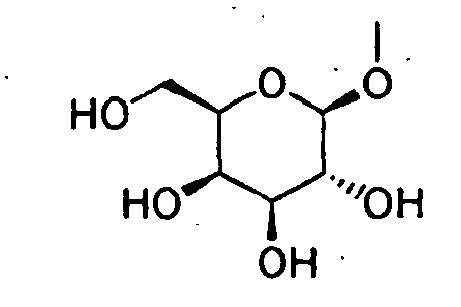
- As concrete compounds in the present invention, compounds described in Examples 1-187 are examplified. Specifically, the following compounds or pharmaceutically acceptable salts thereof are preferable.


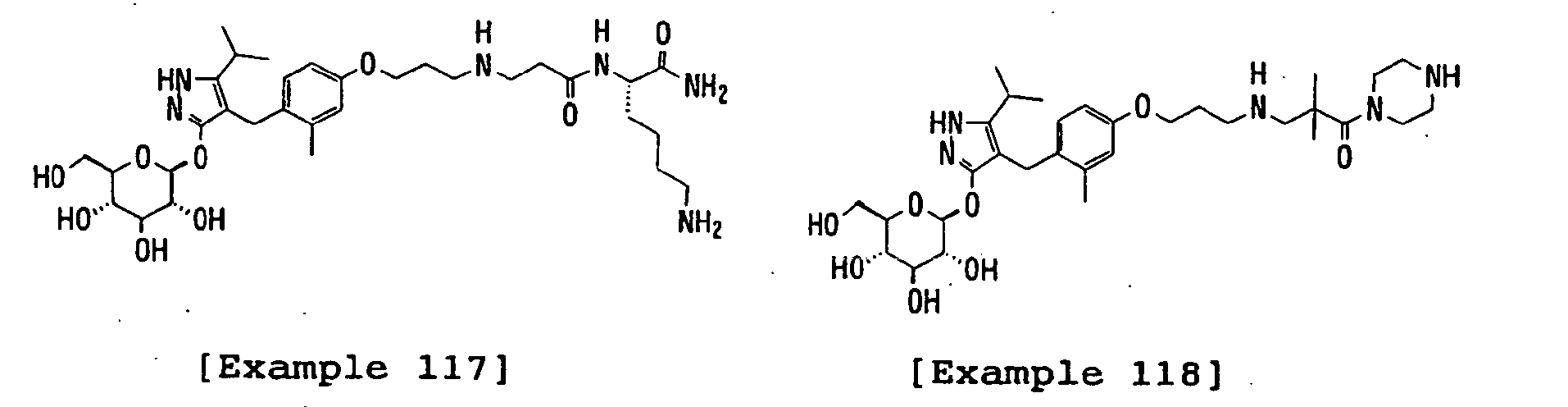


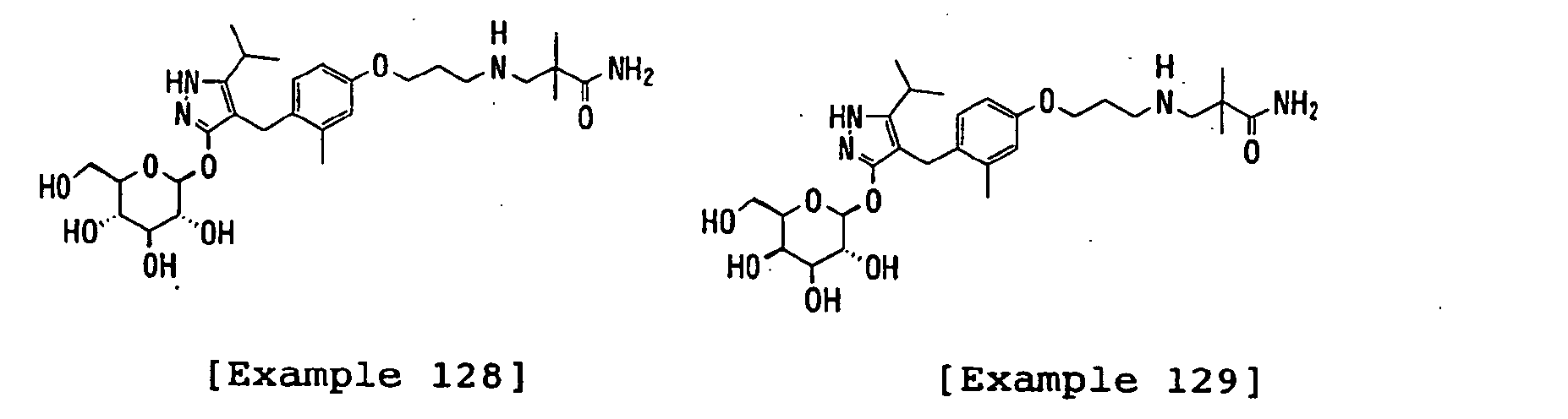
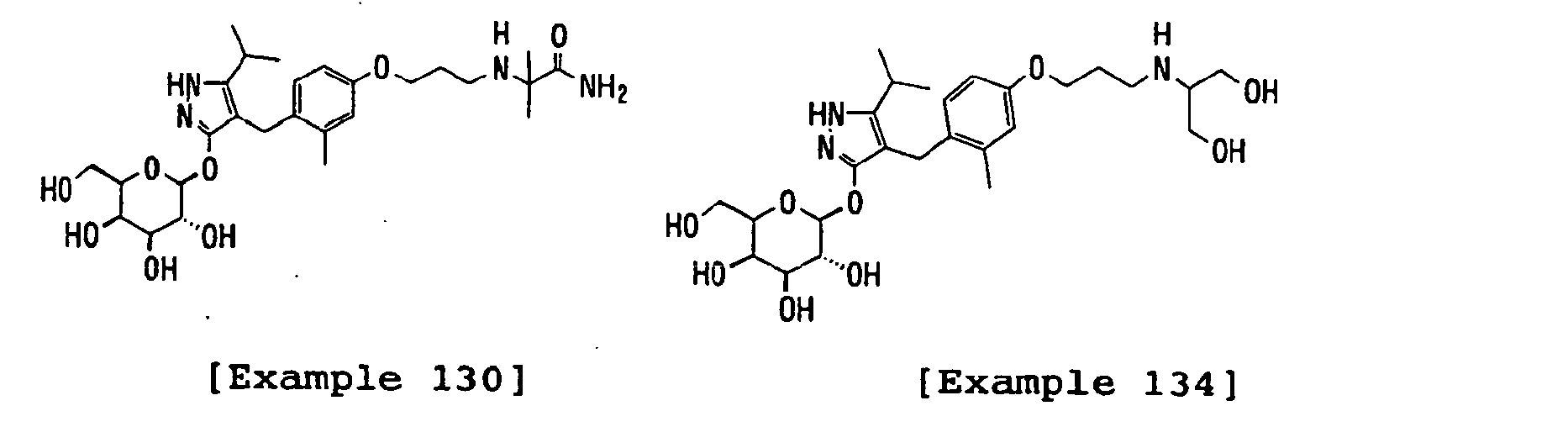

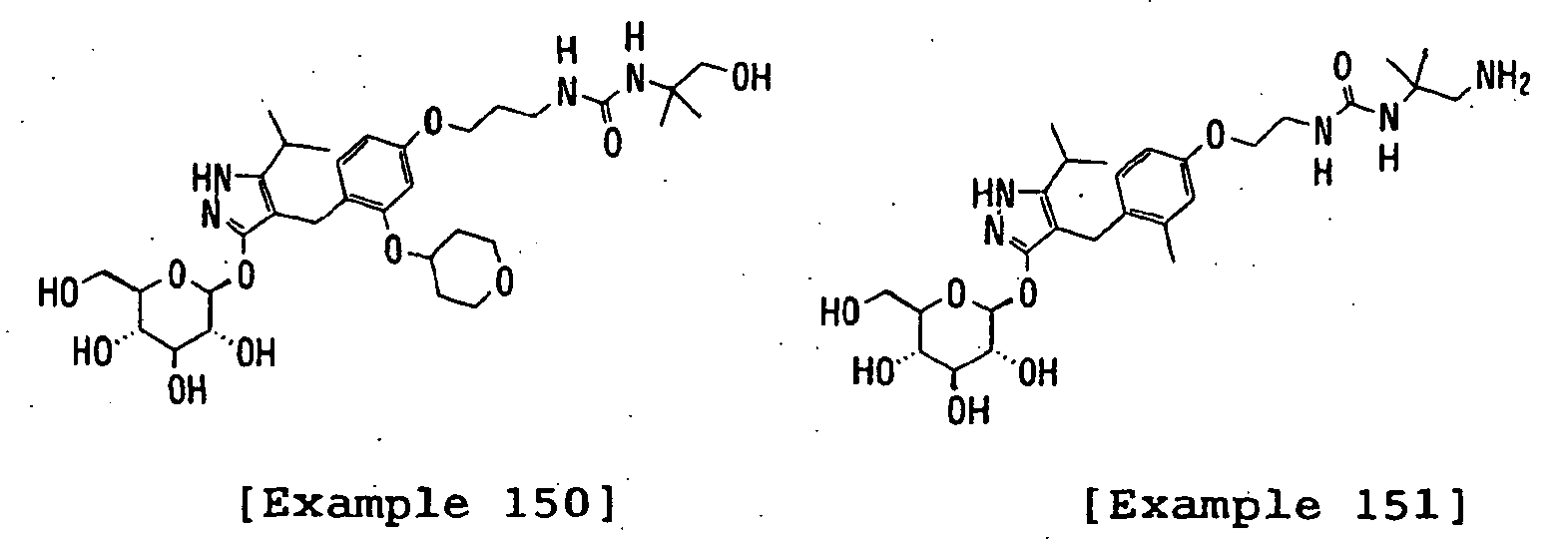


- For example, the compounds represented by the above general formula (I) of the present invention can be prepared according to the following procedure:

- A compound represented by the above general formula (VI) can be prepared by condensing a benzyl compound represented by the above general formula (IV) with a ketoacetate represented by the above general formula (V) in the presence of a base such as sodium hydride or potassium tert-butoxide in an inert solvent. As the inert solvent used in the reaction, for example, 1,2-dimethoxyethane, tetrahydrofuran, N,N-dimethylformamide, or a mixed solvent thereof can be illustrated. The reaction temperature is usually from room temperature to reflux temperature, and the reaction time is usually from 1 hour to 1 day, varying based on a used starting material, solvent and reaction temperature.
- A benzylpyrazole derivative represented by the above general formula (III) can be prepared by condensing a compound represented by the above general formula (VI) with a hydrazine compound represented by the above general formula (VII) or a monohydrate thereof, or a salt thereof in the presence or absence of a base in an inert solvent, and introducing a hydroxy-protective group in the usual way as occasion demands. As the inert solvent used in the condensing reaction, for example, toluene, tetrahydrofuran, chloroform, methanol, ethanol or a mixed solvent thereof can be illustrated, and as the base, for example, triethylamine, N,N-diisopropylethyl-amine, pyridine, sodium methoxide or sodium ethoxide can be illustrated. The reaction temperature is usually from room temperature to reflux temperature, and the reaction time is usually from 1 hour to 1 day, varying based on a used starting material, solvent and reaction temperature. The obtained benzylpyrazole derivative represented by the above general formula (III) can be also used in the subsequent process after suitably converting into a salt thereof in the usual way.
- A compound represented by the above general formula (X) can be prepared by condensing dithiocarbonate ester compound represented by the above general formula (VIII) with a ketone compound represented by the above general formula (IX) in the presence of a base such as sodium amide in an inert solvent. As the inert solvent used in the reaction, for example, toluene can be illustrated. The reaction temperature is usually from -20°C to room temperature, and the reaction time is usually from 30 minutes to 1 day, varying based on a used starting material, solvent and reaction temperature.
- A benzyloxypyrazole derivative represented by the above general formula (XI) can be prepared by condensing a compound represented by the above general formula (X) with a hydrazine compound represented by the above general formula (VII) or a monohydrate thereof, or a salt thereof in the presence of a base such as triethylamine or N,N-diisopropylethylamine in an inert solvent, and introducing a hydroxy-protective group in the usual way as occasion demands. As the inert solvent used in the condensing reaction, for example, acetonitrile can be illustrated. The reaction temperature is usually from 0°C to reflux temperature, and the reaction time is usually from 1 hour to 1 day, varying based on a used starting material, solvent and reaction temperature.
- A pyrazole aldehyde derivative represented by the above general formula (XII) can be prepared by subjecting a compound represented by the above general formula (XI) to Vilsmeier reaction using phosphorus oxychloride and N,N-dimethylformamide in a various solvent. As the solvent used in the reacion, for example, N,N-dimethylformamide can be illustrated. The reaction temperature is usually from 0°C to reflux temperature, and the reaction time is usually from 30 minutes to 1 day, varying based on a used starting material, solvent and reaction temperature.
- A compound represented by the above general formula (XIV) can be prepared by condensing a compound represented by the above general formula (XII) with a Grignard reagent, a Reformatsky reagent or a lithium reagent represented by the above general formula (XIII) in an inert solvent. As the inert solvent used in the reaction, for example, tetrahydrofuran, diethyl ether, or a mixed solvent thereof can be illustrated. The reaction temperature is usually from -78°C to room temperature, and the reaction time is usually from 30 minutes to 1 day, varying based on a used starting material, solvent and reaction temperature.
- A benzylpyrazole derivative represented by the above general formula (III) can be prepared by subjecting a compound represented by the above general formula (XIV) to catalytic hydrogenation using a palladium catalyst such as palladium-carbon powder in the presence or absence of an acid such as hydrochloric acid in an inert solvent, and in case that a compound represented by the above general formula (XIV) has any sulfur atom, subjecting the resulting compound to acid treatment in an aqueous solution of trifluoroacetic acid and dimethyl sulfide usually at 0°C to reflux temperature for 30 minutes to 1 day as occasion demands. As the solvent used in the catalytic hydrogenation, for example, methanol, ethanol, tetrahydrofuran, ethyl acetate, acetic acid, isopropanol or a mixed solvent thereof can be illustrated. The reaction temperature is usually from room temperature to reflux temperature, and the reaction time is usually from 30 minutes to 1 day, varying based on a used starting material, solvent and reaction temperature. The obtained benzylpyrazole derivative represented by the above general formula (III) can be also used in the subsequent process after suitably converting into a salt thereof in the usual way.
-
- [1] In case that one of Q3 and T3 is a C1-6 alkyl group, a C1-6 alkoxy-substituted (C1-6 alkyl) group or a C3-7 cycloalkyl group in a benzylpyrazole derivative represented by the above general formula (III), a corresponding compound represented by the above general formula (II) of the present invention can be prepared by subjecting a corresponding benzylpyrazole derivative represented by the above general formula (III) to glycosidation using acetobromo-α-D-glucose, acetobromo-α-D-galactose, 2,3,4,6-tetra-O-pivaloyl-α-D-glucopyranosyl bromide or 2,3,4;6-tetra-O-pivaloyl-α-D-galactopyranosyl bromide in the presence of a base such as, for example, silver carbonate, sodium hydride in an inert solvent. As the inert solvent used in the reaction, for example, tetrahydrofuran, dimethoxyethane, N,N-dimethylformamide, a mixed solvent thereof can be illustrated. The reaction temperature is usually from room temperature to reflux temperature, and the reaction time is usually from 1 hour to 1 day, varying based on a used starting material, solvent and reaction temperature.
- [2] In case that one of Q3 and T3 is a halo(C1-6 alkyl) group in a benzylpyrazole derivative represented by the above general formula (III), a corresponding compound represented by the above general formula (II) of the present invention can be prepared by subjecting a corresponding benzylpyrazole derivative represented by the above general formula (III) to glycosidation using acetobromo-α-D-glucose, acetobromo-α-D-galactose, 2,3,4,6-tetra-O-pivaloyl-α-D-glucopyranosyl bromide or 2,3,4,6-tetra-O-pivaloyl-α-D-galactopyranosyl bromide in the presence of a base such as, for example, potassium carbonate in an inert solvent. As the inert solvent used in the reaction, for example, tetrahydrofuran, acetonitrile or a mixed solvent thereof can be illustrated. The reaction temperature is usually from room temperature to reflux temperature, and the reaction time is usually from 1 hour to 1 day, varying based on a used starting material, solvent and reaction temperature.
- [3] In case that one of Q3 and T3 is a C2-6 alkyl group, a C1-6 alkoxy-substituted (C1-6 alkyl) group or a C3-7 cycloalkyl group in a benzylpyrazole derivative represented by the above general formula (III), a corresponding compound represented by the above general formula (II) of the present invention can be also prepared by subjecting a corresponding benzylpyrazole derivative represented by the above general formula (III) to glycosidation using acetobromo-α-D-glucose, acetobromo-α-D-galactose, 2,3,4,6-tetra-O-pivaloyl-α-D-glucopyranosyl bromide or 2,3,4,6-tetra-O-plvaloyl-α-D-galactopyranosyl bromide in the presence of a base such as, for example, sodium hydroxide, or potassium hydroxide, potassium carbonate and a phase transfer catalyst such as, for example, benzyltri (n-butyl) ammonium chloride, benzyltri-(n-butyl)ammonium bromide or tetra(n-butyl)ammonium hydrogen sulfate in an inert solvent containing water. As the inert solvent used in the reaction, for example, dichloromethane, toluene, benzotrifluoride or a mixed solvent thereof can be illustrated. The reaction temperature is usually from 0°C to reflux temperature, and the reaction time is usually from 30 minutes to 1 day, varying based on a used starting material, solvent and reaction temperature.
- The obtained glycosidated benzylpyrazole derivative represented by the above general formula (II) can be also used in the subsequent process after suitably converting into a salt thereof and separating in the usual way.
- A pyrazole derivative represented by the above general formula (I) of the present invention can be prepared by subjecting a compound represented by the above general formula (II) to alkaline hydrolysis, and removing a protective group or subjecting a nitro group of the resulting compound to reduction as occasion demands. As the solvent used in the hydrolysis reaction, for example, methanol, ethanol, tetrahydrofuran, water or a mixed solvent thereof can be illustrated. As the base, for example, sodium hydroxide, sodium methoxide, sodium ethoxide, methylamine or dimethylamine can be illustrated. The reaction temperature is usually from 0°C to reflux temperature, and the reaction time is usually from 30 minutes to 1 day, varying based on a used starting material, solvent and reaction temperature. As mentioned above, in case of compounds having a protective group in R11, R12, R14, Y1 and/or Z1 after the hydrolysis, the protective group can be suitably removed in the usual way. Furthermore, after the completion of the above reaction, compounds having a nitro group in R2 represented by the above general formula (I) can be also derived into a corresponding compound having an amino group by catalytic reduction using a platinum catalyst such as platinum oxide in an inert solvent such as ethyl acetate at usually room temperature to reflux temperature for usually 30 minutes to 1 day in the usual way.
- Among the compounds represented by the above general formula (III) as starting materials, there can be the following three tautomers in compounds wherein R11 is a hydrogen atom, varying based on difference in the reaction conditions, and the compounds represented by the above general formula (III) include all the compounds:

- Of the compounds represented by the above general formula (I) of the present invention, a compound wherein R1 represents a C1-6 alkyl group, a C1-6 alkenyl group, a hydroxy (C2-6 alkyl) group, a C3-7 cycloalkyl group, a C3-7 cycloalkyl-substituted (C1-6 alkyl) group or an aryl(C1-6 alkyl) group which may have the same or different 1 to 3 substituents selected from the group consisting of a halogen atom, a hydroxy group, an amino group, a C1-6 alkyl group and a C1-6 alkoxy group on the ring, for example, can be prepared according to the following procedure:

- A pyrazole derivative represented by the above general formula (Ia) of the present invention can be prepared by subjecting a compound represented by the above general formula (IIa) to hydrolysis according to a similar method to that described in the above process 1-9 and N-alkylation using an alkylating agent represented by the above general formula (XV) in the presence of a base such as cesium carbonate or potassium carbonate in an inert solvent, and in case of compounds having a protective group, suitably removing the protective group in the usual way as occasion demands. As the inert solvent used in the N-alkylation, for example, acetonitrile, ethanol, 1,2-dimethoxyethane, tetrahydrofuran, N,N-dimethylformamide, dimethyl sulfoxide or a mixed solvent thereof can be illustrated. The reaction temperature is usually from room temperature to reflux temperature, and the reaction time is usually from 10 minutes to 1 day, varying based on a used starting material, solvent and reaction temperature.
- Of the compounds represented by the above general formula (I) of the present invention, a compound wherein R1, R4 and Z represent a hydrogen atom, for example, can be also prepared according to the following procedure:
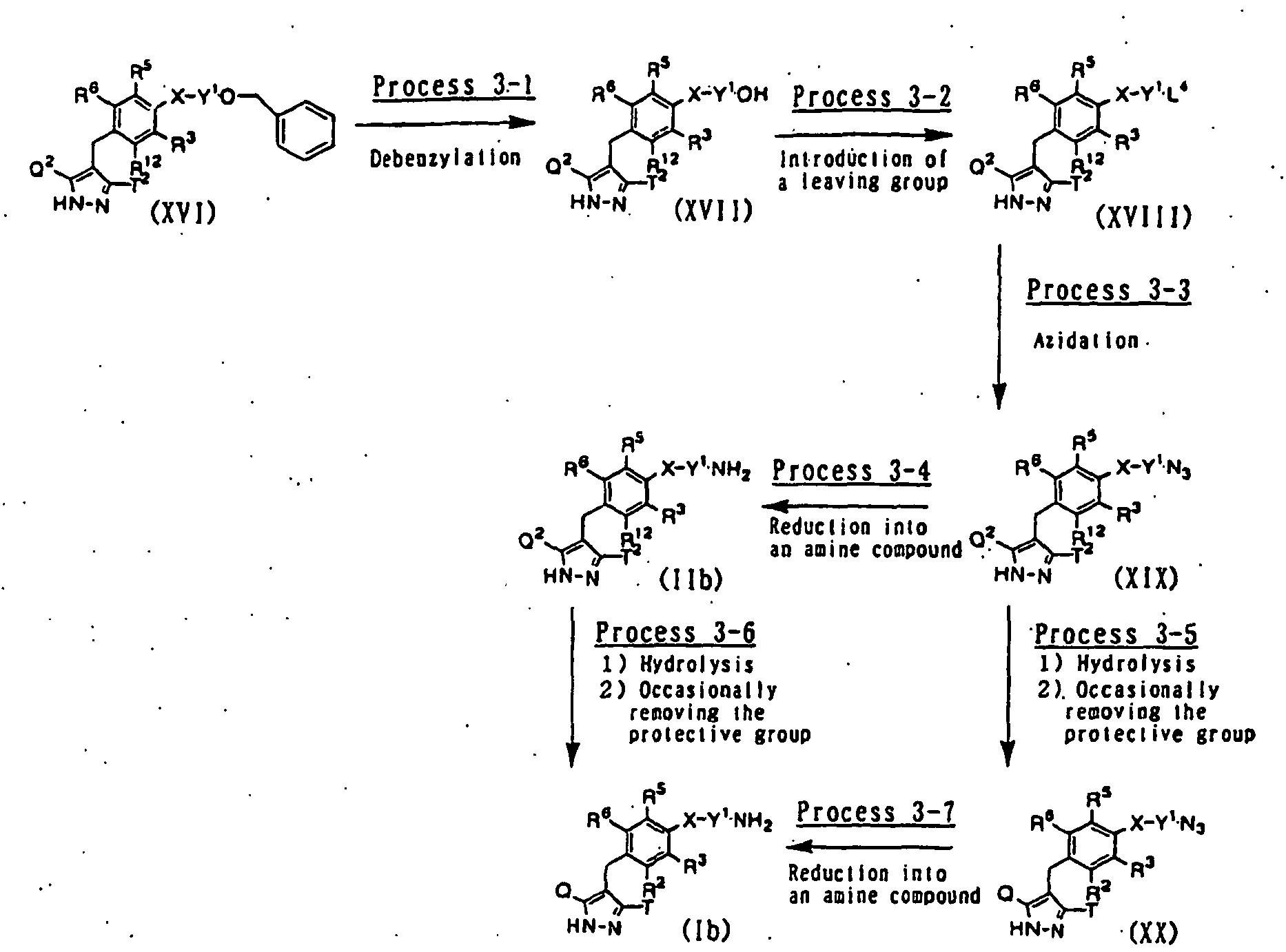
- A compound represented by the above general formula (XVII) can be prepared by subjecting a compound represented by the above general formula (XVI) to catalytic hydrogenation using a palladium catalyst such as palladium-carbon powder in an inert solvent to remove the benzyl group. As the solvent used in the catalytic hydrogenation, for example, methanol, ethanol, tetrahydrofuran, ethyl acetate, acetic acid or a mixed solvent thereof can be illustrated. The reaction temperature is usually from 0°C to reflux temperature, and the reaction time is usually from 1 hour to 2 days, varying based on a used starting material, solvent and reaction temperature.
- A compound represented by the above general formula (XVIII) can be prepared by introducing a leaving group into a compound represented by the above general formula (XVII) using an acid chloride such as mesyl chloride or tosyl chloride in the presence of a base such as triethylamine or N,N-diisopropylethylamine in an inert solvent. As the solvent used in the introducing reaction, for example, dichloromethane, ethyl acetate, tetra-hydrofuran, pyridine or a mixed solvent thereof can be illustrated. The reaction temperature is usually from 0°C to room temperature, and the reaction time is usually from 30 minutes to 1 day, varying based on a used starting material, solvent and reaction temperature.
- A compound represented by the above general formula (XIX) can be prepared by subjecting a compound represented by the above general formula (XVIII) to azidation using an azidating agent such as sodium azide in an inert solvent. As the solvent used in the azidation, for example, dichloromethane, ethyl acetate, N,N-dimethylformamide, dimethyl sulfoxide, N-methyl-pyrrolidone, N,N-dimethylimidazolidinone or a mixed solvent thereof can be illustrated. The reaction temperature is usually from room temperature to reflux temperature, and the reaction time is usually from 30 minutes to 1 day, varying based on a used starting material, solvent and reaction temperature.
- A compound represented by the above general formula (IIb) of the present invention can be prepared by subjecting a compound represented by the above general formula (XIX) to catalytic hydrogenation using a palladium catalyst such as palladium-carbon powder in an inert solvent. As the solvent used in the catalytic hydrogenation, for example, tetrahydrofuran, methanol, ethanol, ethyl acetate or a mixed solvent thereof can be illustrated. The reaction temperature is usually from room temperature to reflux temperature, and the reaction time is usually from 30 minutes to 1 day, varying based on a used starting material, solvent and reaction temperature.
- A compound represented by the above general formula (XX) can be prepared by subjecting a compound represented by the above general formula (XIX) to alkaline hydrolysis, and removing the protective group in the usual way as occasion demands. As the solvent used in the hydrolysis reaction, for example, methanol, ethanol, tetrahydrofuran, water or a mixed solvent thereof can be illustrated. As the base, for example, sodium hydroxide, sodium methoxide, sodium ethoxide, methylamine, or dimethylamine can be illustrated. The reaction temperature is usually from 0°C to reflux temperature, and the reaction time is usually from 30 minutes to 1 day, varying based on a used starting material, solvent and reaction temperature. In case of compounds having a protective group in R12 and/or Y1 after the hydrolysis, the protective group can be suitably removed in the usual way as the process 1-9.
- A pyrazole derivative represented by the above general formula (Ib) of the present invention can be prepared by subjecting a compound represented by the above general formula (IIb) to alkaline hydrolysis, and removing the protective group in the usual way as occasion demands. As the solvent used in the hydrolysis reaction, for example, methanol, ethanol, tetrahydrofuran, water or a mixed solvent thereof can be illustrated. As the base, for example, sodium hydroxide, sodium methoxide, sodium ethoxide, methylamine, or dimethylamine can be illustrated. The reaction temperature is usually from 0°C to reflux temperature, and the reaction time is usually from 30 minutes to 1 day, varying based on a used starting material, solvent and reaction temperature. In case of compounds having a protective group in R12 and/or Y1 after the hydrolysis, the protective group can be suitably removed in the usual way as the process 1-9.
- A pyrazole derivative represented by the above general formula (Ib) of the present invention can be prepared by subjecting a compound represented by the above general formula (XX) to catalytic hydrogenation using a palladium catalyst such as palladium-carbon powder in an inert solvent. As the solvent used in the catalytic hydrogenation, for example, tetra-hydrofuran, methanol, ethanol, ethyl acetate or a mixed solvent thereof can be illustrated. The reaction temperature is usually from room temperature to reflux temperature, and the reaction time is usually from 30 minutes to 1 day, varying based on a used starting material, solvent and reaction temperature.
- Of the compounds represented by the above general formula (I) of the present invention, a compound wherein R1 and R4 represent a hydrogen atom; and Z represents -CORC, -SO2RC, -CON(RD)RE or -C(=NR2G)NHR2H, for example, can be prepared according to the following procedures:

- A compound represented by the above general formula (IIc) can be prepared from a compound represented by the above general formula (IIb) by treating according to the following methods 1-4, and removing the protective group in the usual way as occasion demands.
- A compound represented by the above general formula (IIb) is allowed to react with an acid chloride represented by the above general formula (XXI) or (XXII) in the presence of a base such as triethylamine, N,N-diisopropylethylamine, pyridine or 1,8-diazabicyclo[5.4.0]unde-7-cene in an inert solvent such as dichloromethane, ethyl acetate, tetrahydrofuran, pyridine, acetonitrile or a mixed solvent thereof at usually 0°C to reflux temperature for usually 30 minutes to 1 day.
- A compound represented by the above general formula (IIb) is allowed to react with an isocyanate compound represented by the above general formula (XXIII) in the presence or absence of a base such as triethylamine, N,N-diisopropylethylamine, pyridine or 1,8-diazabicyclo[5.4.0]unde-7-cene in an inert solvent such as dichloromethane, ethyl acetate, tetrahydrofuran, pyridine, acetonitrile, toluene or a mixed solvent thereof at usually 0°C to reflux temperature for usually 30 minutes to 1 day.
- A compound represented by the above general formula (IIb) is allowed to react with a carboxylic acid compound represented by the above general formula (XXIV) after suitably adding 1-hydroxybenzotriazole as occasion demands in the presence of a condensing agent such as 1-ethyl-3-(3-dimethylaminopropyl)-carbodiimide hydrochloride or dicyclohexylcarbodiimide and in the presence or absence of a base such as triethylamine or N,N-diisopropylethylamine in an inert solvent such as N,N-dimethylformamide, dichloromethane or a mixed solvent thereof at usually 0°C to reflux temperature for usually 1 hour to 2 days.
- A compound represented by the above general formula (IIb) is allowed to react with a guanidylating reagent represented by the above general formula (XXV) such as N-(benzyloxycarbonyl)-1H-pyrazol-1-carboxamidine in an inert solvent such as tetrahydrofuran, methanol, ethanol, toluene, N,N-dimethylformamide or a mixed solvent thereof at usually room temperature to reflux temperature for usually 1 hour to 5 days.
- A pyrazole derivative represented by the above general formula (Ic) of the present invention can be prepared by subjecting a compound represented by the above general formula (IIc) to alkaline hydrolysis, and removing the protective group in the usual way as occasion demands. As the solvent used in the hydrolysis reaction, for example, methanol, ethanol, tetrahydrofuran, water or a mixed solvent thereof can be illustrated. As the base, for example, sodium hydroxide, sodium methoxide, sodium ethoxide, methylamine or dimethylamine can be illustrated. The reaction temperature is usually from 0°C to reflux temperature, and the reaction time is usually from 30 minutes to 1 day, varying based on a used starting material, solvent and reaction temperature. In case of compounds having a protective group in R12 , Y1 and/or Z after the hydrolysis, the protective group can be suitably removed in the usual way as the process 1-9.
- An activated ester compound represented by the above general formula (XXVII) can be prepared by condensing a compound represented by the above general formula (IIb) with an agent for making an activated ester represented by the above formula (XXVI) in the presence of a base such as triethylamine, N,N-diisopropylethylamine, pyridine or 1,8-diazabicyclo-[5.4.0]unde-7-cene in an inert solvent. As the solvent used in the condensing reaction, for example, dichloromethane, tetrahydrofuran, ethyl acetate, acetonitrile, pyridine or a mixed solvent thereof can be illustrated. The reaction temperature is usually from 0°C to reflux temperature, and the reaction time is usually from 30 minutes to 1 day, varying based on a used starting material, solvent and reaction temperature.
- An pyrazole derivative represented by the above general formula (IId) of the present invention can be prepared by condensing a compound represented by the above general formula (XXVII) with an amine compound represented by the above general formula (XXVIII) or a salt thereof in the presence or absence of a base such as triethylamine, N,N-diisopropylethylamine, pyridine, 1,8-diazabicyclo[5.4.0]unde-7-cene, sodium hydride, potassium tert-butoxide, potassium carbonate or cesium carbonate in an inert solvent, and removing the protective group in the usual way as occasion demands. As the solvent used in the condensing reaction, for example, dichloromethane, methanol, ethanol, tetrahydrofuran, ethyl acetate, acetonitrile, pyridine, N,N-dimethylformamide or a mixed solvent thereof can be illustrated. The reaction temperature is usually from room temperature to reflux temperature, and the reaction time is usually from 30 minutes to 2 days, varying based on a used starting material, solvent and reaction temperature.
- A pyrazole derivative represented by the above general formula (Id) of the present invention can be prepared by subjecting a compound represented by the above general formula (IId) to alkaline hydrolysis, and removing the protective group in the usual way as occasion demands. As the solvent used in the hydrolysis reaction, for example, methanol, ethanol, tetrahydrofuran, water or a mixed solvent thereof can be illustrated. As the base, for example, sodium hydroxide, sodium methoxide, sodium ethoxide, methylamine or dimethylamine can be illustrated. The reaction temperature is usually from 0°C to reflux temperature, and the reaction time is usually from 30 minutes to 1 day, varying based on a used starting material, solvent and reaction temperature. In case of compounds having a protective group in R12, R1D, R1E and/or Y1 after the hydrolysis, the protective group can be suitably removed in the usual way as the process 1-9.
- Of the compounds represented by the above general formula (I) of the present invention, a compound wherein R1 represents a hydrogen atom; and Z represents RB, for example, can be also prepared according to the following procedures:

- A pyrazole derivative represented by the above general formula (Ie) of the present invention can be prepared by condensing a compound represented by the above general formula (XVIII) with an amine compound represented by the above general formula (XXIX) or a salt thereof in the presence or absence of a base such as triethylamine, N,N-diisopropylethylamine, pyridine, 1,8-diazabicyclo[5.4.0]unde-7-cene, sodium hydride, potassium tert-butoxide, potassium carbonate or cesium carbonate in an inert solvent after adding sodium iodide as occasion demands, subjecting the resulting compound to alkaline hydrolysis, and removing the protective group in the usual way as occasion demands. As the solvent used in the condensing reaction, for example, acetonitrile, N,N-dimethylformamide, dimethyl sulfoxide, N-methylpyrrolidone, methanol, ethanol, 2-propanol, tetrahydrofuran or a mixed solvent thereof can be illustrated. The reaction temperature is usually from room temperature to reflux temperature, and the reaction time is usually from 1 hour to 5 days, varying based on a used starting material, solvent and reaction temperature. As the solvent used in the hydrolysis reaction, for example, methanol, ethanol, tetrahydrofuran, water or a mixed solvent thereof can be illustrated. As the base, for example, sodium hydroxide, sodium methoxide, sodium ethoxide, methylamine or dimethylamine can be illustrated. The reaction temperature is usually from 0°C to reflux temperature, and the reaction time is usually from 30 minutes to 1 day, varying based on a used starting material, solvent and reaction temperature. In case of compounds having a protective group in R12, R14, R1B and/or Y1 after the hydrolysis, the protective group can be suitably removed in the usual way as the process 1-9.
- Of the compounds represented by the above general formula (I) of the present invention, a compound wherein R1 represents a hydrogen atom; R4 represent a C1-6 alkyl group which may have the same or different 1 to 5 groups selected from the above substituent group (i); and Z represents a hydrogen atom, a C1-6 alkyl group which may have the same or different 1 to 5 groups selected from the above substituent group (i), -CORC, -SO2RC, -CONHRD or =C(=NR2C)NHR2H, for example, can be also prepared according to the following procedures:

- A compound represented by the above general formula (IIe) of the present invention can be prepared from a compound represented by the above general formula (IIb) by treating according to the following methods 1-3.
-
- 1) A compound represented by the above general formula (IIb) is allowed to react with an acid chloride represented by the above general formula (XXX) in the presence of a base such as triethylamine, N,N-diisopropylethylamine, pyridine or 1,8-diazabicyclo[5.4.0]unde-7-cene in an inert solvent such as dichloromethane, ethyl acetate, tetrahydrofuran, pyridine, acetonitrile or a mixed solvent thereof at usually 0°C to room temperature for usually 30 minutes to 1 day to obtain the corresponding sulfonamide compound.
- 2) The obtained sulfonamide compound is N-alkylated using an alkylating agent represented by the above general formula (XXXI) after adding sodium iodide as occasion demands in the presence of a base such as potassium carbonate, cesium carbonate or sodium hydride in an inert solvent such as N,N-dimethylformamide, acetone, tetrahydrofuran, acetonitrile or a mixed solvent thereof at usually room temperature to reflux temperature for usually 1 hour to 2 days, or the obtained sulfonamide compound is N-alkylated using an alcohol compound represented by the above general formula (XXXII) in the presence of a diester of an azodicarboxylic acid such as diethyl azodicarboxylate or diisopropyl azodicarboxylate, and triphenylphosphine in an inert solvent such as tetrahydrofuran, ethyl acetate, acetonitrile or a mixed solvent thereof at usually room temperature to reflux temperature for usually 30 minutes to 1 day to obtain the corresponding N,N-disubstituted sulfonamide compound.
- 3-4) The obtained N,N-disubstituted sulfonamide compound is deprotected using a thiol reagent such as mercaptoacetic acid or thiophenol in the presence of a base such as cesium carbonate or potassium carbonate in an inert solvent such as N,N-dimethylformamide, acetonitrile or a mixed solvent thereof at usually room temperature to reflux temperature for usually 1 hour to 1 day to obtain the corresponding secondary amine compound, and the protective group is removed in the usual way as occasion demands.
- An aldehyde compound represented by the above general formula (XXXIII) or a ketone compound represented by the above general formula (XXXIV) is reductively aminated using a compound represented by the above general formula (IIb) in the presence of a reducing agent such as sodium cyanoborohydride or sodium triacetoxyborohydride in an inert solvent such as tetrahydrofuran, 1,2-dichloroethane, acetic acid or a mixed solvent thereof at usually room temperature to reflux temperature for usually 1 hour to 1 day.
- A compound represented by the above general formula (IIb) is N-alkylated using an alkylating agent represented by the above general formula (XXXI) after adding sodium iodide as occasion demands in the presence or absence of a base such as triethylamine, N,N-diisopropylethylamine, pyridine or 1,8-diazabicyclo-[5.4.0]unde-7-cene in an inert solvent such as acetonitrile, N,N-dimethylformamide, dimethyl sulfoxide, N-methylpyrrolidone, methanol, ethanol, 2-propanol or a mixed solvent thereof at usually room temperature to reflux temperature for usually 1 hour to 5 days.
-
- 1) A sulfonamide compound represented by the above general formula (XXXV) is N-alkylated using a compound represented by the above general formula (XVII) in the presence of a diester of an azodicarboxylic acid such as diethyl azodicarboxylate or diisopropyl azodicarboxylate, and triphenylphosphine in an inert solvent such as tetrahydrofuran, ethyl acetate, acetonitrile or a mixed solvent thereof at usually room temperature to reflux temperature for usually 30 minutes to 1 day to obtain the corresponding N,N-disubstituted sulfonamide compound.
- 2-3) The obtained N,N-disubstituted sulfonamide compound is deprotected using a thiol reagent such as mercaptoacetic acid or thiophenol in the presence of a base such as cesium carbonate or potassium carbonate in an inert solvent such as N,N-dimethylformamide, acetonitrile or a mixed solvent thereof at usually room temperature to reflux temperature for usually 1 hour to 1 day to obtain the corresponding secondary amine compound, and the protective group is removed in the usual way as occasion demands to prepare a prazole derivative represented by the above general formula (IIe) of the present invention.
- A pyrazole derivative represented by the above general formula (If) of the present invention can be prepared by subjecting a compound represented by the above general formula (IIe) to alkaline hydrolysis, and removing the protective group in the usual way as occasion demands. As the solvent used in the hydrolysis reaction, for example, methanol, ethanol, tetrahydrofuran, water or a mixed solvent thereof can be illustrated. As the base, for example, sodium hydroxide, or sodium methoxide, sodium ethoxide, methylamine or dimethylamine can be illustrated. The reaction temperature is usually from 0°C to reflux temperature, and the reaction time is usually from 30 minutes to 1 day, varying based on a used starting material, solvent and reaction temperature. In case of compounds having a protective group in R12, R24 and/or Y1 after the hydrolysis, the protective group can be suitably removed in the usual way as the process 1-9.
- A compound represented by the above general formula (IIf) of the present invention can be prepared from a compound represented by the above general formula (IIe) by treating according to the following methods 1-6, and removing the protective group in the usual way as occasion demands.
- A compound represented by the above general formula (IIe) is allowed to react with an acid chloride represented by the above general formula (XXI) or (XXII) in the presence of a base such as triethylamine, N,N-diisopropylethylamine, pyridine or 1,8-diazabicyclo[5.4.0]unde-7-cene in an inert solvent such as dichloromethane, ethyl acetate, tetrahydrofuran, pyridine, acetonitrile or a mixed solvent thereof at usually 0°C to reflux temperature for usually 30 minutes to 1 day.
- A compound represented by the above general formula (IIe) is allowed to react with an isocyanate compound represented by the above general formula (XXIII) in the presence or absence of a base such as triethylamine, N,N-diisopropylethylamine, pyridine or 1,8-diazabicyclo[5.4.0]unde-7-cene in an inert solvent such as dichloromethane, ethyl acetate, tetrahydrofuran, pyridine, acetonitrile, toluene or a mixed solvent thereof at usually 0°C to reflux temperature for usually 30 minutes to 1 day.
- A compound represented by the above general formula (IIe) is allowed to react with a carboxylic acid compound represented by the above general formula (XXIV) after suitably adding 1-hydroxybenzotriazole as occasion demands in the presence of a condensing agent such as 1-ethyl-3-(3-dimethylaminopropyl)-carbodiimide hydrochloride or dicyclohexylcarbodiimide and in the presence or absence of a base such as triethylamine or N,N-diisopropylethylamine in an inert solvent such as N,N-dimethylformamide, dichloromethane or a mixed solvent thereof at usually 0°C to reflux temperature for usually 1 hour to 2 days.
- A compound represented by the above general formula (IIe) is allowed to react with a guanidylating reagent represented by the above general formula (XXV) such as N-(benzyloxycarbonyl)-1H-pyrazol-1-carboxamidine in an inert solvent such as tetrahydrofuran, methanol, ethanol, toluene, N,N-dimethylformamide or a mixed solvent thereof at usually room temperature to reflux temperature for usually 1 hour to 5 days.
- An aldehyde compound represented by the above general formula (XXXIII) or a ketone compound represented by the above general formula (XXXIV) is reductively aminated using a compound represented by the above general formula (IIe) in the presence of a reducing agent such as sodium cyanoborohydride or sodium triacetoxyborohydride in an inert solvent such as tetrahydrofuran, 1,2-dichloroethane, acetic acid or a mixed solvent thereof at usually room temperature to reflux temperature for usually 1 hour to 1 day.
- A compound represented by the above general formula (IIe) is N-alkylated using an alkylating agent represented by the above general formula (XXXI) after adding sodium iodide as occasion demands in the presence or absence of a base such as triethylamine, N,N-diisopropylethylamine, pyridine or 1,8-diazabicyclo-[5.4.0]unde-7-cene in an inert solvent such as acetonitrile, N,N-dimethylformamide, dimethyl sulfoxide, N-methyl-pyrrolidone, methanol, ethanol, 2-propanol or a mixed solvent thereof at usually room temperature to reflux temperature for usually 1 hour to 5 days.
- A pyrazole derivative represented by the above general formula (Ig) of the present invention can be prepared by subjecting a compound represented by the above general formula (IIf) to alkaline hydrolysis, and removing the protective group in the usual way as occasion demands. As the solvent used in the hydrolysis reaction, for example, methanol, ethanol, tetrahydrofuran, water or a mixed solvent thereof can be illustrated. As the base, for example, sodium hydroxide, sodium methoxide, sodium ethoxide, methylamine or dimethylamine can be illustrated. The reaction temperature is usually from 0°C to reflux temperature, and the reaction time is usually from 30 minutes to 1 day, varying based on a used starting material, solvent and reaction temperature. In case of compounds having a protective group in R12, R24, Y1 and/or Z3 after the hydrolysis, the protective group can be suitably removed in the usual way as the process 1-9.
- Of the compounds represented by the above general formula (I) of the present invention, a compound wherein R1 represents a hydrogen atom; X represents an oxygen atom; Y represents -CH2CH(OH)CH2-; and Z is RB, for example, can be also prepared according to the following procedures:

- A compound represented by the above general formula (XXXVIII) can be prepared by subjecting a compound represented by the above general formula (XXXVI) to O-alkylation using an alkylating agent represented by the above general formula (XXXVII) after suitably adding a phase transfer catalyst such as, for example, tetra (n-butyl) ammonium bromide as occasion demands in the presence of a base such as, for example, cesium carbonate, potassium carbonate, sodium hydride, sodium hydroxide or cesium fluoride in an inert solvent. As the solvent used in the O-alkylation, for example, N,N-dimethylformamide, acetone, tetrahydrofuran, chlorobenzene, dichloromethane, water or a mixed solvent thereof can be illustrated. The reaction temperature is usually from room temperature to reflux temperature, and the reaction time is usually from 1 hour to 3 days, varying based on a used starting material, solvent and reaction temperature.
- An pyrazole derivative represented by the above general formula (Ih) of the present invention can be prepared by condensing a compound represented by the above general formula (XXXVIII) with an amine compound represented by the above general formula (XXIX) or a salt thereof in the presence or absence of a base such as triethylamine, N,N-diisopropylethylamine, pyridine, 1,8-diazabicyclo[5.4.0]unde-7-cene, sodium hydride, potassium tert-butoxide, potassium carbonate or cesium carbonate in an inert solvent, subjecting the resulting compound to alkaline hydrolysis, and removing the protective group in the usual way as occasion demands. As the solvent used in the condensing reaction, for example, acetonitrile, N,N-dimethyl-formamide, methanol, ethanol, tetrahydrofuran or a mixed solvent thereof can be illustrated. The reaction temperature is usually from room temparature to reflux temperature, and the reaction time is usually from 1 hour to 1 day, varying based on a used starting material, solvent and reaction temperature. As the solvent used in the hydrolysis, for example, methanol, ethanol, tetrahydrofuran, water or a mixed solvent thereof can be illustrated. As the base, for example, sodium hydroxide, sodium methoxide, sodium ethoxide, methylamine or dimethylamine can be illustrated. The reaction temperature is usually from 0°C to reflux temperature, and the reaction time is usually from 30 minutes to 1 day, varying based on a used starting material, solvent and reaction temperature. In case of compounds having a protective group in R12, R14 and/or R1B after the hydrolysis, the protective group can be suitably removed in the usual way as the process 1-9.
- Of the compounds represented by the above general formula (I) of the present invention, a compound wherein R1 and R4 represents a hydrogen atom; and Z is -C(=NCN)N(R7)R8, for example, can be also prepared according to the following procedures:

- A compound represented by the above general formula (XXXX) can be prepared by condensing a compound represented by the above general formula (IIb) with an isothioureidating reagent represented by the above general formula (XXXIX) in an inert solvent. As the solvent used in the condensing reaction, for example, methanol, ethanol, 2-propanol, tetrahydrofuran, toluene or a mixed solvent thereof can be illustrated. The reaction temperature is usually from room temperature to reflux temperature, and the reaction time is usually from 1 hour to 1 day, varying based on a used starting material, solvent and reaction temperature.
- A compound represented by the above general formula (Ii) of the present invention can be prepared by condensing a compound represented by the above general formula (XXXX) with an amine compound represented by the above general formula (XXIX) or a salt thereof in the presence or absence of a base such as triethylamine, N,N-diisopropylethylamine, pyridine, 1,8-diazabicyclo[5.4.0]unde-7-cene, sodium hydride, potassium tert-butoxide, potassium carbonate or cesium carbonate in an inert solvent, subjecting the resulting compound to alkaline hydrolysis, and removing the protective group in the usual way as occasion demands. As the solvent used in the condensing reaction, for example, methanol, ethanol, acetonitrile, 2-propanol, N,N-dimethylformamide, tetrahydrofuran or a mixed solvent thereof can be illustrated. The reaction temperature is usually from room temparature to reflux temperature, and the reaction time is usually from 1 hour to 1 day, varying based on a used starting material, solvent and reaction temperature. As the solvent used in the hydrolysis, for example, methanol, ethanol, tetrahydrofuran, water or a mixed solvent thereof can be illustrated. As the base, for example, sodium hydroxide, sodium methoxide, sodium ethoxide, methylamine or dimethylamine can be illustrated. The reaction temperature is usually from 0°C to reflux temperature, and the reaction time is usually from 30 minutes to 1 day, varying based on a used starting material, solvent and reaction temperature. In case of compounds having a protective group in R1B, R12, R14 and/or Y1 after the hydrolysis, the protective group can be suitably removed in the usual way as the process 1-9.
- In case of removing a protective group in the above production processes, methods other than those described above can be also carried out in the usual way.
- The compounds represented by the above general formula (I) of the present invention obtained by the above production processes can be isolated and purified by conventional separation means such as fractional recrystallization, purification using chromatography, solvent extraction and solid phase extraction.
- The pyrazole derivatives represented by the above general formula (I) of the present invention can be converted into their pharmaceutically acceptable salts in the usual way. Examples of such salts include acid addition salts with mineral acids such as, for example, hydrochloric acid, hydrobromic acid, hydroiodic acid, sulfuric acid, nitric acid or phosphoric acid, acid addition salts with organic acids such as, for example, formic acid, acetic acid, methanesulfonic acid, benzenesulfonic acid, p-toluenesulfonic acid, propionic acid, citric acid, succinic acid, tartaric acid, fumaric acid, butyric acid, oxalic acid, malonic acid, maleic acid, lactic acid, malic acid, carbonic acid, glutamic acid or aspartic acid, salts with inorganic bases such as, for example, a sodium salt or a potassium salt , and salts with organic bases such as, for example, N-methyl-D-glucamine, N,N'-dibenzyletylenediamine, 2-aminoethanol, tris(hydroxy-methyl)aminomethane, arginine or lysine.
- The compounds represented by the above general formula (I) of the present invention include their solvates with pharmaceutically acceptable solvents such as ethanol and water.
- Of the pyrazole derivatives represented by the above general formula (I) of the present invention , there are two geometrical isomers in each compound having an unsaturated bond. In the present invention, either of cis(Z)-isomer or trans(E)-isomer can be employed.
- Of the pyrazole derivatives represented by the above general formula (I) of the present invention , there are two optical isomers, R-isomer and S-isomer, in each compound having an asymmetric carbon atom excluding the glucopyranosyloxy moiety or the galactopyranosyloxy moiety. In the present invention, either of the isomers can be employed, and a mixture of both isomers can be also employed.
- The pyrazole derivatives represented by the above general formula (I) of the present invention, for example, showed a potent inhibitory activity in human SGLT1 in a human SGLT1 inhibitory activity confirmatory test as described below, and exerted an excellent inhibitory activity of blood glucose level increase in a confirmatory test of the inhibitory activity of blood glucose level increase in rat. Thus, the pyrazole derivatives represented by the above general formula (I) of the present invention exhibit an excellent SGLT1 inhibitory activity at the small intestine, and can remarkably inhibit blood glucose level increase and/or decrease blood galactose level by inhibiting or delaying glucose and galactose absorption. Therefore, a pharmaceutical composition comprising as an active ingredient a pyrazole derivative represented by the above general formula (I) of the present invention or a pharmaceutically acceptable salt thereof is extremely useful as an agent for inhibiting postprandial hypreglycemia, an agent for the inhibition of advancing impaired glucose tolerance (IGT) or impaired fasting glycemia (IFG) into diabetes in a subject, and an agent for the prevention or treatment of a disease associated with hyperglycemia such as, for example, diabetes, impaired glucose tolerance, impaired fasting glycemia, diabetic complications (e.g., retinopathy, neuropathy, nephropathy, ulcer, macroangiopathy), obesity, hyperinsulinemia, hyperlipidemia,hyper-cholesterolemia, hypertriglyceridemia, lipid metabolism disorder, atherosclerosis, hypertension, congestive heart failure, edema, hyperuricemia or gout, which relates to SGLT1 activity at the small intestine, and an agent for the prevention or treatment of a disease associated with increasing blood galactose level such as galactosemia.
- Furthermore, the compounds of the present invention can be suitably used in combination with at least one member selected from drugs other than SGLT2 inhibitors. Examples of the drugs which can be used in combination with the compounds of the present invention include an insulin sensitivity enhancer, a glucose absorption inhibitor, a biguanide, an insulin secretion enhancer, a SGLT2 inhibitor, an insulin or insulin analogue, a glucagon receptor antagonist, an insulin receptor kinase stimulant, a tripeptidyl peptidase II inhibitor, a dipeptidyl peptidase IV inhibitor, a protein tyrosine phosphatase-1B inhibitor, a glycogen phosphorylase inhibitor, a glucose-6-phosphatase inhibitor, a fructose-bisphosphatase inhibitor, a pyruvate dehydrogenase inhibitor, a hepatic gluconeogenesis inhibitor, D-chiroinsitol, a glycogen synthase kinase-3 inhibitor, glucagon-like peptide-1, a glucagon-like peptide-1 analogue, a glucagon-like peptide-1 agonist, amylin, an amylin analogue, an amylin agonist, an aldose reductase inhibitor, an advanced glycation endproducts formation inhibitor, a protein kinase C inhibitor, a y-aminobutyric acid receptor antagonist, a sodium channel antagonist, a transcript factor NF-κB inhibitor, a lipid peroxidase inhibitor, an N-acetylated-α-linked-acid-dipeptidase inhibitor, insulin-like growth factor-I, platelet-derived growth factor (PDGF), a platelet-derived growth factor (PDGF) analogue (e.g., PDGF-AA, PDGF-BB, PDGF-AB), epidermal growth factor (EGF), nerve growth factor, a carnitine derivative, uridine, 5-hydroxy-1-methylhidantoin, EGB-761, bimoclomol, sulodexide, Y-128, antidiarrhoics, cathartics, a hydroxymethylglutaryl coenzyme A reductase inhibitor, a fibric acid derivative, a β3-adrenoceptor agonist, an acyl-coenzyme A cholesterol acyltransferase inhibitor, probcol, a thyroid hormone receptor agonist, a cholesterol absorption inhibitor, a lipase inhibitor, a microsomal triglyceride transfer protein inhibitor, a lipoxygenase inhibitor, a carnitine palmitoyltransferase inhibitor, a squalene synthase inhibitor, a low-density lipoprotein receptor enhancer, a nicotinic acid derivative, a bile acid sequestrant, a sodium/bile acid cotransporter inhibitor, a cholesterol ester transfer protein inhibitor, an appetite suppressant, an angiotensin-converting enzyme inhibitor, a neutral endopeptidase inhibitor, an angiotensin II receptor antagonist, an endothelin-converting enzyme inhibitor, an endothelin receptor antagonist, a diuretic agent, a calcium antagonist, a vasodilating antihypertensive agent, a sympathetic blocking agent, a centrally acting antihypertensive agent, an α2-adrenoceptor agonist, an antiplatelets agent, a uric acid synthesis inhibitor, a uricosuric agent and a urinary alkalinizer.
- In case of uses of the compound of the present invention in combination with the above one or more drugs, the present invention includes either dosage forms of simultaneous administration as a single preparation or separated praparations in way of the same or different administration route, and administration at different dosage intervals as separated praparations in way of the same or different administration route. A pharmaceutical combination comprising the compound of the present invention and the above drug(s) includes both dosage forms as a single preparation and separated preparations for combination as mentioned above.
- The compounds of the present invention can obtain more advantageous effects than additive effects in the prevention or treatment of the above diseases when using suitably in combination with the above one or more drugs. Also, the administration dose can be decreased in comparison with administration of either drug alone, or adverse effects of coadministrated drugs other than SGLT1 inhibitors can be avoided or declined.
- Concrete compounds as the drugs used for combination and preferable diseases to be treated are exemplified as follows. However, the present invention is not limited thereto, and the concrete compounds include their free compounds, and their or other pharmaceutically acceptable salts.
- As insulin sensitivity enhancers, peroxisome proliferator-activated receptor-γ agonists such as troglitazone, pioglitazone hydrochloride, rosiglitazone maleate, sodium darglitazone, GI-262570, isaglitazone, LG-100641, NC-2100, T-174, DRF-2189, CLX-0921, CS-011, GW-1929, ciglitazone, sodium englitazone and NIP-221, peroxisome proliferator-activated receptor-α agonists such as GW-9578 and BM-170744, peroxisome proliferator-activated receptor-α/γ agonists such as GW-409544, KRP-297, NN-622, CLX-0940, LR-90, SB-219994, DRF-4158 and DRF-MDX8, retinoid X receptor agonists such as ALRT-268, AGN-4204, MX-6054, AGN-194204, LG-100754 and bexarotene, and other insulin sensitivity enhancers such as reglixane, ONO-5816, MBX-102, CRE-1625, FK-614, CLX-0901, CRE-1633, NN-2344, BM-13125, BM-501050, HQL-975, CLX-0900, MBX-668, MBX-675, S-15261, GW-544, AZ-242, LY-510929, AR-H049020 and GW-501516 are illustrated. Insulin sensitivity enhancers are used preferably for diabetes, impaired glucose tolerance, diabetic complications, obesity, hyperinsulinemia, hyperlipidemia, hypercholesterolemia, hypertriglyceridemia, lipid metabolism disorder or atherosclerosis, and more preferably for diabetes, impaired glucose tolerance or hyperinsulinemia bacause of improving the disturbance of insulin signal transduction in peripheral tissues and enhancing glucose uptake into the tissues from the blood, leading to lowering of blood glucose level.
- As glucose absorption inhibitors, compounds other othan SGLT1 inhibitors, for example, α-glucosidase inhibitors such as acarbose, voglibose, miglitol, CKD-711, emiglitate, MDL-25,637, camiglibose and MDL-73,945, and α-amylase inhibitors such as AZM-127 are illustrated. Glucoseabsorption inhibitors are used preferably for diabetes, impaired glucose tolerance, diabetic complications, obesity or hyperinsulinemia, and more preferably for impaired glucose tolerance because of inhibiting the gastrointestinal enzymatic digestion of carbohydrates contained in foods, and inhibiting or delaying the absorption of glucose into the body.
- As biguanides, for example, phenformin, buformin hydrochloride or metformin hydrochloride are illustrated. Biguanides are used preferably for diabetes, impaired glucose tolerance, diabetic complications or hyperinsulinemia, and more preferably for diabetes, impaired glucose tolerance or hyperinsulinemia because of lowering blood glucose level by inhibitory effects on hepatic gluconeogenesis, accelerating effects on anaerobic glycolysis in tissues or improving effects on insulin resistance in peripheral tissues.
- As insulin secretion enhancers, for example, tolbutamide, chlorpropamide, tolazamide, acetohexamide, glyclopyramide, glyburide (glibenclamide), gliclazide, 1-butyl-3-metanilyl-urea, carbutamide, glibornuride, glipizide, gliquidone, glisoxapide, glybuthiazol, glybuzole, glyhexamide, sodium glymidine, glypinamide, phenbutamide, tolcyclamide, glimepiride, nateglinide, mitiglinide calcium hydrate or repaglinide are illustrated. In addition, the insulin secretion enhancers include glucokinase activators such as RO-28-1675. Insulin secretion enhancers are used preferably for diabetes, impaired glucose tolerance or diabetic complications, and more preferably for diabetes or impaired glucose tolerance because of lowering blood glucose level by act ing on pancreatic β-cells and enhancing the insulin secretion.
- As SGLT2 inhibitors, T-1095 and compounds described in Japanese patent publications Nos.
Hei10-237089 2001-288178 WO01/16147 WO01/27128 WO01/68660 WO01/74834 WO01/74835 WO02/28872 WO02/36602 WO02/44192 WO02/53573 - As insulin or insulin analogues, for example, human insulin, animal-derived insulin, human or animal-derived insulin analogues are illustrated. These preparations are used preferably for diabetes, impaired glucose tolerance or diabetic complications, and more preferably for diabetes or impaired glucose tolerance.
- As glucagon receptor antagonists, for example, BAY-27-9955 or NNC-92-1687 are illustrated; as insulin receptor kinase stimulants. For example, TER-17411, L-783281 or KRX-613 are illustrated; as tripeptidyl peptidase II inhibitors, for example, UCL-1397 is illustrated; as dipeptidyl peptidase IV inhibitors, for example NVP-DPP728A, TSL-225 or P-32/98 are illustrated; as protein tyrosine phosphatase 1B inhibitors, for example, PTP-112, OC-86839 or PNU-177496 are illustrated; as glycogen phosphorylase inhibitors, for example NN-4201 or CP-368296 are illustrated; as fructose-bisphosphatase inhibitors, for example, R-132917 is illustrated; as pyruvate dehydrogenase inhibitors, for example, AZD-7545 is illustrated; as hepatic gluconeogenesis inhibitors, for example, FR-225659 is illustrated; as glucagon-like peptide-1 analogues, for example, exendin-4 or CJC-1131 are illustrated; as glucagon-like peptide 1 agonists; for example, AZM-134 for LY-315902 are illustrated; and as amylin, amylin analogues or amylin agonists, for example, pramlintide acetate is illustrated. These drugs, glucose-6-phosphatase inhibitors, D-chiroinsitol, glycogen synthase kinase-3 inhibitors and glucagon-like peptide-1 are used preferably for diabetes, impaired glucose tolerance, diabetic complications or hyperinsulinemia, and more preferably for diabetes or impaired glucose tolerance.
- As aldose reductase inhibitors, for example, ascorbyl gamolenate, tolrestat, epalrestat, ADN-138, BAL-ARI8, ZD-5522, ADN-311, GP-1447, IDD-598, fidarestat, sorbinil, ponalrestat, risarestat, zenarestat, minalrestat, methosorbinil, AL-1567, imirestat, M-16209, TAT, AD-5467, zopolrestat, AS-3201, NZ-314, SG-210, JTT-811 or lindolrestat are illustrated. Aldose reductase inhibitors are preferably used for diabetic complications because of inhibiting aldose reductase and lowering excessive intracellular accumulation of sorbitol in accelated polyol pathway which are in continuous hyperglycemic condition in the tissues in diabetic complications.
- As advanced glycation endproducts formation inhibitors, for example, pyridoxamine, OPB-9195, ALT-946, ALT-711 or pimagedine hydrochloride are illustrated. Advanced glycation endproducts formation inhibitors are preferably used for diabetic complications because of inhibiting formation of advanced glycation endproducts which are accelated in continuous hyperglycemic condition in diabetes and declining of cellular damage.
- As protein kinase C inhibitors, for example, LY-333531 or midostaurin are illustrated. Protein kinase C inhibitors are preferably used for diabetic complications because of inhibiting of protein kinase C activity which is accelated in continuous hyperglycemic condition in diabetes.
- As γ-aminobutyric acid receptor antagonists, for example, topiramate is illustrated; as sodium channel antagonists, for example, mexiletine hydrochloride or oxcarbazepine are illustrated; as transcrit factor NF-κB inhibitors, for example dexlipotam is illustrated; as lipid peroxidase inhibitors, for example tirilazad mesylate is illustrated; as N-acetylated-α-linked-acid-dipeptidase inhibitors, for example, GPI-5693 is illustrated; and as carnitine derivatives, for example, carnitine, levacecarnine hydrochloride, levocarnitine chloride, levocarnitine or ST-261 are illustrated. These drugs, insulin-like growth factor-I, platelet-derived growth factor, platelet derived growth factor analogues, epidermal growth factor, nerve growth factor, uridine, 5-hydroxy-1-methyl-hidantoin, EGB-761, bimoclomol, sulodexide and Y-128 are preferably used for diabetic complications.
- As antidiarrhoics or cathartics, for example, polycarbophil calcium, albumin tannate or bismuth subnitrate are illustrated. These drugs are preferably used for, for example, diarrheal or constipation accompanying, for example, diabetes.
- As hydroxymethylglutaryl coenzyme A reductase inhibitors, for example, sodium cerivastatin, sodium pravastatin, lovastatin, simvastatin, sodium fluvastatin, atorvastatin calcium hydrate, SC-45355, SQ-33600, CP-83101, BB-476, L-669262, S-2468, DMP-565, U-20685, BAY-x-2678, BAY-10-2987, calcium pitavastatin, calcium rosuvastatin, colestolone, dalvastatin, acitemate, mevastatin, crilvastatin, BMS-180431, BMY-21950, glenvastatin, carvastatin, BMY-22089 or bervastatin are illustrated. Hydroxymethylglutaryl coenzyme A reductase inhibitors are used preferably for hyperlipidemia, hypercholesterolemia, hypertriglyceridemia, lipid metabolism disorder or atherosclerosis, and more preferably for hyperlipidemia, hypercholesterolemia or atherosclerosis because of lowering blood cholesterol level by inhibiting hydroxymethylglutaryl coenzyme A reductase.
- As fibric acid derivatives, for example, bezafibrate, beclobrate, binifibrate, ciprofibrate, clinofibrate, clofibrate, aluminum clofibrate, clofibric acid, etofibrate, fenofibrate, gemfibrozil, nicofibrate, pirifibrate, ronifibrate, simfibrate, theofibrate or AHL-157 are illustrated. Fibric acid derivatives are used preferably for hyperinsulinemia, hyperlipidemia, hypercholesterolemia, hypertriglyceridemia, lipid metabolism disorder or atherosclerosis, and more preferably for hyperlipidemia, hypertriglyceridemia or atherosclerosis because of activating hepatic lipoprotein lipase and enhancing fatty acid oxidation, leading to lowering of blood triglyceride level.
- As β3-adrenoceptor agonists, for example, BRL-28410, SR-58611A. ICI-198157, ZD-2079, BMS-194449, BRL-37344, CP-331679, CP-114271, L-750355, BMS-187413, SR-59062A, BMS-210285, LY-377604, SWR-0342SA, AZ-40140, SB-226552, D-7114, BRL-35135, FR-149175, BRL-26830A, CL-316243, AJ-9677, GW-427353, N-5984, GW-2696 or YM178 are illustrated. β3-Adrenoceptor agonists are used preferably for obesity, hyperinsulinemia, hyperlipidemia, hypercholesterolemia, hypertriglyceridemia or lipid metabolism disorder, and more preferably for obesity or hyperinsulinemia because of stimulating β3-adrenoceptor in adipose tissue and enhancing the fatty acid oxidation, leading to induction of energy expenditure.
- As acyl-coenzyme A cholesterol acyltransferase inhibitors, for example, NTE-122, MCC-147, PD-132301-2, DUP-129, U-73482, U-768b7, RP-70676, P-06139, CP-113818, RP-73163, FR-129169, FY-038, EAB-309, KY-455, LS-3115, FR-145237, T-2591, J-104127, R-755, FCE-28654, YIC-C8-434, avasimibe, CI-976, RP-64477, F-1394, eldacimibe, CS-505, CL-283546, YM-17E, lecimibide 447C88, YM-750, E-5324, KW-3033, HL-004 or eflucimibe are illustrated. Acyl-coenzyme A cholesterol acyltransferase inhibitors are used preferably for hyperlipidemia, hypercholesterolemia, hypertriglyceridemia or lipid metabolism disorder, and more preferably for hyperlipidemia or hypercholesterolemia because of lowering blood cholesterol level by inhibiting acyl-coenzyme A cholesterol acyltransferase.
- As thyroid hormone recptor agonists, for example, sodium liothyronine, sodium levothyroxine or KB-2611 are illustrated; as cholesterol absorption inhibitors, for example, ezetimibe or SCH-48461 are illustrated; as lipase inhibitors, for example, orlistat, ATL-962, AZM-131 or RED-103004 are illustrated; as carnitine palmitoyltransferase inhibitors, for example, etomoxir is illustrated; as squalene synthase inhibitors, for example, SDZ-268-198, BMS-188494, A-87049, RPR-101821, ZD-9720, RPR-107393 or ER-27856 are illustrated; as nicotinic acid derivatives for example, nicotinic acid, nicotinamide, nicomol, niceritrol, acipimox or nicorandil are illustrated; as bile acid sequestrants, for example, colestyramine, colestilan, colesevelam hydrochloride or GT-102-279 are illustrated; as sodium/bile acid cotransporter inhibitors, for example, 264W94, S-8921 or SD-5613 are illustrated; and as cholesterol ester transfer protein inhibitors, for example, PNU=107368E, SC-795, JTT-705 or CP-529414 are illustrated. These drugs, probcol, microsomal trigylceride transfer protein inhibitors, lipoxygenase inhibitors and low-density lipoprotein receptor enhancers are preferably used for hyperlipidemia, hypercholesterolemia, hypertriglyceridemia or lipid metabolism disorder.
- As appetite suppressants, monoamine reuptake inhibitors, serotonin reuptake inhibitors, serotonin releasing stimulants, serotonin agonists (especially 5HT2C-agonists), noradrenaline reuptake inhibitors, noradrenaline releasing stimulants, α1-adrenoceptor agonists, β2-adrenoceptor agonists, dopamine agonists, cannabinoid receptor antagonists, γ-aminobutyric acid receptor antagonists, H3-histamine antagonists, L-histidine, leptin, leptin analogues, leptin receptor agonists, melanocortin receptor agonists (especially, MC3-R agonists, MC4-R agonists), α-melanocyte stimulating hormone, cocaine-and amphetamine-regulated transcript, mahogany protein, enterostatin agonists, calcitonin, calcitonin-gene-related peptide, bombesin, cholecystokinin agonists (especially CCK-A agonists), corticotropin-releasing hormone, corticotrophin-releasing hormone analogues, corticotropin-releasing hormone agonists, urocortin, somatostatin, somatostatin analogues, somatostatin receptor agonists, pituitary adenylate cyclase-activating peptide, brain-derived neurotrophic factor, ciliary neurotrophic factor, thyrotropin-releasing hormone, neurotensin, sauvagine, neuropeptide Y antagonists, opioid peptide antagonists, galanin antagonists, melanin-concentrating hormone antagonists, agouti-related protein inhibitors and orexin receptor antagonists are illustrated Concretely, as monoamine reuptake inhibitors, for example, mazindol is illustrated; as serotonin reuptake inhibitors, for example, dexfenfluramine hydrochloride, fenfluramine, sibutramine hydrochloride, fluvoxamine maleate or sertraline hydrochloride are illustrated; as serotonin agonists, for example, inotriptan or (+)-norfenfluramine are illustrated; as noradrenaline reuptake inhibitors, for example, bupropion or GW-320659 are illustrated; as noradrenaline releasing stimulants, for example rolipram or YM-992 are illustrated; as β2-adrenoceptor agonists, for example amphetamine, dextroamphetamine, phentermine, benzphetamine, methamphetamine, phendimetrazine, phenmetrazine, diethylpropion, phenylpropanolamine or clobenzorex are illustrated; as dopamine agonists, for example, ER-230, doprexin or bromocriptine mesylate are illustrated; as cannabinoid receptor antagonists; for example, rimonabant is illustrated; as γ-aminobutyric acid receptor antagonists, for example, topiramate is illustrated; as H3-histamine antagonists, for example, GT-2394 is illustrated; as leptin, leptin analogues or leptin receptor agonists, for example, LY-355101 is illustrated; as cholecystokinin agonists (especially CCK-A agonists), for example, SR-146131, SSR-125180, BP-3.200, A-71623, FPL-15849, GI-248573, GW-7178, GI-181771, GW-7854 or A-71378 are illustrated; and as neuropeptide Y antagonists, for example, SR-120819-A, PD-160170, NGD-95-1, BIBP-3226, 1229-U-91, CGP-71683, BIBO-3304, CP-671906-01 or J-115814 are illustrated. Appetite suppressants are used preferably for diabetes, impaired glucose tolerance, diabetic complications, obesity, hyperlipidemia, hypercholesterolemia, hypertriglyceridemia, lipid metabolism disorder, atherosclerosis, hypertension, congestive heart failure, edema, hyperuricemia or gout, and more preferably for obesity because of stimulating or inhibiting the activities of intracerebral monoamines or bioactive peptides in central appetite regulatory system and suppressing the appetite, leading to reduction of energy intake.
- As angiotensin-converting enzyme inhibitors, for example, captopril, enalapri maleate, alacepril,delapril hydrochloride,ramipril, lisinopril, imidapril hydrochloride, benazepril hydrochloride, ceronapril monohydrate, cilazapril, sodium fosinopril, perindopril erbumine, calcium moveltipril, quinapril hydrochloride, spirapril hydrochloride, temocapril hydrochloride, trandolapril, calcium zofenopril, moexipril hydrochloride or rentiapril are illustrated. Angiotensin-converting enzyme inhibitors are preferably used for diabetic complications or hypertension.
- As neutral endopeptidase inhibitors, for example, omapatrilat, MDL-100240, fasidotril, sampatrilat, GW-660511X, mixanpril, SA-7060, E-4030, SLV-306 or ecadotril are illustrated. Neutral endopeptidase inhibitors are preferably used for diabetic complications or hypertension.
- As angiotensin II receptor antagonists, for example, candesartan cilexetil, candesartan cilexetil/hydrochlorothiazide, potassium losartan, eprosartan mesylate, valsartan, telmisartan, irbesartan, EXP-3174, L-158809, EXP-3312, olmesartan, tasosartan, KT-3-671, GA-0113, RU-64276, EMD-90423 or BR-9701 are illustrated. Angiotensin II receptor antagonists are preferably used for diabetic complications or hypertension.
- As endothelin-converting enzyme inhibitors, for example, CGS-31447, CGS-35066 or SM-19712 are illustrated; as endothelin receptor antagonists, for example, IL-749805, TBC-3214, BMS-182874, BQ-610, TA-0201, SB-215355, PD-180988, sodium sitaxsentan, BMS-193884, darusentan, TBC-3711, bosentan, sodium tezosentan, J-104132, YM-598, S-0139, SB-234551, RPR-118031A, ATZ-1993, RO-61-1790, ABT-546, enlasentan or BMS-207940 are illustrated. These drugs are preferably used for diabetic complications or hypertension, and more preferably for hypertension.
- As diuretic agents, for example, chlorthalidone, metolazone, cyclopenthiazide, trichloromethiazide, hydrochlorothiazide, hydroflumethiazide, benzylhydrochlorothiazide, penflutizide, methyclothiazide, indapamide, tripamide, mefruside, azosemide, etacrynic acid, torasemide, piretanide, furosemide, bumetanide, meticrane, potassium canrenoate, spironolactone, triamterene, aminophylline, cicletanine hydrochloride, LLU-α, PNU-80873A, isosorbide, D-mannitol, D-sorbitol, fructose, glycerin, acetazolamide, methazolamide, FR-179544, OPC-31260, lixivaptan or conivaptan hydrochloride are illustrated. Diuretic drugs are preferably used for diabetic complications, hypertension, congestive heart failure or edema, and more preferably for hypertension, congestive heart failure or edema because of reducing blood pressure or improving edema by increasing urinary excretion.
- As calcium antagonists, for example, aranidipine, efonidipine hydrochloride, nicardipine hydrochloride, barnidipine hydrochloride, benidipine hydrochloride, manidipine hydrochloride, cilnidipine, nisoldipine, nitrendipine, nifedipine, nilvadipine, felodipine, amlodipine besilate, pranidipine, lercanidipine hydrochloride, isradipine, elgodipine, azelnidipine, lacidipine, vatanidipine hydrochloride, lemildipine, diltiazem hydrochloride, clentiazem maleate, verapamil hydrochloride, S-verapamil fasudil hydrochloride, bepridil hydrochloride or gallopamil hydrochloride are illustrated; as vasodilating antihypertensive agents, for example, indapamide, todralazine hydrochloride, hydralazine hydrochloride, cadralazine, budralazine or the like are illustrated; as sympathetic blocking agents, amosulalol hydrochloride, terazosin hydrochloride, bunazosin hydrochloride, prazosin hydrochloride, doxazosin mesylate, propranolol hydrochloride, atenolol, metoprolol tartrate, carvedilol, nipradilol, celiprolol hydrochloride, nebivolol, betaxolol hydrochloride, pindolol, tertatolol hydrochloride. bevantolol hydrochloride, timolol maleate, carteolol hydrochloride, bisoprolol hemifumarate, bopindolol malonate, nipradilol, penbutolol sulfate, acebutolol hydrochloride, tilisolol hydrochloride, nadolol, urapidil or indoramin are illustrated; as centrally acting antihypertensive agents, for example, reserpine is illustrated; and as α2 adrenoceptor agonists, for example, clonidine hydrochloride, methyldopa, CHF-1035, guanabenz acetate, guanfacine hydrochloride, moxonidine, lofexidine or talipexole hydrochloride are illustrated. These drugs are preferably used for hypertension.
- As antiplatelets agents, for example, ticlopidine hydrochloride, dipyridamole, cilostazol, ethyl icosapentate, sarpogrelate hydrochloride, dilazep dihydrochloride, trapidil, beraprost sodium or aspirin are illustrated. Antiplatelets agents are preferably used for atherosclerosis or congestive heart failure.
- As uric acid synthesis inhibitors, for example, allopurinol or oxypurinol are illustrated; as uricosuric agents, for example, benzbromarone or probenecid are illustrated; and as urinary alkalinizers, for example, sodium hydrogen carbonate, potassium citrate or sodium citrate are illustrated. These drugs are preferably used for hyperuricemia or gout.
- In case of uses in combination with drugs other than SGLT2 inhibitors, for example, in the use for diabetes, the combination with at least one member of the group consisting of an insulin sensitivity enhancer, a glucose absorption inhibitor, a biguanide, an insulin secretion enhancer, a SGLT2 inhibitors, an insulin or insulin analogue, a glucagon receptor antagonist, an insulin receptor kinase stimulant, a tripeptidyl peptidase II inhibitor, a dipeptidyl peptidase IV inhibitor, a protein tyrosine phosphatase-1B inhibitor, a glycogen phosphorylase inhibitor, a glucose-6-phosphatase inhibitor, a fructose-bisphosphatase inhibitor, a pyruvate dehydrogenase inhibitor, a hepatic gluconeogenesis inhibitor D-chiroinsitol, a glycogen synthase kinase-3 inhibitor, glucagon-like peptide-1, a glucagon-like peptide-1 analogue, a glucagon-like peptide-1 agonist, amylin, an amylin analogue, an amylin agonist and an appetite suppressant is preferable; the combination with at least one member of the group consisting of an insulin sensitivity enhancer, a biguanide, an insulin secretion enhancer, a SGLT2 inhibitors, an insulin or insulin analogue, a glucagon receptor antagonist, an insulin receptor kinase stimulant, a tripeptidyl peptidase II inhibitor, a dipeptidyl peptidase IV inhibitor, a protein tyrosine phosphatase-1B inhibitor, a glycogen phosphorylase inhibitor, a glucose-6-phosphatase inhibitor, a fructose-bisphosphatase inhibitor, a pyruvate dehydrogenase inhibitor, a hepatic gluconeogenesis inhibitor, D-chiroinsitol, a glycogensynthase kinase-3 inhibitor, glucagon-like peptide-1, a glucagon-like peptide-1 analogue, a glucagon-like peptide-1 agonist, amylin, an amylin analogue and an amylin agonist is more preferable; and the combination with at least one member of the group consisting of an insulin sensitivity enhancer, a biguanide, an insulin secretion enhancer, a SGLT2 inhibitor and an insulin or insulin analogue is most preferable. Similarly, in the use for diabetic complications, the combination with at least one member of the group consisting of an insulin sensitivity enhancer, a glucose absorption inhibitor, abiguanide, aninsulin secretion enhancer, a SGLT2 inhibitor, an insulin or insulin analogue, a glucagon receptor antagonist, an insulin receptor kinase stimulant, a tripeptidyl peptidase II inhibitor, a dipeptidyl peptidase IV inhibitor, a protein tyrosine phosphatase-1B inhibitor, a glycogen phosphorylase inhibitor, a glucose-6-phosphatase inhibitor, a fructose-bisphosphatase inhibitor, a pyruvate dehydrogenase inhibitor, a hepatic gluconeogenesis inhibitor, D-chiroinsitol, glycogen synthase kinase-3 inhibitors, glucagon-like peptide-1, a glucagon-like peptide-1 analogue, a glucagon-like peptide-1 agonist, amylin, an amylin analogue, an amylin agonist, an aldose reductase inhibitor, an advanced glycation endproducts formation inhibitor, a protein kinase C inhibitor, a γ-aminobutyric acid antagonist, a sodium channel antagonist, a transcript factor NF-κB inhibitor, a lipid peroxidase inhibitor, an N-acetylated-α-linked-acid-dipeptidase inhibitor, insulin-like growth factor-I, platelet-derived growth factor, a platelet derived growth factor analogue, epidermal growth factor, nerve growth factor, a carnitine derivative, uridine, 5-hydroxy-1-methylhidantoin, EGB-761, bimoclomol, sulodexide, Y-128, an angiotensin-converting enzyme inhibitor, a neutral endopeptidase inhibitor,an angiotensin II receptor antagonist, an endothelin-converting enzyme inhibitor, an endothelin receptor antagonist and a diuretic agnet is preferable; and the combination with at least one member of the group consisting of an aldose reductase inhibitor, an angiotensin-converting enzyme inhibitor, a neutral endopeptidase inhibitor and an angiotensin II receptor antagonist is more preferable. Furthermore, in the use for obesity, the combination with at least one member of the group consisting of an insulin sensitivity enhancer, a glucose absorption inhibitor, abiguanide, an insulin secretion enhancer, a SGLT2 inhibitor, an insulin or insulin analogue, a glucagon receptor antagonist, an insulin receptor kinase stimulant, a tripeptidyl peptidase II inhibitor, a dipeptidyl peptidase IV inhibitor, a protein tyrosine phosphatase-1B inhibitor, a glycogen phosphorylase inhibitor, a glucose-6-phosphatase inhibitor, a fructose-bisphosphatase inhibitor, a pyruvate dehydrogenase inhibitor, a hepatic gluconeogenesis inhibitor, D-chiroinsitol, a glycogen synthase kinase-3 inhibitor, glucagon-like peptide-1, a glucagon-like peptide-1 analogue, a glucagon-like peptide-1 agonist, amylin, an amylin analogue, an amylin agonist, a β3-adrenoceptor agonist and an appetite suppressant is preferable; and the combination with at least one member of the group consisting of a SGLT2 inhibitors, aβ3-adrenoceptor agonist and an appetite suppressant is more preferable.
- When the pharmaceutical compositions of the present invention are employed in the practical treatment, various dosage forms are used depending on their uses. As examples of the dosage forms, powders, granules, fine granules, dry sirups, tablets, capsules, injections, solutions, ointments, suppositories or poultices are illustrated, which are orally or parenterally administered. The pharmaceutical compositions of the present invention also include sustained release formulation including gastrointestinal mucoadhesive formulation (e.g., International publications Nos.
WO99/10010 WO99/26606 2001-2567 - These pharmaceutical compositions can be prepared by admixing with or by diluting and dissolving with an appropriate pharmaceutical additive such as, for example, excipients, disintegrators, binders, lubricants, diluents, buffers, isotonicities, antiseptics, moistening agents, emulsifiers, dispersing agents, stabilizing agents or dissolving aids, and formulating the mixture in accordance with conventional methods. In case of the uses of the compound of the present invention in combination with the drug(s) other than SGLT1 inhibitors, they can be prepared by formulating each active ingredient together or individually.
- When the pharmaceutical compositions of the present invention are employed in the practical treatment, the dosage of a compound represented by the above general formula (I) or a pharmaceutically acceptable salt thereof as the active ingredient is appropriately decided depending on the age, sex, body weight and degree of symptoms and treatment of each patient, which is approximately within the range of from 0.1 to 1,000mg per day per adult human in the case of oral administration and approximately within the range of from 0.01 to 300mg per day per adult human in the case of parenteral administration, and the daily dose can be divided into one to several doses per day and administered suitably. Also, in case of the uses of the compound of the present invention in combination with the drug(s) other than SGLT1 inhibitors, the dosage of the compound of the present invention can be decreased, depending on the dosage of the drug(s) other than SGLT1 inhibitors.
- The present invention is further illustrated in more detail by way of the following Reference Examples, Examples and Test Examples. However, the present invention is not limited thereto.
- To a solution of 2-benzyloxycarbonylamino-2-methyl-propionic acid (1 g) in N,N-dimethylformamide (10 mL) were added 1-hydroxybenzotriazole(0.63 g), 1-ethyl-3-(3-dimethylaminopropyl)carbodiimide hydrochloride (1.21 g), triethylamine (1.76 mL) and 28% aqueous ammonia solution (2 mL), and the mixture was stirred at room temperature overnight. The reaction mixture was poured into water, and the resulting mixture was extracted with ethyl acetate. The organic layer was washed with 0.5 mol/L hydrochloric acid, water, 1 mol/L aqueous sodium hydroxide solution, water and brine successively, and dried over anhydrous sodium sulfate. The solvent was removed under reduced pressure to give 2-benzyloxycarbonylamino-2-methylpropionamide (0.26 g). This material was dissolved in methanol (5 mL). To the solution was added 10% palladium-carbon powder (30 mg), and the mixture was stirred at room temperature under a hydrogen atmosphere for 3 hours. The insoluble material was removed by filtration, and the filtrate was concentrated under reduced pressure to give the title compound (0.11 g).
1H-NMR (DMSO-d6) δ ppm:
1.15 (6H, s), 1.9 (2H, brs), 6.83 (1H, brs), 7.26 (1H, brs) - To a suspension of glycinamide hydrochloride (0.11 g) and triethylamine (0.35 mL) in dichloromethane (3 mL) was added 2-nitrobenzenesulfonyl chloride (0.27 g), and the mixture was stirred at room temperature for 1 hour. The reaction mixture was poured into 0.5 mol/L hydrochloric acid, and the resulting mixture was extracted with ethyl acetate. The organic layer was washed with water and brine successively, and dried over anhydrous sodium sulfate. The solvent was removed under reduced pressure, and the residue was purified by column chromatography on silica gel (eluent: dichloromethane/methanol = 20/1) to give the title compound (72 mg).
1H-NMR (DMSO-d6) δ ppm:
3.57 (2H, d, J=5.9Hz), 7.1 (1H, brs), 7.33 (1H, brs), 7.8-7.9 (2H, m), 7.95-8.1 (2H, m), 8.16 (1H, t, J=5.9Hz) - The title compound was prepared in a similar manner to that described in Reference Example 2 using L-alanine amide hydrochloride instead of glycinamide hydrochloride.
1H-NMR (CD3OD) δ ppm:
1.33 (3H, d, J=7.1Hz), 4.03 (1H, q, J=7.1Hz), 7.75-7.85 (2H, m), 7.85-7.9 (1H, m), 8.05-8.15 (1H, m) - The title compound was prepared in a similar manner to that described in Reference Example 2 using 2-amino-2-methyl-propionamide instead of glycinamide hydrochloride.
1H-NMR (DMSO-d6) δ ppm:
1.32 (6H, s), 7.2-7.3 (2H, m), 7.8-7.9 (2H, m), 7.92 (1H, s), 7.95-8.0 (1H, m), 8.05-8.15 (1H, m) - The title compound was prepared in a similar manner to that described in Reference Example 2 using 3-aminopropionamide hydrochloride instead of glycinamide hydrochloride.
1H-NMR (DMSO-d6) δ ppm:
2.27 (2H, t, J=7.3Hz), 3.0-3.15 (2H, m), 6.85 (1H, brs), 7.34 (1H, brs), 7.8-7.9 (2H, m), 7.95-8.05 (3H, m) - To a solution of 4-hydroxybenzaldehyde (2.44 g) in N,N-dimethylformamide (20 mL) were added cesium carbonate (7.17 g), benzyl 3-bromopropyl ether (4.81 g) and a catalytic amount of sodium iodide, and the mixture was stirred at room temperature for 4 days. The reaction mixture was poured into water, and the resulting mixture was extracted with diethyl ether. The organic layer was washed with water, and dried over anhydrous magnesium sulfate. The solvent was removed under reduced pressure to give 4-(3-benzyloxypropoxy)benzaldehyde. This material was dissolved in ethanol (20 mL). To the solution was added sodium borohydride (757 mg), and the mixture was stirred at room temperature for 3 hours. To the reaction mixture was added methanol, and the resulting mixture was concentrated under reducedpressure. Water was added to the residue, and the mixture was extracted with diethyl ether. The organic layer was washed with a saturated aqueous sodium hydrogen carbonate solution, and dried over anhydrous magnesium sulfate. The solvent was removed under reduced pressure, and the residue was purified by column chromatography on silica gel (eluent: n-hexane/ethyl acetate = 5/1 - 2/1) to give the title compound (5.17 g).
1H-NMR (CDCl3) δ ppm:
1. 54 (1H, t, J=5.9Hz), 2.05-2.15 (2H, m), 3.66 (2H, t, J=6.2Hz), 4.09 (2H, t, J=6.2Hz), 4.52 (2H, s), 4.61 (2H, d, J=5.9Hz), 6.85-6.95 (2H, m), 7.2-7.35 (7H, m) - The title compound was prepared in a similar manner to that described in Reference Example 6 using benzyl 2-bromoethyl ether instead of benzyl 3-bromopropyl ether.
1H-NMR (CDCl3) δ ppm:
1.53 (1H, t, J=5.8Hz), 3.8-3.85 (2H, m), 4.1-4.2 (2H, m), 4.62 (2H, d, J=5.8Hz), 4.64 (2H, s), 6.85-6.95 (2H, m), 7.25-7.4 (7H, m) - The title compound was prepared in a similar manner to that described in Reference Example 6 using benzyl 4-bromobutyl ether instead of benzyl 3-bromopropyl ether.
1H-NMR (CDCl3) δ ppm:
1.52 (1H, t, J=5.6Hz), 1.75-1.95 (4H, m), 3.54 (2H, t, J=6.1Hz), 3.98 (2H, t, J=6.3Hz), 4.52 (2H, s), 4.61 (2H, d, J=5.6Hz), 6.8-6.9 (2H, m), 7.2-7.4 (7H, m) - To a solution of 4-bromo-3-methylphenol (2.5 g) in N,N-dimethylformamide (10 mL) were added cesium carbonate (4.79 g), benzyl 3-bromopropyl ether (2.48 mL) and a catalytic amount of sodium iodide, and the mixture was stirred at room temperature for 60 hours. The reaction mixture was poured into water, and the resulting mixture was extracted with diethyl ether. The organic layer was washed with water, and dried over anhydrous magnesium sulfate. The solvent was removed under reduced pressure to give 4-(3-benzyloxypropoxy)-1-bromo-2-methylbenzene. This material was dissolved in tetrahydrofuran (100 mL). To the solution was added n-butyl lithium (2.46 mol/L n-hexane solution, 6 mL) at -78°C under an argon atmosphere, and the mixture was stirred for 5 minutes. To the reaction mixture was added N,N-dimethylformamide (2.57 mL), and the mixture was allowed to warm to 0°C and stirred for 1 hour. The reaction mixture was poured into water, and the resulting mixture was extracted with diethyl ether. The organic layer was washed with water and brine successively, and dried over anhydrous magnesium sulfate. The solvent was removed under reduced pressure to give 4-(3-benzyloxypropoxy)-2-methylbenzaldehyde. This material was dissolved in ethanol (40 mL). To the solution was added sodium borohydride (506 mg), and the mixture was stirred at room temperature overnight. To the reaction mixture was added methanol, and the resulting mixture was concentrated under reduced pressure. Water was added to the residue, and the mixture was extracted with diethyl ether. The organic layer was washed with a saturated aqueous sodium hydrogen carbonate solution, and dried over anhydrous magnesium sulfate. The solvent was removed under reduced pressure, and the residue was purified by column chromatography on silica gel (eluent: n-hexane/ethyl acetate = 5/1 - 1.5/1) to give the title compound (3.33 g).
1H-NMR (CDCl3) δ ppm:
1. 37 (1H, t, J=5.7Hz), 2.0-2.15 (2H, m), 2.36 (3H, s), 3. 66 (2H, t, J=6.2Hz), 4.08 (2H, t, J=6.3Hz), 4.52 (2H, s), 4.63 (2H, d, J=5.7Hz), 6.65-6.8 (2H, m), 7.15-7.4 (6H, m) - The title compound was prepared in a similar manner to that described in Reference Example 9 using benzyl 2-bromoethyl ether instead of benzyl 3-bromopropyl ether.
1H-NMR (CDCl3) δ ppm:
1.39 (1H, t, J=5.8Hz), 2.35 (3H, s), 3.8-3.85 (2H, m), 4.1-4.2 (2H, m), 4.6-4.65 (4H, m), 6.73 (1H, dd, J=8.2Hz, 2.6Hz), 6.78 (1H, d, J=2.6Hz), 7.22 (1H, d, J=8.2Hz), 7.25-7.4 (5H, m) - To a solution of [4-(3-benzyloxypropoxy)phenyl]methanol (5.17 g) in tetrahydrofuran (25 mL) were added triethylamine (3.04 mL) and methanesulfonyl chloride (1.62 mL) under ice-cooling, and the mixture was stirred for 1 hour. The insoluble material was removed by filtration. The obtained solution of [4-(3-benzyloxypropoxy)phenyl]methyl mesylate in tetrahydrofuran was added to a suspension of sodium hydride (60%, 875 mg) and ethyl 4-methyl-3-oxopentanoate (3.3 g) in tetrahydrofuran (50 mL), and the mixture was heated for reflux for 8 hours. To the reaction mixture was added 1 mol/L hydrochloric acid, and the resulting mixture was extracted with diethyl ether. The organic layer was washed with water, and dried over anhydrous magnesium sulfate. The solvent was removed under reduced pressure. To a solution of the residue in toluene (10 mL) was added hydrazine monohydrate (2.76 mL), and the mixture was stirred at 100°C overnight. The reaction mixture was purified by column chromatography on silica gel (eluent: dichloromethane/methanol = 50/1 - 20/1) to give the title compound (5.22 g).
1H-NMR (CDCl3) δ ppm:
1.14 (6H, d, J=6.8Hz), 2.0-2.1 (2H, m), 2.8-2.95 (1H, m), 3.6-3.7 (4H, m), 4.04 (2H, t, J=6.5Hz), 4.51 (2H, s), 6.75-6.85 (2H, m), 7.05-7.15 (2H, m), 7.2-7.35 (5H, m) - The title compound was prepared in a similar manner to that described in Reference Example 11 using [4-(2-benzyloxy-ethoxy)phenyl]methanol instead of [4-(3-benzyloxypropoxy)-phenyl]methanol.
1H-NMR (CDCl3) δ ppm:
1.14 (6H, d, J=7.3Hz), 2.8-2.95 (1H, m), 3.66 (2H, s), 3.75-3.85 (2H, m), 4.05-4.15 (2H, m), 4.62 (2H, s), 6.75-6.85 (2H, m), 7.1-7.15 (2H, m), 7.25-7.4 (5H, m) - The title compound was prepared in a similar manner to that described in Reference Example 11 using [4-(4-benzyloxy-butoxy)phenyl]methanol instead of [4-(3-benzyloxypropoxy)-phenyl]methanol.
1H-NMR (CDCl3) δ ppm:
1.14 (6H, d, J=7.0Hz), 1.7-1.9 (4H, m), 2.8-2.95 (1H, m), 3.53 (2H, t, J=6.1Hz), 3.66 (2H, s), 3.93 (2H, t, J=6.3Hz), 4.51 (2H, s), 6.7-6.8 (2H, m), 7.05-7.15 (2H, m), 7.2-7.35 (5H, m) - The title compound was prepared in a similar manner to that described in Reference Example 11 using [4-(3-benzyloxy-propoxy)-2-methylphenyl]methanol instead of [4-(3-benzyl-oxypropoxy)phenyl]methanol.
1H-NMR (DMSO-d6) δ ppm:
1.04 (6H, d, J=7.0Hz), 1.9-2.0 (2H, m), 2.24 (3H, s), 2.65-2.8 (1H, m), 3.44 (2H, s), 3.56 (2H, t, J=6.4Hz), 3.97 (2H, t, J=6.1Hz), 4.47 (2H, s), 6.6 (1H, dd, J=8.6Hz, 2.6Hz), 6.69 (1H, d, J=2.6Hz), 6.78 (1H, d, J=8.6Hz), 7.2-7.35 (5H, m) - The title compound was prepared in a similar manner to that described in Reference Example 11 using (4-benzyloxyphenyl)methanol instead of [4-(3-benzyloxypropoxy)phenyl]-methanol.
1H-NMR (DMSO-d6) δ ppm:
1.06 (6H, d, J=6.8Hz), 2.75-2.9 (1H, m), 3.5 (2H, s), 5.03 (2H, s), 6.85-6.9 (2H, m), 7.0-7.1 (2H, m), 7.25-7.45 (5H, m) - The title compound was prepared in a similar manner to that described in Reference Example 11 using [4-(2-benzyloxy-ethoxy)-2-methylphenyl]methanol instead of [4-(3-benzyl-oxypropoxy)phenyl]methanol.
1H-NMR (CDCl3) δ ppm:
1.1 (6H, d, J=6.9Hz), 2.3 (3H, s), 2.75-2.9 (1H, m), 3.6 (2H, s), 3.75-3.85 (2H, m), 4.05-4.15 (2H, m), 4.62 (2H, s), 6.64 (1H, dd, J=8.5Hz, 2.5Hz), 6.74 (1H, d, J=2.5Hz), 6.94 (1H, d, J=8.5Hz), 7.25-7.4 (5H, m) - To a solution of 4-{[4-(3-benzyloxypropoxy)phenyl]-methyl}-1,2-dihydro-5-isopropyl-3H-pyrazol-3-one (5.08 g), acetobromo-α-D-glucose(5.49 g) and benzyltri(n-butyl)ammonium chloride (2.08 g) in dichloromethane (40 mL) was added 5 mol/L aqueous sodium hydroxide solution (8 mL), and the mixture was stirred at room temperature for 3 hours. The reaction mixture was purified by column chromatography on aminopropylated silica gel (eluent: n-hexane/ethyl acetate = 1/1 - 1/3 - 1/5). The purified material was further purified by column chromatography on silica gel (eluent: n-hexane/ethyl acetate = 1/1 - 1/2 - 1/4) to give the title compound (2.75 g).
1H-NMR (CDCl3) δ ppm:
1.15 (6H, d, J=7.1Hz), 1.87 (3H, s), 1.95-2.1 (11H, m), 2.85-2.95 (1H, m), 3.5-3.7 (4H, m), 3.8-3.9 (1H, m), 4.03 (2H, t, J=6.4Hz), 4.15 (1H, dd, J=12.3Hz, 2.4Hz), 4.31 (1H, dd, J=12.3Hz, 4.1Hz), 4.51 (2H, s), 5.15-5.3 (3H, m), 5.55-5.65 (1H, m), 6.7-6.8 (2H, m), 7.0-7.05 (2H, m), 7.2-7.35 (5H, m) - The title compound was prepared in a similar manner to that described in Reference Example 17 using 4-{[4-(2-benzyloxy-ethoxy)phenyl]methyl}-1,2-dihydro-5-isopropyl-3H-pyrazol-3-one instead of 4-{[4-(3-benzyloxypropoxy)phenyl]methyl}-1,2-dihydro-5-isopropyl-3H-pyrazol-3-one.
1H-NMR (CDCl3) δ ppm:
1.14 (6H, d, J=6.8Hz), 1.88 (3H, s), 2.01 (3H, s), 2.03 (3H, s), 2.06 (3H, s), 2.8-2.95 (1H, m), 3.57 (1H, d, J=15.8Hz), 3.63 (1H, d, J=15.8Hz), 3.75-3.9 (3H, m), 4.05-4.2 (3H, m), 4.31 (1H, dd, J=12.4Hz, 4.1Hz), 4.62 (2H, s), 5.15-5.3 (3H, m), 5.55-5.6 (1H, m), 6.75-6.85 (2H, m), 7.0-7.05 (2H, m), 7.25-7.4 (5H, m) - The title compound was prepared in a similar manner to that described in Reference Example 17 using 4-{[4-(4-benzyloxybutoxy)phenyl]methyl}-1,2-dihydro-5-isopropyl-3H-pyrazol-3-one instead of 4-{[4-(3-benzyloxypropoxy)phenyl]-methyl}-1,2-dihydro-5-isopropyl-3H-pyrazol-3-one.
1H-NMR (CDCl3) δ ppm:
1.15 (6H, d, J=6.7Hz), 1.7-1.9 (7H, m), 2.01 (3H, s), 2.03 (3H, s), 2.06 (3H, s), 2.85-2.95 (1H, m), 3.5-3.6 (3H, m), 3.62 (1H, d, J=16.3Hz), 3.8-3.9 (1H, m), 3.92 (2H, t, J=6.5Hz), 4.1-4.2 (1H, m), 4.31 (1H, dd, J=12.3Hz, 4.1Hz), 4.51 (2H, s), 5.15-5.3 (3H, m), 5.55-5.65 (1H, m), 6.7-6.8 (2H, m), 6.95-7.05 (2H, m), 7.2-7.4 (5H, m) - The title compound was prepared in a similar manner to that described in Reference Example 17 using 4-{[4-(3-benzyloxypropoxy)-2-methylphenyl]methyl}-1,2-dihydro-5-isopropyl-3H-pyrazol-3-one instead of 4-{[4-(3-benzyl-oxypropoxy)phenyl]methyl}-1,2-dihydro-5-isopropyl-3H-pyrazol-3-one.
1H-NMR (CDCl3) δ ppm:
1.05-1.15 (6H, m), 1.8 (3H, s), 1.9-2.15 (11H, m), 2.25 (3H, s), 2.75-2.85 (1H, m), 3.49 (1H, d, J=16.4Hz), 3.59 (1H, d, J=16.4Hz), 3.64 (2H, t, J=6.3Hz), 3.8-3.9 (1H, m), 4.0-4.05 (2H, m), 4.1-4.15 (1H, m), 4.3 (1H, dd, J=12.2Hz, 4.1Hz), 4.51 (2H, s), 5.15-5.3 (3H, m), 5.55 (1H, d, J=7.8Hz), 6.57 (1H, dd, J=8.4Hz, 2.6Hz), 6.68 (1H, d, J=2.6Hz), 6.79 (1H, d, J=8.4Hz), 7.2-7.4 (5H, m) - The title compound was prepared in a similar manner to that described in Reference Example 17 using 4-[(4-benzyloxyphenyl)methyl]-1,2-dihydro-5-isopropyl-3H-pyrazol-3-one instead of 4-{[4-(3-benzyloxypropoxy)phenyl]methyl}-1,2-dihydro-5-isopropyl-3H-pyrazol-3-one.
1H-NMR (CDCl3) δ ppm:
1.16 (6H, d, J=7.1Hz), 1.85 (3H, s), 2.01 (3H, s), 2.03 (3H, s), 2.06 (3H, s), 2.85-2.95 (1H, m), 3.57 (1H, d, J=15.9Hz), 3.63 (1H, d, J=15.9Hz), 3.8-3.9 (1H, m), 4.1-4.2 (1H, m), 4.31 (1H, dd, J=12.6Hz, 3.9Hz), 5.02 (2H, s), 5.15-5.3 (3H, m), 5.55-5.65 (1H, m), 6.8-6.9 (2H, m), 7.0-7.1 (2H, m), 7.25-7.45 (5H, m) - The title compound was prepared in a similar manner to that described in Reference Example 17 using 4-{[4-(2-benzyloxyethoxy)-2-methylphenyl]methyl}-1,2-dihydro-5-isopropyl-3H-pyrazol-3-one instead of 4-{[4-(3-benzyloxy-propoxy)phenyl]methyl}-1,2-dihydro-5-isopropyl-3H-pyrazol-3-one.
1H-NMR (CDCl3) δ ppm:
1.05-1.15 (6H, m), 1.81 (3H, s), 1.99 (3H, s), 2.02 (3H, s), 2.06 (3H, s), 2.25 (3H, s), 2.7-2.85 (1H, m), 3.5 (1H, d, J=16.6Hz), 3.59 (1H, d, J=16.6Hz), 3.75-3.9 (3H, m) , 4.05-4.2 (3H, m), 4.3 (1H, dd, J=12.2Hz, 4.1Hz), 4.62 (2H, s), 5.1-5.3 (3H, m), 5.55 (1H, d, J=8.0Hz), 6.6 (1H, dd, J=8.5Hz, 2.5Hz), 6.71 (1H, d, J=2.5Hz), 6.8 (1H, d, J=8.5Hz), 7.25-7.4 (5H, m) - 3-(2,3,4,6-Tetra-O-acetyl-β-D-glucopyranosyloxy)-4-{[4-(3-benzyloxypropoxy)phenyl]methyl}-5-isopropyl-1H-pyrazole (2.75 g) was dissolved in a mixed solvent of methanol (20 mL) and tetrahydrofuran (9 mL). To the solution was added 10% palladium-carbon powder (550 mg), and the mixture was stirred at room temperature under a hydrogen atmosphere for 4 hours. The insoluble material was removed by filtration, and the solvent of the filtrate was removed under reduced pressure to give the title compound (2.4 g).
1H-NMR (CDCl3) δ ppm:
1.1-1.2 (6H, m), 1.89 (3H, s), 1.95-2.1 (11H, m), 2.85-2.95 (1H, m), 3.58 (1H, d, J=16.3Hz), 3.63 (1H, d, J=16.3Hz), 3.8-3.9 (3H, m), 4.05-4.1 (2H, m), 4.13 (1H, dd, J=12.1Hz, 2.1Hz), 4.3 (1H, dd, J=12.1Hz, 4.1Hz), 5.15-5.3 (3H, m), 5.58 (1H, d, J=7.3Hz), 6.7-6.8 (2H, m), 7.0-7.05 (2H, m) - The title compound was prepared in a similar manner to that described in Reference Example 23 using 3-(2,3,4,6-tetra-O-acetyl-β-D-glucopyranosyloxy)-4-{[4-(2-benzyloxy-ethoxy)phenyl]methyl}-5-isopropyl-1H-pyrazole instead of 3-(2,3,4,6-tetra-O-acetyl-β-D-glucopyranosyloxy)-4-{[4-(3-benzyloxypropoxy)phenyl]methyl}-5-isopropyl-1H-pyrazole.
1H-NMR (CDCl3) δ ppm:
1.16 (6H, d, J=6.8Hz), 1.89 (3H, s), 2.01 (3H, s), 2.03 (3H, s), 2.06 (3H, s), 2.85-2.95 (1H, m), 3.58 (1H, d, J=16.0Hz), 3.63 (1H, d, J=16.0Hz), 3.8-3.9 (1H, m), 3.9-4.0 (2H, m), 4.0-4.1 (2H, m), 4.1-4.2 (1H, m), 4.25-4.35 (1H, m), 5.15-5.3 (3H, m), 5.55-5.65 (1H, m), 6.75-6.85 (2H, m), 7.0-7.1 (2H, m) - The title compound was prepared in a similar manner to that described in Reference Example 23 using 3- (2, 3, 4, 6-tetra-O-acetyl-β-D-glucopyranosyloxy)-4-{[4-(4-benzyloxybutoxy)-phenyl]methyl}-5-isopropyl-1H-pyrazole instead of 3-(2,3,4,6-tetra-O-acetyl-β-D-glucopyranosyloxy)-4-{[4-(3-benzyloxy-propoxy)phenyl]methyl}-5-isopropyl-1H-pyrazole.
1H-NMR (CDCl3) δ ppm:
1.1-1.2 (6H, m), 1.65-1.8 (2H, m), 1.8-1.95 (5H, m), 2.01 (3H, s), 2.03 (3H, s), 2.06 (3H, s), 2.85-2.95 (1H, m), 3.57 (1H, d, J=16.2Hz), 3.63 (1H, d, J=16.2Hz), 3.71 (2H, t, J=6.3Hz), 3.8-3.9 (1H, m), 3.96 (2H, t, J=6.2Hz), 4.14 (1H, dd, J=12.4Hz, 2.4Hz), 4.31 (1H, dd, J=12.4Hz, 4.1Hz), 5.15-5.3 (3H, m), 5.55-5.65 (1H, m), 6.7-6.8 (2H, m), 7.0-7.05 (2H, m) - The title compound was prepared in a similar manner to that described in Reference Example 23 using 3-(2,3,4,6-tetra-O-acetyl-β-D-glucopyranosyloxy)-4-{[4-(3-benzyloxy-propoxy)-2-methylphenyl]methyl}-5-isopropyl-1H-pyrazole instead of 3-(2,3,4,6-tetra-O-acetyl-β-D-glucopyranosyloxy)-4-{[4-(3-benzyloxypropoxy)phenyl]methyl}-5-isopropyl-1H-pyrazole.
1H-NMR (CDCl3) δ ppm:
1.1-1.2 (6H, m), 1.83 (3H, s), 1.95-2.1 (11H, m), 2.26 (3H, s), 2.75-2.9 (1H, m), 3.5 (1H, d, J=16.5Hz), 3.58 (1H, d, J=16.5Hz), 3.75-3.9 (3H, m), 4.0-4.15 (3H, m), 4.28 (1H, dd, J=12.3Hz, 4.1Hz), 5.1-5.3 (3H, m), 5.55 (1H, d, J=7.9Hz), 6.59 (1H, dd, J=8.3Hz, 2.5Hz), 6.69 (1H, d, J=2.5Hz), 6.81 (1H, d, J=8.3Hz) - The title compound was prepared in a similar manner to that described in Reference Example 23 using 3-(2,3,4,6-tetra-O-acetyl-β-D-glucopyranosyloxy)-4-[(4-benzyloxyphenyl)methyl]-5-isopropyl-1H-pyrazole instead of 3-(2,3,4,6-tetra-O-acetyl-β-D-glucopyranosyloxy)-4-{[4-(3-benzyloxy-propoxy)phenyl]methyl}-5-isopropyl-1H-pyrazole.
1H-NMR (CDCl3) δ ppm:
1.1-1.2 (6H, m), 1.89 (3H, s), 2.0 (3H, s), 2.02 (3H, s), 2.06 (3H, s), 2.85-3.0 (1H, m), 3.57 (1H, d, J=16.2Hz), 3.61 (1H, d, J=16.2Hz), 3.8-3.9 (1H, m), 4.05-4.2 (1H, m), 4.29 (1H, dd, J=12.5Hz, 4.0Hz), 4.91 (1H, brs), 5.15-5.3 (3H, m), 5.55-5.6 (1H, m), 6.65-6.75 (2H, m), 6.95-7.05 (2H, m) - The title compound was prepared in a similar manner to that described in Reference Example 23 using 3-(2,3,4,6-tetra-O-acetyl-β-D-glucopyranosyloxy)-4-{[4-(2-benzyloxy-ethoxy)-2-methylphenyl]methyl}-5-isopropyl-1H-pyrazole instead of 3-(2,3,4,6-tetra-O-acetyl-β-D-glucopyranosyloxy)-4-{[4-(3-benzyloxypropoxy)phenyl]methyl}-5-isopropyl-1H-pyrazole.
1H-NMR (CDCl3) δ ppm:
1.1-1.2 (6H, m), 1.83 (3H, s), 1.99 (3H, s), 2.02 (3H, s), 2.06 (3H, s), 2.26 (3H, s), 2.75-2.9 (1H, m), 3.51 (1H, d, J=16.9Hz), 3.59 (1H, d, J=16.9Hz), 3.8-3.85 (1H, m), 3.9-3.95 (2H, m), 4.0-4.1 (2H, m), 4.11 (1H, dd, J=12.5Hz, 2.5Hz), 4.28 (1H, dd, J=12.5Hz, 4.1Hz), 5.1-5.3 (3H, m), 5.55 (1H, d, J=7.9Hz), 6.6 (1H, dd, J=8.3Hz, 2.7Hz), 6.71 (1H, d, J=2.7Hz), 6.82 (1H, d, J=8.3Hz) - To a solution of 3-(2,3,4,6-tetra-O-acetyl-β-D-glucopyranosyloxy)-4-{[4-(3-hydroxypropoxy)phenyl]methyl}-5-isopropyl-1H-pyrazole (2.21 g) in dichloromethane (35 mL) were added triethylamine (0.65 mL) and methanesulfonyl chloride (0.33 mL), and the mixture was stirred at room temperature overnight. The reaction mixture was poured into 0.5 mol/L hydrochloric acid, and the resulting mixture was extracted with ethyl acetate. The organic layer was washed with water, and dried over anhydrous magnesium sulfate. The solvent was removed under reduced pressure to give 3-(2,3,4,6-tetra-O-acetyl-β-D-glucopyranosyloxy)-5-isopropyl-4-({4-[3-(methanesulfonyloxy)-propoxy]phenyl}methyl)-1H-pyrazole. This material was dissolved in N,N-dimethylformamide (20 mL). To the solution was added sodium azide (0.46 g), and the mixture was stirred at 100°C for 1.5 hours. The reaction mixture was poured into water, and the resulting mixture was extracted with ethyl acetate. The organic layer was washed with water three times, and dried over anhydrous magnesium sulfate. The solvent was removed under reduced pressure, and the residue was purified by column chromatography on silica gel (eluent: n-hexane/ethyl acetate = 1/1 - 1/3) to give the title compound (1.6 g).
1H-NMR (CDCl3) δ ppm:
1.1-1.2 (6H, m), 1.89 (3H, s), 1.95-2.1 (11H, m), 2.85-2.95 (1H, m), 3.5 (2H, t, J=6.7Hz), 3.57 (1H, d, J=15.9Hz), 3.63 (1H, d, J=15.9Hz), 3.8-3.9 (1H, m), 4.0 (2H, t, J=5.9Hz), 4.1-4.2 (1H, m), 4.31 (1H, dd, J=12.2Hz, 4.2Hz), 5.15-5.3 (3H, m), 5.55-5.65 (1H, m), 6.7-6.8 (2H, m), 7.0-7.1 (2H, m) - The title compound was prepared in a similar manner to that described in Reference Example 29 using 3-(2,3,4,6-tetra-O-acetyl-β-D-glucopyranosyloxy)-4-{[4-(2-hydroxy-ethoxy)phenyl]methyl}-5-isopropyl-1H-pyrazole instead of 3-(2,3,4,6-tetra-O-acetyl-β-D-glucopyranosyloxy)-4-{[4-(3-hydroxypropoxy)phenyl]methyl}-5-isopropyl-1H-pyrazole.
1H-NMR (CDCl3) δ ppm:
1.1-1.2 (6H, m), 1.89 (3H, s), 2.01 (3H, s), 2.03 (3H, s), 2.06 (3H, s), 2.85-2.95 (1H, m), 3.5-3.7 (4H, m), 3.8-3.9 (1H, m), 4.11 (2H, t, J=5.1Hz), 4.14 (1H, dd, J=12.2Hz, 2.2Hz), 4.31 (1H, dd, J=12.2Hz, 4.0Hz), 5.15-5.3 (3H, m), 5.55-5.65 (1H, m), 6.75-6.85 (2H, m), 7.0-7.1 (2H, m) - The title compound was prepared in a similar manner to that described in Reference Example 29 using 3-(2,3,4,6-tetra-O-acetyl-β-D-glucopyranosyloxy)-4-{[4-(4-hydroxy-butoxy)phenyl]methyl}-5-isopropyl-1H-pyrazole instead of 3-(2,3,4,6-tetra-O-acetyl-β-D-glucopyranosyloxy)-4-{[4-(3-hydroxypropoxy)phenyl]methyl}-5-isopropyl-1H-pyrazole.
1H-NMR (CDCl3) δ ppm:
1.1-1.2 (6H, m), 1.7-1.95 (7H, m), 2.01 (3H, s), 2.03 (3H, s), 2.06 (3H, s), 2.85-2.95 (1H, m), 3.35 (2H, t, J=6.8Hz), 3.57 (1H, d, J=16.0Hz), 3.63 (1H, d, J=16.0Hz), 3.8-3.9 (1H, m), 3.94 (2H, t, J=6.0Hz), 4.14 (1H, dd, J=12.6Hz, 2.5Hz), 4.31 (1H, dd, J=12.6Hz, 4.1Hz), 5.15-5.3 (3H, m), 5.55-5.65 (1H, m), 6.7-6.8 (2H, m), 7.0-7.1 (2H, m) - The title compound was prepared in a similar manner to that described in Reference Example 29 using 3-(2,3,4,6-tetra-O-acetyl-β-D-glucopyranosyloxy)-4-{[4-(3-hydroxy-propoxy)-2-methylphenyl]methyl}-5-isopropyl-1H-pyrazole instead of 3-(2,3,4,6-tetra-O-acetyl-β-D-glucopyranosyloxy)-4-{[4-(3-hydroxypropoxy)phenyl]methyl}-5-isopropyl-1H-pyrazole.
1H-NMR (CDCl3) δ ppm:
1.05-1.15 (6H, m), 1.81 (3H, s), 1.95-2.1 (11H, m), 2.26 (3H, s), 2.75-2.9 (1H, m), 3.45-3.55 (3H, m), 3.59 (1H, d, J=16.5Hz), 3.8-3.9 (1H, m), 3.95-4.05 (2H, m), 4.05-4.15 (1H, m), 4.29 (1H, dd, J=12.6Hz, 4.1Hz), 5.1-5.3 (3H, m), 5.55 (1H, d, J=7.9Hz), 6.57 (1H, dd, J=8.7Hz, 2.6Hz), 6.68 (1H, d, J=2.6Hz), 6.8 (1H, d, J=8.7Hz) - The title compound was prepared in a similar manner to that described in Reference Example 29 using 3- (2,3,4,6-tetra-O-acetyl-β-D-glucopyranosyloxy)-4-{[4-(2-hydroxyethoxy)-2-methylphenyl]methyl}-5-isopropyl-1H-pyrazole instead of 3-(2,3,4,6-tetra-O-acetyl-β-D-glucopyranosyloxy)-4-{[4-(3-hydroxypropoxy)phenyl]methyl}-5-isopropyl-1H-pyrazole.
1H-NMR (CDCl3) δ ppm:
1.05-1.2 (6H, m), 1.82 (3H, s), 2.0 (3H, s), 2.02 (3H, s), 2.06 (3H, s), 2.27 (3H, s), 2.75-2.9 (1H, m), 3.45-3.65 (4H, m), 3.8-3.9 (1H, m), 4.05-4.15 (3H, m), 4.29 (1H, dd, J=12.2Hz, 4.2Hz), 5.1-5.3 (3H, m), 5.56 (1H, d, J=7.7Hz), 6.6 (1H, dd, J=8.3Hz, 2.6Hz), 6.71 (1H, d, J=2.6Hz), 6.82 (1H, d, J=8.3Hz) - To a solution of 3-(2,3,4,6-tetra-O-acetyl-β-D-glucopyranosyloxy)-4-{[4-(3-azidopropoxy)phenyl]methyl}-5-isopropyl-1H-pyrazole (1.6 g) in tetrahydrofuran (25 mL) was added 10% palladium-carbon powder (300 mg), and the mixture was stirred at room temperature under a hydrogen atmosphere for 2 hours. The insoluble material was removed by filtration, and the solvent of the filtrate was removed under reduced pressure to give the title compound (1.5 g).
1H-NMR (CD3OD) δ ppm:
1.1-1.2 (6H, m), 1.85-2.0 (8H, m), 2.01 (3H, s), 2.02 (3H, s), 2.8-3.0 (3H, m), 3.6 (2H, s), 3.9-4.0 (1H, m), 4.01 (2H, t, J=6.0Hz), 4.11 (1H, dd, J=12.4Hz, 2.5Hz), 4.29 (1H, dd, J=12.4Hz, 3.9Hz), 5.05-5.15 (2H, m), 5.25-5.35 (1H, m), 5.48 (1H, d, J=8.2Hz), 6.75-6.85 (2H, m), 7.0-7.05 (2H, m) - The title compound was prepared in a similar manner to that described in Example 1 using 3-(2,3,4,6-tetra-O-acetyl-β-D-glucopyranosyloxy)-4-{[4-(2-azidoethoxy)phenyl]methyl}-5-isopropyl-1H-pyrazole instead of 3-(2,3,4,6-tetra-O-acetyl-β-D-glucopyranosyloxy)-4-{[4-(3-azidopropoxy)phenyl]-methyl}-5-isopropyl-1H-pyrazole.
1H-NMR (CDCl3) δ ppm:
1.16 (6H, d, J=6.9Hz), 1.89 (3H, s), 2.01 (3H, s), 2.03 (3H, s), 2.06 (3H, s), 2.85-2.95 (1H, m) , 3.05 (2H, t, J=5.0Hz), 3.57 (1H, d, J=16.0Hz), 3.63 (1H, d, J=16.0Hz), 3.8-3.9 (1H, m), 3.94 (2H, t, J=5.0Hz), 4.1-4.2 (1H, m), 4.25-4.35 (1H, m), 5.15-5.3 (3H, m), 5.5-5.65 (1H, m), 6.75-6.8 (2H, m), 7.0-7.1 (2H, m) - The title compound was prepared in a similar manner to that described in Example 1 using 3-(2,3,4,6-tetra-O-acetyl-β-D-glucopyranosyloxy)-4-{[4-(4-azidobutoxy)phenyl]methyl}-5-isopropyl-1H-pyrazole instead of 3-(2,3,4,6-tetra-O-acetyl-β-D-glucopyranosyloxy)-4-{[4-(3-azidopropoxy)phenyl]-methyl}-5-isopropyl-1H-pyrazole.
1H-NMR (CDCl3) δ ppm:
1.15 (6H, d, J=6.8Hz), 1.5-1.65 (2H, m), 1.7-1.85 (2H, m), 1.88 (3H, s), 2.01 (3H, s), 2.03 (3H, s), 2.06 (3H, s), 2.76 (2H, t, J=7.1Hz), 2.85-2.95, (1H, m), 3.56 (1H, d, J=15.7Hz), 3.62 (1H, d, J=15.7Hz), 3.8-3.9 (1H, m), 3.92 (2H, t, J=6.5Hz), 4.1-4.2 (1H, m), 4.31 (1H, dd, J=12.2Hz, 4.1Hz), 5.15-5.3 (3H, m), 5.55-5.65 (1H, m), 6.7-6.8 (2H, m), 6.95-7.05 (2H, m) - The title compound was prepared in a similar manner to that described in Example 1 using 3-(2,3,4,6-tetra-O-acetyl-β-D-glucopyranosyloxy)-4-{[4-(3-azidopropoxy)-2-methylphenyl]methyl}-5-isopropyl-1H-pyrazole instead of 3-(2,3,4,6-tetra-O-acetyl-β-D-glucopyranosyloxy)-4-{[4-(3-azido-propoxy)phenyl]methyl}-5-isopropyl-1H-pyrazole.
1H-NMR (CDCl3) δ ppm:
1.05-1.15 (6H, m), 1.82 (3H, s), 1.85-1.95 (2H, m), 1.99 (3H, s), 2.02 (3H, s), 2.06 (3H, s), 2.25 (3H, s), 2.75-2.95 (3H, m), 3.5 (1H, d, J=16.5Hz), 3.58 (1H, d, J=16.5Hz), 3.75-3.9 (1H, m), 3.9-4.05 (2H, m), 4.05-4.2 (1H, m), 4.29 (1H, dd, J=12.6Hz, 4.0Hz), 5.1-5.3 (3H, m), 5.5-5.6 (1H, m), 6.58 (1H, dd, J=8.4Hz, 2.7Hz), 6.68 (1H, d, J=2.7Hz), 6.8 (1H, d, J=8.4Hz) - The title compound was prepared in a similar manner to that described in Example 1 using 3-(2,3,4,6-tetra-O-acetyl-β-D-glucopyranosyloxy)-4-{[4-(2-azidoethoxy)-2-methylphenyl]methyl}-5-isopropyl-1H-pyrazole instead of 3-(2,3,4,6-tetra-O-acetyl-β-D-glucopyranosyloxy)-4-{[4-(3-azido-propoxy)phenyl]methyl}-5-isopropyl-1H-pyrazole.
1H-NMR (CDCl3) δ ppm:
1.05-1.15 (6H, m), 1.82 (3H, s), 2.0 (3H, s), 2.02 (3H, s), 2.06 (3H, s), 2.26 (3H, s), 2.75-2.85 (1H, m), 3.0-3.1 (2H, m), 3.5 (1H, d, J=16.3Hz), 3.59 (1H, d, J=16.3Hz), 3.8-3.9 (1H, m), 3.9-4.0 (2H, m), 4.12 (1H, dd, J=12.4Hz, 2.4Hz), 4.29 (1H, dd, J=12.4Hz, 4.0Hz), 5.15-5.3 (3H, m), 5.55 (1H, d, J=7.9Hz), 6.59 (1H, dd, J=8.5Hz, 2.6Hz), 6.7 (1H, d, J=2.6Hz), 6.81 (1H, d, J=8.5Hz) - To a solution of 3-(2,3,4,6-tetra-O-acetyl-β-D-glucopyranosyloxy)-4-{[4-(3-aminopropoxy)phenyl]methyl}-5-isopropyl-1H-pyrazole (0.1 g) in methanol (2 mL) was added sodium methoxide (28% methanol solution, 0.062 mL), and the mixture was stirred at room temperature for 30 minutes. The reaction mixture was concentrated under reduced pressure, and the residue was purified by solid phase extraction on ODS (washing solvent: distilled water, eluent: methanol) to give the title compound (57 mg).
1H-NMR (CD3OD) δ ppm:
1.05-1.15 (6H, m), 1.8-1.95 (2H, m), 2.8 (2H, t, J=7.0Hz), 2.85-2.95 (1H, m), 3.25-3.45 (4H, m), 3.6-3.8 (3H, m), 3.8-3.9 (1H, m), 3.99 (2H, t, J=6.0Hz), 5.0-5.1 (1H, m), 6.7-6.85 (2H, m), 7.05-7.15 (2H, m) - The title compound was prepared in a similar manner to that described in Example 6 using 3-(2,3,4,6-tetra-O-acetyl-β-D-glucopyranosyloxy)-4-{[4-(2-aminoethoxy)phenyl]-methyl}-5-isopropyl-1H-pyrazole instead of 3-(2,3,4,6-tetra-O-acetyl-β-D-glucopyranosyloxy)-4-{[4-(3-aminopropoxy)-phenyl]methyl}-5-isopropyl-1H-pyrazole.
1H-NMR (CD3OD) δ ppm:
1.05-1.15 (6H, m), 2.8-2.95 (1H, m), 2.96 (2H, t, J=5.4Hz), 3.25-3.45 (4H, m), 3.6-3.7 (2H, m), 3.73 (1H, d, J=15.9Hz), 3.8-3.9 (1H, m), 3.95 (2H, t, J=5.4Hz), 5.05-5.1 (1H, m), 6.75-6.85 (2H, m), 7.05-7.15 (2H, m) - The title compound was prepared in a similar manner to that described in Example 6 using 3-(2,3,4,6-tetra-O-acetyl-β-D-glucopyranosyloxy)-4-{[4-(4-aminobutoxy)phenyl]methyl)-5-isopropyl-1H-pyrazole instead of 3-(2,3,4,6-tetra-O-acetyl-β-D-glucopyranosyloxy)-4-{[4-(3-aminopropoxy)phenyl]-methyl}-5-isopropyl-1H-pyrazole.
1H-NMR (CD3OD) δ ppm:
1.05-1.2 (6H, m), 1.55-1.7 (2H, m), 1.7-1.85 (2H, m), 2.67 (2H, t, J=7.1Hz), 2.8-2.95 (1H, m), 3.25-3.45 (4H, m), 3.6-3.7 (2H, m), 3.73 (1H, d, J=15.7Hz), 3.8-3.9 (1H, m), 3.93 (2H, t, J=6.3Hz), 5.0-5.15 (1H, m), 6.7-6.85 (2H, m), 7.05-7.15 (2H, m) - The title compound was prepared in a similar manner to that described in Example 6 using 3-(2,3,4,6-tetra-O-acetyl-β-D-glucopyranosyloxy)-4-{[4-(3-aminopropoxy)-2-methylphenyl]methyl}-5-isopropyl-1H-pyrazole instead of 3-(2,3,4,6-tetra-O-acetyl-β-D-glucopyranosyloxy)-4-{[4-(3-amino-propoxy)phenyl]methyl}-5-isopropyl-1H-pyrazole.
1H-NMR (CD3OD) δ ppm:
1.05-1.2 (6H, m), 1.85-2.0 (2H, m), 2.29 (3H, s), 2.7-2.9 (3H, m), 3.25-3.45 (4H, m), 3.55-3.75 (3H, m), 3.75-3.85 (1H, m), 4.0 (2H, t, J=5.9Hz), 4.95-5.1 (1H, m), 6.62 (1H, dd, J=8.4Hz, 2.5Hz), 6.71 (1H, d, J=2.5Hz), 6.85 (1H, d, J=8.4Hz) - To a solution of 3-(2,3,4,6-tetra-O-acetyl-β-D-glucopyranosyloxy)-4-{[4-(3-aminopropoxy)phenyl]methyl}-5-isopropyl-1H-pyrazole (0.36 g) in dichloromethane (6 mL) were added triethylamine (0.2 mL) and methanesulfonyl chloride (0.05 mL), and the mixture was stirred at room temperature overnight. The reaction mixture was poured into 0.5 mol/L hydrochloric acid, and the resulting mixture was extracted with ethyl acetate. The organic layer was washed with water, and dried over anhydrous magnesium sulfate. The solvent was removed under reduced pressure, and the residue was purified by column chromatography on silica gel (eluent: n-hexane/ethyl acetate = 1/3 - ethyl acetate) to give 3-(2,3,4,6-tetra-O-acetyl-β-D-gluco-pyranosyloxy)-5-isopropyl-4-({4-[3-(methanesulfonylamino)-propoxy]phenyl}methyl)-1H-pyrazole (255 mg). This material was dissolved in methanol (6 mL). To the solution was added sodium methoxide (28% methanol solution, 0.11 mL), and the mixture was stirred at room temperature for 1 hour. The reaction mixture was concentrated under reduced pressure, and the residue was purified by solid phase extraction on ODS (washing solvent: distilled water, eluent: methanol) to give the title compound (0.16 g).
1H-NMR (CD3OD) δ ppm:
1.05-1.15 (6H, m), 1.9-2.05 (2H, m), 2.8-2.95 (4H, m), 3.24 (2H, t, J=7.0Hz), 3.3-3.45 (4H, m), 3.6-3.7 (2H, m), 3.73 (1H, d, J=16.0Hz), 3.8-3.9 (1H, m), 4.01 (2H, t, J=6.1Hz), 5.0-5.15 (1H, m), 6.75-6.85 (2H, m), 7.05-7.15 (2H, m) - The title compound was prepared in a similar manner to that described in Example 10 using 3-(2,3,4,6-tetra-O-acetyl-β-D-glucopyranosyloxy)-4-{[4-(2-aminoethoxy)phenyl]-methyl}-5-isopropyl-1H-pyrazole instead of 3-(2,3,4,6-tetra-O-acetyl-β-D-glucopyranosyloxy)-4-{[4-(3-aminopropoxy)-phenyl]methyl}-5-isopropyl-1H-pyrazole.
1H-NMR (CD3OD) δ ppm:
1.05-1.15 (6H, m), 2.8-2.95 (1H, m), 2.97 (3H, s), 3.25-3.45 (6H, m), 3.6-3.7 (2H, m), 3.74 (1H, d, J=15.9Hz), 3.8-3.9 (1H, m), 4.03 (2H, t, J=5.4Hz), 5.0-5.15 (1H, m), 6.8-6.85 (2H, m), 7.05-7.15 (2H, m) - The title compound was prepared in a similar manner to that described in Example 10 using 3-(2,3,4,6-tetra-O-acetyl-β-D-glucopyranosyloxy)-4-({4-[3-(carbamoylmethylamino)-propoxy]-2-methylphenyl}methyl)-5-isopropyl-1H-pyrazole instead of 3-(2,3,4,6-tetra-O-acetyl-β-D-glucopyranosyloxy)-4-{[4-(3-aminopropoxy)phenyl]methyl}-5-isopropyl-1H-pyrazole.
1H-NMR (CD3OD) δ ppm:
1.05-1.15 (6H, m), 1.95-2.1 (2H, m), 2.29 (3H, s), 2.75-2.85 (1H, m), 3.0 (3H, s), 3.25-3.4 (4H, m), 3.46 (2H, t, J=7.1Hz), 3.6-3.75 (3H, m) , 3.75-3.85 (1H, m) , 3.95-4.05 (4H, m) , 4.95-5.05 (1H, m), 6.62 (1H, dd, J=8.3Hz, 2.7Hz), 6.72 (1H, d, J=2.7Hz), 6.85 (1H, d, J=8.3Hz) - To a solution of 3-(2,3,4,6-tetra-O-acetyl-β-D-glucopyranosyloxy)-4-{[4-(3-aminopropoxy)phenyl]methyl}-5-isopropyl-1H-pyrazole (0.1 g) in N,N-dimethylformamide (1 mL) were added 2-benzyloxycarbonylaminoacetic acid (51 mg), 1-hydroxybenzotriazole(33mg)and1-ethyl-3-(3-dimethylaminopropyl)carbodiimide hydrochloride (93 mg), and the mixture was stirred at room temperature overnight. The reaction mixture was poured into water, and the resulting mixture was extracted with ethyl acetate. The organic layer was washed with water, a saturated aqueous sodium hydrogen carbonate solution, water and brine successively, dried over anhydrous magnesium sulfate and concentrated under reduced pressure. The residue was purified by column chromatography on silica gel (eluent: ethyl acetate - dichloromethane/methanol = 30/1 - 20/1) to give 3-(2,3,4,6-tetra-O-acetyl-β-D-glucopyranosyloxy)-4-[(4-{3-[2-(benzyloxycarbonylamino)acetylamino]propoxy}phenyl)-methyl]-5-isopropyl-1H-pyrazole (46 mg). This material was dissolved in methanol (3 mL). To the solution was added 10% palladium-carbon powder (20 mg), and the mixture was stirred at room temperature under a hydrogen atmosphere for 1.5 hours. The insoluble material was removed by filtration, and the solvent of the filtrate was removed under reduced pressure to give 3-(2,3,4,6-tetra-O-acetyl-β-D-glucopyranosyloxy)-4-({4-(3-(2-aminoacetylamino)propoxy]phenyl}methyl)-5-isopropyl-1H-pyrazole (34 mg). This material was dissolved in methanol (3 mL). To the solution was added sodium methoxide (28% methanol solution, 0.01 mL), and the mixture was stirred at room temperature for 30 minutes. The reaction mixture was concentrated under reduced pressure, and the residue was purified by solid phase extraction on ODS (washing solvent: distilled water, eluent: methanol) to give the title compound (23 mg).
1H-NMR (CD3OD) δ ppm:
1.1-1.15 (6H, m), 1.9-2.0 (2H, m), 2.85-2.95 (1H, m), 3.23 (2H, s), 3.25-3.45 (6H, m), 3.6-3.7 (2H, m), 3.73 (1H, d, J=16.0Hz), 3.8-3.9 (1H, m), 3.98 (2H, t, J=6.1Hz), 5.0-5.1 (1H, m), 6.75-6.85 (2H, m), 7.05-7.15 (2H, m) - The title compound was prepared in a similar manner to that described in Example 13 using (S)-2-(benzyloxycarbonylamino)propionic acid instead of 2-benzyloxycarbonylaminoacetic acid.
1H-NMR (CD3OD) δ ppm :
1.05-1.2 (6H, m), 1.24 (3H, d, J=6.9Hz), 1.9-2.0 (2H, m), 2.8-2.95 (1H, m), 3.25-3.45 (7H, m), 3.6-3.8 (3H, m), 3.8-3.9 (1H, m), 3.98 (2H, t, J=6.0Hz), 5.0-5.15 (1H, m), 6.75-6.85 (2H, m), 7.0-7.15 (2H, m) - The title compound was prepared in a similar manner to that described in Example 13 using 3-(benzyloxycarbonylamino)propionic acid instead of 2-benzyloxycarbonylaminoacetic acid.
1H-NMR (CD3OD) δ ppm:
1.05-1.2 (6H, m), 1.85-2.0 (2H, m), 2.33 (2H, t, J=6.6Hz), 2.75-2.95 (3H, m), 3.25-3.45 (6H, m), 3.6-3.7 (2H, m), 3.73 (1H, d, J=16.0Hz), 3.8-3.9 (1H, m), 3.97 (2H, t, J=6.0Hz), 5.0-5.1 (1H, m), 6.7-6.85 (2H, m), 7.05-7.15 (2H, m) - The title compound was prepared in a similar manner to that described in Example 13 using (S)-2-benzyloxycarbonyl-amino-3-hydroxypropionic acid instead of 2-benzyloxycarbonylaminoacetic acid.
1H-NMR (CD3OD) δ ppm:
1.05-1.2 (6H, m), 1.9-2.0 (2H, m), 2.8-2.95 (1H, m), 3.25-3.45 (7H, m), 3.55-3.7 (4H, m), 3.73 (1H, d, J=15.6Hz), 3.8-3.9 (1H, m), 3.99 (2H, t, J=6.2Hz), 5.0-5.15 (1H, m) , 6.75-6.85 (2H, m), 7.15 (2H, m) - The title compound was prepared in a similar manner to that described in Example 13 using (S)-2-benzyloxycarbonylamino-3-(1H-imidazol-4-yl)propionic acid instead of 2-benzyloxycarbonylaminoacetic acid.
1H-NMR (CD3OD) δ ppm:
1.1-1.2 (6H, m), 1.8-1.95 (2H, m), 2.7-3.0 (3H, m), 3.25-3.45 (6H, m), 3.5-3.55 (1H, m), 3.6-3.7 (2H, m), 3.73 (1H, d, J=15.7Hz), 3.8-3.95 (3H, m), 5.0-5.15 (1H, m), 6.75-6.85 (3H, m), 7.05-7.15 (2H, m), 7.54 (1H, s) - The title compound was prepared in a similar manner to that described in Example 13 using 2-benzyloxycarbonylamino-2-methylpropionic acid instead of 2-benzyloxycarbonylaminoacetic acid.
1H-NMR (CD3OD) δ ppm:
1.05-1.2 (6H, m), 1.29 (6H, s), 1.9-2.0 (2H, m), 2.8-2.95 (1H, m), 3.25-3.45 (6H, m), 3.6-3.7 (2H, m), 3.73 (1H, d, J=16.1Hz), 3.8-3.9 (1H, m), 3.98 (2H, t, J=6.1Hz), 5.0-5.15 (1H, m), 6.75-6.85 (2H, m), 7.05-7.2 (2H, m) - To a solution of 3-(2,3,4,6-tetra-O-acetyl-β-D-glucopyranosyloxy)-4-{[4-(3-aminopropoxy)phenyl]methyl}-5-isopropyl-1H-pyrazole (97 mg) in dichloromethane (3 mL) were added triethylamine (0.035 mL) and 4-nitrophenyl chloroformate (35 mg), and the mixture was stirred at room temperature for 1 hour.. To the reaction mixture was added 4-(2-aminoethyl)morpholine (41 mg), and the mixture was stirred at room temperature overnight. The reaction mixture was poured into water, and the resulting mixture was extracted with ethyl acetate. The organic layer was washed with water, a saturated aqueous sodium hydrogen carbonate solution, water and brine successively, dried over anhydrous magnesium sulfate and concentrated under reduced pressure. The residue was purified by column chromatography on silica gel (eluent: ethyl acetate - dichloromethane/methanol = 10/1 - 5/1) to give 3-(2,3,4,6-tetra-O-acetyl-β-D-glucopyranosyloxy)-5-isopropyl-4-{[4-(3-{3-[2-(morpholin-4-yl)ethyl]ureido}propoxy)phenyl]-methyl}-1H-pyrazole (58 mg). This material was dissolved in methanol (3 mL). To the solution was added sodium methoxide (28% methanol solution, 0.03 mL), and the mixture was stirred at room temperature for 30 minutes. The reaction mixture was concentratedunderreducedpressure, and the residue was purified by solid phase extraction on ODS (washing solvent: distilled water, eluent: methanol) to give the title compound (39 mg).
1H-NMR (CD3OD) δ ppm:
1.10-1.15 (6H, m), 1.85-1.95 (2H, m), 2.35-2.5 (6H, m), 2.85-2.95 (1H, m), 3.2-3.45 (8H, m), 3.6-3.7 (6H, m), 3.73 (1H, d, J=15.9Hz), 3.8-3.9 (1H, m), 3.97 (2H, t, J=6.2Hz), 5.0-5.1 (1H, m), 6.75-6.85 (2H, m), 7.05-7.15 (2H, m) - The title compound was prepared in a similar manner to that described in Example 19 using N,N-dimethylethylenediamine instead of 4-(2-aminoethyl)morpholine.
1H-NMR (CD3OD) δ ppm:
1.1-1.15 (6H, m), 1.85-1.95 (2H, m), 2.26 (6H, s), 2.43 (2H, t, J=6.7Hz), 2.85-2.95 (1H, m), 3.2-3.4 (8H, m), 3.6-3.7 (2H, m), 3.73 (1H, d, J=15.9Hz), 3.8-3.9 (1H, m), 3.97 (2H, t, J=6.0Hz), 5.0-5.1 (1H, m), 6.75-6.85 (2H, m), 7.05-7.15 (2H, m) - The title compound was prepared in a similar manner to that described in Example 19 using 2-amino-2-methyl-1,3-propanediol instead of 4-(2-aminoethyl)morpholine.
1H-NMR (CD3OD) δ ppm:
1.05-1.2 (9H, m), 1.8-1.95 (2H, m), 2.8-2.95 (1H, m), 3.2-3.45 (6H, m), 3.5-3.8 (7H, m), 3.8-3.9 (1H, m), 3.97 (2H, t, J=6.1Hz), 5.0-5.15 (1H, m), 6.75-6.85 (2H, m), 7.05-7.15 (2H, m) - The title compound was prepared in a similar manner to that described in Example 19 using 2-amino-1,3-propanediol instead of 4-(2-aminoethyl)morpholine.
1H-NMR (CD3OD) δ ppm:
1.05-1.15 (6H, m), 1.85-1.95 (2H, m), 2.8-2.95 (1H, m), 3.25-3.45 (6H, m), 3.5-3.75 (8H, m), 3.8-3.9 (1H, m), 3.97 (2H, t, J=6.2Hz), 5.0-5.1 (1H, m), 6.75-6.85 (2H, m), 7.05-7.15 (2H, m) - The title compound was prepared in a similar manner to that described in Example 19 using 2-aminoethanol instead of 4-(2-aminoethyl)morpholine.
1H-NMR (CD3OD) δ ppm:
1.05-1.2 (6H, m), 1.85-1.95 (2H, m), 2.85-2.95 (1H, m), 3.21 (2H, t, J=5.6Hz), 3.25-3.45 (6H, m), 3.55 (2H, t, J=5.6Hz), 3.6-3.7 (2H, m), 3.73 (1H, d, J=16.1Hz), 3.8-3.9 (1H, m), 3.97 (2H, t, J=6.2Hz), 5.0-5.1 (1H, m), 6.75-6.85 (2H, m), 7.05-7.15 (2H, m) - The title compound was prepared in a similar manner to that described in Example 19 using 2-amino-2-methyl-1-propanol instead of 4-(2-aminoethyl)morpholine.
1H-NMR (CD3OD) δ ppm:
1.1-1.5 (6H, m), 1.22 (6H, s), 1.85-1.95 (2H, m), 2.8-2.95 (1H, m), 3. 24 (2H, t, J=6.6Hz), 3.25-3.45 (4H, m), 3.5 (2H, s), 3.6-3.7 (2H, m), 3.73 (1H, d, J=15.8Hz), 3.8-3.9 (1H, m), 3.96 (2H, t, J=6.2Hz), 5.0-5.1 (1H, m), 6.75-6.85 (2H, m), 7.05-7.15 (2H, m) - The title compound was prepared in a similar manner to that described in Example 19 using 1-(2-aminoethyl)pyrrolidine instead of 4-(2-aminoethyl)morpholine.
1H-NMR (CD3OD) δ ppm:
1.05-1.2 (6H, m), 1.75-1.85 (4H, m), 1.85-1.95 (2H, m), 2.5-2.65 (6H, m), 2.85-2.95 (1H, m), 3.2-3.45 (8H, m), 3.6-3.7 (2H, m), 3.73 (1H, d, J=15.8Hz), 3.8-3.9 (1H, m), 3.97 (2H, t, J=6.0Hz), 5.0-5.1 (1H, m), 6.75-6.85 (2H, m), 7.05-7.15 (2H, m) - The title compound was prepared in a similar manner to that described in Example 19 using tris(hydroxymethyl)-aminomethane instead of 4-(2-aminoethyl)morpholine.
1H-NMR (CD3OD) δ ppm:
1.05-1.2 (6H, m), 1.85-1.95 (2H, m), 2.8-2.95 (1H, m), 3.2-3.45 (6H, m), 3.55-3.7 (8H, m), 3.73 (1H, d, J=16.0Hz), 3.8-3.9 (1H, m), 3.97 (2H, t, J=6.1Hz), 5.0-5.1 (1H, m), 6.75-6.85 (2H, m), 7.05-7.15 (2H, m) - The title compound was prepared in a similar manner to that described in Example 19 using 3-(2,3,4,6-tetra-O-acetyl-β-D-glucopyranosyloxy)-4-{[4-(3-aminopropoxy)-2-methylphenyl]methyl}-5-isopropyl-1H-pyrazole and 1-(2-hydroxyethyl)piperazine instead of 3-(2,3,4,6-tetra-O-acetyl-β-D-glucopyranosyloxy)-4-{[4-(3-aminopropoxy)phenyl]methyl}-5-isopropyl-1H-pyrazole and 4-(2-aminoethyl)morpholine, respectively.
1H-NMR (CD3OD) δ ppm:
1.05-1.15 (6H, m), 1.85-2.0 (2H, m), 2.29 (3H, s), 2.4-2.55 (6H, m), 2.75-2.85 (1H, m), 3.25-3.45 (10H, m), 3.55-3.75 (5H, m), 3.75-3.85 (1H, m), 3.96 (2H, t, J=6.1Hz), 4.95-5.05 (1H, m), 6.61 (1H, dd, J=8.5Hz, 2.6Hz), 6.7 (1H, d, J=2.6Hz), 6.85 (1H, d, J=8.5Hz) - The title compound was prepared in a similar manner to that described in Example 19 using 3-(2,3,4,6-tetra-O-acetyl-β-D-glucopyranosyloxy)-4-{[4-(3-aminopropoxy)-2-methylphenyl]methyl}-5-isopropyl-1H-pyrazole and 2-amino-2-methyl-1,3-propanediol instead of 3-(2,3,4,6-tetra-O-acetyl-β-D-glucopyranosyloxy)-4-{[4-(3-aminopropoxy)phenyl]-methyl}-5-isopropyl-1H-pyrazole and 4-(2-aminoethyl)-morpholine, respectively
1H-NMR (CD3OD)δ ppm:
1.05-1.15 (6H, m), 1.19 (3H, s), 1.85-1.95 (2H, m), 2.29 (3H, s), 2.75-2.85 (1H, m), 3.2-3.4 (6H, m), 3.5-3.75 (7H, m), 3.75-3.85 (1H, m), 3.96 (2H, t, J=6.2Hz), 4.95-5.05 (1H, m), 6.62 (1H, dd, J=8.6Hz, 2.5Hz), 6.71 (1H, d, J=2.5Hz), 6.85 (1H, d, J=8.6Hz) - The title compound was prepared in a similar manner to that described in Example 19 using 3-(2,3,4,6-tetra-O-acetyl-β-D-glucopyranosyloxy)-4-{[4-(3-aminopropoxy)-2-methylphenyl]methyl}-5-isopropyl-1H-pyrazole and 2-amino-2-methyl-1-propanol instead of 3-(2,3,4,6-tetra-O-acetyl-β-D-glucopyranosyloxy)-4-{[4-(3-aminopropoxy)phenyl]methyl}-5-isopropyl-1H-pyrazole and 4-(2-aminoethyl)morpholine, respectively.
1H - NMR (CD3OD) δ ppm:
1.05-1.15 (6H, m), 1.23 (6H, s), 1.8-1.95 (2H, m), 2.29 (3H, s), 2.75-2.85 (1H, m), 3.24 (2H, t, J=6.8Hz), 3.25-3.4 (4H, m), 3.5 (2H, s), 3.55-3.75 (3H, m), 3.75-3.85 (1H, m), 3.96 (2H, t, J=6.2Hz), 4.95-5.05 (1H, m), 6.62 (1H, dd, J=8.5Hz, 2.6Hz), 6.71 (1H, d, J=2.6Hz), 6.85 (1H, d, J=8.5Hz) - The title compound was prepared in a similar manner to that described in Example 19 using 3-(2,3,4,6-tetra-O-acetyl-β-D-glucopyranosyloxy)-4-{[4-(3-aminopropoxy)-2-methylphenyl]methyl}-5-isopropyl-1H-pyrazole and 2-aminoethanol instead of 3-(2,3,4,6-tetra-O-acetyl-β-D-glucopyranosyloxy)-4-{[4-(3-aminopropoxy)phenyl]methyl}-5-isopropyl-1H-pyrazole and 4-(2-aminoethyl)morpholine, respectively.
1H-NMR (CD3OD) δ ppm:
1.05-1.15 (6H, m), 1.85-1.95 (2H, m), 2.29 (3H, s), 2.75-2.85 (1H, m), 3.22 (2H, t, J=5.7Hz), 3.25-3.4 (6H, m), 3.55 (2H, t, J=5.7Hz), 3.6-3.75 (3H, m), 3.75-3.85 (1H, m), 3.96 (2H, t, J=6.2Hz), 4.95-5.05 (1H, m), 6.62 (1H, dd, J=8.2Hz, 2.4Hz), 6. 71 (1H, d, J=2.4Hz), 6.85 (1H, d, J=8.2Hz) - The title compound was prepared in a similar manner to that described in Example 19 using 3-(2,3,4,6-tetra-O-acetyl-β-D-glucopyranosyloxy)-4-{[4-(2-aminoethoxy)-2-methylphenyl)methyl}-5-isopropyl-1H-pyrazole and 2-amino-2-methylpropionamide instead of 3-(2,3,4,6-tetra-O-acetyl-β-D-glucopyranosyloxy)-4-{[4-(3-aminopropoxy)phenyl]methyl}-5-isopropyl-1H-pyrazole and 4-(2-aminoethyl)morpholine, respectively.
1H-NMR (CD3OD) δ ppm:
1.05-1.15 (6H, m), 1.44 (6H, s), 2.29 (3H, s), 2.75-2.85 (1H, m), 3.25-3.4 (4H, m), 3.44 (2H, t, J=5.3Hz), 3.55-3.75 (3H, m), 3.75-3.85 (1H, m), 3.95 (2H, t, J=5.3Hz), 4.95-5.05 (1H, m), 6.63 (1H, dd, J=8.5Hz, 2.6Hz), 6.72 (1H, d, J=2.6Hz), 6.86 (1H, d, J=8.5Hz) - The title compound was prepared in a similar manner to that described in Example 19 using 3-(2,3,4,6-tetra-O-acetyl-β-D-glucopyranosyloxy)-4-{[4-(2-aminoethoxy)-2-methylphenyl]methyl}-5-isopropyl-1H-pyrazole and 2-amino-2-methyl-1,3-propanediol instead of 3-(2,3,4,6-tetra-O-acetyl-β-D-glucopyranosyloxy)-4-{[4-(3-aminopropoxy)phenyl]methyl}-5-isopropyl-1H-pyrazole and 4-(2-aminoethyl)morpholine, respectively.
1H - NMR (CD3OD) δ ppm:
1.05-1.15 (6H, m), 1.2 (3H, s), 2.29 (3H, s), 2.75-2.85 (1H m), 3.25-3.4 (4H, m), 3.43 (2H, t, J=5.3Hz), 3.5-3.75 (7H, m), 3.75-3.85 (1H, m), 3.94 (2H, t, J=5.3Hz), 4.95-5.05 (1H, m), 6.63 (1H, dd, J=8.3Hz, 2.7Hz), 6.73 (1H, d, J=2.7Hz), 6.86 (1H, d, J=8.3Hz) - The title compound was prepared in a similar manner to that described in Example 19 using 3-(2,3,4,6-tetra-O-acetyl-β-D-glucopyranosyloxy)-4-{[4-(2-aminoethoxy)-2-methylphenyl]methyl}-5-isopropyl-1H-pyrazole and 2-amino-2-methyl-1-propanol instead of 3-(2,3,4,6-tetra-O-acetyl-β-D-glucopyranosyloxy)-4-{[4-(3-aminopropoxy)phenyl]methyl}-5-isopropyl-1H-pyrazole and 4-(2-aminoethyl)morpholine, respectively.
1H-NMR (CD3OD) δ ppm:
1.05-1.15 (6H, m), 1.23 (6H, s), 2.29 (3H, s), 2.75-2.85 (1H, m), 3.25-3.4 (4H, m), 3.42 (2H, t, J=5.3Hz), 3.52 (2H, s), 3.55-3.75 (3H, m), 3.75-3.85 (1H, m), 3.94 (2H, t, J=5.3Hz), 4.95-5.05 (1H, m), 6.63 (1H, dd, J=8.3Hz, 2.5Hz), 6.72 (1H, d, J=2.5Hz), 6.86 (1H, d, J=8.3Hz) - To a solution of 3-(2,3,4,6-tetra-O-acetyl-β-D-glucopyranosyloxy)-4-{[4-(3-hydroxypropoxy)-2-methylphenyl]-methyl}-5-isopropyl-1H-pyrazole (0.29 g) in dichloromethane (5 mL) were added triethylamine (0.08 mL) and methanesulfonyl chloride (0.04 mL), and the mixture was stirred at room temperature overnight. The reaction mixture was poured into 0.5 mol/L hydrochloric acid, and the resulting mixture was extracted with ethyl acetate. The organic layer was washed with water, and dried over anhydrous magnesium sulfate. The solvent was removed under reduced pressure to give 3-(2,3,4,6-tetra-O-acetyl-β-D-glucopyranosyloxy)-5-isopropyl-4-({4-[3-(methanesulfonyloxy)propoxy]-2-methylphenyl}methyl)-1H-pyrazole. This material was dissolved in N,N-dimethylformamide (3 mL). To the solution was added 1-(2-hydroxyethyl)piperazine (0.13 g), and the mixture was stirred at 60°C for 9 hours. The reaction mixture was poured into water, and the resulting mixture was extracted with ethyl acetate. The organic layer was washed with water twice, and dried over anhydrous magnesium sulfate. The solvent was removed under reduced pressure, and the residue was purified by column chromatography on silica gel (eluent: ethyl acetate - dichloromethane/methanol = 10/1 - 5/1) to give the title compound (91 mg).
1H-NMR (CDCl3) δ ppm:
1.05-1.2 (6H, m), 1.81 (3H, s), 1.9-2.0 (5H, m), 2.02 (3H, s), 2.07 (3H, s), 2.26 (3H, s), 2.3-2.75 (12H, m), 2.75-2.9 (1H, m), 3.49 (1H, d, J=16.4Hz), 3.55-3.7 (3H, m), 3.8-3.9 (1H, m), 3.9-4.0 (2H, m), 4.1-4.2 (1H, m), 4.3 (1H, dd, J=12.3Hz, 3.8Hz), 5.15-5.3 (3H, m), 5.55 (1H, d, J=8.3Hz), 6.57 (1H, dd, J=8.6Hz, 2.7Hz), 6.68 (1H, d, J=2.7Hz), 6.79 (1H, d, J=8.6Hz) - The title compound was prepared in a similar manner to that described in Example 6 using 3-(2,3,4,6-tetra-O-acetyl-β-D-glucopyranosyloxy)-4-[(4-{3-[4-(2-hydroxyethyl)-piperazin-1-yl]propoxy}-2-methylphenyl)methyl]-5-isopropyl-1H-pyrazole instead of 3-(2,3,4,6-tetra-O-acetyl-β-D-glucopyranosyloxy)-4-{[4-(3-aminopropoxy)phenyl]methyl}-5-isopropyl-1H-pyrazole.
1H-NMR (CD3OD) δ ppm:
1.05-1.15 (6H, m) 1.85-2.0 (2H, m), 2.28 (3H, s), 2.3-2.85 (13H, m), 3.25-3.4 (4H, m), 3.6-3.75 (5H, m), 3.75-3.85 (1H, m), 3. 96 (2H, t, J=6.2Hz), 4.95-5.1 (1H, m), 6.6 (1H, dd, J=8.5Hz, 2.4Hz), 6.69 (1H, d, J=2.4Hz), 6.84 (1H, d, J=8.5Hz) - To a solution of 3-(2,3,4,6-tetra-O-acetyl-β-D-glucopyranosyloxy)-4-{[4-(3-aminopropoxy)phenyl]methyl}-5-isopropyl-1H-pyrazole (0.19 g) in 2-propanol (2 mL) was added S,S'-dimethyl-N-cyanodithioiminocarbonate (57 mg), and the mixture was stirred at room temperature for 4 hours. The reaction mixture was purified by column chromatography on silica gel (eluent: n-hexane/ethyl acetate = 1/1 - dichloromethane /methanol = 20/1) to give the title compound (0.19 g).
1H-NMR (CD3OD) δ ppm:
1.1-1.2 (6H, m), 1.91 (3H, s), 1.97 (3H, s), 2.0-2.1 (8H, m), 2.56 (3H, s), 2.85-3.0 (1H, m), 3.5-3.65 (4H, m), 3.9-4.05 (3H, m), 4.11 (1H, dd, J=12.4Hz, 2.3Hz), 4.29 (1H, dd, J=12.4Hz, 4.0Hz), 5.05-5.15 (2H, m), 5.25-5.35 (1H, m), 5.48 (1H, d, J=8.0Hz), 6.75-6.85 (2H, m), 7.0-7.1 (2H, m) - Methylamine (40% methanol solution, 2 mL) was added to 3-(2,3,4,6-tetra-O-acetyl-(β-D-glucopyranosyloxy)-4-[(4-{3-[N'-(cyano)-S-(methyl)isothioureido]propoxy}phenyl)methyl]-5-isopropyl-1H-pyrazole (40 mg), and the mixture was stirred at room temperature overnight. The reaction mixture was concentrated under reduced pressure, and the residue was dissolved in methanol (2 mL). To the solution was added sodium methoxide (28% methanol solution, 0.02 mL), and the mixture was stirred at room temperature for 1 hour. The reaction mixture was concentrated under reduced pressure, and the residue was purified by solid phase extraction on ODS (washing solvent: distilled water, eluent: methanol) to give the title compound (18 mg).
1H - NMR (CD3OD) δ ppm:
1.1-1.15 (6H, m), 1.95-2.05 (2H, m) 2.76 (3H, s), 2.85-2.95 (1H, m), 3.25-3.45 (6H, m), 3.6-3.7 (2H, m), 3.73 (1H, d, J=16.2Hz), 3.8-3.9 (1H, m), 4.0 (2H, t, J=5.9Hz), 5.05-5.1 (1H, m), 6.75-6.85 (2H, m), 7.05-7.15 (2H, m) - To a solution of 3-(2,3,4,6-tetra-O-acetyl-β-D-glucopyranosyloxy)-4-[(4-{3-[N'-(cyano)-S-(methyl)isothio-ureido]propoxy}phenyl)methyl]-5-isopropyl-1H-pyrazole (30 mg) in methanol (1 mL) was added 2-aminoethanol (0.5 mL), and the mixture was stirred at 50 C° overnight. After cooling to room temperature, to the reaction mixture was added sodium methoxide (28% methanol solution, 0.02 mL), and the mixture was stirred at room temperature for 1 hour. The reaction mixture was concentrated under reduced pressure, and the residue was purified by solid phase extraction on ODS (washing solvent: distilled water, eluent: methanol) to give the title compound (15 mg).
1H-NMR (CD3OD) δ ppm:
1.05-1.2 (6H, m), 1.95-2.05 (2H, m), 2.8-2.95 (1H, m), 3.25-3.45 (6H, m), 3.5-3.7 (6H, m), 3.73 (1H, d, J=15.8Hz), 3.8-3.9 (1H, m), 4.0 (2H, t, J=5.9Hz), 5.0-5.1 (1H, m), 6.75-6.85 (2H, m), 7.05-7.15 (2H, m) - To a solution of chlorosulfonyl isocyanate (0.022 mL) in acetonitrile (1 mL) was added water (0.005 mL), and the mixture was stirred at room temperature for 10 minutes. This reaction mixture was added to a solution of 3-(2,3,4,6-tetra-O-acetyl-β-D-glucopyranosyloxy)-4-{[4-(3-aminopropoxy)phenyl]-methyl}-5-isopropyl-1H-pyrazole (51 mg) and triethylamine (0.052 mL) in dichloromethane (2 mL), and the mixture was stirred at room temperature overnight. The reaction mixture was poured into water, and the resulting mixture was extracted with ethyl acetate. The organic layer was washed with brine, and dried over anhydrous sodium sulfate. The solvent was removed under reduced pressure, and the residue was purified by column chromatography on silica gel (eluent: dichloromethane/methanol = 30/1) to give 3-(2,3,4,6-tetra-O-acetyl-β-D-glucopyranosyloxy)-5-isopropyl-4-({4-[3-(sulfamoylamino)propoxy]phenyl}-methyl)-1H-pyrazole (18 mg). This material was dissolved in methanol (2 mL). To the solution was added sodium methoxide (28% methanol solution, 0.01 mL), and the mixture was stirred at room temperature for 1 hour. The reaction mixture was concentrated under reduced pressure, and the residue was purified by solid phase extraction on ODS (washing solvent: distilled water, eluent: methanol) to give the title compound (3 mg).
1H-NMR (CD3OD) δ ppm:
1.05-1.2 (6H, m), 1.95-2.05 (2H, m), 2.8-2.95 (1H, m), 3.21 (2H, t, J=6.8Hz), 3.25-3.45 (4H, m), 3.6-3.8 (3H, m), 3.84 (1H, d, J=11.6Hz), 4.02 (2H, t, J=6.0Hz), 5.0-5.15 (1H, m), 6.75-6.85 (2H, m), 7.05-7.15 (2H, m) - To a solution of 3-(2,3,4,6-tetra-O-acetyl-β-D-glucopyranosyloxy)-4-{[4-(3-hydroxypropoxy)-2-methylphenyl]-methyl}-5-isopropyl-1H-pyrazole (98 mg) in tetrahydrofuran (2 mL) were added 2-(2-nitrobenzenesulfonylamino)acetoamide (40 mg), triphenylphosphine (45 mg) and diethyl azodicarboxylate (40% toluene solution, 0.1 mL), and the mixture was stirred at room temperature overnight. The reaction mixture was purified by column chromatography on silica gel (eluent: ethyl acetate - dichloromethane/methanol = 10/1) to give 3-(2,3,4,6-tetra-O acetyl-β-D-glucopyranosyloxy)-5-isopropyl-4-[(4-{3-[N-(2-nitrobenzenesulfonyl)-N-(carbamoylmethyl)amino]propoxy}-2-methylphenyl)methyl]-1H-pyrazole (92 mg). This material was dissolved in acetonitrile (1 mL). To the solution were added cesium carbonate (0.14 g) and thiophenol (0.012 mL), and the mixture was stirred at room temperature for 1 hour. The reaction mixture was poured into water, and the resulting mixture was extracted with ethyl acetate. The organic layer was washed with brine, and dried over sodium sulfate. The solvent was removed under reduced pressure, and the residue was purified by column chromatography on silica gel (eluent: dichloromethane/methanol = 10/1 - 5/1) to give the title compound (57 mg).
1H-NMR (CD3OD) δ ppm:
1.1-1.15 (6H, m), 1.83 (3H, s), 1.9-2.05 (11H, m), 2.26 (3H, s), 2.75-2.9 (3H, m), 3.28 (2H, s), 3.53 (1H, d, J=16.1Hz), 3.58 (1H, d, J=16.1Hz), 3.85-3.95 (1H, m), 4.01 (2H, t, J=6.3Hz), 4.06 (1H, dd, J=12.4Hz, 2.3Hz), 4.27 (1H, dd, J=12.4Hz, 4.2Hz), 5.0-5.15 (2H, m), 5.2-5.3 (1H, m), 5.43 (1H, d, J=8.0Hz), 6.61 (1H, dd, J=8.5Hz, 2.6Hz), 6.71 (1H, d, J=2.6Hz), 6.77 (1H, d, J=8.5Hz) - The title compound was prepared in a similar manner to that described in Example 39 using 3-(2,3,4,6-tetra-O-acetyl-β-D-glucopyranosyloxy)-4-{[4-(3-hydroxypropoxy)phenyl]-methyl}-5-isopropyl-1H-pyrazole instead of 3-(2,3,4,6-tetra-O-acetyl-β-D-glucopyranosyloxy)-4-t[4-(3-hydroxy-propoxy)-2-methylphenyl]methyl}-5-isopropyl-1H-pyrazole.
1H-NMR (CD3OD) δ ppm:
1.1-1.2 (6H, m), 1.85-2.0 (8H, m), 2.01 (3H, s), 2.02 (3H, s), 2.78 (2H, t, J=6.9Hz), 2.85-3.0 (1H, m), 3.27 (2H, s), 3.59 (2H, s) , 3.9-4.0 (1H, m), 4.01 (2H, t, J=6.2Hz), 4.11 (1H, dd, J=12.5Hz, 2.3Hz), 4.3 (1H, dd, J=12.5Hz, 4.0Hz), 5.05-5.15 (2H, m), 5.25-5.35 (1H, m), 5.47 (1H, d, J=8.4Hz), 6.75-6.85 (2H, m), 7.0-7.05 (2H, m) - The title compound was prepared in a similar manner to that described in Example 39 using 3-(2,3,4,6-tetra-O-acetyl-β-D-glucopyranosyloxy)-4-{[4-(3-hydroxypropoxy)phenyl]-methyl}-5-isopropyl-1H-pyrazole and (S)-2-(2-nitrobenzene-sulfonylamino)propionamide instead of 3-(2,3,4,6-tetra-O-acetyl-β-D-glucopyranosyloxy)-4-{[4-(3-hydroxypropoxy)-2-methylphenyl]methyl}-5-isopropyl-1H-pyrazole and 2-(2-nitrobenzenesulfonylamino)acetoamide, respectively.
1H-NMR (CD3OD) δ ppm:
1.1-1.2 (6H, m), 1.27 (3H, d, J=6.9Hz), 1.85-2.0 (8H, m), 2.01 (3H, s), 2.02 (3H, s), 2.65-2.8 (2H, m), 2.85-3.0 (1H, m), 3.59 (2H, s), 3.9-4.05 (3H, m), 4.11 (1H, dd, J=12.5Hz, 2.2Hz), 4.3 (1H, dd, J=12.5Hz, 3.9Hz), 5.05-5.15 (2H, m), 5.25-5.35 (1H, m), 5.48 (1H, d, J=7.8Hz), 6.75-6.85 (2H, m), 7.0-7.05 (2H, m) - The title compound was prepared in a similar manner to that described in Example 39 using 3-(2,3,4,6-tetra-O-acetyl-β-D-glucopyranosyloxy)-4-{[4-(3-hydroxypropoxy)phenyl]-methyl}-5-isopropyl-1H-pyrazole and 2-methyl-2-(2-nitro-benzenesulfonylamino)propionamide instead of 3-(2,3,4,6-tetra-O-acetyl-β-D-glucopyranosyloxy)-4-{[4-(3-hydroxy-propoxy)-2-methylphenyl]methyl}-5-isopropyl-1H-pyrazole and 2-(2-nitrobenzenesulfonylamino)acetoamide, respectively.
1H-NMR (CD3OD) δ ppm:
1.1-1.2 (6H, m), 1.31 (6H, s), 1.85-2.0 (8H, m), 2.01 (3H, s), 2.02 (3H, s), 2.6-2.8 (2H, m), 2.85-3.0 (1H, m), 3.59 (2H, s), 3.9-4.0 (1H, m), 4.02 (2H, t, J=6.1Hz), 4.11 (1H, dd, J=12.5Hz, 2.6Hz), 4.3 (1H, dd, J=12.5Hz, 4.1Hz), 5.05-5.15 (2H, m), 5.25-5.35 (1H, m), 5.48 (1H, d, J=8.2Hz), 6.75-6.85 (2H, m), 7.0-7.05 (2H, m) - The title compound was prepared in a similar manner to that described in Example 39 using 3-(2,3,4,6-tetra-O-acetyl-β-D-glucopyranosyloxy)-4-{[4-(2-hydroxyethoxy)-2-methylphenyl]methyl}-5-isopropyl-1H-pyrazole instead of 3-(2,3,4,6-tetra-O-acetyl-β-D-glucopyranosyloxy)-4-{[4-(3-hydroxy-propoxy)-2-methylphenyl]methyl}-5-isopropyl-1H-pyrazole.
1H-NMR (CD3OD) δ ppm:
1.05-1.15 (6H, m), 1.83 (3H, s), 1.96 (3H, s), 2.0 (3H, s), 2.02 (3H, s), 2.26 (3H, s), 2.75-2.9 (1H, m), 2.96 (2H, t, J=5.2Hz), 3.32 (2H, s), 3.53 (1H, d, J=16.6Hz), 3.59 (1H, d, J=16.6Hz), 3.85-3.95 (1H, m), 4.03 (2H, t, J=5.2Hz), 4.06 (1H, dd, J=12.3Hz, 2.0Hz), 4.27 (1H, dd, J=12.3Hz, 4.2Hz), 5.0-5.15 (2H, m), 5.2-5. 35 (1H, m), 5.43 (1H, d, J=8.0Hz), 6.64 (1H, dd, J=8.5Hz, 2.3Hz), 6.74 (1H, d, J=2.3Hz), 6.78 (1H, d, J=8.5Hz) - The title compound was prepared in a similar manner to that described in Example 39 using 3-(2,3,4,6-tetra-O-acetyl-β-D-glucopyranosyloxy)-4-{[4-(2-hydroxyethoxy)-2-methylphenyl]methyl}-5-isopropyl-1H-pyrazole and 3-(2-nitro-benzenesulfonylamino)propionamide instead of 3-(2,3,4,6-tetra-O-acetyl-β-D-glucopyranosyloxy)-4-{[4-(3-hydroxy-propoxy)-2-methylphenyl]methyl}-5-isopropyl-1H-pyrazole and 2-(2-nitrobenzenesulfonylamino)acetoamide, respectively.
1H-NMR (CD3OD) δ ppm:
1.05-1.15 (6H, m), 1.83 (3H, s), 1.96 (3H, s), 2.0 (3H, s), 2.02 (3H, s), 2.26 (3H, s), 2.47 (2H, t, J=6.7Hz), 2.75-2.9 (1H, m), 2.9-3.05 (4H, m), 3.53 (1H, d, J=16.4Hz), 3.59 (1H, d, J=16.4Hz), 3.85-3.95 (1H, m), 4.0-4.1 (3H, m), 4.27 (1H, dd, J=12.5Hz, 4.1Hz), 5.0-5. 15 (2H, m), 5.25-5.35 (1H, m), 5.43 (1H, d, J=8.2Hz), 6. 64 (1H, dd, J=8.3Hz, 2.6Hz), 6.75 (1H, d, J=2.6Hz), 6.79 (1H, d, J=8.3Hz) - The title compound was prepared in a similar manner to that described in Example 6 using 3-(2,3,4,6-tetra-O-acetyl-β-D-glucopyranosyloxy)-4-({4-[3-(carbamoylmethylamino)-propoxy]-2-methylphenyl}methyl)-5-isopropyl-1H-pyrazole instead of 3-(2,3,4,6-tetra-O-acetyl-β-D-glucopyranosyloxy)-4-{[4-(3-aminopropoxy)phenyl]methyl}-5-isopropyl-1H-pyrazole.
1H - NMR (CD30D) δ ppm:
1.05-1.15 (6H, m), 1.85-2.0 (2H, m), 2.28 (3H, s), 2.7-2.85 (3H, m), 3.24 (2H, s), 3.25-3.4 (4H, m), 3.6-3.75 (3H, m), 3.75-3.85 (1H, m), 4.01 (2H, t, J=6.1Hz), 4.95-5.05 (1H, m), 6.62 (1H, dd, J=8.4Hz, 2.4Hz), 6.71 (1H, d, J=2.4Hz), 6.85 (1H, d, J=8.4Hz) - The title compound was prepared in a similar manner to that described in Example 6 using 3-(2,3,4,6-tetra-O-acetyl-β-D-glucopyranosyloxy)-4-({4-[3-(carbamoylmethylamino)-propoxy]phenyl}methyl)-5-isopropyl-1H-pyrazole instead of 3-(2,3,4,6-tetra-O-acetyl-β-D-glucopyranosyloxy)-4-{[4-(3-aminopropoxy)phenyl]methyl}-5-isopropyl-1H-pyrazole.
1H-NMR (CD3OD) δ ppm:
1.05-1.2 (6H, m), 1.85-2.0 (2H, m), 2.75 (2H, t, J=6.9Hz), 2.8-2.95. (1H, m), 3.25 (2H, s), 3.3-3.45 (4H, m), 3.6-3.7 (2H, m), 3.73 (1H, d, J=16.3Hz), 3.8-3.9 (1H, m), 4.02 (2H, t, J=6.0Hz), 5.0-5.1 (1H, m), 6.75-6.85 (2H, m), 7.05-7.15 (2H, m) - The title compound was prepared in a similar manner to that described in Example 6 using 3-(2,3,4,6-tetra-O-acetyl-β-D-glucopyranosyloxy)-4-[(4-{3-[(S)-1-(carbamoyl)ethyl-amino]propoxy}phenyl)methyl]-5-isopropyl-1H-pyrazole instead of 3-(2,3,4,6-tetra-O-acetyl-β-D-glucopyranosyloxy)-4-{[4-(3-aminopropoxy)phenyl]methyl}-5-isopropyl-1H-pyrazole.
1H-NMR (CD3OD) δ ppm:
1.05-1.2 (6H, m), 1.26 (3H, d, J=7.0Hz), 1.85-2.0 (2H, m), 2.6-2.75 (2H, m), 2.8-2.95 (1H, m), 3.19 (1H, q, J=7.0Hz), 3.25-3.45 (4H, m), 3.6-3.7 (2H, m), 3.73 (1H, d, J=16.0Hz), 3.8-3.9 (1H, m), 4.0 (2H, t, J=6.2Hz), 5.0-5.15 (1H, m), 6.75-6.85 (2H, m), 7.05-7.15 (2H, m) - The title compound was prepared in a similar manner to that described in Example 6 using 3-(2,3,4,6-tetra-O-acetyl-β-D-glucopyranosyloxy)-4-[(4-{3-[1-carbamoyl-1-(methyl)-ethylamino]propoxy}phenyl)methyl]-5-isopropyl-1H-pyrazole instead of 3-(2,3,4,6-tetra-O-acetyl-β-D-glucopyranosyloxy)-4-{[4-(3-aminopropoxy)phenyl]methyl}-5-isopropyl-1H-pyrazole.
1H-NMR (CD3OD) δ ppm:
1.05-1.2 (6H, m), 1.29 (6H, s), 1.85-1.95 (2H, m), 2.65 (2H, t, J=7.1Hz), 2.8-2.95 (1H, m), 3.25-3.45 (4H, m), 3.6-3.7 (2H, m), 3.73 (1H, d, J=15.9Hz), 3.8-3.9 (1H, m), 4.02 (2H, t, J=5.9Hz), 5.0-5.1 (1H, m), 6.75-6.85 (2H, m), 7.05-7.15 (2H, m) - The title compound was prepared in a similar manner to that described in Example 6 using 3-(2,3,4,6-tetra-O-acetyl-β-D-glucopyranosyloxy)-4-({4-[2-(carbamoylmethylamino)-ethoxy]-2-methylphenyl}methyl)-5-isopropyl-1H-pyrazole instead of 3-(2,3,4,6-tetra-O-acetyl-β-D-glucopyranosyloxy)-4-{[4-(3-aminopropoxy)phenyl]methyl}-5-isopropyl-1H-pyrazole.
1H-NMR (CD3OD) δ ppm:
1.05-1.15 (6H, m), 2.29 (3H, s), 2.75-2.85 (1H, m), 2.94 (2H, t, J=5.2Hz), 3.25-3.4 (6H, m), 3.6-3.75 (3H, m), 3.75-3.85 (1H, m), 4.02 (2H, t, J=5.2Hz), 4.95-5.1 (1H, m), 6.64 (1H, dd, J=8.4Hz, 2.5Hz), 6.74 (1H, d, J=2.5Hz), 6.86 (1H, d, J=8.4Hz) - The title compound was prepared in a similar manner to that described in Example 6 using 3-(2,3,4,6-tetra-O-acetyl-β-D-glucopyranosyloxy)-4-[(4-{2-[2-(carbamoyl)ethylamino]-ethoxy}-2-methylphenyl)methyl]-5-isopropyl-1H-pyrazole instead of 3-(2,3,4,6-tetra-O-acetyl-β-D-glucopyranosyloxy)-4-{[4-(3-aminopropoxy)phenyl]methyl}-5-isopropyl-1H-pyrazole.
1H-NMR (CD3OD) δ ppm:
1.05-1.15 (6H, m), 2.29 (3H, s), 2.44 (2H, t, J=6.8Hz), 2.7-2.85 (1H, m), 2.9 (2H, t, J=6.8Hz), 2.95 (2H, t, J=5.1Hz), 3.25-3.4 (4H, m), 3.6-3.75 (3H, m), 3.75-3.85 (1H, m), 4.03 (2H, t, J=5.1Hz), 4.95-5.05 (1H, m), 6.64 (1H, dd, J=8.5Hz, 2.4Hz), 6.74 (1H, d, J=2.4Hz), 6.86 (1H, d, J=8.5Hz) - To a solution of 3-(2,3,4,6-tetra-O-acetyl-β-D-glucopyranosyloxy)-4-{[4-(3-hydroxypropoxy)-2-methylphenyl]-methyl}-5-isopropyl-1H-pyrazole (0.25 g) in tetrahydrofuran (2 mL) were added 2-methyl-2-(2-nitrobenzenesulfonylamino)-propionamide (0.14 g), triphenylphosphine (0.12 g) and diethyl azodicarboxylate (40% toluene solution, 0.26mL), and the mixture was stirred at room temperature overnight. The reaction mixture was purified by column chromatography on silica gel (eluent: n-hexane/ethyl acetate = 1/4 - dichloromethane/methanol =20/1) to give 3-(2,3,4,6-tetra-O-acetyl-β-D-glucopyranosyloxy)-5-isopropyl-4-{[4-(3-{N-(2-nitrobenzenesulfonyl)-N-[1-carbamoyl-1-(methyl)ethyl]amino}propoxy)-2-methylphenyl]-methyl}-1H-pyrazole (0.32 g). This material was dissolved in acetonitrile (3 mL). To the solution were added cesium carbonate (0.46 g) and thiophenol (0.038 mL), and the mixture was stirred at room temperature for 1 hour. The reaction mixture was poured into water, and the resulting mixture was extracted with ethyl acetate. The organic layer was washed with water and brine successively, and dried over anhydrous sodium sulfate. The solvent was removed under reduced pressure, and the residue was purified by column chromatography on silica gel (eluent: n-hexane/ethyl acetate = 1/5 - dichloromethane/methanol = 15/1 - 10/1) to give 3-(2,3,4,6-tetra-O-acetyl-β-D-glucopyranosyloxy)-4-[(4-{3-[1-carbamoyl-1-(methyl)ethylamino]propoxy}-2-methylphenyl)methyl]-5-isopropyl-1H-pyrazole (20 mg). This material was dissolved in methanol (1 mL). To the solution was added sodium methoxide (28% methanol solution, 0.01 mL), and the mixture was stirred at room temperature for 1 hour. The reaction mixture was concentrated under reduced pressure, and the residue was purified by solid phase extraction on ODS (washing solvent: distilled water, eluent: methanol) to give the title compound (11 mg).
1H-NMR (CD3OD) δ ppm:
1.05-1.15 (6H, m), 1.29 (6H, s), 1.85-1.95 (2H, m), 2.29 (3H, s), 2.65 (2H, t, J=6.9Hz), 2.75-2.85 (1H, m), 3.25-3.4 (4H, m), 3.55-3.75 (3H, m), 3.75-3.85 (1H, m), 4.01 (2H, t, J=6.1Hz), 4.95-5.05 (1H, m), 6.61 (1H, dd, J=8.5Hz, 2.6Hz), 6.7 (1H, d, J=2.6Hz), 6.85 (1H, d, J=8.5Hz) - The title compound was prepared in a similar manner to that described in Example 51 using 3-(2-nitrobenzenesulfonyl-amino)propionamide instead of 2-methyl-2-(2-nitrobenzene-sulfohylamino)propionamide.
1H - NMR (CD3OD) δ ppm:
1.05-1.15 (6H, m), 1.85-2.0 (2H, m), 2.29 (3H, s), 2.42 (2H, t, J=6.9Hz), 2.7-2.9 (5H, m), 3.25-3.4 (4H, m), 3.6-3.75 (3H, m), 3.75-3.85 (1H, m), 3.99 (2H, t, J=6.2Hz), 4.95-5.05 (1H, m), 6.62 (1H, dd, J=8.4Hz, 2.4Hz), 6.71 (1H, d, J=2.4Hz), 6.85 (1H, d, J=8.4Hz) - A mixture of 3-(2,3,4,6-tetra-O-acetyl-β-D-glucopyranosyloxy)-4-[(4-hydroxyphenyl)methyl]-5-isopropyl-1H-pyrazole (0.55 g), (R)-1-(3-nitrobenzenesulfonyloxy)-2,3-epoxypropane (0.38 g) and cesium carbonate (0.57 g) in N,N-dimethylformamide (5 mL) was stirred at room temperature for 24 hours. The reaction mixture was poured into water, and the resulting mixture was extracted with ethyl acetate. The organic layer was washed with water and brine successively, and dried over anhydrous magnesium sulfate. The solvent was removed under reduced pressure, and the residue was purified by column chromatography on silica gel (eluent: n-hexane/ethyl acetate = 2/1) to give 3-(2,3,4,6- tetra-O-acetyl-β-D-glucopyranosyloxy)-4-({4-[(R)-2,3-epoxypropoxy]phenyl}methyl)-5-isopropyl-1H-pyrazole (0.4 g). This material (43 mg) was dissolved in ethanol (1.5 mL). To the solution was added 2-amino-2-methyl-1,3-propanediol (51 mg), and the mixture was stirred at 75 C° for 14 hours. To the reaction mixture was added 1 mol/L aqueous sodium hydroxide solution (0.28 mL), and the mixture was stirred at room temperature for 1 hour. The reaction mixture was directly purified by preparative reverse phase column chromatography (Shiseido CAPCELL PAK UG120 ODS, 5 µm. 120 Å, 20 x 50 mm, flow rate 30 mL/minute linear gradient, water/methanol = 90/10 - 10/90) to give the title compound (12 mg).
1H - NMR (CD3OD) δ ppm:
1.0 (3H, s), 1.05-1.15 (6H, m), 2.68 (1H, dd, J=11.6Hz, 8.1Hz), 2.78 (1H, dd, J=11.6Hz, 3.8Hz), 2.8-2.95 (1H, m), 3.25-3.55 (8H, m), 3.6-3.7 (2H, m), 3.73 (1H, d, J=16.1Hz), 3.8-4.0 (4H, m), 5.0-5.1 (1H, m), 6.75-6.85 (2H, m), 7.05-7.15 (2H, m) - The title compound was prepared in a similar manner to that described in Example 53 using 2-aminoethanol instead of 2-amino-2-methyl-1,3-propanediol.
1H-NMR (CD3OD) δ ppm:
1.05-1.2 (6H, m), 2.65-2.95 (5H, m), 3.25-3.45 (4H, m), 3.6-3.8 (5H, m), 3.8-3.9 (1H, m), 3.91 (2H, d, J=5.4Hz), 4.0-4.1 (1H, m), 5.0-5.1 (1H, m), 6.75-6.85 (2H, m), 7.05-7.15 (2H, m) - To a solution of 3-(2,3,4,6-tetra-O-acetyl-β-D-glucopyranosyloxy)-4-{[4-(3-aminopropoxy)-2-methylphenyl]-methyl}-5-isopropyl-1H-pyrazole (70 mg) in tetrahydrofuran (3 mL) was added N-(benzyloxycarbonyl)-1H-pyrazole-1-carboxamidine (0.27 g), and the mixture was stirred at 60 C° for 20 hours. The reaction mixture was concentrated under reduced pressure, and the residue was purified by column chromatography on silica gel (eluent: n-hexane/ethyl acetate = 1/1 - ethyl acetate - ethyl acetate/ethanol = 10/1) to give 3-(2,3,4,6-tetra-O-acetyl-β-D-glucopyranosyloxy)-4-({4-[3-(N'-benzyloxycarbonylguanidino)propoxy]-2-methylphenyl}-methyl)-5-isopropyl-1H-pyrazole (50 mg). This material was dissolved in methanol (1 mL). To the solution was added sodium methoxide (28% methanol solution, 0.01 mL), and the mixture was stirred at room temperature for 1 hour. The reaction mixture was concentrated under reduced pressure, and the residue was purified by solid phase extraction on ODS (washing solvent: distilled water, eluent: methanol) to give 4-({4-[3-(N'-benzyl-oxycarbonylguanidino)propoxy]-2-methylphenyl}methyl)-3-(β-D-glucopyranosyloxy)-5-isopropyl-1H-pyrazole (35 mg). This material was dissolved in methanol (2 mL). To the solution was added 10% palladium-carbon powder (15 mg), and the mixture was stirred at room temperature under a hydrogen atmosphere for 2 hours. The insoluble material was removed by filtration, and the solvent of the filtrate was removed under reduced pressure to give the title compound (27 mg).
1H-NMR (CD3OD) δ ppm:
1.05-1.2 (6H, m), 1.95-2.05 (2H, m), 2.29 (3H, s), 2.75-2.9 (1H, m), 3.25-3.45 (6H, m), 3.55-3.75 (3H, m), 3.75-3.85 (1H, m), 4.01 (2H, t, J=5.7Hz), 4.95-5.05 (1H, m), 6.64 (1H, dd, J=8.6Hz, 2.5Hz), 6.73 (1H, d, J=2.5Hz), 6.87 (1H, d, J=8.6Hz) - The title compound was prepared in a similar manner to that described in Example 55 using 3-(2,3,4,6-tetra-O-acetyl-β-D-glucopyranosyloxy)-4-{[4-(2-aminoethoxy)-2-methylphenyl]methyl}-5-isopropyl-1H-pyrazole instead of 3-(2,3,4,6-tetra-O-acetyl-β-D-glucopyranosyloxy)-4-{[4-(3-aminopropoxy)-2-methylphenyl]methyl}-5-isopropyl-1H-pyrazole.
1H-NMR (CD3OD) δ ppm:
1.05-1.15 (6H, m), 2.3 (3H, s), 2.75-2.9 (1H, m), 3.25-3.4 (4H, m), 3.55 (2H, t, J=5.0Hz), 3.6-3.75 (3H, m), 3.75-3.85 (1H, m), 4.06 (2H, t, J=5.0Hz), 5.02 (1H, d, J=7.0Hz), 6.65 (1H, dd, J=8.5Hz, 2.6Hz), 6.75 (1H, d, J=2.6Hz), 6.88 (1H, d, J=8.5Hz) - To a solution of 3-(2,3,4,6-tetra-O-acetyl-β-D-glucopyranosyloxy)-4-{[4-(3-hydroxypropoxy)-2-methylphenyl]-methyl}-5-isopropyl-1H-pyrazole (1 g) in dichloromethane (16 mL) were added triethylamine (0.29 mL) and methanesulfonyl chloride (0.15 mL), and the mixture was stirred at room temperature for 3 hours. The reaction mixture was poured into 0.5 mol/L hydrochloric acid, and the resulting mixture was extracted with ethyl acetate. The organic layer was washed with water, and dried over anhydrous magnesium sulfate. The solvent was removed under reduced pressure to give 3-(2,3,4,6-tetra-O-acetyl-β-D-glucopyranosyloxy)-5-isopropyl-4-({4-[3-(methanesulfonyloxy)propoxy]-2-methylphenyl}methyl)-1H-pyrazole (1.12 g). The obtained 3-(2,3,4,6-tetra-O-acetyl-β-D-glucopyranosyloxy)-5-isopropyl-4-({4-[3-(methane-sulfonyloxy)propoxy]-2-methylphenyl}methyl)-1H-pyrazole (0.2 g) was dissolved in a mixed solvent of acetonitrile (2 mL) and ethanol (2 mL). To the solution were added 2-amino-2-methyl-1-propanol (0.25 g) and a catalytic amount of sodium iodide, and the mixture was stirred at 60C° for 2 days. The reaction mixture was concentrated under reduced pressure, and the residue was dissolved in methanol (3 mL). To the solution was added sodium methoxide (28% methanol solution, 0.16 mL), and the mixture was stirred at room temperature for 1 hour. The reaction mixture was concentrated under reduced pressure, and the residue was purified by solid phase extraction on ODS (washing solvent: distilled water, eluent: methanol) to give the title compound (0.13 g).
1H-NMR (CD3OD) δ ppm:
1.0-1.15 (12H, m), 1.85-2.0 (2H, m), 2.29 (3H, s), 2.65-2.85 (3H, m), 3.25-3.4 (6H, m), 3.6-3.75 (3H, m), 3.75-3.85 (1H, m), 4.0 (2H, t, J=5.6Hz), 4.95-5.05 (1H, m), 6.62 (1H, dd, J=8.5Hz, 2.6Hz), 6.71 (1H, d, J=2.6Hz), 6.85 (1H, d, J=8.5Hz) - The title compound was prepared in a similar manner to that described in Example 57 using 2-aminoethanol instead of 2-amino-2-methyl-1-propanol.
1H - NMR (CD3OD) δ ppm:
1.05-1.15 (6H, m), 1.9-2.0 (2H, m), 2.29 (3H, s), 2.7-2.85 (5H, m), 3.25-3.4 (4H, m), 3.55-3.75 (5H, m), 3.75-3.85 (1H, m), 4.0 (2H, t, J=5.9Hz), 4.95-5.05 (1H, m), 6.62 (1H, dd, J=8.5Hz, 2.5Hz), 6.71 (1H, d, J=2.5Hz), 6.85 (1H, d, J=8.5Hz) - The title compound was prepared in a similar manner to that described in Example 57 using 2-amino-1,3-propanediol instead of 2-amino-2-methyl-1-propanol.
1H-NMR (CD3OD) δ ppm:
1.05-1.15 (6H, m), 1.9-2.0 (2H, m), 2.29 (3H, s), 2.65-2.9 (4H, m), 3.25-3.4 (4H, m), 3.54 (2H, dd, J=11.1Hz, 5.8Hz), 3.55-3.75 (5H, m), 3.75-3.85 (1H, m), 4.01 (2H, t, J=6.0Hz), 4.95-5.05 (1H, m), 6.62 (1H, dd, J=8.6Hz, 2.5Hz), 6.72 (1H, d, J=2.5Hz), 6.85 (1H, d, J=8.6Hz) - The title compound was prepared in a similar manner to that described in Example 57 using 3-(2,3,4,6-tetra-O-acetyl-β-D-glucopyranosyloxy)-4-{[4-(3-hydroxypropoxy)phenyl]-methyl}-5-isopropyl-1H-pyrazole and 2-amino-1,3-propanediol instead of 3-(2,3,4,6-tetra-O-acetyl-β-D-glucopyranosyloxy)-4-{[4-(3-hydroxypropoxy)-2-methylphenyl]methyl}-5-isopropyl-1H-pyrazole and 2-amino-2-methyl-1-propanol, respectively.
1H-NMR (CD3OD) δ ppm:
1.05-1.2 (6H, m), 1.9-2.0 (2H, m), 2.65-2.75 (1H, m), 2.8-2.95 (3H, m), 3.25-3.45 (4H, m), 3.54 (2H, dd, J=11.2Hz, 5.9Hz), 3.55-3.7 (4H, m), 3.73 (1H, d, J=15.8Hz), 3.8-3.9 (1H, m), 4.02 (2H, t, J=6.1Hz), 5.0-5.15 (1H, m), 6.75-6.85 (2H, m), 7.05-7.15 (2H, m) - The title compound was prepared in a similar manner to that described in Example 57 using 3-(2,3,4,6-tetra-O-acetyl-β-D-glucopyranosyloxy)-4-{[4-(3-hydroxypropoxy)phenyl]-methyl}-5-isopropyl-1H-pyrazole instead of 3-(2,3,4,6-tetra-O-acetyl-β-D-glucopyranosyloxy)-4-{[4-(3-hydroxypropoxy)-2-methylphenyl]methyl}-5-isopropyl-1H-pyrazole.
1H - NMR (CD3OD) δ ppm:
1.0-1.15 (12H, m), 1.85-2.0 (2H, m), 2.65-2.8 (2H, m), 2.8-2.95 (1H, m), 3.25-3.45 (6H, m), 3.6-3.8 (3H, m), 3.8-3.9 (1H, m), 3.95-4.05 (2H, m), 5.0-5.15 (1H, m), 6.75-6.85 (2H, m), 7.05-7.15 (2H, m) - The title compound was prepared in a similar manner to that described in Example 57 using 3-(2,3,4,6-tetra-O-acetyl-β-D-glucopyranosyloxy)-4-{[4-(2-hydroxyethoxy)-2-methylphenyl]methyl}-5-isopropyl-1H-pyrazole and 2-amino-1,3-propanediol instead of 3-(2,3,4,6-tetra-O-acetyl-β-D-glucopyranosyloxy)-4-{[4-(3-hydroxypropoxy)-2-methylphenyl]-methyl}-5-isopropyl-1H-pyrazole and 2-amino-2-methyl-1-propanol, respectively.
1H-NMR (CD3OD) δ ppm:
1.05-1.15 (6H, m), 2.29 (3H, s), 2.7-2.85 (2H, m), 3.04 (2H, t, J=5.2Hz), 3.25-3.4 (4H, m), 3.55 (2H, dd, J=11.2Hz, 5.8Hz), 3.6-3.75 (5H, m), 3.75-3.85 (1H, m), 4.06 (2H, t, J=5.2Hz), 4.95-5.1 (1H, m), 6.65 (1H, dd, J=8.5Hz, 2.7Hz), 6.75 (1H, d, J=2.7Hz), 6.87 (1H, d, J=8.5Hz) - The title compound was prepared in a similar manner to that described in Example 57 using 3-(2,3,4,6-tetra-O-acetyl-β-D-glucopyranosyloxy)-4-{[4-(2-hydroxyethoxy)-2-methylphenyl]methyl}-5-isopropyl-1H-pyrazole and 2-aminoethanol instead of 3-(2,3,4,6-tetra-O-acetyl-β-D-glucopyranosyloxy)-4-{[4-(3-hydroxypropoxy)-2-methylphenyl]methyl}-5-isopropyl-1H-pyrazole and 2-amino-2-methyl-1-propanol, respectively.
1H-NMR (CD3OD) δ ppm :
1.05-1.15 (6H, m), 2.29 (3H, s), 2.75-2.85 (3H, m), 2.99 (2H, t, J=5.2Hz), 3.25-3.4 (4H, m), 3.6-3.75 (5H, m), 3.75-3.85 (1H, m), 4.05 (2H, t, J=5.2Hz), 4.95-5.1 (1H, m), 6.65 (1H, dd, J=8.4Hz, 2.4Hz), 6.74 (1H, d, J=2.4Hz), 6.87 (1H, d, J=8.4Hz) - The title compound was prepared in a similar manner to that described in Example 57 using 3-(2,3,4,6-tetra-O-acetyl-β-D-glucopyranosyloxy)-4-{[4-(3-hydroxypropoxy)-phenyl]methyl}-5-isopropyl-1H-pyrazole and 3-picolylamine instead of 3-(2,3,4,6-tetra-O-acetyl-β-D-glucopyranosyloxy)-4-{[4-(3-hydroxypropoxy)-2-methylphenyl]methyl}-5-isopropyl-1H-pyrazole and 2-amino-2-methyl-1-propanol, respectively.
1H - NMR (CD3OD) δ ppm :
1.05-1.15 (6H, m), 1.9-2.0 (2H, m), 2.77 (2H, t, J=7.2Hz), 2.8-2.95 (1H, m), 3.25-3.45 (4H, m), 3.6-3.7 (2H, m), 3.73 (1H, d, J=16.3Hz), 3.75-3.9 (3H, m), 4.0 (2H, t, J=6.0Hz), 5.0-5.1 (1H, m), 6.7-6.8 (2H, m), 7.05-7.15 (2H, m), 7.35-7.45 (1H, m), 7.8-7.85 (1H, m), 8.4-8.45 (1H, m), 8.5-8.55 (1H, m) - The title compound was prepared in a similar manner to that described in Example 6 using 3-(2,3,4,6-tetra-O-acetyl-β-D-glucopyranosyloxy)-4-{[4-(2-aminoethoxy)-2-methylphenyl]methyl}-5-isopropyl-1H-pyrazole instead of 3-(2,3,4,6-tetra-O-acetyl-β-D-glucopyranosyloxy)-4-{[4-(3-amino-propoxy)phenyl]methyl}-5-isopropyl-1H-pyrazole.
1H - NMR (CD3OD) δ ppm :
1.05-1.15 (6H, m), 2.29 (3H, s), 2.7-2.85 (1H, m), 2.99 (2H, t, J=5.2Hz), 3.25-3.4 (4H, m), 3.55-3.75 (3H, m), 3.75-3.85 (1H, m), 3.97 (2H, t, J=5.2Hz), 4.95-5.05 (1H, m), 6.64 (1H, dd, J=8.6Hz, 2.7Hz), 6.74 (1H, d, J=2.7Hz), 6.86 (1H, d, J=8.6Hz) - The title compound was prepared in a similar manner to that described in Example 57 using 3-amino-1-propanol instead of 2-amino-2-methyl-1-propanol.
1H - NMR (CD3OD) δ ppm :
1.05-1.15 (6H, m), 1.7-1.8 (2H, m), 1.9-2.0 (2H, m), 2.29 (3H, s), 2.65-2.85 (5H, m), 3.25-3.4 (4H, m), 3.55-3.75 (5H, m), 3.75-3.85 (1H, m), 3.99 (2H, t, J=6.1Hz), 4.95-5.05 (1H, m), 6.61 (1H, dd, J=8.5Hz, 2.5Hz), 6.7 (1H, d, J=2.5Hz), 6.85 (1H, d, J=8.5Hz) - The title compound was prepared in a similar manner to that described in Example 57 using 2-amino-2-methyl-1,3-propanediol instead of 2-amino-2-methyl-1-propanol.
1H - NMR (CD3OD) δ ppm:
1.01 (3H, s), 1.05-1.15 (6H, m), 1.85-2.0 (2H, m), 2.29 (3H, s), 2.7-2.85 (3H, m), 3.25-3.4 (4H, m), 3.4-3.55 (4H, m), 3.6-3.75 (3H, m), 3.75-3.85 (1H, m), 4.01 (2H, t, J=6.0Hz), 4.95-5.05 (1H, m), 6.62 (1H, dd, J=8.3Hz, 2.6Hz), 6.72 (1H, d, J=2.6Hz), 6.84 (1H, d, J=8.3Hz) - The title compound was prepared in a similar manner to that described in Example 57 using 3-(2,3,4,6-tetra-O-acetyl-β-D-glucopyranosyloxy)-4-{[4-(2-hydroxyethoxy)-2-methylphenyl]methyl}-5-isopropyl-1H-pyrazole and 2-amino-2-methyl-1,3-propanediol instead of 3-(2,3,4,6-tetra-O-acetyl-β-D-glucopyranosyloxy)-4-{[4-(3-hydroxypropoxy)-2-methylphenyl]methyl}-5-isopropyl-1H-pyrazole and 2-amino-2-methyl-1-propanol, respectively.
1H - NMR (CD3OD) δ ppm:
1.01 (3H, s), 1.05-1.15 (6H, m), 2.29 (3H, s), 2.7-2.85 (1H, m), 2.92 (2H, t, J=5.3Hz), 3.25-3.4 (4H, m), 3.4-3.55 (4H, m), 3.6-3.75 (3H, m); 3.75-3.85 (1H, m), 4.02 (2H, t, J=5.3Hz), 4.95-5.05 (1H, m), 6.64 (1H, dd, J=8.4Hz, 2.7Hz), 6.74 (1H, d, J=2.7Hz), 6.86 (1H, d, J=8.4Hz). - The title compound was prepared in a similar manner to that described in Example 57 using 3-(2,3,4,6-tetra-O-acetyl-β-D-glucopyranosyloxy)-4-{[4-(3-hydroxypropoxy)phenyl]-methyl}-5-isopropyl-1H-pyrazole and tris (hydroxymethyl)-aminomethane instead of 3-(2,3,4,6-tetra-O-acetyl-β-D-glucopyranosyloxy)-4-{[4-(3-hydroxypropoxy)-2-methylphenyl]methyl}-5-isopropyl-1H-pyrazole and 2-amino-2-methyl-1-propanol, respectively.
1H - NMR (CD30D) δ ppm:
1.05-1.2 (6H, m), 1.85-2.0 (2H, m), 2.75-2.95 (3H, m), 3.25-3.4 (4H, m), 3.56 (6H, s), 3.6-3.75 (3H, m), 3.8-3.9 (1H, m), 4.02 (2H, t, J=6.1Hz), 5.0-5.1 (1H, m), 6.75-6.85 (2H, m), 7.05-7.15 (2H, m) - The title compound was prepared in a similar manner to that described in Example 57 using 3-(2,3,4,6-tetra-O-acetyl-β-D-glucopyranosyloxy)-4-{[4-(2-hydroxyethoxy)-2-methylphenyl]methyl}-5-isopropyl-1H-pyrazole and 3-amino-1-propanol instead of 3-(2,3,4,6-tetra-O-acetyl-β-D-glucopyranosyloxy)-4-{[4-(3-hydroxypropoxy)-2-methylphenyl]-methyl}-5-isopropyl-1H-pyrazole and 2-amino-2-methyl-1-propanol, respectively.
1H-NMR (CD3OD) δ ppm :
1.05-1.15 (6H, m), 1.7-1.8 (2H, m), 2.29 (3H, s), 2.65-2.85 (3H, m), 2.94 (2H, t, J=5.2Hz), 3.25-3.4 (4H, m), 3.55-3.75 (5H, m), 3.75-3.85 (1H, m), 4.03 (2H, t, J=5.2Hz), 4.95-5.05 (1H, m), 6.64 (1H, dd, J=8.1Hz, 2.4Hz), 6.74 (1H, d, J=2.4Hz), 6.86 (1H, d, J=8.1Hz) - The title compound was prepared in a similar manner to that described in Example 57 using tris (hydroxymethyl)-aminomethane instead of 2-amino-2-methyl-1-propanol.
1H - NMR (CD3OD) δ ppm:
1.05-1.15 (6H, m), 1.85-1.95 (2H, m), 2.28 (3H, s), 2.75-2.85 (3H, m), 3.25-3.4 (4H, m), 3.56 (6H, s), 3.6-3.75 (3H, m), 3.75-3.85 (1H, m), 4.01 (2H, t, J=6.0Hz), 4.95-5.05 (1H, m), 6.62 (1H, dd, J=8.5Hz, 2.5Hz), 6.71 (1H, d, J=2.5Hz), 6.84 (1H, d, J=8.5Hz) - To a solution of 2-benzyloxycarbonylamino-2-(methyl)-propionic acid (1 g) in tetrahydrofuran (5 mL) was added 1,1'-carbonylbis-1H-imidazole (889 mg), and the mixture was stirred at room temperature for 1 hour. To the reaction mixture was added 2-aminoethanol (0.38 mL), and the mixture was stirred at room temperature for 2 hours. The reaction mixture was purified by column chromatography on silica gel (eluent: dichloromethane/methanol = 20/1) to give 2-[2-benzyloxycarbonylamino-2-(methyl)propionylamino]ethanol (973 mg). This material was dissolved in methanol (5 mL). To the solution was added 10% palladium-carbon powder (200 mg), and the mixture was stirred at room temperature under a hydrogen atmosphere overnight. The insoluble material was removed by filtration, and the solvent of the filtrate was removed under reduced pressure to give the title compound (505 mg).
1H - NMR (CD3OD) δ ppm:
1.31 (6H, s), 3.25-3.35 (2H, m), 3.6 (2H, t, J=5.7Hz) - The title compound was prepared in a similar manner to that described in Reference Example 35 using 1-methylpiperazine instead of 2-aminoethanol.
1H-NMR (DMSO-d6) δ ppm:
1.24 (6H, s), 1.83 (2H, brs), 2.16 (3H, s), 2.26 (4H, t; J=5.0Hz), 3.5-3.95 (4H, br) - The title compound was prepared in a similar manner to that described in Reference Example 35 using 2-amino-2-methyl-1-propanol instead of 2-aminoethanol.
1H-NMR (CD3OD) δ ppm:
1.28 (12H, s), 3.55 (2H, s) - The title compound was prepared in a similar manner to that described in Reference Example 35 using 3-amino-1-propanol instead of 2-aminoethanol.
1H-NMR (DMSO-d6) δ ppm:
1.16 (6H, s), 1.5-1.6 (2H, m), 1.89 (2H, brs), 3.05-3.15 (2H, m), 3.35-3.45 (2H, m), 4.43 (1H, t, J=5.3Hz), 7.8-7.95 (1H, br) - The title compound was prepared in a similar manner to that described in Reference Example 35 using morpholine instead of 2-aminoethanol.
1H-NMR (DMSO-d6) δ ppm:
1.25 (6H, s), 1.75-2.3 (2H, br), 3.45-3.6 (4H, m), 3.65-3.95 (4H, br) - To a solution of 3-(2,3,4,6-tetra-O-acetyl-β-D-glucopyranosyloxy)-4-{[4-(3-hydroxypropoxy)phenyl]methyl}-5-isopropyl-1H-pyrazole (0.77 g) in dichloromethane (5 mL) were added triethylamine (0.26 mL) and methanesulfonyl chloride (0.12 mL), and the mixture was stirred at room temperature for 30 minutes. The reaction mixture was poured into 0.5 mol/L hydrochloric acid, and the resulting mixture was extracted with ethyl acetate. The organic layer was washed with water and brine, and dried over anhydrous sodium sulfate. The solvent was removed under reduced pressure to give 3-(2,3,4,6-tetra-O-acetyl-β-D-glucopyranosyloxy)-5-isopropyl-4-({4-[3-(methanesulfonyloxy)-propoxy]phenyl}methyl)-1H-pyrazole (0.85 g). The obtained 3-(2,3,4,6-tetra-O-acetyl-β-D-glucopyranosyloxy)-5-isopropyl-4-({4-[3-(methanesulfonyloxy)propoxy]phenyl}-methyl)-1H-pyrazole (0.2 g) was dissolved in a mixed solvent of acetonitrile (1.5 mL) and ethanol (1.5 mL). To the solution were added 2-[2-amino-2-(methyl)propionylamino]ethanol (0.25 g) and a catalytic amount of sodium iodide, and the mixture was stirred at 60C° for 4 days. The reaction mixture was concentrated under reduced pressure, and the residue was purified by column chromatography on silica gel (eluent: dichloromethane/methanol = 20/1 - 10/1) to give 3-(2,3,4,6-tetra-O-acetyl-β-D-glucopyranosyloxy)-4-[(4-{3-[1-(2-hydroxyethylcarbamoyl)-1-(methyl)ethylamino]propoxy}phenyl)methyl]-5-isopropyl-1H-pyrazole (0.13 g). This material was dissolved in methanol (3 mL). To the solution was added sodium methoxide (28% methanol solution, 0.05 mL), and the mixture was stirred at room temperature for 3 hours. The reaction mixture was concentrated under reduced pressure, and the residue was purified by solid phase extraction on ODS (washing solvent: distilled water, eluent: methanol) to give the title compound (93 mg).
1H - NMR (CD3OD) δ ppm:
1.05-1.15 (6H, m), 1.28 (6H, s), 1.8-1.95 (2H, m), 2.63 (2H, t, J=6.9Hz), 2.85-2.95 (1H, m), 3.2-3.4 (6H, m), 3.55 (2H, t, J=5.8Hz), 3.6-3.9 (4H, m), 4.03 (2H, t, J=6.2Hz), 5.0-5.1 (1H, m), 6.7-6.85 (2H, m), 7.0-7.15 (2H, m) - The title compound was prepared in a similar manner to that described in Example 72 using 4-methyl-1-[2-amino-2-(methyl)propionyl]piperazine instead of 2-[2-amino-2-(methyl)propionylamino]ethanol.
1H - NMR (CD3OD) δ ppm:
1.1-1.15 (6H, m), 1.34 (6H, s), 1.8-1.95 (2H, m), 2.19 (3H, s), 2.3-2.4 (4H, m), 2.66 (2H, t, J=6.3Hz), 2.8-2.95 (1H, m), 3.3-3.4 (4H, m), 3.55-4.15 (10H, m), 5.0-5.15 (1H, m), 6.7-6.8 (2H, m), 7.05-7.15 (2H, m) - The title compound was prepared in a similar manner to that described in Example 72 using 2-[2-amino-2-(methyl)-propionylamino]-2-methyl-1-propanol instead of 2-[2-amino-2-(methyl)propionylamino]ethanol.
1H - NMR (CD3OD) δ ppm:
1.1-1.15 (6H, m), 1.24 (6H, s), 1.25 (6H, s), 1.85-1.95 (2H, m), 2.64 (2H, t, J=6.9Hz), 2.8-2.95 (1H, m), 3.3-3.45 (4H, m), 3.48 (2H, s), 3.6-3.9 (4H, m), 4.03 (2H, t, J=6.1Hz), 5.05-5.1 (1H, m), 6.75-6.8 (2H, m), 7.05-7.15 (2H, m) - The title compound was prepared in a similar manner to that described in Example 72 using 3-[2-amino-2-(methyl)-propionylamino]-1-propanol instead of 2-[2-amino-2-(methyl)propionylamino]ethanol.
1H - NMR (CD3OD) δ ppm:
1.1-1.15 (6H, m), 1. 27 (6H, s), 1.55-1.7 (2H, m), 1.85-1.95 (2H, m), 2.62 (2H, t, J=6.8Hz), 2.8-2.95 (1H, m), 3.23 (2H, t, J=6.7Hz), 3.3-3.4 (4H, m), 3.53 (2H, t, J=6.2Hz), 3.6-3.85 (4H, m), 4.03 (2H, t, J=6.0Hz), 5.0-5.1 (1H, m), 6.75-6.85 (2H, m), 7.05-7.15 (2H, m) - The title compound was prepared in a similar manner to that described in Example 72 using N-[2-amino-2-(methyl)-propionyl]morpholine instead of 2-[2-amino-2-(methyl)-propionylamino]ethanol.
1H - NMR (CD3OD) δ ppm:
1.05-1.15 (6H, m), 1.35 (6H, s), 1.8-1.95 (2H, m), 2.6-2.75 (2H, m), 2.8-2.95 (1H, m), 3.3-3.4 (4H, m), 3.45-4.15 (14H, m), 5.0-5.15 (1H, m), 6.7-6.8 (2H, m), 7.05-7.15 (2H, m) - To a solution of dichlorophenoxymethane (1 g) in acetonitrile (10 mL) was added methanesulfonamide (0.39 g) under ice-cooling, and the mixture was stirred at room temperature for 48 hours. The reaction mixture was poured into a saturated aqueous sodium hydrogen carbonate solution, and the resuling mixture was extracted with ethyl acetate. The organic layer was washed with water and brine, and dried over anhydrous magnesium sulfate. The solvent was removed under reduced pressure to give 1-(N-methanesulfonylimino)-1,1-diphenoxy-methane (0.95 g). To a solution of 3-(2,3,4,6-tetra-O-acetyl-β-D-glucopyranosyloxy)-4-{[4-(2-aminoethoxy)-2-methylphenyl]methyl}-5-isopropyl-1H-pyrazole (50 mg) in tetrahydrofuran (1 mL) was added 1-(N-methanesulfonylimino)-1,1-diphenoxymethane (26 mg) under ice-cooling, and the mixture was stirred at room temperature for 1 hour. To the reaction mixture was added 2-aminoethanol (49 mg), and the mixture was stirred at 60C° overnight. The reaction mixture was concentrated under reduced pressure, and the residue was dissolved in methanol (2 mL). To the solution was added sodium methoxide (28% methanol solution, 0.008 mL), and the mixture was stirred at room temperature for 3 hours. To the reaction mixture was added acetic acid (0.01 mL). The resulting mixture was concentrated under reduced pressure, and the residue was purified by solid phase extraction on ODS (washing solvent: distilled water, eluent: methanol) to give the title compound (38 mg).
1H - NMR (CD3OD) δ ppm:
1.05-1.15 (6H, m), 2.28 (3H, s), 2.75-2.85 (1H, m), 2.9 (3H, s), 3.25-3.4 (6H, m), 3.6 (2H, t, J=5.3Hz), 3.6-3.75 (5H, m), 3.8 (1H, d, J=12.0Hz), 4.05 (2H, t, J=5.3Hz), 4.95-5.05 (1H, m), 6.65 (1H, dd, J=8.1Hz, 2.4Hz), 6.76 (1H, d, J=2.4Hz), 6.86 (1H, d, J=8.1Hz) - The title compound was prepared in a similar manner to that described in Example 72 using 3-(2,3,4,6-tetra-O-acetyl-β-D-glucopyranosyloxy)-4-{[4-(3-hydroxypropoxy)-2-methylphenyl]methyl}-5-isopropyl-1H-pyrazole and (S)-2-amino-6-(benzyloxycarbonylamino)hexanamide instead of 3-(2,3,4,6-tetra-O-acetyl-β-D-glucopyranosyloxy)-4-{[4-(3-hydroxy-propoxy)phenyl]methyl}-5-isopropyl-1H-pyrazole and 2-[2-amino-2-(methyl)propionylamino]ethanol, respectively.
1H - NMR (CD3OD) δ ppm:
1.05-1.15 (6H, m), 1.3-1.45 (2H, m), 1.45-1.7 (4H, m), 1.85-2.0 (2H, m), 2.28 (3H, s), 2.6-2.85 (3H, m), 3.05-3.15 (3H, m), 3.25-3.4 (4H, m), 3.6-3.7 (3H, m), 3.75-3.85 (1H, m), 3.99 (2H, t, J=6.0Hz), 4.95-5.1 (3H, m), 6.61 (1H, dd, J=8.4Hz, 2.5Hz), 6.7 (1H, d, J=2.5Hz), 6.84 (1H, d, J=8.4Hz), 7.2-7.4 (5H, m) - To a solution of 4-[(4-{3-[(S)-5-benzyloxycarbonylamino-1-(carbamoyl)pentylamino]propoxy}-2-methylphenyl)-methyl]-3-(β-D-glucopyranosyloxy)-5-isopropyl-1H-pyrazole (0.17 g) in methanol (4 mL) was added 10% palladium-carbon powder (30 mg), and the mixture was stirred at room temperature under a hydrogen atmosphere for 1 hour. The insoluble material was removed by filtration, and the filtrate was concentrated under reduced pressure to give the title compound (0.13 g).
1H - NMR (CD3OD) δ ppm:
1.05-1.15 (6H, m), 1.3-1.7 (6H, m), 1.85-2.0 (2H, m), 2.29 (3H, s), 2.6-2.9 (5H, m), 3.08 (1H, t, J=6.6Hz), 3.25-3.4 (4H, m), 3.6-3.75 (3H, m), 3.75-3.85 (1H, m), 4.0 (2H, t, J=6.1Hz), 5.01 (1H, d, J=7.0Hz), 6.61 (1H, dd, J=8.4Hz, 2.6Hz), 6.7 (1H, d, J=2.6Hz), 6.84 (1H, d, J=8.4Hz) - The title compound was prepared in a similar manner to that described in Example 13 using 3-(2,3,4,6-tetra-O-acetyl-β-D-glucopyranosyloxy)-4-{[4-(3-aminopropoxy)-2-methylphenyl]methyl}-5-isopropyl-1H-pyrazole and (S)-2,5-bis-(benzyloxycarbonylamino)pentanoic acid instead of 3-(2,3,4,6-tetra-O-acetyl-β-D-glucopyranosyloxy)-4-{[4-(3-amino-propoxy)phenyl]methyl}-5-isopropyl-1H-pyrazole and 2-benzyloxycarbonylaminoacetic acid, respectively.
1H - NMR (CD3OD) δ ppm:
1.05-1.15 (6H, m), 1.35-1.75 (4H, m), 1.9-2.0 (2H, m), 2.29 (3H, s), 2.59 (2H, t, J=6.9Hz), 2.75-2.9 (1H, m), 3.2-3.5 (7H, m), 3.55-3.75 (3H, m), 3.75-3.85 (1H, m), 3.97 (2H, t, J=6.0Hz), 5.01 (1H, d, J=7.3Hz), 6.62 (1H, dd, J=8.5Hz, 2.3Hz), 6.72 (1H, d, J=2.3Hz), 6.85 (1H, d, J=8.5Hz) - To a solution of diethyl dimethylmalonate (3 g) in ethanol (5 mL) was added a solution of sodium hydroxide (0.64 g) in water (2 mL), and the mixture was stirred at room temperature for 5 days. The reaction mixture was concentrated under reduced pressure, and the residue was acidified by addition of 2 mol/L hydrochloric acid. The resulting mixture was extracted with ethyl acetate. The extract was washed with brine, and dried over anhydrous magnesium sulfate. The solvent was removed under reduced pressure to give mono-ethyl dimethylmalonate (2.43 g). To a solution of the obtained mono-ethyl dimethylmalonate (1 g) in N,N-dimethylformamide (20 mL) were added 1-(benzyloxycarbonyl)piperazine (1.38 g), 1-hydroxybenzotriazole (0.93 g), triethylamine (1.31 mL) and 1-ethyl-3-(3-dimethylaminopropyl) carbodiimide hydrochloride (2.4g), and the mixture was stirred at room temperature for 2 days. The reaction mixture was poured into water, and the resulting mixture was extracted with diethyl ether. The extract was washed with a saturated aqueous sodium hydrogen carbonate solution, water and brine, and dried over anhydrous magnesium sulfate. The solvent was removed under reduced pressure, and the residue was purified by column chromatography on silica gel (eluent : n-hexane/ethyl acetate = 4/1 - 2/1) to give 1-benzyloxycarbonyl-4-[2-ethoxy-carbonyl-2-(methyl)propionyl]piperazine (1.77 g). This material was dissolved in ethanol (5 mL). To the solution was added 2 mol/L aqueous sodium hydroxide solution (2.93 mL), and the mixture was stirred at 55C° overnight. The reaction mixture was poured into water, and the resulting mixture was washed with diethyl ether. The aqueous layer was acidified by addition of 2 mol/L hydrochloric acid, and the mixture was extracted with diethyl ether. The extract was washed with brine, and dried over anhydrous magnesium sulfate. The solvent was removed under reduced pressure to give the title compound (0.28 g).
1H - NMR (CDCl3) δ ppm:
1.48 (6H, s), 3.25-3.7 (8H, m), 5.14 (2H, s), 7.3-7.4 (5H, m) - The title compound was prepared in a similar manner to that described in Example 13 using 3-(2,3,4,6-tetra-O-acetyl-β-D-glucopyranosyloxy)-4-{[4-(2-aminoethoxy)-2-methylphenyl]methyl}-5-isopropyl-1H-pyrazole and 1-benzyloxycarbonyl-4-[2-carboxy-2-(methyl)propionyl]piperazine instead of 3-(2,3,4,6-tetra-O-acetyl-β-D-glucopyranosyloxy)-4-{[4-(3-aminopropoxy)phenyl]methyl}-5-isopropyl-1H-pyrazole and 2-benzyloxy carbonyl amino acetic acid, respectively.
1H-NMR (CD3OD) δ ppm:
1.1-1.2 (6H, m), 1.37 (6H, s), 2.3 (3H, s), 2.35-2.9 (5H, m), 3.1-3.75 (13H, m), 3.81 (1H, d, J=11.5Hz), 4.02 (2H, t, J=5.4Hz), 5.02 (1H, d, J=7.4Hz), 6.62 (1H, dd, J=8.4Hz, 2.5Hz), 6.72 (1H, d, J=2.5Hz), 6.86 (1H, d, J=8.4Hz) - To a solution of N,N-dimethyl-1,3-diaminopropane (0.92 g) and triethylamine (0.95 mL) in dichloromethane (10 mL) was added 2-nitrobenzenesulfonyl chloride (1 g), and the mixture was stirred at room temperature overnight. The reaction mixture was purified by column chromatography on silica gel (eluent: dichloromethane/methanol = 10/1) to give the title compound (1.26 g).
1H - NMR-(CDCl3) δ ppm:
1.7-1.8 (2H, m), 2.28 (6H, s), 2.46 (2H, t, J=5.9Hz), 3.15-3.25 (2H, m), 7.65-7.75 (2H, m), 7.8-7.85 (1H, m), 8.05-8.15 (1H, m) - The title compound was prepared in a similar manner to that described in Reference Example 2 using methyl 3-amino-propionate hydrochloride instead of glycinamide hydrochloride.
1H - NMR (CDCl3) δ ppm:
2.61 (2H, t, J=6.2Hz), 3.37 (2H, q, J=6.2Hz), 3.69 (3H, s), 5.96 (1H, t, J=6.2Hz), 7.7-7.8 (2H, m), 7.85-7.9 (1H, m), 8.1-8.2 (1H, m) - To a solution of methyl 3-(2-nitrobenzenesulfonylamino)-propionate (6.15 g) in ethanol (20 mL) - methanol (5 mL) was added 5 mol/L aqueous sodium hydroxide solution (20 mL), and the mixture was stirred at room temperature overnight. The reaction mixture was acidified by addition of 2 mol/L hydrochloric acid (55 mL), and the resulting mixture was extracted with ethyl acetate. The extract was washed with water and brine, and dried over anhydrous sodium sulfate. The solvent was removed under reduced pressure, and the residue was treated withn-hexane and ethyl acetate. The precipitated crystals were collected by filtration, washed with n-hexane and dried under reduced pressure to give 3-(2-nitrobenzenesulfonyl-amino) propionic acid (5.83 g). To a solution of the obtained 3-(2-nitrobenzenesulfonylamino)propionic acid (0.5 g) in tetrahydrofuran (5 mL) was added 1,1'-carbonylbis-1H-imidazole (0.35 g), and the mixture was stirred at room temperature for 2 hours. To the reaction mixture was added 1-methylpiperazine (0.46 g), and the mixture was stirred at 50C° for 3 days. The reaction mixture was concentrated under reduced pressure, and the residue was purified by column chromatography on aminopropylated silica gel (eluent: dichloromethane/methanol = 40/1) to give the title compound (0.61 g).
1H - NMR (CDCl3) δ ppm: 2.25-2.4 (7H, m), 2.61 (2H, t, J=5.7Hz), 3.3-3.45 (4H, m), 3.55-3.65 (2H, m), 7.65-7.75 (2H, m), 7.8-7.9 (1H, m), 8.1-8.15 (1H, m) - The title compound was prepared in a similar manner to that described in Reference Example 43 using 1-benzylpiperazine instead of 1-methylpiperazine.
1H-NMR (CDCl3) δ ppm:
2.35-2.45 (4H, m), 2.59 (2H, t, J=5.8Hz), 3.3-3.45 (4H, m), 3. 52 (2H, s), 3.55-3.65 (2H, m), 7.2-7.35 (5H, m), 7.65-7.75 (2H, m), 7.8-7.9 (1H, m), 8.05-8.15 (1H, m) - The title compound was prepared in a similar manner to that described in Reference Example 43 using 1-(2-hydroxyethyl)-piperazine instead of 1-methylpiperazine.
1H - NMR (CDCl3) δ ppm:
2.4-2.65 (8H, m), 3.37 (2H, t, J=5.8Hz), 3.43 (2H, t, J=5.0Hz), 3.55-3.7 (4H, m), 7.7-7.75 (2H, m), 7.8-7.9 (1H, m), 8.1-8.15 (1H, m) - To a solution of 4-(2-hydroxyethyl)-1-[3-(2-nitro-benzenesufonylamino) propionyl] piperazine (1.15g) and pyridine (1.47 mL) in dichloromethane (10 mL) was added acetic anhydride (1.72 mL), and the mixture was stirred at room temperature overnight. The reaction mixture was poured into water, and the resulting mixture was extracted with ethyl acetate. The extract was washed with water and brine, and dried over anhydrous sodium sulfate. The solvent was removed under reduced pressure, and the residue was purified by column chromatography on silica gel (eluent: n-hexane/ethyl acetate = 1/2 - dichloromethane /methanol = 10/1) to give the title compound (0.38 g).
1H - NMR (CDCl3) δ ppm:
2. 07 (3H, s), 2.4-2.55 (4H, m), 2.55-2.7 (4H, m), 3.3-3.45 (4H, m), 3.55-3.65 (2H, m), 4.05-4.15 (2H, m), 6.34 (1H, t, J=6.5Hz), 7.7-7.75 (2H, m), 7.8-7.9 (1H, m), 8.1-8.15 (1H, m) - The title compound was prepared in a similar manner to that described in Example 51 using N,N-dimethyl-N'-(2-nitrobenzenesulfonyl)-1,3-diaminopropane instead of 2-methyl-2-(2-nitrobenzenesulfonylamino)propionamide.
1H =NMR (CD3OD) δ ppm :
1.05-1.15 (6H, m), 1.6-1.75 (2H, m), 1.85-2.0 (2H, m), 2.22 (6H, s), 2.29 (3H, s), 2.3-2.4 (2H, m), 2.61 (2H, t, J=7.4Hz), 2.7-2.85 (3H, m) , 3.25-3.4 (4H, m), 3.6-3.75 (3H, m), 3.75-3.85 (1H, m), 3.99 (2H, t, J=6.0Hz), 4.95-5.1 (1H, m), 6.61 (1H, dd, J=8.2Hz, 2.5Hz), 6.7 (1H, d, J=2.5Hz), 6.85 (1H, d, J=8.2Hz) - The title compound was prepared in a similar manner to that described in Example 51 using methyl 3-(2-nitro-benzenesulfonylamino)propionate instead of 2-methyl-2-(2-nitrobenzenesulfonylamino)propionamide.
1H-NMR (CD3OD) δ ppm:
1.05-1.15 (6H, m), 1.95-2.05 (2H, m), 2.29 (3H, s), 2.64 (2H, t, J=6.5Hz), 2.75-2.85 (1H, m), 2.9-3.1 (4H, m), 3.25-3.4 (4H, m), 3.6-3.7 (6H, m), 3.75-3.85 (1H, m), 4.03 (2H, t, J=6.0Hz), 5.0-5.05 (1H, m), 6.64 (1H, dd, J=8.3Hz, 2.3Hz), 6.73 (1H, d, J=2.3Hz), 6.87 (1H, d, J=8.3Hz) - The title compound was prepared in a similar manner to that described in Example 51 using 4-methyl-1-[3-(2-nitro-benzenesulfonylamino)propionyl]piperazine instead of 2-methyl-2-(2-nitrobenzenesulfonylamino)propionamide.
1H-NMR (CD3OD) δ ppm:
1.05-1.15 (6H, m), 1.9-2.0 (2H, m), 2.29 (6H, s), 2.35-2.45 (4H, m), 2.6 (2H, t, J=6.6Hz), 2.75-2.9 (5H, m), 3.3-3.4 (4H, m), 3.5-3.7 (7H, m), 3.8-3.85 (1H, m), 4.0 (2H, t, J=6.0Hz), 5.0-5.05 (1H, m), 6.62 (1H, dd, J=8.4Hz, 2.5Hz), 6.72 (1H, d, J=2.5Hz), 6.85 (1H, d, J=8.4Hz) - The title compound was prepared in a similar manner to that described in Example 51 using 4-(2-acetoxyethyl)-1-[3-(2-nitrobenzenesulfonylamino)propionyl]piperazine instead of 2-methyl-2-(2-nitrobenzenesulfonylamino)propionamide.
1H - NMR (CD3OD) δ ppm:
1.05-1.15 (6H, m), 1.9-2.0 (2H, m), 2.29 (3H, s), 2.46 (2H, t, J=5.1Hz), 2.5-2.55 (4H, m), 2.6 (2H, t, J=6.6Hz), 2.75-2.9 (5H, m), 3.25-3.4 (4H, m), 3.5-3.7 (9H, m), 3.75-3.85 (1H, m), 4.0 (2H, t, J=6.0Hz), 4.95-5.05 (1H, m), 6.62(1H, dd, J=8.4Hz, 2.6Hz), 6.72 (1H, d, J=2.6Hz), 6.85 (1H, d, J=8.4Hz) - 3-(β-D-Glucopyranosyloxy)-5-isopropyl-4-{[4-(3-{2-[(4-benzylpiperazin-1-yl)carbonyl]ethylamino}propoxy)-2-methylphenyl]methyl}-1H-pyrazole was prepared in a similar manner to that described in Example 51 using 4-benzyl-1-[3-(2-nitrobenzenesulfonylamino)propionyl]piperazine instead of 2-methyl-2-(2-nitrobenzenesulfonylamino)propionamide. Then the title compound was prepared in a similar manner to that described in Example 79 using this material instead of 4-[(4-{3-[(S)-5-benzyloxycarbonylamino-1-(carbamoyl)pentyl-amino]propoxy}-2-methylphenyl)methyl]-3-(β-D-glucopyranosyloxy)-5-isopropyl-1H-pyrazole.
1H - NMR (CD3OD) δ ppm:
1.05-1.15 (6H, m), 1.9-2.0 (2H, m), 2.29 (3H, s), 2.59 (2H, t, J=6.6Hz), 2.7-2.9 (9H, m), 3.3-3.4 (4H, m), 3.45-3.55 (4H, m), 3.6-3.7 (3H, m), 3.75-3.85 (1H, m), 4.0 (2H, t, J=6.0Hz), 4.95-5.05 (1H, m), 6.62 (1H, dd, J=8.4Hz, 2.3Hz), 6.72 (1H, d, J=2.3Hz), 6.85 (1H, d, J=8.4Hz) - To a solution of 3-benzyloxycarbonylaminopropionic acid (1 g) in tetrahydrofuran (10 mL) was added 1,1'-carbonylbis-1H-imidazole (0.94 g), and the mixture was stirred at room temperature for 1 hour. To the reaction mixture was added 2-aminoethanol (0.81 mL), and the mixture was stirred at room temperature for 1 hour. The reaction mixture was poured into water, and the resulting mixture was extracted with ethyl acetate. The extract was washed with 0.5 mol/L hydrochloric acid, water and brine successively, and dried over anhydrous sodium sulfate. The solvent was removed under reduced pressure, and the residue was washed with a mixed solvent of n-hexane and ethyl acetate (2/1), and dried under reduced pressure to give 2-[3-(benzyloxycarbonylamino)propionylamino]ethanol (0.25 g). The obtained 2-[3-(benzyloxycarbonylamino)propionylamino]-ethanol (50 mg) was dissolved in methanol (3 mL). To the solution was added 10% palladium-carbon powder (20 mg), and the mixture was stirred at room temperature under a hydrogen atmosphere for 2 hours. The insoluble material was removed by filtration, and the filtrate was concentrated under reduced pressure to give 2-(3-aminopropionylamino)ethanol (24 mg). To a solution of 3-(2,3,4,6-tetra-O-acetyl-β-D-glucopyranosyloxy)-4-{[4-(3-hydroxypropoxy)-2-methylphenyl)methyl}-5-isopropyl-1H-pyrazole (0.81 g) and triethylamine (0.21 mL) in dichloromethane (6 mL) was added methanesulfonyl chloride (0.11 mL), and the mixture was stirred at room temperature for 1hour. The reaction mixture was poured into 0.5 mol/L hydrochloric acid, and the resulting mixture was extracted with ethyl acetate. The extract was washed with water and brine, and dried over anhydrous sodium sulfate. The solvent was removed under reduced pressure to give 3-(2,3,4,6-tetra-O-acetyl-β-D-glucopyranosyloxy)-5-isopropyl-4-({4-[3-(methanesulfonyloxy)propoxy]-2-methylphenyl}methyl)-1H-pyrazole (0.89 g). To a solution of the obtained 3-(2,3,4,6-tetra-O-acetyl-β-D-glucopyranosyloxy)-5-isopropyl-4-({4-[3-(methanesulfonyloxy)propoxy]-2-methylphenyl}methyl)-1H-pyrazole (50 mg) in acetonitrile (1 mL) - ethanol (1 mL) were added2-(3-aminopropionylamino)ethanol described above (23 mg) and sodium iodide (11 mg), and the mixture was stirred at 60C° for 3 days. The reaction mixture was concentrated under reduced pressure, and the residue was purified by column chromatography on silica gel (eluent: dichloromethane/methanol = 10/1 - 5/1) to give 3-(2,3,4,6-tetra-O-acetyl-β-D-glucopyranosyloxy)-4-[(-4-{3-(2-(2-hydroxyethylcarbamoyl)ethylamino]propoxy}-2-methylphenyl)-methyl]-5-isopropyl-1H-pyrazole (42 mg). This material was dissolved in methanol (3 mL). To the solution was added sodium methoxide (28% methanol solution, 0.03 mL), and the mixture was stirred at room temperature for 1 hour. The reaction mixture was concentrated under reduced pressure, and the residue was purified by solid phase extraction on ODS (washing solvent: distilled water, eluent: methanol) to give the title compound (18 mg).
1H-NMR (CD3OD) δ ppm:
1.05-1.15 (6H, m), 1.9-2.0 (2H, m), 2.29 (3H, s), 2.41 (2H, t, J=6.7Hz), 2.7-2.9 (5H, m), 3.25-3.4 (6H, m), 3. 57 (2H, t, J=5.7Hz), 3.6-3.7 (3H, m), 3.75-3.85 (1H, m), 3.99 (2H, t, J=6.1Hz), 4.95-5.05 (1H, m), 6.62 (1H, dd, J=8.4Hz, 2.5Hz), 6.71 (1H, d, J=2.5Hz), 6.85 (1H, d, J=8.4Hz) - The title compound was prepared in a similar manner to that described in Example 87 using 3-amino-1-propanol instead of 2-aminoethanol.
1H - NMR (CD3OD) δ ppm:
1.05-1.15 (6H, m), 1.65-1.75 (2H, m), 1.9-2.0 (2H, m), 2.29 (3H, s), 2.4 (2H, t, J=6.8Hz), 2.75-2.9 (5H, m), 3.24 (2H, t, J=6.9Hz), 3.25-3.4 (4H, m), 3.56 (2H, t, J=6.3Hz), 3.6-3.7 (3H, m), 3.75-3.85 (1H, m), 3.99 (2H, t, J=6.1Hz), 4.95-5.05 (1H, m), 6.62 (1H, dd, J=8.4Hz, 2.5Hz), 6.71 (1H, d, J=2.5Hz), 6.85 (1H, d, J=8.4Hz) - The title compound was prepared in a similar manner to that described in Example 87 using 2-amino-1,3-propanediol instead of 2-aminoethanol.
1H-NMR (CD3OD) δ ppm:
1.05-1.15 (6H, m), 1.9-2.0 (2H, m), 2.29 (3H, s), 2.44 (2H, t, J=6.7Hz), 2.75-2.85 (3H, m), 2.88 (2H, t, J=6.7Hz), 3.25-3.4 (4H, m), 3.55-3.7 (7H, m), 3.75-3.85 (1H, m), 3.9-3.95 (1H, m), 4.0 (2H, t, J=6.1Hz), 4.95-5.05 (1H, m), 6.62 (1H, dd, J=8.4Hz, 2.5Hz), 6.71 (1H, d, J=2.5Hz), 6.85 (1H, d, J=8.4Hz) - The title compound was prepared in a similar manner to that described in Example 87 using 2-amino-2-methyl-1,3-propanediol instead of 2-aminoethanol.
1H - NMR (CD3OD) δ ppm:
1.05-1.15 (6H, m), 1.22 (3H, s), 1.9-2.0 (2H, m), 2.29 (3H, s), 2.4 (2H, t, J=6.5Hz), 2.75-2.9 (5H, m), 3.25-3.4 (4H, m), 3.55-3.75 (7H, m), 3.75-3.85 (1H, m), 3.99 (2H, t, J=6.0Hz), 4.95-5.05 (1H, m), 6.62 (1H, dd, J=8.4Hz, 2.4Hz), 6.71 (1H, d, J=2.4Hz), 6.85 (1H, d, J=8.4Hz) - The title compound was prepared in a similar manner to that described in Example 87 using tris(hydroxymethyl)-aminomethane instead of 2-aminoethanol.
1H-NMR (CD3OD) δ ppm:
1.05-1.15 (6H, m), 1.9-2.0 (2H, m), 2.29 (3H, s), 2.44 (2H, t, J=6.4Hz), 2.75-2.9 (5H, m), 3.25-3.4 (4H, m), 3.6-3.75 (9H, m), 3.75-3.85 (1H, m), 4.0 (2H, t, J=6.0Hz), 4.95-5.05 (1H, m) , 6. 62 (1H, dd, J=8.4Hz, 2.2Hz), 6.71 (1H, d, J=2.2Hz), 6.85 (1H, d, J=8.4Hz) - The title compound was prepared in a similar manner to that described in Reference Example 17 using 4-{[4-(3-benzyl-oxypropoxy)-2-methylphenyl]methyl}-1,2-dihydro-5-isopropyl-3H-pyrazol-3-one and acetobromo-α-D-galactose instead of 4-{[4-(3-benzyloxypropoxy)phenyl]methyl}-1,2-dihydro-5-isopropyl-3H-pyrazol-3-one and acetobromo-α-D-glucose, respectively.
1H-NMR (CDCl3) δ ppm:
1.05-1.15 (6H, m), 1.81 (3H, s), 1.98 (3H, s), 2.0-2.1 (5H, m), 2.22 (3H, s), 2.26 (3H, s), 2.75-2.85 (1H, m), 3.5 (1H, d, J=16.5Hz), 3.55-3.7 (3H, m), 4.0-4.1 (3H, m), 4.1-4.2 (2H, m), 4.52 (2H, s), 5.07 (1H, dd, J=10.3Hz, 3.3Hz), 5.35-5.45 (2H, m), 5.52 (1H, d, J=7.8Hz), 6.58 (1H, dd, J=8.4Hz, 2.7Hz), 6.69 (1H, d, J=2.7Hz), 6.79 (1H, d, J=8.4Hz), 7.2-7.35 (5H, m) - The title compound was prepared in a similar manner to that described in Reference Example 23 using 3-(2,3,4,6-tetra-O-acetyl-β-D-galactopyranosyloxy)-4-{[4-(3-benzyloxy-propoxy)-2-methylphenyl]methyl}-5-isopropyl-1H-pyrazole instead of 3-(2,3,4,6-tetra-O-acetyl-β-D-glucopyranosyloxy)-4-{[4-(3-benzyloxypropoxy)phenyl]methyl}-5-isopropyl-1H-pyrazole.
1H - NMR (CDCl3) δ ppm:
1.1-1.2 (6H, m), 1.83 (3H, s), 1.95-2.05 (8H, m), 2.16 (3H, s), 2.27 (3H, s), 2.75-2.85 (1H, m), 3.51 (1H, d, J=16.6Hz), 3.61 (1H, d, J=16.6Hz), 3.8-3.9 (2H, m), 4.0-4.2 (5H, m), 5.07 (1H, dd, J=10.4Hz, 3.5Hz), 5.35-5.45 (2H, m), 5.51 (1H, d, J=8.2Hz), 6.6 (1H, dd, J=8.5Hz, 2.7Hz), 6.7 (1H, d, J=2.7Hz), 6.81 (1H, d, J=8.5Hz) - To a solution of acrylamide (32 g) in ethanol (450 mL) was added benzylamine (59 mL), and the mixture was stirred at 60C° overnight. The reaction mixture was concentrated under reduced pressure, and the residue was purified by column chromatography on silica gel (eluent: n-hexane/ethyl acetate = 1/1 - dichloromethane/methanol = 50/1) to give the title compound (73.2 g).
1H - NMR (CDCl3) δ ppm:
2.35-2.45 (2H, m), 2.9-2.95 (2H, m), 3.81 (2H, s), 5.15-5.6 (1H, br), 7.2-7.65 (6H, m) - To a solution of 3-(2,3,4,6-tetra-O-acetyl-β-D-galactopyranosyloxy)-4-{[4-(3-hydroxypropoxy)-2-methylphenyl]-methyl}-5-isopropyl-1H-pyrazole (0.1 g) and triethylamine (0.026 mL) in dichloromethane (3 mL) was added methanesulfonyl chloride (0.013 mL), and the mixture was stirred at room temperature for 1 hour. The reaction mixture was poured into 0.5 mol/L hydrochloric acid, and the resulting mixture was extracted with ethyl acetate. The extract was washed with water and brine, and dried over anhydrous sodium sulfate. The solvent was removed under reduced pressure to give 3-(2,3,4,6-tetra-O-acetyl-β-D-galactopyranosyloxy)-5-isopropyl-4-({4-[3-(methanesulfonyloxy)propoxy]-2-methylphenyl}methyl)-1H-pyrazole (0.11 g). This material was dissolved in a solution of acetonitrile (2 mL) and methanol (2 mL). To the solution were added 3-benzylaminopropionamide (46 mg) and sodium iodide (24 mg), and the mixture was stirred at 60C° for 3 days. The reaction mixture was poured into water, and the resulting mixture was extracted with ethyl acetate. The extract was washed with water and brine, and dried over anhydrous sodium sulfate. The solvent was removed under reduced pressure, and the residue was purified by column chromatography on silica gel (eluent: dichloromethane/methanol = 20/1 - 10/1) to give the title compound (78 mg).
1H - NMR (CDCl3) δ ppm:
1.05-1.15 (6H, m), 1.83 (3H, s), 1.9-2.0 (5H, m), 2.02 (3H, s), 2.15 (3H, s), 2.26 (3H, s), 2.39 (2H, t, J=6.1Hz), 2.67 (2H, t, J=7.0Hz), 2.7-2.85 (3H, m), 3.5 (1H, d, J=16.6Hz), 3.55-3.65 (3H, m), 3.91 (2H, t, J=6.1Hz), 4.0-4.1 (1H, m), 4.1-4.2 (2H, m), 5.07 (1H, dd, J=10.4Hz, 3.5Hz), 5.21 (1H, brs), 5.35-5.45 (2H, m), 5.53 (1H, d, J=8.2Hz), 6.53 (1H, dd, J=8.6Hz, 2.4Hz), 6.63 (1H, d, J=2.4Hz), 6.79 (1H, d, J=8.6Hz), 7.2-7.35 (5H, m), 7.44 (1H, brs) - The title compound was prepared in a similar manner to that described in Example 92 using 3-(2,3,4,6-tetra-O-acetyl-β-D-glucopyranosyloxy)-4-{[4-(3-hydroxypropoxy)-2-methylphenyl]methyl}-5-isopropyl-1H-pyrazole instead of 3-(2,3,4,6-tetra-O-acetyl-β-D-galactopyranosyloxy)-4-{[4-(3-hydroxy-propoxy)-2-methylphenyl]methyl}-5-isopropyl-1H-pyrazole.
1H-NMR (CDCl3) δ ppm:
1.1-1.15 (6H, m), 1.82 (3H, s), 1.9-2.1 (11H, m), 2.25 (3H, s), 2.39 (2H, t, J=6.1Hz), 2.66 (2H, t, J=7.2Hz), 2.7-2.9 (3H, m), 3.49 (1H, d, J=16.2Hz), 3.58 (1H, d, J=16.2Hz), 3.62 (2H, s), 3.8-3.95 (3H, m), 4.05-4.15 (1H, m), 4.29 (1H, dd, J=12.2Hz, 4.0Hz), 5.15-5.3 (4H, m), 5.56 (1H, d, J=7.6Hz), 6.52 (1H, dd, J=8.2Hz, 2.7Hz), 6.62 (1H, d, J=2.7Hz), 6.79 (1H, d, J=8.2Hz), 7.2-7.35 (5H, m), 7.47 (1H, brs) - To a solution of 3-(2,3,4,6-tetra-O-acetyl-β-D-galactopyranosyloxy)-4-[(4-{3-[N-benzyl-N-(2-carbamoylethyl)-amino]propoxy}-2-methylphenyl)methyl]-5-isopropyl-1H-pyrazole (75 mg) inmethanol (3 mL) was added 10% palladium-carbon powder (20 mg), and the mixture was stirred at room temperature under a hydrogen atmosphere for 2.5 hours. The insoluble material was removed by filtration, and the filtrate was concentrated under reduced pressure to give 4-[(4-{3-[2-(carbamoyl)ethylamino]propoxy}-2-methylphenyl)methyl]-3-(2,3,4,6-tetra-O-acetyl-β-D-galactopyranosyloxy)-5-isopropyl-1H-pyrazole (66 mg). This material was dissolved in methanol (3 mL). To the solution was added sodium methoxide (28% methanol solution, 0.03 mL), and the mixture was stirred at room temperature for 1 hour. To the reaction mixture was added acetic acid (0.04 mL), and the resulting mixture was concentrated under reduced pressure. The residue was purified by solid phase extraction on ODS (washing solvent: distilled water, eluent: methanol) to give the title compound (43 mg).
1H - NMR (CD3OD) δ ppm:
1.05-1.15 (6H, m), 1.9-2.0 (2H, m), 2.28 (3H, s), 2.42 (2H, t, J=6.8Hz), 2.7-2.9 (5H, m), 3.49 (1H, dd, J=9.7Hz, 3.2Hz), 3.55-3.8 (6H, m), 3.85 (1H, d, J=3.2Hz), 3.99 (2H, t, J=6.1Hz), 5.0-5.05 (1H, m), 6.61 (1H, dd, J=8.4Hz, 2.5Hz), 6.7 (1H, d, J=2.5Hz), 6.85 (1H, d, J=8.4Hz) - To a solution of 3-(2,3,4,6-tetra-O-acetyl-β-D-glucopyranosyloxy)-4-[(4-{3-[N-benzyl-N-(2-carbamoylethyl)-amino]propoxy}-2-methylphenyl)methyl]-5-isopropyl-1H-pyrazole (45.3 g) in methanol (400 mL) was added sodium methoxide (28% methanol solution, 2.2 mL), and the mixture was stirred at room temperature for 1 hour. The reaction mixture was concentrated under reduced pressure, and the residue was purified by column chromatography on silica gel (eluent: dichloromethane/methanol = 5/1 - 4/1) to give the title compound (33.2 g).
1H-NMR (CD3OD) δ ppm:
1.05-1.15 (6H, m), 1.85-1.95 (2H, m), 2.28 (3H, s), 2.4 (2H, t, J=6.9Hz), 2.55-2.65 (2H, m), 2.75-2.85 (3H, m), 3.25-3.4 (4H, m), 3.55-3.75 (5H, m), 3.75-3.85 (1H, m), 3.92 (2H, t, J=6.2Hz), 4.95-5.05 (1H, m), 6.55 (1H, dd, J=8.5Hz, 2.8Hz), 6.62 (1H, d, J=2.8Hz), 6.83 (1H, d, J=8.5Hz), 7.15-7.35 (5H, m) - The title compound was prepared in a similar manner to that described in Reference Example 9 using benzyl bromide instead of benzyl 3-bromopropyl ether.
1H-NMR(CDCl3) δ ppm:
1.37 (1H, t, J=5.8Hz), 2.36 (3H, s), 4.64 (2H, d, J=5.8Hz), 5.06 (2H, s), 6.79 (1H, dd, J=8.4Hz, 2.4Hz), 6.84 (1H, d, J=2.4Hz), 7.23 (1H, d, J=8.4Hz), 7.25-7.45 (5H, m) - To a solution of tetrahydro-4H-pyran-4-ol (3.62 g) and triethylamine (5.6 mL) in tetrahydrofuran (35 mL) was added methanesulfonyl chloride (2.93 mL) under ice-cooling, and the mixture was stirred at room temperature for 1 hour. The insoluble material was removed by filtration. To the filtrate were added N,N-dimethylformamide (70 mL), 4-benzyloxy-2-hydroxybenzaldehyde (5.39 g) and cesium carbonate (23 g), and the mixture was stirred at 80°C for 12 hours. The reaction mixture was poured into water, and the resulting mixture was extracted with diethyl ether. The extract was washed with water and brine, and dried over anhydrous magnesium sulfate. The solvent was removed under reduced pressure, and the residue was purified by column chromatography on silica gel (eluent: n-hexane/ethyl acetate = 4/1 - 2/1) to give 4-benzyloxy-2-(tetrahydro-4H-pyran-4-yl-oxy)benzaldehyde (4.58 g). This material was dissolved in ethanol (70 mL). To the solution was added sodium borohydride (0.28 g) under ice-cooling, and the mixture was stirred at room temperature for 3 hours. To the reaction mixture was added methanol, and the resulting mixture was concentrated under reduced pressure. A saturated aqueous sodium hydrogen carbonate solution was added to the residue, and the mixture was extracted with diethyl ether. The extract was washed with a saturated aqueous sodium hydrogen carbonate solution, water and brine successively, and dried over anhydrous magnesium sulfate. The solvent was removed under reduced pressure, and the residue was purified by column chromatography on silica gel (eluent: n-hexane/ethyl acetate = 3/1 - 1/1) to give the title compound (4.45 g).
1H-NMR (CDCl3) δ ppm:
1.75-1.85 (2H, m), 1.95-2.05 (2H, m), 2.11 (1H, t, J=6.3Hz), 3.5-3.65 (2H, m), 3.9-4.0 (2H, m), 4.45-4.55 (1H, m), 4. 63 (2H, d, J=6.3Hz), 5.05 (2H, s), 6.5-6.6 (2H, m), 7.19 (1H, d, J=7.7Hz), 7.3-7.45 (5H, m) - The title compound was prepared in a similar manner to that described in Reference Example 11 using (4-benzyloxy-2-methylphenyl)methanol instead of [4-(3-benzyloxypropoxy)-phenyl]methanol.
1H-NMR (DMSO-d6) δ ppm:
1. 04 (6H, d, J=6.8Hz), 2.24 (3H, s), 2.65-2.8 (1H, m), 3.44 (2H, s), 5.02 (2H, s), 6.69 (1H, dd, J=8.7Hz, 2.4Hz), 6.75-6.85 (2H, m), 7.25-7.45 (5H, m) - The title compound was prepared in a similar manner to that described in Reference Example 11 using [4-benzyloxy-2-(tetrahydro-4H-pyran-4-yloxy)phenyl]methanol instead of [4-(3-benzyloxypropoxy)phenyl]methanol.
1H-NMR (CDCl3) δ ppm:
1.16 (6H, d, J=7.1Hz), 1.75-1.9 (2H, m), 1.95-2.1 (2H, m), 2.9-3.05 (1H, m), 3.5-3.6 (2H, m), 3.64 (2H, s), 3.9-4.05 (2H, m), 4.4-4.5 (1H, m), 5.0 (2H, s), 6.45-6.55 (2H, m), 7.0 (1H, d, J=8.4Hz), 7.25-7.45 (5H, m) - The title compound was prepared in a similar manner to that described in Reference Example 17 using 4-[(4-benzyloxy-2-methylphenyl)methyl]-1,2-dihydro-5-isopropyl-3H-pyrazol-3-one and 2,3,4,6-tetra-O-pivaloyl-α-D-glucopyranosyl bromide (Kunz, H. ; Harreus, A. Liebigs Ann. Chem. 1982, 41-48 Velarde,S.; Urbina,J.; Pena,M.R. J.Org.Chem. 1996, 61, 9541-9545) instead of 4-{[4-(3-benzyloxypropoxy)phenyl]methyl}-1,2-dihydro-5-isopropyl-3H-pyrazol-3-one and acetobromo-α-D-glucose, respectively.
1H-NMR (CDCl3) δ ppm:
1.04 (9H, s), 1.05-1.2 (33H, m), 2.27 (3H, s), 2.7-2.85 (1H, m), 3.45-3.6 (2H, m), 3.8-3.9 (1H, m), 4.11 (1H, dd, J=12.6Hz, 4.8Hz), 4.17 (1H, dd, J=12.6Hz, 1.8Hz), 5.0 (2H, s), 5.15-5.3 (2H,m), 5.37 (1H, t, J=9.5Hz), 5.65 (1H, d, J=7.8Hz), 6.64 (1H, dd, J=8.4Hz , 2.8Hz) , 6.77 (1H, d, J=2.8Hz), 6.83 (1H, d, J=8.4Hz), 7.25-7.45 (5H, m) - The title compound was prepared in a similar manner to that described in Reference Example 17 using 4-{[4-benzyloxy-2-(tetrahydro-4H-pyran-4-yloxy)phenyl]methyl}-1,2-dihydro-5-isopropyl-3H-pyrazol-3-one and 2,3,4,6-tetra-O-pivaloyl-α-D-glucopyranosyl bromide instead of 4-{[4-(3-benzyloxy-propoxy)phenyl]methyl}-1,2-dihydro-5-isopropyl-3H-pyrazol-3-one and acetobromo-α-D-glucose, respectively.
1H - NMR (CDCl3) δ ppm:
1.0-1.2 (42H, m), 1.7-1.85 (2H, m), 1.95-2.05 (2H, m), 2.85-2.95 (1H, m), 3.5-3.65 (4H, m), 3.8-3.9 (1H, m), 3.9-4.0 (2H, m), 4.12 (1H, dd, J=12.4Hz, 5.1Hz), 4.19 (1H, dd, J=12.4Hz, 1.8Hz), 4.4-4.5 (1H, m), 4.99 (2H, s), 5.15-5.3 (2H, m), 5.36 (1H, t, J=9.4Hz), 5.66 1H, d, J=8.0Hz), 6.42 (1H, dd, J=8.3Hz, 2.3Hz), 6.47 (1H, d, J=2.3Hz), 6.86 (1H, d, J=8.3Hz), 7.25-7.45 (5H, m) - To a solution of 4-[(4-benzyloxy-2-methylphenyl)methyl]-5-isopropyl-3-(2,3,4,6-tetra-O-pivaloyl-β-D-glucopyranosyloxy)-1H-pyrazole (2 g) in N,N-dimethylacetoamide (36 mL) were added sodium hydride (55% , 0.26 g) and benzyl 2-bromoethyl ether (0.76 mL) under ice-cooling, and the mixture was stirred at room temperature for 2 hours. The reaction mixture was poured into water, and the resulting mixture was extracted with diethyl ether. The extract was washed with water twice and brine, and dried over anhydrous magnesium sulfate. The solvent was removed under reduced pressure, and the residue was purified by column chromatography on silica gel (eluent: n-hexane/ethyl acetate = 4/1) to give the title compound (0.89 g).
1H-NMR (CDCl3) δ ppm:
1.0-1.2 (42H, m), 2.28 (3H, s), 2.95-3.05 (1H, m), 3.52 (1H, d, J=17.0Hz), 3.57 (1H, d, J=17.0Hz), 3.75-3.85 (3H, m), 4.0-4.2 (4H, m), 4.46 (1H, d, J=12.1Hz), 4.49 (1H, d, J=12.1Hz), 4.99 (2H, s), 5.1-5.2 (2H, m), 5.34 (1H, t, J=9.5Hz), 5.61 (1H, d, J=8.1Hz), 6.6 (1H, dd, J=8.5Hz, 2.6Hz), 6.73 (1H, d, J=8.5Hz), 6.77 (1H, d, J=2.6Hz), 7.2-7.45 (10H, m) - The title compound was prepared in a similar manner to that described in Reference Example 56 using benzyl 3-bromopropyl ether instead of benzyl 2-bromoethyl ether.
1H-NMR (CDCl3) δ ppm:
1.03 (9H, s), 1.05-1.2 (33H, m), 2.05-2.15 (2H, m), 2.28 (3H, s), 2.9-3.0 (1H, m), 3.45-3.6 (4H, m), 3.7-3.8 (1H, m), 3.95-4.1 (3H, m), 4.12 (1H, dd, J=12.0Hz, 1.9Hz), 4.51 (2H, s), 5.0 (2H, s), 5.1-5.2 (2H, m), 5.33 (1H, t, J=9.5Hz), 5.61 (1H, d, J=8.2Hz), 6.61 (1H, dd, J=8.3Hz, 2.7Hz), 6.72 (1H, d, J=8.3Hz), 6.77 (1H, d, J=2.7Hz), 7.2-7.5 (10H, m) - 4-[(4-Benzyloxy-2-methylphenyl)methyl]-5-isopropyl-3-(2,3,4,6-tetra-O-pivaloyl-β-D-glucopyranosyloxy)-1H-pyrazole (5 g) was dissolved in tetrahydrofuran (18 mL). To the solution was added 10% palladium-carbon powder (500 mg), and the mixture was stirred at room temperature under a hydrogen atmosphere for 3 hours. The insoluble material was removed by filtration, and the solvent of the filtrate was removed under reduced pressure to give the title compound (4.45 g).
1H-NMR (CDCl3) δ ppm:
1.0-1.2 (42H,m), 2.24 (3H, s), 2.7-2.85 (1H, m), 3.52 (2H, s), 3.8-3.9 (1H, m), 4.09 (1H, dd, J=12.4Hz, 4.7Hz)4.15 (1H, dd, J=12.4Hz, 1.9Hz), 4.6 (1H, s), 5.15-5.25 (2H, m), 5.36 (1H, t, J=9.2Hz), 5.65 (1H, d, J=8.0Hz), 6.5 (1H, dd, J=8.3Hz, 2.9Hz), 6.61 (1H, d, J=2.9Hz), 6.78 (1H, d, J=8.3Hz) - The title compound was prepared in a similar manner to that described in Reference Example 58 using 1-(2-benzyloxyethyl)-4-[(4-benzyloxy-2-methylphenyl)methyl]-5-isopropyl-3-(2,3,4,6-tetra-O-pivaloyl-β-D-glucopyranosyloxy)-1H-pyrazole instead of 4-[(4-benzyloxy-2-methylphenyl)methyl]-5-isopropyl-3-(2,3,4,6-tetra-O-pivaloyl-β-D-glucopyranosyloxy)-1H-pyrazole.
1H - NMR (CDCl3) δ ppm:
1.0-1.2 (42H, m), 2.26 (3H, s), 2.9-3.0 (1H, m), 3.51 (1H, d, J=17.0Hz), 3.55 (1H, d, J=17.0Hz), 3.75-3.9 (2H, m), 3.9-4.0 (2H, m), 4.0-4.15 (4H, m), 4.61 (1H, s), 5.15-5.25 (2H, m), 5.35 (1H, t, J=9.4Hz), 5.53 (1H, d, J=8.1Hz), 6.48 (1H, dd, J=8.4Hz, 2.7Hz), 6.61 (1H, d, J=2.7Hz), 6.67 (1H, d, J=8.4Hz) - The title compound was prepared in a similar manner to that described in Reference Example 58 using 4-[(4-benzyloxy-2-methylphenyl)methyl]-1-(3-benzyloxypropyl)-5-isopropyl-3-(2,3,4,6-tetra-O-pivaloyl-β-D-glucopyranosyloxy)-1H-pyrazole instead of 4-[(4-benzyloxy-2-methylphenyl)methyl]-5-isopropyl-3-(2,3,4,6-tetra-O-pivaloyl-β-D-glucopyranosyloxy)-1H-pyrazole.
1H-NMR (CDCl3) δ ppm:
1.03 (9H, s), 1.05-1.15 (24H, m), 1.19 (9H, s), 1.9-2.0 (2H, m), 2.25 (3H, s), 2.9-3.0 (1H, m), 3.5 (1H, d, J=17.3Hz), 3.54 (1H, d, J=17.3Hz), 3.6-3.7 (2H, m), 3.8-3.9 (1H, m), 3.93 (1H, t, J=6.4Hz), 4.1-4.2 (3H, m), 4.22 (1H, dd, J=12.6Hz, 1.7Hz), 4.51 (1H, s), 5.15-5.25 (2H, m), 5.35 (1H, t, J=9.4Hz), 5.52 (1H, d, J=8.1Hz), 6.48 (1H, dd, J=8.3Hz, 2.4Hz), 6.61 (1H, d, J=2.4Hz), 6.66 (1H, d, J=8.3Hz) - The title compound was prepared in a similar manner to that described in Reference Example 58 using 4-{[4-benzyloxy-2-(tetrahydro-4H-pyran-4-yloxy)phenyl]methyl}-5-isopropyl-3-(2,3,4,6-tetra-O-pivaloyl-β-D-glucopyranosyloxy)-1H-pyrazole instead of 4-[(4-benzyloxy-2-methylphenyl)methyl]-5-isopropyl-3-(2,3,4,6-tetra-O-pivaloyl-β-D-glucopyranosyl-oxy)-1H-pyrazole.
1H-NMR (CDCl3) δ ppm:
1.0-1.2 (42H, m), 1.75-1.9 (2H, m), 1.95-2.1 (2H, m), 2.8-2.95 (1H, m), 3.52 (1H, d, J=16.5Hz), 3.55-3.65 (3H, m), 3.8-3.9 (1H, m), 3.9-4.05 (2H, m), 4.05-4.2 (2H, m), 4.4-4.5 (1H, m), 5.14 (1H, brs), 5.15-5.3 (2H, m), 5.3-5.4 (1H, m), 5.65 (1H, d, J=8.1Hz), 6.22 (1H, dd, J=8.2Hz, 2.3Hz), 6.37 (1H, d, J=2.3Hz), 6.78 (1H, d, J=8.2Hz) - To a solution of 4-[(4-hydroxy-2-methylphenyl)-methyl]-5-isopropyl-3-(2,3,4,6-tetra-O-pivaloyl-β-D-glucopyranosyloxy)-1H-pyrazole (8.58 g), 1-bromo-3-chloropropane (2.85 mL) and tetra(n-butyl)ammonium bromide (1.86 g) in tetrahydrofuran (43 mL) was added 5 mol/L aqueous sodium hydroxide solution (5.76 mL), and the mixture was stirred at room temperature overnight. The reaction mixture was poured into 1 mol/L hydrochloric acid, and the resulting mixture was extracted with diethyl ether. The extract was washed with 1 mol/L hydrochloric acid, water and brine successively, and dried over anhydrous sodium sulfate. The solvent was removed under reduced pressure, and the residue was dissolved in n-hexane (15 mL) - diisopropyl ether (5 mL) under reflux condition. The solution was cooled to room temperature, and n-hexane (25 mL) was added to the solution. The precipitated crystals were collected by filtration, and the crystals were washed with n-hexane and dried under reduced pressure to give the title compound (6.06 g).
1H = NMR (CDCl3) δ ppm:
1.0-1.2 (42H, m), 2.15-2.25 (2H, m), 2.27 (3H, s), 2.7-2.85 (1H, m) , 3.51 (1H, d, J=16.7Hz), 3.53 (1H, d, J=16.7Hz), 3.73 (2H, t, J=6.4Hz), 3.8-3.9 (1H, m), 4.05 (2H, t, J=5.9Hz), 4.11 (1H, dd, J=12.4Hz, 4.7Hz), 4.17 (1H, dd, J=12.4Hz, 1.9Hz), 5.15-5.3 (2H, m), 5.3-5.4 (1H, m), 5.65 (1H, d, J=8.1Hz), 6.57 (1H, dd, J=8.4Hz, 2.7Hz), 6.68 (1H, d, J=2.7Hz), 6.83 (1H, d, J=8.4Hz) - To a solution of 1-(2-hydroxyethyl)-4-[(4-hydroxy-2-methylphenyl)methyl]-5-isopropyl-3-(2,3,4,6-tetra-O-pivaloyl-β-D-glucopyranosyloxy)-1H-pyrazole (0.69 g), 1-bromo-3- chloropropane (0.22 mL) and tetra(n-butyl)ammonium bromide (0.14 g) in tetrahydrofuran (8 mL) was added 5 mol/L aqueous sodium hydroxide solution (0.43 mL), and the mixture was stirred at room temperature overnight. The reaction mixture was poured into 0.5 mol/L hydrochloric acid, and the resulting mixture was extracted with diethyl ether. The extract was washed with water and brine successively, and dried over anhydrous magnesium sulfate. The solvent was removed under reduced pressure, and the residue was purified by column chromatography on silica gel (eluent: n-hexane/ethyl acetate = 1/1) to give the title compound (0.56 g).
1H-NMR (CDCl3) δ ppm:
1.0-1.2 (42H, m), 2.15-2.25 (2H, m), 2.28 (3H, s), 2.9-3.0 (1H, m), 3.52 (1H, d, J=16.9Hz), 3.57 (1H, d, J=16.9Hz), 3.73 (2H, t, J=6.2Hz), 3.75-4.0 (4H, m), 4.0-4.15 (6H, m), 5.15-5.25 (2H, m), 5.35 (1H, t, J=9.6Hz), 5.54 (1H, d, J=8.1Hz), 6.56 (1H, dd, J=8.5Hz, 2.5Hz), 6.69 (1H, d, J=2.5Hz), 6.72 (1H, d, J=8.5Hz) - The title compound was prepared in a similar manner to that described in Reference Example 63 using 4-[(4-hydroxy-2-methylphenyl)methyl]-1-(3-hydroxypropyl)-5-isopropyl-3-(2,3,4,6-tetra-O-pivaloyl-β-D-glucopyranosyloxy)-1H-pyrazole instead of 1-(2-hydroxyethyl)-4-[(4-hydroxy-2-methylphenyl)methyl]-5-isopropyl-3-(2,3,4,6-tetra-O-pivaloyl-β-D-glucopyranosyloxy)-1H-pyrazole.
1H-NMR (CDCl3) δ ppm:
1.02 (9H, s), 1.05-1.15 (24H, m), 1.19 (9H, s), 1.9-2.0 (2H, m), 2.15-2.25 (2H, m), 2.28 (3H, s), 2.9-3.0 (1H, m), 3.51 (1H, d, J=16.9Hz), 3.55 (1H, d, J=16.9Hz), 3.6-3.7 (2H, m), 3.73 (2H, t, J=6.3Hz), 3.8-3.9 (1H, m), 3.96 (1H, t, J=6.4Hz), 4.05 (2H, t, J=5.9Hz), 4.1-4.2 (3H, m), 4.23 (1H, dd, J=12.6Hz, 1.7Hz), 5.15-5.25 (2H, m), 5.35 (1H, t, J=9.4Hz), 5.52 (1H, d, J=8.1Hz), 6.55 (1H, dd, J=8.4Hz, 2.6Hz), 6.69 (1H, d, J=2.6Hz), 6.71 (1H, d, J=8.4Hz) - The title compound was prepared in a similar manner to that described in Reference Example 63 using 4-{[4-hydroxy-2-(tetrahydro-4H-pyran-4-yloxy)phenyl]methyl}-5-isopropyl-3-(2,3,4,6-tetra-O-pivaloyl-β-D-glucopyranosyloxy)-1H-pyrazole instead of 1-(2-hydroxyethyl)-4-[(4-hydroxy-2-methylphenyl)methyl]-5-isopropyl-3-(2,3,4,6-tetra-O-pivaloyl-β-D-glucopyranosyloxy)-1H-pyrazole.
1H-NMR (CDCl3) δ ppm:
1.0-1.2 (42H, m), 1.75-1.9 (2H, m), 2.0-2.1 (2H, m), 2.15-2.25 ( 2H, m), 2.85-2.95 (1H, m), 3.5-3.65 (4H, m), 3.73 (2H, t, J=6.4Hz), 3.8-3.9 (1H, m) , 3.9-4.1 (4H, m) , 4.13 (1H, dd, J=12.4Hz, 4.8Hz), 4.19 (1H, dd, J=12.4Hz, 1.9Hz), 4.4-4.55 (1H, m), 5.15-5.3 (2H, m), 5.3-5.4 (1H, m), 5.66 (1H, d, J=8.1Hz), 6.34 (1H, dd, J=8.4Hz, 2.4Hz), 6.41 (1H, d, J=2.4Hz), 6.86 (1H, d, J=8.4Hz) - To a solution of acrylamide g) in ethanol (30 mL ) was added 3-amino-1-propanol (3.23 mL), and the mixture was stirred at room temperature for 3 hours. The reaction mixture was concentrated under reduced pressure. To the residue were added tetrahydrofuran (30 mL) and N-(benzyloxycarbonyloxy)-succinimide (14 g), and the mixture was stirred at room temperature overnight. The reaction mixture was poured into water, and the resulting mixture was extracted with ethyl acetate. The extract was washed with water and brine, and dried over anhydrous sodium sulfate. The solvent was removed under reduced pressure, and the residue was purified by column chromatography on silica gel (eluent: dichloromethane/methanol = 40/1 - 20/1 - 5/1) to give 3-[N-benzyloxycarbonyl-N-(3-hydroxypropyl)-amino]propionamide (3.51 g). To a solution of the obtained 3-[N-benzyloxycarbonyl-N-(3-hydroxypropyl)amino]propion-amide (0. 5 g) and carbon tetrabromide (0.65 g) in dichloromethane (5 mL) was added triphenylphosphine (1.03 g) under ice-cooling, and the mixture was stirred at room temperature for 2 hours. The reaction mixture was poured into water, and the resulting mixture was extracted with ethyl acetate. The extract was washed with water and brine, and dried over anhydrous sodium sulfate. The solvent was removed under reduced pressure, and the residue was purified by column chromatography on silica gel (eluent: n-hexane/ethyl acetate = 1/4 - dichloromethane/methanol = 10/1) to give the title compound (0.41 g).
1H-NMR (CD3OD) δ ppm:
2.0-2.2 (2H, m), 2.4-2.55 (2H, m) , 3.35-3.5 (4H, m), 3.56 (2H, t, J=6.9Hz), 5.12 (2H, s), 7.25-7.45 (5H, m) - To a solution of 4-[(4-hydroxy-2-methylphenyl)methyl]-5-isopropyl-3-(2,3,4,6-tetra-O-pivaloyl-β-D-glucopyranosyloxy)-1H-pyrazole (0.4 g), 3-[N-benzyloxycarbonyl-N-(3-bromopropyl)amino]propionamide (0.28g) and tetra (n-butyl)-ammonium bromide (87 mg) in dichloromethane (4 mL) was added 5 mol/L aqueous sodium hydroxide solution (0.32 mL), and the mixture was stirred at room temperature overnight. The reaction mixture was poured into 1 mol/L hydrochloric acid, and the resulting mixture was extracted with diethyl ether. The extract was washed with 1 mol/L hydrochloric acid, water and brine, and dried over anhydrous magnesium sulfate. The solvent was removed under reduced pressure, and the residue was purified by column chromatography on silica gel (eluent: n-hexane/ethyl acetate = 1/3 - 1/6) to give the title compound (0.42 g).
1H-NMR (CD3OD) δ ppm:
1.0-1.2 (42H, m), 1.9-2.05 (2H, m), 2.25 (3H, s), 2.4-2.55 (2H, m), 2.75-2.85 (1H, m), 3.45-3.65 (6H, m), 3.85-4.0 (3H, m), 4.08 (1H, dd, J=12.5Hz, 1.9Hz), 4.16 (1H, dd, J=12.5Hz, 4.4Hz), 4.95-5.2 (4H, m), 5.35-5.45 (1H, m), 5.58 (1H, d, J=7.9Hz), 6.45-6.75 (2H, m), 6.8 (1H, d, J=8.4Hz), 7.25-7.4 (5H, m) - The title compound was prepared in a similar manner to thatdescribed in Example 96 using 4-{[4-hydroxy-2-(tetrahydro-4H-pyran-4-yloxy)phenyl]methyl}-5-isopropyl-3-(2,3,4,6-tetra-O-pivaloyl-β-D-glucopyranosyloxy)-1H-pyrazole instead of 4-[(4-hydroxy-2-methylphenyl)methyl]-5-isopropyl-3-(2,3,4,6-tetra-O-pivaloyl-β-D-glucopyranosyloxy)-1H-pyrazole.
1H-NMR (CD3OD) δ ppm:
1.0-1.2 (42H, m), 1.7-1.85 (2H, m), 1.9-2.15 (4H, m), 2.4-2.55 (2H, m), 2.85-2.95 (1H, m), 3.35-3.65 (8H, m), 3.85-4.0 (5H, m), 4.11 (1H, dd, J=12.5Hz, 1.9Hz), 4.18 (1H, dd, J=12.5Hz, 4.4Hz), 4.45-4.6 (1H, m), 5.05-5.2 (4H, m), 5.35-5.4 (1H, m), 5.57 (1H, d, J=8.2Hz), 6.2-6.6 (2H, m), 6.8 (1H, d, J=8.4Hz), 7.2-7.45 (5H, m) - A mixture of 4-{[4-(3-chloropropoxy)-2-methylphenyl]-methyl}-5-isopropyl-3-(2,3,4,6-tetra-O-pivaloyl-β-D-glucopyranosyloxy)-1H-pyrazole(1.34g), 3-benzylaminopropionamide (0.73 g), sodium iodide (0.24 g), ethanol (6 mL) and acetonitrile (6 mL) was stirred at 70C° for 2 days. To the reaction mixture was added sodium iodide (0.2 g), and the mixture was further stirred at 75C° for 24 hours. The reaction mixture was poured into 1 mol/L hydrochloric acid, and the resulting mixture was extracted with ethyl acetate. The extract was washed with water, a saturated aqueous sodiumhydrogen carbonate solution and brine, and dried over anhydrous sodium sulfate. The solvent was removed under reduced pressure, and the residue was purified by column chromatography on silica gel (eluent: n-hexane/ethyl acetate = 1/5 - dichloromethane/methanol = 15/1) to give the title compound (0.97 g).
1H - NMR (CD3OD) δ ppm:
1.0-1.2 (42H, m), 1.85-1.95 (2H, m), 2.26 (3H, s), 2.4 (2H, t, J=6.9Hz), 2.62 (2H, t, J=6.9Hz), 2.75-2.9 (3H, m), 3.52 (1H, d, J=16.4Hz), 3.56 (1H, d, J=16.4Hz), 3.62 (2H, s), 3.85-3.95 (3H, m), 4.08 (1H, dd, J=12.4Hz, 1.8Hz), 4.16 (1H, dd, J=12.4Hz, 4.4Hz), 5.05-5.2 (2H, m), 5.35-5.45 (1H, m), 5.58 (1H, d, J=8.1Hz), 6.52 (1H, dd, J=8.5Hz, 2.5Hz), 6.61 (1H, d, J=2.5Hz), 6.79 (1H, d, J=8.5Hz), 7.15-7.35 (5H, m) - The title compound was prepared in a similar manner to that described in Example 98 using 4-{[4-(3-chloropropoxy)-2-methylphenyl]methyl}-1-(2-hydroxyethyl)-5-isopropyl-3-(2,3,4,6-tetra-O-pivaloyl-β-D-glucopyranosyloxy)-1H-pyrazole instead of 4-{[4-(3-chloropropoxy)-2-methylphenyl]methyl}-5-isopropyl-3-(2,3,4,6-tetra-O-pivaloyl-β-D-glucopyranosyloxy)-1H-pyrazole.
1H-NMR (CD3OD) δ ppm:
1.0-1.2 (42H, m), 1.85-1.95 (2H, m), 2.28 (3H, s), 2.4 (2H, t, J=7.1Hz), 2. 62 (2H, t, J=7.0Hz), 2.8 (2H, t, J=7.1Hz), 3.05-3.15 (1H, m), 3.5-3.65 (4H, m), 3.8-3.95 (5H, m), 4.0-4.2 (4H, m), 5.0-5.2 (2H, m), 5.36 (1H, t, J=9.5Hz), 5.59 (1H, d, J=7.8Hz), 6.5 (1H, dd, J=8.5Hz, 2.7Hz), 6.62 (1H, d, J=2.7Hz), 6.7 (1H, d, J=8.5Hz), 7.15-7.4 (5H, m) - The title compound was prepared in a similar manner to that described in Example 98 using 4-{[4-(3-chloropropoxy)-2-methylphenyl]methyl}-1-(3-hydroxypropyl)-5-isopropyl-3-(2,3,4,6-tetra-O-pivaloyl-β-D-glucopyranosyloxy)-1H-pyrazole instead of 4-{[4-(3-chloropropoxy)-2-methylphenyl]methyl}-5-isopropyl-3-(2,3,4,6-tetra-O-pivaloyl-β-D-glucopyranosyloxy)-1H-pyrazole
1H-NMR (CD3OD) δ ppm:
1.0-1.2 (42H, m), 1.85-2.05 (4H, m), 2.28 (3H, s), 2.4 (2H, t, J=7.0Hz), 2.62 (2H, t, J=7.0Hz), 2.8 (2H, t, J=7.0Hz), 3.0-3.1 (1H, m), 3.5-3.65 (6H, m), 3.85-3.95 (3H, m), 4.0-4.2 (4H, m), 5.0-5.2 (2H, m), 5.37 (1H, t, J=9.4Hz), 5.6 (1H, d, J=7.7Hz), 6.5 (1H, dd, J=8.4Hz, 2.6Hz), 6.62 (1H, d, J=2.6Hz), 6.67 (1H, d, J=8.4Hz), 7.15-7.35 (5H, m) - The title compound was prepared in a similar manner to that described in Example 98 using 4-{[4-(3-chloropropoxy)-2-(tetrahydro-4H-pyran-4-yloxy)phenyl]methyl}-5-isopropyl-3-(2,3,4,6-tetra-O-pivaloyl-β-D-glucopyranosyloxy)-1H-pyrazole and 2-amino-2-methylpropionamide instead of 4-{[4-(3-chloropropoxy)-2-methylphenyl]methyl}-5-isopropyl-3-(2,3,4,6-tetra-O-pivaloyl-β-D-glucopyranosyloxy)-1H-pyrazole and 3-benzylaminopropionamide, respectively.
1H- NMR (CD3OD) δ ppm:
1.05-1.2 (42H, m), 1.32 (6H, s), 1.7-1.85 (2H, m), 1.85-2.1 (4H, m), 2.69 (2H, t, J=7.0Hz), 2.85-2.95 (1H, m), 3.53 (1H, d, J=16.6Hz), 3.55-3.7 (3H, m), 3.85-4.05 (5H, m), 4.11 (1H, dd, J=12.4Hz, 1.6Hz), 4.18 (1H, dd, J=12.4Hz, 4.3Hz), 4.55-4.65 (1H, m), 5.05-5.2 (2H, m), 5.3-5.4 (1H, m), 5.56 (1H, d, J=8.2Hz), 6.38 (1H, dd, J=8.4Hz, 2.2Hz), 6.53 (1H, d, J=2.2Hz), 6.81 (1H, d, J=8.4Hz) - To a solution of 4-[(4-{3-[N-benzyl-N-(2-carbamoyl-ethyl)amino]propoxy}-2-methylphenyl)methyl]-5-isopropyl-3-(2,3,4,6-tetra-O-pivaloyl-β-D-glucopyranosyloxy)-1H-pyrazole (0.96 g) in tetrahydrofuran (5 mL) was added 10% palladium-carbon powder (0.1 g), and the mixture was stirred at room temperature under a hydrogen atmosphere overnight. The insoluble material was removed by filtration, and the filtrate was concentrated under reduced pressure to give the title compound (0.87 g).
1H-NMR (CD3OD) δ ppm:
1.05-1.2 (42H, m), 1.9-2.0 (2H, m), 2.27 (3H, s), 2.43 (2H, t, J=6.8Hz), 2.75-2.9 (5H, m), 3.53 (1H, d, J=16.4Hz), 3.56 (1H, d, J=16.4Hz), 3.9-4.05 (3H, m), 4.08 (1H, dd, J=12.4Hz, 1.8Hz), 4.16 (1H, dd, J=12.4Hz, 4.4Hz), 5.05-5.2 (2H, m), 5.35-5.45 (1H, m), 5.58 (1H, d, J=8.1Hz), 6.59 (1H, dd, J=8.4Hz, 2.6Hz), 6.7 (1H, d, J=2.6Hz), 6.81 (1H, d, J=8.4Hz) - The title compound was prepared in a similar manner to that described in Example 102 using 4-[(4-{3-[N-benzyl-N-(2-carbamoylethyl)amino]propoxy}-2'-methylphenyl)methyl]-1-(2-hydroxyethyl)-5-isopropyl-3-(2,3,4,6-tetra-O-pivaloyl-β-D-glucopyranosyloxy)-1H-pyrazole instead of 4-[(4-{3-[N-benzyl-N-(2-carbamoylethyl)amino]propoxy}-2-methylphenyl)-methyl]-5-isopropyl-3-(2,3,4,6-tetra-O-pivaloyl-β-D-glucopyranosyloxy)-1H-pyrazole.
1H-NMR (CD3OD) δ ppm:
1.05-1.2 (42H, m), 1.85-2.0 (2H, m), 2.29 (3H, s), 2.42 (2H, t, J=6.9Hz), 2.77 (2H, t, J=7.1Hz), 2.85 (2H, t, J=6.9Hz), 3.05-3.2 (1H, m), 3.56 (1H, d, J=16.8Hz), 3.61 (1H, d, J=16.8Hz), 3.8-4.2 (9H, m), 5.0-5.2 (2H, m), 5.37 (1H, t, J=9.4Hz), 5.59 (1H, d, J=8.0Hz), 6.56 (1H, dd, J=8.4Hz, 2.5Hz), 6.65-6.75 (2H, m) - The title compound was prepared in a similar manner to that described in Example 102 using 4-[(4-{3-[N-benzyl-N-(2-carbamoylethyl)amino]propoxy}-2-methylphenyl)methyl]-1-(3-hydroxypropyl)-5-isopropyl-3-(2,3,4,6-tetra-O-pivaloyl-β-D-glucopyranosyloxy)-1H-pyrazole instead of 4-[(4-{3-[N-benzyl-N-(2-carbamoylethyl)amino]propoxy}-2-methylphenyl)-methyl]-5-isopropyl-3-(2,3,4,6-tetra-O-pivaloyl-β-D-glucopyranosyloxy)-1H-pyrazole.
1H - NMR (CD3OD) δ ppm:
1.0-1.2 (42H, m), 1.9-2.05 (4H, m), 2.29 (3H, s), 2.44 (2H, t, J=6.8Hz), 2.81 (2H, t, J=7.1Hz), 2.88 (2H, t, J=6.8Hz), 3.0-3.15 (1H, m), 3.5-3.65 (4H, m), 3.85-4.2 (7H, m), 5.0-5.2 (2H, m), 5.37 (1H t, J=9.5Hz), 5.6 (1H, d, J=8.4Hz), 6.57 (1H, dd, J=8.3Hz, 2.3Hz), 6.65-6.75 (2H, m) - The title compound was prepared in a similar manner to that described in Example 102 using 4-{[4-{3-[N-benzyloxycarbonyl-N-(2-carbamoylethyl)amino]propoxy}-2-(tetrahydro-4H-pyran-4-yloxy)phenyl]methyl}-5-isopropyl-3-(2,3,4,6-tetra-O-pivaloyl-β-D-glucopyranosyloxy)-1H-pyrazole instead of 4-[(4-{3-[N-benzyl-N-(2-carbamoylethyl)amino]propoxy}-2-methylphenyl)methyl]-5-isopropyl-3-(2,3,4,6-tetra-O-pivaloyl-β-D-glucopyranosyloxy)-1H-pyrazole.
1H - NMR (CD3OD) δ ppm:
1.0-1.2 (42H, m), 1.7-1.85 (2H, m), 2.0-2.1 (2H, m), 2.1-2.2 (2H, m), 2.67 (2H, t, J=6.2Hz) , 2.85-2.95 (1H, m), 3.2-3.35 (4H, m), 3.54 (1H, d, J=16.5Hz), 3.55-3.7 (3H, m), 3.9-4.0 (3H, m), 4.05-4.15 (3H, m), 4.19 (1H, dd, J=12.4Hz, 4.4Hz), 4.55-4.65 (1H, m), 5.05-5.2 (2H, m), 5.35-5.45 (1H, m), 5.58 (1H, d, J=8.1Hz), 6.43 (1H, dd, J=8.4Hz, 2.3Hz), 6.64 (1H, d, J=2.3Hz), 6.84 (1H, d, J=8.4Hz) - To a solution of 4-[(4-{3-[2-(carbamoyl)ethylamino]-propoxy}-2-methylphenyl)methyl]-1-(3-hydroxypropyl)-5-isopropyl-3-(2,3,4,6-tetra-O-pivaloyl-β-D-glucopyranosyloxy)-1H-pyrazole (0.3 g) in methanol (6 mL) was added sodium methoxide (28% methanol solution, 0.25 mL), and the mixture was stirred at 50C° overnight. The reaction mixture was concentrated under reduced pressure, and the residue was purified by solid phase extraction on ODS (washing solvent: distilled water, eluent: methanol) to give the title compound (0.16 g).
1H-NMR (CD3OD) δ ppm:
1.1-1.2 (6H, m), 1.9-2.05 (4H, m), 2.3 (3H, s), 2.42 (2H, t, J=6.8Hz), 2.77 (2H, t, J=7.1Hz), 2.84 (2H, t, J=6.8Hz), 3.0-3.15 J=6.8Hz) , 2.77 (4H, m) , 3.5-5-3.75 (5H, (2H, 3.8 (1H, dd, 3.0-3,15 (1H, m) , 3.2-3.4 (4H, m), 3.55-3.75 (5H, m) , 3.8 (1H, dd, J=12.1Hz, 2.1Hz), 3.99 (2H, t, J=6.2Hz), 4.11 (2H, t, J=7.2Hz), 5.03 (1H, d, J=7.6Hz), 6.6 (1H, dd, J=8.3Hz, 2.6Hz), 6.72 (1H, d, J=2.6Hz), 6.74 (1H, d, J=8.3Hz) - The title compound was prepared in a similar manner to that described in Example 106 using 4-[(4-{3-[2-(carbamoyl)ethylamino]propoxy}-2-methylphenyl)methyl]-1-(2-hydroxyethyl)-5-isopropyl-3-(2,3,4,6-tetra-O-pivaloyl-β-D-glucopyranosyloxy)-1H-pyrazole instead of 4-[(4-{3-[2-(carbamoyl)ethylamino]propoxy}-2-methylphenyl)methyl]-1-(3-hydroxypropyl)-5-isopropyl-3-(2,3,4,6-tetra-O-pivaloyl-β-D-glucopyranosyloxy)-1H-pyrazole.
1H-NMR (CD3OD) δ ppm:
1.1-1.2 (6H, m), 1.85-2.0 (2H, m), 2.3 (3H, s), 2.41 (2H, t, J=6.8Hz), 2.77 (2H, t, J=7.1Hz), 2.84 (2H, t, J=6.8Hz), 3.05-3.2 (1H, m), 3.2-3.4 (4H, m), 3.6-3.75 (3H, m), 3.79 (1H, dd, J=12.0Hz, 2.2Hz), 3.85 (2H, t, J=5.7Hz), 3.99 (2H, t, J=6.0Hz), 4.09 (2H, t, J=5.7Hz), 5.06 (1H, d, J=7.7Hz), 6.6 (1H, dd, J=8.4Hz, 2.7Hz), 6.72 (1H, d, J=2.7Hz), 6.77 (1H, d, J=8.4Hz) - The title compound was prepared in a similar manner to that described in Example 106 using 4-{[4-{3-[1-carbamoyl-1-(methyl)ethylamino]propoxy)-2-(tetrahydro-4H-pyran-4-yl-oxy)phenyl]methyl}-5-isopropyl-3-(2,3,4,6-tetra-O-pivaloyl-β-D-glucopyranosyloxy)-1H-pyrazole instead of 4-[(4-{3-[2-(carbamoyl)ethylamino]propoxy}-2-methylphenyl)methyl]-1-(3-hydroxypropyl)-5-isopropyl-3-(2,3,4,6-tetra-O-pivaloyl-β-D-glucopyranosyloxy)-1H-pyrazole:
1H-NMR (CD3OD) δppm:
1.05-1.2 (6H, m), 1.29 (6H, s), 1.7-1.85 (2H, m), 1.85-1.95 (2H, m), 1.95-2.1 (2H, m), 2.64 (2H, t, J=6.9Hz), 2.8-2.95 (1H, m), 3.25-3.45 (4H, m), 3.55-3.75 (5H, m), 3.8-3.9 (1H, m), 3.9-4.05 (4H, m), 4.5-4.65 (1H, m), 5.0-5.1 (1H, m), 6.4 (1H, dd, J=8.4Hz, 2.0Hz), 6.53 (1H, d, J=2.0Hz), 6.9 (1H, d, J=8.4Hz) - The title compound was prepared in a similar manner to that described in Example 106 using 4-{[4-{3-[2-(carbamoyl)ethylamino]propoxy}-2-(tetrahydro-4H-pyran-4-yloxy)phenyl]methyl}-5-isopropyl-3-(2,3,4,6-tetra-O-pivaloyl-β-D-glucopyranosyloxy)-1H-pyrazole instead of 4-[(4-{3-[2-(carbamoyl)ethylamino]propoxy}-2-methylphenyl)methyl]-1-(3-hydroxypropyl)-5-isopropyl-3-(2,3,4,6-tetra-O-pivaloyl-β-D-glucopyranosyloxy)-1H-pyrazole.
1H-NMR (CD3OD) δ ppm:
1.05-1.15 (6H, m), 1.7-1.85 (2H, m), 1.9-2.1 (4H, m), 2.43 (2H, t, J=6.8Hz), 2.79 (2H, t, J=7.0Hz), 2.8-2.95 (3H, m), 3.25-3.4 (4H, m), 3.55-3.75 (5H, m), 3.8-3.85 (1H, m), 3.9-4.05 (4H, m), 4.55-4.65 (1H, m) , 5.0-5.1(1H, m) , 6. 41 (1H, dd, J=8.4Hz, 2.4Hz), 6.54 (1H, d, J=2.4Hz), 6.9 (1H, d, J=8.4Hz) - To a solution of 4-[(4-{3-[N-benzyl-N-(2-carbamoylethyl)amino]propoxy}-2-methylphenyl)methyl]-5-isopropyl-3-(2,3,4,6-tetra-O-pivaloyl-β-D-glucopyranosyloxy)-1H-pyrazole (1.25 g) in methanol (13 mL) was added sodium methoxide (28% methanol solution, 0.25 mL), and the mixture was stirred at 50C° for 6 hours. The reaction mixture was concentrated under reduced pressure, and the residue was purified by column chromatography on silica gel (eluent: dichloromethane/methanol = 10/1 - 5/1) to give the title compound (0.5 g).
1H-NMR (CD3OD) δ ppm:
1.05-1.15 (6H, m), 1.85-1.95 (2H, m), 2.28 (3H, s), 2.4 (2H, t, J=6.9Hz), 2.55-2.65 (2H, m) , 2.75-2.85 (3H, m), 3.25-3.4 (4H, m), 3.55-3.75 (5H, m), 3.75-3.85 (1H, m), 3.92 (2H, t, J=6.2Hz), 4.95-5.05 (1H, m), 6.55 (1H, dd, J=8.5Hz, 2.8Hz), 6.62 (1H, d, J=2.8Hz), 6.83 (1H, d, J=8.5Hz), 7.15-7.35 (5H, m) - 4-[(4-{3-[N-Benzyl-N-(2-carbamoylethyl)amino]-propoxy}-2-methylphenyl)methyl]-3-(β-D-glucopyranosyloxy)-5-isopropyl-1H-pyrazole (0.5 g) was dissolved in methanol (8 mL). To the solution was added 10% palladium-carbon powder (0.1 g), and the mixture was stirred at room temperature under a hydrogen atmosphere for 3 hours. The insoluble material was removed by filtration, and the filtrate was concentrated under reduced pressure. A part (0.1 g) of the residue was dissolved in a mixed solvent of methanol (1 mL) and ethyl acetate (1.5 mL). To the solution was added a seed crystal, and the mixture was stirred at room temperature for 3 days. The precipitated crystals were collected by filtration. The crystals were washed with a mixed solvent of methanol and ethyl acetate (2/3), and dried under reduced pressure to give the title compound (85 mg).
1H - NMR (CD3OD) δ ppm:
1.05-1.15 (6H, m), 1.85-2.0 (2H, m), 2.29 (3H, s), 2.42 (2H, t, J=6.9Hz), 2.7-2.9 (5H, m), 3.25-3.4 (4H, m), 3.6-3.75 (3H, m), 3.75-3.85 (1H, m), 3.99 (2H, t, J=6.2Hz), 4.95-5.05 (1H, m), 6.62 (1H, dd, J=8.4Hz, 2.4Hz), 6.71 (1H, d, J=2.4Hz), 6.85 (1H, d, J=8.4Hz)
melting point: 191-193 C° - To a suspension of 4-[(4-hydroxy-2-methylphenyl)-methyl]-5-isopropyl-3-(2,3,4,6-tetra-O-pivaloyl-β-D-glucopyranosyloxy)-1H-pyrazole (0.3 g) and potassium carbonate (84 mg) in N,N-dimethylformamide (3mL) were added (S)-1- (p-toluene-sulfonyloxy)-2,3-epoxypropane (0.1 g) and a catalytic amount of cesium fluoride, and the mixture was stirred at room temperature overnight. The reaction mixture was poured into a saturated aqueous ammonium chloride solution, and the resulting mixture was extracted with ethyl acetate. The extract was washed with a saturated aqueous sodium hydrogen carbonate solution and brine, and dried over anhydrous sodium sulfate. The solvent was removed under reduced pressure, and the residue was dissolved in methanol (5 mL). To the solution was added 3-benzylaminopropionamide (0.14 g), and the mixture was stirred at 50C° overnight. The reaction mixture was concentrated under reduced pressure, and the residue was purified by column chromatography on silica gel (eluent: n-hexane/ethyl acetate = 1/2 - dichloromethane/methanol = 10/1) to give 4-[(4-{(S)-3-[N-benzyl-N-(2-carbamoylethyl)amino]-2-hydroxypropoxy}-2-methylphenyl)methyl]-5-isopropyl-3-(2,3,4,6-tetra-O-pivaloyl-β-D-glucopyranosyloxy)-1H-pyrazole (0.23 g). This material was dissolved in methanol (5 mL). To the solution was added 10% palladium-carbon powder (0.1 g), and the mixture was stirred at room temperature under a hydrogen atmosphere for 4 days. The insoluble material was removed by filtration, and the filtrate was concentrated under reduced pressure. The residue was dissolved in methanol (5 mL). To the solution was added sodium methoxide (28% methanol solution, 0.085 mL), and the mixture was stirred at 50C° overnight. The reaction mixture was concentrated under reduced pressure, and the residue was purified by solid phase extraction on ODS (washing solvent: distilled water,eluent:methanol) and preparative reverse phase column chromatography (Shiseido CAPCELL PAK UG120 ODS, 5 µm, 120 Å, 20 x 50 mm, flow rate 30 mL/minute linear gradient, water/methanol = 90/10 - 10/90) successively to give the title compound (23 mg).
1H - NMR (CD3OD) δ ppm:
1.05-1.15 (6H, m), 2.29 (3H, s), 2.43 (2H, t, J=6.7Hz), 2. 65-2 . 95 (5H, m), 3.25-3.4 (4H, m), 3.6-3.7 (3H, m), 3.75-3.85 (1H, m), 3.9 (2H, d, J=5.3Hz), 3.95-4.05 (1H, m), 4.95-5.05 (1H, m), 6. 64 (1H, dd, J=8.4Hz, 2.4Hz), 6.74 (1H, d, J=2.4Hz), 6.86 (1H, d, J=8.4Hz) - The title compound was prepared in a similar manner to that described in Example 112 using (R)-1-(p-toluenesulfonyl-oxy)-2,3-epoxypropane instead of (S)-1-(p-toluenesulfonyl-oxy)-2,3-epoxypropane.
1H-NMR (CD3OD) δ ppm:
1.05-1.15 (6H, m), 2.29 (3H, s), 2.43 (2H, t, J=6.7Hz), 2.65-2.95 (5H, m), 3.25-3.4 (4H, m), 3.6-3.7 (3H, m), 3.75-3.85 (1H, m), 3.9 (2H, d, J=5.3Hz), 4.0-4.05 (1H, m), 4.95-5.05 (1H, m), 6.64 (1H, dd, J=8.4Hz, 2.5Hz), 6.74 (1H, d, J=2.5Hz), 6.86 (1H, d, J=8.4Hz) - To a solution of benzyl acrylate (2 g) in ethanol (15 mL) was added benzylamine (1.75 mL), and the mixture was stirred at room temperature overnight. The reaction mixture was concentrated under reduced pressure, and the residue was purified by column chromatography on silica gel (eluent: n-hexane/ethyl acetate = 2/1 - 1/1) to give the title compound (2.91 g).
1H - NMR (CDCl3) δ ppm:
2.59 (2H, t, J=6.5Hz), 2.92 (2H, t, J=6.5Hz), 3.79 (2H, s), 5.13 (2H, s), 7.2-7.4 (10H, m) - To a solution of 3-(2,3,4,6-tetra-O-acetyl-β-D-glucopyranosyloxy)-4-{[4-(3-hydroxypropoxy)-2-methylphenyl]-methyl}-5-isopropyl-1H-pyrazole (1 g) and triethylamine (0.29 mL) indichloromethane (10 mL) was addedmethanesulfonyl chloride (0.13 mL), and the mixture was stirred at room temperature for 1 hour. The reaction mixture was poured into 0.5 mol/L hydrochloric acid, and the resulting mixture was extracted with ethyl acetate. The extract was washed with water and brine, and dried over anhydrous sodium sulfate. The solvent was removed under reduced pressure to give 3-(2,3,4,6-tetra-O-acetyl-β-D-glucopyranosyloxy)-5-isopropyl-4-({4-[3-(methanesulfonyloxy)propoxy]-2-methylphenyl}methyl)-1H-pyrazole (1.12 g). This material was dissolved in acetonitrile (7 mL) - ethanol (7 mL). To the solution were added benzyl 3-benzylaminopropionate (1.27g) and sodium iodide (240 mg), and the mixture was stirred at 60C° for 2 days. The reaction mixture was poured into water, and the resulting mixture was extracted with ethyl acetate. The extract was washed with water and brine, and dried over anhydrous sodium sulfate. The solvent was removed under reduced pressure, and the residue was purified by column chromatography on silica gel (eluent: dichloromethane /methanol = 30/1 - 20/1) to give 3-(2,3,4,6-tetra-O-acetyl-β-D-glucopyranosyloxy)-4-[(4-{3-[N-benzyl-N-(2-benzyloxy-carbonylethyl)amino]propoxy}-2-methylphenyl)methyl]-5-isopropyl-1H-pyrazole (1.3 g). This material was dissolved in methanol (10 mL). To the solution was added 10% palladium-carbon powder (0.65 g), and the mixture was stirred at room temperature under a hydrogen atmosphere overnight. The insoluble material was removed by filtration, and the filtrate was concentrated under reduced pressure to give 3-(2,3,4,6-tetra-O-acetyl-β-D-glucopyranosyloxy)-4-({4-[3-(2-carboxyethylamino)-propoxy]-2-methylphenyl}methyl)-5-isopropyl-1H-pyrazole (0.95 g). This material was dissolved in 1,4-dioxane (10 mL). To the solution were added sodium hydrogen carbonate (0.45 g) and water (10 mL), and the mixture was stirred for 15 minutes. To the reaction mixture was added benzyloxycarbonyl chloride (0.23 mL), and the mixture was stirred at room temperature overnight. To the reaction mixture was added benzyloxycarbonyl chloride (0.23 mL), and the mixture was stirred at room temperature for 3 hours. The reaction mixture was poured into 0.5 mol/L hydrochloric acid, and the resulting mixture was extracted with ethyl acetate. The extract was washed with water and brine, and dried over anhydrous sodium sulfate. The solvent was removed under reduced pressure to give 3-(2,3,4,6-tetra-O-acetyl-β-D-glucopyranosyloxy)-4-[(4-{3-[N-benzyloxycarbonyl-N-(2-carboxyethyl)amino]propoxy}-2-methylphenyl)-methyl]-5-isopropyl-1H-pyrazole(0.86 g). To a solution of the obtained 3-(2,3,4,6-tetra-O-acetyl-β-D-glucopyranosyloxy)-4-[(4-{3-[N-benzyloxycarbonyl-N-(2-carboxyethyl)amino]-propoxy}-2-methylphenyl)methyl]-5-isopropyl-1H-pyrazole (0.17 g) in N,N-dimethylformamide (3 mL) were added L-serine amide hydrochloride (37 mg), 1-hydroxybenzotriazole (30 mg), 1-ethyl-3-(3-dimethylaminopropyl)carbodiimide hydrochloride (77 mg) and triethylamine (0.11 mL), and the mixture was stirred at room temperature for 8 hours. The reaction mixture was poured into water, and the resulting mixture was extracted with ethyl acetate. The extract was washed with water and brine, and dried over anhydrous sodium sulfate. The solvent was removed under reduced pressure, and the residue was purified by column chromatography on silica gel (eluent: dichloromethane /methanol = 20/1 - 10/1) to give 3-(2,3,4,6-tetra-O-acetyl-β-D-glucopyranosyloxy)-4-({4-[3-(N-benzyloxycarbonyl-N-{2-[(S)-1-carbamoyl-2-hydroxyethylcarbamoyl]ethyl}amino)propoxy]-2-methylphenyl}methyl)-5-isopropyl-1H-pyrazole (81 mg). This material was dissolved in methanol (5 mL). To the solution was added 10% palladium-carbon powder (10 mg), and the mixture was stirred at room temperature under a hydrogen atmosphere for 3 hours. The insoluble material was removed by filtration, and the filtrate was concentrated under reduced pressure. The residue was dissolved in methanol (4 mL). To the solution was added sodium methoxide (28% methanol solution, 0.02 mL), and the mixture was stirred at room temperature for 1 hour. The reaction mixture was concentrated under reduced pressure, and the residue was purified by solid phase extraction on ODS (washing solvent: distilled water, eluent: methanol) to give the title compound (38 mg).
1H - NMR (CD3OD) δ ppm:
1.0-1.2 (6H, m), 1.85-2.0 (2H, m), 2.28 (3H, s), 2.4-2.55 (2H, m), 2.7-2.95 (5H, m), 3.25-3.4 (4H, m), 3.55-3.85 (6H, m), 3.99 (2H, t, J=6.1Hz), 4.35-4.45 (1H, m), 4.95-5.05 (1H, m), 6.61 (1H, dd, J=8.4Hz, 2.2Hz), 6.71 (1H, d, J=2.2Hz), 6.84 (1H, d, J=8.4Hz) - The title compound was prepared in a similar manner to that described in Example 114 using glycinamide hydrochloride instead of L-serine amide hydrochloride.
1H - NMR (CD3OD) δ ppm:
1.05-1.15 (6H, m), 1.9-2.0 (2H, m), 2.29 (3H, s), 2.46 (2H, t, J=6.6Hz), 2.7-2.85 (3H, m), 2.88 (2H, t, J=6.6Hz), 3.3-3.4 (4H, m), 3.6-3.7 (3H, m), 3.75-3.85 (3H, m), 3.99 (2H, t, J=6.1Hz), 5.0-5.05 (1H, m), 6.61 (1H, dd, J=8.4Hz, 2.5Hz), 6.71 (1H, d, J=2.5Hz), 6.85 (1H, d, J=8.4Hz) - The title compound was prepared in a similar manner to that described in Example 114 using L-alanine amide hydrochloride instead of L-serine amide hydrochloride.
1H - NMR (CD3OD) δ ppm:
1.05-1. 15 (6H, m), 1. 33 (3H, d, J=7.2Hz), 1.9-2.0 (2H, m), 2.29 (3H, s), 2.35-2.5 (2H, m), 2.7-2.9 (5H, m), 3.3-3.4 (4H, m), 3.6-3.7 (3H, m), 3.75-3.85 (1H, m), 3.99 (2H, t, J=6.1Hz), 4.32 (1H, q, J=7.2Hz), 4.95-5.05 (1H, m), 6.61 (1H, dd, J=8.4Hz, 2.3Hz), 6.71 (1H, d, J=2.3Hz), 6.85 (1H, d, J=8.4Hz) - The title compound was prepared in a similar manner to that described in Example 114 using (S)-2-amino-6-(benzyloxycarbonylamino)hexanamide hydrochloride instead of L-serine amide hydrochloride.
1H - NMR (CD3OD) δ ppm:
1.05-1.2 (6H, m), 1.25-2.0 (8H, m), 2.29 (3H, s), 2.35-2.55 (2H, m), 2.63 (2H, t, J=7.0Hz), 2.7-2.95 (5H, m), 3.25-3.4 (4H, m), 3.55-3.75 (3H, m), 3.75-3.85 (1H, m), 3.99 (2H, t, J=6.0Hz), 4.25-4.35 (1H, m), 4.95-5.05 (1H, m), 6.62 (1H, dd, J=8.4Hz, 2.2Hz), 6.71 (1H, d, J=2.2Hz), 6.84 (1H, d, J=8.4Hz) - To a solution of 3-amino-2,2-dimethyl-1-propanol (5 g) in methanol (50 mL) was added di-tert-butyl dicarbonate (12.7 g), and the mixture was stirred at room temperature overnight. The reaction mixture was concentrated under reduced pressure. The residue (solid) was treated with n-hexane-diethyl ether and collected by filtration, washed with n-hexane and dried under reduced pressure to give 3-(tert-butoxycarbonylamino)-2,2-dimethyl-1-propanol (7.48 g). To this material were added carbon tetrachloride (40 mL), acetonitrile (40 mL), water (48 mL), sodium periodate (38.8 g) and ruthenium trichloride-n hydrate (1 g) successively, and the mixture was stirred at room temperature overnight. The reaction mixture was diluted with water, and the resulting mixture was extracted with ethyl acetate. The organic layer was washed with water and brine. To the organic layer was added a saturated aqueous potassium carbonate solution, and the aqueous layer was separated. The aqueous layer was acidified with 2 mol/L hydrochloric acid, and the mixture was extracted with ethyl acetate. The extract was washed with water and brine, and dried over anhydrous magnesium sulfate. The solvent was removed under reduced pressure to give 3-(tert-butoxycarbonylamino)-2,2-di(methyl)propionic acid (2.78 g). This material was dissolved in N,N-dimethylformamide (30 mL). To the solution were added potassium carbonate (3.54 g) and benzyl bromide (2.28 mL), and the mixture was stirred at room temperature overnight. The reaction mixture was poured into water, and the resulting mixture was extracted with ethyl acetate. The extract was washed with water and brine, and dried over anhydrous sodium sulfate. The solvent was removed under reduced pressure, and the residue was purified by column chromatography on silica gel (eluent: n-hexane/ethyl acetate = 2/1) to give benzyl 3-(tert-butoxycarbonylamino)-2,2-di(methyl)propionate (2.72 g). To this material was added hydrochloric acid (4 mol/L 1,4-dioxane solution, 10 mL), and the mixture was stirred at room temperature for 3 days. The reaction mixture was concentrated under reduced pressure. To the residue was added a saturated aqueous sodium hydrogen carbonate solution, and the mixture was extracted with ethyl acetate. The extract was washed with water and brine, and dried over anhydrous sodium sulfate. The solvent was removed under reduced pressure to give the title compound (1.61 g).
1H - NMR (DMSO-d6) δ ppm:
1.09 (6H, s), 1.35-1.7 (2H, br), 2.63 (2H, s), 5.09 (2H, s), 7.25-7.45 (5H, m) - To a solution of 3-(2,3,4,6-tetra-O-acetyl-β-D-glucopyranosyloxy)-4-{[4-(3-hydroxyropoxy)-2-methylphenyl]-methyl}-5-isopropyl-1H-pyrazole (1 g) and triethylamine (0.25 mL) in dichloromethane (5 mL) was added methanesulfonyl chloride (0.13 mL), and the mixture was stirred at room temperature for 1 hour. The reaction mixture was poured into 0.5 mol/L hydrochloric acid, and the resulting mixture was extracted with ethyl acetate. The extract was washed with water and brine, and dried over anhydrous sodium sulfate. The solvent was removed under reduced pressure to give 3-(2,3,4,6-tetra-O-acetyl-β-D-glucopyranosyloxy)-5-isopropyl-4-({4-[3-(methane-sulfonyloxy)propoxy]-2-methylphenyl}methyl)-1H-pyrazole (1.12 g). The obtained 3-(2,3,4,6-tetra-O-acetyl-β-D-glucopyranosyloxy)-5-isopropyl-4-({4-[3-(methane-sulfonyloxy)propoxy]-2-methylphenyl}methyl)-1H-pyrazole (0.36 g) was dissolved in 2-propanol (2 mL) - acetonitrile (2 mL). To the solution were added benzyl 3-amino-2,2-di-(methyl)propionate (0.26 g) and sodium iodide (75 mg), and the mixture was stirred at 60C° for 2 days. The reaction mixture was poured into water, and the resulting mixture was extracted with ethyl acetate. The extract was washed with water and brine, and dried over anhydrous sodium sulfate. The solvent was removed under reduced pressure, and the residue was purified by column chromatography on silica gel (eluent: n-hexane/ethyl acetate = 1/5 - dichloromethane/methanol = 20/1) to give 3-(2,3,4,6-tetra-O-acetyl-β-D-glucopyranosyloxy)-4-[(4-{3-[2-benzyloxycarbonyl-2-(methyl)propylamino]propoxy}-2-methylphenyl)methyl]-5-isopropyl-1H-pyrazole (0.35 g). This material was dissolved in methanol (5 mL). To the solution was added 10% palladium-carbon powder (0.1 g), and the mixture was stirred at room temperature under a hydrogen atmosphere for 5 hours. The insoluble material was removed by filtration, and the filtrate was concentrated under reduced pressure to give 3-(2,3,4,6-tetra-O-acetyl-β-D-glucopyranosyloxy)-4-[(4-{3-[2-carboxy-2-(methyl)propylamino]propoxy}-2-methylphenyl)-methyl]-5-isopropyl-1H-pyrazole (0.31 g). This material was dissolved in tetrahydrofuran (4 mL). To the solution were added triethylamine (0.094 mL) and N-(benzyloxycarbonyloxy)-succinimide (64 mg), and the mixture was stirred at room temperature overnight. The reaction mixture was poured into 0.5 mol/L hydrochloric acid, and the resulting mixture was extracted with ethyl acetate. The extract was washed with water and brine, and dried over anhydrous sodium sulfate. The solvent was removed under reduced pressure, and the residue was purified by column chromatography on silica gel (eluent: dichloromethane/methanol = 20/1) to give 3-(2,3,4,6-tetra-O-acetyl-β-D-glucopyranosyloxy)-4-{[4-(3-{N-benzyloxycarbonyl-N-[2-carboxy-2-(methyl)propyl]amino}propoxy)-2-methylphenyl]-methyl}-5-isopropyl-1H-pyrazole (0.3 g). To a solution of the obtained 3-(2,3,4,6-tetra-O-acetyl-β-D-glucopyranosyloxy)-4-{[4-(3-{N-benzyloxycarbonyl-N-[2-carboxy-2-(methyl)-propyl]amino}propoxy)-2-methylphenyl]methyl}-5-isopropyl-1H-pyrazole (0.1 g) in N,N-dimethylformamide (2 mL) were added 1-benzylpiperazine (26 mg), 1-hydroxybenzotriazole (17 mg), 1-ethyl-3-(3-dimethylaminopropyl)carbodiimide hydrochloride (44 mg) and triethylamine (0.064 mL), and the mixture was stirred at room temperature for 6 hours. The reaction mixture was poured into water, and the resulting mixture was extracted with ethyl acetate. The extract was washed with water and brine, and dried over anhydrous sodium sulfate. The solvent was removed under reduced pressure, and the residue was purified by column chromatography on silica gel (eluent: dichloromethane/methanol = 40/1) to give 3-(2,3,4,6-tetra-O-acetyl-β-D-glucopyranosyloxy)-4-{[4-(3-{N-benzyloxycarbonyl-N-[2-(4-benzylpiperazin-1-yl)carbonyl-2-(methyl)propyl]amino}propoxy)-2-methylphenyl]methyl}-5-isopropyl-1H-pyrazole (45 mg). This material was dissolved in tetrahydrofuran (4 mL). To the solution was added 10% palladium-carbon powder (20 mg), and the mixture was stirred at room temperature under a hydrogen atmosphere overnight. To the reaction mixture was added methanol (2 mL), and the mixture was stirred at room temperature under a hydrogen atmosphere for 5 hours. The insoluble material was removed by filtration, and the filtrate was concentrated under reduced pressure. The residue was dissolved in methanol (2 mL). To the solution was added sodium methoxide (28% methanol solution, 0.02 mL), and the mixture was stirred at room temperature for 1 hour. The reaction mixture was concentrated under reduced pressure, and the residue was purified by solid phase extraction on ODS (washing solvent: distilled water, eluent: methanol) and preparative reverse phase column chromatography (Shiseido CAPCELL PAK UG120 ODS, 5 µm, 120 Å, 20 x 50 mm, flow rate 30 mL/minute linear gradient, water/methanol = 90/10 - 10/90) successively to give the title compound (12 mg).
1H - NMR (CD3OD) δ ppm:
1.05-1.2 (6H, m), 1.29 (6H, s), 1.85-2.0 (2H, m), 2.3 (3H, s), 2.65-2.9 (9H, m), 3.25-3.4 (4H, m), 3.5-3.75 (7H, m), 3.75-3.85 (1H, m), 4.0 (2H, t, J=5.8Hz), 5.0-5.1 (1H, m), 6.62 (1H, dd, J=8.4Hz, 2.0Hz), 6.72 (1H, d, J=2.0Hz), 6.84 (1H, d, J=8.4Hz) - The title compound was prepared in a similar manner to that described in Example 118 using L-serine amide hydrochloride instead of 1-benzylpiperazine.
1H - NMR (CD3OD) δ ppm:
1.05-1.15 (6H, m), 1.17 (3H, s), 1.19 (3H, s), 1.9-2.0 (2H, m), 2.28 (3H, s), 2.7 (2H, s), 2.75-2.85 (3H, m), 3.25-3.4 (4H, m), 3.6-3.7 (3H, m), 3.76 (1H, dd, J=11.1Hz, 4.7Hz), 3.8-3.9 (2H, m), 4.0 (2H, t, J=6.1Hz), 4.35-4.4 (1H, m), 4.95-5.05 (1H, m), 6.61 (1H, dd, J=8.4Hz, 2.3Hz), 6.71 (1H, d, J=2.3Hz), 6.84 (1H, d, J=8.4Hz) - The title compound was prepared in a similar manner to that described in Example 118 using 1-methylpiperazine instead of 1-benzylpiperazine.
1H-NMR (CD3OD) δ ppm:
1.05-1.15 (6H, m), 1.29 (6H, s), 1.85-2.0 (2H, m), 2.26 (3H, s), 2.29 (3H, s), 2.3-2.45 (4H, m), 2.6-2.85 (5H, m), 3.25-3.4 (4H, m), 3.55-3.75 (7H, m), 3.75-3.85 (1H, m), 3.99 (2H, t, J=6.0Hz), 4.95-5.05 (1H, m), 6.61 (1H, dd, J=8.4Hz, 2.5Hz), 6.71 (1H, d, J=2.5Hz), 6.84 (1H, d, J=8.4Hz) - The title compound was prepared in a similar manner to that described in Example 118 using 1-(2-hydroxyethyl)-piperazine instead of 1-benzylpiperazine.
1H - NMR (CD3OD) δ ppm:
1.05-1.15 (6H, m), 1.29 (6H, s), 1.85-2.0 (2H, m), 2.29 (3H, s), 2.4-2.55 (6H, m), 2.65-2.85 (5H, m), 3.25-3.4 (4H, m), 3.55-3.75 (9H, m), 3.75-3.85 (1H, m), 3.99 (2H, t, J=5.8Hz), 5.0-5.05 (1H, m), 6.61 (1H, dd, J=8.3Hz, 1.9Hz), 6.71 (1H, d, J=1.9Hz), 6.85 (1H, d, J=8.3Hz) - To a suspension of 3,3-dimethylacrylic acid (1.3 g) and potassium carbonate (2.07 g) in N,N-dimethylformamide (15 mL) was added benzyl bromide (1.19 mL), and the mixture was stirred at room temperature for 4 hours. The reaction mixture was poured into water, and the resulting mixture was extracted with diethyl ether. The extract was washed with water and brine, and dried over anhydrous sodium sulfate. The solvent was removed under reduced pressure, and the residue was dissolved in 2-propanol (20 mL). An ammonia gas was bubbled into the solution at -15C° until saturation, and the mixture was stirred at 80C° overnight. The reaction mixture was concentrated under reduced pressure, and the residue was purified by column chromatography on silica gel (eluent: dichloromethane/methanol = 15/1 - 7/1) to give the title compound (0.31 g).
1H-NMR (DMSO-d6) δ ppm:
1.08 (6H, s), 1.78 (2H, brs), 2.38 (2H, s), 5.08 (2H, s), 7.3-7.4 (5H, m) - A mixture of 4-{[4-(3-chloropropoxy)-2-methylphenyl]-methyl}-5-isopropyl-3-(2,3,4,6-tetra-O-pivaloyl-β-D-glucopyranosyloxy)-1H-pyrazole (1 g) and sodium iodide (0.27 g) in acetonitrile (5 mL) was heated for reflux for 10 hours. After cooling to 60C°, to the reaction mixture was added a solution of benzyl 3-amino-3-methylbutyrate (0.31 g) in 2-propanol (5 mL), and the mixture was stirred at 55C° for 6 days. The reaction mixture was concentrated under reduced pressure, and the residue was dissolved in ethyl acetate - water. The organic layer was separated. The organic layer was washed with water and brine, and dried over anhydrous sodium sulfate. The solvent was removed under reduced pressure, and the residue was purified by column chromatography on silica gel (eluent: n-hexane/ethyl acetate = 1/2 - dichloromethane/methanol = 20/1) to give 4-[(4-{3-[2-benzyloxycarbonyl-1,1-di(methyl)ethylamino]propoxy}-2-methylphenyl)methyl]-5-isopropyl-3-(2,3,4,6-tetra-O-pivaloyl-β-D-glucopyranosyloxy)-1H-pyrazole (0.63 g). This material was dissolved in methanol (5 mL). To the solution was added 10% palladium-carbon powder (65 mg), and the mixture was stirred at room temperature under a hydrogen atmosphere overnight. The insoluble material was removed by filtration, and the filtrate was concentrated under reduced pressure to give 4-[(4-{3-[2-carboxy-1,1-di(methyl)ethylamino]propoxy}-2-methylphenyl)methyl]-5-isopropyl-3-(2,3,4,6-tetra-O-pivaloyl-β-D-glucopyranosyloxy)-1H-pyrazole (0.52 g). To a solution of 4-[(4-{3-[2-carboxy-1,1-di(methyl)ethyl-amino]propoxy}-2-methylphenyl)methyl]-5-isopropyl-3-(2,3,4,6-tetra-O-pivaloyl-β-D-glucopyranosyloxy)-1H-pyrazole (0.1 g) in N,N-dimethylformamide (2 mL) were added 1-(2-hydroxyethyl)piperazine (19 mg), 1-hydroxybenzotriazole (17 mg), 1-ethyl-3-(3-dimethylaminopropyl)carbodiimide hydrochloride (43 mg) and triethylamine (0.062 mL), and the mixture was stirred at room temperature for 20 hours. The reaction mixture was poured into water, and the resulting mixture was extracted with ethyl acetate. The extract was washed with water and brine, and dried over anhydrous sodium sulfate. The solvent was removed under reduced pressure, and the residue was dissolved in methanol (3 mL). To the solution was added sodium methoxide (28% methanol solution, 0.1 mL), and the mixture was stirred at 50C° overnight. The reaction mixture was concentrated under reduced pressure, and the residue was purified by solid phase extraction on ODS (washing solvent: distilled water, eluent: methanol) and preparative reverse phase column chromatography (Shiseido CAPCELL PAK UG120 ODS, 5 µm, 120 Å, 20 x 50 mm, flowrate 30 mL/minute linear gradient, water/methanol = 90/10 - 10/90) successively to give the title compound (13 mg).
MS(ESI, m/z) : 678 [M+H]+
1H - NMR (CD3OD) δ ppm:
1.05-1.15 (6H, m), 1.18 (6H, s), 1.85-2.0 (2H, m), 2.29 (3H, s), 2.42 (2H, t, J=5.0Hz), 2.45-2.55 (6H, m), 2.71 (2H, t, J=7.0Hz), 2.75-2.9 (1H, m), 3.25-3.4 (4H, m), 3.5-3.75 (9H, m), 3.75-3.85 (1H, m), 3.99 (2H, t, J=6.0Hz), 4.95-5.05 (1H, m), 6.62 (1H, dd, J=8.4Hz, 2.5Hz), 6.72 (1H, d, J=2.5Hz), 6.85 (1H, d, J=8.4Hz) - The title compound was prepared in a similar manner to that described in Example 122 using L-serine amide hydrochloride instead of 1-(2-hydroxyethyl)piperazine.
MS(ESI, m/z) : 652 [M+H]+
1H - NMR (CD3OD) δ ppm:
1.05-1.15 (6H, m), 1.19 (6H, s), 1.85-2.0 (2H, m), 2.2-2.5 (5H, m), 2.7-2.95 (3H, m), 3.25-3.4 (4H, m), 3.55-3.9 (6H, m), 4.01 (2H, t, J=6.1Hz), 4.35-4.45 (1H, m), 4.95-5.05 (1H, m), 6.62 (1H, dd, J=8.3Hz, 2.3Hz), 6.72 (1H, d, J=2.3Hz), 6.85 (1H, d, J=8.3Hz) - 4-{[4-(3-[2-[(S)-5-Benzyloxycarbonylamino-1-(carbamoyl)pentylcarbamoyl]-1,1-di(methyl)ethylamino}-propoxy)-2-methylphenyl]methyl}-3-(β-D-glucopyranosyloxy)-5-isopropyl-1H-pyrazole was prepared in a similar manner to that described in Example 122 using 2-amino-6-(benzyloxycarbonylamino)hexanamide hydrochloride instead of 1-(2-hydroxyethyl)piperazine, and the title compound was prepared in a similar manner to that described in Example 79 using this material instead of 4-[(4-{3-[(S)-5-benzyloxycarbonylamino-1-(carbamoyl)pentylamino]propoxy}-2-methylphenyl)methyl]-3-(β-D-glucopyranosyloxy)-5-isopropyl-1H-pyrazole.
MS(ESI, m/z) : 693 [M+H]+
1H-NMR (CD3OD) δ ppm:
1.05-1.15 (6H, m), 1.17 (6H, s), 1.25-1.85 (6H, m), 1.85-2.0 (2H, m), 2.2-2.45 (5H, m), 2.55-2.9 (5H, m), 3.25-3.4 (4H, m), 3.6-3.75 (3H, m), 3.75-3.85 (1H, m), 4.02 (2H, t, J=5.8Hz), 4.25-4.35 (1H, m), 4.95-5.05 (1H, m), 6.63 (1H, dd, J=8.4Hz, 2.3Hz), 6.72 (1H, d, J=2.3Hz), 6.85 (1H, d, J=8.4Hz) - 4-{[4-(3-{2-[(4-Benzylpiperazin-1-yl)carbonyl]-1,1-di(methyl)ethylamino}propoxy)-2-methylphenyl]methyl}-3-(β-D-glucopyranosyloxy)-5-isopropyl-1H-pyrazole was prepared in a similar manner to that described in Example 122 using 1-benzylpiperazine instead of 1-(2-hydroxyethyl)piperazine, and the title compound was prepared in a similar manner to that described in Example 79 using this material instead of 4-[(4-{3-[(S)-5-benzyloxycarbonylamino-1-(carbamoyl)pentyl-amino]propoxy}-2-methylphenyl)methyl]-3-(β-D-glucopyranosyloxy)-5-isopropyl-1H-pyrazole.
MS(ESI, m/z) : 634 [M+H]+
1H-NMR (CD3OD) δ ppm:
1.05-1.15 (6H, m), 1.19 (6H, s), 1.85-2.0 (2H, m), 2.29 (3H, s), 2.52 (2H, s), 2,6-2.9 (7H, m), 3.25-3.4 (4H, m), 3.4-3.55 (4H, m), 3.6-3.75 (3H, m), 3.75-3.85 (1H,m), 3.99 (2H,t, J=6.0Hz), 4.95-5.05 (1H, m), 6.62 (1H, dd, J=8.4Hz, 2.5Hz), 6.72 (1H, d, J=2.5Hz), 6.84 (1H, d, J=8.4Hz) - To a mixture of 3-aminobutyric acid (0.52 g), 2 mol/L aqueous sodium hydroxide solution (10 mL) and tetrahydrofuran (10 mL) was added benzyloxycarbonyl chloride (1.07 mL), and the mixture was stirred at room temperature overnight. The reaction mixture was poured into 2 mol/L hydrochloric acid, and the resulting mixture was extracted with ethyl acetate. The extract was washed with water and brine, and dried over anhydrous sodium sulfate. The solvent was removed under reduced pressure. The residue (solid) was treated with n-hexane. The crystals were collected by filtration, washed with n-hexane and dried under reduced pressure to give 3-benzyloxycarbonylaminobutyric acid (0.59 g). This material was dissolved in tetrahydrofuran (5 mL). To the solution was added 1,1'-carbonylbis-1H-imidazole (0.59 g), and the mixture was stirred at room temperature for 1 hour. To the reaction mixture was added 28% aqueous ammonia solution (5 mL), and the mixture was stirred at room temperature for 1 hour. The reaction mixture was diluted with diethyl ether. The insoluble material was collected by filtration, washed with water and diethyl ether, and dried under reduced pressure to give 3-benzyloxycarbonylaminobutyramide (0.54 g). The obtained 3-benzyloxycarbonylaminobutyramide (76 mg) was dissolved in methanol (3 mL). To the solution was added 10% palladium-carbon powder (20 mg), and the mixture was stirred at room temperature under a hydrogen atmosphere for 2 hours. The insoluble material was removed by filtration, and the filtrate was concentrated under reduced pressure to give the title compound (32 mg).
1H-NMR (CD3OD) δ ppm:
1.14 (3H, d, J=6.6Hz), 2.2-2.35 (2H, m), 3.25-3.35 (1H, m) - The title compound was prepared in a similar manner to that described in Reference Example 70 using 3-amino-2-methyl-propionic acid instead of 3-aminobutyric acid.
1H-NMR (CD3OD) δ ppm:
1.13 (3H, d, J=6.9Hz), 2.4-2.5 (1H, m), 2.6-2.7 (1H, m), 2.8-2.9 (1H, m) - To a solution of 3-amino-2,2-dimethyl-1-propanol (2 g) in tetrahydrofuran (20 mL) was added N-(benzyloxycarbonyloxy)-succinimide (7.25 g), and the mixture was stirred at room temperature overnight. The reaction mixture was poured into water, and the resulting mixture was extracted with ethyl acetate. The extract was washed with water and brine, and dried over anhydrous sodium sulfate. The solvent was removed under reduced pressure, and the residue was purified by column chromatography on silica gel (eluent: n-hexane/ethyl acetate = 3/1 - 1/1) to give 3-benzyloxycarbonylamino-2,2-dimethyl-1-propanol (4.6 g). To this material were added carbon tetrachloride (40 mL), acetonitrile (40 mL), water (48 mL), sodium periodate (11.6 g) and ruthenium trichloride (0.2 g) successively, and the mixture was stirred at room temperature overnight. To the reaction mixture were added sodium periodate (11.6 g) and ruthenium trichloride (0.2 g), and the mixture was stirred at room temperature for 3 days. The reaction mixture was diluted with water, and the resulting mixture was extracted with ethyl acetate. The extract was dried over anhydrous sodium sulfate. The solvent was removed under reduced pressure, and the residue was dissolved in a saturated aqueous potassium carbonate solution. The solution was washed with ethyl acetate, and the aqueous layer was acidified with 2 mol/L hydrochloric acid. The mixture was extracted with ethyl acetate, and the extract was washed with water and brine, and dried over anhydrous sodium sulfate. The solvent was removed under reduced pressure to give 3-benzyloxycarbonylamino-2,2-di(methyl)propionic acid (3.6 g). This material was dissolved in tetrahydrofuran (25 mL). To the solution was added 1,1'-carbonylbis-1H-imidazole (3.39 g), and the mixture was stirred at room temperature for 1 hour. To the reaction mixture was added 28% aqueous ammonia solution (25 mL), and the mixture was stirred at room temperature for 1 hour. The reaction mixture was diluted with water, and the resulting mixture was extracted with ethyl acetate. The extract was washed with 1 mol/L hydrochloric acid, water and brine, and dried over anhydrous sodium sulfate. The solvent was removed under reduced pressure to give 3-benzyloxycarbonylamino-2,2-di(methyl)-propionamide (3.35 g). The obtained 3-benzyloxycarbonylamino-2,2-di(methyl)propionamide (0.13 g) was dissolved in methanol (5 mL). To the solution was added 10% palladium-carbon powder (30 mg), and the mixture was stirred at room temperature under a hydrogen atmosphere for 2 hours. The insoluble material was removed by filtration, and the filtrate was concentrated under reduced pressure to give the title compound (61 mg).
1H-NMR (DMSO-d6) δ ppm:
1.0 (6H, s), 1.4-2.0 (2H, br), 2.52 (2H, s), 6.69 (1H, brs), 7.36 (1H, brs) - The compounds described in Tables 1-2 were prepared in a similar manner to that described in Example 57 or Example 72 using the corresponding starting materials.
[Table 1] Example No. Structure 1H-NMR (CD3OD) δ ppm: Example 126 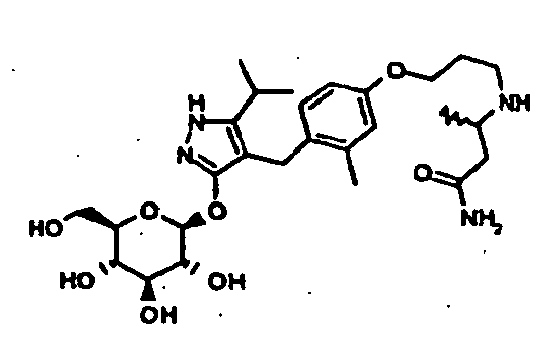
1.05-1.2 (9H, m), 1.9-2.0 (2H, m), 2.25 (1H, dd, J=14.6Hz, 6.5Hz), 2.29 (3H, s), 2.39 (1H, dd, J=14.6Hz, 6.5Hz), 2.7-2.9 (3H, m), 3.05-3.15 (1H, m), 3.25-3.4 (4H, m), 3.6-3.7 (3H, m), 3.75-3.85 (1H, m), 4.0 (2H, t, J=6.0Hz), 4.95-5.05 (1H, m), 6.62 (1H, dd, J=8.4Hz, 2.3Hz), 6.71 (1H, d, J=2.3Hz), 6.85 (1H, d, J=8.4Hz) Example 127 
1.05-1.2 (9H, m), 1.9-2.0 (2H, m), 2.29 (3H, s), 2.5-2.65 (2H, m), 2.7-2.9 (4H, m), 3.25-3.4 (4H, m), 3.6-3. 7(3H, m),3. 75-3.85 (1H, m), 3.95-4.05 (2H, m), 4.95-5.05 (1H, m), 6.62 (1H, dd, J=8.3Hz, 2.3Hz), 6.71 (1H, d,J=2.3Hz), 6.85 (1H, d, J=8.3Hz) Example 128 
1.05-1.15 (6H, m), 1.17 (6H, s), 1.9-2.0 (2H, m), 2.29 (3H, s), 2.66 (2H, s), 2.75-2.85(3H, m), 3.25-3.4 (4H, m), 3.6-3.7 (3H, m), 3.75-3.85 (1H, m), 4.0 (2H, t, J=6.0Hz), 4.95-5.05 (1H, m), 6.61 (1H, dd, J=8.4Hz, 2.6Hz), 6.7 (1H, d, J=2.6Hz), 6.85 (1H, d, J=8.4Hz) Example 129 
1.05-1.15 (6H, m), 1.16 (6H, s), 1.85-2.0 (2H, m), 2.28 (3H, s), 2.65 (2H, s), 2.7-2.85 (3H, m), 3.49 (1H, dd, J=9.7Hz, 3.2Hz), 3.55-3.8 (6H, m), 3.85 (1H, d, J=3.2Hz), 3.99 (2H, t, J=6.0Hz), 5.03 (1H, d, J=7.9Hz), 6.61 (1H, dd, J=8.4Hz , 2.3Hz), 6.7 (1H, d, J=2.3Hz), 6.85 (1H, d, J=8.4Hz) Example 130 
1.05-1.2 (6H, m), 1.29 (6H, s), 1.85-1.95 (2H, m), 2.28 (3H, s), 2.65 (2H, t, J=7.0Hz), 2.75-2.85 (1H, m), 3.49 (1H, dd, J=9.7Hz, 3.2Hz), 3.55-3.8 (6H, m), 3.84 (1H, d, J=3.2Hz), 4.01 (2H, t, J=6.1Hz), 5.03 (1H, d, J=7.7Hz), 6.61 (1H, dd, J=8.4Hz, 2.4Hz), 6.7 (1H, d, J=2.4Hz), 6.85 (1H, d, J=8.4Hz) Example 131 
1.05-1.15 (6H, m), 1.9-2.0 (2H, m), 2.28 (3H, s), 2.65-2.85 (5H, m), 3.49 (1H, dd, J=9.8Hz, 3.6Hz), 3.55-3.8 (8H, m), 3.8-3.9 (1H, m), 3.99 (2H, t, J=6.1Hz), 5.03 (1H, d, J=7.9Hz), 6.61 (1H, dd, J=8.4Hz, 2.6Hz), 6.71 (1H, d, J=2.6Hz), 6.85 (1H, d, J=8.4Hz) [Table 2] Example No. Structure 1H-NMR (CD3OD) δ ppm: Example 132 
1.03 (3H, d, J=6.4Hz), 1.05-1.15 (6H, m), 1.85-2.0 (2H, m), 2.28 (3H, s), 2.65-2.95 (4H, m), 3.38 (1H, dd, J=10.6Hz, 7.3Hz), 3.45-3.8 (8H, m), 3.84 (1H, d, J=3.3Hz), 3.9-4.1 (2H, m), 5.03 (1H, d, J=8.0Hz), 6.61 (1H, dd, J=8.5Hz, 2.6Hz), 6.71 (1H, d, J=2.6Hz), 6.85 (1H, d, J=8.5Hz) Example 133 
1.05-1.15 (6H, m), 1.65-1.8 (2H, m), 1.9-2.0 (2H, m), 2.28 (3H, s), 2.65-2.85 (5H, m), 3.49 (1H, dd, J=9.7Hz, 3.5Hz), 3.55-3.8 (8H, m), 3.84 (1H, d, J=3.5Hz), 3.99 (2H, t, J=6.3Hz), 5.03 (1H, d, J=7.8Hz), 6.61 (1H, dd, J=8.5Hz, 2.7Hz), 6.7 (1H, d, J=2.7Hz), 6.85 (1H, d, J=8.5Hz) Example 134 
1.05-1.15 (6H, m), 1.9-2.0 (2H, m), 2.28 (3H, s), 2.65-2.9 (4H, m), 3.45-3.8 (11H, m), 3.8-3.9 (1H, m) , 4.0 (2H, t, J=6.1Hz), 5.03 (1H, d, J=7.8Hz), 6.61 (1H, dd, J=8.4Hz, 2.7Hz), 6.71 (1H, d, J=2.7Hz), 6.84 (1H, d, J=8.4Hz) Example 135 
0.99 (3H, s), 1.05-1.15 (6H, m), 1.85-1.95 (2H, m), 2.28 (3H, s), 2.7-2.85 (3H,m), 3.46 (4H, s), 3.49 (1H, dd, J=9.6Hz, 3.1Hz), 3.55-3.8 (6H, m), 3.84 (1H, d, J=3.1Hz), 4.0 (2H, t, J=6.1Hz), 5.03 (1H, d, J=7.9Hz), 6.61 (1H, dd, J=8.3Hz, 2.6Hz), 6.71 (1H, d, J=2.6Hz), 6.84 (1H, d, J=8.3Hz) Example 136 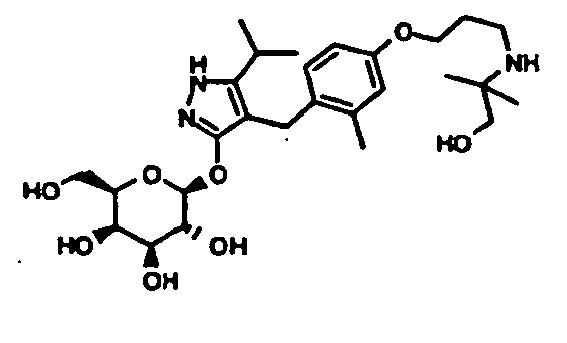
1.04 (6H, s), 1.05-1.15 (6H, m), 1.85-2.0 (2H, m), 2.28 (3H, s), 2.65-2.85 (3H, m), 3.36 (2H, s), 3.49 (1H, dd, J=9.8Hz, 3.6Hz), 3.55-3.8 (6H, m), 3.8-3.9 (1H, m), 3.99 (2H, t, J=6.1Hz), 5.03 (1H, d, J=7.8Hz), 6.61 (1H, dd, J=8.3Hz, 2.4Hz), 6.71 (1H, d, J=2.4Hz), 6.85 (1H, d, J=8.3Hz) Example 137 
1.05-1.15 (6H, m), 1.85-2.0 (2H, m), 2.28 (3H, s), 2.7-2.9 (3H, m). 3.45-3.8 (13H, m), 3.8-3.9 (1H, m), 4.01 (2H, t, J=6.1Hz), 5.03 (1H, d, J=7.8Hz), 6.61 (1H, dd, J=8.6Hz, 2.4Hz), 6.71 (1H, d, J=2.4Hz), 6.85 (1H, d, J=8.6Hz) - The title compound was prepared in a similar manner to that described in Reference Example 29 using 3-(2,3,4,6-tetra-O-acetyl-β-D-galactopyranosyloxy)-4-{[4-(3-hydroxy-propoxy)-2-methylphenyl]methyl}-5-isopropyl-1H-pyrazole instead of 3-(2,3,4,6-tetra-O-acetyl-β-D-glucopyranosyloxy)-4-{[4-(3-hydroxypropoxy)phenyl]methyl}-5-isopropyl-1H-pyrazole.
1H-NMR (CDCl3) δ ppm:
1.05-1.2 (6H, m), 1.82 (3H, s), 1.95-2.1 (8H, m), 2.16 (3H, s), 2.27 (3H, s), 2.75-2.85 (1H, m), 3.45-3.55 (3H, m), 3.61 (1H, d, J=16.3Hz), 3.95-4.1 (3H, m), 4.1-4.2 (2H, m), 5.07 (1H, dd, J=10.4Hz, 3.5Hz), 5.35-5.45 (2H, m), 5.52 (1H, d, J=8.2Hz), 6.58 (1H, dd, J=8.3Hz, 2.6Hz), 6.69 (1H, d, J=2.6Hz), 6.81 (1H, d, J=8.3Hz) - To a solution of 4-{[4-(3-chloropropoxy)-2-(tetra-hydro-4H-pyran-4-yloxy)phenyl]methyl}-5-isopropyl-3-(2,3,4,6-tetra-O-pivaloyl-β-D-glucopyranosyloxy)-1H-pyrazole (0.3g) in N,N-dimethylformamide (5 mL) was added sodium azide (43 mg), and the mixture was stirred at 80C° for 3 hours. To the reaction mixture was added water, and the precipitated crystals were collected by filtration. The crystals were washed with water and n-hexane, and dried under reduced pressure to give the title compound (0.3 g).
1H-NMR (CDCl3) δ ppm:
1.0-1.2 (42H, m), 1.75-1.9 (2H, m), 1.95-2.1 (4H, m), 2.85-2.95 (1H, m), 3. 45-3.65 (6H, m), 3.8-3.9 (1H, m), 3.95-4.05 (4H, m), 4.1-4.25 (2H, m), 4.4-4.55 (1H, m), 5.15-5.3 (2H, m), 5.36 (1H, t, J=9.2Hz), 5. 67 (1H, d, J=8.0Hz), 6.33 (1H, dd, J=8.5Hz, 2.4Hz), 6.4 (1H, d, J=2.4Hz), 6.86 (1H, d, J=8.5Hz) - The title compound was prepared in a similar manner to that described in Example 1 using 3-(2,3,4,6-tetra-O-acetyl-β-D-galactopyranosyloxy)-4-{[4-(3-azidopropoxy)-2-methylphenyl]methyl}-5-isopropyl-1H-pyrazole instead of 3-(2,3,4,6-tetra-O-acetyl-β-D-glucopyranosyloxy)-4-{[4-(3-azido-propoxy)phenyl]methyl}-5-isopropyl-1H-pyrazole.
1H-NMR (CD3OD) δ ppm:
1.05-1.15 (6H, m), 1.84 (3H, s), 1.85-2.0 (8H, m), 2.14 (3H, s), 2.27 (3H, s), 2.75-2.9 (3H, m), 3.53 (1H, d, J=16.5Hz), 3.59 (1H, d, J=16.5Hz), 4.0 (2H, t, J=6.2Hz), 4.05-4.2 (3H, m), 5.1-5.2 (1H, m), 5.2-5.3 (1H, m), 5.35-5.45 (2H, m) , 6.61 (1H, dd, J=8.3Hz, 2.3Hz), 6.71 (1H, d, J=2.3Hz), 6.78 (1H, d, J=8.3Hz) - The title compound was prepared in a similar manner to that described in Example 1 using 4-{[4-(3-azidopropoxy)-2-(tetrahydro-4H-pyran-4-yloxy)phenyl]methyl}-5-isopropyl-3-(2,3,4,6-tetra-O-pivaloyl-β-D-glucopyranosyloxy)-1H-pyrazole instead of 3-(2,3,4,6-tetra-O-acetyl-β-D-glucopyranosyloxy)-4-{[4-(3-azidopropoxy)phenyl]methyl)-5-isopropyl-1H-pyrazole.
1H-NMR (CDCl3) δ ppm:
1.0-1.2 (42H, m), 1.75-1.95 (4H, m), 1.95-2.1 (2H, m), 2.8-3.0 (3H, m), 3.5-3.7 (4H, m), 3.8-3.9 (1H, m), 3.9-4.05 (4H, m), 4.05-4.25 (2H, m), 4.4-4.55 (1H, m), 5.15-5.3 (2H, m), 5.36 (1H, t, J=9.3Hz), 5.67 (1H, d, J=7.4Hz), 6.3-6.45 (2H, m), 6.85 (1H, d, J=8.6Hz) - To a solution of 3-(2,3,4,6-tetra-O-acetyl-β-D-glucopyranosyloxy)-4-{[4-(2-aminoethoxy)-2-methylphenyl]methyl}-5-isopropyl-1H-pyrazole (60 mg) in dichloromethane (3 mL) were added triethylamine (0.016 mL) and 4-nitrophenyl chloroformate (21 mg), and the mixture was stirred at room temperature for 1 hour. To the reaction mixture were added tris (hydroxymethyl)-aminomethane (35 mg) and methanol (3 mL), and the mixture was stirred at room temperature for 3 hours. The reaction mixture was poured into water, and the resulting mixture was extracted with ethyl acetate. The organic layer was washed with water and brine, and dried over anhydrous magnesium sulfate. The solvent was removed under reduced pressure, and the residue was purified by column chromatography on silica gel (eluent: dichloromethane/methanol = 10/1 - 6/1) to give 3-(2,3,4,6-tetra-O-acetyl-β-D-glucopyranosyloxy)-4-{[4-(2-{3-[2-hydroxy-1,1-bis(hydroxymethyl)ethyl]ureido}ethoxy)-2-methylphenyl]methyl}-5-isopropyl-1H-pyrazole (36 mg). This material was dissolved in methanol (2 mL). To the solution was added sodium methoxide (28% methanol solution, 0.018 mL), and the mixture was stirred at room temperature for 1 hour. The reaction mixture was concentrated under reduced pressure, and the residue was purified by solid phase extraction on ODS (washing solvent: distilled water, eluent: methanol) to give the title compound (22 mg).
1H-NMR (CD3OD) δ ppm:
1.05-1.15 (6H, m), 2.29 (3H, s), 2.75-2.85 (1H, m), 3.25-3.4 (4H, m), 3.44 (2H, t, J=5.3Hz), 3.6-3.75 (9H, m), 3.81 (1H, d, J=11.7Hz), 3.95 (2H, t, J=5.3Hz), 5.02 (1H, d, J=6.6Hz), 6.63 (1H, dd, J=8.5Hz, 2.4Hz), 6.73 (1H, d, J=2.4Hz), 6.86 (1H, d, J=8.5Hz) - The compounds described in Tables 3-4 were prepared in a similar manner to that described in Example 140 using the corresponding starting materials. The synthesis of Example 151 was carried out by catalytic hydrogenation in a similar manner to that described in Example 79 after the completion of the operation of Example 140.
[Table 3] Example No. Structure 1H-NMR (CD3OD) δ ppm: Example 141 
1.05-1.15(6H, m), 1.85-1.95 (2H, m), 2.29 (3H, s), 2.75-2.85 (1H, m), 3.2-3.4 (6H, m), 3.6-3.75 (9H, m), 3.81 (1H, d, J=11.5Hz), 3.9-4.0 (2H, m), 4.95-5.05 (1H, m), 6.62 (1H, d, J=8.3Hz), 6.71 (1H, s), 6.85 (1H, d, J=8.3Hz) Example 142 
1.05-1.15 (6H, m), 1.85-1.95 (2H, m), 2.28 (3H, s), 2.75-2.85 (1H, m), 3.25 (2H, t, J=6.9Hz), 3.49 (1H, dd, J=9.8Hz, 3.3Hz), 3.55-3.8 (12H, m), 3.8-3.9 (1H, m), 3.96 (2H, t, J=6.1Hz), 5.03 (1H, d, J=7.8Hz), 6.61 (1H, dd, J=8.4Hz, 2.6Hz), 6.71 (1H, d, J=2.6Hz), 6.85 (1H, d, J=8.4Hz) Example 143 
1.05-1.15 (9H, m), 1.85-1.95 (2H, m), 2.28 (3H, s), 2.75-2.85 (1H, m), 3.2-3.5 (8H, m), 3.55-3.85 (5H, m), 3.96 (2H, t, J=6.1Hz), 4.95-5.05 (1H, m), 6.62 (1H, dd, J=8.4Hz, 2.5Hz), 6.71 (1H, d, J=2.5Hz), 6.86(1H, d, J=8.4Hz) Example 144 
1.05-1.15 (6H, m), 1.27 (6H, s), 2.29 (3H, s), 2.7-2.85 (1H, m), 2.89 (3H, s), 3.2-3.4 (6H, m), 3.42 (2H, t, J=5.3Hz), 3.55-3.75 (3H, m), 3.75-3.85 (1H, m), 3.94 (2H, t, J=5.3Hz), 4.95-5.1(1H, m), 6.63 (1H, dd, J=8.2Hz, 2.7Hz), 6.72 (1H, d, J=2.7Hz), 6.86 (1H, d, J=8.2Hz) [Table 4] Example Structure 1H-NMR (CD3OD) δ ppm: Example 145 
1.05-1.15 (6H, m), 2.26 (6H, s), 2.29 (3H, s), 2.43 (2H, t, J=6.8Hz), 2.75-2.85(1H, m), 3.2-3.4 ( 6H, m), 3.46 (2H, t, J=5.4Hz), 3.6-3.75 (3H, m), 3.75-3.85 (1H, m), 3.95 (2H, t, J=5.4Hz), 4.95-5.05 (1H, m), 6.62 (1H, dd, J=8.4Hz, 2.7Hz), 6.72 (1H, d, J=2.7Hz), 6.86 (1H, d, J=8.4Hz) Example 146 
1.05-1.15 (6H, m), 1.6-1.7 (2H, m), 2.23 (6H, s), 2.29 (3H, s), 2.3-2.4 (2H, m), 2.75-2.85 (1H, m), 3.14 (2H, t, J=7.0Hz), 3.25-3.4 (4H, m), 3.46 (2H, t, J=5.4Hz), 3.6-3.75 (3H, m), 3.75-3.85 (1H, m), 3.95 (2H, t, J=5.4Hz), 4.95-5.05 (1H, m), 6.63 (1H, dd, J=8.4Hz, 2.6Hz), 6.72 (1H, d, J=2.6Hz), 6.86 (1H, d, J=8.4Hz) Example 147 
0.91 (3H, d, J=6.6Hz), 0.96 (3H, d, J=6.5 Hz), 1.05-1.15 (6H, m), 1.85-1.95(2H, m), 2.0-2.1 (1H, m), 2.28 (3H, s), 2.75-2.85 (1H, m), 3.25-3.4 (6H, m), 3.6-3.75 (3H, m), 3.81 (1H, d, J=12.4Hz), 3.97 (2H, t, J=6.2Hz), 4.06 (1H, d, J=6.1Hz), 5.02 (1H, d, J=7.0 Hz), 6.62 (1H, dd, J=8.3Hz, 2.4Hz), 6.72 (1H, d, J=2.4Hz), 6.85 (1H, d, J=8.3Hz) Example 148 
1.05-1.15 (6H, m), 1.23 (6H, s), 1.8-1.95 (2H, m), 2.28 (3H, s), 2.7-2.85 (1H, m), 3.24 (2H, t, J=6.9Hz), 3.4-3.8 (9H, m), 3.84 (1H, d, J=2.9Hz), 3.95 (2H, t, J=6.2Hz), 5.03 (1H, d, J=7.6Hz), 6.61 (1H, dd, J=8.3Hz, 2.6Hz), 6.71 (1H, d, J=2.6Hz), 6.85 (1H, d, J=8.3Hz) Example 149 
1.05-1.2 (6H, m), 1.7-1.85 (2H, m), 1.85-1.95 (2H, m), 1.95-2.1 (2H, m), 2.34 (6H, s), 2.52 (2H, t, J=6.5Hz), 2.8-2.95 (1H, m), 3.2-3.4 (8H, m), 3.55-3.75 (5H, m), 3.83 (1H, d, J=12.0Hz), 3.9-4.0 (4H, m), 4.5-4.65 (1H, m), 5.06 (1H, d, J=7.0Hz), 6.41 (1H, dd, J=8.2Hz, 2.4Hz), 6.53 (1H, d, J=2.4Hz), 6.9 (1H, d, J=8.2Hz) Example 150 
1.05-1.2 (6H, m), 1.23 (6H, s), 1.7-1.95 (4H, m), 1.95-2.1 (2H, m); 2.8-2.95 (1H, m), 3.24 (2H, t, J=6.8Hz), 3.25-3.4 (4H, m), 3.5 (2H, s), 3.55-3.75 (5H, m), 3.83 (1H, d, J=11.1 Hz), 3.9-4.0 (4H, m), 4.5-4.65 (1H, m) , 5.0- 5.1 (1H, m), 6.41 (1H, dd, J=8.5Hz, 2.3Hz), 6.54 (1H, d, J=2.3Hz), 6.9 (1H, d, J=8.5Hz) Example 151 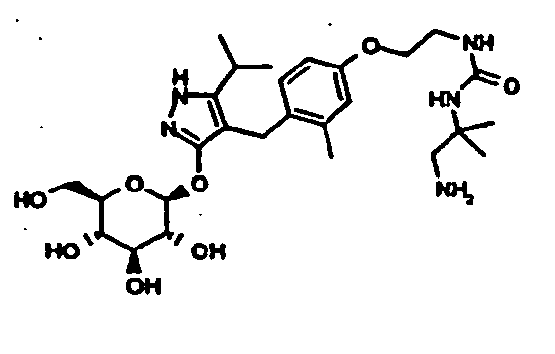
1.05-1.15 (6H, m), 1.23 (6H, s), 2.29 (3H, s), 2.75-2.85 (3H, m), 3.25-3.4 (4H, m), 3.42 (2H, t, J=5.4Hz), 3.6-3.75 (3H, m), 3.75-3.85 (1H, m), 3.94 (2H, t, J=5.4Hz), 5.01 (1H, d, J=7.2Hz), 6.63 (1H, dd, J=8.3Hz, 2.7Hz), 6.72 (1H, d, J=2.7Hz), 6.86 (1H, d, J=8.3Hz) - To a suspension of sodium hydride (60%, 1.09 g) in 1,2-dimethoxyethane (25 mL) was added 2-(4-bromophenyl)ethanol (5 g) under ice-cooling, and the mixture was stirred at room temperature for 1.5 hours. To the reaction mixture was added benzyl bromide (3.25 mL), and the mixture was stirred at 80C° overnight. To the reaction mixture was added a saturated aqueous ammonium chloride solution, and the resulting mixture was extracted with diethyl ether. The extract was washed with water and brine, and dried over anhydrous magnesium sulfate. The solvent was removed under reduced pressure, and the residue was purified by column chromatography on silica gel (eluent: n-hexane - n-hexane/ethyl acetate = 50/1 - 20/1) to give the title compound (6.8 g).
1H-NMR (CDCl3) δ ppm:
2.86 (2H, t, J=6.8Hz), 3.66 (2H, t, J=6.8Hz), 4.5 (2H, s), 7.05-7.15 (2H, m), 7.2-7.35 (5H, m), 7.35-7.45 (2H, m) - To a solution of 4-(2-benzyloxyethyl)-1-bromobenzene (6.8 g) in tetrahydrofuran (80 mL) was added n-butyl lithium (2.6 mol/L n-hexane solution, 8.98 mL) at -78°C under an argon atmosphere, and the mixture was stirred for 30 minutes. To the reaction mixture was added N,N-dimethylformamide (20 mL), and the mixture was allowed to warm to 0°C and stirred for 2 hours. The reaction mixture was poured into a saturated aqueous ammonium chloride solution, and the resulting mixture was extracted with ethyl acetate. The organic layer was washed with water and brine, and dried over anhydrous magnesium sulfate. The solvent was removed under reduced pressure to give 4-(2-benzyloxyethyl)benzaldehyde (5.6 g). This material was dissolved in methanol (80 mL). To the solution was added sodium borohydride (1.77 g) under ice-cooling, and the mixture was stirred at room temperature overnight. To the reaction mixture was added a saturated aqueous ammonium chloride solution, and the resulting mixture was extracted with diethyl ether. The organic layer was washed with water and brine, and dried over anhydrous magnesium sulfate. The solvent was removed under reduced pressure, and the residue (solid) was treated with n-hexane, collected by filtration and dried under reduced pressure to give the title compound (5.41 g).
1H-NMR (CDCl3) δ ppm:
2.93 (2H, t, J=7.1Hz), 3.68 (2H, t, J=7.1Hz), 4.52 (2H, s), 4.65 (2H, s), 7.15-7.4 (9H, m) - The title compound was prepared in a similar manner to that described in Reference Example 11 using [4-(2-benzyloxyethyl)phenyl]methanol instead of [4-(3-benzyloxy-propoxy)phenyl]methanol.
1H-NMR (DMSO-d6)δ ppm:
1.07 (6H, d, J=7.1Hz), 2.75-2.9 (3H, m), 3.54 (2H, s), 3.59 (2H, t, J=6.9Hz), 4.45 (2H, s), 7.0-7.15 (4H, m), 7.2-7.35 (5H, m) - The title compound was prepared in a similar manner to that described in Reference Example 17 using 4-{[4-(2-benzyloxyethyl)phenyl]methyl}-1,2-dihydro-5-isopropyl-3H-pyrazol-3-one instead of 4-{[4-(3-benzyloxypropoxy)phenyl]-methyl}-1,2-dihydro-5-isopropyl-3H-pyrazol-3-one.
1H-NMR (CDCl3) δ ppm:
1.1-1.2 (6H, m), 1.83 (3H, s), 2.01 (3H, s), 2.03 (3H, s), 2.05 (3H, s), 2.8-2.95 (3H, m), 3.55-3.7 (4H, m), 3.8-3.9 (1H, m), 4.14 (1H, dd, J=12.5Hz, 2.4Hz), 4.31 (1H, dd, J=12.5Hz, 3.9Hz), 4.5 (2H, s), 5.15-5.3 (3H, m), 5.5-5.6 (1H, m), 7.0-7.1 (4H, m), 7.2-7.35 (5H, m) - The title compound was prepared in a similar manner to that described in Reference Example 17 using 4-{[4-(2-benzyl-oxyethyl)phenyl]methyl}-1,2-dihydro-5-isopropyl-3H-pyrazol-3-one and acetobromo-α-D-galactose instead of 4-{[4-(3-benzyl-oxypropoxy)phenyl]methyl}-1,2-dihydro-5-isopropyl-3H-pyrazol-3-one and acetobromo-α-D-glucose, respectively.
1H-NMR (CDCl3) δ ppm :
1.1-1.2 (6H, m), 1.85 (3H, s), 1.99 (3H, s), 2.02 (3H, s), 2.17 (3H, s), 2.85-2.95 (3H, m), 3.61 (1H, d, J=15.9Hz), 3.65 (2H, t, J=7.2Hz), 3.69 (1H, d, J=15.9Hz), 4.0-4.25 (3H, m), 4.51 (2H, s), 5.09 (1H, dd, J=10.6Hz, 3.3Hz), 5.4-5.5 (2H, m), 5.55 (1H, d, J=8.2Hz), 7.0-7.1 (4H, m), 7.2-7.35 (5H, m) - The title compound was prepared in a similar manner to that described in Reference Example 23 using 3-(2,3,4,6-tetra-O-acetyl-β-D-glucopyranosyloxy)-4-{[4-(2-benzyloxyethyl)-phenyl]methyl}-5-isopropyl-1H-pyrazole instead of 3-(2,3,4,6-tetra-O-acetyl-β-D-glucopyranosyloxy)-4-{[4-(3-benzyloxy-propoxy)phenyl]methyl}-5-isopropyl-1H-pyrazole.
1H-NMR (CDCl3) δ ppm:
1.18 (6H, d, J=7.2Hz), 1.87 (3H, s), 2.0 (3H, s), 2.02 (3H, s), 2.05 (3H, s), 2.81 (2H, t, J=6. 6Hz) , 2.85-3.0 (1H, m), 3.62 (1H, d, J=16.0Hz), 3.67 (1H, d, J=16.0Hz), 3.75-3.9 (3H, m), 4.12 (1H, dd, J=12.4Hz, 2.4Hz), 4.29 (1H, dd, J=12.4Hz, 3.8Hz), 5.15-5.3 (3H, m), 5.57 (1H, d, J=7.5Hz), 7.05-7.15 (4H, m) - The title compound was prepared in a similar manner to that described in Reference Example 23 using 3-(2,3,4,6-tetra-O-acetyl-β-D-galactopyranosyloxy)-4-{[4-(2-benzyloxyethyl)phenyl]methyl}-5-isopropyl-1H-pyrazole instead of 3-(2,3,4,6-tetra-O-acetyl-β-D-glucopyranosyloxy)-4-{[4-(3-benzyloxypropoxy)phenyl]methyl}-5-isopropyl-1H-pyrazole.
1H-NMR (CDCl3) δ ppm:
1.15-1.2 (6H, m), 1.88 (3H, s), 1.98 (3H, s), 2.02 (3H, s), 2.17 (3H, s), 2.81 (2H, t, J=6.4Hz), 2.85-3.0 (1H, m), 3.63 (1H, d, J=16.1Hz), 3.7 (1H, d, J=16.1Hz), 3.8-3.9 (2H, m), 4.0-4.1 (1H, m), 4.1-4.2 (2H, m), 5.08 (1H, dd, J=10.4Hz, 3.5Hz), 5.35-5.45 (2H, m), 5.56 (1H, d, J=8.1Hz), 7.05-7.15 (4H, m) - To a solution of 3-(2,3,4,6-tetra-O-acetyl-β-D-glucopyranosyloxy)-4-{[4-(2-hydroxyethyl)phenyl]methyl}-5-isopropyl-1H-pyrazole (2.13 g) and triethylamine (0.65 mL) in dichloromethane (20 mL) was addedmethanesulfonyl chloride (0.36 mL) under ice-cooling, and the mixture was stirred at room temperature for 1 hour. The reaction mixture was poured into water, and the resulting mixture was extracted with ethyl acetate. The extract was washed with water and brine, and dried over anhydrous magnesium sulfate. The solvent was removed under reduced pressure to give 3-(2,3,4,6-tetra-O-acetyl-β-D-glucopyranosyloxy)-5-isopropyl-4-{[4-(2-methanesulfonyloxy-ethyl)phenyl]methyl}-1H-pyrazole (2.4 g). This material was dissolved in N,N-dimethylformamide (20 mL). To the solution was added sodium azide (0.71 g), and the mixture was stirred at 80C° for 3 hours. The reaction mixture was poured into water, and the resulting mixture was extracted with ethyl acetate. The extract was washed with water and brine, and dried over anhydrous magnesium sulfate. The solvent was removed under reduced pressure, and the residue was purified by column chromatography on silica gel (eluent: n-hexane/ethyl acetate = 1/1 - 1/2) to give 3-(2,3,4,6-tetra-O-acetyl-β-D-glucopyranosyloxy)-4-{[4-(2-azidoethyl)phenyl]methyl}-5-isopropyl-1H-pyrazole (1.55 g). The obtained 3-(2,3,4,6-tetra-O-acetyl-β-D-glucopyranosyloxy)-4-{[4-(2-azidoethyl)phenyl]methyl}-5-isopropyl-1H-pyrazole (1 g) was dissolved in tetrahydrofuran (5 mL). To the solution was added 10% palladium-carbon powder (0.15 g), and the mixture was stirred at room temperature under a hydrogen atmosphere for 6 hours. The insoluble material was removed by filtration, and the filtrate was concentrated under reduced pressure to give 3-(2,3,4,6-tetra-O-acetyl-β-D-glucopyranosyloxy)-4-{[4-(2-aminoethyl)phenyl]methyl}-5-isopropyl-1H-pyrazole (0.96 g). The obtained 3-(2,3,4,6-tetra-O-acetyl-β-D-glucopyranosyloxy)-4-{[4-(2-aminoethyl)-phenyl]methyl}-5-isopropyl-1H-pyrazole (0.48 g) was dissolved in dichloromethane (5 mL). To the solution were added triethylamine (0.13 mL) and 4-nitrophenyl chloroformate (0.18 g) under ice-cooling, and the mixture was stirred at room temperature for 2 hours. A 1/6 amount of the reaction mixture was separated. To the part of the reaction mixture were added triethylamine (0.084 mL), L-valine amide hydrochloride (45 mg) and tetrahydrofuran (1 mL), and the mixture was stirred at room temperature for 5 hours. The reaction mixture was purified by column chromatography on silica gel (eluent: ethyl acetate - ethyl acetate/methanol = 10/1) to give 3-(2,3,4,6-tetra-O-acetyl-β-D-glucopyranosyloxy)-4-{[4-(2-{3-[(S)-1-carbamoyl-2-(methyl)propyl]ureido}ethyl)phenyl]methyl}-5-isopropyl-1H-pyrazole (48 mg). This material was dissolved in methanol (2 mL). To the solution was added sodium methoxide (28% methanol solution, 0.013 mL), and the mixture was stirred at room temperature for 1 hour. To the reaction mixture was added acetic acid (0.2 mL). The resulting mixture was concentrated under reduced pressure, and the residue was purified by solid phase extraction on ODS (washing solvent: distilled water, eluent: methanol) to give the title compound (29 mg).
1H-NMR (CD3OD) δ ppm:
0.9 (3H, d, J=7.0Hz), 0.95 (3H, d, J=6.5Hz), 1.1-1.2 (6H, m), 2.0-2.1 (1H, m), 2.71 (2H, t, J=7.1Hz), 2.85-3.0 (1H, m), 3.25-3.45 (6H, m), 3.6-3.75 (2H, m), 3.78 (1H, d, J=16.0Hz), 3.8-3.9 (1H, m), 4.04 (1H, d, J=5.9Hz), 5.04 (1H, d, J=7.4Hz), 7.05-7.15 (4H, m) - The compounds described in Tables 5-8 were prepared in a similar manner to that described in Example 152 using the corresponding starting materials. The syntheses of Examples 171 and 172 were carried out by catalytic hydrogenation in a similar manner to that described in Example 79 after the completion of the operation of Example 152.
[Table 5] Example No. Structure 1H - NMR (CD3OD) δ ppm: Example 153 
1.1-1.2 (6H, m), 2.71 (2H, t, J=7.0Hz), 2.85-3.0 (1H, m), 3.2-3.4 (6H, m), 3.6-3.9 (4H, m), 5.0-5.1 (1H, m), 7.05-7.2 (4H, m) Example 154 
1.1-1.2 (6H, m), 2.71 (2H, t, J=7.1Hz), 2.85-3.0 (1H, m), 3.2 (2H, t, J=5.7Hz), 3.25-3.45 (6H, m), 3.5-3.9 (6H, m), 5.0-5.1 (1H, m), 7.05-7.15 (4H, m) [Table 6] Example No. Structure 1H - NMR (CD3OD) δ ppm: Example 155 
1.05-1.2 (6H, m), 1.29 (3H, d, J=7.1Hz), 2.71 (2H, t, J=7.0Hz), 2.85-3.0 (1H, m), 3.25-3.45 (6H, m), 3.6-3.9 (4H, m), 4.19 (1H, q, J=7.1Hz), 5.0-5.1 (1H, m), 7.05-7.15 (4H, m) Example 156 
1.1-1.2 (6H, m), 2.71 (2H, t, J=7.0Hz), 2.85-3.0 (1H, m), 3.25-3.45 (6H, m), 3.5-3.9 (9H, m), 5.0-5.1 (1H, m), 7.05-7-15 (4H, m) Example 157 
1.1-1.2 (9H, m), 2.7 (2H, t, J=7.0Hz), 2.85-3.0 (1H, m), 3.2-3.4 (6H, m), 3.55 (2H, d, J.=11.0Hz), 3.59 (2H, d, J=11.0Hz), 3.6-3.9 (4H, m), 5.0-5.1 (1H, m), 7.05-7.15 (4H, m) Example 158 
1.1-1.2 (6H, m), 2.44 (6H, s), 2.63 (2H, t, J=6.3Hz), 2.71 (2H, t, J=6.8Hz), 2.9-3.0 (1H, m), 3.25-3.4 (8H, m), 3.6-3.75 (2H, m), 3.75-3.85 (2H, m), 5.0-5.05 (1H, m), 7.05-7.15 (4H, m) Example 159 
1.1-1.2 (6H, m), 1.22 (6H, s), 2.69 (2H, t, J=7.1Hz), 2.85-3.0 (1H, m), 3.2-3.4 (6H, m), 3.5 (2H, s), 3.6-3.75 (2H, m), 3.75-3.9 (2H, m), 5.0-5.1 (1H, m), 7.05-7.15 (4H, m) Example 160 
1.09 (3H, d. J=6.8Hz), 1.1-1.2 (6H, m), 2.7 (2H, t, J=7.0Hz), 2.85-3.0 (1H, m), 3.25-3.5 (8H, m), 3.6-3.9 (5H, m), 5.0-5.1 (1H, m), 7.05-7.15 (4H, m) [Table 7] Example No. Structure 1H - NMR (CD3OD) δ ppm: Example 161 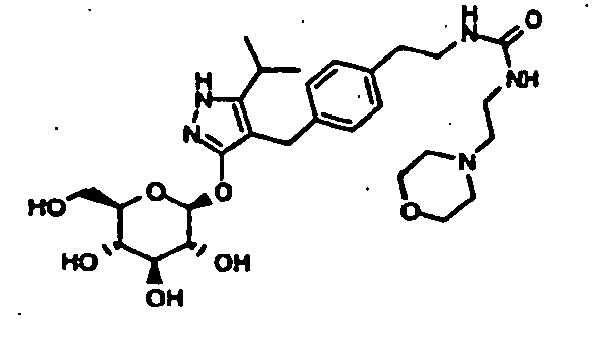
1.1-1.2 (6H, m), 2.35-2.55 (6H, m), 2.7.1 (2H, t, J=6.9Hz), 2.85-3.0 (1H, m), 3.23 (2H, t, J=6.2Hz), 3.25-3.4 (6H, m), 3.6-3.9 (8H, m), 5.0-5.1 (1H, m), 7.05-7.2 (4H, m) Example 162 
1.05-1.2 (9H, m), 2.7 (2H, t, J=7.0Hz), 2.85-3.05 (2H, m), 3.15 (1H, dd, J=13.7Hz, 4.4Hz), 3.2-3.4 (6H, m), 3.6-3.9 (5H, m), 5.0-5.1 (1H, m), 7.05-7.15 (4H, m) Example 163 
0.88 (3H, d, J=6.8Hz), 0.93 (3H, d, J=6.4Hz), 1.1-1.2 (6H, m), 1.8-1.9 (1H, m), 2.71 (2H, t, J=7.1Hz), 2.85-3.0 (1H, m), 3.2-3.4 (6H, m), 3.45-3. 55 (3H, m), 3.6-3.9 (4H, m), 5.0-5.1 (1H, m), 7.05-7.15 (4H, m) Example 164 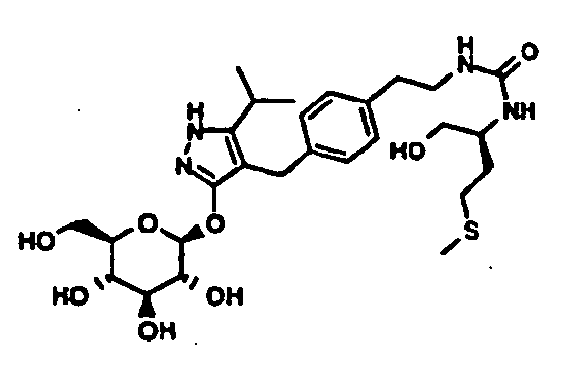
1.1-1.2 (6H,m), 1.55-1.7 (1H, m), 1.8-1.9 (1H, m), 2.08 (3H, s), 2.4-2.6 (2H, m), 2.65-2.8 (2H, m), 2.85-3.0 (1H, m), 3.2-3.4 (6H, m), 3.44 (1H, dd, J=10.9Hz, 5.4Hz), 3.5 (1H, dd, J=10.9Hz, 5.0Hz), 3.6-3.9 (5H, m), 5.03 (1H, d, J=7.3Hz), 7.05-7.15 (4H, m) Example 165 
1.1-1.2 (6H, m), 2.6-2.75 (3H, m), 2.8-3.0 (2H, m), 3.15-3.4 (6H, m), 3.47 (1H, dd, J=10.9Hz, 5.3Hz), 3.5 (1H, dd, J=10.9Hz, 4.8Hz), 3.6-3.95 (5H, m), 5.03 (1H, d, J=7.2Hz), 6.83 (1H, s), 7.0-7.15 (4H, m), 7.57 (1H, d, J=1.4Hz) Example 166 
1.1-1.2 (6H, m), 2.65-2.75 (4H, m), 2.85-3.0 (1H, m), 3.2-3.4 (8H, m), 3.6-3.75 (2H, m), 3.77 (1H, d, J=16.1Hz), 3.83 (1H, d, J=11.8Hz), 5.04 (1H, d, J=7.2Hz), 6.81 (1H, s), 7.05-7.15 (4H, m), 7.57 (1H, d, J=1.2Hz) [Table 8] Example No. Structure 1H-NMR (CD3OD) δ ppm: Example 167 
1.1-1.2 (9H, m), 2.73 (2H, t, J=6.9Hz), 2.85-3.0 (1H, m), 3.25-3.45 (6H, m), 3.6-3.75 (2H, m), 3.78 (1H, d, J=16.0Hz), 3.83 (1H, d, J=12.3Hz), 4.05-4.15 (1H, m), 4.15-4.25 (1H, m), 5.04 (1H, d, J=7.0Hz), 7.05-7.15 (4H, m) Example 168 
1.1-1.2 (6H, m), 1.6-1.7 (2H, m), 2.15-2.8 (15H, m), 2.85-3.0 (1H, m), 3.12 (2H, t, J=6.7Hz), 3.2-3.4 (6H, m), 3.6-3.75(2H, m), 3.78 (1H, d, J=16.0Hz), 3.83 (1H, d, J=11.9Hz), 5.0-5.1 (1H, m), 7.05-7.15 (4H, m) Example 169 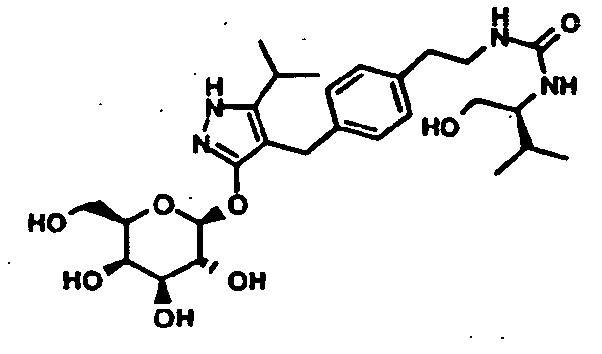
0.88 (3H, d, J=6.7Hz), 0.93 (3H, d, J=6.6Hz), 1.05-1.2 (6H, m), 1.8-1.9 (1H, m), 2.71 (2H, t, J=6.9Hz), 2.85-3.0 (1H, m), 3.25-3.4 (2H, m), 3.4-3.8 (10H, m), 3.8-3.9 (1H, m), 5.05 (1H, d, J=7.6Hz), 7.05-7.15 (4H, m) Example 170 
0.9 (3H, d, J=7.1Hz), 0.95 (3H, d, J=6.9Hz), 1.1-1.2 (6H, m), 1.95-2.1 (1H, m), 2.71 (2H, t, J=7.2Hz), 2.85-3.0 (1H, m), 3.25-3.4 (2H, m), 3.51 (1H, dd, J=9.8Hz, 3.6Hz), 3.55-3.65 (1H, m), 3.65-3.8 (5H, m), 3.8-3.9 (1H, m), 4.04 (1H, d, J=6.1Hz), 5.05(1H, d, J=7.9Hz), 7.05-7.15 (4H, m) Example 171 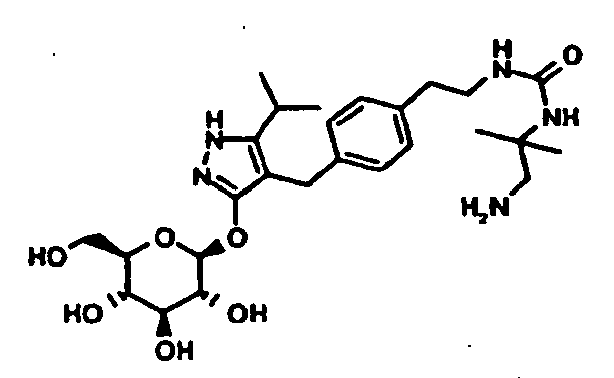
1.1-1.2 (6H, m), 1.21 (6H, s), 2.69 (2H, t, J=6.9Hz), 2.78 (2H, s), 2.85-3.0 (1H, m), 3.2-3.4 (6H, m), 3.6-3.9 (4H, m), 5.04 (1H, d, J=7.3Hz), 7.05-7.15 (4H, m) Example 172 
1.1-1.2 (6H, m), 1.25-1.65 (6H, m), 2.6-2.75 (4H, m), 2.85-3.0 (1H, m), 3.2-3.55 (8H, m), 3.6-3.9 (5H, m), 5.04 (1H, d, J=7.8Hz), 7.05-7.15 (4H, m) - To a solution of 4-bromo-2-methylbenzoic acid (10 g) in tetrahydrofuran (60 mL) was added borane-dimethylsulfide complex (7.07 g) under ice-cooling. The reaction mixture was stirred at room temperature for 5 minutes, and stirred at 75°C for 2 days. The reaction mixture was cooled to room temperature. A saturated aqueous potassium carbonate solution was added to the reaction mixture, and the organic layer was separated. The organic layer was washed with water and brine, and dried over anhydrous magnesium sulfate. The solvent was removed under reduced pressure to give the title compound (9.0 g).
1H-NMR (CDCl3) δ ppm:
1.55-1.65 (1H, m), 2.36 (3H, s), 4.64 (2H, d, J=5.4Hz), 7.2-7.25 (1H, m), 7.3-7.35 (2H, m) - To a solution of 4-bromo-2-methylbenzyl alcohol (9.0 g) in dichloromethane (50 mL) was added thionyl chloride (3.8 mL) under ice-cooling, and the reaction mixture was stirred at room temperature overnight. The reaction mixture was concentrated under reduced pressure to give 4-bromo-2-methylbenzyl chloride (9.8 g). Sodium hydride (55%, 0.84 g) was suspended in tetrahydrofuran (80 mL). To the suspension was added methyl 4-methyl-3-oxopentanoate (2.94 g) under ice-cooling, and the mixture was stirred at room temperature for 1 hour. To the reaction mixture was added 4-bromo-2-methylbenzyl chloride (4.08 g), and the mixture was stirred at 60C° for 36 hours. To the reaction mixture was added a saturated aqueous ammonium chloride solution, and the resulting mixture was extracted with diethyl ether. The extract was dried over anhydrous magnesium sulfate, and the solvent was removed under reduced pressure. The residue was dissolved in acetonitrile (24 mL). To the solution were added N-vinylphthalimide (3.29 g), palladium acetate(II) (0.42 g), tris(o-methylphenyl)phosphine (2.27 g) and N,N-diisopropylethylamine (13 mL), and the mixture was stirred at 100C° for 16 hours. The reaction mixture was concentrated under reduced pressure, and the residue was purified by column chromatography on silica gel (eluent: n-hexane n-hexane/ethyl acetate = 3/1 - 3/2) to give N-{(E)-2-[4-(2-methoxycarbonyl-4-methyl-3-oxopentyl)-3-methylphenyl]-vinyl}phthalimide (6.45 g). To this material were added methanol (50 mL) and 10% palladium-carbon powder (3 g), and the mixture was stirred at room temperature under a hydrogen atmosphere for 2 hours. The insoluble material was removed by filtration, and the filtrate was concentrated under reduced pressure. A part (1 g) of the residue was dissolved in ethanol (15 mL). To the solution was added hydrazine monohydrate (1.38 mL), and the mixture was stirred at 80C° for 13 hours. The insoluble material was removed by filtration, and the filtrate was concentrated under reduced pressure. The residue was purified by solid phase extraction on ODS (washing solvent: distilled water, eluent: methanol) and benzenesulfonic acid resin (washing solvent: methanol, eluent: 2 mol/L ammonia-methanol solution) to give the title compound (0.3 g).
1H-NMR (DMSO-d6) δ ppm:
1.04 (6H, d, J=6.7Hz), 2.25 (3H, s), 2.53 (2H, t, J=7.2Hz), 2.65-2.8 (3H, m), 3.47 (2H, s), 6.75-6.9 (2H, m), 6.93 (1H, s) - To a solution of 4-{[4-(2-aminoethyl)-2-methylphenyl]methyl}-1,2-dihydro-5-isopropyl-3H-pyrazol-3-one (0.3g) in tetrahydrofuran (5 mL) was added N-(benzyloxycarbonyl-oxy)succinimide (0.33 g), and the mixture was stirred at room temperature overnight. The reaction mixture was poured into water, and the resulting mixture was extracted with ethyl acetate. The extract was washed with a saturated aqueous sodium hydrogen carbonate solution twice, water and brine, and dried over anhydrous magnesium sulfate. The solvent was removed under reduced pressure to give the title compound (0.34 g).
1H-NMR (CDCl3) δ ppm:
1.11 (6H, d, J=6.7Hz), 2.31 (3H, s), 2.65-2.95 (3H, m), 3.35-3.5 (2H, m), 3.63 (2H, s), 4.65-4.8 (1H, m), 5.09 (2H, s), 6.85-7.0 (3H, m), 7.25-7.4 (5H, m) - The title compound was prepared in a similar manner to that described in Reference Example 17 using 4-({4-[2-(benzyloxycarbonylamino)ethyl]-2-methylphenyl}methyl)-1,2-dihydro-5-isopropyl-3H-pyrazol-3-one instead of 4-{[4-(3-benzyloxypropoxy)phenyl]methyl}-1,2-dihydro-5-isopropyl-3H-pyrazol-3-one
1H-NMR (CDCl3) δ ppm:
1.05-1.15 (6H, m), 1.79 (3H, s), 1.98 (3H, s), 2.02 (3H, s), 2.05 (3H, s), 2.26 (3H, s), 2.73 (2H, t, J=6.7Hz), 2.75-2.9 (1H, m), 3.35-3.45 (2H, m), 3.53 (1H, d, J=16.5Hz), 3.62 (1H, d, J=16.5Hz), 3.75-3.85 (1H, m), 4.08 (1H, dd, J=12.5Hz, 2.7Hz), 4.27 (1H, dd, J=12.5Hz, 4.1Hz), 4.8-4.9 (1H, m), 5.09 (2H, s), 5.1-5.3 (3H, m), 5.55 (1H, d, J=7.7Hz), 6.8-6.9 (2H, m), 6.93 (1H, s), 7.25-7.4 (5H, m) - 3-(2,3,4,6-Tetra-O-acetyl-β-D-glucopyranosyloxy)-4-({4-[2-(benzyloxycarbonylamino)ethyl]-2-methylphenyl}-methyl)-5-isopropyl-1H-pyrazole (20 mg) was dissolved in methanol (1 mL). To the solution was added sodium methoxide (28% methanol solution, 0.005 mL), and the mixture was stirred at room temperature for 2 hours. The reaction mixture was concentrated under reduced pressure, and the residue was purified by solid phase extraction on ODS (washing solvent: distilled water, eluent: methanol) to give 4-({4-[2-(benzyloxycarbonylamino)ethyl]-2-methylphenyl}methyl)-3-(β-D-glucopyranosyloxy)-5-isopropyl-1H-pyrazole. This material was dissolved in methanol (1 mL). To the solution was added 10% palladium-carbon powder (5 mg), and the mixture was stirred at room temperature under a hydrogen atmosphere for 6 hours. The insoluble material was removed by filtration, and the filtrate was concentrated under reduced pressure to give the title compound (11 mg).
1H - NMR (CD3OD) δ ppm:
1.05-1.15 (6H, m), 2.31 (3H, s), 2.67 (2H, t, J=7.0Hz), 2.75-2.9 (3H, m), 3.25-3.4 (4H, m), 3.6-3.85 (4H, m), 4.95-5.05 (1H, m), 6.85-7.0 (3H, m) - 3-(2,3,4,6-Tetra-O-acetyl-β-D-glucopyranosyloxy)-4-({4-[2-(benzyloxycarbonylamino)ethyl]-2-methylphenyl}-methyl)-5-isopropyl-1H-pyrazole (0.3 g) was dissolved in tetrahydrofuran (2 mL). To the solution was added 10% palladium-carbon powder (20 mg), and the mixture was stirred at room temperature under a hydrogen atmosphere for 6 hours. The insoluble material was removed by filtration, and the filtrate was concentrated under reduced pressure to give 3-(2,3,4,6-tetra-O-acetyl-β-D-glucopyranosyloxy)-4-{[4-(2-aminoethyl)-2-methylphenyl]methyl}-5-isopropyl-1H-pyrazole (0.24 g). The obtained 3-(2,3,4,6-tetra-O-acetyl-β-D-glucopyranosyloxy)-4-{[4-(2-aminoethyl)-2-methylphenyl]-methyl}-5-isopropyl-1H-pyrazole (0.13 g) was dissolved in dichloromethane (2.6 mL). To the solution were added triethylamine (0.042 mL) and 4-nitrophenyl chloroformate (52 mg) under ice-cooling, and the mixture was stirred at room temperature for 2 hours. A 1/4 amount of the reaction mixture was separated. To the part of the reaction mixture were added triethylamine (0.028 mL) and L-threonine amide hydrochloride (23mg), and the mixture was stirred at room temperature overnight. The reaction mixture was purified by column chromatography on silica gel (eluent: ethyl acetate - ethyl acetate/methanol = 10/1) to give 3-(2,3,4,6-tetra-O-acetyl-β-D-glucopyranosyloxy)-4-{[4-(2-{3-[(1S,2R)-1-carbamoyl-2-hydroxypropyl]-ureido}ethyl)-2-methylphenyl]methyl}-5-isopropyl-1H-pyrazole (30 mg). This material was dissolved in methanol (2 mL). To the solution was added sodium methoxide (28% methanol solution, 0.006 mL), and the mixture was stirred at room temperature for 1 hour. To the reaction mixture was added acetic acid (0.005 mL). The resulting mixture was concentrated under reduced pressure, and the residue was purified by solid phase extraction on ODS (washing solvent: distilled water, eluent: methanol) to give the title compound (21 mg).
1H-NMR (CD3OD) δ ppm:
1.1-1.2 (9H, m), 2.31 (3H, s), 2.7 (2H, t, J=7.0Hz), 2.8-2.9 (1H, m), 3.2-3.45 (6H, m), 3.6-3.75 (3H, m), 3.8 (1H, dd, J=12.1Hz, 2.1Hz), 4.05-4.15 (1H, m), 4.15-4.25 (1H, m), 4.97 (1H, d, J=7.0Hz), 6.85-6.95 (2H, m), 7.0 (1H, s) - The compounds described in Tables 9-10 were prepared in a similar manner to that described in Example 175 using the corresponding starting materials. The syntheses of Examples 180 and 181 were carried out by catalytic hydrogenation in a similar manner to that described in Example 79 after the completion of the operation of Example 175.
[Table 9] Example No. Structure 1H - NMR (CD3OD) δ ppm: Example 176 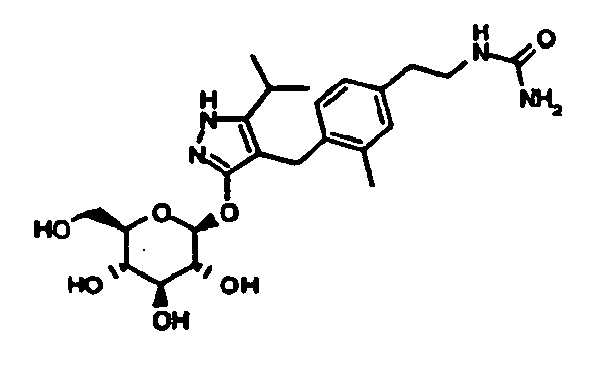
1.1-1.2 (6H, m), 2.31 (3H, s), 2.69 (2H, t, J=7.0Hz), 2.75-2.9 (1H, m), 3.2-3.4 (6H, m), 3.6-3.75 (3H, m), 3.75-3.85 (1H, m), 4.97 (1H, d, J=6.9Hz), 6.85-6.95 (2H, m), 6.99 (1H, s) Example 177 
1.05-1.2 (9H, m), 2.31 (3H, s), 2.6-2.75 (2H, m), 2.75-2.9 (1H, m), 3.2-3.4 (6H, m), 3. 5-3.75 (7H, m), 3.8 (1H, d, J=11.6Hz), 4.9-5.05 (1H, m), 6.85-6.95 (2H, m), 6.99 (1H, s) [Table 10] Example No. Structure 1H-NMR (CD3OD) δ ppm: Example 178 
1.1-1.2 (6H, m), 2.25 (6H, s), 2.31 (3H, s), 2.4 (2H, t, J=6. 5Hz), 2.68 (2H, t, J=6.7Hz), 2.8-2.9 (1H, m), 3.15-3.4 (8H, m), 3.6-3.75 (3H, m), 3.75-3.85 (1H, m), 4.9-5.0 (1H, m), 6.85-6.95 (2H, m), 6.98 (1H, s) Example 179 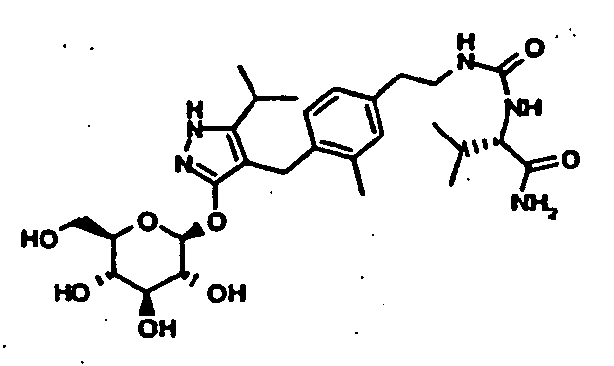
0.91 (3H, d, J=6.7Hz), 0.96.(3H, d, J=6.6Hz), 1.05-1.2 (6H, m), 1.95-2.1 (1H, m), 2.3 (3H, s), 2.65-2. 75 (2H, m), 2.8-2.9 (1H, m), 3.2-3.45 (6H, m), 3.6-3.75 (3H, m) 3.75-3.85 (1H, m), 4.05 (1H, d, J=6.1Hz), 4.9-5.05 (1H, m), 6.85-6.95 (2H, m), 6.99 (1H, s) Example 180 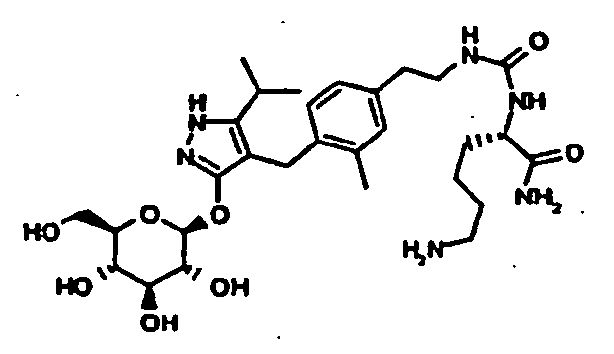
1.1-1.2 (6H, m), 1.3-1.85 (6H, m), 2.31-(3H, s), 2.6-2.75 (4H, m), 2.8-2.9 (1H, m), 3.2-3.45 (6H, m), 3.6-3.75 (3H, m), 3.75-3.85 (1H, m), 4.05-4.2 (1H, m), 4.9-5.0 (1H, m), 6.85-7.0 (3H, m) Example 181 
1.05-1.2 (6H, m), 1.3-1.65 (6H, m), 2.31 (3H, s), 2.6-2.75 (4H, m), 2.8-2.9 (1H, m), 3.2-3.55 (8H, m), 3.55-3.75 (4H, m), 3.75-3.85 (1H, m), 4.98 (1H, d, J=7.5Hz), 6.85-7.0 (3H, m) - The title compound was prepared in a similar manner to that described in Example 51 using 3-(2,3,4,6-tetra-O-acetyl-β-D-galactopyranosyloxy)-4-{[4-(3-hydroxypropoxy)-2-methylphenyl]methyl}-5-isopropyl-1H-pyrazole and N,N-dimethyl-N'-(2-nitrobenzenesulfonyl)-1,3-diaminopropane instead of 3-(2,3,4,6-tetra-O-acetyl-β-D-glucopyranosyloxy)-4-{[4-(3-hydroxypropoxy)-2-methylphenyl]methyl}-5-isopropyl-1H-pyrazole and 2-methyl-2-(2-nitrobenzenesulfonylamino)-propionamide, respectively.
1H -NMR (CD3OD) δ ppm:
1.05-1.15 (6H, m), 1.65-1.75 (2H, m), 1.9-2.0 (2H, m), 2.23 (6H, s), 2.28 (3H, s), 2.3-2.4 (2H, m), 2.61 (2H, t, J=7.3Hz), 2.7-2.85 (3H, m), 3.49 (1H, dd, J=9.8Hz, 3.5Hz), 3.55-3.8 (6H, m), 3.84 (1H, d, J=3.5Hz), 3.99 (2H, t, J=6.1Hz), 5.03 (1H, d, J=7.9Hz), 6.6 (1H, d, J=8.7Hz, 2.4Hz), 6.7 (1H, d, J=2.4Hz), 6.85 (1H, d, J=8.7Hz) - To a solution of 3,3-dimethylacrylic acid (5 g) in tetrahydrofuran (15 mL) was added 1,1'-carbonyl bis-1H-imidazole (10.5 g), and the mixture was stirred at room temperature for 30 minutes. To the reaction mixture was added 28% aqueous ammonia solution (30 mL), and the mixture was stirred at room temperature for 1 hour. The reaction mixture was concentrated under reduced pressure, and the residue was purified by column chromatography on silica gel (eluent: dichloromethane/methanol = 10/1) to give 3,3-dimethylacrylamide (2.05 g). This material was dissolved in 2-propanol (20 mL). An ammonia gas was bubbled into the solution at -15C° until saturation, and the mixture was stirred at 80C° for 40 hours. The reaction mixture was concentrated under reduced pressure, and the residue was purified by benzenesulfonic acid resin (washing solvent: methanol, eluent: 2 mol/L ammonia - methanol solution) to give the title compound (0.13 g).
1H - NMR (CD3OD) δ ppm:
1.19 (6H, s), 2.27 (2H, s) - The title compound was prepared in a similar manner to that described in Example 72 using 3-(2,3,4,6-tetra-O-acetyl-β-D-galactopyranosyloxy)-4-{[4-(3-hydroxypropoxy)-2-methyl-phenyllmethyl}-5-isopropyl-1H-pyrazole and 3-amino-3-methylbutyramide instead of 3-(2,3,4,6,-tetra-O-acetyl-β-D-glucopyranosyloxy)-4-{[4-(3-hydroxypropoxy)phenyl]-methyl}-5-isopropyl-1H-pyrazole and 2-[2-amino-2-(methyl)-propionylamino]ethanol, respectively.
MS(ESI, m/z) : 565 [M+H]+
1H - NMR (CD3OD) δ ppm:
1.05-1.15 (6H, m), 1.18 (6H, s), 1.85-2.0 (2H, m), 2.28 (3H, s), 2.32 (2H, s), 2.7-2.85 (3H, m), 3.49 (1H, dd, J=9.7Hz, 3.3Hz), 3.58 (1H, t, J=5.8Hz), 3.6-3.8 (5H, m), 3.8-3.9 (1H, m), 4.0 (2H, t, J=5.9Hz), 5.03 (1H, d, J=7.9Hz), 6.55-6.65 (1H, m), 6.65-6.75 (1H, m), 6.8-6.9 (1H, m) - The title compound was prepared in a similar manner to that described in Reference Example 11 using (4-benzyloxy-2-methylphenyl)methanol and ethyl trifluoroacetoacetate instead of [4-(3-benzyloxypropoxy)phenyl]methanol and ethyl 4-methyl-3-oxopentanoate, respectively.
1H-NMR (DMSO-d6) δ ppm:
2.24 (3H, s), 3.58 (2H, s), 5.02 (2H, s), 6.65 (1H, d, J=8.5Hz), 6.7 (1H, dd, J=8.5Hz, 2.7Hz), 6.81 (1H, d, J=2.7Hz), 7.25-7.45 (5H, m) - A suspension of 4-[(4-benzyloxy-2-methylphenyl)methyl]-5-trifluoromethyl-1,2-dihydro-3H-pyrazol-3-one (0.5 g), acetobromo-α-D-galactose (0.62 g) and potassium carbonate (0.29 g) in acetonitrile (5 mL) was stirred at room temperature overnight. The reaction mixture was poured into water, and the resulting mixture was extracted with ethyl acetate. The extract was washed with brine, and dried over anhydrous sodium sulfate. The solvent was removed under reduced pressure, and the residue was purified by column chromatography on silica gel (eluent: n-hexane/ethyl acetate = 2/1 - 1/1) to give the title compound (0.66 g).
1H-NMR (CDCl3) δ ppm:
1.78 (3H, s), 1.98 (3H, s), 2.05 (3H, s), 2.17 (3H, s), 2.3 (3H, s), 3.67 (1H, d, J=16.4Hz), 3.72 (1H, d, J=16.4Hz), 3.98 (1H, t, J=6.3Hz), 4.1-4.25 (2H, m), 5.0-5.1 (3H, m), 5.15-5.4 (2H, m), 5.42 (1H, dd, J=3.4Hz, 1.0Hz), 6.67 (1H, dd, J=8.5Hz, 2.6Hz), 6.75 (1H, d, J=8.5Hz), 6.8 (1H, d, J=2.6Hz), 7.25-7.45 (5H, m) - The title compound was prepared in a similar manner to that described in Reference Example 58 using 3-(2,3,4,6-tetra-O-acetyl-β-D-galactopyranosyloxy)-4-[(4-benzyloxy-2-methylphenyl)methyl]-5-trifluoromethyl-1H-pyrazole instead of 4-[(4-benzyloxy-2-methylphenyl)methyl]-5-isopropyl-3-(2,3,4,6-tetra-O-pivaloyl-β-D-glucopyranosyloxy)-1H-pyrazole.
1H-NMR (CDCl3) δ ppm:
1.83 (3H, s), 1.98 (3H, s), 2.05 (3H, s), 2.18 (3H, s), 2.27 (3H, s), 3.66 (1H, d, J=16.4Hz), 3.71 (1H, d, J=16.4Hz), 3.95-4.0 (1H, m), 4.05-4.2 (2H, m), 4.84 (1H, brs), 5.03 (1H, dd, J=10.3Hz, 3.4Hz), 5.2-5.4 (2H, m), 5.41 (1H, dd, J=3.4Hz, 1.1Hz), 6.54 (1H, dd, J=8.3Hz, 2.7Hz), 6.64 (1H, d, J=2.7Hz), 6.72 (1H, d, J=8.3Hz) - 3-(2,3,4,6-Tetra-O-acetyl-β-D-galactopyranosyloxy)-4-[(4-{3-[N-benzyloxycarbonyl-N-(2-carbamoylethyl)amino]-propoxy}-2-methylphenyl)methyl]-5-trifluoromethyl-1H-pyrazole was prepared in a similar manner to that described in Example 96 using 3-(2,3,4,6-tetra-O-acetyl-β-D-galactopyranosyloxy)-5-trifluoromethyl-4-[(4-hydroxy-2-methylphenyl)methyl]-1H-pyrazole instead of 4-[(4-hydroxy-2-methylphenyl)methyl]-5-isopropyl-3-(2,3,4,6-tetra-O-pivaloyl-β-D-glucopyranosyloxy)-1H-pyrazole, and the title compound was prepared in a similar manner to that described in Example 94 using this material instead of 3-(2,3,4,6-tetra-O-acetyl-β-D-galactopyranosyloxy)-4-[(4-{3-[N-benzyl-N-(2-carbamoylethyl)amino]propoxy}-2-methylphenyl)methyl]-5-isopropyl-1H-pyrazole.
MS(ESI, m/z) : 563 [M+H]+
1H-NMR (CD3OD) δ ppm:
1.95-2.1 (2H, m), 2.25 (3H, s), 2.41 (2H, t, J=6.9Hz), 2.63 (2H, t, J=7.1Hz), 2. 83 (2H, t, J=6.9Hz), 3.53 (1H, dd, J=9.8Hz, 3.4Hz), 3.55-3.8 (6H, m), 3.87 (1H, d, J=3.4Hz), 4.21 (2H, t, J=6.7Hz), 5.28 (1H, d, J=7.9Hz), 6.45 (1H, dd, J=8.4Hz, 2.4Hz), 6.55-6.65 (2H, m) - To a solution of 3-(2,3,4,6-tetra-O-acetyl-β-D-glucopyranosyloxy)-4-{[4-(2,-aminoethoxy)-2-methylphenyl]methyl}-5-isopropyl-1H-pyrazole (0.5 g) in N,N-dimethylformamide (10 mL) were added 1-benzyloxycarbonyl-4-[2-carboxy-2-(methyl)-propionyl]piperazine (0.28 g), 1-hydroxybenzotriazole (0.22 g), triethylamine (0.18mL) and 1-ethyl-3-(3-dimethylaminopropyl)-carbodiimide hydrochloride (0.46 g), and the mixture was stirred at room temperature for 2 days. The reaction mixture was poured into water, and the resulting mixture was extracted with diethyl ether. The organic layer was washed with a saturated aqueous sodium hydrogen carbonate solution, water and brine successively, dried over anhydrous magnesium sulfate and concentrated under reduced pressure. The residue was purified by column chromatography on silica gel (eluent: dichloromethane/methanol = 30/1) to give 3-(2,3,4,6-tetra-O-acetyl-β-D-glucopyranosyloxy)-4-[(4-{2-[2-{[4-(benzyloxycarbonyl)piperazin-1-yl]-carbonyl}-2-(methyl)propionylamino]ethoxy}-2-methylphenyl)-methyl]-5-isopropyl-1H-pyrazole (0.3 g). This material was dissolved in methanol (4 mL). To the solution was added sodium methoxide (28% methanol solution, 0.06 mL), and the mixture was stirred at room temperature for 30 minutes. To the reaction mixture was added acetic acid (0.035 mL), and the resulting mixture was concentrated under reduced pressure. The residue was purified by column chromatography on silica gel (eluent: dichloromethane/methanol = 10/1 - 5/1) to give the title compound (0.23 g).
1H-NMR (CD3OD) δ ppm:
1.05-1.15 (6H, m), 1.37 (6H, s), 2.25 (3H, s), 2.7-2.85 (1H, m), 3.15-3.75 (17H, m), 3.81 (1H, d, J=12.0Hz), 4.02 (2H, t, J=5.2Hz), 5.02 (1H, d, J=7.4Hz), 5.09 (2H, s), 6.55-6.65 (1H, m), 6.69 (1H, d, J=2.2Hz), 6.84 (1H, d, J=8.7Hz), 7.25-7.4 (5H, m) - A mixture of 4-[(4-{2-[2-{[4-(benzyloxycarbonyl)-piperazin-1-yl]carbonyl}-2-(methyl)propionylamino]ethoxy}-2-methylphenyl)methyl]-3-(β-D-glucopyranosyloxy)-5-isopropyl-1H-pyrazole (0.23 g), p-toluenesulfonic acid monohydrate (0.41 g) and 2-propanol (10 mL) was stirred at 50C° for 2 days. The reaction mixture was poured into a saturated aqueous sodium hydrogen carbonate solution, and the resulting mixture was extracted with ethyl acetate. The extract was washed with water and brine, and dried over anhydrous magnesium sulfate. The solvent was removed under reduced pressure, and the residue was purified by column chromatography on silica gel (eluent: dichloromethane/methanol = 10/1) to give the title compound (0.18 g).
1H-NMR (CD3OD) δ ppm:
1.06 (6H, d, J=6.7Hz), 1.37 (6H, s), 2.25 (3H, s), 2. 7-2 . 85 (1H, m), 3.15-3.7 (12H, m), 4.02 (2H, t, J=5.3Hz), 5.09 (2H, s), 6.6 (1H, dd, J=8.6Hz, 2.3Hz), 6.7 (1H, d, J=2.3Hz), 6.85 (1H, d, J=8.6Hz), 7.25-7.4 (5H, m) - The title compound was prepared in a similar manner to that described in Reference Example 17 using 4-[(4-{2-[2-{[4-(benzyloxycarbonyl)piperazin-1-yl]carbonyl}-2-(methyl)-propionylamino]ethoxy}-2-methylphenyl)methyl]-1,2-dihydro-5-isopropyl-3H-pyrazol-3-one and acetobromo-α-D-galactose instead of 4-{[4-(3-benzyloxypropoxy)phenyl]methyl}-1,2-dihydro-5-isopropyl-3H-pyrazol-3-one and acetobromo-α-D-glucose, respectively.
1H - NMR (CDCl3) δ ppm:
1.05-1.15 (6H, m), 1.41 (6H, s), 1.83 (3H, s), 1.98 (3H, s), 2.02 (3H, s), 2.15 (3H, s), 2.25 (3H, s), 2.7-2.85 (1H, m), 3.25-3.7 (12H, m), 3.97 (2H, t, J=4.9Hz), 4.0-4.1 (1H, m), 4.1-4.2 (2H, m), 5.08 (1H, dd, J=10.4Hz, 3.5Hz), 5.12 (2H, s), 5.35-5.45 (2H, m), 5.52 (1H, d, J=8.1Hz), 5.92 (1H, t, J=5.7Hz), 6.53 (1H, dd, J=8.4Hz, 2.6Hz), 6.63 (1H, d, J=2.6Hz), 6.81 (1H, d, J=8.4Hz), 7.25-7.4 (5H, m) - To a solution of 3-(2,3,4,6-tetra-O-acetyl-β-D-galactopyranosyloxy)-4-[(4-{2-[2-{[4-(benzyloxycarbonyl)piperazin-1-yl]carbonyl}-2-(methyl)propionylamino]ethoxy}-2-methylphenyl)methyl]-5-isopropyl-1H-pyrazole (0.14 g) in methanol (3 mL) was added sodium methoxide (28% methanol solution, 0.015 mL), and the mixture was stirred at room temperature for 30 minutes. The reaction mixture was purified by column chromatography on silica gel (eluent: dichloromethane/methanol = 5/1) to give 4-[(4-{2-[2-{[4-(benzyloxycarbonyl)piperazin-1-yl]-carbonyl}-2-(methyl)propionylamino]ethoxy}-2-methylphenyl)-methyl]-3-(β-D-galactopyranosyloxy)-5-isopropyl-1H-pyrazole (70 mg). This material was dissolved in methanol (4 mL). To the solution was added 10% palladium-carbon powder (10 mg), and the mixture was stirred at room temperature under a hydrogen atmosphere for 1 hour. The insoluble material was removed by filtration, and the filtrate was concentrated under reduced pressure to give the title compound (54 mg).
1H-NMR (CD3OD) δ ppm:
1.05-1.2 (6H, m), 1.37 (6H, s), 2.3 (3H, s), 2.35-2.9 (5H, m), 3.1-3.8 (13H, m), 3.85 (1H, d, J=3.3Hz), 4.02 (2H, t, J=5.5Hz), 5.04 (1H, d, J=8.0Hz), 6.62 (1H, dd, J=8.4Hz, 2.4Hz), 6.72 (1H, d, J=2.4Hz), 6.86 (1H, d, J=8.4Hz) - The cDNA library was prepared for PCR amplification by reverse transcription from total RNA deprived from human small intestine (Ori gene) using oligo-dT as a primer. Using this cDNA library as a template, the DNA fragment coding 1 to 2005 bp of human SGLT1 (ACCESSION: M24847), which was reported by Hediger et al., was amplified by PCR method and inserted into the multi-cloning site of pcDNA3.1(-) (Invitrogen). The DNA sequence inserted was perfectly matched to the previously reported sequence.
- The expression vector of human SGLT1 was digested by Sca I into a linear DNA. The linear DNA was transfected into CHO-K1 cells by means of lipofection (Effectene Transfection Reagent: QIAGEN). Neomycin resistant cell lines were selected by culture in the medium containing G418 (1 mg/mL, LIFE TECHNOLOGIES), and then the activity against the uptake of methyl-α-D-glucopyranoside was measured by the method described below. The cell line, which showed the greatest uptake activity, was selected and designated as CS1-5-11D. CS1-5-11D cells were cultured in the presence of G418 at 200 µg/mL.
- CS1-5-11D cells were seeded into a 96-well culture plate at a density of 3 × 10⁴ cells/well and cultured for 2 days, and were used in the uptake assay. A mixture of non-labeled (Sigma) and 14C-labeled α-MG (Amersham Pharmcia Biotec) was added to the uptake buffer (pH 7.4; containing 140 mM sodium chloride, 2 mM potassium chloride, 1 mM calcium chloride, 1 mM magnesium chloride, 10 mM 2-[4-(2-hydroxyethyl)-1-piperazinyl]ethane sulfonic acid, and 5 mM tris(hydroxymethyl)aminomethane) at the final concentration of 1 mM. A test compound was dissolved in dimethyl sulfoxide, and then appropriately diluted with distilled water. The test compound solution was added to the uptake buffer containing 1 mM α-MG, and designated as a measurement buffer. For the control group, the measurement buffer without any test compound was prepared. For measuring the basal uptake, a basal uptake measurement buffer which contains 140 mM chorine chloride instead of sodium chloride was prepared. After removing the culture medium of CS1-5-11D cells, 180 µL of the pre-treatment buffer (the basal uptake buffer without α-MG) was added to each well and incubated at 37°C for 10 minutes. After repeating the same treatment, the pre-treatment buffer was removed. To each well was added 75 µL of the measurement buffer or the basal uptake buffer was added and incubated at 37° C for 1 hour. After removing the measurement buffer, cells were washed twice with 180 µL per well of the washing buffer (the basal uptake buffer containing 10 mM non-labeled α-MG). The cells were solubilized by 75 µL per well of 0. 2 mol/L sodium hydroxide. The cell lysates were transferred into PicoPlates (Packard), and then added 150 µL of MicroScint-40 (Packard) and mixed. Radioactivity was measured by means of micro-scintillation counter TopCount (Packard). One hundred % was set to the difference between the uptake in the control group and the basal uptake, and the uptake of methyl α-D-glucopyranoside at each drug concentration were calculated. The drug concentration, at which 50% uptake of methyl α-D-glucopyranoside was inhibited (IC50 value), was calculated using logit plot. The results are shown in Table 11.
[Table 11] Test compound IC50 value (nM) Example 6 304 Example 9 42 Example 10 169 Example 13 267 Example 21 127 Example 22 233 Example 24 61 Example 28 90 Example 29 19 Example 30 257 Example 31 166 Example 32 113 Example 33 65 Example 35 160 Example 36 383 Example 37 158 Example 38 246 Example 45 68 Example 48 54 Example 49 148 Example 50 159 Example 51 22 Exampel 52 131 Example 55 98 Example 56 38 Example 57 43 Example 58 100 Example 59 71 Example 61 199 Example 62 138 Example 63 322 Example 64 178 - Male wistar rats (Japan Charles River), aged 8 weeks old, were injected nicotinamide (230 mg/kg) intraperitoneally. Fifteen minutes after injection, they were injected streptozotocin (85 mg/kg) intravenously from tail vain under anesthesia with ether. After a week, rats were fasted overnight and then glucose tolerance test (2 g/kg) was done. The rats which showed plasma glucose concentration at 1 hour after glucose load was over 300 mg/dL were selected to use liquid meal tolerance test.
- After overnight fasted, the diabetic rats were orally administered a test compound (1 mg/kg), which was dissolved in distilled water or 0.5% aqueous carboxymethylcellulose solution, in the drug-treating group, or distilled water or 0.5% aqueous carboxymethylcellulose solution alone in a control group. Immediately after the compound administration, 17.25 kcal/kg of liquid meal (No. 038, Control diet, assorted with dextrin and maltose; Oriental Yeast Co., Ltd.) was loaded orally. The blood was collected from tail artery immediately before and after administration with the time course, and treated with heparin immediately. The blood was centrifuged, and the plasma was collected to quantify the plasma glucose concentration by glucose oxidase method. Plasma glucose concentrations at pretreatment (0h), 0.5 and 1 hour after the drug administration are shown in Table 12. The values in the Table are presented as the mean ± S.E.
[Table 12] Test compound Plasma glucose concentration (mg/dL) 0h 0.5h 1h Control 95 ± 5 219 ± 12 246 ± 17 Example 6 97 ± 10 126 ± 12 140 ± 13 Control 122 ± 6 258 ± 32 260 ± 35 Example 10 120 ± 10 145 ± 5 164 ± 6 Control 106 ± 4 199 8 ± 8 196 ± 15 Example 13 108 ± 8 127 ± 7 135 ± 7 Control 115 ± 3 276 ± 25 261 ± 32 Example 21 122 ± 11 211 ± 22 242 ± 35 Example 35 113 ± 4 188 ± 16 229 ± 25 Control 140 ± 13 313 ± 48 283 ± 52 Example 24 146 ± 7 210 ± 33 228 ± 50 Control 131 ± 7 330 ± 37 306 ± 45 Example 37 132 ± 5 231 ± 21 286 ± 31 Control 123 ± 10 305 ± 18 304 ± 23 Example 45 129 ± 11 169 ± 18 182 ± 27 Control 124 ± 5 278 ± 31 274 ± 22 Example 52 138 ± 4 163 ± 5 176 ± 10 Control 123 ± 8 292 ± 28 294 ± 29 Example 55 122 ± 5 200 ± 16 211 ± 18 Example 59 115 ± 7 143 ± 4 154 ± 13 Control 121 ± 7 313 ± 33 303 ± 63 Example 56 109 ± 10 146 ± 7 165 ± 17 Control 91 ± 12 238 ± 4 213 ± 22 Example 64 116 ± 2 141 ± 12 148 ± 22 - Male ICR mice (CLEA Japan, Inc.; 32-37 g, n = 5), aged 6 weeks old, were fasted for 4 hours. A test compound, which was dissolved in distilled water, was administered orally at a dose of 1 g/kg, and then mice were observed for 24 hours. The results are shown in the following Table 13.
[Table 13] Test compound Number of death Example 52 0/5 - The pyrazole derivatives represented by the above general formula (I) of the present invention or pharmaceutically acceptable salts thereof exert an inhibitory activity in human SGLT1 and can suppress increase of blood glucose level by inhibiting absorption of carbohydrate such as glucose at the small intestine, and particularly, can suppress remarkably increase of blood glucose level and/or can lower blood galactose level by delaying absorption of glucose and galactose based on the mechanism, and for example, can normalize postprandial hyperglycemia. Therefore, the present invention can provide excellent agents for the prevention or treatment of a disease associated with hyperglycemia such as for example diabetes, impaired glucose tolerance, impaired fasting glycemia, diabetic complications or or obesity , and a disease associated with the increase of blood galactose level such as galactosemia. In addition, since the pyrazole derivatives represented by the above general formula (II) of the present invention and salts thereof are important as intermediates in the production of the pyrazole derivatives represented by the above general formula (I), the compounds represented by the above general formula (I) of the present invention can be readily prepared via such compounds.
Claims (38)
- A pyrazole derivative represented by the general formula:

R1 represents a hydrogen atom, a C1-6 alkyl group, a C2-6 alkenyl group, a hydroxy (C2-6 alkyl) group, a C3-7 cycloalkyl group, a C3-7 cycloalkyl-substituted (C1-6 alkyl) group, an aryl group which may have the same or different 1 to 3 substituents selected from the group consisting of a halogen atom, a hydroxy group, an amino group, a C1-6 alkyl group and a C1-6 alkoxy group, or an aryl (C1-6 alkyl) group which may have the same or different 1 to 3 substituents selected from the group consisting of a halogen atom, a hydroxy group, an amino group, a C1-6 alkyl group and a C1-6 alkoxy group on the ring;
one of Q and T represents a group represented by the formula:

R2 represents a hydrogen atom, a halogen atom, a hydroxy group, a C1-6 alkyl group, a C1-6 alkoxy group, a C1-6 alkylthio group, a halo (C1-6 alkyl) group, a halo (C1-6 alkoxy) group, a C1-6 alkoxy-substituted (C1-6 alkoxy) group, a C3-7 cycloalkyl-substituted (C2-6 alkoxy) group or -A-RA in which A represents a single bond, an oxygen atom, a methylene group, an ethylene group, -OCH2- or -CH2O-; and RA represents a C3-7 cycloalkyl group, a C2-6 heterocycloalkyl group, an aryl group which may have the same or different 1 to 3 substituents selected from the group consisting of a halogen atom, a hydroxy group, an amino group, a C1-6 alkyl group, a C1-6 alkoxy group, a C2-6 alkenyloxy group, a halo (C1-6 alkyl) group, a hydroxy (C1-6 alkyl) group, a carboxy group, a C2-7 alkoxycarbonyl group, a cyano group and a nitro group, or a heteroaryl group which may have a substituent selected from the group consisting of a halogen atom and a C1-6 alkyl group;
X represents a single bond, an oxygen atom or a sulfur atom;
Y represents a C1-6 alkylene group which may be substituted by a hydroxy group or a C2-6 alkenylene group;
Z represents -RB, -CORC, -SO2RC, CON(RD)RE, -SO2NHRF or -C(=NRG)N(RH)RI;
RC represents an aryl group which may have the same or different 1 to 3 substituents selected from the group consisting of a halogen atom, a hydroxy group, an amino group, a C1-6 alkylsulfonylamino group, a C1-6 alkyl group and a C1-6 alkoxy group, a heteroaryl group which may have a substituent selected from the group consisting of a halogen atom, an amino group and a C1-6 alkyl group, or a C1-6 alkyl group which may have the same or different 1 to 5 groups selected from the following substituent group (i);
R4, RB, RD, RE and RF are the same or different, and each represents a hydrogen atom, an aryl group which may have the same or different 1 to 3 substituents selected from the group consisting of a halogen atom, a hydroxy group, an amino group, a C1-6 alkylsulfonylamino group, a C1-6 alkyl group and a C1-6 alkoxy group, a heteroaryl group which may have a substituent selected from the group consisting of a halogen atom, an amino group and a C1-6 alkyl group, or a C1-6 alkyl group which may have the same or different 1 to 5 groups selected from the following substituent group (i), or both of R4 and RB bind together with the neighboring nitrogen atom to form a C2-6 cyclic amino group which may have a substituent selected from the group consisting of a hydroxy group, a carbamoyl group, a C1-6 alkyl group, an oxo group, a carbamoyl (C1-6 alkyl) group, a hydroxy(C1-6 alkyl) group and a C1-6 alkylsulfonylamino-substituted (C1-6 alkyl) group, or both of RD and RE bind together with the neighboring nitrogen atom to form a C2-6 cyclic amino group which may have a substituent selected from the group consisting of a hydroxy group, a carbamoyl group, a C1-6 alkyl group, an oxo group, a carbamoyl (C1-6 alkyl) group, a hydroxy (C1-6 alkyl) group and a C1-6 alkylsulfonylamino-substituted (C1-6 alkyl) group;
RG, RH and RI are the same or different, and each represents a hydrogen atom, a cyano group, a carbamoyl group, a C2-7 acyl group, a C2-7 alkoxycarbonyl group, an aryl (C2-7 alkoxycarbonyl) group, a nitro group, a C1-6 alkylsulfonyl group, a sulfamide group, a carbamimidoyl group, or a C1-6 alkyl group which may have the same or different 1 to 5 groups selected from the following substituent group (i), or both of RG and RH bind to form an ethylene group, or both of RH and RI bind together with the neighboring nitrogen atom to form a C2-6 cyclic amino group which may have a substituent selected from the group consisting of a hydroxy group, a carbamoyl group, a C1-6 alkyl group, an oxo group, a carbamoyl (C1-6 alkyl) group, a hydroxy (C1-6 alkyl) group and a C1-6 alkylsulfonylamino-substituted (C1-6 alkyl) group;
R3, R5 and R6 are the same or different, and each represents a hydrogen atom, a halogen atom, a C1-6 alkyl group or a C1-6 alkoxy group; and
substituent group (i) consists of a hydroxy group, a C1-6 alkoxy group, a C1-6 alkylthio group, an amino group, a mono or di (C1-6 alkyl)amino group, a mono or di [hydroxy (C1-6 alkyl)]amino group, an ureido group, a sulfamide group, a mono or di (C1-6 alkyl) ureido group, a mono or di (C1-6 alkyl)sulfamide group, a C2-7 acylamino group, a C1-6 alkylsulfonylamino group, a C1-6 alkylsulfonyl group, a carboxy group, a C2-7 alkoxycarbonyl group, -CON(RJ)RK in which RJ and RK are the same or different, and each represents a hydrogen atom or a C1-6 alkyl group which may have the same or different 1 to 3 substituents selected from the group consisting of a hydroxy group, an amino group, a mono or di (C1-6 alkyl)amino group, a mono or di [hydroxy (C1-6 alkyl)]amino group, an ureido group, a mono or di (C1-6 alkyl)ureido group, a C2-7 acylamino group, a C1-6 alkylsulfonylamino group and a carbamoyl group, or both of RJ and RK bind together with the neighboring nitrogen atom to form a C2-6 cyclic amino group which may have a substituent selected from the group consisting of a hydroxy group, a carbamoyl group, a C1-6 alkyl group, an oxogroup, a carbamoyl (C1-6 alkyl) group, a hydroxy (C1-6 alkyl) group and a C1-6 alkylsulfonylamino-substituted (C1-6 alkyl) group, an aryl (C1-6 alkoxy) group which may have the same or different 1 to 3 substituents selected from the group consisting of a halogen atom, a hydroxy group, an amino group, a C1-6 alkyl group and a C1-6 alkoxy group on the ring, an aryl (C1-6 alkylthio) group which may have the same or different 1 to 3 substituents selected from the group consisting of a halogen atom, a hydroxy group, an amino group, a C1-6 alkyl group and a C1-6 alkoxy group on the ring, a C3-7 cycloalkyl group, a C2-6 heterocycloalkyl group, an aryl group which may have the same or different 1 to 3 substituents selected from the group consisting of a halogen atom, a hydroxy group, an amino group, a C1-6 alkylsulfonylamino group, a C1-6 alkyl group and a C1-6 alkoxy group, a heteroaryl group which may have a substituent selected from the group consisting of a halogen atom, an amino group and a C1-6 alkyl group, a C2-6 cyclic amino group which may have a substituent selected from the group consisting of a hydroxy group, a carbamoyl group, a C1-6 alkyl group, an oxo group a carbamoyl (C1-6 alkyl) group, a hydroxy (C1-6 alkyl) group and a C1-6 alkylsulfonylamino-substituted (C1-6 alkyl) group, and a C1-4 -aromatic cyclic amino group which may have a C1-6 alkyl group as a substituent,
or a pharmaceutically acceptable salt thereof. - A pyrazole derivative claimed in claim 1, wherein R4 represents a hydrogen atom, an aryl group which may have the same or different 1 to 3 substituents selected from the group consisting of a halogen atom, a hydroxy group, an amino group, a C1-6 alkylsulfonylamino group, a C1-6 alkyl group and a C1-6 alkoxy group, a heteroaryl group which may have a substituent selected from the group consisting of a halogen atom, an amino group and a C1-6 alkyl group, or a C1-6 alkyl group which may have the same or different 1 to 5 groups selected from the following substituent group (i); RB represents an aryl group which may have the same or different 1 to 3 substituents selected from the group consisting of a halogen atom, a hydroxy group, an amino group, a C1-6 alkylsulfonylamino group, a C1-6 alkyl group and a C1-6 alkoxy group, a heteroaryl group which may have a substituent selected from the group consisting of a halogen atom, an amino group and a C1-6 alkyl group, or a C1-6 alkyl group which may have the same or different 1 to 5 groups selected from the following substituent group (i); RC represents an aryl group which has the same or different 1 to 3 substituents selected from the group consisting of a halogen atom, a hydroxy group, an amino group, a C1-6 alkylsulfonylamino group, a C1-6 alkyl group and a C1-6 alkoxy group, a heteroaryl group which may have a substituent selected from the group consisting of a halogen atom, an amino group and a C1-6 alkyl group, or a C1-6 alkyl group which has the same or different 1 to 5 groups selected from the following substituent group (i); and
substituent group (i) consists of a hydroxy group, a C1-6 alkoxy group, a C1-6 alkylthio group, an amino group, a mono or di (C1-6 alkyl)amino group, a mono or di [hydroxy (C1-6 alkyl)]amino group, an ureido group, a sulfamide group, a mono or di (C1-6 alkyl)ureido group, a mono or di (C1-6 alkyl)sulfamide group, a C2-7 acylamino group, a C1-6 alkylsulfonylamino group, a C1-6 alkylsulfonyl group, a carboxy group, a C2-7 alkoxycarbonyl group, -CON(RJ)RK in which RJ and RK are the same or different, and each represents a hydrogen atom or a C1-6 alkyl group which may have the same or different 1 to 3 substituents selected from the group consisting of a hydroxy group, an amino group, a mono or di (C1-6 alkyl)amino group, a mono or di [hydroxy (C1-6 alkyl)]amino group, an ureido group, a mono or di (C1-6 alkyl)ureido group, a C2-7 acylamino group, a C1-6 alkylsulfonylamino group and a carbamoyl group, or both of RJ and RK bind together with the neighboring nitrogen atom to form a C2-6 cyclic amino group which may have a substituent selected from the group consisting of a hydroxy group, a carbamoyl group, a C1-6 alkyl group, an oxo group, a carbamoyl (C1-6 alkyl) group, a hydroxy (C1-6 alkyl) group and a C1-6alkylsulfonylamino-substituted (C1-6 alkyl) group, an aryl (C1-6 alkoxy) group which may have the same or different 1 to 3 substituents selected from the group consisting of a halogen atom, a hydroxy group, an amino group, a C1-6 alkyl group and a C1-6 alkoxy group on the ring, an aryl (C1-6 alkylthio) group which may have the same or different 1 to 3 substituents selected from the group consisting of a halogen atom, a hydroxy group, an amino group, a C1-6 alkyl group and a C1-6 alkoxy group on the ring, a C3-7 cycloalkyl group, a C2-6 heterocycloalkyl group, an aryl group which may have the same or different 1 to 3 substituents selected from the group consisting of a halogen atom, a hydroxy group, an amino group, a C1-6 alkylsulfonylamino group, a C1-6 alkyl group and a C1-6 alkoxy group, a heteroaryl group which may have a substituent selected from the group consisting of a halogen atom, an amino group and a C1-6 alkyl group, a C2-6 cyclic amino group which may have a substituent selected from the group consisting of a hydroxy group, a carbamoyl group, a C1-6 alkyl group, an oxo group, a carbamoyl (C1-6 alkyl) group, a hydroxy (C1-6 alkyl) group and a C1-6 alkylsulfonylamino-substituted (C1-6 alkyl) group, and a C1-4 aromatic cyclic amino group which may have a C1-6 alkyl group as a substituent,
or a pharmaceutically acceptable salt thereof. - A pyrazole derivative claimed in claim 2, wherein Z represents -RB; RB represents an aryl group which has the same or different 1 to 3 substituents selected from the group consisting of a halogen atom, a hydroxy group, an amino group; a C1-6 alkylsulfonylamino group, a C1-6 alkyl group and a C1-6 alkoxy group, a heteroaryl group which may have a substituent selected from the group consisting of a halogen atom, an amino group and a C1-6 alkyl group, or a C1-6 alkyl group which has the same or different 1 to 5 groups selected from the following substituent group (i); and
substituent group (i) consists of a hydroxy group, a C1-6 alkoxy group, a C1-6 alkylthio group, an amino group, a mono or di (C1-6 alkyl)amino group, a mono or di [hydroxy (C1-6 alkyl)]amino group, an ureido group, a sulfamide group, a mono or di (C1-6 alkyl) ureido group, a mono or di (C1-6 alkyl)sulfamide group, a C2-7 acylamino group, a C1-6 alkylsulfonylamino group, a C1-6 alkylsulfonyl group, a carboxy group, a C2-7 alkoxycarbonyl group, -CON(RJ)RK in which RJ and RK are the same or different, and each represents a hydrogen atom or a C1-6 alkyl group which may have the same or different 1 to 3 substituents selected from the group consisting of a hydroxy group, an amino group, a mono or di (C1-6 alkyl)amino group, a mono or di [hydroxy (C1-6 alkyl)]amino group, an ureido group, a mono or di (C1-6 alkyl)ureido group, a C2-7 acylamino group, a C1-6 alkylsulfonylamino group and a carbamoyl group, or both of RJ and RK bind together with the neighboring nitrogen atom to form a C2-6 cyclic amino group which may have a substituent selected from the group consisting of a hydroxy group, a carbamoyl group, a C1-6 alkyl group, an oxo group, a carbamoyl (C1-6 alkyl) group, a hydroxy (C1-6 alkyl) group and a C1-6 alkylsulfonylamino-substituted (C1-6 alkyl) group, an aryl (C1-6 alkoxy) group which may have the same or different 1 to 3 substituents selected from the group consisting of a halogen atom, a hydroxy group, an amino group, a C1-6 alkyl group and a C1-6 alkoxy group on the ring, an aryl (C1-6 alkylthio) group which may have the same or different 1 to 3 substituents selected from the group consisting of a halogen atom, a hydroxy group, an amino group, a C1-6 alkyl group and a C1-6 alkoxy group on the ring, a C3-7 cycloalkyl group, a C2-6 heterocycloalkyl group, an aryl group which may have the same or different 1 to 3 substituents selected from the group consisting of a halogen atom, a hydroxy group, an amino group, a C1-6 alkylsulfonylamino group, a C1-6 alkyl group and a C1-6 alkoxy group, a heteroaryl group which may have a substituent selected from the group consisting of a halogen atom, an amino group and a C1-6 alkyl group, a C2-6 cyclic amino group which may have a substituent selected from the group consisting of a hydroxy group, a carbamoyl group, a C1-6 alkyl group, an oxo group, a carbamoyl (C1-6 alkyl) group, a hydroxy (C1-6 alkyl) group and a C1-6 alkylsulfonylamino-substituted (C1-6 alkyl) group, and a C1-4 aromatic cyclic amino group which may have a C1-6 alkyl group as a substituent,
or a pharmaceutically acceptable salt thereof. - A pyrazole derivative claimed in claim 3, wherein R4 represents a hydrogen atom; RB represents a C1-6 alkyl group which has the same or different 1 to 5 groups selected from the following substituent group (iA); and
substituent group (iA) consists of a hydroxy group, an amino group, a mono or di (C1-6 alkyl) amino group, a carboxy group a C2-7 alkoxycarbonyl group and -CON(RJA)RKA in which RJA and RKA are the same or different, and each represents a hydrogen atom or a C1-6 alkyl group which may have the same or different 1 to 3 substituents selected from the group consisting of a hydroxy group, an amino group, a mono or di (C1-6 alkyl) amino group and a carbamoyl group, or both of RJA and RKA bind together with the neighboring nitrogen atom to form a C2-6 cyclic amino group which may have a substituent selected from the group consisting of a C1-6 alkyl group and a hydroxy (C1-6 alkyl) group,
or a pharmaceutically acceptable salt thereof. - A pyrazole derivative claimed in claim 4, wherein RB represents a C1-6 alkyl group which has a carbamoyl group, or a pharmaceutically acceptable salt thereof.
- A pyrazole derivative claimed in claim 2, wherein Z represents -CON(RD)RE, or a pharmaceutically acceptable salt thereof.
- A pyrazole derivative claimed in claim 6, wherein RD represents a hydrogen atom; RE represents a C1-6 alkyl group which has the same or different 1 to 5 groups selected from the following substituent group (iB); and substituent group (iB) consists of a hydroxy group, an amino group, a mono or di (C1-6 alkyl)amino group and -CON(RJB)RKB in which RJB and RKB are the same or different, and each represents a hydrogen atom, a C1-6 alkyl group which may have the same or different 1 to 3 substituents selected from the group consisting of a hydroxy group, an amino group and a mono or di (C1-6 alkyl) amino group, or pharmaceutically acceptable salt thereof.
- A pyrazole derivative claimed in claim 2, wherein Z represents -C(=NRG)N(RH)RI, or pharmaceutically acceptable salt thereof.
- A pyrazole derivative claimed in claim 8, wherein RG represents a hydrogen atom or a C1-6 alkylsulfonyl group; RH represents a hydrogen atom; RI represents a hydrogen atom or a C1-6 alkyl group which may have the same or different 1 to 5 groups selected from the following substituent group (iC); and substituent group (iC) consists of a hydroxy group, an amino group, a mono or di (C1-6 alkyl)amino group, or pharmaceutically acceptable salt thereof.
- A pyrazole derivative claimed in claim 2, wherein Z represents -CORC; RC represents a C1-6 alkyl group which has a group selected from the following substituent group (iD); and substituent group (iD) consists of an amino group and -CON(RJC)RKC in which both of RJC and RKC bind together with the neighboring nitrogen atom to form a C2-6 cyclic amino group which may have a substituent selected from the group consisting of a C1-6 alkyl group and a hydroxy (C1-6 alkyl) group, or pharmaceutically acceptable salt thereof.
- A pyrazole derivative claimed in any one of claims 1-10, wherein X represents a single bond or an oxygen atom; and Y represents an ethylene group or a trimethylene group, or pharmaceutically acceptable salt thereof.
- A pyrazole derivative claimed in any one of claims 1-11, wherein R1 represents a hydrogen atom or a hydroxy (C2-6 alkyl) group; T represents a group represented by the formula:

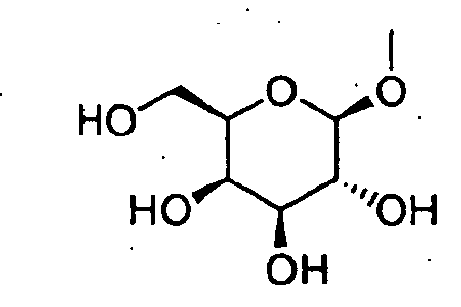
- A pyrazole derivative claimed in any one of claims 1-11 wherein one of Q and T represents a group represented by the formula:

- A pyrazole derivative claimed in claim 12 or 13, wherein T represents a group represented by the formula:

- A pyrazole derivative claimed in claim 12 or 14, wherein Q represents an isopropyl group or a pharmaceutically acceptable salt thereof .
- A pyrazole derivative claimed in claim 1, which is a compound selected from the following group and pharmaceutically acceptable salts thereof.
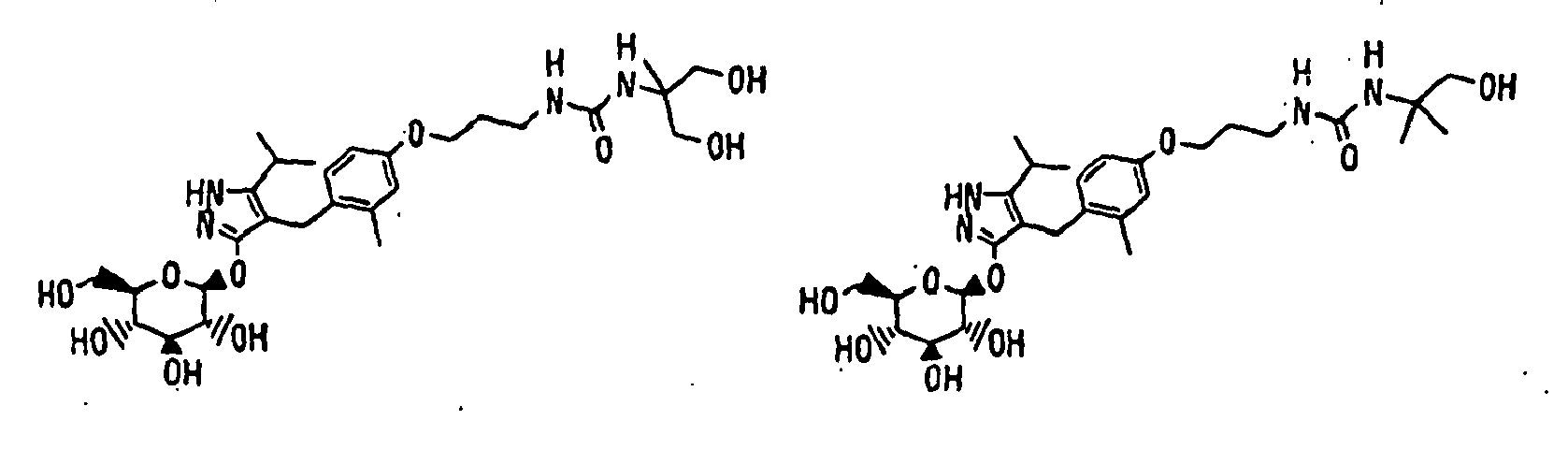
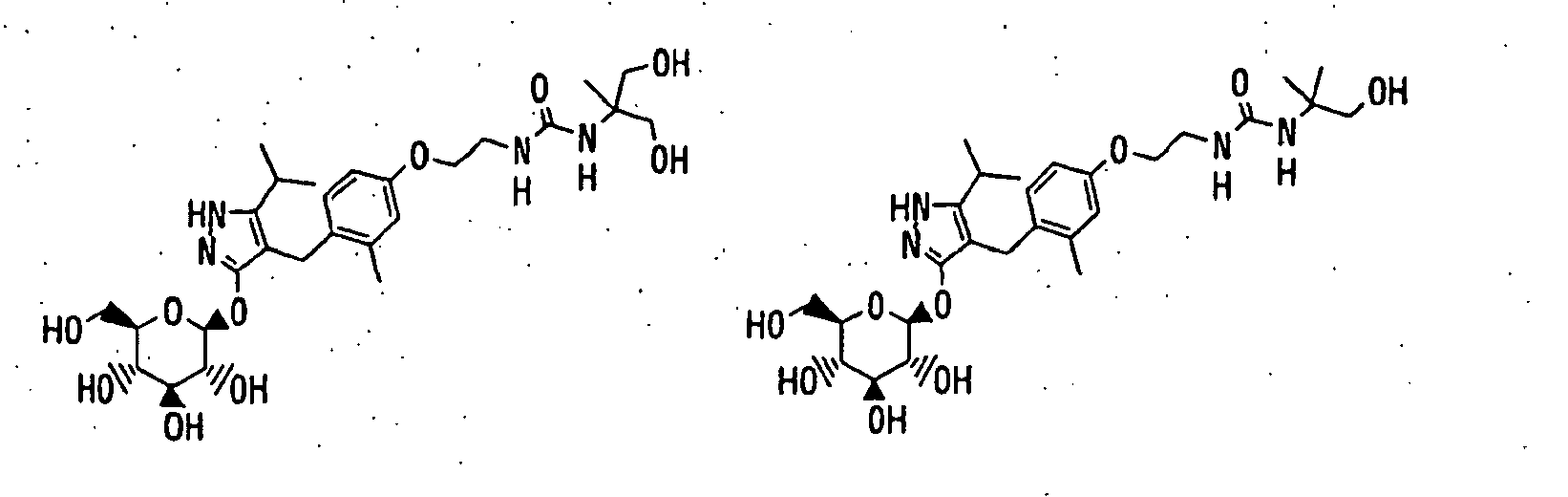


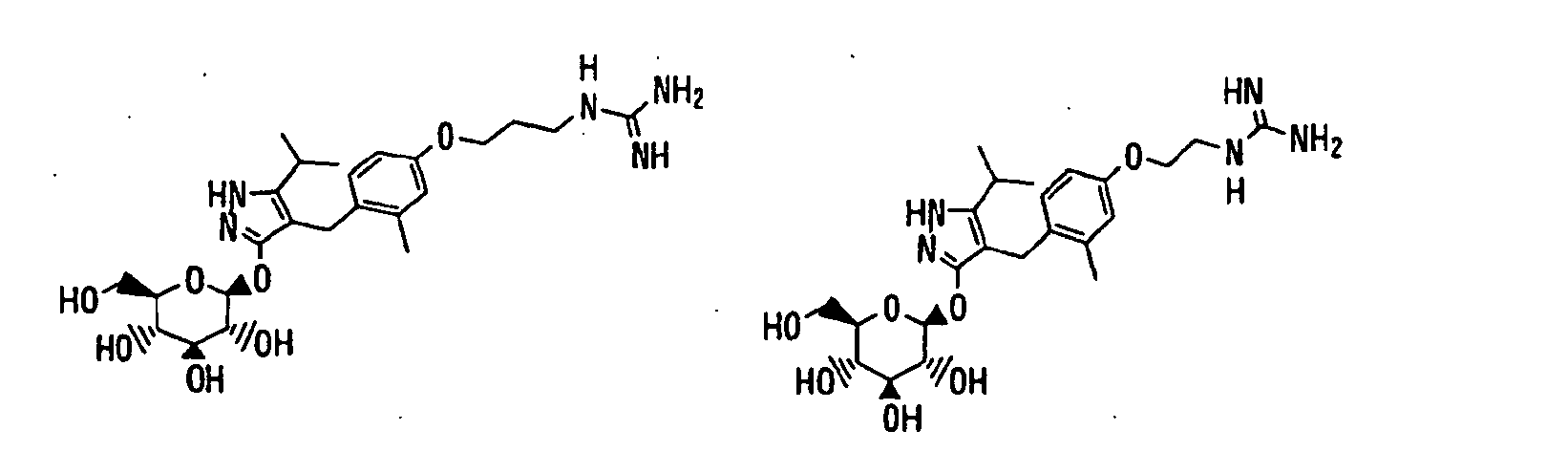


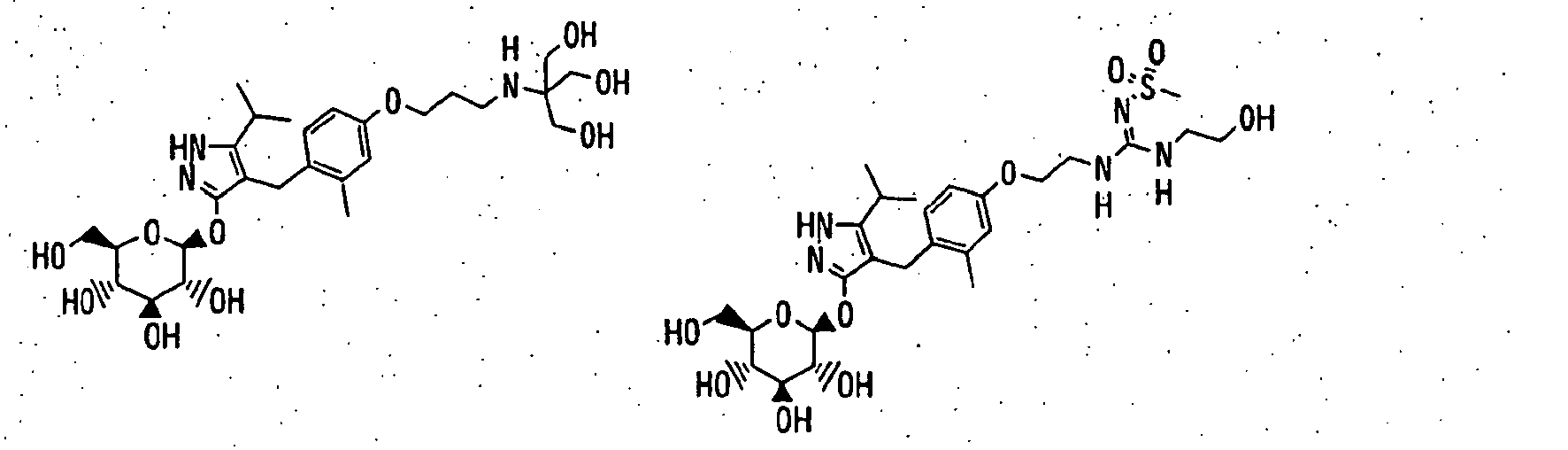


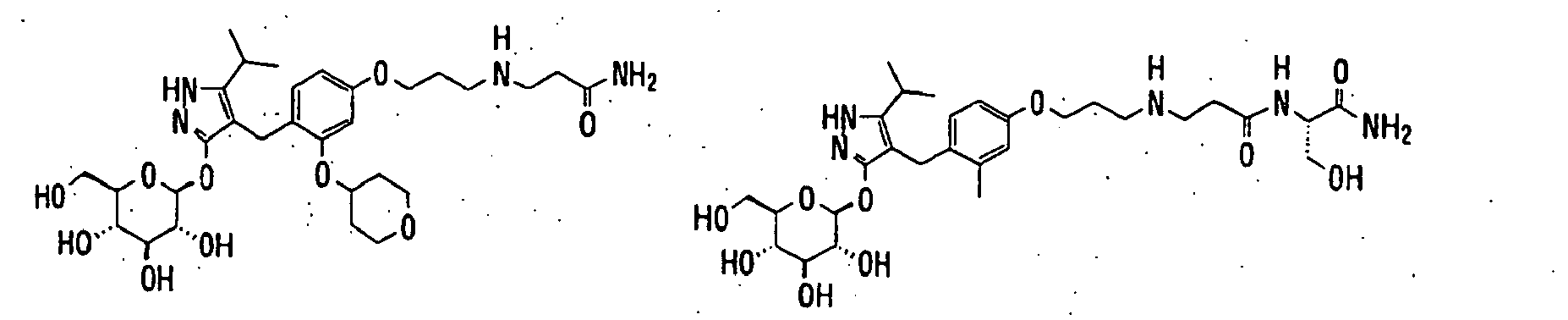


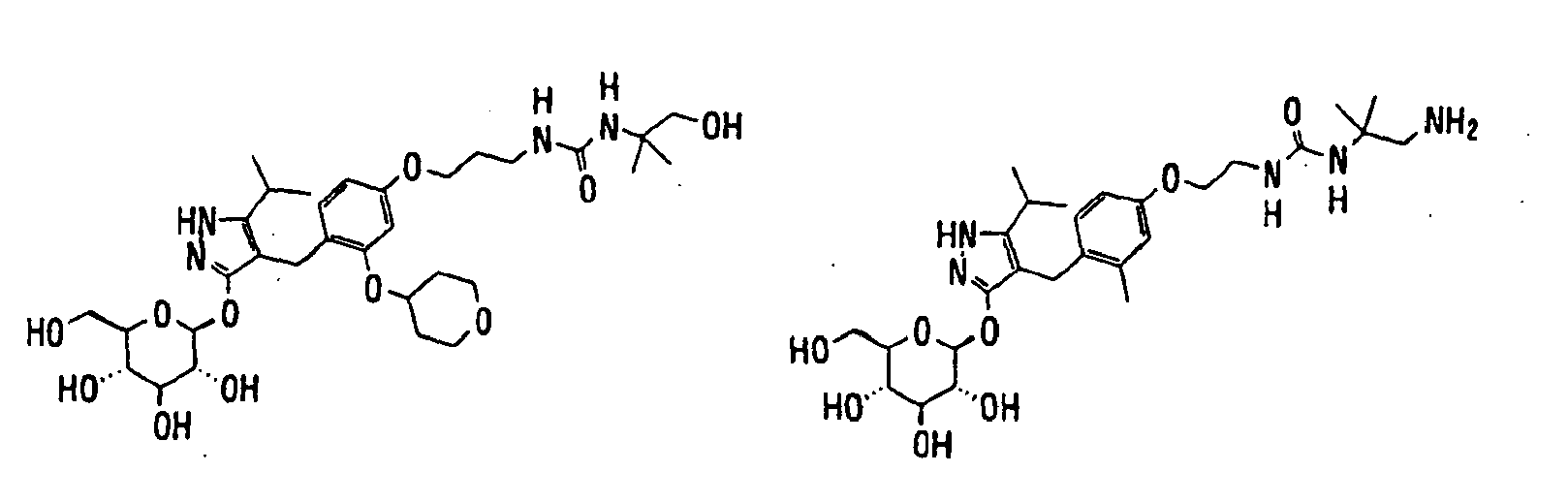

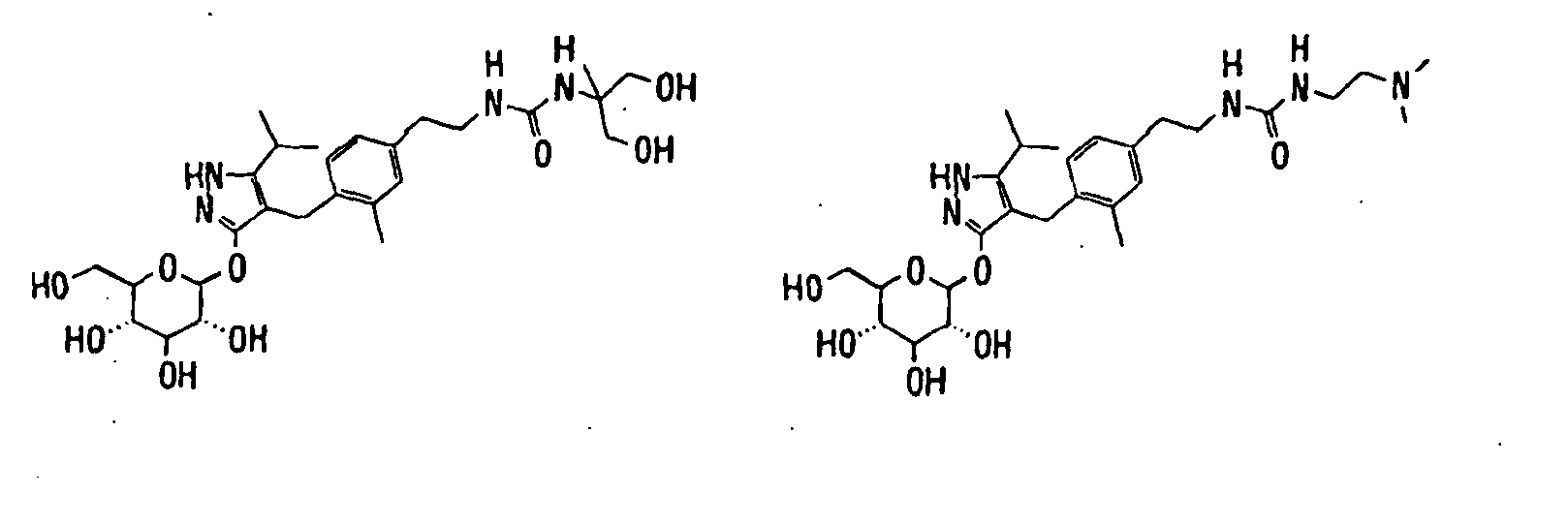


- A pharmaceutical composition comprising as an active ingredient a pyrazole derivative claimed in any one of claims 1-16 or a pharmaceutically acceptable salt thereof .
- A human SGLT1 inhibitor comprising as an active ingredient a pyrazole derivative claimed in any one of claims 1-16 or a pharmaceutically acceptable salt thereof .
- An agent for inhibiting postprandial hyperglycemia comprising as an active ingredient a pyrazole derivative claimed in any one of claims 1-16 or a pharmaceutically acceptable salt thereof .
- An agent for the prevention or treatment of a disease associated with hyperglycemia, which comprises as an active ingredient a pyrazole derivative claimed in any one of claims 1-16 or a pharmaceutically acceptable salt thereof .
- An agent for the prevention or treatment claimed in claim 20. wherein the disease associated with hyperglycemia is a disease selected from the group consisting of diabetes, impaired glucose tolerance, impaired fasting glycemia, diabetic complications, obesity, hyperinsulinemia, hyperlipidemia, hypercholesterolemia, hypertriglyceridemia, lipid metabolism disorder, atherosclerosis, hypertension, congestive heart failure, edema, hyperuricemia and gout.
- An agent for the inhibition of advancing impaired glucose tolerance or impaired fasting glycemia into diabetes in a subject, which comprises as an active ingredient a pyrazole derivative claimed in any one of claims 1-16 or a pharmaceutically acceptable salt thereof .
- An agent for the prevention or treatment of a disease associated with the increase of blood galactose level, which comprises as an active ingredient a pyrazole derivative claimed in any one of claims 1-16 or a pharmaceutically acceptable salt thereof .
- An agent for the prevention or treatment claimed in claim 23, wherein the disease associated with the increase of blood galactose level is galactosemia.
- A pharmaceutical composition claimed in claim 17, wherein the dosage form is sustained release formulation.
- An agent claimed in any one of claims 18-24, wherein the dosage form is sustained release formulation.
- A pyrazole derivative claimed in any one of claims 1-16 or a pharmaceutically acceptable salt thereof for use in a method for the prevention or treatment of a disease associated with hyperglycemia.
- A pyrazole derivative claimed in any one of claims 1-16 or a pharmaceutically acceptable salt thereof for use in a method for the inhibition of advancing impaired glucose tolerance or impaired fasting glycemia into diabetes in a subject.
- A pyrazole derivative claimed in any one of claims 1-16 or a pharmaceutically acceptable salt thereof , for use in a method for the prevention or treatment of a disease associated with the increase of blood galactose level.
- A use of a pyrazole derivative claimed in any one of claims 1-16 or a pharmaceutically acceptable salt thereof for the manufacture of a pharmaceutical composition for the prevention or treatment of a disease associated with hyperglycemia.
- A use of a pyrazole derivative claimed in any one of claims 1-16 or a pharmaceutically acceptable salt thereof thereof for the manufacture of a pharmaceutical composition for the inhibition of advancing impaired glucose tolerance or impaired fasting glycemia into diabetes in a subject.
- A use of a pyrazole derivative claimed in any one of claims 1-16 or a pharmaceutically acceptable salt thereof for the manufacture of a pharmaceutical composition for the prevention or treatment of a disease associated with the increase of blood galactose level.
- A pharmaceutical combination which comprises (A) a pyrazole derivative claimed in any one of claims 1-16 or a pharmaceutically acceptable salt thereof, and (B) at least one member selected from the group consisting of an insulin sensitivity enhancer, a glucose absorption inhibitor, a biguanide, an insulin secretion enhancer, a SGLT2 inhibitor, an insulin or insulin analogue, a glucagon receptor antagonist, an insulin receptor kinase stimulant, a tripeptidyl peptidase II inhibitor, a dipeptidyl peptidase IV inhibitor, a protein tyrosine phosphatase-1B inhibitor, a glycogen phosphorylase inhibitor, a glucose-6-phosphatase inhibitor, a fructose-bisphosphatase inhibitor, a pyruvate dehydrogenase inhibitor, a hepatic gluconeogenesis inhibitor, D-chiroinsitol, a glycogen synthase kinase-3 inhibitor, glucagon-like peptide-1, a glucagon-like peptide-1 analogue, a glucagon-like peptide-1 agonist, amylin, an amylin analogue, an amylin agonist, an aldose reductase inhibitor, an advanced glycation endproducts formation inhibitor, a protein kinase C inhibitor, a γ-aminobutyric acid receptor antagonist, a sodium channel antagonist, a transcript factor NF-κB inhibitor, a lipid peroxidase inhibitor, an N-acetylated-α-linked-acid-dipeptidase inhibitor, insulin-like growth factor-I, platelet-derived growth factor, a platelet-derived growth factor analogue, epidermal growth factor, nerve growth factor, a carnitine derivative, uridine, 5-hydroxy-1-methylhidantoin, EGB-761, bimoclomol, sulodexide, Y-128, antidiarrhoics, cathartics, a hydroxymethylglutaryl coenzyme A reductase inhibitor, a fibric acid derivative, a β3-adrenoceptor agonist, an acyl-coenzyme A cholesterol acyltransferase inhibitor, probcol, a thyroid hormone receptor agonist, a cholesterol absorption inhibitor, a lipase inhibitor, a microsomal triglyceride transfer protein inhibitor, a lipoxygenase inhibitor, a carnitine palmitoyl-transferase inhibitor, a squalene synthase inhibitor, a low-density lipoprotein receptor enhancer, a nicotinic acid derivative, a bile acid sequestrant, a sodium/bile acid cotransporter inhibitor, a cholesterol ester transfer protein inhibitor, an appetite suppressant, an angiotensin-converting enzyme inhibitor, a neutral endopeptidase inhibitor, an angiotensin II receptor antagonist, an endothelin-converting enzyme inhibitor, an endothelin receptor antagonist, a diuretic agent, a calcium antagonist, a vasodilating antihypertensive agent, a sympathetic blocking agent, a centrally acting antihypertensive agent, an α2-adrenoceptor agonist, an antiplatelets agent, a uric acid synthesis inhibitor, a uricosuric agent and a urinary alkalinizer.
- A pharmaceutical combination which comprises (A) a pyrazole derivative claimed in any one of claims 1-16, or a pharmaceutically acceptable salt thereof , and (B) at least one member selected from the group consisting of an insulin sensitivity enhancer, a glucose absorption inhibitor, a biguanide, an insulin secretion enhancer, a SGLT2 inhibitor, an insulin or insulin analogue, a glucagon receptor antagonist, an insulin receptor kinase stimulant, a tripeptidyl peptidase II inhibitor, a dipeptidyl peptidase IV inhibitor, a protein tyrosine phosphatase-1B inhibitor, a glycogen phosphorylase inhibitor, a glucose-6-phosphatase inhibitor, a fructose-bisphosphatase inhibitor, a pyruvate dehydrogenase inhibitor, a hepatic gluconeogenesis inhibitor, D-chiroinsitol, a glycogen synthase kinase-3 inhibitor, glucagon-like peptide-1, a glucagon-like peptide-1 analogue, a glucagon-like peptide-1 agonist, amylin, an amylin analogue, an amylin agonist, an aldose reductase inhibitor, an advanced glycation endproducts formation inhibitor, a protein kinase C inhibitor, a γ-aminobutyric acid receptor antagonist, a sodium channel antagonist, a transcript factor NF-κB inhibitor, a lipid peroxidase inhibitor, an N-acetylated-α-linked-acid-dipeptidase inhibitor, insulin-like growth factor-I, platelet-derived growth factor, a platelet-derived growth factor analogue, epidermal growth factor, nerve growth factor, a carnitine derivative, uridine, 5-hydroxy-1-methylhidantoin, EGB-761, bimoclomol, sulodexide, Y-128, antidiarrhoics, cathartics, a hydroxymethylglutaryl coenzyme A reductase inhibitor, a fibric acid derivative, a β3-adrenoceptor agonist, an acyl-coenzyme A cholesterol acyltransf erase inhibitor, probcol, a thyroid hormone receptor agonist, a cholesterol absorption inhibitor, a lipase inhibitor, a microsomal triglyceride transfer protein inhibitor, a lipoxygenase inhibitor, a carnitine palmitoyl-transferase inhibitor, a squalene synthase inhibitor, a low-density lipoprotein receptor enhancer, a nicotinic acid derivative, a bile acid sequestrant, a sodium/bile acid cotransporter inhibitor, a cholesterol ester transfer protein inhibitor, an appetite suppressant, an angiotensin-converting enzyme inhibitor, a neutral endopeptidase inhibitor, an angiotensin II receptor antagonist, an endothelin-converting enzyme inhibitor, an endothelin receptor antagonist, a diuretic agent, a calcium antagonist, a vasodilating antihypertensive agent, a sympathetic blocking agent, a centrally acting antihypertensive agent, an α2-adrenoceptor agonist, an antiplatelets agent, a uric acid synthesis inhibitor, a uricosuric agent and a urinary alkalinizer for use in a method for the prevention or treatment of a disease associated with hyperglycemia or a disease associated with the increase of blook galactose level.
- A pharmaceutical combination which comprises (A) a pyrazole derivative claimed in any one of claims 1-16 or a pharmaceutically acceptable salt thereof thereof, and (B) at least one member selected from the group consisting of an insulin sensitivity enhancer, a glucose absorption inhibitor, a biguanide, an insulin secretion enhancer, a SGLT2 inhibitor, an insulin or insulin analogue, a glucagon receptor antagonist, an insulin receptor kinase stimulant, a tripeptidyl peptidase II inhibitor, a dipeptidyl peptidase IV inhibitor, a protein tyrosine phosphatase-1B inhibitor, a glycogen phosphorylase inhibitor, a glucose-6-phosphatase inhibitor, a fructose-bisphosphatase inhibitor, a pyruvate dehydrogenase inhibitor, a hepatic gluconeogenesis inhibitor, D-chiroinsitol, a glycogen synthase kinase-3 inhibitor, glucagon-like peptide-1, a glucagon-like peptide-1 analogue, a glucagon-like peptide-1 agonist, amylin, an amylin analogue, an amylin agonist, an aldose reductase inhibitor,
a protein kinase C inhibitor, a γ-aminobutyric acid receptor antagonist, a sodium channel antagonist, a transcript factor NF-κB inhibitor, a lipid peroxidase inhibitor, an N-acetylated-α-linked-acid dipeptidase inhibitor, insulin-like growth factor-I, platelet-derived growth factor, a platelet-derived growth factor analogue, epidermal growth factor, nerve growth factor, a carnitine derivative, uridine, 5-hydroxy-1-methylhidantoin, EGB-761, bimoclomol, sulodexide, Y-128, antidiarrhoics, cathartics, a hydroxymethylglutaryl coenzyme A reductase inhibitor, a fibric acid derivative, a β3-adrenoceptor agonist, an acyl-coenzyme A cholesterol acyltransferase inhibitor, probcol, a thyroid hormone receptor agonist, a cholesterol absorption inhibitor, a lipase inhibitor, a microsomal triglyceride transfer protein inhibitor, a lipoxygenase inhibitor, a carnitine palmitoyl-transferase inhibitor, a squalane synthase inhibitor, a low-density lipoprotein receptor enhancer, a nicotinic acid derivative, a bile acid sequestrant, a sodium/bile acid cotransporter inhibitor, a cholesterol ester transfer protein inhibitor, an appetite suppressant, an angiotensin-converting enzyme inhibitor, a neutral endopeptidase inhibitor, an angiotensin II receptor antagonist, an endothelin-converting enzyme inhibitor, an endothelin receptor antagonist, a diuretic agent, a calcium antagonist, a vasodilating antihypertensive agent, a sympathetic blocking agent, a centrally acting antihypertensive agent, an α2-adrenoceptor agonist, an antiplatelets agent, a uric acid synthesis inhibitor, a uricosuric agent and a urinary alkalinizer for use in a method for the inhibition of advancing impaired glucose tolerance or impaired fasting glycemia into diabetes in a subject. - A use of (A) a pyrazole derivative claimed in any one of claims 1-16 or a pharmaceutically acceptable salt thereof , and (B) at least one member selected from the group consisting of an insulin sensitivity enhancer, a glucose absorption inhibitor, a biguanide, an insulin secretion enhancer, a SGLT2 inhibitor, an insulin or insulin analogue, a glucagon receptor antagonist, an insulin receptor kinase stimulant, a tripeptidyl peptidase II inhibitor, a dipeptidyl peptidase IV inhibitor, a protein tyrosine phosphatase-1B inhibitor, a glycogen phosphorylase inhibitor, a glucose-6-phosphatase inhibitor, a fructose-bisphosphatase inhibitor, a pyruvate dehydrogenase inhibitor, a hepatic gluconeogenesis inhibitor, D-chiroinsitol, a glycogen synthase kinase-3 inhibitor, glucagon-like peptide-1, a glucagon-like peptide-1 analogue, a glucagon-like peptide-1 agonist, amylin, an amylin analogue, an amylin agonist, an aldose reductase inhibitor, an advanced glycation endproducts formation inhibitor, a protein kinase C inhibitor, a γ-aminobutyric acid receptor antagonist, a sodium channel antagonist, a transcript factor NF-κB inhibitor, a lipid peroxidase inhibitor, an N-acetylated-α-linked-acid-dipeptidase inhibitor, insulin-like growth factor-I, platelet-derived growth factor, a platelet-derived growth factor analogue, epidermal growth factor, nerve growth factor, a carnitine derivative, uridine, 5-hydroxy-1-methylhidantoin, EGB-761, bimoclomol, sulodexide, Y-128, antidiarrhoics, cathartics, a hydroxymethylglutaryl coenzyme A reductase inhibitor, a fibric acid derivative, a β3-adrenoceptor agonist, an acyl-coenzyme A cholesterol acyltransferase inhibitor, probcol, a thyroid hormone receptor agonist, a cholesterol absorption inhibitor, a lipase inhibitor, a microsomal triglyceride transfer protein inhibitor, a lipoxygenase inhibitor, a carnitine palmitoyl-transferase inhibitor, a squalene synthase inhibitor, a low-density lipoprotein receptor enhancer, a nicotinic acid derivative, a bile acid sequestrant, a sodium/bile acid cotransporter inhibitor, a cholesterol ester transfer protein inhibitor, an appetite suppressant, an angiotensin-converting enzyme inhibitor, a neutral endopeptidase inhibitor, an angiotensin II receptor antagonist, an endothelin-converting enzyme inhibitor, an endothelin receptor antagonist, a diuretic agent, a calcium antagonist, a vasodilating antihypertensive agent, a sympathetic blocking agent, a centrally acting antihypertensive agent, an α2-adrenoceptor agonist, an antiplatelets agent, a uric acid synthesis inhibitor, auricosuric agent and a urinary alkalinizer, for the manufacture of a pharmaceutical composition for the prevention or treatment of a disease associated with hyperglycemia or a disease associated with the increase of blood galactose level.
- A use of (A) a pyrazole derivative claimed in any one of claims 1-16 or a pharmaceutically acceptable salt thereof , and (B) at least one member selected from the group consisting of an insulin sensitivity enhancer, a glucose absorption inhibitor, a biguanide, an insulin secretion enhancer, a SGLT2 inhibitor, an insulin or insulin analogue, a glucagon receptor antagonist, an insulin receptor kinase stimulant, a tripeptidyl peptidase II inhibitor, a dipeptidyl peptidase IV inhibitor, a protein tyrosine phosphatase-1B inhibitor, a glycogen phosphorylase inhibitor, a glucose-6-phosphatase inhibitor, a fructose-bisphosphatase inhibitor, a pyruvate dehydrogenase inhibitor, a hepatic gluconeogenesis inhibitor, D-chiroinsitol, a glycogen synthase kinase-3 inhibitor, glucagon-like peptide-1, a glucagon-like peptide-1 analogue, a glucagon-like peptide-1 agonist, amylin, an amylin analogue, an amylin agonist, an aldose reductase inhibitor, an advanced glycation endproducts formation inhibitor, a protein kinase C inhibitor, a γ-aminobutyric acid receptor antagonist, a sodium channel antagonist, a transcript factor NF-κB inhibitor, a lipid peroxidase inhibitor, an N-acetylated-α-linked-acid-dipeptidase inhibitor, insulin-like growth factor-I, platelet-derived growth factor, a platelet-derived growth factor analogue, epidermal growth factor, nerve growth factor, a carnitine derivative, uridine, 5-hydroxy-1-methylhidantoin, EGB-761, bimoclomol, sulodexide, Y-128, antidiarrhoics, cathartics, a hydroxymethylglutaryl coenzyme A reductase inhibitor, a fibric acid derivative, a β3-adrenoceptor agonist, an acyl-coenzyme A cholesterol acyltransferase inhibitor, probcol, a thyroid hormone receptor agonist, a cholesterol absorption inhibitor, a lipase inhibitor, a microsomal triglyceride transfer protein inhibitor, a lipoxygenase inhibitor, a carnitine palmitoyl-transferase inhibitor, a squalene synthase inhibitor, a low-density lipoprotein receptor enhancer, a nicotinic acid derivative, a bile acid sequestrant, a sodium/bile acid cotransporter inhibitor, a cholesterol ester transfer protein inhibitor, an appetite suppressant, an angiotensin-converting enzyme inhibitor, a neutral endopeptidase inhibitor, an angiotensin II receptor antagonist, an endothelin-converting enzyme inhibitor, an endothelin receptor antagonist, a diuretic agent, a calcium antagonist, a vasodilating antihypertensive agent, a sympathetic blocking agent, a centrally acting antihypertensive agent, an α2-adrenoceptor agonist, an antiplatelets agent, a uric acid synthesis inhibitor, a uricosuric agent and a urinary alkalinizer, for the manufacture of a pharmaceutical composition for the inhibition of advancing impaired glucose tolerance or impaired fasting glycemia into diabetes in a subject.
- A pyrazole derivative represented by the general formula:

R11 represents a hydrogen atom, a C1-6 alkyl group, a C2-6 alkenyl group, a hydroxy(C2-6 alkyl) group which may have a protective group, a C3-7 cycloalkyl group, a C3-7 cycloalkyl-substituted (C1-6 alkyl) group, an aryl group which may have the same or different 1 to 3 substituents selected from the group consisting of a halogen atom, a hydroxy group which may have a protective group, an amino group which may have a protective group, a C1-6 alkyl group and a C1-6 alkoxy group, or an aryl(C1-6 alkyl) group which may have the same or different 1 to 3 substituents selected from the group consisting of a halogen atom, a hydroxy group which may have a protective group, an amino group which may have a protective group, a C1-6 alkyl group and a C1-6 alkoxy group on the ring;
one of Q2 and T2 represents a 2,3,4,6-tetra-O-acetyl-β-D-glucopyranosyloxy group, a 2,3,4,6-tetra-O-pivaloyl-β-D-glucopyranosyloxy group, a 2,3,4,6-tetra-O-acetyl-β-D-galactopyranosyloxy group or a 2,3,4,6-tetra-O-pivaloyl-β-D-galactopyranosyloxy group, while the other represents a C1-6 alkyl group, a halo(C1-6 alkyl) group, a C1-6 alkoxy-substituted (C1-6 alkyl) group or a C3-7 cycloalkyl group;
R12 represents a hydrogen atom, a halogen atom, a hydroxy group which may have a protective group, a C1-6 alkyl group, a C1-6 alkoxy group, a C1-6 alkylthio group, a halo(C1-6 alkyl) group, a halo (C1-6 alkoxy) group, a C1-6 alkoxy-substituted (C1-6 alkoxy) group, a C3-7 cycloalkyl- substituted (C2-6 alkoxy) group or -A-R1A in which A represents a single bond, an oxygen atom, a methylene group, an ethylene group, -OCH2- or -CH2O-; and R1A represents a C3-7 cycloalkyl group, a C2-6 heterocycloalkyl group, an aryl group which may have the same or different 1 to 3 substituents selected from the group consisting of a halogen atom, a hydroxy group which may have a protective group, an amino group which may have a protective group, a C1-6 alkyl group, a C1-6 alkoxy group, a C2-6 alkenyloxy group, a halo(C1-6 alkyl) group, a hydroxy(C1-6 alkyl) group which may have a protective group, a carboxy group which may have a protective group, a C2-7 alkoxycarbonyl group, a cyano group and a nitro group, or a heteroaryl group which may have a substituent selected from the group consisting of a halogen atom and a C1-6 alkyl group;
X represents a single bond, an oxygen atom or a sulfur atom;
Y1 represents a C1-6 alkylene group which may be substituted by a hydroxy group which may have a protective group, or a C2-6 alkenylene group;
Z1 represents -R1B, -COR1C, -SO2R1C, -CON(R1D)R1E, -SO2NHR1F or -C(=NR1G)N(R1H)R1I;
R1C represents an aryl group which may have the same or different 1 to 3 substituents selected from the group consisting of a halogen atom, a hydroxy group which may have a protective group, an amino group which may have a protective group, a C1-6 alkylsulfonylamino group, a C1-6 alkyl group and a C1-6 alkoxy group, a heteroaryl group which may have a substituent selected from the group consisting of a halogen atom, an amino group which may have a protective group and a C1-6 alkyl group,or a C1-6 alkyl group which may have the same or different 1 to 5 groups selected from the following substituent group (ii);
R14, R1B, R1D, R1E and R1F are the same or different, and each represents a hydrogen atom, an aryl group which may have the same or different 1 to 3 substituents selected from the group consisting of a halogen atom, a hydroxy group which may have a protective group, an amino group which may have a protective group, a C1-6 alkylsulfonylamino group, a C1-6 alkyl group and a C1-6 alkoxy group, a heteroaryl group which may have a substituent selected from the group consisting of a halogen atom, an amino group which may have a protective group and a C1-6 alkyl group, or a C1-6 alkyl group which may have the same or different 1 to 5 groups selected from the following substituent group (ii), or both of R14 and R1B bind together with the neighboring nitrogen atom to form a C2-6 cyclic amino group which may have a substituent selected from the group consisting of a hydroxy group which may have a protective group, a carbamoyl group, a C1-6 alkyl group, an oxo group, a carbamoyl(C1-6 alkyl) group, a hydroxy(C1-6 alkyl) group which may have a protective group and a C1-6 alkylsulfonylamino-substituted (C1-6 alkyl) group, or both of R1D and R1E bind together with the neighboring nitrogen atom to form a C2-6 cyclic amino group which may have a substituent selected from the group consisting of a hydroxy group which may have a protective group, a carbamoyl group, a C1-6 alkyl group, an oxo group, a carbamoyl(C1-6 alkyl) group, a hydroxy(C1-6 alkyl) group which may have a protective group and a C1-6 alkylsulfonylamino-substituted (C1-6 alkyl) group;
R1G, R1H and R1I are the same or different, and each represents a hydrogen atom, a cyano group, a carbamoyl group, a C2-7 acyl group, a C2-7 alkoxycarbonyl group, an aryl(C2-7 alkoxycarbonyl) group, anitrogroup, a C1-6 alkylsulfonyl group, a sulfamide group, a carbamimidoyl group, or a C1-6 alkyl group which may have the same or different 1 to 5 groups selected from the following substituent group (ii), or both of R1G and R1H bind to form an ethylene group, or both of R1H and R1I bind together with the neighboring nitrogen atom to form a C2-6 cyclic amino group which may have a substituent selected from the group consisting of a hydroxy group which may have a protective group, a carbamoyl group, a C1-6 alkyl group, an oxo group, a carbamoyl(C1-6 alkyl) group, a hydroxy(C1-6 alkyl) group which may have a protective group and a C1-6 alkylsulfonylamino-substituted (C1-6 alkyl) group;
R3, R5 and R6 are the same or different, and each represents a hydrogen atom, a halogen atom, a C1-6 alkyl group or a C1-6 alkoxy group; and
substituent group (ii) consists of a hydroxy group which may have a protective group, a C1-6 alkoxy group, a C1-6 alkylthio group, an amino group which may have a protective group, a mono or di(C1-6 alkyl)amino group which may have a protective group, a mono or di[hydroxy(C1-6 alkyl)]amino group which may have a protective group, an ureido group, a sulfamide group, a mono or di(C1-6 alkyl)ureido group, a mono or di(C1-6 alkyl)sulfamide group, a C2-7 acylamino group, a C1-6 alkylsulfonylamino group, a C1-6 alkylsulfonyl group, a carboxy group which may have a protective group, a C2-7 alkoxycarbonyl group, -CON(R1J)R1K in which R1J and R1K are the same or different, and each represents a hydrogen atom or a C1-6 alkyl group which may have the same or different 1 to 3 substituents selected from the group consisting of a hydroxy group which may have a protective group, an amino group which may have a protective group, a mono or di(C1-6 alkyl)amino group which may have a protective group, a mono or di[hydroxy(C1-6 alkyl)]amino group which may have a protective group, an ureido group, a mono or di(C1-6 alkyl)ureido group, a C2-7 acylamino group, a C1-6 alkylsulfonylamino group and a carbamoyl group, or both of R1J and R1K bind together with the neighboring nitrogen atom to form a C2-6 cyclic amino group which may have a substituent selected from the group consisting of a hydroxy group which may have a protective group, a carbamoyl group, a C1-6 alkyl group, an oxo group, a carbamoyl(C1-6 alkyl) group, a hydroxy(C1-6 alkyl) group which may have a protective group and a C1-6 alkylsulfonylamino-substituted (C1-6 alkyl) group, an aryl(C1-6 alkoxy) group which may have the same or different 1 to 3 substituents selected from the group consisting of a halogen atom, a hydroxy group which may have a protective group, an amino group which may have a protective group, a C1-6 alkyl group and a C1-6 alkoxy group on the ring, an aryl(C1-6 alkylthio) group which may have the same or different 1 to 3 substituents selected from the group consisting of a halogen atom, a hydroxy group which may have a protective group, an amino group which may have a protective group, a C1-6 alkyl group and a C1-6 alkoxy group on the ring, a C3-7 cycloalkyl group, a C2-6 heterocycloalkyl group, an aryl group which may have the same or different 1 to 3 substituents selected from the group consisting of a halogen atom, a hydroxy group which may have a protective group, an amino group which may have a protective group, a C1-6 alkylsulfonylamino group, a C1-6 alkyl group and
a C1-6 alkoxy group, a heteroaryl group which may have a substituent selected from the group consisting of a halogen atom, an amino group which may have a protective group and a C1-6 alkyl group, a C2-6 cyclic amino group which may have a substituent selected from the group consisting of a hydroxy group which may have a protective group, a carbamoyl group, a C1-6 alkyl group, an oxo group, a carbamoyl (C1-6 alkyl) group, a hydroxy(C1-6 alkyl) group which may have a protective group and a C1-6 alkylsulfonylamino-substituted (C1-6 alkyl) group, and a C1-4 aromatic cyclic amino group which may have a C1-6 alkyl group as a substituent, or a salt thereof.
Applications Claiming Priority (5)
| Application Number | Priority Date | Filing Date | Title |
|---|---|---|---|
| JP2002244381 | 2002-08-23 | ||
| JP2002244381 | 2002-08-23 | ||
| JP2002324076A JP2004137245A (en) | 2002-08-23 | 2002-11-07 | Pyrazole derivative, pharmaceutical composition containing the same, its pharmaceutical use and production intermediate |
| JP2002324076 | 2002-11-07 | ||
| PCT/JP2003/010551 WO2004018491A1 (en) | 2002-08-23 | 2003-08-21 | Pyrazole derivatives, medicinal composition containing the same, medicinal use thereof, and intermediate for production thereof |
Publications (3)
| Publication Number | Publication Date |
|---|---|
| EP1548024A1 EP1548024A1 (en) | 2005-06-29 |
| EP1548024A4 EP1548024A4 (en) | 2010-05-12 |
| EP1548024B1 true EP1548024B1 (en) | 2012-06-06 |
Family
ID=31949579
Family Applications (1)
| Application Number | Title | Priority Date | Filing Date |
|---|---|---|---|
| EP03792760A Expired - Lifetime EP1548024B1 (en) | 2002-08-23 | 2003-08-21 | Pyrazole derivatives, medicinal composition containing the same, medicinal use thereof, and intermediate for production thereof |
Country Status (16)
| Country | Link |
|---|---|
| US (2) | US7635684B2 (en) |
| EP (1) | EP1548024B1 (en) |
| JP (2) | JP2004137245A (en) |
| KR (1) | KR100985504B1 (en) |
| AU (1) | AU2003262263B8 (en) |
| BR (1) | BRPI0313694B8 (en) |
| CA (1) | CA2496329C (en) |
| ES (1) | ES2386140T3 (en) |
| IL (1) | IL167038A (en) |
| MX (1) | MXPA05002129A (en) |
| NO (1) | NO330569B1 (en) |
| NZ (1) | NZ538423A (en) |
| PL (1) | PL213094B1 (en) |
| RU (1) | RU2369613C2 (en) |
| TW (1) | TW200410980A (en) |
| WO (1) | WO2004018491A1 (en) |
Families Citing this family (55)
| Publication number | Priority date | Publication date | Assignee | Title |
|---|---|---|---|---|
| BRPI0313290B1 (en) * | 2002-08-08 | 2016-12-06 | Kissei Pharmaceutical | pyrazole derivatives, promulgation, pharmaceutical composition, therapeutic agents and medicinal use |
| JP2004137245A (en) | 2002-08-23 | 2004-05-13 | Kissei Pharmaceut Co Ltd | Pyrazole derivative, pharmaceutical composition containing the same, its pharmaceutical use and production intermediate |
| AU2003262262A1 (en) * | 2002-08-27 | 2004-03-19 | Kissei Pharmaceutical Co., Ltd. | Pyrazole derivatives, medicinal composition containing the same, and medicinal use thereof |
| EP1568380A4 (en) * | 2002-12-04 | 2009-10-21 | Kissei Pharmaceutical | Preventive or remedy for diseases caused by hyperglycemia |
| WO2004058790A1 (en) * | 2002-12-25 | 2004-07-15 | Kissei Pharmaceutical Co., Ltd. | Nitrogen-containing heterocycic derivatives, medicinal compositions containing the same and medicinal use thereof |
| US7375090B2 (en) * | 2003-08-26 | 2008-05-20 | Boehringer Ingelheim International Gmbh | Glucopyranosyloxy-pyrazoles, pharmaceutical compositions containing these compounds, the use thereof and processed for the preparation thereof |
| US7838552B2 (en) | 2004-06-04 | 2010-11-23 | Forest Laboratories Holdings Limited | Compositions comprising nebivolol |
| US7803838B2 (en) | 2004-06-04 | 2010-09-28 | Forest Laboratories Holdings Limited | Compositions comprising nebivolol |
| DE102004028241B4 (en) * | 2004-06-11 | 2007-09-13 | Sanofi-Aventis Deutschland Gmbh | New fluoroglycoside derivatives of pyrazoles, medicines containing these compounds and manufacture of these medicines |
| EP1813611B1 (en) | 2004-11-18 | 2014-10-01 | Kissei Pharmaceutical Co., Ltd. | 1-substituted-3- beta-d-glycopyranosylated nitrogenous hetero- cyclic compounds and medicines containing the same |
| JP2008007405A (en) * | 2004-12-07 | 2008-01-17 | Takeda Chem Ind Ltd | Carboxamide derivative |
| CA2621269A1 (en) * | 2005-07-22 | 2007-01-25 | Boehringer Ingelheim International Gmbh | Processes for preparing pyrazole-o-glycoside derivatives and novel intermediates of said processes |
| UY30082A1 (en) | 2006-01-11 | 2007-08-31 | Boehringer Ingelheim Int | CRYSTAL FORM OF 1- (1-METHYLETHYL) -4` - ((2-FLUORO-4-METOXIFENIL) METHYL) -5`- METHYL-1H-PIRAZOL-3`-OBD-GLUCOPYRANOSIDE, A METHOD FOR PREPARATION AND USE OF THE SAME TO PREPARE MEDICATIONS |
| JP2009167103A (en) * | 2006-05-02 | 2009-07-30 | Taisho Pharmaceutical Co Ltd | Pyrazolyl 5-thioglycoside compound |
| PE20110235A1 (en) | 2006-05-04 | 2011-04-14 | Boehringer Ingelheim Int | PHARMACEUTICAL COMBINATIONS INCLUDING LINAGLIPTIN AND METMORPHINE |
| AR061026A1 (en) | 2006-05-19 | 2008-07-30 | Taisho Pharmaceutical Co Ltd | C-PHENYL GLICITOL COMPOUND AND PHARMACEUTICAL PREPARATION |
| CA2655937A1 (en) | 2006-06-29 | 2008-01-03 | Taisho Pharmaceutical Co., Ltd. | C-phenyl 1-thioglucitol compound |
| AU2007332476A1 (en) | 2006-12-14 | 2008-06-19 | Taisho Pharmaceutical Co., Ltd. | 1-phenyl 1-thio-D-glucitol derivative |
| CA2709530C (en) | 2007-12-27 | 2016-02-23 | Kissei Pharmaceutical Co., Ltd. | Monosebacate of pyrazole derivative |
| US8354382B2 (en) * | 2008-04-16 | 2013-01-15 | Kissei Pharmaceutical Co., Ltd. | Hemifumarate of a pyrazole derivative |
| AP2728A (en) | 2008-08-28 | 2013-08-31 | Pfizer | Dioxa-bicyclo[3.2.1.] octane-2,3,4-triol derivatives |
| MY155658A (en) | 2009-02-23 | 2015-11-13 | Taisho Pharmaceutical Co Ltd | A-isopropylphenyl glucitol compounds as sglti inhibitors |
| WO2011002011A1 (en) * | 2009-07-01 | 2011-01-06 | キッセイ薬品工業株式会社 | Combined medicine of sglt1 inhibitor and dpp-iv inhibitor |
| TW201105336A (en) * | 2009-07-01 | 2011-02-16 | Kissei Pharmaceutical | Combined medicine of pyrazole derivative and biguanide drug |
| WO2011002012A1 (en) * | 2009-07-01 | 2011-01-06 | 大日本住友製薬株式会社 | Medicinal agent comprising combination of sglt1 inhibitor and insulin-resistance-ameliorating agent |
| CN102574776A (en) | 2009-07-31 | 2012-07-11 | 桑多斯股份公司 | Process for the preparation of ω-amino-alkamides and ω-amino-alkanesulfamides and intermediates for the process |
| EP2298782A1 (en) * | 2009-08-26 | 2011-03-23 | Sanofi-Aventis | Method for producing pyrazole glycoside derivatives |
| WO2011039338A2 (en) | 2009-10-02 | 2011-04-07 | Sanofi-Aventis | Use of compounds with sglt-1/sglt-2 inhibitor activity for producing medicaments for treatment of bone diseases |
| WO2011048148A2 (en) | 2009-10-20 | 2011-04-28 | Novartis Ag | Glycoside derivative and uses thereof |
| US8163704B2 (en) | 2009-10-20 | 2012-04-24 | Novartis Ag | Glycoside derivatives and uses thereof |
| DK2496583T3 (en) | 2009-11-02 | 2015-02-02 | Pfizer | Dioxa-bicyclo [3.2.1] octane-2,3,4-triol DERIVATIVES |
| WO2011107494A1 (en) | 2010-03-03 | 2011-09-09 | Sanofi | Novel aromatic glycoside derivatives, medicaments containing said compounds, and the use thereof |
| WO2012010651A2 (en) | 2010-07-23 | 2012-01-26 | Sandoz Ag | Method for the preparation of omega-amino-alkaneamides and omega-amino-alkanethioamides as well as intermediates of this method |
| ES2546253T3 (en) | 2010-08-20 | 2015-09-22 | Taisho Pharmaceutical Co., Ltd. | 4-Isopropyl-6-methoxyphenylglucitol compound |
| CA2807755A1 (en) | 2010-08-20 | 2012-02-23 | Taisho Pharmaceutical Co., Ltd. | Crystal form of 4-isopropylphenyl glucitol compound and process for production thereof |
| US8614195B2 (en) | 2011-04-14 | 2013-12-24 | Novartis Ag | Glycoside derivatives and uses thereof |
| CA2832951A1 (en) | 2011-04-14 | 2012-10-18 | Novartis Ag | Glycoside derivatives and uses thereof |
| AR087701A1 (en) * | 2011-08-31 | 2014-04-09 | Japan Tobacco Inc | PIRAZOL DERIVATIVES WITH SGLT1 INHIBITING ACTIVITY |
| PL2848254T3 (en) | 2012-05-07 | 2017-03-31 | Kissei Pharmaceutical Co., Ltd. | Pyrazole derivative and use thereof for medical purposes |
| UA113086C2 (en) | 2012-05-10 | 2016-12-12 | PRAZOLE COMPOUNDS AS SGLT1 INHIBITORS | |
| TW201425326A (en) | 2012-10-05 | 2014-07-01 | Lilly Co Eli | Novel urea compounds |
| UA117574C2 (en) | 2012-11-20 | 2018-08-27 | Лексікон Фармасьютікалз, Інк. | Inhibitors of sodium glucose cotransporter 1 |
| MX346453B (en) | 2013-02-04 | 2017-03-17 | Taisho Pharmaceutical Co Ltd | Prophylactic or therapeutic drug for constipation. |
| EP2774619B1 (en) | 2013-03-04 | 2016-05-18 | BioActive Food GmbH | Composition for the treatment of hyperglycaemic diseases |
| US8652527B1 (en) | 2013-03-13 | 2014-02-18 | Upsher-Smith Laboratories, Inc | Extended-release topiramate capsules |
| US9101545B2 (en) | 2013-03-15 | 2015-08-11 | Upsher-Smith Laboratories, Inc. | Extended-release topiramate capsules |
| AR098670A1 (en) | 2013-11-08 | 2016-06-08 | Lilly Co Eli | SGLT1 INHIBITOR |
| EP2944311A1 (en) | 2014-05-16 | 2015-11-18 | BioActive Food GmbH | Combination of biologically active substances for treating hyperglycemic diseases |
| CN111630058B (en) | 2018-01-31 | 2022-02-15 | 广东东阳光药业有限公司 | Glucopyranosyl derivative and use thereof |
| BR112020019624A8 (en) * | 2018-03-28 | 2022-03-03 | Avolynt | Method to treat postprandial hypoglycemia |
| EP3886854A4 (en) | 2018-11-30 | 2022-07-06 | Nuvation Bio Inc. | PYRROLE AND PYRAZOLE COMPOUNDS AND METHODS OF USE THEREOF |
| BR112021024165A2 (en) | 2019-05-31 | 2022-04-26 | Avolynt | Compositions and methods for the treatment of metabolic diseases |
| WO2024254354A1 (en) * | 2023-06-06 | 2024-12-12 | Vogenx | Compositions and methods for treating refractory or intractable epilepsy |
| WO2024254302A1 (en) * | 2023-06-06 | 2024-12-12 | Vogenx | Compositions and methods for treating hyperinsulinemic hypoglycemia |
| WO2025117962A1 (en) * | 2023-12-01 | 2025-06-05 | Vogenx | Compositions and methods for treating glucose-dependent insulinotropic peptide-dependent cushing's syndrome |
Family Cites Families (8)
| Publication number | Priority date | Publication date | Assignee | Title |
|---|---|---|---|---|
| KR20020060067A (en) * | 1999-04-06 | 2002-07-16 | 가와무라 요시부미 | α-SUBSTITUTED CARBOXYLIC ACID DERIVATIVES |
| BRPI0013667B8 (en) | 1999-08-31 | 2021-05-25 | Kissei Pharmaceutical | glucopyranosyloxypyrazole derivatives, medicinal compositions containing them and their intermediates in their production |
| ES2337127T3 (en) * | 2000-11-02 | 2010-04-21 | Ajinomoto Co., Inc. | NEW DERIVATIVES OF PIRAZOL AND REMEDIES AGAINST DIABETES CONTAINING THEM. |
| MXPA03005923A (en) * | 2000-12-28 | 2004-01-26 | Kissei Pharmaceuticals Co Ltd | Glucopyranosyloxypyrazole derivatives and use thereof in medicines. |
| BRPI0313290B1 (en) * | 2002-08-08 | 2016-12-06 | Kissei Pharmaceutical | pyrazole derivatives, promulgation, pharmaceutical composition, therapeutic agents and medicinal use |
| JP2004137245A (en) | 2002-08-23 | 2004-05-13 | Kissei Pharmaceut Co Ltd | Pyrazole derivative, pharmaceutical composition containing the same, its pharmaceutical use and production intermediate |
| CA2500873C (en) * | 2002-10-04 | 2012-01-17 | Kissei Pharmaceutical Co., Ltd. | Pyrazole derivative, medicinal composition containing the same, medicinal use thereof and intermediate in producing the same |
| US7576064B2 (en) * | 2003-06-20 | 2009-08-18 | Kissei Pharmaceutical Co., Ltd. | Pyrazole derivative, drug composition containing the same and production intermediate therefor |
-
2002
- 2002-11-07 JP JP2002324076A patent/JP2004137245A/en active Pending
-
2003
- 2003-08-21 KR KR1020057003117A patent/KR100985504B1/en not_active Expired - Lifetime
- 2003-08-21 RU RU2005108055/04A patent/RU2369613C2/en active
- 2003-08-21 MX MXPA05002129A patent/MXPA05002129A/en active IP Right Grant
- 2003-08-21 PL PL375551A patent/PL213094B1/en unknown
- 2003-08-21 CA CA2496329A patent/CA2496329C/en not_active Expired - Lifetime
- 2003-08-21 EP EP03792760A patent/EP1548024B1/en not_active Expired - Lifetime
- 2003-08-21 AU AU2003262263A patent/AU2003262263B8/en not_active Expired
- 2003-08-21 JP JP2005501231A patent/JP4597048B2/en not_active Expired - Lifetime
- 2003-08-21 ES ES03792760T patent/ES2386140T3/en not_active Expired - Lifetime
- 2003-08-21 WO PCT/JP2003/010551 patent/WO2004018491A1/en not_active Ceased
- 2003-08-21 US US10/525,197 patent/US7635684B2/en active Active
- 2003-08-21 NZ NZ538423A patent/NZ538423A/en not_active IP Right Cessation
- 2003-08-21 BR BRPI0313694A patent/BRPI0313694B8/en not_active IP Right Cessation
- 2003-08-22 TW TW092123126A patent/TW200410980A/en not_active IP Right Cessation
-
2005
- 2005-02-22 IL IL167038A patent/IL167038A/en unknown
- 2005-03-17 NO NO20051411A patent/NO330569B1/en not_active IP Right Cessation
-
2009
- 2009-04-09 US US12/421,236 patent/US8324176B2/en not_active Expired - Lifetime
Also Published As
| Publication number | Publication date |
|---|---|
| BRPI0313694B1 (en) | 2017-12-19 |
| JP4597048B2 (en) | 2010-12-15 |
| PL213094B1 (en) | 2013-01-31 |
| AU2003262263B2 (en) | 2009-06-25 |
| US20050272669A1 (en) | 2005-12-08 |
| PL375551A1 (en) | 2005-11-28 |
| BR0313694A (en) | 2005-07-05 |
| KR20050038633A (en) | 2005-04-27 |
| RU2369613C2 (en) | 2009-10-10 |
| NO20051411L (en) | 2005-04-26 |
| MXPA05002129A (en) | 2005-06-03 |
| EP1548024A4 (en) | 2010-05-12 |
| AU2003262263A1 (en) | 2004-03-11 |
| RU2005108055A (en) | 2006-02-10 |
| ES2386140T3 (en) | 2012-08-10 |
| AU2003262263B8 (en) | 2009-08-06 |
| US7635684B2 (en) | 2009-12-22 |
| CA2496329A1 (en) | 2004-03-04 |
| JPWO2004018491A1 (en) | 2005-12-08 |
| NO330569B1 (en) | 2011-05-16 |
| HK1082744A1 (en) | 2006-06-16 |
| NZ538423A (en) | 2007-02-23 |
| IL167038A (en) | 2010-11-30 |
| CA2496329C (en) | 2012-05-15 |
| WO2004018491A1 (en) | 2004-03-04 |
| BRPI0313694B8 (en) | 2021-05-25 |
| JP2004137245A (en) | 2004-05-13 |
| KR100985504B1 (en) | 2010-10-05 |
| EP1548024A1 (en) | 2005-06-29 |
| US8324176B2 (en) | 2012-12-04 |
| TWI298071B (en) | 2008-06-21 |
| TW200410980A (en) | 2004-07-01 |
| US20090203633A1 (en) | 2009-08-13 |
Similar Documents
| Publication | Publication Date | Title |
|---|---|---|
| EP1548024B1 (en) | Pyrazole derivatives, medicinal composition containing the same, medicinal use thereof, and intermediate for production thereof | |
| US7375087B2 (en) | Pyrazole derivative, medicinal composition containing the same, medicinal use thereof, and intermediate for production thereof | |
| US7998975B2 (en) | Nitrogenous fused-ring derivatives, medicinal compositions containing the derivatives, and use thereof as drugs | |
| EP1609798B1 (en) | Fused heterocyclic derivative, medicinal composition containing the same, and medicinal use thereof | |
| EP1577317A1 (en) | Nitrogen-containing heterocycic derivatives, medicinal compositions containing the same and medicinal use thereof | |
| JP2004196788A (en) | Benzylphenol derivatives, pharmaceutical compositions containing them and their pharmaceutical uses | |
| US20070185197A1 (en) | Phenol derivative, medicinal composition containing the same, and medicinal use thereof | |
| HK1082744B (en) | Pyrazole derivatives, medicinal composition containing the same, medicinal use thereof, and intermediate for production thereof |
Legal Events
| Date | Code | Title | Description |
|---|---|---|---|
| PUAI | Public reference made under article 153(3) epc to a published international application that has entered the european phase |
Free format text: ORIGINAL CODE: 0009012 |
|
| 17P | Request for examination filed |
Effective date: 20050225 |
|
| AK | Designated contracting states |
Kind code of ref document: A1 Designated state(s): AT BE BG CH CY CZ DE DK EE ES FI FR GB GR HU IE IT LI LU MC NL PT RO SE SI SK TR |
|
| AX | Request for extension of the european patent |
Extension state: AL LT LV MK |
|
| DAX | Request for extension of the european patent (deleted) | ||
| A4 | Supplementary search report drawn up and despatched |
Effective date: 20100412 |
|
| RIC1 | Information provided on ipc code assigned before grant |
Ipc: A61P 3/10 20060101ALI20100406BHEP Ipc: A61K 38/27 20060101ALI20100406BHEP Ipc: A61K 38/26 20060101ALI20100406BHEP Ipc: A61K 38/00 20060101ALI20100406BHEP Ipc: A61K 31/737 20060101ALI20100406BHEP Ipc: A61K 31/7072 20060101ALI20100406BHEP Ipc: A61K 31/4166 20060101ALI20100406BHEP Ipc: A61K 31/37 20060101ALI20100406BHEP Ipc: A61K 31/205 20060101ALI20100406BHEP Ipc: A61K 31/10 20060101ALI20100406BHEP Ipc: A61K 31/7056 20060101ALI20100406BHEP Ipc: C07H 17/02 20060101AFI20040320BHEP |
|
| 17Q | First examination report despatched |
Effective date: 20110318 |
|
| GRAP | Despatch of communication of intention to grant a patent |
Free format text: ORIGINAL CODE: EPIDOSNIGR1 |
|
| GRAS | Grant fee paid |
Free format text: ORIGINAL CODE: EPIDOSNIGR3 |
|
| GRAA | (expected) grant |
Free format text: ORIGINAL CODE: 0009210 |
|
| AK | Designated contracting states |
Kind code of ref document: B1 Designated state(s): AT BE BG CH CY CZ DE DK EE ES FI FR GB GR HU IE IT LI LU MC NL PT RO SE SI SK TR |
|
| REG | Reference to a national code |
Ref country code: GB Ref legal event code: FG4D |
|
| REG | Reference to a national code |
Ref country code: AT Ref legal event code: REF Ref document number: 560989 Country of ref document: AT Kind code of ref document: T Effective date: 20120615 Ref country code: CH Ref legal event code: NV Representative=s name: KIRKER & CIE S.A. Ref country code: CH Ref legal event code: EP |
|
| REG | Reference to a national code |
Ref country code: NL Ref legal event code: T3 |
|
| REG | Reference to a national code |
Ref country code: IE Ref legal event code: FG4D |
|
| REG | Reference to a national code |
Ref country code: DE Ref legal event code: R096 Ref document number: 60341190 Country of ref document: DE Effective date: 20120802 |
|
| REG | Reference to a national code |
Ref country code: SE Ref legal event code: TRGR |
|
| REG | Reference to a national code |
Ref country code: ES Ref legal event code: FG2A Ref document number: 2386140 Country of ref document: ES Kind code of ref document: T3 Effective date: 20120810 |
|
| PG25 | Lapsed in a contracting state [announced via postgrant information from national office to epo] |
Ref country code: CY Free format text: LAPSE BECAUSE OF FAILURE TO SUBMIT A TRANSLATION OF THE DESCRIPTION OR TO PAY THE FEE WITHIN THE PRESCRIBED TIME-LIMIT Effective date: 20120606 Ref country code: FI Free format text: LAPSE BECAUSE OF FAILURE TO SUBMIT A TRANSLATION OF THE DESCRIPTION OR TO PAY THE FEE WITHIN THE PRESCRIBED TIME-LIMIT Effective date: 20120606 |
|
| REG | Reference to a national code |
Ref country code: AT Ref legal event code: MK05 Ref document number: 560989 Country of ref document: AT Kind code of ref document: T Effective date: 20120606 |
|
| PG25 | Lapsed in a contracting state [announced via postgrant information from national office to epo] |
Ref country code: GR Free format text: LAPSE BECAUSE OF FAILURE TO SUBMIT A TRANSLATION OF THE DESCRIPTION OR TO PAY THE FEE WITHIN THE PRESCRIBED TIME-LIMIT Effective date: 20120907 Ref country code: SI Free format text: LAPSE BECAUSE OF FAILURE TO SUBMIT A TRANSLATION OF THE DESCRIPTION OR TO PAY THE FEE WITHIN THE PRESCRIBED TIME-LIMIT Effective date: 20120606 |
|
| PG25 | Lapsed in a contracting state [announced via postgrant information from national office to epo] |
Ref country code: CZ Free format text: LAPSE BECAUSE OF FAILURE TO SUBMIT A TRANSLATION OF THE DESCRIPTION OR TO PAY THE FEE WITHIN THE PRESCRIBED TIME-LIMIT Effective date: 20120606 Ref country code: SK Free format text: LAPSE BECAUSE OF FAILURE TO SUBMIT A TRANSLATION OF THE DESCRIPTION OR TO PAY THE FEE WITHIN THE PRESCRIBED TIME-LIMIT Effective date: 20120606 Ref country code: AT Free format text: LAPSE BECAUSE OF FAILURE TO SUBMIT A TRANSLATION OF THE DESCRIPTION OR TO PAY THE FEE WITHIN THE PRESCRIBED TIME-LIMIT Effective date: 20120606 Ref country code: EE Free format text: LAPSE BECAUSE OF FAILURE TO SUBMIT A TRANSLATION OF THE DESCRIPTION OR TO PAY THE FEE WITHIN THE PRESCRIBED TIME-LIMIT Effective date: 20120606 Ref country code: RO Free format text: LAPSE BECAUSE OF FAILURE TO SUBMIT A TRANSLATION OF THE DESCRIPTION OR TO PAY THE FEE WITHIN THE PRESCRIBED TIME-LIMIT Effective date: 20120606 |
|
| PG25 | Lapsed in a contracting state [announced via postgrant information from national office to epo] |
Ref country code: PT Free format text: LAPSE BECAUSE OF FAILURE TO SUBMIT A TRANSLATION OF THE DESCRIPTION OR TO PAY THE FEE WITHIN THE PRESCRIBED TIME-LIMIT Effective date: 20121008 |
|
| PG25 | Lapsed in a contracting state [announced via postgrant information from national office to epo] |
Ref country code: MC Free format text: LAPSE BECAUSE OF NON-PAYMENT OF DUE FEES Effective date: 20120831 |
|
| PLBE | No opposition filed within time limit |
Free format text: ORIGINAL CODE: 0009261 |
|
| STAA | Information on the status of an ep patent application or granted ep patent |
Free format text: STATUS: NO OPPOSITION FILED WITHIN TIME LIMIT |
|
| PG25 | Lapsed in a contracting state [announced via postgrant information from national office to epo] |
Ref country code: DK Free format text: LAPSE BECAUSE OF FAILURE TO SUBMIT A TRANSLATION OF THE DESCRIPTION OR TO PAY THE FEE WITHIN THE PRESCRIBED TIME-LIMIT Effective date: 20120606 |
|
| 26N | No opposition filed |
Effective date: 20130307 |
|
| REG | Reference to a national code |
Ref country code: IE Ref legal event code: MM4A |
|
| REG | Reference to a national code |
Ref country code: DE Ref legal event code: R097 Ref document number: 60341190 Country of ref document: DE Effective date: 20130307 |
|
| PG25 | Lapsed in a contracting state [announced via postgrant information from national office to epo] |
Ref country code: BG Free format text: LAPSE BECAUSE OF FAILURE TO SUBMIT A TRANSLATION OF THE DESCRIPTION OR TO PAY THE FEE WITHIN THE PRESCRIBED TIME-LIMIT Effective date: 20120906 Ref country code: IE Free format text: LAPSE BECAUSE OF NON-PAYMENT OF DUE FEES Effective date: 20120821 |
|
| PG25 | Lapsed in a contracting state [announced via postgrant information from national office to epo] |
Ref country code: LU Free format text: LAPSE BECAUSE OF NON-PAYMENT OF DUE FEES Effective date: 20120821 |
|
| PG25 | Lapsed in a contracting state [announced via postgrant information from national office to epo] |
Ref country code: HU Free format text: LAPSE BECAUSE OF FAILURE TO SUBMIT A TRANSLATION OF THE DESCRIPTION OR TO PAY THE FEE WITHIN THE PRESCRIBED TIME-LIMIT Effective date: 20030821 |
|
| REG | Reference to a national code |
Ref country code: FR Ref legal event code: PLFP Year of fee payment: 14 |
|
| REG | Reference to a national code |
Ref country code: FR Ref legal event code: PLFP Year of fee payment: 15 |
|
| REG | Reference to a national code |
Ref country code: FR Ref legal event code: PLFP Year of fee payment: 16 |
|
| PGFP | Annual fee paid to national office [announced via postgrant information from national office to epo] |
Ref country code: NL Payment date: 20220809 Year of fee payment: 20 |
|
| PGFP | Annual fee paid to national office [announced via postgrant information from national office to epo] |
Ref country code: TR Payment date: 20220727 Year of fee payment: 20 Ref country code: SE Payment date: 20220816 Year of fee payment: 20 Ref country code: IT Payment date: 20220818 Year of fee payment: 20 Ref country code: GB Payment date: 20220818 Year of fee payment: 20 Ref country code: ES Payment date: 20220906 Year of fee payment: 20 Ref country code: DE Payment date: 20220823 Year of fee payment: 20 |
|
| PGFP | Annual fee paid to national office [announced via postgrant information from national office to epo] |
Ref country code: FR Payment date: 20220815 Year of fee payment: 20 Ref country code: BE Payment date: 20220809 Year of fee payment: 20 |
|
| PGFP | Annual fee paid to national office [announced via postgrant information from national office to epo] |
Ref country code: CH Payment date: 20220822 Year of fee payment: 20 |
|
| REG | Reference to a national code |
Ref country code: DE Ref legal event code: R071 Ref document number: 60341190 Country of ref document: DE |
|
| REG | Reference to a national code |
Ref country code: NL Ref legal event code: MK Effective date: 20230820 |
|
| REG | Reference to a national code |
Ref country code: ES Ref legal event code: FD2A Effective date: 20230828 |
|
| REG | Reference to a national code |
Ref country code: CH Ref legal event code: PL |
|
| REG | Reference to a national code |
Ref country code: GB Ref legal event code: PE20 Expiry date: 20230820 |
|
| REG | Reference to a national code |
Ref country code: BE Ref legal event code: MK Effective date: 20230821 |
|
| REG | Reference to a national code |
Ref country code: SE Ref legal event code: EUG |
|
| PG25 | Lapsed in a contracting state [announced via postgrant information from national office to epo] |
Ref country code: GB Free format text: LAPSE BECAUSE OF EXPIRATION OF PROTECTION Effective date: 20230820 Ref country code: ES Free format text: LAPSE BECAUSE OF EXPIRATION OF PROTECTION Effective date: 20230822 |