EP1547893A1 - Method and apparatus for controlling lift of a structural object - Google Patents
Method and apparatus for controlling lift of a structural object Download PDFInfo
- Publication number
- EP1547893A1 EP1547893A1 EP04029567A EP04029567A EP1547893A1 EP 1547893 A1 EP1547893 A1 EP 1547893A1 EP 04029567 A EP04029567 A EP 04029567A EP 04029567 A EP04029567 A EP 04029567A EP 1547893 A1 EP1547893 A1 EP 1547893A1
- Authority
- EP
- European Patent Office
- Prior art keywords
- pressure
- value
- air
- deviation
- lift
- Prior art date
- Legal status (The legal status is an assumption and is not a legal conclusion. Google has not performed a legal analysis and makes no representation as to the accuracy of the status listed.)
- Granted
Links
Images




Classifications
-
- B—PERFORMING OPERATIONS; TRANSPORTING
- B65—CONVEYING; PACKING; STORING; HANDLING THIN OR FILAMENTARY MATERIAL
- B65G—TRANSPORT OR STORAGE DEVICES, e.g. CONVEYORS FOR LOADING OR TIPPING, SHOP CONVEYOR SYSTEMS OR PNEUMATIC TUBE CONVEYORS
- B65G7/00—Devices for assisting manual moving or tilting heavy loads
- B65G7/02—Devices adapted to be interposed between loads and the ground or floor, e.g. crowbars with means for assisting conveyance of loads
- B65G7/06—Devices adapted to be interposed between loads and the ground or floor, e.g. crowbars with means for assisting conveyance of loads using fluid at high pressure supplied from an independent source to provide a cushion between load and ground
-
- B—PERFORMING OPERATIONS; TRANSPORTING
- B60—VEHICLES IN GENERAL
- B60V—AIR-CUSHION VEHICLES
- B60V1/00—Air-cushion
- B60V1/11—Stability or attitude control
-
- B—PERFORMING OPERATIONS; TRANSPORTING
- B66—HOISTING; LIFTING; HAULING
- B66F—HOISTING, LIFTING, HAULING OR PUSHING, NOT OTHERWISE PROVIDED FOR, e.g. DEVICES WHICH APPLY A LIFTING OR PUSHING FORCE DIRECTLY TO THE SURFACE OF A LOAD
- B66F3/00—Devices, e.g. jacks, adapted for uninterrupted lifting of loads
- B66F3/24—Devices, e.g. jacks, adapted for uninterrupted lifting of loads fluid-pressure operated
- B66F3/25—Constructional features
- B66F3/35—Inflatable flexible elements, e.g. bellows
Definitions
- the invention relates to a method and apparatus for controlling the lift of at least one structural object where the structure(s) is (are) lifted-and-transported using a plurality of air-casters each of which has a torus bag capable of lifting the structure(s) so as to be easily moved.
- Lift-and-transportation includes a stage from initiating lift to completion of the lift, a stage of transporting a structure while being lifted, and a stage of initiating landing (lifting down) to completion of the landing.
- the publication of unexamined applications JP2001-2400A is an example of a description of a lift-and-transportation apparatus using a plurality of air-casters.
- the air-caster has a structure such as one shown in FIG.4 where the air-caster includes a torus bag (doughnut-shaped bag)(6), piping (3) for feeding compressed air (2) into the torus bag, a landing pad (7) being in contact with a floor (ground) (8) while the compressed air is not fed into the torus bag, and a base plate(mounting plate) (5) contacting a structural object to be lifted-and-transported.
- the air-caster itself is supported by the landing pad wherein the bottom face contacts the floor while the torus bag is in a relaxed state (as shown in FIG.4-(a)).
- the torus bag inflates (state as shown in FIG.4-(b)).
- the pressure in the torus bag exceeds a predetermined pressure value, the compressed air is discharged through the gap between the torus bag and the floor(ground) to form an air foil (state as shown in FIG.4-(c)).
- Air consumption of the air-caster corresponds to an amount of the discharged air.
- the structural object on the air-caster can be moved in lateral direction by pulling horizontally.
- Piping for feeding compressed air into the plurality of air-casters in one section includes primary piping for feeding compressed air to the one section and secondary piping branching off from the primary piping for feeding the compressed air to each of the plurality of air-casters.
- the primary piping and the secondary piping have a primary flow control valve and a secondary flow control valve, respectively.
- Each air-caster does not always have the same amount of distance required for the lift (lift distance) when the same air flow rate or the same inner air pressure are provided, since the properties of the torus bags can vary from one to another.
- the secondary flow control valve has a function to compensate for the difference in the lift distances caused by the different properties of the torus bags. An operator can visually observe the difference in lift for the torus bags and manually control a valve opening for each primary flow control valve so that all the divided 4-5 sections can be gradually lifted in the same speed or be kept in the same level of lift distance.
- this conventional method has the following problems in the lift (lifting-up) process and landing (lifting-down) process.
- This difficulty also occurs when the structural object is landing (lifted down for landing) from the lifted (floating) position. During landing, it is also difficult to make a plurality of air-casters in the same section have the same lift distance only by controlling the opening of the primary flow control valve. Even if each of the secondary flow control valves is adjusted according to the individual property of each torus bag in advance so that the plurality of air-casters in the same section can have the same lift distance only by controlling the opening of the primary flow control valve, the floor (ground) where each of the torus bags is in contact is not always even, which leads to a difference in air consumption in each torus bag, which results in different lift distances for each torus bag.
- the contour of the floor (ground) in the area where each torus bag is in contact usually changes as the structural object is transported. This may result in a drastic increase in the compressed air consumption. Therefore, while moving a structural object in a lateral direction while maintaining flotation, the opening of each primary flow control valve has to be momentarily controlled to adjust the flotation so that 4 or 5 sections will have almost the same lift distance, which task is very difficult to perform. It is also difficult to make a plurality of air-casters in the same section have the same lift distance by only controlling the opening of the primary flow control valve, since conditions of the floor (ground) in contact with the torus bags usually change as the air-caster moves.
- the range of the opening of the valve where the flow rate is proportional to the degree of the opening is very limited. If the opening exceeds the range, then the flow rate drastically increases. Accordingly, in the case of manually controlling the opening of the valve, only the limited range where the flow rate is proportional to the degree of the opening is available. Other ranges where the relation between the degree of the opening and the flow rate is unclear or unstable cannot be practically available for manual control. Thus, it is impossible to manually feed compressed air instantly into the torus bag of the air-caster, where the compressed air is drastically consumed, to compensate for the consumption.
- the structural object to be lifted weighs at least one ton.
- the structural object to be lifted weighs at least 20 tons.
- the structural object to be lifted weighs at least 200 tons.
- An embodiment of the present invention is an apparatus for controlling the lift of at least one structural object comprising: a plurality of air-casters each of which has a torus bag; piping for feeding compressed air into the air-caster; a flow control valve installed in the piping; a pressure gauge installed in each air-caster for measuring an inner pressure of the torus bag; a lifted distance measuring gauge installed in each of air-casters for measuring a lifted distance of the air-caster; and a data processing unit for receiving pressure data measured by the pressure gauge and lifted distance data measured by the lifted distance measuring gauge and sending a valve opening control signal to the flow control valve based on the pressure data and/or a lifted distance data.
- the change in pressure ( ⁇ P) within the air-caster is controlled over time depending on the situation.
- the ⁇ P/time is referred to herein as a "pressure gradient value.”
- the data processing unit comprises: basic data including a reference pressure gradient value, a modified pressure gradient value and the reference value for deviation of lift distance; means for calculating a deviation of lifted distance of each air-caster based on the lifted distance data from the lifted distance measuring gauge and comparing the deviation of lifted distance and the reference value for deviation of lift distance; means for shifting a pressure gradient value from the reference pressure gradient value to the modified pressure gradient value according to a result of comparing the deviation of the lift distance with the reference value for deviation of lift distance; means for calculating a reference pressure value at a specified time based on the time and the reference pressure gradient value or the modified pressure gradient value; means for calculating a result by comparing the pressure data measured by the pressure gauge and the reference pressure value at a specified time; and means for generating the valve opening control signal according to the calculated result based on the comparison and sending the generated signal to the flow control valve.
- the present invention relates to a method for controlling the lift of a structural object using a plurality of air-casters each of which has a torus bag comprising the steps of: measuring an inner pressure of each torus bag; comparing the measured pressure data and a reference pressure value; and controlling an opening of a flow control valve to control the flow of compressed air to be fed into the torus bag according to the results of the comparison.
- the method further comprises the steps of: measuring the lifted distance of each air-caster; calculating the deviation of the lifted distance of each air-caster according to the measured lifted distance; comparing the calculated deviation to a reference value for deviation of lift distance; and setting a pressure gradient value for each air-caster according to the results of the comparison.
- FIG. 5 illustrates a schematic of a controlling apparatus and is described in FIG. 1, which is a flow diagram showing the method for controlling the lift of the structural object using air-casters.
- a plurality of air-casters are arranged to be underneath the structural object.
- the number of the air-caster is determined based on the weight of the structural object and performance of the air-caster. Any arrangement of the air-casters are possible so long as the structural object can be supported with good balance.
- five air-casters (AC1-AC5) are arranged to lift a 230 ton structural object.
- Each air-caster is equipped with a pressure gauge to measure inner pressure of the torus bag and the measured pressure data is sent to a data processing unit. Also each air-caster is equipped with a lift distance measuring gauge to measure lift distance of the structural object and measured distance data is sent to a data processing unit.
- the lift distance is defined as a distance between the bottom face of landing pad 7 and the surface of floor 8 shown in FIG. 4.
- the frequency (time interval) of the measurement of the pressure and/or the distance will vary depending upon the purpose, but is preferably about 1 cycle/second for fine pressure control and fine distance control.
- the frequency of cycles can be 0.01 to 1000 cycles/second, or more preferably 0.5 to 2 cycles/second.
- the frequencies can be set by the data processing unit or the pressure gauge or the lifted distance measuring gauge itself.
- a laser displacement gauge is used as a lift distance measuring gauge.
- the distance to the object is measured in the following way: light is emitted, an optical path of the light is changed with prism or mirror, the light reaches the target object and is reflected by the target to return to sensor head.
- Measuring accuracy of this gauge depends on the surface state of target object where the laser light is reflected. Therefore, it is preferable to color the surface or cover the surface with a colored object having a dull white or dull gray color which improves the precision of reflection.
- Each piping for feeding compressed air into each of air-casters from the compressor is equipped with a flow control valve to which a valve opening control signal for controlling the opening of the flow control valve is sent from a data processing unit.
- a compressor equipped with a dryer is shown which feeds the compressed air through an air filter to remove foreign materials
- a flow control valve is shown which feeds compressed air into each of the air-casters.
- the compressor should preferably be capable of feeding much higher pressure of compressed air than the inner pressure required for the air-caster.
- source pressure of the compressor can be 6 Kg/cm 2 to create a pressure of 3.5 Kg/ cm 2 for the torus bag of the air-caster.
- the inner pressure of the torus bag increases as time goes on according to a predetermined pressure gradient value until a base plate of the air-caster reaches a bottom plate of the structural object.
- a data processing unit sends a valve opening control signal to a flow control valve after comparing data from the pressure gauge with a reference pressure at a specified time which is determined by the time and the pressure gradient value. For example, if the measured inner pressure of torus bag is less than the reference pressure at the time, the data processing unit sends a valve opening control signal to make the valve opening increase by 1% to the flow control valve.
- the percentage for increasing the opening can be determined in proportion to the difference between the measured inner pressure of the torus bag and the reference pressure at the time.
- the valve opening control signal is sent to the flow control valve according to the frequency of the pressure measurement.
- the present invention is mainly directed to a lift control process after the base plate of the air-caster reaches the bottom plate of the structural object.
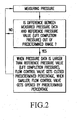
- a lift control shown in FIG.1 is performed, where both pressure measurements and lift measurements are performed.
- Inner pressure of the torus bag increases as time progresses according to a predetermined reference pressure gradient value.
- the data processing unit sends the valve opening control signal to the flow control valve after comparing the data from the pressure gauge with the reference pressure (from a reference pressure gradient) at a specified time. For example, if the measured inner pressure of a torus bag is less than the reference pressure at the time, the data processing unit sends a valve opening control signal to open the flow control valve an additional 1%.
- the percentage for increasing the opening can be determined in proportion to the difference between the measured inner pressure of torus bag and the reference pressure at the time.
- the reference pressure gradient value is set up as (several percent of the difference between a lift initiation pressure and a lift completion pressure)/min.
- the difference measured between a lift initiation pressure and a lift completion pressure can be from 0.5Kg/cm 2 to 0.8Kg/cm 2 . Therefore, 0.02 Kg/cm 2 /min, which is about 3% of (from 0.5Kg/cm 2 to 0.8Kg/cm 2 ), is set up as a reference pressure gradient value.
- a deviation of lift distance for each air-caster is calculated using the data processing unit.
- An average lift distance is normally calculated using lift distance data from all of the air-casters used. However, an average value calculated using the data from 60% or more of the total number of air-casters used can be practically useful for the purpose of calculating the deviation. If the deviation of lift distance of some air-caster deviates from a predetermined reference value for deviation of lift distance, a pressure gradient value applied to the air-caster is shifted from the reference pressure gradient to a modified pressure gradient.
- a reference value for deviation of lift distance and a modified pressure gradient value are set up as below in the data processing unit in advance.
- Reference Value for Deviation of Lift Distance Condition Modified Pressure Gradient Value - 2mm Deviation of lift distance of the air-caster is less than - 2mm 0.04 Kg/cm 2 /min.
- - 1mm Deviation of lift distance of the air-caster is less than - 1mm 0.03 Kg/cm 2 /min.
- + 1mm Deviation of lift distance of the air-caster is more than + 1mm 0.01 Kg/cm 2 /min.
- + 2mm Deviation of lift distance of the air-caster is more than + 2mm 0.00 Kg/cm 2 /min.
- the data processing unit When a pressure gradient value is changed to a modified pressure gradient value by the data processing unit for an air-caster, the data processing unit sends a valve opening control signal to a flow control valve of the said air-caster after comparing the data from pressure gauge with a reference pressure at a specified time calculated from the modified pressure gradient value.
- a combination of controlling the valve opening so that the inner pressure of each air-caster can follow a specified pressure gradient and controlling the shift of pressure gradient value so that the deviation of lift distance can stay within a predetermined range can be used, which makes it possible to lift a large structural object having a bottom plate of 20 m in diameter without causing any bends or warps.
- the reference value for deviation of lift distance and the modified pressure gradient value can be modified as appropriate and the number of the reference value for deviation of lift distance can be changed, for example, from 4 in the above example to 6 or 2 (e.g., - 1mm and + 1mm) .
- a normal designed pressure of the air-caster e.g., 3.5 - 5.0 Kg/cm 2
- a normal designed pressure of the air-caster can be an appropriate upper limit value.
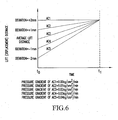
- FIG.6 is a graph showing the rough relationship between the time and lift distance with respect to each air-caster according to one implementation (described below) of the present invention.
- #1 air-caster (AC1) is lifted 2mm more than the average lift distance which is calculated as an average of 5 lift distances for 5 air-casters.
- #2 air-caster (AC2) is lifted 1mm more than the average.
- #3 air-caster (AC3) is lifted equal to the average.
- #4 air-caster (AC4) is lifted 1mm less than the average.
- #5 air-caster (AC5) is lifted 2mm less than the average.
- the data processing unit shifts the pressure gradient of AC1 from 0.02 Kg/cm 2 /min.
- the data processing unit sends a valve opening control signal to a flow control valve so that the inner pressure of each air-caster can follow the shifted new pressure gradient (modified pressure gradient value).
- the difference between the lift distances of air-casters becomes small.
- lift completion pressure e.g.,3.0.Kg/cm 2
- the inner pressure at the time is set up as a reference pressure value in the data processing unit, and the measuring lift distance is terminated.
- An embodiment of the present invention is a method for controlling lift of a structural object while being lifted and moved in lateral direction is described using FIG.2.
- the air casters there are 5 air-casters shown in FIG.5 can support the weight of the structural object (e.g. , 230 ton) at the lift completion pressure. It is unavoidable for the structural object to tend to slightly tilt in the pulling direction when the structure is pulled and moved, however, it is not necessary to correct the tilt. Therefore, only a pressure control, i.e. , pressure of each air-caster is kept at the lift completion pressure, is required unlike the control performed in FIG.1 where the measuring lift distance is required.
- FIG.3 is a flow diagram showing a method for controlling lift of a structural object when the structural object is landing (lifted down for landing) from the floating position.
- the control method for the landing is almost the same as the one for starting the lift except that the reference pressure gradient value is set as - 0.02 kg/cm 2 /min. Further the reference value for deviation of lift distance and the modified pressure gradient value are set in the data processing unit as below.
- Reference Value For Deviation Of Lift Distance Condition Modified Pressure Gradient Value - 2mm Deviation of lift distance of the air-caster is less than - 2mm 0.00 Kg/cm 2 /min.
- - 1mm Deviation of lift distance of the air-caster is less than - 1mm - 0.01 Kg/cm 2 /min.
- + 1mm Deviation of lift distance of the air-caster is more than + 1mm - 0.03 Kg/cm 2 /min.
- + 2mm Deviation of lift distance of the air-caster is more than + 2mm - 0.04 Kg/cm 2 /min.
- a pressure at which the air-caster just contacts the structural object (bottom plate) e.g., 0.5 Kg/cm 2
- the bottom face of a structural object can be automatically kept in parallel (horizontal) to the floor regardless of the floor contour to which the air-caster faces, which makes it possible to lift and transport a large structural object without causing deformations such as bends or warps.
- the bottom part of a blast furnace which is lined on the inside with refractory materials such as brick, it is strictly required to avoid deformation and/or stress to the refractory materials.
- the method and the apparatus for the lift control set forth above can be preferably applied to the transportation of a structural object such as a bottom part block of a blast furnace which is lined on the inside with refractory materials.
Landscapes
- Engineering & Computer Science (AREA)
- Mechanical Engineering (AREA)
- Aviation & Aerospace Engineering (AREA)
- Transportation (AREA)
- Life Sciences & Earth Sciences (AREA)
- Geology (AREA)
- Structural Engineering (AREA)
- Forklifts And Lifting Vehicles (AREA)
- Magnetic Bearings And Hydrostatic Bearings (AREA)
- Control Of Fluid Pressure (AREA)
- Conveying And Assembling Of Building Elements In Situ (AREA)
- Load-Engaging Elements For Cranes (AREA)
- Control And Safety Of Cranes (AREA)
- Rollers For Roller Conveyors For Transfer (AREA)
- Fluid-Pressure Circuits (AREA)
- Forms Removed On Construction Sites Or Auxiliary Members Thereof (AREA)
- Handcart (AREA)
Abstract
Description
- The invention relates to a method and apparatus for controlling the lift of at least one structural object where the structure(s) is (are) lifted-and-transported using a plurality of air-casters each of which has a torus bag capable of lifting the structure(s) so as to be easily moved. Lift-and-transportation includes a stage from initiating lift to completion of the lift, a stage of transporting a structure while being lifted, and a stage of initiating landing (lifting down) to completion of the landing.
- The publication of unexamined applications JP2001-2400A is an example of a description of a lift-and-transportation apparatus using a plurality of air-casters. The air-caster has a structure such as one shown in FIG.4 where the air-caster includes a torus bag (doughnut-shaped bag)(6), piping (3) for feeding compressed air (2) into the torus bag, a landing pad (7) being in contact with a floor (ground) (8) while the compressed air is not fed into the torus bag, and a base plate(mounting plate) (5) contacting a structural object to be lifted-and-transported. The air-caster itself is supported by the landing pad wherein the bottom face contacts the floor while the torus bag is in a relaxed state (as shown in FIG.4-(a)). When compressed air is fed into the torus bag, the torus bag inflates (state as shown in FIG.4-(b)). When the pressure in the torus bag exceeds a predetermined pressure value, the compressed air is discharged through the gap between the torus bag and the floor(ground) to form an air foil (state as shown in FIG.4-(c)). Air consumption of the air-caster corresponds to an amount of the discharged air. In the state where the air foil is formed in addition to completion of lift by the air-caster, the structural object on the air-caster can be moved in lateral direction by pulling horizontally.
- A conventional method for controlling the lift of a structural object in the case where the structure is lifted-and-transported using a plurality of air-casters is now described. First, a bottom face of a large structural object to be transported is divided into 4 or 5 sections to arrange a plurality of air-casters to each section. Piping for feeding compressed air into the plurality of air-casters in one section includes primary piping for feeding compressed air to the one section and secondary piping branching off from the primary piping for feeding the compressed air to each of the plurality of air-casters. The primary piping and the secondary piping have a primary flow control valve and a secondary flow control valve, respectively. Each air-caster does not always have the same amount of distance required for the lift (lift distance) when the same air flow rate or the same inner air pressure are provided, since the properties of the torus bags can vary from one to another. The secondary flow control valve has a function to compensate for the difference in the lift distances caused by the different properties of the torus bags. An operator can visually observe the difference in lift for the torus bags and manually control a valve opening for each primary flow control valve so that all the divided 4-5 sections can be gradually lifted in the same speed or be kept in the same level of lift distance. However, this conventional method has the following problems in the lift (lifting-up) process and landing (lifting-down) process.
- It is difficult to lift a large structural object having a diameter of more than 10 m while maintaining the bottom face of the object horizontal and in good balance by manually controlling the opening of the flow control valve through visually observing the lift distance. In particular, after the lifting force by inner pressure of the torus bag becomes matched with the weight of the object, fine control of the air flow and inner pressure of the torus bag is required to make the air-caster float. However it is impossible for the operator to manually make such a fine control of the opening of the primary flow control valve in each divided section through visually observing the lift distance. Consequently, it is very difficult to lift a large structural object so that it is level horizontally and to make it float.
- This difficulty also occurs when the structural object is landing (lifted down for landing) from the lifted (floating) position. During landing, it is also difficult to make a plurality of air-casters in the same section have the same lift distance only by controlling the opening of the primary flow control valve. Even if each of the secondary flow control valves is adjusted according to the individual property of each torus bag in advance so that the plurality of air-casters in the same section can have the same lift distance only by controlling the opening of the primary flow control valve, the floor (ground) where each of the torus bags is in contact is not always even, which leads to a difference in air consumption in each torus bag, which results in different lift distances for each torus bag.
- Further, there are problems for moving a structural object in a lateral direction while maintaining flotation:
- A problem can occur when the contour of the floor in which the object is being transported changes. The contour of the floor (ground) in the area where each torus bag is in contact usually changes as the structural object is transported. This may result in a drastic increase in the compressed air consumption. Therefore, while moving a structural object in a lateral direction while maintaining flotation, the opening of each primary flow control valve has to be momentarily controlled to adjust the flotation so that 4 or 5 sections will have almost the same lift distance, which task is very difficult to perform. It is also difficult to make a plurality of air-casters in the same section have the same lift distance by only controlling the opening of the primary flow control valve, since conditions of the floor (ground) in contact with the torus bags usually change as the air-caster moves. As for the flow control valve, the range of the opening of the valve where the flow rate is proportional to the degree of the opening is very limited. If the opening exceeds the range, then the flow rate drastically increases. Accordingly, in the case of manually controlling the opening of the valve, only the limited range where the flow rate is proportional to the degree of the opening is available. Other ranges where the relation between the degree of the opening and the flow rate is unclear or unstable cannot be practically available for manual control. Thus, it is impossible to manually feed compressed air instantly into the torus bag of the air-caster, where the compressed air is drastically consumed, to compensate for the consumption.
- It is an object of the present invention to provide a method and an apparatus for controlling lift of at least one structural object in the case where the object(s) is (are) lifted-and-transported using a plurality of air-casters in order to solve the problems in the conventional technology set forth above, which can prevent the object(s) from having deformation such as a bend and/or warp while being lifted-and-transported.
- This object can be achieved by the features defined in the claims.
- In an embodiment of the present invention, the structural object to be lifted weighs at least one ton. Preferably, the structural object to be lifted weighs at least 20 tons. Most preferably, the structural object to be lifted weighs at least 200 tons.
- An embodiment of the present invention is an apparatus for controlling the lift of at least one structural object comprising: a plurality of air-casters each of which has a torus bag; piping for feeding compressed air into the air-caster; a flow control valve installed in the piping; a pressure gauge installed in each air-caster for measuring an inner pressure of the torus bag; a lifted distance measuring gauge installed in each of air-casters for measuring a lifted distance of the air-caster; and a data processing unit for receiving pressure data measured by the pressure gauge and lifted distance data measured by the lifted distance measuring gauge and sending a valve opening control signal to the flow control valve based on the pressure data and/or a lifted distance data.
- In an embodiment of the present invention, the change in pressure (ΔP) within the air-caster is controlled over time depending on the situation. The ΔP/time is referred to herein as a "pressure gradient value."
- In an embodiment of the present invention, the data processing unit comprises: basic data including a reference pressure gradient value, a modified pressure gradient value and the reference value for deviation of lift distance; means for calculating a deviation of lifted distance of each air-caster based on the lifted distance data from the lifted distance measuring gauge and comparing the deviation of lifted distance and the reference value for deviation of lift distance; means for shifting a pressure gradient value from the reference pressure gradient value to the modified pressure gradient value according to a result of comparing the deviation of the lift distance with the reference value for deviation of lift distance; means for calculating a reference pressure value at a specified time based on the time and the reference pressure gradient value or the modified pressure gradient value; means for calculating a result by comparing the pressure data measured by the pressure gauge and the reference pressure value at a specified time; and means for generating the valve opening control signal according to the calculated result based on the comparison and sending the generated signal to the flow control valve.
- According to another embodiment, the present invention relates to a method for controlling the lift of a structural object using a plurality of air-casters each of which has a torus bag comprising the steps of: measuring an inner pressure of each torus bag; comparing the measured pressure data and a reference pressure value; and controlling an opening of a flow control valve to control the flow of compressed air to be fed into the torus bag according to the results of the comparison.
- In an embodiment of the present invention, the method further comprises the steps of: measuring the lifted distance of each air-caster; calculating the deviation of the lifted distance of each air-caster according to the measured lifted distance; comparing the calculated deviation to a reference value for deviation of lift distance; and setting a pressure gradient value for each air-caster according to the results of the comparison. Thus, in order to shift the structural object from landing state to lifted state, a combination of controlling the valve opening so that the inner pressure of each air-caster can follow a specified pressure gradient and controlling the shift of the pressure gradient value so that the deviation of lift distance can stay within a predetermined range.
- The present invention is more specifically set forth in the following description with reference to the drawings, in which;
- FIG. 1 is a flow diagram showing a method for controlling lift of a structural object using air-casters;
- FIG.2 is a flow diagram showing a method for controlling lift of a structural object using air-casters while the structural object is lifted and moved;
- FIG.3 is a flow diagram showing a method for controlling lift of a structural object using air-casters when the structural object is landing (lifted down for landing) from the lifted position;
- FIG. 4 is a schematic of an air-caster used for the present invention;
- FIG.5 is a schematic of a controlling apparatus used for the present invention;
- FIG.6 is a graph showing a rough relationship between the time and lift distance with respect to each air-caster;
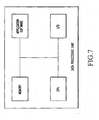
- FIG.7 is an exemplary diagram of the components of the data processing apparatus; and
- FIG.8 is also an exemplary diagram of the components of the data processing apparatus.
-
- An embodiment of the invention is described using FIG. 5 which illustrates a schematic of a controlling apparatus and is described in FIG. 1, which is a flow diagram showing the method for controlling the lift of the structural object using air-casters. In order to lift and transport the structural object (by compressed air using air-casters), a plurality of air-casters are arranged to be underneath the structural object. The number of the air-caster is determined based on the weight of the structural object and performance of the air-caster. Any arrangement of the air-casters are possible so long as the structural object can be supported with good balance. In the embodiment shown in FIG.5, five air-casters (AC1-AC5) are arranged to lift a 230 ton structural object.
- Each air-caster is equipped with a pressure gauge to measure inner pressure of the torus bag and the measured pressure data is sent to a data processing unit. Also each air-caster is equipped with a lift distance measuring gauge to measure lift distance of the structural object and measured distance data is sent to a data processing unit. The lift distance is defined as a distance between the bottom face of landing pad 7 and the surface of
floor 8 shown in FIG. 4. The frequency (time interval) of the measurement of the pressure and/or the distance will vary depending upon the purpose, but is preferably about 1 cycle/second for fine pressure control and fine distance control. The frequency of cycles can be 0.01 to 1000 cycles/second, or more preferably 0.5 to 2 cycles/second. The frequencies can be set by the data processing unit or the pressure gauge or the lifted distance measuring gauge itself. - In FIG.5 a laser displacement gauge is used as a lift distance measuring gauge. In the laser displacement gauge, the distance to the object is measured in the following way: light is emitted, an optical path of the light is changed with prism or mirror, the light reaches the target object and is reflected by the target to return to sensor head.
- Measuring accuracy of this gauge depends on the surface state of target object where the laser light is reflected. Therefore, it is preferable to color the surface or cover the surface with a colored object having a dull white or dull gray color which improves the precision of reflection.
- Each piping for feeding compressed air into each of air-casters from the compressor is equipped with a flow control valve to which a valve opening control signal for controlling the opening of the flow control valve is sent from a data processing unit. In the example shown in FIG.5, a compressor equipped with a dryer is shown which feeds the compressed air through an air filter to remove foreign materials, and a flow control valve is shown which feeds compressed air into each of the air-casters. The compressor should preferably be capable of feeding much higher pressure of compressed air than the inner pressure required for the air-caster. For example, source pressure of the compressor can be 6 Kg/cm2 to create a pressure of 3.5 Kg/ cm2 for the torus bag of the air-caster.
- In order to shift the structural object from a landing state to a lifting state, the inner pressure of the torus bag increases as time goes on according to a predetermined pressure gradient value until a base plate of the air-caster reaches a bottom plate of the structural object. For that purpose, a data processing unit sends a valve opening control signal to a flow control valve after comparing data from the pressure gauge with a reference pressure at a specified time which is determined by the time and the pressure gradient value. For example, if the measured inner pressure of torus bag is less than the reference pressure at the time, the data processing unit sends a valve opening control signal to make the valve opening increase by 1% to the flow control valve. The percentage for increasing the opening can be determined in proportion to the difference between the measured inner pressure of the torus bag and the reference pressure at the time. The valve opening control signal is sent to the flow control valve according to the frequency of the pressure measurement. The present invention is mainly directed to a lift control process after the base plate of the air-caster reaches the bottom plate of the structural object.
- In the lift control process, a lift control shown in FIG.1 is performed, where both pressure measurements and lift measurements are performed. Inner pressure of the torus bag increases as time progresses according to a predetermined reference pressure gradient value. For that purpose, the data processing unit sends the valve opening control signal to the flow control valve after comparing the data from the pressure gauge with the reference pressure (from a reference pressure gradient) at a specified time. For example, if the measured inner pressure of a torus bag is less than the reference pressure at the time, the data processing unit sends a valve opening control signal to open the flow control valve an additional 1%. The percentage for increasing the opening can be determined in proportion to the difference between the measured inner pressure of torus bag and the reference pressure at the time.
- It is preferable to set up the reference pressure gradient value as (several percent of the difference between a lift initiation pressure and a lift completion pressure)/min. In the case where an air-caster supports is 60-90 % of the load capacity of the air-caster (load factor 60-90%), the difference measured between a lift initiation pressure and a lift completion pressure can be from 0.5Kg/cm2 to 0.8Kg/cm2. Therefore, 0.02 Kg/cm2/min, which is about 3% of (from 0.5Kg/cm2 to 0.8Kg/cm2), is set up as a reference pressure gradient value.
- Based on lift distance of each air-caster which is measured at the same time as the pressure measurement, a deviation of lift distance for each air-caster (difference between each measured lift distance and an average lift distance) is calculated using the data processing unit. An average lift distance is normally calculated using lift distance data from all of the air-casters used. However, an average value calculated using the data from 60% or more of the total number of air-casters used can be practically useful for the purpose of calculating the deviation. If the deviation of lift distance of some air-caster deviates from a predetermined reference value for deviation of lift distance, a pressure gradient value applied to the air-caster is shifted from the reference pressure gradient to a modified pressure gradient. In an embodiment of the present invention, a reference value for deviation of lift distance and a modified pressure gradient value are set up as below in the data processing unit in advance.
Reference Value for Deviation of Lift Distance Condition Modified Pressure Gradient Value - 2mm Deviation of lift distance of the air-caster is less than - 2mm 0.04 Kg/cm2/min. - 1mm Deviation of lift distance of the air-caster is less than - 1mm 0.03 Kg/cm2/min. + 1mm Deviation of lift distance of the air-caster is more than + 1mm 0.01 Kg/cm2/min. + 2mm Deviation of lift distance of the air-caster is more than + 2mm 0.00 Kg/cm2/min. - Thus, in order to shift the structural object from the landing state to the lift state, a combination of controlling the valve opening so that the inner pressure of each air-caster can follow a specified pressure gradient and controlling the shift of pressure gradient value so that the deviation of lift distance can stay within a predetermined range can be used, which makes it possible to lift a large structural object having a bottom plate of 20 m in diameter without causing any bends or warps. The reference value for deviation of lift distance and the modified pressure gradient value can be modified as appropriate and the number of the reference value for deviation of lift distance can be changed, for example, from 4 in the above example to 6 or 2 (e.g., - 1mm and + 1mm) . For safer operation, it is preferable to set up an upper limit of inner pressure with the torus bag during the lift (lifting up) process in the data processing unit. A normal designed pressure of the air-caster (e.g., 3.5 - 5.0 Kg/cm2) can be an appropriate upper limit value.
- FIG.6 is a graph showing the rough relationship between the time and lift distance with respect to each air-caster according to one implementation (described below) of the present invention. At time to, #1 air-caster (AC1) is lifted 2mm more than the average lift distance which is calculated as an average of 5 lift distances for 5 air-
casters. # 2 air-caster (AC2) is lifted 1mm more than the average. #3 air-caster (AC3) is lifted equal to the average. #4 air-caster (AC4) is lifted 1mm less than the average. #5 air-caster (AC5) is lifted 2mm less than the average. Under the circumstances, the data processing unit shifts the pressure gradient of AC1 from 0.02 Kg/cm2/min. to 0.00 Kg/cm2/min., the pressure gradient of AC2 from 0.02 Kg/cm2 /min. to 0.01 Kg/cm2 /min., the pressure gradient of AC3 from 0.02 Kg/cm2 /min. to 0.02 Kg/cm2/min. (no change), the pressure gradient of AC4 from 0.02 Kg/cm2/min. to 0.03 Kg/cm2/min., and the pressure gradient of AC5 from 0.02 Kg/cm2/min. to 0.04 Kg/cm2/min. - Then the data processing unit sends a valve opening control signal to a flow control valve so that the inner pressure of each air-caster can follow the shifted new pressure gradient (modified pressure gradient value). At time t1 after a short period of time (less than the time interval for measuring the lift distance), the difference between the lift distances of air-casters becomes small. When a lift distance of each air-caster which is measured momentarily by a lift distance measuring gauge reaches a predetermined lift completion distance, the inner pressure at the time (lift completion pressure, e.g.,3.0.Kg/cm2) is set up as a reference pressure value in the data processing unit, and the measuring lift distance is terminated.
- In the next stage the structural object is laterally transported while being lifted.
- An embodiment of the present invention is a method for controlling lift of a structural object while being lifted and moved in lateral direction is described using FIG.2. To transport the structural object while being lifted, all that is needed is that the air casters (there are 5 air-casters shown in FIG.5) can support the weight of the structural object (e.g. , 230 ton) at the lift completion pressure. It is unavoidable for the structural object to tend to slightly tilt in the pulling direction when the structure is pulled and moved, however, it is not necessary to correct the tilt. Therefore, only a pressure control, i.e. , pressure of each air-caster is kept at the lift completion pressure, is required unlike the control performed in FIG.1 where the measuring lift distance is required.
- FIG.3 is a flow diagram showing a method for controlling lift of a structural object when the structural object is landing (lifted down for landing) from the floating position.
- The control method for the landing is almost the same as the one for starting the lift except that the reference pressure gradient value is set as - 0.02 kg/cm2/min. Further the reference value for deviation of lift distance and the modified pressure gradient value are set in the data processing unit as below.
Reference Value For Deviation Of Lift Distance Condition Modified Pressure Gradient Value - 2mm Deviation of lift distance of the air-caster is less than - 2mm 0.00 Kg/cm2 /min. - 1mm Deviation of lift distance of the air-caster is less than - 1mm - 0.01 Kg/cm2 /min. + 1mm Deviation of lift distance of the air-caster is more than + 1mm - 0.03 Kg/cm2 /min. + 2mm Deviation of lift distance of the air-caster is more than + 2mm - 0.04 Kg/cm2/min. - By using the method and the apparatus for the lift control set forth above, the bottom face of a structural object can be automatically kept in parallel (horizontal) to the floor regardless of the floor contour to which the air-caster faces, which makes it possible to lift and transport a large structural object without causing deformations such as bends or warps. In the case of transportation of the bottom part of a blast furnace which is lined on the inside with refractory materials such as brick, it is strictly required to avoid deformation and/or stress to the refractory materials. The method and the apparatus for the lift control set forth above can be preferably applied to the transportation of a structural object such as a bottom part block of a blast furnace which is lined on the inside with refractory materials.
Claims (14)
- An apparatus for controlling lift of at least one structural object comprising:a plurality of air-casters each of which has a torus bag;piping for feeding compressed air into at least one of the air-casters;a flow control valve installed in the piping;a pressure gauge operatively associated with each air-caster for measuring a pressure of the torus bag;a lift distance measuring gauge operatively associated with each of said air-casters for measuring a lifted distance of the air-caster; anda data processing unit for receiving pressure data measured by the pressure gauge and lift distance data measured by the lifted distance measuring gauge and for sending a valve opening control signal to the flow control valve based on the pressure data and/or lift distance data.
- An apparatus according to claim 1, wherein the data processing unit comprises:means for calculating a result by comparing the pressure data measured by the pressure gauge with at least one reference pressure value; andmeans for generating the valve opening control signal according to the calculated result and sending the generated signal to the flow control valve.
- An apparatus according to claim 1 or 2, wherein the data processing unit comprises:data comprising a reference pressure gradient value, a modified pressure gradient value and a reference value for deviation of lift distance;means for calculating a deviation of lift distance of each air-caster based on the lift distance data from a lift distance measuring gauge and comparing the deviation of lift distance with the reference value for deviation of lift distance;means for shifting a pressure gradient value from the reference pressure gradient value to the modified pressure gradient value based upon a comparison between the deviation of lift distance and the reference value for deviation of lift distance;means for calculating a theoretical reference pressure value based on the reference pressure gradient value at a specified time or the modified pressure gradient value at a specified time;means for comparing the pressure data measured by the pressure gauge with the theoretical reference pressure value; andmeans for generating the valve opening control signal according to the comparison of the pressures and sending the generated signal to the flow control valve.
- A method for controlling a lift of at least one object using a plurality of air-casters each of which has a torus bag comprising steps of:measuring a pressure in each torus bag;comparing the measured pressure data and a reference pressure value using a data processing unit; andcontrolling an opening of a flow control valve for controlling a flow of compressed air to be fed into the torus bag according to a result of the comparison using a data processing unit.
- A method according to claim 4, further comprising a step of calculating the reference pressure value based on a predetermined pressure gradient value and time.
- A method according to claim 4 or 5, further comprising steps of:measuring a lift distance of each air-caster;calculating a deviation of lift distance of each air-caster; andsetting a pressure gradient value for each air-caster according to a result of the calculated deviation.
- A method according to claim 6, wherein the step of setting a pressure gradient value is made by reducing the pressure gradient value when the deviation of lift distance is more than a predetermined reference value for deviation of lift distance.
- A method according to claim 6 or 7, wherein the step of setting a pressure gradient value is made by increasing the pressure gradient value when the deviation of lift distance is less than a predetermined reference value for deviation of lift distance.
- A method according to any one of claims 6 to 8, further comprising a step of comparing the calculated deviation with a plurality of reference values for deviation of lift distance; and the step of setting a pressure gradient value is made by setting a plurality of pressure gradient values according to the result of the comparison of the calculated deviation and the plurality of reference value for deviation of lift distance.
- A method according to any one of claims 6 to 9,
wherein a reference pressure value is the lower value between a theoretical reference pressure value as calculated from the applied pressure gradient over a specified time and an upper limit of pressure. - A method according to any one of claims 6 to 9,
wherein a reference pressure value is the higher value between a theoretical reference pressure value as calculated from the applied pressure gradient over a specified time and a lower limit of pressure. - An apparatus according to any one of claims 1 to 3,
wherein the data processing unit comprises:a pressure calculating module for calculating a result by comparing the pressure data measured by the pressure gauge with at least one reference pressure value; anda valve opening control signal generating module for generating the valve opening control signal according to the calculated result and sending the generated signal to the flow control valve. - An apparatus according to any one of claims 1 to 3 and 12,
wherein the data processing unit comprises:data comprising a reference pressure gradient value, a modified pressure gradient value and a reference value for deviation of lift distance;lift distance calculating module for calculating a deviation of lift distance of each air-caster based on the lift distance data from a lift distance measuring gauge and comparing the deviation of lift distance with the reference value for deviation of lift distance;a shifting module for shifting a pressure gradient value from the reference pressure gradient value to the modified pressure gradient value based upon a comparison between the deviation of lift distance and the reference value for deviation of lift distance;a reference pressure value calculating module for calculating a reference pressure value at a specified time based on the time and the reference pressure gradient value or the modified pressure gradient value;a pressure calculating module for calculating a difference between the pressure data measured by the pressure gauge and a reference pressure value at a specified time; anda valve opening control signal generating module for generating the valve opening control signal according to the calculated difference in pressure and sending the generated signal to the flow control valve. - A method according to claim 7 or 8, wherein the pressure gradient value is reduced or increased by 0.01 to 5%.
Applications Claiming Priority (2)
| Application Number | Priority Date | Filing Date | Title |
|---|---|---|---|
| JP2003425710 | 2003-12-22 | ||
| JP2003425710 | 2003-12-22 |
Publications (2)
| Publication Number | Publication Date |
|---|---|
| EP1547893A1 true EP1547893A1 (en) | 2005-06-29 |
| EP1547893B1 EP1547893B1 (en) | 2007-06-06 |
Family
ID=34544951
Family Applications (1)
| Application Number | Title | Priority Date | Filing Date |
|---|---|---|---|
| EP04029567A Expired - Lifetime EP1547893B1 (en) | 2003-12-22 | 2004-12-14 | Method and apparatus for controlling lift of a structural object |
Country Status (7)
| Country | Link |
|---|---|
| EP (1) | EP1547893B1 (en) |
| JP (1) | JP4799856B2 (en) |
| KR (1) | KR100649507B1 (en) |
| AT (1) | ATE364001T1 (en) |
| BR (1) | BRPI0405735A (en) |
| DE (1) | DE602004006822T2 (en) |
| TW (2) | TWI291448B (en) |
Cited By (16)
| Publication number | Priority date | Publication date | Assignee | Title |
|---|---|---|---|---|
| KR100649507B1 (en) | 2003-12-22 | 2006-11-28 | 신닛뽄세이테쯔 카부시키카이샤 | Method and apparatus for controlling lift of a structural object |
| EP2039610A1 (en) * | 2007-09-19 | 2009-03-25 | UHLMANN PAC-SYSTEME GmbH & Co. KG | Method and device for moving a machine part |
| ITTO20120409A1 (en) * | 2012-05-08 | 2013-11-09 | M M S R L | PROTECTIVE DEVICE FOR TIRES OF A MOTOR VEHICLE |
| US8651457B2 (en) | 2010-07-30 | 2014-02-18 | Gillespie + Powers, Inc. | Heater system media bed float sled and method of using the same |
| EP3006288A1 (en) * | 2014-10-10 | 2016-04-13 | Goodrich Corporation | Multi-zone load leveling system for air cushion supported aircraft cargo loading robot |
| US9352835B2 (en) | 2014-10-10 | 2016-05-31 | Goodrich Corporation | Wedge lift jacking system for crawler supported aircraft loading robot |
| US9387931B2 (en) | 2014-10-10 | 2016-07-12 | Goodrich Corporation | Air cushion aircraft cargo loading systems and shuttle drive unit |
| US9511860B2 (en) | 2014-10-10 | 2016-12-06 | Goodrich Corporation | Air cushion aircraft cargo loading systems and wireless communication unit |
| US9511861B2 (en) | 2014-10-10 | 2016-12-06 | Goodrich Corporation | Noise reduction barrier for air cushion supported aircraft cargo loading robot |
| US9555888B2 (en) | 2014-10-10 | 2017-01-31 | Goodrich Corporation | Pressure compensating air curtain for air cushion supported cargo loading platform |
| US9567166B2 (en) | 2014-10-10 | 2017-02-14 | Goodrich Corporation | Compact centrifugal air blowers for air cushion supported cargo loading platform |
| US9643723B2 (en) | 2014-10-10 | 2017-05-09 | Goodrich Corporation | Slide bushing supported aircraft cargo loading systems and methods |
| US9764840B2 (en) | 2014-10-10 | 2017-09-19 | Goodrich Corporation | Air cushion aircraft cargo loading systems and wireless charging unit |
| US10196146B2 (en) | 2014-10-10 | 2019-02-05 | Goodrich Corporation | Self propelled air cushion supported aircraft cargo loading systems and methods |
| US10393225B2 (en) | 2015-01-05 | 2019-08-27 | Goodrich Corporation | Integrated multi-function propulsion belt for air cushion supported aircraft cargo loading robot |
| EP4610213A1 (en) * | 2024-02-29 | 2025-09-03 | Vetter GmbH | Smart monitoring of a lifting process with pneumatic lifting cushion |
Families Citing this family (6)
| Publication number | Priority date | Publication date | Assignee | Title |
|---|---|---|---|---|
| JP4570545B2 (en) * | 2005-09-22 | 2010-10-27 | 東京エレクトロン株式会社 | Substrate processing apparatus and substrate processing method |
| DE102007057481B4 (en) | 2007-11-29 | 2010-06-24 | Festo Ag & Co. Kg | Method for operating a goods presentation device |
| US9580250B2 (en) | 2015-01-30 | 2017-02-28 | Goodrich Corporation | Bushing cleaner systems and methods |
| KR102088516B1 (en) * | 2018-05-30 | 2020-03-13 | 한국기계연구원 | Transporter with air cushion and method of controlling the same |
| JP7071891B2 (en) * | 2018-07-17 | 2022-05-19 | 株式会社ミツトヨ | Height gauge |
| DE102024105760A1 (en) * | 2024-02-29 | 2025-09-04 | Vetter Gmbh | Lifting cushions with integrated lifting measurement |
Citations (4)
| Publication number | Priority date | Publication date | Assignee | Title |
|---|---|---|---|---|
| US3340943A (en) * | 1965-05-07 | 1967-09-12 | Bertin & Cie | Air cushion stability control device with adjustable plenum chamber volume |
| GB1505839A (en) * | 1974-09-02 | 1978-03-30 | Bliss Pendair Ltd | Air cushion vehicles |
| DE3400101C1 (en) * | 1984-01-03 | 1985-03-21 | Delu-Luftkissentransportgerätetechnik GmbH, 8500 Nürnberg | Compressed air control device for an air cushion carrier pallet |
| GB2160487A (en) * | 1984-06-21 | 1985-12-24 | Solving Ky | Air cushion pressure regulation |
Family Cites Families (5)
| Publication number | Priority date | Publication date | Assignee | Title |
|---|---|---|---|---|
| JPS59195109U (en) * | 1983-06-14 | 1984-12-25 | 三井造船株式会社 | Air action support structure |
| JPH07941B2 (en) * | 1989-02-03 | 1995-01-11 | 株式会社大林組 | Automatic floor finishing equipment |
| JPH11314715A (en) * | 1998-04-30 | 1999-11-16 | Mitsubishi Heavy Ind Ltd | Air-floating type conveying truck |
| JP3779844B2 (en) * | 1999-06-21 | 2006-05-31 | 新日本製鐵株式会社 | Fluid levitation transportation method of large structure with bottom plate |
| TWI291448B (en) | 2003-12-22 | 2007-12-21 | Nippon Steel Corp | Method and apparatus for controlling lift of a structural object |
-
2004
- 2004-11-30 TW TW093136843A patent/TWI291448B/en not_active IP Right Cessation
- 2004-11-30 TW TW096113336A patent/TWI350434B/en not_active IP Right Cessation
- 2004-12-13 JP JP2004359252A patent/JP4799856B2/en not_active Expired - Fee Related
- 2004-12-14 AT AT04029567T patent/ATE364001T1/en not_active IP Right Cessation
- 2004-12-14 EP EP04029567A patent/EP1547893B1/en not_active Expired - Lifetime
- 2004-12-14 DE DE602004006822T patent/DE602004006822T2/en not_active Expired - Lifetime
- 2004-12-20 KR KR1020040108541A patent/KR100649507B1/en not_active Expired - Fee Related
- 2004-12-20 BR BR0405735-0A patent/BRPI0405735A/en not_active IP Right Cessation
Patent Citations (4)
| Publication number | Priority date | Publication date | Assignee | Title |
|---|---|---|---|---|
| US3340943A (en) * | 1965-05-07 | 1967-09-12 | Bertin & Cie | Air cushion stability control device with adjustable plenum chamber volume |
| GB1505839A (en) * | 1974-09-02 | 1978-03-30 | Bliss Pendair Ltd | Air cushion vehicles |
| DE3400101C1 (en) * | 1984-01-03 | 1985-03-21 | Delu-Luftkissentransportgerätetechnik GmbH, 8500 Nürnberg | Compressed air control device for an air cushion carrier pallet |
| GB2160487A (en) * | 1984-06-21 | 1985-12-24 | Solving Ky | Air cushion pressure regulation |
Cited By (22)
| Publication number | Priority date | Publication date | Assignee | Title |
|---|---|---|---|---|
| KR100649507B1 (en) | 2003-12-22 | 2006-11-28 | 신닛뽄세이테쯔 카부시키카이샤 | Method and apparatus for controlling lift of a structural object |
| EP2039610A1 (en) * | 2007-09-19 | 2009-03-25 | UHLMANN PAC-SYSTEME GmbH & Co. KG | Method and device for moving a machine part |
| US9403522B2 (en) | 2010-07-30 | 2016-08-02 | Gillespie + Powers, Inc. | Heater system media bed float sled and method of using the same |
| US8651457B2 (en) | 2010-07-30 | 2014-02-18 | Gillespie + Powers, Inc. | Heater system media bed float sled and method of using the same |
| ITTO20120409A1 (en) * | 2012-05-08 | 2013-11-09 | M M S R L | PROTECTIVE DEVICE FOR TIRES OF A MOTOR VEHICLE |
| US9555888B2 (en) | 2014-10-10 | 2017-01-31 | Goodrich Corporation | Pressure compensating air curtain for air cushion supported cargo loading platform |
| US9776720B2 (en) | 2014-10-10 | 2017-10-03 | Goodrich Corporation | Air cushion aircraft cargo loading systems and wireless communication unit |
| US9352835B2 (en) | 2014-10-10 | 2016-05-31 | Goodrich Corporation | Wedge lift jacking system for crawler supported aircraft loading robot |
| US9511860B2 (en) | 2014-10-10 | 2016-12-06 | Goodrich Corporation | Air cushion aircraft cargo loading systems and wireless communication unit |
| US9511861B2 (en) | 2014-10-10 | 2016-12-06 | Goodrich Corporation | Noise reduction barrier for air cushion supported aircraft cargo loading robot |
| EP3006288A1 (en) * | 2014-10-10 | 2016-04-13 | Goodrich Corporation | Multi-zone load leveling system for air cushion supported aircraft cargo loading robot |
| US9567166B2 (en) | 2014-10-10 | 2017-02-14 | Goodrich Corporation | Compact centrifugal air blowers for air cushion supported cargo loading platform |
| US9643723B2 (en) | 2014-10-10 | 2017-05-09 | Goodrich Corporation | Slide bushing supported aircraft cargo loading systems and methods |
| US9764840B2 (en) | 2014-10-10 | 2017-09-19 | Goodrich Corporation | Air cushion aircraft cargo loading systems and wireless charging unit |
| US9387931B2 (en) | 2014-10-10 | 2016-07-12 | Goodrich Corporation | Air cushion aircraft cargo loading systems and shuttle drive unit |
| US9783298B2 (en) | 2014-10-10 | 2017-10-10 | Goodrich Corporation | Noise reduction barrier for air cushion supported aircraft cargo loading robot |
| US9783299B2 (en) | 2014-10-10 | 2017-10-10 | Goodrich Corporation | Pressure compensating air curtain for air cushion supported cargo loading platform |
| US9784276B2 (en) | 2014-10-10 | 2017-10-10 | Goodrich Corporation | Compact centrifugal air blowers for air cushion supported cargo loading platform |
| US10005557B2 (en) | 2014-10-10 | 2018-06-26 | Goodrich Corporation | Pressure compensating air curtain for air cushion supported cargo loading platform |
| US10196146B2 (en) | 2014-10-10 | 2019-02-05 | Goodrich Corporation | Self propelled air cushion supported aircraft cargo loading systems and methods |
| US10393225B2 (en) | 2015-01-05 | 2019-08-27 | Goodrich Corporation | Integrated multi-function propulsion belt for air cushion supported aircraft cargo loading robot |
| EP4610213A1 (en) * | 2024-02-29 | 2025-09-03 | Vetter GmbH | Smart monitoring of a lifting process with pneumatic lifting cushion |
Also Published As
| Publication number | Publication date |
|---|---|
| DE602004006822T2 (en) | 2008-05-15 |
| TWI291448B (en) | 2007-12-21 |
| EP1547893B1 (en) | 2007-06-06 |
| DE602004006822D1 (en) | 2007-07-19 |
| TW200731042A (en) | 2007-08-16 |
| TW200521069A (en) | 2005-07-01 |
| JP4799856B2 (en) | 2011-10-26 |
| KR100649507B1 (en) | 2006-11-28 |
| TWI350434B (en) | 2011-10-11 |
| BRPI0405735A (en) | 2005-08-30 |
| ATE364001T1 (en) | 2007-06-15 |
| KR20050063695A (en) | 2005-06-28 |
| JP2005206376A (en) | 2005-08-04 |
Similar Documents
| Publication | Publication Date | Title |
|---|---|---|
| EP1547893B1 (en) | Method and apparatus for controlling lift of a structural object | |
| US4231313A (en) | Stabilizing system on a semi-submersible crane vessel | |
| KR102360342B1 (en) | A control system for hydraulic operated platform using a inclined sensor with on off valve | |
| KR101862067B1 (en) | Cargo handling by a spreader | |
| US5766538A (en) | Method of quality control during production of concrete blocks | |
| EP2205368B1 (en) | Apparatus for controlling the position of crane tong according to slab bending and the method thereof | |
| HK123095A (en) | Crane installation for a container | |
| EP2123594A1 (en) | Industrial lift truck with speed control | |
| CN112453073A (en) | Automatic slab discharging control method for slab stacking platform | |
| US20030034183A1 (en) | Method for weighing a load and for controlling loading | |
| KR19980028699A (en) | Mast Slope Stabilization Device and Method | |
| KR101155588B1 (en) | imprint apparatus | |
| KR100980668B1 (en) | Integrated automation system for measurement judgment control for lifting large structures using three-dimensional location information | |
| WO1998043909A1 (en) | Method for lifting load with vacuum gripping apparatus | |
| EP2269926B1 (en) | Unload system | |
| BRPI0405735B1 (en) | METHOD AND APPARATUS FOR CONTROLING LIFTING A STRUCTURAL OBJECT | |
| JP2002362476A (en) | Method for controlling deflection of floating working stage | |
| KR102549225B1 (en) | (press cast protection and defect protection instrument | |
| EP1951606B1 (en) | A method to increase the head rope life for single conveyance friction mine hoists for deep shafts | |
| JPH1089848A (en) | Heat treatment furnace | |
| CN117661460A (en) | A closed-loop correction method and device for steel beam pushing based on PID control system | |
| KR20040044016A (en) | Apparatus for measuring weight of slab using pick up crane | |
| CN110498371A (en) | Vehicle for positioning the method supported and being supported with positioning | |
| CA2388327A1 (en) | Method for determining thickness of stack of cheese slices | |
| JPH02285235A (en) | Method and apparatus for detecting reject of concrete product |
Legal Events
| Date | Code | Title | Description |
|---|---|---|---|
| PUAI | Public reference made under article 153(3) epc to a published international application that has entered the european phase |
Free format text: ORIGINAL CODE: 0009012 |
|
| 17P | Request for examination filed |
Effective date: 20050113 |
|
| AK | Designated contracting states |
Kind code of ref document: A1 Designated state(s): AT BE BG CH CY CZ DE DK EE ES FI FR GB GR HU IE IS IT LI LT LU MC NL PL PT RO SE SI SK TR |
|
| AX | Request for extension of the european patent |
Extension state: AL BA HR LV MK YU |
|
| AKX | Designation fees paid |
Designated state(s): AT BE BG CH CY CZ DE DK EE ES FI FR GB GR HU IE IS IT LI LT LU MC NL PL PT RO SE SI SK TR |
|
| GRAP | Despatch of communication of intention to grant a patent |
Free format text: ORIGINAL CODE: EPIDOSNIGR1 |
|
| GRAS | Grant fee paid |
Free format text: ORIGINAL CODE: EPIDOSNIGR3 |
|
| GRAA | (expected) grant |
Free format text: ORIGINAL CODE: 0009210 |
|
| RIN1 | Information on inventor provided before grant (corrected) |
Inventor name: TAKASAKI, HIROSHIC/O NIPPON STEEL CORP. Inventor name: TAKEDA, YUUICHIC/O NIPPON STEEL CORP. Inventor name: WATANABE, KAZUYOSHIC/O NIPPON STEEL CORP. |
|
| AK | Designated contracting states |
Kind code of ref document: B1 Designated state(s): AT BE BG CH CY CZ DE DK EE ES FI FR GB GR HU IE IS IT LI LT LU MC NL PL PT RO SE SI SK TR |
|
| PG25 | Lapsed in a contracting state [announced via postgrant information from national office to epo] |
Ref country code: FI Free format text: LAPSE BECAUSE OF FAILURE TO SUBMIT A TRANSLATION OF THE DESCRIPTION OR TO PAY THE FEE WITHIN THE PRESCRIBED TIME-LIMIT Effective date: 20070606 Ref country code: CH Free format text: LAPSE BECAUSE OF FAILURE TO SUBMIT A TRANSLATION OF THE DESCRIPTION OR TO PAY THE FEE WITHIN THE PRESCRIBED TIME-LIMIT Effective date: 20070606 Ref country code: LI Free format text: LAPSE BECAUSE OF FAILURE TO SUBMIT A TRANSLATION OF THE DESCRIPTION OR TO PAY THE FEE WITHIN THE PRESCRIBED TIME-LIMIT Effective date: 20070606 |
|
| REG | Reference to a national code |
Ref country code: GB Ref legal event code: FG4D |
|
| REG | Reference to a national code |
Ref country code: CH Ref legal event code: EP |
|
| REG | Reference to a national code |
Ref country code: IE Ref legal event code: FG4D |
|
| REF | Corresponds to: |
Ref document number: 602004006822 Country of ref document: DE Date of ref document: 20070719 Kind code of ref document: P |
|
| PG25 | Lapsed in a contracting state [announced via postgrant information from national office to epo] |
Ref country code: SE Free format text: LAPSE BECAUSE OF FAILURE TO SUBMIT A TRANSLATION OF THE DESCRIPTION OR TO PAY THE FEE WITHIN THE PRESCRIBED TIME-LIMIT Effective date: 20070906 |
|
| PG25 | Lapsed in a contracting state [announced via postgrant information from national office to epo] |
Ref country code: ES Free format text: LAPSE BECAUSE OF FAILURE TO SUBMIT A TRANSLATION OF THE DESCRIPTION OR TO PAY THE FEE WITHIN THE PRESCRIBED TIME-LIMIT Effective date: 20070917 |
|
| RAP2 | Party data changed (patent owner data changed or rights of a patent transferred) |
Owner name: NIPPON STEEL ENGINEERING CO., LTD |
|
| REG | Reference to a national code |
Ref country code: GB Ref legal event code: 732E |
|
| ET | Fr: translation filed | ||
| PG25 | Lapsed in a contracting state [announced via postgrant information from national office to epo] |
Ref country code: PL Free format text: LAPSE BECAUSE OF FAILURE TO SUBMIT A TRANSLATION OF THE DESCRIPTION OR TO PAY THE FEE WITHIN THE PRESCRIBED TIME-LIMIT Effective date: 20070606 Ref country code: AT Free format text: LAPSE BECAUSE OF FAILURE TO SUBMIT A TRANSLATION OF THE DESCRIPTION OR TO PAY THE FEE WITHIN THE PRESCRIBED TIME-LIMIT Effective date: 20070606 |
|
| NLV1 | Nl: lapsed or annulled due to failure to fulfill the requirements of art. 29p and 29m of the patents act | ||
| REG | Reference to a national code |
Ref country code: CH Ref legal event code: PL |
|
| BECA | Be: change of holder's address |
Owner name: NIPPON STEEL ENGINEERING CO. LTD6-3 OTEMACHI 2-CHO Effective date: 20070606 |
|
| BECH | Be: change of holder |
Owner name: NIPPON STEEL ENGINEERING CO. LTD Effective date: 20070606 |
|
| PG25 | Lapsed in a contracting state [announced via postgrant information from national office to epo] |
Ref country code: SI Free format text: LAPSE BECAUSE OF FAILURE TO SUBMIT A TRANSLATION OF THE DESCRIPTION OR TO PAY THE FEE WITHIN THE PRESCRIBED TIME-LIMIT Effective date: 20070606 Ref country code: NL Free format text: LAPSE BECAUSE OF FAILURE TO SUBMIT A TRANSLATION OF THE DESCRIPTION OR TO PAY THE FEE WITHIN THE PRESCRIBED TIME-LIMIT Effective date: 20070606 Ref country code: CZ Free format text: LAPSE BECAUSE OF FAILURE TO SUBMIT A TRANSLATION OF THE DESCRIPTION OR TO PAY THE FEE WITHIN THE PRESCRIBED TIME-LIMIT Effective date: 20070606 Ref country code: BG Free format text: LAPSE BECAUSE OF FAILURE TO SUBMIT A TRANSLATION OF THE DESCRIPTION OR TO PAY THE FEE WITHIN THE PRESCRIBED TIME-LIMIT Effective date: 20070906 Ref country code: PT Free format text: LAPSE BECAUSE OF FAILURE TO SUBMIT A TRANSLATION OF THE DESCRIPTION OR TO PAY THE FEE WITHIN THE PRESCRIBED TIME-LIMIT Effective date: 20071106 Ref country code: IS Free format text: LAPSE BECAUSE OF FAILURE TO SUBMIT A TRANSLATION OF THE DESCRIPTION OR TO PAY THE FEE WITHIN THE PRESCRIBED TIME-LIMIT Effective date: 20071006 |
|
| PG25 | Lapsed in a contracting state [announced via postgrant information from national office to epo] |
Ref country code: LT Free format text: LAPSE BECAUSE OF FAILURE TO SUBMIT A TRANSLATION OF THE DESCRIPTION OR TO PAY THE FEE WITHIN THE PRESCRIBED TIME-LIMIT Effective date: 20070606 Ref country code: SK Free format text: LAPSE BECAUSE OF FAILURE TO SUBMIT A TRANSLATION OF THE DESCRIPTION OR TO PAY THE FEE WITHIN THE PRESCRIBED TIME-LIMIT Effective date: 20070606 |
|
| PLBE | No opposition filed within time limit |
Free format text: ORIGINAL CODE: 0009261 |
|
| STAA | Information on the status of an ep patent application or granted ep patent |
Free format text: STATUS: NO OPPOSITION FILED WITHIN TIME LIMIT |
|
| REG | Reference to a national code |
Ref country code: FR Ref legal event code: TP |
|
| PG25 | Lapsed in a contracting state [announced via postgrant information from national office to epo] |
Ref country code: DK Free format text: LAPSE BECAUSE OF FAILURE TO SUBMIT A TRANSLATION OF THE DESCRIPTION OR TO PAY THE FEE WITHIN THE PRESCRIBED TIME-LIMIT Effective date: 20070606 Ref country code: GR Free format text: LAPSE BECAUSE OF FAILURE TO SUBMIT A TRANSLATION OF THE DESCRIPTION OR TO PAY THE FEE WITHIN THE PRESCRIBED TIME-LIMIT Effective date: 20070907 |
|
| 26N | No opposition filed |
Effective date: 20080307 |
|
| PG25 | Lapsed in a contracting state [announced via postgrant information from national office to epo] |
Ref country code: RO Free format text: LAPSE BECAUSE OF FAILURE TO SUBMIT A TRANSLATION OF THE DESCRIPTION OR TO PAY THE FEE WITHIN THE PRESCRIBED TIME-LIMIT Effective date: 20070606 |
|
| PG25 | Lapsed in a contracting state [announced via postgrant information from national office to epo] |
Ref country code: MC Free format text: LAPSE BECAUSE OF NON-PAYMENT OF DUE FEES Effective date: 20071231 |
|
| PG25 | Lapsed in a contracting state [announced via postgrant information from national office to epo] |
Ref country code: IE Free format text: LAPSE BECAUSE OF NON-PAYMENT OF DUE FEES Effective date: 20071214 |
|
| PG25 | Lapsed in a contracting state [announced via postgrant information from national office to epo] |
Ref country code: EE Free format text: LAPSE BECAUSE OF FAILURE TO SUBMIT A TRANSLATION OF THE DESCRIPTION OR TO PAY THE FEE WITHIN THE PRESCRIBED TIME-LIMIT Effective date: 20070606 |
|
| PG25 | Lapsed in a contracting state [announced via postgrant information from national office to epo] |
Ref country code: CY Free format text: LAPSE BECAUSE OF FAILURE TO SUBMIT A TRANSLATION OF THE DESCRIPTION OR TO PAY THE FEE WITHIN THE PRESCRIBED TIME-LIMIT Effective date: 20070606 |
|
| PG25 | Lapsed in a contracting state [announced via postgrant information from national office to epo] |
Ref country code: LU Free format text: LAPSE BECAUSE OF NON-PAYMENT OF DUE FEES Effective date: 20071214 |
|
| PG25 | Lapsed in a contracting state [announced via postgrant information from national office to epo] |
Ref country code: HU Free format text: LAPSE BECAUSE OF FAILURE TO SUBMIT A TRANSLATION OF THE DESCRIPTION OR TO PAY THE FEE WITHIN THE PRESCRIBED TIME-LIMIT Effective date: 20071207 Ref country code: TR Free format text: LAPSE BECAUSE OF FAILURE TO SUBMIT A TRANSLATION OF THE DESCRIPTION OR TO PAY THE FEE WITHIN THE PRESCRIBED TIME-LIMIT Effective date: 20070606 |
|
| REG | Reference to a national code |
Ref country code: FR Ref legal event code: PLFP Year of fee payment: 12 |
|
| PGFP | Annual fee paid to national office [announced via postgrant information from national office to epo] |
Ref country code: DE Payment date: 20151208 Year of fee payment: 12 Ref country code: GB Payment date: 20151209 Year of fee payment: 12 |
|
| PGFP | Annual fee paid to national office [announced via postgrant information from national office to epo] |
Ref country code: FR Payment date: 20151110 Year of fee payment: 12 Ref country code: BE Payment date: 20151207 Year of fee payment: 12 |
|
| PGFP | Annual fee paid to national office [announced via postgrant information from national office to epo] |
Ref country code: IT Payment date: 20151221 Year of fee payment: 12 |
|
| PG25 | Lapsed in a contracting state [announced via postgrant information from national office to epo] |
Ref country code: BE Free format text: LAPSE BECAUSE OF NON-PAYMENT OF DUE FEES Effective date: 20161231 |
|
| REG | Reference to a national code |
Ref country code: DE Ref legal event code: R119 Ref document number: 602004006822 Country of ref document: DE |
|
| GBPC | Gb: european patent ceased through non-payment of renewal fee |
Effective date: 20161214 |
|
| REG | Reference to a national code |
Ref country code: FR Ref legal event code: ST Effective date: 20170831 |
|
| PG25 | Lapsed in a contracting state [announced via postgrant information from national office to epo] |
Ref country code: IT Free format text: LAPSE BECAUSE OF NON-PAYMENT OF DUE FEES Effective date: 20161214 Ref country code: FR Free format text: LAPSE BECAUSE OF NON-PAYMENT OF DUE FEES Effective date: 20170102 |
|
| PG25 | Lapsed in a contracting state [announced via postgrant information from national office to epo] |
Ref country code: DE Free format text: LAPSE BECAUSE OF NON-PAYMENT OF DUE FEES Effective date: 20170701 Ref country code: GB Free format text: LAPSE BECAUSE OF NON-PAYMENT OF DUE FEES Effective date: 20161214 |
|
| REG | Reference to a national code |
Ref country code: BE Ref legal event code: MM Effective date: 20161231 |