EP1547306B1 - Method and network device for hierachical prefix based routing - Google Patents
Method and network device for hierachical prefix based routing Download PDFInfo
- Publication number
- EP1547306B1 EP1547306B1 EP03784922A EP03784922A EP1547306B1 EP 1547306 B1 EP1547306 B1 EP 1547306B1 EP 03784922 A EP03784922 A EP 03784922A EP 03784922 A EP03784922 A EP 03784922A EP 1547306 B1 EP1547306 B1 EP 1547306B1
- Authority
- EP
- European Patent Office
- Prior art keywords
- destination address
- information
- address prefix
- network device
- data structure
- Prior art date
- Legal status (The legal status is an assumption and is not a legal conclusion. Google has not performed a legal analysis and makes no representation as to the accuracy of the status listed.)
- Expired - Lifetime
Links
Images






Classifications
-
- H—ELECTRICITY
- H04—ELECTRIC COMMUNICATION TECHNIQUE
- H04L—TRANSMISSION OF DIGITAL INFORMATION, e.g. TELEGRAPHIC COMMUNICATION
- H04L45/00—Routing or path finding of packets in data switching networks
- H04L45/02—Topology update or discovery
- H04L45/04—Interdomain routing, e.g. hierarchical routing
-
- H—ELECTRICITY
- H04—ELECTRIC COMMUNICATION TECHNIQUE
- H04L—TRANSMISSION OF DIGITAL INFORMATION, e.g. TELEGRAPHIC COMMUNICATION
- H04L45/00—Routing or path finding of packets in data switching networks
- H04L45/74—Address processing for routing
- H04L45/745—Address table lookup; Address filtering
-
- H—ELECTRICITY
- H04—ELECTRIC COMMUNICATION TECHNIQUE
- H04L—TRANSMISSION OF DIGITAL INFORMATION, e.g. TELEGRAPHIC COMMUNICATION
- H04L45/00—Routing or path finding of packets in data switching networks
- H04L45/74—Address processing for routing
- H04L45/745—Address table lookup; Address filtering
- H04L45/74591—Address table lookup; Address filtering using content-addressable memories [CAM]
Definitions
- a network device may facilitate an exchange of information packets via a communication network.
- a network switch or router can receive streams of information packets from other devices, such as Personal Computers (PCs). The network device may then transmit the information packets to other network devices, such as to other network switches or routers. Those network devices may in turn forward the information packets until they reach an appropriate destination.
- PCs Personal Computers
- Each information packet may be associated with a destination address.
- a network device can then process and transmit the information packet as appropriate (e.g., to another network switch or router) in accordance with the destination address.
- the network device may store a list of destination addresses and associated routing information in memory. Accessing such a list, however, may take a considerable amount of time - especially when the network device needs to search for routing information associated with a lengthy destination address. Moreover, the amount of time required to access the information may degrade the performance of a high-speed network device.
- the present invention provides a network device associated with a device address prefix as set forth in claim 1 and a method of communication via a network device associated with a device address prefix as set forth in claim 4.
- FIG. 1 is a block diagram of a communication system 100.
- a first network device 120 may exchange information with a second network device 130 via a communication network 110.
- the network devices 120, 130 may comprise, for example, network switches or routers, such a device associated with the IXP2400 network processor available from INTEL®.
- the communication network 110 may be associated with, for example, a Local Area Network (LAN), a Metropolitan Area Network (MAN), a Wide Area Network (WAN), a Fast Ethernet network, a wireless network, a fiber network, and/or an Internet Protocol (IP) network, such as the Internet, an intranet, or an extranet.
- LAN Local Area Network
- MAN Metropolitan Area Network
- WAN Wide Area Network
- IP Internet Protocol
- the communication network 110 may include different types of networks and any number of other network devices (e.g. , intermediate switches and routers).
- the first network device 120 can communicate with a number of associated devices 122 (e.g., PCs).
- the second network device 130 can communication with a number of associated devices 132. In this way, one device 122 may transmit a stream of information packets to another device 132.
- FIG. 2 is a block diagram of a network device 200 according to some embodiments.
- the network device 200 includes a communication port 210 that may be used to exchange information packets with other devices. Note that more than one communication port 210 may be associated with the network device 200.
- the network device 200 also includes a controller 220.
- the controller 220 may comprise, for example, a control plane processor (e.g. , an Intel® XScale TM processor) that performs control and system management functions as well as executing real-time applications.
- a control plane processor e.g. , an Intel® XScale TM processor
- the network device 200 further includes a packet forwarding engine 230 that may be used to determine routing information based on an information packet's associated destination address.
- the packet forwarding engine 230 may also facilitate flow categorization, congestion management, and set queuing priorities.
- the packet forwarding engine 230 includes a local cache 232.
- the local cache 232 may be used, for example, to store information that can be accessed by the packet forwarding engine 230 in a relatively fast manner.
- the packet forwarding engine 230 may also access a memory unit 240, such as a Static Random Access Memory (SRAM) unit. Note that the memory unit 240 may be able to store more information than the local cache 232. However, it may take more time for the packet forwarding engine 230 to access this information.
- SRAM Static Random Access Memory
- the packet forwarding engine 230 may also access a hashing unit 250, such as a hashing unit 250 that supports a 128-bit hash function.
- a hashing unit 250 such as a hashing unit 250 that supports a 128-bit hash function.
- FIG. 2 a particular network device 200 is illustrated in FIG. 2, according to other embodiments the network device 200 may include fewer and/or different components.
- the network device 200 may include multiple packet forwarding engines 230 to process information packets.
- FIG. 3 is a flow chart of a method according to some embodiments.
- the flow charts described herein do not imply a fixed order to the actions, and embodiments may be practiced in any order that is practicable.
- the method may be associated with, for example, the network device 200 and/or packet forwarding engine 230 illustrated in FIG. 2.
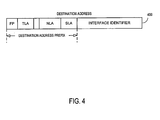
- FIG. 4 illustrates a destination address 400 according to some embodiments.
- the destination address 400 shown in FIG. 4 is an Internet Protocol version 6 (IPv6) address as defined in Request For Comment 2373, "IP Version 6 Addressing Architecture" published by the Internet Engineering Task Force (July, 1998).
- IPv6 Internet Protocol version 6
- the 128-bit IPv6 destination address 400 includes a 64-bit "destination address prefix" and a 64-bit interface identifier.
- the destination address prefix comprises three bits of Format Prefix (FP) information, 13 bits of Top Level Aggregation (TLA) information, 24 bits of Next Level Aggregation (NLA) information, and a 16 bits of Site Level Aggregation (SLA) information.
- FP Format Prefix
- TLA Top Level Aggregation
- NLA Next Level Aggregation
- SLA Site Level Aggregation
- the destination address prefix also includes eight bits of reserved information (e.g. , which may be set to zero).
- the FP information identifies the destination address 400 as a unicast (or anycast), a multicast, a link local, or another type of address.
- the destination address 400 illustrated in FIG. 4 represents information for a unicast (or anycast) address.
- the IPv6 destination address 400 is structured to reflect a hierarchy or aggregation of addresses.
- the first hierarchical level is the TLA information, followed by the NLA information and then the SLA information.
- the interface identifier can be used to distinguish among hosts local to a site (e.g. , a globally or locally unique identifier).
- a network device may determine an appropriate route for an information packet based on the destination address prefix (e.g., the FP, TLA, NLA, and SLA information) without regard to the interface address - unless the information packet's final destination is related to the network device ( e.g. , the final destination may be in a subnet directly connected to the network device).
- the phrase “device address information” may refer to, for example, a device address prefix associated with a network device.
- IPv6 addresses Due to the hierarchical allocation of IPv6 addresses, specific routing information will not typically be present in a network device (e.g. , a router) unless that device lies at the edge of the network and the destination address is attached to a subnet connected to the network device.
- information packets destined to a network "inside" the domain of a network device e.g. , when an edge router connects a local network to the rest of a network
- the destination address prefix associated with the information packet may be same as the network device's address prefix. In other words, more specific routes in a network device are expected to have the prefix of the address of the network device.
- the address on each interface may share a common IPv6 prefix (with the number of bits in the prefix depending on the position of the router in the hierarchy).
- routing information may be cached for addresses that match all (or parts) of the device address prefix (e.g. , a router's IPv6 address prefix).
- the determination of whether the destination address is associated with the device address information is performed via a local cache 232.
- the packet forwarding engine 230 may perform this determination using information stored in a local memory.
- the information stored in local memory comprises a subset of a trie data structure stored in the memory unit 240.
- FIG. 5 illustrates a trie data structure 500 according to some embodiments.
- the trie data structure 500 illustrated in FIG. 5 includes seven trie tables. Each table has entries associated with "00" through "FF,” and each entry may represent an address or pointer associated with another table ( i.e., in the next level of the trie data structure 500) or a "null" ( e.g. , indicating that no other table is associated with that entry).
- the trie data structure 500 may be used to determine routing information associated with a destination address prefix or an entire destination address.
- FIG. 6 illustrates information 600 that may be associated with a trie data structure 500 according to some embodiments.
- the information 600 may be stored, for example, in the memory unit 240.
- a 16-bit route pointer 602 represents a routing table entry associated with a particular trie table entry.
- the route pointer 602 may also, according to some embodiments, indicate that no valid routing information is available (e.g., when the 16-bit route pointer 602 has a null value).
- a 16-bit next trie pointer 604 represents a trie table that should be searched next or indicates that the search should terminate (e.g., when the next trie pointer 604 has a null value).
- the trie data structure 500 and associated information 600 may be used to determine an appropriate route pointer 602 for a packet of information.
- a route pointer 602 may be extracted each time a match is found in the trie data structure 500. If the extracted route pointer 602 is valid (e.g., not null), the current route pointer may be updated with the extracted route pointer 602. Of course, if the extracted route pointer 602 is not valid (e.g., null), the current route pointer may remain unchanged. When the trie lookup algorithm terminates (e.g., the next tree pointer 604 is null), the current route pointer may be used to transmit the information packet.
- a current router pointer may be initialized to a default value (e.g., "35").
- a route pointer 602 value of "22” is extracted.
- the current router pointer would then be updated (e.g., from 35 to 22) and the third trie table would be accessed (e.g., entry "09” based on the destination address).
- a subset of the information 600 is also stored in the local cache 232 of the packet forwarding engine 230. For example, entries associated with the device address may be stored in the local cache 232.
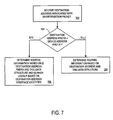
- FIG. 7 is a flow chart of a method to determine routing information according to some embodiments. The method may be performed, for example, by the network device 200 shown in FIG. 2 ( e.g. , by the packet forwarding engine 230).
- a destination address associated with an information packet is received.
- the destination address may include, for example, a destination address prefix and a destination address interface identifier.
- the packet forwarding engine 230 may use an LPM algorithm to determine if the destination address prefix matches the device address prefix using information stored in the local cache 232.
- the information stored in the local cache 232 may comprise a trie data structure (e.g., a trie data structure that stores information associated with the device address prefix without storing all potential destination address prefixes).
- routing information is determined at 706 based on the destination address prefix and a trie data structure.
- the packet forwarding engine 230 may access a trie data structure in the memory unit 240 to determine a route pointer for the information packet based on the first 64 bits of an IPv6 destination address.
- the last 64 bits of the IPv6 address i.e. , the interface identifier
- the packet forwarding engine 230 can simply perform a hash lookup based on the interface identifier to determine appropriate routing information (e.g., via the hashing unit 250).
- routing information is determined at 708 based on the entire destination address and the trie data structure stored in the memory unit 240. For example, since the network device 200 is likely related to the destination device (as reflected by the matching destination address prefix and device address prefix), the level of detail represented by the last 64 bits of the IPv6 address may be required to determine an appropriate route for the information packet.
- the network device 200 may then arrange for the information packet to be transmitted in accordance with the determined routing information (e.g. , by forwarding the information packet using the route pointer).
- FIGS. 8 through 10 are a flow chart of a method to determine routing information according to some embodiments.
- the method may be performed, for example, by a packet forwarding engine 230 when an IPv6 unicast (or anycast) destination address is processed.
- IPv6 unicast or anycast
- other types of addresses e.g. , a multicast address
- default routing information may initially be determined for the destination address.
- the first octet of the destination address is compared to the first octet of the device address.
- the packet forwarding engine 230 may compare the first octet using a trie data structure stored in the local cache 232. In this case, appropriate routing information can also be determined when the first octet matches ( e.g., to replace default routing information).
- the process continues with the next octet of the destination address and device address. If all 128 bits have been compared and have matched, the process ends at 806. That is, the entire destination address and device address matched, and all of the routing information may be accessed in the local cache 232 (and there is no need to access the memory unit 240).
- a octet of the destination address does not match the device address.
- appropriate routing information may be extracted from the local cache 232 (e.g. , when a valid route pointer is extracted it may replace the current route pointer).
- the destination device is probably related the network device 200, such as by being part of a network within the domain of the network device 200), the process continues at FIG. 10.
- the process of FIG. 9 begins after it has been determined that less than all of the first 64 bits in the destination address matched the device address prefix.
- an appropriate location in a trie data structure is selected.
- the trie data structure may be stored, for example, in the memory unit 240.
- the appropriate location is selected based on the number of octets that did match in FIG. 8. If no octets had matched in FIG. 8, for example, the first table in the trie data structure may be selected. On the other hand, a table deeper in the trie data structure may be selected if a number of octets had matched.
- the trie data structure is then used to determine if any additional routing information is associated with the remaining octets of the destination address prefix (e.g. , beginning with the first octet that did not match the device address prefix).
- the next trie entry is null at 904 then the current route pointer may be extracted at 906 ( i.e., because no more routing information is cached in the trie data structure).
- next trie entry is not null, the next tree lookup is performed at 908 (and the current route pointer may be updated as appropriate). If all 64 bits of the destination address prefix have not yet been looked up at 910, the process continues at 904.
- a hash lookup is performed on the last 64 bits of the destination address (i.e., the interface identifier) at 912 and the route pointer information is extracted at 906 (e.g., the current route pointer). Because the network device 200 is probably not related to the destination device ( i.e., because the destination address prefix did not match the device address prefix in FIG. 8), the level of detail contained in the last 64 bits may not be needed to determine an appropriate route for the information packet. The network device 200 may then arrange for an information packet to be transmitted in accordance with the determined route pointer information.
- FIG. 10 begins after it has been determined (in FIG. 8) that all of the first 64 bits in the destination address matched the device address prefix.
- an appropriate location in a trie data structure is selected.
- the trie data structure may be stored, for example, in the memory unit 240. Note that the level of the trie data structure selected at 1002 may always be the same ( i.e., because 64 bits always matched in FIG. 8).
- the trie data structure is then used to determine routing information based on the remaining octets of the destination address (e.g. , beginning with the first octet of the interface identifier). In particular, if the next trie entry is null at 1004, the current route pointer may be extracted at 1006 ( i.e ., because no more routing information is cached in the trie data structure).
- next tree lookup is performed at 1008 (and the current route pointer may be updated as appropriate). If all 128 bits of the entire destination address (i.e. , the 64-bit destination address prefix in FIG. 8 and the 64-bit interface identifier in FIG. 10) have not yet been looked up at 1010, the process continues at 1004. Note that in this case, a hash lookup of the 64-bit interface identifier might not provide sufficient routing information (e.g. , because the network device 200 is probably related to the destination device, such as by being part of a network within the domain of the network device 200).
- the route pointer information is extracted at 1006 (e.g., the current route pointer).
- the network device 200 may then arrange for an information packet to be transmitted in accordance with the determined route pointer information.
- a router has a device address prefix of 01:09:FF:24.
- entries 01 in the first table, 09 in the third table, and FF in the fifth table may be stored in a trie data structure at the local cache 232.
- a destination address of 01:30:: is received.
- the first octet i.e., 30
- the packet forwarding engine 230 may then examine the third table of a larger trie structure stored in the memory unit 240 ( e.g. , to determine if more routing information is available for that destination address).
- some embodiments may use the hierarchical nature of IPv6 addressing to reduce the worst case time of trie data structure lookup.
- the device address prefix may be stored, for example, in a data structure and updated as appropriate ( e.g. , by code that is executed by the controller 220). Such a data structure may then be read by one or more packet forwarding engines 230 that perform a route lookup process.
- the data structure may be stored in the memory unit 240.
- the packet forwarding engine 230 executing a route lookup makes a local copy of the device address prefix in the local cache 232.
- the controller 220 may notify the packet forwarding engine 230 so that the local copy may be updated accordingly. For example, the controller 220 may generate a signal and the packet forwarding engine 230 may look for the signal before processing a packet of information. When the signal is present, the packet forwarding engine 230 may copy the new device address prefix from the memory unit 240 to the local cache 232. As another approach, the packet forwarding engine 230 may periodically copy the device address prefix from the memory unit 240 to the local cache 232 ( e.g. , regardless of whether the device address prefix has changed).
- the size of a trie data structure may depend on the requirements of an IPv6 implementation. A larger structure may lead to less lookups but may make route updates more difficult due to prefix expansions (e.g. , the network device 200 may need to update several entries in the trie data structure in order to update a single route entry).
- all trie tables have 8-bit entries.
- the first trie table has 16-bit entries and the other tables have 8-bit entries. Note that an initial 16-bit trie table may be impractical if smaller prefixes need to be expanded to 16 bits to update route entries. For example, to add a prefix of length 12, 16 entries ( i.e., 2 to the fourth power) may be needed with the 16-bit trie table.
- a large trie data structure may consume more memory as compared to a smaller trie data structure (e.g. , because a table may be statically allocated even though many entries may not be used).
- trie tables may be allocated as needed and therefore the number of unused entries may be less.
- the worst-case memory reads for an entire IPv6 address lookup may increase. This is because the network device 200 may have to traverse through more trie tables to match the same number of bits as compared to a larger structure ( i.e., because each trie table matches fewer bits).
- a network device 200 may need to match the first 64 bits of a destination address to a device address prefix.
- a normal trie lookup may be performed for the remaining 64 bits (i.e. , the interface identifier). If all trie data structures have 8 bits, then in the worst case eight separate memory unit 240 lookups may be required to determine IPv6 routing information.
- a network device 200 has 8,000 routing entries. Moreover, the prefix size of the routing entries are uniformly distributed from 1 through 64. Due to hierarchical routing, all routing entries for larger prefix length should have most of their search paths in common. As an example, if a router's address is 0102:0304:0506:0707:090A:0B:0C:0D0E:0F10, then almost all routing entries with a prefix length greater than 32 will have the prefix 0102:0304::/32 due to hierarchical routing. Therefore, the number of trie tables may be very close to a best case memory requirement. If absolute hierarchical addressing is followed, the memory requirement will be 70K in the memory unit 240. Note that the actual memory requirement may depend on the distribution of the entries.
- IPv6 IP address
- other embodiments may be associated with other addressing schemes (e.g. , another hierarchical addressing scheme).
- software or hardware are described as performing certain functions, such functions may be performed using software, hardware, or a combination of software and hardware (e.g. , a medium may store instructions adapted to be executed by a processor to perform a method of facilitating communication).
- functions described herein may be implemented via a software simulation of Application Specific Integrated Circuit (ASIC) hardware.
- ASIC Application Specific Integrated Circuit
Landscapes
- Engineering & Computer Science (AREA)
- Computer Networks & Wireless Communication (AREA)
- Signal Processing (AREA)
- Data Exchanges In Wide-Area Networks (AREA)
Abstract
Description
- A network device may facilitate an exchange of information packets via a communication network. For example, a network switch or router can receive streams of information packets from other devices, such as Personal Computers (PCs). The network device may then transmit the information packets to other network devices, such as to other network switches or routers. Those network devices may in turn forward the information packets until they reach an appropriate destination.
- Each information packet may be associated with a destination address. A network device can then process and transmit the information packet as appropriate (e.g., to another network switch or router) in accordance with the destination address. To facilitate this process, the network device may store a list of destination addresses and associated routing information in memory. Accessing such a list, however, may take a considerable amount of time - especially when the network device needs to search for routing information associated with a lengthy destination address. Moreover, the amount of time required to access the information may degrade the performance of a high-speed network device.
- As an example, the paper by Kuo G-S et. al., "A new architectural concept of hierarchical routing scheme for IPv6 in future high-speed large global Internet", Proceedings of the IEEE Telecommunications Symposium 1998, Sao Paulo, Brazil, August 1998, pages 638-643, discloses an IPv6 information packet having a destination address comprising a destination address prefix. Each portion of the prefix is used in conjunction with multiple routing tables to determine routing information. If there is no match within the routing tables then only default routing information is supplied to route the information packet.
- The present invention provides a network device associated with a device address prefix as set forth in
claim 1 and a method of communication via a network device associated with a device address prefix as set forth inclaim 4. -
- FIG. 1 is a block diagram of a communication system.
- FIG. 2 is a block diagram of a network device according to some embodiments.
- FIG. 3 is a flow chart of a method according to some embodiments.
- FIG. 4 illustrates a destination address according to some embodiments.
- FIG. 5 illustrates a trie data structure according to some embodiments.
- FIG. 6 illustrates information that may be associated with a trie data structure according to some embodiments.
- FIG. 7 is a flow chart of a method to determine routing information according to some embodiments.
- FIGS. 8 through 10 are a flow chart of a method to determine routing information according to some embodiments.
- FIG. 1 is a block diagram of a
communication system 100. In particular, afirst network device 120 may exchange information with asecond network device 130 via acommunication network 110. Thenetwork devices - The
communication network 110 may be associated with, for example, a Local Area Network (LAN), a Metropolitan Area Network (MAN), a Wide Area Network (WAN), a Fast Ethernet network, a wireless network, a fiber network, and/or an Internet Protocol (IP) network, such as the Internet, an intranet, or an extranet. Note that thecommunication network 110 may include different types of networks and any number of other network devices (e.g., intermediate switches and routers). - As illustrated in FIG. 1, the
first network device 120 can communicate with a number of associated devices 122 (e.g., PCs). Similarly, thesecond network device 130 can communication with a number of associateddevices 132. In this way, onedevice 122 may transmit a stream of information packets to anotherdevice 132. - FIG. 2 is a block diagram of a
network device 200 according to some embodiments. Thenetwork device 200 includes acommunication port 210 that may be used to exchange information packets with other devices. Note that more than onecommunication port 210 may be associated with thenetwork device 200. - The
network device 200 also includes acontroller 220. Thecontroller 220 may comprise, for example, a control plane processor (e.g., an Intel® XScale™ processor) that performs control and system management functions as well as executing real-time applications. - The
network device 200 further includes apacket forwarding engine 230 that may be used to determine routing information based on an information packet's associated destination address. Thepacket forwarding engine 230 may also facilitate flow categorization, congestion management, and set queuing priorities. According to some embodiments, thepacket forwarding engine 230 includes alocal cache 232. Thelocal cache 232 may be used, for example, to store information that can be accessed by thepacket forwarding engine 230 in a relatively fast manner. - The
packet forwarding engine 230 may also access amemory unit 240, such as a Static Random Access Memory (SRAM) unit. Note that thememory unit 240 may be able to store more information than thelocal cache 232. However, it may take more time for thepacket forwarding engine 230 to access this information. - The
packet forwarding engine 230 may also access ahashing unit 250, such as ahashing unit 250 that supports a 128-bit hash function. Although aparticular network device 200 is illustrated in FIG. 2, according to other embodiments thenetwork device 200 may include fewer and/or different components. For example, thenetwork device 200 may include multiplepacket forwarding engines 230 to process information packets. - FIG. 3 is a flow chart of a method according to some embodiments. The flow charts described herein do not imply a fixed order to the actions, and embodiments may be practiced in any order that is practicable. The method may be associated with, for example, the
network device 200 and/orpacket forwarding engine 230 illustrated in FIG. 2. - At 302, a destination address associated with an information packet is received (e.g., by the packet forwarding engine 230). By way of example, FIG. 4 illustrates a
destination address 400 according to some embodiments. In particular, thedestination address 400 shown in FIG. 4 is an Internet Protocol version 6 (IPv6) address as defined in Request For Comment 2373, "IP Version 6 Addressing Architecture" published by the Internet Engineering Task Force (July, 1998). - The 128-bit
IPv6 destination address 400 includes a 64-bit "destination address prefix" and a 64-bit interface identifier. The destination address prefix comprises three bits of Format Prefix (FP) information, 13 bits of Top Level Aggregation (TLA) information, 24 bits of Next Level Aggregation (NLA) information, and a 16 bits of Site Level Aggregation (SLA) information. Note that the destination address prefix also includes eight bits of reserved information (e.g., which may be set to zero). - The FP information identifies the
destination address 400 as a unicast (or anycast), a multicast, a link local, or another type of address. In particular, thedestination address 400 illustrated in FIG. 4 represents information for a unicast (or anycast) address. - Note that the
IPv6 destination address 400 is structured to reflect a hierarchy or aggregation of addresses. The first hierarchical level is the TLA information, followed by the NLA information and then the SLA information. Finally, the interface identifier can be used to distinguish among hosts local to a site (e.g., a globally or locally unique identifier). As a result, a network device may determine an appropriate route for an information packet based on the destination address prefix (e.g., the FP, TLA, NLA, and SLA information) without regard to the interface address - unless the information packet's final destination is related to the network device (e.g., the final destination may be in a subnet directly connected to the network device). - Referring again to FIG. 3, it is determined at 304 if the destination address is associated with "device address information." As used herein, the phrase "device address information" may refer to, for example, a device address prefix associated with a network device.
- Due to the hierarchical allocation of IPv6 addresses, specific routing information will not typically be present in a network device (e.g., a router) unless that device lies at the edge of the network and the destination address is attached to a subnet connected to the network device. On the other hand, information packets destined to a network "inside" the domain of a network device (e.g., when an edge router connects a local network to the rest of a network) may require specific routes. Note that, in this case, the destination address prefix associated with the information packet may be same as the network device's address prefix. In other words, more specific routes in a network device are expected to have the prefix of the address of the network device. For an IPv6 network device, the address on each interface may share a common IPv6 prefix (with the number of bits in the prefix depending on the position of the router in the hierarchy). Thus, routing information may be cached for addresses that match all (or parts) of the device address prefix (e.g., a router's IPv6 address prefix).
According to some embodiments, the determination of whether the destination address is associated with the device address information (e.g., whether a destination address prefix matches a device address prefix) is performed via alocal cache 232. For example, thepacket forwarding engine 230 may perform this determination using information stored in a local memory. According to some embodiments, the information stored in local memory comprises a subset of a trie data structure stored in thememory unit 240. - FIG. 5 illustrates a
trie data structure 500 according to some embodiments. In particular, thetrie data structure 500 illustrated in FIG. 5 includes seven trie tables. Each table has entries associated with "00" through "FF," and each entry may represent an address or pointer associated with another table (i.e., in the next level of the trie data structure 500) or a "null" (e.g., indicating that no other table is associated with that entry). - By way of example, consider a 128-bit destination address of 01:09:FF:00:: (with "::" indicating that the remaining bits are zero). The first eight bits of the address (i.e., "01") is used as an index in the first, or base, trie table. Note that the entry associated with "01" in the first table illustrated in FIG. 5 points to the third table. The next eight bits of the address (i.e., "09") are then used as an index in the third table, resulting in an entry that points to the fifth table. Similarly, the next eight bits (i.e., "FF") are used as an index in the fifth table, resulting in an entry that points to the seventh table. The next eight bits (i.e., "00"), however, result in a null entry indicating that no further information for that address is stored in the
trie data structure 500. - The
trie data structure 500 may be used to determine routing information associated with a destination address prefix or an entire destination address. For example, FIG. 6 illustratesinformation 600 that may be associated with atrie data structure 500 according to some embodiments. Theinformation 600 may be stored, for example, in thememory unit 240. According to some embodiments, a 16-bit route pointer 602 represents a routing table entry associated with a particular trie table entry. Theroute pointer 602 may also, according to some embodiments, indicate that no valid routing information is available (e.g., when the 16-bit route pointer 602 has a null value). In addition, a 16-bitnext trie pointer 604 represents a trie table that should be searched next or indicates that the search should terminate (e.g., when thenext trie pointer 604 has a null value). - In this way, the
trie data structure 500 and associatedinformation 600 may be used to determine anappropriate route pointer 602 for a packet of information. For example, aroute pointer 602 may be extracted each time a match is found in thetrie data structure 500. If the extractedroute pointer 602 is valid (e.g., not null), the current route pointer may be updated with the extractedroute pointer 602. Of course, if the extractedroute pointer 602 is not valid (e.g., null), the current route pointer may remain unchanged. When the trie lookup algorithm terminates (e.g., thenext tree pointer 604 is null), the current route pointer may be used to transmit the information packet. - By way of example, consider again the trie data structure illustrated in FIG. 5 and a 128-bit destination address of 01:09:FF:00::. Before executing a trie lookup algorithm, a current router pointer may be initialized to a default value (e.g., "35"). When the first trie table is accessed (e.g., entry "01" based on the destination address), assume that a
route pointer 602 value of "22" is extracted. The current router pointer would then be updated (e.g., from 35 to 22) and the third trie table would be accessed (e.g., entry "09" based on the destination address). Assume that theroute pointer 602 associated with this entry in the third trie table is "0." In this case, no valid routing information is available and the current route pointer would remain unchanged (e.g., as "22"). The process may then be repeated until the trie lookup algorithm terminates (e.g., when the null entry in the seventh trie table is accessed).According to some embodiments, a subset of theinformation 600 is also stored in thelocal cache 232 of thepacket forwarding engine 230. For example, entries associated with the device address may be stored in thelocal cache 232. - FIG. 7 is a flow chart of a method to determine routing information according to some embodiments. The method may be performed, for example, by the
network device 200 shown in FIG. 2 (e.g., by the packet forwarding engine 230). - At 702, a destination address associated with an information packet is received. The destination address may include, for example, a destination address prefix and a destination address interface identifier.
- At 704, it is determined whether or not the destination address prefix matches a device address prefix (i.e., the device address prefix that is associated with the network device). For example, the
packet forwarding engine 230 may use an LPM algorithm to determine if the destination address prefix matches the device address prefix using information stored in thelocal cache 232. Note that the information stored in thelocal cache 232 may comprise a trie data structure (e.g., a trie data structure that stores information associated with the device address prefix without storing all potential destination address prefixes). - If the destination address prefix does not match the device address prefix at 704, routing information is determined at 706 based on the destination address prefix and a trie data structure. For example, the
packet forwarding engine 230 may access a trie data structure in thememory unit 240 to determine a route pointer for the information packet based on the first 64 bits of an IPv6 destination address. Note that, in this case, the last 64 bits of the IPv6 address (i.e., the interface identifier) may represent a level of detail that is not required to determine an appropriate route (because thenetwork device 200 is probably not directly associated with the destination device as reflected by the non-matching destination address prefix and device address prefix). Instead, thepacket forwarding engine 230 can simply perform a hash lookup based on the interface identifier to determine appropriate routing information (e.g., via the hashing unit 250). - If the destination address prefix matches the device address prefix at 704, routing information is determined at 708 based on the entire destination address and the trie data structure stored in the
memory unit 240. For example, since thenetwork device 200 is likely related to the destination device (as reflected by the matching destination address prefix and device address prefix), the level of detail represented by the last 64 bits of the IPv6 address may be required to determine an appropriate route for the information packet. - The
network device 200 may then arrange for the information packet to be transmitted in accordance with the determined routing information (e.g., by forwarding the information packet using the route pointer). - FIGS. 8 through 10 are a flow chart of a method to determine routing information according to some embodiments. The method may be performed, for example, by a
packet forwarding engine 230 when an IPv6 unicast (or anycast) destination address is processed. Note that other types of addresses (e.g., a multicast address) may instead be forwarded to thecontroller 220 for exception processing. Also note that default routing information may initially be determined for the destination address. - At 802, the first octet of the destination address is compared to the first octet of the device address. For example, the
packet forwarding engine 230 may compare the first octet using a trie data structure stored in thelocal cache 232. In this case, appropriate routing information can also be determined when the first octet matches (e.g., to replace default routing information). - If the first octet matches at 804, it is determined whether all 128 bits of the destination address and device address have been compared at 806. If all 128 bits have not been compared, the process continues with the next octet of the destination address and device address. If all 128 bits have been compared and have matched, the process ends at 806. That is, the entire destination address and device address matched, and all of the routing information may be accessed in the local cache 232 (and there is no need to access the memory unit 240).
- The process continues until it is found at 804 that a octet of the destination address does not match the device address. Note that for each matched octet, appropriate routing information may be extracted from the local cache 232 (e.g., when a valid route pointer is extracted it may replace the current route pointer). When it is found that a octet of the destination address does not match the device address, it is determined whether or not at least 64 bits of the destination address matched the device address at 810. If less than 64 bits matched (and the destination device is probably not related the network device 200), the process continues at FIG. 9. If at least 64 bits matched (e.g., the destination device is probably related the
network device 200, such as by being part of a network within the domain of the network device 200), the process continues at FIG. 10. Thus, the process of FIG. 9 begins after it has been determined that less than all of the first 64 bits in the destination address matched the device address prefix. At 902, an appropriate location in a trie data structure is selected. The trie data structure may be stored, for example, in thememory unit 240. - According to some embodiments, the appropriate location is selected based on the number of octets that did match in FIG. 8. If no octets had matched in FIG. 8, for example, the first table in the trie data structure may be selected. On the other hand, a table deeper in the trie data structure may be selected if a number of octets had matched.
- The trie data structure is then used to determine if any additional routing information is associated with the remaining octets of the destination address prefix (e.g., beginning with the first octet that did not match the device address prefix). In particular, if the next trie entry is null at 904 then the current route pointer may be extracted at 906 (i.e., because no more routing information is cached in the trie data structure).
- If the next trie entry is not null, the next tree lookup is performed at 908 (and the current route pointer may be updated as appropriate). If all 64 bits of the destination address prefix have not yet been looked up at 910, the process continues at 904.
- When all 64 bits of the destination address prefix have been looked up, a hash lookup is performed on the last 64 bits of the destination address (i.e., the interface identifier) at 912 and the route pointer information is extracted at 906 (e.g., the current route pointer). Because the
network device 200 is probably not related to the destination device (i.e., because the destination address prefix did not match the device address prefix in FIG. 8), the level of detail contained in the last 64 bits may not be needed to determine an appropriate route for the information packet. Thenetwork device 200 may then arrange for an information packet to be transmitted in accordance with the determined route pointer information. - Refer now to the process of FIG. 10, which begins after it has been determined (in FIG. 8) that all of the first 64 bits in the destination address matched the device address prefix. At 1002, an appropriate location in a trie data structure is selected. The trie data structure may be stored, for example, in the
memory unit 240. Note that the level of the trie data structure selected at 1002 may always be the same (i.e., because 64 bits always matched in FIG. 8). - The trie data structure is then used to determine routing information based on the remaining octets of the destination address (e.g., beginning with the first octet of the interface identifier). In particular, if the next trie entry is null at 1004, the current route pointer may be extracted at 1006 (i.e., because no more routing information is cached in the trie data structure).
- If the next trie entry is not null, the next tree lookup is performed at 1008 (and the current route pointer may be updated as appropriate). If all 128 bits of the entire destination address (i.e., the 64-bit destination address prefix in FIG. 8 and the 64-bit interface identifier in FIG. 10) have not yet been looked up at 1010, the process continues at 1004. Note that in this case, a hash lookup of the 64-bit interface identifier might not provide sufficient routing information (e.g., because the
network device 200 is probably related to the destination device, such as by being part of a network within the domain of the network device 200). - When all 128 bits of the destination address have been looked up, the route pointer information is extracted at 1006 (e.g., the current route pointer). The
network device 200 may then arrange for an information packet to be transmitted in accordance with the determined route pointer information. - Referring again to FIG. 5, assume that a router has a device address prefix of 01:09:FF:24. As a result,
entries 01 in the first table, 09 in the third table, and FF in the fifth table may be stored in a trie data structure at thelocal cache 232. Now assume that a destination address of 01:30:: is received. In this case, the first octet (i.e., 30) may be matched in thelocal cache 232, but thepacket forwarding engine 230 will be unable to match the second octet (i.e., 30). As a result, thepacket forwarding engine 230 may then examine the third table of a larger trie structure stored in the memory unit 240 (e.g., to determine if more routing information is available for that destination address). - Accordingly, some embodiments may use the hierarchical nature of IPv6 addressing to reduce the worst case time of trie data structure lookup.
- The device address prefix may be stored, for example, in a data structure and updated as appropriate (e.g., by code that is executed by the controller 220). Such a data structure may then be read by one or more
packet forwarding engines 230 that perform a route lookup process. For example, the data structure may be stored in thememory unit 240. According to another embodiment, thepacket forwarding engine 230 executing a route lookup makes a local copy of the device address prefix in thelocal cache 232. - If the device address prefix changes, the
controller 220 may notify thepacket forwarding engine 230 so that the local copy may be updated accordingly. For example, thecontroller 220 may generate a signal and thepacket forwarding engine 230 may look for the signal before processing a packet of information. When the signal is present, thepacket forwarding engine 230 may copy the new device address prefix from thememory unit 240 to thelocal cache 232. As another approach, thepacket forwarding engine 230 may periodically copy the device address prefix from thememory unit 240 to the local cache 232 (e.g., regardless of whether the device address prefix has changed). - The size of a trie data structure may depend on the requirements of an IPv6 implementation. A larger structure may lead to less lookups but may make route updates more difficult due to prefix expansions (e.g., the
network device 200 may need to update several entries in the trie data structure in order to update a single route entry). - According to one embodiment, all trie tables have 8-bit entries. According to another embodiment, the first trie table has 16-bit entries and the other tables have 8-bit entries. Note that an initial 16-bit trie table may be impractical if smaller prefixes need to be expanded to 16 bits to update route entries. For example, to add a prefix of length 12, 16 entries (i.e., 2 to the fourth power) may be needed with the 16-bit trie table.
- Moreover, a large trie data structure may consume more memory as compared to a smaller trie data structure (e.g., because a table may be statically allocated even though many entries may not be used). In smaller structures, trie tables may be allocated as needed and therefore the number of unused entries may be less.
- On the other hand, if the size of a trie data structure is reduced, the worst-case memory reads for an entire IPv6 address lookup may increase. This is because the
network device 200 may have to traverse through more trie tables to match the same number of bits as compared to a larger structure (i.e., because each trie table matches fewer bits). - In the worst IPv6 case, a
network device 200 may need to match the first 64 bits of a destination address to a device address prefix. In addition, a normal trie lookup may be performed for the remaining 64 bits (i.e., the interface identifier). If all trie data structures have 8 bits, then in the worst case eightseparate memory unit 240 lookups may be required to determine IPv6 routing information. - By way of example, assume that a
network device 200 has 8,000 routing entries. Moreover, the prefix size of the routing entries are uniformly distributed from 1 through 64. Due to hierarchical routing, all routing entries for larger prefix length should have most of their search paths in common. As an example, if a router's address is 0102:0304:0506:0707:090A:0B:0C:0D0E:0F10, then almost all routing entries with a prefix length greater than 32 will have the prefix 0102:0304::/32 due to hierarchical routing. Therefore, the number of trie tables may be very close to a best case memory requirement. If absolute hierarchical addressing is followed, the memory requirement will be 70K in thememory unit 240. Note that the actual memory requirement may depend on the distribution of the entries. - The following illustrates various additional embodiments. These do not constitute a definition of all possible embodiments, and those skilled in the art will understand that many other embodiments are possible. Further, although the following embodiments are briefly described for clarity, those skilled in the art will understand how to make any changes, if necessary, to the above description to accommodate these and other embodiments and applications.
- For example, although some embodiments have been described with respect to IPv6 addressing, other embodiments may be associated with other addressing schemes (e.g., another hierarchical addressing scheme).
- Further, although software or hardware are described as performing certain functions, such functions may be performed using software, hardware, or a combination of software and hardware (e.g., a medium may store instructions adapted to be executed by a processor to perform a method of facilitating communication). For example, functions described herein may be implemented via a software simulation of Application Specific Integrated Circuit (ASIC) hardware.
- The several embodiments described herein are solely for the purpose of illustration. Persons skilled in the art will recognize from this description other embodiments may be practiced with modifications and alterations limited only by the claims.
Claims (8)
- A network device (200) associated with a device address prefix, comprising:a communication port (210) to receive a destination address (400) associated with an information packet, wherein the destination address (400) includes a destination address prefix and a destination address interface identifier;a hashing unit (250); anda packet forwarding engine (230) including a local cache (232) to store at least a portion of a trie data structure (500) associated with the device address prefix, wherein the packet forwarding engine (230) is arranged to determine a route pointer for the information packet based on:at least the portion of the trie data structure (500), when the destination address prefix matches the device address prefix;and(a) at least a portion of the destination address prefix and at least the portion of the trie data structure (500) and (b) a hash lookup by the hashing unit (250) associated with at least a portion of the destination address interface identifier for determining additional routing information, when the destination address prefix does not match the device address prefix.
- The network device (200) of claim 1, further comprising:a memory unit (240) external to the packet forwarding engine (230) arranged to store at least a further portion of the trie data structure (500).
- The network device (200) of claim 1, wherein the network device (200) is associated with at least one of: (i) an edge device, (ii) a switch, or (iii) a router.
- A method of communication via a network device (200) associated with a device address prefix, comprising:receiving a destination address (400) associated with an information packet, wherein the destination address (400) comprises a destination address prefix and a destination address interface identifier;if the destination address prefix matches the device address prefix, determining routing information for the information packet based on the destination address (400) and at least a portion of a trie data structure (500) associated with the device address prefix; andif the destination address prefix does not match the device address prefix, determining routing information based on: (i) the destination address prefix and at least the portion of the trie data structure (500), and (ii) performing a hash lookup based on the destination address interface identifier for determining additional routing information.
- The method of claim 4, wherein at least the portion of the trie data structure is stored in a local cache (232).
- The method of claim 5, wherein the hash lookup is associated with an external memory unit (240).
- The method of claim 5, wherein the network device (200) is associated with at least one of: (i) an edge device, (ii) a switch, or (iii) a router.
- The method of claim 5, wherein the routing information comprises a route pointer for the information packet, and further comprising:arranging for the information packet to be transmitted in accordance with the route pointer.
Applications Claiming Priority (3)
| Application Number | Priority Date | Filing Date | Title |
|---|---|---|---|
| US10/216,369 US7142541B2 (en) | 2002-08-09 | 2002-08-09 | Determining routing information for an information packet in accordance with a destination address and a device address |
| US216369 | 2002-08-09 | ||
| PCT/US2003/024502 WO2004015919A2 (en) | 2002-08-09 | 2003-08-05 | Hierarchical prefix based routing in ipv6 networks |
Publications (2)
| Publication Number | Publication Date |
|---|---|
| EP1547306A2 EP1547306A2 (en) | 2005-06-29 |
| EP1547306B1 true EP1547306B1 (en) | 2007-01-31 |
Family
ID=31495043
Family Applications (1)
| Application Number | Title | Priority Date | Filing Date |
|---|---|---|---|
| EP03784922A Expired - Lifetime EP1547306B1 (en) | 2002-08-09 | 2003-08-05 | Method and network device for hierachical prefix based routing |
Country Status (7)
| Country | Link |
|---|---|
| US (1) | US7142541B2 (en) |
| EP (1) | EP1547306B1 (en) |
| AT (1) | ATE353176T1 (en) |
| AU (1) | AU2003261378A1 (en) |
| DE (1) | DE60311588T2 (en) |
| TW (1) | TWI226170B (en) |
| WO (1) | WO2004015919A2 (en) |
Cited By (1)
| Publication number | Priority date | Publication date | Assignee | Title |
|---|---|---|---|---|
| US8625582B2 (en) | 2008-08-14 | 2014-01-07 | Motorola Solutions, Inc. | Method and apparatus for routing a bearer path in an internet protocol multimedia subsystem based communication system |
Families Citing this family (18)
| Publication number | Priority date | Publication date | Assignee | Title |
|---|---|---|---|---|
| US7493412B2 (en) * | 2002-09-12 | 2009-02-17 | International Business Machines Corporation | Method for processing a data packet |
| US7948916B2 (en) * | 2003-01-31 | 2011-05-24 | Hewlett-Packard Development Company, L.P. | Method and apparatus for discovering topology information in a network |
| US8909726B1 (en) | 2003-08-27 | 2014-12-09 | Cisco Technology, Inc. | Priority based anycast routing |
| US7515588B2 (en) * | 2004-03-18 | 2009-04-07 | Intel Corporation | Method and apparatus to support a large internet protocol forwarding information base |
| US20060083247A1 (en) * | 2004-10-14 | 2006-04-20 | Sun Microsystems, Inc. | Prefix lookup using address-directed hash tables |
| US8073968B1 (en) * | 2004-11-03 | 2011-12-06 | Cisco Technology, Inc. | Method and apparatus for automatically optimizing routing operations at the edge of a network |
| US7751331B1 (en) | 2005-05-09 | 2010-07-06 | Cisco Technology, Inc. | Technique for policy conflict resolution using priority with variance |
| US8369329B2 (en) * | 2005-05-16 | 2013-02-05 | Rockstar Consortium Us Lp | Dynamic hierarchical address resource management architecture, method and apparatus |
| US20070014240A1 (en) * | 2005-07-12 | 2007-01-18 | Alok Kumar | Using locks to coordinate processing of packets in a flow |
| US20070268885A1 (en) * | 2006-05-16 | 2007-11-22 | Nortel Networks Ltd. | Method and system for two stage forwarding information base |
| ATE550867T1 (en) * | 2006-11-07 | 2012-04-15 | Nokia Siemens Networks Gmbh | METHOD FOR FORWARDING ADDRESS PREFIX DATA IN A NETWORK AND DEVICE |
| US7765323B2 (en) | 2006-12-29 | 2010-07-27 | Intel Corporation | Sink device addressing mechanism |
| US7940768B2 (en) | 2008-06-08 | 2011-05-10 | Apple Inc. | Source address based routing process |
| CN101710906B (en) * | 2009-12-18 | 2013-02-13 | 工业和信息化部电信传输研究所 | IPv6 address structure and method and device for allocating and tracing same |
| US20140281019A1 (en) * | 2013-03-15 | 2014-09-18 | Microsoft Corporation | Network Transmission Adjustment Based On Application-Provided Transmission Metadata |
| US11051140B2 (en) * | 2014-09-19 | 2021-06-29 | Texas Instruments Incorporated | Compression of internet protocol version 6 addresses in wireless sensor networks |
| CN104333615A (en) * | 2014-11-05 | 2015-02-04 | 中国联合网络通信集团有限公司 | Method and device for tracing address source |
| CN112468399B (en) * | 2020-10-30 | 2022-03-15 | 中盈优创资讯科技有限公司 | Anycast routing network information identification method based on port mode |
Family Cites Families (10)
| Publication number | Priority date | Publication date | Assignee | Title |
|---|---|---|---|---|
| DE69319757T2 (en) * | 1992-01-10 | 1999-04-15 | Digital Equipment Corp | Method for connecting a line card to an address recognition unit |
| US5289390A (en) * | 1992-05-22 | 1994-02-22 | Hewlett-Packard Company | Method for determining the electrical cable length of an active ring of a token ring local area network |
| US6181698B1 (en) * | 1997-07-09 | 2001-01-30 | Yoichi Hariguchi | Network routing table using content addressable memory |
| US6055236A (en) * | 1998-03-05 | 2000-04-25 | 3Com Corporation | Method and system for locating network services with distributed network address translation |
| AU6214300A (en) | 1999-07-13 | 2001-01-30 | Alteon Web Systems, Inc. | Method and apparatus for conducting the ip longest prefix match search |
| US6631419B1 (en) * | 1999-09-22 | 2003-10-07 | Juniper Networks, Inc. | Method and apparatus for high-speed longest prefix and masked prefix table search |
| AU2001286954A1 (en) | 2000-08-31 | 2002-03-13 | The Regents Of The University Of California | Cluster-based aggregated switching technique (cast) for routing data packets and information objects in computer networks |
| JP4453205B2 (en) * | 2001-01-15 | 2010-04-21 | ソニー株式会社 | Information processing apparatus and method, recording medium, and program |
| US6961336B2 (en) * | 2001-03-06 | 2005-11-01 | Watchguard Technologies, Inc. | Contacting a computing device outside a local network |
| US7280752B2 (en) * | 2002-02-22 | 2007-10-09 | Intel Corporation | Network address routing using multiple routing identifiers |
-
2002
- 2002-08-09 US US10/216,369 patent/US7142541B2/en not_active Expired - Fee Related
-
2003
- 2003-05-14 TW TW092113072A patent/TWI226170B/en not_active IP Right Cessation
- 2003-08-05 WO PCT/US2003/024502 patent/WO2004015919A2/en not_active Ceased
- 2003-08-05 DE DE60311588T patent/DE60311588T2/en not_active Expired - Lifetime
- 2003-08-05 AU AU2003261378A patent/AU2003261378A1/en not_active Abandoned
- 2003-08-05 AT AT03784922T patent/ATE353176T1/en not_active IP Right Cessation
- 2003-08-05 EP EP03784922A patent/EP1547306B1/en not_active Expired - Lifetime
Cited By (1)
| Publication number | Priority date | Publication date | Assignee | Title |
|---|---|---|---|---|
| US8625582B2 (en) | 2008-08-14 | 2014-01-07 | Motorola Solutions, Inc. | Method and apparatus for routing a bearer path in an internet protocol multimedia subsystem based communication system |
Also Published As
| Publication number | Publication date |
|---|---|
| DE60311588T2 (en) | 2007-11-15 |
| TW200406107A (en) | 2004-04-16 |
| TWI226170B (en) | 2005-01-01 |
| WO2004015919A2 (en) | 2004-02-19 |
| WO2004015919A3 (en) | 2004-04-08 |
| DE60311588D1 (en) | 2007-03-22 |
| EP1547306A2 (en) | 2005-06-29 |
| US7142541B2 (en) | 2006-11-28 |
| ATE353176T1 (en) | 2007-02-15 |
| AU2003261378A8 (en) | 2004-02-25 |
| US20040028040A1 (en) | 2004-02-12 |
| AU2003261378A1 (en) | 2004-02-25 |
Similar Documents
| Publication | Publication Date | Title |
|---|---|---|
| EP1547306B1 (en) | Method and network device for hierachical prefix based routing | |
| US7039018B2 (en) | Technique to improve network routing using best-match and exact-match techniques | |
| Gupta et al. | Routing lookups in hardware at memory access speeds | |
| EP1344152B1 (en) | Apparatus and method for performing high-speed ip route lookup and managing routing/forwarding tables | |
| EP2214357B1 (en) | Method and system for facilitating forwarding a packet in a content-centric network | |
| US7260096B2 (en) | Method and router for forwarding internet data packets | |
| US7760720B2 (en) | Translating native medium access control (MAC) addresses to hierarchical MAC addresses and their use | |
| US6661787B1 (en) | Integrated data table in a network | |
| US6922410B1 (en) | Organization of databases in network switches for packet-based data communications networks | |
| JP2010178342A (en) | System for forwarding packet with hierarchically structured variable-length identifier | |
| US6337862B1 (en) | Network switch with truncated trie look-up facility | |
| JP5050978B2 (en) | Transmission information transfer apparatus and method | |
| CN112787932B (en) | Method, device and system for generating forwarding information | |
| EP2112787B1 (en) | Data transmission between different VLANs by using MAC addresses | |
| RU2233473C2 (en) | Device and method for performing high-speed search for routes of internet protocol and controlling routing/transfer tables | |
| US12432211B2 (en) | Interleaved exact-match lookup table for multiple packet processing applications in a network device | |
| KR100748090B1 (en) | Method and apparatus for processing packet in high speed router | |
| Ghosh et al. | A hash based architecture of longest prefix matching for fast IP processing | |
| JP3376941B2 (en) | Router device | |
| Zitterbart et al. | Efficient routing table lookup for IPv6 | |
| US10715440B1 (en) | Distributed next hop resolution | |
| KR100596385B1 (en) | Forwarding Information Processing Method Configured in Virtual Local Area Network in Router | |
| Yang et al. | Hardware Based Routing Lookup for IPv4 |
Legal Events
| Date | Code | Title | Description |
|---|---|---|---|
| PUAI | Public reference made under article 153(3) epc to a published international application that has entered the european phase |
Free format text: ORIGINAL CODE: 0009012 |
|
| 17P | Request for examination filed |
Effective date: 20050302 |
|
| AK | Designated contracting states |
Kind code of ref document: A2 Designated state(s): AT BE BG CH CY CZ DE DK EE ES FI FR GB GR HU IE IT LI LU MC NL PT RO SE SI SK TR |
|
| AX | Request for extension of the european patent |
Extension state: AL LT LV MK |
|
| DAX | Request for extension of the european patent (deleted) | ||
| GRAP | Despatch of communication of intention to grant a patent |
Free format text: ORIGINAL CODE: EPIDOSNIGR1 |
|
| RIC1 | Information provided on ipc code assigned before grant |
Ipc: H04L 12/56 20060101AFI20060713BHEP |
|
| RTI1 | Title (correction) |
Free format text: METHOD AND NETWORK DEVICE FOR HIERACHICAL PREFIX BASED ROUTING |
|
| GRAS | Grant fee paid |
Free format text: ORIGINAL CODE: EPIDOSNIGR3 |
|
| GRAA | (expected) grant |
Free format text: ORIGINAL CODE: 0009210 |
|
| AK | Designated contracting states |
Kind code of ref document: B1 Designated state(s): AT BE BG CH CY CZ DE DK EE ES FI FR GB GR HU IE IT LI LU MC NL PT RO SE SI SK TR |
|
| PG25 | Lapsed in a contracting state [announced via postgrant information from national office to epo] |
Ref country code: FI Free format text: LAPSE BECAUSE OF FAILURE TO SUBMIT A TRANSLATION OF THE DESCRIPTION OR TO PAY THE FEE WITHIN THE PRESCRIBED TIME-LIMIT Effective date: 20070131 Ref country code: NL Free format text: LAPSE BECAUSE OF FAILURE TO SUBMIT A TRANSLATION OF THE DESCRIPTION OR TO PAY THE FEE WITHIN THE PRESCRIBED TIME-LIMIT Effective date: 20070131 Ref country code: CH Free format text: LAPSE BECAUSE OF FAILURE TO SUBMIT A TRANSLATION OF THE DESCRIPTION OR TO PAY THE FEE WITHIN THE PRESCRIBED TIME-LIMIT Effective date: 20070131 Ref country code: SI Free format text: LAPSE BECAUSE OF FAILURE TO SUBMIT A TRANSLATION OF THE DESCRIPTION OR TO PAY THE FEE WITHIN THE PRESCRIBED TIME-LIMIT Effective date: 20070131 Ref country code: AT Free format text: LAPSE BECAUSE OF FAILURE TO SUBMIT A TRANSLATION OF THE DESCRIPTION OR TO PAY THE FEE WITHIN THE PRESCRIBED TIME-LIMIT Effective date: 20070131 Ref country code: LI Free format text: LAPSE BECAUSE OF FAILURE TO SUBMIT A TRANSLATION OF THE DESCRIPTION OR TO PAY THE FEE WITHIN THE PRESCRIBED TIME-LIMIT Effective date: 20070131 Ref country code: DK Free format text: LAPSE BECAUSE OF FAILURE TO SUBMIT A TRANSLATION OF THE DESCRIPTION OR TO PAY THE FEE WITHIN THE PRESCRIBED TIME-LIMIT Effective date: 20070131 |
|
| REG | Reference to a national code |
Ref country code: GB Ref legal event code: FG4D |
|
| REG | Reference to a national code |
Ref country code: CH Ref legal event code: EP |
|
| REG | Reference to a national code |
Ref country code: IE Ref legal event code: FG4D |
|
| REF | Corresponds to: |
Ref document number: 60311588 Country of ref document: DE Date of ref document: 20070322 Kind code of ref document: P |
|
| PG25 | Lapsed in a contracting state [announced via postgrant information from national office to epo] |
Ref country code: SE Free format text: LAPSE BECAUSE OF FAILURE TO SUBMIT A TRANSLATION OF THE DESCRIPTION OR TO PAY THE FEE WITHIN THE PRESCRIBED TIME-LIMIT Effective date: 20070430 |
|
| PG25 | Lapsed in a contracting state [announced via postgrant information from national office to epo] |
Ref country code: BG Free format text: LAPSE BECAUSE OF EXPIRATION OF PROTECTION Effective date: 20070501 |
|
| PG25 | Lapsed in a contracting state [announced via postgrant information from national office to epo] |
Ref country code: ES Free format text: LAPSE BECAUSE OF FAILURE TO SUBMIT A TRANSLATION OF THE DESCRIPTION OR TO PAY THE FEE WITHIN THE PRESCRIBED TIME-LIMIT Effective date: 20070512 |
|
| PG25 | Lapsed in a contracting state [announced via postgrant information from national office to epo] |
Ref country code: PT Free format text: LAPSE BECAUSE OF FAILURE TO SUBMIT A TRANSLATION OF THE DESCRIPTION OR TO PAY THE FEE WITHIN THE PRESCRIBED TIME-LIMIT Effective date: 20070702 |
|
| NLV1 | Nl: lapsed or annulled due to failure to fulfill the requirements of art. 29p and 29m of the patents act | ||
| ET | Fr: translation filed | ||
| REG | Reference to a national code |
Ref country code: CH Ref legal event code: PL |
|
| PG25 | Lapsed in a contracting state [announced via postgrant information from national office to epo] |
Ref country code: SK Free format text: LAPSE BECAUSE OF FAILURE TO SUBMIT A TRANSLATION OF THE DESCRIPTION OR TO PAY THE FEE WITHIN THE PRESCRIBED TIME-LIMIT Effective date: 20070131 |
|
| PLBE | No opposition filed within time limit |
Free format text: ORIGINAL CODE: 0009261 |
|
| STAA | Information on the status of an ep patent application or granted ep patent |
Free format text: STATUS: NO OPPOSITION FILED WITHIN TIME LIMIT |
|
| PG25 | Lapsed in a contracting state [announced via postgrant information from national office to epo] |
Ref country code: BE Free format text: LAPSE BECAUSE OF FAILURE TO SUBMIT A TRANSLATION OF THE DESCRIPTION OR TO PAY THE FEE WITHIN THE PRESCRIBED TIME-LIMIT Effective date: 20070131 Ref country code: RO Free format text: LAPSE BECAUSE OF FAILURE TO SUBMIT A TRANSLATION OF THE DESCRIPTION OR TO PAY THE FEE WITHIN THE PRESCRIBED TIME-LIMIT Effective date: 20070131 Ref country code: CZ Free format text: LAPSE BECAUSE OF FAILURE TO SUBMIT A TRANSLATION OF THE DESCRIPTION OR TO PAY THE FEE WITHIN THE PRESCRIBED TIME-LIMIT Effective date: 20070131 |
|
| 26N | No opposition filed |
Effective date: 20071101 |
|
| PG25 | Lapsed in a contracting state [announced via postgrant information from national office to epo] |
Ref country code: MC Free format text: LAPSE BECAUSE OF NON-PAYMENT OF DUE FEES Effective date: 20070831 Ref country code: IT Free format text: LAPSE BECAUSE OF FAILURE TO SUBMIT A TRANSLATION OF THE DESCRIPTION OR TO PAY THE FEE WITHIN THE PRESCRIBED TIME-LIMIT Effective date: 20070131 Ref country code: GR Free format text: LAPSE BECAUSE OF FAILURE TO SUBMIT A TRANSLATION OF THE DESCRIPTION OR TO PAY THE FEE WITHIN THE PRESCRIBED TIME-LIMIT Effective date: 20070501 |
|
| PG25 | Lapsed in a contracting state [announced via postgrant information from national office to epo] |
Ref country code: IE Free format text: LAPSE BECAUSE OF NON-PAYMENT OF DUE FEES Effective date: 20070807 |
|
| PG25 | Lapsed in a contracting state [announced via postgrant information from national office to epo] |
Ref country code: EE Free format text: LAPSE BECAUSE OF FAILURE TO SUBMIT A TRANSLATION OF THE DESCRIPTION OR TO PAY THE FEE WITHIN THE PRESCRIBED TIME-LIMIT Effective date: 20070131 |
|
| PG25 | Lapsed in a contracting state [announced via postgrant information from national office to epo] |
Ref country code: CY Free format text: LAPSE BECAUSE OF FAILURE TO SUBMIT A TRANSLATION OF THE DESCRIPTION OR TO PAY THE FEE WITHIN THE PRESCRIBED TIME-LIMIT Effective date: 20070131 |
|
| PG25 | Lapsed in a contracting state [announced via postgrant information from national office to epo] |
Ref country code: LU Free format text: LAPSE BECAUSE OF NON-PAYMENT OF DUE FEES Effective date: 20070805 |
|
| PG25 | Lapsed in a contracting state [announced via postgrant information from national office to epo] |
Ref country code: TR Free format text: LAPSE BECAUSE OF FAILURE TO SUBMIT A TRANSLATION OF THE DESCRIPTION OR TO PAY THE FEE WITHIN THE PRESCRIBED TIME-LIMIT Effective date: 20070131 Ref country code: HU Free format text: LAPSE BECAUSE OF FAILURE TO SUBMIT A TRANSLATION OF THE DESCRIPTION OR TO PAY THE FEE WITHIN THE PRESCRIBED TIME-LIMIT Effective date: 20070801 |
|
| REG | Reference to a national code |
Ref country code: FR Ref legal event code: PLFP Year of fee payment: 13 |
|
| REG | Reference to a national code |
Ref country code: FR Ref legal event code: PLFP Year of fee payment: 14 |
|
| REG | Reference to a national code |
Ref country code: DE Ref legal event code: R082 Ref document number: 60311588 Country of ref document: DE Representative=s name: MAUCHER JENKINS, DE Ref country code: DE Ref legal event code: R082 Ref document number: 60311588 Country of ref document: DE Representative=s name: MAUCHER JENKINS PATENTANWAELTE & RECHTSANWAELT, DE |
|
| PGFP | Annual fee paid to national office [announced via postgrant information from national office to epo] |
Ref country code: DE Payment date: 20160802 Year of fee payment: 14 |
|
| REG | Reference to a national code |
Ref country code: FR Ref legal event code: PLFP Year of fee payment: 15 |
|
| PGFP | Annual fee paid to national office [announced via postgrant information from national office to epo] |
Ref country code: GB Payment date: 20170802 Year of fee payment: 15 |
|
| REG | Reference to a national code |
Ref country code: DE Ref legal event code: R119 Ref document number: 60311588 Country of ref document: DE |
|
| REG | Reference to a national code |
Ref country code: FR Ref legal event code: PLFP Year of fee payment: 16 |
|
| PG25 | Lapsed in a contracting state [announced via postgrant information from national office to epo] |
Ref country code: DE Free format text: LAPSE BECAUSE OF NON-PAYMENT OF DUE FEES Effective date: 20180301 |
|
| GBPC | Gb: european patent ceased through non-payment of renewal fee |
Effective date: 20180805 |
|
| PG25 | Lapsed in a contracting state [announced via postgrant information from national office to epo] |
Ref country code: GB Free format text: LAPSE BECAUSE OF NON-PAYMENT OF DUE FEES Effective date: 20180805 |
|
| PGFP | Annual fee paid to national office [announced via postgrant information from national office to epo] |
Ref country code: FR Payment date: 20190730 Year of fee payment: 17 |
|
| PG25 | Lapsed in a contracting state [announced via postgrant information from national office to epo] |
Ref country code: FR Free format text: LAPSE BECAUSE OF NON-PAYMENT OF DUE FEES Effective date: 20200831 |