EP1546126B1 - Process for producing trifluoromethyl-substituted 2-alkoxyacetophenone derivatives - Google Patents
Process for producing trifluoromethyl-substituted 2-alkoxyacetophenone derivatives Download PDFInfo
- Publication number
- EP1546126B1 EP1546126B1 EP03784619A EP03784619A EP1546126B1 EP 1546126 B1 EP1546126 B1 EP 1546126B1 EP 03784619 A EP03784619 A EP 03784619A EP 03784619 A EP03784619 A EP 03784619A EP 1546126 B1 EP1546126 B1 EP 1546126B1
- Authority
- EP
- European Patent Office
- Prior art keywords
- formula
- represented
- trifluoromethyl
- ether
- acetal
- Prior art date
- Legal status (The legal status is an assumption and is not a legal conclusion. Google has not performed a legal analysis and makes no representation as to the accuracy of the status listed.)
- Expired - Lifetime
Links
- 238000000034 method Methods 0.000 title claims abstract description 52
- RTZKZFJDLAIYFH-UHFFFAOYSA-N Diethyl ether Chemical compound CCOCC RTZKZFJDLAIYFH-UHFFFAOYSA-N 0.000 claims abstract description 64
- -1 trifluoromethyl-substituted acetophenone Chemical class 0.000 claims abstract description 50
- DHKHKXVYLBGOIT-UHFFFAOYSA-N acetaldehyde Diethyl Acetal Natural products CCOC(C)OCC DHKHKXVYLBGOIT-UHFFFAOYSA-N 0.000 claims abstract description 39
- 229910052751 metal Inorganic materials 0.000 claims abstract description 24
- 239000002184 metal Substances 0.000 claims abstract description 24
- 150000004703 alkoxides Chemical class 0.000 claims abstract description 23
- 239000003377 acid catalyst Substances 0.000 claims abstract description 16
- 238000006359 acetalization reaction Methods 0.000 claims abstract description 9
- 239000003795 chemical substances by application Substances 0.000 claims abstract description 9
- 230000003301 hydrolyzing effect Effects 0.000 claims abstract description 5
- 125000004036 acetal group Chemical group 0.000 claims abstract description 4
- 125000002777 acetyl group Chemical class [H]C([H])([H])C(*)=O 0.000 claims abstract 14
- OKKJLVBELUTLKV-UHFFFAOYSA-N Methanol Chemical compound OC OKKJLVBELUTLKV-UHFFFAOYSA-N 0.000 claims description 58
- LYCAIKOWRPUZTN-UHFFFAOYSA-N Ethylene glycol Chemical group OCCO LYCAIKOWRPUZTN-UHFFFAOYSA-N 0.000 claims description 27
- VEXZGXHMUGYJMC-UHFFFAOYSA-N Hydrochloric acid Chemical compound Cl VEXZGXHMUGYJMC-UHFFFAOYSA-N 0.000 claims description 12
- 229910052700 potassium Inorganic materials 0.000 claims description 9
- 229910052708 sodium Inorganic materials 0.000 claims description 8
- 239000011734 sodium Substances 0.000 claims description 8
- 239000007864 aqueous solution Substances 0.000 claims description 6
- 125000000217 alkyl group Chemical group 0.000 claims description 4
- 229910052799 carbon Inorganic materials 0.000 claims description 4
- 239000011591 potassium Substances 0.000 claims description 4
- 229910052744 lithium Inorganic materials 0.000 claims description 3
- 125000004432 carbon atom Chemical group C* 0.000 claims 2
- 238000006243 chemical reaction Methods 0.000 description 61
- XEKOWRVHYACXOJ-UHFFFAOYSA-N Ethyl acetate Chemical compound CCOC(C)=O XEKOWRVHYACXOJ-UHFFFAOYSA-N 0.000 description 27
- 150000001241 acetals Chemical class 0.000 description 26
- 239000012043 crude product Substances 0.000 description 23
- 239000000243 solution Substances 0.000 description 21
- GDTBXPJZTBHREO-UHFFFAOYSA-N bromine Substances BrBr GDTBXPJZTBHREO-UHFFFAOYSA-N 0.000 description 20
- LFQSCWFLJHTTHZ-UHFFFAOYSA-N Ethanol Chemical compound CCO LFQSCWFLJHTTHZ-UHFFFAOYSA-N 0.000 description 15
- 230000031709 bromination Effects 0.000 description 15
- 238000005893 bromination reaction Methods 0.000 description 15
- HEDRZPFGACZZDS-UHFFFAOYSA-N Chloroform Chemical compound ClC(Cl)Cl HEDRZPFGACZZDS-UHFFFAOYSA-N 0.000 description 12
- 238000011282 treatment Methods 0.000 description 11
- PMZURENOXWZQFD-UHFFFAOYSA-L Sodium Sulfate Chemical compound [Na+].[Na+].[O-]S([O-])(=O)=O PMZURENOXWZQFD-UHFFFAOYSA-L 0.000 description 10
- 238000001914 filtration Methods 0.000 description 10
- 238000004817 gas chromatography Methods 0.000 description 10
- 238000001291 vacuum drying Methods 0.000 description 10
- YXFVVABEGXRONW-UHFFFAOYSA-N Toluene Chemical compound CC1=CC=CC=C1 YXFVVABEGXRONW-UHFFFAOYSA-N 0.000 description 9
- 239000012295 chemical reaction liquid Substances 0.000 description 9
- BDAWXSQJJCIFIK-UHFFFAOYSA-N potassium methoxide Chemical compound [K+].[O-]C BDAWXSQJJCIFIK-UHFFFAOYSA-N 0.000 description 9
- HPALAKNZSZLMCH-UHFFFAOYSA-M sodium;chloride;hydrate Chemical compound O.[Na+].[Cl-] HPALAKNZSZLMCH-UHFFFAOYSA-M 0.000 description 9
- 239000002904 solvent Substances 0.000 description 9
- 150000001875 compounds Chemical class 0.000 description 8
- 238000000605 extraction Methods 0.000 description 8
- 239000010410 layer Substances 0.000 description 8
- 239000012044 organic layer Substances 0.000 description 8
- 239000000047 product Substances 0.000 description 8
- XLYOFNOQVPJJNP-UHFFFAOYSA-N water Substances O XLYOFNOQVPJJNP-UHFFFAOYSA-N 0.000 description 8
- 239000002994 raw material Substances 0.000 description 7
- 238000003756 stirring Methods 0.000 description 7
- OKTJSMMVPCPJKN-UHFFFAOYSA-N Carbon Chemical compound [C] OKTJSMMVPCPJKN-UHFFFAOYSA-N 0.000 description 6
- HEDRZPFGACZZDS-MICDWDOJSA-N Trichloro(2H)methane Chemical compound [2H]C(Cl)(Cl)Cl HEDRZPFGACZZDS-MICDWDOJSA-N 0.000 description 6
- 150000001298 alcohols Chemical class 0.000 description 6
- 238000007865 diluting Methods 0.000 description 6
- 239000000126 substance Substances 0.000 description 6
- 238000004293 19F NMR spectroscopy Methods 0.000 description 5
- 238000005160 1H NMR spectroscopy Methods 0.000 description 5
- WQDUMFSSJAZKTM-UHFFFAOYSA-N Sodium methoxide Chemical compound [Na+].[O-]C WQDUMFSSJAZKTM-UHFFFAOYSA-N 0.000 description 5
- 239000000654 additive Substances 0.000 description 5
- 230000000996 additive effect Effects 0.000 description 5
- 239000012267 brine Substances 0.000 description 5
- 230000000052 comparative effect Effects 0.000 description 5
- 238000010511 deprotection reaction Methods 0.000 description 5
- LIGACIXOYTUXAW-UHFFFAOYSA-N phenacyl bromide Chemical class BrCC(=O)C1=CC=CC=C1 LIGACIXOYTUXAW-UHFFFAOYSA-N 0.000 description 5
- HHAISVSEJFEWBZ-UHFFFAOYSA-N 1-[4-(trifluoromethyl)phenyl]ethanone Chemical compound CC(=O)C1=CC=C(C(F)(F)F)C=C1 HHAISVSEJFEWBZ-UHFFFAOYSA-N 0.000 description 4
- XTHFKEDIFFGKHM-UHFFFAOYSA-N Dimethoxyethane Chemical compound COCCOC XTHFKEDIFFGKHM-UHFFFAOYSA-N 0.000 description 4
- KFZMGEQAYNKOFK-UHFFFAOYSA-N Isopropanol Chemical compound CC(C)O KFZMGEQAYNKOFK-UHFFFAOYSA-N 0.000 description 4
- CSNNHWWHGAXBCP-UHFFFAOYSA-L Magnesium sulfate Chemical compound [Mg+2].[O-][S+2]([O-])([O-])[O-] CSNNHWWHGAXBCP-UHFFFAOYSA-L 0.000 description 4
- QAOWNCQODCNURD-UHFFFAOYSA-N Sulfuric acid Chemical compound OS(O)(=O)=O QAOWNCQODCNURD-UHFFFAOYSA-N 0.000 description 4
- WYURNTSHIVDZCO-UHFFFAOYSA-N Tetrahydrofuran Chemical compound C1CCOC1 WYURNTSHIVDZCO-UHFFFAOYSA-N 0.000 description 4
- 239000007810 chemical reaction solvent Substances 0.000 description 4
- 239000002274 desiccant Substances 0.000 description 4
- 150000002170 ethers Chemical class 0.000 description 4
- 230000007062 hydrolysis Effects 0.000 description 4
- 238000006460 hydrolysis reaction Methods 0.000 description 4
- 239000000543 intermediate Substances 0.000 description 4
- VLKZOEOYAKHREP-UHFFFAOYSA-N n-Hexane Chemical compound CCCCCC VLKZOEOYAKHREP-UHFFFAOYSA-N 0.000 description 4
- 239000000758 substrate Substances 0.000 description 4
- 125000002023 trifluoromethyl group Chemical group FC(F)(F)* 0.000 description 4
- QTBSBXVTEAMEQO-UHFFFAOYSA-N Acetic acid Chemical compound CC(O)=O QTBSBXVTEAMEQO-UHFFFAOYSA-N 0.000 description 3
- WEVYAHXRMPXWCK-UHFFFAOYSA-N Acetonitrile Chemical compound CC#N WEVYAHXRMPXWCK-UHFFFAOYSA-N 0.000 description 3
- 229940126062 Compound A Drugs 0.000 description 3
- YMWUJEATGCHHMB-UHFFFAOYSA-N Dichloromethane Chemical compound ClCCl YMWUJEATGCHHMB-UHFFFAOYSA-N 0.000 description 3
- NLDMNSXOCDLTTB-UHFFFAOYSA-N Heterophylliin A Natural products O1C2COC(=O)C3=CC(O)=C(O)C(O)=C3C3=C(O)C(O)=C(O)C=C3C(=O)OC2C(OC(=O)C=2C=C(O)C(O)=C(O)C=2)C(O)C1OC(=O)C1=CC(O)=C(O)C(O)=C1 NLDMNSXOCDLTTB-UHFFFAOYSA-N 0.000 description 3
- ZMXDDKWLCZADIW-UHFFFAOYSA-N N,N-Dimethylformamide Chemical compound CN(C)C=O ZMXDDKWLCZADIW-UHFFFAOYSA-N 0.000 description 3
- IMNFDUFMRHMDMM-UHFFFAOYSA-N N-Heptane Chemical compound CCCCCCC IMNFDUFMRHMDMM-UHFFFAOYSA-N 0.000 description 3
- 238000005481 NMR spectroscopy Methods 0.000 description 3
- 229910052794 bromium Inorganic materials 0.000 description 3
- 125000002915 carbonyl group Chemical group [*:2]C([*:1])=O 0.000 description 3
- 238000004440 column chromatography Methods 0.000 description 3
- 238000004821 distillation Methods 0.000 description 3
- 239000011521 glass Substances 0.000 description 3
- 150000008282 halocarbons Chemical class 0.000 description 3
- 238000010813 internal standard method Methods 0.000 description 3
- 238000004811 liquid chromatography Methods 0.000 description 3
- 239000003960 organic solvent Substances 0.000 description 3
- NLKNQRATVPKPDG-UHFFFAOYSA-M potassium iodide Chemical compound [K+].[I-] NLKNQRATVPKPDG-UHFFFAOYSA-M 0.000 description 3
- BDERNNFJNOPAEC-UHFFFAOYSA-N propan-1-ol Chemical compound CCCO BDERNNFJNOPAEC-UHFFFAOYSA-N 0.000 description 3
- 238000000425 proton nuclear magnetic resonance spectrum Methods 0.000 description 3
- 238000000746 purification Methods 0.000 description 3
- 230000035484 reaction time Effects 0.000 description 3
- 238000001953 recrystallisation Methods 0.000 description 3
- FVAUCKIRQBBSSJ-UHFFFAOYSA-M sodium iodide Chemical compound [Na+].[I-] FVAUCKIRQBBSSJ-UHFFFAOYSA-M 0.000 description 3
- 238000005406 washing Methods 0.000 description 3
- DNIAPMSPPWPWGF-VKHMYHEASA-N (+)-propylene glycol Chemical compound C[C@H](O)CO DNIAPMSPPWPWGF-VKHMYHEASA-N 0.000 description 2
- YPFDHNVEDLHUCE-UHFFFAOYSA-N 1,3-propanediol Substances OCCCO YPFDHNVEDLHUCE-UHFFFAOYSA-N 0.000 description 2
- RYHBNJHYFVUHQT-UHFFFAOYSA-N 1,4-Dioxane Chemical compound C1COCCO1 RYHBNJHYFVUHQT-UHFFFAOYSA-N 0.000 description 2
- KWOLFJPFCHCOCG-UHFFFAOYSA-N Acetophenone Natural products CC(=O)C1=CC=CC=C1 KWOLFJPFCHCOCG-UHFFFAOYSA-N 0.000 description 2
- FERIUCNNQQJTOY-UHFFFAOYSA-N Butyric acid Chemical compound CCCC(O)=O FERIUCNNQQJTOY-UHFFFAOYSA-N 0.000 description 2
- YTAOYLRAMYEGAE-UHFFFAOYSA-N FC(c1ccc(C2(CBr)OCCO2)cc1)(F)F Chemical compound FC(c1ccc(C2(CBr)OCCO2)cc1)(F)F YTAOYLRAMYEGAE-UHFFFAOYSA-N 0.000 description 2
- BZLVMXJERCGZMT-UHFFFAOYSA-N Methyl tert-butyl ether Chemical compound COC(C)(C)C BZLVMXJERCGZMT-UHFFFAOYSA-N 0.000 description 2
- LRHPLDYGYMQRHN-UHFFFAOYSA-N N-Butanol Chemical compound CCCCO LRHPLDYGYMQRHN-UHFFFAOYSA-N 0.000 description 2
- OFBQJSOFQDEBGM-UHFFFAOYSA-N Pentane Chemical compound CCCCC OFBQJSOFQDEBGM-UHFFFAOYSA-N 0.000 description 2
- NBIIXXVUZAFLBC-UHFFFAOYSA-N Phosphoric acid Chemical compound OP(O)(O)=O NBIIXXVUZAFLBC-UHFFFAOYSA-N 0.000 description 2
- DKGAVHZHDRPRBM-UHFFFAOYSA-N Tert-Butanol Chemical compound CC(C)(C)O DKGAVHZHDRPRBM-UHFFFAOYSA-N 0.000 description 2
- DTQVDTLACAAQTR-UHFFFAOYSA-N Trifluoroacetic acid Chemical compound OC(=O)C(F)(F)F DTQVDTLACAAQTR-UHFFFAOYSA-N 0.000 description 2
- 238000004458 analytical method Methods 0.000 description 2
- 125000003118 aryl group Chemical group 0.000 description 2
- 230000015572 biosynthetic process Effects 0.000 description 2
- 238000009835 boiling Methods 0.000 description 2
- BTANRVKWQNVYAZ-UHFFFAOYSA-N butan-2-ol Chemical compound CCC(C)O BTANRVKWQNVYAZ-UHFFFAOYSA-N 0.000 description 2
- WERYXYBDKMZEQL-UHFFFAOYSA-N butane-1,4-diol Chemical compound OCCCCO WERYXYBDKMZEQL-UHFFFAOYSA-N 0.000 description 2
- DKPFZGUDAPQIHT-UHFFFAOYSA-N butyl acetate Chemical compound CCCCOC(C)=O DKPFZGUDAPQIHT-UHFFFAOYSA-N 0.000 description 2
- 150000001721 carbon Chemical group 0.000 description 2
- 150000001735 carboxylic acids Chemical class 0.000 description 2
- 239000003153 chemical reaction reagent Substances 0.000 description 2
- XBDQKXXYIPTUBI-UHFFFAOYSA-N dimethylselenoniopropionate Natural products CCC(O)=O XBDQKXXYIPTUBI-UHFFFAOYSA-N 0.000 description 2
- 238000004090 dissolution Methods 0.000 description 2
- 238000001035 drying Methods 0.000 description 2
- ZXEKIIBDNHEJCQ-UHFFFAOYSA-N isobutanol Chemical compound CC(C)CO ZXEKIIBDNHEJCQ-UHFFFAOYSA-N 0.000 description 2
- 239000007788 liquid Substances 0.000 description 2
- 238000005580 one pot reaction Methods 0.000 description 2
- 229920000166 polytrimethylene carbonate Polymers 0.000 description 2
- 239000011541 reaction mixture Substances 0.000 description 2
- 238000000926 separation method Methods 0.000 description 2
- 238000003786 synthesis reaction Methods 0.000 description 2
- VZGDMQKNWNREIO-UHFFFAOYSA-N tetrachloromethane Chemical compound ClC(Cl)(Cl)Cl VZGDMQKNWNREIO-UHFFFAOYSA-N 0.000 description 2
- YLQBMQCUIZJEEH-UHFFFAOYSA-N tetrahydrofuran Natural products C=1C=COC=1 YLQBMQCUIZJEEH-UHFFFAOYSA-N 0.000 description 2
- JOXIMZWYDAKGHI-UHFFFAOYSA-N toluene-4-sulfonic acid Chemical compound CC1=CC=C(S(O)(=O)=O)C=C1 JOXIMZWYDAKGHI-UHFFFAOYSA-N 0.000 description 2
- MIOPJNTWMNEORI-GMSGAONNSA-N (S)-camphorsulfonic acid Chemical compound C1C[C@@]2(CS(O)(=O)=O)C(=O)C[C@@H]1C2(C)C MIOPJNTWMNEORI-GMSGAONNSA-N 0.000 description 1
- WSLDOOZREJYCGB-UHFFFAOYSA-N 1,2-Dichloroethane Chemical compound ClCCCl WSLDOOZREJYCGB-UHFFFAOYSA-N 0.000 description 1
- BHJZFRYNTCVIBG-UHFFFAOYSA-N 1-(2-bromo-1,1-dimethoxyethyl)-3-(trifluoromethyl)benzene Chemical compound COC(CBr)(OC)C1=CC=CC(C(F)(F)F)=C1 BHJZFRYNTCVIBG-UHFFFAOYSA-N 0.000 description 1
- RHGBQSYZBRLHQF-UHFFFAOYSA-N 1-[2,3-bis(trifluoromethyl)phenyl]ethanone Chemical compound CC(=O)C1=CC=CC(C(F)(F)F)=C1C(F)(F)F RHGBQSYZBRLHQF-UHFFFAOYSA-N 0.000 description 1
- MHLYNSLYUWMONA-UHFFFAOYSA-N 1-[2,4-bis(trifluoromethyl)phenyl]ethanone Chemical compound CC(=O)C1=CC=C(C(F)(F)F)C=C1C(F)(F)F MHLYNSLYUWMONA-UHFFFAOYSA-N 0.000 description 1
- ZBIHDCGAPRWDOA-UHFFFAOYSA-N 1-[2,5-bis(trifluoromethyl)phenyl]ethanone Chemical compound CC(=O)C1=CC(C(F)(F)F)=CC=C1C(F)(F)F ZBIHDCGAPRWDOA-UHFFFAOYSA-N 0.000 description 1
- PJFHVTMHXYOAJP-UHFFFAOYSA-N 1-[2,6-bis(trifluoromethyl)phenyl]ethanone Chemical compound CC(=O)C1=C(C(F)(F)F)C=CC=C1C(F)(F)F PJFHVTMHXYOAJP-UHFFFAOYSA-N 0.000 description 1
- FYDUUODXZQITBF-UHFFFAOYSA-N 1-[2-(trifluoromethyl)phenyl]ethanone Chemical compound CC(=O)C1=CC=CC=C1C(F)(F)F FYDUUODXZQITBF-UHFFFAOYSA-N 0.000 description 1
- BBNWVBMFEWTMHU-UHFFFAOYSA-N 1-[3,4-bis(trifluoromethyl)phenyl]ethanone Chemical compound CC(=O)C1=CC=C(C(F)(F)F)C(C(F)(F)F)=C1 BBNWVBMFEWTMHU-UHFFFAOYSA-N 0.000 description 1
- MCYCSIKSZLARBD-UHFFFAOYSA-N 1-[3,5-bis(trifluoromethyl)phenyl]ethanone Chemical compound CC(=O)C1=CC(C(F)(F)F)=CC(C(F)(F)F)=C1 MCYCSIKSZLARBD-UHFFFAOYSA-N 0.000 description 1
- ABXGMGUHGLQMAW-UHFFFAOYSA-N 1-[3-(trifluoromethyl)phenyl]ethanone Chemical compound CC(=O)C1=CC=CC(C(F)(F)F)=C1 ABXGMGUHGLQMAW-UHFFFAOYSA-N 0.000 description 1
- XQQZRZQVBFHBHL-UHFFFAOYSA-N 12-crown-4 Chemical compound C1COCCOCCOCCO1 XQQZRZQVBFHBHL-UHFFFAOYSA-N 0.000 description 1
- VFTFKUDGYRBSAL-UHFFFAOYSA-N 15-crown-5 Chemical compound C1COCCOCCOCCOCCO1 VFTFKUDGYRBSAL-UHFFFAOYSA-N 0.000 description 1
- XEZNGIUYQVAUSS-UHFFFAOYSA-N 18-crown-6 Chemical compound C1COCCOCCOCCOCCOCCO1 XEZNGIUYQVAUSS-UHFFFAOYSA-N 0.000 description 1
- CLBGIOQSOGUCTA-UHFFFAOYSA-N 2-[(2-phenyl-1,3-dioxolan-2-yl)methyl]-1h-imidazole Chemical class O1CCOC1(C=1C=CC=CC=1)CC1=NC=CN1 CLBGIOQSOGUCTA-UHFFFAOYSA-N 0.000 description 1
- FKJSFKCZZIXQIP-UHFFFAOYSA-N 2-bromo-1-(4-bromophenyl)ethanone Chemical compound BrCC(=O)C1=CC=C(Br)C=C1 FKJSFKCZZIXQIP-UHFFFAOYSA-N 0.000 description 1
- XQJAHBHCLXUGEP-UHFFFAOYSA-N 2-bromo-1-(4-methoxyphenyl)ethanone Chemical compound COC1=CC=C(C(=O)CBr)C=C1 XQJAHBHCLXUGEP-UHFFFAOYSA-N 0.000 description 1
- HEMROKPXTCOASZ-UHFFFAOYSA-N 2-bromo-1-[4-(trifluoromethyl)phenyl]ethanone Chemical compound FC(F)(F)C1=CC=C(C(=O)CBr)C=C1 HEMROKPXTCOASZ-UHFFFAOYSA-N 0.000 description 1
- VBXNXBARORLRRI-UHFFFAOYSA-N 2-chloro-1-[4-(trifluoromethyl)phenyl]ethanone Chemical compound FC(F)(F)C1=CC=C(C(=O)CCl)C=C1 VBXNXBARORLRRI-UHFFFAOYSA-N 0.000 description 1
- PQAMFDRRWURCFQ-UHFFFAOYSA-N 2-ethyl-1h-imidazole Chemical compound CCC1=NC=CN1 PQAMFDRRWURCFQ-UHFFFAOYSA-N 0.000 description 1
- BCTBZMLZCLEMAA-UHFFFAOYSA-N 2-methoxy-1-[3-(trifluoromethyl)phenyl]ethanone Chemical compound COCC(=O)C1=CC=CC(C(F)(F)F)=C1 BCTBZMLZCLEMAA-UHFFFAOYSA-N 0.000 description 1
- WDXVCXWXZAMAKA-UHFFFAOYSA-N 2-methoxy-1-[4-(trifluoromethyl)phenyl]ethanone Chemical compound COCC(=O)C1=CC=C(C(F)(F)F)C=C1 WDXVCXWXZAMAKA-UHFFFAOYSA-N 0.000 description 1
- QKPVEISEHYYHRH-UHFFFAOYSA-N 2-methoxyacetonitrile Chemical compound COCC#N QKPVEISEHYYHRH-UHFFFAOYSA-N 0.000 description 1
- BMYNFMYTOJXKLE-UHFFFAOYSA-N 3-azaniumyl-2-hydroxypropanoate Chemical compound NCC(O)C(O)=O BMYNFMYTOJXKLE-UHFFFAOYSA-N 0.000 description 1
- DRNJIKRLQJRKMM-UHFFFAOYSA-N 4-(trifluoromethyl)benzonitrile Chemical compound FC(F)(F)C1=CC=C(C#N)C=C1 DRNJIKRLQJRKMM-UHFFFAOYSA-N 0.000 description 1
- WKBOTKDWSSQWDR-UHFFFAOYSA-N Bromine atom Chemical compound [Br] WKBOTKDWSSQWDR-UHFFFAOYSA-N 0.000 description 1
- 0 C*Cc1cc(C2(CBr)O[C@](C)C*2C)ccc1 Chemical compound C*Cc1cc(C2(CBr)O[C@](C)C*2C)ccc1 0.000 description 1
- XDTMQSROBMDMFD-UHFFFAOYSA-N Cyclohexane Chemical compound C1CCCCC1 XDTMQSROBMDMFD-UHFFFAOYSA-N 0.000 description 1
- FXHOOIRPVKKKFG-UHFFFAOYSA-N N,N-Dimethylacetamide Chemical compound CN(C)C(C)=O FXHOOIRPVKKKFG-UHFFFAOYSA-N 0.000 description 1
- SECXISVLQFMRJM-UHFFFAOYSA-N N-Methylpyrrolidone Chemical compound CN1CCCC1=O SECXISVLQFMRJM-UHFFFAOYSA-N 0.000 description 1
- IPMRFNJFZBOIKO-UHFFFAOYSA-M [Br-].FC(F)(F)C1=CC=C([Mg+])C=C1 Chemical compound [Br-].FC(F)(F)C1=CC=C([Mg+])C=C1 IPMRFNJFZBOIKO-UHFFFAOYSA-M 0.000 description 1
- WSWOKFODOPIESP-UHFFFAOYSA-M [Br-].FC(F)(F)C1=CC=CC([Mg+])=C1 Chemical compound [Br-].FC(F)(F)C1=CC=CC([Mg+])=C1 WSWOKFODOPIESP-UHFFFAOYSA-M 0.000 description 1
- 150000008062 acetophenones Chemical class 0.000 description 1
- 239000002253 acid Substances 0.000 description 1
- 239000002671 adjuvant Substances 0.000 description 1
- 239000003905 agrochemical Substances 0.000 description 1
- 150000001338 aliphatic hydrocarbons Chemical class 0.000 description 1
- 125000003545 alkoxy group Chemical group 0.000 description 1
- 229910000147 aluminium phosphate Inorganic materials 0.000 description 1
- 150000001408 amides Chemical class 0.000 description 1
- SRSXLGNVWSONIS-UHFFFAOYSA-N benzenesulfonic acid Chemical compound OS(=O)(=O)C1=CC=CC=C1 SRSXLGNVWSONIS-UHFFFAOYSA-N 0.000 description 1
- 229940092714 benzenesulfonic acid Drugs 0.000 description 1
- 125000001246 bromo group Chemical group Br* 0.000 description 1
- 125000000484 butyl group Chemical group [H]C([*])([H])C([H])([H])C([H])([H])C([H])([H])[H] 0.000 description 1
- 239000007795 chemical reaction product Substances 0.000 description 1
- 239000013065 commercial product Substances 0.000 description 1
- 150000003983 crown ethers Chemical class 0.000 description 1
- 230000005595 deprotonation Effects 0.000 description 1
- 238000010537 deprotonation reaction Methods 0.000 description 1
- SBZXBUIDTXKZTM-UHFFFAOYSA-N diglyme Chemical compound COCCOCCOC SBZXBUIDTXKZTM-UHFFFAOYSA-N 0.000 description 1
- 239000003814 drug Substances 0.000 description 1
- 229940079593 drug Drugs 0.000 description 1
- 150000002148 esters Chemical class 0.000 description 1
- 125000001495 ethyl group Chemical group [H]C([H])([H])C([H])([H])* 0.000 description 1
- 239000002360 explosive Substances 0.000 description 1
- 239000000417 fungicide Substances 0.000 description 1
- 230000026030 halogenation Effects 0.000 description 1
- 238000005658 halogenation reaction Methods 0.000 description 1
- GNOIPBMMFNIUFM-UHFFFAOYSA-N hexamethylphosphoric triamide Chemical compound CN(C)P(=O)(N(C)C)N(C)C GNOIPBMMFNIUFM-UHFFFAOYSA-N 0.000 description 1
- 239000012535 impurity Substances 0.000 description 1
- 238000009776 industrial production Methods 0.000 description 1
- 150000004694 iodide salts Chemical class 0.000 description 1
- LZWQNOHZMQIFBX-UHFFFAOYSA-N lithium;2-methylpropan-2-olate Chemical compound [Li+].CC(C)(C)[O-] LZWQNOHZMQIFBX-UHFFFAOYSA-N 0.000 description 1
- SJFNDMHZXCUXSA-UHFFFAOYSA-M methoxymethyl(triphenyl)phosphanium;chloride Chemical compound [Cl-].C=1C=CC=CC=1[P+](C=1C=CC=CC=1)(COC)C1=CC=CC=C1 SJFNDMHZXCUXSA-UHFFFAOYSA-M 0.000 description 1
- 125000002496 methyl group Chemical group [H]C([H])([H])* 0.000 description 1
- 150000007522 mineralic acids Chemical class 0.000 description 1
- 239000011259 mixed solution Substances 0.000 description 1
- 239000000203 mixture Substances 0.000 description 1
- 150000002825 nitriles Chemical class 0.000 description 1
- 230000000269 nucleophilic effect Effects 0.000 description 1
- 150000007524 organic acids Chemical class 0.000 description 1
- 235000005985 organic acids Nutrition 0.000 description 1
- 125000002524 organometallic group Chemical group 0.000 description 1
- 239000003444 phase transfer catalyst Substances 0.000 description 1
- NHKJPPKXDNZFBJ-UHFFFAOYSA-N phenyllithium Chemical compound [Li]C1=CC=CC=C1 NHKJPPKXDNZFBJ-UHFFFAOYSA-N 0.000 description 1
- RPDAUEIUDPHABB-UHFFFAOYSA-N potassium ethoxide Chemical compound [K+].CC[O-] RPDAUEIUDPHABB-UHFFFAOYSA-N 0.000 description 1
- LPNYRYFBWFDTMA-UHFFFAOYSA-N potassium tert-butoxide Chemical compound [K+].CC(C)(C)[O-] LPNYRYFBWFDTMA-UHFFFAOYSA-N 0.000 description 1
- CBMSDILKECEMOT-UHFFFAOYSA-N potassium;2-methylpropan-1-olate Chemical compound [K+].CC(C)C[O-] CBMSDILKECEMOT-UHFFFAOYSA-N 0.000 description 1
- CUQOHAYJWVTKDE-UHFFFAOYSA-N potassium;butan-1-olate Chemical compound [K+].CCCC[O-] CUQOHAYJWVTKDE-UHFFFAOYSA-N 0.000 description 1
- 235000019260 propionic acid Nutrition 0.000 description 1
- FVSKHRXBFJPNKK-UHFFFAOYSA-N propionitrile Chemical compound CCC#N FVSKHRXBFJPNKK-UHFFFAOYSA-N 0.000 description 1
- 125000001436 propyl group Chemical group [H]C([*])([H])C([H])([H])C([H])([H])[H] 0.000 description 1
- LVTJOONKWUXEFR-FZRMHRINSA-N protoneodioscin Natural products O(C[C@@H](CC[C@]1(O)[C@H](C)[C@@H]2[C@]3(C)[C@H]([C@H]4[C@@H]([C@]5(C)C(=CC4)C[C@@H](O[C@@H]4[C@H](O[C@H]6[C@@H](O)[C@@H](O)[C@@H](O)[C@H](C)O6)[C@@H](O)[C@H](O[C@H]6[C@@H](O)[C@@H](O)[C@@H](O)[C@H](C)O6)[C@H](CO)O4)CC5)CC3)C[C@@H]2O1)C)[C@H]1[C@H](O)[C@H](O)[C@H](O)[C@@H](CO)O1 LVTJOONKWUXEFR-FZRMHRINSA-N 0.000 description 1
- 239000012264 purified product Substances 0.000 description 1
- 238000004445 quantitative analysis Methods 0.000 description 1
- 150000003242 quaternary ammonium salts Chemical class 0.000 description 1
- IUVKMZGDUIUOCP-BTNSXGMBSA-N quinbolone Chemical compound O([C@H]1CC[C@H]2[C@H]3[C@@H]([C@]4(C=CC(=O)C=C4CC3)C)CC[C@@]21C)C1=CCCC1 IUVKMZGDUIUOCP-BTNSXGMBSA-N 0.000 description 1
- 239000000376 reactant Substances 0.000 description 1
- VEMKTZHHVJILDY-UHFFFAOYSA-N resmethrin Chemical compound CC1(C)C(C=C(C)C)C1C(=O)OCC1=COC(CC=2C=CC=CC=2)=C1 VEMKTZHHVJILDY-UHFFFAOYSA-N 0.000 description 1
- QDRKDTQENPPHOJ-UHFFFAOYSA-N sodium ethoxide Chemical compound [Na+].CC[O-] QDRKDTQENPPHOJ-UHFFFAOYSA-N 0.000 description 1
- 235000009518 sodium iodide Nutrition 0.000 description 1
- MFRIHAYPQRLWNB-UHFFFAOYSA-N sodium tert-butoxide Chemical compound [Na+].CC(C)(C)[O-] MFRIHAYPQRLWNB-UHFFFAOYSA-N 0.000 description 1
- SYXYWTXQFUUWLP-UHFFFAOYSA-N sodium;butan-1-olate Chemical compound [Na+].CCCC[O-] SYXYWTXQFUUWLP-UHFFFAOYSA-N 0.000 description 1
- WBQTXTBONIWRGK-UHFFFAOYSA-N sodium;propan-2-olate Chemical compound [Na+].CC(C)[O-] WBQTXTBONIWRGK-UHFFFAOYSA-N 0.000 description 1
- 125000001424 substituent group Chemical group 0.000 description 1
- 238000006467 substitution reaction Methods 0.000 description 1
- DPKBAXPHAYBPRL-UHFFFAOYSA-M tetrabutylazanium;iodide Chemical compound [I-].CCCC[N+](CCCC)(CCCC)CCCC DPKBAXPHAYBPRL-UHFFFAOYSA-M 0.000 description 1
- ITMCEJHCFYSIIV-UHFFFAOYSA-N triflic acid Chemical compound OS(=O)(=O)C(F)(F)F ITMCEJHCFYSIIV-UHFFFAOYSA-N 0.000 description 1
- YFNKIDBQEZZDLK-UHFFFAOYSA-N triglyme Chemical compound COCCOCCOCCOC YFNKIDBQEZZDLK-UHFFFAOYSA-N 0.000 description 1
Classifications
-
- C—CHEMISTRY; METALLURGY
- C07—ORGANIC CHEMISTRY
- C07D—HETEROCYCLIC COMPOUNDS
- C07D317/00—Heterocyclic compounds containing five-membered rings having two oxygen atoms as the only ring hetero atoms
- C07D317/08—Heterocyclic compounds containing five-membered rings having two oxygen atoms as the only ring hetero atoms having the hetero atoms in positions 1 and 3
- C07D317/10—Heterocyclic compounds containing five-membered rings having two oxygen atoms as the only ring hetero atoms having the hetero atoms in positions 1 and 3 not condensed with other rings
- C07D317/14—Heterocyclic compounds containing five-membered rings having two oxygen atoms as the only ring hetero atoms having the hetero atoms in positions 1 and 3 not condensed with other rings with substituted hydrocarbon radicals attached to ring carbon atoms
- C07D317/18—Radicals substituted by singly bound oxygen or sulfur atoms
- C07D317/22—Radicals substituted by singly bound oxygen or sulfur atoms etherified
-
- C—CHEMISTRY; METALLURGY
- C07—ORGANIC CHEMISTRY
- C07C—ACYCLIC OR CARBOCYCLIC COMPOUNDS
- C07C43/00—Ethers; Compounds having groups, groups or groups
- C07C43/30—Compounds having groups
- C07C43/315—Compounds having groups containing oxygen atoms singly bound to carbon atoms not being acetal carbon atoms
-
- C—CHEMISTRY; METALLURGY
- C07—ORGANIC CHEMISTRY
- C07C—ACYCLIC OR CARBOCYCLIC COMPOUNDS
- C07C45/00—Preparation of compounds having >C = O groups bound only to carbon or hydrogen atoms; Preparation of chelates of such compounds
- C07C45/56—Preparation of compounds having >C = O groups bound only to carbon or hydrogen atoms; Preparation of chelates of such compounds from heterocyclic compounds
- C07C45/57—Preparation of compounds having >C = O groups bound only to carbon or hydrogen atoms; Preparation of chelates of such compounds from heterocyclic compounds with oxygen as the only heteroatom
-
- C—CHEMISTRY; METALLURGY
- C07—ORGANIC CHEMISTRY
- C07C—ACYCLIC OR CARBOCYCLIC COMPOUNDS
- C07C45/00—Preparation of compounds having >C = O groups bound only to carbon or hydrogen atoms; Preparation of chelates of such compounds
- C07C45/56—Preparation of compounds having >C = O groups bound only to carbon or hydrogen atoms; Preparation of chelates of such compounds from heterocyclic compounds
- C07C45/57—Preparation of compounds having >C = O groups bound only to carbon or hydrogen atoms; Preparation of chelates of such compounds from heterocyclic compounds with oxygen as the only heteroatom
- C07C45/59—Preparation of compounds having >C = O groups bound only to carbon or hydrogen atoms; Preparation of chelates of such compounds from heterocyclic compounds with oxygen as the only heteroatom in five-membered rings
-
- C—CHEMISTRY; METALLURGY
- C07—ORGANIC CHEMISTRY
- C07C—ACYCLIC OR CARBOCYCLIC COMPOUNDS
- C07C45/00—Preparation of compounds having >C = O groups bound only to carbon or hydrogen atoms; Preparation of chelates of such compounds
- C07C45/56—Preparation of compounds having >C = O groups bound only to carbon or hydrogen atoms; Preparation of chelates of such compounds from heterocyclic compounds
- C07C45/57—Preparation of compounds having >C = O groups bound only to carbon or hydrogen atoms; Preparation of chelates of such compounds from heterocyclic compounds with oxygen as the only heteroatom
- C07C45/60—Preparation of compounds having >C = O groups bound only to carbon or hydrogen atoms; Preparation of chelates of such compounds from heterocyclic compounds with oxygen as the only heteroatom in six-membered rings
-
- C—CHEMISTRY; METALLURGY
- C07—ORGANIC CHEMISTRY
- C07C—ACYCLIC OR CARBOCYCLIC COMPOUNDS
- C07C49/00—Ketones; Ketenes; Dimeric ketenes; Ketonic chelates
- C07C49/76—Ketones containing a keto group bound to a six-membered aromatic ring
- C07C49/84—Ketones containing a keto group bound to a six-membered aromatic ring containing ether groups, groups, groups, or groups
-
- C—CHEMISTRY; METALLURGY
- C07—ORGANIC CHEMISTRY
- C07D—HETEROCYCLIC COMPOUNDS
- C07D317/00—Heterocyclic compounds containing five-membered rings having two oxygen atoms as the only ring hetero atoms
- C07D317/08—Heterocyclic compounds containing five-membered rings having two oxygen atoms as the only ring hetero atoms having the hetero atoms in positions 1 and 3
- C07D317/10—Heterocyclic compounds containing five-membered rings having two oxygen atoms as the only ring hetero atoms having the hetero atoms in positions 1 and 3 not condensed with other rings
- C07D317/14—Heterocyclic compounds containing five-membered rings having two oxygen atoms as the only ring hetero atoms having the hetero atoms in positions 1 and 3 not condensed with other rings with substituted hydrocarbon radicals attached to ring carbon atoms
- C07D317/16—Radicals substituted by halogen atoms or nitro radicals
Definitions
- the present invention relates to a process for producing trifluoromethyl-substituted 2-alkoxyacetophenone derivatives, which are important intermediates for medicines and agricultural chemicals, and to intermediates obtained in the process.
- Tetrahedron (1979), 35(15), 1807-1815 discloses a process of reacting methoxyacetonitrile with 3-trifluoromethylphenylmagnesium bromide or 4-trifluoromethylphenylmagnesium bromide.
- J. Am. Chem. Soc. (1970), 92, 311-320 discloses a process of reacting 4'-triffuoromethyl-2-diazoacetophenone with methanol. These processes may not be suitable as industrial production processes for producing trifluoromethyl-substituted 2-alkoxyacetophenone derivatives, due to the use of an expensive reagent excessively and the use of an explosive reagent (see J. Organometallic Chem., 390(1990), 275-292 ).
- Tetrahedron (1994), 50(35), 10539-10548 discloses a reaction of 4-methoxy phenacyl bromide or 4-bromo phenacyl bromide with sodium methoxide.
- Japanese Patent Application Publication 2001-72638 discloses a process for producing ⁇ -bromoalkylphenones by reacting alkylphenones with bromine in a lower alcohol and then by treating the obtained reaction liquid with an acid. It is disclosed in this publication that specific examples of the lower alcohols are methanol, ethanol and propanol.
- US 3,717,655 discloses 1-( ⁇ -aryl)ethylimidazole derivates and methods for producing such derivates.
- EP 0 080 071 A2 describes 2-imidazolylmethyl-2-phenyl-1,3-dioxolanes, methods for producing these compounds and their use als fungicides.
- the inventors examined in detail reaction conditions of a process for producing trifluoromethyl-substituted 2-alkoxyacetophenone derivatives by reacting trifluoromethyl-substituted phenacyl halides with metal alkoxides. As a result, it was found that this process is almost incapable of producing the target product and that such reactions of substituted phenacyl halides with metal alkoxides are strongly influenced by changing the type of the substituent (e.g., trifluoromethyl group) on the aryl group of a phenacyl halide.
- the type of the substituent e.g., trifluoromethyl group
- a process for producing a brominated acetal represented by the formula 3. comprises the step of (a) brominating a trifluoromethyl-substituted acetophenone, represented by the formula 1, by Br 2 in the presence of an acetalization agent that is an alkylene diol represented by the formula 2, where m represents 1 or 2, where n represents an integer of from 2 to 4, where m and n are respectively defined as in the formulas 1 and 2.
- this process may be used for producing a brominated acetal represented by the formula 6, wherein the trifluoromethyl-substituted acetophenone to be brominated is represented by the formula 4, and wherein the acetalization agent that is an alkylene diol represented by the formula 5.
- this process comprises the step (a), which is identical with that of the process for producing a brominated acetal of formula 3 and the above additional steps (b) and (c).
- this process may be used for producing a trifluoromethyl-substituted 2-alkoxyacetophenone derivative represented by the formula 12 wherein the trifluoromethyl-substituted acetophenone to be brominated is represented by the above formula 4, wherein the acetalization agent is an alkylene diol represented by the above formula 5, wherein the brominated acetal is represented by the above formula 6, wherein the metal alkoxide of the step (b) is represented by the formula 10, and wherein the ether of the step (b) is represented by the formula 11. CH 3 OM [10] where M represents Na or K,
- the acetalization agent in the process for producing a brominated acetal represented by the formula 3 or in the process for producing a trifluoromethyl-substituted 2-alkoxyacetophenone derivate represented by the formula 9 may be ethylene glycol.
- the metal alkoxide of the step (b) of the process for producing a trifluoromethyl-substituted 2-alkoxyacetophenone derivate represented by the formula 9 may be sodium alkoxide or potassium alkoxide.
- the acid catalyst of the step (c) in the process for producing a trifluoromethyl-substituted 2-alkoxyacetophenone derivate represented by the formula 9 or by the formula 12 is hydrochloric acid.
- step (c) may be conducted by dissolving the ether in an aqueous solution of the acid catalyst in the presence of methanol.
- the present invention provides a brominated acetal represented by the formula 3, wherein m represents 1 or 2 and n represents an integer of from 2 to 4.
- the brominated acetal is represented by the formula 6:
- the present invention provides an ether represented by the formula 8, wherein m represents 1 or 2, n represents an integer of from 2 to 4, and R 1 represents an alkyl group having a carbon atom number of from 1 to 4.
- the ether is represented by the formula 11.
- the present invention provides intermediate compounds, that is, acetals represented by the formula 18 and ethers represented by the formula 11 (the formula 11 is recited in the above): where m represents 1 or 2, X represents Br and n represents an integer of from 2 to 4.
- both of the halogenation and the carbonyl group protection proceed simultaneously in one step (i.e., the step (a) of the processes) by brominating a trifluoromethyl substituted acetophenone, represented by the formula 1, by Br 2 in the presence of an alkylene diol represented by the formula 2, thereby producing a brominated acetal represented by the formula 3 with high yield (see the following reaction scheme 1).
- the inventors unexpectedly found in the above bromination that the use of the alkylene diol forms an equilibrium composition (crude reaction product) in which dialkylacetals (e.g., compound C in Table 1) greatly surpass ⁇ -bromoacetophenones (e.g., compounds A and D in Table 1) in amount, as compared with the case of using a lower alcohol (e.g., methanol), which is disclosed in Japanese Patent Application Publication 2001-72638 .
- dialkylacetals e.g., compound C in Table 1
- ⁇ -bromoacetophenones e.g., compounds A and D in Table 1
- a crude product obtained by the bromination of the present invention does almost not contain such ⁇ -bromoacetophenones, which do not react with a metal alkoxide in the subsequent replacement reaction to produce the target ether.
- the crude product is highly suitable for the raw material of the subsequent replacement reaction (i.e., the step (b)).
- the bromination of the present invention produces a brominated acetal of the formula 3 with high yield.
- the bromination of the present invention is a suitable for industrially producing a brominated acetal of the formula 3 or a trifluoromethyl-substituted 2-alkoxyacetophenone derivative of the formula 9.
- the present invention it is possible to obtain a brominated acetal (almost not containing ⁇ -bromoacetophenones and ⁇ , ⁇ -dibromoacetophenones) in the step (a) of the processes at one time with high yield by brominating the trifluoromethyl-substituted acetophenone by Br 2 in the presence of the alkylene diol. Then, the subsequent replacement reaction to replace the bromine with the alkoxy group can proceed very smoothly in the step (b) of the process for producing a derivative according to formula 9 or 12 by reacting the brominated acetal with the metal alkoxide, thereby producing a corresponding ether of the formula 8 with high yield.
- a trifluoromethyl-substituted acetophenone represented by the formula 1
- the starting raw material is selected from 2'-trifluoromethylacetophenone, 3'-trifluoromethylacetophenone, 4'-trifluoromethylacetophenone (represented by the formula 4), 2',3'-bis(trifluoromethyl)acetophenone, 2',4'-bis(trifluoromethyl)acetophenone, 2',5'-bis(trifluoromethyl)acetophenone, 2',6'-bis(trifluoromethyl)acetophenone, 3',4'-bis(trifluoromethyl)acetophenone, and 3',5'-bis(trifluoromethyl)acetophenone.
- novel compounds can also be produced, based on the disclosures of Japanese Patent Application Publication 2001-72638 and Tetrahedron Letters No. 53, pp. 4647-4650 (1970 ), by using substrates having a trifluoromethyl group(s) at a different substitution position(s) on the aryl group.
- the alkylene diol (represented by the formula 2) is selected from ethylene glycol (represented by the formula 5), 1,3-propanediol, and 1,4-butanediol. Of these, ethylene glycol and 1,3-propanediol are preferable, and ethylene glycol is more particularly preferable.
- the alkylene diol used in the bromination may be in an amount of at least one equivalent, preferably 1-30 equivalents, more preferably 1-20 equivalents, per equivalent of the trifluoromethyl-substituted acetophenone of the formula 1.
- Br 2 used in the bromination may be in an amount of at least one equivalent, preferably 1-10 equivalents, more preferably 1-5 equivalents, per equivalent of the trifluoromethyl-substituted acetophenone of the formula 1.
- This diluting solvent may be selected from aliphatic hydrocarbons (e.g., n-pentane, n-hexane, cyclohexane, and n-heptane), halogenated hydrocarbons (e.g., methylene chloride, chloroform, carbon tetrachloride, and 1,2-dichloroethane), ethers (e.g., diethyl ether, tetrahydrofuran, t-butyl methyl ether, and 1,4-dioxane), esters (e.g., ethyl acetate, and n-butyl acetate), nitriles (e.g., acetonitrile and propionitrile), and carboxylic acids (e.g., acetic acid, propionic acid, and butyric acid).
- aliphatic hydrocarbons e.g., n-pentane, n-hexane,
- the way of adding Br 2 in the bromination is not particularly limited.
- a diluted solution of Br 2 may be added dropwise to a mixed solution containing the trifluoromethyl-substituted acetophenone and the alkylene diol.
- the reaction solvent for conducting the bromination may be the same as the diluting solvent of Br 2 .
- the alkylene diol may also be used as a reaction solvent by using it in an excessive amount.
- the temperature for conducting the bromination may be from -20°C to +150°C, preferably -10°C to +125°C, more preferably from 0°C to +100°C.
- reaction time for conducting the bromination may be from 1hr to 48hr, it may be varied depending on the type of the substrate and the reaction conditions. Therefore, it is preferable to terminate the reaction after confirming that the raw material has almost been consumed by checking the progress of the reaction by an analytical means such as gas chromatography, liquid chromatography and NMR.
- Post-treatment of the bromination is not particularly limited.
- An exemplary post-treatment may be conducted as follows. After the reaction, the reaction liquid is added to water or brine, followed by extraction with an organic solvent such as ethyl acetate and toluene. Then, the collected organic layer is dried with a drying agent such as anhydrous sodium sulfate and anhydrous magnesium sulfate, followed by filtration, concentration and vacuum drying, thereby obtaining a crude product.
- a drying agent such as anhydrous sodium sulfate and anhydrous magnesium sulfate
- the lower layer can be separated from the upper layer, followed by washing with brine, water or the like, drying with a drying agent (such as anhydrous sodium sulfate and anhydrous magnesium sulfate), filtration and vacuum drying, thereby obtaining a crude product.
- a drying agent such as anhydrous sodium sulfate and anhydrous magnesium sulfate
- the crude product may be subjected to a purification such as activated carbon treatment, distillation, recrystallization, and column chromatography, thereby obtaining a brominated acetal of the formula 3 with high chemical purity.
- step (b) of the processes for producing a trifluoromethyl-substituted 2-alkoxyacetophenone derivative are described in detail, as follows. This reaction can be conducted by reacting a brominated acetal of the formula 3 with a metal alkoxide of the formula 7.
- the metal alkoxide of the formula 7 is selected from MeOLi, MeONa and MeOK (represented by the formula 10), EtOLi, EtONa, EtOK, n-PrOLi, n-PrONa, n-PrOK, i-PrOLi, i-PrONa, i-PrOK, n-BuOLi, n-BuONa, n-BuOK, i-BuOLi, i-BuONa, i-BuOK, sec-BuOLi, sec-BuONa, sec-BuOK, tert-BuOLi, tert-BuONa, and tert-BuOK, where Me, Et, Pr and Bu respectively represent methyl group, ethyl group, propyl group, and butyl group.
- the metal alkoxide can easily be prepared from a corresponding alcohol and a metal (Li, Na or K).
- the metal alkoxide in the form of an alcohol solution may be used in the replacement reaction without conducting its separation from the alcohol solution. It is also possible to use a commercial product of an isolated metal alkoxide (e.g., MeOLi, MeONa, and MeOK) or an alcohol solution of metal alkoxide (e.g., a methanol solution containing 28%MeONa and a methanol solution containing 30%MeOK).
- the metal alkoxide used in the replacement reaction may be in an amount of at least 1 equivalent, preferably 1-20 equivalents, more preferably 1-10 equivalents, per equivalent of the brominated acetal of the formula 3.
- This additive may be selected from crown ethers (e.g., 12-crown-4, 15-crown-5, and 18-crown-6), ethylene glycol dialkyl ethers (e.g., 1,2-dimethoxyethane, diethylene glycol dimethyl ether, and triethylene glycol dimethyl ether), and iodides (e.g., sodium iodide, potassium iodide, and tetrabutylammonium iodide).
- the additive may be omitted provided that the reaction temperature is well controlled.
- the additive used in the replacement reaction may be in an amount of at least 0.001 equivalents, preferably 0.005-50 equivalents, more preferably 0.01-30 equivalents, per equivalent of the brominated acetal.
- the reaction solvent for conducting the replacement reaction may be selected from alcohols (e.g., methanol, ethanol, propanol, isopropanol, butanol, isobutanol, sec-butanol, and tert-butanol), ethers (e.g., diethyl ether, tetrahydrofuran, t-butyl methyl ether, and 1,4-dioxane), and amides (e.g., hexamethylphosphoric triamide, N,N-dimethylformamide, N,N-dimethylacetamide, and N-methylpyrolidone). Of these, alcohols and ethers are preferable, and alcohols are more preferable.
- alcohols e.g., methanol, ethanol, propanol, isopropanol, butanol, isobutanol, sec-butanol, and tert-butanol
- ethers e.g.,
- the reaction temperature for conducting the replacement reaction may be from 0°C to 250°C, preferably 25°C to 225°C, more preferably 50°C to 200°C. In case that it is necessary to have a reaction temperature higher than the boiling point of the reaction solution, it is possible to use a pressure-proof reaction vessel.
- reaction time for conducting the replacement may be from 6hr to 48hr, it may be varied depending on the type of the substrate and the reaction conditions. Therefore, it is preferable to terminate the reaction after confirming that the raw material has almost been consumed by checking the progress of the reaction by an analytical means such as gas chromatography, liquid chromatography and NMR.
- Post-treatment of the replacement reaction is not particularly limited.
- An exemplary post-treatment may be conducted as follows. After the reaction, the reaction liquid is added to water or brine, followed by extraction with an organic solvent (e.g., ethyl acetate and toluene) and washing with water. Then, the collected organic layer is dried with a drying agent such as anhydrous sodium sulfate and anhydrous magnesium sulfate, followed by filtration, concentration and vacuum drying, thereby obtaining a crude product.
- the crude product may be subjected to purification such as activated carbon treatment, distillation, recrystallization, and column chromatography, thereby obtaining an ether of the formula 8 with high chemical purity.
- it is optional to directly add an acid catalyst aqueous solution to the reaction mixture liquid in order to conduct the replacement reaction and the deprotection (hydrolysis) in one pot.
- step (c) of the processes are described in detail, as follows. It is possible to conduct the step (c) by reacting the ether, which has been obtained by the step (b), with water in the presence of an acid catalyst.
- the acid catalyst may be selected from organic acids (e.g., benzenesulfonic acid, p-toluenesulfonic acid, 10-camphorsulfonic acid, trifluoroacetic acid, and trifluoromethanesulfonic acid) and inorganic acids (e.g., hydrochloric acid, hydrobromic acid, sulfuric acid, and phosphoric acid). Of these, hydrochloric acid and sulfuric acid are preferable, and hydrochloric acid is more preferable.
- organic acids e.g., benzenesulfonic acid, p-toluenesulfonic acid, 10-camphorsulfonic acid, trifluoroacetic acid, and trifluoromethanesulfonic acid
- inorganic acids e.g., hydrochloric acid, hydrobromic acid, sulfuric acid, and phosphoric acid.
- hydrochloric acid and sulfuric acid are preferable, and hydrochloric acid is more preferable.
- the acid catalyst used in the deprotection may be in an amount of 100 equivalents or less, preferably 0.01-75 equivalents, more preferably 0.05-50 equivalents, per equivalent of the ether.
- the acid catalyst concentration of the aqueous solution may be at least 0.01N, preferably 0.05-20N, more preferably 0.1-12N.
- step (c) is a hydrolysis, it is necessary to dissolve the ether in an aqueous solution of an acid catalyst. Therefore, it is possible to more smoothly conduct the reaction by using a solubilizer (dissolution adjuvant) to achieve a uniform dissolution.
- the solubilizer may be selected from alcohols (e.g., methanol, ethanol, propanol, and isopropanol) and phase transfer catalysts (e.g., quaternary ammonium salts). Of these, methanol and ethanol are preferable, and methanol is more preferable.
- alcohols e.g., methanol, ethanol, propanol, and isopropanol
- phase transfer catalysts e.g., quaternary ammonium salts.
- methanol and ethanol are preferable, and methanol is more preferable.
- the solubilizer used in the step (c) may be 10 parts by volume or less, preferably 0.001-5.0 parts by volume, more preferably 0.01-3.0 parts by volume, relative to one part by volume of the acid catalyst aqueous solution.
- the reaction temperature for conducting the step (c) may be 0-200°C, preferably 0-175°C, more preferably 0-150°C. In case that it is necessary to have a reaction temperature higher than the boiling point of the reaction solution, it is possible to use a pressure-proof reaction vessel.
- reaction time for conducting the step (c) may be from 6hr to 48hr, it may be varied depending on the type of the substrate and the reaction conditions. Therefore, it is preferable to terminate the reaction after confirming that the raw material has almost been consumed by checking the progress of the reaction by an analytical means such as gas chromatography, liquid chromatography and NMR.
- Post-treatment of the step (c) is not particularly limited.
- An exemplary post-treatment may be conducted as follows. After the reaction, the reaction liquid is added to water or brine, followed by extraction with an organic solvent (e.g., ethyl acetate and toluene) and washing with water. Then, the collected organic layer is dried with a drying agent such as anhydrous sodium sulfate and anhydrous magnesium sulfate, followed by filtration, concentration and vacuum drying, thereby obtaining a crude product.
- a drying agent such as anhydrous sodium sulfate and anhydrous magnesium sulfate
- the crude product may be subjected to purification such as activated carbon treatment, distillation, recrystallization, and column chromatography, thereby obtaining the target product, a trifluoromethyl-substituted 2-alkoxyacetophenone derivative of the formula 9, with high chemical purity.
- Example 1 is illustrative of the processes for producing a brominated acetal represented by the formula 3 or formula 6, and Comparative Examples 1 to 3 are not.
- Example 2 is illustrative of the processes for producing a brominated acetal represented by the formula 3 or formula 6 and the processes for producing a trifluoromethyl-substituted 2-alkoxyacetophenone derivative represented by the formula 9 or formula 12.
- a pressure-proof glass vessel was charged with (a) a part (20.11g, 64.64mmol, 1eq.) of the crude product of the above-obtained lower layer, (b) 75.56g of a 30% MeOK solution containing 323.23mmol (5.00eq.) of MeOK dissolved in methanol, and (c) 11.65g (129.27mmol, 2.00eq.) of 1,2-dimethoxyethane, followed by stirring for 15hr at 140°C. After the reaction, the reaction liquid was poured into a saturated brine, followed by extraction with ethyl acetate. The collected organic layer was dried with anhydrous sodium sulfate, followed by filtration, concentration and vacuum drying, thereby obtaining 18.12g of a crude product of an ether represented by the following formula.
- a pressure-proof glass vessel was charged with 1.00g (3.74mmol, 1eq.) of 2-bromo-4'-trifluoromethylacetophenone and 4.38g of 30% MeOK solution containing 18.74mmol (5.01eq.) of MeOK dissolved in methanol, followed by stirring for 24hr at room temperature. After the reaction, the reaction liquid was poured into a saturated brine, followed by extraction with ethyl acetate. The collected organic layer was dried with anhydrous sodium sulfate, followed by filtration, concentration and vacuum drying, thereby obtaining 0.94g of a crude product of a trifluoromethyl-substituted 2-alkoxyacetophenone derivative represented by the following formula.
- a pressure-proof glass vessel was charge with 1.00g (4.49mmol, 1eq.) of 2-chloro-4'-trifluoromethylacetophenone and 5.25g of 30%MeOK solution containing 22.46mmol (5.00eq.) of MeOK dissolved in methanol, followed by stirring for 24hr at room temperature. After the reaction, the reaction liquid was poured into a saturated brine, followed by extraction with ethyl acetate. The collected organic layer was dried with anhydrous sodium sulfate, followed by filtration, concentration and vacuum drying, thereby obtaining 0.89g of a crude product of a trifluoromethyl-substituted 2-alkoxyacetophenone derivative represented by the following formula.
Landscapes
- Chemical & Material Sciences (AREA)
- Organic Chemistry (AREA)
- Organic Low-Molecular-Weight Compounds And Preparation Thereof (AREA)
Abstract
Description
- The present invention relates to a process for producing trifluoromethyl-substituted 2-alkoxyacetophenone derivatives, which are important intermediates for medicines and agricultural chemicals, and to intermediates obtained in the process.
- Of trifluoromethyl-substituted 2-alkoxyacetophenone derivatives, only 3'-trifluoromethyl-2-methoxyacetophenone and 4'-trifluoromethyl-2-methoxyacetophenone are known. These compounds can be produced by the following processes. Synthesis (1999), (9), 1558-1560 discloses a process of reacting an ylide (generated from methoxymethyltriphenylphosphonium chloride and phenyl lithium) with 4-trifluoromethylbenzonitrile. Tetrahedron (1979), 35(15), 1807-1815 discloses a process of reacting methoxyacetonitrile with 3-trifluoromethylphenylmagnesium bromide or 4-trifluoromethylphenylmagnesium bromide. J. Am. Chem. Soc. (1970), 92, 311-320 discloses a process of reacting 4'-triffuoromethyl-2-diazoacetophenone with methanol. These processes may not be suitable as industrial production processes for producing trifluoromethyl-substituted 2-alkoxyacetophenone derivatives, due to the use of an expensive reagent excessively and the use of an explosive reagent (see J. Organometallic Chem., 390(1990), 275-292).
- Tetrahedron (1994), 50(35), 10539-10548 discloses a reaction of 4-methoxy phenacyl bromide or 4-bromo phenacyl bromide with sodium methoxide.
-
Japanese Patent Application Publication 2001-72638 -
US 3,717,655 discloses 1-(β-aryl)ethylimidazole derivates and methods for producing such derivates. -
EP 0 080 071 A2 describes 2-imidazolylmethyl-2-phenyl-1,3-dioxolanes, methods for producing these compounds and their use als fungicides. - In Database crossfire Beilstein Institut zur Förderung der chemischen Wissenschaften, Reaction ID 4094312 the synthesis of 1-(2-bromo-1,1-dimethoxy-ethyl)-3-trifluoromethylbenzene is described.
- It has been believed that a process of reacting a phenacyl halide with a metal alkoxide to obtain a 2-alkoxyacetophenone derivative is a promising process for industrially producing trifluoromethyl-substituted 2-alkoxyacetophenone derivatives.
- Thus, the inventors examined in detail reaction conditions of a process for producing trifluoromethyl-substituted 2-alkoxyacetophenone derivatives by reacting trifluoromethyl-substituted phenacyl halides with metal alkoxides. As a result, it was found that this process is almost incapable of producing the target product and that such reactions of substituted phenacyl halides with metal alkoxides are strongly influenced by changing the type of the substituent (e.g., trifluoromethyl group) on the aryl group of a phenacyl halide. In fact, in the case that the phenacyl halide has such trifluoromethyl substituent, which is a strongly electron attractive group, it was assumed that a nucleophilic attack of the metal alkoxide to the carbonyl group or a deprotonation at the α-position of the carbonyl group occurs mainly, resulting in a failure to produce the target product.
- It is therefore an object of the present invention to provide a process for industrially producing a trifluoromethyl-substituted 2-alkoxyacetophenone derivative.
- It is another object of the present invention to provide a process for producing a brominated acetal with high yield, which can be an intermediate for the above trifluoromethyl-substituted 2-alkoxyacetophenone derivative.
- According to the present invention, there is provided a process for producing a brominated acetal represented by the formula 3. The process comprises the step of (a) brominating a trifluoromethyl-substituted acetophenone, represented by the formula 1, by Br2 in the presence of an acetalization agent that is an alkylene diol represented by the formula 2,

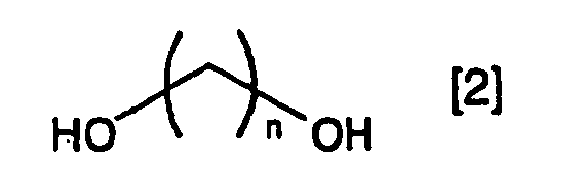

- According to a preferred embodiment, this process may be used for producing a brominated acetal represented by the formula 6, wherein the trifluoromethyl-substituted acetophenone to be brominated is represented by the formula 4, and wherein the acetalization agent that is an alkylene diol represented by the formula 5.


- According to the present invention, there is also provided a process for producing a trifluoromethyl-substituted 2-alkoxyacetophenone derivative represented by the formula 9, comprising the steps of:
- (a) brominating a trifluoromethyl-substituted acetophenone, represented by the formula 1, according to the aforementioned process, thereby preparing a brominated acetal represented by the formula 3;
- (b) reacting the brominated acetal with a metal alkoxide represented by the formula 7, thereby converting the brominated acetal into an ether represented by the formula 8; and
- (c) hydrolyzing the ether in the presence of an acid catalyst to remove an acetal group from the ether, thereby producing the 2-alkoxyacetophenone derivative.
R1OM [7]
- As stated above, this process comprises the step (a), which is identical with that of the process for producing a brominated acetal of formula 3 and the above additional steps (b) and (c).
- According to a preferred embodiment, this process may be used for producing a trifluoromethyl-substituted 2-alkoxyacetophenone derivative represented by the formula 12 wherein the trifluoromethyl-substituted acetophenone to be brominated is represented by the above formula 4, wherein the acetalization agent is an alkylene diol represented by the above formula 5, wherein the brominated acetal is represented by the above formula 6, wherein the metal alkoxide of the step (b) is represented by the formula 10, and wherein the ether of the step (b) is represented by the formula 11.
CH3OM [10]
where M represents Na or K,

- The acetalization agent in the process for producing a brominated acetal represented by the formula 3 or in the process for producing a trifluoromethyl-substituted 2-alkoxyacetophenone derivate represented by the formula 9 may be ethylene glycol.
- Furthermore, the metal alkoxide of the step (b) of the process for producing a trifluoromethyl-substituted 2-alkoxyacetophenone derivate represented by the formula 9 may be sodium alkoxide or potassium alkoxide.
- Preferably, the acid catalyst of the step (c) in the process for producing a trifluoromethyl-substituted 2-alkoxyacetophenone derivate represented by the formula 9 or by the formula 12 is hydrochloric acid.
- In the process for producing a trifluoromethyl-substituted 2-alkoxyacetophenone derivate represented by the formula 9 or by the formula 12, step (c) may be conducted by dissolving the ether in an aqueous solution of the acid catalyst in the presence of methanol.
- According to a further aspect, the present invention provides a brominated acetal represented by the formula 3,

- Preferably, the brominated acetal is represented by the formula 6:

- According to a further aspect, the present invention provides an ether represented by the formula 8,

- Preferably, the ether is represented by the formula 11.

- The present invention provides intermediate compounds, that is, acetals represented by the formula 18 and ethers represented by the formula 11 (the formula 11 is recited in the above):

- The inventors further unexpectedly found that both of the halogenation and the carbonyl group protection proceed simultaneously in one step (i.e., the step (a) of the processes) by brominating a trifluoromethyl substituted acetophenone, represented by the formula 1, by Br2 in the presence of an alkylene diol represented by the formula 2, thereby producing a brominated acetal represented by the formula 3 with high yield (see the following reaction scheme 1).

- In fact, the inventors unexpectedly found in the above bromination that the use of the alkylene diol forms an equilibrium composition (crude reaction product) in which dialkylacetals (e.g., compound C in Table 1) greatly surpass α-bromoacetophenones (e.g., compounds A and D in Table 1) in amount, as compared with the case of using a lower alcohol (e.g., methanol), which is disclosed in
Japanese Patent Application Publication 2001-72638 Table 1 
Run Lower alcohol or Alkylenediol Temperature Time Compound A1,2 B or C1,2 D1,2 1 CH3OH 26-28°C 3.5h 29.2% 53.8% 9.5% 5.6ml 24h 26.0% 45.3% 25.3% (1.4ml)3 2 HOCH2CH2OH 25-28°C 3.5h 11.7% 54.2% 0.3% 7.5ml 24h 3.4% 88.6% 0.8% (CHCl3 2.2ml)3 1: Determined by GC.
2:
3: The used amount for preparing dropping Br2 solution. - In general, it is not easy to handle Br2 due to its properties. Thus, it is difficult to precisely control the charged amount of Br2, and it is common to use an excessive amount of Br2 in order to increase yield. In case that Br2 is used in an excessive amount, the use of a lower alcohol (e.g., methanol), which is disclosed in
Japanese Patent Application Publication 2001-72638 - According to the present invention, it is possible to obtain a brominated acetal (almost not containing α-bromoacetophenones and α,α-dibromoacetophenones) in the step (a) of the processes at one time with high yield by brominating the trifluoromethyl-substituted acetophenone by Br2 in the presence of the alkylene diol. Then, the subsequent replacement reaction to replace the bromine with the alkoxy group can proceed very smoothly in the step (b) of the process for producing a derivative according to formula 9 or 12 by reacting the brominated acetal with the metal alkoxide, thereby producing a corresponding ether of the formula 8 with high yield. Then, it is possible to produce the target product, the trifluoromethyl-substituted 2-alkoxyacetophenone derivative, with high yield in the step (c) of the process by hydrolyzing or deprotecting the ether in the presence of an acid catalyst. Each of these steps (a), (b) and (c) is high in selectively and does almost not produce impurities difficult for separation. Therefore, the processes according to the present invention are very useful for industrially producing the target brominated acetal and the target trifluoromethyl-substituted 2-alkoxyacetophenone derivative.
- The processes of the present invention are described in detail as follows (see the following reaction scheme 2).

- Firstly, the bromination of the step (a) of the processes is described in detail, as follows. The starting raw material, a trifluoromethyl-substituted acetophenone (represented by the formula 1), is selected from 2'-trifluoromethylacetophenone, 3'-trifluoromethylacetophenone, 4'-trifluoromethylacetophenone (represented by the formula 4), 2',3'-bis(trifluoromethyl)acetophenone, 2',4'-bis(trifluoromethyl)acetophenone, 2',5'-bis(trifluoromethyl)acetophenone, 2',6'-bis(trifluoromethyl)acetophenone, 3',4'-bis(trifluoromethyl)acetophenone, and 3',5'-bis(trifluoromethyl)acetophenone. Although some of these compounds are novel compounds, such novel compounds can also be produced, based on the disclosures of
Japanese Patent Application Publication 2001-72638 - The alkylene diol (represented by the formula 2) is selected from ethylene glycol (represented by the formula 5), 1,3-propanediol, and 1,4-butanediol. Of these, ethylene glycol and 1,3-propanediol are preferable, and ethylene glycol is more particularly preferable.
- The alkylene diol used in the bromination may be in an amount of at least one equivalent, preferably 1-30 equivalents, more preferably 1-20 equivalents, per equivalent of the trifluoromethyl-substituted acetophenone of the formula 1.
- Br2 used in the bromination may be in an amount of at least one equivalent, preferably 1-10 equivalents, more preferably 1-5 equivalents, per equivalent of the trifluoromethyl-substituted acetophenone of the formula 1.
- It is possible to handle Br2 by dissolving Br2 in a diluting solvent. This diluting solvent may be selected from aliphatic hydrocarbons (e.g., n-pentane, n-hexane, cyclohexane, and n-heptane), halogenated hydrocarbons (e.g., methylene chloride, chloroform, carbon tetrachloride, and 1,2-dichloroethane), ethers (e.g., diethyl ether, tetrahydrofuran, t-butyl methyl ether, and 1,4-dioxane), esters (e.g., ethyl acetate, and n-butyl acetate), nitriles (e.g., acetonitrile and propionitrile), and carboxylic acids (e.g., acetic acid, propionic acid, and butyric acid). Of these, halogenated hydrocarbons and carboxylic acids are preferable, and halogenated hydrocarbons are more preferable.
- The way of adding Br2 in the bromination is not particularly limited. For example, a diluted solution of Br2 may be added dropwise to a mixed solution containing the trifluoromethyl-substituted acetophenone and the alkylene diol.
- The reaction solvent for conducting the bromination may be the same as the diluting solvent of Br2. Furthermore, the alkylene diol may also be used as a reaction solvent by using it in an excessive amount.
- The temperature for conducting the bromination may be from -20°C to +150°C, preferably -10°C to +125°C, more preferably from 0°C to +100°C.
- Although the reaction time for conducting the bromination may be from 1hr to 48hr, it may be varied depending on the type of the substrate and the reaction conditions. Therefore, it is preferable to terminate the reaction after confirming that the raw material has almost been consumed by checking the progress of the reaction by an analytical means such as gas chromatography, liquid chromatography and NMR.
- Post-treatment of the bromination is not particularly limited. An exemplary post-treatment may be conducted as follows. After the reaction, the reaction liquid is added to water or brine, followed by extraction with an organic solvent such as ethyl acetate and toluene. Then, the collected organic layer is dried with a drying agent such as anhydrous sodium sulfate and anhydrous magnesium sulfate, followed by filtration, concentration and vacuum drying, thereby obtaining a crude product. In case that the alkylene diol (particularly ethylene glycol) is used in an excessive amount as a reactant and a reaction solvent of the bromination, the reaction liquid after the reaction separates into two layers. The target product exists only in the lower layer. Therefore, the lower layer can be separated from the upper layer, followed by washing with brine, water or the like, drying with a drying agent (such as anhydrous sodium sulfate and anhydrous magnesium sulfate), filtration and vacuum drying, thereby obtaining a crude product. According to need, the crude product may be subjected to a purification such as activated carbon treatment, distillation, recrystallization, and column chromatography, thereby obtaining a brominated acetal of the formula 3 with high chemical purity. As an alternative to the above post-treatment, it is optional to directly add a metal alkoxide of the formula 7 to the reaction mixture liquid in order to conduct the bromination and the replacement reaction in one pot.
- The replacement reaction of the step (b) of the processes for producing a trifluoromethyl-substituted 2-alkoxyacetophenone derivative are described in detail, as follows. This reaction can be conducted by reacting a brominated acetal of the formula 3 with a metal alkoxide of the formula 7.
- The metal alkoxide of the formula 7 is selected from MeOLi, MeONa and MeOK (represented by the formula 10), EtOLi, EtONa, EtOK, n-PrOLi, n-PrONa, n-PrOK, i-PrOLi, i-PrONa, i-PrOK, n-BuOLi, n-BuONa, n-BuOK, i-BuOLi, i-BuONa, i-BuOK, sec-BuOLi, sec-BuONa, sec-BuOK, tert-BuOLi, tert-BuONa, and tert-BuOK, where Me, Et, Pr and Bu respectively represent methyl group, ethyl group, propyl group, and butyl group. Of these, sodium alkoxides and potassium alkoxides are preferable, and potassium alkoxides are more particularly preferable. The metal alkoxide can easily be prepared from a corresponding alcohol and a metal (Li, Na or K). The metal alkoxide in the form of an alcohol solution may be used in the replacement reaction without conducting its separation from the alcohol solution. It is also possible to use a commercial product of an isolated metal alkoxide (e.g., MeOLi, MeONa, and MeOK) or an alcohol solution of metal alkoxide (e.g., a methanol solution containing 28%MeONa and a methanol solution containing 30%MeOK).
- The metal alkoxide used in the replacement reaction may be in an amount of at least 1 equivalent, preferably 1-20 equivalents, more preferably 1-10 equivalents, per equivalent of the brominated acetal of the formula 3.
- It is possible to conduct the replacement reaction by adding an additive. This additive may be selected from crown ethers (e.g., 12-crown-4, 15-crown-5, and 18-crown-6), ethylene glycol dialkyl ethers (e.g., 1,2-dimethoxyethane, diethylene glycol dimethyl ether, and triethylene glycol dimethyl ether), and iodides (e.g., sodium iodide, potassium iodide, and tetrabutylammonium iodide). In some cases, it is possible to conduct the replacement reaction more smoothly by using the additive. However, the additive may be omitted provided that the reaction temperature is well controlled. The additive used in the replacement reaction may be in an amount of at least 0.001 equivalents, preferably 0.005-50 equivalents, more preferably 0.01-30 equivalents, per equivalent of the brominated acetal.
- The reaction solvent for conducting the replacement reaction may be selected from alcohols (e.g., methanol, ethanol, propanol, isopropanol, butanol, isobutanol, sec-butanol, and tert-butanol), ethers (e.g., diethyl ether, tetrahydrofuran, t-butyl methyl ether, and 1,4-dioxane), and amides (e.g., hexamethylphosphoric triamide, N,N-dimethylformamide, N,N-dimethylacetamide, and N-methylpyrolidone). Of these, alcohols and ethers are preferable, and alcohols are more preferable.
- The reaction temperature for conducting the replacement reaction may be from 0°C to 250°C, preferably 25°C to 225°C, more preferably 50°C to 200°C. In case that it is necessary to have a reaction temperature higher than the boiling point of the reaction solution, it is possible to use a pressure-proof reaction vessel.
- Although the reaction time for conducting the replacement may be from 6hr to 48hr, it may be varied depending on the type of the substrate and the reaction conditions. Therefore, it is preferable to terminate the reaction after confirming that the raw material has almost been consumed by checking the progress of the reaction by an analytical means such as gas chromatography, liquid chromatography and NMR.
- Post-treatment of the replacement reaction is not particularly limited. An exemplary post-treatment may be conducted as follows. After the reaction, the reaction liquid is added to water or brine, followed by extraction with an organic solvent (e.g., ethyl acetate and toluene) and washing with water. Then, the collected organic layer is dried with a drying agent such as anhydrous sodium sulfate and anhydrous magnesium sulfate, followed by filtration, concentration and vacuum drying, thereby obtaining a crude product. According to need, the crude product may be subjected to purification such as activated carbon treatment, distillation, recrystallization, and column chromatography, thereby obtaining an ether of the formula 8 with high chemical purity. As an alternative to the above post-treatment, it is optional to directly add an acid catalyst aqueous solution to the reaction mixture liquid in order to conduct the replacement reaction and the deprotection (hydrolysis) in one pot.
- The deprotection (hydrolysis) of the step (c) of the processes are described in detail, as follows. It is possible to conduct the step (c) by reacting the ether, which has been obtained by the step (b), with water in the presence of an acid catalyst.
- The acid catalyst may be selected from organic acids (e.g., benzenesulfonic acid, p-toluenesulfonic acid, 10-camphorsulfonic acid, trifluoroacetic acid, and trifluoromethanesulfonic acid) and inorganic acids (e.g., hydrochloric acid, hydrobromic acid, sulfuric acid, and phosphoric acid). Of these, hydrochloric acid and sulfuric acid are preferable, and hydrochloric acid is more preferable.
- The acid catalyst used in the deprotection may be in an amount of 100 equivalents or less, preferably 0.01-75 equivalents, more preferably 0.05-50 equivalents, per equivalent of the ether.
- The acid catalyst concentration of the aqueous solution may be at least 0.01N, preferably 0.05-20N, more preferably 0.1-12N.
- Since the step (c) is a hydrolysis, it is necessary to dissolve the ether in an aqueous solution of an acid catalyst. Therefore, it is possible to more smoothly conduct the reaction by using a solubilizer (dissolution adjuvant) to achieve a uniform dissolution.
- The solubilizer may be selected from alcohols (e.g., methanol, ethanol, propanol, and isopropanol) and phase transfer catalysts (e.g., quaternary ammonium salts). Of these, methanol and ethanol are preferable, and methanol is more preferable.
- The solubilizer used in the step (c) may be 10 parts by volume or less, preferably 0.001-5.0 parts by volume, more preferably 0.01-3.0 parts by volume, relative to one part by volume of the acid catalyst aqueous solution.
- The reaction temperature for conducting the step (c) may be 0-200°C, preferably 0-175°C, more preferably 0-150°C. In case that it is necessary to have a reaction temperature higher than the boiling point of the reaction solution, it is possible to use a pressure-proof reaction vessel.
- Although the reaction time for conducting the step (c) may be from 6hr to 48hr, it may be varied depending on the type of the substrate and the reaction conditions. Therefore, it is preferable to terminate the reaction after confirming that the raw material has almost been consumed by checking the progress of the reaction by an analytical means such as gas chromatography, liquid chromatography and NMR.
- Post-treatment of the step (c) is not particularly limited. An exemplary post-treatment may be conducted as follows. After the reaction, the reaction liquid is added to water or brine, followed by extraction with an organic solvent (e.g., ethyl acetate and toluene) and washing with water. Then, the collected organic layer is dried with a drying agent such as anhydrous sodium sulfate and anhydrous magnesium sulfate, followed by filtration, concentration and vacuum drying, thereby obtaining a crude product. According to need, the crude product may be subjected to purification such as activated carbon treatment, distillation, recrystallization, and column chromatography, thereby obtaining the target product, a trifluoromethyl-substituted 2-alkoxyacetophenone derivative of the formula 9, with high chemical purity.
- The following nonlimitative examples are illustrative of the present invention. In fact, Example 1 is illustrative of the processes for producing a brominated acetal represented by the formula 3 or formula 6, and Comparative Examples 1 to 3 are not. Example 2 is illustrative of the processes for producing a brominated acetal represented by the formula 3 or formula 6 and the processes for producing a trifluoromethyl-substituted 2-alkoxyacetophenone derivative represented by the formula 9 or formula 12.
- 2.82g (14.99mmol, 1eq.) of 4'-trifluoromethylacetophenone were dissolved in 5.6ml of methanol. While the solution was controlled to have an internal temperature of 26-27°C, a methanol solution obtained by diluting 3.60g (22.53mmol, 1.50eq.) of Br2 with 1.4ml of methanol was added to the solution, followed by stirring for 24hr with an internal temperature of 26-28°C. 3.5hr and 24hr after the start of the reaction, the progress of the reaction was checked by gas chromatography. The results are shown in Table 2.
Table 2 Time Compound A1 B1 D1 3.5h 29.2% 53.8% 9.5% 24h 26.0% 45.3% 25.3% 
- 2.82g (14.99mmol, 1eq.) of 4'-trifluoromethylacetophenone were dissolved in 7.5ml (8.35g, 134.53mmol, 8.97eq.) of ethylene glycol. While the solution was controlled to have an internal temperature of 25-28°C, a chloroform solution obtained by diluting 3.60g (22.53mmol, 1.50eq.) of Br2 with 2.2ml of chloroform was added to the solution, followed by stirring for 24hr with an internal temperature of 25-26°C. 3.5hr and 24hr after the start of the reaction, the progress of the reaction was checked by gas chromatography. The results are shown in Table 3.
Table 3 Time Compound A1 C1 D1 3.5h 11.7% 54.2% 0.3% 24h 3.4% 88.6% 0.8% 
- 106g (0.56mol, 1eq.) of 4'-trifluoromethylacetophenone were dissolved in 281ml (313g, 5.04mol, 9.00eq.) of ethylene glycol. While the solution was controlled to have an internal temperature of 28-32°C, a chloroform solution obtained by diluting 108g (0.68mol, 1.21eq.) of Br2 with 56ml of chloroform was added to the solution, followed by stirring for 15hr with an internal temperature of 29-32°C. The resulting reaction separated into an upper and lower layer. Then, the lower layer was washed with 2% brine, followed by drying with anhydrous sodium sulfate, filtration and vacuum drying, thereby obtaining 165g of a crude product of a brominated acetal represented by the following formula.

- The yield was 94%. The analytical results of the crude product by gas chromatography are shown in Table 4, and its 1H-NMR spectrum was as follows.
Table 4 Compound A1 C1 D1 Total Others 0.6% 96.9% 0.9% 1.6% 
- 1H-NMR (standard substance: TMS, solvent: CDCl3), δppm: 3.64 (s, 2H), 3.83-3.98 (m, 2H), 4.14-4.30 (m, 2H), 7.64 (Ar-H, 4H).
- Separately, water was poured into the above-obtained upper layer, followed by extraction with ethyl acetate. The collected organic layer was dried with anhydrous sodium sulfate, followed by filtration, concentration and vacuum drying, thereby obtaining 6g of a brominated acetal of the above formula. The yield was 3%.
- A pressure-proof glass vessel was charged with (a) a part (20.11g, 64.64mmol, 1eq.) of the crude product of the above-obtained lower layer, (b) 75.56g of a 30% MeOK solution containing 323.23mmol (5.00eq.) of MeOK dissolved in methanol, and (c) 11.65g (129.27mmol, 2.00eq.) of 1,2-dimethoxyethane, followed by stirring for 15hr at 140°C. After the reaction, the reaction liquid was poured into a saturated brine, followed by extraction with ethyl acetate. The collected organic layer was dried with anhydrous sodium sulfate, followed by filtration, concentration and vacuum drying, thereby obtaining 18.12g of a crude product of an ether represented by the following formula.

- Conversion and selectivity of the reaction were found by gas chromatography to be 99% and 97%, respectively. 1H-NMR spectrum of the crude product was as follows.
1H-NMR (standard substance: TMS, solvent: CDCl3), δppm: 3.40 (s, 3H), 3.60 (s, 2H), 3.79-3.93 (m, 2H), 4.06-4.20 (m, 2H), 7.55-7.72 (Ar-H, 4H). - The total amount (18.12g, 64.64 mmol, 1eq.) of the above crude product of the ether and 242.40ml of 8N HCl (containing 1939.20mmol (30.00eq.) of HCl) were added to 242.4ml of methanol, followed by stirring for 36hr at room temperature. After the reaction, the reaction liquid was poured into a saturated brine, followed by extraction with ethyl acetate. The collected organic layer was dried with anhydrous sodium sulfate, followed by filtration, concentration and vacuum drying, thereby obtaining 15.63g of a crude product of a trifluoromethyl-substituted 2-alkoxyacetophenone derivative represented by the following formula.

- Conversion of the reaction was found by gas chromatography to be 99%. The crude product was found by a quantitative analysis with 19F-NMR internal standard method to contain 12.07g of the target product. The total yield from the bromination to the deprotection was 83%. The total amount (15.63g) of the crude product was recrystallized from n-hexane (1.5 times that of the crude product in volume), thereby obtaining 9.31g of a purified product (gas chromatographic purity: higher than 99.7%). 1H-NMR spectrum of the product was as follows:
1H-NMR (standard substance: TMS, solvent: CDCl3), δppm: 3.52 (s, 3H), 4.70 (s, 2H), 7.75 (d, 8.6Hz, 2H), 8.06 (d, 8.6Hz, 2H). - A pressure-proof glass vessel was charged with 1.00g (3.74mmol, 1eq.) of 2-bromo-4'-trifluoromethylacetophenone and 4.38g of 30% MeOK solution containing 18.74mmol (5.01eq.) of MeOK dissolved in methanol, followed by stirring for 24hr at room temperature. After the reaction, the reaction liquid was poured into a saturated brine, followed by extraction with ethyl acetate. The collected organic layer was dried with anhydrous sodium sulfate, followed by filtration, concentration and vacuum drying, thereby obtaining 0.94g of a crude product of a trifluoromethyl-substituted 2-alkoxyacetophenone derivative represented by the following formula.

- As a result of an analysis of the crude product with gas chromatography and 1H-NMR and 19F-NMR, it was found that the raw material had almost been consumed (conversion>95%). However, the yield was found by a 19F-NMR internal standard method to be less than 5%.
- A pressure-proof glass vessel was charge with 1.00g (4.49mmol, 1eq.) of 2-chloro-4'-trifluoromethylacetophenone and 5.25g of 30%MeOK solution containing 22.46mmol (5.00eq.) of MeOK dissolved in methanol, followed by stirring for 24hr at room temperature. After the reaction, the reaction liquid was poured into a saturated brine, followed by extraction with ethyl acetate. The collected organic layer was dried with anhydrous sodium sulfate, followed by filtration, concentration and vacuum drying, thereby obtaining 0.89g of a crude product of a trifluoromethyl-substituted 2-alkoxyacetophenone derivative represented by the following formula.

- As a result of an analysis of the crude product with gas chromatography and 1H-NMR and 19F-NMR, it was found that the raw material had almost been consumed (conversion>95%). However, the yield was found by a 19F-NMR internal standard method to be less than 5%.


Claims (12)
- A process for producing a brominated acetal represented by the formula 3, comprising the step of (a) brominating a trifluoromethyl-substituted acetophenone, represented by the formula 1, by Br2 in the presence of an acetalization agent that is an alkylene diol represented by the formula 2,


- A process according to claim 1, wherein the brominated acetal is represented by the formula 6, wherein the trifluoromethyl-substituted acetophenone to be brominated is represented by the formula 4, and wherein the acetalization agent is an alkylene diol represented by the formula 5.


- A process for producing a trifluoromethyl-substituted 2-alkoxyacetophenone derivative represented by the formula 9, comprising the steps of:(a) brominating a trifluoromethyl-substituted acetophenone represented by the formula 1 according to the process of claim 1, thereby preparing a brominated acetal represented by the formula 3;(b) reacting the brominated acetal with a metal alkoxide represented by the formula 7, thereby converting the brominated acetal into an ether represented by the formula 8; and(c) hydrolyzing the ether in the presence of an acid catalyst to remove an acetal group from the ether, thereby producing the 2-alkoxyacetophenone derivative,where m represents 1 or 2,


R1OM [7]
where R1 represents an alkyl group having a carbon atom number of from 1 to 4, and M represents Li, Na or K,

- A process according to claim 3, wherein the trifluoromethyl-substituted 2-alkoacyacetophenone derivative is represented by the formula 12, wherein the trifluoromethyl-substituted acetophenone to be brominated is represented by the formula 4, wherein the acetalization agent is an alkylene diol represented by the formula 5, wherein the brominated acetal is represented by the formula 6, wherein the metal alkoxide of the step (b) is represented by the formula 10, and wherein the ether of the step (b) is represented by the formula 11.


CH3OM [10]
where M represents Na or K,

- A process according to claim 1 or 3, wherein the acetalization agent is ethylene glycol.
- A process according to claim 3, wherein the metal alkoxide of the step (b) is sodium alkoxide or potassium alkoxide.
- A process according to claim 3 or 4, wherein the acid catalyst of the step (c) is hydrochloric acid.
- A process according to claim 3 or 4, wherein the step (c) is conducted by dissolving the ether in an aqueous solution of the acid catalyst in the presence of methanol.
- A brominated acetal represented by the formula 3,

- A brominated acetal according to claim 9, which is represented by the formula 6.
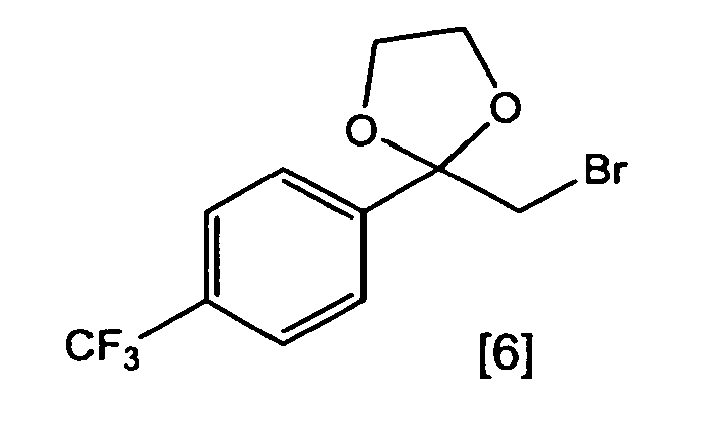
- An ether represented by the formula 8,

- An ether according to claim 11, which is represented by the formula 11.

Applications Claiming Priority (5)
| Application Number | Priority Date | Filing Date | Title |
|---|---|---|---|
| JP2002232698A JP2004067637A (en) | 2002-08-09 | 2002-08-09 | Method for producing trifluoromethyl-substituted 2-alkoxyacetophenone derivative |
| JP2002232698 | 2002-08-09 | ||
| JP2002261160 | 2002-09-06 | ||
| JP2002261160A JP4278938B2 (en) | 2002-09-06 | 2002-09-06 | Process for producing trifluoromethyl-substituted 2-alkoxyacetophenone derivative |
| PCT/JP2003/010153 WO2004014887A1 (en) | 2002-08-09 | 2003-08-08 | Process for producing trifluoromethyl-substituted 2-alkoxyacetophenone derivatives |
Publications (2)
| Publication Number | Publication Date |
|---|---|
| EP1546126A1 EP1546126A1 (en) | 2005-06-29 |
| EP1546126B1 true EP1546126B1 (en) | 2007-11-21 |
Family
ID=31719863
Family Applications (1)
| Application Number | Title | Priority Date | Filing Date |
|---|---|---|---|
| EP03784619A Expired - Lifetime EP1546126B1 (en) | 2002-08-09 | 2003-08-08 | Process for producing trifluoromethyl-substituted 2-alkoxyacetophenone derivatives |
Country Status (5)
| Country | Link |
|---|---|
| US (2) | US7053248B2 (en) |
| EP (1) | EP1546126B1 (en) |
| CN (1) | CN100347166C (en) |
| DE (1) | DE60317691T2 (en) |
| WO (1) | WO2004014887A1 (en) |
Families Citing this family (1)
| Publication number | Priority date | Publication date | Assignee | Title |
|---|---|---|---|---|
| CN104230875A (en) * | 2014-10-08 | 2014-12-24 | 黄山学院 | One-step method for preparing alpha-halogenated acetophenone glycol ketal compound |
Family Cites Families (4)
| Publication number | Priority date | Publication date | Assignee | Title |
|---|---|---|---|---|
| SU557755A3 (en) * | 1968-08-19 | 1977-05-05 | Янссен Фармасьютика Н.В. (Фирма) | Method for preparing imidazole derivatives |
| DE3144318A1 (en) * | 1981-11-07 | 1983-05-19 | Bayer Ag, 5090 Leverkusen | 2-IMIDAZOLYLMETHYL-2-PHENYL-1, 3-DIOXOLANE, METHOD FOR THE PRODUCTION THEREOF AND THEIR USE AS FUNGICIDES |
| JP2001072638A (en) | 1999-09-01 | 2001-03-21 | Nippon Kayaku Co Ltd | PRODUCTION OF alpha-BROMOALKYLPHENONES |
| AU6596800A (en) | 1999-09-03 | 2001-04-10 | Asahi Kasei Kabushiki Kaisha | Processes for the preparation of tricyclic amino alcohol derivatives |
-
2003
- 2003-08-08 DE DE60317691T patent/DE60317691T2/en not_active Expired - Lifetime
- 2003-08-08 WO PCT/JP2003/010153 patent/WO2004014887A1/en not_active Ceased
- 2003-08-08 CN CN03818358.7A patent/CN100347166C/en not_active Expired - Fee Related
- 2003-08-08 US US10/473,399 patent/US7053248B2/en not_active Expired - Fee Related
- 2003-08-08 EP EP03784619A patent/EP1546126B1/en not_active Expired - Lifetime
-
2006
- 2006-02-06 US US11/347,390 patent/US7189863B2/en not_active Expired - Fee Related
Also Published As
| Publication number | Publication date |
|---|---|
| DE60317691T2 (en) | 2008-10-30 |
| US20060128976A1 (en) | 2006-06-15 |
| CN1671683A (en) | 2005-09-21 |
| CN100347166C (en) | 2007-11-07 |
| EP1546126A1 (en) | 2005-06-29 |
| US7053248B2 (en) | 2006-05-30 |
| WO2004014887A1 (en) | 2004-02-19 |
| DE60317691D1 (en) | 2008-01-03 |
| US20050171363A1 (en) | 2005-08-04 |
| US7189863B2 (en) | 2007-03-13 |
Similar Documents
| Publication | Publication Date | Title |
|---|---|---|
| EP2305625B1 (en) | Process for production of benzaldehyde compound | |
| EP2241546B1 (en) | Process for production of benzaldehyde compound | |
| CN1074759C (en) | Process for preparing fluoromethyl 1, 1, 1, 3, 3, 3, -hexafluoroisopropyl ether | |
| JP3822644B2 (en) | Method for producing 1,3-dioxolane-4-methanol compound | |
| JPWO1998011087A1 (en) | Method for producing 1,3-dioxolane-4-methanol compound | |
| US7375254B2 (en) | Process for recovery of 1,1,1,3,3,3-hexafluoroisopropanol from the waste stream of sevoflurane synthesis | |
| JP7576036B2 (en) | Method for producing perfluoro(2,4-dimethyl-2-fluoroformyl-1,3-dioxolane) | |
| JPWO1998011088A1 (en) | Method for producing 1,3-dioxolane-4-methanol compound | |
| CN1392133A (en) | Process for preparing bromodifluoacetic acid compounds | |
| DE60015806T2 (en) | POLY-3-CYCLOPROPYL-3-HYDROXYPROPIONATE AND METHOD FOR ITS PREPARATION AND DERIVATIVES THEREOF | |
| JP2000143688A (en) | Production of zeaxanthin mono-beta-glucoside | |
| US7053248B2 (en) | Process for producing trifluoromethyl- substituted 2- alkoxyacetophenone derivatives | |
| JP4278938B2 (en) | Process for producing trifluoromethyl-substituted 2-alkoxyacetophenone derivative | |
| WO2002088058A1 (en) | Process for the preparation of benzyl alcohols | |
| JPH1160529A (en) | Production of ether | |
| JP3900202B2 (en) | Process for producing 1,3-dioxolane-4-methanol compound | |
| JP4403369B2 (en) | Method for producing fluorophenol derivative | |
| JP2004269425A (en) | Method for preparing trifluoromethyl-substituted 2-alkoxyacetophenone derivative | |
| JP4273383B2 (en) | Method for producing fluorine-containing aromatic alcohols | |
| EP4430025A1 (en) | Process and intermediates for preparation of isofetamid | |
| CN119707647A (en) | Preparation method of dendrobe phenol | |
| JP3312414B2 (en) | Process for producing dienoic halides | |
| CN117886677A (en) | A kind of synthetic method of allyl trifluoroethyl ether compound | |
| CN119306577A (en) | A kind of preparation method of polyglycol | |
| JP2022163487A (en) | (6z,9z)-6,9-dodecadien-1-yne and production method thereof |
Legal Events
| Date | Code | Title | Description |
|---|---|---|---|
| PUAI | Public reference made under article 153(3) epc to a published international application that has entered the european phase |
Free format text: ORIGINAL CODE: 0009012 |
|
| 17P | Request for examination filed |
Effective date: 20050104 |
|
| AK | Designated contracting states |
Kind code of ref document: A1 Designated state(s): AT BE BG CH CY CZ DE DK EE ES FI FR GB GR HU IE IT LI LU MC NL PT RO SE SI SK TR |
|
| RBV | Designated contracting states (corrected) |
Designated state(s): DE FR GB |
|
| 17Q | First examination report despatched |
Effective date: 20050725 |
|
| GRAP | Despatch of communication of intention to grant a patent |
Free format text: ORIGINAL CODE: EPIDOSNIGR1 |
|
| GRAS | Grant fee paid |
Free format text: ORIGINAL CODE: EPIDOSNIGR3 |
|
| GRAA | (expected) grant |
Free format text: ORIGINAL CODE: 0009210 |
|
| AK | Designated contracting states |
Kind code of ref document: B1 Designated state(s): DE FR GB |
|
| REG | Reference to a national code |
Ref country code: GB Ref legal event code: FG4D |
|
| REF | Corresponds to: |
Ref document number: 60317691 Country of ref document: DE Date of ref document: 20080103 Kind code of ref document: P |
|
| ET | Fr: translation filed | ||
| PLBE | No opposition filed within time limit |
Free format text: ORIGINAL CODE: 0009261 |
|
| STAA | Information on the status of an ep patent application or granted ep patent |
Free format text: STATUS: NO OPPOSITION FILED WITHIN TIME LIMIT |
|
| 26N | No opposition filed |
Effective date: 20080822 |
|
| PGFP | Annual fee paid to national office [announced via postgrant information from national office to epo] |
Ref country code: FR Payment date: 20130823 Year of fee payment: 11 Ref country code: GB Payment date: 20130821 Year of fee payment: 11 |
|
| PGFP | Annual fee paid to national office [announced via postgrant information from national office to epo] |
Ref country code: DE Payment date: 20131030 Year of fee payment: 11 |
|
| REG | Reference to a national code |
Ref country code: DE Ref legal event code: R119 Ref document number: 60317691 Country of ref document: DE |
|
| GBPC | Gb: european patent ceased through non-payment of renewal fee |
Effective date: 20140808 |
|
| REG | Reference to a national code |
Ref country code: FR Ref legal event code: ST Effective date: 20150430 |
|
| PG25 | Lapsed in a contracting state [announced via postgrant information from national office to epo] |
Ref country code: GB Free format text: LAPSE BECAUSE OF NON-PAYMENT OF DUE FEES Effective date: 20140808 Ref country code: DE Free format text: LAPSE BECAUSE OF NON-PAYMENT OF DUE FEES Effective date: 20150303 |
|
| PG25 | Lapsed in a contracting state [announced via postgrant information from national office to epo] |
Ref country code: FR Free format text: LAPSE BECAUSE OF NON-PAYMENT OF DUE FEES Effective date: 20140901 |