EP1545815B1 - Ni-coated ti powders - Google Patents
Ni-coated ti powders Download PDFInfo
- Publication number
- EP1545815B1 EP1545815B1 EP03794963A EP03794963A EP1545815B1 EP 1545815 B1 EP1545815 B1 EP 1545815B1 EP 03794963 A EP03794963 A EP 03794963A EP 03794963 A EP03794963 A EP 03794963A EP 1545815 B1 EP1545815 B1 EP 1545815B1
- Authority
- EP
- European Patent Office
- Prior art keywords
- powder
- coated
- powders
- bearing
- sintered body
- Prior art date
- Legal status (The legal status is an assumption and is not a legal conclusion. Google has not performed a legal analysis and makes no representation as to the accuracy of the status listed.)
- Expired - Lifetime
Links
Images


Classifications
-
- B—PERFORMING OPERATIONS; TRANSPORTING
- B22—CASTING; POWDER METALLURGY
- B22F—WORKING METALLIC POWDER; MANUFACTURE OF ARTICLES FROM METALLIC POWDER; MAKING METALLIC POWDER; APPARATUS OR DEVICES SPECIALLY ADAPTED FOR METALLIC POWDER
- B22F3/00—Manufacture of workpieces or articles from metallic powder characterised by the manner of compacting or sintering; Apparatus specially adapted therefor ; Presses and furnaces
- B22F3/10—Sintering only
- B22F3/11—Making porous workpieces or articles
- B22F3/1143—Making porous workpieces or articles involving an oxidation, reduction or reaction step
-
- A—HUMAN NECESSITIES
- A61—MEDICAL OR VETERINARY SCIENCE; HYGIENE
- A61L—METHODS OR APPARATUS FOR STERILISING MATERIALS OR OBJECTS IN GENERAL; DISINFECTION, STERILISATION OR DEODORISATION OF AIR; CHEMICAL ASPECTS OF BANDAGES, DRESSINGS, ABSORBENT PADS OR SURGICAL ARTICLES; MATERIALS FOR BANDAGES, DRESSINGS, ABSORBENT PADS OR SURGICAL ARTICLES
- A61L27/00—Materials for grafts or prostheses or for coating grafts or prostheses
- A61L27/02—Inorganic materials
- A61L27/04—Metals or alloys
- A61L27/06—Titanium or titanium alloys
-
- A—HUMAN NECESSITIES
- A61—MEDICAL OR VETERINARY SCIENCE; HYGIENE
- A61L—METHODS OR APPARATUS FOR STERILISING MATERIALS OR OBJECTS IN GENERAL; DISINFECTION, STERILISATION OR DEODORISATION OF AIR; CHEMICAL ASPECTS OF BANDAGES, DRESSINGS, ABSORBENT PADS OR SURGICAL ARTICLES; MATERIALS FOR BANDAGES, DRESSINGS, ABSORBENT PADS OR SURGICAL ARTICLES
- A61L27/00—Materials for grafts or prostheses or for coating grafts or prostheses
- A61L27/28—Materials for coating prostheses
- A61L27/30—Inorganic materials
- A61L27/306—Other specific inorganic materials not covered by A61L27/303 - A61L27/32
-
- B—PERFORMING OPERATIONS; TRANSPORTING
- B22—CASTING; POWDER METALLURGY
- B22F—WORKING METALLIC POWDER; MANUFACTURE OF ARTICLES FROM METALLIC POWDER; MAKING METALLIC POWDER; APPARATUS OR DEVICES SPECIALLY ADAPTED FOR METALLIC POWDER
- B22F1/00—Metallic powder; Treatment of metallic powder, e.g. to facilitate working or to improve properties
- B22F1/17—Metallic particles coated with metal
-
- B—PERFORMING OPERATIONS; TRANSPORTING
- B22—CASTING; POWDER METALLURGY
- B22F—WORKING METALLIC POWDER; MANUFACTURE OF ARTICLES FROM METALLIC POWDER; MAKING METALLIC POWDER; APPARATUS OR DEVICES SPECIALLY ADAPTED FOR METALLIC POWDER
- B22F3/00—Manufacture of workpieces or articles from metallic powder characterised by the manner of compacting or sintering; Apparatus specially adapted therefor ; Presses and furnaces
- B22F3/10—Sintering only
- B22F3/11—Making porous workpieces or articles
-
- B—PERFORMING OPERATIONS; TRANSPORTING
- B22—CASTING; POWDER METALLURGY
- B22F—WORKING METALLIC POWDER; MANUFACTURE OF ARTICLES FROM METALLIC POWDER; MAKING METALLIC POWDER; APPARATUS OR DEVICES SPECIALLY ADAPTED FOR METALLIC POWDER
- B22F3/00—Manufacture of workpieces or articles from metallic powder characterised by the manner of compacting or sintering; Apparatus specially adapted therefor ; Presses and furnaces
- B22F3/23—Manufacture of workpieces or articles from metallic powder characterised by the manner of compacting or sintering; Apparatus specially adapted therefor ; Presses and furnaces involving a self-propagating high-temperature synthesis or reaction sintering step
-
- B—PERFORMING OPERATIONS; TRANSPORTING
- B22—CASTING; POWDER METALLURGY
- B22F—WORKING METALLIC POWDER; MANUFACTURE OF ARTICLES FROM METALLIC POWDER; MAKING METALLIC POWDER; APPARATUS OR DEVICES SPECIALLY ADAPTED FOR METALLIC POWDER
- B22F9/00—Making metallic powder or suspensions thereof
- B22F9/16—Making metallic powder or suspensions thereof using chemical processes
- B22F9/18—Making metallic powder or suspensions thereof using chemical processes with reduction of metal compounds
- B22F9/24—Making metallic powder or suspensions thereof using chemical processes with reduction of metal compounds starting from liquid metal compounds, e.g. solutions
-
- A—HUMAN NECESSITIES
- A61—MEDICAL OR VETERINARY SCIENCE; HYGIENE
- A61F—FILTERS IMPLANTABLE INTO BLOOD VESSELS; PROSTHESES; DEVICES PROVIDING PATENCY TO, OR PREVENTING COLLAPSING OF, TUBULAR STRUCTURES OF THE BODY, e.g. STENTS; ORTHOPAEDIC, NURSING OR CONTRACEPTIVE DEVICES; FOMENTATION; TREATMENT OR PROTECTION OF EYES OR EARS; BANDAGES, DRESSINGS OR ABSORBENT PADS; FIRST-AID KITS
- A61F2/00—Filters implantable into blood vessels; Prostheses, i.e. artificial substitutes or replacements for parts of the body; Appliances for connecting them with the body; Devices providing patency to, or preventing collapsing of, tubular structures of the body, e.g. stents
- A61F2/02—Prostheses implantable into the body
- A61F2/30—Joints
- A61F2/3094—Designing or manufacturing processes
- A61F2002/30968—Sintering
-
- A—HUMAN NECESSITIES
- A61—MEDICAL OR VETERINARY SCIENCE; HYGIENE
- A61F—FILTERS IMPLANTABLE INTO BLOOD VESSELS; PROSTHESES; DEVICES PROVIDING PATENCY TO, OR PREVENTING COLLAPSING OF, TUBULAR STRUCTURES OF THE BODY, e.g. STENTS; ORTHOPAEDIC, NURSING OR CONTRACEPTIVE DEVICES; FOMENTATION; TREATMENT OR PROTECTION OF EYES OR EARS; BANDAGES, DRESSINGS OR ABSORBENT PADS; FIRST-AID KITS
- A61F2310/00—Prostheses classified in A61F2/28 or A61F2/30 - A61F2/44 being constructed from or coated with a particular material
- A61F2310/00005—The prosthesis being constructed from a particular material
- A61F2310/00011—Metals or alloys
- A61F2310/00023—Titanium or titanium-based alloys, e.g. Ti-Ni alloys
-
- A—HUMAN NECESSITIES
- A61—MEDICAL OR VETERINARY SCIENCE; HYGIENE
- A61F—FILTERS IMPLANTABLE INTO BLOOD VESSELS; PROSTHESES; DEVICES PROVIDING PATENCY TO, OR PREVENTING COLLAPSING OF, TUBULAR STRUCTURES OF THE BODY, e.g. STENTS; ORTHOPAEDIC, NURSING OR CONTRACEPTIVE DEVICES; FOMENTATION; TREATMENT OR PROTECTION OF EYES OR EARS; BANDAGES, DRESSINGS OR ABSORBENT PADS; FIRST-AID KITS
- A61F2310/00—Prostheses classified in A61F2/28 or A61F2/30 - A61F2/44 being constructed from or coated with a particular material
- A61F2310/00389—The prosthesis being coated or covered with a particular material
- A61F2310/00395—Coating or prosthesis-covering structure made of metals or of alloys
- A61F2310/00419—Other metals
- A61F2310/00461—Coating made of nickel or Ni-based alloys
-
- B—PERFORMING OPERATIONS; TRANSPORTING
- B22—CASTING; POWDER METALLURGY
- B22F—WORKING METALLIC POWDER; MANUFACTURE OF ARTICLES FROM METALLIC POWDER; MAKING METALLIC POWDER; APPARATUS OR DEVICES SPECIALLY ADAPTED FOR METALLIC POWDER
- B22F2999/00—Aspects linked to processes or compositions used in powder metallurgy
-
- Y—GENERAL TAGGING OF NEW TECHNOLOGICAL DEVELOPMENTS; GENERAL TAGGING OF CROSS-SECTIONAL TECHNOLOGIES SPANNING OVER SEVERAL SECTIONS OF THE IPC; TECHNICAL SUBJECTS COVERED BY FORMER USPC CROSS-REFERENCE ART COLLECTIONS [XRACs] AND DIGESTS
- Y10—TECHNICAL SUBJECTS COVERED BY FORMER USPC
- Y10T—TECHNICAL SUBJECTS COVERED BY FORMER US CLASSIFICATION
- Y10T428/00—Stock material or miscellaneous articles
- Y10T428/12—All metal or with adjacent metals
- Y10T428/12181—Composite powder [e.g., coated, etc.]
Definitions
- the present invention relates to coated powder, comprising a Ti-bearing core and a Ni-bearing coating, which can be used for the production of porous Ni-Ti alloys.
- Such a porous Ni-Ti alloy article is described in U.S. Pat. No. 5,986,169.
- the article has a porosity of 8 to 90 % and is defined by a network of interconnected passageways extending throughout.
- the network exhibits an isotropic permeability permitting complete migration of fluids.
- the material is elastically deformable.
- U.S. Pat. No. 2,853,403 describes a method for producing composite metal powders. This method consists of dispersing, in solid form, particles of one or more metals of interest as nuclei in an ammoniated solution in which another metal of interest having different chemical and/or physical properties is present as a soluble salt, and precipitating the latter metal from the solution by gas reduction to form composite metal particles in which the dispersed metal particles are coated by the precipitated metal. This method was however never specifically applied for the manufacture of Ni-coated Ti powder.
- JP06-240381 Ti powder is coated with Ni by mechnical cladding, up to a weight level of 15% Ni, and the obtained powder is further kneaded, molded, degreased and sintered.
- composite powders for flame spray used for the cladding layer of an engine are made of Ti alloys coated with Ni, by stirring Ti powder with Ni powder finer than the Ti powder.
- the atomic ratio Ni:Ti is limited to 0.2.
- Ni and TiNi powders are mixed to produce a mixture to be sintered as a porous SHS body where the Ni:Ti ratio is 1.
- the use of coated powders is however not disclosed.
- coated powder comprising a metallic Ti core and a metallic Ni coating, characterised by a Ni:Ti atomic ratio of more than 0.5, preferably between 0.9 and 1.1, and more preferably between 0.96 and 1.04. Atomic ratios of more than 0.5 to about 1 are preferred as this avoids the formation of secondary phases and yields an alloy with better mechanical properties.
- Ni:Ti atomic ratio of the mixture between 0.9 and 1.1, and preferably between 0.99 and 1.01. This procedure allows for easy adjustments to the Ni:Ti ratio.
- the particle size of the powders should preferably be finer than 150 mesh.
- Another object of the invention concerns a process of manufacturing a coated powder comprising the steps of:
- the Ni is preferably precipitated onto the Ti powder at a temperature of at least 100 °C and a hydrogen pressure in the autoclave of at least 1.4 MPa.
- Powders obtained by this coating process are, as such or after mixing with Ni-bearing or Ti-bearing powders, suitable for SHS sintering of objects.
- Ni-coated Ti powder By using coated powders, local fluctuations in composition are limited and well under control. Ni-coated Ti powder also decreases the diffusion distance between the Ni and Ti atoms, which may eliminate or reduce the formation of unwanted intermetallic compounds such as Ni 3 Ti and NiTi 2 . It has been found that the porosity of the porous titanium-nickel produced by SHS starting from Ni-coated Ti powder is more homogeneous throughout the sample compared to starting with elemental powders. It has also been found that the compactibility of Ni-coated Ti powder is significantly better than that of elemental powders. Because of this, next to the possibility for a decreased die wear, larger devices can be produced.
- the SHS process can produce Ni-Ti alloys with large pore volumes and a three-dimensional interconnected network of pores and channels. This porous network is particularly suitable for implants to achieve secure tissue-to-implant bonding.
- Pre-alloyed powder such as atomised Ni-Ti, does not work for the SHS process, since it is already an alloy and the exothermic reaction does not take place during sintering.
- ammonium salts such as (NH 4 ) 2 SO 4 or (NH 4 ) 2 CO 3 , may be added, to prevent the formation of unwanted Ni(OH) 2 and to ensures a smooth coating.
- Ti powder along with a Ni bearing solution such as a sulphate or a carbonate, and, in particular when a sulphate is used, ammonium hydroxide (ammoniac), preferably in a NH 3 :Ni ratio of 2:1, are fed to an autoclave.
- a surface-active additive such as anthraquinone, is also added to the solution to an amount of 0.2 to 5 wt.% of the Ti powder. This ensures a smooth coating of the Ti particles.
- the Ni is then precipitated on the titanium surface using H 2 at a temperature of 100 to 200 °C and at an H 2 pressure of 1.4 to 3.4 MPa. After coating, the slurry is washed, filtered and dried.
- Ni-coated Ti powder was produced starting from 3 types of Ti powder having a different particle size distribution:
- composition of the coated powder is shown in Table 2.
- Table 2 Composition of the coated powder Powder reference Composition Ni wt.% Ti wt.% A 53.8 45.8 B 53.7 46.1 C 53.3 46.0
- the three different powders were die-compacted on an Instron-press to a density of respectively 48 %, 59 % and 51 % of the theoretical density using a compaction load of 22 kN, 19 kN and 11 kN respectively.
- Two types of pores are present: small ones and large elongated ones perpendicular to the propagation front direction (Figure 4).
- the width of the elongated pores increases from roughly 200-300 ⁇ m to 400-600 ⁇ m and finally to 800-1000 ⁇ m.
- the porosity distribution in each sample is homogeneous, except in the regions where a large amount of liquid phase was present, resulting in lower porosity.
- the phases present in the SHS-product have been determined using XRD (X-Ray Diffraction) and EDX (Energy Dispersive X-ray) analysis.
- the XRD diagram in Figure 5 clearly shows the presence of the desired Ni-Ti phase, both monoclinic and cubic, and possibly a limited amount of NiTi 2 .
- Ni-coated Ti powder Based on the composition analysis of the Ni-coated Ti powder, additional fine Ni powder was blended with the coated powder to balance the Ni:Ti atomic ratio to 1:1. The addition of Ni powder is shown in Table 3. Table 3: Amount of Ni added to 100 g of Ni-coated Ti powder Powder reference Ni:Ti (wt.%) Ni powder added (g) D 53.8:45.8 2.34 E 53.7:46.1 2.80 F 53.3:46.0 3.08
- Quartz tubes with a diameter of 20 to 25 mm and a length of 130 to 170 mm were used for containing the powder.
- Powder mixture G was ball milled for 2 hours before being loosely packed in a quartz tube.
- Green density of the mixed powder was about 50 to 60 %.
- a load of 30 to 40 kN was needed to press the sample.
- the green densities for powders D, E and F were respectively about 45%, 50% and 65%, accomplished using loads of 10 kN, 15 kN and 18 kN respectively.
- Figure 6 shows macroscopic pictures of the samples prepared by SHS.
- the surface morphology of the samples made by Ni-coated Ti powder was homogeneous.
- the surface morphology of the samples made by mixed Ni and Ti powders was rough and the porosity was inhomogeneous.
Landscapes
- Chemical & Material Sciences (AREA)
- Health & Medical Sciences (AREA)
- Chemical Kinetics & Catalysis (AREA)
- Mechanical Engineering (AREA)
- Manufacturing & Machinery (AREA)
- Engineering & Computer Science (AREA)
- Life Sciences & Earth Sciences (AREA)
- Epidemiology (AREA)
- Transplantation (AREA)
- Animal Behavior & Ethology (AREA)
- General Health & Medical Sciences (AREA)
- Public Health (AREA)
- Veterinary Medicine (AREA)
- Oral & Maxillofacial Surgery (AREA)
- Medicinal Chemistry (AREA)
- Dermatology (AREA)
- Inorganic Chemistry (AREA)
- General Chemical & Material Sciences (AREA)
- Powder Metallurgy (AREA)
Abstract
Description
- The present invention relates to coated powder, comprising a Ti-bearing core and a Ni-bearing coating, which can be used for the production of porous Ni-Ti alloys.
- Such a porous Ni-Ti alloy article is described in U.S. Pat. No. 5,986,169. The article has a porosity of 8 to 90 % and is defined by a network of interconnected passageways extending throughout. The network exhibits an isotropic permeability permitting complete migration of fluids. The material is elastically deformable. These characteristics render it useful in biomedical and other applications. For producing the porous article, the so-called self-propagating high-temperature synthesis (SHS) method is used in which the alloy is produced by means of a layered combustion which exploits exothermic heat emitted during interaction of elemental nickel and titanium powders.
- U.S. Pat. No. 2,853,403 describes a method for producing composite metal powders. This method consists of dispersing, in solid form, particles of one or more metals of interest as nuclei in an ammoniated solution in which another metal of interest having different chemical and/or physical properties is present as a soluble salt, and precipitating the latter metal from the solution by gas reduction to form composite metal particles in which the dispersed metal particles are coated by the precipitated metal. This method was however never specifically applied for the manufacture of Ni-coated Ti powder.
- In JP06-240381 Ti powder is coated with Ni by mechnical cladding, up to a weight level of 15% Ni, and the obtained powder is further kneaded, molded, degreased and sintered. In JP08-284622 composite powders for flame spray used for the cladding layer of an engine are made of Ti alloys coated with Ni, by stirring Ti powder with Ni powder finer than the Ti powder. The atomic ratio Ni:Ti is limited to 0.2.
- In WO 01/87370 Ti, Ni and TiNi powders are mixed to produce a mixture to be sintered as a porous SHS body where the Ni:Ti ratio is 1. The use of coated powders is however not disclosed.
- The use of elemental Ni and Ti powders renders the production process sensitive to segregation problems, resulting in composition fluctuations and/or non-homogeneous porosity. Composition fluctuations can in turn lead to the formation of unwanted secondary phases.
- According to the invention, the above drawbacks can be overcome using coated powder, comprising a metallic Ti core and a metallic Ni coating, characterised by a Ni:Ti atomic ratio of more than 0.5, preferably between 0.9 and 1.1, and more preferably between 0.96 and 1.04. Atomic ratios of more than 0.5 to about 1 are preferred as this avoids the formation of secondary phases and yields an alloy with better mechanical properties.
- It may be useful to mix Ti-bearing powder or Ni-bearing powder with the coated powder so as to obtain a Ni:Ti atomic ratio of the mixture of between 0.9 and 1.1, and preferably between 0.99 and 1.01. This procedure allows for easy adjustments to the Ni:Ti ratio.
- The particle size of the powders should preferably be finer than 150 mesh.
- Above described powders can be used for the manufacture of sintered objects, possibly using the SHS technique.
- Another object of the invention concerns a process of manufacturing a coated powder comprising the steps of:
- providing for suitable quantities of a Ti powder and of a Ni salt bearing aqueous solution;
- feeding said powder and said solution in an autoclave together with a quantity of NH4OH, and, optionally, with a quantity of ammonium salts;
- precipitating the Ni onto the Ti powder by hydrogen reduction;
- washing, filtering and drying the slurry obtained, thereby obtaining a Ni-coated Ti powder.
- The Ni is preferably precipitated onto the Ti powder at a temperature of at least 100 °C and a hydrogen pressure in the autoclave of at least 1.4 MPa.
- Powders obtained by this coating process are, as such or after mixing with Ni-bearing or Ti-bearing powders, suitable for SHS sintering of objects.
- By using coated powders, local fluctuations in composition are limited and well under control. Ni-coated Ti powder also decreases the diffusion distance between the Ni and Ti atoms, which may eliminate or reduce the formation of unwanted intermetallic compounds such as Ni3Ti and NiTi2. It has been found that the porosity of the porous titanium-nickel produced by SHS starting from Ni-coated Ti powder is more homogeneous throughout the sample compared to starting with elemental powders. It has also been found that the compactibility of Ni-coated Ti powder is significantly better than that of elemental powders. Because of this, next to the possibility for a decreased die wear, larger devices can be produced. Additional advantages are that no milling is required, thus avoiding contamination such as oxidation of Ti during the preparation stage, and that the intimate contact between Ni and Ti makes it possible to perform SHS with no or less preheating compared to green compacts made of elemental Ti and Ni powders.
- The SHS process can produce Ni-Ti alloys with large pore volumes and a three-dimensional interconnected network of pores and channels. This porous network is particularly suitable for implants to achieve secure tissue-to-implant bonding. Pre-alloyed powder, such as atomised Ni-Ti, does not work for the SHS process, since it is already an alloy and the exothermic reaction does not take place during sintering.
- During the manufacturing the coated powder, 50 to 500 g/l ammonium salts, such as (NH4)2SO4 or (NH4)2CO3, may be added, to prevent the formation of unwanted Ni(OH)2 and to ensures a smooth coating.
- The following Figures illustrate the invention.
- Figure 1 shows an SEM of coated product.
- Figure 2 shows an EDS map of the cross section of Ni-coated Ti powder; the solid Ti cores (left) and the Ni-coating (right) are visible.
- Figure 3 gives a longitudinal view of powder A after compaction and SHS; the arrow indicates the direction of the propagation front.
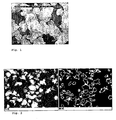
- Figure 4 is a SEM-image of powder A (left) and powder B (right) after SHS.
- Figure 5 shows an XRD spectrum of Ni-coated powder D after SHS.
- Figure 6 shows macroscopic pictures of samples made by the SHS process using different raw materials: (a) using powder D, (b) powder E, (c) powder F, (d) powder G.
- Figure 7 shows SEM pictures of samples made by SHS using various raw materials at low (top) and high (bottom) magnification: (a) and (d) for powder D, (b) and (e) for powder F, (c) and (f) for powder G.
- Ti powder along with a Ni bearing solution, such as a sulphate or a carbonate, and, in particular when a sulphate is used, ammonium hydroxide (ammoniac), preferably in a NH3:Ni ratio of 2:1, are fed to an autoclave. A surface-active additive, such as anthraquinone, is also added to the solution to an amount of 0.2 to 5 wt.% of the Ti powder. This ensures a smooth coating of the Ti particles. The Ni is then precipitated on the titanium surface using H2 at a temperature of 100 to 200 °C and at an H2 pressure of 1.4 to 3.4 MPa. After coating, the slurry is washed, filtered and dried.
- The result of coating a batch of Ti powder as described in
preferred embodiment 1 is given in Table 1. The reduction temperature was 150 °C and the reduction pressure was maintained at 3.4 MPa. A SEM (Scanning Electron Microscope) picture of the coated product is shown in Figure 1. An EDS (Energy Dispersive Spectroscopy) map of the cross section of the powder is shown in Figure 2. SEM and EDS maps show a homogeneous and smooth coating.Table 1: Results of coating Feed Coated powder Ni (g/L) Ti (g/L) Ni wt.% Ti wt.% 21.8 21.6 53.2 46.6 - Ni-coated Ti powder was produced starting from 3 types of Ti powder having a different particle size distribution:
- powder A: Ni coated -400 mesh Ti powder;
- powder B: Ni coated -250 +325 mesh Ti powder;
- powder C: Ni coated -150 +200 mesh Ti powder.
- The composition of the coated powder is shown in Table 2.
Table 2: Composition of the coated powder Powder reference Composition Ni wt.% Ti wt.% A 53.8 45.8 B 53.7 46.1 C 53.3 46.0 - The three different powders were die-compacted on an Instron-press to a density of respectively 48 %, 59 % and 51 % of the theoretical density using a compaction load of 22 kN, 19 kN and 11 kN respectively.
- SHS performed on compacted powder A requires an ignition time of less than 10 seconds. The propagation front is parallel and stable and the resulting sample dimensions are also stable (Figure 3). Powders B and C showed a tendency to more intensive melting in the upper part of the sample.
- Two types of pores are present: small ones and large elongated ones perpendicular to the propagation front direction (Figure 4). As the initial particle size increases from powder A to powder C, the width of the elongated pores increases from roughly 200-300 µm to 400-600 µm and finally to 800-1000 µm. The porosity distribution in each sample is homogeneous, except in the regions where a large amount of liquid phase was present, resulting in lower porosity.
- The phases present in the SHS-product have been determined using XRD (X-Ray Diffraction) and EDX (Energy Dispersive X-ray) analysis. The XRD diagram in Figure 5 clearly shows the presence of the desired Ni-Ti phase, both monoclinic and cubic, and possibly a limited amount of NiTi2.
- To be able to compare Ni-coated Ti powder with elemental Ni and Ti powders, the following batches were prepared:
- powder D: Ni coated -400 mesh Ti powder, blended with some additional Ni powder;
- powder E: Ni coated -250 +325 mesh Ti powder, blended with some additional Ni powder;
- powder F: Ni coated -150 +200 mesh Ti powder, blended with some additional Ni powder;
- powder G: Ni powder of 1.2 µm (d50), mixed with -250 +325 mesh Ti powder in a 1:1 atomic ratio (55.07:44.93 Ni:Ti wt.% ratio).
- Based on the composition analysis of the Ni-coated Ti powder, additional fine Ni powder was blended with the coated powder to balance the Ni:Ti atomic ratio to 1:1. The addition of Ni powder is shown in Table 3.
Table 3: Amount of Ni added to 100 g of Ni-coated Ti powder Powder reference Ni:Ti (wt.%) Ni powder added (g) D 53.8:45.8 2.34 E 53.7:46.1 2.80 F 53.3:46.0 3.08 - Quartz tubes with a diameter of 20 to 25 mm and a length of 130 to 170 mm were used for containing the powder. Powder mixture G was ball milled for 2 hours before being loosely packed in a quartz tube. Green density of the mixed powder was about 50 to 60 %. A load of 30 to 40 kN was needed to press the sample.
The green densities for powders D, E and F were respectively about 45%, 50% and 65%, accomplished using loads of 10 kN, 15 kN and 18 kN respectively. - All samples were placed in a vacuum chamber with a vacuum of about 0.01 Pa. After pre-heating the samples to 350 °C for 1 hour, the samples were ignited. SHS took place.
- Figure 6 shows macroscopic pictures of the samples prepared by SHS. The surface morphology of the samples made by Ni-coated Ti powder was homogeneous. The surface morphology of the samples made by mixed Ni and Ti powders was rough and the porosity was inhomogeneous.
- SEM pictures in Figures 7(c) and 7(f) show that the pore size and morphology of the sample made from mixed Ni and Ti powder are inhomogeneous. Figures 7(a), 7(b), 7(d), and 7(e) show that the pore size and morphology prepared from finer Ni-coated Ti powders are more homogeneous than those by coarser Ni-coated Ti powder. There are also more open pores in the samples using finer Ni-coated Ti powders. Overall, samples using Ni-coated Ti powder have a more homogeneous porosity than that using mixed Ni and Ti powders.
Claims (11)
- Coated powder, having a metallic Ti core and a metallic Ni coating, said coated powder is characterised by a Ni:Ti atomic ratio of more than 0.5, preferably between 0.9 and 1.1, and more preferably between 0.96 and 1.04.
- Powder mixture comprising a coated powder according to claim 1, and further comprising one or both of Ni-bearing powder and Ti-bearing powder, wherein the Ni:Ti atomic ratio of the mixture is between 0.9 and 1.1, preferably between 0.99 and 1.01.
- Coated powder or powder mixture according to any one of claims 1 and 2, characterised by a particle size finer than 150 mesh.
- Use of a coated powder or a powder mixture according to any one of claims 1 to 3 for the manufacture of a sintered body.
- Use of a coated powder or a powder mixture according to claim 4. characterised in that the sintered body is obtained by a self-propagating high temperature process.
- A sintered body obtained by a self-propagating high temperature process using powders according to any one of claims 1 to 3.
- process of manufacturing a coated powder according to claim 1, comprising the steps of:- providing for suitable quantities of a Ti powder and of a Ni salt bearing aqueous solution;- feeding said powder and said solution in an autoclave together, with a quantity of NH4OH, and, optionally, with a quantity of ammonium salts;- precipitating the Ni onto the Ti powder by hydrogen reduction;- washing, filtering and drying the slurry obtained, thereby obtaining a Ki-coated Ti powder.
- Process according to claim 7, whereby the Ni is precipitated onto the Ti powder at a temperature of at least 100 °C and a hydrogen pressure in the autoclave of at least 1.4 MPa.
- Process of manufacturing a coated powder according to claim 2, comprising the steps of claim 7, and further comprising the step of intimately mixing the Ni-coated Ti powder with one or both of Ni-bearing and Ti-bearing powder.
- Process of manufacturing a porous sintered body based on a Ni-Ti alloy, comprising the steps of any one of claims 7 to 9, and further comprising the step of subjecting the powder or powder mixture to a self-propagating high temperature synthesis operation.
- A sintered body obtained by a process according to claim 10.
Priority Applications (1)
| Application Number | Priority Date | Filing Date | Title |
|---|---|---|---|
| EP03794963A EP1545815B1 (en) | 2002-09-10 | 2003-08-20 | Ni-coated ti powders |
Applications Claiming Priority (6)
| Application Number | Priority Date | Filing Date | Title |
|---|---|---|---|
| EP02078736 | 2002-09-10 | ||
| EP02078736 | 2002-09-10 | ||
| US40999002P | 2002-09-12 | 2002-09-12 | |
| US409990P | 2002-09-12 | ||
| EP03794963A EP1545815B1 (en) | 2002-09-10 | 2003-08-20 | Ni-coated ti powders |
| PCT/EP2003/009552 WO2004024373A1 (en) | 2002-09-10 | 2003-08-20 | Ni-coated ti powders |
Publications (2)
| Publication Number | Publication Date |
|---|---|
| EP1545815A1 EP1545815A1 (en) | 2005-06-29 |
| EP1545815B1 true EP1545815B1 (en) | 2006-03-01 |
Family
ID=31995528
Family Applications (1)
| Application Number | Title | Priority Date | Filing Date |
|---|---|---|---|
| EP03794963A Expired - Lifetime EP1545815B1 (en) | 2002-09-10 | 2003-08-20 | Ni-coated ti powders |
Country Status (8)
| Country | Link |
|---|---|
| US (2) | US20060162493A1 (en) |
| EP (1) | EP1545815B1 (en) |
| AT (1) | ATE318669T1 (en) |
| AU (1) | AU2003264122A1 (en) |
| CA (1) | CA2508215A1 (en) |
| DE (1) | DE60303827T2 (en) |
| ES (1) | ES2263062T3 (en) |
| WO (1) | WO2004024373A1 (en) |
Cited By (1)
| Publication number | Priority date | Publication date | Assignee | Title |
|---|---|---|---|---|
| RU2522257C2 (en) * | 2010-06-11 | 2014-07-10 | ООО Инновационно-стоматологический центр "НАНОДЕНТ" (ООО ИСЦ "НАНОДЕНТ") | Method of producing porous titanium nickelid oxide |
Families Citing this family (3)
| Publication number | Priority date | Publication date | Assignee | Title |
|---|---|---|---|---|
| DE60310776T2 (en) * | 2003-08-08 | 2007-10-11 | Biorthex Inc., Blainville | BIOKOMPATIBLE POROUS TI-NI MATERIAL |
| RU2473519C1 (en) * | 2011-10-24 | 2013-01-27 | Юлия Алексеевна Щепочкина | Crude mixture for making heat-insulation articles |
| KR101718058B1 (en) | 2012-08-01 | 2017-03-20 | 삼성에스디아이 주식회사 | Negative active material, preparing method thereof, and lithium battery employing the same |
Family Cites Families (10)
| Publication number | Priority date | Publication date | Assignee | Title |
|---|---|---|---|---|
| US2853403A (en) * | 1956-04-11 | 1958-09-23 | Sherritt Gordon Mines Ltd | Method of producing composite metal powders |
| US3428543A (en) * | 1964-05-09 | 1969-02-18 | Starck Hermann C Fa | Composite powders and apparatus for the production of the same |
| US3410714A (en) * | 1965-10-18 | 1968-11-12 | Gen Electric | Metallizing and bonding non-metallic bodies |
| JP2628184B2 (en) * | 1988-04-25 | 1997-07-09 | 日新製鋼株式会社 | Method of electroplating metal on fine powder |
| JPH06240381A (en) * | 1993-02-10 | 1994-08-30 | Kawasaki Steel Corp | Production of ti alloy sintered compact by injection-molding of metal powder |
| JPH08284622A (en) * | 1995-04-06 | 1996-10-29 | Mitsubishi Materials Corp | Ti alloy engine valve with excellent wear resistance and thermal shock resistance |
| US5698081A (en) * | 1995-12-07 | 1997-12-16 | Materials Innovation, Inc. | Coating particles in a centrifugal bed |
| US6048644A (en) * | 1997-03-24 | 2000-04-11 | Matsushita Electric Industrial Co., Ltd. | Hydrogen storage alloy electrode |
| RU2170645C2 (en) * | 1999-07-16 | 2001-07-20 | Гюнтер Виктор Эдуардович | Mixture for production of cellular structure carrier |
| CA2308898A1 (en) * | 2000-05-19 | 2001-11-19 | Georgiy Tsyrenovich Dambaev | Powder mixture for the production of a porous nickel-titanium structure as a carrier for living cells |
-
2003
- 2003-08-20 AT AT03794963T patent/ATE318669T1/en not_active IP Right Cessation
- 2003-08-20 DE DE60303827T patent/DE60303827T2/en not_active Expired - Lifetime
- 2003-08-20 ES ES03794963T patent/ES2263062T3/en not_active Expired - Lifetime
- 2003-08-20 WO PCT/EP2003/009552 patent/WO2004024373A1/en not_active Ceased
- 2003-08-20 CA CA002508215A patent/CA2508215A1/en not_active Abandoned
- 2003-08-20 US US10/527,441 patent/US20060162493A1/en not_active Abandoned
- 2003-08-20 AU AU2003264122A patent/AU2003264122A1/en not_active Abandoned
- 2003-08-20 EP EP03794963A patent/EP1545815B1/en not_active Expired - Lifetime
-
2008
- 2008-09-17 US US12/212,155 patent/US20090029045A1/en not_active Abandoned
Cited By (1)
| Publication number | Priority date | Publication date | Assignee | Title |
|---|---|---|---|---|
| RU2522257C2 (en) * | 2010-06-11 | 2014-07-10 | ООО Инновационно-стоматологический центр "НАНОДЕНТ" (ООО ИСЦ "НАНОДЕНТ") | Method of producing porous titanium nickelid oxide |
Also Published As
| Publication number | Publication date |
|---|---|
| WO2004024373A1 (en) | 2004-03-25 |
| DE60303827T2 (en) | 2006-12-14 |
| DE60303827D1 (en) | 2006-04-27 |
| AU2003264122A1 (en) | 2004-04-30 |
| US20060162493A1 (en) | 2006-07-27 |
| CA2508215A1 (en) | 2004-03-25 |
| ATE318669T1 (en) | 2006-03-15 |
| US20090029045A1 (en) | 2009-01-29 |
| EP1545815A1 (en) | 2005-06-29 |
| ES2263062T3 (en) | 2006-12-01 |
Similar Documents
| Publication | Publication Date | Title |
|---|---|---|
| US7122069B2 (en) | Mo-Cu composite powder | |
| JPH05209247A (en) | Cermet alloy and method for producing the same | |
| JP7758666B2 (en) | Spherical powder for three-dimensional object manufacturing | |
| EP0477685A2 (en) | Cermets and their production and use | |
| WO2018134202A1 (en) | Method for producing hard metal bodies by means of 3d printing | |
| US20090029045A1 (en) | Ni-Coated Ti Powders | |
| JP2000501786A (en) | Prealloyed powder and its use in the production of diamond tools | |
| JP2002501440A (en) | Prealloyed copper-containing powder and its use in the production of diamond tools | |
| EP1433554A1 (en) | Production of injection-molded metallic articles using chemically reduced nonmetallic precursor compounds | |
| EP2208558B1 (en) | Process for producing refractory metal alloy powders | |
| CA2556825A1 (en) | Processes for sintering aluminum and aluminum alloy components | |
| RU2032496C1 (en) | Method of obtaining aluminides of transition metals | |
| EP1666420A2 (en) | Method of making a CuMoO4-based composite oxide powder | |
| Davydov et al. | Influence of starting reagents on the formation of Ti3SiC2 porous skeleton by SHS in air | |
| US11478848B2 (en) | Powder comprising coated hard material particles | |
| KR101938471B1 (en) | Method of tantalum carbide for hard metal and tantalum carbide for hard metal using the same | |
| CN100431744C (en) | Preparation method of Mo-Cu composite powder | |
| WO2022253661A1 (en) | Method for manufacturing tools in which at least one working area is formed with hard material particles that are embedded in a metallic matrix material | |
| JP3045199B2 (en) | Manufacturing method of high hardness cemented carbide | |
| JP2025060020A (en) | Powder material for additive manufacturing and method for manufacturing molded object using said powder material | |
| JPH1121119A (en) | Production of compound carbide and cemented carbide using the same | |
| KR20250099136A (en) | Granular mixture for additive manufacturing | |
| CA3268333A1 (en) | Granular mixture for additive manufacturing | |
| JPH0578776A (en) | Cermet alloy and its production | |
| JPH05148590A (en) | Low thermal expansion alloy powder and its composition |
Legal Events
| Date | Code | Title | Description |
|---|---|---|---|
| PUAI | Public reference made under article 153(3) epc to a published international application that has entered the european phase |
Free format text: ORIGINAL CODE: 0009012 |
|
| 17P | Request for examination filed |
Effective date: 20050411 |
|
| AK | Designated contracting states |
Kind code of ref document: A1 Designated state(s): AT BE BG CH CY CZ DE DK EE ES FI FR GB GR HU IE IT LI LU MC NL PT RO SE SI SK TR |
|
| AX | Request for extension of the european patent |
Extension state: AL LT LV MK |
|
| 17Q | First examination report despatched |
Effective date: 20050630 |
|
| GRAP | Despatch of communication of intention to grant a patent |
Free format text: ORIGINAL CODE: EPIDOSNIGR1 |
|
| GRAS | Grant fee paid |
Free format text: ORIGINAL CODE: EPIDOSNIGR3 |
|
| DAX | Request for extension of the european patent (deleted) | ||
| GRAA | (expected) grant |
Free format text: ORIGINAL CODE: 0009210 |
|
| AK | Designated contracting states |
Kind code of ref document: B1 Designated state(s): AT BE BG CH CY CZ DE DK EE ES FI FR GB GR HU IE IT LI LU MC NL PT RO SE SI SK TR |
|
| PG25 | Lapsed in a contracting state [announced via postgrant information from national office to epo] |
Ref country code: NL Free format text: LAPSE BECAUSE OF FAILURE TO SUBMIT A TRANSLATION OF THE DESCRIPTION OR TO PAY THE FEE WITHIN THE PRESCRIBED TIME-LIMIT Effective date: 20060301 Ref country code: FI Free format text: LAPSE BECAUSE OF FAILURE TO SUBMIT A TRANSLATION OF THE DESCRIPTION OR TO PAY THE FEE WITHIN THE PRESCRIBED TIME-LIMIT Effective date: 20060301 Ref country code: CH Free format text: LAPSE BECAUSE OF FAILURE TO SUBMIT A TRANSLATION OF THE DESCRIPTION OR TO PAY THE FEE WITHIN THE PRESCRIBED TIME-LIMIT Effective date: 20060301 Ref country code: LI Free format text: LAPSE BECAUSE OF FAILURE TO SUBMIT A TRANSLATION OF THE DESCRIPTION OR TO PAY THE FEE WITHIN THE PRESCRIBED TIME-LIMIT Effective date: 20060301 Ref country code: AT Free format text: LAPSE BECAUSE OF FAILURE TO SUBMIT A TRANSLATION OF THE DESCRIPTION OR TO PAY THE FEE WITHIN THE PRESCRIBED TIME-LIMIT Effective date: 20060301 Ref country code: RO Free format text: LAPSE BECAUSE OF FAILURE TO SUBMIT A TRANSLATION OF THE DESCRIPTION OR TO PAY THE FEE WITHIN THE PRESCRIBED TIME-LIMIT Effective date: 20060301 Ref country code: SI Free format text: LAPSE BECAUSE OF FAILURE TO SUBMIT A TRANSLATION OF THE DESCRIPTION OR TO PAY THE FEE WITHIN THE PRESCRIBED TIME-LIMIT Effective date: 20060301 Ref country code: SK Free format text: LAPSE BECAUSE OF FAILURE TO SUBMIT A TRANSLATION OF THE DESCRIPTION OR TO PAY THE FEE WITHIN THE PRESCRIBED TIME-LIMIT Effective date: 20060301 |
|
| REG | Reference to a national code |
Ref country code: GB Ref legal event code: FG4D |
|
| REG | Reference to a national code |
Ref country code: CH Ref legal event code: EP |
|
| REG | Reference to a national code |
Ref country code: IE Ref legal event code: FG4D |
|
| REF | Corresponds to: |
Ref document number: 60303827 Country of ref document: DE Date of ref document: 20060427 Kind code of ref document: P |
|
| PG25 | Lapsed in a contracting state [announced via postgrant information from national office to epo] |
Ref country code: SE Free format text: LAPSE BECAUSE OF FAILURE TO SUBMIT A TRANSLATION OF THE DESCRIPTION OR TO PAY THE FEE WITHIN THE PRESCRIBED TIME-LIMIT Effective date: 20060601 Ref country code: DK Free format text: LAPSE BECAUSE OF FAILURE TO SUBMIT A TRANSLATION OF THE DESCRIPTION OR TO PAY THE FEE WITHIN THE PRESCRIBED TIME-LIMIT Effective date: 20060601 Ref country code: BG Free format text: LAPSE BECAUSE OF FAILURE TO SUBMIT A TRANSLATION OF THE DESCRIPTION OR TO PAY THE FEE WITHIN THE PRESCRIBED TIME-LIMIT Effective date: 20060601 |
|
| PG25 | Lapsed in a contracting state [announced via postgrant information from national office to epo] |
Ref country code: PT Free format text: LAPSE BECAUSE OF FAILURE TO SUBMIT A TRANSLATION OF THE DESCRIPTION OR TO PAY THE FEE WITHIN THE PRESCRIBED TIME-LIMIT Effective date: 20060801 |
|
| PG25 | Lapsed in a contracting state [announced via postgrant information from national office to epo] |
Ref country code: IE Free format text: LAPSE BECAUSE OF NON-PAYMENT OF DUE FEES Effective date: 20060821 |
|
| PG25 | Lapsed in a contracting state [announced via postgrant information from national office to epo] |
Ref country code: MC Free format text: LAPSE BECAUSE OF NON-PAYMENT OF DUE FEES Effective date: 20060831 |
|
| NLV1 | Nl: lapsed or annulled due to failure to fulfill the requirements of art. 29p and 29m of the patents act | ||
| REG | Reference to a national code |
Ref country code: CH Ref legal event code: PL |
|
| ET | Fr: translation filed | ||
| REG | Reference to a national code |
Ref country code: ES Ref legal event code: FG2A Ref document number: 2263062 Country of ref document: ES Kind code of ref document: T3 |
|
| PLBE | No opposition filed within time limit |
Free format text: ORIGINAL CODE: 0009261 |
|
| STAA | Information on the status of an ep patent application or granted ep patent |
Free format text: STATUS: NO OPPOSITION FILED WITHIN TIME LIMIT |
|
| 26N | No opposition filed |
Effective date: 20061204 |
|
| PG25 | Lapsed in a contracting state [announced via postgrant information from national office to epo] |
Ref country code: GR Free format text: LAPSE BECAUSE OF FAILURE TO SUBMIT A TRANSLATION OF THE DESCRIPTION OR TO PAY THE FEE WITHIN THE PRESCRIBED TIME-LIMIT Effective date: 20060602 Ref country code: CZ Free format text: LAPSE BECAUSE OF FAILURE TO SUBMIT A TRANSLATION OF THE DESCRIPTION OR TO PAY THE FEE WITHIN THE PRESCRIBED TIME-LIMIT Effective date: 20060301 |
|
| PG25 | Lapsed in a contracting state [announced via postgrant information from national office to epo] |
Ref country code: EE Free format text: LAPSE BECAUSE OF FAILURE TO SUBMIT A TRANSLATION OF THE DESCRIPTION OR TO PAY THE FEE WITHIN THE PRESCRIBED TIME-LIMIT Effective date: 20060301 |
|
| PG25 | Lapsed in a contracting state [announced via postgrant information from national office to epo] |
Ref country code: TR Free format text: LAPSE BECAUSE OF FAILURE TO SUBMIT A TRANSLATION OF THE DESCRIPTION OR TO PAY THE FEE WITHIN THE PRESCRIBED TIME-LIMIT Effective date: 20060301 Ref country code: HU Free format text: LAPSE BECAUSE OF FAILURE TO SUBMIT A TRANSLATION OF THE DESCRIPTION OR TO PAY THE FEE WITHIN THE PRESCRIBED TIME-LIMIT Effective date: 20060902 Ref country code: LU Free format text: LAPSE BECAUSE OF NON-PAYMENT OF DUE FEES Effective date: 20060820 |
|
| PG25 | Lapsed in a contracting state [announced via postgrant information from national office to epo] |
Ref country code: CY Free format text: LAPSE BECAUSE OF FAILURE TO SUBMIT A TRANSLATION OF THE DESCRIPTION OR TO PAY THE FEE WITHIN THE PRESCRIBED TIME-LIMIT Effective date: 20060301 |
|
| PGFP | Annual fee paid to national office [announced via postgrant information from national office to epo] |
Ref country code: ES Payment date: 20090821 Year of fee payment: 7 |
|
| PGFP | Annual fee paid to national office [announced via postgrant information from national office to epo] |
Ref country code: DE Payment date: 20090821 Year of fee payment: 7 Ref country code: GB Payment date: 20090827 Year of fee payment: 7 |
|
| PGFP | Annual fee paid to national office [announced via postgrant information from national office to epo] |
Ref country code: BE Payment date: 20090915 Year of fee payment: 7 |
|
| PGFP | Annual fee paid to national office [announced via postgrant information from national office to epo] |
Ref country code: IT Payment date: 20090819 Year of fee payment: 7 |
|
| BERE | Be: lapsed |
Owner name: *UMICORE Effective date: 20100831 |
|
| GBPC | Gb: european patent ceased through non-payment of renewal fee |
Effective date: 20100820 |
|
| REG | Reference to a national code |
Ref country code: FR Ref legal event code: ST Effective date: 20110502 |
|
| PG25 | Lapsed in a contracting state [announced via postgrant information from national office to epo] |
Ref country code: IT Free format text: LAPSE BECAUSE OF NON-PAYMENT OF DUE FEES Effective date: 20100820 |
|
| REG | Reference to a national code |
Ref country code: DE Ref legal event code: R119 Ref document number: 60303827 Country of ref document: DE Effective date: 20110301 |
|
| PG25 | Lapsed in a contracting state [announced via postgrant information from national office to epo] |
Ref country code: BE Free format text: LAPSE BECAUSE OF NON-PAYMENT OF DUE FEES Effective date: 20100831 Ref country code: FR Free format text: LAPSE BECAUSE OF NON-PAYMENT OF DUE FEES Effective date: 20100831 Ref country code: DE Free format text: LAPSE BECAUSE OF NON-PAYMENT OF DUE FEES Effective date: 20110301 |
|
| PG25 | Lapsed in a contracting state [announced via postgrant information from national office to epo] |
Ref country code: GB Free format text: LAPSE BECAUSE OF NON-PAYMENT OF DUE FEES Effective date: 20100820 |
|
| PGFP | Annual fee paid to national office [announced via postgrant information from national office to epo] |
Ref country code: FR Payment date: 20090914 Year of fee payment: 7 |
|
| REG | Reference to a national code |
Ref country code: ES Ref legal event code: FD2A Effective date: 20111019 |
|
| PG25 | Lapsed in a contracting state [announced via postgrant information from national office to epo] |
Ref country code: ES Free format text: LAPSE BECAUSE OF NON-PAYMENT OF DUE FEES Effective date: 20100821 |