TECHNICAL FIELD OF THE INVENTION
The present invention is generally related to
security on a computer or network, and is more specifically
related to firewalls and their management.
BACKGROUND OF THE INVENTION
In general, a firewall is an electronic
boundary that prevents unauthorized users from accessing
certain files on a network or a computer. A firewall may be
provided as firewall code on a user's computer ("host
firewall"). Alternatively, a dedicated firewall machine may
be provided at the edge of a network ("edge firewall") that
interfaces with computers outside the network and has special
security precautions built into it in order to protect
sensitive files on computers within the network. The idea is
to protect a cluster of more loosely administered machines
hidden behind the edge firewall from computer users outside of
the network. The machine on which the edge firewall is
located is often referred to as a "gateway" or a "dedicated
gateway." If configured to protect a network from the
Internet, the machine is often referred to as an "Internet
Gateway Device."
Firewalls use one or more of at least three
different security measures to control traffic flowing in and
out of a network. In a first method, called static packet
filtering, packets are analyzed against a set of filters.
Packets approved by the filters are sent to the requesting
system; all others are discarded. In a second method, called
proxy service, information from the Internet is retrieved by
the firewall, evaluated against a policy, and then sent to the
requesting system, and vice versa. In a third, newer method,
called stateful inspection, the contents of a packet are not
examined, but instead key parts of the packet are compared to
a database of trusted information. Information traveling from
inside the firewall to the outside is monitored for special
defining characteristics, and then incoming information is
compared to these characteristics. If the comparison yields a
reasonable match, the information is allowed through.
Otherwise it is discarded. Other traffic controls may be
utilized, and the above three are given as examples.
Firewalls are often customizable, meaning, for
example, that filters may be added or removed based upon
several conditions. For example, Internet Protocol ("IP")
addresses may be used to restrict or block traffic. If so, in
one example, if a certain IP address outside the network is
reading too many files from a server, a firewall can block all
traffic to and/or from that address. As another example, a
firewall may block all access to certain domain names, or
allow access to only specific domain names. As still another
example, a company might set up a network with only one or two
machines to handle a specific protocol or protocols and ban
those protocols on all other machines. Still another example
is using ports to restrict traffic. For example, if a server
machine is running a Web (HTTP) server and an FTP server, the
Web server would typically be available on port 80, and the
FTP server would be available on port 21. A company might
block port 21 access on all machines but one on a network.
Thus, a firewall ensures security by reviewing
network communications and only allowing communications that
are consistent with a policy that has been set within the
firewall services of the firewall. While the traffic control
methods described above work well for filtering traffic,
managing a firewall may be difficult. For example, a user may
want to set particular access policies for a machine, but may
have no understanding of ports, packets, and/or filters.
Contemporary methods used for specifying firewall policies
that configure the firewall are often unintuitive, and/or may
require an in-depth knowledge of networking protocols and
implementations.
SUMMARY OF THE INVENTION
The following presents a simplified summary of
some embodiments of the invention in order to provide a basic
understanding of the invention. This summary is not an
extensive overview of the invention. It is not intended to
identify key/critical elements of the invention or to
delineate the scope of the invention. Its sole purpose is to
present some embodiments of the invention in a simplified form
as a prelude to the more detailed description that is
presented later.
In accordance with an embodiment of the
invention, an object model is provided as a general framework
for managing network services, such as firewall services,
network quality of service, parental control, and network
intrusion detection, as nonlimiting examples.
A user or an administrator of a computer may
utilize the object model to manage the services. For example,
a user may access a user interface which accesses the object
model and through which the user may set policy for the
services. In addition, the object model may be accessed by a
remote management tool, for example by a network
administrator. In this manner, the object model may be used
to remotely set policies for the services, and a single
administrator may manage the services of many computers.
The object model isolates a user and/or an
administrator from having to deal with the many possible
issues involved in configuring the services. The object model
includes two main name spaces: a policy engine platform and a
policy object model. The policy engine platform is the
central point for interacting with the policy for the services
and the kernel components that actually perform the services.
The policy engine platform performs the acts of establishing
policy and plumbing the policy to the platform kernel
components.
The policy object model is used to specify
policies that the services support. The policy object model
permits an advanced user to define traditional packet-centric
type filtering policy, or a less advanced user to develop
policy using more simplified rules based upon an application
using the services and a user of the application.
Other features of the invention will become
apparent from the following detailed description when taken in
conjunction with the drawings, in which:
BRIEF DESCRIPTION OF THE DRAWINGS
FIG. 1 is a schematic diagram illustrating
computers connected by a network;
FIG. 2 is a schematic diagram generally
illustrating an exemplary computer system usable to implement
an embodiment of the invention;
FIG. 3 is a block diagram illustrating details
of an architecture for the computer system of FIG. 2 that may
be used in accordance with an embodiment of the invention;
FIG. 4 is a diagram generally representing
firewall service objects that may be produced in accordance
with an embodiment of the firewall policy object model;
FIG. 5 shows an example of five different base
abstract firewall policy objects that are derived from a
policy object in accordance with an embodiment of the
invention;
FIG. 6 shows a number of different policy
condition classes that may derived from a policy condition
object in accordance with an embodiment of the present
invention;
FIG. 7 shows a number of different policy
action classes that may derived from a policy action object in
accordance with an embodiment of the present invention;
FIG. 8 is a block diagram generally
representing classes of a firewall policy engine platform in
accordance with an embodiment of the invention;
FIG. 9 shows more detail regarding the classes
shown in FIG. 8;
FIG. 10 is a flow diagram generally
representing steps for creating, editing or deleting a policy
rule utilizing a RuleEditor object in accordance with an
embodiment of the invention;
FIG. 11 is a flow diagram generally
representing steps for creating a policy rule utilizing a
SettingEditor object in accordance with an embodiment of the
invention; and
FIG. 12 is a flow diagram generally
representing steps for viewing policy rules utilizing a
RuleExplorer object in accordance with an embodiment of the
invention.
DETAILED DESCRIPTION
In the following description, various
embodiments of the present invention will be described. For
purposes of explanation, specific configurations and details
are set forth in order to provide a thorough understanding of
the embodiments. However, it will also be apparent to one
skilled in the art that the present invention may be practiced
without the specific details. Furthermore, well-known
features may be omitted or simplified in order not to obscure
the embodiment being described.
Prior to proceeding with a description of the
various embodiments of the invention, a description of a
computer and networking environment in which the various
embodiments of the invention may be practiced is now
provided. Although not required, the invention will be
described in the general context of computer-executable
instructions, such as program modules, being executed by a
computer. Generally, programs include routines, objects,
components, data structures and the like that perform
particular tasks or implement particular abstract data types.
The terms "program" or "module" as used herein may connote a
single program module or multiple program modules acting in
concert. The terms "computer" and "computing device" as used
herein include any device that electronically executes one or
more programs, such as personal computers (PCs), hand-held
devices, multi-processor systems, microprocessor-based
programmable consumer electronics, network PCs, minicomputers,
tablet PCs, laptop computers, consumer appliances having a
microprocessor or microcontroller, routers, gateways, hubs and
the like. The invention may also be employed in distributed
computing environments, where tasks are performed by remote
processing devices that are linked through a communications
network. In a distributed computing environment, programs may
be located in both local and remote memory storage devices.
An example of a computer networking environment
suitable for incorporating aspects of the invention is
described with reference to FIG. 1. The example computer
networking environment includes several computers 102
communicating with one another over a safe network 104,
indicated by a cloud. The safe network 104 may include many
well-known components, such as routers, gateways, hubs, etc.
and allows the computers 102 to communicate via wired and/or
wireless media. When interacting with one another over the
safe network 104, one or more of the computers 102 may act as
clients, servers or peers with respect to other computers
102. Accordingly, the various embodiments of the invention
may be practiced on clients, servers, peers or combinations
thereof, even though specific examples contained herein may
not refer to all of these types of computers.
The safe network 104 in this example is
considered a "safe" network, in that the computers 102 are
protected by a common firewall, in the example shown as an
Internet gateway device 106. The Internet gateway device 106
protects the computers 102 from remote computers 108 located
on a public or unsafe network 110, in the example shown by a
cloud. Although described as an Internet gateway device 106,
the gateway device may protect the safe network from other
types of unsafe networks, not necessarily the Internet,
including a LAN, a WAN, or another network.
Although shown as having multiple computers,
the safe network 104 may include only a single computer 102.
In addition, although the unsafe network 110 is shown as
having multiple remote computers 108, it may instead have only
one. Further, although the network shown in FIG. 1 includes
both the safe network 104 and the unsafe network 110, a
computer, such as one of the computers 102, may connect
directly to the unsafe network 110, with or without a safe
network 104 and/or the Internet gateway device 106.
Referring to FIG. 2, an example of a basic
configuration for the computer 102 on which embodiments of the
invention described herein may be implemented is shown. This
basic configuration may also be used for the Internet gateway
device 106. For ease of description, however, embodiments of
the invention will be described typically with reference to
the computer 102.
In its most basic configuration, the computer
102 typically includes at least one processing unit 202 and
memory 204. The processing unit 202 executes instructions to
carry out tasks in accordance with various embodiments of the
invention. In carrying out such tasks, the processing unit
202 may transmit electronic signals to other parts of the
computer 102 and to devices outside of the computer 102 to
cause some result. Depending on the exact configuration and
type of the computer 102, the memory 204 may be volatile (such
as RAM), non-volatile (such as ROM or flash memory), or some
combination of the two. This most basic configuration is
illustrated in FIG. 2 by dashed line 206.
The computer 102 may also have additional
features/functionality. For example, the computer 102 may
also include additional storage (removable 208 and/or non-removable
210) including, but not limited to, magnetic or
optical disks or tape. Computer storage media includes
volatile and non-volatile, removable and non-removable media
implemented in any method or technology for storage of
information, including computer-executable instructions, data
structures, program modules, or other data. Computer storage
media includes, but is not limited to, RAM, ROM, EEPROM, flash
memory, CD-ROM, digital versatile disk (DVD) or other optical
storage, magnetic cassettes, magnetic tape, magnetic disk
storage or other magnetic storage devices, or any other medium
which can be used to stored the desired information and which
can be accessed by the computer 102. Any such computer
storage media may be part of computer 102.
The computer 102 preferably also contains
communications connections 212 that allow the device to
communicate with other devices, such as other computers 102 on
the safe network 104, or remote computers 108 on the unsafe
network 110 (only a single remote computer 108 is shown in
FIG. 2). A communication connection is an example of a
communication medium. Communication media typically embody
computer readable instructions, data structures, program
modules, or other data in a modulated data signal such as a
carrier wave or other transport mechanism and include any
information delivery media. By way of example, and not
limitation, the term "communication media" includes wireless
media such as acoustic, RF, infrared and other wireless
media. The term "computer-readable medium" as used herein
includes both computer storage media and communication media.
The computer 102 may also have input devices
216 such as a keyboard/keypad, mouse, pen, voice input device,
touch input device, etc. Output devices 218 such as a display
220, speakers, a printer, etc. may also be included. These
devices are well known in the art and need not be described at
length here.
In the description that follows, the invention
will be described with reference to acts and symbolic
representations of operations that are performed by one or
more computing devices, unless indicated otherwise. As such,
it will be understood that such acts and operations, which are
at times referred to as being computer-executed, include the
manipulation by the processing unit of the computer 102 of
electrical signals representing data in a structured form.
This manipulation transforms the data or maintains it at
locations in the memory system of the computer 102, which
reconfigures or otherwise alters the operation of the computer
102 in a manner well understood by those skilled in the art.
The data structures where data is maintained are physical
locations of the memory that have particular properties
defined by the format of the data. However, while the
invention is being described in the foregoing context, it is
not meant to be limiting as those of skill in the art will
appreciate that several of the acts and operation described
hereinafter may also be implemented in hardware.
FIG. 3 is a block diagram illustrating details
of an architecture for the computer 102 that may be used in
accordance with an embodiment of the invention. The computer
102 includes a host firewall services, indicated by the
reference numeral 302. The firewall services 302 may be a
component of an operating system or a separate firewall
application or program running on or otherwise associated with
the computer 102. In general, as used herein, a "firewall
service" is a user mode service that is responsible for
managing firewall policy and plumbing down policies to kernel
components for enforcement. In the example shown, the
firewall services 302 act as a host firewall services, in that
the firewall services protect the computer 102 on which the
firewall services run. The firewall services 302 may also be
configured to make the computer 102 act as a gateway device.
In accordance with an embodiment of the
invention, an object model, in FIG. 3 shown as a firewall
object model 300, is provided as a general framework for
managing network services, in the embodiment shown in FIG. 3,
the firewall services 302. Although embodiments of the
inventions are described with respect to an object model for
managing firewall services such as the firewall services 302,
aspects of the present invention and embodiments of the
present invention may be utilized to manage other networking
services for a computer, such as network quality of service,
parental control, and network intrusion detection, as
nonlimiting examples.
Briefly described, the firewall object model
300 isolates a user and/or an administrator from having to
deal with the many possible issues involved in configuring and
managing the firewall services 302. A user of the computer
102 or an administrator for the computer or the safe network
may utilize the firewall object model 300 to manage the
firewall services 302. For example, a user may access a
Firewall User Interface 304 which accesses the firewall object
model 300 and through which the user may set firewall policy
308 for the firewall services 302. The Firewall User
Interface 304 may be provided by the firewall services 302,
for example, or may be provided by an application or as part
of an operating system, for example. In addition, the
firewall object model 300 may be accessed by a Remote
Management Tool 306, for example by a network administrator.
In this manner, the firewall object model 300 may be used to
remotely set policies for the firewall services 302,
permitting a single administrator to manage services on a
large number of computers.
The firewall policy 308 is maintained on or is
associated with the computer 102. In the embodiment shown,
the firewall policy 308 is shown as a database, but the
firewall policy 308 may be maintained in several databases or
may be stored in another suitable manner.
The firewall object model 300 includes two main
name spaces: a firewall policy engine platform 310 and a
policy object model 312. Briefly described, the firewall
policy engine platform 310 is the central point for
interacting with the firewall policy 308 and firewall platform
kernel components 314. The firewall platform kernel
components 314, such as a TCP/IP or network stack, are the
components of the kernel that are actually perform the
function of filtering packets or other information from the
computer 102. The firewall policy engine platform 310
performs the acts of creating and configuring policy, as is
further described below.
The policy object model 312 is used to specify
firewall policies that the firewall services 302 support. The
policy object model 312 permits an advanced user to define
traditional packet-centric type filtering policy, or a less
advanced user to define policy based upon the application and
the user of the application, as described further below.
The firewall object model 300 uses an object-oriented
paradigm, where manageable objects are modeled using
the concepts of classes and instances. The objects present in
the firewall object model 300 are classes, instances,
properties, and qualifiers. Classes are models or templates
for objects, while instances are occurrences of classes,
properties are the individual fields of classes or instances,
and qualifiers are modifiers of any of these. The policy
object model 312 may be used to define policy objects, which
are rules that specify security actions of the firewall
services. The firewall policy engine platform 310 includes
active objects which can perform acts, such as create, delete,
or modify, on the policy objects.
FIG. 4 shows a diagram generally representing
firewall service objects that may be produced in accordance
with an embodiment of the firewall policy object model 312.
The PolicyObject object 400 is the abstract base class for the
objects used in the firewall object model 300. It has three
main subclasses: PolicyRule 402, PolicyAction 404, and
PolicyCondition 406. The PolicyRule 402 models rules, and in
the example given includes five different properties. A first
property, Condition, defines one or more conditions to match
in order for an action in this rule to take place. These
conditions may be represented by PolicyCondition classes, as
further described below. A second property, Action, defines
one or more actions to take when the conditions specified in
this rule are matched. These actions may be represented by
PolicyAction classes, as further described below. A third
property, TimeConstraint, specifies the day of the week and
the time of the day when this rule will be effective, e.g.,
9am-5pm Monday-Friday. A fourth property, NetworkLocation,
specifies the network locations where this rule is effective.
A fifth property, Weight, indicates the weight of the rule,
and is used by the firewall policy engine platform 310 to
resolve rule conflicts. The TimeConstraint, NetworkLocation,
and Weight properties are editable by a user or administrator,
for example via the Firewall User Interface 304 or the Remote
Management Tool 306.
The PolicyRule 402 is an abstract class, and
base abstract firewall policy objects can be derived
therefrom. FIG. 5 shows an example of five different base
firewall policy objects that are derived from PolicyRule 402.
Others may be derived as needed to reflect further constraints
imposed by certain network policies for example quality of
service (QoS) or parental control policies. The five base
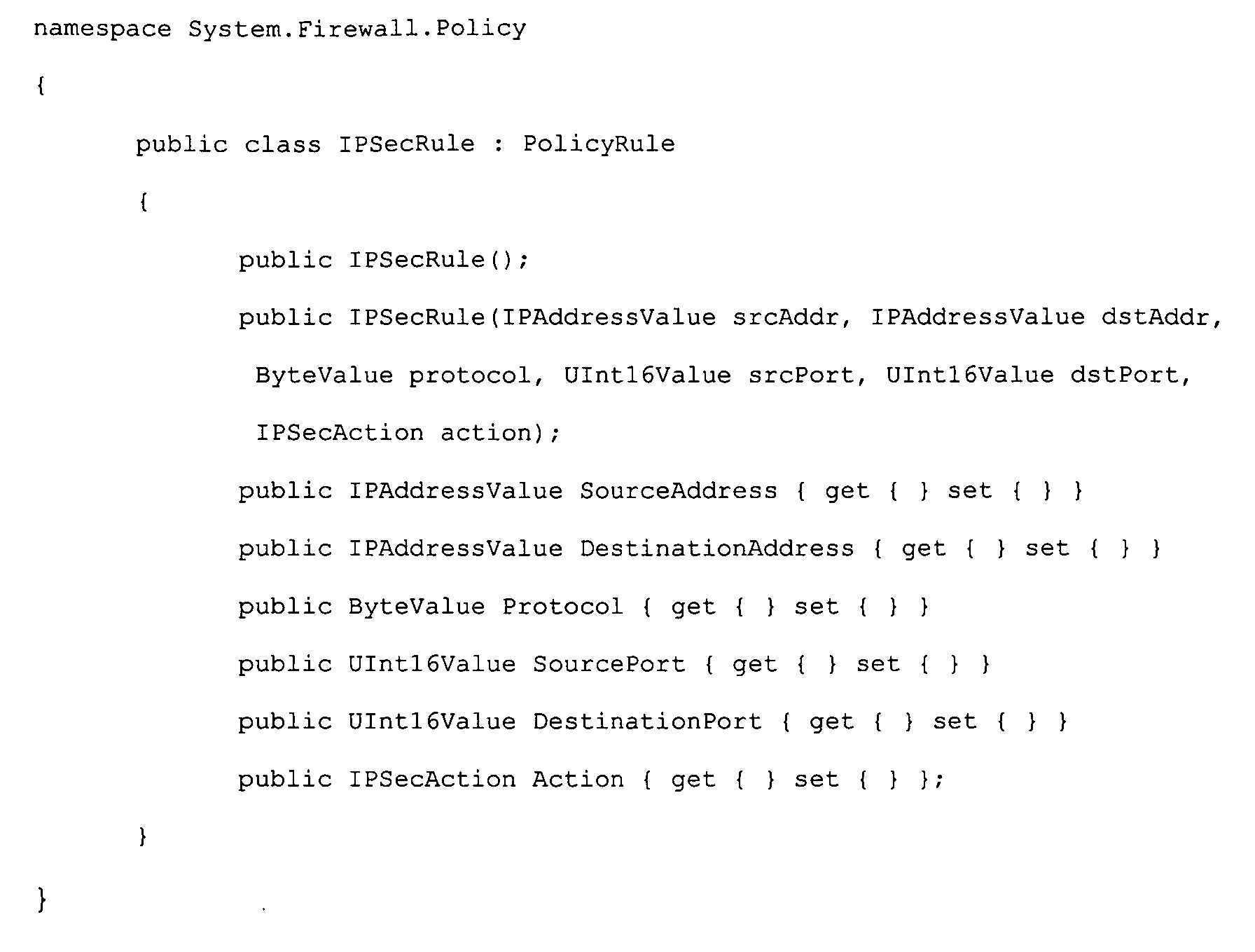
firewall policy objects shown in FIG. 5 are TransportRule 502,
KeyingModule 504, IKERule 506, IPSecRule 508, and
ApplicationRule 510. Details regarding these example derived
policy rule classes are included at Exhibit A.
In accordance with an embodiment of the
invention, the firewall services 302 are capable of examining
a packet at several different layers as the packet moves
through a network stack. For example, the firewall services
302 may include an IP framing layer filter, a TCP layer
filter, a transport layer filter, an application layer filter,
a remote procedure call layer filter, and many other filters
that provide lower level filtering so that an item does not
have to move through the entire stack before it is blocked.
Such firewall services 302 are planned to be implemented in
Microsoft's LONGHORN operating system, yet to be released.
Application programming interfaces may be provided to third
parties to allow the third parties to participate in the
filtering decisions that take place at the various layers.
Specific implementation details of the filters are not
necessary for a description of this invention. However, the
base abstract firewall policy objects may be configured so as
to operate with these particular filters at each respective
layer.
The TransportRule 502 models the traditional
firewall rule that mainly filters on the standard 5-tuple.
The IPSecRule 508, the KeyingModule rule 504 and the IKERule
506 are three different rules for specifying IPSec-related
policies. As is known, IPSec is a protocol that provides
security for transmission of sensitive information over
unprotected networks such as the Internet. IPSec acts as the
network layer, protecting and authenticating IP packets
between participating devices. Details of the IPSecRule 508,
the KeyingModule rule 504 and the IKERule 506 are given in
Exhibit A, attached hereto.
ApplicationRule 510 utilizes the method
disclosed in U.S. Patent Application No. 10/603,648, filed
June 25, 2003, and entitled "Method of Assisting an
Application to Traverse a Firewall". Briefly described, that
application describes an application layer ("ALE") that may be
utilized with the network stack so that a user may easily
create a simple firewall policy, or network access policy, to
either allow or deny firewall unaware applications and
services on the user's computer to connect to the network.
The policies are set on a per-user and per-application basis.
The user does not need to know or use rules reports,
protocols, or IP addresses to enable an application to work
through a firewall. An enforcement module includes an
interception module that watches for connect and listen
attempts by applications and services to the network stack.
The interception module traps these attempts and determines
what user is making the attempt, what application or service
is making the attempt, and then conducts a firewall policy
lookup to determine whether or not the user and/or application
is allowed to connect to the network. If so, the interception
module may instruct the host and/or edge firewall to configure
itself for the connection being requested.
The PolicyCondition object 406 is an abstract
object from which policy condition classes may be derived.
Each policy condition class represents modes or situations
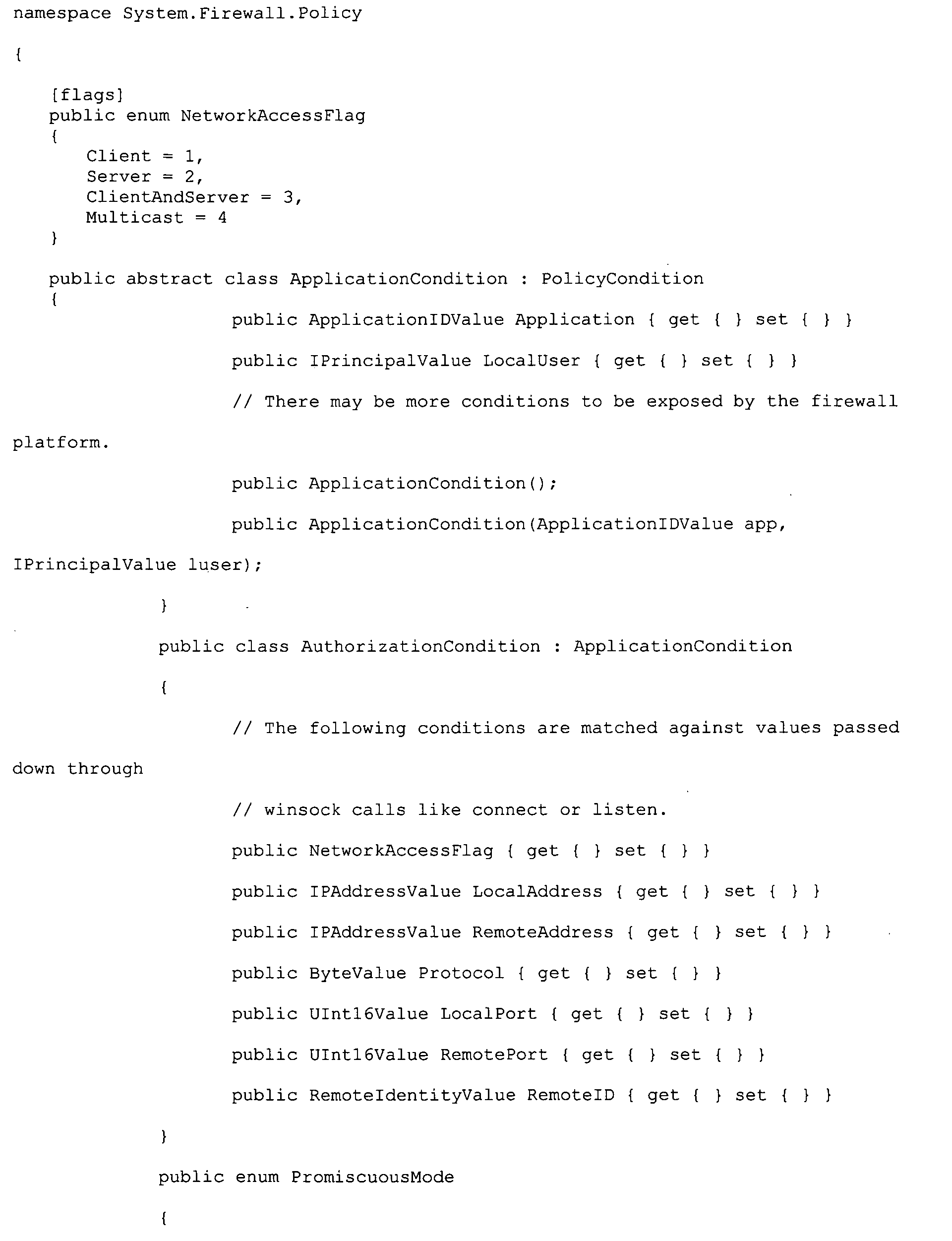
that the firewall services 302 may encounter. FIG. 6 shows a
number of different policy condition classes that may be
derived from the PolicyCondition object 406 in accordance with
an embodiment of the present invention. Each of these policy
condition classes represents different modes or conditions,
such as IP condition, transport condition, application
condition, or other modes that may be in existence upon an
attempt at using the firewall services 302. Classes derived
from PolicyCondition 406 may have subclasses. For example,
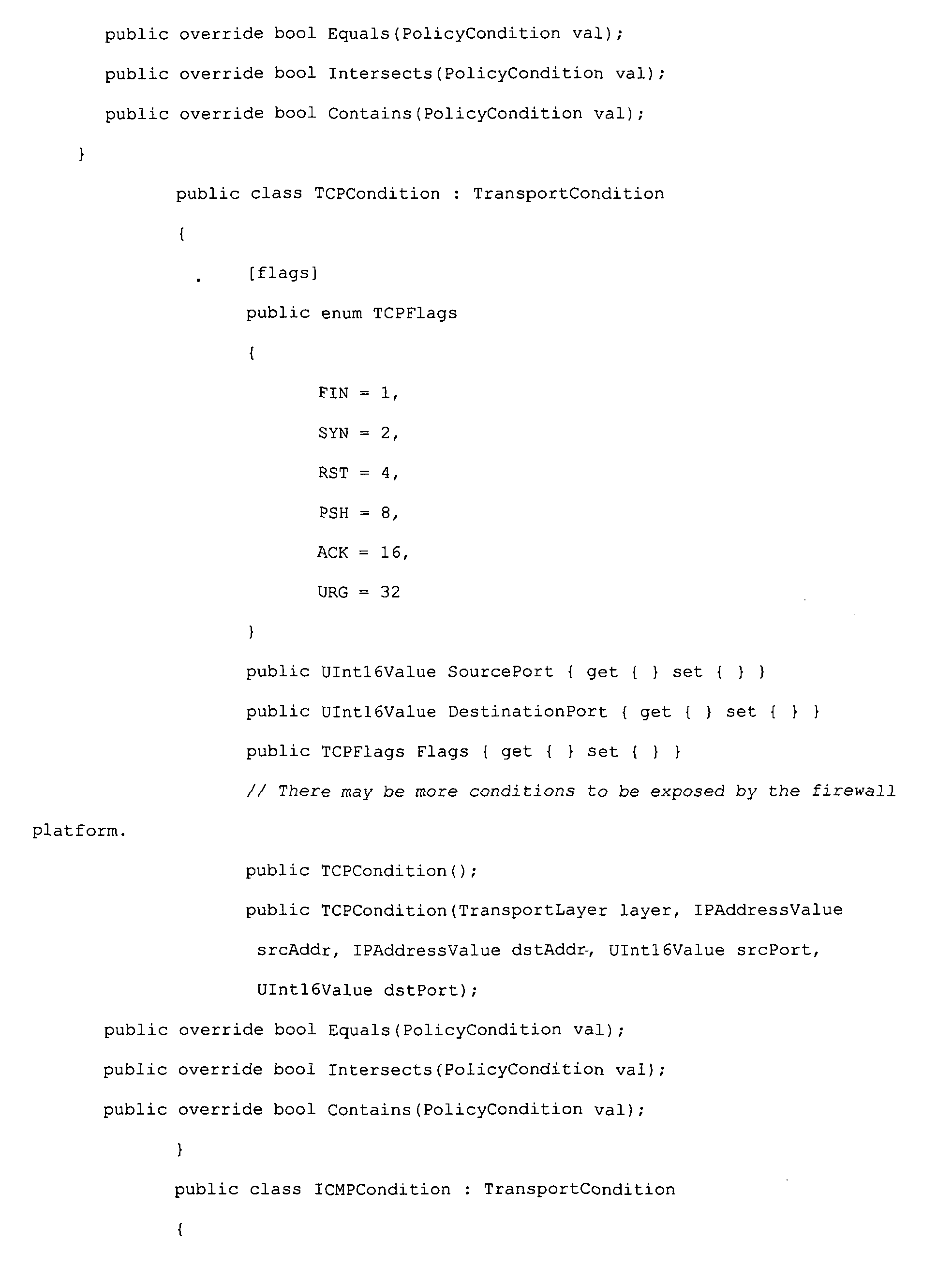
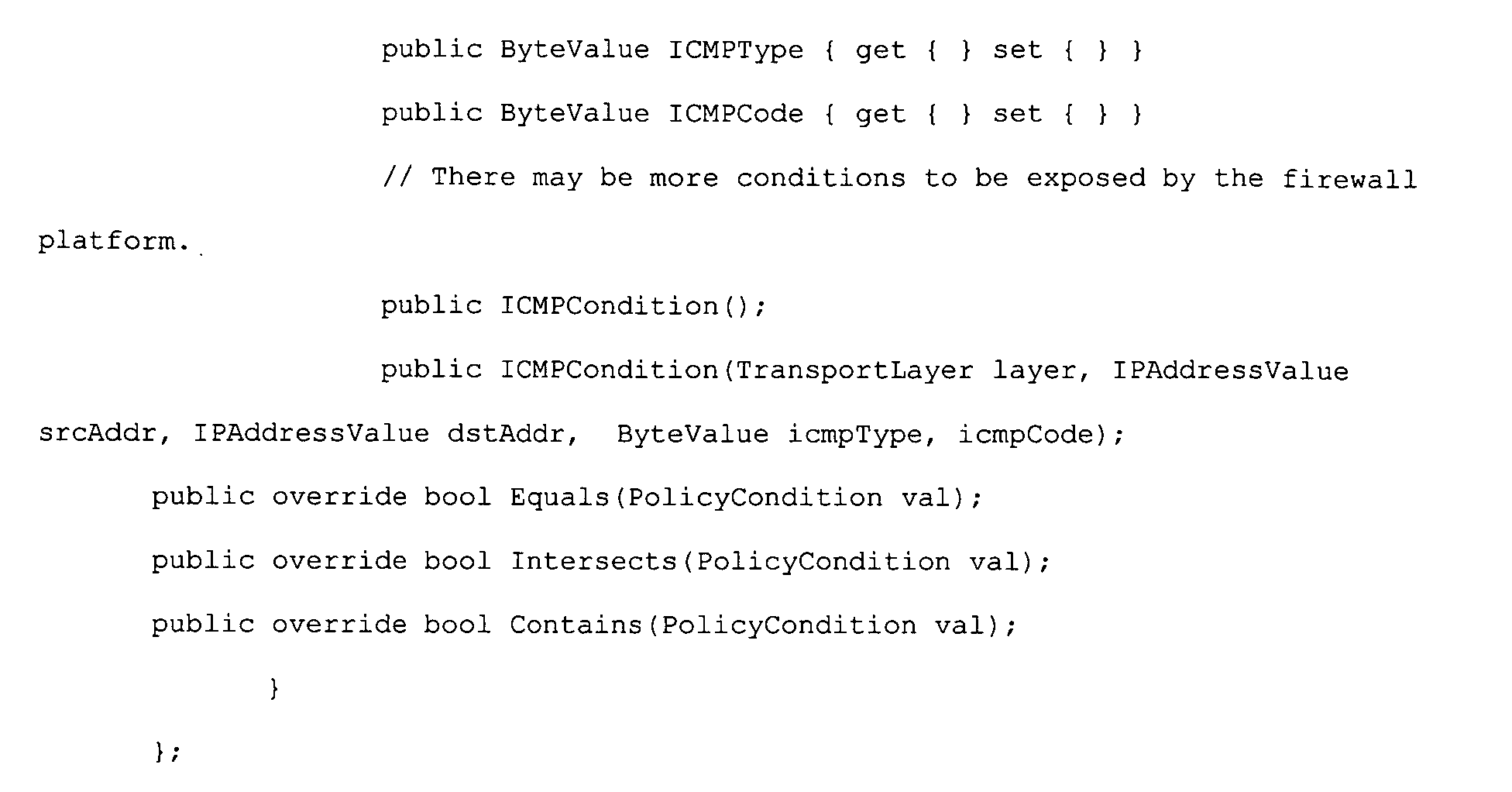
transport conditions may include TCP condition, ICMP
condition, UDP condition, as examples. Descriptions of the
condition classes shown in FIG. 6 are included at Exhibit B.
Again, as with the policy objects described above, the
conditions may relate to filters that are available to the
firewall services 302.
A number of different policy actions may be
utilized with the policy object model 312. Examples of
different policy action classes, derived from the PolicyAction
class 404, are shown in FIG. 7. In general, the actions that
are allowed are Permit, which allows packets that match the
associated condition, Deny, which drops packets that do not
match the associated condition, and Log, which logs packets
that match the associated condition. Combinations of these
may be used as well. More complex actions may be provided,
such as authentication. A description of many examples of the
actions shown in FIG. 7 is included at Exhibit C.
As can be seen in FIG. 8, in accordance with an
embodiment of the invention, the firewall policy engine
platform 310 includes four main classes: a firewall class
object 802, a setting editor class object 804, a rule editor
class object 806, and a rule explorer class object 808. The
firewall class object 802 is the main class for interacting
with the firewall services 302. The firewall class object 802
follows a singleton pattern to reference the firewall services
302. That is, the class uniquely describes only a single
instance, i.e., the firewall services 302 available on the
computer 102.
A list of example properties and methods for
the firewall class object 802 is shown as part of the firewall
policy engine platform 310 in FIG. 9. For the firewall class
object 802, in accordance with an embodiment of the invention,
the firewall class object 802 includes properties of
FirewallMode and LogSettings. The FirewallMode is the current
filtering mode of the firewall services 302. It value may be,
for example, BlockAllTraffic, PermitAllTraffic, or Filtering,
which represents that the firewall services 302 are running
and are enforcing settings that have been defined. The
LogSettings may represent a global setting that specifies the
logging settings, including things to log, logging limit and
overflow behavior. Each of these properties is editable, for
example via the Firewall User Interface 304 or the Remote
Management Tool 306. Other properties may be included as part
of the firewall class object 802. The firewall class object
802 may also include methods or operations to instantiate or
create new instances of the other three classes of the
firewall policy engine platform 310; i.e., the setting editor
class object 804 (AcquireSettingEditor), the rule editor class
object 806 (AcquireRuleEditor), and the rule explorer class
object 808 (AcquireRuleExplorer). An example of the
configuration of the firewall class object is included at
Exhibit E.
Each of the methods AcquireSettingEditor,
AcquireRuleEditor, and AcquireRuleExplorer utilizes a policy
provider as a parameter. In accordance with an embodiment of
the invention, the firewall class object 802 acts as an
arbitrator when there is a conflict between policies of
multiple policy providers. In general, a policy provider is a
source of firewall policies for the firewall services 302,
preferably one that can be securely identified. A policy
provider is associated with a particular priority class or
level at which all the rules from this provider will be added.
For example, policy providers may be ranked in accordance with
their individual priorities. A remote network security
management server, e.g. the user's Internet Service Provider
(ISP) who manages the user's computer as a value-add service,
may get a ranking of a "1," indicating highest priority, and
may be given the definition in the firewall class object 802
of ManagedServiceProvider. A LocalProvider is given the
priority of "2," and represents a local user or administrator
of the computer. A DomainProvider is an administrator of the
domain to which the user is attached, and receives a priority
of "3". An application provider may be given a priority of
"4". An example of a priority set by an application provider
would be a financial services application that has a setting
requiring that all traffic to its server be secure.
The setting editor class 804 may include a
number of properties, including ApplicationSettings,
DefaultApplicationSetting, DefaultOSServiceSetting,
TrustedZone, SecureZone, and IsICMPAllowed. The
ApplicationSettings property represents the application
firewall rules stored in the system. The
DefaultApplicationSetting is the default firewall setting to
apply when an application's firewall setting is not specified.
The DefaultOSServiceSetting is the default firewall setting to
apply when an operating system service's firewall setting is
unspecified. The TrustedZone property is the trusted Internet
Protocol ("IP") address list to use when an application
setting does not specify its own trusted IP addresses. The
SecureZone property is the default trusted authenticated
remote identity list to use when an application setting does
not specify its own trusted authenticated remote identities.
Finally, the IsICMPAllowed property indicates whether Internet
Control Message Protocol ("ICMP") messages are allowed; e.g.,
the TCP/IP stack will respond to pings and generate ICMP
errors. Otherwise, the ICMP messages are blocked. All of
these properties may be editable, for example via the Firewall
User Interface 304 or the Remote Management Tool 306, except
the ApplicationSettings property.
The example of the setting editor 804 shown in
FIG. 9 includes two methods: SetDefaultSecurityLevel and
GetSecurityLevel. The parameters for the
SetDefaultSecurityLevel are user and security level. The
parameter for the GetSecurityLevel is user. The
SetDefaultSecurityLevel allows a user or administrator to set
the default security level for the parameter-specified user.
The GetSecurityLevel allows a user or administrator to get the
default security level for the parameter-specified user.
The setting editor class object 804 provides
firewall and policy management software developers a
programmatic interface to manage firewall policy in a simple
and application- and user-centric form. The main objects that
it operates on are the ApplicationSetting 902 and the
SecurityLevel 904. ApplicationSetting 902 associates security
levels with applications and users, and includes three
properties: the ApplicationID, the User, and the
SecurityLevel. The ApplicationID and User represent the
application to which this ApplicationSetting 902 pertains, and
the user for which the ApplicationSetting is specified.
Together they form a unique key for ApplicationSetting 902.
The SecurityLevel is a read-write property and may be edited
by a user or administrator, for example via the Firewall User
Interface 304 or the Remote Management Tool 306. The property
represents the security level when the particular user (User)
uses the particular application (ApplicationID).
The SecurityLevel may be supplied by a
SecurityLevel object 904 utilizing a GetRules method of the
ApplicationSetting 902. The GetRules object utilizes the
parameters of Application, User, and Contacts to obtain a list
of application rules that enforce the setting "use this
security level with these remote contacts when this user uses
this application." In accordance with an embodiment of the
present invention, the SecurityLevel object 904 includes a set
of templates that includes the list of application rules for
the particular security level of the application, the user,
and the contacts. More information about the SecurityLevel
object 904 and ApplicationSetting is provided at Exhibit D.
The RuleEditor class object 806 is an
application programming interface used by advanced policy
providers to perform policy related operations such as add,
remove, or update policies. As described above, there may be
more than one policy provider on a single host. The
RuleEditor class object 806 provides an advanced view of the
system allowing administrators and power users to define
specific parameters for policy rules of the firewall services
302. The example of the RuleEditor class object 806 in FIG. 9
includes two properties: PriorityClass and Provider.
PriorityClass is the class of the priority which the
particular provider is given, as described above. Provider is
the provider requesting the action.
The example of the RuleEditor class object 806
in FIG. 9 includes five methods: AddRule, RemoveRule,
UpdateRule, GetRules, and RemoveAll. AddRule is utilized to
push down a set of policies to the firewall policy engine
platform 310. The request to add a PolicyRule may fail if the
PolicyRule is invalid (e.g., the PolicyAction does not match
the PolicyCondition), if the provider trying to add the policy
does not have privilege to do so (based, for example, on the
rankings set forth above), or if the transaction is aborted.
If the request to add a PolicyRule does not fail, the firewall
policy engine platform 310, in turn, plumbs the new policy
down to the firewall platform kernel components 314.
RemoveRule is utilized to removed a specified
policy, and includes the parameter of the particular policy to
be removed, and may fail because of improper privilege or
transaction failure. UpdateRule is used to change the
specified policy that was previously added, and utilizes as a
parameter the policy that is to be changed. UpdateRule is
subject to the same exceptions as AddRule. RemoveAll removes
all of the rules that this particular policy provider has
created, and may fail due to inadequate privilege. It may be
an atomic operation, i.e., done with one transaction.
The rule explorer class object 808 permits a
user or administrator to view all policies that are currently
in the firewall platform, subject to privilege. In accordance
with an embodiment of the invention, the view is read-only.
In the example of the rule explorer class object 808 in FIG.
9, there is one event: RuleChangedEvent. RuleChangedEvent is
for the rule explorer class object 808 to receive notification
when the policies that it views have changed. In the example
of the rule explorer class object 808 in FIG. 9, there is one
property, which is EventFilter. EventFilter permits a user or
administrator to define a subset of the policies to be viewed.
There is a single method of GetRules which obtains rules that
are currently enforced in the firewall platform in accordance
with the EventFilter. The operation may be done in a single
transaction.
FIG. 10 is a flow diagram generally
representing steps for creating, editing or deleting a policy
rule utilizing the RuleEditor object 806 in accordance with an
embodiment of the invention. These steps may performed, for
example, via software associated with the Firewall User
Interface 304 or the Remote Management Tool 306.
Beginning at step 1000, the firewall class 802
is created. A user then requests to acquire the RuleEditor
class at step 1002 using the respective method in the firewall
class 802. At step 1004, a determination is made whether or
not the user is requesting deletion of a policy or policies.
If so, step 1004 branches to step 1006, where the user
provides the particular policy as a parameter. At step 1008,
a determination is made whether or not the user has
authorization to delete the policy, for example by comparing
the user's provider ranking (described above) versus a minimal
ranking needed for deletion of the particular policy. If the
user does not have authorization, then 1008 branches to step
1010 where the transaction fails. If the user does have
authorization, then step 1008 branches to step 1012, where the
policy is deleted.
If the user wishes to edit or add a policy,
then step 1004 branches to step 1014. The method for editing
a policy is somewhat different than adding, but the
similarities are sufficient so that the two are described
together here. The steps shown in FIG. 10 from 1014 are
directed to adding a policy, and differences with editing,
where significant, are described further below. For example,
if a user is editing a policy, then prior to step 1014, the
user provides the policy as a parameter so that it may be
edited.
At step 1014, the user derives a policy class,
or chooses from existing policy classes, such as the rules
502-510 shown in FIG. 5. At step 1016, the user selects a
condition from available policy conditions, or derives a new
policy condition. At step 1018, the user selects an action or
derives a new policy action for the policy rule that is being
established. If a user were editing an existing policy
instead of creating a policy, then steps 1014-1018 may involve
selecting a different policy class, condition, and/or action
instead of starting from scratch.
At step 1020, a determination is made whether
the particular user has authorization to commit to the new
policy. This determination can be made similar to the
determination made in step 1008. If not, then step 1020
branches to step 1022, where the transaction fails. If the
user does have authorization, then step 1020 branches to step
1024, where a determination is made whether or not the
particular policy is allowed. For example, a determination
can be made whether the particular condition matches the
action in accordance with rules set by the policy class. If
not, step 1024 branches to step 1026, where the transaction
fails. If so, then step 1024 branches to step 1028, where the
policy is plumbed to the firewall platform kernel components
314 by the firewall policy engine platform 310.
The method shown in FIG. 10 permits an advanced
user to establish a firewall policy for a computer 102. The
advanced user may set the firewall policies in accordance with
filtering needs for the computer 102.
FIG. 11 is a flow diagram generally
representing steps for creating a policy rule utilizing the
setting editor object 804. Beginning at step 1100, the
firewall class 802 is created. At step 1102, the setting
editor object is acquired via the method provided in the
firewall class 802.
Because the application and user are known, and
the application setting 902 provides available security levels
for the known application and the known user, and the user is
supplied one or more security levels at step 1104. The user
selects one of the security levels at step 1106. If the user
is not authorized to set such a security level, then step 1108
branches to step 1110, where the transaction fails. If the
user does have authorization, then step 1108 branches to step
1112, where the firewall policy engine platform 310 plumbs the
policy to the firewall platform kernel components 314.
As can be seen, the method of FIG. 11 provides
a relatively simple method for a user who is not advanced to
set firewall policy for a computer 102. The policy may be set
without knowledge of ports, packets, or other items that
typically must be entered to configure a firewall.
FIG. 12 is a flow diagram generally
representing steps for viewing policy rules utilizing the rule
explorer object 808 in accordance with an embodiment of the
invention. Beginning at step 1200, the firewall class 802 is
created. At step 1202, the RuleExplorer object 808 is
acquired using the associated method in the firewall class
802. The appropriate parameters for the rules the user wants
to see (e.g., all rules that the particular provider has
created) are provided at step 1204. At step 1206, the rules
are provided for viewing to the user, for example via the
Firewall User Interface 304.
Although not shown in FIG. 12, viewing rules
via the RuleExplorer object 808 may require authorization, and
thus may be limited to a particular level of provider and
higher. In addition, if changes occur to the rules,
notifications of those changes may be sent to the user via the
RuleChangeEvent property.
All references, including publications, patent
applications, and patents, cited herein are hereby
incorporated by reference to the same extent as if each
reference were individually and specifically indicated to be
incorporated by reference and were set forth in its entirety
herein.
The use of the terms "a" and "an" and "the" and
similar referents in the context of describing the invention
(especially in the context of the following claims) are to be
construed to cover both the singular and the plural, unless
otherwise indicated herein or clearly contradicted by
context. The terms "comprising," "having," "including," and
"containing" are to be construed as open-ended terms (i.e.,
meaning "including, but not limited to,") unless otherwise
noted. Recitation of ranges of values herein are merely
intended to serve as a shorthand method of referring
individually to each separate value falling within the range,
unless otherwise indicated herein, and each separate value is
incorporated into the specification as if it were individually
recited herein. All methods described herein can be performed
in any suitable order unless otherwise indicated herein or
otherwise clearly contradicted by context. The use of any and
all examples, or exemplary language (e.g., "such as") provided
herein, is intended merely to better illuminate embodiments of
the invention and does not pose a limitation on the scope of
the invention unless otherwise claimed. No language in the
specification should be construed as indicating any non-claimed
element as essential to the practice of the invention.
Preferred embodiments of this invention are
described herein, including the best mode known to the
inventors for carrying out the invention. Variations of those
preferred embodiments may become apparent to those of ordinary
skill in the art upon reading the foregoing description. The
inventors expect skilled artisans to employ such variations as
appropriate, and the inventors intend for the invention to be
practiced otherwise than as specifically described herein.
Accordingly, this invention includes all modifications and
equivalents of the subject matter recited in the claims
appended hereto as permitted by applicable law. Moreover, any
combination of the above-described elements in all possible
variations thereof is encompassed by the invention unless
otherwise indicated herein or otherwise clearly contradicted
by context.
EXHIBIT A
System.Firewall.Policy.ApplicationRule
ApplicationRule is the rule that is enforced by the application layer enforcement although it
may also dynamically instantiate rules at other layers e.g. an IPSec rule the transport layer to
secure all traffic by a certain application or user.
System.Firewall.Policy.TransportRule
TransportRule models the traditional firewall rule that
mainly filters on the standard 5-tuple.
System.Firewall.Policy.IKERule
There are three different rules for specifying IPSec related policies: IPSecRule,
KeyingModuleRule and IKERule. IPSecRule is added at the transport layer where matching
traffic triggers the IPSec callout. The IPSec callout set a security context in the packet so that
the IPSec module will be invoked to search for existing SAs to secure the traffic. If none is
found, KeyingModuleRule will be matched to find the right keying module to perform key
negotiation. Depending on the keying module selected, the corresponding IKERule or
MamieRule will be matched to find the appropriate configure settings for performing the key
exchange. Then IPSecRule will again be matched to set up the proper IPSec SA that will be
used for actually securing the traffic e.g. AH or ESP.
IKERule specifies the parameters for carrying out IKE key negotiation protocol. IKERule
can only take local address and remote address as its condition. The action for IKERule is an
IKEAction.
System.Firewall.Policy.IPSecRule
Conceptually IPSecRule plays two distinct roles, one is to trigger the IPSec callout when the
associating condition is matched, and another to indicate the configure parameters for
securing the matching traffic. So it specifies both what packets need to be secured and also
how they will be secured. Different 5 tuples can have different IPSec parameters. Although
at the transport layer, the firewall platform can match more fields than the standard 5-tuple
e.g. TCP flags, for the purpose of carrying out IPSec, 5-tuple is sufficient. So IPSecRule
only lists the standard 5 tuple, i.e. source address, destination address, protocol, source port
and destination port, as its condition fields. Other fields can be added if there are practical
cases requires traffics matching the same 5-tuple to be secured differently based on those
fields.
System.Firewall.Policy.KeyingModuleRule
KeyingModuleRule selects which key negotiation module to use when there is no existing
secure channel (association) to the remote peer, which could be a host or a user.
KeyingModuleRule also take the standard 5-tuple as its condition. In case where more than
one module is available, for example Mamie for user authentication in addition to traditional
IKE, KeyingModuleAction lists them in the order that they will be tried either concurrently
or sequentially until one of them succeeds or all fails.
EXHIBIT B
System.Firewall.Policy.PolicyCondition
|
Method
|
|
Name
|
Equals |
|
Return Type
|
Bool |
|
Description
|
Return true if all packets that match this PolicyCondition object also match the passing argument condition and vice versa. Otherwise return false. |
|
Parameters
|
PolicyCondition cond |
|
Method
|
|
Name
|
Intersects |
|
Return Type
|
Bool |
|
Description
|
Return true if there are packets that match this PolicyCondition object also match the passing argument condition. Return false if there is no such packet. |
|
Parameters
|
PolicyCondition |
|
Method
|
|
Name
|
Contains |
|
Return Type
|
Bool |
|
Description
|
Return true if all packets that match the passing argument condition also match this PolicyCondition object. Otherwise return false. |
|
Parameters
|
PolicyCondition |
System.Firewall.Policy.EthernetCondition
|
Property
|
|
Name
|
Layer |
|
Description
|
Specify where this link layer rule will be applied: |
| |
• InboundTop: This layer is called after each received packet has traversed all other NDIS light weight filter shims. On the receive path, this is the last chance to filter a data-link packet before it is delivered to the network layer for processing. |
| |
• OutboundTop: This layer is called before each sent packet has traversed any other NDIS light weight filter shims. On the send path, this is the first chance to filter a data-link packet before it is processed by other NDIS light weight filters. |
| |
• InboundBottom: This layer is called before each received packet has traversed any other NDIS light weight filter shims. This layer is the first opportunity to filter a received packet. |
| |
• OutboundBottom: This layer is called after each sent packet has traversed all other NDIS light weight filter shims. This layer is the last opportunity to filter a sent packet. |
|
Access
|
Read/Write |
|
Property
|
|
Name
|
SourceMACAddress |
|
Description
|
This value is used to match the source MAC address field in the Ethernet header. |
| Access |
Read/Write |
|
Property
|
|
Name
|
DestinationMACAddress |
|
Description
|
This value is used to match the destination MAC address field in the Ethernet header. |
|
Access
|
Read/Write |
System.Firewall.Policy.IPCondition
The IPAddress class is taken from System.Net namespace. It support both v4 and v6
IPAddresses. However, for one particular condition, all the condition fields have to be
interpreted in the context of one address family. In other words, it will raise a runtime
exception if the source address is a v4 address but the destination address is a v6 address.
| Property |
| Name | Layer |
| Description | The specific IP layer at which this condition is to be applied. The possible IP layers are as following: |
| | • InboundIPPacket: This layer is called after a just after the IP header has been parsed and just before any header processing takes place on received IP packet. IPSec decryption and reassembly will not have occurred at this point. |
| | • OutboundIPPacket: This layer is called just before a sent packet is evaluated for fragmentation. By the time this layer is called, all IP header processing is complete and all extension headers are in place. IPSec authentication and encryption will have already occurred at this time. |
| | • InboundIPFragment: This layer is called for every received fragment. Non-fragmented packets that are received will not be called out for this layer. |
| | • OutboundIPFragment: This layer is called for every sent and forwarded fragment. If a sent IP packet is not fragmented, it will not be called out for this layer. |
| | • IPForward: This layer is called for each forwarded packet. |
| Access | Read/Write |
| Property |
| Name | SourceAddress |
| Description | This value is used to match the source address field in the IP header. |
| Access | Read/Write |
| Property |
| Name | DestinationAddress |
| Description | This value is used to match the destination address field in the IP header. |
| Access | Read/Write |
| Property |
| Name | Protocol |
| Description | This value is used to match the protocol field in the IP header. |
| Access | Read/Write |
| Property |
| Name | PacketLength |
| Description | This value is used to match the packet length field in the IP header. |
| Access | Read/Write |
| Property |
| Name | NetworkInterface |
| Description | Specify the network interface on which this condition will be matched. If the layer property is set to be IPForward, it will only match the receiving interface of the forwarded packets when the rule direction is set to Inbound and the outgoing interface when the rule direction is set to Outbound. |
| Access | Read/Write |
ICMP v6 defines ICMP type and code differently than ICMP v4. The address family of the
source and destination address determines if an ICMPCondition will be interpreted as ICMP
v4 or v6.
| Property |
| Name | SourcePort |
| Description | This value is used to match the source port field in the TCP/UDP header. |
| Access | Read/Write |
| Property |
| Name | DestinationPort |
| Description | This value is used to match the destination port field in the TCP/UDP header. |
| Access | Read/Write |
| Property |
| Name | Flags |
| Description | This value is used to match the corresponding bits in the TCP flags field: FIN, SYN, RST, PSH, ACK, URG |
| Access | Read/Write |
| Property |
| Name | ICMPType |
| Description | This value is used to match the type field in the ICMP header. |
| Access | Read/Write |
| Property |
| Name | ICMPCode |
| Description | This value is used to match the code field in the ICMP header. |
| Access | Read/Write |
IPSecAuthorizationCondition matches both inbound and outbound packet IPSec context.
The inspection is assumed to take place right after IPSec authentication completes. If the
associated action is Permit, then the IPSec SA will be established and traffic will be secured.
If the action to take is Deny, no SA will be created and the IPSec main mode negotiation will
fail.
System.Firewall.Policy.ApplicationCondition
ApplicationCondition matches the conditions that are exposed by the application layer
enforcement. This is the main engine for providing application and user based firewall
policies.
| Property |
| Name | Application |
| Description | This is to match packets that are generated / received by this application. |
| Access | Read/Write |
| Property |
| Name | LocalUser |
| Description | This is to match packets that are generated / received by this user. |
| Access | Read/Write |
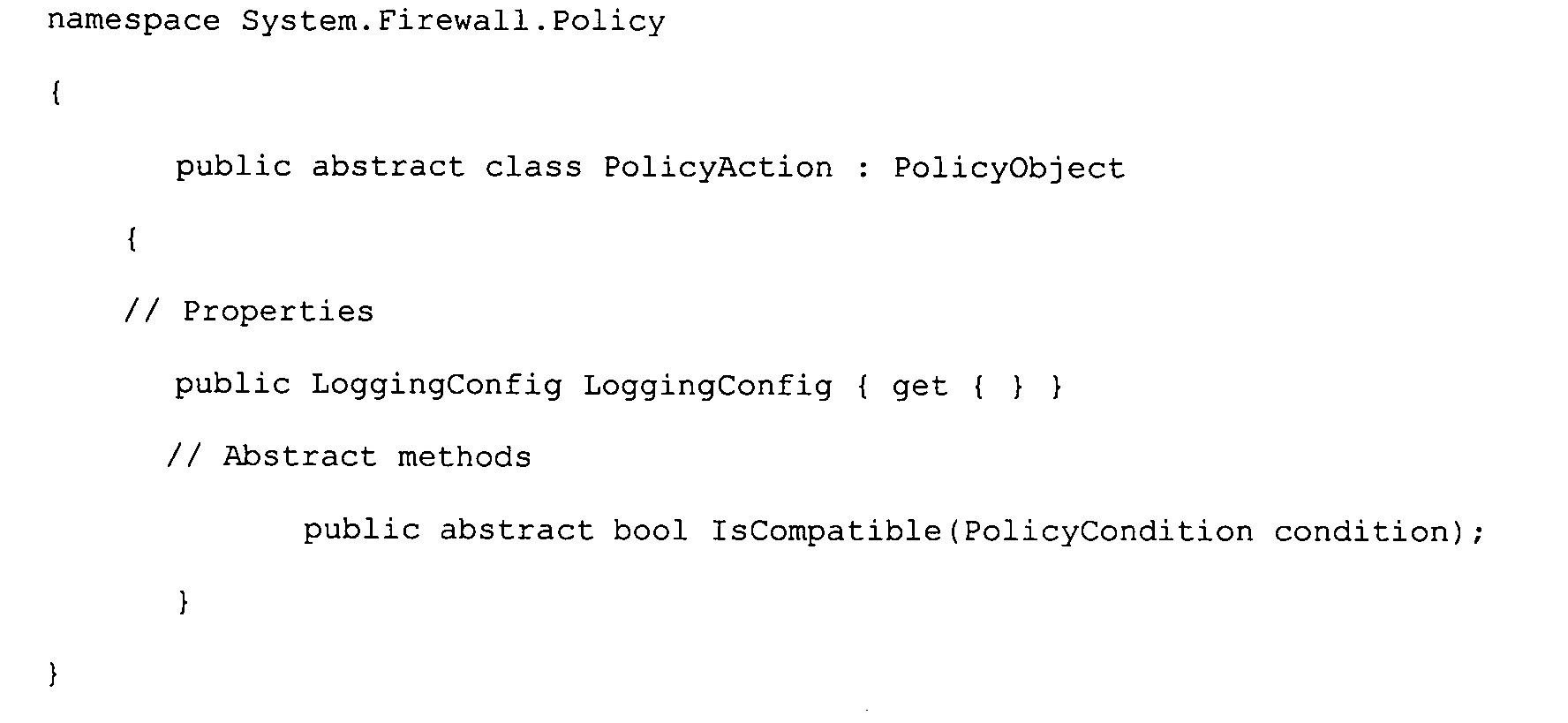
PolicyAction is an abstract class that serves as the root class for all specific action classes.
Whether to log the packet is implied by specifying a non-empty logging configure object.
Methods
|
Method
|
|
Name
|
IsCompatible |
|
Return Type
|
Bool |
|
Description
|
Return true if this action can take place at the same layer as the condition. Otherwise return false. |
|
Parameters
|
Condition - The condition against which this action will be checked. |
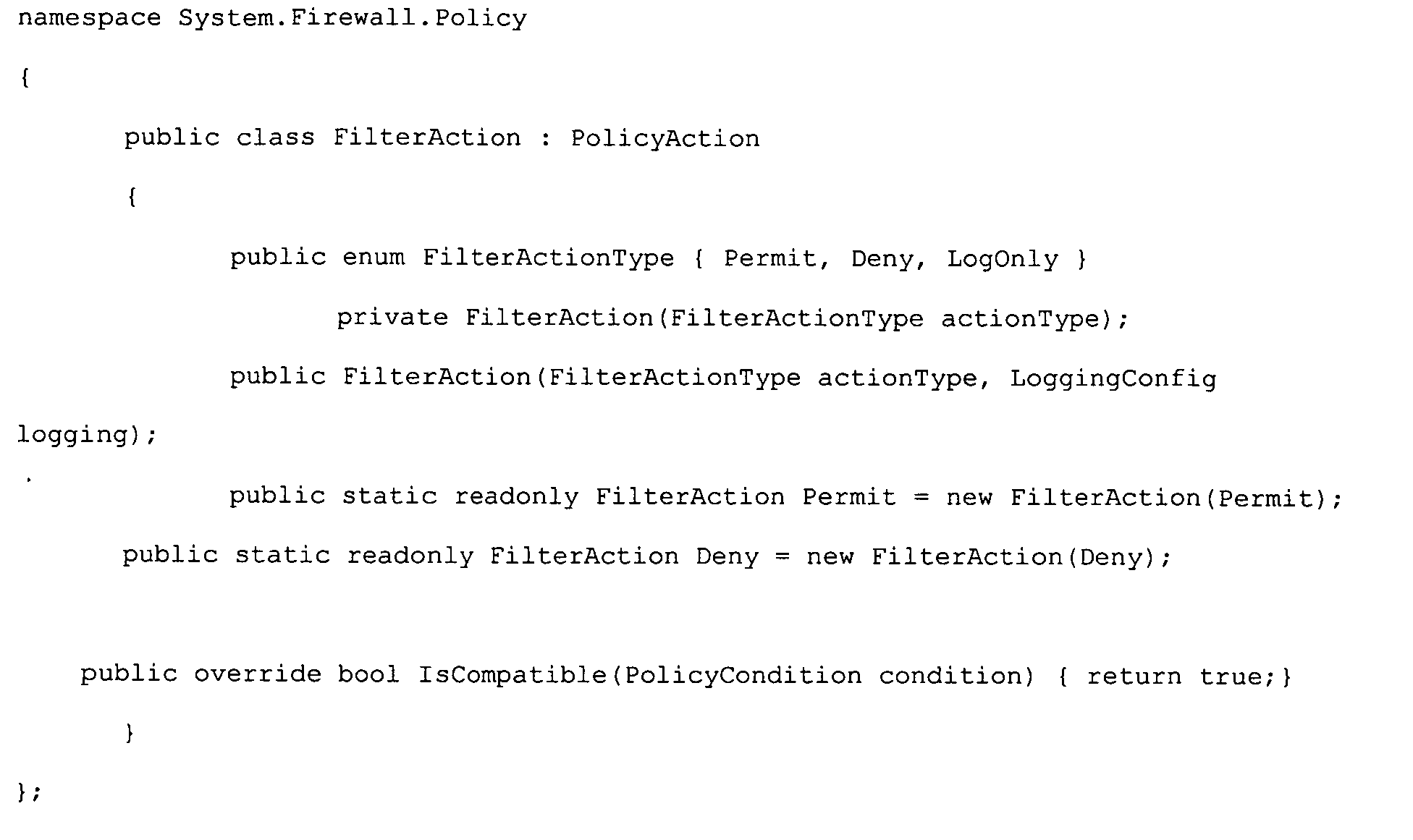
System.Firewall.Policy.FilterAction
FilterAction models the following action scenarios:
- Permit: Allow packets that match the associating PolicyCondition object.
PolicyAction action = FilterAction.Permit; - Deny: Drop packets that match the associating PolicyCondition object.
PolicyAction action = FilterAction.Deny; - Permit and Log: Allow and log packets that match the associating PolicyCondition
object.
new
FilterAction(FilterAction.FilterActionType.Permit,
logging); - Deny and Log: Drop and log packets that match the associating PolicyCondition
object.
new FilterAction(FilterAction.FilterActionType.Deny,
logging); - Log Only: Log packets that match the associating PolicyCondition object.
new
FilterAction(FilterAction.FilterActionType.LogOnly,
logging);
Please note that FilterAction can be associated with any PolicyCondition as it is required that
all layers in the firewall platform will at least support Permit, Deny and Log actions.
System.Firewall.Policy.InstantiationTemplate
Instantiation templates can be any of the following templates:
- TransportTemplate: the template to be instantiated at the transport layer either
inbound or outbound.
- IPSecLayer: the IPsec template to be instantiated at IPSec layer.
- IPSec Authorization rule template: the authorization template to be instantiated at
the IPSec authorization layer.
Each of the above classes provide two constructors. The first one is to be instantiated when
the associated application rule matched to perform client instantiation. When client
instantiation takes place, the full 5-tuple is available to instantiate the template. On the other
hand, if it is not a client instantiation, only local 3-tuple, i.e. local address, protocol, and local
port, available. This is what the second constructor will be used for. So implicitly, the first
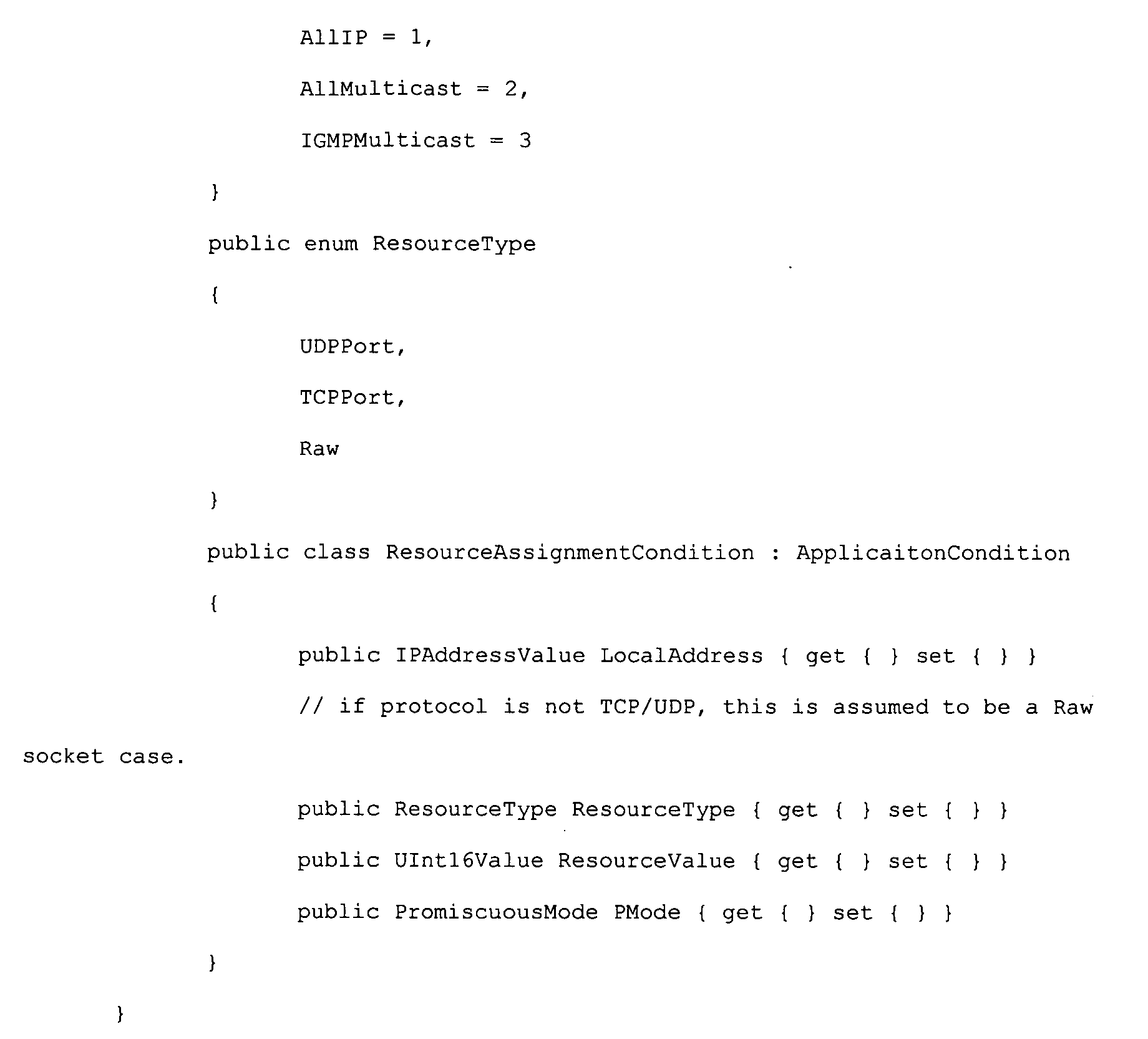
constructor set the isClientInstantiation flag in the base InstantiationTemplate class to be true
while the second one set it to false. The client instantiation templates are instantiated only
when the full 5-tuple is available while the server instantiation templates only at the time
when the local 3-tuple is available.
System.Firewall.Policy.ApplicationAction
The possible ApplicationAction scenarios are as following:
- Permit: Allow packets that match the associating ApplicationCondition object.
- Deny: Drop packets that match the associating ApplicationCondition object.
- Ask: Ask for users' decisions when packets match the associating
ApplicationCondition object.
- Log Only: Log packets that match the associating ApplicationCondition object.
Methods
|
Method
|
|
Name
|
GetTemplates |
|
Return Type
|
InstantiateTemplateCollection |
|
Description
|
Return the list of instantiate templates that will be created when this application action takes place. |
|
Parameters
|
Condition - The condition against which this action will be checked. |
System.Firewall.Policy.CalloutAction
CalloutAction models the callout extensions that the platform provides. When associating
conditions are matched, the callout action specifies the callout extension that the platform
needs to invoke. It is used as an extension mechanism to provide additional security
functionalities like intrusion detection, parental control etc.
| Property |
| Name | CalloutModeul |
| Description | The callout module to be invoked when the associating condition is matched. |
| Access | Read Only |
| Property |
| Name | CalloutContext |
| Description | The callout specific context information to be passed to the callout module when it is invoked. |
| Access | Read/Write |
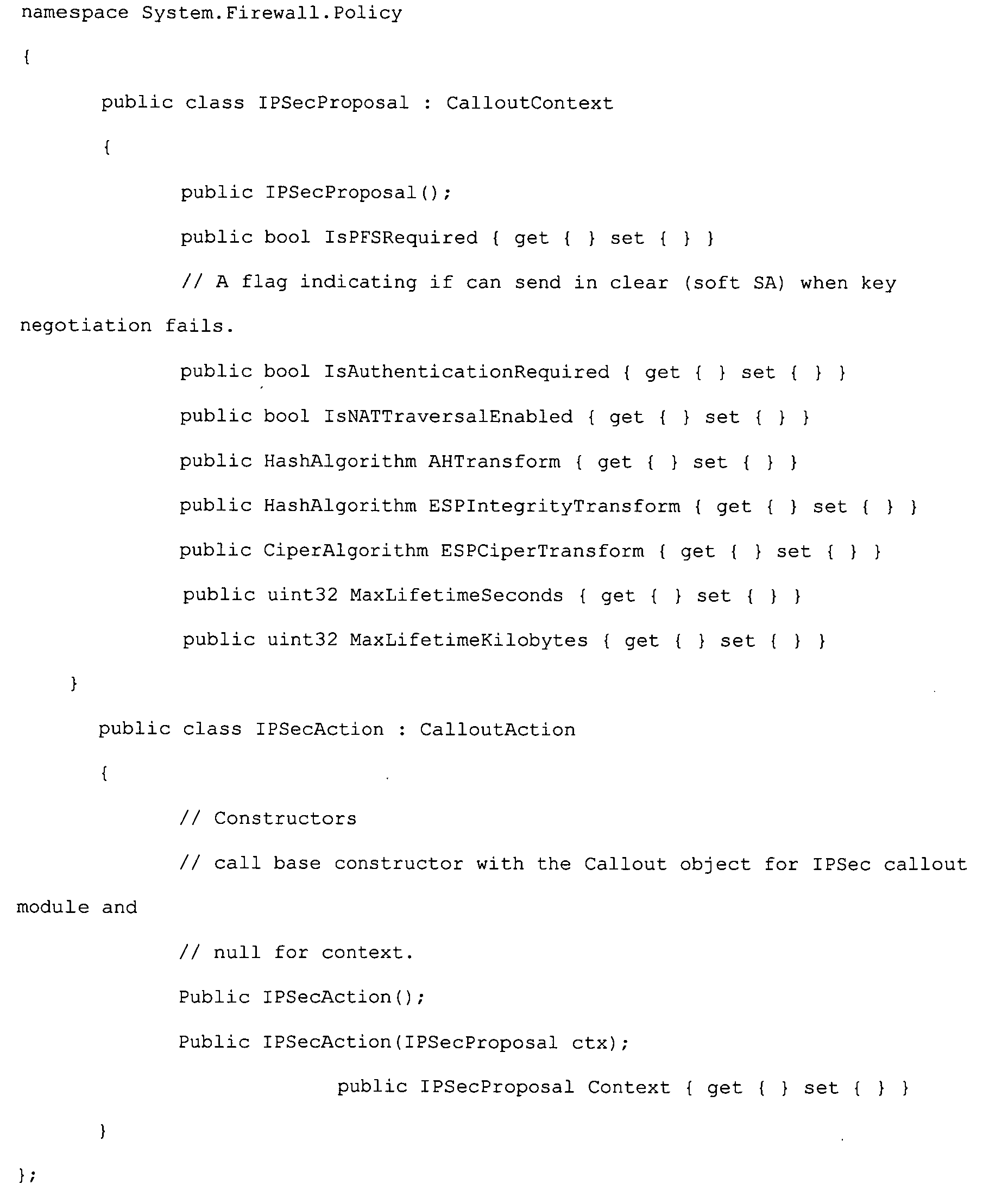
IPSecAction triggers the IPSec callout to set a security context in the matching packets so that
the packets will be further process by the IPSec driver. It also specifies the actual IPSec
configure parameters for securing network traffic, including AH or ESP or both and their
corresponding transform settings.
System.Firewall.Policy.IKEAction
IKEAction defines the authentication methods for performing IKE key negotiation protocol,
which can be either pre-shared key, Kerberos or certificates, and also proposals for
authentication algorithms.
System.Firewall.Policy.KeyingModuleAction
KeyingModuleAction selects the specified keying module to perform key negotiation
exchanges. When more than one is specified, each of the listed keying modules will be tried
in order until one of them succeeds or all have failed.
Methods
|
Method
|
|
Name
|
GetKeyingModules |
|
Return Type
|
KeyingModuleCollection |
|
Description
|
Return one or more keying modules that may be invoked when this action is taken place. If more than one keying modules are listed, they will be tried in the order as specified until one of them succeeds or all fail. |
|
Parameters
|
None. |
Exhibit D
System.Firewall.Policy.ApplicationSetting
|
Property
|
|
Parameters
|
Application |
|
Description
|
The application for which this application setting is about. |
|
Access
|
Read Only |
|
Property
|
|
Parameters
|
User |
|
Description
|
The user for which this application setting is specified. Together with the application field, it serves as the unique key for application settings. |
|
Access
|
Read Only |
|
Property
|
|
Parameters
|
SecurityLevel |
|
Description
|
The security level when this user uses this application. |
|
Access
|
Read Write |
|
Method
|
|
Name
|
GetRules |
|
Parameters
|
Application - The application to which this security level is to be applied. |
| |
User - The user to which this security level is to be applied. |
| |
Contacts - The list of remote contacts that is used when this security level is applied. |
|
Returns
|
ApplicationRuleCollection |
|
Description
|
Obtain the list of application rules that enforces the setting "using this security level with these remote contacts when this user uses this application". |
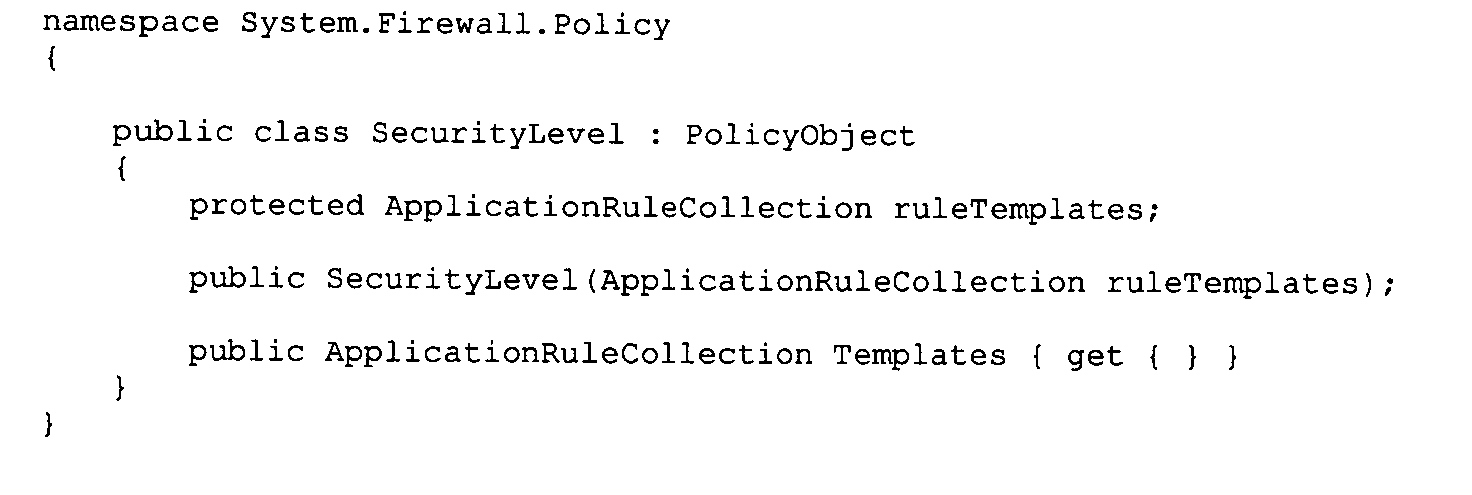
System.Firewall.Policy.SecurityLevel
|
Property
|
|
Parameters
|
Templates |
|
Description
|
The list of application rule templates that make of this security level. |
|
Access
|
Read Only |
The reference of remote entities in a security level
determines the setting for IPSec main mode key exchange. For
example, if a trusted contact is an X509 certificate, the CA
certificate for this contact will be treated as a trusted root
certificate used in IKE negotiation. For the security
reason, certificates, pre-shared keys and other credentials
will be not stored by the PFW service. Instead the should
come from the dedicated windows security stores e.g. secure
certificate store for certificates.
Exhibit E
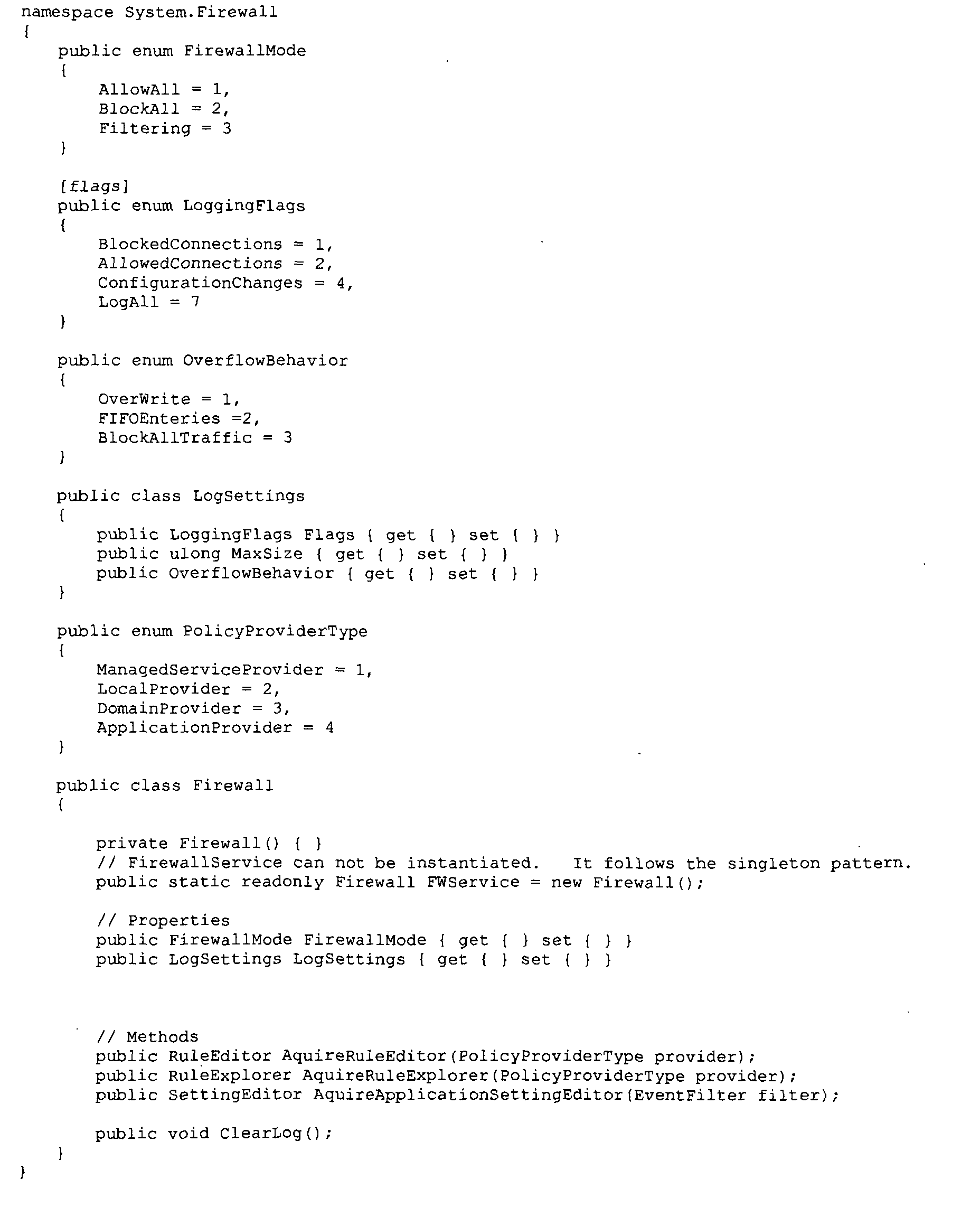
System.Firewall. FirewallService
Properties
|
Property
|
|
Parameters
|
FirewallMode |
|
Description
|
The current filtering mode of the personal firewall service. It can be any of the following value: |
| • Block All: the personal firewall service is running and it is blocking all traffic |
| • Permit All: the personal firewall service is running and it is allowing all traffic |
| • Filtering: the personal firewall service is running and it is actually enforcing the application settings that users have defined. |
|
Access
|
Read Write |
|
Property
|
|
Parameters
|
LogSettings |
|
Description
|
A global setting that specifies the logging settings including things to log, logging limit and over flow behavior. |
|
Access
|
Read Write |
Methods
|
Method
|
|
Name
|
AquireRuleEditor |
|
Parameters
|
Provider - The type policy provider that the returned policy editor will act as. |
|
Returns
|
RuleEditor - an object reference through which all advanced policy rules will be managed. |
| The principal of the current calling thread will be used in permission checking. So in a 'runas' situation, the impersonation needs to take place before calling this method to create a RuleEditor. An insufficient privilege exception will be raised if the current caller does not have sufficient privileges. |
|
Description
|
The policy provider interface for manipulating policy rules directly, i.e. the advanced view of rules in the system including those stored in the persistent store and plumbed down to the kernel driver. |
|
Method
|
|
Name
|
AquireRuleExplorer |
|
Parameters
|
Provider - The type policy provider that the returned policy explorer will act as. |
|
Returns
|
RuleExplorer - an object reference through which rules from other providers may be retrieved with sufficient privileges. |
|
Description
|
Creation of a rule explorer object for viewing rules that are currently enforced in the platform by a specific policy provider. |
|
Method
|
|
Name
|
AquireSettingEditor |
|
Parameters
|
Provider - The type policy provider that the returned firewall setting editor will act as. |
|
Returns
|
SettingEditor - an object reference through which all simple application settings will be managed. |
| The principal of the current calling thread will be used in permission checking. So in a 'runas' situation, the impersonation needs to take place before calling this method. An insufficient privilege exception will be raised if the current caller does not possess sufficient privileges. |
|
Description
|
Creation of an editor object for managing simple views of rules in terms of application settings. |
|
Method
|
|
Name
|
ClearLog |
|
Parameters
|
Void |
|
Returns
|
Void |
|
Description
|
Remove all records in the log. |
System.Firewall.SettingEditor
Properties
|
Property
|
|
Parameters
|
ApplicationSettings |
|
Description
|
All the application firewall rules stored in the system. |
|
Access
|
Read Only |
|
Property
|
|
Parameters
|
DefaultApplicationSetting |
|
Description
|
The default firewall setting to apply when an application's setting is not specified. |
|
Access
|
Read Write |
|
Property
|
|
Parameters
|
DefaultWindowsServiceSetting |
|
Description
|
The default firewall setting to apply when a windows service's firewall setting is unspecified |
|
Access
|
Read Write |
|
Property
|
|
Parameters
|
TrustedZone |
|
Description
|
The default trusted IP address list to use when an application setting does not specify its own trusted IP addresses. |
|
Access
|
Read Write |
|
Property
|
|
Parameters
|
SecureZone |
|
Description
|
The default trusted authenticated remote identity list to use when an application setting does not specify its own trusted authenticated remote identities. |
|
Access
|
Read Write |
|
Property
|
|
Parameters
|
IsICMPAllowed |
|
Description
|
If true, all ICMP messages are allowed e.g. the stack will respond to pings and generate ICMP errors. Otherwise, it is blocked. |
|
Access
|
Read Write |
Methods
|
Method
|
|
Name
|
SetDefaultSecurityLevel |
|
Parameters
|
User - |
| Level - |
|
Returns
|
Void |
|
Description
|
Set the default security level for the specified user. |
|
Method
|
|
Name
|
GetSecurityLevel |
|
Parameters
|
User - |
|
Returns
|
Void |
|
Description
|
Get the default security level for the specified user. |
System.Firewall.RuleExplorer
A RuleExplorer object gives a firewall client the read-only
view of all the policies that are currently in the
firewall platform (subject to privilege checking though).
|
Method
|
|
Name
|
GetRules |
|
Return Type
|
RuleReferenceCollection |
|
Description
|
Obtain rules that are currently enforced in the firewall platform. The operation is done in one transaction, i.e. it is an atomic operation with the proper isolation level. |
|
Parameters
|
None. |
Events
|
Property
|
|
Name
|
RuleChangedEvent |
|
Description
|
This is for the RuleExplorer client to receive notification when the policies that it is views have changed. |
|
Parameters
|
Source - the specific RuleExplorer object whose policies that it's viewing have changed |
| Args - the RuleChangedEventArgs consist of the list of policies that have changed in the form of RuleReferenceCollection object. |
System.Firewall.RuleEditor
Methods
|
Method
|
|
Name
|
AddRule |
|
Return Type
|
RuleReference |
|
Description
|
Push down a set of policies to the policy engine which in turn plumb them down to the kernel driver. |
|
Parameters
|
Policy - a new policy to be plumbed down to the firewall platform driver |
|
Exceptions
|
ArgumentException: when try to add an invalid PolicyRule object |
| PrivilegeException: when try to add a rule with insufficient privileges. |
| TransactionException: when the current transaction is aborted because of transaction time out. |
|
Method
|
|
Name
|
RemoveRule |
|
Return Type
|
Void |
|
Description
|
Remove the specified policy from the firewall platform enforcement |
|
Parameters
|
Policy -policy to be removed from the firewall platform driver |
|
Exceptions
|
PrivilegeException: when try to remove a rule with insufficient privileges. |
| TransactionException: when the current transaction is aborted because of transaction time out. |
|
Method
|
|
Name
|
UpdateRule |
|
Return Type
|
void |
|
Description
|
Change the specified policy that has been previously added. |
|
Parameters
|
Policy - policy that need to be changed |
|
Exceptions
|
ArgumentException: when try to set an invalid PolicyRule object |
| PrivilegeException: when try to add a rule with insufficient privileges. |
| TransactionException: when the current transaction is aborted because of transaction time out. |
|
Method
|
|
Name
|
RemoveAll |
|
Return Type
|
void |
|
Description
|
Remove all the rules that this policy provider has created. It is an atomic operation i.e. it is done within one transaction. |
|
Parameters
|
Policy - policy that need to be changed |
|
Exceptions
|
PrivilegeException: when try to add a rule with insufficient privileges. |
| TransactionException: when the current transaction is aborted because of transaction time out or the transaction has failed. |
Properties
|
Property
|
|
Name
|
PriorityClass |
|
Description
|
The priority class that this policy provider is in. |
|
Access
|
Read Only |
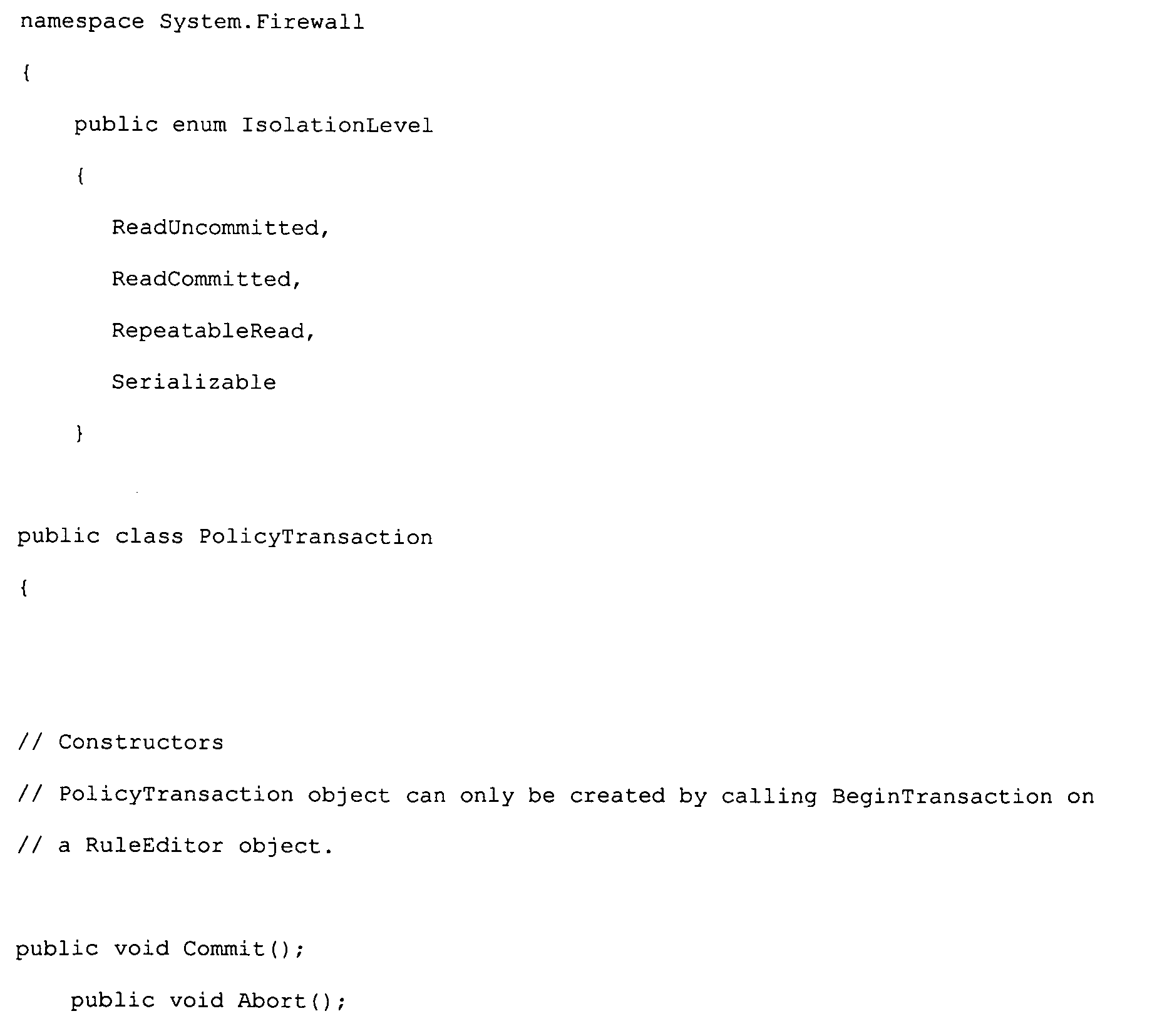
System.Firewall. PolicyTransaction
The current firewall platform only supports one phase commit for policy transactions. For
each transactional operation like read/add/update/remove rules, some locks will be held till
the transaction ends i.e. either committed or aborted. Considering the fact that it is less
common.to have multiple explorers and editors try to access the policy engine concurrently, a
coarse grained concurrency control schemes using a global engine lock is currently used. So
only isolation level Serializable is currently supported.
To prevent deadlock or starvation, each transaction is associated with a time out interval. If
there are any other transactions waiting for the current transaction to finish, the current
transaction will be aborted by the platform if it does not end before the times out interval
expires. If the transaction is aborted because of time out, the next transactional operations
like calling AddRule on RuleEditor or Commit on PolicyTransaction will raise a
TransactionException.
Rule validation and access permission checking are done at the time when the policy
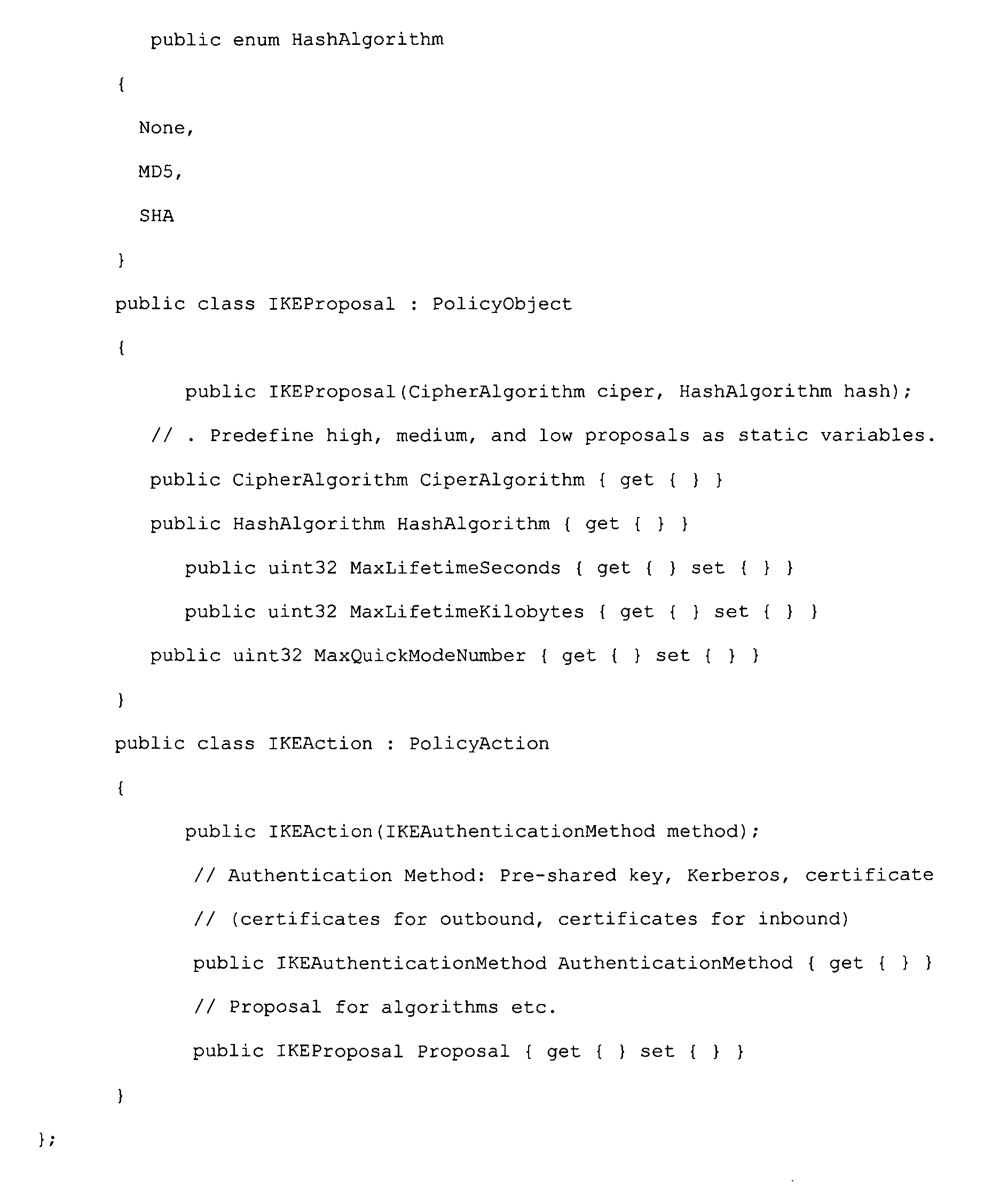
operations are invoked e.g. calling GetRules on a RuleExplorer object or UpdateRule on a
RuleEditor. But changes will not take effect until the transaction that they are in is
committed. The policy engine will take all the changes as one batch and apply them
atomically to the kernel model firewall driver.
Methods
|
Method
|
|
Name
|
Commit |
|
Return Type
|
Void |
|
Description
|
Perform this policy transaction. |
|
Parameters
|
None |
|
Exceptions
|
TransactionException: When this policy transaction fails to commit due to some unexpected causes like running out memory. |
|
Method
|
|
Name
|
Abort |
|
Return Type
|
void |
|
Description
|
Abort the specified transaction. |
|
Parameters
|
None. |
|
Exceptions
|
TransactionException: When the platform fails to roll back changes made by this transaction. |
Properties
|
Property
|
|
Name
|
IsolationLevel |
|
Description
|
The isolation level that this transaction object is at. There are four possible isolation levels: |
| |
• ReadUncommitted: Uncommitted changes in one transaction can be viewed from other transactions. |
| |
• ReadCommmitted: Changes in one transaction can be viewed from other transactions only after they have been committed. |
| |
• RepeatableRead: At this isolation level it is guaranteed that any rule that has been read will not change during the whole transaction, but other transactions may add new rules which subsequent reads in this transaction will return. |
| |
• Serializable: All concurrent transactions interact only in ways that produce the same effect as if each transaction were executed one after another. |
| |
The current firewall platform only support isolation level of Serializable.
The support for other levels may be added in the future. |
|
Access
|
Read Only |
System.Firewall.RuleReference
Each RuleReference has one corresponding RuleEditor that
owns it. Only that RuleEditor will be able to modify this
object.
|
Property
|
|
Name
|
Spec |
|
Description
|
The actual content of the policy that is to be or being enforced by the underlying firewall platform components. |
|
Access
|
Read/Write |
|
Property
|
|
Name
|
Status |
|
Description
|
The enforcement status of this policy, which can be in one of the following state: |
| - Active: Committed to the policy manager successfully and it is placed on the active list and being enforced. |
| - Disabled: Committed to the policy manager successfully but due to a complete block by other high priority policies, or because either the location or time constraints are not met, it is currently on the disabled rule list. |
| |
- InTransaction: Valid policy specification and it is in a transaction to be committed to the policy manager |
| |
- Invalid: Invalid policy specification and not committed. |
|
Access
|
Read Only |
|
Property
|
|
Name
|
ProviderInfo |
|
Description
|
The information about the provider who owns this policy |
|
Access
|
Read Only |