EP1544808A1 - Integrated circuit card system and application loading method - Google Patents
Integrated circuit card system and application loading method Download PDFInfo
- Publication number
- EP1544808A1 EP1544808A1 EP04014247A EP04014247A EP1544808A1 EP 1544808 A1 EP1544808 A1 EP 1544808A1 EP 04014247 A EP04014247 A EP 04014247A EP 04014247 A EP04014247 A EP 04014247A EP 1544808 A1 EP1544808 A1 EP 1544808A1
- Authority
- EP
- European Patent Office
- Prior art keywords
- card
- policy
- management system
- attribute information
- integrated circuit
- Prior art date
- Legal status (The legal status is an assumption and is not a legal conclusion. Google has not performed a legal analysis and makes no representation as to the accuracy of the status listed.)
- Withdrawn
Links
Images



Classifications
-
- G—PHYSICS
- G07—CHECKING-DEVICES
- G07F—COIN-FREED OR LIKE APPARATUS
- G07F7/00—Mechanisms actuated by objects other than coins to free or to actuate vending, hiring, coin or paper currency dispensing or refunding apparatus
- G07F7/08—Mechanisms actuated by objects other than coins to free or to actuate vending, hiring, coin or paper currency dispensing or refunding apparatus by coded identity card or credit card or other personal identification means
- G07F7/10—Mechanisms actuated by objects other than coins to free or to actuate vending, hiring, coin or paper currency dispensing or refunding apparatus by coded identity card or credit card or other personal identification means together with a coded signal, e.g. in the form of personal identification information, like personal identification number [PIN] or biometric data
- G07F7/1008—Active credit-cards provided with means to personalise their use, e.g. with PIN-introduction/comparison system
-
- G—PHYSICS
- G06—COMPUTING OR CALCULATING; COUNTING
- G06Q—INFORMATION AND COMMUNICATION TECHNOLOGY [ICT] SPECIALLY ADAPTED FOR ADMINISTRATIVE, COMMERCIAL, FINANCIAL, MANAGERIAL OR SUPERVISORY PURPOSES; SYSTEMS OR METHODS SPECIALLY ADAPTED FOR ADMINISTRATIVE, COMMERCIAL, FINANCIAL, MANAGERIAL OR SUPERVISORY PURPOSES, NOT OTHERWISE PROVIDED FOR
- G06Q20/00—Payment architectures, schemes or protocols
- G06Q20/30—Payment architectures, schemes or protocols characterised by the use of specific devices or networks
- G06Q20/34—Payment architectures, schemes or protocols characterised by the use of specific devices or networks using cards, e.g. integrated circuit [IC] cards or magnetic cards
- G06Q20/341—Active cards, i.e. cards including their own processing means, e.g. including an IC or chip
-
- G—PHYSICS
- G06—COMPUTING OR CALCULATING; COUNTING
- G06Q—INFORMATION AND COMMUNICATION TECHNOLOGY [ICT] SPECIALLY ADAPTED FOR ADMINISTRATIVE, COMMERCIAL, FINANCIAL, MANAGERIAL OR SUPERVISORY PURPOSES; SYSTEMS OR METHODS SPECIALLY ADAPTED FOR ADMINISTRATIVE, COMMERCIAL, FINANCIAL, MANAGERIAL OR SUPERVISORY PURPOSES, NOT OTHERWISE PROVIDED FOR
- G06Q20/00—Payment architectures, schemes or protocols
- G06Q20/30—Payment architectures, schemes or protocols characterised by the use of specific devices or networks
- G06Q20/34—Payment architectures, schemes or protocols characterised by the use of specific devices or networks using cards, e.g. integrated circuit [IC] cards or magnetic cards
- G06Q20/355—Personalisation of cards for use
- G06Q20/3552—Downloading or loading of personalisation data
-
- G—PHYSICS
- G06—COMPUTING OR CALCULATING; COUNTING
- G06Q—INFORMATION AND COMMUNICATION TECHNOLOGY [ICT] SPECIALLY ADAPTED FOR ADMINISTRATIVE, COMMERCIAL, FINANCIAL, MANAGERIAL OR SUPERVISORY PURPOSES; SYSTEMS OR METHODS SPECIALLY ADAPTED FOR ADMINISTRATIVE, COMMERCIAL, FINANCIAL, MANAGERIAL OR SUPERVISORY PURPOSES, NOT OTHERWISE PROVIDED FOR
- G06Q20/00—Payment architectures, schemes or protocols
- G06Q20/30—Payment architectures, schemes or protocols characterised by the use of specific devices or networks
- G06Q20/34—Payment architectures, schemes or protocols characterised by the use of specific devices or networks using cards, e.g. integrated circuit [IC] cards or magnetic cards
- G06Q20/357—Cards having a plurality of specified features
- G06Q20/3576—Multiple memory zones on card
- G06Q20/35765—Access rights to memory zones
Definitions
- the present invention generally relates to an integrated circuit (IC) card system using an IC card and, more particularly, to a method of loading a card application program into an IC card and executing it.
- IC integrated circuit
- Multifunction IC cards into which plural services can be loaded are increasingly replacing conventional type magnetic cards.
- a card issuer mainly manages a multifunction IC card. The card issuer often determines beforehand the application programs (APs) to be loaded into the IC card.
- APs application programs
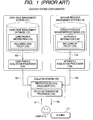
- FIG. 1 shows a system configuration that automatically discriminates the right combination of an IC card and an AP in IC card management service proposed by GP.
- the outline of components of this conventional system is described below.
- a card issue management system 101 manages information related to an IC card and the information of a card user and executes the card issue service.
- the card issue management system 101 manages a card issue management database (DB) 121.
- Card profile information 122 is managed in the corresponding DB.
- Card profile information 122 is attribute information related to the card.
- Card profile information 122 is a generic name for information used for the management of the card by the card issue management system 101.
- Card profile information 122 also includes basic data such as card identification (ID) and card capacity, as well as data that dynamically varies such as the list information of APs currently loaded into the card. Particularly, in this case, it is characteristic that data called card policy 123 is included.
- the card policy 123 is a requisite requested of another entity such as an AP by the card, for example, a requisite that the capacity of an AP shall be 4 KB or less and the type of the AP shall be an AP corresponding to Java®Card.
- the card policy is included in the card profile information 122.
- a card profile acquisition processor 124 is provided with logic for returning the corresponding card profile in response to a request from an external system.
- a service provider management system 102 manages information related to the AP and the information of a service user and provides service.
- the service provider management system 102 manages a service provider management database 131, in which AP profile information 132 is managed.
- the AP profile information 132 is attribute information related to the AP.
- AP profile information 132 is a generic name for information used for the management of the AP by the service provider management system 102.
- the AP profile information 132 also includes basic data such as card identification (ID) and the name of the AP, as well as data that dynamically varies such as whether the AP is run or not.
- ID card identification
- the AP profile information 132 includes an AP policy 133.
- the AP policy 133 is a requisite requested of another entity such as a card by the AP, for example, a requisite that the EEPROM capacity of the card shall be 16 KB or more and the platform of the card shall be Java® Card.
- An AP profile acquisition processor 134 is provided with logic for returning the corresponding AP profile in response to a request from an external system.
- a collator system 103 is a system for collecting a profile in response to a request from a user 111 and for determining whether a policy included in the profile is met or not.
- the collator system 103 includes profile collection logic 141 and a policy determination processor 142.
- the profile collection logic 141 is provided with logic for requesting and acquiring card profile information 122 of the card issue management system 101 and requesting and acquiring AP profile information 132 of the service provider management system 102.
- the policy determination processor 142 includes logic for analyzing an acquired profile, for determining whether each policy is met or not, and for providing the result to the user.
- the card issue management system 101, the service provider management system 102 and the collator system 103 exchange information via a network such as a public network, via a network including a common carrier leased line, or via mailing or handing a document and an information record medium.
- the terminal and the server of each system exchange information via a public network or via a network including a leased line.
- the collator system When it is determined whether a desired AP can be loaded into a card 110 which the user 111 owns or not, the collator system is requested to determine whether the AP can be loaded or not (a step 151). For a concrete request method, there are Web access from a home PC, access from a terminal installed at a shop, and access via telephone inquiry.
- the collator system 103 acquires the corresponding card profile information 122 from the card issue management system 101 using the ID of the card owned by the user as a key (steps 152, 153). Similarly, the collator system 103 acquires the corresponding AP profile information from the service provider management system using application identification (AID) of the AP desired by the user as a key (steps 154, 155).
- AID application identification
- the collator system 103 verifies whether a card policy in the acquired card profile is met or not using information in the AP profile. For example, when the card policy is that the capacity of the AP shall be 4 KB or less, the collator system 103 checks an AP capacity item in the AP profile and determines whether the capacity is 4 KB or less or not. Similarly, the collator system verifies whether an AP policy in the AP profile is met or not by use of information in the card profile.
- the collator system 103 checks an EEPROM capacity item in the card profile and determines whether the EEPROM capacity is 16 KB or more or not The collator system 103 determines all policies and provides the result to the user (a step 156).
- Profile information including policies is represented in extensible markup language (XML).
- the AP can be loaded or deleted into/from a multifunction IC card after the card is issued to a user. It is assumed that the user freely selects the AP and repeatedly loads or deletes it. Therefore, it is estimated that it will be the essential service of a card issue manager to dynamically present which AP can be loaded to the user at real time.
- a problem in a system proposed by a GP is that all items of profile information are required to be acquired.
- the collator system acquires the information of all items defined as a profile because the contents of a policy are not known until the collator system receives a card policy included in a card profile and an AP policy included in an AP profile.
- a problem related to security occurs. That is, every time a policy is determined, information unnecessary for determination is all provided to an external system. Besides, a problem in efficiency caused by differences in transmitted/received data capacity also occurs.
- no large difference is made.
- Another problem in the system proposed by the GP is that the format of profile information is fixed.
- Profile information is information considered to be managed in the existent system, such as card ID, card capacity in the case of a card profile, AID, and the name of an AP in the case of an AP profile as described above.
- the format of each profile collected by the collator system 103 is required to be unified in the same format.
- the card issue management system and the service provider management system are required to create a new DB or to create profile information according to the format beforehand. Creating a new DB has a problem of manhours. Creating profile information requires creating profile information corresponding to the change of DB information at real time, which is difficult.
- the objects of the present invention are to enable a card issue manager to dynamically present which application program (AP) can be loaded at real time, to enable the determination of a policy without the acquisition of all items of profile information by a collator, to minimize the quantity of data exchanged between systems, and to enable the collection of each profile without unifying the format of each profile collected by the collator system.
- AP application program
- a request to load an application program into an IC card is received.
- a card policy which is requested of a card issue management system for application profile information and which is a condition for allowing the loading of the application program is requested and acquired of the card issue management system.
- An application policy which is requested of a service provider management system for the card profile information of the IC card and which is a condition for allowing the loading of the application program is requested and acquired of the service provider management system.
- Ann item of application profile information required for determining the card policy and a definition format specified by the card policy are specified and are requested of the service provider management system.
- the item of the application profile information is extracted from a service provider management database.
- the application profile information of the IC card converted according to the definition format is acquired.
- the item of the IC card profile information required for determining the application policy and a definition format specified by the application policy are specified and are requested of the card issue management system.
- the item of the IC card profile information is extracted from a card issue management database.
- the IC card profile information converted according to the definition format is acquired.
- the card policy is determined by the converted IC card profile information.
- the application policy is determined by the converted IC card application profile information. It is then determined whether the application program can be loaded into the IC card or not.
- the profile information provided to the external system by the card issue management system and the service provider management system can be made dynamic and minimally sized.
- mapping rule is extracted in accordance with a format specified by a policy if a profile is provided and as the profile is dynamically created based upon an existing DB according to the rule, a profile format is not required to be the only fixed format.
- the existing DB can be utilized as it is. Accordingly, man-hours newly required in newly creating a table and other things can be reduced.
- An embodiment of the invention will be concretely described below.
- a description is given below of a process for determining whether an application program (AP) can be loaded or not into an integrated circuit (IC) card system.
- the process is executed using solving methods in linkage among a card issue management system, a service provider management system and a collator system.
- the definition format means the format definition of the notation of profile information. For example, if profile information is described in extensible markup language (XML), document type definition (DTD) and XML schema definition are the definition format.
- XML extensible markup language
- DTD document type definition
- XML schema definition are the definition format.
- the definition format is not necessarily uniform amongst all systems, the definition format must be specified in a policy provided by each system. Therefore, the definition format is required to be able to be dynamically accessed by plural systems. It is assumed that the definition format is open to the public on a Web server and other similar apparatus.
- Mapping rule information means information in which a mapping rule between a public definition format and card attribute existent information is described. As it is assumed that plural definition formats are open to the public, plural mapping rule information items are accordingly prepared. As many mapping rules as definition formats are required. In a case having only one definition format, one definition format may be managed as a file. However, in a case having plural definition formats, data that can be uniquely specified, such as definition format identfication (ID) and uniform resource locator (URL), the definition format of which is open to the public may be stored in a DB as a key.
- ID definition format identfication
- URL uniform resource locator
- a user requests the collator system to determine whether an AP can be loaded or not.
- the collator system acquires information for identifying a card, such as card ID from an IC card owned by the user.
- the collator acquires information for identifying an application program (AP) such as application identification (AID) of an AP which the user desires to be loaded.
- AP application program
- AID application identification
- the collator system specifies the card ID and requests the corresponding card policy of the card issue management system.
- the collator system specifies the AID and requests the corresponding AP policy of the service provider management system.
- the card issue management system stores the corresponding card policy in the DB using the specified card ID as a key.
- the card policy is managed in the DB as a part of card profile information.
- the card policy is stored in the DB as independent information.
- the card issue management system extracts the card policy corresponding to the card ID and transmits it to the collator system.
- an AP policy is similarly managed in the DB independent of application profile information.
- the AP policy corresponding to the AID specified by the collator system is extracted from the DB and is transmitted to the collator system.
- the collator system analyzes contents of the acquired card policy and the acquired AP policy and extracts items of profile information required for determining the policy.
- the collator system specifies the necessary card profile item and a definition format specified by the policy and requests a card profile of the card issue management system.
- the collator system similarly specifies the required AP profile item and a definition format specified by the policy and requests an AP profile of the service provider management system. In this case, the definition format of the card profile and the definition format of the AP profile are not required to be the same.
- the card issue management system checks to the specified definition format.
- the card issue management system selects a mapping rule between the specified definition format and a card attribute existent information DB owned by itself, checks to which item in the DB the required profile information item is equivalent according to the rule, and then extracts a value.
- the card issue management system creates card profile information based upon the extracted value according to the specified definition format and then transmits the card profile information to the collator system.
- the service provider management system checks the specified definition format.
- the service provider management system selects a mapping rule between the specified definition format and AP attribute existent information DB owned by itself, checks to which item in the DB the required profile information item is equivalent according to the rule, and then extracts a value.
- the service provider management system then creates AP profile information based upon the extracted value according to the specified definition format and transmits it to the collator system.
- the collator system determines whether the card policy is met or not using the acquired card policy and the profile information required for determination.
- the collator system similarly determines whether the AP policy is met or not using the acquired AP policy and the profile information required for determination. After all policy determination is finished, the collator system presents the result to the user.
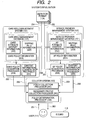
- FIG. 2 shows the basic configuration of systems of the present invention.
- the card issue management system 101 manages information related to the IC card and the information of the card user and executes card issue service.
- information related to the IC card means card ID, the capacity (ROM, EEPROM, RAM) of the card, the type and the version of card OS, and card status information including the list information of loaded Aps.
- information of the card user means the name, the age, the distinction of sex, the address, the phone number and the history information of the user.
- the card issue management system 101 manages a card issue management database 121 and in the DB, card policy information 221, card attribute existent information 222 and mapping rule information 223 are managed.
- the card policy information 221 is a requisite which the card requests of another entity such as AP.
- the card policy information is that the capacity of the AP shall be 4 KB or less, the type of the AP shall be an AP corresponding to JavaCard, the annual income of the user shall exceed a fixed condition, and the age of the user shall exceed a fixed condition.
- Card attribute existent information 222 means profile information related to the card that has been managed by card issue management system 101.
- Card attribute existent information 222 may include basic data, such as card ID, card capacity, the type, and the version of card OS.
- Card attribute existent information 222 may also include data that dynamically varies, such as card status information, including the list information of APs currently loaded into the card.
- Mapping rule information 223 means information describing a mapping rule between a definition format 104 open to the public and card attribute existent information 222. As it is assumed that plural definition formats 104 are open to the public, plural mapping rule information items are accordingly prepared.
- a card policy acquisition processor 224 is provided with logic for returning the corresponding card policy in response to a request from an external system.
- An existent information conversion processor 225 is provided with the following logic.
- the existent information conversion processor 225 retrieves mapping rule information corresponding to a specified definition format in response to a card profile request that requests card profile information from the external system.
- the existent information conversion processor extracts card attribute existent information 222 corresponding to a requested profile item according to a mapping rule.
- the card profile information is a generic name of attribute information related to the card.
- Card profile information includes basic data, such as card ID, card capacity, the type and the version of card OS.
- Card profile information also includes data that dynamically varies, such as card status information, including the list information of APs currently loaded in the card.
- the existent information conversion processor 225 creates a card profile by finally converting the extracted information according to the definition format and transmits it to the collator system 103.
- a card issue management system provider has the commitment of IC card issue service and executes IC card issue service using the card issue management system 101, as revised by the present invention.
- Examples of a card issue management system provider include a credit card issuance company, a bank, a local government, a department store, and public transport.
- the card issue management system 101 may be installed in a service center of each company.
- the card issue management system 101 may be installed in a center of an arbitrary service operation company commissioned by each company.
- the card issue management system 101 is realized by a server, the card issue management database 121 is realized by a DB in a hard disk drive (HDD), and processors 224, 225 are operated according to a computer program installed in an application server in the HDD.
- the card issue management database 121 is realized by a DB in a hard disk drive (HDD)
- processors 224, 225 are operated according to a computer program installed in an application server in the HDD.
- the service provider management system 102 manages information related to an AP and the information of a service user and provides service.
- the service provider management system 102 manages a service provider management database 131.
- AP policy information 231, AP attribute existent information 232, and mapping rule information 233 are managed.
- the AP policy information 231 is a requisite requested of another entity such as a card by an AP.
- the AP policy information 231 is that the EEPROM capacity of a card shall be 16 KB or more, that the platform of the card shall be Java®Card, that the type of the card shall be a gold card, and that the age of the user shall meet a certain condition.
- the AP attribute existent information 232 means attribute information related to the AP that has been managed by the service provider management system 102.
- the AP attribute existent information 232 may include basic data, such as AID, the name, the version, the capacity and the type of the AP.
- the AP attribute existent information 232 may also include data that dynamically varies such as the AP status information including whether the AP is run or not are included.
- the mapping rule information 233 means information describing a mapping rule between the definition format 104 open to the public and the AP attribute existent information 232. As it is supposed that plural definition formats 104 are open to the public, plural mapping rule information items are accordingly prepared.
- An AP policy acquisition processor 234 is provided with logic for returning the corresponding AP policy in response to a request from an external system.
- An existent information conversion processor 235 is provided with the following logic.
- the existent information conversion processor 235 retrieves mapping rule information corresponding to a specified definition format in response to a request for an AP profile from an external system.
- the existent information conversion processor 235 extracts AP attribute existent information corresponding to a requested profile item according to a mapping rule.
- the existent information conversion processor 235 then converts the extracted information according to the definition format, creates an AP profile, and transmits the AP profile to the collator system.
- a service provider management system provider has the commitment of service for loading or deleting an AP and the operation of service.
- the provider executes service for loading or deleting an AP using the service provider management system 102.
- Examples of a service provider management system provider include an operation manager of a point-of-sale AP, an electronic money operation manager, and the operation manager of an entertainment AP, such as a video game.
- the service provider management system may be installed in service centers of companies.
- the service provider management system may also be installed in a center of an arbitrary service operation company commissioned by companies.
- the service provider management system 102 is realized by a server.
- the service provider management database 131 is realized by a DB in a HDD.
- Processors 234, 235 are operated according to a computer program installed in the application server in the HDD.
- the collator system 103 is a system for collecting the policy and a profile required for determining the policy in response to a request of the user 111 and determining whether the policy is met or not.
- the collator system 103 is provided with a policy collection processor 241, a necessary profile collection processor 242 and a policy determination processor 243.
- the policy collection processor 241 is provided with logic for requesting and acquiring the card policy of the card issue management system 101, and for requesting and acquiring the AP policy of the service provider management system 102.
- the necessary profile collection processor 242 is provided with logic for analyzing the contents of the acquired policy, extracting an item of profile information required for determining the policy, and requesting and acquiring the profile information.
- the necessary profile collection processor 242 transmits the necessary card profile information item and a definition format specified by the policy to the card issue management system 101 and then receives the corresponding card profile.
- the necessary profile collection processor 242 transmits the necessary AP profile information item and a definition format determined by the policy to the service provider management system and receives the corresponding AP profile.
- the policy determination processor 243 is provided with logic for analyzing the acquired profile, determining whether the card policy and the AP policy are met or not, and presenting the result to the user.
- a collator system provider has the commitment of determination service using the policy and the profile, and executes determination service using the collator system 103.
- the collator system provider may be a provider dedicated to newly supposed collation service.
- the card issue management system provider may execute determination service when a card is issued.
- the service provider management system provider may execute determination service when an AP is loaded.
- the collator system 103 may be installed in a service center of the collator system provider.
- the collator system may also be installed as a part of the card issue management system or as a part of the service provider management system.
- the collator system 103 is realized by a server.
- Processors 241, 242, 243 are operated according to a computer program installed in the application server in HDD.
- the collator system 103 requires the IC card reader/writer to acquire card profile information, such as card ID, from an IC card.
- card profile information such as card ID
- connectors of the reader/writer may be different depending upon the usage of a user. For example, if the home PC of a user is connected to the collator system via the Internet, the reader/writer is installed in the home PC. If a user visits a shop of the collator system provider and utilizes service, the reader/writer are installed in a terminal installed in the shop.
- a definition format 104 is a format for a card profile and an AP profile to follow.
- a policy creator can also create a definition format.
- these definition formats are open to the public and must be freely accessible to plural external providers, including a profile provider such as the card issue management system provider and the service provider management system provider.
- the definition format is typically installed in a Web server and may be accessed with a URL. There may also be a provider dedicated only to the management service of a definition format. However, the card issue management system provider and the service provider management system provider or the collator system provider may often create, publish and manage a definition format.
- the card issue management system 101, the service provider management system 102 and the collator system 103 exchange information via a network such as a public network, via a network including a common carrier leased line, or via mailing or handing a document and an information record medium.
- the terminal and the server of each system exchange information via a public network or via a network including a leased line.
- mapping rule information 223, 233 is information showing a relationship between the definition format 104 open to the public and attribute existent information 222, 232 owned by each system.
- the process for determining whether an AP can be loaded or not can be executed.
- the user 111 who desires an AP to be loaded into the IC card accesses the collator system and requests it to be determined whether or not the AP desired to be loaded can be loaded into the IC card 110 owned by the user (step 251). Examples of a request method include accessing the Web access from a home PC, accessing the Web from a terminal installed in a shop, and calling an operator by telephone.
- the collator system 103 first executes policy acquisition processing.
- the collator system 103 acquires the corresponding card policy from the card issue management system using a card ID of the card owned by the user or a card type related to the card ID as a key (step 252).
- the collator system 103 acquires the corresponding AP policy from the service provider management system 102 using AID of the AP which the user desires to be loaded or an AP type related to AID as a key (step 253).
- the collator system 103 analyzes the acquired policy and extracts an item of card profile information required for determining the policy and an item of AP profile information required for determining the policy. For example, when the card policy is that the capacity of the AP shall be 4,KB or less, a necessary item of AP profile information is the capacity of the AP. Similarly, for example, when the AP policy is that the EEPROM capacity of the card shall be 16 KB or more, a necessary item of card profile information is the EEPROM capacity of the card.
- the collator system 103 specifies the necessary items of profile information and the definition format 104 specified by the policy, requests a card profile of the card issue management system 101 and requests an AP profile of the service provider management system 102.
- the card issue management system 101 first refers to the specified definition format (step 254), retrieves the corresponding mapping rule information 223, extracts requested information from the card attribute existent information 222 according to the mapping rule information, and transmits the information to the existent information conversion processor 225 (step 256).
- the card issue management system then converts information extracted in the existent information conversion processor according to the definition format and transmits it to the collator system (step 258).
- the service provider management system 102 similarly refers to a specified definition format (step 255), retrieves the corresponding mapping rule information 233, extracts requested information from the AP attribute existent information 232 according to the mapping rule information, and transmits the information to the existent information conversion processor 235 (step 257).
- the service provider management system 102 then converts information extracted in the existent information conversion processor 235 according to the definition format and transmits it to the collator system 103 (step 259).
- the collator system 103 determines a card policy and an AP policy using the acquired policy and profiles required for determination.
- the collator system 103 finishes the determination of all policies, presents the result to the user (step 260), and finishes the process for determining whether an AP can be loaded or not.
- the user reconsiders and selects an AP which the user desires to be loaded based upon the result of determination. A process for actually loading the AP is started. However, even if the user desires an AP the loading of which is rejected as a result of the determination again, the AP will not be loaded.
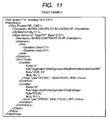
- FIG. 11 shows an example notation of a policy, in accordance with an embodiment of the present invention.
- the card policy is represented here in XML.
- the contents of the policy are that nonvolatile capacity, which an AP requires, shall be 4000 bytes or less and that the type of the AP shall be an application program.
- FIG. 12 shows an example of an AP profile represented in XML like the policy, in accordance with an embodiment of the present invention.
- the type of the AP, volatile capacity which the AP requires, nonvolatile capacity which the AP requires, and a parameter when the AP is installed are described as an item.
- mapping rule information 223, 233 is a mapping table of an XPATH character string showing each element of XML data shown in FIG. 12 and a table column name of the existing DB.
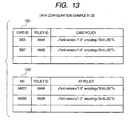
- FIG. 13 shows the data structure of a DB for managing a policy, in accordance with an embodiment of the present invention.
- a card policy information concretely showing a policy ID and the card policy is managed using a card ID as a key 1301. It is equivalent to the card policy information 221 in FIG. 2.
- the policy ID is an ID for identifying a policy. If a card is uniquely limited, the corresponding card policy is also limited to one. However, it is assumed that the card policy is not different for every card but plural cards often refer to the same card policy. Circumstances are also similar with respect to the AP policy and AID.
- FIG. 3 shows an outline of an example IC card system, in accordance with an embodiment of the present invention.
- the IC card 110 includes a chip 302.
- the IC chip 302 exchanges data with reader/writer 303 (or a terminal provided with reader/writer).
- the reader/writer 303 includes a control processor 304 and a magnetic disk 305 to be a database.
- IC card 110 includes Vcc (a power supply terminal), GND (a ground terminal), RST (a reset terminal), I/O (an input/output terminal) and CLK (a clock terminal).
- An inquiry 306 may occur concerning a card ID and others from the reader/writer 303 to the IC card 110.
- the IC card 110 may make a response 307 to the inquiry 306. Such transmission of various information is fully achieved by a normal system.
- the application program is loaded into a memory region concretely in the IC chip 302 in the IC card 110.
- Examples of the memory include a random access memory (RAM), an electrical erasable programmable read only memory (EEPROM), and a read only memory (ROM).
- RAM random access memory
- EEPROM electrical erasable programmable read only memory
- ROM read only memory
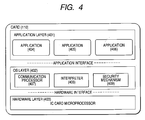
- FIG. 4 shows the logical configuration of a basic region inside an IC in the IC card 110, in accordance with an embodiment of the present invention.
- the IC includes hardware layer 403, an OS layer 402, which is a region into which an operating system (OS) is loaded, and an application layer 401, which is a region into which an application program is loaded.
- Plural application programs 404 to 406 can be loaded into the application layer 401.
- Application program initial loading means that the application programs 404 to 406 are distributed to an applicant of use in a state in which the application programs are already loaded when the IC card is issued.
- Dynamic loading means that these application programs 404 to 406 can be loaded or deleted after the card is issued.
- These application programs 404 to 406 are managed by the service provider management system 102 shown in FIG. 2.
- the OS layer 402 is provided with a communication processor 407, an interpreter 408 and a security mechanism 409, receives a command from an external terminal, and transfers a command of the application programs.
- An application interface is installed between the application layer 401 and the OS layer 402.
- a hardware interface is installed between the OS layer 402 and the hardware layer 403.
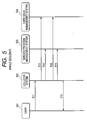
- FIG. 5 shows a sequence for determining whether an AP can be loaded or not in response to a request of a user, in accordance with an embodiment of the present invention.
- a user 501 sends a request 511 to the collator system 502.
- the request 511 is to determine whether an AP desired to be loaded into the IC card owned by the user can be loaded.
- the collator system 502 acquires the card ID of the IC card 110, then requests and acquires the corresponding card policy of the card issue management system 504 (step 512).
- the collator system 502 requests and acquires the corresponding AP policy of the service provider management system 503 using AID of the AP which the user desires to be loaded as a key (step 513).
- the collator system 502 analyzes the acquired policy, extracts a necessary item of card profile information, requests and acquires a card profile of the card issue management system 504 (step 514). Similarly, the collator system 502 extracts a necessary item of AP profile information, requests and acquires an AP profile of the service provider management system 503 (step 515). The collator system 502 determines all policies using the acquired policy and the acquired profiles and presents the result to the user 501 (step 516).
- the user 501 is equivalent to the user 111 shown in FIG. 2.
- the collator system 502 is equivalent to the collator system 103 shown in FIG. 2.
- the service provider management system 503 is equivalent to the service provider management system 102 shown in FIG. 2.
- the card issue management system 504 is equivalent to the card issue management system 102 shown in FIG. 2.
- FIG. 6 is a flowchart showing the operation of the collator system in an embodiment of the present invention.
- the collator system 502 receives a request to determine whether or not an AP can be loaded from the user (step 601).
- a request method include Web access from a home PC, access from a terminal installed in a shop, and telephone inquiry to an operator.
- the collator system 502 acquires the card ID of the IC card 110, requests the corresponding card policy of the card issue management system 504, and requests an AP policy corresponding to AID of an AP which the user desires to be loaded of the service provider management system 503 (step 602). Each policy is acquired (step 603). However, as the determination of policies cannot be continued if policies cannot be acquired, the processing is stopped (step 610).
- each policy can be acquired, such policies are analyzed and a profile item required for determining policies is determined (a step 604).
- both the determined card profile item and a definition format which the policy specifies are requested of the card issue management system.
- both the AP profile item and a definition format specified by the policy are requested of the service provider management system 503 (step 605).
- Each profile is acquired (step 606). However, as the determination of policies cannot be continued if policies cannot be acquired, the processing is stopped (step 611). If each profile can be acquired, a policy is determined using such policies and profiles (step 607).
- step 608 it is presented to the user that an AP cannot be loaded if it is determined that the AP cannot be loaded (step 612). If it is determined that the AP can be loaded, it is presented to the user and the processing is finished (step 609).
- FIGs. 7 and 8 are flowcharts showing the operation of the card issue management system 504 in an embodiment of the invention.
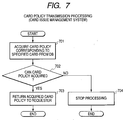
- the card issue management system 504 acquires a card policy corresponding to the specified card from a DB in response to a request from the collator system 502 (step 701). If the corresponding card policy cannot be acquired as a result of the acquisition process from the DB (step 702), it is presented to the collator system 502 and the processing is stopped (step 704). If the corresponding card policy can be acquired, the card policy is transmitted to the collator system 502 and the processing is finished (step 703).
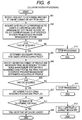
- the card issue management system 504 refers to a specified definition format in response to a request from the collator system 502 and retrieves a mapping rule for mapping with its own DB (step 801). As a result of a retrieval process (step 802), because a card profile according to the specified definition format cannot be transmitted if no mapping rule is prepared, the card profile is transmitted to the collator system 502. The processing is then stopped (step 805). If the mapping rule is prepared, a value corresponding to a necessary item of a specified profile is extracted from the DB and is converted to the form of the card profile according to the definition format (step 803). The converted card profile is transmitted to the collator system 502. The processing is then finished (step 804).
- FIGs. 9 and 10 are flowcharts showing the operation of the service provider management system 503 in an embodiment of the invention.
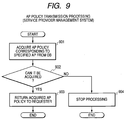
- the service provider management system 503 acquires an AP policy corresponding to a specified AP from the DB in response to a request from the collator system 502 (step 901). As a result of the acquisition process from the DB (step 902), if the corresponding AP policy cannot be acquired, the AP policy is transmitted to the collator system 502 and the processing is stopped (step 904). If the corresponding AP policy can be acquired, the AP policy is transmitted to the collator system 502 and the processing is finished (step 903).
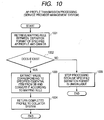
- the service provider management system 503 refers to a specified definition format in response to a request from the collator system 502 and retrieves a mapping rule for mapping with its own DB (step 1001).
- the AP profile is transmitted to the collator system 502 and the processing is stopped (step 1005).
- the mapping rule is prepared, a value corresponding to a necessary item of a specified profile is extracted from the DB and is converted to the form of the AP profile according to the definition format (step 1003).
- the converted AP profile is transmitted to the collator system 502 and the processing is finished (step 1004).
- the IC card 110 includes a contact type IC card and a noncontact type IC card. However, embodiments of the present invention can be applied independent of the configuration of the IC card 110.
- a function for determining whether an AP can be loaded provided by the invention of the existing IC card operation management system, can be executed by adding an existent information conversion function according to a mapping rule and a policy management function.
- the following problems are addressed by providing a system that a policy and a profile are independently managed and the profile is dynamically created based upon an existing DB.
- the collator system 502 is required to acquire all items of profile information. This problem is solved by independently managing a policy of a profile.
- the collator system 502 acquires a card policy from the card issue management system 504 and acquires an AP policy from the service provider management system 503 if the collator system 502 receives a request to determine whether an AP can be loaded.
- the collator system 502 analyzes the contents of the acquired policy and requests each profile item required for determination of the card issue management system 504 and the service provider management system. Accordingly, the requested system does not disclose unnecessary information for determining policies outside the system by extracting only the specified profile item and returning it to the collator system. The quantity of data exchanged between the systems can also be minimized.
- the definition format is not the only available fixed format.
- a format can be selected and specified by a provider for creating policies, and can also be freely created provided that the format is open to the public and a system that determines policies is publicly available.
- the collator system 502 requests a necessary profile item of a system that manages the item after the collator system 502 acquires policies. However, at that time, the collator system 502 specifies a definition format described in the policy (or information required for referring to a definition format).
- the requested system refers to the specified definition format and refers to a mapping rule with its own existing DB.
- the mapping rule is prepared by a designer of a DB table and others beforehand. Accordingly, it is recognized to which item in the requested system's DB the requested profile item corresponds by referring to the mapping rule. A value can thereby be returned, and profile information is then provided to an external system by the card issue management system 504 and the service provider management system 503 to determine policies, which can be created according to a dynamically specified definition format without making the format of the profile information the only fixed format.
- the profile information provided to the external system described above can be dynamically created utilizing the existing DB of the IC card operation management system already operated as it is.
Landscapes
- Engineering & Computer Science (AREA)
- Business, Economics & Management (AREA)
- Physics & Mathematics (AREA)
- General Physics & Mathematics (AREA)
- Microelectronics & Electronic Packaging (AREA)
- Computer Networks & Wireless Communication (AREA)
- Accounting & Taxation (AREA)
- Strategic Management (AREA)
- General Business, Economics & Management (AREA)
- Theoretical Computer Science (AREA)
- Stored Programmes (AREA)
- Credit Cards Or The Like (AREA)
Abstract
An integrated circuit card operation management system and method are provided. In one example of the system, a collator system is provided for receiving a user request to determine whether the application program can be loaded, for acquiring a card policy from a card issue management system, and for acquiring an application program policy from a service provider management system. The collator system requests card related information of the card issue management system and requests application program related information of the service provider management system. The collator system specifies a definition format. The card issue management system and the service provider management system extract requested information from existent information, convert the requested information according to the specified definition format, and transmit the converted information to the collator system. Using the acquired policies and the acquired profiles, the collator system determines whether the application program can be loaded. <IMAGE>
Description
The present invention generally relates to an integrated
circuit (IC) card system using an IC card and, more
particularly, to a method of loading a card application
program into an IC card and executing it.
Multifunction IC cards into which plural services can be
loaded are increasingly replacing conventional type magnetic
cards. A card issuer mainly manages a multifunction IC card.
The card issuer often determines beforehand the application
programs (APs) to be loaded into the IC card.
Regarding evaluating the combination of various cards and
APs, a method involving a specification decision group related
to an IC card of Global Platform (GP) is disclosed in
GlobalPlatform Systems Profiles 1.1.0, published September 2,
2003.
FIG. 1 shows a system configuration that automatically
discriminates the right combination of an IC card and an AP in
IC card management service proposed by GP. The outline of
components of this conventional system is described below.
A card issue management system 101 manages information
related to an IC card and the information of a card user and
executes the card issue service. The card issue management
system 101 manages a card issue management database (DB) 121.
Card profile information 122 is managed in the corresponding
DB. Card profile information 122 is attribute information
related to the card. Card profile information 122 is a
generic name for information used for the management of the
card by the card issue management system 101. Card profile
information 122 also includes basic data such as card
identification (ID) and card capacity, as well as data that
dynamically varies such as the list information of APs
currently loaded into the card. Particularly, in this case,
it is characteristic that data called card policy 123 is
included. The card policy 123 is a requisite requested of
another entity such as an AP by the card, for example, a
requisite that the capacity of an AP shall be 4 KB or less and
the type of the AP shall be an AP corresponding to Java®Card.
The card policy is included in the card profile information
122. A card profile acquisition processor 124 is provided
with logic for returning the corresponding card profile in
response to a request from an external system.
A service provider management system 102 manages
information related to the AP and the information of a service
user and provides service. The service provider management
system 102 manages a service provider management database 131,
in which AP profile information 132 is managed. The AP
profile information 132 is attribute information related to
the AP. AP profile information 132 is a generic name for
information used for the management of the AP by the service
provider management system 102. The AP profile information
132 also includes basic data such as card identification (ID)
and the name of the AP, as well as data that dynamically
varies such as whether the AP is run or not. Like the card
profile information 122, the AP profile information 132
includes an AP policy 133. The AP policy 133 is a requisite
requested of another entity such as a card by the AP, for
example, a requisite that the EEPROM capacity of the card
shall be 16 KB or more and the platform of the card shall be
Java® Card. An AP profile acquisition processor 134 is
provided with logic for returning the corresponding AP profile
in response to a request from an external system.
A collator system 103 is a system for collecting a
profile in response to a request from a user 111 and for
determining whether a policy included in the profile is met or
not. The collator system 103 includes profile collection
logic 141 and a policy determination processor 142. The
profile collection logic 141 is provided with logic for
requesting and acquiring card profile information 122 of the
card issue management system 101 and requesting and acquiring
AP profile information 132 of the service provider management
system 102. The policy determination processor 142 includes
logic for analyzing an acquired profile, for determining
whether each policy is met or not, and for providing the
result to the user.
The card issue management system 101, the service
provider management system 102 and the collator system 103
exchange information via a network such as a public network,
via a network including a common carrier leased line, or via
mailing or handing a document and an information record medium.
The terminal and the server of each system exchange
information via a public network or via a network including a
leased line.
Each of the above-mentioned systems is provided with a
processor, but they are realized and operated as a computer
program.
Next, the problem of a conventional type system will be
described using the operational procedure of a process for
determining whether the loading of an AP into an IC card is
allowed in the above-mentioned system or not for an example.
When it is determined whether a desired AP can be loaded
into a card 110 which the user 111 owns or not, the collator
system is requested to determine whether the AP can be loaded
or not (a step 151). For a concrete request method, there are
Web access from a home PC, access from a terminal installed at
a shop, and access via telephone inquiry. The collator system
103 acquires the corresponding card profile information 122
from the card issue management system 101 using the ID of the
card owned by the user as a key (steps 152, 153). Similarly,
the collator system 103 acquires the corresponding AP profile
information from the service provider management system using
application identification (AID) of the AP desired by the user
as a key (steps 154, 155).
The collator system 103 verifies whether a card policy in
the acquired card profile is met or not using information in
the AP profile. For example, when the card policy is that the
capacity of the AP shall be 4 KB or less, the collator system
103 checks an AP capacity item in the AP profile and
determines whether the capacity is 4 KB or less or not.
Similarly, the collator system verifies whether an AP policy
in the AP profile is met or not by use of information in the
card profile. When the AP policy is that the EEPROM capacity
of the card shall be 16 KB or more, the collator system 103
checks an EEPROM capacity item in the card profile and
determines whether the EEPROM capacity is 16 KB or more or not
The collator system 103 determines all policies and provides
the result to the user (a step 156). Profile information
including policies is represented in extensible markup
language (XML).
If the types of IC cards increase, various APs are
accordingly developed and can be provided. For versions are
upgraded, loading may be impossible depending upon the
combination of a card and an AP. Therefore, managing the
combination of a loadable card and an AP becomes an intricate
task for a card manager.
The AP can be loaded or deleted into/from a multifunction
IC card after the card is issued to a user. It is assumed
that the user freely selects the AP and repeatedly loads or
deletes it. Therefore, it is estimated that it will be the
essential service of a card issue manager to dynamically
present which AP can be loaded to the user at real time.
A problem in a system proposed by a GP is that all items
of profile information are required to be acquired.
The collator system acquires the information of all items
defined as a profile because the contents of a policy are not
known until the collator system receives a card policy
included in a card profile and an AP policy included in an AP
profile. Hereby, a problem related to security occurs. That
is, every time a policy is determined, information unnecessary
for determination is all provided to an external system.
Besides, a problem in efficiency caused by differences in
transmitted/received data capacity also occurs. When the
policy of a whole IC card is determined in response to a
request from a user, no large difference is made. However,
when an IC card, the policy of which is to be determined, has
large capacity and, accordingly, there are a large number of
profiles for the collator to acquire, as in the case of a
batch process, the data capacity of each profile information
item is a large problem for efficiency of the system.
Another problem in the system proposed by the GP is that
the format of profile information is fixed.
Profile information is information considered to be
managed in the existent system, such as card ID, card capacity
in the case of a card profile, AID, and the name of an AP in
the case of an AP profile as described above. However, in a
conventional type method, the format of each profile collected
by the collator system 103 is required to be unified in the
same format. Also, the card issue management system and the
service provider management system are required to create a
new DB or to create profile information according to the
format beforehand. Creating a new DB has a problem of manhours.
Creating profile information requires creating profile
information corresponding to the change of DB information at
real time, which is difficult.
The objects of the present invention are to enable a card
issue manager to dynamically present which application program
(AP) can be loaded at real time, to enable the determination
of a policy without the acquisition of all items of profile
information by a collator, to minimize the quantity of data
exchanged between systems, and to enable the collection of
each profile without unifying the format of each profile
collected by the collator system.
The following provides a summary of some embodiments of
the present invention. In one example of the method, a
request to load an application program into an IC card is
received. A card policy which is requested of a card issue
management system for application profile information and
which is a condition for allowing the loading of the
application program is requested and acquired of the card
issue management system. An application policy which is
requested of a service provider management system for the card
profile information of the IC card and which is a condition
for allowing the loading of the application program is
requested and acquired of the service provider management
system. Ann item of application profile information required
for determining the card policy and a definition format
specified by the card policy are specified and are requested
of the service provider management system. The item of the
application profile information is extracted from a service
provider management database. The application profile
information of the IC card converted according to the
definition format is acquired. The item of the IC card
profile information required for determining the application
policy and a definition format specified by the application
policy are specified and are requested of the card issue
management system. The item of the IC card profile
information is extracted from a card issue management database.
The IC card profile information converted according to the
definition format is acquired. The card policy is determined
by the converted IC card profile information. The application
policy is determined by the converted IC card application
profile information. It is then determined whether the
application program can be loaded into the IC card or not.
Hereby, the profile information provided to the external
system by the card issue management system and the service
provider management system can be made dynamic and minimally
sized.
As only profile information required for determining a
policy can be exchanged between the systems by a policy
determination method provided by the invention, the disclosure
of unnecessary profile information is prevented and security
is thereby increased. In addition, as minimum data capacity
is transmitted/received, efficiency is increased and cost is
reduced.
Further, as a mapping rule is extracted in accordance
with a format specified by a policy if a profile is provided
and as the profile is dynamically created based upon an
existing DB according to the rule, a profile format is not
required to be the only fixed format. In addition, the
existing DB can be utilized as it is. Accordingly, man-hours
newly required in newly creating a table and other things can
be reduced.
The present invention will be readily understood by the
following detailed description in conjunction with the
accompanying drawings. To facilitate this description, like
reference numerals designate like structural elements.
An invention for an integrated circuit card system and an
application loading method is disclosed. Numerous specific
details are set forth in order to provide a thorough
understanding of the present invention. It will be understood
however, to one skilled in the art, that the present invention
may be practiced with other specific details.
An embodiment of the invention will be concretely
described below. A description is given below of a process
for determining whether an application program (AP) can be
loaded or not into an integrated circuit (IC) card system.
The process is executed using solving methods in linkage among
a card issue management system, a service provider management
system and a collator system.
As preparation, the card issue management system and the
service provider management system prepare a mapping rule
between a public definition format and the existent
information managed in each database (DB) owned by themselves.
The definition format means the format definition of the
notation of profile information. For example, if profile
information is described in extensible markup language (XML),
document type definition (DTD) and XML schema definition are
the definition format. As different systems of the card issue
management system and the service provider management system
provide profile information owned by each, notation according
to a common format is required. As the definition format is
not necessarily uniform amongst all systems, the definition
format must be specified in a policy provided by each system.
Therefore, the definition format is required to be able to be
dynamically accessed by plural systems. It is assumed that
the definition format is open to the public on a Web server
and other similar apparatus.
Mapping rule information means information in which a
mapping rule between a public definition format and card
attribute existent information is described. As it is assumed
that plural definition formats are open to the public, plural
mapping rule information items are accordingly prepared. As
many mapping rules as definition formats are required. In a
case having only one definition format, one definition format
may be managed as a file. However, in a case having plural
definition formats, data that can be uniquely specified, such
as definition format identfication (ID) and uniform resource
locator (URL), the definition format of which is open to the
public may be stored in a DB as a key.
Next, a policy acquisition process by the collator system
will be described. A user requests the collator system to
determine whether an AP can be loaded or not. The collator
system acquires information for identifying a card, such as
card ID from an IC card owned by the user. The collator
acquires information for identifying an application program
(AP) such as application identification (AID) of an AP which
the user desires to be loaded. The collator system specifies
the card ID and requests the corresponding card policy of the
card issue management system. The collator system then
specifies the AID and requests the corresponding AP policy of
the service provider management system.
Next, a card policy transmission process by the card
issue management system will be described. The card issue
management system stores the corresponding card policy in the
DB using the specified card ID as a key. Heretofore, the card
policy is managed in the DB as a part of card profile
information. However, the card policy is stored in the DB as
independent information. The card issue management system
extracts the card policy corresponding to the card ID and
transmits it to the collator system.
In an AP policy transmission process by the service
provider management system, an AP policy is similarly managed
in the DB independent of application profile information. The
AP policy corresponding to the AID specified by the collator
system is extracted from the DB and is transmitted to the
collator system.
Next, a profile acquisition process by the collator
system will be described. The collator system analyzes
contents of the acquired card policy and the acquired AP
policy and extracts items of profile information required for
determining the policy. The collator system specifies the
necessary card profile item and a definition format specified
by the policy and requests a card profile of the card issue
management system. The collator system similarly specifies
the required AP profile item and a definition format specified
by the policy and requests an AP profile of the service
provider management system. In this case, the definition
format of the card profile and the definition format of the AP
profile are not required to be the same.
Next, a card profile transmission process by the card
issue management system will be described. The card issue
management system checks to the specified definition format.
The card issue management system selects a mapping rule
between the specified definition format and a card attribute
existent information DB owned by itself, checks to which item
in the DB the required profile information item is equivalent
according to the rule, and then extracts a value. Next, the
card issue management system creates card profile information
based upon the extracted value according to the specified
definition format and then transmits the card profile
information to the collator system.
An AP profile transmission process by the service
provider management system is described here. The service
provider management system checks the specified definition
format. The service provider management system selects a
mapping rule between the specified definition format and AP
attribute existent information DB owned by itself, checks to
which item in the DB the required profile information item is
equivalent according to the rule, and then extracts a value.
The service provider management system then creates AP profile
information based upon the extracted value according to the
specified definition format and transmits it to the collator
system.
Next, a policy determination process by the collator
system will be described. The collator system determines
whether the card policy is met or not using the acquired card
policy and the profile information required for determination.
The collator system similarly determines whether the AP policy
is met or not using the acquired AP policy and the profile
information required for determination. After all policy
determination is finished, the collator system presents the
result to the user.
FIG. 2 shows the basic configuration of systems of the
present invention. The card issue management system 101
manages information related to the IC card and the information
of the card user and executes card issue service. In one
example, information related to the IC card means card ID, the
capacity (ROM, EEPROM, RAM) of the card, the type and the
version of card OS, and card status information including the
list information of loaded Aps. In one example, information
of the card user means the name, the age, the distinction of
sex, the address, the phone number and the history information
of the user.
The card issue management system 101 manages a card issue
management database 121 and in the DB, card policy information
221, card attribute existent information 222 and mapping rule
information 223 are managed.
The card policy information 221 is a requisite which the
card requests of another entity such as AP. For example, the
card policy information is that the capacity of the AP shall
be 4 KB or less, the type of the AP shall be an AP
corresponding to JavaCard, the annual income of the user shall
exceed a fixed condition, and the age of the user shall exceed
a fixed condition.
Card attribute existent information 222 means profile
information related to the card that has been managed by card
issue management system 101. Card attribute existent
information 222 may include basic data, such as card ID, card
capacity, the type, and the version of card OS. Card
attribute existent information 222 may also include data that
dynamically varies, such as card status information, including
the list information of APs currently loaded into the card.
A card policy acquisition processor 224 is provided with
logic for returning the corresponding card policy in response
to a request from an external system.
An existent information conversion processor 225 is
provided with the following logic. The existent information
conversion processor 225 retrieves mapping rule information
corresponding to a specified definition format in response to
a card profile request that requests card profile information
from the external system. Next, the existent information
conversion processor extracts card attribute existent
information 222 corresponding to a requested profile item
according to a mapping rule. The card profile information is
a generic name of attribute information related to the card.
Card profile information includes basic data, such as card ID,
card capacity, the type and the version of card OS. Card
profile information also includes data that dynamically varies,
such as card status information, including the list
information of APs currently loaded in the card. The existent
information conversion processor 225 creates a card profile by
finally converting the extracted information according to the
definition format and transmits it to the collator system 103.
A card issue management system provider has the
commitment of IC card issue service and executes IC card issue
service using the card issue management system 101, as revised
by the present invention. Examples of a card issue management
system provider include a credit card issuance company, a bank,
a local government, a department store, and public transport.
The card issue management system 101 may be installed in a
service center of each company. The card issue management
system 101 may be installed in a center of an arbitrary
service operation company commissioned by each company.
The card issue management system 101 is realized by a
server, the card issue management database 121 is realized by
a DB in a hard disk drive (HDD), and processors 224, 225 are
operated according to a computer program installed in an
application server in the HDD.
The service provider management system 102 manages
information related to an AP and the information of a service
user and provides service. The service provider management
system 102 manages a service provider management database 131.
In the DB, AP policy information 231, AP attribute existent
information 232, and mapping rule information 233 are managed.
The AP policy information 231 is a requisite requested of
another entity such as a card by an AP. For example, the AP
policy information 231 is that the EEPROM capacity of a card
shall be 16 KB or more, that the platform of the card shall be
Java®Card, that the type of the card shall be a gold card, and
that the age of the user shall meet a certain condition.
The AP attribute existent information 232 means attribute
information related to the AP that has been managed by the
service provider management system 102. The AP attribute
existent information 232 may include basic data, such as AID,
the name, the version, the capacity and the type of the AP.
The AP attribute existent information 232 may also include
data that dynamically varies such as the AP status information
including whether the AP is run or not are included.
The mapping rule information 233 means information
describing a mapping rule between the definition format 104
open to the public and the AP attribute existent information
232. As it is supposed that plural definition formats 104 are
open to the public, plural mapping rule information items are
accordingly prepared.
An AP policy acquisition processor 234 is provided with
logic for returning the corresponding AP policy in response to
a request from an external system.
An existent information conversion processor 235 is
provided with the following logic. The existent information
conversion processor 235 retrieves mapping rule information
corresponding to a specified definition format in response to
a request for an AP profile from an external system. Next,
the existent information conversion processor 235 extracts AP
attribute existent information corresponding to a requested
profile item according to a mapping rule. The existent
information conversion processor 235 then converts the
extracted information according to the definition format,
creates an AP profile, and transmits the AP profile to the
collator system.
A service provider management system provider has the
commitment of service for loading or deleting an AP and the
operation of service. The provider executes service for
loading or deleting an AP using the service provider
management system 102. Examples of a service provider
management system provider include an operation manager of a
point-of-sale AP, an electronic money operation manager, and
the operation manager of an entertainment AP, such as a video
game. The service provider management system may be installed
in service centers of companies. The service provider
management system may also be installed in a center of an
arbitrary service operation company commissioned by companies.
The service provider management system 102 is realized by
a server. The service provider management database 131 is
realized by a DB in a HDD. Processors 234, 235 are operated
according to a computer program installed in the application
server in the HDD.
The collator system 103 is a system for collecting the
policy and a profile required for determining the policy in
response to a request of the user 111 and determining whether
the policy is met or not. The collator system 103 is provided
with a policy collection processor 241, a necessary profile
collection processor 242 and a policy determination processor
243.
The policy collection processor 241 is provided with
logic for requesting and acquiring the card policy of the card
issue management system 101, and for requesting and acquiring
the AP policy of the service provider management system 102.
The necessary profile collection processor 242 is
provided with logic for analyzing the contents of the acquired
policy, extracting an item of profile information required for
determining the policy, and requesting and acquiring the
profile information. The necessary profile collection
processor 242 transmits the necessary card profile information
item and a definition format specified by the policy to the
card issue management system 101 and then receives the
corresponding card profile. The necessary profile collection
processor 242 transmits the necessary AP profile information
item and a definition format determined by the policy to the
service provider management system and receives the
corresponding AP profile. The policy determination processor
243 is provided with logic for analyzing the acquired profile,
determining whether the card policy and the AP policy are met
or not, and presenting the result to the user.
A collator system provider has the commitment of
determination service using the policy and the profile, and
executes determination service using the collator system 103.
The collator system provider may be a provider dedicated to
newly supposed collation service. However, the card issue
management system provider may execute determination service
when a card is issued. The service provider management system
provider may execute determination service when an AP is
loaded. Accordingly, the collator system 103 may be installed
in a service center of the collator system provider. The
collator system may also be installed as a part of the card
issue management system or as a part of the service provider
management system.
A definition format 104 is a format for a card profile
and an AP profile to follow. Plural definition formats exist
and can be freely selected when a policy is created. A policy
creator can also create a definition format. However, these
definition formats are open to the public and must be freely
accessible to plural external providers, including a profile
provider such as the card issue management system provider and
the service provider management system provider.
The definition format is typically installed in a Web
server and may be accessed with a URL. There may also be a
provider dedicated only to the management service of a
definition format. However, the card issue management system
provider and the service provider management system provider
or the collator system provider may often create, publish and
manage a definition format.
The card issue management system 101, the service
provider management system 102 and the collator system 103
exchange information via a network such as a public network,
via a network including a common carrier leased line, or via
mailing or handing a document and an information record medium.
The terminal and the server of each system exchange
information via a public network or via a network including a
leased line.
Next, a rough procedure for determining whether an AP can
be loaded or not according to a method proposed in the
embodiment of the invention will be described.
A process for determining whether an AP can be loaded or
not is started in response to a request to determine whether
an AP can be loaded or not from the user 111. However, there
is a process to be executed for preparation. This process
involves preparing mapping rule information 223, 233. The
mapping rule information 223, 233 is information showing a
relationship between the definition format 104 open to the
public and attribute existent information 222, 232 owned by
each system.
When the above-mentioned preparation is finished, the
process for determining whether an AP can be loaded or not can
be executed. The user 111 who desires an AP to be loaded into
the IC card accesses the collator system and requests it to be
determined whether or not the AP desired to be loaded can be
loaded into the IC card 110 owned by the user (step 251).
Examples of a request method include accessing the Web access
from a home PC, accessing the Web from a terminal installed in
a shop, and calling an operator by telephone.
The collator system 103 first executes policy acquisition
processing. The collator system 103 acquires the
corresponding card policy from the card issue management
system using a card ID of the card owned by the user or a card
type related to the card ID as a key (step 252).
Similarly, the collator system 103 acquires the
corresponding AP policy from the service provider management
system 102 using AID of the AP which the user desires to be
loaded or an AP type related to AID as a key (step 253).
The collator system 103 analyzes the acquired policy and
extracts an item of card profile information required for
determining the policy and an item of AP profile information
required for determining the policy. For example, when the
card policy is that the capacity of the AP shall be 4,KB or
less, a necessary item of AP profile information is the
capacity of the AP. Similarly, for example, when the AP
policy is that the EEPROM capacity of the card shall be 16 KB
or more, a necessary item of card profile information is the
EEPROM capacity of the card.
The collator system 103 specifies the necessary items of
profile information and the definition format 104 specified by
the policy, requests a card profile of the card issue
management system 101 and requests an AP profile of the
service provider management system 102. The card issue
management system 101 first refers to the specified definition
format (step 254), retrieves the corresponding mapping rule
information 223, extracts requested information from the card
attribute existent information 222 according to the mapping
rule information, and transmits the information to the
existent information conversion processor 225 (step 256). The
card issue management system then converts information
extracted in the existent information conversion processor
according to the definition format and transmits it to the
collator system (step 258). The service provider management
system 102 similarly refers to a specified definition format
(step 255), retrieves the corresponding mapping rule
information 233, extracts requested information from the AP
attribute existent information 232 according to the mapping
rule information, and transmits the information to the
existent information conversion processor 235 (step 257). The
service provider management system 102 then converts
information extracted in the existent information conversion
processor 235 according to the definition format and transmits
it to the collator system 103 (step 259).
The collator system 103 determines a card policy and an AP
policy using the acquired policy and profiles required for
determination. The collator system 103 finishes the
determination of all policies, presents the result to the user
(step 260), and finishes the process for determining whether
an AP can be loaded or not. The user reconsiders and selects
an AP which the user desires to be loaded based upon the
result of determination. A process for actually loading the
AP is started. However, even if the user desires an AP the
loading of which is rejected as a result of the determination
again, the AP will not be loaded.
FIG. 11 shows an example notation of a policy, in
accordance with an embodiment of the present invention. The
card policy is represented here in XML. The contents of the
policy are that nonvolatile capacity, which an AP requires,
shall be 4000 bytes or less and that the type of the AP shall
be an application program.
FIG. 12 shows an example of an AP profile represented in
XML like the policy, in accordance with an embodiment of the
present invention. The type of the AP, volatile capacity
which the AP requires, nonvolatile capacity which the AP
requires, and a parameter when the AP is installed are
described as an item.
When the profile is generated, the profile can be
dynamically generated from existing DBs 222, 232, shown in FIG.
2, using mapping rule information 223, 233, shown in FIG. 2.
In the case of the profile example shown in FIG. 12, one
example of the mapping rule information 223, 233 is a mapping
table of an XPATH character string showing each element of XML
data shown in FIG. 12 and a table column name of the existing
DB.
FIG. 13 shows the data structure of a DB for managing a
policy, in accordance with an embodiment of the present
invention. In the case of a card policy, information
concretely showing a policy ID and the card policy is managed
using a card ID as a key 1301. It is equivalent to the card
policy information 221 in FIG. 2.
In the case of an AP policy, information concretely
showing the policy ID and the AP policy is managed using AID
as a key 1302. It is equivalent to the AP policy information
231 in FIG. 2.
The policy ID is an ID for identifying a policy. If a
card is uniquely limited, the corresponding card policy is
also limited to one. However, it is assumed that the card
policy is not different for every card but plural cards often
refer to the same card policy. Circumstances are also similar
with respect to the AP policy and AID.
FIG. 3 shows an outline of an example IC card system, in
accordance with an embodiment of the present invention. The
IC card 110 includes a chip 302. In this example, the IC chip
302 exchanges data with reader/writer 303 (or a terminal
provided with reader/writer). The reader/writer 303 includes
a control processor 304 and a magnetic disk 305 to be a
database. IC card 110 includes Vcc (a power supply terminal),
GND (a ground terminal), RST (a reset terminal), I/O (an
input/output terminal) and CLK (a clock terminal). An inquiry
306 may occur concerning a card ID and others from the
reader/writer 303 to the IC card 110. The IC card 110 may
make a response 307 to the inquiry 306. Such transmission of
various information is fully achieved by a normal system.
The application program is loaded into a memory region
concretely in the IC chip 302 in the IC card 110. Examples of
the memory that may be used include a random access memory
(RAM), an electrical erasable programmable read only memory
(EEPROM), and a read only memory (ROM).
FIG. 4 shows the logical configuration of a basic region
inside an IC in the IC card 110, in accordance with an
embodiment of the present invention. The IC includes hardware
layer 403, an OS layer 402, which is a region into which an
operating system (OS) is loaded, and an application layer 401,
which is a region into which an application program is loaded.
Plural application programs 404 to 406 can be loaded into the
application layer 401. Application program initial loading
means that the application programs 404 to 406 are distributed
to an applicant of use in a state in which the application
programs are already loaded when the IC card is issued.
Dynamic loading means that these application programs 404 to
406 can be loaded or deleted after the card is issued. These
application programs 404 to 406 are managed by the service
provider management system 102 shown in FIG. 2. Information
related not only to the body of the application programs but
also to AID and AP size is stored in the AP attribute existent
information 232 in the DB 131. The OS layer 402 is provided
with a communication processor 407, an interpreter 408 and a
security mechanism 409, receives a command from an external
terminal, and transfers a command of the application programs.
An application interface is installed between the application
layer 401 and the OS layer 402. A hardware interface is
installed between the OS layer 402 and the hardware layer 403.
FIG. 5 shows a sequence for determining whether an AP can
be loaded or not in response to a request of a user, in
accordance with an embodiment of the present invention. A
user 501 sends a request 511 to the collator system 502. The
request 511 is to determine whether an AP desired to be loaded
into the IC card owned by the user can be loaded. The
collator system 502 acquires the card ID of the IC card 110,
then requests and acquires the corresponding card policy of
the card issue management system 504 (step 512). The collator
system 502 requests and acquires the corresponding AP policy
of the service provider management system 503 using AID of the
AP which the user desires to be loaded as a key (step 513).
Next, the collator system 502 analyzes the acquired
policy, extracts a necessary item of card profile information,
requests and acquires a card profile of the card issue
management system 504 (step 514). Similarly, the collator
system 502 extracts a necessary item of AP profile information,
requests and acquires an AP profile of the service provider
management system 503 (step 515). The collator system 502
determines all policies using the acquired policy and the
acquired profiles and presents the result to the user 501
(step 516).
The following explains the relationship between each
component shown in FIG. 5 and FIG. 2. The user 501 is
equivalent to the user 111 shown in FIG. 2. The collator
system 502 is equivalent to the collator system 103 shown in
FIG. 2. The service provider management system 503 is
equivalent to the service provider management system 102 shown
in FIG. 2. The card issue management system 504 is equivalent
to the card issue management system 102 shown in FIG. 2.
The details of the method of determining whether an AP
can be loaded or not in the embodiment of the invention
described above will be described using flowcharts of FIGs. 6
to 10, showing each operation of the card issue management
system 504, the service provider management system 503 and the
collator system 502 below. In these drawings, the sequence
shown in FIG. 5 is described in detail.
FIG. 6 is a flowchart showing the operation of the
collator system in an embodiment of the present invention.
The collator system 502 receives a request to determine
whether or not an AP can be loaded from the user (step 601).
As described above, an examples of a request method include
Web access from a home PC, access from a terminal installed in
a shop, and telephone inquiry to an operator. The collator
system 502 acquires the card ID of the IC card 110, requests
the corresponding card policy of the card issue management
system 504, and requests an AP policy corresponding to AID of
an AP which the user desires to be loaded of the service
provider management system 503 (step 602). Each policy is
acquired (step 603). However, as the determination of
policies cannot be continued if policies cannot be acquired,
the processing is stopped (step 610). If each policy can be
acquired, such policies are analyzed and a profile item
required for determining policies is determined (a step 604).
Next, both the determined card profile item and a definition
format which the policy specifies are requested of the card
issue management system. Similarly, both the AP profile item
and a definition format specified by the policy are requested
of the service provider management system 503 (step 605).
Each profile is acquired (step 606). However, as the
determination of policies cannot be continued if policies
cannot be acquired, the processing is stopped (step 611). If
each profile can be acquired, a policy is determined using
such policies and profiles (step 607). As a result of the
determination of all policies (a step 608), it is presented to
the user that an AP cannot be loaded if it is determined that
the AP cannot be loaded (step 612). If it is determined that
the AP can be loaded, it is presented to the user and the
processing is finished (step 609).
FIGs. 7 and 8 are flowcharts showing the operation of the
card issue management system 504 in an embodiment of the
invention.
Referring to FIG. 7, a card policy transmission process
of the card issue management system 504 will be described.
The card issue management system 504 acquires a card policy
corresponding to the specified card from a DB in response to a
request from the collator system 502 (step 701). If the
corresponding card policy cannot be acquired as a result of
the acquisition process from the DB (step 702), it is
presented to the collator system 502 and the processing is
stopped (step 704). If the corresponding card policy can be
acquired, the card policy is transmitted to the collator
system 502 and the processing is finished (step 703).
Next, referring to FIG. 8, a card profile transmission
process of the card issue management system 504 will be
described. The card issue management system 504 refers to a
specified definition format in response to a request from the
collator system 502 and retrieves a mapping rule for mapping
with its own DB (step 801). As a result of a retrieval
process (step 802), because a card profile according to the
specified definition format cannot be transmitted if no
mapping rule is prepared, the card profile is transmitted to
the collator system 502. The processing is then stopped (step
805). If the mapping rule is prepared, a value corresponding
to a necessary item of a specified profile is extracted from
the DB and is converted to the form of the card profile
according to the definition format (step 803). The converted
card profile is transmitted to the collator system 502. The
processing is then finished (step 804).
FIGs. 9 and 10 are flowcharts showing the operation of
the service provider management system 503 in an embodiment of
the invention.
Referring to FIG. 9, an AP policy transmission process of
the service provider management system 503 will be described.
The service provider management system 503 acquires an AP
policy corresponding to a specified AP from the DB in response
to a request from the collator system 502 (step 901). As a
result of the acquisition process from the DB (step 902), if
the corresponding AP policy cannot be acquired, the AP policy
is transmitted to the collator system 502 and the processing
is stopped (step 904). If the corresponding AP policy can be
acquired, the AP policy is transmitted to the collator system
502 and the processing is finished (step 903).
Referring to FIG. 10, an AP profile transmission process
of the service provider management system 503 will be
described. The service provider management system 503 refers
to a specified definition format in response to a request from
the collator system 502 and retrieves a mapping rule for
mapping with its own DB (step 1001). As a result of the
retrieval process (step 1002), because an AP profile according
to the specified definition format cannot be transmitted if no
mapping rule is prepared, the AP profile is transmitted to the
collator system 502 and the processing is stopped (step 1005).
If the mapping rule is prepared, a value corresponding to a
necessary item of a specified profile is extracted from the DB
and is converted to the form of the AP profile according to
the definition format (step 1003). The converted AP profile
is transmitted to the collator system 502 and the processing
is finished (step 1004).
Embodiments of the present invention have been described.
The IC card 110 includes a contact type IC card and a noncontact
type IC card. However, embodiments of the present
invention can be applied independent of the configuration of
the IC card 110.
In the card issue management system 504 and the service
provider management system 503, information managed in the
existing DB can be dynamically converted to a profile.
Therefore, a function for determining whether an AP can be
loaded, provided by the invention of the existing IC card
operation management system, can be executed by adding an
existent information conversion function according to a
mapping rule and a policy management function. There is also
service for enabling a function for determining whether an AP
can be loaded, wherein the function is to be executed by
adding only necessary functions as described above.
As described above, according to the embodiment of the
invention, the following problems are addressed by providing a
system that a policy and a profile are independently managed
and the profile is dynamically created based upon an existing
DB.
One problem is that the collator system 502 is required
to acquire all items of profile information. This problem is
solved by independently managing a policy of a profile. The
collator system 502 acquires a card policy from the card issue
management system 504 and acquires an AP policy from the
service provider management system 503 if the collator system
502 receives a request to determine whether an AP can be
loaded. The collator system 502 analyzes the contents of the
acquired policy and requests each profile item required for
determination of the card issue management system 504 and the
service provider management system. Accordingly, the
requested system does not disclose unnecessary information for
determining policies outside the system by extracting only the
specified profile item and returning it to the collator system.
The quantity of data exchanged between the systems can also be
minimized.
Another problem is that the format of profile information
is fixed. This problem is solved by preparing a profile
format called a definition format, dynamically selecting it,
and preparing a mapping rule between the definition format and
existing DB. The definition format is not the only available
fixed format. A format can be selected and specified by a
provider for creating policies, and can also be freely created
provided that the format is open to the public and a system
that determines policies is publicly available. The collator
system 502 requests a necessary profile item of a system that
manages the item after the collator system 502 acquires
policies. However, at that time, the collator system 502
specifies a definition format described in the policy (or
information required for referring to a definition format).
The requested system refers to the specified definition
format and refers to a mapping rule with its own existing DB.
The mapping rule is prepared by a designer of a DB table and
others beforehand. Accordingly, it is recognized to which
item in the requested system's DB the requested profile item
corresponds by referring to the mapping rule. A value can
thereby be returned, and profile information is then provided
to an external system by the card issue management system 504
and the service provider management system 503 to determine
policies, which can be created according to a dynamically
specified definition format without making the format of the
profile information the only fixed format.
The profile information provided to the external system
described above can be dynamically created utilizing the
existing DB of the IC card operation management system already
operated as it is.
In the foregoing specification, the invention has been
described with reference to specific embodiments thereof. It
will, however, be evident that various modifications and
changes may be made thereto without departing from the broader
spirit and scope of the invention. The specification and
drawings are, accordingly, to be regarded in an illustrative
rather than a restrictive sense.
Claims (10)
- A collator system configured to be connected to an integrated circuit card via an integrated circuit card reader/writer, wherein the collator system is connected to a card issue management system configured to execute an integrated circuit card issue service, wherein the card issue management system includes a card issue management database for storing attribute information of the integrated circuit card in a predetermined format,
wherein the card issue management system is further connected to a service provider management system configured to provide service according to an application program in the integrated circuit card, wherein the service provider management system includes a service provider management database for storing the attribute information of the application program in a predetermined format, and wherein the collator system is configured to receive a request to load the application program into the integrated circuit card, the collator system comprising:a policy collection processor configured to request and acquire a card policy of the card issue management system for the attribute information of the application program, wherein the card policy includes a condition for allowing the loading of the application program of the card issue management system, wherein the policy collection processor is further configured to request and acquire an application policy of the service provider management system for the attribute information of the integrated circuit card, and wherein the application policy is a condition for allowing the loading of the application program of the service provider management system;a necessary profile collection processor configured to specify an item of the attribute information of the application program required for determining the card policy, to specify a definition format of the card policy, to request the card policy and the definition format from the service provider management system, to extract the item of the attribute information, and to acquire the attribute information in the integrated circuit card converted according to the definition format, wherein the necessary profile collection processor is further configured to specify an item of another attribute information of the integrated circuit card required for determining the application policy, to specify another definition format of the application policy, to request the other attribute information and the other definition format of the card issue management system, to extract the item of the other attribute information, and to acquire the other attribute information converted according to the other definition format; anda policy determination processor configured to determine the card policy based upon the attribute information converted according to the definition format, to determine the application policy based upon the other attribute information converted according to the other definition format, and to determine whether the application program can be loaded into the integrated circuit card. - A card issue management system configured to be connected to a collator system for collecting a card policy which is requested of the card issue management system, wherein the card issue management system is configured to execute an integrated circuit card issue service for attribute information of an application program in an integrated circuit card, wherein the card policy is a condition for allowing the loading of the application program and an application policy which is requested of a service provider management system, wherein the service provider management system is configured to provide service according to the application program in the integrated circuit card for the attribute information of the integrated circuit card, and wherein the application policy is a condition for allowing the loading of the application program and for determining the card policy and the application policy, the card issue management system comprising:a card issue management database configured to store the attribute information of the integrated circuit card in a predetermined format;a card policy acquisition processor configured to send the card policy to the collator system in response to a request from the collator system to acquire the card policy; andan existent information conversion processor configured to extract from the card issue management database an item of the attribute information of the integrated circuit card specified by the collator system, to convert the attribute information of the integrated circuit card from the predetermined format according to a definition format based upon the attribute information of the application program, and to send the attribute information as converted to the collator system.
- The card issue management system of Claim 2, wherein the card issue management database is further configured to store mapping information having a mapping rule between a definition format and the attribute information of the integrated circuit card, and wherein the existent information conversion processor is further configured to retrieve the mapping rule corresponding to the definition format, to extract the item of the attribute information of the integrated circuit card according to the mapping rule retrieved, to convert the extracted item according to the definition format, and to transmit the converted item to the collator system.
- The card issue management system of Claim 2, wherein the definition format is managed by a Web server, and wherein the card issue management system is further configured to utilize the definition format by accessing the Web server.
- A service provider management system connected to a collator system for collecting a card policy which is requested of a card issue management system, wherein the card issue management system is configured to execute an integrated circuit card issue service for attribute information of an application program in an integrated circuit card, wherein the card policy is a condition for allowing the loading of the application program and an application policy which is requested of the service provider management system, wherein the service provider management system is configured to provide service according to the application program in the integrated circuit card for the attribute information of the integrated circuit card, and wherein the application policy is a condition for allowing the loading of the application program and for determining the card policy and the application policy, the service provider management system comprising:a service provider management database configured to store the attribute information of the application program in a predetermined format;an application program policy acquisition processor configured to transmit the application policy to the collator system in response to a request from the collator system to acquire the application policy; andan existent information conversion processor configured to extract from the card issue management database an item of the attribute information of the application program specified by/the collator system, to convert the attribute information of the integrated circuit card from the predetermined format according to a definition format based upon the attribute information of the integrated circuit card, and to send the attribute information as converted to the collator system.
- The service provider management system of Claim 5, wherein the service provider management database is further configured to store mapping information having a mapping rule between a definition format and the attribute information of the integrated circuit card, and wherein the existent information conversion processor is further configured to retrieve the mapping rule corresponding to the definition format, to extract the specified item of the attribute information of the integrated circuit card according to the mapping rule retrieved, to convert the extracted item according to the definition format, and to transmit the converted item to the collator system.
- The system of Claim 2 or 5, wherein plural definition formats exist.
- The card issue management system of Claim 7, wherein the card issue management database is further configured to store plural mapping rule information items corresponding to the plural definition formats.
- The service provider management system of Claim 7, wherein the service provider management database is further configured to store plural mapping rule information items corresponding to the plural definition formats.
- The service provider management system according of Claim 7, wherein the definition format is managed by a Web server, and wherein the service provider management system is further configured to utilize the definition format by accessing the Web server.
Applications Claiming Priority (2)
| Application Number | Priority Date | Filing Date | Title |
|---|---|---|---|
| JP2003421961 | 2003-12-19 | ||
| JP2003421961A JP4496771B2 (en) | 2003-12-19 | 2003-12-19 | IC card system and application loading method |
Publications (1)
| Publication Number | Publication Date |
|---|---|
| EP1544808A1 true EP1544808A1 (en) | 2005-06-22 |
Family
ID=34510676
Family Applications (1)
| Application Number | Title | Priority Date | Filing Date |
|---|---|---|---|
| EP04014247A Withdrawn EP1544808A1 (en) | 2003-12-19 | 2004-06-17 | Integrated circuit card system and application loading method |
Country Status (3)
| Country | Link |
|---|---|
| US (1) | US7487920B2 (en) |
| EP (1) | EP1544808A1 (en) |
| JP (1) | JP4496771B2 (en) |
Cited By (2)
| Publication number | Priority date | Publication date | Assignee | Title |
|---|---|---|---|---|
| FR2896323A1 (en) * | 2006-01-16 | 2007-07-20 | Oberthur Card Syst Sa | METHOD FOR GENERATING A PROFILE FOR CUSTOMIZING AN ELECTRONIC ENTITY AND ASSOCIATED SYSTEM |
| CN104994494A (en) * | 2015-05-07 | 2015-10-21 | 深圳市数智国兴信息科技有限公司 | One-card service implementation method and system |
Families Citing this family (28)
| Publication number | Priority date | Publication date | Assignee | Title |
|---|---|---|---|---|
| CN101048898B (en) * | 2004-10-29 | 2012-02-01 | 麦德托尼克公司 | Lithium-ion batteries and medical devices |
| JP2006134236A (en) * | 2004-11-09 | 2006-05-25 | Canon Inc | Profile acquisition method, apparatus, program, and storage medium |
| DE102006042723A1 (en) * | 2006-09-12 | 2008-03-27 | Vodafone Holding Gmbh | Chip card and method for software-based modification of a chip card |
| US8060620B2 (en) * | 2006-10-05 | 2011-11-15 | Microsoft Corporation | Profile deployment using a generic format |
| US8479254B2 (en) * | 2007-03-16 | 2013-07-02 | Apple Inc. | Credential categorization |
| US20090077118A1 (en) * | 2007-03-16 | 2009-03-19 | Novell, Inc. | Information card federation point tracking and management |
| US20090178112A1 (en) * | 2007-03-16 | 2009-07-09 | Novell, Inc. | Level of service descriptors |
| US8151324B2 (en) | 2007-03-16 | 2012-04-03 | Lloyd Leon Burch | Remotable information cards |
| US20090077627A1 (en) * | 2007-03-16 | 2009-03-19 | Novell, Inc. | Information card federation point tracking and management |
| US20090204622A1 (en) * | 2008-02-11 | 2009-08-13 | Novell, Inc. | Visual and non-visual cues for conveying state of information cards, electronic wallets, and keyrings |
| US20090077655A1 (en) * | 2007-09-19 | 2009-03-19 | Novell, Inc. | Processing html extensions to enable support of information cards by a relying party |
| US20090228885A1 (en) * | 2008-03-07 | 2009-09-10 | Novell, Inc. | System and method for using workflows with information cards |
| US20090249430A1 (en) * | 2008-03-25 | 2009-10-01 | Novell, Inc. | Claim category handling |
| US20090199284A1 (en) * | 2008-02-06 | 2009-08-06 | Novell, Inc. | Methods for setting and changing the user credential in information cards |
| US20090204542A1 (en) * | 2008-02-11 | 2009-08-13 | Novell, Inc. | Privately sharing relying party reputation with information card selectors |
| US20090205035A1 (en) * | 2008-02-11 | 2009-08-13 | Novell, Inc. | Info card selector reception of identity provider based data pertaining to info cards |
| US20090217368A1 (en) * | 2008-02-27 | 2009-08-27 | Novell, Inc. | System and method for secure account reset utilizing information cards |
| US8079069B2 (en) * | 2008-03-24 | 2011-12-13 | Oracle International Corporation | Cardspace history validator |
| US20090272797A1 (en) * | 2008-04-30 | 2009-11-05 | Novell, Inc. A Delaware Corporation | Dynamic information card rendering |
| US20100011409A1 (en) * | 2008-07-09 | 2010-01-14 | Novell, Inc. | Non-interactive information card token generation |
| US20100031328A1 (en) * | 2008-07-31 | 2010-02-04 | Novell, Inc. | Site-specific credential generation using information cards |
| US8561172B2 (en) | 2008-08-29 | 2013-10-15 | Novell Intellectual Property Holdings, Inc. | System and method for virtual information cards |
| US20100095372A1 (en) * | 2008-10-09 | 2010-04-15 | Novell, Inc. | Trusted relying party proxy for information card tokens |
| US8083135B2 (en) * | 2009-01-12 | 2011-12-27 | Novell, Inc. | Information card overlay |
| US8632003B2 (en) | 2009-01-27 | 2014-01-21 | Novell, Inc. | Multiple persona information cards |
| US20100251353A1 (en) * | 2009-03-25 | 2010-09-30 | Novell, Inc. | User-authorized information card delegation |
| JP2016207069A (en) * | 2015-04-27 | 2016-12-08 | 株式会社東芝 | IC card issuance data processing device, IC card issuance data generation program, and IC card issuance data generation method |
| JP6372548B2 (en) * | 2016-11-17 | 2018-08-15 | 大日本印刷株式会社 | Issue support server and issue support program |
Citations (4)
| Publication number | Priority date | Publication date | Assignee | Title |
|---|---|---|---|---|
| WO1999027492A1 (en) * | 1997-11-24 | 1999-06-03 | Holger Mackenthun | Gateway apparatus for designing and issuing multiple application cards |
| WO2000025278A1 (en) * | 1998-10-27 | 2000-05-04 | Visa International Service Association | Delegated management of smart card applications |
| US6402028B1 (en) * | 1999-04-06 | 2002-06-11 | Visa International Service Association | Integrated production of smart cards |
| EP1321907A2 (en) * | 2001-12-19 | 2003-06-25 | Hitachi, Ltd. | Smart card managing system |
Family Cites Families (6)
| Publication number | Priority date | Publication date | Assignee | Title |
|---|---|---|---|---|
| JP2624160B2 (en) * | 1993-12-08 | 1997-06-25 | 日本電気株式会社 | Data format converter |
| US5889941A (en) * | 1996-04-15 | 1999-03-30 | Ubiq Inc. | System and apparatus for smart card personalization |
| US6575372B1 (en) * | 1997-02-21 | 2003-06-10 | Mondex International Limited | Secure multi-application IC card system having selective loading and deleting capability |
| JP2001236232A (en) * | 2000-02-25 | 2001-08-31 | Ntt Data Corp | IC card system, IC card, IC card processing method, and recording medium |
| JP3639204B2 (en) * | 2000-10-27 | 2005-04-20 | 日本電信電話株式会社 | IC card operation management system and method |
| JP2003186734A (en) * | 2001-12-21 | 2003-07-04 | Dainippon Printing Co Ltd | Electronic form data conversion system, server, development client, program, recording medium |
-
2003
- 2003-12-19 JP JP2003421961A patent/JP4496771B2/en not_active Expired - Fee Related
-
2004
- 2004-06-17 EP EP04014247A patent/EP1544808A1/en not_active Withdrawn
- 2004-06-18 US US10/869,891 patent/US7487920B2/en not_active Expired - Fee Related
Patent Citations (4)
| Publication number | Priority date | Publication date | Assignee | Title |
|---|---|---|---|---|
| WO1999027492A1 (en) * | 1997-11-24 | 1999-06-03 | Holger Mackenthun | Gateway apparatus for designing and issuing multiple application cards |
| WO2000025278A1 (en) * | 1998-10-27 | 2000-05-04 | Visa International Service Association | Delegated management of smart card applications |
| US6402028B1 (en) * | 1999-04-06 | 2002-06-11 | Visa International Service Association | Integrated production of smart cards |
| EP1321907A2 (en) * | 2001-12-19 | 2003-06-25 | Hitachi, Ltd. | Smart card managing system |
Non-Patent Citations (2)
| Title |
|---|
| "GlobalPlatform: Card Configurator and Script Builder Specification", INTERNET ARTICLE, October 2002 (2002-10-01), XP002313353, Retrieved from the Internet <URL:http://www.globalplatform.org/specifications/archived/archived-sys-tech.zip> [retrieved on 20050112] * |
| "GlobalPlatform: Card Customization Guide", INTERNET ARTICLE, 13 August 2002 (2002-08-13), XP002298377 * |
Cited By (4)
| Publication number | Priority date | Publication date | Assignee | Title |
|---|---|---|---|---|
| FR2896323A1 (en) * | 2006-01-16 | 2007-07-20 | Oberthur Card Syst Sa | METHOD FOR GENERATING A PROFILE FOR CUSTOMIZING AN ELECTRONIC ENTITY AND ASSOCIATED SYSTEM |
| WO2007080328A3 (en) * | 2006-01-16 | 2007-08-30 | Oberthur Card Syst Sa | Method for generating a profile for the personalisation of an electronic entity and associated system |
| CN104994494A (en) * | 2015-05-07 | 2015-10-21 | 深圳市数智国兴信息科技有限公司 | One-card service implementation method and system |
| CN104994494B (en) * | 2015-05-07 | 2018-11-13 | 深圳市数智国兴信息科技有限公司 | A kind of realization method and system of all-purpose card service |
Also Published As
| Publication number | Publication date |
|---|---|
| JP2005182435A (en) | 2005-07-07 |
| JP4496771B2 (en) | 2010-07-07 |
| US7487920B2 (en) | 2009-02-10 |
| US20050137737A1 (en) | 2005-06-23 |
Similar Documents
| Publication | Publication Date | Title |
|---|---|---|
| US7487920B2 (en) | Integrated circuit card system and application loading method | |
| US7650325B2 (en) | Dynamic interface adapter for integration of source and target applications | |
| US7165727B2 (en) | Method and apparatus for installing an application onto a smart card | |
| US7140549B2 (en) | Method and apparatus for selecting a desired application on a smart card | |
| US7374099B2 (en) | Method and apparatus for processing an application identifier from a smart card | |
| JP5162094B2 (en) | Method and apparatus for metadata-driven business logic processing | |
| US7191288B2 (en) | Method and apparatus for providing an application on a smart card | |
| US20040167894A1 (en) | Method for using a business model data interface | |
| US20040193652A1 (en) | Dynamic generation and automated distribution of user interface from database model | |
| US7664782B2 (en) | Associating a set of related web services having different input data structures with a common identification name | |
| US9043756B2 (en) | Compound versioning and identification scheme for composite application development | |
| US8046757B2 (en) | Method for installing ActiveX control | |
| US20070050751A1 (en) | Automatic interoperation with legacy POS service and control objects | |
| US20090013305A1 (en) | Generating a subset model from a model | |
| JP3422734B2 (en) | How to operate smart cards and card applications | |
| KR100537058B1 (en) | Online marc data provision system and method for the efficient provision of the marc data | |
| US20010051899A1 (en) | Document managing apparatus for managing transaction slip data in electronic commerce | |
| CN114281306B (en) | IT architecture control method, control device, processor and electronic device | |
| CN114462562A (en) | Smart card writing method, system, electronic device and storage medium | |
| JP4523196B2 (en) | Management server for exchanging data with IC card and method executed by management server | |
| US20080104098A1 (en) | Methods And Systems For Managing Data Stored On A Contactless Flash Memory Device | |
| KR102789302B1 (en) | Method of determining specification of smart contracts in block-chain and server performing thesame | |
| US20070130520A1 (en) | Extensible web service policy behavior | |
| JP2006235693A (en) | Card information changing system, card information changing method, and card information changing program | |
| Dařena | Database system selection for marketing strategies support in information systems |
Legal Events
| Date | Code | Title | Description |
|---|---|---|---|
| PUAI | Public reference made under article 153(3) epc to a published international application that has entered the european phase |
Free format text: ORIGINAL CODE: 0009012 |
|
| AK | Designated contracting states |
Kind code of ref document: A1 Designated state(s): AT BE BG CH CY CZ DE DK EE ES FI FR GB GR HU IE IT LI LU MC NL PL PT RO SE SI SK TR |
|
| AX | Request for extension of the european patent |
Extension state: AL HR LT LV MK |
|
| 17P | Request for examination filed |
Effective date: 20051213 |
|
| AKX | Designation fees paid |
Designated state(s): DE FR GB IT |
|
| STAA | Information on the status of an ep patent application or granted ep patent |
Free format text: STATUS: THE APPLICATION IS DEEMED TO BE WITHDRAWN |
|
| 18D | Application deemed to be withdrawn |
Effective date: 20150106 |