EP1544794A1 - Verfahren und Anordnung der automatischen Verbesserung der Qualität digitaler Bilder - Google Patents
Verfahren und Anordnung der automatischen Verbesserung der Qualität digitaler Bilder Download PDFInfo
- Publication number
- EP1544794A1 EP1544794A1 EP04292869A EP04292869A EP1544794A1 EP 1544794 A1 EP1544794 A1 EP 1544794A1 EP 04292869 A EP04292869 A EP 04292869A EP 04292869 A EP04292869 A EP 04292869A EP 1544794 A1 EP1544794 A1 EP 1544794A1
- Authority
- EP
- European Patent Office
- Prior art keywords
- histogram
- value
- pixels
- threshold
- histograms
- Prior art date
- Legal status (The legal status is an assumption and is not a legal conclusion. Google has not performed a legal analysis and makes no representation as to the accuracy of the status listed.)
- Withdrawn
Links
Images

Classifications
-
- G—PHYSICS
- G06—COMPUTING OR CALCULATING; COUNTING
- G06T—IMAGE DATA PROCESSING OR GENERATION, IN GENERAL
- G06T5/00—Image enhancement or restoration
- G06T5/90—Dynamic range modification of images or parts thereof
- G06T5/92—Dynamic range modification of images or parts thereof based on global image properties
-
- G—PHYSICS
- G06—COMPUTING OR CALCULATING; COUNTING
- G06T—IMAGE DATA PROCESSING OR GENERATION, IN GENERAL
- G06T5/00—Image enhancement or restoration
- G06T5/40—Image enhancement or restoration using histogram techniques
Definitions
- the present invention relates to the field of methods for image enhancement for image printing apparatus digital, including color printers.
- the invention relates more particularly a method and system for automatically improving the digital image quality.
- a disadvantage of this system is the complexity of the operation of treatment that requires a computer hardware performance so cumbersome.
- the contrast enhancement there is only one type of image enhancement: the contrast enhancement. This problem is crucial especially in devices whose miniaturization does not make it possible to have sufficiently effective treatment for the methods of the prior art.
- one wants to carry out a stretching or stretching to increase the visual dynamics of an image it is necessary to use a method completely different.
- the production steps histogram, end of histogram detection, comparison of the value detected with the threshold are respectively performed on each of the two or three histograms relating to the same original image and for each of which said associated coded value corresponds to a distinct color component, the modification being carried out by a stretching algorithm only if the detected value does not exceed said threshold for at least two histograms, the equalization algorithm of histogram being used in the opposite case.
- the determined number of pixels to be discriminated during the detection step is proportional to the number pixels of the digital image.
- the percentage of pixels at discriminate against all the pixels of the digital image is to the order of 1 thousandth.
- the pixel count for each value coded luminance is a count of pixels of this particular value, said detection step being performed for three different histograms each reporting respectively a numerical value corresponding to a luminance component of a distinct color to be selected from among the red, the green and blue or among cyan blue, magenta pink and yellow.
- the invention makes it possible to detect by example if all the dynamics of red, green, blue is used, so that a user or complementary software can choose between a image enhancement produced by stretching-type stretching or histogram equalization.
- the set threshold is between 235 and 255.
- the end detection step histogram is performed for each of the three histograms in browsing the histogram in the direction of the coded value of the luminance the highest at the lowest value and calculating for each value of the histogram traveled a variable accumulating the account of pixels thus identified, the detection of the end of the histogram taking place when the value of this variable exceeds said determined number of pixels to discriminate.
- the step of using the histogram modified is performed by the image processing system to form a image of improved quality on display means or by means printing a device incorporating said system.
- Another object of the invention is to delete one or more of the disadvantages of the prior art by defining a system of improvement automatic digital image quality easily usable for to overcome faults frequently encountered in digital photos: under-exposure and backlighting.
- the means of modification histogram are arranged to automatically trigger the algorithm of stretching if the means of comparison indicate in said criterion that the difference between the detected value and the set fixed threshold is negative, and trigger the histogram equalization algorithm in case of indication opposite.
- the pixel count for each value coded luminance is a count of pixels of this particular value
- the histogram production module being arranged to generate three different histograms each reporting the coded value of the luminance corresponding to a distinct color component.
- the histogram production module is arranged to generate histograms with different components of color among which are the three colors red, green and blue and / or the three colors cyan blue, magenta pink and yellow.
- the detection means are suitable for respectively determining said detected value for three histograms relating to the same original image and for each of which associated code corresponds to a distinct color component, histograms being provided by the histogram production module.
- the means of modification of histogram are arranged to receive from the means of comparing at least two data representative of distinct results for comparison with said fixed threshold obtained from histograms for which said associated coded value corresponds to a component of distinct color, so as to trigger the stretching algorithm only if two of the results correspond to a failure to threshold by the end of histogram value detected.
- the means of histogram modification are arranged to receive from the means of comparison at least two representative data of distinct results for comparison with said fixed threshold obtained from of histograms for which said associated coded value corresponds to a separate color component, so as to trigger the algorithm histogram equalization only if two of the results match when the threshold is exceeded by the detected end of histogram value.
- the system comprises means for determining the total number of pixels for the image to be improved, said calculation module being arranged to use a proportionality factor stored in the storage unit to combine with the total number of pixels of the digital image to obtain said determined number of pixels to be discriminated.
- the proportionality factor stored in the storage unit is of the order of 10 -5 .
- the histogram production module is able to provide histograms reporting a numerical value between 0 and 255 corresponding to a luminance component, while the threshold is between 235 and 255.
- appendix illustrates an example of an implementation program which can be used in the present invention.
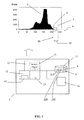
- the image processing system (1) shown in Fig. 1 comprises a storage unit (11) able to store a shape digital image of an original image (5) and a module (10) of production histogram.
- the original image (5) may consist of an image captured at level of a sensor that can convert a physical quantity measurable such as the luminance of the image captured in analog signal. The captured image can thus be sampled and coded on a number determined bit.
- the histogram generation module (10) is arranged to generate at least one histogram (2) of a said digital form along a first axis corresponding to a coded value (4), such as by example luminance, and a second axis corresponding to a count of pixels of a particular value for said coded value (4).
- the digital form of the image is composed of a series of pixels.
- An image in the 640 * 480 format thus comprises 307200 pixels.
- the histogram is used to represent a numerical value representative of a characteristic property or measurable magnitude of the image. In the example of Figure 1, it is a measure of intensity luminous per square meter or luminance, expressed in an arbitrary unit.
- the histogram (2) contains an entry for each value possible luminance coded on 8 bits, that is to say between 0 and 255, to which corresponds an account of the pixels of the image which have this value particular luminance. Another type of coding can naturally considered.
- Means for determining the total number of pixels for the digital image to be improved are provided in the processing system (1) image.
- the histogram production module (10) is furthermore arranged to generate three different histograms (21, 22, 23, Figure 2) each corresponding to the luminance corresponding to a component of distinct color, for example red, green and blue.
- the components of color can also be cyan blue, magenta pink and yellow.
- the component for the cyan blue can be obtained from the component for the red performing the operation: "255 - red component”.
- the magenta and yellow components can be obtained in a similar way from respectively green and color components blue.
- the image processing system (1) is capable of transform the image, either by performing a histogram equalization over three color components combined by changing the function of pixel intensity distribution, or by performing a stretch called stretching to increase the visual dynamics of the image and saturate a very low percentage of pixels.
- the system comprises means (15) for modifying the histogram respectively consisting of at least one histogram equalization algorithm and at least one stretching.
- Such means (15) for modifying the histogram can trigger respectively one or the other algorithms designed to modify the histogram (2) on three color components taken together respectively performing either a histogram equalization function or a stretching function.
- the image processing system (1) has features to distinguish the type of improvement to apply to a photo by analyzing the end of the histogram (2).
- the system (1) shown in FIG. 1 thus comprises means for detecting (12) the end of a histogram including a calculation module (14) able to discriminate a determined number (N) of pixels of the histogram analyzed in order decreasing their value for said coded value (4) of the luminance of way to detect the end of the analyzed histogram at the level of the first pixel not discriminated.
- These detection means (12) are arranged to determine the value said detected value (20) allocated to the first non-discriminated pixel in the histogram (2).
- comparison (13), coupled to the detection means (12), are provided in the image processing system (1) for comparing the detected value (20) with a fixed threshold (3) set in the storage unit (11).
- Ways (15) histogram modification are coupled to these means of comparison (13) and are arranged to trigger respectively one or the other of the two algorithms of equalization and stretching depending on the exceeding or not exceeding the threshold (3) by said detected value (20).
- the stretching algorithm is triggered automatically if the means of comparison indicate that the difference (30) between the detected value (20) and the fixed threshold (3) set is negative. If otherwise indicated, this is the histogram equalization algorithm which is triggered.
- An adjustment unit (16) adapted to use the histogram modified allows to adjust coded values (4) of the luminance in the digital form of the image whose quality needs to be improved.
- said means for detection (12) are able respectively to determine said detected value (20) for each of the three histograms (21, 22, 23) relating to the same original image (5) and for each of which the associated luminance corresponds to a distinct color component.
- These three histograms (21, 22, 23) are provided by the histogram generation module (10) after step (50) of storing the digital form of the original image (5) in the storage unit (11) of the system (1), during a step (51) of histogram production explained in the appendix.
- the histogram of the luminance for which three color components, for example red, green and blue, are confused, can also be generated during this step (51).
- each of the three histograms are produced as tables (21, 220, 230) of data that are stored in the storage unit (11).
- the stretching algorithm is triggered automatically if the means of comparison (13) indicates that the difference (30) between the detected value (20) and the fixed threshold (3) set is negative for at least two of the histograms (21, 2, 23) provided by the production module (10) histogram.
- a step (52) for detecting the end of the histogram can be performed by the detection means (12) of the treatment system image for the three histograms (21, 22, 23) of Figure 2 corresponding to distinct color components, so that step (53) for comparison between detected value (20) and fixed threshold (3) is performed for each of these histograms (21, 22, 23).
- the fixed threshold (3) is example between 235 and 255. In the case of Figure 1, this threshold (3) is approximately 240. In the example of the attached appendix, this threshold is 247.
- This step (52) for detecting the end of the histogram is performed for each of the three histograms (21, 22, 23) by scanning the histogram from the highest numerical value to the lowest value and calculating for each successive value of the histogram traveled a variable accumulating the count of pixels thus identified.
- the detection of the end of the histogram takes place when the value of this variable exceeds said determined number (N) of pixels to be discriminated.
- this determined number (N) of pixels to be discriminated during the detection step (52) is proportional to the number of pixels of the digital image.
- the percentage of pixels to be discriminated with respect to the totality of the pixels of the digital image is for example and in a nonlimiting manner of the order of one thousandth.
- the proportionality factor is about 10 -5 , which means for this example that a pixel will be ignored and discriminated during the detection step (52) if the image has 100000 pixels.
- the calculation module (14) can be arranged to use a proportionality factor stored in the storage unit (11) to be combined with the total number of pixels of the digital image to obtain said determined number (N) of pixels to discriminate.
- the comparison means (13) may be arranged to receive from the detection means (12) at least two data selected from the following three (201, 202, 203) representative of the distinct results obtained for each of those histograms (21, 22, 23). Each of these data is compared with said threshold (3).
- the histogram modifying means (15) are arranged to receive from the means of comparison (13) at least one criterion respectively representative of the overtaking or non-exceeding threshold (3) by said detected value (20).
- at least two data selected from the following three (C1, C2, C3) as criteria for each of the histograms (21, 22, 23) are thus supplied to the means (15) for modifying the histogram by means of comparison (13).
- These data (C1, C2, C3) are more precisely representative of distinct results obtained by comparing the different sensing data (201, 202, 203) with said set threshold (3).
- the means (15) for modifying the histogram then trigger the "stretching" stretching algorithm only if two of the results correspond to a non-exceeding threshold (3) by the detected value (20) end of histogram.
- the histogram equalization algorithm is triggered similarly only if two of the results corresponding to an exceeding of the threshold (3) by the detected value (20) of end of histogram.
- the step (54) of modification of the luminance histogram (2) corresponding to the image the quality of which needs to be improved is based on the exceeding the threshold (3) by the detected value (20).
- a substep (541) makes it possible to call to the stretching algorithm stored in the storage unit (11) to perform the histogram modification.
- another substep (542) is performed to make use of the histogram equalization algorithm, also stored in the unit of memorization (11), when modifying the histogram.
- a step (55) of using the modified histogram makes it possible to adjust the value of the luminous intensity per square meter or equivalent magnitude in said digital form so as to form a modified image (6) of improved quality.
- stages of histogram production (51), end of histogram detection (52), comparison (53) of the value detected (20) with the threshold (3) can be realized for two, three or several histograms (21, 22, 23) relating to the same original image (5) and for each of which said associated measurable magnitude (4) corresponds to a distinct color component.
- modules and steps described above can be realized in a hidden or programmed electronic component.
- the mask or the program implementing the process steps can be of the form described below in the appendix.
Landscapes
- Physics & Mathematics (AREA)
- General Physics & Mathematics (AREA)
- Engineering & Computer Science (AREA)
- Theoretical Computer Science (AREA)
- Facsimile Image Signal Circuits (AREA)
- Image Processing (AREA)
Applications Claiming Priority (2)
| Application Number | Priority Date | Filing Date | Title |
|---|---|---|---|
| FR0314732 | 2003-12-16 | ||
| FR0314732A FR2863751B1 (fr) | 2003-12-16 | 2003-12-16 | Procede et systeme d'amelioration automatique de la qualite d'images numeriques |
Publications (1)
| Publication Number | Publication Date |
|---|---|
| EP1544794A1 true EP1544794A1 (de) | 2005-06-22 |
Family
ID=34508673
Family Applications (1)
| Application Number | Title | Priority Date | Filing Date |
|---|---|---|---|
| EP04292869A Withdrawn EP1544794A1 (de) | 2003-12-16 | 2004-12-03 | Verfahren und Anordnung der automatischen Verbesserung der Qualität digitaler Bilder |
Country Status (2)
| Country | Link |
|---|---|
| EP (1) | EP1544794A1 (de) |
| FR (1) | FR2863751B1 (de) |
Citations (1)
| Publication number | Priority date | Publication date | Assignee | Title |
|---|---|---|---|---|
| EP0772158A2 (de) * | 1995-10-30 | 1997-05-07 | Hewlett-Packard Company | Bildverarbeitungssystem |
-
2003
- 2003-12-16 FR FR0314732A patent/FR2863751B1/fr not_active Expired - Fee Related
-
2004
- 2004-12-03 EP EP04292869A patent/EP1544794A1/de not_active Withdrawn
Patent Citations (1)
| Publication number | Priority date | Publication date | Assignee | Title |
|---|---|---|---|---|
| EP0772158A2 (de) * | 1995-10-30 | 1997-05-07 | Hewlett-Packard Company | Bildverarbeitungssystem |
Non-Patent Citations (3)
| Title |
|---|
| "Handbook of image processing operators", 1 January 1996, JOHN WILEY & SONS LTD., Chichester, West Sussex PO19 1UD, UK, ISBN: 978-0-471-95642-6, article REINHARD KLETTE ET AL: "Chapter 5.1: Gray Scale Transformations", pages: 141 - 149, XP055379709 * |
| FISHER B ET AL: "Contrast Stretching - Histogram Equalization", HYPERMEDIA IMAGE PROCESSING REFERENCE, 1994, DEPARTMENT OF ARTIFICIAL INTELLIGENCE, UNIVERSITY OF EDINBURGH, UK, pages 1 - 8, XP002291289, Retrieved from the Internet <URL:http://www.cee.hw.ac.uk/hipr/html/stretch.html; http://www.cee.hw.ac.uk/hipr/html/histeq.html> [retrieved on 20040804] * |
| KUO S-S ET AL: "Real time image enhancement for both text and color photo images", PROCEEDINGS OF THE INTERNATIONAL CONFERENCE ON IMAGE PROCESSING. (ICIP). WASHINGTON, OCT. 23 - 26, 1995, LOS ALAMITOS, IEEE COMP. SOC. PRESS, US, vol. VOL. 3, 23 October 1995 (1995-10-23), pages 159 - 162, XP010196949, ISBN: 0-7803-3122-2 * |
Also Published As
| Publication number | Publication date |
|---|---|
| FR2863751A1 (fr) | 2005-06-17 |
| FR2863751B1 (fr) | 2006-03-03 |
Similar Documents
| Publication | Publication Date | Title |
|---|---|---|
| US8648938B2 (en) | Detecting red eye filter and apparatus using meta-data | |
| US20080144946A1 (en) | Method of chromatic classification of pixels and method of adaptive enhancement of a color image | |
| JP2004348733A (ja) | デジタル画像における赤目領域の検出方法及び装置 | |
| FR3058818A1 (fr) | Procede d'augmentation de la saturation d'une image, et dispositif correspondant. | |
| EP2011329B1 (de) | Verfahren zum verarbeiten eines relativbeleuchtungsphänomens an einem digitalbild und assoziiertes verarbeitungssystem | |
| FR2905188A1 (fr) | Procede et dispositif de conversion de densites d'image | |
| FR2827060A1 (fr) | Procede d'identification du ciel dans une image et image obtenue grace a ce procede | |
| SE538435C2 (en) | Method, device and computer program product for determining colour transforms between images comprising a plurality of image elements | |
| CN108769543A (zh) | 曝光时间的确定方法及装置 | |
| CN105893927B (zh) | 动画视频识别与编码方法及装置 | |
| EP1544794A1 (de) | Verfahren und Anordnung der automatischen Verbesserung der Qualität digitaler Bilder | |
| EP1544793A1 (de) | Verfahren und System zur Qualitätsverbesserung von überbelichteten digitalen Bildern | |
| FR2827109A1 (fr) | Procede d'identification des ombres dans une image et image obtenue grace a ce procede | |
| EP1267300B1 (de) | Verfahren zur Fingerabdruckerkennung durch Färbung und Rechnersystem zum Ausführung dieses Verfahrens | |
| EP3625766A1 (de) | Verfahren zur detektion und quantifizierung von unschärfe auf einem digitalbild | |
| Hou et al. | Hue modification estimation using sensor pattern noise | |
| FR2978274A1 (fr) | Procede de traitement differencie de zones d'une image | |
| FR3069087B1 (fr) | Procede de traitement d'une image | |
| WO2024170840A1 (fr) | Procédé de traitement d'une image infrarouge | |
| FR3157631A1 (fr) | Procédé de quantification des brûlures générées par rectification d’une pièce | |
| WO2013135977A1 (fr) | Système pour déterminer l'identification d'un appareil photographique a partir d'une photographie et procédé mis en oeuvre dans un tel système | |
| EP1684210B1 (de) | Rote-Augen-Erkennung beruhend auf Erkennung von Hautzonen | |
| EP3427225A1 (de) | Bildverarbeitungsverfahren | |
| WO2026022158A1 (fr) | Procédé de détermination d'une texture d'un objet et dispositifs associés pour aider à la visualisation de la rugosité de surface | |
| EP4439484A1 (de) | Verfahren zur klassifizierung von hochaufgelösten mehrdimensionalen daten |
Legal Events
| Date | Code | Title | Description |
|---|---|---|---|
| PUAI | Public reference made under article 153(3) epc to a published international application that has entered the european phase |
Free format text: ORIGINAL CODE: 0009012 |
|
| AK | Designated contracting states |
Kind code of ref document: A1 Designated state(s): AT BE BG CH CY CZ DE DK EE ES FI FR GB GR HU IE IS IT LI LT LU MC NL PL PT RO SE SI SK TR |
|
| AX | Request for extension of the european patent |
Extension state: AL BA HR LV MK YU |
|
| RAP1 | Party data changed (applicant data changed or rights of an application transferred) |
Owner name: SAGEM COMMUNICATION |
|
| AKX | Designation fees paid |
Designated state(s): AT BE BG CH CY CZ DE DK EE ES FI FR GB GR HU IE IS IT LI LT LU MC NL PL PT RO SE SI SK TR |
|
| 17P | Request for examination filed |
Effective date: 20051216 |
|
| RBV | Designated contracting states (corrected) |
Designated state(s): DE ES FR GB IT |
|
| RAP1 | Party data changed (applicant data changed or rights of an application transferred) |
Owner name: SAGEM COMMUNICATIONS |
|
| 17Q | First examination report despatched |
Effective date: 20080903 |
|
| RAP1 | Party data changed (applicant data changed or rights of an application transferred) |
Owner name: SAGEM COMMUNICATIONS SAS |
|
| RAP1 | Party data changed (applicant data changed or rights of an application transferred) |
Owner name: SAGEM COMMUNICATIONS |
|
| RAP1 | Party data changed (applicant data changed or rights of an application transferred) |
Owner name: SAGEM COMMUNICATIONS SAS |
|
| RAP1 | Party data changed (applicant data changed or rights of an application transferred) |
Owner name: SAGEMCOM DOCUMENTS SAS |
|
| GRAP | Despatch of communication of intention to grant a patent |
Free format text: ORIGINAL CODE: EPIDOSNIGR1 |
|
| STAA | Information on the status of an ep patent application or granted ep patent |
Free format text: STATUS: GRANT OF PATENT IS INTENDED |
|
| INTG | Intention to grant announced |
Effective date: 20171002 |
|
| STAA | Information on the status of an ep patent application or granted ep patent |
Free format text: STATUS: THE APPLICATION IS DEEMED TO BE WITHDRAWN |
|
| 18D | Application deemed to be withdrawn |
Effective date: 20180213 |