EP1544592A2 - Method and device for isolating, collecting and transferring hazardous samples - Google Patents
Method and device for isolating, collecting and transferring hazardous samples Download PDFInfo
- Publication number
- EP1544592A2 EP1544592A2 EP04030021A EP04030021A EP1544592A2 EP 1544592 A2 EP1544592 A2 EP 1544592A2 EP 04030021 A EP04030021 A EP 04030021A EP 04030021 A EP04030021 A EP 04030021A EP 1544592 A2 EP1544592 A2 EP 1544592A2
- Authority
- EP
- European Patent Office
- Prior art keywords
- gas
- air
- package
- sealed
- items
- Prior art date
- Legal status (The legal status is an assumption and is not a legal conclusion. Google has not performed a legal analysis and makes no representation as to the accuracy of the status listed.)
- Withdrawn
Links
Images



Classifications
-
- G—PHYSICS
- G01—MEASURING; TESTING
- G01N—INVESTIGATING OR ANALYSING MATERIALS BY DETERMINING THEIR CHEMICAL OR PHYSICAL PROPERTIES
- G01N1/00—Sampling; Preparing specimens for investigation
- G01N1/02—Devices for withdrawing samples
- G01N1/22—Devices for withdrawing samples in the gaseous state
- G01N1/2226—Sampling from a closed space, e.g. food package, head space
-
- G—PHYSICS
- G01—MEASURING; TESTING
- G01N—INVESTIGATING OR ANALYSING MATERIALS BY DETERMINING THEIR CHEMICAL OR PHYSICAL PROPERTIES
- G01N1/00—Sampling; Preparing specimens for investigation
- G01N1/02—Devices for withdrawing samples
- G01N1/22—Devices for withdrawing samples in the gaseous state
-
- G—PHYSICS
- G01—MEASURING; TESTING
- G01N—INVESTIGATING OR ANALYSING MATERIALS BY DETERMINING THEIR CHEMICAL OR PHYSICAL PROPERTIES
- G01N1/00—Sampling; Preparing specimens for investigation
- G01N1/02—Devices for withdrawing samples
- G01N1/22—Devices for withdrawing samples in the gaseous state
- G01N1/24—Suction devices
-
- A—HUMAN NECESSITIES
- A47—FURNITURE; DOMESTIC ARTICLES OR APPLIANCES; COFFEE MILLS; SPICE MILLS; SUCTION CLEANERS IN GENERAL
- A47G—HOUSEHOLD OR TABLE EQUIPMENT
- A47G29/00—Supports, holders, or containers for household use, not provided for in groups A47G1/00-A47G27/00 or A47G33/00
- A47G29/12—Mail or newspaper receptacles, e.g. letter-boxes; Openings in doors or the like for delivering mail or newspapers
- A47G29/122—Parts, details, or accessories, e.g. signalling devices, lamps, devices for leaving messages
- A47G2029/1221—Parts, details, or accessories, e.g. signalling devices, lamps, devices for leaving messages comprising means to detect or prevent a terrorist attack, e.g. to detect anthrax-laced letters
-
- G—PHYSICS
- G01—MEASURING; TESTING
- G01N—INVESTIGATING OR ANALYSING MATERIALS BY DETERMINING THEIR CHEMICAL OR PHYSICAL PROPERTIES
- G01N1/00—Sampling; Preparing specimens for investigation
- G01N1/02—Devices for withdrawing samples
- G01N2001/022—Devices for withdrawing samples sampling for security purposes, e.g. contraband, warfare agents
- G01N2001/025—Devices for withdrawing samples sampling for security purposes, e.g. contraband, warfare agents postal items
-
- G—PHYSICS
- G01—MEASURING; TESTING
- G01N—INVESTIGATING OR ANALYSING MATERIALS BY DETERMINING THEIR CHEMICAL OR PHYSICAL PROPERTIES
- G01N1/00—Sampling; Preparing specimens for investigation
- G01N1/02—Devices for withdrawing samples
- G01N1/22—Devices for withdrawing samples in the gaseous state
- G01N1/2226—Sampling from a closed space, e.g. food package, head space
- G01N2001/2241—Sampling from a closed space, e.g. food package, head space purpose-built sampling enclosure for emissions
-
- G—PHYSICS
- G01—MEASURING; TESTING
- G01N—INVESTIGATING OR ANALYSING MATERIALS BY DETERMINING THEIR CHEMICAL OR PHYSICAL PROPERTIES
- G01N35/00—Automatic analysis not limited to methods or materials provided for in any single one of groups G01N1/00 - G01N33/00; Handling materials therefor
- G01N35/10—Devices for transferring samples or any liquids to, in, or from, the analysis apparatus, e.g. suction devices, injection devices
- G01N35/1079—Devices for transferring samples or any liquids to, in, or from, the analysis apparatus, e.g. suction devices, injection devices with means for piercing stoppers or septums
Definitions
- the present invention relates generally to biohazard detection and, more particularly, to the isolation, collection and transferring of a biohazard sample trapped in a filter of a detection system.
- Detection of biohazards in the mail for culture or polymerase chain reaction (PCR) analysis requires collection of a sample. Similar detection technologies for other harmful contaminants also require collection of samples.
- PCR polymerase chain reaction
- a wet cotton swab or the like is used to take a sample of the suspected contaminants from the mail for testing. Wet cotton swabs may cause damage to the forensic evidence by matting dry powders or causing ink to run.
- the mail is then bagged for safekeeping or further processing. As such, part of the suspected contaminants will be lost in the chemical hood and contaminate the equipment disposed therein. Furthermore, the mail is required to be bagged more than once.
- the present invention provides a method and system for isolating, transferring and testing particles that may be biological or other hazardous contaminants carried by a mail piece or a mail tray.
- the mail pieces, along with the mail tray, are encapsulated in a sealed package at one location and transferred to another location for testing so as to minimize the contamination at the testing location and any other location through which the mail passes.
- the sealed package is connected to an air sampling system, which directly draws an air sample from the sealed package through a filter chamber so that particles suspected to be biological or other hazardous contaminants are trapped on a filter in the filter chamber.
- the container that is used to encapsulate the mail pieces may be transparent so as to allow visual inspection of the sealed package.
- the container may be flexible so that it may collapse during or at the end the sample collection process.
- a tube with a self-seated coupler is provided on the sealed package to allow the air sampling system to draw air out of the sealed package.
- the self-sealed coupler prevents the air inside the sealed package from escaping into the environment.
- the mall pieces and the mail tray in the sealed packages are manually or mechanically disturbed before or during air sampling so as to dislodge the particles carried by the mail pieces or the mail tray.
- Figure 1 is a schematic representation illustrating the method and system for isolating and transferring suspected contaminated samples, according to the present invention.
- Figure 2 is a schematic representation illustrating the method and system for collecting suspected contaminated samples, according to the present invention.
- Figure 3 is a schematic representation illustrating another method and system for collecting suspected contaminated samples, according to the present invention.
- Figure 4a is a schematic representation illustrating a septum on the sealed package being engaged with a sample collecting tube.
- Figure 4b is a schematic representation illustrating the septum on the sealed package being disengaged from the sample collecting tube.
- Figure 5a is a schematic representation illustrating a tube extended from the sealed package being engaged with the sample collecting tube.
- Figure 5b is a schematic representation illustrating the tube from the sealed container being disengaged from the sample collecting tube.
- Figure 6a is a schematic representation illustrating a collapsed, sealed container having a septum disposed thereon.
- Figure 6b is a schematic representation illustrating a collapsed, sealed container having a tube extended therefrom.
- Figure 7 is a schematic representation illustrating a glove bag used as a container for encapsulating mail pieces in a mail tray.
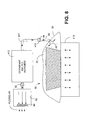
- Figure 8 is a schematic representation illustrating the method and system of testing suspected contaminated samples directly from a sealed container.
- Figure 9 is a schematic representation illustrating a filter chamber being safely transported to a remote location for testing the possible contaminants trapped in the filter chamber.
- the present invention uses a dry filter collection assembly to collect the suspected biological or other hazardous contaminants from a sealed container containing one or more mail pieces.
- the container is sealed at one location and the suspected biological contaminants are tested at the same location or at another location.
- a mail-tray 10 containing mail pieces 5 that may be contaminated with biological or other hazardous contaminants is encapsulated in a flexible bag 30 at a location 100.
- the sealed package 50 may then be transported to a different location 200 for testing.
- location 200 can be a building that has a window 210 to accept the sealed package 50.
- the sealed package 50 is transferred to a jogger 310 in a collecting station 300.
- the sealed package 50 may contain air or a gas, such as nitrogen.
- air or a gas such as nitrogen.
- the outer bag Prior to transferring the mail tray into the building, the outer bag can be removed and properly discarded.
- the mail may be transported by any means for any distance to testing location 200 without risking contamination of facilities or personnel along the route of transit.
- the sealed package 50 has a tube 40 to allow a sample collection system 60 to collect the suspected hazardous contaminants from the sealed package 50.
- One end of the tube 40 has an open inlet 42, which is shaped like a "T" or has a number of orifices so that there are multiple sub-inlets to prevent blockage of air flow in the event that the end of the inlet touches the inner walls of the bag 30.
- the other end of the tube 40 has coupler 44.
- the air sample collection system 60 comprises a filter chamber 66 having an air filter 68.
- the filter can be wet or dry.
- One end of the filter chamber 66 is connected to a first air passageway 61, which is securely affixed to a coupler 62.
- the other end of the filter chamber 66 is connected to a second air passageway 63, which is securely affixed to a coupler 64.
- the coupler 62 is different from the coupler 64.
- the coupler 64 Is operatively connected to an air pump 90 through a coupler 92 so as to allow air to be drawn out of the interior 22 of the bag 30 through the filter chamber 66. It is important that the couplers 44, 62, 64 and 92 are self-sealed such that each of the couplers is closed when it is not engaged with another coupler. It should be noted that the pores on the filter 68 should be small enough to trap suspected contaminants.
- the filter 68 is a HEPA filter.
- another fine air filter 94 such as HEPA, in the air pump 90.
- HEPA another fine air filter 94
- the mail pieces in the sealed package 50 can be manually disturbed or disturbed by the vibration of the jogger 310.
- It is advantageous to install a flow gauge 80 in the air passageway 63 to provide visual confirmation that the air passageways 61, 63, the tube 40 or the air inlet 42 is not blocked.
- the air pump 90 provides an audible change in pitch and volume when the airflow is impeded. Such pitch or sound volume change warns the operator to look for problems.
- an instrument for direct analysis of the air stream and any particles suspended in it may be substituted for or combined with the air sample collection system 60 comprising filter chamber 66 having an air filter 68, as shown in Figure 8.
- a septum 34 on the bag 30, as shown in Figure 3.
- a filter chamber 66 that has a coupler 62
- a filter chamber 76 that has a needle 72 for reaching into the interior 22 of the sealed package 50 through the septum 34.
- the filter chamber 76 also has an air filter 78 to trap the suspected contaminants.
- the filter chamber 76 also has a first air passageway 71 on one end and a second passageway 73 on the other end.
- the second passageway 73 is securely affixed to a self-sealed coupler 74, which can be operatively engaged with the coupler 92 of the air pump 90.
- the septum 34 is a self-sealed material such that it allows the needle 72 to reach into the bag 30 to draw an air sample therefrom, as shown in Figure 4a. But when the needle 72 is pulled off from the septum 34, the septum 34 is effectively closed off to prevent air inside the bag 30 from leaking out, as shown in Figure 4b.
- the couplers 62 and 44 are also self-sealed. When the coupler 44 and coupler 62 are operatively engaged with each other, air is allowed to be drawn into the passageway 61 via the tube 40 and the couplers 44 and 62, as shown in Figure 5a. When the coupler 44 and coupler 62 are disengaged from each other, each of the couples 44 and 62 is closed (marked with an "X"), as shown in Figure 5b.
- the bag 30 is made of a soft and flexible material and the air pressure in the sealed package 50 is close to ambient pressure during sampling.
- the bag 30 When air is removed from the sealed package 50 during the collection procedure, the bag 30 will collapse and the air pressure inside the collapsed package 50' is lower than ambient. As such, any leaks or improper seals will cause air leakage into the bag 30, not venting into the environment.
- the collapsed sealed package 50' is less likely to be accidentally punctured. Due to the self-sealing nature of the septum 34 and the coupler 44, air exchange between the exterior and interior of the sealed package 50' is prevented.
- One alternative container is a sealable box having flexible sides. When sample air is withdrawn from the box, the sides flex and a lower than ambient air pressure occurs inside the sealed container.
- Another alternative is a rigid box which further includes a one-way air inlet valve which allows air to enter as the sample is being withdrawn.
- the container material is anti-static so that the suspected biohazard particles in the container, once aerosolized, stay in the air instead of becoming attached to the surface of the container.
- the items to be tested occupy less than half the volume of the sealed package so as to allow a relatively large volume of air for sample collection and testing. Such sample collection is made at six liters per minute without significant backpressure. A majority of the extra open air space is preferably located above the open container that holds the items to be tested, but could be located on the side of the sealed package.
- the bag 30' has one or two gloves 150 to allow an operator to access the mail pieces 5 inside the bag 30' through the gloves.
- a collection probe 46 which is securely attached to the tube 40, can be inserted into an envelope or mail piece to directly collect air and powder samples from inside the envelope.
- a sharp edge 56 can be provided inside the sealed package so that it can be used to make a short slit on an envelope or mail piece to ensure that there is no inner seal containing a biological hazard.
- a short slit allows the collection probe 46 to be inserted into the envelope without comprising the privacy of the contents.
- the sample collection system as depicted in Figures 2 and 3 can be powered by a portable power source or by a wall outlet. It is possible to collect the air samples at the sealing location, inside a customer building or at a laboratory test location, The encapsulation of the mail pieces not only prevents the contaminants from contaminating the surrounding, but also preserves the evidence of the mail being contaminated. The encapsulation provides safety to the employees and the building. It also maximizes the ability to collect the hazard sample. Collecting the samples directly from the sealed package minimizes the lost of evidence. In contrast, opening a mail piece in a chemical hood and obtaining a sample in the chemical hood may cause some powder or particles to come out of the mail piece and be vacuumed away, thereby losing evidence.
- the mail remains in the original tray, and the mail and the tray remain sealed inside the container until the tests are completed to determine if hazardous materials are present
- the tray and the mail can be removed from the container - and processed in the normal fashion without requiring any further additional steps.
- Figures 2 and 3 illustrate how the suspected contaminants are collected using a filter chamber 66 or 76 to trap the particles in the air within the sealed package 30.
- the trapped particles on the filter 68 or 78 must be further tested to determine whether those particles are indeed contaminants.
- the filter chamber 66 can be safely transported from the collecting location 200 or 100 to a remote location 400 for testing, using a contaminant analysis instrument 410, such as a PCR analysis machine or other suitable instrument, as shown in Figure 9.
- a contaminant analysis instrument 410 such as a PCR analysis machine or other suitable instrument, as shown in Figure 9.
- the contaminant analysis instrument 410 is operatively connected to a sealed package 30 to detect the contaminants directly.
- the analysis instrument 410 is connected to the sealed package 30 via an air passage 411 and a seal-sealed coupler 412.
- the analysis instrument 410 is also connected to an air pump 90, which draws an air and particle samples from the sealed package 30 through the analysis instrument.
Landscapes
- Health & Medical Sciences (AREA)
- Life Sciences & Earth Sciences (AREA)
- Engineering & Computer Science (AREA)
- Biomedical Technology (AREA)
- Molecular Biology (AREA)
- Physics & Mathematics (AREA)
- Chemical & Material Sciences (AREA)
- Analytical Chemistry (AREA)
- Biochemistry (AREA)
- General Health & Medical Sciences (AREA)
- General Physics & Mathematics (AREA)
- Immunology (AREA)
- Pathology (AREA)
- Sampling And Sample Adjustment (AREA)
Abstract
Description
Claims (12)
- A method of testing items carrying particles that may be contaminants, comprising:wherein the package comprises a self-sealable member disposed thereon, and the filter is disposed in a filter chamber having an air passageway operatively connected to a gas outlet on the package and the first passageway is securely connected to a needle for piercing the self-sealable member in order to provide the gas outlet for collecting the gas sample.sealing the items in a package containing a gas; andcollecting a gas sample from the package through a filter for trapping on the filter at least part of the particles in the gas sample,
- The method of claim 1, wherein the self-sealable member substantially prevents air from leaking into the collapsed package so as to keep the collapsed package substantially the same after said collecting.
- The method of claim 1, further comprising
agitating the items to cause at least part of the particles carried in the items to move into the gas in the package. - The method of claim 1, wherein,
the items occupy less than half the volume of the sealed package. - The method of claim 1 further comprising
retaining the Items in the sealed package until after results of said checking step are complete. - A system for testing items carrying particles that may be contaminants,
wherein the items are sealed in a container containing a gas, the container having a self-sealable air outlet, said system comprising:a gas drawing device;a device for operating on the gas drawn, anda first air passageway and a second air passageway, wherein the first passageway is operatively connected to the gas drawing device, and a second air passageway connected to the air outlet so as to draw an gas sample from the sealed container through the air outlet, the first passageway and the device for operating on the drawn gas. - The system of claim 6, wherein the device for operating on the gas drawn comprises a filter chamber having an air filter.
- The system of claim 6, wherein the device for operating on the gas drawn comprises an instrument for analyzing at least one of the gas and any particles suspended in the gas.
- The system of claim 6, wherein the items comprise mail pieces and the gas comprises air.
- The system of claim 6, further comprising
a mechanism, disposed in relation to the sealed container, for agitating the items while the gas is being drawn. - The system of claim 6, wherein the container is a bag made of a flexible material so that the sealed container becomes substantially collapsed when the air pump draws the gas sample from the sealed bag.
- The system of claim 6, wherein the container comprises an anti-static material so as to reduce the amount of the particles sticking on the package.
Applications Claiming Priority (2)
| Application Number | Priority Date | Filing Date | Title |
|---|---|---|---|
| US742476 | 1985-06-07 | ||
| US10/742,476 US7340970B2 (en) | 2003-12-19 | 2003-12-19 | Method and device for isolating, collecting and transferring hazardous samples |
Publications (2)
| Publication Number | Publication Date |
|---|---|
| EP1544592A2 true EP1544592A2 (en) | 2005-06-22 |
| EP1544592A3 EP1544592A3 (en) | 2005-11-09 |
Family
ID=34523252
Family Applications (1)
| Application Number | Title | Priority Date | Filing Date |
|---|---|---|---|
| EP04030021A Withdrawn EP1544592A3 (en) | 2003-12-19 | 2004-12-17 | Method and device for isolating, collecting and transferring hazardous samples |
Country Status (2)
| Country | Link |
|---|---|
| US (1) | US7340970B2 (en) |
| EP (1) | EP1544592A3 (en) |
Cited By (2)
| Publication number | Priority date | Publication date | Assignee | Title |
|---|---|---|---|---|
| EP1867963A3 (en) * | 2006-06-14 | 2011-04-27 | Mocon, Inc. | Instrument for accurately measuring mass flow rate of a fluid pumped from a hermetically sealed container |
| FR2993667A1 (en) * | 2012-07-19 | 2014-01-24 | Renault Sa | Method for analysis of gases contained in e.g. flexible enclosure with lithium ion electric cell for electric vehicle, involves withdrawing part of gas released by flexible enclosure via valve, and routing part of gas to analysis device |
Families Citing this family (19)
| Publication number | Priority date | Publication date | Assignee | Title |
|---|---|---|---|---|
| US7491548B2 (en) * | 2003-12-19 | 2009-02-17 | Pitney Bowes Inc. | Method and device for collecting and transferring biohazard samples |
| US7543478B2 (en) * | 2007-04-12 | 2009-06-09 | Northrop Grumman Systems Corporation | Device and method for detecting hazardous material in mail |
| US8047053B2 (en) * | 2007-05-09 | 2011-11-01 | Icx Technologies, Inc. | Mail parcel screening using multiple detection technologies |
| FR2958401A1 (en) * | 2010-04-01 | 2011-10-07 | Braun Medical Sas | DEVICE FOR COLLECTING A LIQUID SAMPLE FROM A FLEXIBLE POCKET |
| CN102323116A (en) * | 2011-10-11 | 2012-01-18 | 山东大学 | A sinking aerosol sampler |
| CN103163275B (en) * | 2011-12-16 | 2016-08-24 | 同方威视技术股份有限公司 | The detection device of article surface dangerous substance and detection method |
| FR3042591B1 (en) * | 2015-10-16 | 2017-12-22 | Agence Nat Pour La Gestion Des Dechets Radioactifs | ENCLOSURE OF GASEOUS RELEASE MEASURES AND METHOD FOR MEASURING THE GAS RELEASE OF AN OBJECT HAVING A GAS RELEASE POTENTIAL |
| ES3037747T3 (en) | 2017-09-21 | 2025-10-06 | Becton Dickinson Co | Augmented reality devices for hazardous contaminant testing |
| JP7303799B2 (en) | 2017-09-21 | 2023-07-05 | ベクトン・ディキンソン・アンド・カンパニー | Reactive Fractionation Template for Hazardous Contaminant Testing |
| USD859683S1 (en) | 2017-09-21 | 2019-09-10 | Becton, Dickinson And Company | Collection device |
| CN111278987B (en) | 2017-09-21 | 2024-02-23 | 贝克顿·迪金森公司 | Sampling systems and technologies to collect hazardous contaminants with high pick-up and shedding efficiency |
| EP3684944B1 (en) | 2017-09-21 | 2025-01-01 | Becton, Dickinson and Company | Hazardous contaminant collection kit and rapid testing |
| AU2018337027B2 (en) | 2017-09-21 | 2024-06-06 | Becton, Dickinson And Company | Hazardous contaminant collection kit and rapid testing |
| CN111107939B (en) | 2017-09-21 | 2022-04-12 | 贝克顿·迪金森公司 | System and template to guide the collection of hazardous contaminant samples and methods of using the same |
| JP7223749B2 (en) | 2017-09-21 | 2023-02-16 | ベクトン・ディキンソン・アンド・カンパニー | High dynamic range analyzer for testing hazardous contaminants |
| CN113383222A (en) | 2019-01-28 | 2021-09-10 | 贝克顿·迪金森公司 | Hazardous contaminant collection device with integrated swab and testing device |
| JP7503074B2 (en) * | 2019-03-20 | 2024-06-19 | ベクトン・ディキンソン・アンド・カンパニー | Sampling systems and techniques for the detection of hazardous contaminants |
| FR3097965B1 (en) | 2019-06-28 | 2022-03-18 | Carrefour Du Laboratoire | Sampling device intended to collect elements present in the atmosphere prevailing within a containment. |
| CN113102259B (en) * | 2021-04-12 | 2022-02-25 | 深圳市爱租机科技有限公司 | Shunt system based on intelligent scanning |
Family Cites Families (21)
| Publication number | Priority date | Publication date | Assignee | Title |
|---|---|---|---|---|
| CH421799A (en) | 1963-06-24 | 1966-09-30 | Soag Machine Tools Ltd | Packing machine |
| US4069965A (en) | 1975-12-24 | 1978-01-24 | Maddox Jr Herman H | Mail slot pouch assembly |
| CA1177278A (en) | 1981-07-10 | 1984-11-06 | Shrik K. Gandhi | Compressed breathing air sampling device |
| US5429803A (en) | 1991-04-18 | 1995-07-04 | Lamina, Inc. | Liquid specimen container and attachable testing modules |
| ES2044009T3 (en) * | 1989-10-09 | 1994-01-01 | Nestle Sa | PROCEDURE AND DEVICE FOR THE SIMULTANEOUS DETERMINATION OF THE OXYGEN CONTENT AND THE RESIDUAL PRESSURE IN A PACKAGING .. |
| CH679892A5 (en) | 1989-11-17 | 1992-04-30 | Orbisphere Lab | |
| US5368226A (en) | 1993-11-01 | 1994-11-29 | Franceschino; Luisa M. | Mail slot pouch apparatus |
| GB2303111A (en) | 1995-07-11 | 1997-02-12 | Autowrappers Europack Limited | Flow wrapping of product groups |
| US5942699A (en) * | 1997-06-12 | 1999-08-24 | R.A.Y. Buechler Ltd. | Method and apparatus for sampling contaminants |
| GB2350803B (en) | 1999-06-09 | 2003-03-05 | Air Dispersions Ltd | Gas sampling assemblies |
| US6571650B2 (en) * | 2001-10-22 | 2003-06-03 | Perkinelmer Instruments Llc | Variable headspace sampling system |
| US6792795B2 (en) * | 2001-10-26 | 2004-09-21 | Lockheed Martin Corporation | System and method for detecting hazardous materials using agitation |
| US20040027036A1 (en) * | 2001-11-02 | 2004-02-12 | Jim Hall | System for safely inspecting matter possibly containing chemical or biological agents |
| WO2003104087A2 (en) | 2001-11-08 | 2003-12-18 | United States Postal Service | Handling potentially contaminated mail |
| AU2002365277A1 (en) * | 2001-12-10 | 2003-07-15 | Lockheed Martin Corporation | Mail tub with vacuum ports |
| US7390465B2 (en) | 2001-12-10 | 2008-06-24 | Lockheed Martin Corporation | System and method for contamination detection within sealed containers |
| US6789727B2 (en) | 2001-12-10 | 2004-09-14 | Lockheed Martin Corporation | Mail processing apparatus and collection box with a mail article sealer |
| AU2002360642A1 (en) | 2001-12-19 | 2003-07-09 | Pitney Bowes Inc. | Notifying mail users of mail piece contamination |
| US6740836B2 (en) | 2001-12-31 | 2004-05-25 | Pitney Bowes Inc. | System and method for outsorting suspect mail from an incoming mail stream |
| US7318548B2 (en) | 2002-03-26 | 2008-01-15 | Lockheed Martin Corporation | Apparatus and method for isolating deposited items |
| US6742703B2 (en) | 2002-05-31 | 2004-06-01 | Sealed Air Corporation | Mail collection box |
-
2003
- 2003-12-19 US US10/742,476 patent/US7340970B2/en not_active Expired - Fee Related
-
2004
- 2004-12-17 EP EP04030021A patent/EP1544592A3/en not_active Withdrawn
Cited By (2)
| Publication number | Priority date | Publication date | Assignee | Title |
|---|---|---|---|---|
| EP1867963A3 (en) * | 2006-06-14 | 2011-04-27 | Mocon, Inc. | Instrument for accurately measuring mass flow rate of a fluid pumped from a hermetically sealed container |
| FR2993667A1 (en) * | 2012-07-19 | 2014-01-24 | Renault Sa | Method for analysis of gases contained in e.g. flexible enclosure with lithium ion electric cell for electric vehicle, involves withdrawing part of gas released by flexible enclosure via valve, and routing part of gas to analysis device |
Also Published As
| Publication number | Publication date |
|---|---|
| US7340970B2 (en) | 2008-03-11 |
| US20050136540A1 (en) | 2005-06-23 |
| EP1544592A3 (en) | 2005-11-09 |
Similar Documents
| Publication | Publication Date | Title |
|---|---|---|
| US7340970B2 (en) | Method and device for isolating, collecting and transferring hazardous samples | |
| AU2003285852B2 (en) | Point source biological agent detection system | |
| EP3025139B1 (en) | Method for sampling biological particles from a fluid flow | |
| CA2500365C (en) | Mobile isolation glove box with disposable enclosure for investigation | |
| US20100288059A1 (en) | Specimen container, system, and method | |
| US20030136203A1 (en) | Package biochemical hazard and contraband detector | |
| WO2003078957A2 (en) | System and method for detecting bio-hazardous particulates in mail handling systems | |
| US20040027036A1 (en) | System for safely inspecting matter possibly containing chemical or biological agents | |
| US7198749B2 (en) | Handling potentially contaminated mail | |
| US20030071543A1 (en) | Mail and package inspection device and method | |
| US8735756B1 (en) | System and method for processing mail | |
| US20030136179A1 (en) | Mail tub with air ports | |
| US7972869B2 (en) | Method and device for collecting and transferring biohazard samples | |
| US7491548B2 (en) | Method and device for collecting and transferring biohazard samples | |
| US6715151B2 (en) | Manipulation shield and containment enclosure for inspecting contaminated matter | |
| US20230146816A1 (en) | Large area surface sampler with invertible bag | |
| US8337776B1 (en) | Closed-loop waste disposal system for enhanced safety | |
| EP1544593B1 (en) | Method and system for isolating and testing biological contaminants in mail packages | |
| US6888085B2 (en) | Method and system for detection of contaminants in mail | |
| US20030127952A1 (en) | Assembly for the physical manipulation of potentially contaminated articles | |
| Harper | Contamination of the environment by special purpose centrifuges used in clinical laboratories. | |
| CN101163558A (en) | Device for screening mail for harmful substances | |
| JPS63232816A (en) | filter device | |
| Bennett et al. | D3. 3 ADVANCED DESIGN AND TECHNOLOGY IDENTIFICATION |
Legal Events
| Date | Code | Title | Description |
|---|---|---|---|
| PUAI | Public reference made under article 153(3) epc to a published international application that has entered the european phase |
Free format text: ORIGINAL CODE: 0009012 |
|
| AK | Designated contracting states |
Kind code of ref document: A2 Designated state(s): AT BE BG CH CY CZ DE DK EE ES FI FR GB GR HU IE IS IT LI LT LU MC NL PL PT RO SE SI SK TR |
|
| AX | Request for extension of the european patent |
Extension state: AL BA HR LV MK YU |
|
| PUAL | Search report despatched |
Free format text: ORIGINAL CODE: 0009013 |
|
| AK | Designated contracting states |
Kind code of ref document: A3 Designated state(s): AT BE BG CH CY CZ DE DK EE ES FI FR GB GR HU IE IS IT LI LT LU MC NL PL PT RO SE SI SK TR |
|
| AX | Request for extension of the european patent |
Extension state: AL BA HR LV MK YU |
|
| 17P | Request for examination filed |
Effective date: 20060503 |
|
| AKX | Designation fees paid |
Designated state(s): DE FR GB |
|
| 17Q | First examination report despatched |
Effective date: 20060814 |
|
| 17Q | First examination report despatched |
Effective date: 20060814 |
|
| STAA | Information on the status of an ep patent application or granted ep patent |
Free format text: STATUS: THE APPLICATION HAS BEEN WITHDRAWN |
|
| 18W | Application withdrawn |
Effective date: 20080509 |