EP1544194A1 - 4-(substituted aryl)-5-hydroxyisoquinolinone derivative - Google Patents
4-(substituted aryl)-5-hydroxyisoquinolinone derivative Download PDFInfo
- Publication number
- EP1544194A1 EP1544194A1 EP03765364A EP03765364A EP1544194A1 EP 1544194 A1 EP1544194 A1 EP 1544194A1 EP 03765364 A EP03765364 A EP 03765364A EP 03765364 A EP03765364 A EP 03765364A EP 1544194 A1 EP1544194 A1 EP 1544194A1
- Authority
- EP
- European Patent Office
- Prior art keywords
- group
- substituents
- denotes
- substituted
- halogen atom
- Prior art date
- Legal status (The legal status is an assumption and is not a legal conclusion. Google has not performed a legal analysis and makes no representation as to the accuracy of the status listed.)
- Withdrawn
Links
- 0 *c1cc(c(*)ncc2*)c2c(O)c1 Chemical compound *c1cc(c(*)ncc2*)c2c(O)c1 0.000 description 5
- NXTPGRADYHJWLK-UHFFFAOYSA-N CN(C)CCc(ccc(C(c(c1ccc2)c2O)=CNC1=O)c1)c1[N+]([O-])=O Chemical compound CN(C)CCc(ccc(C(c(c1ccc2)c2O)=CNC1=O)c1)c1[N+]([O-])=O NXTPGRADYHJWLK-UHFFFAOYSA-N 0.000 description 1
- NCBXZVLOVKDCMW-UHFFFAOYSA-N CN(C)Cc(cc1)ccc1C(c(c1ccc2)c2O)=CNC1=O Chemical compound CN(C)Cc(cc1)ccc1C(c(c1ccc2)c2O)=CNC1=O NCBXZVLOVKDCMW-UHFFFAOYSA-N 0.000 description 1
- IYMNDJPINSMPRP-UHFFFAOYSA-N Cc(c([N+]([O-])=O)c1)ccc1-c(cn1)c2c(OC(c3ccccc3)=O)cccc2c1OC Chemical compound Cc(c([N+]([O-])=O)c1)ccc1-c(cn1)c2c(OC(c3ccccc3)=O)cccc2c1OC IYMNDJPINSMPRP-UHFFFAOYSA-N 0.000 description 1
- NNBWDZPRFABFSA-UHFFFAOYSA-N Oc(cccc12)c1C(c1ccc(CN(CC3)CC=C3c3ccccc3)cc1)=CNC2=O Chemical compound Oc(cccc12)c1C(c1ccc(CN(CC3)CC=C3c3ccccc3)cc1)=CNC2=O NNBWDZPRFABFSA-UHFFFAOYSA-N 0.000 description 1
- PJZUPPXVURZCMS-UHFFFAOYSA-N Oc1ccc(CNCc(cc2)ccc2C(c(c2ccc3)c3O)=CNC2=O)cc1 Chemical compound Oc1ccc(CNCc(cc2)ccc2C(c(c2ccc3)c3O)=CNC2=O)cc1 PJZUPPXVURZCMS-UHFFFAOYSA-N 0.000 description 1
Classifications
-
- C—CHEMISTRY; METALLURGY
- C07—ORGANIC CHEMISTRY
- C07D—HETEROCYCLIC COMPOUNDS
- C07D401/00—Heterocyclic compounds containing two or more hetero rings, having nitrogen atoms as the only ring hetero atoms, at least one ring being a six-membered ring with only one nitrogen atom
- C07D401/02—Heterocyclic compounds containing two or more hetero rings, having nitrogen atoms as the only ring hetero atoms, at least one ring being a six-membered ring with only one nitrogen atom containing two hetero rings
- C07D401/10—Heterocyclic compounds containing two or more hetero rings, having nitrogen atoms as the only ring hetero atoms, at least one ring being a six-membered ring with only one nitrogen atom containing two hetero rings linked by a carbon chain containing aromatic rings
-
- A—HUMAN NECESSITIES
- A61—MEDICAL OR VETERINARY SCIENCE; HYGIENE
- A61K—PREPARATIONS FOR MEDICAL, DENTAL OR TOILETRY PURPOSES
- A61K31/00—Medicinal preparations containing organic active ingredients
- A61K31/33—Heterocyclic compounds
- A61K31/395—Heterocyclic compounds having nitrogen as a ring hetero atom, e.g. guanethidine or rifamycins
- A61K31/435—Heterocyclic compounds having nitrogen as a ring hetero atom, e.g. guanethidine or rifamycins having six-membered rings with one nitrogen as the only ring hetero atom
- A61K31/47—Quinolines; Isoquinolines
- A61K31/472—Non-condensed isoquinolines, e.g. papaverine
-
- A—HUMAN NECESSITIES
- A61—MEDICAL OR VETERINARY SCIENCE; HYGIENE
- A61K—PREPARATIONS FOR MEDICAL, DENTAL OR TOILETRY PURPOSES
- A61K31/00—Medicinal preparations containing organic active ingredients
- A61K31/33—Heterocyclic compounds
- A61K31/395—Heterocyclic compounds having nitrogen as a ring hetero atom, e.g. guanethidine or rifamycins
- A61K31/435—Heterocyclic compounds having nitrogen as a ring hetero atom, e.g. guanethidine or rifamycins having six-membered rings with one nitrogen as the only ring hetero atom
- A61K31/47—Quinolines; Isoquinolines
- A61K31/472—Non-condensed isoquinolines, e.g. papaverine
- A61K31/4725—Non-condensed isoquinolines, e.g. papaverine containing further heterocyclic rings
-
- A—HUMAN NECESSITIES
- A61—MEDICAL OR VETERINARY SCIENCE; HYGIENE
- A61K—PREPARATIONS FOR MEDICAL, DENTAL OR TOILETRY PURPOSES
- A61K31/00—Medicinal preparations containing organic active ingredients
- A61K31/33—Heterocyclic compounds
- A61K31/395—Heterocyclic compounds having nitrogen as a ring hetero atom, e.g. guanethidine or rifamycins
- A61K31/495—Heterocyclic compounds having nitrogen as a ring hetero atom, e.g. guanethidine or rifamycins having six-membered rings with two or more nitrogen atoms as the only ring heteroatoms, e.g. piperazine or tetrazines
- A61K31/496—Non-condensed piperazines containing further heterocyclic rings, e.g. rifampin, thiothixene or sparfloxacin
-
- A—HUMAN NECESSITIES
- A61—MEDICAL OR VETERINARY SCIENCE; HYGIENE
- A61K—PREPARATIONS FOR MEDICAL, DENTAL OR TOILETRY PURPOSES
- A61K31/00—Medicinal preparations containing organic active ingredients
- A61K31/33—Heterocyclic compounds
- A61K31/395—Heterocyclic compounds having nitrogen as a ring hetero atom, e.g. guanethidine or rifamycins
- A61K31/535—Heterocyclic compounds having nitrogen as a ring hetero atom, e.g. guanethidine or rifamycins having six-membered rings with at least one nitrogen and one oxygen as the ring hetero atoms, e.g. 1,2-oxazines
- A61K31/5375—1,4-Oxazines, e.g. morpholine
- A61K31/5377—1,4-Oxazines, e.g. morpholine not condensed and containing further heterocyclic rings, e.g. timolol
-
- A—HUMAN NECESSITIES
- A61—MEDICAL OR VETERINARY SCIENCE; HYGIENE
- A61P—SPECIFIC THERAPEUTIC ACTIVITY OF CHEMICAL COMPOUNDS OR MEDICINAL PREPARATIONS
- A61P1/00—Drugs for disorders of the alimentary tract or the digestive system
-
- A—HUMAN NECESSITIES
- A61—MEDICAL OR VETERINARY SCIENCE; HYGIENE
- A61P—SPECIFIC THERAPEUTIC ACTIVITY OF CHEMICAL COMPOUNDS OR MEDICINAL PREPARATIONS
- A61P13/00—Drugs for disorders of the urinary system
- A61P13/12—Drugs for disorders of the urinary system of the kidneys
-
- A—HUMAN NECESSITIES
- A61—MEDICAL OR VETERINARY SCIENCE; HYGIENE
- A61P—SPECIFIC THERAPEUTIC ACTIVITY OF CHEMICAL COMPOUNDS OR MEDICINAL PREPARATIONS
- A61P17/00—Drugs for dermatological disorders
-
- A—HUMAN NECESSITIES
- A61—MEDICAL OR VETERINARY SCIENCE; HYGIENE
- A61P—SPECIFIC THERAPEUTIC ACTIVITY OF CHEMICAL COMPOUNDS OR MEDICINAL PREPARATIONS
- A61P17/00—Drugs for dermatological disorders
- A61P17/02—Drugs for dermatological disorders for treating wounds, ulcers, burns, scars, keloids, or the like
-
- A—HUMAN NECESSITIES
- A61—MEDICAL OR VETERINARY SCIENCE; HYGIENE
- A61P—SPECIFIC THERAPEUTIC ACTIVITY OF CHEMICAL COMPOUNDS OR MEDICINAL PREPARATIONS
- A61P19/00—Drugs for skeletal disorders
- A61P19/02—Drugs for skeletal disorders for joint disorders, e.g. arthritis, arthrosis
-
- A—HUMAN NECESSITIES
- A61—MEDICAL OR VETERINARY SCIENCE; HYGIENE
- A61P—SPECIFIC THERAPEUTIC ACTIVITY OF CHEMICAL COMPOUNDS OR MEDICINAL PREPARATIONS
- A61P25/00—Drugs for disorders of the nervous system
-
- A—HUMAN NECESSITIES
- A61—MEDICAL OR VETERINARY SCIENCE; HYGIENE
- A61P—SPECIFIC THERAPEUTIC ACTIVITY OF CHEMICAL COMPOUNDS OR MEDICINAL PREPARATIONS
- A61P25/00—Drugs for disorders of the nervous system
- A61P25/14—Drugs for disorders of the nervous system for treating abnormal movements, e.g. chorea, dyskinesia
-
- A—HUMAN NECESSITIES
- A61—MEDICAL OR VETERINARY SCIENCE; HYGIENE
- A61P—SPECIFIC THERAPEUTIC ACTIVITY OF CHEMICAL COMPOUNDS OR MEDICINAL PREPARATIONS
- A61P25/00—Drugs for disorders of the nervous system
- A61P25/14—Drugs for disorders of the nervous system for treating abnormal movements, e.g. chorea, dyskinesia
- A61P25/16—Anti-Parkinson drugs
-
- A—HUMAN NECESSITIES
- A61—MEDICAL OR VETERINARY SCIENCE; HYGIENE
- A61P—SPECIFIC THERAPEUTIC ACTIVITY OF CHEMICAL COMPOUNDS OR MEDICINAL PREPARATIONS
- A61P25/00—Drugs for disorders of the nervous system
- A61P25/28—Drugs for disorders of the nervous system for treating neurodegenerative disorders of the central nervous system, e.g. nootropic agents, cognition enhancers, drugs for treating Alzheimer's disease or other forms of dementia
-
- A—HUMAN NECESSITIES
- A61—MEDICAL OR VETERINARY SCIENCE; HYGIENE
- A61P—SPECIFIC THERAPEUTIC ACTIVITY OF CHEMICAL COMPOUNDS OR MEDICINAL PREPARATIONS
- A61P29/00—Non-central analgesic, antipyretic or antiinflammatory agents, e.g. antirheumatic agents; Non-steroidal antiinflammatory drugs [NSAID]
-
- A—HUMAN NECESSITIES
- A61—MEDICAL OR VETERINARY SCIENCE; HYGIENE
- A61P—SPECIFIC THERAPEUTIC ACTIVITY OF CHEMICAL COMPOUNDS OR MEDICINAL PREPARATIONS
- A61P3/00—Drugs for disorders of the metabolism
- A61P3/08—Drugs for disorders of the metabolism for glucose homeostasis
- A61P3/10—Drugs for disorders of the metabolism for glucose homeostasis for hyperglycaemia, e.g. antidiabetics
-
- A—HUMAN NECESSITIES
- A61—MEDICAL OR VETERINARY SCIENCE; HYGIENE
- A61P—SPECIFIC THERAPEUTIC ACTIVITY OF CHEMICAL COMPOUNDS OR MEDICINAL PREPARATIONS
- A61P37/00—Drugs for immunological or allergic disorders
-
- A—HUMAN NECESSITIES
- A61—MEDICAL OR VETERINARY SCIENCE; HYGIENE
- A61P—SPECIFIC THERAPEUTIC ACTIVITY OF CHEMICAL COMPOUNDS OR MEDICINAL PREPARATIONS
- A61P43/00—Drugs for specific purposes, not provided for in groups A61P1/00-A61P41/00
-
- A—HUMAN NECESSITIES
- A61—MEDICAL OR VETERINARY SCIENCE; HYGIENE
- A61P—SPECIFIC THERAPEUTIC ACTIVITY OF CHEMICAL COMPOUNDS OR MEDICINAL PREPARATIONS
- A61P9/00—Drugs for disorders of the cardiovascular system
-
- A—HUMAN NECESSITIES
- A61—MEDICAL OR VETERINARY SCIENCE; HYGIENE
- A61P—SPECIFIC THERAPEUTIC ACTIVITY OF CHEMICAL COMPOUNDS OR MEDICINAL PREPARATIONS
- A61P9/00—Drugs for disorders of the cardiovascular system
- A61P9/10—Drugs for disorders of the cardiovascular system for treating ischaemic or atherosclerotic diseases, e.g. antianginal drugs, coronary vasodilators, drugs for myocardial infarction, retinopathy, cerebrovascula insufficiency, renal arteriosclerosis
-
- C—CHEMISTRY; METALLURGY
- C07—ORGANIC CHEMISTRY
- C07D—HETEROCYCLIC COMPOUNDS
- C07D217/00—Heterocyclic compounds containing isoquinoline or hydrogenated isoquinoline ring systems
- C07D217/22—Heterocyclic compounds containing isoquinoline or hydrogenated isoquinoline ring systems with hetero atoms or with carbon atoms having three bonds to hetero atoms with at the most one bond to halogen, e.g. ester or nitrile radicals, directly attached to carbon atoms of the nitrogen-containing ring
- C07D217/24—Oxygen atoms
-
- C—CHEMISTRY; METALLURGY
- C07—ORGANIC CHEMISTRY
- C07D—HETEROCYCLIC COMPOUNDS
- C07D409/00—Heterocyclic compounds containing two or more hetero rings, at least one ring having sulfur atoms as the only ring hetero atoms
- C07D409/02—Heterocyclic compounds containing two or more hetero rings, at least one ring having sulfur atoms as the only ring hetero atoms containing two hetero rings
- C07D409/04—Heterocyclic compounds containing two or more hetero rings, at least one ring having sulfur atoms as the only ring hetero atoms containing two hetero rings directly linked by a ring-member-to-ring-member bond
Definitions
- the present invention relates to 4-substituted aryl-5-hydroxyisoquinolinone derivatives, their pharmacologically acceptable addition salts, and an inhibitor of poly (ADP-ribose) polymerase containing these as effective ingredients.
- Poly (ADP-ribose) polymerase (hereinafter, abbreviated as "PARP", another name: poly (ADP-ribose) synthetase) is a protein that regulates the function of nuclear DNA, and an enzyme that is activated by recognizing the damage of DNA to successively transfer poly (ADP-ribose) to acceptor proteins such as DNA-polymerase, utilizing NAD (nicotinamide adenine dinucleotide) being an essential constitutive element in cell as an enzyme substrate. It is considered therefore that the excessive activation of PARP may cause decreased capacity of energy production in cell based on the depletion of NAD essential for the electron transport system and result in cell death (C. Szabo, Free Radic. Biol.
- PARP has also been attracting attention as an apoptosis-relevant enzyme from the fact that caspase-3, one of the interleukin-1b conversion enzyme-like protease family, cleaves PARP as substrate.
- a compound with the PARP inhibitory activity is effective as a preventive and/or therapeutic drug for the diseases originating from excessive activation of PARP, for example, various ischemic diseases (cerebral infarction, cardiac infarction, acute renal failure, etc.), inflammatory diseases (inflammatory enteric disease, multiple cerebrosclerosis, arthritis, chronic rheumatism, etc.), nerve-degenerative diseases (Alzheimer's disease, Huntington's chorea, Parkinson disease, etc.), diabetes, septic shock, cephalic injury and the like.
- various ischemic diseases cerebral infarction, cardiac infarction, acute renal failure, etc.
- inflammatory diseases inflammatory enteric disease, multiple cerebrosclerosis, arthritis, chronic rheumatism, etc.
- nerve-degenerative diseases Alzheimer's disease, Huntington's chorea, Parkinson disease, etc.
- diabetes septic shock, cephalic injury and the like.
- WO0044726 compounds represented by a formula (T) [wherein R1 denotes a C1 ⁇ 4 alkyl group substituted with hydroxy group or amino group, or -A1-A2-A3 (wherein A1 denotes-NR3C(O)-, -NR4C(S)-, -NR5SO 2 - or the like, A2 denotes a C1 ⁇ 8 alkylene group, C2-8 alkenylene group, Cyc1 or the like, and A3 denotes a hydrogen atom, -NR17R18, Cyc2, -OR19 or the like)] (a part was extracted for the explanation of substituents), and, in WO0067734, compounds represented by a formula (U) [wherein R1 denotes a hydrogen atom, halogen atom, straight chain or branched C 1 -C 6 -alkyl group, hydroxy group, nitro group, CF 3
- the invention is to provide a novel compound with PARP inhibitory activity, the development of which is expected as a preventive and / or therapeutic drug for the diseases originating from excessive activation of PARP, for example, various ischemic diseases (cerebral infarction, cardiac infarction, acute renal failure, etc.), inflammatory diseases (inflammatory enteric disease, multiple cerebrosclerosis, arthritis, chronic rheumatism, etc.), nerve-degenerative diseases (Alzheimer's disease, Huntington's chorea, Parkinson disease, etc.), diabetes and its complications, cephalic injury and the like.
- various ischemic diseases cerebral infarction, cardiac infarction, acute renal failure, etc.
- inflammatory diseases inflammatory enteric disease, multiple cerebrosclerosis, arthritis, chronic rheumatism, etc.
- nerve-degenerative diseases Alzheimer's disease, Huntington's chorea, Parkinson disease, etc.
- diabetes and its complications cephalic injury and the like.
- ring Ar denotes a phenyl group, naphthyl group, 5- or 6-membered heterocycle and its condensed ring
- R 1 denotes a hydrogen atom or halogen atom
- R 2 denotes a hydrogen atom, halogen atom, hydroxy group, lower alkyl group which may be substituted with halogen atom, cycloalkyl group which may be substituted with halogen atom, lower alkoxy group which may be substituted with halogen atom, aralkyloxy group which may have substituents, nitro group, amino group which may have substituents, aralkyl group which may have substituents, phenyl group which may have substituents, naphthyl group which may have substituents, or 5-or 6-membered heterocycle which may have substituents and its conden
- halogen atoms in “lower alkyl group which may be substituted with halogen atom”, "cycloalkyl group which may be substituted with halogen atom” and “lower alkoxy group which may be substituted with halogen atom”, fluorine, chlorine, bromine and iodine are mentioned, for ,lower alkyl groups” , straight chain or branched ones with carbon atoms of 1 to 6 such as methyl, ethyl, n-propyl and iso-propyl are mentioned, for “cycloalkyl groups", ones with carbon atoms of 3 to 7 such as cyclopropyl, cyclopentyl and cyclohexyl are mentioned, and, for "lower alkoxy groups", straight chain or branched ones with carbon atoms of 1 to 5 such as methoxy, ethoxy and propoxy are mentioned.
- lower alkoxycarbonyl groups straight chain or branched ones with carbon atoms of 1 to 6 such as methoxycarbonyl and ethoxycarbonyl
- amino groups which may be substituted with acyl group, lower alkylsulfonyl group which may be substituted with halogen atom or arylsulfonyl group, for example, with acetyl, methanesulfonyl, phenylsulfonyl or the like, or which may be substituted with lower alkyl group which may be substituted with halogen atom, phenyl group which may have substituents and aralkyl group which may have substituents, are mentioned, for "5- or 6-membered cycloamino groups” in "5- or 6-membered cycloamino group which may have substituents", pyrrolidyl, piperidyl, piperazyl, morph
- heterocycles in “5- or 6-membered heterocycle and its condensed ring” are saturated or unsaturated monocyclic or polycyclic heterocycle groups which may have substituents and which can contain one or more nitrogen, oxygen or sulfur atoms, and, for example, pyrrolidyl, piperidyl, piperazyl, morpholyl, thiomorpholyl, tetrahydropyridyl, furanyl, thienyl, pyrazolyl, imidazolyl, oxazolyl, thiazolyl, pyridyl, pyrimidyl, pyridazyl, pyrazyl, etc.
- the condensed ring indicates benzene-condensed rings of said "heterocycles” (for example, indolyl, tetrahydroquinolyl, benzoxazolidinyl, benzothiazolidinyl, benzofuranyl, benzothienyl, benzimidazolyl,quinolyl, tetrahydroquinolyl, isoquinolyl, tetrahydroisoquinolyl, quinazolyl, quinoxalyl, cinnolyl, etc. are mentioned), or condensed rings consisting of two rings selected arbitrarily from said "heterocycles” (for example, imidazopyridine, pyrazolopyridine, imidazopyrimidine, etc. are mentioned).
- the compounds represented by the general formula (1) of the invention can be converted to pharmacologically acceptable salts, if need be.
- pharmacologically acceptable salts for example, salts with inorganic acids such as hydrochloric acid, hydrobromic acid and sulfuric acid, salts with organic acids such as acetic acid, fumaric acid, maleic acid, oxalic acid, citric acid, methanesulfonic acid and tosylic acid, and salts with bases such as sodium salt, potassium salt, calcium salt and ammonium salt are mentioned.
- the compounds represented by the general formula (1) and their pharmacologically acceptable salts of the invention may be their intramolecular salts, their anhydrides, hydrates or solvates.
- the compounds with PARP inhibitory activity of the invention represented by the general formula (1) can be prepared through processes shown below, or in combination of publicly known processes.
- ring Ar, A, R 1 , R 2 , R 3 and R 4 denote the same meanings as described above
- R 9 denotes a lower alkyl group which may be substituted with halogen atom or aralkyl group which may have substituents
- R 10 denotes a lower alkyl group which may be substituted with halogen atom, aralkyl groupwhich may have substituents or acyl group
- X denotes a halogen atom.
- the conversion from compounds represented by the general formula (5) to compounds represented by the general formula (6) (process I-A) can be performed by using compounds represented by a general formula (8) (wherein ring Ar, A, R 2 , R 3 and R 4 denote the same meanings as described above, R 11 and R 12 denote identically or differently hydroxy groups, lower alkyl groups or lower alkoxy groups, or R 11 and R 12 may be bound together to form a 5- or 6-membered cyclic pinacol ester which may be substituted with lower alkyl group), and by reacting for 1 to 48 hours at 20 to 160°C in a suitable solvent, for example, tetrahydrofuran, N,N-dimethylformamide, benzene, toluene, mixed solvent thereof or the like in the presence of a suitable catalyst, for example, tetrakis(triphenylphosphine)palladium(0), bis(triphenylphosphine)palladium(II) chloride, (1,1'-
- Compounds, R 10 being acyl group, among compounds represented by the general formula (6) can be converted to compounds represented by the general formula (7) (process I-B).
- the conversion can be performed by using a suitable base, for example, sodium hydroxide, potassium hydroxide, lithium hydroxide, potassium carbonate, sodium hydrogencarbonate, ammonia or the like, and by reacting for 0.5 to 24 hours at 0 to 100°C in a suitable solvent, for example, water, methanol, ethanol, tetrahydrofuran, 1,4-dioxane, mixed solvent thereof or the like.
- a suitable base for example, sodium hydroxide, potassium hydroxide, lithium hydroxide, potassium carbonate, sodium hydrogencarbonate, ammonia or the like
- a suitable solvent for example, water, methanol, ethanol, tetrahydrofuran, 1,4-dioxane, mixed solvent thereof or the like.
- the conversion from compounds represented by the general formula (7) to compounds represented by the general formula (1) can be performed by using a suitable acid, for example, hydrochloric acid, hydrobromic acid, sulfuric acid, trifluoroacetic acid or the like, or a suitable dealkylating agent, for example, trimethylsilyl iodide, boron tribromide or the like, and by reacting for 1 to 72 hours at 20 to 120°C without solvent or in a suitable solvent, for example, water, acetic acid, methanol, dichloromethane, mixed solvent thereof or the like.
- a suitable acid for example, hydrochloric acid, hydrobromic acid, sulfuric acid, trifluoroacetic acid or the like
- a suitable dealkylating agent for example, trimethylsilyl iodide, boron tribromide or the like
- the conversion can be performed by using a suitable acid, for example, hydrochloric acid, hydrobromic acid, sulfuric acid, trifluoroacetic acid or the like, or a suitable dealkylating agent, for example, trimethylsilyl iodide, boron tribromide or the like, and by reacting for 1 to 72 hours at 20 to 120°C without solvent or in a suitable solvent, for example, water, acetic acid, methanol, dichloromethane, mixed solvent thereof or the like. Also, it is possible to react these suitable acid and suitable dealkylating agent over twice stepwise.
- a suitable acid for example, hydrochloric acid, hydrobromic acid, sulfuric acid, trifluoroacetic acid or the like
- a suitable dealkylating agent for example, trimethylsilyl iodide, boron tribromide or the like
- ring Ar, A, R 1 , R 2 , R 3 , R 4 , R 9 , R 10 and X denote the same meanings as described above,
- a a denotes a single bond, C 1 ⁇ C 3 alkylene or C 2 ⁇ C 3 alkenylene, and
- R 10a denotes a lower alkyl group which may be substituted with halogen atom or aralkyl group which may have substituents.
- R 10 being lower alkyl group which may be substituted with halogen atom or aralkyl group which may have substituents, among compounds represented by the general formula (9) can be converted to compounds represented by the general formula (6a) (process II-B).
- the conversion can be performed by using compounds represented by a general formula (12) (wherein R 3 and R 4 denote the same meanings as described above), and by reacting for 1 to 24 hours at 0 to 60°C in a suitable solvent, for example, methanol, ethanol, dichloromethane, chloroform, mixed solvent thereof or the like, and, if need be, in the presence of a suitable acid, for example, hydrochloric acid, hydrobromic acid, acetic acid or the like, or a suitable Lewis acid, for example, aluminum chloride, zinc chloride or the like, after adding a suitable reducing agent, for example, lithium borohydride, sodium borohydride, sodium cyanoborohydride or the like.
- a suitable solvent for example, methanol, ethanol, dichloromethane, chloroform, mixed solvent thereof or the like
- a suitable acid for example, hydrochloric acid, hydrobromic acid, acetic acid or the like
- a suitable Lewis acid for example, aluminum chloride, zinc chloride or
- compounds, R 10 being acyl group, among compounds represented by the general formula (9) can be converted to compounds represented by the general formula (10) (process II-D) through the process similar to process I-B.
- process II-E The conversion from compounds represented by the general formula (10) to compounds represented by the general formula (7) (process II-E) can be performed through the process similar to process II-B, using compounds represented by the general formula (12) (wherein R 3 and R 4 denote the same meanings as described above).
- process II-F The conversion from compounds represented by the general formula (7) to compounds represented by the general formula (1) (process II-F) can be performed through the process similar to process I-C.
- ring Ar, A, A a , R 1 , R 2 , R 3 , R 4 , R 9 , R 10 and X denote the same meanings as described above.
- process III-A The conversion from compounds represented by the general formula (5) to compounds represented by the general formula (13) (process III-A) can be performed through the process similar to process I-A, using compounds represented by a general formula (15) (wherein ring Ar, A, R 2 , R 11 and R 12 denote the same meanings as described above).
- the conversion from compounds represented by the general formula (13) to compounds represented by the general formula (6) (process III-B) can be performed by using a suitable halogenating agent, for example, thionyl chloride, phosphorus oxychloride, thionyl bromide or the like, and by reacting for 0.5 to 6 hours at -20 to 80°C without solvent or in a suitable solvent, for example, dichloromethane, chloroform, tetrahydrofuran, mixed solvent thereof or the like, or by using a suitable sulfonylating agent, for example, methanesulfonyl chloride, trifluoromethanesulfonic anhydride or the like, and by reactkng for 0.5 to 3 hours at -20 to 60°C in a suitable solvent, for example, dichloromethane, tetrahydrofuran, N,N-dimethylformamide, mixed solvent thereof or the like, and then by using compounds represented by the general formula (12) (wherein R 3 and R 4
- R 10 being lower alkyl group which may be substituted with halogen atom or aralkyl group which may have substituents, among compounds represented by the general formula (6) can be converted to compounds represented by the general formula (1) (process III-C) through the process similar to process I-D.
- compounds, R 10 being acyl group, among compounds represented by the general formula (6) can be converted to compounds represented by the general formula (7) (process III-D) through the process similar to process I-B.
- compounds represented by the general formula (14) can also be converted from compounds represented by the general formula (10) (process III-F). Namely, the conversion can be performed by using a suitable reducing agent, for example, lithium borohydride, sodium borohydride, sodium cyanoborohydride or the like, and by reacting for 0.5 to 12 hours at 0 to 80°C in a suitable solvent, for example, methanol, ethanol, isopropanol, tetrahydrofuran, mixed solvent thereof or the like.
- a suitable reducing agent for example, lithium borohydride, sodium borohydride, sodium cyanoborohydride or the like
- a suitable solvent for example, methanol, ethanol, isopropanol, tetrahydrofuran, mixed solvent thereof or the like.
- the conversion from compounds represented by the general formula (14) to compounds represented by the general formula (7) (process III-G) can be performed by using a suitable halogenating agent, for example, thionyl chloride, phosphorus oxychloride, thionyl bromide or the like, and by reacting for 0.5 to 6 hours at -20 to 80°C without solvent or in a suitable solvent, for example, dichloromethane, chloroform, tetrahydrofuran, mixed solvent thereof or the like, and then by using compounds represented by the general formula (12) (wherein R 3 and R 4 denote the same meanings as described above),and by reacting for 1 to 12 hours at 0 to 120°C in a suitable solvent, for example, methanol, dichloromethane, tetrahydrofuran, N,N-dimethylformamide, mixed solvent thereof or the like, and, if need be, in the presence of a suitable iodide, for example, sodium iodide, potassium iodide
- ring Ar, A, A a , R 1 , R 2 , R 9 , R 10 , R 10a and X denote the same meanings as described above
- a b denotes a single bond or methylene group
- R 13 denotes a lower alkyl group which may be substituted with halogen atom or aralkyl group which may have substituents.
- process IV-A The conversion from compounds represented by the general formula (5) to compounds represented by the general formula (16) (process IV-A) can be performed through the process similar to process I-A, using compounds represented by a general formula (18) (wherein ring Ar, A a , R 2 , R 11 , R 12 and R 13 denote the same meanings as described above).
- compounds, A a being C 2 ⁇ C 3 alkenylene, among compounds represented by the general formula (16) can also be converted from compounds represented by the general formula (10a) (process IV-B). Namely, the conversion can be performed by using compounds represented by a general formula (19) (wherein R 13 denotes the same meaning as described above, and R 14 denotes a lower alkyl group), and by reacting for 1 to 6 hours at -78 to 80°C in a suitable solvent, for example, methanol, benzene, tetrahydrofuran, N,N-dimethylformamide, mixed solvent thereof or the like, in the presence of a suitable base, for example, sodium hydride, potassium carbonate, triethylamine, pyridine or the like.
- a suitable solvent for example, methanol, benzene, tetrahydrofuran, N,N-dimethylformamide, mixed solvent thereof or the like
- a suitable base for example, sodium hydride, potassium carbonate, trieth
- Compounds, A 10 being lower alkyl group which may be substituted with halogen atom or aralkyl group which may have substituents, among compounds represented by the general formula (16) can be converted to compounds represented by the general formula (13a) through the process IV-C.
- the conversion can be performed by using a suitable reducing agent, for example, lithium borohydride, lithium aluminum hydride or the like, and by reacting for 0.5 to 6 hours at -20 to 60°C in a suitable solvent, for example, diethyl ether, tetrahydrofuran or the like.
- compounds, R 10 being acyl group, among compounds represented by the general formula (16) can be converted to compounds represented by the general formula (17) through the process IV-D.
- the conversion can be performed by using a suitable sodium lower alkoxide, for example, sodium methoxide, sodium ethoxide or the like, and by reacting for 0.5 to 5 hours at -20 to 20°C in a suitable solvent, for example, methanol, ethanol or the like.
- process IV-E The conversion from compounds represented by the general formula (17) to compounds represented by the general formula (14) (process IV-E) can be performed through the process similar to process IV-C.
- ring Ar, R 1 , R 2 , R 3 , R 4 , R 9 , R 10 , R 10a and X denote the same meanings as described above.
- process V-A The conversion from compounds represented by the general formula (5) to compounds represented by the general formula (20) (process V-A) can be performed through the process similar to process I-A, using compounds represented by a general formula (25) (wherein ring Ar, R 11 and R 12 denote the same meanings as described above, and nitro group is substituted at ortho position of methyl group).
- R 10 being lower alkyl group which may be substituted with halogen atom or aralkyl group which may have substituents, among compounds represented by the general formula (20) can be converted to compounds represented by the general formula (21) through process V-B.
- the conversion can be performed by using compounds represented by a general formula (26) (wherein R 15 denotes a lower alkyl group), and by reacting for 1 to 24 hours at 100 to 180°C in a suitable solvent, for example, N,N-dimethylformamide, N,N-dimethylacetamide, N-methyl-2-pyrrolidinone or the like, after adding compounds represented by the general formula (12) (wherein R 3 and R 4 denote the same meanings as described above), if need be.
- a suitable solvent for example, N,N-dimethylformamide, N,N-dimethylacetamide, N-methyl-2-pyrrolidinone or the like
- process V-C The conversion from compounds represented by the general formula (21) to compounds represented by the general formula (1h) (process V-C) can be performed through the process similar to process I-D.
- process V-E The conversion from compounds represented by the general formula (22) to compounds represented by the general formula (23) (process V-E) can be performed through the process similar to process V-B, using N,N-dimethylformamide as a solvent.
- compounds represented by the general formula (23) can also be converted directly from compounds, R 10 being acyl group, among compounds represented by the general formula (20), (process V-F) through the process similar to process V-E.
- process V-G The conversion from compounds represented by the general formula (23) to compounds represented by the general formula (1h) (process V-G) can be performed through the process similar to process I-D.
- compounds represented by the general formula (23) can be converted to compounds represented by the general formula (24) through process V-H.
- the conversion can be performed by using a suitable reducing agent, for example, sodium borohydride, lithium borohydride or the like, and by reacting for 0.5 to 6 hours at 20 to 80°C in a suitable solvent, for example, methanol, ethanol, tetrahydrofuran, mixed solvent thereof or the like.
- compounds represented by the general formula (1i) can be converted from compounds represented by the general formula (1h) (process V-J) through the process similar to process V-H.
- compounds represented by the general formula (1i) can also be converted to compounds, A being ethylene and R 2 being amino group which is substituted at ortho position of group -A-NR 3 R 4 , among compounds represented by the general formula (1) (process V-K).
- the conversion can be performed by using a suitable catalyst, for example, palladium on carbon, platinum on carbon or the like, and by submitting to the hydrogenating reaction for 1 to 12 hours at 20 to 80°C under ambient pressure or, if need be, under pressure in a suitable solvent, for example, methanol, tetrahydrofuran, N,N-dimethylformamide, mixed solvent thereof or the like.
- a suitable solvent for example, methanol, tetrahydrofuran, N,N-dimethylformamide, mixed solvent thereof or the like.
- R 1 , R 9 , R 10 and X denote the same meanings as described above.
- the conversion from compounds represented by the general formula (27) to compounds represented by the general formula (28) (process VI-A) can be performed, using compounds represented by a general formula (32) R 10 -X 1 (wherein R 10 denotes the same meaning as described above, and X 1 denotes a halogen atom), and by reacting for 2 to 48 hours at 0 to 140°C in a suitable solvent, for example, toluene, ethyl acetate, tetrahydrofuran, N,N-dimethylformamide, mixed solvent thereof or the like in the presence of a suitable base, for example, sodium hydride, potassium carbonate, triethylamine or the like.
- a suitable solvent for example, toluene, ethyl acetate, tetrahydrofuran, N,N-dimethylformamide, mixed solvent thereof or the like
- a suitable base for example, sodium hydride, potassium carbonate, triethylamine or the like.
- the conversion from compounds represented by the general formula (28) to compounds represented by the general formula (29) can be performed by using a suitable peroxide, for example, 3-chloroperbenzoic acid, magnesium monoperoxyphthalate or the like, and by reacting for 4 to 72 hours at 0 to 80°C in a suitable solvent, for example, benzene, dichloromethane, ethyl acetate, methanol or the like.
- a suitable peroxide for example, 3-chloroperbenzoic acid, magnesium monoperoxyphthalate or the like
- a suitable solvent for example, benzene, dichloromethane, ethyl acetate, methanol or the like.
- the conversion from compounds represented by the general formula (29) to compounds represented by the general formula (30) can be performed by using a suitable acid anhydride, for example, acetic anhydride, trifluoroacetic anhydride or the like, and by reacting for 1 to 24 hours at 40 to 120°C without solvent or in a suitable solvent, for example, acetic acid, toluene, 1,4-dioxane, mixed solvent thereof or the like, followed by using water and by reacting for 2 to 48 hours at 60 to 120°C without solvent or in a suitable solvent, for example, acetic acid, methanol, ethanol, acetonitrile, mixed solvent thereof or the like.
- a suitable acid anhydride for example, acetic anhydride, trifluoroacetic anhydride or the like
- the conversion from compounds represented by the general formula (30) to compounds represented by the general formula (31) can be performed by using compounds represented by a general formula (33) R 9 -X 2 (wherein R 9 denotes the same meaning as described above, and X 2 denotes a halogen atom), and by reacting for 1 to 24 hours at 60 to 110°C in a suitable solvent, for example, benzene, toluene, ethyl acetate, mixed solvent thereof or the like in the presence of a suitable silver salt, for example, silver oxide, silver trifluoroacetate or the like, or by using a suitable halogenating agent, for example, thionyl chloride, thionyl bromide, phosphorus oxychloride or the like, and by reacting for 0.5 to 12 hours at 0 to 100°C without solvent or in a suitable solvent, for example, dichloromethane, chloroform, tetrahydrofuran or the like, and then by using compounds represented by
- the conversion from compounds represented by the general formula (31) to compounds represented by the general formula (5) can be performed by using a suitable halogenating agent, for example, bromine, N-bromosuccinimide, N-chlorosuccinimide or the like, and by reacting for 2 to 72 hours at -20 to 120°C in a suitable solvent, for example, aceticacid, dichloromethane, N,N-dimethylformamide, N,N- dimethylacetamide, mixed solvent thereof or the like.
- a suitable halogenating agent for example, bromine, N-bromosuccinimide, N-chlorosuccinimide or the like
- a suitable solvent for example, aceticacid, dichloromethane, N,N-dimethylformamide, N,N- dimethylacetamide, mixed solvent thereof or the like.
- compounds, R 2 being nitro group, among compounds represented by the general formula (1) can be converted to compounds, R 2 being amino group, among compounds represented by the general formula (1), by using a suitable catalyst, for example, palladium on carbon, platinum on carbon or the like, and by submitting to the hydrogenating reaction for 1 to 72 hours at 20 to 80°C under ambient pressure or, if need be, under pressure in a suitable solvent, for example, methanol, ethanol, tetrahydrofuran, N,N-dimethylformamide, mixed solvent thereof or the like, and further they can be converted to compounds, R 2 being amino group which may have substituents, among compounds represented by the general formula (1), by using a suitable acylating agent, for example, acetic anhydride, acetyl chloride or the like, or a suitable sulfonylating agent, for example, methanesulfonyl chloride, 4-toluenesulfonyl chloride or the like, and by reacting for 1 to 24
- R 4 being general formula (3) and R 6 being phenyl group which may have substituents, naphthyl group which may have substituents or 5- or 6-membered heterocycle which may have substituents and its condensed ring, wherein the substituent is lower alkoxy group which may be substituted with halogen atom or nitro group, among compounds represented by the general formula (1) or compounds represented by the general formula (6) and general formula (7), being synthetic intermediates in the Preparative processes I through III, it is also possible to convert to hydroxy group, amino group and amino group which may have substituents.
- the 4-substituted aryl-5-hydroxyisoquinolinone derivatives represented by the general formula (1) and their addition salts of the invention exhibit excellent PARP inhibitory activity.
- inventive compounds for therapeutic or preventive agents, they can be used solely or by mixing opportunely with pharmacologically acceptable excipient, diluent or the like, and administered orally in a form of tablet, capsule, granule, powder, syrup or the like, or parenterally in a form of injection, percutaneous absorption, suppository or the like.
- inventive compounds can be used in combination with other drugs.
- they may be used for combination administrations or formulating agents.
- drugs to be used for combination fibrinolytic agent, antiplatelet, protector of brain, antiedemic agent, anticoagulant, antipyretic, improver of cerebral circulatory metabolism, antiepileptic, antidepressant, antiinflammatory drug, ACE inhibitor, antiphlogistic analgesic, blood glucose regulator, etc. are mentioned.
- inventive compounds can be used in combination, even in the cases of surgical therapy, hypothermic therapy, hyperbaric oxygen therapy, etc.
- N,N-dimethylformamidodimethylacetal 3.32mL, 25.0mmol
- ethanol 50mL
- sodium borohydride 567mg, 15.0mmol
- Process 1 To a solution of the compound of Referential example 8 (300mg, 1.07mmol) in methanol (15mL) were added 2mol/Ldimethylamine -methanol solution (3.21mL, 6.42mmol) and zinc chloride (73.2mg, 537 ⁇ mol), and the mixture was stirred for 1 hour at room temperature. To the reaction mixture was added sodium cyanoborohydride (67.2mg, 1. 07mmol), and the mixture was stirred for 4 hours at room temperature. Water was added to the reaction mixture, which was extracted with dichloromethane, dried over anhydrous sodium sulfate, and then solvent was distilled off. A small quantity of dichloromethane was added to the residue obtained.
- Process 2 To a solution of 4-[4-(dimethylaminomethyl) phenyl]-5-hydroxy-1-methoxyisoquinoline (102mg, 331 ⁇ mol) in acetic acid (15mL) were added 47% hydrobromic acid (1.5mL) and water (1.5 mL), and the mixture was refluxed for 1 hour. Water was added to the residue obtained by concentrating the reaction mixture under reduced pressure, which was made basic with saturated aqueous solution of sodium hydrogencarbonate. The precipitated crystals were collected by filtration, washed with water, and then air-dried, thereby affording 66.2mg of the title compound as brown powder. Yield 68%.
- a mixed solution (5mL) of acetic acid-47% hydrobromic acid-water (8:1:1) was added to the residue, and the mixture was refluxed for 1 hour. After cooling, water was added to the residue obtained by concentrating the reaction mixture under reduced pressure. After the solution was brought to pH 8 with saturated aqueous solution of sodium hydrogencarbonate, ethyl acetate was added and the mixture was stirred for 15 minutes at room temperature. The precipitated crystals were collected by filtration, washed with water and ethyl acetate in order, and then air-dried.
- Example 51 Using the compound of Example 51 (100mg, 259 ⁇ mol), through the process similar to Example 58, 76.7mg of the title compound were afforded as light brown powder. Yield 79%.
- Example 62 4-[4-[(4-Benzyl-1,2,3,6-tetrahydropyridine-1-yl)methyl]phenyl]-1,2-dihydro-5-hydroxy-1-oxoisoquinoline and 4-[4-[(4-benzyl-4-hydroxypiperidino)methyl]phenyl]-1,2- dihydro-5-hydroxy-1-oxoisoquinoline
- Example 65 To a solution of the compound of Example 65 (46.0mg, 130 ⁇ mol) in methanol-N,N-dimethylformamide (3:1, 4mL) was added 10% palladium on carbon (moisture 51.1%, 5.00mg), and the mixture was stirred for 2 hours at room temperature under hydrogen current (ambient pressure). Catalyst was filtered off using celite and solvent was distilled off. Acetone was added to the residue obtained. The crystals were collected by filtration, washed using acetone, and then air-dried, thereby affording 35.4mg of the title compound as light brown powder. Yield 84%.
- Process 1 To a solution of the compound of Referential example 17 (200mg, 501 ⁇ mol) in tetrahydrofuran (5mL) were added triethylamine (100 ⁇ L, 720 ⁇ mol) and methanesulfonyl chloride (60.0 ⁇ L, 780 ⁇ mol) under cooling with ice, and the mixture was stirred for 30 minutes at room temperature. Ice water was added to the reaction mixture, which was extracted with ethyl acetate, dried over anhydrous sodium sulfate, and then solvent was distilled off.
- triethylamine 100 ⁇ L, 720 ⁇ mol
- methanesulfonyl chloride 60.0 ⁇ L, 780 ⁇ mol
- Process 2 To a solution of 4-[4-[2- (dimethylamino)ethyl] phenyl]-5-hydroxy-1-methoxyisoquinoline (91.3mg, 283 ⁇ mol) in acetic acid (5mL) were added 47% hydrobromic acid (0.5mL) and water (0.5mL), and the mixture was stirred for 1 hour at 100°C. Water was added to the residue obtained by concentrating the reaction mixture under reduced pressure. The solution was brought to pH 8 with saturated aqueous solution of sodium hydrogencarbonate and concentrated under reduced pressure.
- Example 80 Using the compound of Example 80 (129mg, 301 ⁇ mol), through the process similar to Example 58, 106mg of the title compound were afforded as light brown powder. Yield 83%.
- Process 2 Using 4-[4-(3-dimethylaminopropene-1-yl)phenyl]-5-hydroxy-1-methoxyisoquinoline (15.0mg, 44.9 ⁇ mol), through the process similar to Process 2 in Example 1, 12.7mg of the title compound were afforded as light brown powder. Yield 88%.
- Example 120 4-[4-[3-(4-Phenyl-1,2,3,6-tetrahydropyridine-1-yl)propene-1-yl]phenyl]-1,2-dihydro-5-hydroxy-1-oxoisoquinoline
- PARP (Trevigen 4667-050-01) was diluted 35 times with a buffer consisting of 50mmol/L Tris-HCl (pH 7.8), 100mmol/L KCl and 1mmol/L dithiothreitol to use for the experiment.
- a buffer consisting of 50mmol/L Tris-HCl (pH 7.8), 100mmol/L KCl and 1mmol/L dithiothreitol to use for the experiment.
- a plastic test tube were placed 76.5 ⁇ L of buffer consisting of 117.6mmol/L Tris-HCl (pH 8.0), 11.8mmol/L MgCl 2 , 5.9mM dithiothreitol and 0.4mmol/L NAD, 2.5 ⁇ L of [ 14 C]NAD (NENLife Science Products, Inc.
- the inventive compounds are novel 4-substituted aryl-5-hydroxyisoquinolinone derivatives and their salts, which have excellent PARP inhibitory activity.
- the inventive compounds with PARP inhibitory activity are useful as a preventive and/or therapeutic drugs for the diseases originating from excessive activation of PARP, for example, various ischemic diseases (cerebral infarction, cardiac infarction, acute renal failure, etc.), inflammatory diseases (inflammatory enteric disease, multiple cerebrosclerosis, arthritis, chronic rheumatism, etc.), nerve-degenerative diseases (Alzheimer's disease, Huntington's chorea, Parkinson disease, etc.), diabetes, septic shock, cephalic injury and the like.
- ischemic diseases cerebral infarction, cardiac infarction, acute renal failure, etc.
- inflammatory diseases inflammatory enteric disease, multiple cerebrosclerosis, arthritis, chronic rheumatism, etc.
- nerve-degenerative diseases Alzheimer's disease, Huntington's chorea, Parkinson disease, etc.
Landscapes
- Health & Medical Sciences (AREA)
- Chemical & Material Sciences (AREA)
- Organic Chemistry (AREA)
- Public Health (AREA)
- Life Sciences & Earth Sciences (AREA)
- Veterinary Medicine (AREA)
- General Health & Medical Sciences (AREA)
- Pharmacology & Pharmacy (AREA)
- Medicinal Chemistry (AREA)
- Animal Behavior & Ethology (AREA)
- Bioinformatics & Cheminformatics (AREA)
- Engineering & Computer Science (AREA)
- Nuclear Medicine, Radiotherapy & Molecular Imaging (AREA)
- General Chemical & Material Sciences (AREA)
- Chemical Kinetics & Catalysis (AREA)
- Epidemiology (AREA)
- Biomedical Technology (AREA)
- Neurosurgery (AREA)
- Neurology (AREA)
- Diabetes (AREA)
- Urology & Nephrology (AREA)
- Dermatology (AREA)
- Cardiology (AREA)
- Rheumatology (AREA)
- Heart & Thoracic Surgery (AREA)
- Immunology (AREA)
- Psychology (AREA)
- Psychiatry (AREA)
- Vascular Medicine (AREA)
- Emergency Medicine (AREA)
- Endocrinology (AREA)
- Hematology (AREA)
- Obesity (AREA)
- Hospice & Palliative Care (AREA)
- Pain & Pain Management (AREA)
- Orthopedic Medicine & Surgery (AREA)
- Physical Education & Sports Medicine (AREA)
- Pharmaceuticals Containing Other Organic And Inorganic Compounds (AREA)
Abstract
The invention provides 4-substituted aryl-5-hydroxyisoquinolinone
derivatives and their pharmacologically
acceptable addition salts with excellent inhibitory effect on poly
(ADP-ribose) synthetase.
4-Substituted aryl-5-hydroxyisoquinolinone derivatives,
represented by a general formula (1)
Description
The present invention relates to 4-substituted aryl-5-hydroxyisoquinolinone
derivatives, their pharmacologically
acceptable addition salts, and an inhibitor of poly (ADP-ribose)
polymerase containing these as effective ingredients.
Poly (ADP-ribose) polymerase (hereinafter, abbreviated as "PARP",
another name: poly (ADP-ribose) synthetase) is a protein that
regulates the function of nuclear DNA, and an enzyme that is activated
by recognizing the damage of DNA to successively transfer poly
(ADP-ribose) to acceptor proteins such as DNA-polymerase, utilizing
NAD (nicotinamide adenine dinucleotide) being an essential
constitutive element in cell as an enzyme substrate. It is considered
therefore that the excessive activation of PARP may cause decreased
capacity of energy production in cell based on the depletion of NAD
essential for the electron transport system and result in cell death
(C. Szabo, Free Radic. Biol. Med., 21, 855(1996)). Moreover, PARP
has also been attracting attention as an apoptosis-relevant enzyme
from the fact that caspase-3, one of the interleukin-1b conversion
enzyme-like protease family, cleaves PARP as substrate.
Furthermore, it is reported from an experiment using PARP-knockout
mice that the cultured nerve cells obtained from the brain
of the knockout mice exhibit resistance to the injury due to nitric
oxide and excitatory amino acids such as NMDA (N-methyl-D-aspartate)
and that in this knockout mouse, the infarction volume due to cerebral
ischemia is reduced by about 80% or more (M.J.L. Eliasson et
al.,Nature Med., 3, 1089(1997)). From these facts, it is considered
that the PARP inhibitor would be effective for cerebral infarction
and neurodegenerative diseases (Alzheimer's disease, Huntington's
chorea, Parkinson disease, etc.). Besides, there is a report that
describes that it would be effective for diabetes, diseases due to
ischemia or ischemia-reperfusion such as cardiac infarction and
acute renal failure, circulatory diseases such as septic shock, and
inflammatory diseases such as chronic rheumatism and multiple
sclerosis (C. Szabo et al., Trend pharmacol. Sci., 19, 287(1998)).
It is also reported that the PARP inhibitor would be effective as
an antiretrovirus agent including HIV (G. A. Cole et al., Biochem.
Biophys. Res. Commun., 180, 504(1991)) and a sensitizer for
anticancer therapeutics (C. Arundel-Suto, et al., Radiat. Res., 126,
367 (1991); S. Boulton et al., Br. J. Cancer, 72, 849(1995)).
Based on the facts as above, it is expected that a compound with
the PARP inhibitory activity is effective as a preventive and/or
therapeutic drug for the diseases originating from excessive
activation of PARP, for example, various ischemic diseases (cerebral
infarction, cardiac infarction, acute renal failure, etc.),
inflammatory diseases (inflammatory enteric disease, multiple
cerebrosclerosis, arthritis, chronic rheumatism, etc.), nerve-degenerative
diseases (Alzheimer's disease, Huntington's chorea,
Parkinson disease, etc.), diabetes, septic shock, cephalic injury
and the like.
There, as compounds with the PARP inhibitory activity known
currently, formulae (A) to (P) listed in Table 1

 are known, but all of them are not isoquinolinone derivatives and
have different structure from that of the inventive compounds.
Moreover, the PARP inhibitory activities disclosed cannot also be
said to be sufficient.
are known, but all of them are not isoquinolinone derivatives and
have different structure from that of the inventive compounds.
Moreover, the PARP inhibitory activities disclosed cannot also be
said to be sufficient.
Moreover, as compounds having the isoquinolinone structure with
the PARP inhibitory activity, in Jpn. Kokai Tokkyo Koho JP
002,124,874, compounds represented by a formula (Q)
 (wherein R denotes OR1, lower alkyl group, NR1R2, halogen atom,
trifluoromethyl group, COOX2, CN or COX2 (wherein R1 denotes a
hydrogen atom, lower alkyl group, benzyl group, lower alkanoyl group
or (CH2)n(CHOH)y(CH2)mA (wherein n denotes an integer of 1 to 4,
y denotes an integer of 0 or 1, m denotes an integer of 0 to 5, A
denotes OR2, N(CH3)2, N(CH2CH3)2,
(wherein R denotes OR1, lower alkyl group, NR1R2, halogen atom,
trifluoromethyl group, COOX2, CN or COX2 (wherein R1 denotes a
hydrogen atom, lower alkyl group, benzyl group, lower alkanoyl group
or (CH2)n(CHOH)y(CH2)mA (wherein n denotes an integer of 1 to 4,
y denotes an integer of 0 or 1, m denotes an integer of 0 to 5, A
denotes OR2, N(CH3)2, N(CH2CH3)2,
 R2 denotes a hydrogen atom, lower alkyl group, phenyl group or benzyl
group, and X2 denotes a lower alkyl group, aryl group or aralkyl
group), X denotes independently OR1, S-alkyl group with C1~4 or NR4R5
(wherein R4 and R5 denote each independently a hydrogen atom, lower
alkyl group, benzyl group, lower alkanoyl group or (CH2)n (CHOH)y
(CH2)mQ (wherein Q denotes N(CH3)2 or N(CH2CH3)2)), Z denotes
-CHR2 CHR3-, -CR6=CR3- or-CR3 = N- (wherein R3 denotes a hydrogen
atom, alkyl group, phenyl group or benzyl group, and R6 denotes a
hydrogen atom, lower alkyl group, phenyl group, benzyl group,
chlorine atom, bromine atom or NR7R8 (wherein R7 and R8 denote each
independently a hydrogen atom or lower alkyl group)), and, when Z
is -CR3=N-, N in Z is bound to N on ring), are known, and, in WO9911624,
compounds represented by a formula (R)
R2 denotes a hydrogen atom, lower alkyl group, phenyl group or benzyl
group, and X2 denotes a lower alkyl group, aryl group or aralkyl
group), X denotes independently OR1, S-alkyl group with C1~4 or NR4R5
(wherein R4 and R5 denote each independently a hydrogen atom, lower
alkyl group, benzyl group, lower alkanoyl group or (CH2)n (CHOH)y
(CH2)mQ (wherein Q denotes N(CH3)2 or N(CH2CH3)2)), Z denotes
-CHR2 CHR3-, -CR6=CR3- or-CR3 = N- (wherein R3 denotes a hydrogen
atom, alkyl group, phenyl group or benzyl group, and R6 denotes a
hydrogen atom, lower alkyl group, phenyl group, benzyl group,
chlorine atom, bromine atom or NR7R8 (wherein R7 and R8 denote each
independently a hydrogen atom or lower alkyl group)), and, when Z
is -CR3=N-, N in Z is bound to N on ring), are known, and, in WO9911624,
compounds represented by a formula (R)
 (wherein X denotes a double bond oxygen atom or hydroxy group, R7
denotes a hydrogen atom or lower alkyl group, Y denotes independently
an atom needed for forming monocyclic, bicyclic or tricyclic
hydrocarbon ring consisting of 5- to 6-membered ring or condensed
ring being a heterocycle, and Z denotes -CHR2 CHR3- (wherein R2 and
R3 denote each independently a hydrogen atom, alkyl group, aryl group
or aralkyl group), -R6C=CR3- (wherein R3 and R6 denote each
independently a hydrogen atom, lower alkyl group, aryl group, aralkyl
group, halogen atom, -NO2, -COOR7 or -NR7R8 (wherein R8 denotes a
hydrogen atom or C1~C9 alkyl group), and R6 and R3 may constitute
independently a 5- to 6-membered aromatic ring), -R2 C=N-, -CR2 (OH)
-NR7 or -C(O)-NR7-), are known. However, in the specifications of
these patent applications, isoquinolinones with hydroxy group at
5-position and aryl group at 4-position, which is a feature of the
inventive compounds, are not disclosed, and the PARP inhibitory
activity of compounds disclosed in these cannot also be said to be
sufficient.
(wherein X denotes a double bond oxygen atom or hydroxy group, R7
denotes a hydrogen atom or lower alkyl group, Y denotes independently
an atom needed for forming monocyclic, bicyclic or tricyclic
hydrocarbon ring consisting of 5- to 6-membered ring or condensed
ring being a heterocycle, and Z denotes -CHR2 CHR3- (wherein R2 and
R3 denote each independently a hydrogen atom, alkyl group, aryl group
or aralkyl group), -R6C=CR3- (wherein R3 and R6 denote each
independently a hydrogen atom, lower alkyl group, aryl group, aralkyl
group, halogen atom, -NO2, -COOR7 or -NR7R8 (wherein R8 denotes a
hydrogen atom or C1~C9 alkyl group), and R6 and R3 may constitute
independently a 5- to 6-membered aromatic ring), -R2 C=N-, -CR2 (OH)
-NR7 or -C(O)-NR7-), are known. However, in the specifications of
these patent applications, isoquinolinones with hydroxy group at
5-position and aryl group at 4-position, which is a feature of the
inventive compounds, are not disclosed, and the PARP inhibitory
activity of compounds disclosed in these cannot also be said to be
sufficient.
Moreover, compounds represented by a formula (S) described in
Table 2
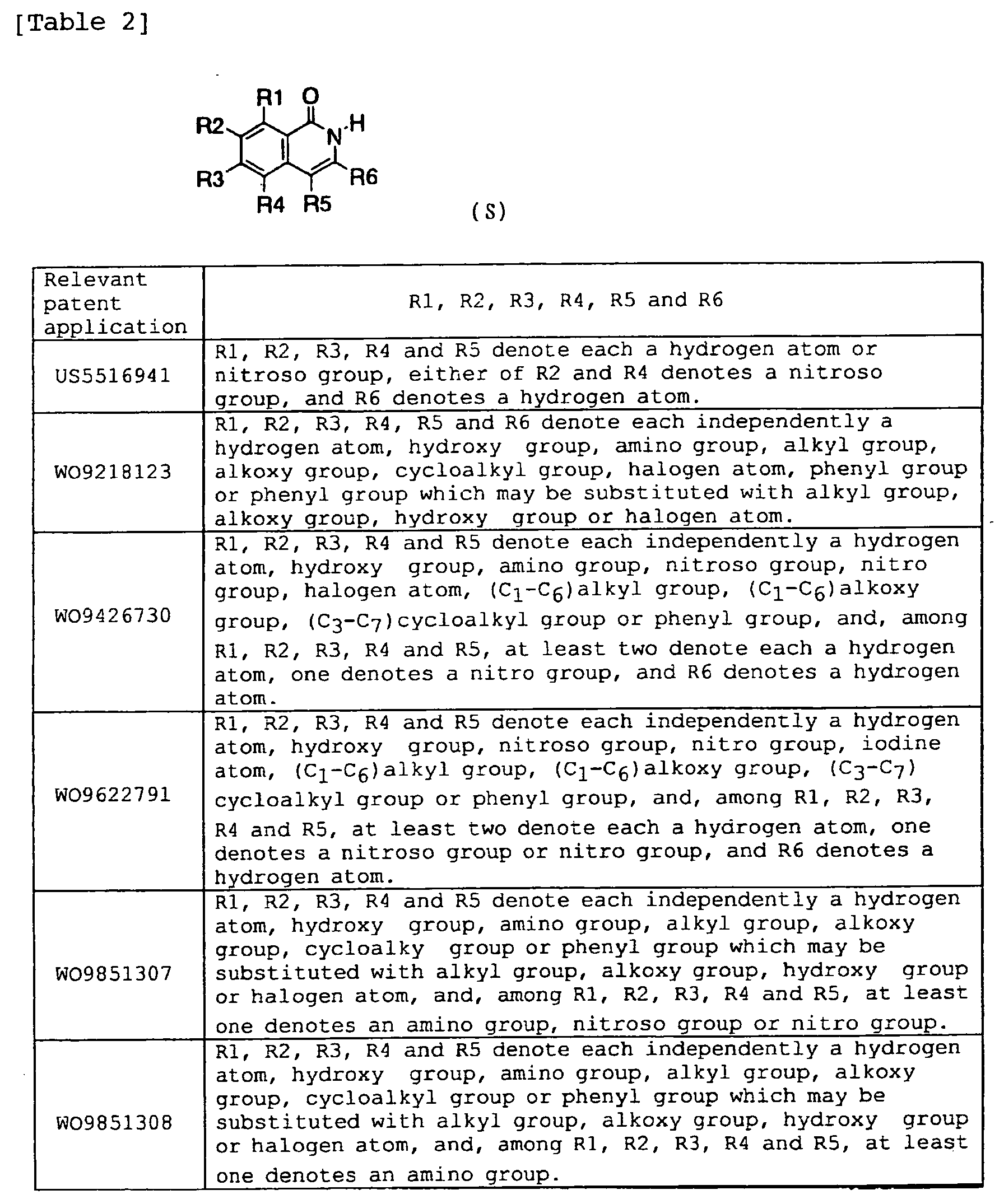 are known, but the isoquinolinone derivatives disclosed in the
specifications of these patent applications are only 5-nitrosoisoquinolinones,
and there are no descriptions with respect
to the isoquinolinone derivatives with hydroxy group at 5-position
and aryl group at 4-position, which is a feature of the inventive
compounds.
are known, but the isoquinolinone derivatives disclosed in the
specifications of these patent applications are only 5-nitrosoisoquinolinones,
and there are no descriptions with respect
to the isoquinolinone derivatives with hydroxy group at 5-position
and aryl group at 4-position, which is a feature of the inventive
compounds.
Furthermore, as structure-resemblant compounds with the PARP
inhibitory activity, in WO0044726, compounds represented by a
formula (T)
 [wherein R1 denotes a C1~4 alkyl group substituted with hydroxy group
or amino group, or -A1-A2-A3 (wherein A1 denotes-NR3C(O)-, -NR4C(S)-,
-NR5SO2- or the like, A2 denotes a C1~8 alkylene group, C2-8
alkenylene group, Cyc1 or the like, and A3 denotes a hydrogen atom,
-NR17R18, Cyc2, -OR19 or the like)] (a part was extracted for the
explanation of substituents), and, in WO0067734, compounds
represented by a formula (U)
[wherein R1 denotes a C1~4 alkyl group substituted with hydroxy group
or amino group, or -A1-A2-A3 (wherein A1 denotes-NR3C(O)-, -NR4C(S)-,
-NR5SO2- or the like, A2 denotes a C1~8 alkylene group, C2-8
alkenylene group, Cyc1 or the like, and A3 denotes a hydrogen atom,
-NR17R18, Cyc2, -OR19 or the like)] (a part was extracted for the
explanation of substituents), and, in WO0067734, compounds
represented by a formula (U)
 [wherein R1 denotes a hydrogen atom, halogen atom, straight chain
or branched C1-C6-alkyl group, hydroxy group, nitro group, CF3, CN,
NR11R12, NH-CO-R13 or O-C1-C4-alkyl group (wherein R11 and R12 denote
each independently a hydrogen atom or C1-C4-alkyl group, and R13
denotes a hydrogen atom, C1-C4-alkylgroup, C1-C4-alkyl-phenyl group
or phenyl group), A1 denotes a straight chain or branched C0-C6-alkylene
group, A2 denotes NR2,NR2-C1-C6-alkyl-, O or the like, and
A3 denotes a 5- to 6-membered monocyclic or bicyclic aromatic ring
which may have substituents or hetero aromatic ring] (a part was
extracted for the explanation of substituents), are known, but all
of these are phthalazinone derivatives, hence the structure is
different from that of the inventive compounds being isoquinolinone
derivatives. In addition, no compounds with hydroxy group at a
portion corresponding to 5-position of isoquinolinone, that is, at
5-position of phthalazinone are disclosed.
[wherein R1 denotes a hydrogen atom, halogen atom, straight chain
or branched C1-C6-alkyl group, hydroxy group, nitro group, CF3, CN,
NR11R12, NH-CO-R13 or O-C1-C4-alkyl group (wherein R11 and R12 denote
each independently a hydrogen atom or C1-C4-alkyl group, and R13
denotes a hydrogen atom, C1-C4-alkylgroup, C1-C4-alkyl-phenyl group
or phenyl group), A1 denotes a straight chain or branched C0-C6-alkylene
group, A2 denotes NR2,NR2-C1-C6-alkyl-, O or the like, and
A3 denotes a 5- to 6-membered monocyclic or bicyclic aromatic ring
which may have substituents or hetero aromatic ring] (a part was
extracted for the explanation of substituents), are known, but all
of these are phthalazinone derivatives, hence the structure is
different from that of the inventive compounds being isoquinolinone
derivatives. In addition, no compounds with hydroxy group at a
portion corresponding to 5-position of isoquinolinone, that is, at
5-position of phthalazinone are disclosed.
Moreover, as structure-resemblant compounds of 4-substituted
aryl-5-hydroxyisoquinolinone derivatives, in US4897391, as
compounds with antiallergy, anti-inflammation and inhibitory effect
on abnormal proliferation, compounds represented by a formula (V)
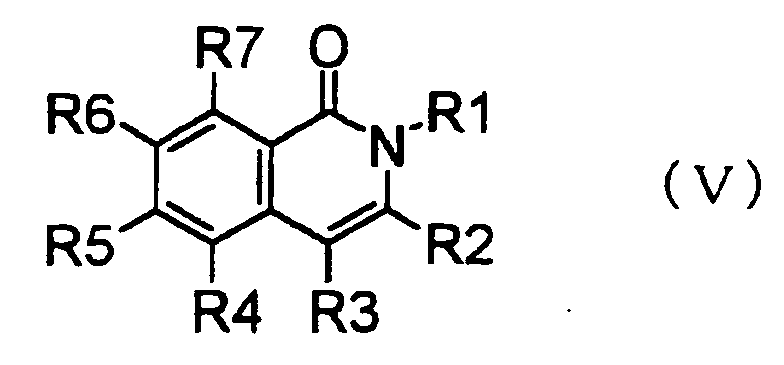 [wherein R1 denotes a hydrogen atom, alkyl group, arylmethyl group
or the like, R2 denotes a hydrogen atom, alkyl group, arylgroup or
the like, R3 denotes a hydrogen atom, alkyl group, arylmethyl group,
aryl group or the like, R4 and R6 denote each independently a hydrogen
atom, halogen atom, -OR8 (wherein R8 denotes independently a hydrogen
atom or alkyl group) or the like, and, between R4 and R6, at least
one denotes -SH, -OH, -NHR8 or the like, and R5 and R7 denote each
independently a hydrogen atom, halogen atom, -CF3 or the like] (a
part was extracted for the explanation of substituents), are known,
but all of the compounds described in the specification of this patent
application have the same substituents at 5-position and7-position
of isoquinolinone ring, and no compounds with hydroxy group only
at 5-position as the inventive compounds do are disclosed. In
addition, it is difficult to prepare the compounds with hydroxy group
only at 5-position as the inventive compounds through the preparative
process disclosed. Further, also with respect to aryl group at
4-position, only phenyl group is disclosed and phenyl group having
substituents and hetero aryl group is not disclosed. Also, the PARP
inhubitory activity is not described at all.
[wherein R1 denotes a hydrogen atom, alkyl group, arylmethyl group
or the like, R2 denotes a hydrogen atom, alkyl group, arylgroup or
the like, R3 denotes a hydrogen atom, alkyl group, arylmethyl group,
aryl group or the like, R4 and R6 denote each independently a hydrogen
atom, halogen atom, -OR8 (wherein R8 denotes independently a hydrogen
atom or alkyl group) or the like, and, between R4 and R6, at least
one denotes -SH, -OH, -NHR8 or the like, and R5 and R7 denote each
independently a hydrogen atom, halogen atom, -CF3 or the like] (a
part was extracted for the explanation of substituents), are known,
but all of the compounds described in the specification of this patent
application have the same substituents at 5-position and7-position
of isoquinolinone ring, and no compounds with hydroxy group only
at 5-position as the inventive compounds do are disclosed. In
addition, it is difficult to prepare the compounds with hydroxy group
only at 5-position as the inventive compounds through the preparative
process disclosed. Further, also with respect to aryl group at
4-position, only phenyl group is disclosed and phenyl group having
substituents and hetero aryl group is not disclosed. Also, the PARP
inhubitory activity is not described at all.
Moreover, compounds represented by a formula (W) described in
Table 3
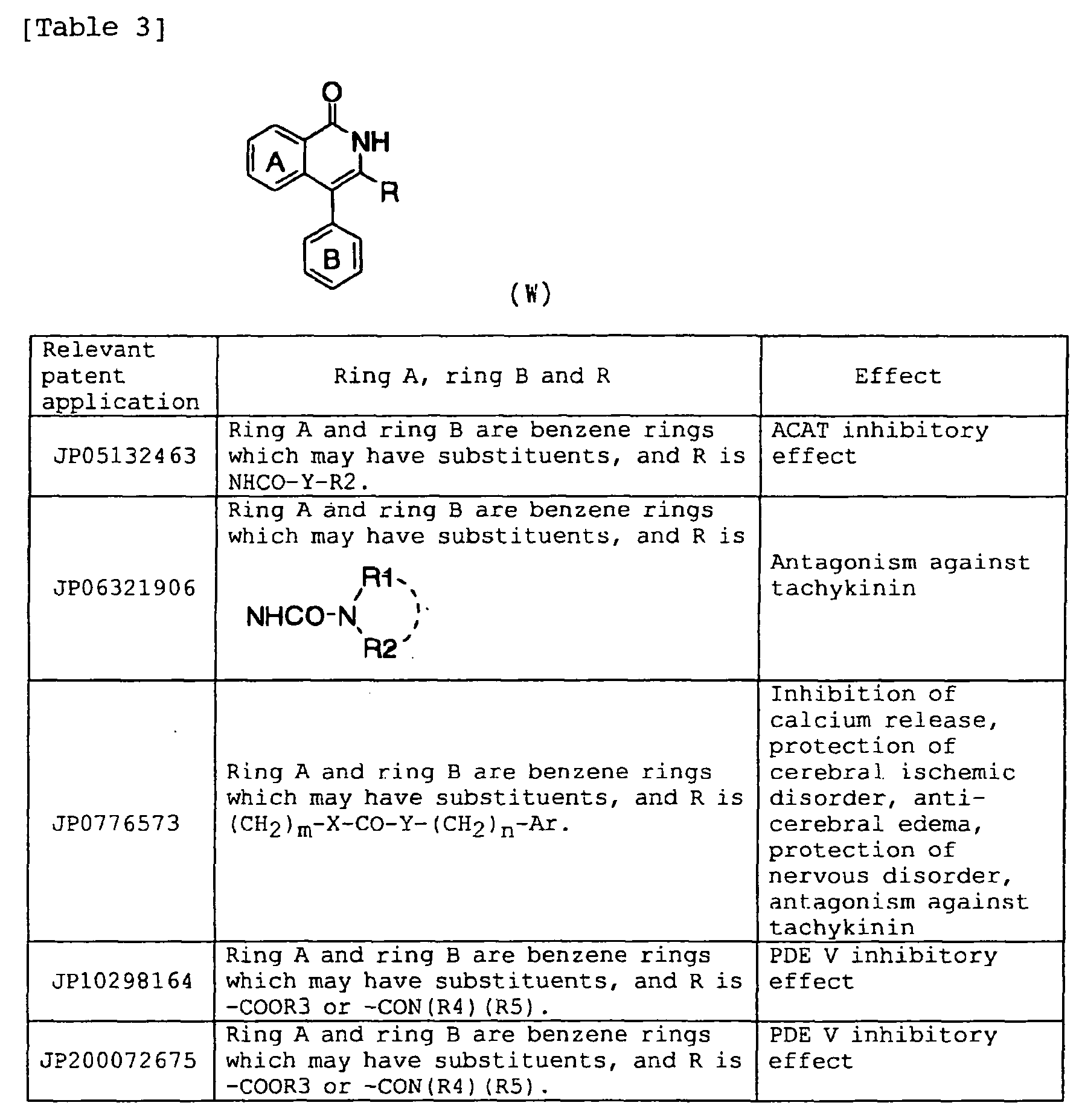 are known, but compounds with substituent other than hydrogen atom
at 2-position and hydroxy group at 5-position as well are not
disclosed in all cases, hence the structure is different from that
of the inventive compounds. Alao, the PARP inhibitory activity is
not described at all.
are known, but compounds with substituent other than hydrogen atom
at 2-position and hydroxy group at 5-position as well are not
disclosed in all cases, hence the structure is different from that
of the inventive compounds. Alao, the PARP inhibitory activity is
not described at all.
The invention is to provide a novel compound with PARP inhibitory
activity, the development of which is expected as a preventive and
/ or therapeutic drug for the diseases originating from excessive
activation of PARP, for example, various ischemic diseases (cerebral
infarction, cardiac infarction, acute renal failure, etc.),
inflammatory diseases (inflammatory enteric disease, multiple
cerebrosclerosis, arthritis, chronic rheumatism, etc.), nerve-degenerative
diseases (Alzheimer's disease, Huntington's chorea,
Parkinson disease, etc.), diabetes and its complications, cephalic
injury and the like.
As a result of diligent studies aiming at the development of a
novel compound with PARP inhibitory activity, the inventors have
found that 4-substituted aryl-5-hydroxyisoquinolinone derivatives
and their pharmacologically acceptable addition salts have excellent
PARP inhibitory effect.
Namely, according to the invention, it has been found that
4-substituted aryl-5-hydroxyisoquinolinone derivatives
represented by a general formula (1)
 [wherein ring Ar denotes a phenyl group, naphthyl group, 5- or
6-membered heterocycle and its condensed ring, R1 denotes a hydrogen
atom or halogen atom, R2 denotes a hydrogen atom, halogen atom,
hydroxy group, lower alkyl group which may be substituted with
halogen atom, cycloalkyl group which may be substituted with halogen
atom, lower alkoxy group which may be substituted with halogen atom,
aralkyloxy group which may have substituents, nitro group, amino
group which may have substituents, aralkyl group which may have
substituents, phenyl group which may have substituents, naphthyl
group which may have substituents, or 5-or 6-membered heterocycle
which may have substituents and its condensed ring, A denotes a C1~C4
alkylene or C2~C4 alkenylene, R3 denotes a hydrogen atom, lower alkyl
group which may be substituted with halogen atom, or general formula
(2)
[wherein ring Ar denotes a phenyl group, naphthyl group, 5- or
6-membered heterocycle and its condensed ring, R1 denotes a hydrogen
atom or halogen atom, R2 denotes a hydrogen atom, halogen atom,
hydroxy group, lower alkyl group which may be substituted with
halogen atom, cycloalkyl group which may be substituted with halogen
atom, lower alkoxy group which may be substituted with halogen atom,
aralkyloxy group which may have substituents, nitro group, amino
group which may have substituents, aralkyl group which may have
substituents, phenyl group which may have substituents, naphthyl
group which may have substituents, or 5-or 6-membered heterocycle
which may have substituents and its condensed ring, A denotes a C1~C4
alkylene or C2~C4 alkenylene, R3 denotes a hydrogen atom, lower alkyl
group which may be substituted with halogen atom, or general formula
(2)
-Q1-R5
(wherein Q1 denotes a C1~C4 alkylene, and R5 denotes a hydroxy group,
lower alkoxy group which may be substituted with halogen atom, amino
group which may have substituents, lower alkoxycarbonyl group or
carboxy group), R4 denotes a lower alkyl group which may be
substituted with halogen atom, cycloalkyl group which may have
substituents, phenyl group which may have substituents, naphthyl
group which may have substituents, or 5- or 6-membered heterocycle
which may have substituents and its condensed ring, general formula
(3)
-Q2-R6
(wherein Q2 denotes a C1~C4 alkylene, and R6 denotes a hydroxy group,
lower alkoxy group which may be substituted with halogen atom, lower
alkoxycarbonyl group, carboxy group, cycloalkyl group which may have
substituents, cycloalkenyl group which may have substituents, phenyl
group which may have substituents, naphthyl group which may have
substituents, or 5- or 6-membered heterocycle which may have
substituents and its condensed ring), or general formula (4)
 (wherein R7 and R8 denote identically or differently hydrogen atoms,
lower alkyl groups which may be substituted with halogen atom,
aralkyl groups which may have substituents, or R7 and R8 are bound
together to form a 5- or 6-membered heterocycle which may have
substituents and its condensed ring), or R3 and R4 are bound together
to form a 5- or 6-membered heterocycle which may have substituents
and its condensed ring],and their pharmacologically acceptable
addition salts, and 4-substituted aryl-5-hydroxyisoquinolinone
derivatives represented by a general formula (1d)
(wherein R7 and R8 denote identically or differently hydrogen atoms,
lower alkyl groups which may be substituted with halogen atom,
aralkyl groups which may have substituents, or R7 and R8 are bound
together to form a 5- or 6-membered heterocycle which may have
substituents and its condensed ring), or R3 and R4 are bound together
to form a 5- or 6-membered heterocycle which may have substituents
and its condensed ring],and their pharmacologically acceptable
addition salts, and 4-substituted aryl-5-hydroxyisoquinolinone
derivatives represented by a general formula (1d)
 [wherein R1 denotes a hydrogen atom or halogen atom, R2a denotes
a hydrogen atom, halogen atom, hydroxy group, lower alkyl group which
may be substituted with halogen atom, lower alkoxy group which may
be substituted with halogen atom, nitro group, or amino group which
may have substituents, A1 denotes a C1~C4 alkylene, R3a denotes a
hydrogen atom or lower alkyl group which may be substituted with
halogen atom, R4b denotes a lower alkyl group which may be substituted
with halogen atom, or general formula (3a)
[wherein R1 denotes a hydrogen atom or halogen atom, R2a denotes
a hydrogen atom, halogen atom, hydroxy group, lower alkyl group which
may be substituted with halogen atom, lower alkoxy group which may
be substituted with halogen atom, nitro group, or amino group which
may have substituents, A1 denotes a C1~C4 alkylene, R3a denotes a
hydrogen atom or lower alkyl group which may be substituted with
halogen atom, R4b denotes a lower alkyl group which may be substituted
with halogen atom, or general formula (3a)
-Q2-R6a
(wherein Q2 denotes a C1~C4 alkylene, and R6a denotes a cycloalkyl
group which may have substituents, cycloalkenyl group which may have
substituents, phenyl group which may have substituents, naphthyl
group which may have substituents, or 5- or 6-membered heterocycle
which may have substituents and its condensed ring), or R3a and R4b
are bound together to form a 5- or 6-membered heterocycle which may
have substituents and its condensed ring],and their
pharmacologically acceptable addition salts, have excellent PARP
inhibitory effect, leading to the completion of the invention.
In the general formula (1) of the inventive compounds, preferably,
compounds, ring Ar being phenyl group, R1 being hydrogen atom, and
A being C1~C4 alkylene, are mentioned. As these preferable compounds,
for example, compounds listed in following Tables 4 through 12 can
be mentioned, but the invention is not confined to these compounds
or their pharmacologically acceptable addition salts.

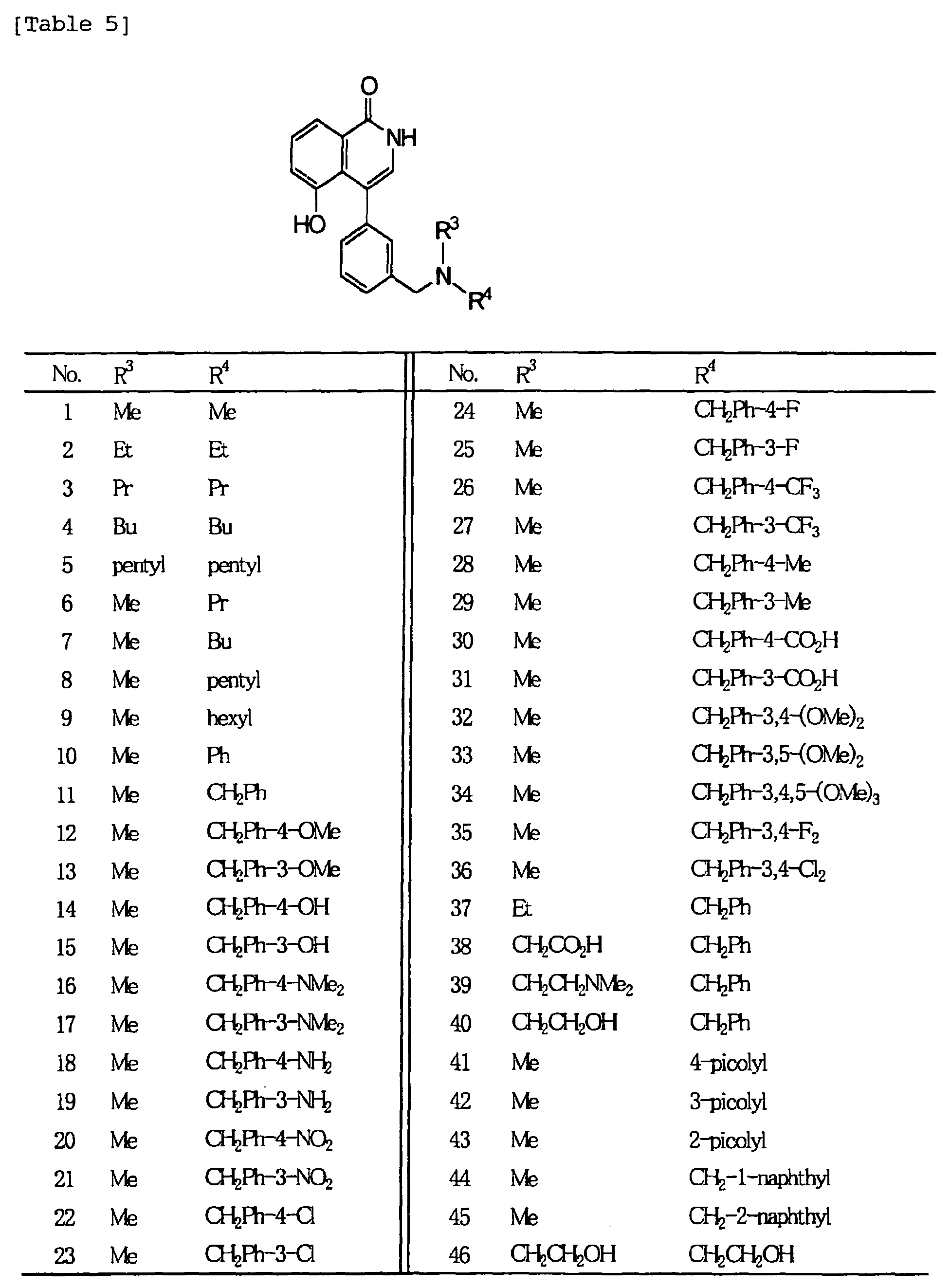


In Tables 4 through 12 aforementioned, as more preferable
compounds, exemplified nos. 1 to 12, 14, 16, 18, 37 to 39, 42 and
44 described in Table 4, exemplified nos. 1 to 3 described in Table
5, exemplified nos. 2, 6 to 9, and 24 described in Table 6, exemplified
nos. 2, 3, 8, 9, 11 to 18, 20, 22, 24, 32, 34, 36, 39, 40 and 48
described in Table 7, exemplified nos. 1 to 17, 20 to 22, 24, 25
and 27 to 29 described in Table 9, exemplified nos. 1 to 4, 6, 7,
9, 10, 14 to 16, 19 to 21 and 24 described in Table 10, exemplified
nos. 1 and 2 described in Table 11, and exemplified nos. 2, 8, 19
and 25 described in Table 12 can be mentioned.
In the description of the general formula (1) of the invention,
for "halogen atoms" in "lower alkyl group which may be substituted
with halogen atom", "cycloalkyl group which may be substituted with
halogen atom" and "lower alkoxy group which may be substituted with
halogen atom", fluorine, chlorine, bromine and iodine are mentioned,
for ,lower alkyl groups" , straight chain or branched ones with carbon
atoms of 1 to 6 such as methyl, ethyl, n-propyl and iso-propyl are
mentioned, for "cycloalkyl groups", ones with carbon atoms of 3 to
7 such as cyclopropyl, cyclopentyl and cyclohexyl are mentioned,
and, for "lower alkoxy groups", straight chain or branched ones with
carbon atoms of 1 to 5 such as methoxy, ethoxy and propoxy are
mentioned. Moreover, in the text, for substituents in "cycloalkyl
group which may have substituents", "cycloalkenyl group which may
have substituents", "aralkyl group which may have substituents",
"aralkyloxy group which may have substituents", "phenyl group which
may have substituents", "naphthyl group which may have substituents",
and "5- or 6- membered heterocycle which may have substituents and
its condensed ring", halogen atom, hydroxy group, lower alkyl group
which may be substituted with halogen atom, lower alkoxy group which
may be substituted with halogen atom, lower alkylthio group, lower
alkoxycarbonyl group, nitro group, amino group which may have
substituents, cyano group, carboxy group, aldehyde group, lower
alkyl group substituted with hydroxy group, lower alkyl group
substituted with carboxy group, lower alkyl group substituted with
amino group, which may be substituted with lower alkyl group which
may be substituted with halogen atom or aralkyl group which may have
substituents, lower alkyl group substituted with 5- or 6-membered
cycloamino group which may have substituents, lower alkoxy group
substituted with hydroxy group, lower alkoxy group substituted with
carboxy group, lower alkoxy group substituted with amino group, which
may be substituted with lower alkyl group which may be substituted
with halogen atom or aralkyl group which may have substituents, lower
alkoxy group substituted with 5- or 6-membered cycloamino group which
may have substituents, aralkyl group which may have substituents,
phenyl group which may have substituents, naphthyl group which may
have substituents, 5- or 6-membered heterocycle group which may have
substituents, etc. are mentioned, for "lower alkoxycarbonyl groups",
straight chain or branched ones with carbon atoms of 1 to 6 such
as methoxycarbonyl and ethoxycarbonyl, for "amino groups which may
have substituents", amino groups, which may be substituted with acyl
group, lower alkylsulfonyl group which may be substituted with
halogen atom or arylsulfonyl group, for example, with acetyl,
methanesulfonyl, phenylsulfonyl or the like, or which may be
substituted with lower alkyl group which may be substituted with
halogen atom, phenyl group which may have substituents and aralkyl
group which may have substituents, are mentioned, for "5- or 6-membered
cycloamino groups" in "5- or 6-membered cycloamino group
which may have substituents", pyrrolidyl, piperidyl, piperazyl,
morpholyl, thiomorpholyl, etc.are mentioned, for "cycloalkenyl
groups" in "cycloalkenyl group which may have substituents", ones
with carbon atoms of 5 to 7 such as cyclopentenyl and cyclohexenyl
are mentioned, and, for "aralkyl groups" in "aralkyl group which
may have substituents "and "aralkyloxy group which may have
substituents", benzyl, diphenylmethyl, phenethyl, phenylpropyl,
etc. are mentioned. The substituents referred to so here indicate
"substituents" as explained above. Moreover, "heterocycles" in "5-
or 6-membered heterocycle and its condensed ring" are saturated or
unsaturated monocyclic or polycyclic heterocycle groups which may
have substituents and which can contain one or more nitrogen, oxygen
or sulfur atoms, and, for example, pyrrolidyl, piperidyl, piperazyl,
morpholyl, thiomorpholyl, tetrahydropyridyl, furanyl, thienyl,
pyrazolyl, imidazolyl,
oxazolyl, thiazolyl, pyridyl, pyrimidyl, pyridazyl, pyrazyl, etc.
are mentioned, and "its condensed ring" indicates benzene-condensed
rings of said "heterocycles" (for example, indolyl,
tetrahydroquinolyl, benzoxazolidinyl, benzothiazolidinyl,
benzofuranyl, benzothienyl, benzimidazolyl,quinolyl,
tetrahydroquinolyl, isoquinolyl, tetrahydroisoquinolyl,
quinazolyl, quinoxalyl, cinnolyl, etc. are mentioned), or condensed
rings consisting of two rings selected arbitrarily from said
"heterocycles" (for example, imidazopyridine, pyrazolopyridine,
imidazopyrimidine, etc. are mentioned).
The compounds represented by the general formula (1) of the
invention can be converted to pharmacologically acceptable salts,
if need be. For the pharmacologically acceptable salts, for example,
salts with inorganic acids such as hydrochloric acid, hydrobromic
acid and sulfuric acid, salts with organic acids such as acetic acid,
fumaric acid, maleic acid, oxalic acid, citric acid, methanesulfonic
acid and tosylic acid, and salts with bases such as sodium salt,
potassium salt, calcium salt and ammonium salt are mentioned.
Moreover, the compounds represented by the general formula (1)
and their pharmacologically acceptable salts of the invention may
be their intramolecular salts, their anhydrides, hydrates or
solvates.
The compounds with PARP inhibitory activity of the invention
represented by the general formula (1) can be prepared through
processes shown below, or in combination of publicly known processes.

In said formulae, ring Ar, A, R1, R2, R3 and R4 denote the same
meanings as described above, R9 denotes a lower alkyl group which
may be substituted with halogen atom or aralkyl group which may have
substituents, R10 denotes a lower alkyl group which may be
substituted with halogen atom, aralkyl groupwhich may have
substituents or acyl group, and X denotes a halogen atom.
The conversion from compounds represented by the general formula
(5) to compounds represented by the general formula (6) (process I-A)
can be performed by using compounds represented by a general formula
(8)
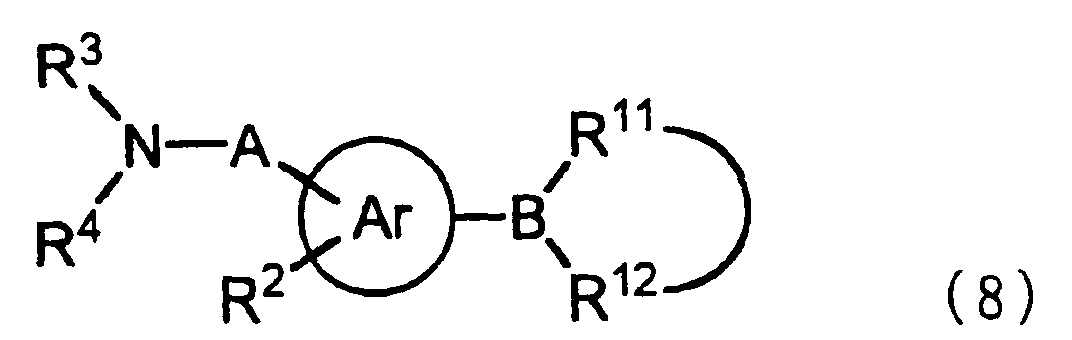 (wherein ring Ar, A, R2, R3 and R4 denote the same meanings as
described above, R11 and R12 denote identically or differently
hydroxy groups, lower alkyl groups or lower alkoxy groups, or R11
and R12 may be bound together to form a 5- or 6-membered cyclic pinacol
ester which may be substituted with lower alkyl group), and by
reacting for 1 to 48 hours at 20 to 160°C in a suitable solvent, for
example, tetrahydrofuran, N,N-dimethylformamide, benzene, toluene,
mixed solvent thereof or the like in the presence of a suitable
catalyst, for example, tetrakis(triphenylphosphine)palladium(0),
bis(triphenylphosphine)palladium(II) chloride, (1,1'-bis
(diphenylphosphino) ferrocene)palladium(II) chloride or the like,
after adding a suitable base, for example, sodium hydroxide, sodium
carbonate, potassium carbonate, sodium hydrogencarbonate,
triethylamine, N,N-diisopropylethylamine or the like.
(wherein ring Ar, A, R2, R3 and R4 denote the same meanings as
described above, R11 and R12 denote identically or differently
hydroxy groups, lower alkyl groups or lower alkoxy groups, or R11
and R12 may be bound together to form a 5- or 6-membered cyclic pinacol
ester which may be substituted with lower alkyl group), and by
reacting for 1 to 48 hours at 20 to 160°C in a suitable solvent, for
example, tetrahydrofuran, N,N-dimethylformamide, benzene, toluene,
mixed solvent thereof or the like in the presence of a suitable
catalyst, for example, tetrakis(triphenylphosphine)palladium(0),
bis(triphenylphosphine)palladium(II) chloride, (1,1'-bis
(diphenylphosphino) ferrocene)palladium(II) chloride or the like,
after adding a suitable base, for example, sodium hydroxide, sodium
carbonate, potassium carbonate, sodium hydrogencarbonate,
triethylamine, N,N-diisopropylethylamine or the like.
Compounds, R10 being acyl group, among compounds represented by
the general formula (6) can be converted to compounds represented
by the general formula (7) (process I-B). Namely, the conversion
can be performed by using a suitable base, for example, sodium
hydroxide, potassium hydroxide, lithium hydroxide, potassium
carbonate, sodium hydrogencarbonate, ammonia or the like, and by
reacting for 0.5 to 24 hours at 0 to 100°C in a suitable solvent,
for example, water, methanol, ethanol, tetrahydrofuran, 1,4-dioxane,
mixed solvent thereof or the like.
The conversion from compounds represented by the general formula
(7) to compounds represented by the general formula (1) (process I-C)
can be performed by using a suitable acid, for example, hydrochloric
acid, hydrobromic acid, sulfuric acid, trifluoroacetic acid or the
like, or a suitable dealkylating agent, for example, trimethylsilyl
iodide, boron tribromide or the like, and by reacting for 1 to 72
hours at 20 to 120°C without solvent or in a suitable solvent, for
example, water, acetic acid, methanol, dichloromethane, mixed
solvent thereof or the like.
Moreover, compounds, R10 being lower alkyl group which may be
substituted with halogen atom or aralkyl group which may have
substituents, among compounds represented by the general formula
(6) can be converted directly to compounds represented by the general
formula (1) (process I-D). Namely, the conversion can be performed
by using a suitable acid, for example, hydrochloric acid, hydrobromic
acid, sulfuric acid, trifluoroacetic acid or the like, or a suitable
dealkylating agent, for example, trimethylsilyl iodide, boron
tribromide or the like, and by reacting for 1 to 72 hours at 20 to
120°C without solvent or in a suitable solvent, for example, water,
acetic acid, methanol, dichloromethane, mixed solvent thereof or
the like. Also, it is possible to react these suitable acid and
suitable dealkylating agent over twice stepwise.
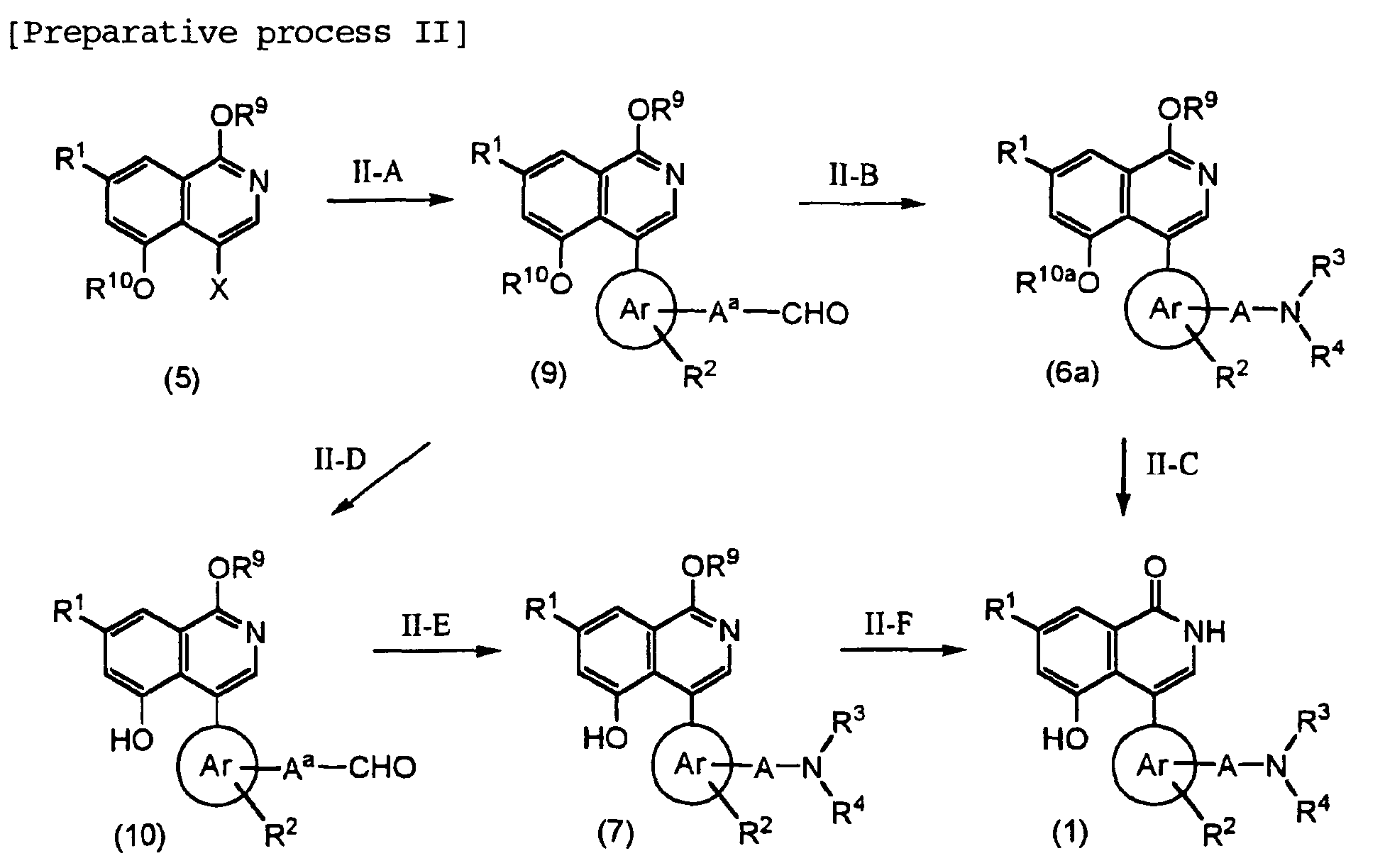
In said formulae, ring Ar, A, R1, R2, R3, R4, R9, R10 and X denote
the same meanings as described above, Aa denotes a single bond, C1~C3
alkylene or C2~C3 alkenylene, and R10a denotes a lower alkyl group
which may be substituted with halogen atom or aralkyl group which
may have substituents. The conversion from compounds represented
by the general formula (5) to compounds represented by the general
formula (9)(process II-A) can be performed through the process
similar to process I-A, using compounds represented by a general
formula (11)
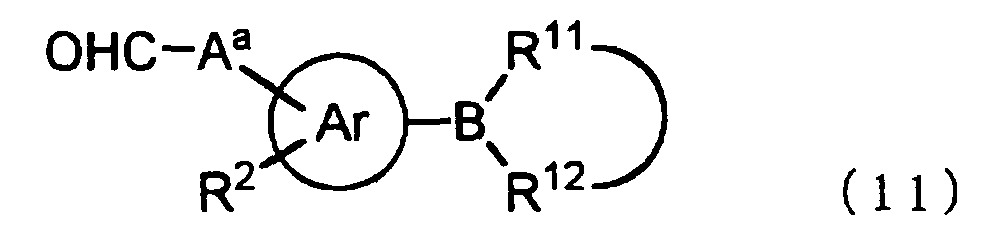 (wherein ring Ar, Aa, R2, R11 and R12 denote the same meanings as
described above).
(wherein ring Ar, Aa, R2, R11 and R12 denote the same meanings as
described above).
Compounds, R10 being lower alkyl group which may be substituted
with halogen atom or aralkyl group which may have substituents, among
compounds represented by the general formula (9) can be converted
to compounds represented by the general formula (6a) (process II-B).
Namely, the conversion can be performed by using compounds
represented by a general formula (12)
 (wherein R3 and R4 denote the same meanings as described above),
and by reacting for 1 to 24 hours at 0 to 60°C in a suitable solvent,
for example, methanol, ethanol, dichloromethane, chloroform, mixed
solvent thereof or the like, and, if need be, in the presence of
a suitable acid, for example, hydrochloric acid, hydrobromic acid,
acetic acid or the like, or a suitable Lewis acid, for example,
aluminum chloride, zinc chloride or the like, after adding a suitable
reducing agent, for example, lithium borohydride, sodium borohydride,
sodium cyanoborohydride or the like.
(wherein R3 and R4 denote the same meanings as described above),
and by reacting for 1 to 24 hours at 0 to 60°C in a suitable solvent,
for example, methanol, ethanol, dichloromethane, chloroform, mixed
solvent thereof or the like, and, if need be, in the presence of
a suitable acid, for example, hydrochloric acid, hydrobromic acid,
acetic acid or the like, or a suitable Lewis acid, for example,
aluminum chloride, zinc chloride or the like, after adding a suitable
reducing agent, for example, lithium borohydride, sodium borohydride,
sodium cyanoborohydride or the like.
The conversion from compounds represented by the general formula
(6a) to compounds represented by the general formula (1) (process
II-C) can be performed through the process similar to process I-D.
Moreover, compounds, R10 being acyl group, among compounds
represented by the general formula (9) can be converted to compounds
represented by the general formula (10) (process II-D) through the
process similar to process I-B.
The conversion from compounds represented by the general formula
(10) to compounds represented by the general formula (7) (process
II-E) can be performed through the process similar to process II-B,
using compounds represented by the general formula (12)
 (wherein R3 and R4 denote the same meanings as described above).
The conversion from compounds represented by the general formula
(7) to compounds represented by the general formula (1) (process II-F)
can be performed through the process similar to process I-C.

In said formulae, ring Ar, A, Aa, R1, R2, R3, R4, R9, R10 and
X denote the same meanings as described above.
The conversion from compounds represented by the general formula
(5) to compounds represented by the general formula (13) (process
III-A) can be performed through the process similar to process I-A,
using compounds represented by a general formula (15)
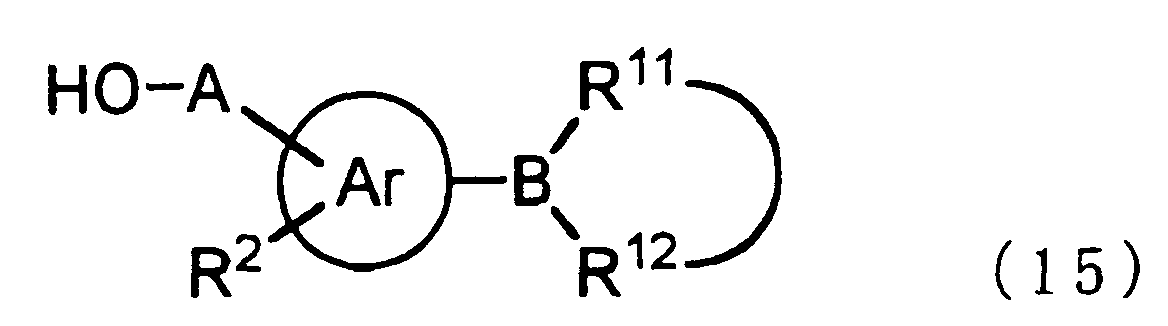 (wherein ring Ar, A, R2, R11 and R12 denote the same meanings as
described above).
(wherein ring Ar, A, R2, R11 and R12 denote the same meanings as
described above).
The conversion from compounds represented by the general formula
(13) to compounds represented by the general formula (6) (process
III-B) can be performed by using a suitable halogenating agent, for
example, thionyl chloride, phosphorus oxychloride, thionyl bromide
or the like, and by reacting for 0.5 to 6 hours at -20 to 80°C without
solvent or in a suitable solvent, for example, dichloromethane,
chloroform, tetrahydrofuran, mixed solvent thereof or the like, or
by using a suitable sulfonylating agent, for example, methanesulfonyl
chloride, trifluoromethanesulfonic anhydride or the like, and by
reactkng for 0.5 to 3 hours at -20 to 60°C in a suitable solvent,
for example, dichloromethane, tetrahydrofuran, N,N-dimethylformamide,
mixed solvent thereof or the like, and then by
using compounds represented by the general formula (12)
 (wherein R3 and R4 denote the same meanings as described above), and
by reacting for 1 to 12 hours at 0 to 120°C in a suitable solvent,
for example, methanol, dichloromethane, tetrahydrofuran, N,N-dimethylformamide,
mixed solvent thereof or the like, and, if need
be, in the presence of a suitable iodide, for example, sodium iodide,
potassium iodide, tetrabutylammonium iodide or the like, or a
suitable base, for example, triethylamine, pyridine, N,N-diisopropylethylamine
or the like.
(wherein R3 and R4 denote the same meanings as described above), and
by reacting for 1 to 12 hours at 0 to 120°C in a suitable solvent,
for example, methanol, dichloromethane, tetrahydrofuran, N,N-dimethylformamide,
mixed solvent thereof or the like, and, if need
be, in the presence of a suitable iodide, for example, sodium iodide,
potassium iodide, tetrabutylammonium iodide or the like, or a
suitable base, for example, triethylamine, pyridine, N,N-diisopropylethylamine
or the like.
Compounds, R10 being lower alkyl group which may be substituted
with halogen atom or aralkyl group which may have substituents, among
compounds represented by the general formula (6) can be converted
to compounds represented by the general formula (1) (process III-C)
through the process similar to process I-D.
Moreover, compounds, R10 being acyl group, among compounds
represented by the general formula (6) can be converted to compounds
represented by the general formula (7) (process III-D) through the
process similar to process I-B.
Compounds, R10 being acyl group, among compounds represented by
the general formula (13) can be converted to compounds represented
by the general formula (14) (process III-E) through the process
similar to process I-B.
Moreover, compounds represented by the general formula (14) can
also be converted from compounds represented by the general formula
(10) (process III-F). Namely, the conversion can be performed by
using a suitable reducing agent, for example, lithium borohydride,
sodium borohydride, sodium cyanoborohydride or the like, and by
reacting for 0.5 to 12 hours at 0 to 80°C in a suitable solvent, for
example, methanol, ethanol, isopropanol, tetrahydrofuran, mixed
solvent thereof or the like.
The conversion from compounds represented by the general formula
(14) to compounds represented by the general formula (7) (process
III-G) can be performed by using a suitable halogenating agent, for
example, thionyl chloride, phosphorus oxychloride, thionyl bromide
or the like, and by reacting for 0.5 to 6 hours at -20 to 80°C without
solvent or in a suitable solvent, for example, dichloromethane,
chloroform, tetrahydrofuran, mixed solvent thereof or the like, and
then by using compounds represented by the general formula (12)
 (wherein R3 and R4 denote the same meanings as described above),and
by reacting for 1 to 12 hours at 0 to 120°C in a suitable solvent,
for example, methanol, dichloromethane, tetrahydrofuran, N,N-dimethylformamide,
mixed solvent thereof or the like, and, if need
be, in the presence of a suitable iodide, for example, sodium iodide,
potassium iodide, tetrabutylammonium iodide or the like.
(wherein R3 and R4 denote the same meanings as described above),and
by reacting for 1 to 12 hours at 0 to 120°C in a suitable solvent,
for example, methanol, dichloromethane, tetrahydrofuran, N,N-dimethylformamide,
mixed solvent thereof or the like, and, if need
be, in the presence of a suitable iodide, for example, sodium iodide,
potassium iodide, tetrabutylammonium iodide or the like.
The conversion from compounds represented by the general formula
(7) to compounds represented by the general formula (1)(process
III-H) can be performed through the process similar to process I-C.
In the Preparative process III aforementioned, compounds
represented by the general formula (13a), R10 being lower alkyl group
which may be substituted with halogen atom or aralkyl group which
may have substituents, among compounds represented by the general
formula (13) and compounds represented by the general formula (14)
can also be synthesized by a separate synthetic process (Preparative
process IV) shown below.

In said formulae, ring Ar, A, Aa, R1, R2, R9, R10, R10a and X
denote the same meanings as described above, Ab denotes a single
bond or methylene group, and R13 denotes a lower alkyl group which
may be substituted with halogen atom or aralkyl group which may have
substituents.
The conversion from compounds represented by the general formula
(5) to compounds represented by the general formula (16) (process
IV-A) can be performed through the process similar to process I-A,
using compounds represented by a general formula (18)
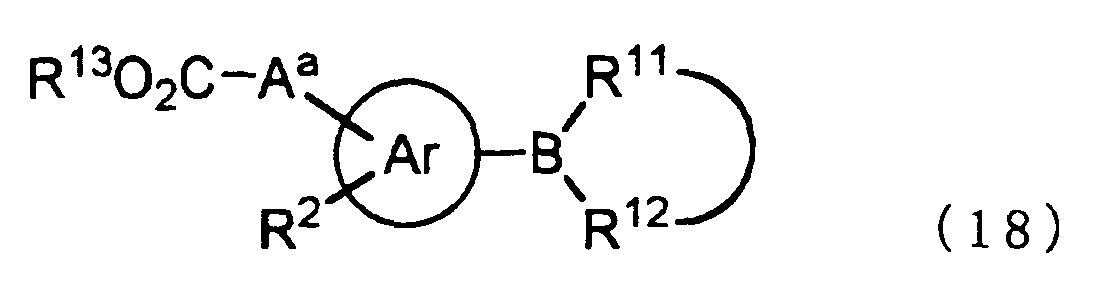 (wherein ring Ar, Aa, R2, R11, R12 and R13 denote the same meanings
as described above).
(wherein ring Ar, Aa, R2, R11, R12 and R13 denote the same meanings
as described above).
Moreover, compounds, Aa being C2~C3 alkenylene, among compounds
represented by the general formula (16) can also be converted from
compounds represented by the general formula (10a) (process IV-B).
Namely, the conversion can be performed by using compounds
represented by a general formula (19)
 (wherein R13 denotes the same meaning as described above, and R14
denotes a lower alkyl group), and by reacting for 1 to 6 hours at
-78 to 80°C in a suitable solvent, for example, methanol, benzene,
tetrahydrofuran, N,N-dimethylformamide, mixed solvent thereof or
the like, in the presence of a suitable base, for example, sodium
hydride, potassium carbonate, triethylamine, pyridine or the like.
(wherein R13 denotes the same meaning as described above, and R14
denotes a lower alkyl group), and by reacting for 1 to 6 hours at
-78 to 80°C in a suitable solvent, for example, methanol, benzene,
tetrahydrofuran, N,N-dimethylformamide, mixed solvent thereof or
the like, in the presence of a suitable base, for example, sodium
hydride, potassium carbonate, triethylamine, pyridine or the like.
Compounds, A10 being lower alkyl group which may be substituted
with halogen atom or aralkyl group which may have substituents, among
compounds represented by the general formula (16) can be converted
to compounds represented by the general formula (13a) through the
process IV-C. Namely, the conversion can be performed by using a
suitable reducing agent, for example, lithium borohydride, lithium
aluminum hydride or the like, and by reacting for 0.5 to 6 hours
at -20 to 60°C in a suitable solvent, for example, diethyl ether,
tetrahydrofuran or the like.
Moreover, compounds, R10 being acyl group, among compounds
represented by the general formula (16) can be converted to compounds
represented by the general formula (17) through the process IV-D.
Namely, the conversion can be performed by using a suitable sodium
lower alkoxide, for example, sodium methoxide, sodium ethoxide or
the like, and by reacting for 0.5 to 5 hours at -20 to 20°C in a suitable
solvent, for example, methanol, ethanol or the like.
The conversion from compounds represented by the general formula
(17) to compounds represented by the general formula (14) (process
IV-E) can be performed through the process similar to process IV-C.
Moreover, compounds represented by a general formula (1h) and
general formula (1i), A being ethylene or ethenylene and R2 being
nitro group which is substituted at ortho position of group
-A-NR3R4, among compounds represented by the general formula (1)
can also be synthesized, using processes shown below (Preparative
process V).
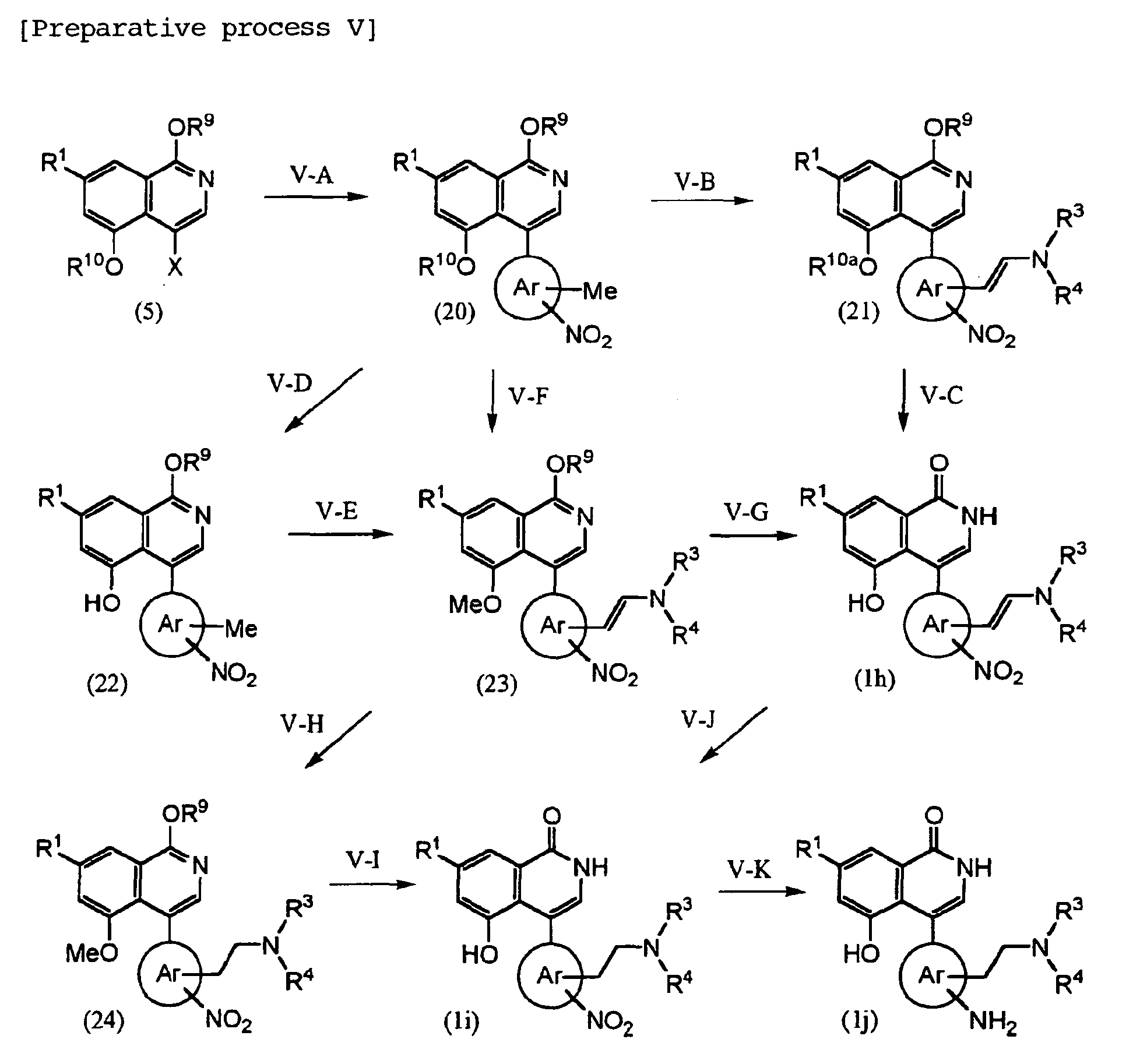
In said formulae, ring Ar, R1, R2, R3, R4, R9, R10, R10a and X
denote the same meanings as described above.
The conversion from compounds represented by the general formula
(5) to compounds represented by the general formula (20) (process
V-A) can be performed through the process similar to process I-A,
using compounds represented by a general formula (25)
 (wherein ring Ar, R11 and R12 denote the same meanings as described
above, and nitro group is substituted at ortho position of methyl
group).
(wherein ring Ar, R11 and R12 denote the same meanings as described
above, and nitro group is substituted at ortho position of methyl
group).
Compounds, R10 being lower alkyl group which may be substituted
with halogen atom or aralkyl group which may have substituents, among
compounds represented by the general formula (20) can be converted
to compounds represented by the general formula (21) through process
V-B. Namely, the conversion can be performed by using compounds
represented by a general formula (26)
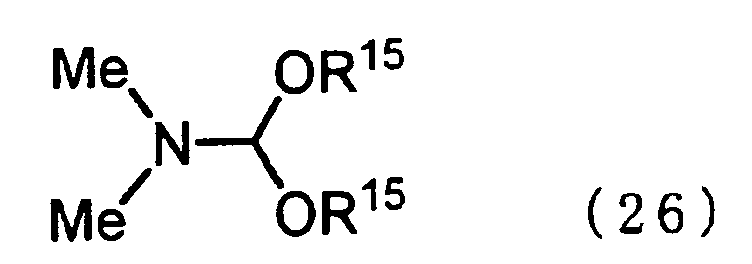 (wherein R15 denotes a lower alkyl group), and by reacting for 1
to 24 hours at 100 to 180°C in a suitable solvent, for example,
N,N-dimethylformamide, N,N-dimethylacetamide, N-methyl-2-pyrrolidinone
or the like, after adding compounds represented by
the general formula (12)
(wherein R15 denotes a lower alkyl group), and by reacting for 1
to 24 hours at 100 to 180°C in a suitable solvent, for example,
N,N-dimethylformamide, N,N-dimethylacetamide, N-methyl-2-pyrrolidinone
or the like, after adding compounds represented by
the general formula (12)
 (wherein R3 and R4 denote the same meanings as described above), if
need be.
(wherein R3 and R4 denote the same meanings as described above), if
need be.
The conversion from compounds represented by the general formula
(21) to compounds represented by the general formula (1h) (process
V-C) can be performed through the process similar to process I-D.
Compounds, R10 being acyl group, among compounds represented by
the general formula (20) can be converted to compounds represented
by the general formula (22) through the process similar to process
I-B.
The conversion from compounds represented by the general formula
(22) to compounds represented by the general formula (23) (process
V-E) can be performed through the process similar to process V-B,
using N,N-dimethylformamide as a solvent.
Moreover, compounds represented by the general formula (23) can
also be converted directly from compounds, R10 being acyl group,
among compounds represented by the general formula (20), (process
V-F) through the process similar to process V-E.
The conversion from compounds represented by the general formula
(23) to compounds represented by the general formula (1h) (process
V-G) can be performed through the process similar to process I-D.
Moreover, compounds represented by the general formula (23) can
be converted to compounds represented by the general formula (24)
through process V-H. Namely, the conversion can be performed by using
a suitable reducing agent, for example, sodium borohydride, lithium
borohydride or the like, and by reacting for 0.5 to 6 hours at 20
to 80°C in a suitable solvent, for example, methanol, ethanol,
tetrahydrofuran, mixed solvent thereof or the like.
The conversion from compounds represented by the general formula
(24) to compounds represented by the general formula (1i) (process
V-I) can be performed through the process similar to process I-D.
Moreover, compounds represented by the general formula (1i) can
be converted from compounds represented by the general formula (1h)
(process V-J) through the process similar to process V-H.
Furthermore, compounds represented by the general formula (1i)
can also be converted to compounds, A being ethylene and R2 being
amino group which is substituted at ortho position of group
-A-NR3R4, among compounds represented by the general formula (1)
(process V-K). Namely, the conversion can be performed by using a
suitable catalyst, for example, palladium on carbon, platinum on
carbon or the like, and by submitting to the hydrogenating reaction
for 1 to 12 hours at 20 to 80°C under ambient pressure or, if need
be, under pressure in a suitable solvent, for example, methanol,
tetrahydrofuran, N,N-dimethylformamide, mixed solvent thereof or
the like.
In the Preparative processes I through V, compounds represented
by the general formula (5), being starting compounds, can be
synthesized through processes shown below (Preparative process VI).
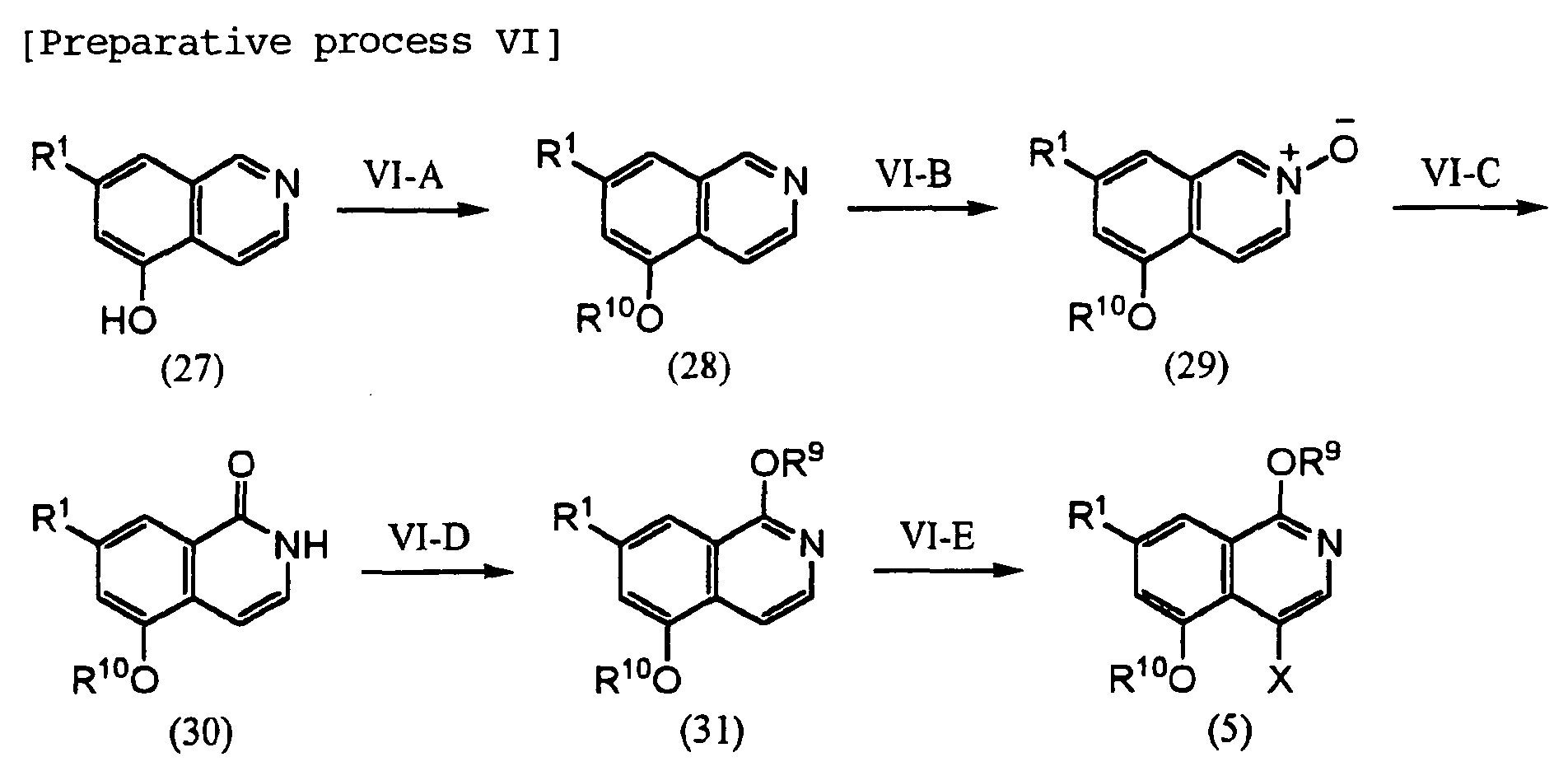
In said formulae, R1, R9, R10 and X denote the same meanings as
described above.
The conversion from compounds represented by the general formula
(27) to compounds represented by the general formula (28) (process
VI-A) can be performed, using compounds represented by a general
formula (32)
R10-X1
(wherein R10 denotes the same meaning as described above, and X1
denotes a halogen atom), and by reacting for 2 to 48 hours at 0 to
140°C in a suitable solvent, for example, toluene, ethyl acetate,
tetrahydrofuran, N,N-dimethylformamide, mixed solvent thereof or
the like in the presence of a suitable base, for example, sodium
hydride, potassium carbonate, triethylamine or the like.
The conversion from compounds represented by the general formula
(28) to compounds represented by the general formula (29) (process
VI-B) can be performed by using a suitable peroxide, for example,
3-chloroperbenzoic acid, magnesium monoperoxyphthalate or the like,
and by reacting for 4 to 72 hours at 0 to 80°C in a suitable solvent,
for example, benzene, dichloromethane, ethyl acetate, methanol or
the like.
The conversion from compounds represented by the general formula
(29) to compounds represented by the general formula (30) (process
VI-C) can be performed by using a suitable acid anhydride, for example,
acetic anhydride, trifluoroacetic anhydride or the like, and by
reacting for 1 to 24 hours at 40 to 120°C without solvent or in a
suitable solvent, for example, acetic acid, toluene, 1,4-dioxane,
mixed solvent thereof or the like, followed by using water and by
reacting for 2 to 48 hours at 60 to 120°C without solvent or in a
suitable solvent, for example, acetic acid, methanol, ethanol,
acetonitrile, mixed solvent thereof or the like.
The conversion from compounds represented by the general formula
(30) to compounds represented by the general formula (31) (process
VI-D) can be performed by using compounds represented by a general
formula (33)
R9-X2
(wherein R9 denotes the same meaning as described above, and X2
denotes a halogen atom), and by reacting for 1 to 24 hours at 60
to 110°C in a suitable solvent, for example, benzene, toluene, ethyl
acetate, mixed solvent thereof or the like in the presence of a
suitable silver salt, for example, silver oxide, silver
trifluoroacetate or the like, or by using a suitable halogenating
agent, for example, thionyl chloride, thionyl bromide, phosphorus
oxychloride or the like, and by reacting for 0.5 to 12 hours at 0
to 100°C without solvent or in a suitable solvent, for example,
dichloromethane, chloroform, tetrahydrofuran or the like, and then
by using compounds represented by a general formula (34)
R9O-M
(wherein R9 denotes the same meaning as described above, and M denotes
sodium or potassium), and by reacting for 0.5 to 12 hours at 0 to
100°C in a suitable solvent, for example, methanol, ethanol,
tetrahydrofuran, N,N-dimethylformamide, mixed solvent thereof or
the like.
The conversion from compounds represented by the general formula
(31) to compounds represented by the general formula (5) (process
VI-E) can be performed by using a suitable halogenating agent, for
example, bromine, N-bromosuccinimide, N-chlorosuccinimide or the
like, and by reacting for 2 to 72 hours at -20 to 120°C in a suitable
solvent, for example, aceticacid, dichloromethane, N,N-dimethylformamide,
N,N- dimethylacetamide, mixed solvent thereof
or the like.
Moreover, in the Preparative processes I through V, compounds
represented by the general formulae (8), (11), (15), (18) and (25)
can be synthesized easily through publicly known processes, for
example, through the processes described in Tetrahedron Lett., 38,
3447(1997), J. Org. Chem., 60, 7508 (1995), Chem. Rev., 95, 2457
(1995), etc.
In compounds represented by the general formula (1) or compounds
represented by the general formula (6) and general formula (7), being
synthetic intermediates in the Preparative processes I through III,
the conversion of R2 to other substituent in the case of need can
also be performed through publicly known processes. For example,
compounds, R2 being lower alkoxy group which may be substituted with
halogen atom, among compounds represented by the general formula
(1) can be converted to compounds, R2 being hydroxy group, among
compounds represented by the general formula (1), by using a suitable
acid, for example, hydrochloric acid, hydrobromic acid or the like,
and by reacting for 1 to 24 hours at 60 to 110°C without solvent or
in a suitable solvent, for example, water, acetic acid, mixed solvent
thereof or the like.
Moreover, compounds, R2 being nitro group, among compounds
represented by the general formula (1) can be converted to compounds,
R2 being amino group, among compounds represented by the general
formula (1), by using a suitable catalyst, for example, palladium
on carbon, platinum on carbon or the like, and by submitting to the
hydrogenating reaction for 1 to 72 hours at 20 to 80°C under ambient
pressure or, if need be, under pressure in a suitable solvent, for
example, methanol, ethanol, tetrahydrofuran, N,N-dimethylformamide,
mixed solvent thereof or the like, and further they can be converted
to compounds, R2 being amino group which may have substituents, among
compounds represented by the general formula (1), by using a suitable
acylating agent, for example, acetic anhydride, acetyl chloride or
the like, or a suitable sulfonylating agent, for example,
methanesulfonyl chloride, 4-toluenesulfonyl chloride or the like,
and by reacting for 1 to 24 hours at 0 to 80°C in a suitable solvent,
for example, chloroform, tetrahydrofuran, N,N-dimethylformamide,
mixed solvent thereof or the like without base or in the presence
of a suitable base, for example, triethylamine, pyridine or the like.
Similarly, in the case of compounds, R4 being general formula
(3) and R6 being phenyl group which may have substituents, naphthyl
group which may have substituents or 5- or 6-membered heterocycle
which may have substituents and its condensed ring, wherein the
substituent is lower alkoxy group which may be substituted with
halogen atom or nitro group, among compounds represented by the
general formula (1) or compounds represented by the general formula
(6) and general formula (7), being synthetic intermediates in the
Preparative processes I through III, it is also possible to convert
to hydroxy group, amino group and amino group which may have
substituents.
Processes for converting R2 in compounds represented by the
general formula (1) or compounds represented by the general formula
(6) and general formula (7), being synthetic intermediates in the
Preparative processes I through III, and the substituent in compounds,
R4 being general formula (3) and R6 being phenyl group which may
have substituents, naphthyl group which may have substituents or
5- or 6-membered heterocycle which may have substituents and its
condensed ring, among compounds represented by the general formula
(1) or compounds represented by the general formula (6) and general
formula (7), being synthetic intermediates in the Preparative
processes I through III, to other substituents, if need be, are not
confined to these.
The 4-substituted aryl-5-hydroxyisoquinolinone derivatives
represented by the general formula (1) and their addition salts of
the invention exhibit excellent PARP inhibitory activity. When using
the inventive compounds for therapeutic or preventive agents, they
can be used solely or by mixing opportunely with pharmacologically
acceptable excipient, diluent or the like, and administered orally
in a form of tablet, capsule, granule, powder, syrup or the like,
or parenterally in a form of injection, percutaneous absorption,
suppository or the like.
Moreover, the inventive compounds can be used in combination with
other drugs. In this case, they may be used for combination
administrations or formulating agents. As the drugs to be used for
combination, fibrinolytic agent, antiplatelet, protector of brain,
antiedemic agent, anticoagulant, antipyretic, improver of cerebral
circulatory metabolism, antiepileptic, antidepressant, antiinflammatory
drug, ACE inhibitor, antiphlogistic analgesic, blood
glucose regulator, etc. are mentioned.
Moreover, the inventive compounds can be used in combination,
even in the cases of surgical therapy, hypothermic therapy,
hyperbaric oxygen therapy, etc.
In following, referential examples, examples and test examples
will be shown to illustrate the invention in more detail, but the
scope of the invention is not confined thereto.
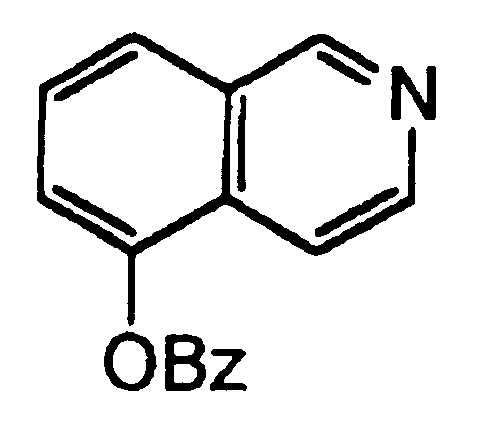
To a solution of 5-hydroxyisoquinoline (15.0g, 103mmol) in
dichloromethane (300ml) was added triethylamine (10.9g, 108mmol),
and the mixture was cooled to 0°C. Under stirring, benzoyl chloride
(15.2g, 108mmol) was added dropwise and the temperature was raised
to room temperature. After stirring for 6 hours at room temperature,
dichloromethane was added. The solution was washed with saturated
aqueous solution of sodium hydrogencarbonate, then dried over
anhydrous magnesium sulfate and solvent was distilled off, thereby
affording 26.6g of the title compound as a light brown liquid. Yield
quantitative.
1H-NMR (DMSO-d6, δ): 7.68(2H,t,J=7.3Hz), 7.75(1H,d,J=5.9Hz), 7.79 -7.85(3H,m), 8.12-8.16(1H,m), 8.28(2H,d,J=7.3Hz), 8.55 (1H,d,J= 5.9Hz), 9.45(1H,s).
1H-NMR (DMSO-d6, δ): 7.68(2H,t,J=7.3Hz), 7.75(1H,d,J=5.9Hz), 7.79 -7.85(3H,m), 8.12-8.16(1H,m), 8.28(2H,d,J=7.3Hz), 8.55 (1H,d,J= 5.9Hz), 9.45(1H,s).

To a solution of the compound of Referential example 1 (1.92g,
7.70mmol) in dichloromethane (100ml) was added 3-chloroperbenzoic
acid (2.45g, 9.24mmol), and the mixture was stirred for 6 hours at
room temperature. Saturated aqueous solution of sodium
hydrogencarbonate was added and the solution was extracted with
dichloromethane. The extract was dried over anhydrous magnesium
sulfate and solvent was distilled off, thereby affording 2.35g of
the title compound as light brown powder. Yield quantitative.
1H-NMR (DMSO-d6, δ): 7.61(1H,d,J=7.8Hz), 7.67(2H,t,J=8.3Hz),7.75 (1H,t,J= 7.8Hz), 7.82(1H,t,J=8.3Hz), 7.86-7.88(2H,m),8.14(1H,d, J=7.3Hz), 8.26(2H,d,J=8.3Hz), 9.07(1H,s).
1H-NMR (DMSO-d6, δ): 7.61(1H,d,J=7.8Hz), 7.67(2H,t,J=8.3Hz),7.75 (1H,t,J= 7.8Hz), 7.82(1H,t,J=8.3Hz), 7.86-7.88(2H,m),8.14(1H,d, J=7.3Hz), 8.26(2H,d,J=8.3Hz), 9.07(1H,s).

To the compound of Referential example 2 (29.9g, 123mmol) was
added acetic anhydride (100mL), and the mixture was refluxed for
4 hours. After the reaction mixture was concentrated under reduced
pressure, ethanol (100ml) and water (50ml) were added and the mixture
was refluxed for 30 minutes. Ethanol was added to the residue obtained
by distilling off solvent. The precipitated crystals were collected
by filtration, washed with ethanol, and then air-dried, thereby
affording 19.0g of the title compound as brown powder. Yield 64%.
1H-NMR(DMSO-d6, δ): 6.40(1H,d,J=7.3Hz), 7.21(1H,t,J=6.3Hz), 7.57
(1H,t,J=7.8Hz), 7.64-7.72(3H,m), 7.81(1H,t,J=7.3Hz), 8.16(1H,d,J=
7.3Hz), 8.23(2H,d,J=7.8Hz), 11.45(1H,brs).

To a solution of the compound of Referential example 3 (22.1g,
83.3mmol) in toluene (300mL) was added silver oxide (I) (57.9g,
250mmol) and methyl iodide (30mL), and the mixture was refluxed for
8 hours. The reaction mixture was filtered using celite and the
residue obtained by distilling off solvent was purified by silica
gel column chromatography [hexane:ethyl acetate (20:1→10:1)],
thereby affording 9.83g of the title compound as colorless powder.
Yield 42%.
1H-NMR(DMSO-d6, δ): 4.10(3H,s), 7.29(1H,d,J=5.8Hz), 7.66-7.73 (3H,m), 7.77(1H,dd,J=7.8,1.0Hz), 7.82(1H,t,J=7.3Hz),8.05(1H,d, J=5.8Hz), 8.16(1H,d,J=7.8Hz), 8.26(2H,d,J=7.3Hz).
1H-NMR(DMSO-d6, δ): 4.10(3H,s), 7.29(1H,d,J=5.8Hz), 7.66-7.73 (3H,m), 7.77(1H,dd,J=7.8,1.0Hz), 7.82(1H,t,J=7.3Hz),8.05(1H,d, J=5.8Hz), 8.16(1H,d,J=7.8Hz), 8.26(2H,d,J=7.3Hz).

A solution of the compound of Referential example 4 (9.83g,
35.2mmol) in N,N-dimethylformamide (200mL) was cooled to 0°C and,
under stirring, N-bromosuccinimide (6.39g, 35.9mmol) was added
little by little. After stirring for 30 minutes at 0°C, the
temperature was raised to room temperature and the mixture was
stirred for 16 hours. The residue obtained by concentrating the
reaction mixture was purified by silica gel column chromatography
[hexane:ethyl acetate (20:1→10:1)], thereby affording 11.6g of the
title compound as colorless powder. Yield 92%.
1H-NMR (DMSO-d6, δ): 4.10(3H,s), 7.66(2H,t, J=8.3Hz), 7.77-7.82 (3H,m), 8.22(2H,d, J= 8.3Hz), 8.26(1H,s), 8.28-8.32(1H,m).
1H-NMR (DMSO-d6, δ): 4.10(3H,s), 7.66(2H,t, J=8.3Hz), 7.77-7.82 (3H,m), 8.22(2H,d, J= 8.3Hz), 8.26(1H,s), 8.28-8.32(1H,m).

To a suspension of the compound of Referential example 5 (20.0g,
55.8mmol) and 4-formylphenylboric acid (12.6g, 83.8 mmol) in toluene
(50mL) were added [1,1'- bis(diphenylphosphino)ferrocene]
dichloropalladium(II)-dichloromethane(1:1) complex (1.22g, 1.67
mmol) and 2mol/L aqueous solution of sodium carbonate, and the
mixture was refluxed for 5 hours. After cooling, the organic layer
was separated, dried over anhydrous sodium sulfate, and then solvent
was distilled off. A small quantity of ethyl acetate was added to
the residue obtained. The crystals were collected by filtration,
washed with ethyl acetate, and then air-dried, thereby affording
16.6g of the title compound as yellow powder. Yield 78%.
1H-NMR (DMSO-d6, δ): 4.15(3H,s), 7.30(2H,t,J=7.8Hz), 7.42(2H,d,
J=7.8Hz), 7.51-7.55(5H,m), 7.68(1H,d,J=7.3Hz), 7.78(1H,d,J=7.8Hz),
7.81(1H,s), 8.32(1H,d,J=8.3Hz), 9.59(1H,s).
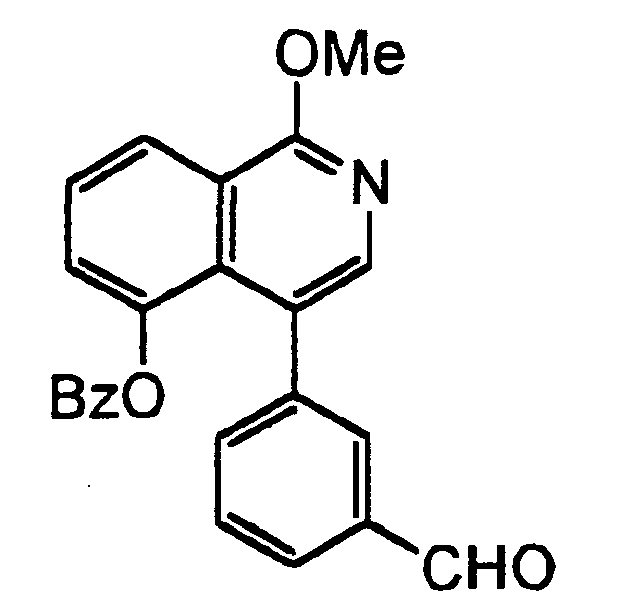
Using the compound of Referential example 5 (3.58g, 10.0 mmol)
and 3-formylphenylboric acid (2.55g, 15.0mmol), through the process
similar to Referential example 6, 2..91g of the title compound were
afforded as colorless powder. Yield 76%.
1H-NMR (DMSO-d6, δ): 4.14(3H,s), 7.23-7.33(4H,m), 7.46-7.49(2H,m), 7.53-7.60(2H,m), 7.67(1H,dd,J=7.8,1.5Hz), 7.73-7.80(3H,m), 8.32 (1H,dd,J=8.3,1.5Hz), 9.77(1H,s).
1H-NMR (DMSO-d6, δ): 4.14(3H,s), 7.23-7.33(4H,m), 7.46-7.49(2H,m), 7.53-7.60(2H,m), 7.67(1H,dd,J=7.8,1.5Hz), 7.73-7.80(3H,m), 8.32 (1H,dd,J=8.3,1.5Hz), 9.77(1H,s).

To a suspension of the compound of Referential example 6 (6.65g,
17.3mmol) in ethanol-water (2:1, 150mL) was added 1 mol/L aqueous
solution of sodium hydroxide (17.3mL, 17.3mmol), and the mixture
was refluxed for 1 hour. After cooling, water was added to the reaction
mixture, which was extracted with ethyl acetate. The extract was
dried over anhydrous sodium sulfate, and then solvent was distilled
off. The residue obtained was purified by silica gel column
chromatography [hexane:ethyl acetate=4:1], thereby affording 2.08g
of the title compound as pale yellow powder. Yield 43%.
1H-NMR (DMSO-d6, δ): 4.08(3H,s), 7.05(1H,dd,J=7.8,1.0Hz), 7.48 (1H,t,J=7.8Hz), 7.55(2H,d,J=8.3Hz), 7.70(1H,s), 7.74(1H,dd, J=8.3, 1.0Hz), 7.89(2H,d,J=8.3Hz), 10.04(1H,s), 10.06(1H,s).
1H-NMR (DMSO-d6, δ): 4.08(3H,s), 7.05(1H,dd,J=7.8,1.0Hz), 7.48 (1H,t,J=7.8Hz), 7.55(2H,d,J=8.3Hz), 7.70(1H,s), 7.74(1H,dd, J=8.3, 1.0Hz), 7.89(2H,d,J=8.3Hz), 10.04(1H,s), 10.06(1H,s).
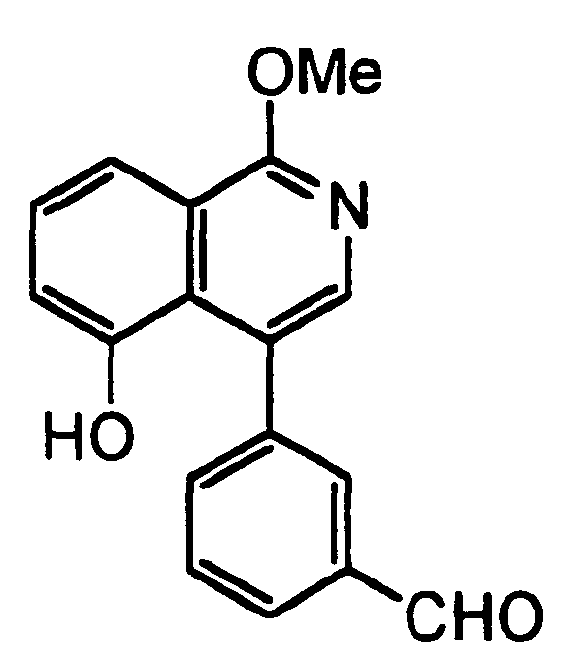
Using the compound of Referential example 7 (4.46g, 11.6 mmol),
through the process similar to Referential example 8, 2.43g of the
title compound were afforded as a pale yellow amorphous material.
Yield 75%.
1H-NMR (DMSO-d6, δ): 4.07(3H,s), 7.04(1H,dd,J=7.8,1.0Hz), 7.47 (1H, t,J=7.8Hz), 7.58(1H,t,J=7.8Hz), 7.66-7.70(2H,m), 7.74(1H, dd,J=8.3, 1.0Hz), 7.85-7.87(2H,m), 10.06(1H,s), 9.80-10.20(1H, br).
1H-NMR (DMSO-d6, δ): 4.07(3H,s), 7.04(1H,dd,J=7.8,1.0Hz), 7.47 (1H, t,J=7.8Hz), 7.58(1H,t,J=7.8Hz), 7.66-7.70(2H,m), 7.74(1H, dd,J=8.3, 1.0Hz), 7.85-7.87(2H,m), 10.06(1H,s), 9.80-10.20(1H, br).
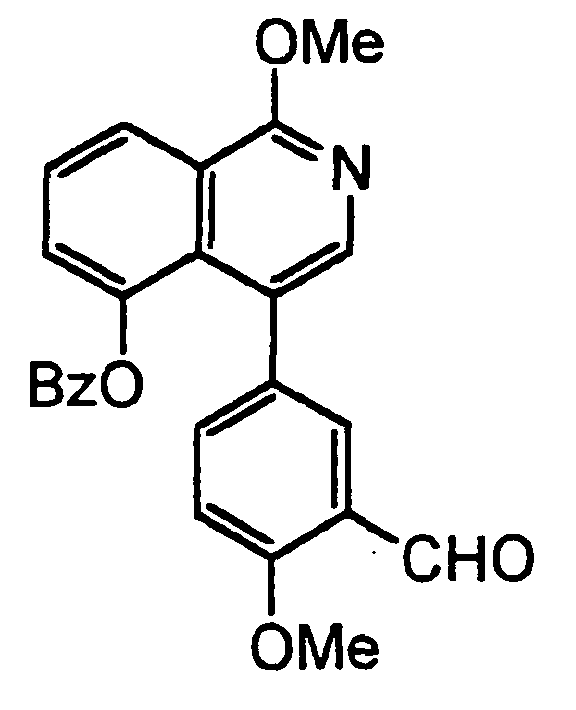
Using the compound of Referential example 5 (1.79g, 5.00 mmol)
and 3-formyl-4-methoxyphenylboric acid (1.35g, 7.50mmol), through
the process similar to Referential example 6, 317mg of the title
compound were afforded as light brown powder. Yield 15%.
1H-NMR (DMSO-d6, δ): 3.55(3H,s), 4.18(3H,s), 6.54(1H,d,J=8.8
Hz),7.29(2H,t,J=7.8Hz), 7.35-7.40(2H,m), 7.53(1H,t,J=7.8Hz),
7.60-7.67(3H,m), 7.74-7.76(2H,m), 8.34(1H,dd,J=8.3,1.0Hz),10.20
(1H,s).

Using the compound of Referential example 10 (315mg, 762 µmol),
through the process similar to Referential example 8, 192mg of the
title compound were afforded as pale yellow powder. Yield 81%.
1H-NMR (DMSO-d6, δ): 3.97(3H,s), 4.06(3H,s), 7.03(1H,d,J=7.8Hz),
7.22(1H,d,J=8.3Hz), 7.45(1H,t,J=7.8Hz), 7.60-7.65(3H,m),7.72
(1H,d,J=8.3Hz), 10.42(1H,s).
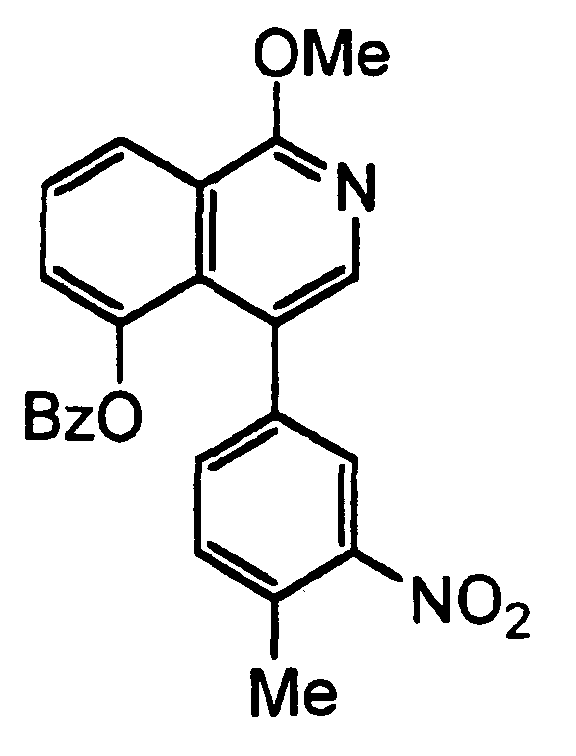
Using the compound of Referential example 5 (2.51g, 7.00 mmol)
and 4-methyl-3-nitrophenylboric acid (1.90g, 10.5mmol), through the
process similar to Referential example 6, 2.51g of the title compound
were afforded as colorless powder. Yield 87%.
1H-NMR (DMSO-d6, δ): 2.04(3H,s), 4.14(3H,s), 7.14(1H,d,J=7.8 Hz),7.38(2H,t,J=7.3Hz), 7.46(1H,dd,J=7.8,2.0Hz), 7.57(2H,dd,J= 8.3,1.0Hz), 7.62-7.69(2H,m), 7.77-7.81(3H,m), 8.32(1H,dd,J=8.3, 1.0Hz).
1H-NMR (DMSO-d6, δ): 2.04(3H,s), 4.14(3H,s), 7.14(1H,d,J=7.8 Hz),7.38(2H,t,J=7.3Hz), 7.46(1H,dd,J=7.8,2.0Hz), 7.57(2H,dd,J= 8.3,1.0Hz), 7.62-7.69(2H,m), 7.77-7.81(3H,m), 8.32(1H,dd,J=8.3, 1.0Hz).
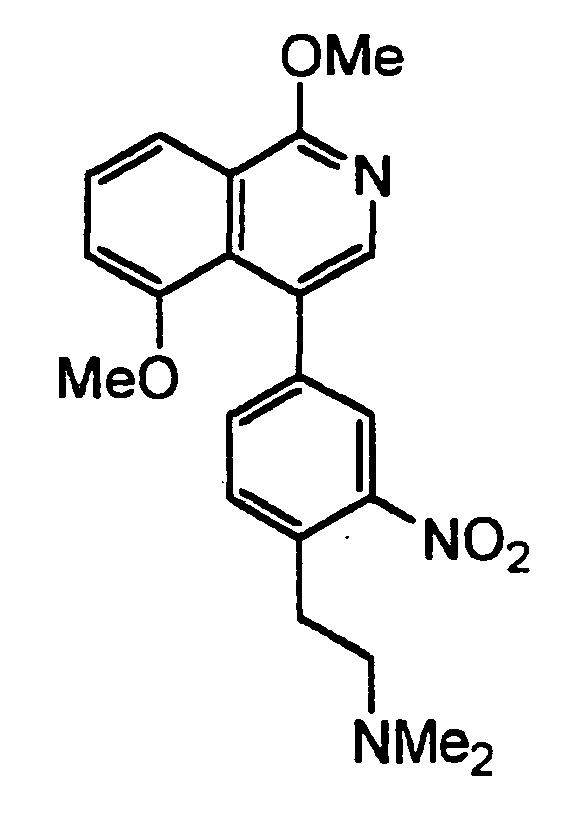
To a solution of the compound of Referential example 12 (2.07g,
5.00mmol) in N,N-dimethylformamide (50mL) was added N,N-dimethylformamidodimethylacetal
(3.32mL, 25.0mmol), and the
mixture was refluxed for 6 hours. After cooling, ethanol (50mL) and
successively sodium borohydride (567mg, 15.0mmol) were added to the
residue obtained by concentrating the reaction mixture under reduced
pressure and the mixture was refluxed for 5 hours. After cooling,
water was added to the reaction mixture, which was extracted with
ethyl acetate, dried over anhydrous sodium sulfate, and then solvent
was evaporated. The obtained residue was purified by silica gel
column chromatography [hexane-ethyl acetate (1:1)→ethyl acetate-methanol-triethylamine
(10:1:0.1)], thereby affording 498mg of the
title compound as a brown viscous liquid. Yield 26%.
1H-NMR (DMSO-d6, δ): 2.36(6H,s), 2.68(2H,t,J=7.8Hz), 3.14(2H, brs),
3.56(3H,s), 4.16(3H,s), 7.02(1H,d,J=7.3Hz), 7.36(1H,d, J=7.8Hz),
7.48-7.53(2H,m), 7.78(1H,s), 7.88(1H,d,J=2.0Hz), 7.95(1H,dd,J=
8.3,1.0Hz).

To a solution of 2-(4-bromophenyl)ethanol (500mg, 2.49mmol) in
dimethyl sulfoxide (5mL) were added bis (pinacolato) diboron (632mg,
2.49mmol), potassium acetate (733mg, 7.47mmol) and [1,1'-bis
(diphenylphosphino)ferrocene]dichloropalladium(II)-dichloromethane
(1:1) complex (102mg, 124µmol), and the mixture was
stirred for 5 hours at 120°C. Ice water and toluene were added to
the reaction mixture and the insolubles were filtered off. The
organic layer was separated, washed with water, then dried over
anhydrous sodium sulfate, and solvent was distilled off. The residue
obtained was purified by silica gel column chromatography [hexane-ethyl
acetate=1:1], thereby affording 455mg of the title compound
as a pale yellow oil. Yield 89%.
1H-NMR (CDCl3, δ): 1.34(12H,s), 2.89(2H,t,J=6.3Hz), 3.87(2H,q,
J=6.3Hz), 7.25(2H,d,J=7.8Hz), 7.77(2H,d,J=8.3Hz).
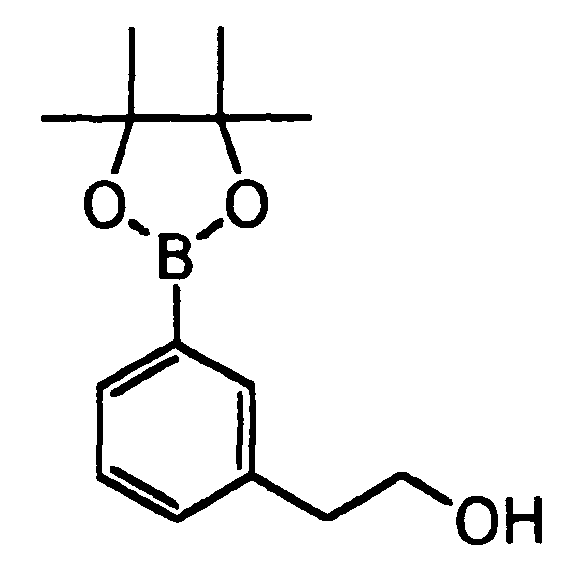
Using 2-(3-bromophenyl]ethanol (4.17g, 20.7mmol), through the
process similar to Referential example 14, 3.98g of the title
compound were afforded as a yellow oil. Yield 77%.
1H-NMR (CDCl3, δ): 1.35(12H,s), 2.88(2H,t,J=6.3Hz), 3.87(2H,q,
J=6.3Hz), 7.32-7.37(2H,m), 7.67-7.69(2H,m).
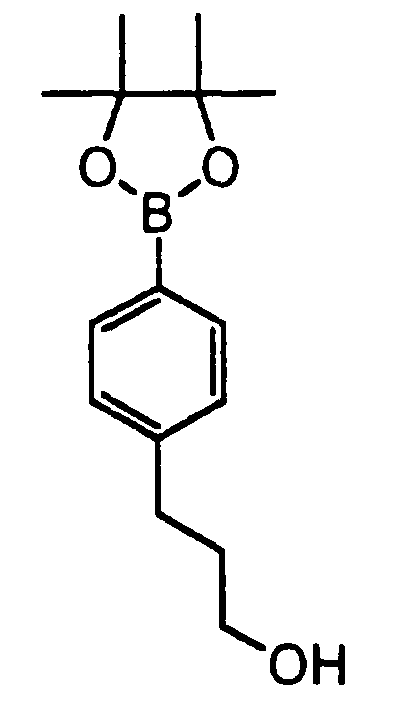
Using 3-(4-bromophenyl]propanol (508mg, 2.36mmol), through the
process similar to Referential example 14, 229mg of the title
compound were afforded as a yellow oil. Yield 37%.
1H-NMR (CDCl3, δ): 1.34(12H,s), 1.86-1.93(2H,m), 2.70-2.75 (2H,m),
3.65-3.69(2H,m), 7.22(2H,d,J=8.3Hz), 7.74(2H,d,J=7.8Hz).
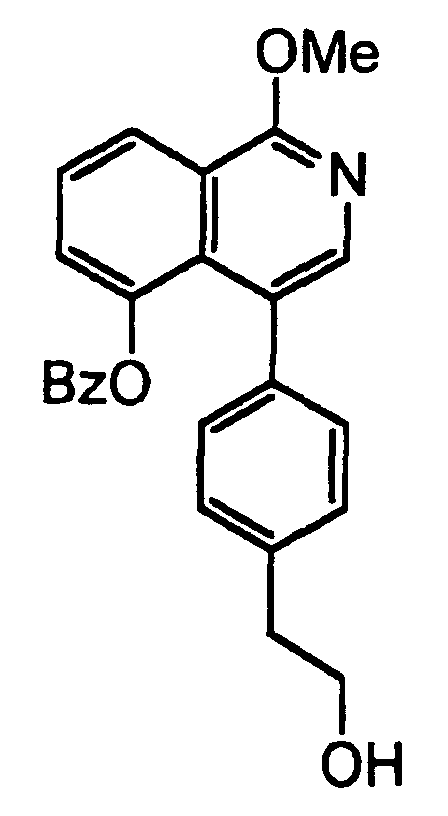
Using the compound of Referential example 5 (634mg, 1.77 mmol)
and the compound of Referential example 14 (440mg, 1.77 mmol),
through the process similar to Referential example 6, 225mg of the
title compound were afforded as pale yellow powder. Yield 32%.
1H-NMR (CDCl3, δ): 2.45(2H,t,J=6.3Hz), 3.53(2H,q,J=6.3Hz), 4.18
(3H,s), 6.89(2H,d,J=7.8Hz), 7.21(2H,d,J=7.8Hz), 7.31(2H,t, J=8.3
Hz), 7.38(1H,dd,J=7.8,1.0Hz), 7.51-7.55(1H,m), 7.61(1H,t,J=7.8Hz),
7.68(2H,dd,J=8.3,1.5Hz), 7.77(1H,s), 8.34(1H,dd, J=8.3, 1.0Hz).

Using the compound of Referential example 5 (5.07g, 14.2 mmol)
and the compound of Referential example 15 (3.52g, 14.2 mmol),
through the process similar to Referential example 6, 4.05g of the
title compound were afforded as a yellow oil. Yield 71%.
1H-NMR (CDCl3, δ): 2.54-2.64(2H,m), 3.64(2H,q,J=6.3Hz), 4.18(3H,s),
6.66(1H,d,J=7.3Hz), 7.02(1H,t,J=7.8Hz), 7.08(1H,s), 7.17- 7.19
(1H,m), 7.28-7.31(2H,m), 7.39(1H,dd,J=7.3,1.0Hz), 7.49-7.54(1H,m),
7.59-7.63(3H,m), 7.77(1H,s), 8.34(1H,dd,J=8.3,1.5 Hz).
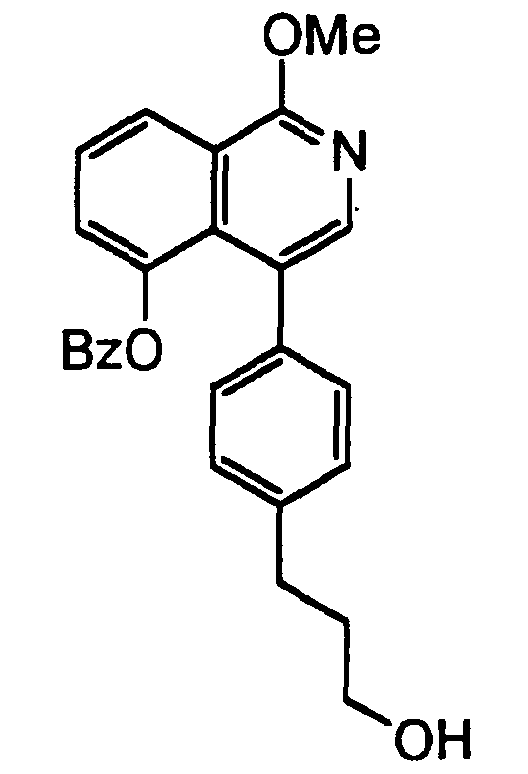
Using the compound of Referential example 5 (5.12g, 14.3 mmol)
and the compound of Referential example 16 (3.75g, 14.3 mmol),
through the process similar to Referential example 6, 3.03g of the
title compound were afforded as pale yellow powder. Yield 51%.
1H-NMR (CDCl3, δ): 1.52-1.59(2H,m), 2.27(2H,t,J=7.3Hz), 3.53(2H,q,
J=6.3Hz), 4.18(3H,s), 6.85(2H,d,J=7.8Hz), 7.18(2H,d,J=7.8Hz),
7.29(2H,t,J=7.8Hz), 7.38(1H,dd,J=7.8,1.0Hz), 7.50(1H,t,J= 7.3Hz),
7.60(1H,t,J=8.3Hz), 7.65(2H,dd,J=8.3,1.0Hz), 7.78(1H,s),8.33(1H,
dd,J=8.3,1.0Hz).
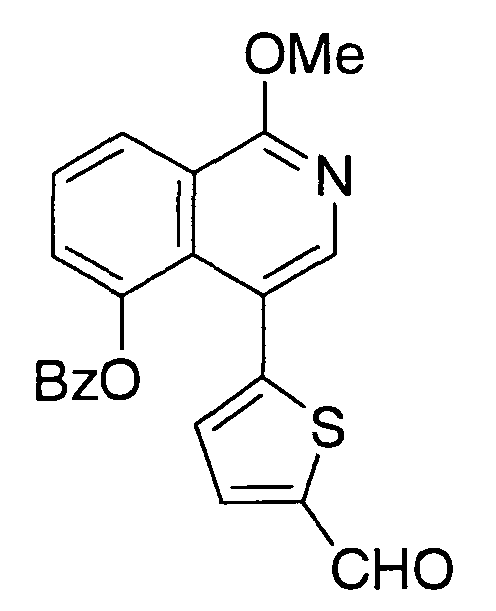
To a solution of the compound of Referential example 5 (1.00g,
279mmol) in anhydrous 1,4-dioxane (60mL) were added 5-formyl-2-thiopheneboric
acid (1.31g, 8.38mmol), triethylamine (1.17mL,8.38
mmol) and [1,1'- bis (diphenylphosphino)ferrocene]
dichloropalladium(II)- dichloromethane(1:1) complex (228mg,280
µmol), and the mixture was refluxed for 9 hours. After cooling, the
reaction mixture was filtered through celite and the filtrate was
concentrated under reduced pressure. The residue obtained was
purified by silica gel column chromatography [hexane:ethyl acetate
(4:3→ 1:1)], thereby affording 990mg of the title compound as pale
yellow powder. Yield 91%.
1H-NMR (CDCl3, δ): 4.19(3H,s), 6.92(1H,d,J=3.9Hz), 7.03(1H,d, J= 3.4Hz), 7.34(2H,t,J=7.8Hz), 7.47(1H,dd,J=8.3,1.5Hz), 7.55(1H,t,J= 7.8Hz), 7.66(1H,t,J=8.3Hz), 7.82(2H,dd,J=8.3,1.5Hz), 7.93(1H,s), 8.35(1H,dd,J=8.3,1.5Hz), 9.38(1H,s).
1H-NMR (CDCl3, δ): 4.19(3H,s), 6.92(1H,d,J=3.9Hz), 7.03(1H,d, J= 3.4Hz), 7.34(2H,t,J=7.8Hz), 7.47(1H,dd,J=8.3,1.5Hz), 7.55(1H,t,J= 7.8Hz), 7.66(1H,t,J=8.3Hz), 7.82(2H,dd,J=8.3,1.5Hz), 7.93(1H,s), 8.35(1H,dd,J=8.3,1.5Hz), 9.38(1H,s).

To a solution of the compound of Referential example 20 (49.3mg,
12 7µmol) in ethanol (3mL) was added sodium hydrogencarbonate (31.9mg,
380µmol), and the mixture was refluxed for 8 hours. After cooling,
water was added and the solution was brought to pH 1 using 1mol/L
hydrochloric acid. This was extracted with ethyl acetate, washed
with brine, then dried over anhydrous sodium sulfate, and solvent
was distilled off. The residue obtained was purified by silica gel
column chromatography [hexane:ethyl acetate=4:1], thereby
affording 30.3mg of the title compound as pale yellow powder. Yield
84%.
1H-NMR (CDCl3, δ): 4.17(3H,s), 7.14(1H,dd,J=7.8,1.0Hz), 7.51(1H,t, J=7.8Hz), 7.81(1H,d,J=3.4Hz), 7.92(1H,s), 7.97(1H,dd,J=8.3, 1.0Hz), 9.96(1H,s).
1H-NMR (CDCl3, δ): 4.17(3H,s), 7.14(1H,dd,J=7.8,1.0Hz), 7.51(1H,t, J=7.8Hz), 7.81(1H,d,J=3.4Hz), 7.92(1H,s), 7.97(1H,dd,J=8.3, 1.0Hz), 9.96(1H,s).
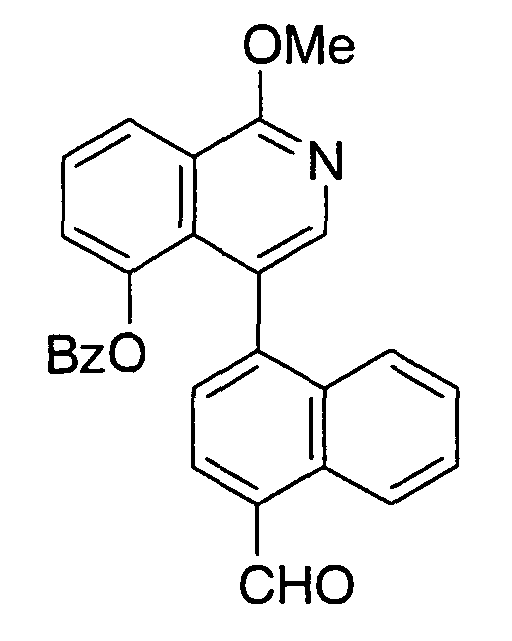
Using the compound of Referential example 5 (1.43g, 4.00 mmol)
and 4-formyl-1-naphthaleneboric acid (1.00g, 5.00mmol), through the
process similar to Referential example 6, 1.23g of the title compound
were afforded as pale yellow powder. Yield 71%.
1H-NMR (DMSO-d6, δ): 4.19(3H,s), 6.82-6.84(2H,m), 7.09(2H,t, J=7.9 Hz), 7.40-7.52(4H,m), 7.58(1H,dd,J=6.7,1.2Hz), 7.65-7.69(1H,m), 7.75-7.82(2H,m), 7.88(1H,s), 8.38(1H,dd,J=7.3,1.2Hz), 8.96(1H,d,J =8.6Hz),9.95(1H,s).
1H-NMR (DMSO-d6, δ): 4.19(3H,s), 6.82-6.84(2H,m), 7.09(2H,t, J=7.9 Hz), 7.40-7.52(4H,m), 7.58(1H,dd,J=6.7,1.2Hz), 7.65-7.69(1H,m), 7.75-7.82(2H,m), 7.88(1H,s), 8.38(1H,dd,J=7.3,1.2Hz), 8.96(1H,d,J =8.6Hz),9.95(1H,s).

To a solution of the compound of Referential example 22 (610mg,
1.41mmol) in ethanol (15mL) was added potassium hydroxide (92.0mg,
1.41mmol), and the mixture was refluxed for 1 hour. After cooling,
the residue obtained by concentrating the reaction mixture was
purified by silica gel column chromatography [hexane:ethyl acetate
=10:1], then diisopropyl ether was added and the precipitated
crystals were collected by filtration, thereby affording 328mg of
the title compound as colorless powder. Yield 71%.
1H-NMR (DMSO-d6, δ): 4.14(3H,s), 6.90(1H,brd,J=6.7Hz), 7.41-7.50 (3H,m), 7.64-7.70(2H,m), 7.76-7.80(2H,m), 8.22(1H,d,J=6.7Hz), 9.25 (1H,d,J=9.2Hz), 9.74(1H,brs), 10.45(1H,s).
1H-NMR (DMSO-d6, δ): 4.14(3H,s), 6.90(1H,brd,J=6.7Hz), 7.41-7.50 (3H,m), 7.64-7.70(2H,m), 7.76-7.80(2H,m), 8.22(1H,d,J=6.7Hz), 9.25 (1H,d,J=9.2Hz), 9.74(1H,brs), 10.45(1H,s).

To a solution of the compound of Referential example 5 (1.79g,
5.00mmol) in toluene (50mL) were added 4-fluoro-3- formylphenylboric
acid (1.01g, 6.00mmol), 2mol/L aqueous solution of sodium carbonate
(5.00mL, 10.0mmol) and [1,1'- bis(diphenylphosphino)ferrocene]
dichloropalladium(II)- dichloromethane(1:1) complex (204mg, 250
µmol), and the mixture was refluxed for 5 hours. After cooling, the
organic layer was separated, dried over anhydrous sodium sulfate,
and then solvent was distilled off. The residue obtained was purified
by silica gel column chromatography [hexane:ethyl acetate=4:1],
thereby affording 1.58g of the title compound as colorless powder.
Yield 79%.
1H-NMR (DMSO-d6, δ): 4.14(3H,s), 7.07(1H,dd,J=7.9,10.4Hz), 7.40 (2H,t,J=7.9Hz), 7.54-7.69(6H,m), 7.77-7.80(2H,m), 8.32(1H,d,J=8.6 Hz), 9.92(1H,s).
1H-NMR (DMSO-d6, δ): 4.14(3H,s), 7.07(1H,dd,J=7.9,10.4Hz), 7.40 (2H,t,J=7.9Hz), 7.54-7.69(6H,m), 7.77-7.80(2H,m), 8.32(1H,d,J=8.6 Hz), 9.92(1H,s).
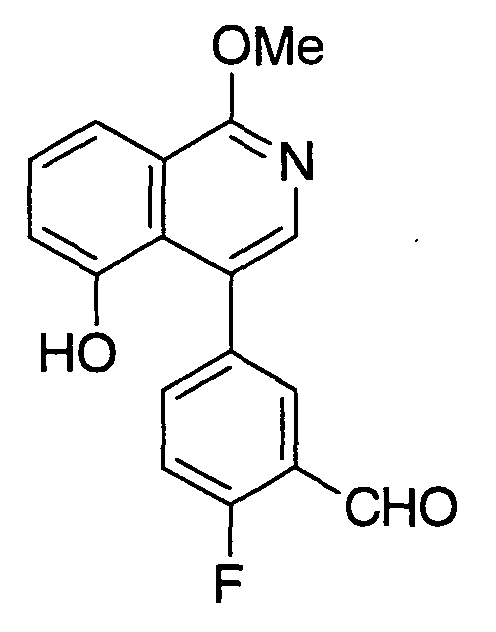
To a solution of the compound of Referential example 24 (1.58g,
3.93mmol) in ethanol (80mL) was added sodium hydrogencarbonate
(991mg, 11.8mmol), and the mixture was refluxed for 8 hours. After
cooling, brine was added and the solution was extracted with ethyl
acetate, dried over anhydrous sodium sulfate, and then solvent was
distilled off. Dichloromethane was added to the residue obtained,
The precipitates were collected by filtration and dried, thereby
affording 765mg of the title compound as pale yellow powder. The
filtrate was concentrated and purified by silica gel column
chromatography [hexane:ethyl acetate=4:1], thereby affording 155mg
additionally. Total yield97%.
1H-NMR (DMSO-d6, δ): 4.07(3H,s), 7.04-7.06(1H,m), 7.39(1H,dd, J= 10.4,7.9Hz), 7.47(1H,t,J=7.9Hz), 7.68-7.77(4H,m), 10.05(1H,s), 10.28(1H,s).
1H-NMR (DMSO-d6, δ): 4.07(3H,s), 7.04-7.06(1H,m), 7.39(1H,dd, J= 10.4,7.9Hz), 7.47(1H,t,J=7.9Hz), 7.68-7.77(4H,m), 10.05(1H,s), 10.28(1H,s).
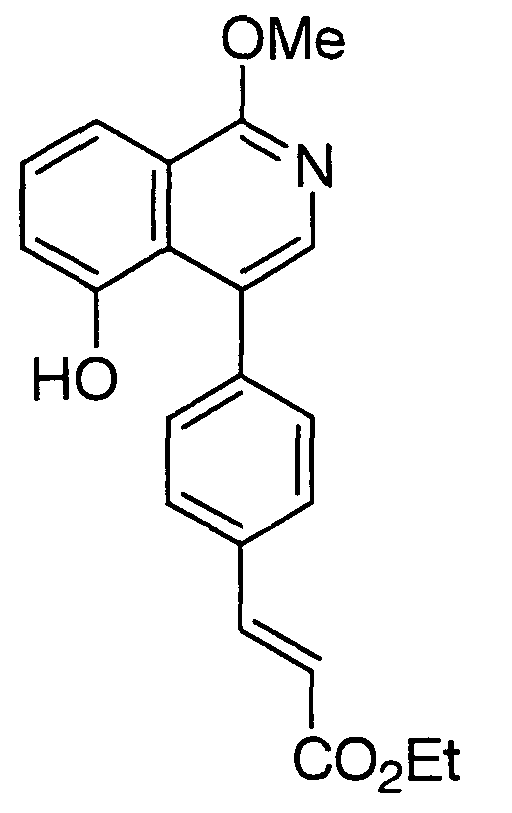
To a suspension of 60% sodium hydride in oil (301mg, 7.52 mmol)
in tetrahydrofuran (35mL) was added dropwise ethyl
diethylphosphonoacetate (853µL, 4.30mmol) under cooling with ice,
and the mixture was stirred for 15 minutes. A solution of the compound
of Referential example 8 (1.00g, 3.58mmol) in tetrahydrofuran (15mL)
was added dropwise thereto, and the mixture was stirred for 4 hours,
while gradually returning the temperature to room temperature. The
reaction mixture was poured in ice water (100mL) and stirred for
30 minutes at room temperature. This was extracted with ethyl acetate,
dried over anhydrous sodium sulfate, and then solvent was distilled
off. The residue obtained was purified by silica gel column
chromatography [hexane:ethyl acetate=4:1], thereby affording 947mg
of the title compound as pale yellow powder. Yield 76%.
1H-NMR (DMSO-d6, δ): 1.26(3H,t,J=7.3Hz),4.05(3H,s), 4.19(2H,q,J= 7.3Hz), 6.64(1H,d,J=15.9Hz), 7.01(1H,d,J=7.3Hz), 7.35(2H,d,J=7.9 Hz), 7.44(1H,t,J=7.9Hz), 7.65-7.72(5H,m), 9.96(1H,brs).
1H-NMR (DMSO-d6, δ): 1.26(3H,t,J=7.3Hz),4.05(3H,s), 4.19(2H,q,J= 7.3Hz), 6.64(1H,d,J=15.9Hz), 7.01(1H,d,J=7.3Hz), 7.35(2H,d,J=7.9 Hz), 7.44(1H,t,J=7.9Hz), 7.65-7.72(5H,m), 9.96(1H,brs).

To a suspension of lithium aluminum hydride (146mg, 3.07 mmol)
in tetrahydrofuran (10mL) was added dropwise a solution of the
compound of Referential example 26 (537mg, 1.54mmol) in
tetrahydrofuran (10mL) under cooling with ice, and the mixture was
stirred for 3 hours, while gradually returning the temperature to
room temperature. Water (5mL) and 2mol/L aqueous solution of sodium
hydroxide (1mL) were added and the mixture was stirred for 30 minutes.
This was filtered using celite and the residue was washed with ethyl
acetate (20mL). The organic layer of the filtrate was separated,
washed with brine, dried over anhydrous sodium sulfate, and then
solvent was distilled off. The residue obtained was purified by
silica gel column chromatography [hexane:ethyl acetate=1:1],
thereby affording 173mg of the title compound as colorless powder.
Yield 37%.
1H-NMR (CDCl3, δ): 4.15(3H,s), 4.39(2H,dt,J=5.5,1.2Hz), 5.48(1H,s), 6.48(1H,dt,J=15.9,5.5Hz), 6.71(1H,d,J=15.9Hz), 7.10(1H,dd,J=7.3, 1.2Hz), 7.44-7.50(3H,m), 7.54(2H,d,J=7.9Hz), 7.73(1H,s),7.93-7.96 (1H,m).
1H-NMR (CDCl3, δ): 4.15(3H,s), 4.39(2H,dt,J=5.5,1.2Hz), 5.48(1H,s), 6.48(1H,dt,J=15.9,5.5Hz), 6.71(1H,d,J=15.9Hz), 7.10(1H,dd,J=7.3, 1.2Hz), 7.44-7.50(3H,m), 7.54(2H,d,J=7.9Hz), 7.73(1H,s),7.93-7.96 (1H,m).

1H-NMR (DMSO-d6, δ): 2.19(6H,s), 3.43(2H,s), 4.06(3H,s), 7.01 (1H,d,J=7.8Hz), 7.25(4H,s), 7.44(1H,t,J=7.8Hz), 7.64(1H,s), 7.71 (1H,d,J=8.3Hz), 9.88(1H,s).
Process 2: To a solution of 4-[4-(dimethylaminomethyl) phenyl]-5-hydroxy-1-methoxyisoquinoline (102mg, 331µmol) in acetic acid (15mL) were added 47% hydrobromic acid (1.5mL) and water (1.5 mL), and the mixture was refluxed for 1 hour. Water was added to the residue obtained by concentrating the reaction mixture under reduced pressure, which was made basic with saturated aqueous solution of sodium hydrogencarbonate. The precipitated crystals were collected by filtration, washed with water, and then air-dried, thereby affording 66.2mg of the title compound as brown powder. Yield 68%. 1H-NMR (DMSO-d6, δ): 2.17(6H,s), 6.73(1H,d,J=5.4Hz), 7.00(1H,d, J=6.8Hz), 7.20(4H,s), 7.31(1H,t,J=7.8Hz), 7.77(1H,dd,J=7.8,1.0Hz), 9.67(1H,bs), 11.27(1H,brs).
HR-MS (m/z): 294.1383 (+1.5mmu).

1H-NMR (CDCl3, δ): 1.07(6H,t,J=7.3Hz), 2.57(4H,q,J=7.3Hz), 3.64
(2H,s), 6.38(1H,brs), 7.13(1H,dd, J=7.8,1.5Hz), 7.40-7.46(3H,m),
7.49(2H,d,J=8.3Hz), 8.12(1H,dd,J=8.3,1.5Hz), 9.38(1H,brs).
Anal. Calcd. for C20H22N2O2·1/4H2O: C, 73.48; H, 6.94; N, 8.57(%).
Found: C, 73.40; H, 6.83; N, 8.43(%).
HR-MS (m/z): 322.1681 (+0.0mmu).
Found: C, 73.40; H, 6.83; N, 8.43(%).
HR-MS (m/z): 322.1681 (+0.0mmu).
1H-NMR (DMSO-d6, δ): 0.85(6H,t,J=7.3Hz), 1.43-1.48(4H,m), 2.36
(4H,brs), 3.53(2H,s), 6.73(1H,d,J=5.9Hz), 7.01(1H,d,J=8.3Hz),
7.21(4H,s), 7.32(1H,t,J=8.3Hz), 7.77(1H,d,J=7.8Hz), 9.61(1H,s),
11.28(1H,brs).
Anal. Calcd. for C22H26N2O2·3/4H2O: C, 72.60; H, 7.62; N, 7.70(%). Found: C, 72.48; H, 7.25; N, 7.67(%).
HR-MS (m/z): 350.1965 (-3.0mmu).
Anal. Calcd. for C22H26N2O2·3/4H2O: C, 72.60; H, 7.62; N, 7.70(%). Found: C, 72.48; H, 7.25; N, 7.67(%).
HR-MS (m/z): 350.1965 (-3.0mmu).
1H-NMR (DMSO-d6, δ): 0.86(6H,t,J=7.3Hz), 1.24-1.33(4H,m), 1.39-1.46(4H,m),
2.39(4H,t,J=7.3Hz), 3.52(2H,s),6.71(1H,d,J=5.9Hz),
7.01(1H,dd,J=7.8,1.5Hz), 7.20(4H,s), 7.31(1H,t,J=7.8Hz),7.77(1H,
dd,J=7.8,1.0Hz), 9.58(1H,s),11.24(1H,d,J=5.4Hz).
Anal. Calcd. for C24H30N2O2·1/8H2O: C, 75.71; H, 8.01; N, 7.36(%). Found: C, 75.65; H, 8.12; N, 7.32(%).
HR-MS (m/z): 378.2275 (-3.2mmu).
Anal. Calcd. for C24H30N2O2·1/8H2O: C, 75.71; H, 8.01; N, 7.36(%). Found: C, 75.65; H, 8.12; N, 7.32(%).
HR-MS (m/z): 378.2275 (-3.2mmu).
1H-NMR (DMSO-d6, δ): 0.85(6H,t,J=7.3Hz), 1.23-1.26(6H,m), 1.42-1.45(4H,m),
2.38(4H,t,J=7.3Hz), 3.52(2H,s), 6.71(1H,s), 7.01 (1H,
dd,J=7.8,1.0Hz), 7.20(4H,s), 7.32(1H,t,J=7.8Hz), 7.77(1H, dd,J=7.8,
1.0Hz), 9.30-9.80(1H,br), 11.10-11.40(1H,br).
Anal. Calcd. for C26H34N2O2·1/8H2O: C, 76.39; H, 8.44; N, 6.85(%). Found: C, 76.36; H, 8.70; N, 6.80(%).
HR-MS (m/z): 406.2613 (-0.7mmu).
Anal. Calcd. for C26H34N2O2·1/8H2O: C, 76.39; H, 8.44; N, 6.85(%). Found: C, 76.36; H, 8.70; N, 6.80(%).
HR-MS (m/z): 406.2613 (-0.7mmu).
1H-NMR (DMSO-d6, δ): 0.88(3H,t,J=7.3Hz), 1.45-1.54(2H,m), 2.12
(3H,s), 2.31(2H,t,J=7.3Hz), 3.45(2H,s), 6.73(1H,d,J=5.9Hz), 7.00
(1H,d,J=7.8Hz), 7.20(4H,s), 7.31(1H,t,J=7.8Hz), 7.77(1H,d,J=7.8
Hz), 9.63(1H,s), 11.26(1H,d,J=4.9Hz).
Anal. Calcd. for C20H22N2O2·1/10H2O: C, 74.09; H, 6.90; N, 8.64 (%). Found: C, 74.17; H, 6.97; N, 8.69(%).
HR-FAB+ (m/z): 323.1773 (+1.4mmu).
Anal. Calcd. for C20H22N2O2·1/10H2O: C, 74.09; H, 6.90; N, 8.64 (%). Found: C, 74.17; H, 6.97; N, 8.69(%).
HR-FAB+ (m/z): 323.1773 (+1.4mmu).
1H-NMR (DMSO-d6, δ): 0.88(3H,t,J=7.3Hz), 1.29-1.34(2H,m), 1.42-1.48(2H,m),
2.12(3H,s), 2.34(2H,t,J=7.3Hz), 3.45(2H,s), 6.72 (1H,d,
J=5.4Hz), 7.01(1H,d,J=7.8Hz), 7.20(4H,s), 7.31(1H,t, J=7.8Hz),
7.77(1H,d,J=7.8Hz), 9.62(1H,s), 11.26(1H,d,J=4.9Hz).
Anal. Calcd. for C21H24N2O2·1/10H2O: C, 74.57; H, 7.21; N, 8.28 (%). Found: C, 74.50; H, 7.25; N, 8.35(%).
HR-MS (m/z): 336.1815 (-2.3mmu).
Anal. Calcd. for C21H24N2O2·1/10H2O: C, 74.57; H, 7.21; N, 8.28 (%). Found: C, 74.50; H, 7.25; N, 8.35(%).
HR-MS (m/z): 336.1815 (-2.3mmu).
1H-NMR (DMSO-d6, δ): 0.87(3H,t,J=6.9Hz), 1.26-1.30(4H,m), 1.40-1.55(2H,m),
2.11(3H,s), 2.34(2H,t,J=7.3Hz), 3.45(2H,s), 6.73(1H,d,
J=5.9Hz), 7.00(1H,dd,J=7.8,1.0Hz), 7.20(4H,s), 7.32(1H,t,J=7.8Hz),
7.77(1H,dd,J=7.8,1.0Hz), 9.63(1H,s), 11.27(1H,d, J=5.4Hz).
Anal. Calcd. for C22H26N2O2: C, 75.40; H, 7.48; N, 7.99(%).
Found: C, 75.21; H, 7.51; N, 8.07(%).
HR-FAB+ (m/z): 351.2052 (-2.0mmu).
Found: C, 75.21; H, 7.51; N, 8.07(%).
HR-FAB+ (m/z): 351.2052 (-2.0mmu).
1H-NMR (DMSO-d6, δ): 0.86(3H,t,J=6.9Hz), 1.27-1.31(6H,m), 1.44-1.47(2H,m),
2.11(3H,s), 2.34(2H,t,J=6.9Hz), 3.45(2H,s), 6.73
(1H,d,J=5.4Hz), 7.01(1H,d,J=7.8Hz), 7.20(4H,s), 7.32(1H,t, J=
7.8Hz), 7.70(1H,d,J=7.8Hz), 9.63(1H,s), 11.27(1H,d,J=4.9Hz).
Anal. Calcd. for C23H28N2O2·1/10H2O: C, 75.42; H, 7.76; N, 7.65(%).
Found: C, 75.35; H, 7.74; N, 7.72(%).
HR-MS (m/z): 364.2126 (-2.5mmu).
HR-MS (m/z): 364.2126 (-2.5mmu).
1H-NMR (DMSO-d6, δ): 2.57(4H,t,J=6.4Hz), 3.46-3.51(4H,m), 3.66
(2H,s), 4.39(2H,t,J=5.4Hz), 6.73(1H,d,J=5.9Hz), 7.00(1H,d, J=7.8
Hz), 7.19-7.26(4H,m), 7.32(1H,t,J=7.8Hz), 7.77(1H,d,J=7.8Hz),9.65
(1H,s), 11.27(1H,d,J=5.9Hz).
Anal. Calcd. for C20H22N2O4·3/10H2O: C, 66.76; H, 6.33; N, 7.79(%). Found: C, 66.79; H, 6.34; N, 7.66(%).
HR-FAB+ (m/z): 355.1644 (-1.4mmu).
Anal. Calcd. for C20H22N2O4·3/10H2O: C, 66.76; H, 6.33; N, 7.79(%). Found: C, 66.79; H, 6.34; N, 7.66(%).
HR-FAB+ (m/z): 355.1644 (-1.4mmu).
1H-NMR (DMSO-d6, δ): 3.03(3H,s), 4.59(2H,s), 6.62(1H,t,J=7.3Hz),
6.71-6.76(3H,m), 6.99(1H,dd,J=7.8,1.0Hz), 7.11-7.22(6H,m), 7.31
(1H,t,J=7.8Hz), 7.76(1H,dd,J=7.8,1.0Hz), 9.65(1H,s), 11.27(1H,d,
J=5.9Hz).
Anal. Calcd. for C23H20N2O2·4/5H2O: C, 74.49; H, 5.87; N, 7.55(%). Found: C, 74.42; H, 5.65; N, 7.42(%).
HR-FAB+ (m/z): 357.1581 (-2.2mmu).
Anal. Calcd. for C23H20N2O2·4/5H2O: C, 74.49; H, 5.87; N, 7.55(%). Found: C, 74.42; H, 5.65; N, 7.42(%).
HR-FAB+ (m/z): 357.1581 (-2.2mmu).
1H-NMR (DMSO-d6, δ): 2.12(3H,s), 3.51(2H,s), 3.53(2H,s),6.74
(1H,d,J=5.4Hz), 6.99(1H,dd,J=7.8,1.0Hz), 7.22-7.39(10H,m),
7.77(1H,dd,J=7.8,1.0Hz), 9.63(1H,s), 11.26(1H,d,J=3.9Hz).
Anal. Calcd. for C24H22N2O2·1/3H2O: C, 76.57; H, 6.02; N, 7.44(%). Found: C, 76.54; H, 6.01; N, 7.44(%).
HR-MS (m/z): 370.1671 (-1.0mmu).
Anal. Calcd. for C24H22N2O2·1/3H2O: C, 76.57; H, 6.02; N, 7.44(%). Found: C, 76.54; H, 6.01; N, 7.44(%).
HR-MS (m/z): 370.1671 (-1.0mmu).
1H-NMR (DMSO-d6, δ): 2.09(3H,s), 3.46(2H,s), 3.48(2H,s), 3.74(3H,s),
6.74(1H,d,J=5.4Hz),6.91(2H,d,J=8.3Hz),7.00(1H,d,J=7.8Hz) ,7.21-7.33(7H,m),
7.75(1H,d,J=7.8Hz), 9.63(1H,s), 11.27(1H,d, J=5.4Hz).
Anal. Calcd. for C25H24N2O3·1/10H2O: C, 74.64; H, 6.06; N, 6.96(%). Found: C, 74.56; H, 6.17; N, 6.95(%).
HR-FAB+ (m/z): 401.1855 (-1.1mmu).
Anal. Calcd. for C25H24N2O3·1/10H2O: C, 74.64; H, 6.06; N, 6.96(%). Found: C, 74.56; H, 6.17; N, 6.95(%).
HR-FAB+ (m/z): 401.1855 (-1.1mmu).
1H-NMR (DMSO-d6, δ): 2.08(3H,s), 2.87(6H,s), 3.41(2H,s), 3.46(2H,s),
6.69-6.71(3H,m), 6.95(1H,d,J=7.3Hz), 7.16(2H,d,J=8.3Hz), 7.20-7.29(5H,m),
7.72(1H,d,J=7.3Hz), 11.23(1H,brs).
Anal. Calcd. for C26H27N3O2·1H2O: C, 72.37; H, 6.77; N, 9.74(%). Found: C, 72.60; H, 6.38; N, 9.73(%).
HR-MS (m/z): 413.2090 (-1.4mmu).
Anal. Calcd. for C26H27N3O2·1H2O: C, 72.37; H, 6.77; N, 9.74(%). Found: C, 72.60; H, 6.38; N, 9.73(%).
HR-MS (m/z): 413.2090 (-1.4mmu).
1H-NMR (DMSO-d6, δ): 2.06(3H,s), 3.44(2H,s), 4.94(2H,s), 6.53
(2H,d,J=7.8Hz), 6.69(1H,s), 6.92(1H,brs), 7.00(2H,d,J=8.3Hz),
7.19-7.27(5H,m), 7.69(1H,brs), 11.21(1H,brs).
HR-MS (m/z): 385.1805 (+1.5mmu).
HR-MS (m/z): 385.1805 (+1.5mmu).
1H-NMR (DMSO-d6, δ): 1.04(3H,t,J=7.3Hz), 3.56(2H,s), 3.57
(2H,s),6.73(1H,d,J=5.4Hz), 6.99(1H,dd,J=7.8,1.0Hz), 7.21-7.40(10H,m),7.77(1H,dd,J=7.8,1.0Hz),
9.59(1H,s), 11.25
(1H,d,J=4.9Hz).
Anal. Calcd. for C25H24N2O2: C, 78.10; H, 6.29; N, 7.29(%).
Found: C, 77.88; H, 6.47; N, 7.28(%).
HR-MS (m/z): 384.1802 (-3.5mmu).
Anal. Calcd. for C25H24N2O2: C, 78.10; H, 6.29; N, 7.29(%).
Found: C, 77.88; H, 6.47; N, 7.28(%).
HR-MS (m/z): 384.1802 (-3.5mmu).
1H-NMR (DMSO-d6, δ): 3.20(2H,s), 3.76(2H,s), 3.79(2H,s),6.74
(1H,d,J=5.4Hz), 6.99(1H,d,J=7.8Hz), 7.22-7.40(10H,m),7.77(1H,d,
J=7.8Hz), 9.64(1H,s), 11.28(1H,d,J=5.4Hz).
Anal. Calcd. for C25H22N2O4·1/10H2O: C, 72.14; H, 5.37; N, 6.73 (%). Found: C, 72.13; H, 5.49; N, 6.71(%).
Anal. Calcd. for C25H22N2O4·1/10H2O: C, 72.14; H, 5.37; N, 6.73 (%). Found: C, 72.13; H, 5.49; N, 6.71(%).
HR-FAB+ (m/z): 415.1630 (-2.8mmu).
1H-NMR (DMSO-d6, δ): 2.10(6H,s), 3.59(2H,s), 3.60(2H,s), 6.72-6.73(1H,m),
7.00(1H,d,J=7.8Hz), 7.21-7.39(10H,m), 7.77(1H,d, J=
8.3Hz), 9.60(1H,s), 11.27(1H,d,J=5.9Hz).
Anal. Calcd. for C27H29N3O2·1/4H2O: C, 75.06; H, 6.88; N, 9.73 (%). Found: C, 75.04; H, 6.92; N, 9.71(%).
HR-FAB+ (m/z): 428.2350 (+1.2mmu).
Anal. Calcd. for C27H29N3O2·1/4H2O: C, 75.06; H, 6.88; N, 9.73 (%). Found: C, 75.04; H, 6.92; N, 9.71(%).
HR-FAB+ (m/z): 428.2350 (+1.2mmu).
1H-NMR (DMSO-d6, δ): 2.21(3H,s), 2.60-2.64(2H,m), 2.80(2H,t, J=
6.8Hz), 3.54(2H,s), 6.72(1H,s), 7.00(1H,d,J=6.9Hz), 7.15-7.33
(10H,m), 7.77(1H,d,J=8.3Hz), 9.65(1H,s), 11.26(1H,s).
Anal. Calcd. for C25H24N2O2·1/6H2O: C, 77.49; H, 6.33; N, 7.23 (%). Found: C, 77.49; H, 6.41; N, 7.30(%).
HR-FAB+ (m/z): 385.1923 (+0.7mmu).
Anal. Calcd. for C25H24N2O2·1/6H2O: C, 77.49; H, 6.33; N, 7.23 (%). Found: C, 77.49; H, 6.41; N, 7.30(%).
HR-FAB+ (m/z): 385.1923 (+0.7mmu).
1H-NMR (DMSO-d6, δ): 2.19(3H,s), 2.55-2.59(2H,m), 2.71-2.75(2H,m),
3.53(2H,s), 3.71(3H,s), 6.73(1H,s), 6.84(2H,d,J=8.3Hz), 6.99-7.01(1H,m),
7.10-7.21(6H,m), 7.31(1H,t,J=7.8Hz), 7.77(1H,d,J=
7.8Hz), 9.30-9.80(1H,br), 11.10-11.40(1H,br).
HR-FAB+ (m/z): 415.2039 (+1.8mmu).
HR-FAB+ (m/z): 415.2039 (+1.8mmu).
1H-NMR (DMSO-d6, δ): 1.76-1.81(2H,m), 2.13(3H,s), 2.38(2H,t, J=
7.3Hz), 2.62(2H,t,J=7.3Hz), 3.46(2H,s), 6.72-6.74(1H,m), 7.01(1H,d,
J=7.8Hz), 7.15-7.34(10H,m), 7.78(1H,d,J=7.8Hz), 9.64(1H,s), 11.28
(1H,d,J=5.4Hz).
Anal. Calcd. for C26H26N2O2·1/10H2O: C, 78.01; H, 6.60; N, 7.00 (%). Found: C, 78.00; H, 6.58; N, 7.06(%).
HR-FAB+ (m/z): 399.2076 (+0.3mmu).
Anal. Calcd. for C26H26N2O2·1/10H2O: C, 78.01; H, 6.60; N, 7.00 (%). Found: C, 78.00; H, 6.58; N, 7.06(%).
HR-FAB+ (m/z): 399.2076 (+0.3mmu).
1H-NMR (DMSO-d6, δ): 2.12(3H,s), 3.53(2H,s), 3.57(2H,s),6.74
(1H,d,J=5.9Hz), 7.00(1H,dd,J=7.8,1.5Hz), 7.22-7.28(4H,m),7.31
(1H,t,J=7.8Hz), 7.39(1H,dd,J=7.8,4.9Hz), 7.76-7.79(2H,m),8.48
(1H,dd,J=4.9,2.0Hz), 8.55(1H,d,J=2.0Hz), 9.63(1H,s), 11.28(1H,
d,J=5.4Hz).
Anal. Calcd. for C23H21N3O2·4/5H2O: C, 71.60; H, 5.90; N, 10.89 (%). Found: C, 71.52; H, 5.89; N, 10.84(%).
HR-FAB+ (m/z): 409.1943 (+2.7mmu).
Anal. Calcd. for C23H21N3O2·4/5H2O: C, 71.60; H, 5.90; N, 10.89 (%). Found: C, 71.52; H, 5.89; N, 10.84(%).
HR-FAB+ (m/z): 409.1943 (+2.7mmu).
1H-NMR (DMSO-d6, δ): 0.70-0.90(2H,m), 1.10-1.30(3H,m), 1.50-1.70(4H,m),
1.75-1.85(2H,m), 2.10(3H,s), 2.15(2H,d,J=7.3Hz),
3.43(2H,s), 6.73(1H,d,J=5.4Hz), 7.01(1H,d,J=7.8Hz), 7.20(4H,s),
7.32(1H,t,J=7.8Hz), 7.76-7.78(1H,m), 9.62(1H,s), 11.27(1H,d, J=
5.4Hz).
Anal. Calcd. for C24H28N2O2·1/2H2O: C, 74.77; H, 7.58; N, 7.27 (%). Found: C, 74.77; H, 7.37; N, 7.34(%).
HR-FAB+ (m/z): 377.2219 (-1.0mmu).
Anal. Calcd. for C24H28N2O2·1/2H2O: C, 74.77; H, 7.58; N, 7.27 (%). Found: C, 74.77; H, 7.37; N, 7.34(%).
HR-FAB+ (m/z): 377.2219 (-1.0mmu).
1H-NMR (DMSO-d6,δ): 1.48-1.57 (4H,m), 1.90-1.93 (4H,m), 2.10-2.13
(5H,m), 2.42-2.46(2H,m), 3.47(2H,s), 5.40(1H,s), 6.68(1H,s),6.92
(1H,s), 7.19(4H,s), 7.26(1H,t,J=7.8Hz), 7.69(1H,d,J=7.3Hz) ,10.90-11.50(1H,br).
HR-FAB+ (m/z): 415.2039 (+1.8mmu).
HR-FAB+ (m/z): 415.2039 (+1.8mmu).
1H-NMR (DMSO-d6, δ): 1.23(3H,t,J=7.3Hz), 6.73(1H,d,J=5.9Hz), 7.06
(1H,d,J=7.3Hz), 7.33-7.42(5H,m), 7.79(1H,d,J=7.8Hz), 8.71 (1H,brs),
9.67(1H,s), 11.36(1H,d,J=5.9Hz).
HR-MS (m/z): 294.1383 (+1.5mmu).
HR-MS (m/z): 294.1383 (+1.5mmu).
1H-NMR (DMSO-d6, δ): 0.88(3H,t,J=7.3Hz), 1.41-1.50(2H,m), 3.69
(2H,s), 6.71(1H,s), 7.00(1H,d,J=6.8Hz), 7.19(2H,d,J=8.3Hz), 7.23
(2H,d,J=8.3Hz), 7.31(1H,t,J=7.8Hz), 7.76-7.78(1H,m), 9.20-10.00
(1H,br), 10.90-11.60 (1H,br).
HR-MS (m/z): 308.1547 (+2.2mmu).
HR-MS (m/z): 308.1547 (+2.2mmu).
1H-NMR (DMSO-d6, δ): 2.60(2H,t,J=5.9Hz), 3.49(2H,brs), 3.72(2H,s),
7.00(1H,d,J=7.3Hz), 7.19-7.25(4H,m), 7.31(1H,t,J=7.8Hz), 7.77
(1H,d,J=7.8Hz), 11.28(1H,brs).
HR-MS (m/z): 310.1307 (-1.0mmu).
HR-MS (m/z): 310.1307 (-1.0mmu).
1H-NMR (CDCl3, δ): 1.03(6H,t,J=6.8Hz), 2.58(4H,q,J=6.8Hz), 2.63-2.76(4H,m),
3.83(2H,s), 6.77(1H,s), 7.12(1H,d,J=7.3Hz), 7.31-7.42(5H,m),
8.07(1H,d,J=7.3Hz).
HR-MS (m/z): 365.2134 (+3.1mmu).
HR-MS (m/z): 365.2134 (+3.1mmu).
1H-NMR (DMSO-d6, δ): 3.85(2H,s), 4.18(2H,s), 6.74(1H,d,J=5.9Hz),
7.06(1H,d,J=6.8Hz), 7.33-7.41(5H,m), 7.79(1H,d,J=7.8Hz), 9.69
(1H,s), 11.35(1H,d,J=6.3Hz).
HR-FAB+ (m/z): 325.1163 (-2.5mmu).
HR-FAB+ (m/z): 325.1163 (-2.5mmu).
1H-NMR (CDCl3,δ): 4.30(2H,s), 6.57(1H,brs), 6.67(2H,d,J=7.3Hz),
6.71(1H,d,J=5.9Hz), 7.00(1H,dd,J=7.8,1.0Hz), 7.08(2H,t,J= 7.8Hz),
7.21-7.33(5H,m), 7.77(1H,dd,J=7.8,1.0Hz), 9.63(1H,s), 11.28
(1H,d,J=5.9Hz).
HR-MS (m/z): 342.1353 (-1.6mmu).
HR-MS (m/z): 342.1353 (-1.6mmu).
1H-NMR (CDCl3, δ): 3.79(4H,brs), 6.72(1H,d,J=5.9Hz), 7.01(1H,d,
J=8.8Hz), 7.23- 7.41(10H,m), 7.78(1H,d,J=7.8Hz), 9.63(1H,s), 11.29
(1H,d,J=5.4Hz).
HR-MS (m/z): 356.1537 (+1.2mmu).
HR-MS (m/z): 356.1537 (+1.2mmu).
1H-NMR (DMSO-d6,δ): 1.72(4H,s), 3.62(2H,s), 6.73(1H,d,J=5.9Hz),
6.99-7.01(1H,m), 7.22(4H,s), 7.32(1H,t,J=7.8Hz), 7.76-7.78(1H,m),
9.65(1H,s), 11.28(1H,d,J=4.9Hz).
HR-MS (m/z): 320.1518 (-0.7mmu).
HR-MS (m/z): 320.1518 (-0.7mmu).
1H-NMR (DMSO-d6, δ): 1.41(2H,brs), 1.51(4H,brs), 2.35(4H,brs),6.73
(1H,d,J=5.9Hz), 7.00(1H,d,J=7.8Hz), 7.20(4H,s), 7.31(1H,t,J=7.8
Hz), 7.77(1H,t,J=7.3Hz), 9.65(1H,s), 11.27(1H,d,J=5.9Hz).
HR-MS (m/z): 334.1694 (+1.3mmu).
HR-MS (m/z): 334.1694 (+1.3mmu).
1H-NMR (CDCl3, δ): 2.49(4H,brs), 3.58(2H,s),
3.74(4H,t,J=4.9Hz),6.81(1H,d,J=4.9Hz), 7.13(1H,dd,J=8.3,1.5Hz),
7.42-7.52(5H,m), 8.13(1H,dd,J=8.3,1.5Hz), 9.12(1H,brs).
Anal. Calcd. for C20H20N2O3·2/3H2O: C, 68.95; H, 6.17; N, 8.04 (%). Found: C, 68.90; H, 6.15; N, 7.99(%).
HR-MS (m/z): 336.1468 (-0.6mmu).
Anal. Calcd. for C20H20N2O3·2/3H2O: C, 68.95; H, 6.17; N, 8.04 (%). Found: C, 68.90; H, 6.15; N, 7.99(%).
HR-MS (m/z): 336.1468 (-0.6mmu).
1H-NMR (DMSO-d6, δ): 2.45(4H,brs), 2.91(4H,t,J=4.8Hz), 3.50(2H,s),
6.72(1H,s), 7.01(1H,dd,J=7.8,1.5Hz), 7.22(4H,s), 7.32(1H,t,J=
7.8Hz), 7.77(1H,dd,J=7.8,1.5Hz), 9.64(1H,brs), 11.28(1H, brs).
HR-MS (m/z): 335.1650 (+1.6mmu).
HR-MS (m/z): 335.1650 (+1.6mmu).
1H-NMR (DMSO-d6, δ): 2.71(2H,t,J=5.9Hz), 2.84(2H,t,J=5.9Hz), 3.58
(2H,s), 3.67(2H,s), 6.75(1H,d,J=4.9Hz), 7.00-7.02(2H,m), 7.09-7.11(3H,m),
7,23-7.34(5H,m), 7.78(1H,d,J=7.8Hz), 9.65(1H,s),
11.28(1H,d,J=5.4Hz).
Anal. Calcd. for C25H22N2O2·1/6H2O: C, 77.90; H, 5.84; N, 7.27 (%). Found: C, 77.88; H, 5.93; N, 7.31(%).
HR-MS (m/z): 382.1693 (+1.2mmu).
Anal. Calcd. for C25H22N2O2·1/6H2O: C, 77.90; H, 5.84; N, 7.27 (%). Found: C, 77.88; H, 5.93; N, 7.31(%).
HR-MS (m/z): 382.1693 (+1.2mmu).
1H-NMR (DMSO-d6, δ): 2.55(4H,t,J=4.9Hz), 3.15(4H,t,J=4.9Hz),3.55
(2H,s), 6.74-6.79(2H,m), 6.93(2H,d,J=7.8Hz), 7.01(1H,dd,J=7.8,1.0
Hz), 7.19-7.24(6H,m), 7,32(1H,d,J=7.8Hz),7.78(1H,dd,J=7.8,1.0Hz),
9.67(1H,s), 11.27(1H,d,J=5.4Hz).
Anal. Calcd. for C26H25N3O2·2/3H2O: C, 73.74; H, 6.27; N, 9.92 (%). Found: C, 73.65; H, 6.33; N, 9.70(%).
HR-FAB+ (m/z): 412.1999 (-2.6mmu).
Anal. Calcd. for C26H25N3O2·2/3H2O: C, 73.74; H, 6.27; N, 9.92 (%). Found: C, 73.65; H, 6.33; N, 9.70(%).
HR-FAB+ (m/z): 412.1999 (-2.6mmu).
1H-NMR (DMSO-d6, δ): 2.40(8H,brs), 3.46(2H,s), 3.47(2H,s), 6.73
(1H,d,J=5.9Hz), 6.99(1H,d,J=7.8Hz), 7.20(1H,s), 7.22-7.34(6H,m),
7,77(1H,d,J=7.8Hz), 9.64(1H,s), 11.27(1H,d,J=5.4Hz).
Anal. Calcd. for C27H27N3O2·1/10H2O: C, 75.89; H, 6.42; N, 9.83 (%). Found: C, 75.84; H, 6.44; N, 9.77(%).
HR-MS (m/z): 425.2122 (+1.9mmu).
Anal. Calcd. for C27H27N3O2·1/10H2O: C, 75.89; H, 6.42; N, 9.83 (%). Found: C, 75.84; H, 6.44; N, 9.77(%).
HR-MS (m/z): 425.2122 (+1.9mmu).
1H-NMR (DMSO-d6, δ): 1.34-1.45(8H,m), 1.65(2H,d,J=11.7Hz), 1.88
(2H,t,J=11.7Hz), 2.14(1H,t,J=11.7Hz), 2.41(4H,brs),2.86(2H,d,J=
11.2Hz), 6.71(1H,s), 6.96(1H,d,J=7.3Hz), 7.17(4H,s),7,28(1H,t,J=
7.8Hz), 7.72(1H,d,J=7.8Hz).
HR-FAB+ (m/z): 418.2523 (+2.8mmu).
HR-FAB+ (m/z): 418.2523 (+2.8mmu).
1H-NMR (DMSO-d6, δ): 2.15(6H,s), 3.38(2H,s), 6.72(1H,d,J=5.9Hz),
7.02(1H,d,J=7.8Hz), 7.14-7.17(3H,m), 7.22-7.26(1H,m),7.32(1H,t,J=
7.3Hz), 7.78(1H,d,J=7.8Hz), 9.62(1H,s), 11.28 (1H,d,J=4.9Hz).
Anal. Calcd. for C18H18N2O2·1/8H2O: C, 72.89; H, 6.20; N, 9.44(%). Found: C, 72.86; H, 6.24; N, 9.45(%).
Anal. Calcd. for C18H18N2O2·1/8H2O: C, 72.89; H, 6.20; N, 9.44(%). Found: C, 72.86; H, 6.24; N, 9.45(%).
1H-NMR (DMSO-d6, δ): 0.97(6H,t,J=6.8Hz), 3.52(2H,s), 6.71(1H, brs),
7.01(1H,d,J=7.8Hz), 7.12(1H,d,J=6.8Hz), 7.19-7.23(3H,m), 7.32
(1H,t,J=7.8Hz), 7.77(1H,d,J=7.8Hz), 11.26(1H,brs).
HR-MS (m/z): 322.1663 (-1.8mmu).
HR-MS (m/z): 322.1663 (-1.8mmu).
1H-NMR (DMSO-d6, δ): 0.82(6H,t,J=6.9Hz), 1.38-1.47(4H,m), 2.35
(4H,t,J=7.3Hz), 3.52(2H,s), 6.70(1H,d,J=5.4Hz), 7.01(1H,d, J=6.9
Hz), 7.11(1H,d,J=6.9Hz), 7.18-7.24(3H,m), 7.32(1H,t,J=7.8Hz), 7.77
(1H,d,J=7.8Hz), 9.57(1H,s), 11.24(1H,d,J=4.4Hz).
Anal. Calcd. for C22H26N2O2·1/5H2O: C, 74.63; H, 7.52; N, 7.91(%).
Found: C, 74.55; H, 7.81; N, 8.05(%).
HR-MS (m/z): 350.1974 (-2.0mmu).
Anal. Calcd. for C22H26N2O2·1/5H2O: C, 74.63; H, 7.52; N, 7.91(%).
Found: C, 74.55; H, 7.81; N, 8.05(%).
HR-MS (m/z): 350.1974 (-2.0mmu).
1H-NMR (DMSO-d6, δ): 1.69(4H,s), 2.44(4H,s), 3.57(2H,s), 6.72
(1H,d,J=5.9Hz), 7.01(1H,dd,J=7.8,1.0Hz), 7.13(1H,d,J=7.3Hz),
7.17-7.25(3H,m), 7.32(1H,t,J=7.8Hz), 7.77(1H,dd,J=7.8,1.5Hz),
9.63(1H,s), 11.28(1H,d,J=5.4Hz).
Anal. Calcd. for C17H17N3O2·1/10H2O: C, 74.56; H, 6.32; N, 8.69(%). Found: C, 74.55; H, 6.49; N, 8.60(%).
Anal. Calcd. for C17H17N3O2·1/10H2O: C, 74.56; H, 6.32; N, 8.69(%). Found: C, 74.55; H, 6.49; N, 8.60(%).
1H-NMR (DMSO-d6, δ): 1.37-1.82(6H,m), 2.89(2H,brs), 4.29(2H,brs),
6.83(1H,brs), 7.05(1H,d,J=8.3Hz), 7.33-7.39(5H,m), 7.80(1H,d,J=
8.3Hz), 9.17(1H,brs), 9.71(1H,s), 11.40(1H,brs).
HR-MS (m/z): 334.1700 (+1.9mmu).
HR-MS (m/z): 334.1700 (+1.9mmu).

To a solution of the compound of Referential example 8 (200 mg,
716µmol) in methanol (10ml) were added zinc chloride (48.8 mg,
358µmol) and successively 4-nitrobenzylamine (654mg, 4.30 mmol),
and the mixture was stirred for 1.5 hours at room temperature. To
the reaction mixture was added sodium borohydride (27.1mg, 716µmol),
and the mixture was stirred for 1 hour at room temperature. Following
this, sodium borohydride (27.1mg, 716µmol) was added additionally,
and the mixture was stirred further for 1 hour. Water was added to
the reaction mixture, which was extracted with dichloromethane,
dried over anhydrous sodium sulfate, and then solvent was distilled
off. A mixed solution (5mL) of acetic acid-47% hydrobromic acid-water
(8:1:1) was added to the residue, and the mixture was refluxed
for 1 hour. After cooling, water was added to the residue obtained
by concentrating the reaction mixture under reduced pressure. After
the solution was brought to pH 8 with saturated aqueous solution
of sodium hydrogencarbonate, ethyl acetate was added and the mixture
was stirred for 15 minutes at room temperature. The precipitated
crystals were collected by filtration, washed with water and ethyl
acetate in order, and then air-dried. These were submitted to silica
gel column chromatography [ethyl acetate-methanol-triethylamine
=10:1:1] to afford 76.2mg of the title compound as yellowish brown
powder. Yield 26%.
1H-NMR (DMSO-d6, δ): 3.74(2H,s), 3.88(2H,s), 6.72(1H,d,J=5.9Hz), 7.01-7.03(1H,m), 7.22(2H,d,J=7.8Hz), 7.28(2H,d,J=8.3Hz),7.32(1H,t, J=7.8Hz), 7.67(2H,d,J=8.8Hz), 7.78(1H,dd,J=8.3,1.5Hz),8.22(2H,d, J=8.8Hz), 9.63(1H,s), 11.28(1H,d,J=5.4Hz).
Anal. Calcd. for C23H19N3O4·4/5H2O: C, 66.43; H, 4.99; N, 10.11(%).
Found: C, 66.44; H, 4.75; N, 10.39(%).
HR-FAB+ (m/z): 402.1439 (-1.5mmu).
1H-NMR (DMSO-d6, δ): 3.74(2H,s), 3.88(2H,s), 6.72(1H,d,J=5.9Hz), 7.01-7.03(1H,m), 7.22(2H,d,J=7.8Hz), 7.28(2H,d,J=8.3Hz),7.32(1H,t, J=7.8Hz), 7.67(2H,d,J=8.8Hz), 7.78(1H,dd,J=8.3,1.5Hz),8.22(2H,d, J=8.8Hz), 9.63(1H,s), 11.28(1H,d,J=5.4Hz).
Anal. Calcd. for C23H19N3O4·4/5H2O: C, 66.43; H, 4.99; N, 10.11(%).
Found: C, 66.44; H, 4.75; N, 10.39(%).
HR-FAB+ (m/z): 402.1439 (-1.5mmu).
Through the process similar to Example 45, compounds listed in
following Table 14 were afforded.
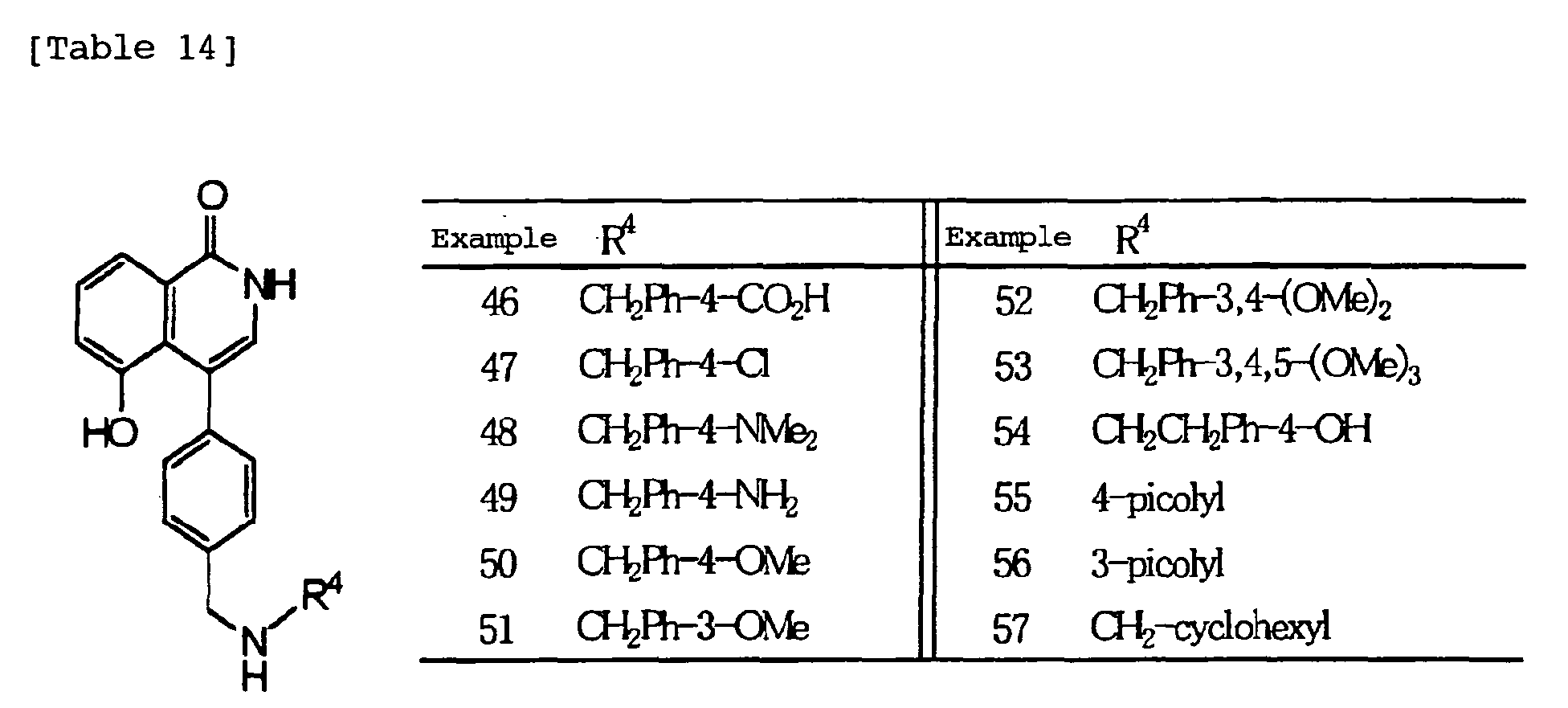
1H-NMR (DMSO-d6, δ): 3.72(2H,s), 3.80(2H,s), 6.72(1H,d,J=4.9Hz),
7.01(2H,d,J=7.8Hz), 7.27(2H,d,J=8.3Hz), 7.32(1H,t,J=7.8Hz),7.49
(2H,d,J=8.3Hz), 7.77(1H,d,J=8.3Hz), 7.91(2H,d,J=7.8Hz), 9.66(1H,
s), 11.28(1H,d,J=4.4Hz).
Anal. Calcd. for C24H20N2O4·2/3H2O: C, 69.89; H, 5.18; N, 6.79(%). Found: C, 69.90; H, 5.02; N, 6.77(%).
HR-FAB+ (m/z): 401.1439 (-1.2mmu).
Anal. Calcd. for C24H20N2O4·2/3H2O: C, 69.89; H, 5.18; N, 6.79(%). Found: C, 69.90; H, 5.02; N, 6.77(%).
HR-FAB+ (m/z): 401.1439 (-1.2mmu).
1H-NMR (DMSO-d6, δ): 3.68(2H,s), 3.71(2H,s), 7.01(1H,dd,J=7.8,
1.0Hz), 7.21(2H,d,J=8.3Hz), 7.26(2H,d,J=8.3Hz), 7.32(1H,t, J=7.8
Hz), 7.39-7.42(4H,m), 7.77(1H,dd,J=7.8,1.5Hz), 9.40-9.70 (1H,br),
11.10-11.50(1H,br).
HR-FAB+ (m/z): 390.1103 (-3.2mmu).
HR-FAB+ (m/z): 390.1103 (-3.2mmu).
1H-NMR (DMSO-d6, δ): 2.86(6H,s), 3.60(2H,s), 3.67(2H,s), 6.68-6.70(2H,m),
7.00(1H,d,J=7.8Hz), 7.17(2H,d,J=8.8Hz), 7.20(2H,d,J=
7.8Hz), 7.24(2H,d,J=8.3Hz), 7.30(1H,t,J=7.8Hz), 7.74(1H,d, J=7.8
Hz), 9.50-10.20 (1H,br), 11.10-11.50(1H,br).
HR-FAB+ (m/z): 400.1999 (-2.6mmu).
HR-FAB+ (m/z): 400.1999 (-2.6mmu).
1H-NMR (DMSO-d6, δ): 3.54(2H,s), 3.67(2H,s), 4.90(2H,s), 6.52(2H,
d,J=7.8Hz), 6.71(1H,s), 6.99-7.01(3H,m), 7.20(2H,d,J=7.8Hz),7.25
(2H,d,J=7.8Hz), 7.31(1H,t,J=7.8Hz), 7.77(1H,d,J=7.8Hz), 9.60(1H,
s), 11.25(1H,s).
Anal. Calcd. for C23H21N3O2·2/5H2O: C, 72.96; H, 5.80; N, 11.10(%). Found: C, 73.03; H, 5.81; N, 10.91(%).
HR-FAB+ (m/z): 372.1711 (-0.1mmu).
Anal. Calcd. for C23H21N3O2·2/5H2O: C, 72.96; H, 5.80; N, 11.10(%). Found: C, 73.03; H, 5.81; N, 10.91(%).
HR-FAB+ (m/z): 372.1711 (-0.1mmu).
1H-NMR (DMSO-d6, δ): 3.65(2H,s), 3.68(2H,s), 3.74(3H,s), 6.72(1H,s),
6.89(2H,d,J=8.3Hz), 7.01(1H,d,J=7.8Hz), 7.19-7.34(7H,m), 7.77
(1H,d,J=7.8Hz), 9.61(1H,s), 11.26(1H,s).
Anal. Calcd. for C24H22N2O3·1/2H2O: C, 72.89; H, 5.86; N, 7.08(%). Found: C, 72.95; H, 5.73; N, 7.17(%).
HR-MS (m/z): 386.1607 (-2.3mmu).
Anal. Calcd. for C24H22N2O3·1/2H2O: C, 72.89; H, 5.86; N, 7.08(%). Found: C, 72.95; H, 5.73; N, 7.17(%).
HR-MS (m/z): 386.1607 (-2.3mmu).
1H-NMR (DMSO-d6, δ): 3.69(4H,s), 3.75(3H,s), 6.72(1H,s), 6.80
(1H,dd,J=7.8,2.0Hz), 6.94(1H,t,J=7.3Hz), 7.01(1H,d,J=7.8Hz),7.20-7.27(5H,m),
7.32(1H,t,J=7.8Hz), 7.77-7.79(1H,m), 9.50-9.70(1H,br),
11.20-11.40(1H,br).
Anal. Calcd. for C24H22N2O3·1/6H2O: C, 74.02; H, 5.78; N, 7.19(%). Found: C, 74.05; H, 5.83; N, 7.18(%).
HR-FAB+ (m/z): 387.1691 (-1.8mmu).
Anal. Calcd. for C24H22N2O3·1/6H2O: C, 74.02; H, 5.78; N, 7.19(%). Found: C, 74.05; H, 5.83; N, 7.18(%).
HR-FAB+ (m/z): 387.1691 (-1.8mmu).
1H-NMR (DMSO-d6, δ): 3.65(2H,s), 3.68(2H,s), 3.73(3H,s), 3.75(3H,s),
6.84-6.90(2H,m), 6.99-7.02(2H,m), 7.21(2H,d,J=7.8Hz), 7.26(2H,d,
J=8.3Hz), 7.32(1H,t,J=7.8Hz), 7.78(1H,dd,J=7.8,1.0Hz), 9.61 (1H,s),
11.26(1H,s).
Anal. Calcd. for C25H24N2O4·1/5H2O: C, 71.48; H, 5.85; N, 6.67(%). Found: C, 71.49; H, 5.82; N, 6.63(%).
HR-FAB+ (m/z): 417.1834 (+2.0mmu).
Anal. Calcd. for C25H24N2O4·1/5H2O: C, 71.48; H, 5.85; N, 6.67(%). Found: C, 71.49; H, 5.82; N, 6.63(%).
HR-FAB+ (m/z): 417.1834 (+2.0mmu).
1H-NMR (DMSO-d6, δ): 3.63(3H,s), 3.66(2H,s), 3.70(2H,s), 3.77(6H,s),
6.69(2H,s), 6.72(1H,s), 7.01(1H,dd,J=7.8,1.0Hz), 7.21(2H,d,J=7.8
Hz), 7.27(2H,d,J=8.3Hz), 7.32(1H,t,J=7.8Hz), 7.78(1H,dd, J=7.8,
1.0Hz), 9.62(1H,s), 11.27(1H,s).
Anal. Calcd. for C26H26N2O5·1/5H2O: C, 69.38; H, 5.91; N, 6.22(%). Found: C, 69.35; H, 5.88; N, 6.25(%).
HR-FAB+ (m/z): 447.1943 (+2.3mmu).
Anal. Calcd. for C26H26N2O5·1/5H2O: C, 69.38; H, 5.91; N, 6.22(%). Found: C, 69.35; H, 5.88; N, 6.25(%).
HR-FAB+ (m/z): 447.1943 (+2.3mmu).
1H-NMR (DMSO-d6, δ): 2.62-2.72(4H,m), 3.72(2H,s), 6.66(2H,d,J=
8.3Hz), 6.71(1H,s), 6.99-7.01(3H,m), 7.22(2H,d,J=8.3Hz), 7.31
(1H,t,J=7.8Hz), 7.76-7.78(1H,m), 9.13(1H,s), 9.60(1H,brs),11.27
(1H,brs).
Anal. Calcd. for C24H22N2O3·1/5H2O: C, 73.90; H, 5.79; N, 7.18(%). Found: C, 73.86; H, 5.95; N, 7.16(%).
HR-FAB+ (m/z): 387.1698 (-1.0mmu).
Anal. Calcd. for C24H22N2O3·1/5H2O: C, 73.90; H, 5.79; N, 7.18(%). Found: C, 73.86; H, 5.95; N, 7.16(%).
HR-FAB+ (m/z): 387.1698 (-1.0mmu).
1H-NMR (DMSO-d6, δ): 3.70(2H,s), 3.75(2H,s),
6.72(1H,d,J=5.4Hz),7.01(1H,d,J=7.8Hz), 7.21(2H,d,J=8.3Hz), 7.27
(2H,d,J=8.3Hz), 7.32(1H,t,J=7.8Hz), 7.39(2H,d,J=5.9Hz), 7.77-7.79
(1H,m), 8.50 (2H,d,J=5.9Hz), 9.61(1H,s), 11.26(1H,d,J=4.9Hz).
Anal. Calcd. for C22H19N3O2·1/3H2O: C, 72.71; H, 5.45; N, 11.56(%). Found: C, 72.71; H, 5.49; N, 11.42(%).
HR-MS (m/z): 351.1469 (-0.8mmu).
Anal. Calcd. for C22H19N3O2·1/3H2O: C, 72.71; H, 5.45; N, 11.56(%). Found: C, 72.71; H, 5.49; N, 11.42(%).
HR-MS (m/z): 351.1469 (-0.8mmu).
1H-NMR (DMSO-d6, δ): 3.80(2H,s), 3.83(2H,s), 6.72(1H,d,J=5.4Hz),
7.03(1H,d,J=7.8Hz), 7.24(2H,d,J=8.3Hz), 7.29-7.34(2H,m),7.39(1H,
dd,J=7.8,4.9Hz), 7.77-7.83(2H,m), 8.49(1H,d,J=4.4Hz),8.58 (1H,s),
9.63(1H,s), 11.29(1H,d,J=3.9Hz).
Anal. Calcd. for C22H19N3O2·4/5H2O: C, 71.07; H, 5.58; N, 11.30(%). Found: C, 70.95; H, 5.46; N, 11.24(%).
HR-FAB+ (m/z): 358.1588 (+3.3mmu).
Anal. Calcd. for C22H19N3O2·4/5H2O: C, 71.07; H, 5.58; N, 11.30(%). Found: C, 70.95; H, 5.46; N, 11.24(%).
HR-FAB+ (m/z): 358.1588 (+3.3mmu).
1H-NMR (DMSO-d6, δ): 0.80-1.00(2H,m), 1,10-1.30(3H,m), 1,40-1.50
(1H,m), 1,60-1.80(5H,m), 2.37(2H,d,J=6.9Hz), 3.70(2H,s),6.71(1H,
s), 7.01(1H,d,J=7.8Hz), 7.19(2H,d,J=7.8Hz), 7.24(2H,d,J=7.8 Hz),
7.32(1H,t,J=7.8Hz), 7.78(1H,d,J=7.8Hz), 9.40-9.70 (1H,br),11.00-11.50(1H,br).
Anal. Calcd. for C23H26N2O2·1/3H2O: C, 74.97; H, 7.29; N, 7.60(%). Found: C, 74.85; H, 7.30; N, 7.81(%).
HR-MS (m/z): 362.1983 (-1.1mmu).
Anal. Calcd. for C23H26N2O2·1/3H2O: C, 74.97; H, 7.29; N, 7.60(%). Found: C, 74.85; H, 7.30; N, 7.81(%).
HR-MS (m/z): 362.1983 (-1.1mmu).
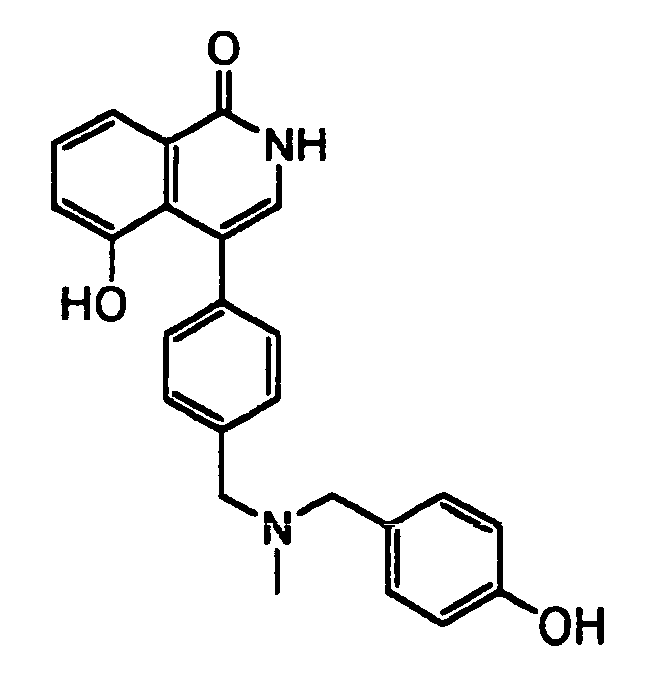
To a solution of the compound of Example 13 (168 mg, 420 µmol)
in acetic acid (4ml) was added 47% hydrobromic acid (2ml), and the
mixture was refluxed for 6 hours. After cooling, water was added
to the residue obtained by concentrating the reaction mixture under
reduced pressure, and the solution was brought to pH 8 with saturated
aqueous solution of sodium hydrogencarbonate. This was extracted
with ethyl acetate-methanol mixed solution (10:1), dried over
anhydrous sodium sulfate, and then solvent was distilled off. A small
quantity of ethyl acetate was added to the residue obtained. The
crystals were collected by filtration, washed with ethyl acetate,
and then air-dried, thereby affording 130mg of the title compound
as colorless powder. Yield 79%.
1H-NMR (DMSO-d6, δ): 2.08(3H,s), 3.40(2H,s), 3.47(2H,s), 6.71-6.74(3H,m), 6.99(1H,dd,J=7.8,1.0Hz), 7.14(2H,d,J=8.3Hz), 7.21(2H, d,J=8.3Hz), 7.25(2H,d,J=8.3Hz), 7.31(1H,t,J=7.8Hz), 7.77(1H,dd, J=7.8,1.0Hz), 9.27(1H,s), 9.63(1H,s), 11.27(1H,d,J=5.9 Hz).
Anal. Calcd. for C24H22N2O3·1/5H2O: C, 73.90; H, 5.79; N, 7.18(%). Found: C, 73.93; H, 5.75; N, 7.13(%).
HR-FAB+ (m/z): 387.1704 (-0.4mmu).
1H-NMR (DMSO-d6, δ): 2.08(3H,s), 3.40(2H,s), 3.47(2H,s), 6.71-6.74(3H,m), 6.99(1H,dd,J=7.8,1.0Hz), 7.14(2H,d,J=8.3Hz), 7.21(2H, d,J=8.3Hz), 7.25(2H,d,J=8.3Hz), 7.31(1H,t,J=7.8Hz), 7.77(1H,dd, J=7.8,1.0Hz), 9.27(1H,s), 9.63(1H,s), 11.27(1H,d,J=5.9 Hz).
Anal. Calcd. for C24H22N2O3·1/5H2O: C, 73.90; H, 5.79; N, 7.18(%). Found: C, 73.93; H, 5.75; N, 7.13(%).
HR-FAB+ (m/z): 387.1704 (-0.4mmu).

Using the compound of Example 51 (100mg, 259µmol), through the
process similar to Example 58, 76.7mg of the title compound were
afforded as light brown powder. Yield 79%.
1H-NMR (DMSO-d6, δ): 3.63(2H,s), 3.68(2H,s), 6.72-6.80(3H,m), 7.00(1H,d,J=7.3Hz), 7.08-7.11(1H,m), 7.21(2H,d,J=6.9Hz), 7.26 (2H,d,J=6.9Hz), 7.32(1H,t,J=7.8Hz), 7.77 (1H,d,J=7.3Hz), 9.26 (1H,s), 9.62(1H,s), 11.27(1H,s).
Anal. Calcd. for C23H20N2O3·1/6H2O: C, 73.58; H, 5.46; N, 7.46(%). Found: C, 73.56; H, 5.47; N, 7.41(%).
HR-FAB+ (m/z): 373.1533 (-1.9mmu).
1H-NMR (DMSO-d6, δ): 3.63(2H,s), 3.68(2H,s), 6.72-6.80(3H,m), 7.00(1H,d,J=7.3Hz), 7.08-7.11(1H,m), 7.21(2H,d,J=6.9Hz), 7.26 (2H,d,J=6.9Hz), 7.32(1H,t,J=7.8Hz), 7.77 (1H,d,J=7.3Hz), 9.26 (1H,s), 9.62(1H,s), 11.27(1H,s).
Anal. Calcd. for C23H20N2O3·1/6H2O: C, 73.58; H, 5.46; N, 7.46(%). Found: C, 73.56; H, 5.47; N, 7.41(%).
HR-FAB+ (m/z): 373.1533 (-1.9mmu).

To a solution of the compound of Example 50 (195mg, 505µmol) in
acetic acid (4mL) was added 47% hydrobromic acid (2mL), and the
mixture was refluxed for 8 hours. After cooling, water was added
to the residue obtained by concentrating the reaction mixture under
reduced pressure. The precipitated crystals were collected by
filtration, washed with water, and then air-dried, thereby affording
208mg of the title compound as colorless powder. Yield 91%.
1H-NMR (DMSO-d6, δ): 3.98(2H,s), 4.06(2H,s), 6.73(1H,d,J=5.4Hz), 6.80(2H,d,J=8.3Hz), 7.06(1H,dd,J=7.8,1.0Hz), 7.27-7.39 (7H,m), 7.79(1H,dd,J=7.8,1.0Hz), 9.61(1H,s), 9.64(1H,s), 11.33(1H,d, J=5.4 Hz).
HR-FAB+ (m/z): 373.1568 (+1.6mmu).
1H-NMR (DMSO-d6, δ): 3.98(2H,s), 4.06(2H,s), 6.73(1H,d,J=5.4Hz), 6.80(2H,d,J=8.3Hz), 7.06(1H,dd,J=7.8,1.0Hz), 7.27-7.39 (7H,m), 7.79(1H,dd,J=7.8,1.0Hz), 9.61(1H,s), 9.64(1H,s), 11.33(1H,d, J=5.4 Hz).
HR-FAB+ (m/z): 373.1568 (+1.6mmu).
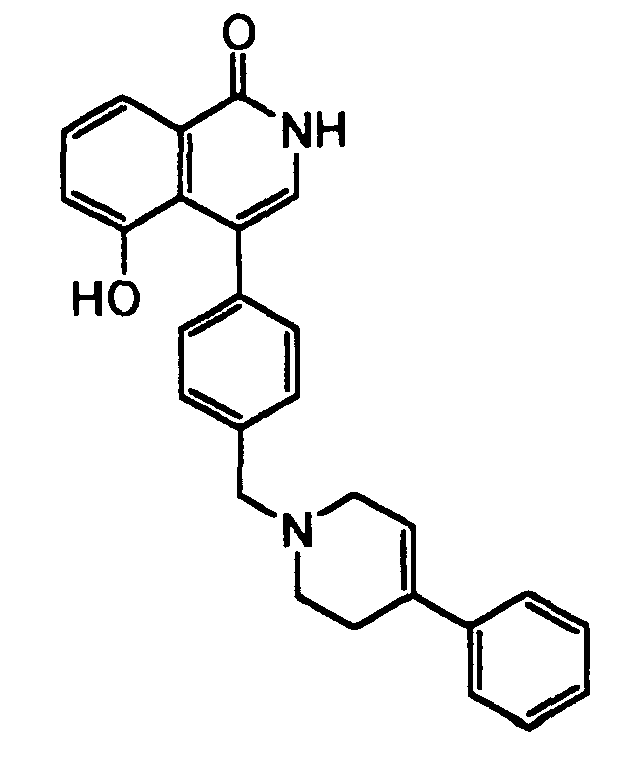
Using the compound of Referential example 8 (200mg, 716µmol) and
4-hydroxy-4-phenylpiperidine (762mg, 4.30mmol), through the
process similar to Example 1, 126mg of the title compound were
afforded as colorless powder. Yield 42%.
1H-NMR (DMSO-d6, δ): 2.69(2H,s), 3.10(2H,d,J=2.9Hz), 3.61(2H,s), 6.17(1H,s), 6.75(1H,d,J=3.3Hz), 7.01(1H,d,J=7.8Hz), 7.18-7.35(8H, m), 7.43-7.45(2H,m), 7.76-7.78(1H,m), 9.68(1H,s), 11.27(1H,s).
Anal. Calcd. for C27H24N2O2·3/5H2O: C, 77.34; H, 6.06; N, 6.68(%). Found: C, 77.31; H, 5.91; N, 6.69(%).
HR-MS (m/z): 408.1829 (-0.9mmu).
1H-NMR (DMSO-d6, δ): 2.69(2H,s), 3.10(2H,d,J=2.9Hz), 3.61(2H,s), 6.17(1H,s), 6.75(1H,d,J=3.3Hz), 7.01(1H,d,J=7.8Hz), 7.18-7.35(8H, m), 7.43-7.45(2H,m), 7.76-7.78(1H,m), 9.68(1H,s), 11.27(1H,s).
Anal. Calcd. for C27H24N2O2·3/5H2O: C, 77.34; H, 6.06; N, 6.68(%). Found: C, 77.31; H, 5.91; N, 6.69(%).
HR-MS (m/z): 408.1829 (-0.9mmu).

Using the compound of Referential example 8 (200mg, 716µmol) and
4-benzyl-4-hydroxypiperidine (822mg, 4.30mmol), through the
process similar to Example 1, 51.9mg (yield 17%) of 4-[4-[(4-benzyl-1,2,3,6-tetrahydropyridin-1-yl)methyl]phenyl]-1,2-dihydro-5-hydroxy-1-oxoisoquinoline
and 164mg (yield 52%) of 4-[4-[(4-benzyl-4-hydroxypiperidino)methyl]phenyl]-1,2-
dihydro-5-hydroxy-1-oxoisoquinoline
were afforded as colorless powder.
4-[4-[(4-Benzyl-1,2,3,6-tetrahydropyridin-1-yl)methyl]phenyl]-1,2-dihydro-5-hydroxy-1-oxoisoquinoline
1H-NMR (DMSO-d6, δ): 1.95(2H,s), 2.89(2H,s), 3.26(2H,s), 3.52(2H,s), 5.40(1H,s), 6.72(1H,d,J=5.9Hz), 6.98-7.00(1H,m), 7.16-7.23(7H,m), 7.27-7.33(3H,m), 7.77(1H,dd,J=7.8,1.0Hz), 9.63(1H,s), 11.27 (1H, d,J=5.4).
Anal. Calcd. for C28H26N2O2·1/2H2O: C, 77.93; H, 6.31; N, 6.49(%). Found: C, 78.07; H, 6.32; N, 6.44(%).
HR-FAB+ (m/z): 423.2076 (+0.4mmu).
4-[4-[(4-Benzyl-4-hydroxypiperidino)methyl]phenyl]-1,2-dihydro -5-hydroxy-1-oxoisoquinoline
1H-NMR(DMSO-d6, δ): 1.35-1.38(2H,m), 1.47-1.54(2H,m),2.27-2.32 (2H,m), 2.67(2H,s), 3.43(2H,s), 4.14 (1H,s),6.72(1H,d,J=5.9Hz), 6.99-7.00(1H,m), 7.16-7.27(9H,m), 7.31 (1H,t,J=7.8Hz),7.77(1H, dd,J=7.8,1.0Hz), 9.62(1H,s), 11.26 (1H,d,J=5.4).
Anal. Calcd. for C28H28N2O3·1/5H2O: C, 75.72; H, 6.45; N, 6.31(%). Found: C, 75.71; H, 6.52; N, 6.31(%).
HR-MS (m/z): 441.2159 (-1.9mmu).
1H-NMR (DMSO-d6, δ): 1.95(2H,s), 2.89(2H,s), 3.26(2H,s), 3.52(2H,s), 5.40(1H,s), 6.72(1H,d,J=5.9Hz), 6.98-7.00(1H,m), 7.16-7.23(7H,m), 7.27-7.33(3H,m), 7.77(1H,dd,J=7.8,1.0Hz), 9.63(1H,s), 11.27 (1H, d,J=5.4).
Anal. Calcd. for C28H26N2O2·1/2H2O: C, 77.93; H, 6.31; N, 6.49(%). Found: C, 78.07; H, 6.32; N, 6.44(%).
HR-FAB+ (m/z): 423.2076 (+0.4mmu).
4-[4-[(4-Benzyl-4-hydroxypiperidino)methyl]phenyl]-1,2-dihydro -5-hydroxy-1-oxoisoquinoline
1H-NMR(DMSO-d6, δ): 1.35-1.38(2H,m), 1.47-1.54(2H,m),2.27-2.32 (2H,m), 2.67(2H,s), 3.43(2H,s), 4.14 (1H,s),6.72(1H,d,J=5.9Hz), 6.99-7.00(1H,m), 7.16-7.27(9H,m), 7.31 (1H,t,J=7.8Hz),7.77(1H, dd,J=7.8,1.0Hz), 9.62(1H,s), 11.26 (1H,d,J=5.4).
Anal. Calcd. for C28H28N2O3·1/5H2O: C, 75.72; H, 6.45; N, 6.31(%). Found: C, 75.71; H, 6.52; N, 6.31(%).
HR-MS (m/z): 441.2159 (-1.9mmu).

Using the compound of Referential example 11 (190mg, 614 µmol)
and dipropylamine (506µL, 3.69mmol), through the process similar
to Example 1, 148mg of the title compound were afforded as colorless
powder. Yield 62%.
1H-NMR (DMSO-d6, δ): 0.80(6H,t,J=7.3Hz), 1.36-1.43(4H,m), 2.35 (4H,t,J=7.3Hz), 3.51(2H,s), 3.78(2H,s), 6.67(1H,d,J=5.9Hz),6.87 (1H,d,J=8.3Hz), 7.01(1H,dd,J=7.8,1.0Hz), 7.08(1H,dd,J=8.3,2.4Hz), 7.25(1H,d,J=2.4Hz), 7.31(1H,t,J=7.8Hz), 7.75-7.77 (1H,m),9.49(1H, s), 11.20(1H,d,J=5.4Hz).
Anal. Calcd. for C23H28N2O3·1/5H2O: C, 71.92; H, 7.45; N, 7.29(%). Found: C, 71.86; H, 7.46; N, 7.14(%).
HR-MS (m/z): 380.2090 (-1.0mmu).
1H-NMR (DMSO-d6, δ): 0.80(6H,t,J=7.3Hz), 1.36-1.43(4H,m), 2.35 (4H,t,J=7.3Hz), 3.51(2H,s), 3.78(2H,s), 6.67(1H,d,J=5.9Hz),6.87 (1H,d,J=8.3Hz), 7.01(1H,dd,J=7.8,1.0Hz), 7.08(1H,dd,J=8.3,2.4Hz), 7.25(1H,d,J=2.4Hz), 7.31(1H,t,J=7.8Hz), 7.75-7.77 (1H,m),9.49(1H, s), 11.20(1H,d,J=5.4Hz).
Anal. Calcd. for C23H28N2O3·1/5H2O: C, 71.92; H, 7.45; N, 7.29(%). Found: C, 71.86; H, 7.46; N, 7.14(%).
HR-MS (m/z): 380.2090 (-1.0mmu).
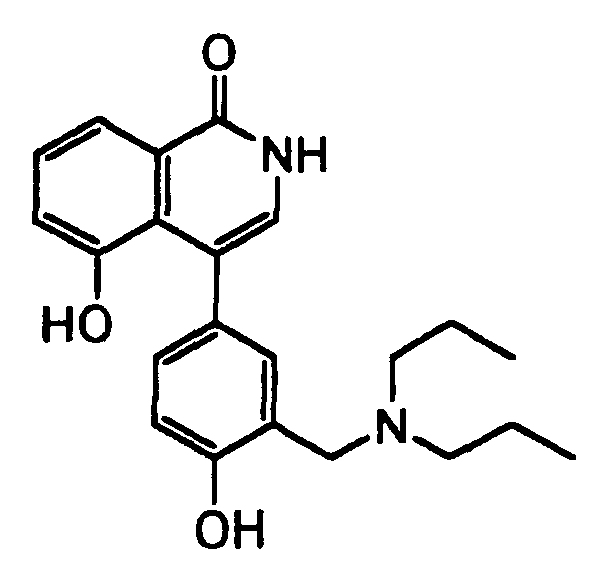
To a solution of the compound of Example 63 (84.6mg, 222 µmol)
in dichloromethane (5mL) was added 1mol/L boron tribromide-dichloromethane
solution (1.11mL, 1.11mmol), and the mixture was
refluxed for 24 hours. After cooling, the reaction mixture was poured
in ice water and the solution was brought to pH 8 with sodium carbonate.
This was extracted using dichloromethane, dried over anhydrous
sodium sulfate, and then solvent was distilled off. The residue
obtained was purified by Chromatolex NH column chromatography [ethyl
acetate-methanol= 20:1], thereby affording 69.8mg of the title
compound as colorless powder. Yield 86%.
1H-NMR (DMSO-d6, δ): 0.85(6H,t,J=7.3Hz), 1.47-1.53(4H,m), 2.42-2.46(4H,m), 3.70(2H,s), 6.62(1H,d,J=7.8Hz), 6.67(1H,d,J=5.9Hz), 6.95-7.01(3H,m), 7.30(1H,t,J=7.8Hz), 7.76(1H,d,J=8.3Hz), 9.20-9.80(1H,br), 11.19(1H,d,J=4.9Hz).
HR-MS (m/z): 366.1954 (-1.0mmu).
1H-NMR (DMSO-d6, δ): 0.85(6H,t,J=7.3Hz), 1.47-1.53(4H,m), 2.42-2.46(4H,m), 3.70(2H,s), 6.62(1H,d,J=7.8Hz), 6.67(1H,d,J=5.9Hz), 6.95-7.01(3H,m), 7.30(1H,t,J=7.8Hz), 7.76(1H,d,J=8.3Hz), 9.20-9.80(1H,br), 11.19(1H,d,J=4.9Hz).
HR-MS (m/z): 366.1954 (-1.0mmu).

Using the compound of Referential example 13 (574mg, 1.50 mmol),
through the process similar to Example 64, 61.5mg of the title
compound were afforded as yellow powder. Yield 11%.
1H-NMR (DMSO-d6, δ): 2.20(6H,s), 2.98(2H,t,J=7.8Hz), 6.89(1H,d, J=5.4Hz), 7.04(1H,d,J=7.8Hz), 7.35(1H,t,J=7.8Hz), 7.45(1H,d, J=8.3 Hz), 7.55(1H,dd,J=7.8,1.5Hz), 7.77-7.79(2H,m), 9.90(1H,s), 11.42 (1H,d,J=5.4Hz).
Anal. Calcd. for C19H19N3O4·1/3H2O: C, 63.50; H, 5.52; N, 11.69(%). Found: C, 63.51; H, 5.64; N, 11.53(%).
HR-MS (m/z): 353.1413 (-1.0mmu).
1H-NMR (DMSO-d6, δ): 2.20(6H,s), 2.98(2H,t,J=7.8Hz), 6.89(1H,d, J=5.4Hz), 7.04(1H,d,J=7.8Hz), 7.35(1H,t,J=7.8Hz), 7.45(1H,d, J=8.3 Hz), 7.55(1H,dd,J=7.8,1.5Hz), 7.77-7.79(2H,m), 9.90(1H,s), 11.42 (1H,d,J=5.4Hz).
Anal. Calcd. for C19H19N3O4·1/3H2O: C, 63.50; H, 5.52; N, 11.69(%). Found: C, 63.51; H, 5.64; N, 11.53(%).
HR-MS (m/z): 353.1413 (-1.0mmu).
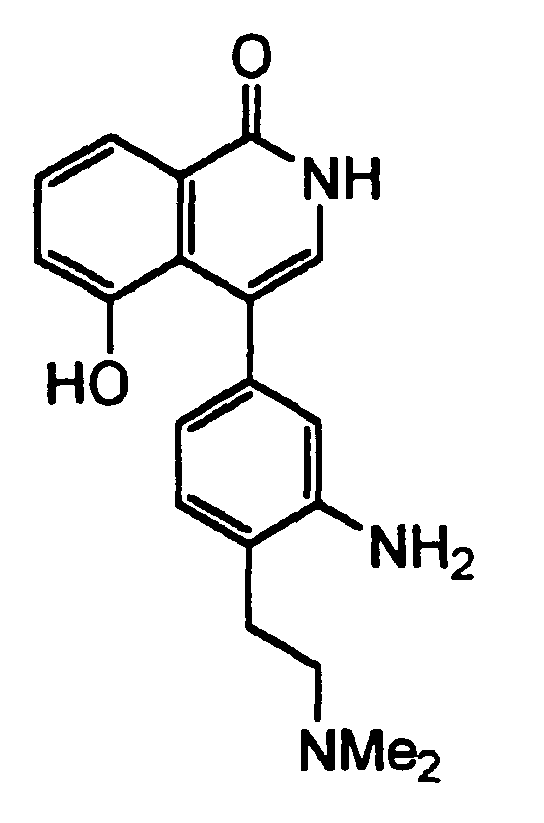
To a solution of the compound of Example 65 (46.0mg, 130 µmol)
in methanol-N,N-dimethylformamide (3:1, 4mL) was added 10% palladium
on carbon (moisture 51.1%, 5.00mg), and the mixture was stirred for
2 hours at room temperature under hydrogen current (ambient pressure).
Catalyst was filtered off using celite and solvent was distilled
off. Acetone was added to the residue obtained. The crystals were
collected by filtration, washed using acetone, and then air-dried,
thereby affording 35.4mg of the title compound as light brown powder.
Yield 84%.
1H-NMR (DMSO-d6, δ): 2.21(6H,s), 2.42(2H,t,J=7.8Hz), 2.57(2H,t, J=7.8Hz), 4.77(2H,s), 6.42(1H,dd,J=7.8,1.5Hz), 6.54(1H,d,J=2.0Hz), 6.65(1H,s), 6.84(1H,d,J=7.8Hz), 6.95(1H,d,J=7.3Hz), 7.28(1H,t,J= 7.8Hz), 7.71(1H,d,J=7.3Hz), 9.10-10.10(1H,br),10.80-11.30(1H,br). HR-MS (m/z): 323.1647 (+1.4mmu).
1H-NMR (DMSO-d6, δ): 2.21(6H,s), 2.42(2H,t,J=7.8Hz), 2.57(2H,t, J=7.8Hz), 4.77(2H,s), 6.42(1H,dd,J=7.8,1.5Hz), 6.54(1H,d,J=2.0Hz), 6.65(1H,s), 6.84(1H,d,J=7.8Hz), 6.95(1H,d,J=7.3Hz), 7.28(1H,t,J= 7.8Hz), 7.71(1H,d,J=7.3Hz), 9.10-10.10(1H,br),10.80-11.30(1H,br). HR-MS (m/z): 323.1647 (+1.4mmu).
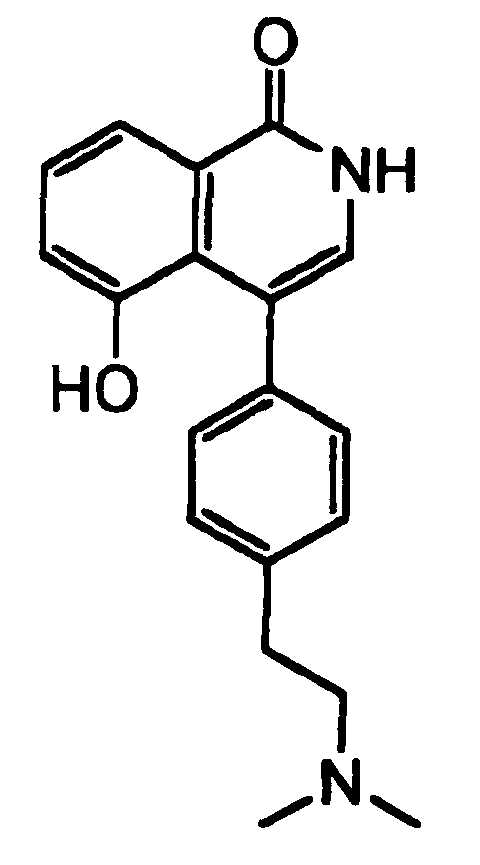
1H-NMR (CDCl3,δ): 2.34(6H,s), 2.59-2.63(2H,m), 2.83-2.88 (2H,m), 4.15(3H,s), 7.07(1H,dd,J=7.8,1.0Hz), 7.36(2H,d,J=8.3Hz), 7.41(2H, d,J=8.3Hz), 7.47(1H,t,J=7.8Hz), 7.72(1H,s), 7.93(1H,dd, J=8.3,1.0 Hz).
Process 2: To a solution of 4-[4-[2- (dimethylamino)ethyl] phenyl]-5-hydroxy-1-methoxyisoquinoline (91.3mg, 283µmol) in acetic acid (5mL) were added 47% hydrobromic acid (0.5mL) and water (0.5mL), and the mixture was stirred for 1 hour at 100°C. Water was added to the residue obtained by concentrating the reaction mixture under reduced pressure. The solution was brought to pH 8 with saturated aqueous solution of sodium hydrogencarbonate and concentrated under reduced pressure. The residue obtained was purified by silica gel column chromatography [ethyl acetate-methanol =1:1], washed with ethyl acetate and water in order, and then air-dried, thereby affording 37.2mg of the title compound as pale yellow powder. Yield 43%.
1H-NMR (DMSO-d6, δ): 2.20(6H,s), 2.72(2H,t,J=7.3Hz), 6.71(1H,d, J=5.9Hz), 6.99(1H,d,J=7.8Hz), 7.13(2H,d,J=7.8Hz), 7.17(2H,d, J= 8.3Hz), 7.31(1H,t,J=7.8Hz), 7.76-7.78(1H,m), 9.64(1H,s), 11.26 (1H,d,J=4.9Hz).
Anal. Calcd. for C19H20N2O2·1/4H2O: C, 72.94; H, 6.60; N, 8.95(%). Found: C, 72.87; H, 6.49; N, 8.92(%). HR-FAB+ (m/z): 309.1579 (-2.4mmu).

1H-NMR (DMSO-d6, δ): 0.92(6H,brs), 1.30-1.90(4H,br), 2.80-3.30
(4H,br), 6.70(1H,d,J=5.9Hz), 7.03(1H,d,J=7.8Hz), 7.22(4H,brs),
7.33(1H,t,J=7.8Hz), 7.78(1H,d,J=7.8Hz), 9.61(1H,s), 11.29(1H,d,J=
5.9Hz).
HR-FAB+ (m/z): 365.2246 (+1.7mmu).
HR-FAB+ (m/z): 365.2246 (+1.7mmu).
1H-NMR (DMSO-d6, δ): 0.85(3H,t,J=7.3Hz), 1.39-1.48(2H,m), 2.22
(3H,s), 2.32(2H,t,J=7.3Hz), 2.52-2.56(2H,m), 2.69-2.73(2H,m),
6.71(1H,d,J=5.4Hz), 6.99(1H,dd,J=7.8,1.5Hz), 7.13(2H,d,J=8.3 Hz),
7.17(2H,d,J=8.3Hz), 7.31(1H,t,J=7.8Hz), 7.77(1H,dd,J=7.8,1.0Hz),
9.62(1H,brs), 11.26(1H,d,J=5.9Hz).
Anal. Calcd. for C21H24N2O2: C, 74.97; H, 7.19; N, 8.33(%). Found: C, 74.86; H, 7.24; N, 8.39(%).
HR-FAB+ (m/z): 337.1938 (+2.2mmu).
Anal. Calcd. for C21H24N2O2: C, 74.97; H, 7.19; N, 8.33(%). Found: C, 74.86; H, 7.24; N, 8.39(%).
HR-FAB+ (m/z): 337.1938 (+2.2mmu).
1H-NMR (DMSO-d6, δ): 0.87(3H,t,J=7.3Hz), 1.23-1.32(4H,m), 1.39-1.46(2H,m),
2.23(3H,s), 2.36(2H,brs), 2.56(2H,brs), 2.72(2H,t,J=
7.8Hz), 6.71(1H,d,J=5.9Hz), 6.99(1H,d,J=7.8Hz), 7.13(2H,d, J=8.3
Hz), 7.17(2H,d,J=7.8Hz), 7.31(1H,t,J=7.8Hz), 7.76-7.78(1H,m), 9.62
(1H,brs), 11.26(1H,d,J=5.4Hz).
Anal. Calcd. for C23H28N2O2·1/5H2O: C, 75.05; H, 7.78; N, 7.61(%). Found: C, 75.00; H, 7.84; N, 7.77(%).
HR-FAB+ (m/z): 365.2197 (-3.2mmu).
Anal. Calcd. for C23H28N2O2·1/5H2O: C, 75.05; H, 7.78; N, 7.61(%). Found: C, 75.00; H, 7.84; N, 7.77(%).
HR-FAB+ (m/z): 365.2197 (-3.2mmu).
1H-NMR (DMSO-d6, δ): 2.14(6H,s), 2.24(3H,s), 2.30-2.34(2H,m),
2.45-2.48(2H,m), 2.56-2.60(2H,m), 2.70-2.73(2H,m), 6.71(1H,d,
J=5.4Hz), 6.99(1H,dd,J=7.8,1.0Hz), 7.13(2H,d,J=8.3Hz), 7.17
(2H,d,J=8.3Hz), 7.31(1H,t,J=7.8Hz), 7.77(1H,dd,J=7.8,1.0Hz),
9.50-9.80(1H,br), 11.25(1H,d,J=4.9Hz).
Anal. Calcd. for C22H27N3O2·1/5H2O: C, 71.59; H, 7.48; N, 11.39(%). Found: C, 71.57; H, 7.50; N, 11.29(%).
HR-MS (m/z): 365.2078 (-2.6mmu).
Anal. Calcd. for C22H27N3O2·1/5H2O: C, 71.59; H, 7.48; N, 11.39(%). Found: C, 71.57; H, 7.50; N, 11.29(%).
HR-MS (m/z): 365.2078 (-2.6mmu).
1H-NMR (DMSO-d6, δ): 0.70-1.00(2H,br), 1.10-1.30(4H,m), 1.50-1.80(6H,m),
2.00-2.40(4H,br), 2.60-2.90(2H,br), 6.70(1H,d, J=6.1
Hz), 7.00(1H,d,J=6.7Hz), 7.10-7.25(4H,m), 7.32(1H,t,J=7.9Hz), 7.77
(1H,d,J=7.9Hz), 9.61(1H,s), 11.20-11.30(1H,m).
HR-FAB+ (m/z): 391.2389 (+0.3mmu).
HR-FAB+ (m/z): 391.2389 (+0.3mmu).
1H-NMR (DMSO-d6, δ): 2.20(3H,s), 2.59(2H,t,J=7.8Hz), 2.79(2H,t,
J=7.8Hz), 3.55(2H,s), 6.71(1H,d,J=5.9Hz), 6.98-7.00(1H,m), 7.11
(2H,d,J=8.3Hz), 7.16(2H,d,J=8.3Hz), 7.22-7.33(6H,m), 7.77 (1H,dd,
J=7.8,1.0Hz), 9.61(1H,s), 11.26(1H,d,J=5.4Hz).
Anal. Calcd. for C25H24N2O2·2/5H2O: C, 76.66; H, 6.38; N, 7.15(%). Found: C, 76.73; H, 6.28; N, 7.10(%).
HR-MS (m/z): 384.1803 (-3.5mmu).
Anal. Calcd. for C25H24N2O2·2/5H2O: C, 76.66; H, 6.38; N, 7.15(%). Found: C, 76.73; H, 6.28; N, 7.10(%).
HR-MS (m/z): 384.1803 (-3.5mmu).
1H-NMR (DMSO-d6, δ): 2.20(3H,brs), 2.54-2.58(2H,m), 2.70-2.85
(2H,m), 3.48(2H,brs), 3.73(3H,s), 6.71(1H,d,J=5.5Hz), 6.87(2H,
d,J=7.3Hz), 6.99(1H,d,J=7.9Hz), 7.11(2H,d,J=7.9Hz), 7.16(2H,d,
J=7.9Hz), 7.20(2H,d,J=6.7Hz), 7.31(1H,t,J=7.9Hz), 7.77(1H,d,J=
7.3Hz), 9.61(1H,s), 11.26(1H,d,J=6.1Hz).
Anal. Calcd. for C26H26N2O3·1/2H2O: C, 73.74; H, 6.43; N, 6.61(%). Found: C, 73.52; H, 6.28; N, 6.50(%).
HR-MS (m/z): 414.1957 (+1.4mmu).
Anal. Calcd. for C26H26N2O3·1/2H2O: C, 73.74; H, 6.43; N, 6.61(%). Found: C, 73.52; H, 6.28; N, 6.50(%).
HR-MS (m/z): 414.1957 (+1.4mmu).
1H-NMR DMSO-d6, δ): 2.22(3H,s), 2.57-2.61(2H,m), 2.77-2.81(2H,m),
3.52(2H,s),3.72(3H,s), 6.72(1H,d,J=5.9Hz), 6.79-6.81(1H,m), 6.85-6.87(2H,m),
6.99(1H,dd,J=7.8,1.5Hz), 7.11(2H,d,J=8.3Hz), 7.16 (2H,
d,J=8.3Hz), 7.22(1H,t,J=7.8Hz), 7.31(1H,t,J=7.8 Hz), 7.76- 7.78
(1H,m), 9.61(1H,s), 11.26(1H,d,J=5.4Hz).
Anal. Calcd. for C26H26N2O3·1/6H2O: C, 74.80; H, 6.36; N, 6.71(%). Found: C, 74.81; H, 6.35; N, 6.75(%).
HR-MS (m/z): 414.1977 (+3.3mmu).
Anal. Calcd. for C26H26N2O3·1/6H2O: C, 74.80; H, 6.36; N, 6.71(%). Found: C, 74.81; H, 6.35; N, 6.75(%).
HR-MS (m/z): 414.1977 (+3.3mmu).
1H-NMR (DMSO-d6, δ): 2.19(3H,brs), 2.76(2H,brs), 4.93(2H,brs),
6.50(2H,d,J=8.3Hz), 6.71(1H,d,J=5.9Hz), 6.93(2H,d,J=8.3Hz), 6.98
(1H,d,J=7.8Hz), 7.09(2H,d,J=8.3Hz), 7.16(2H,d,J=8.3Hz), 7.31(1H,t,
J=7.8Hz), 7.77(1H,d,J=7.8Hz), 9.61(1H,s), 11.25(1H, d,J=6.3Hz).
Anal. Calcd. for C25H25N3O2·1/5H2O: C, 74.49; H, 6.35; N, 10.42(%). Found: C, 74.47; H, 6.37; N, 10.32(%).
HR-FAB+ (m/z): 400.2002 (-2.3mmu).
Anal. Calcd. for C25H25N3O2·1/5H2O: C, 74.49; H, 6.35; N, 10.42(%). Found: C, 74.47; H, 6.37; N, 10.32(%).
HR-FAB+ (m/z): 400.2002 (-2.3mmu).
1H-NMR (DMSO-d6, δ): 2.20(3H,brs), 2.78(2H,brs), 2.87(6H,s), 3.45
(2H,s), 6.67(2H,d,J=8.8Hz), 6.71(1H,d,J=5.9Hz), 6.99(1H,d,J=7.8
Hz), 7.10(4H,d,J=8.8Hz), 7.16(2H,d,J=8.3Hz), 7.31(1H,t, J=7.8Hz),
7.77(1H,d,J=7.8Hz), 9.62(1H,s), 11.26(1H,d,J=5.9Hz).
HR-MS (m/z): 427.2286 (+2.7mmu).
HR-MS (m/z): 427.2286 (+2.7mmu).
1H-NMR (DMSO-d6, δ): 1.47-1.57(4H,m), 1.90-2.00(4H,m), 2.06 (2H,t,
J=7.3Hz), 2.24(3H,s), 2.45(2H,t,J=7.3Hz), 2.57(2H,t,J=7.8 Hz),
2.72(2H,t,J=7.8Hz), 5.40(1H,s), 6.70(1H,d,J=5.9Hz), 7.00 (1H,d,J=
7.8Hz), 7.13(2H,d,J=8.3Hz), 7.17(2H,d,J=7.8Hz), 7.31(1H,t,J=7.8
Hz), 7.77(1H,d,J=7.8Hz), 9.62(1H,s), 11.26(1H,d,J=5.9Hz).
HR-FAB+ (m/z): 403.2401 (+1.6mmu).
HR-FAB+ (m/z): 403.2401 (+1.6mmu).
1H-NMR (DMSO-d6, δ): 2.32(3H,s), 2.63-2.73(8H,m), 6.71(1H,d, J=5.4
Hz), 7.00(1H,d,J=7.8Hz), 7.12-7.33(10H,m), 7.77(1H,d, J=7.8Hz),
9.62(1H,s), 11.26(1H,d,J=5.4Hz).
Anal. Calcd. for C26H26N2O2·1/5H2O: C, 77.66; H, 6.62; N, 6.97(%). Found: C, 77.57; H, 6.65; N, 6.94(%).
HR-FAB+ (m/z): 399.2053 (-2.0mmu).
Anal. Calcd. for C26H26N2O2·1/5H2O: C, 77.66; H, 6.62; N, 6.97(%). Found: C, 77.57; H, 6.65; N, 6.94(%).
HR-FAB+ (m/z): 399.2053 (-2.0mmu).
1H-NMR (DMSO-d6, δ): 2.74(8H,brs), 3.72(3H,s), 6.71(1H,d,J=5.9Hz),
6.87(2H,d,J=8.3Hz), 7.01(1H,d,J=7.8Hz), 7.17-7.19(6H,m), 7.32
(1H,t,J=7.8Hz), 7.77(1H,dd,J=7.8,1.5Hz), 9.63(1H,s), 11.28(1H,d,
J=5.4Hz).
HR-FAB+ (m/z): 429.2146 (-3.2mmu).
HR-FAB+ (m/z): 429.2146 (-3.2mmu).
1H-NMR (DMSO-d6, δ): 2.70-2.77(4H,m), 2.82-2.88(4H,m), 3.66(2H,s),
6.72(1H,d,J=5.9Hz), 6.99(1H,d,J=6.8Hz), 7.07-7.13(4H,m), 7.18(4H,
s), 7.31(1H,t,J=7.8Hz), 7.77(1H,t,J=6.8Hz), 9.63(1H,s), 11.26(1H,
d,J=5.4Hz).
Anal. Calcd. for C26H24N2O2·1/5H2O: C, 78.05; H, 6.15; N, 7.00(%). Found: C, 78.03; H, 6.16; N, 6.86(%).
HR-MS (m/z): 396.1801 (-3.7mmu).
Anal. Calcd. for C26H24N2O2·1/5H2O: C, 78.05; H, 6.15; N, 7.00(%). Found: C, 78.03; H, 6.16; N, 6.86(%).
HR-MS (m/z): 396.1801 (-3.7mmu).
1H-NMR (DMSO-d6, δ): 2.65-2.69(2H,m), 2.74-2.77(2H,m), 2.80-2.84
(2H,m), 3.19(2H,d,J=2.4Hz), 6.19(1H,s), 6.72(1H,d,J=5.9Hz), 6.99
(1H,d,J=7.8Hz), 7.18(4H,s), 7.24(1H,t,J=7.8Hz), 7.29-7.36(3H,m),
7.44(2H,d,J=7.3Hz), 7.77(1H,d,J=7.8Hz), 9.63(1H,s), 11.26(1H,d,
J=5.9Hz).
Anal. Calcd. for C28H26N2O2·2/3H2O: C, 77.40; H, 6.34; N, 6.45(%). Found: C, 77.42; H, 6.23; N, 6.54(%).
HR-MS (m/z): 422.1951 (-4.3mmu).
Anal. Calcd. for C28H26N2O2·2/3H2O: C, 77.40; H, 6.34; N, 6.45(%). Found: C, 77.42; H, 6.23; N, 6.54(%).
HR-MS (m/z): 422.1951 (-4.3mmu).
1H-NMR (DMSO-d6, δ): 2.20-2.50(8H,m), 2.73(2H,t,J=7.8Hz), 3.46
(2H,s), 6.71(1H,d,J=5.9Hz), 6.99(1H,dd,J=7.8,1.0Hz), 7.13(2H,d,
J=7.8Hz), 7.17(2H,d,J=7.8Hz), 7.22-7.34(6H,m), 7.77(1H,dd, J=7.8,
1.0Hz), 9.61(1H,s), 11.25(1H,d,J=5.4Hz).
Anal. Calcd. for C28H29N3O2·1/4H2O: C, 75.73; H, 6.70; N, 9.46(%). Found: C, 75.70; H, 6.74; N, 9.32(%).
HR-MS (m/z): 439.2274 (+1.5mmu).
Anal. Calcd. for C28H29N3O2·1/4H2O: C, 75.73; H, 6.70; N, 9.46(%). Found: C, 75.70; H, 6.74; N, 9.32(%).
HR-MS (m/z): 439.2274 (+1.5mmu).
1H-NMR (DMSO-d6, δ): 2.18(6H,s), 2.46(2H,t,J=7.3Hz), 2.70(2H,t,
J=7.3Hz), 6.72(1H,d,J=5.4Hz), 7.01(1H,dd,J=7.8,1.0Hz), 7.07-7.11
(3H,m), 7.19(1H,t,J=7.8Hz), 7.32(1H,t,J=7.8Hz), 7.77(1H,dd,J=7.8,
1.0Hz), 9.64(1H,brs), 11.26(1H,d,J=4.9Hz).
Anal. Calcd. for C19H20N2O2·1/3H2O: C, 72.59; H, 6.63; N, 8.91(%). Found: C, 72.70; H, 6.63; N, 8.83(%).
HR-MS (m/z): 308.1517 (-0.7mmu).
Anal. Calcd. for C19H20N2O2·1/3H2O: C, 72.59; H, 6.63; N, 8.91(%). Found: C, 72.70; H, 6.63; N, 8.83(%).
HR-MS (m/z): 308.1517 (-0.7mmu).
1H-NMR (DMSO-d6, δ): 0.85(6H,t,J=7.3Hz), 1,46(4H,brs), 2.67(8H,
brs), 6.72(1H,d,J=5.9Hz), 7.02(1H,d,J=7.8Hz), 7.11-7.21(4H,m),
7.32(1H,t,J=7.8Hz), 7.78(1H,d,J=7.8Hz), 9.60(1H,brs), 11.29(1H,
brs).
HR-MS (m/z): 364.2132 (-1.9mmu).
HR-MS (m/z): 364.2132 (-1.9mmu).
1H-NMR (DMSO-d6, δ): 1.67-1.75(2H,m), 2.14(6H,s), 2.24(2H,t,J=7.3
Hz), 2.59(2H,t,J=7.8Hz), 6.71(1H,d,J=5.9Hz), 6.99(1H,dd,J=7.8,1.0
Hz), 7.11(2H,d,J=8.3Hz), 7.17(2H,d,J=7.8Hz),7.31(1H,t, J=7.8Hz),
7.77(1H,dd,J=8.3,1.0Hz), 9.62(1H,s), 11.25(1H,d, J=4.9 Hz).
Anal. Calcd. for C20H22N2O2·1/8H2O: C, 73.99; H, 6.91; N, 8.63(%). Found: C, 73.94; H, 6.99; N, 8.59(%).
HR-MS (m/z): 322.1707 (+2.6mmu).
Anal. Calcd. for C20H22N2O2·1/8H2O: C, 73.99; H, 6.91; N, 8.63(%). Found: C, 73.94; H, 6.99; N, 8.59(%).
HR-MS (m/z): 322.1707 (+2.6mmu).
1H-NMR (DMSO-d6, δ): 0.86(6H,t,J=7.3Hz), 1,34-1.43(4H,m), 1,65-1.73(2H,m),
2.33(4H,t,J=7.3Hz), 2.41(2H,t,J=6.8Hz), 2.59(2H,t,J=
7.3Hz), 6.71(1H,d,J=5.9Hz), 7.00(1H,d,J=7.8Hz), 7.11(2H,d,J=7.8
Hz), 7.17(2H,d,J=8.3Hz), 7.31(1H,t,J=7.8Hz), 7.76-7.78(1H,m),9.61
(1H,s), 11.25(1H,d,J=5.4Hz).
Anal. Calcd. for C24H30N2O2·4/5H2O: C, 73.36; H, 8.11; N, 7.13(%). Found: C, 73.10; H, 8.06; N, 7.00(%).
HR-MS (m/z): 378.2341 (+3.3mmu).
Anal. Calcd. for C24H30N2O2·4/5H2O: C, 73.36; H, 8.11; N, 7.13(%). Found: C, 73.10; H, 8.06; N, 7.00(%).
HR-MS (m/z): 378.2341 (+3.3mmu).
1H-NMR (DMSO-d6, δ): 1.67-1.75(2H,m), 2.13(6H,s), 2.16(3H,s),
2.29-2.40(6H,m), 2.59(2H,t,J=7.3Hz), 6.71(1H,d,J=5.4Hz), 6.99(1H,
d,J=7.8Hz), 7.11(2H,d,J=7.8Hz), 7.17(2H,d,J=8.3Hz), 7.31(1H,t,J=
7.8Hz), 7.77(1H,d,J=7.8Hz), 9.63(1H,brs), 11.25(1H,d,J=5.4 Hz).
Anal. Calcd. for C23H29N3O2·1/4H2O: C, 71.94; H, 7.74; N, 10.94(%). Found: C, 71.98; H, 7.81; N, 10.95(%).
HR-MS (m/z): 379.2263 (+0.3mmu).
Anal. Calcd. for C23H29N3O2·1/4H2O: C, 71.94; H, 7.74; N, 10.94(%). Found: C, 71.98; H, 7.81; N, 10.95(%).
HR-MS (m/z): 379.2263 (+0.3mmu).
1H-NMR (DMSO-d6, δ): 1.78(2H,brs), 2.13(3H,brs), 2.38(2H,brs),
2.60(2H,t,J=7.8Hz), 3.73(3H,s), 6.71(1H,d,J=5.9Hz),6.89(2H,d,J=
8.8Hz), 7.00(1H,d,J=7.8Hz), 7.10(2H,d,J=8.3Hz), 7.16(2H,d, J=7.8
Hz), 7.22(2H,d,J=8.3Hz), 7.31(1H,t,J=7.8Hz), 7.77(1H,d, J=7.8Hz),
9.62(1H,s), 11.26(1H,d,J=5.9Hz).
Anal. Calcd. for C27H28N2O3·11/10H2O: C, 72.33; H, 6.79; N, 6.25(%). Found: C, 72.29; H, 6.57; N, 6.33(%).
HR-MS (m/z): 428.2100 (+0.0mmu).
Anal. Calcd. for C27H28N2O3·11/10H2O: C, 72.33; H, 6.79; N, 6.25(%). Found: C, 72.29; H, 6.57; N, 6.33(%).
HR-MS (m/z): 428.2100 (+0.0mmu).
1H-NMR (DMSO-d6, δ): 1.74-1.78(2H,m), 2.09(3H,s), 2.34(2H,t,J=7.3
Hz), 2.59(2H,t,J=7.3Hz), 2.86(6H,s), 6.68(2H,d,J=8.8Hz),6.71(1H,d,
J=4.4Hz), 7.00(1H,d,J=7.8Hz), 7.08-7.11(4H,m), 7.15(2H,d,J=7.8Hz),
7.31(1H,t,J=7.8Hz), 7.77(1H,d,J=8.3Hz), 9.61 (1H,brs),11.26(1H,
brs).
Anal. Calcd. for C28H31N3O2·H2O: C, 73.18; H, 7.24; N, 9.14(%). Found: C, 73.35; H, 7.11; N, 8.88(%).
HR-MS (m/z): 441.2381 (-3.6mmu).
Anal. Calcd. for C28H31N3O2·H2O: C, 73.18; H, 7.24; N, 9.14(%). Found: C, 73.35; H, 7.11; N, 8.88(%).
HR-MS (m/z): 441.2381 (-3.6mmu).
1H-NMR (DMSO-d6, δ): 1.75(2H,brs), 2.33(3H,brs), 2.55-2.68(8H, m),
3.71(3H,s), 6.71(1H,d,J=5.4Hz), 6.85(2H,d,J=8.8Hz),7.00(1H,d,J=
7.8Hz), 7.10(2H,d,J=8.8Hz), 7.14-7.18(4H,m), 7.31(1H,t,J=7.8Hz),
7.77(1H,d,J=7.8Hz), 9.60(1H,s), 11.26(1H,d,J=5.4Hz).
HR-MS (m/z): 442.2234 (-2.3mmu).
HR-MS (m/z): 442.2234 (-2.3mmu).
1H-NMR (DMSO-d6, δ): 1.69-1.76(2H,m), 2.30(2H,t,J=7.8Hz), 2.38
(8H,brs), 2.59(2H,t,J=7.8Hz), 3.45(2H,s), 6.71(1H,s),6.99(1H,d,J=
7.8Hz), 7.10(2H,d,J=7.8Hz), 7.16(2H,d,J=7.8Hz), 7.22-7.33(6H,m),
7.77(1H,dd,J=7.8,1.0Hz), 9.59 (1H,brs), 11.24(1H,brs).
Anal. Calcd. for C29H31N3O2·1/3H2O: C, 75.79; H, 6.95; N, 9.14(%). Found: C, 75.75; H, 7.03; N, 9.09(%).
HR-MS (m/z): 453.2405 (-1.1mmu).
Anal. Calcd. for C29H31N3O2·1/3H2O: C, 75.79; H, 6.95; N, 9.14(%). Found: C, 75.75; H, 7.03; N, 9.09(%).
HR-MS (m/z): 453.2405 (-1.1mmu).
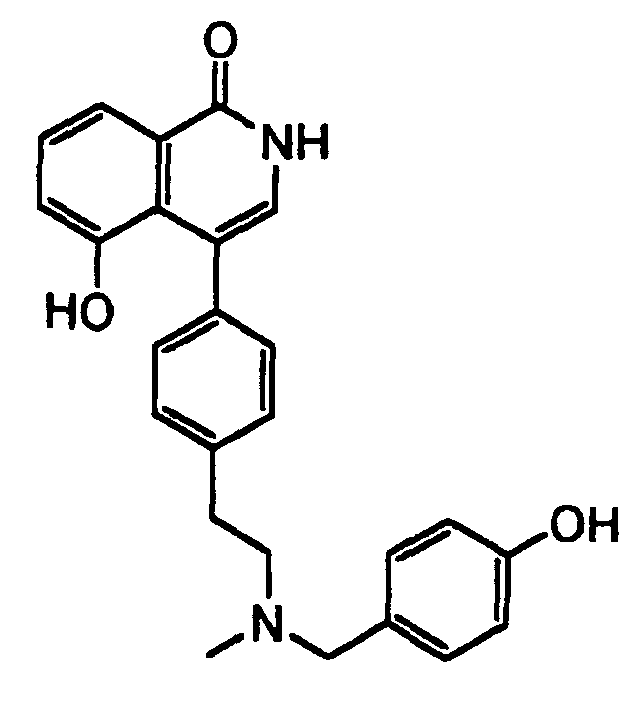
Using the compound of Example 74 (94.6mg, 228µmol), through the
process similar to Example 58, 61.5mg of the title compound were
afforded as light brown powder. Yield 67%.
1H-NMR (DMSO-d6, δ): 2.94(4H,brs), 6.71(1H,d,J=5.9Hz), 6.81(2H, brs), 7.01(1H,d,J=6.8Hz), 7.16-7.21(6H,m),7.32(1H,t,J=7.8Hz), 7.77(1H,dd,J=7.8,1.0Hz), 9.62(1H,s), 11.29(1H,d,J=5.9Hz).
HR-FAB+ (m/z): 401.1826 (-3.9mmu).
1H-NMR (DMSO-d6, δ): 2.94(4H,brs), 6.71(1H,d,J=5.9Hz), 6.81(2H, brs), 7.01(1H,d,J=6.8Hz), 7.16-7.21(6H,m),7.32(1H,t,J=7.8Hz), 7.77(1H,dd,J=7.8,1.0Hz), 9.62(1H,s), 11.29(1H,d,J=5.9Hz).
HR-FAB+ (m/z): 401.1826 (-3.9mmu).
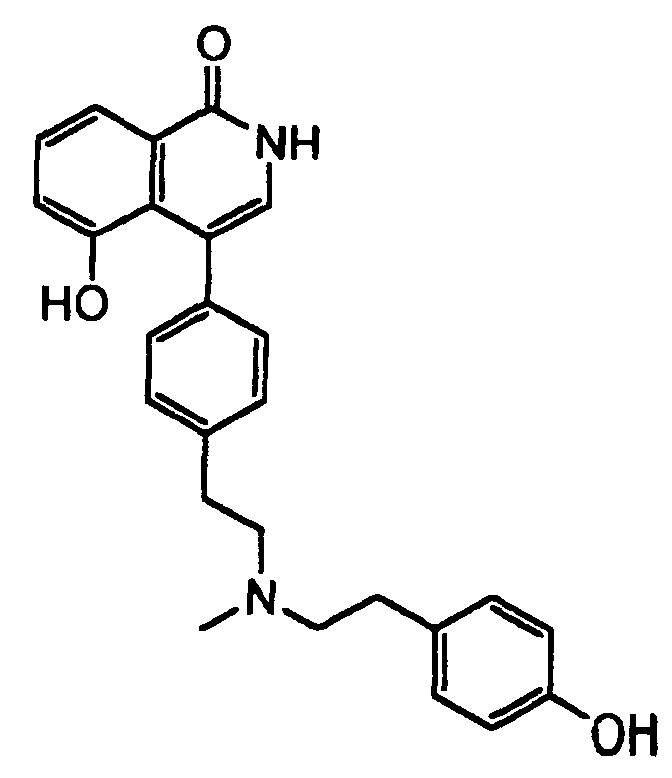
Using the compound of Example 80 (129mg, 301µmol), through the
process similar to Example 58, 106mg of the title compound were
afforded as light brown powder. Yield 83%.
1H-NMR (DMSO-d6, δ): 2.31(3H,brs), 2.60-2.73(8H,m), 6.66(2H,d, J=8.3Hz), 6.71(1H,d,J=5.4Hz), 6.99-7.02(3H,m), 7.13(2H,d,J=8.3Hz), 7.17(2H,d,J=8.3Hz), 7.31(1H,t,J=7.8Hz), 7.77(1H,d,J=7.8Hz), 9.14 (1H,s), 9.64(1H,brs), 11.26(1H,d,J=5.4Hz).
Anal. Calcd. for C26H26N2O3·1/2H2O: C, 73.74; H, 6.44; N, 6.61(%). Found: C, 73.55; H, 6.27; N, 6.62(%).
HR-FAB+ (m/z): 415.2044 (+2.3mmu).
1H-NMR (DMSO-d6, δ): 2.31(3H,brs), 2.60-2.73(8H,m), 6.66(2H,d, J=8.3Hz), 6.71(1H,d,J=5.4Hz), 6.99-7.02(3H,m), 7.13(2H,d,J=8.3Hz), 7.17(2H,d,J=8.3Hz), 7.31(1H,t,J=7.8Hz), 7.77(1H,d,J=7.8Hz), 9.14 (1H,s), 9.64(1H,brs), 11.26(1H,d,J=5.4Hz).
Anal. Calcd. for C26H26N2O3·1/2H2O: C, 73.74; H, 6.44; N, 6.61(%). Found: C, 73.55; H, 6.27; N, 6.62(%).
HR-FAB+ (m/z): 415.2044 (+2.3mmu).

Using the compound of Example 89 (231mg, 539µmol), through the
process similar to Example 58, 175mg of the title compound were
afforded as colorless powder. Yield 78%.
1H-NMR (DMSO-d6, δ): 1.81(2H,brs), 2.13(3H,brs), 2.60(2H,t,J=7.8 Hz), 6.70-6.74(3H,m), 7.00(1H,d,J=7.3Hz), 7.11-7.18(6H,m),7.31 (1H,t,J=7.8Hz), 7.77(1H,d,J=7.8Hz), 9.29(1H,brs), 9.60(1H,brs), 11.26(1H,d,J=5.9Hz).
HR-MS (m/z): 414.1945 (+0.1mmu).
1H-NMR (DMSO-d6, δ): 1.81(2H,brs), 2.13(3H,brs), 2.60(2H,t,J=7.8 Hz), 6.70-6.74(3H,m), 7.00(1H,d,J=7.3Hz), 7.11-7.18(6H,m),7.31 (1H,t,J=7.8Hz), 7.77(1H,d,J=7.8Hz), 9.29(1H,brs), 9.60(1H,brs), 11.26(1H,d,J=5.9Hz).
HR-MS (m/z): 414.1945 (+0.1mmu).

Using the compound of Example 91 (361mg, 816µmol), through the
process similar to Example 58, 312mg of the title compound were
afforded as pale yellow powder. Yield 89%.
1H-NMR (DMSO-d6, δ): 1.65-1.80(2H,m), 2.24(3H,brs), 2.33(2H,brs), 2.54-2.60(6H,m), 6.66(2H,d,J=8.3Hz), 6.71(1H,d,J=5.9Hz),6.99(1H,d, J=7.8Hz), 7.00(2H,d,J=8.3Hz), 7.09(2H,d,J=7.8Hz), 7.16(2H,d,J=8.3 Hz), 7.31(1H,t,J=7.8Hz), 7.77(1H,dd,J=7.8,1.0Hz),9.12 (1H,brs), 9.66(1H,brs), 11.25(1H,d,J=5.4Hz).
HR-FAB+ (m/z): 428.2122 (+2.3mmu).
1H-NMR (DMSO-d6, δ): 1.65-1.80(2H,m), 2.24(3H,brs), 2.33(2H,brs), 2.54-2.60(6H,m), 6.66(2H,d,J=8.3Hz), 6.71(1H,d,J=5.9Hz),6.99(1H,d, J=7.8Hz), 7.00(2H,d,J=8.3Hz), 7.09(2H,d,J=7.8Hz), 7.16(2H,d,J=8.3 Hz), 7.31(1H,t,J=7.8Hz), 7.77(1H,dd,J=7.8,1.0Hz),9.12 (1H,brs), 9.66(1H,brs), 11.25(1H,d,J=5.4Hz).
HR-FAB+ (m/z): 428.2122 (+2.3mmu).

1H-NMR (DMSO-d6, δ): 1.35-1.43(2H,m), 1.65(4H,brs), 1.80(2H,d,J=
11.0Hz), 1.93-1,99(2H,m), 2.46(4H,brs), 2.80(2H,d,J=11.0Hz),3.44
(2H,s), 6.73(1H,d,J=4.9Hz), 7.01(1H,d,J=6.7Hz), 7.20(4H,s),7.31
(1H,t,J=7.9Hz), 7.77(1H,d,J=7.3Hz), 9.75(1H,brs),11.27(1H,d,J=
5.5Hz).
HR-MS (m/z): 403.2234 (-2.6mmu).
HR-MS (m/z): 403.2234 (-2.6mmu).
1H-NMR (DMSO-d6, δ): 1.57-1.63(2H,m), 2.58(2H,t,J=6.7Hz), 3.48(2H,
t,J=6.1Hz), 3.68(2H,s), 6.71(1H,s), 7.00(1H,d,J=7.9Hz), 7.18-7.24
(4H,m), 7.31(1H,t,J=7.9Hz), 7.77(1H,d,J=7.9Hz), 11.25(1H,brs).
HR-MS (m/z): 324.1457 (-1.7mmu).
HR-MS (m/z): 324.1457 (-1.7mmu).
1H-NMR (DMSO-d6, δ): 2.11(3H,s), 3.50(2H,s), 3.51(2H,s), 6.73(1H,d,
J=5.5Hz), 7.01(1H,d,J=7.9Hz), 7.14-7.33(10H,m), 7.78(1H,d,J=7.9
Hz), 9.61(1H,s), 11.27(1H,brd,J=5.5Hz).
Anal. Calcd. for C24H22N2O2·1/10H2O: C, 77.44; H, 6.01; N, 7.53(%).
Found: C, 77.20; H, 6.13; N, 7.31(%).
HR-MS (m/z): 370.1674 (-0.7mmu).
Anal. Calcd. for C24H22N2O2·1/10H2O: C, 77.44; H, 6.01; N, 7.53(%).
Found: C, 77.20; H, 6.13; N, 7.31(%).
HR-MS (m/z): 370.1674 (-0.7mmu).
1H-NMR (DMSO-d6, δ): 2.20(3H,s), 2.59(2H,t,J=6.7Hz), 2.77(2H,t,
J=7.3Hz), 3.53(2H,s), 6.70(1H,d,J=5.5Hz), 7.02(1H,dd,J=7.9,1.2Hz),
7.10-7.23(9H,m), 7.32(1H,t,J=7.9Hz), 7.78(1H,dd,J=7.9,1.2Hz),9.60
(1H,brs), 11.28(1H,brd,J=5.5Hz).
Anal. Calcd. for C25H24N2O2·1/10H2O: C, 77.73; H, 6.31; N, 7.25(%). Found: C, 77.64; H, 6.51; N, 7.04(%).
HR-MS (m/z): 384.1867 (+3.0mmu).
Anal. Calcd. for C25H24N2O2·1/10H2O: C, 77.73; H, 6.31; N, 7.25(%). Found: C, 77.64; H, 6.51; N, 7.04(%).
HR-MS (m/z): 384.1867 (+3.0mmu).
1H-NMR (DMSO-d6, δ): 1.75(2H,quin,J=7.3Hz), 2.12(3H,s),2.36(2H,t,
J=7.3Hz), 2.58(2H,t,J=7.3Hz), 3.45(2H,s),6.71(1H,d,J=5.5Hz),7.01
(1H,d,J=7.3Hz), 7.12-7.19(6H,m), 7.22-7.26(3H,m),7.32(1H,t,J=7.9
Hz), 7.77(1H,dd,J=7.9,1.2Hz), 9.62(1H,brs), 11.27(1H,brd,J=5.5
Hz).
Anal. Calcd. for C26H26N2O2: C, 78.36; H, 6.58; N, 7.03(%).
Found: C, 78.19; H, 6.75; N, 6.96(%).
HR-MS (m/z): 398.2013 (+1.9mmu).
Anal. Calcd. for C26H26N2O2: C, 78.36; H, 6.58; N, 7.03(%).
Found: C, 78.19; H, 6.75; N, 6.96(%).
HR-MS (m/z): 398.2013 (+1.9mmu).
1H-NMR (DMSO-d6, δ): 0.85(3H,t,J=7.3Hz),1.47(2H,quin,J=7.3Hz),
2.12(3H,s), 2.31(2H,br), 3.45(2H,brs), 6.72(1H,d,J=5.5Hz),7.01(1H,
dd,J=6.7,1.2Hz), 7.13-7.26(4H,m), 7.32(1H,t,J=7.9Hz),7.77(1H,dd,
J=6.7,1.2Hz), 9.61(1H,brs), 11.26(1H,brd,J=5.5Hz).
Anal. Calcd. for C20H22N2O2·3/10H2O: C, 73.28; H, 6.95; N, 8.55(%). Found: C, 73.05; H, 6.97; N, 8.30(%).
HR-FAB+ (m/z): 323.1731 (-2.8mmu).
Anal. Calcd. for C20H22N2O2·3/10H2O: C, 73.28; H, 6.95; N, 8.55(%). Found: C, 73.05; H, 6.97; N, 8.30(%).
HR-FAB+ (m/z): 323.1731 (-2.8mmu).
1H-NMR (DMSO-d6, δ): 2.09(3H,s), 3.44(2H,s), 3.47(2H,s), 3.73(3H,s),
6.73(1H,d,J=5.5Hz), 6.88(2H,d,J=8.6Hz), 7.01(1H,dd,J=6.7, 1.2Hz),
7.14-7.16(1H,m), 7.21-7.28(5H,m), 7.32(1H,t,J=7.9Hz), 7.78(1H,dd,
J=6.7,1.2Hz), 9.61(1H,s), 11.27(1H,brd,J=5.5Hz).
HR-FAB+ (m/z): 401.1833 (-3.2mmu).
HR-FAB+ (m/z): 401.1833 (-3.2mmu).
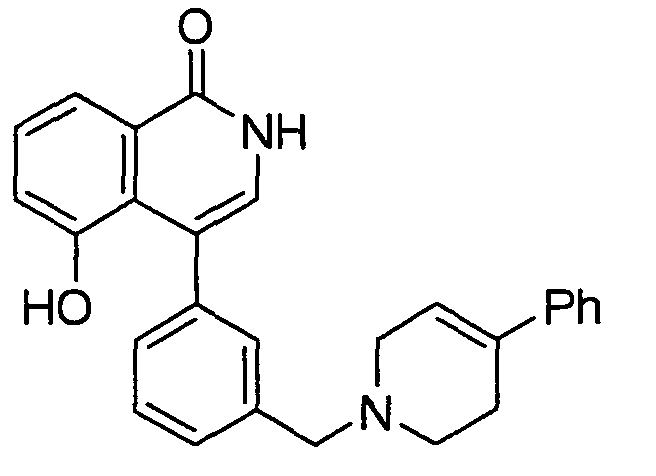
Using the compound of Referential example 9 (200mg, 716µmol) and
4-hydroxy-4-phenylpiperidine (762mg, 4.30mmol), through the
process similar to Example 45, 208mg of the title compound were
afforded as brown powder. Yield 71%.
1H-NMR (DMSO-d6, δ): 2.46(2H,brs), 2.66(2H,t,J=5.5Hz), 3.08(2H, d,J=2.4Hz), 3.58(2H,s), 6.13(1H,s), 6.73(1H,s), 7.01(1H,dd,J=6.7, 1.2Hz), 7.15-7.17(1H,m), 7.21-7.33(8H,m), 7.39-7.41(2H,m),9.64 (1H,brs), 11.26(1H,br).
HR-FAB+ (m/z): 409.1915 (-0.1mmu).
1H-NMR (DMSO-d6, δ): 2.46(2H,brs), 2.66(2H,t,J=5.5Hz), 3.08(2H, d,J=2.4Hz), 3.58(2H,s), 6.13(1H,s), 6.73(1H,s), 7.01(1H,dd,J=6.7, 1.2Hz), 7.15-7.17(1H,m), 7.21-7.33(8H,m), 7.39-7.41(2H,m),9.64 (1H,brs), 11.26(1H,br).
HR-FAB+ (m/z): 409.1915 (-0.1mmu).
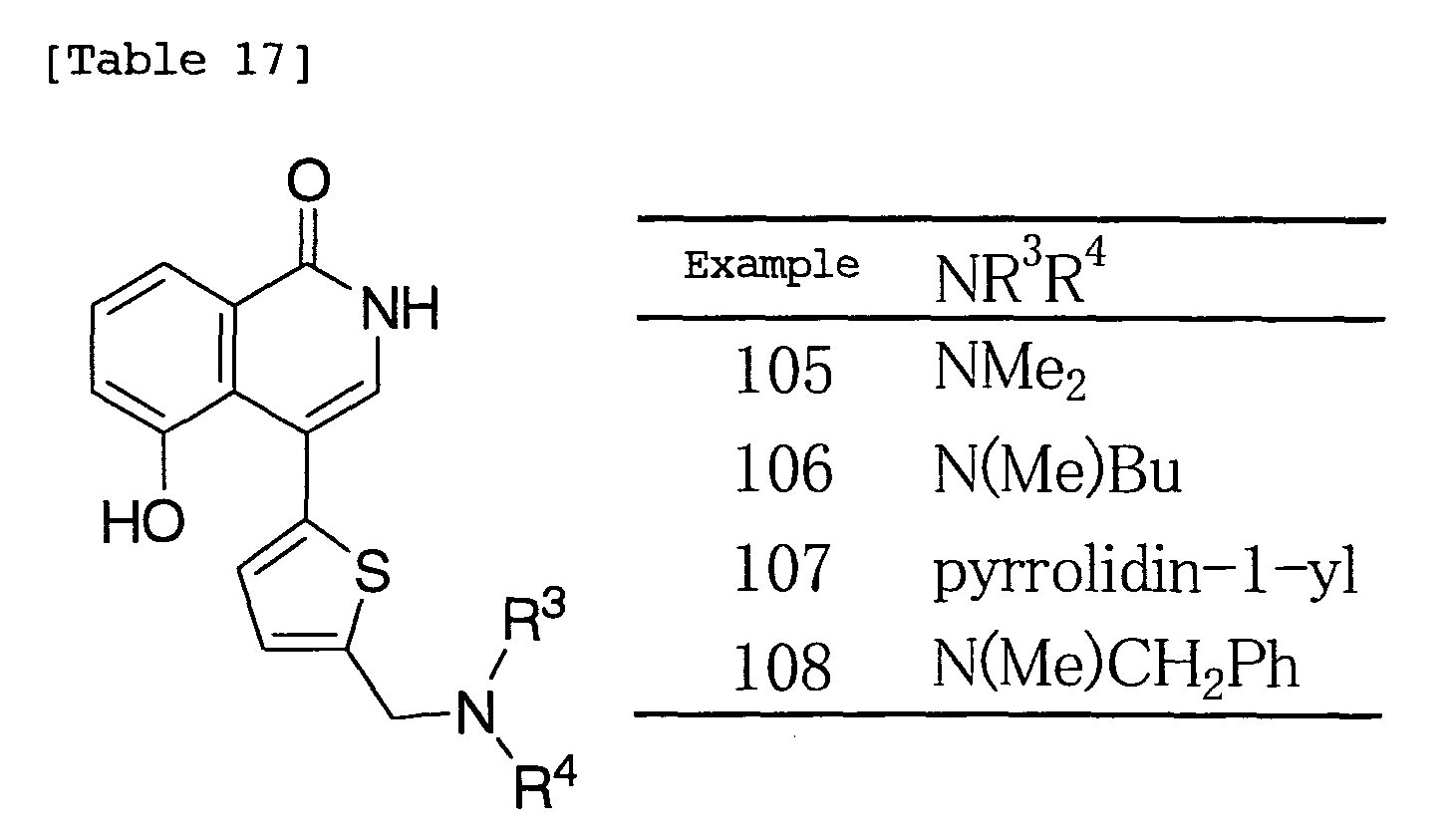
1H-NMR (DMSO-d6, δ): 2.19(6H,s), 3.56(2H,s), 6.73(1H,d,J=3.7Hz),
6.77(1H,d,J=3.7Hz), 6.89(1H,s), 7.00(1H,d,J=7.3Hz), 7.30(1H,t,
J=7.3Hz), 7.71(1H,d,J=7.3Hz).
HR-MS (m/z): 300.0923 (-0.9mmu).
HR-MS (m/z): 300.0923 (-0.9mmu).
1H-NMR (DMSO-d6, δ): 0.87(3H,t,J=7.3Hz), 1.23-1.34(2H,m), 1.40-1.47(2H,m),
2.17(3H,s), 2.36(2H,t,J=7.3Hz), 3.63(2H,s), 6.73(1H,d,
J=3.7Hz), 6.77(1H,d,J=3.1Hz), 6.90(1H,s), 7.03(1H,d, J=7.3 Hz),
7.32(1H,t,J=7.9Hz), 7.75(1H,d,J=7.9Hz), 9.74(1H,s), 11.34 (1H,s).
HR-MS (m/z): 342.1385 (-1.7mmu).
HR-MS (m/z): 342.1385 (-1.7mmu).
1H-NMR (DMSO-d6, δ): 1.71(4H,s), 3.74(2H,s),6.72(1H,d,J=3.1Hz),
6.78(1H,d,J=3.1Hz), 6.91(1H,s), 7.03(1H,d,J=7.9Hz),7.32(1H,t,
J=7.9Hz), 7.74(1H,d,J=7.9Hz), 9.75(1H,s), 11.34(1H,s).
HR-MS (m/z): 326.1107 (+1.8mmu).
HR-MS (m/z): 326.1107 (+1.8mmu).
1H-NMR (DMSO-d6, δ): 2.17(3H,s), 3.55(2H,s), 3.70(2H,s),6.75(1H,d,
J=3.0Hz), 6.82(1H,d,J=3.0Hz), 6.92(1H,s), 7.03(1H,d,J=7.9Hz),
7.25-7.35(7H,m), 7.75(1H,d,J=7.9Hz), 9.75(1H,brs), 11.35(1H,brs).
HR-MS (m/z): 376.1257 (+1.1mmu).
HR-MS (m/z): 376.1257 (+1.1mmu).
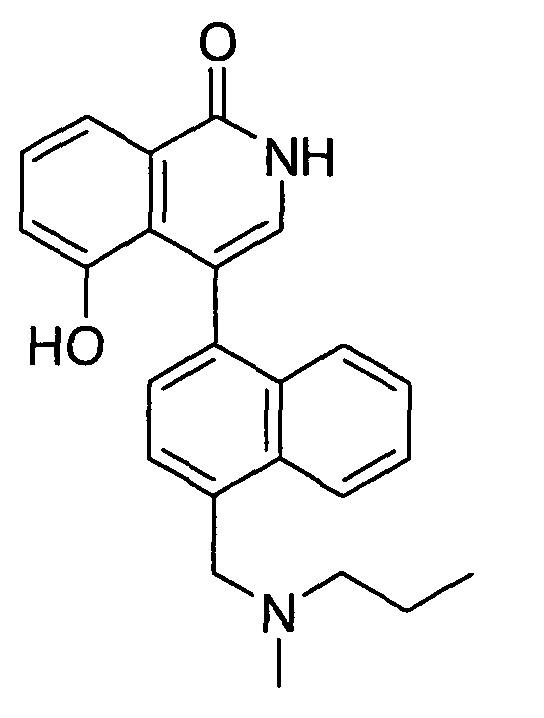
Using the compound of Referential example 23 (100mg, 304µmol)
and N-methylpropylamine (187µL, 1.82mmol), through the process
similar to Example 45, 25.5mg of the title compound were afforded
as grayish white powder. Yield 26%.
1H-NMR (DMSO-d6, δ): 0.88(3H,t,J=7.3Hz), 1.55(2H,quin,J=7.3Hz), 2.15(3H,s), 2.43(2H,t,J=7.3Hz), 3.86(2H,s), 6.81-6.84(2H,m),7.27-7.35(3H,m), 7.38-7.50(3H,m), 7.81(1H,dd,J=6.7,1.2Hz), 8.29(1H,d, J=7.9Hz), 9.31(1H,s), 11.34(1H,brd,J=5.5Hz).
HR-FAB+ (m/z): 373.1930 (+1.4mmu).
1H-NMR (DMSO-d6, δ): 0.88(3H,t,J=7.3Hz), 1.55(2H,quin,J=7.3Hz), 2.15(3H,s), 2.43(2H,t,J=7.3Hz), 3.86(2H,s), 6.81-6.84(2H,m),7.27-7.35(3H,m), 7.38-7.50(3H,m), 7.81(1H,dd,J=6.7,1.2Hz), 8.29(1H,d, J=7.9Hz), 9.31(1H,s), 11.34(1H,brd,J=5.5Hz).
HR-FAB+ (m/z): 373.1930 (+1.4mmu).
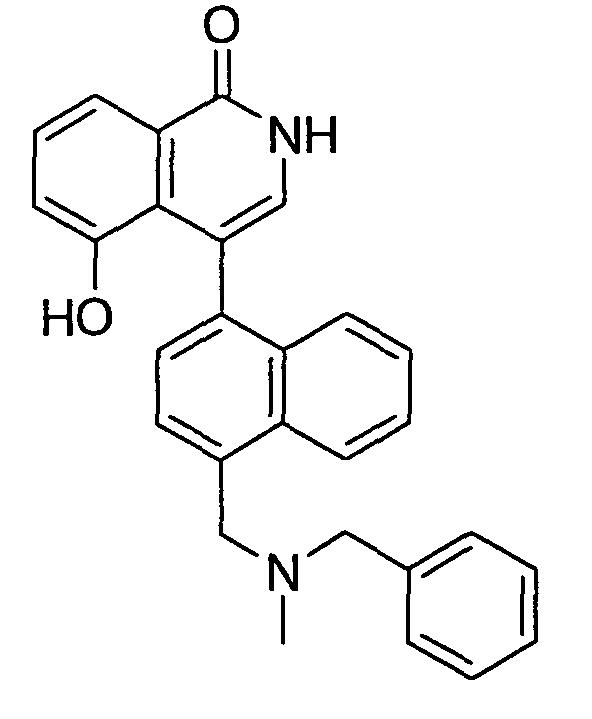
Using the compound of Referential example 23 (100mg, 304µmol)
and N-methylbenzylamine (235µL, 1.82mmol), through the process
similar to Example 45, 44.4mg of the title compound were afforded
as colorless powder. Yield 35%.
1H-NMR (DMSO-d6, δ): 2.12(3H,s), 3.63(2H,s), 3.91-3.99(2H,m), 6.81-6.83(2H,m), 7.21-7.36(8H,m), 7.44-7.53(3H,m), 7.80(1H,d, J=7.9Hz), 8.27(1H,d,J=8.6Hz), 9.28(1H,s), 11.34(1H,brd,J=5.5Hz). HR-MS (m/z): 421.1895 (-2.1mmu).
1H-NMR (DMSO-d6, δ): 2.12(3H,s), 3.63(2H,s), 3.91-3.99(2H,m), 6.81-6.83(2H,m), 7.21-7.36(8H,m), 7.44-7.53(3H,m), 7.80(1H,d, J=7.9Hz), 8.27(1H,d,J=8.6Hz), 9.28(1H,s), 11.34(1H,brd,J=5.5Hz). HR-MS (m/z): 421.1895 (-2.1mmu).
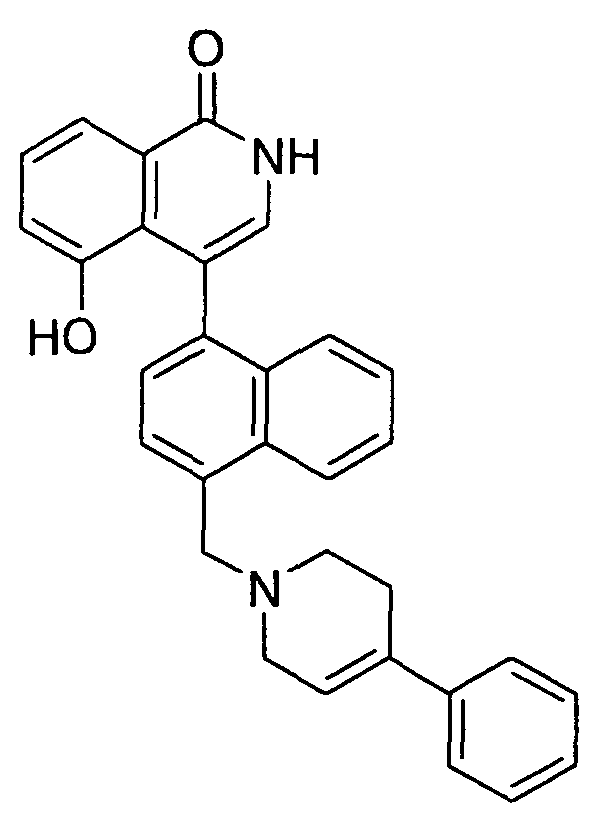
Using the compound of Referential example 23 (100mg, 304µmol)
and 4-hydroxy-4-phenylpiperidine (323mg, 1.82mmol), through the
process similar to Example 45, 76.4mg of the title compound were
afforded as colorless powder. Yield 55%.
1H-NMR (DMSO-d6, δ): 2.74-2.84(3H,m), 3.19(3H,br), 4.03(2H,s), 6.18(1H,brs), 6.83-6.84(2H,m), 7.22-7.52(11H,m), 7.15-7.17(1H,m), 7.81(1H,d,J=7.9Hz), 8.31(1H,d,J=8.6Hz), 9.34(1H,s), 11.35(1H,brd, J=4.9Hz).
HR-FAB+ (m/z): 459.2072 (-0.1mmu).
1H-NMR (DMSO-d6, δ): 2.74-2.84(3H,m), 3.19(3H,br), 4.03(2H,s), 6.18(1H,brs), 6.83-6.84(2H,m), 7.22-7.52(11H,m), 7.15-7.17(1H,m), 7.81(1H,d,J=7.9Hz), 8.31(1H,d,J=8.6Hz), 9.34(1H,s), 11.35(1H,brd, J=4.9Hz).
HR-FAB+ (m/z): 459.2072 (-0.1mmu).
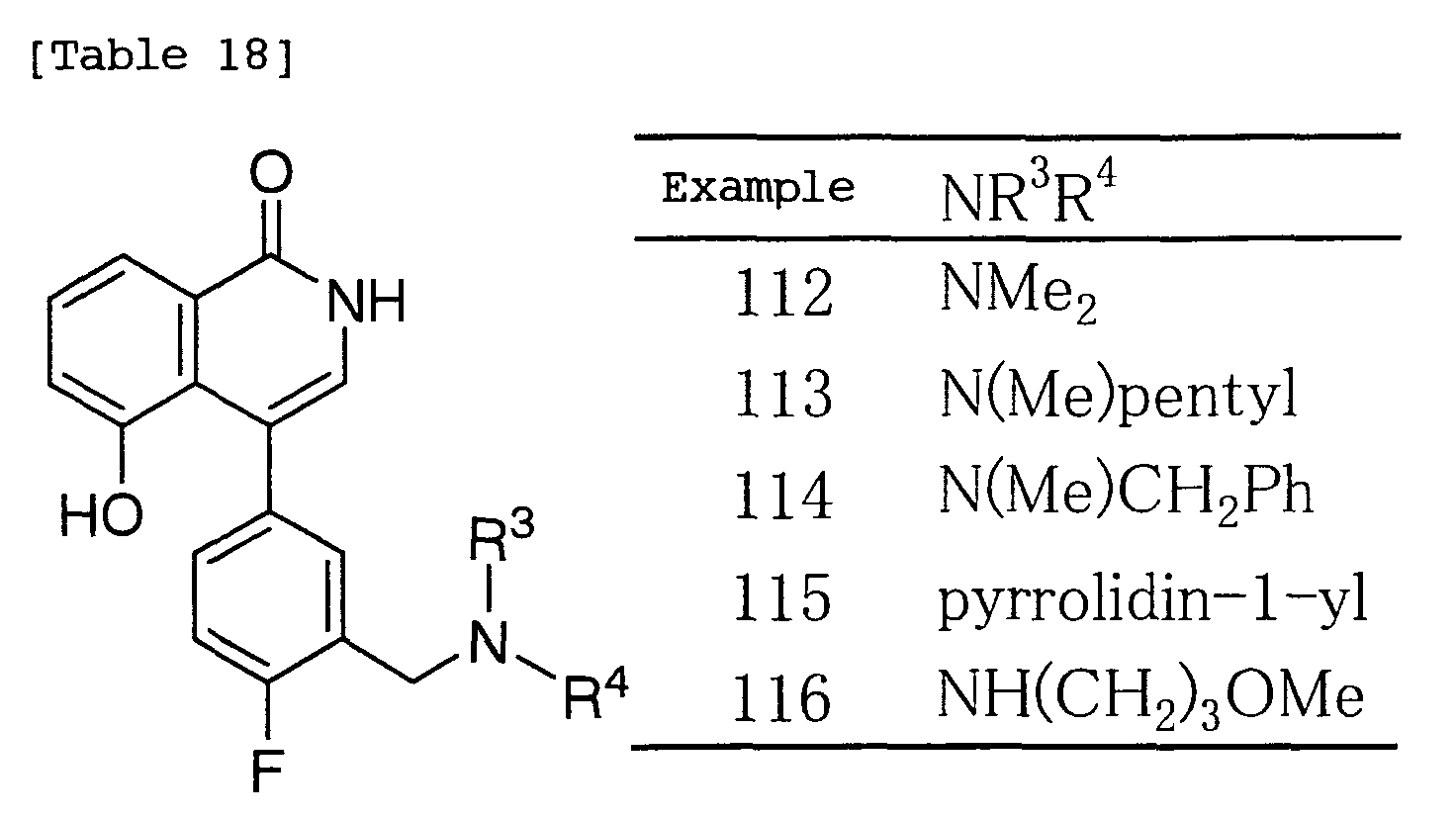
1H-NMR (DMSO-d6, δ): 2.32(6H,s), 3.63-3.65(2H,m), 6.76(1H,d,J=6.1
Hz), 7.03-7.05(1H,m), 7.11(1H,t,J=8.6Hz), 7.23-7.26(1H,m),7.29-7.34(2H,m),
7.78(1H,dd,J=7.9,1.2Hz), 9.70(1H,s),11.32(1H,d,J=4.9
Hz).
Anal. Calcd. for C18H17FN2O2·3/4H2O: C, 66.35; H, 5.72; N, 8.60(%). Found: C, 66.34; H, 5.54; N, 8.43(%).
HR-MS (m/z): 312.1261 (-1.3mmu).
Anal. Calcd. for C18H17FN2O2·3/4H2O: C, 66.35; H, 5.72; N, 8.60(%). Found: C, 66.34; H, 5.54; N, 8.43(%).
HR-MS (m/z): 312.1261 (-1.3mmu).
1H-NMR (DMSO-d6, δ): 0.81(3H,t,J=6.7Hz), 1.21-1.25(4H,m), 1.42-1.45(2H,m),
2.13(3H,s), 2.33(2H,t,J=7.3Hz), 3.49(2H,s), 6.72(1H,d,
J=5.5Hz), 7.00-7.08(2H,m), 7.15-7.19(1H,m), 7.24(1H,dd,J=7.3,2.4
Hz), 7.32(1H,t,J=7.9Hz), 7.77(1H,d,J=7.9Hz), 9.64(1H,s),11.28(1H,
d,J=5.5Hz).
HR-MS (m/z): 368.1884 (-1.6mmu).
HR-MS (m/z): 368.1884 (-1.6mmu).
1H-NMR (DMSO-d6, δ): 2.11(3H,s), 3.54(2H,s), 3.56(2H,s), 6.75
(1H,d,J=5.5Hz), 7.02(1H,d,J=7.3Hz), 7.08(1H,dd,J=9.8,8.6Hz),7.17-7.25(2H,m),
7.28-7.34(6H,m), 7.78(1H,dd,J=7.9,1.2Hz), 9.66 (1H,s),
11.29(1H,d,J=5.5Hz).
Anal. Calcd. for C24H21FN2O2: C, 74.21; H, 5.45; N, 7.21(%).
Found: C, 74.09; H, 5.46; N, 7.23(%).
HR-MS (m/z): 388.1583 (-0.4mmu).
Anal. Calcd. for C24H21FN2O2: C, 74.21; H, 5.45; N, 7.21(%).
Found: C, 74.09; H, 5.46; N, 7.23(%).
HR-MS (m/z): 388.1583 (-0.4mmu).
1H-NMR (DMSO-d6, δ): 1.68(4H,brs), 3.63(2H,brs), 6.74(1H,d,J=
5.5Hz), 7.01-7.08(2H,m), 7.16-7.19(1H,m), 7.26(1H,d,J=7.3Hz),
7.32(1H,t,J=7.9Hz), 7.77(1H,dd,J=7.9,1.2Hz), 9.67(1H,s), 11.28
(1H,dd,J=4.3,1.2Hz).
Anal. Calcd. for C20H19FN2O2·1/5H2O: C, 70.24; H, 5.72; N, 8.19(%). Found: C, 70.21; H, 5.54; N, 8.18(%).
HR-MS (m/z): 338.1429 (-0.1mmu).
Anal. Calcd. for C20H19FN2O2·1/5H2O: C, 70.24; H, 5.72; N, 8.19(%). Found: C, 70.21; H, 5.54; N, 8.18(%).
HR-MS (m/z): 338.1429 (-0.1mmu).
1H-NMR (DMSO-d6, δ): 1.63(2H,t,J=6.7Hz), 2.55(2H,t,J=6.7Hz),3.16
(3H,s), 3.71(2H,s), 6.74(1H,s), 7.00-7.06(2H,m), 7.12-7.16 (1H,m),
7.30-7.34(2H,m), 7.77(1H,d,J=7.9Hz), 9.50-9.90 (1H,br),11.29(1H,
d,J=1.8Hz).
HR-MS (m/z): 356.1568 (+3.2mmu).
HR-MS (m/z): 356.1568 (+3.2mmu).

1H-NMR (CDCl3, δ): 2.31(6H,s), 3.13(2H,d,J=6.7Hz), 4.15(3H,s), 6.35(1H,dt,J=15.9,6.7Hz), 6.59(1H,d,J=16.5Hz), 7.08(1H,dd,J=7.3, 1.2Hz), 7.43-7.53(5H,m), 7.72(1H,s), 7.93(1H,dd,J=7.9, 1.2Hz). Process 2: Using 4-[4-(3-dimethylaminopropene-1-yl)phenyl]-5-hydroxy-1-methoxyisoquinoline (15.0mg, 44.9µmol), through the process similar to Process 2 in Example 1, 12.7mg of the title compound were afforded as light brown powder. Yield 88%.
1H-NMR (DMSO-d6, δ): 2.18(6H,s), 3.03(2H,d,J=6.7Hz), 6.27(1H,dt, J=16.5,6.7Hz), 6.54(1H,d,J=15.9Hz), 6.74(1H,d,J=6.1Hz), 7.02 (1H,d, J=7.3Hz), 7.21(2H,J=8.6Hz), 7.30-7.36(3H,m), 7.77(1H,d, J=7.3Hz), 9.67(1H,s), 11.29(1H,d,J=5.5Hz).
HR-MS (m/z): 320.1501 (-2.4mmu).

Using the compound of Referential example 27 (50.0mg, 163 µmol)
and pyrrolidine (81.6µL, 978µmol), through the process similar to
Example 117, 17.1mg of the title compound were afforded as colorless
powder. Yield 30%.
1H-NMR (DMSO-d6, δ): 1.70(4H,brs), 2.47(4H,brs), 3.20(2H,d,J=6.7Hz), 6.32(1H,dt,J=15.9,6.7Hz), 6.55(1H,d,J=15.9Hz), 6.74(1H,s),7.02(1H,d,J=7.3Hz), 7.21(2H,J=7.9Hz), 7.30-7.36(3H,m), 7.77(1H,d,J=7.9Hz), 9.64(1H,brs), 11.29(1H,brs).
HR-MS (m/z): 346.1670 (-1.1mmu).
1H-NMR (DMSO-d6, δ): 1.70(4H,brs), 2.47(4H,brs), 3.20(2H,d,J=6.7Hz), 6.32(1H,dt,J=15.9,6.7Hz), 6.55(1H,d,J=15.9Hz), 6.74(1H,s),7.02(1H,d,J=7.3Hz), 7.21(2H,J=7.9Hz), 7.30-7.36(3H,m), 7.77(1H,d,J=7.9Hz), 9.64(1H,brs), 11.29(1H,brs).
HR-MS (m/z): 346.1670 (-1.1mmu).
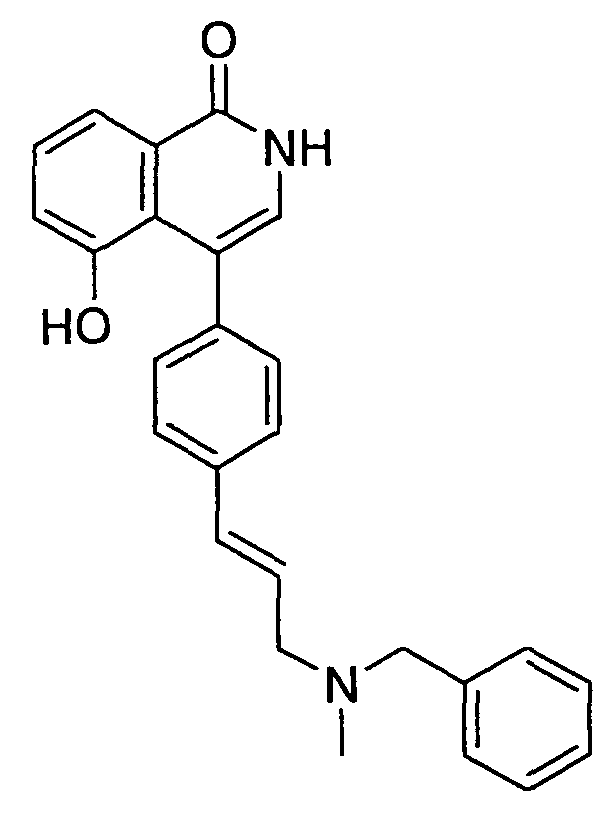
Using the compound of Referential example 27 (50.0mg, 163 µmol)
and N-methylbenzylamine (126µL, 978µmol), through the process
similar to Example 117, 3.1mg of the title compound were afforded
as colorless powder. Yield 5%.
1H-NMR (DMSO-d6, δ): 2.15(3H,s), 3.17(2H,d,J=6.7Hz), 3.53(2H,s), 6.34(1H,dt,J=15.9,6.7Hz), 6.55-6.60(1H,m), 6.74(1H,s), 7.01(1H,d, J=7.9Hz), 7.21(2H,d,J=7.9Hz), 7.24-7.34(6H,m), 7.37(2H,d,J=7.9Hz), 7.77(1H,d,J=7.9Hz), 9.68(1H,s), 11.29(1H,s).
HR-MS (m/z): 396.1853 (+1.5mmu).
1H-NMR (DMSO-d6, δ): 2.15(3H,s), 3.17(2H,d,J=6.7Hz), 3.53(2H,s), 6.34(1H,dt,J=15.9,6.7Hz), 6.55-6.60(1H,m), 6.74(1H,s), 7.01(1H,d, J=7.9Hz), 7.21(2H,d,J=7.9Hz), 7.24-7.34(6H,m), 7.37(2H,d,J=7.9Hz), 7.77(1H,d,J=7.9Hz), 9.68(1H,s), 11.29(1H,s).
HR-MS (m/z): 396.1853 (+1.5mmu).

Using the compound of Referential example 27 (50.0mg, 163 µmol)
and 4-hydroxy-4-phenylpiperidine (173mg, 978µmol), through the
process similar to Example 117, 28.5mg of the title compound were
afforded as colorless powder. Yield 40%.
1H-NMR (DMSO-d6, δ): 2.68-2.71(2H,m), 3.14(2H,s), 3.24(2H,d,J=6.1 Hz), 6.18(1H,s), 6.35(1H,dt,J=15.9,6.7Hz), 6.51(1H,d,J=15.9Hz), 6.75(1H,d,J=4.3Hz), 7.02(1H,d,J=7.9Hz), 7.21-7.35 (3H,m),7.38(2H, d,J=7.9Hz), 7.44(2H,d,J=7.9Hz), 7.78(1H,d,J=7.9Hz), 9.68(1H,s), 11.30(1H,d,J=4.9Hz).
HR-MS (m/z): 434.1966 (-2.8mmu).
1H-NMR (DMSO-d6, δ): 2.68-2.71(2H,m), 3.14(2H,s), 3.24(2H,d,J=6.1 Hz), 6.18(1H,s), 6.35(1H,dt,J=15.9,6.7Hz), 6.51(1H,d,J=15.9Hz), 6.75(1H,d,J=4.3Hz), 7.02(1H,d,J=7.9Hz), 7.21-7.35 (3H,m),7.38(2H, d,J=7.9Hz), 7.44(2H,d,J=7.9Hz), 7.78(1H,d,J=7.9Hz), 9.68(1H,s), 11.30(1H,d,J=4.9Hz).
HR-MS (m/z): 434.1966 (-2.8mmu).
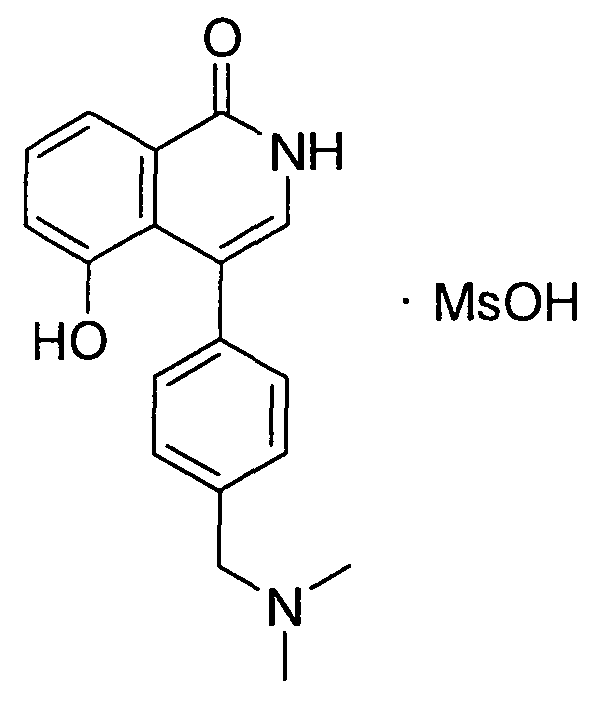
To a suspension of the compound of Example 1 (414mg, 1.41mmol)
in methanol (15mL) was added methanesulfonic acid (101µL, 1.55mmol),
and the mixture was stirred for 30 minutes at room temperature.
Acetone was added to the residue obtained by concentrating the
reaction mixture under reduced pressure. The precipitated crystals
were collected by filtration, washed with acetone, and then dried,
thereby affording 492mg of the title compound as light brown powder.
Yield 88%.
1H-NMR (DMSO-d6, δ): 2.32(3H,s), 2.77(6H,d,J=4.9Hz), 4.32(2H,d, J=4.9Hz), 6.77(1H,d,J=6.1Hz), 7.05(1H,dd,J=7.9,1.2Hz), 7.32-7.43 (5H,m), 7.79(1H,dd,J=7.9,1.2Hz), 9.58(1H,brs),9.70(1H,s),11.36 (1H,d,J=6.1Hz).
Anal. Calcd. for C18H18N2O2·CH4O3S·1/3H2O: C, 57.56; H, 5.76; N,7.07(%).
Found: C, 57.49; H, 5.56; N, 6.85(%).
1H-NMR (DMSO-d6, δ): 2.32(3H,s), 2.77(6H,d,J=4.9Hz), 4.32(2H,d, J=4.9Hz), 6.77(1H,d,J=6.1Hz), 7.05(1H,dd,J=7.9,1.2Hz), 7.32-7.43 (5H,m), 7.79(1H,dd,J=7.9,1.2Hz), 9.58(1H,brs),9.70(1H,s),11.36 (1H,d,J=6.1Hz).
Anal. Calcd. for C18H18N2O2·CH4O3S·1/3H2O: C, 57.56; H, 5.76; N,7.07(%).
Found: C, 57.49; H, 5.56; N, 6.85(%).
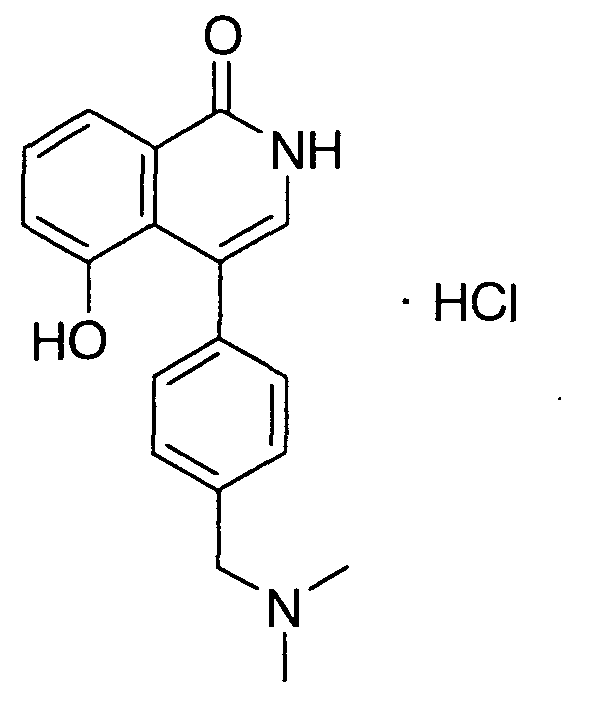
To a suspension of the compound of Example 1 (200mg, 679 µmol)
in methanol (10mL) was used 1 mol/L hydrochloric acid (679µL,679
µmol), and, through the process similar to Example 121, 237mg of
the title compound were afforded as light brown powder. Yield
quantitative.
1H-NMR (DMSO-d6, δ): 2.71(6H,d,J=4.9Hz), 4.29(2H,d,J=5.5Hz),6.77 (1H,d,J=5.5Hz), 7.08(1H,dd,J=7.9,1.2Hz), 7.34(1H,t,J=7.9Hz),7.36 (2H,d,J=7.9Hz), 7.48(2H,d,J=7.9Hz), 7.78(1H,dd,J=7.9,1.2Hz),9.79 (1H,s), 10.63(1H,brs), 11.37(1H,d,J=5.5Hz).
Anal. Calcd. for C18H18N2O2·HCl·H2O: C, 61.98; H, 6.07; N, 8.03(%).
Found: C, 61.94; H, 5.75; N, 7.77(%).
1H-NMR (DMSO-d6, δ): 2.71(6H,d,J=4.9Hz), 4.29(2H,d,J=5.5Hz),6.77 (1H,d,J=5.5Hz), 7.08(1H,dd,J=7.9,1.2Hz), 7.34(1H,t,J=7.9Hz),7.36 (2H,d,J=7.9Hz), 7.48(2H,d,J=7.9Hz), 7.78(1H,dd,J=7.9,1.2Hz),9.79 (1H,s), 10.63(1H,brs), 11.37(1H,d,J=5.5Hz).
Anal. Calcd. for C18H18N2O2·HCl·H2O: C, 61.98; H, 6.07; N, 8.03(%).
Found: C, 61.94; H, 5.75; N, 7.77(%).
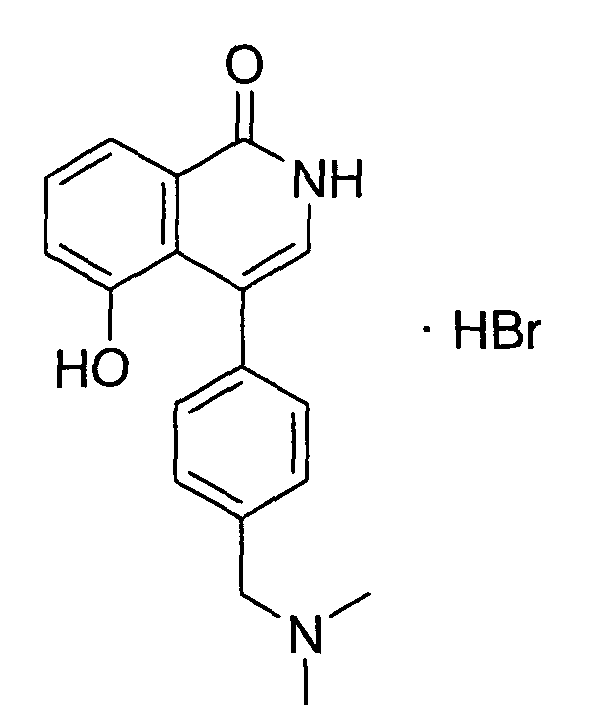
To a suspension of the compound of Example 1 (200mg, 679 µmol)
inmethanol (10mL) was used 1 mol/L hydrobromic acid (679µL, 679µmol),
and, through the process similar to Example 121, 250mg of the title
compound were afforded as light brown powder. Yield 97%.
1H-NMR (DMSO-d6, δ): 2.69(6H,s), 4.21(2H,s), 6.77(1H,d,J=5.5Hz), 7.04-7.06(1H,m), 7.32-7.41(5H,m), 7.79(1H,d,J=6.7Hz),9.69(1H, s), 9.40-10.00(1H,br), 11.35(1H,d,J=5.5Hz).
Anal. Calcd. for C18H18N2O2·HBr·1/5H2O: C, 57.07; H, 5.16; N, 7.39(%).
Found: C, 57.07; H, 5.32; N, 7.05(%).
1H-NMR (DMSO-d6, δ): 2.69(6H,s), 4.21(2H,s), 6.77(1H,d,J=5.5Hz), 7.04-7.06(1H,m), 7.32-7.41(5H,m), 7.79(1H,d,J=6.7Hz),9.69(1H, s), 9.40-10.00(1H,br), 11.35(1H,d,J=5.5Hz).
Anal. Calcd. for C18H18N2O2·HBr·1/5H2O: C, 57.07; H, 5.16; N, 7.39(%).
Found: C, 57.07; H, 5.32; N, 7.05(%).
PARP (Trevigen 4667-050-01) was diluted 35 times with a buffer
consisting of 50mmol/L Tris-HCl (pH 7.8), 100mmol/L KCl and 1mmol/L
dithiothreitol to use for the experiment. In a plastic test tube
were placed 76.5µL of buffer consisting of 117.6mmol/L Tris-HCl (pH
8.0), 11.8mmol/L MgCl2, 5.9mM dithiothreitol and 0.4mmol/L NAD,
2.5µL of [14C]NAD (NENLife Science Products, Inc. NEC743, 370kBq/mL),
1µL of activated DNA(Trevigen 4667-50-06), testing compound or 10µL
of solvent for testing compound and 10µL of the 35 times diluted
PARP solution. After mixing well, the contents were warmed to 25°C
in a water bath. After 10 minutes, the reaction was stopped by adding
1mL of ice-cold 20% trichloroacetic acid and the test tube was left
on ice. The precipitates were collected on a glass fiber filter by
suction filtration and washed 5 times with 5% trichloroacetic acid.
The radioactivity on the filter was measured with liquid
scintillation counter. The enzyme activity in the absence of testing
compound was made to be 100%, and the concentration to decrease this
to 50% (IC50 value) was calculated.

Results of this test are shown in Table 19. From these results,
it was confirmed that the novel 4-substituted aryl-5-hydroxyisoquinolinone
derivatives and their salts of the invention
have excellent PARP inhibitory activity.
Based on the fact as above, the inventive compounds are novel
4-substituted aryl-5-hydroxyisoquinolinone derivatives and their
salts, which have excellent PARP inhibitory activity. The inventive
compounds with PARP inhibitory activity are useful as a preventive
and/or therapeutic drugs for the diseases originating from excessive
activation of PARP, for example, various ischemic diseases (cerebral
infarction, cardiac infarction, acute renal failure, etc.),
inflammatory diseases (inflammatory enteric disease, multiple
cerebrosclerosis, arthritis, chronic rheumatism, etc.), nerve-degenerative
diseases (Alzheimer's disease, Huntington's chorea,
Parkinson disease, etc.), diabetes, septic shock, cephalic injury
and the like.
Claims (16)
- 4-Substituted aryl-5-hydroxyisoquinolinone derivatives represented by a general formula (1)[wherein ring Ar denotes a phenyl group, naphthyl group, 5- or 6-membered heterocycle and its condensed ring, R1 denotes a hydrogen atom or halogen atom, R2 denotes a hydrogen atom, halogen atom, hydroxy group, lower alkyl group which may be substituted with halogen atom, cycloalkyl group which may be substituted with halogen atom, lower alkoxy group which may be substituted with halogen atom, aralkyloxy group which may have substituents, nitro group, amino group which may have substituents, aralkyl group which may have substituents, phenyl group which may have substituents, naphthyl group which may have substituents, or 5-or 6-membered heterocycle which may have substituents and its condensed ring, A denotes a C1~C4 alkylene or C2~C4 alkenylene, R3 denotes a hydrogen atom, lower alkyl group which may be substituted with halogen atom, or general formula (2)
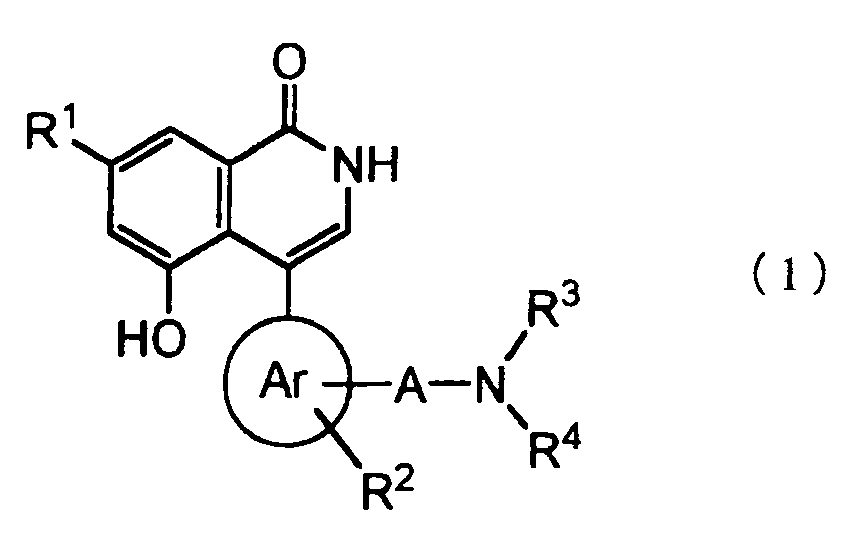 (wherein R7 and R8 denote identically or differently hydrogen atoms, lower alkyl groups which may be substituted with halogenatom, aralkyl groups which may have substituents, or R7 and R8 are bound together to form a 5- or 6-membered heterocycle which may have substituents and its condensed ring), or R3 with R4 are bound together to form a 5- or 6-membered heterocycle which may have substituents and its condensed ring],and their pharmacologically acceptable addition salts.
- 4-Substituted aryl-5-hydroxyisoquinolinone derivatives of Claim 1, represented by a general formula (1a)[wherein ring Ar denotes a phenyl group, naphthyl group, 5- or 6-membered heterocycle and its condensed ring, R1 denotes a hydrogen atom or halogen atom, R2a denotes a hydrogen atom, halogen atom, hydroxy group, lower alkyl group which may be substituted with halogen atom, lower alkoxy group which may be substituted with halogen atom, nitro group, or amino group which may have substituents, A denotes a C1~C4 alkylene or C2~C4 alkenylene, R3 denotes a hydrogen atom, lower alkyl group which may be substituted with halogen atom, or general formula (2)
 (wherein R7 and R8 denote identically or differently hydrogen atoms, lower alkyl groups which may be substituted with halogenatom, aralkyl groups which may have substituents, or R7 and R8 are bound together to form a 5- or 6- membered heterocycle whichmay have substituents and its condensed ring), or R3 and R4 are bound together to form a 5- or 6-membered heterocycle which may have substituents and its condensed ring],and their pharmacologically acceptable addition salts.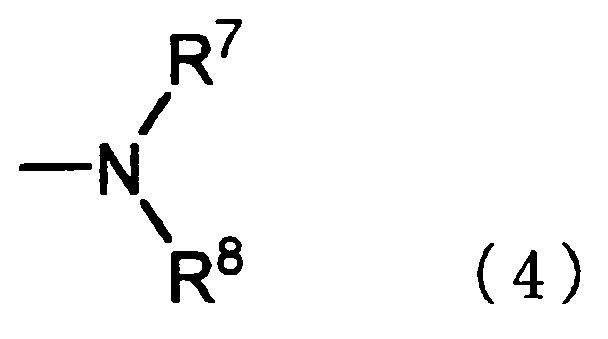
- 4-Substituted aryl-5-hydroxyisoquinolinone derivatives of Claim 1, represented by a general formula (1b)[wherein ring Ar denotes a phenyl group, naphthyl group, 5- or 6-membered heterocycle and its condensed ring, R1 denotes a hydrogen atom or halogen atom, R2a denotes a hydrogen atom, halogen atom, hydroxy group, lower alkyl group which may be substituted with halogen atom, lower alkoxy group which may be substituted with halogen atom, nitro group, or amino group which may have substituents, A1 denotes a C1~C4 alkylene, R3a denotes a hydrogen atom or lower alkyl group which may be substituted with halogen atom, R4a denotes a lower alkyl group which may be substituted with halogen atom, cycloalkyl group which may have substituents, general formula (3)
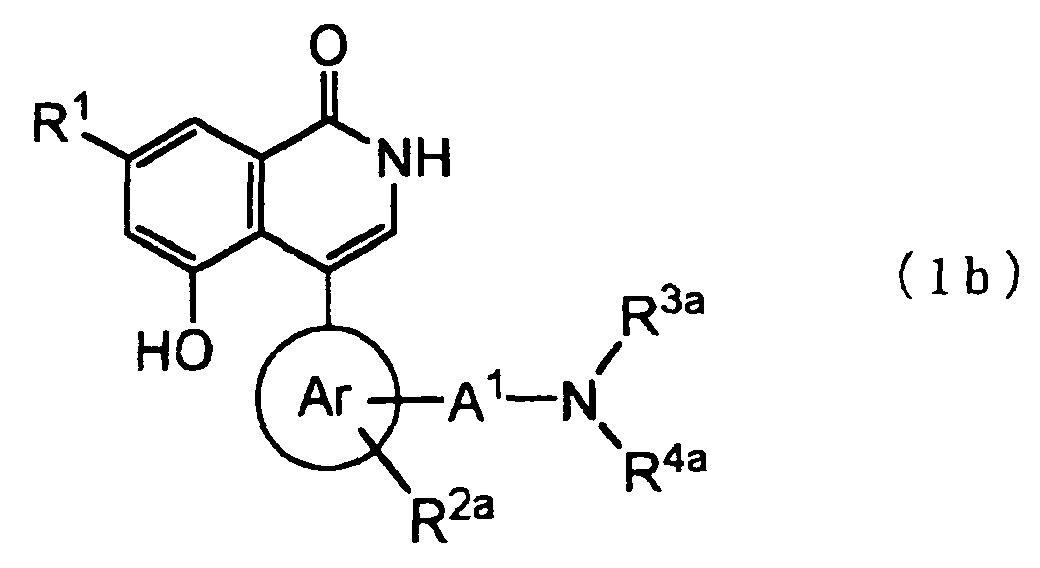 (wherein R7 and R8 denote identically or differently hydrogen atoms, lower alkyl groups which may be substituted with halogenatom, aralkyl groups which may have substituents, or R7 and R8 are bound together to form a 5- or 6- membered heterocycle whichmay have substituents and its condensed ring), or R3a and R4a are bound together to form a 5- or 6-membered heterocycle which may have substituents and its condensed ring],and their pharmacologically acceptable addition salts.
- 4-Substituted aryl-5-hydroxyisoquinolinone derivatives of Claim 1, represented by a general formula (1c)[wherein ring Ar denotes a phenyl group, naphthyl group, 5- or 6-membered heterocycle and its condensed ring, R1 denotes a hydrogen atom or halogen atom, R2a denotes a hydrogen atom, halogen atom, hydroxy group, lower alkyl group which may be substituted with halogen atom, lower alkoxy group which may be substituted with halogen atom, nitro group, or amino group which may have substituents,A1 denotes a C1~C4 alkylene, R3a denotes a hydrogen atom or lower alkyl group which may be substituted with halogen atom,R4b denotes a lower alkyl group which may be substituted with halogen atom, or general formula (3a)
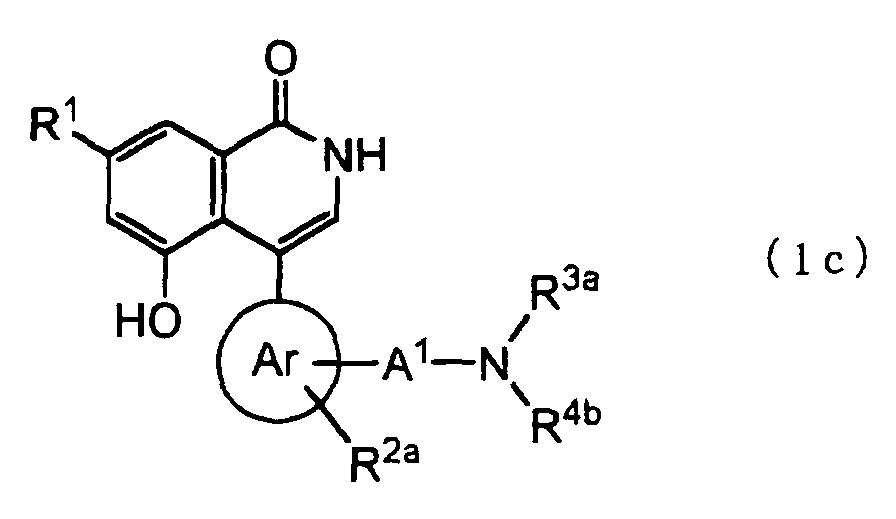
- 4-Substituted aryl-5-hydroxyisoquinolinone derivatives of Claim 1, represented by a general formula (1d)[wherein R1 denotes a hydrogen atom or halogen atom, R2a denotes a hydrogen atom, halogen atom, hydroxy group, lower alkyl group which may be substituted with halogen atom, lower alkoxy group which may be substituted with halogen atom, nitro group, or amino group which may have substituents,A1 denotes a C1~C4 alkylene, R3a denotes a hydrogen atom or lower alkyl group which may be substituted with halogen atom, R4b denotes a lower alkyl group which may be substituted with halogen atom, or general formula (3a)
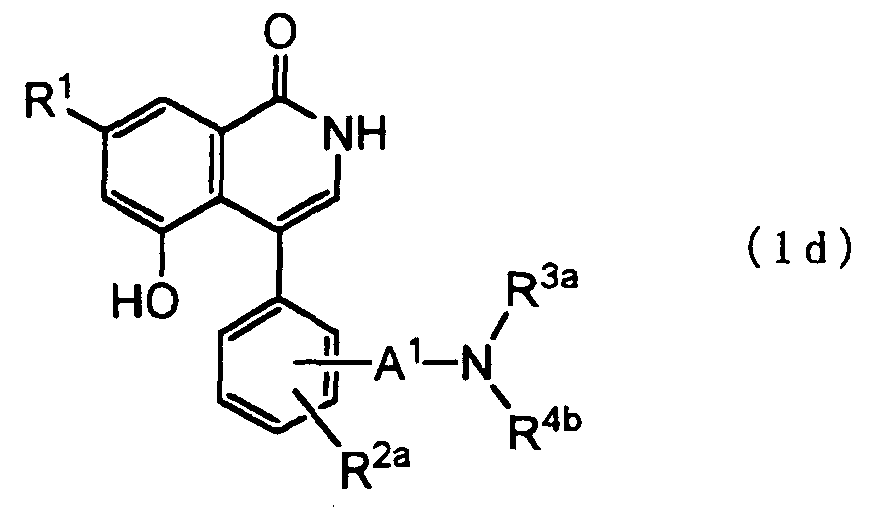
- 4-Substituted aryl-5-hydroxyisoquinolinone derivatives of Claim 1, represented by a general formula (1e)[wherein R1a denotes a hydrogen atom, R2b denotes a hydrogen atom, A1 denotes a C1~C4 alkylene, and R3b and R4c are bound together to form a 5- or 6-membered heterocycle which may have substituents and its condensed ring],and their pharmacologically acceptable addition salts.
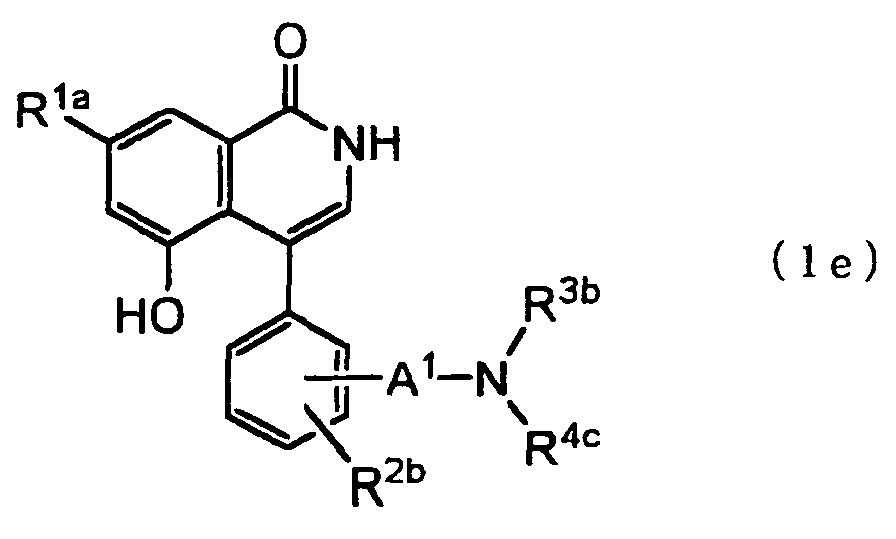
- 4-Substituted aryl-5-hydroxyisoquinolinone derivatives of Claim 1, represented by a general formula (1f)[wherein R1a denotes a hydrogen atom, R2b denotes a hydrogen atom, A1 denotes a C1~C4 alkylene, R3c denotes a lower alkyl group which may be substituted with halogen atom, and R4d denotes a lower alkyl group which may be substituted with halogen atom], and their pharmacologically acceptable addition salts.
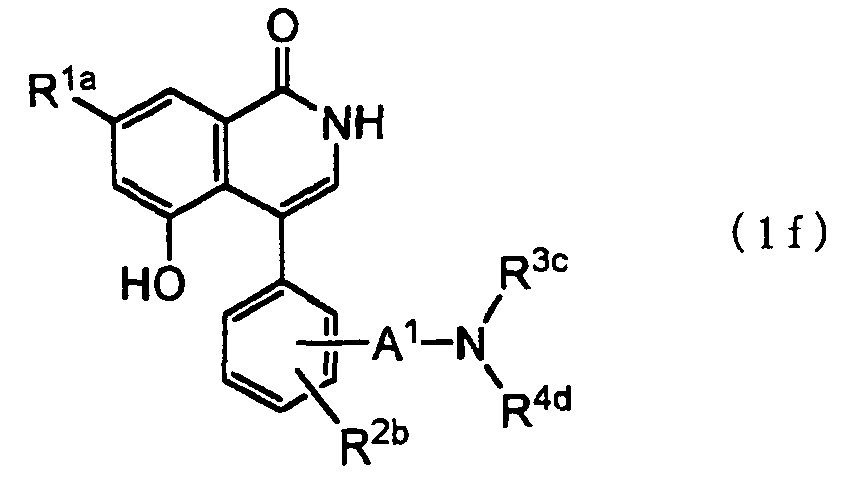
- 4-Substituted aryl-5-hydroxyisoquinolinone derivatives of Claim 1, represented by a general formula (1g)[wherein R1a denotes a hydrogen atom, R2b denotes a hydrogen atom, A1 denotes a C1~C4 alkylene, R3d denotes a hydrogen atom or lower alkyl group which may be substituted with halogen atom, R4e denotes general formula (3a)

- Compounds of Claim 1, wherein the compounds represented by said general formula (1) are 1,2-dihydro-4-[4-(dimethylaminomethyl)phenyl]-5-hydroxy-1-oxoisoquinoline, 1,2-dihydro-5-hydroxy-4-[4-[(N-methylbenzylamino)methyl]phenyl]-1-oxoisoquinoline, 1,2-dihydro-5-hydroxy-4-[4-[(N-methyl-2-phenylethylamino) methyl] phenyl]-1-oxoisoquinoline, 1,2- dihydro-5-hydroxy-4 -[4-[(N-methyl-3-phenylpropylamino)methyl]phenyl]-1-oxoisoquinoline,1,2-dihydro-5-hydroxy-4-[4-[(N-methylcyclohexylmethylamino) methyl]phenyl]-1-oxoisoquinoline, 1,2-dihydro-5-hydroxy-1-oxo-4-[4-[(pyrrolidin-1-yl)methyl]phenyl]isoquinoline and 1,2-dihydro-5-hydroxy-1-oxo-4-[4- [(4-phenyl-1,2,3,6-tetrahydropyridin-1-yl)methyl]phenyl]isoquinoline.
- An inhibitor of poly (ADP-ribose)synthetase, characterized by containing one or more kinds of 4-substituted aryl-5-hydroxyisoquinolinone derivatives and their pharmacologically acceptable addition salts of any of claims 1 through 9 as effective ingredients.
- A medicinal drug, characterized by containing one or more kinds of 4-substituted aryl-5-hydroxyisoquinolinone derivatives and their pharmacologically acceptable addition salts of any of Claims 1 through 9 as effective ingredients.
- A preventive and/or therapeutic drug for the ischemic diseases (cerebral infarction, cardiac infarction, acute renal failure, etc.), characterized by containing one or more kinds of 4-substituted aryl-5-hydroxyisoquinolinone derivatives and their pharmacologically acceptable addition salts of any of Claims 1 through 9 as effective ingredients.
- A preventive and/or therapeutic drug for the inflammatory diseases (inflammatory bowel disease, multiple cerebrosclerosis, arthritis, chronic rheumatism, etc.), characterized by containing one or more kinds of 4-substituted aryl-5-hydroxyisoquinolinone derivatives and their pharmacologically acceptable addition salts of any of Claims 1 through 9 as effective ingredients.
- A preventive and/or therapeutic drug for the neurodegenerative diseases (Alzheimer's disease, Huntington's chorea, Parkinson disease, etc.), characterized by containing one or more kinds of 4-substituted aryl-5-hydroxyisoquinolinonederivatives and their pharmacologically acceptable addition salts of any of Claims 1 through 9 as effective ingredients.
- A preventive and/or therapeutic drug for the diabetes and its complications, characterized by containing one or more kinds of 4-substituted aryl-5-hydroxyisoquinolinone derivatives and their pharmacologically acceptable addition salts of any of Claims 1 through 9 as effective ingredients.
- A therapeutic drug for the brain trauma, characterized by containing one or more kinds of 4-substituted aryl-5-hydroxyisoquinolinone derivatives and their pharmacologically acceptable addition salts of any of claims 1 through 9 as effective ingredients.
Applications Claiming Priority (3)
| Application Number | Priority Date | Filing Date | Title |
|---|---|---|---|
| JP2002214673 | 2002-07-24 | ||
| JP2002214673 | 2002-07-24 | ||
| PCT/JP2003/009332 WO2004009556A1 (en) | 2002-07-24 | 2003-07-23 | 4-(substituted aryl)-5-hydroxyisoquinolinone derivative |
Publications (2)
| Publication Number | Publication Date |
|---|---|
| EP1544194A1 true EP1544194A1 (en) | 2005-06-22 |
| EP1544194A4 EP1544194A4 (en) | 2009-01-21 |
Family
ID=30767891
Family Applications (1)
| Application Number | Title | Priority Date | Filing Date |
|---|---|---|---|
| EP03765364A Withdrawn EP1544194A4 (en) | 2002-07-24 | 2003-07-23 | DERIVATIVE 4- (ARYL SUBSTITUTED) -5-HYDROXYISOQUINOLINONE |
Country Status (10)
| Country | Link |
|---|---|
| US (1) | US7425563B2 (en) |
| EP (1) | EP1544194A4 (en) |
| JP (1) | JPWO2004009556A1 (en) |
| KR (1) | KR20050030636A (en) |
| CN (1) | CN100348584C (en) |
| AU (1) | AU2003255149A1 (en) |
| CA (1) | CA2493234A1 (en) |
| MX (1) | MXPA05000983A (en) |
| NZ (1) | NZ537793A (en) |
| WO (1) | WO2004009556A1 (en) |
Cited By (6)
| Publication number | Priority date | Publication date | Assignee | Title |
|---|---|---|---|---|
| WO2013076090A1 (en) * | 2011-11-25 | 2013-05-30 | Nerviano Medical Sciences S.R.L. | 3-phenyl-isoquinolin-1(2h)-one derivatives as parp-1 inhibitors |
| WO2013132253A1 (en) * | 2012-03-07 | 2013-09-12 | Institute Of Cancer Research: Royal Cancer Hospital (The) | 3-aryl-5-substituted-isoquinolin-1-one compounds and their therapeutic use |
| EP2903991A4 (en) * | 2012-10-02 | 2016-09-07 | Intermune Inc | ANTI-FIBROTIC PYRIDINONES |
| US9611223B2 (en) | 2013-09-11 | 2017-04-04 | Institute Of Cancer Research: Royal Cancer Hospital (The) | 3-aryl-5-substituted-isoquinolin-1-one compounds and their therapeutic use |
| USRE47142E1 (en) | 2008-06-03 | 2018-11-27 | Intermune, Inc. | Compounds and methods for treating inflammatory and fibrotic disorders |
| US10233195B2 (en) | 2014-04-02 | 2019-03-19 | Intermune, Inc. | Anti-fibrotic pyridinones |
Families Citing this family (9)
| Publication number | Priority date | Publication date | Assignee | Title |
|---|---|---|---|---|
| PE20050952A1 (en) * | 2003-09-24 | 2005-12-19 | Novartis Ag | DERIVATIVES OF ISOQUINOLINE AS INHIBITORS OF B-RAF |
| WO2005113540A1 (en) * | 2004-05-20 | 2005-12-01 | Mitsubishi Pharma Corporation | Isoquinoline compound and pharmaceutical use thereof |
| MX347085B (en) * | 2006-12-28 | 2017-04-06 | Abbott Laboratories * | Inhibitors of poly(adp-ribose)polymerase. |
| US8466150B2 (en) | 2006-12-28 | 2013-06-18 | Abbott Laboratories | Inhibitors of poly(ADP-ribose)polymerase |
| US9623021B2 (en) * | 2007-01-22 | 2017-04-18 | Gtx, Inc. | Nuclear receptor binding agents |
| US9604931B2 (en) | 2007-01-22 | 2017-03-28 | Gtx, Inc. | Nuclear receptor binding agents |
| KR101638035B1 (en) * | 2007-01-22 | 2016-07-11 | 지티엑스, 인코포레이티드 | Nuclear receptor binding agents |
| BR112014000267A2 (en) | 2011-07-04 | 2016-09-20 | Bayer Ip Gmbh | use of substituted isoquinolinones, isoquinolinediones, isoquinolinetrionas and dihydroisoquinolinones or, in each case, salts thereof as active agents against abiotic stress in plants |
| EP4065099A4 (en) | 2019-11-25 | 2023-11-29 | The Research Foundation for The State University of New York | COMBINATION THERAPY USING FABP5 INHIBITORS WITH TAXANES FOR THE TREATMENT OF CANCER |
Family Cites Families (6)
| Publication number | Priority date | Publication date | Assignee | Title |
|---|---|---|---|---|
| US4897391A (en) | 1988-06-17 | 1990-01-30 | Schering Corporation | Tricyclic anti-allergy, antiinflammatory and anti-hyperproliferative compounds |
| JP2786896B2 (en) * | 1988-08-19 | 1998-08-13 | ワーナー―ランバート・コンパニー | Substituted dihydroisoquinolinones and related compounds |
| US6197785B1 (en) | 1997-09-03 | 2001-03-06 | Guilford Pharmaceuticals Inc. | Alkoxy-substituted compounds, methods, and compositions for inhibiting PARP activity |
| US20020022636A1 (en) * | 1997-09-03 | 2002-02-21 | Jia-He Li | Oxo-substituted compounds, process of making, and compositions and methods for inhibiting parp activity |
| KR20010101675A (en) * | 1999-01-26 | 2001-11-14 | 우에노 도시오 | 2h-phthalazin-1-one derivatives and drugs comprising these derivatives as the active ingredient |
| US20040176361A1 (en) | 2001-05-23 | 2004-09-09 | Masakazu Fujio | Fused heterocyclic compound and medicinal use thereof |
-
2003
- 2003-07-23 AU AU2003255149A patent/AU2003255149A1/en not_active Abandoned
- 2003-07-23 JP JP2004522783A patent/JPWO2004009556A1/en active Pending
- 2003-07-23 US US10/521,565 patent/US7425563B2/en not_active Expired - Fee Related
- 2003-07-23 CN CNB038175894A patent/CN100348584C/en not_active Expired - Fee Related
- 2003-07-23 KR KR1020057001311A patent/KR20050030636A/en not_active Ceased
- 2003-07-23 WO PCT/JP2003/009332 patent/WO2004009556A1/en not_active Ceased
- 2003-07-23 NZ NZ537793A patent/NZ537793A/en unknown
- 2003-07-23 EP EP03765364A patent/EP1544194A4/en not_active Withdrawn
- 2003-07-23 CA CA002493234A patent/CA2493234A1/en not_active Abandoned
- 2003-07-23 MX MXPA05000983A patent/MXPA05000983A/en active IP Right Grant
Cited By (16)
| Publication number | Priority date | Publication date | Assignee | Title |
|---|---|---|---|---|
| USRE47142E1 (en) | 2008-06-03 | 2018-11-27 | Intermune, Inc. | Compounds and methods for treating inflammatory and fibrotic disorders |
| EA027800B1 (en) * | 2011-11-25 | 2017-09-29 | НЕРВИАНО МЕДИКАЛ САЙЕНСИЗ С.р.л. | 3-phenyl-isoquinolin-1(2h)-one derivatives as parp-1 inhibitors |
| US9422243B2 (en) | 2011-11-25 | 2016-08-23 | NERVIANO MEDICAL SCIENCES S.R.L. a corporation | 3-phenyl-isoquinolin-1(2H)-one derivatives as PARP-1 inhibitors |
| WO2013076090A1 (en) * | 2011-11-25 | 2013-05-30 | Nerviano Medical Sciences S.R.L. | 3-phenyl-isoquinolin-1(2h)-one derivatives as parp-1 inhibitors |
| WO2013132253A1 (en) * | 2012-03-07 | 2013-09-12 | Institute Of Cancer Research: Royal Cancer Hospital (The) | 3-aryl-5-substituted-isoquinolin-1-one compounds and their therapeutic use |
| US9193689B2 (en) | 2012-03-07 | 2015-11-24 | Institute Of Cancer Research: Royal Cancer Hospital (The) | 3-aryl-5-substituted-isoquinolin-1-one compounds and their therapeutic use |
| AU2013229229B2 (en) * | 2012-03-07 | 2017-10-19 | Institute Of Cancer Research: Royal Cancer Hospital (The) | 3-aryl-5-substituted-isoquinolin-1-one compounds and their therapeutic use |
| RU2696572C2 (en) * | 2012-03-07 | 2019-08-05 | Инститьют Оф Кансер Ресёрч: Ройял Кансер Хоспитал (Зе) | 3-aryl-5-substituted isoquinolin-1-one compounds and their therapeutic application |
| KR20150001734A (en) * | 2012-03-07 | 2015-01-06 | 디 인스티튜트 오브 캔서 리서치:로얄 캔서 하스피틀 | 3-aryl-5-substituted-isoquinolin-1-one compounds and their therapeutic use |
| EP2903991A4 (en) * | 2012-10-02 | 2016-09-07 | Intermune Inc | ANTI-FIBROTIC PYRIDINONES |
| US9675593B2 (en) | 2012-10-02 | 2017-06-13 | Intermune, Inc. | Anti-fibrotic pyridinones |
| US10376497B2 (en) | 2012-10-02 | 2019-08-13 | Intermune, Inc. | Anti-fibrotic pyridinones |
| US10898474B2 (en) | 2012-10-02 | 2021-01-26 | Intermune, Inc. | Anti-fibrotic pyridinones |
| US9611223B2 (en) | 2013-09-11 | 2017-04-04 | Institute Of Cancer Research: Royal Cancer Hospital (The) | 3-aryl-5-substituted-isoquinolin-1-one compounds and their therapeutic use |
| US10233195B2 (en) | 2014-04-02 | 2019-03-19 | Intermune, Inc. | Anti-fibrotic pyridinones |
| US10544161B2 (en) | 2014-04-02 | 2020-01-28 | Intermune, Inc. | Anti-fibrotic pyridinones |
Also Published As
| Publication number | Publication date |
|---|---|
| KR20050030636A (en) | 2005-03-30 |
| US7425563B2 (en) | 2008-09-16 |
| MXPA05000983A (en) | 2005-08-18 |
| US20060173039A1 (en) | 2006-08-03 |
| WO2004009556A1 (en) | 2004-01-29 |
| CA2493234A1 (en) | 2004-01-29 |
| EP1544194A4 (en) | 2009-01-21 |
| CN1671668A (en) | 2005-09-21 |
| WO2004009556A9 (en) | 2004-10-21 |
| NZ537793A (en) | 2007-05-31 |
| JPWO2004009556A1 (en) | 2005-11-17 |
| CN100348584C (en) | 2007-11-14 |
| AU2003255149A1 (en) | 2004-02-09 |
Similar Documents
| Publication | Publication Date | Title |
|---|---|---|
| CN102026961B (en) | Amide compound | |
| US9096518B2 (en) | Substituted hydroxamic acids and uses thereof | |
| US8513421B2 (en) | Substituted hydroxamic acids and uses thereof | |
| JP6807385B2 (en) | RET inhibitor | |
| US20190119280A1 (en) | Compositions useful for treating disorders related to kit and pdgfr | |
| CN104169260A (en) | Novel triazone derivative | |
| US7425563B2 (en) | 4-(Substituted aryl)-5-hydroxyisoquinolinone derivative | |
| TW200806650A (en) | P38 inhibitors and methods of use thereof | |
| KR101760158B1 (en) | Condensed ring pyridine compound | |
| CN114409656A (en) | PIM kinase inhibitors | |
| WO2019000504A1 (en) | Phosphodiesterase inhibitor type 5 (pde 5), and preparation method and application thereof | |
| JP2004043458A (en) | 4-aryl-5-hydroxyisoquinoline derivatives and method for producing the same | |
| CN103339109B (en) | Tetrahydroisoquinoline derivative | |
| CN111825605A (en) | Aryl ketone amide compound and its preparation method and use | |
| CN119143724A (en) | Alkynyl substituted pyrazole compound and preparation method and application thereof | |
| CN103649066A (en) | 5-carbamoyl-adamantan-2-yl amide derivatives, pharmaceutically acceptable salts thereof and preparation process thereof |
Legal Events
| Date | Code | Title | Description |
|---|---|---|---|
| PUAI | Public reference made under article 153(3) epc to a published international application that has entered the european phase |
Free format text: ORIGINAL CODE: 0009012 |
|
| 17P | Request for examination filed |
Effective date: 20050210 |
|
| AK | Designated contracting states |
Kind code of ref document: A1 Designated state(s): AT BE BG CH CY CZ DE DK EE ES FI FR GB GR HU IE IT LI LU MC NL PT RO SE SI SK TR |
|
| AX | Request for extension of the european patent |
Extension state: AL LT LV MK |
|
| A4 | Supplementary search report drawn up and despatched |
Effective date: 20081229 |
|
| STAA | Information on the status of an ep patent application or granted ep patent |
Free format text: STATUS: THE APPLICATION IS DEEMED TO BE WITHDRAWN |
|
| 18D | Application deemed to be withdrawn |
Effective date: 20090818 |