EP1542169A1 - Verfahren und System zum Prüfen einer Zugangsberechtigung zu einem Dienst durch biometrische Identifizierung - Google Patents
Verfahren und System zum Prüfen einer Zugangsberechtigung zu einem Dienst durch biometrische Identifizierung Download PDFInfo
- Publication number
- EP1542169A1 EP1542169A1 EP04291640A EP04291640A EP1542169A1 EP 1542169 A1 EP1542169 A1 EP 1542169A1 EP 04291640 A EP04291640 A EP 04291640A EP 04291640 A EP04291640 A EP 04291640A EP 1542169 A1 EP1542169 A1 EP 1542169A1
- Authority
- EP
- European Patent Office
- Prior art keywords
- client
- title
- management center
- signal
- customer
- Prior art date
- Legal status (The legal status is an assumption and is not a legal conclusion. Google has not performed a legal analysis and makes no representation as to the accuracy of the status listed.)
- Withdrawn
Links
Images


Classifications
-
- G—PHYSICS
- G07—CHECKING-DEVICES
- G07C—TIME OR ATTENDANCE REGISTERS; REGISTERING OR INDICATING THE WORKING OF MACHINES; GENERATING RANDOM NUMBERS; VOTING OR LOTTERY APPARATUS; ARRANGEMENTS, SYSTEMS OR APPARATUS FOR CHECKING NOT PROVIDED FOR ELSEWHERE
- G07C9/00—Individual registration on entry or exit
- G07C9/30—Individual registration on entry or exit not involving the use of a pass
- G07C9/32—Individual registration on entry or exit not involving the use of a pass in combination with an identity check
- G07C9/37—Individual registration on entry or exit not involving the use of a pass in combination with an identity check using biometric data, e.g. fingerprints, iris scans or voice recognition
-
- G—PHYSICS
- G06—COMPUTING OR CALCULATING; COUNTING
- G06Q—INFORMATION AND COMMUNICATION TECHNOLOGY [ICT] SPECIALLY ADAPTED FOR ADMINISTRATIVE, COMMERCIAL, FINANCIAL, MANAGERIAL OR SUPERVISORY PURPOSES; SYSTEMS OR METHODS SPECIALLY ADAPTED FOR ADMINISTRATIVE, COMMERCIAL, FINANCIAL, MANAGERIAL OR SUPERVISORY PURPOSES, NOT OTHERWISE PROVIDED FOR
- G06Q20/00—Payment architectures, schemes or protocols
- G06Q20/38—Payment protocols; Details thereof
- G06Q20/40—Authorisation, e.g. identification of payer or payee, verification of customer or shop credentials; Review and approval of payers, e.g. check credit lines or negative lists
- G06Q20/401—Transaction verification
- G06Q20/4014—Identity check for transactions
- G06Q20/40145—Biometric identity checks
Definitions
- the invention relates to a data transfer method by telecommunication, to control a title authorization for access to a service or acquisition of a product.
- the method includes processing reservation information relating to the product or reserved service in a memory of a communicating portable object of the customer, such as a mobile phone (or " terminal ").
- the aforementioned booking information thus serves as a proof of reservation. They are stored in a memory of the communicating portable object until later use, in particular for checking the validity of the title whose reservation information is stored.
- the portable object communicates with a reservation management center, such as a server in the case of a mobile terminal.
- a delivery mode a request for reservation or acquisition whose information which the characterize are stored in a memory of the object communicating.
- a control mode we compare stored availability and / or validity information in a memory of the reservations management center at aforementioned information which is initially stored in the memory of the communicating object.
- Such an embodiment makes it possible, advantageously, to pass the usual physical titles printed on paper, such as tickets or banknotes show. Indeed, the information stored in the terminal memory, controllable and can be transferred at any time as a file computer science, thus replacing physical titles usual.
- the present invention improves the situation.
- said signal is a signal speech while the title management center performs, from said signal, an authentication voice to compare the voice of the customer to that stored in reference during the recording phase.
- the biometric character is relative to an iridian impression, or an impression digital or, more generally, to any biometric data including data to authenticate a individual can be transmitted from a terminal mobile.
- the management center identifies in said signal both information on the title and the customer voice data.
- said signal is preferentially a speech signal corresponding to a sentence pronounced by the customer indicating characteristics of the title.
- the securities management center advantageously recognize the words pronounced in the said sentence and determines a correspondence with data title and stored in the center's memory Management.
- the terminal comprises a sound sensor and the signal that the terminal delivers is a speech signal, while the management center for titles includes a voice authentication device to authenticate the customer's voice.
- said signal is a speech signal corresponding to a sentence pronounced by the customer in indicating characteristics of the title
- the center of securities management also includes a module of voice recognition, able to recognize words pronounced in that sentence and to determine a correspondence with title data stored in the memory of said management center.
- the signal that receives and processes the server is a speech signal and the server further includes a voice authentication device allowing to authenticate the customer's voice.
- the signal comprises words of a sentence pronounced by the customer and indicating characteristics of the title, and said means of comparison are advantageously able to determine a correspondence with title data stored in the memory.
- the abbreviation TER is for a mobile terminal, for example a mobile telephone, or a PDA (for " Personal Digital Assistant "). ).
- the acronym PC is aimed at a control station, for example a laptop or fixed.
- the initials SER refer to a title management center, such as a remote server connected to the PC control station.
- the mobile terminal TER at least, is connected to a mobile communication network, for example the GSM / GPRS network, while the SER server can be connected to the switched network, the two networks being connected by a gateway conventional in itself, which makes it possible to establish communications between the mobile terminal TER and the server SER, if necessary via the PC control station, as will be seen later.
- the PC control station also includes a communication interface to the SER server.
- biometric parameters can be derived from biometric characters such as voice, iris, fingerprint, or other.
- Biometric sensors such as a microphone for voice authentication, make it possible to obtain a file that is a sound file in the case of the voice, an image for the iris or digital fingerprint, or other.
- the authentication consists firstly in calculating these parameters (also called “coefficients" ) from the aforementioned file and comparing them with parameters calculated from a reference file. It will thus be understood that the above-mentioned data, relating to the biometric character of a client and transmitted in the signal sent by the mobile terminal to the management center, are the data of this file or, alternatively, directly the calculated coefficients, mentioned above. (if the terminal has sufficient processing capacity).
- the PC control station may include means (a monitor or speakers) to inform the customer a securities management center number to call.
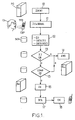
- the TER terminal connects to the SER server by dialing a SER server number (typically a short number).
- the SER server identifies the client by its mobile ID number provided directly, or in asking the client for a predetermined identifier.
- the client provides, via his mobile TER, title information and then related data biometric character to authenticate the client (step 12). It is indicated that these data previously recorded have been acquired by a procedure which will be described later, with reference to the figure 2.
- the server looks in its database if data is stored for the received ID ID (step 13). If no data was not stored for this user, the server SER informs the customer, and eventually sends a message corresponding to the PC checkpoint indicating that the customer is not known. For example, the procedure of control can stop at the end step 14 if the identifier ID was not recognized.
- the biometric character used is the voice of the customer and, in this variant, the Title data and related data biometric character can be drawn from the same signal, corresponding to a speech signal, which allows both to identify the characteristics of the title and to authenticate the client, in the same processing step.
- the customer CL may be asked to pronounce a identification phrase in a CAP sound sensor that has its terminal TER.
- the sound signal thus captured is transmitted, with-a -identifier ID of the terminal, to the SER server, in step 11 shown in Figure 1.
- the sentence pronounced by the client CL to form the signal sound captured in step 11 then contains information relating to the security previously acquired.
- the routine that prompts the CL client to pronounce this sentence can ask him to pronounce the name of a movie and a session time, if the title is for a movie theater.
- the terminal ID can correspond to a subscription number associated with the terminal TER, especially in the realization where this terminal is a mobile phone.
- the identifier ID can be transmitted without specific action of the user.
- a variant would consist of a particular action of the user, for example a question / answer exchange with the server.
- step 12 the server extracts the signal transmitted to step 11, using the voice recognition module, DATA (TI) data relating to the title. If the identifier ID has been recognized, the server then compares the DATA (TI) data with the data stored for the identifier ID (step 15). If no data is recognized, the SER server can request a new seizure to the TER terminal user and after several unsuccessful entries, send to the PC checkpoint a denied access message that is displayed on a PC control station.
- DATA TI
- the authentication module calculates and compares the voice parameters of the signal transmitted to those stored in the server memory in association with the ID. If the result of the comparison is negative, the SER server may request a new seizure to the TER terminal user and after several unsuccessful entries (eg three), send to checkpoint a denial of access message (step 14) displayed on a PC monitor (no represent).
- the SER server transmits to the PC checkpoint an access authorization message, displayed on the PC monitor (Step 16) and issue a documentary evidence using a printer connected to the PC control station.
- the PC control station when the position of PC control terminates its connection with TER terminal, whereas, at the end of step 16, the client CL accesses the service required, the PC control station issues a message of end of connection to the SER server, indicating that the title is well consumed by the CL client.
- the server removes from its memory any reference to the title, since it has been consumed, and transmits to TER terminal (step 18) a message of consumption of the title for inform the customer CL.
- PC control can locate the TER terminal of the CL client, so that the TER terminal is identified with the PC control.
- the mobile terminal TER and the PC stations are for example equipped each with a module of wireless local communication.
- the PC station detects the TER terminal and the data transmitted by the terminal transit advantageously towards the SER management center, via the PC control station.
- the description is now process of acquiring title, prior to its control as described with reference to FIG. 1.
- the terminal TER establishes a connection to step 21, with the SER server to acquire a title. From the outset, the TER terminal transmits its identifier ID to the SER server.
- the SER server indicates, at Step 22, a list of possible choices that the CL client can select individually. These possible choices can be for example destinations and flights of airplane or titles and movie schedules.
- a voice server is provided for orient the CL client in the different possible choices.
- the client CL commands a selection in this list, for example vocally.
- the client CL pronounced then the information relating to the title in the sensor sound that comprises the mobile terminal TER.
- the signal sound corresponding to this voice command is transmitted to the server SER, which, in step 24, tests whether the signal voice allows him to recognize a selection in the different choices offered to the CL client. In case incompatibility, the CL client is invited back to indicate your choice orally.
- the client CL transmits, via its TER terminal, the data relating to a biometric character of the client.
- the SER server recognizes the data relating to the title and can extract, substantially in the same stage, customer voice data, by speech Recognition.
- This data is stored in the server memory SER, for later use, in particular for a check of coincidence of these data with the data taken from a signal, for example voice, picked up in step 11 ( Figure 1), while checking the validity of the title.
- step 25 corresponding to the customer ID, which will make it easier to recognize the parameters customer-specific voice when checking the title.
- the acquisition step ends, the case after a payment stage, by the transmission from the server to the terminal, an acknowledgment of receipt (step 26) consisting of a message, for example written (such as an SMS message), indicating the characteristics of the title that has been acquired.
- an acknowledgment of receipt consisting of a message, for example written (such as an SMS message), indicating the characteristics of the title that has been acquired.
- the first client CL1 wishing to surrender its title, establishes, at step 31, a connection to the SER server, from its TER1 mobile terminal.
- the server starts a verification routine of the identity of the caller and, preferentially, ask the client CL1 to pronounce a sentence in the sound sensor of its mobile terminal TER1, in step 33.
- the CL1 client should indicate the identity of the CL2 beneficiary of the title, or indicate the TER2 terminal ID this person CL2.
- the server checks whether the CL1 client's voice parameters are clearly identified in correspondence of the identifier ID of the user CL1 and the title whose assignment is required. More Generally, it is indicated that verification steps 32 to 34 may be similar to steps 11 to 15 described herein before with reference to Figure 1.
- step 34 the server stores the identifier of the CL2 user tracks title data.
- the server then establishes a connection to the terminal TER2 of the second client CL2 by transmitting a message (step 36) to retrieve data relating to a biometric character.
- the server calculates the parameters from the received data. These last are stored in correspondence of the identifier ID2 of the terminal TER2 and characteristics of the title, at the stage 38.
- the server sends to both terminals TER1 and TER2 an acknowledgment, at step 39, indicating that the assignment has been registered. So when the second CL2 client will wish to consume the transferred title, the server will consult in its memory the identifier ID2 of the second terminal TER2, the data relating to the title and voice settings.
- the server also comprises processing means 42, such as a processor to drive the different operations performed by the server and in particular compare biometric data and title data with those stored in memory 43.
- processing means 42 such as a processor to drive the different operations performed by the server and in particular compare biometric data and title data with those stored in memory 43.
- the server finally comprises a module 44 for writing message of validity or invalidity of the securities, as well as a second COM2 communication interface with the PC checkpoint to convey the message supra. It is indicated that the module 44 can be active too to form messages for the mobile terminal, as described above with reference to steps 17 and 18 of Figure 1.
- step 11 the user CL can select a choice otherwise voice command, for example by activating keys of his terminal.
- the recognition of the voice parameters of the CL user is then done thanks to a standard sentence that pronounced the CL user.
- the TER terminal comprises an optical reader able to take a shot of the iris of CL user or fingerprint sensor able to capture a fingerprint image and to extract the essential data that will allow to authenticate the CL user.
- These essential data can be transmitted to the server for storage and / or check of coincidence with data previously stored, just like the voice data in the speech recognition embodiment described above.
- this step can be carried out from a Internet connection or landline phone. If the position (computer or telephone) used is equipped with a sensor for entering biometric data (microphone, fingerprint or iris sensor, or other), the Entering this data can be done directly. If not, the server will prompt the client to indicate a number subscriber (on mobile or landline) to recall this post and enter this data later.
- the character Biometric used can be chosen by the customer, or again by the server.
- the checkpoint may also include means for acquiring these data.
- the checkpoint is equipped with a sensor such as a microphone, or a fingerprint reader iridian or digital, and transmits the information collected at the management center. This variant can prove beneficial if the management center fails not to decipher the biometric data transmitted by the terminal or if it does not have a sensor or has a faulty sensor.
Landscapes
- Business, Economics & Management (AREA)
- Engineering & Computer Science (AREA)
- Accounting & Taxation (AREA)
- Physics & Mathematics (AREA)
- General Physics & Mathematics (AREA)
- Computer Security & Cryptography (AREA)
- Finance (AREA)
- Strategic Management (AREA)
- General Business, Economics & Management (AREA)
- Theoretical Computer Science (AREA)
- Human Computer Interaction (AREA)
- Telephonic Communication Services (AREA)
Priority Applications (1)
| Application Number | Priority Date | Filing Date | Title |
|---|---|---|---|
| EP04291640A EP1542169A1 (de) | 2004-06-29 | 2004-06-29 | Verfahren und System zum Prüfen einer Zugangsberechtigung zu einem Dienst durch biometrische Identifizierung |
Applications Claiming Priority (1)
| Application Number | Priority Date | Filing Date | Title |
|---|---|---|---|
| EP04291640A EP1542169A1 (de) | 2004-06-29 | 2004-06-29 | Verfahren und System zum Prüfen einer Zugangsberechtigung zu einem Dienst durch biometrische Identifizierung |
Publications (1)
| Publication Number | Publication Date |
|---|---|
| EP1542169A1 true EP1542169A1 (de) | 2005-06-15 |
Family
ID=34486591
Family Applications (1)
| Application Number | Title | Priority Date | Filing Date |
|---|---|---|---|
| EP04291640A Withdrawn EP1542169A1 (de) | 2004-06-29 | 2004-06-29 | Verfahren und System zum Prüfen einer Zugangsberechtigung zu einem Dienst durch biometrische Identifizierung |
Country Status (1)
| Country | Link |
|---|---|
| EP (1) | EP1542169A1 (de) |
Citations (4)
| Publication number | Priority date | Publication date | Assignee | Title |
|---|---|---|---|---|
| US20020029169A1 (en) * | 2000-09-05 | 2002-03-07 | Katsuhiko Oki | Method and system for e-transaction |
| US20030014648A1 (en) * | 2001-07-10 | 2003-01-16 | Nec Corporation | Customer authentication system, customer authentication method, and control program for carrying out said method |
| US20030172037A1 (en) * | 2002-03-07 | 2003-09-11 | International Business Machines Corporation | System and method for purchasing and authentificating electronic tickets |
| US20030220095A1 (en) * | 2002-05-24 | 2003-11-27 | At&T Wireless Services, Inc. | Biometric authentication of a wireless device user |
-
2004
- 2004-06-29 EP EP04291640A patent/EP1542169A1/de not_active Withdrawn
Patent Citations (4)
| Publication number | Priority date | Publication date | Assignee | Title |
|---|---|---|---|---|
| US20020029169A1 (en) * | 2000-09-05 | 2002-03-07 | Katsuhiko Oki | Method and system for e-transaction |
| US20030014648A1 (en) * | 2001-07-10 | 2003-01-16 | Nec Corporation | Customer authentication system, customer authentication method, and control program for carrying out said method |
| US20030172037A1 (en) * | 2002-03-07 | 2003-09-11 | International Business Machines Corporation | System and method for purchasing and authentificating electronic tickets |
| US20030220095A1 (en) * | 2002-05-24 | 2003-11-27 | At&T Wireless Services, Inc. | Biometric authentication of a wireless device user |
Similar Documents
| Publication | Publication Date | Title |
|---|---|---|
| EP2591463B1 (de) | Sicheres System und Verfahren zur Feststellung und Aufzeichnung einer Identität | |
| FR2864289A1 (fr) | Controle d'acces biometrique utilisant un terminal de telephonie mobile | |
| EP2537286B1 (de) | Verfahren zur biometrischen authentifizierung, authentifizierungssystem und zugehöriges programm | |
| FR3083894A1 (fr) | Procede de reconnaissance biometrique | |
| WO2009027607A2 (fr) | Procede et systeme de fourniture de services | |
| FR2999324A1 (fr) | Gestion securisee d'une transaction de prestation de service | |
| EP2793197B1 (de) | Verfahren und automatisches System zur Zugangskontrolle | |
| WO2005032153A2 (fr) | Méthode d'appariement entre un téléphone portable et une carte personnelle | |
| EP1618535B1 (de) | Verfahren zur sicheren zugangssteuerung | |
| EP1542169A1 (de) | Verfahren und System zum Prüfen einer Zugangsberechtigung zu einem Dienst durch biometrische Identifizierung | |
| FR2758197A1 (fr) | Procede et installation pour realiser un titre d'usager personnalise infalsifiable | |
| EP3185189B1 (de) | Verfahren und system zur erbringung eines dienstes mit überprüfung der übereinstimmung zwischen einem fahrzeug, das diesen dienst empfängt, und einem nutzer des dienstes | |
| EP1634220B1 (de) | Verfahren und vorrichtung zur biometrischen erkennung für verifizierungszwecke auf chipkarten | |
| EP1186152B1 (de) | System und verfahren zur bearbeitung von fernsprechanrufen | |
| FR2861482A1 (fr) | Procede de securisation d'une donnee biometrique d'authentification et procede d'authentification d'un utilisateur a partir d'une donnee biometrique d'authentification | |
| EP3928501A1 (de) | Verfahren zur verwaltung des zugangs eines benutzers zu einem sprachdienst, entsprechende vorrichtung, system und programme | |
| EP4254286B1 (de) | System zum versand von in schachteln enthaltenen gegenständen, auf welche mittel zur identifizierung des empfängers bestimmt sind | |
| FR3153683A1 (fr) | système et méthode d’authentification d’utilisateurs. | |
| FR2805066A1 (fr) | Procede de codage d'une image detectee d'une caracteristique biometrique d'une personne, procede d'authentification securise pour une autorisation d'acces en faisant application, dispositifs de mise en oeuvre correspondants | |
| FR3114891A3 (fr) | Système d’identification biométrique | |
| FR3105480A3 (fr) | Système d’identification | |
| EP4367620A1 (de) | Verfahren zur steuerung einer kontaktlosen transaktion und entsprechendes kommunikationsobjekt | |
| WO2023001845A1 (fr) | Procédé d'enrôlement d'un utilisateur par un organisme sur une chaîne de blocs | |
| FR2982977A1 (fr) | Systeme materiel et procede pour l'identification biometrique et gestion automatique des chauffeurs et taxis | |
| EP2798564A1 (de) | Verfahren und system für sichere zahlungstransaktionen mithilfe einer zahlungskarte |
Legal Events
| Date | Code | Title | Description |
|---|---|---|---|
| PUAI | Public reference made under article 153(3) epc to a published international application that has entered the european phase |
Free format text: ORIGINAL CODE: 0009012 |
|
| AK | Designated contracting states |
Kind code of ref document: A1 Designated state(s): AT BE BG CH CY CZ DE DK EE ES FI FR GB GR HU IE IT LI LU MC NL PL PT RO SE SI SK TR |
|
| AX | Request for extension of the european patent |
Extension state: AL HR LT LV MK |
|
| AKX | Designation fees paid | ||
| REG | Reference to a national code |
Ref country code: DE Ref legal event code: 8566 |
|
| STAA | Information on the status of an ep patent application or granted ep patent |
Free format text: STATUS: THE APPLICATION IS DEEMED TO BE WITHDRAWN |
|
| 18D | Application deemed to be withdrawn |
Effective date: 20051216 |