EP1542082A1 - Electrophotographic photoreceptor, undercoat layer coating liquid therefor, method of preparing the photoreceptor, and image forming apparatus and process cartridge using the photoreceptor - Google Patents
Electrophotographic photoreceptor, undercoat layer coating liquid therefor, method of preparing the photoreceptor, and image forming apparatus and process cartridge using the photoreceptor Download PDFInfo
- Publication number
- EP1542082A1 EP1542082A1 EP04028691A EP04028691A EP1542082A1 EP 1542082 A1 EP1542082 A1 EP 1542082A1 EP 04028691 A EP04028691 A EP 04028691A EP 04028691 A EP04028691 A EP 04028691A EP 1542082 A1 EP1542082 A1 EP 1542082A1
- Authority
- EP
- European Patent Office
- Prior art keywords
- undercoat layer
- electrophotographic photoreceptor
- normal
- photoreceptor
- coating liquid
- Prior art date
- Legal status (The legal status is an assumption and is not a legal conclusion. Google has not performed a legal analysis and makes no representation as to the accuracy of the status listed.)
- Granted
Links
Images

Classifications
-
- G—PHYSICS
- G03—PHOTOGRAPHY; CINEMATOGRAPHY; ANALOGOUS TECHNIQUES USING WAVES OTHER THAN OPTICAL WAVES; ELECTROGRAPHY; HOLOGRAPHY
- G03G—ELECTROGRAPHY; ELECTROPHOTOGRAPHY; MAGNETOGRAPHY
- G03G5/00—Recording-members for original recording by exposure, e.g. to light, to heat or to electrons; Manufacture thereof; Selection of materials therefor
- G03G5/14—Inert intermediate or cover layers for charge-receiving layers
- G03G5/142—Inert intermediate layers
Definitions
- the present invention relates to an electrophotographic photoreceptor for use in laser printers, digital copiers and laser facsimiles; an undercoat layer coating liquid therefor; a method of preparing the photoreceptor; and image forming apparatus and a process cartridge using the photoreceptor.
- Electrophotographic image forming devices can produce high-quality images at a high-speed, and are used for copiers and laser beam printers.
- An organic photoreceptor using an organic photoconductive material has been developed and has gradually become widely used as a photoreceptor in electrophotographic image forming devices. Over time, the photoreceptor has changed from a) a charge transporting complex constitution or a single-layered constitution wherein a charge generation material is dispersed in a binder resin to b) a functionally-separated constitution wherein a photosensitive layer is separated into charge generation layer and a charge transport layer, and has improved its performance.
- the currently prevailing approach includes use of a functionally-separated photoreceptor having a constitution wherein an undercoat layer is formed on an aluminum substrate, a charge generation layer is formed on the undercoat layer and a charge transport layer is formed on the charge generation layer.
- the undercoat layer is formed to improve adhesiveness, coatability, chargeability of the photosensitive layer, and to prevent an unnecessary charge from the substrate from entering the photosensitive layer and cover a defect on the substrate.
- the undercoat layer typically includes only a binder resin and an undercoat layer including a binder resin and a pigment.
- resins used in the undercoat layer include water-soluble resins such as polyvinylalcohol and casein; alcohol-soluble resins such as nylon copolymers; and hardened resins having a three-dimensional network such as polyurethane, melamine resins, phenol resins, phenol resins, oil-free alkyd resins, epoxy resins and siloxane resins.
- Nylon alcohol-soluble resins are highly sensitive to environment because of their high water absorbability and affinity, and therefore the resultant photoreceptor changes its properties according to humidity.
- a photoreceptor having an undercoat layer using alcohol-soluble resins, particularly the nylon resins absorb a large amount of water in the undercoat layer, and therefore properties thereof change significantly when repeatedly used in an environment of high temperature and high humidity or a low temperature and low humidity. This results in production of abnormal images such as black spots and deterioration of image density.
- an inorganic pigment such as titanium oxide may be dispersed in the undercoat layer to enhance a hiding effect of the defect on the substrate and a scattering effect of incident light such as coherence light (a laser beam) to prevent occurrence of an interference pattern.
- incident light such as coherence light (a laser beam)
- formaldehyde is used to form melamine resins, alkyd/melamine resins, acryl/melamine resins, phenol resins and methoxymethylated nylon. Therefore, unreacted materials are absorbed in the resins and the formaldehyde generates in a heat cross-linking process after the undercoat layer is formed.
- formaldehyde is an indoor pollutant listed in the Clean Air Act and is said to be a cause of an illness known as "sick house syndrome.” Thus, to prevent formaldehyde from being discharged to the atmosphere, expensive collection equipment needs to be used.
- Such resins include urethane resins.
- a compound, including a group including an active hydrogen such as acrylpolyol is dried with hot air for a predetermined period of time in the presence of a hardener, such as a monomer including an isocyanate group, such that a three-dimensional network crosslinking reaction between the group including an active hydrogen of the acrylpolyol and isocyanate group of the hardener starts to form a hardened film.
- a hardener such as a monomer including an isocyanate group
- a coating liquid using the isocyanate group has a short usable time.
- a blocked isocyanate having a long pot life in a coating liquid for an electrophotographic photoreceptor and an isocyanate coating material, which is stable in the presence of alcohol-soluble chemicals, water-soluble chemicals or the compound including a group including an active hydrogen, is a topic of ongoing research.
- the blocked isocyanate includes an isocyanate group protected with a blocker such as oxime and starts an addition reaction with a compound, including a group including active hydrogen such as a hydroxyl group, when heated and the blocker is removed to proceed a crosslinking reaction.
- a blocker such as oxime
- the blocker Since the blocker has a high release temperature, an investment for a drying equipment increases more than a conventional equipment, which consumes more energy than the conventional one and increases CO 2 , resulting in increase of global warming.
- the release temperature i.e., the crosslinking temperature
- a usable time of a coating liquid for the photoreceptor is extended to the maximum.
- Japanese Laid-Open Patent Publications Nos. 06-158267and06-257312, and Japanese Patents Nos. 02637557, 02608328 and 02567090 disclose a photoreceptor including block isocyanate in its intermediate or undercoat layer, wherein a zinc compound and a basic compound are disclosed as a catalyst.
- a basic amine in the present invention not only largely reduces the crosslinking temperature, but also when included in an undercoat layer of an electrophotographic photoreceptor, the resultant photoreceptor has high potential stability and produces no abnormal images.
- the basic amine provides an undercoat layer coating liquid for an electrophotographic photoreceptor, having high liquid properties, which makes a clear distinction from the above-mentioned zinc compound and basic compound.
- an object of the present invention is to provide an electrophotographic photoreceptor having good electrostatic properties and high durability.
- Another object of the present invention is to provide a coating liquid for the photoreceptor, having good storage stability and capable of reducing crosslinking energy.
- a further object of the present invention is to provide a method of preparing the photoreceptor.
- an electrophotographic photoreceptor including an electroconductive substrate; an undercoat layer located overlying the electroconductive substrate; and a photosensitive layer located overlying the undercoat layer, wherein the undercoat layer comprises a blocked isocyanate compound and a basic amine.
- the undercoat layer further includes, an oil-free alkyd resin including a hydroxyl group.
- the undercoat layer preferably includes the basic amine in an amount of from 0.0001 to 5 % by weight based on total weight of the oil-free alkyd resin and blocked isocyanate compound.
- the present invention provides an electrophotographic photoreceptor without deterioration of chargeability and sensitivity, an image forming apparatus using the photoreceptor, an undercoat layer coating liquid reducing cost of facility investment and energy consumption in a heat crosslinking process, and a method of preparing an electrophotographic photoreceptor using the undercoat layer coating liquid.
- Fig. 1 is a cross-sectional view of an embodiment of layers of the electrophotographic photoreceptor of the present invention, wherein at least an undercoat layer 33 and a photosensitive layer 34 are overlaid on an electroconductive substrate 32.
- Fig. 2 is a cross-sectional view of another embodiment of layers of the electrophotographic photoreceptor of the present invention, wherein an undercoat layer 33, a charge generation layer 35 and a charge transport layer 36 are overlaid on an electroconductive substrate 32.
- the undercoat layer 33 includes at least a blocked isocyanate resin.
- the storage stability of a liquid formed of a solvent wherein an isocyanate resin and a pigment are dispersed is essential. Therefore, the isocyanate is preferably blocked with a blocker or inner blocked when stored in an environment of high temperature and high humidity or for long periods.
- blocked isocyanate resin examples include IPDI-B1065 and IPDI-B1530 which are brand names of isophoronediisocyanate using ⁇ -caprolactam as a blocker from Degussa-Huls AG or IPDI-BF1540 which is a brand name of inner blocked urethodione bonding type block isophoronediisocyanate from HÜLS, and oxime-blocked 2,4-tolylenediisocyanate, 2,6-tolylenediisocyanate, diphenylmethane-4,4'-diisocyanate, hexamethylenediisocyanate, etc.
- oxime examples include formaldehyde oxime, acetaldoxime, methyl ethyl ketone oxime and cyclohexanone oxime.
- oxime-blocked blocked isocyanate examples include DM-60 and DM-160 which are brand names from Meisei Chemical Works, Ltd. and Burnock B7-887-60, B3-867 and DB980K from Dainippon Ink And Chemicals, Inc.
- the undercoat layer 33 includes a basic amine.
- the basic amine includes an aliphatic amine, an aromatic amine and an alicyclic amine.
- Specific examples of the aliphatic amine include ammonia; monoethanol amine; diethanol amine; triethanol amine; polymethylene diamine such as ethylene diamine, butane diamine, propane diamine, hexane diamine and dodecane diamine; polyethylene polyamine such as diethylene triamine and triethylene tetramine; polyether diamine; etc.
- aromatic amine examples include 2,4- or 2, 6-diaminotoluene (TDA) , crude TDA, 1, 2-, 1, 3- or 1, 4-phenylene diamine, diethyltolylene diamine, 4,4-diaminodiphenylmethane i (MDA), crude MDA, 1,5-naphthylene diamine, 3,3'-dichloro-4,4'-diaminodiphenylmethane, 3, 3' -dimethyl-4, 4' -diaminodiphenylcyclohexane, 1, 2-, 1, 3- or 1,4-xylene diamine, etc.
- TDA 2,4- or 2, 6-diaminotoluene
- MDA 4,4-diaminodiphenylmethane i
- alicyclic amine examples include 4,4'-diaminodicyclohexylmethane, 3,3'-dimethyl-4,4'-diaminodicyclohexylmethane, 3-amino-1-cyclohexylaminopropane, bis(aminomethyl)cyclohexane, isophoronediamine, norbornenediamine, 3,9-bis(3-aminopropyl)-2,4,8,10-tetraoxaspiro(-5,5-)undecane, etc.
- the amine compound includes at least one of -NH 2 group and -NH- group, and has an average molecular weight not less than 110, preferably from 120 to 5, 000, and more preferably from 120 to 500. It is essential that the undercoat layer 33 includes the amine compound in an amount of from 0.0001 to 5 % by weight, and preferably from 0.01 to 1 % by weight based on total weight of a base resin (a) and a hardener (b). When the amount is less than 0.0001 % by weight, the crosslinking temperature, i.e., the release temperature of the blocker scarcely changes.
- the resultant photoreceptor has a high residual potential and a low photosensitivity from the beginning because of including a large amount of an unreacted crosslinker or the base resin in its undercoat layer.
- An image forming apparatus including such a photoreceptor produces images having low image density, and which is noticeable when continuously used.
- the amount is greater than 5 % by weight, the resultant undercoat layer coating liquid has a shorter usable time.
- the residual potential thereof noticeably increases.
- the basic amine compounds can be used alone or in combination with a tertiary amino alcohol.
- the base resin included in the undercoat layer include resins including an active hydrogen such as polyether polyol, polyester polyol, acrylic polyol, epoxy polyol which are typically called as polyol; an oil-free alkyd resin; an epoxy resin; etc.
- the oil-free alkyd resin including at least a hydroxyl group is preferably used.
- the oil-free alkyd resin is a saturated polyester resin formed of a polybasic acid and a polyalcohol, and has a direct chain structure bonded with an ester bonding without a fatty acid.
- the oil-free alkyd resin has innumerable kinds according to the polybasic acid, polyalcohol and a modifying agent.
- oil-free alkyd resin including a hydroxyl group examples include Bekkolite M-6401-50, M-6402-50, M-6003-60, M-6005-60, 46-118, 46-119, 52-584, M-6154-50, M-6301-45, 55-530, 54-707, 46-169-S, M-6201-40-1M, M-6205-50, 54-409 which are brand names of oil-free alkyd resins from Dainippon Ink And Chemicals, Inc.; and Espel 103, 110, 124 and 135 which are brand names of oil-free alkyd resins from Hitachi Chemical Co., Ltd.
- the oil-free alkyd resin preferably has a hydroxyl value not less than 60.
- the crosslinking is not sufficientlyperformedbecause the binder resin has less reactive site with the isocyanate and the layer formability deteriorates, resulting in deterioration of adherence between a photosensitive layer and an electroconductive substrate.
- a moisture resistance of the resultant photoreceptor deteriorates if an unreacted functional group remains, and tends to accumulate a charge in an environment of high humidity, resulting in extreme deterioration of photosensitivity thereof, image density due to increase of a dark part potential and halftone image reproducibility.
- the hydroxyl value is determined by a method specified in JIS K 0070.
- the oil-free alkyd resin including a hydroxyl group included in the undercoat layer preferably has an equal number of moles of the hydroxyl group to that of the isocyanate group of the blocked isocyanate resin included therein.
- the hydroxyl group or isocyanate group which is a reactive group performingacrosslinkbetweentheoil-freealkydresinincluding a hydroxyl group and the blocked isocyanate resin is excessively present and remains as unreacted, the unreacted group in the undercoat layer accumulates a charge.
- the undercoat layer 33 may include a metal oxide as a white pigment.
- the metal oxide include a titanium oxide, an aluminum oxide, a zinc oxide, a lead white, a silicon oxide, an indium oxide, a zirconium oxide, a magnesium oxide, etc., wherein the aluminum oxide, zirconium oxide or titanium oxide is preferably used.
- the titaniumoxide is white, absorbing little visible light and near-infrared light, and preferably used to increase sensitivity of a photoreceptor.
- the titanium oxide has a large refractive index and can effectively prevent moire occurring when images are written with coherent light such as a laser beam.
- the titanium oxide preferably has a purity not less than 99.4 %. Impurities thereof are mostly hygroscopic materials such as Na 2 O and K 2 O, and ionic materials. When the purity is less than 99.2 %, properties of the resultant photoreceptor largely change due to the environment (particularly to the humidity) and repeated use. Further, the impurities tend to cause defective images such as black spots.
- the purity of the titanium oxide in the undercoat layer can be determined by a measurement method specified in JIS K5116, the entire contents of which are incorporated by reference.
- a ratio (P/R) of a titanium oxide (P) to a binder resin (R) included in the under coat layer is preferably from 0.9/1.0 to 2.5/1.0 by volume.
- the P/R is less than 0.9/1.0, properties of the undercoat layer are contingent to those of the binder resin, and particularly properties of the resultant photoreceptor largely changes due to a change of the temperature and humidity and repeated use.
- the undercoat layer includes more airspaces and deteriorates its adherence to a charge generation layer.
- the P/R is greater than 3.0/1.0, air is stored therein, which causes an air bubble when a photosensitive layer is coated and dried, resulting in defective coating.
- the solvent for use in a coating liquid for the undercoat layer 33 include isopropanol, acetone, methyl ethyl ketone, cyclohexanone, tetrahydrofuran, dioxane, ethylcellosolve, ethyl acetate, methyl acetate, dichloromethane, monochlorobenzene, cyclohexane, toluene, xylene, ligroin, etc.
- An inorganic pigment, i.e., the titanium oxide included in the undercoat layer 33 preferably has a particle diameter of from 0.05 to 1 ⁇ m, and more preferably from 0.1 to 0.5 ⁇ m.
- the undercoat layer preferably has a thickness of from 0.1 to 50 ⁇ m, and more preferably of from 2 to 8 ⁇ m.
- the undercoat layer has a thickness less than 2 ⁇ m, the undercoat layer does not sufficiently work as an undercoat layer and the resultant photoreceptor has insufficient pre-exposure resistance.
- the undercoat layer has a thickness greater than 8 ⁇ m, the layer has less smoothness, and the resultant photoreceptor has less sensitivity and environment resistance, although having sufficient pre-exposure resistance.
- Suitable materials as the electroconductive substrate 32 include materials having a volume resistance not greater than 10 10 ⁇ ⁇ cm. Specific examples of such materials include plastic cylinders, plastic films or paper sheets, on the surface of which a metal such as aluminum, nickel, chromium, nichrome, copper, gold, silver, platinum and the like, or a metal oxide such as tinoxides, indiumoxidesandthelike, is deposited or sputtered.
- a plate of a metal such as aluminum, aluminum alloys, nickel and stainless steel and a metal cylinder, which is prepared by tubing a metal such as the metals mentioned above by a method such as drawing ironing, impact ironing, extruded ironing and extruded drawing, and then treating the surface of the tube by cutting, super finishing, polishing and the like treatments, can also be used as the substrate.
- the endless nickel belt and endless stainless belt disclosed in Japanese Laid-Open Patent Publication No. 52-36016 can also be used as the electroconductive substrate 32.
- an electroconductive powder dispersed in a proper binder resin can be coated on the above-mentioned substrate 32.
- the electroconductive powder include carbon powders such as carbon black and acetylene black; metallic powders such as aluminium, nickel, iron, nichrome, copper, zinc, and silver; or metallic oxides such as electroconductive titanium oxide, electroconductive tin oxide and ITO.
- binder resins include thermoplastic resins, thermosetting resins or photo-curing resins such as polystyrene, styrene-acrylonitrile copolymers, styrene-butadiene copolymers, styrene-maleic anhydride copolymers, polyester, polyvinyl chloride, vinyl chloride-vinyl acetate copolymers, polyvinyl acetate, polyvinylidene chloride, polyarylate, polycarbonate, cellulose acetate resins, ethyl cellulose resins, polyvinylbutyral,polyvinylformal,polyvinyltoluene,acrylic resins, silicone resins, fluorine-containing resins, epoxy resins, melamine resins, urethane resins, phenolic resins and alkyd resins.
- Such an electroconductive layer can be formed by coating a liquid wherein the electroconductive powder and binder resin are dispersed in a proper solvent
- a cylindrical substrate having an electroconductive layer formed of a heat contraction tube including a material such as polyvinylchloride, polypropylene, polyester, polystyrene, polyvinylidene, polyethylene, rubber chloride and Teflon (registered trade name) and the above-mentioned an electroconductive powder thereon can also be used as the electroconductive substrate 32.
- a material such as polyvinylchloride, polypropylene, polyester, polystyrene, polyvinylidene, polyethylene, rubber chloride and Teflon (registered trade name) and the above-mentioned an electroconductive powder thereon can also be used as the electroconductive substrate 32.
- the charge generation layer 35 includes a butyral resin as a binder resin in an amount of 50 % by weight in Examples of the present invention.
- a butyral resin as a binder resin in an amount of 50 % by weight in Examples of the present invention.
- the chargegenerationlayer preferablyincludesthe binder resin in an amount of from 10 to 500 parts by weight, and more preferably from 25 to 300 parts per 100 parts by weight of the charge generation material.
- the solvent for use in a coating liquid for the charge generation layer include isopropanol, acetone, methyl ethyl ketone, cyclohexanone, tetrahydrofuran, dioxane, ethylcellosolve, ethyl acetate, methyl acetate, dichloromethane, monochlorobenzene, cyclohexane, toluene, xylene, ligroin, etc.
- the charge generation layer 35 is formed by coating a liquid wherein the charge generation material and binder resin are dispersed in a solvent on the undercoat layer 33, and drying the liquid.
- the charge generation layer preferably has a thickness of from 0.01 to 5 ⁇ m, and more preferably of from 0.1 to 2 ⁇ m.
- the charge transport layer 36 can be formed on the charge generation layer by coating a coating liquid wherein a charge transport material and a binder resin is dissolved or dispersed in a proper solvent thereon, and drying the liquid.
- the charge transport layer may optionally include a plasticizer, a leveling agent and an antioxidant.
- Specific examples of the solvent include chloroform, tetrahydrofuran, dioxane, toluene, monochlorobenzene, dichloroethane, dichloromethane, cyclohexanone, methyl ethyl ketone, acetone, etc.
- the charge transport materials included in the charge transport layer include positive hole transport materials and electron transport materials.
- the electron transport materials include electron accepting materials such as chloranil, bromanil, tetracyanoethylene, tetracyanoquinodimethane, 2,4,7-trinitro-9-fluorenone, 2,4,5,7-tetranitro-9-fluorenone, 2,4,5,7-tetranitro-xanthone, 2,4,8-trinitrothioxanthone, 2,6,8-trinitro-4H-indeno[1,2-b]thiophene-4-one, 1,3,7-trinitrobenzothiophene-5,5-dioxide, and the like compounds.
- electron accepting materials such as chloranil, bromanil, tetracyanoethylene, tetracyanoquinodimethane, 2,4,7-trinitro-9-fluorenone, 2,4,5,7-tetranitro-9-fluorenone, 2,4,5,7-tetranitro-xanthone, 2,4,8-trinitrothioxanthone, 2,6,8-trinitro-4H-indeno[1,2-b
- positive-hole transport materials include known materials such as poly-N-carbazole and its derivatives, poly-y-carbazolylethylglutamate and its derivatives, pyrene-formaldehyde condensation products and their derivatives, polyvinyl pyrene, polyvinyl phenanthrene, polysilane, oxazole derivatives, oxadiazole derivatives, imidazole derivatives, monoarylamines, diarylamines, triarylamines, stilbene derivatives, ⁇ -phenyl stilbene derivatives,benzidine derivatives,diarylmethane derivatives, triarylmethane derivatives, 9-styrylanthracene derivatives, pyrazoline derivatives, divinyl benzene derivatives, hydrazone derivatives, indene derivatives, butadiene derivatives, pyrene derivatives, bisstilbene derivatives, enamine derivatives, other polymerized hole transport materials, and the like.
- known materials such as
- the binder resin for use in the charge transport layer include thermoplastic resins or thermosetting resins such as polystyrene, styrene-acrylonitrile copolymers, styrene-butadiene copolymers, styrene-maleic anhydride copolymers, polyesters, polyvinyl chloride, vinyl chloride-vinyl acetate copolymers, polyvinyl acetate, polyvinylidene chloride, polyarylates, phenoxy resins, polycarbonates, cellulose acetate resins, ethyl cellulose resins, polyvinyl butyral resins, polyvinyl formal resins, polyvinyl toluene, poly-N-vinyl carbazole, acrylic resins, silicone resins, epoxy resins, melamine resins, urethane resins, phenolic resins, alkyd resins and the polycarbonate copolymers disclosed in Japanese Laid-Open Patent Publications Nos.
- the charge transport layer preferably includes the charge transport material of from 20 to 300 parts by weight, and more preferably from 40 to 150 parts by weight per 100 parts by weight of the binder resin.
- the charge transport layer preferably has a thickness of from 5 to 50 ⁇ m.
- the charge transport layer may include a leveling agent and an antioxidant.
- the leveling agents include silicone oils such as dimethyl silicone oils and methylphenyl silicone oils; and polymers and oligomers having a perfluoroalkyl group in their side chain.
- a content of the leveling agent is from 0 to 1 part by weight per 100 parts by weight of the binder resin.
- the antioxidant include hindered phenolic compounds, sulfur compounds, phosphorous compounds, hindered amine compounds, pyridine derivatives, piperidine derivatives, morpholine derivatives, etc.
- the charge transport layer preferably includes the antioxidant of from 0 to 5 parts by weight per 100 parts by weight of the binder resin.
- Coating methods for the electrophotographic photoreceptor include dip coating methods, spray coating methods, bead coating methods, nozzle coating methods, spinner coating methods, ring coating methods, Meyer bar coating methods, roller coating methods, curtain coating methods, etc.
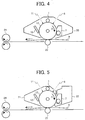
- a peripheral surface of the electrophotographic photoreceptor 12 rotating in the direction of an arrow A is positively or negatively charged by a charger 1 to have a predetermined voltage.
- a DC voltage is applied to the charger 1.
- the DC voltage applied thereto is preferably from -2,000 to +2,000 V.
- a pulsating flow voltage which is further overlapped with an AC voltage may be applied to the charger 1.
- the AC voltage overlapped with the DC voltage preferably has a voltage between peaks not greater than 4,000 V.
- the charger and electrophotographic photoreceptor vibrate to occasionally emit an abnormal noise. Therefore, it is preferable that the applied voltage is gradually increased to protect the photoreceptor.
- the charger 1 can rotate in the same or reverse direction of the photoreceptor 12, or can slide on a peripheral surface thereof without rotating. Further, the charger may have a cleaning function to remove a residual toner on the photoreceptor 12. In this case, a cleaner 10 is not required.
- the charged photoreceptor 12 receives imagewise light 6 (slit light or laser beam scanning light) from an irradiator (not shown).
- imagewise light 6 slit light or laser beam scanning light
- the irradiation is shut down for a non-image part of an original and a image part thereof having a low potential by the irradiation receives a developing bias slightly lower than the surface potential to perform a reversal development.
- an electrostatic latent image correlating to the original including the non-image part is sequentially formed.
- the electrostatic latent image is developed by an image developer 7 with a toner to form a toner image.
- the toner image is sequentially transferred by a transferer 8 onto a recording material 9 fed from a paper feeder (not shown) between the photoreceptor 12 and transferer 8 in synchronization with the rotation of the photoreceptor 12.
- the recording material 9 having the toner image is separated from the photoreceptor and transferred to an image fixer (not shown) such that the toner image is fixed thereon to form a copy which is fed out from the image forming apparatus.
- the surface of the photoreceptor 12 is cleaned by the cleaner 10 removing a residual toner after transferred, discharged by a pre-irradiation 11 and prepared for forming a following image.
- the above-mentioned image forming unit may be fixedly set in a copier, a facsimile or a printer.
- the image forming unit may be detachably set therein as a process cartridge which is an image forming unit (or device) including a photoreceptor, and at least one of a charger, an image developer and a cleaner.
- a photoreceptor 12 for an electrophotographic image forming apparatus, and the apparatus unit may be detachable with the apparatus using guide means thereof such as a rail.
- a cleaner 10 may not be included in the container 20.
- At least a photoreceptor 12 and a charger 1 are included in a first container 21 as a first unit and at least an image developer 7 is included in a second container 22 as a second unit, and the first and second unit may detachable with the apparatus.
- a cleaner 10 may not be included in the container 21.
- a transferer 23 in Figs. 4 and 5 a transferer having the same configuration as that of the charger 1 can be used.
- a DC voltage of from 400 to 2,000 V is preferably applied to the transferer 23.
- Numeral 24 is a fixer.
- Titanium oxide 80 (CREL from Ishihara Sangyo Kaisha, Ltd.) Oil-free alkyd resin 15 (Bekkolite M6163-60 having a solid content of 60 % by weight from Dainippon Ink & Chemicals, Inc.) Blocked isocyanate resin 20 (Burnock B3-867 having a solid content of 70 % by weight from Dainippon Ink and Chemicals, Inc.) Methyl ethyl ketone 100 Diethylamine 0.23
- the undercoat layer coating liquid was coated on three (3) aluminum drums having a diameter of 30 mm and a length of 340 mm, and the liquid coated on each drum was dried at 110°C, 130 °C and 150 °C for 20 min respectively to form an undercoat layers having a thickness of 4 ⁇ m thereon.
- ⁇ -type metal-free phthalocyanine 12 (TPA-891 from Toyo Ink Mfg. Co., Ltd.)
- Disazo pigment 24 having the following formula (1) Cyclohexanone 330
- a resin solution wherein 6 parts by weight of polyvinylbutyral (XYHL from Union Carbide Corp.) are dissolved in 850 parts by weight of methyl ethyl ketone and 1,100 parts by weight of cyclohexanone was added to the dispersion, and the dispersion was further dispersed for 3 hrs to prepare a charge generation layer coating liquid.
- the charge generation layer coating liquid was coated on the three (3) aluminium drums with the undercoat layers prepared as above and the liquid coated on each drum was dried at 130 °C for 10 min to form a charge generation layer having a thickness of 0.2 ⁇ m thereon.
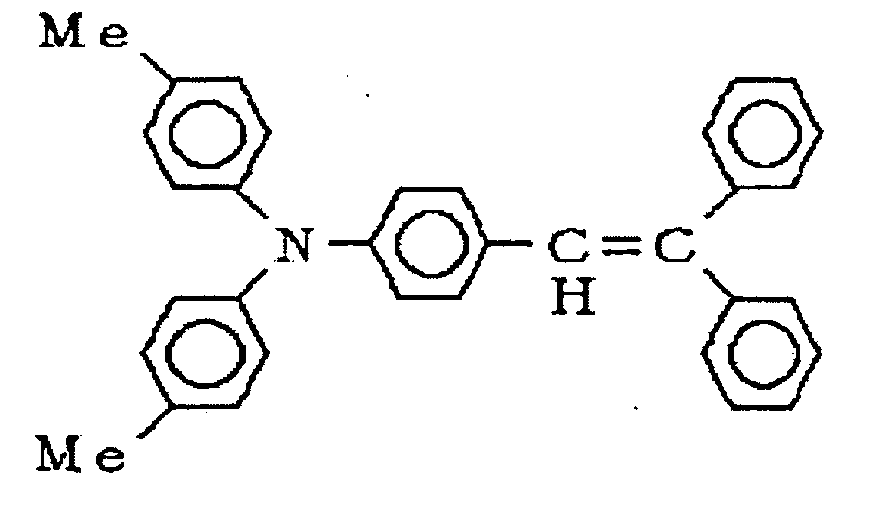
- Charge transport material 8 having the following formula (2): Polycarbonate 10 (Z-type having a viscosity-average molecular weight of 50,000) Silicone oil 0.002 (KF-50 from Shin-Etsu Chemical Co., Ltd.) Tetrahydrofuran 100
- the charge transport layer coating liquid was coated on each charge generation layer formed as above, and the liquid was dried at 130 °C for 20 min to form a charge transport layer having a thickness of 30 ⁇ m thereon.
- photoreceptors of Example 1 was prepared.
- Example 1 The procedure for preparation of the photoreceptors of Example 1 was repeated to prepare photoreceptors except for changing an amount of the diethylamine in the undercoat layer coating liquid from 0.23 to 0.0023 parts by weight.
- Example 1 The procedure for preparation of the photoreceptors of Example 1 was repeated to prepare photoreceptors except for changing an amount of the diethylamine in the undercoat layer coating liquid from 0.23 to 0.000023 parts by weight.
- Example 1 The procedure for preparation of the photoreceptors of Example 1 was repeated to prepare photoreceptors except for changing an amount of the diethylamine in the undercoat layer coating liquid from 0.23 to 0.000013 parts by weight.
- Example 1 The procedure for preparation of the photoreceptors of Example 1 was repeated to prepare photoreceptors except for changing the undercoat layer coating liquid to an undercoat layer coating liquid having the following formula: Titanium oxide 80 (CREL having a purity of 99.7 % by weight from Ishihara Sangyo Kaisha, Ltd.) Oil-free alkyd resin 25 (Bekkolite M6401-50 having a solid content of 50 % by weight and a hydroxyl value of 130 from Dainippon Ink & Chemicals, Inc.) Blocked isocyanate resin 12.5 (Burnock B7-887-50 having a solid content of 60 % by weight from Dainippon Ink and Chemicals, Inc.) Methyl ethyl ketone 100 Diethyl ethanolamine 0.23
- Titanium oxide 80 CREL having a purity of 99.7 % by weight from Ishihara Sangyo Kaisha, Ltd.
- Oil-free alkyd resin 25 Bekkolite M6401-50 having a solid
- Example 25 The procedure for preparation of the photoreceptors of Example 25 was repeated to prepare photoreceptors except for changing an amount of the diethyl ethanolamine in the undercoat layer coating liquid from 0.23 to 0.0023 parts by weight.
- Example 25 The procedure for preparation of the photoreceptors of Example 25 was repeated to prepare photoreceptors except for changing an amount of the diethyl ethanolamine in the undercoat layer coating liquid from 0.23 to 1.15 parts by weight.
- Example 25 The procedure for preparation of the photoreceptors of Example 25 was repeated to prepare photoreceptors except for changing an amount of the diethyl ethanolamine in the undercoat layer coating liquid from 0.23 to 1.72 parts by weight.
- Example 25 The procedure for preparation of the photoreceptors of Example 25 was repeated to prepare photoreceptors except for changing an amount of the diethyl ethanolamine in the undercoat layer coating liquid from 0.23 to 0.000023 parts by weight.
- Example 25 The procedure for preparation of the photoreceptors of Example 25 was repeated to prepare photoreceptors except for changing an amount of the diethyl ethanolamine in the undercoat layer coating liquid from 0.23 to 0.000013 parts by weight.
- Example 1 The procedure for preparation of the photoreceptors of Example 1 was repeated to prepare photoreceptors except for excluding the diethylamine in the undercoat layer coating liquid.
- Example 25 The procedure for preparation of the photoreceptors of Example 25 was repeated to prepare photoreceptors except for excluding the diethyl ethanolamine in the undercoat layer coating liquid.
- Example 25 The procedure for preparation of the photoreceptors of Example 25 was repeated to prepare photoreceptors except for changing 0.23 parts by weight of the diethyl ethanolamine to 0.0002 parts by weight of octyltin.
- Example Base resin Blocked isocyanate Basic amine Content of basic amine (against resin)
- Example 1 M6163-60 B3-867 Diethylamine 1.00% 2 M6163-60 B3-867 Diethylamine 0.01% 3 M6163-60 B3-867 Diethylamine 5.00% 4 M6163-60 B3-867 Diethylamine 7.50% 5 M6163-60 B3-867 Diethylamine 0.0001% 6 M6163-60 B3-867 Diethylamine 0.00005% 7 M6163-60 B3-867 Triethylamine 1.00% 8 M6163-60 B3-867 Triethylamine 0.01% 9 M6163-60 B3-867 Triethylamine 5.00% 10 M6163-60 B3-867 Triethylamine 7.50% 11 M6163-60 B3-867 Triethylamine 0.0001% 12 M6163-60 B3-867 Triethylamine 0.00005% 13 M6163
Landscapes
- Physics & Mathematics (AREA)
- General Physics & Mathematics (AREA)
- Photoreceptors In Electrophotography (AREA)
Abstract
Description
| Titanium oxide | 80 |
| (CREL from Ishihara Sangyo Kaisha, Ltd.) | |
| Oil-free alkyd resin | 15 |
| (Bekkolite M6163-60 having a solid content of 60 % by weight | |
| from Dainippon Ink & Chemicals, Inc.) | |
| Blocked isocyanate resin | 20 |
| (Burnock B3-867 having a solid content of 70 % by weight | |
| from Dainippon Ink and Chemicals, Inc.) | |
| Methyl ethyl ketone | 100 |
| Diethylamine | 0.23 |
| τ-type metal-free phthalocyanine | 12 |
| (TPA-891 from Toyo Ink Mfg. Co., Ltd.) | |
| | 24 |
| having the following formula (1) |

| Cyclohexanone | 330 |
| Charge transport material | 8 |
| having the following formula (2): |
| Polycarbonate | 10 |
| (Z-type having a viscosity-average | |
| molecular weight of 50,000) | |
| Silicone oil | 0.002 |
| (KF-50 from Shin-Etsu Chemical Co., Ltd.) | |
| Tetrahydrofuran | 100 |
| Titanium oxide | 80 |
| (CREL having a purity of 99.7 % by weight from Ishihara | |
| Sangyo Kaisha, Ltd.) | |
| Oil-free alkyd resin | 25 |
| (Bekkolite M6401-50 having a solid content of 50 % by weight | |
| and a hydroxyl value of 130 from Dainippon Ink & Chemicals, Inc.) | |
| Blocked isocyanate resin | 12.5 |
| (Burnock B7-887-50 having a solid content of 60 % by weight | |
| from Dainippon Ink and Chemicals, Inc.) | |
| Methyl ethyl ketone | 100 |
| Diethyl ethanolamine | 0.23 |
| Example | Base resin | Blocked isocyanate | Basic amine | Content of basic amine (against resin) |
| Example 1 | M6163-60 | B3-867 | Diethylamine | 1.00% |
| 2 | M6163-60 | B3-867 | Diethylamine | 0.01% |
| 3 | M6163-60 | B3-867 | Diethylamine | 5.00% |
| 4 | M6163-60 | B3-867 | Diethylamine | 7.50% |
| 5 | M6163-60 | B3-867 | Diethylamine | 0.0001% |
| 6 | M6163-60 | B3-867 | Diethylamine | 0.00005% |
| 7 | M6163-60 | B3-867 | Triethylamine | 1.00% |
| 8 | M6163-60 | B3-867 | Triethylamine | 0.01% |
| 9 | M6163-60 | B3-867 | Triethylamine | 5.00% |
| 10 | M6163-60 | B3-867 | Triethylamine | 7.50% |
| 11 | M6163-60 | B3-867 | Triethylamine | 0.0001% |
| 12 | M6163-60 | B3-867 | Triethylamine | 0.00005% |
| 13 | M6163-60 | B3-867 | Ethyl ethanolamine | 1.00% |
| 14 | M6163-60 | B3-867 | Ethyl ethanolamine | 0.01% |
| 15 | M6163-60 | B3-867 | Ethyl ethanolamine | 5.00% |
| 16 | M6163-60 | B3-867 | Ethyl ethanolamine | 7.50% |
| 17 | M6163-60 | B3-867 | Ethyl ethanolamine | 0.0001% |
| 18 | M6163-60 | B3-867 | Ethyl ethanolamine | 0.00005% |
| 19 | M6163-60 | B3-867 | Diethyl ethanolamine | 1.00% |
| 20 | M6163-60 | B3-867 | Diethyl ethanolamine | 0.01% |
| 21 | M6163-60 | B3-867 | Diethyl ethanolamine | 5.00% |
| 22 | M6163-60 | B3-867 | Diethyl ethanolamine | 7.50% |
| 23 | M6163-60 | B3-867 | Diethyl ethanolamine | 0.0001% |
| 24 | M6163-60 | B3-867 | Diethyl ethanolamine | 0.00005% |
| 25 | M6401-50 | B7-887-60 | Diethyl ethanolamine | 1.00% |
| 26 | M6401-50 | B7-887-60 | Diethyl ethanolamine | 0.01% |
| 27 | M6401-50 | B7-887-60 | Diethyl ethanolamine | 5.00% |
| 28 | M6401-50 | B7-887-60 | Diethyl ethanolamine | 7.50% |
| 29 | M6401-50 | B7-887-60 | Diethyl ethanolamine | 0.0001% |
| 30 | M6401-50 | B7-887-60 | Diethyl ethanolamine | 0.00005% |
| 31 | M6401-50 | B7-887-60 | Hexamethylene diamine | 1.00% |
| 32 | M6401-50 | B7-887-60 | Hexamethylene diamine | 0.01% |
| 33 | M6401-50 | B7-887-60 | Hexamethylene diamine | 5.00% |
| 34 | M6401-50 | B7-887-60 | Hexamethylene diamine | 7.50% |
| 35 | M6401-50 | B7-887-60 | Hexamethylene diamine | 0.0001% |
| 36 | M6401-50 | B7-887-60 | Hexamethylene diamine | 0.00005% |
| 37 | M6401-50 | B7-887-60 | Methyl ethanolamine | 1.00% |
| 38 | M6401-50 | B7-887-60 | Methyl ethanolamine | 0.01% |
| 39 | M6401-50 | B7-887-60 | Methyl ethanolamine | 5.00% |
| 40 | M6401-50 | B7-887-60 | Methyl ethanolamine | 7.50% |
| 41 | M6401-50 | B7-887-60 | Methyl ethanolamine | 0.0001% |
| 42 | M6401-50 | B7-887-60 | Methyl ethanolamine | 0.00005% |
| Comparative Example 1 | M6163-60 | B3-867 | None | None |
| 2 | M6163-60 | B3-867 | Dibutyltin oxide | 1.00% |
| 3 | M6401-50 | B7-887-60 | None | None |
| 4 | M6401-50 | B7-887-60 | Octyltin | 0.0001% |
| Undercoat layer drying conditions | Initial potential | Potential after 30,000 images | Abnormal images | Viscosity | ||||
| Vw (-V) | VL (=V) | Vw (-V) | VL (=V) | Soon after preparation (mPa • s) | 1 month later (mPa • s) | |||
| Example 1 | 110°C20min | 915 | 150 | 925 | 165 | Normal | 8.5 | 8.3 |
| 130°C20 min | 905 | 150 | 930 | 165 | Normal | |||
| 150°C20 min | 910 | 145 | 945 | 150 | Normal | |||
| 2 | 110°C20 min | 920 | 145 | 925 | 155 | Normal | 8.6 | 8.5 |
| 130°C20 min | 925 | 150 | 920 | 150 | Normal | |||
| 150°C20 min | 915 | 140 | 935 | 150 | Normal | |||
| 3 | 110°C20 min | 905 | 145 | 920 | 165 | Normal | 8.5 | 8.9 |
| 130°C20 min | 895 | 150 | 920 | 165 | Normal | |||
| 150°C20 min | 910 | 145 | 930 | 170 | Normal | |||
| 4 | 110°C20 min | 895 | 145 | 925 | 215 | Image density deteriorated after 27,000 images | ||
| 130°C20 min | 905 | 145 | 925 | 220 | Image density deteriorated after 26,000 images | 8.4 | 13.2 | |
| 150°C 20min | 925 | 140 | 945 | 215 | Image density deteriorated after 29,000 images | |||
| 5 | 110°C20 min | 915 | 150 | 930 | 185 | Normal | 8.3 | 8.6 |
| 130°C20 min | 905 | 155 | 945 | 190 | Normal | |||
| 150°C20 min | 910 | 145 | 925 | 185 | Normal | |||
| 6 | 110°C20 min | 920 | 260 | 920 | 300 | Image density deteriorated after 10,000 images | 9 | 8.4 |
| 130°C20 min | 925 | 190 | 935 | 220 | Normal | |||
| 150°C20 min | 900 | 145 | 920 | 160 | Normal | |||
| 7 | 110°C20 min | 910 | 145 | 925 | 165 | Normal | 8.6 | 9.5 |
| 130°C20 min | 905 | 140 | 945 | 155 | Normal | |||
| 150°C20 min | 915 | 145 | 925 | 160 | Normal | |||
| 8 | 110°C20min | 905 | 150 | 945 | 170 | Normal | 8.8 | 9 |
| 130°C20min | 910 | 145 | 930 | 175 | Normal | |||
| 150°C20min | 905 | 140 | 945 | 165 | Normal | |||
| 9 | 110°C20min | 895 | 145 | 925 | 165 | Normal | 8.5 | 9.5 |
| 130°C20min | 900 | 140 | 920 | 165 | Normal | |||
| 150°C20min | 890 | 130 | 935 | 160 | Normal | |||
| 10 | 110°C20min | 910 | 150 | 920 | 230 | Image density deteriorated after 27,000 images | ||
| 130°C20 min | 905 | 145 | 925 | 225 | Image density deteriorated after 26,000 images | 8.7 | 12.5 | |
| 150°C20min | 915 | 150 | 945 | 225 | Image density deteriorated after 29,000 images | |||
| 11 | 110°C20 min | 905 | 190 | 930 | 230 | Image density deteriorated after 27,000 images | 8.5 | 9.2 |
| 130°C20 min | 910 | 145 | 945 | 165 | Normal | |||
| 150°C20 min | 895 | 140 | 925 | 165 | Normal | |||
| 12 | 110°C20 min | 900 | 205 | 920 | 245 | Image density deteriorated after 25,000 images | 8.9 | 9.5 |
| 130°C20 min | 905 | 185 | 935 | 210 | Normal | |||
| 150°C20 min | 900 | 150 | 910 | 150 | Normal | |||
| 13 | 110°C20 min | 905 | 135 | 905 | 165 | Normal | 8.3 | 8.7 |
| 130°C20 min | 915 | 130 | 925 | 170 | Normal | |||
| 150°C20 min | 895 | 135 | 905 | 165 | Normal | |||
| 14 | 110°C20 min | 900 | 140 | 925 | 165 | Normal | 8.5 | 9.5 |
| 130°C20 min | 895 | 135 | 945 | 165 | Normal | |||
| 150°C20 min | 905 | 130 | 925 | 170 | Normal | |||
| 15 | 110°C20 min | 905 | 135 | 945 | 165 | Normal | 8.7 | 9.2 |
| 130°C20 min | 900 | 130 | 930 | 165 | Normal | |||
| 150°C20 min | 895 | 120 | 945 | 160 | Normal | |||
| 16 | 110°C20 min | 910 | 140 | 925 | 215 | Image density deteriorated after 29,000 images | 8.4 | 15.3 |
| 130°C20 min | 915 | 135 | 920 | 225 | Normal | |||
| 150°C20 min | 895 | 140 | 935 | 210 | Normal | |||
| 17 | 110°C20 min | 900 | 180 | 920 | 210 | Normal | 8.6 | 8.7 |
| 130°C20 min | 905 | 135 | 925 | 165 | Normal | |||
| 150°C20 min | 915 | 130 | 945 | 150 | Normal | |||
| 18 | 110°C20 min | 905 | 195 | 905 | 240 | Image density deteriorated after 24,000 images | 8.6 | 8.6 |
| 130°C20 min | 895 | 175 | 925 | 210 | Normal | |||
| 150°C20 min | 900 | 140 | 945 | 150 | Normal | |||
| 19 | 110°C20 min | 915 | 145 | 925 | 165 | Normal | 8.4 | 8.9 |
| 130°C20 min | 920 | 140 | 945 | 160 | Normal | |||
| 150°C20 min | 905 | 145 | 925 | 165 | Normal | |||
| 20 | 110°C20 min | 905 | 160 | 945 | 165 | Normal | 8.4 | 8.5 |
| 130°C20 min | 915 | 165 | 915 | 170 | Normal | |||
| 150°C20min | 920 | 175 | 925 | 165 | Normal | |||
| 21 | 110°C20min | 915 | 165 | 905 | 185 | Normal | 8.6 | 9.2 |
| 130°C20min | 905 | 155 | 905 | 195 | Normal | |||
| 150°C20min | 910 | 160 | 915 | 180 | Normal | |||
| 22 | 110°C20min | 895 | 165 | 900 | 225 | Image density deteriorated after 23,000 images | 8.6 | 17.3 |
| 130°C20 min | 915 | 155 | 905 | 210 | Image density deteriorated after 25,000 images | |||
| 150°C20 min | 895 | 160 | 895 | 215 | Image density deteriorated after 25,000 images | |||
| 23 | 110°C20 min | 900 | 145 | 900 | 165 | Normal | 8.4 | 9 |
| 130°C20min | 915 | 140 | 910 | 165 | Normal | |||
| 150°C20min | 905 | 145 | 915 | 170 | Normal | |||
| 24 | 110°C20 min | 905 | 200 | 905 | 280 | Image density deteriorated after 21,000 images | 8.5 | 9.2 |
| 130°C20min | 895 | 175 | 900 | 210 | Image density deteriorated after 24,000 images | |||
| 150°C20 min | 900 | 140 | 910 | 175 | Normal | |||
| 25 | 110°C20 min | 915 | 145 | 930 | 165 | Normal | 8.5 | 8.7 |
| 130°C20min | 905 | 140 | 920 | 165 | Normal | |||
| 150°C20min | 905 | 145 | 920 | 170 | Normal | |||
| 26 | 110°C20min | 910 | 155 | 925 | 165 | Normal | 8.5 | 9.3 |
| 130°C20min | 895 | 145 | 910 | 165 | Normal | |||
| 150°C20 min | 900 | 140 | 915 | 160 | Normal | |||
| 27 | 110°C20 min | 905 | 150 | 920 | 165 | Normal | 8.4 | 9.3 |
| 130°C20min | 900 | 150 | 915 | 165 | Normal | |||
| 150°C20 min | 905 | 145 | 920 | 170 | Normal | |||
| 110°C20 min | 905 | 150 | 920 | 235 | Image density | |||
| 28 | deteriorated after 26,000 images | 8.3 | 13.5 | |||||
| 130°C20min | 915 | 145 | 930 | 240 | Image density deteriorated after 25,000 images | |||
| 150°C20 min | 905 | 155 | 920 | 235 | Image density deteriorated after 25,000 images | |||
| 29 | 110°C20min | 895 | 145 | 920 | 170 | Normal | 9 | 9.1 |
| 130°C20 min | 900 | 155 | 925 | 165 | Normal | |||
| 150°C20min | 915 | 150 | 940 | 170 | Normal | |||
| 30 | 110°C20min | 905 | 200 | 930 | 260 | Image density deteriorated after 20,000 images | 9 | 9 |
| 130°C20min | 920 | 175 | 945 | 220 | Image density deteriorated after 24,000 images | |||
| 150°C20min | 900 | 155 | 925 | 175 | Normal | |||
| 31 | 110°C20 min | 915 | 135 | 940 | 165 | Normal | 8.8 | 8.9 |
| 130°C20 min | 905 | 130 | 930 | 155 | Normal | |||
| 150°C20min | 905 | 135 | 930 | 145 | Normal | |||
| 32 | 110°C20min | 910 | 145 | 935 | 155 | Normal | 8.5 | 8.7 |
| 130°C20min | 895 | 135 | 920 | 145 | Normal | |||
| 150°C20min | 900 | 130 | 925 | 165 | Normal | |||
| 33 | 110°C20 min | 905 | 140 | 930 | 190 | Normal | 8.3 | 9.7 |
| 130°C20 min | 900 | 140 | 925 | 185 | Normal | |||
| 150°C20 min | 905 | 135 | 930 | 185 | Normal | |||
| 34 | 110°C20 min | 905 | 140 | 930 | 225 | Image density deteriorated after 24,000 images | 8.5 | 15.2 |
| 130°C20min | 915 | 135 | 940 | 235 | Image | |||
| density deteriorated after 23,000 images | ||||||||
| 150°C20min | 905 | 145 | 930 | 230 | Image density deteriorated after 24,000 images | |||
| 35 | 110°C20min | 915 | 135 | 940 | 190 | Normal | 8.7 | 8.9 |
| 130°C20min | 905 | 145 | 930 | 150 | Normal | |||
| 150°C20min | 910 | 140 | 935 | 155 | Normal | |||
| 36 | 110°C20min | 920 | 190 | 945 | 270 | Image density deteriorated after 19,000 images | 8.5 | 9 |
| 130°C20 min | 925 | 165 | 935 | 220 | Image density deteriorated after 27,000 images | |||
| 150°C20min | 915 | 145 | 925 | 170 | Normal | |||
| 37 | 110°C20min | 905 | 145 | 915 | 150 | Normal | 8.9 | 8.5 |
| 130°C20min | 895 | 140 | 905 | 160 | Normal | |||
| 150°C20 min | 910 | 145 | 920 | 150 | Normal | |||
| 38 | 110°C20 min | 895 | 155 | 905 | 170 | Normal | 8.4 | 8.9 |
| 130°C20min | 905 | 145 | 915 | 195 | Normal | |||
| 150°C20 min | 905 | 140 | 915 | 190 | Normal | |||
| 39 | 110°C20 min | 915 | 150 | 925 | 190 | Normal | 8.5 | 9.5 |
| 130°C20 min | 800 | 150 | 900 | 185 | Normal | |||
| 150°C20 min | 895 | 145 | 905 | 185 | Normal | |||
| 40 | 110°C20min | 915 | 150 | 925 | 230 | Image density deteriorated after 22,000 images | 8.3 | 14.3 |
| 130°C20 min | 905 | 150 | 915 | 235 | Image density deteriorated after 23,000 images | |||
| 150°C20min | 900 | 145 | 910 | 230 | Image density deteriorated after 21,000 images | |||
| 41 | 110°C20 min | 920 | 125 | 930 | 175 | Normal | 8.8 | 9.3 |
| 130°C20 min | 915 | 135 | 925 | 165 | Normal | |||
| 150°C20 min | 920 | 130 | 930 | 170 | Normal | |||
| 42 | 110°C20 min | 895 | 180 | 905 | 220 | Image density deteriorated after 29,000 images | 8.5 | 9 |
| 130°20 min | 900 | 155 | 910 | 190 | Normal | |||
| 150°C20 min | 905 | 135 | 915 | 170 | Normal | |||
| 110°C20 min | 900 | 350 | 970 | 470 | Images flowed from the beginning. Black part image | |||
| Comparative Example 1 | density deteriorated. Black part almost disappeared after 20,000 images | 8.5 | 9.2 | |||||
| 130°C20 min | 905 | 210 | 960 | 320 | Images flowed, black part Image density deteriorated after 15,000 images | |||
| 150°C20min | 895 | 140 | 950 | 190 | Normal | |||
| 110°C20min | 900 | 220 | 950 | 250 | Local black spots after | |||
| 2 | 21,000 images | 7.9 | 8.5 | |||||
| 130°C20 min | 905 | 185 | 935 | 210 | Local black spots after 12,000 images | |||
| 150°C20min | 905 | 195 | 920 | 225 | Local black spots after 8,000 images | |||
| 3 | 110°C20 min | 900 | 290 | 955 | 390 | Images flowed, black part Image density deteriorated after 12,000 images | 8.4 | 8.9 |
| 130°C20 min | 920 | 200 | 945 | 310 | Images flowed, | |||
| black part Image density deteriorated after 18,000 images | ||||||||
| 150°C20 min | 900 | 145 | 940 | 180 | Normal | |||
| 4 | 110°C20 min | 900 | 235 | 950 | 280 | Local black spots after 26,000 images | 8.4 | 8.9 |
| 130°C20 min | 920 | 200 | 945 | 230 | Local black spots after 15,000 images | |||
| 150°C20 min | 900 | 150 | 945 | 180 | Local black spots after 12,000 images |
Claims (9)
- An electrophotographic photoreceptor, comprising:wherein the undercoat layer comprises a blocked isocyanate compound and a basic amine.an electroconductive substrate;an undercoat layer located overlying the electroconductive substrate; anda photosensitive layer located overlying the undercoat layer,
- The electrophotographic photoreceptor of Claim 1, wherein the undercoat layer further comprises an oil-free alkyd resin including a hydroxyl group.
- The electrophotographic photoreceptor of Claim 2, wherein the undercoat layer comprises the basic amine in an amount of from 0.0001 to 5 % by weight based on total weight of the oil-free alkyd resin and blocked isocyanate compound.
- A method of preparing the electrophotographic photoreceptor according to any one of Claims 1 to 3, comprising:coating a first liquid comprising the blocked isocyanate compound and basic amine on the electroconductive substrate to form the undercoat layer; andcoating a second liquid on the undercoat layer to form the photosensitive layer thereon.
- An undercoat layer coating liquid for an electrophotographic photoreceptor, comprising a blocked isocyanate compound and a basic amine.
- The undercoat layer coating liquid for an electrophotographic photoreceptor of Claim 5, further comprising an oil-free alkyd resin including a hydroxyl group.
- The undercoat layer coating liquid for an electrophotographic photoreceptor of Claim 6, comprising the basic amine in an amount of from 0.0001 to 5 % by weight based on total weight of the oil-free alkyd resin andblocked isocyanate compound.
- An image forming apparatus, comprising:the electrophotographic photoreceptor according to any one of Claims 1 to 3;a charger configured to charge the electrophotographic photoreceptor;an irradiator configured to irradiate the electrophotographic photoreceptor to form an electrostatic latent image thereon;an image developer configured to develop the electrostatic latent image with a toner to form a toner image thereon;a transferer configured to transfer the toner image onto a receiving material;a fixer configured to fix the toner image on the receiving material;a cleaner configured to remove the toner remaining on the electrophotographic photoreceptor after transferred; anda discharger configured to discharge the electrophotographic photoreceptor.
- A process cartridge, comprising:the electrophotographic photoreceptor according to any one of Claims 1 to 3; andat least one of a charger, an irradiator, an image developer, a transferer and a fixer.
Applications Claiming Priority (3)
| Application Number | Priority Date | Filing Date | Title |
|---|---|---|---|
| JP2003407365 | 2003-12-05 | ||
| JP2003407365 | 2003-12-05 | ||
| JP2004346638A JP4445376B2 (en) | 2003-12-05 | 2004-11-30 | Electrophotographic photoreceptor, image forming apparatus having the same, coating liquid for undercoat layer of photoreceptor, and method for producing the same |
Publications (2)
| Publication Number | Publication Date |
|---|---|
| EP1542082A1 true EP1542082A1 (en) | 2005-06-15 |
| EP1542082B1 EP1542082B1 (en) | 2009-07-29 |
Family
ID=34510451
Family Applications (1)
| Application Number | Title | Priority Date | Filing Date |
|---|---|---|---|
| EP04028691A Expired - Lifetime EP1542082B1 (en) | 2003-12-05 | 2004-12-03 | Electrophotographic photoreceptor, undercoat layer coating liquid therefor, method of preparing the photoreceptor, and image forming apparatus and process cartridge using the photoreceptor |
Country Status (2)
| Country | Link |
|---|---|
| US (2) | US7521161B2 (en) |
| EP (1) | EP1542082B1 (en) |
Cited By (4)
| Publication number | Priority date | Publication date | Assignee | Title |
|---|---|---|---|---|
| EP2680077A1 (en) * | 2012-06-29 | 2014-01-01 | Canon Kabushiki Kaisha | Electrophotographic photosensitive member, process catridge, and electrophotographic apparatus |
| EP2680078A3 (en) * | 2012-06-29 | 2014-03-26 | Canon Kabushiki Kaisha | Electrophotographic photosensitive member, method for producing electrophotgraphic photosensitive member, process cartridge, electrophotographic apparatus, and imide compound |
| US8993205B2 (en) | 2012-06-29 | 2015-03-31 | Canon Kabushiki Kaisha | Electrophotographic photosensitive member, process cartridge, and electrophotographic apparatus |
| RU2565581C2 (en) * | 2012-06-29 | 2015-10-20 | Кэнон Кабусики Кайся | Electrophotographic photosensitive element, printing cartridge and electrophotographic apparatus |
Families Citing this family (9)
| Publication number | Priority date | Publication date | Assignee | Title |
|---|---|---|---|---|
| CN100533280C (en) * | 2004-11-19 | 2009-08-26 | 三菱化学株式会社 | Coating liquid for forming undercoat layer and electrophotographic photoreceptor having undercoat layer formed by applying the coating liquid |
| WO2007135984A1 (en) * | 2006-05-18 | 2007-11-29 | Mitsubishi Chemical Corporation | Electrophotographic photosensitive body, method for producing conductive base, image forming device, and electrophotographic cartridge |
| US7579127B2 (en) * | 2006-06-15 | 2009-08-25 | Eastman Kodak Company | Blocked polyisocyanates incorporating planar electron-deficient tetracobonylbisimide moieties |
| US7588872B2 (en) * | 2006-08-08 | 2009-09-15 | Xerox Corporation | Photoreceptor |
| US7635548B2 (en) * | 2006-08-08 | 2009-12-22 | Xerox Corporation | Photoreceptor |
| JP5396438B2 (en) * | 2011-07-14 | 2014-01-22 | 紀州技研工業株式会社 | Inkjet ink |
| JP6049329B2 (en) * | 2012-06-29 | 2016-12-21 | キヤノン株式会社 | Electrophotographic photosensitive member, method for manufacturing electrophotographic photosensitive member, process cartridge, and electrophotographic apparatus |
| JP2016109844A (en) * | 2014-12-05 | 2016-06-20 | 株式会社リコー | Electrophotographic photoreceptor, image formation device, and process cartridge |
| US9772568B2 (en) * | 2015-03-30 | 2017-09-26 | Canon Kabushiki Kaisha | Electrophotographic photosensitive member, process cartridge, and electrophotographic apparatus |
Citations (7)
| Publication number | Priority date | Publication date | Assignee | Title |
|---|---|---|---|---|
| JPH01233459A (en) * | 1988-03-14 | 1989-09-19 | Ricoh Co Ltd | Electrophotographic photoreceptor |
| US4946766A (en) * | 1988-03-14 | 1990-08-07 | Ricoh Company, Ltd. | Electrophotographic photoconductor having intermediate layer comprising indium oxide |
| EP0394142A2 (en) * | 1989-04-20 | 1990-10-24 | Canon Kabushiki Kaisha | Electrophotographic photosensitive member |
| EP0490622A1 (en) * | 1990-12-07 | 1992-06-17 | Canon Kabushiki Kaisha | Electrophotographic photosensitive member and apparatus using same |
| EP0498626A1 (en) * | 1991-02-04 | 1992-08-12 | Canon Kabushiki Kaisha | Electrophotographic photosensitive member and apparatus using same |
| US5643702A (en) * | 1996-01-11 | 1997-07-01 | Xerox Corporation | Multilayered electrophotograpic imaging member with vapor deposited generator layer and improved adhesive layer |
| JP2003342045A (en) * | 2002-05-23 | 2003-12-03 | Dainippon Ink & Chem Inc | Resin composition for interlayer of laminated glass, laminated glass and method for producing the same |
Family Cites Families (10)
| Publication number | Priority date | Publication date | Assignee | Title |
|---|---|---|---|---|
| US4575527A (en) * | 1984-12-12 | 1986-03-11 | Atlantic Richfield Company | Viscosity stabilized water-soluble amine polymers |
| US4964766A (en) * | 1987-11-25 | 1990-10-23 | Turchan Manuel C | Method and apparatus for machining a casting surface |
| JP2608328B2 (en) | 1989-06-12 | 1997-05-07 | キヤノン株式会社 | Electrophotographic photoreceptor |
| JP2637557B2 (en) | 1989-06-08 | 1997-08-06 | キヤノン株式会社 | Electrophotographic photoreceptor |
| JPH05257312A (en) | 1990-12-07 | 1993-10-08 | Canon Inc | Electrophotographic photoreceptor, electrophotographic apparatus and facsimile using the same |
| JPH05158267A (en) | 1991-12-06 | 1993-06-25 | Canon Inc | Electrophotographic sensitive body, electrophotographic device and facsimile using the same |
| US6026262A (en) | 1998-04-14 | 2000-02-15 | Ricoh Company, Ltd. | Image forming apparatus employing electrophotographic photoconductor |
| JP4010536B2 (en) | 2001-03-02 | 2007-11-21 | 株式会社リコー | Coating method, coating apparatus, electrophotographic photosensitive member produced by the coating method, image forming method, and image forming apparatus |
| JP4049662B2 (en) * | 2002-11-26 | 2008-02-20 | 株式会社リコー | Electrophotographic photoreceptor and image forming apparatus having the same |
| EP1519241B1 (en) * | 2003-09-17 | 2008-11-26 | Ricoh Company, Ltd. | Electrophotographic photoreceptor, and image forming apparatus and process cartridge therefor using the electrophotographic photoreceptor |
-
2004
- 2004-12-03 EP EP04028691A patent/EP1542082B1/en not_active Expired - Lifetime
- 2004-12-06 US US11/003,597 patent/US7521161B2/en not_active Expired - Fee Related
-
2009
- 2009-02-18 US US12/372,872 patent/US7651828B2/en not_active Expired - Fee Related
Patent Citations (7)
| Publication number | Priority date | Publication date | Assignee | Title |
|---|---|---|---|---|
| JPH01233459A (en) * | 1988-03-14 | 1989-09-19 | Ricoh Co Ltd | Electrophotographic photoreceptor |
| US4946766A (en) * | 1988-03-14 | 1990-08-07 | Ricoh Company, Ltd. | Electrophotographic photoconductor having intermediate layer comprising indium oxide |
| EP0394142A2 (en) * | 1989-04-20 | 1990-10-24 | Canon Kabushiki Kaisha | Electrophotographic photosensitive member |
| EP0490622A1 (en) * | 1990-12-07 | 1992-06-17 | Canon Kabushiki Kaisha | Electrophotographic photosensitive member and apparatus using same |
| EP0498626A1 (en) * | 1991-02-04 | 1992-08-12 | Canon Kabushiki Kaisha | Electrophotographic photosensitive member and apparatus using same |
| US5643702A (en) * | 1996-01-11 | 1997-07-01 | Xerox Corporation | Multilayered electrophotograpic imaging member with vapor deposited generator layer and improved adhesive layer |
| JP2003342045A (en) * | 2002-05-23 | 2003-12-03 | Dainippon Ink & Chem Inc | Resin composition for interlayer of laminated glass, laminated glass and method for producing the same |
Non-Patent Citations (2)
| Title |
|---|
| DATABASE WPI Section Ch Week 198943, Derwent World Patents Index; Class A89, AN 1989-314207, XP002314209 * |
| DATABASE WPI Section Ch Week 200431, Derwent World Patents Index; Class A25, AN 2004-333404, XP002314208 * |
Cited By (6)
| Publication number | Priority date | Publication date | Assignee | Title |
|---|---|---|---|---|
| EP2680077A1 (en) * | 2012-06-29 | 2014-01-01 | Canon Kabushiki Kaisha | Electrophotographic photosensitive member, process catridge, and electrophotographic apparatus |
| EP2680078A3 (en) * | 2012-06-29 | 2014-03-26 | Canon Kabushiki Kaisha | Electrophotographic photosensitive member, method for producing electrophotgraphic photosensitive member, process cartridge, electrophotographic apparatus, and imide compound |
| US8940465B2 (en) | 2012-06-29 | 2015-01-27 | Canon Kabushiki Kaisha | Electrophotographic photosensitive member, method for producing electrophotographic photosensitive member, process cartridge, electrophotographic apparatus, and imide compound |
| US8993205B2 (en) | 2012-06-29 | 2015-03-31 | Canon Kabushiki Kaisha | Electrophotographic photosensitive member, process cartridge, and electrophotographic apparatus |
| US9012112B2 (en) | 2012-06-29 | 2015-04-21 | Canon Kabushiki Kaisha | Electrophotographic photosensitive member, process cartridge, and electrophotographic apparatus |
| RU2565581C2 (en) * | 2012-06-29 | 2015-10-20 | Кэнон Кабусики Кайся | Electrophotographic photosensitive element, printing cartridge and electrophotographic apparatus |
Also Published As
| Publication number | Publication date |
|---|---|
| US20090202937A1 (en) | 2009-08-13 |
| US20050123846A1 (en) | 2005-06-09 |
| US7651828B2 (en) | 2010-01-26 |
| US7521161B2 (en) | 2009-04-21 |
| EP1542082B1 (en) | 2009-07-29 |
Similar Documents
| Publication | Publication Date | Title |
|---|---|---|
| US7651828B2 (en) | Method for preparing an electrophotographic photoreceptor | |
| US7732113B2 (en) | Electrophotographic photosensitive member, process cartridge and electrophotographic apparatus, and process for producing electrophotographic photosensitive member | |
| EP1143302B1 (en) | Electrophotographic photoreceptor and image forming method and apparatus using the photoreceptor | |
| JP5492443B2 (en) | Coating liquid for protective layer of electrophotographic photosensitive member having organic photosensitive layer and coating therefor | |
| EP0394142B1 (en) | Electrophotographic photosensitive member | |
| JP4798976B2 (en) | Electrophotographic photoreceptor | |
| JP2001117250A (en) | Electrophotographic photosensitive member, process cartridge having the electrophotographic photosensitive member, and electrophotographic apparatus | |
| JP3818585B2 (en) | Electrophotographic photoreceptor and image forming method using the same | |
| US7351507B2 (en) | Electrophotographic photoreceptor, image forming apparatus and method, and image process cartridge | |
| JPH08160651A (en) | Electrophotographic photoreceptor and image forming method | |
| JP4049662B2 (en) | Electrophotographic photoreceptor and image forming apparatus having the same | |
| JP7824814B2 (en) | Electrophotographic photoreceptor, process cartridge, and electrophotographic apparatus | |
| JP4445376B2 (en) | Electrophotographic photoreceptor, image forming apparatus having the same, coating liquid for undercoat layer of photoreceptor, and method for producing the same | |
| JP3818584B2 (en) | Electrophotographic photoreceptor and image forming method using the same | |
| JP3818589B2 (en) | Electrophotographic photoreceptor and image forming method using the same | |
| US6410195B1 (en) | Electrophotographic photosensitive member, process cartridge, and electrophotographic apparatus | |
| JP2003091086A (en) | Electrophotographic photoreceptor, process cartridge and electrophotographic apparatus | |
| JP6622553B2 (en) | Electrophotographic photosensitive member, process cartridge, and electrophotographic apparatus | |
| JP3593840B2 (en) | Electrophotographic photoreceptor and electrophotographic apparatus | |
| US7270927B2 (en) | Non-halogenated polymeric binder | |
| JP3936628B2 (en) | Electrophotographic photoreceptor and image forming method using the same | |
| JP3728928B2 (en) | Electrophotographic photoreceptor | |
| US6180302B1 (en) | Electrophotographic photosensitive member, and process cartridge and electrophotographic apparatus provided with the electrophotographic member | |
| JP2007086176A (en) | Electrophotographic photosensitive member manufacturing method, electrophotographic photosensitive member, electrophotographic apparatus, electrophotographic manufacturing method, and electrophotographic photosensitive member coating machine | |
| JPH11338178A (en) | Electrophotographic equipment |
Legal Events
| Date | Code | Title | Description |
|---|---|---|---|
| PUAI | Public reference made under article 153(3) epc to a published international application that has entered the european phase |
Free format text: ORIGINAL CODE: 0009012 |
|
| AK | Designated contracting states |
Kind code of ref document: A1 Designated state(s): AT BE BG CH CY CZ DE DK EE ES FI FR GB GR HU IE IS IT LI LT LU MC NL PL PT RO SE SI SK TR |
|
| AX | Request for extension of the european patent |
Extension state: AL BA HR LV MK YU |
|
| 17P | Request for examination filed |
Effective date: 20050714 |
|
| AKX | Designation fees paid |
Designated state(s): DE FR GB |
|
| 17Q | First examination report despatched |
Effective date: 20071220 |
|
| GRAP | Despatch of communication of intention to grant a patent |
Free format text: ORIGINAL CODE: EPIDOSNIGR1 |
|
| GRAS | Grant fee paid |
Free format text: ORIGINAL CODE: EPIDOSNIGR3 |
|
| GRAA | (expected) grant |
Free format text: ORIGINAL CODE: 0009210 |
|
| AK | Designated contracting states |
Kind code of ref document: B1 Designated state(s): DE FR GB |
|
| REG | Reference to a national code |
Ref country code: GB Ref legal event code: FG4D |
|
| REF | Corresponds to: |
Ref document number: 602004022240 Country of ref document: DE Date of ref document: 20090910 Kind code of ref document: P |
|
| PLBE | No opposition filed within time limit |
Free format text: ORIGINAL CODE: 0009261 |
|
| STAA | Information on the status of an ep patent application or granted ep patent |
Free format text: STATUS: NO OPPOSITION FILED WITHIN TIME LIMIT |
|
| 26N | No opposition filed |
Effective date: 20100503 |
|
| REG | Reference to a national code |
Ref country code: DE Ref legal event code: R082 Ref document number: 602004022240 Country of ref document: DE Representative=s name: MEISSNER BOLTE PATENTANWAELTE RECHTSANWAELTE P, DE Ref country code: DE Ref legal event code: R082 Ref document number: 602004022240 Country of ref document: DE Representative=s name: MEISSNER, BOLTE & PARTNER GBR, DE |
|
| REG | Reference to a national code |
Ref country code: DE Ref legal event code: R082 Ref document number: 602004022240 Country of ref document: DE Representative=s name: MEISSNER, BOLTE & PARTNER GBR, DE |
|
| REG | Reference to a national code |
Ref country code: FR Ref legal event code: PLFP Year of fee payment: 12 |
|
| REG | Reference to a national code |
Ref country code: FR Ref legal event code: PLFP Year of fee payment: 13 |
|
| PGFP | Annual fee paid to national office [announced via postgrant information from national office to epo] |
Ref country code: DE Payment date: 20161213 Year of fee payment: 13 Ref country code: GB Payment date: 20161222 Year of fee payment: 13 |
|
| PGFP | Annual fee paid to national office [announced via postgrant information from national office to epo] |
Ref country code: FR Payment date: 20161222 Year of fee payment: 13 |
|
| REG | Reference to a national code |
Ref country code: DE Ref legal event code: R119 Ref document number: 602004022240 Country of ref document: DE |
|
| GBPC | Gb: european patent ceased through non-payment of renewal fee |
Effective date: 20171203 |
|
| REG | Reference to a national code |
Ref country code: FR Ref legal event code: ST Effective date: 20180831 |
|
| PG25 | Lapsed in a contracting state [announced via postgrant information from national office to epo] |
Ref country code: DE Free format text: LAPSE BECAUSE OF NON-PAYMENT OF DUE FEES Effective date: 20180703 Ref country code: FR Free format text: LAPSE BECAUSE OF NON-PAYMENT OF DUE FEES Effective date: 20180102 |
|
| PG25 | Lapsed in a contracting state [announced via postgrant information from national office to epo] |
Ref country code: GB Free format text: LAPSE BECAUSE OF NON-PAYMENT OF DUE FEES Effective date: 20171203 |