EP1541576A1 - Furoisoquinoline derivative and use thereof - Google Patents
Furoisoquinoline derivative and use thereof Download PDFInfo
- Publication number
- EP1541576A1 EP1541576A1 EP03741560A EP03741560A EP1541576A1 EP 1541576 A1 EP1541576 A1 EP 1541576A1 EP 03741560 A EP03741560 A EP 03741560A EP 03741560 A EP03741560 A EP 03741560A EP 1541576 A1 EP1541576 A1 EP 1541576A1
- Authority
- EP
- European Patent Office
- Prior art keywords
- group
- alkyl
- carbonyl
- aryl
- mono
- Prior art date
- Legal status (The legal status is an assumption and is not a legal conclusion. Google has not performed a legal analysis and makes no representation as to the accuracy of the status listed.)
- Withdrawn
Links
- IOSPRMXMPQEKIH-UHFFFAOYSA-N furo[2,3-h]isoquinoline Chemical class C1=NC=C2C(C=CO3)=C3C=CC2=C1 IOSPRMXMPQEKIH-UHFFFAOYSA-N 0.000 title description 5
- 150000001875 compounds Chemical class 0.000 claims abstract description 212
- 125000004169 (C1-C6) alkyl group Chemical group 0.000 claims abstract description 153
- 125000004435 hydrogen atom Chemical group [H]* 0.000 claims abstract description 124
- 125000003178 carboxy group Chemical group [H]OC(*)=O 0.000 claims abstract description 64
- 150000003839 salts Chemical class 0.000 claims abstract description 58
- 125000002887 hydroxy group Chemical group [H]O* 0.000 claims abstract description 40
- 125000004093 cyano group Chemical group *C#N 0.000 claims abstract description 30
- 125000003277 amino group Chemical group 0.000 claims abstract description 23
- 125000001570 methylene group Chemical group [H]C([H])([*:1])[*:2] 0.000 claims abstract description 19
- 102000011017 Type 4 Cyclic Nucleotide Phosphodiesterases Human genes 0.000 claims abstract description 18
- 108010037584 Type 4 Cyclic Nucleotide Phosphodiesterases Proteins 0.000 claims abstract description 18
- 230000002401 inhibitory effect Effects 0.000 claims abstract description 18
- 229910052705 radium Inorganic materials 0.000 claims abstract description 11
- 229910052701 rubidium Inorganic materials 0.000 claims abstract description 11
- 125000001183 hydrocarbyl group Chemical group 0.000 claims abstract 7
- 125000001424 substituent group Chemical group 0.000 claims description 468
- -1 thiocarbamoyl Chemical group 0.000 claims description 331
- 125000004432 carbon atom Chemical group C* 0.000 claims description 164
- 125000004433 nitrogen atom Chemical group N* 0.000 claims description 163
- 229910052757 nitrogen Inorganic materials 0.000 claims description 162
- 125000005842 heteroatom Chemical group 0.000 claims description 155
- 125000004430 oxygen atom Chemical group O* 0.000 claims description 155
- 229910052717 sulfur Inorganic materials 0.000 claims description 153
- 125000004434 sulfur atom Chemical group 0.000 claims description 153
- 125000002373 5 membered heterocyclic group Chemical group 0.000 claims description 120
- 125000002252 acyl group Chemical group 0.000 claims description 97
- 125000005115 alkyl carbamoyl group Chemical group 0.000 claims description 83
- 125000004454 (C1-C6) alkoxycarbonyl group Chemical group 0.000 claims description 77
- 125000005116 aryl carbamoyl group Chemical group 0.000 claims description 74
- 125000005915 C6-C14 aryl group Chemical group 0.000 claims description 60
- 125000005153 alkyl sulfamoyl group Chemical group 0.000 claims description 60
- 125000003710 aryl alkyl group Chemical group 0.000 claims description 58
- 125000000623 heterocyclic group Chemical group 0.000 claims description 54
- 125000000882 C2-C6 alkenyl group Chemical group 0.000 claims description 53
- 125000003601 C2-C6 alkynyl group Chemical group 0.000 claims description 53
- 125000006552 (C3-C8) cycloalkyl group Chemical group 0.000 claims description 50
- 125000003917 carbamoyl group Chemical group [H]N([H])C(*)=O 0.000 claims description 50
- 125000005843 halogen group Chemical group 0.000 claims description 48
- 125000006553 (C3-C8) cycloalkenyl group Chemical group 0.000 claims description 46
- 238000000034 method Methods 0.000 claims description 46
- 239000003814 drug Substances 0.000 claims description 40
- 125000005098 aryl alkoxy carbonyl group Chemical group 0.000 claims description 39
- 125000005161 aryl oxy carbonyl group Chemical group 0.000 claims description 37
- 125000004916 (C1-C6) alkylcarbonyl group Chemical group 0.000 claims description 35
- 125000004191 (C1-C6) alkoxy group Chemical group 0.000 claims description 30
- 125000004738 (C1-C6) alkyl sulfinyl group Chemical group 0.000 claims description 30
- 125000004739 (C1-C6) alkylsulfonyl group Chemical group 0.000 claims description 30
- 125000006636 (C3-C8) cycloalkylcarbonyl group Chemical group 0.000 claims description 30
- 125000005974 C6-C14 arylcarbonyl group Chemical group 0.000 claims description 30
- 125000005138 alkoxysulfonyl group Chemical group 0.000 claims description 30
- 125000004685 alkoxythiocarbonyl group Chemical group 0.000 claims description 30
- 125000004691 alkyl thio carbonyl group Chemical group 0.000 claims description 30
- 125000005099 aryl alkyl carbonyl group Chemical group 0.000 claims description 30
- 125000005142 aryl oxy sulfonyl group Chemical group 0.000 claims description 30
- 125000005135 aryl sulfinyl group Chemical group 0.000 claims description 30
- 125000004391 aryl sulfonyl group Chemical group 0.000 claims description 30
- 125000002485 formyl group Chemical group [H]C(*)=O 0.000 claims description 30
- 125000004397 aminosulfonyl group Chemical group NS(=O)(=O)* 0.000 claims description 27
- 229910052799 carbon Inorganic materials 0.000 claims description 27
- 125000001769 aryl amino group Chemical group 0.000 claims description 22
- 125000005281 alkyl ureido group Chemical group 0.000 claims description 20
- 125000002496 methyl group Chemical group [H]C([H])([H])* 0.000 claims description 20
- 125000000449 nitro group Chemical group [O-][N+](*)=O 0.000 claims description 20
- 125000003806 alkyl carbonyl amino group Chemical group 0.000 claims description 18
- 208000006673 asthma Diseases 0.000 claims description 18
- 229940124597 therapeutic agent Drugs 0.000 claims description 16
- 125000001691 aryl alkyl amino group Chemical group 0.000 claims description 15
- 125000004043 oxo group Chemical group O=* 0.000 claims description 15
- 208000006545 Chronic Obstructive Pulmonary Disease Diseases 0.000 claims description 14
- 206010012438 Dermatitis atopic Diseases 0.000 claims description 14
- 201000008937 atopic dermatitis Diseases 0.000 claims description 14
- 238000004519 manufacturing process Methods 0.000 claims description 14
- 239000000651 prodrug Substances 0.000 claims description 14
- 229940002612 prodrug Drugs 0.000 claims description 14
- 208000024827 Alzheimer disease Diseases 0.000 claims description 13
- 208000026139 Memory disease Diseases 0.000 claims description 13
- 208000001132 Osteoporosis Diseases 0.000 claims description 13
- 206010039085 Rhinitis allergic Diseases 0.000 claims description 13
- 201000010105 allergic rhinitis Diseases 0.000 claims description 13
- 229910052736 halogen Inorganic materials 0.000 claims description 13
- 150000002367 halogens Chemical class 0.000 claims description 13
- 230000000069 prophylactic effect Effects 0.000 claims description 13
- 206010039073 rheumatoid arthritis Diseases 0.000 claims description 13
- 208000027866 inflammatory disease Diseases 0.000 claims description 12
- 125000005493 quinolyl group Chemical group 0.000 claims description 12
- 206010012601 diabetes mellitus Diseases 0.000 claims description 11
- 201000001320 Atherosclerosis Diseases 0.000 claims description 10
- 208000023275 Autoimmune disease Diseases 0.000 claims description 10
- 125000004423 acyloxy group Chemical group 0.000 claims description 10
- 230000001684 chronic effect Effects 0.000 claims description 9
- 125000004442 acylamino group Chemical group 0.000 claims description 8
- 239000008194 pharmaceutical composition Substances 0.000 claims description 8
- 125000004214 1-pyrrolidinyl group Chemical group [H]C1([H])N(*)C([H])([H])C([H])([H])C1([H])[H] 0.000 claims description 7
- 229940123932 Phosphodiesterase 4 inhibitor Drugs 0.000 claims description 7
- 125000003545 alkoxy group Chemical group 0.000 claims description 7
- 150000001924 cycloalkanes Chemical class 0.000 claims description 7
- 125000005170 cycloalkyloxycarbonyl group Chemical group 0.000 claims description 7
- 125000000951 phenoxy group Chemical group [H]C1=C([H])C([H])=C(O*)C([H])=C1[H] 0.000 claims description 7
- 239000002587 phosphodiesterase IV inhibitor Substances 0.000 claims description 7
- 241000124008 Mammalia Species 0.000 claims description 6
- 125000002102 aryl alkyloxo group Chemical group 0.000 claims description 6
- 125000004658 aryl carbonyl amino group Chemical group 0.000 claims description 6
- 125000004076 pyridyl group Chemical group 0.000 claims description 6
- 125000001544 thienyl group Chemical group 0.000 claims description 6
- 125000006700 (C1-C6) alkylthio group Chemical group 0.000 claims description 5
- 125000005196 alkyl carbonyloxy group Chemical group 0.000 claims description 5
- QJGQUHMNIGDVPM-UHFFFAOYSA-N nitrogen group Chemical group [N] QJGQUHMNIGDVPM-UHFFFAOYSA-N 0.000 claims description 5
- 125000002924 primary amino group Chemical group [H]N([H])* 0.000 claims description 5
- 125000000547 substituted alkyl group Chemical group 0.000 claims description 5
- 125000003396 thiol group Chemical group [H]S* 0.000 claims description 5
- 125000004845 (C1-C6) alkylsulfonylamino group Chemical group 0.000 claims description 4
- 125000005914 C6-C14 aryloxy group Chemical group 0.000 claims description 4
- 125000005194 alkoxycarbonyloxy group Chemical group 0.000 claims description 4
- 125000005431 alkyl carboxamide group Chemical group 0.000 claims description 4
- 125000005530 alkylenedioxy group Chemical group 0.000 claims description 4
- 125000006615 aromatic heterocyclic group Chemical group 0.000 claims description 4
- 125000005199 aryl carbonyloxy group Chemical group 0.000 claims description 4
- 125000004657 aryl sulfonyl amino group Chemical group 0.000 claims description 4
- 125000005110 aryl thio group Chemical group 0.000 claims description 4
- RDDCXHIVTYQBIZ-ZHACJKMWSA-N (e)-3-[4-(6-ethoxy-3,3,8,8-tetramethyl-4,9-dihydrofuro[2,3-h]isoquinolin-1-yl)-2-methoxyphenyl]prop-2-enoic acid Chemical compound C1=2C=3CC(C)(C)OC=3C(OCC)=CC=2CC(C)(C)N=C1C1=CC=C(\C=C\C(O)=O)C(OC)=C1 RDDCXHIVTYQBIZ-ZHACJKMWSA-N 0.000 claims description 3
- REJXJUYWVJARLP-UHFFFAOYSA-N 2-(benzylamino)-4-(6-ethoxy-3,3,8,8-tetramethyl-4,9-dihydrofuro[2,3-h]isoquinolin-1-yl)benzoic acid Chemical compound C1=2C=3CC(C)(C)OC=3C(OCC)=CC=2CC(C)(C)N=C1C(C=1)=CC=C(C(O)=O)C=1NCC1=CC=CC=C1 REJXJUYWVJARLP-UHFFFAOYSA-N 0.000 claims description 3
- CTZSCOHIBRBJON-UHFFFAOYSA-N 2-[4-(6-ethoxy-3,3,8,8-tetramethyl-4,9-dihydrofuro[2,3-h]isoquinolin-1-yl)-2-(pyridine-2-carbonylamino)phenyl]acetic acid Chemical compound C1=2C=3CC(C)(C)OC=3C(OCC)=CC=2CC(C)(C)N=C1C(C=1)=CC=C(CC(O)=O)C=1NC(=O)C1=CC=CC=N1 CTZSCOHIBRBJON-UHFFFAOYSA-N 0.000 claims description 3
- MLGDGCWNNDDWHT-UHFFFAOYSA-N 2-[[4-(6-ethoxy-3,3,8,8-tetramethyl-4,9-dihydrofuro[2,3-h]isoquinolin-1-yl)phenyl]methoxy]acetic acid Chemical compound C1=2C=3CC(C)(C)OC=3C(OCC)=CC=2CC(C)(C)N=C1C1=CC=C(COCC(O)=O)C=C1 MLGDGCWNNDDWHT-UHFFFAOYSA-N 0.000 claims description 3
- KRFYJBUCWCIHID-UHFFFAOYSA-N 4-(6-ethoxy-3,3,8,8-tetramethyl-4,9-dihydrofuro[2,3-h]isoquinolin-1-yl)-2-(ethylamino)benzoic acid Chemical compound C1=C(C(O)=O)C(NCC)=CC(C=2C3=C4CC(C)(C)OC4=C(OCC)C=C3CC(C)(C)N=2)=C1 KRFYJBUCWCIHID-UHFFFAOYSA-N 0.000 claims description 3
- SNDFKPVQJRPDEY-UHFFFAOYSA-N 4-(6-ethoxy-3,3,8,8-tetramethyl-4,9-dihydrofuro[2,3-h]isoquinolin-1-yl)-2-(quinoline-2-carbonylamino)benzoic acid Chemical compound C1=CC=CC2=NC(C(=O)NC=3C(C(O)=O)=CC=C(C=3)C3=NC(C)(C)CC=4C=C(C=5OC(C)(C)CC=5C=43)OCC)=CC=C21 SNDFKPVQJRPDEY-UHFFFAOYSA-N 0.000 claims description 3
- 125000001951 carbamoylamino group Chemical group C(N)(=O)N* 0.000 claims description 3
- 125000001301 ethoxy group Chemical group [H]C([H])([H])C([H])([H])O* 0.000 claims description 3
- 125000000717 hydrazino group Chemical group [H]N([*])N([H])[H] 0.000 claims description 3
- 125000001841 imino group Chemical group [H]N=* 0.000 claims description 3
- 125000000956 methoxy group Chemical group [H]C([H])([H])O* 0.000 claims description 3
- ILGUHNUWOYKHLA-UHFFFAOYSA-N n-[2-carbamoyl-5-(6-ethoxy-3,3,8,8-tetramethyl-4,9-dihydrofuro[2,3-h]isoquinolin-1-yl)phenyl]pyridine-2-carboxamide Chemical compound C1=2C=3CC(C)(C)OC=3C(OCC)=CC=2CC(C)(C)N=C1C(C=1)=CC=C(C(N)=O)C=1NC(=O)C1=CC=CC=N1 ILGUHNUWOYKHLA-UHFFFAOYSA-N 0.000 claims description 3
- 125000001476 phosphono group Chemical group [H]OP(*)(=O)O[H] 0.000 claims description 3
- 125000004070 6 membered heterocyclic group Chemical group 0.000 claims 1
- 125000002915 carbonyl group Chemical group [*:2]C([*:1])=O 0.000 claims 1
- XEKOWRVHYACXOJ-UHFFFAOYSA-N Ethyl acetate Chemical compound CCOC(C)=O XEKOWRVHYACXOJ-UHFFFAOYSA-N 0.000 description 90
- 238000002360 preparation method Methods 0.000 description 89
- 235000002639 sodium chloride Nutrition 0.000 description 81
- 239000003795 chemical substances by application Substances 0.000 description 63
- 239000000203 mixture Substances 0.000 description 63
- HEDRZPFGACZZDS-MICDWDOJSA-N Trichloro(2H)methane Chemical compound [2H]C(Cl)(Cl)Cl HEDRZPFGACZZDS-MICDWDOJSA-N 0.000 description 57
- 229940000425 combination drug Drugs 0.000 description 49
- 239000000243 solution Substances 0.000 description 46
- FAPWRFPIFSIZLT-UHFFFAOYSA-M Sodium chloride Chemical compound [Na+].[Cl-] FAPWRFPIFSIZLT-UHFFFAOYSA-M 0.000 description 40
- 238000006243 chemical reaction Methods 0.000 description 38
- 150000002430 hydrocarbons Chemical group 0.000 description 38
- XLYOFNOQVPJJNP-UHFFFAOYSA-N water Substances O XLYOFNOQVPJJNP-UHFFFAOYSA-N 0.000 description 37
- VLKZOEOYAKHREP-UHFFFAOYSA-N n-Hexane Chemical compound CCCCCC VLKZOEOYAKHREP-UHFFFAOYSA-N 0.000 description 36
- KRKNYBCHXYNGOX-UHFFFAOYSA-N citric acid Chemical compound OC(=O)CC(O)(C(O)=O)CC(O)=O KRKNYBCHXYNGOX-UHFFFAOYSA-N 0.000 description 33
- 238000005160 1H NMR spectroscopy Methods 0.000 description 29
- 239000002904 solvent Substances 0.000 description 29
- LFQSCWFLJHTTHZ-UHFFFAOYSA-N Ethanol Chemical compound CCO LFQSCWFLJHTTHZ-UHFFFAOYSA-N 0.000 description 28
- OKKJLVBELUTLKV-UHFFFAOYSA-N Methanol Chemical compound OC OKKJLVBELUTLKV-UHFFFAOYSA-N 0.000 description 28
- 230000002829 reductive effect Effects 0.000 description 28
- 239000007864 aqueous solution Substances 0.000 description 25
- ZMXDDKWLCZADIW-UHFFFAOYSA-N N,N-Dimethylformamide Chemical compound CN(C)C=O ZMXDDKWLCZADIW-UHFFFAOYSA-N 0.000 description 24
- 239000000126 substance Substances 0.000 description 24
- 239000000546 pharmaceutical excipient Substances 0.000 description 22
- CSNNHWWHGAXBCP-UHFFFAOYSA-L Magnesium sulfate Chemical compound [Mg+2].[O-][S+2]([O-])([O-])[O-] CSNNHWWHGAXBCP-UHFFFAOYSA-L 0.000 description 20
- 238000000576 coating method Methods 0.000 description 20
- 239000011541 reaction mixture Substances 0.000 description 20
- 229920006395 saturated elastomer Polymers 0.000 description 20
- 239000011780 sodium chloride Substances 0.000 description 20
- VEXZGXHMUGYJMC-UHFFFAOYSA-N Hydrochloric acid Chemical compound Cl VEXZGXHMUGYJMC-UHFFFAOYSA-N 0.000 description 19
- 150000001721 carbon Chemical group 0.000 description 19
- YXFVVABEGXRONW-UHFFFAOYSA-N Toluene Chemical compound CC1=CC=CC=C1 YXFVVABEGXRONW-UHFFFAOYSA-N 0.000 description 18
- 238000001816 cooling Methods 0.000 description 17
- 238000009472 formulation Methods 0.000 description 17
- 229930195733 hydrocarbon Natural products 0.000 description 17
- 239000007924 injection Substances 0.000 description 17
- 238000002347 injection Methods 0.000 description 17
- 239000002253 acid Substances 0.000 description 16
- 229940079593 drug Drugs 0.000 description 16
- 229920000642 polymer Polymers 0.000 description 16
- QTBSBXVTEAMEQO-UHFFFAOYSA-N Acetic acid Chemical compound CC(O)=O QTBSBXVTEAMEQO-UHFFFAOYSA-N 0.000 description 15
- DNIAPMSPPWPWGF-UHFFFAOYSA-N Propylene glycol Chemical compound CC(O)CO DNIAPMSPPWPWGF-UHFFFAOYSA-N 0.000 description 15
- WKBOTKDWSSQWDR-UHFFFAOYSA-N Bromine atom Chemical compound [Br] WKBOTKDWSSQWDR-UHFFFAOYSA-N 0.000 description 14
- ZAMOUSCENKQFHK-UHFFFAOYSA-N Chlorine atom Chemical compound [Cl] ZAMOUSCENKQFHK-UHFFFAOYSA-N 0.000 description 14
- NBIIXXVUZAFLBC-UHFFFAOYSA-N Phosphoric acid Chemical compound OP(O)(O)=O NBIIXXVUZAFLBC-UHFFFAOYSA-N 0.000 description 14
- 239000000654 additive Substances 0.000 description 14
- GDTBXPJZTBHREO-UHFFFAOYSA-N bromine Substances BrBr GDTBXPJZTBHREO-UHFFFAOYSA-N 0.000 description 14
- 229910052794 bromium Inorganic materials 0.000 description 14
- 239000000460 chlorine Substances 0.000 description 14
- 229910052801 chlorine Inorganic materials 0.000 description 14
- 239000011248 coating agent Substances 0.000 description 14
- HQKMJHAJHXVSDF-UHFFFAOYSA-L magnesium stearate Chemical compound [Mg+2].CCCCCCCCCCCCCCCCCC([O-])=O.CCCCCCCCCCCCCCCCCC([O-])=O HQKMJHAJHXVSDF-UHFFFAOYSA-L 0.000 description 14
- 239000012044 organic layer Substances 0.000 description 14
- 230000009467 reduction Effects 0.000 description 14
- 238000006722 reduction reaction Methods 0.000 description 14
- QAOWNCQODCNURD-UHFFFAOYSA-N Sulfuric acid Chemical compound OS(O)(=O)=O QAOWNCQODCNURD-UHFFFAOYSA-N 0.000 description 13
- 229920002678 cellulose Polymers 0.000 description 13
- 125000001495 ethyl group Chemical group [H]C([H])([H])C([H])([H])* 0.000 description 13
- 239000000314 lubricant Substances 0.000 description 13
- VZCYOOQTPOCHFL-OWOJBTEDSA-N Fumaric acid Chemical compound OC(=O)\C=C\C(O)=O VZCYOOQTPOCHFL-OWOJBTEDSA-N 0.000 description 12
- PEDCQBHIVMGVHV-UHFFFAOYSA-N Glycerine Chemical compound OCC(O)CO PEDCQBHIVMGVHV-UHFFFAOYSA-N 0.000 description 12
- AFVFQIVMOAPDHO-UHFFFAOYSA-N Methanesulfonic acid Chemical compound CS(O)(=O)=O AFVFQIVMOAPDHO-UHFFFAOYSA-N 0.000 description 12
- HEMHJVSKTPXQMS-UHFFFAOYSA-M Sodium hydroxide Chemical compound [OH-].[Na+] HEMHJVSKTPXQMS-UHFFFAOYSA-M 0.000 description 12
- 229920002472 Starch Polymers 0.000 description 12
- WYURNTSHIVDZCO-UHFFFAOYSA-N Tetrahydrofuran Chemical compound C1CCOC1 WYURNTSHIVDZCO-UHFFFAOYSA-N 0.000 description 12
- ZMANZCXQSJIPKH-UHFFFAOYSA-N Triethylamine Chemical compound CCN(CC)CC ZMANZCXQSJIPKH-UHFFFAOYSA-N 0.000 description 12
- 239000001913 cellulose Substances 0.000 description 12
- 235000010980 cellulose Nutrition 0.000 description 12
- 150000007524 organic acids Chemical class 0.000 description 12
- 239000008107 starch Substances 0.000 description 12
- 235000019698 starch Nutrition 0.000 description 12
- 125000000999 tert-butyl group Chemical group [H]C([H])([H])C(*)(C([H])([H])[H])C([H])([H])[H] 0.000 description 12
- VZCYOOQTPOCHFL-UHFFFAOYSA-N trans-butenedioic acid Natural products OC(=O)C=CC(O)=O VZCYOOQTPOCHFL-UHFFFAOYSA-N 0.000 description 12
- ZCYVEMRRCGMTRW-UHFFFAOYSA-N 7553-56-2 Chemical compound [I] ZCYVEMRRCGMTRW-UHFFFAOYSA-N 0.000 description 11
- 239000004215 Carbon black (E152) Substances 0.000 description 11
- RGSFGYAAUTVSQA-UHFFFAOYSA-N Cyclopentane Chemical compound C1CCCC1 RGSFGYAAUTVSQA-UHFFFAOYSA-N 0.000 description 11
- PXGOKWXKJXAPGV-UHFFFAOYSA-N Fluorine Chemical compound FF PXGOKWXKJXAPGV-UHFFFAOYSA-N 0.000 description 11
- 229920002153 Hydroxypropyl cellulose Polymers 0.000 description 11
- HSHXDCVZWHOWCS-UHFFFAOYSA-N N'-hexadecylthiophene-2-carbohydrazide Chemical compound CCCCCCCCCCCCCCCCNNC(=O)c1cccs1 HSHXDCVZWHOWCS-UHFFFAOYSA-N 0.000 description 11
- 235000015165 citric acid Nutrition 0.000 description 11
- 239000003405 delayed action preparation Substances 0.000 description 11
- 229910052731 fluorine Inorganic materials 0.000 description 11
- 239000011737 fluorine Substances 0.000 description 11
- 235000010977 hydroxypropyl cellulose Nutrition 0.000 description 11
- 239000001863 hydroxypropyl cellulose Substances 0.000 description 11
- 229920003088 hydroxypropyl methyl cellulose Polymers 0.000 description 11
- 235000010979 hydroxypropyl methyl cellulose Nutrition 0.000 description 11
- 239000001866 hydroxypropyl methyl cellulose Substances 0.000 description 11
- 239000011630 iodine Substances 0.000 description 11
- 229910052740 iodine Inorganic materials 0.000 description 11
- 238000002156 mixing Methods 0.000 description 11
- 229920001223 polyethylene glycol Polymers 0.000 description 11
- 235000013855 polyvinylpyrrolidone Nutrition 0.000 description 11
- 229920000036 polyvinylpyrrolidone Polymers 0.000 description 11
- 239000001267 polyvinylpyrrolidone Substances 0.000 description 11
- 239000003381 stabilizer Substances 0.000 description 11
- CIWBSHSKHKDKBQ-JLAZNSOCSA-N Ascorbic acid Chemical compound OC[C@H](O)[C@H]1OC(=O)C(O)=C1O CIWBSHSKHKDKBQ-JLAZNSOCSA-N 0.000 description 10
- FBPFZTCFMRRESA-KVTDHHQDSA-N D-Mannitol Chemical compound OC[C@@H](O)[C@@H](O)[C@H](O)[C@H](O)CO FBPFZTCFMRRESA-KVTDHHQDSA-N 0.000 description 10
- 239000002202 Polyethylene glycol Substances 0.000 description 10
- UIIMBOGNXHQVGW-UHFFFAOYSA-M Sodium bicarbonate Chemical compound [Na+].OC([O-])=O UIIMBOGNXHQVGW-UHFFFAOYSA-M 0.000 description 10
- WPYMKLBDIGXBTP-UHFFFAOYSA-N benzoic acid Chemical compound OC(=O)C1=CC=CC=C1 WPYMKLBDIGXBTP-UHFFFAOYSA-N 0.000 description 10
- 125000000484 butyl group Chemical group [H]C([*])([H])C([H])([H])C([H])([H])C([H])([H])[H] 0.000 description 10
- 239000003054 catalyst Substances 0.000 description 10
- 229910052943 magnesium sulfate Inorganic materials 0.000 description 10
- 235000019341 magnesium sulphate Nutrition 0.000 description 10
- ZFXYFBGIUFBOJW-UHFFFAOYSA-N theophylline Chemical compound O=C1N(C)C(=O)N(C)C2=C1NC=N2 ZFXYFBGIUFBOJW-UHFFFAOYSA-N 0.000 description 10
- WVDDGKGOMKODPV-UHFFFAOYSA-N Benzyl alcohol Chemical compound OCC1=CC=CC=C1 WVDDGKGOMKODPV-UHFFFAOYSA-N 0.000 description 9
- KFZMGEQAYNKOFK-UHFFFAOYSA-N Isopropanol Chemical compound CC(C)O KFZMGEQAYNKOFK-UHFFFAOYSA-N 0.000 description 9
- 229910052783 alkali metal Inorganic materials 0.000 description 9
- 239000003153 chemical reaction reagent Substances 0.000 description 9
- 239000008187 granular material Substances 0.000 description 9
- 230000002140 halogenating effect Effects 0.000 description 9
- DMEGYFMYUHOHGS-UHFFFAOYSA-N heptamethylene Natural products C1CCCCCC1 DMEGYFMYUHOHGS-UHFFFAOYSA-N 0.000 description 9
- 235000010355 mannitol Nutrition 0.000 description 9
- 125000001997 phenyl group Chemical group [H]C1=C([H])C([H])=C(*)C([H])=C1[H] 0.000 description 9
- 239000000047 product Substances 0.000 description 9
- 125000001436 propyl group Chemical group [H]C([*])([H])C([H])([H])C([H])([H])[H] 0.000 description 9
- 238000010898 silica gel chromatography Methods 0.000 description 9
- 239000007787 solid Substances 0.000 description 9
- FEWJPZIEWOKRBE-JCYAYHJZSA-N Dextrotartaric acid Chemical compound OC(=O)[C@H](O)[C@@H](O)C(O)=O FEWJPZIEWOKRBE-JCYAYHJZSA-N 0.000 description 8
- GUBGYTABKSRVRQ-QKKXKWKRSA-N Lactose Natural products OC[C@H]1O[C@@H](O[C@H]2[C@H](O)[C@@H](O)C(O)O[C@@H]2CO)[C@H](O)[C@@H](O)[C@H]1O GUBGYTABKSRVRQ-QKKXKWKRSA-N 0.000 description 8
- 229930195725 Mannitol Natural products 0.000 description 8
- 229930006000 Sucrose Natural products 0.000 description 8
- CZMRCDWAGMRECN-UGDNZRGBSA-N Sucrose Chemical compound O[C@H]1[C@H](O)[C@@H](CO)O[C@@]1(CO)O[C@@H]1[C@H](O)[C@@H](O)[C@H](O)[C@@H](CO)O1 CZMRCDWAGMRECN-UGDNZRGBSA-N 0.000 description 8
- FEWJPZIEWOKRBE-UHFFFAOYSA-N Tartaric acid Natural products [H+].[H+].[O-]C(=O)C(O)C(O)C([O-])=O FEWJPZIEWOKRBE-UHFFFAOYSA-N 0.000 description 8
- VSCWAEJMTAWNJL-UHFFFAOYSA-K aluminium trichloride Chemical compound Cl[Al](Cl)Cl VSCWAEJMTAWNJL-UHFFFAOYSA-K 0.000 description 8
- 239000011230 binding agent Substances 0.000 description 8
- 239000000306 component Substances 0.000 description 8
- 229940093915 gynecological organic acid Drugs 0.000 description 8
- 239000005457 ice water Substances 0.000 description 8
- 125000001449 isopropyl group Chemical group [H]C([H])([H])C([H])(*)C([H])([H])[H] 0.000 description 8
- 239000008101 lactose Substances 0.000 description 8
- 239000000594 mannitol Substances 0.000 description 8
- 235000005985 organic acids Nutrition 0.000 description 8
- 239000003223 protective agent Substances 0.000 description 8
- 229960004793 sucrose Drugs 0.000 description 8
- 239000003826 tablet Substances 0.000 description 8
- 235000002906 tartaric acid Nutrition 0.000 description 8
- 239000011975 tartaric acid Substances 0.000 description 8
- JIAARYAFYJHUJI-UHFFFAOYSA-L zinc dichloride Chemical compound [Cl-].[Cl-].[Zn+2] JIAARYAFYJHUJI-UHFFFAOYSA-L 0.000 description 8
- GUBGYTABKSRVRQ-XLOQQCSPSA-N Alpha-Lactose Chemical compound O[C@@H]1[C@@H](O)[C@@H](O)[C@@H](CO)O[C@H]1O[C@@H]1[C@@H](CO)O[C@H](O)[C@H](O)[C@H]1O GUBGYTABKSRVRQ-XLOQQCSPSA-N 0.000 description 7
- WQZGKKKJIJFFOK-GASJEMHNSA-N Glucose Natural products OC[C@H]1OC(O)[C@H](O)[C@@H](O)[C@@H]1O WQZGKKKJIJFFOK-GASJEMHNSA-N 0.000 description 7
- UFHFLCQGNIYNRP-UHFFFAOYSA-N Hydrogen Chemical compound [H][H] UFHFLCQGNIYNRP-UHFFFAOYSA-N 0.000 description 7
- 229920002125 Sokalan® Polymers 0.000 description 7
- 150000001298 alcohols Chemical class 0.000 description 7
- 229910000147 aluminium phosphate Inorganic materials 0.000 description 7
- WQZGKKKJIJFFOK-VFUOTHLCSA-N beta-D-glucose Chemical compound OC[C@H]1O[C@@H](O)[C@H](O)[C@@H](O)[C@@H]1O WQZGKKKJIJFFOK-VFUOTHLCSA-N 0.000 description 7
- 239000003086 colorant Substances 0.000 description 7
- 239000013078 crystal Substances 0.000 description 7
- 235000011187 glycerol Nutrition 0.000 description 7
- 125000004051 hexyl group Chemical group [H]C([H])([H])C([H])([H])C([H])([H])C([H])([H])C([H])([H])C([H])([H])* 0.000 description 7
- 239000001257 hydrogen Substances 0.000 description 7
- 229910052739 hydrogen Inorganic materials 0.000 description 7
- 125000000959 isobutyl group Chemical group [H]C([H])([H])C([H])(C([H])([H])[H])C([H])([H])* 0.000 description 7
- 235000019359 magnesium stearate Nutrition 0.000 description 7
- 239000003921 oil Substances 0.000 description 7
- 235000019198 oils Nutrition 0.000 description 7
- 239000002245 particle Substances 0.000 description 7
- 125000001147 pentyl group Chemical group C(CCCC)* 0.000 description 7
- 239000003755 preservative agent Substances 0.000 description 7
- 230000002335 preservative effect Effects 0.000 description 7
- 125000002914 sec-butyl group Chemical group [H]C([H])([H])C([H])([H])C([H])(*)C([H])([H])[H] 0.000 description 7
- 239000005720 sucrose Substances 0.000 description 7
- 239000000725 suspension Substances 0.000 description 7
- 239000000454 talc Substances 0.000 description 7
- 229910052623 talc Inorganic materials 0.000 description 7
- 235000012222 talc Nutrition 0.000 description 7
- VTYYLEPIZMXCLO-UHFFFAOYSA-L Calcium carbonate Chemical compound [Ca+2].[O-]C([O-])=O VTYYLEPIZMXCLO-UHFFFAOYSA-L 0.000 description 6
- 229920002134 Carboxymethyl cellulose Polymers 0.000 description 6
- XDTMQSROBMDMFD-UHFFFAOYSA-N Cyclohexane Chemical compound C1CCCCC1 XDTMQSROBMDMFD-UHFFFAOYSA-N 0.000 description 6
- YMWUJEATGCHHMB-UHFFFAOYSA-N Dichloromethane Chemical compound ClCCl YMWUJEATGCHHMB-UHFFFAOYSA-N 0.000 description 6
- RTZKZFJDLAIYFH-UHFFFAOYSA-N Diethyl ether Chemical compound CCOCC RTZKZFJDLAIYFH-UHFFFAOYSA-N 0.000 description 6
- IAZDPXIOMUYVGZ-WFGJKAKNSA-N Dimethyl sulfoxide Chemical compound [2H]C([2H])([2H])S(=O)C([2H])([2H])[2H] IAZDPXIOMUYVGZ-WFGJKAKNSA-N 0.000 description 6
- CPELXLSAUQHCOX-UHFFFAOYSA-N Hydrogen bromide Chemical compound Br CPELXLSAUQHCOX-UHFFFAOYSA-N 0.000 description 6
- 239000002841 Lewis acid Substances 0.000 description 6
- BAPJBEWLBFYGME-UHFFFAOYSA-N Methyl acrylate Chemical compound COC(=O)C=C BAPJBEWLBFYGME-UHFFFAOYSA-N 0.000 description 6
- PCLIMKBDDGJMGD-UHFFFAOYSA-N N-bromosuccinimide Chemical compound BrN1C(=O)CCC1=O PCLIMKBDDGJMGD-UHFFFAOYSA-N 0.000 description 6
- MUBZPKHOEPUJKR-UHFFFAOYSA-N Oxalic acid Chemical compound OC(=O)C(O)=O MUBZPKHOEPUJKR-UHFFFAOYSA-N 0.000 description 6
- 102000004861 Phosphoric Diester Hydrolases Human genes 0.000 description 6
- 108090001050 Phosphoric Diester Hydrolases Proteins 0.000 description 6
- OFOBLEOULBTSOW-UHFFFAOYSA-N Propanedioic acid Natural products OC(=O)CC(O)=O OFOBLEOULBTSOW-UHFFFAOYSA-N 0.000 description 6
- KEAYESYHFKHZAL-UHFFFAOYSA-N Sodium Chemical compound [Na] KEAYESYHFKHZAL-UHFFFAOYSA-N 0.000 description 6
- KDYFGRWQOYBRFD-UHFFFAOYSA-N Succinic acid Natural products OC(=O)CCC(O)=O KDYFGRWQOYBRFD-UHFFFAOYSA-N 0.000 description 6
- 125000002777 acetyl group Chemical group [H]C([H])([H])C(*)=O 0.000 description 6
- 230000002378 acidificating effect Effects 0.000 description 6
- 125000001797 benzyl group Chemical group [H]C1=C([H])C([H])=C(C([H])=C1[H])C([H])([H])* 0.000 description 6
- KDYFGRWQOYBRFD-NUQCWPJISA-N butanedioic acid Chemical compound O[14C](=O)CC[14C](O)=O KDYFGRWQOYBRFD-NUQCWPJISA-N 0.000 description 6
- 239000001768 carboxy methyl cellulose Substances 0.000 description 6
- 235000014113 dietary fatty acids Nutrition 0.000 description 6
- 229930195729 fatty acid Natural products 0.000 description 6
- 239000000194 fatty acid Substances 0.000 description 6
- 239000000706 filtrate Substances 0.000 description 6
- 235000003599 food sweetener Nutrition 0.000 description 6
- 239000001530 fumaric acid Substances 0.000 description 6
- 239000008103 glucose Substances 0.000 description 6
- 150000007517 lewis acids Chemical class 0.000 description 6
- VZCYOOQTPOCHFL-UPHRSURJSA-N maleic acid Chemical compound OC(=O)\C=C/C(O)=O VZCYOOQTPOCHFL-UPHRSURJSA-N 0.000 description 6
- 239000011976 maleic acid Substances 0.000 description 6
- 239000011159 matrix material Substances 0.000 description 6
- 229940098779 methanesulfonic acid Drugs 0.000 description 6
- VLTRZXGMWDSKGL-UHFFFAOYSA-N perchloric acid Chemical compound OCl(=O)(=O)=O VLTRZXGMWDSKGL-UHFFFAOYSA-N 0.000 description 6
- BWHMMNNQKKPAPP-UHFFFAOYSA-L potassium carbonate Chemical compound [K+].[K+].[O-]C([O-])=O BWHMMNNQKKPAPP-UHFFFAOYSA-L 0.000 description 6
- 125000001501 propionyl group Chemical group O=C([*])C([H])([H])C([H])([H])[H] 0.000 description 6
- RMAQACBXLXPBSY-UHFFFAOYSA-N silicic acid Chemical compound O[Si](O)(O)O RMAQACBXLXPBSY-UHFFFAOYSA-N 0.000 description 6
- 235000012239 silicon dioxide Nutrition 0.000 description 6
- 239000012312 sodium hydride Substances 0.000 description 6
- 229910000104 sodium hydride Inorganic materials 0.000 description 6
- 239000004094 surface-active agent Substances 0.000 description 6
- 239000003765 sweetening agent Substances 0.000 description 6
- YLQBMQCUIZJEEH-UHFFFAOYSA-N tetrahydrofuran Natural products C=1C=COC=1 YLQBMQCUIZJEEH-UHFFFAOYSA-N 0.000 description 6
- 229920002261 Corn starch Polymers 0.000 description 5
- IVOMOUWHDPKRLL-KQYNXXCUSA-N Cyclic adenosine monophosphate Chemical compound C([C@H]1O2)OP(O)(=O)O[C@H]1[C@@H](O)[C@@H]2N1C(N=CN=C2N)=C2N=C1 IVOMOUWHDPKRLL-KQYNXXCUSA-N 0.000 description 5
- 239000004375 Dextrin Substances 0.000 description 5
- 229920001353 Dextrin Polymers 0.000 description 5
- 108010010803 Gelatin Proteins 0.000 description 5
- UQSXHKLRYXJYBZ-UHFFFAOYSA-N Iron oxide Chemical compound [Fe]=O UQSXHKLRYXJYBZ-UHFFFAOYSA-N 0.000 description 5
- GWEVSGVZZGPLCZ-UHFFFAOYSA-N Titan oxide Chemical compound O=[Ti]=O GWEVSGVZZGPLCZ-UHFFFAOYSA-N 0.000 description 5
- 235000010489 acacia gum Nutrition 0.000 description 5
- 239000001785 acacia senegal l. willd gum Substances 0.000 description 5
- 235000011054 acetic acid Nutrition 0.000 description 5
- DPXJVFZANSGRMM-UHFFFAOYSA-N acetic acid;2,3,4,5,6-pentahydroxyhexanal;sodium Chemical compound [Na].CC(O)=O.OCC(O)C(O)C(O)C(O)C=O DPXJVFZANSGRMM-UHFFFAOYSA-N 0.000 description 5
- 150000001408 amides Chemical group 0.000 description 5
- 235000010323 ascorbic acid Nutrition 0.000 description 5
- 239000011668 ascorbic acid Substances 0.000 description 5
- 230000037396 body weight Effects 0.000 description 5
- 239000002775 capsule Substances 0.000 description 5
- 235000010948 carboxy methyl cellulose Nutrition 0.000 description 5
- 229920001577 copolymer Polymers 0.000 description 5
- 239000008120 corn starch Substances 0.000 description 5
- 235000019425 dextrin Nutrition 0.000 description 5
- 201000010099 disease Diseases 0.000 description 5
- 208000037265 diseases, disorders, signs and symptoms Diseases 0.000 description 5
- 230000000694 effects Effects 0.000 description 5
- 150000002148 esters Chemical group 0.000 description 5
- 239000000284 extract Substances 0.000 description 5
- 238000001914 filtration Methods 0.000 description 5
- 239000000796 flavoring agent Substances 0.000 description 5
- 229920000159 gelatin Polymers 0.000 description 5
- 235000019322 gelatine Nutrition 0.000 description 5
- 235000011852 gelatine desserts Nutrition 0.000 description 5
- 238000005469 granulation Methods 0.000 description 5
- 230000003179 granulation Effects 0.000 description 5
- 150000008282 halocarbons Chemical class 0.000 description 5
- 239000012052 hydrophilic carrier Substances 0.000 description 5
- 229910052751 metal Inorganic materials 0.000 description 5
- 239000002184 metal Substances 0.000 description 5
- 201000006417 multiple sclerosis Diseases 0.000 description 5
- 239000003960 organic solvent Substances 0.000 description 5
- 239000000843 powder Substances 0.000 description 5
- 230000035484 reaction time Effects 0.000 description 5
- 235000017557 sodium bicarbonate Nutrition 0.000 description 5
- 229910000030 sodium bicarbonate Inorganic materials 0.000 description 5
- 238000005507 spraying Methods 0.000 description 5
- 239000000829 suppository Substances 0.000 description 5
- 238000013268 sustained release Methods 0.000 description 5
- 239000012730 sustained-release form Substances 0.000 description 5
- 229960000278 theophylline Drugs 0.000 description 5
- 229920002554 vinyl polymer Polymers 0.000 description 5
- 125000005913 (C3-C6) cycloalkyl group Chemical group 0.000 description 4
- 125000002941 2-furyl group Chemical group O1C([*])=C([H])C([H])=C1[H] 0.000 description 4
- 125000000175 2-thienyl group Chemical group S1C([*])=C([H])C([H])=C1[H] 0.000 description 4
- 125000000339 4-pyridyl group Chemical group N1=C([H])C([H])=C([*])C([H])=C1[H] 0.000 description 4
- NLXLAEXVIDQMFP-UHFFFAOYSA-N Ammonia chloride Chemical compound [NH4+].[Cl-] NLXLAEXVIDQMFP-UHFFFAOYSA-N 0.000 description 4
- 239000005711 Benzoic acid Substances 0.000 description 4
- HEDRZPFGACZZDS-UHFFFAOYSA-N Chloroform Chemical compound ClC(Cl)Cl HEDRZPFGACZZDS-UHFFFAOYSA-N 0.000 description 4
- ZAFNJMIOTHYJRJ-UHFFFAOYSA-N Diisopropyl ether Chemical compound CC(C)OC(C)C ZAFNJMIOTHYJRJ-UHFFFAOYSA-N 0.000 description 4
- 102000004190 Enzymes Human genes 0.000 description 4
- 108090000790 Enzymes Proteins 0.000 description 4
- LYCAIKOWRPUZTN-UHFFFAOYSA-N Ethylene glycol Chemical compound OCCO LYCAIKOWRPUZTN-UHFFFAOYSA-N 0.000 description 4
- DHMQDGOQFOQNFH-UHFFFAOYSA-N Glycine Chemical compound NCC(O)=O DHMQDGOQFOQNFH-UHFFFAOYSA-N 0.000 description 4
- KDLHZDBZIXYQEI-UHFFFAOYSA-N Palladium Chemical compound [Pd] KDLHZDBZIXYQEI-UHFFFAOYSA-N 0.000 description 4
- 229920000148 Polycarbophil calcium Polymers 0.000 description 4
- WCUXLLCKKVVCTQ-UHFFFAOYSA-M Potassium chloride Chemical compound [Cl-].[K+] WCUXLLCKKVVCTQ-UHFFFAOYSA-M 0.000 description 4
- JUJWROOIHBZHMG-UHFFFAOYSA-N Pyridine Chemical compound C1=CC=NC=C1 JUJWROOIHBZHMG-UHFFFAOYSA-N 0.000 description 4
- VYPSYNLAJGMNEJ-UHFFFAOYSA-N Silicium dioxide Chemical compound O=[Si]=O VYPSYNLAJGMNEJ-UHFFFAOYSA-N 0.000 description 4
- CDBYLPFSWZWCQE-UHFFFAOYSA-L Sodium Carbonate Chemical compound [Na+].[Na+].[O-]C([O-])=O CDBYLPFSWZWCQE-UHFFFAOYSA-L 0.000 description 4
- PMZURENOXWZQFD-UHFFFAOYSA-L Sodium Sulfate Chemical compound [Na+].[Na+].[O-]S([O-])(=O)=O PMZURENOXWZQFD-UHFFFAOYSA-L 0.000 description 4
- DTQVDTLACAAQTR-UHFFFAOYSA-N Trifluoroacetic acid Chemical compound OC(=O)C(F)(F)F DTQVDTLACAAQTR-UHFFFAOYSA-N 0.000 description 4
- 150000007513 acids Chemical class 0.000 description 4
- 235000010443 alginic acid Nutrition 0.000 description 4
- 229920000615 alginic acid Polymers 0.000 description 4
- 229940024606 amino acid Drugs 0.000 description 4
- 235000001014 amino acid Nutrition 0.000 description 4
- 150000001413 amino acids Chemical class 0.000 description 4
- 229960005070 ascorbic acid Drugs 0.000 description 4
- 239000012298 atmosphere Substances 0.000 description 4
- SRSXLGNVWSONIS-UHFFFAOYSA-N benzenesulfonic acid Chemical compound OS(=O)(=O)C1=CC=CC=C1 SRSXLGNVWSONIS-UHFFFAOYSA-N 0.000 description 4
- 229940092714 benzenesulfonic acid Drugs 0.000 description 4
- 235000010233 benzoic acid Nutrition 0.000 description 4
- 125000001584 benzyloxycarbonyl group Chemical group C(=O)(OCC1=CC=CC=C1)* 0.000 description 4
- WHGYBXFWUBPSRW-FOUAGVGXSA-N beta-cyclodextrin Chemical compound OC[C@H]([C@H]([C@@H]([C@H]1O)O)O[C@H]2O[C@@H]([C@@H](O[C@H]3O[C@H](CO)[C@H]([C@@H]([C@H]3O)O)O[C@H]3O[C@H](CO)[C@H]([C@@H]([C@H]3O)O)O[C@H]3O[C@H](CO)[C@H]([C@@H]([C@H]3O)O)O[C@H]3O[C@H](CO)[C@H]([C@@H]([C@H]3O)O)O3)[C@H](O)[C@H]2O)CO)O[C@@H]1O[C@H]1[C@H](O)[C@@H](O)[C@@H]3O[C@@H]1CO WHGYBXFWUBPSRW-FOUAGVGXSA-N 0.000 description 4
- 239000008112 carboxymethyl-cellulose Substances 0.000 description 4
- 229940105329 carboxymethylcellulose Drugs 0.000 description 4
- 238000000748 compression moulding Methods 0.000 description 4
- OAYLNYINCPYISS-UHFFFAOYSA-N ethyl acetate;hexane Chemical compound CCCCCC.CCOC(C)=O OAYLNYINCPYISS-UHFFFAOYSA-N 0.000 description 4
- 239000010419 fine particle Substances 0.000 description 4
- 235000013355 food flavoring agent Nutrition 0.000 description 4
- 239000008273 gelatin Substances 0.000 description 4
- 229940014259 gelatin Drugs 0.000 description 4
- 238000005984 hydrogenation reaction Methods 0.000 description 4
- 230000003834 intracellular effect Effects 0.000 description 4
- 229940031703 low substituted hydroxypropyl cellulose Drugs 0.000 description 4
- BDAGIHXWWSANSR-UHFFFAOYSA-N methanoic acid Natural products OC=O BDAGIHXWWSANSR-UHFFFAOYSA-N 0.000 description 4
- FWIITEPZVPNZFL-UHFFFAOYSA-N methyl 2-(4-cyano-2-nitrophenyl)acetate Chemical compound COC(=O)CC1=CC=C(C#N)C=C1[N+]([O-])=O FWIITEPZVPNZFL-UHFFFAOYSA-N 0.000 description 4
- 230000004048 modification Effects 0.000 description 4
- 238000012986 modification Methods 0.000 description 4
- 238000000465 moulding Methods 0.000 description 4
- LXNAVEXFUKBNMK-UHFFFAOYSA-N palladium(II) acetate Substances [Pd].CC(O)=O.CC(O)=O LXNAVEXFUKBNMK-UHFFFAOYSA-N 0.000 description 4
- YJVFFLUZDVXJQI-UHFFFAOYSA-L palladium(ii) acetate Chemical compound [Pd+2].CC([O-])=O.CC([O-])=O YJVFFLUZDVXJQI-UHFFFAOYSA-L 0.000 description 4
- UYWQUFXKFGHYNT-UHFFFAOYSA-N phenylmethyl ester of formic acid Natural products O=COCC1=CC=CC=C1 UYWQUFXKFGHYNT-UHFFFAOYSA-N 0.000 description 4
- XNGIFLGASWRNHJ-UHFFFAOYSA-N phthalic acid Chemical compound OC(=O)C1=CC=CC=C1C(O)=O XNGIFLGASWRNHJ-UHFFFAOYSA-N 0.000 description 4
- 235000010482 polyoxyethylene sorbitan monooleate Nutrition 0.000 description 4
- 229920001282 polysaccharide Polymers 0.000 description 4
- 239000005017 polysaccharide Substances 0.000 description 4
- 150000004804 polysaccharides Chemical class 0.000 description 4
- 229920000053 polysorbate 80 Polymers 0.000 description 4
- 125000006239 protecting group Chemical group 0.000 description 4
- YGSDEFSMJLZEOE-UHFFFAOYSA-N salicylic acid Chemical compound OC(=O)C1=CC=CC=C1O YGSDEFSMJLZEOE-UHFFFAOYSA-N 0.000 description 4
- 239000011734 sodium Substances 0.000 description 4
- 229910052708 sodium Inorganic materials 0.000 description 4
- 229910052938 sodium sulfate Inorganic materials 0.000 description 4
- 235000011152 sodium sulphate Nutrition 0.000 description 4
- JOXIMZWYDAKGHI-UHFFFAOYSA-N toluene-4-sulfonic acid Chemical compound CC1=CC=C(S(O)(=O)=O)C=C1 JOXIMZWYDAKGHI-UHFFFAOYSA-N 0.000 description 4
- QAEDZJGFFMLHHQ-UHFFFAOYSA-N trifluoroacetic anhydride Chemical compound FC(F)(F)C(=O)OC(=O)C(F)(F)F QAEDZJGFFMLHHQ-UHFFFAOYSA-N 0.000 description 4
- 239000011592 zinc chloride Substances 0.000 description 4
- 235000005074 zinc chloride Nutrition 0.000 description 4
- 125000000171 (C1-C6) haloalkyl group Chemical group 0.000 description 3
- LQIAZOCLNBBZQK-UHFFFAOYSA-N 1-(1,2-Diphosphanylethyl)pyrrolidin-2-one Chemical compound PCC(P)N1CCCC1=O LQIAZOCLNBBZQK-UHFFFAOYSA-N 0.000 description 3
- MNCMBBIFTVWHIP-UHFFFAOYSA-N 1-anthracen-9-yl-2,2,2-trifluoroethanone Chemical group C1=CC=C2C(C(=O)C(F)(F)F)=C(C=CC=C3)C3=CC2=C1 MNCMBBIFTVWHIP-UHFFFAOYSA-N 0.000 description 3
- 125000001637 1-naphthyl group Chemical group [H]C1=C([H])C([H])=C2C(*)=C([H])C([H])=C([H])C2=C1[H] 0.000 description 3
- OISVCGZHLKNMSJ-UHFFFAOYSA-N 2,6-dimethylpyridine Chemical compound CC1=CC=CC(C)=N1 OISVCGZHLKNMSJ-UHFFFAOYSA-N 0.000 description 3
- LBLYYCQCTBFVLH-UHFFFAOYSA-N 2-Methylbenzenesulfonic acid Chemical compound CC1=CC=CC=C1S(O)(=O)=O LBLYYCQCTBFVLH-UHFFFAOYSA-N 0.000 description 3
- NIXOWILDQLNWCW-UHFFFAOYSA-N 2-Propenoic acid Natural products OC(=O)C=C NIXOWILDQLNWCW-UHFFFAOYSA-N 0.000 description 3
- 125000004974 2-butenyl group Chemical group C(C=CC)* 0.000 description 3
- 125000000069 2-butynyl group Chemical group [H]C([H])([H])C#CC([H])([H])* 0.000 description 3
- 125000006022 2-methyl-2-propenyl group Chemical group 0.000 description 3
- 125000001622 2-naphthyl group Chemical group [H]C1=C([H])C([H])=C2C([H])=C(*)C([H])=C([H])C2=C1[H] 0.000 description 3
- 125000003903 2-propenyl group Chemical group [H]C([*])([H])C([H])=C([H])[H] 0.000 description 3
- 125000001494 2-propynyl group Chemical group [H]C#CC([H])([H])* 0.000 description 3
- ZOOGRGPOEVQQDX-UUOKFMHZSA-N 3',5'-cyclic GMP Chemical compound C([C@H]1O2)OP(O)(=O)O[C@H]1[C@@H](O)[C@@H]2N1C(N=C(NC2=O)N)=C2N=C1 ZOOGRGPOEVQQDX-UUOKFMHZSA-N 0.000 description 3
- 125000006043 5-hexenyl group Chemical group 0.000 description 3
- CSCPPACGZOOCGX-UHFFFAOYSA-N Acetone Chemical compound CC(C)=O CSCPPACGZOOCGX-UHFFFAOYSA-N 0.000 description 3
- WEVYAHXRMPXWCK-UHFFFAOYSA-N Acetonitrile Chemical compound CC#N WEVYAHXRMPXWCK-UHFFFAOYSA-N 0.000 description 3
- UHOVQNZJYSORNB-UHFFFAOYSA-N Benzene Chemical compound C1=CC=CC=C1 UHOVQNZJYSORNB-UHFFFAOYSA-N 0.000 description 3
- KZMGYPLQYOPHEL-UHFFFAOYSA-N Boron trifluoride etherate Chemical compound FB(F)F.CCOCC KZMGYPLQYOPHEL-UHFFFAOYSA-N 0.000 description 3
- 229920002785 Croscarmellose sodium Polymers 0.000 description 3
- 229920000858 Cyclodextrin Polymers 0.000 description 3
- 239000001856 Ethyl cellulose Substances 0.000 description 3
- ZZSNKZQZMQGXPY-UHFFFAOYSA-N Ethyl cellulose Chemical compound CCOCC1OC(OC)C(OCC)C(OCC)C1OC1C(O)C(O)C(OC)C(CO)O1 ZZSNKZQZMQGXPY-UHFFFAOYSA-N 0.000 description 3
- DGAQECJNVWCQMB-PUAWFVPOSA-M Ilexoside XXIX Chemical compound C[C@@H]1CC[C@@]2(CC[C@@]3(C(=CC[C@H]4[C@]3(CC[C@@H]5[C@@]4(CC[C@@H](C5(C)C)OS(=O)(=O)[O-])C)C)[C@@H]2[C@]1(C)O)C)C(=O)O[C@H]6[C@@H]([C@H]([C@@H]([C@H](O6)CO)O)O)O.[Na+] DGAQECJNVWCQMB-PUAWFVPOSA-M 0.000 description 3
- 108010044467 Isoenzymes Proteins 0.000 description 3
- XUJNEKJLAYXESH-REOHCLBHSA-N L-Cysteine Chemical compound SC[C@H](N)C(O)=O XUJNEKJLAYXESH-REOHCLBHSA-N 0.000 description 3
- WHUUTDBJXJRKMK-VKHMYHEASA-N L-glutamic acid Chemical compound OC(=O)[C@@H](N)CCC(O)=O WHUUTDBJXJRKMK-VKHMYHEASA-N 0.000 description 3
- VVQNEPGJFQJSBK-UHFFFAOYSA-N Methyl methacrylate Chemical compound COC(=O)C(C)=C VVQNEPGJFQJSBK-UHFFFAOYSA-N 0.000 description 3
- LRHPLDYGYMQRHN-UHFFFAOYSA-N N-Butanol Chemical compound CCCCO LRHPLDYGYMQRHN-UHFFFAOYSA-N 0.000 description 3
- MBBZMMPHUWSWHV-BDVNFPICSA-N N-methylglucamine Chemical compound CNC[C@H](O)[C@@H](O)[C@H](O)[C@H](O)CO MBBZMMPHUWSWHV-BDVNFPICSA-N 0.000 description 3
- 229920003171 Poly (ethylene oxide) Polymers 0.000 description 3
- 239000004372 Polyvinyl alcohol Substances 0.000 description 3
- RWRDLPDLKQPQOW-UHFFFAOYSA-N Pyrrolidine Chemical compound C1CCNC1 RWRDLPDLKQPQOW-UHFFFAOYSA-N 0.000 description 3
- DKGAVHZHDRPRBM-UHFFFAOYSA-N Tert-Butanol Chemical compound CC(C)(C)O DKGAVHZHDRPRBM-UHFFFAOYSA-N 0.000 description 3
- OKJPEAGHQZHRQV-UHFFFAOYSA-N Triiodomethane Natural products IC(I)I OKJPEAGHQZHRQV-UHFFFAOYSA-N 0.000 description 3
- 150000001340 alkali metals Chemical class 0.000 description 3
- 229910052784 alkaline earth metal Inorganic materials 0.000 description 3
- 125000000217 alkyl group Chemical group 0.000 description 3
- HSFWRNGVRCDJHI-UHFFFAOYSA-N alpha-acetylene Natural products C#C HSFWRNGVRCDJHI-UHFFFAOYSA-N 0.000 description 3
- 150000003863 ammonium salts Chemical class 0.000 description 3
- 125000002078 anthracen-1-yl group Chemical group [H]C1=C([H])C([H])=C2C([H])=C3C([*])=C([H])C([H])=C([H])C3=C([H])C2=C1[H] 0.000 description 3
- 125000000748 anthracen-2-yl group Chemical group [H]C1=C([H])C([H])=C2C([H])=C3C([H])=C([*])C([H])=C([H])C3=C([H])C2=C1[H] 0.000 description 3
- 239000003963 antioxidant agent Substances 0.000 description 3
- 230000003078 antioxidant effect Effects 0.000 description 3
- 235000006708 antioxidants Nutrition 0.000 description 3
- 239000002585 base Substances 0.000 description 3
- 235000019445 benzyl alcohol Nutrition 0.000 description 3
- 229960004217 benzyl alcohol Drugs 0.000 description 3
- KTLFENNEPHBKJD-UHFFFAOYSA-K benzyl(trimethyl)azanium;tribromide Chemical compound [Br-].[Br-].[Br-].C[N+](C)(C)CC1=CC=CC=C1.C[N+](C)(C)CC1=CC=CC=C1.C[N+](C)(C)CC1=CC=CC=C1 KTLFENNEPHBKJD-UHFFFAOYSA-K 0.000 description 3
- PPDJNZTUDFPAHX-UHFFFAOYSA-N benzyltrimethylammonium dichloroiodate Chemical compound Cl[I-]Cl.C[N+](C)(C)CC1=CC=CC=C1 PPDJNZTUDFPAHX-UHFFFAOYSA-N 0.000 description 3
- 230000003182 bronchodilatating effect Effects 0.000 description 3
- 239000000872 buffer Substances 0.000 description 3
- 229910000019 calcium carbonate Inorganic materials 0.000 description 3
- 235000010216 calcium carbonate Nutrition 0.000 description 3
- 238000010531 catalytic reduction reaction Methods 0.000 description 3
- 230000001276 controlling effect Effects 0.000 description 3
- 229960001681 croscarmellose sodium Drugs 0.000 description 3
- 235000010947 crosslinked sodium carboxy methyl cellulose Nutrition 0.000 description 3
- 125000001995 cyclobutyl group Chemical group [H]C1([H])C([H])([H])C([H])(*)C1([H])[H] 0.000 description 3
- 125000000582 cycloheptyl group Chemical group [H]C1([H])C([H])([H])C([H])([H])C([H])([H])C([H])(*)C([H])([H])C1([H])[H] 0.000 description 3
- 125000000113 cyclohexyl group Chemical group [H]C1([H])C([H])([H])C([H])([H])C([H])(*)C([H])([H])C1([H])[H] 0.000 description 3
- 125000000640 cyclooctyl group Chemical group [H]C1([H])C([H])([H])C([H])([H])C([H])([H])C([H])(*)C([H])([H])C([H])([H])C1([H])[H] 0.000 description 3
- 125000001511 cyclopentyl group Chemical group [H]C1([H])C([H])([H])C([H])([H])C([H])(*)C1([H])[H] 0.000 description 3
- 125000001559 cyclopropyl group Chemical group [H]C1([H])C([H])([H])C1([H])* 0.000 description 3
- 230000001419 dependent effect Effects 0.000 description 3
- 238000010511 deprotection reaction Methods 0.000 description 3
- 239000006185 dispersion Substances 0.000 description 3
- CCIVGXIOQKPBKL-UHFFFAOYSA-M ethanesulfonate Chemical compound CCS([O-])(=O)=O CCIVGXIOQKPBKL-UHFFFAOYSA-M 0.000 description 3
- 125000003754 ethoxycarbonyl group Chemical group C(=O)(OCC)* 0.000 description 3
- 235000019325 ethyl cellulose Nutrition 0.000 description 3
- 229920001249 ethyl cellulose Polymers 0.000 description 3
- 125000002534 ethynyl group Chemical group [H]C#C* 0.000 description 3
- MOTRZVVGCFFABN-UHFFFAOYSA-N hexane;2-propan-2-yloxypropane Chemical compound CCCCCC.CC(C)OC(C)C MOTRZVVGCFFABN-UHFFFAOYSA-N 0.000 description 3
- 229910000042 hydrogen bromide Inorganic materials 0.000 description 3
- IXCSERBJSXMMFS-UHFFFAOYSA-N hydrogen chloride Substances Cl.Cl IXCSERBJSXMMFS-UHFFFAOYSA-N 0.000 description 3
- 229910000041 hydrogen chloride Inorganic materials 0.000 description 3
- XMBWDFGMSWQBCA-UHFFFAOYSA-N hydrogen iodide Chemical compound I XMBWDFGMSWQBCA-UHFFFAOYSA-N 0.000 description 3
- 229910000043 hydrogen iodide Inorganic materials 0.000 description 3
- 229920003063 hydroxymethyl cellulose Polymers 0.000 description 3
- 229940031574 hydroxymethyl cellulose Drugs 0.000 description 3
- 150000003949 imides Chemical class 0.000 description 3
- 239000004615 ingredient Substances 0.000 description 3
- 229910052500 inorganic mineral Inorganic materials 0.000 description 3
- PNDPGZBMCMUPRI-UHFFFAOYSA-N iodine Chemical compound II PNDPGZBMCMUPRI-UHFFFAOYSA-N 0.000 description 3
- INQOMBQAUSQDDS-UHFFFAOYSA-N iodomethane Chemical compound IC INQOMBQAUSQDDS-UHFFFAOYSA-N 0.000 description 3
- 235000013980 iron oxide Nutrition 0.000 description 3
- 125000000555 isopropenyl group Chemical group [H]\C([H])=C(\*)C([H])([H])[H] 0.000 description 3
- 239000007788 liquid Substances 0.000 description 3
- 239000000463 material Substances 0.000 description 3
- 125000001160 methoxycarbonyl group Chemical group [H]C([H])([H])OC(*)=O 0.000 description 3
- YDCHPLOFQATIDS-UHFFFAOYSA-N methyl 2-bromoacetate Chemical compound COC(=O)CBr YDCHPLOFQATIDS-UHFFFAOYSA-N 0.000 description 3
- 229920000609 methyl cellulose Polymers 0.000 description 3
- 235000010981 methylcellulose Nutrition 0.000 description 3
- 239000001923 methylcellulose Substances 0.000 description 3
- 229960002900 methylcellulose Drugs 0.000 description 3
- 239000003094 microcapsule Substances 0.000 description 3
- 235000010755 mineral Nutrition 0.000 description 3
- 239000011707 mineral Substances 0.000 description 3
- 150000007522 mineralic acids Chemical class 0.000 description 3
- 239000011259 mixed solution Substances 0.000 description 3
- 230000003647 oxidation Effects 0.000 description 3
- 238000007254 oxidation reaction Methods 0.000 description 3
- 229950005134 polycarbophil Drugs 0.000 description 3
- 229920002451 polyvinyl alcohol Polymers 0.000 description 3
- 229910000027 potassium carbonate Inorganic materials 0.000 description 3
- BDERNNFJNOPAEC-UHFFFAOYSA-N propan-1-ol Chemical compound CCCO BDERNNFJNOPAEC-UHFFFAOYSA-N 0.000 description 3
- 230000001954 sterilising effect Effects 0.000 description 3
- 238000004659 sterilization and disinfection Methods 0.000 description 3
- OGIDPMRJRNCKJF-UHFFFAOYSA-N titanium oxide Inorganic materials [Ti]=O OGIDPMRJRNCKJF-UHFFFAOYSA-N 0.000 description 3
- ITMCEJHCFYSIIV-UHFFFAOYSA-N triflic acid Chemical compound OS(=O)(=O)C(F)(F)F ITMCEJHCFYSIIV-UHFFFAOYSA-N 0.000 description 3
- 235000015112 vegetable and seed oil Nutrition 0.000 description 3
- 239000008158 vegetable oil Substances 0.000 description 3
- 125000000391 vinyl group Chemical group [H]C([*])=C([H])[H] 0.000 description 3
- 239000001993 wax Substances 0.000 description 3
- ZYGUHXFVEJMPCU-UHFFFAOYSA-N (4-cyano-2-methoxyphenyl) trifluoromethanesulfonate Chemical compound COC1=CC(C#N)=CC=C1OS(=O)(=O)C(F)(F)F ZYGUHXFVEJMPCU-UHFFFAOYSA-N 0.000 description 2
- IXPNQXFRVYWDDI-UHFFFAOYSA-N 1-methyl-2,4-dioxo-1,3-diazinane-5-carboximidamide Chemical compound CN1CC(C(N)=N)C(=O)NC1=O IXPNQXFRVYWDDI-UHFFFAOYSA-N 0.000 description 2
- YQTCQNIPQMJNTI-UHFFFAOYSA-N 2,2-dimethylpropan-1-one Chemical group CC(C)(C)[C]=O YQTCQNIPQMJNTI-UHFFFAOYSA-N 0.000 description 2
- 125000000579 2,2-diphenylethyl group Chemical group [H]C1=C([H])C([H])=C(C([H])=C1[H])C([H])(C1=C([H])C([H])=C([H])C([H])=C1[H])C([H])([H])* 0.000 description 2
- HZAXFHJVJLSVMW-UHFFFAOYSA-N 2-Aminoethan-1-ol Chemical compound NCCO HZAXFHJVJLSVMW-UHFFFAOYSA-N 0.000 description 2
- 125000000094 2-phenylethyl group Chemical group [H]C1=C([H])C([H])=C(C([H])=C1[H])C([H])([H])C([H])([H])* 0.000 description 2
- MIDXCONKKJTLDX-UHFFFAOYSA-N 3,5-dimethylcyclopentane-1,2-dione Chemical compound CC1CC(C)C(=O)C1=O MIDXCONKKJTLDX-UHFFFAOYSA-N 0.000 description 2
- BMYNFMYTOJXKLE-UHFFFAOYSA-N 3-azaniumyl-2-hydroxypropanoate Chemical compound NCC(O)C(O)=O BMYNFMYTOJXKLE-UHFFFAOYSA-N 0.000 description 2
- 125000006201 3-phenylpropyl group Chemical group [H]C1=C([H])C([H])=C(C([H])=C1[H])C([H])([H])C([H])([H])C([H])([H])* 0.000 description 2
- OSWFIVFLDKOXQC-UHFFFAOYSA-N 4-(3-methoxyphenyl)aniline Chemical compound COC1=CC=CC(C=2C=CC(N)=CC=2)=C1 OSWFIVFLDKOXQC-UHFFFAOYSA-N 0.000 description 2
- XAASLEJRGFPHEV-UHFFFAOYSA-N 4-cyanobenzyl alcohol Chemical compound OCC1=CC=C(C#N)C=C1 XAASLEJRGFPHEV-UHFFFAOYSA-N 0.000 description 2
- QJRWLNLUIAJTAD-UHFFFAOYSA-N 4-hydroxy-3-methoxybenzonitrile Chemical compound COC1=CC(C#N)=CC=C1O QJRWLNLUIAJTAD-UHFFFAOYSA-N 0.000 description 2
- PNVBLOSDBCTTKD-UHFFFAOYSA-N 4-iodo-3-methoxybenzonitrile Chemical compound COC1=CC(C#N)=CC=C1I PNVBLOSDBCTTKD-UHFFFAOYSA-N 0.000 description 2
- AKXYRAFKYJATOL-UHFFFAOYSA-N 4-iodo-3-phenylmethoxybenzonitrile Chemical compound IC1=CC=C(C#N)C=C1OCC1=CC=CC=C1 AKXYRAFKYJATOL-UHFFFAOYSA-N 0.000 description 2
- IKHGUXGNUITLKF-UHFFFAOYSA-N Acetaldehyde Chemical compound CC=O IKHGUXGNUITLKF-UHFFFAOYSA-N 0.000 description 2
- DLFVBJFMPXGRIB-UHFFFAOYSA-N Acetamide Chemical compound CC(N)=O DLFVBJFMPXGRIB-UHFFFAOYSA-N 0.000 description 2
- 229920002126 Acrylic acid copolymer Polymers 0.000 description 2
- 229910002012 Aerosil® Inorganic materials 0.000 description 2
- KXDAEFPNCMNJSK-UHFFFAOYSA-N Benzamide Chemical compound NC(=O)C1=CC=CC=C1 KXDAEFPNCMNJSK-UHFFFAOYSA-N 0.000 description 2
- 125000000041 C6-C10 aryl group Chemical group 0.000 description 2
- PMPVIKIVABFJJI-UHFFFAOYSA-N Cyclobutane Chemical compound C1CCC1 PMPVIKIVABFJJI-UHFFFAOYSA-N 0.000 description 2
- FBPFZTCFMRRESA-FSIIMWSLSA-N D-Glucitol Natural products OC[C@H](O)[C@H](O)[C@@H](O)[C@H](O)CO FBPFZTCFMRRESA-FSIIMWSLSA-N 0.000 description 2
- FBPFZTCFMRRESA-JGWLITMVSA-N D-glucitol Chemical compound OC[C@H](O)[C@@H](O)[C@H](O)[C@H](O)CO FBPFZTCFMRRESA-JGWLITMVSA-N 0.000 description 2
- XTHFKEDIFFGKHM-UHFFFAOYSA-N Dimethoxyethane Chemical compound COCCOC XTHFKEDIFFGKHM-UHFFFAOYSA-N 0.000 description 2
- JIGUQPWFLRLWPJ-UHFFFAOYSA-N Ethyl acrylate Chemical compound CCOC(=O)C=C JIGUQPWFLRLWPJ-UHFFFAOYSA-N 0.000 description 2
- 229920003134 Eudragit® polymer Polymers 0.000 description 2
- 239000001116 FEMA 4028 Substances 0.000 description 2
- 239000004471 Glycine Substances 0.000 description 2
- OAKJQQAXSVQMHS-UHFFFAOYSA-N Hydrazine Chemical compound NN OAKJQQAXSVQMHS-UHFFFAOYSA-N 0.000 description 2
- MHAJPDPJQMAIIY-UHFFFAOYSA-N Hydrogen peroxide Chemical compound OO MHAJPDPJQMAIIY-UHFFFAOYSA-N 0.000 description 2
- XEEYBQQBJWHFJM-UHFFFAOYSA-N Iron Chemical compound [Fe] XEEYBQQBJWHFJM-UHFFFAOYSA-N 0.000 description 2
- CKLJMWTZIZZHCS-REOHCLBHSA-N L-aspartic acid Chemical compound OC(=O)[C@@H](N)CC(O)=O CKLJMWTZIZZHCS-REOHCLBHSA-N 0.000 description 2
- ROHFNLRQFUQHCH-YFKPBYRVSA-N L-leucine Chemical compound CC(C)C[C@H](N)C(O)=O ROHFNLRQFUQHCH-YFKPBYRVSA-N 0.000 description 2
- COLNVLDHVKWLRT-QMMMGPOBSA-N L-phenylalanine Chemical compound OC(=O)[C@@H](N)CC1=CC=CC=C1 COLNVLDHVKWLRT-QMMMGPOBSA-N 0.000 description 2
- YNAVUWVOSKDBBP-UHFFFAOYSA-N Morpholine Chemical compound C1COCCN1 YNAVUWVOSKDBBP-UHFFFAOYSA-N 0.000 description 2
- FXHOOIRPVKKKFG-UHFFFAOYSA-N N,N-Dimethylacetamide Chemical compound CN(C)C(C)=O FXHOOIRPVKKKFG-UHFFFAOYSA-N 0.000 description 2
- GRYLNZFGIOXLOG-UHFFFAOYSA-N Nitric acid Chemical compound O[N+]([O-])=O GRYLNZFGIOXLOG-UHFFFAOYSA-N 0.000 description 2
- GLUUGHFHXGJENI-UHFFFAOYSA-N Piperazine Chemical compound C1CNCCN1 GLUUGHFHXGJENI-UHFFFAOYSA-N 0.000 description 2
- NQRYJNQNLNOLGT-UHFFFAOYSA-N Piperidine Chemical compound C1CCNCC1 NQRYJNQNLNOLGT-UHFFFAOYSA-N 0.000 description 2
- 229920002845 Poly(methacrylic acid) Polymers 0.000 description 2
- XBDQKXXYIPTUBI-UHFFFAOYSA-M Propionate Chemical compound CCC([O-])=O XBDQKXXYIPTUBI-UHFFFAOYSA-M 0.000 description 2
- 229920001218 Pullulan Polymers 0.000 description 2
- 229910021626 Tin(II) chloride Inorganic materials 0.000 description 2
- XSQUKJJJFZCRTK-UHFFFAOYSA-N Urea Chemical compound NC(N)=O XSQUKJJJFZCRTK-UHFFFAOYSA-N 0.000 description 2
- GQFNOGOPWBZPOX-UHFFFAOYSA-N [4-(6-ethoxy-3,3,8,8-tetramethyl-4,9-dihydrofuro[2,3-h]isoquinolin-1-yl)phenyl]methyl acetate Chemical compound C1=2C=3CC(C)(C)OC=3C(OCC)=CC=2CC(C)(C)N=C1C1=CC=C(COC(C)=O)C=C1 GQFNOGOPWBZPOX-UHFFFAOYSA-N 0.000 description 2
- 230000000996 additive effect Effects 0.000 description 2
- 239000003463 adsorbent Substances 0.000 description 2
- 125000001980 alanyl group Chemical group 0.000 description 2
- 208000026935 allergic disease Diseases 0.000 description 2
- 229920003144 amino alkyl methacrylate copolymer Polymers 0.000 description 2
- 235000019270 ammonium chloride Nutrition 0.000 description 2
- 229940121363 anti-inflammatory agent Drugs 0.000 description 2
- 239000002260 anti-inflammatory agent Substances 0.000 description 2
- 230000003110 anti-inflammatory effect Effects 0.000 description 2
- 239000002216 antistatic agent Substances 0.000 description 2
- 229960005261 aspartic acid Drugs 0.000 description 2
- 239000012752 auxiliary agent Substances 0.000 description 2
- 125000003236 benzoyl group Chemical group [H]C1=C([H])C([H])=C(C([H])=C1[H])C(*)=O 0.000 description 2
- 235000011175 beta-cyclodextrine Nutrition 0.000 description 2
- 229960004853 betadex Drugs 0.000 description 2
- UORVGPXVDQYIDP-BJUDXGSMSA-N borane Chemical class [10BH3] UORVGPXVDQYIDP-BJUDXGSMSA-N 0.000 description 2
- ILAHWRKJUDSMFH-UHFFFAOYSA-N boron tribromide Chemical compound BrB(Br)Br ILAHWRKJUDSMFH-UHFFFAOYSA-N 0.000 description 2
- WTEOIRVLGSZEPR-UHFFFAOYSA-N boron trifluoride Chemical compound FB(F)F WTEOIRVLGSZEPR-UHFFFAOYSA-N 0.000 description 2
- 239000001506 calcium phosphate Substances 0.000 description 2
- 159000000007 calcium salts Chemical class 0.000 description 2
- CJZGTCYPCWQAJB-UHFFFAOYSA-L calcium stearate Chemical compound [Ca+2].CCCCCCCCCCCCCCCCCC([O-])=O.CCCCCCCCCCCCCCCCCC([O-])=O CJZGTCYPCWQAJB-UHFFFAOYSA-L 0.000 description 2
- 239000008116 calcium stearate Substances 0.000 description 2
- 235000013539 calcium stearate Nutrition 0.000 description 2
- 235000013736 caramel Nutrition 0.000 description 2
- 150000001720 carbohydrates Chemical class 0.000 description 2
- 229960001631 carbomer Drugs 0.000 description 2
- 125000004181 carboxyalkyl group Chemical group 0.000 description 2
- 125000002057 carboxymethyl group Chemical group [H]OC(=O)C([H])([H])[*] 0.000 description 2
- 229940084030 carboxymethylcellulose calcium Drugs 0.000 description 2
- 239000004359 castor oil Substances 0.000 description 2
- 230000003915 cell function Effects 0.000 description 2
- PMOWTIHVNWZYFI-WAYWQWQTSA-N cis-2-coumaric acid Chemical compound OC(=O)\C=C/C1=CC=CC=C1O PMOWTIHVNWZYFI-WAYWQWQTSA-N 0.000 description 2
- 239000008119 colloidal silica Substances 0.000 description 2
- 238000013329 compounding Methods 0.000 description 2
- 239000002385 cottonseed oil Substances 0.000 description 2
- 235000012343 cottonseed oil Nutrition 0.000 description 2
- 229960000913 crospovidone Drugs 0.000 description 2
- ZOOGRGPOEVQQDX-UHFFFAOYSA-N cyclic GMP Natural products O1C2COP(O)(=O)OC2C(O)C1N1C=NC2=C1NC(N)=NC2=O ZOOGRGPOEVQQDX-UHFFFAOYSA-N 0.000 description 2
- 125000001316 cycloalkyl alkyl group Chemical group 0.000 description 2
- HGCIXCUEYOPUTN-UHFFFAOYSA-N cyclohexene Chemical compound C1CCC=CC1 HGCIXCUEYOPUTN-UHFFFAOYSA-N 0.000 description 2
- PAFZNILMFXTMIY-UHFFFAOYSA-N cyclohexylamine Chemical compound NC1CCCCC1 PAFZNILMFXTMIY-UHFFFAOYSA-N 0.000 description 2
- WJTCGQSWYFHTAC-UHFFFAOYSA-N cyclooctane Chemical compound C1CCCCCCC1 WJTCGQSWYFHTAC-UHFFFAOYSA-N 0.000 description 2
- 239000004914 cyclooctane Substances 0.000 description 2
- LPIQUOYDBNQMRZ-UHFFFAOYSA-N cyclopentene Chemical compound C1CC=CC1 LPIQUOYDBNQMRZ-UHFFFAOYSA-N 0.000 description 2
- 230000007812 deficiency Effects 0.000 description 2
- 230000000593 degrading effect Effects 0.000 description 2
- 238000013461 design Methods 0.000 description 2
- XBDQKXXYIPTUBI-UHFFFAOYSA-N dimethylselenoniopropionate Natural products CCC(O)=O XBDQKXXYIPTUBI-UHFFFAOYSA-N 0.000 description 2
- USIUVYZYUHIAEV-UHFFFAOYSA-N diphenyl ether Chemical compound C=1C=CC=CC=1OC1=CC=CC=C1 USIUVYZYUHIAEV-UHFFFAOYSA-N 0.000 description 2
- 125000005982 diphenylmethyl group Chemical group [H]C1=C([H])C([H])=C(C([H])=C1[H])C([H])(*)C1=C([H])C([H])=C([H])C([H])=C1[H] 0.000 description 2
- 239000002270 dispersing agent Substances 0.000 description 2
- 239000008298 dragée Substances 0.000 description 2
- 239000000839 emulsion Substances 0.000 description 2
- HQPMKSGTIOYHJT-UHFFFAOYSA-N ethane-1,2-diol;propane-1,2-diol Chemical compound OCCO.CC(O)CO HQPMKSGTIOYHJT-UHFFFAOYSA-N 0.000 description 2
- 150000002170 ethers Chemical class 0.000 description 2
- WMFKQJPKYJSLNX-AATRIKPKSA-N ethyl (e)-3-(4-cyano-2-nitrophenyl)prop-2-enoate Chemical compound CCOC(=O)\C=C\C1=CC=C(C#N)C=C1[N+]([O-])=O WMFKQJPKYJSLNX-AATRIKPKSA-N 0.000 description 2
- WDCDAAMJNUHOIY-UHFFFAOYSA-N ethyl acetate;2-propan-2-yloxypropane Chemical compound CCOC(C)=O.CC(C)OC(C)C WDCDAAMJNUHOIY-UHFFFAOYSA-N 0.000 description 2
- NUVBSKCKDOMJSU-UHFFFAOYSA-N ethylparaben Chemical compound CCOC(=O)C1=CC=C(O)C=C1 NUVBSKCKDOMJSU-UHFFFAOYSA-N 0.000 description 2
- 239000003172 expectorant agent Substances 0.000 description 2
- 238000001125 extrusion Methods 0.000 description 2
- 150000004665 fatty acids Chemical class 0.000 description 2
- 239000007941 film coated tablet Substances 0.000 description 2
- 235000013305 food Nutrition 0.000 description 2
- 235000019253 formic acid Nutrition 0.000 description 2
- 235000011087 fumaric acid Nutrition 0.000 description 2
- 230000006870 function Effects 0.000 description 2
- 125000000524 functional group Chemical group 0.000 description 2
- 210000004211 gastric acid Anatomy 0.000 description 2
- 229960002989 glutamic acid Drugs 0.000 description 2
- 229960002449 glycine Drugs 0.000 description 2
- 238000010438 heat treatment Methods 0.000 description 2
- BXWNKGSJHAJOGX-UHFFFAOYSA-N hexadecan-1-ol Chemical compound CCCCCCCCCCCCCCCCO BXWNKGSJHAJOGX-UHFFFAOYSA-N 0.000 description 2
- AOGQPLXWSUTHQB-UHFFFAOYSA-N hexyl acetate Chemical compound CCCCCCOC(C)=O AOGQPLXWSUTHQB-UHFFFAOYSA-N 0.000 description 2
- 230000007062 hydrolysis Effects 0.000 description 2
- 238000006460 hydrolysis reaction Methods 0.000 description 2
- VIPHVHVAGBKHGR-UHFFFAOYSA-N hydron;pyridine-2-carbonyl chloride;chloride Chemical compound Cl.ClC(=O)C1=CC=CC=N1 VIPHVHVAGBKHGR-UHFFFAOYSA-N 0.000 description 2
- 125000002768 hydroxyalkyl group Chemical group 0.000 description 2
- CGIGDMFJXJATDK-UHFFFAOYSA-N indomethacin Chemical compound CC1=C(CC(O)=O)C2=CC(OC)=CC=C2N1C(=O)C1=CC=C(Cl)C=C1 CGIGDMFJXJATDK-UHFFFAOYSA-N 0.000 description 2
- 239000003112 inhibitor Substances 0.000 description 2
- 150000007529 inorganic bases Chemical class 0.000 description 2
- 239000000543 intermediate Substances 0.000 description 2
- 125000005929 isobutyloxycarbonyl group Chemical group [H]C([H])([H])C([H])(C([H])([H])[H])C([H])([H])OC(*)=O 0.000 description 2
- 125000005932 isopentyloxycarbonyl group Chemical group 0.000 description 2
- 125000005928 isopropyloxycarbonyl group Chemical group [H]C([H])([H])C([H])(OC(*)=O)C([H])([H])[H] 0.000 description 2
- 238000004898 kneading Methods 0.000 description 2
- 231100000053 low toxicity Toxicity 0.000 description 2
- 229960003511 macrogol Drugs 0.000 description 2
- 159000000003 magnesium salts Chemical class 0.000 description 2
- 229960003194 meglumine Drugs 0.000 description 2
- 239000012528 membrane Substances 0.000 description 2
- 210000004379 membrane Anatomy 0.000 description 2
- 150000002739 metals Chemical class 0.000 description 2
- IQCDHRRJYHIFOO-SNAWJCMRSA-N methyl (e)-3-(4-cyano-2-nitrophenyl)prop-2-enoate Chemical compound COC(=O)\C=C\C1=CC=C(C#N)C=C1[N+]([O-])=O IQCDHRRJYHIFOO-SNAWJCMRSA-N 0.000 description 2
- LVXAGJDKXZAERW-UHFFFAOYSA-N methyl 2-(2-amino-4-cyanophenyl)acetate Chemical compound COC(=O)CC1=CC=C(C#N)C=C1N LVXAGJDKXZAERW-UHFFFAOYSA-N 0.000 description 2
- OWHDBLCQWMITEM-UHFFFAOYSA-N methyl 2-(4-cyano-2-nitrophenoxy)acetate Chemical compound COC(=O)COC1=CC=C(C#N)C=C1[N+]([O-])=O OWHDBLCQWMITEM-UHFFFAOYSA-N 0.000 description 2
- HNPHBCBMTPRCRY-UHFFFAOYSA-N methyl 2-(4-cyano-2-nitrophenyl)-2-methylpropanoate Chemical compound COC(=O)C(C)(C)C1=CC=C(C#N)C=C1[N+]([O-])=O HNPHBCBMTPRCRY-UHFFFAOYSA-N 0.000 description 2
- FUPUSAFEUIFSEY-UHFFFAOYSA-N methyl 2-amino-4-carbamoylbenzoate Chemical compound COC(=O)C1=CC=C(C(N)=O)C=C1N FUPUSAFEUIFSEY-UHFFFAOYSA-N 0.000 description 2
- VCYAYJCEAKQYAM-UHFFFAOYSA-N methyl 2-amino-4-cyanobenzoate Chemical compound COC(=O)C1=CC=C(C#N)C=C1N VCYAYJCEAKQYAM-UHFFFAOYSA-N 0.000 description 2
- QYVVFPDNGCDFSH-UHFFFAOYSA-N methyl 4-cyano-2-[(2,2,2-trifluoroacetyl)amino]benzoate Chemical compound COC(=O)C1=CC=C(C#N)C=C1NC(=O)C(F)(F)F QYVVFPDNGCDFSH-UHFFFAOYSA-N 0.000 description 2
- LXCFILQKKLGQFO-UHFFFAOYSA-N methylparaben Chemical compound COC(=O)C1=CC=C(O)C=C1 LXCFILQKKLGQFO-UHFFFAOYSA-N 0.000 description 2
- 239000012046 mixed solvent Substances 0.000 description 2
- 239000012452 mother liquor Substances 0.000 description 2
- 210000004877 mucosa Anatomy 0.000 description 2
- 125000001624 naphthyl group Chemical group 0.000 description 2
- 125000005933 neopentyloxycarbonyl group Chemical group 0.000 description 2
- 229910017604 nitric acid Inorganic materials 0.000 description 2
- 239000012299 nitrogen atmosphere Substances 0.000 description 2
- GLDOVTGHNKAZLK-UHFFFAOYSA-N octadecan-1-ol Chemical compound CCCCCCCCCCCCCCCCCCO GLDOVTGHNKAZLK-UHFFFAOYSA-N 0.000 description 2
- 239000002674 ointment Substances 0.000 description 2
- 210000000056 organ Anatomy 0.000 description 2
- 150000007530 organic bases Chemical class 0.000 description 2
- 125000001181 organosilyl group Chemical group [SiH3]* 0.000 description 2
- 235000006408 oxalic acid Nutrition 0.000 description 2
- 239000007800 oxidant agent Substances 0.000 description 2
- FJKROLUGYXJWQN-UHFFFAOYSA-N papa-hydroxy-benzoic acid Natural products OC(=O)C1=CC=C(O)C=C1 FJKROLUGYXJWQN-UHFFFAOYSA-N 0.000 description 2
- PGMYKACGEOXYJE-UHFFFAOYSA-N pentyl acetate Chemical compound CCCCCOC(C)=O PGMYKACGEOXYJE-UHFFFAOYSA-N 0.000 description 2
- 125000001148 pentyloxycarbonyl group Chemical group 0.000 description 2
- PNJWIWWMYCMZRO-UHFFFAOYSA-N pent‐4‐en‐2‐one Natural products CC(=O)CC=C PNJWIWWMYCMZRO-UHFFFAOYSA-N 0.000 description 2
- 125000006678 phenoxycarbonyl group Chemical group 0.000 description 2
- 230000004962 physiological condition Effects 0.000 description 2
- 239000002504 physiological saline solution Substances 0.000 description 2
- 239000000049 pigment Substances 0.000 description 2
- 239000006187 pill Substances 0.000 description 2
- HYAFETHFCAUJAY-UHFFFAOYSA-N pioglitazone Chemical compound N1=CC(CC)=CC=C1CCOC(C=C1)=CC=C1CC1C(=O)NC(=O)S1 HYAFETHFCAUJAY-UHFFFAOYSA-N 0.000 description 2
- 239000004014 plasticizer Substances 0.000 description 2
- 229920001993 poloxamer 188 Polymers 0.000 description 2
- 239000004584 polyacrylic acid Substances 0.000 description 2
- 239000000244 polyoxyethylene sorbitan monooleate Substances 0.000 description 2
- 229940068968 polysorbate 80 Drugs 0.000 description 2
- 235000013809 polyvinylpolypyrrolidone Nutrition 0.000 description 2
- 229920000523 polyvinylpolypyrrolidone Polymers 0.000 description 2
- XAEFZNCEHLXOMS-UHFFFAOYSA-M potassium benzoate Chemical compound [K+].[O-]C(=O)C1=CC=CC=C1 XAEFZNCEHLXOMS-UHFFFAOYSA-M 0.000 description 2
- 239000001103 potassium chloride Substances 0.000 description 2
- 235000011164 potassium chloride Nutrition 0.000 description 2
- 125000004742 propyloxycarbonyl group Chemical group 0.000 description 2
- QELSKZZBTMNZEB-UHFFFAOYSA-N propylparaben Chemical compound CCCOC(=O)C1=CC=C(O)C=C1 QELSKZZBTMNZEB-UHFFFAOYSA-N 0.000 description 2
- 235000019423 pullulan Nutrition 0.000 description 2
- UMJSCPRVCHMLSP-UHFFFAOYSA-N pyridine Natural products COC1=CC=CN=C1 UMJSCPRVCHMLSP-UHFFFAOYSA-N 0.000 description 2
- 230000001105 regulatory effect Effects 0.000 description 2
- 229960001860 salicylate Drugs 0.000 description 2
- YGSDEFSMJLZEOE-UHFFFAOYSA-M salicylate Chemical compound OC1=CC=CC=C1C([O-])=O YGSDEFSMJLZEOE-UHFFFAOYSA-M 0.000 description 2
- 229960004889 salicylic acid Drugs 0.000 description 2
- 125000005930 sec-butyloxycarbonyl group Chemical group [H]C([H])([H])C([H])([H])C([H])(OC(*)=O)C([H])([H])[H] 0.000 description 2
- 239000008159 sesame oil Substances 0.000 description 2
- 235000011803 sesame oil Nutrition 0.000 description 2
- 235000010413 sodium alginate Nutrition 0.000 description 2
- 239000000661 sodium alginate Substances 0.000 description 2
- 229940005550 sodium alginate Drugs 0.000 description 2
- 229910000029 sodium carbonate Inorganic materials 0.000 description 2
- 235000017550 sodium carbonate Nutrition 0.000 description 2
- 235000019812 sodium carboxymethyl cellulose Nutrition 0.000 description 2
- 229920001027 sodium carboxymethylcellulose Polymers 0.000 description 2
- HRZFUMHJMZEROT-UHFFFAOYSA-L sodium disulfite Chemical compound [Na+].[Na+].[O-]S(=O)S([O-])(=O)=O HRZFUMHJMZEROT-UHFFFAOYSA-L 0.000 description 2
- 235000010262 sodium metabisulphite Nutrition 0.000 description 2
- 159000000000 sodium salts Chemical class 0.000 description 2
- GEHJYWRUCIMESM-UHFFFAOYSA-L sodium sulfite Chemical compound [Na+].[Na+].[O-]S([O-])=O GEHJYWRUCIMESM-UHFFFAOYSA-L 0.000 description 2
- 239000000600 sorbitol Substances 0.000 description 2
- 235000010356 sorbitol Nutrition 0.000 description 2
- 235000011150 stannous chloride Nutrition 0.000 description 2
- 239000007940 sugar coated tablet Substances 0.000 description 2
- 230000002522 swelling effect Effects 0.000 description 2
- 208000024891 symptom Diseases 0.000 description 2
- 239000006068 taste-masking agent Substances 0.000 description 2
- 125000005931 tert-butyloxycarbonyl group Chemical group [H]C([H])([H])C(OC(*)=O)(C([H])([H])[H])C([H])([H])[H] 0.000 description 2
- FPGGTKZVZWFYPV-UHFFFAOYSA-M tetrabutylammonium fluoride Chemical compound [F-].CCCC[N+](CCCC)(CCCC)CCCC FPGGTKZVZWFYPV-UHFFFAOYSA-M 0.000 description 2
- VZGDMQKNWNREIO-UHFFFAOYSA-N tetrachloromethane Chemical compound ClC(Cl)(Cl)Cl VZGDMQKNWNREIO-UHFFFAOYSA-N 0.000 description 2
- 125000003718 tetrahydrofuranyl group Chemical group 0.000 description 2
- FYSNRJHAOHDILO-UHFFFAOYSA-N thionyl chloride Chemical compound ClS(Cl)=O FYSNRJHAOHDILO-UHFFFAOYSA-N 0.000 description 2
- AXZWODMDQAVCJE-UHFFFAOYSA-L tin(II) chloride (anhydrous) Chemical compound [Cl-].[Cl-].[Sn+2] AXZWODMDQAVCJE-UHFFFAOYSA-L 0.000 description 2
- GGUBFICZYGKNTD-UHFFFAOYSA-N triethyl phosphonoacetate Chemical compound CCOC(=O)CP(=O)(OCC)OCC GGUBFICZYGKNTD-UHFFFAOYSA-N 0.000 description 2
- WJKHJLXJJJATHN-UHFFFAOYSA-N triflic anhydride Chemical compound FC(F)(F)S(=O)(=O)OS(=O)(=O)C(F)(F)F WJKHJLXJJJATHN-UHFFFAOYSA-N 0.000 description 2
- GETQZCLCWQTVFV-UHFFFAOYSA-N trimethylamine Chemical compound CN(C)C GETQZCLCWQTVFV-UHFFFAOYSA-N 0.000 description 2
- COIOYMYWGDAQPM-UHFFFAOYSA-N tris(2-methylphenyl)phosphane Chemical compound CC1=CC=CC=C1P(C=1C(=CC=CC=1)C)C1=CC=CC=C1C COIOYMYWGDAQPM-UHFFFAOYSA-N 0.000 description 2
- 125000002221 trityl group Chemical group [H]C1=C([H])C([H])=C([H])C([H])=C1C([*])(C1=C(C(=C(C(=C1[H])[H])[H])[H])[H])C1=C([H])C([H])=C([H])C([H])=C1[H] 0.000 description 2
- 125000003774 valeryl group Chemical group O=C([*])C([H])([H])C([H])([H])C([H])([H])C([H])([H])[H] 0.000 description 2
- HDTRYLNUVZCQOY-UHFFFAOYSA-N α-D-glucopyranosyl-α-D-glucopyranoside Natural products OC1C(O)C(O)C(CO)OC1OC1C(O)C(O)C(O)C(CO)O1 HDTRYLNUVZCQOY-UHFFFAOYSA-N 0.000 description 1
- XWTYSIMOBUGWOL-UHFFFAOYSA-N (+-)-Terbutaline Chemical compound CC(C)(C)NCC(O)C1=CC(O)=CC(O)=C1 XWTYSIMOBUGWOL-UHFFFAOYSA-N 0.000 description 1
- XUFXOAAUWZOOIT-SXARVLRPSA-N (2R,3R,4R,5S,6R)-5-[[(2R,3R,4R,5S,6R)-5-[[(2R,3R,4S,5S,6R)-3,4-dihydroxy-6-methyl-5-[[(1S,4R,5S,6S)-4,5,6-trihydroxy-3-(hydroxymethyl)-1-cyclohex-2-enyl]amino]-2-oxanyl]oxy]-3,4-dihydroxy-6-(hydroxymethyl)-2-oxanyl]oxy]-6-(hydroxymethyl)oxane-2,3,4-triol Chemical compound O([C@H]1O[C@H](CO)[C@H]([C@@H]([C@H]1O)O)O[C@H]1O[C@@H]([C@H]([C@H](O)[C@H]1O)N[C@@H]1[C@@H]([C@@H](O)[C@H](O)C(CO)=C1)O)C)[C@@H]1[C@@H](CO)O[C@@H](O)[C@H](O)[C@H]1O XUFXOAAUWZOOIT-SXARVLRPSA-N 0.000 description 1
- DYIOSHGVFJTOAR-JGWLITMVSA-N (2r,3r,4s,5r)-6-sulfanylhexane-1,2,3,4,5-pentol Chemical compound OC[C@@H](O)[C@@H](O)[C@H](O)[C@@H](O)CS DYIOSHGVFJTOAR-JGWLITMVSA-N 0.000 description 1
- BJEPYKJPYRNKOW-REOHCLBHSA-N (S)-malic acid Chemical compound OC(=O)[C@@H](O)CC(O)=O BJEPYKJPYRNKOW-REOHCLBHSA-N 0.000 description 1
- WSLDOOZREJYCGB-UHFFFAOYSA-N 1,2-Dichloroethane Chemical compound ClCCCl WSLDOOZREJYCGB-UHFFFAOYSA-N 0.000 description 1
- NWUYHJFMYQTDRP-UHFFFAOYSA-N 1,2-bis(ethenyl)benzene;1-ethenyl-2-ethylbenzene;styrene Chemical compound C=CC1=CC=CC=C1.CCC1=CC=CC=C1C=C.C=CC1=CC=CC=C1C=C NWUYHJFMYQTDRP-UHFFFAOYSA-N 0.000 description 1
- RYHBNJHYFVUHQT-UHFFFAOYSA-N 1,4-Dioxane Chemical compound C1COCCO1 RYHBNJHYFVUHQT-UHFFFAOYSA-N 0.000 description 1
- LMDZBCPBFSXMTL-UHFFFAOYSA-N 1-Ethyl-3-(3-dimethylaminopropyl)carbodiimide Substances CCN=C=NCCCN(C)C LMDZBCPBFSXMTL-UHFFFAOYSA-N 0.000 description 1
- ASOKPJOREAFHNY-UHFFFAOYSA-N 1-Hydroxybenzotriazole Chemical class C1=CC=C2N(O)N=NC2=C1 ASOKPJOREAFHNY-UHFFFAOYSA-N 0.000 description 1
- 125000001088 1-naphthoyl group Chemical group C1(=CC=CC2=CC=CC=C12)C(=O)* 0.000 description 1
- 125000004206 2,2,2-trifluoroethyl group Chemical group [H]C([H])(*)C(F)(F)F 0.000 description 1
- AAYWIXGLVAEPTP-UHFFFAOYSA-N 2,3-dimethylbutan-2-ylboron Chemical compound [B]C(C)(C)C(C)C AAYWIXGLVAEPTP-UHFFFAOYSA-N 0.000 description 1
- SMZOUWXMTYCWNB-UHFFFAOYSA-N 2-(2-methoxy-5-methylphenyl)ethanamine Chemical compound COC1=CC=C(C)C=C1CCN SMZOUWXMTYCWNB-UHFFFAOYSA-N 0.000 description 1
- VHVPQPYKVGDNFY-DFMJLFEVSA-N 2-[(2r)-butan-2-yl]-4-[4-[4-[4-[[(2r,4s)-2-(2,4-dichlorophenyl)-2-(1,2,4-triazol-1-ylmethyl)-1,3-dioxolan-4-yl]methoxy]phenyl]piperazin-1-yl]phenyl]-1,2,4-triazol-3-one Chemical compound O=C1N([C@H](C)CC)N=CN1C1=CC=C(N2CCN(CC2)C=2C=CC(OC[C@@H]3O[C@](CN4N=CN=C4)(OC3)C=3C(=CC(Cl)=CC=3)Cl)=CC=2)C=C1 VHVPQPYKVGDNFY-DFMJLFEVSA-N 0.000 description 1
- KHYBXNRCGVIHQM-UHFFFAOYSA-N 2-[[4-(6-ethoxy-3,3,8,8-tetramethyl-4,9-dihydrofuro[2,3-h]isoquinolin-1-yl)phenyl]methoxy]acetic acid;hydrochloride Chemical compound Cl.C1=2C=3CC(C)(C)OC=3C(OCC)=CC=2CC(C)(C)N=C1C1=CC=C(COCC(O)=O)C=C1 KHYBXNRCGVIHQM-UHFFFAOYSA-N 0.000 description 1
- 125000005999 2-bromoethyl group Chemical group 0.000 description 1
- SFPNZPQIIAJXGL-UHFFFAOYSA-N 2-ethoxyethyl 2-methylprop-2-enoate Chemical compound CCOCCOC(=O)C(C)=C SFPNZPQIIAJXGL-UHFFFAOYSA-N 0.000 description 1
- XWKFPIODWVPXLX-UHFFFAOYSA-N 2-methyl-5-methylpyridine Natural products CC1=CC=C(C)N=C1 XWKFPIODWVPXLX-UHFFFAOYSA-N 0.000 description 1
- BSKHPKMHTQYZBB-UHFFFAOYSA-N 2-methylpyridine Chemical compound CC1=CC=CC=N1 BSKHPKMHTQYZBB-UHFFFAOYSA-N 0.000 description 1
- 125000001216 2-naphthoyl group Chemical group C1=C(C=CC2=CC=CC=C12)C(=O)* 0.000 description 1
- MTIICZYHDDOIEC-UHFFFAOYSA-N 3,3-dimethyl-2-oxo-1h-indole-6-carbonitrile Chemical compound N#CC1=CC=C2C(C)(C)C(=O)NC2=C1 MTIICZYHDDOIEC-UHFFFAOYSA-N 0.000 description 1
- DDYUBCCTNHWSQM-UHFFFAOYSA-N 3-(3-cyclopentyloxy-4-methoxyphenyl)-3-(1,3-dioxoisoindol-2-yl)propanamide Chemical compound COC1=CC=C(C(CC(N)=O)N2C(C3=CC=CC=C3C2=O)=O)C=C1OC1CCCC1 DDYUBCCTNHWSQM-UHFFFAOYSA-N 0.000 description 1
- FPQQSJJWHUJYPU-UHFFFAOYSA-N 3-(dimethylamino)propyliminomethylidene-ethylazanium;chloride Chemical compound Cl.CCN=C=NCCCN(C)C FPQQSJJWHUJYPU-UHFFFAOYSA-N 0.000 description 1
- KLPQJJKXRIDASJ-UHFFFAOYSA-N 3-[(3-cyclopentyloxy-4-methoxyphenyl)methyl]-N-ethyl-8-propan-2-yl-7H-purin-6-imine Chemical compound CCN=C1C2=C(N=C(N2)C(C)C)N(C=N1)CC3=CC(=C(C=C3)OC)OC4CCCC4 KLPQJJKXRIDASJ-UHFFFAOYSA-N 0.000 description 1
- QKOKLMFCKLEFDV-UHFFFAOYSA-N 3-amino-4-methoxycarbonylbenzoic acid Chemical compound COC(=O)C1=CC=C(C(O)=O)C=C1N QKOKLMFCKLEFDV-UHFFFAOYSA-N 0.000 description 1
- 125000004080 3-carboxypropanoyl group Chemical group O=C([*])C([H])([H])C([H])([H])C(O[H])=O 0.000 description 1
- JXTGXKQNEFYEKG-UHFFFAOYSA-N 3-hydroxy-4-iodobenzonitrile Chemical compound OC1=CC(C#N)=CC=C1I JXTGXKQNEFYEKG-UHFFFAOYSA-N 0.000 description 1
- VHYFNPMBLIVWCW-UHFFFAOYSA-N 4-Dimethylaminopyridine Chemical compound CN(C)C1=CC=NC=C1 VHYFNPMBLIVWCW-UHFFFAOYSA-N 0.000 description 1
- NLPHXWGWBKZSJC-UHFFFAOYSA-N 4-acetylbenzonitrile Chemical compound CC(=O)C1=CC=C(C#N)C=C1 NLPHXWGWBKZSJC-UHFFFAOYSA-N 0.000 description 1
- SKXUZFJOLNNWIG-UHFFFAOYSA-N 4-bromo-3-methylbenzonitrile Chemical compound CC1=CC(C#N)=CC=C1Br SKXUZFJOLNNWIG-UHFFFAOYSA-N 0.000 description 1
- OOXKJWHAVIZEHI-UHFFFAOYSA-N 4-cyano-2-nitrobenzeneacetic acid Chemical compound OC(=O)CC1=CC=C(C#N)C=C1[N+]([O-])=O OOXKJWHAVIZEHI-UHFFFAOYSA-N 0.000 description 1
- KNKVNTDAQHBEAW-UHFFFAOYSA-N 4-formyl-3-nitrobenzonitrile Chemical compound [O-][N+](=O)C1=CC(C#N)=CC=C1C=O KNKVNTDAQHBEAW-UHFFFAOYSA-N 0.000 description 1
- INBLGVOPOSGVTA-UHFFFAOYSA-N 4-hydroxy-3-nitrobenzonitrile Chemical compound OC1=CC=C(C#N)C=C1[N+]([O-])=O INBLGVOPOSGVTA-UHFFFAOYSA-N 0.000 description 1
- LSLYOANBFKQKPT-DIFFPNOSSA-N 5-[(1r)-1-hydroxy-2-[[(2r)-1-(4-hydroxyphenyl)propan-2-yl]amino]ethyl]benzene-1,3-diol Chemical compound C([C@@H](C)NC[C@H](O)C=1C=C(O)C=C(O)C=1)C1=CC=C(O)C=C1 LSLYOANBFKQKPT-DIFFPNOSSA-N 0.000 description 1
- FHVDTGUDJYJELY-UHFFFAOYSA-N 6-{[2-carboxy-4,5-dihydroxy-6-(phosphanyloxy)oxan-3-yl]oxy}-4,5-dihydroxy-3-phosphanyloxane-2-carboxylic acid Chemical compound O1C(C(O)=O)C(P)C(O)C(O)C1OC1C(C(O)=O)OC(OP)C(O)C1O FHVDTGUDJYJELY-UHFFFAOYSA-N 0.000 description 1
- WUWFMDMBOJLQIV-UHFFFAOYSA-N 7-(3-aminopyrrolidin-1-yl)-1-(2,4-difluorophenyl)-6-fluoro-4-oxo-1,4-dihydro-1,8-naphthyridine-3-carboxylic acid Chemical compound C1C(N)CCN1C(C(=C1)F)=NC2=C1C(=O)C(C(O)=O)=CN2C1=CC=C(F)C=C1F WUWFMDMBOJLQIV-UHFFFAOYSA-N 0.000 description 1
- JRLTTZUODKEYDH-UHFFFAOYSA-N 8-methylquinoline Chemical group C1=CN=C2C(C)=CC=CC2=C1 JRLTTZUODKEYDH-UHFFFAOYSA-N 0.000 description 1
- GSDSWSVVBLHKDQ-UHFFFAOYSA-N 9-fluoro-3-methyl-10-(4-methylpiperazin-1-yl)-7-oxo-2,3-dihydro-7H-[1,4]oxazino[2,3,4-ij]quinoline-6-carboxylic acid Chemical compound FC1=CC(C(C(C(O)=O)=C2)=O)=C3N2C(C)COC3=C1N1CCN(C)CC1 GSDSWSVVBLHKDQ-UHFFFAOYSA-N 0.000 description 1
- LRFVTYWOQMYALW-UHFFFAOYSA-N 9H-xanthine Chemical class O=C1NC(=O)NC2=C1NC=N2 LRFVTYWOQMYALW-UHFFFAOYSA-N 0.000 description 1
- WBZFUFAFFUEMEI-UHFFFAOYSA-M Acesulfame k Chemical compound [K+].CC1=CC(=O)[N-]S(=O)(=O)O1 WBZFUFAFFUEMEI-UHFFFAOYSA-M 0.000 description 1
- 229920001817 Agar Polymers 0.000 description 1
- QGZKDVFQNNGYKY-UHFFFAOYSA-N Ammonia Chemical compound N QGZKDVFQNNGYKY-UHFFFAOYSA-N 0.000 description 1
- VHUUQVKOLVNVRT-UHFFFAOYSA-N Ammonium hydroxide Chemical compound [NH4+].[OH-] VHUUQVKOLVNVRT-UHFFFAOYSA-N 0.000 description 1
- 206010002383 Angina Pectoris Diseases 0.000 description 1
- 239000004475 Arginine Substances 0.000 description 1
- 108010011485 Aspartame Proteins 0.000 description 1
- 241000416162 Astragalus gummifer Species 0.000 description 1
- MBUVEWMHONZEQD-UHFFFAOYSA-N Azeptin Chemical compound C1CN(C)CCCC1N1C(=O)C2=CC=CC=C2C(CC=2C=CC(Cl)=CC=2)=N1 MBUVEWMHONZEQD-UHFFFAOYSA-N 0.000 description 1
- 229910015900 BF3 Inorganic materials 0.000 description 1
- 238000006027 Birch reduction reaction Methods 0.000 description 1
- 241000283690 Bos taurus Species 0.000 description 1
- 241000167854 Bourreria succulenta Species 0.000 description 1
- CPELXLSAUQHCOX-UHFFFAOYSA-M Bromide Chemical compound [Br-] CPELXLSAUQHCOX-UHFFFAOYSA-M 0.000 description 1
- DKPFZGUDAPQIHT-UHFFFAOYSA-N Butyl acetate Natural products CCCCOC(C)=O DKPFZGUDAPQIHT-UHFFFAOYSA-N 0.000 description 1
- FERIUCNNQQJTOY-UHFFFAOYSA-M Butyrate Chemical compound CCCC([O-])=O FERIUCNNQQJTOY-UHFFFAOYSA-M 0.000 description 1
- FERIUCNNQQJTOY-UHFFFAOYSA-N Butyric acid Natural products CCCC(O)=O FERIUCNNQQJTOY-UHFFFAOYSA-N 0.000 description 1
- 125000005947 C1-C6 alkylsulfonyloxy group Chemical group 0.000 description 1
- ZYUZLEUJKZZXNN-UHFFFAOYSA-N C1=CC(CC(N)C(O)=O)=CC=C1OS(=O)(=O)C1=CC=C(C=CC=C2)C2=C1 Chemical group C1=CC(CC(N)C(O)=O)=CC=C1OS(=O)(=O)C1=CC=C(C=CC=C2)C2=C1 ZYUZLEUJKZZXNN-UHFFFAOYSA-N 0.000 description 1
- OYPRJOBELJOOCE-UHFFFAOYSA-N Calcium Chemical compound [Ca] OYPRJOBELJOOCE-UHFFFAOYSA-N 0.000 description 1
- OKTJSMMVPCPJKN-UHFFFAOYSA-N Carbon Chemical group [C] OKTJSMMVPCPJKN-UHFFFAOYSA-N 0.000 description 1
- 229920000623 Cellulose acetate phthalate Polymers 0.000 description 1
- DQEFEBPAPFSJLV-UHFFFAOYSA-N Cellulose propionate Chemical compound CCC(=O)OCC1OC(OC(=O)CC)C(OC(=O)CC)C(OC(=O)CC)C1OC1C(OC(=O)CC)C(OC(=O)CC)C(OC(=O)CC)C(COC(=O)CC)O1 DQEFEBPAPFSJLV-UHFFFAOYSA-N 0.000 description 1
- 235000005979 Citrus limon Nutrition 0.000 description 1
- 244000131522 Citrus pyriformis Species 0.000 description 1
- 240000000560 Citrus x paradisi Species 0.000 description 1
- CKLJMWTZIZZHCS-UHFFFAOYSA-N D-OH-Asp Natural products OC(=O)C(N)CC(O)=O CKLJMWTZIZZHCS-UHFFFAOYSA-N 0.000 description 1
- QNAYBMKLOCPYGJ-UHFFFAOYSA-N D-alpha-Ala Natural products CC([NH3+])C([O-])=O QNAYBMKLOCPYGJ-UHFFFAOYSA-N 0.000 description 1
- 229920002307 Dextran Polymers 0.000 description 1
- 235000019739 Dicalciumphosphate Nutrition 0.000 description 1
- XBPCUCUWBYBCDP-UHFFFAOYSA-N Dicyclohexylamine Chemical compound C1CCCCC1NC1CCCCC1 XBPCUCUWBYBCDP-UHFFFAOYSA-N 0.000 description 1
- 108010082495 Dietary Plant Proteins Proteins 0.000 description 1
- JOYRKODLDBILNP-UHFFFAOYSA-N Ethyl urethane Chemical compound CCOC(N)=O JOYRKODLDBILNP-UHFFFAOYSA-N 0.000 description 1
- 229920003163 Eudragit® NE 30 D Polymers 0.000 description 1
- 229920003159 Eudragit® RS 100 Polymers 0.000 description 1
- 239000005715 Fructose Substances 0.000 description 1
- 229930091371 Fructose Natural products 0.000 description 1
- RFSUNEUAIZKAJO-ARQDHWQXSA-N Fructose Chemical compound OC[C@H]1O[C@](O)(CO)[C@@H](O)[C@@H]1O RFSUNEUAIZKAJO-ARQDHWQXSA-N 0.000 description 1
- KINWYTAUPKOPCQ-YFKPBYRVSA-N Fudosteine Chemical compound OC(=O)[C@@H](N)CSCCCO KINWYTAUPKOPCQ-YFKPBYRVSA-N 0.000 description 1
- WHUUTDBJXJRKMK-UHFFFAOYSA-N Glutamic acid Natural products OC(=O)C(N)CCC(O)=O WHUUTDBJXJRKMK-UHFFFAOYSA-N 0.000 description 1
- 235000010469 Glycine max Nutrition 0.000 description 1
- 244000068988 Glycine max Species 0.000 description 1
- 240000004670 Glycyrrhiza echinata Species 0.000 description 1
- 235000001453 Glycyrrhiza echinata Nutrition 0.000 description 1
- 235000006200 Glycyrrhiza glabra Nutrition 0.000 description 1
- 235000017382 Glycyrrhiza lepidota Nutrition 0.000 description 1
- 208000009329 Graft vs Host Disease Diseases 0.000 description 1
- 229920002907 Guar gum Polymers 0.000 description 1
- 229920000084 Gum arabic Polymers 0.000 description 1
- 206010019280 Heart failures Diseases 0.000 description 1
- PMMYEEVYMWASQN-DMTCNVIQSA-N Hydroxyproline Chemical compound O[C@H]1CN[C@H](C(O)=O)C1 PMMYEEVYMWASQN-DMTCNVIQSA-N 0.000 description 1
- 206010020751 Hypersensitivity Diseases 0.000 description 1
- 206010020772 Hypertension Diseases 0.000 description 1
- HEFNNWSXXWATRW-UHFFFAOYSA-N Ibuprofen Chemical compound CC(C)CC1=CC=C(C(C)C(O)=O)C=C1 HEFNNWSXXWATRW-UHFFFAOYSA-N 0.000 description 1
- WRYCSMQKUKOKBP-UHFFFAOYSA-N Imidazolidine Chemical compound C1CNCN1 WRYCSMQKUKOKBP-UHFFFAOYSA-N 0.000 description 1
- 206010061218 Inflammation Diseases 0.000 description 1
- ZCVMWBYGMWKGHF-UHFFFAOYSA-N Ketotifene Chemical compound C1CN(C)CCC1=C1C2=CC=CC=C2CC(=O)C2=C1C=CS2 ZCVMWBYGMWKGHF-UHFFFAOYSA-N 0.000 description 1
- 229920003085 Kollidon® CL Polymers 0.000 description 1
- QNAYBMKLOCPYGJ-UWTATZPHSA-N L-Alanine Natural products C[C@@H](N)C(O)=O QNAYBMKLOCPYGJ-UWTATZPHSA-N 0.000 description 1
- CKLJMWTZIZZHCS-UWTATZPHSA-N L-Aspartic acid Natural products OC(=O)[C@H](N)CC(O)=O CKLJMWTZIZZHCS-UWTATZPHSA-N 0.000 description 1
- PWKSKIMOESPYIA-BYPYZUCNSA-N L-N-acetyl-Cysteine Chemical compound CC(=O)N[C@@H](CS)C(O)=O PWKSKIMOESPYIA-BYPYZUCNSA-N 0.000 description 1
- AHLPHDHHMVZTML-BYPYZUCNSA-N L-Ornithine Chemical compound NCCC[C@H](N)C(O)=O AHLPHDHHMVZTML-BYPYZUCNSA-N 0.000 description 1
- QNAYBMKLOCPYGJ-REOHCLBHSA-N L-alanine Chemical compound C[C@H](N)C(O)=O QNAYBMKLOCPYGJ-REOHCLBHSA-N 0.000 description 1
- ODKSFYDXXFIFQN-BYPYZUCNSA-P L-argininium(2+) Chemical compound NC(=[NH2+])NCCC[C@H]([NH3+])C(O)=O ODKSFYDXXFIFQN-BYPYZUCNSA-P 0.000 description 1
- 239000004201 L-cysteine Substances 0.000 description 1
- 235000013878 L-cysteine Nutrition 0.000 description 1
- AGPKZVBTJJNPAG-WHFBIAKZSA-N L-isoleucine Chemical compound CC[C@H](C)[C@H](N)C(O)=O AGPKZVBTJJNPAG-WHFBIAKZSA-N 0.000 description 1
- 229930182844 L-isoleucine Natural products 0.000 description 1
- 239000004395 L-leucine Substances 0.000 description 1
- 235000019454 L-leucine Nutrition 0.000 description 1
- KDXKERNSBIXSRK-YFKPBYRVSA-N L-lysine Chemical compound NCCCC[C@H](N)C(O)=O KDXKERNSBIXSRK-YFKPBYRVSA-N 0.000 description 1
- GSDSWSVVBLHKDQ-JTQLQIEISA-N Levofloxacin Chemical compound C([C@@H](N1C2=C(C(C(C(O)=O)=C1)=O)C=C1F)C)OC2=C1N1CCN(C)CC1 GSDSWSVVBLHKDQ-JTQLQIEISA-N 0.000 description 1
- WHXSMMKQMYFTQS-UHFFFAOYSA-N Lithium Chemical compound [Li] WHXSMMKQMYFTQS-UHFFFAOYSA-N 0.000 description 1
- KDXKERNSBIXSRK-UHFFFAOYSA-N Lysine Natural products NCCCCC(N)C(O)=O KDXKERNSBIXSRK-UHFFFAOYSA-N 0.000 description 1
- 239000004472 Lysine Substances 0.000 description 1
- FYYHWMGAXLPEAU-UHFFFAOYSA-N Magnesium Chemical compound [Mg] FYYHWMGAXLPEAU-UHFFFAOYSA-N 0.000 description 1
- 235000006679 Mentha X verticillata Nutrition 0.000 description 1
- 235000002899 Mentha suaveolens Nutrition 0.000 description 1
- 235000001636 Mentha x rotundifolia Nutrition 0.000 description 1
- CERQOIWHTDAKMF-UHFFFAOYSA-M Methacrylate Chemical compound CC(=C)C([O-])=O CERQOIWHTDAKMF-UHFFFAOYSA-M 0.000 description 1
- CERQOIWHTDAKMF-UHFFFAOYSA-N Methacrylic acid Chemical compound CC(=C)C(O)=O CERQOIWHTDAKMF-UHFFFAOYSA-N 0.000 description 1
- 229920000881 Modified starch Polymers 0.000 description 1
- 229940121948 Muscarinic receptor antagonist Drugs 0.000 description 1
- 238000005481 NMR spectroscopy Methods 0.000 description 1
- 206010028980 Neoplasm Diseases 0.000 description 1
- 102000008092 Norepinephrine Plasma Membrane Transport Proteins Human genes 0.000 description 1
- 108010049586 Norepinephrine Plasma Membrane Transport Proteins Proteins 0.000 description 1
- 208000008589 Obesity Diseases 0.000 description 1
- AHLPHDHHMVZTML-UHFFFAOYSA-N Orn-delta-NH2 Natural products NCCCC(N)C(O)=O AHLPHDHHMVZTML-UHFFFAOYSA-N 0.000 description 1
- UTJLXEIPEHZYQJ-UHFFFAOYSA-N Ornithine Natural products OC(=O)C(C)CCCN UTJLXEIPEHZYQJ-UHFFFAOYSA-N 0.000 description 1
- 229940099471 Phosphodiesterase inhibitor Drugs 0.000 description 1
- 244000090599 Plantago psyllium Species 0.000 description 1
- 235000010451 Plantago psyllium Nutrition 0.000 description 1
- 229920001214 Polysorbate 60 Polymers 0.000 description 1
- ZLMJMSJWJFRBEC-UHFFFAOYSA-N Potassium Chemical compound [K] ZLMJMSJWJFRBEC-UHFFFAOYSA-N 0.000 description 1
- 201000004681 Psoriasis Diseases 0.000 description 1
- 239000007868 Raney catalyst Substances 0.000 description 1
- NPXOKRUENSOPAO-UHFFFAOYSA-N Raney nickel Chemical compound [Al].[Ni] NPXOKRUENSOPAO-UHFFFAOYSA-N 0.000 description 1
- 229910000564 Raney nickel Inorganic materials 0.000 description 1
- 240000007651 Rubus glaucus Species 0.000 description 1
- 235000011034 Rubus glaucus Nutrition 0.000 description 1
- 235000009122 Rubus idaeus Nutrition 0.000 description 1
- GBFLZEXEOZUWRN-VKHMYHEASA-N S-carboxymethyl-L-cysteine Chemical compound OC(=O)[C@@H](N)CSCC(O)=O GBFLZEXEOZUWRN-VKHMYHEASA-N 0.000 description 1
- RUOGJYKOQBFJIG-UHFFFAOYSA-N SCH-351591 Chemical compound C12=CC=C(C(F)(F)F)N=C2C(OC)=CC=C1C(=O)NC1=C(Cl)C=[N+]([O-])C=C1Cl RUOGJYKOQBFJIG-UHFFFAOYSA-N 0.000 description 1
- 229940124639 Selective inhibitor Drugs 0.000 description 1
- 206010040047 Sepsis Diseases 0.000 description 1
- ZBVKEHDGYSLCCC-UHFFFAOYSA-N Seratrodast Chemical compound O=C1C(C)=C(C)C(=O)C(C(CCCCCC(O)=O)C=2C=CC=CC=2)=C1C ZBVKEHDGYSLCCC-UHFFFAOYSA-N 0.000 description 1
- GIIZNNXWQWCKIB-UHFFFAOYSA-N Serevent Chemical compound C1=C(O)C(CO)=CC(C(O)CNCCCCCCOCCCCC=2C=CC=CC=2)=C1 GIIZNNXWQWCKIB-UHFFFAOYSA-N 0.000 description 1
- UIIMBOGNXHQVGW-DEQYMQKBSA-M Sodium bicarbonate-14C Chemical compound [Na+].O[14C]([O-])=O UIIMBOGNXHQVGW-DEQYMQKBSA-M 0.000 description 1
- 210000001744 T-lymphocyte Anatomy 0.000 description 1
- 244000299461 Theobroma cacao Species 0.000 description 1
- 235000005764 Theobroma cacao ssp. cacao Nutrition 0.000 description 1
- 235000005767 Theobroma cacao ssp. sphaerocarpum Nutrition 0.000 description 1
- ATJFFYVFTNAWJD-UHFFFAOYSA-N Tin Chemical compound [Sn] ATJFFYVFTNAWJD-UHFFFAOYSA-N 0.000 description 1
- 229920001615 Tragacanth Polymers 0.000 description 1
- HDTRYLNUVZCQOY-WSWWMNSNSA-N Trehalose Natural products O[C@@H]1[C@@H](O)[C@@H](O)[C@@H](CO)O[C@@H]1O[C@@H]1[C@H](O)[C@@H](O)[C@@H](O)[C@@H](CO)O1 HDTRYLNUVZCQOY-WSWWMNSNSA-N 0.000 description 1
- GSEJCLTVZPLZKY-UHFFFAOYSA-N Triethanolamine Chemical compound OCCN(CCO)CCO GSEJCLTVZPLZKY-UHFFFAOYSA-N 0.000 description 1
- DOOTYTYQINUNNV-UHFFFAOYSA-N Triethyl citrate Chemical compound CCOC(=O)CC(O)(C(=O)OCC)CC(=O)OCC DOOTYTYQINUNNV-UHFFFAOYSA-N 0.000 description 1
- 235000021307 Triticum Nutrition 0.000 description 1
- 244000098338 Triticum aestivum Species 0.000 description 1
- 208000024780 Urticaria Diseases 0.000 description 1
- 235000009499 Vanilla fragrans Nutrition 0.000 description 1
- 244000263375 Vanilla tahitensis Species 0.000 description 1
- 235000012036 Vanilla tahitensis Nutrition 0.000 description 1
- 235000009754 Vitis X bourquina Nutrition 0.000 description 1
- 235000012333 Vitis X labruscana Nutrition 0.000 description 1
- 240000006365 Vitis vinifera Species 0.000 description 1
- 235000014787 Vitis vinifera Nutrition 0.000 description 1
- FZNCGRZWXLXZSZ-CIQUZCHMSA-N Voglibose Chemical compound OCC(CO)N[C@H]1C[C@](O)(CO)[C@@H](O)[C@H](O)[C@H]1O FZNCGRZWXLXZSZ-CIQUZCHMSA-N 0.000 description 1
- 235000010724 Wisteria floribunda Nutrition 0.000 description 1
- HCHKCACWOHOZIP-UHFFFAOYSA-N Zinc Chemical compound [Zn] HCHKCACWOHOZIP-UHFFFAOYSA-N 0.000 description 1
- YPFLFUJKZDAXRA-UHFFFAOYSA-N [3-(carbamoylamino)-2-(2,4-dichlorobenzoyl)-1-benzofuran-6-yl] methanesulfonate Chemical compound O1C2=CC(OS(=O)(=O)C)=CC=C2C(NC(N)=O)=C1C(=O)C1=CC=C(Cl)C=C1Cl YPFLFUJKZDAXRA-UHFFFAOYSA-N 0.000 description 1
- QIPLEUCIUUSICU-UHFFFAOYSA-N [4-(6-ethoxy-3,3,8,8-tetramethyl-4,9-dihydrofuro[2,3-h]isoquinolin-1-yl)phenyl]methanol Chemical compound C1=2C=3CC(C)(C)OC=3C(OCC)=CC=2CC(C)(C)N=C1C1=CC=C(CO)C=C1 QIPLEUCIUUSICU-UHFFFAOYSA-N 0.000 description 1
- YKTSYUJCYHOUJP-UHFFFAOYSA-N [O--].[Al+3].[Al+3].[O-][Si]([O-])([O-])[O-] Chemical compound [O--].[Al+3].[Al+3].[O-][Si]([O-])([O-])[O-] YKTSYUJCYHOUJP-UHFFFAOYSA-N 0.000 description 1
- 238000010521 absorption reaction Methods 0.000 description 1
- 239000000205 acacia gum Substances 0.000 description 1
- 229960002632 acarbose Drugs 0.000 description 1
- XUFXOAAUWZOOIT-UHFFFAOYSA-N acarviostatin I01 Natural products OC1C(O)C(NC2C(C(O)C(O)C(CO)=C2)O)C(C)OC1OC(C(C1O)O)C(CO)OC1OC1C(CO)OC(O)C(O)C1O XUFXOAAUWZOOIT-UHFFFAOYSA-N 0.000 description 1
- 239000000619 acesulfame-K Substances 0.000 description 1
- KXKVLQRXCPHEJC-UHFFFAOYSA-N acetic acid trimethyl ester Natural products COC(C)=O KXKVLQRXCPHEJC-UHFFFAOYSA-N 0.000 description 1
- IYKJEILNJZQJPU-UHFFFAOYSA-N acetic acid;butanedioic acid Chemical compound CC(O)=O.OC(=O)CCC(O)=O IYKJEILNJZQJPU-UHFFFAOYSA-N 0.000 description 1
- 229960004308 acetylcysteine Drugs 0.000 description 1
- 239000004480 active ingredient Substances 0.000 description 1
- 230000010933 acylation Effects 0.000 description 1
- 238000005917 acylation reaction Methods 0.000 description 1
- YKIOKAURTKXMSB-UHFFFAOYSA-N adams's catalyst Chemical compound O=[Pt]=O YKIOKAURTKXMSB-UHFFFAOYSA-N 0.000 description 1
- 108060000200 adenylate cyclase Proteins 0.000 description 1
- 102000030621 adenylate cyclase Human genes 0.000 description 1
- 239000000853 adhesive Substances 0.000 description 1
- 230000001070 adhesive effect Effects 0.000 description 1
- 239000000443 aerosol Substances 0.000 description 1
- 239000008272 agar Substances 0.000 description 1
- 229940023476 agar Drugs 0.000 description 1
- 235000010419 agar Nutrition 0.000 description 1
- 238000004220 aggregation Methods 0.000 description 1
- 230000002776 aggregation Effects 0.000 description 1
- 229960003767 alanine Drugs 0.000 description 1
- NDAUXUAQIAJITI-UHFFFAOYSA-N albuterol Chemical compound CC(C)(C)NCC(O)C1=CC=C(O)C(CO)=C1 NDAUXUAQIAJITI-UHFFFAOYSA-N 0.000 description 1
- 229940072056 alginate Drugs 0.000 description 1
- 239000000783 alginic acid Substances 0.000 description 1
- 229960001126 alginic acid Drugs 0.000 description 1
- 150000004781 alginic acids Chemical class 0.000 description 1
- 150000001342 alkaline earth metals Chemical class 0.000 description 1
- 230000029936 alkylation Effects 0.000 description 1
- 238000005804 alkylation reaction Methods 0.000 description 1
- 230000007815 allergy Effects 0.000 description 1
- HDTRYLNUVZCQOY-LIZSDCNHSA-N alpha,alpha-trehalose Chemical compound O[C@@H]1[C@@H](O)[C@H](O)[C@@H](CO)O[C@@H]1O[C@@H]1[C@H](O)[C@@H](O)[C@H](O)[C@@H](CO)O1 HDTRYLNUVZCQOY-LIZSDCNHSA-N 0.000 description 1
- WQZGKKKJIJFFOK-PHYPRBDBSA-N alpha-D-galactose Chemical compound OC[C@H]1O[C@H](O)[C@H](O)[C@@H](O)[C@H]1O WQZGKKKJIJFFOK-PHYPRBDBSA-N 0.000 description 1
- BJEPYKJPYRNKOW-UHFFFAOYSA-N alpha-hydroxysuccinic acid Natural products OC(=O)C(O)CC(O)=O BJEPYKJPYRNKOW-UHFFFAOYSA-N 0.000 description 1
- AZDRQVAHHNSJOQ-UHFFFAOYSA-N alumane Chemical class [AlH3] AZDRQVAHHNSJOQ-UHFFFAOYSA-N 0.000 description 1
- 229910052782 aluminium Inorganic materials 0.000 description 1
- XAGFODPZIPBFFR-UHFFFAOYSA-N aluminium Chemical compound [Al] XAGFODPZIPBFFR-UHFFFAOYSA-N 0.000 description 1
- 229960005174 ambroxol Drugs 0.000 description 1
- JBDGDEWWOUBZPM-XYPYZODXSA-N ambroxol Chemical compound NC1=C(Br)C=C(Br)C=C1CN[C@@H]1CC[C@@H](O)CC1 JBDGDEWWOUBZPM-XYPYZODXSA-N 0.000 description 1
- PECIYKGSSMCNHN-UHFFFAOYSA-N aminophylline Chemical compound NCCN.O=C1N(C)C(=O)N(C)C2=NC=N[C]21.O=C1N(C)C(=O)N(C)C2=NC=N[C]21 PECIYKGSSMCNHN-UHFFFAOYSA-N 0.000 description 1
- 229960003556 aminophylline Drugs 0.000 description 1
- 235000011114 ammonium hydroxide Nutrition 0.000 description 1
- 235000021120 animal protein Nutrition 0.000 description 1
- 239000003945 anionic surfactant Substances 0.000 description 1
- 239000003242 anti bacterial agent Substances 0.000 description 1
- 230000000844 anti-bacterial effect Effects 0.000 description 1
- 239000000043 antiallergic agent Substances 0.000 description 1
- 239000000924 antiasthmatic agent Substances 0.000 description 1
- 229940121375 antifungal agent Drugs 0.000 description 1
- 239000003429 antifungal agent Substances 0.000 description 1
- VMWNQDUVQKEIOC-CYBMUJFWSA-N apomorphine Chemical compound C([C@H]1N(C)CC2)C3=CC=C(O)C(O)=C3C3=C1C2=CC=C3 VMWNQDUVQKEIOC-CYBMUJFWSA-N 0.000 description 1
- 229960004046 apomorphine Drugs 0.000 description 1
- 125000001204 arachidyl group Chemical group [H]C([*])([H])C([H])([H])C([H])([H])C([H])([H])C([H])([H])C([H])([H])C([H])([H])C([H])([H])C([H])([H])C([H])([H])C([H])([H])C([H])([H])C([H])([H])C([H])([H])C([H])([H])C([H])([H])C([H])([H])C([H])([H])C([H])([H])C([H])([H])[H] 0.000 description 1
- ODKSFYDXXFIFQN-UHFFFAOYSA-N arginine Natural products OC(=O)C(N)CCCNC(N)=N ODKSFYDXXFIFQN-UHFFFAOYSA-N 0.000 description 1
- GVTLDPJNRVMCAL-UHFFFAOYSA-N arofylline Chemical compound C1=2N=CNC=2C(=O)N(CCC)C(=O)N1C1=CC=C(Cl)C=C1 GVTLDPJNRVMCAL-UHFFFAOYSA-N 0.000 description 1
- 229950009746 arofylline Drugs 0.000 description 1
- 125000005279 aryl sulfonyloxy group Chemical group 0.000 description 1
- 229940072107 ascorbate Drugs 0.000 description 1
- 239000000605 aspartame Substances 0.000 description 1
- IAOZJIPTCAWIRG-QWRGUYRKSA-N aspartame Chemical compound OC(=O)C[C@H](N)C(=O)N[C@H](C(=O)OC)CC1=CC=CC=C1 IAOZJIPTCAWIRG-QWRGUYRKSA-N 0.000 description 1
- 235000010357 aspartame Nutrition 0.000 description 1
- 229960003438 aspartame Drugs 0.000 description 1
- 235000003704 aspartic acid Nutrition 0.000 description 1
- 229960004574 azelastine Drugs 0.000 description 1
- NBMKJKDGKREAPL-DVTGEIKXSA-N beclomethasone Chemical compound C1CC2=CC(=O)C=C[C@]2(C)[C@]2(Cl)[C@@H]1[C@@H]1C[C@H](C)[C@@](C(=O)CO)(O)[C@@]1(C)C[C@@H]2O NBMKJKDGKREAPL-DVTGEIKXSA-N 0.000 description 1
- 229940092705 beclomethasone Drugs 0.000 description 1
- JUHORIMYRDESRB-UHFFFAOYSA-N benzathine Chemical compound C=1C=CC=CC=1CNCCNCC1=CC=CC=C1 JUHORIMYRDESRB-UHFFFAOYSA-N 0.000 description 1
- 229960004365 benzoic acid Drugs 0.000 description 1
- CUBCNYWQJHBXIY-UHFFFAOYSA-N benzoic acid;2-hydroxybenzoic acid Chemical class OC(=O)C1=CC=CC=C1.OC(=O)C1=CC=CC=C1O CUBCNYWQJHBXIY-UHFFFAOYSA-N 0.000 description 1
- AGEZXYOZHKGVCM-UHFFFAOYSA-N benzyl bromide Chemical compound BrCC1=CC=CC=C1 AGEZXYOZHKGVCM-UHFFFAOYSA-N 0.000 description 1
- OQFSQFPPLPISGP-UHFFFAOYSA-N beta-carboxyaspartic acid Natural products OC(=O)C(N)C(C(O)=O)C(O)=O OQFSQFPPLPISGP-UHFFFAOYSA-N 0.000 description 1
- 239000000227 bioadhesive Substances 0.000 description 1
- 230000015572 biosynthetic process Effects 0.000 description 1
- 210000000601 blood cell Anatomy 0.000 description 1
- 230000036765 blood level Effects 0.000 description 1
- KGBXLFKZBHKPEV-UHFFFAOYSA-N boric acid Chemical group OB(O)O KGBXLFKZBHKPEV-UHFFFAOYSA-N 0.000 description 1
- 239000004327 boric acid Chemical group 0.000 description 1
- 229910052796 boron Inorganic materials 0.000 description 1
- MCQRPQCQMGVWIQ-UHFFFAOYSA-N boron;methylsulfanylmethane Chemical compound [B].CSC MCQRPQCQMGVWIQ-UHFFFAOYSA-N 0.000 description 1
- UWTDFICHZKXYAC-UHFFFAOYSA-N boron;oxolane Chemical compound [B].C1CCOC1 UWTDFICHZKXYAC-UHFFFAOYSA-N 0.000 description 1
- 230000003925 brain function Effects 0.000 description 1
- 229940124630 bronchodilator Drugs 0.000 description 1
- 239000000168 bronchodilator agent Substances 0.000 description 1
- 235000014121 butter Nutrition 0.000 description 1
- 229940043232 butyl acetate Drugs 0.000 description 1
- 125000006251 butylcarbonyl group Chemical group 0.000 description 1
- 125000004063 butyryl group Chemical group O=C([*])C([H])([H])C([H])([H])C([H])([H])[H] 0.000 description 1
- 235000001046 cacaotero Nutrition 0.000 description 1
- 239000011575 calcium Substances 0.000 description 1
- 229910052791 calcium Inorganic materials 0.000 description 1
- 229910000389 calcium phosphate Inorganic materials 0.000 description 1
- 235000011010 calcium phosphates Nutrition 0.000 description 1
- 229940095498 calcium polycarbophil Drugs 0.000 description 1
- 239000004202 carbamide Substances 0.000 description 1
- 235000013877 carbamide Nutrition 0.000 description 1
- 229960004399 carbocisteine Drugs 0.000 description 1
- 125000006297 carbonyl amino group Chemical group [H]N([*:2])C([*:1])=O 0.000 description 1
- 239000004203 carnauba wax Substances 0.000 description 1
- 235000013869 carnauba wax Nutrition 0.000 description 1
- 229920001525 carrageenan Polymers 0.000 description 1
- 235000010418 carrageenan Nutrition 0.000 description 1
- 238000005266 casting Methods 0.000 description 1
- 235000019438 castor oil Nutrition 0.000 description 1
- 230000015556 catabolic process Effects 0.000 description 1
- RTXOFQZKPXMALH-GHXIOONMSA-N cefdinir Chemical compound S1C(N)=NC(C(=N\O)\C(=O)N[C@@H]2C(N3C(=C(C=C)CS[C@@H]32)C(O)=O)=O)=C1 RTXOFQZKPXMALH-GHXIOONMSA-N 0.000 description 1
- 229960003719 cefdinir Drugs 0.000 description 1
- OKBVVJOGVLARMR-QSWIMTSFSA-N cefixime Chemical compound S1C(N)=NC(C(=N\OCC(O)=O)\C(=O)N[C@@H]2C(N3C(=C(C=C)CS[C@@H]32)C(O)=O)=O)=C1 OKBVVJOGVLARMR-QSWIMTSFSA-N 0.000 description 1
- 229960002129 cefixime Drugs 0.000 description 1
- 210000004027 cell Anatomy 0.000 description 1
- 229920002301 cellulose acetate Polymers 0.000 description 1
- 229940081734 cellulose acetate phthalate Drugs 0.000 description 1
- 229920003086 cellulose ether Polymers 0.000 description 1
- 229920006218 cellulose propionate Polymers 0.000 description 1
- 210000003169 central nervous system Anatomy 0.000 description 1
- 208000013677 cerebrovascular dementia Diseases 0.000 description 1
- 208000026106 cerebrovascular disease Diseases 0.000 description 1
- 229960000541 cetyl alcohol Drugs 0.000 description 1
- CEZCCHQBSQPRMU-UHFFFAOYSA-L chembl174821 Chemical compound [Na+].[Na+].COC1=CC(S([O-])(=O)=O)=C(C)C=C1N=NC1=C(O)C=CC2=CC(S([O-])(=O)=O)=CC=C12 CEZCCHQBSQPRMU-UHFFFAOYSA-L 0.000 description 1
- CFBUZOUXXHZCFB-OYOVHJISSA-N chembl511115 Chemical compound COC1=CC=C([C@@]2(CC[C@H](CC2)C(O)=O)C#N)C=C1OC1CCCC1 CFBUZOUXXHZCFB-OYOVHJISSA-N 0.000 description 1
- 239000003638 chemical reducing agent Substances 0.000 description 1
- 235000019693 cherries Nutrition 0.000 description 1
- 125000004218 chloromethyl group Chemical group [H]C([H])(Cl)* 0.000 description 1
- 239000000812 cholinergic antagonist Substances 0.000 description 1
- 238000004587 chromatography analysis Methods 0.000 description 1
- 229950001653 cilomilast Drugs 0.000 description 1
- KSPYMJJKQMWWNB-UHFFFAOYSA-N cipamfylline Chemical compound O=C1N(CC2CC2)C(=O)C=2NC(N)=NC=2N1CC1CC1 KSPYMJJKQMWWNB-UHFFFAOYSA-N 0.000 description 1
- 229950002405 cipamfylline Drugs 0.000 description 1
- 229910017052 cobalt Inorganic materials 0.000 description 1
- 239000010941 cobalt Substances 0.000 description 1
- GUTLYIVDDKVIGB-UHFFFAOYSA-N cobalt atom Chemical compound [Co] GUTLYIVDDKVIGB-UHFFFAOYSA-N 0.000 description 1
- 238000007796 conventional method Methods 0.000 description 1
- 235000005687 corn oil Nutrition 0.000 description 1
- 239000002285 corn oil Substances 0.000 description 1
- 239000003246 corticosteroid Substances 0.000 description 1
- 229960001334 corticosteroids Drugs 0.000 description 1
- 230000008878 coupling Effects 0.000 description 1
- 238000010168 coupling process Methods 0.000 description 1
- 238000005859 coupling reaction Methods 0.000 description 1
- 238000002425 crystallisation Methods 0.000 description 1
- 230000008025 crystallization Effects 0.000 description 1
- 150000001925 cycloalkenes Chemical class 0.000 description 1
- 125000000753 cycloalkyl group Chemical group 0.000 description 1
- CFBGXYDUODCMNS-UHFFFAOYSA-N cyclobutene Chemical compound C1CC=C1 CFBGXYDUODCMNS-UHFFFAOYSA-N 0.000 description 1
- 125000006637 cyclobutyl carbonyl group Chemical group 0.000 description 1
- ZXIJMRYMVAMXQP-UHFFFAOYSA-N cycloheptene Chemical compound C1CCC=CCC1 ZXIJMRYMVAMXQP-UHFFFAOYSA-N 0.000 description 1
- 125000006640 cycloheptyl carbonyl group Chemical group 0.000 description 1
- 125000006639 cyclohexyl carbonyl group Chemical group 0.000 description 1
- URYYVOIYTNXXBN-UPHRSURJSA-N cyclooctene Chemical compound C1CCC\C=C/CC1 URYYVOIYTNXXBN-UPHRSURJSA-N 0.000 description 1
- 239000004913 cyclooctene Substances 0.000 description 1
- 125000006641 cyclooctyl carbonyl group Chemical group 0.000 description 1
- 125000006638 cyclopentyl carbonyl group Chemical group 0.000 description 1
- 125000006255 cyclopropyl carbonyl group Chemical group [H]C1([H])C([H])([H])C1([H])C(*)=O 0.000 description 1
- XUJNEKJLAYXESH-UHFFFAOYSA-N cysteine Natural products SCC(N)C(O)=O XUJNEKJLAYXESH-UHFFFAOYSA-N 0.000 description 1
- 235000018417 cysteine Nutrition 0.000 description 1
- 238000006731 degradation reaction Methods 0.000 description 1
- 239000008121 dextrose Substances 0.000 description 1
- NEFBYIFKOOEVPA-UHFFFAOYSA-K dicalcium phosphate Chemical compound [Ca+2].[Ca+2].[O-]P([O-])([O-])=O NEFBYIFKOOEVPA-UHFFFAOYSA-K 0.000 description 1
- 229910000390 dicalcium phosphate Inorganic materials 0.000 description 1
- 229940038472 dicalcium phosphate Drugs 0.000 description 1
- 229960001193 diclofenac sodium Drugs 0.000 description 1
- QVQGTNFYPJQJNM-UHFFFAOYSA-N dicyclohexylmethanamine Chemical compound C1CCCCC1C(N)C1CCCCC1 QVQGTNFYPJQJNM-UHFFFAOYSA-N 0.000 description 1
- 235000013681 dietary sucrose Nutrition 0.000 description 1
- ZBCBWPMODOFKDW-UHFFFAOYSA-N diethanolamine Chemical compound OCCNCCO ZBCBWPMODOFKDW-UHFFFAOYSA-N 0.000 description 1
- 125000001028 difluoromethyl group Chemical group [H]C(F)(F)* 0.000 description 1
- HXJFQNUWPUICNY-UHFFFAOYSA-N disiamylborane Chemical compound CC(C)C(C)BC(C)C(C)C HXJFQNUWPUICNY-UHFFFAOYSA-N 0.000 description 1
- 238000004821 distillation Methods 0.000 description 1
- 239000012153 distilled water Substances 0.000 description 1
- 239000000975 dye Substances 0.000 description 1
- 230000004064 dysfunction Effects 0.000 description 1
- 229960001971 ebastine Drugs 0.000 description 1
- MJJALKDDGIKVBE-UHFFFAOYSA-N ebastine Chemical compound C1=CC(C(C)(C)C)=CC=C1C(=O)CCCN1CCC(OC(C=2C=CC=CC=2)C=2C=CC=CC=2)CC1 MJJALKDDGIKVBE-UHFFFAOYSA-N 0.000 description 1
- 230000002526 effect on cardiovascular system Effects 0.000 description 1
- 229920001971 elastomer Polymers 0.000 description 1
- 230000001804 emulsifying effect Effects 0.000 description 1
- 238000005516 engineering process Methods 0.000 description 1
- 230000002708 enhancing effect Effects 0.000 description 1
- 230000002255 enzymatic effect Effects 0.000 description 1
- 210000003979 eosinophil Anatomy 0.000 description 1
- 229960003449 epinastine Drugs 0.000 description 1
- WHWZLSFABNNENI-UHFFFAOYSA-N epinastine Chemical compound C1C2=CC=CC=C2C2CN=C(N)N2C2=CC=CC=C21 WHWZLSFABNNENI-UHFFFAOYSA-N 0.000 description 1
- 229960003262 erdosteine Drugs 0.000 description 1
- QGFORSXNKQLDNO-UHFFFAOYSA-N erdosteine Chemical compound OC(=O)CSCC(=O)NC1CCSC1=O QGFORSXNKQLDNO-UHFFFAOYSA-N 0.000 description 1
- DQYBDCGIPTYXML-UHFFFAOYSA-N ethoxyethane;hydrate Chemical compound O.CCOCC DQYBDCGIPTYXML-UHFFFAOYSA-N 0.000 description 1
- PHUHIZWFJZAWNE-AATRIKPKSA-N ethyl (E)-3-(2-amino-4-cyanophenyl)prop-2-enoate Chemical compound CCOC(=O)\C=C\C1=CC=C(C#N)C=C1N PHUHIZWFJZAWNE-AATRIKPKSA-N 0.000 description 1
- ALFMGNGWRFDTMB-CSKARUKUSA-N ethyl (E)-3-(4-cyanophenyl)but-2-enoate Chemical compound CCOC(=O)\C=C(/C)C1=CC=C(C#N)C=C1 ALFMGNGWRFDTMB-CSKARUKUSA-N 0.000 description 1
- ALFMGNGWRFDTMB-NTMALXAHSA-N ethyl (Z)-3-(4-cyanophenyl)but-2-enoate Chemical compound CCOC(=O)\C=C(\C)C1=CC=C(C#N)C=C1 ALFMGNGWRFDTMB-NTMALXAHSA-N 0.000 description 1
- 229940093499 ethyl acetate Drugs 0.000 description 1
- MHYCRLGKOZWVEF-UHFFFAOYSA-N ethyl acetate;hydrate Chemical compound O.CCOC(C)=O MHYCRLGKOZWVEF-UHFFFAOYSA-N 0.000 description 1
- WHQLQYRFIHPMNA-UHFFFAOYSA-N ethyl acetate;oxolane Chemical compound C1CCOC1.CCOC(C)=O WHQLQYRFIHPMNA-UHFFFAOYSA-N 0.000 description 1
- 125000004494 ethyl ester group Chemical group 0.000 description 1
- QUSNBJAOOMFDIB-UHFFFAOYSA-O ethylaminium Chemical compound CC[NH3+] QUSNBJAOOMFDIB-UHFFFAOYSA-O 0.000 description 1
- 125000006125 ethylsulfonyl group Chemical group 0.000 description 1
- 230000001747 exhibiting effect Effects 0.000 description 1
- 230000003419 expectorant effect Effects 0.000 description 1
- 239000003889 eye drop Substances 0.000 description 1
- 229940012356 eye drops Drugs 0.000 description 1
- 239000003885 eye ointment Substances 0.000 description 1
- 229960001022 fenoterol Drugs 0.000 description 1
- 229960003592 fexofenadine Drugs 0.000 description 1
- RWTNPBWLLIMQHL-UHFFFAOYSA-N fexofenadine Chemical compound C1=CC(C(C)(C(O)=O)C)=CC=C1C(O)CCCN1CCC(C(O)(C=2C=CC=CC=2)C=2C=CC=CC=2)CC1 RWTNPBWLLIMQHL-UHFFFAOYSA-N 0.000 description 1
- 235000019634 flavors Nutrition 0.000 description 1
- RFHAOTPXVQNOHP-UHFFFAOYSA-N fluconazole Chemical compound C1=NC=NN1CC(C=1C(=CC(F)=CC=1)F)(O)CN1C=NC=N1 RFHAOTPXVQNOHP-UHFFFAOYSA-N 0.000 description 1
- 229960004884 fluconazole Drugs 0.000 description 1
- WMWTYOKRWGGJOA-CENSZEJFSA-N fluticasone propionate Chemical compound C1([C@@H](F)C2)=CC(=O)C=C[C@]1(C)[C@]1(F)[C@@H]2[C@@H]2C[C@@H](C)[C@@](C(=O)SCF)(OC(=O)CC)[C@@]2(C)C[C@@H]1O WMWTYOKRWGGJOA-CENSZEJFSA-N 0.000 description 1
- 229960000289 fluticasone propionate Drugs 0.000 description 1
- FNUZASGZEHGWQM-RJRMRWARSA-M flutropium bromide Chemical compound C[N@+](CCF)([C@H](CC1)C2)[C@@H]1C[C@H]2OC(C(C1=CC=CC=C1)(C1=CC=CC=C1)O)=O.[Br-] FNUZASGZEHGWQM-RJRMRWARSA-M 0.000 description 1
- 229950008319 flutropium bromide Drugs 0.000 description 1
- 229960002848 formoterol Drugs 0.000 description 1
- BPZSYCZIITTYBL-UHFFFAOYSA-N formoterol Chemical compound C1=CC(OC)=CC=C1CC(C)NCC(O)C1=CC=C(O)C(NC=O)=C1 BPZSYCZIITTYBL-UHFFFAOYSA-N 0.000 description 1
- 229950006783 fudosteine Drugs 0.000 description 1
- 229930182830 galactose Natural products 0.000 description 1
- 239000000499 gel Substances 0.000 description 1
- 210000004392 genitalia Anatomy 0.000 description 1
- 235000001727 glucose Nutrition 0.000 description 1
- 235000013922 glutamic acid Nutrition 0.000 description 1
- 239000004220 glutamic acid Substances 0.000 description 1
- 125000005456 glyceride group Chemical group 0.000 description 1
- ZEMPKEQAKRGZGQ-XOQCFJPHSA-N glycerol triricinoleate Natural products CCCCCC[C@@H](O)CC=CCCCCCCCC(=O)OC[C@@H](COC(=O)CCCCCCCC=CC[C@@H](O)CCCCCC)OC(=O)CCCCCCCC=CC[C@H](O)CCCCCC ZEMPKEQAKRGZGQ-XOQCFJPHSA-N 0.000 description 1
- 150000002334 glycols Chemical class 0.000 description 1
- 208000024908 graft versus host disease Diseases 0.000 description 1
- 235000021552 granulated sugar Nutrition 0.000 description 1
- 235000010417 guar gum Nutrition 0.000 description 1
- 239000000665 guar gum Substances 0.000 description 1
- 229960002154 guar gum Drugs 0.000 description 1
- 150000002391 heterocyclic compounds Chemical class 0.000 description 1
- GNOIPBMMFNIUFM-UHFFFAOYSA-N hexamethylphosphoric triamide Chemical compound CN(C)P(=O)(N(C)C)N(C)C GNOIPBMMFNIUFM-UHFFFAOYSA-N 0.000 description 1
- FUZZWVXGSFPDMH-UHFFFAOYSA-M hexanoate Chemical compound CCCCCC([O-])=O FUZZWVXGSFPDMH-UHFFFAOYSA-M 0.000 description 1
- 229940088597 hormone Drugs 0.000 description 1
- 239000005556 hormone Substances 0.000 description 1
- WGCNASOHLSPBMP-UHFFFAOYSA-N hydroxyacetaldehyde Natural products OCC=O WGCNASOHLSPBMP-UHFFFAOYSA-N 0.000 description 1
- 229920003132 hydroxypropyl methylcellulose phthalate Polymers 0.000 description 1
- 229940031704 hydroxypropyl methylcellulose phthalate Drugs 0.000 description 1
- 229940071676 hydroxypropylcellulose Drugs 0.000 description 1
- 229960001680 ibuprofen Drugs 0.000 description 1
- 230000036039 immunity Effects 0.000 description 1
- 238000001727 in vivo Methods 0.000 description 1
- 229960000905 indomethacin Drugs 0.000 description 1
- 210000004969 inflammatory cell Anatomy 0.000 description 1
- 230000004054 inflammatory process Effects 0.000 description 1
- 239000003978 infusion fluid Substances 0.000 description 1
- 208000030603 inherited susceptibility to asthma Diseases 0.000 description 1
- 239000012155 injection solvent Substances 0.000 description 1
- 229910017053 inorganic salt Inorganic materials 0.000 description 1
- 230000037041 intracellular level Effects 0.000 description 1
- 238000007918 intramuscular administration Methods 0.000 description 1
- 238000007912 intraperitoneal administration Methods 0.000 description 1
- 230000002601 intratumoral effect Effects 0.000 description 1
- 238000001990 intravenous administration Methods 0.000 description 1
- 239000003456 ion exchange resin Substances 0.000 description 1
- 229920003303 ion-exchange polymer Polymers 0.000 description 1
- 229960001361 ipratropium bromide Drugs 0.000 description 1
- KEWHKYJURDBRMN-ZEODDXGYSA-M ipratropium bromide hydrate Chemical compound O.[Br-].O([C@H]1C[C@H]2CC[C@@H](C1)[N@@+]2(C)C(C)C)C(=O)C(CO)C1=CC=CC=C1 KEWHKYJURDBRMN-ZEODDXGYSA-M 0.000 description 1
- 229910052742 iron Inorganic materials 0.000 description 1
- VBMVTYDPPZVILR-UHFFFAOYSA-N iron(2+);oxygen(2-) Chemical class [O-2].[Fe+2] VBMVTYDPPZVILR-UHFFFAOYSA-N 0.000 description 1
- LIKBJVNGSGBSGK-UHFFFAOYSA-N iron(3+);oxygen(2-) Chemical compound [O-2].[O-2].[O-2].[Fe+3].[Fe+3] LIKBJVNGSGBSGK-UHFFFAOYSA-N 0.000 description 1
- JEIPFZHSYJVQDO-UHFFFAOYSA-N iron(III) oxide Inorganic materials O=[Fe]O[Fe]=O JEIPFZHSYJVQDO-UHFFFAOYSA-N 0.000 description 1
- GJRQTCIYDGXPES-UHFFFAOYSA-N iso-butyl acetate Natural products CC(C)COC(C)=O GJRQTCIYDGXPES-UHFFFAOYSA-N 0.000 description 1
- FGKJLKRYENPLQH-UHFFFAOYSA-M isocaproate Chemical compound CC(C)CCC([O-])=O FGKJLKRYENPLQH-UHFFFAOYSA-M 0.000 description 1
- 229960000310 isoleucine Drugs 0.000 description 1
- 125000001972 isopentyl group Chemical group [H]C([H])([H])C([H])(C([H])([H])[H])C([H])([H])C([H])([H])* 0.000 description 1
- JMMWKPVZQRWMSS-UHFFFAOYSA-N isopropanol acetate Natural products CC(C)OC(C)=O JMMWKPVZQRWMSS-UHFFFAOYSA-N 0.000 description 1
- 229940011051 isopropyl acetate Drugs 0.000 description 1
- GWYFCOCPABKNJV-UHFFFAOYSA-M isovalerate Chemical compound CC(C)CC([O-])=O GWYFCOCPABKNJV-UHFFFAOYSA-M 0.000 description 1
- OQAGVSWESNCJJT-UHFFFAOYSA-N isovaleric acid methyl ester Natural products COC(=O)CC(C)C OQAGVSWESNCJJT-UHFFFAOYSA-N 0.000 description 1
- 229960004130 itraconazole Drugs 0.000 description 1
- 229960004958 ketotifen Drugs 0.000 description 1
- 208000017169 kidney disease Diseases 0.000 description 1
- 210000002429 large intestine Anatomy 0.000 description 1
- 239000010410 layer Substances 0.000 description 1
- 230000003902 lesion Effects 0.000 description 1
- 229960003136 leucine Drugs 0.000 description 1
- 229960003376 levofloxacin Drugs 0.000 description 1
- 229940010454 licorice Drugs 0.000 description 1
- 239000000865 liniment Substances 0.000 description 1
- 229910052744 lithium Inorganic materials 0.000 description 1
- 229940083747 low-ceiling diuretics xanthine derivative Drugs 0.000 description 1
- 229960002373 loxoprofen Drugs 0.000 description 1
- WORCCYVLMMTGFR-UHFFFAOYSA-M loxoprofen sodium Chemical compound [Na+].C1=CC(C(C([O-])=O)C)=CC=C1CC1C(=O)CCC1 WORCCYVLMMTGFR-UHFFFAOYSA-M 0.000 description 1
- 210000002540 macrophage Anatomy 0.000 description 1
- 239000011777 magnesium Substances 0.000 description 1
- 229910052749 magnesium Inorganic materials 0.000 description 1
- ZLNQQNXFFQJAID-UHFFFAOYSA-L magnesium carbonate Chemical compound [Mg+2].[O-]C([O-])=O ZLNQQNXFFQJAID-UHFFFAOYSA-L 0.000 description 1
- 239000001095 magnesium carbonate Substances 0.000 description 1
- 229910000021 magnesium carbonate Inorganic materials 0.000 description 1
- 235000014380 magnesium carbonate Nutrition 0.000 description 1
- 239000001630 malic acid Substances 0.000 description 1
- 235000011090 malic acid Nutrition 0.000 description 1
- 230000000873 masking effect Effects 0.000 description 1
- 239000000155 melt Substances 0.000 description 1
- 230000003340 mental effect Effects 0.000 description 1
- AFCCDDWKHLHPDF-UHFFFAOYSA-M metam-sodium Chemical compound [Na+].CNC([S-])=S AFCCDDWKHLHPDF-UHFFFAOYSA-M 0.000 description 1
- 229940117841 methacrylic acid copolymer Drugs 0.000 description 1
- 229920003145 methacrylic acid copolymer Polymers 0.000 description 1
- UKVIEHSSVKSQBA-UHFFFAOYSA-N methane;palladium Chemical compound C.[Pd] UKVIEHSSVKSQBA-UHFFFAOYSA-N 0.000 description 1
- WFVRRLSZJVKDKI-MDZDMXLPSA-N methyl (E)-3-(4-cyano-2-phenylmethoxyphenyl)prop-2-enoate Chemical compound COC(=O)\C=C\C1=CC=C(C#N)C=C1OCC1=CC=CC=C1 WFVRRLSZJVKDKI-MDZDMXLPSA-N 0.000 description 1
- ZSDLBRPPUUOSSO-SNAWJCMRSA-N methyl (e)-3-(2-amino-4-cyanophenyl)prop-2-enoate Chemical compound COC(=O)\C=C\C1=CC=C(C#N)C=C1N ZSDLBRPPUUOSSO-SNAWJCMRSA-N 0.000 description 1
- UQDQFUWFAYYTSD-AATRIKPKSA-N methyl (e)-3-(4-cyano-2-methylphenyl)prop-2-enoate Chemical compound COC(=O)\C=C\C1=CC=C(C#N)C=C1C UQDQFUWFAYYTSD-AATRIKPKSA-N 0.000 description 1
- QEUFIYPTVHUKBX-UHFFFAOYSA-N methyl 2-(2-amino-4-cyanophenoxy)acetate Chemical compound COC(=O)COC1=CC=C(C#N)C=C1N QEUFIYPTVHUKBX-UHFFFAOYSA-N 0.000 description 1
- FFCALCDCZITJBM-UHFFFAOYSA-N methyl 2-(4-cyanophenyl)-2-methylpropanoate Chemical compound COC(=O)C(C)(C)C1=CC=C(C#N)C=C1 FFCALCDCZITJBM-UHFFFAOYSA-N 0.000 description 1
- OHTZXQYRHDVXLJ-UHFFFAOYSA-N methyl 2-(4-cyanophenyl)acetate Chemical compound COC(=O)CC1=CC=C(C#N)C=C1 OHTZXQYRHDVXLJ-UHFFFAOYSA-N 0.000 description 1
- UKAWSVOUGXWTON-UHFFFAOYSA-N methyl 2-[(4-cyanophenyl)methoxy]acetate Chemical compound COC(=O)COCC1=CC=C(C#N)C=C1 UKAWSVOUGXWTON-UHFFFAOYSA-N 0.000 description 1
- KWWSBWPDAXJZGB-UHFFFAOYSA-N methyl 2-[4-cyano-2-(pyridine-2-carbonylamino)phenyl]acetate Chemical compound COC(=O)CC1=CC=C(C#N)C=C1NC(=O)C1=CC=CC=N1 KWWSBWPDAXJZGB-UHFFFAOYSA-N 0.000 description 1
- LCXLDALAQKHMEY-UHFFFAOYSA-N methyl 2-[4-cyano-2-[(2,2,2-trifluoroacetyl)amino]phenyl]acetate Chemical compound COC(=O)CC1=CC=C(C#N)C=C1NC(=O)C(F)(F)F LCXLDALAQKHMEY-UHFFFAOYSA-N 0.000 description 1
- CTSAXXHOGZNKJR-UHFFFAOYSA-N methyl 2-diethoxyphosphorylacetate Chemical compound CCOP(=O)(OCC)CC(=O)OC CTSAXXHOGZNKJR-UHFFFAOYSA-N 0.000 description 1
- NODBKCIZFFCJFM-UHFFFAOYSA-N methyl 4-cyano-2-(ethylamino)benzoate Chemical compound CCNC1=CC(C#N)=CC=C1C(=O)OC NODBKCIZFFCJFM-UHFFFAOYSA-N 0.000 description 1
- GQOOOFOFLABXIF-AATRIKPKSA-N methyl 5-cyano-2-[(e)-3-methoxy-3-oxoprop-1-enyl]benzoate Chemical compound COC(=O)\C=C\C1=CC=C(C#N)C=C1C(=O)OC GQOOOFOFLABXIF-AATRIKPKSA-N 0.000 description 1
- SSXDDLXAVMYVKR-UHFFFAOYSA-N methyl 5-cyano-2-iodobenzoate Chemical compound COC(=O)C1=CC(C#N)=CC=C1I SSXDDLXAVMYVKR-UHFFFAOYSA-N 0.000 description 1
- GTCAXTIRRLKXRU-UHFFFAOYSA-N methyl carbamate Chemical compound COC(N)=O GTCAXTIRRLKXRU-UHFFFAOYSA-N 0.000 description 1
- 239000004292 methyl p-hydroxybenzoate Substances 0.000 description 1
- 235000010270 methyl p-hydroxybenzoate Nutrition 0.000 description 1
- IQSHMXAZFHORGY-UHFFFAOYSA-N methyl prop-2-enoate;2-methylprop-2-enoic acid Chemical compound COC(=O)C=C.CC(=C)C(O)=O IQSHMXAZFHORGY-UHFFFAOYSA-N 0.000 description 1
- MGJXBDMLVWIYOQ-UHFFFAOYSA-N methylazanide Chemical compound [NH-]C MGJXBDMLVWIYOQ-UHFFFAOYSA-N 0.000 description 1
- 229960002216 methylparaben Drugs 0.000 description 1
- 125000006216 methylsulfinyl group Chemical group [H]C([H])([H])S(*)=O 0.000 description 1
- 125000004170 methylsulfonyl group Chemical group [H]C([H])([H])S(*)(=O)=O 0.000 description 1
- 210000001616 monocyte Anatomy 0.000 description 1
- 125000004573 morpholin-4-yl group Chemical group N1(CCOCC1)* 0.000 description 1
- 210000000214 mouth Anatomy 0.000 description 1
- 210000002200 mouth mucosa Anatomy 0.000 description 1
- 229940066491 mucolytics Drugs 0.000 description 1
- 208000010125 myocardial infarction Diseases 0.000 description 1
- YKYONYBAUNKHLG-UHFFFAOYSA-N n-Propyl acetate Natural products CCCOC(C)=O YKYONYBAUNKHLG-UHFFFAOYSA-N 0.000 description 1
- GOQYKNQRPGWPLP-UHFFFAOYSA-N n-heptadecyl alcohol Natural products CCCCCCCCCCCCCCCCCO GOQYKNQRPGWPLP-UHFFFAOYSA-N 0.000 description 1
- JVXXKQIRGQDWOJ-UHFFFAOYSA-N naphthalene-2-carboxamide Chemical compound C1=CC=CC2=CC(C(=O)N)=CC=C21 JVXXKQIRGQDWOJ-UHFFFAOYSA-N 0.000 description 1
- OELFLUMRDSZNSF-BRWVUGGUSA-N nateglinide Chemical compound C1C[C@@H](C(C)C)CC[C@@H]1C(=O)N[C@@H](C(O)=O)CC1=CC=CC=C1 OELFLUMRDSZNSF-BRWVUGGUSA-N 0.000 description 1
- 229960000698 nateglinide Drugs 0.000 description 1
- 229920001206 natural gum Polymers 0.000 description 1
- 125000001971 neopentyl group Chemical group [H]C([*])([H])C(C([H])([H])[H])(C([H])([H])[H])C([H])([H])[H] 0.000 description 1
- 230000001537 neural effect Effects 0.000 description 1
- 239000002858 neurotransmitter agent Substances 0.000 description 1
- 230000007935 neutral effect Effects 0.000 description 1
- 210000000440 neutrophil Anatomy 0.000 description 1
- 150000005480 nicotinamides Chemical class 0.000 description 1
- 239000002736 nonionic surfactant Substances 0.000 description 1
- 235000020824 obesity Nutrition 0.000 description 1
- 229960001699 ofloxacin Drugs 0.000 description 1
- 239000004006 olive oil Substances 0.000 description 1
- 235000008390 olive oil Nutrition 0.000 description 1
- 230000003287 optical effect Effects 0.000 description 1
- 210000004798 organs belonging to the digestive system Anatomy 0.000 description 1
- 229960003104 ornithine Drugs 0.000 description 1
- 230000001590 oxidative effect Effects 0.000 description 1
- LCELQERNWLBPSY-KHSTUMNDSA-M oxitropium bromide Chemical compound [Br-].C1([C@@H](CO)C(=O)O[C@H]2C[C@@H]3[N+]([C@H](C2)[C@@H]2[C@H]3O2)(C)CC)=CC=CC=C1 LCELQERNWLBPSY-KHSTUMNDSA-M 0.000 description 1
- 229960001609 oxitropium bromide Drugs 0.000 description 1
- 150000002942 palmitic acid derivatives Chemical class 0.000 description 1
- 125000001312 palmitoyl group Chemical group O=C([*])C([H])([H])C([H])([H])C([H])([H])C([H])([H])C([H])([H])C([H])([H])C([H])([H])C([H])([H])C([H])([H])C([H])([H])C([H])([H])C([H])([H])C([H])([H])C([H])([H])C([H])([H])[H] 0.000 description 1
- 239000012188 paraffin wax Substances 0.000 description 1
- 230000036961 partial effect Effects 0.000 description 1
- 239000001814 pectin Substances 0.000 description 1
- 235000010987 pectin Nutrition 0.000 description 1
- 229920001277 pectin Polymers 0.000 description 1
- 239000005426 pharmaceutical component Substances 0.000 description 1
- 239000000825 pharmaceutical preparation Substances 0.000 description 1
- 229960005190 phenylalanine Drugs 0.000 description 1
- HKOOXMFOFWEVGF-UHFFFAOYSA-N phenylhydrazine Chemical compound NNC1=CC=CC=C1 HKOOXMFOFWEVGF-UHFFFAOYSA-N 0.000 description 1
- 229940067157 phenylhydrazine Drugs 0.000 description 1
- 125000003356 phenylsulfanyl group Chemical group [*]SC1=C([H])C([H])=C([H])C([H])=C1[H] 0.000 description 1
- 125000003170 phenylsulfonyl group Chemical group C1(=CC=CC=C1)S(=O)(=O)* 0.000 description 1
- 239000002571 phosphodiesterase inhibitor Substances 0.000 description 1
- 125000000612 phthaloyl group Chemical group C(C=1C(C(=O)*)=CC=CC1)(=O)* 0.000 description 1
- 229940023488 pill Drugs 0.000 description 1
- 229960005095 pioglitazone Drugs 0.000 description 1
- 229920003229 poly(methyl methacrylate) Polymers 0.000 description 1
- 229940093429 polyethylene glycol 6000 Drugs 0.000 description 1
- 229920000193 polymethacrylate Polymers 0.000 description 1
- 239000004926 polymethyl methacrylate Substances 0.000 description 1
- 229920002689 polyvinyl acetate Polymers 0.000 description 1
- 239000011118 polyvinyl acetate Substances 0.000 description 1
- 229920001290 polyvinyl ester Polymers 0.000 description 1
- 229910052700 potassium Inorganic materials 0.000 description 1
- 239000011591 potassium Substances 0.000 description 1
- 230000003389 potentiating effect Effects 0.000 description 1
- 229960002288 procaterol Drugs 0.000 description 1
- FKNXQNWAXFXVNW-BLLLJJGKSA-N procaterol Chemical compound N1C(=O)C=CC2=C1C(O)=CC=C2[C@@H](O)[C@@H](NC(C)C)CC FKNXQNWAXFXVNW-BLLLJJGKSA-N 0.000 description 1
- 230000008569 process Effects 0.000 description 1
- 108090000765 processed proteins & peptides Proteins 0.000 description 1
- OVPLZYJGTGDFNB-UHFFFAOYSA-N propan-2-yl carbamate Chemical compound CC(C)OC(N)=O OVPLZYJGTGDFNB-UHFFFAOYSA-N 0.000 description 1
- QLNJFJADRCOGBJ-UHFFFAOYSA-N propionamide Chemical compound CCC(N)=O QLNJFJADRCOGBJ-UHFFFAOYSA-N 0.000 description 1
- 229940080818 propionamide Drugs 0.000 description 1
- 235000019260 propionic acid Nutrition 0.000 description 1
- 229940090181 propyl acetate Drugs 0.000 description 1
- 239000004405 propyl p-hydroxybenzoate Substances 0.000 description 1
- 235000010232 propyl p-hydroxybenzoate Nutrition 0.000 description 1
- 229960003415 propylparaben Drugs 0.000 description 1
- 235000018102 proteins Nutrition 0.000 description 1
- 108090000623 proteins and genes Proteins 0.000 description 1
- 102000004169 proteins and genes Human genes 0.000 description 1
- 238000000425 proton nuclear magnetic resonance spectrum Methods 0.000 description 1
- 230000002685 pulmonary effect Effects 0.000 description 1
- 208000005069 pulmonary fibrosis Diseases 0.000 description 1
- 208000002815 pulmonary hypertension Diseases 0.000 description 1
- 238000000746 purification Methods 0.000 description 1
- IUVKMZGDUIUOCP-BTNSXGMBSA-N quinbolone Chemical compound O([C@H]1CC[C@H]2[C@H]3[C@@H]([C@]4(C=CC(=O)C=C4CC3)C)CC[C@@]21C)C1=CCCC1 IUVKMZGDUIUOCP-BTNSXGMBSA-N 0.000 description 1
- 229940044601 receptor agonist Drugs 0.000 description 1
- 239000000018 receptor agonist Substances 0.000 description 1
- 238000001953 recrystallisation Methods 0.000 description 1
- 238000012827 research and development Methods 0.000 description 1
- 230000000241 respiratory effect Effects 0.000 description 1
- 230000002441 reversible effect Effects 0.000 description 1
- 239000002151 riboflavin Substances 0.000 description 1
- 235000019192 riboflavin Nutrition 0.000 description 1
- 150000003287 riboflavins Chemical class 0.000 description 1
- MNDBXUUTURYVHR-UHFFFAOYSA-N roflumilast Chemical compound FC(F)OC1=CC=C(C(=O)NC=2C(=CN=CC=2Cl)Cl)C=C1OCC1CC1 MNDBXUUTURYVHR-UHFFFAOYSA-N 0.000 description 1
- 229960002586 roflumilast Drugs 0.000 description 1
- 238000005096 rolling process Methods 0.000 description 1
- 229960002052 salbutamol Drugs 0.000 description 1
- 229960004017 salmeterol Drugs 0.000 description 1
- HFHDHCJBZVLPGP-UHFFFAOYSA-N schardinger α-dextrin Chemical compound O1C(C(C2O)O)C(CO)OC2OC(C(C2O)O)C(CO)OC2OC(C(C2O)O)C(CO)OC2OC(C(O)C2O)C(CO)OC2OC(C(C2O)O)C(CO)OC2OC2C(O)C(O)C1OC2CO HFHDHCJBZVLPGP-UHFFFAOYSA-N 0.000 description 1
- 230000035945 sensitivity Effects 0.000 description 1
- 238000000926 separation method Methods 0.000 description 1
- 229960003090 seratrodast Drugs 0.000 description 1
- 208000012201 sexual and gender identity disease Diseases 0.000 description 1
- 208000015891 sexual disease Diseases 0.000 description 1
- 239000000741 silica gel Substances 0.000 description 1
- 229910002027 silica gel Inorganic materials 0.000 description 1
- 210000000813 small intestine Anatomy 0.000 description 1
- 239000012279 sodium borohydride Substances 0.000 description 1
- 229910000033 sodium borohydride Inorganic materials 0.000 description 1
- 239000001488 sodium phosphate Substances 0.000 description 1
- 229910000162 sodium phosphate Inorganic materials 0.000 description 1
- 235000010265 sodium sulphite Nutrition 0.000 description 1
- 239000012321 sodium triacetoxyborohydride Substances 0.000 description 1
- XMVONEAAOPAGAO-UHFFFAOYSA-N sodium tungstate Chemical compound [Na+].[Na+].[O-][W]([O-])(=O)=O XMVONEAAOPAGAO-UHFFFAOYSA-N 0.000 description 1
- JGMJQSFLQWGYMQ-UHFFFAOYSA-M sodium;2,6-dichloro-n-phenylaniline;acetate Chemical compound [Na+].CC([O-])=O.ClC1=CC=CC(Cl)=C1NC1=CC=CC=C1 JGMJQSFLQWGYMQ-UHFFFAOYSA-M 0.000 description 1
- 239000007901 soft capsule Substances 0.000 description 1
- 239000008279 sol Substances 0.000 description 1
- 239000008247 solid mixture Substances 0.000 description 1
- 238000007711 solidification Methods 0.000 description 1
- 230000008023 solidification Effects 0.000 description 1
- 238000000638 solvent extraction Methods 0.000 description 1
- 239000003549 soybean oil Substances 0.000 description 1
- 235000012424 soybean oil Nutrition 0.000 description 1
- 230000000087 stabilizing effect Effects 0.000 description 1
- 239000007858 starting material Substances 0.000 description 1
- 210000002784 stomach Anatomy 0.000 description 1
- 239000006190 sub-lingual tablet Substances 0.000 description 1
- 238000007920 subcutaneous administration Methods 0.000 description 1
- 229940098466 sublingual tablet Drugs 0.000 description 1
- 239000000758 substrate Substances 0.000 description 1
- 235000000346 sugar Nutrition 0.000 description 1
- 230000002459 sustained effect Effects 0.000 description 1
- 230000008961 swelling Effects 0.000 description 1
- 230000002194 synthesizing effect Effects 0.000 description 1
- 238000010189 synthetic method Methods 0.000 description 1
- 229920001059 synthetic polymer Polymers 0.000 description 1
- 239000006188 syrup Substances 0.000 description 1
- 235000020357 syrup Nutrition 0.000 description 1
- 229960000195 terbutaline Drugs 0.000 description 1
- PUGUQINMNYINPK-UHFFFAOYSA-N tert-butyl 4-(2-chloroacetyl)piperazine-1-carboxylate Chemical compound CC(C)(C)OC(=O)N1CCN(C(=O)CCl)CC1 PUGUQINMNYINPK-UHFFFAOYSA-N 0.000 description 1
- WMOVHXAZOJBABW-UHFFFAOYSA-N tert-butyl acetate Chemical compound CC(=O)OC(C)(C)C WMOVHXAZOJBABW-UHFFFAOYSA-N 0.000 description 1
- LFKDJXLFVYVEFG-UHFFFAOYSA-N tert-butyl carbamate Chemical compound CC(C)(C)OC(N)=O LFKDJXLFVYVEFG-UHFFFAOYSA-N 0.000 description 1
- QIQCZROILFZKAT-UHFFFAOYSA-N tetracarbon dioxide Chemical group O=C=C=C=C=O QIQCZROILFZKAT-UHFFFAOYSA-N 0.000 description 1
- 125000001412 tetrahydropyranyl group Chemical group 0.000 description 1
- 230000001225 therapeutic effect Effects 0.000 description 1
- 239000002562 thickening agent Substances 0.000 description 1
- XDDVRYDDMGRFAZ-UHFFFAOYSA-N thiobenzophenone Chemical group C=1C=CC=CC=1C(=S)C1=CC=CC=C1 XDDVRYDDMGRFAZ-UHFFFAOYSA-N 0.000 description 1
- BRNULMACUQOKMR-UHFFFAOYSA-N thiomorpholine Chemical compound C1CSCCN1 BRNULMACUQOKMR-UHFFFAOYSA-N 0.000 description 1
- 229910052718 tin Inorganic materials 0.000 description 1
- 239000004408 titanium dioxide Substances 0.000 description 1
- XJDNKRIXUMDJCW-UHFFFAOYSA-J titanium tetrachloride Chemical compound Cl[Ti](Cl)(Cl)Cl XJDNKRIXUMDJCW-UHFFFAOYSA-J 0.000 description 1
- 229950008187 tosufloxacin Drugs 0.000 description 1
- 210000005090 tracheal smooth muscle Anatomy 0.000 description 1
- FGMPLJWBKKVCDB-UHFFFAOYSA-N trans-L-hydroxy-proline Natural products ON1CCCC1C(O)=O FGMPLJWBKKVCDB-UHFFFAOYSA-N 0.000 description 1
- ODLHGICHYURWBS-LKONHMLTSA-N trappsol cyclo Chemical compound CC(O)COC[C@H]([C@H]([C@@H]([C@H]1O)O)O[C@H]2O[C@@H]([C@@H](O[C@H]3O[C@H](COCC(C)O)[C@H]([C@@H]([C@H]3O)O)O[C@H]3O[C@H](COCC(C)O)[C@H]([C@@H]([C@H]3O)O)O[C@H]3O[C@H](COCC(C)O)[C@H]([C@@H]([C@H]3O)O)O[C@H]3O[C@H](COCC(C)O)[C@H]([C@@H]([C@H]3O)O)O3)[C@H](O)[C@H]2O)COCC(O)C)O[C@@H]1O[C@H]1[C@H](O)[C@@H](O)[C@@H]3O[C@@H]1COCC(C)O ODLHGICHYURWBS-LKONHMLTSA-N 0.000 description 1
- QORWJWZARLRLPR-UHFFFAOYSA-H tricalcium bis(phosphate) Chemical compound [Ca+2].[Ca+2].[Ca+2].[O-]P([O-])([O-])=O.[O-]P([O-])([O-])=O QORWJWZARLRLPR-UHFFFAOYSA-H 0.000 description 1
- FAQYAMRNWDIXMY-UHFFFAOYSA-N trichloroborane Chemical compound ClB(Cl)Cl FAQYAMRNWDIXMY-UHFFFAOYSA-N 0.000 description 1
- 125000003866 trichloromethyl group Chemical group ClC(Cl)(Cl)* 0.000 description 1
- 239000001069 triethyl citrate Substances 0.000 description 1
- 235000013769 triethyl citrate Nutrition 0.000 description 1
- VMYFZRTXGLUXMZ-UHFFFAOYSA-N triethyl citrate Natural products CCOC(=O)C(O)(C(=O)OCC)C(=O)OCC VMYFZRTXGLUXMZ-UHFFFAOYSA-N 0.000 description 1
- BDZBKCUKTQZUTL-UHFFFAOYSA-N triethyl phosphite Chemical compound CCOP(OCC)OCC BDZBKCUKTQZUTL-UHFFFAOYSA-N 0.000 description 1
- 125000002023 trifluoromethyl group Chemical group FC(F)(F)* 0.000 description 1
- RYFMWSXOAZQYPI-UHFFFAOYSA-K trisodium phosphate Chemical compound [Na+].[Na+].[Na+].[O-]P([O-])([O-])=O RYFMWSXOAZQYPI-UHFFFAOYSA-K 0.000 description 1
- NQPDZGIKBAWPEJ-UHFFFAOYSA-N valeric acid Chemical compound CCCCC(O)=O NQPDZGIKBAWPEJ-UHFFFAOYSA-N 0.000 description 1
- 229960001729 voglibose Drugs 0.000 description 1
- 239000000080 wetting agent Substances 0.000 description 1
- 229920001285 xanthan gum Polymers 0.000 description 1
- 235000010493 xanthan gum Nutrition 0.000 description 1
- 239000000230 xanthan gum Substances 0.000 description 1
- 229940082509 xanthan gum Drugs 0.000 description 1
- 229910052725 zinc Inorganic materials 0.000 description 1
- 239000011701 zinc Substances 0.000 description 1
Classifications
-
- C—CHEMISTRY; METALLURGY
- C07—ORGANIC CHEMISTRY
- C07D—HETEROCYCLIC COMPOUNDS
- C07D491/00—Heterocyclic compounds containing in the condensed ring system both one or more rings having oxygen atoms as the only ring hetero atoms and one or more rings having nitrogen atoms as the only ring hetero atoms, not provided for by groups C07D451/00 - C07D459/00, C07D463/00, C07D477/00 or C07D489/00
- C07D491/02—Heterocyclic compounds containing in the condensed ring system both one or more rings having oxygen atoms as the only ring hetero atoms and one or more rings having nitrogen atoms as the only ring hetero atoms, not provided for by groups C07D451/00 - C07D459/00, C07D463/00, C07D477/00 or C07D489/00 in which the condensed system contains two hetero rings
- C07D491/04—Ortho-condensed systems
-
- C—CHEMISTRY; METALLURGY
- C07—ORGANIC CHEMISTRY
- C07D—HETEROCYCLIC COMPOUNDS
- C07D491/00—Heterocyclic compounds containing in the condensed ring system both one or more rings having oxygen atoms as the only ring hetero atoms and one or more rings having nitrogen atoms as the only ring hetero atoms, not provided for by groups C07D451/00 - C07D459/00, C07D463/00, C07D477/00 or C07D489/00
- C07D491/02—Heterocyclic compounds containing in the condensed ring system both one or more rings having oxygen atoms as the only ring hetero atoms and one or more rings having nitrogen atoms as the only ring hetero atoms, not provided for by groups C07D451/00 - C07D459/00, C07D463/00, C07D477/00 or C07D489/00 in which the condensed system contains two hetero rings
- C07D491/04—Ortho-condensed systems
- C07D491/044—Ortho-condensed systems with only one oxygen atom as ring hetero atom in the oxygen-containing ring
- C07D491/048—Ortho-condensed systems with only one oxygen atom as ring hetero atom in the oxygen-containing ring the oxygen-containing ring being five-membered
-
- A—HUMAN NECESSITIES
- A61—MEDICAL OR VETERINARY SCIENCE; HYGIENE
- A61K—PREPARATIONS FOR MEDICAL, DENTAL OR TOILETRY PURPOSES
- A61K31/00—Medicinal preparations containing organic active ingredients
- A61K31/33—Heterocyclic compounds
- A61K31/395—Heterocyclic compounds having nitrogen as a ring hetero atom, e.g. guanethidine or rifamycins
- A61K31/435—Heterocyclic compounds having nitrogen as a ring hetero atom, e.g. guanethidine or rifamycins having six-membered rings with one nitrogen as the only ring hetero atom
- A61K31/4353—Heterocyclic compounds having nitrogen as a ring hetero atom, e.g. guanethidine or rifamycins having six-membered rings with one nitrogen as the only ring hetero atom ortho- or peri-condensed with heterocyclic ring systems
- A61K31/4355—Heterocyclic compounds having nitrogen as a ring hetero atom, e.g. guanethidine or rifamycins having six-membered rings with one nitrogen as the only ring hetero atom ortho- or peri-condensed with heterocyclic ring systems the heterocyclic ring system containing a five-membered ring having oxygen as a ring hetero atom
-
- A—HUMAN NECESSITIES
- A61—MEDICAL OR VETERINARY SCIENCE; HYGIENE
- A61K—PREPARATIONS FOR MEDICAL, DENTAL OR TOILETRY PURPOSES
- A61K31/00—Medicinal preparations containing organic active ingredients
- A61K31/33—Heterocyclic compounds
- A61K31/395—Heterocyclic compounds having nitrogen as a ring hetero atom, e.g. guanethidine or rifamycins
- A61K31/435—Heterocyclic compounds having nitrogen as a ring hetero atom, e.g. guanethidine or rifamycins having six-membered rings with one nitrogen as the only ring hetero atom
- A61K31/44—Non condensed pyridines; Hydrogenated derivatives thereof
- A61K31/4427—Non condensed pyridines; Hydrogenated derivatives thereof containing further heterocyclic ring systems
- A61K31/444—Non condensed pyridines; Hydrogenated derivatives thereof containing further heterocyclic ring systems containing a six-membered ring with nitrogen as a ring heteroatom, e.g. amrinone
-
- A—HUMAN NECESSITIES
- A61—MEDICAL OR VETERINARY SCIENCE; HYGIENE
- A61K—PREPARATIONS FOR MEDICAL, DENTAL OR TOILETRY PURPOSES
- A61K31/00—Medicinal preparations containing organic active ingredients
- A61K31/33—Heterocyclic compounds
- A61K31/395—Heterocyclic compounds having nitrogen as a ring hetero atom, e.g. guanethidine or rifamycins
- A61K31/435—Heterocyclic compounds having nitrogen as a ring hetero atom, e.g. guanethidine or rifamycins having six-membered rings with one nitrogen as the only ring hetero atom
- A61K31/44—Non condensed pyridines; Hydrogenated derivatives thereof
- A61K31/455—Nicotinic acids, e.g. niacin; Derivatives thereof, e.g. esters, amides
-
- A—HUMAN NECESSITIES
- A61—MEDICAL OR VETERINARY SCIENCE; HYGIENE
- A61K—PREPARATIONS FOR MEDICAL, DENTAL OR TOILETRY PURPOSES
- A61K31/00—Medicinal preparations containing organic active ingredients
- A61K31/33—Heterocyclic compounds
- A61K31/395—Heterocyclic compounds having nitrogen as a ring hetero atom, e.g. guanethidine or rifamycins
- A61K31/435—Heterocyclic compounds having nitrogen as a ring hetero atom, e.g. guanethidine or rifamycins having six-membered rings with one nitrogen as the only ring hetero atom
- A61K31/47—Quinolines; Isoquinolines
- A61K31/4709—Non-condensed quinolines and containing further heterocyclic rings
-
- A—HUMAN NECESSITIES
- A61—MEDICAL OR VETERINARY SCIENCE; HYGIENE
- A61K—PREPARATIONS FOR MEDICAL, DENTAL OR TOILETRY PURPOSES
- A61K31/00—Medicinal preparations containing organic active ingredients
- A61K31/33—Heterocyclic compounds
- A61K31/395—Heterocyclic compounds having nitrogen as a ring hetero atom, e.g. guanethidine or rifamycins
- A61K31/495—Heterocyclic compounds having nitrogen as a ring hetero atom, e.g. guanethidine or rifamycins having six-membered rings with two or more nitrogen atoms as the only ring heteroatoms, e.g. piperazine or tetrazines
- A61K31/505—Pyrimidines; Hydrogenated pyrimidines, e.g. trimethoprim
- A61K31/517—Pyrimidines; Hydrogenated pyrimidines, e.g. trimethoprim ortho- or peri-condensed with carbocyclic ring systems, e.g. quinazoline, perimidine
-
- A—HUMAN NECESSITIES
- A61—MEDICAL OR VETERINARY SCIENCE; HYGIENE
- A61K—PREPARATIONS FOR MEDICAL, DENTAL OR TOILETRY PURPOSES
- A61K31/00—Medicinal preparations containing organic active ingredients
- A61K31/33—Heterocyclic compounds
- A61K31/395—Heterocyclic compounds having nitrogen as a ring hetero atom, e.g. guanethidine or rifamycins
- A61K31/535—Heterocyclic compounds having nitrogen as a ring hetero atom, e.g. guanethidine or rifamycins having six-membered rings with at least one nitrogen and one oxygen as the ring hetero atoms, e.g. 1,2-oxazines
- A61K31/5375—1,4-Oxazines, e.g. morpholine
- A61K31/538—1,4-Oxazines, e.g. morpholine ortho- or peri-condensed with carbocyclic ring systems
-
- A—HUMAN NECESSITIES
- A61—MEDICAL OR VETERINARY SCIENCE; HYGIENE
- A61K—PREPARATIONS FOR MEDICAL, DENTAL OR TOILETRY PURPOSES
- A61K31/00—Medicinal preparations containing organic active ingredients
- A61K31/33—Heterocyclic compounds
- A61K31/395—Heterocyclic compounds having nitrogen as a ring hetero atom, e.g. guanethidine or rifamycins
- A61K31/55—Heterocyclic compounds having nitrogen as a ring hetero atom, e.g. guanethidine or rifamycins having seven-membered rings, e.g. azelastine, pentylenetetrazole
- A61K31/551—Heterocyclic compounds having nitrogen as a ring hetero atom, e.g. guanethidine or rifamycins having seven-membered rings, e.g. azelastine, pentylenetetrazole having two nitrogen atoms, e.g. dilazep
- A61K31/5513—1,4-Benzodiazepines, e.g. diazepam or clozapine
-
- A—HUMAN NECESSITIES
- A61—MEDICAL OR VETERINARY SCIENCE; HYGIENE
- A61P—SPECIFIC THERAPEUTIC ACTIVITY OF CHEMICAL COMPOUNDS OR MEDICINAL PREPARATIONS
- A61P11/00—Drugs for disorders of the respiratory system
-
- A—HUMAN NECESSITIES
- A61—MEDICAL OR VETERINARY SCIENCE; HYGIENE
- A61P—SPECIFIC THERAPEUTIC ACTIVITY OF CHEMICAL COMPOUNDS OR MEDICINAL PREPARATIONS
- A61P11/00—Drugs for disorders of the respiratory system
- A61P11/02—Nasal agents, e.g. decongestants
-
- A—HUMAN NECESSITIES
- A61—MEDICAL OR VETERINARY SCIENCE; HYGIENE
- A61P—SPECIFIC THERAPEUTIC ACTIVITY OF CHEMICAL COMPOUNDS OR MEDICINAL PREPARATIONS
- A61P11/00—Drugs for disorders of the respiratory system
- A61P11/06—Antiasthmatics
-
- A—HUMAN NECESSITIES
- A61—MEDICAL OR VETERINARY SCIENCE; HYGIENE
- A61P—SPECIFIC THERAPEUTIC ACTIVITY OF CHEMICAL COMPOUNDS OR MEDICINAL PREPARATIONS
- A61P17/00—Drugs for dermatological disorders
-
- A—HUMAN NECESSITIES
- A61—MEDICAL OR VETERINARY SCIENCE; HYGIENE
- A61P—SPECIFIC THERAPEUTIC ACTIVITY OF CHEMICAL COMPOUNDS OR MEDICINAL PREPARATIONS
- A61P19/00—Drugs for skeletal disorders
- A61P19/02—Drugs for skeletal disorders for joint disorders, e.g. arthritis, arthrosis
-
- A—HUMAN NECESSITIES
- A61—MEDICAL OR VETERINARY SCIENCE; HYGIENE
- A61P—SPECIFIC THERAPEUTIC ACTIVITY OF CHEMICAL COMPOUNDS OR MEDICINAL PREPARATIONS
- A61P19/00—Drugs for skeletal disorders
- A61P19/08—Drugs for skeletal disorders for bone diseases, e.g. rachitism, Paget's disease
- A61P19/10—Drugs for skeletal disorders for bone diseases, e.g. rachitism, Paget's disease for osteoporosis
-
- A—HUMAN NECESSITIES
- A61—MEDICAL OR VETERINARY SCIENCE; HYGIENE
- A61P—SPECIFIC THERAPEUTIC ACTIVITY OF CHEMICAL COMPOUNDS OR MEDICINAL PREPARATIONS
- A61P25/00—Drugs for disorders of the nervous system
- A61P25/24—Antidepressants
-
- A—HUMAN NECESSITIES
- A61—MEDICAL OR VETERINARY SCIENCE; HYGIENE
- A61P—SPECIFIC THERAPEUTIC ACTIVITY OF CHEMICAL COMPOUNDS OR MEDICINAL PREPARATIONS
- A61P25/00—Drugs for disorders of the nervous system
- A61P25/28—Drugs for disorders of the nervous system for treating neurodegenerative disorders of the central nervous system, e.g. nootropic agents, cognition enhancers, drugs for treating Alzheimer's disease or other forms of dementia
-
- A—HUMAN NECESSITIES
- A61—MEDICAL OR VETERINARY SCIENCE; HYGIENE
- A61P—SPECIFIC THERAPEUTIC ACTIVITY OF CHEMICAL COMPOUNDS OR MEDICINAL PREPARATIONS
- A61P29/00—Non-central analgesic, antipyretic or antiinflammatory agents, e.g. antirheumatic agents; Non-steroidal antiinflammatory drugs [NSAID]
-
- A—HUMAN NECESSITIES
- A61—MEDICAL OR VETERINARY SCIENCE; HYGIENE
- A61P—SPECIFIC THERAPEUTIC ACTIVITY OF CHEMICAL COMPOUNDS OR MEDICINAL PREPARATIONS
- A61P3/00—Drugs for disorders of the metabolism
- A61P3/08—Drugs for disorders of the metabolism for glucose homeostasis
- A61P3/10—Drugs for disorders of the metabolism for glucose homeostasis for hyperglycaemia, e.g. antidiabetics
-
- A—HUMAN NECESSITIES
- A61—MEDICAL OR VETERINARY SCIENCE; HYGIENE
- A61P—SPECIFIC THERAPEUTIC ACTIVITY OF CHEMICAL COMPOUNDS OR MEDICINAL PREPARATIONS
- A61P37/00—Drugs for immunological or allergic disorders
- A61P37/02—Immunomodulators
-
- A—HUMAN NECESSITIES
- A61—MEDICAL OR VETERINARY SCIENCE; HYGIENE
- A61P—SPECIFIC THERAPEUTIC ACTIVITY OF CHEMICAL COMPOUNDS OR MEDICINAL PREPARATIONS
- A61P37/00—Drugs for immunological or allergic disorders
- A61P37/08—Antiallergic agents
-
- A—HUMAN NECESSITIES
- A61—MEDICAL OR VETERINARY SCIENCE; HYGIENE
- A61P—SPECIFIC THERAPEUTIC ACTIVITY OF CHEMICAL COMPOUNDS OR MEDICINAL PREPARATIONS
- A61P43/00—Drugs for specific purposes, not provided for in groups A61P1/00-A61P41/00
-
- A—HUMAN NECESSITIES
- A61—MEDICAL OR VETERINARY SCIENCE; HYGIENE
- A61P—SPECIFIC THERAPEUTIC ACTIVITY OF CHEMICAL COMPOUNDS OR MEDICINAL PREPARATIONS
- A61P9/00—Drugs for disorders of the cardiovascular system
- A61P9/10—Drugs for disorders of the cardiovascular system for treating ischaemic or atherosclerotic diseases, e.g. antianginal drugs, coronary vasodilators, drugs for myocardial infarction, retinopathy, cerebrovascula insufficiency, renal arteriosclerosis
Definitions
- the present invention relates to a novel furoisoquinoline derivative which has a phosphodiesterase IV-inhibiting action, and is useful as a prophylactic and/or therapeutic agent against inflammatory diseases, atopic dermatitis, allergic rhinitis, asthma, chronic obstructive pulmonary diseases, chronic rheumatoid arthritis, autoimmune diseases, depression, Alzheimer's dementia, memory disorders, osteoporosis, diabetes, atherosclerosis and the like, and use thereof.
- cAMP cyclic adenosine-3',5'-monophosphate
- the intracellular cAMP level is regulated by a synthesizing enzyme and a degrading enzyme.
- cAMP is produced by adenyl cyclases and degraded by phosphodiesterase. This degrading enzyme also regulate the degradation of cyclic guanosine-3',5'-monophosphate (cGMP).
- Therapeutic agents against a bronchial asthma can be broadly classified into three groups. That is, the three groups include bronchodilators (e.g., ⁇ -adrenaline receptor agonists), the antiinflammatory agents (e.g., corticosteroids) and xanthine derivatives having both of the bronchodilating effect and the antiinflammatory effect (e.g., theophylline).
- bronchodilators e.g., ⁇ -adrenaline receptor agonists
- the antiinflammatory agents e.g., corticosteroids
- xanthine derivatives having both of the bronchodilating effect and the antiinflammatory effect
- theophylline has been used as a therapeutic agent against asthma for a long time.
- Theophylline has drawn attention recently since its bronchodilating effect has been found to be based on the phosphodiesterase-inhibiting effect.
- a medicament for treating an inflammatory disease such as asthma is desired to be one which inhibits the phosphodiesterase IV selectively and which has no effects on other isozymes of the phosphodiesterase.
- a phosphodiesterase IV-selective inhibitor is an effective therapeutic agent against an inflammatory disease such as asthma [Pulmonary Pharmacology, Vol. 7, p. 1 (1994)].
- the compounds which are known to be evaluated clinically to have the phosphodiesterase IV-selective inhibiting action include Arofylline, Cilomilast, Roflumilast, V-11294A, CDC-801, BAY 19-8004, Cipamfylline, SCH-351591, PD 189659 and the like (Annual Reports in Medicinal Chemistry, Vol. 36, p41-56, (2001)).
- a nicotinamide derivative is described in WO 01/57036, and a furoisoquinoline derivative in WO 01/70746 and WO 03/000695.
- WO 02/04455 discloses a compound represented by the formula [wherein R 1 is C 1-6 alkyl, C 2-6 alkenyl, C 2-6 alkynyl, C 3-6 cycloalkyl, C 4-7 cycloalkylalkyl or benzyl (these may have a certain substituent), R 2 is a hydrogen atom, C 1-6 alkyl, C 2-6 alkenyl, C 2-6 alkynyl, C 3-6 cycloalkyl, C 4-7 cycloalkylalkyl or C 1-6 haloalkyl, R 3 is a hydrogen atom, a halogen atom, C 1-6 alkyl, C 1-6 haloalkyl or C 3-6 cycloalkyl (the C 1-6 alkyl, C 1-6 haloalkyl or C 3-6 cycloalkyl may have a certain substituent), R 4 , R 5 and R 6 are each independently a hydrogen atom,
- a potent selective phosphodiesterase IV inhibitor is expected to have a sufficient prophylactic or therapeutic effect in a wide range of diseases accompanied with inflammations.
- the objective of the invention is to provide a novel heterocyclic compound which has selective phosphodiesterase IV-inhibiting effect and increases the intracellular cAMP level whereby exhibiting bronchodilating and antiinflammatory effects and which is also excellent in terms of safety, etc.
- A represents (1) a bond
- R a represents respectively a hydrogen atom or a C 1-6 alkyl group
- R a and R b each represent respectively a hydrogen atom or a C 1-6 alkyl group
- R a and R b each represent respectively a hydrogen atom or a C 1-6 alkyl group
- R c and R d each represent a hydrogen atom or a C 1-6 alkyl group
- p represents 0 or 1 and q represents 1 or 2
- R 1 represents (1) a cyano group or (2) an optionally esterified or amidated carboxyl group
- R 2 represents (1) a hydrogen atom, (2) an optionally substituted hydroxyl group, (3) an optionally
- the present inventors have found unexpectedly that such compound, based on the characteristic chemical structure, has an excellent phosphodiesterase IV-inhibiting action and is used as a prophylactic and/or therapeutic agent against inflammatory diseases, atopic dermatitis, asthma, chronic obstructive pulmonary diseases, chronic rheumatoid arthritis, autoimmune diseases, depression, Alzheimer's dementia, memory disorders, diabetes or atherosclerosis.
- the present inventors have made a further study based on these findings, and finally reached completion of the present invention.
- the present invention relates to:
- A is (1) a bond
- (2) a group represented by the formula -CR a CR b - (R a and R b each represent a hydrogen atom or a C 1-6 alkyl group)
- R c and R d each represent a hydrogen atom or a C 1-6 alkyl group, p represents 0 or 1 and q represents 1 or 2)
- the C 1-6 alkyl group represented by R a , R b , R c and R d includes, for example, methyl, ethyl, propyl, isopropyl, butyl, isobutyl, sec-butyl, tert-butyl, pentyl, hexyl and the like.
- the group represented by the "formula -(CONH) p -(C(R c )(R d )) q - (R c and R d each represent a hydrogen atom or a C 1-6 alkyl group, p is 0 or 1 and q is 1 or 2)" includes, for example, a group represented by -CH 2 -, -CH(C 1-6 alkyl)-, -C(C 1-6 alkyl) (C 1-6 alkyl)-, -(CH 2 ) 2 -, -(CH(C 1-6 alkyl)) 2 -, -(C(C 1-6 alkyl) (C 1-6 alkyl)) 2 -, -CONH-CH 2 -, -CONH-CH(C 1-6 alkyl)-, -CONH-C(C 1-6 alkyl) (C 1-6 alkyl)-, -CONH-(CH 2 ) 2 -, -CONH-(CH
- R 1 is (1) a cyano group or (2) an optionally esterified or amidated carboxyl group.
- the "optionally esterified or amidated carboxyl group" represented by R 1 includes, for example, (i) a carboxyl group, (ii) a C 1-6 alkoxy-carbonyl group which may have 1 to 5 substituents selected from (1) a halogen atom, (2) a C 1-3 alkylenedioxy group, (3) a nitro group, (4) a cyano group, (5) an optionally halogenated C 1-6 alkyl group, (6) an optionally halogenated C 2-6 alkenyl group, (7) an optionally halogenated C 2-6 alkynyl group, (8) a C 3-8 cycloalkyl group, (9) a C 6-14 aryl group, (10) an optionally halogenated C 1-6 alkoxy group, (11) an optionally halogenated C 1-6 alkylthio group, (12) a hydroxyl group, (13) an amino group, (14) a mono-C 1-6 alkylamino group, (15) a mono
- halogen atom in the above-mentioned Substituent group A includes, for example, fluorine, chlorine, bromine and iodine.
- the "C 1-3 alkylenedioxy group" in the above-mentioned Substituent group A includes, for example, methylenedioxy, ethylenedioxy and propylenedioxy.
- the "optionally halogenated C 1-6 alkyl group" in the above-mentioned Substituent group A is, for example, a C 1-6 alkyl group (e.g., methyl, ethyl, propyl, isopropyl, butyl, isobutyl, sec-butyl, tert-butyl, pentyl, hexyl and the like) which may have 1 to 3 halogen atoms (e.g., fluorine, chlorine, bromine and iodine) and the like, and specifically methyl, chloromethyl, difluoromethyl, trichloromethyl, trifluoromethyl, ethyl, 2-bromoethyl, 2,2,2-trifluoroethyl, propyl, 3,3,3-trifluoropropyl, isopropyl, butyl, 4,4,4-trifluorobutyl, isobutyl, sec-butyl, tert-
- the "optionally halogenated C 2-6 alkenyl group" in the above-mentioned Substituent group A includes, for example, a C 2-6 alkenyl group (e.g., vinyl, allyl, isopropenyl, 2-butenyl, 2-methyl-2-propenyl, 4-pentenyl, 5-hexenyl and the like) which may have 1 to 3 halogen atoms (e.g., fluorine, chlorine, bromine and iodine) and the like.
- halogen atoms e.g., fluorine, chlorine, bromine and iodine
- the "optionally halogenated C 2-6 alkynyl group" in the above-mentioned Substituent group A includes, for example, a C 2-6 alkynyl group (e.g., propargyl, ethynyl, 2-butynyl, 2-hexynyl and the like) which may have 1 to 3 halogen atoms (e.g., fluorine, chlorine, bromine and iodine) and the like.
- a C 2-6 alkynyl group e.g., propargyl, ethynyl, 2-butynyl, 2-hexynyl and the like
- 1 to 3 halogen atoms e.g., fluorine, chlorine, bromine and iodine
- the "C 3-8 cycloalkyl group" in the above-mentioned Substituent group A includes, for example, cyclopropyl, cyclobutyl, cyclopentyl, cyclohexyl, cycloheptyl, cyclooctyl and the like.
- the "C 6-14 aryl group" in the above-mentioned Substituent group A includes, for example, phenyl, 1-naphthyl, 2-naphthyl, 1-anthryl, 2-anthryl, 9-anthryl, 1-phenanthryl, 2-phenanthryl, 3-phenanthryl, 4-phenanthryl, 9-phenanthryl and the like.
- the "optionally halogenated C 1-6 alkoxy group" in the above-mentioned Substituent group A includes, for example, a C 1-6 alkoxy group (e.g., methoxy, ethoxy, propoxy, isopropoxy, n-butoxy, isobutoxy, sec-butoxy, tert-butoxy, pentyloxy, isopentyloxy, neopentyloxy and the like) which may have 1 to 3 halogen atoms (e.g., fluorine, chlorine, bromine and iodine) and the like, and specifically methoxy, ethoxy, propoxy, isopropoxy, butoxy, isobutoxy, sec-butoxy, tert-butoxy, trichloromethoxy, 3,3,3-trifluoropropoxy, 4,4,4-trifluorobutoxy, 5,5,5-trifluoropentyloxy, 6,6,6-trifluorohexyloxy and the like.
- the "optionally halogenated C 1-6 alkylthio group" in the above-mentioned Substituent group A includes, for example, a C 1-6 alkylthio group (e.g., methylthio, ethylthio, propylthio, isopropylthio, butylthio, isobutylthio, sec-butylthio, tert-butylthio and the like) which may have 1 to 3 halogen atoms (e.g., fluorine, chlorine, bromine and iodine) and the like, and specifically methylthio, difluoromethylthio, trifluoromethylthio, ethylthio, propylthio, isopropylthio, butylthio, 4,4,4-trifluorobutylthio, pentylthio, hexylthio and the like.
- a C 1-6 alkylthio group e.g
- the "mono-C 1-6 alkylamino group" in the above-mentioned Substituent group A includes, for example, methylamino, ethylamino, propylamino, isopropylamino, butylamino and the like.
- the "mono-C 6-14 arylamino group" in the above-mentioned Substituent group A includes, for example, phenylamino, 1-naphthylamino, 2-naphthylamino and the like.
- the "di-C 1-6 alkylamino group" in the above-mentioned Substituent group A includes, for example, dimethylamino, diethylamino, dipropylamino, diisopropylamino, dibutylamino, ethylmethylamino and the like.
- the "di-C 6-14 arylamino group" in the above-mentioned Substituent group A includes, for example, diphenylamino, di(2-naphthyl)amino and the like.
- C 1-6 alkyl-carbonyl as the "acyl group" in the above-mentioned Substituent group A includes, for example, acetyl, propionyl, butyryl, isobutyryl, valeryl, isovaleryl, pivaloyl and the like.
- the "C 3-8 cycloalkyl-carbonyl" as the "acyl group" in the above-mentioned Substituent group A includes, for example, cyclopropyl-carbonyl, cyclobutyl-carbonyl, cyclopentyl-carbonyl, cyclohexyl-carbonyl, cycloheptyl-carbonyl, cyclooctyl-carbonyl and the like.
- the "C 1-6 alkoxy-carbonyl" as the "acyl group" in the above-mentioned Substituent group A includes, for example, methoxy-carbonyl, ethoxy-carbonyl, propoxy-carbonyl, isopropoxy-carbonyl, n-butoxy-carbonyl, isobutoxy-carbonyl, sec-butoxy-carbonyl, tert-butoxy-carbonyl, pentyloxy-carbonyl, isopentyloxy-carbonyl, neopentyloxy-carbonyl and the like.
- the "C 6-14 aryl-carbonyl" as the "acyl group" in the above-mentioned Substituent group A includes, for example, benzoyl, 1-naphthoyl, 2-naphthoyl and the like.
- the "C 7-16 aralkyl-carbonyl" as the "acyl group" in the above-mentioned Substituent group A includes, for example, phenylacetyl, 3-phenylpropionyl and the like.
- the "C 6-14 aryloxy-carbonyl" as the "acyl group" in the above-mentioned Substituent group A includes, for example, phenoxycarbonyl, 2-naphthyloxycarbonyl and the like.
- the "C 7-16 aralkyloxy-carbonyl" as the "acyl group" in the above-mentioned Substituent group A includes, for example, benzyloxycarbonyl, 2-naphthyloxycarbonyl and the like.
- the "5- or 6-membered heterocyclic carbonyl containing 1 to 3 hetero atoms selected from a nitrogen atom, a sulfur atom and an oxygen atom in addition to carbon atoms" as the "acyl group" in the above-mentioned Substituent group A includes, for example, 1-pyrrolidinylcarbonyl, 4-piperidylcarbonyl, 1-piperazinylcarbonyl, 2-morpholinylcarbonyl, 4-pyridylcarbonyl, 3-thienylcarbonyl, 2-furylcarbonyl, 2-thiazolylcarbonyl and the like.
- the "mono-C 1-6 alkyl-carbamoyl" as the "acyl group" in the above-mentioned Substituent group A includes, for example, methylcarbamoyl, ethylcarbamoyl and the like.
- the "di-C 1-6 alkyl-carbamoyl" as the "acyl group" in the above-mentioned Substituent group A includes, for example, dimethylcarbamoyl, diethylcarbamoyl and the like.
- the "mono-C 6-14 aryl-carbamoyl" as the "acyl group" in the above-mentioned Substituent group A includes, for example, phenylcarbamoyl, 2-naphthylcarbamoyl and the like.
- the "di-C 6-14 aryl-carbamoyl" as the "acyl group" in the above-mentioned Substituent group A includes, for example, diphenylcarbamoyl and the like.
- the "5- or 6-membered heterocyclic carbamoyl containing 1 to 3 hetero atoms selected from a nitrogen atom, a sulfur atom and an oxygen atom in addition to carbon atoms" as the "acyl group" in the above-mentioned Substituent group A includes, for example, 1-pyrrolidinylcarbamoyl, 4-piperidylcarbamoyl, 1-piperazinylcarbamoyl, 2-morpholinylcarbamoyl, 4-pyridylcarbamoyl, 3-thienylcarbamoyl, 2-furylcarbamoyl, 2-thiazolylcarbamoyl and the like.
- C 1-6 alkyl-thiocarbonyl as the "acyl group" in the above-mentioned Substituent group A includes, for example, methylthiocarbonyl, ethylthiocarbonyl and the like.
- the "C 3-8 cycloalkyl-thiocarbonyl" as the "acyl group" in the above-mentioned Substituent group A includes, for example, cyclopentylthiocarbonyl, cyclohexylthiocarbonyl and the like.
- C 1-6 alkoxy-thiocarbonyl as the "acyl group" in the above-mentioned Substituent group A includes, for example, methoxythiocarbonyl, ethoxythiocarbonyl, propoxythiocarbonyl, butoxythiocarbonyl and the like.
- the "C 6-14 aryl-thiocarbonyl" as the "acyl group" in the above-mentioned Substituent group A includes, for example, phenylthiocarbonyl, 2-naphthylthiocarbonyl and the like.
- the "C 7-16 aralkyl-thiocarbonyl" as the "acyl group" in the above-mentioned Substituent group A includes, for example, benzylthiocarbonyl, phenethylthiocarbonyl and the like.
- the "C 6-14 aryloxy-thiocarbonyl" as the "acyl group" in the above-mentioned Substituent group A includes, for example, phenoxythiocarbonyl, 2-naphthyloxythiocarbonyl and the like.
- the "C 7-16 aralkyloxy-thiocarbonyl" as the "acyl group" in the above-mentioned Substituent group A includes, for example, benzyloxythiocarbonyl, 2-naphthylmethyloxythiocarbonyl and the like.
- the "5- or 6-membered heterocyclic thiocarbonyl containing 1 to 3 hetero atoms selected from a nitrogen atom, a sulfur atom and an oxygen atom in addition to carbon atoms" as the "acyl group" in the above-mentioned Substituent group A includes, for example, 1-pyrrolidinylthiocarbonyl, 4-piperidylthiocarbonyl, 1-piperazinylthiocarbonyl, 2-morpholinylthiocarbonyl, 4-pyridylthiocarbonyl, 3-thienylthiocarbonyl, 2-furylthiocarbonyl, 2-thiazolylthiocarbonyl and the like.
- the "mono-C 1-6 alkyl-thiocarbamoyl" as the "acyl group" in the above-mentioned Substituent group A includes, for example, methylthiocarbamoyl, ethylthiocarbamoyl and the like.
- the "di-C 1-6 alkyl-thiocarbamoyl" as the "acyl group" in the above-mentioned Substituent group A includes, for example, dimethylthiocarbamoyl, diethylthiocarbamoyl and the like.
- the "mono-C 6-14 aryl-thiocarbamoyl" as the "acyl group" in the above-mentioned Substituent group A includes, for example, phenylthiocarbamoyl, 2-naphthylthiocarbamoyl and the like.
- the "di-C 6-14 aryl-thiocarbamoyl" as the "acyl group" in the above-mentioned Substituent group A includes, for example, diphenylthiocarbonyl and the like.
- the "5- or 6-membered heterocyclic thiocarbamoyl containing 1 to 3 hetero atoms selected from a nitrogen atom, a sulfur atom and an oxygen atom in addition to carbon atoms" as the "acyl group" in the above-mentioned Substituent group A includes, for example, 1-pyrrolidinylthiocarbamoyl, 4-piperidylthiocarbamoyl, 1-piperazinylthiocarbamoyl, 2-morpholinylthiocarbamoyl, 4-pyridylthiocarbamoyl, 3-thienylthiocarbamoyl, 2-furylthiocarbamoyl, 2-thiazolylthiocarbamoyl and the like.
- the "mono-C 1-6 alkylsulfamoyl" as the "acyl group" in the above-mentioned Substituent group A includes, for example, methylsulfamoyl, ethylsulfamoyl and the like.
- the "di-C 1-6 alkylsulfamoyl" as the "acyl group" in the above-mentioned Substituent group A includes, for example, dimethylsulfamoyl, diethylsulfamoyl and the like.
- the "C 6-14 arylsulfamoyl" as the "acyl group" in the above-mentioned Substituent group A includes, for example, phenylsulfamoyl and the like.
- C 1-6 alkylsulfonyl as the "acyl group" in the above-mentioned Substituent group A includes, for example, methylsulfonyl, ethylsulfonyl and the like.
- the "C 6-14 arylsulfonyl" as the "acyl group" in the above-mentioned Substituent group A includes, for example, phenylsulfonyl, 2-naphthylsulfonyl and the like.
- C 1-6 alkylsulfinyl as the "acyl group" in the above-mentioned Substituent group A includes, for example, methylsulfinyl, ethylsulfinyl and the like.
- the "C 6-14 arylsulfinyl" as the "acyl group" in the above-mentioned Substituent group A includes, for example, phenylsulfinyl, 2-naphthylsulfinyl and the like.
- the "C 1-6 alkoxysulfinyl" as the "acyl group" in the above-mentioned Substituent group A includes, for example, methoxysulfinyl, ethoxysulfinyl and the like.
- the "C 6-14 aryloxysulfinyl" as the "acyl group" in the above-mentioned Substituent group A includes, for example, phenoxysulfinyl and the like.
- the "C 1-6 alkoxysulfonyl" as the "acyl group" in the above-mentioned Substituent group A includes, for example, methoxysulfonyl, ethoxysulfonyl and the like.
- the "C 6-14 aryloxysulfonyl" as the "acyl group" in the above-mentioned Substituent group A includes, for example, phenoxysulfonyl and the like.
- C 1-6 alkyl-carboxamide as the "acylamino group" in the above-mentioned Substituent group A includes, for example, acetamide, propionamide and the like.
- the "C 6-14 aryl-carboxamide” as the "acylamino group" in the above-mentioned Substituent group A includes, for example, benzamide, 2-naphthylcarboxamide and the like.
- the "C 1-6 alkoxy-carboxamide” as the "acylamino group" in the above-mentioned Substituent group A includes, for example, methoxycarboxamide, ethoxycarboxamide, isopropoxycarboxamide, tert-butoxycarboxamide and the like.
- C 1-6 alkylsulfonylamino as the "acylamino group" in the above-mentioned Substituent group A includes, for example, methylsulfonylamino, ethylsulfonylamino and the like.
- the "C 6-14 arylsulfonylamino" as the "acylamino group" in the above-mentioned Substituent group A includes, for example, phenylsulfonylamino, 2-naphthylsulfonylamino and the like.
- C 1-6 alkyl-carbonyloxy as the "acyloxy group" in the above-mentioned Substituent group A includes, for example, acetyloxy, propionyloxy and the like.
- the "C 6-14 aryl-carbonyloxy" as the "acyloxy group" in the above-mentioned Substituent group A includes, for example, benzoyloxy, 2-naphthoyloxy and the like.
- the "C 1-6 alkoxy-carbonyloxy" as the "acyloxy group" in the above-mentioned Substituent group A includes, for example, methoxycarbonyloxy, ethoxycarbonyloxy, isopropoxycarbonyloxy, tert-butoxycarbonyloxy and the like.
- the "mono-C 1-6 alkyl-carbamoyloxy" as the "acyloxy group" in the above-mentioned Substituent group A includes, for example, methylcarbamoyloxy, ethylcarbamoyloxy and the like.
- the "di-C 1-6 alkyl-carbamoyloxy" as the "acyloxy group" in the above-mentioned Substituent group A includes, for example, dimethylcarbamoyloxy, diethylcarbamoyloxy and the like.
- the "mono-C 6-14 aryl-carbamoyloxy" as the "acyloxy group" in the above-mentioned Substituent group A includes, for example, phenylcarbamoyloxy, 2-naphthylcarbamoyloxy and the like.
- the "di-C 6-14 aryl-carbamoyloxy" as the "acyloxy group" in the above-mentioned Substituent group A includes, for example, diphenylcarbamoyloxy and the like.
- the "5- to 14-membered heterocyclic group containing 1 to 4 hetero atoms selected from a nitrogen atom, a sulfur atom and an oxygen atom in addition to carbon atoms" in the above-mentioned Substituent group A includes, for example, 4-pyridyl, 2-thienyl, 2-furyl, 2-thiazolyl, 3-indolyl, morpholino, piperazin-1-yl, piperidino, pyrrolidin-1-yl, 2-isoindolinyl and the like.
- the "C 6-14 aryloxy group" in the above-mentioned Substituent group A includes, for example, phenoxy.
- the "di-C 1-6 alkoxy-phosphoryl group" in the above-mentioned Substituent group A includes, for example, dimethoxyphosphoryl, diethoxyphosphoryl and the like.
- the "C 6-14 arylthio group" in the above-mentioned Substituent group A includes, for example, phenylthio and the like.
- C 1-6 alkyl-ureido group in the above-mentioned Substituent group A includes, for example, methylureido, ethylureido and the like.
- the "di-C 1-6 alkyl-ureido group" in the above-mentioned Substituent group A includes, for example, dimethylureido, diethylureido and the like.
- the "C 1-6 alkoxy-carbonyl group” of the "C 1-6 alkoxy-carbonyl group which may have 1 to 5 substituents selected from the above-mentioned Substituent group A " as the "optionally esterified or amidated carboxyl group” represented by R 1 includes, for example, for example, methoxy-carbonyl, ethoxy-carbonyl, propoxy-carbonyl, isopropoxy-carbonyl, n-butoxy-carbonyl, isobutoxy-carbonyl, sec-butoxy-carbonyl, tert-butoxy-carbonyl, pentyloxy-carbonyl, isopentyloxy-carbonyl, neopentyloxy-carbonyl and the like.
- the "C 3-8 cycloalkyloxy-carbonyl group" of the "C 3-8 cycloalkyloxy-carbonyl group which may have 1 to 5 substituents selected from Substituent group A described above" as the "optionally esterified or amidated carboxyl group” represented by R 1 includes, for example, cyclopropyloxy-carbonyl, cyclobutyloxy-carbonyl, cyclopentyloxy-carbonyl, cyclohexyloxy-carbonyl, cycloheptyloxy-carbonyl, cyclooctyloxy-carbonyl and the like.
- the "C 7-16 aralkyloxy-carbonyl group” of the “C 7-16 aralkyloxy-carbonyl group which may have 1 to 5 substituents selected from Substituent group A described above" as the "optionally esterified or amidated carboxyl group” represented by R 1 includes, for example, benzyloxycarbonyl, 2-naphthyloxycarbonyl and the like.
- the "C 6-14 aryloxy-carbonyl group” of the “C 6-14 aryloxy-carbonyl group which may have 1 to 5 substituents selected from Substituent group A described above" as the "optionally esterified or amidated carboxyl group” represented by R 1 includes, for example, phenoxycarbonyl, 2-naphthyloxycarbonyl and the like.
- the "mono-C 1-6 alkyl-carbamoyl group" of the “mono-C 1-6 alkyl-carbamoyl group which may have 1 to 5 substituents selected from Substituent group A described above" as the "optionally esterified or amidated carboxyl group” represented by R 1 includes, for example, methylcarbamoyl, ethylcarbamoyl and the like.
- the "di-C 1-6 alkyl-carbamoyl group" of the "di-C 1-6 alkyl-carbamoyl group which may have 1 to 5 substituents selected from Substituent group A described above" as the "optionally esterified or amidated carboxyl group” represented by R 1 includes, for example, dimethylcarbamoyl, diethylcarbamoyl and the like.
- the "mono-C 6-14 aryl-carbamoyl group" of the “mono-C 6-14 aryl-carbamoyl group which may have 1 to 5 substituents selected from Substituent group A described above" as the "optionally esterified or amidated carboxyl group” represented by R 1 includes, for example, phenylcarbamoyl, 2-naphthylcarbamoyl and the like.
- the "di-C 6-14 aryl-carbamoyl group" of the “di-C 6-14 aryl-carbamoyl group which may have 1 to 5 substituents selected from Substituent group A described above" as the "optionally esterified or amidated carboxyl group” represented by R 1 includes, for example, diphenylcarbamoyl and the like.
- R 1 is preferably (1) a cyano group, (2) a carboxyl group, (3) a C 1-6 alkoxycarbonyl group, (4) a carbamoyl group, (5) an N-mono-C 1-6 alkylcarbamoyl group, and among these, R 1 is preferably carboxyl group or carbamoyl group.
- R 2 is (1) a hydrogen atom, (2) an optionally substituted hydroxyl group, (3) an optionally substituted amino group, (4) an optionally substituted alkyl group, (5) an optionally esterified or amidated carboxyl group or (6) a nitro group.
- R 2 includes, for example, a group represented by the formula -OR 12
- R 12 is (a) a hydrogen atom, (b) a C 1-6 alkyl group, a C 2-6 alkenyl group, a C 2-6 alkynyl group, a C 3-8 cycloalkyl group, a C 3-8 cycloalkenyl group, a C 6-14 aryl group or a C 7-16 aralkyl group, each of which may have 1 to 5 substituents selected from Substituent group A, or (c) an acyl group selected from formyl, carbamoyl, C 1-6 alkyl-carbonyl, C 3-8 cycloalkyl-carbonyl, C 1-6 alkoxy-carbonyl, C 6-14 aryl-carbonyl, C 7-16 aralkyl-carbonyl, C 6-14 aryloxy-carbonyl, C 7-16 aralkyloxy-carbonyl, C 7-16 aralkyloxy
- the C 1-6 alkyl group, a C 2-6 alkenyl group, a C 2-6 alkynyl group, a C 3-8 cycloalkyl group, a C 3-8 cycloalkenyl group, a C 6-14 aryl group or a C 7-16 aralkyl group of the "C 1-6 alkyl group, the C 2-6 alkenyl group, the C 2-6 alkynyl group, the C 3-8 cycloalkyl group, the C 3-8 cycloalkenyl group, the C 6-14 aryl group or the C 7-16 aralkyl group, each of which may have 1 to 5 substituents selected from Substituent group A" represented by R 12 includes, for example, the followings:
- R 2 includes, for example, (1) a group represented by the formula-NR 13 R 14 (R 13 and R 14 each represent (i') a hydrogen atom, (ii') a C 1-6 alkyl group, a C 2-6 alkenyl group, a C 2-6 alkynyl group, a C 3-8 cycloalkyl group, a C 3-8 cycloalkenyl group, a C 6-14 aryl group or a C 7-16 aralkyl group, each of which may have 1 to 5 substituents selected from Substituent group A, (iii') an acyl group selected from formyl, carbamoyl, C 1-6 alkyl-carbonyl, C 3-8 cycloalkyl-carbonyl, C 1-6 alkoxy-carbonyl, C 6-14 aryl-carbonyl, C 7-16 aralkyl-carbonyl, C 6-14 aryloxy-carbonyl, C 7-16
- the C 1-6 alkyl group, the C 2-6 alkenyl group, the C 2-6 alkynyl group, the C 3-8 cycloalkyl group, the C 3-8 cycloalkenyl group, the C 6-14 aryl group or the C 7-16 aralkyl group, each of which may have 1 to 5 substituents selected from Substituent group A" represented by R 13 and R 14 includes those such as the above-mentioned "C 1-6 alkyl group, a C 2-6 alkenyl group, a C 2-6 alkynyl group, a C 3-8 cycloalkyl group, a C 3-8 cycloalkenyl group, a C 6-14 aryl group or a C 7-16 aralkyl group, each of which may have 1 to 5 substituents selected from Substituent group A" represented by R 12 .
- acyl group which may have 1 to 5 substituents selected from Substituent group A described above represented by R 13 and R 14 includes those such as the above-mentioned "acyl group which may have 1 to 5 substituents selected from Substituent group A described above” represented by R 12 .
- the 5- to 14-membered ring which R 13 and R 14 may form together with the adjacent nitrogen atom includes, for example, 1-pyrrolidinyl, 1-piperidyl, 1-piperazinyl, 4-morpholinyl, 4-thiomorpholinyl, 1,2-dihydropyridin-1-yl, 1-imidazolidinyl and the like.
- the "optionally substituted alkyl group" represented by R 2 includes, for example, a C 1-6 alkyl group which may have 1 to 5 substituents selected from Substituent group A described above and the like.
- the C 1-6 alkyl group includes, for example, methyl, ethyl, propyl, isopropyl, butyl, isobutyl, sec-butyl, tert-butyl, pentyl, hexyl and the like.
- the "optionally esterified or amidated carboxyl group" represented by R 2 includes, for example, those such as the “optionally esterified or amidated carboxyl group” represented by R 1 .
- R 2 is preferably (1) a hydrogen atom, (2) a hydroxyl group, (3) a C 1-6 alkoxy group, (4) a C 7-16 aralkyloxy group, (5) an amino group, (6) a mono-C 1-6 alkylamino group which may have one substituent selected from carboxyl, carbamoyl, quinolyl, phenoxy and pyridyl, (7) a mono-C 7-16 aralkylamino group which may have one substituent selected from a halogen atom, cyano, C 1-6 alkoxy, carboxyl and C 1-6 alkoxycarbonyl, (8) a mono-C 6-14 arylamino group, (9) a mono-C 1-6 alkylcarbonylamino group which may have 1 to 3 substituents selected from a halogen atom, thienyl and C 1-6 alkoxycarbonyl-C 1-6 alkylthio, (10) a mono-C 1-6 alkylsulfony
- R 2 is preferably (1) a hydrogen atom, (2) a C 1-6 alkoxy group, (3) a mono-C 1-6 alkylamino group, (4) a mono-C 7-16 aralkylamino group, (5) a quinolylcarbonylamino group or (6) a pyridylcarbonylamino group.
- the ring which R 2 and A or R 1 may form together with the adjacent nitrogen atom includes, for example, a 5- to 8-membered heterocycle which may have 1 to 5 substituents selected from Substituent group A described above.
- the "5- to 8-membered heterocycle” is a 5- to 8-membered heterocycle (preferably a 5- to 7-membered aliphatic heterocycle) containing one or more (e.g., 1 to 4, preferably 1 to 3) hetero atoms of one or two kinds selected from a nitrogen atom, a sulfur atom and an oxygen atom in addition to carbon atoms and the like.
- a partial structure represented by the formula may have, for example, the structure represented by the formula [wherein Rings B to G may have 1 to 5 substituents selected from the above-mentioned Substituent group A] and the like.
- the substituent which the ring that R 2 and A or R 1 may form together with the adjacent nitrogen atom, may have is preferably, for example, (1) a hydroxyl group, (2) a C 1-6 alkyl group which may have one C 1-6 alkoxy-carbonyl (e.g., methyl, ethyl, propyl, butyl, isobutyl, sec-butyl, tert-butyl, pentyl, hexyl, methoxycarbonylmethyl, ethoxycarbonylmethyl and the like), (3) a C 7-16 aralkyl group (e.g., benzyl and the like), (4) a C 6-14 aryl group (e.g., phenyl and the like), (5) an oxo group and the like.
- a hydroxyl group (2) a C 1-6 alkyl group which may have one C 1-6 alkoxy-carbonyl (e.g., methyl, ethyl, propyl,
- R 3 and R 4 each represent (1) a hydrogen atom, (2) an optionally substituted hydrocarbon group or (3) an acyl group, and R 3 and R 4 may be taken together with the adjacent carbon atom to form an optionally substituted 3- to 8-membered ring.
- the "optionally substituted hydrocarbon group" represented by R 3 and R 4 includes, for example, a C 1-6 alkyl group (e.g., methyl, ethyl, propyl, isopropyl, butyl, isobutyl, sec-butyl, tert-butyl, pentyl, hexyl and the like), a C 2-6 alkenyl group (e.g., vinyl, allyl, isopropenyl, 2-butenyl, 2-methyl-2-propenyl, 4-pentenyl, 5-hexenyl and the like), a C 2-6 alkynyl group (e.g., propargyl, ethynyl, 2-butynyl, 2-hexynyl and the like), a C 3-8 cycloalkyl group (e.g., cyclopropyl, cyclobutyl, cyclopentyl, cyclohexyl, cyclohept
- aralkyl group e.g., benzyl, phenethyl, diphenylmethyl, 1-naphthylmethyl,
- the "acyl group” represented by R 3 and R 4 includes those such as the above-mentioned “acyl group” represented by Substituent group A.
- the 3- to 8-membered ring which R 3 and R 4 form together with the adjacent carbon atom includes, for example, a 3- to 8-membered homocycle or heterocycle.
- the 3- to 8-membered homocycle which R 3 and R 4 form together with the adjacent carbon atom includes 3- to 8-membered cyclic hydrocarbon comprising carbon atoms and hydrogen atoms, and specifically C 3-8 cycloalkane (e.g., cyclobutane, cyclopentane, cyclohexane, cycloheptane and cyclooctane), C 3-8 cycloalkene (e.g., cyclobutene, cyclopentene, cyclohexene, cycloheptene, cyclooctene) and the like.
- C 3-8 cycloalkane e.g., cyclobutane, cyclopentane, cyclohexane, cycloheptane and cyclooctane
- C 3-8 cycloalkene e.g., cyclobutene, cyclopentene, cyclohexene,
- the 3- to 8-membered homocycle is preferably C 3-8 cycloalkane, particularly a 5- or 6-membered homocycle such as cyclopentane, cyclohexane and the like (particularly, cyclohexane).
- the 3- to 8-membered heterocycle which R 3 and R 4 form together with the adjacent carbon atom includes a 5- to 8-membered aliphatic heterocycle (preferably a 5- or 6-membered aliphatic heterocycle) containing one or more (e.g., 1 to 4, preferably 1 to 3) hetero atoms of one or two kinds selected from a nitrogen atom, a sulfur atom and an oxygen atom in addition to carbon atoms and the like.
- R 3 and R 4 are preferably a C 1-6 alkyl group, particularly methyl, respectively.
- R 5 is (1) a hydrogen atom, (2) a cyano group, (3) an optionally substituted hydrocarbon group, (4) an acyl group or (5) an optionally substituted hydroxyl group.
- the "optionally substituted hydrocarbon group" represented by R 5 includes those such as the above-mentioned "optionally substituted hydrocarbon group” represented by R 3 and R 4 .
- the "acyl group” represented by R 5 includes those such as the above-mentioned “acyl group” represented by Substituent group A.
- R 5 includes, for example, a group represented by the formula -OR 15
- R 15 is (a) a hydrogen atom, (b) a C 1-6 alkyl group, a C 2-6 alkenyl group, a C 2-6 alkynyl group, a C 3-8 cycloalkyl group, a C 3-8 cycloalkenyl group, a C 6-14 aryl group or a C 7-16 aralkyl group, each of which may have 1 to 5 substituents selected from Substituent group A, or (c) an acyl group selected from formyl, carbamoyl, C 1-6 alkyl-carbonyl, C 3-8 cycloalkyl-carbonyl, C 1-6 alkoxy-carbonyl, C 6-14 aryl-carbonyl, C 7-16 aralkyl-carbonyl, C 6-14 aryloxy-carbonyl, C 7-16 aralkyloxy-carbonyl, C 7-16 aralkyloxy
- the C 1-6 alkyl group, the C 2-6 alkenyl group, the C 2-6 alkynyl group, the C 3-8 cycloalkyl group, the C 3-8 cycloalkenyl group, the C 6-14 aryl group or the C 7-16 aralkyl group, each of which may have 1 to 5 substituents selected from Substituent group A” and the "acyl group which may have 1 to 5 substituents selected from Substituent group A described above” represented by R 15 include those such as the above-mentioned "the C 1-6 alkyl group, the C 2-6 alkenyl group, the C 2-6 alkynyl group, the C 3-8 cycloalkyl group, the C 3-8 cycloalkenyl group, the C 6-14 aryl group or the C 7-16 aralkyl group, each of which may have 1 to 5 substituents selected from Substituent group A” and the "acyl group which may have 1 to 5 substituents selected from Substi
- R 5 is preferably a hydrogen atom or a C 1-6 alkyl group optionally substituted with a cyano group, particularly preferably a hydrogen atom.
- R 6 is (1) a hydrogen atom, (2) an optionally substituted hydrocarbon group, (3) an acyl group, (4) an optionally substituted heterocyclic group, (5) a halogen atom, (6) an optionally substituted hydroxyl group, (7) an optionally substituted thiol group, (8) a group represented by the formula-S(O) r R 11 (R 11 represents an optionally substituted hydrocarbon group or an optionally substituted heterocyclic group, and r represents 1 or 2) or (9) an optionally substituted amino group.
- the "optionally substituted hydrocarbon group" represented by R 6 includes those such as the above-mentioned "optionally substituted hydrocarbon group” represented by R 3 and R 4 .
- the "acyl group” represented by R 6 includes those such as the above-mentioned “acyl group” represented by Substituent group A.
- heterocyclic group of the "optionally substituted heterocyclic group” represented by R 6 includes, for example, a 5- to 14-membered heterocyclic group containing 1 to 4 hetero atoms selected from a nitrogen atom, a sulfur atom and an oxygen atom in addition to carbon atoms (e.g., 4-pyridyl, 2-thienyl, 2-furyl, 2-thiazolyl, 3-indolyl, morpholino, piperazin-1-yl, piperidino, pyrrolidin-1-yl, 2-isoindolinyl and the like).
- a 5- to 14-membered heterocyclic group containing 1 to 4 hetero atoms selected from a nitrogen atom, a sulfur atom and an oxygen atom in addition to carbon atoms e.g., 4-pyridyl, 2-thienyl, 2-furyl, 2-thiazolyl, 3-indolyl, morpholino, piperazin-1-yl, piperidino,
- the "substituent" of the "optionally substituted heterocyclic group” represented by R 6 includes 1 to 5 substituents selected from the above-mentioned Substituent group A.
- the "halogen atom" represented by R 6 includes, for example, fluorine, chlorine, bromine and iodine.
- R 6 includes, for example, a group represented by the formula -OR 16
- R 16 is (i') a hydrogen atom, (ii') a C 1-6 alkyl group, a C 2-6 alkenyl group, a C 2-6 alkynyl group, a C 3-8 cycloalkyl group, a C 3-8 cycloalkenyl group, a C 6-14 aryl group or a C 7-16 aralkyl group, each of which may have 1 to 5 substituents selected from Substituent group A, (iii') an acyl group selected from formyl, carbamoyl, C 1-6 alkyl-carbonyl, C 3-8 cycloalkyl-carbonyl, C 1-6 alkoxy-carbonyl, C 6-14 aryl-carbonyl, C 7-16 aralkyl-carbonyl, C 6-14 aryloxy-carbonyl, C 7-16 aralkyl, C 6-14 aryloxy-carbon
- the C 1-6 alkyl group, the C 2-6 alkenyl group, the C 2-6 alkynyl group, the C 3-8 cycloalkyl group, the C 3-8 cycloalkenyl group, the C 6-14 aryl group or the C 7-16 aralkyl group, each of which may have 1 to 5 substituents selected from Substituent group A” and the "acyl group which may have 1 to 5 substituents selected from Substituent group A described above” represented by R 16 include those such as the above-mentioned "C 1-6 alkyl group, a C 2-6 alkenyl group, a C 2-6 alkynyl group, a C 3-8 cycloalkyl group, a C 3-8 cycloalkenyl group, a C 6-14 aryl group or a C 7-16 aralkyl group, each of which may have 1 to 5 substituents selected from Substituent group A" and the "acyl group which may have 1 to 5 substituent
- the "5- to 14-membered heterocycle containing 1 to 4 hetero atoms selected from a nitrogen atom, a sulfur atom and an oxygen atom in addition to carbon atoms, each of which may have 1 to 5 substituents selected from Substituent group A described above" represented by R 16 includes, for example, 4-pyridyl, 2-thienyl, 2-furyl, 2-thiazolyl, 3-indolyl, morpholino, piperazin-1-yl, piperidino, pyrrolidin-1-yl, 2-isoindolinyl and the like, each of which may have 1 to 5 substituents selected from Substituent group A described above.
- the "optionally substituted thiol group" represented by R 6 includes, for example, a group represented by the formula -SR 17 (R 17 is (i') a hydrogen atom, (ii') a C 1-6 alkyl group, a C 2-6 alkenyl group, a C 2-6 alkynyl group, a C 3-8 cycloalkyl group, a C 3-8 cycloalkenyl group, a C 6-14 aryl group or a C 7-16 aralkyl group, each of which may have 1 to 5 substituents selected from Substituent group A, (iii') an acyl group selected from formyl, carbamoyl, C 1-6 alkyl-carbonyl, C 3-8 cycloalkyl-carbonyl, C 1-6 alkoxy-carbonyl, C 6-14 aryl-carbonyl, C 7-16 aralkyl-carbonyl, C 6-14 aryloxy-carbonyl, C 7-16 a
- the "acyl group which may have 1 to 5 substituents selected from Substituent group A described above” and the "5- to 14-membered heterocycle containing 1 to 4 hetero atoms selected from a nitrogen atom, a sulfur atom and an oxygen atom in addition to carbon atoms, each of which may have 1 to 5 substituents selected from Substituent group A described above” represented by R 17 include those such as the above-mentioned "C 1-6 alkyl group, a C 2-6 alkenyl group, a C 2-6 alkynyl group, a C 3-8 cycloalkyl group,
- R 11 in the group represented by the "formula -S(O) r R 11 (R 11 represents an optionally substituted hydrocarbon group or an optionally substituted heterocyclic group, and r represents 1 or 2)" represented by R 6 includes, for example, a C 1-6 alkyl group, a C 2-6 alkenyl group, a C 2-6 alkynyl group, a C 3-8 cycloalkyl group, a C 3-8 cycloalkenyl group, a C 6-14 aryl group or a C 7-16 aralkyl group, each of which may have 1 to 5 substituents selected from Substituent group A, and includes those such as the above-mentioned "C 1-6 alkyl group, a C 2-6 alkenyl group, a C 2-6 alkynyl group, a C 3-8 cycloalkyl group, a C 3-8 cycloalkenyl group, a C 6-14 ary
- the "optionally substituted heterocyclic group" represented by R 11 in the group represented by the "formula -S(O) r R 11 (R 11 represents an optionally substituted hydrocarbon group or an optionally substituted heterocyclic group, and r represents 1 or 2)" represented by R 6 is a 5- to 14-membered heterocycle containing 1 to 4 hetero atoms selected from a nitrogen atom, a sulfur atom and an oxygen atom in addition to carbon atoms, each of which may have 1 to 5 substituents selected from Substituent group A described above and the like, and includes those such as the above-mentioned "5- to 14-membered heterocycle containing 1 to 4 hetero atoms selected from a nitrogen atom, a sulfur atom and an oxygen atom in addition to carbon atoms, each of which may have 1 to 5 substituents selected from Substituent group A described above” represented by R 16 .
- R 6 includes, for example, a group represented by the formula -NR 18 R 19 (R 18 and R 19 each represent (i') a hydrogen atom, (ii') a C 1-6 alkyl group, a C 2-6 alkenyl group, a C 2-6 alkynyl group, a C 3-8 cycloalkyl group, a C 3-8 cycloalkenyl group, a C 6-14 aryl group or a C 7-16 aralkyl group, each of which may have 1 to 5 substituents selected from Substituent group A, (iii') an acyl group selected from formyl , carbamoyl, C 1-6 alkyl-carbonyl, C 3-8 cycloalkyl-carbonyl, C 1-6 alkoxy-carbonyl, C 6-14 aryl-carbonyl, C 7-16 aralkyl-carbonyl, C 6-14 aryloxy-carbonyl, C 7
- the "acyl group which may have 1 to 5 substituents selected from Substituent group A described above” and the "5- to 14-membered heterocycle containing 1 to 4 hetero atoms selected from a nitrogen atom, a sulfur atom and an oxygen atom in addition to carbon atoms, each of which may have 1 to 5 substituents selected from Substituent group A described above” represented by R 18 and R 19 include those such as the above-mentioned "C 1-6 alkyl group, a C 2-6 alkenyl group, a C 2-6 alkynyl group, a C 3-8 cycloalky
- R 6 is preferably an optionally substituted hydroxyl group, a group represented by the formula -S(O) r R 11 (R 11 represents an optionally substituted hydrocarbon group or an optionally substituted heterocyclic group, and r represents 1 or 2) or an optionally substituted amino group.
- R 6 is preferably (1) a group represented by the formula -OR 16 wherein R 16 is a C 1-6 alkyl group, (2) a group represented by the formula -S(O) r R 11 wherein r is 1 and R 11 is a C 1-6 alkyl group or (3) a group represented by the formula -NR 18 R 19 wherein R 18 is C 1-6 alkyl-carbonyl and R 19 is a hydrogen atom.
- R 6 is particularly preferably a group represented by the formula -OR 16 wherein R 16 is a C 1-6 alkyl group, particularly a C 2-6 alkyl group, and specifically ethyl.
- R 6 is preferably a C 1-6 alkoxy group, more preferably a C 2-6 alkoxy group, particularly ethoxy.
- R 7 and R 8 are each (1) a hydrogen atom or (2) an optionally substituted hydrocarbon group, or R 7 and R 8 may be taken together with the adjacent carbon atom to form an optionally substituted 3- to 8-membered ring.
- the "optionally substituted hydrocarbon group" represented by R 7 and R 8 includes those such as the above-mentioned “optionally substituted hydrocarbon group” represented by R 3 and R 4 .
- the "optionally substituted 3- to 8-membered ring" which R 7 and R 8 form together with the adjacent carbon atom includes those such as the above-mentioned "optionally substituted 3- to 8-membered ring" which R 3 and R 4 form together with the adjacent carbon atom, preferably optionally substituted 3- to 8-membered homocycle, more preferably C 3-8 cycloalkane (e.g., cyclobutane, cyclopentane, cyclohexane, cycloheptane, cyclooctane), particularly preferably 5- or 6-membered homocycle such as cyclopentane, cyclohexane and the like (particularly, cyclopentane) .
- C 3-8 cycloalkane e.g., cyclobutane, cyclopentane, cyclohexane, cycloheptane, cyclooctane
- 5- or 6-membered homocycle such as
- R 7 and R 8 are each preferably a C 1-6 alkyl group (e.g., methyl, ethyl and the like) and the like, particularly preferably a methyl group.
- R 9 and R 10 are each (1) a hydrogen atom or (2) an optionally substituted hydrocarbon group.
- the "optionally substituted hydrocarbon group" represented by R 9 and R 10 includes those such as the above-mentioned “optionally substituted hydrocarbon group” represented by R 3 and R 4 .
- R 9 and R 10 each represent preferably a hydrogen atom.
- Y is an optionally substituted methylene group.
- the substituent of the methylene group is a group selected from the above-mentioned Substituent group A.
- Y is preferably methylene.
- n is 0 or 1. Among these, n is preferably 0.
- the preferable compound of the present invention is as follows:
- R 2 is (1) a hydroxyl group, (2) a C 1-6 alkoxy group, (3) a C 7-16 aralkyloxy group, (4) an amino group, (5) a mono-C 1-6 alkylamino group which may have one substituent selected from carboxyl, carbamoyl, quinolyl, phenoxy and pyridyl, (6) a mono-C 7-16 aralkylamino group which may have one substituent selected from a halogen atom, cyano, C 1-6 alkoxy, carboxyl and C 1-6 alkoxycarbonyl, (7) a mono-C 6-14 arylamino group, (8) a mono-C 1-6 alkylcarbonylamino group which may have 1 to 3 substituents selected from a halogen atom, thienyl and C 1-6 alkoxycarbonyl-C 1-6 alkylthio, (9) a mono-C 1-6 alkylsulfonylamino group, (10) a mono
- the compound of the present invention is preferably a compound represented in Examples 1 to 32, 35 to 92, 98, 99, 102, 103, 111 to 113 or 121 to 168 or a salt thereof as described below, particularly 4-(6-ethoxy-3,4,8,9-tetrahydro-3,3,8,8-tetramethylfuro[2,3-h]isoquinolin-1-yl)-2-[(phenylmethyl)amino]benzoic acid, 4-(6-ethoxy-3,4,8,9-tetrahydro-3,3,8,8-tetramethylfuro[2,3-h]isoquinolin-1-yl)-2-(ethylamino)benzoic acid, (E)-3-[4-(6-ethoxy-3,4,8,9-tetrahydro-3,3,8,8-tetramethylfuro[2,3-h]isoquinolin-1-yl)-2-methoxyphenyl]-2-propenoic acid,
- the compound of the present invention is preferably a compound represented in below-described Examples 33, 34, 93 to 97, 100, 101, 104 to 110 or 114 to 120 or a salt thereof, particularly [[4-(6-ethoxy-3,4,8,9-tetrahydro-3,3,8,8-tetramethylfuro[2,3-h]isoquinolin-1-yl)phenyl]methoxy]acetic acid, 4-(6-ethoxy-3,4,8,9-tetrahydro-3,3,8,8-tetramethylfuro[2,3-h]isoquinolin-1-yl)- ⁇ , ⁇ -dimethylbenzene acetic acid or a salt thereof, particularly [[4-(6-ethoxy-3,4,8,9-tetrahydro-3,3,8,8-tetramethylfuro[2,3-h]isoquinolin-1-yl)phenyl]methoxy]acetic acid hydrochloride or 4-(6-ethoxy-3
- Salts of the compounds of the present invention include a pharmacologically acceptable salt, etc., for example, a salt with an inorganic base, an ammonium salt, a salt with an organic base, a salt with an inorganic acid, a salt with an organic acid, a salt with a basic or acidic amino acid, etc.
- a salt with an inorganic base include an alkali metal salt such as a sodium salt, potassium salt, etc.; an alkaline earth metal salt such as a calcium salt, a magnesium salt, etc.; an aluminum salt; etc.
- Suitable examples of the salt with an organic base include a salt with trimethylamine, triethylamine, pyridine, picoline, 2,6-lutidine, ethanolamine, diethanolamine, triethanolamine, cyclohexylamine, dicyclohexylamine, N,N'-dibenzylethylenediamine, etc.
- Suitable examples of the salt with an inorganic acid include a salt with hydrochloric acid, hydrobromic acid, nitric acid, sulfuric acid, phosphoric acid, etc.
- Suitable examples of the salt with an organic acid include a salt with formic acid, acetic acid, trifluoroacetic acid, phthalic acid, fumaric acid, oxalic acid, tartaric acid, maleic acid, citric acid, succinic acid, malic acid, methanesulfonic acid, benzenesulfonic acid, p-toluenesulfonic acid, etc.
- Suitable examples of the salt with a basic amino acid include a salt with arginine, lysine, ornithine, etc.
- Suitable examples of the salt with an acidic amino acid include a salt with aspartic acid, glutamic acid, etc.
- a pharmacologically acceptable salt is preferred, and the examples thereof include, in the case of having a basic functional group, a salt with an inorganic acid such as hydrochloric acid, hydrobromic acid, nitric acid, sulfuric acid and phosphoric acid, etc., a salt with an organic acid such as acetic acid, phthalic acid, fumaric acid, oxalic acid, tartaric acid, maleic acid, citric acid, succinic acid, methanesulfonic acid and p-toluenesulfonic acid, etc. and, in the case of having an acidic functional group, an alkaline metal salt such as a sodium salt, a potassium salt, etc., an alkaline earth metal salt such as a calcium salt, magnesium salt, etc., and an ammonium salt.
- an inorganic acid such as hydrochloric acid, hydrobromic acid, nitric acid, sulfuric acid and phosphoric acid, etc.
- a salt with an organic acid such as ace
- the prodrug of the compound of the present invention or a salt thereof means a compound which is converted to the compound of the present invention under the physiological condition or with reaction in vivo by an enzyme, a gastric acid or the like, that is, a compound which is converted to the compound of the present invention by enzymatic oxidation, reduction, hydrolysis, etc.; a compound which is converted to the compound of the present invention with hydrolysis by gastric acid, etc.; etc.
- Examples of the prodrug of the compound of the present invention include a compound wherein an amino group of the compound of the present invention is substituted with acyl, alkyl or phosphoric acid (e.g.
- a compound wherein an amino group of the compound of the present invention is substituted with eicosanyl, alanyl, pentylaminocarbonyl, (5-methyl-2-oxo-1,3-dioxolen-4-yl)methoxycarbonyl, tetrahydrofuranyl, pyrrolidylmethyl, pivaloyloxymethyl or tert-butyl, etc.); a compound wherein a hydroxyl group of the compound of the present invention is substituted with acyl, alkyl, phosphoric acid or boric acid (e.g.
- a compound wherein a hydroxyl group of the compound of the present invention is substituted with acetyl, palmitoyl, propanoyl, pivaloyl, succinyl, fumaryl, alanyl or dimethylaminomethylcarbonyl, etc.); a compound wherein a carboxyl group of the compound of the present invention is substituted with ester or amide (e.g.
- a compound wherein a carboxyl group of the compound of the present invention is substituted with ethyl ester, phenyl ester, carboxymethyl ester, dimethylaminomethyl ester, pivaloyloxymethyl ester, ethoxycarbonyloxyethyl ester, phthalidyl ester, (5-methyl-2-oxo-1,3-dioxolen-4-yl)methyl ester, cyclohexyloxycarbonylethyl ester or methyl amide, etc.); etc.
- These prodrugs can be manufactured by a per se known method from the compound of the present invention.
- the prodrug of the compound of the present invention may be a compound which is converted into the compound of the present invention under the physiological conditions as described in "Pharmaceutical Research and Development", Vol.7 (Molecular Design), pp. 163-198, published in 1990 by Hirokawa Publishing Co.
- the compound of the present invention or a salt thereof can be prepared based on Reaction Formula 1 to Reaction Formula 4 as described below and modifications thereof.
- Compounds (I), (IV) and (V) can be prepared by, for example, the method described in WO 01/70746 or JP-A-2001-335579, or a modification thereof.
- Compound (II) is commercially available, or can be prepared according to a per se known method or a modification thereof.
- alcohols represent methanol, ethanol, 1-propanol, 2-propanol, tert-butyl alcohol and the like; ethers represent diethyl ether, diisopropyl ether, diphenyl ether, tetrahydrofuran, 1,4-dioxane, 1,2-dimethoxyethane and the like; hydrocarbons represent benzene, toluene, cyclohexane, hexane and the like; amides represent N,N-dimethylformamide, N,N-dimethylacetamide, hexamethylphosphoric triamide and the like; halogenated hydrocarbons represent dichloromethane, chloroform, carbon tetrachloride, 1,2-dichloroethane and the like; organic acids represent formic acid, acetic acid, propionic acid, trifluoroacetic acid, methanesulfonic acid and the like; esters represent methyl
- Compound (III) [wherein Y represents CH 2 or CH(OH)] is prepared by reacting Compound (I) with Compound (II) under the presence of an acid or a halogenating reagent.
- the amount of Compound (II) to be used is about 0.5 to about 5 moles, preferably about 0.5 to about 2 moles, relative to 1 mole of Compound (I).
- the “acid” includes mineral acids such as sulfuric acid, hydrogen chloride, hydrogen bromide, hydrogen iodide, perchloric acid, etc., Lewis acids such as a boron trifluoride diethyl ether complex, zinc chloride, aluminum chloride and the like organic acids such as methanesulfonic acid, trifluoromethanesulfonic acid, ethanesulfonic acid, benzenesulfonic acid, toluenesulfonic acid and the like and the like.
- the amount of the acid to be used is about 1 to about 10 moles, preferably about 1 to about 6 moles, relative to 1 mole of Compound (I).
- the "halogenating reagent” includes halogens such as bromine, chlorine, iodine, etc., imides such as N-bromosuccinimide, etc., halogen adducts such as benzyltrimethylammonium dichloroiodate, benzyltrimethylammonium tribromide, etc. and the like.
- the amount of the halogenating reagent to be used is about 1 to about 5 moles, preferably about 1 to about 2 moles, relative to 1 mole of Compound (I).
- This reaction is conducted advantageously using a solvent which is inert to the reaction.
- solvent is not particularly limited as long as the reaction proceeds, but preferably, for example, hydrocarbons, organic acids, halogenated hydrocarbons, esters or a mixture thereof and the like.
- the reaction time is usually about 10 minutes to about 48 hours, preferably about 15 minutes to about 24 hours.
- the reaction temperature is usually about -20 to about 150°C, preferably about 0 to about 100°C.
- Compound (III) [wherein Y represents CH 2 or CH(OH)] is prepared by reacting Compound (IV) [wherein Z is an optionally substituted hydroxyl group or a halogen atom] with Compound (II) under the presence of an acid or a halogenating reagent.
- the "optionally substituted hydroxyl group" represented by Z includes, for example, (1) a hydroxyl group, (2) an optionally halogenated C 1-6 alkylcarbonyloxy (e.g., acetyloxy, trifluoroacetyloxy, propionyloxy and the like), (3) an optionally halogenated C 1-6 alkylsulfonyloxy (e.g., methanesulfonyloxy, trifluoromethanesulfonyloxy, ethanesulfonyloxy and the like) and (4) C 6-10 arylsulfonyloxy which may have 1 to 3 substituents selected from halogen, C 1-6 alkyl, C 1-6 alkoxy and nitro (e.g., phenylsulfonyloxy, naphthylsulfonyloxy, p-chlorophenylsulfonyloxy, m-nitrophenylsulfonyloxy,
- halogen atom represented by Z includes, for example, fluorine, chlorine, bromine and iodine.
- the amount of Compound (II) to be used is about 0.5 to about 5 moles, preferably about 0.5 to about 2 moles, relative to 1 mole of Compound (I).
- the “acid” includes mineral acids such as sulfuric acid, hydrogen chloride, hydrogen bromide, hydrogen iodide, perchloric acid, etc., Lewis acids such as a boron trifluoride diethyl ether complex, zinc chloride, aluminum chloride, etc., organic acids such as methanesulfonic acid, trifluoromethanesulfonic acid, ethanesulfonic acid, benzenesulfonic acid, toluenesulfonic acid, etc. and the like.
- the amount of the acid to be used is about 1 to about 10 moles, preferably about 1 to about 6 moles, relative to 1 mole of Compound (I).
- the "halogenating reagent” includes halogens such as bromine, chlorine, iodine, etc., imides such as N-bromosuccinimide, etc., halogen adducts such as benzyltrimethylammonium dichloroiodate, benzyltrimethylammonium tribromide, etc. and the like.
- the amount of the halogenating reagent to be used is about 1 to about 5 moles, preferably about 1 to about 2 moles, relative to 1 mole of Compound (I).
- This reaction is conducted advantageously using a solvent which is inert to the reaction.
- solvent is not particularly limited as long as the reaction proceeds, but preferably, for example, hydrocarbons, organic acids, halogenated hydrocarbons, esters or a mixture thereof and the like.
- the reaction time is usually about 10 minutes to about 48 hours, preferably about 15 minutes to about 24 hours.
- the reaction temperature is usually about -20 to about 150°C, preferably about 0 to about 100°C.
- Compound (VI) is prepared by reacting Compound (V) [wherein R 4a is a divalent group formed by removing one hydrogen atom from R 4 ] with Compound (II) under the presence of an acid or a halogenating reagent.
- the amount of Compound (II) to be used is about 0.5 to about 5 moles, preferably about 0.5 to about 2 moles, relative to 1 mole of Compound (I).
- the “acid” includes mineral acids such as sulfuric acid, hydrogen chloride, hydrogen bromide, hydrogen iodide, perchloric acid, etc., Lewis acids such as boron trifluoride diethyl ether complex, zinc chloride, aluminum chloride, etc., organic acids such as methanesulfonic acid, trifluoromethanesulfonic acid, ethanesulfonic acid, benzenesulfonic acid, toluenesulfonic acid, etc. and the like.
- the amount of the acid to be used is about 1 to about 10 moles, preferably about 1 to about 6 moles, relative to 1 mole of Compound (I).
- the "halogenating reagent” includes halogens such as bromine, chlorine, iodine, etc., imides such as N-bromosuccinimide, etc., halogen adducts such as benzyltrimethylammonium dichloroiodate, benzyltrimethylammonium tribromide, etc. and the like.
- the amount of the halogenating reagent to be used is about 1 to about 5 moles, preferably about 1 to about 2 moles, relative to 1 mole of Compound (I).
- This reaction is conducted advantageously using a solvent which is inert to the reaction.
- solvent is not particularly limited as long as the reaction proceeds, but preferably, for example, hydrocarbons, organic acids, halogenated hydrocarbons, esters or a mixture thereof and the like.
- the reaction time is usually about 10 minutes to about 48 hours, preferably about 15 minutes to about 24 hours.
- the reaction temperature is usually about -20 to about 150°C, preferably about 0 to about 100°C.
- Compound (VII) is prepared by reducing Compound (III).
- the reducing method includes, for example, reduction with a metal hydrogen complex such as sodium borohydride, etc., reduction with borane complexes such as a borane tetrahydrofuran complex, a borane dimethylsulfide complex, etc., reduction with alkylboranes such as thexyl borane, disiamyl borane, etc., reduction with diborane, reduction with metals such as zinc, aluminum, tin, iron, etc., reduction with alkali metals such as sodium, lithium, etc./liquid ammonia (Birch reduction), reduction by hydrogenation reaction and the like.
- a metal hydrogen complex such as sodium borohydride, etc.
- borane complexes such as a borane tetrahydrofuran complex, a borane dimethylsulfide complex, etc.
- alkylboranes such as thexyl borane, disiamyl borane, etc.
- reduction with diborane
- the amount is about 1 to about 10 moles, preferably about 1 to about 3 moles, relative to 1 mole of Compound (III).
- the amount is about 1 to about 10 moles, preferably about 1 to about 5 moles, relative to 1 mole of Compound (III).
- the amount is about 1 to about 20 equivalents, preferably about 1 to about 5 equivalents to 1 mole of Compound (III).
- Lewis acid may be used.
- the "Lewis acid” includes, for example, aluminum chloride, aluminum bromide, titanium (IV) chloride, tin (II) chloride, zinc chloride, boron trichloride, boron tribromide, boron trifluoride and the like.
- the amount of the Lewis acid to be used is about 1 to about 5 moles, preferably about 1 to about 2 moles, relative to Compound (III) .
- a hydrogenation reaction may also be used for the reduction, and in such a case, the catalyst includes palladium carbon, platinum (IV) oxide, Raney nickel, Raney cobalt and the like.
- the amount of the catalyst to be used is about 5 to about 1000% by weight, preferably about 10 to about 300% by weight to Compound (III).
- This reaction is conducted advantageously using a solvent which is inert to the reaction.
- a solvent which is inert to the reaction.
- Such solvent is not particularly limited as long as the reaction proceeds, but preferably, for example, a solvent such as alcohols, ethers, hydrocarbons, amides, organic acids and the like or a mixed solvent thereof and the like.
- the reaction time varies depending on kinds and amount of a reducing agent to be used or activity or amount of a catalyst, but usually about 1 hour to about 100 hours, preferably about 1 hour to about 50 hours.
- the reaction temperature is usually about -20 to about 120°C, preferably about 0 to about 80°C.
- the hydrogen pressure is usually about 1 to about 100 atm.
- Compound (VIII) is prepared by oxidizing Compound (VII).
- the oxidizing agent used in oxidation includes, for example, hydrogen peroxide and the like.
- the amount of the oxidizing agent to be used is about 1 to about 20 moles, preferably about 1 to about 5 moles, relative to 1 mole of Compound (VII).
- a catalyst such as sodium tungstate (VI) and the like.
- the amount of the catalyst to be used is about 0.05 to about 1 mole, preferably about 0.05 to about 0.5 mole, relative to 1 mole of Compound (VII).
- This reaction is conducted advantageously using a solvent which is inert to the reaction.
- a solvent is not particularly limited as long as the reaction proceeds, but preferably, for example, a solvent such as alcohols, hydrocarbons, amides, halogenated hydrocarbons, water and the like or a mixed solvent thereof and the like.
- the reaction time is usually about 30 minutes to about 48 hours, preferably about 1 hour to about 24 hours.
- the reaction temperature is usually about -20 to about 150°C, preferably about 0 to about 100°C.
- a starting compound having an amino, carboxy or hydroxy as its substituent may be present as a compound in which a protective group used ordinarily in a peptide chemistry has been introduced into such a substituent, and an objective compound can be obtained by deprotection if necessary after the reaction.
- a protective group for amino includes, for example, formyl, or C 1-6 alkyl-carbonyl (e.g., acetyl, propionyl and the like), benzoyl, C 1-6 alkoxy-carbonyl (e.g., methoxycarbonyl, ethoxycarbonyl and the like), phenyloxycarbonyl, C 7-10 aralkyloxy-carbonyl (e.g., benzyloxycarbonyl and the like), trityl and phthaloyl, each of which may have a substituent, etc.
- formyl or C 1-6 alkyl-carbonyl (e.g., acetyl, propionyl and the like), benzoyl, C 1-6 alkoxy-carbonyl (e.g., methoxycarbonyl, ethoxycarbonyl and the like), phenyloxycarbonyl, C 7-10 aralkyloxy-carbonyl (e.g., benzy
- the substituent includes a halogen atom (e.g., fluorine, chlorine, bromine and iodine and the like), C 1-6 alkyl-carbonyl (e.g., acetyl, propionyl, valeryl and the like), nitro and the like.
- halogen atom e.g., fluorine, chlorine, bromine and iodine and the like
- C 1-6 alkyl-carbonyl e.g., acetyl, propionyl, valeryl and the like
- the number of substituents is 1 to 3 or so.
- a protective group for carboxyl includes, for example, C 1-6 alkyl (e.g., methyl, ethyl, propyl, isopropyl, butyl, tert-butyl and the like), phenyl, trityl and silyl, each of which may have a substituent, etc.
- C 1-6 alkyl e.g., methyl, ethyl, propyl, isopropyl, butyl, tert-butyl and the like
- phenyl, trityl and silyl each of which may have a substituent, etc.
- the substituent includes a halogen atom (e.g., fluorine, chlorine, bromine and iodine and the like), formyl, C 1-6 alkyl-carbonyl (e.g., acetyl, propionyl, butylcarbonyl and the like), nitro, C 1-6 alkyl (e.g., methyl, ethyl, tert-butyl and the like), C 6-10 aryl (e.g., phenyl, naphthyl and the like) and the like.
- the number of substituents is 1 to 3 or so.
- a protective group for hydroxy includes, for example, formyl, or C 1-6 alkyl (e.g., methyl, ethyl, propyl, isopropyl, butyl, tert-butyl and the like), phenyl, C 7-11 aralkyl (e.g., benzyl and the like), C 1-6 alkyl-carbonyl (e.g., acetyl, propionyl and the like), phenyloxycarbonyl, C 7-11 aralkyloxy-carbonyl (e.g., benzyloxycarbonyl and the like), tetrahydropyranyl, tetrahydrofuranyl and silyl, each of which may have a substituent, etc.
- C 1-6 alkyl e.g., methyl, ethyl, propyl, isopropyl, butyl, tert-butyl and the like
- phenyl C 7-11 aral
- the substituent includes a halogen atom (e.g., fluorine, chlorine, bromine and iodine and the like), C 1-6 alkyl (e.g., methyl, ethyl, tert-butyl and the like), C 7-11 aralkyl (e.g., benzyl and the like), C 6-10 aryl (e.g., phenyl, naphthyl and the like), nitro and the like.
- the number of substituents is 1 to 4 or so.
- a deprotection method may be a per se known method or a modification thereof such as a treatment with an acid, base, UV, hydrazine, phenylhydrazine, sodium N-methyldithiocarbamate, tetrabutylammonium fluoride, palladium (II) acetate and the like, as well as a reduction.
- deprotection, acylation, alkylation, hydrogenation, oxidation, reduction, carbon chain elongation and substituent exchange reaction are further used if necessary, alone or in combination thereof to synthesize the compound of the present invention.
- These reactions may employ the methods described for example in New Course of Experimental Chemistry, Vols. 14 and 15, 1977 (MARUZEN) and the like.
- an objective product is obtained in a free form by a reaction described above, and it may be then converted into a salt in accordance with an ordinary method, and when it is obtained as a salt then it may be converted into a free form or another salt in accordance with an ordinary method.
- the compound of the present invention thus obtained can be isolated and purified from a reaction solution by a known method such as solvent conversion, concentration, solvent extraction, fraction distillation, crystallization, recrystallization, chromatography and the like.
- the compound of the present invention When the compound of the present invention is present as a configuration isomer, a diastereomer, a conformer and the like, and it can be then isolated, if desired, by a separation or purification procedure described above.
- the compound of the present invention When the compound of the present invention is present as a racemate, it can be resolved into an S form and an R form by an ordinary optical resolution method.
- the compound of the present invention may be hydrated or non-hydrated.
- the compound of the present invention may be labeled with an isotope (e.g., 3 H, 14 C and 35 S) and the like.
- an isotope e.g., 3 H, 14 C and 35 S
- the compound of the present invention or a salt thereof has an excellent phosphodiesterase inhibiting effect, particularly a phosphodiesterase IV-inhibiting effect and a low toxicity and also is safe, it can be used as a prophylactic or therapeutic agent in mammals (for example, human, mouse, dog, rat, cattle, etc.) against inflammatory diseases, autoimmune disease, diabetes, atherosclerosis, graft versus host disease, multiple sclerosis, sepsis, psoriasis, osteoporosis, depression, central dysfunction after cerebrovascular occlusion, cerebrovascular dementia, Alzheimer's dementia, memory disorders, obesity, cardiac insufficiency, pulmonary fibrosis, allergic diseases (e.g., atopic dermatitis, allergic rhinitis, urticaria), angina pectoris, myocardial infarction, hypertension, pulmonary hypertension, renal diseases, brain function diseases, immunity deficiency, ophthalmological diseases, male or female sexual disorders and the like, as well as
- the compound of the present invention or a salt thereof can be used as a prophylactic or therapeutic agent against inflammatory diseases, atopic dermatitis, allergic rhinitis, asthma, chronic obstructive pulmonary diseases, chronic rheumatoid arthritis, autoimmune diseases, depression, Alzheimer's dementia, memory disorders, osteoporosis, diabetes, atherosclerosis and the like, as well as a phosphodiesterase IV inhibitor.
- the administration route may be oral or parenteral.
- the compound of the present invention can be used, by inhibiting phosphodiesterase IV A, as a prophylactic or therapeutic agent against asthma, atopic dermatitis, allergic rhinitis, chronic obstructive pulmonary diseases, rheumatoid arthritis, depression, Alzheimer's dementia, memory disorders, multiple sclerosis or osteoporosis, by inhibiting phosphodiesterase IV B, as a prophylactic or therapeutic agent against asthma, atopic dermatitis, allergic rhinitis, chronic obstructive pulmonary diseases, rheumatoid arthritis, depression, Alzheimer's dementia, memory disorders, multiple sclerosis or osteoporosis, by inhibiting phosphodiesterase IV C, as a prophylactic or therapeutic agent against asthma, atopic dermatitis, allergic rhinitis, chronic obstructive pulmonary diseases, rheumatoid arthritis, multiple sclerosis or osteoporosis, and by inhibiting phosphodiesterase IV D, as a
- formulations include a tablet (including a sugar-coated tablet and a film-coated tablet), pills, capsules (including microcapsules), granules, fine powders, powders, syrups, emulsions, suspensions, injectable preparations, inhalation preparations, ointments, eye drops, aerosols, ophthalmic ointments, hard ointments, suppositories, troches, poultices, liniments and the like. Any of these formulations can be prepared in accordance with an ordinary method (for example a method described in Japanese Pharmacopoeia).
- the amount of the compound of the present invention in a formulation according to the invention may vary depending on the formulation, and it is usually 0.01 to 100% by weight, preferably 0.1 to 50% by weight, more preferably 0.5 to 20% by weight based on the whole formulation.
- a tablet is produced by mixing a medicament as it is with an excipient, binder, disintegrating agent or other suitable additives to form a homogenous mass, granulating by a suitable method, combining with a lubricant and the like, and then compression-molding it, or by mixing a medicament as it is with an excipient, a binder, a disintegrating agent or other suitable additives to form a homogenous mass and then compression-molding it, or by preparing a granule first and then compression-molding it directly or after mixing it with suitable additives to form a homogenous mass.
- the formulation can further contain a coloring agent, a flavoring agent and the like, if necessary.
- the formulation can further be film-coated by a suitable coating agent.
- a certain amount of a medicament is dissolved, suspended or emulsified in an injection solvent, physiological saline, Ringer's solution and the like when the medicament is water-soluble, or usually in vegetable oils and the like when the medicament is water-insoluble, whereby obtaining a certain quantity, or a certain amount of the medicament is sealed in a vial for an injection formulation.
- a carrier for an oral formulation includes a material customarily used in the pharmaceutical field, such as starch, mannitol, crystalline cellulose, sodium carboxymethylcellulose and the like.
- a carrier for the injectable preparation for example, distilled water, physiological saline, a glucose solution, an infusion solution and the like. Other additives generally used in a formulation may also be added properly.
- a daily dose in an adult suffering from asthma is generally 0.01 to 100 mg/kg, preferably 0.1 to 50 mg/kg, more preferably 0.5 to 10 mg/kg as an active ingredient (the compound of the present invention), which is given orally once or twice divided a day.
- the compound of the invention can exhibit an excellent phosphodiesterase IV-inhibiting activity even when being given alone, it can also be used in combination (multi-medicament combination) with other pharmaceutical components other than the compound of the present invention (hereinafter abbreviated as a combination drug).
- Such a combination drug includes, for example, an anti-chronic obstructive pulmonary disease agent (e.g., a ⁇ stimulant: fenoterol, salbutamol, terbutaline, formoterol, salmeterol, a mucolytic agent: ambroxol, erdosteine, carbocisteine, an expectorant: fudosteine, an antioxidant: N-acetyl cysteine and the like), an anti-asthma agent (for example, fluticasone propionate, beclomethasone propionate, theophylline, aminophylline, procaterol, ketotifen, azelastine, seratrodast, etc.), an anti-allergic agent (for example, fexofenadine, epinastine, ebastine, etc.), an anticholinergic agent (for example, thiotropium bromide, ipratropium bromide, flutropium bromide, oxi
- the administration time of the compound of the present invention and the combination drug is not restricted, and the compound of the present invention or the combination drug can be administered to the subject simultaneously, or may be administered at different times.
- the dosage of the combination drug may be determined according to the administration amount clinically used, and can be appropriately selected depending on the subject to be administered, the administration route, the disease, the combination and the like.
- the administration mode of the compound of the present invention and the combination drug is not particularly limited, and it may be sufficient that the compound of the present invention and the combination drug are combined in administration. Examples of such administration mode include the following methods:
- the combination preparation of the present invention has low toxicity, and for example, the compound of the present invention and/or the above-mentioned combination drug can be mixed with a pharmacologically acceptable carrier according to a per se known method to give a pharmaceutical composition, for example, a tablet (including a sugar-coated tablet and a film-coated tablet), powders, granules, capsules (including a soft capsule), solutions, injections, suppositories, sustained release agents and the like, each of which can be safely administered orally or parenterally (e.g., locally, rectally, intravenously and the like).
- a pharmaceutical composition for example, a tablet (including a sugar-coated tablet and a film-coated tablet), powders, granules, capsules (including a soft capsule), solutions, injections, suppositories, sustained release agents and the like, each of which can be safely administered orally or parenterally (e.g., locally, rectally, intravenously and the like).
- the injection can be administered by intravenous, intramuscular, subcutaneous, intra-organ, intranasal, intradermal, instillation, intracerebral, intrarectal, intravaginal, intraperitoneal, intratumoral, juxtaposition of tumor and administration directly to the lesion.
- the pharmacologically acceptable carrier which may be used in production of the combination preparation includes those used for the above-mentioned pharmaceutical composition of the present invention.
- the compounding ratio of the compound of the present invention to the combination drug in the combination preparation of the present invention can be appropriately selected depending on the administration subject, the administration route, the diseases and the like.
- the content of the compound of the present invention in the combination preparation varies depending on the form of preparation, and is usually from about 0.01% by weight to about 100% by weight, preferably from about 0.1% by weight to about 50% by weight, more preferably from about 0.5% by weight to about 20% by weight, relative to the total of the preparation.
- the content of the combination drug in the combination preparation of the present invention varies depending on the form of preparation, and is usually from about 0.01% by weight to about 100% by weight, preferably from about 0.1% by weight to about 50% by weight, more preferably from about 0.5% by weight to about 20% by weight, to the total of the preparation.
- the content of additives such as a carrier and the like in the combination preparation of the present invention varies depending on the form of preparation, and is usually from about 1% by weight to about 99.99% by weight, preferably from about 10% by weight to about 90% by weight, to the total of the preparation.
- preparations can be manufactured by a per se known method commonly used in the pharmaceutical manufacturing process.
- the compound of the present invention and the combination drug can be provided as an injectable preparation such as an aqueous injection together with a dispersing agent (e.g., Tween 80 (manufactured by Atlas Powder, US), HCO 60 (manufactured by Nikko Chemicals), polyethylene glycol, carboxymethyl cellulose, sodium alginate, hydroxypropylmethyl cellulose, dextrin and the like), a stabilizer (e.g., ascorbic acid, sodium pyrosulfite and the like), a surfactant (e.g., Polysorbate 80, Macrogol and the like), a solubilizer (e.g., glycerin, ethanol and the like), a buffer (e.g., phosphoric acid and an alkali metal salt thereof, citric acid and an alkali metal salt thereof and the like), an isotonizing agent (e.g., sodium chloride, potassium chloride, mannitol, sorbitol, glucose and the like
- glycerin meglumine and the like
- a solubilizing agent e.g., propylene glycol, sucrose and the like
- a soothing agent e.g., glucose, benzyl alcohol and the like
- the compound of the present invention and the combination drug can be provided as a preparation for oral administration according to a per se known method by adding an excipient (e.g., lactose, sucrose, starch and the like), a disintegrating agent (e.g., starch, calcium carbonate and the like), a binder (e.g., starch, arabic gum, carboxymethyl cellulose, polyvinylpyrrolidone, hydroxypropyl cellulose and the like), a lubricant (e.g., talc, magnesium stearate, polyethylene glycol 6000 and the like) and the like, to the compound of the present invention or the combination drug, and compression-molding the mixture, then if desired, coating the molded product by a per se known method for the purpose of masking of taste, enteric property or sustained release.
- an excipient e.g., lactose, sucrose, starch and the like
- a disintegrating agent e.g., starch, calcium carbonate and
- the coating agent includes, for example, hydroxypropylmethyl cellulose, ethyl cellulose, hydroxymethyl cellulose, hydroxypropyl cellulose, polyoxyethylene glycol, Tween 80, Pluronic F68, cellulose acetate phthalate, hydroxypropylmethyl cellulose phthalate, hydroxymethyl cellulose acetate succinate, Eudragit (methacrylic acid/acrylic acid copolymer, manufactured by Rohm, Germany), pigment (e.g., iron oxide red, titanium dioxide and the like) and the like.
- the preparation for oral administration may be either a rapid release preparation or a sustained release preparation.
- the compound of the present invention and the combination drug can be provided as an oil or aqueous solid, semisolid or liquid suppository according to a per se known method.
- the oily substrate used in the above-mentioned composition includes, for example, glycerides of higher fatty acids [e.g., cacao butter, Witepsol (manufactured by Dynamit Nobel, Germany) and the like], intermediate grade fatty acids [e.g., Myglyol (manufactured by Dynamit Nobel, Germany) and the like], or vegetable oils (e.g., sesame oil, soy bean oil, cotton seed oil and the like) and the like.
- the aqueous base includes, for example, polyethylene glycols and propylene glycol
- the aqueous gel base includes, for example, natural gums, cellulose derivatives, vinyl polymers, acrylic acid polymers and the like.
- the above-mentioned sustained release agent includes sustained release microcapsules and the like.
- a per se known method can be adopted.
- a compound of the present invention is preferably molded into an oral administration preparation such as a solid preparation (e.g., powder, granule, tablet, capsule and the like) and the like, or molded into a rectal administration preparation such as a suppository.
- an oral administration preparation is preferable.
- the combination drug can be provided as the above-mentioned drug form depending on the kind of the drug.
- an injectable preparation is prepared by dissolving the compound of the present invention or the combination drug in water.
- This injectable preparation may be allowed to contain a benzoate and/or a salicylate.
- the injection is obtained by dissolving the compound of the present invention or the combination drug, and if desired, a benzoate and/or a salicylate, into water.
- salts of benzoic acid and salicylic acid include, for example, salts of alkali metals such as sodium, potassium and the like, salts of alkaline earth metals such as calcium, magnesium and the like, ammonium salts, meglumine salts, organic acid salts such as tromethamol and the like.
- the concentration of the compound of the present invention or the combination drug in the injection is from 0.5 w/v% to 50 w/v%, preferably from about 3 w/v% to about 20 w/v%.
- concentration of a salt of benzoic acid or/and a salt of salicylic acid is from 0.5 w/v% to 50 w/v%, preferably from 3 w/v% to 20 w/v%.
- additives to be used in an injection may be appropriately added in a preparation of the present invention.
- the additives include a stabilizer (e.g. ascorbic acid, sodium pyrosulfite and the like), a surfactant (e.g., Polysorbate 80, macrogol and the like), a solubilizer (e.g., glycerin, ethanol and the like), a buffer (e.
- phosphoric acid and an alkali metal salt thereof, citric acid and an alkali metal salt thereof and the like an isotonizing agent (e.g., sodium chloride, potassium chloride and the like), a dispersing agent (e.g., hydroxypropylmethyl cellulose, dextrin and the like), a pH regulator (e.g., hydrochloric acid, sodium hydroxide and the like), a preservative (e.g., ethyl p-oxybenzoate, benzoic acid and the like), a dissolving agent (e.g., conc.
- an isotonizing agent e.g., sodium chloride, potassium chloride and the like
- a dispersing agent e.g., hydroxypropylmethyl cellulose, dextrin and the like
- a pH regulator e.g., hydrochloric acid, sodium hydroxide and the like
- a preservative e.g., ethyl p-oxybenz
- glycerin meglumine and the like
- a solubilizing agent e.g., propylene glycol, sucrose and the like
- a soothing agent e.g., glucose, benzyl alcohol and the like
- additives are blended in a usual proportion generally used in an injection.
- the pH of the injection is controlled from 2 to 12, preferably from 2.5 to 8.0 by addition of a pH regulator.
- An injectable preparation is obtained by dissolving the compound of the present invention or the combination drug and if desired, a salt of benzoic acid and/or a salt of salicylic acid, and if necessary, the above-mentioned additives into water. These may be dissolved in any order, and can be appropriately dissolved by the method similar to that in a conventional method of producing an injection.
- An aqueous solution for injection may be advantageously heated, alternatively, for example, filter sterilization, high pressure heat sterilization and the like can be conducted in the same manner as those for a usual injection, to provide an injection.
- an aqueous solution for injection is subjected to high pressure heat sterilization at 100°C to 121°C for 5 minutes to 30 minutes.
- a preparation endowed with the antibacterial property of a solution may also be produced so that it can be used as a preparation which is divided and administered multiple-times.
- a sustained release preparation which is obtained, by coating a core containing the compound of the present invention or the combination drug with a film forming agent such as a water-insoluble substance, swellable polymer and the like, if desired.
- a sustained release preparation for oral administration of once administration a day type is preferable.
- the water insoluble substance used in film forming agent includes, for example, cellulose ethers such as ethyl cellulose, butyl cellulose and the like; cellulose esters such as cellulose acetate, cellulose propionate and the like; polyvinyl esters such as polyvinyl acetate, polyvinyl butyrate and the like; an acrylic acid/methacrylic acid copolymer, a methyl methacrylate copolymer, an ethoxyethyl methacrylate/cinnamoethyl methacrylate/aminoalkyl methacrylate copolymer, polyacrylic acid, polymethacrylic acid, methacrylic acid alkyl amide copolymer, poly(methyl methacrylate), polymethacrylate, polymethacryl amide, amino alkyl methacrylate copolymer, poly(methacrylic acid anhydride), glycidyl methacrylate copolymer, and specially an Eudragits (manu
- the swellable polymer is preferably a polymer having acidic dissociating group and pH-dependent swelling property, and a polymer having an acidic dissociating group which swells little in an area such as the stomach and swells in a neutral area such as the small intestine or the large intestine.
- the polymer having the acidic dissociating group and pH-dependent swelling property includes, for example, crosslinkable polyacrylic polymer such as Carbomer 934P, 940, 941, 974P, 980, 1342 and the like, polycarbophil, calcium polycarbophil (all manufactured by BF Goodrich.), Hibiswako 103, 104, 105, 304 (all manufactured by Wako Pure Chemical Co., Ltd.) and the like.
- the film forming agent used in a sustained release preparation may further contain a hydrophilic substance.
- the hydrophilic substance includes, for example, a polysaccharide optionally having sulfuric acid group such as pullulans, dextrin, alginic acid alkali metal salt and the like; a polysaccharide having a hydroxyalkyl group or a carboxyalkyl group such as hydroxypropyl cellulose, hydroxypropyl methyl cellulose, sodium carboxymethyl cellulose and the like; methyl cellulose; polyvinyl pyrrolidone; polyvinyl alcohol; polyethylene glycol; and the like.
- a polysaccharide optionally having sulfuric acid group such as pullulans, dextrin, alginic acid alkali metal salt and the like
- a polysaccharide having a hydroxyalkyl group or a carboxyalkyl group such as hydroxypropyl cellulose, hydroxypropyl methyl cellulose, sodium carboxymethyl cellulose and the like
- methyl cellulose polyvinyl pyrrolidone
- polyvinyl alcohol
- the content of the water-insoluble substance in the film forming agent of the sustained release preparation is about 30%(w/w) to about 90%(w/w), preferably about 35%(w/w) to about 80%(w/w), and more preferably about 40%(w/w) to about 75%(w/w).
- the content of the swellable polymer is about 3%(w/w) to about 30%(w/w), preferably about 3%(w/w) to about 15%(w/w).
- the film forming agent may further contain a hydrophilic substance, in this case, the content of the hydrophilic substance in the film forming agent is about 50%(w/w) or less, preferably about 5%(w/w) to about 40%(w/w), and more preferably about 5%(w/w) to about 35%(w/w).
- This %(w/w) indicates % by weight based on a film forming agent composition which is obtained by removing a solvent (e.g., water, lower alcohols such as methanol, ethanol, etc. and the like) from a solution of the film forming agent.
- a solvent e.g., water, lower alcohols such as methanol, ethanol, etc. and the like
- the sustained release preparation is manufactured by preparing a core containing drugs as exemplified below, then, coating the resulted core with a liquid of the film forming agent prepared by heating and dissolving a water-insoluble substance, a swellable polymer and the like or by dissolving or dispersing it in a solvent.
- the form of a core containing a drug to be coated with a film forming agent is not particularly limited, and preferably the core is formed into particles such as granules or fine particles.
- the average particle size thereof is preferably from about 150 to about 2,000 ⁇ m, further preferably, from about 500 ⁇ m to about 1,400 ⁇ m.
- Preparation of the core can be conducted by a usual production method.
- it can be prepared by mixing a suitable excipient, a binder, a disintegrating agent, a lubricant, a stabilizer and the like with a drug, and subjecting the mixture to wet-extrusion granulation, fluidized-bed granulation or the like.
- the content of the drugs in the core is from about 0.5%(w/w) to about 95%(w/w), preferably from about 5%(w/w) to about 80%(w/w), further preferably from about 30%(w/w) to about 70%(w/w).
- the excipient contained in the core includes, for example, saccharides such as sucrose, lactose, mannitol, glucose and the like, starch, crystalline cellulose, calcium phosphate, corn starch and the like Among them, crystalline cellulose and corn starch are preferable.
- the binders include, for example, polyvinyl alcohol, hydroxypropyl cellulose, polyethylene glycol, polyvinyl pyrrolidone, Pluronic F68, arabic gum, gelatin, starch and the like.
- the disintegrating agents include, for example, carboxymethyl cellulose calcium (ECG505), croscarmellose sodium (Ac-Di-Sol), crosslinkable polyvinyl pyrrolidone (crospovidone), low-substituted hydroxypropyl cellulose (L-HPC) and the like.
- hydroxypropyl cellulose, polyvinyl pyrrolidone and low-substituted hydroxypropyl cellulose are preferable.
- the lubricant or the aggregation inhibitor includes, for example, talc, magnesium stearate and an inorganic salt thereof.
- the lubricant includes a polyethylene glycol and the like.
- the stabilizing agent includes an acid such as tartaric acid, citric acid, succinic acid, fumaric acid, maleic acid and the like.
- the core can also be prepared by, for example, a rolling granulation method in which a drug or a mixture of the drug with an excipient, a lubricant and the like is added portionwise to an inert carrier particle which is the center of the core while spraying a binder dissolved in a suitable solvent such as water, lower alcohols (e.g., methanol, ethanol, etc.) and the like, a pan coating method, a fluidized bed coating method or a melt granulating method.
- the inert carrier particle includes, for example, those made of sucrose, lactose, starch, crystalline cellulose or waxes, and the average particle size thereof is preferably from about 100 ⁇ m to about 1,500 ⁇ m.
- the surface of the core may be coated with a protective agent.
- the protective agent includes, for example, the above-mentioned hydrophilic substances, water-insoluble substances and the like.
- the protective agent is preferably polyethylene glycol, and polysaccharides having a hydroxyalkyl group or carboxyalkyl group, more preferably hydroxypropylmethyl cellulose and hydroxypropyl cellulose.
- the protective agent may contain a stabilizer such as acids such as tartaric acid, citric acid, succinic acid, fumaric acid, maleic acid and the like, and a lubricant such as talc and the like.
- the coating amount is from about 1%(w/w) to about 15% (w/w), preferably from about 1%(w/w) to about 10%(w/w), further preferably from about 2%(w/w) to about 8%(w/w), based on the core.
- the coating of the protective agent can be carried out by a usual coating method, and specifically the coating can be carried out by spraying the protective agent by a fluidized bed coating method, a pan coating method and the like.
- a core obtained in the above-mentioned step I is coated with a solution of the film forming agent obtained by heating and dissolving the above-mentioned water-insoluble substance and a pH-dependent swellable polymer and a hydrophilic substance, or by dissolving or dispersing them in a solvent, to give a sustained release preparation.
- the method for coating a core with a solution of the film forming agent includes, for example, a spray coating method and the like.
- composition ratio of a water-insoluble substance, a swellable polymer and a hydrophilic substance in a solution of the film forming agent is appropriately selected so that the contents of these components in a coated film are those as described above, respectively.
- the coating amount of the film forming agent is from about 1%(w/w) to about 90%(w/w), preferably from about 5%(w/w) to about 50%(w/w), further preferably from about 5%(w/w) to about 35%(w/w), based on the core (not including coating amount of the protective agent).
- the solvent in the solution of the film forming agent includes water or an organic solvent alone or in admixture thereof.
- the mixing ratio of water to the organic solvent can be varied in the range from 1 to 100%, and preferably from about 1% to about 30%.
- the organic solvent is not particularly limited as long as it dissolves a water-insoluble substance, and for example, it includes lower alcohols such as methanol, ethanol, 2-propanol, 1-butanol and the like, lower alkanones such as acetone and the like, acetonitrile, chloroform, dichloromethane and the like. Among them, lower alcohols are preferable, and ethanol and 2-propanol are particularly preferable.
- Water, and a mixture of water with an organic solvent are preferably used as a solvent for a film forming agent.
- an acid such as tartaric acid, citric acid, succinic acid, fumaric acid, maleic acid and the like may also be added into a solution of the film forming agent for stabilizing the solution of the film forming agent.
- the operation in the case of coating by a spray coating method can be conducted by a usual coating method, and specifically it can be conducted by spray-coating a solution of the film forming agent onto a core, for example, by a fluidized bed coating method, a pan coating method and the like.
- talc, titanium oxide, magnesium stearate, calcium stearate, light anhydrous silicic acid and the like may also be added as a lubricant
- glycerin fatty esters, hardened castor oils, triethyl citrate, cetyl alcohol, stearyl alcohol and the like may also be added as a plasticizer.
- an antistatic agent such as talc and the like may be mixed.
- the rapid release preparation may be liquid (a solution, a suspension, an emulsion and the like) or solid (particles, a pill, a tablet and the like). It may be an oral preparation or a parenteral preparation such as an injectable preparation and the like, and preferably an oral preparation.
- the rapid release preparation may usually also contain a carrier, an additive and an excipient customarily used in the field of formulation (hereinafter, sometimes abbreviated as the excipient) in addition to the drug as an active component.
- the preparation excipient used is not particularly limited as long as it is an excipient ordinarily used as a preparation excipient.
- the excipient for an oral solid preparation includes lactose, starch, corn starch, crystalline cellulose (Avicel PH101, manufactured by Asahi Chemical Industry Co., Ltd.
- excipients can be used alone or in combinations of two or more.
- the content of the excipient is, for example, from about 4.5 w/w% to about 99.4 w/w%, preferably from about 20 w/w% to about 98.5 w/w%, further preferably from about 30 w/w% to about 97 w/w%, based on the total amount of the rapid release preparation.
- the content of a drug in the rapid release preparation can be appropriately selected in the range from about 0.5% to about 95%, preferably from about 1% to about 60% based on the total amount of the rapid release preparation.
- the rapid release preparation When the rapid release preparation is an oral solid preparation, it usually contains a disintegrating agent in addition to the above-mentioned components.
- the disintegrating agent includes, for example, carboxymethyl cellulose calcium (ECG-505, manufactured by Gotoku Yakuhin), croscarmellose sodium (for example, Actisol, manufactured by Asahi Chemical Industry Co., Ltd.), crospovidone (for example, Kollidon CL, manufactured by BASF), low-substituted hydroxypropyl cellulose (manufactured by Shin-Etsu Chemical Co., Ltd.), carboxymethyl starch (manufactured by Matsutani Kagaku K.K.), carboxymethyl starch sodium (Exprotab, manufactured by Kimura Sangyo), partially pregelatinized starch (PCS, manufactured by Asahi Chemical Industry Co., Ltd.) and the like, and for example, includes those which disintegrate a granule by contacting with water and absorbing water, causing swelling, or making a
- disintegrating agents can be used alone or in combinations of two or more.
- the amount of the disintegrating agent used is appropriately selected depending on the kind and the compounding amount of a drug used, formulation design for release property and the like, and for example, from about 0.05 w/w% to about 30 w/w%, preferably from about 0.5 w/w% to about 15 w/w%, based on the total amount of the rapid releasing agent.
- the rapid release preparation is an oral solid preparation
- it may further contain if desired, additives conventional in solid preparations in addition to the above-mentioned composition.
- an additive includes, for example, a binder (e.g., sucrose, gelatin, arabic gum powder, methyl cellulose, hydroxypropyl cellulose, hydroxypropylmethyl cellulose, carboxylmethyl cellulose, polyvinylpyrrolidone, pullulans, dextrin and the like), a lubricant (e.g., polyethylene glycol, magnesium stearate, talc, light anhydrous silicic acid (for example, Aerosil (Nippon Aerosil Co., Ltd.)), a surfactant (e.g., anionic surfactants such as sodium alkylsulfate and the like, nonionic surfactants such as polyoxyethylene fatty acid ester and polyoxyethylene sorbitan fatty acid ester, polyoxyethylene castor oil derivatives and the like), a coloring agent (e.
- the above-mentioned binder includes preferably hydroxypropyl cellulose, polyethylene glycol and polyvinylpyrrolidone and the like.
- the rapid releasing preparation can be prepared by mixing the above-mentioned components, and if necessary, further kneading the mixture, and molding it based on a usual technology of producing preparations.
- the above-mentioned mixing is conducted by generally used methods, for example, mixing, kneading and the like.
- a rapid release preparation when a rapid release preparation is formed, for example, into a particle, it can be prepared, according to the same means as in the above-mentioned method for preparing a core of a sustained release preparation, by mixing the components using a vertical granulator, a universal kneader (manufactured by Hata Tekkosho), a fluidized bed granulator FD-5S (manufactured by Pulek) and the like, and then subjecting the mixture to wet extrusion granulation, fluidized bed granulation and the like.
- rapid releasing preparation and sustained releasing preparation may be themselves provided as the products, or provided appropriately together with preparation excipients and the like, separately, by an ordinary method to a preparation, and then they may be administered simultaneously or may be administered in combination at any administration interval, or they may be themselves provided as one oral preparation (e.g., granules, fine particles, tablets, capsules and the like) or provided as one oral preparation together with preparation excipients and the like. It may also be permissible that they are provided as granules or fine particles, and filled in the same capsule to be used as a preparation for oral administration.
- Sublingual, buccal or intraoral rapid disintegrating agents may be a solid preparation such as a tablet and the like, or may be an oral mucosa membrane patch (film).
- the sublingual, buccal or intraoral rapid disintegrating agent is preferably a preparation containing the compound of the present invention or the combination drug and an excipient. It may contain also auxiliary agents such as a lubricant, an isotonizing agent, a hydrophilic carrier, a water-dispersible polymer, a stabilizer and the like. Further, for easy absorption and increased bioavailability, ⁇ -cyclodextrin or ⁇ -cyclodextrin derivatives (e.g., hydroxypropyl- ⁇ -cyclodextrin and the like) and the like may also be contained.
- auxiliary agents such as a lubricant, an isotonizing agent, a hydrophilic carrier, a water-dispersible polymer, a stabilizer and the like.
- ⁇ -cyclodextrin or ⁇ -cyclodextrin derivatives e.g., hydroxypropyl- ⁇ -cyclodextrin and the like
- the above-mentioned excipient includes lactose, sucrose, D-mannitol, starch, crystalline cellulose, light anhydrous silicic acid and the like.
- the lubricant includes magnesium stearate, calcium stearate, talc, colloidal silica and the like, and particularly preferably magnesium stearate and colloidal silica.
- the isotonizing agent includes sodium chloride, glucose, fructose, mannitol, sorbitol, lactose, saccharose, glycerin, urea and the like, and particularly preferably mannitol.
- the hydrophilic carrier includes a swellable hydrophilic carrier such as crystalline cellulose, ethyl cellulose, crosslinkable polyvinylpyrrolidone, light anhydrous silicic acid, silicic acid, dicalcium phosphate, calcium carbonate and the like, and particularly preferably crystalline cellulose (e.g., fine crystalline cellulose and the like).
- a swellable hydrophilic carrier such as crystalline cellulose, ethyl cellulose, crosslinkable polyvinylpyrrolidone, light anhydrous silicic acid, silicic acid, dicalcium phosphate, calcium carbonate and the like, and particularly preferably crystalline cellulose (e.g., fine crystalline cellulose and the like).
- the water-dispersible polymer includes gums (e.g., gum tragacanth, acacia gum and cyamoposis gum), alginates (e.g., sodium alginate), cellulose derivatives (e.g., methyl cellulose, carboxymethyl cellulose, hydroxymethyl cellulose, hydroxypropyl cellulose and hydroxypropylmethyl cellulose), gelatin, water-soluble starch, polyacrylic acids (e.g., Carbomer), polymethacrylic acid, polyvinyl alcohol, polyethylene glycol, polyvinylpyrrolidone, polycarbophil, ascorbate, palmitates and the like, and preferably hydroxypropylmethyl cellulose, polyacrylic acid, alginate, gelatin, carboxymethyl cellulose, polyvinylpyrrolidone, polyethylene glycol and the like, particularly preferably hydroxypropylmethyl cellulose.
- the stabilizer includes cysteine, thiosorbitol, tartaric acid, citric acid, sodium
- the sublingual, buccal or intraoral rapid disintegrating agent can be manufactured by mixing the compound of the present invention or the combination drug and an excipient by a per se known method. Further, if desired, an auxiliary agent such as a lubricant, an isotonizing agent, a hydrophilic carrier, a water-dispersible polymer, a stabilizer, a coloring agent, a sweetening agent, a preservative and the like may be mixed.
- the sublingual, buccal or intraoral rapid disintegrating agent is obtained by mixing the above-mentioned components simultaneously or at time intervals, and then subjecting the mixture to tablet-making molding under pressure. For obtaining suitable hardness, it may also be permissible that the materials are moistened by using a solvent such as water, alcohol and the like if desired before and after the tablet making process, and after the molding, the materials are dried, to obtain a product.
- the compound of the present invention or the combination drug and the above-mentioned water-dispersible polymer preferably, hydroxypropyl cellulose and hydroxypropylmethyl cellulose
- an excipient and the like are dissolved in a solvent such as water and the like, and the resulted solution is cast to give a film.
- additives such as a plasticizer, a stabilizer, an antioxidant, a preservative, a coloring agent, a buffer, a sweetening agent and the like may also be added.
- glycols such as polyethylene glycol, propylene glycol and the like may be contained, or for enhancing adhesion of the film to an intraoral mucosa membrane lining, a bio-adhesive polymer (e.g., polycarbophil, carbopol) may also be contained.
- a solution is poured on the non-adhesive surface, spread to uniform thickness (preferably, about 10 micron to about 1,000 micron) by an application tool such as a doctor blade and the like, and the solution is then dried to form a film. It may be advantageous that thus formed film is dried at room temperature or under heat, and cut into desired surface area.
- the intraoral rapid disintegrating preparation is preferably solid rapid diffuse preparation composed of a network body comprising the compound of the present invention or the combination drug, and a water-soluble or water-diffusible carrier which is inert to the compound of the present invention or the combination drug.
- This network body is obtained by sublimating a solvent from the solid composition constituted of a solution prepared by dissolving the compound of the present invention or the combination drug in a suitable solvent.
- composition of an intraoral rapid disintegrating agent preferably contains a matrix forming agent and a secondary component in addition to the compound of the present invention or the combination drug.
- the matrix forming agent includes animal proteins or vegetable proteins such as gelatins, dextrins, soybean, wheat, psyllium seed protein and the like; rubber substances such as arabic gum, guar gum, agar, xanthan gum and the like; polysaccharides; alginic acids; carboxymethyl celluloses; carrageenans; dextrans; pectins; synthetic polymers such as polyvinylpyrrolidone and the like; substances derived from a gelatin-arabic gum complex and the like.
- animal proteins or vegetable proteins such as gelatins, dextrins, soybean, wheat, psyllium seed protein and the like
- rubber substances such as arabic gum, guar gum, agar, xanthan gum and the like
- polysaccharides alginic acids
- carboxymethyl celluloses carboxymethyl celluloses
- carrageenans dextrans
- pectins synthetic polymers such as polyvinylpyrrolidone and the like
- saccharides such as mannitol, dextrose, lactose, galactose, trehalose and the like; cyclic saccharides such as cyclodextrin and the like; inorganic salts such as sodium phosphate, sodium chloride, aluminum silicate and the like; amino acids having 2 to 12 carbon atoms such as glycine, L-alanine, L-aspartic acid, L-glutamic acid, L-hydroxyproline, L-isoleucine, L-leucine, L-phenylalanine and the like.
- One or more of the matrix forming agent(s) can be introduced in a solution or a suspension before solidification.
- Such matrix forming agent may be present in addition to a surfactant, or may be present with the surfactant excluded.
- the matrix forming agents may help to keep the compound of the present invention or the combination drug diffused in the solution or the suspension, in addition to formation of the matrix.
- the composition may contain secondary components such as a preservative, an antioxidant, a surfactant, a thickening agent, a coloring agent, a pH controlling agent, a flavoring agent, a sweetening agent, a food taste masking agent and the like.
- the coloring agent includes red, black and yellow iron oxides, and FD & C dyes such as FD & C Blue 2, FD & C Red 40 and the like manufactured by Elis and Eberald.
- suitable flavoring agent include mint, raspberry, licorice, orange, lemon, grapefruit, caramel, vanilla, cherry, grape flavor and combinations thereof.
- suitable pH controlling agent include citric acid, tartaric acid, phosphoric acid, hydrochloric acid and maleic acid.
- Suitable sweetening agent examples include aspartame, acesulfame K and thaumatine and the like.
- suitable food taste-masking agent examples include sodium bicarbonate, ion exchange resin, cyclodextrin-inclusion compounds, adsorbent substances and microcapsulated apomorphine.
- the preparation contains the compound of the present invention or the combination drug in an amount of usually from about 0.1% by weight to about 50% by weight, preferably from about 0.1% by weight to about 30% by weight, and is preferably a preparation (such as the above-mentioned sublingual agent, buccal and the like) which can dissolve 90% or more of the compound of the present invention or the combination drug (into water) within the time range of about 1 minute to about 60 minutes, preferably of about 1 minute to about 15 minutes, more preferably of about 2 minutes to about 5 minutes, and intraoral rapid disintegrating preparations which are disintegrated within the range of 1 second to 60 seconds, preferably of 1 to 30 seconds, further preferably of 1 to 10 seconds after being placed in the oral cavity.
- a preparation such as the above-mentioned sublingual agent, buccal and the like
- intraoral rapid disintegrating preparations which are disintegrated within the range of 1 second to 60 seconds, preferably of 1 to 30 seconds, further preferably of 1 to 10 seconds after being placed in the oral cavity.
- the content of the above-mentioned excipient in the whole preparation is from about 10% by weight to about 99% by weight, preferably from about 30% by weight to about 90% by weight.
- the content of the ⁇ -cyclodextrin or ⁇ -cyclodextrin derivative in the whole preparation is from 0 to about 30% by weight.
- the content of the lubricant in the whole preparation is from about 0.01% by weight to about 10% by weight, preferably from about 1% by weight to about 5% by weight.
- the content of the isotonizing agent in the whole preparation is from about 0.1% by weight to about 90% by weight, preferably from about 10% by weight to about 70% by weight.
- the content of the hydrophilic carrier agent in the whole preparation is from about 0.1% by weight to about 50% by weight, preferably from about 10% by weight to about 30% by weight.
- the content of the water-dispersible polymer in the whole preparation is from about 0.1 to about 30% by weight, preferably from about 10% by weight to about 25% by weight.
- the content of the stabilizer in the whole preparation is from about 0.1% by weight to about 10% by weight, preferably from about 1% by weight to about 5% by weight.
- the above-mentioned preparation may further contain additives such as a coloring agent, a sweetening agent, a preservative and the like, if necessary.
- the dose of a combination preparation of the present invention varies depending on the kind of the compound (I) of the present invention, the age, the body weight, the symptoms, the drug form, the administration method, the administration time and the like, and for example, to a patient (adult, body weight: about 60 kg), the combination preparation is administered intravenously at a dose of about 0.01 to about 1,000 mg/kg/day, preferably about 0.01 to about 100 mg/kg/day, more preferably about 0.1 to about 100 mg/kg/day, particularly about 0.1 to about 50 mg/kg/day, particularly about 1.5 to about 30 mg/kg/day in terms of the compound of the present invention or the combination drug, respectively, once or several times divided a day.
- the dose as described above varies depending on various conditions, it may be sometimes sufficient to administer smaller amounts than the above-mentioned dosage, and further it may be sometimes necessary to administer greater amounts than that.
- the amount of the combination drug can be set at any value unless side effects are problematical.
- the daily dosage in terms of the combination drug varies depending on the severity of symptoms, the age, the sex, the body weight, the sensitivity difference of the subject, the administration time and interval, the property, formulation and kind of the pharmaceutical preparation, the kind of effective ingredient and the like, but not particularly limited thereto; for example, in the case of oral administration, the dose of the drug is usually from about 0.001 mg to 2,000 mg, preferably from about 0.01 mg to 500 mg, further preferably from about 0.1 mg to 100 mg, per 1 kg body weight of a mammal, which is usually administered once to four times divided a day.
- the compound of the present invention may be administered after administration of the combination drug or the combination drug may be administered after administration of the compound of the present invention, though they may be administered simultaneously.
- the interval varies depending on the effective ingredient, the drug form and the administration method.
- the combination drug is administered first, the compound of the present invention is administered within time range of from 1 minute to 3 days, preferably from 10 minutes to 1 day, more preferably from 15 minutes to 1 hour after administration of the combination drug.
- the combination drug is administered within time range of from 1 minute to 1 day, preferably from 10 minutes to 6 hours, more preferably from 15 minutes to 1 hour after administration of the compound of the present invention.
- room temperature usually means a temperature from about 10 to about 35°C. % means a mol/mol% when used for a yield and otherwise it means % by weight.
- a basic silica gel used was NH-DM1020 manufactured by FUJI SILYSIA CHEMICAL LTD. Any unidentifiable broad peak such as those of OH and NH protons in each proton NMR spectrum are not included in the data.
- the reaction mixture was poured into a saturated aqueous solution of ammonium chloride under ice-cooling, and extracted twice with ethyl acetate.
- the combined organic layer was washed with a saturated aqueous solution of sodium chloride, dried over magnesium sulfate, filtered, and concentrated under reduced pressure.
- the residue was subjected to a silica gel column chromatography (hexane/ethyl acetate 5:1) to give the title compound (4.42 g, yield 57%).
- the aqueous layer was neutralized with sodium hydrogen carbonate, and extracted three times with ethyl acetate.
- the combined organic layer was washed with a saturated aqueous solution of sodium chloride, dried over sodium sulfate, filtered, and concentrated under reduced pressure.
- the residue was subjected to a basic silica gel column chromatography (hexane/ethyl acetate, 10:1 followed by 5:1), and crystallized from diisopropyl ether-hexane to give the title compound (614 mg, yield 37%).
- the aqueous layer was neutralized with conc. ammonia water, and extracted twice with diethyl ether.
- the combined organic layer was washed with a saturated aqueous solution of sodium chloride, dried over sodium sulfate, filtered, and concentrated under reduced pressure.
- the residue was subjected to a basic silica gel column chromatography (hexane/ethyl acetate 20:1), and the obtained crystals were washed with pentane to give the title compound (2.11 g, yield 10%).
- reaction mixture was poured into a saturated aqueous solution of ammonium chloride, and the mixture was extracted twice with ethyl acetate. The combined organic layer was washed with a saturated aqueous solution of sodium chloride, dried over magnesium sulfate, filtered, and concentrated under reduced pressure.
- N-(2-amino-1,1-dimethyl-2-oxoethyl)-3-(3,4,8,9-tetrahydro-6-hydroxy-3,3,8,8-tetramethylfuro[2,3-h]isoquinolin-1-yl)benzamide (359 mg, 0.799 mmol) in N,N-dimethylformamide (3 ml) were added potassium carbonate (121 mg, 0.878 mmol) and 1,1,1-trifluoro-2-iodoethane (0.087 ml, 0.878 mmol), and the mixture was stirred at room temperature for 2 hours and at 50°C for 4 hours.
- Potassium carbonate (121 mg, 0.878 mmol) and 1,1,1-trifluoro-2-iodoethane (0.17 ml, 1.76 mmol) were added thereto, and the mixture was stirred at room temperature for 60 hours and at 50°C for 4 hours.
- 1,1,1-trifluoro-2-iodoethane (0.087 ml, 0.878 mmol) was added thereto, and the mixture was stirred at 50°C for 4 hours.
- 1,1,1-trifluoro-2-iodoethane (0.17 ml, 1.76 mmol) was added thereto, and the mixture was stirred at 50°C for 18 hours.
- reaction mixture was combined with ice water, and extracted twice with ethyl acetate.
- the combined organic layer was washed with a saturated aqueous solution of sodium chloride, dried over sodium sulfate, filtered, and concentrated under reduced pressure.
- the residue was dissolved in tetrahydrofuran (3 ml), 1 M hydrochloric acid (1 ml) was added thereto, and the mixture was stirred for 30 minutes at room temperature.
- the reaction mixture was combined with ice water, and extracted twice with ethyl acetate.
- the combined organic layer was washed with a saturated aqueous solution of sodium chloride, dried over sodium sulfate, filtered, and concentrated under reduced pressure.
- the reaction mixture was combined with ice water, ethyl acetate and tetrahydrofuran, and alkalified with 5 M aqueous solution of sodium hydroxide, and the precipitate was taken by filtration.
- the aqueous layer was separated, and extracted twice with a mixed solution of ethyl acetate-tetrahydrofuran.
- the combined organic layer was washed with a saturated aqueous solution of sodium chloride, dried over sodium sulfate, and concentrated under reduced pressure.
- the resultant crystals were washed with diisopropyl ether to give the title compound (280 mg, yield 59%).
- the reaction solution was combined with water, and extracted with ethyl acetate.
- the extracts were washed with water, and concentrated under reduced pressure.
- the residue was purified with a silica gel column chromatography (from hexane/ethyl acetate 1:4 to ethyl acetate) and recrystallized from ethyl acetate-hexane to give the title compound (3.04 g, yield 55%).
- Melting point 202 to 203°C.
- reaction solution was combined with water, and extracted with ethyl acetate.
- the extracts were washed with water, and concentrated under reduced pressure.
- the residue was purified with a silica gel column chromatography (ethyl acetate/methanol 97:3) to give the title compound (1.32 g, yield 71%). Amorphous.
- the reaction solution was concentrated under reduced pressure, and the residue was combined with 5 M hydrochloric acid (14 ml), and stirred for 2 hours at 85°C.
- the reaction solution was combined with an aqueous solution of sodium hydrogen carbonate, and extracted with ethyl acetate. The extracts were washed with water, and concentrated under reduced pressure.
- the residue was purified with a basic silica gel column chromatography (from hexane/ethyl acetate 1:4 to ethyl acetate/methanol 97:3), and recrystallized from ethyl acetate-hexane to give the title compound (0.695 g, yield 85%). Melting point: 202 to 204°C.
- reaction solution was combined with sodium hydrogen carbonate water, and extracted with ethyl acetate.
- the extracts were washed with water, and concentrated under reduced pressure.
- the residue was purified with a basic silica gel column chromatography (hexane/ethyl acetate 1:4) to give the title compound (0.375 g, yield 64%). Amorphous.
- the aqueous layer was alkalified with an aqueous solution of sodium hydrogen carbonate, and extracted with ethyl acetate. The extracts were washed with water, and concentrated under reduced pressure. The residue was purified with a basic silica gel column chromatography (hexane/ethyl acetate 9:1 from 17:3) to give the title compound (0.310 g, yield 63%). Amorphous.
- the reaction mixture was combined with water and a saturated aqueous solution of sodium hydrogen carbonate, and extracted three times with chloroform.
- the combined organic layer was washed with water and a saturated aqueous solution of sodium chloride, dried over sodium sulfate, filtered, and concentrated under reduced pressure.
- the residue was crystallized from ethyl acetate-diethyl ether to give the title compound (142 mg, yield 63%).
- the reaction mixture was combined with water and a saturated aqueous solution of sodium hydrogen carbonate, and extracted twice with ethyl acetate.
- the combined organic layer was washed with water and a saturated aqueous solution of sodium chloride, dried over sodium sulfate, filtered, and concentrated under reduced pressure.
- the residue was crystallized from ethyl acetate-diethyl ether to give the title compound (187 mg, yield 80%).
- reaction mixture was combined with water and a saturated aqueous solution of sodium hydrogen carbonate, and extracted twice with ethyl acetate.
- the combined organic layer was washed twice with water, and concentrated under reduced pressure.
- the residue was purified with a basic silica gel column chromatography (ethyl acetate) to give the title compound (1.0 g, yield 96%). Amorphous.
- the reaction mixture was combined with water and a saturated aqueous solution of sodium hydrogen carbonate, and extracted twice with ethyl acetate.
- the combined organic layer was washed with water and a saturated aqueous solution of sodium chloride, dried through sodium sulfate-basic silica gel (eluting with ethyl acetate followed by ethyl acetate/methanol 5:1), and concentrated under reduced pressure.
- the residue was purified with a basic silica gel column chromatography (hexane/ethyl acetate 1:1, ethyl acetate followed by ethyl acetate/methanol 5:1) to give the title compound (505 mg, yield 99%).
- the reaction mixture was combined with water and a saturated aqueous solution of sodium hydrogen carbonate, and extracted twice with ethyl acetate.
- the combined organic layer was washed with water and a saturated aqueous solution of sodium chloride, dried through sodium sulfate-basic silica gel (eluting with ethyl acetate), and concentrated under reduced pressure.
- the residue was crystallized from ethyl acetate-diisopropyl ether to give the title compound (331 mg, yield 63%).
- a solution of methyl 2-nitroterephthalate (50 g) in 1-methyl-2-pyrrolidone (150 ml) was cooled to 10°C, and thionyl chloride (39.6 g) was added dropwise thereto at 10°C.
- the mixture was stirred at 10°C for 1 hour to prepare a solution of acid chloride.
- a mixed solution of 25% ammonia water (350 ml) and toluene (250 ml) was cooled to -10°C.
- the previously obtained solution of acid chloride was added dropwise thereto -at 10°C.
- the solution of acid chloride was washed well with 1-methyl-2-pyrrolidone (50 ml), while keeping the temperature at -10°C.
- Methyl 4-(aminocarbonyl)-2-(ethylamino)benzoate (71.82 g) was suspended in pyridine (718 ml). Phosphorus oxychloride (54.5 g) was added dropwise thereto while keeping the temperature at 20 to 30°C. The mixture was stirred for 1 hour at 20 to 30°C. The mixture was cooled to 0 to 10°C, and water (1436 ml) which was cooled to 0 to 10°C, was added dropwise thereto while keeping the temperature at 0 to 10°C.
- reaction mixture was combined with ice water, neutralized with sodium hydrogen carbonate, and extracted three times with ethyl acetate.
- the combined organic layer was extracted three times with 1 M hydrochloric acid, and the combined aqueous layer was neutralized with sodium hydrogen carbonate, and extracted twice with ethyl acetate.
- the combined organic layer was washed with a saturated aqueous solution of sodium chloride, dried over sodium sulfate, filtered, and concentrated under reduced pressure. To the residue was added ethyl acetate, and the precipitated crystals were removed.
- the filtrate was concentrated under reduced pressure, and to the residue water were added ethyl acetate and tetrahydrofuran.
- the aqueous layer was separated, and extracted three times with tetrahydrofuran-ethyl acetate.
- the combined organic layer was washed with a saturated aqueous solution of sodium chloride, dried over sodium sulfate, filtered, and concentrated under reduced pressure to give the title compound (148 mg, yield 42%).
- the reaction mixture was combined with ice water, and extracted twice with ethyl acetate.
- the combined organic layer was washed with water and a saturated aqueous solution of sodium chloride, dried over sodium sulfate, filtered, and concentrated under reduced pressure.
- the residue was purified with a basic silica gel column chromatography (hexane/ethyl acetate 1:2 followed by ethyl acetate), and crystallized from ethyl acetate-diisopropyl ether to give the title compound (132 mg, yield 62%).
- Methyl 2-amino-4-(6-ethoxy-3,4,8,9-tetrahydro-3,3,8,8-tetramethylfuro[2,3-h]isoquinolin-1-yl)benzoate hydrochloride (1.12 g, 2.44 mmol) and triethylamine (1.25 ml, 9.00 mmol) were added thereto, and the mixture was stirred at room temperature for 1 hour and at 60°C for 5 hours.
Landscapes
- Health & Medical Sciences (AREA)
- Chemical & Material Sciences (AREA)
- Veterinary Medicine (AREA)
- Public Health (AREA)
- General Health & Medical Sciences (AREA)
- Animal Behavior & Ethology (AREA)
- Life Sciences & Earth Sciences (AREA)
- Medicinal Chemistry (AREA)
- Pharmacology & Pharmacy (AREA)
- Organic Chemistry (AREA)
- Engineering & Computer Science (AREA)
- Bioinformatics & Cheminformatics (AREA)
- General Chemical & Material Sciences (AREA)
- Chemical Kinetics & Catalysis (AREA)
- Epidemiology (AREA)
- Nuclear Medicine, Radiotherapy & Molecular Imaging (AREA)
- Pulmonology (AREA)
- Immunology (AREA)
- Physical Education & Sports Medicine (AREA)
- Rheumatology (AREA)
- Neurosurgery (AREA)
- Biomedical Technology (AREA)
- Neurology (AREA)
- Orthopedic Medicine & Surgery (AREA)
- Diabetes (AREA)
- Pain & Pain Management (AREA)
- Psychiatry (AREA)
- Hematology (AREA)
- Endocrinology (AREA)
- Emergency Medicine (AREA)
- Obesity (AREA)
- Hospice & Palliative Care (AREA)
- Vascular Medicine (AREA)
- Cardiology (AREA)
- Urology & Nephrology (AREA)
- Heart & Thoracic Surgery (AREA)
- Dermatology (AREA)
- Otolaryngology (AREA)
- Pharmaceuticals Containing Other Organic And Inorganic Compounds (AREA)
Abstract
The present invention provides a compound represented by the
formula
 wherein A represents (1) a bond, (2) a group represented by
the formula -CRa=CRb- (Ra and Rb each represent a hydrogen atom or
C1-6 alkyl) and the like; R1 represents (1) cyano or (2) an
optionally esterified or amidated carboxyl group; R2 represents
wherein A represents (1) a bond, (2) a group represented by
the formula -CRa=CRb- (Ra and Rb each represent a hydrogen atom or
C1-6 alkyl) and the like; R1 represents (1) cyano or (2) an
optionally esterified or amidated carboxyl group; R2 represents
Description
- The present invention relates to a novel furoisoquinoline derivative which has a phosphodiesterase IV-inhibiting action, and is useful as a prophylactic and/or therapeutic agent against inflammatory diseases, atopic dermatitis, allergic rhinitis, asthma, chronic obstructive pulmonary diseases, chronic rheumatoid arthritis, autoimmune diseases, depression, Alzheimer's dementia, memory disorders, osteoporosis, diabetes, atherosclerosis and the like, and use thereof.
- These days, a large number of hormones and neurotransmitters function to increase or decrease the intracellular level of cyclic adenosine-3',5'-monophosphate (cAMP) which is an intracellular second messenger, whereby regulating the cellular functions. The intracellular cAMP level is regulated by a synthesizing enzyme and a degrading enzyme. Thus, cAMP is produced by adenyl cyclases and degraded by phosphodiesterase. This degrading enzyme also regulate the degradation of cyclic guanosine-3',5'-monophosphate (cGMP).
- Eleven isozymes of the phosphodiesterase have been found so far [Proceedings of the National Academy of Sciences of the United States of America), Vol. 97, p. 3702 (2000)], and each functions to regulate the intracellular CAMP and cGMP levels in various cells such as those in central nervous system, circulatory organs, respiratory organs, digestive organs, genital organs, blood cells and tracheal smooth muscles, whereby controlling the cellular functions. It is also known that a phosphodiesterase isozyme referred to as phosphodiesterase IV exists predominantly in the inflammatory cells such as an eosinophil, neutrophil, monocyte, T-lymphocyte and macrophage [Clinical and Experimental Allergy, Vol.22, p. 337 (1992)].
- Therapeutic agents against a bronchial asthma can be broadly classified into three groups. That is, the three groups include bronchodilators (e.g., β-adrenaline receptor agonists), the antiinflammatory agents (e.g., corticosteroids) and xanthine derivatives having both of the bronchodilating effect and the antiinflammatory effect (e.g., theophylline). Among these, theophylline has been used as a therapeutic agent against asthma for a long time. Theophylline has drawn attention recently since its bronchodilating effect has been found to be based on the phosphodiesterase-inhibiting effect. However, theophylline is a non-selective phosphodiesterase inhibitor and sometimes exhibits a cardiovascular side effect. Thus, its blood level should strictly be controlled to reduce the side effect. Accordingly, a medicament for treating an inflammatory disease such as asthma is desired to be one which inhibits the phosphodiesterase IV selectively and which has no effects on other isozymes of the phosphodiesterase.
- A study result was reported to show a possibility that a phosphodiesterase IV-selective inhibitor is an effective therapeutic agent against an inflammatory disease such as asthma [Pulmonary Pharmacology, Vol. 7, p. 1 (1994)]. The compounds which are known to be evaluated clinically to have the phosphodiesterase IV-selective inhibiting action include Arofylline, Cilomilast, Roflumilast, V-11294A, CDC-801, BAY 19-8004, Cipamfylline, SCH-351591, PD 189659 and the like (Annual Reports in Medicinal Chemistry, Vol. 36, p41-56, (2001)).
- Furthermore, as a compound having the phosphodiesterase IV-selective inhibiting action, a nicotinamide derivative is described in WO 01/57036, and a furoisoquinoline derivative in WO 01/70746 and WO 03/000695.
- As a furoisoquinoline derivative, WO 02/04455 discloses a compound represented by the formula[wherein R1 is C1-6 alkyl, C2-6 alkenyl, C2-6 alkynyl, C3-6 cycloalkyl, C4-7 cycloalkylalkyl or benzyl (these may have a certain substituent),

R2 is a hydrogen atom, C1-6 alkyl, C2-6 alkenyl, C2-6 alkynyl, C3-6 cycloalkyl, C4-7 cycloalkylalkyl or C1-6 haloalkyl,
R3 is a hydrogen atom, a halogen atom, C1-6 alkyl, C1-6 haloalkyl or C3-6 cycloalkyl (the C1-6 alkyl, C1-6 haloalkyl or C3-6 cycloalkyl may have a certain substituent),
R4, R5 and R6 are each independently a hydrogen atom, a halogen atom, nitro and the like, and
R7 is a hydrogen atom, a halogen atom, etc.] as a therapeutic agent for mental and/or neural deficiencies, based on an inhibitory action for reuptake of a norepinephrine transporter protein. Furthermore, WO 03/035650 discloses a compound represented by the formula[wherein one of A and B is a nitrogen atom, and the other is a carbon atom, and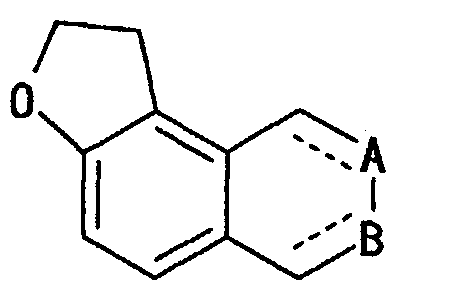 represents a single bond or a double bond] as an entry inhibitor.
- A potent selective phosphodiesterase IV inhibitor is expected to have a sufficient prophylactic or therapeutic effect in a wide range of diseases accompanied with inflammations. The objective of the invention is to provide a novel heterocyclic compound which has selective phosphodiesterase IV-inhibiting effect and increases the intracellular cAMP level whereby exhibiting bronchodilating and antiinflammatory effects and which is also excellent in terms of safety, etc.
- The present inventors have made extensive studies, and firstly synthesized a novel furo[2,3-h]isoquinoline compound represented by having the formulawherein A represents (1) a bond, (2) a group represented by the formula -CRa=CRb- (Ra and Rb each represent respectively a hydrogen atom or a C1-6 alkyl group), (3) a group represented by the formula -(CONH)p-(C(Rc) (Rd))q- (Rc and Rd each represent a hydrogen atom or a C1-6 alkyl group, p represents 0 or 1 and q represents 1 or 2), (4) a group represented by the formula-CH2OCH2- or (5) a group represented by the formula -OCH2-;
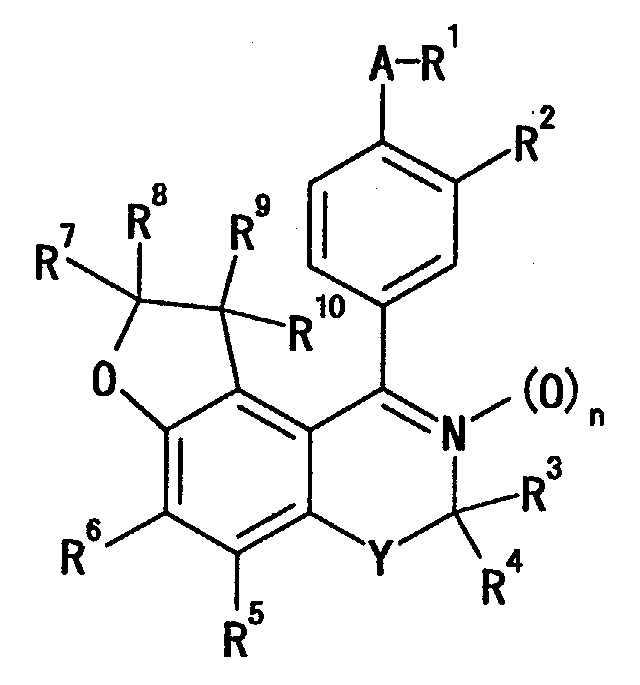
R1 represents (1) a cyano group or (2) an optionally esterified or amidated carboxyl group;
R2 represents (1) a hydrogen atom, (2) an optionally substituted hydroxyl group, (3) an optionally substituted amino group, (4) an optionally substituted alkyl group, (5) an optionally esterified or amidated carboxyl group or (6) a nitro group, or R2 and A or R1 may be taken together with the adjacent carbon atom to form a ring;
R3 and R4 each represent (1) a hydrogen atom, (2) an optionally substituted hydrocarbon group or (3) an acyl group, or R3 and R4 may be taken together with the adjacent carbon atom to form an optionally substituted 3- to 8-membered ring;
R5 represents (1) a hydrogen atom, (2) a cyano group, (3) an optionally substituted hydrocarbon group, (4) an acyl group or (5) an optionally substituted hydroxyl group;
R6 represents (1) a hydrogen atom, (2) an optionally substituted hydrocarbon group, (3) an acyl group, (4) an optionally substituted heterocyclic group, (5) a halogen atom, (6) an optionally substituted hydroxyl group, (7) an optionally substituted thiol group, (8) a group represented by the formula-S(O)rR11 (R11 represents an optionally substituted hydrocarbon group or an optionally substituted heterocyclic group, and r represents 1 or 2) or (9) an optionally substituted amino group;
R7 and R8 each represent (1) a hydrogen atom or (2) an optionally substituted hydrocarbon group, or R7 and R8 may be taken together with the adjacent carbon atom to form an optionally substituted 3- to 8-membered ring;
R9 and R10 are each (1) a hydrogen atom or (2) an optionally substituted hydrocarbon group;
Y represents an optionally substituted methylene group; and n represents 0 or 1,
provided that if A is a bond, R2 is not a hydrogen atom, and if A is a group represented by the formula -(CONH)p-(C(Rc) (Rd))q- (Rc and Rd each represent a hydrogen atom or a C1-6 alkyl group, p represents 0 or 1 and q represents 1 or 2), R6 is not methoxy, or a salt thereof, which is characterized by having (1) cyano or (2) an optionally esterified or amidated carboxyl group at the end of the substituent at the position 4 of the phenyl group which is a substituent at the position 1 of the furo[2,3-h]isoquinoline. Furthermore, the present inventors have found unexpectedly that such compound, based on the characteristic chemical structure, has an excellent phosphodiesterase IV-inhibiting action and is used as a prophylactic and/or therapeutic agent against inflammatory diseases, atopic dermatitis, asthma, chronic obstructive pulmonary diseases, chronic rheumatoid arthritis, autoimmune diseases, depression, Alzheimer's dementia, memory disorders, diabetes or atherosclerosis. The present inventors have made a further study based on these findings, and finally reached completion of the present invention. - That is, the present invention relates to:
- [1] A compound represented by the formula
wherein A represents (1) a bond, (2) a group represented by the formula -CRa=CRb- (Ra and Rb each represent a hydrogen atom or a C1-6 alkyl group), (3) a group represented by the formula - (CONH)p-(C(Rc) (Rd))q- (Rc and Rd each represent a hydrogen atom or a C1-6 alkyl group, p represents 0 or 1 and q represents 1 or 2), (4) a group represented by the formula -CH2OCH2- or (5) a group represented by the formula -OCH2-;

R1 represents (1) a cyano group or (2) an optionally esterified or amidated carboxyl group;
R2 represents (1) a hydrogen atom, (2) an optionally substituted hydroxyl group, (3) an optionally substituted amino group, (4) an optionally substituted alkyl group, (5) an optionally esterified or amidated carboxyl group or (6) a nitro group, or R2 and A or R1 may be taken together with the adjacent carbon atom to form a ring;
R3 and R4 each represent (1) a hydrogen atom, (2) an optionally substituted hydrocarbon group or (3) an acyl group, or R3 and R4 may be taken together with the adjacent carbon atom to form an optionally substituted 3- to 8-membered ring;
R5 represents (1) a hydrogen atom, (2) a cyano group, (3) an optionally substituted hydrocarbon group, (4) an acyl group or (5) an optionally substituted hydroxyl group;
R6 represents (1) a hydrogen atom, (2) an optionally substituted hydrocarbon group, (3) an acyl group, (4) an optionally substituted heterocyclic group, (5) a halogen atom, (6) an optionally substituted hydroxyl group, (7) an optionally substituted thiol group, (8) a group represented by the formula-S(O)rR11 (R11 represents an optionally substituted hydrocarbon group or an optionally substituted heterocyclic group, and r represents 1 or 2) or (9) an optionally substituted amino group;
R7 and R8 each represent (1) a hydrogen atom or (2) an optionally substituted hydrocarbon group, or R7 and R8 may be taken together with the adjacent carbon atom to form an optionally substituted 3- to 8-membered ring;
R9 and R10 each represent (1) a hydrogen atom or (2) an optionally substituted hydrocarbon group; Y represents an optionally substituted methylene group; and
n represents 0 or 1,
provided that if A is a bond, R2 is not a hydrogen atom, and if A is a group represented by the formula -(CONH)p-(C(Rc) (Rd))q- (Rc and Rd each represent a hydrogen atom or a C1-6 alkyl group, p represents 0 or 1 and q represents 1 or 2), R6 is not methoxy, or a salt thereof; - [2] the compound as described in the above-mentioned [1],
wherein R1 is (i) a cyano group, (ii) a carboxyl group, (iii) a C1-6
alkoxy-carbonyl group which may have 1 to 5 substituents
selected from a group consisting of (1) a halogen atom, (2) a C1-3
alkylenedioxy group, (3) a nitro group, (4) a cyano group, (5) an
optionally halogenated C1-6 alkyl group, (6) an optionally
halogenated C2-6 alkenyl group, (7) an optionally halogenated C2-6
alkynyl group, (8) a C3-8 cycloalkyl group, (9) a C6-14 aryl group,
(10) an optionally halogenated C1-6 alkoxy group, (11) an
optionally halogenated C1-6 alkylthio group, (12) a hydroxyl group,
(13) an amino group, (14) a mono-C1-6 alkylamino group, (15) a
mono-C6-14 arylamino group, (16) a di-C1-6 alkylamino group, (17) a
di-C6-14 arylamino group, (18) an acyl group selected from formyl,
carboxyl, carbamoyl, C1-6 alkyl-carbonyl, C3-8 cycloalkyl-carbonyl,
C1-6 alkoxy-carbonyl, C6-14 aryl-carbonyl, C7-16 aralkyl-carbonyl, C6-14
aryloxy-carbonyl, C7-16 aralkyloxy-carbonyl, 5- or 6-membered
heterocyclic carbonyl containing 1 to 3 hetero atoms selected from
a nitrogen atom, a sulfur atom and an oxygen atom in addition to
carbon atoms, mono-C1-6 alkyl-carbamoyl, di-C1-6 alkyl-carbamoyl,
mono-C6-14 aryl-carbamoyl, di-C6-14 aryl-carbamoyl, 5- or 6-membered
heterocyclic carbamoyl containing 1 to 3 hetero atoms selected
from a nitrogen atom, a sulfur atom and an oxygen atom in addition
to carbon atoms, C1-6 alkyl-thiocarbonyl, C3-8 cycloalkyl-thiocarbonyl,
C1-6 alkoxy-thiocarbonyl, C6-14 aryl-thiocarbonyl, C7-16
aralkyl-thiocarbonyl, C6-14 aryloxy-thiocarbonyl, C7-16 aralkyloxy-thiocarbonyl,
5- or 6-membered heterocyclic thiocarbonyl
containing 1 to 3 hetero atoms selected from a nitrogen atom, a
sulfur atom and an oxygen atom in addition to carbon atoms,
thiocarbamoyl, mono-C1-6 alkyl-thiocarbamoyl, di-C1-6 alkyl-thiocarbamoyl,
mono-C6-14 aryl-thiocarbamoyl, di-C6-14 aryl-thiocarbamoyl,
5- or 6-membered heterocyclic thiocarbamoyl
containing 1 to 3 hetero atoms selected from a nitrogen atom, a
sulfur atom and an oxygen atom in addition to carbon atoms,
sulfamoyl, mono-C1-6 alkylsulfamoyl, di-C1-6 alkylsulfamoyl, C6-14
arylsulfamoyl, C1-6 alkylsulfonyl, C6-14 arylsulfonyl, C1-6
alkylsulfinyl, C6-14 arylsulfinyl, sulfino, sulfo, C1-6
alkoxysulfinyl, C6-14 aryloxysulfinyl, C1-6 alkoxysulfonyl and C6-14
aryloxysulfonyl, (19) an acylamino group selected from formylamino,
C1-6 alkyl-carboxamide, C6-14 aryl-carboxamide, C1-6 alkoxy-carboxamide,
C1-6 alkylsulfonylamino and C6-14 arylsulfonylamino,
(20) an acyloxy group selected from C1-6 alkyl-carbonyloxy, C6-14
aryl-carbonyloxy, C1-6 alkoxy-carbonyloxy, mono-C1-6 alkyl-carbamoyloxy,
di-C1-6 alkyl-carbamoyloxy, mono-C6-14 aryl-carbamoyloxy,
di-C6-14 aryl-carbamoyloxy and nicotinoyloxy, (21) a
5- to 14-membered heterocyclic group containing 1 to 4 hetero
atoms selected from a nitrogen atom, a sulfur atom and an oxygen
atom in addition to carbon atoms, (22) a phosphono group, (23) a
C6-14 aryloxy group, (24) a di-C1-6 alkoxy-phosphoryl group, (25) a
C6-14 arylthio group, (26) a hydrazino group, (27) an imino group,
(28) an oxo group, (29) a ureido group, (30) a C1-6 alkyl-ureido
group, (31) a di-C1-6 alkyl-ureido group, (32) an oxide group and
(33) a group formed by the binding of 2 or 3 groups selected from
(1) to (32) listed above and the like (hereinafter, simply
referred to as Substituent group A), (iv) a C3-8 cycloalkyloxy-carbonyl
group which may have 1 to 5 substituents selected from
Substituent group A described above, (v) a C7-16 aralkyloxy-carbonyl
group which may have 1 to 5 substituents selected from
Substituent group A described above, (vi) a C6-14 aryloxy-carbonyl
group which may have 1 to 5 substituents selected from Substituent
group A described above, (vii) a carbamoyl group, (viii) a mono-C1-6
alkyl-carbamoyl group which may have 1 to 5 substituents
selected from Substituent group A described above, (ix) a di-C1-6
alkyl-carbamoyl group which may have 1 to 5 substituents selected
from Substituent group A described above, (x) a mono-C6-14 aryl-carbamoyl
group which may have 1 to 5 substituents selected from
Substituent group A described above or (xi) a di-C6-14 aryl-carbamoyl
group which may have 1 to 5 substituents selected from
Substituent group A described above.
R2 is (i) a hydrogen atom, (ii) a group represented by the formula -OR12 (R12 represents (a) a hydrogen atom, (b) a C1-6 alkyl group, a C2-6 alkenyl group, a C2-6 alkynyl group, a C3-8 cycloalkyl group, a C3-8 cycloalkenyl group, a C6-14 aryl group or a C7-16 aralkyl group, each of which may have 1 to 5 substituents selected from Substituent group A described above, or (c) an acyl group selected from formyl, carbamoyl, C1-6 alkyl-carbonyl, C3-8 cycloalkyl-carbonyl, C1-6 alkoxy-carbonyl, C6-14 aryl-carbonyl, C7-16 aralkyl-carbonyl, C6-14 aryloxy-carbonyl, C7-16 aralkyloxy-carbonyl, 5- or 6-membered heterocyclic carbonyl containing 1 to 3 hetero atoms selected from a nitrogen atom, a sulfur atom and an oxygen atom in addition to carbon atoms, mono-C1-6 alkyl-carbamoyl, di-C1-6 alkyl-carbamoyl, mono-C6-14 aryl-carbamoyl, di-C6-14 aryl-carbamoyl, 5- or 6-membered heterocyclic carbamoyl containing 1 to 3 hetero atoms selected from a nitrogen atom, a sulfur atom and an oxygen atom in addition to carbon atoms, C1-6 alkyl-thiocarbonyl, C3-8 cycloalkyl-thiocarbonyl, C1-6 alkoxy-thiocarbonyl, C6-14 aryl-thiocarbonyl, C7-16 aralkyl-thiocarbonyl, C6-14 aryloxy-thiocarbonyl, C7-16 aralkyloxy-thiocarbonyl, 5- or 6-membered heterocyclic thiocarbonyl containing 1 to 3 hetero atoms selected from a nitrogen atom, a sulfur atom and an oxygen atom in addition to carbon atoms, thiocarbamoyl, mono-C1-6 alkyl-thiocarbamoyl, di-C1-6 alkyl-thiocarbamoyl, mono-C6-14 aryl-thiocarbamoyl, di-C6-14 aryl-thiocarbamoyl, 5- or 6-membered heterocyclic thiocarbamoyl containing 1 to 3 hetero atoms selected from a nitrogen atom, a sulfur atom and an oxygen atom in addition to carbon atoms, sulfamoyl, mono-C1-6 alkylsulfamoyl, di-C1-6 alkylsulfamoyl, C6-14 arylsulfamoyl, C1-6 alkylsulfonyl, C6-14 arylsulfonyl, C1-6 alkylsulfinyl, C6-14 arylsulfinyl, C1-6 alkoxysulfinyl, C6-14 aryloxysulfinyl, C1-6 alkoxysulfonyl and C6-14 aryloxysulfonyl, which may have 1 to 5 substituents selected from Substituent group A described above), (iii) a group represented by the formula-NR13R14 (R13 and R14 each represent (i') a hydrogen atom, (ii') a C1-6 alkyl group, a C2-6 alkenyl group, a C2-6 alkynyl group, a C3-8 cycloalkyl group, a C3-8 cycloalkenyl group, a C6-14 aryl group or a C7-16 aralkyl group, each of which may have 1 to 5 substituents selected from Substituent group A described above, (iii') an acyl group selected from formyl, carbamoyl, C1-6 alkyl-carbonyl, C3-8 cycloalkyl-carbonyl, C1-6 alkoxy-carbonyl, C6-14 aryl-carbonyl, C7-16 aralkyl-carbonyl, C6-14 aryloxy-carbonyl, C7-16 aralkyloxy-carbonyl, 5- or 6-membered heterocyclic carbonyl containing 1 to 3 hetero atoms selected from a nitrogen atom, a sulfur atom and an oxygen atom in addition to carbon atoms, mono-C1-6 alkyl-carbamoyl, di-C1-6 alkyl-carbamoyl, mono-C6-14 aryl-carbamoyl, di-C6-14 aryl-carbamoyl, 5- or 6-membered heterocyclic carbamoyl containing 1 to 3 hetero atoms selected from a nitrogen atom, a sulfur atom and an oxygen atom in addition to carbon atoms, C1-6 alkyl-thiocarbonyl, C3-8 cycloalkyl-thiocarbonyl, C1-6 alkoxy-thiocarbonyl, C6-14 aryl-thiocarbonyl, C7-16 aralkyl-thiocarbonyl, C6-14 aryloxy-thiocarbonyl, C7-16 aralkyloxy-thiocarbonyl, 5- or 6-membered heterocyclic thiocarbonyl containing 1 to 3 hetero atoms selected from a nitrogen atom, a sulfur atom and an oxygen atom in addition to carbon atoms, thiocarbamoyl, mono-C1-6 alkyl-thiocarbamoyl, di-C1-6 alkyl-thiocarbamoyl, mono-C6-14 aryl-thiocarbamoyl, di-C6-14 aryl-thiocarbamoyl, 5- or 6-membered heterocyclic thiocarbamoyl containing 1 to 3 hetero atoms selected from a nitrogen atom, a sulfur atom and an oxygen atom in addition to carbon atoms, sulfamoyl, mono-C1-6 alkylsulfamoyl, di-C1-6 alkylsulfamoyl, C6-14 arylsulfamoyl, C1-6 alkylsulfonyl, C6-14 arylsulfonyl, C1-6 alkylsulfinyl, C6-14 arylsulfinyl, C1-6 alkoxysulfinyl, C6-14 aryloxysulfinyl, C1-6 alkoxysulfonyl and C6-14 aryloxysulfonyl, which may have 1 to 5 substituents selected from Substituent group A described above or (iv') a 5- to 14-membered heterocycle containing 1 to 4 hetero atoms selected from a nitrogen atom, a sulfur atom and an oxygen atom in addition to carbon atoms, which may have 1 to 5 substituents selected from Substituent group A described above, or R13 and R14 may be taken together with the adjacent a nitrogen atom to form a 5- to 14-membered ring), (iv) a C1-6 alkylideneamino group which may have 1 to 5 substituents selected from Substituent group A described above, (v) a C1-6 alkyl group which may have 1 to 5 substituents selected from Substituent group A described above, (vi) a carboxyl group, (vii) a C1-6 alkoxy-carbonyl group which may have 1 to 5 substituents selected from Substituent group A described above, (viii) a C3-8 cycloalkyloxy-carbonyl group which may have 1 to 5 substituents selected from Substituent group A described above, (ix) a C7-16 aralkyloxy-carbonyl group which may have 1 to 5 substituents selected from Substituent group A described above, (x) a C6-14 aryloxy-carbonyl group which may have 1 to 5 substituents selected from Substituent group A described above, (xi) a carbamoyl group, (xii) a mono-C1-6 alkyl-carbamoyl group which may have 1 to 5 substituents selected from Substituent group A described above, (xiii) a di-C1-6 alkyl-carbamoyl group which may have 1 to 5 substituents selected from Substituent group A described above, (xiv) a mono-C6-14 aryl-carbamoyl group which may have 1 to 5 substituents selected from Substituent group A described above, (xv) a di-C6-14 aryl-carbamoyl group which may have 1 to 5 substituents selected from Substituent group A described above or (xvi) a nitro group, or R2 and A or R1 may be taken together to form a 5- to 14-membered ring containing 1 to 4 hetero atoms selected from a nitrogen atom and an oxygen atom in addition to carbon atoms, which may have 1 to 5 substituents selected from Substituent group A described above;
each of R3 and R4 is any of the following (i) to (iii): - (i) a hydrogen atom,
- (ii) a C1-6 alkyl group, a C2-6 alkenyl group, a C2-6 alkynyl group, a C3-8 cycloalkyl group, a C3-8 cycloalkenyl group, a C6-14 aryl group or a C7-16 aralkyl group, each of which may have 1 to 5 substituents selected from Substituent group A described above,
- (iii) an acyl group selected from formyl, carboxyl, carbamoyl,
C1-6 alkyl-carbonyl, C3-8 cycloalkyl-carbonyl, C1-6 alkoxy-carbonyl,
C6-14 aryl-carbonyl, C7-16 aralkyl-carbonyl, C6-14 aryloxy-carbonyl,
C7-16 aralkyloxy-carbonyl, 5- or 6-membered heterocyclic carbonyl
containing 1 to 3 hetero atoms selected from a nitrogen atom, a
sulfur atom and an oxygen atom in addition to carbon atoms, mono-C1-6
alkyl-carbamoyl, di-C1-6 alkyl-carbamoyl, mono-C6-14 aryl-carbamoyl,
di-C6-14 aryl-carbamoyl, 5- or 6-membered heterocyclic
carbamoyl containing 1 to 3 hetero atoms selected from a nitrogen
atom, a sulfur atom and an oxygen atom in addition to carbon atoms,
C1-6 alkyl-thiocarbonyl, C3-8 cycloalkyl-thiocarbonyl, C1-6 alkoxy-thiocarbonyl,
C6-14 aryl-thiocarbonyl, C7-16 aralkyl-thiocarbonyl,
C6-14 aryloxy-thiocarbonyl, C7-16 aralkyloxy-thiocarbonyl, 5- or 6-membered
heterocyclic thiocarbonyl containing 1 to 3 hetero atoms
selected from a nitrogen atom, a sulfur atom and an oxygen atom in
addition to carbon atoms, thiocarbamoyl, mono-C1-6 alkyl-thiocarbamoyl,
di-C1-6 alkyl-thiocarbamoyl, mono-C6-14 aryl-thiocarbamoyl,
di-C6-14 aryl-thiocarbamoyl, 5- or 6-membered
heterocyclic thiocarbamoyl containing 1 to 3 hetero atoms selected
from a nitrogen atom, a sulfur atom and an oxygen atom in addition
to carbon atoms, sulfamoyl, mono-C1-6 alkylsulfamoyl, di-C1-6
alkylsulfamoyl, C6-14 arylsulfamoyl, C1-6 alkylsulfonyl, C6-14
arylsulfonyl, C1-6 alkylsulfinyl, C6-14 arylsulfinyl, sulfino, sulfo,
C1-6 alkoxysulfinyl, C6-14 aryloxysulfinyl, C1-6 alkoxysulfonyl and
C6-14 aryloxysulfonyl, which may have 1 to 5 substituents selected
from Substituent group A described above; or
R3 and R4 may be taken together with the adjacent carbon atom to form C3-8 cycloalkane or a 3- to 8-membered heterocycle, each of which may have 1 to 3 substituents selected from C1-6 alkyl, C6-14 aryl, C7-16 aralkyl, amino, mono-C1-6 alkylamino, mono-C6-14 arylamino, di-C1-6 alkylamino, di-C6-14 arylamino and a 4- to 10-membered aromatic heterocyclic group,
R5 is (i) a hydrogen atom, (ii) a cyano group, (iii) a C1-6 alkyl group, a C2-6 alkenyl group, a C2-6 alkynyl group, a C3-8 cycloalkyl group, a C3-8 cycloalkenyl group, a C6-14 aryl group or a C7-16 aralkyl group, each of which may have 1 to 5 substituents selected from Substituent group A described above, (iv) an acyl group selected from formyl, carboxyl, carbamoyl, C1-6 alkyl-carbonyl, C3-8 cycloalkyl-carbonyl, C1-6 alkoxy-carbonyl, C6-14 aryl-carbonyl, C7-16 aralkyl-carbonyl, C6-14 aryloxy-carbonyl, C7-16 aralkyloxy-carbonyl, 5- or 6-membered heterocyclic carbonyl containing 1 to 3 hetero atoms selected from a nitrogen atom, a sulfur atom and an oxygen atom in addition to carbon atoms, mono-C1-6 alkyl-carbamoyl, di-C1-6 alkyl-carbamoyl, mono-C6-14 aryl-carbamoyl, di-C6-14 aryl-carbamoyl, 5- or 6-membered heterocyclic carbamoyl containing 1 to 3 hetero atoms selected from a nitrogen atom, a sulfur atom and an oxygen atom in addition to carbon atoms, C1-6 alkyl-thiocarbonyl, C3-8 cycloalkyl-thiocarbonyl, C1-6 alkoxy-thiocarbonyl, C6-14 aryl-thiocarbonyl, C7-16 aralkyl-thiocarbonyl, C6-14 aryloxy-thiocarbonyl, C7-16 aralkyloxy-thiocarbonyl, 5- or 6-membered heterocyclic thiocarbonyl containing 1 to 3 hetero atoms selected from a nitrogen atom, a sulfur atom and an oxygen atom in addition to carbon atoms, thiocarbamoyl, mono-C1-6 alkyl-thiocarbamoyl, di-C1-6 alkyl-thiocarbamoyl, mono-C6-14 aryl-thiocarbamoyl, di-C6-14 aryl-thiocarbamoyl, 5- or 6-membered heterocyclic thiocarbamoyl containing 1 to 3 hetero atoms selected from a nitrogen atom, a sulfur atom and an oxygen atom in addition to carbon atoms, sulfamoyl, mono-C1-6 alkylsulfamoyl, di-C1-6 alkylsulfamoyl, C6-14 arylsulfamoyl, C1-6 alkylsulfonyl, C6-14 arylsulfonyl, C1-6 alkylsulfinyl, C6-14 arylsulfinyl, sulfino, sulfo, C1-6 alkoxysulfinyl, C6-14 aryloxysulfinyl, C1-6 alkoxysulfonyl and C6-14 aryloxysulfonyl, which may have 1 to 5 substituents selected from Substituent group A described above, or (v) a group represented by the formula -OR15 (R15 represents (a) a hydrogen atom, (b) a C1-6 alkyl group, a C2-6 alkenyl group, a C2-6 alkynyl group, a C3-8 cycloalkyl group, a C3-8 cycloalkenyl group, a C6-14 aryl group or a C7-16 aralkyl group, each of which may have 1 to 5 substituents selected from Substituent group A described above, or (c) an acyl group selected from formyl, carbamoyl, C1-6 alkyl-carbonyl, C3-8 cycloalkyl-carbonyl, C1-6 alkoxy-carbonyl, C6-14 aryl-carbonyl, C7-16 aralkyl-carbonyl, C6-14 aryloxy-carbonyl, C7-16 aralkyloxy-carbonyl, 5- or 6-membered heterocyclic carbonyl containing 1 to 3 hetero atoms selected from a nitrogen atom, a sulfur atom and an oxygen atom in addition to carbon atoms, mono-C1-6 alkyl-carbamoyl, di-C1-6 alkyl-carbamoyl, mono-C6-14 aryl-carbamoyl, di-C6-14 aryl-carbamoyl, 5- or 6-membered heterocyclic carbamoyl containing 1 to 3 hetero atoms selected from a nitrogen atom, a sulfur atom and an oxygen atom in addition to carbon atoms, C1-6 alkyl-thiocarbonyl, C3-8 cycloalkyl-thiocarbonyl, C1-6 alkoxy-thiocarbonyl, C6-14 aryl-thiocarbonyl, C7-16 aralkyl-thiocarbonyl, C6-14 aryloxy-thiocarbonyl, C7-16 aralkyloxy-thiocarbonyl, 5- or 6-membered heterocyclic thiocarbonyl containing 1 to 3 hetero atoms selected from a nitrogen atom, a sulfur atom and an oxygen atom in addition to carbon atoms, thiocarbamoyl, mono-C1-6 alkyl-thiocarbamoyl, di-C1-6 alkyl-thiocarbamoyl, mono-C6-14 aryl-thiocarbamoyl, di-C6-14 aryl-thiocarbamoyl, 5- or 6-membered heterocyclic thiocarbamoyl containing 1 to 3 hetero atoms selected from a nitrogen atom, a sulfur atom and an oxygen atom in addition to carbon atoms, sulfamoyl, mono-C1-6 alkylsulfamoyl, di-C1-6 alkylsulfamoyl, C6-14 arylsulfamoyl, C1-6 alkylsulfonyl, C6-14 arylsulfonyl, C1-6 alkylsulfinyl, C6-14 arylsulfinyl, C1-6 alkoxysulfinyl, C6-14 aryloxysulfinyl, C1-6 alkoxysulfonyl and C6-14 aryloxysulfonyl, which may have 1 to 5 substituents selected from Substituent group A described above),
R6 is any of the following (i) to (x):
- (i) a hydrogen atom,
- (ii) a C1-6 alkyl group, a C2-6 alkenyl group, a C2-6 alkynyl group, a C3-8 cycloalkyl group, a C3-8 cycloalkenyl group, a C6-14 aryl group or a C7-16 aralkyl group, each of which may have 1 to 5 substituents selected from Substituent group A described above,
- (iii) an acyl group selected from formyl, carboxyl, carbamoyl, C1-6 alkyl-carbonyl, C3-8 cycloalkyl-carbonyl, C1-6 alkoxy-carbonyl, C6-14 aryl-carbonyl, C7-16 aralkyl-carbonyl, C6-14 aryloxy-carbonyl, C7-16 aralkyloxy-carbonyl, 5- or 6-membered heterocyclic carbonyl containing 1 to 3 hetero atoms selected from a nitrogen atom, a sulfur atom and an oxygen atom in addition to carbon atoms, mono-C1-6 alkyl-carbamoyl, di-C1-6 alkyl-carbamoyl, mono-C6-14 aryl-carbamoyl, di-C6-14 aryl-carbamoyl, 5- or 6-membered heterocyclic carbamoyl containing 1 to 3 hetero atoms selected from a nitrogen atom, a sulfur atom and an oxygen atom in addition to carbon atoms, C1-6 alkyl-thiocarbonyl, C3-8 cycloalkyl-thiocarbonyl, C1-6 alkoxy-thiocarbonyl, C6-14 aryl-thiocarbonyl, C7-16 aralkyl-thiocarbonyl, C6-14 aryloxy-thiocarbonyl, C7-16 aralkyloxy-thiocarbonyl, 5- or 6-membered heterocyclic thiocarbonyl containing 1 to 3 hetero atoms selected from a nitrogen atom, a sulfur atom and an oxygen atom in addition to carbon atoms, thiocarbamoyl, mono-C1-6 alkyl-thiocarbamoyl, di-C1-6 alkyl-thiocarbamoyl, mono-C6-14 aryl-thiocarbamoyl, di-C6-14 aryl-thiocarbamoyl, 5- or 6-membered heterocyclic thiocarbamoyl containing 1 to 3 hetero atoms selected from a nitrogen atom, a sulfur atom and an oxygen atom in addition to carbon atoms, sulfamoyl, mono-C1-6 alkylsulfamoyl, di-C1-6 alkylsulfamoyl, C6-14 arylsulfamoyl, C1-6 alkylsulfonyl, C6-14 arylsulfonyl, C1-6 alkylsulfinyl, C6-14 arylsulfinyl, sulfino, sulfo, C1-6 alkoxysulfinyl, C6-14 aryloxysulfinyl, C1-6 alkoxysulfonyl and C6-14 aryloxysulfonyl, which may have 1 to 5 substituents selected from Substituent group A described above,
- (iv) a 5- to 14-membered heterocycle containing 1 to 4 hetero atoms selected from a nitrogen atom, a sulfur atom and an oxygen atom in addition to carbon atoms, which may have 1 to 5 substituents selected from Substituent group A described above,
- (v) a halogen atom,
- (vi) a group represented by the formula -OR16 (R16 represents (i') a hydrogen atom, (ii') a C1-6 alkyl group, a C2-6 alkenyl group, a C2-6 alkynyl group, a C3-8 cycloalkyl group, a C3-8 cycloalkenyl group, a C6-14 aryl group or a C7-16 aralkyl group, each of which may have 1 to 5 substituents selected from Substituent group A described above, (iii') an acyl group selected from formyl, carbamoyl, C1-6 alkyl-carbonyl, C3-8 cycloalkyl-carbonyl, C1-6 alkoxy-carbonyl, C6-14 aryl-carbonyl, C7-16 aralkyl-carbonyl, C6-14 aryloxy-carbonyl, C7-16 aralkyloxy-carbonyl, 5- or 6-membered heterocyclic carbonyl containing 1 to 3 hetero atoms selected from a nitrogen atom, a sulfur atom and an oxygen atom in addition to carbon atoms, mono-C1-6 alkyl-carbamoyl, di-C1-6 alkyl-carbamoyl, mono-C6-14 aryl-carbamoyl, di-C6-14 aryl-carbamoyl, 5- or 6-membered heterocyclic carbamoyl containing 1 to 3 hetero atoms selected from a nitrogen atom, a sulfur atom and an oxygen atom in addition to carbon atoms, C1-6 alkyl-thiocarbonyl, C3-8 cycloalkyl-thiocarbonyl, C1-6 alkoxy-thiocarbonyl, C6-14 aryl-thiocarbonyl, C7-16 aralkyl-thiocarbonyl, C6-14 aryloxy-thiocarbonyl, C7-16 aralkyloxy-thiocarbonyl, 5- or 6-membered heterocyclic thiocarbonyl containing 1 to 3 hetero atoms selected from a nitrogen atom, a sulfur atom and an oxygen atom in addition to carbon atoms, thiocarbamoyl, mono-C1-6 alkyl-thiocarbamoyl, di-C1-6 alkyl-thiocarbamoyl, mono-C6-14 aryl-thiocarbamoyl, di-C6-14 aryl-thiocarbamoyl, 5- or 6-membered heterocyclic thiocarbamoyl containing 1 to 3 hetero atoms selected from a nitrogen atom, a sulfur atom and an oxygen atom in addition to carbon atoms, sulfamoyl, mono-C1-6 alkylsulfamoyl, di-C1-6 alkylsulfamoyl, C6-14 arylsulfamoyl, C1-6 alkylsulfonyl, C6-14 arylsulfonyl, C1-6 alkylsulfinyl, C6-14 arylsulfinyl, C1-6 alkoxysulfinyl, C6-14 aryloxysulfinyl, C1-6 alkoxysulfonyl and C6-14 aryloxysulfonyl, which may have 1 to 5 substituents selected from Substituent group A described above, or (iv') a 5- to 14-membered heterocycle containing 1 to 4 hetero atoms selected from a nitrogen atom, a sulfur atom and an oxygen atom in addition to carbon atoms, which may have 1 to 5 substituents selected from Substituent group A described above),
- (vii) a group represented by the formula -SR17 (R17 represents (i') a hydrogen atom, (ii') a C1-6 alkyl group, a C2-6 alkenyl group, a C2-6 alkynyl group, a C3-8 cycloalkyl group, a C3-8 cycloalkenyl group, a C6-14 aryl group or a C7-16 aralkyl group, each of which may have 1 to 5 substituents selected from Substituent group A described above, (iii') an acyl group selected from formyl, carbamoyl, C1-6 alkyl-carbonyl, C3-8 cycloalkyl-carbonyl, C1-6 alkoxy-carbonyl, C6-14 aryl-carbonyl, C7-16 aralkyl-carbonyl, C6-14 aryloxy-carbonyl, C7-16 aralkyloxy-carbonyl, 5- or 6-membered heterocyclic carbonyl containing 1 to 3 hetero atoms selected from a nitrogen atom, a sulfur atom and an oxygen atom in addition to carbon atoms, mono-C1-6 alkyl-carbamoyl, di-C1-6 alkyl-carbamoyl, mono-C6-14 aryl-carbamoyl, di-C6-14 aryl-carbamoyl, 5- or 6-membered heterocyclic carbamoyl containing 1 to 3 hetero atoms selected from a nitrogen atom, a sulfur atom and an oxygen atom in addition to carbon atoms, C1-6 alkyl-thiocarbonyl, C3-8 cycloalkyl-thiocarbonyl, C1-6 alkoxy-thiocarbonyl, C6-14 aryl-thiocarbonyl, C7-16 aralkyl-thiocarbonyl, C6-14 aryloxy-thiocarbonyl, C7-16 aralkyloxy-thiocarbonyl, 5- or 6-membered heterocyclic thiocarbonyl containing 1 to 3 hetero atoms selected from a nitrogen atom, a sulfur atom and an oxygen atom in addition to carbon atoms, thiocarbamoyl, mono-C1-6 alkyl-thiocarbamoyl, di-C1-6 alkyl-thiocarbamoyl, mono-C6-14 aryl-thiocarbamoyl, di-C6-14 aryl-thiocarbamoyl, 5- or 6-membered heterocyclic thiocarbamoyl containing 1 to 3 hetero atoms selected from a nitrogen atom, a sulfur atom and an oxygen atom in addition to carbon atoms, sulfamoyl, mono-C1-6 alkylsulfamoyl, di-C1-6 alkylsulfamoyl, C6-14 arylsulfamoyl, C1-6 alkylsulfonyl, C6-14 arylsulfonyl, C1-6 alkylsulfinyl, C6-14 arylsulfinyl, C1-6 alkoxysulfinyl, C6-14 aryloxysulfinyl, C1-6 alkoxysulfonyl and C6-14 aryloxysulfonyl, which may have 1 to 5 substituents selected from Substituent group A described above or (iv') a 5- to 14-membered heterocycle containing 1 to 4 hetero atoms selected from a nitrogen atom, a sulfur atom and an oxygen atom in addition to carbon atoms, which may have 1 to 5 substituents selected from Substituent group A described above),
- (viii) a group represented by the formula -S(O)rR11 (R11 represents (i') a C1-6 alkyl group, a C2-6 alkenyl group, a C2-6 alkynyl group, a C3-8 cycloalkyl group, a C3-8 cycloalkenyl group, a C6-14 aryl group or a C7-16 aralkyl group, each of which may have 1 to 5 substituents selected from Substituent group A described above or (ii') a 5- to 14-membered heterocycle containing 1 to 4 hetero atoms selected from a nitrogen atom, a sulfur atom and an oxygen atom in addition to carbon atoms, which may have 1 to 5 substituents selected from Substituent group A described above and r is 1 or 2) or
- (ix) a group represented by the formula =NR18R19 (R18 and R19 each represent (i') a hydrogen atom, (ii') a C1-6 alkyl group, a C2-6 alkenyl group, a C2-6 alkynyl group, a C3-8 cycloalkyl group, a C3-8 cycloalkenyl group, a C6-14 aryl group or a C7-16 aralkyl group, each of which may have 1 to 5 substituents selected from Substituent group A described above, (iii') an acyl group selected from formyl, carbamoyl, C1-6 alkyl-carbonyl, C3-8 cycloalkyl-carbonyl, C1-6 alkoxy-carbonyl, C6-14 aryl-carbonyl, C7-16 aralkyl-carbonyl, C6-14 aryloxy-carbonyl, C7-16 aralkyloxy-carbonyl, 5- or 6-membered heterocyclic carbonyl containing 1 to 3 hetero atoms selected from a nitrogen atom, a sulfur atom and an oxygen atom in addition to carbon atoms, mono-C1-6 alkyl-carbamoyl, di-C1-6 alkyl-carbamoyl, mono-C6-14 aryl-carbamoyl, di-C6-14 aryl-carbamoyl, 5- or 6-membered heterocyclic carbamoyl containing 1 to 3 hetero atoms selected from a nitrogen atom, a sulfur atom and an oxygen atom in addition to carbon atoms, C1-6 alkyl-thiocarbonyl, C3-8 cycloalkyl-thiocarbonyl, C1-6 alkoxy-thiocarbonyl, C6-14 aryl-thiocarbonyl, C7-16 aralkyl-thiocarbonyl, C6-14 aryloxy-thiocarbonyl, C7-16 aralkyloxy-thiocarbonyl, 5- or 6-membered heterocyclic thiocarbonyl containing 1 to 3 hetero atoms selected from a nitrogen atom, a sulfur atom and an oxygen atom in addition to carbon atoms, thiocarbamoyl, mono-C1-6 alkyl-thiocarbamoyl, di-C1-6 alkyl-thiocarbamoyl, mono-C6-14 aryl-thiocarbamoyl, di-C6-14 aryl-thiocarbamoyl, 5- or 6-membered heterocyclic thiocarbamoyl containing 1 to 3 hetero atoms selected from a nitrogen atom, a sulfur atom and an oxygen atom in addition to carbon atoms, sulfamoyl, mono-C1-6 alkylsulfamoyl, di-C1-6 alkylsulfamoyl, C6-14 arylsulfamoyl, C1-6 alkylsulfonyl, C6-14 arylsulfonyl, C1-6 alkylsulfinyl, C6-14 arylsulfinyl, C1-6 alkoxysulfinyl, C6-14 aryloxysulfinyl, C1-6 alkoxysulfonyl and C6-14 aryloxysulfonyl, which may have 1 to 5 substituents selected from Substituent group A described above or (iv') a 5- to 14-membered heterocycle containing 1 to 4 hetero atoms selected from a nitrogen atom, a sulfur atom and an oxygen atom in addition to carbon atoms, which may have 1 to 5 substituents selected from Substituent group A described above),
- [3] the compound as described in the above-mentioned [1],
wherein A is (1) a bond, (2) a group represented by the formula-CRa=CRb-
(Ra and Rb each represent a hydrogen atom or a C1-6 alkyl
group), (3) a group represented by the formula -(CONH)p-(C(Rc)
(Rd))q- (Rc and Rd each represent a hydrogen atom or a C1-6
alkyl group, p represents 0 or 1 and q represents 1 or 2), (4) a
group represented by the formula -CH2OCH2- or (5) a group
represented by the formula -OCH2-,
R1 is (1) a cyano group, (2) a carboxyl group, (3) a C1-6 alkoxycarbonyl group, (4) a carbamoyl group or (5) an N-mono-C1-6 alkylcarbamoyl group,
R2 is (1) a hydrogen atom, (2) a hydroxyl group, (3) a C1-6 alkoxy group, (4) a C7-16 aralkyloxy group, (5) an amino group, (6) a mono-C1-6 alkylamino group which may have one substituent selected from carboxyl, carbamoyl, quinolyl, phenoxy and pyridyl, (7) a mono-C7-16 aralkylamino group which may have one substituent selected from a halogen atom, cyano, C1-6 alkoxy, carboxyl and C1-6 alkoxycarbonyl, (8) a mono-C6-14 arylamino group, (9) a mono-C1-6 alkylcarbonylamino group which may have 1 to 3 substituents selected from a halogen atom, thienyl and C1-6 alkoxycarbonyl-C1-6 alkylthio, (10) a mono-C1-6 alkylsulfonylamino group, (11) a mono-C6-14 arylcarbonylamino group which may have one substituent selected from C1-6 alkoxy and C1-6 alkylcarbonylamino, (12) a quinolylcarbonylamino group, (13) a pyridylcarbonylamino group which may have 1 or 2 halogen atoms, (14) an indolylcarbonylamino group, (15) a N-C1-6 alkyl-N-C1-6 alkylcarbonylamino group which may have 1 to 4 substituents selected from a halogen atom, C1-6 alkoxycarbonyl and quinolyl, (16) a N-C1-6 alkylcarbonyl-N-C7-16 aralkylamino group which may have 1 to 3 halogens, (17) a N-C1-6 alkyl-N-pyridylcarbonylamino group, (18) a C1-6 alkylideneamino group which may have one di-C1-6 alkylamino, (19) a mono-C1-6 alkylureido group which may have one C1-6 alkoxycarbonyl, (20) a di-C1-6 alkylureido, (21) a mono-C6-14 arylureido group, (22) a 1-imidazolidinyl group which may have 1 to 3 substituents selected from C1-6 alkyl and oxo, (23) a C1-6 alkyl group, (24) a C1-6 alkoxycarbonyl group, (25) a nitro group or (26) a 1-pyrrolidinyl group, or R2 and A or R1 may be taken together with the adjacent carbon atom to form a nitrogen-containing 5- to 7-membered ring which may have 1 to 3 substituents selected from (1) a hydroxyl group, (2) C1-6 alkyl which may have one C1-6 alkoxy-carbonyl, (3) C7-16 aralkyl, (4) C6-14 aryl and (5) oxo,
R3 and R4 are each a C1-6 alkyl group,
R5 is a hydrogen atom,
R6 is a C1-6 alkoxy group,
R7 and R8 are each a C1-6 alkyl group,
R9 and R10 are each a hydrogen atom,
Y is a methylene group and
n is 0; - [4] a compound represented by the formula
wherein A is (1) a bond, (2) a group represented by the formula -CH=CH-, (3) a group represented by the formula -CONH-C(Rc) (Rd)- (Rc and Rd each represent a hydrogen atom or a C1-6 alkyl group), or (4) a group represented by the formula -OCH2-,
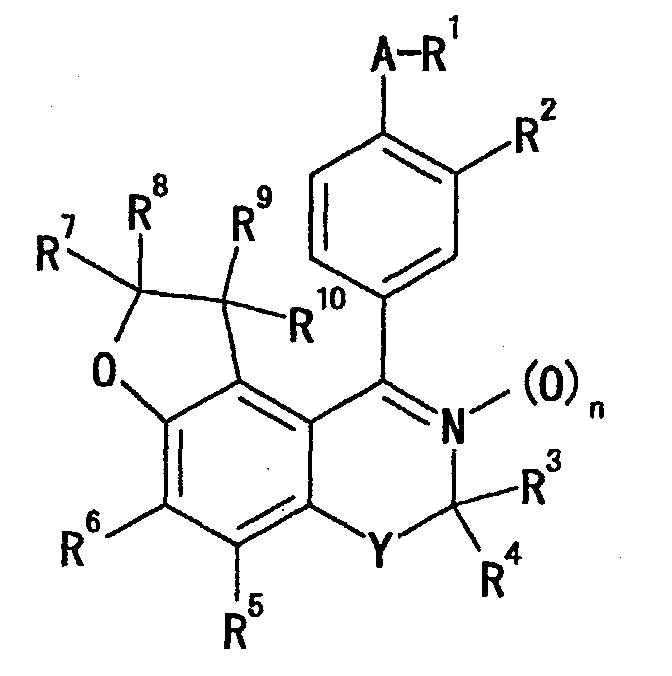
R1 is (1) a cyano group, (2) a carboxyl group, (3) a C1-6 alkoxycarbonyl group, (4) a carbamoyl group or (5) an N-mono-C1-6 alkylcarbamoyl group,
R2 is (1) a hydroxyl group, (2) a C1-6 alkoxy group, (3) a C7-16 aralkyloxy group, (4) an amino group, (5) a mono-C1-6 alkylamino group which may have one substituent selected from carboxyl, carbamoyl, quinolyl, phenoxy and pyridyl, (6) a mono-C7-16 aralkylamino group which may have one substituent selected from a halogen atom, cyano, C1-6 alkoxy, carboxyl and C1-6 alkoxycarbonyl, (7) a mono-C6-14 arylamino group, (8) a mono-C1-6 alkylcarbonylamino group which may have 1 to 3 substituents selected from a halogen atom, thienyl and C1-6 alkoxycarbonyl-C1-6 alkylthio, (9) a mono-C1-6 alkylsulfonylamino group, (10) a mono-C6-14 arylcarbonylamino group which may have one substituent selected from C1-6 alkoxy and C1-6 alkylcarbonylamino, (11) a quinolylcarbonylamino group, (12) a pyridylcarbonylamino group which may have 1 or 2 halogen atoms, (13) an indolylcarbonylamino group, (14) a N-C1-6 alkyl-N-C1-6 alkylcarbonylamino group which may have 1 to 4 substituents selected from a halogen atom, C1-6 alkoxycarbonyl and quinolyl, (15) a N-C1-6 alkylcarbonyl-N-C7-16 aralkylamino group which may have 1 to 3 halogens, (16) a N-C1-6 alkyl-N-pyridylcarbonylamino group, (17) a C1-6 alkylideneamino group which may have one di-C1-6 alkylamino, (18) a mono-C1-6 alkylureido group which may have one C1-6 alkoxycarbonyl, (19) a di-C1-6 alkylureido group, (20) a mono-C6-14 arylureido group, (21) a 1-imidazolidinyl group which may have 1 to 3 substituents selected from C1-6 alkyl and oxo, (22) a C1-6 alkyl group, (23) a C1-6 alkoxycarbonyl group, (24) a nitro group or (25) a 1-pyrrolidinyl group, or
R2 and A or R1 may be taken together with the adjacent carbon atom to form a nitrogen-containing 5- to 7-membered ring which may have 1 to 3 substituents selected from (1) a hydroxyl group, (2) a C1-6 alkyl group which may have one C1-6 alkoxy-carbonyl, (3) C7-16 aralkyl group, (4) a C6-14 aryl group and (5) an oxo group,
R3 and R4 are each a C1-6 alkyl group,
R5 is a hydrogen atom,
R6 is a C2-6 alkoxy group,
R7 and R8 are each a C1-6 alkyl group,
R9 and R10 are each a hydrogen atom,
Y is a methylene group, and
n is 0, or a salt thereof; - [5] a compound represented by the formula
wherein A is (1) a group represented by the formula -CRa=CRb- (Ra and Rb each represent a hydrogen atom or a C1-6 alkyl group), (2) a group represented by the formula -(CONH)p-(C(Rc)(Rd))q- (Rc and Rd each represent a hydrogen atom or a C1-6 alkyl group, p represents 0 or 1 and q represents 1 or 2), (3) a group represented by the formula -CH2OCH2- or (4) a group represented by the formula -OCH2-,

R1 is (1) a carboxyl group, (2) a C1-6 alkoxycarbonyl group, (3) an N-mono-C1-6 alkylcarbamoyl group or (4) a carbamoyl group,
R2 is a hydrogen atom,
R3 and R4 are each a C1-6 alkyl group,
R5 is a hydrogen atom,
R6 is a C2-6 alkoxy group,
R7 and R8 are each a C1-6 alkyl group,
R9 and R10 are each a hydrogen atom,
Y is a methylene group, and
n is 0, or a salt thereof; - [6] the compound as described in the above-mentioned [4], wherein A is (1) a bond or (2) a group represented by the formula -CH=CH-;
- [7] the compound as described in the above-mentioned [5], wherein A is (1) a group represented by the formula -CH=CH-, (2) a group represented by the formula -(C(Rc) (Rd))- (Rc and Rd each represent a hydrogen atom or a C1-6 alkyl group) or (3) a group represented by the formula -CH2OCH2-;
- [8] the compound as described in the above-mentioned [4], wherein R1 is a carboxyl group or a carbamoyl group;
- [9] the compound as described in the above-mentioned [5], wherein R1 is a carboxyl group;
- [10] the compound as described in the above-mentioned [4], wherein R2 is (1) a C1-6 alkoxy group, (2) a mono-C1-6 alkylamino group, (3) a mono-C7-16 aralkylamino group, (4) a quinolylcarbonylamino group or (5) a pyridylcarbonylamino group;
- [11] the compound as described in the above-mentioned [4] or [5], wherein R3 and R4 are each methyl;
- [12] the compound as described in the above-mentioned [4] or [5], wherein R6 is ethoxy;
- [13] the compound as described in the above-mentioned [4] or [5], wherein R7 and R8 are each methyl;
- [14] the compound as described in the above-mentioned [4], which is 4-(6-ethoxy-3,4,8,9-tetrahydro-3,3,8,8-tetramethylfuro[2,3-h]isoquinolin-1-yl)-2-[(phenylmethyl)amino]benzoic acid, 4-(6-ethoxy-3,4,8,9-tetrahydro-3,3,8,8-tetramethylfuro[2,3-h]isoquinolin-1-yl)-2-(ethylamino)benzoic acid, (E)-3-[4-(6-ethoxy-3,4,8,9-tetrahydro-3,3,8,8-tetramethylfuro[2,3-h]isoquinolin-1-yl)-2-methoxyphenyl]-2-propenoic acid, 4-(6-ethoxy-3,4,8,9-tetrahydro-3,3,8,8-tetramethylfuro[2,3-h]isoquinolin-1-yl)-2-[(2-quinolinylcarbonyl)amino]benzoic acid, 4-(6-ethoxy-3,4,8,9-tetrahydro-3,3,8,8-tetramethylfuro[2,3-h]isoquinolin-1-yl)-2-[(2-pyridinylcarbonyl)amino]benzene acetic acid, N-[2-(aminocarbonyl)-5-(6-ethoxy-3,4,8,9-tetrahydro-3,3,8,8-tetramethylfuro[2,3-h]isoquinolin-1-yl)phenyl]-2-pyridinecarboxamide or a salt thereof;
- [15] the compound as described in the above-mentioned [5], which is [[4-(6-ethoxy-3,4,8,9-tetrahydro-3,3,8,8-tetramethylfuro[2,3-h]isoquinolin-1-yl)phenyl]methoxy]acetic acid, 4-(6-ethoxy-3,4,8,9-tetrahydro-3,3,8,8-tetramethylfuro[2,3-h]isoquinolin-1-yl)-α,α-dimethylbenzene acetic acid or a salt thereof;
- [16] the pharmaceutical composition comprising the compound as described in the above-mentioned [1] or a prodrug thereof;
- [17] the pharmaceutical composition as described in the above-mentioned [16], which is a phosphodiesterase IV inhibitor;
- [18] the pharmaceutical composition as described in the above-mentioned [16], which is a prophylactic and/or therapeutic agent against inflammatory diseases, atopic dermatitis, allergic rhinitis, asthma, chronic obstructive pulmonary diseases, chronic rheumatoid arthritis, autoimmune diseases, depression, Alzheimer's dementia, memory disorders, osteoporosis, diabetes or atherosclerosis;
- [19] a method of inhibiting phosphodiesterase IV which is characterized by administering to a mammal an effective amount of the compound as described in the above-mentioned [1] or a prodrug thereof;
- [20] a method of preventing and/or treating inflammatory diseases, atopic dermatitis, allergic rhinitis, asthma, chronic obstructive pulmonary diseases, chronic rheumatoid arthritis, autoimmune diseases, depression, Alzheimer's dementia, memory disorders, osteoporosis, diabetes or atherosclerosis which is characterized by administering to a mammal an effective amount of the compound as described in the above-mentioned [1] or a prodrug thereof;
- [21] use of the compound as described in the above-mentioned
- [1] or a prodrug thereof for manufacturing a phosphodiesterase IV inhibitor;
- [22] use of the compound as described in the above-mentioned [1] or a prodrug thereof for manufacturing a prophylactic and/or therapeutic agent against inflammatory diseases, atopic dermatitis, allergic rhinitis, asthma, chronic obstructive pulmonary diseases, chronic rheumatoid arthritis, autoimmune diseases, depression, Alzheimer's dementia, memory disorders, osteoporosis, diabetes or atherosclerosis; etc.
-
- In the above formulae, A is (1) a bond, (2) a group represented by the formula -CRa=CRb- (Ra and Rb each represent a hydrogen atom or a C1-6 alkyl group), (3) a group represented by the formula -(CONH)p-(C(Rc)(Rd))q- (Rc and Rd each represent a hydrogen atom or a C1-6 alkyl group, p represents 0 or 1 and q represents 1 or 2), (4) a group represented by the formula-CH2OCH2- or (5) a group represented by the formula -OCH2-.
- The C1-6 alkyl group represented by Ra, Rb, Rc and Rd includes, for example, methyl, ethyl, propyl, isopropyl, butyl, isobutyl, sec-butyl, tert-butyl, pentyl, hexyl and the like.
- The group represented by the "formula -CRa=CRb- (Ra and Rb each represent a hydrogen atom or a C1-6 alkyl group)" includes, for example, a group represented by -CH=CH-, -C(C1-6 alkyl)=CH-,-CH=C(C1-6 alkyl) - or -C(C1-6 alkyl)=C(C1-6 alkyl)-, and among these, preferably -CH=CH-, -C(C1-6 alkyl)=CH-, -CH=C(C1-6 alkyl)-, particularly preferably a group represented by -CH=CH-,-C(methyl)=CH- or -CH=C (methyl)-.
- The group represented by the "formula -(CONH)p-(C(Rc)(Rd))q- (Rc and Rd each represent a hydrogen atom or a C1-6 alkyl group, p is 0 or 1 and q is 1 or 2)" includes, for example, a group represented by -CH2-, -CH(C1-6 alkyl)-, -C(C1-6 alkyl) (C1-6 alkyl)-, -(CH2)2-, -(CH(C1-6 alkyl))2-, -(C(C1-6 alkyl) (C1-6 alkyl))2-, -CONH-CH2-, -CONH-CH(C1-6 alkyl)-, -CONH-C(C1-6 alkyl) (C1-6 alkyl)-, -CONH-(CH2)2-, -CONH-(CH(C1-6 alkyl))2- or -CONH-(C(C1-6 alkyl) (C1-6 alkyl))2-, and among these, preferably -CH2-, -C(C1-6 alkyl) (C1-6 alkyl)-, -(CH2)2-, -CONH-CH2-, -CONH-C(C1-6 alkyl) (C1-6 alkyl)-, particularly a group represented by -CH2-, -C(methyl)2-, -(CH2)2-, -CONH-CH2- or -CONH-C (methyl)2-.
- A is preferably (1) a bond, (2) a group represented by the formula -CH=CH-, (3) a group represented by the formula-C(Rc) (Rd)- (Rc and Rd each represent a hydrogen atom or a C1-6 alkyl group) or (4) a group represented by the formula -CH2OCH2-, and among these, more preferably (1) a bond, (2) a group represented by the formula -CH=CH-, (3) a group represented by the formula-C(methyl)2- or (4) a group represented by the formula -CH2OCH2-.
- In the above formulae, R1 is (1) a cyano group or (2) an optionally esterified or amidated carboxyl group.
- The "optionally esterified or amidated carboxyl group" represented by R1 includes, for example, (i) a carboxyl group, (ii) a C1-6 alkoxy-carbonyl group which may have 1 to 5 substituents selected from (1) a halogen atom, (2) a C1-3 alkylenedioxy group, (3) a nitro group, (4) a cyano group, (5) an optionally halogenated C1-6 alkyl group, (6) an optionally halogenated C2-6 alkenyl group, (7) an optionally halogenated C2-6 alkynyl group, (8) a C3-8 cycloalkyl group, (9) a C6-14 aryl group, (10) an optionally halogenated C1-6 alkoxy group, (11) an optionally halogenated C1-6 alkylthio group, (12) a hydroxyl group, (13) an amino group, (14) a mono-C1-6 alkylamino group, (15) a mono-C6-14 arylamino group, (16) a di-C1-6 alkylamino group, (17) a di-C6-14 arylamino group, (18) an acyl group selected from formyl, carboxyl, carbamoyl, C1-6 alkyl-carbonyl, C3-8 cycloalkyl-carbonyl, C1-6 alkoxy-carbonyl, C6-14 aryl-carbonyl, C7-16 aralkyl-carbonyl, C6-14 aryloxy-carbonyl, C7-16 aralkyloxy-carbonyl, 5- or 6-membered heterocyclic carbonyl containing 1 to 3 hetero atoms selected from a nitrogen atom, a sulfur atom and an oxygen atom in addition to carbon atoms, mono-C1-6 alkyl-carbamoyl, di-C1-6 alkyl-carbamoyl, mono-C6-14 aryl-carbamoyl, di-C6-14 aryl-carbamoyl, 5- or 6-membered heterocyclic carbamoyl containing 1 to 3 hetero atoms selected from a nitrogen atom, a sulfur atom and an oxygen atom in addition to carbon atoms, C1-6 alkyl-thiocarbonyl, C3-8 cycloalkyl-thiocarbonyl, C1-6 alkoxy-thiocarbonyl, C6-14 aryl-thiocarbonyl, C7-16 aralkyl-thiocarbonyl, C6-14 aryloxy-thiocarbonyl, C7-16 aralkyloxy-thiocarbonyl, 5- or 6-membered heterocyclic thiocarbonyl containing 1 to 3 hetero atoms selected from a nitrogen atom, a sulfur atom and an oxygen atom in addition to carbon atoms, thiocarbamoyl, mono-C1-6 alkyl-thiocarbamoyl, di-C1-6 alkyl-thiocarbamoyl, mono-C6-14 aryl-thiocarbamoyl, di-C6-14 aryl-thiocarbamoyl, 5- or 6-membered heterocyclic thiocarbamoyl containing 1 to 3 hetero atoms selected from a nitrogen atom, a sulfur atom and an oxygen atom in addition to carbon atoms, sulfamoyl, mono-C1-6 alkylsulfamoyl, di-C1-6 alkylsulfamoyl, C6-14 arylsulfamoyl, C1-6 alkylsulfonyl, C6-14 arylsulfonyl, C1-6 alkylsulfinyl, C6-14 arylsulfinyl, sulfino, sulfo, C1-6 alkoxysulfinyl, C6-14 aryloxysulfinyl, C1-6 alkoxysulfonyl and C6-14 aryloxysulfonyl, (19) an acylamino group selected from formylamino, C1-6 alkyl-carboxamide, C6-14 aryl-carboxamide, C1-6 alkoxy-carboxamide, C1-6 alkylsulfonylamino and C6-14 arylsulfonylamino,
- (20) an acyloxy group selected from C1-6 alkyl-carbonyloxy, C6-14 aryl-carbonyloxy, C1-6 alkoxy-carbonyloxy, mono-C1-6 alkyl-carbamoyloxy, di-C1-6 alkyl-carbamoyloxy, mono-C6-14 aryl-carbamoyloxy, di-C6-14 aryl-carbamoyloxy and nicotinoyloxy, (21) a 5- to 14-membered heterocyclic group containing 1 to 4 hetero atoms selected from a nitrogen atom, a sulfur atom and an oxygen atom in addition to carbon atoms, (22) a phosphono group, (23) a C6-14 aryloxy group, (24) a di-C1-6 alkoxy-phosphoryl group, (25) a C6-14 arylthio group, (26) a hydrazino group, (27) an imino group, (28) an oxo group (except the case that it forms a ring together with a hydrocarbon group), (29) a ureido group, (30) a C1-6 alkyl-ureido group, (31) a di-C1-6 alkyl-ureido group, (32) an oxide group and (33) a group formed by binding of 2 or 3 groups selected from (1) to (32) listed above and the like a group consisting of (hereinafter, abbreviated as Substituent group A), (iii) a C3-8 cycloalkyloxy-carbonyl group which may have 1 to 5 substituents selected from Substituent group A described above, (iv) a C7-16 aralkyloxy-carbonyl group which may have 1 to 5 substituents selected from Substituent group A described above, (v) a C6-14 aryloxy-carbonyl group which may have 1 to 5 substituents selected from Substituent group A described above, (vi) a carbamoyl group, (vii) a mono-C1-6 alkyl-carbamoyl group which may have 1 to 5 substituents selected from Substituent group A described above, (viii) a di-C1-6 alkyl-carbamoyl group which may have 1 to 5 substituents selected from Substituent group A described above, (ix) a mono-C6-14 aryl-carbamoyl group which may have 1 to 5 substituents selected from Substituent group A described above or (x) a di-C6-14 aryl-carbamoyl group which may have 1 to 5 substituents selected from Substituent group A described above and the like.
-
- The "halogen atom" in the above-mentioned Substituent group A includes, for example, fluorine, chlorine, bromine and iodine.
- The "C1-3 alkylenedioxy group" in the above-mentioned Substituent group A includes, for example, methylenedioxy, ethylenedioxy and propylenedioxy.
- The "optionally halogenated C1-6 alkyl group" in the above-mentioned Substituent group A is, for example, a C1-6 alkyl group (e.g., methyl, ethyl, propyl, isopropyl, butyl, isobutyl, sec-butyl, tert-butyl, pentyl, hexyl and the like) which may have 1 to 3 halogen atoms (e.g., fluorine, chlorine, bromine and iodine) and the like, and specifically methyl, chloromethyl, difluoromethyl, trichloromethyl, trifluoromethyl, ethyl, 2-bromoethyl, 2,2,2-trifluoroethyl, propyl, 3,3,3-trifluoropropyl, isopropyl, butyl, 4,4,4-trifluorobutyl, isobutyl, sec-butyl, tert-butyl, pentyl, isopentyl, neopentyl, 5,5,5-trifluoropentyl, hexyl, 6,6,6-trifluorohexyl or the like.
- The "optionally halogenated C2-6 alkenyl group" in the above-mentioned Substituent group A includes, for example, a C2-6 alkenyl group (e.g., vinyl, allyl, isopropenyl, 2-butenyl, 2-methyl-2-propenyl, 4-pentenyl, 5-hexenyl and the like) which may have 1 to 3 halogen atoms (e.g., fluorine, chlorine, bromine and iodine) and the like.
- The "optionally halogenated C2-6 alkynyl group" in the above-mentioned Substituent group A includes, for example, a C2-6 alkynyl group (e.g., propargyl, ethynyl, 2-butynyl, 2-hexynyl and the like) which may have 1 to 3 halogen atoms (e.g., fluorine, chlorine, bromine and iodine) and the like.
- The "C3-8 cycloalkyl group" in the above-mentioned Substituent group A includes, for example, cyclopropyl, cyclobutyl, cyclopentyl, cyclohexyl, cycloheptyl, cyclooctyl and the like.
- The "C6-14 aryl group" in the above-mentioned Substituent group A includes, for example, phenyl, 1-naphthyl, 2-naphthyl, 1-anthryl, 2-anthryl, 9-anthryl, 1-phenanthryl, 2-phenanthryl, 3-phenanthryl, 4-phenanthryl, 9-phenanthryl and the like.
- The "optionally halogenated C1-6 alkoxy group" in the above-mentioned Substituent group A includes, for example, a C1-6 alkoxy group (e.g., methoxy, ethoxy, propoxy, isopropoxy, n-butoxy, isobutoxy, sec-butoxy, tert-butoxy, pentyloxy, isopentyloxy, neopentyloxy and the like) which may have 1 to 3 halogen atoms (e.g., fluorine, chlorine, bromine and iodine) and the like, and specifically methoxy, ethoxy, propoxy, isopropoxy, butoxy, isobutoxy, sec-butoxy, tert-butoxy, trichloromethoxy, 3,3,3-trifluoropropoxy, 4,4,4-trifluorobutoxy, 5,5,5-trifluoropentyloxy, 6,6,6-trifluorohexyloxy and the like.
- The "optionally halogenated C1-6 alkylthio group" in the above-mentioned Substituent group A includes, for example, a C1-6 alkylthio group (e.g., methylthio, ethylthio, propylthio, isopropylthio, butylthio, isobutylthio, sec-butylthio, tert-butylthio and the like) which may have 1 to 3 halogen atoms (e.g., fluorine, chlorine, bromine and iodine) and the like, and specifically methylthio, difluoromethylthio, trifluoromethylthio, ethylthio, propylthio, isopropylthio, butylthio, 4,4,4-trifluorobutylthio, pentylthio, hexylthio and the like.
- The "mono-C1-6 alkylamino group" in the above-mentioned Substituent group A includes, for example, methylamino, ethylamino, propylamino, isopropylamino, butylamino and the like.
- The "mono-C6-14 arylamino group" in the above-mentioned Substituent group A includes, for example, phenylamino, 1-naphthylamino, 2-naphthylamino and the like.
- The "di-C1-6 alkylamino group" in the above-mentioned Substituent group A includes, for example, dimethylamino, diethylamino, dipropylamino, diisopropylamino, dibutylamino, ethylmethylamino and the like.
- The "di-C6-14 arylamino group" in the above-mentioned Substituent group A includes, for example, diphenylamino, di(2-naphthyl)amino and the like.
- The "C1-6 alkyl-carbonyl" as the "acyl group" in the above-mentioned Substituent group A includes, for example, acetyl, propionyl, butyryl, isobutyryl, valeryl, isovaleryl, pivaloyl and the like.
- The "C3-8 cycloalkyl-carbonyl" as the "acyl group" in the above-mentioned Substituent group A includes, for example, cyclopropyl-carbonyl, cyclobutyl-carbonyl, cyclopentyl-carbonyl, cyclohexyl-carbonyl, cycloheptyl-carbonyl, cyclooctyl-carbonyl and the like.
- The "C1-6 alkoxy-carbonyl" as the "acyl group" in the above-mentioned Substituent group A includes, for example, methoxy-carbonyl, ethoxy-carbonyl, propoxy-carbonyl, isopropoxy-carbonyl, n-butoxy-carbonyl, isobutoxy-carbonyl, sec-butoxy-carbonyl, tert-butoxy-carbonyl, pentyloxy-carbonyl, isopentyloxy-carbonyl, neopentyloxy-carbonyl and the like.
- The "C6-14 aryl-carbonyl" as the "acyl group" in the above-mentioned Substituent group A includes, for example, benzoyl, 1-naphthoyl, 2-naphthoyl and the like.
- The "C7-16 aralkyl-carbonyl" as the "acyl group" in the above-mentioned Substituent group A includes, for example, phenylacetyl, 3-phenylpropionyl and the like.
- The "C6-14 aryloxy-carbonyl" as the "acyl group" in the above-mentioned Substituent group A includes, for example, phenoxycarbonyl, 2-naphthyloxycarbonyl and the like.
- The "C7-16 aralkyloxy-carbonyl" as the "acyl group" in the above-mentioned Substituent group A includes, for example, benzyloxycarbonyl, 2-naphthyloxycarbonyl and the like.
- The "5- or 6-membered heterocyclic carbonyl containing 1 to 3 hetero atoms selected from a nitrogen atom, a sulfur atom and an oxygen atom in addition to carbon atoms" as the "acyl group" in the above-mentioned Substituent group A includes, for example, 1-pyrrolidinylcarbonyl, 4-piperidylcarbonyl, 1-piperazinylcarbonyl, 2-morpholinylcarbonyl, 4-pyridylcarbonyl, 3-thienylcarbonyl, 2-furylcarbonyl, 2-thiazolylcarbonyl and the like.
- The "mono-C1-6 alkyl-carbamoyl" as the "acyl group" in the above-mentioned Substituent group A includes, for example, methylcarbamoyl, ethylcarbamoyl and the like.
- The "di-C1-6 alkyl-carbamoyl" as the "acyl group" in the above-mentioned Substituent group A includes, for example, dimethylcarbamoyl, diethylcarbamoyl and the like.
- The "mono-C6-14 aryl-carbamoyl" as the "acyl group" in the above-mentioned Substituent group A includes, for example, phenylcarbamoyl, 2-naphthylcarbamoyl and the like.
- The "di-C6-14 aryl-carbamoyl" as the "acyl group" in the above-mentioned Substituent group A includes, for example, diphenylcarbamoyl and the like.
- The "5- or 6-membered heterocyclic carbamoyl containing 1 to 3 hetero atoms selected from a nitrogen atom, a sulfur atom and an oxygen atom in addition to carbon atoms" as the "acyl group" in the above-mentioned Substituent group A includes, for example, 1-pyrrolidinylcarbamoyl, 4-piperidylcarbamoyl, 1-piperazinylcarbamoyl, 2-morpholinylcarbamoyl, 4-pyridylcarbamoyl, 3-thienylcarbamoyl, 2-furylcarbamoyl, 2-thiazolylcarbamoyl and the like.
- The "C1-6 alkyl-thiocarbonyl" as the "acyl group" in the above-mentioned Substituent group A includes, for example, methylthiocarbonyl, ethylthiocarbonyl and the like.
- The "C3-8 cycloalkyl-thiocarbonyl" as the "acyl group" in the above-mentioned Substituent group A includes, for example, cyclopentylthiocarbonyl, cyclohexylthiocarbonyl and the like.
- The "C1-6 alkoxy-thiocarbonyl" as the "acyl group" in the above-mentioned Substituent group A includes, for example, methoxythiocarbonyl, ethoxythiocarbonyl, propoxythiocarbonyl, butoxythiocarbonyl and the like.
- The "C6-14 aryl-thiocarbonyl" as the "acyl group" in the above-mentioned Substituent group A includes, for example, phenylthiocarbonyl, 2-naphthylthiocarbonyl and the like.
- The "C7-16 aralkyl-thiocarbonyl" as the "acyl group" in the above-mentioned Substituent group A includes, for example, benzylthiocarbonyl, phenethylthiocarbonyl and the like.
- The "C6-14 aryloxy-thiocarbonyl" as the "acyl group" in the above-mentioned Substituent group A includes, for example, phenoxythiocarbonyl, 2-naphthyloxythiocarbonyl and the like.
- The "C7-16 aralkyloxy-thiocarbonyl" as the "acyl group" in the above-mentioned Substituent group A includes, for example, benzyloxythiocarbonyl, 2-naphthylmethyloxythiocarbonyl and the like.
- The "5- or 6-membered heterocyclic thiocarbonyl containing 1 to 3 hetero atoms selected from a nitrogen atom, a sulfur atom and an oxygen atom in addition to carbon atoms" as the "acyl group" in the above-mentioned Substituent group A includes, for example, 1-pyrrolidinylthiocarbonyl, 4-piperidylthiocarbonyl, 1-piperazinylthiocarbonyl, 2-morpholinylthiocarbonyl, 4-pyridylthiocarbonyl, 3-thienylthiocarbonyl, 2-furylthiocarbonyl, 2-thiazolylthiocarbonyl and the like.
- The "mono-C1-6 alkyl-thiocarbamoyl" as the "acyl group" in the above-mentioned Substituent group A includes, for example, methylthiocarbamoyl, ethylthiocarbamoyl and the like.
- The "di-C1-6 alkyl-thiocarbamoyl" as the "acyl group" in the above-mentioned Substituent group A includes, for example, dimethylthiocarbamoyl, diethylthiocarbamoyl and the like.
- The "mono-C6-14 aryl-thiocarbamoyl" as the "acyl group" in the above-mentioned Substituent group A includes, for example, phenylthiocarbamoyl, 2-naphthylthiocarbamoyl and the like.
- The "di-C6-14 aryl-thiocarbamoyl" as the "acyl group" in the above-mentioned Substituent group A includes, for example, diphenylthiocarbonyl and the like.
- The "5- or 6-membered heterocyclic thiocarbamoyl containing 1 to 3 hetero atoms selected from a nitrogen atom, a sulfur atom and an oxygen atom in addition to carbon atoms" as the "acyl group" in the above-mentioned Substituent group A includes, for example, 1-pyrrolidinylthiocarbamoyl, 4-piperidylthiocarbamoyl, 1-piperazinylthiocarbamoyl, 2-morpholinylthiocarbamoyl, 4-pyridylthiocarbamoyl, 3-thienylthiocarbamoyl, 2-furylthiocarbamoyl, 2-thiazolylthiocarbamoyl and the like.
- The "mono-C1-6 alkylsulfamoyl" as the "acyl group" in the above-mentioned Substituent group A includes, for example, methylsulfamoyl, ethylsulfamoyl and the like.
- The "di-C1-6 alkylsulfamoyl" as the "acyl group" in the above-mentioned Substituent group A includes, for example, dimethylsulfamoyl, diethylsulfamoyl and the like.
- The "C6-14 arylsulfamoyl" as the "acyl group" in the above-mentioned Substituent group A includes, for example, phenylsulfamoyl and the like.
- The "C1-6 alkylsulfonyl" as the "acyl group" in the above-mentioned Substituent group A includes, for example, methylsulfonyl, ethylsulfonyl and the like.
- The "C6-14 arylsulfonyl" as the "acyl group" in the above-mentioned Substituent group A includes, for example, phenylsulfonyl, 2-naphthylsulfonyl and the like.
- The "C1-6 alkylsulfinyl" as the "acyl group" in the above-mentioned Substituent group A includes, for example, methylsulfinyl, ethylsulfinyl and the like.
- The "C6-14 arylsulfinyl" as the "acyl group" in the above-mentioned Substituent group A includes, for example, phenylsulfinyl, 2-naphthylsulfinyl and the like.
- The "C1-6 alkoxysulfinyl" as the "acyl group" in the above-mentioned Substituent group A includes, for example, methoxysulfinyl, ethoxysulfinyl and the like.
- The "C6-14 aryloxysulfinyl" as the "acyl group" in the above-mentioned Substituent group A includes, for example, phenoxysulfinyl and the like.
- The "C1-6 alkoxysulfonyl" as the "acyl group" in the above-mentioned Substituent group A includes, for example, methoxysulfonyl, ethoxysulfonyl and the like.
- The "C6-14 aryloxysulfonyl" as the "acyl group" in the above-mentioned Substituent group A includes, for example, phenoxysulfonyl and the like.
- The "C1-6 alkyl-carboxamide" as the "acylamino group" in the above-mentioned Substituent group A includes, for example, acetamide, propionamide and the like.
- The "C6-14 aryl-carboxamide" as the "acylamino group" in the above-mentioned Substituent group A includes, for example, benzamide, 2-naphthylcarboxamide and the like.
- The "C1-6 alkoxy-carboxamide" as the "acylamino group" in the above-mentioned Substituent group A includes, for example, methoxycarboxamide, ethoxycarboxamide, isopropoxycarboxamide, tert-butoxycarboxamide and the like.
- The "C1-6 alkylsulfonylamino" as the "acylamino group" in the above-mentioned Substituent group A includes, for example, methylsulfonylamino, ethylsulfonylamino and the like.
- The "C6-14 arylsulfonylamino" as the "acylamino group" in the above-mentioned Substituent group A includes, for example, phenylsulfonylamino, 2-naphthylsulfonylamino and the like.
- The "C1-6 alkyl-carbonyloxy" as the "acyloxy group" in the above-mentioned Substituent group A includes, for example, acetyloxy, propionyloxy and the like.
- The "C6-14 aryl-carbonyloxy" as the "acyloxy group" in the above-mentioned Substituent group A includes, for example, benzoyloxy, 2-naphthoyloxy and the like.
- The "C1-6 alkoxy-carbonyloxy" as the "acyloxy group" in the above-mentioned Substituent group A includes, for example, methoxycarbonyloxy, ethoxycarbonyloxy, isopropoxycarbonyloxy, tert-butoxycarbonyloxy and the like.
- The "mono-C1-6 alkyl-carbamoyloxy" as the "acyloxy group" in the above-mentioned Substituent group A includes, for example, methylcarbamoyloxy, ethylcarbamoyloxy and the like.
- The "di-C1-6 alkyl-carbamoyloxy" as the "acyloxy group" in the above-mentioned Substituent group A includes, for example, dimethylcarbamoyloxy, diethylcarbamoyloxy and the like.
- The "mono-C6-14 aryl-carbamoyloxy" as the "acyloxy group" in the above-mentioned Substituent group A includes, for example, phenylcarbamoyloxy, 2-naphthylcarbamoyloxy and the like.
- The "di-C6-14 aryl-carbamoyloxy" as the "acyloxy group" in the above-mentioned Substituent group A includes, for example, diphenylcarbamoyloxy and the like.
- The "5- to 14-membered heterocyclic group containing 1 to 4 hetero atoms selected from a nitrogen atom, a sulfur atom and an oxygen atom in addition to carbon atoms" in the above-mentioned Substituent group A includes, for example, 4-pyridyl, 2-thienyl, 2-furyl, 2-thiazolyl, 3-indolyl, morpholino, piperazin-1-yl, piperidino, pyrrolidin-1-yl, 2-isoindolinyl and the like.
- The "C6-14 aryloxy group" in the above-mentioned Substituent group A includes, for example, phenoxy.
- The "di-C1-6 alkoxy-phosphoryl group" in the above-mentioned Substituent group A includes, for example, dimethoxyphosphoryl, diethoxyphosphoryl and the like.
- The "C6-14 arylthio group" in the above-mentioned Substituent group A includes, for example, phenylthio and the like.
- The "C1-6 alkyl-ureido group" in the above-mentioned Substituent group A includes, for example, methylureido, ethylureido and the like.
- The "di-C1-6 alkyl-ureido group" in the above-mentioned Substituent group A includes, for example, dimethylureido, diethylureido and the like.
- The "C1-6 alkoxy-carbonyl group" of the "C1-6 alkoxy-carbonyl group which may have 1 to 5 substituents selected from the above-mentioned Substituent group A " as the "optionally esterified or amidated carboxyl group" represented by R1 includes, for example, for example, methoxy-carbonyl, ethoxy-carbonyl, propoxy-carbonyl, isopropoxy-carbonyl, n-butoxy-carbonyl, isobutoxy-carbonyl, sec-butoxy-carbonyl, tert-butoxy-carbonyl, pentyloxy-carbonyl, isopentyloxy-carbonyl, neopentyloxy-carbonyl and the like.
- The "C3-8 cycloalkyloxy-carbonyl group" of the "C3-8 cycloalkyloxy-carbonyl group which may have 1 to 5 substituents selected from Substituent group A described above" as the "optionally esterified or amidated carboxyl group" represented by R1 includes, for example, cyclopropyloxy-carbonyl, cyclobutyloxy-carbonyl, cyclopentyloxy-carbonyl, cyclohexyloxy-carbonyl, cycloheptyloxy-carbonyl, cyclooctyloxy-carbonyl and the like.
- The "C7-16 aralkyloxy-carbonyl group" of the "C7-16 aralkyloxy-carbonyl group which may have 1 to 5 substituents selected from Substituent group A described above" as the "optionally esterified or amidated carboxyl group" represented by R1 includes, for example, benzyloxycarbonyl, 2-naphthyloxycarbonyl and the like.
- The "C6-14 aryloxy-carbonyl group" of the "C6-14 aryloxy-carbonyl group which may have 1 to 5 substituents selected from Substituent group A described above" as the "optionally esterified or amidated carboxyl group" represented by R1 includes, for example, phenoxycarbonyl, 2-naphthyloxycarbonyl and the like.
- The "mono-C1-6 alkyl-carbamoyl group" of the "mono-C1-6 alkyl-carbamoyl group which may have 1 to 5 substituents selected from Substituent group A described above" as the "optionally esterified or amidated carboxyl group" represented by R1 includes, for example, methylcarbamoyl, ethylcarbamoyl and the like.
- The "di-C1-6 alkyl-carbamoyl group" of the "di-C1-6 alkyl-carbamoyl group which may have 1 to 5 substituents selected from Substituent group A described above" as the "optionally esterified or amidated carboxyl group" represented by R1 includes, for example, dimethylcarbamoyl, diethylcarbamoyl and the like.
- The "mono-C6-14 aryl-carbamoyl group" of the "mono-C6-14 aryl-carbamoyl group which may have 1 to 5 substituents selected from Substituent group A described above" as the "optionally esterified or amidated carboxyl group" represented by R1 includes, for example, phenylcarbamoyl, 2-naphthylcarbamoyl and the like.
- The "di-C6-14 aryl-carbamoyl group" of the "di-C6-14 aryl-carbamoyl group which may have 1 to 5 substituents selected from Substituent group A described above" as the "optionally esterified or amidated carboxyl group" represented by R1 includes, for example, diphenylcarbamoyl and the like.
- R1 is preferably (1) a cyano group, (2) a carboxyl group, (3) a C1-6 alkoxycarbonyl group, (4) a carbamoyl group, (5) an N-mono-C1-6 alkylcarbamoyl group, and among these, R1 is preferably carboxyl group or carbamoyl group.
- In the above formulae, R2 is (1) a hydrogen atom, (2) an optionally substituted hydroxyl group, (3) an optionally substituted amino group, (4) an optionally substituted alkyl group, (5) an optionally esterified or amidated carboxyl group or (6) a nitro group.
- The "optionally substituted hydroxyl group" represented by R2 includes, for example, a group represented by the formula -OR12 (R12 is (a) a hydrogen atom, (b) a C1-6 alkyl group, a C2-6 alkenyl group, a C2-6 alkynyl group, a C3-8 cycloalkyl group, a C3-8 cycloalkenyl group, a C6-14 aryl group or a C7-16 aralkyl group, each of which may have 1 to 5 substituents selected from Substituent group A, or (c) an acyl group selected from formyl, carbamoyl, C1-6 alkyl-carbonyl, C3-8 cycloalkyl-carbonyl, C1-6 alkoxy-carbonyl, C6-14 aryl-carbonyl, C7-16 aralkyl-carbonyl, C6-14 aryloxy-carbonyl, C7-16 aralkyloxy-carbonyl, 5- or 6-membered heterocyclic carbonyl containing 1 to 3 hetero atoms selected from a nitrogen atom, a sulfur atom and an oxygen atom in addition to carbon atoms, mono-C1-6 alkyl-carbamoyl, di-C1-6 alkyl-carbamoyl, mono-C6-14 aryl-carbamoyl, di-C6-14 aryl-carbamoyl, 5- or 6-membered heterocyclic carbamoyl containing 1 to 3 hetero atoms selected from a nitrogen atom, a sulfur atom and an oxygen atom in addition to carbon atoms, C1-6 alkyl-thiocarbonyl, C3-8 cycloalkyl-thiocarbonyl, C1-6 alkoxy-thiocarbonyl, C6-14 aryl-thiocarbonyl, C7-16 aralkyl-thiocarbonyl, C6-14 aryloxy-thiocarbonyl, C7-16 aralkyloxy-thiocarbonyl, 5- or 6-membered heterocyclic thiocarbonyl containing 1 to 3 hetero atoms selected from a nitrogen atom, a sulfur atom and an oxygen atom in addition to carbon atoms, thiocarbamoyl, mono-C1-6 alkyl-thiocarbamoyl, di-C1-6 alkyl-thiocarbamoyl, mono-C6-14 aryl-thiocarbamoyl, di-C6-14 aryl-thiocarbamoyl, 5- or 6-membered heterocyclic thiocarbamoyl containing 1 to 3 hetero atoms selected from a nitrogen atom, a sulfur atom and an oxygen atom in addition to carbon atoms, sulfamoyl, mono-C1-6 alkylsulfamoyl, di-C1-6 alkylsulfamoyl, C6-14 arylsulfamoyl, C1-6 alkylsulfonyl, C6-14 arylsulfonyl, C1-6 alkylsulfinyl, C6-14 arylsulfinyl, C1-6 alkoxysulfinyl, C6-14 aryloxysulfinyl, C1-6 alkoxysulfonyl and C6-14 aryloxysulfonyl, each of which may have 1 to 5 substituents selected from Substituent group A described above).
- The C1-6 alkyl group, a C2-6 alkenyl group, a C2-6 alkynyl group, a C3-8 cycloalkyl group, a C3-8 cycloalkenyl group, a C6-14 aryl group or a C7-16 aralkyl group of the "C1-6 alkyl group, the C2-6 alkenyl group, the C2-6 alkynyl group, the C3-8 cycloalkyl group, the C3-8 cycloalkenyl group, the C6-14 aryl group or the C7-16 aralkyl group, each of which may have 1 to 5 substituents selected from Substituent group A" represented by R12 includes, for example, the followings:
- a C1-6 alkyl group: methyl, ethyl, propyl, isopropyl, butyl, isobutyl, sec-butyl, tert-butyl, pentyl, hexyl and the like;
- a C2-6 alkenyl group: vinyl, allyl, isopropenyl, 2-butenyl, 2-methyl-2-propenyl, 4-pentenyl, 5-hexenyl and the like;
- a C2-6 alkynyl group: propargyl, ethynyl, 2-butynyl, 2-hexynyl and the like;
- a C3-8 cycloalkyl group: cyclopropyl, cyclobutyl, cyclopentyl, cyclohexyl, cycloheptyl, cyclooctyl and the like;
- a C3-8 cycloalkenyl group: 1-cyclopropenyl, 1-cyclobutenyl, 1-cyclopentenyl, 1-cyclohexenyl and the like;
- a C6-14 aryl group: phenyl, 1-naphthyl, 2-naphthyl, 1-anthryl, 2-anthryl, 9-anthryl, 1-phenanthryl, 2-phenanthryl, 3-phenanthryl, 4-phenanthryl, 9-phenanthryl and the like; and
- a C7-16 aralkyl group: benzyl, phenethyl, diphenylmethyl, 1-naphthylmethyl, 2-naphthylmethyl, 2-phenethyl, 2,2-diphenylethyl, 1-phenylpropyl, 2-phenylpropyl, 3-phenylpropyl, 4-phenylbutyl, 5-phenylpentyl, biphenylylmethyl, biphenylylethyl, biphenylylpropyl, biphenylylbutyl and the like.
-
- The "C1-6 alkyl-carbonyl", the "C3-8 cycloalkyl-carbonyl", the "C1-6 alkoxy-carbonyl", the "C6-14 aryl-carbonyl", the "C7-16 aralkyl-carbonyl", the "C6-14 aryloxy-carbonyl", the "C7-16 aralkyloxy-carbonyl", the "5- or 6-membered heterocyclic carbonyl containing 1 to 3 hetero atoms selected from a nitrogen atom, a sulfur atom and an oxygen atom in addition to carbon atoms", the "mono-C1-6 alkyl-carbamoyl", the "di-C1-6 alkyl-carbamoyl", the "mono-C6-14 aryl-carbamoyl", the "di-C6-14 aryl-carbamoyl", the "5- or 6-membered heterocyclic carbamoyl containing 1 to 3 hetero atoms selected from a nitrogen atom, a sulfur atom and an oxygen atom in addition to carbon atoms", the "C1-6 alkyl-thiocarbonyl", the "C3-8 cycloalkyl-thiocarbonyl", the "C1-6 alkoxy-thiocarbonyl", the "C6-14 aryl-thiocarbonyl", the "C7-16 aralkyl-thiocarbonyl", the "C6-14 aryloxy-thiocarbonyl", the "C7-16 aralkyloxy-thiocarbonyl", the "5- or 6-membered heterocyclic thiocarbonyl containing 1 to 3 hetero atoms selected from a nitrogen atom, a sulfur atom and an oxygen atom in addition to carbon atoms", the "mono-C1-6 alkyl-thiocarbamoyl", the "di-C1-6 alkyl-thiocarbamoyl", the "mono-C6-14 aryl-thiocarbamoyl", the "di-C6-14 aryl-thiocarbamoyl", the "5- or 6-membered heterocyclic thiocarbamoyl containing 1 to 3 hetero atoms selected from a nitrogen atom, a sulfur atom and an oxygen atom in addition to carbon atoms", the "mono-C1-6 alkylsulfamoyl", the "di-C1-6 alkylsulfamoyl", the "C6-14 arylsulfamoyl", the "C1-6 alkylsulfonyl", the "C6-14 arylsulfonyl", the "C1-6 alkylsulfinyl", the "C6-14 arylsulfinyl", the "C1-6 alkoxysulfinyl", the "C6-14 aryloxysulfinyl", the "C1-6 alkoxysulfonyl" and the "C6-14 aryloxysulfonyl" as the acyl group of the "acyl group which may have 1 to 5 substituents selected from Substituent group A described above" represented by R12, includes those such as the "C1-6 alkyl-carbonyl", the "C3-8 cycloalkyl-carbonyl", the "C1-6 alkoxy-carbonyl", the "C6-14 aryl-carbonyl", the "C7-16 aralkyl-carbonyl", the "C6-14 aryloxy-carbonyl", the "C7-16 aralkyloxy-carbonyl", the "5- or 6-membered heterocyclic carbonyl containing 1 to 3 hetero atoms selected from a nitrogen atom, a sulfur atom and an oxygen atom in addition to carbon atoms", the "mono-C1-6 alkyl-carbamoyl", the "di-C1-6 alkyl-carbamoyl", the "mono-C6-14 aryl-carbamoyl", the "di-C6-14 aryl-carbamoyl", the "5- or 6-membered heterocyclic carbamoyl containing 1 to 3 hetero atoms selected from a nitrogen atom, a sulfur atom and an oxygen atom in addition to carbon atoms", the "C1-6 alkyl-thiocarbonyl", the "C3-8 cycloalkyl-thiocarbonyl", the "C1-6 alkoxy-thiocarbonyl", the "C6-14 aryl-thiocarbonyl", the "C7-16 aralkyl-thiocarbonyl", the "C6-14 aryloxy-thiocarbonyl", the "C7-16 aralkyloxy-thiocarbonyl", the "5- or 6-membered heterocyclic thiocarbonyl containing 1 to 3 hetero atoms selected from a nitrogen atom, a sulfur atom and an oxygen atom in addition to carbon atoms", the "mono-C1-6 alkyl-thiocarbamoyl", the "di-C1-6 alkyl-thiocarbamoyl", the "mono-C6-14 aryl-thiocarbamoyl", the "di-C6-14 aryl-thiocarbamoyl", the "5- or 6-membered heterocyclic thiocarbamoyl containing 1 to 3 hetero atoms selected from a nitrogen atom, a sulfur atom and an oxygen atom in addition to carbon atoms", the "mono-C1-6 alkylsulfamoyl", the "di-C1-6 alkylsulfamoyl", the "C6-14 arylsulfamoyl", the "C1-6 alkylsulfonyl", the "C6-14 arylsulfonyl", the "C1-6 alkylsulfinyl", the "C6-14 arylsulfinyl", the "C1-6 alkoxysulfinyl", the "C6-14 aryloxysulfinyl", the "C1-6 alkoxysulfonyl" and the "C6-14 aryloxysulfonyl" in the acyl group of the above-mentioned Substituent group A.
- The "optionally substituted amino group" represented by R2 includes, for example, (1) a group represented by the formula-NR13R14 (R13 and R14 each represent (i') a hydrogen atom, (ii') a C1-6 alkyl group, a C2-6 alkenyl group, a C2-6 alkynyl group, a C3-8 cycloalkyl group, a C3-8 cycloalkenyl group, a C6-14 aryl group or a C7-16 aralkyl group, each of which may have 1 to 5 substituents selected from Substituent group A, (iii') an acyl group selected from formyl, carbamoyl, C1-6 alkyl-carbonyl, C3-8 cycloalkyl-carbonyl, C1-6 alkoxy-carbonyl, C6-14 aryl-carbonyl, C7-16 aralkyl-carbonyl, C6-14 aryloxy-carbonyl, C7-16 aralkyloxy-carbonyl, 5- or 6-membered heterocyclic carbonyl containing 1 to 3 hetero atoms selected from a nitrogen atom, a sulfur atom and an oxygen atom in addition to carbon atoms, mono-C1-6 alkyl-carbamoyl, di-C1-6 alkyl-carbamoyl, mono-C6-14 aryl-carbamoyl, di-C6-14 aryl-carbamoyl, 5- or 6-membered heterocyclic carbamoyl containing 1 to 3 hetero atoms selected from a nitrogen atom, a sulfur atom and an oxygen atom in addition to carbon atoms, C1-6 alkyl-thiocarbonyl, C3-8 cycloalkyl-thiocarbonyl, C1-6 alkoxy-thiocarbonyl, C6-14 aryl-thiocarbonyl, C7-16 aralkyl-thiocarbonyl, C6-14 aryloxy-thiocarbonyl, C7-16 aralkyloxy-thiocarbonyl, 5- or 6-membered heterocyclic thiocarbonyl containing 1 to 3 hetero atoms selected from a nitrogen atom, a sulfur atom and an oxygen atom in addition to carbon atoms, thiocarbamoyl, mono-C1-6 alkyl-thiocarbamoyl, di-C1-6 alkyl-thiocarbamoyl, mono-C6-14 aryl-thiocarbamoyl, di-C6-14 aryl-thiocarbamoyl, 5- or 6-membered heterocyclic thiocarbamoyl containing 1 to 3 hetero atoms selected from a nitrogen atom, a sulfur atom and an oxygen atom in addition to carbon atoms, sulfamoyl, mono-C1-6 alkylsulfamoyl, di-C1-6 alkylsulfamoyl, C6-14 arylsulfamoyl, C1-6 alkylsulfonyl, C6-14 arylsulfonyl, C1-6 alkylsulfinyl, C6-14 arylsulfinyl, C1-6 alkoxysulfinyl, C6-14 aryloxysulfinyl, C1-6 alkoxysulfonyl and C6-14 aryloxysulfonyl, each of which may have 1 to 5 substituents selected from Substituent group A described above or (iv') a 5- to 14-membered heterocycle containing 1 to 4 hetero atoms selected from a nitrogen atom, a sulfur atom and an oxygen atom in addition to carbon atoms, each of which may have 1 to 5 substituents selected from Substituent group A described above, or R13 and R14 may be taken together with the adjacent a nitrogen atom to form a 5- to 14-membered ring), (2) a C1-6 alkylideneamino group which may have 1 to 5 substituents selected from Substituent group A described above (e.g., methylideneamino, ethylideneamino and the like) and the like.
- "The C1-6 alkyl group, the C2-6 alkenyl group, the C2-6 alkynyl group, the C3-8 cycloalkyl group, the C3-8 cycloalkenyl group, the C6-14 aryl group or the C7-16 aralkyl group, each of which may have 1 to 5 substituents selected from Substituent group A" represented by R13 and R14 includes those such as the above-mentioned "C1-6 alkyl group, a C2-6 alkenyl group, a C2-6 alkynyl group, a C3-8 cycloalkyl group, a C3-8 cycloalkenyl group, a C6-14 aryl group or a C7-16 aralkyl group, each of which may have 1 to 5 substituents selected from Substituent group A" represented by R12.
- The "acyl group which may have 1 to 5 substituents selected from Substituent group A described above" represented by R13 and R14 includes those such as the above-mentioned "acyl group which may have 1 to 5 substituents selected from Substituent group A described above" represented by R12.
- The "5- to 14-membered heterocycle containing 1 to 4 hetero atoms selected from a nitrogen atom, a sulfur atom and an oxygen atom in addition to carbon atoms " of the "5- to 14-membered heterocycle containing 1 to 4 hetero atoms selected from a nitrogen atom, a sulfur atom and an oxygen atom in addition to carbon atoms, each of which may have 1 to 5 substituents selected from Substituent group A described above" represented by R13 and R14 includes, for example, 4-pyridyl, 2-thienyl, 2-furyl, 2-thiazolyl, 3-indolyl, morpholino, piperazin-1-yl, piperidino, pyrrolidin-1-yl, 2-isoindolinyl and the like.
- The 5- to 14-membered ring which R13 and R14 may form together with the adjacent nitrogen atom includes, for example, 1-pyrrolidinyl, 1-piperidyl, 1-piperazinyl, 4-morpholinyl, 4-thiomorpholinyl, 1,2-dihydropyridin-1-yl, 1-imidazolidinyl and the like.
- The "optionally substituted alkyl group" represented by R2 includes, for example, a C1-6 alkyl group which may have 1 to 5 substituents selected from Substituent group A described above and the like. The C1-6 alkyl group includes, for example, methyl, ethyl, propyl, isopropyl, butyl, isobutyl, sec-butyl, tert-butyl, pentyl, hexyl and the like.
- The "optionally esterified or amidated carboxyl group" represented by R2 includes, for example, those such as the "optionally esterified or amidated carboxyl group" represented by R1.
- R2 is preferably (1) a hydrogen atom, (2) a hydroxyl group, (3) a C1-6 alkoxy group, (4) a C7-16 aralkyloxy group, (5) an amino group, (6) a mono-C1-6 alkylamino group which may have one substituent selected from carboxyl, carbamoyl, quinolyl, phenoxy and pyridyl, (7) a mono-C7-16 aralkylamino group which may have one substituent selected from a halogen atom, cyano, C1-6 alkoxy, carboxyl and C1-6 alkoxycarbonyl, (8) a mono-C6-14 arylamino group, (9) a mono-C1-6 alkylcarbonylamino group which may have 1 to 3 substituents selected from a halogen atom, thienyl and C1-6 alkoxycarbonyl-C1-6 alkylthio, (10) a mono-C1-6 alkylsulfonylamino group, (11) a mono-C6-14 arylcarbonylamino group which may have one substituent selected from C1-6 alkoxy and C1-6 alkylcarbonylamino, (12) a quinolylcarbonylamino group, (13) a pyridylcarbonylamino group which may have 1 or 2 halogen atoms, (14) an indolylcarbonylamino group, (15) a N-C1-6 alkyl-N-C1-6 alkylcarbonylamino group which may have 1 to 4 substituents selected from a halogen atom, C1-6 alkoxycarbonyl and quinolyl, (16) a N-C1-6 alkylcarbonyl-N-C7-16 aralkylamino group which may have 1 to 3 halogens, (17) a N-C1-6 alkyl-N-pyridylcarbonylamino group, (18) a C1-6 alkylideneamino group which may have one di-C1-6 alkylamino, (19) a mono-C1-6 alkylureido group which may have one C1-6 alkoxycarbonyl, (20) a di-C1-6 alkylureido group, (21) a mono-C6-14 arylureido group, (22) a 1-imidazolidinyl group which may have 1 to 3 substituents selected from C1-6 alkyl and oxo, (23) a C1-6 alkyl group, (24) a C1-6 alkoxycarbonyl group, (25) a nitro group or (26) a 1-pyrrolidinyl group. Among these, R2 is preferably (1) a hydrogen atom, (2) a C1-6 alkoxy group, (3) a mono-C1-6 alkylamino group, (4) a mono-C7-16 aralkylamino group, (5) a quinolylcarbonylamino group or (6) a pyridylcarbonylamino group.
- The ring which R2 and A or R1 may form together with the adjacent nitrogen atom includes, for example, a 5- to 8-membered heterocycle which may have 1 to 5 substituents selected from Substituent group A described above.
- The "5- to 8-membered heterocycle" is a 5- to 8-membered heterocycle (preferably a 5- to 7-membered aliphatic heterocycle) containing one or more (e.g., 1 to 4, preferably 1 to 3) hetero atoms of one or two kinds selected from a nitrogen atom, a sulfur atom and an oxygen atom in addition to carbon atoms and the like.
- Specifically, a partial structure represented by the formulamay have, for example, the structure represented by the formula
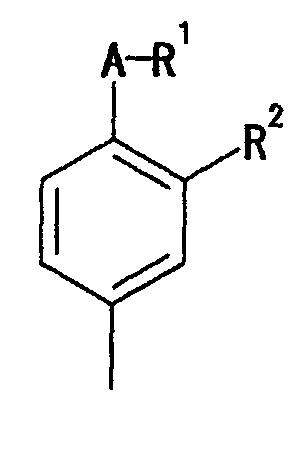 [wherein Rings B to G may have 1 to 5 substituents selected from the above-mentioned Substituent group A] and the like.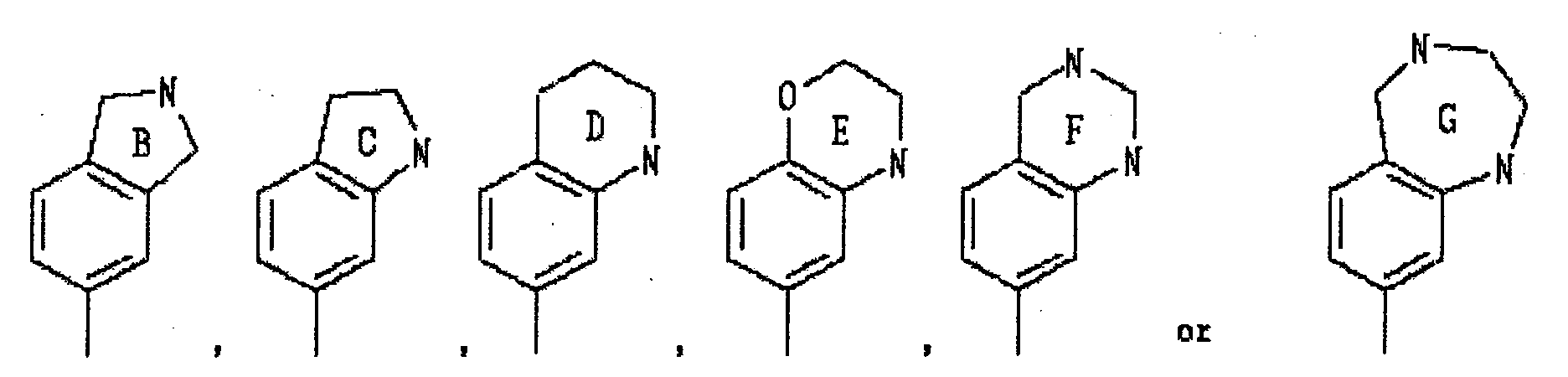
- The substituent which the ring that R2 and A or R1 may form together with the adjacent nitrogen atom, may have is preferably, for example, (1) a hydroxyl group, (2) a C1-6 alkyl group which may have one C1-6 alkoxy-carbonyl (e.g., methyl, ethyl, propyl, butyl, isobutyl, sec-butyl, tert-butyl, pentyl, hexyl, methoxycarbonylmethyl, ethoxycarbonylmethyl and the like), (3) a C7-16 aralkyl group (e.g., benzyl and the like), (4) a C6-14 aryl group (e.g., phenyl and the like), (5) an oxo group and the like.
- R3 and R4 each represent (1) a hydrogen atom, (2) an optionally substituted hydrocarbon group or (3) an acyl group, and R3 and R4 may be taken together with the adjacent carbon atom to form an optionally substituted 3- to 8-membered ring.
- The "optionally substituted hydrocarbon group" represented by R3 and R4 includes, for example, a C1-6 alkyl group (e.g., methyl, ethyl, propyl, isopropyl, butyl, isobutyl, sec-butyl, tert-butyl, pentyl, hexyl and the like), a C2-6 alkenyl group (e.g., vinyl, allyl, isopropenyl, 2-butenyl, 2-methyl-2-propenyl, 4-pentenyl, 5-hexenyl and the like), a C2-6 alkynyl group (e.g., propargyl, ethynyl, 2-butynyl, 2-hexynyl and the like), a C3-8 cycloalkyl group (e.g., cyclopropyl, cyclobutyl, cyclopentyl, cyclohexyl, cycloheptyl, cyclooctyl and the like), a C3-8 cycloalkenyl group (e.g., 1-cyclopropenyl, 1-cyclobutenyl, 1-cyclopentenyl, 1-cyclohexenyl and the like), a C6-14 aryl group (e.g. , phenyl, 1-naphthyl, 2-naphthyl, 1-anthryl, 2-anthryl, 9-anthryl, 1-phenanthryl, 2-phenanthryl, 3-phenanthryl, 4-phenanthryl, 9-phenanthryl and the like) or a C7-16 aralkyl group (e.g., benzyl, phenethyl, diphenylmethyl, 1-naphthylmethyl, 2-naphthylmethyl, 2-phenethyl, 2,2-diphenylethyl, 1-phenylpropyl, 2-phenylpropyl, 3-phenylpropyl, 4-phenylbutyl and 5-phenylpentyl), each of which may have 1 to 5 substituents selected from Substituent group A described above and the like.
- The "acyl group" represented by R3 and R4 includes those such as the above-mentioned "acyl group" represented by Substituent group A.
- The 3- to 8-membered ring which R3 and R4 form together with the adjacent carbon atom includes, for example, a 3- to 8-membered homocycle or heterocycle.
- The 3- to 8-membered homocycle which R3 and R4 form together with the adjacent carbon atom includes 3- to 8-membered cyclic hydrocarbon comprising carbon atoms and hydrogen atoms, and specifically C3-8 cycloalkane (e.g., cyclobutane, cyclopentane, cyclohexane, cycloheptane and cyclooctane), C3-8 cycloalkene (e.g., cyclobutene, cyclopentene, cyclohexene, cycloheptene, cyclooctene) and the like. Among these, the 3- to 8-membered homocycle is preferably C3-8 cycloalkane, particularly a 5- or 6-membered homocycle such as cyclopentane, cyclohexane and the like (particularly, cyclohexane).
- The 3- to 8-membered heterocycle which R3 and R4 form together with the adjacent carbon atom includes a 5- to 8-membered aliphatic heterocycle (preferably a 5- or 6-membered aliphatic heterocycle) containing one or more (e.g., 1 to 4, preferably 1 to 3) hetero atoms of one or two kinds selected from a nitrogen atom, a sulfur atom and an oxygen atom in addition to carbon atoms and the like.
- More specifically, it is, for example, a 5- to 8-membered (preferably 5- or 6-membered) aliphatic heterocycle containing 1 to 3 hetero atoms selected from a nitrogen atom, an oxygen atom and a sulfur atom such as piperidine, piperazine, morpholine, thiomorpholine, pyrrolidine, imidazolidine and the like such as in addition to carbon atoms and nitrogen atoms and the like.
- R3 and R4 are preferably a C1-6 alkyl group, particularly methyl, respectively.
- In the above formulae, R5 is (1) a hydrogen atom, (2) a cyano group, (3) an optionally substituted hydrocarbon group, (4) an acyl group or (5) an optionally substituted hydroxyl group.
- The "optionally substituted hydrocarbon group" represented by R5 includes those such as the above-mentioned "optionally substituted hydrocarbon group" represented by R3 and R4.
- The "acyl group" represented by R5 includes those such as the above-mentioned "acyl group" represented by Substituent group A.
- The "optionally substituted hydroxyl group" represented by R5 includes, for example, a group represented by the formula -OR15 (R15 is (a) a hydrogen atom, (b) a C1-6 alkyl group, a C2-6 alkenyl group, a C2-6 alkynyl group, a C3-8 cycloalkyl group, a C3-8 cycloalkenyl group, a C6-14 aryl group or a C7-16 aralkyl group, each of which may have 1 to 5 substituents selected from Substituent group A, or (c) an acyl group selected from formyl, carbamoyl, C1-6 alkyl-carbonyl, C3-8 cycloalkyl-carbonyl, C1-6 alkoxy-carbonyl, C6-14 aryl-carbonyl, C7-16 aralkyl-carbonyl, C6-14 aryloxy-carbonyl, C7-16 aralkyloxy-carbonyl, 5- or 6-membered heterocyclic carbonyl containing 1 to 3 hetero atoms selected from a nitrogen atom, a sulfur atom and an oxygen atom in addition to carbon atoms, mono-C1-6 alkyl-carbamoyl, di-C1-6 alkyl-carbamoyl, mono-C6-14 aryl-carbamoyl, di-C6-14 aryl-carbamoyl, 5- or 6-membered heterocyclic carbamoyl containing 1 to 3 hetero atoms selected from a nitrogen atom, a sulfur atom and an oxygen atom in addition to carbon atoms, C1-6 alkyl-thiocarbonyl, C3-8 cycloalkyl-thiocarbonyl, C1-6 alkoxy-thiocarbonyl, C6-14 aryl-thiocarbonyl, C7-16 aralkyl-thiocarbonyl, C6-14 aryloxy-thiocarbonyl, C7-16 aralkyloxy-thiocarbonyl, 5- or 6-membered heterocyclic thiocarbonyl containing 1 to 3 hetero atoms selected from a nitrogen atom, a sulfur atom and an oxygen atom in addition to carbon atoms, thiocarbamoyl, mono-C1-6 alkyl-thiocarbamoyl, di-C1-6 alkyl-thiocarbamoyl, mono-C6-14 aryl-thiocarbamoyl, di-C6-14 aryl-thiocarbamoyl, 5- or 6-membered heterocyclic thiocarbamoyl containing 1 to 3 hetero atoms selected from a nitrogen atom, a sulfur atom and an oxygen atom in addition to carbon atoms, sulfamoyl, mono-C1-6 alkylsulfamoyl, di-C1-6 alkylsulfamoyl, C6-14 arylsulfamoyl, C1-6 alkylsulfonyl, C6-14 arylsulfonyl, C1-6 alkylsulfinyl, C6-14 arylsulfinyl, C1-6 alkoxysulfinyl, C6-14 aryloxysulfinyl, C1-6 alkoxysulfonyl and C6-14 aryloxysulfonyl, each of which may have 1 to 5 substituents selected from Substituent group A described above) and the like.
- "The C1-6 alkyl group, the C2-6 alkenyl group, the C2-6 alkynyl group, the C3-8 cycloalkyl group, the C3-8 cycloalkenyl group, the C6-14 aryl group or the C7-16 aralkyl group, each of which may have 1 to 5 substituents selected from Substituent group A" and the "acyl group which may have 1 to 5 substituents selected from Substituent group A described above" represented by R15 include those such as the above-mentioned "the C1-6 alkyl group, the C2-6 alkenyl group, the C2-6 alkynyl group, the C3-8 cycloalkyl group, the C3-8 cycloalkenyl group, the C6-14 aryl group or the C7-16 aralkyl group, each of which may have 1 to 5 substituents selected from Substituent group A" and the "acyl group which may have 1 to 5 substituents selected from Substituent group A described above" represented by R12.
- R5 is preferably a hydrogen atom or a C1-6 alkyl group optionally substituted with a cyano group, particularly preferably a hydrogen atom.
- In the above formulae, R6 is (1) a hydrogen atom, (2) an optionally substituted hydrocarbon group, (3) an acyl group, (4) an optionally substituted heterocyclic group, (5) a halogen atom, (6) an optionally substituted hydroxyl group, (7) an optionally substituted thiol group, (8) a group represented by the formula-S(O)rR11 (R11 represents an optionally substituted hydrocarbon group or an optionally substituted heterocyclic group, and r represents 1 or 2) or (9) an optionally substituted amino group.
- The "optionally substituted hydrocarbon group" represented by R6 includes those such as the above-mentioned "optionally substituted hydrocarbon group" represented by R3 and R4.
- The "acyl group" represented by R6 includes those such as the above-mentioned "acyl group" represented by Substituent group A.
- The "heterocyclic group" of the "optionally substituted heterocyclic group" represented by R6 includes, for example, a 5- to 14-membered heterocyclic group containing 1 to 4 hetero atoms selected from a nitrogen atom, a sulfur atom and an oxygen atom in addition to carbon atoms (e.g., 4-pyridyl, 2-thienyl, 2-furyl, 2-thiazolyl, 3-indolyl, morpholino, piperazin-1-yl, piperidino, pyrrolidin-1-yl, 2-isoindolinyl and the like).
- The "substituent" of the "optionally substituted heterocyclic group" represented by R6 includes 1 to 5 substituents selected from the above-mentioned Substituent group A.
- The "halogen atom" represented by R6 includes, for example, fluorine, chlorine, bromine and iodine.
- The "optionally substituted hydroxyl group" represented by R6 includes, for example, a group represented by the formula -OR16 (R16 is (i') a hydrogen atom, (ii') a C1-6 alkyl group, a C2-6 alkenyl group, a C2-6 alkynyl group, a C3-8 cycloalkyl group, a C3-8 cycloalkenyl group, a C6-14 aryl group or a C7-16 aralkyl group, each of which may have 1 to 5 substituents selected from Substituent group A, (iii') an acyl group selected from formyl, carbamoyl, C1-6 alkyl-carbonyl, C3-8 cycloalkyl-carbonyl, C1-6 alkoxy-carbonyl, C6-14 aryl-carbonyl, C7-16 aralkyl-carbonyl, C6-14 aryloxy-carbonyl, C7-16 aralkyloxy-carbonyl, 5- or 6-membered heterocyclic carbonyl containing 1 to 3 hetero atoms selected from a nitrogen atom, a sulfur atom and an oxygen atom in addition to carbon atoms, mono-C1-6 alkyl-carbamoyl, di-C1-6 alkyl-carbamoyl, mono-C6-14 aryl-carbamoyl, di-C6-14 aryl-carbamoyl, 5- or 6-membered heterocyclic carbamoyl containing 1 to 3 hetero atoms selected from a nitrogen atom, a sulfur atom and an oxygen atom in addition to carbon atoms, C1-6 alkyl-thiocarbonyl, C3-8 cycloalkyl-thiocarbonyl, C1-6 alkoxy-thiocarbonyl, C6-14 aryl-thiocarbonyl, C7-16 aralkyl-thiocarbonyl, C6-14 aryloxy-thiocarbonyl, C7-16 aralkyloxy-thiocarbonyl, 5- or 6-membered heterocyclic thiocarbonyl containing 1 to 3 hetero atoms selected from a nitrogen atom, a sulfur atom and an oxygen atom in addition to carbon atoms, thiocarbamoyl, mono-C1-6 alkyl-thiocarbamoyl, di-C1-6 alkyl-thiocarbamoyl, mono-C6-14 aryl-thiocarbamoyl, di-C6-14 aryl-thiocarbamoyl, 5- or 6-membered heterocyclic thiocarbamoyl containing 1 to 3 hetero atoms selected from a nitrogen atom, a sulfur atom and an oxygen atom in addition to carbon atoms, sulfamoyl, mono-C1-6 alkylsulfamoyl, di-C1-6 alkylsulfamoyl, C6-14 arylsulfamoyl, C1-6 alkylsulfonyl, C6-14 arylsulfonyl, C1-6 alkylsulfinyl, C6-14 arylsulfinyl, C1-6 alkoxysulfinyl, C6-14 aryloxysulfinyl, C1-6 alkoxysulfonyl and C6-14 aryloxysulfonyl, each of which may have 1 to 5 substituents selected from Substituent group A described above or (iv') a 5- to 14-membered heterocycle containing 1 to 4 hetero atoms selected from a nitrogen atom, a sulfur atom and an oxygen atom in addition to carbon atoms, each of which may have 1 to 5 substituents selected from Substituent group A described above) and the like.
- "The C1-6 alkyl group, the C2-6 alkenyl group, the C2-6 alkynyl group, the C3-8 cycloalkyl group, the C3-8 cycloalkenyl group, the C6-14 aryl group or the C7-16 aralkyl group, each of which may have 1 to 5 substituents selected from Substituent group A" and the "acyl group which may have 1 to 5 substituents selected from Substituent group A described above" represented by R16 include those such as the above-mentioned "C1-6 alkyl group, a C2-6 alkenyl group, a C2-6 alkynyl group, a C3-8 cycloalkyl group, a C3-8 cycloalkenyl group, a C6-14 aryl group or a C7-16 aralkyl group, each of which may have 1 to 5 substituents selected from Substituent group A" and the "acyl group which may have 1 to 5 substituents selected from Substituent group A described above" represented by R12.
- The "5- to 14-membered heterocycle containing 1 to 4 hetero atoms selected from a nitrogen atom, a sulfur atom and an oxygen atom in addition to carbon atoms, each of which may have 1 to 5 substituents selected from Substituent group A described above" represented by R16 includes, for example, 4-pyridyl, 2-thienyl, 2-furyl, 2-thiazolyl, 3-indolyl, morpholino, piperazin-1-yl, piperidino, pyrrolidin-1-yl, 2-isoindolinyl and the like, each of which may have 1 to 5 substituents selected from Substituent group A described above.
- The "optionally substituted thiol group" represented by R6 includes, for example, a group represented by the formula -SR17 (R17 is (i') a hydrogen atom, (ii') a C1-6 alkyl group, a C2-6 alkenyl group, a C2-6 alkynyl group, a C3-8 cycloalkyl group, a C3-8 cycloalkenyl group, a C6-14 aryl group or a C7-16 aralkyl group, each of which may have 1 to 5 substituents selected from Substituent group A, (iii') an acyl group selected from formyl, carbamoyl, C1-6 alkyl-carbonyl, C3-8 cycloalkyl-carbonyl, C1-6 alkoxy-carbonyl, C6-14 aryl-carbonyl, C7-16 aralkyl-carbonyl, C6-14 aryloxy-carbonyl, C7-16 aralkyloxy-carbonyl, 5- or 6-membered heterocyclic carbonyl containing 1 to 3 hetero atoms selected from a nitrogen atom, a sulfur atom and an oxygen atom in addition to carbon atoms, mono-C1-6 alkyl-carbamoyl, di-C1-6 alkyl-carbamoyl, mono-C6-14 aryl-carbamoyl, di-C6-14 aryl-carbamoyl, 5- or 6-membered heterocyclic carbamoyl containing 1 to 3 hetero atoms selected from a nitrogen atom, a sulfur atom and an oxygen atom in addition to carbon atoms, C1-6 alkyl-thiocarbonyl, C3-8 cycloalkyl-thiocarbonyl, C1-6 alkoxy-thiocarbonyl, C6-14 aryl-thiocarbonyl, C7-16 aralkyl-thiocarbonyl, C6-14 aryloxy-thiocarbonyl, C7-16 aralkyloxy-thiocarbonyl, 5- or 6-membered heterocyclic thiocarbonyl containing 1 to 3 hetero atoms selected from a nitrogen atom, a sulfur atom and an oxygen atom in addition to carbon atoms, thiocarbamoyl, mono-C1-6 alkyl-thiocarbamoyl, di-C1-6 alkyl-thiocarbamoyl, mono-C6-14 aryl-thiocarbamoyl, di-C6-14 aryl-thiocarbamoyl, 5- or 6-membered heterocyclic thiocarbamoyl containing 1 to 3 hetero atoms selected from a nitrogen atom, a sulfur atom and an oxygen atom in addition to carbon atoms, sulfamoyl, mono-C1-6 alkylsulfamoyl, di-C1-6 alkylsulfamoyl, C6-14 arylsulfamoyl, C1-6 alkylsulfonyl, C6-14 arylsulfonyl, C1-6 alkylsulfinyl, C6-14 arylsulfinyl, C1-6 alkoxysulfinyl, C6-14 aryloxysulfinyl, C1-6 alkoxysulfonyl and C6-14 aryloxysulfonyl, each of which may have 1 to 5 substituents selected from Substituent group A described above or (iv') a 5- to 14-membered heterocycle containing 1 to 4 hetero atoms selected from a nitrogen atom, a sulfur atom and an oxygen atom in addition to carbon atoms, each of which may have 1 to 5 substituents selected from Substituent group A described above).
- "The C1-6 alkyl group, the C2-6 alkenyl group, the C2-6 alkynyl group, the C3-8 cycloalkyl group, the C3-8 cycloalkenyl group, the C6-14 aryl group or the C7-16 aralkyl group, each of which may have 1 to 5 substituents selected from Substituent group A", the "acyl group which may have 1 to 5 substituents selected from Substituent group A described above" and the "5- to 14-membered heterocycle containing 1 to 4 hetero atoms selected from a nitrogen atom, a sulfur atom and an oxygen atom in addition to carbon atoms, each of which may have 1 to 5 substituents selected from Substituent group A described above" represented by R17 include those such as the above-mentioned "C1-6 alkyl group, a C2-6 alkenyl group, a C2-6 alkynyl group, a C3-8 cycloalkyl group, a C3-8 cycloalkenyl group, a C6-14 aryl group or a C7-16 aralkyl group, each of which may have 1 to 5 substituents selected from Substituent group A", the "acyl group which may have 1 to 5 substituents selected from Substituent group A described above" and the "5- to 14-membered heterocycle containing 1 to 4 hetero atoms selected from a nitrogen atom, a sulfur atom and an oxygen atom in addition to carbon atoms, each of which may have 1 to 5 substituents selected from Substituent group A described above" represented by R16.
- The "optionally substituted hydrocarbon group" represented by R11 in the group represented by the "formula -S(O)rR11 (R11 represents an optionally substituted hydrocarbon group or an optionally substituted heterocyclic group, and r represents 1 or 2)" represented by R6 includes, for example, a C1-6 alkyl group, a C2-6 alkenyl group, a C2-6 alkynyl group, a C3-8 cycloalkyl group, a C3-8 cycloalkenyl group, a C6-14 aryl group or a C7-16 aralkyl group, each of which may have 1 to 5 substituents selected from Substituent group A, and includes those such as the above-mentioned "C1-6 alkyl group, a C2-6 alkenyl group, a C2-6 alkynyl group, a C3-8 cycloalkyl group, a C3-8 cycloalkenyl group, a C6-14 aryl group or a C7-16 aralkyl group, each of which may have 1 to 5 substituents selected from Substituent group A" represented by R16.
- The "optionally substituted heterocyclic group" represented by R11 in the group represented by the "formula -S(O)rR11 (R11 represents an optionally substituted hydrocarbon group or an optionally substituted heterocyclic group, and r represents 1 or 2)" represented by R6 is a 5- to 14-membered heterocycle containing 1 to 4 hetero atoms selected from a nitrogen atom, a sulfur atom and an oxygen atom in addition to carbon atoms, each of which may have 1 to 5 substituents selected from Substituent group A described above and the like, and includes those such as the above-mentioned "5- to 14-membered heterocycle containing 1 to 4 hetero atoms selected from a nitrogen atom, a sulfur atom and an oxygen atom in addition to carbon atoms, each of which may have 1 to 5 substituents selected from Substituent group A described above" represented by R16.
- The "optionally substituted amino group" represented by R6 includes, for example, a group represented by the formula -NR18R19 (R18 and R19 each represent (i') a hydrogen atom, (ii') a C1-6 alkyl group, a C2-6 alkenyl group, a C2-6 alkynyl group, a C3-8 cycloalkyl group, a C3-8 cycloalkenyl group, a C6-14 aryl group or a C7-16 aralkyl group, each of which may have 1 to 5 substituents selected from Substituent group A, (iii') an acyl group selected from formyl , carbamoyl, C1-6 alkyl-carbonyl, C3-8 cycloalkyl-carbonyl, C1-6 alkoxy-carbonyl, C6-14 aryl-carbonyl, C7-16 aralkyl-carbonyl, C6-14 aryloxy-carbonyl, C7-16 aralkyloxy-carbonyl, 5- or 6-membered heterocyclic carbonyl containing 1 to 3 hetero atoms selected from a nitrogen atom, a sulfur atom and an oxygen atom in addition to carbon atoms, mono-C1-6 alkyl-carbamoyl, di-C1-6 alkyl-carbamoyl, mono-C6-14 aryl-carbamoyl, di-C6-14 aryl-carbamoyl, 5- or 6-membered heterocyclic carbamoyl containing 1 to 3 hetero atoms selected from a nitrogen atom, a sulfur atom and an oxygen atom in addition to carbon atoms, C1-6 alkyl-thiocarbonyl, C3-8 cycloalkyl-thiocarbonyl, C1-6 alkoxy-thiocarbonyl, C6-14 aryl-thiocarbonyl, C7-16 aralkyl-thiocarbonyl, C6-14 aryloxy-thiocarbonyl, C7-16 aralkyloxy-thiocarbonyl, 5- or 6-membered heterocyclic thiocarbonyl containing 1 to 3 hetero atoms selected from a nitrogen atom, a sulfur atom and an oxygen atom in addition to carbon atoms, thiocarbamoyl, mono-C1-6 alkyl-thiocarbamoyl, di-C1-6 alkyl-thiocarbamoyl, mono-C6-14 aryl-thiocarbamoyl, di-C6-14 aryl-thiocarbamoyl, 5- or 6-membered heterocyclic thiocarbamoyl containing 1 to 3 hetero atoms selected from a nitrogen atom, a sulfur atom and an oxygen atom in addition to carbon atoms, sulfamoyl, mono-C1-6 alkylsulfamoyl, di-C1-6 alkylsulfamoyl, C6-14 arylsulfamoyl, C1-6 alkylsulfonyl, C6-14 arylsulfonyl, C1-6 alkylsulfinyl, C6-14 arylsulfinyl, C1-6 alkoxysulfinyl, C6-14 aryloxysulfinyl, C1-6 alkoxysulfonyl and C6-14 aryloxysulfonyl, each of which may have 1 to 5 substituents selected from Substituent group A described above or (iv') a 5- to 14-membered heterocycle containing 1 to 4 hetero atoms selected from a nitrogen atom, a sulfur atom and an oxygen atom in addition to carbon atoms, each of which may have 1 to 5 substituents selected from Substituent group A described above) and the like.
- "The C1-6 alkyl group, the C2-6 alkenyl group, the C2-6 alkynyl group, the C3-8 cycloalkyl group, the C3-8 cycloalkenyl group, the C6-14 aryl group or the C7-16 aralkyl group, each of which may have 1 to 5 substituents selected from Substituent group A", the "acyl group which may have 1 to 5 substituents selected from Substituent group A described above" and the "5- to 14-membered heterocycle containing 1 to 4 hetero atoms selected from a nitrogen atom, a sulfur atom and an oxygen atom in addition to carbon atoms, each of which may have 1 to 5 substituents selected from Substituent group A described above" represented by R18 and R19 include those such as the above-mentioned "C1-6 alkyl group, a C2-6 alkenyl group, a C2-6 alkynyl group, a C3-8 cycloalkyl group, a C3-8 cycloalkenyl group, a C6-14 aryl group or a C7-16 aralkyl group, each of which may have 1 to 5 substituents selected from Substituent group A", the "acyl group which may have 1 to 5 substituents selected from Substituent group A described above" and the "5- to 14-membered heterocycle containing 1 to 4 hetero atoms selected from a nitrogen atom, a sulfur atom and an oxygen atom in addition to carbon atoms, each of which may have 1 to 5 substituents selected from Substituent group A described above" represented by R16.
- R6 is preferably an optionally substituted hydroxyl group, a group represented by the formula -S(O)rR11 (R11 represents an optionally substituted hydrocarbon group or an optionally substituted heterocyclic group, and r represents 1 or 2) or an optionally substituted amino group.
- Among these, R6 is preferably (1) a group represented by the formula -OR16 wherein R16 is a C1-6 alkyl group, (2) a group represented by the formula -S(O)rR11 wherein r is 1 and R11 is a C1-6 alkyl group or (3) a group represented by the formula -NR18R19 wherein R18 is C1-6 alkyl-carbonyl and R19 is a hydrogen atom.
- R6 is particularly preferably a group represented by the formula -OR16 wherein R16 is a C1-6 alkyl group, particularly a C2-6 alkyl group, and specifically ethyl.
- Namely, R6 is preferably a C1-6 alkoxy group, more preferably a C2-6 alkoxy group, particularly ethoxy.
- In the above formulae, R7 and R8 are each (1) a hydrogen atom or (2) an optionally substituted hydrocarbon group, or R7 and R8 may be taken together with the adjacent carbon atom to form an optionally substituted 3- to 8-membered ring.
- The "optionally substituted hydrocarbon group" represented by R7 and R8 includes those such as the above-mentioned "optionally substituted hydrocarbon group" represented by R3 and R4.
- The "optionally substituted 3- to 8-membered ring" which R7 and R8 form together with the adjacent carbon atom includes those such as the above-mentioned "optionally substituted 3- to 8-membered ring" which R3 and R4 form together with the adjacent carbon atom, preferably optionally substituted 3- to 8-membered homocycle, more preferably C3-8 cycloalkane (e.g., cyclobutane, cyclopentane, cyclohexane, cycloheptane, cyclooctane), particularly preferably 5- or 6-membered homocycle such as cyclopentane, cyclohexane and the like (particularly, cyclopentane) .
- R7 and R8 are each preferably a C1-6 alkyl group (e.g., methyl, ethyl and the like) and the like, particularly preferably a methyl group.
- In the above formulae, R9 and R10 are each (1) a hydrogen atom or (2) an optionally substituted hydrocarbon group.
- The "optionally substituted hydrocarbon group" represented by R9 and R10 includes those such as the above-mentioned "optionally substituted hydrocarbon group" represented by R3 and R4.
- R9 and R10 each represent preferably a hydrogen atom.
- In the above formulae, Y is an optionally substituted methylene group. The substituent of the methylene group is a group selected from the above-mentioned Substituent group A.
- Among these, Y is preferably methylene.
- In the above formulae, n is 0 or 1. Among these, n is preferably 0.
- The preferable compound of the present invention is as follows:
- a compound represented by the formula
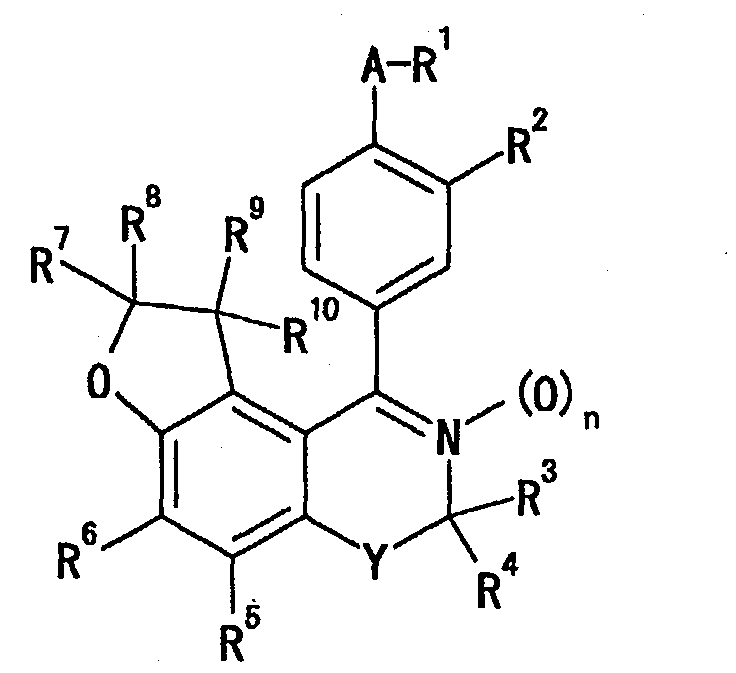 wherein A is (1) a bond, (2) a group represented by the
formula -CH=CH-, (3) a group represented by the formula -CONH-C(Rc)
(Rd)- (Rc and Rd each represent a hydrogen atom or C1-6 alkyl),
or (4) a group represented by the formula -OCH2-,
wherein A is (1) a bond, (2) a group represented by the
formula -CH=CH-, (3) a group represented by the formula -CONH-C(Rc)
(Rd)- (Rc and Rd each represent a hydrogen atom or C1-6 alkyl),
or (4) a group represented by the formula -OCH2-, -
- R2 is (1) a hydroxyl group, (2) a C1-6 alkoxy group, (3) a C7-16 aralkyloxy group, (4) an amino group, (5) a mono-C1-6 alkylamino group which may have one substituent selected from carboxyl, carbamoyl, quinolyl, phenoxy and pyridyl, (6) a mono-C7-16 aralkylamino group which may have one substituent selected from a halogen atom, cyano, C1-6 alkoxy, carboxyl and C1-6 alkoxycarbonyl, (7) a mono-C6-14 arylamino group, (8) a mono-C1-6 alkylcarbonylamino group which may have 1 to 3 substituents selected from a halogen atom, thienyl and C1-6 alkoxycarbonyl-C1-6 alkylthio, (9) a mono-C1-6 alkylsulfonylamino group, (10) a mono-C6-14 arylcarbonylamino group which may have one substituent selected from C1-6 alkoxy and C1-6 alkylcarbonylamino, (11) a quinolylcarbonylamino group, (12) a pyridylcarbonylamino group which may have 1 or 2 halogen atoms, (13) an indolylcarbonylamino group, (14) a N-C1-6 alkyl-N-C1-6 alkylcarbonylamino group which may have 1 to 4 substituents selected from a halogen atom, C1-6 alkoxycarbonyl and quinolyl, (15) a N-C1-6 alkylcarbonyl-N-C7-16 aralkylamino group which may have 1 to 3 halogens, (16) a N-C1-6 alkyl-N-pyridylcarbonylamino group, (17) a C1-6 alkylideneamino group which may have one di-C1-6 alkylamino, (18) a mono-C1-6 alkylureido group which may have one C1-6 alkoxycarbonyl, (19) a di-C1-6 alkylureido, (20) a mono-C6-14 arylureido group, (21) a 1-imidazolidinyl group which may have 1 to 3 substituents selected from C1-6 alkyl and oxo, (22) a C1-6 alkyl group, (23) a C1-6 alkoxycarbonyl group, (24) a nitro group or (25) a 1-pyrrolidinyl group, or R2 and A or R1 may be taken together with the adjacent carbon atom to form a nitrogen-containing 5- to 7-membered ring which may have 1 to 3 substituents selected from (1) a hydroxyl group, (2) C1-6 alkyl which may have one C1-6 alkoxy-carbonyl, (3) C7-16 aralkyl, (4) C6-14 aryl and (5) oxo,
R3 and R4 each represent a C1-6 alkyl group,
R5 is a hydrogen atom,
R6 is a C2-6 alkoxy group,
R7 and R8 are each a C1-6 alkyl group,
R9 and R10 are each a hydrogen atom,
Y is a methylene group, and
n is 0, or a salt thereof. - Among these, the compound of the present invention is preferably a compound represented in Examples 1 to 32, 35 to 92, 98, 99, 102, 103, 111 to 113 or 121 to 168 or a salt thereof as described below, particularly 4-(6-ethoxy-3,4,8,9-tetrahydro-3,3,8,8-tetramethylfuro[2,3-h]isoquinolin-1-yl)-2-[(phenylmethyl)amino]benzoic acid, 4-(6-ethoxy-3,4,8,9-tetrahydro-3,3,8,8-tetramethylfuro[2,3-h]isoquinolin-1-yl)-2-(ethylamino)benzoic acid, (E)-3-[4-(6-ethoxy-3,4,8,9-tetrahydro-3,3,8,8-tetramethylfuro[2,3-h]isoquinolin-1-yl)-2-methoxyphenyl]-2-propenoic acid, 4-(6-ethoxy-3,4,8,9-tetrahydro-3,3,8,8-tetramethylfuro[2,3-h]isoquinolin-1-yl)-2-[(2-quinolinylcarbonyl)amino]benzoic acid, 4-(6-ethoxy-3,4,8,9-tetrahydro-3,3,8,8-tetramethylfuro[2,3-h]isoquinolin-1-yl)-2-[(2-pyridinylcarbonyl)amino]benzene acetic acid, N-[2-(aminocarbonyl)-5-(6-ethoxy-3,4,8,9-tetrahydro-3,3,8,8-tetramethylfuro[2,3-h]isoquinolin-1-yl)phenyl]-2-pyridinecarboxamide or a salt thereof.
- Furthermore, in the same manner, the compound of the present invention is preferably a compound represented by the formulawherein A is (1) a group represented by the formula -CRa=CRb- (Ra and Rb each represent a hydrogen atom or C1-6 alkyl), (2) a group represented by the formula -(CONH)p-(C(Rc)(Rd))q- (Rc and Rd each represent a hydrogen atom or C1-6 alkyl, p is 0 or 1 and q is 1 or 2), (3) a group represented by the formula -CH2OCH2- or (4) a group represented by the formula -OCH2-, R1 is (1) a carboxyl group, (2) a C1-6 alkoxycarbonyl group, (3) an N-mono-C1-6 alkylcarbamoyl group or (4) a carbamoyl group, R2 is a hydrogen atom, R3 and R4 are each a C1-6 alkyl group, R5 is a hydrogen atom, R6 is C2-6 alkoxy group, R7 and R8 are each a C1-6 alkyl group, R9 and R10 are each a hydrogen atom, Y is a methylene group and n is 0, or a salt thereof.

- Among these, the compound of the present invention is preferably a compound represented in below-described Examples 33, 34, 93 to 97, 100, 101, 104 to 110 or 114 to 120 or a salt thereof, particularly [[4-(6-ethoxy-3,4,8,9-tetrahydro-3,3,8,8-tetramethylfuro[2,3-h]isoquinolin-1-yl)phenyl]methoxy]acetic acid, 4-(6-ethoxy-3,4,8,9-tetrahydro-3,3,8,8-tetramethylfuro[2,3-h]isoquinolin-1-yl)-α,α-dimethylbenzene acetic acid or a salt thereof, particularly [[4-(6-ethoxy-3,4,8,9-tetrahydro-3,3,8,8-tetramethylfuro[2,3-h]isoquinolin-1-yl)phenyl]methoxy]acetic acid hydrochloride or 4-(6-ethoxy-3,4,8,9-tetrahydro-3,3,8,8-tetramethylfuro[2,3-h]isoquinolin-1-yl)-α,α-dimethylbenzene acetic acid hydrochloride hydrate.
- Salts of the compounds of the present invention include a pharmacologically acceptable salt, etc., for example, a salt with an inorganic base, an ammonium salt, a salt with an organic base, a salt with an inorganic acid, a salt with an organic acid, a salt with a basic or acidic amino acid, etc. Suitable examples of the salt with an inorganic base include an alkali metal salt such as a sodium salt, potassium salt, etc.; an alkaline earth metal salt such as a calcium salt, a magnesium salt, etc.; an aluminum salt; etc. Suitable examples of the salt with an organic base include a salt with trimethylamine, triethylamine, pyridine, picoline, 2,6-lutidine, ethanolamine, diethanolamine, triethanolamine, cyclohexylamine, dicyclohexylamine, N,N'-dibenzylethylenediamine, etc. Suitable examples of the salt with an inorganic acid include a salt with hydrochloric acid, hydrobromic acid, nitric acid, sulfuric acid, phosphoric acid, etc. Suitable examples of the salt with an organic acid include a salt with formic acid, acetic acid, trifluoroacetic acid, phthalic acid, fumaric acid, oxalic acid, tartaric acid, maleic acid, citric acid, succinic acid, malic acid, methanesulfonic acid, benzenesulfonic acid, p-toluenesulfonic acid, etc. Suitable examples of the salt with a basic amino acid include a salt with arginine, lysine, ornithine, etc. Suitable examples of the salt with an acidic amino acid include a salt with aspartic acid, glutamic acid, etc.
- Among those, a pharmacologically acceptable salt is preferred, and the examples thereof include, in the case of having a basic functional group, a salt with an inorganic acid such as hydrochloric acid, hydrobromic acid, nitric acid, sulfuric acid and phosphoric acid, etc., a salt with an organic acid such as acetic acid, phthalic acid, fumaric acid, oxalic acid, tartaric acid, maleic acid, citric acid, succinic acid, methanesulfonic acid and p-toluenesulfonic acid, etc. and, in the case of having an acidic functional group, an alkaline metal salt such as a sodium salt, a potassium salt, etc., an alkaline earth metal salt such as a calcium salt, magnesium salt, etc., and an ammonium salt.
- The prodrug of the compound of the present invention or a salt thereof means a compound which is converted to the compound of the present invention under the physiological condition or with reaction in vivo by an enzyme, a gastric acid or the like, that is, a compound which is converted to the compound of the present invention by enzymatic oxidation, reduction, hydrolysis, etc.; a compound which is converted to the compound of the present invention with hydrolysis by gastric acid, etc.; etc. Examples of the prodrug of the compound of the present invention include a compound wherein an amino group of the compound of the present invention is substituted with acyl, alkyl or phosphoric acid (e.g. a compound wherein an amino group of the compound of the present invention is substituted with eicosanyl, alanyl, pentylaminocarbonyl, (5-methyl-2-oxo-1,3-dioxolen-4-yl)methoxycarbonyl, tetrahydrofuranyl, pyrrolidylmethyl, pivaloyloxymethyl or tert-butyl, etc.); a compound wherein a hydroxyl group of the compound of the present invention is substituted with acyl, alkyl, phosphoric acid or boric acid (e.g. a compound wherein a hydroxyl group of the compound of the present invention is substituted with acetyl, palmitoyl, propanoyl, pivaloyl, succinyl, fumaryl, alanyl or dimethylaminomethylcarbonyl, etc.); a compound wherein a carboxyl group of the compound of the present invention is substituted with ester or amide (e.g. a compound wherein a carboxyl group of the compound of the present invention is substituted with ethyl ester, phenyl ester, carboxymethyl ester, dimethylaminomethyl ester, pivaloyloxymethyl ester, ethoxycarbonyloxyethyl ester, phthalidyl ester, (5-methyl-2-oxo-1,3-dioxolen-4-yl)methyl ester, cyclohexyloxycarbonylethyl ester or methyl amide, etc.); etc. These prodrugs can be manufactured by a per se known method from the compound of the present invention.
- In addition, the prodrug of the compound of the present invention may be a compound which is converted into the compound of the present invention under the physiological conditions as described in "Pharmaceutical Research and Development", Vol.7 (Molecular Design), pp. 163-198, published in 1990 by Hirokawa Publishing Co.
- Furthermore, the compound in Reference Examples 27 to 115 as described below has also a phosphodiesterase IV inhibiting action in the similar manner to the compound of the present invention.
- The compound of the present invention or a salt thereof can be prepared based on Reaction Formula 1 to Reaction Formula 4 as described below and modifications thereof.
- Symbols of the compounds in the following Reaction Formula schemes are as described above unless otherwise stated. Furthermore, when Compounds (III), (VI) and (VIII) which are included in the compound of the present invention, and Compounds (I), (II), (IV), (V) and (VII) which are corresponding to intermediates thereof in the Reaction Formulae, form salts thereof, and the salts include, for example, those such as the above-mentioned salts of the compound of the present invention.
- Compounds (I), (IV) and (V) can be prepared by, for example, the method described in WO 01/70746 or JP-A-2001-335579, or a modification thereof.
- Compound (II) is commercially available, or can be prepared according to a per se known method or a modification thereof.
- For the general solvent used in the following reactions, alcohols represent methanol, ethanol, 1-propanol, 2-propanol, tert-butyl alcohol and the like; ethers represent diethyl ether, diisopropyl ether, diphenyl ether, tetrahydrofuran, 1,4-dioxane, 1,2-dimethoxyethane and the like; hydrocarbons represent benzene, toluene, cyclohexane, hexane and the like; amides represent N,N-dimethylformamide, N,N-dimethylacetamide, hexamethylphosphoric triamide and the like; halogenated hydrocarbons represent dichloromethane, chloroform, carbon tetrachloride, 1,2-dichloroethane and the like; organic acids represent formic acid, acetic acid, propionic acid, trifluoroacetic acid, methanesulfonic acid and the like; esters represent methyl acetate, ethyl acetate, propyl acetate, isopropyl acetate, butyl acetate, isobutyl acetate, tert-butyl acetate, pentyl acetate, hexyl acetate and the like unless otherwise described.

- Compound (III) [wherein Y represents CH2 or CH(OH)] is prepared by reacting Compound (I) with Compound (II) under the presence of an acid or a halogenating reagent.
- The amount of Compound (II) to be used is about 0.5 to about 5 moles, preferably about 0.5 to about 2 moles, relative to 1 mole of Compound (I).
- The "acid" includes mineral acids such as sulfuric acid, hydrogen chloride, hydrogen bromide, hydrogen iodide, perchloric acid, etc., Lewis acids such as a boron trifluoride diethyl ether complex, zinc chloride, aluminum chloride and the like organic acids such as methanesulfonic acid, trifluoromethanesulfonic acid, ethanesulfonic acid, benzenesulfonic acid, toluenesulfonic acid and the like and the like. The amount of the acid to be used is about 1 to about 10 moles, preferably about 1 to about 6 moles, relative to 1 mole of Compound (I).
- The "halogenating reagent" includes halogens such as bromine, chlorine, iodine, etc., imides such as N-bromosuccinimide, etc., halogen adducts such as benzyltrimethylammonium dichloroiodate, benzyltrimethylammonium tribromide, etc. and the like. The amount of the halogenating reagent to be used is about 1 to about 5 moles, preferably about 1 to about 2 moles, relative to 1 mole of Compound (I).
- This reaction is conducted advantageously using a solvent which is inert to the reaction. Such solvent is not particularly limited as long as the reaction proceeds, but preferably, for example, hydrocarbons, organic acids, halogenated hydrocarbons, esters or a mixture thereof and the like.
- The reaction time is usually about 10 minutes to about 48 hours, preferably about 15 minutes to about 24 hours. The reaction temperature is usually about -20 to about 150°C, preferably about 0 to about 100°C.

- Compound (III) [wherein Y represents CH2 or CH(OH)] is prepared by reacting Compound (IV) [wherein Z is an optionally substituted hydroxyl group or a halogen atom] with Compound (II) under the presence of an acid or a halogenating reagent.
- The "optionally substituted hydroxyl group" represented by Z includes, for example, (1) a hydroxyl group, (2) an optionally halogenated C1-6 alkylcarbonyloxy (e.g., acetyloxy, trifluoroacetyloxy, propionyloxy and the like), (3) an optionally halogenated C1-6 alkylsulfonyloxy (e.g., methanesulfonyloxy, trifluoromethanesulfonyloxy, ethanesulfonyloxy and the like) and (4) C6-10 arylsulfonyloxy which may have 1 to 3 substituents selected from halogen, C1-6 alkyl, C1-6 alkoxy and nitro (e.g., phenylsulfonyloxy, naphthylsulfonyloxy, p-chlorophenylsulfonyloxy, m-nitrophenylsulfonyloxy, p-toluenesulfonyloxy and the like).
- The "halogen atom" represented by Z includes, for example, fluorine, chlorine, bromine and iodine.
- The amount of Compound (II) to be used is about 0.5 to about 5 moles, preferably about 0.5 to about 2 moles, relative to 1 mole of Compound (I).
- The "acid" includes mineral acids such as sulfuric acid, hydrogen chloride, hydrogen bromide, hydrogen iodide, perchloric acid, etc., Lewis acids such as a boron trifluoride diethyl ether complex, zinc chloride, aluminum chloride, etc., organic acids such as methanesulfonic acid, trifluoromethanesulfonic acid, ethanesulfonic acid, benzenesulfonic acid, toluenesulfonic acid, etc. and the like. The amount of the acid to be used is about 1 to about 10 moles, preferably about 1 to about 6 moles, relative to 1 mole of Compound (I).
- The "halogenating reagent" includes halogens such as bromine, chlorine, iodine, etc., imides such as N-bromosuccinimide, etc., halogen adducts such as benzyltrimethylammonium dichloroiodate, benzyltrimethylammonium tribromide, etc. and the like. The amount of the halogenating reagent to be used is about 1 to about 5 moles, preferably about 1 to about 2 moles, relative to 1 mole of Compound (I).
- This reaction is conducted advantageously using a solvent which is inert to the reaction. Such solvent is not particularly limited as long as the reaction proceeds, but preferably, for example, hydrocarbons, organic acids, halogenated hydrocarbons, esters or a mixture thereof and the like.
- The reaction time is usually about 10 minutes to about 48 hours, preferably about 15 minutes to about 24 hours. The reaction temperature is usually about -20 to about 150°C, preferably about 0 to about 100°C.


- Compound (VI) is prepared by reacting Compound (V) [wherein R4a is a divalent group formed by removing one hydrogen atom from R4] with Compound (II) under the presence of an acid or a halogenating reagent.
- The amount of Compound (II) to be used is about 0.5 to about 5 moles, preferably about 0.5 to about 2 moles, relative to 1 mole of Compound (I).
- The "acid" includes mineral acids such as sulfuric acid, hydrogen chloride, hydrogen bromide, hydrogen iodide, perchloric acid, etc., Lewis acids such as boron trifluoride diethyl ether complex, zinc chloride, aluminum chloride, etc., organic acids such as methanesulfonic acid, trifluoromethanesulfonic acid, ethanesulfonic acid, benzenesulfonic acid, toluenesulfonic acid, etc. and the like. The amount of the acid to be used is about 1 to about 10 moles, preferably about 1 to about 6 moles, relative to 1 mole of Compound (I).
- The "halogenating reagent" includes halogens such as bromine, chlorine, iodine, etc., imides such as N-bromosuccinimide, etc., halogen adducts such as benzyltrimethylammonium dichloroiodate, benzyltrimethylammonium tribromide, etc. and the like. The amount of the halogenating reagent to be used is about 1 to about 5 moles, preferably about 1 to about 2 moles, relative to 1 mole of Compound (I).
- This reaction is conducted advantageously using a solvent which is inert to the reaction. Such solvent is not particularly limited as long as the reaction proceeds, but preferably, for example, hydrocarbons, organic acids, halogenated hydrocarbons, esters or a mixture thereof and the like.
- The reaction time is usually about 10 minutes to about 48 hours, preferably about 15 minutes to about 24 hours. The reaction temperature is usually about -20 to about 150°C, preferably about 0 to about 100°C.

- Compound (VII) is prepared by reducing Compound (III).
- The reducing method includes, for example, reduction with a metal hydrogen complex such as sodium borohydride, etc., reduction with borane complexes such as a borane tetrahydrofuran complex, a borane dimethylsulfide complex, etc., reduction with alkylboranes such as thexyl borane, disiamyl borane, etc., reduction with diborane, reduction with metals such as zinc, aluminum, tin, iron, etc., reduction with alkali metals such as sodium, lithium, etc./liquid ammonia (Birch reduction), reduction by hydrogenation reaction and the like.
- In the case of reduction with the metal hydrogen complex, the amount is about 1 to about 10 moles, preferably about 1 to about 3 moles, relative to 1 mole of Compound (III).
- In the case of reduction with the borane complexes, alkylboranes or diborane, the amount is about 1 to about 10 moles, preferably about 1 to about 5 moles, relative to 1 mole of Compound (III).
- In the case of reduction with metals or alkali metals, the amount is about 1 to about 20 equivalents, preferably about 1 to about 5 equivalents to 1 mole of Compound (III).
- In this reaction, if desired, Lewis acid may be used. The "Lewis acid" includes, for example, aluminum chloride, aluminum bromide, titanium (IV) chloride, tin (II) chloride, zinc chloride, boron trichloride, boron tribromide, boron trifluoride and the like. The amount of the Lewis acid to be used is about 1 to about 5 moles, preferably about 1 to about 2 moles, relative to Compound (III) .
- A hydrogenation reaction may also be used for the reduction, and in such a case, the catalyst includes palladium carbon, platinum (IV) oxide, Raney nickel, Raney cobalt and the like. The amount of the catalyst to be used is about 5 to about 1000% by weight, preferably about 10 to about 300% by weight to Compound (III).
- This reaction is conducted advantageously using a solvent which is inert to the reaction. Such solvent is not particularly limited as long as the reaction proceeds, but preferably, for example, a solvent such as alcohols, ethers, hydrocarbons, amides, organic acids and the like or a mixed solvent thereof and the like.
- The reaction time varies depending on kinds and amount of a reducing agent to be used or activity or amount of a catalyst, but usually about 1 hour to about 100 hours, preferably about 1 hour to about 50 hours. The reaction temperature is usually about -20 to about 120°C, preferably about 0 to about 80°C. When a hydrogenation catalyst is used, the hydrogen pressure is usually about 1 to about 100 atm.
- Compound (VIII) is prepared by oxidizing Compound (VII).
- The oxidizing agent used in oxidation includes, for example, hydrogen peroxide and the like. The amount of the oxidizing agent to be used is about 1 to about 20 moles, preferably about 1 to about 5 moles, relative to 1 mole of Compound (VII).
- In this reaction, it is preferable to use a catalyst such as sodium tungstate (VI) and the like. The amount of the catalyst to be used is about 0.05 to about 1 mole, preferably about 0.05 to about 0.5 mole, relative to 1 mole of Compound (VII).
- This reaction is conducted advantageously using a solvent which is inert to the reaction. Such a solvent is not particularly limited as long as the reaction proceeds, but preferably, for example, a solvent such as alcohols, hydrocarbons, amides, halogenated hydrocarbons, water and the like or a mixed solvent thereof and the like.
- The reaction time is usually about 30 minutes to about 48 hours, preferably about 1 hour to about 24 hours. The reaction temperature is usually about -20 to about 150°C, preferably about 0 to about 100°C.
- In each of the reactions described above, a starting compound having an amino, carboxy or hydroxy as its substituent may be present as a compound in which a protective group used ordinarily in a peptide chemistry has been introduced into such a substituent, and an objective compound can be obtained by deprotection if necessary after the reaction.
- A protective group for amino includes, for example, formyl, or C1-6 alkyl-carbonyl (e.g., acetyl, propionyl and the like), benzoyl, C1-6 alkoxy-carbonyl (e.g., methoxycarbonyl, ethoxycarbonyl and the like), phenyloxycarbonyl, C7-10 aralkyloxy-carbonyl (e.g., benzyloxycarbonyl and the like), trityl and phthaloyl, each of which may have a substituent, etc. The substituent includes a halogen atom (e.g., fluorine, chlorine, bromine and iodine and the like), C1-6 alkyl-carbonyl (e.g., acetyl, propionyl, valeryl and the like), nitro and the like. The number of substituents is 1 to 3 or so.
- A protective group for carboxyl includes, for example, C1-6 alkyl (e.g., methyl, ethyl, propyl, isopropyl, butyl, tert-butyl and the like), phenyl, trityl and silyl, each of which may have a substituent, etc. The substituent includes a halogen atom (e.g., fluorine, chlorine, bromine and iodine and the like), formyl, C1-6 alkyl-carbonyl (e.g., acetyl, propionyl, butylcarbonyl and the like), nitro, C1-6 alkyl (e.g., methyl, ethyl, tert-butyl and the like), C6-10 aryl (e.g., phenyl, naphthyl and the like) and the like. The number of substituents is 1 to 3 or so.
- A protective group for hydroxy includes, for example, formyl, or C1-6 alkyl (e.g., methyl, ethyl, propyl, isopropyl, butyl, tert-butyl and the like), phenyl, C7-11 aralkyl (e.g., benzyl and the like), C1-6 alkyl-carbonyl (e.g., acetyl, propionyl and the like), phenyloxycarbonyl, C7-11 aralkyloxy-carbonyl (e.g., benzyloxycarbonyl and the like), tetrahydropyranyl, tetrahydrofuranyl and silyl, each of which may have a substituent, etc. The substituent includes a halogen atom (e.g., fluorine, chlorine, bromine and iodine and the like), C1-6 alkyl (e.g., methyl, ethyl, tert-butyl and the like), C7-11 aralkyl (e.g., benzyl and the like), C6-10 aryl (e.g., phenyl, naphthyl and the like), nitro and the like. The number of substituents is 1 to 4 or so.
- A deprotection method may be a per se known method or a modification thereof such as a treatment with an acid, base, UV, hydrazine, phenylhydrazine, sodium N-methyldithiocarbamate, tetrabutylammonium fluoride, palladium (II) acetate and the like, as well as a reduction.
- In any case, deprotection, acylation, alkylation, hydrogenation, oxidation, reduction, carbon chain elongation and substituent exchange reaction are further used if necessary, alone or in combination thereof to synthesize the compound of the present invention. These reactions may employ the methods described for example in New Course of Experimental Chemistry, Vols. 14 and 15, 1977 (MARUZEN) and the like.
- When an objective product is obtained in a free form by a reaction described above, and it may be then converted into a salt in accordance with an ordinary method, and when it is obtained as a salt then it may be converted into a free form or another salt in accordance with an ordinary method. The compound of the present invention thus obtained can be isolated and purified from a reaction solution by a known method such as solvent conversion, concentration, solvent extraction, fraction distillation, crystallization, recrystallization, chromatography and the like.
- When the compound of the present invention is present as a configuration isomer, a diastereomer, a conformer and the like, and it can be then isolated, if desired, by a separation or purification procedure described above. When the compound of the present invention is present as a racemate, it can be resolved into an S form and an R form by an ordinary optical resolution method.
- When the compound of the present invention has its stereoisomers, then individual isomers or a mixture thereof may also be encompassed in the invention.
- The compound of the present invention may be hydrated or non-hydrated.
- The compound of the present invention may be labeled with an isotope (e.g., 3H, 14C and 35S) and the like.
- Since the compound of the present invention or a salt thereof has an excellent phosphodiesterase inhibiting effect, particularly a phosphodiesterase IV-inhibiting effect and a low toxicity and also is safe, it can be used as a prophylactic or therapeutic agent in mammals (for example, human, mouse, dog, rat, cattle, etc.) against inflammatory diseases, autoimmune disease, diabetes, atherosclerosis, graft versus host disease, multiple sclerosis, sepsis, psoriasis, osteoporosis, depression, central dysfunction after cerebrovascular occlusion, cerebrovascular dementia, Alzheimer's dementia, memory disorders, obesity, cardiac insufficiency, pulmonary fibrosis, allergic diseases (e.g., atopic dermatitis, allergic rhinitis, urticaria), angina pectoris, myocardial infarction, hypertension, pulmonary hypertension, renal diseases, brain function diseases, immunity deficiency, ophthalmological diseases, male or female sexual disorders and the like, as well as a phosphodiesterase IV inhibitor. Especially, the compound of the present invention or a salt thereof can be used as a prophylactic or therapeutic agent against inflammatory diseases, atopic dermatitis, allergic rhinitis, asthma, chronic obstructive pulmonary diseases, chronic rheumatoid arthritis, autoimmune diseases, depression, Alzheimer's dementia, memory disorders, osteoporosis, diabetes, atherosclerosis and the like, as well as a phosphodiesterase IV inhibitor. The administration route may be oral or parenteral.
- Particularly, the compound of the present invention can be used, by inhibiting phosphodiesterase IV A, as a prophylactic or therapeutic agent against asthma, atopic dermatitis, allergic rhinitis, chronic obstructive pulmonary diseases, rheumatoid arthritis, depression, Alzheimer's dementia, memory disorders, multiple sclerosis or osteoporosis, by inhibiting phosphodiesterase IV B, as a prophylactic or therapeutic agent against asthma, atopic dermatitis, allergic rhinitis, chronic obstructive pulmonary diseases, rheumatoid arthritis, depression, Alzheimer's dementia, memory disorders, multiple sclerosis or osteoporosis, by inhibiting phosphodiesterase IV C, as a prophylactic or therapeutic agent against asthma, atopic dermatitis, allergic rhinitis, chronic obstructive pulmonary diseases, rheumatoid arthritis, multiple sclerosis or osteoporosis, and by inhibiting phosphodiesterase IV D, as a prophylactic or therapeutic agent against asthma, atopic dermatitis, allergic rhinitis, chronic obstructive pulmonary diseases, rheumatoid arthritis, depression, Alzheimer's dementia, memory disorders, multiple sclerosis or osteoporosis.
- Specific examples of formulation include a tablet (including a sugar-coated tablet and a film-coated tablet), pills, capsules (including microcapsules), granules, fine powders, powders, syrups, emulsions, suspensions, injectable preparations, inhalation preparations, ointments, eye drops, aerosols, ophthalmic ointments, hard ointments, suppositories, troches, poultices, liniments and the like. Any of these formulations can be prepared in accordance with an ordinary method (for example a method described in Japanese Pharmacopoeia).
- The amount of the compound of the present invention in a formulation according to the invention may vary depending on the formulation, and it is usually 0.01 to 100% by weight, preferably 0.1 to 50% by weight, more preferably 0.5 to 20% by weight based on the whole formulation.
- Specifically, a tablet is produced by mixing a medicament as it is with an excipient, binder, disintegrating agent or other suitable additives to form a homogenous mass, granulating by a suitable method, combining with a lubricant and the like, and then compression-molding it, or by mixing a medicament as it is with an excipient, a binder, a disintegrating agent or other suitable additives to form a homogenous mass and then compression-molding it, or by preparing a granule first and then compression-molding it directly or after mixing it with suitable additives to form a homogenous mass. The formulation can further contain a coloring agent, a flavoring agent and the like, if necessary. The formulation can further be film-coated by a suitable coating agent.
- In a method for producing an injection formulation, a certain amount of a medicament is dissolved, suspended or emulsified in an injection solvent, physiological saline, Ringer's solution and the like when the medicament is water-soluble, or usually in vegetable oils and the like when the medicament is water-insoluble, whereby obtaining a certain quantity, or a certain amount of the medicament is sealed in a vial for an injection formulation.
- A carrier for an oral formulation includes a material customarily used in the pharmaceutical field, such as starch, mannitol, crystalline cellulose, sodium carboxymethylcellulose and the like. A carrier for the injectable preparation, for example, distilled water, physiological saline, a glucose solution, an infusion solution and the like. Other additives generally used in a formulation may also be added properly.
- The dose of such a formulation may vary depending on the age, the body weight, the condition, the administration route, the administration frequency and the like, but for example, a daily dose in an adult suffering from asthma is generally 0.01 to 100 mg/kg, preferably 0.1 to 50 mg/kg, more preferably 0.5 to 10 mg/kg as an active ingredient (the compound of the present invention), which is given orally once or twice divided a day.
- While the compound of the invention can exhibit an excellent phosphodiesterase IV-inhibiting activity even when being given alone, it can also be used in combination (multi-medicament combination) with other pharmaceutical components other than the compound of the present invention (hereinafter abbreviated as a combination drug).
- Such a combination drug includes, for example, an anti-chronic obstructive pulmonary disease agent (e.g., a β stimulant: fenoterol, salbutamol, terbutaline, formoterol, salmeterol, a mucolytic agent: ambroxol, erdosteine, carbocisteine, an expectorant: fudosteine, an antioxidant: N-acetyl cysteine and the like), an anti-asthma agent (for example, fluticasone propionate, beclomethasone propionate, theophylline, aminophylline, procaterol, ketotifen, azelastine, seratrodast, etc.), an anti-allergic agent (for example, fexofenadine, epinastine, ebastine, etc.), an anticholinergic agent (for example, thiotropium bromide, ipratropium bromide, flutropium bromide, oxitropium bromide, etc.), an anti-inflammatory agent (for example, diclofenac sodium, ibuprofen, indomethacin, loxoprofen sodium, etc.), an antibacterial agent (for example, cefixime, cefdinir, ofloxacin, tosufloxacin tosylate, levofloxacin, etc.), an antifungal agent (for example, fluconazole, itraconazole, etc.), a diabetes-treating agent (for example, pioglitazone, nateglinide, voglibose, acarbose, etc.) and the like.
- In combination of the compound of the present invention and the combination drug, the administration time of the compound of the present invention and the combination drug is not restricted, and the compound of the present invention or the combination drug can be administered to the subject simultaneously, or may be administered at different times. The dosage of the combination drug may be determined according to the administration amount clinically used, and can be appropriately selected depending on the subject to be administered, the administration route, the disease, the combination and the like.
- The administration mode of the compound of the present invention and the combination drug is not particularly limited, and it may be sufficient that the compound of the present invention and the combination drug are combined in administration. Examples of such administration mode include the following methods:
- (1) a method wherein the compound of the present invention and the combination drug are simultaneously produced to give a single preparation which is administered;
- (2) a method wherein the compound of the present invention and the combination drug are separately produced to give two kinds of preparations which are administered simultaneously through the same administration route;
- (3) a method wherein the compound of the present invention and the combination drug are separately produced to give two kinds of preparations which are administered through the same administration route at different times;
- (4) a method wherein the compound of the present invention and the combination drug are separately produced to give two kinds of preparations which are administered simultaneously by different administration routes;
- (5) a method wherein the compound of the present invention and the combination drug are separately produced to give two kinds of preparations which are administered by different administration routes at different times (for example, the compound of the present invention and the combination drug are administered in this order, or in the reverse order) and the like. Hereinafter, these administration modes are referred to as the combination preparation of the present invention.
-
- The combination preparation of the present invention has low toxicity, and for example, the compound of the present invention and/or the above-mentioned combination drug can be mixed with a pharmacologically acceptable carrier according to a per se known method to give a pharmaceutical composition, for example, a tablet (including a sugar-coated tablet and a film-coated tablet), powders, granules, capsules (including a soft capsule), solutions, injections, suppositories, sustained release agents and the like, each of which can be safely administered orally or parenterally (e.g., locally, rectally, intravenously and the like). The injection can be administered by intravenous, intramuscular, subcutaneous, intra-organ, intranasal, intradermal, instillation, intracerebral, intrarectal, intravaginal, intraperitoneal, intratumoral, juxtaposition of tumor and administration directly to the lesion.
- The pharmacologically acceptable carrier which may be used in production of the combination preparation includes those used for the above-mentioned pharmaceutical composition of the present invention.
- The compounding ratio of the compound of the present invention to the combination drug in the combination preparation of the present invention can be appropriately selected depending on the administration subject, the administration route, the diseases and the like.
- For example, the content of the compound of the present invention in the combination preparation varies depending on the form of preparation, and is usually from about 0.01% by weight to about 100% by weight, preferably from about 0.1% by weight to about 50% by weight, more preferably from about 0.5% by weight to about 20% by weight, relative to the total of the preparation.
- The content of the combination drug in the combination preparation of the present invention varies depending on the form of preparation, and is usually from about 0.01% by weight to about 100% by weight, preferably from about 0.1% by weight to about 50% by weight, more preferably from about 0.5% by weight to about 20% by weight, to the total of the preparation.
- The content of additives such as a carrier and the like in the combination preparation of the present invention varies depending on the form of preparation, and is usually from about 1% by weight to about 99.99% by weight, preferably from about 10% by weight to about 90% by weight, to the total of the preparation.
- When the compound of the present invention and the combination drug are formulated separately, the same contents may be adopted.
- These preparations can be manufactured by a per se known method commonly used in the pharmaceutical manufacturing process.
- For example, the compound of the present invention and the combination drug can be provided as an injectable preparation such as an aqueous injection together with a dispersing agent (e.g., Tween 80 (manufactured by Atlas Powder, US), HCO 60 (manufactured by Nikko Chemicals), polyethylene glycol, carboxymethyl cellulose, sodium alginate, hydroxypropylmethyl cellulose, dextrin and the like), a stabilizer (e.g., ascorbic acid, sodium pyrosulfite and the like), a surfactant (e.g., Polysorbate 80, Macrogol and the like), a solubilizer (e.g., glycerin, ethanol and the like), a buffer (e.g., phosphoric acid and an alkali metal salt thereof, citric acid and an alkali metal salt thereof and the like), an isotonizing agent (e.g., sodium chloride, potassium chloride, mannitol, sorbitol, glucose and the like), a pH regulator (e.g., hydrochloric acid, sodium hydroxide and the like), a preservative (e.g.', ethyl p-oxybenzoate, benzoic acid, methylparaben, propylparaben, benzyl alcohol and the like), a dissolving agent (e.g., cone. glycerin, meglumine and the like), a solubilizing agent (e.g., propylene glycol, sucrose and the like), a soothing agent (e.g., glucose, benzyl alcohol and the like) and the like, or an oily injection by dissolving, suspending or emulsifying them in a vegetable oil such as olive oil, sesame oil, cotton seed oil, corn oil and the like or a solubilizing agent such as propylene glycol.
- In the case of a preparation for oral administration, the compound of the present invention and the combination drug can be provided as a preparation for oral administration according to a per se known method by adding an excipient (e.g., lactose, sucrose, starch and the like), a disintegrating agent (e.g., starch, calcium carbonate and the like), a binder (e.g., starch, arabic gum, carboxymethyl cellulose, polyvinylpyrrolidone, hydroxypropyl cellulose and the like), a lubricant (e.g., talc, magnesium stearate, polyethylene glycol 6000 and the like) and the like, to the compound of the present invention or the combination drug, and compression-molding the mixture, then if desired, coating the molded product by a per se known method for the purpose of masking of taste, enteric property or sustained release. The coating agent includes, for example, hydroxypropylmethyl cellulose, ethyl cellulose, hydroxymethyl cellulose, hydroxypropyl cellulose, polyoxyethylene glycol, Tween 80, Pluronic F68, cellulose acetate phthalate, hydroxypropylmethyl cellulose phthalate, hydroxymethyl cellulose acetate succinate, Eudragit (methacrylic acid/acrylic acid copolymer, manufactured by Rohm, Germany), pigment (e.g., iron oxide red, titanium dioxide and the like) and the like. The preparation for oral administration may be either a rapid release preparation or a sustained release preparation.
- For example, in the case of a suppository, the compound of the present invention and the combination drug can be provided as an oil or aqueous solid, semisolid or liquid suppository according to a per se known method. The oily substrate used in the above-mentioned composition includes, for example, glycerides of higher fatty acids [e.g., cacao butter, Witepsol (manufactured by Dynamit Nobel, Germany) and the like], intermediate grade fatty acids [e.g., Myglyol (manufactured by Dynamit Nobel, Germany) and the like], or vegetable oils (e.g., sesame oil, soy bean oil, cotton seed oil and the like) and the like. Further, the aqueous base includes, for example, polyethylene glycols and propylene glycol, and the aqueous gel base includes, for example, natural gums, cellulose derivatives, vinyl polymers, acrylic acid polymers and the like.
- The above-mentioned sustained release agent includes sustained release microcapsules and the like. For obtaining a sustained release microcapsule, a per se known method can be adopted. For example, it is preferable to mold into a sustained release preparation shown in [2] below.
- A compound of the present invention is preferably molded into an oral administration preparation such as a solid preparation (e.g., powder, granule, tablet, capsule and the like) and the like, or molded into a rectal administration preparation such as a suppository. Particularly, an oral administration preparation is preferable.
- The combination drug can be provided as the above-mentioned drug form depending on the kind of the drug.
- In the following, there will be shown specifically [1] an injection of the compound of the present invention or the combination drug and a production method thereof, [2] a rapid release preparation or sustained release preparation of the compound of the present invention or the combination drug and a production method thereof and [3] a sublingual tablet, a buccal or an intraoral rapid integrating agent of the compound of the present invention or the combination drug or a production method thereof.
- It is preferred that an injectable preparation is prepared by dissolving the compound of the present invention or the combination drug in water. This injectable preparation may be allowed to contain a benzoate and/or a salicylate.
- The injection is obtained by dissolving the compound of the present invention or the combination drug, and if desired, a benzoate and/or a salicylate, into water.
- The above-mentioned salts of benzoic acid and salicylic acid include, for example, salts of alkali metals such as sodium, potassium and the like, salts of alkaline earth metals such as calcium, magnesium and the like, ammonium salts, meglumine salts, organic acid salts such as tromethamol and the like.
- The concentration of the compound of the present invention or the combination drug in the injection is from 0.5 w/v% to 50 w/v%, preferably from about 3 w/v% to about 20 w/v%. The concentration of a salt of benzoic acid or/and a salt of salicylic acid is from 0.5 w/v% to 50 w/v%, preferably from 3 w/v% to 20 w/v%.
- Conventional additives to be used in an injection may be appropriately added in a preparation of the present invention. Examples of the additives include a stabilizer (e.g. ascorbic acid, sodium pyrosulfite and the like), a surfactant (e.g., Polysorbate 80, macrogol and the like), a solubilizer (e.g., glycerin, ethanol and the like), a buffer (e. g., phosphoric acid and an alkali metal salt thereof, citric acid and an alkali metal salt thereof and the like), an isotonizing agent (e.g., sodium chloride, potassium chloride and the like), a dispersing agent (e.g., hydroxypropylmethyl cellulose, dextrin and the like), a pH regulator (e.g., hydrochloric acid, sodium hydroxide and the like), a preservative (e.g., ethyl p-oxybenzoate, benzoic acid and the like), a dissolving agent (e.g., conc. glycerin, meglumine and the like), a solubilizing agent (e.g., propylene glycol, sucrose and the like), a soothing agent (e.g., glucose, benzyl alcohol and the like) and the like. These additives are blended in a usual proportion generally used in an injection.
- It is advantageous that the pH of the injection is controlled from 2 to 12, preferably from 2.5 to 8.0 by addition of a pH regulator.
- An injectable preparation is obtained by dissolving the compound of the present invention or the combination drug and if desired, a salt of benzoic acid and/or a salt of salicylic acid, and if necessary, the above-mentioned additives into water. These may be dissolved in any order, and can be appropriately dissolved by the method similar to that in a conventional method of producing an injection.
- An aqueous solution for injection may be advantageously heated, alternatively, for example, filter sterilization, high pressure heat sterilization and the like can be conducted in the same manner as those for a usual injection, to provide an injection.
- It may be advantageous that an aqueous solution for injection is subjected to high pressure heat sterilization at 100°C to 121°C for 5 minutes to 30 minutes.
- Further, a preparation endowed with the antibacterial property of a solution may also be produced so that it can be used as a preparation which is divided and administered multiple-times.
- Preferred is a sustained release preparation which is obtained, by coating a core containing the compound of the present invention or the combination drug with a film forming agent such as a water-insoluble substance, swellable polymer and the like, if desired. For example, a sustained release preparation for oral administration of once administration a day type is preferable.
- The water insoluble substance used in film forming agent includes, for example, cellulose ethers such as ethyl cellulose, butyl cellulose and the like; cellulose esters such as cellulose acetate, cellulose propionate and the like; polyvinyl esters such as polyvinyl acetate, polyvinyl butyrate and the like; an acrylic acid/methacrylic acid copolymer, a methyl methacrylate copolymer, an ethoxyethyl methacrylate/cinnamoethyl methacrylate/aminoalkyl methacrylate copolymer, polyacrylic acid, polymethacrylic acid, methacrylic acid alkyl amide copolymer, poly(methyl methacrylate), polymethacrylate, polymethacryl amide, amino alkyl methacrylate copolymer, poly(methacrylic acid anhydride), glycidyl methacrylate copolymer, and specially an Eudragits (manufactured by Rohm Pharma) such as Eudragit RS-100, RL-100, RS-30D, RL-30D, RL-PO, RS-PO (a copolymer of ethyl acrylate/methyl methacrylate/chlorotrimethylmethacrylate/ethyl ammonium), Eudragit NE-30D (a copolymer of methyl methacrylate/ethyl acrylate) and the like, a hydrogenated oil such as hardened caster oil (e.g., Lubri wax (Freund Corporation) and the like) and the like; a wax such as carnauba wax, fatty acid glycerin ester, paraffin and the like; polyglycerin fatty acid ester and the like.
- The swellable polymer is preferably a polymer having acidic dissociating group and pH-dependent swelling property, and a polymer having an acidic dissociating group which swells little in an area such as the stomach and swells in a neutral area such as the small intestine or the large intestine.
- The polymer having the acidic dissociating group and pH-dependent swelling property includes, for example, crosslinkable polyacrylic polymer such as Carbomer 934P, 940, 941, 974P, 980, 1342 and the like, polycarbophil, calcium polycarbophil (all manufactured by BF Goodrich.), Hibiswako 103, 104, 105, 304 (all manufactured by Wako Pure Chemical Co., Ltd.) and the like.
- The film forming agent used in a sustained release preparation may further contain a hydrophilic substance.
- The hydrophilic substance includes, for example, a polysaccharide optionally having sulfuric acid group such as pullulans, dextrin, alginic acid alkali metal salt and the like; a polysaccharide having a hydroxyalkyl group or a carboxyalkyl group such as hydroxypropyl cellulose, hydroxypropyl methyl cellulose, sodium carboxymethyl cellulose and the like; methyl cellulose; polyvinyl pyrrolidone; polyvinyl alcohol; polyethylene glycol; and the like.
- The content of the water-insoluble substance in the film forming agent of the sustained release preparation is about 30%(w/w) to about 90%(w/w), preferably about 35%(w/w) to about 80%(w/w), and more preferably about 40%(w/w) to about 75%(w/w). The content of the swellable polymer is about 3%(w/w) to about 30%(w/w), preferably about 3%(w/w) to about 15%(w/w). The film forming agent may further contain a hydrophilic substance, in this case, the content of the hydrophilic substance in the film forming agent is about 50%(w/w) or less, preferably about 5%(w/w) to about 40%(w/w), and more preferably about 5%(w/w) to about 35%(w/w). This %(w/w) indicates % by weight based on a film forming agent composition which is obtained by removing a solvent (e.g., water, lower alcohols such as methanol, ethanol, etc. and the like) from a solution of the film forming agent.
- The sustained release preparation is manufactured by preparing a core containing drugs as exemplified below, then, coating the resulted core with a liquid of the film forming agent prepared by heating and dissolving a water-insoluble substance, a swellable polymer and the like or by dissolving or dispersing it in a solvent.
- The form of a core containing a drug to be coated with a film forming agent (hereinafter, sometimes simply referred to as a core) is not particularly limited, and preferably the core is formed into particles such as granules or fine particles.
- When the core is composed of granules or fine particles, the average particle size thereof is preferably from about 150 to about 2,000 µm, further preferably, from about 500 µm to about 1,400 µm.
- Preparation of the core can be conducted by a usual production method. For example, it can be prepared by mixing a suitable excipient, a binder, a disintegrating agent, a lubricant, a stabilizer and the like with a drug, and subjecting the mixture to wet-extrusion granulation, fluidized-bed granulation or the like.
- The content of the drugs in the core is from about 0.5%(w/w) to about 95%(w/w), preferably from about 5%(w/w) to about 80%(w/w), further preferably from about 30%(w/w) to about 70%(w/w).
- The excipient contained in the core includes, for example, saccharides such as sucrose, lactose, mannitol, glucose and the like, starch, crystalline cellulose, calcium phosphate, corn starch and the like Among them, crystalline cellulose and corn starch are preferable.
- The binders include, for example, polyvinyl alcohol, hydroxypropyl cellulose, polyethylene glycol, polyvinyl pyrrolidone, Pluronic F68, arabic gum, gelatin, starch and the like. The disintegrating agents include, for example, carboxymethyl cellulose calcium (ECG505), croscarmellose sodium (Ac-Di-Sol), crosslinkable polyvinyl pyrrolidone (crospovidone), low-substituted hydroxypropyl cellulose (L-HPC) and the like.
Among these, hydroxypropyl cellulose, polyvinyl pyrrolidone and low-substituted hydroxypropyl cellulose are preferable. The lubricant or the aggregation inhibitor includes, for example, talc, magnesium stearate and an inorganic salt thereof. The lubricant includes a polyethylene glycol and the like. The stabilizing agent includes an acid such as tartaric acid, citric acid, succinic acid, fumaric acid, maleic acid and the like. - In addition to the above-mentioned preparation methods, the core can also be prepared by, for example, a rolling granulation method in which a drug or a mixture of the drug with an excipient, a lubricant and the like is added portionwise to an inert carrier particle which is the center of the core while spraying a binder dissolved in a suitable solvent such as water, lower alcohols (e.g., methanol, ethanol, etc.) and the like, a pan coating method, a fluidized bed coating method or a melt granulating method. The inert carrier particle includes, for example, those made of sucrose, lactose, starch, crystalline cellulose or waxes, and the average particle size thereof is preferably from about 100 µm to about 1,500 µm.
- For the purpose of separating the drug contained in the core from the film forming agent, the surface of the core may be coated with a protective agent. The protective agent includes, for example, the above-mentioned hydrophilic substances, water-insoluble substances and the like. The protective agent is preferably polyethylene glycol, and polysaccharides having a hydroxyalkyl group or carboxyalkyl group, more preferably hydroxypropylmethyl cellulose and hydroxypropyl cellulose. The protective agent may contain a stabilizer such as acids such as tartaric acid, citric acid, succinic acid, fumaric acid, maleic acid and the like, and a lubricant such as talc and the like.
When the protective agent is used, the coating amount is from about 1%(w/w) to about 15% (w/w), preferably from about 1%(w/w) to about 10%(w/w), further preferably from about 2%(w/w) to about 8%(w/w), based on the core. - The coating of the protective agent can be carried out by a usual coating method, and specifically the coating can be carried out by spraying the protective agent by a fluidized bed coating method, a pan coating method and the like.
- A core obtained in the above-mentioned step I is coated with a solution of the film forming agent obtained by heating and dissolving the above-mentioned water-insoluble substance and a pH-dependent swellable polymer and a hydrophilic substance, or by dissolving or dispersing them in a solvent, to give a sustained release preparation.
- The method for coating a core with a solution of the film forming agent includes, for example, a spray coating method and the like.
- The composition ratio of a water-insoluble substance, a swellable polymer and a hydrophilic substance in a solution of the film forming agent is appropriately selected so that the contents of these components in a coated film are those as described above, respectively.
- The coating amount of the film forming agent is from about 1%(w/w) to about 90%(w/w), preferably from about 5%(w/w) to about 50%(w/w), further preferably from about 5%(w/w) to about 35%(w/w), based on the core (not including coating amount of the protective agent).
- The solvent in the solution of the film forming agent includes water or an organic solvent alone or in admixture thereof. In the case of use in admixture, the mixing ratio of water to the organic solvent (water/organic solvent: ratio by weight) can be varied in the range from 1 to 100%, and preferably from about 1% to about 30%. The organic solvent is not particularly limited as long as it dissolves a water-insoluble substance, and for example, it includes lower alcohols such as methanol, ethanol, 2-propanol, 1-butanol and the like, lower alkanones such as acetone and the like, acetonitrile, chloroform, dichloromethane and the like. Among them, lower alcohols are preferable, and ethanol and 2-propanol are particularly preferable. Water, and a mixture of water with an organic solvent are preferably used as a solvent for a film forming agent. In this case, if necessary, an acid such as tartaric acid, citric acid, succinic acid, fumaric acid, maleic acid and the like may also be added into a solution of the film forming agent for stabilizing the solution of the film forming agent.
- The operation in the case of coating by a spray coating method can be conducted by a usual coating method, and specifically it can be conducted by spray-coating a solution of the film forming agent onto a core, for example, by a fluidized bed coating method, a pan coating method and the like. In this case, if necessary, talc, titanium oxide, magnesium stearate, calcium stearate, light anhydrous silicic acid and the like may also be added as a lubricant, and glycerin fatty esters, hardened castor oils, triethyl citrate, cetyl alcohol, stearyl alcohol and the like may also be added as a plasticizer.
- After coating with a film forming agent, if necessary, an antistatic agent such as talc and the like may be mixed.
- The rapid release preparation may be liquid (a solution, a suspension, an emulsion and the like) or solid (particles, a pill, a tablet and the like). It may be an oral preparation or a parenteral preparation such as an injectable preparation and the like, and preferably an oral preparation.
- The rapid release preparation may usually also contain a carrier, an additive and an excipient customarily used in the field of formulation (hereinafter, sometimes abbreviated as the excipient) in addition to the drug as an active component. The preparation excipient used is not particularly limited as long as it is an excipient ordinarily used as a preparation excipient.
For example, the excipient for an oral solid preparation includes lactose, starch, corn starch, crystalline cellulose (Avicel PH101, manufactured by Asahi Chemical Industry Co., Ltd. and the like), powdered sugar, granulated sugar, mannitol, light anhydrous silicic acid, magnesium carbonate, calcium carbonate, L-cysteine and the like, and preferably corn starch, mannitol and the like. These excipients can be used alone or in combinations of two or more. The content of the excipient is, for example, from about 4.5 w/w% to about 99.4 w/w%, preferably from about 20 w/w% to about 98.5 w/w%, further preferably from about 30 w/w% to about 97 w/w%, based on the total amount of the rapid release preparation. - The content of a drug in the rapid release preparation can be appropriately selected in the range from about 0.5% to about 95%, preferably from about 1% to about 60% based on the total amount of the rapid release preparation.
- When the rapid release preparation is an oral solid preparation, it usually contains a disintegrating agent in addition to the above-mentioned components. The disintegrating agent includes, for example, carboxymethyl cellulose calcium (ECG-505, manufactured by Gotoku Yakuhin), croscarmellose sodium (for example, Actisol, manufactured by Asahi Chemical Industry Co., Ltd.), crospovidone (for example, Kollidon CL, manufactured by BASF), low-substituted hydroxypropyl cellulose (manufactured by Shin-Etsu Chemical Co., Ltd.), carboxymethyl starch (manufactured by Matsutani Kagaku K.K.), carboxymethyl starch sodium (Exprotab, manufactured by Kimura Sangyo), partially pregelatinized starch (PCS, manufactured by Asahi Chemical Industry Co., Ltd.) and the like, and for example, includes those which disintegrate a granule by contacting with water and absorbing water, causing swelling, or making a channel between an effective ingredient constituting the core and an excipient. These disintegrating agents can be used alone or in combinations of two or more. The amount of the disintegrating agent used is appropriately selected depending on the kind and the compounding amount of a drug used, formulation design for release property and the like, and for example, from about 0.05 w/w% to about 30 w/w%, preferably from about 0.5 w/w% to about 15 w/w%, based on the total amount of the rapid releasing agent.
- When the rapid release preparation is an oral solid preparation, it may further contain if desired, additives conventional in solid preparations in addition to the above-mentioned composition. Such an additive includes, for example, a binder (e.g., sucrose, gelatin, arabic gum powder, methyl cellulose, hydroxypropyl cellulose, hydroxypropylmethyl cellulose, carboxylmethyl cellulose, polyvinylpyrrolidone, pullulans, dextrin and the like), a lubricant (e.g., polyethylene glycol, magnesium stearate, talc, light anhydrous silicic acid (for example, Aerosil (Nippon Aerosil Co., Ltd.)), a surfactant (e.g., anionic surfactants such as sodium alkylsulfate and the like, nonionic surfactants such as polyoxyethylene fatty acid ester and polyoxyethylene sorbitan fatty acid ester, polyoxyethylene castor oil derivatives and the like), a coloring agent (e.g., a tar-based pigment, caramel, iron oxide red, titanium oxide and riboflavins), and if necessary, an appetizing agent (e.g., a sweetening agent, a flavoring agent and the like), an adsorbent, a preservative, a wetting agent, an antistatic agent and the like. Further, a stabilizer such as an organic acid such as tartaric acid, citric acid, succinic acid, fumaric acid and the like may also be added.
- The above-mentioned binder includes preferably hydroxypropyl cellulose, polyethylene glycol and polyvinylpyrrolidone and the like.
- The rapid releasing preparation can be prepared by mixing the above-mentioned components, and if necessary, further kneading the mixture, and molding it based on a usual technology of producing preparations. The above-mentioned mixing is conducted by generally used methods, for example, mixing, kneading and the like. Specifically, when a rapid release preparation is formed, for example, into a particle, it can be prepared, according to the same means as in the above-mentioned method for preparing a core of a sustained release preparation, by mixing the components using a vertical granulator, a universal kneader (manufactured by Hata Tekkosho), a fluidized bed granulator FD-5S (manufactured by Pulek) and the like, and then subjecting the mixture to wet extrusion granulation, fluidized bed granulation and the like.
- Thus obtained rapid releasing preparation and sustained releasing preparation may be themselves provided as the products, or provided appropriately together with preparation excipients and the like, separately, by an ordinary method to a preparation, and then they may be administered simultaneously or may be administered in combination at any administration interval, or they may be themselves provided as one oral preparation (e.g., granules, fine particles, tablets, capsules and the like) or provided as one oral preparation together with preparation excipients and the like. It may also be permissible that they are provided as granules or fine particles, and filled in the same capsule to be used as a preparation for oral administration.
- Sublingual, buccal or intraoral rapid disintegrating agents may be a solid preparation such as a tablet and the like, or may be an oral mucosa membrane patch (film).
- The sublingual, buccal or intraoral rapid disintegrating agent is preferably a preparation containing the compound of the present invention or the combination drug and an excipient. It may contain also auxiliary agents such as a lubricant, an isotonizing agent, a hydrophilic carrier, a water-dispersible polymer, a stabilizer and the like. Further, for easy absorption and increased bioavailability, β-cyclodextrin or β-cyclodextrin derivatives (e.g., hydroxypropyl-β-cyclodextrin and the like) and the like may also be contained.
- The above-mentioned excipient includes lactose, sucrose, D-mannitol, starch, crystalline cellulose, light anhydrous silicic acid and the like. The lubricant includes magnesium stearate, calcium stearate, talc, colloidal silica and the like, and particularly preferably magnesium stearate and colloidal silica. The isotonizing agent includes sodium chloride, glucose, fructose, mannitol, sorbitol, lactose, saccharose, glycerin, urea and the like, and particularly preferably mannitol. The hydrophilic carrier includes a swellable hydrophilic carrier such as crystalline cellulose, ethyl cellulose, crosslinkable polyvinylpyrrolidone, light anhydrous silicic acid, silicic acid, dicalcium phosphate, calcium carbonate and the like, and particularly preferably crystalline cellulose (e.g., fine crystalline cellulose and the like). The water-dispersible polymer includes gums (e.g., gum tragacanth, acacia gum and cyamoposis gum), alginates (e.g., sodium alginate), cellulose derivatives (e.g., methyl cellulose, carboxymethyl cellulose, hydroxymethyl cellulose, hydroxypropyl cellulose and hydroxypropylmethyl cellulose), gelatin, water-soluble starch, polyacrylic acids (e.g., Carbomer), polymethacrylic acid, polyvinyl alcohol, polyethylene glycol, polyvinylpyrrolidone, polycarbophil, ascorbate, palmitates and the like, and preferably hydroxypropylmethyl cellulose, polyacrylic acid, alginate, gelatin, carboxymethyl cellulose, polyvinylpyrrolidone, polyethylene glycol and the like, particularly preferably hydroxypropylmethyl cellulose. The stabilizer includes cysteine, thiosorbitol, tartaric acid, citric acid, sodium carbonate, ascorbic acid, glycine, sodium sulfite and the like, and particularly preferably citric acid and ascorbic acid.
- The sublingual, buccal or intraoral rapid disintegrating agent can be manufactured by mixing the compound of the present invention or the combination drug and an excipient by a per se known method. Further, if desired, an auxiliary agent such as a lubricant, an isotonizing agent, a hydrophilic carrier, a water-dispersible polymer, a stabilizer, a coloring agent, a sweetening agent, a preservative and the like may be mixed. The sublingual, buccal or intraoral rapid disintegrating agent is obtained by mixing the above-mentioned components simultaneously or at time intervals, and then subjecting the mixture to tablet-making molding under pressure. For obtaining suitable hardness, it may also be permissible that the materials are moistened by using a solvent such as water, alcohol and the like if desired before and after the tablet making process, and after the molding, the materials are dried, to obtain a product.
- In the case of molding into a mucosa membrane patch (film), the compound of the present invention or the combination drug and the above-mentioned water-dispersible polymer (preferably, hydroxypropyl cellulose and hydroxypropylmethyl cellulose), an excipient and the like are dissolved in a solvent such as water and the like, and the resulted solution is cast to give a film. Further, additives such as a plasticizer, a stabilizer, an antioxidant, a preservative, a coloring agent, a buffer, a sweetening agent and the like may also be added. For imparting suitable elasticity to the film, glycols such as polyethylene glycol, propylene glycol and the like may be contained, or for enhancing adhesion of the film to an intraoral mucosa membrane lining, a bio-adhesive polymer (e.g., polycarbophil, carbopol) may also be contained. In the casting, a solution is poured on the non-adhesive surface, spread to uniform thickness (preferably, about 10 micron to about 1,000 micron) by an application tool such as a doctor blade and the like, and the solution is then dried to form a film. It may be advantageous that thus formed film is dried at room temperature or under heat, and cut into desired surface area.
- The intraoral rapid disintegrating preparation is preferably solid rapid diffuse preparation composed of a network body comprising the compound of the present invention or the combination drug, and a water-soluble or water-diffusible carrier which is inert to the compound of the present invention or the combination drug. This network body is obtained by sublimating a solvent from the solid composition constituted of a solution prepared by dissolving the compound of the present invention or the combination drug in a suitable solvent.
- The composition of an intraoral rapid disintegrating agent preferably contains a matrix forming agent and a secondary component in addition to the compound of the present invention or the combination drug.
- The matrix forming agent includes animal proteins or vegetable proteins such as gelatins, dextrins, soybean, wheat, psyllium seed protein and the like; rubber substances such as arabic gum, guar gum, agar, xanthan gum and the like; polysaccharides; alginic acids; carboxymethyl celluloses; carrageenans; dextrans; pectins; synthetic polymers such as polyvinylpyrrolidone and the like; substances derived from a gelatin-arabic gum complex and the like. Further, it includes saccharides such as mannitol, dextrose, lactose, galactose, trehalose and the like; cyclic saccharides such as cyclodextrin and the like; inorganic salts such as sodium phosphate, sodium chloride, aluminum silicate and the like; amino acids having 2 to 12 carbon atoms such as glycine, L-alanine, L-aspartic acid, L-glutamic acid, L-hydroxyproline, L-isoleucine, L-leucine, L-phenylalanine and the like.
- One or more of the matrix forming agent(s) can be introduced in a solution or a suspension before solidification. Such matrix forming agent may be present in addition to a surfactant, or may be present with the surfactant excluded. The matrix forming agents may help to keep the compound of the present invention or the combination drug diffused in the solution or the suspension, in addition to formation of the matrix.
- The composition may contain secondary components such as a preservative, an antioxidant, a surfactant, a thickening agent, a coloring agent, a pH controlling agent, a flavoring agent, a sweetening agent, a food taste masking agent and the like. The coloring agent includes red, black and yellow iron oxides, and FD & C dyes such as FD & C Blue 2, FD & C Red 40 and the like manufactured by Elis and Eberald. Examples of the suitable flavoring agent include mint, raspberry, licorice, orange, lemon, grapefruit, caramel, vanilla, cherry, grape flavor and combinations thereof. Examples of the suitable pH controlling agent include citric acid, tartaric acid, phosphoric acid, hydrochloric acid and maleic acid. Examples of the suitable sweetening agent include aspartame, acesulfame K and thaumatine and the like. Examples of the suitable food taste-masking agent include sodium bicarbonate, ion exchange resin, cyclodextrin-inclusion compounds, adsorbent substances and microcapsulated apomorphine.
- The preparation contains the compound of the present invention or the combination drug in an amount of usually from about 0.1% by weight to about 50% by weight, preferably from about 0.1% by weight to about 30% by weight, and is preferably a preparation (such as the above-mentioned sublingual agent, buccal and the like) which can dissolve 90% or more of the compound of the present invention or the combination drug (into water) within the time range of about 1 minute to about 60 minutes, preferably of about 1 minute to about 15 minutes, more preferably of about 2 minutes to about 5 minutes, and intraoral rapid disintegrating preparations which are disintegrated within the range of 1 second to 60 seconds, preferably of 1 to 30 seconds, further preferably of 1 to 10 seconds after being placed in the oral cavity.
- The content of the above-mentioned excipient in the whole preparation is from about 10% by weight to about 99% by weight, preferably from about 30% by weight to about 90% by weight. The content of the β-cyclodextrin or β-cyclodextrin derivative in the whole preparation is from 0 to about 30% by weight. The content of the lubricant in the whole preparation is from about 0.01% by weight to about 10% by weight, preferably from about 1% by weight to about 5% by weight. The content of the isotonizing agent in the whole preparation is from about 0.1% by weight to about 90% by weight, preferably from about 10% by weight to about 70% by weight. The content of the hydrophilic carrier agent in the whole preparation is from about 0.1% by weight to about 50% by weight, preferably from about 10% by weight to about 30% by weight. The content of the water-dispersible polymer in the whole preparation is from about 0.1 to about 30% by weight, preferably from about 10% by weight to about 25% by weight. The content of the stabilizer in the whole preparation is from about 0.1% by weight to about 10% by weight, preferably from about 1% by weight to about 5% by weight. The above-mentioned preparation may further contain additives such as a coloring agent, a sweetening agent, a preservative and the like, if necessary.
- The dose of a combination preparation of the present invention varies depending on the kind of the compound (I) of the present invention, the age, the body weight, the symptoms, the drug form, the administration method, the administration time and the like, and for example, to a patient (adult, body weight: about 60 kg), the combination preparation is administered intravenously at a dose of about 0.01 to about 1,000 mg/kg/day, preferably about 0.01 to about 100 mg/kg/day, more preferably about 0.1 to about 100 mg/kg/day, particularly about 0.1 to about 50 mg/kg/day, particularly about 1.5 to about 30 mg/kg/day in terms of the compound of the present invention or the combination drug, respectively, once or several times divided a day. Of course, since the dose as described above varies depending on various conditions, it may be sometimes sufficient to administer smaller amounts than the above-mentioned dosage, and further it may be sometimes necessary to administer greater amounts than that.
- The amount of the combination drug can be set at any value unless side effects are problematical. The daily dosage in terms of the combination drug varies depending on the severity of symptoms, the age, the sex, the body weight, the sensitivity difference of the subject, the administration time and interval, the property, formulation and kind of the pharmaceutical preparation, the kind of effective ingredient and the like, but not particularly limited thereto; for example, in the case of oral administration, the dose of the drug is usually from about 0.001 mg to 2,000 mg, preferably from about 0.01 mg to 500 mg, further preferably from about 0.1 mg to 100 mg, per 1 kg body weight of a mammal, which is usually administered once to four times divided a day.
- In administration of the combination preparation, the compound of the present invention may be administered after administration of the combination drug or the combination drug may be administered after administration of the compound of the present invention, though they may be administered simultaneously. When administered at a time interval, the interval varies depending on the effective ingredient, the drug form and the administration method. For example, when the combination drug is administered first, the compound of the present invention is administered within time range of from 1 minute to 3 days, preferably from 10 minutes to 1 day, more preferably from 15 minutes to 1 hour after administration of the combination drug. When the compound of the present invention is administered first, the combination drug is administered within time range of from 1 minute to 1 day, preferably from 10 minutes to 6 hours, more preferably from 15 minutes to 1 hour after administration of the compound of the present invention.
- The present invention is further detailed in the following Reference Examples, Examples, Formulation Examples and Experimental Examples, any of which are for illustrative purpose only and is not intended to restrict the invention and can be modified without departing from the scope of the invention.
- In the following Reference Examples and Examples, the term "room temperature" usually means a temperature from about 10 to about 35°C. % means a mol/mol% when used for a yield and otherwise it means % by weight. A basic silica gel used was NH-DM1020 manufactured by FUJI SILYSIA CHEMICAL LTD. Any unidentifiable broad peak such as those of OH and NH protons in each proton NMR spectrum are not included in the data.
- Corn starch, hydroxypropylcellulose, magnesium stearate, lactose, croscarmellose sodium, hydroxypropylmethyl cellulose, iron (III) oxide and titanium oxide to be used in the following Formulation Examples were appropriate products for Japanese Pharmacopoeia revision 14th.
- Abbreviations shown below are defined as follows:
- s: Singlet
- d: Doublet
- t: Triplet
- q: Quartet
- m: Multiplet
- J: Coupling constant
- Hz: Hertz
- CDCl3: chloroform-d
- DMSO-d6: dimethylsulfoxide-d6
- 1H NMR: Proton nuclear magnetic resonance
-
- To a solution of 1-methyl 2-aminoterephthalate (8.0 g, 41.0 mmol) in N,N-dimethylformamide (40 ml) were added 1-hydroxy-1H-benzotriazole·ammonium salt (6.86 g, 45.1 mmol) and 1-ethyl-3-(3-dimethylaminopropyl)carbodiimide hydrochloride (8.64 g, 45.1 mmol) under ice-cooling, and the mixture was stirred at the same temperature for 1.5 hours and at room temperature for 30 minutes. The reaction mixture was combined with ice water, and the precipitated crystals were taken by filtration, and washed with water and diethyl ether. The filtrate was neutralized with sodium hydrogen carbonate, and extracted four times with a mixed solution of tetrahydrofuran-ethyl acetate. The combined organic layer was dried over sodium sulfate, filtered, and concentrated under reduced pressure. The residue was crystallized from water-ethyl acetate to give the title compound (7.32 g, yield 92%).
1H NMR (DMSO-d6) δ 3.80 (3H, s), 6.74 (2H, s), 6.94 (1H, dd, J = 8.4, 1.8 Hz), 7.24 (1H, d, J = 1.8 Hz), 7.37 (1H, br s), 7.72 (1H, d, J = 8.4 Hz), 7.91 (1H, br s). - To a solution of methyl 2-amino-4-(aminocarbonyl)benzoate (4.02 g, 20.7 mmol) in tetrahydrofuran (40 ml) were added triethylamine (6.43 ml, 45.5 mmol) and trifluoroacetic anhydride (6.34 ml, 45.5 mmol) under ice-cooling, and the mixture was stirred at the same temperature for 30 minutes. The reaction mixture was combined with ice water, and extracted twice with ethyl acetate. The combined organic layer was washed with a saturated aqueous solution of sodium chloride, dried over magnesium sulfate, filtered, and concentrated under reduced pressure. The residue was subjected to a silica gel column chromatography (hexane/ethyl acetate, 10:1) to give the title compound (5.65 g, quantitative).
1H NMR (CDCl3) δ 4.03 (3H, s), 7.53 (1H, dd, J = 8.2, 1.4 Hz), 8.22 (1H, d, J = 8.2 Hz), 9.04 (1H, d, J = 1.4 Hz), 12.30 (1H, br s). - To a suspension of methyl 4-cyano-2-[(trifluoroacetyl)amino]benzoate (108 g, 397 mmol) in methanol (850 ml) was added potassium carbonate (60.3 g, 436 mmol), and the mixture was stirred for 2 hours at 50°C. After cooling, methanol was distilled off under reduced pressure, the residue was combined with water, and extracted twice with ethyl acetate. The combined organic layer was washed with 0.5 M hydrochloric acid, and a saturated aqueous solution of sodium chloride, dried over sodium sulfate, filtered, and concentrated under reduced pressure. The residue was crystallized from ethyl acetate-diisopropyl ether to give the title compound (53.9 g, yield 76%).
1H NMR (CDCl3) δ 3.90 (3H, s), 5.93 (2H, br s), 6.87 (1H, dd, J = 8.4, 1.8 Hz), 6.94 (1H, d, J = 1.8 Hz), 7.93 (1H, d, J = 8.4 Hz). - To a solution of methyl 2-amino-4-cyanobenzoate (3.04 g, 17.3 mmol) in acetic acid (10 ml) were added acetaldehyde (90%) (10 ml) and sodium triacetoxy borohydride (7.71 g, 36.4 mmol) under ice-cooling, and the mixture was stirred at the same temperature for 1 hour and at room temperature for 2 hours. The reaction mixture was combined with ice water, neutralized with sodium hydrogen carbonate, and extracted with ethyl acetate. The combined organic layer was washed with water and a saturated aqueous solution of sodium chloride, dried over sodium sulfate, filtered, and concentrated under reduced pressure. The resultant crystals were washed with diisopropyl ether-hexane to give the title compound (800 mg, yield 23%). The mother liquor was concentrated under reduced pressure, the residue was subjected to a silica gel column chromatography (hexane/ethyl acetate, 50:1 followed by 30:1), and the obtained crystals were washed with hexane to give the title compound (920 mg, yield 26%).
1H NMR (CDCl3) δ 1.34 (3H, t, J = 7.0 Hz), 3.16-3.29 (2H, m), 3.88 (3H, s), 6.77-6.82 (1H, m), 6.90 (1H, s), 7.77 (1H, br s), 7.95 (1H, d, J = 7.6 Hz). - To a solution of 4-cyanobenzenemethanol (5.02 g, 37.7 mmol) in tetrahydrofuran (30 ml) was added sodium hydride (66% dispersion in oil) (1.51 g, 41.5 mmol), and the mixture was stirred for 1.5 hours at 60°C. Under ice-cooling, methyl bromoacetate (3.93 ml, 41.5 mmol) was added thereto, and the mixture was stirred for 30 minutes at 60°C. After cooling, methyl bromoacetate (1.07 ml, 11.3 mmol) was further added thereto, and the mixture was stirred for 1 hour at 60°C. The reaction mixture was poured into a saturated aqueous solution of ammonium chloride under ice-cooling, and extracted twice with ethyl acetate. The combined organic layer was washed with a saturated aqueous solution of sodium chloride, dried over magnesium sulfate, filtered, and concentrated under reduced pressure. The residue was subjected to a silica gel column chromatography (hexane/ethyl acetate 5:1) to give the title compound (4.42 g, yield 57%).
1H NMR (CDCl3) δ 3.78 (3H, s), 4.17 (2H, s), 4.69 (2H, s), 7.49 (2H, d, J = 8.1 Hz), 7.65 (2H, d, J = 8.1 Hz). - To a solution of 3-hydroxy-4-iodobenzonitrile (946 mg, 3.86 mmol) in N,N-dimethylformamide (6 ml) were added iodomethane (0.26 ml, 4.25 mmol) and sodium hydride (66% dispersion in oil) (155 mg, 4.25 mmol) under ice-cooling, and the mixture was stirred at room temperature for 2 hours. The reaction mixture was combined with ice water, and extracted twice with ethyl acetate. The combined organic layer was washed with water and a saturated aqueous solution of sodium chloride, dried over magnesium sulfate, and concentrated under reduced pressure to give the title compound (790 mg, yield 79%).
1H NMR (CDCl3) δ 3.93 (3H, s), 6.97-7.02 (2H, m), 7.90 (1H, d, J = 8.4 Hz). - To a solution of 4-hydroxy-3-methoxybenzonitrile (10.9 g, 73.1 mmol) in ethyl acetate (75 ml) were added pyridine (13.0 ml, 161 mmol) and trifluoromethanesulfonic anhydride (22.7 g, 80.4 mmol) under ice-cooling, and the mixture was stirred for 1 hour at the same temperature. The reaction mixture was combined with ice water, and extracted twice with ethyl acetate. The combined organic layer was washed with 1 M hydrochloric acid, 1 M aqueous solution of sodium hydroxide, water and a saturated aqueous solution of sodium chloride, dried over magnesium sulfate, concentrated under reduced pressure, and crystallized from ethyl acetate-hexane to give the title compound (15.7 g, yield 76%).
1H NMR (CDCl3) δ 3.98 (3H, s), 7.30-7.35 (3H, m). - To a solution of 4-iodo-3-methoxybenzonitrile (790 mg, 3.05 mmol) in N,N-dimethylformamide (7 ml) were added methyl acrylate (0.57 ml, 6.30 mmol) dicyclohexylmethylamine (1.67 ml, 6.33 mmol), tris(2-methylphenyl)phosphine (118 mg, 0.338 mmol) and palladium (II) acetate (22 mg, 0.0980 mmol), and the mixture was stirred for 13 hours at 90°C. After cooling, the reaction mixture was combined with water, and extracted twice with ethyl acetate. The combined organic layer was washed with water and a saturated aqueous solution of sodium chloride, dried over magnesium sulfate, filtered, and concentrated under reduced pressure. The resultant crystals were washed with hexane to give the title compound (550 mg, yield 83%).
- To a suspension of 4-cyano-2-methoxyphenyl trifluoromethanesulfonate (5.03 g, 17.9 mmol), palladium (II) acetate (40 mg, 0.179 mmol) and sodium carbonate (2.28 g, 21.5 mmol) in N,N-dimethylacetamide (30 ml) were added triethyl phosphite (0.31 ml, 1.79 mmol) and methyl acrylate (3.22 ml, 35.8 mmol), and the mixture was stirred for 20 hours under nitrogen atmosphere at 100°C. After cooling, the reaction mixture was combined with water, and extracted with ethyl acetate. The organic layer was washed with water and a saturated aqueous solution of sodium chloride, dried over magnesium sulfate, filtered, and concentrated under reduced pressure. The resultant crystals were washed with diisopropyl ether to give the title compound (610 mg, yield 16%). The mother liquor was concentrated under reduced pressure, the residue was subjected to a silica gel column chromatography (hexane/ethyl acetate, 10:1 followed by 3:1) to give the title compound (560 mg, yield 14%).
1H NMR (CDCl3) δ 3.82 (3H, s), 3.93 (3H, s), 6.58 (1H, d, J = 16.1 Hz), 7.14 (1H, d, J = 1.5 Hz), 7.27 (1H, dd, J = 8.2, 1.5 Hz), 7.57 (1H, d, J = 8.2 Hz), 7.94 (1H, d, J = 16.1 Hz). - With benzyl bromide, the title compound was obtained by the method similar to that in Reference Example 6. Yield 77%.
1H NMR (CDCl3) δ 5.19 (2H, s), 6.98-7.04 (2H, m), 7.35-7.46 (5H, m), 7.90 (1H, d, J = 7.8 Hz). - From 4-iodo-3-(phenylmethoxy)benzonitrile, the title compound was obtained by the method similar to that in Reference Example 8. Yield 74%.
1H NMR (CDCl3) δ 3.81 (3H, s), 5.19 (2H, s), 6.60 (1H, d, J = 16.3 Hz), 7.19 (1H, s), 7.27 (1H, d, J = 8.0 Hz), 7.60 (1H, d, J = 8.0 Hz), 8.01 (1H, d, J = 16.3 Hz). - From methyl 5-cyano-2-iodobenzoate, the title compound was obtained by the method similar to that in Reference Example 8. Yield 73%.
1H NMR (CDCl3) d 3.84 (3H, s), 3.97 (3H, s), 6.36 (1H, d, J = 16.0 Hz), 7.69 (1H, d, J = 8.0 Hz), 7.81 (1H, dd, J = 8.0, 1.4 Hz), 8.28 (1H, d, J = 1.4 Hz), 8.43 (1H, d, J = 16.0 Hz). - To a solution of methyl 4-cyanobenzeneacetate (2.646 g, 15.1 mmol) and iodomethane (2.4 ml) in N,N-dimethylformamide (50 ml) was slowly added 60% oily sodium hydride (1.55 g, 38.8 mmol) under ice-cooling. The reaction mixture was stirred for 2 hours at room temperature. The reaction solution was slowly added to ice water, and extracted with ethyl acetate. The extracts were washed with a saturated aqueous solution of sodium chloride, dried, and concentrated under reduced pressure. The residue was subjected to a silica gel column chromatography (ethyl acetate/hexane 3:1) to give the title compound (2.996 g, yield 98%).
1H NMR (CDCl3) δ 1.59 (6H, s), 3.67 (3H, s), 7.42-7.47 (2H, m), 7.61-7.65 (2H, m). - To a solution of 4-cyano-2-nitrobenzeneacetic acid (4.236 g, 20.5 mmol) in methanol (80 ml) was added dropwise thionyl chloride (1.5 ml) under ice-cooling. The reaction mixture was stirred at room temperature for 2 hours, and concentrated under reduced pressure. The residue was combined with a saturated aqueous solution of sodium hydrogen carbonate, and extracted with ethyl acetate. The extracts were washed with a saturated aqueous solution of sodium chloride, dried, and concentrated under reduced pressure to give the title compound (4.40 g, yield 97%).
1H NMR (CDCl3) δ 3.74 (3H, s), 4.11 (2H, s), 7.53 (1H, d), 7.88 (1H, dd), 8.42 (1H, d). - To a solution of methyl 4-cyano-2-nitrobenzeneacetate (2.793 g, 12.7 mmol) in toluene (40 ml) were added magnesium sulfate (770 mg) and 10% palladium/carbon (50% water-containing product) (268 mg), and the mixture was subjected to catalytic reduction at room temperature for 6 hours under hydrogen atmosphere. The catalyst and magnesium sulfate were separated by filtration, and the filtrate was concentrated under reduced pressure to give the title compound (2.293 g, yield 95%).
1H NMR (CDCl3) δ 3.60 (2H, s), 3.71 (3H, s), 4.28 (2H, br s), 6.94-7.04 (2H, m), 7.16 (1H, d). - To a solution of methyl 4-cyano-2-nitrobenzeneacetate (2.241 g, 10.2 mmol) in toluene (30 ml) were added magnesium sulfate (636 mg) and 10% palladium/carbon (50% water-containing product) (110 mg), and the mixture was subjected to catalytic reduction under hydrogen atmosphere at room temperature for 5 hours. The catalyst and magnesium sulfate were separated by filtration, and the filtrate was concentrated under reduced pressure. To a solution of the residue and triethylamine (1.7 ml) in toluene (10 ml) was added dropwise a solution of trifluoroacetic anhydride (1.6 ml) in toluene (5 ml) under ice-cooling, and the reaction mixture was stirred at 0°C for 30 minutes. The reaction solution was combined with water, and extracted with ethyl acetate. The extracts were washed with a saturated aqueous solution of sodium chloride, dried, and concentrated under reduced pressure to give the title compound (2.288 g, yield 79%).
1H NMR (CDCl3) δ 3.75 (2H, s), 3.80 (3H, s), 7.38 (1H, d), 7.51 (1H, dd), 8.28 (1H, d), 10.32 (1H, br s). - To a solution of methyl 2-amino-4-cyanobenzeneacetate (1.155 g, 6.07 mmol) and 4-(dimethylamino)pyridine (2.234 g, 18.2 mmol) in N,N-dimethylformamide (50 ml) was added picolinic acid chloride hydrochloride (1.628 g, 9.15 mmol) and the mixture was stirred for 2 hours at room temperature. Picolinic acid chloride hydrochloride (0.527 g, 2.96 mmol) was further was added to the reaction mixture, and the mixture was stirred at room temperature for 1 hour. The obtained mixture was combined with water, and alkalified with an aqueous solution of 10% potassium carbonate, and extracted with ethyl acetate. The organic layer was washed with a saturated aqueous solution of sodium chloride, dried, and concentrated under reduced pressure. The resultant crude crystals were recrystallized from ethyl acetate-hexane to give the title compound (1.034 g, yield 58%).
1H NMR (CDCl3) δ 3.78 (3H, s), 3.79 (2H, s), 7.36-7.56 (3H, m), 7.94 (1H, dt), 8.27-8.34 (1H, m), 8.64-8.69 (1H, m), 10.70 (1H, br s) . - To a solution of methyl 4-cyano-2-nitrobenzeneacetate (1.69 g, 7.68 mmol) and iodomethane (1.9 ml) in N,N-dimethylformamide (30 ml) was slowly added 60% oily sodium hydride (937 mg, 23.4 mmol) under ice-cooling. The reaction mixture was stirred at room temperature for 3 hours. The reaction solution was slowly added to ice water, and extracted with ethyl acetate. The extracts were washed with a saturated aqueous solution of sodium chloride, dried, and concentrated under reduced pressure. The residue was subjected to a silica gel column chromatography (ethyl acetate/hexane 3:1) to give the title compound (1.864 g, yield 98%).
1H NMR (CDCl3) δ 1.70 (6H, s), 3.66 (3H, s), 7.76 (1H, d), 7.89 (1H, dd), 8.21 (1H, d). - To a solution of methyl 4-cyano-α,α-dimethyl-2-nitrobenzeneacetate (1.237 g, 4.98 mmol) in methanol (20 ml) was added 10% palladium/carbon (50% water-containing product) (252 mg) under hydrogen atmosphere at room temperature for 14 hours, and the mixture was subjected to catalytic reduction. The catalyst was separated by filtration, and the filtrate was concentrated under reduced pressure to give the title compound (915 mg, yield 99%).
1H NMR (CDCl3) δ 1.34 (6H, s), 7.24-7.32 (2H, m), 7.41 (1H, dd). - To a solution of methyl diethylphosphonoacetate (4.2 ml) in tetrahydrofuran (10 ml) was added 60% oily sodium hydride (633 mg, 15.8 mmol) at 0°C, and the mixture was stirred at room temperature for 30 minutes. To the reaction mixture solution was added 4-formyl-3-nitrobenzonitrile (2685 mg, 15.2 mmol) at room temperature, and the mixture was further stirred at room temperature for 2.5 hours. The reaction mixture was combined with 20% ammonia water, and extracted with ethyl acetate. The extracts were washed with a saturated aqueous solution of sodium chloride, dried, and concentrated under reduced pressure. The resultant crude crystals were recrystallized from ethyl acetate-hexane to give the title compound (2695 mg, yield 76%).
1H NMR (CDCl3) δ 3.86 (3H, s), 6.45 (1H, d), 7.77 (1H, d), 7.89-7.96 (1H, m), 8.10 (1H, d), 8.35 (1H, d). - With ethyl diethylphosphonoacetate, the title compound was obtained by the method similar to that in Reference Example 19. Yield 40%.
1H NMR (CDCl3) δ 1.36 (3H, t, J = 7.2 Hz), 4.31 (2H, q, J = 7.2 Hz), 6.45 (1H, d, J = 15.4 Hz), 7.78 (1H, d, J = 7.8 Hz), 7.93 (1H, d, J = 7.8 Hz), 8.09 (1H, d, J = 15.4 Hz), 8.35 (1H, s). - A mixed solution of methyl (E)-3-(4-cyano-2-nitrophenyl)-2-propenoate (2.695 g, 11.6 mmol) and tin (II) chloride (11.01 g, 58.1 mmol) in ethanol (50 ml) and ethyl acetate (50 ml) was stirred for 2 hours at 70°C. The reaction mixture was cooled, and neutralized by adding a saturated aqueous solution of sodium hydrogen carbonate, and the insolubles were separated by filtration. The organic layer was separated, washed with a saturated aqueous solution of sodium chloride, dried, and concentrated under reduced pressure to give the title compound (1.771 g, yield 76%).
1H NMR (CDCl3) δ 3.82 (3H, s), 4.14 (2H, br s), 6.42 (1H, d), 6.94-7.05 (2H, m), 7.42 (1H, d), 7.74 (1H, d). - From ethyl (E)-3-(4-cyano-2-nitrophenyl)-2-propenoate, the title compound was obtained by the method similar to that in Reference Example 21. Yield 79%.
1H NMR (CDCl3) δ 1.35 (3H, t, J = 7.2 Hz), 4.18 (2H, br s), 4.28 (2H, q, J = 7.2 Hz), 6.42 (1H, d, J = 16.1 Hz), 6.97 (1H, s), 7.02 (1H, d, J = 8.0 Hz), 7.42 (1H, d, J = 8.0 Hz), 7.74 (1H, d, J = 16.1 Hz). - To a solution of 4-cyano-2-nitrophenol (8.21 g, 50.0 mmol) and methyl bromoacetate (5.2 ml, 55 mmol) in N,N-dimethylformamide (50 ml) was added potassium carbonate (8.30 g, 60.1 mmol), and the mixture was stirred for 2 hours at room temperature. The reaction mixture was combined with water, and extracted twice with ethyl acetate. The combined organic layer was washed twice with water, 0.5 M hydrochloric acid and water, and concentrated under reduced pressure. The residue was washed with a mixed solution of ethyl acetate-diisopropyl ether to give the title compound (6.41 g, yield 54%).
1H NMR (CDCl3) δ 3.83 (3H, s), 4.89 (2H, s), 7.06 (1H, d, J = 8.9 Hz), 7.81 (1H, dd, J = 8.9, 2.1 Hz), 8.19 (1H, d, J = 2.1 Hz). - To a solution of methyl (4-cyano-2-nitrophenoxy)acetate (1.00 g, 3.80 mmol) in tetrahydrofuran (10 ml) was added 10% palladium/carbon (50% water-containing product) (0.10 g), and the mixture was stirred at 0°C for 2 hours and at room temperature for 1 hour under hydrogen atmosphere. The catalyst was filtered off, and the filtrate was concentrated under reduced pressure. The residue was washed with diisopropyl ether to give the title compound (731 mg, yield 93%).
1H NMR (CDCl3) δ 3.82 (3H, s), 4.14 (2H, br s), 4.71 (2H, s), 6.69 (1H, d, J = 8.3 Hz), 6.95 (1H, d, J = 1.9 Hz), 7.01 (1H, dd, J = 8.3, 1.9 Hz). - A suspension of 4-bromo-3-methylbenzonitrile (1.96 g, 10.0 mmol), methyl acrylate (1.1 ml, 12 mmol), palladium (II) acetate (90 mg, 0.40 mmol) and tris(2-methylphenyl)phosphine (488 mg, 1.60 mmol) in triethylamine (10 ml) was stirred under nitrogen atmosphere at 100°C for 14 hours. The reaction mixture was combined with ethyl acetate, and the mixture was filtered through Hyflo Super-Cel (trade name), and the filtrate was concentrated under reduced pressure. The residue was subjected to a silica gel column chromatography (hexane/ethyl acetate, 100:1, 10:1 followed by 5:1), and recrystallized from ethyl acetate-hexane to give the title compound (423 mg, yield 21%).
1H NMR (CDCl3) δ 2.47 (3H, s), 3.84 (3H, s), 6.43 (1H, d, J = 15.9 Hz), 7.48-7.53 (2H, m), 7.61 (1H, d, J = 8.4 Hz), 7.91 (1H, d, J = 15.9 Hz). - To a solution of ethyl diethylphosphonoacetate (2.71 g, 12.1 mmol) in tetrahydrofuran (20 ml) was added sodium hydride (66% dispersion in oil) (0.44 g, 12 mmol) under ice-cooling, and the mixture was stirred at the same temperature for 10 minutes. To the obtained mixture was added portionwise 4-acetylbenzonitrile, and the mixture was stirred at room temperature 24 hours. The reaction mixture was poured into a saturated aqueous solution of ammonium chloride, and the mixture was extracted twice with ethyl acetate. The combined organic layer was washed twice with water, and concentrated under reduced pressure. The residue was subjected to a silica gel column chromatography (hexane/ethyl acetate, 15:1 followed by 5:1) to give (E)-form (748 mg, yield 34%, crystallized from diisopropyl ether-hexane) and (Z)-form (341 mg, yield 16%, oil).
(E)-form: 1H NMR (CDCl3) δ 1.33 (3H, t, J = 7.1 Hz), 2.57 (3H, d, J = 1.5 Hz), 4.23 (2H, q, J = 7.1 Hz), 6.15 (1H, q, J = 1.5 Hz), 7.56 (2H, d, J = 8.7 Hz), 7.68 (2H, d, J = 8.7 Hz).
(Z)-form: 1H NMR (CDCl3) δ 1.11 (3H, t, J = 7.2 Hz), 2.17 (3H, d, J = 1.7 Hz), 4.01 (2H, q, J = 7.2 Hz), 5.97 (1H, q, J = 1.7 Hz), 7.30 (2H, d, J = 8.4 Hz), 7.65 (2H, d, J = 8.4 Hz). - To a solution of 7-ethoxy-2,3-dihydro-2,2-dimethyl-α-(1-methylethyl)-5-benzofuranmethanol (1.26 g, 4.78 mmol) and 4-cyanobenzenemethanol (530 mg, 3.98 mmol) in toluene (3.5 ml) and acetic acid (2 ml) was added conc. sulfuric acid (0.53 ml, 9.95 mmol), and the mixture was stirred for 1 hour at 80°C. Ethanol (35.9 ml) was added dropwise thereto at the same temperature and the mixture was stirred for 30 minutes. After cooling, the reaction mixture was poured into ice water, and washed with diisopropyl ether. The aqueous layer was neutralized with sodium hydrogen carbonate, and extracted three times with ethyl acetate. The combined organic layer was washed with a saturated aqueous solution of sodium chloride, dried over sodium sulfate, filtered, and concentrated under reduced pressure. The residue was subjected to a basic silica gel column chromatography (hexane/ethyl acetate, 10:1 followed by 5:1), and crystallized from diisopropyl ether-hexane to give the title compound (614 mg, yield 37%).
1H NMR (CDCl3) δ 1.23 (6H, s), 1.28 (6H, s), 1.46 (3H, t, J = 7.0 Hz), 2.11 (3H, s), 2.20 (2H, s), 2.66 (2H, s), 4.18 (2H, q, J = 7.0 Hz), 5.15 (2H, s), 6.60 (1H, s), 7.34-7.42 (4H, m). - To a solution of [4-(6-ethoxy-3,4,8,9-tetrahydro-3,3,8,8-tetramethylfuro[2,3-h]isoquinolin-1-yl)phenyl]methyl acetate (881 mg, 2.09 mmol) in methanol (4 ml) was added 5 M aqueous solution (1 ml) of sodium hydroxide, and the mixture was stirred for 1 hour at room temperature. Methanol was distilled off under reduced pressure, the residue was combined with water and diisopropyl ether, and neutralized with 5 M hydrochloric acid. The precipitated crystals were taken by filtration, and washed with water and diisopropyl ether to give the title compound (666 mg, yield 84%).
1H NMR (CDCl3) δ 1.24 (6H, s), 1.31 (6H, s), 1.46 (3H, t, J = 7.0 Hz), 2.21 (2H, s), 2.66 (2H, s), 4.18 (2H, q, J = 7.0 Hz), 4.72 (2H, s), 6.60 (1H, s), 7.33 (2H, d, J = 8.6 Hz), 7.38 (2H, d, J = 8.6 Hz). - To a solution of 4-cyanophenol (3.00 g, 25.2 mmol) and 7-ethoxy-2,3-dihydro-2,2-dimethyl-α-(1-methylethyl)-5-benzofuranmethanol (8.66 g, 32.8 mmol) in acetic acid (30 ml)-toluene (40 ml) was added conc. sulfuric acid (3.49 ml, 65.5 mmol), and the mixture was stirred at 80°C for 1 hour. The reaction solution was cooled with ice, water was added thereto, and the mixture was washed with diisopropyl ether. The aqueous layer was again ice-cooled and alkalified with conc. ammonia water, and extracted with ethyl acetate. The extracts were washed with water, and concentrated under reduced pressure. The residue was purified with a silica gel column chromatography (ethyl acetate/methanol 19:1), and crystallized from ethyl acetate-hexane to give the title compound (1.47 g, yield 16%).
1H NMR (CDCl3) δ 1.28 (6H, s), 1.30 (6H, s), 1.46 (3H, t, J = 7.0 Hz), 2.24 (2H, s), 2.69 (2H, s), 4.18 (2H, q, J = 7.0 Hz), 6.45 (2H, d, J = 8.6 Hz), 6.59 (1H, s), 7.03 (2H, d, J = 8.6 Hz), 8.01 (1H, br s). - To a solution of 1-methylethyl 3-[6-(ethylthio)-3,4,8,9-tetrahydro-3,3,8,8-tetramethylfuro[2,3-h]isoquinolin-1-yl]benzoate (2.28 g, 5.05 mmol) in methanol (10 ml) was added 5 M aqueous solution (5 ml) of sodium hydroxide, and the mixture was stirred at room temperature for 15 hours. The reaction solution was adjusted at pH 4.5 with 5 M hydrochloric acid, methanol was added thereto, and the solvent was distilled off under reduced pressure. The residue was dissolved in water, and extracted three times with ethyl acetate. The combined organic layer was concentrated under reduced pressure, the residue was recrystallized from ethyl acetate-diisopropyl ether to give the title compound (1.50 g, yield 73%).
1H NMR (CDCl3) δ 1.28 (6H, s), 1.39 (3H, t, J = 7.2 Hz), 1.52 (6H, s), 2.17 (2H, s), 2.92 (2H, s), 3.04 (2H, q, J = 7.2 Hz), 6.95 (1H, s), 7.46 (1H, t, J = 7.4 Hz), 7.61 (1H, d, J = 7.4 Hz), 8.03 (1H, d, J = 7.4 Hz), 8.13 (1H, s). - To a solution of 3-[6-(ethylthio)-3,4,8,9-tetrahydro-3,3,8,8-tetramethylfuro[2,3-h]isoquinolin-1-yl]benzaic acid (1.76 g, 4.30 mmol), α,α-dimethylglycine amide hydrochloride (655 mg, 4.73 mmol), 1-hydroxy-1H-benzotriazole monohydrate (724 mg, 4.73 mmol) and triethylamine (1.50 ml, 10.8 mmol) in N,N-dimethylformamide (8 ml) was added 1-ethyl-3-(3-dimethylaminopropyl)carbodiimide hydrochloride (1.07 g, 5.59 mmol) under ice-cooling, and the mixture was stirred at room temperature for 15 hours. To the reaction mixture was poured ice water, and the mixture was extracted three times with ethyl acetate. The combined organic layer was washed with an aqueous solution of sodium chloride and a saturated aqueous solution of sodium chloride, dried over sodium sulfate, filtered, and concentrated under reduced pressure. The residue was crystallized from ethyl acetate-diisopropyl ether to give the title compound (2.01 g, yield 95%).
1H NMR (CDCl3) δ 1.25 (6H, s), 1.30 (6H, s), 1.34 (3H, t, J = 7.4 Hz), 1.71 (6H, s), 2.17 (2H, s), 2.68 (2H, s), 3.00 (2H, q, J = 7.4 Hz), 5.51 (1H, br s), 6.45 (1H, br s), 6.93 (1H, s), 7.02 (1H, s), 7.42-7.52 (2H, m), 7.85-7.89 (2H, m). - To a suspension of N-(2-amino-1,1-dimethyl-2-oxoethyl)-3-[6-(ethylthio)-3,4,8,9-tetrahydro-3,3,8,8-tetramethylfuro[2,3-h]isoquinolin-1-yl]benzamide (826 mg, 1.67 mmol) in methanol (7 ml) was added a solution of sodium periodate (895 mg, 4.18 mmol) in water (5 ml) under ice-cooling, and the mixture was stirred at room temperature for 40 hours. The solvent was distilled off under reduced pressure, and the residue was combined with an aqueous solution of sodium chloride, and extracted three times with tetrahydrofuran. The combined organic layer was dried over sodium sulfate, and concentrated under reduced pressure. The residue was subjected to a basic silica gel column chromatography (hexane/ethyl acetate 1:3 followed by ethyl acetate) to give the title compound (85 mg), and a mixture of the starting materials and the title compound (528 mg). The mixture was dissolved in methanol (6 ml), a solution of sodium periodate (450 mg, 2.10 mmol) in water (2.5 ml) was added thereto, and the mixture was stirred at room temperature for 18 hours. The solvent was distilled off under reduced pressure, and the residue was combined with an aqueous solution of sodium chloride, and extracted twice with ethyl acetate-tetrahydrofuran. The combined organic layer was dried over sodium sulfate, and concentrated under reduced pressure. The residue was subjected to a basic silica gel column chromatography (hexane/ethyl acetate 1:3 followed by ethyl acetate), collected with those previously obtained, and recrystallized from ethyl acetate-diisopropyl ether to give the title compound (292 mg, yield 34%).
1H NMR (CDCl3) δ 1.20-1.31 (15H, m), 1.73 (6H, s), 2.18 (2H, s), 2.77 (2H, s), 2.83-3.18 (2H, m), 5.48 (1H, br s), 6.37 (1H, br s), 7.05 (1H, s), 7.44 (1H, s), 7.48-7.56 (2H, m), 7.83-7.88 (2H, m). - To a suspension of N-(2-amino-1,1-dimethyl-2-oxoethyl)-3-[6-(ethylsulfinyl)-3,4,8,9-tetrahydro-3,3,8,8-tetramethylfuro[2,3-h]isoquinolin-1-yl]benzamide (588 mg, 1.19 mmol) in methanol (6 ml) was added a solution of sodium periodate (1.27 g, 5.96 mmol) in water (5 ml) under ice-cooling, and the mixture was stirred at 60°C for 18 hours. After cooling, solvent was distilled off under reduced pressure, to the residue were added an aqueous solution of sodium chloride, sodium hydrogen carbonate and ethyl acetate, and the precipitated crystals were taken by filtration to give the title compound (265 mg, yield 50%). The filtrate was extracted twice with a mixed solution of ethyl acetate-tetrahydrofuran, the combined organic layer was dried over sodium sulfate, and concentrated under reduced pressure. The residue was subjected to a basic silica gel column chromatography (hexane/ethyl acetate 1:3 followed by ethyl acetate), and recrystallized from ethyl acetate to give the title compound (185 mg, yield 30%).
1H NMR (CDCl3+DMSO-d6 5 drops) δ 1.26 (6H, s), 1.30 (3H, t, J = 7.5 Hz), 1.30 (6H, s), 1.72 (6H, s), 2.24 (2H, s), 2.75 (2H, s), 3.34 (2H, q, J = 7.5 Hz), 6.11 (1H, br s), 6.89 (1H, br s), 7.49-7.52 (3H, m), 7.75 (1H, s), 7.90-7.94 (2H, m). - To a solution of 2,3-dihydro-7-methoxy-2,2-dimethyl-a-(1-methylethyl)-5-benzofuranmethanol (16.0 g, 63.9 mmol) and 3-cyanobenzoic acid (7.84 g, 53.3 mmol) in toluene (60 ml) and acetic acid (35 ml) was added conc. sulfuric acid (7.10 ml, 133 mmol), and the mixture was stirred for 1 hour at 80°C. Ethanol (35.9 ml) was added dropwise thereto at the same temperature and the mixture was stirred for 30 minutes. After cooling, the reaction mixture was poured into ice water, and washed with diethyl ether. The aqueous layer was neutralized with conc. ammonia water, and extracted twice with diethyl ether. The combined organic layer was washed with a saturated aqueous solution of sodium chloride, dried over sodium sulfate, filtered, and concentrated under reduced pressure. The residue was subjected to a basic silica gel column chromatography (hexane/ethyl acetate 20:1), and the obtained crystals were washed with pentane to give the title compound (2.11 g, yield 10%).
1H NMR (CDCl3) δ 1.26 (6H, s), 1.30 (6H, s), 1.49 (3H, t, J = 7.2 Hz), 2.17 (2H, s), 2.70 (2H, s), 3.93 (3H, s), 4.38 (2H, q, J = 7.2 Hz), 6.63 (1H, s), 7.43-7.64 (2H, m), 8.06-8.11 (2H, m). - A solution of 3-(3,4,8,9-tetrahydro-6-methoxy-3,3,8,8-tetramethylfuro[2,3-h]isoquinolin-1-yl)benzoic acid (840 mg, 2.21 mmol) in 48% hydrobromic acid (6 ml) was stirred at 110°C for 36 hours. After ice-cooling, the precipitated crystals were taken by filtration, and washed with water and diethyl ether to give the title compound (676 mg, yield 69%).
1H NMR (DMSO-d6) δ 1.22 (6H, s), 1.43 (6H, s), 2.07 (1H, d, J = 14.6 Hz), 2.18 (1H, d, J = 14.6 Hz), 3.09 (2H, s), 6.78 (1H, s), 7.73-7.87 (2H, m), 8.14-8.28 (2H, m), 11.29 (1H, br s), 12.32 (1H, br s). - To a solution of 3,4,8,9-tetrahydro-6-methoxy-3,3,8,8-tetramethyl-1-phenylfuro[2,3-h]isoquinoline-5-acetonitrile (215 mg, 0.574 mmol) in N,N-dimethylformamide (2 ml) iodomethane (0.079 ml, 1.26 mmol) was added sodium hydride (66% dispersion in oil) (46 mg, 1.26 mmol) under ice-cooling, and the mixture was stirred at the same temperature for 30 minutes and at room temperature for 20 hours. The reaction mixture was combined with ice water, and extracted twice with ethyl acetate. The combined organic layer was washed with water and a saturated aqueous solution of sodium chloride, dried over sodium sulfate, and concentrated under reduced pressure. The residue was subjected to a basic silica gel column chromatography (hexane/ethyl acetate 20:1), and recrystallized from hexane to give the title compound (77 mg, yield 33%).
1H NMR (CDCl3+DMSO-d6 5 drops) δ 1.20 (6H, s), 1.29 (6H, s), 1.94 (6H, s), 2.15 (2H, s), 2.88 (2H, s), 3.95 (3H, s), 7.39-7.45 (5H, m) . - To a solution of 1.57 M n-butyllithium/hexane (42.3 ml, 66.4 mmol) were added dropwise a solution of N,N,N',N'-tetramethylethylenediamine (10.0 ml, 66.4 mmol) in tetrahydrofuran (15 ml), a solution of 7-bromo-2,3-dihydro-2,2-dimethyl-5-(2-methyl-1-propenyl)benzofuran (4.68 g, 16.6 mmol) in tetrahydrofuran (15 ml) and a solution of n-propyl disulfate (20 g, 133 mmol) in tetrahydrofuran (15 ml) at -78°C in this order, and the mixture was stirred for 15 hours with elevating the temperature naturally to room temperature. The reaction mixture was poured into a saturated aqueous solution of ammonium chloride, and the mixture was extracted twice with ethyl acetate. The combined organic layer was washed with a saturated aqueous solution of sodium chloride, dried over magnesium sulfate, filtered, and concentrated under reduced pressure. The residue was subjected to a silica gel column chromatography (hexane followed by hexane/ethyl acetate 50:1) to give a mixture of 2,3-dihydro-2,2-dimethyl-5-(2-methyl-1-propenyl)-7-(propylthio)benzofuran and 2,3-dihydro-2,2-dimethyl-5-(2-methyl-1-propenyl)benzofuran at about 15:2 (4.11 g).
- To a suspension of the obtained mixture (3.10 g) and 3-cyanobenzoate 1-methylethyl (1.83 g, 9.65 mmol) in acetic acid (6 ml) and toluene (13 ml) was added dropwise conc. sulfuric acid (1.29 ml, 24.1 mmol) under ice-cooling, and the mixture was stirred for 1.5 hours at 60°C. Conc. sulfuric acid (0.51 ml, 9.65 mmol) and 2-propanol (11.7 ml) were further added dropwise thereto, and the mixture was heated under reflux for 5 hours. To the reaction mixture was poured ice water, the mixture was neutralized with sodium hydrogen carbonate, and extracted twice with ethyl acetate. The combined organic layer was washed with a saturated aqueous solution of sodium chloride, dried over sodium sulfate, filtered, and concentrated under reduced pressure. The residue was dissolved in N,N-dimethylformamide (20 ml). 2-iodopropane (0.48 ml, 4.83 mmol) and potassium carbonate (668 mg, 4.83 mmol) were added thereto, and the mixture was stirred for 15 hours at room temperature. To the reaction mixture was poured ice water, and the mixture was extracted twice with ethyl acetate. The combined organic layer was washed with a saturated aqueous solution of sodium chloride, dried over sodium sulfate, filtered, and concentrated under reduced pressure. The residue was subjected to a silica gel column chromatography (hexane/ethyl acetate, 10:1 followed by 5:1) to give the title compound (1.00 g, yield 22%) .
Oily matter. - From 1-methylethyl 3-[3,4,8,9-tetrahydro-3,3,8,8-tetramethyl-6-(propylthio)furo[2,3-h]isoquinolin-1-yl]benzoate, the title compound was obtained by the method similar to that in Reference Example 30. Yield 17%.
Melting point: 206-208°C (ethyl acetate-diisopropyl ether).
1H NMR (CDCl3) δ 1.11 (3H, t, J = 7.5 Hz), 1.25 (6H, s), 1.51 (3H, s), 1.74-1.86 (2H, m), 1.91 (3H, s), 2.10 (2H, s), 2.92 (1H, d, J = 13.0 Hz), 3.04 (2H, t, J = 7.2 Hz), 3.41 (1H, d, J = 13.0 Hz), 6.97 (1H, s), 7.66 (1H, dd, J = 7.8, 7.5 Hz), 7.68 (1H, s), 8.00 (1H, d, J = 7.5 Hz), 8.12 (1H, d, J = 7.8 Hz). - From 3-[3,4,8,9-tetrahydro-3,3,8,8-tetramethyl-6-(propylthio)furo[2,3-h]isoquinolin-1-yl]benzoic acid, the title compound was obtained by the method similar to that in Reference Example 31. Yield 57%.
Melting point:195-197°C (diisopropyl ether).
1H NMR (CDCl3) d 1.05 (3H, t, J = 7.2 Hz), 1.25 (6H, s), 1.30 (6H, s), 1.62-1.78 (2H, m), 1.71 (6H, s), 2.17 (2H, s), 2.68 (2H, s), 2.95 (2H, t, J = 7.3 Hz), 5.49 (1H, br s), 6.43 (1H, br s), 6.92 (1H, s), 6.96 (1H, s), 7.43-7.52 (2H, m), 7.85-7.89 (2H, m). - From N-(2-amino-1,1-dimethyl-2-oxoethyl)-3-[3,4,8,9-tetrahydro-3,3,8,8-tetramethyl-6-(propylthio)furo[2,3-h]isoquinolin-1-yl]benzamide, the title compound was obtained by the method similar to that in Reference Example 32. Yield 87%.
1H NMR (CDCl3) δ 1.07 (3H, t, J = 7.5 Hz), 1.23-1.35 (12H, m), 1.60-2.05 (2H, m), 1.72 (6H, s), 2.19 (2H, s), 2.75-3.05 (2H, m), 2.80 (2H, s), 5.51 (1H, br s), 6.39 (1H, br s), 7.12 (1H, br s), 7.44-7.55 (2H, m), 7.85-7.92 (2H, m). - To a solution of 3,4,8,9-tetrahydro-6-methoxy-3,3,8,8-tetramethyl-1-phenylfuro[2,3-h]isoquinoline-5-acetonitrile (301 mg, 0.804 mmol) in tetrahydrofuran (5 ml) was added dropwise a solution of 1.54 M tert-butyllithium/pentane (1.15 ml, 1.77 mmol) at -78°C, and the mixture was stirred for 1 hour at the same temperature. A solution of N-fluorobenzenesulfonimide (634 mg, 2.01 mmol) in tetrahydrofuran (5 ml) was added dropwise at -78°C thereto, and the mixture was stirred with elevating the temperature naturally to room temperature for 3 hours. The reaction mixture was combined with ice water, and extracted twice with ethyl acetate. The combined organic layer was washed with a saturated aqueous solution of sodium chloride, dried over sodium sulfate, filtered, and concentrated under reduced pressure. The residue was subjected to a basic silica gel column chromatography (hexane/ethyl acetate, 30:1 followed by 10:1), and crystallized from pentane to give the title compound (198 mg, yield 63%).
1H NMR (CDCl3) δ 1.27 (6H, s), 1.30 (6H, s), 2.13 (1H, d, J = 14.0 Hz), 2.22 (1H, d, J = 14.0 Hz), 2.82 (1H, d, J = 15.6 Hz), 2.98 (1H, dd, J = 15.6, 3.6 Hz), 4.04 (3H, s), 6.66 (1H, d, J = 45.2 Hz), 7.39 (5H, s). - To a solution of α-fluoro-3,4,8,9-tetrahydro-6-methoxy-3,3,8,8-tetramethyl-1-phenylfuro[2,3-h]isoquinoline-5-acetonitrile (89 mg, 0.227 mmol) in tetrahydrofuran (1 ml) was added dropwise a solution of 1.54 M tert-butyllithium/pentane (0.16 ml, 0.249 mmol) at -78°C, and the mixture was stirred for 1 hour at the same temperature. A solution of N-fluorobenzenesulfonimide (93 mg, 0.295 mmol) in tetrahydrofuran (5 ml) was added dropwise at -78°C thereto, and the mixture was stirred for 15 hours with elevating the temperature naturally to room temperature. The reaction mixture was combined with ice water, and extracted twice with ethyl acetate. The combined organic layer was washed with a saturated aqueous solution of sodium chloride, dried over sodium sulfate, filtered, and concentrated under reduced pressure. The residue was subjected to a silica gel column chromatography (hexane/ethyl acetate, 10:1 followed by 5:1), and crystallized from diisopropyl ether-hexane to give the title compound (14 mg, yield 15%).
1H NMR (CDCl3) δ 1.23 (6H, s), 1.30 (6H, s), 2.19 (2H, t, J = 1.8 Hz), 2.85 (2H, t, J = 2.8 Hz), 4.08 (3H, s), 7.40 (5H, s). - To a solution of ethyl 3-(6-ethoxy-3,4,8,9-tetrahydro-3,3,8,8-tetramethylfuro[2,3-h]isoquinolin-1-yl)benzoate (117 mg, 0.278 mmol) in 1,2-dichloroethane (2 ml) were added trichloroacetyl chloride (0.037 ml, 0.333 mmol) and aluminum chloride (44 mg, 0.333 mmol) under ice-cooling, and the mixture was stirred at room temperature for 6 hours. The reaction mixture was poured into ice water, neutralized with 5 M aqueous solution of sodium hydroxide, and extracted twice with ethyl acetate. The combined organic layer was washed with water and a saturated aqueous solution of sodium chloride, dried over sodium sulfate, and concentrated under reduced pressure. The residue was subjected to a basic silica gel column chromatography (ethyl acetate) to give the title compound as free base. This was dissolved in ethyl acetate, a solution of 4 M hydrogen chloride/ethyl acetate was added thereto, and the mixture was concentrated under reduced pressure, and the residue was crystallized from ethyl acetate to give the title compound (43 mg, yield 36%).
1H NMR (DMSO-d6) δ 1.22 (6H, s), 1.33 (3H, t, J = 6.9 Hz), 1.43 (6H, s), 2.05-2.20 (2H, m), 3.07 (2H, s), 4.37 (2H, q, J = 6.9 Hz), 6.84 (1H, s), 7.78 (1H, t, J = 7.8 Hz), 7.88 (1H, d, J = 7.8 Hz), 8.15 (1H, d, J = 1.2 Hz), 8.27 (1H, dd, J = 7.8, 1.2 Hz), 11.43 (1H, br s). - From 7-bromo-2,3-dihydro-2,2-dimethyl-5-(2-methyl-1-propenyl)benzofuran, the title compound was obtained as free base by the method similar to that in Reference Example 37. This was dissolved in ethyl acetate, a solution of 4 M hydrogen chloride/ethyl acetate was added thereto, and the mixture was concentrated under reduced pressure, and the residue was crystallized from hexane to give the title compound. Yield 8.9%.
1H NMR (DMSO-d6) δ 1.26 (6H, s), 1.30 (6H, s), 1.36 (6H, d, J = 6.3 Hz), 2.17 (2H, s), 2.51 (3H, s),2.70 (2H, s), 5.20-5.33 (1H, m), 7.47 (1H, t, J = 7.7 Hz), 7.61 (1H, dt, J = 7.7, 1.5 Hz), 8.04 (1H, t, J = 1.5 Hz), 8.08 (1H, dt, J = 7.7, 1.5 Hz). - From 1-methylethyl 3-[3,4,8,9-tetrahydro-3,3,8,8-tetramethyl-6-(methylthio)furo[2,3-h]isoquinolin-1-yl]benzoate, the title compound was obtained as free base by the method similar to that in Reference Example 30. This was dissolved in ethyl acetate, and a solution of 4 M hydrogen chloride/ethyl acetate was added thereto. The mixture was concentrated under reduced pressure, and the residue was crystallized from ethanol-ethyl acetate-diisopropyl ether to give the title compound. Yield 95%.
1H NMR (DMSO-d6) δ 1.23 (6H, s), 1.45 (6H, s), 2.10-2.25 (2H, m), 2.57 (3H, s), 3.17 (2H, s), 7.19 (1H, s), 7.77 (1H, t, J = 7.5 Hz), 7.87 (1H, d, J = 7.5 Hz), 8.19 (1H, s), 8.27 (1H, d, J = 7.5 Hz). - From 3-[3,4,8,9-tetrahydro-3,3,8,8-tetramethyl-6-(methylthio)furo[2,3-h]isoquinolin-1-yl]benzoic acid hydrochloride, the title compound was obtained by the method similar to that in Reference Example 31. Yield 71%.
1H NMR (CDCl3) δ 1.26 (6H, s), 1.30 (6H, s), 1.71 (6H, s), 2.17 (2H, s), 2.50 (3H, s), 2.70 (2H, s), 5.41 (1H, br s), 6.43 (1H, br s), 6.86 (1H, s), 6.97 (1H, s), 7.43-7.49 (2H, m), 7.85-7.89 (2H, m). - From N-(2-amino-1,1-dimethyl-2-oxoethyl)-3-[3,4,8,9-tetrahydro-3,3,8,8-tetramethyl-6-(methylthio)furo[2,3-h]isoquinolin-1-yl]benzamide, the title compound was obtained by the method similar to that in Reference Example 32. Yield 59%.
1H NMR (CDCl3) δ 1.20-1.43 (12H, m), 1.69 (6H, s), 2.19 (2H, s), 2.78 (2H, s), 2.83 (3H, s), 5.44 (1H, br s), 6.36 (1H, br s), 7.06 (1H, s), 7.48-7.57 (3H, m), 7.80-7.90 (2H, m). - To a solution of N-(2-amino-1,1-dimethyl-2-oxoethyl)-3-(3,4,8,9-tetrahydro-6-methoxy-3,3,8,8-tetramethylfuro[2,3-h]isoquinolin-1-yl)benzamide (546 mg, 1.18 mmol) in 1,2-dichloroethane (3 ml) were added trichloroacetyl chloride (0.21 ml, 2.94 mmol) and aluminum chloride (392 mg, 2.94 mmol) under ice-cooling, and the mixture was stirred at room temperature for 60 hours. Trichloroacetyl chloride (0.20 ml, 2.83 mmol) and aluminum chloride (472 mg, 3.54 mmol) were added thereto under ice-cooling, and the mixture was stirred at room temperature for 87 hours. The reaction mixture was poured into ice water, neutralized with 5 M aqueous solution of sodium hydroxide, and the precipitate was taken by filtration. The filtrate was extracted with a mixed solution of tetrahydrofuran-ethyl acetate, the combined organic layer was washed with a saturated aqueous solution of sodium chloride, dried over sodium sulfate, and concentrated under reduced pressure. The residue was subjected to a basic silica gel column chromatography (ethyl acetate followed by ethyl acetate/methanol 10:1), and the obtained crystals were washed with diisopropyl ether to give the title compound (163 mg, yield 32%).
1H NMR (CDCl3+ DMSO-d6 5 drops) δ 1.24 (6H, s), 1.29 (6H, s), 1.80 (6H, s), 2.16 (2H, s), 2.63 (2H, s), 6.60 (1H, s), 7.45-7.55 (2H, m), 7.80 (1H, br s), 7.91-7.98 (2H, m). - To a solution of N-(2-amino-1,1-dimethyl-2-oxoethyl)-3-(3,4,8,9-tetrahydro-6-methoxy-3,3,8,8-tetramethylfuro[2,3-h]isoquinolin-1-yl)benzamide (10.1 g, 21.8 mmol) in 1,2-dichloroethane (60 ml) were added trichloroacetyl chloride (1.55 ml, 21.8 mmol) and aluminum chloride (10.2 g, 76.3 mmol) under ice-cooling, and the mixture was stirred at room temperature for 60 hours. Trichloroacetyl chloride (1.55 ml, 21.8 mmol) and aluminum chloride (4.36 g, 32.7 mmol) were added thereto under ice-cooling, and the mixture was stirred for 15 hours at room temperature. The reaction mixture was combined with ice water, ethyl acetate and tetrahydrofuran, and neutralized with 5 M aqueous solution of sodium hydroxide. The aqueous layer was separated, and extracted with a mixed solution of tetrahydrofuran-ethyl acetate. The combined organic layer was washed with a saturated aqueous solution of sodium chloride, dried over sodium sulfate, and concentrated under reduced pressure. The residue was subjected to a basic silica gel column chromatography (ethyl acetate/methanol 10:1), and the obtained crystals were washed with diisopropyl ether to give the title compound (8.17 g, yield 83%).
1H NMR (CDCl3) δ 1.24 (6H, s), 1.28 (6H, s), 1.69 (6H, s), 2.15 (2H, s), 2.63 (2H, s), 5.97 (1H, br s), 6.59 (1H, s), 6.83 (1H, br s), 7.44-7.52 (2H, m),7.60 (1H, s), 7.87-7.91 (2H, m). - To a solution of N-(2-amino-1,1-dimethyl-2-oxoethyl)-3-(3,4,8,9-tetrahydro-6-hydroxy-3,3,8,8-tetramethylfuro[2,3-h]isoquinolin-1-yl)benzamide hydrochloride (148 mg, 0.305 mmol) in N,N-dimethylformamide (2 ml) were added potassium carbonate (89 mg, 0.641 mmol) and 1-bromo-2-fluoroethane (0.025 ml, 0.335 mmol), and the mixture was stirred at room temperature for 1 hour and at 60°C for 2 hours. After cooling, the reaction mixture was poured into ice water, and extracted twice with ethyl acetate. The combined organic layer was washed with an aqueous solution of sodium chloride and a saturated aqueous solution of sodium chloride, dried over sodium sulfate, and concentrated under reduced pressure. The residue was subjected to a basic silica gel column chromatography (ethyl acetate), and the obtained crystals were washed with diisopropyl ether to give the title compound (64 mg, yield 42%).
1H NMR (CDCl3) δ 1.26 (6H, s), 1.30 (6H, s), 1.72 (6H, s), 2.17 (2H, s), 2.69 (2H, s), 4.39 (2H, dt, J = 27.8, 4.4 Hz), 4.78 (2H, dt, J = 46.4, 4.4 Hz), 5.30 (1H, br s), 6.43 (1H, br s), 6.67 (1H, s), 6.93 (1H, br s), 7.46-7.50 (2H, m), 7.85-7.90 (2H, m). - From N-(2-amino-1,1-dimethyl-2-oxoethyl)-3-[3,4,8,9-tetrahydro-3,3,8,8-tetramethyl-6-(methylsulfinyl)furo[2,3-h]isoquinolin-1-yl]benzamide, the title compound was obtained by the method similar to that in Reference Example 33. Yield 65%.
1H NMR (CDCl3) δ 1.27 (6H, s), 1.36 (6H, s), 1.74 (6H, s), 2.23 (2H, s), 2.75 (2H, s), 3.21 (3H, s), 5.43 (1H, br s), 6.30 (1H, br s), 7.05 (1H, s), 7.48-7.53 (2H, m), 7.57 (1H, s), 7.85-7.92 (2H, m). - To a solution of N-(2-amino-1,1-dimethyl-2-oxoethyl)-3-(3,4,8,9-tetrahydro-6-hydroxy-3,3,8,8-tetramethylfuro[2,3-h]isoquinolin-1-yl)benzamide (359 mg, 0.799 mmol) in N,N-dimethylformamide (3 ml) were added potassium carbonate (121 mg, 0.878 mmol) and 1,1,1-trifluoro-2-iodoethane (0.087 ml, 0.878 mmol), and the mixture was stirred at room temperature for 2 hours and at 50°C for 4 hours. Potassium carbonate (121 mg, 0.878 mmol) and 1,1,1-trifluoro-2-iodoethane (0.17 ml, 1.76 mmol) were added thereto, and the mixture was stirred at room temperature for 60 hours and at 50°C for 4 hours. 1,1,1-trifluoro-2-iodoethane (0.087 ml, 0.878 mmol) was added thereto, and the mixture was stirred at 50°C for 4 hours. 1,1,1-trifluoro-2-iodoethane (0.17 ml, 1.76 mmol) was added thereto, and the mixture was stirred at 50°C for 18 hours. After cooling, the reaction mixture was combined with ice water, and extracted twice with ethyl acetate. The combined organic layer was washed with a saturated aqueous solution of sodium chloride, dried over sodium sulfate, and concentrated under reduced pressure. The residue was subjected to a basic silica gel column chromatography (hexane/ethyl acetate 1:2 followed by ethyl acetate), and crystallized with diethyl ether-diisopropyl ether to give the title compound (102 mg, yield 24%).
1H NMR (CDCl3) δ 1.25 (6H, s), 1.30 (6H, s), 1. 72 (6H, s), 2.17 (2H, s), 2.67 (2H, s), 4.54 (2H, q, J = 8.4 Hz), 5.38 (1H, br s), 6.43 (1H, br s), 6.71 (1H, s), 6.97 (1H, s), 7.44-7.49 (2H, m), 7.84-7.88 (2H, m). - To a solution of [1-(3-bromophenyl)-3,4,8,9-tetrahydro-3,3,8,8-tetramethylfuro[2,3-h]isoquinolin-6-yl] trifluoromethanesulfonate (183 mg, 0.345 mmol) in 40% methylamine/methanol was added a solution (3 ml) of ammonium chloride (37 mg, 0.690 mmol), and the mixture was stirred under nitrogen atmosphere in a sealed tube at 150°C for 18 hours. After cooling, the solvent was distilled off under reduced pressure, and the residue was dissolved by adding water and ethyl acetate. The aqueous layer was separated, and extracted with ethyl acetate.
The combined organic layer was washed with a saturated aqueous solution of sodium chloride, dried over sodium sulfate, and concentrated under reduced pressure. The residue was subjected to a basic silica gel column chromatography (hexane/ethyl acetate, 10:1) to give the title compound as free base. This was dissolved in ethyl acetate, a solution of 4 M hydrogen chloride/ethyl acetate was added thereto, and the mixture was concentrated under reduced pressure to give the title compound (34 mg, yield 20%). Amorphous.
1H NMR (DMSO-d6) δ 1.27 (6H, s), 1.37 (3H, s), 1. 42 (3H, s), 2.08 (1H, d, J = 15.5 Hz), 2.20 (1H, d, J = 15.5 Hz), 2.88 (3H, d, J = 4.8 Hz), 2.98 (1H, d, J = 16.2 Hz), 3.18 (1H, d, J = 16.2 Hz), 6.53 (1H, s), 7.15-7.25 (1H, m), 7.45-7.60 (2H, m), 7.84 (1H, s), 7.85-7.95 (1H, m), 11.44 (1H, s). - From 2-[3-(3,4,8,9-tetrahydro-6-hydroxy-3,3,8,8-tetramethylfuro[2,3-h]isoquinolin-1-yl)phenyl]-5,5-dimethyl-1,5-dihydro-4H-imidazol-4-one and iodoethane, the title compound was obtained by the method similar to that in Reference Example 50. Yield 83%.
1H NMR (CDCl3) δ 1.25 (6H, s), 1.31 (6H, s), 1.47 (3H, t, J = 7.0 Hz), 1.80 (6H, s), 2.16 (2H, s), 2.68 (2H, s), 4.19 (2H, q, J = 7.0 Hz), 6.60-6.62 (2H, m), 7.48-7.50 (2H, m), 7.85 (1H, s), 7.92-7.96 (1H, m). - To a suspension of 1-(3-bromophenyl)-3,4,8,9-tetrahydro-6-methoxy-3,3,8,8-tetramethyl-1-phenylfuro[2,3-h]isoquinoline (1.47 g, 3.55 mmol), paraformaldehyde (94%) (170 mg, 5.32 mmol) and sodium bromide (603 mg, 5.86 mmol) in acetic acid (1.02 ml, 17.8 mmol) was added conc. sulfuric acid (0.57 ml, 10.7 mmol), and the mixture was stirred for 20 hours at 100°C. After cooling, the reaction mixture was combined with ice water, neutralized with conc. ammonia water, and extracted twice with ethyl acetate. The combined organic layer was washed with a saturated aqueous solution of sodium chloride, dried over sodium sulfate, filtered, and concentrated under reduced pressure. The residue was subjected to a silica gel column chromatography (hexane/ethyl acetate, 10:1) to give the title compound (673 mg, yield 37%). Amorphous.
1H NMR (CDCl3) δ 1.27 (6H, s), 1.32 (6H, s), 2.19 (2H, s), 2.70 (2H, s), 4.05 (3H, s), 4.63 (2H, s), 7.26-7.35 (2H, m), 7.50-7.56 (2H, m). - To a solution of 5-(bromomethyl)-1-(3-bromophenyl)-3,4,8,9-tetrahydro-6-methoxy-3,3,8,8-tetramethylfuro[2,3-h]isoquinoline (670 mg, 1.32 mmol) in N,N-dimethylformamide (7 ml) was added a solution of sodium cyanate (65 mg, 1.32 mmol) in water (2 ml), and the mixture was stirred at room temperature for 2 hours. The reaction mixture was combined with water, and extracted twice with ethyl acetate. The combined organic layer was washed with water and a saturated aqueous solution of sodium chloride, dried over sodium sulfate, filtered, and concentrated under reduced pressure. The residue was subjected to a basic silica gel column chromatography (hexane/ethyl acetate, 10:1), and crystallized from hexane to give the title compound (131 mg, yield 49%).
1H NMR (CDCl3) δ 1.28 (6H, s), 1.32 (6H, s), 2.20 (2H, s), 2.68 (2H, s), 3.73 (2H, s), 4.05 (3H, s), 7.25-7.36 (2H, m), 7.50-7.57 (2H, m). - To a solution of 1-(3-bromophenyl)-3,4,8,9-tetrahydro-6-methoxy-3,3,8,8-tetramethylfuro[2,3-h]isoquinoline-5-acetonitrile (170 mg, 0.375 mmol) in toluene (1.5 ml) were added benzophenoneimine (0.075 ml, 0.450 mmol) 2,2'-bis(diphenylphosphino)-1,1'-binaphthyl (17.5 mg, 0.0281 mmol), sodium tert-butoxide (50.4 mg, 0.525 mmol) and tris(dibenzylideneacetone)dipalladium(0) (8.6 mg, 0.00938 mmol), and the mixture was stirred for 15 hours under nitrogen atmosphere at 80°C. After cooling, the reaction mixture was combined with ice water, and extracted twice with ethyl acetate. The combined organic layer was washed with a saturated aqueous solution of sodium chloride, dried over sodium sulfate, filtered, and concentrated under reduced pressure. The residue was dissolved in tetrahydrofuran (3 ml), 1 M hydrochloric acid (1 ml) was added thereto, and the mixture was stirred for 30 minutes at room temperature. The reaction mixture was combined with ice water, and extracted twice with ethyl acetate. The combined organic layer was washed with a saturated aqueous solution of sodium chloride, dried over sodium sulfate, filtered, and concentrated under reduced pressure. The residue was subjected to a basic silica gel column chromatography (hexane/ethyl acetate 2:1) to give the title compound (94 mg, yield 64%).
Oily matter.
1H NMR (CDCl3) δ 1.26 (6H, s), 1.31 (6H, s), 2.30 (2H, s), 2.66 (2H, s), 3.73 (2H, s), 4.02 (3H, s), 6.67 (3H, m), 7.10-7.18 (1H, m). - With 1-iodopropane, the title compound was obtained by the method similar to that in Reference Example 50. Yield 62%.
1H NMR (CDCl3) δ 1.04 (3H, t, J = 7.5 Hz), 1.26 (6H, s), 1.30 (6H, s), 1.75-1.91 (2H, m), 2.17 (2H, s), 2.69 (2H, s), 4.07 (2H, q, J = 6.9 Hz), 5.40 (1H, br s), 5.47 (1H, br s), 6.62 (1H, s), 7.02 (1H, s), 7.45-7.50 (2H, m), 7.86-7.89 (2H, m). - With 2-iodoacetamide, the title compound was obtained as free base by the method similar to that in Reference Example 50. This was dissolved in ethyl acetate, a solution of 4 M hydrogen chloride/ethyl acetate was added thereto, and the mixture was concentrated under reduced pressure. The resultant crystals were washed with ethyl acetate to give the title compound was obtained. Yield 68%.
1H NMR (DMSO-d6) δ 1.25 (6H, s), 1.48 (12H, s), 2.20-2.30 (2H, m), 3.05-3.20 (2H, m), 4.70 (2H, s), 6.91 (1H, s), 6.91 (1H, s), 6.94 (1H, s), 7.20 (1H, s), 7.41 (1H, s), 7.54 (1H, s), 7.70-7.74 (2H, m), 8.15-8.30 (2H, m), 8.47 (1H, s). - To a solution of 3-[5-(cyanomethyl)-3,4,8,9-tetrahydro-6-methoxy-3,3,8,8-tetramethylfuro[2,3-h]isoquinolin-1-yl]-N-methylbenzamide hydrochloride (529 mg, 1.13 mmol) in 1,2-dichloroethane (3 ml) was added aluminum chloride (452 mg, 3.39 mmol) under ice-cooling, and the mixture was stirred at room temperature for 4.5 hours. Aluminum chloride (301 mg, 2.26 mmol) was further added thereto, and the mixture was stirred at room temperature for 3 hours. The reaction mixture was combined with ice water, ethyl acetate and tetrahydrofuran, and alkalified with 5 M aqueous solution of sodium hydroxide, and the precipitate was taken by filtration. The aqueous layer was separated, and extracted twice with a mixed solution of ethyl acetate-tetrahydrofuran. The combined organic layer was washed with a saturated aqueous solution of sodium chloride, dried over sodium sulfate, and concentrated under reduced pressure. The resultant crystals were washed with diisopropyl ether to give the title compound (280 mg, yield 59%).
1H NMR (CDCl3) δ 1.25 (6H, s), 1.35 (6H, s), 2.14 (2H, s), 2.76 (2H, s), 2.97 (3H, d, J = 4.8 Hz), 3.72 (2H, s), 6.80-6.85 (1H, m), 7.47-7.50 (2H, m), 7.85-7.93 (2H, m). - From 3-[5-(cyanomethyl)-3,4,8,9-tetrahydro-6-hydroxy-3,3,8,8-tetramethylfuro[2,3-h]isoquinolin-1-yl]-N-methylbenzamide and iodoethane, the title compound was obtained by the method similar to that in Reference Example 50. Yield 79%.
1H NMR (CDCl3) δ 1.26 (12H, s), 1.39 (3H, t, J = 7.0 Hz), 2.10 (2H, s), 2.68 (2H, s), 3.00 (3H, d, J = 4.8 Hz), 3.76 (2H, s), 4.34 (2H, q, J = 7.0 Hz), 6.40-6.53 (1H, br), 7.44-7.50 (2H, m), 7.75 (1H, s), 7.83-7.89 (1H, m). - To a solution of N-(2-amino-1,1-dimethyl-2-oxoethyl)-3-(3,4,8,9-tetrahydro-6-hydroxy-3,3,8,8-tetramethylfuro[2,3-h]isoquinolin-1-yl)benzamide (438 mg, 0.974 mmol) in N,N-dimethylformamide (4 ml) were added potassium carbonate (148 mg, 1.07 mmol), potassium iodide (16 mg, 0.0974 mmol) and 2-bromoethanol (0.076 ml, 1.07 mmol), and the mixture was stirred at 60°C for 5 hours. 2-bromoethanol (0.035 ml, 0.487 mmol) was further added thereto, and the mixture was stirred for 15 hours at 60°C. After cooling, the reaction mixture was combined with ice water, and extracted twice with ethyl acetate. The combined organic layer was washed with an aqueous solution of sodium chloride and a saturated aqueous solution of sodium chloride, dried over sodium sulfate, and concentrated under reduced pressure. The residue was subjected to a basic silica gel column chromatography (hexane/ethyl acetate, 50:1 followed by 20:1), and crystallized from ethyl acetate to give the title compound (209 mg, yield 44%).
1H NMR (CDCl3) δ 1.25 (6H, s), 1.30 (6H, s), 1.71 (6H, s), 2.18 (2H, s), 2.68 (2H, s), 3.95 (2H, t, J = 4.4 Hz), 4.21 (2H, t, J = 4.4 Hz), 5.43 (1H, br s), 6.45 (1H, br s), 6.66 (1H, s), 7.01 (1H, s), 7.42-7.49 (2H, m), 7.84-7.90 (2H, m). - With 3-bromo-1-propyne, the title compound was obtained by the method similar to that in Reference Example 50. Yield 76%.
1H NMR (CDCl3) δ 1.25 (6H, s), 1.30 (6H, s), 1.71 (6H, s), 2.18 (2H, s), 2.59 (1H, t, J = 2.2 Hz), 2.70 (2H, s), 4.83 (2H, d, J = 2.2 Hz), 5.81 (1H, br s), 6.78 (1H, br s), 7.41-7.49 (2H, m), 7.86-7.91 (2H, m). - To a suspension of N-(2-amino-1,1-dimethyl-2-oxoethyl)-3-(3,4,8,9-tetrahydro-6-hydroxy-3,3,8,8-tetramethylfuro[2,3-h]isoquinolin-1-yl)benzamide (451 mg, 1.00 mmol) in 1,4-dioxane (4 ml) were added chlorobenzyltriethyl ammonium (11 mg, 0.050 mmol) and a solution of sodium hydroxide (120 mg, 3.01 mmol) in water (0.12 ml). Chlorodifluoromethane was bubbled under ice-cooling for 10 minutes and the mixture was stirred at room temperature for 5 hours. Chlorodifluoromethane was bubbled again, and the mixture was stirred for 15 hours at room temperature. The reaction mixture was combined with ice water, and extracted twice with ethyl acetate. The combined organic layer was washed with a saturated aqueous solution of sodium chloride, dried over sodium sulfate, and concentrated under reduced pressure. The residue was subjected to a silica gel column chromatography (ethyl acetate/methanol, 50:1 followed by 10:1), and crystallized from diethyl ether-hexane to give the title compound (276 mg, yield 55%).
1H NMR (CDCl3) δ 1.26 (6H, s), 1.30 (6H, s), 1.72 (6H, s), 2.20 (2H, s), 2.69 (2H, s), 5.41 (1H, br s), 6.40 (1H, br s), 6.57 (1H, d, J = 74.2 Hz), 6.87 (1H, s), 7.01 (1H, s), 7.47-7.50 (2H, m), 7.85-7.90 (2H, m). - From methyl 3-[5-(cyanomethyl)-3,4,8,9-tetrahydro-6-methoxy-3,3,8,8-tetramethylfuro[2,3-h]isoquinolin-1-yl]benzoate, the title compound was obtained by the method similar to that in Reference Example 60. Yield 40%.
1H NMR (CDCl3) δ 1.27 (12H, s), 2.16 (2H, s), 2.72 (2H, s), 3.76 (2H, s), 3.93 (3H, s), 5,75 (1H, br s), 7.47-7.51 (1H, m), 7.58-7.61 (1H, m),8.05 (1H, s), 8.15-8.12 (1H, m). - From methyl 3-[5-(cyanomethyl)-3,4,8,9-tetrahydro-6-hydroxy-3,3,8,8-tetramethylfuro[2,3-h]isoquinolin-1-yl]benzoate and iodoethane, the title compound was obtained by the method similar to that in Reference Example 50. Yield 64%.
1H NMR (CDCl3) δ 1.27 (6H, s), 1.28 (6H, s), 1.39 (3H, t, J = 7.2 Hz), 2.11 (2H, s), 2.69 (2H, s), 3.76 (2H, s), 3.93 (3H, s), 4.34 (2H, q, J = 7.2 Hz), 7.49 (1H, t, J = 7.5 Hz), 7.59-7.62 (1H, m), 8.06-8.11 (2H, m). - From methyl 3-[5-(cyanomethyl)-6-ethoxy-3,4,8,9-tetrahydro-3,3,8,8-tetramethylfuro[2,3-h]isoquinolin-1-yl]benzoate, 3-[5-(cyanomethyl)-6-ethoxy-3,4,8,9-tetrahydro-3,3,8,8-tetramethylfuro[2,3-h]isoquinolin-1-yl]benzoic acid was obtained by the method similar to that in Reference Example 30. From the resultant benzoic acid derivative, the title compound was obtained by the method similar to that in Reference Example 31. Yield 72%.
1H NMR (CDCl3) δ 1.32-1.50 (15H, m), 1.73 (6H, s), 2.28 (2H, s), 2.92 (2H, s), 3.77 (3H, s), 4.52 (2H, q, J = 7.0 Hz), 5.35 (1H, br s), 6.50 (1H, br s), 7.41 (1H, d, J = 8.0 Hz), 7.55 (1H, t, J = 8.0 Hz), 8.09 (1H, d, J = 8.0 Hz), 8.34 (1H, br s), 8.44 (1H, s). - From 7-ethoxy-2,3-dihydro-2,2-dimethyl-a-(1-methylethyl)-5-benzofuranmethanol and 4-cyano-N-methylbenzamide, the title compound was obtained by the method similar to that in Reference Example 34. Yield 50%.
1H NMR (CDCl3) δ 1.25 (6H, s), 1.29 (6H, s), 1.46 (3H, t, J = 7.0 Hz), 2.16 (2H, s), 2.67 (2H, s), 3.04 (3H, d, J = 5.0 Hz), 4.18 (2H, q, J = 7.0 Hz), 6.29 (1H, t, J = 5.0 Hz), 6.61 (1H, s), 7.45 (2H, dd, J = 6.8, 1.8 Hz), 7.78 (2H, dd, J = 6.8, 1.8 Hz). - From 7-ethoxy-2,3-dihydro-2,2-dimethyl-a-(1-methylethyl)-5-benzofuranmethanol and 4-aminobenzonitrile, the title compound was obtained as free base by the method similar to that in Reference Example 34. This was dissolved in ethyl acetate, and a solution of 4 M hydrogen chloride/ethyl acetate was added thereto. The mixture was concentrated under reduced pressure, and the residue was crystallized from ethanol-diisopropyl ether to give the title compound. Yield 31%.
1H NMR (DMSO-d6) δ 1.29 (6H, s), 1.36 (6H, s), 1.36 (3H, t, J = 7.0 Hz), 2.50 (2H, s), 3.04 (2H, s), 4.21 (2H, q, J = 7.0 Hz), 6.76 (2H, d, J = 8.4 Hz), 7.02 (1H, s), 7.08 (2H, br s), 7.36 (2H, d, J = 8.4 Hz), 11.66 (1H, br s). - To a solution of 4-(6-ethoxy-3,4,8,9-tetrahydro-3,3,8,8-tetramethylfuro[2,3-h]isoquinolin-1-yl)benzenamine dihydrochloride (323 mg, 0.738 mmol) in tetrahydrofuran (3 ml) were added triethylamine (0.34 ml, 2.44 mmol) and acetyl chloride (0.058 ml, 0.812 mmol) under ice-cooling, and the mixture was stirred at room temperature for 2 hours. The reaction mixture was combined with ice water, and extracted twice with ethyl acetate. The combined organic layer was washed with water and a saturated aqueous solution of sodium chloride, dried over sodium sulfate, filtered, and concentrated under reduced pressure. The residue was subjected to a basic silica gel column chromatography (hexane/ethyl acetate, 2:1 followed by 1:1), and crystallized from diethyl ether-hexane to give the title compound (191 mg, yield 64%).
1H NMR (CDCl3) δ 1.22 (6H, s), 1.31 (6H, s), 1.45 (3H, t, J = 7.0 Hz), 2.18 (3H, s), 2.25 (2H, s), 2.65 (2H, s), 4.17 (2H, q, J = 7.0 Hz), 6.58 (1H, s), 7.34 (2H, d, J = 8.0 Hz), 7.40 (1H, s), 7.52 (2H, d, J = 8.0 Hz). - A mixture of 3-(bromomethyl)-6-ethoxy-3,4,8,9-tetrahydro-3,8,8-trimethyl-1-phenylfuro[2,3-h]isoquinoline hydrochloride (0.50 g, 1.08 mmol) and 40% methylamine/methanol a solution of (4 ml) was stirred for 15 hours at 160°C under nitrogen atmosphere in a sealed tube. The reaction solution was concentrated under reduced pressure, and the residue was alkalified with an aqueous solution of sodium hydrogen carbonate, and extracted with ethyl acetate. The extracts were washed with water, and concentrated under reduced pressure. The residue was subjected to a silica gel column chromatography (from ethyl acetate/methanol 19:1 to ethyl acetate/methanol/triethylamine 92:5:3), then purified with a basic silica gel column chromatography (hexane/ethyl acetate 3:1), and recrystallized from ethyl acetate-diisopropyl ether to give the title compound (0.18 g, yield 46%).
Melting point: 126 to 128°C.
1H NMR (CDCl3) δ 1.08 (3H, s), 1.22 (3H, s), 1.28 (3H, s), 2.10 (1H, d, J = 15.8 Hz), 2.19 (1H, d, J = 15.8 Hz), 2.46 (3H, s), 2.47 (1H, d, J = 15.2 Hz), 2.67 (1H, d, J = 10.8 Hz), 2.81 (1H, d, J = 10.8 Hz), 2.91 (3H, d, J = 5.0 Hz), 3.05 (2H, d, J = 15.2 Hz), 3.98 (1H, br d, J = 5.0 Hz), 6.31 (1H, s), 7.37 (5H, s). - A solution of 3-(bromomethyl)-6-ethoxy-3,4,8,9-tetrahydro-3,8,8-trimethyl-1-phenylfuro[2,3-h]isoquinoline hydrochloride (0.80 g, 1.72 mmol) in N,N-dimethylformamide (15 ml) was cooled with ice, and to this solution were added sodium hydride (66% dispersion in oil) (62.6 mg, 1.72 mmol) and potassium phthalimide (0.414 g, 2.24 mmol). The mixture was stirred under nitrogen atmosphere at 170°C for 3 hours and cooled to room temperature.
The reaction solution was combined with water, and extracted with ethyl acetate. The extracts were washed with water, and concentrated under reduced pressure. The residue was purified with a silica gel column chromatography (from hexane/ethyl acetate to 3:2 ethyl acetate), and recrystallized from ethyl acetate-hexane to give the title compound (0.53g, yield 62%).
Melting point: 187 to 189°C.
1H NMR (CDCl3) δ 1.18 (3H, s), 1.21 (3H, s), 1.37 (3H, s), 1.44 (3H, t, J = 7.0 Hz), 2.04 (1H, d, J = 16.4 Hz), 2.11 (1H, d, J = 16.4 Hz), 2.79 (1H, d, J = 15.8 Hz), 3.00 (1H, d, J = 15.8 Hz), 3.84 (1H, d, J = 13.6 Hz), 3.95 (1H, d, J = 13.6 Hz), 4.13 (2H, q, J = 7.0 Hz), 6.53 (1H, s), 7.36-7.44 (5H, m), 7.63-7.78 (4H, m). - To a solution of 3-(bromomethyl)-6-ethoxy-3,4,8,9-tetrahydro-3,8,8-trimethyl-1-phenylfuro[2,3-h]isoquinoline (3.00 g, 7.00 mmol) in dimethylsulfoxide (24 ml) was added sodium cyanate (0.378 g, 7.70 mmol), and the mixture was stirred for 15 hours under nitrogen atmosphere at 80°C. The reaction solution was combined with water, and extracted with ethyl acetate. The extracts were washed with water, and concentrated under reduced pressure. The residue was purified with a silica gel column chromatography (from hexane/ethyl acetate 4:1 to 7:3) to give the title compound (0.51 g, yield 19%).
Amorphous.
1H NMR (CDCl3) δ 1.30 (3H, s), 1.33 (3H, s), 1.36 (3H, s), 1.48 (3H, t, J = 6.9 Hz), 2.21 (2H, s), 2.58 (1H, d, J = 16.5 Hz), 2.71 (1H, d, J = 16.5 Hz), 2.81 (1H, d, J = 15.6 Hz), 2.91 (1H, d, J = 15.6 Hz), 4.20 (2H, q, J = 6.9 Hz), 6.66 (1H, s), 7.40 (5H, s). - To a solution of ice-cooled 6-ethoxy-3,4,8,9-tetrahydro-3,8,8-trimethyl-1-phenylfuro[2,3-h]isoquinoline-3-acetonitrile (0.41 g, 1.09 mmol) in methanol (5 ml) were added 1 M aqueous solution of sodium hydroxide (1.64 ml, 1.64 mmol) and 30% hydrogen peroxide water (0.186g, 1.64 mmol), and the mixture was stirred at room temperature for 24 hours. The reaction solution was combined with water, and extracted with ethyl acetate. The extracts were washed with water, and concentrated under reduced pressure. The residue was purified with a silica gel column chromatography (ethyl acetate/methanol 19:1) to give the title compound (0.31 g, yield 72%).
Amorphous.
1H NMR (CDCl3) δ 1.13 (3H, s), 1.28 (3H, s), 1.36 (3H, s), 1.47 (3H, t, J = 7.0 Hz), 2.15 (1H, d, J = 16.2 Hz), 2.31 (1H, d, J = 16.2 Hz), 2.53 (1H, d, J = 14.4 Hz), 2.56 (1H, d, J = 15.4 Hz), 2.68 (1H, d, J = 14.4 Hz), 2.88 (1H, d, J = 15.4 Hz), 4.19 (2H, q, J = 7.0 Hz), 5.48-5.50 (1H, m), 6.63 (1H, s), 7.41 (5H, s), 7.90 (1H, br d, J = 4.0 Hz). - To a suspension of 2-[(6-ethoxy-3,4,8,9-tetrahydro-3,8,8-trimethyl-1-phenylfuro[2,3-h]isoquinolin-3-yl)methyl]-1H-isoindol-1,3(2H)-dione (2.44 g, 4.93 mmol) in ethanol (20 ml) was added hydrazine monohydrate (0.550 ml, 11.3 mmol), and the mixture was heated under reflux for 3 hours. The reaction solution was cooled to room temperature, alkalified with 1 M aqueous solution of sodium hydroxide, and extracted with ethyl acetate. The extracts were washed with 1 M aqueous solution of sodium hydroxide and water, and concentrated under reduced pressure. The residue was purified with a basic silica gel column chromatography (ethyl acetate/methanol 97:3) to give the title compound (1.71 g, yield 95%).
Amorphous.
1H NMR (CDCl3) δ 1.06 (3H, s), 1.28 (3H, s), 1.33 (3H, s), 1.46 (3H, t, J = 7.0 Hz), 2.14 (1H, d, J = 16.2 Hz), 2.24 (1H, d, J = 16.2 Hz), 2.47 (1H, d, J = 15.6 Hz), 2.79 (1H, d, J = 12.8 Hz), 2.88 (1H, d, J = 12.8 Hz), 2.91 (1H, d, J = 15.6 Hz), 4.19 (2H, q, J = 7.0 Hz), 6.62 (1H, s), 7.39 (5H, s). - To a solution of ice-cooled 6-ethoxy-3,4,8,9-tetrahydro-3,8,8-trimethyl-1-phenylfuro[2,3-h]isoquinoline-3-methanamine (0.20 g, 0.55 mmol) in tetrahydrofuran (3 ml) was added 1 M aqueous solution of sodium hydroxide (1.4 ml, 1.4 mmol), and further benzoyl chloride (0.096 ml, 0.82 mmol) was added dropwise thereto. The mixture was stirred under ice-cooling for 30 minutes, combined with water, and extracted with ethyl acetate. The extracts were washed with water, and concentrated under reduced pressure to give the title compound (0.24 g, yield 93%).
Amorphous.
1H NMR (CDCl3) δ 1. 07 (3H, s), 1.27 (3H, s), 1.33 (3H, s), 1.46 (3H, t, J = 7.0 Hz), 2.12 (1H, d, J = 16.2 Hz), 2.24 (1H, d, J = 16.2 Hz), 2.57 (1H, d, J = 15.6 Hz), 2.94 (1H, d, J = 15.6 Hz), 3.61-3.70 (1H, m), 3.78-3.88 (1H, m), 4.18 (2H, q, J = 7.0 Hz), 6.64 (1H, s), 6.97-7.02 (1H, m), 7.41-7.51 (8H, m), 7.75-7.79 (2H, m). - To a solution of ice-cooled 6-ethoxy-3,4,8,9-tetrahydro-3,8,8-trimethyl-1-phenylfuro[2,3-h]isoquinoline-3-methanamine (0.540 g, 1.48 mmol) in tetrahydrofuran (7 ml) was added 1 M aqueous solution of sodium hydroxide (3.7 ml, 3.7 mmol), and further chloroacetyl chloride (0.177 ml, 2.22 mmol) was added dropwise thereto. The mixture was stirred under ice-cooling for 15 minutes, combined with water, and extracted with ethyl acetate. The extracts were washed with water, and concentrated under reduced pressure to give the title compound (0.64 g, yield 98%). Amorphous.
1H NMR (CDCl3) δ 1.04 (3H, s), 1.28 (3H, s), 1.35 (3H, s), 1.47 (3H, t, J = 6.9 Hz), 2.15 (1H, d, J = 16.2 Hz), 2.27 (1H, d, J = 16.2 Hz), 2.54 (1H, d, J = 12.0 Hz), 2.85 (1H, d, J = 12.0 Hz), 3.39-3.46 (1H, m), 3.63-3.70 (1H, m), 4.07 (2H, s), 4.18 (2H, q, J = 6.9 Hz), 6.63 (1H, s), 7.32-7.42 (6H, m). - To a solution of 2-chloro-N-[(6-ethoxy-3,4,8,9-tetrahydro-3,8,8-trimethyl-1-phenylfuro[2,3-h]isoquinolin-3-yl)methyl]acetamide (0.340 g, 0.771 mmol) in N,N-dimethylformamide (5 ml) were added sodium hydride (66% dispersion in oil) (33.6 mg, 0.925 mmol) and imidazole (0.157 g, 2.31 mmol), and the mixture was stirred at room temperature for 30 minutes. The reaction solution was combined with water, and extracted with ethyl acetate. The extracts were washed with water, and concentrated under reduced pressure. The residue was purified with a basic silica gel column chromatography (ethyl acetate/methanol 19:1) to give the title compound (0.262 g, yield 72%).
Amorphous.
1H NMR (CDCl3) δ 0.91 (3H, s), 1.26 (3H, s), 1.36 (3H, s), 1.46 (3H, t, J = 7.0 Hz), 2.13 (1H, d, J = 16.2 Hz), 2.31 (1H, d, J = 16.2 Hz), 2.46 (1H, d, J = 15.2 Hz), 2.75 (1H, d, J = 15.2 Hz), 3.23-3.33 (1H, m), 3.59-3.70 (1H, m), 4.18 (2H, q, J = 7.0 Hz), 4.67 (2H, s), 6.50-6.58 (1H, m), 6.61 (1H, s), 6.93 (1H, s), 7.08-7.10 (2H, m), 7.28-7.31 (2H, m), 7.41-7.44 (2H, m), 7.52 (1H, s). - To a solution of ice-cooled 6-ethoxy-3,4,8,9-tetrahydro-3,8,8-trimethyl-1-phenylfuro[2,3-h]isoquinoline-3-methanamine (0.200 g, 0.549 mmol) in tetrahydrofuran (3 ml) was added 1 M aqueous solution of sodium hydroxide (1.4 ml, 1.4 mmol), and further methanesulfonyl chloride (0.064 ml, 0.82 mmol) was added dropwise thereto. The mixture was stirred under ice-cooling for 30 minutes, combined with water, and extracted with ethyl acetate. The extracts were washed with water, concentrated under reduced pressure, and further the residue was washed with hexane and dried to give the title compound (0.17 g, yield 70%).
Amorphous.
1H NMR (CDCl3) δ 1.05 (3H, s), 1.27 (3H, s), 1.35 (3H, s), 1.47 (3H, t, J = 7.0 Hz), 2.13 (1H, d, J = 16.2 Hz), 2.28 (1H, d, J = 16.2 Hz), 2.46 (1H, d, J = 15.4 Hz), 2.96 (3H, s), 3.05 (1H, d, J = 15.4 Hz), 3.18-3.26 (1H, m), 3.37-3.44 (1H, m), 4.19 (2H, q, J = 7.0 Hz), 5.04-5.10 (1H, m), 6.63 (1H, s), 7.40 (5H, s). - To a solution of 2-chloro-N-[(6-ethoxy-3,4,8,9-tetrahydro-3,8,8-trimethyl-1-phenylfuro[2,3-h]isoquinolin-3-yl)methyl]acetamide (0.300 g, 0.680 mmol) in tetrahydrofuran (4 ml) was added an aqueous solution of 40% dimethylamine (1 ml), and the mixture was stirred at room temperature for 1 hour. The reaction solution was combined with water, and extracted with ethyl acetate. The extracts were washed with water, and concentrated under reduced pressure to give the title compound (0.230 g, yield 75%).
Amorphous.
1H NMR (CDCl3) δ 1.05 (3H, s), 1.27 (3H, s), 1.33 (3H, s), 1.46 (3H, t, J = 7.0 Hz), 2.12 (1H, d, J = 16.4 Hz), 2.23 (1H, d, J = 16.4 Hz), 2.26 (6H, s), 2.53 (1H, d, J = 15.8 Hz), 2.84 (1H, d, J = 15.8 Hz), 2.97 (2H, s), 3.43-3.62 (2H, m), 4.18 (2H, q, J = 7.0 Hz), 6.62 (1H, s), 7.38-7.44 (5H, m), 7.67-7.75 (1H, m). - From 6-ethoxy-3,4,8,9-tetrahydro-3,8,8-trimethyl-1-phenylfuro[2,3-h]isoquinoline-3-methanamine and acetic anhydride, the title compound was obtained by the method similar to that in Reference Example 79. Yield 63%.
Amorphous.
1H NMR (CDCl3) δ 1.01 (3H, s), 1.27 (3H, s), 1.34 (3H, s), 1.46 (3H, t, J = 7.0 Hz), 2.00 (3H, s), 2.12 (1H, d, J = 16.2 Hz), 2.24 (1H, d, J = 16.2 Hz), 2.49 (1H, d, J = 15.6 Hz), 2.86 (1H, d, J = 15.6 Hz), 3.40-3.51 (1H, m), 3.53-3.63 (1H, m), 4.18 (2H, q, J = 7.0 Hz), 6.17-6.24 (1H, m), 6.62 (1H, s), 7.41 (5H, s). - A mixture of 3-(6-ethoxy-3,4,8,9-tetrahydro-3,3,8,8-tetramethylfuro[2,3-h]isoquinolin-1-yl)-N-methylbenzamide (2.78 g, 6.84 mmol), N-bromosuccinimide (1.46 g, 8.21 mmol) and 2,2'-azobis(isobutyronitrile) (0.112 g, 0.684 mmol) was heated under reflux for 1 hour. The reaction solution was cooled to room temperature, and concentrated under reduced pressure. The residue was combined with an aqueous solution of sodium hydrogen carbonate and extracted with ethyl acetate. The extracts were washed with water, and concentrated under reduced pressure. The residue was purified with a basic silica gel column chromatography (ethyl acetate), and recrystallized from ethyl acetate-hexane to give the title compound (0.400 g, yield 14%).
Melting point: 186 to 188°C.
1H NMR (CDCl3) δ 1.18 (3H, s), 1.26 (3H, s), 1.30 (6H, s), 1.47 (3H, t, J = 6.9 Hz), 2.14 (2H, s), 2.94 (3H, d, J = 4.8 Hz), 4.12 (2H, q, J = 6.9 Hz), 4.38 (1H, br s), 6.90 (1H, s), 6.96 (1H, br s), 7.41-7.46 (2H, m), 7.71 (1H, s), 7.84-7.88 (1H, m). - A solution of 3-(6-ethoxy-3,4,8,9-tetrahydro-4-hydroxy-3,3,8,8-tetramethylfuro[2,3-h]isoquinolin-1-yl)-N-methylbenzamide (0.100 g, 0.237 mmol) in dichloromethane (3 ml) was cooled to-78°C, to this solution was added diethylaminosulfur trifluoride (41.7 µl, 0.284 mmol), and the mixture was slowly cooled to room temperature with stirring the mixture. The reaction solution was combined with an aqueous solution of sodium hydrogen carbonate, and extracted with ethyl acetate. The extracts were washed with water, and concentrated under reduced pressure. The residue was purified with a silica gel column chromatography (ethyl acetate), and recrystallized from ethyl acetate-hexane to give the title compound (79.0 mg, yield 79%).
Melting point: 172 to 173°C.
1H NMR (CDCl3) δ 1.12 (3H, s), 1.28 (3H, s), 1.33 (3H, s), 1.47 (3H, t, J = 7.0 Hz), 1.48 (3H, s), 2.13 (1H, d, J = 16.2 Hz), 2.22 (1H, d, J = 16.2 Hz), 2.97 (3H, d, J = 4.6 Hz), 4.22 (2H, q, J = 7.0 Hz), 5.10 (1H, d, J = 50.8 Hz), 6.43-6.53 (1H, m), 6.87-6.89 (1H, m), 7.42-7.50 (2H, m), 7.79 (1H, s), 7.85-7.93 (1H, m). - To a solution of 3-(6-ethoxy-3,4,8,9-tetrahydro-4-hydroxy-3,3,8,8-tetramethylfuro[2,3-h]isoquinolin-1-yl)-N-methylbenzamide (0.450 g, 1.07 mmol) in chloroform (5 ml) was added manganese dioxide (1.5 g), and the mixture was stirred for 15 hours at room temperature. The reaction solution was filtered, and the filtrate was concentrated under reduced pressure. The residue was purified with a silica gel column chromatography (ethyl acetate) and recrystallized from ethyl acetate-hexane to give the title compound (0.289 g, yield 64%).
Melting point: 233 to 235°C.
1H NMR (CDCl3) δ 1.33 (6H, s), 1.49 (3H, t, J = 7.0 Hz), 1.50 (6H, s), 2.16 (2H, s), 2.98 (3H, d, J = 4.4 Hz), 4.25 (2H, q, J = 7.0 Hz), 6.47 (1H, br d, J = 4.4 Hz), 7.42-7.52 (2H, m), 7.56 (1H, s), 7.75-7.79 (1H, m), 7.86-7.92 (1H, m). - To a solution of 3-(6-ethoxy-3,4,8,9-tetrahydro-3,3,8,8-tetramethylfuro[2,3-h]isoquinolin-1-yl)benzoic acid hydrochloride (0.200 g, 0.465 mmol) and 1-hydroxy-1H-benzotriazole monohydrate (78.4 mg, 0.512 mmol) in N,N-dimethylformamide (2 ml) was added 1-ethyl-3-(3-dimethylaminopropyl)carbodiimide hydrochloride (0.116 g, 0.605 mmol) under ice-cooling, and the mixture was stirred under ice-cooling for 30 minutes. To this mixture was added an aqueous solution of 50% dimethylamine (1 ml), and the mixture was further stirred for 1 hour under ice-cooling. The reaction solution was combined with water, and extracted with ethyl acetate. The extracts were washed with water and concentrated under reduced pressure to give the title compound (0.188 g, yield 96%).
Oily matter.
1H NMR (CDCl3) δ 1.24 (6H, s), 1.31 (6H, s), 1.46 (3H, t, J = 7.0 Hz), 2.23 (2H, s), 2.67 (2H, s), 3.00-3.08 (6H, m), 4.18 (2H, q, J = 7.0 Hz), 6.60 (1H, s), 7.42-7.49 (4H, m). - To a suspension of 3-(6-ethoxy-3,4,8,9-tetrahydro-3,3,8,8-tetramethylfuro[2,3-h]isoquinolin-1-yl)benzoic acid hydrochloride (0.20 g, 0.465 mmol), 1-hydroxy-1H-benzotriazole monohydrate (78.4 mg, 0.512 mmol) and pyrrolidine (58.2 µl, 0.698 mmol) in N,N-dimethylformamide (2 ml) were added 1-ethyl-3-(3-dimethylaminopropyl)carbodiimide hydrochloride (0.116 g, 0.605 mmol) and triethylamine (0.195 ml, 1.40 mmol), and the mixture was stirred at room temperature for 1 hour. The reaction solution was combined with water, and extracted with ethyl acetate. The extracts were washed with water and concentrated under reduced pressure to give the title compound (0.175 g, yield 84%).
Oily matter.
1H NMR (CDCl3) δ 1.23 (6H, s), 1.31 (6H, s), 1.46 (3H, t, J = 7.0 Hz), 1.82-1.99 (4H, m), 2.22 (2H, s), 2.67 (2H, s), 3.44 (2H, t, J = 6.2 Hz), 3.63 (2H, t, J = 6.4 Hz), 4.18 (2H, q, J = 7.0 Hz), 6.60 (1H, s), 7.38-7.60 (4H, m). - From 3-(6-ethoxy-3,4,8,9-tetrahydro-3,3,8,8-tetramethylfuro[2,3-h]isoquinolin-1-yl)benzoic acid hydrochloride and piperidine, the title compound was obtained by the method similar to that in Reference Example 86. Yield 79%.
Oily matter.
1H NMR (CDCl3) δ 1.23 (6H, s), 1.31 (6H, s), 1.46 (3H, t, J = 7.0 Hz), 1.48-1.71 (6H, m), 2.22 (2H, s), 2.67 (2H, s), 3.39 (2H, br s), 3.68 (2H, br s), 4.18 (2H, q, J = 7.0 Hz), 6.60 (1H, s), 7.38-7.50 (4H, m). - To a solution of 3-(6-ethoxy-3,4,8,9-tetrahydro-3,3,8,8-tetramethylfuro[2,3-h]isoquinolin-1-yl)benzenamine (3.50 g, 9.60 mmol), 1-hydroxy-1H-benzotriazole monohydrate (1.62 g, 10.6 mmol) and 1-[[(1,1-dimethylethyl)oxy]carbonyl]-3-piperidinecarboxylic acid (2.20 g, 9.60 mmol) in N,N-dimethylformamide (30 ml) were added 1-ethyl-3-(3-dimethylaminopropyl)carbodiimide hydrochloride (2.39 g, 12.5 mmol) and triethylamine (4.02 ml, 28.8 mmol), and the mixture was stirred at 50°C for 2 hours. The reaction solution was combined with water, and extracted with ethyl acetate. The extracts were washed with water, and concentrated under reduced pressure. The residue was purified with a silica gel column chromatography (from hexane/ethyl acetate 1:4 to ethyl acetate) and recrystallized from ethyl acetate-hexane to give the title compound (3.04 g, yield 55%).
Melting point: 202 to 203°C.
1H NMR (CDCl3) δ 1.19 (3H, s), 1.24 (3H, s), 1.31 (6H, s), 1.38-1.72 (2H, m), 1.45 (9H, s), 1.46 (3H, t, J = 7.0 Hz), 1.91 (2H, br s), 2.26 (2H, s), 2.45 (1H, br s), 2.65 (2H, s), 3.09 (1H, br s), 3.38 (1H, br s), 3.72 (1H, br s), 3.90-3.98 (1H, m), 4.18 (2H, q, J = 7.0 Hz), 6.58 (1H, s), 7.03 (1H, d, J = 7.8 Hz), 7.22-7.30 (1H, m), 7.48 (1H, s), 7.75 (1H, d, J = 8.2 Hz), 8.52 (1H, br s). - To a solution of 1,1-dimethylethyl 3-[[[3-(6-ethoxy-3,4,8,9-tetrahydro-3,3,8,8-tetramethylfuro[2,3-h]isoquinolin-1-yl)phenyl]amino]carbonyl]-1-piperidinecarboxylate (2.48 g, 4.31 mmol) in ethanol (30 ml) was added a solution of 4 M hydrogen chloride/ethyl acetate (2.5 ml), and the mixture was stirred for 1 hour at 60°C. The reaction solution was cooled to room temperature and concentrated under reduced pressure. The residue was crystallized from ethyl acetate to give the title compound (2.18 g, yield 92%).
Melting point: 256 to 257°C (Decomposed).
1H NMR (DMSO-d6) δ 1.18 (3H, t, J = 7.1 Hz), 1.24 (6H, s), 1.46 (6H, br s), 1.59-1.80 (3H, m), 2.06-2.10 (1H, m), 2.22-2.43 (2H, m), 2.86-3.48 (7H, m), 4.24 (2H, q, J = 7.1 Hz), 7.08 (1H, s), 7.32 (1H, d, J = 7.8 Hz), 7.59 (1H, t, J = 7.8 Hz), 7.88 (1H, br s), 7.99 (1H, s), 9.18-9.29 (1H, m), 9.33-9.48 (1H, m). - To a suspension of 3-(6-ethoxy-3,4,8,9-tetrahydro-3,3,8,8-tetramethylfuro[2,3-h]isoquinolin-1-yl)benzenamine dihydrochloride (0.800 g, 1.83 mmol) in tetrahydrofuran (10 ml) was added triethylamine (0.510 ml, 3.66 mmol), and the mixture was stirred until the red color was dissipated. To this mixture was added sodium cyanate (0.238 g, 3.66 mmol) and the mixture was cooled with ice, and trifluoroacetic acid (0.705 ml, 9.15 mmol) was added dropwise thereto. The mixture was stirred for 2 hours at room temperature, combined with an aqueous solution of sodium hydrogen carbonate, and extracted with ethyl acetate. The extracts were washed with water, and concentrated under reduced pressure. The residue was recrystallized from ethyl acetate-hexane to give the title compound (0.470 g, yield 63%).
Melting point: 202 to 205°C.
1H NMR (CDCl3) δ 1.24 (6H, s), 1.30 (6H, s), 1.45 (3H, t, J = 7.0 Hz), 2.27 (2H, s), 2.67 (2H, s), 4.17 (2H, q, J = 7.0 Hz), 4.92 (2H, br s), 6.58 (1H, s), 6.94 (1H, d, J = 7.2 Hz), 7.19 (1H, d, J = 8.2 Hz), 7.25-7.28 (1H, m), 7.36 (1H, d, J = 7.2 Hz), 7.75 (1H, br s). - To a suspension of 3-(6-ethoxy-3,4,8,9-tetrahydro-3,3,8,8-tetramethylfuro[2,3-h]isoquinolin-1-yl)benzenamine dihydrochloride (1.50 g, 3.43 mmol), 2-methyl-2-[(trifluoroacetyl)amino]propionic acid (0.683 g, 3.43 mmol) and 1-hydroxy-1H-benzotriazole monohydrate (0.525 g, 3.43 mmol) in N,N-dimethylformamide (10 ml) were added 1-ethyl-3-(3-dimethylaminopropyl)carbodiimide hydrochloride (0.855 g, 4.46 mmol) and triethylamine (1.67 ml, 12.0 mmol), and the mixture was stirred at room temperature for 15 hours. The reaction solution was combined with water, and extracted with ethyl acetate. The extracts were washed with water, and concentrated under reduced pressure. The residue was purified with a silica gel column chromatography (ethyl acetate/methanol 97:3) to give the title compound (1.32 g, yield 71%).
Amorphous.
1H NMR (CDCl3) δ 1.24 (6H, s), 1.32 (6H, s), 1.47 (3H, t, J = 7.0 Hz), 1.76 (6H, s), 2.29 (2H, s), 2.66 (2H, s), 4.18 (2H, q, J = 7.0 Hz), 6.60 (1H, s), 7.15 (1H, d, J = 7.8 Hz), 7.37 (1H, t, J = 7.8 Hz), 7.45-7.49 (1H, m), 7.64-7.71 (1H, m), 7.80 (2H, s). - From 3-(6-ethoxy-3,4,8,9-tetrahydro-3,3,8,8-tetramethylfuro[2,3-h]isoquinolin-1-yl)benzenamine dihydrochloride and 5-oxo-2-pyrrolidinecarboxylic acid, the title compound was obtained by the method similar to that in Reference Example 91. Yield 78%.
Amorphous.
1H NMR (CDCl3) δ 1.22 (6H, br s), 1.30 (6H, s), 1.46 (3H, t, J = 7.0 Hz), 2.00 (2H, br s), 2.21 (2H, s), 2.28-2.55 (4H, m), 4.08-4.23 (3H, m), 6.58 (1H, s), 7.07 (1H, d, J = 8.0 Hz), 7.15-7.30 (2H, m), 7.54 (1H, s), 7.71 (1H, d, J = 8.0 Hz), 8.71 (1H, br s). - To a solution of 2-methyl-N-[3-(6-ethoxy-3,4,8,9-tetrahydro-3,3,8,8-tetramethylfuro[2,3-h]isoquinolin-1-yl)phenyl]-2-[(trifluoroacetyl)amino]propanamide (1.25 g, 2.29 mmol) in tetrahydrofuran (10 ml) was added 2 M aqueous solution (5 ml) of sodium hydroxide, and the mixture was stirred at 90°C for 24 hours. The reaction solution was combined with water, and extracted with ethyl acetate. The extracts were washed with water and concentrated under reduced pressure to give the title compound (0.98 g, yield 95%).
Amorphous.
1H NMR (CDCl3) δ 1.23 (6H, s), 1.31 (6H, s), 1.43-1.48 (9H, m), 2.28 (2H, s), 2.65 (2H, s), 4.18 (2H, q, J = 7.8 Hz), 6.59 (1H, s), 7.07 (1H, d, J = 7.8 Hz), 7.33 (1H, t, J = 7.8 Hz), 7.54 (1H, s), 7.82 (1H, d, J = 7.8 Hz), 9.97 (1H, s). - To a solution of 2-amino-2-methyl-N-[3-(6-ethoxy-3,4,8,9-tetrahydro-3,3,8,8-tetramethylfuro[2,3-h]isoquinolin-1-yl)phenyl]propanamide (0.890 g, 1.98 mmol) in N,N-dimethylformamide (10 ml) was added N,N'-carbonyldiimidazole (0.685 g, 4.22 mmol), and the mixture was stirred for 20 hours at room temperature. The reaction solution was combined with a saturated aqueous solution of sodium hydrogen carbonate, and extracted with ethyl acetate. The extracts were washed with water, and concentrated under reduced pressure. The residue was purified with a silica gel column chromatography (from hexane/ethyl acetate 1:1 to ethyl acetate), and recrystallized from ethyl acetate-hexane to give the title compound (0.370 g, yield 39%).
Melting point: 237 to 238°C.
1H NMR (CDCl3) δ 1.25-1.32 (18H, m), 1.47 (3H, t, J = 6.9 Hz), 2.37 (2H, br s), 2.69 (2H, s), 4.19 (2H, q, J = 6.9 Hz), 6.60 (1H, s), 7.28-7.34 (1H, m), 7.42-7.48 (2H, m), 7.55 (1H, br s), 7.62 (1H, s). - To a suspension of 3-(6-ethoxy-3,4,8,9-tetrahydro-3,3,8,8-tetramethylfuro[2,3-h]isoquinolin-1-yl)benzenamine dihydrochloride (0.800 g, 1.83 mmol) in tetrahydrofuran (12 ml) was added triethylamine (0.561 ml, 4.03 mmol), and the mixture was stirred until the red color was dissipated. To this mixture was added ethyl isocyanatoacetate (0.215 ml, 1.92 mmol), and the mixture was stirred at 60°C for 1.5 hours. The reaction solution was concentrated under reduced pressure, and the residue was combined with 5 M hydrochloric acid (14 ml), and stirred for 2 hours at 85°C. The reaction solution was combined with an aqueous solution of sodium hydrogen carbonate, and extracted with ethyl acetate. The extracts were washed with water, and concentrated under reduced pressure. The residue was purified with a basic silica gel column chromatography (from hexane/ethyl acetate 1:4 to ethyl acetate/methanol 97:3), and recrystallized from ethyl acetate-hexane to give the title compound (0.695 g, yield 85%).
Melting point: 202 to 204°C.
1H NMR (CDCl3) δ 1.25 (6H, br s), 1.33 (6H, s), 1.46 (3H, t, J = 7.0 Hz), 2.36 (2H, br s), 2.66 (2H, s), 3.98 (2H, s), 4.18 (2H, q, J = 7.0 Hz), 6.59 (1H, s), 7.41-7.52 (4H, m). - To a solution of ice-cooled 3-[3-(6-ethoxy-3,4,8,9-tetrahydro-3,3,8,8-tetramethylfuro[2,3-h]isoquinolin-1-yl)phenyl]-2,4-imidazolidinedione (0.567 g, 1.27 mmol) in tetrahydrofuran (5 ml) was added sodium hydride (66% dispersion in oil) (55.3 mg, 1.52 mmol), and the mixture was stirred under ice-cooling for 20 minutes. To this mixture was added dropwise iodomethane (94.6 µl, 1.52 mmol), and the mixture was further stirred for 1 hour under ice-cooling. The reaction solution was combined with sodium hydrogen carbonate water, and extracted with ethyl acetate. The extracts were washed with water, and concentrated under reduced pressure. The residue was purified with a basic silica gel column chromatography (hexane/ethyl acetate 1:4) to give the title compound (0.375 g, yield 64%).
Amorphous.
1H NMR (CDCl3) δ 1.23 (6H, s), 1.33 (6H, s), 1.45 (3H, t, J = 7.0 Hz), 2.36 (2H, br s), 2.65 (2H, s), 3.06 (3H, s), 4.00 (2H, s), 4.18 (2H, q, J = 7.0 Hz), 6.58 (1H, s), 7.48-7.52 (4H, m). - A suspension of N-[3-(6-ethoxy-3,4,8,9-tetrahydro-3,3,8,8-tetramethylfuro[2,3-h]isoquinolin-1-yl)phenyl]-3-piperidinecarboxamide dihydrochloride (0.400 g, 0.729 mmol) in tetrahydrofuran (3 ml) was cooled with ice, 2 M aqueous solution of sodium hydroxide (1.5 ml, 3.0 mmol) was added thereto, and the mixture was stirred. To this mixture was added dropwise acetic anhydride (0.103 ml, 1.09 mmol), and the mixture was stirred at room temperature for 1 hour. The reaction solution was combined with water, and extracted with ethyl acetate. The extracts were washed with water and concentrated under reduced pressure to give the title compound (0.38 g, quantitative).
Amorphous.
1H NMR (CDCl3) δ 1.16 (3H, s), 1.23 (3H, s), 1.30 (6H, s), 1.45 (3H, t, J = 7.0 Hz), 1.50-1.55 (1H, m), 1.62-1.81 (1H, m), 1.99 (2H, s), 2.13 (3H, s), 2.25 (2H, s), 2.62-2.75 (3H, m), 3.28-3.47 (2H, m), 3.59-3.66 (0.7H, m), 3.87-3.93 (0.3H, m), 4.11-4.21 (2.7H, m), 4.47-4.55 (0.3H, m), 6.56-6.60 (1H, m), 6.98-7.04 (1H, m), 7.21-7.25 (1H, m), 7.35 (0.3H, s), 7.53 (0.7H, s), 7.64-7.68 (0.7H, m), 7.87-7.92 (0.3H, m), 8.70 (0.3H, br s), 8.98 (0.7H, br s). - From N-[3-(6-ethoxy-3,4,8,9-tetrahydro-3,3,8,8-tetramethylfuro[2,3-h]isoquinolin-1-yl)phenyl]-3-piperidinecarboxamide dihydrochloride and sodium cyanate, the title compound was obtained by the method similar to that in Reference Example 90. Yield 75%.
Melting point: 119 to 121°C (recrystallized from ethyl acetate).
1H NMR (DMSO-d6) δ 1.13 (6H, s), 1.22 (6H, s), 1.32 (3H, t, J = 7.0 Hz), 1.50-1.66 (2H, m), 1.81-2.01 (1H, m), 2.28 (2H, s), 2.31-2.48 (1H, m), 2.53-2.66 (4H, m), 2.70-2.81 (1H, m), 3.83-3.95 (1H, m), 4.00-4.13 (3H, m), 5.96 (2H, s), 6.75 (1H, s), 7.03 (1H, d, J = 7.5 Hz), 7.34 (1H, t, J = 7.5 Hz), 7.60-7.71 (2H, m), 10.07 (1H, s). - To a suspension of N-[3-(6-ethoxy-3,4,8,9-tetrahydro-3,3,8,8-tetramethylfuro[2,3-h]isoquinolin-1-yl)phenyl]-3-piperidinecarboxamide dihydrochloride (0.500 g, 0.912 mmol) in tetrahydrofuran (10 ml) was added triethylamine (0.280 ml, 2.01 mmol), and the mixture was stirred at room temperature for 15 minutes. To this mixture was added dropwise methyl isocyanate (64.5 µl, 1.09 mmol), and the mixture was stirred at room temperature for 1.5 hours. The reaction solution was combined with water, and extracted with ethyl acetate. The extracts were washed with water and concentrated under reduced pressure to give the title compound (0.30 g, yield 62%).
Amorphous.
1H NMR (DMSO-d6) δ 1.12 (6H, s), 1.22 (6H, s), 1.33 (3H, t, J = 7.0 Hz), 1.56-1.64 (2H, m), 1.91 (1H, br d, J = 10.4 Hz), 2.28 (2H, s), 2.33-2.45 (1H, m), 2.50-2.67 (7H, m), 2.76 (1H, t, J = 12.6 Hz), 3.90 (1H, br d, J = 12.6 Hz), 4.01-4.13 (3H, m), 6.37-6.47 (1H, m), 6.77 (1H, s), 7.01 (1H, d, J = 7.6 Hz), 7.32 (1H, t, J = 7.6 Hz), 7.60-7.65 (2H, m), 10.01 (1H, s). - To a suspension of 3-(6-ethoxy-3,4,8,9-tetrahydro-3,3,8,8-tetramethylfuro[2,3-h]isoquinolin-1-yl)benzenamine dihydrochloride (0.800 g, 1.83 mmol) in tetrahydrofuran (10 ml) was added triethylamine (1.27 ml, 9.15 mmol), and the mixture was stirred until the red color was dissipated. This was cooled with ice, trifluoroacetic anhydride (0.387 ml, 2.75 mmol) was added dropwise thereto, and the mixture was stirred for 1 hour. The reaction solution was combined with water, and extracted with ethyl acetate. The extracts were washed with water, and concentrated under reduced pressure. The residue was and recrystallized from ethyl acetate-hexane to give the title compound (0.65 g, yield 77%).
1H NMR (CDCl3) δ 1.29 (12H, s), 1.46 (3H, t, J = 6.9 Hz), 2.21 (2H, br s), 2.69 (2H, s), 4.18 (2H, q, J = 6.9 Hz), 6.59 (1H, s), 7.10-7.12 (2H, m), 7.24-7.29 (1H, m), 7.35 (1H, d, J = 8.1 Hz), 10.06 (1H, br s). - To a solution of ice-cooled N-[3-(6-ethoxy-3,4,8,9-tetrahydro-3,3,8,8-tetramethylfuro[2,3-h]isoquinolin-1-yl)phenyl]-2,2,2-trifluoroacetamide (0.500 g, 1.09 mmol) and benzyl bromide (0.155 ml, 1.31 mmol) in tetrahydrofuran (5 ml) was added sodium hydride (66% dispersion in oil) (47.4 mg, 1.31 mmol), and the mixture was stirred at 60°C for 15 hours. The reaction solution was poured into 0.2 M hydrochloric acid, and washed with diisopropyl ether. The aqueous layer was alkalified with an aqueous solution of sodium hydrogen carbonate, and extracted with ethyl acetate. The extracts were washed with water, and concentrated under reduced pressure. The residue was purified with a basic silica gel column chromatography (hexane/ethyl acetate 9:1 from 17:3) to give the title compound (0.310 g, yield 63%).
Amorphous.
1H NMR (CDCl3) δ 1.23 (6H, s), 1.32 (6H, s), 1.45 (3H, t, J = 7.0 Hz), 2.31 (2H, s), 2.65 (2H, s), 4.02 (1H, br s), 4.17 (2H, q, J = 7.0 Hz), 4.34 (2H, s), 6.57-6.71 (4H, m), 7.15 (1H, t, J = 8.0 Hz), 7.29-7.35 (5H, m). - To a solution of succinic anhydride (503 mg, 5.03 mmol) in tetrahydrofuran (5 ml) was added a solution of 3-(3,4,8,9-tetrahydro-6-methoxy-3,3,8,8-tetramethylfuro[2,3-h]isoquinolin-1-yl)benzenamine (1.76 g, 5.02 mmol) in tetrahydrofuran (5 ml), and the mixture was stirred at room temperature for 1.5 hours. The reaction mixture was combined with diethyl ether, and the crystals were taken by filtration to give the title compound (2.09 g, yield 92%).
1H NMR (CDCl3) δ 1.30 (6H, s), 1.41 (6H, br s), 2.30 (2H, br s), 2.52 (4H, s), 2.84 (2H, s), 3.94 (3H, s), 6.64 (1H, s), 7.03 (1H, d, J = 7.5 Hz), 7.21-7.28 (1H, m), 7.58 (1H, d, J = 7.5 Hz), 7.71 (1H, s), 9.83 (1H, s). - To a solution of 4-oxo-4-[[3-(3,4,8,9-tetrahydro-6-methoxy-3,3,8,8-tetramethylfuro[2,3-h]isoquinolin-1-yl)phenyl]amino]butyric acid (226 mg, 0.502 mmol) and 1-hydroxy-1H-benzotriazole·ammonium salt (92 mg, 0.60 mmol) in N,N-dimethylformamide (1 ml) was added 1-ethyl-3-(3-dimethylaminopropyl)carbodiimide hydrochloride (125 mg, 0.652 mmol), and the mixture was stirred at room temperature for 15 hours. The reaction mixture was combined with water and a saturated aqueous solution of sodium hydrogen carbonate, and extracted three times with chloroform. The combined organic layer was washed with water and a saturated aqueous solution of sodium chloride, dried over sodium sulfate, filtered, and concentrated under reduced pressure. The residue was crystallized from ethyl acetate-diethyl ether to give the title compound (142 mg, yield 63%).
1H NMR (CDCl3) δ 1.23 (6H, br s), 1.31 (6H, s), 2.26 (2H, s), 2.60-2.75 (6H, m), 3.92 (3H, s), 5.58 (1H, br s), 5.91 (1H, br s), 6.59 (1H, s), 7.02 (1H, d, J = 7.7 Hz), 7.26 (1H, t, J = 7.7 Hz), 7.44 (1H, t, J = 1.7 Hz), 7.65-7.70 (1H, m), 8.64 (1H, br s). - To 4-oxo-4-[[3-(3,4,8,9-tetrahydro-6-methoxy-3,3,8,8-tetramethylfuro[2,3-h]isoquinolin-1-yl)phenyl]amino]butyric acid (226 mg, 0.502 mmol), a solution of 40% methylamine/methanol (55 mg, 0.71 mmol) and a solution of 1-hydroxy-1H-benzotriazole monohydrate (85 mg, 0.56 mmol) in N,N-dimethylformamide (1 ml) was added 1-ethyl-3-(3-dimethylaminopropyl)carbodiimide hydrochloride (125 mg, 0.652 mmol), and the mixture was stirred at room temperature for 15 hours. The reaction mixture was combined with water and a saturated aqueous solution of sodium hydrogen carbonate, and extracted twice with ethyl acetate. The combined organic layer was washed with water and a saturated aqueous solution of sodium chloride, dried over sodium sulfate, filtered, and concentrated under reduced pressure. The residue was crystallized from ethyl acetate-diethyl ether to give the title compound (187 mg, yield 80%).
1H NMR (CDCl3) δ 1.23 (6H, br s), 1.31 (6H, s), 2.28 (2H, s), 2.53-2.60 (2H, m), 2.64-2.72 (4H, m), 2.77-2.82 (3H, m), 3.92 (3H, s), 5.95-6.08 (1H, m), 6.60 (1H, s), 7.04 (1H, d, J = 7.2 Hz), 7.25-7.34 (1H, m), 7.48 (1H, s), 7.64-7.70 (1H, m), 8.48-8.68 (1H, m). - A solution of 3-(3,4,8,9-tetrahydro-6-methoxy-3,3,8,8-tetramethylfuro[2,3-h]isoquinolin-1-yl)benzenamine (701 mg, 2.00 mmol), 3-(tert-butoxycarbonylamino)propionic acid (417 mg, 2.20 mmol), 1-hydroxy-1H-benzotriazole monohydrate (337 mg, 2.20 mmol) and 1-ethyl-3-(3-dimethylaminopropyl)carbodiimide hydrochloride (499 mg, 2.60 mmol) in N,N-dimethylformamide (4 ml) was stirred at room temperature for 24 hours. The reaction mixture was combined with water and a saturated aqueous solution of sodium hydrogen carbonate, and extracted twice with ethyl acetate. The combined organic layer was washed twice with water, and concentrated under reduced pressure. The residue was purified with a basic silica gel column chromatography (ethyl acetate) to give the title compound (1.0 g, yield 96%).
Amorphous.
1H NMR (CDCl3) δ 1.23 (6H, br s), 1.32 (6H, s), 1.43 (9H, s), 2.29 (2H, s), 2.56 (2H, t, J = 5.9 Hz), 2.68 (2H, s), 3.47 (2H, q, J = 5.9 Hz), 3.92 (3H, s), 5.12-5.24 (1H, m), 6.60 (1H, s), 7.04-7.10 (1H, m), 7.30 (1H, t, J = 8.0 Hz), 7.46-7.51 (1H, m), 7.63-7.68 (1H, m), 7.96-8.05 (1H, m). - To a solution of 1,1-dimethylethyl [3-oxo-3-[[3-(3,4,8,9-tetrahydro-6-methoxy-3,3,8,8-tetramethylfuro[2,3-h]isoquinolin-1-yl)phenyl]amino]propyl]carbamate (930 mg, 1.84 mmol) in ethanol (5 ml) was added a solution of conc. hydrochloric acid (0.50 ml)/ethanol (1 ml), and the mixture was stirred at 80°C for 5 hours. The reaction mixture was concentrated under reduced pressure. The residue was combined with water and ethyl acetate, neutralized with a saturated aqueous solution of sodium hydrogen carbonate, and extracted twice with ethyl acetate. The combined organic layer was washed with a saturated aqueous solution of sodium chloride, dried through sodium sulfate-basic silica gel (eluting with ethyl acetate followed by chloroform/methanol 5:1), and concentrated under reduced pressure to give the title compound (280 mg, yield 36%).
1H NMR (CDCl3) δ 1.24 (6H, br s), 1.32 (6H, s), 2.30 (2H, s), 2.40-2.49 (2H, m), 2.68 (2H, s), 3.08-3.14 (2H, m), 3.92 (3H, s), 6.60 (1H, s), 7.06 (1H, dt, J = 7.9, 1.4 Hz), 7.32 (1H, t, J = 7.9 Hz), 7.39 (1H, t, J = 1.8 Hz), 7.82 (1H, ddd, J = 7.9, 2.2, 0.8 Hz), 10.14 (1H, br s). - To a solution of 3-amino-N-[3-(3,4,8,9-tetrahydro-6-methoxy-3,3,8,8-tetramethylfuro[2,3-h]isoquinolin-1-yl)phenyl]propanamide (191 mg, 0.453 mmol) and triethylamine (82 µl, 0.59 mmol) in tetrahydrofuran (3 ml) was added dropwise acetyl chloride (38 µl, 0.54 mmol) under ice-cooling, and the mixture was stirred at the same temperature for 10 minutes. The reaction mixture was combined with water and a saturated aqueous solution of sodium hydrogen carbonate, and extracted twice with ethyl acetate. The combined organic layer was washed twice with water, and concentrated under reduced pressure. The residue was crystallized from ethyl acetate-hexane to give the title compound (188 mg, yield 90%).
1H NMR (CDCl3) δ 1.24 (6H, br s), 1.32 (6H, s), 1.97 (3H, s), 2.29 (2H, s), 2.54 (2H, m), 2.69 (2H, s), 3.53-3.62 (2H, m), 3.92 (3H, s), 6.35-6.42 (1H, m), 6.60 (1H, s), 7.08 (1H, d, J = 8.0 Hz), 7.31 (1H, t, J = 8.0 Hz), 7.56 (1H, s), 7.60 (1H, d, J = 8.0 Hz), 8.07 (1H, br s). - To a solution of 3-(3,4,8,9-tetrahydro-6-methoxy-3,3,8,8-tetramethylfuro[2,3-h]isoquinolin-1-yl)benzoic acid hydrochloride (208 mg, 0.500 mmol), N-acetylethylenediamine (61 mg, 0.60 mmol) and 1-hydroxy-1H-benzotriazole monohydrate (92 mg, 0.60 mmol) in N,N-dimethylformamide (1 ml) were added triethylamine (0.21 ml, 1.5 mmol) and 1-ethyl-3-(3-dimethylaminopropyl)carbodiimide hydrochloride (125 mg, 0.652 mmol), and the mixture was stirred at room temperature for 15 hours. The reaction mixture was combined with water and a saturated aqueous solution of sodium hydrogen carbonate, and extracted twice with ethyl acetate. The combined organic layer was washed twice with water, and concentrated under reduced pressure. The residue was crystallized from ethyl acetate-diethyl ether to give the title compound (169 mg, yield 73%).
1H NMR (CDCl3) δ 1.25 (6H, br s), 1.30 (6H, s), 2.00 (3H, s), 2.18 (2H, s), 2.69 (2H, s), 3.43-3. 59 (4H, m), 3.93 (3H, s), 6.42-6.50 (1H, m), 6.62 (1H, s), 7.30-7.36 (1H, m), 7.41-7.50 (2H, m), 7.83 (1H, dt, J = 6.5, 2.2 Hz), 7.88-7.90 (1H, m). - To a solution of 3-(3,4,8,9-tetrahydro-6-methoxy-3,3,8,8-tetramethylfuro[2,3-h]isoquinolin-1-yl)benzenamine (351 mg, 1.00 mmol), 3-(acetamido)benzoic acid (198 mg, 1.11 mmol) and 1-hydroxy-1H-benzotriazole monohydrate (169 mg, 1.10 mmol) in N,N-dimethylformamide (1 ml) was added 1-ethyl-3-(3-dimethylaminopropyl)carbodiimide hydrochloride (250 mg, 1.30 mmol), and the mixture was stirred at room temperature for 14 hours. The reaction mixture was combined with water and a saturated aqueous solution of sodium hydrogen carbonate, and extracted twice with ethyl acetate. The combined organic layer was washed with water and a saturated aqueous solution of sodium chloride, dried through sodium sulfate-basic silica gel (eluting with ethyl acetate followed by ethyl acetate/methanol 5:1), and concentrated under reduced pressure. The residue was purified with a basic silica gel column chromatography (hexane/ethyl acetate 1:1, ethyl acetate followed by ethyl acetate/methanol 5:1) to give the title compound (505 mg, yield 99%).
Amorphous.
1H NMR (CDCl3) δ 1.25 (6H, br s), 1.32 (6H, s), 2.09 (3H, s), 2.33 (2H, s), 2.69 (2H, br s), 3.92 (3H, s), 6.60 (1H, s), 7.07 (1H, d, J = 7.8 Hz), 7.28-7.38 (2H, m), 7.50 (1H, d, J = 7.8 Hz), 7.62 (1H, s), 7.70-7.77 (2H, m), 7.89 (1H, s), 8.30 (1H, br s), 8.43 (1H, br s). - To a solution of 3-(6-ethoxy-3,4,8,9-tetrahydro-3,3,8,8-tetramethylfuro[2,3-h]isoquinolin-1-yl)benzenamine dihydrochloride (438 mg, 1.00 mmol), 3-(acetamido)benzoic acid (198 mg, 1.11 mmol) and 1-hydroxy-1H-benzotriazole monohydrate (169 mg, 1.10 mmol) in N,N-dimethylformamide (1.5 ml) were added triethylamine (0.51 ml, 3.7 mmol) and 1-ethyl-3-(3-dimethylaminopropyl)carbodiimide hydrochloride (250 mg, 1.30 mmol), and the mixture was stirred at room temperature for 40 hours. The reaction mixture was combined with water and a saturated aqueous solution of sodium hydrogen carbonate, and extracted twice with ethyl acetate. The combined organic layer was washed with water and a saturated aqueous solution of sodium chloride, dried through sodium sulfate-basic silica gel (eluting with ethyl acetate), and concentrated under reduced pressure. The residue was crystallized from ethyl acetate-diisopropyl ether to give the title compound (331 mg, yield 63%).
1H NMR (CDCl3) δ 1.25 (6H, br s), 1.32 (6H, s), 1.46 (3H, t, J = 7.0 Hz), 2.12 (3H, s), 2.31 (2H, s), 2.67 (2H, br s), 4.18 (2H, q, J = 7.0 Hz), 6.59 (1H, s), 7.06-7.11 (1H, m), 7.33 (1H, t, J = 8.0 Hz), 7.37 (1H, t, J = 8.0 Hz), 7.53 (1H, d, J = 8.1 Hz), 7.61 (1H, t, J = 1.8 Hz), 7.70-7.80 (2H, m), 7.92 (1H, s), 8.21 (1H, br s), 8.24 (1H, s). - To a solution of 3-(3,4,8,9-tetrahydro-6-methoxy-3,3,8,8-tetramethylfuro[2,3-h]isoquinolin-1-yl)phenol (479 mg, 1.36 mmol) and methyl bromoacetate (0.15 ml, 1.6 mmol) in N,N-dimethylformamide (3 ml) was added potassium carbonate (245 mg, 1.77 mmol), and the mixture was stirred at room temperature for 23 hours. The reaction mixture was combined with water, and extracted twice with ethyl acetate. The combined organic layer was washed twice with water, and concentrated under reduced pressure. The residue was purified with a silica gel column chromatography (hexane/ethyl acetate 2:1) to give the title compound (550 mg, yield 95%).
Amorphous.
1H NMR (CDCl3) δ 1.24 (6H, s), 1.32 (6H, s), 2.23 (2H, s), 2.69 (2H, s), 3.79 (3H, s), 3.92 (3H, s), 4.66 (2H, s), 6.60 (1H, s), 6.92 (1H, dd, J = 2.3, 1.4 Hz), 6.96 (1H, ddd, J = 8.2, 2.6, 1.0 Hz), 7.01 (1H, dt, J = 7.8, 1.2 Hz), 7.27-7.34 (1H, m). - To a solution of methyl [3-(3,4,8,9-tetrahydro-6-methoxy-3,3,8,8-tetramethylfuro[2,3-h]isoquinolin-1-yl)phenoxy]acetate (545 mg, 1.29 mmol) in methanol (3 ml) was added 5 M aqueous solution of sodium hydroxide (0.64 ml, 3.2 mmol), and the mixture was heated under reflux for 15 minutes. The reaction mixture was combined with 1 M hydrochloric acid (3.2 ml, 3.2 mmol) under ice-cooling, and the mixture was twice extracted with chloroform. The combined organic layer was washed with a saturated aqueous solution of sodium chloride, dried over sodium sulfate, filtered, concentrated under reduced pressure to give the title compound (0.52 g, yield 98%).
Amorphous.
1H NMR (DMSO-d6) δ 1.15 (6H, s), 1.22 (6H, s), 2.23 (2H, s), 2.66 (2H, s), 3.81 (3H, s), 4.72 (2H, s), 6.79-6.83 (2H, m), 6.93 (1H, d, J = 8.0 Hz), 7.00 (1H, dd, J = 8.0, 2.4 Hz), 7.33 (1H, t, J = 8.0 Hz). - To a solution of [3-(3,4,8,9-tetrahydro-6-methoxy-3,3,8,8-tetramethylfuro[2,3-h]isoquinolin-1-yl)phenoxy]acetic acid (544 mg, 1.33 mmol), 40% methylamine/methanol a solution of (0.23 g, 3.0 mmol) and 1-hydroxy-1H-benzotriazole monohydrate (244 mg, 1.46 mmol) in N,N-dimethylformamide (4 ml) was added 1-ethyl-3-(3-dimethylaminopropyl)carbodiimide hydrochloride (331 mg, 1.73 mmol), and the mixture was stirred at room temperature for 44 hours. The reaction mixture was combined with water and a saturated aqueous solution of sodium hydrogen carbonate, and extracted twice with ethyl acetate. The combined organic layer was washed twice with water, and concentrated under reduced pressure. The residue was crystallized from ethyl acetate-diisopropyl ether to give the title compound (412 mg, yield 73%).
1H NMR (CDCl3) δ 1.24 (6H, br s), 1.32 (6H, s), 2.23 (2H, s), 2.69 (2H, s), 2.91 (3H, d, J = 5.1 Hz), 3.93 (3H, s), 4.53 (2H, s), 6.55-6.68 (1H, m), 6.61 (1H, s), 6.92 (1H, ddd, J = 8.2, 2.7, 0.9 Hz), 6.99-7.04 (2H, m), 7.32 (1H, t, J = 8.2 Hz). - With methyl 2-bromo-4-cyanobenzoate, the title compound was obtained by the method similar to that in Reference Example 29. Yield 37%.
Amorphous.
1H NMR (CDCl3) δ 1.24 (6H, s), 1.34 (6H, s), 1.46 (3H, t, J = 7.0 Hz), 2.24 (2H, s), 2.66 (2H, s), 3.95 (3H, s), 4.18 (2H, q, J = 7.0 Hz), 6.61 (1H, s), 7.41 (1H, dd, J = 1.2, 8.0 Hz), 7.73 (1H, d, J = 1.2 Hz), 7.84 (1H, d, J = 8.0 Hz). - From 2,3-dihydro-7-methoxy-2,2-dimethyl-a-(1-methylethyl)-5-benzofuranmethanol and methyl 2-bromo-4-cyanobenzoate, the title compound was obtained by the method similar to that in Reference Example 29. Yield 31%.
Amorphous.
1H NMR (CDCl3) δ 1.24 (6H, s), 1.35 (6H, s), 2.26 (2H, s), 2.68 (2H, s), 3.93 (3H, s), 3.96 (3H, s), 6.62 (1H, s), 7.41 (1H, d, J = 8.1 Hz), 7.74 (1H, d, J = 1.2 Hz), 7.85 (1H, dd, J = 1.2, 8.1 Hz). - A solution of methyl 2-nitroterephthalate (50 g) in 1-methyl-2-pyrrolidone (150 ml) was cooled to 10°C, and thionyl chloride (39.6 g) was added dropwise thereto at 10°C. The mixture was stirred at 10°C for 1 hour to prepare a solution of acid chloride. Separately, a mixed solution of 25% ammonia water (350 ml) and toluene (250 ml) was cooled to -10°C. The previously obtained solution of acid chloride was added dropwise thereto -at 10°C.
The solution of acid chloride was washed well with 1-methyl-2-pyrrolidone (50 ml), while keeping the temperature at -10°C. The mixture was stirred at -10°C for 30 minutes, and the temperature was elevated to 0°C. Then, water (250 ml) was added dropwise thereto at 0 to 10°C. The mixture was stirred at 0 to 10°C for 2 hours, and the precipitated crystals were taken by filtration, and washed with water (500 ml) to give the title compound (45.16 g, yield 91%).
1H NMR (DMSO-d6) δ 3.86 (3H, s), 7.81 (1H, s), 7.94 (1H, d, J = 7.9 Hz), 8.26 (1H, d, J = 7.9 Hz), 8.35 (1H, s), 8.47 (1H, s). - To a solution of methyl 4-(aminocarbonyl)-2-nitrobenzoate methyl (20 g) in tetrahydrofuran (200 ml), methanol (200 ml) and acetic acid (100 ml) was added 90% acetaldehyde (13.1 g). Then, 5% palladium carbon (hydrate, 2 g) was added thereto. The reaction was conducted under 0.8 MPa of hydrogen pressure at 45 to 55°C for 1 hour. The catalyst was filtered off while keeping the temperature of the reaction solution at 45 to 55°C. The crystals were washed with tetrahydrofuran/methanol=1/1 (100 ml). The mixture was concentrated under reduced pressure to the volume of 200 ml. Water (200 ml) was added dropwise thereto at 20 to 30°C. The mixture was stirred at 20 to 30°C for 30 minutes, cooled, and stirred for 1 hour at 0 to 10°C. The precipitated crystals were taken by filtration, and washed with water (200 ml) to give the title compound (18.58 g, yield 94%).
1H NMR (CDCl3) δ 1.32 (3H, t, J = 7.2 Hz), 3.25-3.34 (2H, m), 3.88 (3H, s), 5.75 (1H, br), 6.08 (1H, br), 6.83 (1H, dd, J = 1.6, 8.3 Hz), 7.17 (1H, d, J = 1.6 Hz), 7.68 (1H, br), 7.94 (1H, d, J = 8.3 Hz). - Methyl 4-(aminocarbonyl)-2-(ethylamino)benzoate (71.82 g) was suspended in pyridine (718 ml). Phosphorus oxychloride (54.5 g) was added dropwise thereto while keeping the temperature at 20 to 30°C. The mixture was stirred for 1 hour at 20 to 30°C. The mixture was cooled to 0 to 10°C, and water (1436 ml) which was cooled to 0 to 10°C, was added dropwise thereto while keeping the temperature at 0 to 10°C. The mixture was stirred at 0 to 10°C for 2 hours, the crystals were taken by filtration, and washed with water (719 ml) to give the title compound (61.5 g, yield 93%).
1H NMR (CDCl3) δ 1.34 (3H, t, J = 7.1 Hz), 3.18-3.27 (2H, m), 3.89 (3H, s), 6.79 (1H, dd, J = 1.4, 8.2 Hz), 6.91 (1H, s), 7.76 (1H, br), 7.94 (1H, d, J = 8.2 Hz). - To a mixed solution of methyl 2-amino-4-cyanobenzeneacetate (478 mg, 2.51 mmol), 2,5-dimethoxytetrahydrofuran (468 mg, 3.54 mmol) and sulfuric acid (2.8 ml) in methanol (3 ml) and tetrahydrofuran (7 ml) was added portionwise sodium borohydride (485 mg, 12.8 mmol). The reaction mixture solution was stirred at room temperature for 14 hours. The reaction mixture was combined with water, and extracted with ethyl acetate. The extracts were washed with a saturated aqueous solution of sodium chloride, dried, and concentrated under reduced pressure. The residue was purified with a silica gel column chromatography (ethyl acetate/hexane 3:1) to give the title compound (279 mg, yield 45%).
1H NMR (CDCl3) δ 1.90-1.98 (4H, m), 3.12-3.18 (4H, m), 3.70 (3H, s), 3.73 (2H, s), 7.14-7.24 (3H, m). - To a solution of 7-ethoxy-2,3-dihydro-2,2-dimethyl-a-(1-methylethyl)-5-benzofuranmethanol (11.3 g, 42.9 mmol) and methyl 2-amino-4-cyanobenzoate (6.30 g, 35.8 mmol) in toluene (40 ml) and acetic acid (25 ml) was added conc. sulfuric acid (5.92 ml, 111 mmol) under ice-cooling, and the mixture was stirred for 2 hours at 80°C. Methanol (18 ml) was added dropwise thereto, and the mixture was stirred for 30 minutes at 65°C. After cooling, the reaction mixture was combined with ice water, neutralized with sodium hydrogen carbonate, and extracted three times with ethyl acetate. The combined organic layer was extracted three times with 1 M hydrochloric acid, and the combined aqueous layer was neutralized with sodium hydrogen carbonate, and extracted twice with ethyl acetate. The combined organic layer was washed with a saturated aqueous solution of sodium chloride, dried over sodium sulfate, filtered, and concentrated under reduced pressure. To the residue was added ethyl acetate, and the precipitated crystals were removed. The mother liquor was concentrated under reduced pressure, and the residue was purified with a basic silica gel column chromatography (hexane/ethyl acetate, 5:1 followed by 3:1) to give the title compound (7.33 g, yield 49%).
Amorphous.
1H NMR (CDCl3) δ 1.24 (6H, s), 1.33 (6H, s), 1.46 (3H, t, J = 7.0 Hz), 2.36 (2H, s), 2.66 (2H, s), 3.89 (3H, s), 4.18 (2H, q, J = 7.0 Hz), 5.76 (2H, s), 6.59 (1H, s), 6.62 (1H, dd, J = 7.8, 1.5 Hz), 6.73 (1H, d, J = 1.5 Hz), 7.85 (1H, d, J = 7.8 Hz). - Methyl 2-amino-4-(6-ethoxy-3,4,8,9-tetrahydro-3,3,8,8-tetramethylfuro[2,3-h]isoquinolin-1-yl)benzoate (7.33 g, 17.3 mmol) was dissolved in ethyl acetate, and a solution of 4 M hydrogen chloride/ethyl acetate (8.7 ml) was added thereto. The mixture was concentrated under reduced pressure, and the residue was crystallized from ethanol-ethyl acetate to give the title compound (7.16 g, yield 90%).
1H NMR (DMSO-d6) δ 1.27 (6H, s), 1.37 (3H, t, J = 7.0 Hz), 1.43 (6H, s), 2.39 (2H, s), 3.15 (2H, s), 3.85 (3H, s), 4.24 (2H, q, J = 7.0 Hz), 6.90 (1H, d, J = 8.2, 1.4 Hz), 6.97 (1H, d, J = 1.4 Hz), 7.08 (1H, s), 7.91 (1H, d, J = 8.2 Hz). - To a solution of methyl 2-amino-4-(6-ethoxy-3,4,8,9-tetrahydro-3,3,8,8-tetramethylfuro[2,3-h]isoquinolin-1-yl)benzoate (5.54 g, 13.1 mmol) in tetrahydrofuran (50 ml) were added triethylamine (2.01 ml, 14.4 mmol) and trifluoroacetic anhydride (1.94 ml, 13.8 mmol) under ice-cooling, and the mixture was stirred for 1 hour at room temperature. The reaction mixture was combined with ice water, and extracted twice with ethyl acetate. The combined organic layer was washed with a saturated aqueous solution of sodium chloride, dried over sodium sulfate, filtered, and concentrated under reduced pressure. The residue was crystallized from diisopropyl ether to give the title compound (4.14 g, yield 61%). The mother liquor was concentrated under reduced pressure, and again crystallized from diisopropyl ether to give the title compound (590 mg, yield 8.7%). Further, the mother liquor was concentrated under reduced pressure, and crystallized from hexane to give the title compound (1.08 g, yield 16%).
1H NMR (CDCl3) δ 1.32 (12H, s), 1.47 (3H, t, J = 7.2 Hz), 2.29 (2H, s), 2.74 (2H, s), 4.01 (3H, s), 4.21 (2H, q, J = 7.2 Hz), 6.63 (1H, s), 7.36 (1H, dd, J = 8.0, 1.4 Hz), 8.15 (1H, d, J = 8.0 Hz), 8.70 (1H, d, J = 1.4 Hz), 12.28 (1H, s). - To a solution of methyl 4-(6-ethoxy-3,4,8,9-tetrahydro-3,3,8,8-tetramethylfuro[2,3-h]isoquinolin-1-yl)-2-[(trifluoroacetyl)amino]benzoate (104 mg, 0.201 mmol) in N,N-dimethylformamide (1 ml) were added potassium tert-butoxide (25 mg, 0.221 mmol) and benzyl bromide (0.026 ml, 0.221 mmol) under ice-cooling, and the mixture was stirred at room temperature for 3 hours. The reaction mixture was combined with ice water, and extracted twice with ethyl acetate. The combined organic layer was washed with water and a saturated aqueous solution of sodium chloride, dried over sodium sulfate, filtered, and concentrated under reduced pressure. The residue was purified with a silica gel column chromatography (hexane/ethyl acetate, 5:1 followed by 3:1) to give the title compound as free base. This was dissolved in ethyl acetate and a solution of 4 M hydrogen chloride/ethyl acetate was added thereto. The mixture was concentrated under reduced pressure, and the residue was crystallized from ethyl acetate-diisopropyl ether to give the title compound (73 mg, yield 56%).
1H NMR (DMSO-d6) δ 1.20 (6H, s), 1.37 (3H, t, J = 6.8 Hz), 1.44 (3H, s), 1.54 (3H, s), 2.13 (2H, s), 3.07 (1H, d, J = 19.5 Hz), 3.23 (1H, d, J = 19.5 Hz), 3.51 (3H, s), 4.24 (2H, q, J = 6.8 Hz), 4.61-4.75 (1H, br), 5.15-5.30 (1H, br), 7.08 (1H, s), 7.10-7.20 (2H, m), 7.27-7.29 (3H, m), 7.78-8.07 (3H, m). - To a solution of methyl 4-(6-ethoxy-3,4,8,9-tetrahydro-3,3,8,8-tetramethylfuro[2,3-h]isoquinolin-1-yl)-2-[(phenylmethyl)(trifluoroacetyl)amino]benzoate (1.11 g, 1.82 mmol) in methanol (6 ml) was added potassium carbonate (504 mg, 3.65 mmol), and the mixture was stirred for 1 hour at 65°C. After cooling, methanol was distilled off under reduced pressure, and the residue was combined with water, and extracted twice with ethyl acetate. The combined organic layer was washed with water and a saturated aqueous solution of sodium chloride, dried over sodium sulfate, filtered, and concentrated under reduced pressure. The residue was purified with a basic silica gel column chromatography (hexane/ethyl acetate, 10:1 followed by 5:1) to give the title compound (697 mg, yield 75%).
Amorphous.
1H NMR (CDCl3) δ 1.23 (6H, s), 1.33 (6H, s), 1.46 (3H, t, J = 7.0 Hz), 2.25 (2H, s), 2.65 (2H, s), 3.87 (3H, s), 4.17 (2H, q, J = 7.0 Hz), 4.44 (2H, d, J = 5.4 Hz), 6.57-6.60 (2H, m), 6.72 (1H, s), 7.25-7.34 (5H, m), 7.92 (1H, d, J = 8.1 Hz), 8.13 (1H, t, J = 5.4 Hz). - To a solution of methyl 4-(6-ethoxy-3,4,8,9-tetrahydro-3,3,8,8-tetramethylfuro[2,3-h]isoquinolin-1-yl)-2-[(phenylmethyl)amino]benzoate (586 mg, 1.14 mmol) in methanol (5 ml) was added 5 M aqueous solution (1 ml) of sodium hydroxide, and the mixture was stirred at room temperature for 1.5 hours and at 60°C for 2.5 hours. Methanol was distilled off under reduced pressure, and the residue was neutralized with 5 M hydrochloric acid, and extracted twice with ethyl acetate. The combined organic layer was washed with a saturated aqueous solution of sodium chloride, dried over sodium sulfate, and concentrated under reduced pressure. The residue was purified with a silica gel column chromatography (hexane/ethyl acetate 1:2 followed by ethyl acetate), and recrystallized from ethyl acetate-diethyl ether-diisopropyl ether to give the title compound (159 mg, yield 28%).
1H NMR (CDCl3) δ 1.25 (6H, s), 1.47 (6H, s), 1.47 (3H, t, J = 7.0 Hz), 2.20 (2H, br s), 2.83 (2H, s), 4.20 (2H, q, J = 7.0 Hz), 4.29 (2H, s), 6.39 (1H, d, J = 8.0 Hz), 6.50 (1H, s), 6.60 (1H, s), 7.15-7.25 (5H, m), 7.79 (1H, d, J = 8.0 Hz), 8.40-9.00 (1H, br). - To ethanol (2 ml) was added dropwise thionyl chloride (0.095 ml, 1.30 mmol) under ice-cooling, and the mixture was stirred at the same temperature for 10 minutes. 4-(6-ethoxy-3,4,8,9-tetrahydro-3,3,8,8-tetramethylfuro[2,3-h]isoquinolin-1-yl)-2-[(phenylmethyl)amino]benzoic acid (180 mg, 0.361 mmol) was added thereto, and the mixture was stirred at 80°C for 36 hours. After cooling, ethanol was distilled off under reduced pressure, and the residue was combined with water, and neutralized with 1 M aqueous solution of sodium hydroxide. The mixture was extracted twice with ethyl acetate, the combined organic layer was washed with a saturated aqueous solution of sodium chloride, dried over sodium sulfate, filtered, and concentrated under reduced pressure. The residue was purified with a basic silica gel column chromatography (hexane/ethyl acetate, 10:1), and crystallized from diisopropyl ether-hexane to give the title compound (84 mg, yield 44%).
1H NMR (CDCl3) δ 1.23 (6H, s), 1.30 (6H, s), 1.36-1.49 (6H, m), 2.26 (2H, s), 2.66 (2H, s), 4.17 (2H, q, J = 7.0 Hz), 4.32 (2H, q, J = 7.0 Hz), 4.43 (2H, d, J = 5.4 Hz), 6.56-6.59 (2H, m), 6.71 (1H, s), 7.25-7.35 (5H, m), 7.93 (1H, d, J = 8.2 Hz), 8.14 (1H, t, J = 5.4 Hz). - To a solution of ethyl 4-(6-ethoxy-3,3,8,8-tetramethyl-3,4,8,9-tetrahydrofuro[2,3-h]isoquinolin-1-yl)-2-[(phenylmethyl)amino]benzoate (610 mg, 1.16 mmol) in tetrahydrofuran (6 ml) were added triethylamine (0.18 ml, 1.27 mmol) and acetyl chloride (0.091 ml, 1.27 mmol) under ice-cooling, and the mixture was stirred at room temperature for 2 hours and at 60°C for 2 hours. After cooling, sodium hydride (66% dispersion in oil) (46 mg, 1.27 mmol) and acetyl chloride (0.091 ml, 1.27 mmol) were added thereto, and the mixture was stirred at room temperature for 15 hours. The reaction mixture was combined with ice water, and extracted twice with ethyl acetate. The combined organic layer was washed with a saturated aqueous solution of sodium chloride, dried over sodium sulfate, filtered, and concentrated under reduced pressure. The residue was purified with a silica gel column chromatography (hexane/ethyl acetate, 5:1 followed by 3:1), and crystallized from diisopropyl ether-hexane to give the title compound (283 mg, yield 43%).
1H NMR (CDCl3) δ 1.17 (3H, s), 1.25 (3H, s), 1.30 (6H, s), 1.30 (3H, t, J = 7.4 Hz), 1.46 (3H, t, J = 7.0 Hz), 1.89 (3H, s), 2.15 (2H, s), 2.65 (2H, s), 4.10 (2H, q, J = 7.0 Hz), 4.19 (2H, q, J = 7.4 Hz), 4.64 (1H, d, J = 14.2 Hz), 4.96 (1H, d, J = 14.2 Hz), 6.60 (1H, s), 7.04 (1H, d, J = 1.6 Hz), 7.20-7.30 (5H, m), 7.45 (1H, dd, J = 8.0, 1.6 Hz), 7.96 (1H, d, J = 8.0 Hz). - To a solution of ethyl 2-[acetyl(phenylmethyl)amino]-4-(6-ethoxy-3,4,8,9-tetrahydro-3,3,8,8-tetramethylfuro[2,3-h]isoquinolin-1-yl)benzoate (369 mg, 0.649 mmol) in methanol (3 ml) was added 5 M aqueous solution (1 ml) of sodium hydroxide, and the mixture was stirred at room temperature for 3 hours. Methanol was distilled off under reduced pressure, and the residue was neutralized with 5 M hydrochloric acid. The precipitated crystals were taken by filtration, and washed with water and diethyl ether to give the title compound (183 mg, yield 52%). The filtrate was concentrated under reduced pressure, and to the residue water were added ethyl acetate and tetrahydrofuran. The aqueous layer was separated, and extracted three times with tetrahydrofuran-ethyl acetate. The combined organic layer was washed with a saturated aqueous solution of sodium chloride, dried over sodium sulfate, filtered, and concentrated under reduced pressure to give the title compound (148 mg, yield 42%).
1H NMR (CDCl3) δ 1.22 (3H, s), 1.26 (6H, s), 1.41 (3H, s), 1.46 (3H, t, J = 7.0 Hz), 1.70 (2H, s), 2.63-2.90 (5H, m), 4.04 (1H, d, J = 13.8 Hz), 4.19 (2H, q, J = 7.0 Hz), 5.58 (1H, d, J = 13.8 Hz), 6.59 (1H, s), 6.80 (1H, br s), 7.19 (5H, s), 7.43 (1H, d, J = 7.9 Hz), 7.99 (1H, d, J = 7.9 Hz). - To a solution of 2-[acetyl(phenylmethyl)amino]-4-(6-ethoxy-3,4,8,9-tetrahydro-3,3,8,8-tetramethylfuro[2,3-h]isoquinolin-1-yl)benzoic acid (221 mg, 0.409 mmol), 1-hydroxy-1H-benzotriazole·ammonium salt (68 mg, 0.450 mmol) and triethylamine (0.063 ml, 0.450 mmol) in N,N-dimethylformamide (2 ml) was added 1-ethyl-3-(3-dimethylaminopropyl)carbodiimide hydrochloride (86 mg, 0.450 mmol), and the mixture was stirred at room temperature for 15 hours. The reaction mixture was combined with ice water, and extracted twice with ethyl acetate. The combined organic layer was washed with water and a saturated aqueous solution of sodium chloride, dried over sodium sulfate, filtered, and concentrated under reduced pressure. The residue was purified with a basic silica gel column chromatography (hexane/ethyl acetate 1:2 followed by ethyl acetate), and crystallized from ethyl acetate-diisopropyl ether to give the title compound (132 mg, yield 62%).
1H NMR (CDCl3) δ 1.22 (12H, s), 1.44 (3H, t, J = 7.0 Hz), 1.85 (2H, br s), 2.65 (5H, s), 4.16 (2H, q, J = 7.0 Hz), 5.42 (2H, s), 6.57 (1H, s), 7.05 (2H, dd, J = 8.0, 2.8 Hz), 7.30-7.35 (4H, m), 7.42 (1H, dd, J = 8.0, 1.0 Hz), 8.41 (1H, d, J = 8.0 Hz). - To a suspension of methyl 2-amino-4-(6-ethoxy-3,4,8,9-tetrahydro-3,3,8,8-tetramethylfuro[2,3-h]isoquinolin-1-yl)benzoate hydrochloride (978 mg, 2.13 mmol) in tetrahydrofuran (10 ml) were added triethylamine (0.88 ml, 6.30 mmol) and benzoyl chloride (0.25 ml, 2.17 mmol), and the mixture was stirred for 1 hour at 70°C. After cooling, the reaction mixture was combined with ice water, neutralized with sodium hydrogen carbonate, and extracted twice with ethyl acetate. The combined organic layer was washed with a saturated aqueous solution of sodium chloride, dried over sodium sulfate, filtered, and concentrated under reduced pressure. The residue was crystallized from ethyl acetate-diisopropyl ether to give the title compound (593 mg, yield 53%).
1H NMR (CDCl3) δ 1.32 (6H, s), 1.36 (6H, s), 1.48 (3H, t, J = 7.0 Hz), 2.40 (2H, br s), 2.76 (2H, br s), 4.00 (3H, s), 4.21 (2H, q, J = 7.0 Hz), 6.63 (1H, s), 7.28-7.35 (1H, m), 7.50-7.60 (3H, m), 8.03 (2H, d, J = 8.4 Hz), 8.17 (1H, d, J = 8.4 Hz), 9.00 (1H, s), 12.07 (1H, s). - To a solution of methyl 2-(benzoylamino)-4-(6-ethoxy-3,4,8,9-tetrahydro-3,3,8,8-tetramethylfuro[2,3-h]isoquinolin-1-yl)benzoate (574 mg, 1.09 mmol) in methanol (5 ml) was added 5 M aqueous solution (2 ml) of sodium hydroxide, and the mixture was stirred for 1 hour at 60°C. After cooling, the residue was adjusted at pH 5.5 with 5 M hydrochloric acid, and methanol was distilled off under reduced pressure. The resultant crystals were washed with water and diethyl ether to give the title compound (517 mg, yield 93%).
1H NMR (CDCl3) δ 1.26 (6H, s), 1.50 (3H, t, J = 7.0 Hz), 1.67 (3H, s), 1.80 (3H, s), 2.19 (1H, d, J = 17.2 Hz), 2.44 (1H, d, J = 17.2 Hz), 3.00-3.20 (2H, m), 4.20 (2H, q, J = 7.0 Hz), 6.69 (1H, s), 6.82-6.87 (1H, m), 7.30-7.50 (3H, m), 7.70-7.82 (1H, m), 7.90-8.05 (2H, m), 8.79 (1H, s). - To a solution of methyl 2-amino-4-(6-ethoxy-3,4,8,9-tetrahydro-3,3,8,8-tetramethylfuro[2,3-h]isoquinolin-1-yl)benzoate hydrochloride (854 mg, 1.86 mmol) in N,N-dimethylformamide (8 ml) were added 4-(dimethylamino)pyridine (1.05 g, 8.60 mmol) and isonicotinic acid chloride hydrochloride (614 mg, 3.45 mmol), and the mixture was stirred at room temperature for 3 hours and at 50°C for 1 hour. Isonicotinic acid chloride hydrochloride (153 mg, 0.86 mmol) was further added thereto, and the mixture was stirred for 1 hour at 50°C. After cooling, the reaction mixture was combined with ice water, and extracted twice with ethyl acetate. The combined organic layer was washed with water and a saturated aqueous solution of sodium chloride, dried over sodium sulfate, filtered, and concentrated under reduced pressure. The resultant crystals were washed with diisopropyl ether to give the title compound (630 mg, yield 64%).
1H NMR (CDCl3) δ 1.32 (12H, s), 1.48 (3H, t, J = 7.0 Hz), 2.37 (2H, br s), 2.75 (2H, s), 4.02 (3H, s), 4.21 (2H, q, J = 7.0 Hz), 6.64 (1H, s), 7.30-7.35 (1H, m), 7.87-7.89 (2H, m), 8.18 (1H, d, J = 8.1 Hz), 8.85 (2H, d, J = 6.3 Hz), 8.95 (1H, d, J = 1.2 Hz), 12.27 (1H, s) . - From methyl 4-(6-ethoxy-3,4,8,9-tetrahydro-3,3,8,8-tetramethylfuro[2,3-h]isoquinolin-1-yl)-2-[(4-pyridinylcarbonyl)amino]benzoate, the title compound was obtained by the method similar to that in Example 9. Yield 45%.
1H NMR (CDCl3+ DMSO-d6 4 drops) δ 1.28 (6H, s), 1.36 (6H, s), 1.47 (3H, t, J = 7.0 Hz), 2.32 (2H, s), 2.79 (2H, s), 4.21 (2H, q, J = 7.0 Hz), 6.65 (1H, s), 7.06 (1H, dd, J = 8.0, 1.2 Hz), 7.99 (2H, d, J = 6.0 Hz), 8.17 (1H, d, J = 8.0 Hz), 8.72 (2H, d, J = 6.0 Hz), 8.81 (1H, d, J = 1.2 Hz). - To a solution of 3-(acetamido)benzoic acid (486 mg, 2.71 mmol) in toluene (2 ml) were added thionyl chloride (0.33 ml, 4.52 mmol) and N,N-dimethylformamide (1 drop), and the mixture was stirred for 1 hour at 80°C. After cooling, the solvent was distilled off under reduced pressure, and the residue was dissolved in N,N-dimethylformamide (6 ml). Methyl 2-amino-4-(6-ethoxy-3,4,8,9-tetrahydro-3,3,8,8-tetramethylfuro[2,3-h]isoquinolin-1-yl)benzoate hydrochloride (1.12 g, 2.44 mmol) and triethylamine (1.25 ml, 9.00 mmol) were added thereto, and the mixture was stirred at room temperature for 1 hour and at 60°C for 5 hours. To the obtained mixture were added triethylamine (0.47 ml, 3.39 mmol), and the acid chloride which was prepared with 3-(acetamido)benzoic acid (607 mg, 3.39 mmol), thionyl chloride (0.49 ml, 6.78 mmol) and toluene (2 ml) in the same method as described above, and the mixture was stirred at room temperature for 15 hours. The reaction mixture was combined with ice water, and extracted twice with ethyl acetate. The combined organic layer was washed with water and a saturated aqueous solution of sodium chloride, dried over sodium sulfate, filtered, and concentrated under reduced pressure. The residue was purified with a silica gel column chromatography (hexane/ethyl acetate, 3:1 followed by 1:1), and crystallized from ethyl acetate-diisopropyl ether to give the title compound (326 mg, yield 23%).
1H NMR (CDCl3) δ 1.26 (6H, s), 1.32 (6H, s), 1.47 (3H, t, J = 7.0 Hz), 2.20 (3H, s), 2.36 (2H, s), 2.68 (2H, s), 4.00 (3H, s), 4.19 (2H, q, J = 7.0 Hz), 6.61 (1H, s), 7.17 (1H, dd, J = 8.2, 1.4 Hz), 7.44-7.52 (2H, m), 7.74 (1H, d, J = 8.2 Hz), 7.90 (1H, s), 7.98-8.02 (1H, m), 8.10 (1H, d, J = 8.0 Hz), 8.96 (1H, s), 12.01 (1H, s). - To a suspension of methyl 2-[[3-(acetylamino)benzoyl]amino]-4-(6-ethoxy-3,4,8,9-tetrahydro-3,3,8,8-tetramethylfuro[2,3-h]isoquinolin-1-yl)benzoate (175 mg, 0.300 mmol) in methanol (1 ml) was added 5 M aqueous solution of sodium hydroxide (0.16 ml, 0.80 mmol), and the mixture was heated under reflux for 30 minutes. The reaction mixture was cooled, and diluted with water. 1 M hydrochloric acid (0.80 ml, 0.80 mmol) was added dropwise thereto, and the precipitated crystals were taken by filtration, and washed with water to give the title compound (159 mg, yield 93%).
1H NMR (DMSO-d6) δ 1.23 (6H, s), 1.25 (6H, br s), 1.35 (3H, t, J = 6.9 Hz), 2.08 (3H, s), 2.32-2.52 (2H, m), 2.80 (2H, br s), 4.15 (2H, q, J = 6.9 Hz), 6.90 (1H, s), 7.22 (1H, d, J = 8.1 Hz), 7.50 (1H, t, J = 8.0 Hz), 7.62 (1H, d, J = 7.8 Hz), 7.80 (1H, d, J = 8.1 Hz), 8.13 (1H, d, J = 8.1 Hz), 8.23 (1H, s), 8.76 (1H, s), 10.22 (1H, s). - To a solution of methyl 2-amino-4-(6-ethoxy-3,4,8,9-tetrahydro-3,3,8,8-tetramethylfuro[2,3-h]isoquinolin-1-yl)benzoate hydrochloride (1.20 g, 2.61 mmol) in N,N-dimethylformamide (8 ml) were added triethylamine (1.18 ml, 8.47 mmol) and acetyl chloride (0.19 ml, 2.66 mmol) under ice-cooling, and the mixture was stirred at room temperature for 1 hour and at 60°C for 3 hours. After cooling, triethylamine (0.91 ml, 6.53 mmol) and acetyl chloride (0.47 ml, 6.53 mmol) were added thereto, and the mixture was stirred at room temperature for 24 hours. The reaction mixture was combined with ice water, and extracted twice with ethyl acetate. The combined organic layer was washed with water and a saturated aqueous solution of sodium chloride, dried over sodium sulfate, filtered, and concentrated under reduced pressure. The residue was purified with a silica gel column chromatography (hexane/ethyl acetate, 3:1 followed by 1:1), and crystallized from diisopropyl ether-hexane to give the title compound (264 mg, yield 22%).
1H NMR (CDCl3) δ 1.24 (6H, s), 1.31 (6H, s), 1.46 (3H, t, J = 7.0 Hz), 2.22 (3H, s), 2.30 (2H, s), 2.66 (2H, s), 3.95 (3H, s), 4.18 (2H, q, J = 7.0 Hz), 6.59 (1H, s), 7.11 (1H, dd, J = 8.2, 1.4 Hz), 8.04 (1H, d, J = 8.2 Hz), 8.73 (1H, d, J = 1.4 Hz), 11.04 (1H, s). - From methyl 2-(acetylamino)-4-(6-ethoxy-3,4,8,9-tetrahydro-3,3,8,8-tetramethylfuro[2,3-h]isoquinolin-1-yl)benzoate, the title compound was obtained by the method similar to that in Example 12. Yield 89%.
1H NMR (CDCl3) δ 1.27 (6H, s), 1.49 (3H, t, J = 7.0 Hz), 1. 62 (6H, s), 2.13 (3H, s), 2.14 (1H, d, J = 24.0 Hz), 2.38 (1H, d, J = 24.0 Hz), 2.99 (2H, s), 4.25 (2H, q, J = 7.0 Hz), 6.66 (1H, s), 6.80 (1H, d, J = 8.0 Hz), 7.67-7.90 (1H, br), 8.58 (1H, s), 9.70 (1H, br s). - To a solution of methyl 2-amino-4-(6-ethoxy-3,4,8,9-tetrahydro-3,3,8,8-tetramethylfuro[2,3-h]isoquinolin-1-yl)benzoate hydrochloride (1.01 g, 2.20 mmol) in pyridine (4 ml) was added methanesulfonyl chloride (0.24 ml, 3.06 mmol), and the mixture was stirred at room temperature for 15 hours. After cooling, the reaction mixture was combined with ice water, and extracted twice with ethyl acetate. The combined organic layer was washed with water and a saturated aqueous solution of sodium chloride, dried over sodium sulfate, filtered, and concentrated under reduced pressure. The residue was purified with a basic silica gel column chromatography (hexane/ethyl acetate 5:1), and crystallized from diethyl ether-hexane to give the title compound (445 mg, yield 40%).
1H NMR (CDCl3) δ 1.24 (6H, s), 1.33 (6H, s), 1.46 (3H, t, J = 6.9 Hz), 2.26 (2H, s), 2.68 (2H, s), 3.09 (3H, s), 3.96 (3H, s), 4.18 (2H, q, J = 6.9 Hz), 6.60 (1H, s), 7.18 (1H, dd, J = 8.1, 1.2 Hz), 7.27 (1H, d, J = 1.2 Hz), 8.09 (1H, d, J = 8.1 Hz). - From methyl 4-(6-ethoxy-3,4,8,9-tetrahydro-3,3,8,8-tetramethylfuro[2,3-h]isoquinolin-1-yl)-2-[(methylsulfonyl)amino]benzoate, the title compound was obtained by the method similar to that in Example 12. Yield 93%.
1H NMR (CDCl3) δ 1.29 (3H, s), 1.32 (3H, s), 1.51 (3H, t, J = 7.0 Hz), 1.62 (3H, s), 1.74 (3H, s), 2.13 (1H, d, J = 17.0 Hz), 2.38 (1H, d, J = 17.0 Hz), 2.93 (3H, s), 2.99 (1H, d, J = 15.4 Hz), 3.18 (1H, d, J = 15.4 Hz), 4.27 (2H, q, J = 7.0 Hz), 6.70 (1H, s), 7.04 (1H, d, J = 7.7 Hz), 7.49 (1H, s), 7.87 (1H, d, J = 7.7 Hz). - To a solution of methyl 2-amino-4-(6-ethoxy-3,4,8,9-tetrahydro-3,3,8,8-tetramethylfuro[2,3-h]isoquinolin-1-yl)benzoate hydrochloride (813 mg, 1.77 mmol) in N,N-dimethylformamide (6 ml) were added 4-(dimethylamino)pyridine (1.10 g, 9.02 mmol) and picolinic acid chloride hydrochloride (730 mg, 4.10 mmol), and the mixture was stirred for 1 hour at room temperature. The reaction mixture was combined with ice water, and extracted twice with a mixed solution of ethyl acetate-tetrahydrofuran. The combined organic layer was washed with an aqueous solution of sodium chloride and a saturated aqueous solution of sodium chloride, dried over sodium sulfate, filtered, and concentrated under reduced pressure. The resultant crystals were washed with diisopropyl ether-hexane to give the title compound (738 mg, yield 79%).
1H NMR (CDCl3) δ 1.26 (6H, s), 1.30 (6H, s), 1.47 (3H, t, J = 7.0 Hz), 2.33 (2H, s), 2.69 (2H, s), 4.04 (3H, s), 4.19 (2H, q, J = 7.0 Hz), 6.60 (1H, s), 7.20 (1H, dd, J = 8.2, 1.6 Hz), 7.49 (1H, ddd, J = 7.8, 4.8, 1.2 Hz), 7.91 (1H, td, J = 7.8, 1.3 Hz), 8.13 (1H, d, J = 8.2 Hz), 8.26 (1H, dd, J = 7.8, 1.2 Hz), 8.79 (1H, dd, J = 4.8, 1.3 Hz), 9.05 (1H, d, J = 1.6 Hz). - To a solution of methyl 4-(6-ethoxy-3,4,8,9-tetrahydro-3,3,8,8-tetramethylfuro[2,3-h]isoquinolin-1-yl)-2-[(2-pyridinylcarbonyl)amino]benzoate (444 mg, 0.842 mmol) in methanol (4 ml) was added 5 M aqueous solution (1 ml) of sodium hydroxide, and the mixture was stirred at room temperature for 2 hours. Methanol was distilled off under reduced pressure, and the residue was neutralized with 5 M hydrochloric acid, and extracted twice with ethyl acetate. The combined organic layer was washed with a saturated aqueous solution of sodium chloride, dried over sodium sulfate, filtered, and concentrated under reduced pressure. The residue was dissolved in ethyl acetate, and a solution of 4 M hydrogen chloride/ethyl acetate (0.64 ml) was added thereto. The mixture was concentrated under reduced pressure, and the residue was crystallized from ethanol-diisopropyl ether to give the title compound (432 mg, yield 93%).
1H NMR (DMSO-d6) δ 1.23 (6H, s), 1.38 (3H, t, J = 7.0 Hz), 1.44 (3H, s), 1.50 (3H, s), 2.30 (1H, d, J = 14.4 Hz), 2.44 (1H, d, J = 14.4 Hz), 3.13 (1H, d, J = 14.8 Hz), 3.27 (1H, d, J = 14.8 Hz), 4.26 (2H, q, J = 7.0 Hz), 7.11 (1H, s), 7.48 (1H, d, J = 8.2 Hz), 7.70-7.76 (1H, m), 8.07-8.20 (2H, m), 8.29 (1H, d, J = 8.2 Hz), 8.77 (1H, d, J = 4.4 Hz), 9.03 (1H, s). - To a solution of 4-(6-ethoxy-3,4,8,9-tetrahydro-3,3,8,8-tetramethylfuro[2,3-h]isoquinolin-1-yl)-2-[(2-pyridinylcarbonyl)amino]benzoic acid hydrochloride (228 mg, 0.415 mmol), 1-hydroxy-1H-benzotriazole·ammonium salt (70 mg, 0.539 mmol) and triethylamine (0.14 ml, 1.04 mmol) in N,N-dimethylformamide (2 ml) was added 1-ethyl-3-(3-dimethylaminopropyl)carbodiimide hydrochloride (103 mg, 0.539 mmol), and the mixture was stirred at room temperature for 2 hours and at 50°C for 4 hours. After cooling, the reaction mixture was combined with ice water, and extracted twice with ethyl acetate. The combined organic layer was washed with a saturated aqueous solution of sodium hydrogen carbonate, water and a saturated aqueous solution of sodium chloride, dried over sodium sulfate, filtered, and concentrated under reduced pressure. The residue was purified with a silica gel column chromatography (hexane/ethyl acetate 1:2 followed by ethyl acetate), and crystallized from ethyl acetate-hexane to give the title compound (141 mg, yield 66%).
1H NMR (CDCl3) δ 1.27 (6H, s), 1.29 (6H, s), 1.46 (3H, t, J = 7.0 Hz), 2.31 (2H, br s), 2.68 (2H, s), 4.18 (2H, q, J = 7.0 Hz), 6.59 (1H, s), 7.07 (1H, dd, J = 8.0, 1.8 Hz), 7.39 (1H, ddd, J = 7.5, 4.8, 1.2 Hz), 7.58 (1H, d, J = 8.0 Hz), 7.82 (1H, td, J = 7.5, 1.8 Hz), 8.19 (1H, ddd, J = 7.5, 1.2, 0.9 Hz), 8.65 (1H, ddd, J = 4.8, 1.8, 0.9 Hz), 8.96 (1H, d, J = 1.8 Hz). - With nicotinic acid chloride hydrochloride, the title compound was obtained by the method similar to that in Example 13. Yield 67%.
1H NMR (CDCl3) δ 1.26 (6H, s), 1.32 (6H, s), 1.47 (3H, t, J = 7.0 Hz), 2.35 (2H, s), 2.68 (2H, s), 4.00 (3H, s), 4.19 (2H, q, J = 7.0 Hz), 6.61 (1H, s), 7.20 (1H, dd, J = 8.2, 1.6 Hz), 7.47 (1H, dd, J = 8.0, 4.8 Hz), 8.12 (1H, d, J = 8.2 Hz), 8.32 (1H, dt, J = 8.0, 1.8 Hz), 8.80 (1H, dd, J = 4.8, 1.8 Hz), 8.96 (1H, d, J = 1.6 Hz), 9.29 (1H, d, J = 1.8 Hz), 12.21 (1H, s). - From methyl 4-(6-ethoxy-3,4,8,9-tetrahydro-3,3,8,8-tetramethylfuro[2,3-h]isoquinolin-1-yl)-2-[(3-pyridinylcarbonyl)amino]benzoate, the title compound was obtained by the method similar to that in Example 9. Yield 90%.
1H NMR (CDCl3) δ 1.25 (6H, s), 1. 51 (3H, t, J = 6.9 Hz), 1.73 (3H, s), 1.80 (3H, s), 2.20 (1H, d, J = 16.6 Hz), 2.37 (1H, d, J = 16.6 Hz), 3.09 (1H, d, J = 16.6 Hz), 3.18 (1H, d, J = 16.6 Hz), 4.28 (2H, q, J = 6.9 Hz), 6.17 (1H, s), 6.87 (1H, d, J = 7.2 Hz), 7.30-7.38 (1H, m), 7.78-7.90 (1H, m), 8.10-8.25 (1H, m), 8.67-8.72 (2H, m), 9.05-9.13 (1H, m). - To a suspension of 2-chloroisonicotinic acid (678 mg, 4.30 mmol) in toluene (2 ml) were added thionyl chloride (0.38 ml, 5.16 mmol) and N,N-dimethylformamide (1 drop), and the mixture was stirred for 1 hour at 80°C. After cooling, the solvent was distilled off under reduced pressure, and the residue was dissolved in N,N-dimethylformamide (3 ml). Methyl 2-amino-4-(6-ethoxy-3,4,8,9-tetrahydro-3,3,8,8-tetramethylfuro[2,3-h]isoquinolin-1-yl)benzoate hydrochloride (852 mg, 1.86 mmol) and 4-(dimethylamino)pyridine (1.16 g, 9.46 mmol) were added thereto, and the mixture was stirred at room temperature for 2 hours. The reaction mixture was combined with ice water, and extracted twice with ethyl acetate. The combined organic layer was washed with water and a saturated aqueous solution of sodium chloride, dried over sodium sulfate, filtered, and concentrated under reduced pressure. The residue was purified with a silica gel column chromatography (hexane/ethyl acetate 5:1), and the obtained crystals were crystallized from diisopropyl ether-hexane to give the title compound (694 mg, yield 66%).
1H NMR (CDCl3) δ 1.26 (6H, s), 1.32 (6H, s), 1.47 (3H, t, J = 7.0 Hz), 2.33 (2H, s), 2.68 (2H, s), 4.00 (3H, s), 4.20 (2H, q, J = 7.0 Hz), 6.61 (1H, s), 7.24 (1H, d, J = 8.6 Hz), 7.78 (1H, d, J = 5.2 Hz), 7.92 (1H, s), 8.14 (1H, d, J = 8.6 Hz), 8.61 (1H, d, J = 5.2 Hz), 8.91 (1H, s), 12.28 (1H, s). - To a solution of methyl 2-[(2-chloro-4-pyridinylcarbonyl)amino]-4-(6-ethoxy-3,4,8,9-tetrahydro-3,3,8,8-tetramethylfuro[2,3-h]isoquinolin-1-yl)benzoate (466 mg, 0.829 mmol) in methanol (4 ml) was added 5 M aqueous solution (1 ml) of sodium hydroxide, and the mixture was stirred at room temperature for 5 hours and at 50°C for 1 hour. After cooling, methanol was distilled off under reduced pressure, and the residue was neutralized with 5 M hydrochloric acid, and extracted twice with ethyl acetate. The combined organic layer was dried over sodium sulfate, and concentrated under reduced pressure. This was dissolved in ethyl acetate, and a solution of 4 M hydrogen chloride/ethyl acetate was added thereto. The mixture was concentrated under reduced pressure, and the residue was crystallized from ethyl acetate to give a mixture. To a suspension of 2-chloroisonicotinic acid (152 mg, 0.966 mmol) in toluene (1 ml) were added thionyl chloride (0.078 ml, 1.06 mmol) and N,N-dimethylformamide (1 drop), and the mixture was stirred for 1 hour at 80°C. After cooling, the solvent was distilled off under reduced pressure, and the residue was dissolved in N,N-dimethylformamide (1 ml). Previously obtained crystals and 4-(dimethylamino)pyridine (177 mg, 1.45 mmol) were added thereto under ice-cooling, and the mixture was stirred for 1 hour at room temperature. The reaction mixture was combined with ice water, neutralized with sodium hydrogen carbonate, and extracted twice with ethyl acetate. The combined organic layer was washed with water and a saturated aqueous solution of sodium chloride, dried over sodium sulfate, put through silica gel layer, and concentrated under reduced pressure. The residue was dissolved in methanol (1 ml), 5 M aqueous solution (0.5 ml) of sodium hydroxide was added thereto, and the mixture was stirred for 1 hour at room temperature. Methanol was distilled off under reduced pressure. The residue was combined with ethyl acetate, neutralized with 5 M hydrochloric acid, and concentrated under reduced pressure. To the residue was added ethanol, the insolubles were taken by filtration, and the filtrate was concentrated under reduced pressure. This procedure was repeated twice, and the residue was crystallized from ethanol-ethyl acetate to give the title compound (142 mg, yield 29%).
1H NMR (DMSO-d6) δ 1.24 (6H, s), 1.38 (3H, t, J = 7.0 Hz), 1.44 (6H, s), 2.30 (1H, d, J = 14.0 Hz), 2.45 (1H, d, J = 14.0 Hz), 3.14 (2H, s), 4.24 (2H, q, J = 7.0 Hz), 7.08 (1H, s), 7.51 (1H, d, J = 8.0 Hz), 7.86 (1H, d, J = 5.6 Hz), 7.94 (1H, s), 8.24 (1H, d, J = 8.0 Hz), 8.59 (1H, s), 8.70 (1H, d, J = 5.6 Hz), 12.36 (1H, s). - With 2,6-dichloro-4-pyridine carboxylic acid, the title compound was obtained by the method similar to that in Example 26. Yield 46%.
1H NMR (CDCl3) δ 1.26 (6H, s), 1.32 (6H, s), 1.47 (3H, t, J = 7.0 Hz), 2.32 (2H, s), 2.68 (2H, s), 4.03 (3H, s), 4.19 (2H, q, J = 7.0 Hz), 6.61 (1H, s), 7.25 (1H, dd, J = 8.0, 1.6 Hz), 7.82 (2H, s), 8.14 (1H, d, J = 8.0 Hz), 8.86 (1H, d, J = 1.6 Hz), 12.29 (1H, s). - To a solution of 2-quinolinecarboxylic acid (656 mg, 3.79 mmol) in toluene (3 ml) were added thionyl chloride (0.41 ml, 5.67 mmol) and N,N-dimethylformamide (1 drop), and the mixture was stirred for 30 minutes at 80°C. After cooling, the solvent was distilled off under reduced pressure, and the residue was dissolved in N,N-dimethylformamide (6 ml). Methyl 2-amino-4-(6-ethoxy-3,4,8,9-tetrahydro-3,3,8,8-tetramethylfuro[2,3-h]isoquinolin-1-yl)benzoate (800 mg, 1.89 mmol) and 4-(dimethylamino)pyridine (924 mg, 7.56 mmol) were added thereto, and the mixture was stirred for 1.5 hours at room temperature.
The reaction mixture was combined with ice water, and extracted twice with ethyl acetate. The combined organic layer was washed with water and a saturated aqueous solution of sodium chloride, dried over sodium sulfate, filtered, and concentrated under reduced pressure. The residue was purified with a silica gel column chromatography (hexane/ethyl acetate, 3:1 followed by 2:1), and the obtained crystals were washed with hexane to give the title compound (831 mg, yield 76%).
1H NMR (CDCl3) δ 1.27 (6H, s), 1.30 (6H, s), 1.47 (3H, t, J = 7.0 Hz), 2.34 (2H, s), 2.69 (2H, s), 4.09 (3H, s), 4.20 (2H, q, J = 7.0 Hz), 6.61 (1H, s), 7.21 (1H, dd, J = 8.0, 1.4 Hz), 7.62-7.70 (1H, m), 7.80-7.93 (2H, m), 8.16 (1H, d, J = 8.0 Hz), 8.33-8.35 (3H, m), 9.09 (1H, d, J = 1.8 Hz). - To a solution of methyl 4-(6-ethoxy-3,4,8,9-tetrahydro-3,3,8,8-tetramethylfuro[2,3-h]isoquinolin-1-yl)-2-[(2-quinolinylcarbonyl)amino]benzoate (563 mg, 0.975 mmol) in methanol (4 ml) was added 5 M aqueous solution (0.39 ml) of sodium hydroxide, and the mixture was stirred at room temperature for 1.5 hours and at 55°C for 3 hours. After cooling, methanol was distilled off under reduced pressure, and the residue was combined with water and acetone, and neutralized with 5 M hydrochloric acid. The precipitated crystals were washed with water and diethyl ether to give the title compound (481 mg, yield 88%).
1H NMR (CDCl3) δ 1.22 (6H, s), 1.50 (3H, t, J = 7.0 Hz), 1.75 (6H, s), 2.17 (1H, d, J = 17.7 Hz), 2.42 (1H, d, J = 17.7 Hz), 3.06 (2H, s), 4.26 (2H, q, J = 7.0 Hz), 6.70 (1H, s), 7.10-7.20 (1H, m), 7.55 (1H, t, J = 7.5 Hz), 7.67-7.79 (2H, m), 8.00-8.15 (3H, m), 8.34 (1H, d, J = 4.7 Hz), 8.93 (1H, s). - To a suspension of methyl 2-amino-4-(6-ethoxy-3,4,8,9-tetrahydro-3,3,8,8-tetramethylfuro[2,3-h]isoquinolin-1-yl)benzoate hydrochloride (815 mg, 1.78 mmol) in xylene (4 ml) were added bromobenzene (0.21 ml, 1.97 mmol), cesium carbonate (2.15 g, 6.60 mmol), palladium (II) acetate (11 mg, 0.0495 mmol) and 2,2'-bis(diphenylphosphino)-1,1'-binaphthyl (46 mg, 0.0743 mmol), and the mixture was stirred at 140°C for 7 hours. After cooling, the reaction mixture was combined with ice water, neutralized with sodium hydrogen carbonate, and extracted twice with ethyl acetate. The combined organic layer was washed with a saturated aqueous solution of sodium chloride, dried over magnesium sulfate, filtered, and concentrated under reduced pressure. The residue was purified with a silica gel column chromatography (hexane/ethyl acetate, 10:1 followed by 5:1), and crystallized from diisopropyl ether-hexane to give the title compound (369 mg, yield 42%).
1H NMR (CDCl3) δ 1.20 (6H, s), 1.33 (6H, s), 1.45 (3H, t, J = 7.0 Hz), 2.35 (2H, s), 2.63 (2H, s), 3.93 (3H, s), 4.16 (2H, q, J = 7.0 Hz), 6.56 (1H, s), 6.73 (1H, dd, J = 8.0, 1.4 Hz), 7.02-7.10 (1H, m), 7.21-7.35 (5H, m), 7.98 (1H, d, J = 8.0 Hz), 9.55 (1H, s). - From methyl 4-(6-ethoxy-3,4,8,9-tetrahydro-3,3,8,8-tetramethylfuro[2,3-h]isoquinolin-1-yl)-2-(phenylamino)benzoate, the title compound was obtained by the method similar to that in Example 9. Yield 87%.
1H NMR (CDCl3) δ 1.30 (6H, s), 1.47 (3H, t, J = 7.0 Hz), 1.56 (6H, s), 2.36 (2H, s), 2.92 (2H, s), 4.20 (2H, q, J = 7.0 Hz), 6.52 (1H, dd, J = 7.6, 1.6 Hz), 6.93 (1H, br s), 7.12 (1H, d, J = 1.6 Hz), 7.21-7.27 (5H, m), 7.82 (1H, d, J = 7.6 Hz). - A solution of 4-(6-ethoxy-3,4,8,9-tetrahydro-3,3,8,8-tetramethylfuro[2,3-h]isoquinolin-1-yl)phenol (0.500 g, 1.37 mmol) in N,N-dimethylformamide (5 ml) was cooled with ice, sodium hydride (66% dispersion in oil) (59.7 mg, 1.64 mmol) was added thereto, and the mixture was stirred at room temperature for 1 hour. To this was added methyl bromoacetate (0.155 ml, 1.64 mmol), and the mixture was further stirred at 80°C for 3 hours. The reaction solution was cooled to room temperature, combined with water, and extracted with ethyl acetate. The extracts were washed with water, and concentrated under reduced pressure. The residue was purified with a silica gel column chromatography (hexane/ethyl acetate, 1:1 followed by 1:2), and crystallized from diisopropyl ether to give the title compound (0.570 g, yield 55%).
1H NMR (CDCl3) δ 1.22 (6H, s), 1.32 (6H, s), 1.46 (3H, t, J = 7.0 Hz), 2.23 (2H, s), 2.65 (2H, s), 3.81 (3H, s), 4.18 (2H, q, J = 7.0 Hz), 4.67 (2H, s), 6.59 (1H, s), 6.92 (2H, dd, J = 6.8, 2.0 Hz), 7.35 (2H, dd, J = 6.8, 2.0 Hz). - From methyl [4-(6-ethoxy-3,4,8,9-tetrahydro-3,3,8,8-tetramethylfuro[2,3-h]isoquinolin-1-yl)phenoxy]acetate, the title compound was obtained as free base by the method similar to that in Example 9. This was dissolved in ethyl acetate, a solution of 4 M hydrogen chloride/ethyl acetate was added thereto, and the mixture was concentrated under reduced pressure to give the title compound. Yield 88%.
Amorphous.
1H NMR (DMSO-d6) δ 1.26 (6H, s), 1.37 (3H, t, J = 7.0 Hz), 1.41 (6H, s), 2.28 (2H, s), 3.11 (2H, s), 4.23 (2H, q, J = 7.0 Hz), 4.97 (2H, s), 7.06 (1H, s), 7.17 (1H, d, J = 8.4 Hz), 7.19 (1H, d, J = 8.4 Hz), 7.57 (2H, d, J = 8.4 Hz), 12.32 (1H, s). - To a suspension of methyl 2-amino-4-(6-ethoxy-3,4,8,9-tetrahydro-3,3,8,8-tetramethylfuro[2,3-h]isoquinolin-1-yl)benzoate hydrochloride (2.11 g, 4.60 mmol) in tetrahydrofuran (16 ml) were added triethylamine (1.25 ml, 8.95 mmol) and ethyl isocyanatoacetate (0.57 ml, 5.11 mmol) under ice-cooling, and the mixture was heated under reflux for 4 hours. Ethyl isocyanatoacetate (0.42 ml, 3.84 mmol) was further added in three portions, and the mixture was heated under reflux for 15 hours.
The reaction mixture was combined with water, and extracted twice with a mixed solution of ethyl acetate-tetrahydrofuran. The combined organic layer was washed with a saturated aqueous solution of sodium chloride, dried over sodium sulfate, filtered, and concentrated under reduced pressure. The resultant crystals were washed with diisopropyl ether to give the title compound (393 mg, yield 85%).
1H NMR (CDCl3) δ 1.23-1.32 (15H, s), 1.46 (3H, t, J = 7.0 Hz), 2.34 (2H, s), 2.64 (2H, s), 3.93 (3H, s), 3.98-4.28 (6H, m), 5.23 (1H, t, J = 5.2 Hz), 6.57 (1H, s), 7.00 (1H, dd, J = 8.0, 1.6 Hz), 7.99 (1H, d, J = 8.0 Hz), 8.56 (1H, d, J = 1.6 Hz), 10.51 (1H, s). - A solution of methyl 2-[[[(2-ethoxy-2-oxoethyl)amino]carbonyl]amino]-4-(6-ethoxy-3,4,8,9-tetrahydro-3,3,8,8-tetramethylfuro[2,3-h]isoquinolin-1-yl)benzoate (1.94 g, 3.52 mmol) in 5 M hydrochloric acid (5 ml) was stirred at 80°C for 7 hours. The solution was dissolved in methanol (10 ml), conc. sulfuric acid (0.56 ml, 10.6 mmol) was added thereto, and the mixture was stirred at 70°C for 15 hours. After cooling, methanol was distilled off under reduced pressure, the residue was neutralized with sodium hydrogen carbonate, and extracted twice with ethyl acetate. The combined organic layer was washed with a saturated aqueous solution of sodium chloride, dried over sodium sulfate, and concentrated under reduced pressure. The residue was purified with a silica gel column chromatography (hexane/ethyl acetate, 3:1 followed by 1:1), and crystallized from diethyl ether to give the title compound (812 mg, yield 46%).
1H NMR (CDCl3) δ 1.32 (6H, s), 1.35 (6H, s), 1.47 (3H, t, J = 7.0 Hz), 2.28 (2H, s), 2.75 (2H, s), 3.78 (3H, s), 4.20 (2H, q, J = 7.0 Hz), 4.78 (2H, s), 6.63 (1H, s), 7.16 (1H, dd, J = 8.2, 1.4 Hz), 7.21 (1H, d, J = 1.4 Hz), 8.05 (1H, d, J = 8.2 Hz), 9.62 (1H, s). - To a solution of methyl 2-(2,5-dioxo-1-imidazolidinyl)-4-(6-ethoxy-3,4,8,9-tetrahydro-3,3,8,8-tetramethylfuro[2,3-h]isoquinolin-1-yl)benzoate (279 mg, 0.552 mmol) in methanol (2 ml) was added 1 M aqueous solution (1.16 ml) of sodium hydroxide, and the mixture was stirred at room temperature for 18 hours. The reaction solution was acidified with 5 M hydrochloric acid, and the solvent was distilled off under reduced pressure. The residue was combined with ethanol and acetone, and the insolubles were taken by filtration. The filtrate was concentrated under reduced pressure, and this procedure was repeated twice to give the title compound (271 mg, yield 93%).
Amorphous.
1H NMR (DMSO-d6) δ 1.25 (6H, s), 1.37 (3H, t, J = 7.0 Hz), 1.44 (6H, s), 2.30 (2H, s), 3.15 (2H, s), 4.24 (2H, q, J = 7.0 Hz), 4.61 (2H, s), 7.08 (1H, s), 7.40 (1H, d, J = 8.0 Hz), 7.43 (1H, s), 8.15 (1H, d, J = 8.0 Hz), 12.00 (1H, s). - From methyl 2-(2,5-dioxo-1-imidazolidinyl)-4-(6-ethoxy-3,4,8,9-tetrahydro-3,3,8,8-tetramethylfuro[2,3-h]isoquinolin-1-yl)benzoate and iodomethane, the title compound was obtained by the method similar to that in Example 33. Yield 86%.
1H NMR (CDCl3) δ 1.26 (6H, s), 1.35 (6H, s), 1.47 (3H, t, J = 7.0 Hz), 2.24 (2H, s), 2.70 (2H, s), 3.65 (3H, s), 3.80 (3H, s), 4.20 (2H, q, J = 7.0 Hz), 4.88 (2H, s), 6.63 (1H, s), 7.27 (1H, d, J = 8.0 Hz), 7.31 (1H, s), 8.22 (1H, d, J = 8.0 Hz). - From methyl 4-(6-ethoxy-3,4,8,9-tetrahydro-3,3,8,8-tetramethylfuro[2,3-h]isoquinolin-1-yl)-2-(3-methyl-2,5-dioxo-1-imidazolidinyl)benzoate, the title compound was obtained by the method similar to that in Example 12. Yield 77%.
1H NMR (DMSO-d6) δ 1.33 (6H, s), 1.49 (6H, s), 1.49 (3H, t, J = 7.0 Hz), 2.08-2.15 (2H, m), 2.72-3.00 (2H, m), 3.61 (3H, s), 4.23 (2H, q, J = 7.0 Hz), 4.58-4.85 (2H, m), 6.67 (1H, s), 7.26 (1H, d, J = 8.0 Hz), 7.42 (1H, s), 8.32 (1H, d, J = 8.0 Hz). - To a solution of methyl 2-amino-4-(6-ethoxy-3,4,8,9-tetrahydro-3,3,8,8-tetramethylfuro[2,3-h]isoquinolin-1-yl)benzoate (869 mg, 2.06 mmol) in N,N-dimethylacetamide (5 ml) were added triethylamine (0.14 ml, 1.03 mmol) and 4-nitrophenyl chlorocarbonate (598 mg, 2.97 mmol), and the mixture was stirred for 1.5 hours at room temperature. A solution (2.6 ml, 5.15 mmol) of 2 M dimethylamine/tetrahydrofuran was added thereto under ice-cooling, and the mixture was stirred at room temperature for 15 hours. The reaction mixture was combined with ice water, neutralized with sodium hydrogen carbonate, and extracted twice with ethyl acetate. The combined organic layer was washed with a saturated aqueous solution of sodium hydrogen carbonate, water and a saturated aqueous solution of sodium chloride, dried over sodium sulfate, filtered, and concentrated under reduced pressure. The residue was purified with a silica gel column chromatography (hexane/ethyl acetate 1:1), and crystallized from diisopropyl ether-hexane to give the title compound (281 mg, yield 28%). The mother liquor was again purified with a silica gel column chromatography (hexane/ethyl acetate 1:1), and crystallized from diethyl ether-hexane to give the title compound (257 mg, yield 25%).
1H NMR (CDCl3) δ 1.22 (6H, s), 1.31 (6H, s), 1.45 (3H, t, J = 6.9 Hz), 2.35 (2H, br s), 2.64 (2H, s), 3.07 (6H, s), 3.93 (3H, s), 4.17 (2H, q, J = 6.9 Hz), 6.56 (1H, s), 6.97 (1H, dd, J = 8.1, 1.8 Hz), 7.99 (1H, d, J = 8.1 Hz), 8.63 (1H, d, J = 1.8 Hz), 10.65 (1H, s). - From methyl 2-[[(dimethylamino)carbonyl]amino]-4-(6-ethoxy-3,4,8,9-tetrahydro-3,3,8,8-tetramethylfuro[2,3-h]isoquinolin-1-yl)benzoate, the title compound was obtained by the method similar to that in Example 12. Yield 60%.
1H NMR (DMSO-d6) δ 1.18 (6H, s), 1.22 (6H, s), 1.34 (3H, t, J = 6.9 Hz), 2.35 (2H, br s), 2.69 (2H, s), 2.95 (6H, s), 4.11 (2H, q, J = 6.9 Hz), 6.82 (1H, s), 6.99 (1H, d, J = 8.1 Hz), 7.99 (1H, d, J = 8.1 Hz), 8.44 (1H, s), 11.27 (1H, br s). - With aniline, the title compound was obtained by the method similar to that in Example 40. Yield 69%.
1H NMR (CDCl3) δ 1.14 (6H, s), 1.23 (6H, s), 1.33 (3H, t, J = 6.9 Hz), 2.42 (2H, br s), 2.62 (2H, s), 3.92 (3H, s), 4.09 (2H, q, J = 6.9 Hz), 6.79 (1H, s), 6.94-6.99 (1H, m), 7.07 (1H, d, J = 8.2 Hz), 7.23-7.28 (2H, m), 7.47 (1H, d, J = 7.8 Hz), 7.98 (1H, d, J = 8.2 Hz), 8.33 (1H, s), 9.85 (1H, s), 10.06 (1H, s). - From methyl 2-[[(phenylamino)carbonyl]amino]-4-(6-ethoxy-3,4,8,9-tetrahydro-3,3,8,8-tetramethylfuro[2,3-h]isoquinolin-1-yl)benzoate, the title compound was obtained by the method similar to that in Example 9. Yield 58%.
1H NMR (CDCl3) δ 1.35 (12H, s), 1.48 (3H, t, J = 7.0 Hz), 2.31 (2H, s), 2.75 (2H, br s), 4.20 (2H, q, J = 7.0 Hz), 6.63 (1H, s), 7.17 (1H, dd, J = 8.1, 1.5 Hz), 7.24-7.29 (3H, m), 7.42-7.54 (3H, m), 8.08 (1H, d, J = 8.1 Hz), 9.80 (1H, s). - From tert-butyl bromoacetate, the title compound was obtained by the method similar to that in Example 4. Yield 43%.
1H NMR (CDCl3) δ 1.16 (3H, s), 1.28 (3H, s), 1.31 (3H, s), 1.32 (3H, s), 1.46 (3H, t, J = 7.2 Hz), 1.49 (9H, s), 2.62 (1H, d, J = 15.8 Hz), 2.74 (1H, d, J = 15.8 Hz), 3.67 (1H, d, J = 16.8 Hz), 3.91 (3H, s), 4.19 (2H, q, J = 7.2 Hz), 4.85 (1H, d, J = 16.8 Hz), 6.61 (1H, s), 7.50 (1H, dd, J = 8.0, 1.4 Hz), 7.70 (1H, d, J = 1.4 Hz), 8.09 (1H, d, J = 8.0 Hz). - To a solution of methyl 2-[[2-(1,1-dimethylethoxy)-2-oxoethyl](trifluoroacetyl)amino]-4-(6-ethoxy-3,4,8,9-tetrahydro-3,3,8,8-tetramethylfuro[2,3-h]isoquinolin-1-yl)benzoate (1.91 g, 3.02 mmol) in methanol (15 ml) was added potassium carbonate (835 mg, 6.04 mmol), and the mixture was stirred for 1 hour at 60°C. After cooling, methanol was distilled off under reduced pressure. The residue was combined with water, adjusted at pH 5 with 1 M hydrochloric acid, and extracted three times with ethyl acetate. The extract was concentrated under reduced pressure, and the obtained crystals were washed with diisopropyl ether to give the title compound (1.04 g, yield 72%).
1H NMR (CDCl3) δ 1.31 (6H, s), 1.49 (3H, t, J = 7.0 Hz), 1.54 (6H, s), 2.36 (2H, s), 2.95 (2H, s), 3.64 (2H, s), 3.83 (3H, s), 4.25 (2H, q, J = 7.0 Hz), 6.52 (1H, s), 6.54 (1H, d, J = 8.0 Hz), 6.67 (1H, s), 7.94 (1H, d, J = 8.0 Hz), 8.07 (1H, br s). - From N-[5-(6-ethoxy-3,4,8,9-tetrahydro-3,3,8,8-tetramethylfuro[2,3-h]isoquinolin-1-yl)-2-(methoxycarbonyl)phenyl]glycine, the title compound was obtained by the method similar to that in Example 10. Yield 78%.
1H NMR (CDCl3) δ 1.25 (6H, s), 1.32 (6H, s), 1.46 (3H, t, J = 7.0 Hz), 2.27 (2H, s), 2.68 (2H, s), 3.91 (3H, s), 3.97 (2H, d, J = 5.9 Hz), 4.19 (2H, q, J = 7.0 Hz), 5.37 (1H, br s), 6.40 (1H, br s), 6.60 (1H, s), 6.64 (1H, d, J = 1.4 Hz), 7.72 (1H, dd, J = 8.2, 1.4 Hz), 7.96 (1H, d, J = 8.2 Hz), 8.29 (1H, t, J = 5.9 Hz). - From N-[5-(6-ethoxy-3,4,8,9-tetrahydro-3,3,8,8-tetramethylfuro[2,3-h]isoquinolin-1-yl)-2-(methoxycarbonyl)phenyl]glycine, the title compound was obtained by the method similar to that in Example 12. Yield 68%.
1H NMR (DMSO-d6) δ 1.15 (6H, s), 1.23 (6H, s), 1.33 (3H, t, J = 6.8 Hz), 2.32 (2H, s), 2.66 (2H, s), 3.99 (2H, s), 4.06 (2H, q, J = 6.8 Hz), 6.51 (1H, s), 6.56 (1H, d, J = 8.0 Hz), 6.79 (1H, s), 7.85 (1H, d, J = 8.0 Hz), 8.24 (1H, br s). - To a solution of methyl 4-(6-ethoxy-3,4,8,9-tetrahydro-3,3,8,8-tetramethylfuro[2,3-h]isoquinolin-1-yl)-2-[(trifluoroacetyl)amino]benzoate (3.04 g, 5.86 mmol) in N,N-dimethylformamide (20 ml) were added potassium tert-butoxide (724 mg, 6.45 mmol) and iodoethane (0.52 ml, 6.45 mmol), and the mixture was stirred at room temperature for 2 hours and at 50°C for 3 hours. Iodoethane (0.094 ml, 1.17 mmol) was further added thereto, and the mixture was stirred at 50°C for 5 hours. The reaction mixture was combined with ice water, and extracted twice with ethyl acetate. The combined organic layer was washed with water and a saturated aqueous solution of sodium chloride, dried over sodium sulfate, filtered, and concentrated under reduced pressure. The residue was purified with a silica gel column chromatography (hexane/ethyl acetate, 5:1 followed by 3:1) to give the title compound (1.76 g, yield 55%).
Amorphous.
1H NMR (CDCl3) δ 1.13-1.43 (15H, m), 1.46 (3H, t, J = 7.0 Hz), 2.11 (1H, d, J = 16.1 Hz), 2.22 (1H, d, J = 16.1 Hz), 2.65 (1H, d, J = 15.5 Hz), 2.73 (1H, d, J = 15.5 Hz), 3.35-3.55 (0.6 H, m), 3.88 (0.9H, s), 3.90 (2.1H, s), 3.96-4.16 (1.4H, m), 4.19 (2H, q, J = 7.0 Hz), 6.61 (1H, s), 7.25 (0.3H, d, J = 1.4 Hz), 7.30 (0.7H, d, J = 1.4 Hz), 7.52 (0.7H, dd, J = 7.8, 1.4 Hz), 7.63 (0.3H, dd, J = 7.8, 1.4 Hz), 8.12 (0.7H, d, J = 7.8 Hz), 8.19 (0.3H, d, J = 7.8 Hz). - To a solution of methyl 4-(6-ethoxy-3,4,8,9-tetrahydro-3,3,8,8-tetramethylfuro[2,3-h]isoquinolin-1-yl)-2-[ethyl(trifluoroacetyl)amino]benzoate (1.70 g, 3.11 mmol) in methanol (10 ml) was added potassium carbonate (645 mg, 4.67 mmol), and the mixture was stirred at 60°C for 10 hours. After cooling, methanol was distilled off under reduced pressure, and the residue was combined with water, and extracted twice with ethyl acetate. The combined organic layer was washed with a saturated aqueous solution of sodium chloride, dried over sodium sulfate, filtered, and concentrated under reduced pressure. The residue was purified with a basic silica gel column chromatography (hexane/ethyl acetate, 10:1), and crystallized from pentane to give the title compound (528 mg, 38%).
1H NMR (CDCl3) δ 1.24 (6H, s), 1.26-1.34 (9H, m), 1.46 (3H, t, J = 7.0 Hz), 2.36 (2H, s), 2.68 (2H, s), 3.17-3.30 (2H, m), 3.87 (3H, s), 4.18 (2H, q, J = 7.0 Hz), 6.57 (1H, dd, J = 8.0, 1.4 Hz), 6.59 (1H, d, J = 1.4 Hz), 6.67 (1H, s), 7.64 (1H, t, J = 5.5 Hz), 7.89 (1H, d, J = 8.0 Hz). - To a suspension of methyl 4-cyano-2-(ethylamino)benzoate (10 g) in methyl acetate (50 ml) was added dropwise trifluoromethanesulfonic acid (43.4 ml) at room temperature with stirring the suspension. Then, a solution of 7-ethoxy-2,3-dihydro-2,2-dimethyl-α-(1-methylethyl)-5-benzofuranmethanol(25.89 g) in methyl acetate (260 ml) was added dropwise thereto with keeping the internal temperature at 60 to 65°C. The mixture was stirred for 2 hours at 60°C, and the reaction solution was concentrated under reduced pressure. To the residue were added diisopropyl ether (10 ml) and ice water (50 ml), and added 25% ammonia water (50 ml) with ice-cooling. The layers were separated, and the aqueous layer was extracted with diisopropyl ether (50 ml). The organic layer was collected and washed twice with water. The organic layer was concentrated, and re-concentrated with adding ethyl acetate (30 ml). To the concentrated residue was added ethyl acetate (30 ml), and added dropwise a solution (12.3 ml) of 4M hydrogen chloride-ethyl acetate. Heptane (15 ml) was added thereto and the mixture was cooled with ice. The mixture was mixed with stirring for 2 hours at less than 10°C, and the crystals were taken by filtration to give the title compound as hydrochloride (15.3 g, yield 64%).
1H NMR (CDCl3) δ 1.25-1.36 (9H, m), 1.51 (3H, t, J = 7.0 Hz), 1.61 (3H, br s), 1.79(3H, br s), 2.30-2.60(2H, m), 2. 80-3.20 (2H, m), 3.30(1H, br s), 3.88(3H, s), 3.50(1H, br s), 4.27(2H, q, J = 7.0 Hz), 6.50-6.61(1H, m), 6.70(1H, s), 7.10(1H, m), 7.77(1H, s), 7.97(1H, d, J = 8.2 Hz), 14.5(1H, s). - The aqueous layer extracted with ethyl acetate in Method 1 of Example 49 was neutralized with 5 M hydrochloric acid, and extracted three times with ethyl acetate. The combined organic layer was washed with a saturated aqueous solution of sodium chloride, dried over sodium sulfate, filtered, concentrated under reduced pressure, and crystallized from ethyl acetate-diisopropyl ether to give the title compound (327 mg, 24%).
1H NMR (CDCl3) δ 1.14 (3H, t, J = 7.0 Hz), 1.31 (6H, s), 1.47 (6H, s), 1.47 (3H, t, J = 7.0 Hz), 2.37 (2H, s), 2.83 (2H, s), 3.09 (2H, q, J = 7.0 Hz), 4,21 (2H, q, J = 7.0 Hz), 6.45 (1H, dd, J = 8.1, 1.5 Hz), 6.59 (1H, d, J = 1.5 Hz), 6.62 (1H, s), 7.84 (1H, d, J = 8.1 Hz), 8.06 (1H, br s). - To a solution of 7-ethoxy-2,3-dihydro-2,2-dimethyl-α-(1-methylethyl)-5-benzofuranmethanol (2.98 g, 11.3 mmol) and methyl 4-cyano-2-(ethylamino)benzoate (1.92 g, 9.40 mmol) in toluene (10 ml) and acetic acid (6 ml) was added conc. sulfuric acid (1.25 ml, 23.5 mmol) under ice-cooling, and the mixture was stirred for 2 hours at 80°C. Conc. sulfuric acid (0.25 ml, 4.7 mmol) was further added thereto, and the mixture was stirred for 1 hour at 80°C. Methanol (4.25 ml) was added dropwise thereto, and the mixture was stirred for 30 minutes at 60°C. After cooling, the reaction mixture was combined with ice water, and washed with ethyl acetate. The organic layer was extracted twice with 2 M hydrochloric acid, the combined aqueous layer was adjusted at pH 4.5 with sodium hydrogen carbonate, and extracted twice with ethyl acetate. The combined organic layer was washed with a saturated aqueous solution of sodium hydrogen carbonate, water and a saturated aqueous solution of sodium chloride, dried over sodium sulfate, filtered, and concentrated under reduced pressure. To the residue was added ethyl acetate, and the precipitated crystals were removed. The filtrate was concentrated under reduced pressure, the residue was purified with a basic silica gel column chromatography (hexane/ethyl acetate, 50:1 followed by 10:1), and crystallized from pentane to give methyl 4-(6-ethoxy-3,4,8,9-tetrahydro-3,3,8,8-tetramethylfuro[2,3-h]isoquinolin-1-yl)-2-(ethylamino)benzoate (1.54 g, yield 36%).
- Methyl 4-(6-ethoxy-3,4,8,9-tetrahydro-3,3,8,8-tetramethylfuro[2,3-h]isoquinolin-1-yl)-2-(ethylamino)benzoate (1.54 g, 3.42 mmol) was suspended in methanol (7 ml) and 5 M aqueous solution (1.71 ml) of sodium hydroxide were added thereto, and the mixture was stirred at room temperature for 2 hours and at 50°C for 1.5 hours. After cooling, methanol was distilled off under reduced pressure, and the residue was combined with water and washed with diisopropyl ether and ethyl acetate. The aqueous layer was neutralized with 5 M hydrochloric acid, and extracted twice with ethyl acetate. The combined organic layer was washed with a saturated aqueous solution of sodium chloride, dried over sodium sulfate, filtered, concentrated under reduced pressure, and recrystallized from ethyl acetate-hexane to give the title compound (1.30 g, yield 87%).
- To a solution of methyl 4-(6-ethoxy-3,4,8,9-tetrahydro-3,3,8,8-tetramethylfuro[2,3-h]isoquinolin-1-yl)-2-(ethylamino)benzoate hydrochloride (2 g) in methanol (4 ml) was added dropwise 5 M aqueous solution (2.87 ml) of sodium hydroxide and the mixture was stirred at the internal temperature of 45 to at 55°C for 2 hours. The mixture was cooled, methanol was distilled off, and the residue was adjusted at pH about 8 with 6 M hydrochloric acid. Ethyl acetate (8 ml) was added thereto, and the mixture was further adjusted at pH 6.1 with 6M hydrochloric acid. The mixture was mixed by stirring at room temperature for 1 hour and at less than 10°C for 2 hours. The precipitated crystals were taken by filtration, and washed with water (6 ml) and cooled ethyl acetate (6 ml) in this order to give the title compound (1.58 g, yield 88%).
- With methyl 4-(6-ethoxy-3,4,8,9-tetrahydro-3,3,8,8-tetramethylfuro[2,3-h]isoquinolin-1-yl)-2-(ethylamino)benzoate and picolinic acid chloride hydrochloride, the title compound was obtained by the method similar to that in Example 13. Yield 37%.
1H NMR (CDCl3) δ 1.17 (3H, s), 1.21 (0.6H, t, J = 6.9 Hz), 1.29 (3H, s), 1.30 (3H, s), 1.31 (2.4H, t, J = 6.9 Hz), 1.36 (3H, s), 1.47 (3H, t, J = 6.9 Hz), 2.29 (1H, d, J = 16.2 Hz), 2.35-2.65 (1H, br), 2.62 (1H, d, J = 15.6 Hz), 2.70 (1H, d, J = 15.6 Hz), 3.40-3.56 (0.4H, m), 3.78 (2.4H, s), 3.90 (0.6H, s), 3.94-4.10 (1.6H, m), 4.18 (2H, q, J = 6.9 Hz), 6.91 (1H, s), 7.11 (0.8H, t, J = 6.3 Hz), 7.30-7.36 (1H, m), 7.48 (0.8H, s), 7.56-7.83 (3.2H, m), 8.06-8.16 (1H, m), 8.62 (0.2H, d, J = 5.1 Hz). - From methyl 4-(6-ethoxy-3,4,8,9-tetrahydro-3,3,8,8-tetramethylfuro[2,3-h]isoquinolin-1-yl)-2-[ethyl(2-pyridinylcarbonyl)amino]benzoate, the title compound was obtained by the method similar to that in Example 9. Yield 60%.
1H NMR (DMSO-d6) δ 1.06-1.36 (18H, m), 2.20 (1H, t, J = 16.9 Hz), 2.31 (1H, t, J = 16.9 Hz), 2.62 (2H, s), 3.67-3.84 (1H, m), 3.87-4.04 (1H, m), 4.09 (2H, q, J = 6.8 Hz), 6.80 (1H, s), 7.24-7.30 (2.6H, m), 7.45-8.15 (4.2H, m), 8.64 (0.2H, d, J = 5.0 Hz). - From methyl 4-(6-ethoxy-3,4,8,9-tetrahydro-3,3,8,8-tetramethylfuro[2,3-h]isoquinolin-1-yl)-2-(ethylamino)benzoate, the title compound was obtained as free base by the method similar to that in Example 17. This was dissolved in ethyl acetate, and a solution of 4 M hydrogen chloride/ethyl acetate was added thereto. The mixture was concentrated under reduced pressure, and the residue was crystallized from ethyl acetate-diisopropyl ether to give the title compound. Yield 88%.
1H NMR (DMSO-d6) δ 0.92-1.05 (3H, m), 1.17 (6H, s), 1.37 (3H, t, J = 7.0 Hz), 1.48 (6H, s), 1.74 (2.25H, s), 2.12 (1H, d, J = 16.0 Hz), 2.16 (0.75H, s), 2.22 (1H, d, J = 16.0 Hz), 3.16 (2H, s), 3.30-3.55 (1.5H, br), 3.70-3.90 (0.5H, br), 3.82 (0.75H, s), 3.87 (2.25H, s), 4.24 (2H, q, J = 7.0 Hz), 7.09 (1H, s), 7.58 (0.25H, s), 7.51 (0.25H, d, J = 7.8 Hz), 7.74 (0.75H, s), 7.76 (0.75H, d, J = 7.8 Hz), 8.06 (0.25H, d, J = 7.8 Hz), 8.14 (0.75H, d, J = 7.8 Hz). - From methyl 2-(acetylethylamino)-4-(6-ethoxy-3,4,8,9-tetrahydro-3,3,8,8-tetramethylfuro[2,3-h]isoquinolin-1-yl)benzoate, the title compound was obtained by the method similar to that in Example 12. Yield 71%.
1H NMR (CDCl3) δ 0.85-1.10 (3H, br), 1.31 (6H, s), 1.46-1.52 (12H, m), 2.19 (2H, s), 2.91 (2H, br s), 3.25-3.45 (1H, br), 3.65-4.10 (1H, br), 4.24 (2H, q, J = 7.2 Hz), 5.20-6.40 (1H, br), 6.68 (1H, s), 7.26 (1H, s), 7.56 (1H, d, J = 7.8 Hz), 7.98 (1H, d, J = 7.8 Hz). - From methyl 4-(6-ethoxy-3,4,8,9-tetrahydro-3,3,8,8-tetramethylfuro[2,3-h]isoquinolin-1-yl)-2-[(trifluoroacetyl)amino]benzoate, the title compound was obtained as a free base by the method similar to that in Example 9. This was dissolved in ethyl acetate, and a solution of 4 M hydrogen chloride/ethyl acetate was added thereto. The mixture was concentrated under reduced pressure to give the title compound. Yield 53%.
Amorphous.
1H NMR (DMSO-d6) δ 1.27 (6H, s), 1.37 (3H, t, J = 7.0 Hz), 1.43 (6H, s), 2.40 (2H, s), 3.15 (2H, s), 4.24 (2H, q, J = 7.0 Hz), 6.66 (1H, dd, J = 8.1, 1.0 Hz), 6.92 (1H, d, J = 1.0 Hz), 7.08 (1H, s), 7.89 (1H, d, J = 8.1 Hz). - To a suspension of 2-amino-4-(6-ethoxy-3,4,8,9-tetrahydro-3,3,8,8-tetramethylfuro[2,3-h]isoquinolin-1-yl)benzoic acid hydrochloride (691 mg, 1.55 mmol) in 1,2-dimethoxyethane (5 ml) were added methylamine hydrochloride (145 mg, 2.15 mmol), diethyl cyanophosphonate (0.24 ml, 1.58 mmol) and triethylamine (0.90 ml, 6.48 mmol), and the mixture was stirred at 80°C for 7 hours. After cooling, the reaction mixture was combined with water, and extracted twice with ethyl acetate. The combined organic layer was washed with a saturated aqueous solution of sodium chloride, dried over sodium sulfate, filtered, and concentrated under reduced pressure. The residue was purified with a basic silica gel column chromatography (hexane/ethyl acetate, 1:1 followed by 1:2) to give the title compound (254 mg, yield 39%).
Amorphous.
1H NMR (CDCl3) δ 1.23 (6H, s), 1.33 (6H, s), 1.46 (3H, t, J = 7.0 Hz), 2.35 (2H, s), 2.65 (2H, s), 2.97 (3H, d, J = 4.5 Hz), 4.17 (2H, q, J = 7.0 Hz), 5.56 (2H, br s), 6.28-6.38 (1H, br), 6.58 (1H, dd, J = 8.1, 1.0 Hz), 6.59 (1H, s), 6.72 (1H, d, J = 1.0 Hz), 7.28 (1H, d, J = 8.1 Hz). - To a suspension of 2-amino-4-(6-ethoxy-3,4,8,9-tetrahydro-3,3,8,8-tetramethylfuro[2,3-h]isoquinolin-1-yl)-N-methylbenzamide (122 mg, 0.289 mmol) in tetrahydrofuran (1 ml) were added triethylamine (0.044 ml, 0.318 mmol) and benzoyl chloride (0.037 ml, 0.318 mmol), and the mixture was stirred for 1 hour at room temperature. The reaction mixture was combined with ice water, neutralized with sodium hydrogen carbonate, and extracted twice with ethyl acetate. The combined organic layer was washed with a saturated aqueous solution of sodium chloride, dried over sodium sulfate, filtered, and concentrated under reduced pressure. The residue was purified with a basic silica gel column chromatography (hexane/ethyl acetate, 1:1 followed by 1:2), and the obtained crystals were washed with diisopropyl ether to give the title compound (77 mg, yield 51%).
1H NMR (CDCl3) δ 1.29 (12H, s), 1.46 (3H, t, J = 7.0 Hz), 2.28 (2H, s), 2.69 (2H, s), 3.12 (3H, d, J = 4.6 Hz), 4.18 (2H, q, J = 7.0 Hz), 6.59 (1H, s), 6.82 (1H, d, J = 7.8 Hz), 7.30-7.45 (4H, m), 7.70-7.85 (1H, br), 7.88-7.92 (2H, m), 8.92 (1H, s), 12.26 (1H, s). - With 2-amino-4-(6-ethoxy-3,4,8,9-tetrahydro-3,3,8,8-tetramethylfuro[2,3-h]isoquinolin-1-yl)-N-methylbenzamide and picolinic acid chloride hydrochloride, the title compound was obtained by the method similar to that in Example 13. Yield 64%.
1H NMR (CDCl3) δ 1.28 (6H, s), 1.29 (6H, s), 1.46 (3H, t, J = 7.2 Hz), 2.29 (2H, br s), 2.68 (2H, s), 3.11 (3H, d, J = 4.8 Hz), 4.18 (2H, q, J = 7.2 Hz), 6.59 (1H, s), 6.85-6.95 (1H, br), 7.03 (1H, dd, J = 8.0 Hz), 7.38 (1H, dd, J = 7.7, 4.6 Hz), 7.49 (1H, d, J = 8.0 Hz), 7.78-7.87 (1H, m), 8.21 (1H, d, J = 7.7 Hz), 8.65 (1H, d, J = 4.6 Hz), 8.95 (1H, s). - 2-Amino-4-(6-ethoxy-3,4,8,9-tetrahydro-3,3,8,8-tetramethylfuro[2,3-h]isoquinolin-1-yl)-N-methylbenzamide (352 mg, 0,835 mmol) was dissolved in ethyl acetate, a solution of 4 M hydrogen chloride/ethyl acetate was added thereto, and the mixture was concentrated under reduced pressure. The residue was combined with acetone, heated, and concentrated under reduced pressure to give the title compound (378 mg, yield 91%).
Amorphous.
1H NMR (DMSO-d6) δ 1.24 (3H, s), 1.27 (3H, s), 1.33-1.48 (15H, m), 2.34 (2H, s), 2.96 (3H, s), 3.09 (1H, d, J = 16.4 Hz), 3.21 (1H, d, J = 16.4 Hz), 4.23 (2H, q, J = 7.0 Hz), 6.82 (1H, s), 6.85 (1H, d, J = 7.8 Hz), 7.07 (1H, s), 7.31 (1H, s), 7.83 (1H, d, J = 7.8 Hz). - With glycine ethyl ester hydrochloride, the title compound was obtained by the method similar to that in Example 56. Yield 59%.
1H NMR (CDCl3) δ 1.23-1.36 (15H, m), 1.46 (3H, t, J = 6.9 Hz), 2.37 (2H, s), 2.65 (2H, s), 4.12-4.26 (4H, m), 4.27 (2H, q, J = 6.9 Hz), 5.60 (2H, br s), 6.58 (1H, s), 6.58 (1H, dd, J = 8.2, 1.4 Hz), 6.76 (1H, d, J = 1.4 Hz), 6.86 (1H, t, J = 4.8 Hz), 7.37 (1H, d, J = 8.2 Hz). - With N-[2-amino-4-(6-ethoxy-3,4,8,9-tetrahydro-3,3,8,8-tetramethylfuro[2,3-h]isoquinolin-1-yl)benzoyl]glycine ethyl ester and isonicotinic acid chloride hydrochloride, the title compound was obtained by the method similar to that in Example 13. Yield 74%.
1H NMR (CDCl3) δ 1.28 (6H, s), 1.31 (6H, s), 1.35 (3H, t, J = 7.0 Hz), 1.46 (3H, t, J = 7.0 Hz), 2.32 (2H, br s), 2.69 (2H, s), 4.18 (2H, q, J = 7.0 Hz), 4.30 (2H, q, J = 7.0 Hz), 6.60 (1H, s), 7.04 (1H, d, J = 8.0 Hz), 7.58 (1H, d, J = 8.0 Hz), 7.74-7.76 (3H, m), 8.71-8.73 (2H, m), 8.84 (1H, d, J = 1.5 Hz). - With N-[2-amino-4-(6-ethoxy-3,4,8,9-tetrahydro-3,3,8,8-tetramethylfuro[2,3-h]isoquinolin-1-yl)benzoyl]glycine ethyl ester and picolinic acid chloride hydrochloride, the title compound was obtained by the method similar to that in Example 13. Yield 80%.
1H NMR (CDCl3) δ 1.26 (6H, s), 1.32 (6H, s), 1.33 (3H, t, J = 7.0 Hz), 1.47 (3H, t, J = 7.2 Hz), 2.36 (2H, s), 2.68 (2H, s), 4.19 (2H, q, J = 7.0 Hz), 4.23-4.34 (4H, m), 6.60 (1H, s), 6.93 (1H, t, J = 5.0 Hz), 7.18 (1H, dd, J = 8.1, 1.8 Hz), 7.45 (1H, ddd, J = 7.7, 4.8, 1.4 Hz), 7.65 (1H, d, J = 8.1), 7.87 (1H, td, J = 7.7, 1.8 Hz), 8.23 (1H, d, J = 7.7 Hz), 8.73 (1H, d, J = 4.8), 8.97 (1H, d, J = 1.4 Hz). - From N-[4-(6-ethoxy-3,4,8,9-tetrahydro-3,3,8,8-tetramethylfuro[2,3-h]isoquinolin-1-yl)-2-[(2-pyridinylcarbonyl)amino]benzoyl]glycine ethyl ester, the title compound was obtained by the method similar to that in Example 12. Yield 82%.
1H NMR (CDCl3) δ 1.30 (6H, s), 1.49 (6H, s), 1.49 (3H, t, J = 7.0 Hz), 2.14 (1H, d, J = 17.8 Hz), 2.52 (1H, d, J = 17.8 Hz), 2.75-3.10 (2H, br), 3.95 (2H, d, J = 4.8 Hz), 4.25 (2H, q, J = 7.0 Hz), 6.66 (1H, s), 7.34-7.41 (2H, m), 7.77-7.96 (3H, m), 8.14 (1H, d, J = 8.0 Hz), 8.66 (1H, d, J = 4.4 Hz), 8.95 (1H, s). - With N-[2-amino-4-(6-ethoxy-3,4,8,9-tetrahydro-3,3,8,8-tetramethylfuro[2,3-h]isoquinolin-1-yl)benzoyl]glycine ethyl ester and nicotinic acid chloride hydrochloride, the title compound was obtained by the method similar to that in Example 13. Yield 78%.
1H NMR (CDCl3) δ 1.28 (6H, s), 1.33 (6H, s), 1.34 (3H, t, J = 6.9 Hz), 1.47 (3H, t, J = 6.9 Hz), 2.35 (2H, br s), 2.69 (2H, s), 4.19 (2H, q, J = 6.9 Hz), 4.26-4.33 (4H, m), 6.60 (1H, s), 7.14 (1H, d, J = 7.8 Hz), 7.28-7.35 (1H, br), 7.38 (1H, dd, J = 8.1, 4.8 Hz), 7.63 (1H, d, J = 7.8 Hz), 8.21 (1H, dd, J = 8.1, 2.1 Hz), 8.73 (1H, d, J = 4.8 Hz), 8.87 (1H, s), 9.23 (1H, d, J = 2.1 Hz). - With N-[4-(6-ethoxy-3,4,8,9-tetrahydro-3,3,8,8-tetramethylfuro[2,3-h]isoquinolin-1-yl)-2-[(3-pyridinylcarbonyl)amino]benzoyl]glycine ethyl ester, the title compound was obtained by the method similar to that in Example 12. Yield 49%.
1H NMR (CDCl3) δ 1.31 (6H, s), 1.49 (6H, s), 1.49 (3H, t, J = 7.0 Hz), 2.22-2.53 (2H, br), 2.91 (2H, s), 3.78 (2H, s), 4.25 (2H, q, J = 7.0 Hz), 6.67 (1H, s), 6.95-7.35 (1H, br), 7.26-7.40 (2H, m), 7.88 (2H, d, J = 8.0 Hz), 8.21-8.26 (1H, m), 8.70 (1H, d, J = 4.4 Hz), 8.91 (1H, s), 9.24 (1H, s). - With N-[2-amino-4-(6-ethoxy-3,4,8,9-tetrahydro-3,3,8,8-tetramethylfuro[2,3-h]isoquinolin-1-yl)benzoyl]glycine ethyl ester, the title compound was obtained by the method similar to that in Example 57. Yield 80%.
1H NMR (CDCl3) δ 1.29-1.35 (15H, m), 1.47 (3H, t, J = 6.9 Hz), 2.34 (2H, br s), 2.69 (2H, s), 4.19 (2H, q, J = 6.9 Hz), 4.28 (2H, q, J = 6.9 Hz), 6.59 (1H, s), 7.08 (1H, d, J = 7.8 Hz), 7.41-7.52 (4H, m), 7.63 (1H, d, J = 7.8 Hz), 7.95 (1H, d, J = 7.2 Hz), 8.91 (1H, s). - With N-[2-(benzoylamino)-4-(6-ethoxy-3,4,8,9-tetrahydro-3,3,8,8-tetramethylfuro[2,3-h]isoquinolin-1-yl)benzoyl]glycine ethyl ester, the title compound was obtained by the method similar to that in Example 12. Yield 91%.
1H NMR (DMSO-d6) δ 1.16 (6H, s), 1.23 (6H, s), 1.34 (3H, t, J = 6.9 Hz), 2.42 (2H, br s), 2.65 (2H, s), 4.00 (2H, d, J = 4.0 Hz), 4.10 (2H, q, J = 6.9 Hz), 6.81 (1H, s), 7.24 (1H, d, J = 8.4 Hz), 7.56-7.64 (3H, m), 7.89-7.95 (3H, m), 8.70 (1H, s), 9.37 (1H, t, J = 4.0 Hz). - With N-[2-amino-4-(6-ethoxy-3,4,8,9-tetrahydro-3,3,8,8-tetramethylfuro[2,3-h]isoquinolin-1-yl)benzoyl]glycine ethyl ester and 4-(acetamido)benzoic acid, the title compound was obtained by the method similar to that in Example 15. Yield 43%.
1H NMR (CDCl3) δ 1.21 (6H, s), 1.30 (6H, s), 1.30 (3H, t, J = 7.0 Hz), 1.46 (3H, t, J = 7.0 Hz), 2.25 (2H, s), 2.67 (2H, s), 3.11 (3H, s), 3.16 (3H, s), 4.18 (2H, q, J = 7.0 Hz), 4.24 (2H, q, J = 7.0 Hz), 4.25-4.36 (2H, br), 6.60 (1H, s), 6.90 (1H, d, J = 1.8 Hz), 7.08 (1H, dd, J = 8.1, 1.8 Hz), 7.69 (1H, s), 8.28 (1H, d, J = 8.1 Hz), 10.68 (1H, d, J = 4.6 Hz). - With sarcosine methyl ester hydrochloride, the title compound was obtained by the method similar to that in Example 56. Yield 76%.
1H NMR (CDCl3) δ 1.26 (6H, s), 1.34 (6H, s), 1.47 (3H, t, J = 7.0 Hz), 2.28 (2H, s), 2.68 (2H, s), 3.29 (3H, s), 3.87 (2H, s), 4.19 (2H, q, J = 7.0 Hz), 6.61 (1H, s), 7.12 (1H, s), 7.27 (1H, d, J = 8.1 Hz), 7.97 (1H, d, J = 8.1 Hz), 7.98 (1H, s). - To a solution of 4-(6-ethoxy-3,4,8,9-tetrahydro-3,3,8,8-tetramethylfuro[2,3-h]isoquinolin-1-yl)-2-[(phenylmethyl)amino]benzoic acid (810 mg, 1.62 mmol), glycine ethyl ester hydrochloride (249 mg, 1.79 mmol) and 1-hydroxy-1H-benzotriazole monohydrate (274 mg, 1.79 mmol) in N,N-dimethylformamide (6 ml) was added 1-ethyl-3-(3-dimethylaminopropyl)carbodiimide hydrochloride (404 mg, 2.11 mmol), and the mixture was stirred for 1 hour at room temperature. The reaction mixture was combined with ice water, and extracted three times with ethyl acetate. The combined organic layer was washed with a saturated aqueous solution of sodium chloride, dried over sodium sulfate, filtered, and concentrated under reduced pressure. The residue was purified with a basic silica gel column chromatography (hexane/ethyl acetate 2:1), and crystallized from diethyl ether-hexane to give the title compound (713 mg, yield 75%).
1H NMR (CDCl3) δ 1.22 (6H, s), 1.31 (6H, s), 1.32 (3H, t, J = 7.0 Hz), 1.46 (3H, t, J = 7.0 Hz), 2.26 (2H, s), 2.65 (2H, s), 4.17 (2H, q, J = 7.0 Hz), 4.26 (2H, q, J = 7.0 Hz), 4.38 (2H, d, J = 5.4 Hz), 6.57 (1H, s), 6.60 (1H, d, J = 8.0 Hz), 6.71 (1H, s), 7.19-7.35 (5H, m), 7.45 (1H, d, J = 8.0 Hz), 8.03 (1H, t, J = 5.4 Hz). - From N-[4-(6-ethoxy-3,4,8,9-tetrahydro-3,3,8,8-tetramethylfuro[2,3-h]isoquinolin-1-yl)-2-[(phenylmethyl)amino]benzoyl]glycine ethyl ester, the title compound was obtained by the method similar to that in Example 9. Yield 85%.
1H NMR (CDCl3) δ 1.29 (6H, s), 1.46-1.53 (9H, m), 2.16 (1H, d, J = 12.8 Hz), 2.31 (1H, d, J = 12.8 Hz), 2.91 (1H, d, J = 13.2 Hz), 3.01 (1H, d, J = 13.2 Hz), 3.77 (2H, s), 4.24 (2H, q, J = 7.0 Hz), 4.23 (2H, s), 6.59 (1H, d, J = 8.0 Hz), 6.66 (1H, s), 6.72 (1H, s), 7.17-7.37 (5H, m), 7.57 (1H, d, J = 8.0 Hz), 8.27 (1H, br s). - To a solution of 4-(6-ethoxy-3,4,8,9-tetrahydro-3,3,8,8-tetramethylfuro[2,3-h]isoquinolin-1-yl)-2-[(phenylmethyl)amino]benzoic acid (301 mg, 0.604 mmol), glycinamide hydrochloride (73 mg, 0.664 mmol), 1-hydroxy-1H-benzotriazole monohydrate (102 mg, 0.664 mmol) and triethylamine (0.093 ml, 0.664 mmol) in N,N-dimethylformamide (3 ml) was added 1-ethyl-3-(3-dimethylaminopropyl)carbodiimide hydrochloride (151 mg, 0.785 mmol) under ice-cooling, and the mixture was stirred at room temperature for 3 hours. To the reaction mixture was poured ice water, and the mixture was extracted three times with a mixed solution of ethyl acetate-tetrahydrofuran. The combined organic layer was washed with a saturated aqueous solution of sodium chloride, dried over sodium sulfate, filtered, and concentrated under reduced pressure. The residue was purified with a basic silica gel column chromatography (ethyl acetate followed by ethyl acetate/methanol 50:1) to give the title compound as free base. This was dissolved in ethyl acetate, a solution of 4 M hydrogen chloride/ethyl acetate was added thereto, and the mixture was concentrated under reduced pressure to give the title compound (237 mg, yield 66%).
Amorphous.
1H NMR (DMSO-d6) δ 1.21 (3H, s), 1.24 (3H, s), 1.37 (3H, t, J = 7.0 Hz), 1.43 (6H, s), 2.20 (1H, d, J = 17.0 Hz), 2.34 (1H, d, J = 17.0 Hz), 3.13 (2H, s), 3.80 (1H, d, J = 9.6 Hz), 3.82 (1H, d, J = 9.6 Hz), 4.23 (2H, q, J = 7.0 Hz), 4.43 (2H, d, J = 5.4 Hz), 6.75 (1H, dd, J = 8.0, 1.4 Hz), 6.91 (1H, d, J = 1.4 Hz), 7.06 (2H, s), 7.25-7.35 (5H, m), 7.48 (1H, s), 7.89 (1H, d, J = 8.0 Hz), 8.86 (1H, t, J = 5.4 Hz) . - From 4-(6-ethoxy-3,4,8,9-tetrahydro-3,3,8,8-tetramethylfuro[2,3-h]isoquinolin-1-yl)-2-[(phenylmethyl)amino]benzoic acid, the title compound was obtained by the method similar to that in Example 10. Yield 74%.
1H NMR (CDCl3) δ 1.22 (6H, s), 1.30 (6H, s), 1.46 (3H, t, J = 6.9 Hz), 2.26 (2H, s), 2.65 (2H, s), 4.17 (2H, q, J = 6.9 Hz), 4.40 (2H, d, J = 5.4 Hz), 5.45-6.10 (2H, br), 6.56 (1H, dd, J = 8.1, 1.5 Hz), 6.57 (1H, s), 6.71 (1H, d, J = 1.5 Hz), 7.23-7.40 (6H, m), 8.29 (1H, t, J = 5.4 Hz). - To a solution of 4-(6-ethoxy-3,4,8,9-tetrahydro-3,3,8,8-tetramethylfuro[2,3-h]isoquinolin-1-yl)-2-[(phenylmethyl)amino]benzamide (2.97 g, 5.96 mmol) in chloroform (20 ml) was added phosphorus oxychloride (2.78 ml, 29.8 mmol), and the mixture was stirred for 1 hour at 85°C. After cooling, the reaction mixture was poured into ice water, neutralized with sodium hydrogen carbonate, and extracted twice with ethyl acetate. The combined organic layer was washed with a saturated aqueous solution of sodium chloride, dried over sodium sulfate, filtered, and concentrated under reduced pressure. The resultant crystals were washed with hexane to give the title compound (2.57 g, yield 90%).
1H NMR (CDCl3) δ 1.23 (6H, s), 1.26 (6H, s), 1.46 (3H, d, J = 7.0 Hz), 2.21 (2H, s), 2.66 (2H, s), 4.17 (2H, q, J = 7.0 Hz), 4.43 (2H, d, J = 5.6 Hz), 4.97 (1H, t, J = 5.6 Hz), 6.58 (1H, s), 6.70 (1H, dd, J = 7.8, 1.2 Hz), 6.73 (1H, d, J = 1.2 Hz), 7.30-7.38 (5H, m), 7.43 (1H, d, J = 7.8 Hz). - With ethyl 2-aminoisobutyrate hydrochloride, the title compound was obtained by the method similar to that in Example 72. Yield 32%.
1H NMR (CDCl3) δ 1.22 (6H, s), 1.28 (3H, t, J = 7.0 Hz), 1.35 (6H, s), 1.46 (3H, t, J = 7.0 Hz), 1.70 (6H, s), 2.39 (2H, s), 2.65 (2H, s), 4.18 (2H, q, J = 7.0 Hz), 4.23 (2H, q, J = 7.0 Hz), 5.53 (2H, s), 6.59 (1H, s), 6.62 (1H, dd, J = 8.0, 1.8 Hz), 6.73 (1H, d, J = 1.8 Hz), 7.34 (1H, d, J = 8.0 Hz). - The free base of the title compound which was obtained at the same time in Example 75, was dissolved in ethyl acetate, a solution of 4 M hydrogen chloride/ethyl acetate was added thereto, and the mixture was concentrated under reduced pressure to give the title compound. Yield 11%.
Amorphous.
1H NMR (DMSO-d6) δ 1.08 (3H, t, J = 7.0 Hz), 1.19 (3H, s), 1.25 (3H, s), 1.37 (3H, t, J = 7.0 Hz), 1.42 (6H, s), 1.47 (6H, s), 2.07 (1H, d, J = 14.0 Hz), 2.27 (1H, d, J = 14.0 Hz), 3.13 (2H, s), 4.03 (2H, q, J = 7.0 Hz), 4.23 (2H, q, J = 7.0 Hz), 4.43 (2H, s), 6.74 (1H, d, J = 7.8 Hz), 6.91 (1H, s), 7.06 (1H, s), 7.20-7.40 (5H, m), 7.87 (1H, d, J = 7.8 Hz), 8.24 (1H, br s), 8.76 (1H, s). - To a solution of N-[[2-amino-4-(6-ethoxy-3,4,8,9-tetrahydro-3,3,8,8-tetramethylfuro[2,3-h]isoquinolin-1-yl)benzoyl]-2-methylalanine ethyl ester (299 mg, 0.573 mmol) in methanol (2 ml) was added 5 M aqueous solution (0.5 ml) of sodium hydroxide, and the mixture was stirred at room temperature for 5 hours. The solvent was distilled off under reduced pressure, and the residue was combined with water, and neutralized with 5 M hydrochloric acid. The residue was combined with diethyl ether, and crystallized to give the title compound (73 mg, yield 26%).
1H NMR (CDCl3) δ 1.34 (6H, s), 1.48 (6H, s), 1.48 (3H, t, J = 7.0 Hz), 1.60 (6H, s), 2.37 (2H, s), 2.90 (2H, br s), 4.24 (2H, q, J = 7.0 Hz), 5.00-5.50 (2H, br s), 6.56 (1H, d, J = 8.0 Hz), 6.64 (1H, s), 6.71 (1H, s), 7.31 (1H, d, J = 8.0 Hz), 7.42 (1H, s). - With N-[2-amino-4-(6-ethoxy-3,4,8,9-tetrahydro-3,3,8,8-tetramethylfuro[2,3-h]isoquinolin-1-yl)benzoyl]-2-methylalanine ethyl ester and picolinic acid chloride hydrochloride, the title compound was obtained by the method similar to that in Example 13. Yield 71%.
1H NMR (CDCl3) δ 1.22 (3H, t, J = 7.2 Hz), 1.25 (6H, s), 1.33 (6H, s), 1.47 (3H, t, J = 7.2 Hz), 1.74 (6H, s), 2.38 (2H, br s), 2.67 (2H, s), 4.16-4.26 (4H, m), 6.60 (1H, s), 6.81 (1H, s), 7.20 (1H, d, J = 7.8 Hz), 7.43-7.47 (1H, m), 7.58 (1H, d, J = 7.8 Hz), 7.83-7.89 (1H, m), 8.21 (1H, d, J = 7.8 Hz), 8.71 (1H, d, J = 4.8 Hz), 8.89 (1H, s). - With N-[4-(6-ethoxy-3,4,8,9-tetrahydro-3,3,8,8-tetramethylfuro[2,3-h]isoquinolin-1-yl)-2-[(2-pyridinylcarbonyl)amino]benzoyl]-2-methylalanine ethyl ester, the title compound was obtained by the method similar to that in Example 12. Yield 49%.
1H NMR (CDCl3) δ 1.30 (3H, s), 1.36 (3H, s), 1.48-1.55 (6H, m), 1.68 (6H, s), 1.86 (3H, s), 2.26 (1H, d, J = 16.7 Hz), 2.71 (1H, d, J = 16.7 Hz), 2.82 (1H, d, J = 17.0 Hz), 3.27 (1H, d, J = 17.0 Hz), 4.29 (2H, q, J = 7.0 Hz), 6.71 (1H, s), 7.42-7.52 (1H, m), 7.75-8.02 (4H, m), 8.14 (1H, d, J = 7.6 Hz), 8.74 (1H, d, J = 4.4 Hz), 8.89 (1H, s). - From N-[4-(6-ethoxy-3,4,8,9-tetrahydro-3,3,8,8-tetramethylfuro[2,3-h]isoquinolin-1-yl)-2-[(phenylmethyl)amino]benzoyl]-2-methylalanine ethyl ester hydrochloride, the title compound was obtained as free base by the method similar to that in Example 9. This was dissolved in ethyl acetate, a solution of 4 M hydrogen chloride/ethyl acetate was added thereto, and the mixture was concentrated under reduced pressure to give the title compound. Yield 73%.
Amorphous.
1H NMR (DMSO-d6) δ 1.21 (3H, s), 1.25 (3H, s), 1.37 (3H, t, J = 7.0 Hz), 1.43 (6H, s), 1.47 (6H, s), 2.21 (1H, d, J = 17.6 Hz), 2.36 (1H, d, J = 17.6 Hz), 3.13 (2H, s), 4.23 (2H, q, J = 7.0 Hz), 4.43 (2H, s), 6.74 (1H, d, J = 8.4 Hz), 6.91 (1H, s), 7.06 (1H, s), 7.25-7.40 (6H, m), 7.90 (1H, d, J = 8.4 Hz), 8.36 (1H, br s), 8.61 (1H, s). - From methyl 4-cyano-2-hydroxybenzoate methyl, the title compound was obtained by the method similar to that in Example 2. Yield 38%.
1H NMR (DMSO-d6) δ 1.25 (6H, s), 1.37 (3H, t, J = 7.0 Hz), 1.44 (6H, s), 2.30 (2H, s), 3.14 (2H, s), 3.92 (3H, s), 4.24 (2H, q, J = 7.0 Hz), 7.08 (1H, s), 7.11 (1H, dd, J = 8.0, 1.4 Hz), 7.30 (1H, d, J = 1.4 Hz), 7.95 (1H, d, J = 8.0 Hz), 10.86 (1H, s). - To a solution of methyl 4-(6-ethoxy-3,4,8,9-tetrahydro-3,3,8,8-tetramethylfuro[2,3-h]isoquinolin-1-yl)-2-hydroxybenzoate hydrochloride (614 mg, 1.33 mmol) in N,N-dimethylformamide (5 ml) were added potassium tert-butoxide (313 mg, 2.79 mmol) and benzyl bromide (0.17 ml, 1.47 mmol), and the mixture was stirred at room temperature for 2 hours and at 50°C for 2 hours. Potassium tert-butoxide (149 mg, 1.33 mmol) and benzyl bromide (0.16 ml, 1.33 mmol) were further added thereto, and the mixture was stirred at room temperature for 2 hours. The reaction mixture was combined with ice water, and extracted twice with ethyl acetate. The combined organic layer was washed with 0.5 M aqueous solution of sodium hydroxide, water and a saturated aqueous solution of sodium chloride, dried over sodium sulfate, and concentrated under reduced pressure. The residue was purified with a silica gel column chromatography (hexane/ethyl acetate, 5:1 followed by 3:1) to give the title compound as free base. This was dissolved in ethyl acetate, a solution of 4 M hydrogen chloride/ethyl acetate was added thereto, and the mixture was concentrated under reduced pressure, and the residue was crystallized from ethyl acetate-diisopropyl ether to give the title compound (271 mg, yield 37%). 1H NMR (DMSO-d6) δ 1.23 (6H, s), 1.37 (3H, t, J = 7.0 Hz), 1.46 (6H, s), 2.24 (2H, s), 3.14 (2H, s), 3.87 (3H, s), 4.25 (2H, q, J = 7.0 Hz), 5.23 (2H, s), 7.09 (1H, s), 7.26 (1H, d, J = 7.8 Hz), 7.34-7.52 (5H, m), 7.60 (1H, s), 7.91 (1H, d, J = 7.8 Hz).
- From methyl 4-(6-ethoxy-3,4,8,9-tetrahydro-3,3,8,8-tetramethylfuro[2,3-h]isoquinolin-1-yl)-2-(phenylmethoxy)benzoate hydrochloride, the title compound was obtained as free base by the method similar to that in Example 9. This was dissolved in ethyl acetate, a solution of 4 M hydrogen chloride/ethyl acetate was added thereto, and the mixture was concentrated under reduced pressure to give the title compound. Yield 85%.
Amorphous.
1H NMR (DMSO-d6) δ 1.24 (6H, s), 1.38 (3H, t, J = 7.0 Hz), 1.45 (6H, s), 2.26 (2H, s), 3.15 (2H, s), 3.87 (3H, s), 4.24 (2H, q, J = 7.0 Hz), 5.28 (2H, s), 7.09 (1H, s), 7.20-7.53 (7H, m), 7.86 (1H, d, J = 7.6 Hz). - To a solution of 7-ethoxy-2,3-dihydro-2,2-dimethyl-α-(1-methylethyl)-5-benzofuranmethanol (799 mg, 3.02 mmol) and methyl (E)-3-(4-cyano-2-methoxyphenyl)-2-propenoate (547 mg, 2.52 mmol) in toluene (3.5 ml) and acetic acid (2 ml) was added conc. sulfuric acid (0.34 ml, 6.30 mmol), and the mixture was stirred for 2 hours at 70°C. After cooling, the reaction mixture was combined with ice water, washed with diisopropyl ether, neutralized with sodium hydrogen carbonate, and extracted twice with ethyl acetate. The combined organic layer was washed with a saturated aqueous solution of sodium chloride, dried over sodium sulfate, filtered, and concentrated under reduced pressure. The residue was purified with a basic silica gel column chromatography (hexane/ethyl acetate, 10:1 followed by 5:1), and crystallized from diisopropyl ether-hexane to give the title compound (376 mg, yield 32%).
1H NMR (CDCl3) δ 1.24 (6H, s), 1.33 (6H, s), 1.47 (3H, t, J = 7.0 Hz), 2.29 (2H, s), 2.67 (2H, s), 3.81 (3H, s), 3.91 (3H, s), 4.19 (2H, q, J = 7.0 Hz), 6.57 (1H, d, J = 16.2 Hz), 6.61 (1H, s), 6.96 (1H, s), 6.98 (1H, d, J = 7.8 Hz), 7.52 (1H, d, J = 7.8 Hz), 8.01 (1H, d, J = 16.2 Hz). - Methyl (E)-3-(4-cyano-2-methoxyphenyl)-2-propenoate (800 mg) was suspended in methyl acetate (8 ml), and trifluoromethanesulfonic acid(3.25 ml) was added dropwise thereto. Then, a solution of 7-ethoxy-2,3-dihydro-2,2-dimethyl-α-(1-methylethyl)-5-benzofuranmethanol (1.95 g) in methyl acetate (22 ml) was slowly added dropwise thereto at around 60°C. The mixture was stirred for 1 hour at around 60°C. Ice-cooled 25% ammonia water (6 ml) was added dropwise thereto. Toluene and water were further added thereto and the layers were separated. The organic layer was washed with water. The organic layer was extracted three times with 1 M hydrochloric acid. The organic layer was further combined with diisopropyl ether and further extracted with 1 M hydrochloric acid. The aqueous layer was combined, and washed with diisopropyl ether. The aqueous layer was alkalified by adding sodium hydrogen carbonate. The mixture was extracted with ethyl acetate. The extracts were washed with water, dried with anhydrous sodium sulfate, and concentrated under reduced pressure. The residue was subjected to a basic silica gel chromatography (20 g), and eluted with hexane/ethyl acetate=5/1 to give the title compound (1.45 g, yield 85%).
- To a suspension of methyl (E)-3-[4-(6-ethoxy-3,4,8,9-tetrahydro-3,3,8,8-tetramethylfuro[2,3-h]isoquinolin-1-yl)-2-methoxyphenyl]-2-propenoate (277 mg, 0.598 mmol) in methanol (2 ml) was added 5 M aqueous solution (0.5 ml) of sodium hydroxide, and the mixture was stirred at room temperature for 1 hour and at 50°C for 30 minutes. After cooling, methanol was distilled off under reduced pressure, and the residue was combined with water and washed with diisopropyl ether. The aqueous layer was adjusted at pH 4.5 with 5 M hydrochloric acid, and extracted three times with a mixed solution of ethyl acetate-tetrahydrofuran. The combined organic layer was dried over sodium sulfate, filtered, concentrated under reduced pressure, and recrystallized from acetone-diisopropyl ether to give the title compound (240 mg, yield 89%).
1H NMR (CDCl3) δ 1.33 (6H, s), 1.38 (6H, s), 1.48 (3H, t, J = 7.0 Hz), 2.30 (2H, s), 2.78 (2H, s), 3.94 (3H, s), 4.21 (2H, q, J = 7.0 Hz), 6.48 (1H, d, J = 16.2 Hz), 6.64 (1H, s), 6.97 (1H, d, J = 7.9 Hz), 7.08 (1H, s), 7.50 (1H, d, J = 7.9 Hz), 7.91 (1H, d, J = 16.2 Hz). - From methyl (E)-3-[4-cyano-2-(phenylmethoxy)phenyl]-2-propenoate, the title compound was obtained by the method similar to that in Example 84. Yield 22%.
1H NMR (CDCl3) δ 1.28 (12H, s), 1.46 (3H, t, J = 7.0 Hz), 2.25 (2H, s), 2.78 (2H, br s), 3.77 (3H, s), 4.19 (2H, q, J = 7.0 Hz), 6.34 (1H, d, J = 16.1 Hz), 6.58 (1H, dd, J = 8.0, 1.4 Hz), 6.60 (1H, s), 6.82 (1H, d, J = 1.4 Hz), 7.16 (1H, d, J = 8.0 Hz), 7.82 (1H, d, J = 16.1 Hz). - To a solution of methyl (E)-3-[4-(6-ethoxy-3,4,8,9-tetrahydro-3,3,8,8-tetramethylfuro[2,3-h]isoquinolin-1-yl)-2-hydroxy phenyl]-2-propenoate (283 mg, 0.630 mmol) in N,N-dimethylformamide (2.5 ml) were added potassium carbonate (96 mg, 0.692 mmol) and benzyl bromide (0.082 ml, 0.692 mmol), and the mixture was stirred at 60°C for 4 hours. After cooling, water was poured to the reaction mixture, and the mixture was extracted twice with ethyl acetate. The combined organic layer was washed with water and a saturated aqueous solution of sodium chloride, dried over sodium sulfate, and concentrated under reduced pressure. The residue was purified with a basic silica gel column chromatography (hexane/ethyl acetate, 20:1 followed by 7:1) to give the title compound as free base. This was dissolved in ethyl acetate, a solution of 4 M hydrogen chloride/ethyl acetate was added thereto, and the mixture was concentrated under reduced pressure to give the title compound (224 mg, yield 62%).
1H NMR (DMSO-d6) δ 1.24 (6H, s), 1.46 (3H, t, J = 6.8 Hz), 1.45 (6H, s), 2.28 (2H, s), 3.14 (2H, s), 3.72 (3H, s), 4.25 (2H, q, J = 6.8 Hz), 5,29 (2H, s), 6.84 (1H, d, J = 16.4 Hz), 7.09 (1H, s), 7.23 (1H, d, J = 8.2 Hz), 7.30-7.56 (6H, m), 7.95 (1H, d, J = 16.4 Hz), 8.04 (1H, d, J = 8.2 Hz). - From methyl (E)-3-[4-(6-ethoxy-3,4,8,9-tetrahydro-3,3,8,8-tetramethylfuro[2,3-h]isoquinolin-1-yl)-2-(phenylmethoxy)phenyl]-2-propenoate, the title compound was obtained by the method similar to that in Example 9. Yield 63%.
1H NMR (CDCl3) δ 1.30 (12H, s), 1.47 (3H, t, J = 7.0 Hz), 2.21 (2H, s), 2.72 (2H, s), 4.19 (2H, q, J = 7.0 Hz), 5,16 (2H, s), 6.50 (1H, d, J = 16.2 Hz), 6.61 (1H, s), 6.96 (1H, d, J = 8.0 Hz), 7.08 (1H, s), 7.29-7.43 (5H, m), 7.52 (1H, d, J = 8.0 Hz), 8.03 (1H, d, J = 16.2 Hz). - A suspension of a solution of 4-bromophthalic anhydride (854 mg, 1.72 mmol) in 28% sodium methoxide/methanol (8 ml) and tetrahydrofuran (8 ml) was heated under reflux for 10 minutes. After cooling, a 1:1 mixture of the precipitated 2-methyl 4-bromo-1,2-benzenedicarboxylate 1-sodium salt and 1-methyl 4-bromo-1,2-benzenedicarboxylate 2-sodium salt was taken by filtration, and washed with diethyl ether. The filtrate was concentrated under reduced pressure, the residue was combined with ice water, acidified with 2 M hydrochloric acid, and extracted twice with ethyl acetate. The combined organic layer was washed with water and a saturated aqueous solution of sodium chloride, dried over magnesium sulfate, filtered, concentrated under reduced pressure, and crystallized from diisopropyl ether-hexane to give 1:1 mixture of 4-bromo-1,2-benzenedicarboxylic acid 1-methyl ester and 4-bromo-1,2-benzenedicarboxylic acid 2-methyl ester (1.16 g, yield 20%). Furthermore, the mother liquor was concentrated to give the same mixture (1.63 g, yield 29%) as an oily matter. The mixture of the sodium salts was dissolved in water, acidified with 2 M hydrochloric acid, and extracted twice with ethyl acetate. The combined organic layer was washed with water and a saturated aqueous solution of sodium chloride, dried over magnesium sulfate, filtered, and concentrated under reduced pressure to give 1:1 mixture of 4-bromo-1,2-benzenedicarboxylic acid 1-methyl ester and 4-bromo-1,2-benzenedicarboxylic acid 2-methyl ester (1.41 g, yield 25%). A suspension of the resultant mixture (210 mg, 0.811 mmol) of bromo forms, zinc cyanate (52 mg, 0.446 mmol) and tetrakis(triphenylphosphine)palladium(0) (19 mg, 0.0162 mmol) in toluene (1.6 ml) and N-methyl-2-pyrrolidone (0.4 ml) was stirred at 100°C for 8 hours. After cooling, the reaction mixture was combined with water, and extracted twice with ethyl acetate. The combined organic layer was washed with a saturated aqueous solution of sodium chloride, dried over sodium sulfate, filtered, and concentrated under reduced pressure. The residue was dissolved in toluene (1.5 ml) and acetic acid (1 ml). 7-Ethoxy-2,3-dihydro-2,2-dimethyl-α-(1-methylethyl)-5-benzofuranmethanol (214 mg, 0.811 mmol) and conc. sulfuric acid (0.11 ml, 2.03 mmol) were added thereto, and the mixture was stirred for 2 hours at 80°C. After cooling, the reaction mixture was combined with ice water, washed with diisopropyl ether, neutralized with sodium hydrogen carbonate, and extracted twice with ethyl acetate. The combined organic layer was washed with a saturated aqueous solution of sodium chloride, dried over sodium sulfate, filtered, and concentrated under reduced pressure to give a crude product (130 mg) containing 1:1 mixture of 4-(6-ethoxy-3,4,8,9-tetrahydro-3,3,8,8-tetramethylfuro[2,3-h]isoquinolin-1-yl)-1,2-benzenedicarboxylic acid 1-methyl ester and 4-(6-ethoxy-3,4,8,9-tetrahydro-3,3,8,8-tetramethylfuro[2,3-h]isoquinolin-1-yl)-1,2-benzenedicarboxylic acid 2-methyl ester. This product (120 mg) without purification was dissolved in N,N-dimethylformamide (2 ml). Benzylamine (43 mg, 0.399 mmol), 1-hydroxy-1H-benzotriazole monohydrate (65 mg, 0.426 mmol) and 1-ethyl-3-(3-dimethylaminopropyl)carbodiimide hydrochloride (92 mg, 0.478 mmol) were added thereto, and the mixture was stirred at room temperature for 15 hours. The reaction mixture was combined with ice water, and extracted twice with ethyl acetate. The combined organic layer was washed with water and a saturated aqueous solution of sodium chloride, dried over sodium sulfate, filtered, and concentrated under reduced pressure. The residue was subjected to a silica gel column chromatography to give the title compound (26 mg, yield 1.8%).
1H NMR (CDCl3) δ 1.24 (6H, s), 1.31 (6H, s), 1.46 (3H, t, J = 7.0 Hz), 2.16 (2H, s), 2.68 (2H, s), 4.19 (2H, q, J = 7.0 Hz), 4.87 (2H, s), 6.62 (1H, s), 7.28-7.38 (3H, m), 7.46 (2H, dd, J = 7.6, 1.6 Hz), 7.72 (1H, d, J = 7.6, 1.3 Hz), 7.84 (1H, d, J = 7.6 Hz), 7.94 (1H, d, J = 1.3 Hz). - To a solution of 7-ethoxy-2,3-dihydro-2,2-dimethyl-α-(1-methylethyl)-5-benzofuranmethanol (17.4 g, 65.9 mmol) and 2,3-dihydro-1,3-dioxo-1H-isoindol-5-carbonitrile (6.30 g, 35.8 mmol) in toluene (40 ml) and acetic acid (25 ml) was added conc. sulfuric acid (9.46 ml, 55.0 mmol) under ice-cooling, and the mixture was stirred for 30 minutes at 80°C. Ethanol was added dropwise thereto, and the mixture was stirred for 30 minutes at the same temperature. After cooling, the reaction mixture was combined with ice water, washed with diisopropyl ether, neutralized with sodium hydrogen carbonate, and extracted three times with ethyl acetate. The combined organic layer was extracted three times with 1 M hydrochloric acid. The combined aqueous layer was neutralized with sodium hydrogen carbonate, and extracted twice with ethyl acetate. The combined organic layer was washed with a saturated aqueous solution of sodium chloride, dried over sodium sulfate, filtered, and concentrated under reduced pressure. To the residue was added ethyl acetate, and the precipitated crystals were taken and removed by filtration. The filtrate was concentrated under reduced pressure, the residue was purified with a silica gel column chromatography (hexane/ethyl acetate, 3:1 followed by 2:1), and the obtained crystals were washed with hexane to give the title compound (3.60 g, yield 16%). 1H NMR (CDCl3) δ 1.26 (6H, s), 1.32 (6H, s), 1.47 (3H, t, J = 6.9 Hz), 2.16 (2H, s), 2.70 (2H, s), 4.20 (2H, q, J = 6.9 Hz), 6.64 (1H, s), 7.79 (1H, dd, J = 7.8, 1.5 Hz), 7.88 (1H, dd, J = 7.8, 0.9 Hz), 7.95 (1H, dd, J = 1.5, 0.9 Hz), 7.98 (1H, s).
- The washed solution of the title compound in Example 90 was concentrated under reduced pressure, and the residue was purified with a basic silica gel column chromatography (hexane/ethyl acetate, 10:1) to give the title compound as free base. This was dissolved in ethyl acetate, and a solution of 4 M hydrogen chloride/ethyl acetate was added thereto. The mixture was concentrated under reduced pressure, and the residue was crystallized from ethyl acetate-hexane to give a hydrochloride of the title compound (227 mg, yield 0.78%).
1H NMR (DMSO-d6) δ 1.25-1.44 (21H, m), 2.17 (1H, d, J = 17.0 Hz), 2.28 (1H, d, J = 17.0 Hz), 3.13 (2H, s), 4.19-4.40 (6H, m), 7.08 (1H, s), 7.88-8.01 (3H, m). - From 5-(6-ethoxy-3,4,8,9-tetrahydro-3,3,8,8-tetramethylfuro[2,3-h]isoquinolin-1-yl)-1H-isoindol-1,3(2H)-dione and iodomethane, the title compound was obtained by the method similar to that in Example 82. Yield 71%.
1H NMR (CDCl3) δ 1.25 (6H, s), 1.31 (6H, s), 1.47 (3H, t, J = 7.0 Hz), 2.16 (2H, s), 2.69 (2H, s), 3.21 (3H, s), 4.19 (2H, q, J = 7.0 Hz), 6.63 (1H, s), 7.75 (1H, dd, J = 7.8, 1.4 Hz), 7.86 (1H, dd, J = 7.8, 0.8 Hz), 7.92 (1H, dd, J = 1.4, 0.8 Hz). - To a solution of 7-ethoxy-2,3-dihydro-2,2-dimethyl-α-(1-methylethyl)-5-benzofuranmethanol (6.80 g, 25.7 mmol) and methyl [(4-cyanophenyl)methoxy]acetate (4.40 g, 21.4 mmol) in toluene (24 ml) and acetic acid (14 ml) was added conc. sulfuric acid (2.85 ml, 111 mmol), and the mixture was stirred for 1.5 hours at 80°C. Methanol (10.8 ml) was added dropwise thereto, and the mixture was stirred for 30 minutes at 70°C. After cooling, the reaction mixture was combined with ice water, washed with diisopropyl ether, neutralized with sodium hydrogen carbonate, and extracted twice with ethyl acetate. The combined organic layer was washed with a saturated aqueous solution of sodium chloride, dried over sodium sulfate, filtered, and concentrated under reduced pressure. The residue was purified with a basic silica gel column chromatography (hexane/ethyl acetate, 5:1 followed by 1:1) to give the title compound (1.18 g, yield 12%).
Amorphous.
1H NMR (CDCl3) δ 1.23 (6H, s), 1.31 (6H, s), 1.46 (3H, t, J = 7.0 Hz), 2.21 (2H, s), 2.66 (2H, s), 3.78 (3H, s), 4.10 (2H, s), 4.18 (2H, q, J = 7.0 Hz), 4.69 (2H, s), 6.60 (1H, s), 7.39 (4H, s). - A solution of 4-(6-ethoxy-3,4,8,9-tetrahydro-3,3,8,8-tetramethylfuro[2,3-h]isoquinolin-1-yl)benzenemethanol (580 mg, 1.53 mmol) in N,N-dimethylformamide (4 ml) was cooled with ice, sodium hydride (66% dispersion in oil) (61 mg, 1.68 mmol) was added thereto, and the mixture was stirred at room temperature for 30 minutes. To this mixture was added methyl bromoacetate (0.16 ml, 1.68 mmol), and the mixture was stirred at room temperature for 5 hours. The reaction mixture was combined with ice water, and extracted three times with ethyl acetate. The combined organic layer was washed with water and a saturated aqueous solution of sodium chloride, dried over sodium sulfate, filtered, and concentrated under reduced pressure. The residue was purified with a silica gel column chromatography (hexane/ethyl acetate, 5:1 followed by 1:1) to give the title compound (179 mg, yield 26%).
- Methyl [[4-(6-ethoxy-3,4,8,9-tetrahydro-3,3,8,8-tetramethylfuro[2,3-h]isoquinolin-1-yl)phenyl]methoxy]acetate (179 mg, 0.396 mmol) was dissolved in ethyl acetate, a solution of 4 M hydrogen chloride/ethyl acetate was added thereto, and the mixture was concentrated under reduced pressure to give the title compound (123 mg, yield 64%) as amorphous.
1H NMR (DMSO-d6) δ 1.23 (6H, s), 1.37 (3H, t, J = 7.0 Hz), 1.44 (6H, s), 2.21 (2H, s), 3.14 (2H, s), 3.69 (3H, s), 4.24 (2H, q, J = 7.0 Hz), 4.27 (2H, s), 4.71 (2H, s), 7.08 (1H, s), 7.58-7.65 (4H, m). - To a solution of methyl [[4-(6-ethoxy-3,4,8,9-tetrahydro-3,3,8,8-tetramethylfuro[2,3-h]isoquinolin-1-yl)phenyl]methoxy]acetate (660 mg, 1.46 mmol) in methanol (8 ml) was added 5 M aqueous solution (1.5 ml) of sodium hydroxide, and the mixture was stirred for 30 minutes at room temperature. Methanol was distilled off under reduced pressure, the residue was combined with water washed with diisopropyl ether, and acidified with 5 M hydrochloric acid. Acetone was added thereto, the insolubles were removed by filtration, and the filtrate was concentrated under reduced pressure. The residue was crystallized from acetone-diisopropyl ether to give the title compound (594 mg, yield 86%).
1H NMR (DMSO-d6) δ 1.24 (6H, s), 1.37 (3H, t, J = 7.0 Hz), 1.43 (6H, s), 2.22 (2H, s), 3.14 (2H, s), 4.15 (2H, s), 4.23 (2H, q, J = 7.0 Hz), 4.70 (2H, s), 7.08 (1H, s), 7.61 (4H, s). - From 4-(6-ethoxy-3,4,8,9-tetrahydro-3,3,8,8-tetramethylfuro[2,3-h]isoquinolin-1-yl)benzoic acid hydrochloride and glycine ethyl ester hydrochloride, the title compound was obtained by the method similar to that in Example 72. Yield 68%.
1H NMR (CDCl3) δ 1.25 (6H, s), 1.31 (6H, s), 1.33 (3H, t, J = 7.2 Hz), 1.46 (3H, t, J = 7.0 Hz), 2.18 (2H, s), 2.68 (2H, s), 4.19 (2H, q, J = 7.0 Hz), 4.23-4.33 (4H, m), 6.61 (1H, s), 6.70 (1H, t, J = 5.0 Hz), 7.49 (2H, d, J = 8.5 Hz), 7.85 (2H, d, J = 8.5 Hz). - From N-[4-(6-ethoxy-3,4,8,9-tetrahydro-3,3,8,8-tetramethylfuro[2,3-h]isoquinolin-1-yl)benzoyl]glycine ethyl ester, the title compound was obtained by the method similar to that in Example 95. Yield 94%.
Amorphous.
1H NMR (CDCl3) δ 1.24 (6H, s), 1.37 (3H, t, J = 7.0 Hz), 1.45 (6H, s), 2.21 (2H, s), 3.16 (2H, s), 3.98 (2H, t, J = 5.8 Hz), 4.24 (2H, q, J = 7.0 Hz), 7.09 (1H, s), 7.76 (2H, d, J = 8.5 Hz), 8.13 (2H, d, J = 8.5 Hz), 9.24 (1H, t, J = 5.8 Hz). - From methyl 5-cyano-2-((E)-3-methoxy-3-oxo-1-propenyl)benzoate, the title compound was obtained by the method similar to that in Example 90. Yield 4%.
- The title compound was obtained in Example 98 at the same time. Yield 14%.
1H NMR (CDCl3) δ 1.29 (6H, s), 1.33 (6H, s), 1.48 (3H, t, J = 7.0 Hz), 2.23 (2H, s), 2.70 (2H, s), 3.91 (3H, s), 4.20 (2H, q, J = 7.0 Hz), 6.35 (1H, d, J = 16.0 Hz), 6.63 (1H, s), 7.64 (1H, d, J = 8.0 Hz), 7.69 (1H, d, J = 8.0 Hz), 8.01 (1H, s), 8.49 (1H, d, J = 16.0 Hz). - To a solution of 7-ethoxy-2,3-dihydro-2,2-dimethyl-a-(1-methylethyl)-5-benzofuranmethanol (0.780 g, 2.94 mmol) and methyl (E)-3-(4-cyanophenyl)-2-propenoate (0.500 g, 2.67 mmol) in acetic acid (4.4 ml)-toluene (5 ml) was added dropwise conc. sulfuric acid (0.37 ml), and the mixture was stirred for 1 hour at 80°C. The reaction solution, which was cooled to room temperature, was combined with water, and washed with diisopropyl ether. The aqueous layer was cooled with ice, alkalified with conc. ammonia water, and extracted with ethyl acetate. The extracts were washed with water, and concentrated under reduced pressure. The residue was purified with a silica gel column chromatography (hexane/ethyl acetate 1:1) to give the title compound (0.480 g, yield 41%). Amorphous.
1H NMR (CDCl3) δ 1.24 (6H, s), 1.32 (6H, s), 1.46 (3H, t, J = 7.0 Hz), 2.23 (2H, s), 2.67 (2H, s), 3.82 (3H, s), 4.18 (2H, q, J = 7.0 Hz), 6.49 (1H, d, J = 15.8 Hz), 6.61 (1H, s), 7.43 (2H, d, J = 8.0 Hz), 7.56 (2H, d, J = 8.0 Hz), 7.73 (1H, d, J = 15.8 Hz). - To a solution of methyl (E)-3-[4-(6-ethoxy-3,4,8,9-tetrahydro-3,3,8,8-tetramethylfuro[2,3-h]isoquinolin-1-yl)phenyl]-2-propenoate in methanol (5 ml) was added a 2 M aqueous solution (5 ml) of sodium hydroxide, and the mixture was stirred at room temperature for 4 hours. The reaction solution was combined with 2 M hydrochloric acid (5 ml), and the precipitated crystals were taken by filtration. This was washed with water and diisopropyl ether, dried, and recrystallized from methanol-ethyl acetate to give the title compound (0.610 g, yield 70%).
1H NMR (DMSO-d6) δ 1.13 (6H, s), 1.22 (6H, s), 1.33 (3H, t, J = 6.8 Hz), 2.25 (2H, s), 2.61 (2H, s), 4.09 (2H, q, J = 6.8 Hz), 6.54 (1H, d, J = 16.0 Hz), 6.78 (1H, s), 7.31-7.42 (3H, m), 7.61 (2H, d, J = 8.0 Hz). - To a suspension of 7-ethoxy-2,3-dihydro-2,2-dimethyl-α-(1-methylethyl)-5-benzofuranmethanol (635 mg, 2.40 mmol) and methyl (E)-3-(4-cyano-2-methylphenyl)-2-propenoate (403 mg, 2.00 mmol) in toluene (3 ml) and acetic acid (1.5 ml) was added dropwise conc. sulfuric acid (0.29 ml, 5.4 mmol), and the mixture was stirred at 85°C for 1.5 hours. The reaction mixture was cooled to 65°C, methanol (1.2 ml) was added dropwise thereto, and the mixture was stirred for 1 hour at the same temperature. After cooling, the mixture was added dropwise to sodium hydrogen carbonate (1.4 g, 17 mmol), combined with water, and extracted twice with ethyl acetate. The combined organic layer was washed twice with water, and concentrated under reduced pressure. The residue was purified with a silica gel column chromatography (hexane/ethyl acetate 2:1) to give the title compound (385 mg, yield 43%).
Amorphous.
1H NMR (CDCl3) δ 1.24 (6H, s), 1.32 (6H, s), 1.47 (3H, t, J = 7.0 Hz), 2.25 (2H, s), 2.46 (3H, s), 2.66 (2H, s), 3.82 (3H, s), 4.19 (2H, q, J = 7.0 Hz), 6.41 (1H, d, J = 15.9 Hz), 6.61 (1H, s), 7.21-7.29 (2H, m), 7.57 (1H, d, J = 8.1 Hz), 8.00 (1H, d, J = 15.9 Hz). - To a solution of methyl (E)-3-[4-(6-ethoxy-3,4,8,9-tetrahydro-3,3,8,8-tetramethylfuro[2,3-h]isoquinolin-1-yl)-2-methylphenyl]-2-propenoate (279 mg, 0.623 mmol) in methanol (1 ml) was added a 5 M aqueous solution of sodium hydroxide (0.24 ml, 1.2 mmol), and the mixture was stirred at room temperature for 1.5 hours and at 50°C for 1 hour. The reaction mixture was combined with 1 M hydrochloric acid (1.2 ml, 1.2 mmol), and extracted twice with chloroform. The combined organic layer was washed with a saturated aqueous solution of sodium chloride, dried over sodium sulfate, filtered, concentrated under reduced pressure to give the title compound (257 mg, yield 95%).
Amorphous.
1H NMR (DMSO-d6) δ 1.14 (6H, s), 1.23 (6H, s), 1.33 (3H, t, J = 7.0 Hz), 2.27 (2H, s), 2.42 (3H, s), 2.62 (2H, s), 4.09 (2H, q, J = 7.0 Hz), 6.49 (1H, d, J = 15.9 Hz), 6.79 (1H, s), 7.21 (1H, d, J = 7.8 Hz), 7.26 (1H, s), 7.76 (1H, d, J = 7.8 Hz), 7.84 (1H, d, J = 15.9 Hz). - To a solution of triethyl 2-phosphonopropionate (4.05 g, 17.0 mmol) in tetrahydrofuran (15 ml) was added sodium hydride (66% dispersion in oil) (0.62 g, 17 mmol) under ice-cooling, and the mixture was stirred at the same temperature for 15 minutes. To this mixture was added 4-cyanobenzaldehyde (1.86 g, 14.2 mmol), and the mixture was stirred at room temperature for 30 minutes. The obtained mixture was combined with a solution which had been separately prepared from triethyl 2-phosphonopropionate (0.81 g, 3.4 mmol), sodium hydride (66% dispersion in oil) (0.12 g, 3.3 mmol) and tetrahydrofuran (3 ml) in the same manner, and stirred at room temperature for 30 minutes. The reaction mixture was poured into a saturated aqueous solution of ammonium chloride, and extracted twice with ethyl acetate. The combined organic layer was washed twice with water, and concentrated under reduced pressure. The residue was purified with a silica gel column chromatography (hexane/ethyl acetate, 100:1 followed by 5:1) to give a semi-solid containing ethyl (E)-3-(4-cyanophenyl)-2-methyl-2-propenoate (3.09 g).
1H NMR (CDCl3) δ 1.36 (3H, t, J = 7.2 Hz), 2.10 (3H, d, J = 1.2 Hz), 4.29 (2H, q, J = 7.2 Hz), 7.47 (2H, d, J = 8.1 Hz), 7.64-7.66 (1H, m), 7.69 (2H, d, J = 8.1 Hz). - This product (972 mg) and 7-ethoxy-2,3-dihydro-2,2-dimethyl-α-(1-methylethyl)-5-benzofuranmethanol (1.43 g, 5.41 mmol) were suspended in toluene (7 ml) and acetic acid (3.5 ml), and conc. sulfuric acid (0.66 ml, 12 mmol) was added dropwise thereto. The resultant mixture was stirred at 85°C for 1.5 hours. To the reaction mixture was added dropwise ethanol (5 ml), and the mixture was stirred for 1 hour at the same temperature. After cooling, the mixture was added dropwise to sodium hydrogen carbonate (3.12 g, 37.1 mmol), combined with water, and extracted twice with ethyl acetate. The combined organic layer was washed with water and a saturated aqueous solution of sodium chloride, dried over sodium sulfate, filtered, and concentrated under reduced pressure. The residue was purified with a silica gel column chromatography (hexane/ethyl acetate, 20:1 followed by 5:1), and crystallized from hexane to give the title compound (734 mg, yield 35%).
1H NMR (CDCl3) δ 1.25 (6H, s), 1.32 (6H, s), 1.36 (3H, t, J = 7.1 Hz), 1.47 (3H, t, J = 6.9 Hz), 2.13 (3H, d, J = 1.5 Hz), 2.22 (2H, s), 2.67 (2H, s), 4.19 (2H, q, J = 7.0 Hz), 4.28 (2H, q, J = 7.1 Hz), 6.61 (1H, s), 7.43 (4H, s), 7.72 (1H, q, J = 1.5 Hz). - To a suspension of ethyl (E)-3-[4-(6-ethoxy-3,4,8,9-tetrahydro-3,3,8,8-tetramethylfuro[2,3-h]isoquinolin-1-yl)phenyl]-2-methyl-2-propenoate (300 mg, 0.65 mmol) in ethanol (1.5 ml) was added a 5 M aqueous solution of sodium hydroxide (0.26 ml, 1.3 mmol), and the mixture was stirred at 50°C for 1.5 hours. The reaction mixture was combined with 1 M hydrochloric acid (1.3 ml, 1.3 mmol) under ice-cooling, and extracted twice with chloroform. The combined organic layer was washed with a saturated aqueous solution of sodium chloride, dried over sodium sulfate, filtered, and concentrated under reduced pressure. The residue was recrystallized from ethyl acetate-diethyl ether to give the title compound (190 mg, yield 67%).
1H NMR (DMSO-d6) δ 1.14 (6H, s), 1.23 (6H, s), 1.33 (3H, t, J = 6.8 Hz), 2.07 (3H, s), 2.24 (2H, s), 2.62 (2H, s), 4.09 (2H, q, J = 6.8 Hz), 6.79 (1H, s), 7.40 (2H, d, J = 7.4 Hz), 7.51 (2H, d, J = 7.4 Hz), 7.64 (1H, s), 12.57 (1H, br s). - 7-Ethoxy-2,3-dihydro-2,2-dimethyl-α-(1-methylethyl)-5-benzofuranmethanol (793 mg, 3.00 mmol) and ethyl (E)-3-(4-cyanophenyl)-2-butenoate (538 mg, 2.50 mmol) were suspended in toluene (4 ml) and acetic acid (2 ml), conc. sulfuric acid (0.37 ml, 6.9 mmol) was added dropwise thereto, and the mixture was stirred at 85°C for 1.5 hours. To the reaction mixture was added dropwise ethanol (3 ml), and the mixture was stirred for 2 hours at the same temperature. After cooling, the mixture was added dropwise to sodium hydrogen carbonate (1.75 g, 20.8 mmol), combined with water, and extracted twice with ethyl acetate. The combined organic layer was washed with water and a saturated aqueous solution of sodium chloride, and concentrated under reduced pressure. The residue was purified with a silica gel column chromatography (hexane/ethyl acetate, 5:1 followed by 2:1) to give the title compound (413 mg, yield 36%).
Amorphous.
1H NMR (CDCl3) δ 1.24 (6H, s), 1.32 (6H, s), 1.33 (3H, t, J = 7.2 Hz), 1.47 (3H, t, J = 7.1 Hz), 2.23 (2H, s), 2.59 (3H, d, J = 1.4 Hz), 2.67 (2H, s), 4.14-4.23 (2H, m), 4.23 (2H, q, J = 7.1 Hz), 6.19 (1H, q, J = 1.4 Hz), 6.61 (1H, s), 7.41 (2H, d, J = 8.6 Hz), 7.51 (2H, d, J = 8.6 Hz). - To a solution of ethyl (E)-3-[4-(6-ethoxy-3,4,8,9-tetrahydro-3,3,8,8-tetramethylfuro[2,3-h]isoquinolin-1-yl)phenyl]-2-butenoate (206 mg, 0.446 mmol) in ethanol (1.5 ml) was added a 5 M aqueous solution of sodium hydroxide (0.18 ml, 0.90 mmol), and the mixture was stirred at room temperature for 4 hours and at 50°C for 4 hours. The reaction mixture was cooled, combined with 1 M hydrochloric acid (0.90 ml, 0.90 mmol), and extracted twice with chloroform. The combined organic layer was washed with a saturated aqueous solution of sodium chloride, dried over sodium sulfate, filtered, and concentrated under reduced pressure. The residue was crystallized from ethyl acetate-diethyl ether-hexane to give the title compound (40 mg, yield 21%).
1H NMR (DMSO-d6) δ 1.13 (6H, s), 1.23 (6H, s), 1.33 (3H, t, J = 7.1 Hz), 2.25 (2H, s), 2.50-2.53 (3H, m), 2.61 (2H, s), 4.09 (2H, q, J = 7.1 Hz), 6.18-6.21 (1H, m), 6.79 (1H, s), 7.38 (2H, d, J = 8.4 Hz), 7.61 (2H, d, J = 8.4 Hz), 12.20-12.40 (1H, br). - With ethyl (Z)-3-(4-cyanophenyl)-2-butenoate, the title compound was obtained by the method similar to that in Example 106. Yield 29%.
1H NMR (CDCl3) δ 1.18 (3H, t, J = 7.1 Hz), 1.24 (6H, s), 1.33 (6H, s), 1.46 (3H, t, J = 7.1 Hz), 2.16 (3H, d, J = 1.3 Hz), 2.28 (2H, s), 2.67 (2H, s), 4.02 (2H, q, J = 7.1 Hz), 4.18 (2H, q, J = 7.0 Hz), 5.92 (1H, q, J = 1.3 Hz), 6.59 (1H, s), 7.22 (2H, d, J = 8.4 Hz), 7.36 (2H, q, J = 8.4 Hz). - To a solution of ethyl (E)-3-(4-cyanophenyl)-2-propenoate (8.04 g, 40.0 mmol) in ethyl acetate (40 ml) was added 10% palladium/carbon (50% water-containing product) (0.80 g), and the mixture was stirred under hydrogen atmosphere at room temperature for 80 minutes. The catalyst was filtered, and the filtrate was concentrated under reduced pressure to give oil matter (8.36 g) containing ethyl 4-cyanobenzenepropanoate.
- This substance and 7-ethoxy-2,3-dihydro-2,2-dimethyl-α-(1-methylethyl)-5-benzofuranmethanol (10.6 g, 40.1 mmol) were dissolved in toluene (40 ml) and acetic acid (20 ml), and conc. sulfuric acid (5.9 ml, 0.11 mol) was added dropwise thereto. The resultant mixture was stirred at 85°C for 1.5 hours. To the reaction mixture was added dropwise ethanol (20 ml), and the mixture was stirred for 1 hour at the same temperature. After cooling, the mixture was added dropwise to sodium hydrogen carbonate (24.5 g, 0.292 mol), and ethyl acetate and water were added thereto. The organic layer was separated, and the aqueous layer was extracted with ethyl acetate. The combined organic layer was washed with water and a saturated aqueous solution of sodium chloride, dried through sodium sulfate-basic silica gel (eluting with ethyl acetate), and concentrated under reduced pressure. The residue was purified with a basic silica gel column chromatography (hexane/ethyl acetate, 10:1 followed by 3:1) to give the title compound (3.42 g, yield 19%).
Oily matter.
1H NMR (CDCl3) δ 1.23 (6H, s), 1.25 (3H, t, J = 7.2 Hz), 1.31 (6H, s), 1.46 (3H, t, J = 7.1 Hz), 2.19 (2H, s), 2.61 (2H, t, J = 7.7 Hz), 2.65 (2H, s), 2.98 (2H, t, J = 7.7 Hz), 4.13 (2H, q, J = 7.1 Hz), 4.18 (2H, q, J = 7.1 Hz), 6.59 (1H, s), 7.21 (2H, d, J = 8.4 Hz), 7.31 (2H, d, J = 8.4 Hz). - To a solution of ethyl 4-(6-ethoxy-3,4,8,9-tetrahydro-3,3,8,8-tetramethylfuro[2,3-h]isoquinolin-1-yl)benzenepropanoate (450 mg, 1.00 mmol) in ethanol (1 ml) was added 5 M aqueous solution of sodium hydroxide (0.40 ml, 2.0 mmol), and the mixture was stirred at room temperature for 4.5 hours. The reaction mixture was combined with 1 M hydrochloric acid (2.0 ml, 2.0 mmol) under ice-cooling, and extracted twice with chloroform. The combined organic layer was washed with a saturated aqueous solution of sodium chloride, dried over sodium sulfate, filtered, concentrated under reduced pressure to give the title compound (418 mg, yield 99%).
Amorphous.
1H NMR (DMSO-d6) δ 1.12 (6H, s), 1.21 (6H, s), 1.32 (3H, t, J = 6.9 Hz), 2.18 (2H, s), 2.55 (2H, t, J = 7.5 Hz), 2.61 (2H, s), 2.87 (2H, t, J = 7.5 Hz), 4.08 (2H, q, J = 6.9 Hz), 6.78 (1H, s), 7.25 (4H, s), 12.15 (1H, br s). - To a suspension of 7-ethoxy-2,3-dihydro-2,2-dimethyl-α-(1-methylethyl)-5-benzofuranmethanol (1.03 g, 3.90 mmol) and methyl (2-amino-4-cyanophenoxy)acetate (730 mg, 3.54 mmol) in toluene (4 ml), a solution of conc. sulfuric acid (0.71 ml, 13 mmol) in acetic acid (2 ml) was added dropwise under ice-cooling, and the mixture was stirred for 1 hour at 85°C. The reaction mixture was combined with water, washed with diisopropyl ether, neutralized with sodium hydrogen carbonate, and extracted twice with ethyl acetate. The combined organic layer was washed with water (twice) and a saturated aqueous solution of sodium chloride, dried through sodium sulfate-basic silica gel (eluting with ethyl acetate), and concentrated under reduced pressure. The residue was crystallized from ethyl acetate-diethyl ether to give the title compound (775 mg, yield 52%).
1H NMR (CDCl3) δ 1.23 (6H, br s), 1.35 (6H, s), 1.47 (3H, t, J = 6.9 Hz), 3.32 (2H, s), 2.66 (2H, s), 4.18 (2H, q, J = 6.9 Hz), 4.62 (2H, s), 6.60 (1H, s), 6.91-6.98 (3H, m), 8.46 (1H, br s) . - To a suspension of 6-(6-ethoxy-3,4,8,9-tetrahydro-3,3,8,8-tetramethylfuro[2,3-h]isoquinolin-1-yl)-2H-1,4-benzoxazin-3(4H)-one (631 mg, 1.50 mmol) in N,N-dimethylformamide (3 ml) was added sodium hydride (66% dispersion in oil) (66 mg, 1.8 mmol), and the mixture was stirred at room temperature for 40 minutes. The obtained mixture was combined with benzyl bromide (0.23 ml, 1.9 mmol), and stirred at room temperature for 40 minutes. The reaction mixture was combined with water, and extracted twice with ethyl acetate. The combined organic layer was washed twice with water, and concentrated under reduced pressure. The residue was crystallized from ethyl acetate-diethyl ether to give the title compound (502 mg, yield 66%).
1H NMR (CDCl3) δ 1.19 (6H, br s), 1.22 (6H, s), 1.45 (3H, t, J = 7.1 Hz), 1.95 (2H, br s), 2.62 (2H, s), 4.17 (2H, q, J = 7.1 Hz), 4.72 (2H, s), 5.00-5.20 (2H, br), 6.57 (1H, s), 6.94 (1H, dd, J = 8.3, 1.4 Hz), 6.98 (1H, d, J = 8.3 Hz), 7.02 (1H, d, J = 1.4 Hz), 7.13-7.28 (5H, m). - To a suspension of 6-(6-ethoxy-3,4,8,9-tetrahydro-3,3,8,8-tetramethylfuro[2,3-h]isoquinolin-1-yl)-4-(phenylmethyl)-2H-1,4-benzoxazin-3(4H)-one (409 mg, 0.801 mmol) in ethanol (1 ml) was added a 5 M aqueous solution of sodium hydroxide (160 µl, 0.800 mmol), and the mixture was heated under reflux for 20 hours. To the obtained mixture was further added 5 M aqueous solution of sodium hydroxide (160 µl, 0.800 mmol), and the mixture was heated under reflux for 7 hours. After cooling, the reaction mixture was combined with ethanol and diethyl ether, and crystallized to give the title compound.
1H NMR (CDCl3) δ 1.06 (6H, s), 1.19 (6H, s), 1.31 (3H, t, J = 6.7 Hz), 2.25 (2H, s), 2.53 (2H, s), 4.05 (2H, q, J = 6.7 Hz), 4.11 (2H, s), 4.26 (2H, d, J = 4.8 Hz), 6.12-6.24 (1H, m), 6.40 (1H, s), 6.45 (1H, d, J = 8.4 Hz), 6.66-6.72 (2H, m), 7.16-7.37 (5H, m). - A solution of 7-ethoxy-2,3-dihydro-2,2-dimethyl-α-(1-methylethyl)-5-benzofuranmethanol (1067 mg, 4.04 mmol) and methyl 4-cyanobenzeneacetate (701 mg, 4.00 mmol) in toluene (4 ml) and acetic acid (2 ml) was cooled with ice, and conc. sulfuric acid (0.64 ml) was added dropwise thereto. The resultant mixture was stirred for 2 hours at 80°C. The reaction mixture was combined with methanol (2 ml), and the mixture was stirred at 60°C for 45 minutes. The resultant mixture was cooled, the aqueous layer was separated by adding water, and the organic layer was extracted with water. The combined aqueous layer was combined with an aqueous solution of 10% potassium carbonate, alkalified, and extracted with ethyl acetate. The organic layer was washed with a saturated aqueous solution of sodium chloride, dried, and concentrated under reduced pressure. The residue was subjected to a basic alumina column chromatography (hexane/ethyl acetate, 10:1 followed by 2:1), and crystallized from diisopropyl ether-hexane to give the title compound (285 mg, yield 17%).
1H NMR (CDCl3) δ 1.23 (6H, s), 1.31 (6H, s), 1.46 (3H, t), 2.21 (2H, s), 2.66 (2H, s), 3.66 (2H, s), 3.68 (3H, s), 4.18 (2H, q), 6.60 (1H, s), 7.29 (2H, d), 7.35 (2H, d). - To a solution of methyl 4-(6-ethoxy-3,4,8,9-tetrahydro-3,3,8,8-tetramethylfuro[2,3-h]isoquinolin-1-yl)benzeneacetate (285 mg, 0.676 mmol) in methanol (3 ml) was added a 1 M aqueous solution (2 ml) of sodium hydroxide, and the mixture was stirred at room temperature for 6 hours. The reaction solution was combined with 1 M hydrochloric acid, and further with 1 M hydrochloric acid until the pH become 4, and extracted with chloroform. The organic layer was washed with a saturated aqueous solution of sodium chloride, dried, and concentrated under reduced pressure. The resultant crude crystals were crystallized from ethyl acetate-hexane to give the title compound (251 mg, yield 91%).
1H NMR (CDCl3) δ 1.30 (6H, br s), 1.45 (6H, s), 1.47 (3H, t), 2.14 (2H, s), 2.81 (2H, s), 3.58 (2H, s), 4.21 (2H, q), 6.63 (1H, s), 7.26 (2H, d), 7.37 (2H, d). - A solution of 7-ethoxy-2,3-dihydro-2,2-dimethyl-α-(1-methylethyl)-5-benzofuranmethanol (1462 mg, 5.52 mmol) and methyl 4-cyano-α,α-dimethylbenzeneacetate (1121 mg, 5.53 mmol) in toluene (4 ml) and acetic acid (2 ml) was cooled with ice, and conc. sulfuric acid (0.80 ml) was added dropwise thereto. The resultant mixture was stirred for 2 hours at 80°C. To the reaction mixture was added dropwise methanol (2 ml), and the mixture was stirred at 60°C for 45 minutes. The resultant mixture was cooled, the aqueous layer was separated by adding water, and the organic layer was extracted with water. The combined aqueous layer was combined with an aqueous solution of 10% potassium carbonate, alkalified, and extracted with ethyl acetate. The organic layer was washed with a saturated aqueous solution of sodium chloride, dried, and concentrated under reduced pressure. The residue was subjected to a basic alumina column chromatography (hexane/ethyl acetate, 10:1 followed by 2:1) and purified with a silica gel column chromatography (hexane/ethyl acetate 1:1), and recrystallized from ethyl acetate-hexane to give the title compound (799 mg, yield 32%).
1H NMR (CDCl3) δ 1.23 (6H, s), 1.30 (6H, s), 1.46 (3H, t), 1.59 (6H, s), 2.18 (2H, s), 2.66 (2H, s), 3.63 (3H, s), 4.18 (2H, q), 6.60 (1H, s), 7.33 (4H, s). - The separated fractions obtained by eluting with methanol/ethyl acetate (1:1) in basic alumina column chromatography in Example 116 were recrystallized from acetone-hexane to give the title compound (348 mg, yield 14%).
1H NMR (DMSO-d6) δ 1.13 (6H, br s), 1.21 (6H, s), 1.34 (3H, t), 1.51 (6H, s), 2.17 (2H, s), 2.59 (2H, s), 4.09 (2H, q), 6.75 (1H, s), 7.29 (2H, d), 7.37 (2H, d). - To a mixed solution of methyl 4-(6-ethoxy-3,4,8,9-tetrahydro-3,3,8,8-tetramethylfuro[2,3-h]isoquinolin-1-yl)-α,α-dimethylbenzeneacetate (507 mg, 1.13 mmol) in methanol (6 ml) and tetrahydrofuran (6 ml) was added a 1 M aqueous solution (4 ml) of sodium hydroxide, and the mixture was stirred at room temperature for 6 hours. The reaction solution was combined with 1 M hydrochloric acid, and further with 1 M hydrochloric acid until the pH 4, and extracted with ethyl acetate. The organic layer was washed with a saturated aqueous solution of sodium chloride, dried, and concentrated under reduced pressure. The resultant crude crystals were recrystallized from ethanol-diisopropyl ether to give the title compound (366 mg, yield 66%).
1H NMR (DMSO-d6) δ 1.23 (6H, br s), 1.40 (3H, t), 1.44 (6H, s), 1.56 (6H, s), 2.15 (2H, s), 3.13 (2H, s), 4.24 (2H, q), 7.05 (1H, s), 7.55 (2H, d), 7.61 (2H, d). - To a solution of 4-(6-ethoxy-3,4,8,9-tetrahydro-3,3,8,8-tetramethylfuro[2,3-h]isoquinolin-1-yl)-α,α-dimethylbenzeneacetic acid hydrochloride hydrate (311 mg, 0.635 mmol), methylamine hydrochloride (65 mg, 0.963 mmol) and 1-hydroxy-1H-benzotriazole monohydrate (115 mg, 0.751 mmol) in N,N-dimethylformamide (3 ml) were added 1-ethyl-3-(3-dimethylaminopropyl)carbodiimide hydrochloride (150 mg, 0.782 mmol) and triethylamine (0.42 ml), and the mixture was stirred at room temperature for 24 hours. The reaction mixture was combined with a saturated aqueous solution of sodium hydrogen carbonate, and extracted with ethyl acetate. The organic layer was washed with a saturated aqueous solution of sodium chloride, dried, and concentrated under reduced pressure. The residue was subjected to a silica gel column chromatography (hexane/ethyl acetate 1:2) to prepare hydrochloride. The hydrochloride was recrystallized from ethanol-diisopropyl ether to give the title compound (290 mg, yield 94%).
1H NMR (Free form, CDCl3) δ 1.24 (6H, s), 1.31 (6H, s), 1.46 (3H, t), 1.60 (6H, s), 2.18 (2H, s), 2.66 (2H, s), 2.68 (3H, d), 4.18 (2H, q), 5.09 (1H, br s), 6.60 (1H, s), 7.37 (4H, s). - To a solution of 4-(6-ethoxy-3,4,8,9-tetrahydro-3,3,8,8-tetramethylfuro[2,3-h]isoquinolin-1-yl)-α,α-dimethylbenzeneacetic acid hydrochloride hydrate (306 mg, 0.624 mmol) and 1-hydroxy-1H-benzotriazole ammonium salt (119 mg, 0.782 mmol) in acetonitrile (10 ml) were added 1-ethyl-3-(3-dimethylaminopropyl)carbodiimide hydrochloride (146 mg, 0.762 mmol) and triethylamine (0.22 ml), and the mixture was stirred at room temperature for 14 hours. The reaction mixture was combined with a saturated aqueous solution of sodium hydrogen carbonate, and extracted with ethyl acetate. The organic layer was washed with a saturated aqueous solution of sodium chloride, dried, and concentrated under reduced pressure. The residue was purified with a silica gel column chromatography (hexane/ethyl acetate 1:3). The resultant crude crystals were recrystallized from ethyl acetate-hexane to give the title compound (242 mg, yield 89%).
1H NMR (CDCl3) δ 1.24 (6H, s), 1.30 (6H, s), 1.46 (3H, t), 1.61 (6H, s), 2.18 (2H, s), 2.66 (2H, s), 4.17 (2H, q), 5.13 (1H, br s), 5.18 (1H, br s), 6.59 (1H, s), 7.36-7.43 (4H, m). - A solution of 7-ethoxy-2,3-dihydro-2,2-dimethyl-α-(1-methylethyl)-5-benzofuranmethanol (1463 mg, 5.53 mmol) and methyl 4-cyano-2-nitrobenzeneacetate (1103 mg, 5.00 mmol) in toluene (6 ml) and acetic acid (3 ml) was cooled with ice, and conc. sulfuric acid (0.8 ml) was added dropwise thereto. The resultant mixture was stirred for 2 hours at 80°C. To the reaction mixture was added methanol (3 ml), and the mixture was stirred for 1 hour at 60°C. The resultant mixture was cooled, the aqueous layer was separated by adding water, and the organic layer was extracted with water. The combined aqueous layer was combined with an aqueous solution of 10% potassium carbonate, alkalified, and extracted with ethyl acetate. The organic layer was washed with a saturated aqueous solution of sodium chloride, dried, and concentrated under reduced pressure. The residue was purified with a silica gel column chromatography (hexane/ethyl acetate 1:2). The resultant crude crystals were recrystallized from ethyl acetate-hexane to give the title compound (898 mg, yield 38%).
1H NMR (CDCl3) δ 1.25 (6H, s), 1.34 (6H, s), 1.47 (3H, t), 2.25 (2H, s), 2.68 (2H, s), 3.71 (3H, s), 4.07 (2H, s), 4.20 (2H, q), 6.63 (1H, s), 7.38 (1H, d), 7.66 (1H, dd), 8.19 (1H, d). - To a solution of methyl 4-(6-ethoxy-3,4,8,9-tetrahydro-3,3,8,8-tetramethylfuro[2,3-h]isoquinolin-1-yl)-2-nitrobenzeneacetate (618 mg, 1.32 mmol) in methanol (6 ml) was added 1 M aqueous solution (3 ml) of sodium hydroxide, and the mixture was stirred at room temperature for 5 hours. The reaction solution was combined with 1 M hydrochloric acid (3 ml) and extracted with ethyl acetate. The organic layer was washed with a saturated aqueous solution of sodium chloride, dried, and concentrated under reduced pressure. The resultant crude crystals were recrystallized from ethanol-diisopropyl ether to give the title compound (570 mg, yield 95%).
1H NMR (DMSO-d6) δ 1.21 (6H, br s), 1.26 (6H, br s), 1.35 (3H, t), 2.28 (2H, s), 2.60 (2H, s), 3.35 (2H, s), 4.05-4.21 (2H, m), 6.86 (1H, br s), 7.48-7.80 (2H, m), 7.91-8.20 (1H, m). - A solution of 7-ethoxy-2,3-dihydro-2,2-dimethyl-α-(1-methylethyl)-5-benzofuranmethanol (992 mg, 3.75 mmol), methyl 4-cyano-2-[(2-pyridinylcarbonyl)amino]benzeneacetate (1001 mg, 3.34 mmol) in toluene (4 ml) and acetic acid (2 ml) was cooled with ice, and conc. sulfuric acid (0.54 ml) was added dropwise thereto. The resultant mixture was stirred for 2 hours at 80°C. The reaction mixture was combined with methanol (2 ml), and stirred for 2 hours at 60°C. The resultant mixture was cooled, the aqueous layer was separated by adding water, and the organic layer was extracted with water. The combined aqueous layer was combined with an aqueous solution of 10% potassium carbonate, alkalified, and extracted with ethyl acetate. The organic layer was washed with a saturated aqueous solution of sodium chloride, dried, and concentrated under reduced pressure. The residue was purified with a basic silica gel column chromatography (hexane/ethyl acetate 1:1) to give the title compound (356 mg, yield 19%). Amorphous.
1H NMR (CDCl3) δ 1.23 (6H, s), 1.35 (6H, s), 1.46 (3H, t), 2.48 (2H, br s), 2.65 (2H, s), 3.68-3.81 (2H, m), 3.73 (3H, s), 4.18 (2H, q), 6.59 (1H, s), 7.28-7.34 (2H, m), 7.44-7.52 (1H, m), 7.89 (1H, dt), 8.07 (1H, d), 8.26 (1H, d), 8.62-8.69 (1H, m), 10.55 (1H, s). - To a solution of methyl 4-(6-ethoxy-3,4,8,9-tetrahydro-3,3,8,8-tetramethylfuro[2,3-h]isoquinolin-1-yl)-2-[(2-pyridinylcarbonyl)amino]benzeneacetate (135 mg, 0.25 mmol) in methanol (1 ml) was added 1 M aqueous solution (0.5 ml) of sodium hydroxide, and the mixture was stirred at room temperature for 14 hours. The reaction solution was combined with 1 M hydrochloric acid (0.5 ml) and extracted with ethyl acetate. The organic layer was washed with a saturated aqueous solution of sodium chloride, dried, and concentrated under reduced pressure. The resultant crude crystals were recrystallized from ethanol-diisopropyl ether to give the title compound (66 mg, yield 50%).
1H NMR (DMSO-d6) δ 1.14 (6H, br s), 1.25 (6H, br s), 1.34 (3H, t), 2.50 (2H, br s), 2.62 (2H, s), 3.73 (2H, s), 4.10 (2H, q), 6.75 (1H, s), 7.20 (1H, d), 7.37 (1H, d), 7.61-7.68 (1H, m), 7.76 (1H, s), 8.04 (1H, t), 8.12 (1H, d), 8.68 (1H, d), 10.54 (1H, s). - A solution of 7-ethoxy-2,3-dihydro-2,2-dimethyl-α-(1-methylethyl)-5-benzofuranmethanol (2114 mg, 8.00 mmol) and methyl 4-cyano-2-(trifluoroacetylamino)benzeneacetate (2065 mg, 7.21 mmol) in toluene (8 ml) and acetic acid (4 ml) was cooled with ice, and conc. sulfuric acid (1.2 ml) was added dropwise thereto. The resultant mixture was stirred for 1 hour at 80°C. The reaction mixture was combined with methanol (5 ml), and stirred for 1 hour at 60°C. The resultant mixture was cooled, the aqueous layer was separated by adding water, and the organic layer was extracted with water. The combined aqueous layer was combined with an aqueous solution of 10% potassium carbonate, alkalified, and extracted with ethyl acetate. The organic layer was washed with a saturated aqueous solution of sodium chloride, dried, and concentrated under reduced pressure. The residue was subjected to a basic alumina column chromatography (ethyl acetate/methanol 10:1) and purified with a silica gel column chromatography (ethyl acetate). The resultant crude crystals were recrystallized from ethyl acetate-hexane to give the title compound (542 mg, yield 19%).
1H NMR (CDCl3) δ 1.23 (6H, s), 1.34 (6H, s), 1.46 (3H, t), 2.30 (2H, s), 2.66 (2H, s), 3.56 (2H, s), 4.19 (2H, q), 6.60 (1H, s), 6.97-7.04 (2H, m), 7.20 (1H, d), 8.05 (1H, br s). - A solution of 7-ethoxy-2,3-dihydro-2,2-dimethyl-α-(1-methylethyl)-5-benzofuranmethanol (1500 mg, 5.67 mmol) and 6-cyano-1,3-dihydro-3,3-dimethyl-2H-indol-2-one (955 mg, 5.13 mmol) in toluene (5 ml) and acetic acid (2.5 ml) was cooled with ice, and conc. sulfuric acid (0.82 ml) was added dropwise thereto. The resultant mixture was stirred at 80°C for 85 minutes. The resultant mixture was cooled, the aqueous layer was separated by adding water, and the organic layer was extracted with water. The combined aqueous layer was combined with an aqueous solution of 10% potassium carbonate, alkalified, and extracted with ethyl acetate. The organic layer was washed with a saturated aqueous solution of sodium chloride, dried, and concentrated under reduced pressure. The residue was purified with a basic silica gel column chromatography (ethyl acetate). The resultant crude crystals were washed with diisopropyl ether to give the title compound (66 mg, yield 3%).
1H NMR (CDCl3) δ 1.24 (6H, br s), 1.33 (6H, s), 1.40 (6H, s), 1.47 (3H, t), 2.28 (2H, s), 2.66 (2H, s), 4.19 (2H, q), 6.60 (1H, s), 6.99-7.05 (2H, m), 7.16 (1H, d), 7.82 (1H, s). - A solution of 7-ethoxy-2,3-dihydro-2,2-dimethyl-α-(1-methylethyl)-5-benzofuranmethanol (2550 mg, 9.65 mmol) and methyl 3-(2-amino-4-cyanophenyl)-2-propenoate (1771 mg, 8.76 mmol) in toluene (5 ml) and acetic acid (2.5 ml) was cooled with ice, and conc. sulfuric acid (0.82 ml) was added dropwise thereto. The resultant mixture was stirred at 80°C for 85 minutes. The resultant mixture was cooled, the aqueous layer was separated by adding water, and the organic layer was extracted with water. The combined aqueous layer was combined with an aqueous solution of 10% potassium carbonate, alkalified, and extracted with ethyl acetate. The organic layer was washed with a saturated aqueous solution of sodium chloride, dried, and concentrated under reduced pressure. The residue was purified with a silica gel column chromatography (ethyl acetate) and basic alumina column chromatography (hexane/ethyl acetate 4:1). The resultant crude crystals were washed with diisopropyl ether to give the title compound (895 mg, yield 23%).
1H NMR (CDCl3) δ 1.22 (6H, br s), 1.34 (6H, s), 1.46 (3H, t), 2.36 (2H, s), 2.65 (2H, s), 3.81 (3H, s), 4.00 (2H, s), 4.18 (2H, q), 6.39 (1H, d), 6.59 (1H, s), 6.72-6.82 (2H, m), 7.39 (1H, d), 7.84 (1H, d). - The separated fractions obtained by eluting with methanol in basic alumina column chromatography in Example 127 were recrystallized from ethanol-diisopropyl ether to give the title compound (43 mg, yield 1%).
1H NMR (CDCl3) δ 1.26 (6H, br s), 1.30 (6H, s), 1.47 (3H, t), 2.22 (2H, s), 2.69 (2H, s), 4.19 (2H, q), 6.63 (1H, s), 6.71 (1H, d), 7.22 (1H, dd), 7.40 (1H, s), 7.57 (1H, d), 7.82 (1H, d), 11.13 (1H, br s). - To a solution of methyl (E)-3-[2-amino-4-(6-ethoxy-3,4,8,9-tetrahydro-3,3,8,8-tetramethylfuro[2,3-h]isoquinolin-1-yl)phenyl]-2-propenoate (711 mg, 1.59 mmol) and 4-(dimethylamino)pyridine (596 mg, 4.88 mmol) in N,N-dimethylformamide (5 ml) was added picolinic acid chloride hydrochloride (481 mg, 2.70 mmol), and the mixture was stirred at room temperature for 20 minutes. The obtained mixture was alkalified by adding an aqueous solution of 10% potassium carbonate, and extracted with ethyl acetate. The organic layer was washed with a saturated aqueous solution of sodium chloride, dried, and concentrated under reduced pressure. The residue was purified with a basic silica gel column chromatography (hexane/ethyl acetate 1:1). The resultant crude crystals were recrystallized from ethyl acetate-hexane to give the title compound (570 mg, yield 65%).
1H NMR (CDCl3) δ 1.24 (6H, s), 1.34 (6H, s), 1.46 (3H, t), 2.45 (2H, s), 2.66 (2H, s), 3.83 (3H, s), 4.19 (2H, q), 6.54 (1H, d), 6.60 (1H, d), 7.24-7.33 (1H, m), 7.46-7.55 (1H, m), 7.64 (1H, d), 7.86-7.95 (1H, m), 8.00 (1H, d), 8.18 (1H, d), 8.26 (1H, d), 8.66 (1H, d), 10.23 (1H, s). - To a solution of methyl (E)-3-[4-(6-ethoxy-3,4,8,9-tetrahydro-3,3,8,8-tetramethylfuro[2,3-h]isoquinolin-1-yl)-2-[(2-pyridinylcarbonyl)amino]phenyl]-2-propenoate (417 mg, 0.753 mmol) in methanol (5 ml) was added 1 M aqueous solution (1.6 ml) of sodium hydroxide, and the mixture was stirred at room temperature for 5 hours. The reaction solution was combined with 1 M hydrochloric acid (1.6 ml) and extracted with ethyl acetate. The organic layer was washed with a saturated aqueous solution of sodium chloride, dried, and concentrated under reduced pressure. The resultant crude crystals were suspended in methanol to give the title compound (362 mg, yield 89%).
1H NMR (CDCl3) δ 1.29 (6H, br s), 1.31 (6H, br s), 1.46 (3H, t), 2.41 (2H, br s), 2.69 (2H, s), 4.19 (2H, q), 6.41 (1H, d), 6.60 (1H, s), 7.18-7.26 (1H, m), 7.32-7.41 (1H, m), 7.54 (1H, d), 7.70-7.82 (2H, m), 8.10-8.20 (2H, m), 8.55 (1H, d), 10.21 (1H, s). - To a solution of indole-2-carboxylic acid (110 mg, 0.683 mmol) in tetrahydrofuran (2 ml) were added oxalyl chloride (0.07 ml) and N,N-dimethylformamide (1 drop) at 0°C, and the mixture was stirred at room temperature for 30 minutes. The solvent was distilled off under reduced pressure, and the residue was dissolved again in tetrahydrofuran (2 ml), and added to a solution of methyl (E)-3-[2-amino-4-(6-ethoxy-3,4,8,9-tetrahydro-3,3,8,8-tetramethylfuro[2,3-h]isoquinolin-1-yl)phenyl]-2-propenoate (254 mg, 0.549 mmol) and triethylamine (0.09 ml) in tetrahydrofuran (3 ml). The reaction mixture was stirred at room temperature for 1 hour. The obtained mixture was combined with an aqueous solution of 10% potassium carbonate, and extracted with ethyl acetate. The organic layer was washed with a saturated aqueous solution of sodium chloride, dried, and concentrated under reduced pressure. The residue was purified with a silica gel column chromatography (hexane/ethyl acetate 1:1) to give the title compound (305 mg, yield 94%).
Amorphous.
1H NMR (CDCl3) δ 1.33 (6H, s), 1.35 (6H, s), 1.48 (3H, t), 2.14 (2H, s), 2.75 (2H, s), 3.78 (3H, s), 4.20 (2H, q), 6.44 (1H, d), 6.61 (1H, s), 7.10-7.20 (3H, m), 7.26-7.35 (1H, m), 7.43 (1H, d), 7.59-7.68 (2H, m), 7.77 (1H, s), 7.84 (1H, d), 8.85 (1H, br s), 9.65 (1H, br s). - To a mixed solution of methyl (E)-3-[4-(6-ethoxy-3,4,8,9-tetrahydro-3,3,8,8-tetramethylfuro[2,3-h]isoquinolin-1-yl)-2-[(1H-indol-2-ylcarbonyl)amino]phenyl]-2-propenoate (300 mg, 0.507 mmol) in methanol (2 ml) and tetrahydrofuran (2 ml) was added in 1 M aqueous solution (2.5 ml) of sodium hydroxide, and the mixture was stirred at room temperature for 14 hours. The reaction solution was combined with 1 M hydrochloric acid (2.5 ml) and extracted with ethyl acetate. The organic layer was washed with a saturated aqueous solution of sodium chloride, dried, and concentrated under reduced pressure. The resultant crude crystals were recrystallized from ethanol-diisopropyl ether to give the title compound (171 mg, yield 58%).
1H NMR (CD3OD) δ 1.34 (6H, s), 1.45 (6H, s), 1.45 (3H, t), 2.2-2.8 (2H, m), 3.06 (2H, s), 4.26 (2H, q), 6.67 (1H, d), 6.93 (1H, s), 7.09 (1H, t), 7.26 (1H, t), 7.37 (1H, s), 7.47 (2H, d), 7.66 (1H, d), 7.74 (1H, d), 7.90 (1H, d), 8.02 (1H, d). - With ethyl (E)-3-(2-amino-4-cyanophenyl)-2-propenoate, the title compound was obtained by the method similar to that in Example 90. Yield 22%.
Oily matter.
1H NMR (CDCl3) δ 1.23 (6H, s), 1.34 (6H, s), 1.34 (3H, t, J = 7.0 Hz), 1.46 (3H, t, J = 7.0 Hz), 2.36 (2H, s), 2.65 (2H, s), 4.01 (2H, s), 4.22 (2H, q, J = 7.0 Hz), 4.27 (2H, q, J = 7.0 Hz), 6.39 (1H, d, J = 15.8 Hz), 6.59 (1H, s), 6.74-6.80 (2H, m), 7.39 (1H, d, J = 8.0 Hz), 7.83 (1H, d, J = 15.8 Hz). - From ethyl (E)-3-[2-amino-4-(6-ethoxy-3,4,8,9-tetrahydro-3,3,8,8-tetramethylfuro[2,3-h]isoquinolin-1-yl)phenyl]-2-propenoate, the title compound was obtained by the method similar to that in Example 35. Yield 84%.
1H NMR (CDCl3) δ 1.26-1.34 (18H, m), 1.46 (3H, t, J = 6.9 Hz), 2.27 (2H, s), 2.69 (2H, br s), 3.99-4.06 (2H, m), 4.16-4.28 (6H, m), 5.92 (1H, br s), 6.29 (1H, d, J = 15.8 Hz), 6.57 (1H, s), 6.94 (1H, d, J = 8.0 Hz), 7.38 (1H, d, J = 8.0 Hz), 7.53 (1H, s), 7.76 (1H, br s), 7.79 (1H, d, J = 15.8 Hz). - From ethyl (E)-3-[2-[[[(2-ethoxy-2-oxoethyl)amino]carbonyl]amino]-4-(6-ethoxy-3,4,8,9-tetrahydro-3,3,8,8-tetramethylfuro[2,3-h]isoquinolin-1-yl)phenyl]-2-propenoate, the title compound was obtained by the method similar to that in Example 36. Yield 17%.
1H NMR (CDCl3) δ 1.20 (6H, s), 1.29 (6H, s), 1.39 (3H, t, J = 6.9 Hz), 2.40 (2H, br s), 2.56 (1H, d, J = 15.3 Hz), 2.61 (1H, d, J = 15.3 Hz), 3.72 (3H, s), 4.04 (1H, d, J = 21.3 Hz), 4.10-4.21 (3H, m), 6.44 (1H, d, J = 15.9 Hz), 6.52 (1H, s), 7.18 (1H, s), 7.28 (1H, br s), 7.49 (1H, d, J = 15.9 Hz), 7.51 (1H, d, J = 8.1 Hz), 7.72 (1H, d, J = 8.1 Hz). - The free base of the title compound was obtained in Example 135 at the same time. This was dissolved in ethyl acetate, a solution of 4 M hydrogen chloride/ethyl acetate was added thereto, and the mixture was concentrated under reduced pressure to give the title compound. Yield 10%.
Amorphous.
1H NMR (DMSO-d6) δ 1.25 (3H, s), 1.28 (3H, s), 1.37 (3H, t, J = 7.0 Hz), 1.41 (3H, s), 1.45 (3H, s), 2.10-3.25 (6H, m), 3.35 (3H, s), 3.64 (3H, s), 4.05-4.42 (4H, m), 5.00-5.15 (1H, m), 6.94 (0.6H, s), 7.00 (0.4H, s), 7.08 (1H, s), 7.12 (1H, d, J = 8.1 Hz), 7.37 (1H, d, J = 8.1 Hz), 9.89 (1H, s). - Methyl 4-(6-ethoxy-3,4,8,9-tetrahydro-3,3,8,8-tetramethylfuro[2,3-h]isoquinolin-1-yl)-2-[(trifluoroacetyl)amino]benzoate (519 mg, 1 mmol), m-chlorobenzyl bromide (300 mg, 1.46 mmol), potassium carbonate (600 mg, 4.35 mmol) and sodium iodide (100 mg, 0.66 mmol) were stirred in N,N-dimethylformamide (4 ml) at the bath temperature of 50 to 55°C for 0.5 hour. The reaction solution was cooled to room temperature, and thioglycolic acid (0.1 ml) was added thereto, and the mixture was stirred for 15 minutes. The reaction solution was combined with water/a saturated aqueous solution of sodium chloride (2:1) and ethyl acetate/hexane (2:1), and mixed with stirring to separate the layers. The upper layer was washed with water and concentrated under reduced pressure. The residue was dissolved again in methanol and concentrated under reduced pressure to give the title compound (638 mg, yield 99%).
Amorphous.
1H NMR (CDCl3) δ 1.20 (3H, s), 1.25 (3H, s), 1.28 (3H, s), 1.30 (3H, s), 1.45 (3H, t), 2.14 (2H, dd), 2.65 (2H, dd), 3.75 (3H, s), 4.17 (2H, q), 4.56 (1H, d), 5.07 (1H, d), 6.59 (1H, d), 7.08-7.28 (5H, m), 7.50 (1H, dd), 8.06 (1H, dd). - Methyl 2-[(3-chlorophenylmethyl)(trifluoroacetyl)amino]-4-(6-ethoxy-3,4,8,9-tetrahydro-3,3,8,8-tetramethylfuro[2,3-h]isoquinolin-1-yl)benzoate (630 mg, 0.98 mmol) was dissolved in methanol (10 ml), potassium carbonate (500 mg, 3.62 mmol) was added thereto, and the mixture was stirred at room temperature for 17 hours. The mixture was further stirred at the bath temperature of 50-55°C for 0.5 hour and concentrated under reduced pressure. The residue was dissolved by adding water, adjusted at pH 4 to 5 with 2 M hydrochloric acid, combined with ethyl acetate, and mixed with stirring to separate the layers. The upper layer was washed with saline and concentrated under reduced pressure. The residue was purified with a silica gel column chromatography (hexane/ethyl acetate, 2:1, 1:1 followed by hexane/ethyl acetate/methanol 3:3:1) to give the title compound (400 mg, yield 75%).
Amorphous.
1H NMR (CDCl3) δ 1.22 (6H, s), 1.29 (6H, s), 1.45 (3H, t), 2.22 (2H, s), 2.65 (2H, s), 3.88 (3H, s), 4.17 (2H, q), 4.42 (2H, d), 6.57 (1H, s), 6.60 (1H, dd), 6.67 (1H, d), 7.22-7.23 (3H, m), 7.32 (1H, s), 7.92 (1H, d), 8.18 (1H, t). - Methyl 2-[(3-chlorophenyl)methylamino]-4-(6-ethoxy-3,4,8,9-tetrahydro-3,3,8,8-tetramethylfuro[2,3-h]isoquinolin-1-yl)benzoate (217 mg, 0.397 mmol) was dissolved in a mixed solvent of methanol/tetrahydrofuran (1:1, 5 ml), 4 M aqueous solution (0.4 ml) of lithium hydroxide was added thereto, and the mixture was stirred at room temperature for 60 hours. The reaction solution was concentrated under reduced pressure, the residue was dissolved by adding water, and adjusted at pH 4 to 5 with 2 M hydrochloric acid. The produced precipitate was extracted with ethyl acetate, and the ethyl acetate layer was washed with water and concentrated under reduced pressure. The residue was washed with diisopropyl ether and dried to give the title compound (159 mg, yield 75%). Amorphous.
1H NMR (CDCl3) δ 1.25 (6H, s), 1.47 (3H, t), 1.48 (6H, br), 2.31 (2H, br), 2.86 (2H, s), 4.20 (2H, q), 4.26 (2H, br), 6.41 (1H, d), 6.49 (1H, s), 6.61 (1H, s), 6.90-7.17 (3H, m), 7.23 (1H, s), 7.79 (1H, d), 8.75 (1H, br). - With stirring methyl 4-(6-ethoxy-3,4,8,9-tetrahydro-3,3,8,8-tetramethylfuro[2,3-h]isoquinolin-1-yl)-2-[(trifluoroacetyl)amino]benzoate (519 mg, 1 mmol), potassium carbonate (1.38g, 10 mmol) and sodium iodide (300 mg, 1.99 mmol) in N,N-dimethylformamide (4 ml), 2-chloromethylquinoline hydrochloride (278 mg, 1.3 mmol) was added thereto, and the mixture was stirred at room temperature for 15 hours. The reaction solution was combined with thioglycolic acid (0.1 ml), and the mixture was stirred for 15 minutes. The reaction solution was combined with water/a saturated aqueous solution of sodium chloride (2:1) and ethyl acetate/hexane (2:1), and the mixture was mixed with stirring to separate the layers. The upper layer was washed with water and concentrated under reduced pressure. The residue was washed with methanol and dried to give the title compound (639 mg, yield 97%).
Melting point: 185 to 186°C.
1H NMR (CDCl3) δ 1.12 (3H, s), 1.26 (9H, br), 1.47 (3H, t), 2.23 (2H, br), 2.57 (1H, d), 2.70 (1H, d), 3.71 (3H, s), 4.19 (2H, q), 4.76 (1H, d), 5.48 (1H, d), 6.60 (1H, s), 7.25-7.29 (1H, m), 7.48-7.54 (3H, m), 7.61 (1H, br), 7.77 (1H, d), 7.86 (1H, br), 8.08 (1H, d), 8.12 (1H, d). - Methyl 4-(6-ethoxy-3,4,8,9-tetrahydro-3,3,8,8-tetramethylfuro[2,3-h]isoquinolin-1-yl)-2-[(2-quinolinylmethyl)(trifluoroacetyl)amino]benzoate (550 mg, 0.863 mmol) was dissolved in methanol (20 ml), and potassium carbonate (480 mg, 3.48 mmol) was added thereto. The mixture was heated under reflux for 1 hour and concentrated under reduced pressure. The residue was dissolved by adding water, adjusted at pH 4 to 5 with 2 M hydrochloric acid, combined with ethyl acetate, and mixed with stirring to separate the layers. The upper layer was washed with a saturated aqueous solution of sodium chloride and concentrated under reduced pressure. The residue was purified with a silica gel column chromatography (hexane/ethyl acetate, 2:1, 1:1 followed by hexane/ethyl acetate/methanol 3:3:1) to give the title compound (422 mg, yield 90%).
Amorphous.
1H NMR (CDCl3) δ 1.21 (6H, s), 1.25 (6H, s), 1.45 (3H, t), 2.24 (2H, s), 2.65 (2H, s), 3.95 (3H, s), 4.17 (2H, q), 4.75 (2H, d), 6.57 (1H, s), 6.62 (1H, dd), 6.80 (1H, d), 7.44 (1H, dd), 7.52 (1H, t), 7.69-7.73 (1H, m), 7.79 (1H, d), 7.96 (1H, d), 8.10-8.13 (2H, m), 8.88 (1H, br). - Methyl 4-(6-ethoxy-3,4,8,9-tetrahydro-3,3,8,8-tetramethylfuro[2,3-h]isoquinolin-1-yl)-2-[(2-quinolinylmethyl)amino]benzoate (250 mg, 0.444 mmol) was dissolved in methanol (4 ml), and 4 M aqueous solution (0.3 ml) of lithium hydroxide was added thereto. The mixture was heated under reflux for 4 hours, and concentrated under reduced pressure. The residue was dissolved by adding water, and adjusted at pH 4 to 5 with 2 M hydrochloric acid. The produced precipitate was extracted with ethyl acetate, and the ethyl acetate layer was washed with water and concentrated under reduced pressure. The residue was washed with diisopropyl ether and dried to give the title compound (190 mg, yield 79 %).
1H NMR (CDCl3) δ 1.15 (6H, br), 1.44 (6H, s), 1.46 (3H, t), 2.16 (2H, br), 2.81 (2H, s), 4.18 (2H, q), 4.66 (2H, s), 6.48 (1H, dd), 6.58 (1H, s), 6.67 (1H, s), 7.36 (1H, d), 7.43-7.47 (1H, m), 7.60-7.70 (1H, m), 7.69 (1H, d), 7.82 (1H, d), 7.94 (1H, d), 7.97 (1H, d). - Methyl 4-(6-ethoxy-3,4,8,9-tetrahydro-3,3,8,8-tetramethylfuro[2,3-h]isoquinolin-1-yl)-2-[(trifluoroacetyl)amino]benzoate (520 mg, 1 mmol) and p-cyanobenzyl bromide (200 mg, 1.72 mmol) were dissolved in N,N-dimethylformamide (10 ml). To this mixture were added potassium iodide (100 mg) and potassium carbonate (500 mg, 3.61 mmol), and the mixture was stirred at room temperature overnight. The mixture was extracted with diisopropyl ether, washed with water, dried, and concentrated to give methyl 2-[[(4-cyanophenyl)methyl](trifluoroacetyl)amino]-4-(6-ethoxy-3,4,8,9-tetrahydro-3,3,8,8-tetramethylfuro[2,3-h]isoquinolin-1-yl)benzoate (730 mg) as a syrup.
- The product was dissolved in methanol (10 ml), and potassium carbonate (300 mg) was added thereto. The mixture was stirred at room temperature overnight and concentrated. The residue was extracted with diisopropyl ether, washed with water, dried, and purified with a silica gel column chromatography (hexane/ethyl acetate, 5:1, 4:1, 1:1 followed by ethyl acetate) to give the title compound (410 mg, yield 76%).
Amorphous.
1H NMR (CDCl3) δ 1.20 (6H, s), 1.30 (6H, s), 1.45 (3H, t, J = 6.8 Hz), 2.35 (2H, s), 2.63 (2H, s), 3.89 (3H, s), 4.17 (2H, q, J = 6.8 Hz), 4.52 (2H, d, J = 5.6 Hz), 6.57 (1H, s), 6.61-6.66 (2H, m), 7.45 (2H, d, J = 8.4 Hz), 7.60 (2H, d, J = 8.4 Hz), 7.94 (1H, d, J = 8.0 Hz), 8.25 (1H, t, J = 5.6 Hz). - Methyl 2-[[(4-cyanophenyl)methyl]amino]-4-(6-ethoxy-3,4,8,9-tetrahydro-3,3,8,8-tetramethylfuro[2,3-h]isoquinolin-1-yl)benzoate (210 mg, 0.39 mmol) was dissolved in methanol (10 ml), and 2 M aqueous solution (6 ml) of sodium hydroxide was added thereto.
The mixture was stirred at room temperature for 4 hours, neutralized with hydrochloric acid, and concentrated. The residue was purified with a silica gel column chromatography (chloroform followed by chloroform/methanol 4:1) to give the title compound (177 mg, yield 87%).
Amorphous.
1H NMR (CDCl3) δ 1.15-1.35 (9H, br), 1.47 (3H, t, J = 6.8 Hz), 1.35-1.55 (3H, br), 2.00-2.40 (2H, br), 2.70-3.00 (2H, br), 4.21 (2H, q, J = 6.8 Hz), 4.28 (2H, s), 6.42 (1H, d, J = 6.8 Hz), 6.61 (2H, s), 7.21 (2H, d, J = 8.0 Hz), 7.49 (2H, d, J = 8.0 Hz), 7.77 (1H, d, J = 6.8 Hz), 8.67 (1H, br). - Methyl 4-(6-ethoxy-3,4,8,9-tetrahydro-3,3,8,8-tetramethylfuro[2,3-h]isoquinolin-1-yl)-2-[(trifluoroacetyl)amino]benzoate (520 mg, 1.00 mmol) and 2-(chloromethyl)pyridine hydrochloride (215 mg, 1.31 mmol) were dissolved in N,N-dimethylformamide (5 ml). To this mixture were added potassium carbonate (550 mg, 3.97 mmol) and potassium iodide (100 mg), and the mixture was stirred at room temperature overnight. The mixture was neutralized with hydrochloric acid, extracted with diisopropyl ether, washed with water, dried, and purified with a silica gel column chromatography (hexane/ethyl acetate 5:1 followed by ethyl acetate) to give ethyl 4-(6-ethoxy-3,4,8,9-tetrahydro-3,3,8,8-tetramethylfuro[2,3-h]isoquinolin-1-yl)-2-[(2-pyridinylmethyl) (trifluoroacetyl)amino]benzoate as a syrup (726 mg).
- The product was dissolved in methanol (10 ml), and potassium carbonate (300 mg) was added thereto. The mixture was stirred at room temperature overnight and concentrated. The residue was combined with ethyl acetate and stirred, and the ethyl acetate solution was purified with silica gel layer to give the title compound (510 mg, yield 96%).
Amorphous.
1H NMR (CDCl3) δ 1.22 (6H, s), 1.29 (6H, s), 1.42 (3H, t, J = 7.2 Hz), 1.45 (3H, t, J = 7.2 Hz), 2.27 (2H, s), 2.65 (2H, s), 4.17 (2H, q, J = 7.2 Hz), 4.37 (2H, q, J = 7.2 Hz), 4.57 (2H, d, J = 5.2 Hz), 6.57 (1H, s), 6.60 (1H, dd, J = 8.4, 1.2 Hz), 6.68 (1H, d, J = 1.2 Hz), 7.16-7.20 (1H, m), 7.31 (1H, d, J = 7.6 Hz), 7.63 (1H, td, J = 7.6, 2.0 Hz), 7.95 (1H, d, J = 8.4 Hz), 8.60 (2H, m). - Ethyl 4-(6-ethoxy-3,4,8,9-tetrahydro-3,3,8,8-tetramethylfuro[2,3-h]isoquinolin-1-yl)-2-[(2-pyridinylmethyl)amino]benzoate (340 mg) was dissolved in methanol (6 ml), and 2 M aqueous solution (6 ml) of sodium hydroxide was added thereto. The mixture was stirred at room temperature for 2 hours, and methanol was distilled off. The residual aqueous solution was adjusted at pH 7 with hydrochloric acid, extracted with ethyl acetate, dried, and concentrated to give a crude product. The crude product was purified with a silica gel column chromatography (chloroform), and further purified with MCI CHP-20P resin column (water followed by methanol) to give the title compound (296 mg, yield 92%).
Amorphous.
1H NMR (CD3OD) δ 1.20 (6H, s), 1.26 (6H, s), 1.40 (3H, t, J = 6.8 Hz), 2.17 (2H, s), 2.82 (2H, s), 4.17 (2H, q, J = 6.8 Hz), 4.54 (2H, s), 6.52 (1H, s), 6.55 (1H, dd, J = 8.0, 1.2 Hz), 6.77 (1H, s), 7.25 (1H, m), 7.51 (1H, d, J = 8.0 Hz), 7.76 (1H, m), 8.00 (1H, d, J = 7.6 Hz), 8.41 (1H, m). - Methyl 4-(6-ethoxy-3,4,8,9-tetrahydro-3,3,8,8-tetramethylfuro[2,3-h]isoquinolin-1-yl)-2-[(trifluoroacetyl)amino]benzoate (520 mg, 1.00 mmol) and methyl 4-(bromomethyl)benzoate (344 mg, 1.50 mmol) were dissolved in N,N-dimethylformamide (10 ml). To this mixture were added potassium iodide (200 mg, 1.20 mmol) and potassium carbonate (450 mg, 3.25 mmol), and the mixture was stirred at room temperature for 15 hours. The reaction solution was combined with diisopropyl ether and an aqueous solution of sodium chloride, and the layers were separated, dried with sodium sulfate and concentrated to give methyl 4-(6-ethoxy-3,4,8,9-tetrahydro-3,3,8,8-tetramethylfuro[2,3-h]isoquinolin-1-yl)-2-[[[4-(methoxycarbonyl)phenyl]methyl](trifluoroacetyl)amino]benzoate.
- The product was dissolved in methanol (10 ml), potassium carbonate (300 mg) was added thereto, and the mixture was stirred at room temperature for 5 hours. The mixture was concentrated, and the residue was extracted with diisopropyl ether, dried, and concentrated to give a crude product. The crude product was purified with a silica gel column chromatography (hexane/ethyl acetate 4:1 followed by ethyl acetate) to give the title compound (393 mg, yield 68%).
Amorphous.
1H NMR (CDCl3) δ 1.21 (6H, s), 1.28 (6H, s), 1.44 (3H, t, J = 7.2 Hz), 2.20 (2H, s), 2.63 (2H, s), 3.88 (3H, s), 3.89 (3H, s), 4.16 (2H, q, J = 7.2 Hz), 4.51 (2H, d, J = 5.6 Hz), 6.56 (1H, s), 6.57 (1H, dd, J = 8.0, 1.6 Hz), 6.65 (1H, d, J = 1.6 Hz), 7.41 (2H, d, J = 8.4 Hz), 7.92 (1H, d, J = 8.0 Hz), 7.98 (2H, d, J = 8.4 Hz), 8.23 (1H, t, J = 5.6 Hz). - Methyl 4-(6-ethoxy-3,4,8,9-tetrahydro-3,3,8,8-tetramethylfuro[2,3-h]isoquinolin-1-yl)-2-[[[4-(methoxycarbonyl)phenyl]methyl]amino]benzoate (233 mg) was dissolved in methanol(10 ml), and 2 M aqueous solution (6 ml) of sodium hydroxide was added thereto. The mixture was stirred at room temperature for 4 hours, and methanol was distilled off. The residual aqueous solution was adjusted at pH 4 with 1 M hydrochloric acid, and the precipitated crystals were taken by filtration, washed with water, and dried to give the title compound (174 mg, yield 78%).
1H NMR (DMSO-d6) δ 1.16 (6H, s), 1.20-1.45 (6H, m), 1.34 (3H, t, J = 6.9 Hz), 2.00-2.20 (2H, m), 2.60-3.30 (2H, br), 4.07-4.25 (2H, m), 4.60 (2H, s), 6.50-7.10 (3H, m), 7.43 (2H, d, J = 8.3 Hz), 7.83-8.02 (1H, m), 7.89 (2H, d, J = 8.3 Hz), 8.42-8.70 (1H, br), 12.50-13.30 (2H, m). - With 2-methoxybenzyl chloride, the title compound was obtained by the method similar to that in Example 147. Yield 90%. Amorphous.
1H NMR (CDCl3) δ 1.23 (6H, s), 1.27 (6H, s), 1.44 (3H, t, J = 6.8 Hz), 2.23 (2H, s), 2.65 (2H, s), 3.77 (3H, s), 3.85 (3H, s), 4.17 (2H, q, J = 6.8 Hz), 4.40 (2H, d, J = 5.2 Hz), 6.54 (1H, d, J = 7.6 Hz), 6.57 (1H, s), 6.74 (1H, s), 6.80-6.92 (2H, m), 7.21 (1H, t, J = 7.2 Hz), 7.27 (1H, s), 7.89 (1H, d, J = 8.0 Hz), 8.12 (1H, t, J = 5.2 Hz). - From methyl 4-(6-ethoxy-3,4,8,9-tetrahydro-3,3,8,8-tetramethylfuro[2,3-h]isoquinolin-1-yl)-2-[[(2-methoxyphenyl)methyl]amino]benzoate, the title compound was obtained by the method similar to that in Example 148. Yield 99%.
1H NMR (CDCl3) δ 1.24 (6H, s), 1.36 (6H, s), 1.45 (3H, t, J = 7.2 Hz), 2.20 (2H, s), 2.75 (2H, s), 3.72 (3H, s), 4.18 (2H, q, J = 7.2 Hz), 4.36 (2H, s), 6.45 (1H, dd, J = 7.6, 1.2 Hz), 6.55 (1H, d, J = 1.2 Hz), 6.58 (1H, s), 6.77 (1H, d, J = 8.0 Hz), 6.81 (1H, t, J = 7.6 Hz), 7.12-7.18 (1H, m), 7.22-7.30 (1H, m), 7.83 (1H, d, J = 8.0 Hz). - With 4-(chloromethyl)biphenyl, the title compound was obtained by the method similar to that in Example 147. Yield 76%. Amorphous.
1H NMR (CDCl3) δ 1.23 (6H, s), 1.29 (6H, s), 1.44 (3H, t, J = 6.8 Hz), 2.28 (2H, s), 2.65 (2H, s), 3.87 (3H, s), 4.16 (2H, q, J = 6.8 Hz), 4.47 (2H, d, J = 5.2 Hz), 6.57 (1H, s), 6.61 (1H, dd, J = 8.0, 1.2 Hz), 6.76 (1H, d, J = 1.2 Hz), 7.30-7.35 (1H, m), 7.38-7.45 (4H, m), 7.52-7.58 (4H, m), 7.93 (1H, d, J = 8.0 Hz), 8.15 (1H, t, J = 5.2 Hz). - From methyl 2-[([1,1'-biphenyl]-4-ylmethyl)amino]-4-(6-ethoxy-3,4,8,9-tetrahydro-3,3,8,8-tetramethylfuro[2,3-h]isoquinolin-1-yl)benzoate, the title compound was obtained by the method similar to that in Example 152. Yield 99%.
Amorphous.
1H NMR (CDCl3) δ 1.22 (6H, s), 1.42-1.48 (9H, m), 2.24 (2H, s), 2.81 (2H, s), 4.17 (2H, q, J = 6.8 Hz), 4.31 (2H, s), 6.42 (1H, d, J = 6.4 Hz), 6.58 (2H, s), 7.25-7.55 (9H, m), 7.83 (1H, d, J = 8.0 Hz). - Methyl 4-(6-ethoxy-3,4,8,9-tetrahydro-3,3,8,8-tetramethylfuro[2,3-h]isoquinolin-1-yl)-2-[(trifluoroacetyl)amino]benzoate (520 mg, 1.00 mmol) was dissolved in N,N-dimethylformamide (6 ml), and tert-butoxy potassium (150 mg, 1.33 mmol) was added thereto. Then, p-chlorobenzyl bromide (229 mg, 1.11 mmol) was added thereto, and the mixture was stirred at room temperature for 5 hours. The reaction solution was combined with diisopropyl ether and an aqueous solution of potassium dihydrogen phosphate, and stirred. The layers were separated, the diisopropyl ether layer was dried, and concentrated to give a crude product, which was purified with a silica gel column chromatography (hexane/ethyl acetate, 9:1 followed by 4:1) to give methyl 2-[[(4-chlorophenyl)methyl](trifluoroacetyl)amino]-4-(6-ethoxy-3,4,8,9-tetrahydro-3,3,8,8-tetramethylfuro[2,3-h]isoquinolin-1-yl)benzoate (250 mg) as a syrup.
- The product was dissolved in methanol, hydrolyzed by adding 2 M aqueous solution of sodium hydroxide, neutralized with 2 M hydrochloric acid, and extracted with ethyl acetate to give a crude product, which was purified with a silica gel column chromatography (chloroform followed by chloroform/methanol 5:1) to give the title compound (yield 27%).
Amorphous.
1H NMR (CDCl3) δ 1.25 (6H, s), 1.46 (3H, t, J = 6.8 Hz), 1.47-1.53 (6H, m), 2.10-2.30 (2H, m), 2.85 (2H, s), 4.13-4.25 (2H, m), 4.20 (2H, q, J = 6.8 Hz), 6.39 (1H, d, J = 7.6 Hz), 6.52 (1H, s), 6.60 (1H, s), 7.11 (2H, d, J = 8.8 Hz), 7.17 (2H, d, J = 8.8 Hz), 7.78 (1H, d, J = 8.0 Hz), 8.61 (1H, br). - Methyl 4-(6-ethoxy-3,4,8,9-tetrahydro-3,3,8,8-tetramethylfuro[2,3-h]isoquinolin-1-yl)-2-[(trifluoroacetyl)amino]benzoate (520 mg, 1.00 mmol) was dissolved in N,N-dimethylformamide (10 ml). To this mixture were added p-methoxybenzyl chloride (210 mg, 1.34 mmol), potassium iodide (230 mg, 1.38 mmol) and potassium carbonate (450 mg, 3.25 mmol), and the mixture was stirred at room temperature overnight. The reaction solution was extracted with diisopropyl ether, washed with water, dried, and concentrated to methyl give 4-(6-ethoxy-3,4,8,9-tetrahydro-3,3,8,8-tetramethylfuro[2,3-h]isoquinolin-1-yl)-2-[[(4-methoxyphenyl)methyl](trifluoroacetyl)amino]benzoate.
- The product was dissolved in methanol (10 ml), 2 M aqueous solution (6 ml) of sodium hydroxide was added thereto, and the mixture was stirred at room temperature for 4 hours. The mixture was concentrated, and the residue was adjusted at pH 4 with hydrochloric acid. The precipitate was taken by filtration, washed with water, and dried to give the title compound (287 mg, yield 54%).
1H NMR (CDCl3) δ 1.29 (6H, s), 1.37 (6H, s), 1.45 (3H, t, J = 6.8 Hz), 2.19 (2H, s), 2.75 (2H, s), 3.70 (3H, s), 4.19 (2H, s), 4.19 (2H, q, J = 6.8 Hz), 6.40 (1H, d, J = 7.2 Hz), 6.53 (1H, s), 6.57 (1H, s), 6.71 (2H, d, J = 7.6 Hz), 7.12 (2H, d, J = 7.6 Hz), 7.78-7.90 (1H, br). - With 3-phenoxypropyl bromide, the title compound was obtained by the method similar to that in Example 154. Yield 75%. Amorphous.
1H NMR (CDCl3) δ 1.29 (6H, s), 1.45 (6H, s), 1.47 (3H, t, J = 7.2 Hz), 1.97 (2H, t, J = 6.4 Hz), 2.36 (2H, s), 2.80 (2H, s), 3.24 (1H, s), 3.91 (2H, t, J = 6.0 Hz), 4.20 (2H, q, J = 7.2 Hz), 6.44-6.52 (1H, m), 6.61 (2H, d, J = 6.4 Hz), 6.66 (1H, s), 6.80-6.90 (3H, m), 7.19 (2H, t, J = 8.0 Hz), 7.82-7.88 (1H, m). - Methyl 2-amino-4-(6-ethoxy-3,4,8,9-tetrahydro-3,3,8,8-tetramethylfuro[2,3-h]isoquinolin-1-yl)benzoate (211 mg, 0.5 mmol) was dissolved in N,N-dimethylacetamide (3 ml), 2-methoxybenzoyl chloride (0.1 ml, 0.74 mmol) was added thereto, and the mixture was stirred at room temperature for 1 hour. Then, the mixture was extracted with ethyl acetate, washed with water, dried, and concentrated to give a crude product. The crude product was treated with hexane, and the precipitated crystals were taken by filtration to give the title compound (259 mg, yield 93%).
1H NMR (CDCl3) δ 1.24 (6H, s), 1.32 (6H, s), 1.46 (3H, t, J = 6.8 Hz), 2.40 (2H, br), 2.66 (2H, s), 3.95 (3H, s), 4.09 (3H, s), 4.18 (2H, q, J = 6.8 Hz), 6.51 (1H, s), 7.00-7.10 (2H, m), 7.14-7.16 (1H, m), 7.48 (1H, m), 8.05 (1H, d, J = 8.0 Hz), 8.14 (1H, dd, J = 8.0, 1.6 Hz), 9.00 (1H, s), 12.10 (1H, s). - From methyl 4-(6-ethoxy-3,4,8,9-tetrahydro-3,3,8,8-tetramethylfuro[2,3-h]isoquinolin-1-yl)-2-[(2-methoxybenzoyl)amino]benzoate, the title compound was obtained by the method similar to that in Example 9. Yield 89%.
1H NMR (CDCl3) δ 1.29 (6H, s), 1.50 (3H, t, J = 6.8 Hz), 1.63 (6H, s), 2.22 (1H, d, J = 16.0 Hz), 2.58 (1H, d, J = 16.0 Hz), 2.98 (2H, s), 3.96 (3H, s), 4.25 (2H, q, J = 6.8 Hz), 6.66 (1H, s), 6.83-6.90 (3H, m), 7.25-7.36 (1H, m), 7.72 (1H, d, J = 8.2 Hz), 7.87 (2H, d, J = 8.2 Hz), 8.30 (1H, br s), 8.37 (1H, s). - Methyl 2-amino-4-(6-ethoxy-3,4,8,9-tetrahydro-3,3,8,8-tetramethylfuro[2,3-h]isoquinolin-1-yl)benzoate (2.03 g, 4.80 mmol) were dissolved in N,N-dimethylacetamide (10 ml). To this mixture was added chloroacetyl chloride (0.5 ml, 6.28 mmol), and the mixture was stirred at room temperature for 3 hours. The reaction solution was concentrated, the residue was combined with ethyl acetate, and the precipitated crystals were taken by filtration to give the title compound (2.37 g, yield 99%).
1H NMR (CDCl3) δ 1.23 (6H, s), 1.31 (6H, s), 1.45 (3H, t, J = 7.2 Hz), 2.29 (2H, s), 2.66 (2H, s), 3.98 (3H, s), 4.17 (2H, q, J = 7.2 Hz), 4.18 (2H, s), 6.59 (1H, s), 7.19 (1H, dd, J = 8.0, 1.2 Hz), 8.08 (1H, d, J = 8.0 Hz), 8.73 (1H, s). - Methyl 2-[(chloroacetyl)amino]-4-(6-ethoxy-3,4,8,9-tetrahydro-3,3,8,8-tetramethylfuro[2,3-h]isoquinolin-1-yl)benzoate (500 mg, 1.0 mmol) was dissolved in methanol (20 ml). To this solution were added ethyl thioglycolate (0.13 ml, 1.18 mmol) and potassium carbonate (170 mg, 1.23 mmol), and the mixture was stirred for 1 hour at room temperature. The reaction solution was concentrated, and the residue was extracted with diisopropyl ether, washed with water, and dried, and the solvent was distilled off to give the title compound (524 mg, yield 92%).
1H NMR (CDCl3) δ 1.23 (6H, s), 1.31 (6H, s), 1.45 (3H, t, J = 7.2 Hz), 2.35 (2H, s), 2.65 (2H, s), 3.39 (2H, s), 3.52 (2H, s), 3.71 (3H, s), 3.97 (3H, s), 4.18 (2H, q, J = 7.2 Hz), 6.58 (1H, s), 7.16 (1H, dd, J = 8.0, 1.2 Hz), 8.06 (1H, d, J = 8.0 Hz), 8.74 (1H, s), 11.5 (1H, s). - Methyl 2-amino-4-(6-ethoxy-3,4,8,9-tetrahydro-3,3,8,8-tetramethylfuro[2,3-h]isoquinolin-1-yl)benzoate (211 mg, 0.5 mmol) was dissolved in N,N-dimethylacetamide (10 ml). To this solution was added thiophene-2-acetyl chloride (0.1 ml, 0.81 mmol) and the mixture was stirred for 3 hours at room temperature. The reaction solution was extracted with ethyl acetate, washed with water, and dried, concentrated, and the residue was treated with hexane to give the title compound (255 mg, yield 93%).
Amorphous.
1H NMR (CDCl3) δ 1.22 (6H, s), 1.29 (6H, s), 1.45 (3H, t, J = 7.2 Hz), 2.28 (2H, s), 2.64 (2H, s), 3.90 (3H, s), 3.95 (2H, s), 4.17 (2H, q, J = 7.2 Hz), 6.57 (1H, s), 6.99-7.05 (2H, m), 7.12 (1H, dd, J = 8.4, 1.6 Hz), 7.22-7.28 (1H, m), 8.01 (1H, d, J = 8.0 Hz), 8.75 (1H, d, J = 1.6 Hz), 11.1 (1H, s). - To methyl 2-amino-4-(6-ethoxy-3,4,8,9-tetrahydro-3,3,8,8-tetramethylfuro[2,3-h]isoquinolin-1-yl)benzoate (250 mg, 0.6 mmol) was added N,N-dimethylformamide dimethylacetal (2 ml), and the mixture was stirred at 130°C for 3 hours, and concentrated. The residue was purified with a silica gel column chromatography (diisopropyl ether) to give the title compound (210 mg, yield 74%). 1H NMR (CDCl3) δ 1.21 (6H, s), 1.30 (6H, s), 1.45 (3H, t, J = 7.2 Hz), 2.29 (2H, s), 2.66 (2H, s), 3.01 (6H, s), 3.86 (3H, s), 4.17 (2H, q, J = 7.2 Hz), 6.58 (1H, s), 6.90 (1H, d, J = 1.6 Hz), 7.00 (1H, dd, J = 8.0, 1.6 Hz), 7.41 (1H, s), 7.79 (1H, d, J = 8.0 Hz).
- To a mixture of methyl 2-amino-4-cyanobenzoate (2.62 g, 14.9 mmol) and 2,3-dihydro-7-methoxy-2,2-dimethyl-α-(1-methylethyl)-5-benzofuranmethanol (4.12 g, 16.8 mmol) in acetic acid (9.10 ml) and toluene (14.5 ml) was added conc. sulfuric acid (2.15 ml, 40.3 mmol) at room temperature, and the mixture was stirred at 80°C for 2 hours and at 65°C for 13 hours. To the reaction mixture was added methanol (26.0 ml), and the mixture was heated under reflux for 2 hours and 30 minutes. After cooling, the reaction solution was concentrated under reduced pressure. The resultant residue was distributed to ethyl acetate and a saturated aqueous solution of sodium hydrogen carbonate, and further the organic substances were extracted with ethyl acetate from the aqueous layer. The ethyl acetate solution was collected, washed with a saturated aqueous solution of sodium chloride, dried with sodium sulfate, and concentrated under reduced pressure. The resultant residue was purified with a silica gel column chromatography (chloroform/methanol, 50:1 followed by 20:1). The resultant crude product was purified with a basic silica gel column chromatography (hexane/ethyl acetate, 5:1 followed by 3:1), and crystallized from diisopropyl ether to give the title compound (1.23 g, yield 18%). Melting point: 161.0 to 162.0°C.
1H NMR (CDCl3) δ 1.23 (6H, br s), 1.34 (6H, s), 2.37 (2H, s), 2.67 (2H, s), 3.89 (3H, s), 3.92 (3H, s), 5.76 (2H, s), 6.60 (1H, s), 6.62 (1H, dd, J = 8.4, 1.2 Hz), 6.74 (1H, d, J = 1.2 Hz), 7.85 (1H, d, J = 8.4 Hz). - To a solution of methyl 2-amino-4-(3,4,8,9-tetrahydro-6-methoxy-3,3,8,8-tetramethylfuro[2,3-h]isoquinolin-1-yl)benzoate (1.34 g, 3.28 mmol) and triethylamine (0.55 ml, 3.9 mmol) in tetrahydrofuran (13 ml) was added trifluoroacetic anhydride (0.51 ml, 3.6 mmol) at 0°C, and the mixture was stirred at the same temperature for 10 minutes and at room temperature for 2 hours and 10 minutes. The reaction solution was distributed to ethyl acetate and water, and the organic substances were extracted with ethyl acetate from the aqueous layer. The ethyl acetate solution was collected, washed with a saturated aqueous solution of sodium hydrogen carbonate and a saturated aqueous solution of sodium chloride, dried with sodium sulfate, and concentrated under reduced pressure. The resultant residue was washed with diisopropyl ether to give the title compound (0.435 g, yield 26%). Melting point: 146.0 to 147.0°C.
1H NMR (CDCl3) δ 1.25 (6H, s), 1.33 (6H, s), 2.29 (2H, s), 2.69 (2H, s), 3.82 (3H, s), 4.00 (3H, s), 6.62 (1H, s), 7.28 (1H, dd, J = 8.2, 1.6 Hz), 8.12 (1H, d, J = 8.0 Hz), 8.71 (1H, d, J = 1.6 Hz), 12.27 (1H, s). - To a suspension of 3-(acetamido)benzoic acid (215 mg, 1.20 mmol) in 1,2-dichloroethane (1.5 ml) were added thionyl chloride (0.18 ml, 2.5 mmol) and N,N-dimethylformamide (1 drop), and the mixture was stirred for 2 hours at 75°C. The reaction mixture was concentrated under reduced pressure, and the residue was dissolved in 1,2-dichloroethane (0.5 ml). This was added dropwise to a solution of methyl 2-amino-4-(3,4,8,9-tetrahydro-6-methoxy-3,3,8,8-tetramethylfuro[2,3-h]isoquinolin-1-yl)benzoate (337 mg, 0.825 mmol) and triethylamine (0.18 ml, 1.3 mmol) in 1,2-dichloroethane (1 ml), and the mixture was stirred at room temperature for 25 minutes. The reaction mixture was combined with water and ethyl acetate, and weakly alkalified with a saturated aqueous solution of sodium hydrogen carbonate. The organic layer was separated, and the aqueous layer was extracted with ethyl acetate. The combined organic layer was washed with water and a saturated aqueous solution of sodium chloride, dried through sodium sulfate-basic silica gel (eluting with ethyl acetate), and concentrated under reduced pressure. The residue was purified with a basic silica gel column chromatography (hexane/ethyl acetate 1:3), and crystallized from ethyl acetate-diethyl ether to give the title compound (160 mg, yield 34%).
1H NMR (CDCl3) δ 1.26 (6H, s), 1.32 (6H, s), 2.22 (3H, s), 2.37 (2H, br s), 2.70 (2H, s), 3.93 (3H, s), 4.01 (3H, s), 6.17 (1H, s), 7.17 (1H, dd, J = 8.2, 1.4 Hz), 7.40 (1H, br s), 7.49 (1H, t, J = 7.7 Hz), 7.75 (1H, d, J = 7.7 Hz), 7.89-7.92 (1H, m), 7.98-8.03 (1H, m), 8.11 (1H, d, J = 8.2 Hz), 8.96 (1H, d, J = 1.4 Hz), 12.04 (1H, s). - To a suspension of methyl 2-[[3-(acetylamino)benzoyl]amino]-4-(3,4,8,9-tetrahydro-6-methoxy-3,3,8,8-tetramethylfuro[2,3-h]isoquinolin-1-yl)benzoate (85 mg, 0.15 mmol) in methanol (0.4 ml) was added 5 M aqueous solution (76 µl, 0.38 mmol) of sodium hydroxide, and the mixture was stirred at 75°C for 15 minutes.
The reaction mixture was combined with 1 M hydrochloric acid (0.38 ml, 0.38 mmol), and extracted twice with chloroform. The combined organic layer was washed with a saturated aqueous solution of sodium chloride, dried through sodium sulfate, concentrated under reduced pressure to give the title compound (81 mg, yield 97%). Amorphous.
1H NMR (DMSO-d6) δ 1.22 (6H, s), 1.25 (6H, br s), 2.08 (3H, s), 2.39 (2H, br s), 2.81 (2H, br s), 3.86 (3H, s), 6.92 (1H, s), 7.22 (1H, dd, J = 8.1, 1.5 Hz), 7.50 (1H, t, J = 7.8 Hz), 7.59-7.64 (1H, m), 7.77 (1H, m), 8.13 (1H, d, J = 8.1 Hz), 8.24 (1H, s), 8.75 (1H, d, J = 1.5 Hz), 10.21 (1H, s). - To a solution of 7-ethoxy-2,3-dihydro-2,2-dimethyl-α-(1-methylethyl)-5-benzofuranmethanol (343 mg, 1.30 mmol) and methyl 4-cyano-2-pyrrolidinylbenzeneacetate (279 mg, 1.12 mmol) in butyl acetate (3 ml) was added methanesulfonic acid (0.5 ml). The resultant mixture was stirred at 90°C for 5 hours. The resultant mixture was cooled, the aqueous layer was separated by adding water, and the organic layer was extracted with water. The combined aqueous layer was combined with an aqueous solution of 10% potassium carbonate, alkalified, and extracted with ethyl acetate. The organic layer was washed with a saturated aqueous solution of sodium chloride, dried, and concentrated under reduced pressure. The residue was purified with a basic silica gel column chromatography (hexane/ethyl acetate 1:1) to give the title compound (173 mg, yield 28%).
Oily matter.
1H NMR (CDCl3) δ 0.91 (3H, t), 1.23 (6H, br s), 1.28-1.41 (2H, m), 1.31 (6H, s), 1.46 (3H, t), 1.52-1.63 (2H, m), 1.85-1.90 (4H, m), 2.27 (2H, s), 2.66 (2H, s), 3.08 (4H, br s), 3.71 (2H, s), 4.08 (2H, t), 4.18 (2H, q), 6.59 (1H, s), 6.97-7.02 (2H, m), 7.20 (1H, d). - To a solution of 7-ethoxy-2,3-dihydro-2,2-dimethyl-α-(1-methylethyl)-5-benzofuranmethanol (668 mg, 2.53 mmol), methyl 4-cyano-2-[(2-pyridinylcarbonyl)amino]benzeneacetate (668 mg, 2.26 mmol) in butyl acetate (5 ml) was added methanesulfonic acid (0.85 ml). The resultant mixture was stirred for 2 hours at 90°C. The resultant mixture was cooled, the aqueous layer was separated by adding water, and the organic layer was extracted with water. The combined aqueous layer was combined with an aqueous solution of 10% potassium carbonate, alkalified, and extracted with ethyl acetate. The organic layer was washed with a saturated aqueous solution of sodium chloride, dried, and concentrated under reduced pressure. The residue was purified with a basic silica gel column chromatography (hexane/ethyl acetate 1:1) to give the title compound (465 mg, yield 35%).
Amorphous.
1H NMR (CDCl3) δ 0.89 (3H, t), 1.23 (6H, s), 1.30-1.40 (2H, m), 1.35 (6H, s), 1.46 (3H, t), 1.57-1.68 (2H, m), 2.47 (2H, br s), 2.65 (2H, s), 3.75 (2H, br s), 4.11 (2H, t), 4.18 (2H, q), 6.58 (1H, s), 7.21 (1H, dd), 7.31 (1H, d), 7.44-7.49 (1H, m), 7.88 (1H, dt), 8.07 (1H, d), 8.22-8.27 (1H, m), 8.60-8.64 (1H, m), 10.54 (1H, s). - To a solution of butyl 4-(6-ethoxy-3,4,8,9-tetrahydro-3,3,8,8-tetramethylfuro[2,3-h]isoquinolin-1-yl)-2-(1-pyrrolidinyl)benzeneacetate (140 mg, 0.263 mmol) in ethanol (2 ml) was added 1 M aqueous solution (0.5 ml) of sodium hydroxide, and the mixture was stirred for 2 hours at room temperature. The reaction solution was combined with 1 M hydrochloric acid (0.5 ml) and extracted with ethyl acetate. The organic layer was washed with a saturated aqueous solution of sodium chloride, dried, and concentrated under reduced pressure. The resultant residue was made as amorphous powders from ethyl acetate-hexane to give the title compound (101 mg, yield 81%).
1H NMR (DMSO-d6) δ 1.12 (6H, br s), 1.22 (6H, s), 1.34 (3H, t), 1.83 (4H, br s), 2.27 (2H, s), 2.59 (2H, s), 3.05 (4H, br s), 3.59 (2H, s), 4.08 (2H, q), 6.74 (1H, s), 6.84-6.93 (2H, m), 7.18 (1H, d). - In the following, the compounds prepared in Examples 1 to 168 are shown in Tables 1 to 10.
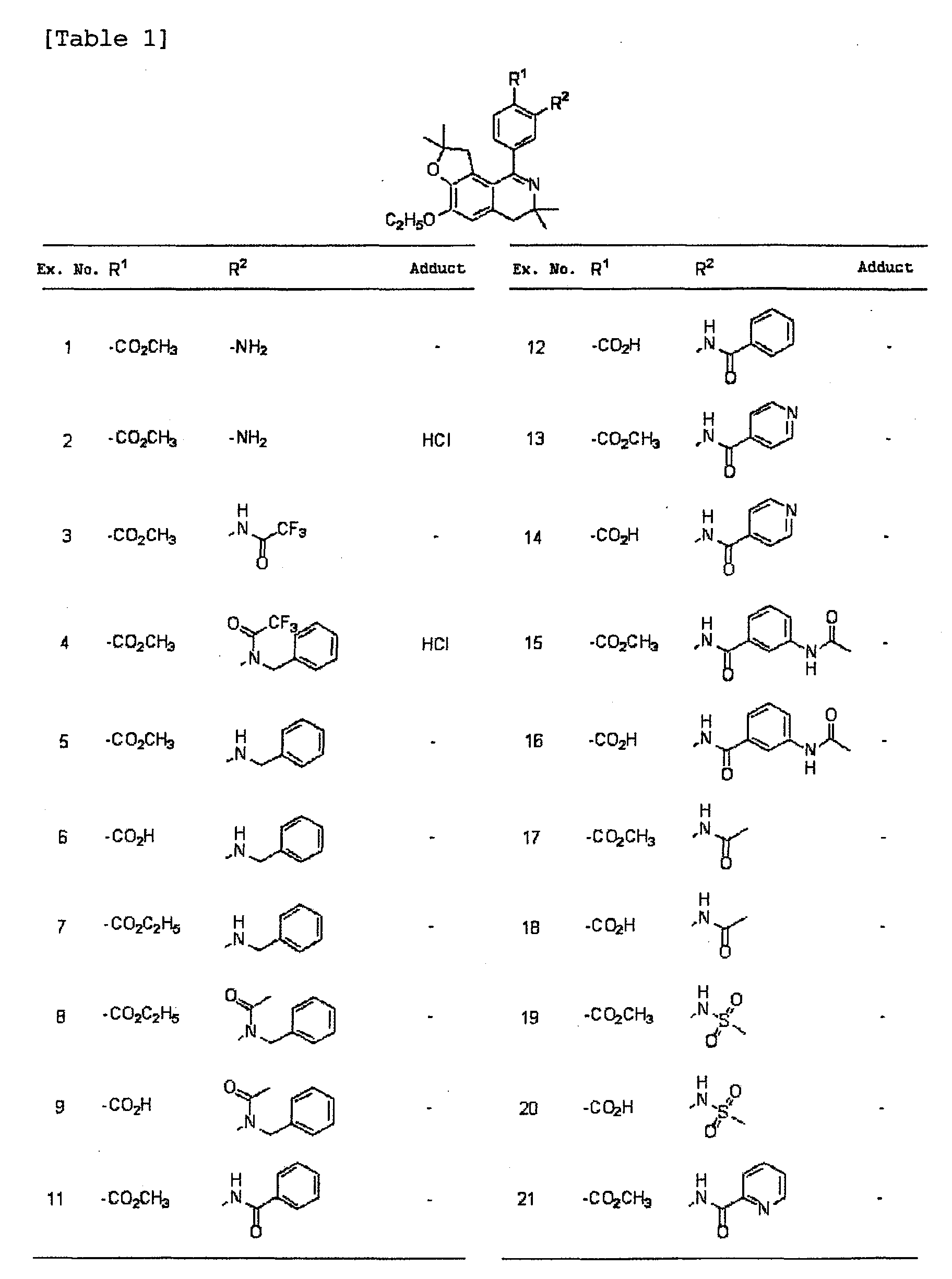
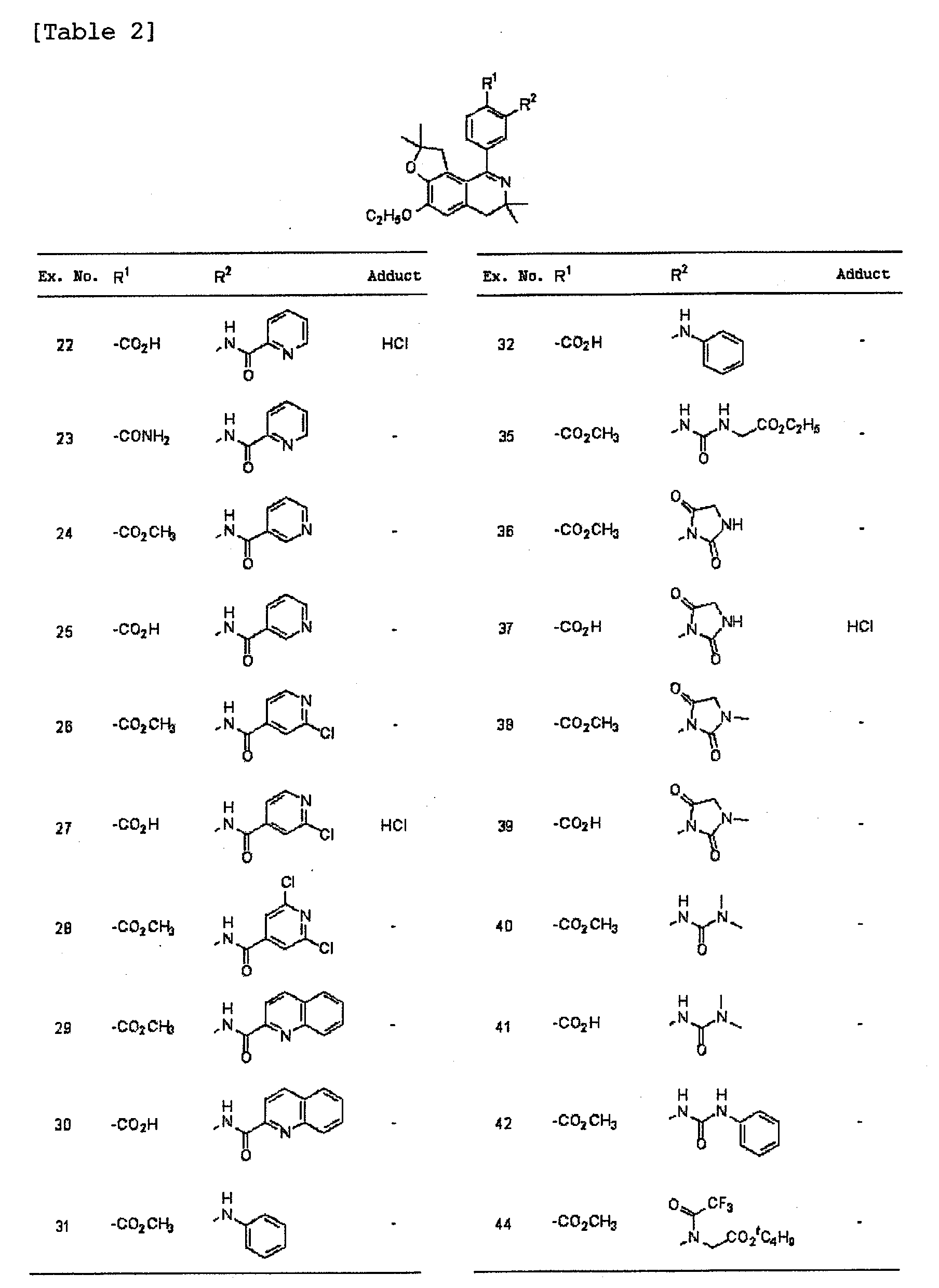


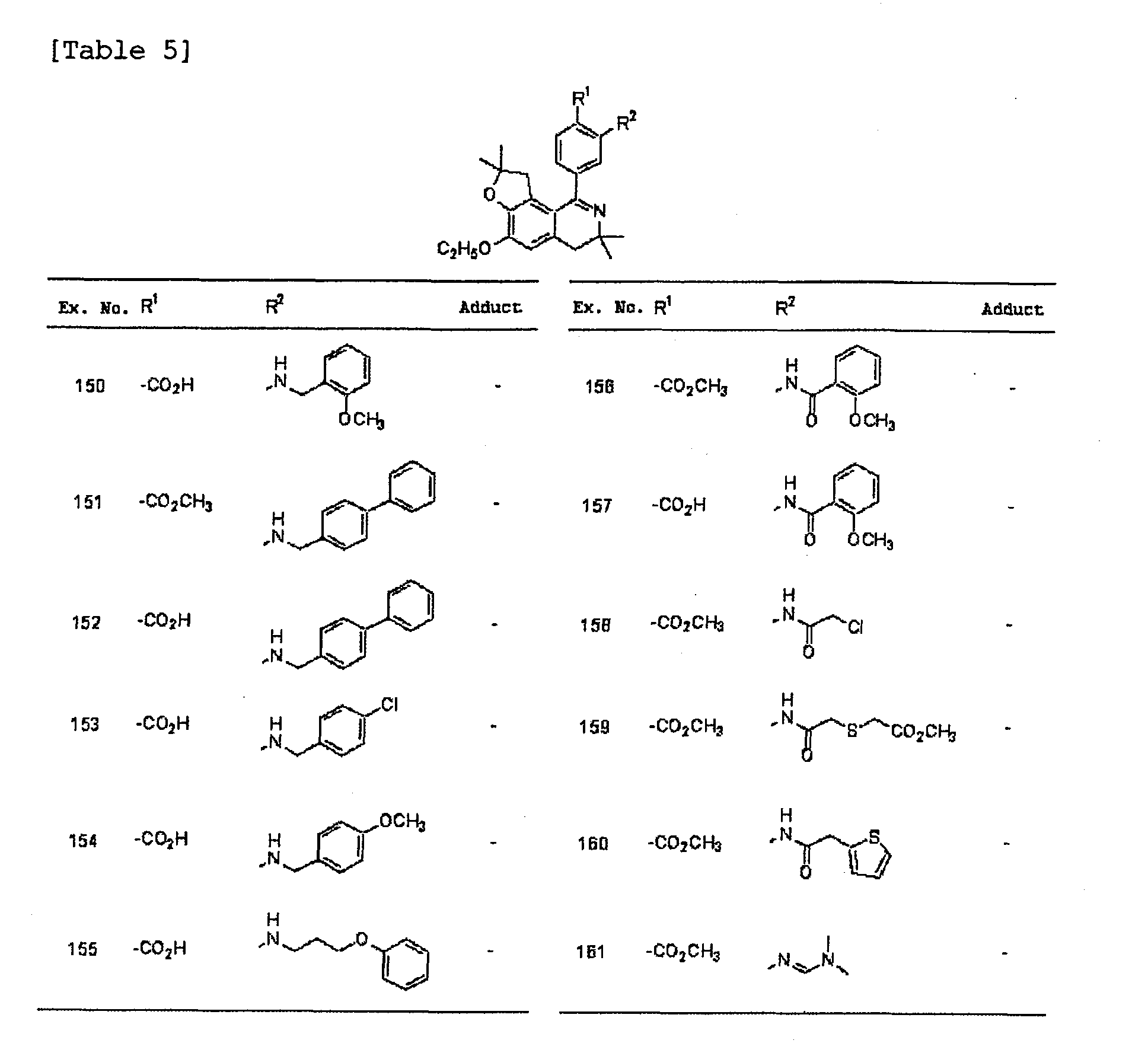


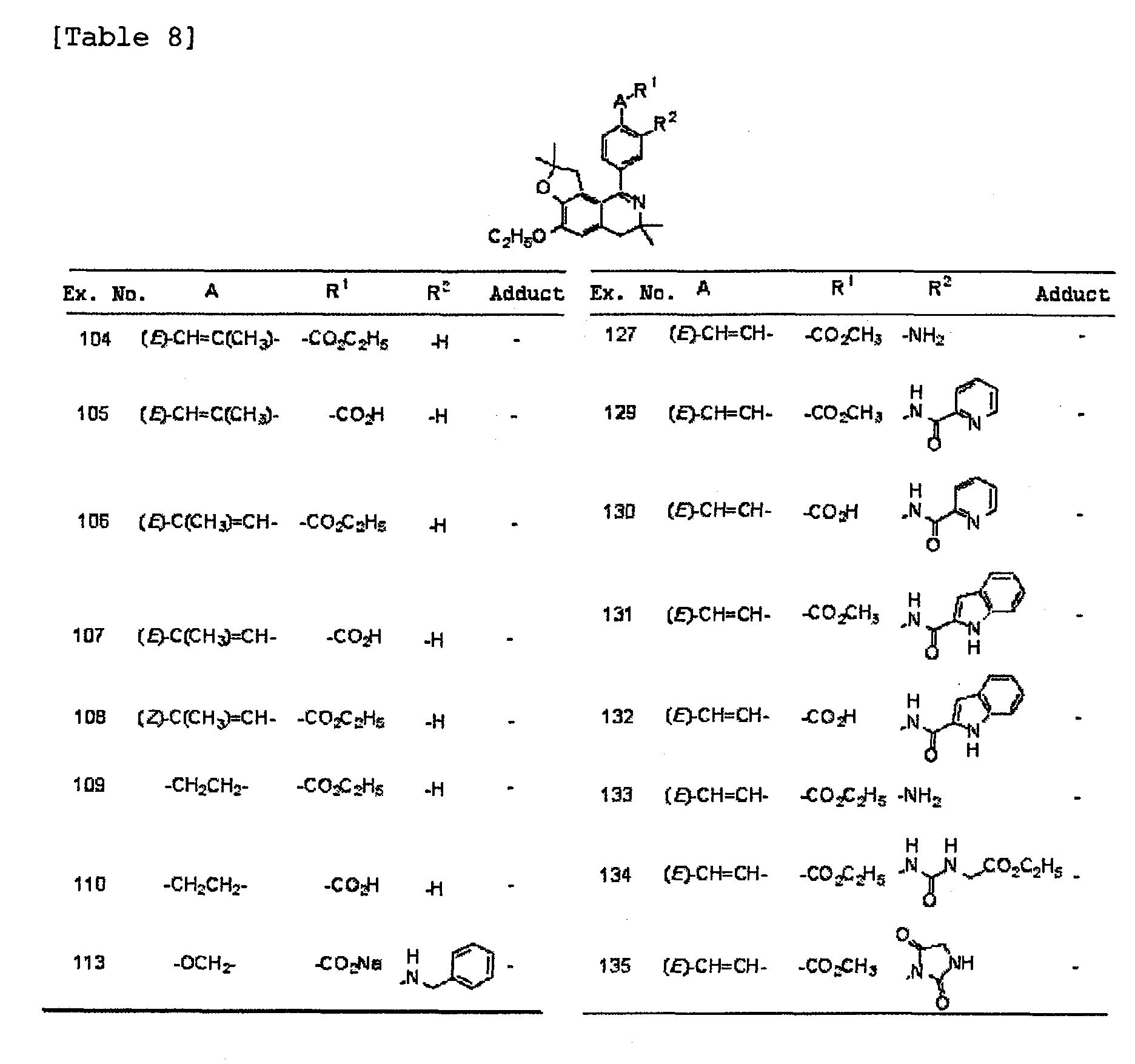
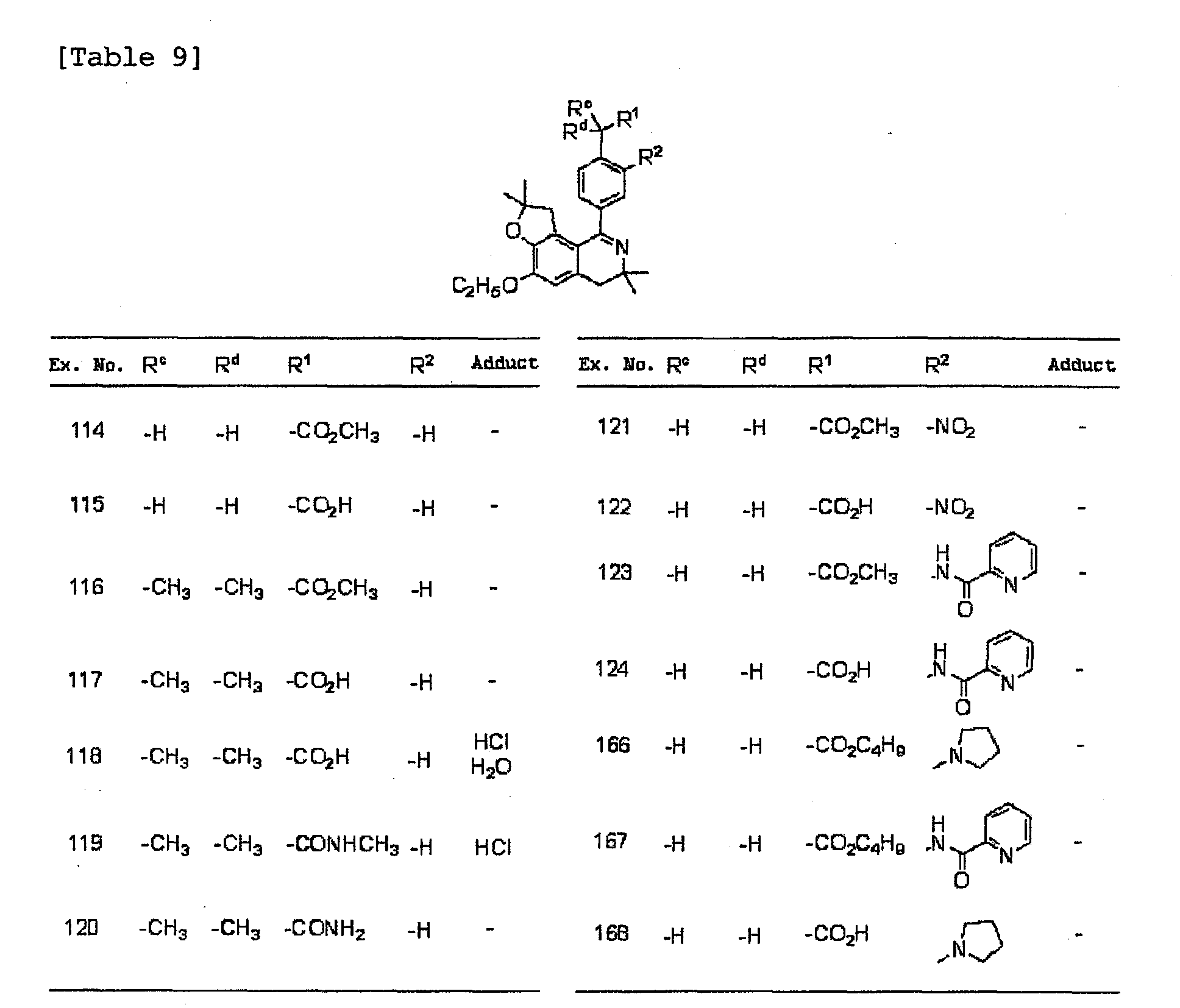


-
(1) Compound of Example 6 10.0 mg (2) Lactose 60.0 mg (3) Corn starch 35.0 mg (4) Gelatin 3.0 mg (5) Magnesium stearate 2.0 mg - A mixture of 10.0 mg of the compound obtained in Example 6, 60.0 mg of lactose and 35.0 mg of a corn starch was granulated using 0.03 ml of 10% aqueous solution of gelatin (3.0 mg as gelatin) through a 1 mm mesh sieve, dried at 40°C and then sieved again. The resultant granule was combined with 2.0 mg of magnesium stearate and then compressed. The resultant core was coated with a sugar coating comprising sucrose, titanium dioxide, talc and gum arabic in an aqueous suspension. The resultant coated tablet was imparted by polishing with beeswax to obtain a coated tablet.
-
(1) Compound of Example 6 10.0 mg (2) Lactose 70.0 mg (3) Corn starch 50.0 mg (4) Soluble starch 7.0 mg (5) Magnesium stearate 3.0 mg - 10.0 mg of the compound obtained in Example 6 and 3.0 mg of magnesium stearate were granulated using 0.07 ml of an aqueous solution of a soluble starch (7.0 mg as soluble starch), dried, and then combined with 70.0 mg of lactose and 50.0 mg of a corn starch. The mixture was compressed into a tablet.
-
(1) Compound of Example 1 5.0 mg (2) Sodium chloride 20.0 mg (3) Distilled water to 2 ml - 5.0 mg of the compound obtained in Example 6 and 20.0 mg of sodium chloride were dissolved in distilled water and water was then added to make the entire volume 2.0 ml. The solution was filtered, and filled aseptically in a 2 ml ampoule. The ampoule was sterilized, sealed, whereby obtaining an injection solution. Formulation Example 4
- In a fluidized bed granulating drier (FD-5S, manufactured by POWREX Corporation), 1500 g of the compound obtained in Example 6, 2025 g of lactose and 556.5 g of corn starch were mixed homogeneously, and then an aqueous solution in which 126 g of hydroxypropylcellulose was dissolved was sprayed in the drier to conduct a granulation, after which the mixture was dried in the fluidized bed granulating drier. The resultant granule was ground using a power mill and sieved through a 1.5 mm punching screen to obtain sized granules. 3927 g of these sized granules were combined with 210 g of croscarmellose sodium and 63 g of magnesium stearate, and mixed in a tumbler mixer to obtain granules to be compacted into tablets. These granules were compacted into 300 mg core tablets using a 6.5 mm frame in a tablet-compacting machine. The resultant core tablets were coated with a solution containing hydroxypropylmethyl cellulose 2910 (TC-5) and macrogol 6000 dissolved therein in a Doria coater coating machine and titanium oxide and iron(III) oxide dispersed therein to obtain about 13500 film-coated tablets each containing 100 mg whose composition is shown below.
Tablet formulation: Composition Content (mg) (1) Compound of Example 6 100.0 (2) Lactose 135.0 (3) Corn starch 37.1 (4) Sodium croscarmellose 15.0 (5) Hydroxypropylcellulose 8.4 (6) Magnesium stearate 4.5 Total (core tablet) 300.0 Film-coated tablet composition: (1) Core tablet 300.0 (Film component) (2) Hydroxypropylmethyl cellulose 2910 7.485 (3) Macrogol 6000 1.5 (4) Titanium oxide 1.0 (5) Iron sesquioxide 0.015 Total 310.0 - According to the method described in Formulation Example 4, about 13500 film-coated tablets having the formulation shown below each containing 25 mg of the compound obtained in Example 6 were obtained.
Tablet formulation: Composition Content (mg) (1) Compound of Example 6 25.0 (2) Lactose 210.0 (3) Corn starch 37.1 (4) Croscarmellose sodium 15.0 (5) Hydroxypropylcellulose 8.4 (6) Magnesium stearate 4.5 Total (core tablet) 300.0 Film-coated formulation: (1) Core tablet 300.0 (Film ingredients) (2) Hydroxypropylcellulose 2910 7.485 (3) Macrogol 6000 1.5 (4) Titanium oxide 1.0 (5) Iron sesquioxide 0.015 Total 310.0 - According to the method described in Formulation Example 4, about 13500 film-coated tablets having the formulation shown below each containing 5 mg of the compound obtained in Example 6 were obtained.
Tablet formulation: Composition Content (mg) (1) Compound of Example 6 5.0 (2) Lactose 230.0 (3) Corn starch 37.1 (4) Croscarmellose sodium 15.0 (5) Hydroxypropylcellulose 8.4 (6) Magnesium stearate 4.5 Total (core tablet) 300.0 Film-coated formulation: (1) Core tablet 300.0 (Film ingredients) (2) Hydroxypropylcellulose 2910 7.485 (3) Macrogol 6000 1.5 (4) Titanium oxide 1.0 (5) Iron sesquioxide 0.015 Total 310.0 - According to the method described in Formulation Example 4, about 13500 film-coated tablets having the formulation shown below each containing 1 mg of the compound obtained in Example 6 were obtained.
Tablet formulation: Composition Content (mg) Compound of Example 6 1.0 Lactose 234.0 Corn starch 37.1 Croscarmellose sodium 15.0 Hydroxypropylcellulose 8.4 Magnesium stearate 4.5 Total (core tablet) 300.0 Film-coated formulation: Core tablet 300.0 (Film ingredients) Hydroxypropylcellulose 2910 7.485 Macrogol 6000 1.5 Titanium oxide 1.0 Iron sesquioxide 0.015 Total 310.0 -
White vaseline 40 g Cetanol 10 g Bleached beeswax 5 g Sorbitan sesquioleate 5 g Lauromocrogold 0.5 g Methyl p-oxybenzoate 0.1 g Propyl p-oxybenzoate 0.1 g Purified water adequate amount - An official absorption ointment (100 g) having the composition shown above was heated preliminarily at 70°C, and the solution was combined with a solution which was obtained by dissolving 1 g of the compound obtained in Example 6 in 20 ml of methanol with heating. At the same temperature, the mixture was stirred with heating for 10 minutes to remove residual methanol, and then cooled to room temperature to obtain a wettable ointment.
- Using the Escherichia coli BL21/pPDE4D3 (FERM BP-7075) producing recombinant human brain-derived phosphodiesterase 4D3, a recombinant human brain-derived phosphodiesterase 4D3 was obtained. The expression and purification of E. coli were in accordance with the protocol attached to GST Gene Fusion System (Pharmacia).
- To a 96-well plate (OPTI plate, Packard), 10 µl of a buffer solution [0.5 M Tris-HCl (pH 7.5), 83 mM MgCl2, 17 mM EGTA], 10 µl of the recombinant human brain-derived phosphodiesterase 4D3 (0.0034 mg/ml) obtained in Section (1) described above, 65 µl of Ultrapure water, 5 µl of an inhibitor sample and 10 µl of [3H] CAMP were added and reacted for 30 minutes at 30°C. After completing the reaction, 50 µl of SPA beads solution [18 mg/ml Yttrium silicate beads, 18 mM ZnSO4] was added thereto, and the mixture was allowed to stand at room temperature for about 20 minutes. The radioactivity was counted using a scintillation counter (Topcount, Packard). Inhibiting activity of the compound against recombinant human brain-derived phosphodiesterase 4D3 was calculated, based on that enzymatic activity under absence of the compound was 100%. The inhibiting activities of the compounds of the present invention were shown in Table 11 as IC50 value.
Example No. Phosphodiesterase 4D inhibiting action (IC50, nM) 6 0.566 17 4.01 21 1.89 23 0.756 30 0.761 50 8.40 57 1.63 74 1.71 85 5.50 94 3.27 95 10.9 118 11.5 120 3.50 124 0.637 - The furoisoquinoline derivative of the present invention has an excellent phosphodiesterase IV-inhibiting action, and is useful as a prophylactic and/or therapeutic agent against inflammatory diseases, atopic dermatitis, allergic rhinitis, asthma, chronic obstructive pulmonary diseases, chronic rheumatoid arthritis, autoimmune diseases, depression, Alzheimer's dementia, osteoporosis, memory disorders, diabetes, atherosclerosis and the like.
R9 and R10 are each (i) a hydrogen atom or (ii) a C1-6 alkyl group, a C2-6 alkenyl group, a C2-6 alkynyl group, a C3-8 cycloalkyl group, a C3-8 cycloalkenyl group, a C6-14 aryl group or a C7-16 aralkyl group, each of which may have 1 to 5 substituents selected from Substituent group A described above, and
Y is a methylene group which may have 1 or 2 substituents selected from Substituent group A described above;
R1 is (1) cyano, (2) carboxyl, (3) C1-6 alkoxycarbonyl, (4) carbamoyl, or (5) N-mono-C1-6 alkylcarbamoyl,
Claims (22)
- A compound represented by the formulawherein A represents (1) a bond, (2) a group represented by the formula -CRa=CRb- (Ra and Rb each represent a hydrogen atom or a C1-6 alkyl group), (3) a group represented by the formula-(CONH)p-(C(Rc) (Rd))q- (Rc and Rd each represent a hydrogen atom or a C1-6 alkyl group, p represents 0 or 1 and q represents 1 or 2), (4) a group represented by the formula -CH2OCH2- or (5) a group represented by the formula -OCH2-;
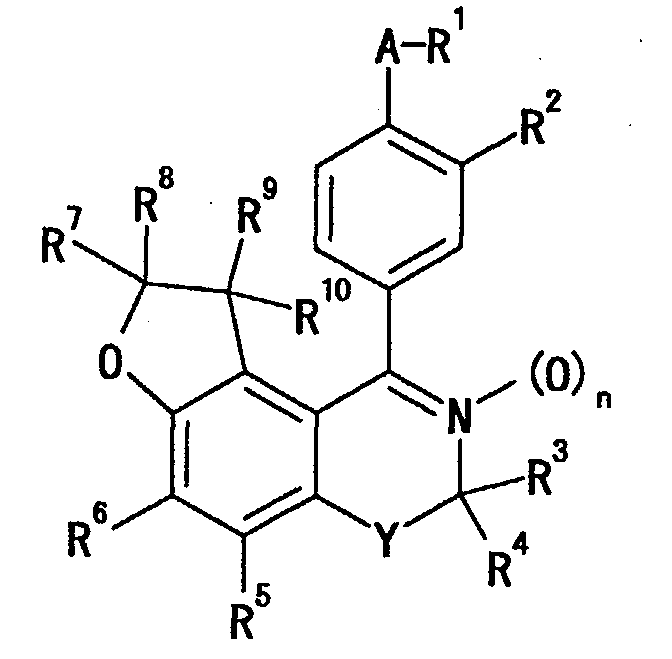
R1 represents (1) a cyano group or (2) an optionally esterified or amidated carboxyl group;
R2 represents (1) a hydrogen atom, (2) an optionally substituted hydroxy group, (3) an optionally substituted amino group, (4) an optionally substituted alkyl group, (5) an optionally esterified or amidated carboxyl group or (6) a nitro group, or R2 and A or R1 may be taken together with the adjacent carbon atom to form a ring;
R3 and R4 each represent (1) a hydrogen atom, (2) an optionally substituted hydrocarbon group or (3) an acyl group, or R3 and R4 may be taken together with the adjacent carbon atom to form an optionally substituted 3- to 8-membered ring;
R5 represents (1) a hydrogen atom, (2) a cyano group, (3) an optionally substituted hydrocarbon group, (4) an acyl group or (5) an optionally substituted hydroxy group;
R6 represents (1) a hydrogen atom, (2) an optionally substituted hydrocarbon group, (3) an acyl group, (4) an optionally substituted heterocyclic group, (5) a halogen atom, (6) an optionally substituted hydroxy group, (7) an optionally substituted thiol group, (8) a group represented by the formula-S(O)rR11 (R11 represents an optionally substituted hydrocarbon group or an optionally substituted heterocyclic group and r is 1 or 2) or (9) an optionally substituted amino group;
R7 and R8 each represent (1) a hydrogen atom or (2) an optionally substituted hydrocarbon group, or R7 and R8 may be taken together with the adjacent carbon atom to form an optionally substituted 3- to 8-membered ring;
R9 and R10 each represent (1) a hydrogen atom or (2) an optionally substituted hydrocarbon group;
Y represents an optionally substituted methylene group; and
n represents 0 or 1,
provided that if A is a bond, R2 is not a hydrogen atom, and if A is a group represented by the formula -(CONH)p-(C(Rc)(Rd))q- (Rc and Rd each represent a hydrogen atom or a C1-6 alkyl group, p represents 0 or 1 and q represents 1 or 2), R6 is not methoxy, or a salt thereof. - The compound according to claim 1, wherein R1 is (i) a cyano group, (ii) a carboxyl group, (iii) a C1-6 alkoxy-carbonyl group which may have 1 to 5 substituents selected from a group consisting of (1) a halogen atom, (2) a C1-3 alkylenedioxy group, (3) a nitro group, (4) a cyano group, (5) an optionally halogenated C1-6 alkyl group, (6) an optionally halogenated C2-6 alkenyl group, (7) an optionally halogenated C2-6 alkynyl group, (8) a C3-8 cycloalkyl group, (9) a C6-14 aryl group, (10) an optionally halogenated C1-6 alkoxy group, (11) an optionally halogenated C1-6 alkylthio group, (12) a hydroxy group, (13) an amino group, (14) a mono-C1-6 alkylamino group, (15) a mono-C6-14 arylamino group, (16) a di-C1-6 alkylamino group, (17) a di-C6-14 arylamino group, (18) an acyl group selected from formyl, carboxyl, carbamoyl, C1-6 alkyl-carbonyl, C3-8 cycloalkyl-carbonyl, C1-6 alkoxy-carbonyl, C6-14 aryl-carbonyl, C7-16 aralkyl-carbonyl, C6-14 aryloxy-carbonyl, C7-16 aralkyloxy-carbonyl, 5- or 6-membered heterocyclic carbonyl containing 1 to 3 hetero atoms selected from a nitrogen atom, a sulfur atom and an oxygen atom in addition to carbon atoms, mono-C1-6 alkyl-carbamoyl, di-C1-6 alkyl-carbamoyl, mono-C6-14 aryl-carbamoyl, di-C6-14 aryl-carbamoyl, 5- or 6-membered heterocyclic carbamoyl containing 1 to 3 hetero atoms selected from a nitrogen atom, a sulfur atom and an oxygen atom in addition to carbon atoms, C1-6 alkyl-thiocarbonyl, C3-8 cycloalkyl-thiocarbonyl, C1-6 alkoxy-thiocarbonyl, C6-14 aryl-thiocarbonyl, C7-16 aralkyl-thiocarbonyl, C6-14 aryloxy-thiocarbonyl, C7-16 aralkyloxy-thiocarbonyl, 5- or 6-membered heterocyclic thiocarbonyl containing 1 to 3 hetero atoms selected from a nitrogen atom, a sulfur atom and an oxygen atom in addition to carbon atoms, thiocarbamoyl, mono-C1-6 alkyl-thiocarbamoyl, di-C1-6 alkyl-thiocarbamoyl, mono-C6-14 aryl-thiocarbamoyl, di-C6-14 aryl-thiocarbamoyl, 5- or 6-membered heterocyclic thiocarbamoyl containing 1 to 3 hetero atoms selected from a nitrogen atom, a sulfur atom and an oxygen atom in addition to carbon atoms, sulfamoyl, mono-C1-6 alkylsulfamoyl, di-C1-6 alkylsulfamoyl, C6-14 arylsulfamoyl, C1-6 alkylsulfonyl, C6-14 arylsulfonyl, C1-6 alkylsulfinyl, C6-14 arylsulfinyl, sulfino, sulfo, C1-6 alkoxysulfinyl, C6-14 aryloxysulfinyl, C1-6 alkoxysulfonyl and C6-14 aryloxysulfonyl, (19) an acylamino group selected from formylamino, C1-6 alkyl-carboxamide, C6-14 aryl-carboxamide, C1-6 alkoxy-carboxamide, C1-6 alkylsulfonylamino and C6-14 arylsulfonylamino, (20) an acyloxy group selected from C1-6 alkyl-carbonyloxy, C6-14 aryl-carbonyloxy, C1-6 alkoxy-carbonyloxy, mono-C1-6 alkyl-carbamoyloxy, di-C1-6 alkyl-carbamoyloxy, mono-C6-14 aryl-carbamoyloxy, di-C6-14 aryl-carbamoyloxy and nicotinoyloxy, (21) a 5- to 14-membered heterocyclic group containing 1 to 4 hetero atoms selected from a nitrogen atom, a sulfur atom and an oxygen atom in addition to carbon atoms, (22) a phosphono group, (23) a C6-14 aryloxy group, (24) a di-C1-6 alkoxy-phosphoryl group, (25) a C6-14 arylthio group, (26) a hydrazino group, (27) an imino group, (28) an oxo group, (29) an ureido group, (30) a C1-6 alkyl-ureido group, (31) a di-C1-6 alkyl-ureido group, (32) an oxide group and (33) a group formed by binding of 2 or 3 groups selected from (1) to (32) listed above and the like (hereinafter, abbreviated as Substituent group A), (iv) a C3-8 cycloalkyloxy-carbonyl group which may have 1 to 5 substituents selected from Substituent group A described above, (v) a C7-16 aralkyloxy-carbonyl group which may have 1 to 5 substituents selected from Substituent group A described above, (vi) a C6-14 aryloxy-carbonyl group which may have 1 to 5 substituents selected from Substituent group A described above, (vii) a carbamoyl group, (viii) a mono-C1-6 alkyl-carbamoyl group which may have 1 to 5 substituents selected from Substituent group A described above, (ix) a di-C1-6 alkyl-carbamoyl group which may have 1 to 5 substituents selected from Substituent group A described above, (x) a mono-C6-14 aryl-carbamoyl group which may have 1 to 5 substituents selected from Substituent group A described above or (xi) a di-C6-14 aryl-carbamoyl group which may have 1 to 5 substituents selected from Substituent group A described above,
R2 is (i) a hydrogen atom, (ii) a group represented by the formula -OR12 (R12 represents (a) a hydrogen atom, (b) a C1-6 alkyl group, C2-6 alkenyl group, C2-6 alkynyl group, C3-8 cycloalkyl group, C3-8 cycloalkenyl group, C6-14 aryl group or C7-16 aralkyl group, each of which may have 1 to 5 substituents selected from Substituent group A described above, or (c) an acyl group selected from formyl, carbamoyl, C1-6 alkyl-carbonyl, C3-8 cycloalkyl-carbonyl, C1-6 alkoxy-carbonyl, C6-14 aryl-carbonyl, C7-16 aralkyl-carbonyl, C6-14 aryloxy-carbonyl, C7-16 aralkyloxy-carbonyl, 5- or 6-membered heterocyclic carbonyl containing 1 to 3 hetero atoms selected from a nitrogen atom, a sulfur atom and an oxygen atom in addition to carbon atoms, mono-C1-6 alkyl-carbamoyl, di-C1-6 alkyl-carbamoyl, mono-C6-14 aryl-carbamoyl, di-C6-14 aryl-carbamoyl, 5- or 6-membered heterocyclic carbamoyl containing 1 to 3 hetero atoms selected from a nitrogen atom, a sulfur atom and an oxygen atom in addition to carbon atoms, C1-6 alkyl-thiocarbonyl, C3-8 cycloalkyl-thiocarbonyl, C1-6 alkoxy-thiocarbonyl, C6-14 aryl-thiocarbonyl, C7-16 aralkyl-thiocarbonyl, C6-14 aryloxy-thiocarbonyl, C7-16 aralkyloxy-thiocarbonyl, 5- or 6-membered heterocyclic thiocarbonyl containing 1 to 3 hetero atoms selected from a nitrogen atom, a sulfur atom and an oxygen atom in addition to carbon atoms, thiocarbamoyl, mono-C1-6 alkyl-thiocarbamoyl, di-C1-6 alkyl-thiocarbamoyl, mono-C6-14 aryl-thiocarbamoyl, di-C6-14 aryl-thiocarbamoyl, 5- or 6-membered heterocyclic thiocarbamoyl containing 1 to 3 hetero atoms selected from a nitrogen atom, a sulfur atom and an oxygen atom in addition to carbon atoms, sulfamoyl, mono-C1-6 alkylsulfamoyl, di-C1-6 alkylsulfamoyl, C6-14 arylsulfamoyl, C1-6 alkylsulfonyl, C6-14 arylsulfonyl, C1-6 alkylsulfinyl, C6-14 arylsulfinyl, C1-6 alkoxysulfinyl, C6-14 aryloxysulfinyl, C1-6 alkoxysulfonyl and C6-14 aryloxysulfonyl, which may have 1 to 5 substituents selected from Substituent group A described above), (iii) a group represented by the formula-NR13R14 (R13 and R14 are each (i') a hydrogen atom, (ii') a C1-6 alkyl group, C2-6 alkenyl group, C2-6 alkynyl group, C3-8 cycloalkyl group, C3-8 cycloalkenyl group, C6-14 aryl group or C7-16 aralkyl group, each of which may have 1 to 5 substituents selected from Substituent group A described above, (iii') an acyl group selected from formyl, carbamoyl, C1-6 alkyl-carbonyl, C3-8 cycloalkyl-carbonyl, C1-6 alkoxy-carbonyl, C6-14 aryl-carbonyl, C7-16 aralkyl-carbonyl, C6-14 aryloxy-carbonyl, C7-16 aralkyloxy-carbonyl, 5- or 6-membered heterocyclic carbonyl containing 1 to 3 hetero atoms selected from a nitrogen atom, a sulfur atom and an oxygen atom in addition to carbon atoms, mono-C1-6 alkyl-carbamoyl, di-C1-6 alkyl-carbamoyl, mono-C6-14 aryl-carbamoyl, di-C6-14 aryl-carbamoyl, 5- or 6-membered heterocyclic carbamoyl containing 1 to 3 hetero atoms selected from a nitrogen atom, a sulfur atom and an oxygen atom in addition to carbon atoms, C1-6 alkyl-thiocarbonyl, C3-8 cycloalkyl-thiocarbonyl, C1-6 alkoxy-thiocarbonyl, C6-14 aryl-thiocarbonyl, C7-16 aralkyl-thiocarbonyl, C6-14 aryloxy-thiocarbonyl, C7-16 aralkyloxy-thiocarbonyl, 5- or 6-membered heterocyclic thiocarbonyl containing 1 to 3 hetero atoms selected from a nitrogen atom, a sulfur atom and an oxygen atom in addition to carbon atoms, thiocarbamoyl, mono-C1-6 alkyl-thiocarbamoyl, di-C1-6 alkyl-thiocarbamoyl, mono-C6-14 aryl-thiocarbamoyl, di-C6-14 aryl-thiocarbamoyl, 5- or 6-membered heterocyclic thiocarbamoyl containing 1 to 3 hetero atoms selected from a nitrogen atom, a sulfur atom and an oxygen atom in addition to carbon atoms, sulfamoyl, mono-C1-6 alkylsulfamoyl, di-C1-6 alkylsulfamoyl, C6-14 arylsulfamoyl, C1-6 alkylsulfonyl, C6-14 arylsulfonyl, C1-6 alkylsulfinyl, C6-14 arylsulfinyl, C1-6 alkoxysulfinyl, C6-14 aryloxysulfinyl, C1-6 alkoxysulfonyl and C6-14 aryloxysulfonyl, which may have 1 to 5 substituents selected from Substituent group A described above or (iv') a 5- to 14-membered heterocycle containing 1 to 4 hetero atoms selected from a nitrogen atom, a sulfur atom and an oxygen atom in addition to carbon atoms, which may have 1 to 5 substituents selected from Substituent group A described above, or R13 and R14 may be taken together with the adjacent a nitrogen atom to form a 5- to 14-membered ring), (iv) a C1-6 alkylideneamino group which may have 1 to 5 substituents selected from Substituent group A described above, (v) a C1-6 alkyl group which may have 1 to 5 substituents selected from Substituent group A described above, (vi) a carboxyl group, (vii) a C1-6 alkoxy-carbonyl group which may have 1 to 5 substituents selected from Substituent group A described above, (viii) a C3-8 cycloalkyloxy-carbonyl group which may have 1 to 5 substituents selected from Substituent group A described above, (ix) a C7-16 aralkyloxy-carbonyl group which may have 1 to 5 substituents selected from Substituent group A described above, (x) a C6-14 aryloxy-carbonyl group which may have 1 to 5 substituents selected from Substituent group A described above, (xi) a carbamoyl group, (xii) a mono-C1-6 alkyl-carbamoyl group which may have 1 to 5 substituents selected from Substituent group A described above, (xiii) a di-C1-6 alkyl-carbamoyl group which may have 1 to 5 substituents selected from Substituent group A described above, (xiv) a mono-C6-14 aryl-carbamoyl group which may have 1 to 5 substituents selected from Substituent group A described above, (xv) a di-C6-14 aryl-carbamoyl group which may have 1 to 5 substituents selected from Substituent group A described above or (xvi) a nitro group, or R2 and A or R1 may be taken together to form a 5- to 14-membered ring containing 1 to 4 hetero atoms selected from a nitrogen atom and an oxygen atom in addition to carbon atoms, which may have 1 to 5 substituents selected from Substituent group A described above;
each of R3 and R4 is any of the following (i) to (iii):R3 and R4 may be taken together with the adjacent carbon atom to form C3-8 cycloalkane or a 3- to 8-membered heterocycle, which may have respectively 1 to 3 substituents selected from C1-6 alkyl, C6-14 aryl, C7-16 aralkyl, amino, mono-C1-6 alkylamino, mono-C6-14 arylamino, di-C1-6 alkylamino, di-C6-14 arylamino and a 4- to 10-membered aromatic heterocyclic group,(i) a hydrogen atom,(ii) a C1-6 alkyl group, C2-6 alkenyl group, C2-6 alkynyl group, C3-8 cycloalkyl group, C3-8 cycloalkenyl group, C6-14 aryl group or C7-16 aralkyl group, each of which may have 1 to 5 substituents selected from Substituent group A described above,(iii) an acyl group selected from formyl, carboxyl, carbamoyl, C1-6 alkyl-carbonyl, C3-8 cycloalkyl-carbonyl, C1-6 alkoxy-carbonyl, C6-14 aryl-carbonyl, C7-16 aralkyl-carbonyl, C6-14 aryloxy-carbonyl, C7-16 aralkyloxy-carbonyl, 5- or 6-membered heterocyclic carbonyl containing 1 to 3 hetero atoms selected from a nitrogen atom, a sulfur atom and an oxygen atom in addition to carbon atoms, mono-C1-6 alkyl-carbamoyl, di-C1-6 alkyl-carbamoyl, mono-C6-14 aryl-carbamoyl, di-C6-14 aryl-carbamoyl, 5- or 6-membered heterocyclic carbamoyl containing 1 to 3 hetero atoms selected from a nitrogen atom, a sulfur atom and an oxygen atom in addition to carbon atoms, C1-6 alkyl-thiocarbonyl, C3-8 cycloalkyl-thiocarbonyl, C1-6 alkoxy-thiocarbonyl, C6-14 aryl-thiocarbonyl, C7-16 aralkyl-thiocarbonyl, C6-14 aryloxy-thiocarbonyl, C7-16 aralkyloxy-thiocarbonyl, 5- or 6-membered heterocyclic thiocarbonyl containing 1 to 3 hetero atoms selected from a nitrogen atom, a sulfur atom and an oxygen atom in addition to carbon atoms, thiocarbamoyl, mono-C1-6 alkyl-thiocarbamoyl, di-C1-6 alkyl-thiocarbamoyl, mono-C6-14 aryl-thiocarbamoyl, di-C6-14 aryl-thiocarbamoyl, 5- or 6-membered heterocyclic thiocarbamoyl containing 1 to 3 hetero atoms selected from a nitrogen atom, a sulfur atom and an oxygen atom in addition to carbon atoms, sulfamoyl, mono-C1-6 alkylsulfamoyl, di-C1-6 alkylsulfamoyl, C6-14 arylsulfamoyl, C1-6 alkylsulfonyl, C6-14 arylsulfonyl, C1-6 alkylsulfinyl, C6-14 arylsulfinyl, sulfino, sulfo, C1-6 alkoxysulfinyl, C6-14 aryloxysulfinyl, C1-6 alkoxysulfonyl and C6-14 aryloxysulfonyl, which may have 1 to 5 substituents selected from Substituent group A described above; or
R5 is (i) a hydrogen atom, (ii) a cyano group, (iii) a C1-6 alkyl group, C2-6 alkenyl group, C2-6 alkynyl group, C3-8 cycloalkyl group, C3-8 cycloalkenyl group, C6-14 aryl group or C7-16 aralkyl group, each of which may have 1 to 5 substituents selected from Substituent group A described above, (iv) an acyl group selected from formyl, carboxyl, carbamoyl, C1-6 alkyl-carbonyl, C3-8 cycloalkyl-carbonyl, C1-6 alkoxy-carbonyl, C6-14 aryl-carbonyl, C7-16 aralkyl-carbonyl, C6-14 aryloxy-carbonyl, C7-16 aralkyloxy-carbonyl, 5- or 6-membered heterocyclic carbonyl containing 1 to 3 hetero atoms selected from a nitrogen atom, a sulfur atom and an oxygen atom in addition to carbon atoms, mono-C1-6 alkyl-carbamoyl, di-C1-6 alkyl-carbamoyl, mono-C6-14 aryl-carbamoyl, di-C6-14 aryl-carbamoyl, 5- or 6-membered heterocyclic carbamoyl containing 1 to 3 hetero atoms selected from a nitrogen atom, a sulfur atom and an oxygen atom in addition to carbon atoms, C1-6 alkyl-thiocarbonyl, C3-8 cycloalkyl-thiocarbonyl, C1-6 alkoxy-thiocarbonyl, C6-14 aryl-thiocarbonyl, C7-16 aralkyl-thiocarbonyl, C6-14 aryloxy-thiocarbonyl, C7-16 aralkyloxy-thiocarbonyl, 5- or 6-membered heterocyclic thiocarbonyl containing 1 to 3 hetero atoms selected from a nitrogen atom, a sulfur atom and an oxygen atom in addition to carbon atoms, thiocarbamoyl, mono-C1-6 alkyl-thiocarbamoyl, di-C1-6 alkyl-thiocarbamoyl, mono-C6-14 aryl-thiocarbamoyl, di-C6-14 aryl-thiocarbamoyl, 5- or 6-membered heterocyclic thiocarbamoyl containing 1 to 3 hetero atoms selected from a nitrogen atom, a sulfur atom and an oxygen atom in addition to carbon atoms, sulfamoyl, mono-C1-6 alkylsulfamoyl, di-C1-6 alkylsulfamoyl, C6-14 arylsulfamoyl, C1-6 alkylsulfonyl, C6-14 arylsulfonyl, C1-6 alkylsulfinyl, C6-14 arylsulfinyl, sulfino, sulfo, C1-6 alkoxysulfinyl, C6-14 aryloxysulfinyl, C1-6 alkoxysulfonyl and C6-14 aryloxysulfonyl, which may have 1 to 5 substituents selected from Substituent group A described above, or (v) a group represented by the formula -OR15 (R15 represents (a) a hydrogen atom, (b) a C1-6 alkyl group, C2-6 alkenyl group, C2-6 alkynyl group, C3-8 cycloalkyl group, C3-8 cycloalkenyl group, C6-14 aryl group or C7-16 aralkyl group, each of which may have 1 to 5 substituents selected from Substituent group A described above, or (c) an acyl group selected from formyl, carbamoyl, C1-6 alkyl-carbonyl, C3-8 cycloalkyl-carbonyl, C1-6 alkoxy-carbonyl, C6-14 aryl-carbonyl, C7-16 aralkyl-carbonyl, C6-14 aryloxy-carbonyl, C7-16 aralkyloxy-carbonyl, 5- or 6-membered heterocyclic carbonyl containing 1 to 3 hetero atoms selected from a nitrogen atom, a sulfur atom and an oxygen atom in addition to carbon atoms, mono-C1-6 alkyl-carbamoyl, di-C1-6 alkyl-carbamoyl, mono-C6-14 aryl-carbamoyl, di-C6-14 aryl-carbamoyl, 5- or 6-membered heterocyclic carbamoyl containing 1 to 3 hetero atoms selected from a nitrogen atom, a sulfur atom and an oxygen atom in addition to carbon atoms, C1-6 alkyl-thiocarbonyl, C3-8 cycloalkyl-thiocarbonyl, C1-6 alkoxy-thiocarbonyl, C6-14 aryl-thiocarbonyl, C7-16 aralkyl-thiocarbonyl, C6-14 aryloxy-thiocarbonyl, C7-16 aralkyloxy-thiocarbonyl, 5- or 6-membered heterocyclic thiocarbonyl containing 1 to 3 hetero atoms selected from a nitrogen atom, a sulfur atom and an oxygen atom in addition to carbon atoms, thiocarbamoyl, mono-C1-6 alkyl-thiocarbamoyl, di-C1-6 alkyl-thiocarbamoyl, mono-C6-14 aryl-thiocarbamoyl, di-C6-14 aryl-thiocarbamoyl, 5- or 6-membered heterocyclic thiocarbamoyl containing 1 to 3 hetero atoms selected from a nitrogen atom, a sulfur atom and an oxygen atom in addition to carbon atoms, sulfamoyl, mono-C1-6 alkylsulfamoyl, di-C1-6 alkylsulfamoyl, C6-14 arylsulfamoyl, C1-6 alkylsulfonyl, C6-14 arylsulfonyl, C1-6 alkylsulfinyl, C6-14 arylsulfinyl, C1-6 alkoxysulfinyl, C6-14 aryloxysulfinyl, C1-6 alkoxysulfonyl and C6-14 aryloxysulfonyl, which may have 1 to 5 substituents selected from Substituent group A described above),
R6 is any of the following (i) to (x):R7 and R8 are each (i) a hydrogen atom or (ii) a C1-6 alkyl group, C2-6 alkenyl group, C2-6 alkynyl group, C3-8 cycloalkyl group, C3-8 cycloalkenyl group, C6-14 aryl group or C7-16 aralkyl group, each of which may have 1 to 5 substituents selected from Substituent group A described above, or R7 and R8 may be taken together with the adjacent carbon atom to form C3-8 cycloalkane or a 3- to 8-membered heterocycle, which may have respectively 1 to 3 substituents selected from C1-6 alkyl, C6-14 aryl, C7-16 aralkyl, amino, mono-C1-6 alkylamino, mono-C6-14 arylamino, di-C1-6 alkylamino, di-C6-14 arylamino and a 4- to 10-membered aromatic heterocyclic group;(i) a hydrogen atom,(ii) a C1-6 alkyl group, C2-6 alkenyl group, C2-6 alkynyl group, C3-8 cycloalkyl group, C3-8 cycloalkenyl group, C6-14 aryl group or C7-16 aralkyl group, each of which may have 1 to 5 substituents selected from Substituent group A described above,(iii) an acyl group selected from formyl, carboxyl, carbamoyl, C1-6 alkyl-carbonyl, C3-8 cycloalkyl-carbonyl, C1-6 alkoxy-carbonyl, C6-14 aryl-carbonyl, C7-16 aralkyl-carbonyl, C6-14 aryloxy-carbonyl, C7-16 aralkyloxy-carbonyl, 5- or 6-membered heterocyclic carbonyl containing 1 to 3 hetero atoms selected from a nitrogen atom, a sulfur atom and an oxygen atom in addition to carbon atoms, mono-C1-6 alkyl-carbamoyl, di-C1-6 alkyl-carbamoyl, mono-C6-14 aryl-carbamoyl, di-C6-14 aryl-carbamoyl, 5- or 6-membered heterocyclic carbamoyl containing 1 to 3 hetero atoms selected from a nitrogen atom, a sulfur atom and an oxygen atom in addition to carbon atoms, C1-6 alkyl-thiocarbonyl, C3-8 cycloalkyl-thiocarbonyl, C1-6 alkoxy-thiocarbonyl, C6-14 aryl-thiocarbonyl, C7-16 aralkyl-thiocarbonyl, C6-14 aryloxy-thiocarbonyl, C7-16 aralkyloxy-thiocarbonyl, 5- or 6-membered heterocyclic thiocarbonyl containing 1 to 3 hetero atoms selected from a nitrogen atom, a sulfur atom and an oxygen atom in addition to carbon atoms, thiocarbamoyl, mono-C1-6 alkyl-thiocarbamoyl, di-C1-6 alkyl-thiocarbamoyl, mono-C6-14 aryl-thiocarbamoyl, di-C6-14 aryl-thiocarbamoyl, 5- or 6-membered heterocyclic thiocarbamoyl containing 1 to 3 hetero atoms selected from a nitrogen atom, a sulfur atom and an oxygen atom in addition to carbon atoms, sulfamoyl, mono-C1-6 alkylsulfamoyl, di-C1-6 alkylsulfamoyl, C6-14 arylsulfamoyl, C1-6 alkylsulfonyl, C6-14 arylsulfonyl, C1-6 alkylsulfinyl, C6-14 arylsulfinyl, sulfino, sulfo, C1-6 alkoxysulfinyl, C6-14 aryloxysulfinyl, C1-6 alkoxysulfonyl and C6-14 aryloxysulfonyl, which may have 1 to 5 substituents selected from Substituent group A described above,(iv) a 5- to 14-membered heterocycle containing 1 to 4 hetero atoms selected from a nitrogen atom, a sulfur atom and an oxygen atom in addition to carbon atoms, which may have 1 to 5 substituents selected from Substituent group A described above,(v) a halogen atom,(vi) a group represented by the formula -OR16 (R16 represents (i') a hydrogen atom, (ii') a C1-6 alkyl group, C2-6 alkenyl group, C2-6 alkynyl group, C3-8 cycloalkyl group, C3-8 cycloalkenyl group, C6-14 aryl group or C7-16 aralkyl group, each of which may have 1 to 5 substituents selected from Substituent group A described above, (iii') an acyl group selected from formyl, carbamoyl, C1-6 alkyl-carbonyl, C3-8 cycloalkyl-carbonyl, C1-6 alkoxy-carbonyl, C6-14 aryl-carbonyl, C7-16 aralkyl-carbonyl, C6-14 aryloxy-carbonyl, C7-16 aralkyloxy-carbonyl, 5- or 6-membered heterocyclic carbonyl containing 1 to 3 hetero atoms selected from a nitrogen atom, a sulfur atom and an oxygen atom in addition to carbon atoms, mono-C1-6 alkyl-carbamoyl, di-C1-6 alkyl-carbamoyl, mono-C6-14 aryl-carbamoyl, di-C6-14 aryl-carbamoyl, 5- or 6-membered heterocyclic carbamoyl containing 1 to 3 hetero atoms selected from a nitrogen atom, a sulfur atom and an oxygen atom in addition to carbon atoms, C1-6 alkyl-thiocarbonyl, C3-8 cycloalkyl-thiocarbonyl, C1-6 alkoxy-thiocarbonyl, C6-14 aryl-thiocarbonyl, C7-16 aralkyl-thiocarbonyl, C6-14 aryloxy-thiocarbonyl, C7-16 aralkyloxy-thiocarbonyl, 5- or 6-membered heterocyclic thiocarbonyl containing 1 to 3 hetero atoms selected from a nitrogen atom, a sulfur atom and an oxygen atom in addition to carbon atoms, thiocarbamoyl, mono-C1-6 alkyl-thiocarbamoyl, di-C1-6 alkyl-thiocarbamoyl, mono-C6-14 aryl-thiocarbamoyl, di-C6-14 aryl-thiocarbamoyl, 5- or 6-membered heterocyclic thiocarbamoyl containing 1 to 3 hetero atoms selected from a nitrogen atom, a sulfur atom and an oxygen atom in addition to carbon atoms, sulfamoyl, mono-C1-6 alkylsulfamoyl, di-C1-6 alkylsulfamoyl, C6-14 arylsulfamoyl, C1-6 alkylsulfonyl, C6-14 arylsulfonyl, C1-6 alkylsulfinyl, C6-14 arylsulfinyl, C1-6 alkoxysulfinyl, C6-14 aryloxysulfinyl, C1-6 alkoxysulfonyl and C6-14 aryloxysulfonyl, which may have 1 to 5 substituents selected from Substituent group A described above, or (iv') a 5- to 14-membered heterocycle containing 1 to 4 hetero atoms selected from a nitrogen atom, a sulfur atom and an oxygen atom in addition to carbon atoms, which may have 1 to 5 substituents selected from Substituent group A described above),(vii) a group represented by the formula -SR17 (R17 represents (i') a hydrogen atom, (ii') a C1-6 alkyl group, C2-6 alkenyl group, C2-6 alkynyl group, C3-8 cycloalkyl group, C3-8 cycloalkenyl group, C6-14 aryl group or C7-16 aralkyl group, each of which may have 1 to 5 substituents selected from Substituent group A described above, (iii') an acyl group selected from formyl, carbamoyl, C1-6 alkyl-carbonyl, C3-8 cycloalkyl-carbonyl, C1-6 alkoxy-carbonyl, C6-14 aryl-carbonyl, C7-16 aralkyl-carbonyl, C6-14 aryloxy-carbonyl, C7-16 aralkyloxy-carbonyl, 5- or 6-membered heterocyclic carbonyl containing 1 to 3 hetero atoms selected from a nitrogen atom, a sulfur atom and an oxygen atom in addition to carbon atoms, mono-C1-6 alkyl-carbamoyl, di-C1-6 alkyl-carbamoyl, mono-C6-14 aryl-carbamoyl, di-C6-14 aryl-carbamoyl, 5- or 6-membered heterocyclic carbamoyl containing 1 to 3 hetero atoms selected from a nitrogen atom, a sulfur atom and an oxygen atom in addition to carbon atoms, C1-6 alkyl-thiocarbonyl, C3-8 cycloalkyl-thiocarbonyl, C1-6 alkoxy-thiocarbonyl, C6-14 aryl-thiocarbonyl, C7-16 aralkyl-thiocarbonyl, C6-14 aryloxy-thiocarbonyl, C7-16 aralkyloxy-thiocarbonyl, 5- or 6-membered heterocyclic thiocarbonyl containing 1 to 3 hetero atoms selected from a nitrogen atom, a sulfur atom and an oxygen atom in addition to carbon atoms, thiocarbamoyl, mono-C1-6 alkyl-thiocarbamoyl, di-C1-6 alkyl-thiocarbamoyl, mono-C6-14 aryl-thiocarbamoyl, di-C6-14 aryl-thiocarbamoyl, 5- or 6-membered heterocyclic thiocarbamoyl containing 1 to 3 hetero atoms selected from a nitrogen atom, a sulfur atom and an oxygen atom in addition to carbon atoms, sulfamoyl, mono-C1-6 alkylsulfamoyl, di-C1-6 alkylsulfamoyl, C6-14 arylsulfamoyl, C1-6 alkylsulfonyl, C6-14 arylsulfonyl, C1-6 alkylsulfinyl, C6-14 arylsulfinyl, C1-6 alkoxysulfinyl, C6-14 aryloxysulfinyl, C1-6 alkoxysulfonyl and C6-14 aryloxysulfonyl, which may have 1 to 5 substituents selected from Substituent group A described above or (iv') a 5- to 14-membered heterocycle containing 1 to 4 hetero atoms selected from a nitrogen atom, a sulfur atom and an oxygen atom in addition to carbon atoms, which may have 1 to 5 substituents selected from Substituent group A described above),(viii) a group represented by the formula -S(O)rR11 (R11 represents (i') a C1-6 alkyl group, C2-6 alkenyl group, C2-6 alkynyl group, C3-8 cycloalkyl group, C3-8 cycloalkenyl group, C6-14 aryl group or C7-16 aralkyl group, each of which may have 1 to 5 substituents selected from Substituent group A described above or (ii') a 5- to 14-membered heterocycle containing 1 to 4 hetero atoms selected from a nitrogen atom, a sulfur atom and an oxygen atom in addition to carbon atoms, which may have 1 to 5 substituents selected from Substituent group A described above and r is 1 or 2) or(ix) a group represented by the formula -NR18R19 (R18 and R19 each represent (i') a hydrogen atom, (ii') a C1-6 alkyl group, C2-6 alkenyl group, C2-6 alkynyl group, C3-8 cycloalkyl group, C3-8 cycloalkenyl group, C6-14 aryl group or C7-16 aralkyl group, each of which may have 1 to 5 substituents selected from Substituent group A described above, (iii') an acyl group selected from formyl, carbamoyl, C1-6 alkyl-carbonyl, C3-8 cycloalkyl-carbonyl, C1-6 alkoxy-carbonyl, C6-14 aryl-carbonyl, C7-16 aralkyl-carbonyl, C6-14 aryloxy-carbonyl, C7-16 aralkyloxy-carbonyl, 5- or 6-membered heterocyclic carbonyl containing 1 to 3 hetero atoms selected from a nitrogen atom, a sulfur atom and an oxygen atom in addition to carbon atoms, mono-C1-6 alkyl-carbamoyl, di-C1-6 alkyl-carbamoyl, mono-C6-14 aryl-carbamoyl, di-C6-14 aryl-carbamoyl, 5- or 6-membered heterocyclic carbamoyl containing 1 to 3 hetero atoms selected from a nitrogen atom, a sulfur atom and an oxygen atom in addition to carbon atoms, C1-6 alkyl-thiocarbonyl, C3-8 cycloalkyl-thiocarbonyl, C1-6 alkoxy-thiocarbonyl, C6-14 aryl-thiocarbonyl, C7-16 aralkyl-thiocarbonyl, C6-14 aryloxy-thiocarbonyl, C7-16 aralkyloxy-thiocarbonyl, 5- or 6-membered heterocyclic thiocarbonyl containing 1 to 3 hetero atoms selected from a nitrogen atom, a sulfur atom and an oxygen atom in addition to carbon atoms, thiocarbamoyl, mono-C1-6 alkyl-thiocarbamoyl, di-C1-6 alkyl-thiocarbamoyl, mono-C6-14 aryl-thiocarbamoyl, di-C6-14 aryl-thiocarbamoyl, 5- or 6-membered heterocyclic thiocarbamoyl containing 1 to 3 hetero atoms selected from a nitrogen atom, a sulfur atom and an oxygen atom in addition to carbon atoms, sulfamoyl, mono-C1-6 alkylsulfamoyl, di-C1-6 alkylsulfamoyl, C6-14 arylsulfamoyl, C1-6 alkylsulfonyl, C6-14 arylsulfonyl, C1-6 alkylsulfinyl, C6-14 arylsulfinyl, C1-6 alkoxysulfinyl, C6-14 aryloxysulfinyl, C1-6 alkoxysulfonyl and C6-14 aryloxysulfonyl, which may have 1 to 5 substituents selected from Substituent group A described above or (iv') a 5- to 14-membered heterocycle containing 1 to 4 hetero atoms selected from a nitrogen atom, a sulfur atom and an oxygen atom in addition to carbon atoms, which may have 1 to 5 substituents selected from Substituent group A described above),
R9 and R10 are each (i) a hydrogen atom or (ii) a C1-6 alkyl group, C2-6 alkenyl group, C2-6 alkynyl group, C3-8 cycloalkyl group, C3-8 cycloalkenyl group, C6-14 aryl group or C7-16 aralkyl group, each of which may have 1 to 5 substituents selected from Substituent group A described above, and
Y is a methylene group which may have 1 or 2 substituents selected from Substituent group A described above. - The compound according to claim 1, wherein A is (1) a bond, (2) a group represented by the formula -CRa=CRb- (Ra and Rb each represent a hydrogen atom or a C1-6 alkyl group), (3) a group represented by the formula -(CONH)p-(C(Rc) (Rd))q- (Rc and Rd each represent a hydrogen atom or a C1-6 alkyl group, p represents 0 or 1 and q represent s 1 or 2), (4) a group represented by the formula -CH2OCH2- or (5) a group represented by the formula -OCH2-,
R1 is (1) a cyano group, (2) a carboxyl group, (3) a C1-6 alkoxycarbonyl group, (4) a carbamoyl group or (5) an N-mono-C1-6 alkylcarbamoyl group,
R2 is (1) a hydrogen atom, (2) a hydroxy group, (3) a C1-6 alkoxy group, (4) a C7-16 aralkyloxy group, (5) an amino group, (6) a mono-C1-6 alkylamino group which may have one substituent selected from carboxyl, carbamoyl, quinolyl, phenoxy and pyridyl, (7) a mono-C7-16 aralkylamino group which may have one substituent selected from a halogen atom, cyano, C1-6 alkoxy, carboxyl and C1-6 alkoxycarbonyl, (8) a mono-C6-14 arylamino group, (9) a mono-C1-6 alkylcarbonylamino group which may have 1 to 3 substituents selected from a halogen atom, thienyl and C1-6 alkoxycarbonyl-C1-6 alkylthio, (10) a mono-C1-6 alkylsulfonylamino group, (11) a mono-C6-14 arylcarbonylamino group which may have one substituent selected from C1-6 alkoxy and C1-6 alkylcarbonylamino, (12) a quinolylcarbonylamino group, (13) a pyridylcarbonylamino group which may have 1 or 2 halogen atoms, (14) an indolylcarbonylamino group, (15) a N-C1-6 alkyl-N-C1-6 alkylcarbonylamino group which may have 1 to 4 substituents selected from a halogen atom, C1-6 alkoxycarbonyl and quinolyl, (16) a N-C1-6 alkylcarbonyl-N-C7-16 aralkylamino group which may have 1 to 3 halogens, (17) a N-C1-6 alkyl-N-pyridylcarbonylamino group, (18) a C1-6 alkylideneamino group which may have one di-C1-6 alkylamino, (19) a mono-C1-6 alkylureido group which may have one C1-6 alkoxycarbonyl, (20) a di-C1-6 alkylureido, (21) a mono-C6-14 arylureido group, (22) a 1-imidazolidinyl group which may have 1 to 3 substituents selected from C1-6 alkyl and oxo, (23) a C1-6 alkyl group, (24) a C1-6 alkoxycarbonyl group, (25) a nitro group or (26) a 1-pyrrolidinyl group, or
R2 and A or R1 may be taken together with the adjacent carbon atom to form a nitrogen-containing 5- to 7-membered ring which may have 1 to 3 substituents selected from (1) a hydroxy group, (2) C1-6 alkyl which may have one C1-6 alkoxy-carbonyl, (3) C7-16 aralkyl, (4) C6-14 aryl and (5) oxo,
R3 and R4 are each a C1-6 alkyl group,
R5 is a hydrogen atom,
R6 is a C1-6 alkoxy group,
R7 and R8 are each a C1-6 alkyl group,
R9 and R10 are each a hydrogen atom,
Y is a methylene group and
n is 0. - A compound represented by the formulawherein A is (1) a bond, (2) a group represented by the formula -CH=CH-, (3) a group represented by the formula -CONH-C(Rc) (Rd)- (Rc and Rd are each a hydrogen atom or a C1-6 alkyl group), or (4) a group represented by the formula -OCH2-,
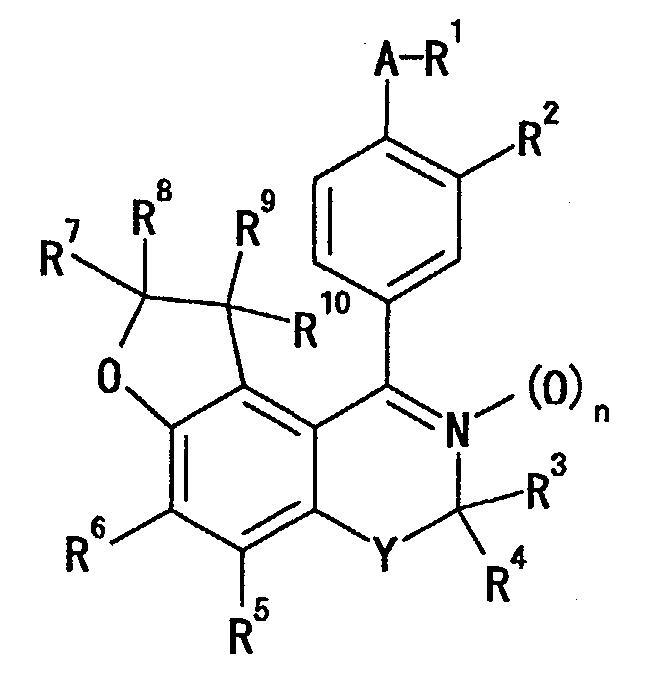
R1 is (1) a cyano group, (2) a carboxyl group, (3) a C1-6 alkoxycarbonyl group, (4) a carbamoyl group or (5) an N-mono-C1-6 alkylcarbamoyl group,
R2 is (1) a hydroxy group, (2) a C1-6 alkoxy group, (3) a C7-16 aralkyloxy group, (4) an amino group, (5) a mono-C1-6 alkylamino group which may have one substituent selected from carboxyl, carbamoyl, quinolyl, phenoxy and pyridyl, (6) a mono-C7-16 aralkylamino group which may have one substituent selected from a halogen atom, cyano, C1-6 alkoxy, carboxyl and C1-6 alkoxycarbonyl, (7) a mono-C6-14 arylamino group, (8) a mono-C1-6 alkylcarbonylamino group which may have 1 to 3 substituents selected from a halogen atom, thienyl and C1-6 alkoxycarbonyl-C1-6 alkylthio, (9) a mono-C1-6 alkylsulfonylamino group, (10) a mono-C6-14 arylcarbonylamino group which may have one substituent selected from C1-6 alkoxy and C1-6 alkylcarbonylamino, (11) a quinolylcarbonylamino group, (12) a pyridylcarbonylamino group which may have 1 or 2 halogen atoms, (13) an indolylcarbonylamino group, (14) a N-C1-6 alkyl-N-C1-6 alkylcarbonylamino group which may have 1 to 4 substituents selected from a halogen atom, C1-6 alkoxycarbonyl and quinolyl, (15) a N-C1-6 alkylcarbonyl-N-C7-16 aralkylamino group which may have 1 to 3 halogens, (16) a N-C1-6 alkyl-N-pyridylcarbonylamino group, (17) a C1-6 alkylideneamino group which may have one di-C1-6 alkylamino, (18) a mono-C1-6 alkylureido group which may have one C1-6 alkoxycarbonyl, (19) a di-C1-6 alkylureido group, (20) a mono-C6-14 arylureido group, (21) a 1-imidazolidinyl group which may have 1 to 3 substituents selected from C1-6 alkyl and oxo, (22) a C1-6 alkyl group, (23) a C1-6 alkoxycarbonyl group, (24) a nitro group or (25) a 1-pyrrolidinyl group, or R2 and A or R1 may be taken together with the adjacent carbon atom to form a nitrogen-containing 5- to 7-membered ring which may have 1 to 3 substituents selected from (1) a hydroxy group, (2) a C1-6 alkyl group which may have one C1-6 alkoxy-carbonyl, (3) a C7-16 aralkyl group, (4) a C6-14 aryl group and (5) an oxo group,
R3 and R4 are each a C1-6 alkyl group,
R5 is a hydrogen atom,
R6 is a C2-6 alkoxy group,
R7 and R8 are each a C1-6 alkyl group,
R9 and R10 are each a hydrogen atom,
Y is a methylene group, and
n is 0, or a salt thereof. - A compound represented by the formulawherein A is (1) a group represented by the formula -CRa=CRb- (Ra and Rb are each a hydrogen atom or a C1-6 alkyl group), (2) a group represented by the formula -(CONH)p-(C(Rc) (Rd))q- (Rc and Rd are each a hydrogen atom or a C1-6 alkyl group, p is 0 or 1 and q is 1 or 2), (3) a group represented by the formula -CH2OCH2- or (4) a group represented by the formula -OCH2-,

R1 is (1) a carboxyl group, (2) a C1-6 alkoxycarbonyl group, (3) an N-mono-C1-6 alkylcarbamoyl group or (4) a carbamoyl group,
R2 is a hydrogen atom,
R3 and R4 are each a C1-6 alkyl group,
R5 is a hydrogen atom,
R6 is a C2-6 alkoxy group,
R7 and R8 are each a C1-6 alkyl group,
R9 and R10 are each a hydrogen atom,
Y is a methylene group, and
n is 0, or a salt thereof. - The compound according to claim 4, wherein A is (1) a bond or (2) a group represented by the formula -CH=CH-.
- The compound according to claim 5, wherein A is (1) a group represented by the formula -CH=CH-, (2) a group represented by the formula -(C(Rc) (Rd))- (Rc and Rd each represent a hydrogen atom or a C1-6 alkyl group) or (3) a group represented by the formula -CH2OCH2-.
- The compound according to claim 4, wherein R1 is a carboxyl group or a carbamoyl group.
- The compound according to claim 5, wherein R1 is a carboxyl group.
- The compound according to claim 4, wherein R2 is (1) a C1-6 alkoxy group, (2) a mono-C1-6 alkylamino group, (3) a mono-C7-16 aralkylamino group, (4) a quinolylcarbonylamino group or (5) a pyridylcarbonylamino group.
- The compound according to claim 4 or 5, wherein R3 and R4 are each methyl.
- The compound according to claim 4 or 5, wherein R6 is ethoxy.
- The compound according to claim 4 or 5, wherein R7 and R8 are each methyl.
- The compound according to claim 4, which is 4-(6-ethoxy-3,4,8,9-tetrahydro-3,3,8,8-tetramethylfuro[2,3-h]isoquinolin-1-yl)-2-[(phenylmethyl)amino]benzoic acid, 4-(6-ethoxy-3,4,8,9-tetrahydro-3,3,8,8-tetramethylfuro[2,3-h]isoquinolin-1-yl)-2-(ethylamino)benzoic acid, (E)-3-[4-(6-ethoxy-3,4,8,9-tetrahydro-3,3,8,8-tetramethylfuro[2,3-h]isoquinolin-1-yl)-2-methoxyphenyl]-2-propenoic acid, 4-(6-ethoxy-3,4,8,9-tetrahydro-3,3,8,8-tetramethylfuro[2,3-h]isoquinolin-1-yl)-2-[(2-quinolinylcarbonyl)amino]benzoic acid, 4-(6-ethoxy-3,4,8,9-tetrahydro-3,3,8,8-tetramethylfuro[2,3-h]isoquinolin-1-yl)-2-[(2-pyridinylcarbonyl)amino]benzene acetic acid, N-[2-(aminocarbonyl)-5-(6-ethoxy-3,4,8,9-tetrahydro-3,3,8,8-tetramethylfuro[2,3-h]isoquinolin-1-yl)phenyl]-2-pyridinecarboxamide or a salt thereof.
- The compound according to claim 5, which is [[4-(6-ethoxy-3,4,8,9-tetrahydro-3,3,8,8-tetramethylfuro[2,3-h]isoquinolin-1-yl)phenyl]methoxy]acetic acid, 4-(6-ethoxy-3,4,8,9-tetrahydro-3,3,8,8-tetramethylfuro[2,3-h]isoquinolin-1-yl)-α,α-dimethylbenzene acetic acid or a salt thereof.
- The pharmaceutical composition comprising the compound according to claim 1 or a prodrug thereof.
- The pharmaceutical composition according to claim 16, which is a phosphodiesterase IV inhibitor.
- The pharmaceutical composition according to claim 16, which is a prophylactic and/or therapeutic agent against inflammatory diseases, atopic dermatitis, allergic rhinitis, asthma, chronic obstructive pulmonary diseases, chronic rheumatoid arthritis, autoimmune diseases, depression, Alzheimer's dementia, memory disorders, osteoporosis, diabetes or atherosclerosis.
- A method of inhibiting phosphodiesterase IV, which comprises administering to a mammal an effective amount of the compound according to claim 1 or a prodrug thereof.
- A method of preventing and/or treating inflammatory diseases, atopic dermatitis, allergic rhinitis, asthma, chronic obstructive pulmonary diseases, chronic rheumatoid arthritis, autoimmune diseases, depression, Alzheimer's dementia, memory disorders, osteoporosis, diabetes or atherosclerosis, which comprises administering to a mammal an effective amount of the compound according to claim 1 or a prodrug thereof.
- Use of the compound according to claim 1 or a prodrug thereof for manufacturing a phosphodiesterase IV inhibitor.
- Use of the compound according to claim 1 or a prodrug thereof for manufacturing a prophylactic and/or therapeutic agent against inflammatory diseases, atopic dermatitis, allergic rhinitis, asthma, chronic obstructive pulmonary diseases, chronic rheumatoid arthritis, autoimmune diseases, depression, Alzheimer's dementia, memory disorders, osteoporosis, diabetes or atherosclerosis.
Applications Claiming Priority (3)
| Application Number | Priority Date | Filing Date | Title |
|---|---|---|---|
| JP2002217496 | 2002-07-26 | ||
| JP2002217496 | 2002-07-26 | ||
| PCT/JP2003/009386 WO2004011470A1 (en) | 2002-07-26 | 2003-07-24 | Furoisoquinoline derivative and use thereof |
Publications (1)
| Publication Number | Publication Date |
|---|---|
| EP1541576A1 true EP1541576A1 (en) | 2005-06-15 |
Family
ID=31184655
Family Applications (1)
| Application Number | Title | Priority Date | Filing Date |
|---|---|---|---|
| EP03741560A Withdrawn EP1541576A1 (en) | 2002-07-26 | 2003-07-24 | Furoisoquinoline derivative and use thereof |
Country Status (6)
| Country | Link |
|---|---|
| US (1) | US20060106048A1 (en) |
| EP (1) | EP1541576A1 (en) |
| KR (1) | KR20050026014A (en) |
| CN (1) | CN1681823A (en) |
| AU (1) | AU2003281691A1 (en) |
| WO (1) | WO2004011470A1 (en) |
Families Citing this family (9)
| Publication number | Priority date | Publication date | Assignee | Title |
|---|---|---|---|---|
| CN101094829B (en) * | 2004-12-07 | 2012-02-08 | 富山化学工业株式会社 | novel anthranilic acid derivative or salt thereof |
| DK1860098T3 (en) * | 2005-03-16 | 2012-12-17 | Toyama Chemical Co Ltd | NEW ANTHRANIC ACID DERIVATIVE OR SALTS THEREOF |
| CN100376582C (en) * | 2006-04-26 | 2008-03-26 | 浙江大学 | A kind of preparation method of hexahydrofuro[3,2-c]quinoline derivatives |
| ES2320955B1 (en) * | 2007-03-02 | 2010-03-16 | Laboratorios Almirall S.A. | NEW DERIVATIVES OF 3 - ((1,2,4) TRIAZOLO (4,3-A) PIRIDIN-7-IL) BENZAMIDA. |
| ES2329639B1 (en) | 2007-04-26 | 2010-09-23 | Laboratorios Almirall S.A. | NEW DERIVATIVES OF 4,8-DIFENILPOLIAZANAFTALENO. |
| EP2108641A1 (en) | 2008-04-11 | 2009-10-14 | Laboratorios Almirall, S.A. | New substituted spiro[cycloalkyl-1,3'-indo]-2'(1'H)-one derivatives and their use as p38 mitogen-activated kinase inhibitors |
| EP2113503A1 (en) * | 2008-04-28 | 2009-11-04 | Laboratorios Almirall, S.A. | New substituted indolin-2-one derivatives and their use as p39 mitogen-activated kinase inhibitors |
| TW201036946A (en) | 2009-01-30 | 2010-10-16 | Toyama Chemical Co Ltd | N-acylanthranilic acid derivative or salt thereof |
| CN111592465A (en) * | 2019-02-20 | 2020-08-28 | 武汉珈汇精化科技有限公司 | Method for preparing 2-amino-4-aminomethyl methyl benzoate and hydrochloride thereof |
Family Cites Families (4)
| Publication number | Priority date | Publication date | Assignee | Title |
|---|---|---|---|---|
| DE2413935A1 (en) * | 1974-03-20 | 1975-10-16 | Schering Ag | 4- (POLYALCOXY-PHENYL) -2-PYRROLIDONE |
| DE60125026T2 (en) * | 2000-03-23 | 2007-06-28 | Takeda Pharmaceutical Co. Ltd. | FLUOROISOCHINOLINE DERIVATIVES, METHOD FOR THEIR PREPARATION AND THEIR USE |
| JP5132864B2 (en) * | 2000-07-11 | 2013-01-30 | アルバニー モレキュラー リサーチ, インコーポレイテッド | 4-Phenyl substituted tetrahydroisoquinolines and methods of use thereof |
| WO2003035650A1 (en) * | 2001-09-25 | 2003-05-01 | Takeda Chemical Industries, Ltd. | Entry inhibitor |
-
2003
- 2003-07-24 US US10/522,119 patent/US20060106048A1/en not_active Abandoned
- 2003-07-24 WO PCT/JP2003/009386 patent/WO2004011470A1/en not_active Ceased
- 2003-07-24 KR KR1020057001474A patent/KR20050026014A/en not_active Withdrawn
- 2003-07-24 AU AU2003281691A patent/AU2003281691A1/en not_active Abandoned
- 2003-07-24 CN CNA038223198A patent/CN1681823A/en active Pending
- 2003-07-24 EP EP03741560A patent/EP1541576A1/en not_active Withdrawn
Non-Patent Citations (1)
| Title |
|---|
| See references of WO2004011470A1 * |
Also Published As
| Publication number | Publication date |
|---|---|
| AU2003281691A1 (en) | 2004-02-16 |
| WO2004011470A1 (en) | 2004-02-05 |
| US20060106048A1 (en) | 2006-05-18 |
| KR20050026014A (en) | 2005-03-14 |
| CN1681823A (en) | 2005-10-12 |
Similar Documents
| Publication | Publication Date | Title |
|---|---|---|
| JP7530390B2 (en) | Novel EGFR inhibitor | |
| DE60125026T2 (en) | FLUOROISOCHINOLINE DERIVATIVES, METHOD FOR THEIR PREPARATION AND THEIR USE | |
| EP2380881B1 (en) | Novel bicyclic heterocyclic compound | |
| EP2181987B9 (en) | 2-Carbonylaminobenzothiazoles and their use for the prophylaxis and treatment of cancer | |
| US8394807B2 (en) | Quinazoline inhibitors of BACE 1 and methods of using | |
| EP1908753B1 (en) | Novel heterocyclidene acetamide derivative | |
| US8012972B2 (en) | Pyridinecarboxylic acid (2-aminophenyl) amide derivative having urea structure | |
| JP2009500295A (en) | Fused heterocyclic derivatives and uses thereof | |
| EP1283055A1 (en) | Soluble beta amyloid precursor protein secretion promoters | |
| JPWO2001021206A1 (en) | Preventive or therapeutic drug for myocarditis, dilated cardiomyopathy and heart failure containing NF-κB inhibitor as an active ingredient | |
| US9062061B2 (en) | Compound having PARP inhibitory activity | |
| US20060106048A1 (en) | Furoisoquinoline derivative and use thereof | |
| WO2010010935A1 (en) | Optically active heterocyclidene-n-arylacetamide derivative | |
| WO2010010934A1 (en) | Heterocyclidene derivative having p-substituted arylacetamide | |
| EP1310491A1 (en) | Method for producing 1-substituted-1,2,3-triazole derivative | |
| EP4121044A1 (en) | Androgen receptor regulation by small molecule enantiomers | |
| JP2004067690A (en) | Furoisoquinoline inducer and its application | |
| US20030216398A1 (en) | Soluble beta amyloid precursor protein secretion promoters | |
| WO2003000697A1 (en) | Furoisoquinoline derivative, process for producing the same, and use | |
| WO2009005459A1 (en) | Phenyl-1,2, 3,4-tetrahydroisoquinolinone derivatives and their use in the treatment of a pain disorder | |
| CN111072604A (en) | α-Aminoamide derivatives and their uses | |
| JP2003073380A (en) | Furoisoquinoline derivative, method for producing the same and use | |
| CN114920697A (en) | Heterocyclic group substituted indan propionamide compound and application thereof | |
| HK40115276A (en) | Flavonoid derivatives with gabaa receptor activity and methods of use | |
| WO2009142321A1 (en) | Novel thiophenediamine derivative having urea structure |
Legal Events
| Date | Code | Title | Description |
|---|---|---|---|
| PUAI | Public reference made under article 153(3) epc to a published international application that has entered the european phase |
Free format text: ORIGINAL CODE: 0009012 |
|
| 17P | Request for examination filed |
Effective date: 20050128 |
|
| AK | Designated contracting states |
Kind code of ref document: A1 Designated state(s): AT BE BG CH CY CZ DE DK EE ES FI FR GB GR HU IE IT LI LU MC NL PT RO SE SI SK TR |
|
| AX | Request for extension of the european patent |
Extension state: AL LT LV MK |
|
| DAX | Request for extension of the european patent (deleted) | ||
| STAA | Information on the status of an ep patent application or granted ep patent |
Free format text: STATUS: THE APPLICATION HAS BEEN WITHDRAWN |
|
| 18W | Application withdrawn |
Effective date: 20060529 |