EP1541551A1 - 2-cyano-4-fluoropyrrolidine derivative or its salt - Google Patents
2-cyano-4-fluoropyrrolidine derivative or its salt Download PDFInfo
- Publication number
- EP1541551A1 EP1541551A1 EP03741499A EP03741499A EP1541551A1 EP 1541551 A1 EP1541551 A1 EP 1541551A1 EP 03741499 A EP03741499 A EP 03741499A EP 03741499 A EP03741499 A EP 03741499A EP 1541551 A1 EP1541551 A1 EP 1541551A1
- Authority
- EP
- European Patent Office
- Prior art keywords
- group
- fluoro
- amino
- carbonitrile
- acetyl
- Prior art date
- Legal status (The legal status is an assumption and is not a legal conclusion. Google has not performed a legal analysis and makes no representation as to the accuracy of the status listed.)
- Withdrawn
Links
- 0 **B(CC1)CCC1(*)N[*+](C*C1)[C@]1C#N Chemical compound **B(CC1)CCC1(*)N[*+](C*C1)[C@]1C#N 0.000 description 1
Classifications
-
- C—CHEMISTRY; METALLURGY
- C07—ORGANIC CHEMISTRY
- C07D—HETEROCYCLIC COMPOUNDS
- C07D401/00—Heterocyclic compounds containing two or more hetero rings, having nitrogen atoms as the only ring hetero atoms, at least one ring being a six-membered ring with only one nitrogen atom
- C07D401/02—Heterocyclic compounds containing two or more hetero rings, having nitrogen atoms as the only ring hetero atoms, at least one ring being a six-membered ring with only one nitrogen atom containing two hetero rings
- C07D401/12—Heterocyclic compounds containing two or more hetero rings, having nitrogen atoms as the only ring hetero atoms, at least one ring being a six-membered ring with only one nitrogen atom containing two hetero rings linked by a chain containing hetero atoms as chain links
-
- A—HUMAN NECESSITIES
- A61—MEDICAL OR VETERINARY SCIENCE; HYGIENE
- A61P—SPECIFIC THERAPEUTIC ACTIVITY OF CHEMICAL COMPOUNDS OR MEDICINAL PREPARATIONS
- A61P3/00—Drugs for disorders of the metabolism
- A61P3/04—Anorexiants; Antiobesity agents
-
- A—HUMAN NECESSITIES
- A61—MEDICAL OR VETERINARY SCIENCE; HYGIENE
- A61P—SPECIFIC THERAPEUTIC ACTIVITY OF CHEMICAL COMPOUNDS OR MEDICINAL PREPARATIONS
- A61P3/00—Drugs for disorders of the metabolism
- A61P3/08—Drugs for disorders of the metabolism for glucose homeostasis
- A61P3/10—Drugs for disorders of the metabolism for glucose homeostasis for hyperglycaemia, e.g. antidiabetics
-
- A—HUMAN NECESSITIES
- A61—MEDICAL OR VETERINARY SCIENCE; HYGIENE
- A61P—SPECIFIC THERAPEUTIC ACTIVITY OF CHEMICAL COMPOUNDS OR MEDICINAL PREPARATIONS
- A61P43/00—Drugs for specific purposes, not provided for in groups A61P1/00-A61P41/00
-
- C—CHEMISTRY; METALLURGY
- C07—ORGANIC CHEMISTRY
- C07D—HETEROCYCLIC COMPOUNDS
- C07D207/00—Heterocyclic compounds containing five-membered rings not condensed with other rings, with one nitrogen atom as the only ring hetero atom
- C07D207/02—Heterocyclic compounds containing five-membered rings not condensed with other rings, with one nitrogen atom as the only ring hetero atom with only hydrogen or carbon atoms directly attached to the ring nitrogen atom
- C07D207/04—Heterocyclic compounds containing five-membered rings not condensed with other rings, with one nitrogen atom as the only ring hetero atom with only hydrogen or carbon atoms directly attached to the ring nitrogen atom having no double bonds between ring members or between ring members and non-ring members
- C07D207/10—Heterocyclic compounds containing five-membered rings not condensed with other rings, with one nitrogen atom as the only ring hetero atom with only hydrogen or carbon atoms directly attached to the ring nitrogen atom having no double bonds between ring members or between ring members and non-ring members with hetero atoms or with carbon atoms having three bonds to hetero atoms with at the most one bond to halogen, e.g. ester or nitrile radicals, directly attached to ring carbon atoms
- C07D207/16—Carbon atoms having three bonds to hetero atoms with at the most one bond to halogen, e.g. ester or nitrile radicals
-
- C—CHEMISTRY; METALLURGY
- C07—ORGANIC CHEMISTRY
- C07D—HETEROCYCLIC COMPOUNDS
- C07D401/00—Heterocyclic compounds containing two or more hetero rings, having nitrogen atoms as the only ring hetero atoms, at least one ring being a six-membered ring with only one nitrogen atom
- C07D401/14—Heterocyclic compounds containing two or more hetero rings, having nitrogen atoms as the only ring hetero atoms, at least one ring being a six-membered ring with only one nitrogen atom containing three or more hetero rings
-
- C—CHEMISTRY; METALLURGY
- C07—ORGANIC CHEMISTRY
- C07D—HETEROCYCLIC COMPOUNDS
- C07D403/00—Heterocyclic compounds containing two or more hetero rings, having nitrogen atoms as the only ring hetero atoms, not provided for by group C07D401/00
- C07D403/02—Heterocyclic compounds containing two or more hetero rings, having nitrogen atoms as the only ring hetero atoms, not provided for by group C07D401/00 containing two hetero rings
- C07D403/12—Heterocyclic compounds containing two or more hetero rings, having nitrogen atoms as the only ring hetero atoms, not provided for by group C07D401/00 containing two hetero rings linked by a chain containing hetero atoms as chain links
-
- C—CHEMISTRY; METALLURGY
- C07—ORGANIC CHEMISTRY
- C07D—HETEROCYCLIC COMPOUNDS
- C07D405/00—Heterocyclic compounds containing both one or more hetero rings having oxygen atoms as the only ring hetero atoms, and one or more rings having nitrogen as the only ring hetero atom
- C07D405/02—Heterocyclic compounds containing both one or more hetero rings having oxygen atoms as the only ring hetero atoms, and one or more rings having nitrogen as the only ring hetero atom containing two hetero rings
- C07D405/12—Heterocyclic compounds containing both one or more hetero rings having oxygen atoms as the only ring hetero atoms, and one or more rings having nitrogen as the only ring hetero atom containing two hetero rings linked by a chain containing hetero atoms as chain links
-
- C—CHEMISTRY; METALLURGY
- C07—ORGANIC CHEMISTRY
- C07D—HETEROCYCLIC COMPOUNDS
- C07D407/00—Heterocyclic compounds containing two or more hetero rings, at least one ring having oxygen atoms as the only ring hetero atoms, not provided for by group C07D405/00
- C07D407/02—Heterocyclic compounds containing two or more hetero rings, at least one ring having oxygen atoms as the only ring hetero atoms, not provided for by group C07D405/00 containing two hetero rings
- C07D407/12—Heterocyclic compounds containing two or more hetero rings, at least one ring having oxygen atoms as the only ring hetero atoms, not provided for by group C07D405/00 containing two hetero rings linked by a chain containing hetero atoms as chain links
-
- C—CHEMISTRY; METALLURGY
- C07—ORGANIC CHEMISTRY
- C07D—HETEROCYCLIC COMPOUNDS
- C07D409/00—Heterocyclic compounds containing two or more hetero rings, at least one ring having sulfur atoms as the only ring hetero atoms
- C07D409/02—Heterocyclic compounds containing two or more hetero rings, at least one ring having sulfur atoms as the only ring hetero atoms containing two hetero rings
- C07D409/12—Heterocyclic compounds containing two or more hetero rings, at least one ring having sulfur atoms as the only ring hetero atoms containing two hetero rings linked by a chain containing hetero atoms as chain links
-
- C—CHEMISTRY; METALLURGY
- C07—ORGANIC CHEMISTRY
- C07D—HETEROCYCLIC COMPOUNDS
- C07D451/00—Heterocyclic compounds containing 8-azabicyclo [3.2.1] octane, 9-azabicyclo [3.3.1] nonane, or 3-oxa-9-azatricyclo [3.3.1.0<2,4>] nonane ring systems, e.g. tropane or granatane alkaloids, scopolamine; Cyclic acetals thereof
- C07D451/02—Heterocyclic compounds containing 8-azabicyclo [3.2.1] octane, 9-azabicyclo [3.3.1] nonane, or 3-oxa-9-azatricyclo [3.3.1.0<2,4>] nonane ring systems, e.g. tropane or granatane alkaloids, scopolamine; Cyclic acetals thereof containing not further condensed 8-azabicyclo [3.2.1] octane or 3-oxa-9-azatricyclo [3.3.1.0<2,4>] nonane ring systems, e.g. tropane; Cyclic acetals thereof
- C07D451/04—Heterocyclic compounds containing 8-azabicyclo [3.2.1] octane, 9-azabicyclo [3.3.1] nonane, or 3-oxa-9-azatricyclo [3.3.1.0<2,4>] nonane ring systems, e.g. tropane or granatane alkaloids, scopolamine; Cyclic acetals thereof containing not further condensed 8-azabicyclo [3.2.1] octane or 3-oxa-9-azatricyclo [3.3.1.0<2,4>] nonane ring systems, e.g. tropane; Cyclic acetals thereof with hetero atoms directly attached in position 3 of the 8-azabicyclo [3.2.1] octane or in position 7 of the 3-oxa-9-azatricyclo [3.3.1.0<2,4>] nonane ring system
Definitions
- the present invention relates to a novel 2-cyano-4-fluoropyrrolidine derivative or a salt thereof useful as a drug, especially for dipeptidyl peptidase IV (hereinafter referred to as "DPP-IV") inhibitor and to a pharmaceutical composition comprising the compound as an active ingredient.
- DPP-IV dipeptidyl peptidase IV
- Dipetidyl peptidase-IV is a serine protease that recognizes and cuts a sequence with proline, hydroxyproline or alanine at the 2nd position from the N-terminal thereof (H-Xaa-Pro, H-Xaa-Hyp or H-Xaa-Ala, in which Xaa indicates an amino acid). It is known that DPP-IV is broadly distributed in humans, not only in tissues of the kidneys, liver, and salivary glands, but also in body fluids such as serum, urine, and saliva. Though its physiological role has not been completely clarified as yet, DPP-IV may participate in regulating biological functions as it cuts various physiologically-active peptides(non-patent reference 1). In particular, it is now specifically noticed that DPP-IV may control the activity of a hormone, incretin that participates in inhibiting blood glucose increase.
- Incretin is a hormone that is secreted from the intestines after nutrient ingestion in humans, and it acts on pancreatic ⁇ -cells to enhance insulin secretion, thereby regulating the blood glucose level. It is known that the incretin activity is attenuated in type 2 diabetics (non-patent reference 2), and it is considered that the activity attenuation will be one reason for the expression of diabetes. Accordingly, it is expected that the postprandial hyperglycemia of diabetics could be ameliorated.
- GLP-1 glucagon-like peptide
- DPP-IV that cleaves it
- the inactive GLP-1 cleaved by DPP-IV binds to a GLP-1 receptor and prevents active GLP-1 from binding to the receptor. Accordingly, it is believed that the incretin action of GLP-1 is thereby attenuated (non-patent reference 4).
- a DPP-IV inhibitor may prevent the inactivation of GLP-1, therefore enhancing the incretin action of active GLP-1, and, as a result, it may prevent the postprandial hyperglycemia of diabetics.
- the DPP-IV inhibitor may be a safe remedy without side effect such as hypoglycemia which is often seen in use of existing insulin-secretion remedies.
- the present inventors made extensive and intensive investigations with respect to compounds having a DPP-IV inhibiting activity, which are expected to be effective for insulin-dependent diabetes (type 1 diabetes), non insulin-dependent diabetes (type 2 diabetes), insulin-resistant disorders and obesity. As a result, it has been found that a novel 2-cyano-4-fluoropyrrolidine derivative or a salt thereof of the invention has an excellent DPP-IV inhibiting activity, leading to accomplishment of the invention.
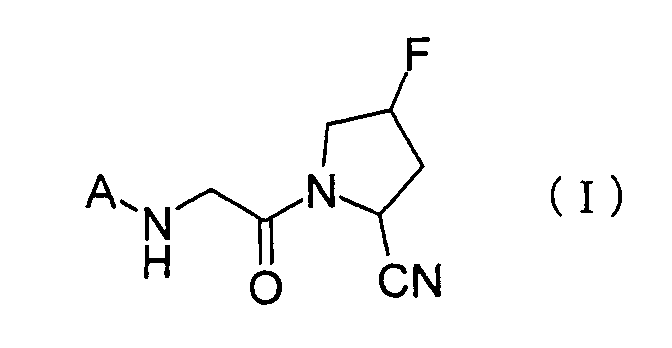
- the invention provides a 2-cyano-4-fluoropyrrolidine derivative of the following general formula (I) or a pharmaceutically acceptable salt thereof that is useful as a DPP-IV inhibitor.
- A represents piperidin-4-yl, oxetan-3-yl, pyrrolidin-3-yl, tetrahydro-2H-pyran-4-yl, pyrazolidin-4-yl, 1,3-dioxan-5-yl, 8-azabicyclo[3.2.1]oct-3-yl or tetrahydro-2H-thiopyran-4-yl, each of which may be substituted, but excluding piperidin-4-yl which is substituted with a group selected from the group consisting of propane-2-sulfonyl, 2,4,6-trimethylbenzenesulfonyl, phenylmethanesulfonyl, 2-naphthalen-1-ylethanesulfonyl, 7,'7-dimethyl-6
- A is preferably piperidin-4-yl or 8-azabicyclo[3.2.1]oct-3-yl, each of which may be substituted, more preferably a group of a general formula (II): wherein B represents carbonyl, sulfonyl or single bond; R 1 represents lower alkyl, aryl or aromatic hetero ring, each of which may be substituted; R 2 represents lower alkyl which is optionally substituted with a group selected from the group consisting of -OH and -O-lower alkyl, or represents -H.
- B is preferably carbonyl or sulfonyl.
- R 1 is preferably lower alkyl which is optionally substituted, more preferably lower alkyl which is optionally substituted with a group selected from the group consisting of -OH and fluoro, even more preferably methyl or ethyl, each of which is optionally substituted with a group selected from the group consisting of -OH and fluoro, most preferably methyl or ethyl, each of which is optionally substituted with -OH.
- R 2 is preferably lower alkyl which is optionally substituted with -OH, more preferably methyl or ethyl, each of which is optionally substituted with -OH, even more preferably methyl, ethyl or hydroxymethyl, most preferably methyl.
- the chemical structure of the 2-cyano-4-fluoropyrrolidine derivatives of the invention is characterized in that an optionally substituted non-aromatic hetero ring bonds to the 1-position of a 2-cyano-4-fluoropyrrolidine skeleton via aminomethylenecarbonyl, and the pharmaceutical characteristic thereof is that the derivatives have a DPP-IV inhibiting activity.
- A is piperidin-4-yl or 8-azabicyclo[3.2.1]oct-3-yl, each of which is optionally substituted; more preferred are those where A is a group of formula (II); even more preferred are those where A is a group of formula (II), B is carbonyl or sulfonyl, R 1 is optionally substituted lower alkyl, R 2 is methyl, ethyl or hydroxymethyl; and most preferred are those where A is a group of formula (II), B is carbonyl or sulfonyl, R 1 is methyl or ethyl, each of which is optionally substituted with a group selected from the group consisting of -OH and fluoro, R 2 is methyl.
- A is a group of formula (II) and B is carbonyl.
- the invention further provides a pharmaceutical composition comprising, as an active ingredient, the compound mentioned above, especially a pharmaceutical composition comprising, as an active ingredient, the compound mentioned above for remedies and/or preventives for insulin-dependent diabetes (type 1 diabetes), non insulin-dependent diabetes (type 2 diabetes), insulin-resistant disorders or obesity; and a pharmaceutical composition comprising, as an active ingredient, the compound mentioned above for dipeptidyl peptidase IV inhibitor.
- lower alkyl means a C 1-6 linear or branched alkyl, for example, concretely including methyl, ethyl, propyl, isopropyl, butyl, tert-butyl, pentyl, neopentyl and hexyl, etc.
- it is methyl, ethyl, propyl or isopropyl, more preferably methyl or ethyl.
- Aryl means a C 6-14 monocyclic to tricyclic, aromatic monovalent group consisting of carbon atoms, for example, concretely including phenyl and naphthyl, etc. Preferably, it is phenyl.
- Aromatic hetero ring means a monocyclic to tricyclic aromatic monovalent group having at least one hetero atom selected from the group consisting of nitrogen, oxygen and sulfur atoms, for example, concretely including furanyl, thienyl, pyrrolyl, pyridyl, oxazolyl, thiazolyl, isothiazolyl, imidazolyl, pyrazolyl, tetrazolyl, pyrazinyl, pyrimidinyl, pyridazinyl, triazinyl, isoxazolyl, triazolyl, benzofuranyl, benzothienyl, benzothiadiazolyl, benzothiazolyl, benzoxazolyl, benzimidazolyl, benzotriazolyl, indolyl, isoindolyl, quinazolyl, quinolyl, isoquinolyl, quinoxayl, imidazopyridinyl and imidazopyr
- the acceptable substituent for the optionally-substituted "piperidin-4-yl, oxetan-3-yl, pyrrolidin-3-yl, tetrahydro-2H-pyran-4-yl, pyrazolidin-4-yl, 1,3-dioxan-5-yl, 8-azabicyclo[3.2.1]oct-3-yl or tetrahydro-2H-thiopyran-4-yl" for A may be any and every one generally usable for these groups, and the group A may have one or more, preferably from 1 to 4 substituents. Including the carbon atom of A that directly bonds to the group NH in formula (I), the carbon atom or the nitrogen atom of the ring may be substituted. In addition, the sulfur atom of the ring may be oxidized.
- the substituent to bond to the carbon atom includes a substituent group X, -OR, -O-X, halogen, -CO-X, -COO-X, -SO 2 -X and -CONRR'.
- it is lower alkyl or aryl, each of which is optionally substituted with one or more group selected from the group consisting of -OR, -O-lower alkyl, -O-aryl, halogen, cyano and nitro, more preferably lower alkyl optionally substituted with a substituent selected from -OH and fluorine.
- R and R' may be the same or different, representing lower alkyl optionally substituted with -OH, or -H (the same shall apply hereinunder).
- “Substituent group X" is meant to include lower alkyl, lower alkenyl, lower alkynyl, cycloalkyl, cycloalkenyl, aryl, non-aromatic hetero ring and aromatic hetero ring, each of which is optionally substituted with one or more group selected from the group consisting of -OR, -O-lower alkyl, -O-aryl, halogen, cyano and nitro (the same shall apply hereinunder).
- the substituent to bond to the nitrogen atom includes a substituent group X, -CO-X, -COO-X, -SO 2 -X, and -CONRR'.
- it is lower alkyl, cycloalkyl, aryl or aromatic hetero ring, each of which is optionally substituted with one or more substituent selected from the group consisting of -OH, -O-lower alkyl, -O-aryl, halogen, cyano and nitro; or -SO 2 -lower alkyl (optionally substituted with one or more substituent selected from the group consisting of -OH, -O-lower alkyl, -O-aryl, halogen, cyano and nitro); or -SO 2 -aryl (optionally substituted with one or more substituent selected from the group consisting of -OH, -O-lower alkyl, -O-aryl, halogen, cyano and nitro).
- “Lower alkenyl” means a C 2-6 alkenyl, for example, concretely including vinyl, allyl, 1-propenyl, 1-butenyl, 2-butenyl and 3-butenyl.
- “Lower alkynyl” means a C 2-6 alkynyl, for example, concretely including ethynyl, 1-propynyl, 2-propynyl, 1-butynyl, 2-butynyl and 3-butynyl.
- Cycloalkyl means a C 3-14 monovalent residue of a carbon ring, and this may be bridged fused. Concretely, for example, it includes cyclopropyl, cyclopentyl, cyclohexyl, cyclooctyl, adamantyl, bornyl, norbornyl, bicyclo[2.2.1]heptyl, bicyclo[3.1.1]heptyl, bicyclo[2.2.2]octyl, bicyclo[3.2.1]octyl and bicyclo[3.3.1]nonyl.
- Cycloalkenyl means a C 3-14 carbon ring residue that corresponds to the "cycloalkyl” but is partially unsaturated, for example, concretely including cyclopentenyl, cyclohexenyl and norbornenyl.
- Halogen includes fluoro, chloro, bromo and iodo. Preferably, it is fluoro, chloro or bromo, more preferably fluoro.
- the compounds of the invention include mixtures of various stereoisomers such as tautomeric isomers and optical isomers, and those isolated from them.
- the compounds of the invention may form acid-addition salts. Depending on the type of the substituent therein, they may form salts with bases.
- the salts include acid-addition salts with mineral acids such as hydrochloric acid, hydrobromic acid, hydroiodic acid, sulfuric acid, nitric acid, phosphoric acid, or with organic acids such as formic acid, acetic acid, propionic acid, oxalic acid, malonic acid, succinic acid, fumaric acid, maleic acid, lactic acid, malic acid, tartaric acid, citric acid, methanesulfonic acid, ethanesulfonic acid, p-toluenesulfonic acid; salts with acidic amino acids such as aspartic acid, glutamic acid, or with inorganic bases such as sodium, potassium, magnesium, calcium, aluminium, or with organic bases such as methylamine, ethylamine, ethanolamine; or with basic amino acids such as lysine, orni
- the compounds of the invention further include hydrates, various pharmaceutically acceptable solvates, and polymorphic crystals.
- the invention should not be limited to the compounds described in Examples given hereinunder, and include all derivatives of formula (I) and their pharmaceutically acceptable salts.
- the compound of the invention includes all of so-called prodrugs, i.e., compounds that will be metabolized and converted into the compound of the foregoing general formula (I) or its salt within humans.
- prodrugs i.e., compounds that will be metabolized and converted into the compound of the foregoing general formula (I) or its salt within humans.
- group to form the prodrug are enumerated those groups described in Prog. Med ., 5, 2157-2161 (1985) and Iyakuhin No Kaihatsu (Development of Drugs), Vol. 7, "Molecular Design", 163-198 (1990), by Hirokawa Publishing Co.
- the compound of the invention and its pharmaceutically acceptable salt can be produced through application of various known synthesis processes by utilizing the characteristic based on the basic skeleton thereof or kinds of the substituents.
- the functional group is replaced by a protective group, i.e., a group that can be readily converted into the functional group in a state of the starting material or intermediates. Thereafter, if desired, the protective group is removed, thereby enabling to obtain the desired compound.
- a functional group include a hydroxyl group, a carboxyl group and an amino group.
- the protective group thereof include the protective groups as described in Greene and Wuts, Protective Groups in Organic Synthesis (third edition) , and these may be properly used depending on the reaction conditions.
- A has the same meaning as above; and X represents a leaving group such as halogen or sulfonyloxy group.
- the method comprises alkylation of a compound (II) with an amine (III) of a general formula, A-NH 2 to give the compound (I) of the invention.
- the reaction may be effected in the absence or presence of a solvent.
- the solvent may be any of aromatic hydrocarbons such as toluene, xylene; ketones such as methyl ethyl ketone, acetone; ethers such as dioxane, tetrahydrofuran, diglyme; alcohols such as methanol, ethanol, isopropanol; chloroform, methylene chloride, acetonitrile, dimethylformamide, dimethylsulfoxide, water; and their mixed solvents.
- a suitable solvent may be selected for the reaction.
- Adding a base to the reaction is preferred for smoothly effecting the reaction.
- the base are alkali carbonates such as sodium carbonate, potassium carbonate; alkali hydrogencarbonates such as sodium hydrogencarbonate, potassium hydrogencarbonate; and organic amines such as triethylamine, diisopropylethylamine, pyridine.
- Some of the compounds of the invention may be produced from the compounds (I) obtained in the manner as above, by combining, in any desired manner, some known steps that may be generally employed by those skilled in the art, such as alkylation, acylation, oxidation, reduction, hydrolysis, etc.
- the compounds of the invention may be isolated and purified as they are in the form of free compounds, or after salted into their salts in an ordinary manner.
- the isolation and purification may be effected in any ordinary chemical operation such as extraction, concentration, distillation, crystallization, filtration, recrystallization, various modes of chromatography, etc.
- the compounds of the invention include optical isomers.
- the optical isomers may be resolved in an ordinary manner, for example, through fractionating crystallization with recrystallization with a suitable salt or through column chromatography.
- the optical active compounds may be produced, starting from a suitable optical active compound.
- the compounds of the invention have a DPP-IV inhibiting activity. Especially, they have an activity to inhibit the degradation of GLP-1, a hormone that acts on pancreatic ⁇ -cells to enhance insulin secretion to thereby regulate blood glucose.
- the compounds of the invention are useful for remedy and/or prevention of insulin-dependent diabetes (type 1 diabetes), especially non insulin-dependent diabetes (type 2 diabetes), insulin-resistant disorders, and obesity.
- the reaction was performed in a 96-well flat-bottom microtiter plate.
- a varying concentration of the test compound was added to an aqueous solution comprised of 25 mM Tris-HCl, 140 mM sodium chloride, 10 mM potassium chloride, 1% RIA-grade bovine serum albumin, and 0.01 mM Gly-Pro-AMC (Bachem).
- To this reaction solution (95 ⁇ L/well), added was 5 ⁇ L of plasma collected from healthy adult volunteers, and incubated at room temperature for 20 minutes. After the reaction, the fluorescence intensity (excitation 355 nm/emission 460 nm) of each well was measured (ARVO, Perkin Elmer). The data of 3 wells under the same conditions were averaged.
- test compound IC 50 / nM test compound IC 50 / nM Example 1
- Example 28 Example 14 7.2
- Example 34 8.2
- Example 19 Example 36 7.5
- Example 21 6.0
- Example 41 5.9
- mice Male ICR mice (Nippon SLC) were grouped into a test group and a control group of 5 subjects each.
- a test compound (10 mg/kg) was dissolved in purified water, and orally administered. Purified water alone was orally administered to the mice of the control group.
- One half, 6, and 12 hours after the administration the blood was collected from each mouse through the orbital venous plexus thereof. The collected blood was immediately centrifuged to isolate the plasma, and the DPP-IV activity of the plasma was measured.
- the process of plasma DPP-IV activity determination was as follows: The reaction was performed in a 96-well plate. 5 ⁇ l of the collected plasma was added to an aqueous solution (95 ⁇ l/well) comprises 25 mM Tris-HCl, 140 mM sodium chloride, 10 mM potassium chloride, 1 % bovine serum albumin, and 0.01 mM Gly-Pro-AMC (Bachem), and incubated at room temperature for 20 minutes. The fluorescence intensity (excitation 355 nm/emission 460 nm) of each well was measured (ARVO, Perkin Elmer).
- Test compound (10 mg/kg) was dissolved in purified water, and orally administered. Purified water alone was orally administered to the rats of the control group. One half, 6, and 12 hours after the administration, the blood was collected from each rat through the tail vein thereof. The collected blood was immediately centrifuged to isolate the plasma, and the DPP-IV activity of the plasma was measured according to the same process as in the dipeptidyl peptidase-IV (DPP-IV) inhibiting activity duration test shown in (2).
- DPP-IV dipeptidyl peptidase-IV
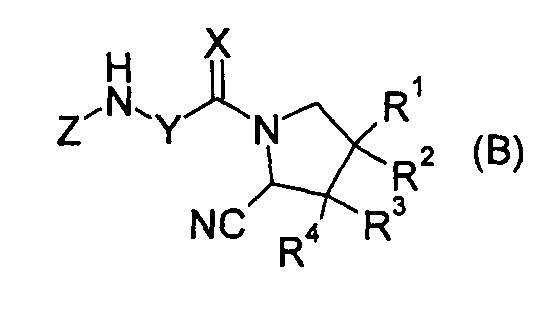
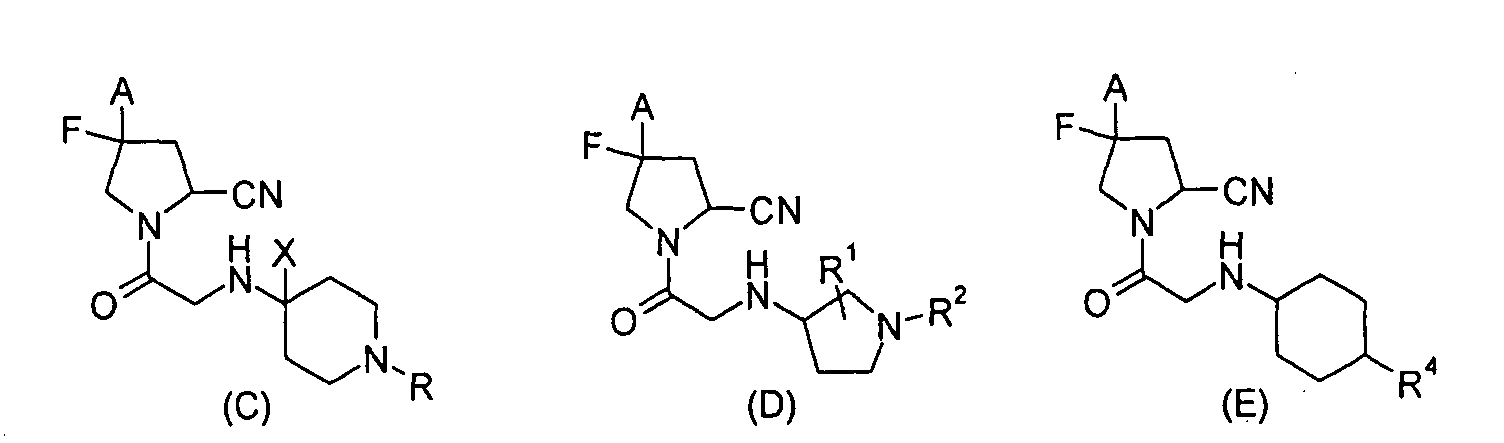
- comparative compound 1 represents Example 4-9 described in patent reference 5
- comparative compound 2 represents Example 4-17 described in patent reference 5
- comparative compound 3 represents Example 33 described in patent reference 7; each patent reference is mentioned above.
- the structure of comparative compounds 1-3 will be shown below.
- Table 2 and Table 3 above show that the compounds of the present invention have good oral activities and their activities last even after 6 hours and 12 hours from their administration. These results confirm that the compounds of the present invention have better oral activities and duration in vivo in comparison with comparative compounds 1-3.
- the pharmaceutical composition that contains, as an active ingredient, one or more of the compounds and their pharmaceutically acceptable salts of the invention may be prepared by the use of a carrier, a vehicle and other additives generally used in formulating pharmaceutical compositions. It may be orally or parenterally administered in any form of tablets, powders, fine granules, granules, capsules, pills, liquids, injections, suppositories, ointments or poultices.
- the clinical dose of the compound of the invention may be suitably determined, depending on the condition, the body weight, the age and the sex of the patients to which it is administered, but is favorable, in general, from 0.1 to 500 mg/adult/day for oral administration, and from 0.01 to 100 mg/adult/day for parenteral administration. This may be administered to the patients all at a time, or may be divided into a few portions for administration in a few times. Since the dose varies depending on various conditions, it may be smaller than the range mentioned above.
- solid composition for oral administration of the compounds of the invention tablets, powders, granules, etc are used.
- the solid composition of those types comprises one or more active substances mixed with at least one inert diluent, such as lactose, mannitol, glucose, hydroxypropyl cellulose, microcrystalline cellulose, starch, polyvinyl pyrrolidone, magnesium metasilicate aluminate.
- the composition may contain any other additives except the inert diluents noted above, for example, a lubricant such as magnesium stearate, a disintegrator such as calcium cellulose glycolate, a stabilizer such as lactose, and a solubilizer or dissolution promoter such as glutamic acid or aspartic acid.
- a lubricant such as magnesium stearate
- a disintegrator such as calcium cellulose glycolate
- a stabilizer such as lactose
- a solubilizer or dissolution promoter such as glutamic acid or aspartic acid.
- the tablets and pills may be coated with a film of sugar or gastric or enteric substances such as sucrose, gelatin, hydroxypropyl cellulose, hydroxypropylmethyl cellulose phthalate.
- a liquid composition for oral administration includes, for example, pharmaceutically-acceptable emulsions, solutions, suspensions, syrups, elixirs and the like, which contain ordinary inactive diluents such as pure water or ethyl alcohol.
- inert diluents such as pure water or ethyl alcohol.
- those compositions may further contain pharmaceutical aids such as solubilizers, dissolution aids, wetting promoters, suspension promoters, and also sweeteners, flavorings, aromas and preservatives.
- Injection for parenteral administration includes, for example, germ-free, aqueous or non-aqueous solutions, suspensions and emulsions.
- the diluent for the aqueous solutions and suspensions includes, for example, distilled water and physiological saline for injections.
- the diluent for the non-aqueous solutions and suspensions includes, for example, propylene glycol, polyethylene glycol, vegetable oils such as olive oil, alcohols such as ethyl alcohol, Polysolvate 80 (trade name).
- compositions may further contain additives such as isotonicity regulators, preservatives, wetting promoters, emulsifiers, dispersants, stabilizers (e.g., lactose), solubilizers, dissolution promoters. These are sterilized by filtering them through bacteria-trapping filters, or by adding microbicides thereto, or by exposing them to radiations. Germ-free, solid compositions may be produced previously, and they may be dissolved in germ-free water or in germ-free solvents for injection, before using them.
- additives such as isotonicity regulators, preservatives, wetting promoters, emulsifiers, dispersants, stabilizers (e.g., lactose), solubilizers, dissolution promoters.
- a suspension of 1.0 g of tert-butyl piperidin-4-ylcarbamate hydrochloride and 0.6 ml of triethylamine in 15 ml of methylene chloride was added to a solution of 418 mg of triphosgene in 10 ml of methylene chloride under cooling with ice-water bath.
- the reaction mixture was stirred for 2 hours with ice cooling, and then a solution of 358 mg of piperidine and 0.6 ml of triethylamine in 5 ml of methylene chloride was added thereto and stirred at room temperature for 15 hours.
- Aqueous 10 % citric acid solution was added to the reaction mixture, and this was extracted with EtOAc.
Landscapes
- Chemical & Material Sciences (AREA)
- Organic Chemistry (AREA)
- Health & Medical Sciences (AREA)
- Diabetes (AREA)
- Medicinal Chemistry (AREA)
- Life Sciences & Earth Sciences (AREA)
- Engineering & Computer Science (AREA)
- Bioinformatics & Cheminformatics (AREA)
- Veterinary Medicine (AREA)
- Public Health (AREA)
- Chemical Kinetics & Catalysis (AREA)
- General Chemical & Material Sciences (AREA)
- General Health & Medical Sciences (AREA)
- Nuclear Medicine, Radiotherapy & Molecular Imaging (AREA)
- Pharmacology & Pharmacy (AREA)
- Animal Behavior & Ethology (AREA)
- Obesity (AREA)
- Hematology (AREA)
- Endocrinology (AREA)
- Emergency Medicine (AREA)
- Child & Adolescent Psychology (AREA)
- Pharmaceuticals Containing Other Organic And Inorganic Compounds (AREA)
- Plural Heterocyclic Compounds (AREA)
- Nitrogen Condensed Heterocyclic Rings (AREA)
- Pyrrole Compounds (AREA)
Abstract
Description



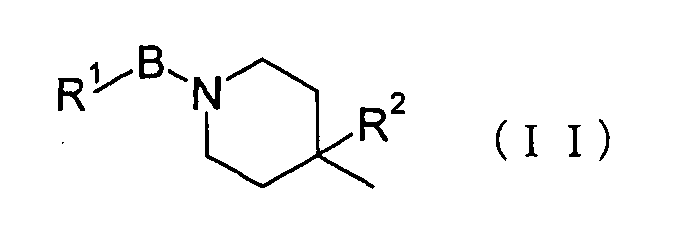
R1 represents lower alkyl, aryl or aromatic hetero ring, each of which may be substituted;
R2 represents lower alkyl which is optionally substituted with a group selected from the group consisting of -OH and -O-lower alkyl, or represents -H.

| test compound | IC50 / nM | test compound | IC50 / nM |
| Example 1 | 4.2 | Example 28 | 5.1 |
| Example 14 | 7.2 | Example 34 | 8.2 |
| Example 19 | 4.2 | Example 36 | 7.5 |
| Example 21 | 6.0 | Example 41 | 5.9 |
| Test for DPP-IV inhibiting activity duration in mice | ||
| test compound | inhibition of plasma DPP-IV activity after 6h / % | inhibition of plasma DPP-IV activity after 12h / % |
| Example 1 | 74 | 59 |
| Example 14 | 66 | 65 |
| Example 19 | 72 | 61 |
| Example 21 | 78 | 71 |
| Example 34 | 85 | 79 |
| Example 36 | 81 | 78 |
| Example 41 | 83 | 78 |
| Test for DPP-IV inhibiting activity duration in rats | ||
| test compound | inhibition of plasma DPP-IV activity after 6h / % | inhibition of plasma DPP-IV activity after 12h / % |
| Example 14 | 92 | 87 |
| Example 34 | 96 | 94 |
| Example 36 | 92 | 86 |
| Example 41 | 93 | 89 |
| Comparative Compound 1 | 65 | 38 |
| Comparative Compound 2 | 77 | 55 |
| Comparative Compound 3 | 80 | 45 |


NMR: 2.33-2.67 (2H,m), 3.60-4.05 (2H,m), 4.35-4.55 (2H,m), 4.95-5.05, 5.30-5.60 (2H,m).


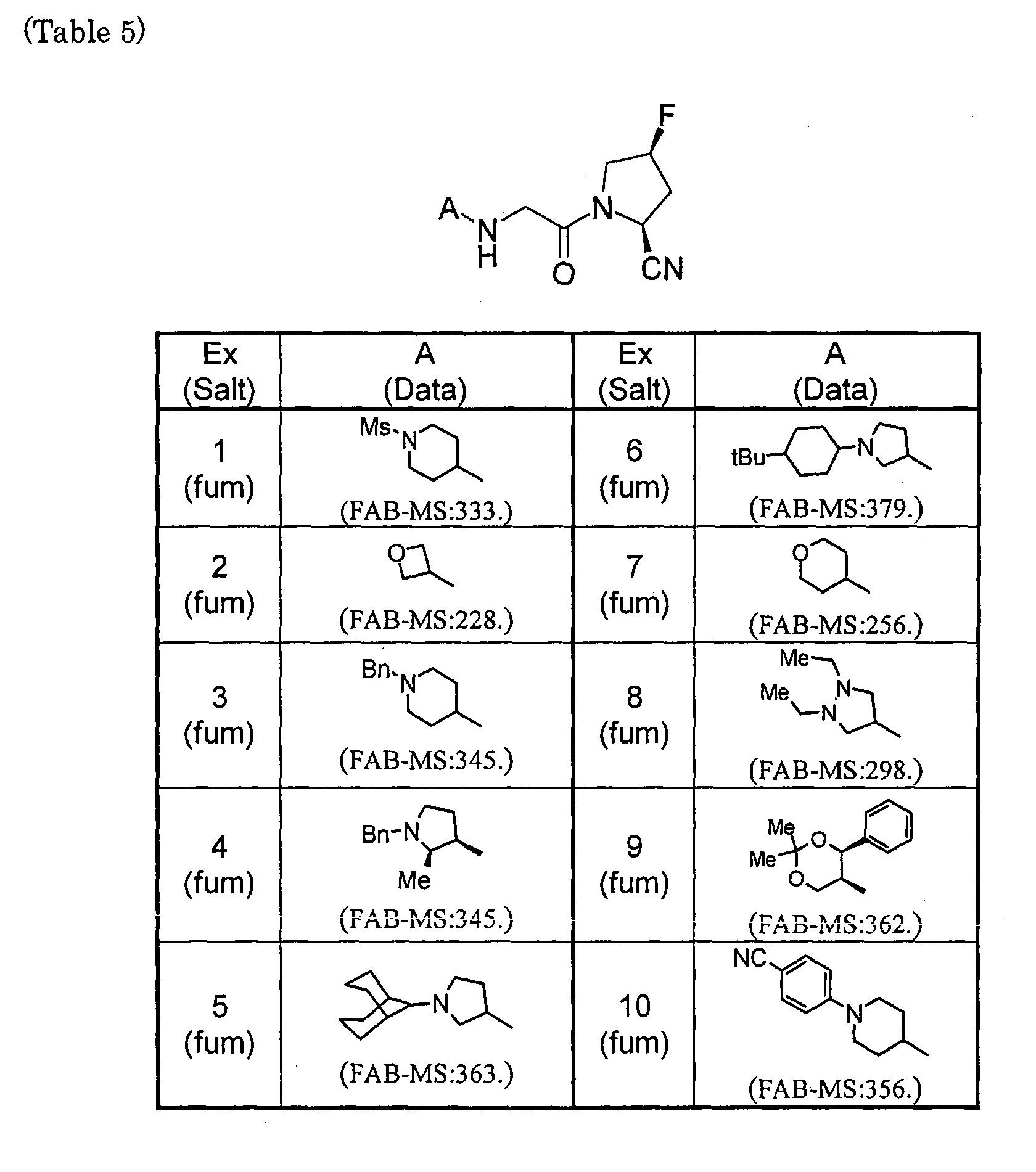
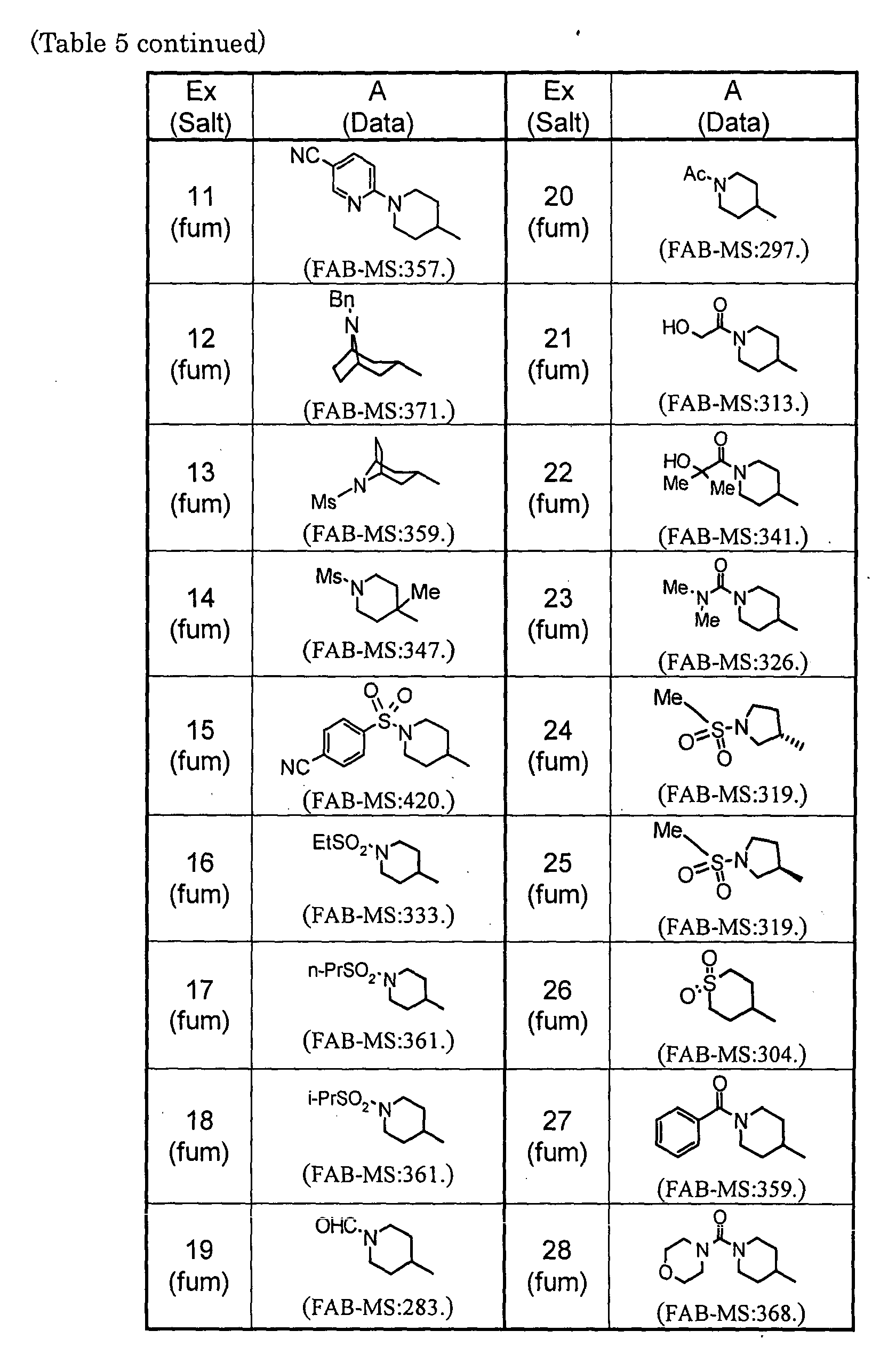
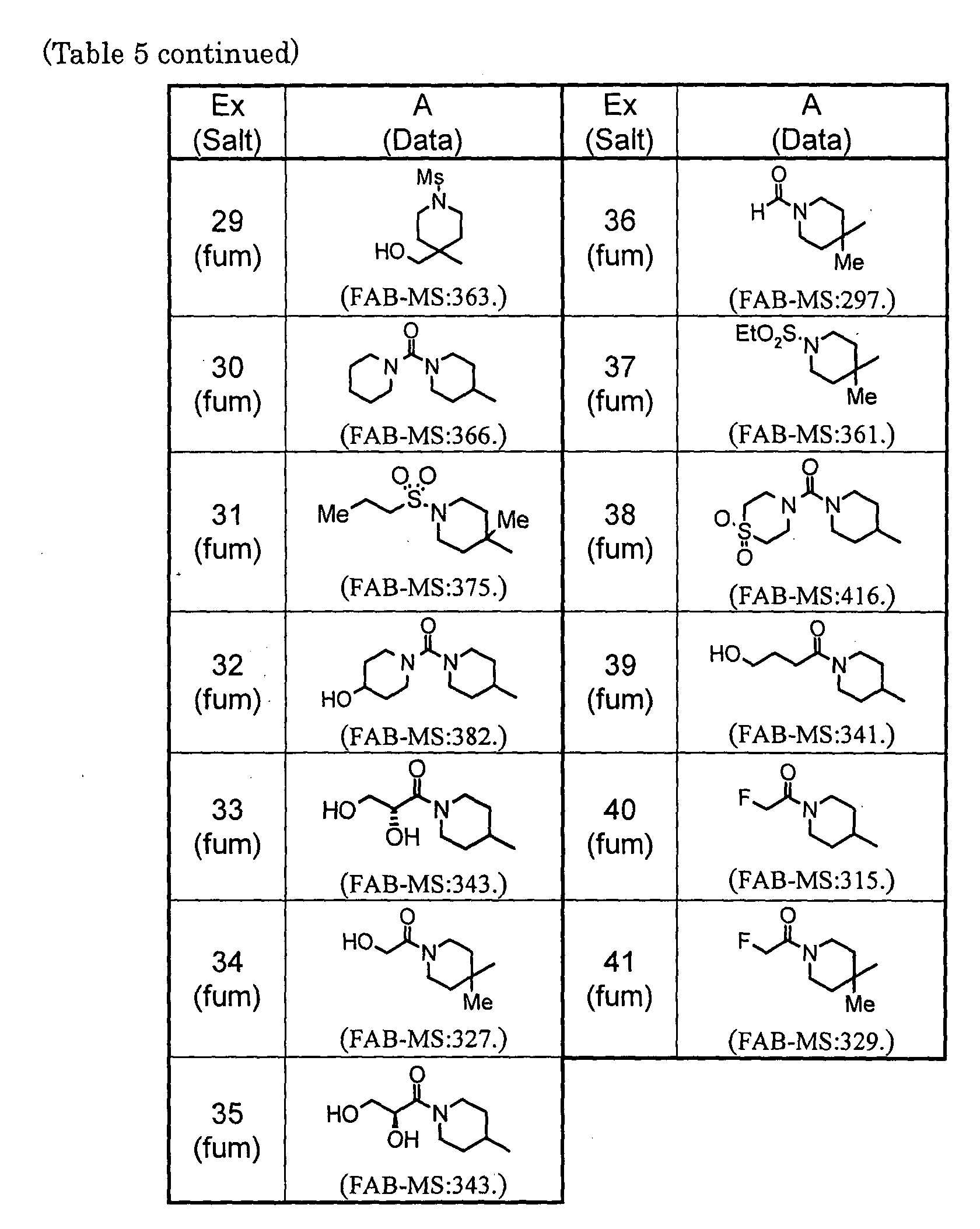
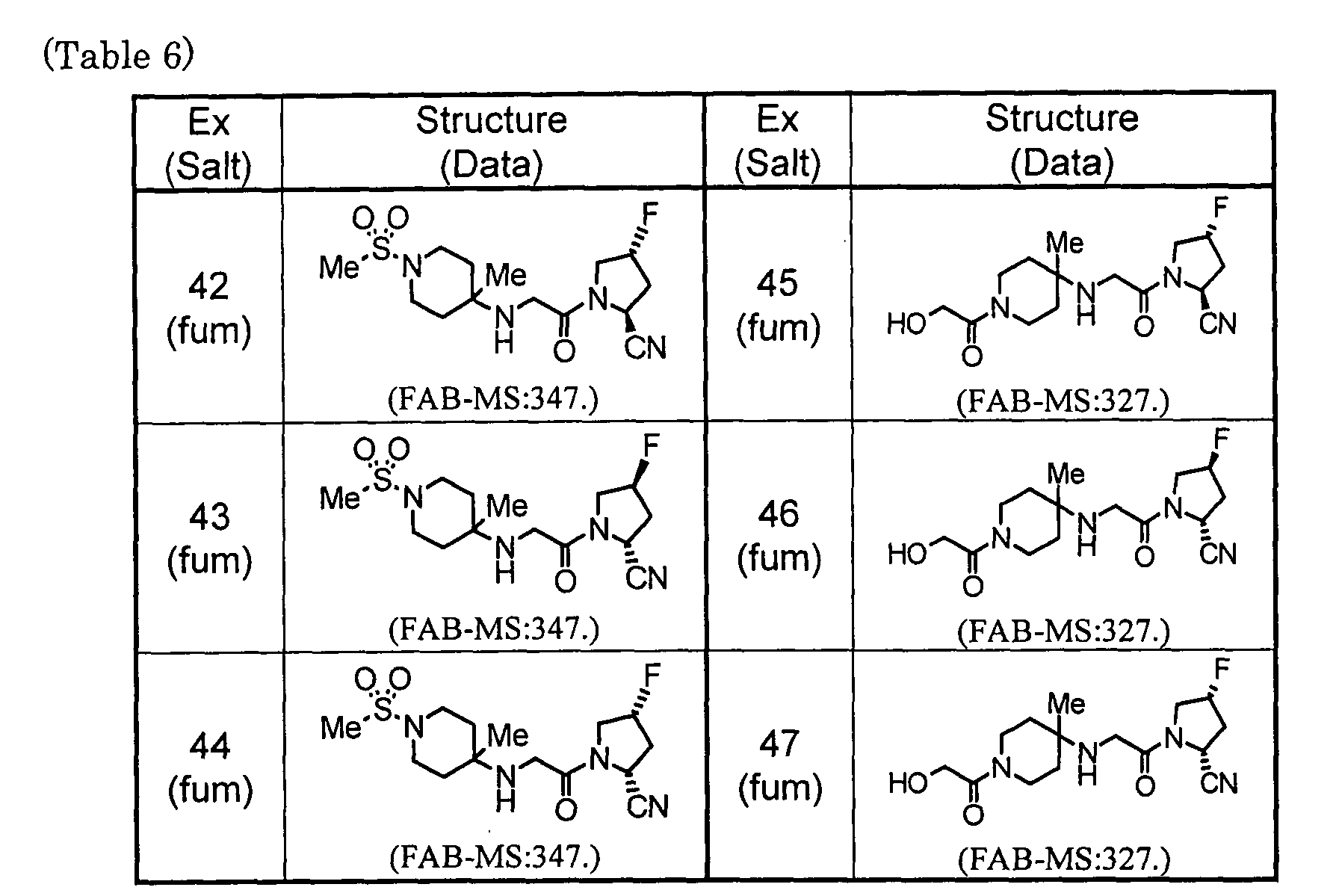
| Ex (Salt) | Data |
| 1 (fum) | NMR:1.30-1.50(2H,m),1.65-2.05(2H,m),2.20-2.60(2H,m),2.60-3.00(6H,m),3.40-3.85(5H,m),3.85-4.02(1H,m),4.90-5.04,5.30-5.60(2H,m),6.57(2H,s). |
| 2 (fum) | NMR:1.95-2.40(2H,m),3.30-4.30(9H,m),4.40-4.75,5.20-5.60(2H,m),6.55(2H,s). |
| 3 (fum) | NMR: 1.30-1.50(2H,m), 1.75-1.90(2H,m), 1.95-2.15(2H,m),2.25-2.70(3H,m),2.75-2.95 (2H,m),3.45-3.60(3H,m),3.60-3.85(2H,m),3.85-4.20(1H,m),4.80-5.38,5.38-5.60(2H,m), 6.56(2H,s),7.20-7.37(5H,m). |
| 4 (fum) | NMR:1.00-1.15(3H,m),1.45-1.70(1H,m),1.90-2.10(1H,m),2.25-2.75(3H,m),2.75-2.95 (2H,m),3.12-3.25(1H,m),3.25-4.10(6H,m),4.90-5.38,5.38-5.60(2H,m),6.58(2H,s),7.20-7.40(5H,m). |
| 5 (fum) | NMR:1.25-2.05(16H,m),2.20-2.90(5H,m),3.00-4.00(7H,m),4.75-5.38,5.38-5.60(2H,m), 6.54(2H,s). |
| 6 (fum) | NMR:0.75-0.90(9H,m),0.90-1.10(2H,m),1.20-1.55(7H,m),1.55-2.10(4H,m),2.10-4.05 (10H,m),4.60-5.38,5.38-5.60(2H,m),6.55(4H,s). |
| 7 (fum) | NMR:1.20-1.45(2H,m),1.70-1.90(2H,m),2.30-2.60(2H,m),2.60-2.90(1H,m),3.20-3.35 (2H,m),3.35-3.55(1H,m),3.55-3.70(2H,m),3.70-4.05(3H,m),4.90-5.34,5.34-5.60(2H,m), 6.57(2H,s). |
| 8 (fum) | NMR:0.98(6H,t),2.25-2.80(8H,m),3.00-3.20(2H,m),3.30-3.80(5H,m),3.80-4.30(1H,m), 4.70-5.38(1H,m),5.38-5.65(1H,m),3.70-4.05(3H,m),4.90-5.34,5.34-5.60(2H,m),6.60 (4H,s). |
| 9 (fum) | NMR:1.35-1.55(6H,m),2.10-2.45(2H,m),2.60-2.75(1H,m),2.98-3.65(4H,m),3.80-3.95 (1H,m),4.00-4.35(1H,m),4.70-4.95,5.15-5.40(3H,m),6.59(2H,s),7.15-7.45(5H,m). |
| 10 (fum) | NMR: 1.24-1.50(2H,m),1.70-2.04(2H,m),2.30-3.04(4H,m),3.40-4.15(7H,m),4.90-5.05, 5.30-5.60(2H,m),6.58(2H,s),7.02(2H,d),7.55(2H,d). |
| 11 (fum) | NMR: 1.20-1.40(2H,m), 1.70-2.00(2H,m),2.30-3.20(4H,m),3.40-4.10(5H,m),4.20-4.40 (2H,m),4.90-5.60(2H,m),6.57(2H,s),6.95(1H,d), 7.83(1H,m),8.45(1H,d). |
| 13 (fum) | NMR:1.35-1.53(2H,m),1.55-1.75(2H,m),1.85-2.05(4H,m),2.30-2.60(2H,m),2.88-3.04 (4H,m),3.35-4.00(4H,m),4.05-4.25(2H,m),4.90-5.04,5.28-5.60(2H,m). |
| 14 (fum) | NMR:1.05-1.20(3H,s),1.45-1.80(4H,m),2.30-2.65(2H,m),2.85(3H,s),3.00-3.30(4H,m), 3.35-3.85(3H,m),3.92-4.10(1H,m),4.97-5.02,5.30-5.62(2H,m),6.58(2H,s). |
| 15 (fum) | NMR:1.25-1.60(2H,m),1.60-2.05(2H,m),2.20-2.90(5H,m),3.00-4.25(6H,m),4.70-5.00, 5.20-5.60(2H,m),6.52(1H,s),7.70-8.00(2H,m),8.05-8.20(2H,m). |
| 19 (fum) | NMR:1.04-1.35(2H,m),1.75-1.95(2H,m),2.30-2.60(2H,m),2.65-2.90(2H,m),3.01-3.10 (1H,m),3.38-4.05(6H,m),4.96-5.35,5.36-5.56(2H,m),6.58(2H,s),7.97(1H,s). |
| 21 (fum) | NMR:1.05-1.40(2H,m),1.86(2H,br),2.30-2.65(1H,m),2.77-2.81(2H,m),2.90-3.05(1H, m),3.47-4.16(11H,m),4.98-5.40,5.34-5.57(2H,m),6.58(2H,s). |
| 28 (fum) | NMR:1.20-1.36(2H,m),1.72-1.90(2H,m),2.30-2.62(1H,m),2.70-2.82(3H,m),3.05-3.15 (4H,m),3.50-4.00(9H,m),4.95-5.37(1H,m),5.40-5.60(1H,m),6.57(2H,s). |
| 34 (fum) | NMR: 1.05-1.20(3H,s), 1.30-1.70(4H,m),2.30-2.65(2H,m),3.10-4.10(10H,m),4.92-5.05,5.32-5.62(2H,m),6.58(2H,s). |
| 36 (fum) | NMR:1.08,1.11(3H,s),1.30-1.65(4H,m),2.30-2.70(2H,m),3.20-4.10(8H,m),4.90-5.05,5-.33-5.60(2H,m),6.59(2H,s),7.96(1H,s). |
| 41 (fum) | NMR:1.06,1.08(3H,s),1.38-1.56(4H,m),2.33-2.67(2H,m),3.17-4.03(8H,m),4.98-5.57(4 H,m),6.60(2H,s). |


Claims (10)
- A 2-Cyano-4-fluoropyrrolidine derivative represented by the following general formula (I) or a pharmaceutically acceptable salt thereof:wherein A represents piperidin-4-yl, oxetan-3-yl, pyrrolidin-3-yl, tetrahydro-2H-pyran-4-yl, pyrazolidin-4-yl, 1,3-dioxan-5-yl, 8-azabicyclo[3.2.1]oct-3-yl or tetrahydro-2H-thiopyran-4-yl, each of which may be substituted, but excluding piperidin-4-yl which is substituted with a group selected from the group consisting of propane-2-sulfonyl, 2,4,6-trimethylbenzenesulfonyl, phenylmethanesulfonyl, 2-naphthalen-1-ylethanesulfonyl, 7,7-dimethyl-6-oxonorbornan-1-ylmethanesulfonyl, 4-fluorophenyl, 3,5-difluorophenyl, 4-nitrophenyl, 4-trifluoromethylphenyl, 4-cyanophenyl, 4-cyano-3-fluorophenyl, 4-cyano-3,5-difluorophenyl, 3-cyano-5-fluorophenyl, benzoxazol-2-yl and benzyl; pyrrolidin-3-yl which is substituted with a group selected from the group consisting of propane-2-sulfonyl, 3-cyanopyridin-6-yl, 4-trifluoromethylphenyl, 4-fluorophenyl and 4-fluorobenzyl; and 8-azabicyclo[3.2.1]oct-3-yl which is substituted with ethoxycarbonyl.
- The compound according to claim 1, wherein A is piperidin-4-yl or 8-azabicyclo[3.2.1]oct-3-yl, each of which may be substituted.
- The compound according to claim 2, wherein A is a group of the following general formula (II):wherein B represents carbonyl, sulfonyl or single bond;

R1 represents lower alkyl, aryl or aromatic hetero ring, each of which may be substituted;
R2 represents lower alkyl which is optionally substituted with a group selected from the group consisting of -OH and -O-lower alkyl, or represents -H. - The compound according to claim 3, wherein B is carbonyl or sulfonyl, R1 is lower alkyl which is optionally substituted, R2 is methyl, ethyl or hydroxymethyl.
- The compound according to claim 4, wherein R1 is methyl or ethyl,each of which is optionally substituted with a group selected from the group consisting of -OH and fluoro, and R2 is methyl.
- The compound according to any of claims 1 to 5, which is the following:4-fluoro-1-({[1-(methanesulfonyl)piperidin-4-yl]amino}acetyl) pyrrolidine-2-carbonitrile,4-fluoro-1-({[4-methyl-1-(methanesulfonyl)piperidin-4-yl]amino}acetyl) pyrrolidine-2-carbonitrile,4-fluoro-1-{[(1-glycoloylpiperidin-4-yl)amino]acetyl}pyrrolidine-2-carbonitrile,4-fluoro-1-{[(1-glycoloyl-4-methylpiperidin-4-yl)amino]acetyl} pyrrolidine-2-carbonitrile,4-fluoro-1-{[(1-fluoroacetyl-4-methylpiperidin-4-yl)amino]acetyl} pyrrolidine-2-carbonitrile,4-fluoro-1-{[(1-formylpiperidin-4-yl)amino]acetyl}pyrrolidine-2-carbonitrile,4-fluoro-1-{[(1-formyl-4-methylpiperidin-4-yl)amino]acetyl}pyrrolidine-2-carbonitrile, or4-fluoro-1-({[1-(morpholin-4-ylcarbonyl)piperidin-4-yl]amino}acetyl) pyrrolidine-2-carbonitrile, or a pharmaceutically acceptable salt thereof.
- The compounds according to claim 3, wherein B is carbonyl.
- A pharmaceutical composition comprising, as the active ingredient, the compound of claim 1.
- The pharmaceutical composition according to claim 8, which is for remedies for insulin-dependent diabetes (type 1 diabetes), non insulin-dependent diabetes (type 2 diabetes), insulin-resistant disorders, or obesity.
- The pharmaceutical composition according to claim 8, which is a dipeptidyl peptidase IV inhibitor.
Applications Claiming Priority (5)
| Application Number | Priority Date | Filing Date | Title |
|---|---|---|---|
| JP2002213654 | 2002-07-23 | ||
| JP2002213654 | 2002-07-23 | ||
| JP2002264450 | 2002-09-10 | ||
| JP2002264450 | 2002-09-10 | ||
| PCT/JP2003/009179 WO2004009544A1 (en) | 2002-07-23 | 2003-07-18 | 2-cyano-4-fluoropyrrolidine derivative or its salt |
Publications (3)
| Publication Number | Publication Date |
|---|---|
| EP1541551A1 true EP1541551A1 (en) | 2005-06-15 |
| EP1541551A8 EP1541551A8 (en) | 2005-11-09 |
| EP1541551A4 EP1541551A4 (en) | 2007-01-24 |
Family
ID=30772234
Family Applications (1)
| Application Number | Title | Priority Date | Filing Date |
|---|---|---|---|
| EP03741499A Withdrawn EP1541551A4 (en) | 2002-07-23 | 2003-07-18 | 2-CYANO-4-FLUOROPYRROLIDINE DERIVATIVE OR SALT THEREOF |
Country Status (18)
| Country | Link |
|---|---|
| US (1) | US7268150B2 (en) |
| EP (1) | EP1541551A4 (en) |
| JP (1) | JP3778207B2 (en) |
| KR (1) | KR100633844B1 (en) |
| CN (1) | CN1312127C (en) |
| AR (1) | AR040653A1 (en) |
| AU (1) | AU2003281625A1 (en) |
| BR (1) | BR0312844A (en) |
| CA (1) | CA2493339A1 (en) |
| IL (1) | IL166239A0 (en) |
| MX (1) | MXPA05000896A (en) |
| NO (1) | NO20050945L (en) |
| NZ (1) | NZ537658A (en) |
| PL (1) | PL374854A1 (en) |
| RU (1) | RU2288222C2 (en) |
| TW (1) | TW200401635A (en) |
| WO (1) | WO2004009544A1 (en) |
| ZA (1) | ZA200500621B (en) |
Cited By (3)
| Publication number | Priority date | Publication date | Assignee | Title |
|---|---|---|---|---|
| WO2006080412A3 (en) * | 2005-01-28 | 2006-09-21 | Taisho Pharmaceutical Co Ltd | Cyanopyrrolidine derivative-containing composition for solid pharmaceutical preparations, solid pharmaceutical preparation containing the composition, and process for producing the solid pharmaceutical preparation |
| WO2007029086A3 (en) * | 2005-09-05 | 2007-05-18 | Ranbaxy Lab Ltd | Derivatives of 3-azabicyclo[3.1.0]hexane as dipeptidyl peptidase-iv inhibitors |
| WO2009037719A1 (en) * | 2007-09-21 | 2009-03-26 | Lupin Limited | Novel compounds as dipeptidyl peptidase iv (dpp iv) inhibitors |
Families Citing this family (50)
| Publication number | Priority date | Publication date | Assignee | Title |
|---|---|---|---|---|
| ATE370943T1 (en) * | 2001-06-27 | 2007-09-15 | Smithkline Beecham Corp | FLUOROPYRROLIDINE AS DIPEPTIDYL-PEPTIDASE INHIBITORS |
| JP3909056B2 (en) | 2001-06-27 | 2007-04-25 | スミスクライン ビーチャム コーポレーション | Fluoropyrrolidines as dipeptidyl peptidase inhibitors |
| HUP0200849A2 (en) * | 2002-03-06 | 2004-08-30 | Sanofi-Synthelabo | N-aminoacetyl-pyrrolidine-2-carbonitrile derivatives, pharmaceutical compositions containing them and process for producing them |
| TW200528440A (en) * | 2003-10-31 | 2005-09-01 | Fujisawa Pharmaceutical Co | 2-cyanopyrrolidinecarboxamide compound |
| ATE537141T1 (en) * | 2004-02-05 | 2011-12-15 | Kyorin Seiyaku Kk | BICYCLOESTER DERIVATIVE |
| AU2005212073B2 (en) * | 2004-02-18 | 2010-07-08 | Kyorin Pharmaceutical Co., Ltd. | Bicyclic amide derivatives |
| US7514571B2 (en) * | 2004-02-27 | 2009-04-07 | Kyorin Pharmaceutical Co., Ltd. | Bicyclo derivative |
| TW200604167A (en) * | 2004-04-27 | 2006-02-01 | Astellas Pharma Inc | Pyrrolidine derivatives |
| EP1794120B1 (en) | 2004-07-23 | 2012-04-11 | Nuada, LLC | Peptidase inhibitors |
| TW200630337A (en) * | 2004-10-14 | 2006-09-01 | Euro Celtique Sa | Piperidinyl compounds and the use thereof |
| JP2008019168A (en) * | 2004-10-22 | 2008-01-31 | Astellas Pharma Inc | Method for producing 2-cyano-4-fluoropyrrolidine derivative |
| CA2587749A1 (en) * | 2004-12-08 | 2006-06-15 | Astellas Pharma Inc. | Piperidine derivative and process for producing the same |
| DOP2006000008A (en) | 2005-01-10 | 2006-08-31 | Arena Pharm Inc | COMBINED THERAPY FOR THE TREATMENT OF DIABETES AND RELATED AFFECTIONS AND FOR THE TREATMENT OF AFFECTIONS THAT IMPROVE THROUGH AN INCREASE IN THE BLOOD CONCENTRATION OF GLP-1 |
| MX2007011453A (en) | 2005-04-22 | 2008-02-12 | Alantos Pharmaceuticals Holding Inc | Dipeptidyl peptidase-iv inhibitors. |
| ATE482947T1 (en) * | 2005-12-21 | 2010-10-15 | Hoffmann La Roche | NEW SALT AND POLYMORPH OF DPP-IV INHIBITOR |
| US20090156465A1 (en) | 2005-12-30 | 2009-06-18 | Sattigeri Jitendra A | Derivatives of beta-amino acid as dipeptidyl peptidase-iv inhibitors |
| US7915427B2 (en) | 2006-03-08 | 2011-03-29 | Kyorin Pharmaceuticals Co., Ltd. | Process for producing aminoacetyl pyrrolidine carbonitrile derivative and intermediate for production thereof |
| WO2007110449A1 (en) * | 2006-03-29 | 2007-10-04 | Euro-Celtique S.A. | Benzenesulfonamide compounds and their use |
| PE20071221A1 (en) | 2006-04-11 | 2007-12-14 | Arena Pharm Inc | GPR119 RECEPTOR AGONISTS IN METHODS TO INCREASE BONE MASS AND TO TREAT OSTEOPOROSIS AND OTHER CONDITIONS CHARACTERIZED BY LOW BONE MASS, AND COMBINED THERAPY RELATED TO THESE AGONISTS |
| TW200812963A (en) * | 2006-04-13 | 2008-03-16 | Euro Celtique Sa | Benzenesulfonamide compounds and the use thereof |
| WO2007118853A1 (en) * | 2006-04-13 | 2007-10-25 | Euro-Celtique S.A. | Benzenesulfonamide compounds and their use as blockers of calcium channels |
| US7727978B2 (en) * | 2006-08-24 | 2010-06-01 | Bristol-Myers Squibb Company | Cyclic 11-beta hydroxysteroid dehydrogenase type I inhibitors |
| CN101230058A (en) * | 2007-01-23 | 2008-07-30 | 上海恒瑞医药有限公司 | Bicycle aza alkyl derivative, preparation method and use in medicine thereof |
| JPWO2008114857A1 (en) | 2007-03-22 | 2010-07-08 | 杏林製薬株式会社 | Process for producing aminoacetylpyrrolidinecarbonitrile derivative |
| KR20120030570A (en) | 2007-04-03 | 2012-03-28 | 미쓰비시 타나베 파마 코퍼레이션 | Combined use of dipeptidyl peptidase iv inhibitor compound and sweetener |
| WO2008124118A1 (en) | 2007-04-09 | 2008-10-16 | Purdue Pharma L.P. | Benzenesulfonyl compounds and the use therof |
| WO2009040659A2 (en) * | 2007-09-28 | 2009-04-02 | Purdue Pharma L.P. | Benzenesulfonamide compounds and the use thereof |
| WO2009116067A2 (en) * | 2008-01-10 | 2009-09-24 | Sun Pharma Advanced Research Company Limited | Novel derivatives of acyl cyanopyrrolidines |
| CL2008003653A1 (en) * | 2008-01-17 | 2010-03-05 | Mitsubishi Tanabe Pharma Corp | Use of a glucopyranosyl-derived sglt inhibitor and a selected dppiv inhibitor to treat diabetes; and pharmaceutical composition. |
| RU2487866C2 (en) * | 2008-01-23 | 2013-07-20 | Цзянсу Хэнсох Фармасьютикал Ко., Лтд. | Dicycloazaalkane derivatives, methods for production thereof and use thereof in medicine |
| EP2146210A1 (en) | 2008-04-07 | 2010-01-20 | Arena Pharmaceuticals, Inc. | Methods of using A G protein-coupled receptor to identify peptide YY (PYY) secretagogues and compounds useful in the treatment of conditions modulated by PYY |
| JP5476305B2 (en) * | 2008-08-07 | 2014-04-23 | 杏林製薬株式会社 | Method for producing bicyclo [2.2.2] octylamine derivative |
| US20110152342A1 (en) * | 2008-08-14 | 2011-06-23 | Hiroshi Uchida | Stabilized pharmaceutical composition |
| GB2483614B (en) | 2009-06-18 | 2014-12-03 | Lupin Ltd | 2-Amino-2- [8-(dimethyl carbamoyl)- 8-aza- bicyclo [3.2.1] oct-3-yl]-exo- ethanoyl derivatives as potent dpp-iv inhibitors |
| AR077642A1 (en) | 2009-07-09 | 2011-09-14 | Arena Pharm Inc | METABOLISM MODULATORS AND THE TREATMENT OF DISORDERS RELATED TO THE SAME |
| JP2013523819A (en) | 2010-04-06 | 2013-06-17 | アリーナ ファーマシューティカルズ, インコーポレイテッド | GPR119 receptor modulators and treatment of disorders related thereto |
| ES2478875T3 (en) * | 2010-04-20 | 2014-07-23 | Syngenta Participations Ag | Process for preparing pyrazolic carboxylic acid amides |
| CN103221410B (en) | 2010-09-22 | 2017-09-15 | 艾尼纳制药公司 | GPR119 receptor modulators and treatment of disorders associated therewith |
| US20140018371A1 (en) | 2011-04-01 | 2014-01-16 | Arena Pharmaceuticals, Inc. | Modulators Of The GPR119 Receptor And The Treatment Of Disorders Related Thereto |
| WO2012145361A1 (en) | 2011-04-19 | 2012-10-26 | Arena Pharmaceuticals, Inc. | Modulators of the gpr119 receptor and the treatment of disorders related thereto |
| WO2012145603A1 (en) | 2011-04-22 | 2012-10-26 | Arena Pharmaceuticals, Inc. | Modulators of the gpr119 receptor and the treatment of disorders related thereto |
| WO2012145604A1 (en) | 2011-04-22 | 2012-10-26 | Arena Pharmaceuticals, Inc. | Modulators of the gpr119 receptor and the treatment of disorders related thereto |
| WO2012170702A1 (en) | 2011-06-08 | 2012-12-13 | Arena Pharmaceuticals, Inc. | Modulators of the gpr119 receptor and the treatment of disorders related thereto |
| RU2485952C2 (en) * | 2011-08-18 | 2013-06-27 | Открытое акционерное общество "Химико-фармацевтический комбинат "АКРИХИН" (ОАО "АКРИХИН") | Dipeptidyl peptidase iv inhibiting agent and pharmaceutical composition thereof |
| WO2013055910A1 (en) | 2011-10-12 | 2013-04-18 | Arena Pharmaceuticals, Inc. | Modulators of the gpr119 receptor and the treatment of disorders related thereto |
| CN103788070B (en) * | 2012-10-26 | 2017-10-20 | 南京华威医药科技开发有限公司 | The inhibitor class polymers of DPP 4 |
| WO2014074668A1 (en) | 2012-11-08 | 2014-05-15 | Arena Pharmaceuticals, Inc. | Modulators of gpr119 and the treatment of disorders related thereto |
| CN105985357A (en) * | 2015-02-12 | 2016-10-05 | 北京赛林泰医药技术有限公司 | Substituted six-component saturated heteroalicyclic long-acting DPP-IV inhibitor |
| CN107683135A (en) | 2015-03-09 | 2018-02-09 | 因特克林医疗有限公司 | Method for treating NASH disease and/or lipodystrophia |
| AU2018249822A1 (en) | 2017-04-03 | 2019-10-31 | Coherus Biosciences Inc. | PPArgamma agonist for treatment of progressive supranuclear palsy |
Family Cites Families (10)
| Publication number | Priority date | Publication date | Assignee | Title |
|---|---|---|---|---|
| TW492957B (en) * | 1996-11-07 | 2002-07-01 | Novartis Ag | N-substituted 2-cyanopyrrolidnes |
| CO5150173A1 (en) * | 1998-12-10 | 2002-04-29 | Novartis Ag | COMPOUNDS N- (REPLACED GLYCLE) -2-DIPEPTIDYL-IV PEPTIDASE INHIBITING CYANOPIRROLIDINS (DPP-IV) WHICH ARE EFFECTIVE IN THE TREATMENT OF CONDITIONS MEDIATED BY DPP-IV INHIBITION |
| WO2001055105A1 (en) | 2000-01-24 | 2001-08-02 | Novo Nordisk A/S | N-substituted 2-cyanopyroles and -pyrrolines which are inhibitors of the enzyme dpp-iv |
| TW583185B (en) | 2000-06-13 | 2004-04-11 | Novartis Ag | N-(substituted glycyl)-2-cyanopyrrolidines and pharmaceutical composition for inhibiting dipeptidyl peptidase-IV (DPP-IV) or for the prevention or treatment of diseases or conditions associated with elevated levels of DPP-IV comprising the same |
| CA2424600C (en) | 2000-10-06 | 2008-12-02 | Tanabe Seiyaku Co., Ltd. | Aliphatic nitrogenous five-membered ring compounds |
| TWI243162B (en) * | 2000-11-10 | 2005-11-11 | Taisho Pharmaceutical Co Ltd | Cyanopyrrolidine derivatives |
| US7074817B2 (en) | 2001-06-20 | 2006-07-11 | Wyeth | Substituted indole acid derivatives as inhibitors of plasminogen activator inhibitor-1 (PAI-1) |
| GB0115517D0 (en) | 2001-06-25 | 2001-08-15 | Ferring Bv | Novel antidiabetic agents |
| ATE370943T1 (en) * | 2001-06-27 | 2007-09-15 | Smithkline Beecham Corp | FLUOROPYRROLIDINE AS DIPEPTIDYL-PEPTIDASE INHIBITORS |
| HUP0200849A2 (en) * | 2002-03-06 | 2004-08-30 | Sanofi-Synthelabo | N-aminoacetyl-pyrrolidine-2-carbonitrile derivatives, pharmaceutical compositions containing them and process for producing them |
-
2003
- 2003-06-27 TW TW092117723A patent/TW200401635A/en unknown
- 2003-07-18 NZ NZ537658A patent/NZ537658A/en unknown
- 2003-07-18 MX MXPA05000896A patent/MXPA05000896A/en not_active Application Discontinuation
- 2003-07-18 EP EP03741499A patent/EP1541551A4/en not_active Withdrawn
- 2003-07-18 CA CA002493339A patent/CA2493339A1/en not_active Abandoned
- 2003-07-18 BR BR0312844-0A patent/BR0312844A/en not_active IP Right Cessation
- 2003-07-18 JP JP2004522764A patent/JP3778207B2/en not_active Expired - Fee Related
- 2003-07-18 PL PL03374854A patent/PL374854A1/en not_active Application Discontinuation
- 2003-07-18 RU RU2005101426/04A patent/RU2288222C2/en not_active IP Right Cessation
- 2003-07-18 AU AU2003281625A patent/AU2003281625A1/en not_active Abandoned
- 2003-07-18 WO PCT/JP2003/009179 patent/WO2004009544A1/en not_active Ceased
- 2003-07-18 KR KR1020057001166A patent/KR100633844B1/en not_active Expired - Fee Related
- 2003-07-18 CN CNB03815854XA patent/CN1312127C/en not_active Expired - Fee Related
- 2003-07-18 US US10/492,347 patent/US7268150B2/en not_active Expired - Fee Related
- 2003-07-22 AR AR20030102623A patent/AR040653A1/en not_active Application Discontinuation
-
2005
- 2005-01-11 IL IL16623905A patent/IL166239A0/en unknown
- 2005-01-21 ZA ZA200500621A patent/ZA200500621B/en unknown
- 2005-02-22 NO NO20050945A patent/NO20050945L/en not_active Application Discontinuation
Cited By (6)
| Publication number | Priority date | Publication date | Assignee | Title |
|---|---|---|---|---|
| WO2006080412A3 (en) * | 2005-01-28 | 2006-09-21 | Taisho Pharmaceutical Co Ltd | Cyanopyrrolidine derivative-containing composition for solid pharmaceutical preparations, solid pharmaceutical preparation containing the composition, and process for producing the solid pharmaceutical preparation |
| WO2007029086A3 (en) * | 2005-09-05 | 2007-05-18 | Ranbaxy Lab Ltd | Derivatives of 3-azabicyclo[3.1.0]hexane as dipeptidyl peptidase-iv inhibitors |
| WO2009037719A1 (en) * | 2007-09-21 | 2009-03-26 | Lupin Limited | Novel compounds as dipeptidyl peptidase iv (dpp iv) inhibitors |
| GB2465132A (en) * | 2007-09-21 | 2010-05-12 | Lupin Ltd | Novel compounds as dipeptidyl peptidase IV (DPP IV) inhibitors |
| GB2465132B (en) * | 2007-09-21 | 2012-06-06 | Lupin Ltd | Compounds as dipeptidyl peptidase IV (DPP IV) inhibitors |
| US8338450B2 (en) | 2007-09-21 | 2012-12-25 | Lupin Limited | Compounds as dipeptidyl peptidase IV (DPP IV) inhibitors |
Also Published As
| Publication number | Publication date |
|---|---|
| KR100633844B1 (en) | 2006-10-16 |
| RU2288222C2 (en) | 2006-11-27 |
| EP1541551A4 (en) | 2007-01-24 |
| EP1541551A8 (en) | 2005-11-09 |
| US20050176771A1 (en) | 2005-08-11 |
| MXPA05000896A (en) | 2005-04-19 |
| JPWO2004009544A1 (en) | 2005-11-17 |
| CA2493339A1 (en) | 2004-01-29 |
| ZA200500621B (en) | 2006-07-26 |
| RU2005101426A (en) | 2005-07-20 |
| KR20050023452A (en) | 2005-03-09 |
| NZ537658A (en) | 2006-08-31 |
| AR040653A1 (en) | 2005-04-13 |
| AU2003281625A1 (en) | 2004-02-09 |
| CN1665785A (en) | 2005-09-07 |
| WO2004009544A1 (en) | 2004-01-29 |
| NO20050945L (en) | 2005-04-22 |
| BR0312844A (en) | 2005-04-26 |
| IL166239A0 (en) | 2006-01-15 |
| PL374854A1 (en) | 2005-11-14 |
| CN1312127C (en) | 2007-04-25 |
| US7268150B2 (en) | 2007-09-11 |
| TW200401635A (en) | 2004-02-01 |
| JP3778207B2 (en) | 2006-05-24 |
Similar Documents
| Publication | Publication Date | Title |
|---|---|---|
| US7268150B2 (en) | 2-cyano-4-fluoropyrrolidine derivative or its salt | |
| JP7053900B2 (en) | GLP-1 receptor agonist and its use | |
| EP3728238B1 (en) | Sulphonyl urea derivatives as nlrp3 inflammasome modulators | |
| KR101482159B1 (en) | Azabicyclooctane derivatives, a process for their preparation and their use as inhibitors of dipeptidyl peptidase IV | |
| JP5165688B2 (en) | Compound | |
| US8227504B2 (en) | Substituted N-phenyl-pyrrolidinylmethylpyrrolidine amides and therapeutic use thereof | |
| BRPI0708264A2 (en) | piperidinylpyrrolidines melanocortin type 4 receptor agonists | |
| EP2408780A2 (en) | 3-oxa-7-azabicycloý3.3.1¨nonanes | |
| SG175995A1 (en) | L- ( piperidin-4-yl) -pyrazole derivatives as gpr 119 modulators | |
| WO2006043490A1 (en) | Pyrimidine derivative fused with nonaromatic ring | |
| WO2006073167A1 (en) | Pyrrolidine derivatives | |
| JP2006045156A (en) | Condensed pyrazole derivatives | |
| JPWO2004007446A1 (en) | Novel azetidine derivative or salt thereof | |
| AU2009278838B2 (en) | Diazepine and diazocane compounds as MC4 agonists | |
| CA2617654A1 (en) | Piperidinoyl-pyrrolidine and piperidinoyl-piperidine compounds | |
| JPWO2005021550A1 (en) | Bicyclic pyrazole derivatives | |
| WO2005073186A1 (en) | Pyrrolidine derivatives | |
| JP2016520098A (en) | Bicyclic derivative containing pyrimidine ring and method for producing the same |
Legal Events
| Date | Code | Title | Description |
|---|---|---|---|
| PUAI | Public reference made under article 153(3) epc to a published international application that has entered the european phase |
Free format text: ORIGINAL CODE: 0009012 |
|
| 17P | Request for examination filed |
Effective date: 20050121 |
|
| AK | Designated contracting states |
Kind code of ref document: A1 Designated state(s): AT BE BG CH CY CZ DE DK EE ES FI FR GB GR HU IE IT LI LU MC NL PT RO SE SI SK TR |
|
| AX | Request for extension of the european patent |
Extension state: AL LT LV MK |
|
| RAP1 | Party data changed (applicant data changed or rights of an application transferred) |
Owner name: ASTELLAS PHARMA INC. |
|
| DAX | Request for extension of the european patent (deleted) | ||
| RAP1 | Party data changed (applicant data changed or rights of an application transferred) |
Owner name: ASTELLAS PHARMA INC. |
|
| A4 | Supplementary search report drawn up and despatched |
Effective date: 20061222 |
|
| RIC1 | Information provided on ipc code assigned before grant |
Ipc: A61P 43/00 20060101ALI20061218BHEP Ipc: A61P 3/10 20060101ALI20061218BHEP Ipc: A61K 31/541 20060101ALI20061218BHEP Ipc: A61K 31/5377 20060101ALI20061218BHEP Ipc: A61K 31/454 20060101ALI20061218BHEP Ipc: A61K 31/439 20060101ALI20061218BHEP Ipc: A61K 31/4155 20060101ALI20061218BHEP Ipc: A61K 31/4025 20060101ALI20061218BHEP Ipc: C07D 409/12 20060101ALI20061218BHEP Ipc: C07D 451/04 20060101ALI20061218BHEP Ipc: C07D 405/12 20060101ALI20061218BHEP Ipc: C07D 403/12 20060101ALI20061218BHEP Ipc: C07D 401/12 20060101ALI20061218BHEP Ipc: C07D 207/16 20060101AFI20040206BHEP |
|
| 17Q | First examination report despatched |
Effective date: 20080131 |
|
| GRAP | Despatch of communication of intention to grant a patent |
Free format text: ORIGINAL CODE: EPIDOSNIGR1 |
|
| STAA | Information on the status of an ep patent application or granted ep patent |
Free format text: STATUS: THE APPLICATION IS DEEMED TO BE WITHDRAWN |
|
| 18D | Application deemed to be withdrawn |
Effective date: 20090703 |