EP1541193A1 - Medical treatment system using biological regulation function alternate, cardiac pacing system based on the medical treatment system, blood pressure regulating system, and cardiac disease treating system - Google Patents
Medical treatment system using biological regulation function alternate, cardiac pacing system based on the medical treatment system, blood pressure regulating system, and cardiac disease treating system Download PDFInfo
- Publication number
- EP1541193A1 EP1541193A1 EP02755821A EP02755821A EP1541193A1 EP 1541193 A1 EP1541193 A1 EP 1541193A1 EP 02755821 A EP02755821 A EP 02755821A EP 02755821 A EP02755821 A EP 02755821A EP 1541193 A1 EP1541193 A1 EP 1541193A1
- Authority
- EP
- European Patent Office
- Prior art keywords
- signals
- nerve
- blood pressure
- stimulation
- activity
- Prior art date
- Legal status (The legal status is an assumption and is not a legal conclusion. Google has not performed a legal analysis and makes no representation as to the accuracy of the status listed.)
- Granted
Links
Images



Classifications
-
- A—HUMAN NECESSITIES
- A61—MEDICAL OR VETERINARY SCIENCE; HYGIENE
- A61N—ELECTROTHERAPY; MAGNETOTHERAPY; RADIATION THERAPY; ULTRASOUND THERAPY
- A61N1/00—Electrotherapy; Circuits therefor
- A61N1/18—Applying electric currents by contact electrodes
- A61N1/32—Applying electric currents by contact electrodes alternating or intermittent currents
- A61N1/36—Applying electric currents by contact electrodes alternating or intermittent currents for stimulation
- A61N1/3605—Implantable neurostimulators for stimulating central or peripheral nerve system
- A61N1/3606—Implantable neurostimulators for stimulating central or peripheral nerve system adapted for a particular treatment
- A61N1/36114—Cardiac control, e.g. by vagal stimulation
-
- A—HUMAN NECESSITIES
- A61—MEDICAL OR VETERINARY SCIENCE; HYGIENE
- A61N—ELECTROTHERAPY; MAGNETOTHERAPY; RADIATION THERAPY; ULTRASOUND THERAPY
- A61N1/00—Electrotherapy; Circuits therefor
- A61N1/18—Applying electric currents by contact electrodes
- A61N1/32—Applying electric currents by contact electrodes alternating or intermittent currents
- A61N1/36—Applying electric currents by contact electrodes alternating or intermittent currents for stimulation
- A61N1/3605—Implantable neurostimulators for stimulating central or peripheral nerve system
- A61N1/3606—Implantable neurostimulators for stimulating central or peripheral nerve system adapted for a particular treatment
- A61N1/36114—Cardiac control, e.g. by vagal stimulation
- A61N1/36117—Cardiac control, e.g. by vagal stimulation for treating hypertension
-
- A—HUMAN NECESSITIES
- A61—MEDICAL OR VETERINARY SCIENCE; HYGIENE
- A61N—ELECTROTHERAPY; MAGNETOTHERAPY; RADIATION THERAPY; ULTRASOUND THERAPY
- A61N1/00—Electrotherapy; Circuits therefor
- A61N1/18—Applying electric currents by contact electrodes
- A61N1/32—Applying electric currents by contact electrodes alternating or intermittent currents
- A61N1/36—Applying electric currents by contact electrodes alternating or intermittent currents for stimulation
- A61N1/362—Heart stimulators
- A61N1/365—Heart stimulators controlled by a physiological parameter, e.g. heart potential
-
- A—HUMAN NECESSITIES
- A61—MEDICAL OR VETERINARY SCIENCE; HYGIENE
- A61N—ELECTROTHERAPY; MAGNETOTHERAPY; RADIATION THERAPY; ULTRASOUND THERAPY
- A61N1/00—Electrotherapy; Circuits therefor
- A61N1/18—Applying electric currents by contact electrodes
- A61N1/32—Applying electric currents by contact electrodes alternating or intermittent currents
- A61N1/36—Applying electric currents by contact electrodes alternating or intermittent currents for stimulation
- A61N1/362—Heart stimulators
- A61N1/365—Heart stimulators controlled by a physiological parameter, e.g. heart potential
- A61N1/36514—Heart stimulators controlled by a physiological parameter, e.g. heart potential controlled by a physiological quantity other than heart potential, e.g. blood pressure
Definitions
- the present invention is related to a system to treat diseases by substituting native biological regulatory function. More particularly, the present invention provides a system to treat diseases by substituting native biological regulatory function that is capable of regulating organs as if their central controllers were normally functioning even if the central controllers themselves become abnormal due to various causes.
- the invention includes a cardiac pacing system, a blood pressure regulating system, and a cardiac disease treatment system, all of which are particular embodiments of the medical treatment system.
- the number of heart donors is definitely small, and the shortage of hearts for transplantation has been seriously discussed worldwide.
- Pacemakers have been used for the treatment of patients with bradycardia. Pacemakers enable necessary rhythmic myocardial contraction by electrically stimulating the myocardium artificially.
- rate-responsive pacemakers in which stimulation rate changes according to the estimated native heart rate from e.g., electrocardiographic QT time, body temperature, or body acceleration.
- specificity, sensitivity and transient response of heart rate regulation compared to native heart rate regulation by such pacemakers have not always been satisfactory.
- abnormal native regulatory function promotes disease processes.
- abnormal native regulatory mechanisms participate in the progression of heart disease, and it is well known that sympathetic nerve overactivation and abnormal vagal nerve withdrawal occur after the onset of acute myocardial infarction, and worsens the outcome.
- Such abnormal native regulatory function can also be observed in circulatory diseases other than heart diseases.
- Pharmacological treatment with drugs such as coronary vasodilators, ⁇ -adrenergic blockers and anti-platelet agents, catheter-based interventional treatment, and coronary artery bypass surgery have been developed as treatments for myocardial infarction.
- Adrenergic agonists such as epinephrine, levodopa and amphetamine, are used for pharmacological treatment of Shy-Drager syndrome with severe orthostatic hypertension, and excessive salt is administered for symptomatic relief. Although symptoms can be alleviated to some extent, it is impossible to treat Shy-Drager syndrome and restore full function.
- the present invention provides a system to treat diseases that is capable of regulating organs as if their central controllers were normally functioning even if the central controllers themselves become abnormal by various causes.
- the present invention includes embodiments directed to a cardiac pacing system, a blood pressure regulating system, and a cardiac disease treatment system, all of which are based on the above medical treatment system.
- a system to treat diseases is based on biological activities.
- the system includes a biological activity sensing means which senses biological activity information issued by biological activities, and outputs biosignals; a calculating means which receives the biosignals sensed by the biological activity sensing means, analyzes and processes the biosignals to calculate signals to stimulate the organism, and outputs the signals; and an organism stimulating means which receives the signals calculated by the calculating means, and stimulates the organism on the basis of the signals.
- the calculating means includes a discriminating means which determines whether the received biosignals are caused by normal biological activities or by abnormal biological activities. When the received biosignals are determined to be caused by normal biological activities, the calculating means does not output signals to stimulate the organism. In contrast, when the received biosignals are determined to be caused by abnormal biological activities, the calculating means outputs signals to stimulate the organism.
- the signals are calculated by a convolution integral between an impulse response previously obtained from normal biological activities and the biosignals sensed by the biological activity sensing means.
- a cardiac pacing system based on biological activities includes a nerve activity sensing means which senses nerve activities of the cardiac sympathetic nerve and/or the vagal nerve, and outputs nerve activity signals.
- a calculating means receives the nerve activity signals sensed by the nerve activity sensing means, analyzes and processes the nerve activity signals to calculate pacing signals to control the heart rate, and outputs the pacing signals.
- a pacing means receives the pacing signals, and stimulates the heart on the basis of the pacing signals to regulate heart rate.
- a blood pressure regulating system which uses the native regulation rule to estimate nerve activities in response to blood pressure changes, includes a blood pressure sensing means, which senses blood pressure and outputs a blood pressure signal.
- a calculating means receives the blood pressure signal sensed by the blood pressure sensing means, analyzes and processes the blood pressure signal to calculate a sympathetic nerve stimulation signal for the regulation of blood pressure by the stimulation of sympathetic nerve innervating vascular beds, and outputs the sympathetic nerve stimulation signal.
- a nerve stimulating means receives the sympathetic nerve stimulation signal calculated by the calculating means, and stimulates the sympathetic nerve innervating vascular beds on the basis of the sympathetic nerve stimulation signal to regulate blood pressure.
- a system to treat cardiac diseases includes a cardiovascular activity sensing means which senses cardiovascular activity information issued by the cardiovascular system, and outputs cardiovascular activity signals.
- a calculating means receives the cardiovascular activity signals sensed by the cardiovascular activity sensing means, analyzes and processes the cardiovascular activity signals to calculate nerve stimulation signals, and outputs the nerve simulation signals.
- a nerve stimulating means receives the nerve stimulation signals, and stimulates the nerve on the basis of the nerve stimulation signals.
- the system to treat diseases in the present invention is capable of restoring native regulatory function as if the lost or abnormal native regulatory functions became normally functioning by substituting the lost or abnormal native functions with the system.
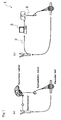
- Figure 1(a) is a schematic illustration showing the components of a native baroreflex or blood pressure regulation system. Information about the changes in blood pressure is transmitted from baroreceptors to the solitary tract nucleus in the medulla oblongata. The solitary tract nucleus then in turn changes sympathetic nerve activity to regulate blood pressure by e.g., vasoconstriction.
- Figure 1(b) is a schematic illustration where the system (1) of the present invention was applied to maintain normal blood pressure regulation even when the native vasomotor center fails to achieve normal function by various causes.
- Blood pressure can be maintained in a normal way by sensing blood pressure with a blood pressure sensing means (2), by converting the blood pressure signal into the signal for nerve stimulation with a nerve stimulating means (4) by a calculating means (3), and by stimulating the nerve with the nerve stimulating means (4) according to the calculated signals.
- Figure 2 is a block diagram depicting an outline of the system of the present invention.
- the disease treatment system (1) disclosed herein includes at least a biological activity sensing means (2), a calculating means (3), and an organism stimulating means (4).
- the biological activity sensing means (2) can output biosignals to the calculating means (3) by sensing biological activity information issued by biological activities of organisms (S).
- Some examples of the biological activity sensing means (2) include, but are not limited to, electrodes and pressure sensors.
- Biosignals sensed by the biological activity sensing means (2) include, but are not limited to, sympathetic nerve activities and parasympathetic nerve activities, blood flow, blood pressure, body temperature, electrocardiogram, electroenchephalogram, and various biochemical markers. One can choose any necessary biosignals that are required for the system to achieve the purpose.
- the number of the biological activity sensing means (2) of the system is not limited. Although only one biological activity sensing means (2) is shown in Figure 2, two or more biological activity sensing means may be supplied to meet the requirements of the system. If there are multiple biological activity sensing means in the system, they may be located at the same site or at different sites within the organism.
- the calculating means (3) can analyze and process biosignals sensed by the biological activity sensing means (2) and transferred to the calculating means, to calculate the signals to stimulate the organism.
- the calculated signals are transferred to the organism stimulation means (4).
- the biosignals sensed by the biological activity sensing means (2) are fed into amplifiers (31) in the calculating means (3) for signal amplification.
- These amplifiers (31) preferably include filters (not shown) capable of eliminating unnecessary higher or lower frequency biosignals or power line noises.
- the amplified signals are converted from analog to digital signals with the aid of analog-to-digital (A/D) converters (32), and then transferred to analyzers/processors (33).
- the analyzers/processors (33) process data to calculate signals to be transferred to organism stimulating means (4).
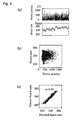
- Figure 3 is a graph showing the relationship between sympathetic nerve activity and heart rate of a representative rabbit.
- Figure 3(a) is a graph showing simultaneously measured changes in cardiac sympathetic nerve activity and heart rate with time.
- FIG. 3(c) is a scatter plot between the heart rate estimated from impulse response function and measured sympathetic nerve activity on one hand, and measured heart rate on the other. As shown in this figure, measured and estimated heart rate correlated well (correlation function 0.93).
- the heart rate actually required by organisms can be obtained.
- one can regulate heart rate by stimulating the heart electrically according to the estimated heart rate, as if it were regulated by the normal central nervous system.
- Discriminating means (not shown), judging whether biosignals coming into the calculating means (3) arise from normal biological activities or from abnormal biological activities, may also optionally be provided in the calculating means (3).
- information about normal-activity biosignals are stored in memory means (not shown), and the input biosignals are compared with the stored information. When the difference exceeds a previously determined threshold for a given time period, the signals are judged to be abnormal-activity signals.
- the calculating means does not output signals to the organism stimulating means for input of normal-activity biosignals, and the native regulatory system itself works.
- the system works so that the signals to stimulate the organism are prepared for the organism stimulating means by analyzing and processing biosignals to correct the abnormal biological activity.
- the system needs to perform no action to maintain normal activities.
- the system outputs signals to correct abnormal biological activities to normal biological activities.
- the organism stimulating means (4) receives the signals to stimulate the organism from the calculating means (3), and stimulates the organism based on the signals.
- Examples of stimulation by the organism stimulating means (4) may include, but are not limited to, electrical stimulation of nerves, myocardium, cerebrum and cerebellum, stimulation with the use of devices for drug administration, artificial pancreas, artificial hearts, and artificial ventilators.
- the basic structure of the cardiac pacing system according to the first embodiment is the same as the system (1) shown in Figure 2.
- the cardiac pacing system includes at least the biological activity (in this case, nerve activity) sensing means (2), the calculating means (3) and the organism stimulating (in this case, cardiac pacing) means (4).
- the biological activity (nerve activity) sensing means (2) senses the nerve activity of the cardiac sympathetic nerve and/or the vagal nerve, and outputs nerve activity signals.
- the biological activity (nerve activity) sensing means (2) are preferably installed in both the cardiac sympathetic nerve and the vagal nerve in order to sense both the activities of the cardiac sympathetic nerve and the vagus nerve. This is because it is known that regulation of heart rate is usually related to both the cardiac sympathetic nerve and the vagal nerve. Installing the sensing devices in both the cardiac sympathetic nerve and the vagal nerve enables heart rate to be regulated less when the vagal activity is enhanced, and to be regulated more when the sympathetic activity is enhanced. In other words, since the heart is regulated by the two nerve systems, it is difficult to regulate heart rate to an arbitrary target by only one nerve system.
- any one of the means may be provided depending on the purpose of the system.
- the biological activity (nerve activity) sensing means (2) is exemplified by an electrode but is not limited thereto so long as it is able to sense the nerve activity and output the nerve activity signals.
- the calculating means (3) receives the nerve activity signals sensed by the nerve activity sensing means (2), analyzes and processes the nerve activity signals, and calculates and outputs pacing signals for regulating heart rate.
- the nerve activity signals sensed by the nerve activity sensing means (2) and the simultaneously measured heart rate are not correlated in a one-to-one manner. Therefore, it is necessary to calculate the pacing signals for regulating heart rate from the nerve activity signals by the calculating means (3).
- pacing signals for regulating heart rate from the nerve activity signals
- the pacing signals derived from the calculating means (3) are fed into the organism stimulating (pacing) means (4).
- the organism stimulating (pacing) means stimulates the heart based on the pacing signals to regulate heart rate.
- the organism stimulating (pacing) means (4) is exemplified by a cardiac pacemaker but not limited thereto so long as it can regulate heart rate by stimulating the heart based on the pacing signals.
- the cardiac pacing system is based on the nerve activities of the cardiac sympathetic nerve and/or vagal nerve, but does not use the nerve activities themselves as the pacing signals.
- the system instead paces the heart based on the pacing signals with heart rate estimated from the nerve activities. Therefore, the system is excellent in specificity, sensitivity and transient response.
- the basic structure of the blood pressure regulating system according to the second embodiment is the same as the system (1) shown in Figure 2.
- the blood pressure regulating system includes at least the biological activity (in this case, blood pressure) sensing means (2), the calculating means (3) and the organism (in this case, nerve) stimulating means (4).
- the biological activity (blood pressure) sensing means (2) senses blood pressure, and outputs the blood pressure signal.
- the biological activity (blood pressure) sensing means (2) is exemplified as a pressure sensor but is not limited thereto so long as it can output the blood pressure signal by sensing blood pressure.
- Baroreceptors distributed in the carotid sinus and aortic arch sense extension of arterial walls with increases in blood pressure, and cause increased impulse transmission to the solitary tract nucleus of the medulla oblongata.
- the solitary tract nucleus suppresses sympathetic nerve activity and stimulates parasympathetic nerve activity.
- stimulation of baroreceptors decreases, the solitary tract nucleus is suppressed, parasympathetic nerve activity is suppressed, and sympathetic nerve activity is stimulated.
- the blood pressure regulating system can be used for patients who are unable to maintain normal blood pressure due to failures in the blood pressure regulating system.
- the calculating means (3) receives the blood pressure signals sensed by the biological activity (blood pressure) sensing means (2), analyzes the blood pressure signals, calculates signals to stimulate the sympathetic nerve that can regulate blood pressure by stimulating the sympathetic nerve innervating vascular beds, and outputs the calculated signals to stimulate the sympathetic nerve.
- the blood pressure signals sensed by the biological activity (blood pressure) sensing means (2) and the sympathetic nerve activity signals are not correlated in a one-to-one manner in blood pressure regulation. Therefore, it is necessary to calculate the signals to stimulate sympathetic nerve innervating vascular beds for blood pressure regulation from blood pressure signals by the calculating means (2).
- the signals to stimulate the sympathetic nerve innervating vascular beds for blood pressure regulation one can use, for example, the impulse response of changes in sympathetic nerve activity in response to changes in blood pressure. These may be used to calculate the signals to stimulate the sympathetic nerve that can regulate the blood pressure.
- the organism (nerve) stimulating means (4) receives the signals to stimulate the sympathetic nerve calculated by the calculating means (3), and regulates blood pressure by stimulating the sympathetic nerve innervating vascular beds based on those signals.
- the sympathetic nerve stimulating sites are exemplified by sympathetic ganglia, surface of the spinal cord, and preferred sites in the brain, but are not limited thereto so long as they can stimulate the sympathetic nerve.
- the blood pressure regulating system is based on blood pressure, but does not use blood pressure itself as the signals to stimulate the sympathetic nerve.
- the system instead stimulates the sympathetic nerve based on the signals to stimulate the sympathetic nerve estimated from the blood pressure. Therefore, the system can perform stable blood pressure regulation as native pressure regulation.
- a third embodiment of the present invention is a cardiac disease treating system.
- the basic structure of the cardiac disease treating system is the same as the system (1) shown in Figure 2.
- the cardiac disease treating system includes at least the biological activity (in this case, cardiac activity) sensing means (2), the calculating means (3) and the organism (in this case, nerve) stimulating means (4).
- the cardiac disease treating system is effective for correcting the cardiac function, which has become abnormal due to any one of a number of various diseases.
- abnormal native regulation is involved in the progression of cardiac diseases, and abnormal sympathetic overactivities and vagal withdrawal have been shown with myocardial infarction. It is possible to prevent the progression of various diseases by correcting the abnormal native functional state with the system according to the present invention.
- the biological activity (cardiac activity) sensing means (2) senses cardiac activity information issued by native cardiac activity and outputs cardiac activity signals.
- Cardiac activity information sensed by the biological activity (cardiac activity) sensing means (2) is exemplified by heart rate and electrocardiogram information.
- the calculating means (3) receives cardiac activity signals sensed by the biological activity (cardiac activity) sensing means (2), analyzes and processes the cardiac activity signals, calculates signals to stimulate the nerve that can regulate cardiac activities by stimulating nerves, and outputs the signals to stimulate the nerve.
- the native regulatory mechanism Before patients get ill, the native regulatory mechanism is normally operating in patients to whom the cardiac disease treating system according to the present invention may be applied. Once falling ill due to any one of a number of various cardiac diseases, however, the native regulatory mechanism does not help the patient recover.
- the calculating means (3) includes a discriminating means (not shown) to discriminate between cardiac activity information fed into the calculating means (3) that arises from normal biological activities and cardiac activity information from abnormal biological activities. In this manner, the calculating means does not calculate signals to stimulate nerve stimulating signals and does not output the signals to stimulate the nerve to the organism (nerve) stimulating means (4) when it is determined that the heart is functioning normally by inputting cardiac activity information sensed by the biological (cardiac) activity sensing means (2). In this situation, the organism is regulated by its native regulatory mechanism.
- the calculating means calculates the nerve stimulating signals to correct the abnormal function of the heart, and outputs the signals to the organism (nerve) stimulating means (4).
- the signals to stimulate the nerve derived from the calculating means (3) are fed into the organism (nerve) stimulating means (4).
- the organism (nerve) stimulating means (4) stimulates the nerve based on the signals to stimulate the nerve and to regulate cardiac activities.
- the organism (nerve) stimulating means (4) is exemplified by an electrode, but is not limited thereto so long as it is able to regulate cardiac activities by stimulating the nerve based on the signals to stimulate the nerve.
- Nerve stimulating sites are exemplified by the vagal nerve, the aortic depressor nerve, and preferred sites in the brain, but are not limited thereto so long as they are able to regulate cardiac activities.
- the anterior descending branch of the left coronary artery in 20 anesthetized rats was ligated to create rats with myocardial infarction. Mortality was periodically tabulated in this group.
- heart rate was decreased by stimulating the vagal nerve (pulse width: 2 msec, pulse voltage: 2 V, pulse frequency: 2 Hz) from 2 minutes after the onset of myocardial infarction. Mortality was also periodically tabulated in this group.
- heart rate was decreased by stimulating the vagal nerve (pulse width: 2 msec, pulse voltage: 2 V, pulse frequency: 5 Hz) from 2 minutes after the onset of myocardial infarction. Mortality was periodically tabulated in this group.
- Example 1 Since Example 1 was performed under anesthesia, the following test was performed to exclude the effects of anesthesia.
- Blood pressure telemeter, vagal nerve tele-stimulating device and coronary artery cuff occluders to create myocardial infarction were implanted in 32 rats.
- vagal nerve was stimulated (pulse width: 0.2 msec, pulse current: 0.1 mA, pulse frequency: 20 Hz) immediately after the occlusion of the coronary artery with cuff occluders for 60 minutes. Mortality was tabulated periodically with vagal nerve stimulation.
- vagal nerve stimulation was performed (pulse width: 0.2 msec, pulse current: 0.2 mA, pulse frequency: 20 Hz) immediately after the occlusion of the coronary artery with cuff occluders for 60 minutes.
- Vagal nerve stimulation was performed with local anesthetic application proximal to the stimulation site to prevent afferent vagal stimulation to the cerebrum (to prevent rats from being restless with the stimulation of 0.2 mA). Mortality was tabulated periodically with vagal nerve stimulation.
- Myocardial infarction was created under anesthesia in the same manner as in Example 1. Surviving rats after every attempt of resuscitation (survival rate after 1 week being ⁇ 40%) underwent another surgery 1 week after the first surgery. Blood pressure telemeter, vagal nerve tele-stimulating device and coronary artery cuff occluders to create myocardial infarction were implanted in these rats in the same manner as in Example 2.
- vagal stimulation was started with the stimulation condition to decrease the heart rate by 20 beats (pulse width: 0.2 msec, pulse current: 0.1 to 0.13 mA, pulse frequency: 20 Hz), and the vagal nerve was stimulated for 10 seconds every 1 minute. The test was continued for 5 weeks. No vagal stimulation was applied to the remaining half of the rats (13 rats). No rat deaths were observed in 5 weeks.
- ventricular weight was significantly smaller in rats with vagal stimulation, indicating ventricular remodeling after myocardial infarction was suppressed. Since ventricular remodeling is known to correlate with mortality in the chronic phase of myocardial infarction, the above results indicate that vagal stimulation enables the correction of the abnormal regulatory mechanism, resulting in a decrease in long-term mortality.
- Myocardial infarction was created under anesthesia in the same manner as in Example 1.
- Surviving rats after every attempt of resuscitation (survival rate after 1 week being ⁇ 40%) underwent another surgery 1 week after the first surgery.
- Blood pressure telemeter, vagal nerve tele-stimulating device and coronary artery cuff occluders to create myocardial infarction were implanted in these rats in the same manner as in Example 2.
- vagal stimulation was started with the stimulation condition to decrease heart rate by 20 beats (pulse width: 0.2 msec, pulse current: 0.1 to 0.13 mA, pulse frequency: 20 Hz), and the vagal nerve was stimulated for 10 seconds every minute for 40 days. The test was continued for 180 days. No vagal stimulation was applied to the remaining half of the rats (23 rats).
- heart rate In anesthetized Japanese white rabbits, the impulse response function of heart rate in response to cardiac sympathetic nerve activity was obtained from measured heart rate and cardiac sympathetic nerve activity. Since heart rate fluctuation is not large enough in anesthetized animals compared to conscious animals, heart rate was artificially altered by randomly changing pressure imposed on baroreceptors.
- Pancuronium bromide and heparin sodium were intravenously injected to eliminate contaminated muscular activities and to prevent blood coagulation, respectively.
- Bilateral carotid arteries, aortic depressor nerves, and vagal nerves were exposed by neck incision in rabbits.
- Bilateral carotid arteries were cannulated with silicone rubber tubes connected to a servo-controlled piston pump. Carotid sinus pressure was randomly changed by applying a band-limited white noise to the servo-pump.
- bilateral vagal nerves and bilateral aortic depressor nerves were cut. After thoracotomy, the left cardiac sympathetic nerve was separated and cut.
- SNA cardiac sympathetic nerve activity
- Atrial electrocardiogram was measured by attaching electrodes to the left atrial appendage. Atrial electrocardiogram was fed into a tachometer to measure instantaneous heart rate (HR). Measured heart rate and cardiac sympathetic nerve activity are exemplified in Figure 3(a).
- Heart rate was predicted from sympathetic nerve activity using a convolution integral between the above-obtained impulse response and the measured sympathetic nerve activity (Equation 2). (where N is the length of impulse response, t is time and ⁇ is a convolution integral parameter, and all signals were discretized at every 0.2 s.)
- the correlation coefficient between measured and predicted heart rate was calculated to be as high as 0.80 to 0.96 (median: 0.88), and the error between measured and predicted heart rate was 1.4 to 6.6 beats/minutes (median: 3.1 beats/minutes), which was as small as 1.2 ⁇ 0.7 % of the average heart rate.
- heart rate can be accurately predicted from cardiac sympathetic nerve activity.
- the rule or the logic how the native blood pressure regulatory center (vasomotor center) determines the sympathetic nerve activity in response to blood pressure information was obtained in 10 rats.
- baroreceptors of animals were isolated from the rest of the circulation, and changes in blood pressure caused by the regulatory function of vasomotor center in response to changes in pressure imposed on baroreceptors were measured.
- Open-loop transfer function (H native ) of baroreflex system was determined from the relation between the input (pressure on baroreceptors) and output (blood pressure).
- H STM ⁇ SAP transfer function from sympathetic nerve activity (STM) to blood pressure (SAP) was determined from these data.
- Transfer function (H BRP ⁇ STM ) of the vasomotor center which characterizes the changes in sympathetic nerve activity (STM) in response to pressure on baroreceptors (BRP), was determined as H native /H STM ⁇ SAP .
- Pancuronium bromide was intravenously injected to eliminate contaminating muscular activities.
- Arterial blood gas was monitored with a blood gas measurement device.
- a polyethylene tube was inserted into the right femoral vein and physiological saline was infused to avoid dehydration.
- a micromanometer-tipped catheter was inserted into the aortic arch via the right femoral artery.
- Bilateral carotid sinuses were isolated from the rest of the circulation to open the baroreflex feedback loop, and vagal nerves and aortic depressor nerves were cut.
- Carotid sinuses were connected to a transducer and to a servo-controlled pump system with a short polyethylene tube.
- the left greater splanchnic nerve was separated and was cut at the level of diaphragm.
- a pair of teflon-coated platinum wires was attached to the distal end.
- the attached ends of platinum wires were embedded in silicone rubber.
- the free ends of the platinum wires were connected to a constant voltage stimulator, controlled by a computer through a D/A converter.
- Carotid sinus pressure was changed at random between 100 to 120 mmHg using a servo-controlled system to determine open-loop baroreflex transfer function (H native ). Carotid sinus pressure and blood pressure were measured for the determination of the transfer function.
- H BRP ⁇ STM The transfer function (H BRP ⁇ STM ) of vasomotor center, which characterizes the changes in sympathetic nerve activity (STM) in response to pressure on baroreceptors (BRP) was determined as H native /H STM ⁇ SAP . Because in native animals the same pressure as blood pressure acts on baroreceptors, the required instantaneous sympathetic nerve activity (STM) to reproduce vasomotor center for given blood pressure changes (SAP) was programmed to calculate according to the following Equation (3). (where h( ⁇ ) is impulse response obtained by inverse Fourier transform of H BRP ⁇ STM )
- Figure 8(a) shows the changes in blood pressure of the rats receiving celiac ganglion stimulation
- Figure 8(b) shows the changes in blood pressure of the normal rats
- Figure 8(c) shows the changes in blood pressure of the rats with impaired blood pressure regulation.
- blood pressure decreased by 34 ⁇ 6 mmHg in 2 seconds after head-up tilt, and by 52 ⁇ 5 mmHg in 10 seconds in the rats with impaired blood pressure regulation.
- blood pressure decreased by 21 ⁇ 5 mmHg in 2 seconds and by 15 ⁇ 6 mmHg in 10 seconds when artificial blood pressure regulation was applied.
- biosignals based on the biological activity of the organism, and can stimulate the organism with signals to stimulate organisms, i.e., signals calculated from the biosignals as required signals to simulate the native regulation.
- each organ can be regulated as if the central controller were normally functioning even if the central controller itself is unable to perform normal regulations due to various causes.
- This invention can be used for various interventions such as cardiac pacing, blood pressure regulation and treatment of cardiac diseases.
- signals to stimulate organisms are calculated with the impulse response obtained from the normal biological activity in advance, signals to stimulate organisms can be obtained as required signals to simulate the native regulation.
- the heart is paced according to the information from cardiac sympathetic nerve and/or vagal nerve activity, but not based on the nerve activity itself. Instead, it is based on the heart rate estimated from the nerve activity. Therefore, the system is excellent in specificity, sensitivity and transient response.
- sympathetic nerve stimulating signals simulating native regulation are estimated from blood pressure, and the estimated sympathetic nerve stimulating signals, but not blood pressure itself, are used for blood pressure regulation. Therefore, stable blood pressure regulation is possible in the same manner as native regulation.
- the heart is regulated by the native regulatory mechanism when the activity of the heart is normal.
- the heart is regulated to restore the normal activity when the activity of the heart is abnormal.
- the present invention can provide systems to treat diseases by substituting native biological regulatory function.
- This system can regulate organs as if their central controllers were normally functioning even if the central controllers themselves become abnormal by various causes.
- Some particular systems of the present invention include, but are not limited to, a cardiac pacing system, a blood pressure regulating system, and a cardiac disease treatment system, all of which are based on the above medical treatment system.
Landscapes
- Health & Medical Sciences (AREA)
- Cardiology (AREA)
- Life Sciences & Earth Sciences (AREA)
- Heart & Thoracic Surgery (AREA)
- Public Health (AREA)
- General Health & Medical Sciences (AREA)
- Biomedical Technology (AREA)
- Nuclear Medicine, Radiotherapy & Molecular Imaging (AREA)
- Radiology & Medical Imaging (AREA)
- Veterinary Medicine (AREA)
- Animal Behavior & Ethology (AREA)
- Engineering & Computer Science (AREA)
- Biophysics (AREA)
- Physiology (AREA)
- Neurology (AREA)
- Neurosurgery (AREA)
- Hematology (AREA)
- Electrotherapy Devices (AREA)
Abstract
Description
- Figure 1(a)
- is a schematic illustration showing the components of a native normally functioning baroreflex.
- Figure 1(b)
- is a schematic illustration showing how to apply the system of the present invention to native abnormally functioning baroreflex.
- Figure 2
- is a block diagram depicting the outline of the system of the present invention.
- Figure 3(a)
- shows the changes in sympathetic nerve activity and heart rate with time.
- Figure 3(b)
- is a scatter plot showing the relationship between sympathetic nerve activity and simultaneous heart rate, obtained by data shown in Figure 3(a).
- Figure 3(c)
- is a scatter plot between the predicted heart rate obtained from sympathetic nerve activity and impulse response, i.e., the required heart rate by organisms, on one hand, and the measured heart rate on the other.
- Figure 4
- is a graph showing results obtained in Example 1.
- Figure 5
- is a graph showing results obtained in Example 2.
- Figure 6
- is a graph showing results obtained in Example 3.
- Figure 7
- is a graph showing results obtained in Example 4.
- Figure 8(a)
- shows orthostatic blood pressure changes of rats with impaired blood pressure regulation but treated with stellate ganglion stimulation in Example 6.
- Figure 8 (b)
- shows orthostatic blood pressure changes of normal rats in Example 6.
- Figure 8(c)
- shows orthostatic blood pressure changes of rats with impaired blood pressure regulation in Example 6.
| (per 1 kg of body weight) | |||
| Biventricular weight | Left ventricular weight | Right ventricular weight | |
| With vagal stimulation | 2.71 ± 0.24 g | 1.86 ± 0.12 g | 0.85 ± 0.27 g |
| Without vagal stimulation | 3.01 ± 0.31 g | 2.03 ± 0.18 g | 0.98 ± 0.30 g |


To substitute native vasomotor centers, sympathetic nerve activity was predicted by a convolution integral between blood pressure change and the impulse response of the native vasomotor center, and stimulated celiac ganglion, a sympathetic nerve ganglion, according to the predicted value.
Claims (6)
- A system to treat diseases based on biological activities, comprising:biological activity sensing means which senses biological activity information issued by biological activities, and outputs biosignals;calculating means which receives the biosignals sensed by the biological activity sensing means, analyzes and processes the biosignals to calculate signals for the stimulation of organisms, and outputs the signals for the stimulation of organisms; andorganism stimulating means which receives the signals for the stimulation of organisms calculated by the calculating means, and stimulates the organism on the basis of the signals for the stimulation of organisms.
- A system to treat diseases based on biological activities, comprising:biological activity sensing means which senses biological activity information issued by biological activities, and outputs biosignals;calculating means which receives the biosignals sensed by the biological activity sensing means, analyzes and processes the bisignals to calculate signals for the stimulation of organisms, and outputs the signals for the stimulation of organisms; andorganism stimulating means which receives the signals for the stimulation of organisms calculated by the calculating means, and stimulates the organism on the basis of the signals for the stimulation of organisms, whereinthe calculating means includes discriminating means which discriminates whether the received biosignals are caused by normal biological activities or by abnormal biological activities, the calculating means does not output the signals for the stimulation of organisms when the received biosignals are discriminated to be caused by normal biological activities, and the calculating means outputs the signals for the stimulation of organisms when the received biosignals are discriminated to be caused by abnormal biological activities.
- A system to treat diseases based on the biological activities according to Claims 1 or 2, wherin
signals for the stimulation of organisms are calculated by convolution integral between impulse response previously obtained from normal biological activities and the biosignals sensed by the biological activity sensing means. - A cardiac pacing system based on biological activities, comprising:nerve activity sensing means which senses nerve activities of cardiac sympathetic nerve and/or vagal nerve, and outputs nerve activity signals;calculating means which receives the nerve activity signals sensed by the nerve activity sensing means, analyzes and processes the nerve activity signals to calculate pacing signals for the control of heart rate, and outputs the pacing signals; andpacing means which receives the pacing signals calculated by the calculating means, and stimulates the heart on the basis of the pacing signals to regulate heart rate.
- A blood pressure regulating system, which uses the native regulation rule to estimate nerve activities in response to blood pressure changes, comprising:blood pressure sensing means which senses blood pressure and outputs a blood pressure signal;calculating means which receives the blood pressure signal sensed by the blood pressure sensing means, analyzes and processes the blood pressure signal to calculate sympathetic nerve stimulation signal for the regulation of blood pressure by the stimulation of sympathetic nerve innervating vascular beds, and outputs the sympathetic nerve stimulation signal; andstimulating means which receives the sympathetic nerve stimulation signal calculated by the calculating means, and stimulates the sympathetic nerve innervating vascular beds on the basis of the sympathetic nerve stimulation signal for the regulation of blood pressure.
- A system to treat cardiac diseases based on biological activities, comprising:cardiovascular activity sensing means which senses cardiovascular activity information issued by cardiovascular system, and outputs cardiovascular activity signals;calculating means which receives the cardiovascular activity signals sensed by the cardiovascular activity sensing means, analyzes and processes the cardiovascular activity signals to calculate nerve stimulation signals, and outputs the nerve simulation signals; andnerve stimulating means which receives the nerve stimulation signals calculated by the calculating means, and stimulates the nerve on the basis of the nerve stimulation signals.
Applications Claiming Priority (1)
| Application Number | Priority Date | Filing Date | Title |
|---|---|---|---|
| PCT/JP2002/007963 WO2004012814A1 (en) | 2002-08-05 | 2002-08-05 | Medical treatment system using biological regulation function alternate, cardiac pacing system based on the medical treatment system, blood pressure regulating system, and cardiac disease treating system |
Publications (3)
| Publication Number | Publication Date |
|---|---|
| EP1541193A1 true EP1541193A1 (en) | 2005-06-15 |
| EP1541193A4 EP1541193A4 (en) | 2008-04-23 |
| EP1541193B1 EP1541193B1 (en) | 2015-11-18 |
Family
ID=31217257
Family Applications (1)
| Application Number | Title | Priority Date | Filing Date |
|---|---|---|---|
| EP02755821.2A Expired - Lifetime EP1541193B1 (en) | 2002-08-05 | 2002-08-05 | Medical treatment system using biological regulation function, alternate cardiac pacing system based on the medical treatment system, blood pressure regulating system, and cardiac disease treating system |
Country Status (7)
| Country | Link |
|---|---|
| US (4) | US7835791B2 (en) |
| EP (1) | EP1541193B1 (en) |
| JP (1) | JP4189448B2 (en) |
| CN (1) | CN1646189A (en) |
| AU (1) | AU2002323810A1 (en) |
| IL (1) | IL166571A (en) |
| WO (1) | WO2004012814A1 (en) |
Cited By (29)
| Publication number | Priority date | Publication date | Assignee | Title |
|---|---|---|---|---|
| US7194313B2 (en) | 2003-12-24 | 2007-03-20 | Cardiac Pacemakers, Inc. | Baroreflex therapy for disordered breathing |
| EP1870129A1 (en) * | 2006-06-23 | 2007-12-26 | Pacesetter, Inc. | Sympathetic afferent activation for adjusting autonomic tone |
| US7460906B2 (en) | 2003-12-24 | 2008-12-02 | Cardiac Pacemakers, Inc. | Baroreflex stimulation to treat acute myocardial infarction |
| US7486991B2 (en) | 2003-12-24 | 2009-02-03 | Cardiac Pacemakers, Inc. | Baroreflex modulation to gradually decrease blood pressure |
| US7509166B2 (en) | 2003-12-24 | 2009-03-24 | Cardiac Pacemakers, Inc. | Automatic baroreflex modulation responsive to adverse event |
| US7555341B2 (en) | 2005-04-05 | 2009-06-30 | Cardiac Pacemakers, Inc. | System to treat AV-conducted ventricular tachyarrhythmia |
| US7570999B2 (en) | 2005-12-20 | 2009-08-04 | Cardiac Pacemakers, Inc. | Implantable device for treating epilepsy and cardiac rhythm disorders |
| US7616990B2 (en) | 2005-10-24 | 2009-11-10 | Cardiac Pacemakers, Inc. | Implantable and rechargeable neural stimulator |
| US7643875B2 (en) | 2003-12-24 | 2010-01-05 | Cardiac Pacemakers, Inc. | Baroreflex stimulation system to reduce hypertension |
| US7647114B2 (en) | 2003-12-24 | 2010-01-12 | Cardiac Pacemakers, Inc. | Baroreflex modulation based on monitored cardiovascular parameter |
| US7657312B2 (en) | 2003-11-03 | 2010-02-02 | Cardiac Pacemakers, Inc. | Multi-site ventricular pacing therapy with parasympathetic stimulation |
| US7660628B2 (en) | 2005-03-23 | 2010-02-09 | Cardiac Pacemakers, Inc. | System to provide myocardial and neural stimulation |
| US7747323B2 (en) | 2004-06-08 | 2010-06-29 | Cardiac Pacemakers, Inc. | Adaptive baroreflex stimulation therapy for disordered breathing |
| US7783353B2 (en) | 2003-12-24 | 2010-08-24 | Cardiac Pacemakers, Inc. | Automatic neural stimulation modulation based on activity and circadian rhythm |
| US7787946B2 (en) | 2003-08-18 | 2010-08-31 | Cardiac Pacemakers, Inc. | Patient monitoring, diagnosis, and/or therapy systems and methods |
| US7869881B2 (en) | 2003-12-24 | 2011-01-11 | Cardiac Pacemakers, Inc. | Baroreflex stimulator with integrated pressure sensor |
| US7979141B2 (en) | 2005-05-16 | 2011-07-12 | Cardiac Pacemakers, Inc. | Transvascular reshaping lead system |
| US8000793B2 (en) | 2003-12-24 | 2011-08-16 | Cardiac Pacemakers, Inc. | Automatic baroreflex modulation based on cardiac activity |
| US8002553B2 (en) | 2003-08-18 | 2011-08-23 | Cardiac Pacemakers, Inc. | Sleep quality data collection and evaluation |
| US8024050B2 (en) | 2003-12-24 | 2011-09-20 | Cardiac Pacemakers, Inc. | Lead for stimulating the baroreceptors in the pulmonary artery |
| US8126560B2 (en) | 2003-12-24 | 2012-02-28 | Cardiac Pacemakers, Inc. | Stimulation lead for stimulating the baroreceptors in the pulmonary artery |
| US8170668B2 (en) | 2006-07-14 | 2012-05-01 | Cardiac Pacemakers, Inc. | Baroreflex sensitivity monitoring and trending for tachyarrhythmia detection and therapy |
| US8200332B2 (en) | 2004-11-04 | 2012-06-12 | Cardiac Pacemakers, Inc. | System and method for filtering neural stimulation |
| US8457734B2 (en) | 2006-08-29 | 2013-06-04 | Cardiac Pacemakers, Inc. | System and method for neural stimulation |
| US8606356B2 (en) | 2003-09-18 | 2013-12-10 | Cardiac Pacemakers, Inc. | Autonomic arousal detection system and method |
| US8657756B2 (en) | 2003-09-18 | 2014-02-25 | Cardiac Pacemakers, Inc. | Implantable device employing movement sensing for detecting sleep-related disorders |
| US8805494B2 (en) | 2005-05-10 | 2014-08-12 | Cardiac Pacemakers, Inc. | System and method to deliver therapy in presence of another therapy |
| US8929990B2 (en) | 2005-04-11 | 2015-01-06 | Cardiac Pacemakers, Inc. | Transvascular neural stimulation device and method for treating hypertension |
| US9020595B2 (en) | 2003-12-24 | 2015-04-28 | Cardiac Pacemakers, Inc. | Baroreflex activation therapy with conditional shut off |
Families Citing this family (29)
| Publication number | Priority date | Publication date | Assignee | Title |
|---|---|---|---|---|
| US7572226B2 (en) | 2003-10-28 | 2009-08-11 | Cardiac Pacemakers, Inc. | System and method for monitoring autonomic balance and physical activity |
| US7769450B2 (en) * | 2004-11-18 | 2010-08-03 | Cardiac Pacemakers, Inc. | Cardiac rhythm management device with neural sensor |
| US8396560B2 (en) | 2004-11-18 | 2013-03-12 | Cardiac Pacemakers, Inc. | System and method for closed-loop neural stimulation |
| US7260431B2 (en) * | 2004-05-20 | 2007-08-21 | Cardiac Pacemakers, Inc. | Combined remodeling control therapy and anti-remodeling therapy by implantable cardiac device |
| US8676326B1 (en) | 2004-10-21 | 2014-03-18 | Pacesetter, Inc | Implantable device with responsive vascular and cardiac controllers |
| US8332047B2 (en) | 2004-11-18 | 2012-12-11 | Cardiac Pacemakers, Inc. | System and method for closed-loop neural stimulation |
| DE602005021389D1 (en) * | 2004-11-18 | 2010-07-01 | Cardiac Pacemakers Inc | DEVICE FOR HEART RHYTHM MANAGEMENT WITH NEUROSENSOR |
| JP5060304B2 (en) * | 2004-11-18 | 2012-10-31 | カーディアック ペースメイカーズ, インコーポレイテッド | System for closed-loop nerve stimulation |
| US7587238B2 (en) | 2005-03-11 | 2009-09-08 | Cardiac Pacemakers, Inc. | Combined neural stimulation and cardiac resynchronization therapy |
| US9566447B2 (en) * | 2005-12-28 | 2017-02-14 | Cardiac Pacemakers, Inc. | Neural stimulation system for reducing atrial proarrhythmia |
| US8731665B1 (en) | 2007-10-24 | 2014-05-20 | Pacesetter, Inc. | Posture detection using pressure and other physiologic sensors |
| US7848816B1 (en) | 2007-12-27 | 2010-12-07 | Pacesetter, Inc. | Acquiring nerve activity from carotid body and/or sinus |
| US7949398B1 (en) | 2007-12-27 | 2011-05-24 | Pacesetter, Inc. | Acquiring nerve activity from carotid body and/or sinus |
| US20090287305A1 (en) * | 2008-05-19 | 2009-11-19 | Amalaha Leonard D | Wholly implantable non-natural heart for humans |
| WO2011017049A1 (en) * | 2009-07-27 | 2011-02-10 | Cardiac Pacemakers, Inc. | Medical device for treating heart failure through blood volume redistribution |
| EP2493560A1 (en) * | 2009-10-30 | 2012-09-05 | Cardiac Pacemakers, Inc. | Pacemaker with vagal surge monitoring and response |
| AU2011239668B2 (en) | 2010-04-15 | 2014-04-17 | Cardiac Pacemakers, Inc. | Autonomic modulation using transient response with intermittent neural stimulation |
| WO2012039420A1 (en) * | 2010-09-21 | 2012-03-29 | 国立大学法人九州大学 | Bionic aortic baroreflex system for treating disease associated with aortic baroreflex dysfunction |
| AU2013230776B2 (en) | 2012-03-08 | 2015-12-03 | Medtronic Af Luxembourg S.A.R.L. | Immune system neuromodulation and associated systems and methods |
| US10076384B2 (en) | 2013-03-08 | 2018-09-18 | Symple Surgical, Inc. | Balloon catheter apparatus with microwave emitter |
| US9454158B2 (en) | 2013-03-15 | 2016-09-27 | Bhushan Somani | Real time diagnostics for flow controller systems and methods |
| US9451893B2 (en) * | 2014-08-18 | 2016-09-27 | Cameron Health, Inc. | Calculation of self-correlation in an implantable cardiac device |
| DE102014014942A1 (en) * | 2014-10-07 | 2016-04-07 | Neuroloop GmbH | Implantable arrangement |
| AU2015358385B2 (en) | 2014-12-03 | 2020-09-03 | Medtronic Ireland Manufacturing Unlimited Company | Systems and methods for modulating nerves or other tissue |
| US10524859B2 (en) | 2016-06-07 | 2020-01-07 | Metavention, Inc. | Therapeutic tissue modulation devices and methods |
| RU2642384C1 (en) * | 2016-12-08 | 2018-01-24 | Общество с ограниченной ответственностью "Косима" (ООО "Косима") | Method for regulation of patient's visceral functions by noninvasive stimulation of spinal cord |
| US10983537B2 (en) | 2017-02-27 | 2021-04-20 | Flow Devices And Systems Inc. | Systems and methods for flow sensor back pressure adjustment for mass flow controller |
| JP7233069B2 (en) * | 2017-09-14 | 2023-03-06 | 株式会社ニューロシューティカルズiVNS | Myocardial infarction treatment control device and myocardial infarction treatment control method |
| US11338143B2 (en) * | 2019-03-20 | 2022-05-24 | Neuroceuticals, Inc. | Control apparatus for treating myocardial infarction and control method for treating myocardial infarction |
Family Cites Families (17)
| Publication number | Priority date | Publication date | Assignee | Title |
|---|---|---|---|---|
| SE346468B (en) * | 1969-02-24 | 1972-07-10 | Lkb Medical Ab | |
| US4006351A (en) * | 1974-11-11 | 1977-02-01 | James Nickolas Constant | Recursive filter implemented as a matched clutter filter |
| US5016635A (en) * | 1988-11-29 | 1991-05-21 | Sigmedics, Inc. Of Delaware | Control of FNS via pattern variations of response EMG |
| US5111815A (en) | 1990-10-15 | 1992-05-12 | Cardiac Pacemakers, Inc. | Method and apparatus for cardioverter/pacer utilizing neurosensing |
| US5199428A (en) | 1991-03-22 | 1993-04-06 | Medtronic, Inc. | Implantable electrical nerve stimulator/pacemaker with ischemia for decreasing cardiac workload |
| US5423325A (en) * | 1993-03-12 | 1995-06-13 | Hewlett-Packard Corporation | Methods for enhancement of HRV and late potentials measurements |
| RU2111771C1 (en) | 1993-10-21 | 1998-05-27 | Благотворительный общественный фонд развития научной медицины | Electrostimulator of gastrointestinal tract |
| EP0688579B1 (en) | 1994-06-24 | 2001-08-22 | St. Jude Medical AB | Device for heart therapy |
| US5700282A (en) | 1995-10-13 | 1997-12-23 | Zabara; Jacob | Heart rhythm stabilization using a neurocybernetic prosthesis |
| CN1101707C (en) | 1996-08-01 | 2003-02-19 | 周益志 | A device for human health care |
| FR2760369B1 (en) | 1997-03-07 | 1999-04-30 | Ela Medical Sa | MULTI-SITE HEART STIMULATOR FOR THE TREATMENT OF HEART FAILURE BY STIMULATION |
| US6129744A (en) | 1997-12-04 | 2000-10-10 | Vitatron Medical, B.V. | Cardiac treatment system and method for sensing and responding to heart failure |
| JP2907211B1 (en) | 1998-07-01 | 1999-06-21 | 日本電気株式会社 | Heart stimulating device, method and recording medium |
| RU2155079C2 (en) | 1998-08-19 | 2000-08-27 | Ярославцев Алексей Юрьевич | Electrostimulator |
| US6223078B1 (en) * | 1999-03-12 | 2001-04-24 | Cardiac Pacemakers, Inc. | Discrimination of supraventricular tachycardia and ventricular tachycardia events |
| EP1483018A1 (en) * | 2002-03-14 | 2004-12-08 | Brainsgate Ltd. | Technique for blood pressure regulation |
| US7079888B2 (en) * | 2002-04-11 | 2006-07-18 | Ansar, Inc. | Method and apparatus for monitoring the autonomic nervous system using non-stationary spectral analysis of heart rate and respiratory activity |
-
2002
- 2002-08-05 US US10/523,539 patent/US7835791B2/en not_active Expired - Lifetime
- 2002-08-05 WO PCT/JP2002/007963 patent/WO2004012814A1/en not_active Ceased
- 2002-08-05 EP EP02755821.2A patent/EP1541193B1/en not_active Expired - Lifetime
- 2002-08-05 CN CN02829413.0A patent/CN1646189A/en active Pending
- 2002-08-05 AU AU2002323810A patent/AU2002323810A1/en not_active Abandoned
- 2002-08-05 IL IL166571A patent/IL166571A/en not_active IP Right Cessation
- 2002-08-05 JP JP2004525760A patent/JP4189448B2/en not_active Expired - Lifetime
-
2008
- 2008-04-16 US US12/103,786 patent/US7962216B2/en not_active Expired - Lifetime
-
2011
- 2011-02-18 US US13/030,200 patent/US8010195B2/en not_active Expired - Fee Related
- 2011-02-23 US US13/032,923 patent/US8010199B2/en not_active Expired - Fee Related
Cited By (68)
| Publication number | Priority date | Publication date | Assignee | Title |
|---|---|---|---|---|
| US8915741B2 (en) | 2003-08-18 | 2014-12-23 | Cardiac Pacemakers, Inc. | Sleep quality data collection and evaluation |
| US8002553B2 (en) | 2003-08-18 | 2011-08-23 | Cardiac Pacemakers, Inc. | Sleep quality data collection and evaluation |
| US7787946B2 (en) | 2003-08-18 | 2010-08-31 | Cardiac Pacemakers, Inc. | Patient monitoring, diagnosis, and/or therapy systems and methods |
| US9014819B2 (en) | 2003-09-18 | 2015-04-21 | Cardiac Pacemakers, Inc. | Autonomic arousal detection system and method |
| US8657756B2 (en) | 2003-09-18 | 2014-02-25 | Cardiac Pacemakers, Inc. | Implantable device employing movement sensing for detecting sleep-related disorders |
| US8606356B2 (en) | 2003-09-18 | 2013-12-10 | Cardiac Pacemakers, Inc. | Autonomic arousal detection system and method |
| US7657312B2 (en) | 2003-11-03 | 2010-02-02 | Cardiac Pacemakers, Inc. | Multi-site ventricular pacing therapy with parasympathetic stimulation |
| US8571655B2 (en) | 2003-11-03 | 2013-10-29 | Cardiac Pacemakers, Inc. | Multi-site ventricular pacing therapy with parasympathetic stimulation |
| US8874211B2 (en) | 2003-12-23 | 2014-10-28 | Cardiac Pacemakers, Inc. | Hypertension therapy based on activity and circadian rhythm |
| US8818513B2 (en) | 2003-12-24 | 2014-08-26 | Cardiac Pacemakers, Inc. | Baroreflex stimulation synchronized to circadian rhythm |
| US7460906B2 (en) | 2003-12-24 | 2008-12-02 | Cardiac Pacemakers, Inc. | Baroreflex stimulation to treat acute myocardial infarction |
| US11154716B2 (en) | 2003-12-24 | 2021-10-26 | Cardiac Pacemakers, Inc. | System for providing stimulation pattern to modulate neural activity |
| US7706884B2 (en) | 2003-12-24 | 2010-04-27 | Cardiac Pacemakers, Inc. | Baroreflex stimulation synchronized to circadian rhythm |
| US10369367B2 (en) | 2003-12-24 | 2019-08-06 | Cardiac Pacemakers, Inc. | System for providing stimulation pattern to modulate neural activity |
| US7783353B2 (en) | 2003-12-24 | 2010-08-24 | Cardiac Pacemakers, Inc. | Automatic neural stimulation modulation based on activity and circadian rhythm |
| US7643875B2 (en) | 2003-12-24 | 2010-01-05 | Cardiac Pacemakers, Inc. | Baroreflex stimulation system to reduce hypertension |
| US7869881B2 (en) | 2003-12-24 | 2011-01-11 | Cardiac Pacemakers, Inc. | Baroreflex stimulator with integrated pressure sensor |
| US10342978B2 (en) | 2003-12-24 | 2019-07-09 | Cardiac Pacemakers, Inc. | Vagus nerve stimulation responsive to a tachycardia precursor |
| US8000793B2 (en) | 2003-12-24 | 2011-08-16 | Cardiac Pacemakers, Inc. | Automatic baroreflex modulation based on cardiac activity |
| US9950170B2 (en) | 2003-12-24 | 2018-04-24 | Cardiac Pacemakers, Inc. | System for providing stimulation pattern to modulate neural activity |
| US8024050B2 (en) | 2003-12-24 | 2011-09-20 | Cardiac Pacemakers, Inc. | Lead for stimulating the baroreceptors in the pulmonary artery |
| US8121693B2 (en) | 2003-12-24 | 2012-02-21 | Cardiac Pacemakers, Inc. | Baroreflex stimulation to treat acute myocardial infarction |
| US9561373B2 (en) | 2003-12-24 | 2017-02-07 | Cardiac Pacemakers, Inc. | System to stimulate a neural target and a heart |
| US8126560B2 (en) | 2003-12-24 | 2012-02-28 | Cardiac Pacemakers, Inc. | Stimulation lead for stimulating the baroreceptors in the pulmonary artery |
| US8131373B2 (en) | 2003-12-24 | 2012-03-06 | Cardiac Pacemakers, Inc. | Baroreflex stimulation synchronized to circadian rhythm |
| US9440078B2 (en) | 2003-12-24 | 2016-09-13 | Cardiac Pacemakers, Inc. | Neural stimulation modulation based on monitored cardiovascular parameter |
| US9314635B2 (en) | 2003-12-24 | 2016-04-19 | Cardiac Pacemakers, Inc. | Automatic baroreflex modulation responsive to adverse event |
| US8195289B2 (en) | 2003-12-24 | 2012-06-05 | Cardiac Pacemakers, Inc. | Baroreflex stimulation system to reduce hypertension |
| US9265948B2 (en) | 2003-12-24 | 2016-02-23 | Cardiac Pacemakers, Inc. | Automatic neural stimulation modulation based on activity |
| US9020595B2 (en) | 2003-12-24 | 2015-04-28 | Cardiac Pacemakers, Inc. | Baroreflex activation therapy with conditional shut off |
| US8285389B2 (en) | 2003-12-24 | 2012-10-09 | Cardiac Pacemakers, Inc. | Automatic neural stimulation modulation based on motion and physiological activity |
| US8321023B2 (en) | 2003-12-24 | 2012-11-27 | Cardiac Pacemakers, Inc. | Baroreflex modulation to gradually decrease blood pressure |
| US8442640B2 (en) | 2003-12-24 | 2013-05-14 | Cardiac Pacemakers, Inc. | Neural stimulation modulation based on monitored cardiovascular parameter |
| US7647114B2 (en) | 2003-12-24 | 2010-01-12 | Cardiac Pacemakers, Inc. | Baroreflex modulation based on monitored cardiovascular parameter |
| US8457746B2 (en) | 2003-12-24 | 2013-06-04 | Cardiac Pacemakers, Inc. | Implantable systems and devices for providing cardiac defibrillation and apnea therapy |
| US7486991B2 (en) | 2003-12-24 | 2009-02-03 | Cardiac Pacemakers, Inc. | Baroreflex modulation to gradually decrease blood pressure |
| US8473076B2 (en) | 2003-12-24 | 2013-06-25 | Cardiac Pacemakers, Inc. | Lead for stimulating the baroreceptors in the pulmonary artery |
| US7194313B2 (en) | 2003-12-24 | 2007-03-20 | Cardiac Pacemakers, Inc. | Baroreflex therapy for disordered breathing |
| US8805513B2 (en) | 2003-12-24 | 2014-08-12 | Cardiac Pacemakers, Inc. | Neural stimulation modulation based on monitored cardiovascular parameter |
| US8805501B2 (en) | 2003-12-24 | 2014-08-12 | Cardiac Pacemakers, Inc. | Baroreflex stimulation to treat acute myocardial infarction |
| US8626301B2 (en) | 2003-12-24 | 2014-01-07 | Cardiac Pacemakers, Inc. | Automatic baroreflex modulation based on cardiac activity |
| US8626282B2 (en) | 2003-12-24 | 2014-01-07 | Cardiac Pacemakers, Inc. | Baroreflex modulation to gradually change a physiological parameter |
| US7509166B2 (en) | 2003-12-24 | 2009-03-24 | Cardiac Pacemakers, Inc. | Automatic baroreflex modulation responsive to adverse event |
| US8639322B2 (en) | 2003-12-24 | 2014-01-28 | Cardiac Pacemakers, Inc. | System and method for delivering myocardial and autonomic neural stimulation |
| US8442638B2 (en) | 2004-06-08 | 2013-05-14 | Cardiac Pacemakers, Inc. | Adaptive baroreflex stimulation therapy for disordered breathing |
| US9872987B2 (en) | 2004-06-08 | 2018-01-23 | Cardiac Pacemakers, Inc. | Method and system for treating congestive heart failure |
| US7747323B2 (en) | 2004-06-08 | 2010-06-29 | Cardiac Pacemakers, Inc. | Adaptive baroreflex stimulation therapy for disordered breathing |
| US8200332B2 (en) | 2004-11-04 | 2012-06-12 | Cardiac Pacemakers, Inc. | System and method for filtering neural stimulation |
| US8768462B2 (en) | 2004-11-04 | 2014-07-01 | Cardiac Pacemakers, Inc. | System and method for filtering neural stimulation |
| US8200331B2 (en) | 2004-11-04 | 2012-06-12 | Cardiac Pacemakers, Inc. | System and method for filtering neural stimulation |
| US8478397B2 (en) | 2005-03-23 | 2013-07-02 | Cardiac Pacemakers, Inc. | System to provide myocardial and neural stimulation |
| US7660628B2 (en) | 2005-03-23 | 2010-02-09 | Cardiac Pacemakers, Inc. | System to provide myocardial and neural stimulation |
| US8909337B2 (en) | 2005-04-05 | 2014-12-09 | Cardiac Pacemakers, Inc. | System to treat AV-conducted ventricular tachyarrhythmia |
| US8190257B2 (en) | 2005-04-05 | 2012-05-29 | Cardiac Pacemakers, Inc. | System to treat AV-conducted ventricular tachyarrhythmia |
| US7555341B2 (en) | 2005-04-05 | 2009-06-30 | Cardiac Pacemakers, Inc. | System to treat AV-conducted ventricular tachyarrhythmia |
| US8929990B2 (en) | 2005-04-11 | 2015-01-06 | Cardiac Pacemakers, Inc. | Transvascular neural stimulation device and method for treating hypertension |
| US8805494B2 (en) | 2005-05-10 | 2014-08-12 | Cardiac Pacemakers, Inc. | System and method to deliver therapy in presence of another therapy |
| US9504836B2 (en) | 2005-05-10 | 2016-11-29 | Cardiac Pacemakers, Inc. | System and method to deliver therapy in presence of another therapy |
| US7979141B2 (en) | 2005-05-16 | 2011-07-12 | Cardiac Pacemakers, Inc. | Transvascular reshaping lead system |
| US8126561B2 (en) | 2005-10-24 | 2012-02-28 | Cardiac Pacemakers, Inc. | Implantable and rechargeable neural stimulator |
| US8634921B2 (en) | 2005-10-24 | 2014-01-21 | Cardiac Pacemakers, Inc. | Implantable and rechargeable neural stimulator |
| US7616990B2 (en) | 2005-10-24 | 2009-11-10 | Cardiac Pacemakers, Inc. | Implantable and rechargeable neural stimulator |
| US8660648B2 (en) | 2005-10-24 | 2014-02-25 | Cardiac Pacemakers, Inc. | Implantable and rechargeable neural stimulator |
| US7570999B2 (en) | 2005-12-20 | 2009-08-04 | Cardiac Pacemakers, Inc. | Implantable device for treating epilepsy and cardiac rhythm disorders |
| EP1870129A1 (en) * | 2006-06-23 | 2007-12-26 | Pacesetter, Inc. | Sympathetic afferent activation for adjusting autonomic tone |
| US8170668B2 (en) | 2006-07-14 | 2012-05-01 | Cardiac Pacemakers, Inc. | Baroreflex sensitivity monitoring and trending for tachyarrhythmia detection and therapy |
| US9002448B2 (en) | 2006-08-29 | 2015-04-07 | Cardiac Pacemakers, Inc. | System and method for neural stimulation |
| US8457734B2 (en) | 2006-08-29 | 2013-06-04 | Cardiac Pacemakers, Inc. | System and method for neural stimulation |
Also Published As
| Publication number | Publication date |
|---|---|
| AU2002323810A1 (en) | 2004-02-23 |
| EP1541193A4 (en) | 2008-04-23 |
| WO2004012814A1 (en) | 2004-02-12 |
| US20050288718A1 (en) | 2005-12-29 |
| US7835791B2 (en) | 2010-11-16 |
| US20080215107A1 (en) | 2008-09-04 |
| US8010195B2 (en) | 2011-08-30 |
| US8010199B2 (en) | 2011-08-30 |
| US20110144710A1 (en) | 2011-06-16 |
| JPWO2004012814A1 (en) | 2006-09-21 |
| US20110144714A1 (en) | 2011-06-16 |
| JP4189448B2 (en) | 2008-12-03 |
| IL166571A (en) | 2012-05-31 |
| IL166571A0 (en) | 2006-01-15 |
| US7962216B2 (en) | 2011-06-14 |
| CN1646189A (en) | 2005-07-27 |
| EP1541193B1 (en) | 2015-11-18 |
Similar Documents
| Publication | Publication Date | Title |
|---|---|---|
| US7835791B2 (en) | Medical treatment system using biological regulation function alternate, cardiac pacing system based on the medical treatment system, blood pressure regulating system, and cardiac disease treating system | |
| US11446501B2 (en) | Systems and methods for delivering vagal nerve stimulation | |
| US9216289B2 (en) | Method and apparatus for controlling autonomic balance using neural stimulation | |
| EP1814627B1 (en) | System for closed-loop neural stimulation | |
| US8332047B2 (en) | System and method for closed-loop neural stimulation | |
| US8050753B2 (en) | Safety control system for implantable neural stimulator | |
| KR100726825B1 (en) | Apparatus for treatment by replacement of bioregulatory function and apparatus for cardiac paging, blood pressure control and heart disease based on the apparatus | |
| RU2295985C2 (en) | Medical treatment system using alternative function of biological regulation; electrocardiostimulation system based on the medical treatment system, system for controlling arterial blood pressure and system for treating cardiac diseases | |
| AU2012261486B2 (en) | Systems for delivering vagal nerve stimulation | |
| KR100752247B1 (en) | Apparatus for treating heart failure using replacement of bioregulatory function |
Legal Events
| Date | Code | Title | Description |
|---|---|---|---|
| PUAI | Public reference made under article 153(3) epc to a published international application that has entered the european phase |
Free format text: ORIGINAL CODE: 0009012 |
|
| 17P | Request for examination filed |
Effective date: 20050204 |
|
| AK | Designated contracting states |
Kind code of ref document: A1 Designated state(s): AT BE BG CH CY CZ DE DK EE ES FI FR GB GR IE IT LI LU MC NL PT SE SK TR |
|
| AX | Request for extension of the european patent |
Extension state: AL LT LV MK RO SI |
|
| RAP1 | Party data changed (applicant data changed or rights of an application transferred) |
Owner name: JAPAN AS REPRESENTED BY PRESIDENT OF NATIONALCARDI Owner name: FUJIKIN INCORPORATED |
|
| DAX | Request for extension of the european patent (deleted) | ||
| RIN1 | Information on inventor provided before grant (corrected) |
Inventor name: SUNAGAWA, KENJI Inventor name: SATO, TAKAYUKI Inventor name: SUGIMACHI, MASARU |
|
| RIN1 | Information on inventor provided before grant (corrected) |
Inventor name: SATO, TAKAYUKI Inventor name: SUNAGAWA, KENJI Inventor name: SUGIMACHI, MASARU |
|
| A4 | Supplementary search report drawn up and despatched |
Effective date: 20080326 |
|
| 17Q | First examination report despatched |
Effective date: 20080729 |
|
| RAP1 | Party data changed (applicant data changed or rights of an application transferred) |
Owner name: NATIONAL CEREBRAL AND CARDIOVASCULAR CENTER Owner name: FUJIKIN INCORPORATED |
|
| GRAP | Despatch of communication of intention to grant a patent |
Free format text: ORIGINAL CODE: EPIDOSNIGR1 |
|
| INTG | Intention to grant announced |
Effective date: 20150609 |
|
| GRAS | Grant fee paid |
Free format text: ORIGINAL CODE: EPIDOSNIGR3 |
|
| GRAA | (expected) grant |
Free format text: ORIGINAL CODE: 0009210 |
|
| AK | Designated contracting states |
Kind code of ref document: B1 Designated state(s): AT BE BG CH CY CZ DE DK EE ES FI FR GB GR IE IT LI LU MC NL PT SE SK TR |
|
| REG | Reference to a national code |
Ref country code: GB Ref legal event code: FG4D |
|
| REG | Reference to a national code |
Ref country code: CH Ref legal event code: EP |
|
| REG | Reference to a national code |
Ref country code: AT Ref legal event code: REF Ref document number: 761208 Country of ref document: AT Kind code of ref document: T Effective date: 20151215 |
|
| REG | Reference to a national code |
Ref country code: IE Ref legal event code: FG4D |
|
| REG | Reference to a national code |
Ref country code: DE Ref legal event code: R096 Ref document number: 60247636 Country of ref document: DE |
|
| REG | Reference to a national code |
Ref country code: NL Ref legal event code: MP Effective date: 20160218 |
|
| REG | Reference to a national code |
Ref country code: AT Ref legal event code: MK05 Ref document number: 761208 Country of ref document: AT Kind code of ref document: T Effective date: 20151118 |
|
| PG25 | Lapsed in a contracting state [announced via postgrant information from national office to epo] |
Ref country code: ES Free format text: LAPSE BECAUSE OF FAILURE TO SUBMIT A TRANSLATION OF THE DESCRIPTION OR TO PAY THE FEE WITHIN THE PRESCRIBED TIME-LIMIT Effective date: 20151118 Ref country code: NL Free format text: LAPSE BECAUSE OF FAILURE TO SUBMIT A TRANSLATION OF THE DESCRIPTION OR TO PAY THE FEE WITHIN THE PRESCRIBED TIME-LIMIT Effective date: 20151118 Ref country code: IT Free format text: LAPSE BECAUSE OF FAILURE TO SUBMIT A TRANSLATION OF THE DESCRIPTION OR TO PAY THE FEE WITHIN THE PRESCRIBED TIME-LIMIT Effective date: 20151118 |
|
| PG25 | Lapsed in a contracting state [announced via postgrant information from national office to epo] |
Ref country code: SE Free format text: LAPSE BECAUSE OF FAILURE TO SUBMIT A TRANSLATION OF THE DESCRIPTION OR TO PAY THE FEE WITHIN THE PRESCRIBED TIME-LIMIT Effective date: 20151118 Ref country code: AT Free format text: LAPSE BECAUSE OF FAILURE TO SUBMIT A TRANSLATION OF THE DESCRIPTION OR TO PAY THE FEE WITHIN THE PRESCRIBED TIME-LIMIT Effective date: 20151118 Ref country code: PT Free format text: LAPSE BECAUSE OF FAILURE TO SUBMIT A TRANSLATION OF THE DESCRIPTION OR TO PAY THE FEE WITHIN THE PRESCRIBED TIME-LIMIT Effective date: 20160318 Ref country code: FI Free format text: LAPSE BECAUSE OF FAILURE TO SUBMIT A TRANSLATION OF THE DESCRIPTION OR TO PAY THE FEE WITHIN THE PRESCRIBED TIME-LIMIT Effective date: 20151118 Ref country code: GR Free format text: LAPSE BECAUSE OF FAILURE TO SUBMIT A TRANSLATION OF THE DESCRIPTION OR TO PAY THE FEE WITHIN THE PRESCRIBED TIME-LIMIT Effective date: 20160219 |
|
| PG25 | Lapsed in a contracting state [announced via postgrant information from national office to epo] |
Ref country code: CZ Free format text: LAPSE BECAUSE OF FAILURE TO SUBMIT A TRANSLATION OF THE DESCRIPTION OR TO PAY THE FEE WITHIN THE PRESCRIBED TIME-LIMIT Effective date: 20151118 |
|
| REG | Reference to a national code |
Ref country code: DE Ref legal event code: R097 Ref document number: 60247636 Country of ref document: DE |
|
| PG25 | Lapsed in a contracting state [announced via postgrant information from national office to epo] |
Ref country code: DK Free format text: LAPSE BECAUSE OF FAILURE TO SUBMIT A TRANSLATION OF THE DESCRIPTION OR TO PAY THE FEE WITHIN THE PRESCRIBED TIME-LIMIT Effective date: 20151118 Ref country code: EE Free format text: LAPSE BECAUSE OF FAILURE TO SUBMIT A TRANSLATION OF THE DESCRIPTION OR TO PAY THE FEE WITHIN THE PRESCRIBED TIME-LIMIT Effective date: 20151118 Ref country code: SK Free format text: LAPSE BECAUSE OF FAILURE TO SUBMIT A TRANSLATION OF THE DESCRIPTION OR TO PAY THE FEE WITHIN THE PRESCRIBED TIME-LIMIT Effective date: 20151118 |
|
| PLBE | No opposition filed within time limit |
Free format text: ORIGINAL CODE: 0009261 |
|
| STAA | Information on the status of an ep patent application or granted ep patent |
Free format text: STATUS: NO OPPOSITION FILED WITHIN TIME LIMIT |
|
| 26N | No opposition filed |
Effective date: 20160819 |
|
| PG25 | Lapsed in a contracting state [announced via postgrant information from national office to epo] |
Ref country code: BE Free format text: LAPSE BECAUSE OF FAILURE TO SUBMIT A TRANSLATION OF THE DESCRIPTION OR TO PAY THE FEE WITHIN THE PRESCRIBED TIME-LIMIT Effective date: 20151118 |
|
| PG25 | Lapsed in a contracting state [announced via postgrant information from national office to epo] |
Ref country code: MC Free format text: LAPSE BECAUSE OF FAILURE TO SUBMIT A TRANSLATION OF THE DESCRIPTION OR TO PAY THE FEE WITHIN THE PRESCRIBED TIME-LIMIT Effective date: 20151118 |
|
| REG | Reference to a national code |
Ref country code: CH Ref legal event code: PL |
|
| GBPC | Gb: european patent ceased through non-payment of renewal fee |
Effective date: 20160805 |
|
| PG25 | Lapsed in a contracting state [announced via postgrant information from national office to epo] |
Ref country code: LI Free format text: LAPSE BECAUSE OF NON-PAYMENT OF DUE FEES Effective date: 20160831 Ref country code: CH Free format text: LAPSE BECAUSE OF NON-PAYMENT OF DUE FEES Effective date: 20160831 |
|
| REG | Reference to a national code |
Ref country code: FR Ref legal event code: ST Effective date: 20170428 |
|
| REG | Reference to a national code |
Ref country code: IE Ref legal event code: MM4A |
|
| PG25 | Lapsed in a contracting state [announced via postgrant information from national office to epo] |
Ref country code: GB Free format text: LAPSE BECAUSE OF NON-PAYMENT OF DUE FEES Effective date: 20160805 Ref country code: FR Free format text: LAPSE BECAUSE OF NON-PAYMENT OF DUE FEES Effective date: 20160831 Ref country code: IE Free format text: LAPSE BECAUSE OF NON-PAYMENT OF DUE FEES Effective date: 20160805 |
|
| PG25 | Lapsed in a contracting state [announced via postgrant information from national office to epo] |
Ref country code: LU Free format text: LAPSE BECAUSE OF NON-PAYMENT OF DUE FEES Effective date: 20160805 |
|
| PG25 | Lapsed in a contracting state [announced via postgrant information from national office to epo] |
Ref country code: CY Free format text: LAPSE BECAUSE OF FAILURE TO SUBMIT A TRANSLATION OF THE DESCRIPTION OR TO PAY THE FEE WITHIN THE PRESCRIBED TIME-LIMIT Effective date: 20151118 |
|
| PG25 | Lapsed in a contracting state [announced via postgrant information from national office to epo] |
Ref country code: TR Free format text: LAPSE BECAUSE OF FAILURE TO SUBMIT A TRANSLATION OF THE DESCRIPTION OR TO PAY THE FEE WITHIN THE PRESCRIBED TIME-LIMIT Effective date: 20151118 |
|
| PG25 | Lapsed in a contracting state [announced via postgrant information from national office to epo] |
Ref country code: BG Free format text: LAPSE BECAUSE OF FAILURE TO SUBMIT A TRANSLATION OF THE DESCRIPTION OR TO PAY THE FEE WITHIN THE PRESCRIBED TIME-LIMIT Effective date: 20151118 |
|
| PGFP | Annual fee paid to national office [announced via postgrant information from national office to epo] |
Ref country code: DE Payment date: 20210826 Year of fee payment: 20 |
|
| REG | Reference to a national code |
Ref country code: DE Ref legal event code: R071 Ref document number: 60247636 Country of ref document: DE |