EP1541192A1 - Two-phase current ventricular electrical stimulator for heart failure and stimulation method - Google Patents
Two-phase current ventricular electrical stimulator for heart failure and stimulation method Download PDFInfo
- Publication number
- EP1541192A1 EP1541192A1 EP03784214A EP03784214A EP1541192A1 EP 1541192 A1 EP1541192 A1 EP 1541192A1 EP 03784214 A EP03784214 A EP 03784214A EP 03784214 A EP03784214 A EP 03784214A EP 1541192 A1 EP1541192 A1 EP 1541192A1
- Authority
- EP
- European Patent Office
- Prior art keywords
- ventricular
- pulses
- pacing
- electrodes
- output
- Prior art date
- Legal status (The legal status is an assumption and is not a legal conclusion. Google has not performed a legal analysis and makes no representation as to the accuracy of the status listed.)
- Granted
Links
- 230000002861 ventricular Effects 0.000 title claims abstract description 61
- 206010019280 Heart failures Diseases 0.000 title claims abstract description 14
- 238000000034 method Methods 0.000 title claims abstract description 7
- 230000000638 stimulation Effects 0.000 title description 2
- 230000002051 biphasic effect Effects 0.000 claims abstract description 16
- 230000001746 atrial effect Effects 0.000 claims abstract description 9
- 230000008447 perception Effects 0.000 claims abstract description 7
- 239000004020 conductor Substances 0.000 claims description 4
- 230000002441 reversible effect Effects 0.000 claims description 4
- 230000005540 biological transmission Effects 0.000 claims 2
- 230000001131 transforming effect Effects 0.000 claims 1
- 210000005240 left ventricle Anatomy 0.000 description 11
- 230000035939 shock Effects 0.000 description 7
- 230000006870 function Effects 0.000 description 5
- 230000000004 hemodynamic effect Effects 0.000 description 5
- 238000007914 intraventricular administration Methods 0.000 description 5
- 230000004087 circulation Effects 0.000 description 4
- 230000002107 myocardial effect Effects 0.000 description 4
- 238000001356 surgical procedure Methods 0.000 description 4
- 210000001519 tissue Anatomy 0.000 description 4
- 238000010586 diagram Methods 0.000 description 3
- 238000002592 echocardiography Methods 0.000 description 3
- 238000002513 implantation Methods 0.000 description 3
- 230000006872 improvement Effects 0.000 description 3
- 210000003205 muscle Anatomy 0.000 description 3
- 230000001360 synchronised effect Effects 0.000 description 3
- 238000011282 treatment Methods 0.000 description 3
- 208000031229 Cardiomyopathies Diseases 0.000 description 2
- 208000014526 Conduction disease Diseases 0.000 description 2
- 208000033988 Device pacing issue Diseases 0.000 description 2
- 201000010046 Dilated cardiomyopathy Diseases 0.000 description 2
- 206010059162 Ventricular dyskinesia Diseases 0.000 description 2
- 230000002159 abnormal effect Effects 0.000 description 2
- 230000004913 activation Effects 0.000 description 2
- 230000001684 chronic effect Effects 0.000 description 2
- 230000008602 contraction Effects 0.000 description 2
- 230000007423 decrease Effects 0.000 description 2
- 208000037265 diseases, disorders, signs and symptoms Diseases 0.000 description 2
- 239000000835 fiber Substances 0.000 description 2
- 230000007246 mechanism Effects 0.000 description 2
- 230000000803 paradoxical effect Effects 0.000 description 2
- 230000033764 rhythmic process Effects 0.000 description 2
- 210000005241 right ventricle Anatomy 0.000 description 2
- 238000004904 shortening Methods 0.000 description 2
- 206010003130 Arrhythmia supraventricular Diseases 0.000 description 1
- 206010006578 Bundle-Branch Block Diseases 0.000 description 1
- 206010007559 Cardiac failure congestive Diseases 0.000 description 1
- 102000008186 Collagen Human genes 0.000 description 1
- 108010035532 Collagen Proteins 0.000 description 1
- 208000009378 Low Cardiac Output Diseases 0.000 description 1
- 238000005481 NMR spectroscopy Methods 0.000 description 1
- 208000009982 Ventricular Dysfunction Diseases 0.000 description 1
- 206010047289 Ventricular extrasystoles Diseases 0.000 description 1
- 206010060953 Ventricular failure Diseases 0.000 description 1
- 230000001154 acute effect Effects 0.000 description 1
- 230000002411 adverse Effects 0.000 description 1
- 230000032683 aging Effects 0.000 description 1
- 230000004075 alteration Effects 0.000 description 1
- 230000002547 anomalous effect Effects 0.000 description 1
- 210000001765 aortic valve Anatomy 0.000 description 1
- QVGXLLKOCUKJST-UHFFFAOYSA-N atomic oxygen Chemical compound [O] QVGXLLKOCUKJST-UHFFFAOYSA-N 0.000 description 1
- 230000008901 benefit Effects 0.000 description 1
- 239000008280 blood Substances 0.000 description 1
- 210000004369 blood Anatomy 0.000 description 1
- 230000036770 blood supply Effects 0.000 description 1
- 230000036471 bradycardia Effects 0.000 description 1
- 208000006218 bradycardia Diseases 0.000 description 1
- 210000004375 bundle of his Anatomy 0.000 description 1
- 229920001436 collagen Polymers 0.000 description 1
- 230000037020 contractile activity Effects 0.000 description 1
- 230000009091 contractile dysfunction Effects 0.000 description 1
- 230000009989 contractile response Effects 0.000 description 1
- 210000004351 coronary vessel Anatomy 0.000 description 1
- 238000013461 design Methods 0.000 description 1
- 201000010099 disease Diseases 0.000 description 1
- 208000035475 disorder Diseases 0.000 description 1
- 230000009977 dual effect Effects 0.000 description 1
- 230000000694 effects Effects 0.000 description 1
- 238000011156 evaluation Methods 0.000 description 1
- 230000036541 health Effects 0.000 description 1
- 210000002837 heart atrium Anatomy 0.000 description 1
- 238000010348 incorporation Methods 0.000 description 1
- 208000028867 ischemia Diseases 0.000 description 1
- 239000011159 matrix material Substances 0.000 description 1
- 238000005259 measurement Methods 0.000 description 1
- 230000028161 membrane depolarization Effects 0.000 description 1
- 230000004048 modification Effects 0.000 description 1
- 238000012986 modification Methods 0.000 description 1
- 238000005457 optimization Methods 0.000 description 1
- 229910052760 oxygen Inorganic materials 0.000 description 1
- 239000001301 oxygen Substances 0.000 description 1
- 230000037361 pathway Effects 0.000 description 1
- 238000011458 pharmacological treatment Methods 0.000 description 1
- 230000034958 pharyngeal pumping Effects 0.000 description 1
- 230000008092 positive effect Effects 0.000 description 1
- 230000008569 process Effects 0.000 description 1
- 238000011084 recovery Methods 0.000 description 1
- 230000007115 recruitment Effects 0.000 description 1
- 238000011160 research Methods 0.000 description 1
- 230000004044 response Effects 0.000 description 1
- 210000005245 right atrium Anatomy 0.000 description 1
- 238000012216 screening Methods 0.000 description 1
- 230000004936 stimulating effect Effects 0.000 description 1
- 230000001839 systemic circulation Effects 0.000 description 1
- 230000009466 transformation Effects 0.000 description 1
- 230000006815 ventricular dysfunction Effects 0.000 description 1
- 210000000596 ventricular septum Anatomy 0.000 description 1
Images

Classifications
-
- A—HUMAN NECESSITIES
- A61—MEDICAL OR VETERINARY SCIENCE; HYGIENE
- A61N—ELECTROTHERAPY; MAGNETOTHERAPY; RADIATION THERAPY; ULTRASOUND THERAPY
- A61N1/00—Electrotherapy; Circuits therefor
- A61N1/18—Applying electric currents by contact electrodes
- A61N1/32—Applying electric currents by contact electrodes alternating or intermittent currents
- A61N1/36—Applying electric currents by contact electrodes alternating or intermittent currents for stimulation
- A61N1/362—Heart stimulators
- A61N1/3627—Heart stimulators for treating a mechanical deficiency of the heart, e.g. congestive heart failure or cardiomyopathy
-
- A—HUMAN NECESSITIES
- A61—MEDICAL OR VETERINARY SCIENCE; HYGIENE
- A61N—ELECTROTHERAPY; MAGNETOTHERAPY; RADIATION THERAPY; ULTRASOUND THERAPY
- A61N1/00—Electrotherapy; Circuits therefor
- A61N1/18—Applying electric currents by contact electrodes
- A61N1/32—Applying electric currents by contact electrodes alternating or intermittent currents
- A61N1/36—Applying electric currents by contact electrodes alternating or intermittent currents for stimulation
- A61N1/362—Heart stimulators
- A61N1/365—Heart stimulators controlled by a physiological parameter, e.g. heart potential
- A61N1/368—Heart stimulators controlled by a physiological parameter, e.g. heart potential comprising more than one electrode co-operating with different heart regions
- A61N1/3684—Heart stimulators controlled by a physiological parameter, e.g. heart potential comprising more than one electrode co-operating with different heart regions for stimulating the heart at multiple sites of the ventricle or the atrium
-
- A—HUMAN NECESSITIES
- A61—MEDICAL OR VETERINARY SCIENCE; HYGIENE
- A61N—ELECTROTHERAPY; MAGNETOTHERAPY; RADIATION THERAPY; ULTRASOUND THERAPY
- A61N1/00—Electrotherapy; Circuits therefor
- A61N1/18—Applying electric currents by contact electrodes
- A61N1/32—Applying electric currents by contact electrodes alternating or intermittent currents
- A61N1/36—Applying electric currents by contact electrodes alternating or intermittent currents for stimulation
- A61N1/362—Heart stimulators
- A61N1/365—Heart stimulators controlled by a physiological parameter, e.g. heart potential
- A61N1/368—Heart stimulators controlled by a physiological parameter, e.g. heart potential comprising more than one electrode co-operating with different heart regions
- A61N1/3684—Heart stimulators controlled by a physiological parameter, e.g. heart potential comprising more than one electrode co-operating with different heart regions for stimulating the heart at multiple sites of the ventricle or the atrium
- A61N1/36843—Bi-ventricular stimulation
Definitions
- the present invention belongs to the field of single ventricular chamber or dual atrial-ventricular chamber electrical heart stimulators or pacemakers, acting by means of the application of a biphasic shock current, and particularly refers to a pulse generator of biphasic current transmitted through electrodes to the ventricles for treating heart failure caused by a loss of ventricular synchronism.
- Heart failure due to severe ventricular dysfunction currently represents one of the greatest medical problems in the Western world, from the medical point of view as well as from the social and economic perspectives.
- Another cause of contractile asynergy is the presence of blocks in the intraventricular electrical conduction tissue and, specifically, the Bundle of His block, resulting in a delay in the arrival of the electrical stimulus to the ventricle and affecting up to 30% of dilated cardiomyopathies.
- ventricles suffering from several types of regional ischemia i.e. lack of blood supply, due to the total or partial obstruction of the coronary arteries; for this reason, a lack of correspondence or a disproportion between the supply and demand is created.
- Certain segments of these ventricles, with an earlier activation, will contract with a minimum volume load, but the shortening of these fibers does not translate into the creation of significant pressure since other segments are still inactive or are activated later and, furthermore, the latter need a large load (pressure) to respond and contract.
- the combination of processes generate an extension of the ventricular pre-ejection time, shortening of the ejection and relaxation times, and subsequent decrease of the ventricular ejection fraction, in addition to causing an increase of the mitral valvular insufficiency, almost always existing already due to ventricular dilatation.
- heart failure patients with desynchronization and bradycardia began to be treated by means of implanting electrodes in the right atrium (if they showed normal, i.e. sinus, rhythm) and in the two ventricles or only in the left ventricle.
- a product of the observations of the inventor of the present application is that in order to obtain resynchronization in a more effective and constant manner, it is advisable to pace the segments of the ventricle which are later activated, as is visualized by means of the tissue Doppler, and, in the cases with intraventricular conduction disorder, this segment is usually the free wall of the left ventricle accompanying abnormal motion of the intraventricular septum, whether it is akinetic or paradoxical motion.
- the type of conventional pacing used for achieving ventricular resynchronization with single-phase current consists of the electrical pulse closing the circuit between two electrodes, one located in each ventricle, or separately in the left ventricle.
- two unipolar electrodes are implanted, one in each ventricle, linked to the current generator (pacemaker) by means of a "Y" connector, and the generator programmed in bipolar version.
- the generator programmed in bipolar version.
- Another pacing form would be unipolar pacing, closing the circuit between an electrode and the generator casing, and the tip of the electrode always acting as a cathode and the generator casing as an anode.
- the alternative for resynchronization in left ventricular pacing requires the left ventricular electrode to be the cathode.
- VVI ventricular or single-chamber
- a "Y" connector must be used to receive the two electrodes, it being necessary to know where the negative pacing, i.e. the proximal tip of the connector, is located, because, in this manner, when choosing between the electrode/electrode (bipolar) variant and the electrode/casing (unipolar) variant, it will determine which ventricle the stimulus is to be generated in. It is evident that it will be necessary for the stimulus triggering to occur in the left ventricle in order to obtain resynchronization.
- VVI ventricular or single-chamber
- DDD dual-chamber
- A-V atrial-ventricular
- Atrial electrode which carries out the perception and pacing functions and, secondly, is provided with two outputs for ventricular pacing, one for the right ventricular electrode and another one for the left, one acting as an anode and the other as a cathode, respectively.
- This generator is the most expensive of the currently commercially available generators, but it maintains the same system already disclosed.
- an atrial and another ventricular output can be provided, adding a "Y" connector and programming the ventricular chamber to bipolar, thereby achieving closing the circuit between both electrodes, of which electrodes one acts as a cathode and the other as an anode.
- A-V synchronism is preserved, and ventricular resynchronization is achieved.
- the ventricular anode can be arranged in the desired area, the same occurring with the cathode and closing the circuit between them. In other words, orienting the direction of the current as desired is thus achieved, but nothing more.
- the pathway consists in providing the two electrodes in the desired position, the circuit being closed with the generator casing.
- a generated positive pulse which is made to pass through a converter dividing it, a positive polarity pulse and another negative polarity pulse simultaneously being provided, each one of which is transmitted to a ventricular output ring of the generator by means of an output conductor, and each one of which will close the circuit with the generator casing.
- a second embodiment of the invention causing the same effect, consists in arranging a bifurcated output, i.e. with two connections to the generator for each one of the ventricular electrodes, in the pulse generator, it thereby being possible to discard the "Y" connector and there being no device between the electrodes and the generator.
- an additional output is provided in a generator of this type, whether it is provided with a coaxial output (first embodiment) or if the output is bifurcated (second embodiment), for standard atrial pacing and perception, as a result of which atrial-ventricular synchronism is respected, and a three-chamber pulse generator, but with unipolar ventricular biphasic pacing, is arranged.
- the present invention is based on the division and transformation of a positive or negative pulse which, when making it go through a signal inverter circuit, achieves changing its polarity.
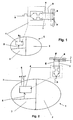
- FIG. 1 shows a first preferred embodiment of the invention and, in it, an electrical heart stimulator, or pacemaker, is generally designated with 1, schematically constituted of a battery 2 and a VVI pulse generation circuitry 3 provided with the corresponding programming and diagnosing parameters.
- a signal- inverter circuit is represented with 4 (see the detail of said circuit enclosed in a dashed line box) intended to receive a pulse through 5, for example, a positive pulse, and to send, through 6 and 7, respective opposing polarity pulses applied directly to the two positive and negative ventricular electrodes 8 and 8', respectively, coaxially arranged 9, therefore it will be provided with a positive stimulus in one electrode and a negative stimulus in the other electrode, therefore, when the simultaneous or variable triggering of both stimuli occurs, a positive and negative current shock, rather than a circuit closure, will be obtained.
- This biphasic biventricular or univentricular (the two electrodes in the same ventricle) pacing would therefore have a coaxial output.
- Figure 2 shows a second preferred embodiment of the invention, consisting in providing the inverter circuit 4 with independent outputs 6, 7, i.e. with respective connections to the generator for the positive and negative ventricular electrodes 8 and 8', respectively, therefore being able to discard the "Y" connecter, and no other device existing between the electrodes and the generator.
- a variant according to the present invention can be seen, incorporated in a generator of this type provided with a coaxial output 9 (see figure 3) and provided with a bifurcated output 6, 7 (see figure 4).
- an additional coaxial output 10 is provided for standard atrial pacing and perception, as a result of which atrial-ventricular synchronism is respected, and a three-chamber pulse generator, but with unipolar ventricular biphasic pacing, is provided.
- the invention can thus be incorporated in any conventional single-chamber as well as dual-chamber generator (pacemaker) model.
- biphasic ventricular pacing as a result of the generated current shock, achieves greater recruitment of myocardial cells between the two electrodes, since it applies to the muscle the entire generated current without dissipation of the latter occurring when the circuit is closed with the generator casing, as occurs in the case of single-phase pacing.
- depolarization of the myocardial fiber occurs intercardially by means of a shock of the two stimuli in the area encompassing the muscle mass comprised between the two electrodes with reference to the casing, and not between a point of the muscle with reference to another point or to the casing.
- the voltage necessary for capture decreases.
- the current shock depolarizes and recruits more or less myocardial mass for the resynchronization and optimization of the ventricular contraction, in turn eliminating the ventricular ectopic foci. Therefore, it is necessary to move up or delay one of the stimuli.
- the standard single-chamber (WIR) or dual-chamber (DDDR) generator i.e. with response to the frequency, must be provided with a signal converter to transform the ventricular pulse output, either in a bifurcated or coaxial manner, into a biphasic one, with the possibility of moving up or delaying either of the two pulses.
- the atrial-ventricular set could be paced in a synchronized manner by means of modification of the A-V delay, the same which can be done with dual-chamber or DDD generators.
- the biphasic generator could be implanted for chronic pacing, as described, or for temporary pacing, the converter system for pacing with biphasic current incorporating a conventional external generator.
Landscapes
- Health & Medical Sciences (AREA)
- Cardiology (AREA)
- Hospice & Palliative Care (AREA)
- Heart & Thoracic Surgery (AREA)
- Engineering & Computer Science (AREA)
- Biomedical Technology (AREA)
- Nuclear Medicine, Radiotherapy & Molecular Imaging (AREA)
- Radiology & Medical Imaging (AREA)
- Life Sciences & Earth Sciences (AREA)
- Animal Behavior & Ethology (AREA)
- General Health & Medical Sciences (AREA)
- Public Health (AREA)
- Veterinary Medicine (AREA)
- Electrotherapy Devices (AREA)
Abstract
Description
- The present invention belongs to the field of single ventricular chamber or dual atrial-ventricular chamber electrical heart stimulators or pacemakers, acting by means of the application of a biphasic shock current, and particularly refers to a pulse generator of biphasic current transmitted through electrodes to the ventricles for treating heart failure caused by a loss of ventricular synchronism.
- Heart failure due to severe ventricular dysfunction currently represents one of the greatest medical problems in the Western world, from the medical point of view as well as from the social and economic perspectives.
- According to estimates of the AHA (American Heart Association), five million people suffered from this disease in 1999 in the United States, and in that same year, the United States Health Department considered that approximately 160 million people worldwide would be in need of sophisticated treatment due to this type of heart failure.
- On the other hand, 70% of those affected are over the age of 65 years, and hospitalization cost in the United States due to heart failures exceeds 3.8 billion dollars with an increase of approximately 445,000 patients per year also being verified.
- These epidemiological data, to which constant aging of the population must be added, provide a clear idea of the magnitude implied by the problem of heart failure treatment, becoming critical when it reaches refractory to maximum, optimal pharmacological treatment.
- In refractory heart failure, an event called "desynchronization" of contractile activity of the ventricles occurs, severely affecting the pumping behavior of said chambers (Herman MW et al., in "Localized Disorders in Myocardial Contraction: Asynergy and Its Role in Congestive Heart Failure", N. Engl. J. Med., 1967, 277, pp. 222-232).
- In dilated cardiomyopathies (contractile dysfunction due to dilatation of the ventricular cavities), it has been observed that structural loss of collagen matrix affects intraventricular electrical conduction and the coordinated contractile response of the various segments of the ventricle. The result is the loss of contractile efficiency in one ventricle, the function of which is already altered.
- Another cause of contractile asynergy is the presence of blocks in the intraventricular electrical conduction tissue and, specifically, the Bundle of His block, resulting in a delay in the arrival of the electrical stimulus to the ventricle and affecting up to 30% of dilated cardiomyopathies.
- Lastly, another form of ventricular asynergy is found in ventricles suffering from several types of regional ischemia, i.e. lack of blood supply, due to the total or partial obstruction of the coronary arteries; for this reason, a lack of correspondence or a disproportion between the supply and demand is created. Certain segments of these ventricles, with an earlier activation, will contract with a minimum volume load, but the shortening of these fibers does not translate into the creation of significant pressure since other segments are still inactive or are activated later and, furthermore, the latter need a large load (pressure) to respond and contract.
- All these abnormal mechanisms finally lead to transferring the ejection from one part of the ventricular chamber to another part, without the amount of blood being ejected into systemic circulation through the aortic valve while it is open.
- In general terms, from the hemodynamic point of view, the combination of processes generate an extension of the ventricular pre-ejection time, shortening of the ejection and relaxation times, and subsequent decrease of the ventricular ejection fraction, in addition to causing an increase of the mitral valvular insufficiency, almost always existing already due to ventricular dilatation.
- In 1966, Schlant was the first to disclose the systolic function improvement resulting from a coordinated ventricular segment activation. This mechanism was called "idioventricular kick" (Circulation, 1966, 23, (Suppl. III): 209, Abstract).
- Research carried out in 1982 revealed which were the most suitable areas of the heart for chronic electrical pacing, i.e. for implanting permanent pacemaker electrodes, by means of epimyocardial cartography, it being found that not all areas are suitable and that the right ventricle, in its diaphragmatic surface as well as in its anterior segment, needed a greater electrical stimulus than the left ventricle; i.e. the electrical pacing threshold was higher and, furthermore, right pacing generated paradoxical septal motion in the left ventricle. On the other hand, it was also noticeable that left pacing through a thoracotomy provided an improvement in some patients suffering heart failure, although it could not be clarified in which ones.
- In more recent hemodynamic studies, by means of the implantation of temporary electrodes in both the right and left ventricles in patients with a low cardiac output and an ejection fraction of less than 35%, and subjected to extracorporeal circulation, it could be noticed that right ventricular pacing only serves to modify the heart rate, which concludes in a routine matter in conventional pacemaker implantation, and that only electrical pacing of the left ventricle, or of both ventricles simultaneously, is able, in certain patients presenting ventricular desynchronization, to improve ejection capacity, mainly at the expense of reversing the paradoxical motion of the ventricular septum, a very frequent phenomenon in post-heart operation patients.
- More recently in 1994, the concept of "ventricular resynchronization" was introduced in clinical practice by Bakker et al. (Pacing Clin. Electrophysiol., 1994; 17:280, Abstract) and later, with more cases, by Cazeau et al. (Pacing Clin. Electrophysiol., 1996; 19:1748-1757), and is derived from the normal use of dual-chamber or atrial-ventricular pacemakers, also called DDD pacemakers in international code. These authors showed that implanting electrodes in both ventricles and stimulating the atrium and the two ventricles, or only the left ventricle, in a synchronized manner in patients with left of the Bundle branch block, an increase of the ejection fraction was found, although they did admit that, given the variability of results, better patient screening was necessary due to the different heart failure etiologies.
- At the same time, other researchers (Aurichio A. "Ventricular resynchronization: basis, technical problems and preliminary results", Abstract. The Euro contribution to arrhythmology, 28 February-March 2002, Madrid) have also clearly shown the importance of establishing a correct atrial-ventricular delay in ventricular resynchronization by means of Eco-Doppler evaluation, such that the emptying-filling phase of the chambers is maximally taken advantage of (Kass et al., "Improved Left Ventricular Mechanics from Acute VDD Pacing in Patients with Dilated Myocardiopathy and Ventricular Conduction Delay", Circulation 1999, 30 March; 99 (12), pp. 1567-1573).
- Lastly, the multicenter European study, "The InSync Italian Registry (2000) (European Heart Journal (Suppl) J22-J30") established "resynchronization" as a new alternative in the treatment of ventricular failure, pointing out, however, that the type of pacing which must be carried out, or if it is to be carried out in both ventricles or only in the left ventricle, and in which area of the latter, is not completely clarified. These aspects are being clarified by means of the use of tissue Doppler, Carto-Graph and nuclear magnetic resonance, which allow visualizing the areas which are activated later.
- In 1999, and based on the researcher's own experience acquired in heart surgery, implanting temporary electrodes in ventricles for electrical pacing of post-heart operation patients with extracorporeal circulation and with an ejection fraction of less than 35%, it could be shown, by means of determinations by thermodilution with a Swan-Ganz catheter and by means of Doppler echocardiography, that simultaneous biventricular or isolated left ventricular pacing was able to improve left ventricular function, i.e. the heart output in liters/minute, and that, in some cases, at the expense of the reversal of the paradoxical septal motion usually generated after heart surgery achiving a simultaneously increased of the ejection fraction and other hemodynamic parameters.
- Therefore, heart failure patients with desynchronization and bradycardia began to be treated by means of implanting electrodes in the right atrium (if they showed normal, i.e. sinus, rhythm) and in the two ventricles or only in the left ventricle. The evolutions, followed by means of Doppler echocardiography, showed different degrees of improvement of ventricular function and of functional ability in spite of the heterogeneity of the treated population.
- Another important aspect, a product of the observations of the inventor of the present application, is that in order to obtain resynchronization in a more effective and constant manner, it is advisable to pace the segments of the ventricle which are later activated, as is visualized by means of the tissue Doppler, and, in the cases with intraventricular conduction disorder, this segment is usually the free wall of the left ventricle accompanying abnormal motion of the intraventricular septum, whether it is akinetic or paradoxical motion. However, it was impossible to show in an overall manner if the stimulation was better in the left ventricle alone or in both ventricles, since complete resynchronization was not always achieved.
- It could later be shown, by means of echocardiography, that anomalous septal motion, very common after heart surgery and which generates ventricular asynchronism, with the subsequent adverse hemodynamic effect, is reversible as a result of ventricular pacing with coordinated biphasic current. This means that, since a large majority of patients with cardiomyopathy present inter or intraventricular conduction disorders, it is impossible to predict, for now, where the shock of the two-pulse current is going to occur, therefore, according to echocardiographic control, it is necessary to move up or delay one of the two electrical pulses.
- This positive effect has been corroborated in later phases, very satisfying pacing thresholds also being obtained, and it being shown, by means of measurement of the intramyocardial tissue oxygen pressure, that there are no significant alterations with regard to pacing with single-phase current.
- Until now, the type of conventional pacing used for achieving ventricular resynchronization with single-phase current consists of the electrical pulse closing the circuit between two electrodes, one located in each ventricle, or separately in the left ventricle. In other words, two unipolar electrodes are implanted, one in each ventricle, linked to the current generator (pacemaker) by means of a "Y" connector, and the generator programmed in bipolar version. Thus, all that is achieved is being able to choose the direction of the current between the two electrodes, one acting as a positive pole (anode) and the other as a negative pole (cathode). The bipolar programming would consist of this.
- Another pacing form would be unipolar pacing, closing the circuit between an electrode and the generator casing, and the tip of the electrode always acting as a cathode and the generator casing as an anode. The alternative for resynchronization in left ventricular pacing requires the left ventricular electrode to be the cathode.
- If a ventricular or single-chamber (VVI), i.e. with a single output, generator is used, a "Y" connector must be used to receive the two electrodes, it being necessary to know where the negative pacing, i.e. the proximal tip of the connector, is located, because, in this manner, when choosing between the electrode/electrode (bipolar) variant and the electrode/casing (unipolar) variant, it will determine which ventricle the stimulus is to be generated in. It is evident that it will be necessary for the stimulus triggering to occur in the left ventricle in order to obtain resynchronization.
- Another resynchronization possibility which has been used consists in triggering the stimulus in the two ventricles simultaneously or with a small delay. This is achieved by means of a dual-chamber (DDD) generator provided with an atrial-ventricular (A-V) delay equal to zero, implanting two electrodes, one in each ventricle. Thus, two stimuli will be simultaneously generated, the two negative poles being the active terminal parts of the electrodes and the circuit being closed with the generator casing.
- In this type of pacing, it is necessary to predetermine which is the ventricle to be contracted in the first place, at a given time, since modifying the A-V delay will achieve that the ventricle connected to the atrial output of the generator could receive the stimulus several milliseconds before the other ventricle, or at the same time if the delay is programmed at zero.
- The-drawback of this design is based on the fact that these dual-chamber (DDD) generators with A-V delay equal to zero have not been designed for biventricular pacing, but rather for atrial-ventricular pacing, and therefore provide a rather unorthodox pacing for conventional follow-up, naturally not familiar with this technique.
- In the cases in which the patients maintains his/her physiological atrial rhythm, i.e. sinus rhythm, it is mandatory to preserve A-V synchronism, in other words, to stimulate both chambers in a synchronous manner, i.e. DDD.
- There is also a type of generator called three-chamber in which, in the first place, an output is provided for the atrial electrode, which carries out the perception and pacing functions and, secondly, is provided with two outputs for ventricular pacing, one for the right ventricular electrode and another one for the left, one acting as an anode and the other as a cathode, respectively. This generator is the most expensive of the currently commercially available generators, but it maintains the same system already disclosed.
- In many cases, if it is accepted that to achieve resynchronization it is not necessary to carry out biventricular pacing and only left ventricular pacing is necessary, then an atrial and another ventricular output can be provided, adding a "Y" connector and programming the ventricular chamber to bipolar, thereby achieving closing the circuit between both electrodes, of which electrodes one acts as a cathode and the other as an anode. Thus, A-V synchronism is preserved, and ventricular resynchronization is achieved.
- However, it must be emphasized that it is always stated that (except in the case of DDD with variable A-V delay, possibly reaching 0 ms) starting from one stimulus, the ventricular anode can be arranged in the desired area, the same occurring with the cathode and closing the circuit between them. In other words, orienting the direction of the current as desired is thus achieved, but nothing more.
- In the case of the variable A-V delay DDD, the pathway consists in providing the two electrodes in the desired position, the circuit being closed with the generator casing.
- According to a first preferred embodiment of the invention, it starts from a generated positive pulse, which is made to pass through a converter dividing it, a positive polarity pulse and another negative polarity pulse simultaneously being provided, each one of which is transmitted to a ventricular output ring of the generator by means of an output conductor, and each one of which will close the circuit with the generator casing.
- A second embodiment of the invention, causing the same effect, consists in arranging a bifurcated output, i.e. with two connections to the generator for each one of the ventricular electrodes, in the pulse generator, it thereby being possible to discard the "Y" connector and there being no device between the electrodes and the generator.
- According to a third embodiment of the present invention, an additional output is provided in a generator of this type, whether it is provided with a coaxial output (first embodiment) or if the output is bifurcated (second embodiment), for standard atrial pacing and perception, as a result of which atrial-ventricular synchronism is respected, and a three-chamber pulse generator, but with unipolar ventricular biphasic pacing, is arranged.
- In the drawings, in the figures of which similar reference numbers designate similar elements,
- figure 1 shows a block diagram illustrating a first embodiment of the pacing system according to the present invention;
- figure 2 shows a block diagram illustrating a second embodiment of the pacing system of the invention; and
- figure 3 and 4 show block diagrams corresponding to the pacing system according to the invention represented in figures 1 and 2, respectively, incorporating an additional variant.
-
- The present invention is based on the division and transformation of a positive or negative pulse which, when making it go through a signal inverter circuit, achieves changing its polarity.
- Figure 1 shows a first preferred embodiment of the invention and, in it, an electrical heart stimulator, or pacemaker, is generally designated with 1, schematically constituted of a
battery 2 and a VVIpulse generation circuitry 3 provided with the corresponding programming and diagnosing parameters. - A signal- inverter circuit is represented with 4 (see the detail of said circuit enclosed in a dashed line box) intended to receive a pulse through 5, for example, a positive pulse, and to send, through 6 and 7, respective opposing polarity pulses applied directly to the two positive and negative
ventricular electrodes 8 and 8', respectively, coaxially arranged 9, therefore it will be provided with a positive stimulus in one electrode and a negative stimulus in the other electrode, therefore, when the simultaneous or variable triggering of both stimuli occurs, a positive and negative current shock, rather than a circuit closure, will be obtained. This biphasic biventricular or univentricular (the two electrodes in the same ventricle) pacing would therefore have a coaxial output. - Figure 2 shows a second preferred embodiment of the invention, consisting in providing the
inverter circuit 4 withindependent outputs ventricular electrodes 8 and 8', respectively, therefore being able to discard the "Y" connecter, and no other device existing between the electrodes and the generator. - In reference to figures 3 and 4 of the drawings (the
inverter circuit 4 is shown in greater detail in figure 3 within a dashed line box), a variant according to the present invention can be seen, incorporated in a generator of this type provided with a coaxial output 9 (see figure 3) and provided with abifurcated output 6, 7 (see figure 4). According to this variant of the invention, an additionalcoaxial output 10 is provided for standard atrial pacing and perception, as a result of which atrial-ventricular synchronism is respected, and a three-chamber pulse generator, but with unipolar ventricular biphasic pacing, is provided. - The invention can thus be incorporated in any conventional single-chamber as well as dual-chamber generator (pacemaker) model.
- Furthermore, also according to the invention, providing the possibility of moving up or delaying any of the
pulses - It is also possible to choose between the emission of a conventional biphasic or single-phase pulse, just as it can also be provided with a generator with a coaxial or bifurcated output, it being possible to incorporate polarity to these pulses.
- From the medical application point of view, biphasic ventricular pacing as a result of the generated current shock, achieves greater recruitment of myocardial cells between the two electrodes, since it applies to the muscle the entire generated current without dissipation of the latter occurring when the circuit is closed with the generator casing, as occurs in the case of single-phase pacing.
- In the case of biphasic pacing, depolarization of the myocardial fiber occurs intercardially by means of a shock of the two stimuli in the area encompassing the muscle mass comprised between the two electrodes with reference to the casing, and not between a point of the muscle with reference to another point or to the casing. On the other hand, given the energy shock generated, the voltage necessary for capture decreases.
- Depending on the electrode implantation area and on the distance between the electrodes, it will be achieved that the current shock depolarizes and recruits more or less myocardial mass for the resynchronization and optimization of the ventricular contraction, in turn eliminating the ventricular ectopic foci. Therefore, it is necessary to move up or delay one of the stimuli.
- In summary, the standard single-chamber (WIR) or dual-chamber (DDDR) generator, i.e. with response to the frequency, must be provided with a signal converter to transform the ventricular pulse output, either in a bifurcated or coaxial manner, into a biphasic one, with the possibility of moving up or delaying either of the two pulses. Likewise, depending on the type of patient, the atrial-ventricular set could be paced in a synchronized manner by means of modification of the A-V delay, the same which can be done with dual-chamber or DDD generators.
- Given the hemodynamic repercussion of resynchronization after heart surgery, both in the surgical act as well as in the recovery rooms, intensive care or coronary intensive care units, the biphasic generator could be implanted for chronic pacing, as described, or for temporary pacing, the converter system for pacing with biphasic current incorporating a conventional external generator.
Claims (10)
- A biphasic current electrical ventricular stimulator (1) for heart failure, of the type comprising:characterized in that it further comprises,a unipolar pulse generator (3) provided with ventricular output electrodes (8, 8') implanted in the walls of the ventricle or respective ventricles; anda direct current feed source (2) for said pulse generator,
a signal inverter circuit (4) intended for dividing and transforming the polarity of said output pulses of said pulse generator (3), for generating similar pulses, of reverse polarity, and transmitting the unipolar pulses supplied to it simultaneously with said similar pulses of reverse polarity through at least a single output conductor connected to the corresponding ventricular electrodes (8, 8') implanted in the walls of the ventricle or respective ventricles. - An electrical ventricular stimulator according to claim 1, characterized in that the transmission of said similar pulses of opposite polarity from said pulse generator (3) to said ventricular electrodes (8, 8') is carried out by means of a single coaxial conductor.
- An electrical ventricular stimulator according to claim 1, characterized in that the transmission of said similar pulses of opposite polarity from said pulse generator (3) to said ventricular electrodes (8, 8') is carried out by means of independent or bifurcated conductors.
- An electrical ventricular stimulator according to claim 2, characterized in that if further comprises a separate output (10) for atrial pacing and perception.
- An electrical ventricular stimulator according to claim 3, characterized in that if further comprises a separate output (10) for atrial pacing and perception.
- An electrical ventricular stimulator according to any one of the previous claims, characterized in that it further comprises a delay circuit provided at the output (6, 7) of said inverter circuit (4) to move up or delay the application of any of said pulses with regard to another pulse.
- An electrical ventricular stimulator according to claim 6, characterized in that said delay circuit for moving up or delaying the application of any of said pulses with regard to another one can be controlled externally with regard to the patient.
- A ventricular pacing method by means of biphasic electric current for heart failure, characterized in that it comprises:providing first unipolar pulses;reversing the polarity of said first pulses to obtain similar pulses of reverse polarity; andsimultaneously applying said similar pulses of opposite polarity to corresponding ventricular electrodes (8, 8') implanted in the walls of the ventricle or respective ventricles.
- A method according to claim 7, characterized in that it further comprises carrying out atrial perception and pacing.
- A method according to any one of claims 7 and 8, characterized in that it further comprises the operation of moving up or delaying the application of said ventricular pulses with regard to another one.
Applications Claiming Priority (3)
| Application Number | Priority Date | Filing Date | Title |
|---|---|---|---|
| ES200201876A ES2199691B2 (en) | 2002-08-07 | 2002-08-07 | VENTRICULAR ELECTRIC STIMULATOR OF BIFASSIC CURRENT FOR CARDIAC FAILURE AND STIMULATION METHOD. |
| ES200201876 | 2002-08-07 | ||
| PCT/ES2003/000402 WO2004014480A1 (en) | 2002-08-07 | 2003-08-01 | Two-phase current ventricular electrical stimulator for heart failure and stimulation method |
Publications (2)
| Publication Number | Publication Date |
|---|---|
| EP1541192A1 true EP1541192A1 (en) | 2005-06-15 |
| EP1541192B1 EP1541192B1 (en) | 2008-12-10 |
Family
ID=31502895
Family Applications (1)
| Application Number | Title | Priority Date | Filing Date |
|---|---|---|---|
| EP03784214A Expired - Lifetime EP1541192B1 (en) | 2002-08-07 | 2003-08-01 | Two-phase current ventricular electrical stimulator for heart failure and stimulation method |
Country Status (5)
| Country | Link |
|---|---|
| EP (1) | EP1541192B1 (en) |
| AT (1) | ATE416820T1 (en) |
| DE (1) | DE60325238D1 (en) |
| ES (1) | ES2199691B2 (en) |
| WO (1) | WO2004014480A1 (en) |
Family Cites Families (3)
| Publication number | Priority date | Publication date | Assignee | Title |
|---|---|---|---|---|
| US4402322A (en) * | 1981-03-25 | 1983-09-06 | Medtronic, Inc. | Pacer output circuit |
| US6341235B1 (en) * | 1996-08-19 | 2002-01-22 | Mower Chf Treatment Irrevocable Trust | Augmentation of electrical conduction and contractility by biphasic cardiac pacing administered via the cardiac blood pool |
| CN1336240A (en) * | 2000-08-02 | 2002-02-20 | 莫顿·M·莫厄尔 | Cardiac pacing methods and devices for electrical use |
-
2002
- 2002-08-07 ES ES200201876A patent/ES2199691B2/en not_active Expired - Fee Related
-
2003
- 2003-08-01 DE DE60325238T patent/DE60325238D1/en not_active Expired - Fee Related
- 2003-08-01 WO PCT/ES2003/000402 patent/WO2004014480A1/en not_active Ceased
- 2003-08-01 AT AT03784214T patent/ATE416820T1/en not_active IP Right Cessation
- 2003-08-01 EP EP03784214A patent/EP1541192B1/en not_active Expired - Lifetime
Non-Patent Citations (1)
| Title |
|---|
| See references of WO2004014480A1 * |
Also Published As
| Publication number | Publication date |
|---|---|
| DE60325238D1 (en) | 2009-01-22 |
| ES2199691A1 (en) | 2004-02-16 |
| ES2199691B2 (en) | 2004-09-16 |
| WO2004014480A1 (en) | 2004-02-19 |
| ATE416820T1 (en) | 2008-12-15 |
| EP1541192B1 (en) | 2008-12-10 |
Similar Documents
| Publication | Publication Date | Title |
|---|---|---|
| US6640135B1 (en) | Apparatus and method for spatially and temporally distributing cardiac electrical stimulation | |
| US6718206B2 (en) | Permanent atrial-his-ventricular sequential pacing | |
| US6556866B2 (en) | Active implantable medical device, in particular a pacemaker, defibrillator and/or cardiovertor of the multisite type providing resynchronization of the ventricles | |
| EP1075308B1 (en) | Multiple channel, sequential, cardiac pacing systems | |
| US6223082B1 (en) | Four-chamber pacing system for optimizing cardic output and determining heart condition | |
| EP1525026B1 (en) | Apparatus and method for optimizing cardiac pumping performance | |
| US5902324A (en) | Bi-atrial and/or bi-ventricular sequential cardiac pacing systems | |
| US8290586B2 (en) | Methods, devices and systems for single-chamber pacing using a dual-chamber pacing device | |
| US6477417B1 (en) | System and method for automatically selecting electrode polarity during sensing and stimulation | |
| US8126546B2 (en) | Anodal excitation of tissue | |
| US7194307B2 (en) | Pacing method and device for preserving native conduction system | |
| EP1541192B1 (en) | Two-phase current ventricular electrical stimulator for heart failure and stimulation method | |
| US20050131471A1 (en) | Multi-site active implantable medical device including a mode of resynchronization of the ventricles | |
| AU2009303324B2 (en) | Single-chamber pacing using a dual-chamber pacing device | |
| US7483740B2 (en) | Active implantable medical device which includes a mode of resynchronization of the ventricular contractions for the treatment of the cardiac insufficiency |
Legal Events
| Date | Code | Title | Description |
|---|---|---|---|
| PUAI | Public reference made under article 153(3) epc to a published international application that has entered the european phase |
Free format text: ORIGINAL CODE: 0009012 |
|
| 17P | Request for examination filed |
Effective date: 20050207 |
|
| AK | Designated contracting states |
Kind code of ref document: A1 Designated state(s): AT BE BG CH CY CZ DE DK EE ES FI FR GB GR HU IE IT LI LU MC NL PT SE SI SK TR |
|
| 17Q | First examination report despatched |
Effective date: 20070619 |
|
| GRAP | Despatch of communication of intention to grant a patent |
Free format text: ORIGINAL CODE: EPIDOSNIGR1 |
|
| RBV | Designated contracting states (corrected) |
Designated state(s): AT BE BG CH CY CZ DE DK EE ES FI FR GB GR HU IE IT LI LU MC NL PT RO SE SI SK TR |
|
| GRAS | Grant fee paid |
Free format text: ORIGINAL CODE: EPIDOSNIGR3 |
|
| GRAS | Grant fee paid |
Free format text: ORIGINAL CODE: EPIDOSNIGR3 |
|
| GRAA | (expected) grant |
Free format text: ORIGINAL CODE: 0009210 |
|
| AK | Designated contracting states |
Kind code of ref document: B1 Designated state(s): AT BE BG CH CY CZ DE DK EE ES FI FR GB GR HU IE IT LI LU MC NL PT RO SE SI SK TR |
|
| REG | Reference to a national code |
Ref country code: GB Ref legal event code: FG4D |
|
| REG | Reference to a national code |
Ref country code: CH Ref legal event code: EP |
|
| REG | Reference to a national code |
Ref country code: IE Ref legal event code: FG4D |
|
| REF | Corresponds to: |
Ref document number: 60325238 Country of ref document: DE Date of ref document: 20090122 Kind code of ref document: P |
|
| PG25 | Lapsed in a contracting state [announced via postgrant information from national office to epo] |
Ref country code: FI Free format text: LAPSE BECAUSE OF FAILURE TO SUBMIT A TRANSLATION OF THE DESCRIPTION OR TO PAY THE FEE WITHIN THE PRESCRIBED TIME-LIMIT Effective date: 20081210 Ref country code: SI Free format text: LAPSE BECAUSE OF FAILURE TO SUBMIT A TRANSLATION OF THE DESCRIPTION OR TO PAY THE FEE WITHIN THE PRESCRIBED TIME-LIMIT Effective date: 20081210 Ref country code: NL Free format text: LAPSE BECAUSE OF FAILURE TO SUBMIT A TRANSLATION OF THE DESCRIPTION OR TO PAY THE FEE WITHIN THE PRESCRIBED TIME-LIMIT Effective date: 20081210 |
|
| NLV1 | Nl: lapsed or annulled due to failure to fulfill the requirements of art. 29p and 29m of the patents act | ||
| PG25 | Lapsed in a contracting state [announced via postgrant information from national office to epo] |
Ref country code: RO Free format text: LAPSE BECAUSE OF FAILURE TO SUBMIT A TRANSLATION OF THE DESCRIPTION OR TO PAY THE FEE WITHIN THE PRESCRIBED TIME-LIMIT Effective date: 20081210 Ref country code: EE Free format text: LAPSE BECAUSE OF FAILURE TO SUBMIT A TRANSLATION OF THE DESCRIPTION OR TO PAY THE FEE WITHIN THE PRESCRIBED TIME-LIMIT Effective date: 20081210 Ref country code: BG Free format text: LAPSE BECAUSE OF FAILURE TO SUBMIT A TRANSLATION OF THE DESCRIPTION OR TO PAY THE FEE WITHIN THE PRESCRIBED TIME-LIMIT Effective date: 20090310 Ref country code: BE Free format text: LAPSE BECAUSE OF FAILURE TO SUBMIT A TRANSLATION OF THE DESCRIPTION OR TO PAY THE FEE WITHIN THE PRESCRIBED TIME-LIMIT Effective date: 20081210 |
|
| PG25 | Lapsed in a contracting state [announced via postgrant information from national office to epo] |
Ref country code: SE Free format text: LAPSE BECAUSE OF FAILURE TO SUBMIT A TRANSLATION OF THE DESCRIPTION OR TO PAY THE FEE WITHIN THE PRESCRIBED TIME-LIMIT Effective date: 20090310 Ref country code: CZ Free format text: LAPSE BECAUSE OF FAILURE TO SUBMIT A TRANSLATION OF THE DESCRIPTION OR TO PAY THE FEE WITHIN THE PRESCRIBED TIME-LIMIT Effective date: 20081210 Ref country code: PT Free format text: LAPSE BECAUSE OF FAILURE TO SUBMIT A TRANSLATION OF THE DESCRIPTION OR TO PAY THE FEE WITHIN THE PRESCRIBED TIME-LIMIT Effective date: 20090511 Ref country code: AT Free format text: LAPSE BECAUSE OF FAILURE TO SUBMIT A TRANSLATION OF THE DESCRIPTION OR TO PAY THE FEE WITHIN THE PRESCRIBED TIME-LIMIT Effective date: 20081210 |
|
| PG25 | Lapsed in a contracting state [announced via postgrant information from national office to epo] |
Ref country code: SK Free format text: LAPSE BECAUSE OF FAILURE TO SUBMIT A TRANSLATION OF THE DESCRIPTION OR TO PAY THE FEE WITHIN THE PRESCRIBED TIME-LIMIT Effective date: 20081210 |
|
| PLBE | No opposition filed within time limit |
Free format text: ORIGINAL CODE: 0009261 |
|
| STAA | Information on the status of an ep patent application or granted ep patent |
Free format text: STATUS: NO OPPOSITION FILED WITHIN TIME LIMIT |
|
| PG25 | Lapsed in a contracting state [announced via postgrant information from national office to epo] |
Ref country code: DK Free format text: LAPSE BECAUSE OF FAILURE TO SUBMIT A TRANSLATION OF THE DESCRIPTION OR TO PAY THE FEE WITHIN THE PRESCRIBED TIME-LIMIT Effective date: 20081210 |
|
| 26N | No opposition filed |
Effective date: 20090911 |
|
| PG25 | Lapsed in a contracting state [announced via postgrant information from national office to epo] |
Ref country code: MC Free format text: LAPSE BECAUSE OF NON-PAYMENT OF DUE FEES Effective date: 20090831 |
|
| REG | Reference to a national code |
Ref country code: CH Ref legal event code: PL |
|
| GBPC | Gb: european patent ceased through non-payment of renewal fee |
Effective date: 20090801 |
|
| PG25 | Lapsed in a contracting state [announced via postgrant information from national office to epo] |
Ref country code: CH Free format text: LAPSE BECAUSE OF NON-PAYMENT OF DUE FEES Effective date: 20090831 Ref country code: LI Free format text: LAPSE BECAUSE OF NON-PAYMENT OF DUE FEES Effective date: 20090831 |
|
| REG | Reference to a national code |
Ref country code: FR Ref legal event code: ST Effective date: 20100430 |
|
| PG25 | Lapsed in a contracting state [announced via postgrant information from national office to epo] |
Ref country code: IE Free format text: LAPSE BECAUSE OF NON-PAYMENT OF DUE FEES Effective date: 20090801 Ref country code: FR Free format text: LAPSE BECAUSE OF NON-PAYMENT OF DUE FEES Effective date: 20090831 Ref country code: DE Free format text: LAPSE BECAUSE OF NON-PAYMENT OF DUE FEES Effective date: 20100302 |
|
| PG25 | Lapsed in a contracting state [announced via postgrant information from national office to epo] |
Ref country code: GR Free format text: LAPSE BECAUSE OF FAILURE TO SUBMIT A TRANSLATION OF THE DESCRIPTION OR TO PAY THE FEE WITHIN THE PRESCRIBED TIME-LIMIT Effective date: 20090311 |
|
| PG25 | Lapsed in a contracting state [announced via postgrant information from national office to epo] |
Ref country code: GB Free format text: LAPSE BECAUSE OF NON-PAYMENT OF DUE FEES Effective date: 20090801 |
|
| PG25 | Lapsed in a contracting state [announced via postgrant information from national office to epo] |
Ref country code: IT Free format text: LAPSE BECAUSE OF FAILURE TO SUBMIT A TRANSLATION OF THE DESCRIPTION OR TO PAY THE FEE WITHIN THE PRESCRIBED TIME-LIMIT Effective date: 20081210 |
|
| PG25 | Lapsed in a contracting state [announced via postgrant information from national office to epo] |
Ref country code: LU Free format text: LAPSE BECAUSE OF NON-PAYMENT OF DUE FEES Effective date: 20090801 |
|
| PG25 | Lapsed in a contracting state [announced via postgrant information from national office to epo] |
Ref country code: HU Free format text: LAPSE BECAUSE OF FAILURE TO SUBMIT A TRANSLATION OF THE DESCRIPTION OR TO PAY THE FEE WITHIN THE PRESCRIBED TIME-LIMIT Effective date: 20090611 |
|
| PG25 | Lapsed in a contracting state [announced via postgrant information from national office to epo] |
Ref country code: TR Free format text: LAPSE BECAUSE OF FAILURE TO SUBMIT A TRANSLATION OF THE DESCRIPTION OR TO PAY THE FEE WITHIN THE PRESCRIBED TIME-LIMIT Effective date: 20081210 |
|
| PG25 | Lapsed in a contracting state [announced via postgrant information from national office to epo] |
Ref country code: CY Free format text: LAPSE BECAUSE OF FAILURE TO SUBMIT A TRANSLATION OF THE DESCRIPTION OR TO PAY THE FEE WITHIN THE PRESCRIBED TIME-LIMIT Effective date: 20081210 Ref country code: ES Free format text: LAPSE BECAUSE OF FAILURE TO SUBMIT A TRANSLATION OF THE DESCRIPTION OR TO PAY THE FEE WITHIN THE PRESCRIBED TIME-LIMIT Effective date: 20090321 |