EP1540394B1 - Verfahren zur herstellung eines auf beugungsgittern basierten optischen identifizierungselementes - Google Patents
Verfahren zur herstellung eines auf beugungsgittern basierten optischen identifizierungselementes Download PDFInfo
- Publication number
- EP1540394B1 EP1540394B1 EP03752367A EP03752367A EP1540394B1 EP 1540394 B1 EP1540394 B1 EP 1540394B1 EP 03752367 A EP03752367 A EP 03752367A EP 03752367 A EP03752367 A EP 03752367A EP 1540394 B1 EP1540394 B1 EP 1540394B1
- Authority
- EP
- European Patent Office
- Prior art keywords
- grating
- substrate
- fiber
- optical
- optical identification
- Prior art date
- Legal status (The legal status is an assumption and is not a legal conclusion. Google has not performed a legal analysis and makes no representation as to the accuracy of the status listed.)
- Expired - Lifetime
Links
- 0 CC1=C*C=C1 Chemical compound CC1=C*C=C1 0.000 description 1
Images






Classifications
-
- G—PHYSICS
- G06—COMPUTING OR CALCULATING; COUNTING
- G06K—GRAPHICAL DATA READING; PRESENTATION OF DATA; RECORD CARRIERS; HANDLING RECORD CARRIERS
- G06K19/00—Record carriers for use with machines and with at least a part designed to carry digital markings
- G06K19/06—Record carriers for use with machines and with at least a part designed to carry digital markings characterised by the kind of the digital marking, e.g. shape, nature, code
- G06K19/06009—Record carriers for use with machines and with at least a part designed to carry digital markings characterised by the kind of the digital marking, e.g. shape, nature, code with optically detectable marking
-
- B—PERFORMING OPERATIONS; TRANSPORTING
- B01—PHYSICAL OR CHEMICAL PROCESSES OR APPARATUS IN GENERAL
- B01L—CHEMICAL OR PHYSICAL LABORATORY APPARATUS FOR GENERAL USE
- B01L3/00—Containers or dishes for laboratory use, e.g. laboratory glassware; Droppers
- B01L3/50—Containers for the purpose of retaining a material to be analysed, e.g. test tubes
- B01L3/502—Containers for the purpose of retaining a material to be analysed, e.g. test tubes with fluid transport, e.g. in multi-compartment structures
- B01L3/5027—Containers for the purpose of retaining a material to be analysed, e.g. test tubes with fluid transport, e.g. in multi-compartment structures by integrated microfluidic structures, i.e. dimensions of channels and chambers are such that surface tension forces are important, e.g. lab-on-a-chip
- B01L3/502707—Containers for the purpose of retaining a material to be analysed, e.g. test tubes with fluid transport, e.g. in multi-compartment structures by integrated microfluidic structures, i.e. dimensions of channels and chambers are such that surface tension forces are important, e.g. lab-on-a-chip characterised by the manufacture of the container or its components
-
- B—PERFORMING OPERATIONS; TRANSPORTING
- B01—PHYSICAL OR CHEMICAL PROCESSES OR APPARATUS IN GENERAL
- B01L—CHEMICAL OR PHYSICAL LABORATORY APPARATUS FOR GENERAL USE
- B01L3/00—Containers or dishes for laboratory use, e.g. laboratory glassware; Droppers
- B01L3/50—Containers for the purpose of retaining a material to be analysed, e.g. test tubes
- B01L3/508—Rigid containers without fluid transport within
- B01L3/5085—Rigid containers without fluid transport within for multiple samples, e.g. microtitration plates
-
- G—PHYSICS
- G03—PHOTOGRAPHY; CINEMATOGRAPHY; ANALOGOUS TECHNIQUES USING WAVES OTHER THAN OPTICAL WAVES; ELECTROGRAPHY; HOLOGRAPHY
- G03H—HOLOGRAPHIC PROCESSES OR APPARATUS
- G03H1/00—Holographic processes or apparatus using light, infrared or ultraviolet waves for obtaining holograms or for obtaining an image from them; Details peculiar thereto
- G03H1/02—Details of features involved during the holographic process; Replication of holograms without interference recording
- G03H1/0272—Substrate bearing the hologram
-
- B—PERFORMING OPERATIONS; TRANSPORTING
- B01—PHYSICAL OR CHEMICAL PROCESSES OR APPARATUS IN GENERAL
- B01J—CHEMICAL OR PHYSICAL PROCESSES, e.g. CATALYSIS OR COLLOID CHEMISTRY; THEIR RELEVANT APPARATUS
- B01J2219/00—Chemical, physical or physico-chemical processes in general; Their relevant apparatus
- B01J2219/00274—Sequential or parallel reactions; Apparatus and devices for combinatorial chemistry or for making arrays; Chemical library technology
- B01J2219/00277—Apparatus
- B01J2219/00457—Dispensing or evacuation of the solid phase support
- B01J2219/00459—Beads
-
- B—PERFORMING OPERATIONS; TRANSPORTING
- B01—PHYSICAL OR CHEMICAL PROCESSES OR APPARATUS IN GENERAL
- B01J—CHEMICAL OR PHYSICAL PROCESSES, e.g. CATALYSIS OR COLLOID CHEMISTRY; THEIR RELEVANT APPARATUS
- B01J2219/00—Chemical, physical or physico-chemical processes in general; Their relevant apparatus
- B01J2219/00274—Sequential or parallel reactions; Apparatus and devices for combinatorial chemistry or for making arrays; Chemical library technology
- B01J2219/00277—Apparatus
- B01J2219/00457—Dispensing or evacuation of the solid phase support
- B01J2219/00459—Beads
- B01J2219/00461—Beads and reaction vessel together
- B01J2219/00463—Directed sorting
-
- B—PERFORMING OPERATIONS; TRANSPORTING
- B01—PHYSICAL OR CHEMICAL PROCESSES OR APPARATUS IN GENERAL
- B01J—CHEMICAL OR PHYSICAL PROCESSES, e.g. CATALYSIS OR COLLOID CHEMISTRY; THEIR RELEVANT APPARATUS
- B01J2219/00—Chemical, physical or physico-chemical processes in general; Their relevant apparatus
- B01J2219/00274—Sequential or parallel reactions; Apparatus and devices for combinatorial chemistry or for making arrays; Chemical library technology
- B01J2219/00277—Apparatus
- B01J2219/00457—Dispensing or evacuation of the solid phase support
- B01J2219/0047—Pins
-
- B—PERFORMING OPERATIONS; TRANSPORTING
- B01—PHYSICAL OR CHEMICAL PROCESSES OR APPARATUS IN GENERAL
- B01J—CHEMICAL OR PHYSICAL PROCESSES, e.g. CATALYSIS OR COLLOID CHEMISTRY; THEIR RELEVANT APPARATUS
- B01J2219/00—Chemical, physical or physico-chemical processes in general; Their relevant apparatus
- B01J2219/00274—Sequential or parallel reactions; Apparatus and devices for combinatorial chemistry or for making arrays; Chemical library technology
- B01J2219/00277—Apparatus
- B01J2219/00497—Features relating to the solid phase supports
- B01J2219/005—Beads
-
- B—PERFORMING OPERATIONS; TRANSPORTING
- B01—PHYSICAL OR CHEMICAL PROCESSES OR APPARATUS IN GENERAL
- B01J—CHEMICAL OR PHYSICAL PROCESSES, e.g. CATALYSIS OR COLLOID CHEMISTRY; THEIR RELEVANT APPARATUS
- B01J2219/00—Chemical, physical or physico-chemical processes in general; Their relevant apparatus
- B01J2219/00274—Sequential or parallel reactions; Apparatus and devices for combinatorial chemistry or for making arrays; Chemical library technology
- B01J2219/00277—Apparatus
- B01J2219/0054—Means for coding or tagging the apparatus or the reagents
- B01J2219/00547—Bar codes
-
- B—PERFORMING OPERATIONS; TRANSPORTING
- B01—PHYSICAL OR CHEMICAL PROCESSES OR APPARATUS IN GENERAL
- B01J—CHEMICAL OR PHYSICAL PROCESSES, e.g. CATALYSIS OR COLLOID CHEMISTRY; THEIR RELEVANT APPARATUS
- B01J2219/00—Chemical, physical or physico-chemical processes in general; Their relevant apparatus
- B01J2219/00274—Sequential or parallel reactions; Apparatus and devices for combinatorial chemistry or for making arrays; Chemical library technology
- B01J2219/00277—Apparatus
- B01J2219/0054—Means for coding or tagging the apparatus or the reagents
- B01J2219/00572—Chemical means
- B01J2219/00576—Chemical means fluorophore
-
- B—PERFORMING OPERATIONS; TRANSPORTING
- B01—PHYSICAL OR CHEMICAL PROCESSES OR APPARATUS IN GENERAL
- B01J—CHEMICAL OR PHYSICAL PROCESSES, e.g. CATALYSIS OR COLLOID CHEMISTRY; THEIR RELEVANT APPARATUS
- B01J2219/00—Chemical, physical or physico-chemical processes in general; Their relevant apparatus
- B01J2219/00274—Sequential or parallel reactions; Apparatus and devices for combinatorial chemistry or for making arrays; Chemical library technology
- B01J2219/0068—Means for controlling the apparatus of the process
- B01J2219/00702—Processes involving means for analysing and characterising the products
-
- B—PERFORMING OPERATIONS; TRANSPORTING
- B01—PHYSICAL OR CHEMICAL PROCESSES OR APPARATUS IN GENERAL
- B01L—CHEMICAL OR PHYSICAL LABORATORY APPARATUS FOR GENERAL USE
- B01L2200/00—Solutions for specific problems relating to chemical or physical laboratory apparatus
- B01L2200/06—Fluid handling related problems
- B01L2200/0636—Focussing flows, e.g. to laminate flows
-
- B—PERFORMING OPERATIONS; TRANSPORTING
- B01—PHYSICAL OR CHEMICAL PROCESSES OR APPARATUS IN GENERAL
- B01L—CHEMICAL OR PHYSICAL LABORATORY APPARATUS FOR GENERAL USE
- B01L2200/00—Solutions for specific problems relating to chemical or physical laboratory apparatus
- B01L2200/06—Fluid handling related problems
- B01L2200/0647—Handling flowable solids, e.g. microscopic beads, cells, particles
- B01L2200/0668—Trapping microscopic beads
-
- B—PERFORMING OPERATIONS; TRANSPORTING
- B01—PHYSICAL OR CHEMICAL PROCESSES OR APPARATUS IN GENERAL
- B01L—CHEMICAL OR PHYSICAL LABORATORY APPARATUS FOR GENERAL USE
- B01L2300/00—Additional constructional details
- B01L2300/06—Auxiliary integrated devices, integrated components
- B01L2300/0627—Sensor or part of a sensor is integrated
- B01L2300/0654—Lenses; Optical fibres
-
- B—PERFORMING OPERATIONS; TRANSPORTING
- B01—PHYSICAL OR CHEMICAL PROCESSES OR APPARATUS IN GENERAL
- B01L—CHEMICAL OR PHYSICAL LABORATORY APPARATUS FOR GENERAL USE
- B01L2400/00—Moving or stopping fluids
- B01L2400/04—Moving fluids with specific forces or mechanical means
- B01L2400/0403—Moving fluids with specific forces or mechanical means specific forces
- B01L2400/0409—Moving fluids with specific forces or mechanical means specific forces centrifugal forces
-
- B—PERFORMING OPERATIONS; TRANSPORTING
- B01—PHYSICAL OR CHEMICAL PROCESSES OR APPARATUS IN GENERAL
- B01L—CHEMICAL OR PHYSICAL LABORATORY APPARATUS FOR GENERAL USE
- B01L2400/00—Moving or stopping fluids
- B01L2400/04—Moving fluids with specific forces or mechanical means
- B01L2400/0403—Moving fluids with specific forces or mechanical means specific forces
- B01L2400/0457—Moving fluids with specific forces or mechanical means specific forces passive flow or gravitation
-
- B—PERFORMING OPERATIONS; TRANSPORTING
- B01—PHYSICAL OR CHEMICAL PROCESSES OR APPARATUS IN GENERAL
- B01L—CHEMICAL OR PHYSICAL LABORATORY APPARATUS FOR GENERAL USE
- B01L2400/00—Moving or stopping fluids
- B01L2400/04—Moving fluids with specific forces or mechanical means
- B01L2400/0475—Moving fluids with specific forces or mechanical means specific mechanical means and fluid pressure
- B01L2400/0487—Moving fluids with specific forces or mechanical means specific mechanical means and fluid pressure fluid pressure, pneumatics
-
- G—PHYSICS
- G02—OPTICS
- G02B—OPTICAL ELEMENTS, SYSTEMS OR APPARATUS
- G02B6/00—Light guides; Structural details of arrangements comprising light guides and other optical elements, e.g. couplings
- G02B6/02—Optical fibres with cladding with or without a coating
- G02B6/02057—Optical fibres with cladding with or without a coating comprising gratings
- G02B6/02076—Refractive index modulation gratings, e.g. Bragg gratings
-
- G—PHYSICS
- G03—PHOTOGRAPHY; CINEMATOGRAPHY; ANALOGOUS TECHNIQUES USING WAVES OTHER THAN OPTICAL WAVES; ELECTROGRAPHY; HOLOGRAPHY
- G03H—HOLOGRAPHIC PROCESSES OR APPARATUS
- G03H2210/00—Object characteristics
- G03H2210/50—Nature of the object
- G03H2210/53—Coded object not directly interpretable, e.g. encrypted object, barcode
-
- G—PHYSICS
- G03—PHOTOGRAPHY; CINEMATOGRAPHY; ANALOGOUS TECHNIQUES USING WAVES OTHER THAN OPTICAL WAVES; ELECTROGRAPHY; HOLOGRAPHY
- G03H—HOLOGRAPHIC PROCESSES OR APPARATUS
- G03H2230/00—Form or shape of the hologram when not registered to the substrate
- G03H2230/10—Microhologram not registered to the substrate
-
- G—PHYSICS
- G03—PHOTOGRAPHY; CINEMATOGRAPHY; ANALOGOUS TECHNIQUES USING WAVES OTHER THAN OPTICAL WAVES; ELECTROGRAPHY; HOLOGRAPHY
- G03H—HOLOGRAPHIC PROCESSES OR APPARATUS
- G03H2270/00—Substrate bearing the hologram
- G03H2270/20—Shape
-
- G—PHYSICS
- G03—PHOTOGRAPHY; CINEMATOGRAPHY; ANALOGOUS TECHNIQUES USING WAVES OTHER THAN OPTICAL WAVES; ELECTROGRAPHY; HOLOGRAPHY
- G03H—HOLOGRAPHIC PROCESSES OR APPARATUS
- G03H2270/00—Substrate bearing the hologram
- G03H2270/20—Shape
- G03H2270/24—Having particular size, e.g. microscopic
Definitions
- This invention relates to identification elements, and more particularly to method of manufacturing diffraction grating based optical identification elements.
- a coding element or platform that provides the capability of providing many codes (e.g., greater than 1 million codes), that can be made very small, and/or that can withstand harsh environments.
- a process for preparing an optical fiber having at least one long period grating with enhanced sensitivity is known.
- a length of optical fiber having a refractive index profile is provided.
- the optical fiber supports a core mode and cladding modes for a range of operational wavelengths.
- Group indices are identified for the core mode and the cladding modes for a specific wavelength wherein the group indices are equal to each other.
- a long period grating is written in the optical fiber.
- the long period grating has a grating defined by the group indices and it couples light from the core mode to a cladding mode proximate to where the group indices are equal.
- a micro-optically labeled article is kown comprising a surface having a plurality of micro-optic structures positioned in a specified pattern to display identifying optical information.
- Objects of the present invention include a method of manufacturing a plurality of diffraction grating based optical identification elements (microbeads) having unique codes.
- a method of manufacturing an optical identification element includes providing a substrate and winding the substrate around a device to provide at least one grating writing section.
- the method further includes writing at least one grating into the substrate disposed in grating writing section, and splitting the substrate disposed in the grating writing section to form a plurality of optical identification elements.
- a diffraction grating-based optical identification element 8 (or encoded element or coded element) comprises a known optical substrate 10, having an optical diffraction grating 12 disposed (or written, impressed, embedded, imprinted, etched, grown, deposited or otherwise formed) in the volume of or on a surface of a substrate 10.
- the grating 12 is a periodic or aperiodic variation in the effective refractive index and/or effective optical absorption of at least a portion of the substrate 10.
- optical identification element 8 described herein is the same as that described in Copending Patent Application Serial No. (CiDRA Docket No. CC-0648A), filed contemporaneously herewith, which is incorporated herein by reference in its entirety.
- the substrate 10 has an inner region 20 where the grating 12 is located.
- the inner region 20 may be photosensitive to allow the writing or impressing of the grating 12.
- the substrate 10 has an outer region 18, which does not have the grating 12 therein.
- the grating 12 is a combination of one or more individual spatial periodic sinusoidal variations (or components) in the refractive index that are collocated at substantially the same location on the substrate 10 along the length of the grating region 20, each having a spatial period (or pitch) ⁇ .
- the resultant combination of these individual pitches is the grating 12, comprising spatial periods ( ⁇ 1- ⁇ n) each representing a bit in the code.
- the grating 12 represents a unique optically readable code, made up of bits, where a bit corresponds to a unique pitch ⁇ within the grating 12. Accordingly, for a digital binary (0-1) code, the code is determined by which spatial periods ( ⁇ 1- ⁇ n) exist (or do not exist) in a given composite grating 12.
- the code or bits may also be determined by additional parameters (or additional degrees of multiplexing), and other numerical bases for the code may be used, as discussed herein and/or in the aforementioned patent application.
- the grating 12 may also be referred to herein as a composite or collocated grating. Also, the grating 12 may be referred to as a "hologram", as the grating 12 transforms, translates, or filters an input optical signal to a predetermined desired optical output pattern or signal.
- the substrate 10 has an outer diameter D1 and comprises silica glass (SiO 2 ) having the appropriate chemical composition to allow the grating 12 to be disposed therein or thereon.
- silica glass SiO 2
- Other materials for the optical substrate 10 may be used if desired.
- the substrate 10 may be made of any glass, e.g., silica, phosphate glass, borosilicate glass, or other glasses, or made of glass and plastic, or solely plastic.
- the optical substrate 10 made of a glass material is desirable. If a flexible substrate is needed, plastic, rubber or polymer-based substrate may be used.
- the optical substrate 10 may be any material capable of having the grating 12 disposed in the grating region 20 and that allows light to pass through it to allow the code to be optically read.
- the optical substrate 10 with the grating 12 has a length L and an outer diameter D1, and the inner region 20 diameter D.
- the length L can range from very small "microbeads” (or microelements, micro-particles, or encoded particles), about 1-1000 microns or smaller, to larger "macrobeads” or “macroelements” for larger applications (about 1.0 - 1000 mm or greater).
- the outer dimension D1 can range from small (less than 1000 microns) to large (1.0 - 1000 mm and greater). Other dimensions and lengths for the substrate 10 and the grating 12 may be used.
- the grating 12 may have a length Lg of about the length L of the substrate 10. Alternatively, the length Lg of the grating 12 may be shorter than the total length L of the substrate 10.
- the outer region 18 is made of pure silica (SiO 2 ) and has a refractive index n2 of about 1.458 (at a wavelength of about 1553 nm), and the inner grating region 20 of the substrate 10 has dopants, such as germanium and/or boron, to provide a refractive index n1 of about 1.453, which is less than that of outer region 18 by about 0.005.
- dopants such as germanium and/or boron
- the grating region 20 may have an index of refraction that is larger than that of the outer region 18 or grating region 20 may have the same index of refraction as the outer region 18 if desired.
- an incident light 24 of a wavelength ⁇ e.g., 532 nm from a known frequency doubled Nd:YAG laser or 632nm from a known Helium-Neon laser, is incident on the grating 12 in the substrate 10.
- a wavelength ⁇ e.g., 532 nm from a known frequency doubled Nd:YAG laser or 632nm from a known Helium-Neon laser
- Any other input wavelength ⁇ can be used if desired provided ⁇ is within the optical transmission range of the substrate (discussed more herein and/or in the aforementioned patent application).
- a portion of the input light 24 passes straight through the grating 12, as indicated by a line 25.
- the remainder of the input light 24 is reflected by the grating 12, as indicated by a line 27 and provided to a detector 29.
- the output light 27 may be a plurality of beams, each having the same wavelength ⁇ as the input wavelength ⁇ and each having a different output angle indicative of the pitches ( ⁇ 1- ⁇ n) existing in the grating 12.
- the input light 24 may be a plurality of wavelengths and the output light 27 may have a plurality of wavelengths indicative of the pitches ( ⁇ 1- ⁇ n) existing in the grating 12.
- the output light may be a combination of wavelengths and output angles.
- the detector 29 has the necessary optics, electronics, software and/or firmware to perform the functions described herein.
- the detector reads the optical signal 27 diffracted or reflected from the grating 12 and determines the code based on the pitches present or the optical pattern, as discussed more herein or in the aforementioned patent application.
- An output signal indicative of the code is provided on a line 31.
- Fig. 3 shows a method 800 of manufacturing a microbead 8 similar to that described hereinbefore in accordance with the present invention.
- the first step 802 includes providing a photosensitive substrate or fiber 830.
- the substrate will be referred to as a fiber with the understanding that the microbeads 8 may be formed of any photosensitive substrate.
- the fiber 830 may be made of any material that has sufficient photosensitivity to allow a diffraction grating 12 to be disposed therein, that represents a code that can be interrogated as described herein and/or in the aforementioned patent application.
- the fiber 830 may be doped or loaded with any dopant now known or later discovered that allows the fiber to exhibit the necessary level of photosensitivity for the incident radiation (e.g., UV or other actinic radiation) used for writing the grating 12, such as, hydrogen, deuterium, boron, germanium, lead, or other dopants that provide photosensitivity, some of which are described in Patent Nos.: US 6,436,857 to Brueck et al , US 5,287,427 to Atkins et al , US 5,235,659 to Atkins et al , US 6,327,406 to Cullen et al , WO 00/44683 to Samsung Electronics Co. LTD, US 6,221,566 to Kohnke et al ,
- step 804 the photosensitive fiber 830 is then stripped of the coating or buffer disposed on its outer surface and then cleaned.
- the stripped fiber is then wound around a cage or basket 832 having a generally polygon shape so that the wound fiber has sections 831 of flat areas.
- Fig. 4 illustrates a fixture/set-up 834 for accomplishing steps 802- 804.
- the photosensitive fiber 830 is threaded through a blade 836 for stripping the buffer from the fiber.
- a heater 838 is disposed prior to the stripper 836 to heat and soften the buffer to ease the removal of the buffer from the fiber.
- the stripped fiber then passes through or between a pair of pads 840 soaked with a solvent, such as acetone, to clean the fiber.
- the fiber 830 is then wound about the cage 832.
- the setup 834 may include one or more pulleys or rollers to provid tension on the fiber when winding the fiber onto the cage.
- the cage 832 has a lower plate 842 and an upper ring support 844 with a plurality of rods 846 connected therebetween.
- the rods are equi-spaced about the circumference of the cage.
- the cage 832 includes 16 openings 848, however, the invention contemplates having any number of openings.
- each wrap of fiber is adjacent to and touches each adjacent wrap to form a single layer of fiber ribbon 850 around the cage.
- the fiber is wrapped around the cage between 100 - 120 times to effectively form a single layer ribbon of fibers.
- the invention contemplates any number of wraps of fiber around the cage.
- the fiber ribbon 850 forms a polygonal shape when wrapped around the change to provide a plurality of flat sections (16 sections) 831. These flat sections 831 of the fiber ribbon 850 provides the area of the fiber that a grating 12 is written in, which will be described in greater detail hereafter. As best shown in Fig. 6 , one section 831 of the fiber ribbon 850 is tape together at 852, including the ends of the fiber, to maintain the tension of the fiber around the cage and to maintain the single layer of the fiber ribbon.
- Figs. 6 shows a single fiber ribbon 850 disposed on the cage 832
- the present invention contemplates that a plurality of fiber ribbons 850 may be axially spaced on the cage, as shown in Fig. 5 .
- Fig. 7 illustrates that the stripped fiber 830 may by wound around a disk 854 having a plurality of circumferentially spaced dovetailed slots 856, wherein the fiber ribbon 850 is taped at 858 to the outer circumference of the disk.
- the next step 808 of Fig. 3 is to write or shoot the diffraction grating(s) 12 into each section 846 of the fiber ribbon 850.
- the grating 12 may be impressed in the fiber 830 by any technique for writing, impressed, embedded, imprinted, or otherwise forming a diffraction grating in the volume of or on a surface of a substrate 10. Examples of some known techniques are described in US Patent No. 4,725,110 and 4,807,950 , entitled “Method for Impressing Gratings Within Fiber Optics", to Glenn et al; and US Patent No.
- the grating 12 may be partially or totally created by etching or otherwise altering the outer surface geometry of the substrate to create a corrugated or varying surface geometry of the substrate, such as is described in US Patent 3,891,302 , entitled “Method of Filtering Modes in Optical Waveguides", to Dabby et al, which is incorporated herein by reference to the extent necessary to understand the present invention, provided the resultant optical refractive profile for the desired code is created.
- the grating 12 may be made by depositing dielectric layers onto the substrate, similar to the way a known thin film filter is created, so as to create the desired resultant optical refractive profile for the desired code.
- Fig. 8 shows the method of writing a grating 12 into the fibers 830 of the ribbon 850 using at least one phase mask 860.
- a laser 862 such as an excimer laser or CO 2 laser, provides an ultra-violet (UV) beam 864, which passes through the phase mask to write a grating 12 having a predetermined profile corresponding to the phase mask.
- one phase mask 860 may be used to write the grating into the fiber 830 to provide ne unique code for the microbead 8.
- Each unique phase mask therefore represents one unique code, thereby requiring a phase mask for each code used. Using only one phase mask to generate each code becomes very expensive and difficult to manufacture when the number of unique codes needed increases.
- each unique code may be generated by writing a plurality of co-located grating 12 into each section 831 of the fiber ribbon 850.
- the resulting grating in a particular section 831 may comprise any combination of eight (8) gratings using eight (8) different phase masks 860. Consequently, the number of unique gratings or codes using eight phase masks equal 2 8 .
- the phase mask may be mounted to a carriage 866, similar to that shown in Figs. 20 and 21 , that translates parallel to the fiber ribbon 850 to select the mask 860 for writing the desired grating 12.
- the invention further contemplates that the phase masks are mounted on a wheel (not shown) that can be rotated to select the desired phase mask.
- Each of the 16 sections 831 of the fiber ribbon 850 may be written with the same grating 12. Alternatively, each section may have a different grating written therein, each section therefore having a different code associated therewith. To provide different gratings 12 for each section 831 using the co-located grating method, each section would use a different combination of phase masks to write each grating. For example, the first, third and fifth phase masks of the 8 phase masks may be used to write the grating that comprises the three co-located gratings written into the first section 831 of the fiber ribbon 850.
- the first, fifth, sixth and eight phase masks may be used to write the grating that comprises the four co-located gratings written into the second section.
- the other sections of the fiber ribbon may be similarly written using different combinations of phase masks. While the embodiment shows two grating writing stations 868, it is contemplated the only one station may be used or any number of stations.
- Fig. 9 shows another method of writing the gratings 12 into each section 831 of the fiber ribbons 850 by using interfering beams 870 provided by a laser 862.
- the UV beam 864 is split by a mirror 872 and reflected to a pair of complementary mirrors 874.
- the complementary mirrors 874 reflect the UV beams 870 back to interfere with each other at the fiber ribbon 850 to form the grating 12.
- a single grating may be written in the sections 831 of the fiber ribbon or a plurality of co-located gratings may be written.
- the complementary mirrors 874 may be tilted to a different angle.
- Fig. 10 illustrates a scanning method for exposing each section 831 of the fiber ribbon 850 using a phase mask 860.
- the width of the UV beam 864 used to write the grating 12 is smaller than the width of the fiber ribbon 850.
- the UV beam 864 translates along the width of the fiber ribbon to scan each of the wraps of fiber 830 in the section of fiber ribbon.
- the beam scan direction 876 is from bottom to top, however, the direction of scan may be from top to bottom of the section.
- the UV beam 864 may be scanned upward by translating the laser 862, or alternatively, the cage 832 may translated upward and downward in the axially direction.
- Fig. 11 illustrates a stationary or blanket method for exposing each section 831 of the fiber ribbon 850 using a phase mask 860.
- the width of the UV beam 864 used to write the grating 12 is as wide as or wider than the width of the fiber ribbon 850. This method enables the entire section 831 to be exposed and a grating written in a single exposure.
- phase mask 860 is square, and not angle, to the section 831 of the fiber ribbon 850 to minimize the blaze angle 878 of the grating 12 as illustrated in Fig. 12 . If the blaze angle 878 is too large (e.g., > 0.1 degree), the microbeads 8 may not exhibit a code to the reader, as the Bragg condition no longer falls with the Bragg envelope.
- step 810 of Fig. 3 after the gratings 12 are written into each section 831 of the fiber ribbon 850 (except the taped section), a strip of tape 880 (e.g., Kapton tape) is adhered to the outer surface of the fiber ribbon 850 as best shown in Fig. 14 .
- step 812 of Fig. 3 once taped, the fiber ribbon is cut off the cage 832 by cutting through the taped section 852 of the fiber ribbon 850 at 882 as shown in Fig. 6 .
- the fiber ribbon 850 is flattened and mounted to a thermally conductive fixture 884, as shown in Figs. 13 and 14 .
- each ribbon 850 is bonded to a plastic sheet material 886 (e.g., polyimide sheet material) that is bonded to the fixture.
- the adhesive 888 used to bond the polyimide sheet 886 to the fixture 884 and the fiber ribbon 850 to the polyimide sheet is a water-soluble thermoset adhesive, such as that know as Aquabond ®.
- the fiber ribbons are secured to the fixture by a pair of clamps 890.
- the length of the fiber ribbons is approximately 632 mm.
- the fixture is heat to liquefy the adhesive 888, which then encases the fibers 830 in the adhesive.
- the adhesive 888 is allowed to cool and harden to thereby encase the fibers and bond to the polyimide sheet 886 and bond the polyimide sheet to the fixture.
- step 816 of Fig. 3 the kapton tape 880 is then removed from the fiber ribbons 850.
- each section 831 having a grating 12 is cut or diced to form the microbeads 8, as shown in Fig. 15 .
- the intermediate sections 892 having no gratings are not dice and left long.
- the blades cut sufficiently deep to cut the fibers 830 and score the polyimide sheet 886 without cutting fully through the sheet.
- Fig. 15 shows a portion of the fiber ribbon 850 and the kerfs 894 created by the cutting blade.
- the intermediate sections 892 are removed from the polyimide sheet 886.
- One method is to cut that portion away with a blade having a wide kerf.
- the fixture can be heated to soften the adhesive 888 to permit the intermediate sections 892 of the ribbon 850 to be scraped away. Once the intermediate sections 892 are removed from the fiber ribbons 850, the fiber ribbons are removed from the fixture 884 by heating the fixture to soften the adhesive between the polyimide sheet and the fixture.
- the microbeads 8 are removed from each of section 831 of the fiber ribbon 850.
- the polyimide sheet 886 is cut across each of the intermediate sections to separate each of the sections 831 having a group of microbeads 8.
- one or more sections 831 having the same code are place within a vessel 896 having a tapered open end 898 and another end having a removable filter 900 (40 um filter material).
- the section 850 having microbeads 8 is placed into the vessel 896 by removing the filter 900 and replacing it.
- the vessel is placed filter end down within a vat 902 having water and solvent (e.g., Aquaclean ®) solution 904 heated to approximately 86 degrees Celsius.
- solvent e.g., Aquaclean ®
- the vat 902 is then placed within an ultrasonic bath 906 of pure water 908, which vibrates the water at approximately 80 KHz.
- the solution 902 passes through the filter 900 of the vessel 896 and dissolves the water soluble adhesive 888 holding the microbeads 8 to the polyimide sheet 886.
- the ultrasonic vibration assists with separating the microbeads from the polyimide sheet.
- the microbeads 8 are cleaned and stored.
- the vessel 896 is then removed from the vat 902 and a polyethylene vile 910 is placed over the tapered opening 898 of the vessel 896, as shown in Figs. 17-18 .
- the vessel and vile are then turned upside down and flushed with de-ionized water to clean the microbeads 8. Consequently, the microbeads 8 flow from the vessel 896 to the vial 910.
- the de-ionized water passes through a dense filter 912 disposed on the bottom of the vial.
- the polyimide sheet 886 is retained within the vessel 896 because the tapered opening 898 of the vessel is smaller than the sheet.
- another filter 914 is place in the vial 910 to secure the microbeads therein for storage.
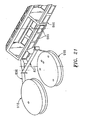
- Figs. 20 and 21 illustrate a method of writing at least one grating 12 in a section 831 of a fiber ribbon 850.
- the fiber ribbon similar to that described hereinbefore, is wound around a spool 916.
- the fiber ribbon is drawn through a grating writing station 868 to a take up spool 918.
- the grating writing station 868 includes a carriage 866 having a plurality of phase masks 860 that linearly translates parallel to the flat section 831 of the fiber ribbon 850.
- the carriage translates to position the desired phase mask in position to write the proper grating 12.
- a set of rollers 920 separate the tape 880 from the fibers 830 and directs the tape away from the ultraviolet (UV) beam 864 to thereby protect the tape from the UV beam.
- the rollers direct the tape and fibers back together and a pair pinch rollers 922 adhere the fibers 830 back onto the taper 880 to form the fiber ribbon 850.
- each section 831 of ribbon 850 is sequentially positioned in the writing station.
- the carriage 866 translates to position a desired phase mask 860 between the laser 862 and the fibers 830.
- the laser then provides the UV beam to write the grating 12 in the fibers 830.
- the carriage 866 then translates to position another phase masks to write a second grating onto the section 831 of fibers 830. This operation continues until all the desired gratings are written.
- the second spool 918 then draws the next section of fibers 830 into the writing station to write the desired grating(s) into the fibers.
- the grating(s) written into each section of fibers may be the same or different.
- the present invention contemplates cutting/dicing the fibers 830 using a laser 924 (e.g., CO 2 laser or excimer laser).
- a laser 924 e.g., CO 2 laser or excimer laser
- the laser 924 may be used to completely cut through the fibers 830.
- the laser can be used to score the fibers as shown in Figs. 22 and 23 .
- two lasers 924 are used to score both sides of the fibers 830 at the same location, while in Fig. 23 , one laser 924 is used to score only one side of the fibers.
- the fibers 830 may be separated to form the microbeads 8 by placing the scored fibers 830 in an ultrasonic bath (at 49 KHz) to vibrate the microbeads 8 apart.
- the microbeads 8 may be separated using a mechanical anvil 928 that snaps or breaks each microbead 8 from the scored fiber 830.
- Fig. 25 is a schematic illustration of an alternative method of manufacturing the microbeads 8.
- the photosensitive fiber 830 is first stripped and cleaned 930.
- the gratings 12 are then written into the fiber 932 and then wound 934 onto a second a spool 936.
- the fiber 830 is then cut off 938 the spool 936 in a plurality of strips 940 of fiber that are flattened out.
- the strips of fibers are then cut or diced 942.
- the probe compound or chemical may be coated or applied to the fiber or microbeads at any step in the process of manufacture of the microbeads described hereinbefore.
- Fig. 26 illustrates another method of cutting/dicing the fibers 830 to form the microbeads 8.
- the fiber 830 is fed into a tubular fiber holder 944.
- a cutting device 946 having a blade 948 cuts or scores the fiber 830 to the appropriate length, which is then separates the microbead from the fiber by a torque element.
- the reflected light 27, comprises a plurality of beams 26-36 that pass through a lens 37, which provides focused light beams 46-56, respectively, which are imaged onto a CCD camera 60.
- other imaging optics may be used to provide the desired characteristics of the optical image/signal onto the camera 60 (e.g., spots, lines, circles, ovals, etc.), depending on the shape of the substrate 10 and input optical signals.
- CCD camera other devices may be used to read/capture the output light.
- the image on the CCD camera 60 is a series of illuminated stripes indicating ones and zeros of a digital pattern or code of the grating 12 in the element 8.
- lines 68 on a graph 70 are indicative of a digitized version of the image of Fig. 28 as indicated in spatial periods ( ⁇ 1- ⁇ n).
- Each of the individual spatial periods ( ⁇ 1- ⁇ n) in the grating 12 is slightly different, thus producing an array ofN unique diffraction conditions (or diffraction angles) discussed more hereinafter.
- the element 8 is illuminated from the side, in the region of the grating 12, at an appropriate input angle, e.g., about 30 degrees, with a single input wavelength ⁇ (monochromatic) source, the diffracted (or reflected) beams 26-36 are generated.
- Other input angles ⁇ i may be used if desired, depending on various design parameters as discussed herein and/or in the aforementioned patent application, and provided that a known diffraction equation (Eq.
- the angle ⁇ o of the reflected output light may be determined.
- ⁇ o sin - 1 ⁇ ⁇ / ⁇ - sin ⁇ i
- ⁇ o 30 degrees
- the output light 27 should fall within an acceptable portion of the Bragg envelope (or normalized reflection efficiency envelope) curve 200, as indicated by points 204,206, also defmed as a Bragg envelope angle ⁇ B, as also discussed herein and/or in the aforementioned patent application.
- the reflection efficiency I (Eqs. 3 & 4) is maximized, which is at the center or peak of the Bragg envelope.
- the input light angle is referred to as the Bragg angle as is known.
- the efficiency decreases for other input and output angles (i.e., ⁇ i # ⁇ o ), as defined by Eqs. 3 & 4.
- the angle ⁇ i of the input light 24 should be set so that the angle ⁇ o of the reflected output light equals the input angle ⁇ i.
- the width of the sin(x)/x function increases and, the coefficient to or amplitude of the sinc 2 (or (sin(x)/x) 2 function (and thus the efficiency level across the Bragg envelope) also increases, and vice versa.
- the half-width of the Bragg envelope as well as the efficiency level across the Bragg envelope both decrease.
- ⁇ n should be made as large as possible to maximize the brightness, which allows D to be made smaller.
- ⁇ B ⁇ ⁇ D ⁇ sin ⁇ i
- ⁇ is a reflection efficiency factor which is the value for x in the sinc 2 (x) function where the value of sinc 2 (x) has decreased to a predetermined value from the maximum amplitude as indicated by points 204,206 on the curve 200.
- the digital code may be generated by selectively creating individual index variations (or individual gratings) with the desired spatial periods ⁇ 1- ⁇ n.
- Other illumination, readout techniques, types of gratings, geometries, materials, etc. may be used as discussed in the aforementioned patent application.
- FIG.30 illustrations (a)-(c), for the grating 12 in a cylindrical substrate 10 having a sample spectral 17 bit code (i.e., 17 different pitches ⁇ 1- ⁇ 17), the corresponding image on the CCD (Charge Coupled Device) camera 60 is shown for a digital pattern of 7 bits turned on (10110010001001001); 9 bits turned on of (11000101010100111); all 17 bits turned on of (11111111111111).
- CCD Charge Coupled Device
- the length of the substrate 10 was 450 microns
- the outer diameter D1 was 65 microns
- the inner diameter D was 14 microns
- ⁇ n for the grating 12 was about 10 -4
- n1 in portion 20 was about 1.458 (at a wavelength of about 1550 nm)
- n2 in portion 18 was about 1.453
- the average pitch spacing ⁇ for the grating 12 was about 0.542 microns
- the spacing between pitches ⁇ was about 0.36 % of the adjacent pitches ⁇ .
- the pitch ⁇ of an individual grating is the axial spatial period of the sinusoidal variation in the refractive index n1 in the region 20 of the substrate 10 along the axial length of the grating 12 as indicated by a curve 90 on a graph 91.
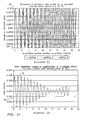
- a sample composite grating 12 comprises three individual gratings that are co-located on the substrate 10, each individual grating having slightly different pitches, ⁇ 1, ⁇ 2, ⁇ 3, respectively, and the difference (or spacing) ⁇ between each pitch ⁇ being about 3.0 % of the period of an adjacent pitch ⁇ as indicated by a series of curves 92 on a graph 94. Referring to Fig.
- FIG. 31 illustration (c), three individual gratings, each having slightly different pitches, ⁇ 1, ⁇ 2, ⁇ 3, respectively, are shown, the difference ⁇ between each pitch ⁇ being about 0.3% of the pitch ⁇ of the adjacent pitch as shown by a series of curves 95 on a graph 97.
- the individual gratings in Fig. 31 , illustrations (b) and (c) are shown to all start at 0 for illustration purposes; however, it should be understood that, the separate gratings need not all start in phase with each other. Referring to Fig.
- the overlapping of the individual sinusoidal refractive index variation pitches ⁇ 1- ⁇ n in the grating region 20 of the substrate 10, produces a combined resultant refractive index variation in the composite grating 12 shown as a curve 96 on a graph 98 representing the combination of the three pitches shown in Fig. 31 , illustration (b).
- the resultant refractive index variation in the grating region 20 of the substrate 10 may not be sinusoidal and is a combination of the individual pitches ⁇ (or index variation).
- the maximum number of resolvable bits N which is equal to the number of different grating pitches ⁇ (and hence the number of codes), that can be accurately read (or resolved) using side-illumination and side-reading of the grating 12 in the substrate 10, is determined by numerous factors, including: the beam width w incident on the substrate (and the corresponding substrate length L and grating length Lg), the thickness or diameter D of the grating 12, the wavelength ⁇ of incident light, the beam divergence angle ⁇ R , and the width of the Bragg envelope ⁇ B (discussed more in the aforementioned patent application), and may be determined by the equation: N ⁇ ⁇ L 2 ⁇ D ⁇ sin ⁇ i
- the bits may be read/detected by providing a plurality of wavelengths and reading the wavelength spectrum of the reflected output light signal. In this case, there would be one bit per wavelength, and thus, the code is contained in the wavelength information of the reflected output signal.
- each bit (or ⁇ ) is defined by whether its corresponding wavelength falls within the Bragg envelope, not by its angular position within the Bragg envelope 200.
- it is not limited by the number of angles that can fit in the Bragg envelope 200 for a given composite grating 12, as in the embodiment discussed hereinbefore.
- the only limitation in the number of bits N is the maximum number of grating pitches ⁇ that can be superimposed and optically distinguished in wavelength space for the output beam.
- the reflection wavelength spectrum ( ⁇ 1- ⁇ n) of the reflected output beam 310 will exhibit a series of reflection peaks 695, each appearing at the same output Bragg angle ⁇ o.
- Each wavelength peak 695 ( ⁇ 1- ⁇ n) corresponds to an associated spatial period ( ⁇ 1- ⁇ n), which make up the grating 12.
- One way to measure the bits in wavelength space is to have the input light angle ⁇ i equal to the output light angle ⁇ o, which is kept at a constant value, and to provide an input wavelength ⁇ that satisfies the diffraction condition (Eq. 1) for each grating pitch ⁇ . This will maximize the optical power of the output signal for each pitch ⁇ detected in the grating 12.
- the transmission wavelength spectrum of the transmitted output beam 330 (which is transmitted straight through the grating 12) will exhibit a series of notches (or dark spots) 696.
- the transmitted light 330 may be detected at the detector/reader 308. It should be understood that the optical signal levels for the reflection peaks 695 and transmission notches 696 will depend on the "strength" of the grating 12, i.e., the magnitude of the index variation n in the grating 12.
- the bits may be detected by continuously scanning the input wavelength.
- a known optical source 300 provides the input light signal 24 of a coherent scanned wavelength input light shown as a graph 304.
- the source 300 provides a sync signal on a line 306 to a known reader 308.
- the sync signal may be a timed pulse or a voltage ramped signal, which is indicative of the wavelength being provided as the input light 24 to the substrate 10 at any given time.
- the reader 308 may be a photodiode, CCD camera, or other optical detection device that detects when an optical signal is present and provides an output signal on a line 309 indicative of the code in the substrate 10 or of the wavelengths present in the output light, which is directly related to the code, as discussed herein.
- the grating 12 reflects the input light 24 and provides an output light signal 310 to the reader 308.
- the wavelength of the input signal is set such that the reflected output light 310 will be substantially in the center 314 of the Bragg envelope 200 for the individual grating pitch (or bit) being read.
- the source 300 may provide a continuous broadband wavelength input signal such as that shown as a graph 316.
- the reflected output beam 310 signal is provided to a narrow band scanning filter 318 which scans across the desired range of wavelengths and provides a filtered output optical signal 320 to the reader 308.
- the filter 318 provides a sync signal on a line 322 to the reader, which is indicative of which wavelengths are being provided on the output signal 320 to the reader and may be similar to the sync signal discussed hereinbefore on the line 306 from the source 300.
- the source 300 does not need to provide a sync signal because the input optical signal 24 is continuous.
- the scanning filter may be located in the path of the input beam 24 as indicated by the dashed box 324, which provides the sync signal on a line 323.
- the reader 308 may be a known optical spectrometer (such as a known spectrum analyzer), capable of measuring the wavelength of the output light.
- each readout wavelength is associated with a predetermined number of bits within the Bragg envelope. Bits (or grating pitches ⁇ ) written for different wavelengths do not show up unless the correct wavelength is used.
- the bits can be read using one wavelength and many angles, many wavelengths and one angle, or many wavelengths and many angles.
- the grating 12 may have a thickness or depth D which is comparable or smaller than the incident beam wavelength ⁇ .
- This is known as a "thin" diffraction grating (or the full angle Bragg envelope is 180 degrees).
- the half-angle Bragg envelope ⁇ B is substantially 90 degrees; however, ⁇ n must be made large enough to provide sufficient reflection efficiency, per Eqs. 3 and 4.
- D* ⁇ n ⁇ ⁇ /2 which corresponds to a ⁇ phase shift between adjacent minimum and maximum refractive index values of the grating 12.
- phase shift between adjacent minimum and maximum refractive index values of the grating 12 should approach a ⁇ phase shift; however, other phase shifts may be used.
- the grating 12 is illuminated with the input light 24 oriented on a line 705 orthogonal to the longitudinal grating vector 705.
- the +/-1 st order beams corresponds to output beams 700,702, respectively.
- the +/-2 nd order beams corresponds to output beams 704,706, respectively.
- the 0 th order (undefracted) beam corresponds to beam 708 and passes straight through the substrate.
- the output beams 700-708 project spectral spots or peaks 710-718, respectively, along a common plane, shown from the side by a line 709, which is parallel to the upper surface of the substrate 10.
- one can use only the +/-1 st order (m +/-1) output beams for the code, in which case there would be only 2 peaks to detect, 712, 714.
- an individual peak may be used instead of using a pair of output peaks for a given order.
- the +/-1 st order beams corresponds to output beams 720,722, respectively.
- the +/-2 nd order beams corresponds to output beams 724,726, respectively.
- the 0 th order (un-defracted) beam corresponds to beam 718 and passes straight through the substrate.
- the output beams 720-726 corresponding to the second pitch ⁇ 2 project spectral spots or peaks 730-736, respectively, which are at a different location than the point 710-716, but along the same common plane, shown from the side by the line 709.
- each different pitch corresponds to a different elevation or output angle which corresponds to a predetermined set of spectral peaks. Accordingly, the presence or absence of a particular peak or set of spectral peaks defines the code.
- the readout angles may no longer be symmetric, leading to possible difficulties in readout.
- the angular sensitivity to the alignment of the longitudinal axis of the substrate 10 to the input angle ⁇ i of incident radiation is reduced or eliminated.
- the input light can be oriented along substantially any angle ⁇ i with respect to the grating 12 without causing output signal degradation, due the large Bragg angle envelope.
- the grating 12 can be oriented at any rotational (or azimuthal) angle without causing output signal degradation.
- changing the incident angle ⁇ i will affect the output angle ⁇ o of the reflected light in a predetermined predictable way, thereby allowing for accurate output code signal detection or compensation.
- the bits can also be multiplexed in an azimuthal (or rotational) angle ⁇ a of the substrate.
- a plurality of gratings 750,752,754,756 each having the same pitch ⁇ are disposed in a surface 701 of the substrate 10 and located in the plane of the substrate surface 701.
- the input light 24 is incident on all the gratings 750,752,754,756 simultaneously.
- Each of the gratings provides output beams oriented based on the grating orientation.
- the grating 750 provides the output beams 764,762
- the grating 752 provides the output beams 766,768
- the grating 754 provides the output beams 770,772
- the grating 756 provides the output beams 774,776.
- Each of the output beams provides spectral peaks or spots (similar to that discussed hereinbefore), which are located in a plane 760 that is parallel to the substrate surface plane 701.
- a single grating pitch ⁇ can produce many bits depending on the number of gratings that can be placed at different azimuthal (rotational) angles on the surface of the substrate 10 and the number of output beam spectral peaks that can be spatially and optically resolved/detected.
- Each bit may be viewed as the presence or absence of a pair of peaks located at a predetermined location in space in the plane 760.
- the azimuthal multiplexing can be combined with the elevation or output angle multiplexing discussed hereinbefore to provide two levels of multiplexing. Accordingly, for a thin grating, the number of bits can be multiplexed based on the number of grating pitches ⁇ and/or geometrically by the orientation of the grating pitches.
- the edges of the substrate 10 no longer scatter light from the incident angle into the "code angular space", as discussed herein and/or in the aforementioned patent application.
- a continuous broadband wavelength source may be used as the optical source if desired.
- the pitches ⁇ in the grating 12 may be created at a angle ⁇ g.
- the pitches when the input light 24 is incident normal to the surface 792, will produce a reflected output beam 790 having an angle ⁇ o determined by Eq. 1 as adjusted for the blaze angle ⁇ g. This can provide another level of multiplexing bits in the code.
- an additional level of multiplexing may be provided by having the optical code use other numerical bases, if intensity levels of each bit are used to indicate code information. This could be achieved by having a corresponding magnitude (or strength) of the refractive index change ( ⁇ n) for each grating pitch ⁇ .
- Four intensity ranges are shown for each bit number or pitch ⁇ , providing for a Base-4 code (where each bit corresponds to 0,1,2, or 3). The lowest intensity level, corresponding to a 0, would exist when this pitch ⁇ is not present in the grating 12. The next intensity level 450 would occur when a first low level ⁇ n1 exists in the grating that provides an output signal within the intensity range corresponding to a 1.
- the next intensity level 452 would occur when a second higher level ⁇ n2 exists in the grating 12 that provides an output signal within the intensity range corresponding to a 2.
- the next intensity level 452, would occur when a third higher level ⁇ n3 exists in the grating 12 that provides an output signal within the intensity range corresponding to a 3.
- the input light 24 may be incident on the substrate 10 on an end face 600 of the substrate 10.
- the input light 24 will be incident on the grating 12 having a more significant component of the light (as compared to side illumination discussed hereinbefore) along the longitudinal grating axis 207 of the grating (along the grating vector k B ), as shown by a line 602.
- the light 602 reflects off the grating 12 as indicated by a line 604 and exits the substrate as output light 608.
- the code information is readable only in the spectral wavelength of the reflected beam, similar to that discussed hereinbefore for wavelength based code reading.
- the input signal in this case may be a scanned wavelength source or a broadband wavelength source.
- the code information may be obtained in reflection from the reflected beam 614 or in transmission by the transmitted beam 616 that passes through the grating 12.
- n in ⁇ sin ⁇ in n out ⁇ sin ⁇ out
- n in is the refractive index of the first (input) medium
- n out is the refractive index of the second (output) medium
- ⁇ in and ⁇ out are measured from a line 620 normal to an incident surface 622.
- n1 in the grating region 20 is greater than the value of n2 in the non-grating region 18, the grating region 20 of the substrate 10 will act as a known optical waveguide for certain wavelengths.
- the grating region 20 acts as a "core” along which light is guided and the outer region 18 acts as a “cladding” which helps confine or guide the light.
- such a waveguide will have a known “numerical aperture” ( ⁇ na) that will allow light that is within the aperture ⁇ na to be directed or guided along the grating axis 207 and reflected axially off the grating 12 and returned and guided along the waveguide.
- the grating 12 will reflect light having the appropriate wavelengths equal to the pitches ⁇ present in the grating 12 back along the region 20 (or core) of the waveguide, and pass the remaining wavelengths of light as the light 632.
- having the grating region 20 act as an optical waveguide for wavelengths reflected by the grating 12 allows incident light that is not aligned exactly with the grating axis 207 to be guided along and aligned with the grating 12 axis 207 for optimal grating reflection.
- any standard waveguide may be used, e.g., a standard telecommunication single mode optical fiber (125 micron diameter or 80 micron diameter fiber with about a 8-10 micron diameter), or a larger diameter waveguide (greater than 0.5 mm diameter), such as is describe in U.S. Patent Application, Serial No. 09/455,868, filed December 6, 1999 , entitled “Large Diameter Waveguide, Grafting”.
- any type of optical waveguide may be used for the optical substrate 10, such as, a multi-mode, birefringent, polarization maintaining, polarizing, multi-core, multi-cladding, or microsturctured optical waveguide, or a flat or planar waveguide (where the waveguide is rectangular shaped), or other waveguides.
- the substrate 10 does not behave as a waveguide for the incident or reflected light and the incident light 24 will be diffracted (or reflected) as indicated by lines 642, and the codes detected as discussed hereinbefore for the end-incidence condition discussed hereinbefore with Fig. 45 , and the remaining light 640 passes straight through.
- illustration (b) alternatively, the input light 24 may be incident from the side and, if the grating 12 has the appropriate blaze angle, the reflected light will exit from the end face 652 as indicated by a line 654.
- the grating 12 may have a plurality of different pitch angles 660,662, which reflect the input light 24 to different output angles as indicated by lines 664, 666. This provides another level of multiplexing (spatially) additional codes, if desired.
- the grating 12 may be impressed in the substrate 10 by any technique for writing, impressed, embedded, imprinted, or otherwise forming a diffraction grating in the volume of or on a surface of a substrate 10. Examples of some known techniques are described in US Patent No. 4,725,110 and 4,807,950 , entitled “Method for Impressing Gratings Within Fiber Optics", to Glenn et al; and US Patent No.
- the grating 12 may be partially or totally created by etching or otherwise altering the outer surface geometry of the substrate to create a corrugated or varying surface geometry of the substrate, such as is described in US Patent 3,891,302 , entitled “Method of Filtering Modes in Optical Waveguides", to Dabby et al, which is incorporated herein by reference to the extent necessary to understand the present invention, provided the resultant optical refractive profile for the desired code is created.
- the grating 12 may be made by depositing dielectric layers onto the substrate, similar to the way a known thin film filter is created, so as to create the desired resultant optical refractive profile for the desired code.
- the substrate 10 may have end-view cross-sectional shapes other than circular, such as square, rectangular, elliptical, clam-shell, D-shaped, or other shapes, and may have side-view sectional shapes other than rectangular, such as circular, square, elliptical, clam-shell, D-shaped, or other shapes.
- 3D geometries other than a cylinder may be used, such as a sphere, a cube, a pyramid or any other 3D shape.
- the substrate 10 may have a geometry that is a combination of one or more of the foregoing shapes.
- the shape of the element 8 and the size of the incident beam may be made to minimize any end scatter off the end face(s) of the element 8, as is discussed herein and/or in the aforementioned patent application. Accordingly, to minimize such scatter, the incident beam 24 may be oval shaped where the narrow portion of the oval is smaller than the diameter D1, and the long portion of the oval is smaller than the length L of the element 8. Alternatively, the shape of the end faces may be rounded or other shapes or may be coated with an antireflective coating.
- any given dimension for the region 20 of the grating 12 may be less than any corresponding dimension of the substrate 10.
- the grating 12 has dimensions of length Lg, depth Dg, and width Wg, and the substrate 12 has different dimensions of length L, depth D, and width W
- the dimensions of the grating 12 may be less than that of the substrate 12.
- the grating 12 may be embedded within or part of a much larger substrate 12.
- the element 8 may be embedded or formed in or on a larger object for identification of the object.
- the dimensions, geometries, materials, and material properties of the substrate 10 are selected such that the desired optical and material properties are met for a given application.
- the resolution and range for the optical codes are scalable by controlling these parameters as discussed herein and/or in the aforementioned patent application.
- the substrate 10 may have an outer coating 799, such as a polymer or other material that may be dissimilar to the material of the substrate 10, provided that the coating 799 on at least a portion of the substrate, allows sufficient light to pass through the substrate for adequate optical detection of the code.
- the coating 799 may be on any one or more sides of the substrate 10.
- the coating 799 may be a material that causes the element 8 to float or sink in certain fluids (liquid and/or gas) solutions.
- the substrate 10 may be made of a material that is less dense than certain fluid (liquids and/or gas) solutions, thereby allowing the elements 8 to float or be buoyant or partially buoyant.
- the substrate may be made of a porous material, such as controlled pore glass (CPG) or other porous material, which may also reduce the density of the element 8 and may make the element 8 buoyant or partially-buoyant in certain fluids.
- CPG controlled pore glass
- the grating 12 is axially spatially invariant.
- the substrate 10 with the grating 12 may be axially subdivided or cut into many separate smaller substrates 30-36 and each substrate 30-36 will contain the same code as the longer substrate 21 had before it was cut.
- the limit on the size of the smaller substrates 30-36 is based on design and performance factors discussed herein and/or in the aforementioned patent application.
- one purpose of the outer region 18 (or region without the grating 12) of the substrate 10 is to provide mechanical or structural support for the inner grating region 20.
- the entire substrate 10 may comprise the grating 12, if desired.
- the support portion may be completely or partially beneath, above, or along one or more sides of the grating region 20, such as in a planar geometry, or a D-shaped geometry, or other geometries, as described herein and/or in the aforementioned patent application.
- the non-grating portion 18 of the substrate 10 may be used for other purposes as well, such as optical lensing effects or other effects (discussed herein or in the aforementioned patent application).
- the end faces of the substrate 10 need not be perpendicular to the sides or parallel to each other. However, for applications where the elements 8 are stacked end-to-end, the packing density may be optimized if the end faces are perpendicular to the sides.
- two or more substrates 10,250, each having at least one grating therein may be attached together to form the element 8, e.g., by an adhesive, fusing or other attachment techniques.
- the gratings 12,252 may have the same or different codes.
- the substrate 10 may have multiple regions 80,90 and one or more of these regions may have gratings in them.
- the substrate 10 may have multiple regions 80,90 and one or more of these regions may have gratings in them.
- gratings 12252 side-by-side (illustration (a)) there may be gratings 82-88, spaced end-to-end (illustration (b)) in the substrate 10.
- the length L of the element 8 may be shorter than its diameter D, thus, having a geometry such as a plug, puck, wafer, disc or plate.
- the substrate 10 may have a plurality of the gratings 12 having the same codes written therein at numerous different angular or rotational (or azimuthal) positions of the substrate 10.
- two gratings 550, 552, having axial grating axes 551, 553, respectively may have a common central (or pivot or rotational) point where the two axes 551,553 intersect.
- the angle ⁇ i of the incident light 24 is aligned properly with the grating 550 and is not aligned with the grating 552, such that output light 555 is reflected off the grating 550 and light 557 passes through the grating 550 as discussed herein. If the element 8 is rotated as shown by the arrows 559, the angle ⁇ i of incident light 24 will become aligned properly with the grating 552 and not aligned with the grating 550 such that output light 555 is reflected off the grating 552 and light 557 passes through the grating 552.
- the bead When multiple gratings are located in this rotational orientation, the bead may be rotated as indicated by a line 559 and there may be many angular positions that will provide correct (or optimal) incident input angles ⁇ i to the grating. While this example shows a circular cross-section, this technique may be used with any shape cross-section.
- illustrations (a), (b), (c), (d), and (e) the substrate 10 may have one or more holes located within the substrate 10.
- holes 560 may be located at various points along all or a portion of the length of the substrate 10. The holes need not pass all the way through the substrate 10. Any number, size and spacing for the holes 560 may be used if desired.
- holes 572 may be located very close together to form a honeycomb-like area of all or a portion of the cross-section.
- one (or more) inner hole 566 may be located in the center of the substrate 10 or anywhere inside of where the grating region(s) 20 are located.
- the inner hole 566 may be coated with a reflective coating 573 to reflect light to facilitate reading of one or more of the gratings 12 and/or to reflect light diffracted off one or more of the gratings 12.
- the incident light 24 may reflect off the grating 12 in the region 20 and then reflect off the surface 573 to provide output light 577. Alternatively, the incident light 24 may reflect off the surface 573, then reflect off the grating 12 and provide the output light 575.
- the grating region 20 may run axially or circumferentially 571 around the substrate 10.
- the holes 579 may be located circumferentially around the grating region 20 or transversely across the substrate 10.
- the grating 12 may be located circumferentially around the outside of the substrate 10, and there may be holes 574 inside the substrate 10.
- the substrate 10 may have one or more protruding portions or teeth 570, 578,580 extending radially and/or circumferentially from the substrate 10.
- the teeth 570, 578,580 may have any other desired shape.
- grating region 20 may have end cross-sectional shapes other than circular and may have side cross-sectional shapes other than rectangular, such as any of the geometries described herein for the substrate 10.
- the grating region 20 may have a oval cross-sectional shape as shown by dashed lines 581, which may be oriented in a desired direction, consistent with the teachings herein. Any other geometries for the substrate 10 or the grating region 20 may be used if desired, as described herein.
- At least a portion of a side of the substrate 10 may be coated with a reflective coating to allow incident light 510 to be reflected back to the same side from which the incident light came, as indicated by reflected light 512.
- the substrate 10 can be electrically and/or magnetically polarized, by a dopant or coating, which may be used to ease handling and/or alignment or orientation of the substrate 10 and/or the grating 12, or used for other purposes.
- the bead may be coated with conductive material, e.g., metal coating on the inside of a holy substrate, or metallic dopant inside the substrate. In these cases, such materials can cause the substrate 10 to align in an electric or magnetic field.
- the substrate can be doped with an element or compound that fluoresces or glows under appropriate illumination, e.g., a rare earth dopant, such as Erbium, or other rare earth dopant or fluorescent or luminescent molecule.
- a rare earth dopant such as Erbium, or other rare earth dopant or fluorescent or luminescent molecule.
- fluorescence or luminescence may aid in locating and/or aligning substrates.
- any of the embodiments described herein are merely for illustrative purposes and, as such, any other dimensions and/or geometries may be used if desired, depending on the application, size, performance, manufacturing requirements, or other factors, in view of the teachings herein.
Landscapes
- Chemical & Material Sciences (AREA)
- Health & Medical Sciences (AREA)
- General Health & Medical Sciences (AREA)
- Hematology (AREA)
- Chemical Kinetics & Catalysis (AREA)
- Clinical Laboratory Science (AREA)
- General Physics & Mathematics (AREA)
- Analytical Chemistry (AREA)
- Physics & Mathematics (AREA)
- Theoretical Computer Science (AREA)
- Dispersion Chemistry (AREA)
- Engineering & Computer Science (AREA)
- Diffracting Gratings Or Hologram Optical Elements (AREA)
- Testing Of Optical Devices Or Fibers (AREA)
- Led Devices (AREA)
- Crystals, And After-Treatments Of Crystals (AREA)
Claims (23)
- Verfahren zur Herstellung eines optischen Identifizierungselements; das Verfahren umfassend:Bereitstellen eines Substrats (830);Winden zumindest zweier oder mehr Wicklungen des Substrats (830) um eine Vorrichtung (832), um zumindest einen Gitterschreibabschnitt (831) zu bilden;Schreiben, in einer einzigen Exposition, zumindest eines Gitters (12) in die zumindest zwei oder mehr Wicklungen des Substrats (830), das im zumindest einen Gitterschreibabschnitt (831) angeordnet ist; undSplitten des im zumindest einen Gitterschreibabschnitt (831) angeordneten Substrats (830), um eine Vielzahl optischer Identifizierungselemente (8) zu schaffen.
- Verfahren nach Anspruch 1, wobei das Substrat eine Faser ist.
- Verfahren nach Anspruch 1, wobei das Substrat (830) eine optische Faser ist, die einen Kern (20) und einen Mantel (18) aufweist.
- Verfahren nach Anspruch 1, wobei das Substrat (830) lichtempfindlich ist.
- Verfahren nach Anspruch 2, das weiterhin das Ablösen eines Puffers von der Faser beinhaltet.
- Verfahren nach Anspruch 1, wobei die Vorrichtung (832) den Gitterschreibabschnitt (831) flach hält.
- Verfahren nach Anspruch 1, wobei die Vorrichtung (832) eine Mehrzahl flacher Gitterschreibabschnitte (831) gewickelten Substrats (830) bereitstellt.
- Verfahren nach Anspruch 1, das weiterhin das Zusammenkleben des gewickelten Substrats (830) beinhaltet.
- Verfahren nach Anspruch 1, das weiterhin das Kleben des Substrats (830) im zumindest einen Gitterschreibabschnitt (831) an ein flächiges Material (886) beinhaltet.
- Verfahren nach Anspruch 9, wobei der Schritt des Splittens des Substrats (830) im Gitterschreibabschnitt (831) weiterhin beinhaltet, dass das ans flächige Material (886) geklebte Substrat (830) geschnitten wird, ohne durch das flächige Material (886) zu schneiden.
- Verfahren nach Anspruch 10, das weiterhin das Trennen der optischen Identifizierungselemente (8) vom flächigen Material (886) beinhaltet.
- Verfahren nach Anspruch 11, wobei das Trennen der optischen Identifizierungselemente (8) und des flächigen Materials (886) das Lösen einer adhäsiven Bindung zwischen den optischen Identifizierungselementen (8) und dem flächigen Material (886) beinhaltet.
- Verfahren nach Anspruch 1, wobei die Vorrichtung (832) polygonal geformt ist, um eine Mehrzahl flacher Gitterschreibabschnitte (831) gewundenen Substrats (830) bereitzustellen.
- Verfahren nach Anspruch 1, wobei das Gitter (12) eine Mehrzahl zusammen angeordneter Gitter (12) umfasst.
- Verfahren nach Anspruch 13, wobei Gitter (12) in eine Mehrzahl von Gitterschreibabschnitten (831) gewundenen Substrats (830) geschrieben werden.
- Verfahren nach Anspruch 1, wobei das Verfahren den Schritt des Drehens der Vorrichtung (832) nach Schreiben jedes des zumindest einen Gitterschreibabschnitts (831) beinhaltet.
- Verfahren nach Anspruch 1, wobei der Schritt des Schreibens das Schreiben, in der einzigen Exposition, eines Gitters (12) in einem ganzen Gitterschreibabschnitt (831) beinhaltet.
- Verfahren nach Anspruch 1, wobei der Schritt des Schreibens das Schreiben, in der einzigen Exposition, eines Gitters (12) in einem Teil des zumindest einen Gitterschreibabschnitts (831) beinhaltet.
- Verfahren nach Anspruch 1, wobei der Schritt des Windens das Winden des Substrats (830) so beinhaltet, dass jede Wicklung des Substrats (830) benachbart zu jeder benachbarten Wicklung ist und diese berührt, um eine einzige Schicht aus Faserband (850) zu bilden.
- Verfahren zur Herstellung eines optischen Identifizierungselements; das Verfahren umfassend:Bereitstellen eines Substrats (830);Winden des Substrats (830) um eine Vorrichtung (832), um zumindest einen Gitterschreibabschnitt (831) bereitzustellen;Schreiben zumindest eines Gitters in das Substrat (830), das im Gitterschreibabschnitt (831) angeordnet ist;Kleben des Substrats (830) in dem zumindest einen Gitterschreibabschnitt (831) an ein flächiges Material (886); undSplitten des im Gitterschreibabschnitt (831) angeordneten Substrats (830), um eine Mehrzahl optischer Identifizierungselemente (8) zu schaffen, indem das ans flächige Material (886) geklebte Substrat (830) geschnitten wird, ohne durch das flächige Material (886) zu schneiden.
- Verfahren nach Anspruch 20, das weiterhin das Trennen der optischen Identifizierungselemente (8) vom flächigen Material (886) beinhaltet.
- Verfahren nach Anspruch 21, wobei das Trennen der optischen Identifizierungselemente (8) und des flächigen Materials (886) das Lösen einer adhäsiven Bindung zwischen den optischen Identifizierungselementen (8) und dem flächigen Material (886) beinhaltet.
- Verfahren nach Anspruch 1 oder 20, wobei die Vorrichtung (832) ein Käfig oder Korb ist.
Applications Claiming Priority (7)
| Application Number | Priority Date | Filing Date | Title |
|---|---|---|---|
| US41054102P | 2002-09-12 | 2002-09-12 | |
| US410541P | 2002-09-12 | ||
| US64568903A | 2003-08-20 | 2003-08-20 | |
| US645686 | 2003-08-20 | ||
| US645689 | 2003-08-20 | ||
| US10/645,686 US20040075907A1 (en) | 2002-08-20 | 2003-08-20 | Diffraction grating-based encoded micro-particles for multiplexed experiments |
| PCT/US2003/028890 WO2004025344A1 (en) | 2002-09-12 | 2003-09-12 | Method of manufacturing of a diffraction grating-based optical identification element |
Publications (2)
| Publication Number | Publication Date |
|---|---|
| EP1540394A1 EP1540394A1 (de) | 2005-06-15 |
| EP1540394B1 true EP1540394B1 (de) | 2010-03-10 |
Family
ID=41809089
Family Applications (1)
| Application Number | Title | Priority Date | Filing Date |
|---|---|---|---|
| EP03752367A Expired - Lifetime EP1540394B1 (de) | 2002-09-12 | 2003-09-12 | Verfahren zur herstellung eines auf beugungsgittern basierten optischen identifizierungselementes |
Country Status (6)
| Country | Link |
|---|---|
| EP (1) | EP1540394B1 (de) |
| AT (1) | ATE460712T1 (de) |
| AU (1) | AU2003270660A1 (de) |
| CA (1) | CA2499032A1 (de) |
| DE (1) | DE60331663D1 (de) |
| WO (1) | WO2004025344A1 (de) |
Families Citing this family (1)
| Publication number | Priority date | Publication date | Assignee | Title |
|---|---|---|---|---|
| CN115468912B (zh) * | 2022-09-02 | 2024-12-20 | 电子科技大学 | 集成生化传感和随机标签双功能的光纤微腔激光装置 |
Family Cites Families (2)
| Publication number | Priority date | Publication date | Assignee | Title |
|---|---|---|---|---|
| AU713820B2 (en) * | 1995-10-16 | 1999-12-09 | Sumitomo Electric Industries, Ltd. | Optical fiber diffraction grating, a method of fabricating thereof and a laser light source |
| US6035082A (en) * | 1998-03-16 | 2000-03-07 | Luna Innovations, Inc. | Process for preparing an optical fiber sensor with enhanced sensitivity |
-
2003
- 2003-09-12 WO PCT/US2003/028890 patent/WO2004025344A1/en not_active Ceased
- 2003-09-12 DE DE60331663T patent/DE60331663D1/de not_active Expired - Lifetime
- 2003-09-12 CA CA002499032A patent/CA2499032A1/en not_active Abandoned
- 2003-09-12 EP EP03752367A patent/EP1540394B1/de not_active Expired - Lifetime
- 2003-09-12 AU AU2003270660A patent/AU2003270660A1/en not_active Abandoned
- 2003-09-12 AT AT03752367T patent/ATE460712T1/de not_active IP Right Cessation
Also Published As
| Publication number | Publication date |
|---|---|
| AU2003270660A1 (en) | 2004-04-30 |
| WO2004025344A1 (en) | 2004-03-25 |
| WO2004025344A8 (en) | 2004-05-21 |
| ATE460712T1 (de) | 2010-03-15 |
| DE60331663D1 (de) | 2010-04-22 |
| EP1540394A1 (de) | 2005-06-15 |
| CA2499032A1 (en) | 2004-03-25 |
Similar Documents
| Publication | Publication Date | Title |
|---|---|---|
| US7375890B2 (en) | Method of manufacturing of a diffraction grating-based optical identification element | |
| CA2498933C (en) | Method and apparatus for aligning elongated microbeads in order to interrogate the same | |
| AU2003265583C1 (en) | Diffraction grating-based optical identification element | |
| US7190522B2 (en) | Chemical synthesis using diffraction grating-based encoded optical elements | |
| US20060023310A1 (en) | Optical identification element using separate or partially overlapped diffraction gratings | |
| US7349158B2 (en) | Diffraction grating-based encoded micro-particles for multiplexed experiments | |
| US20060071075A1 (en) | Optical reader for diffraction grating-based encoded optical identification elements | |
| US20050270603A1 (en) | Optical identification element using separate or partially overlapped diffraction gratings | |
| WO2005026729A2 (en) | Improved method and apparatus for aligning microbeads in order to interrogate the same | |
| US20060160208A1 (en) | Multi-well plate with alignment grooves for encoded microparticles | |
| US20110114729A1 (en) | Optical reader system for substrates having an optically readable code | |
| EP1673614A1 (de) | Optisches lesegerät für codierte optische identifikationselemente auf beugungsgitterbasis | |
| WO2005079544A9 (en) | Multi-well plate with alignment grooves for encoded microparticles | |
| WO2004025344A1 (en) | Method of manufacturing of a diffraction grating-based optical identification element | |
| WO2005079545A9 (en) | Optical identification element using separate or partially overlapped diffraction gratings | |
| EP1540588A1 (de) | Beugungsgitter-gestütztes optisches identifikationselement |
Legal Events
| Date | Code | Title | Description |
|---|---|---|---|
| PUAI | Public reference made under article 153(3) epc to a published international application that has entered the european phase |
Free format text: ORIGINAL CODE: 0009012 |
|
| 17P | Request for examination filed |
Effective date: 20050407 |
|
| AK | Designated contracting states |
Kind code of ref document: A1 Designated state(s): AT BE BG CH CY CZ DE DK EE ES FI FR GB GR HU IE IT LI LU MC NL PT RO SE SI SK TR |
|
| AX | Request for extension of the european patent |
Extension state: AL LT LV MK |
|
| DAX | Request for extension of the european patent (deleted) | ||
| RIN1 | Information on inventor provided before grant (corrected) |
Inventor name: LI, TUO Inventor name: PUTNAM, MARTIN, A. Inventor name: SZCZEPANEK, PAUL, S. Inventor name: MOON, JOHN Inventor name: TRAYNOR, JOSEPH Inventor name: RAUSEO, ANTHONY |
|
| 17Q | First examination report despatched |
Effective date: 20090203 |
|
| GRAP | Despatch of communication of intention to grant a patent |
Free format text: ORIGINAL CODE: EPIDOSNIGR1 |
|
| RIC1 | Information provided on ipc code assigned before grant |
Ipc: G06K 19/06 20060101AFI20090908BHEP |
|
| GRAS | Grant fee paid |
Free format text: ORIGINAL CODE: EPIDOSNIGR3 |
|
| GRAA | (expected) grant |
Free format text: ORIGINAL CODE: 0009210 |
|
| AK | Designated contracting states |
Kind code of ref document: B1 Designated state(s): AT BE BG CH CY CZ DE DK EE ES FI FR GB GR HU IE IT LI LU MC NL PT RO SE SI SK TR |
|
| REG | Reference to a national code |
Ref country code: GB Ref legal event code: FG4D |
|
| REG | Reference to a national code |
Ref country code: CH Ref legal event code: EP |
|
| REG | Reference to a national code |
Ref country code: IE Ref legal event code: FG4D |
|
| REF | Corresponds to: |
Ref document number: 60331663 Country of ref document: DE Date of ref document: 20100422 Kind code of ref document: P |
|
| REG | Reference to a national code |
Ref country code: NL Ref legal event code: VDEP Effective date: 20100310 |
|
| PG25 | Lapsed in a contracting state [announced via postgrant information from national office to epo] |
Ref country code: FI Free format text: LAPSE BECAUSE OF FAILURE TO SUBMIT A TRANSLATION OF THE DESCRIPTION OR TO PAY THE FEE WITHIN THE PRESCRIBED TIME-LIMIT Effective date: 20100310 Ref country code: SI Free format text: LAPSE BECAUSE OF FAILURE TO SUBMIT A TRANSLATION OF THE DESCRIPTION OR TO PAY THE FEE WITHIN THE PRESCRIBED TIME-LIMIT Effective date: 20100310 Ref country code: AT Free format text: LAPSE BECAUSE OF FAILURE TO SUBMIT A TRANSLATION OF THE DESCRIPTION OR TO PAY THE FEE WITHIN THE PRESCRIBED TIME-LIMIT Effective date: 20100310 |
|
| PG25 | Lapsed in a contracting state [announced via postgrant information from national office to epo] |
Ref country code: RO Free format text: LAPSE BECAUSE OF FAILURE TO SUBMIT A TRANSLATION OF THE DESCRIPTION OR TO PAY THE FEE WITHIN THE PRESCRIBED TIME-LIMIT Effective date: 20100310 Ref country code: SE Free format text: LAPSE BECAUSE OF FAILURE TO SUBMIT A TRANSLATION OF THE DESCRIPTION OR TO PAY THE FEE WITHIN THE PRESCRIBED TIME-LIMIT Effective date: 20100310 Ref country code: GR Free format text: LAPSE BECAUSE OF FAILURE TO SUBMIT A TRANSLATION OF THE DESCRIPTION OR TO PAY THE FEE WITHIN THE PRESCRIBED TIME-LIMIT Effective date: 20100611 Ref country code: ES Free format text: LAPSE BECAUSE OF FAILURE TO SUBMIT A TRANSLATION OF THE DESCRIPTION OR TO PAY THE FEE WITHIN THE PRESCRIBED TIME-LIMIT Effective date: 20100621 Ref country code: NL Free format text: LAPSE BECAUSE OF FAILURE TO SUBMIT A TRANSLATION OF THE DESCRIPTION OR TO PAY THE FEE WITHIN THE PRESCRIBED TIME-LIMIT Effective date: 20100310 Ref country code: EE Free format text: LAPSE BECAUSE OF FAILURE TO SUBMIT A TRANSLATION OF THE DESCRIPTION OR TO PAY THE FEE WITHIN THE PRESCRIBED TIME-LIMIT Effective date: 20100310 Ref country code: CY Free format text: LAPSE BECAUSE OF FAILURE TO SUBMIT A TRANSLATION OF THE DESCRIPTION OR TO PAY THE FEE WITHIN THE PRESCRIBED TIME-LIMIT Effective date: 20100310 Ref country code: BE Free format text: LAPSE BECAUSE OF FAILURE TO SUBMIT A TRANSLATION OF THE DESCRIPTION OR TO PAY THE FEE WITHIN THE PRESCRIBED TIME-LIMIT Effective date: 20100310 |
|
| PG25 | Lapsed in a contracting state [announced via postgrant information from national office to epo] |
Ref country code: BG Free format text: LAPSE BECAUSE OF FAILURE TO SUBMIT A TRANSLATION OF THE DESCRIPTION OR TO PAY THE FEE WITHIN THE PRESCRIBED TIME-LIMIT Effective date: 20100610 Ref country code: SK Free format text: LAPSE BECAUSE OF FAILURE TO SUBMIT A TRANSLATION OF THE DESCRIPTION OR TO PAY THE FEE WITHIN THE PRESCRIBED TIME-LIMIT Effective date: 20100310 Ref country code: CZ Free format text: LAPSE BECAUSE OF FAILURE TO SUBMIT A TRANSLATION OF THE DESCRIPTION OR TO PAY THE FEE WITHIN THE PRESCRIBED TIME-LIMIT Effective date: 20100310 |
|
| PLBE | No opposition filed within time limit |
Free format text: ORIGINAL CODE: 0009261 |
|
| STAA | Information on the status of an ep patent application or granted ep patent |
Free format text: STATUS: NO OPPOSITION FILED WITHIN TIME LIMIT |
|
| PG25 | Lapsed in a contracting state [announced via postgrant information from national office to epo] |
Ref country code: PT Free format text: LAPSE BECAUSE OF FAILURE TO SUBMIT A TRANSLATION OF THE DESCRIPTION OR TO PAY THE FEE WITHIN THE PRESCRIBED TIME-LIMIT Effective date: 20100712 Ref country code: DK Free format text: LAPSE BECAUSE OF FAILURE TO SUBMIT A TRANSLATION OF THE DESCRIPTION OR TO PAY THE FEE WITHIN THE PRESCRIBED TIME-LIMIT Effective date: 20100310 |
|
| 26N | No opposition filed |
Effective date: 20101213 |
|
| PG25 | Lapsed in a contracting state [announced via postgrant information from national office to epo] |
Ref country code: IT Free format text: LAPSE BECAUSE OF FAILURE TO SUBMIT A TRANSLATION OF THE DESCRIPTION OR TO PAY THE FEE WITHIN THE PRESCRIBED TIME-LIMIT Effective date: 20100310 |
|
| PG25 | Lapsed in a contracting state [announced via postgrant information from national office to epo] |
Ref country code: MC Free format text: LAPSE BECAUSE OF NON-PAYMENT OF DUE FEES Effective date: 20100930 |
|
| REG | Reference to a national code |
Ref country code: CH Ref legal event code: PL |
|
| REG | Reference to a national code |
Ref country code: FR Ref legal event code: ST Effective date: 20110531 |
|
| PG25 | Lapsed in a contracting state [announced via postgrant information from national office to epo] |
Ref country code: FR Free format text: LAPSE BECAUSE OF NON-PAYMENT OF DUE FEES Effective date: 20100930 Ref country code: LI Free format text: LAPSE BECAUSE OF NON-PAYMENT OF DUE FEES Effective date: 20100930 Ref country code: CH Free format text: LAPSE BECAUSE OF NON-PAYMENT OF DUE FEES Effective date: 20100930 |
|
| REG | Reference to a national code |
Ref country code: DE Ref legal event code: R082 Ref document number: 60331663 Country of ref document: DE Representative=s name: DR. KUNZ & DR. HABENICHT, DE Ref country code: DE Ref legal event code: R082 Ref document number: 60331663 Country of ref document: DE Representative=s name: DR. KUNZ & KOLLEGEN PATENTANWALTSKANZLEI, DE Ref country code: DE Ref legal event code: R082 Ref document number: 60331663 Country of ref document: DE Representative=s name: OLSWANG GERMANY LLP, DE Ref country code: DE Ref legal event code: R082 Ref document number: 60331663 Country of ref document: DE Representative=s name: KUNZ, HERBERT, DIPL.-PHYS. DR.RER.NAT., DE |
|
| PG25 | Lapsed in a contracting state [announced via postgrant information from national office to epo] |
Ref country code: LU Free format text: LAPSE BECAUSE OF NON-PAYMENT OF DUE FEES Effective date: 20100912 Ref country code: HU Free format text: LAPSE BECAUSE OF FAILURE TO SUBMIT A TRANSLATION OF THE DESCRIPTION OR TO PAY THE FEE WITHIN THE PRESCRIBED TIME-LIMIT Effective date: 20100911 |
|
| PG25 | Lapsed in a contracting state [announced via postgrant information from national office to epo] |
Ref country code: TR Free format text: LAPSE BECAUSE OF FAILURE TO SUBMIT A TRANSLATION OF THE DESCRIPTION OR TO PAY THE FEE WITHIN THE PRESCRIBED TIME-LIMIT Effective date: 20100310 |
|
| REG | Reference to a national code |
Ref country code: DE Ref legal event code: R082 Ref document number: 60331663 Country of ref document: DE Representative=s name: OLSWANG GERMANY LLP, DE Ref country code: DE Ref legal event code: R082 Ref document number: 60331663 Country of ref document: DE Representative=s name: KUNZ, HERBERT, DIPL.-PHYS. DR.RER.NAT., DE |
|
| REG | Reference to a national code |
Ref country code: DE Ref legal event code: R082 Ref document number: 60331663 Country of ref document: DE Representative=s name: KUNZ, HERBERT, DIPL.-PHYS. DR.RER.NAT., DE |
|
| PGFP | Annual fee paid to national office [announced via postgrant information from national office to epo] |
Ref country code: IE Payment date: 20220712 Year of fee payment: 20 Ref country code: GB Payment date: 20220721 Year of fee payment: 20 Ref country code: DE Payment date: 20220609 Year of fee payment: 20 |
|
| P01 | Opt-out of the competence of the unified patent court (upc) registered |
Effective date: 20230505 |
|
| REG | Reference to a national code |
Ref country code: DE Ref legal event code: R071 Ref document number: 60331663 Country of ref document: DE |
|
| REG | Reference to a national code |
Ref country code: GB Ref legal event code: PE20 Expiry date: 20230911 |
|
| REG | Reference to a national code |
Ref country code: IE Ref legal event code: MK9A |
|
| PG25 | Lapsed in a contracting state [announced via postgrant information from national office to epo] |
Ref country code: GB Free format text: LAPSE BECAUSE OF EXPIRATION OF PROTECTION Effective date: 20230911 |
|
| PG25 | Lapsed in a contracting state [announced via postgrant information from national office to epo] |
Ref country code: IE Free format text: LAPSE BECAUSE OF EXPIRATION OF PROTECTION Effective date: 20230912 |