EP1540249B1 - System und verfahren zum blasen von schüttdämmung - Google Patents
System und verfahren zum blasen von schüttdämmung Download PDFInfo
- Publication number
- EP1540249B1 EP1540249B1 EP03742437A EP03742437A EP1540249B1 EP 1540249 B1 EP1540249 B1 EP 1540249B1 EP 03742437 A EP03742437 A EP 03742437A EP 03742437 A EP03742437 A EP 03742437A EP 1540249 B1 EP1540249 B1 EP 1540249B1
- Authority
- EP
- European Patent Office
- Prior art keywords
- insulation
- ionizer
- loose
- fill
- static charge
- Prior art date
- Legal status (The legal status is an assumption and is not a legal conclusion. Google has not performed a legal analysis and makes no representation as to the accuracy of the status listed.)
- Expired - Lifetime
Links
- 238000009413 insulation Methods 0.000 title claims description 71
- 238000007664 blowing Methods 0.000 title claims description 37
- 238000000034 method Methods 0.000 title claims description 27
- 230000003068 static effect Effects 0.000 claims description 60
- 239000003365 glass fiber Substances 0.000 claims description 7
- 238000005259 measurement Methods 0.000 claims description 4
- 230000004044 response Effects 0.000 claims description 4
- VTYYLEPIZMXCLO-UHFFFAOYSA-L Calcium carbonate Chemical compound [Ca+2].[O-]C([O-])=O VTYYLEPIZMXCLO-UHFFFAOYSA-L 0.000 description 8
- 238000012360 testing method Methods 0.000 description 7
- 239000000835 fiber Substances 0.000 description 6
- 229910000019 calcium carbonate Inorganic materials 0.000 description 4
- 238000010586 diagram Methods 0.000 description 4
- 239000011152 fibreglass Substances 0.000 description 4
- 239000000463 material Substances 0.000 description 4
- 239000002216 antistatic agent Substances 0.000 description 2
- 238000002474 experimental method Methods 0.000 description 2
- 238000004519 manufacturing process Methods 0.000 description 2
- 238000004806 packaging method and process Methods 0.000 description 2
- 239000002245 particle Substances 0.000 description 2
- 230000008569 process Effects 0.000 description 2
- 230000009467 reduction Effects 0.000 description 2
- 239000000126 substance Substances 0.000 description 2
- 206010040880 Skin irritation Diseases 0.000 description 1
- 230000002411 adverse Effects 0.000 description 1
- 150000003863 ammonium salts Chemical class 0.000 description 1
- 230000015572 biosynthetic process Effects 0.000 description 1
- 239000001913 cellulose Substances 0.000 description 1
- 229920002678 cellulose Polymers 0.000 description 1
- 239000003795 chemical substances by application Substances 0.000 description 1
- 239000002131 composite material Substances 0.000 description 1
- 230000008878 coupling Effects 0.000 description 1
- 238000010168 coupling process Methods 0.000 description 1
- 238000005859 coupling reaction Methods 0.000 description 1
- 230000002939 deleterious effect Effects 0.000 description 1
- 230000009977 dual effect Effects 0.000 description 1
- 230000008030 elimination Effects 0.000 description 1
- 238000003379 elimination reaction Methods 0.000 description 1
- 150000002500 ions Chemical class 0.000 description 1
- 239000011490 mineral wool Substances 0.000 description 1
- 230000002787 reinforcement Effects 0.000 description 1
- 230000036556 skin irritation Effects 0.000 description 1
- 231100000475 skin irritation Toxicity 0.000 description 1
- 239000002699 waste material Substances 0.000 description 1
- 210000002268 wool Anatomy 0.000 description 1
Images

Classifications
-
- B—PERFORMING OPERATIONS; TRANSPORTING
- B05—SPRAYING OR ATOMISING IN GENERAL; APPLYING FLUENT MATERIALS TO SURFACES, IN GENERAL
- B05B—SPRAYING APPARATUS; ATOMISING APPARATUS; NOZZLES
- B05B5/00—Electrostatic spraying apparatus; Spraying apparatus with means for charging the spray electrically; Apparatus for spraying liquids or other fluent materials by other electric means
- B05B5/002—Electrostatic spraying apparatus; Spraying apparatus with means for charging the spray electrically; Apparatus for spraying liquids or other fluent materials by other electric means comprising means for neutralising the spray of charged droplets or particules
-
- E—FIXED CONSTRUCTIONS
- E04—BUILDING
- E04F—FINISHING WORK ON BUILDINGS, e.g. STAIRS, FLOORS
- E04F21/00—Implements for finishing work on buildings
- E04F21/02—Implements for finishing work on buildings for applying plasticised masses to surfaces, e.g. plastering walls
- E04F21/06—Implements for applying plaster, insulating material, or the like
- E04F21/08—Mechanical implements
- E04F21/085—Mechanical implements for filling building cavity walls with insulating materials
Definitions
- the present invention relates to loose-fill insulation blowing systems and methods, and more particularly to methods and systems for reducing static charge developed on the surface of loose-fill insulation during manufacturing, packaging preconditioning and blowing thereof.
- the use of fiberglass loose-fill insulation is well known and preferred by many contractors because it can easily and quickly be applied to new and old building structures and is a relatively low cost material.
- the loose-fill insulation is typically blown through a discharge hose to a desired area, such as open cavities in floors and walls of attics.
- the blown loose-fill insulation being a dialectic material, carries a static charge on its surface as it flows through the discharge hose towards the discharge nozzle, particularly in relatively dry environments.
- This static charge is generated as the insulation travels through the hose and/or before the insulation enters the hose.
- This static charge causes the fibers to repel each other after discharge, thereby causing the fibers to spread out in a cloud formation and adversely affects control of the discharge stream.
- the charge also causes the fibers to stick to undesired surfaces and to operators, causing efficiency losses and skin irritation.
- US5947646 discloses a system for blowing fiber glass loose-fill insulation comprising a loose fill blowing machine including a discharge hose.
- the invention is directed to a system for blowing loose-fill insulation as defined in claim 1, a method of reducing static charge of loose-fill insulation as defined in claim 6, and a method of blowing loose-fill insulation as defined in claim 10.
- the system for blowing loose-fill insulation includes a loose-fill blowing machine including a discharge hose.
- An ionizer is disposed in the flow path of the insulation through the discharge hose, wherein the ionizer reduces the static charge insulation through the discharge hose, wherein the ionizer reduces the static charge developed on the loose-fill insulation prior to discharge thereof.
- the method of reducing static charge developed on loose-fill insulation during blowing includes the step of ionizing the insulation in the flow path of the insulation while the insulation is being discharged in order to reduce the static charge.
- the system and method eliminate, at least in part, the need for antistatic chemicals in loose-fill blowing systems, while reducing static charge build up on the loose-fill insulation and avoiding the distribution problems associated therewith.
- FIG. 1 is a block diagram of a system 10 for blowing loose-fill insulation, such as loose-fill insulation including glass fibers, not according to the invention.
- the system 10 includes a loose-fill blowing machine 12, the details of which should be known to those familiar with loose-fill blowing systems and are not repeated herein.
- One exemplary loose-fill insulation blowing machine 12 is Unisul blowing machine model VOLU-MATIC 3 available from Unisul of Winter Haven, Florida.
- a discharge hose 14 is connected to the loose-fill blowing machine 12 and terminates at a discharge opening 18.
- the discharge hose 14 has a length sufficient to extend from a vehicle (or other location) housing the loose-fill blowing machine 12, for example, to a desired blowing area in a house or other structure.
- the discharge hose 14 is typically between about 30,48 to 60,96 m (one hundred to two hundred feet) long.
- the flow path of the loose-fill insulation through the system 10 is indicated by arrows in FIG. 1 .
- the system 10 includes an ionizer 16 (also known as an ion generator or static eliminator) disposed in the flow path of the blown loose-fill insulation.
- the ionizer 16 is preferably, but not necessarily, disposed proximate to the discharge opening 18 in order to neutralize any static charge developed on the surface of the loose-fill fibers as they flow through the length of discharge hose 14. It can be located just outside this opening 18, such as an attachment to the end of discharge hose 14, or at any point along or within the discharge hose 14, for example.
- One exemplary ionizer includes static bars that ionize surrounding air, continuously creating charged particles that are available to combine with oppositely charged particles on the surface of the loose-fill insulation as it flows through or around the ionizer 16.
- Examples of such ionizers include active static eliminators, hot static eliminators and shockless static eliminators.
- One exemplary ionizer is a tubular shaped active or hot ionizer available from Simco Industrial Static Control of Hatfield, Pennsylvania, under the trademark CONVEYOSTAT, product number 4002857.
- the CONVEYOSTAT ionizer is available in a variety of different sized models having diameters ranging from 3,81-60,69 cm (1.5-24 inches), thereby facilitating the coupling of the ionizer to a range of different sized discharge hoses 14 and more effectively making the tubular ionizer a part of the discharge hose 14 and flow path of the loose-fill insulation.
- the ionizer 16 is shown coupled to a power source 20.
- a power source 20 is a dual phase power supply, 120 V at 60 Hz, also available from Simco.
- the system 10 of FIG. 1 was tested.
- a Simco CONVEYOSTAT tubular ionizer was connected to the end of a standard 10,16 cm (4 inch) diameter discharge hose at its discharge opening.
- the testing room environment was approximately 20% humidity with a temperature of about 21 - 22 °C (about 70-72 °F).
- the ionizer was initially installed but turned "off".
- Blown Material Ionizer ON/OFF Static Level @ discharge (kV) Blown Insulation Stream Diameter (cm) % Decrease in Stream Cross-Sectional Area I/S 4 OFF -7.4 30,48 (12 inches) I/S 4 ON -0.55 20,32 (8 inches) 56% BCR3P OFF -3.5 to -6.5 40,64 (16 inches) BCR3P ON -0.7 to -0.9 30,48 (12 inches) 44% Added CaCO 3 OFF +17 55,88 (22 inches) Added CaCO 3 ON -2.2 30,48 (12 inches) 70%
- the ionizer was placed in between two sections of discharge hose, with approximately 15,24 m (fifty feet) of hose between the ionizer and the discharge opening. In this experiment, the ionizer was not effective at eliminating the static charge. This test was then repeated, but the ionizer was moved to within 3,05 m (ten feet) of the discharge opening of the hose. It was observed that the ionizer, once moved closer to the discharge opening 18, was effective in eliminating at discharge the static charge developed on the blown insulation.
- the ionizer prefferably be disposed within 7,62 m (twenty-five feet or 25 ft), and preferably 3,05 m (ten feet or 10 ft), from the discharge opening 18, or, most preferably, right outside of the discharge opening 18.
- FIG. 2 is a block diagram of a loose-fill blowing system 10A according to the invention, including a closed loop control system.
- the system 10A is the same as system 10 of FIG. 1 , only further including static sensor 22 and controller 24.
- the static sensor 22 measures the level of static charge present on the surface of the loose-fill that passes by the sensor 22.
- the sensor 22 is shown disposed in the hose 14, preferably before and proximate to the ionizer 14, but the sensor 22 could also be placed at or near the discharge opening 18 if the ionizer 16 is relocated closer to the machine 12.
- One example of an appropriate sensor 22 for system 10A is the Model 621 Static Monitor available from Electro-Tech Systems, Inc. of Glenside, Pennsylvania.
- the sensor 22 develops a static measurement signal that is indicative of the level of static charge developed on the loose-fill insulation.
- This signal is provided to controller 24, which is microprocessor based and may be a microncontroller or programmable logic controller.
- the controller 24 is programmed to control the ionizer 16 via its power source 20 based upon or in response to the measurement signal received from the sensor 22.
- the controller 24, for example, may be programmed to increase the power output to the ionizer if any or high levels of static are detected or to decrease the output power as appropriate.
- the controller 24 may also switch the ionizer "off" when no static charge is detected, such as when no loose-fill is being blown through the discharge hose and "on" as static charge is detected.
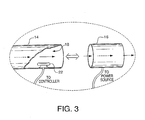
- FIG. 3 is a partial exploded front perspective view of the system 10A of FIG. 2 .
- FIG. 3 illustrates the embodiment of the present system 10A where a tubular ionizer 16 is coupled to the end of a discharge hose 14, i.e., at the discharge opening 18.
- a power line which is coupled to power source 20, is shown connected to the ionizer 16.
- the discharge hose 14 is shown with a static sensor 22 disposed therein.
- a signal line is shown connected to the sensor 22 and couples the controller 24 to the sensor 22.
- the flow path of the loose-fill insulation through the discharge hose 14 and ionizer 16 is shown by directional arrows.
- the method and system described above reduce or eliminate static charge on loose-fill insulation blown from a discharge hose.
- the system and method thereby improve control of the discharge stream while reducing waste and unwanted coverage by the blown insulation. Still further, these benefits may be obtained while eliminating or greatly reducing the use of expensive, corrosive and hydrophilic antistatic chemicals.
- Preconditioning is the process of taking high density bags of insulation and breaking the fiber into small, low density tufts of glass fiber that are conveyed through and air lock in the blowing machine and into a blowing hose. Preconditioning is achieved with paddles and an auger located in the bottom of the blowing machine. It should also be understood that loose fill insulation may include glass fibers, mineral wool, or cellulose, or combinations thereof, for example.
Landscapes
- Engineering & Computer Science (AREA)
- Architecture (AREA)
- Civil Engineering (AREA)
- Structural Engineering (AREA)
- Elimination Of Static Electricity (AREA)
Claims (13)
- System zum Einblasen eines Schüttgutdämmstoffs, welches folgendes aufweist:eine Schüttgut-Einblasmaschine (21) mit einem Ausgabeschlauch (14); unddadurch gekennzeichnet, dass das System ferner folgendes aufweist:- einen Ionisator (16), der in einem Strömungspfad des Dämmstoffs durch den Ausgabeschlauch angeordnet ist, wobei der Ionisator vor dem Ausgeben des Dämmstoffs eine an diesem aufgebaute statische Ladung reduziert,- einen in dem Strömungspfad angeordneten Statiksensor (22) zum Messen der statischen Ladung; und- eine Steuereinrichtung (24), die dazu ausgelegt ist, den Ionisator so zu steuern, dass die statische Ladung in Entsprechung zu einem von dem Statiksensor (22) erfassten Niveau einer statischen Ladung reduziert wird.
- System nach Anspruch 1, wobei der Ionisator (16) nahe einer Ausgabeöffnung (18) des Ausgabeschlauchs angeordnet ist.
- System nach Anspruch 1, wobei der Ionisator (16) eine Röhrenform besitzt.
- System nach Anspruch 1, wobei der Schüttgutdämmstoff Glasfaserdämmstoff beinhaltet.
- System nach Anspruch 1, wobei die Steuereinrichtung (24) eine speicherprogrammierbare Steuerung aufweist.
- Verfahren zum Reduzieren einer an einem Schüttgutdämmstoff aufgebauten statischen Ladung, dadurch gekennzeichnet, dass das Verfahren während des Einblasens die folgenden Schritte umfasst:Ionisieren des Dämmstoffs in einem Strömungspfad des Dämmstoffs, während der Dämmstoff ausgegeben wird, um die statische Ladung zu reduzieren, wobei der Ionisierungsschritt den folgenden Schritt umfasst:Anordnen eines Ionisators (16) in dem Strömungspfad, wobei der Strömungspfad einen Ausgabeschlauch (14) einer Schüttgut-Einblasmaschine aufweist,und das Verfahren ferner die folgenden Schritte umfasst:Messen eines Niveaus der statischen Ladung; undSteuern des Ionisators derart, dass die statische Ladung in Entsprechung zu einem Messwert des Niveaus reduziert wird.
- Verfahren nach Anspruch 6, wobei der Ionisator (16) nahe einer Ausgabeöffnung (18) des Ausgabeschlauchs (14) angeordnet wird.
- Verfahren nach Anspruch 6, wobei der Steuerschritt die Schritte des Einstellens einer Leistung des Ionisators (16) umfasst.
- Verfahren nach Anspruch 6, wobei der Schüttgutdämmstoff Glasfaserdämmstoff beinhaltet.
- Verfahren zum Einblasen eines Schüttgutdämmstoffs, welches die folgenden Schritte umfasst:Einblasen eines Schüttgutdämmstoffs unter Verwendung einer Schüttgut-Einblasmaschine (12) mit einem Ausgabeschlauch (14),dadurch gekennzeichnet, dass sich an dem Schüttgutdämmstoff in einem Strömungspfad durch den Ausgabeschlauch eine statische Ladung aufbaut, wobei das Verfahren folgendes umfasst:Ionisieren des Dämmstoffs in einem Strömungspfad des Dämmstoffs während der Ausgabe des Dämmstoffs, um die statische Ladung zu reduzieren, wobei der Ionisierungsschritt den Schritt des Anordnens eines Ionisators (16) in dem Strömungspfad umfasst,und das Verfahren ferner die Schritte des Messens eines Niveaus der statischen Ladung; unddes Steuerns des Ionisators zum Reduzieren der statischen Ladung in Entsprechung zu einem Messwert des Niveaus umfasst.
- Verfahren nach Anspruch 10, wobei der Ionisator (16) nahe einer Ausgabeöffnung des Ausgabeschlauchs (14) angeordnet wird.
- Verfahren nach Anspruch 10, wobei der Steuerschritt die Schritte des Einstellens einer Leistung des Ionisators (16) umfasst.
- Verfahren nach Anspruch 10, wobei der Schüttgutdämmstoff Glasfaserdämmstoff beinhaltet.
Applications Claiming Priority (3)
| Application Number | Priority Date | Filing Date | Title |
|---|---|---|---|
| US188950 | 2002-07-03 | ||
| US10/188,950 US6732960B2 (en) | 2002-07-03 | 2002-07-03 | System and method for blowing loose-fill insulation |
| PCT/US2003/021219 WO2004005800A1 (en) | 2002-07-03 | 2003-07-02 | System and method for blowing loose-fill insulation |
Publications (3)
| Publication Number | Publication Date |
|---|---|
| EP1540249A1 EP1540249A1 (de) | 2005-06-15 |
| EP1540249A4 EP1540249A4 (de) | 2009-05-06 |
| EP1540249B1 true EP1540249B1 (de) | 2012-12-05 |
Family
ID=29999582
Family Applications (1)
| Application Number | Title | Priority Date | Filing Date |
|---|---|---|---|
| EP03742437A Expired - Lifetime EP1540249B1 (de) | 2002-07-03 | 2003-07-02 | System und verfahren zum blasen von schüttdämmung |
Country Status (5)
| Country | Link |
|---|---|
| US (1) | US6732960B2 (de) |
| EP (1) | EP1540249B1 (de) |
| AU (1) | AU2003281341A1 (de) |
| DK (1) | DK1540249T3 (de) |
| WO (1) | WO2004005800A1 (de) |
Families Citing this family (9)
| Publication number | Priority date | Publication date | Assignee | Title |
|---|---|---|---|---|
| US7449125B2 (en) * | 2004-05-20 | 2008-11-11 | Guardian Fiberglass, Inc. | Insulation with mixture of fiberglass and cellulose |
| US7341416B1 (en) | 2004-12-30 | 2008-03-11 | Rubtsov Yuriy N | Machine and method to feed filled bags, open the bags, empty the bags, and dispose of the empty bags |
| US7448494B2 (en) * | 2005-08-10 | 2008-11-11 | Certain Teed Corporation | Loose fill insulation packaged with additive |
| US20080171201A1 (en) * | 2007-01-12 | 2008-07-17 | Houpt Ronald A | Graphite-Mediated Control of Static Electricity on Fiberglass |
| US8881773B2 (en) * | 2009-11-30 | 2014-11-11 | Owens Corning Intellectual Capital, Llc | Apparatus for removal of loosefill insulation |
| CA2726583C (en) * | 2010-02-15 | 2018-01-16 | Certainteed Corporation | System, method and apparatus for processing fiber materials |
| US9394684B1 (en) | 2015-03-03 | 2016-07-19 | Fiberlock Technologies, Inc. | Method and apparatus for an improved air barrier system |
| US11035134B2 (en) | 2017-10-27 | 2021-06-15 | Owens Corning Intellectual Capital, Llc | Systems for and methods of conditioning loosefill insulation material |
| EP4063585A1 (de) | 2021-03-23 | 2022-09-28 | CertainTeed LLC | Elektrostatisch reduzierendes system mit schlauch für leitung loser isolationsfüllstoffen |
Family Cites Families (20)
| Publication number | Priority date | Publication date | Assignee | Title |
|---|---|---|---|---|
| US4057071A (en) * | 1974-01-09 | 1977-11-08 | Gulf Research & Development Company | Electrostatic charge reducer |
| US4289980A (en) * | 1979-06-22 | 1981-09-15 | Mclaughlin Richard J | Touch sensitive electric switch |
| US4286210A (en) * | 1979-08-16 | 1981-08-25 | Vladimir Ignatjev | Air ion and charge detector |
| US4555447A (en) | 1984-08-09 | 1985-11-26 | Owens-Corning Fiberglas Corporation | Blowing wool insulation |
| US4882485A (en) * | 1987-08-10 | 1989-11-21 | Tracor, Inc. | Ion detector and associated removable ionizer inlet assembly |
| JPH0416045Y2 (de) * | 1987-11-16 | 1992-04-10 | ||
| US5351415A (en) * | 1992-05-18 | 1994-10-04 | Convey, Inc. | Method and apparatus for maintaining clean articles |
| US5539598A (en) * | 1994-12-08 | 1996-07-23 | International Business Machines Corporation | Electrostatic protection for a shielded MR sensor |
| US5535945A (en) * | 1995-02-27 | 1996-07-16 | Basf Corportion | Carpet recycling process and system |
| US6012263A (en) | 1996-01-22 | 2000-01-11 | Guardian Fiberglass, Inc. | Method of installing insulation with dry adhesive and/ or cold dye, and reduced amount of anti-static material |
| US5837064A (en) * | 1996-10-04 | 1998-11-17 | Eco-Snow Systems, Inc. | Electrostatic discharge protection of static sensitive devices cleaned with carbon dioxide spray |
| US5947646A (en) | 1997-02-25 | 1999-09-07 | Guardian Fiberglass, Inc. | System for blowing loose-fill insulation |
| US5898559A (en) * | 1997-07-10 | 1999-04-27 | Ionix Technologies, Inc. | Apparatus and method for neutralizing static electrical charges in gas pipeline |
| US5949635A (en) * | 1997-07-17 | 1999-09-07 | Botez; Dan D. C. | Ionizer for static electricity neutralization |
| US6503026B1 (en) * | 1997-09-12 | 2003-01-07 | Redi-Therm Insulation, Inc. | Static free method for blowing loose fill insulation |
| US6155020A (en) * | 1998-08-27 | 2000-12-05 | Deem; Thomas | Shredded carpet insulation |
| US6252756B1 (en) * | 1998-09-18 | 2001-06-26 | Illinois Tool Works Inc. | Low voltage modular room ionization system |
| US6419171B1 (en) * | 1999-02-24 | 2002-07-16 | Takayanagi Research Inc. | Static eliminator |
| US6150945A (en) * | 1999-03-25 | 2000-11-21 | 3M Innovative Properties Company | Static charge warning device |
| US6329052B1 (en) * | 1999-04-27 | 2001-12-11 | Albany International Corp. | Blowable insulation |
-
2002
- 2002-07-03 US US10/188,950 patent/US6732960B2/en not_active Expired - Fee Related
-
2003
- 2003-07-02 DK DK03742437.1T patent/DK1540249T3/da active
- 2003-07-02 EP EP03742437A patent/EP1540249B1/de not_active Expired - Lifetime
- 2003-07-02 AU AU2003281341A patent/AU2003281341A1/en not_active Abandoned
- 2003-07-02 WO PCT/US2003/021219 patent/WO2004005800A1/en not_active Ceased
Also Published As
| Publication number | Publication date |
|---|---|
| DK1540249T3 (da) | 2013-03-18 |
| WO2004005800A1 (en) | 2004-01-15 |
| EP1540249A4 (de) | 2009-05-06 |
| AU2003281341A1 (en) | 2004-01-23 |
| EP1540249A1 (de) | 2005-06-15 |
| US6732960B2 (en) | 2004-05-11 |
| US20040004136A1 (en) | 2004-01-08 |
Similar Documents
| Publication | Publication Date | Title |
|---|---|---|
| EP1540249B1 (de) | System und verfahren zum blasen von schüttdämmung | |
| CA2204685C (en) | Spray insulation components | |
| US4272935A (en) | Field-installed insulation and apparatus for and method of making and installing the same | |
| US5666780A (en) | Fiberglass/dry adhesive mixture and method of applying same in a uniform manner | |
| US10953418B2 (en) | Water spray applied loose-fill insulation | |
| US6503026B1 (en) | Static free method for blowing loose fill insulation | |
| US5454271A (en) | Method and apparatus for measuring powder flow rate | |
| US4462244A (en) | Apparatus for field testing a smoke detector | |
| US5393794A (en) | Insulation material and method using fly ash | |
| AU2016302429A1 (en) | Method and device for applying an insulation to buildings | |
| CA2557842C (en) | Spray-on insulation system with smooth bore hose and method | |
| US4038037A (en) | Apparatus for the manufacture of homogeneous, fine-pored synthetic resin foams | |
| CA2944266C (en) | Bulk insulation blowing machine with variable airflow distribution | |
| US7000458B2 (en) | Weighing equipment for concrete material | |
| DE69535617T2 (de) | Verfahren und vorrichtung zum herstellen und transportieren eines aerosols zum fernbeschichten und fernabdichten | |
| US7735755B2 (en) | Nozzle assembly, delivery system and method for conveying insulation material | |
| US20060118038A1 (en) | Wall scrubber for blown insulation | |
| NZ228407A (en) | Manufacture of electrical cables comprising application of a water/polyol mixture to prevent adhesion between the core and outer sheath | |
| US20250092692A1 (en) | Pour in place foam insulation for building components | |
| WO2011066499A2 (en) | Apparatus for removal of loosefill insulation | |
| CA2226341C (en) | Collector box with baffle system for use in spray-on fiber recycling system | |
| AT516431B1 (de) | Trocknungsvorrichtung | |
| JP2002039576A (ja) | 加湿方法及び加湿器 | |
| CN214926104U (zh) | 一种聚苯乙烯塑料颗粒的干燥除湿装置 | |
| Harrington et al. | Achieving and Certifying Building Envelope Air Tightness with an Aerosol-Based Automated Sealing Process |
Legal Events
| Date | Code | Title | Description |
|---|---|---|---|
| PUAI | Public reference made under article 153(3) epc to a published international application that has entered the european phase |
Free format text: ORIGINAL CODE: 0009012 |
|
| 17P | Request for examination filed |
Effective date: 20050201 |
|
| AK | Designated contracting states |
Kind code of ref document: A1 Designated state(s): AT BE BG CH CY CZ DE DK EE ES FI FR GB GR HU IE IT LI LU MC NL PT RO SE SI SK TR |
|
| AX | Request for extension of the european patent |
Extension state: AL LT LV MK |
|
| DAX | Request for extension of the european patent (deleted) | ||
| A4 | Supplementary search report drawn up and despatched |
Effective date: 20090403 |
|
| RIC1 | Information provided on ipc code assigned before grant |
Ipc: B05B 7/14 20060101ALI20090330BHEP Ipc: E04F 21/08 20060101AFI20090330BHEP |
|
| 17Q | First examination report despatched |
Effective date: 20090805 |
|
| GRAP | Despatch of communication of intention to grant a patent |
Free format text: ORIGINAL CODE: EPIDOSNIGR1 |
|
| GRAS | Grant fee paid |
Free format text: ORIGINAL CODE: EPIDOSNIGR3 |
|
| GRAA | (expected) grant |
Free format text: ORIGINAL CODE: 0009210 |
|
| RAP1 | Party data changed (applicant data changed or rights of an application transferred) |
Owner name: SAINT-GOBAIN ISOVER |
|
| AK | Designated contracting states |
Kind code of ref document: B1 Designated state(s): AT BE BG CH CY CZ DE DK EE ES FI FR GB GR HU IE IT LI LU MC NL PT RO SE SI SK TR |
|
| REG | Reference to a national code |
Ref country code: GB Ref legal event code: FG4D |
|
| REG | Reference to a national code |
Ref country code: CH Ref legal event code: EP |
|
| REG | Reference to a national code |
Ref country code: AT Ref legal event code: REF Ref document number: 587385 Country of ref document: AT Kind code of ref document: T Effective date: 20121215 |
|
| REG | Reference to a national code |
Ref country code: IE Ref legal event code: FG4D |
|
| REG | Reference to a national code |
Ref country code: DE Ref legal event code: R096 Ref document number: 60342762 Country of ref document: DE Effective date: 20130131 |
|
| REG | Reference to a national code |
Ref country code: DK Ref legal event code: T3 |
|
| REG | Reference to a national code |
Ref country code: SE Ref legal event code: TRGR |
|
| REG | Reference to a national code |
Ref country code: NL Ref legal event code: T3 |
|
| REG | Reference to a national code |
Ref country code: AT Ref legal event code: MK05 Ref document number: 587385 Country of ref document: AT Kind code of ref document: T Effective date: 20121205 |
|
| PG25 | Lapsed in a contracting state [announced via postgrant information from national office to epo] |
Ref country code: ES Free format text: LAPSE BECAUSE OF FAILURE TO SUBMIT A TRANSLATION OF THE DESCRIPTION OR TO PAY THE FEE WITHIN THE PRESCRIBED TIME-LIMIT Effective date: 20130316 |
|
| PG25 | Lapsed in a contracting state [announced via postgrant information from national office to epo] |
Ref country code: GR Free format text: LAPSE BECAUSE OF FAILURE TO SUBMIT A TRANSLATION OF THE DESCRIPTION OR TO PAY THE FEE WITHIN THE PRESCRIBED TIME-LIMIT Effective date: 20130306 Ref country code: SI Free format text: LAPSE BECAUSE OF FAILURE TO SUBMIT A TRANSLATION OF THE DESCRIPTION OR TO PAY THE FEE WITHIN THE PRESCRIBED TIME-LIMIT Effective date: 20121205 Ref country code: CY Free format text: LAPSE BECAUSE OF FAILURE TO SUBMIT A TRANSLATION OF THE DESCRIPTION OR TO PAY THE FEE WITHIN THE PRESCRIBED TIME-LIMIT Effective date: 20121205 |
|
| PG25 | Lapsed in a contracting state [announced via postgrant information from national office to epo] |
Ref country code: AT Free format text: LAPSE BECAUSE OF FAILURE TO SUBMIT A TRANSLATION OF THE DESCRIPTION OR TO PAY THE FEE WITHIN THE PRESCRIBED TIME-LIMIT Effective date: 20121205 |
|
| PG25 | Lapsed in a contracting state [announced via postgrant information from national office to epo] |
Ref country code: EE Free format text: LAPSE BECAUSE OF FAILURE TO SUBMIT A TRANSLATION OF THE DESCRIPTION OR TO PAY THE FEE WITHIN THE PRESCRIBED TIME-LIMIT Effective date: 20121205 Ref country code: SK Free format text: LAPSE BECAUSE OF FAILURE TO SUBMIT A TRANSLATION OF THE DESCRIPTION OR TO PAY THE FEE WITHIN THE PRESCRIBED TIME-LIMIT Effective date: 20121205 Ref country code: BG Free format text: LAPSE BECAUSE OF FAILURE TO SUBMIT A TRANSLATION OF THE DESCRIPTION OR TO PAY THE FEE WITHIN THE PRESCRIBED TIME-LIMIT Effective date: 20130305 Ref country code: CZ Free format text: LAPSE BECAUSE OF FAILURE TO SUBMIT A TRANSLATION OF THE DESCRIPTION OR TO PAY THE FEE WITHIN THE PRESCRIBED TIME-LIMIT Effective date: 20121205 |
|
| PG25 | Lapsed in a contracting state [announced via postgrant information from national office to epo] |
Ref country code: PT Free format text: LAPSE BECAUSE OF FAILURE TO SUBMIT A TRANSLATION OF THE DESCRIPTION OR TO PAY THE FEE WITHIN THE PRESCRIBED TIME-LIMIT Effective date: 20130405 Ref country code: RO Free format text: LAPSE BECAUSE OF FAILURE TO SUBMIT A TRANSLATION OF THE DESCRIPTION OR TO PAY THE FEE WITHIN THE PRESCRIBED TIME-LIMIT Effective date: 20121205 |
|
| PLBE | No opposition filed within time limit |
Free format text: ORIGINAL CODE: 0009261 |
|
| STAA | Information on the status of an ep patent application or granted ep patent |
Free format text: STATUS: NO OPPOSITION FILED WITHIN TIME LIMIT |
|
| 26N | No opposition filed |
Effective date: 20130906 |
|
| PG25 | Lapsed in a contracting state [announced via postgrant information from national office to epo] |
Ref country code: IT Free format text: LAPSE BECAUSE OF FAILURE TO SUBMIT A TRANSLATION OF THE DESCRIPTION OR TO PAY THE FEE WITHIN THE PRESCRIBED TIME-LIMIT Effective date: 20121205 |
|
| REG | Reference to a national code |
Ref country code: DE Ref legal event code: R097 Ref document number: 60342762 Country of ref document: DE Effective date: 20130906 |
|
| PG25 | Lapsed in a contracting state [announced via postgrant information from national office to epo] |
Ref country code: MC Free format text: LAPSE BECAUSE OF FAILURE TO SUBMIT A TRANSLATION OF THE DESCRIPTION OR TO PAY THE FEE WITHIN THE PRESCRIBED TIME-LIMIT Effective date: 20121205 |
|
| REG | Reference to a national code |
Ref country code: CH Ref legal event code: PL |
|
| REG | Reference to a national code |
Ref country code: IE Ref legal event code: MM4A |
|
| PG25 | Lapsed in a contracting state [announced via postgrant information from national office to epo] |
Ref country code: CH Free format text: LAPSE BECAUSE OF NON-PAYMENT OF DUE FEES Effective date: 20130731 Ref country code: LI Free format text: LAPSE BECAUSE OF NON-PAYMENT OF DUE FEES Effective date: 20130731 |
|
| PG25 | Lapsed in a contracting state [announced via postgrant information from national office to epo] |
Ref country code: IE Free format text: LAPSE BECAUSE OF NON-PAYMENT OF DUE FEES Effective date: 20130702 |
|
| PG25 | Lapsed in a contracting state [announced via postgrant information from national office to epo] |
Ref country code: TR Free format text: LAPSE BECAUSE OF FAILURE TO SUBMIT A TRANSLATION OF THE DESCRIPTION OR TO PAY THE FEE WITHIN THE PRESCRIBED TIME-LIMIT Effective date: 20121205 |
|
| PG25 | Lapsed in a contracting state [announced via postgrant information from national office to epo] |
Ref country code: HU Free format text: LAPSE BECAUSE OF FAILURE TO SUBMIT A TRANSLATION OF THE DESCRIPTION OR TO PAY THE FEE WITHIN THE PRESCRIBED TIME-LIMIT; INVALID AB INITIO Effective date: 20030702 Ref country code: LU Free format text: LAPSE BECAUSE OF NON-PAYMENT OF DUE FEES Effective date: 20130702 |
|
| REG | Reference to a national code |
Ref country code: FR Ref legal event code: PLFP Year of fee payment: 14 |
|
| REG | Reference to a national code |
Ref country code: FR Ref legal event code: PLFP Year of fee payment: 15 |
|
| REG | Reference to a national code |
Ref country code: FR Ref legal event code: PLFP Year of fee payment: 16 |
|
| PGFP | Annual fee paid to national office [announced via postgrant information from national office to epo] |
Ref country code: NL Payment date: 20190612 Year of fee payment: 17 |
|
| PGFP | Annual fee paid to national office [announced via postgrant information from national office to epo] |
Ref country code: DK Payment date: 20190710 Year of fee payment: 17 Ref country code: GB Payment date: 20190626 Year of fee payment: 17 Ref country code: FI Payment date: 20190709 Year of fee payment: 17 Ref country code: FR Payment date: 20190718 Year of fee payment: 17 Ref country code: DE Payment date: 20190618 Year of fee payment: 17 Ref country code: SE Payment date: 20190710 Year of fee payment: 17 |
|
| PGFP | Annual fee paid to national office [announced via postgrant information from national office to epo] |
Ref country code: BE Payment date: 20190725 Year of fee payment: 17 |
|
| REG | Reference to a national code |
Ref country code: DE Ref legal event code: R119 Ref document number: 60342762 Country of ref document: DE |
|
| REG | Reference to a national code |
Ref country code: FI Ref legal event code: MAE |
|
| REG | Reference to a national code |
Ref country code: DK Ref legal event code: EBP Effective date: 20200731 |
|
| REG | Reference to a national code |
Ref country code: SE Ref legal event code: EUG |
|
| REG | Reference to a national code |
Ref country code: NL Ref legal event code: MM Effective date: 20200801 |
|
| GBPC | Gb: european patent ceased through non-payment of renewal fee |
Effective date: 20200702 |
|
| REG | Reference to a national code |
Ref country code: BE Ref legal event code: MM Effective date: 20200731 |
|
| PG25 | Lapsed in a contracting state [announced via postgrant information from national office to epo] |
Ref country code: NL Free format text: LAPSE BECAUSE OF NON-PAYMENT OF DUE FEES Effective date: 20200801 Ref country code: FR Free format text: LAPSE BECAUSE OF NON-PAYMENT OF DUE FEES Effective date: 20200731 Ref country code: GB Free format text: LAPSE BECAUSE OF NON-PAYMENT OF DUE FEES Effective date: 20200702 Ref country code: FI Free format text: LAPSE BECAUSE OF NON-PAYMENT OF DUE FEES Effective date: 20200702 |
|
| PG25 | Lapsed in a contracting state [announced via postgrant information from national office to epo] |
Ref country code: BE Free format text: LAPSE BECAUSE OF NON-PAYMENT OF DUE FEES Effective date: 20200731 Ref country code: DE Free format text: LAPSE BECAUSE OF NON-PAYMENT OF DUE FEES Effective date: 20210202 Ref country code: SE Free format text: LAPSE BECAUSE OF NON-PAYMENT OF DUE FEES Effective date: 20200703 |
|
| PG25 | Lapsed in a contracting state [announced via postgrant information from national office to epo] |
Ref country code: DK Free format text: LAPSE BECAUSE OF NON-PAYMENT OF DUE FEES Effective date: 20200731 |